FEDERAL COURT OF AUSTRALIA
Australian Competition and Consumer Commission v Boost Tel Pty Limited [2010] FCA 701
| Citation: | Australian Competition and Consumer Commission v Boost Tel Pty Limited [2010] FCA 701 | |
| | | |
| Parties: | AUSTRALIAN COMPETITION AND CONSUMER COMMISSION v BOOST TEL PTY LIMITED (ACN 092 384 417) and PREPAID SERVICES PTY LIMITED (ACN 094 689 219) | |
| | | |
| File number: | WAD 125 of 2009 | |
| | | |
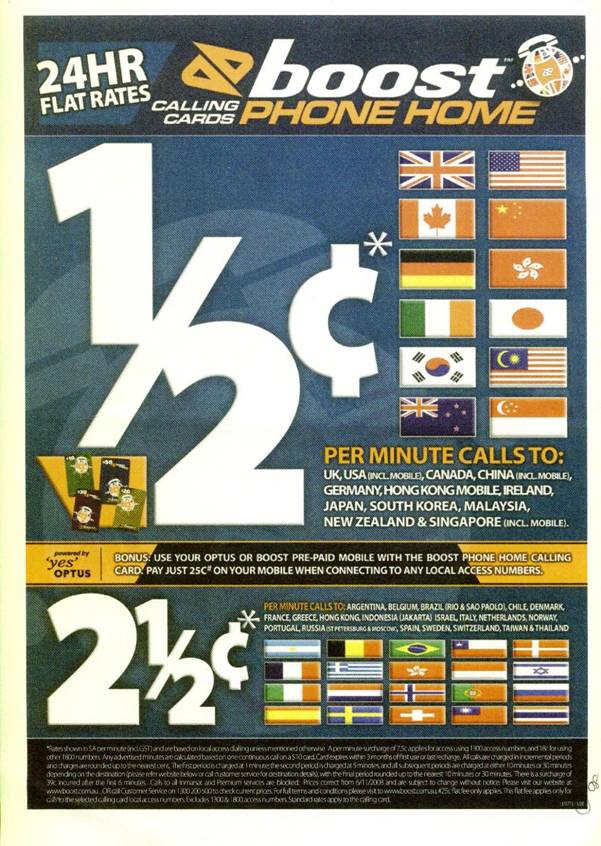
| Judge: | SIOPIS J | |
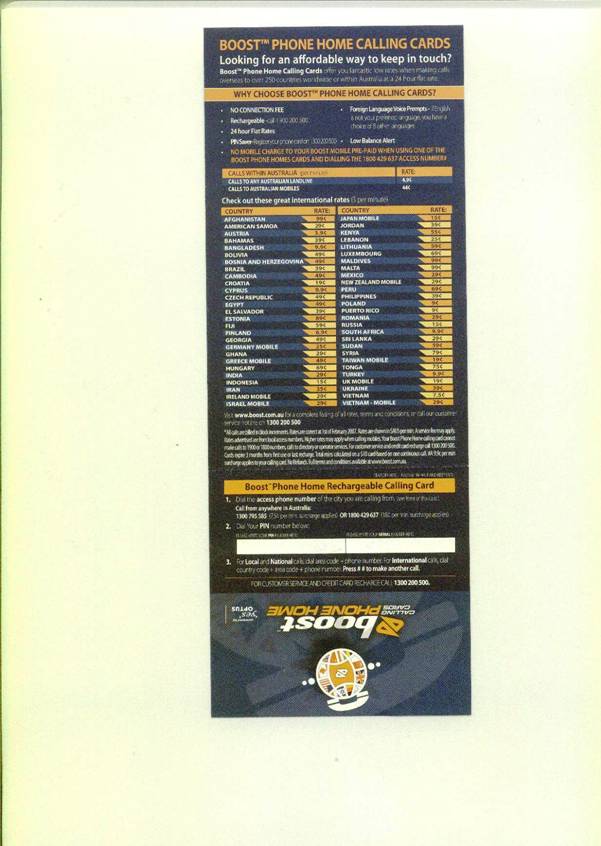
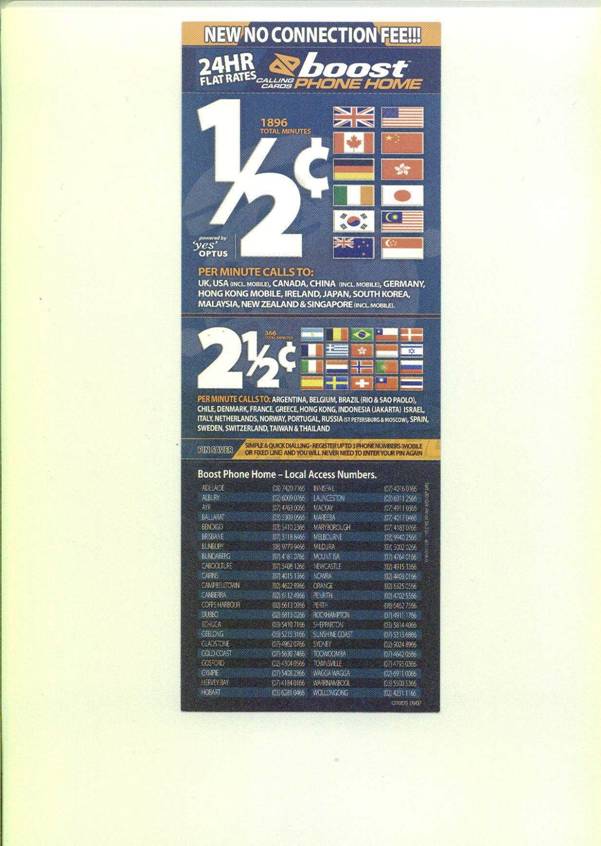
| | | |
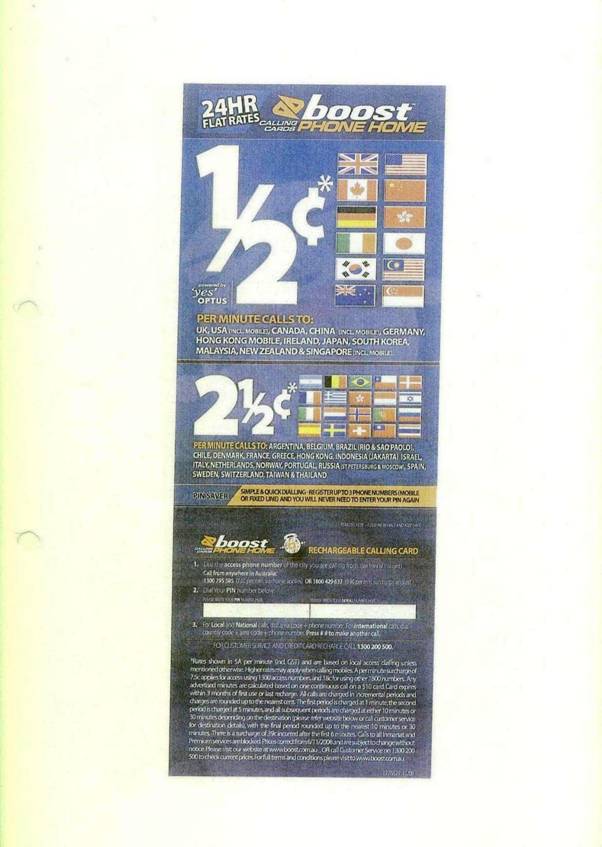
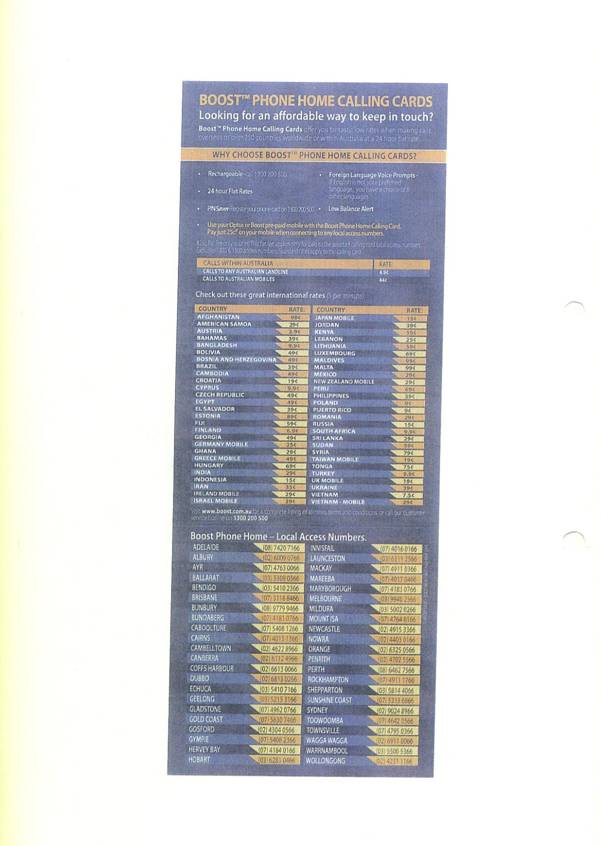
| Date of judgment: | 5 July 2010 | |
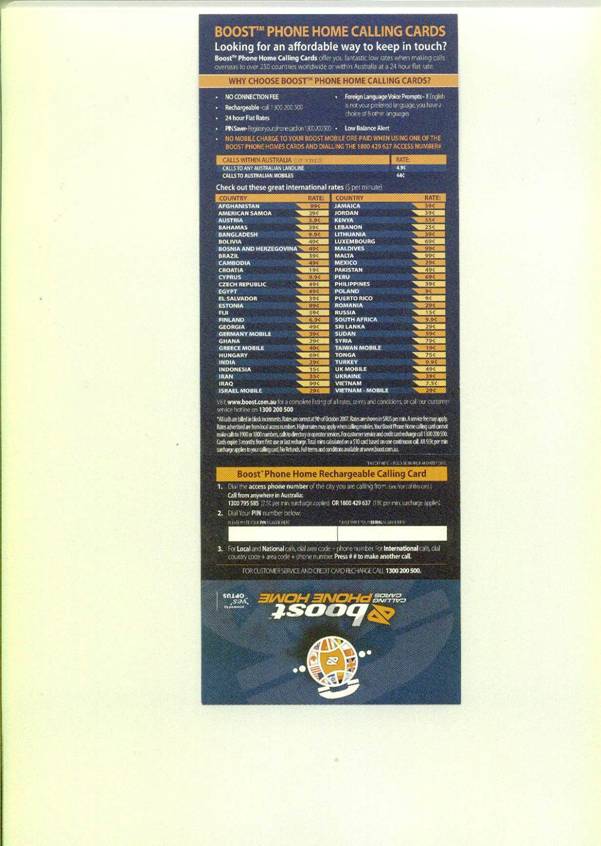
| | | |
| Catchwords: | ||
| | | |
| Legislation: | ||
| | | |
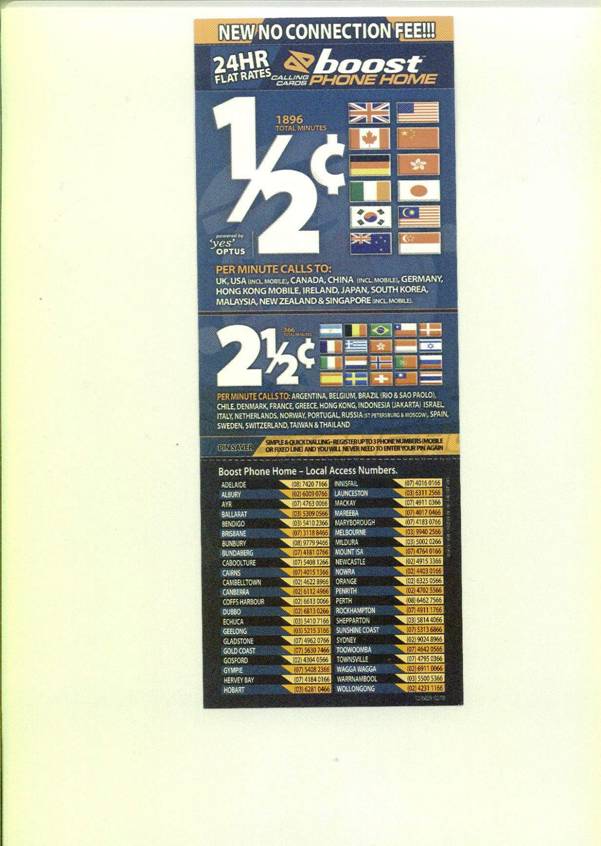
| Cases cited: | Parkdale Custom Built Furniture Proprietary Limited v Puxu Proprietary Limited (1982) 149 CLR 191 Darwin Bakery Pty Ltd v Sully (1981) 36 ALR 371 Australian Competition and Consumer Commission v Tel.Pacific Limited [2009] FCA 279 Medical Benefits Fund of Australia Ltd v Cassidy (2003) 135 FCR 1 | |
|
|
| |
| Date of hearing: | 10 December 2009 | |
|
|
| |
| Date of last submissions: | 23 December 2009 | |
|
|
| |
| Date of Publication of Orders: | 12 July 2010 | |
|
|
| |
| Place: | Perth | |
|
|
| |
| Division: | GENERAL DIVISION | |
|
|
| |
| Category: | Catchwords | |
|
|
| |
| Number of paragraphs: | 124 | |
|
|
| |
| Counsel for the Applicant: | Mr W Keane | |
|
|
| |
| Solicitor for the Applicant: | Corrs Chambers Westgarth | |
|
|
| |
| Counsel for the First Respondent: |
Mr D Perrignon | |
|
|
| |
| Solicitor for the First Respondent: |
Makinson & d’Apice Lawyers | |
|
|
| |
| Solicitor for the Second Respondent: |
Minter Ellison | |
| IN THE FEDERAL COURT OF AUSTRALIA |
|
| WESTERN AUSTRALIA DISTRICT REGISTRY |
|
| GENERAL DIVISION | WAD 125 of 2009 |
| AUSTRALIAN COMPETITION AND CONSUMER COMMISSION Applicant
| |
| AND: | BOOST TEL PTY LIMITED (ACN 092 384 417) First Respondent
PREPAID SERVICES PTY LIMITED (ACN 094 689 219) Second Respondent
|
| JUDGE: | |
| DATE OF PUBLICATION OF ORDERs: |
12 JULY 2010 |
| WHERE MADE: | PERTH |
THE COURT DECLARES THAT:
(a) engaged in conduct that was misleading or deceptive or likely to mislead or deceive, in contravention of section 52(1) of the Trade Practices Act 1974 (Cth);
(b) in connexion with the supply or possible supply of services or in connexion with the promotion of the supply or use of services, falsely represented that the services were of a particular value, in contravention of section 53(aa) of the Trade Practices Act; and
(c) in connexion with the supply or possible supply of services or in connexion with the promotion of the supply or use of services, represented that the services had performance characteristics or benefits that they did not have, in contravention of section 53(c) of the Trade Practices Act,
by publishing, in relation to the Boost pre-paid phone cards (Boost Cards), advertising material, which contained the statements “24Hr Flat Rates” and “New No Connection Fee!!!” and thereby represented that no fees other than timed call charges applied to the use of the Boost Cards (Boost No Fee Representation), when, in fact, an in-call surcharge applied to the Boost Cards and calls made using the Boost Cards.
2. Boost, from at least February 2007 until the date of this order, in trade or commerce:
(a) engaged in conduct that was misleading or deceptive or likely to mislead or deceive in contravention of section 52(1) of the Trade Practices Act;
(b) in connexion with the supply or possible supply of services or in connexion with the promotion of the supply or use of services, falsely represented that the services were of a particular value, in contravention of section 53(aa) of the Trade Practices Act;
(c) in connexion with the supply or possible supply of services or in connexion with the promotion of the supply or use of services, represented that the services had performance characteristics or benefits that they did not have, in contravention of section 53(c) of the Trade Practices Act; and
(d) made false or misleading representation with respect to the price of services, in contravention of section 53(e) of the Trade Practices Act;
by publishing, in relation to the Boost pre-paid phone cards (Boost Cards), advertising material, which contained the statements to the effect that calls to certain locations were charged at certain rates per minute on those cards and thereby represented that regardless of the number and length of calls, users will be able to achieve the stipulated call rate for the location and type of connexion (landline or mobile) specified (Boost Call Rate Representations), when, in fact:
(e) the stipulated call rate could, at best, only be achieved if:
(A) one continuous call were made; or
(B) calls made precisely matched the length of the charging increments specified in the applicable terms and conditions (up to but not exceeding the time at which any in-call surcharge is applied); and
(f) the stipulated call rate is unlikely to be achieved because the actual cost of calls made using the relevant Card is increased by the fact that calls were charged in incremental periods, an in-call surcharge applied and other additional fees and charges were payable in respect of certain calls; and
(g) statements made in the fine print in the relevant advertising material did not negate or diminish the falsity or the misleading or deceptive nature of the Boost Call Rate Representations.
3. Boost, from at least February 2007 until the date of this order, in trade or commerce:
(a) engaged in conduct that was misleading or deceptive or likely to mislead or deceive, in contravention of section 52(1) of the Trade Practices Act;
(b) in connexion with the supply or possible supply of services or in connexion with the promotion of the supply or use of services, falsely represented that the services were of a particular value, in contravention of section 53(aa) of the Trade Practices Act;
(c) in connexion with the supply or possible supply of services or in connexion with the promotion of the supply or use of services, represented that the services had performance characteristics or benefits that they did not have, in contravention of section 53(c) of the Trade Practices Act; and
by publishing, in relation to the Boost pre-paid phone cards (Boost Cards), advertising material, which contained the statements to the effect that a stipulated number of minutes or calls was available on that card and thereby represented that regardless of the number and length of calls, users will be able to achieve the total stipulated call duration for the location and type of connexion (landline or mobile) specified (Boost Call Duration Representations), when, in fact:
(d) the stipulated call rate could, at best, only be achieved if:
(i) one continuous call were made; or
(ii) calls made precisely matched the length of the charging increments specified in the applicable terms and conditions (up to but not exceeding the time at which any in-call surcharge is applied); and
(e) the number of available minutes is diminished by the fact that calls were charged in incremental periods, an in-call surcharge applied and other additional fees and charges were payable in respect of certain calls; and
(f) statements made in the fine print in the relevant advertising material did not negate or diminish the falsity or the misleading or deceptive nature of the Boost Call Duration Representations.
the court orders that:
Boost Injunctions
4. Boost, whether by itself, its servants or agents or otherwise howsoever in connexion with the supply or possible supply of telecommunication services by way of telecommunications products known as “calling cards” or “pre-paid phone cards” (Cards), in trade or commerce, for a period of 2 years from the date of the Court’s order be required, when making representations as to the price (including any rate, charge or fee) or duration of use of the telecommunication services available by way of its Cards to sufficiently disclose the following matters:
(a) all fees applicable to the use of the Card;
(b) the applicable rates and charges including surcharges;
(c) any charging by incremental periods;
(d) any qualifications on the stipulated call duration; and
(e) any qualifications on the stipulated call rate per minute.
5. Boost, whether by itself, its servants or agents or otherwise howsoever in connexion with the supply or possible supply of telecommunication services by way of Cards be restrained for a period of 2 years from the date of the Court’s order, in trade or commerce, from:
(a) representing that no fees other than the timed call charges apply to the use of Cards when other fees are applicable;
(b) representing that a stipulated number of minutes is available for calls using a specified Card when the stipulated call duration can only be achieved by making:
(i) one continuous phone call; or
(ii) a particular number of calls precisely corresponding to the increments of time in which the cost of a call is charged;
(c) representing that a stipulated number of minutes is available for calls using a Card without sufficiently disclosing:
(i) any charging by incremental periods;
(ii) that call charges are rounded up; and
(iii) all applicable fees, including:
(A) any surcharges; and
(B) any higher rates that are payable in respect of certain calls;
(d) representing that a Card can be used for calls at a stipulated call rate per minute for the location and type of connexion (landline or mobile) specified without sufficiently disclosing:
(i) any charging by incremental periods;
(ii) that call charges are rounded up; and
(iii) all applicable fees, including:
(A) any surcharges; and
(B) any higher rates that are payable in respect of certain calls.
Boost Corrective Advertising
6. Boost, within 21 days of the date of this order, shall take all reasonable steps to cause the Boost advertising material and any of its other promotional material that contains representations with similar purport or effect to the No Fee Representations, the Boost Call Duration Representations and the Boost Call Rate Representations to be removed from display and further publication by retailers or any other person.
7. Boost, within 21 days of the date of this order, shall cause to be published a notice in the terms and form set out in Schedule 1 (Boost Notice) including the font size and form specified in the Boost Notice and with the business logo on the top of the Boost Notice as appearing on Boost letterhead, and
(a) distribute or cause to be distributed the Boost Notice to its Card retailers and take reasonable steps and use its best endeavours to require the display of the Boost Notice in the form of an A4 poster in the same locations as the Boost Advertising Material was located for a period of 90 days;
(b) cause the Boost Notice to be published on the Internet at the homepage of all websites which are owned, operated or maintained by or on behalf of Boost, including the website accessible via uniform resource located at the address (URL) www.boost.com.au (Boost Website) (or if any such URL is replaced or changed, the Internet home page of the corresponding website) for a period of 90 days and use its best endeavours to ensure that:
(i) the Boost Notice is to be viewable by clicking a “click-through” icon located on the Boost Website;
(ii) the “click-through” icon referred to in the previous sub-paragraph is located in a central position on the page first accessed when the user opens to the homepage of the Boost Website (or the first page of the calling cards section of the Boost Website if changes are made to the Boost Website);
(iii) the “click-through” icon shall contain the words “Misleading Advertising by Boost – Corrective Notice Ordered by Federal Court of Australia” clearly and prominently in red on a contrasting background and the words “click here”; and
(iv) the Boost Notice occupies the entire webpage which is accessed via the “click-through” icon referred to above.
Boost Community Service Orders
8. Within 21 days of the date of this order, Boost shall send by mail to its 20 largest competitors copies of:
(a) the notice attached in Schedule 2;
(b) these orders; and
(c) any reasons for decision given with these orders.
Boost Compliance Program
9. Boost, within 21 days of the date of this order, shall establish a compliance policy and associated complaints handling system, training and review system in accordance with the program set out in Schedule 3 (Boost Compliance Program).
10. Boost shall maintain and operate the Boost Compliance Program for a period of three years from the date of this order.
Costs
11. The first respondent is to pay the applicant’s costs.
SCHEDULE 1
Boost Tel Pty Limited (Boost) found by Court to have made false representations regarding phone cards
The Federal Court declared that Boost engaged in false misleading or deceptive conduct in relation to cards promoted from at least February 2007 to 5 July 2010 by:
§ representing that no fees other than timed call charges would apply when, in fact, an in-call surcharge applied
§ representing that, on the cards:
o a certain number of minutes was available
o a certain call rate per minute was available
when in fact:
o total number of minutes and stipulated call rate could, at best, be achieved if:
§ one continuous call was made, or
§ calls made precisely matched particular charging increments;
o number of minutes available and call rate per minute were diminished in value by an in-call surcharge and other additional fees and charges which applied in respect of certain calls.
Consumers are urged to make sure they are aware of all applicable fees and charges when buying phone cards.
The Australian Competition and Consumer Commission brought the proceedings in the Federal Court of Australia in relation to breaches of sections 52(1), 53(aa) and 53(c) of the Trade Practices Act 1974 which prohibit false, misleading or deceptive conduct.
The Court made orders that restrained Boost from engaging in similar conduct for a period of 2 years, required it to publish this notice and to implement a trade practices compliance program. A copy of the decision and the detailed orders can be found at www.fedcourt.gov.au.
_____________________________________________________________________________
SCHEDULE 2
Federal Court declares Boost engaged in false, misleading or deceptive conduct in advertising its pre-paid phone cards
Following legal action by the Australian Competition and Consumer Commission (ACCC), the Federal Court of Australia declared Boost Tel Pty Limited (Boost) made false, misleading or deceptive representations in contravention of sections 52(1), 53(aa), 53(c) and 53(e) of the Trade Practices Act 1974 (Cth) (Act).
Boost engaged in the offending conduct over a sustained period of time in connexion with statements it made in advertising for the sale of its pre-paid phone card.
The Court declared that Boost’s conduct contravened the Act because it represented in relation to its phone card that no fees other than timed call charges would apply, when in fact an in-call surcharge was charged for calls beyond certain durations.
The Court also declared Boost contravened the Act because it represented that certain phone cards would have a specific number of minutes’ call time or a stipulated rate per minute when this was not the case. The total stipulated call duration and rate per minute could at best be achieved if one continuous call was made or calls made were precisely 1 or 5 minutes in length.
Further, calls on the Boost card were charged in incremental periods, diminishing the total number of minutes available for use of the card for multiple calls if the call durations did not match the incremental periods. Each of the incremental charging periods and the in‑call surcharges diminished the value of the card and number of minutes available while increasing the cost of the calls.
The Court made orders that restrained Boost from engaging in similar conduct for a period of 2 years, required Boost to publish this notice and to implement a trade practices compliance program and to pay the ACCC’s costs of the proceeding.
A copy of the decision can be found at www.fedcourt.gov.au.
SCHEDULE 3
BOOST TRADE PRACTICES COMPLIANCE AND EDUCATION / TRAINING PROGRAM
Interpretation
1. In this Annexure:
(a) “ACCC” means the Australian Competition and Consumer Commission;
(b) “Act” means the Trade Practices Act 1974 (Cth);
(c) “Compliance Officer” means the person appointed under paragraph 2 or paragraph 3 below;
(d) “Compliance Program” means the Trade Practices Compliance and Education / Training Program in this Annexure;
(e) “Court’s Order” means the relevant order(s) of the Federal Court of Australia made in these proceedings;
(f) “Relevant Provisions” means sections 52(1), 53(aa), 53(c) and 53(e) of the Act which were contravened by the Contravening Conduct, and Division 1 of Part V of the Act which deals with similar or related conduct.
Compliance Officer
2. Boost must, within 28 days of the date of the Court’s Order, appoint a Director or a senior employee with suitable qualifications or experience in corporate compliance as Compliance Officer with responsibility for ensuring that the Compliance Program is effectively established, maintained and administered in accordance with the Court’s Order.
3. After the appointment of the Compliance Officer in accordance with paragraph 2, Boost must take all reasonable steps to ensure that, for the duration of the Court’s Order, there is a Director or a senior employee with suitable qualifications or experience in corporate compliance appointed as Compliance Officer with responsibility for ensuring that the Compliance Program is effectively established, maintained and administered in accordance with the Court’s Order.
4. Boost must take all reasonable steps to ensure that for the duration of the Court’s Order the Compliance Officer discharges his or her responsibility of ensuring that the Compliance Program is effectively established, maintained and administered in accordance with the Court’s Order.
Compliance Officer Training
5. Boost will:
(a) ensure that, within 90 days of the date of the Court’s Order, the Compliance Officer attends practical trade practices training focusing on the Relevant Provisions of the Act;
(b) ensure that the training is administered by a suitably qualified, compliance professional or legal practitioner with expertise in trade practices law;
(c) within 14 days of completion of training, provide the ACCC with a written statement from the trade practices professional confirming the completion of the training conducted in accordance with 5(a) and 5(b) above.
Staff Training
6. Boost will cause all employees of Boost whose duties could result in them being concerned with conduct that may contravene the Relevant Provisions of the Act to receive regular (at least once a year) practical training that focuses on the Relevant Provisions of the Act.
Complaints Handling
7. Boost will:
(a) develop procedures for recording, storing and responding to trade practice complaints within six weeks of the Court’s Order; and
(b) provide the ACCC with an outline of the complaint handling system within two months of the Court’s Order.
8. The implementation and continuing effectiveness of the Compliance Program will be regularly discussed at management meetings.
Review
9. If requested by the ACCC, Boost shall, at its own expense, provide copies of documents and information in respect of matters which are the subject of the Compliance Program.
10. In the event the ACCC has sufficient reason to suspect that the Compliance Program is not being implemented effectively, Boost shall, at its own expense and if requested by the ACCC, cause an interim or additional Review to be conducted and cause the resulting Review Report to be provided to the ACCC.
Note:Settlement and entry of orders is dealt with in Order 36 of the Federal Court Rules.
The text of entered orders can be located using Federal Law Search on the Court’s website.
| IN THE FEDERAL COURT OF AUSTRALIA |
|
| WESTERN AUSTRALIA DISTRICT REGISTRY |
|
| GENERAL DIVISION | WAD 125 of 2009 |
| BETWEEN: | AUSTRALIAN COMPETITION AND CONSUMER COMMISSION Applicant
|
| AND: | BOOST TEL PTY LIMITED (ACN 092 384 417) First Respondent
PREPAID SERVICES PTY LIMITED (ACN 094 689 219) Second Respondent
|
| JUDGE: | SIOPIS J |
| DATE: | 5 JULY 2010 |
| PLACE: | PERTH |
REASONS FOR JUDGMENT
1 The first respondent (Boost) is a marketing company which distributes branded prepaid cards for making international calls using services provided by Optus Networks Pty Ltd. These cards are usually referred to as “calling cards” or “phone cards”.
2 The second respondent (PPS) is a wholly owned subsidiary of Optus Mobile Pty Ltd. It distributes and sells approximately 38 different brands of phone cards to outlets, which supply the phone cards to consumers.
3 Each of Boost and PPS has published advertising material advertising the phone cards.
4 In this proceeding, the applicant (ACCC) claimed that each of Boost and PPS has published advertising material which contained false and misleading or deceptive representations; and that in publishing that material each of Boost and PPS, has contravened the Trade Practices Act 1974 (Cth). The ACCC and PPS have, save for minor differences, agreed to the making of consent orders in respect of the claim made by the ACCC against PPS. However, Boost contested the claim made by the ACCC. These reasons deal with the claim made by the ACCC against Boost.
5 The phone cards distributed by Boost are purchased by persons who wish to make telephone calls to foreign countries using the credit allocated to the phone card. The means of making such a call is to call a local access number, which is identified on the card, and then to enter the personal identification number (PIN), which is also contained on the card.
6 The phone cards are available for purchase by consumers in Australia at newsagents and other outlets. Boost has published a number of posters and flyers advertising the phone cards. The posters are, or have been, on display at these outlets and the flyers are, or have been, distributed at these outlets as well. As mentioned, the ACCC alleges that, by publishing these posters and flyers, Boost has contravened provisions of the Trade Practices Act, on the grounds that the impugned posters and flyers contain representations which are misleading or deceptive, or are false.
7 The ACCC has identified four documents published by Boost which are alleged to contain one or more of the impugned representations. Each of the documents contains information about the use of the phone cards and the rates charged for calls made using the cards.
8 The first document is an A4 sized poster dated 6 November 2008 (the Boost poster). A reproduction of the poster is annexed to these reasons, and is marked “Annexure A”.
9 The second document is a flyer dated 6 November 2008 (the November 2008 flyer). A reproduction of the document is annexed to these reasons, and is marked “Annexure B”.
10 The third document is a flyer dated 9 October 2007 (the October 2007 flyer). A reproduction of the document is annexed to these reasons, and is marked “Annexure C”.
11 The fourth document (the February 2007 flyer) is an earlier version of the October 2007 flyer. It was published in February 2007. A reproduction of the document is annexed to these reasons, and is marked “Annexure “D”.
12 I observe that each of the annexures referred to above, is a reproduction on a smaller scale than that of each of the original documents.
13 The ACCC has alleged that the impugned representations were made in one or more of these documents. The ACCC alleged that there were three such representations. I now turn to the first of the three representations.
the no fee representation
14 The ACCC alleged that by publishing each of the February 2007 and October 2007 flyers, Boost made a representation in each of those documents, that no fees other than timed call charges would apply to calls made using the Boost phone cards. This representation was referred to during the trial as the “no fee representation”. It was contended that in publishing the documents which contained that representation, Boost has engaged in conduct in contravention of ss 52, 53(aa) and 53(c) of the Trade Practices Act.
15 The first question is whether the flyers did contain the representation alleged by the ACCC. This calls for an examination of the contents of the flyers. Each of the flyers is a single sheet document which contains printing on both sides of the document.
16 The statement “NEW NO CONNECTION FEE!!!” appears across the whole of the top of the front page of the flyer. The statement is in capital letters in large font. Immediately below that statement and on the left-hand side of the flyer is the following notation:
24HR
FLAT RATES
17 The statement “½ c per minute calls” appears immediately below the “24hr flat rates” notation. The notation “½ c” is in even larger font than the phrases, “new no connection fee!!!” and “24hr flat rates”, and dominates the front page of the flyer occupying about one‑sixth of the total surface area of the front page of the flyer. Adjacent to the “½ c” notation, are pictures of the flags of the countries to which the half cent per minute call rate applies.
18 Beneath the “½ c per minute calls” notation, is another notation advertising call rates at 2½ cents per minute to a number of different countries. The notation “2½ c” is also in large font and comprises the second most prominent notation, behind the “½ c” notation, on the front page of the flyer.
19 The reverse of the flyer contains a list of call rates for calls to a number of countries not referred to on the front. The reverse of the flyer also contains a paragraph of “small print”. The small print is in very small font and occupies about one-tenth of the total surface area of the back page of the flyer.
20 Among the small print is the following statement: “A service fee may apply”.
21 The ACCC said that the combination and juxtaposition of the “NEW NO CONNECTION FEE!!!” and the “24HR FLAT RATES” statements give rise to an implied representation that no fees other than timed call charges would apply to the use of the Boost cards. The ACCC contended that the prominent words on the front page mention only that the connection fee is no longer charged while the fact that a new fee may be charged is buried in the fine print on the reverse side of the flyer. The ACCC contended that “what the headline gives, the fine print takes away”.
22 Boost accepted that an in-call surcharge of 39 cents applied to calls made using the phone cards after six minutes of any call. However, Boost contended that it was not open to imply the representation contended for by the ACCC, from a consideration of each of the flyers as a whole. It was necessary, said Boost, to have regard to the statements which were made in the small print on the reverse of the flyer.
23 Further, Boost contended that the target market for the phone cards was young English speaking travellers. Boost said that it was, therefore, to be accepted that the class of consumers to whom the advertisements were addressed, would have a “more sophisticated approach to the consumption of telephony services”. Boost went on to contend that, therefore, it was likely that a reasonable consumer of the Boost phone card services, taking reasonable care for his or her own interests, would have heard of, or known of, the likelihood that a phone card may contain charges other than a timed call rate; and that a timed call rate is only a component of the effective or overall costs of the call. Boost said that its additional fees were “well within the industry range”.
24 Boost also contended that because the flyer was a document intended to be hand held, a reasonable consumer taking reasonable care of his or her interests, would be expected to read the whole of the document as one would read a contract. In this respect, Boost said, the document was different to a poster. The words in the central portion of the flyer which disclosed the existence of the surcharge, were available to be read.
25 Boost went on to contend that, accordingly, a reasonable consumer would not have construed the statements in the flyer in the manner alleged by the ACCC and would not have been misled. Further, said Boost, the Court should infer from the fact that the ACCC had not led any evidence of any consumer having been misled that consumers were not misled.
26 Whether conduct is misleading or deceptive for the purposes of s 52 of the Trade Practices Act, is to be assessed by reference to its effect, or likely effect, on reasonable members of the relevant class of consumers.
27 In the case of Parkdale Custom Built Furniture Proprietary Limited v Puxu Proprietary Limited (1982) 149 CLR 191 (Parkdale), Gibbs CJ observed at 199:
It seems clear enough that consideration must be given to the class of consumers likely to be affected by the conduct. Although it is true, as has often been said, that ordinarily a class of consumers may include the inexperienced as well as the experienced, and the gullible as well as the astute, the section must in my opinion by [sic] regarded as contemplating the effect of the conduct on reasonable members of the class. The heavy burdens which the section creates cannot have been intended to be imposed for the benefit of persons who fail to take reasonable care of their own interests. What is reasonable will or [sic] course depend on all the circumstances.
28 Mr Paul John O’Neile, the Chief Executive Officer of Boost, gave evidence at the trial. Mr O’Neile deposed that suppliers of calling cards like Boost, generally purchased call time to particular call destinations from carriers at wholesale rates and resold that time to the consumer at a margin. In order to provide the service at particular rates, the carrier allocated to the supplier of the calling card, specific local access numbers. A consumer who purchased the calling card then used the calling card by calling the most convenient local access number and then keyed in the relevant PIN details.
29 Mr O’Neile also deposed that in February 2007, Boost had by the time of the publication of the flyers, removed the connection fee and had replaced that fee with an in-call surcharge fee of 39 cents charged after six minutes of any call. Mr O’Neile said that an in‑call surcharge fee was, in effect, a fairer fee because a connection fee could be incurred even when no conversation had been possible by a caller, for example, where the call had been answered by an answering machine.
30 Mr O’Neile went on to depose that the target market for the cards was English speaking travellers in the “Youth Segment”. Mr O’Neile referred to the “Youth Segment” as being persons in the age group of 14 to 24 years old. However, Mr O’Neile made it clear that Boost did not sell phone cards and other telecommunication services to persons below the age of 18 years. It would be the parents of persons below 18 years who purchased the services.
31 Mr O’Neile also exhibited to his affidavit, photographs taken by a Boost employee of advertisements for phone cards which were on display in a Sydney store. There were a large number of advertisements. Mr O’Neile went on to say that there were a very large number of competitors who advertised in a similar style to that used by Boost. Mr O’Neile also annexed to his affidavit, a number of posters from competitors in the industry which advertised in this manner.
32 Boost also tendered a bundle of advertising material from other suppliers of phone cards to demonstrate that Boost’s competitors engaged in advertising of a similar style to that used by Boost. The tendered advertisements showed that great prominence was given to the timed rate and the number of minutes available for making calls.
33 It was, on the basis of Mr O’Neile’s evidence that the target market for the phone cards was young English speaking travellers, that Boost contended that the relevant class of consumers likely to be affected by Boost’s conduct would be comprised of persons with a knowledge of, and capacity to, assess technology products and services and who had a more sophisticated approach to the consumption of telephony services.
34 In my view, the class of consumers likely to be affected by Boost’s impugned conduct would embrace a wider range of persons than the target market for the phone cards referred to by Mr O’Neile.
35 First, the phone cards by their very nature are facilitative of international telephone communications. It follows that the range of potential users of the cards would include tourists and travellers to Australia, as well as residents of Australia, with relatives and friends in foreign countries. There is no reason to restrict the class of persons who would wish to make international phone calls using the services provided by the phone cards, only to persons within the 14 to 24 years old category.
36 Secondly, I also infer that a substantial number of potential users of the phone cards would not have English as their first language. This inference is founded on the fact that most of the international destinations listed in the advertising material for the phone card services are non-English speaking countries. Further, the fact that the market for the services includes persons whose first language is not English is recognised in Boost’s own advertising material. Each of the impugned Boost flyers contains the following notation:
Foreign Language Voice Prompts – If English is not your preferred language, you have a choice of 8 other languages.
37 It follows that, in defining the class of persons who would comprise consumers of the phone card services, and so likely to be affected by Boost’s conduct, I place more weight on these factors, than Mr O’Neile’s evidence that the target market for the cards is young English speaking travellers.
38 In my view, the relevant class of consumers would include those members of the general public who have a need to make overseas calls, which would include residents, as well as tourists and travellers of all ages from other countries, and that class would include substantial numbers of persons for whom English is not their first language.
39 As I have previously mentioned, Boost contended that a reasonable consumer would understand, by reason of their sophisticated knowledge of telephony services, the charging practices of the providers of telephony services in Australia, namely, that the time charge was only one element of the effective fee charged for using the phone card services.
40 There was, however, no evidence of the charging practices of providers of telephony services in countries other than Australia. Therefore, even if I had found that the relevant class of consumers had comprised young English speaking travellers, there would have been no basis upon which to find that members of that class of consumers would by reason of their use of the telephony services in their home countries, have had, as Boost contended, a familiarity with the charging practices of the providers of such services in Australia.
41 The next question is whether a reasonable consumer from the relevant class of consumers, would have understood Boost to have made the “no fee representation” as contended for by the ACCC.
42 In my view, a reasonable consumer of the Boost phone card services would, as the ACCC contended, have understood the flyer to be stating that no fees, other than the flat rate call fee, would apply to calls made using the phone cards.
43 The phrases “NEW NO CONNECTION FEE!!!” and “24HR FLAT RATES” are in close proximity to each other and in a very prominent position on the flyer. A reasonable consumer would be likely to have concluded, therefore, that these features represented an essential benefit of purchasing the card. In particular, the use of the word “new” and the three exclamation marks after the words “connection fee” would be likely to have led a reasonable consumer to regard the statement as advertising a positive development for consumers of the card services. A reasonable consumer would be likely to have concluded that the “fanfare” associated with the announcement of the abolition of the connection fee, would only be justified if it had resulted in an overall beneficial development to a consumer. The replacement of one non‑time related fee with another, would, in the mind of a reasonable consumer, not comprise such a benefit. Further, the proximity of the “new no connection fee!!!” statement to the “24hr flat rates” statement, and the absence of the disclosure of any other fee on the front of the flyer, would be likely to have led a reasonable consumer to conclude that the only charges now payable would be the stipulated flat fee based on the duration of the call made.
44 The inclusion of a statement in the miniscule font on the reverse side of the flyer to the effect that a “service fee may apply”, would not in the mind of a reasonable consumer, have affected the content of the representation created by emphatic words and symbols, on the front of the flyer. This is because of the emphatic nature and style of the primary statements on the front of the flyer, the absence of any reference on the front of the flyer to the small print on the reverse of the flyer and, in any event, the tentative nature of the language in the small print.
45 Further, in my view, it does not avail Boost to contend that a reasonable consumer taking care of his or her own interest, would have read the flyer like a contract and examined the small print to search for any further information as to the existence of a fee other than the flat rate fee. The flyer is plainly a promotional document and bears no resemblance to a formal binding contractual document. As mentioned, there was nothing on the front page of the flyer to alert the reader to the existence of small print on the reverse of the flyer which might affect the content of the representation on the front of the flyer.
46 Nor is Boost’s contention that the Court should infer that the “no fee representation” was not misleading because of the absence of evidence of any consumer having been misled, to be accepted. The question is to be determined objectively by reference to all the circumstances. It does not depend upon there being evidence of any person actually being misled.
47 In my view, therefore, by its conduct, in publishing and distributing the flyers, Boost made the “no fee representation”.
48 The “no fee representation” was false because fees, other than time charges, including the in-call service fee, applied to calls made using the Boost phone cards. Accordingly, in making the representation, Boost engaged in conduct which was misleading or deceptive, in contravention of s 52 of the Trade Practices Act.
49 The ACCC also alleged that by publishing the flyers, containing the “no fee representation”, Boost contravened s 53(aa) and s 53(c) of the Trade Practices Act.
50 Section 53(aa) of the Trade Practices Act is in the following terms:
A corporation shall not, in trade or commerce, in connexion with the supply or possible supply of goods or services or in connexion with the promotion by any means of the supply or use of goods or services:
…
(aa) falsely represent that services are of a particular standard, quality, value or grade;
51 Section 53(c) of the Trade Practices Act states:
A corporation shall not, in trade or commerce, in connexion with the supply or possible supply of goods or services or in connexion with the promotion by any means of the supply or use of goods or services:
…
(c) represent that the goods or services have sponsorship, approval, performance characteristics, accessories, uses or benefits they do not have.
52 Boost contended that s 53(aa) did not apply to the “no fee representation”. This was because, so Boost contended, s 53(aa) only applied to false representations made by persons who knew them to be untrue, and the ACCC did not contend that the representations were made with knowledge of their falsity. Further, said Boost, each of the component statements relied upon by the ACCC as giving rise to the “no fee representation”, were literally true and the small print stated that a service fee may apply. In my view, Boost’s contentions are to be rejected. First, it is not necessary that the impugned representation be made with the knowledge that it was false (Darwin Bakery Pty Ltd v Sully (1981) 36 ALR 371). Secondly, the question of whether there has been a contravention, is assessed by reference to the implied representation. It was not to the point that none of the express statements giving rise to the implied representation, was literally false.
53 Boost also contended that s 53(aa), had no application because the “no fee representation” was not a false representation as to the “value” of the services to a consumer purchasing the card.
54 In my view, the “no fee representation” falsely represented the value of the card because the existence of the non-disclosed in-call surcharge fee reduced the amount paid for the card which would be available to meet the timed rate charges in respect of calls made using the card. In other words, there would be fewer minutes available for making calls than if the in-call surcharge was not charged, and the “value” of the card was to that extent, diminished (Australian Competition and Consumer Commission v Tel.Pacific Limited [2009] FCA 279 (Tel.Pacific)).
55 As to s 53(c) of the Trade Practices Act, in my view, Boost contravened s 53(c), because by making the “no fee representation”, it represented that the card had a benefit it did not have, namely, that the card had the benefit of a flat call rate fee structure without further charges being made for the use of the card.
56 The making of the “no fee representation” contravened each of s 53(aa) and s 53(c) of the Trade Practices Act.
the call rate representation
57 The ACCC also contended that by publishing the advertising material, Boost represented that calls made by using the Boost phone card were charged at the stipulated call rate, regardless of the length and number of calls made. This representation was referred to during the trial as the “call rate representation”. It was contended that the “call rate representation” was made in the poster and in each of the three impugned flyers. The ACCC contended that in making the representation, Boost had engaged in conduct in contravention of ss 52, 53(aa), 53(c) and s 53(e) of the Trade Practices Act.
58 Each of these publications prominently displayed the call rates to a number of specific foreign locations. The following statement appeared on the poster and on each of the flyers:
½ c per minute calls to:
UK, USA (incl mobile), Canada, China (incl mobile), Germany, Hong Kong Mobile, Ireland, Japan, South Korea, Malaysia, New Zealand & Singapore (incl mobile).
59 As previously mentioned, the notation “½ c” dominates the front page of the flyers. It also dominates the poster.
60 There is also a prominent statement in the documents to the following effect:
2½ c per minute calls to:
Argentina, Belgium, Brazil (Rio & Sao Paolo), Chile, Denmark, France, Greece, Hong Kong, Indonesia (Jakarta), Israel, Italy, Netherlands, Norway, Portugal, Russia (St Petersburg & Moscow), Spain, Sweden, Switzerland, Taiwan & Thailand.
61 In addition, each of the publications contained in large print the phrase, “24hr flat rates” immediately above and to the left of the large “½ c” notation.
62 There is also an asterisk located adjacent to the notation “½ c” and “2½ c” in the Boost poster and the November 2008 flyer. There is no such asterisk adjacent to the “½ c” and “2½ c” notations in the other two flyers.
63 It was contended by the ACCC, that the “call rate representation” was to be implied from the content and juxtaposition of the phrases and notations referred to above.
64 The ACCC contended that the “call rate representation” was false and misleading or deceptive. This was because at the date of publication of the relevant advertising material, the represented call rate could, at best, only be achieved if one continuous call was made; or the calls were made precisely to match the charging increments specified in the applicable terms and conditions, up to but not exceeding the time at which any in-call surcharge was applied.
65 The ACCC contended that the “call rate representation” was falsified by the following charging conditions which applied to calls made using the cards:
(a) all cards were charged in incremental periods and charges are rounded up to the nearest cent, in that, the first period is charged at one minute, the second period is charged at five minutes and all subsequent periods are charged at either 10 minutes or 30 minutes depending upon the destination, with the final period rounded up to the nearest 10 minutes or 30 minutes;
(b) the advertised rates were calculated based on one continuous call being made on a $10 card;
(c) a per minute surcharge of 7.5 cents applied for access using 1300 numbers and 18 cents for using 1800 numbers;
(d) there was a surcharge of 39 cents incurred after the first six minutes.
66 These charging conditions are set out in the small print of the Boost poster and were applied by Boost to the use of the cards.
67 The ACCC contended that the effect of the combination of the incremental charging condition and the in-call surcharge would mean that a seven minute call to, say Japan, would be charged as a 10 minute call and a 39 cents in-call surcharge would be applied. The charge of the call would be 44 cents. The ACCC contended that a reasonable consumer relying upon the “no fee representation” and the “call rate representation” would expect that the call would be charged at 3.5 cents (being 7 x 0.5 cents). The ACCC said, therefore, that the call would be charged at more than 10 times the amount that a reasonable consumer, relying upon the representations, would expect to pay.
68 The ACCC also contended that the representation created an impression of there being a single rate that would enable a consumer to gauge the speed at which the card was being used. In fact, said the ACCC, the card services did not have that benefit.
69 In its response to the ACCC’s contentions, Boost distinguished between the poster and the November 2008 flyer, which contained an asterisk adjacent to the “½ c” and 2½ c” notations; and the other two flyers (which did not).
70 First, I deal with Boost’s submissions in relation to the documents in the former category.
71 Boost contended that it had not made the “call rate representation” that had been alleged. Boost said that whether the alleged representation had been made had to be assessed by reference to each of the documents as a whole. In this respect, Boost pointed to the fact that on the poster there was an asterisk adjacent to the phrase, “½ c per minute calls”, which was approximately one centimetre in height and width and was highly visible. There was also a prominent asterisk adjacent to the phrase, “2½ c per minute calls”. Boost went on to say that the information disclosing the charging conditions referred to in [65] above, was printed on the face of the poster adjacent to a third linked asterisk. Boost contended that the statements adjacent to the third asterisk dispelled and nullified any possible misrepresentation and negated any misunderstanding that could have arisen in the mind of a reasonable consumer. In support of that contention, Boost pointed to the overall size of the poster and the overall size of the qualifying print adjacent to the third asterisk, and the ease with which the white print could be read against the royal blue gloss background. Boost also pointed to the absolute size of the asterisks and the prominence of the asterisks in the main field of the poster. Boost tendered, at the trial, original documents, which, said Boost, better reflected these features than the copies of the impugned documents included in the tender bundle.
72 Boost also submitted that the phrase, “per minute calls” immediately beneath the “½ c” and “2½ c” notations, invited the reader to look further. This would lead the reader, said Boost, to have regard to the fine print adjacent to the third asterisk at the bottom of the front page.
73 Boost also said that the asterisked statement at the bottom of the page referred consumers to the Boost website at which all the applicable terms were disclosed and were available for inspection.
74 Boost went on to contend that a reasonable consumer in “today’s world, would not confuse a rate of timed charge with either the total cost or total price of the call”.
75 Boost also said that a reasonable consumer in the market for a phone card for overseas calls would know, or could be taken as knowing, that the time charge of a call is only one component of the overall costs of the call, that other charges may apply and the total effective cost of the call may differ from the time rate.
76 The same contentions, said Boost, applied mutatis mutandis to the statements made on the November 2008 flyer.
77 In the case of Medical Benefits Fund of Australia Ltd v Cassidy (2003) 135 FCR 1 at 17-18, at [35]-[39] (MBF), Stone J made the following observations in relation to the use of disclaimers in advertisements:
MBF submits that irrespective of the impression conveyed by the main part of the advertisements the written disclaimers were sufficiently prominent to bring the obstetrics waiting period to the attention of a person viewing the advertisements.
In support of its submissions MBF points to the decision of Moore J in George Weston Foods Ltd v Goodman Fielder Ltd (2000) 49 IPR 553 (Wonder White Case). In that case Moore J held that an asterisk can be sufficient to draw the attention of a consumer to a qualification of a representation. That case concerned, inter alia, the packaging of bread which declared in large typeface “Now Twice the Fibre*”. Moore J observed at 572, that:
the asterisk is prominent and would be taken to signify some qualification or explanation of the words used. One could expect a consumer interested in the fibre content to seek out the qualification or explanation. Not only is the explanation within 2 cm of the words used on the package (albeit in much smaller type) but it is repeated elsewhere on the packaging.
While the Wonder White Case is authority that an asterisk leading to a qualification of a representation may be effective to neutralise an otherwise misleading or deceptive advertisement, whether this is so is a matter for determination in the specific circumstances of any particular case. The qualifying material must be sufficiently prominent to prevent the primary statement being misleading and deceptive or likely to mislead or deceive: Australian Competition and Consumer Commission v Signature Security Group Pty Ltd (2003) ATPR 1 at [26]-[27].
Signature Security involved, inter alia, the advertising of security systems for a price exclusive of any goods and services tax component. In that case, at [27], I commented:
The degree of prominence required may well vary with the potential of the primary statement to be misleading and deceptive. It seems to me that a representation that the price of goods is $295 is seriously misleading if the truth is that they are never available at that price. Even an astute observer noticing the asterisk and realising that it directs the reader to additional information might be led to believe that the goods were available for $295 at least in some circumstances. It is unlikely that such an observer would immediately conclude that they were never available at that price. In those circumstances it would take an extremely prominent reference to the additional information to prevent such a representation from being misleading.
This reasoning is pertinent to the MBF advertisements in question, which presented the striking image of a pregnant woman with the waiver and claim tomorrow representations (primary statements). The disclaimer qualified these representations. The impact of the fine print qualification is, however, disproportionate to the impact of the pregnancy image and the primary statements. The potential for the overall effect to be misleading and deceptive is immense.
78 At 18, at [41], Stone J went on to observe:
Asterisk or not, the disproportion in both the television and billboard advertisements between the dominant representations and the qualification of those representations was such that the qualification was insufficient to draw the attention of prospective customers to the fact that a waiting period applied for obstetrics claims. It is the entire effect, particularly the first impression, that makes the advertisements misleading. Moreover, the fact that the advertisements were part of a campaign to attract new members pursuant to the “Lifetime Health Cover” initiative was relevant for, as the primary judge observed, at [47]:
The fact that consumers were forced to make a decision on whether to purchase private health insurance in what was a quite short period of time leading up to the 30 June deadline explains why this first impression was so significant.
79 In my view, the observations of Stone J are equally applicable to the circumstances of this case. As mentioned, the “½ c” and “2½ c” notations reflecting the time charge rate dominate the surface area of all the publications. The prominence given to these notations would, in my view, create in the mind of a reasonable consumer of the phone card services, the impression that all calls made in the course of the normal usage of the card, would be charged at that rate, regardless of the number or duration of those calls. That impression, however, is fundamentally false. The truth is that that rate could only be achievable in the most exceptional and unlikely of circumstances, namely, if the card was used for a continuous call in excess of 30 hours which exhausted all of the available minutes on the card; or if a series of calls were made of exactly one minute or five minutes duration.
80 The extent of the disparity between the content of the message conveyed by the headline representation, and the content of the message conveyed by the fine print, is too great for it to be adequately and fairly reflected by the style of the presentation used in this advertisement. This is not a case of the asterisked information fairly qualifying the primary representation. This is a case of the fine print seriously undermining the substance and integrity of the primary message. By portraying the highly exceptional as the norm, as Boost has done in the dominant representation in these advertisements, Boost has engaged in highly misleading conduct.
81 To adapt the language of Stone J in MBF, referred to at [78] above, to this case: asterisk or not, the disproportion between the prominence given to the dominant representation and the qualification was insufficient to draw the attention of a consumer to the disparity between the rate that would be charged by the use of the card in highly unlikely circumstances, and the rate which would be charged in the course of the normal usage of the card. It is the entire effect, particularly, the first impression that makes the advertisement misleading.
82 Boost also contended that the time charge element of all calls made by persons using the card, was made at the rate represented in the advertisements. Accordingly, said Boost, the representation was not false. That contention is not accepted. The relevant question is whether Boost made the implied representation alleged by the ACCC.
83 I find that Boost made the implied representation that each call was charged at the stipulated time call rate, regardless of the length or number of calls made, so that the amount charged for each call would be determined by the application of the appropriate stipulated time rate charge to the actual duration of the call.
84 The fact that Boost charged calls on the basis of the application of the charging conditions meant that the “call rate representation” was false.
85 In neither of the February 2007 and October 2007 flyers, is there an asterisk adjacent to the “½ c” and “2½ c” time charge notations drawing the attention of the reader to the small print on the reverse side of each of the flyers. It follows that the reasons which I have expressed as to the inadequacy of using small print to qualify the dominant representation in relation to the poster and the November 2008 flyer, apply a fortiori to the “call rate representation” made on the front page of each of the two flyers.
86 Accordingly, I find that the representation in each of the publications was false and misleading or deceptive, and that in publishing the materials in question, Boost engaged in conduct in contravention of s 52 of the Trade Practices Act.
87 Further, by making the “call rate representation”, Boost falsely represented the amount to be charged in respect of calls made in the course of normal usage of the card, and, therefore, the number of minutes available for making calls in accordance with the normal usage of the card. The value of the card was reflected in the amount of time available for making calls for the amount paid for the card. That was also a benefit of the card. Accordingly, by making the “call rate representation”, Boost misrepresented the value and the benefit of the services obtained by purchasing the card. Boost thereby contravened s 53(aa) and s 53(c) of the Trade Practices Act.
88 The “call rate representation” also falsely represented the price of the services. This was because Boost represented that the stipulated call rate would be the price of making calls in the course of the normal usage of the card and this was untrue. Accordingly, Boost’s conduct in making the “call rate representation” also contravened s 53(e) of the Trade Practices Act.
the call duration representation
89 The third representation which the ACCC alleges that Boost made was referred to as the “call duration representation”. This representation, contended the ACCC, was made in the February 2007 and October 2007 flyers.
90 This representation is derived from the following statements in each of the impugned documents. Each of the impugned flyers contains the phrase, “1896 total minutes” immediately adjacent to the words “½ c per minute calls”. The words are in capital letters and in bold font. I have already said that the notation ”½ c” dominates the front page of the two relevant flyers. Further, lower down on the front page of each of the flyers the phrase, “366 total minutes” appears similarly juxtaposed of the phrase, “2½ c per minute calls”. These words are also in capital letters and bold font.
91 The ACCC pleaded that by publishing these statements, Boost represented that the Boost card could be used to make calls to the countries specified on the flyers for an aggregate period equal to 1896 minutes, when the ½ cent rate applied, and 366 minutes, when the 2½ cent rate applied, regardless of the number and length of individual calls made.
92 It was then contended by the ACCC that the representations were false or misleading, because:
(a) the Stipulated Duration could, at best, only be achieved if:
(i) one continuous call were made; or
(ii) calls made precisely matched the length of the charging increments specified in the applicable terms and conditions (up to but not exceeding the time at which any in-call surcharge is applied);
when it is highly unlikely that a purchaser of a Card would use the Card in that manner;
(b) further or alternatively, calls were charged in incremental blocks and call charges for each completed call were rounded up to the next charging increment;
(c) further or alternatively, surcharges, other additional charges or higher rates may be payable in respect of certain calls; and
(d) further or alternatively, service fees and in-call surcharges applied to multiple uses of the relevant Card.
93 Boost contended that the phrase, “1896 total minutes” does not convey the representation to a reasonable consumer that the applicable card could be used to make calls for the aggregate period of 1896 minutes, regardless of the number and length of individual calls.
94 Boost contended that the statement conveyed the impression that the “stipulated number of minutes may be achieved on a given use of the card”. A reasonable consumer, said Boost, would regard the statement as being a statement of a potential time for the use of the card; and it was contended that the word “total” suggested a maximum capacity. It was said that a reasonable consumer would know the prevalence in the market place of the practice of charging in incremental blocks and the use of surcharges.
95 Further, Boost pointed out that a ½ cent per minute charge in respect of a $10 card did not add up to 1896 minutes, but to 2000 minutes; and that a 2½ cent per minute charge on a $10 card did not add up to 366 minutes. Boost said that a reasonable consumer would, therefore, be aware that some other charges must apply to the calls made and that, accordingly, the duration was a maximum or best possible duration. Boost went on to say that the use of the phrase, “1896 total minutes”, in fact, had the effect of disclosing the surcharge. On the other hand, said Boost, a statement of the absolute maximum time of 2000 minutes would have the effect of disguising the surcharge. Boost contended that this would have put a reasonable consumer on notice and such a consumer could then read all the applicable charges on the reverse side of the flyers. It was also said that the terms on the reverse side of the flyer stated that the duration is based on the consumer making one continuous call and that a service charge may apply. It followed, therefore, that the disclosure of the total minutes had the effect of disclosing the surcharge.
96 Boost went on to contend that even if the statement was capable of conveying the representation alleged, it was accepted by the parties that the stipulated call duration could be achieved in three circumstances:
(a) one continuous call which would yield 1896 minutes;
(b) 2000 separate calls of one minute or less which would yield a total of 2000 total minutes; or
(c) 333 separate calls lasting any duration between one and six minutes which would yield a total of 1896 minutes.
97 Boost contended that because the card could be used in those circumstances to achieve the total minutes represented, the ACCC had failed to establish that the statement was false and misleading or deceptive.
98 In my view, a reasonable consumer would not understand the phrase, “1896 total minutes” as representing a maximum duration which could possibly be achieved depending upon the use of the card. The unqualified language in which the impugned statement is couched, does not permit this construction. Nor would a reasonable consumer, in my view, engage in the arithmetical exercise referred to by Boost, of working out that, if the stipulated flat rate was charged, the total number of minutes would be 2000 and not 1896 minutes, and then conclude that there would be a surcharge applying to calls made using the card. A reasonable consumer would expect that the true basis of the charging structure to be expressly disclosed, rather than having to discern it by engaging upon an arithmetical exercise. In any event, even if a reasonable consumer had engaged in that exercise, he or she would not have concluded thereby that the represented number of minutes could only be achieved by using the card in one of the three highly unlikely circumstances referred to in [96] above.
99 It follows, that I find that the statements did convey the “call duration representation” alleged by the ACCC.
100 Further, in my view, Boost’s contention that the ACCC has not shown that the statement was false and misleading or deceptive because a consumer is able to use the card in a manner which would achieve the represented aggregate number of minutes, is to be rejected.
101 In my view, the fact that the card may be able to be used by a consumer in a number of ways so as to achieve the represented total minutes, is not an answer to the ACCC’s contention that the representation is false and misleading or deceptive. This is because implicit in the use of the word “total” and the unqualified nature of the impugned statement, is the statement that the total number of minutes can be achieved, regardless of the number of calls and duration of each call comprising the aggregate number of calls. In other words, that it could be achieved in the course of the normal usage of the card.
102 The fact that there is contained in the small print on the reverse side of the flyer, a statement to the effect that the total minutes representation is based upon a continuous call being made, and that a service fee may apply, does not assist Boost. First, there is no indication on the front of that flyer that there is a qualification of the general statement in the small print on the reverse of the flyer. Secondly, compared to the prominence given to the primary representation, the small print is not a sufficient means whereby to neutralise the impression created by the primary representation.
103 In those circumstances, I find that the “call duration representation” was false and misleading or deceptive; and that in making it, Boost contravened s 52 of the Trade Practices Act. For the reasons given at [87] above, I also find that in making the “call duration representation”, Boost contravened s 53(aa) and s 53(c) of the Trade Practices Act.
104 Finally, I note that Boost also contended that the Briginshaw principle applied to the proof of contraventions of the Trade Practices Act in this case. In my view, it is unnecessary to determine whether the Briginshaw principle applies in the circumstances of this case. This is because, even if the Briginshaw principle did apply, I would have found that the contraventions were well and truly proved.
orders
105 The Commission sought declarations that by making the representations referred to above, Boost had contravened the Trade Practices Act. The ACCC also sought injunctions, and orders for corrective advertising and community service.
Declarations
106 In my view, the declarations sought by the ACCC should be made. As is evident from the tenor of the reasons set out above, the declarations would quell a legal controversy between the ACCC and Boost. Further, the making of the declarations will serve to mark the Court’s disapproval of the conduct engaged in by Boost.
Injunctions
107 Boost contended that the injunctions sought by the ACCC should not be granted because they did no more than confirm the existing law. Further, Boost also contended that the length of time that has elapsed between the publication of the impugned advertisements and the commencement of this proceeding was a further factor to be taken into account. It was also said that the injunctions should not be granted in the terms sought because they were unclear.
108 I do not accept Boost’s submissions. The injunctions sought go further than simply confirm the existing law. They are directed specifically towards the conduct which has been engaged in by Boost. The need for injunctions enjoining Boost from engaging in the conduct sought to be enjoined, is apparent from the evidence of the misleading advertising practices in the industry and the attitude manifest by Boost in its strenuous defence of its conduct in this proceeding.
109 Further, in my view, the delay between the commencement of the proceeding and the publication of the advertisements is not a circumstance that would preclude the Court from making injunctions. This is particularly so in this case, because it is clear from the submissions that Boost has made in defending its conduct, that the injunctions will have utility in precluding any repetition by Boost of its contravening conduct, and, thereby, protecting consumers.
110 In any event, there is power under s 80 of the Trade Practices Act to enjoin a party, notwithstanding that there is no threat that the party will continue to engage in the contravening conduct. As is evident from the reasons which I have published above, the Court regards the representations as seriously misleading and the public interest requires that conduct of such a misleading nature be enjoined.
111 Also, the terms of the injunctions sought are not so vague as to expose Boost unfairly to further proceedings to determine whether it had breached the terms of the injunction.
112 Accordingly, I will make orders in terms of order 4 of the ACCC’s minute of proposed orders.
Corrective Advertising and Community Service
113 As to proposed order 6, Boost contended that there would be no utility in making that order. This is because Mr O’Neile gave evidence that he had issued instructions in about October 2007, November 2008 and June 2009, to remove and destroy the advertisements, the subject of this case, and replace them with new advertising material. In my view, the steps taken by Mr O’Neile do not go far enough. The issuing of instructions is only the commencement of the removal process. It is necessary that the process be effective. The protection of consumers requires that the further steps required by order 6, be undertaken.
114 Boost contended that no utility would be served by ordering corrective advertising because the alleged contravening conduct ceased in June 2009 by reason of Mr O’Neile’s instructions to remove the advertising materials; and that the card services are quickly spent.
115 There are circumstances when the factors referred to by Boost may result in a Court, in the exercise of its discretion, declining to order corrective advertising on the basis that it would serve no useful purpose. However, in my view, this is not such a case. The evidence of the advertising practices by participants in the industry, and Boost’s vigorous defence of its advertising practices, shows that there is a misapprehension among a large number of participants in the industry, as to the norms of commercial conduct prescribed by the Trade Practices Act.
116 In Tel.Pacific, Gordon J at [15] observed:
Section 86C of the Act is directed at protecting the public interest. The sole consideration of the Court is the protection of the consumers. It achieves those objectives by raising public awareness of the type of conduct that may contravene the Act and as to the outcome of particular litigation: see eg ACCC v On Clinic Australia Pty Ltd (1996) ATPR 41-517. As is well established, these orders are not intended to be punitive: ACCC v On Clinic Australia Pty Ltd. Tel.Pacific did not submit that the order was punitive. In fact, it consented to the order. In the present case, I consider that the proposed order does not merely announce a “win” for the ACCC and the contrition of Tel.Pacific (cf ACCC v Real Estate Institute of WA Inc (1999) 95 FCR 114). It is “directed to informing the relevant market…of the outcome of the litigation so that those in the market have at least a broad understanding of the ways in which (Tel.Pacific has) had to change (its) conduct”: ACCC v Real Estate Institute of WA Inc.
117 In my view, an order for corrective advertising should be made. However, I will hear from the parties as to its precise terms. The purpose of making such an order is not for the purpose of announcing a win for the ACCC. It is for the purpose of protecting consumers by informing the market of the outcome of the litigation “so that those in the market have at least a broad understanding” of the ways in which the Court has applied the norms of conduct prescribed by the Trade Practices Act, specifically in relation to the advertising practices of Boost.
118 It is for this reason, also, that the Court will also order that Boost send by mail, a copy of the notice referred to in order 8(a), and a copy of these reasons and the Court’s orders, to each of its 20 largest competitors. There has been no evidence before the Court as to which companies comprise Boost’s 20 largest competitors. However, no specific objection was taken by Boost to the making of this order on the grounds that the obligations on Boost by the making of such an order, would be too uncertain.
Compliance Program
119 Boost made no specific submissions in opposition to the ACCC’s proposed orders for the implementation by Boost of a compliance program. In my view, in light of my findings and comments as to the apparent misapprehension by Boost and, also, others in the industry, of the norms of conduct prescribed by the Trade Practices Act, it is appropriate that orders for the implementation of a compliance program be made.
120 I will not, however, make the order sought by the ACCC which requires that Boost file and serve on the ACCC an affidavit verifying that it is carried out its obligations. Such an order is unnecessary.
The ACCC’s case against PPS
121 As I have previously mentioned, PPS has indicated that it is content to enter into consent orders with the ACCC in response to the ACCC’s claim against it.
122 However, the final terms of such orders depend to an extent, upon the outcome of this proceeding. Further, there are some minor elements of the proposed consent orders in respect of which PPS and the ACCC appear to disagree.
123 I will, accordingly, make the orders referred to above in respect of the ACCC’s claim against Boost.
124 I will, otherwise, adjourn the proceeding to permit the ACCC and PPS to have regard to the orders in this proceeding and to attend to any further outstanding matters in respect of the formulation of consent orders.
| I certify that the preceding one hundred and twenty-four (124) numbered paragraphs are a true copy of the Reasons for Judgment herein of the Honourable Justice Siopis. |
Associate:
Dated: 5 July 2010
ANNEXURE “A”
ANNEXURE “B”
ANNEXURE “C”
ANNEXURE “D”