FEDERAL COURT OF AUSTRALIA
Akiba on behalf of the Torres Strait Islanders of the Regional Seas Claim Group v State of Queensland (No 2) [2010] FCA 643
| Citation: | Akiba on behalf of the Torres Strait Islanders of the Regional Seas Claim Group v State of Queensland (No 2) [2010] FCA 643 |
| | |
| Parties: | |
| | |
| File number: | QUD 6040 of 2001 |
| | |
| Judge: | FINN J |
| | |
| Date of judgment: | 2 July 2010 |
| | |
| Corrigendum: | 9 August 2010 |
| | |
| Catchwords: | NATIVE TITLE – “society” – Torres Strait Island communities – 1, 4 or 13 societies – significance to be attributed to perceptible differences between particular laws and customs acknowledged and observed by the communities. NATIVE TITLE – sovereignty – sovereignty acquired over different geographical areas at differing times commencing in 1872 – whether sovereignty is over an area or over a person as well – whether new native title rights and interests can be acquired after 1872 in respect of areas not then subject to British sovereignty – whether “sovereign rights” under Seas and Submerged Lands Act 1973 (Cth) to be distinguished from “sovereignty” for Native Title Act purposes. INTERNATIONAL LAW – status of Exclusive Economic Zone – sovereign rights – whether native title in EEZ able to be recognised – application of Native Title Act 1993 (Cth), s 6. NATIVE TITLE – rights and interests – reciprocity based rights founded on a relationship to a person – whether content of rights include a right or interest “in relation to land or waters”: s 223(1), NT Act. NATIVE TITLE – extent of determination area – criteria for determining “boundaries” of several marine estates – whether gaps between, or unused areas – “connection” to waters. NATIVE TITLE – extent of determination area – definition of outer boundaries of the claim area – whether native title proved in whole area – whether connection to all of marine estate established. NATIVE TITLE – recognition of right to take marine resources for commercial purposes – whether recognised – “water” – right to take recognised. NATIVE TITLE – extinguishment – right to take marine resources for commercial purposes – 130 years of legislation controlling commercial fishing – whether simply regulatory in character or prohibitory. STATUTORY INTERPRETATION – construction of legislation claimed to abrogate native title rights – requirement of a clear and plain intention so to do. NATIVE TITLE – extinguishment – “public work” and “adjacent waters” – area necessary for, or incidental to, operation and maintenance of aids to navigation – NT Act, s 253 and s 251D. FIXTURES – NT Act, s 253 – “fixture” – aids to navigation attached to the seabed – criteria for determining fixtures in NT Act settings. NATIVE TITLE – Future act/non-extinguishment principle – s 24NA future act in off-shore place – periodic maintenance of aids to navigation – whether access for maintenance a distinct future act or part of a future act that subsists for the life of the aid – s 238, NT Act. NATIVE TITLE – consent land determinations – significance of as a judgment in rem.
NATIVE TITLE – determination application – not authorised as required by s 61 and s 251B – whether, despite defect in authorisation, it is in the interests of justice for application to be determined – further authorisation not required. NATIVE TITLE – parties – Papua New Guinea parties – joined because interests might be affected by a determination: s 84(5), NT Act – exclusive rights no longer claimed by Applicant – whether PNG parties no longer had the “requisite interest” – order under s 84(8) that they cease to be parties. |
| | |
| Legislation: | Native Title Act 1993 (Cth)ss 6, 10, 13, 23B, 23C, 24KA, 24NA, 61, 61A, 62, 66, 67, 68, 81, 84, 84D, 87, 94A, 190C, 203B, 203BE, 211, 213, 223, 225, 227, 237A, 238, 251B, 251D, 253, Div 3 of Part 2, Div 2B of Part 2 Aboriginals Protection and Restriction of the Sale of Opium Act 1897 (Qld) Torres Strait Islanders Act of 1939 (Qld) Evidence Act 1995 (Cth)ss 74, 78, 79, 135, 144 Torres Strait Fisheries Act 1984 (Cth) ss 3, 4, 5, 7, 8, 14, 15, 15A, 16, 17, 19, 20, 31, 45, Part III, Part IV, Part V Seas and Submerged Lands Act 1973 (Cth) ss 3, 6, 10A, 10B Acts Interpretation Act 1901 (Cth) s 15B Fisheries Act 1952 (Cth) ss 4, 5AA, 5B, 7, 7A, 8, 9, 12D, 12H, 12J, 12K 12M, 12P, 13, Part IVA Queensland Fisheries Act 1877 ss 2, 8, 11, 12 Pearl-shell and Bêche-de-mer Fishery Act 1881 (Qld) ss 1, 3, 4, 5, 6, 11, 13, 16, 16A The Queensland Pearl Shell and Bêche-de-Mer Fisheries (Extra-territorial) Act of 1888 Oyster Act 1886 (Qld) ss 5, 11, 12, 15, 18, 19 Fish and Oyster Act 1914 (Qld) ss 4, 7, 8, 9, 16, 17, 18 Fish and Oyster Acts Amendment Act 1955 (Qld) ss 4, 5, 6 Whaling Acts 1935-1936 (Qld) ss 6, 7 Fisheries Act 1957 (Qld) ss 3, 6, 11, 12, 14, 16, 17, 18, 19, 20, Part III, Part IV, Part V Fisheries Act 1976 (Qld) ss 5, 6, 7, 11, 12, 21, 22, 23, 36H, 41, 42, 43, 44, 45, 46, 47, 48, 49, 51, 53, 54, 55 Part IVA, Part VIII Fisheries Act 1994 (Qld)ss 3, 3A, 11, 14, 36, 37, 38, 43, 44, 78, 79, 132, Part 6, Part 7 Fisheries Management Act 1991 (Cth) ss 3, 4, 5, 9, 10, 17, 21, 32, 76, 78, 95, Part 5 Whaling Act 1935 (Cth) Whale Protection Act 1980 (Cth) Pearl Fisheries Act 1952 (Cth) s 8 Pearl Fisheries Act (No 2) 1953 (Cth) Fisheries Act 1968 (Cth) Continental Shelf (Living Natural Resources) Act 1968 (Cth) ss 7, 11, 15 Fisheries Amendment Act 1980 (Cth) Fisheries Act Amendment Act 1981 (Qld) Fisheries Administration Act 1991 (Cth) Part 2 Australian Maritime Safety Authority Act 1990 (Cth)ss 2A, 7, 31 Lighthouses Act 1911 (Cth) ss 7, 8, 10, 19 Coastal Waters (State Title) Act 1980 (Cth) ss 4, 5 Torres Strait Fisheries Act 1984 (Qld) Transport Operations (Marine Safety) Act 1994 (Qld) Federal Court Rules O 34A Fisheries Regulations 1954 (Cth) Torres Strait Fisheries Regulations 1985 (Cth) regs 10, 11 Fisheries Regulation 2008 (Qld) Transport Operations (Marine Safety) Regulation 2004 (Qld) Treaty between Australia and the Independent State of Papua New Guinea concerning Sovereignty and Maritime Boundaries in the area between the two Countries, including the area known as Torres Strait, and Related Matters signed 18 December 1978. ATS 1985 no 4 (entered into force 15 February 1985) Arts 1, 2, 3, 4, 9, 10 United Nations Convention on the Law of the Sea. Opened for signature 10 December 1982. 1833 UNTS 3 (entered into force 16 November 1994) Arts 2, 3, 4, 17-26, 55, 56, 57, 58, 59, 61, 62, 69, 70, 73, 77, 87, 287, Part VI, Part VII Convention on the High Seas. Opened for signature 29 April 1958. 450 UNTS 11 (entered into force 30 September 1962) Art 2 Convention on the Continental Shelf. Opened for signature 29 April 1958. 499 UNTS 311 (entered into force 10 June 1964) Explanatory Memorandum, Native Title Amendment Bill 1997 (Cth) Explanatory Memorandum, Native Title Bill 1993 (Cth) Queensland, Parliamentary Debates, Legislative Assembly, 24 November 1981, 3875 Commonwealth, Parliamentary Debates, House of Representatives, 21 November 1968, 3136 Commonwealth, Parliamentary Debates, House of Representatives, 19 October 1983, 1902-1903 Explanatory Memorandum, Native Title Amendment (Technical Amendments) Bill 2007 (Cth) |
| | |
| Cases cited: | Mabo v Queensland [No 2] (1992) 175 CLR 1 applied Wacando v Commonwealth (1981) 148 CLR 1 cited Commonwealth v Yarmirr (2001) 208 CLR 1 applied Gamogab v Akiba (2007) 159 FCR 578 cited Gumana v Northern Territory (2007) 158 FCR 349 applied Members of Yorta Yorta Aboriginal Community v Victoria (2002) 214 CLR 422 applied Western Australia v Ward (2002) 213 CLR 1 applied Harrington-Smith v Western Australia (No 2) (2003) 130 FCR 424 cited Alyawarr, Kaytetye, Warumungui, Wakay Native Title Claim Group v Northern Territory [2004] FCA 472 cited Attorney-General for the Northern Territory v Maurice (1986) 161 CLR 475 cited Sampi v Western Australia [2005] FCA 777 cited Gumana v Northern Territory (2004) 141 FCR 457 cited Neowarra v Western Australia [2003] FCA 1402 followed Bodney v Bennell (2008) 167 FCR 84applied Jones v Dunkel (1958) 101 CLR 298 cited Packer v Cameron (1989) 54 SASR 246 cited O’Donnell v Reichard [1975] VR 916 cited Yarmirr v Northern Territory (1998) 82 FCR 533 cited Warria v Queensland [2004] FCA 1572 cited Lota Warria v Queensland [2005] FCA 1117 cited Thaiday v Queensland [2005] FCA 1116 cited Nona and Manas v Queensland [2006] FCA 412 cited Nona v Queensland [2005] FCA 1118 cited Munn v Queensland (2001) 115 FCR 109 followed Quall v Northern Territory of Australia (2009) 180 FCR 528 cited Kokatha People v South Australia [2007] FCA 1057 cited The Wik Peoples v Queensland (1994) 49 FCR 1 cited Western Australia v Ward (2000) 99 FCR 316 applied Northern Territory v Alyawarr (2005) 145 FCR 442 applied Sampi v Western Australia [2010] FCAFC 26 applied De Rose v South Australia (No 2) (2005) 145 FCR 290 followed Harrington-Smith v Western Australia (No 9) (2007) 238 ALR 1 cited The Lardil Peoples v Queensland [2004] FCA 298cited Mye v Queensland [2004] FCA 1573cited Stephen v Queensland [2004] FCA 1574 cited Aruli v Mitchell, SC of WA, Full Court, 31 March 1999 (unreported) cited Western Australia v Commonwealth (1994) 183 CLR 373 cited New South Wales v Commonwealth (1975) 135 CLR 337 cited Fejo v Northern Territory (1998) 195 CLR 96 cited Yanner v Eaton (1999) 201 CLR 351 applied Northern Territory v Arnhem Land Aboriginal Land Trust (2008) 236 CLR 24cited Commonwealth v Yarmirr (2000) 101 FCR 171 cited Daniel v Western Australia [2003] FCA 666 cited Corporation of Saltash v Goodman (1881) 7 QBD 106 cited Goodman v Mayor of Saltash (1882) 7 App Cas 633 cited Race v Ward (1855) 4 El & Bl 702; (1855) 119 ER 259 cited Embrey v Owen (1851) 6 Ex 353; (1851) 155 ER 579 cited Attorney-General, ex rel Yorkshire Derwent Trust Ltd v Brotherton [1992] 1 AC 425 cited Mabo v Queensland [No 1] (1988) 166 CLR 186 cited Wik Peoples v Queensland (1996) 187 CLR 1 applied Evans v New South Wales (2008) 168 FCR 576 followed CIC Insurance Ltd v Bankstown Football Club Ltd (1997) 187 CLR 384 applied Haida Nation v British Columbia (Minister of Forests) (2004) 245 DLR (4th) 33 cited Toomer v Witsell 334 US 385 (1948) cited Harper v Minister for Sea Fisheries (1989) 168 CLR 314 cited Illinois Central Railroad Co v People of the State of Illinois 146 US 387 (1892) cited M C Mehta v Kamal Nath (1997) 1 SCC 388 cited Bonser v La Macchia (1969) 122 CLR 177 cited R v Sparrow (1990) 70 DLR (4th) 385 cited Ward v Cresswell (1741) Willes 265; 125 ER 1165 cited The Australian Heritage Commission v Mount Isa Mines Ltd (1997) 187 CLR 297 cited Australian Provincial Assurance Co Ltd v Coroneo (1938) 38 SR (NSW) 700 cited National Australia Bank Ltd v Blacker (2000) 104 FCR 288 cited N H Dunn Pty Ltd v L M Ericsson Pty Ltd (1979) 2 BPR 9241 cited Metal Manufactures Ltd v Federal Commissioner of Taxation (2000) 43 ATR 375 cited Anthony v Commonwealth (1973) 47 ALJR 83 cited Holland v Hodgson (1872) LR7CP 328 cited Masig People v Queensland [2000] FCA 1067 cited King v Northern Territory of Australia [2007] FCA 1498cited Lardil Peoples v Queensland (2001) 108 FCR 453 cited Reid v South Australia [2007] FCA 1479 cited Ashwin v Western Australia [2010] FCA 206cited Northern Territory v Doepel (2003) 133 FCR 112 cited Griffiths v Northern Territory (2007) 165 FCR 391 cited Byron Environment Centre Inc v Arakwal People (1997) 78 FCR 1 cited Akiba v Queensland (No 2) (2006) 154 FCR 513 cited |
| |
|
| | Spencer Bower, Turner and Handley, Res Judicata (3rd ed, 1996) 2 Smith’s Leading Cases 776 (12th ed, 1915) Professor H.L.A. Hart, in The Concept of Law (OUP New York, 1994) Shorter Oxford English Dictionary (5th ed, 2002) Macquarie Dictionary (4th ed, 2005) Gray and Gray, Elements of Land Law (5th ed, Oxford, 2009) Churchill and Lowe, The Law of the Sea (3rd ed, 1999) Evans, “The Law of the Sea” in Evans (ed) International Law,Ch 20 (Oxford 2003) Brownlie, Principles of Public International Law (7th ed, Oxford, 2008) Triggs, International Law (Lexis Nexis Butterworths, 2006) Attard, The Exclusive Economic Zone in International Law (Oxford, 1987) Gavouneli, Functional Jurisdiction in the Law of the Sea (Martinus Nijhoff, 2007) Anderson, Modern Law of the Sea (Martinus Nijhoff, 2008) Freestone, Barnes and Ong (eds), The Law of the Sea: Progress and Prospects (Oxford, 2006) Bonyhady, The Law of the Countryside (Professional Books,1987) Michael White, Australia Offshore Areas (Federation Press, 2009) Halsbury’s Laws of England, vol 14, “Fisheries” 1269 (1st ed, 1910) Peter Butt, Land Law (5th ed, Thomson Reuters, 2010) |
|
|
|
| Date of hearing: | 26-29 September 2007, 1-6 October 2007, 8-10 October 2007, 29-30 September 2008, 1 October 2008, 13-17 October 2008, 27-30 October 2008, 3-6 November 2008, 1 December 2008, 16-20 February 2009, 23-27 February 2009, 2-3 March 2009, 8 May 2009, 20-24 July 2009. |
|
|
|
| Date of last submissions: | 14 May 2010 |
|
|
|
| Places: | Cairns (Heard in Boigu, Mua, Badu, Saibai, Mer, Erub, Poruma and Brisbane) |
|
|
|
| Division: | GENERAL DIVISION |
|
|
|
| Category: | Catchwords |
|
|
|
| Number of paragraphs: | 1003 |
|
|
|
| Counsel for the Applicants: | Mr R Blowes SC with Mr R Keely and Ms T Keely |
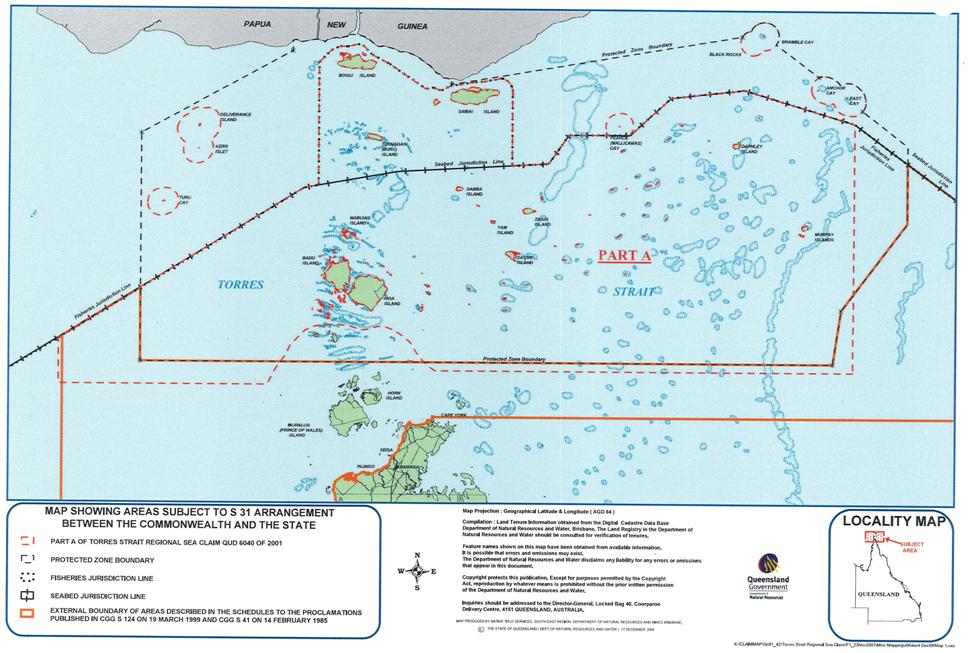
|
|
|
| Solicitor for the Applicants: | Torres Strait Regional Authority |
|
|
|
| Counsel for the State of Queensland:: | Mr G Hiley QC with Mr J Waters SC and Ms H Bowskill |
|
|
|
| Solicitor for the State of Queensland: | Queensland Crown Solicitor |
|
|
|
| Counsel for the Commonwealth of Australia: | Ms R Webb QC |
|
|
|
| Solicitor for the Commonwealth of Australia: | Australian Government Solicitor |
|
|
|
| Counsel for the Commercial Fishing Parties: | Mr P Gore |
|
|
|
| Solicitor for the Commercial Fishing Parties: | Gore & Associates |
|
|
|
| Counsel for Mr P Gamogab: | Mr D O’Gorman SC (Pro Bono) |
|
|
|
| Solicitor for Mr P Gamogab: | Fisher Dore Lawyers |
|
|
|
| Counsel for Mr P Sawabarri: | Mr D O’Gorman SC (Pro Bono) |
|
|
|
| Solicitors for Mr P Sawabarri: | Preston Law |
|
|
|
| Counsel for Mr K Songoro: | Mr Songoro appeared in person. |
|
|
|
| Counsel for Naga Bewani Resources Association: | Ms U Ame, appeared on behalf of the Naga Bewani Resources Association |
FEDERAL COURT OF AUSTRALIA
Akiba on behalf of the Torres Strait Islanders of the Regional Seas Claim Group v State of Queensland (No 2) [2010] FCA 643
CORRIGENDUM
1. In the Appearances on the cover page, in Counsel for the Applicants, delete “Mr R Keely and Ms T Keely” and replace with “Ms A Keely and Mr T Keely”.
2. In the Appearances on the cover page, in Counsel for Mr P Gamogab, delete “(Pro Bono)” after Mr D O’Gorman SC.
3. In the Appearances on the cover page, in Counsel for Mr P Sawabarri, delete “(Pro Bono)” after Mr D O’Gorman SC.
4. At the top of the Orders and First Reasons pages, under “QUEENSLAND DISTRICT REGISTRY” insert “GENERAL DIVISION”.
| I certify that the preceding four (4) numbered paragraphs are a true copy of the Corrigendum to the Reasons for Judgment herein of the Honourable Justice Finn. |
Associate:
Dated: 9 August 2010
| IN THE FEDERAL COURT OF AUSTRALIA |
|
| QUEENSLAND DISTRICT REGISTRY | QUD 6040 of 2001 |
| LEO AKIBA AND GEORGE MYE ON BEHALF OF THE TORRES STRAIT ISLANDERS OF THE REGIONAL SEAS CLAIM GROUP Applicants
| |
| AND: | STATE OF QUEENSLAND & OTHERS Respondents
|
| JUDGE: | |
| DATE OF ORDER: | 2 JULY 2010 |
| WHERE MADE: | CAIRNS |
THE COURT DIRECTS THAT:
1. An agreed Draft Determination giving effect to these reasons be filed and served on or before Friday, 23 July 2010;
2. In default of agreement:
(a) a Draft Determination be filed and served by the Applicant on or before Friday, 23 July 2010; and
(b) the Respondents file and serve such submissions as they may wish to make on or before Friday, 23 July 2010.
(3) The proceeding be adjourned to Brisbane on Friday, 30 July 2010 at 9.30 am for the making of final orders.
Note: Settlement and entry of orders is dealt with in Order 36 of the Federal Court Rules.
The text of entered orders can be located using eSearch on the Court’s website.
| IN THE FEDERAL COURT OF AUSTRALIA |
|
| QUEENSLAND DISTRICT REGISTRY | QUD 6040 of 2001 |
| BETWEEN: | LEO AKIBA AND GEORGE MYE ON BEHALF OF THE TORRES STRAIT ISLANDERS OF THE REGIONAL SEAS CLAIM GROUP Applicants
|
| AND: | STATE OF QUEENSLAND & OTHERS Respondents
|
| JUDGE: | FINN J |
| DATE: | 2 JULY 2010 |
| PLACE: | CAIRNS |
TABLE OF CONTENTS
| 1. A Brief Sketch of Torres Strait................................................................ | [17] |
| (i) The geography..................................................................................................... | [18] |
| (ii) The People........................................................................................................... | [23] |
| 2. The Application.................................................................................................... | [51] |
| (i) Procedural Background....................................................................................... | [51] |
| (ii) The Applicant....................................................................................................... | [54] |
| (iii) The Claim Area.................................................................................................... | [59] |
| (iv) The Rights and Interests Claimed...................................................................... | [64] |
| (v) The Applicant’s “Customary Marine Tenure Model”...................................... | [68] |
| A Digression on Language and Precision............................................................. | [72] |
| 3. The Concessions of the State and the Commonwealth............. | [77] |
| (i) The State’s Concession....................................................................................... | [78] |
| (ii) The Commonwealth’s Concession...................................................................... | [82] |
| 4. The Statutory Setting: Making a Determination of Native Title | [88] |
| 5. The Evidence and Witnesses......................................................................... | [95] |
| (i) The Primary Evidence......................................................................................... | [96] |
| (ii) The Cambridge Expedition.................................................................................. | [104] |
| (iii) The Expert Evidence........................................................................................... | [110] |
| (a) The Applicant’s Experts....................................................................................... | [110] |
| (b) The Respondents’ Experts.................................................................................... | [121] |
| The Commonwealth.............................................................................................. | [121] |
| The State............................................................................................................... | [123] |
| (iv) The Conference of Experts................................................................................. | [129] |
| (v) Johannes and MacFarlane.................................................................................. | [134] |
| 6. The Native Title Land Determinations and the Unresolved Island Claims........................................................................................................ | [146] |
| (i) The Land Determinations................................................................................... | [147] |
| (ii) The Two Unresolved Land Claims...................................................................... | [160] |
| 7. The Society Issue................................................................................................. | [162] |
| Applicable Legal Principles.......................................................................................... | [162] |
| Societies or Society.............................................................................................. | [175] |
| The Laws and Customs................................................................................................. | [177] |
| (i) Descent................................................................................................................. | [182] |
| (ii) Reciprocity and Exchange.................................................................................. | [185] |
| (a) An Informing Principle......................................................................................... | [186] |
| (b) Adoptions.............................................................................................................. | [196] |
| (c) Kinship.................................................................................................................. | [202] |
| (d) Marriage and Affinal Relationships...................................................................... | [215] |
| (e) Hereditary Friendships and “Trading” Relationships.......................................... | [223] |
| (f) Trading “rights”................................................................................................... | [233] |
| (g) “Ailan Pasin”: “Gud Pasin”.............................................................................. | [238] |
| (iii) Emplacement of Social Identity by Original Occupation and Subsequent Inheritance........................................................................................................... | [243] |
| Shared Areas........................................................................................................ | [261] |
| (iv) Territorial Control and the Right to Livelihood............................................... | [279] |
| (a) Territorial Control................................................................................................ | [281] |
| (b) Livelihood............................................................................................................. | [287] |
| (c) Permission............................................................................................................ | [295] |
| (v) Elders................................................................................................................... | [302] |
| (vi) Life Stages, Celebrations and Feasts; Funeral and Mortuary Rites; Songs, Dances and Games.............................................................................................. | [310] |
| (a) Life Stages, Celebrations and Feasts................................................................... | [311] |
| (b) Funeral and Mortuary Rites................................................................................. | [315] |
| (c) Song, Dance and Games....................................................................................... | [317] |
| (d) A Cautionary Note................................................................................................ | [319] |
| (vii) Totems and Clans................................................................................................ | [320] |
| (a) Totemism across Torres Strait.............................................................................. | [326] |
| (b) A totemic system or systems................................................................................. | [331] |
| (viii) Other Laws and Customs.................................................................................... | [358] |
| Contextual Matters....................................................................................................... | [368] |
| (i) “Social ‘levels of scale’”..................................................................................... | [370] |
| (ii) Marine Orientation............................................................................................. | [373] |
| (iii) Language............................................................................................................. | [381] |
| (iv) Receptiveness to Innovation and Change.......................................................... | [390] |
| (v) Cosmology, Mythology and Religion and Sorcery............................................. | [392] |
| (vi) The Central Islanders.......................................................................................... | [398] |
| Professor Beckett’s change of opinion........................................................................... | [408] |
| (vii) Identity................................................................................................................. | [412] |
| (viii) The Two Unresolved Land Claims..................................................................... | [417] |
| (a) Zuizin (Halfway Island)......................................................................................... | [418] |
| (b) Naghir................................................................................................................... | [420] |
| (c) Other matters........................................................................................................ | [431] |
| (ix) Intra-mural allocation of rights......................................................................... | [432] |
| Society: Contentions and Conclusions........................................................................ | [441] |
| (i) The NT Act and the splitting of the sea claim................................................... | [449] |
| (ii) Reciprocity-Based Rights.................................................................................... | [452] |
| (iii) Consideration...................................................................................................... | [453] |
| (a) Mere difference or operative distinction?............................................................ | [453] |
| (b) The Laws and Customs......................................................................................... | [457] |
| (c) Contextual material.............................................................................................. | [465] |
| (d) Closely related islands and cluster groups........................................................... | [475] |
| (e) Haddon’s East-Central/Western division............................................................. | [479] |
| (iv) Conclusion........................................................................................................... | [488] |
| 8. The Rights Issue................................................................................................... | [493] |
| Applicable legal principles: NT Act, s 223(1)............................................................. | [495] |
| (i) Reciprocity based rights...................................................................................... | [503] |
| (ii) The claimed rights and interests......................................................................... | [511] |
| (a) The rights to enter and remain and to use and enjoy........................................... | [519] |
| (b) The rights to access resources, to take the resources and to a livelihood based upon accessing and taking resources................................................................... | [523] |
| (c) The rights “to protect resources”, “to protect the habitat of resources” and “to protect places of importance”....................................................................... | [531] |
| (iii) Conclusion........................................................................................................... | [540] |
| Communal, group or individual rights?........................................................................ | [541] |
| 9. The Geography Issue......................................................................................... | [544] |
| Connection: Applicable Legal Principles.................................................................. | [546] |
| (i) Geography: Contextual material....................................................................... | [553] |
| (a) The Historical record............................................................................................ | [553] |
| (b) Company/Family boats......................................................................................... | [557] |
| (c) Islander boats and boating................................................................................... | [566] |
| (ii) The Expert evidence............................................................................................ | [568] |
| (iii) Islander Evidence................................................................................................ | [588] |
| (a) The evidence of Kris Billy..................................................................................... | [591] |
| (b) The Evidence........................................................................................................ | [594] |
| (c) Identifying “owned” landmarks........................................................................... | [603] |
| (d) Using “landmarks” to identify marine territory.................................................. | [616] |
| (e) Further evidence................................................................................................... | [623] |
| (f) Changes in use of marine estates......................................................................... | [629] |
| (g) “The horizon of visibility”.................................................................................... | [631] |
| (h) “The parties’ maps”............................................................................................. | [632] |
| (iv) Conclusions.......................................................................................................... | [635] |
| “Continuity”......................................................................................................... | [657] |
| (v) The Extremities of the Claim Area..................................................................... | [659] |
| (a) The north-eastern areas...................................................................................... | [661] |
| (b) The Eastern areas............................................................................................... | [665] |
| (c) South of Naghir/Warraber................................................................................... | [668] |
| (d) The South-western areas..................................................................................... | [673] |
| (e) The Western areas.............................................................................................. | [678] |
| (f) The Northern areas............................................................................................. | [684] |
| 10. The Sovereignty Issue...................................................................................... | [686] |
| (i) Context................................................................................................................. | [686] |
| (ii) The Legislative Setting....................................................................................... | [690] |
| (iii) The Issues............................................................................................................ | [703] |
| (iv) Consideration....................................................................................................... | [706] |
| (a) The Territorial seas limitation.............................................................................. | [706] |
| (b) Progressive Sovereignty and the creation of new native title rights.................... | [732] |
| 11. Non-Recognition of Rights and Interests......................................... | [742] |
| (i) Applicable legal principles: “Recognition”....................................................... | [743] |
| (ii) The areas of contention....................................................................................... | [748] |
| (a) Taking for trading or commercial purposes......................................................... | [751] |
| (b) “Waters”.............................................................................................................. | [758] |
| (c) Protect rights........................................................................................................ | [761] |
| 12. Extinguishment................................................................................................... | [763] |
| (i) Applicable legal principles: Extinguishment...................................................... | [766] |
| (ii) The statutory context.......................................................................................... | [779] |
| (a) The Queensland legislation................................................................................... | [780] |
| (b) The Commonwealth’s legislation......................................................................... | [805] |
| Fisheries Act 1952 (Cth) and Pearl Fisheries Act 1952 (Cth)............................... | [807] |
| The Continental Shelf (Living Natural Resources) Act 1968 (Cth)...................... | [815] |
| The Fisheries Management Act 1991 (Cth).......................................................... | [817] |
| The Torres Strait Fisheries Act 1984 (Cth)........................................................... | [828] |
| Consideration................................................................................................................ | [843] |
| Conclusion.................................................................................................................... | [861] |
| 13. Past Extinguishment and Public Works; Future Acts and Non-Extinguishment......................................................................................... | [862] |
| Statutory Context.......................................................................................................... | [864] |
| (i) The Australian Maritime Safety Authority Act 1990 (Cth).............................. | [864] |
| (ii) The Lighthouses Act 1911 (Cth)......................................................................... | [865] |
| (iii) The Coastal Waters (State Title) Act 1980 (Cth)............................................... | [867] |
| (iv) The NT Act: Pre-December 1996....................................................................... | [869] |
| (a) The “fixtures” requirement.................................................................................. | [873] |
| (b) Native title in the pre 23 December 1996 adjacent/affected areas...................... | [885] |
| (v) NT Act: Post December 1996............................................................................. | [901] |
| (a) Native title in the affected areas.......................................................................... | [906] |
| 14. Authorisation...................................................................................................... | [913] |
| (i) The Statutory Setting.......................................................................................... | [913] |
| (ii) The Present Application...................................................................................... | [919] |
| (iii) Consideration....................................................................................................... | [926] |
| 15. Other Interests................................................................................................... | [934] |
| A. International law.................................................................................................. | [935] |
| B. Common law......................................................................................................... | [937] |
| C. Fisheries legislation.............................................................................................. | [940] |
| D. Transport legislation............................................................................................. | [942] |
| E. Other statutory grants.......................................................................................... | [944] |
| F. Access to perform statutory or common law duties............................................. | [946] |
| G. State and Commonwealth laws............................................................................ | [948] |
| H. AMSA rights and interests.................................................................................... | [949] |
| I. PNG interests and the PNG Treaty...................................................................... | [951] |
| 16. The PNG parties and the PNG evidence................................................... | [952] |
| The PNG parties........................................................................................................... | [954] |
| (i) Section 84(8) of the NT Act................................................................................ | [957] |
| (ii) Pende Gamogab and Peter Niwia Sawabarri.................................................... | [962] |
| (iii) Naga Bewani Resources Association................................................................. | [968] |
| (iv) Robinson Gibuma and Frank Warapa............................................................... | [970] |
| (v) The Songoro Family............................................................................................ | [971] |
| (vi) The Gamia Family.............................................................................................. | [986] |
| The PNG Evidence and the Murphy Treaty Report................................................... | [987] |
| The Murphy Treaty Report............................................................................................. | [988] |
| 17. ORDERS....................................................................................................................... | [1002] |
REASONS FOR JUDGMENT
2 The subject matter of the present proceeding is itself distinctive. It seeks a determination of native title rights and interests in a major part of the sea area of Torres Strait. The sea in turn is the integral presence in the lives and livelihoods of the Islander communities. It has rightly been said that their occupation of the region has had “an essentially maritime character”.
3 Unlike in native title claims in Aboriginal Australia, the laws and customs advanced by the communities do not reflect an overarching spiritual connection with the waters. There is no creation story. Yet there are still some, for the most part minor, traditional spiritual beliefs revealed in the evidence. In consequence the laws and customs of present concern are informed in quite some degree by considerations of utility and practicality. This has unusual ramifications in the application of accepted Native Title Act jurisprudence. No more is this so than in relation to the “connection” requirement of s 223(1)(b) of the Native Title Act 1993 (Cth).
4 The Applicant’s evidence is likewise distinctive. British and then Australian sovereignty over the islands of Torres Strait was acquired for the most part in progressive steps taken, first, in 1872 and then in 1879. By these dates the grandparents of some of the indigenous witnesses were alive and were directly, or via the witness’ parents, the sources of oral traditions recounted by those witnesses. From the time of Luis Baez de Torres’ passage through the Strait in 1606, Islander contact with Europeans was the subject of recorded account and observation. Notable amongst these after Cook’s rediscovery of Torres Strait were the writings of British naval officers and other mariners.
5 In 1864 a joint Imperial-colonial outpost was established at Somerset on the eastern tip of Cape York. At much the same time colonial occupation commenced in the Strait. It related initially to the establishment of bêche-de-mer shore fishing stations. In 1868 the pearl shell industry commenced. In 1871 the evangelisation of the Strait began with the advent of the London Missionary Society. In consequence a significant pre- and early sovereignty literature was generated and is in evidence. The most significant body of works in this are the six volumes of reports of the Cambridge Anthropological Expedition to Torres Strait. These were based largely on observations made in the Strait in 1898 by A.C. Haddon (a former zoologist) and six others. The main purpose of the Expedition was to assemble a picture of life before colonisation from the memories of the older men.
6 Unlike with so much of Aboriginal Australia, the acquisition of sovereignty over the islands of the Strait did not lead to the Islanders being dispossessed of their lands or sea domains, or deprived of their traditional means of livelihood. Their continuing presence in the Strait is self-evident as are their detailed knowledge of, and exploitation of the marine resources of, the Strait.
7 As is now well known, native title was first accepted and recognised in relation to the Murray Islands in Torres Strait in the decision of Mabo v Queensland [No 2] (1992) 175 CLR 1 (“Mabo [No 2]”). That decision and the twenty-two Consent Determinations since made under the subsequently enacted Native Title Act have resulted in the recognition of native title in all of the presently inhabited islands of interest in this proceeding and in most of the uninhabited islands. Characteristically the native title holders in these Determinations were found to be members of single island communities. In several instances, though, the title is shared by members of several island communities.
8 Though the land Determinations are of some contextual importance in this proceeding, it is to be emphasised that the present application relates to sea water areas. Because of its present importance, I should emphasise that the NT Act defines “waters” to include not only “sea … a tidal inlet, a bay, an estuary” but also “the bed or subsoil under … any waters” and “the shore, or subsoil under … the shore, between high water and low water”: s 253 (emphasis added). The term is used with this meaning in these reasons. It also requires emphasis that, to the Islanders, land and sea are seamlessly and culturally associated: there is no “sea-land dichotomy”: cf Hviding, 1996.
9 I have concluded that the Applicant has, for the most part, established its claim. There is a single Torres Strait Islander society to which the native title claim group belongs. Under that society’s traditional laws acknowledged and traditional customs observed, the claim group in aggregate holds native title rights and interests in the waters of Torres Strait, with which I am presently concerned, save in those parts specified in these reasons. As the present proceeding does not involve the entirety of the native title claim area, it is inappropriate that I make a finding that the claim group alone constitutes the relevant society. It may be the case – and I express no view on this – that when the balance of the claim is heard and determined in relation to those areas where it overlaps other claims, the evidence may establish that one or both of the Kaurareg and Gudang peoples also belongs to the society for NT Act purposes.
10 I have rejected the State of Queensland’s contention that there were multiple societies (thirteen in number) each constituted by the Islanders of an inhabited island. I likewise have rejected the Commonwealth’s contention that there were four societies each of which was made up of a regional cluster group of islands, eg the Eastern Islands. There is an irony in all of this. The issue of authorisation apart, the answer to the question of native title rights and interests in the waters of Torres Strait – which is, after all, the concern of the present application and of the NT Act – would in all probability have been largely the same whether my conclusion had been one, or four, or thirteen, societies.
11 I have rejected the Applicant’s claim insofar as it asserted that what it called reciprocity based rights and interests constitute native title for the purposes of s 223(1) of the Act. Put inexactly, those are rights based upon reciprocal personal relationships with persons who have native title rights in their own land and marine territories. The native title rights I have found are the non-exclusive rights of the group members of the respective inhabited island communities first, to access, to remain in and to use their own marine territories or territories shared with another, or other, communities; and, secondly; to access resources and to take for any purpose resources in those territories. In exercising these rights the group members are expected to respect their marine territories and what is in them. Importantly, and this requires emphasis, none of these rights confer possession, occupation, or use of the waters to the exclusion of others. Nor do they confer any right to control the conduct of others.
12 The rights will be recognised by the common law beyond Australia’s territorial seas in its Exclusive Economic Zone. The possibility that native title might exist in such an area was contemplated by the Australian Parliament in s 6 of the NT Act. In the northern part of the claim area known colloquially as the “Top Hat”, the native title rights are qualified by the provisions of Australia’s Treaty with Papua New Guinea which came into effect in 1985. It settled the Seabed Boundary Lines between the two countries and provided for Australian “fisheries jurisdiction” in the “Top Hat”.
13 I have found that the right to take resources includes the right to take marine resources for trading or commercial purposes and that such use of them would be recognised by the common law. I have rejected the contentions of the State and of the Commonwealth that the ever expanding regulatory controls placed upon commercial fishing by legislation extinguished any native title right to take fish for commercial purposes. Those legislative controls were not directed at the underlying rights of the native title holders who were obliged to comply with the regulatory measures imposed on them if they were to enjoy their native title rights. The various Acts severally or together did not, and do not, evince a clear and plain intention to extinguish native title rights to take fish for commercial purposes in the Part A Claim Area. Having said this, it needs to be emphasised that, to the extent that those legislative regimes regulate the manner in which, and the conditions subject to which, commercial fishing can be conducted in a fishery in the native title holders’ marine estates, or prohibits qualifiedly or absolutely particular activities in relation to commercial fishing in the fishery in those estates, the native title holders must, in enjoying their native title rights, observe the law of the land. This is their obligation as Australian citizens. Complying with those regimes provides them with the opportunity – qualified it may be – to exercise their native title rights.
14 A distinct part of my reasons deals with the extent to which the construction, operation and maintenance by the Australian Maritime Safety Authority under Commonwealth legislation of aids to navigation in Torres Strait waters have extinguished or otherwise affected the enjoyment of native title in the areas of, or adjacent to, such aids. My conclusions on these matters are contained in these reasons. All I need note here is that, while I have reached conclusions in relation to ten of these aids, I have not in relation to another four. In consequence I have given the parties liberty to apply for the purposes of establishing the boundaries of the areas at each of the four sites where native title has been extinguished.
15 While I have found that the Application made in this matter was not in fact authorised as required by the Native Title Act, I am satisfied that, for the purposes of s 84D of the Act, it is in the interests of justice that the Application be determined despite the defect in authorisation.
16 Finally, there are seven PNG parties to this proceeding. In the case of five of them, I have ordered that they cease to continue as parties to the proceedings. In relation to the remaining two, I will declare that they are not members of the native title claim group.
1. A Brief Sketch of Torres Strait
17 To understand the issues and emphases in this matter, it is necessary to have some appreciation of the geography of the Strait and of the characteristics and distribution of the Islanders who have lived, and who currently live, there. I should note at the outset that I will refer to the islands by their Islander name. Attachment 1 to these reasons is a table of Islander and English names for islands, islets, cays and reefs. For convenience in exposition, I will not differentiate between colonial Papua and modern Papua New Guinea (“PNG”). I will use the occasionally anachronistic acronym PNG to refer to both. Finally, to minimise the need to make lengthy references in the text to the details of source materials – mainly the reports of experts and the tendered scholarly writings of historians, anthropologists, etc – I have adopted an abbreviated form of social science citation which will refer only to the author’s name, the year of the publication and the page reference. If the same author has several publications/reports for the same year, these will be differentiated alphabetically (eg Beckett 2008A, 2008B etc). Attachment 2 contains a full bibliography of the experts and authors to whom reference has been made.
(i) The geography
18 The wide, plateau-like, land bridge between Australia and PNG was almost entirely inundated by rising sea levels between 6,000 and 9,000 years ago. The rocky islands which characterise the western and eastern islands of the Strait once were hills on the bridge. The sea-bed after inundation was relatively flat and shallow ranging from about 30-50 metres in depth in the east and 10-15 metres in the west (now the eastern and western continental shelves) to about 10 metres across the centre. Seasonal and daily fluctuations in wind, rain, tide and current create, as the geographer Nietschmann observed (1985, 134-135), “a kaleidoscopic variety of environmental conditions”. For the Islanders, in consequence, “[s]ea knowledge and sea territory are reciprocals”. The conditions, moreover, are often treacherous. Matthew Flinders observed in A Voyage to Terra Australis, (1814): “[P]erhaps no space of 3½ degrees in length represents more dangers than Torres Strait.” To illustrate this by reference simply to the tides, Nietschmann observed (1989, 67-68):
Torres Strait is a 150-km wide vortex between the Indian and Pacific oceans. Strong tidal currents sweep through the Strait, causing the sea level to fluctuate daily and alternatingly exposing and covering island margins and shallow reefs. Tidal influence is accentuated due to the shallow shelf and the funneling effects of the bordering mainlands and the further constrictions of reef and island. Tidal currents are exceptionally strong due to the vortex-caused acceleration of moving tides. Current speed averages two to three knots, but during spring tides and in the reef channels the tidal current may exceed seven knots. The tidal current changes direction every six hours; twice daily the current is from the west, and twice daily it is from the east.
19 The islands – over 120 in number – are dispersed, in the main, in a broad arc beginning immediately to the west of the tip of Cape York, running north to the PNG coastline and then south easterly to the northern end of the Barrier Reef. Coral reefs and sand cays abound, particularly to the north and more distantly, to the north-east of Cape York. To provide some appreciation of the dimensions of the Strait, the distance between Cape York and the southern PNG coastline is 165 kilometres; and that between the easternmost and westernmost inhabited islands (Mer and Badu) is 215 kilometres.
20 Of the islands themselves, there are four distinct geomorphological types. They have markedly different ecological conditions, hence potential for human habitation and utilisation. The western group of islands contains the largest islands in the Strait. They are constituted by granite and volcanic rock dating back 300 million years and are a geological extension of Cape York. Though relatively infertile, they could sustain limited gardening for food. Marine life – turtle, dugong, fish and shell fish – is abundant on the reefs which surround the islands or which are accessible by boats (previously canoes: see below). The second island group is opposite the PNG coastline. Two of the three islands, Boigu and Saibai, are formed of the accumulated sediments brought down from nearby PNG rivers. Both have large areas of swamps and extensive mangrove areas which contain significant marine life as also waterfowl. Boigu is prone to flooding by sea water and has little arable land. Seagrass beds, which provide the main food eaten by dugongs lie close to both of the mud islands. The third island of this group, Dauan, is a high, rocky, remnant of the landbridge. It has only a small arable area but a permanent fresh water supply which the people from its near neighbour, Saibai, used during dry seasons. Its permanent population has been characteristically small.
21 The third island group, the eastern islands, near the north of the Barrier Reef, are basaltic rocks which may have formed within the last two million years. The islands are relatively fertile and densely vegetated. Extensive horticulture has been practised on them. There is abundant shell fish in close proximity to them. The three now inhabited islands, Mer, Erub and Ugar, have stone fish traps on their fringing reefs. Mer and Erub sustain relatively large populations by Torres Strait standards.
22 The central region of Torres Strait contains some high rocky islets, but low sandy islets predominate. The sandy islands are infertile and provide little by way of land-based food resources. Water is scarce in the dry season. Four sandy islets remain inhabited: Iama, Masig, Poruma and Warraber. There is abundant marine life, especially around the numerous reefs which lie to the north, north-west, east and south of these islands.
(ii) The People
23 Permanent occupation of the western parts of Torres Strait is considered to have occurred 4,000-2,600 years ago, by expansions of Aboriginal people speaking an Aboriginal language. Subsequent immigration of Papuan peoples brought major Papuan language influences into the region. Occupation of the eastern islands by Papuan speakers occurred at about the time of that subsequent immigration.
24 The historical evidence is that the peoples who settled in Torres Strait and their descendants were, and remained, a maritime people. A major symbol of their pre-colonial presence was the large (up to 20 metres in length), double-outrigger, sea-going, sailing canoe: see Attachment 3. They were able to travel long distances. These canoes were acquired from Papua through a complex system of exchange and payment (to which reference will be made below). While no direct evidence exists for the antiquity of canoe technology in the Strait prior to historical records (McNiven, 2008, [103]), it has been suggested the double outriggers may have been around for over one and a half millennia: Barham, 2000, 299. The islands were bereft of a wood supply suitable for the manufacture of such craft. The evidence equally suggests that each inhabited island possessed a sufficient number of these canoes to be able to transport the island’s population. Their uses, as colloquially described, were for flight, fight and food. As the historian, Steve Mullins, has put it:
It was the craft that brought them to the Strait, enabled them to exploit the region’s rich marine resources efficiently, allowed them to be part of a wide network of communities and to import from a range of sources the things they needed or desired.
25 The population of Torres Strait in the early years of European contact has been estimated at between 4,000 and 5,000 people distributed over 17 named communities who regularly occupied at least 25 islands for at least part of the year. It is said that only Mer and Saibai had pre-colonial populations of over 500 people.
26 Though the nineteenth century saw not insignificant population influxes (principally of Pacific Islanders) in association with the growth of the bêche-de-mer and pearlshelling industries which commenced in the 1860s, the Islander population living in Torres Strait has not expanded greatly. There has been very significant Islander migration to the mainland, most particularly since the 1960s.
27 The 2006 census figures reveal that approximately 53,000 people identified themselves as being of Torres Strait Island descent. The expert evidence is that a very large number of these (circa 37,000) are typically made up of people born from the 1970s onwards outside Torres Strait: see Burton, 2008, [15]. The figure for island dwellers in the same census for those 13 islands of present interest (ie excluding islands in the Part B sea claim) reflect the above comments:
(a) Northern Islands: Boigu – 255; Dauan – 144; Saibai – 312.
(b) Western Islands: Mabuiag – 238; Badu – 706; Mua – 397.
(c) Central Islands: Iama – 284; Masig – 267; Poruma – 145; Warraber – 238.
(d) Eastern Islands: Mer – 461; Erub – 283; Ugar – 76 (TSRA figure).
Total: 3806
28 Characteristically, the Islanders identify themselves first and foremost by reference to the island community to which they belong: Boigu, Poruma, etc. Historically and to this day, those individual communities are parts of five established regional island (or “cluster”) groupings. For reasons noted below, four are presently relevant. The people of the three Top Western Islands as they are known – Boigu, Dauan and Saibai – identify together as “Saibailgal”; those of the Western Islands – Mabuiag, Badu and Mua – as “Mululgal”; those of the Central Islands – Iama, Masig, Poruma and Warraber – as “Kulkulgal”; and those of the Eastern Islands – Mer, Erub and Ugar – as “Meriam”. For ease in exposition, I will refer to the four groupings by their English language name.
29 There are traditional language differences between and, to an extent, within the island groupings. These will be referred to later in these reasons. I should emphasise, though, that Torres Strait Creole has become the common language of all Torres Strait Islanders.
30 The narrative which now follows is presented for background and contextual purposes. Its predominantly maritime emphasis reflects not only Islander life, but also themes in the present claim. It is drawn largely, but not exclusively, from the Final Report of the historian, Professor Steve Mullins. As he emphasises, there is not only an extensive scholarly literature on pre-colonial maritime trade in Torres Strait, there is a range of historical documentary sources which relate to what can be described as the “customary maritime exchange” of the Islanders, as well as to Islander trade with, and to participation in the trading activities of, outsiders keen to exploit the marine resources of the Strait.
31 First, customary maritime exchange. As described by Mullins (2008, [19]), this had three important “socio-economic” contexts at the point of sustained contact with Europeans. These were, first, trade within the five cluster group communities which were dependent for their basic subsistence upon the complimentary exploitation of wild foods and cultivated crops in the physically contrasted islands of which each community consisted. In this context, visits by canoe were frequent, informal and often involved the exchange of gifts. The secondcontext was trade between cluster groups. This was less frequent, more formal and often involved the exchange of specialised manufactures. The third was exchange between cluster groups and the mainland of Australia or PNG. This, it is said, took the form of systematised trade. The large sailing canoe was the most valuable commodity in this trade. I have appended Haddon’s 1890 description of the canoe trade between PNG and the Western Islands: see Attachment 4. While, as will be seen, long term, hereditary trading relationships formed an important aspect of long distance maritime trade, it has been questioned whether trade only functioned through a formalised system of set “trade routes” and “an unchanging pattern of relationships”: Lawrence, 1994, 289. Simply to illustrate the dimensions of trade across the Strait, I have included two charts (one of Haddon’s in 1904; the other of Harris in 1979, which is limited to the Western Islands) to illustrate patterns of customary trade and exchange: Attachment 5; see Lawrence, 1994, Figs 22 and 29.
32 Two additional comments should be made about customary exchange. First, exchange was not limited to “commodity exchange”. It extended to “ceremonial exchange” which, according to Mullins “was also important in cementing social relationships across Torres Strait”. A significant example of this will be seen in relation to the Cult of the Four Brethren in the Central and Eastern Islands. Secondly, customary exchange did not occur only between individuals and groups with long-term friendly relationships. It occurred between otherwise hostile groups.
33 Mullins’ summary of the historical documentary sources on pre-colonial maritime trade (2008 at [25]) is that:
[They]show a complex situation of numerous and vibrant exchange relationships between individuals, clans and communities that were the lifeblood of Torres Strait society. Much of the trade involved the necessities of life, such as food items or the implements to obtain food, like the dugong harpoon. Some items changed hands as gifts, and other exchanges had specific ceremonial and social purposes. Trading voyages also provided the opportunity for courtship and entering into marriage arrangements, to “show off new dances and songs” and for the spread of news, “new ideas and innovation”.
(Footnote omitted)
34 Secondly, trade and resource exploitation. By the end of the eighteenth century, the Islanders were positively soliciting from passing ships the exchange of “every kind of iron” (to quote Matthew Flinders), for their own artefacts and commodities. By the 1830’s, from April to September, three or four ships a week passed through the Strait on voyages from Sydney to Eastern ports. Islanders from islands near the main shipping channels (the eastern, central and south-western islands) took advantage of this to trade. They had been hunting hawksbill turtles and trading tortoise shell scutes to Europeans in a seasonal pattern since the 1820’s. By the 1840’s this had developed into a fairly regular trade, with colonial vessels now visiting the Strait specifically to acquire the product: Mullins, 2008, [158]. China was the principal world market, though the shell was also highly prized in Europe.
35 The period from the mid 1830’s to the early 1860’s was marked by substantial increase in trade and exchange. As trade with passing ships grew, the volume and velocity of trade in Torres Strait networks increased to meet the additional demand. Trade in shell products to PNG expanded to satisfy the European taste for artefacts, many of which were obtained on that coast. Eastern Islanders, because of their own deep waters, still had to rely mostly on Central Islanders for the shell products required in the PNG trade.
36 The export of tortoise shell from the Strait continued well into the twentieth century. However, the penetration of the bêche-de-mer (or dried sea cucumber) industry into Torres Strait in the 1860s marked a new departure in Strait resource exploitation. Bêche-de-mer was an expensive, signature ingredient in Chinese cuisine. The establishment of bêche-de-mer fishing stations in the Strait in the mid-1860’s coincided with the advent of colonial occupation (which began with the establishment of a joint Imperial-colonial outpost at Somerset on Cape York). The first wave of bêche-de-mer fishers had learned their trade in the western Pacific and brought their Pacific Islander workforce with them. As Mullins noted (2008, [96]), their arrival heralded a time of radical change when, amongst other things, Torres Strait Islanders began the process of acquiring things they could not produce themselves, “not through barter, but in exchange for their labour”. The Islanders initial involvement in the industry was as gatherers of bêche-de-mer. It was not until at least the 1880’s that a few began to gather and process bêche-de-mer themselves.
37 In 1868, the bêche-de-mer fishers became aware of the extent of the rich Torres Strait pearl shell beds. Commercial collection of pearl shell commenced, bringing with it a new population of maritime workers, many of whom settled in the Strait. The early 1870’s were years of rapidly rising mother-of-pearl prices in Europe that spurred on the industry. It dominated the Torres Strait economy for the next century. By the time all the present day Torres Strait Islands were annexed to the Crown in 1879, a large proportion of the Torres Strait Islander population was, in one way or another, caught up in the process of colonisation leaving less time for the preparation of, and participation in, trading voyages. Many Islanders joined the new industry, there being a great demand for skin divers. Equally, Imperial and colonial legislative restrictions on employing Pacific Islanders in the Strait in the early 1870’s caused a severe labour shortage which further encouraged Torres Strait Islanders into the pearl-shelling industry.
38 At the time of annexation the various marine industries were differentially distributed across the Strait: bêche-de-mer more significantly in the Eastern islands; pearl-shell, in the Central and Western island regions, but not in the Top Western island area (which seems not to have entered the historical record until the 1870’s: see Beckett, 2008A, [37]).
39 In the early 1900s a system facilitating the acquisition by Islander communities and families of pearl-shelling and trochus luggers and cutters was instituted. For most of its history it was administered by the Queensland Government. It existed in various forms from about 1904 to the late 1960s. At its height after World War II it employed some 600 Islander men operating between 20 and 30 vessels. The boats became known as “Company Boats” to distinguish them from the “Master Boats” owned by Europeans. Many Islanders refused to work in the Company Boats and chose instead to remain with, or return to, the master pearl-shellers, where they felt they were better rewarded for their efforts. Once the Company Boats were paid off they were used for communal purposes, such as hunting for turtle and dugong, and visiting friends and relations on neighbouring islands.
40 In 1912 a market for trochus shell was established in Japan. The shell was found in shallow water and was most efficiently collected by swimming divers. From 1915 Company Boats entered the trochus industry. Crews shifted between pearl-shell, trochus and bêche-de-mer, depending on price and seasonal conditions, though each product required quite different collecting and processing techniques.
41 World War II saw a hiatus in the fishing industries, as most of the fishing boats were commandeered by the Army and most of the able bodied men were recruited to serve in the Torres Strait Light Infantry Battalion. After the war, Islanders were granted greater freedom of movement than they had previously enjoyed and some emigrated to mainland Australia to work in the sugar and railway construction industries. Commercial fishing for pearl shell and trochus resumed after the war, but went into decline in the 1960’s as plastic came to be used as a substitute for shell in the manufacture of buttons, the main market for the shell. From the 1960’s a great many Islanders emigrated to the mainland as the census figures earlier referred to show. Although Islanders are not as substantially dependent on the marine industry for a livelihood as they once were, commercial fishing remains the only viable industry in Torres Strait. It is the main source of employment outside of government agencies and projects. Tropical rock lobster, known locally as kayar or crayfish, is now the main species exploited by Islanders; trochus, bêche-de-mer and finfish are also fished commercially.
42 There are three further contextual matters unrelated to fisheries to which it is necessary to refer. The first relates to violence in the Strait prior to annexation; the second, to the advent of the London Missionary Society in 1871; and the third, to aspects of post-annexation, governmental regulation of the Islanders.
43 In the first half of the nineteenth century the Islanders had, as Mullins put it, “a fearsome reputation” for attacks on strangers who entered their sea territory. The story of the audacious attacks on Bligh’s ships in 1792 was retold in most nineteenth century accounts on the region. The 1834 massacre of the survivors of the wreck of the Charles Eaton emphasised the dangers of passing through the Strait. After Flinders published his A Voyage to Terra Australis in 1814, mariners understood the Islanders were head-hunters. This practice was engaged in after battles, after raids for this purpose, as the occasion presented itself, or treacherously. For present purposes it is sufficient to note Haddon’s observations in the 1904 Report at 277-278 on “Homicide” and “Treatment of Strangers” (see also 1904, Ch XVI and 1935, 347-349, “Fighting and Head Hunting”):
It was a meritorious deed to kill foreigners either in fair fight or by treachery, and honour and glory were attached to the bringing home of the skulls of the inhabitants of other islands slain in battle. The men of Tutu were said to have been great warriors, and, I was told, often used to make a raid on another island in order that their young men might have trophies and so find favour with the women. Such raids were, as often as not, made upon weak islands, and not necessarily against those people with whom there was any enmity or ill-feeling.
…
All the natives of Mabuiag were most emphatic in their declaration to Mr Wilkin that any stranger or uninvited arrival of whatever colour, condition, or circumstance was killed, as one informant drily remarked to him, “He stop all the time!”
The second of these paragraphs in particular provides some of the context explaining the significance of customary trading relations (or “tebud” relationships) in pre-annexation customary exchange. As Professor Beckett (see below) observed (2008A, [49]):
These relations implied not merely an obligation to provide certain trade items, in exchange for certain other items, but also a guarantee of personal security; to go to a place where one was not known was to risk death.
I would add relatedly that certain communities periodically raided one another in search of vengeance and heads. People regarded people of other communities with suspicion: Beckett, ibid, [48]; Beckett, 2008B [13]. Again to quote Professor Beckett (1987, 30):
… the rich body of myths, folktales and traditions suggests that the fear of violent death was never far from people’s minds. Warfare was a major preoccupation, while headhunting occupied a place of central importance in their cultural and religious life.
Significantly, while raids and massacres were not uncommon, no land or marine territory appears to have been acquired through warfare: see eg Shnukal, 2004, 326; see also Beckett, 2008A, [31].
44 The London Missionary Society arrived in Torres Strait in 1871 with clear evangelizing purposes. By 1880 all but the smallest communities had a resident pastor or teacher. Every island had a church. The missionaries were quick to acquire considerable authority, religious and temporal, within the Islander communities. They suppressed non-Christian cults and practices they abhorred such as head-hunting and infanticide. These two practices had long contributed to population control in the Strait. By 1890 the Society regarded its initial task of conversion to be complete. After some conflict with the Queensland Government and with a growing diminution in the temporal authority of its missionaries, the Society withdrew from Torres Strait in 1915, handing over to the Anglican Diocese of Carpentaria.
45 Finally, a brief comment on governmental regulation of the Islanders. The main focus of governmental activity immediately after annexation appears to have been on the regulation of the pearling industry and the prevention of excessive exploitation of Torres Strait Islander and Pacific Islanders labourers. It is unnecessary to enlarge here upon this and its odd consequences: see Mullins, 1995, 97-116.
46 The Queensland Government depended on local participation in its administration of the islands. At first local chiefs, called mamooses, were appointed. These were not hereditary offices. Men were singled out who seemed to have influence over their fellows. When teacher magistrates were stationed in the larger communities, the mamooses served as assessors in local matters such as land disputes. In 1898 the Government Resident in Thursday Island, John Douglas, instituted an elected council on Mer, and subsequently councils were instituted throughout the Strait, sitting as an island court for local matters (Haddon, 1904, 264-265; 1908, 178-180).
47 In 1897 the Queensland Parliament enacted the Aboriginals Protection and Restriction on the Sale of Opium Act. It imposed a regime of intensive government supervision and control of Aborigines in Queensland. Douglas secured the Islanders’ exemption from its provisions. In 1911 they were effectively made subject to all of it. In 1912 the “Protector of Aborigines” appointed under the Act required Islanders employed in the pearl-shell industry on Master boats to be engaged under the Act’s permit system. In 1921 the Protector took control of a proportion of the earnings and savings of all Torres Strait Islanders.
48 In 1936 the Islanders mounted a general maritime strike against the government which lasted four months. The causes of this have not been explored in evidence, though the State in its Points of Response has admitted it resulted from dissatisfaction with government management of maritime industries. I would also note one of the Islanders’ desires was to be distinguished from Aborigines. This, and other changes including a form of local government and local island courts, were incorporated in the Torres Strait Islanders Act of 1939 (Qld) and were continued in successor legislation.
49 During World War II the Australian Army took over the administration of Torres Strait. Most Islander men enlisted. They served primarily in the Torres Strait Light Infantry Battalion and were stationed at the Thursday Island and Horn Island bases along with Australian and American servicemen. It has been said that this contact “opened their eyes” about the world outside the Strait: see Ganter, 1994, 92-93.
50 Finally, to revert to the second half of the nineteenth century, the advent of the marine industries, government and the missionaries from the 1860’s wrought both great change and great loss to the traditional ways of the Islanders. Yet they accommodated and adapted themselves to this.
2. The Application
(i) Procedural Background
51 The application (now in its third iteration) was filed on 23 November 2001. The boundaries of the application area were drawn in a way that excluded both the Prince of Wales Group of Islands and islands and reefs off the immediate east coast of northern Cape York. The Prince of Wales islands are directly to the west and north-west of Cape York and are adjacent to it. They include Thursday Island, the administrative centre of Torres Strait. The Kaurareg people (from the Prince of Wales group) and several members of the Gudang people (from Cape York) became respondents to the application and asserted defensively what were said to be their own native title rights in two areas within the application area.
52 In 2008 both the Kaurareg and Gudang peoples filed separate native title claims each of which overlapped (in part) the original application area. By that stage the present application as it then stood was ready for trial. Given that areas of overlap have to be dealt with in the same proceedings: s 67(1) of the NT Act; I ordered the original application be split into Parts A and B, the latter consisting of the overlap areas.
53 The application for present purposes relates only to Part A. Attachment 3 to these reasons indicates the locations of the Part B sea claim. I would emphasise that, the areas of overlap apart, the actual areas claimed in both the Kaurareg and Gudang applications are not in evidence before me. While these may well be matters of which I can take knowledge (see Evidence Act 1995 (Cth) s 144(1)(b)), this is not a course that I need take for reasons which I give when discussing the “Geography issue”.
(ii) The Applicant
54 The native title claim group on whose behalf the application is made, is constituted by the persons who are the living descendants of an enumerated, and lengthy list of persons each of whom was a Torres Strait Islander. That list contains in aggregate all of the names of persons identified in Mabo [No 2] and in the various Consent Determinations as being ancestors of members of the Mabo [No 2] claim group, or of an individual consent, native title holding group.
55 Only two of the originally named four persons making up the Applicant are still alive. Those deceased have not been replaced. Each of the original four were said to be authorised by one or other of the four cluster group segments of the claim group. I note at the outset that there are very real issues about whether the application was, and remains, authorised as required by the NT Act and whether the defects (if any) in authorisation can be cured by me under s 84D of the Act. What is clear is that none of the parties wish for the matter to fail simply on authorisation grounds – the more so as both the State and the Commonwealth have conceded, albeit to differing territorial extents, the existence of native title within the area of the Part A sea claim.
56 There is fundamental disagreement between the parties as to who constituted the “society” under whose laws and customs at sovereignty and now, native title rights and interests in the claim area existed and have continued to exist. The Applicant’s primary case is that the members of the native title claim group comprise, or are members of, and their ancestors at sovereignty comprised or were members of, one “society” for NT Act purposes. In the alternative, the Applicants propose a variety of alternatives which it is unnecessary to describe here.
57 The Commonwealth’s contention is that the evidence is consistent with a finding of four regional societies being the four cluster groups. The State in turn contends that the relevant laws and customs, as also the consent determinations, are consistent with the “societies” being individual island based societies.
58 Surprisingly perhaps, what has emerged as common to the parties is that, whosoever might constitute the relevant society, the native title rights and interests held under the “society’s” laws and customs are held, in substantial part, at the individual island community level by claim group members of that community. The parties diverge in their respective explanations of the phenomenon of land and waters areas “shared” by two or more island communities and in the extent to be given to the sea areas of the individual island communities. Where they disagree sharply, as I will indicate below, is in relation to what the Applicant describes as “reciprocal rights”. These are based on the relationship a person or persons has or have with an Islander who has what are called “emplacement based” (or ownership) rights. It is primarily on account of this bifurcation of right types that the Applicant asserts the need for a finding that the native title claim group itself holds the native title rights and interests in the claim area (Response [27](d)) although paradoxically it does not suggest any “over-arching title” held by the claim group as such: Response [648].
(iii) The Claim Area
59 This is by no means easy to describe for two reasons. First, the Seabed Jurisdiction line between Australia and PNG intersects the Western and Top Western Islands. Nonetheless, PNG has acknowledged that Australia has sovereignty over some number of the islands lying on the PNG side of that line. In consequence the two countries, by treaty done on 18 December 1978, have reached agreement on the territorial seas of those islands and on the maritime jurisdiction of each country in relation both to the seabed and subsoil and to fisheries in areas north of PNG’s seabed jurisdiction line: see generally Treaty between Australia and the Independent State of Papua New Guinea concerning Sovereignty and Maritime Boundaries in the area between the two Countries, including the area known as Torres Strait, and Related Matters, esp Arts 2, 3 and 4 (“the PNG Treaty” or “the Torres Strait Treaty”). The Treaty provisions explain much of the curiosity in the northern parts of the claim: for an analysis of the Treaty see Kaye, “Jurisdictional Patchwork: Law of the Sea and Native Title Issues in the Torres Strait”(2001) 2 Melb J Intl L 381 at 391-397.
60 The continuous white lines – circular and linear – in the map below mark out the external boundaries of the combined Part A and Part B sea claims. It is unnecessary to distinguish the two claims for present purposes. I will explain the references on the map to “1872” and “1879” below.
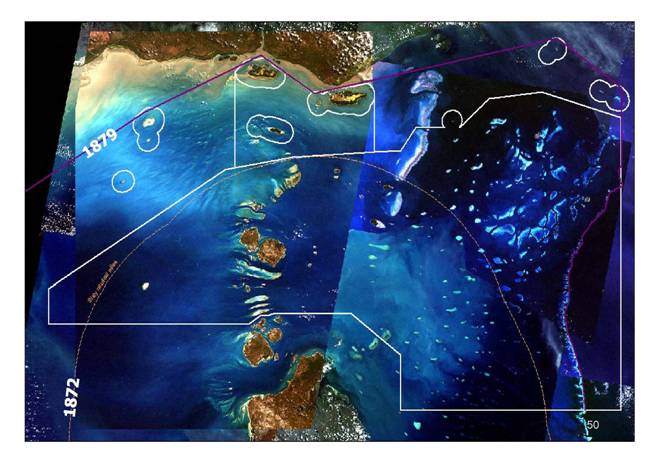
61 The long white line running north-east (ie left to right) across the central area of the map which intersects the Western and Top Western islands, represents, save in one respect, PNG’s Seabed Jurisdiction Line. The excepted respect relates to the bulbous extrusion on the line. The explanation for the bulb is that in its centre, in PNG waters, is an Australian island – Guchen Sandbank. The circular line around its northern side represent the island’s territorial (ie Australian) waters. All of the encircled islands lying north of the PNG Seabed Jurisdiction Line are Australian. The circles around them delimit their respective territorial seas which includes sovereignty over the seabed in their territorial seas. There is an area enclosed by the two vertical lines in the top centre of the map which run from the Seabed line up to the west side of Boigu and the east side of Saibai and then join on the northern side of the two islands just short of the PNG mainland. By virtue of the Treaty, in this area Australia has fisheries jurisdiction but the seabed is PNG’s save for the territorial seas around Boigu, Buru, Dauan and Saibai. This area is referred to colloquially in this proceeding as the “Top Hat”.
62 The second cause of complication in relation to the claim area is that the islands in the Strait of present concern were brought under British sovereignty in two cumulative steps. First, on 30 May 1872, the Imperial Crown acquired sovereignty over a three nautical mile territorial sea around all islands lying within 60 miles of the coast of Queensland. The geographical reach of this is represented by the 1872 line on the above map. Secondly, on 18 July 1879, the Imperial Crown acquired sovereignty over all of the remaining islands within the present sea claim and their respective three nautical mile territorial seas: on the efficacy of the 1879 annexation see Wacando v Commonwealth (1981) 148 CLR 1. The 1879 line on the above map indicates the presently relevant external reach of any part of the area presently claimed. After Federation, the sovereignty of the Imperial Crown passed to the Commonwealth. Further to complicate matters on three subsequent occasions (14 February 1983; 20 November 1990; and 17 February 2006 – to use the dates pleaded by the Commonwealth) Australia altered the manner of measurement of its territorial sea and by subsequent declaration brought further areas of the sea within Australian sovereignty. The consequences of this are that different parts of the claim area came under British/Australian sovereignty at different times. Nonetheless, there are still parts of the claim area which are beyond Australia’s territorial seas. Attachment 7 depicts the progressive extension of the territorial sea from 1982 to 2006.
63 There is controversy between the Applicants and the Respondents as to what is the relevant date (or dates) when sovereignty was acquired by the Crown for NT Act purposes and as to whether native title rights and interests can be recognised beyond Australia’s territorial seas. These together have been described in this proceeding as the “Sovereignty Issue”. Though logically it should be dealt with at the outset, as it affects only two peripheral parts of the claim area in fact (to the south-east and to the far west: see Attachment 4) and because it raises particular issues about Australia’s Exclusive Economic Zone, this issue will be dealt with after I have considered the other native title issues.
(iv) The Rights and Interests Claimed
64 The rights and interests claimed in the application as filed were bounded by the assertion that the sea claim group collectively had the right “to control access, occupation, use and enjoyment of the claim area and its resources by others not members of the claim group”: Native Title Determination Application, Schedule E; emphasis added. Though wisely abandoned: cf Commonwealth v Yarmirr (2001) 208 CLR 1 (“Yarmirr HC”) at [61], [76] and [94]-[100]; this initial assertion provided justification for the joinder of a number of PNG parties who claimed that their interests may be affected by a determination in the proceedings: see NT Act, s 84(5); Gamogab v Akiba (2007) 159 FCR 578 (“Gamogab FC”). I deal with the continued presence of the PNG parties in this proceeding later in these reasons: “16. The PNG Parties”.
65 What I need to emphasise is that the Applicant does not seek the inclusion in any determination of native title of any right or interest having a nature or an extent which would authorise a member of the native title holding group to control access by any other person to, or to control the conduct of any other person in, the claim area. I would note in passing, though, that the Applicant had intended to seek recognition of rights to exclude and control members of the native title claim group. This was resiled from in the face of Full Court authority to the contrary: see Gumana v Northern Territory (2007) 158 FCR 349 (“Gumana FC”) at [170].
66 I will later specify precisely the separate rights claimed. Put compendiously they encompass rights to enter, use and enjoy the claim area, to take its resources, to a livelihood and to protect resources and places of importance. The State and the Commonwealth have made differing concessions in relation to the rights claimed in the claim area.
67 The fundamental, but not the only, issue which divides the parties on rights and interests relates to the geographic reach of the rights claimed.
(v) The Applicant’s “Customary Marine Tenure Model”
68 The following is intended by the Applicant to assist understanding of the dual bases of the traditional rights and interests in marine territory that are claimed under what the Applicant calls its “customary marine tenure model”.
69 To précis the Applicant’s own description, the first are what may be called “ancestral occupation based rights” or “emplacement based rights”. Rights of this kind:
(a) are held by people (a local descent group) who are descendants (usually patrilineal) of the socially recognised prior occupying ancestors (whether themselves members of a family, clan, “community” or a group of people of or from more than one “community”) and the wives of members of the group;
(b) are rights because they are enforceable by appeal to the socially recognised history of prior occupation and to the law or custom that makes that the basis for the existence of the rights; and
(c) are “communal” or “group” rights.
I will call these “occupation based rights”.
70 The second are what may be called “reciprocal relationship based rights” or “reciprocity based rights”. Rights of this kind:
(a) are held by each person who has, or each group of persons who have, a relevant reciprocal relationship (whether based in kinship or of another kind, such as tebud/thubud (eg hereditary trade friendships)) with an ancestral occupation based rights holder or group of such rights holders;
(b) can be called rights or interests because they are enforceable and sanctioned by appeal to the law or custom that associates the reciprocal obligation with the relationship and the law or custom that sanctions consequences for denial of the reciprocal obligation; and
(c) are “group” or “individual” rights.
I will call these “reciprocal rights”.
71 To anticipate matters, I am satisfied that there have been, and are, laws and customs which regulate rights and obligations between persons in certain “reciprocal relationships”. I also am satisfied such relationships have created, and do create, a network of inter-island relationships. However, I am not satisfied that the laws and customs regulating such relationships are generative of rights and interests in land and waters,save in relation to a wife in marriage.
A Digression on Language and Precision
72 Whether native title rights and interests are possessed under the “rules” – to use description in Members of the Yorta Yorta Aboriginal Community v Victoria (2002) 214 CLR 422(“Yorta Yorta HC”) at [42] – that constitute the relevant traditional laws and customs, is “a question of fact”: Western Australia v Ward (2002) 213 CLR 1 (“Ward HC”) at [18]. The inquiry so required to be undertaken necessarily requires reasonable particularity and precision in the delineation of those laws and customs. An abiding cause of difficulty in this case has resulted from language usages which, for reasons of generality and opacity, have generated confusion.
73 Though such usage originated in the Anthropologists’ reports, I acquit the Anthropologists of any responsibility for the consequences occasioned in this case. They, no less than practitioners of other disciplines (including lawyers), have their own arcarna, shorthand, methods of expression, etc which suit their discipline and which are readily comprehensible to others within the discipline. There is no criticism implicit in this. Yet if their scholarship is to assist and not impede the prosecution of a Native Title Act case – for the anthropologist, a foreign field of discourse – it must be the responsibility of the lawyers who engage them to ensure that the language they use and the concepts they wish to communicate are cast in terms that are appropriate and adapted to the demands of such a case and especially to the type of factual inquiries the Court is called upon to undertake. Failures in this regard have been one feature of this case. This said, I would also add that I found the three anthropologists who gave evidence in the Applicant’s case to be helpful witnesses.
74 In Harrington-Smith v Western Australia (No 2) (2003) 130 FCR 424 at [19] Lindgren J observed that “lawyers should be involved in the writing of reports by experts, not, of course, in relation to the substance of the reports (in particular, in arriving at the opinions to be expressed); but in relation to their form, in order to ensure that the legal tests of admissibility are addressed.” The same, in my view, can be said of ensuring intelligibility to a legal audience required to apply known and accepted rules of law.
75 It is highly regrettable that discipline was not exercised by the Applicant’s legal advisers in this matter. It has been a considerable distraction. Speaking for myself, I can say in relation to some matters that it was only when I reached the reply submissions that I understood precisely what were being advanced as particular laws and customs. Unless that discipline is applied, the difficulties such as the Respondents – and I – experienced (these are amply reflected in their submissions) will not be avoided. They are by no means cost free. It would be tedious and unhelpful to rehearse further the language debate.
76 What is clear from the evidence is that there are some differences in the laws and customs acknowledged and observed across the Strait, as also there are differences in the native title rights and interests possessed under those laws and customs. In part, the Respondents’ objection to the language in which the Applicant’s case is cast is that, to use my own words, it contrives the “society” issue by diminishing if not concealing differences and alternative explanations. The Applicant’s approach in contrast, again to use my own words, is that to show differences as such is not necessarily to distinguish, hence the significance of generality and of informing ideas. As will be seen in the event, I do not consider that either approach is sufficient to resolve the issues raised in the native title case.
3. The Concessions of the State and the Commonwealth
77 Issues of non-recognition and extinguishment apart, both the State and the Commonwealth have conceded that, no less so than on island lands (inhabited and uninhabited) in Torres Strait, native title rights and interests continue to be possessed from sovereignty in parts of the sea waters of the claim area. They differ, though, as between each other, as well as with the Applicant, on the questions:
(i) what is the society under whose laws and customs those native title rights and interests are possessed (the “Society” issue);
(ii) what are those rights and interests (the “Rights” issue); and
(iii) what is the geographic reach of the rights claimed or conceded (the “Geography” issue).
These are three of the four principal issues in this proceeding. The fourth, which I have foreshadowed and which will be the last considered, is the “Sovereignty” issue.
(i) The State’s Concession
78 The focal points of the State’s concessions are the declaration of the High Court in Mabo [No 2] and the 22 subsequent consent determinations in relation to islands in Torres Strait which it defines collectively as the “consent determinations”. In respect of each such determination, there is a consent native title holding group whose members in turn are descended from a corresponding ancestral consent native title holding group. The State concedes that from sovereignty to the present without interruption, each ancestral consent native title group, its descendants and subsequently its corresponding consent native title holding group, acknowledged and observed laws and customs (being laws and customs particular, but not necessarily unique, to that group in every respect) under which each group severally possessed the native title rights and interests:
(i) in relation to the area or areas in which the corresponding consent native title holding group now holds the native title; and
(ii) in relation to the adjacent area or areas adjacent to a consent determination area in which the corresponding native title holding group now hold the native title.
79 “Adjacent area” is a defined term in the State’s pleading. It means:
(j) references to the “adjacent area” mean, in relation to an island within the application region that is a consent determination area, the land and waters of:
(i) the inter-tidal zone surrounding and adjoining that island;
(ii) any reefs or low tide elevations close to and wholly or partly fringing or surrounding that island, being reefs or low tide elevations which were at the time of sovereignty readily and regularly accessed from that island without requiring entry into deep or open water; and
(iii) areas lying between the areas described in (i) and (ii).
(Emphasis added)
80 Such is the geographic reach of the concession made in relation to rights and interests in the waters the subject of the sea claim. I should emphasise that this concession is very circumscribed. While it relates to both inhabited and uninhabited islands within a consent determination area, it invites disregard of topographical features adjacent to some number of the islands (because of the “deep water” limitation in (j)(ii)), of the maritime capabilities of many Islanders and of their historic and contemporary use even of the seas surrounding their respective home islands, let alone more distant waters.
81 The rights and interests conceded to be possessed in the “adjacent area” under the respective island’s traditional laws and customs are:
Subject to the traditional laws and customs that govern the exercise of the rights and interests by the native title holders:
(i) the right to access the area in accordance with and for the purposes allowed by and under their traditional laws and customs; and
(ii) the right to fish, hunt and gather living and plant resources for personal, domestic or non-commercial communal consumption in accordance with and for the purposes allowed by and under their traditional laws and customs;
and in each instance do not confer rights of access, use, possession, occupation or enjoyment of the adjacent area on the native title holders to the exclusion of others.
(ii) The Commonwealth’s Concession
82 As with the State, the Commonwealth’s concession is tied in the first instance to the consent determinations, though excluding the determination which relates to Buru Island (in the Top Western) and Warul Kawa, Awial Kawa and Turu Cay (to the north-west of the PNG Seabed Jurisdiction Line). It is conceded that several societies existed at the time of sovereignty under whose traditional laws acknowledged and customs observed, non-exclusive native title rights were possessed by certain persons in relation to:
(i) the inter-tidal zone of each of the inhabited or visited islands [being the consent determination islands];
(ii) the home reef or reefs (if any) of each of the inhabited or visited islands, that is, the reef or reefs (including sandbanks), if any, immediately fringing each such island (as opposed to reefs more distant from that island, being reefs beyond where the shallow fringing reef flats of the island drops off, usually steeply, into deeper water);
(iii) waters between the mean low water mark of each island that is one of the inhabited or visited islands and the most seaward part of that island’s home reefs;
(iv) the seabed (but not the subsoil thereof) between the mean low water mark of each island that is one of the inhabited or visited islands and the most seaward part of that island’s home reefs.
83 It is accepted that those laws and customs have continued to be acknowledged and observed and under them the persons identified as native title holders in the consent determination have rights and interests having the same seaward geographical reach as referred to above.
84 Put shortly, the Commonwealth concedes that there were and are, for present purposes, four societies reflecting the four cluster groupings of Eastern Islands, Central Islands, Western Islands and Top Western Islands. The holders of native title rights and interests under the respective society’s law and customs, though, are the individual island communities within the four separate societies who hold rights and interests in the “marine territory” associated with their island.
85 What is not admitted is that the claim group in this matter constitutes, or is part of, a single society.
86 Though it is not readily apparent on the face of the Commonwealth’s concession, a significant part of the claim area is encompassed by it and, depending upon my findings in relation to reefs etc could be further and greatly enlarged. I will explain this later in these reasons.
87 The non-exclusive rights, the subject of the concession, are defined to mean:
Non-exclusive rights to:
i. have access to or enter and remain on the island waters;
ii. use and enjoy the island waters;
iii. access and take the resources of the island waters for personal, domestic or non-commercial needs.
4. The Statutory Setting: Making a Determination of Native Title
88 In light of the concessions that have been made by the State and the Commonwealth, I need here refer only briefly to the general requirements that need to be satisfied to make out a native title claim and that are to be included in a “determination of native title”.
89 For present purposes, s 61 of the Act permits a native title determination application to be made by a person or persons authorised by those who, according to their traditional laws and customs, hold the common or group rights and interests comprising the native title claimed. There is an “authorisation” issue in this matter. The principles applicable to that issue are considered separately below at [913]-[933].
90 This Court’s jurisdiction to entertain and determine such a determination application is conferred by s 81 and s 213 of the NT Act.
91 Division 2 of Part 15 of the Act defines some number of the “key concepts” of the NT Act. Two require note. Section 223(1) and (2) provide:
(1) The expression native title or native title rights and interests means the communal, group or individual rights and interests of Aboriginal peoples or Torres Strait Islanders in relation to land or waters, where:
(a) the rights and interests are possessed under the traditional laws acknowledged, and the traditional customs observed, by the Aboriginal peoples or Torres Strait Islanders; and
(b) the Aboriginal peoples or Torres Strait islanders, by those laws and customs, have a connection with the land or waters; and
(c) the rights and interests are recognised by the common law of Australia.
…
(2) Without limiting subsection (1), rights and interests in that subsection includes hunting, gathering, or fishing, rights and interests.
92 There are six comments I need to make about these provisions. First, as Gleeson CJ, Gummow and Hayne JJ observed of s 223(1)(a) in Yorta Yorta HC at 50:
To speak of rights and interests possessed under an identified body of laws and customs is, therefore, to speak of rights and interests that are the creatures of the laws and customs of a particular society that exists as a group which acknowledges and observes those laws and customs.
(Emphasis added.)
As already noted, there is a “Society issue” in this matter. The principles applicable to that issue are set out below at [162]-[174]. Secondly, there is a dispute as to whether one large category of “rights” relied upon by the Applicant – the so-called “reciprocity based rights” – are “rights and interests in relation to land or waters” for s 223(1) purposes. The legal principles applicable to that matter are discussed at [495]-[502]. Thirdly, while the concessions of the State and the Commonwealth establish “connection” to waters in the claim area for s 223(1)(b) purposes to the extent of the respective concessions, a “connection” issue has emerged obliquely on the State’s case in relation to the marine areas beyond its concession. The principles applicable to that issue are considered below in the context of the “Geography issue” at [546]-[552]. Fourthly, as was indicated in the joint judgment in Yorta Yorta HC at [43]:
Upon the Crown acquiring sovereignty, the normative or law-making system which then existed could not thereafter validly create new rights, duties or interests.
Imperial and then Commonwealth sovereignty were acquired progressively over areas in Torres Strait between 1872 and 2006. Additionally, Australia acquired “sovereign rights” in its Exclusive Economic Zone by proclamation made under the Seas and Submerged Lands Act 1973 (Cth) in July 1994. This rolling acquisition of sovereignty is responsible for the “Sovereignty issue” in this matter. The principles applicable to it are set out below at [690]-[702]. Fifthly, s 223(1)(c) requires that the native title rights and interests claimed are ones “recognised by the common law”. There is a live issue in this matter as to whether the common law would recognise a non-exclusive right to take marine resources for trading or commercial purposes. The principles applicable to this “Recognition issue” are set out below at [743]-[747]. Sixthly, I would note that, under s 223(2), hunting, gathering and fishing rights and interests can constitute native title rights and interests. Such rights are at the forefront of the Applicant’s claim.
93 Distinctly, s 94A of the NT Act requires the Court, when making a determination of native title, to set out details of the matters mentioned in s 225. Section 225 in turn provides:
A determination of native title is a determination whether or not native title exists in relation to a particular area (the determination area) of land or waters and, if it does exist, a determination of:
(a) who the persons, or each group of persons, holding the common or group rights comprising the native title are; and
(b) the nature and extent of the native title rights and interests in relation to the determination area; and
(c) the nature and extent of any other interests in relation to the determination area; and
(d) the relationship between the rights and interests in paragraphs (b) and (c) (taking into account the effect of this Act); and
(e) to the extent that the land or waters in the determination area are not covered by a non-exclusive agricultural lease or a non-exclusive pastoral lease – whether the native title rights and interests confer possession, occupation, use and enjoyment of that land or waters on the native title holders to the exclusion of all others.
94 The one additional matter to which I should refer relates to extinguishment. There is a variety of issues relating variously to legislative extinguishment of native title, to past acts extinguishment of native title (Division 2B of Part 2 of the Act) and to future acts attracting the non-extinguishment of principle. The principles applicable to extinguishment are considered below at [766]-[778].
5. The Evidence and Witnesses
95 As is characteristic in cases of this variety the evidence, oral and documentary, is voluminous.
(i) The Primary Evidence
96 Twenty-six Islander witnesses swore affidavits and gave oral evidence. Early evidence was heard in the Torres Strait between 26 September and 10 October 2007. Seven witnesses gave evidence on their home island or in one case (Alo Tapim) his island of residence. They were, from the Top Western Islands, Nelson Gibuma (at Boigu) and Mebai Warusam (at Saibai); from the Western Islands, Father John Manas (at Mua) and Walter Nona (at Badu) now deceased; from the Eastern Islands, Alo Tapim (at Mer, his island of origin being Dauar), and George Mye and William (“Bully”) Saylor (at Erub). It was invaluable in traversing the Strait to take this evidence to acquire an aerial appreciation of the topography of much of the Strait and to be provided as well with views on each island.
97 The one relevant regional group of islands not then visited was the Central Islands. Accordingly, I took evidence from a further seven witnesses at Poruma between 13 and 17 October 2008. These witnesses all were from the Central Islands. Three lived on Warraber, though their island of origin was Poruma (Nelson Billy, Kris Billy and Ethel Bob); two lived on Poruma (Jack Billy and George Lui though Mr Lui’s island of origin was Iama); and Sepoima Vida Warria and Daisy Kabay were both from Masig. Twelve other witnesses gave evidence in Cairns between 27 October and 6 November 2008. They were, from the Top Western Islands, Keith Pabai (Boigu) and Gertie Bigi (Dauan); from the Western Islands, Alick Tipoti (Badu), Paleta Doreen (Sophie) Luffman (Mabuiag) and Patrick Whap (Mabuiag); Lena Lillian Bosun (Mua) and Tom Jack Baira (Badu); from the Central Islands, Alice-Maria Lizzie Lui (Iama) and Mareko Kebisu (Iama); and from the Eastern Islands, Kapua George Gutchen (Erub), Atai Wailu (Mer) now deceased and Tom Ned Stephen (Ugar). In the case of all of these witnesses the Applicant was given the opportunity to produce still and video photographs of island and sea features which might be relevant to their evidence. All of the individual affidavits sworn had detailed topographic photographs of the respective witness’s island and of its surrounding waters.
98 I have emphasised the island of each witness because, as is very apparent from their evidence, there are discernible differences (even if only in emphases) in some of the customs applied in their respective islands and cluster groups. The significance of difference is central to the resolution of the Society issue in this case.
99 The State in particular has emphasised that the evidence of these witnesses is of “utmost importance”; no adverse comment was made of any of them; and it was submitted that considerably more weight should be given to their evidence than to the “second hand evidence” (of the experts or of other indigenous people) contained in the experts’ reports, or to evidence of the experts themselves. I was reminded of judicial observations as to the primacy to be given evidence by indigenous witnesses of contemporary conditions and conditions within living memory. I will return to the irony in State’s submission later in these reasons.
100 I accept as of course that the evidence of the Islander witnesses is “central to the [present] claim”: Alyawarr, Kaytetye, Warumungui, Wakay Native Title Claim Group v Northern Territory [2004] FCA 472 (“Alyawarr TJ”) at [89]; see also Attorney-General for the Northern Territory v Maurice (1986) 161 CLR 475 at 492; and that, as it relates to their traditional laws and customs and to their rights and responsibilities in relation to land and waters deriving from those laws and customs, it “is of the highest importance”: Sampi v Western Australia [2005] FCA 777 (“Sampi TJ”) at [48]. Nonetheless, as will become apparent, I have in two respects placed greater reliance on the evidence of some Islander witnesses over others. These are in relation to (i) maritime matters, where I have often had particular regard to the knowledge and experience of those who have had long and sustained involvement in the marine industries; and (ii) oral tradition, where the evidence of witnesses in their 70’s and 80’s has been important in understanding the past that has been transmitted to the present.
101 I have not considered it necessary to outline in particular detail the evidence of all of the Islanders. Rather, I have used it for the most part for purposes of exemplification. For reasons which will later become apparent, the real issues with the Islander evidence lie not so much with exposing differences between them by reference to island of origin etc as with evaluating the significance if any of those differences for present purposes.
102 I would also emphasise that this case is uncharacteristically one in which there is, by comparison with the usual native title claim, an uncommonly large and informative historical record. Further, some at least of the islands have been the subject of extensive anthropological field work: on the evidentiary significance field work may have, see Gumana v Northern Territory (2004) 141 FCR 457 (“Gumana TJ”) at [156]-[161]. In these matters, but not only in them, the opinions of experts – anthropologists, historians, linguists and archaeologists – have an uncommon explanatory significance. Expert evidence from all four of these disciplines has been important in identifying the relevant “society”: see Neowarra v Western Australia [2003] FCA 1402 (“Neowarra”) at [395]. In this regard I would reiterate what Mansfield J said of anthropological evidence in Alyawarr TJ at [89]:
… [it] may provide a framework for understanding the primary evidence of Aboriginal witnesses in respect of the acknowledgement and observance of traditional laws, customs and practices: per Lee J in Ward at first instance at 531. Not only may anthropological evidence observe and record matters relevant to informing the Court as to the social organisation of an applicant claim group, and as to the nature and content of their traditional laws and traditional customs, but by reference to other material including historical literature and anthropological material, the anthropologists may compare that social organisation with the nature and content of the traditional laws and traditional customs of their ancestors and to interpret the similarities or differences.
103 Again to anticipate matters, the emphasis in the Applicant’s case on expert evidence is as pronounced as it is slight in those of the State and the Commonwealth. As will be seen, the Commonwealth did not call any expert evidence on the native title issue.
(ii) The Cambridge Expedition
104 I referred at the beginning of these reasons to the six volume Reports of the 1898 Cambridge Anthropological Expedition to Torres Strait led by A C Haddon. It is necessary to explain a little about the genesis of the expedition, the foci of its research and the utility and limitations of the Reports.
105 Haddon explained the genesis of the expedition in his “Introduction” to volume 1 (the last published) of the Reports. He first went to Torres Strait in 1888 to study marine zoology with no intention of considering ethnography. He stayed at Mabuiag for a month and then spent 5 months on Mer paying short visits to other islands. He appreciated there was little European knowledge of the Islanders’ customs or of their beliefs prior to the changes wrought from around the time of annexation and by the advent of the London Missionary Society. So he began to collect from “old men” information “about old times” and “their folk-tales”. By 1893 he had devoted himself to anthropology. He was then in Cambridge and persuaded six others (mostly medically trained according to Professor Beckett) to accompany him to Torres Strait. The declared purpose of their investigations – “[they] were just in time to record the memory of the vanished past”: 1904, vi – describes for present purposes strengths and limitations of the Haddon Reports.
106 The group arrived at Thursday Island at the end of April 1898. Three members remained on Mer from May to September of that year, the others including Haddon spending part of that period (two months) in PNG. In September into October 1898, five of the group were on Mabuiag. The expedition as such broke up in October 1898.
107 Of the six volumes of reports, five are in evidence. Their titles sufficiently reveal their preoccupations. In order of publication they were: Vol 5, Sociology, Magic and Religion of the Western Islanders (1904); Vol 3, Linguistics (1907); Vol 6, Sociology, Magic and Religion of the Eastern Islanders (1908); Vol 4, Arts and Crafts (1912); Vol 1, General Ethnography (1935). Volume 2 was not tendered.
108 The Reports were much referred to in evidence and helped illuminate significant aspects of Islander customs and beliefs of the period they addressed. Their concerns, though, were not co-extensive with the historical issues raised for Native Title Act purposes in this proceeding. Some number of presently fundamental issues were of no direct interest to Haddon and his group or else were referred to only fleetingly or obliquely. This will become most apparent in my consideration of the “Society issue”.
109 All of the anthropologists who gave evidence expressed qualified views about how the Reports should be approached. I note the following observations of Professor Scott (2008, [442]) which encapsulate the various comments made by the others:
An understanding of what is written by Cambridge Expedition members is improved if one bears in mind the outlook of the time, which indeed informed the mission of the expedition – that primitive cultures were in the process of disappearing under the onslaught of civilization, and the job of ethnography was to salvage a picture of what life had been like short decades before, while native informants still living could recall it and assist the ethnographer in a faithful reconstructed account. A good deal of the ethnography produced was markedly uninterested in what was currently the case, except as a window on a reconstructable and pristine pre-colonial past. A later anthropology has come to understand that indigenous institutions were typically much more resilient, and that adaptation to changing circumstances did not necessarily spell ‘culture loss.’ The impression of the disappearance of traditional culture was amplified by the ‘museum collection’ mentality of such ethnography – exhaustive cataloguing of items of cultural behaviour would occur, often without a great deal of insight to their function and meaning within the larger conduct of social and symbolic life. … Like other members of his expedition, Haddon spent less time in fieldwork in Torres Strait (and that divided between two main field sites) than a graduate student today is expected to do in even one community to earn the PhD. This is not to dismiss the relevance of the Haddon reports – nothing so comprehensive had been attempted previously, or for years afterward. But the wealth of detailed information in the reports must be approached in context.
(iii) The Expert Evidence
(a) The Applicant’s Experts
110 Seven experts provided reports – four anthropologists and three from other disciplines. Only three of the anthropologists were required for cross-examination. Those not called were Nicola Piper, a linguist; Dr Ian McNiven, an archaeologist; Dr John Burton, an anthropologist; and Professor Steve Mullins, an historian.
111 Ms Piperis a linguist who holds a Master of Arts from the Australian National University. She has been involved with linguistic research in the Torres Strait, principally in the Eastern Islands, for the last 20 years. Ms Piper has compiled a grammar of the Eastern Island language, Meriam Mir, and is a proficient speaker of that language. She has maintained contact with people from Mer and, since 2005, been involved in the design and delivery of a Meriam language program through Batchelor Institute of Indigenous Education as part of its Bachelor of Arts. She filed a draft and a final report. No objections were taken to either. I have no reason to question any of her opinions. As will be seen, I rely upon her evidence as to the extent of interpenetration (circa 25%) of the Eastern language and the Western-Central language and as to the closeness of the relationship that must have existed between the two language groups over a very long period time.
112 Dr McNivenholds a PhD from the University of Queensland and currently works as a tenured, full-time Reader and Co-Director of the Programme for Australian Indigenous Archaeology, School of Geography and Environmental Science at Monash University. He has published extensively and has undertaken substantial work in Torres Strait, as well as working in many other places in Australia. No objections were taken to his Reports. My earlier account of the geography and geomorphology of Torres Strait is drawn from his reports. I later refer to further aspects of his evidence.
113 Dr Burton, an anthropologist, holds a PhD from the Australian National University. He has worked extensively in PNG and the Torres Strait. His evidence is contained in four reports and in the genealogies tendered on behalf of the Applicant. These were put on to establish the relevant genealogical record of the claim group. As I understand it, there is now no issue between the parties as to the genealogies.
114 Professor Mullins, an historian, has a PhD from the University of New England. His PhD thesis was entitled Torres Strait: a history of colonial occupation and culture contact, 1864-1884, which was subsequently published in 1995 as Torres Strait: a history of colonial occupation and culture contact, 1864-1897. From 2000 to 2002, he held a post-doctoral fellowship at Central Queensland University. Professor Mullins has published extensively, particularly in relation to the Torres Strait, Australian South Sea Islanders and Australian maritime history. He is currently a tenured Associate Professor in the Faculty of Arts, Humanities and Education, Central Queensland University. While several objections were taken to his report, these have been resolved. Professor Mullins’ primary task was to review the historical record and to collate relevant extracts being observations, assertions, sketches etc made prior to sovereignty relating to:
(i) sharing, trade or exchange, be it inter-island, with PNG, with the mainland or with passing ships;
(ii) travel between the islands, to PNG and to mainland Australia;
(iii) any dependence of the Islanders on the produce of the sea or of an island other than that of their residence;
(iv) any Islander system of marine tenure, including responses to strangers in, or other incursions into, their sea territory; and
(v) the participation of Islanders in the various marine resource industries.
Many extracts of historical sources are included in the Professor’s report and it has substantial extracts in appendices. The identified extracts, in his view, comprise all the relevant extracts of which he was aware, “based on more than twenty years of historical research on Torres Strait”. I have already referred to Professor Mullins’ work: see “The People” above. I have found his report to be a very useful aid.
115 The three anthropologists who were cross-examined are Kevin Murphy, Professor Jeremy Beckett and Professor Colin Scott. They each prepared a number of reports. No small number of objections were made to these. Most have been resolved.
116 Mr Murphy is a PhD student at the Australian National University with some years experience as a practising anthropologist. He worked for the Central Land Council for two years before moving to Torres Strait in 1998 where he was the Senior Anthropologist for the Torres Strait Regional Authority. In that position he wrote and supervised the writing of “connection reports” for native title claims to islands in the Strait. He commenced his PhD in 2002 and did field work at Buzi village in PNG until 2005. He has been engaged to undertake marine tenure research in the Torres Strait including in relation to the present claim. He is a maturing scholar, prepared to acknowledge the questions he did not ask himself and otherwise to make candid concessions where they were due. It is not without significance that much in his written evidence was generally supported by Professor Beckett. Given, as I noted above, that Mr Murphy has assisted the Applicant in research on marine tenure in relation to the present claim, I should indicate that I do not consider that he has obviously succumbed to the “problem of partiality”: on which see Gumana TJ at [163] per Selway J. It has not been suggested or implied that he engaged in advocacy. He disclaimed so doing when preparing his reports.
117 Professor Beckett. As the Commonwealth gracefully acknowledged, the writings of Professor Beckett have an established position in the ethnography of the Torres Strait region. He was the first researcher to concentrate seriously on the area since the Cambridge Expedition. He has worked with Torres Strait Islanders for over 50 years. His affection for the people is apparent as is his professionalism. His observations span three decades of people and events before the commencement of the Mabo case and almost four decades before the Native Title Act era. His research, as he described it, involved “participant observation”. A deal of his evidence was direct evidence of the observations he made: see Gumana TJ at [156]. In his field trips, commencing in 1958 he spent about five months at Mer, about the same at Badu and about four months at Saibai. His travel in the Torres Strait in those days was on the monthly cargo boat and with some travel between Badu and Thursday Island by pearling lugger. He made a second round of trips over nine months commencing in 1961 and has been back many times since.
118 Professor Beckett was made a Fellow of the Academy of the Social Sciences of Australia in 1995. He is a Life Member of the Australian Anthropological Society and a member of the Australian Institute of Aboriginal and Torres Strait Islander Studies. He spent 23 months in the Torres Strait between 1958 and 1961 undertaking his doctoral field work with Torres Strait Islanders and submitted his dissertation in 1963. The theme was community politics, within a framework of Queensland government administration. As will be apparent, I have relied upon his reports.
119 Professor Scott is a cultural anthropologist (the field which deals with contemporary peoples and their historical antecedents) and holds a PhD in anthropology from McGill University in Canada. He has been a student and practitioner of anthropology for 40 years and is an Associate Professor in anthropology at McGill University.
120 Professor Scott’s research specialties have included hunting economy and society, land and sea tenure systems, indigenous ecological knowledge, and the politics of indigenous autonomy and development. He has pursued these specialties in two major cultural-geographic areas – with the James Bay Crees of the Canadian subarctic (from 1976 to the present) and with Torres Strait Islanders (from 1996 to the present), primarily in the form of academic research, with occasional consulting for indigenous organisations and, in Canada, provincial and federal government departments. In addition, Professor Scott has also undertaken brief periods of anthropological field research in Amazonia and the Central Philippines, on the cultural ecology of hunter-horticulturalists and the marine tenure systems of fisher-horticulturalists respectively. He has done extensive field work both with the James Bay Crees and in Torres Strait primarily at Erub. As his regional expertise has been called into question I note his observation in evidence that:
… no anthropologist commands at the level of direct fieldwork experience an entire cultural area, so we do – we do rely to a significant extent on our critical faculties in reading the work of others and assessing its probable validity. So that’s part of the comparative method in anthropology. It’s an old tradition in anthropology and a necessary one if we’re to arrive at any sort of generalities about the functioning of culture and society beyond the very particular communities that we’ve personally worked in.
This comment could be adapted appropriately to the discipline and practice of law: see Bodney v Bennell (2008) 167 FCR 84 (“Bodney FC”) at [92]-[93]. I equally accept his rejection of possible advocacy and loss of objectivity. For my own part, I consider Professor Scott to have been a thoughtful, informed and scholarly witness. I derived considerable benefit from his evidence and from the manner of its giving. Even though I have not always accepted his opinions and explanations, he has greatly assisted in the crystallisation of my own views as to the proper interpretation of aspects of the evidence.
(b) The Respondents’ Experts
The Commonwealth
121 Having indicated in the opening of the case on 1 October 2008 that Professor Basil Sansom would give anthropological evidence, in the event he was not called by the Commonwealth. Professor Sansom had, as I understand it, prepared three reports; had participated in the Conference on Experts (discussed below); and had attended much of the hearings. No evidence was given by the Commonwealth by way of explanation of the decision not to call him. In these circumstances, the Applicant asks that I apply the rule in Jones v Dunkel (1958) 101 CLR 298 at 308, which, it is said, applies not only to an unexplained failure of a party to give evidence, but also to where there has been an unexplained failure of a party to call a witness – including an expert witness: eg Packer v Cameron (1989) 54 SASR 246 at 253-4 – whom that party might reasonably be expected to call to give evidence: O’Donnell v Reichard [1975] VR 916 at 929.
122 It is, as I understand it, common ground that Professor Sansom has had no prior involvement with the Islander witnesses and has conducted no anthropological research in the claim area. To that extent, it is unlikely he could have brought to bear a distinctive perspective and he could not have given direct evidence on the matters in issue: cf Gumana TJ at [156]. Different considerations may have applied to the failure to call him had his Torres Strait experience been otherwise. Then it might reasonably have been expected to call him. I am satisfied, though, that in the distinctive circumstances in which this issue is raised and given the type of contribution he could have been expected to make (ie a literature and peer review) – in all probability it would have been similar in character (I do not speculate about what he might have said) to that of Dr Sackett: see below – it would be inappropriate for me (a) more readily to accept the anthropological evidence given by Mr Murphy, Professor Scott and Professor Beckett; and (b) more confidently to draw inferences open on the evidence that are favourable to the Applicant on matters to which anthropological evidence has been directed.
The State
123 Dr Lee Sackett, a consultant anthropologist, who has held a range of university appointments in Australia over a more than twenty year period was called by the State. He is, as the Applicant acknowledged, “an experienced and respected anthropologist”. He holds a PhD from the University of Oregon. He has written many reports and has many publications relating to Aboriginal affairs and native title/land rights claims.
124 As with Professor Sansom, he neither has had prior involvement with Torres Strait Islanders nor has he conducted field work there. The State openly concedes this. The brief it gave him, to use its description in its submissions, was:
… to consider the position in relation to the three issues that remain the core issues in these proceedings – the single society/single group issue, the geography issue and the rights and interests issue, immediately prior to sovereignty, in the period since sovereignty and at present, in light of materials furnished by the Applicant and other sources. His role was, in essence one of peer review.
Those materials supplied were the draft anthropological reports of the Applicant’s experts and other materials relevant to the sea claim. He in turn sought out further material in light of what had been supplied to him. Dr Sackett in evidence was open about the processes he followed and the material he considered.
125 The Applicant has objected to the admissibility of the whole of his Final Report and severally to many parts of it and to parts of his Supplementary Report. The objection to the whole is still pressed, but, seemingly, only a much reduced number of specific objections are outstanding.
126 The objections to the Final Report as such are founded on s 135 of the Evidence Act, it being said that the probative value of the Final Report is substantially outweighed by its being both unfairly prejudicial to the Applicant and misleading or confusing. The objections are variously that (a) the report comprises the recounting of statements of other authors and the formulation of questions in respect of which no conclusions are expressed; (b) it is argumentative and, by its nature, a submission; (c) it is not centrally concerned to express an opinion upon a clearly defined question or questions; and (d) in so far as it is evaluative, it provides no evaluation based on the expert’s specialised knowledge or requiring the application of specialised knowledge. As such, any probative value it might have (which is denied) is outweighed by its being unfairly prejudicial to the Applicant and misleading or confusing.
127 Dr Sackett has specialised knowledge generally as an anthropologist but has no specialised knowledge of the anthropology of Torres Strait. Having regard to the instructions given to Dr Sackett, the obvious purpose of the report (a peer and literature review of the draft reports) could properly be said to be a “spoiling” one, ie to raise doubts about the opinions of the Applicant’s experts. The Applicant had, and took, every opportunity to counter this in cross-examination. I consider that the objections made, individually and cumulatively, do not meet the burden of s 135. At best they raise issues which may go to weight. I should add, though, that the objection of argumentativeness is hardly fitting in this intellectual context. The report is not bereft of conclusions, even if only of the “not established” variety. It is consistent with well “accepted methods of professional work”: cf Bodney FC at [92]; involving peer and literature review. Dr Sackett was appropriately qualified to undertake, as an anthropologist, the task he did. I refer back to what I said of the like attack made on Professor Scott.
128 The individual objections to Dr Sackett’s reports can be dealt with shortly. While there may be significant objection to the weight to be given to various opinions of Dr Sackett given the manner in which, and the sources upon which, they have been constructed, they are unobjectionable upon the myriad of grounds advanced by the Applicant. The objections for the most part misconceive Dr Sackett’s methodology and his purpose in constructing his reports as he did; they deny him the expertise I consider he possessed to undertake the tasks he did; and they appear to assume, incorrectly, that the “common law basis” rule has been imported into s 79 of the Evidence Act: see Bodney FC at [90]-[91]. I agree in general with the State’s responses to the individual objections. This said, I have made little use of Dr Sackett’s reports for reasons which will become apparent.
(iv) The Conference of Experts
129 In pre-trial directions I ordered that a conference of anthropological experts be convened and that a report thereof be prepared by the Native Title Registrar “for the use of the parties”. The conference was held. Two reports were produced. They took the form of statements of 86 quite disparate propositions to which the experts assigned their agreement or otherwise, occasionally with brief explanatory comments. The experts signed declarations at the end of each report. The Applicant subsequently sought to tender both reports primarily for the purpose of proving the opinion of the experts on the various propositions. I made a ruling pro tem on 1 December 2008 that I would reject the tender. These are my reasons for so doing.
130 The tender was, to say the least, ambitious. As I indicated at the time of the ruling, the direction given to convene a conference of experts was not made under O 34A(3)(2) of the Federal Court Rules. I did not seek and did not anticipate that I would be provided with reports that would be of use to the Court. Having examined them on the voir dire, my expectation has been confirmed in relation to matters of critical significance in the proceedings. Secondly, in giving the direction, the issue did arise as to what possibly might be the subsequent evidentiary use of the reports. I indicated at the time that the reports as such would be without evidentiary significance. This is not to say that material provided to the experts for the conference may not have been able to be used consistent with the provisions of the Evidence Act in cross-examination etc. It was for this reason that I did not, at the request of the parties, make an order which would have ensured the entire confidentiality of the materials used at the conference and in particular each expert’s draft report.
131 My purpose in having the conference was to facilitate the development of the experts’ opinions through a process of interchange between them. This is a familiar scholarly process in the social sciences. The conference was intended to inform the experts of the views of their colleagues and hence enhance the sharpness of their final reports. It equally was intended that it assist them in ascertaining what were and were not the matters in issue between them. It was not in any way intended to be a conference which would lead to the production of a document for the court containing opinions of the experts. If I had in mind such a purpose, the directions I would have given would have been of a totally different character. My intention was clearly understood by the State and the Commonwealth. Such appears not to have been the case with the Applicant for whatever reason. This is unfortunate but it in no way affects my view on the admissibility of the document.
132 I have very little doubt that the manner of participation of the scholars concerned would have been affected in varying degrees by the basis upon which the conference was intended to be held. The Applicant sought to avoid the obvious consequence of what informed my giving the conference direction, by reliance upon a document subsequently agreed by the legal advisers which it is said carried the matter beyond what I might have envisaged. I do not accept the agreement (which has been tendered for present purposes) had that effect and clearly it was not seen to do so by the Respondents. It contained no agreement as to the potential use of the report, although a clause in it reserved the position of the parties. That agreement would always of course be subject to my ruling under the Evidence Act insofar as admissibility of reports in whole or in part were concerned and, in this respect, I would refer to s 135 in particular.
133 The Applicant also contended that, not to allow the reports to be admitted, would deprive them and the Court of the benefit of what is said to be a considerable level of agreement between the experts on issues they were asked to consider by the various parties at the conference. The experts’ final reports indicate, in my view, the utility of the process engaged in at the conference. Moreover, there was simply no reason to assume that the issues upon which there may have been agreement would in fact be found in any way to be relevant in the proceedings. Even if the reports might be said to have had probative value, I ruled them inadmissible under s 135, given the circumstances of their provenance and the reliance thereon by the State and the Commonwealth.
(v) Johannes and MacFarlane
134 In 1991, the CSIRO published the monograph Traditional Fishing in the Torres Strait Islands. It was a study of traditional fisheries in the Strait undertaken by Dr Robert Johannes and James MacFarlane based on information told the authors in Torres Strait Island communities between 1983 and 1987. Both were marine biologists and fisheries development specialists. The prompt for the monograph was Australia’s ratification in February 1985 of the 1978 PNG Treaty. While the focus of the monograph was on traditional fishing and traditional fisheries, Chapter 4 was devoted to what was described as “Customary Marine Tenure”, a term not defined in the work itself.
135 The Commonwealth has sought to tender this monograph and short extracts from a paper jointly authored by Johannes and MacFarlane. The State has tendered another jointly authored article. The Commonwealth describes the monograph as “a standard work on marine tenure” which presents information told to, and hand recorded in field notes, by the co-authors, or matters that were observed first hand. That information, it is said, is “evidence of reputation concerning the existence, nature or extent of a … general right” for the purposes of s 74(1) of the Evidence Act: see Yarmirr v Northern Territory (1998) 82 FCR 533 (“Yarmirr TJ”) at 544; Gumana TJ at [157]. To the extent that conclusions are drawn from that information these, it is said, constitute lay opinion of what the authors saw, perceived or heard for the purposes of s 78(a) of the Evidence Act. The Commonwealth disclaims, as do the authors, that they had anthropological expertise.
136 The Applicant objected to the Commonwealth’s tender on the basis, first, that opinions expressed in them have not been shown to be wholly or substantially based on a relevant specialised knowledge for the purposes of s 79(1) of the Evidence Act; and, secondly, the monograph and the extracts should be excluded under s 135 of the Act even if prima facie admissible.
137 The monograph and the associated articles have been the subject of extensive critiques by Professor Scott and Mr Murphy in their reports. Mr MacFarlane, who gave oral evidence, accepted Professor Scott’s criticisms in some degree in both his affidavit and in oral evidence. As the Commonwealth put it, he acknowledged the “shortcomings” of the monograph and of his methodology. Dr Johannes, I should note, is deceased.
138 I took the course of deferring ruling on the tender until I had heard the evidence both of the Applicant’s anthropologists and of Mr MacFarlane. Having done this has obviated the need for me to make any ruling under s 135 of the Evidence Act, so clear is the picture which emerges as to the use that can, and should, be made of the Chapter and the extracts.
139 While I do not consider that only an anthropologist has the professional expertise to give opinion evidence on customary marine tenure – Bernard Nietschmann, for example, whose writings are referred to in the various experts’ reports, is a geographer – I consider that the opinions ventured by the co-authors on this subject as evidenced in Chapter 4 should be treated with real reserve. Apart from a footnote reference to what “customary marine tenure” might signify (Ch 4, fn 1) for the purposes of the monograph, it is difficult to discern from the Chapter what is (or are) the sense(s) in which the term is used. On occasion it seems to signify marine areas and reefs (whether adjacent to an inhabited island or more remote) which are owned by an individual, family or clan who owned the adjacent part of the foreshore; on others, it is an area which continues to be defended or over which exclusive ownership is claimed. Equally, it seems not to be used in the sense of the marine area which a community considers belongs to it, though it does not fish or use all parts of it, or which it permits other communities to use without permission.
140 The difficulty becomes the more pronounced in light of Mr MacFarlane’s evidence which, I should emphasise, was given openly and straightforwardly. He did not seek to conceal deficiencies or difficulties. The study divided customary marine tenure in Torres Straits “conveniently” into:
(a) Home Reef Tenure: Reefs fringing inhabited islands are referred to as “home reefs” in Torres Strait.
(b) Extended Marine Tenure: We use this term to refer to sea rights over waters, submerged banks and reefs beyond the home reefs.
In one of the article extracts tendered with Ch 4, the co-authors stated that:
We have seen how extended CMT has not been observed in the Torres Strait since the [nineteenth] century.
141 Having regard to the use made by Mabuiag Islanders of Kuiku Pad (a large reef beyond the channel to the islands’ south), and of other like used reefs near Mua, Erub and Masig, Mr MacFarlane accepted the deficiency of the definition which he acknowledged was written by Dr Johannes. He then accepted that islands were “inhabited” for the purposes of the definition if “they’re visited, they have camping areas on them, and people make claim on them”.
142 A more exaggerated difficulty emerged with a map in the chapter which purported to represent “Torres Strait Islands extended marine tenure boundaries”. In his affidavit Mr MacFarlane said he believed there was “a great misunderstanding” of this map. The map itself was an aggregation of what he said was either said in interviews or drawn on charts and maps by some interviewees, of the fishing areas used by each of the communities at the time of the study. Mr MacFarlane emphasised the areas in the map were not to be interpreted as “claimed estates” and that he had discussions with Dr Johannes as to whether it should in fact be used in the publication. He and Dr Johannes differed on how it should be described. He accepted that Dr Johannes regarded the areas marked in the map as being “contemporary tenure areas”. He did not.
143 I do not intend to discuss here the criticisms made of the methodology employed by Johannes and MacFarlane in eliciting information from their informants. I simply recognise there were shortcomings and I note Dr Sackett agreed that he had always had substantial reservations about the methodology and scholarship behind the monograph and he said the evidence provided by Mr MacFarlane “drew even more concerns”.
144 What is surprising about the works of Johannes and MacFarlane, given all the attention to their admissibility, is the remarkably small reference made to them in final oral and written submissions. As Ms Webb QC said on the Commonwealth’s position in oral submissions, the best snapshot at the time of Haddon was Haddon. There was nothing else. Johannes and MacFarlane gathered together information that the Commonwealth could present to the Court. The criticism of it in the anthropologists’ reports prompted the Commonwealth “to allow Mr MacFarlane to answer some of those criticisms or perhaps agree to them”.
145 For reasons which will become apparent when I consider the “Geography issue”, I do not consider the Chapter and associated extracts to be of any real utility in resolving that issue. I admit it into evidence for the purposes of s 74(1) of the Evidence Act. I give that evidence little weight – the more so given the volume of Islander and expert evidence that has been given and tested in the present proceeding. Save for such matters of lay opinion as are admissible under s 78(a), I otherwise disregard the opinions expressed in the tendered material insofar as they apparently relate to the extent of marine estates or territories. In taking this course I do not call into question the work’s utility as it relates to traditional fishing and fisheries in the Torres Strait which, as is made plain in its Preface (pp (i) and (ii)), was its real concern.
6. The Native Title Land Determinations and the Unresolved Island Claims
146 I commence with these two matters – the first, because it provides important context for several of the issues in this matter; the second, because it complicates making any determination of native title in two discrete parts of the claim area.
(i) The Land Determinations
147 There have been 22 determinations of native title rights and interests in relation to over 100 islands, islets and rocks above the high water mark in Part A of the claim area. Mabo [No 2] apart, all have been consent determinations. In 17 of these determinations exclusive native title was found in favour of single island communities. In the case of 4 others the native title rights in question were held collectively by members of two or more island communities all of which in each case belonged to a single “cluster” group of islands, ie the Central Islands: Warria v Queensland [2004] FCA 1572; Warria v Queensland [2005] FCA 1117; Thaiday v Queensland [2005] FCA 1116; and the Western Islands: Nona and Manas v Queensland [2006] FCA 412. In one case – Nona and Ors v Queensland [2005] FCA 1118 – the native title rights and interests in four islands lying on the PNG side of the Seabed Jurisdiction Line (Buru, Warul Kawa, Awial Kawa and Turu Cay) were found in favour of the peoples of five island communities who did not belong to a single, regional group. They were the peoples of Saibai, Dauan, Boigu, Mabuiag and Badu.
148 The State was a party to all of the consent determinations. The Commonwealth as such was a party to none.
149 In each of the consent determinations and consistently with s 87(1) of the NT Act short reasons for decision were delivered. Over half of the reasons in turn drew (understandably uncritically in the circumstances) upon the “connection report” that had been prepared by the anthropologist engaged by the Torres Strait Regional Authority (“the TSRA”) for the purpose of each individual case.
150 The consent determinations are significant in three respects. First, seemingly Dauan apart, each of the individual island communities enjoys native title determinations not only in relation to its “home” island but also to some number of off-shore islands some close to, others remote from, the home island. In the Commonwealth’s concession the various islands that make up those belonging to a particular community provide the boundary markers of that community’s sea territory. The qualification the Commonwealth makes to this is that, if I determine that there are further sandbanks, reefs, etc outside the boundaries so drawn in relation to which a particular community has native title rights (whether shared or otherwise), the boundaries of that community will need to be adjusted accordingly. To oversimplify, the Commonwealth’s approach is essentially one focussed on topographical features with the consent determinations providing a vital component in marking out the sea territory of each island community.
151 Secondly, the State attributes quite different significance to the consent determinations. Its contention is that the determinations, the Court’s reasons for decision and the connection reports imply local laws and customs and local governance, in most cases at the level of the island community determined to hold the native title. As I will later note, the State seeks to explain away the significance of those five determinations where native title belongs to the peoples of a number of island communities.
152 Thirdly, I should indicate at the outset that I do not consider the connection reports prepared for the individual island claims in particular, to be of real moment in this proceeding. Given their purpose, they were sufficient for the day. I would again emphasise that it is common to the parties that, whosoever might constitute the relevant society whose laws and customs are being acknowledged and observed, the native title rights and interests possessed under those laws and customs in both land and waters are held, in the main, at the individual island community level. What are significant are the five determinations in favour of two or more “peoples”. The proper explanation of this phenomenon is of some importance in this proceeding.
153 In saying this I should note the following. A consent based order can only be made under s 87 of the NT Act if it appears to the Court to be appropriate to do so and provided the jurisdictional pre-conditions of s 87(1) have been met: Munn v Queensland (2001) 115 FCR 109 (“Munn”) at [4]-[5]. One of those preconditions is that agreement has been reached between the parties “on the terms of an order of the Federal Court” in relation to the proceedings, etc. While the discretion so given must be exercised judicially and while the Court now characteristically will have regard to such expert and other evidence as has been put on to demonstrate (in the case of an order for a determination of native title) that there is evidence conforming to the requirements of Yorta Yorta HC and s 225 of the NT Act, the Court is not itself required to make its own findings on the matters implicit in, or presupposed by, the orders made. As Emmett J observed in the context of the issue then before him in Munn (at [30]):
… in an appropriate case, the Court may well ask to be shown the evidence upon which the parties have based their decision to reach a compromise. … I would not contemplate that, where the Court is being asked to make an order under s 87, any findings would be made on those matters. The Court would look at the evidence only for the purpose of satisfying itself that those parties who have agreed to compromise the matter, particularly the State on behalf of the community generally, are acting in good faith and rationally.
In consequence, while the Court’s order will found a plea of res judicata as between the parties, there may be a question, unlike with a contested determination: cf Quall v Northern Territory of Australia (2009) 180 FCR 528 esp at [12] and [14]; as to whether a s 87 order may give rise to issue estoppels: cf Spencer Bower, Turner and Handley, Res Judicata, paras 38-39 (3rd ed, 1996). It is unnecessary that I further consider that question which, in any event, may be of little consequence for reasons I give below.
154 In the Applicant’s pleading, it appeared its case was drifting in some fashion into the sphere of issue estoppel. Paragraph [6] of the Fourth Amended Points of Claim is in these terms:
The making of the consent determinations involves:
(a) admissions and acknowledgements by the parties in the proceedings in which the consent determinations were respectively made; and
(b) findings by the Court by consent,
That:
(c) the ancestors are ancestors of the members of the sea claim group;
(d) native title exists on numerous inhabited and uninhabited islands all of which abut and most of which are entirely surrounded by the application area;
(e) the rights and interests that:
(i) exist in relation to land in those areas, as possessed under the traditional laws acknowledged and traditional customs observed by ancestors of members of the sea claim group; and
(ii) are recognised in relation to land in those areas as native title rights and interests,
are exclusive rights and interests.
155 The State in its points of reply gave its own and somewhat different version of the effects of the consent determinations.
156 The parties did not make oral or written final submissions on this aspect of the consent determinations although I invited comment both from the Applicant and the State. The position that seems to have been reached both by the Applicant and by the State in relation to the determinations is that, to use the Applicant’s words: “we don’t regard them to be estoppels or anything of that kind.” At best, the Applicant persists in seeing their relevance mainly in the form of admissions.
157 It is important to emphasise that the consent determinations, having been made in compliance with s 225 of the NT Act (see s 87(2) and s 94A) have the force and effect contemplated by the Act itself. To reiterate what I said in Kokatha People v South Australia [2007] FCA 1057 at [33], it is clear from the text and structure of the Act that a s 225 determination, once made, should be a final, “once and for all” resolution of the extent of native title in relation to a particular piece of land: see Munn at [8]; subject only to the possibility of it being varied or revoked on the limited grounds specified in s 13(5). Because such a determination is declaratory of the rights and interests of all parties holding rights or interests in the area, it is commonly and properly described as a judgment in rem binding the whole world: The Wik Peoples v Queensland (1994) 49 FCR 1; Western Australia v Ward (2000) 99 FCR 316 (“Ward FC”) at 368-369; Gumana TJ at [127]; on judgments in rem see also 2 Smith’s Leading Cases 776 (12th ed, 1915). Nonetheless, it should be remembered that it is the terms of the Act itself (i) which now emphatically give a s 225 determination its finalising effect; see in particular ss 13(1) and (3), 61A(1) and 68; and (ii) which give persons likely to be affected by such a determination (including native title claimants) the opportunity to protect their interests by becoming a party to the proceedings: see s 84(3) and see also s 66.
158 As will later become apparent, I emphasise the above matters for this reason. The inferences justifiably to be drawn from the consent determinations in their respective contexts bear significantly on how properly to explain the five determinations in favour of two or more “peoples”.
159 My own view is that, irrespective of any question of issue estoppel, the inference which is properly to be drawn from the orders themselves in their context, in each of the five instances of multi-island group determinations, is that they each were premised on there being only one normative system of laws and customs and that these were observed by the group members who were descendants from the relevant ancestors specified in each of the determinations. This constitutes a short, but not the only, answer to the State’s case.
(ii) The Two Unresolved Land Claims
160 As I understand it, there are as yet two unresolved land claims in Torres Strait. The first relates to Naghir which is located between Mua and Warraber; the second, to Zuizin (or Halfway Island) which is located south-east of Poruma and about halfway between Cape York and Erub. I have not been provided with any details of the applications made in either case (assuming one has been made in relation to Zuizin). There is, nonetheless, voluminous evidence (lay and expert) concerning particularly Naghir and the two associated islands to its north, Gitalai and Sauraz.
161 Obviously, a land determination, if already made, in relation to either of Naghir or Zuizin, would be likely to have some bearing on any determination I would make in relation at least to the home and near reefs of these islands. Yet I am required to make findings on rights and interests, if any, in relation to the sea areas of those islands. This may not pose a real problem with Zuizin. It clearly falls within the spheres of influence of the Central Islands. The problem with Naghir is more acute because of its location between the Central and Western Islands, because of its historical occupation (none of Naghir and its satellites, Gitalai and Sauraz are now inhabited) and because of its historical significance. I will deal with these two claims separately and briefly later in these reasons.
7. The Society Issue
Applicable Legal Principles
162 The term “society” is not one which appears in the NT Act. It is, as was noted in Northern Territory v Alyawarr (2005) 145 FCR 442 (“Alyawarr FC”) at [78]:
… a conceptual tool for use in its application. It does not introduce, into the judgments required by the NT Act, technical, jurisprudential or social scientific criteria for the classification of groups or aggregations of people as “societies”. The introduction of such elements would potentially involve the application of criteria for the determination of native title rights and interests foreign to the language of the NT Act and confining its application in a way not warranted by its language or stated purposes.
This said, as this proceeding has demonstrated, the apprehension implicit in the above quotation has been actualised. “Society” has become a recurrent and much analysed issue in Federal Court proceedings (including appeals): see, most recently, Sampi v Western Australia [2010] FCAFC 26 (“Sampi FC”).
163 The provenance of the term’s usage was the judgment of Gleeson CJ and Gummow and Hayne JJ in Yorta Yorta HC (at [49]):
Law and custom arise out of and, in important respects, go to define a particular society. In this context, “society” is to be understood as a body of persons united in and by its acknowledgement and observance of a body of law and customs.
The footnote to this sentence reads:
We choose the word “society” rather than “community” to emphasise this close relationship between the identification of the group and the identification of the laws and customs of that group.
The judgment then proceeded:
To speak of rights and interests possessed under an identified body of laws and customs is, therefore, to speak of rights and interests that are the creatures of the laws and customs of a particular society that exists as a group which acknowledges and observes those laws and customs.
164 What is to be noted in this is that, while it is the society whose laws and customs are to be acknowledged and observed, that society as such may not hold communal native title rights and interests under those laws: see Alyawarr FC, at [79]-[80]; Bodney FC at [149]-[153]. All depends on the body of normative rules of the society which gives rise to native title rights and interests: De Rose v South Australia (No 2) (2005) 145 FCR 290 (“De Rose (No 2)”) at [31].
165 To revert again to Alyawarr FC (at [79]-[80]):
The determinations which may be made under s 225 cover a range of possibilities which depend upon the nature of the society said to be the repository of the traditional laws and customs that give rise to the native title rights and interests claimed. In some cases the members of the community identified as the relevant society may enjoy communal ownership of the native title rights and interests, albeit they are allocated intramurally to particular families and clans. This was the case in Sampi v Western Australia [2005] FCA 777. …
If, on the other hand, the society identified as the repository of the traditional laws and customs is a cultural bloc whose members are dispersed in groups over a large arid or semi-arid area an inference of communal ownership of native title rights and interests derived from its laws and customs may be difficult if not impossible to draw. In De Rose v South Australia (No 2) [2005] FCAFC 110 the Court held that a native title determination could be made in favour of individuals or small groups who held native title rights under the traditional laws and customs of a society or community of which they are part. That was identified as the Western Desert Bloc. It was not necessary that the native title holders constituted a society or community in their own right. Each case will, of course, depend upon its own facts.
(Emphasis added.)
166 These observations are of no little importance in this matter, albeit the island communities are dispersed over a sea area and not a desert. I would add to them the recent observations of North and Mansfield JJ in Sampi FC (at [71]):
The circumstances of each native title application are different. They depend heavily on the facts concerning the beliefs, histories, and practices of the particular native title claim group. It is therefore not normally useful to compare the facts in one case to the facts in others.
167 Later in these reasons I will refer to the NT Act’s typology of “communal, group or individual” rights and interests in s 223(1). All I wish to emphasise here is that, merely because the members of a native title claim group in aggregate hold all of the native title rights and interests possessed under their laws and customs, they together do not necessarily have communal rights and interests. The State acknowledges this in its Submissions on Native Title.
168 There are two particular aspects of laws and customs to which I need refer for present purposes. First, accepting as I must, that laws and customs arise out of, and go to define, a society and notwithstanding the “close relationship” emphasised in the Yorta Yorta HC footnote, I do not take their Honours in Yorta Yorta HC in the passages quoted to be suggesting that the defining characteristics of a particular society and of its laws and customs may not admit of considerable diversity in the groups constituting the society and of differential application of, and local differences in, the laws and customs, that relate to such groups.
169 In saying this I reject the implication in the Commonwealth’s submission that the Applicant must establish a body of laws and customs which united people across Torres Strait. That turns the Yorta Yorta HC requirement on its head. The society is required to be united in and by its acknowledgement and observance of a body of law and customs.
170 As will be seen, I have concluded that the relevant society in this matter can appropriately be analogised to a quilt of united parts. While each island community appears to be largely autonomous, they belong to a larger whole. The laws and customs that regulate the internal workings, practices and processes and relationships of members of each largely replicate those of the other communities, though they are not entirely uniform in all respects. There are many factors which would appear to account for such differences as there are. The communities themselves are each linked one to the others not only by these largely common “domestic” laws and customs, but also by common laws and customs which govern the relationship of one community’s members to the members of another, both within and beyond the former’s own land and waters. This view, I would note in passing, appears to reflect what I understand to be that of Professor Beckett as enlarged upon in oral evidence.
171 Secondly, what are laws and customs? The plurality judgment in Yorta Yorta HC touched on this subject helpfully, but not conclusively: at [41]-[42]. Having noted the jurisprudential debates the “laws and customs” terminology might provoke, but also the lack of any need to distinguish between what is a matter of traditional law and what is a matter of traditional custom, the judges indicated (at [42]):
… the rules which together constitute the traditional laws acknowledged and traditional customs observed, and under which the rights or interests are said to be possessed, must be rules having normative content. Without that quality, there may be observable patterns of behaviour but not rights or interests in relation to land or waters.
In Harrington-Smith v Western Australia (No 9) (2007) 238 ALR 1 (“Harrington-Smith (No 9)”) at [996], Lindgren J enlarged upon this by reference to the following comments of Professor H.L.A. Hart, in The Concept of Law (OUP New York, 1994) in relation to “rules” (at p 57):
What is necessary is that there should be a critical reflective attitude to certain patterns of behaviour as a common standard, and that this should display itself in criticism (including self-criticism), demands for conformity, and in acknowledgements that such criticism and demands are justified, all of which find their characteristic expression in the normative terminology of “ought”, “must”, and “should”, “right” and “wrong”.
172 The question whether much of what has been advanced by the Applicant as laws and customs amounts at best to no more than “observable patterns of behaviour”, has been put in issue primarily by the State. A factor of which account needs to be taken in considering this is the distinctive context in which this issue arises. Unlike mainland Aboriginal cases, there is little in the laws and customs relied upon that has any informing spiritual dimension at all: cf Ward FC at [242]). Much appears simply utilitarian; much seems prosaic. As Mr Hiley QC put it, “the absence of the spiritual element … is almost probably unique to this case”. Yet, it needs to be recognised that normative beliefs can be held about ordinary behaviour, as the fierce dispute over how properly to open soft boiled eggs in Swift’s Gulliver’s Travels suggests.
173 After discussion with counsel, I have settled upon the following working definition of “custom” as suited to the distinctive circumstances of this matter. It is that “customs” are accepted and expected norms of behaviour, the departure from which attracts social sanction (often disapproval especially by elders). I would note that reference to the sanction of public disapproval for deviant behaviour recurs in the evidence. I would also note in this regard Haddon’s comment (1908, 250; also to like effect, 1935, 130 and 288-289):
Rules of conduct were sufficiently defined and as far as possible enforced not by a special judiciary or executive body but by public opinion.
Judged by the above working definition, as will be seen, some number of the behaviours relied upon by the Applicant lacked, or were not shown to have, normative content.
174 The one matter I should add, given the submissions that have been made, is that while a person may have a choice as to whether or not to engage in a particular activity (hence is not bound by a custom to do so), he or she may still be bound by customs if the choice is made to engage in that activity. I would instance as an example of this the long-standing practice of adoption of Islander children in the Strait: see eg Haddon, 1904, 126; 1908, 64.
Societies or Society
175 During the hearing of this matter I directed the Applicant to provide “a plain English description of the different possible societies” which could support the claims made by it. Five such societies were identified. They were, in descending order of scale and put in short form (omitting genealogical qualifications):
(i) the larger regional society which extends from the southern mainland coast of Papua New Guinea where it includes some people of that area; it includes all Torres Strait Islanders (including Kaurareg, whether or not they regard themselves as Torres Strait Islanders); and extends to the northern coast of Cape York Peninsula where it includes some people of that area.
(ii) the one society which is that body of persons who are Torres Strait Islanders, whether or not including Kaurareg – this is the Applicant’s society though it does not disavow a larger regional society;
(iii) the two language groups, Eastern and Western – a grouping the Applicant attributes to Haddon (see 1935, 289; 1904, 1; cf Beckett, 2008A, [45]);
(iv) the Torres Strait Islanders of four regional cluster groups of islands – the Commonwealth’s societies; and
(v) the Torres Strait Islanders of each, several, inhabited island – the State’s societies.
176 Before dealing directly with the society issue it is necessary to consider the detail of the body of traditional laws and customs said to be sustained by the Applicant’s “one society”.
The Laws and Customs
177 By way of backdrop to what follows, I simply note the observations of Haddon (1904, 263) speaking of the Western Islands generally, but of Mabuiag in particular:
Most of the social duties of life were relegated by custom to definite members of the community as will be seen on a perusal of our accounts of Kinship and of the various customs and ceremonies. Little appears to have been left to chance or to private initiative or enterprise. Such being the case the ordinary social machinery would run pretty much by itself.
178 In light of the concessions made by the State and the Commonwealth I will, for ease in exposition, deal with the laws and customs propounded (if they are found to be such) on the following basis, save where I indicate to the contrary. This is that, as Yorta Yorta HC requires, (a) they were acknowledged and observed at sovereignty; (b) that acknowledgement and observance has continued substantially uninterrupted since sovereignty to today; and (c) to the extent that they have changed or adapted they can still be seen to be “traditional”.
179 As portrayed in the Applicant’s submissions, the laws and customs fall into two overlapping groups. The first is made up of what have been described as “general principles” or “axiomatic propositions”. Put in short form these are “descent”, “reciprocity and exchange”, “emplacement”, “territorial control” and “livelihood”: see Points of Claim 4, [36]. Mr Murphy regarded the first three of these as the “fundamental principles” which underlie the laws and customs by which rights and interests in the claim area are structured. Professor Beckett endorsed Murphy’s view as “correctly describing the way the Islanders organise their social world”. Professor Scott regarded all five as “constitutional principles” although each is qualified by the others. For its part, the Commonwealth does not doubt that the first three inform the systems under which rights and interests are held in the claim area.
180 The remaining laws and customs are a miscellany of matters to which I will refer independently.
181 The principal focus in what follows will be upon, first, the extent and significance of differences in the laws and customs as between island communities and cluster groups and, secondly, those laws and customs which operate beyond, or which presuppose relationships with persons beyond, an island community’s own land and waters.
(i) Descent
182 This is the law which, as pleaded, stipulates that membership of territorial groupings is recruited by descent: Points of Claim 4, [36](a). As the Commonwealth correctly has put it, the law so formulated contains no informative jural rule. The evidence, though, has largely rectified this deficiency. By way of background, the Native Title Act definition of “Torres Strait Islander” itself has the requirement of being a descendant of an indigenous inhabitant of the Strait, though without specifying any particular line of descent. The evidence, Islander and expert, makes clear that, generally but by no means exclusively, it is patrilineal descent rule that provides (i) an island (or community) identity; (ii) one’s place in the social organisation of that community (ie by reference to lineages, families and clans); and (iii) the basis for acquiring native rights and interests in a place that belonged to one’s ancestor. But for some or all of these purposes exceptions are admitted as, for example, the level of toleration of matrilineal descent (accentuated apparently by the growing prevalence of de facto relationships: see Murphy, 2008 [270]-[277]), the rules on adoption, such rules as permit the disposition of property, etc. As Professor Beckett deftly explained, there were “accommodations and improvisations called into play by contingencies of ‘real life’”. What is important for present purposes, is that property holding is defined primarily at the island community level. The manner and extent of its so doing raises other questions to which I will return.
183 Additionally, descent as a rule provides an indispensable element of a person’s identity. Again, I will return to this below.
184 My final comment is again to observe that genealogical continuity of the members of the claim group back to ancestors who were members of the relevant society or societies at sovereignty is not a live issue.
(ii) Reciprocity and Exchange
185 I will consider reciprocity and exchange, first, as an informing principle and then in its manifestations in various laws and customs.
(a) An Informing Principle
186 Reciprocity and exchange (“the Principle”) are particularised in the Points of Claim 4 (at [36]) in the following terms:
(a) Reciprocity is manifested in multiple forms of exchange.
(b) Exchange does not simply mean trade in material and non-material items; it also includes rights and obligations arising out of (and sustaining) particular relationships between people and out of the movement of people between social groups, both in marriage and by adoptions. Adoption is commonplace among Torres Strait islanders. Marriage establishes relationships of affinity between the respective families of husband and wife.
Again, as the State is quick to note, this is hardly illuminating particularly of the actual content of laws and customs.
187 Nonetheless, the Principle is relied upon by the Applicant to two ends. The first is to sustain what I have earlier referred to as “reciprocity rights”. The second and in my view the more important, is explained in final submissions in the following way (at [381]):
The laws and customs that establish mutual obligations that are associated with various kinds of relationships between members of the native title claim group are closely linked to descent (including by adoption), kinship, marriage and affinal relationships and ‘emplacement’. The laws and customs about each of these things come together to form a system for the social and territorial organisation of the people of the Torres Strait. Thus the sections dealing with those laws and customs are to be taken into account for a proper appreciation of the indigenous customary notions dealt with here.
(Emphasis added.)
188 Given both the significance attributed to this Principle by the Applicant’s anthropologists and the consequences seemingly ascribed to it by Professor Mullins, it is necessary to come to terms with the ideas it is said to embody.
189 Professor Scott (with whose views Professor Beckett agreed) and Mr Murphy each gave the Principle a place of centrality in Islander relationships. To Scott (2008 at [223]-[224]):
Reciprocity is a comprehensive logic for the give-and-take of social relationship. While reciprocity shapes social relationships in some avenues of life in all societies, in egalitarian hunting, fishing, gathering and horticultural societies, it is a dominant and pervasive principle informing relationships in general. Relationships are personal rather than impersonal, and equality, personal autonomy and decision-making by mutual consent are the legitimate standards of interaction. These normative ideals are not always fulfilled; and when they are breached, negative reciprocity may ensue, sometimes with destructive outcomes.
Reciprocity takes various forms, depending on the closeness of relationship of the people involved. At the more intimate end of the spectrum is ‘generalized’ reciprocity in the mode of the ‘gift’, an exchange based in ‘love’, where there is no expectation of return. Nevertheless, the gift generates an implicit social bond and obligation. A classic way to achieve status and prestige in egalitarian societies is, in a noticeable but measured way (so as not to intrude on the autonomy and self-respect of the recipients), to give more than one receives. At an intermediate part of the spectrum, where relationships are less intimate, but trust nevertheless exists, ‘balanced’ or ‘symmetrical’ reciprocity prevails. Things of value are exchanged with an expectation of fair return, though it may not be immediate. And at the ‘stranger’ end of the spectrum, or where people from whom one has become disaffected are concerned, ‘negative’ reciprocity comes to the fore.
Exchange in these circumstances typically requires the immediate return of exact equivalents, as negotiated in barter. In a different but related sense of the term, ‘negative’ reciprocity may also refer to tit-for-tat actions against people with whom one is feuding.
190 While this seems to suggest a concern simply with material exchange, Professor Scott’s explanation of reciprocity goes far beyond this. It is upon his evidence in particular that the Applicant bases its asserted “reciprocity rights” (which are described by him as “secondary” and “tertiary” rights). In giving evidence-in-chief , he enlarged upon his categorisation of rights: (i) primary rights are the rights in an estate of the members of the estate group who by and large get their rights through the patriline; (ii) secondary rightsare held by affines and are exemplified by a person’s right in their mother’s land or sea areas; and (iii) tertiary rights are those held either at a degree of genealogical distance of a second or third cousin, or by a person in tebud or friendship relationship. These distinctions, he indicated were not novel. He considered that an explanation for the system that limited rights holders to primary right holders only would not provide an overall and adequate explanation. Reciprocity was a fundamental tenet. Secondary and tertiary rights while inferior to primary rights were themselves fundamental: to deny a partner in reciprocity without valid reasons was effectively the end of the relationship. It would be a highly disjunctive social order for persons to deny routinely the reciprocal rights that their affines and tebud partners were entitled to in the view of that system. He agreed with me that these rights were essentially status-related. If they were not rights, as Mr Murphy suggested, the right holders in his view had an interest “and significantly more”. Secondary and tertiary right holders were numerically significant in number.
191 The significance of Professor Scott’s secondary and tertiary rights to his view of “society” was made clear in cross-examination. He acknowledged that the existence of such rights on an inter-island scale provided a very important, but not the exclusive reason for his feeling compelled to find that the relevant “society” existed at the Torres Strait regional level.
192 In his 2008 Report Mr Murphy expressed the view (at [300]):
Relationships among Islanders are based on respect and reciprocity. This is the basis of the ethic of “sharing,” in one another’s marine estates, which many Torres Strait Islanders say is of paramount importance in the regulation of rights and interests in the claim area. While ownership of relatively small-scale groupings over discrete marine estates is commonly acknowledged, the connections that exist within and between island communities through intermarriage, adoption, church activities, histories of working together at sea, longstanding trading partnerships, and ancient myths that connect people “from Mer to Boigu,” require that Islanders should allow other Islanders access to their marine estates.
He had earlier exemplified this in particular rules and customs associated with kinship, marriage and the assignment of responsibilities within families about which he concluded:
In my opinion, affinal relationships, and matrilateral relationships in the generations following the marriage that creates an affinal relationship, provide the basis for respect and reciprocity among Torres Strait Islanders which is a feature of their traditional laws and customs regulating rights and interests in the claim area. The statements in paragraphs 288 to 291 above provide examples to illustrate the laws and customs by which uncles have responsibilities to their nephews and aunties have responsibilities to their nieces, however there is some variability in practice; it is not mandatory for every boy to learn how to hunt dugongs for example; but learning how to do is socially approved, and a means to acquire status. First shaving parties, which give public recognition to the relationship between uncle and nephew, are a relatively new phenomenon in their current form, however in my opinion this is a new elaboration based on pre-existing laws and customs. It is not the case even now that every boy must go through a first shaving party; but status accrues to all of the people involved in the ceremony when it does occur.
There is abundant Islander evidence of the laws and customs concerning uncles and aunts to which he refers.
193 While sharing Professor Scott’s view of the importance of the reciprocity Principle to social relationships in the Strait, and while being in substantial agreement with Scott on “how the system works”, Mr Murphy and Professor Beckett both rejected Scott’s “secondary” and “tertiary rights”. To Mr Murphy they were, variously, “privileges” and “expectations” resulting from “obligations”; their basis lay in “reciprocity”; and the only people who had rights to a place were Professor Scott’s primary right holders. Professor Beckett’s view was broadly similar to Mr Murphy’s. As he said of Professor Scott’s typology: “what we’re talking about is essentially the same but I think I would conceptualise it rather differently”. Significantly, speaking of marriage, Professor Beckett commented (2009, [23]):
Marriage also establishes affinal ties to in-laws. However, rights arising from these relations related to moveable property, not to land or marine estates.
194 I will refrain from further explanation here of the reciprocity Principle as such. It is best comprehended through the specific laws and customs which manifest it. Nonetheless, I foreshadow that I accept there is a body of laws and customs founded upon the Principle which apply across Torres Strait. The Principle itself is dominant and pervasive in relationships in general. It probably expresses in particular contexts and in varying degrees, notions of respect, generosity and sharing, social and economic obligations and the personal nature of relationships. The relevant laws and customs can, but do not necessarily, have consequences that found rights and interests in land and marine estates. Examples of the former are those relating to adoption and marriage. It is worthy of note in passing that the State regards the topic of “reciprocity and exchange” as probably the most important one in this case.
195 The following are the principal manifestations of the Principle in the Applicant’s case.
(b) Adoptions
196 Both the State and the Commonwealth concede that adoption is and has been the commonplace in Torres Strait. Neither concedes, and the State contests, that it was, or is, a matter of traditional laws and customs.
197 The subject of adoption was discussed by Rivers (of the Cambridge expedition) as it affected his preparation of the genealogies for Mer and Mabuiag in 1898: see Haddon 1908, at 64-65; Haddon 1904, at 126. As he said of Mer:
The chief difficulty and source of error in Murray Island was the very great prevalence of the practice of adoption. In that island it is a common practice to adopt the child of another, sometimes even before the child is born, and it is customary in these cases to keep the child ignorant of his real parentage. Even after such an adopted child reaches adult life he will always give the name of his adoptive father when questioned as to his parentage, and I was told, and have no reason to doubt, that in many of these cases the men were still ignorant of their real parentage. The fact of the true descent is always, however, remembered by the elders of the families concerned, even if it has been forgotten by the community at large, and, as we shall see later, the real line of descent involves certain restrictions on marriage which render it necessary that the record of it shall be preserved.
198 The practice clearly pre-dates sovereignty. It was referred to and accepted by all of the Islander witnesses. Some were either adopted (eg Nelson Gibuma of Boigu) or had an adopted parent (eg George Mye of Erub and George Lui of Poruma). I would note in passing that Mr Lui’s father’s adoption was as unusual as it was expedient: he was a teacher and was adopted by the elders of Poruma who wished to retain him on the island.
199 The evidence, which is consistent across the claim area, is that adoption generally occurs among close blood relations and for a variety of reasons (eg a couple’s inability to have children, their inability to look after a child, or to replace a person being married out of a family). The information that a person is adopted should be kept from the child, although it is now common for biological parentage to be found out because of modern requirements for registration of births, etc. Adoption still carries with it traditional marriage restrictions for the reasons given by Rivers.
200 The evidence equally discloses instances of inter-island/PNG adoptions: see eg the evidence of Alick Tipoti, Patrick Whap, Tom Ned Stephen, Ethel Bob, Nelson Billy. Professor Scott’s opinion, based on his own interviews at Erub, Masig and Iama and on the studies of others, was that “social cohesion [of the regional society of Torres Strait] within a shared normative order was reinforced by regionally-extensive relations of inter-marriage and adoption”: Scott, 2008, at [348]. He also noted that, prior to sovereignty, and apart from adoption by close blood relations, it was also a traditionally-sanctioned means of incorporating strangers and of population recruitment: ibid [296]-[297].
201 There were not laws and customs requiring children to be adopted out – and to this extent, as the State points out, to engage in the practice was “entirely discretionary”. I am nonetheless satisfied the manner and effects of adoption were the subjects of traditional laws and customs to the extent I have described. Adoption has had, and retains, the significance in social relationships that is captured by the Principle of reciprocity and exchange. In this I agree with Professor Scott, as also with the Applicant’s written submission (at [554]). Nelson Billy’s “first reason” for adoptions, I would note, was that:
… if you and I are cousins or brothers and I’ve got child and you haven’t, I can give you one. We have to share.
Finally, I am satisfied that the laws and customs on adoption were, and are, essentially the same across Torres Strait.
(c) Kinship
202 This is the first area where the State and the Commonwealth rely upon difference to distinguish island laws and customs.
203 The Applicant’s primary contention is that kinship is central to the normative system of the claimant group: it is truly a “glue” that unites Torres Strait Islanders. It reaches into all other areas of law and customs. The situation today, it is said, is that across the Strait the Islanders use a limited number of terms to classify the ways in which people are related to each other.
204 The Commonwealth’s case is that, as Rivers’ descriptions reveal of the kinship systems in the Western and Central Islands and the Eastern Islands: see Haddon 1904, 129-152; Haddon 1908, 92-101; there were differences between them in their kinship terminology and these differences obtain to this day.
205 The State’s case is, broadly speaking, similar. It nonetheless accepts that there are many relationships between Islanders which are based upon kinship. It concludes with the submission that the evidence pertaining to the geographical reach of kinship classification practices should not be treated as a proxy for the identification of the geographical reach of the societies whose laws and customs create and sustain rights and interests in areas of sea. It further submits that, to the extent that the utilisation of common classifications is capable of shedding light on the geographical reach of societies, the evidence in the present case does not support the existence of a single society.
206 The issues of kinship and marriage were of particular interest to Rivers. It is said that he approached the subjects from a perspective of evolution in social forms – a perspective he later abandoned: Murphy, 2008 [249] – and this is reflected, for example, in his speculations on kinship difference. But as Murphy went on to indicate, the main point to be taken from his contributions to the Haddon reports was that kinship was the idiom within which social roles were structured in Torres Strait Islander society and he recorded “large groups of duties, privileges and restrictions associated with different classificatory relationships”: ibid [252]. As Rivers himself observed (Haddon, 1904 at 140):
To the European mind accustomed to a very different system of kinship such a scheme as that described seems extremely complicated. The terms of relationship are used in the ordinary intercourse of every-day life and … the relations they denote carry with them certain important duties and privileges. It is absolutely necessary that every member of the community should be intimately acquainted with this system.
207 For present purposes and given the relatively slight submissions made by the Respondents on this topic, I am content in the following two paragraphs to adopt the Commonwealth’s brief précis of the principal points of difference between the Eastern and the other islands suggested in the two relevant Haddon Reports (1904 and 1908).
208 Common among Western Islands was a system of kinship of the kind known as “classificatory”. Amongst the Western and Central Islands, the terms designating relationships of kinship had the use and the consequences described by Rivers above. In the everyday life of the community, and still more at critical times in the life of the individual and of the community, the system of kinship was of fundamental importance and determined to a large extent the relations of individuals to one another.
209 The system of kinship which existed in the Eastern Islands, like that among the Western and Central Islands, was also of the classificatory kind, and its main features bore a close resemblance to that of the Western and Central Islands described above though with several significant differences. For example in the Eastern Islands there was no special designation given to the father’s sister, the same term being applied for father’s sister and mother’s sister; there were special designations for the children of the brother and sister, ie there was a distinction between children of brothers and children of sisters (which distinction was lacking at Mabuiag, but which probably existed at Saibai); there were not separate designations for grandfather and grandmother, but one designation had to serve for both; there were two separate terms for the relationship of mother’s brother and sister’s son (whereas in the Western and Central Islands there was only one term applied by uncle to nephew and by nephew to uncle); and there were no separate terms to distinguish parents-in-law from brothers- and sisters-in-law. Professor Scott, I would note, identified these in Appendix O to his 2008 Report.
210 Neither the State nor the Commonwealth has sought to explain why these are differences of real importance and why they should be regarded as differentiating in a relevantly decisive way, the two bodies of laws and customs on kinship.
211 In its written submissions the Applicant set out a table of some comparable terms given by Rivers and examples of evidence in the proceeding given by the indigenous witnesses indicating continuing recognition and use of those terms or other variants on them. It is unnecessary to replicate that table in these reasons. From it they drew the following conclusion:
The table indicates that there was much evidence in the proceeding as to contemporary use of the terms in similar way and with similar content. This indicates the continuity of the structural aspects of the kin system, in particular the reciprocal terms for maternal uncle/nephew or niece, and for brothers-in-law; the presence of classificatory fathers and mothers; and persistence of the terms used for the dyadic relations of parent/child, grandparent/grandchild. There was also much evidence involving recognition of the relationships (and associated duties and privileges) indicated by the terms as existing within a structure in a similar way. For example there was much evidence about the importance of the awa/wadawam (“uncle”) and ira/naiwet (“in-law”) relationships.
212 The Applicant goes on to notice that the kinship system across the Strait is more than just a system of terms of address. It involves the identification of reciprocal duties and privileges so marking out the confluences of laws and customs acknowledged by the native title claim group and their ancestors. I would add that there was considerable body of evidence from the Islander witnesses which did illustrate responsibilities in particular kin relationships, that most commonly referred to being the responsibility of a mother’s brother for teaching a boy how to hunt, to assist him to kill his first dugong or turtle and for instructing him at his first shave.
213 It is notable that each of Professors Scott and Beckett, Dr Sackett and Mr Murphy agreed with the following proposition:
The system of kinship which existed in the Eastern Islands, like that among the Western and Central Islands, was of the classificatory kind, and its main features bore a close resemblance to the system of the Western and Central Islands, though with some differences.
214 Finally, I would note that Professor Beckett’s opinion that relations between members of different communities were defined in terms of kinship, trade partners or of sharing the same totemic species. I will later consider in some detail the significance of difference between the laws and customs of islands and island groups in the Strait. I simply note for present purposes that I do not consider that uniformity is required, or necessarily is to be expected to be found in the body of laws and customs of the Islander communities, before they can be said to constitute one society. In the case of kinship, I infer from the opinion of the experts (which I accept) that the close resemblance of the Eastern Island and the Western Island and Central Island systems bespeaks commonality notwithstanding some differences and could properly be described as being part of a common body of laws and customs for the purposes of s 223(1) of the Native Title Act.
(d) Marriage and Affinal Relationships
215 This is a matter that can be dealt with shortly notwithstanding that it has been the subject of considerable historical and Islander evidence.
216 The Commonwealth accepts the evidence from across Torres Strait that marriage between genealogically close persons is inappropriate. Otherwise, it observes correctly that the evidence suggests that the laws and customs regarding marriage are not necessarily uniform, seemingly relying again on the significance of difference as such.
217 The State accepts that within the sea claim area and beyond it there is an expectation that close relations will not marry. It also accepts that there is evidence that, across the region that includes the sea claim (a) there is a practice under which use of the names of in-laws is avoided; and (b) there is a special role for uncles in teaching boys and in “first shave” celebrations (though there is variance in the descriptions of that role and its requirements). For the most part the State deals with the consequences of marriage in the context of other laws and customs. The essence of its submissions, though, is, first, the patterns of behaviour relating to the disapproval of close marriages disclose no more than conformity with practice (or, more correctly, recognition of a prohibition) which is common to most cultures or societies and that conformity with this pattern of behaviour throughout the claim area (and beyond) provides little or no insight into the composition of the society or societies that exist within that area or parts of that area. Secondly, the other alleged laws are no more than patterns of behaviour.
218 The contentions of both the Commonwealth and the State contrast with the historical evidence. Further, while they properly point to variations in the evidence of Islander witnesses on particular practices etc said to constitute laws and customs, they tend to disregard what is the kernel of those practices that the witnesses are acknowledging, albeit with varying, or imprecise, appreciations of it.
219 In writing of the “General Ethnography of Torres Straits”, Haddon (1935) commented (at 288):
The highest moral opprobrium attached to incest, that is marriage or connection between certain persons as defined by universally recognised convention. This seems to have been the only offence which could be characterised by our term of “sin”.
He later observed (at 318):
Rivers has shown quite clearly that although marriage is regulated by kinship, the exceptions indicate that kinsmen who are addressed by the same term are not looked upon in exactly the same way, and that the closeness or remoteness of kinship was of more importance than mere kinship terminology and was so recognised by the elders who adjudicated. On the whole there appears to have been a remarkable correspondence in practice with the recognised regulations for marriage.
He noted that (at 319):
Marriage sets up mutual obligations between the two families concerned.
He illustrated this in relation to a brother-in-law (at 320):
The essential feature of the various customs connected with the relationship of brother-in-law (and to a less extent with the relation between a man and his wife’s kin in general) is that an individual could demand certain services of anyone who stood to him in this relation. There seemed to be little doubt that the duties of imi were reciprocal and that a man could demand service of his sister’s husband, while the latter could in return demand service of the former, his wife’s brother.
Marriage results in new economic ties, new personal contacts and new friendships, not only between the contracting individuals but also among their immediate kinsfolk.
Similarly, Rivers wrote on kinship taboos in the Eastern Islands (1908 at 99):
There is a definite taboo on the name of a relative by marriage, as among the Western Islanders. All other persons are addressed by name, but if relatives by marriage are addressed or spoken of except by the terms expressing the bond of relationship, awim and naubet, it is regarded as an insult, and reparation has to be made. The offender has to conciliate the aggrieved person or persons by a present of food or goods, and until the penalty is paid no communication takes place between the parties.
220 For his part Mr Murphy characterised marriage in terms of an exchange of persons between groups, the transfer of a woman (who generally “marries out”) entailing a set of obligations between the respective families. I would emphasise the evidence reveals by no means infrequent instances of inter-Island, and Island-PNG/Pacific Island marriages and this over the period stretching back before sovereignty: see eg Haddon, 1904, 234; 1912, 4; Shnukal, 2004, 326 and 330; Fuary, 2000, 221, 223 ff. These give rise to affinal obligations: Beckett, 2009, [31]. I would also note that (a) ten of the twenty-six Islander witnesses had a parent or more commonly a grandparent who was not a Torres Strait Islander; and (b) eighteen of these witnesses either was personally, or had a grandparent, father, mother, uncle, aunt, sibling or cousin who was, a party to an inter-Island marriage. I should add that the evidence suggests that until relatively modern times such marriages were more commonly between persons of kindred islands within a cluster group (eg Mabuiag and Badu). But there were clear exceptions. As Professor Scott indicated (2008, at [176]):
Similar to the two-way identity of Masig people at the interface of Kulkalgal with Meriam, the people of Gebar occupied an interface between Kulkalgal and people of Mabuiag and Badu. Shnukal notes: “Rivers’ genealogies record nine marriages between Gebar and mid-western Mabuiag-Badu, ‘a considerable number when the sparse population of [Gebar] is taken into account’ (Haddon 1904:235). This exception to the general rule of intra-group marriage led Haddon to surmise ‘that Gebar people were regarded as part of the [Mabuiag-Badu group] so far as marriage was concerned, though it is probable that they were also similarly related to the [Kulkalgal]’.”
221 There is voluminous (not wholly consistent) indigenous evidence which illustrates contemporary practice of versions of the phenomena described in Haddon. It is extensively footnoted in the Applicant’s submissions. Beyond the prohibition on the marriage of close relations, the evidence concerning reciprocal obligations arising between families from a marriage included (a) the prohibition on speaking the names of affines; (b) significant responsibilities of “uncles” (generally mother’s brothers) for their sister’s son, and of father’s sisters for their brother’s daughter; (c) the responsibilities of affines in relation to funerary rites; and (d) commitment to generosity and sharing to maintain good family relationships including giving access to fishing grounds. As to the last of these I would note Daisy Kabay’s explanation of the requirement to share:
Another thing with in-laws is that they share. If they go out fishing and get a lot of fish, they will share it with the family. They can’t leave you, because you are part of their family. They will share it out in their own family and with family of the in-laws.
The sharing of fish etc was routinely mentioned in oral evidence and the sharing was first and foremost with “family”.
222 The evidence clearly establishes a regime of traditional laws and customs across Torres Strait dealing with marriage and affinal relationships. It is sufficiently coherent in its essentials as to be so described, notwithstanding both differences in details and in understandings of particular laws, and variations in their practice and force. And it embodies reciprocal obligations.
(e) Hereditary Friendships and “Trading” Relationships
223 The Points of Claim 4 refers (at [38]) to the “complex network of social relationships” being “linked” for example by “hereditary and other friendships” and (at [85]) to the claim that:
Members of the various communities of the original society had dealings with one another in the course of long distance voyaging and through networks of relationships including trading partnerships (tebud in Meriam; tubud in Kala Lagau Ya) and these dealings were regulated by laws and customs. The trading networks which integrated the Torres Strait were not limited to the Torres Strait and extended to Cape York and Papua, but only to the coastal communities of each.
224 The “laws and customs” regulating these “dealings” are not particularised, again a matter of criticism by the State. Neither are they conceded by the Respondents to be laws and customs. The Commonwealth accepts that the existence of hereditary friendships is well made out on the evidence although such relationships as such do not give rise to rights and interests in a community’s land or waters. The State does not dispute the existence of friendships and associations which in some cases give rise to mutual interests and/or sharing.
225 I do not intend to deal with this matter at any length. There is voluminous evidence, historical, expert and indigenous on it.
226 I have referred already both to Professor Mullins’ account of customary maritime exchange (including “ceremonial exchange”) in the nineteenth century and to the canoe trade. I will not repeat what I have said. The following evidence of Professor Beckett on pre-annexation trading relationships which encapsulates, and explains the significance of, what is recounted in the historical and expert material suffices for present purposes (see also Scott, 2008, [317]). It is drawn from his 2008A Report.
227 By way of background he noted that the Islanders’ possession of considerable numbers of double outrigger canoes enabled them to travel long distances (which he then instanced): (at [39)]. He continued (excluding footnotes):
(i) In Torres Strait … inter-regional relationships were primarily realised through trade. The Cambridge Reports and other ethno-historical records provide the data for concluding that the entire region was inter-connected in a network of customary trading relations, albeit periodically disrupted by fighting … These relations were vital to the survival of the individual island communities: at [41].
(ii) Islanders recognised certain customary forms regulating their dealings with one another. Apart from hereditary trade friendships (the words for which are virtually the same in the two languages, tebud, tubud) for persons as yet unknown to one another, the devices of totemism, and classificatory kinship, constituted a formula, of the “who do you know that I know and what is the relationship between you” kind; thus on discovering they both know X, and that both call him uncle or father or whatever, they can call one another “brother” etc. etc. However, an encounter between individuals not yet known to one another would usually be facilitated by a third party, with a customary relationship to both. The Central Islanders often performed this role: at [45].
(iii) A utilitarian criterion does not adequately characterise the way in which Islanders occupied the region, since their dealings with one another included the exchange of ceremonial objects, ceremonies, personal adornments, drums, songs and dance paraphernalia; as well as stories, so that one must also speak of cultural occupation. This occupation, economic and cultural, was facilitated by laws and customs which regulated social conduct within and between communities, particularly though not only in regard to trade. Certain communities periodically raided one another in search of vengeance and heads, and people regarded people of other communities with suspicion … nevertheless, Island life was predicated on maintaining relations between communities: at [48].
(iv) These [customary trading] relations implied not merely an obligation to provide certain trade items, in exchange for certain other items, but also a guarantee of personal security; to go to a place where one was not known was to risk death. Trading relations were hereditary, and the partners knew or at least knew of one another, even when the partnership was conducted through intermediaries. Trade did not consist of simple one-off transactions: at [49].
(v) The critical change between the pre- and post-1870s Torres Strait is the gradual cessation of inter-island trade. (The other radical change is the cessation of warfare between islands.) On the basis of my reading of the sources and my discussions with Islanders, I suggest that the Islanders have deployed the kinds of relations they formerly activated for trade etc to other purposes such as working together on luggers, providing hospitality to visitors: at [103].
228 I should note that, in commenting on Professor Beckett’s Report (2008A), Dr Sackett suggested that the Cambridge Reports revealed some difference in the way the Eastern Islanders conducted customary trade (particularly of canoes) as compared with Mabuiag. He observed that among the Meriam, trade with Papua was conducted by the Komet “tribe” (in fact a clan) who then passed the canoe or other item on to other Meriam “tribes” on whose behalf they might have been acting. In the same way, trade with the Central Islands went through the clan called “Peibre” before being passed on to other Meriam. By contrast, he said, the Mabuiag Islanders conducted trade with PNG as individuals as compared with the apparent monopoly of the Komet clan.
229 Professor Beckett’s response (2008B, [6]) was that:
[W]hile it is correct that Komet men mediated the Papuan trade, they did so as individuals. As Haddon tells it, trade was conducted through a man’s hereditary trade friend, called tebud …Moreover, given the “chain” character of trading that Haddon documents for both Meriam and Mabuiag … Mer, seemingly a larger and denser population, added an internal link to the chain – a difference perhaps, but preserving the general character of trade throughout the region.
…
[S]ince the Western, Central and Eastern trading routes overlapped, rather than diverging in separate zones, it seems evident that there were shared laws and customs in regard to trade, whichever group was trading.
I accept this explanation.
230 Hereditary friendships were referred to and exemplified by all witnesses, albeit the focus has today shifted from trading relations to friendships. As Beckett noted (2008A, [65]), inter-Island trade now scarcely exists and trade with PNG has diminished. It is unnecessary to illustrate that evidence. Pre-annexation relationships extended to coastal PNG and northern coastal Cape York. Colonisation clearly affected this reach in relationships. As Beckett put it (2008A, [124]): “[r]elations between Islanders and Aborigines on the one hand and Papuans on the other, lost much of their former importance, and took on a different kind of valency in the new racial hierarchy.”
231 What I should emphasise about customary relationships and dealings between Islanders from different islands, is that the customary forms regulating such relationships presupposed a meshing – a sharing – of laws and customs applicable to them. The reciprocity this could entail was illustrated in a practical way in Islander evidence on dealings with tebud (thubud). So the comments, for example, of Lizzie Lui:
Thubud is family. If someone is my thubud they will look after me when I am visiting or they will come and stay with me when they visit Iama Island. That can carry over the generations too.
It was put to Professor Beckett that such dealings between communities “could well have been regulated by their own respective laws, could they not?”:
PROF BECKETT: If one is in regular trading or other social communication with people, and the other group is working with one set of laws and customs and I am working with my own, it’s going to be very difficult, and I think probably, in evolutionary terms, one would argue that the development of similar laws and customs for people who are in regular association in one form or another, is almost inevitable. It’s an accommodation, if you like - - -
232 I am satisfied hereditary friendships and trading relationships have been and remain a matter of common laws and customs across the Strait. They entail reciprocal obligations, albeit their manner of discharge (eg access to a particular island place) will depend upon what the performing party properly is able to provide, given his or her own rights and interests; and they involve personal, not group or community, relationships.
(f) Trading “rights”
233 Under the heading of “Trade and Commerce” in written submissions the Applicant asserts that laws and customs that relate to trade and commerce involve the regulation of relations and the scope of rights. Reference is then made to Points of Claim 4 (at [44(l)])that the current laws and customs include the “principles” that (inter alia):
Torres Strait Islanders may engage in exchange, trade and commerce with other Torres Strait Islanders and with all others, utilising the resources of the application area.
The relevant “laws and customs” were not those giving rise to mutual reciprocal obligations (such as tebud). Rather, they were ones associated with exchange of, or trade in, items in more open contexts where the focus was more on the object exchanged. And so, it was said (at [653]-[654]):
A trading system assumes, or requires or involves the exercise of rights: territorial rights that permit the exploitation of the resources involved, rights of use of areas and resources, rights of access and transit and so on. A right of territorial control may be involved; otherwise, there may be no incentive to trade, rather than go and help one’s self. In that sense territorial control creates an economy.
So, the acknowledgement and observance of the laws and customs about trade and extra communal use of resources involves the exercise of rights to do the things involved. In that sense, the laws and customs and the rights and interests are barely separable.
By way of conclusion to this (at [723]), it is asserted that “[t]he rules regulating the conduct of trade and exchange are embedded in the rules about the relationship involved”.
234 While both the State and the Commonwealth accept there was considerable evidence supporting the phenomenon of Islander exchange and barter – and I would add to this trade in marine products – the State in particular confesses to an inability to understand the Applicant’s contention. I shared that inability though I accept that the historical evidence clearly supports Professor Mullins’ opinion that “[b]efore British annexation, Torres Strait Islanders were avid traders”: 2008 [13].
235 Professor Mullins’ report evidences a long history of barter and exchange – some planned, some adventitious, some based on chain-like “trust” relationships etc – and later of sale and purchase. Lawrence in “Customary Exchange Across Torres Strait” (1994) has exposed in considerable detail the historical dimensions and complexities of exchange in the Strait, and the network of trade routes which facilitated it. Distinctly, the Islander evidence (and it is extensive) supported emphatically the proposition that, subject to rules relating to conservation, reciprocity and the prevention of waste (see for example, Alick Tipoti), marine life taken by an Islander in waters he or she is entitled to use, belongs to that person to do with as he or she wishes. As Alo Tapim put it:
When I was working for myself, I would just pick up produce from the sea floor and sell it. I regarded it as mine to take and sell; to exchange for cash. No elder ever suggested to me that it was against our customs to take things from the sea and sell it.
236 What I could not discern in the Applicant’s case, though, was what were the laws and customs of, or in relation to, trade and commerce. In oral submissions I put to Mr Blowes SC that once an Islander took possession of a fish, shell etc that person was at liberty to do with it as he or she wished. If it was used in trade or commerce that was simply of consequence of their being able to use it:
HIS HONOUR: So the relevant law is a right of free user and nothing else.
MR BLOWES: Yes.
While I will refer further to inter-Island trading later in these reasons for other purposes, I am not satisfied that the Applicant has sufficiently identified the laws and customs it wishes to propound. Having said this, I accept Professor Scott’s evidence referred to earlier that principles of reciprocity are likely to have been, and to be, at work at some point in his “spectrum”, in exchanges between Islanders.
237 What requires emphasis is that the Islanders’ laws and customs clearly did, and do, allow them to use and to take the marine resources of their own or shared territory. Equally, those laws and customs neither prescribe the uses that only can be made of what is taken, nor otherwise constrain permissible uses. Alo Tapim’s comment above was reiterated by many witnesses. The use of marine resources in trade or commerce, in consequence, seems hardly to require its own enabling law and custom. The relevant custom which is presupposed in the Applicant’s present submission – as also in the claimed “Livelihood custom” below – is the right to use and to take marine resources. That right, as many witnesses indicated, was an exclusive right under their laws and customs: what was in their territory belonged to them. The following are illustrative of this: Nelson Gibuma, speaking of turtle, dugong, stingrays: “If they are in my waters, they are mine. They all belong to Boigulgal”; Walter Nona: “if the trochus shell and the pearl shell is there in our waters, that’s ours”; Alick Tipoti: “all the creatures, the things we get off the sea and the land that belong[s] to us, are ours, belongs to Badulgal”; Keith Pabai: “we use rocks for cooking, amai. Fish, we use rocks to build walls especially our island’s a flat island [Boigu] … we use salt water for cooking”: Kapua Gutchen: “the water that flow around the places [in the Erub area] also belong to Erub … it’s a highway for us”; see also Kris Billy; Tom Jack Baira; Bully Saylor.
(g) “Ailan Pasin”: “Gud Pasin”
238 In Anna Shnukal’s 2004 Dictionary of Torres Strait Creole, “ailan pasin”, a noun, is defined to mean “island fashion, island custom. The way Islanders have long done things”. “Gud pasin”, an adjective or an adverb (though often used in evidence as a noun), is defined to mean “polite, generous”. Almost all of the Islander witnesses addressed the subject of ailan pasin in their affidavits. Gud pasin is the recurrent formula used in their descriptions of it. While ailan pasin has not been the subject of discrete address in submissions, it warrants present mention. It reflects the outlook, the cast of mind, of the witnesses. It gives vitality and coherence to what otherwise is treated discretely in written submissions on laws and customs.
239 The Commonwealth has suggested that aspects of ailan pasin owe some debt to the activities of the London Missionary Society and to the Islanders’ embrace of Christianity. I consider its provenance clearly predates sovereignty. Such is the view of some number of the Islanders, for example, Kapua George Gutchen, Mareko Kebisu, Bully Saylor; see also Professor Beckett, 2008A, [79] ff and Professor Scott, 2008, [99]. Its practice in some respects, though, was probably affected before sovereignty in inter-island relations by suspicions born of warfare and raiding: see Beckett, 2008B, [13]; and after sovereignty, as a result of the demands and influences of church, government and the marine industries: Beckett, 2008A, [103].
240 What is notable about the Islanders’ affidavits is their address, though not uniformly, of many of the major themes in the evidence on laws and customs and particularly those informed by the Reciprocity Principle. The major emphases are upon (a) the ethic of sharing; (b) the requirement of showing respect to others (particularly to elders) and of respecting others’ property; and (c) the need to obtain permission when taking resources from, or using another’s land and waters. The lesser emphases are upon (d) the practice of conservation of resources; (e) making connections with people from other islands to make them feel welcome; and (f) to keep one’s house and yard clean for visitors.
241 I need give only one example – the affidavit evidence of Kris Lui Billy of Warraber. Though lengthy, it captures the essence of what all of the affidavits convey in some degree:
Gud pasin means the same thing as ailan pasin. There is not one rule of gud pasin. There are many different ways in which it can be shown. Overall, it means proper behaviour. It’s the way that we should deal with other people. It is the same across the Torres Strait and I believe that it comes from Before Time [ie before the advent of the London Missionary Society].
Gud pasin means that we show respect for other people, particularly elders, parents and people such as uncles and aunties. Elders have a lot of authority and they are entitled to respect from everyone. It’s not just the men; it’s the same for the women. We show respect for them even after they have passed away, by naming children after them, or even boats or streets or buildings.
…
If respect is not shown, a parent or an uncle would growl at the person or at least sit them down and try to talk to them. Sometimes, people used to get a belting for this. If the person still doesn’t listen, we can tell them to go.
Gud pasin means that we show respect for the property of other people. We don’t take fruit from other people’s gardens. We don’t go to an island that we don’t know very well, and act like it’s our home island, for example, by going straight out to fish on the home reef or other places close to the island. We don’t do these things without telling people from the island what we are doing.
Gud pasin means that, if you catch a turtle or have a good catch of fish, you share it with as many other people as possible. If you get a couple of turtles, or even a dugong, you should share them with the whole community. If you catch fish when you are visiting another island, you should share your catch with people from that island. You look after not only your wife and children, but also old people and other people who can’t look after themselves very well and people who are in special relationships to you such as a boy’s uncle or a girl’s auntie. If you have something that another person doesn’t have and that person needs it, you give them some. This happens between islands with things like bamboo, mangrove timber, firewood, kapmauri and other stones and produce from the garden and the sea. Before the dams were built at Warraber and Poruma, it also used to happen with fresh water.
Gud pasin means that we try to make other people part of our community or even part of our family. We call people ‘auntie’, ‘uncle’, ‘brother’ or ‘sister’ even though they are not directly related to us through blood or marriage. If we meet someone who we don’t know, we try to establish connections between us. We feed people and give them a bed for the night.
Keeping our places clean is also part of gud pasin. Torres Strait Islanders are always sweeping up and raking up outside their houses. This is an everyday job. If we have visitors, there is somewhere nice that we can sit down. Keeping the outside raked also means that we can see from the footprints if anyone has been around the house. We collect the coconuts that fall from the trees and put them in piles underneath the tree or somewhere else. When these coconuts start to shoot, we often go and plant them either in our own area or in a place that everybody uses. This way there will be coconuts in the future. I myself have planted coconuts on our family’s land, but also in places that everybody uses, such as Bet Island. If someone breaks down over there, they will have something to eat and to drink.
242 I would not wish to idealise Islander mores or to suggest that gud pasin has been, and is, invariably practiced. The Strait has not been wholly immune from some of the ills of modern western societies. Nonetheless, I am satisfied that gud pasin, even if aspirational, does inform social relations in Torres Strait. It is the everyday manifestation of Mr Murphy’s observation (2008, [300]): “Relationships among Islanders are based on respect and reciprocity.” For his part, Professor Scott (2008, [99]) locates gud pasin on a larger canvas:
Was Torres Strait society truly ‘united by a shared body of traditional law and custom?’ In my opinion, ‘yes’, with minor local variation. There was nothing unusual or particularly exotic about this shared law and custom. Islanders today call it gud pasin. But the principles of gud pasin cited by Islanders are those classically identified by anthropologists since the early days of the academic discipline as integrating kin-based, egalitarian societies: the expectation of allegiance and respect for kin and in-laws, and the enduring responsibilities between intermarrying families, clans and communities; the imperative to share; the importance of consensus in political life; and on the flip-side of positive reciprocity, the episodes of feuding that occur when factional interests come into conflict, and standards of respect, reciprocity and consent are broached, or perceived to have been.
(iii) Emplacement of Social Identity by Original Occupation and Subsequent Inheritance
243 It is necessary to begin discussion here with my understanding of how the “emplacement rights”, or as I have called them, “occupation based rights” of the members of the native title claim group are brought into play. The Applicant has conceded (Reply, at [287]) that the claim is not one:
… by the claim group as an undifferentiated whole to be owners of the whole claim area on the basis of ancestral occupation by their ancestor (sic) as a group to the whole claim area. That is not and never has been the Applicant’s case.
Rather (at [648]):
… its case is and always has been that the claim group and the claim area respectively represent the various interests and various areas of interests of the respective constituent groups and constituent areas.
244 There is still some ambiguity in this which I asked to be clarified. It was not.
245 It is clear that the laws and customs under which rights and interests in an island community’s lands and waters are possessed, do in some instances allocate rights and interests to sub-groups of the relevant community. It is unnecessary for present purposes to enter upon what is commonly described as the “intramural allocation” of rights and the various bases of it, other than to say that they too are founded on descent and inheritance: see generally Bodney FC at [144]-[158].
246 For the moment it is sufficient to deal with this matter at the level of individual island communities. As I understand it, it is the Applicant’s case that, save for islands and waters shared by the claim group members of two or more island communities, the native title rights and interests of the “respective constituent groups” are simply those of the group members of an island community in respect of that community’s lands and waters. It is “emplacement and inheritance” that assigns a member of the claim group to his or her “respective constituent group”. I should foreshadow in passing that I consider separately below the sharing of land and waters by two or more communities.
247 I have already found that descent provides (i) an island (or “community”) identity; (ii) one’s place in the social organisation of that community (ie by reference to lineages, families and clans); and (iii) the basis for acquiring native title rights and interests in a place (land or water) that belonged to one’s ancestor. The substance of what is presently in issue relates, primarily, to the concept of “original occupation” and, secondarily, to how laws and customs interact with “emplacement” to produce any system of marine tenure.
248 The Applicant’s case, as formulated in submissions is that:
… the law or custom that underlies the customary … notions of property and inheritance, is that emplacement of social identity occurs by original occupation and subsequent inheritance. That is, the relationship to territory that entails ‘ownership’ of it flows from social acceptance of prior occupation of the territory by ancestors.
The clearest statement of what it says is the essence of the “emplacement law or custom” is that of Haddon (1904 at 285):
There is no record of any pre-existing owners of the land and the people of Mabuiag are quite likely to be correct in their statement that they are themselves the aboriginal occupants. “No man he stop first time: we fellow stop all time along Mabuiag.”
249 This last quote encapsulates the concept that “original occupation” was intended to convey. It reflects a social belief not necessarily a known fact and, if it is acknowledged, constitutes a metaphor for sustaining a continuing reality.
250 The difficulties the State in particular has with this are tiered. What sort of presence might amount to occupation? Absent an integrated spiritual connection to the marine estates claimed, how and why do the sea claim group and the claim area provide the social and geographic limits of the rights and interests claimed? The State, moreover, made lengthy reference to Australian and Canadian case law on the requirement of “occupation” (albeit of land) in native title type settings.
251 The great difficulty in dealing with the Applicant’s case is that it has been over-conceptualised and divorced from the environment to which it relates. What needs to be emphasised is that the issue of ownership and inheritance concerns marine areas not simply land. Notions of occupation and use have to accommodate themselves appropriately to that environment. Equally, the Islander relationship with their respective marine areas is not, and need not be, “primarily a spiritual affair”: Ward FC at [242]. Yet it has no less a reality to them for that, as the Islander evidence attests. The Islanders clearly have a deep and historically laden knowledge of their respective marine environments. These permeate their songs and dances. The Applicant in oral submissions contends that “occupation” in Torres Strait ties up a people’s history and locates their identity as well as simply reflecting present use by a present generation. It entails a “cultural occupation”. There is justice in this characterisation. Distinctly, the Islanders actual use and occupation of their areas has in very large measure been purposeful – to hunt, gather etc. It has varied, and I anticipate will continue to vary, over time: see Beckett, 2008A, [145]. It has to be seen and evaluated in that light. Equally their need to roam distantly has been tempered by what was available close to hand. So, for example, when Sophie Luffman from Mabuiag was asked whether she had ever needed to go to Gebar to fish, she replied she did not: “[b]ecause our reefs are plentiful”.
252 To provide context to what follows, I will begin with two general observations from Haddon (1912, at 229 and 4) which emphasise the Islanders’ extensive knowledge and comprehension of the sea areas of the Strait:
(i) The natives have a strongly-marked appreciation of geographical features and can readily make maps or portray the essential characteristics of an island from memory. These faculties are probably to be accounted for by their being navigators.
(ii) The whole area of Torres Straits from the Great Barrier Reef on the east to the deeper water in the west, and from the mouths of the Fly river to Boigu on the north to the northern point of Cape York on the south, was more or less known to the islanders; probably the Western and Eastern Islanders kept mainly to their respective halves of this area, but may have overlapped to some extent in the central islands and reefs. There is no doubt that practically every man had a very extensive and at the same time sufficiently precise knowledge of a large area, being acquainted not only with the special products of various islands, but with the position of sand-banks and reefs that are exposed only at low tides, and with the seasons for collecting the marine fauna of which they were in need. In this and in their gardening operations they were assisted by their knowledge of the movements of the stars, many of which they had grouped into named constellations. For these voyages they must have had a considerable amount of weather-lore and a knowledge of tides and currents.
253 Much of what I have to say here merely précises what is later said in relation to the “Geography Issue”. First, I accept the opinions of Nietschmann (1985 at 144) that Torres Strait Islanders do not consider the sea and its resources to be a “commons” open to anyone who has the ability to enter the water. Instead, each island community has the rights over resources that occur in its specific reef and water areas. Secondly, Islander claims to traditional marine territories are founded on their long term occupation and use (or “prior occupation of ancestors” to use Professor Scott’s “first proposition”: 2008, [17]) of the islands and waters of the Strait. Thirdly, in delimiting the traditional marine areas of a community (and of its members), pragmatic rules and compromises have been employed. Professor Scott (2008, [534]) referred, for example, to “principles of adjacency and proximity” and noted that a division roughly equidistant between two inhabited islands tends to be accepted as a legitimate guideline, as does the claim to a reef by the inhabited island most proximate to it. Islander evidence was to like effect: see eg Bully Saylor and Patrick Whap. Distinctly, Haddon, and others, have referred as well to the idea of “spatial projection” to explain ownership rights extending from the shore. Fourthly, while historic placenames attached to particular islands, reefs, cays and rocks do not of themselves prove ownership of a place, they may well in their context confirm ancestral connections with such places. Again there was Islander evidence to this effect: Patrick Whap and Alec Tipoti. Fifthly, while I do not consider that the evidence of the marine industry use of the waters of the Strait by Company boats reflected as of course the exercise of emplacement laws and customs (though it did in some degree: see the evidence of Kapua Gutchen and Mebai Warusam on Company boats with Islander crew working close to their respective islands), there is both a large body of historical evidence of traditional Islander use (or “working”) and occupation of the marine areas (see the reports both of Professor Mullins and of the archaeologist, Dr McNiven) and the continuation, albeit diminished, of such use and occupation in modern times.
254 It is against the above background that the controversy over “occupation” and “social acceptance” thereof is to be considered. It is accepted that mere use of an area by an Islander, even repeated use, does not necessarily lead to the conclusion that that person (or his or her community) has native title rights in that area. More is needed. For my own part, I do not consider that there is anything arcane in the concepts of “prior use and occupation” of a place or area, and of subsequent and continuing Islander acceptance thereof – I would use the word “acknowledgement”. Nor is there any difficulty in these providing criteria of ownership of marine places by a particular community or by several communities jointly. The evidence of the Islanders and of the experts suggests they equally have no such difficulty. How, and how often, a marine place may have been used and occupied prior to annexation and thereafter, may well turn on quite a number of considerations – remoteness, productivity, access to available shelter or refuge, relationship to commonly used routes, time of year and tide and wind, changes in marine technology, the rise and decline of particular marine industries, etc. Use and occupation, I would emphasise, were and are to be viewed through a pragmatic, for the most part, utilitarian prism. Like issues, I would add, can arise in relation to land – is it accessible, usable other than for bare passage, is its productivity exhausted, etc? Cf Bodney FC at [175]. Such matters merely raise questions concerning what use and occupation, if any at all, can reasonably be expected to have been made by prior ancestors – and today – of a particular place or area that their descendants claim. The answer, as with particular areas of land, may be intensive or regular use. But equally it could well be none at all, occasional, or only for passage over it. However, that is not to say it could not still be an area of a particular community, when that area is viewed in its setting.
255 It was quite unfortunate that Mr Murphy proceeded to enlarge upon the notions of “occupation” and, late in the day, on “social acceptance”. It was unhelpful and diverting. In light of what I have said, I would also add that I derived no particular assistance from the extensive case law discussion of “occupation” as it related to land, upon which the State relied. The difficulties in “occupying” in any conventional sense sea waters, and sandbanks and reefs below the high water mark, are self evident.
256 There is one additional matter concerning “occupation” to which I should refer. The State contends that, given the use made, and continuing to be made, of the claim area by many other people – from PNG, Europeans, Kaurareg, Aboriginals etc – apparently without objection, it is not possible to apply to the area the concept of occupation. It needs to be said, and the historical record confirms it, that from the mid-nineteenth century, positive Islander control (especially in the sense of defence of “borders”) of the metes and bounds of their marine estates was progressively eroded. As Shnukal commented of the Central Islands (2004, at 329):
Frontier seamen were probably unaware of the pre-contact territorial boundaries between adjacent groups, the established ways of negotiating their crossing or the significance of an un-negotiated crossing as an act of war. Even if they were aware, they took no account of it and these first breaches of borders and protocol marked the beginning of the end of the old order.
257 Importantly for present purposes, the Applicant contends that what was and is done in a community’s waters by its members was and is done in virtue of their ancestors’ original occupation, ie is done in accordance with, or in the exercise of rights under, traditional laws and customs. Such is not the case with other users of the waters of the Strait. I accept this and I equally accept, as did Sundberg J in Neowarra at [310] that a society’s normative system containing laws and customs relating to access to, and use of territory, do not cease to embody such laws and customs because others who are strangers to that society are unaware of, disregard, or simply do not accept those laws or the strictures they impose; see also “Territorial control” below. I would note, though, that while the claim group deny that people from PNG have emplacement based rights in the claim area – an issue I do not have to resolve in this proceeding – Australian law does nonetheless acknowledge that some PNG citizens maintain traditional customary associations with areas or features in the Protected Zone in relation to their subsistence or livelihood or social, cultural or religious activities: see eg Torres Strait Fisheries Act 1984 (Cth) and the PNG Treaty.
258 I turn now to the secondary issue of how laws and customs interact with “emplacement” to produce any system of marine tenure. The Commonwealth contends there is no principled explanation of this. It points to the differences in social organisation and forms of ownership between the cluster groups – some notable, some slight – which Professor Beckett identified in articles he wrote in 1972 and 1983 to suggest that they cannot co-exist in a single body of laws and customs.
259 The Applicant’s contention is that Professor Beckett later resiled from the view he put in the 1972 article that the Torres Strait “region consisted of a congeries of autonomous communities” – a matter considered later in these Reasons. It is also contended that emplacement is the law and custom which yields up the different forms of tenure in response to the factual emplacement by ancestral occupation in different island settings. As it was put in oral submissions, it is the same underlying law and custom for each of the forms of tenure, whether that is the family fish trap, the sub-family corner of the fish trap, the clan group or group of clan group areas at Boigu or some loosely identified family areas at Badu.
260 I accept that, as with the inhabited islands where there are various forms of tenure which are not uniform across the Strait – a matter considered below – so it is also with waters, cays etc in the Strait. And so, for example, the manner of division of ownership of the shores and fringing reefs around Mer differs from that around Poruma. A variety of reasons which could have accounted for such variations suggest themselves in the expert and lay evidence and in the literature that has been tendered: patterns of community organisation and settlement (compare the Western and Eastern Islands: Murphy, 2008, [168] and [174]), resource availability, population density, ecological conditions, historical differences etc. What was, and is, highly likely is that there would be differences in detail. This acknowledged, and to foreshadow what I have later to say, I am not satisfied that any of the island communities’ system of land tenure is of itself so uniquely different from the others’ as to set it apart from any or all of the other communities for present purposes. Moreover, I accept the evidence of the Applicant’s anthropologists that all of the Islanders’ laws relating to marine tenure derive (inter alia) from the emplacement principle.
Shared Areas
261 The proper explanation of the sharing of land and of sea areas by more than one Islander community is of no little importance in this proceeding. Such shared areas can, for present purposes, be divided into three groupings. First, there have been five native title consent determinations relating to uninhabited islands, the native title holders comprising the Islanders of more than one Island community. These determinations have clear implications for how native title in particularly adjacent waters may also be held. Secondly, there are, as I earlier indicated, two as yet unresolved land claims in the Torres Strait. The evidence in this proceeding suggests each raises a potential sharing question: in the case of Naghir, between one or more of the Central Islands and Mua; in the case of Zuizin, between one or more of the Central Islands and, possibly, Mer. Thirdly, there is a considerable volume of Islander evidence of the sharing of uninhabited islands and waters, reefs and sandbanks in all four cluster group areas.
262 What that Islander evidence suggests is that there are four varieties of sharing. The first is shared use and ownership of an area by two or more communities. It is the only form of sharing which can give rise to ancestral occupation based rights in land and waters. Significant parts of the Central Islands’ territories fall into this category. As will be seen, this species of sharing commonly occurs as well where the waters of two or more inhabited islands meet up. The second is where an area is owned by a community but its use is shared with one or more other communities. Such sharing occurs, for example, between the close-knit Top Western Islands, of their respective open areas (as was the evidence of Gertie Bigi and Mebai Warusam), as also between Poruma and Warraber and Mabuiag and Badu. It may be the case that this form of sharing could give rise in all of the participating communities to rights in the shared areas. If such could be the case – it has not been argued in this matter: but cf Applicant’s Submissions, fn 32 which is falsified by later submissions – it could only be on the basis of “reciprocity” and not “emplacement”, although the Applicant’s formulation of reciprocity based rights would deny this possibility: “Reciprocity based rights holders are not a group” Submission [1482]; see also Reply [256]. The practical difference between this and the first form of sharing is that the area shared “belongs to” only one of the communities which in turn is “responsible” for the area as Patrick Whap of Mabuiag put it, or “look[s] after” it: Nelson Billy; see also Lillian Bosun, (those sharing have the same rights to use). The third variety consists of what I would describe as known and accepted permissive sharing of the use of one community’s marine areas (usually productive off-shore reefs) by another community or communities. This form of sharing found considerable expression in Islander evidence where it would be said, for example, “the reefs belong to Mabuiag but we share with others”: Sophie Luffman. Correspondingly, Islanders from such other communities would talk of being able to fish such reefs without having to seek permission or else that permission would not be refused. Such evidence was characteristic of the Western Island witnesses. It has been difficult on occasion to differentiate this form of sharing from the second. In the balance of these reasons I refer to both of these forms of use as “permissive use”. The fourth form of sharing is what I would describe as “tolerated” sharing. It is where a community’s area is used without permission but the particular instance is tolerated commonly for reasons of gud pasin. As Jack Billy said, “everybody got to look for their belly full”; to deny anyone a meal – “That’s not gud pasin”. Similarly, Walter Nona would not object to another Islander “looking for food for their family”.
263 Understandably there is quite some opacity in the evidence on sharing, the more so because witnesses in speaking of sharing their own territory appeared often enough to be giving expression to ideas of gud pasin without further differentiation of the use by others that they were countenancing. The potential for confusion is revealed in Alick Tipoti’s evidence where he explains the ambiguity of sharing. Having indicated that the Islanders do not draw lines on maps he went on:
MR BLOWES: So what about people from Mabuiag fishing or hunting in Alligator Passage?
ALICK TIPOTI: They can do that.
MR BLOWES: And people from Badu fishing Alligator Passage?
ALICK TIPOTI: They can do that.
MR BLOWES: So is there an area there then which is shared, or is there really a clear mark?
ALICK TIPOTI: There is no clear mark; it’s a shared area.
MR BLOWES: Right.
ALICK TIPOTI: But that is only saying if I was to draw a line, because Kuiku Pad is shared by Badualgal and Mabiagulgal. But if I was to draw a line then it belongs to Mabiagulgal only.
264 What probably can be said of all but the first form of sharing, for present purposes, is that they represent differing levels of ailan pasin being accorded by a community to others in their use of its marine territory, those levels having their own explanations.
265 I will deal further with the Islanders’ evidence on sharing in the context of the “Geographic issue”. However I will note here the five shared consent determinations.
(i) Warria v Queensland [2004] FCA 1572
266 The claim was to Aureed Island which was no longer an inhabited Central Island. The native title claim group, though described generally as “The Kulkalgal People” were described in Cooper J’s reasons as “smaller sub-groups” of the “wider Kulkalgal group”. They are identified in the Court’s order in the following terms:
The Kulkalgal People, being:
(a) the members of the Warraberalgal, Porumalgal and Masigalgal groups who are the descendants of one or more of the following apical ancestors: Garibu, Panipani, Gaibiri, Largud, Gagabe, Wawa, Mapoo, Baki, Laieh, Gauid, Kalai, Sidmu, Aklan, Gewe Jack, Auara, Wabu, Asaia Messiah, Alau Messiah, Apelu, Tabu, Seregay, Maudar or Kudin; and
(b) Torres Strait Islanders who have been adopted by the above people in accordance with the traditional laws acknowledged and traditional customs observed by those people.
In Dr Lahn’s “Anthropological Report” the members of the claim group are described as having connection to Aureed through the named ancestors. They are also described as being from Warraber, Poruma and Masig. The applicant, Father Warria, deposed that:
4. The traditional land owners have an acknowledged system of traditional laws and customs which they have observed and continue to observe relating to, among other things, land ownership. These laws and customs determine who are the rightful owners of particular parcels of land, how such ownership may rightfully pass from one person to another and collectively recognise the continuing traditional associations with the claim area of the Kulkulgal people.
I would note in passing that Father Warria indicated he had his own discrete parcel of land on Aureed. In his reasons, Cooper J was satisfied on the evidence of Father Warria and the opinions of Dr Lahn that (at [13]):
… the members of the claimant group referred to as the Kulkalgal are members of a society of peoples descended from the Torres Strait Islander peoples who as a society at the time of sovereignty occupied the lands and waters identified in the draft determination in accordance with traditional laws and customs acknowledged and observed by them.
267 While there may be some uncertainty about the “society” so identified, it is quite clear that Cooper J was concerned with a single body of laws and customs and not those of three distinct island communities (ie Warraber, Poruma and Masig). It is equally clear that ownership was based on descent and prior occupation and use.
(ii) Warria v Queensland [2005] FCA 1117
268 The claim was to Garboi (Arden Island) and the native title claim group were described generically as the Poruma and Masig peoples. Father Warria’s affidavit suggests a single body of laws dealing with landholding, descent and use of resources. Dr Fuary refers to the applicant as a particular subgroup of Kulkalgal and as part of a wider regional system. In his reasons Black CJ noted (at [13]):
It is also common ground that the Masig and Poruma peoples acknowledge and observe a body of traditional laws and customs which connect them to Garboi, and have done so since well before the assertion of sovereignty by the Crown. In particular, it is accepted that there is a normative system of laws which regulate their access to and use of the islands.
269 While again it may be controversial as to which “society’s” laws and customs were acknowledged and observed – Dr Sackett was cross-examined indecisively on this matter – it is again clear that the relevant society was not a single island community.
(iii) Thaiday v Queensland [2005] FCA 1116
270 The claim was to Sassie Island and off-shore rocks etc. The claim group were the Warraber, Poruma and Iama peoples descended from named apical ancestors and persons adopted by them. I note in passing that the Warraber and Poruma ancestors are not co-extensive with those named in the Garboi claim (above). The normative system of laws and customs advanced by the claimants were those of the Kulkalgal or Central Island people: “who share a common history, language, and traditional laws and customs” (at [10]). As Black CJ observed (at [11]):
A shared normative system of custom has allowed the Warraber, Poruma and Iama peoples to observe and maintain laws determining the ownership of Sassie since the time prior to the assertion of sovereignty by the Crown.
The Chief Justice regarded this as “common ground”.
(iv) Nona and Ors v Queensland [2005] FCA 1118
271 The claim areas were the islands of Buru (between Mabuiag and Boigu), and Warul Kawa, Kerr Islet and Turu Cay (all to the north-west of the Seabed Jurisdiction Line). The claim group was described generically as the “Saibai, Dauan, Mabuiag, Badu and Boigu peoples” with specified apical ancestors or adoptees. The accompanying affidavit referred to the “system of laws and customs relating to land ownership”, inheritance and descent. Again Black CJ observed (at [13]):
It is common ground that the claimants acknowledge and observe a body of traditional laws and customs which are laws and customs that connect them to the islands the subject of the claim and have done so well before the assertion of sovereignty by the Crown. In particular it is accepted that there is a normative system of laws which have force in the peoples’ lives and which regulate their access to and use of the islands. This is supported by evidence of the continued use of the area, including for hunting, fishing and foraging and, in the case of Warul Kawa, camping. The islands provide rich resources of marine, plant and bird life.
Unlike the previous three consent determinations the areas shared in this matter were shared by islands from two different cluster groups.
(v) Nona and Manas v Queensland [2006] FCA 412
272 The claim was to numerous uninhabited islands, islets and rocks to the south and south-west of Badu and Mua respectively. The claimants were the descendants of apical ancestors of Badu and Mua and named adoptees. The claim seemingly relied upon “Western Torres Strait Islander traditional law and custom”; “a normative system of Torres Strait custom”. I note that Dowsett J inferred that “the State of Queensland has taken such advice as it considers appropriate” and, in light of it, “has chosen to seek this consent determination”.
273 Despite the considerable body of evidence mentioning sharing both of use and of ownership of areas, the evidence explaining sharing was relatively slight. Islander evidence on shared ownership was consistent with acknowledged ancestral occupation by another community (or other communities) as well as one’s own and with inheritance by descent:
MR BLOWES: I was going to say, why is that that Warraber people and Poruma people and Masig people can all go to Ap Island and Aureed area without worrying about each other?
NELSON BILLY: Well, it’s closest to our area as the Central Island group. You know, it’s free to move but we’ve been there before, you know, all our fathers been there, so as we are now following.
MR BLOWES: So fathers from which places?
NELSON BILLY: From Masig.
MR BLOWES: For what, for Ap Island and Aureed? Which fathers?
NELSON BILLY: Masig, Poruma, Warraber, they been there before.
…
MR BLOWES: Alright. Now, say Au Masig it’s got that little bit of Eastern Island language, is that also a place you heard about your ancestors going and working around there?
NELSON BILLY: Well, that’s what I say that, you know, it was in sharing. People from Eastern Island and people from, you know, Murray island come there and they – they named that place like that, you know, in our area. It’s to indicate that they been there. We share that area.
274 Mr Murphy’s view of shared ownership emerged in his oral evidence. He contrasted permission and sharing: “it’s different from giving permission for somebody else to come in and share your area”. A shared area involved the mutual acknowledgment by two or more community groups that that area equally and simultaneously belongs to the groups. He accepted that the main reason for preferring the regional level of society to a community level was because there were some areas shared by two or more community.
275 He agreed that it was possible that under the laws and customs of one society or under the laws and customs that relate to one particular community, there may well be scope for sharing territory with members of another community. He had not before given consideration to that possibility. In re-examination, Mr Murphy reaffirmed that sharing was based on the acknowledgement that a space was shared by both sets of ancestors in such a distant past that “it goes back to the point of … the first occupation of those places”.
276 As will be seen when I consider the Geography issue, shared ownership is of quite some importance where the waters of one community’s marine area meets the waters of another.
277 The State’s submissions on the shared area consent determinations provide in effect a variety of possible rationalisations which do not reflect what was actually put to, and acknowledged by, the Court in each of the five instances. I have accepted for the individual community consent determinations that the reasons given, and the connection reports provided, were sufficient to the day. The same properly can be said for the shared determinations. For the most part, the laws and customs relied upon were those of a cluster group. That did not suffice for Buru-Warul Kawa, etc determination. A larger normative system was invoked. What, in my view, is important is this. The five instances to which I have referred support the reasonable inference that the body of laws and customs invoked in each instance of sharing could accommodate sharing, whatever the combination of groups claiming to share. They could do so because, in applying principles (a) of continuing acknowledgement of prior occupation by ancestors from several island communities and (b) of descent and inheritance, they enabled two or more communities to share land and, in my view, waters. Importantly despite the State’s suggestion that there could be scope for sharing under the laws and customs of a particular Island community, there is no evidence to suggest such was the case in these five instances, let alone to explain how, as in the case of Aureed, that one community’s laws would allocate parcels of land to members of other communities.
278 I consider that these determinations, supported by the evidence there otherwise is of sharing of marine areas, is destructive of the State’s society case (although it by no means provides the only reason for my rejection of it). The Commonwealth takes comfort in its society case from four of the five shared determinations – and it has not conceded, and was not a party to, the Buru-Warul Kawa, etc determination. My difficulty remains, though, that the evidence discloses some number of other instances of shared areas involving islands from different cluster groups. The most plausible explanation of these is consistent with that propounded by the Applicant.
(iv) Territorial Control and the Right to Livelihood
279 I should emphasise at the outset that the Applicant does not press any claims to exclusive rights in the claim area, be this to control of access to it, or of exploitation of resources in it. Such rights, as I will indicate later, would not in any event be recognised by the common law. Nonetheless, the Applicant maintains that it has traditional laws and customs which gave, and give, it control of the relevant marine areas and of the livelihood opportunities arising therefrom.
280 Paragraph 36 of Points of Claim 4 asserts that “[c]urrent laws and customs by which the current society is organised … stipulate for … (d) territorial control; and (e) right to livelihood. These two claimed “rights” are the final two of Professor Scott’s five constitutional principles. As formulated by him they are:
Four: No outsider is entitled to resources within the estates without the permission, which may be express or implied, of the primary rights-holders; however, secondary (including in-laws) and tertiary (including more distant kin) rights-holders from throughout Torres Strait also have entitlements that cannot be refused according to overarching norms of reciprocity; Five: Estate holders have the right and duty to manage and protect the environment and resources of their marine estates; activities that are a threat to a group’s estate, to the resources therein, and the associated livelihoods of the primary rights holders, can be controlled or prohibited.
(a) Territorial Control
281 While “territorial control” is said to be stipulated for in the laws and customs propounded by the Applicant, the relevant laws and customs are not identified in the Applicant’s pleading. The State, while emphasising this in its final submissions, has admitted that the laws and customs of each island community provide for such control. For its part the Commonwealth contends that the Applicant having abandoned a claim for exclusive rights in the sea claim area, the real point of territorial control is that it helps to define the geographic extent of the territorial rights of communities and defines boundaries for the exercise of such native title rights and interests as communities possess. For this reason I consider the Commonwealth’s submission when discussing the Geography issue.
282 The claimed laws and customs, whatever their character, were treated slightly in the parties’ submissions although the Applicant purported to rely upon a large body of evidence to support it, most of this being incorporated by reference and without further elaboration: see Submission [527].
283 The material directly referred to under the “Territorial control” heading is remarkably meagre, the more so given Professor Scott’s tie of control to the notion of “permission”. Reference was made (a) to the historical record of attacks on strangers entering a community’s sea territory – although it is conceded that these were not necessarily to be interpreted as being made in defence of territory (see eg Haddon, 1935, 350); (b) the killing of shipwrecked crew (or sarup) – anomalously, I would suggest, given the general, pre-annexation propensity to kill strangers who arrive unexpectedly (1904, 279) and, sarup in particular (1935, at 349):
… castaways were killed because, if strangers, they might cause trouble by killing some of the people of the island on which they landed, or might make puripuri (harmful magic), and, if belonging to the place itself, they were killed because having lost their senses through being in the water they might kill people or do other harm while in an irresponsible condition.
(c) the use of poles on fringing reefs at Erub and Mer to preserve fishing rights; (d) Scott’s observation that, in the nineteenth century, the options for excluding Europeans and others engaged in the marine industries were curtailed (see also Shnukal, 2004, at 329); and (e) the giving of permission to take marine resources. Much could have been said of territorial control particularly in relation to its survival, evolution, modern manifestations and practice. It was not.
284 However, I would note that the evidence reveals some instances of members of Island communities taking reasonable, measured and lawful steps to protest so to protect their community’s interests in its marine areas from the potentially adverse or, to the Islanders, objectionable conduct of others, be they outsiders, or Torres Strait Islanders from distant communities. Walter Nona and Alo Tapim gave evidence to this effect. And Kris Billy noted in his affidavit:
One day when there were about six commercial crayfishing boats anchored at Kirkcaldie Reef, eleven boats from Warraber, Poruma and Yam Island travelled there to protest about how they were taking away one of our best places to earn a living. Before we went, we called the police because we didn’t want any trouble. I was one of the people who took part in the protest. Many others from these three islands also took part.
The protest at Kirkcaldie Reef was not the only time that we have protested to European fishermen. I sometimes see European crayfishermen using hookahs [diving apparatus] and I ask them to go. We want to free dive, just like our ancestors did. The answer is not for all the Islander fishermen to get hookahs, because if we did this there would not be many crayfish left. I remember another time that I came across a European crayfisherman at Bet Reef. He had a very big boat. I was upset because he was taking crayfish from our backyard. I went over to him and told him: ‘Pull up your anchor and get’.
285 In its reply submissions the Applicant posits that territorial control is the consequence applied in favour of the descendants of the accepted ancestral occupiers:
It is the ‘ownership’ law and custom which is the counterpart of the ‘emplacement’ law and custom. It is what permits the group of emplacement based rights holders to say “it is our, it belongs to us”. That is what the territorial control law and custom is about.
286 I am satisfied that, so conceived, territorial control is an accepted consequential attribute of an area’s being acknowledged as belonging to a community or a number of communities. Save for what I have to say (a) of territorial control in dealing with both the “Rights issue” and the “Geography issue” and (b) on “permission” below, I consider it to be unnecessary to deal further with this matter. I do not intend to make explicit a case which the Applicant has not deemed it necessary to elaborate in an ordered way.
(b) Livelihood
287 I would note by way of preface that the Shorter Oxford English Dictionary (5th ed, 2002), relevantly defined “livelihood” as “a means of living, a source of maintenance”. I would equally note that Art 10(3) of the PNG Treatyprovides:
The principal purpose of the Parties in establishing the Protected Zone, and in determining its northern, southern, eastern and western boundaries, is to acknowledge and protect the traditional way of life and livelihood of the traditional inhabitants including their traditional fishing and free movement.
(Emphasis added.)
288 The Applicant’s case is that an occupation based rights holder has a right to use the area to live off. This right, it is said, runs with territorial control and is part of the law of emplacement and also of reciprocity. The essential idea embodied in it seems to be expressed in Proposition 3 of the 8 propositions prepared by Professor Scott for the Conference of Experts:
Proposition 3. Kin-based groups, island communities, and varying combinations of island communities, each at their appropriate level, have primary rights of possession and control over everything within the boundaries of their estates, and the livelihood opportunities pertaining thereto.
Mr Murphy agreed to the essence of this although he regarded a right to a livelihood as a derivative right; Professor Beckett appeared not to dissent from it; but Professor Sackett considered it to express a universal human right. Professor Scott’s response to Professor Sackett was that because a right is found in other places makes it no less a right within a specific system of law and custom.
289 The evidence relied upon, apart from that of the Applicant’s experts, is of the use made by the claimants of the claim area in their everyday lives and their protection of it. That area has been described variously in the evidence as their “bank”, “garden” and “supermarket”. I need not rehearse it here. That use emerges clearly enough across these reasons. The Islanders unquestionably regard their territories as a source of their livelihood and income. As Kris Billy said:
The sea is the main place we can get money from; there’s not much else that we can catch or grow or make. We only really have buyers for seafood.
290 The Commonwealth’s approach to this matter reflects the stance taken in relation to territorial control. While noting that it is not at all clear what is the particular “rule” about livelihood, but treating it as a right, it suggests there appear to be two possibilities:
(i) As an emplacement based rights holder I can control the use of my resource (and stop others competing) – so that it has no additional content to a “right to control” access to and use of an area and its resources. This is an exclusive right which the Applicant does not claim.
(ii) As an emplacement based rights holder no one can stop me taking what I need; that is, I have a (non-exclusive) right to hunt and fish, and gather resources, or indeed, the right conceded by the Commonwealth “to access and take the resources of the island waters for personal, domestic or non-commercial needs”. The utility of such a “right”, it is said, seems entirely unclear.
Mr Murphy, it is contended, correctly rejects “livelihood” as anything other than derivative. It is not a principle, or a law and custom, or a “right” with any meaningful content in the context of native title.
291 The State contends that little indication has been given as to precisely what laws or customs concerning livelihood are claimed to exist and to be observed. The pleading and the submissions simply assert the right. While it is self-evident that a livelihood has been a prerequisite for the Islanders’ survival, what seems to be sought, it is said, is an assured livelihood rather than a right to secure one’s own livelihood. The subject, for Native Title Act purposes, is simply left with imponderables.
292 For my own part, the key to understanding what is being claimed, but also why it must be rejected, was provided by Professor Scott in his re-examination:
MR KEELY: Now … yesterday you were asked about, in cross-examination I think by Mr Hiley, about livelihood being an important generative principle, and you said something along the lines of "I could elaborate on that". Do you have something further you wish to add to that?
PROF SCOTT: Yes, I would like to elaborate, because I think there is still some misconceptions about, you know, the right to livelihood as a rhetorical matter of about right to livelihood as a universal human right kind of thing. From an islander perspective, from the perspective of custom, when I talk about livelihood as a generative principle alongside ancestry, emplacement, reciprocity, control and so on, I'm talking about that sense of being in a place, that engagement of people …. It's an engagement with a multiplicity of entities in my place …
MR KEELY: Yes.
PROF SCOTT: … When I take things from the sea I'm consuming literally my totemic essence, and the totemic essences of my in-laws and all of my partners in reciprocity. Whether I'm taking those things as subsistence resources or putting them into exchange as gifts or as commodities these are part and parcel of my being in this place, and the substance of my being in this place; it's my life.
…
On this level there couldn't be anything more remote from what I'm talking about than a global human right, you know. We're talking here about … ethno-phenomenology; we're not talking here about modern humanism …
…
PROF SCOTT: So when a Torres Strait Islander reacts to an outsider coming and competing, interfering with their livelihood, it's not just a rhetorical … this is animated from something much deeper. In this sense livelihood is a fundamental principle; this is custom.
In his 2008 Report (at [651]) and [653]) examples were given of livelihood operating as a “generative principle”. Thus -
… the right to livelihood of the primary owners of a marine territory shapes understanding of what can be taken by others, and where. (at [653])
293 “Livelihood”, thus reflects a particular conception of place and being – or, to put it crudely and inexactly, a particular Islander psyche. It is an informing or animating principle for what may on fuller analysis be seen to be laws and customs for Native Title Act purposes. But it is not itself a law or custom. Still less is it a right possessed under laws and customs. In saying this, I do not question that it may properly and appropriately be characterised as a “custom” in the discipline of anthropology.
294 However, what again requires emphasis, as it did in the case of alleged laws and customs relating to “Trade and Commerce”, is that the right to livelihood presupposed a right under the Islanders’ laws and customs that has been clearly established. That right is to use and take the marine resources of the Islanders’ own or shared territory.
(c) Permission
295 Though the subject of a considerable volume of Islander evidence, permission has not been treated discreetly in the Applicant’s submissions. Given my own view of its significance, I intend to deal with it briefly if only because, commercial activity apart, the receiving of “permission” when taking resources from another Island community’s land or waters is the accepted commonplace for Islanders across Torres Strait. I have referred to it already in the context of “Ailan Pasin”.
296 Professor Beckett gave evidence on the care taken when entering upon another’s territory (and particularly their land) prior to annexation and on the circumstances in which entry would be made. Implicit in this was the recognition that one was in another’s, and not one’s own (or shared or common), territory. All of the Islanders gave evidence of contemporary practice. All but one (Keith Pabai) indicated that a person was not obliged to seek permission merely to travel through the waters of another community, although, if going near to an inhabited island, it would be a matter of respect to make them aware of your presence (eg Alick Tipoti).
297 Permission itself was considered to have two rationales: it was required because a community has the right to deny access to their marine territory; alternatively, it was an expression of gud pasin – of courtesy and respect. These seem to represent two points on a spectrum, the gud pasin rationale more commonly being advanced when acknowledging the circumstance that permission was unlikely to be refused. While there were divergent views upon whether permission was needed to be had before or after taking resources – and I had the impression that context might be important in this – it was said by some witnesses (eg Daisy Kabay, Father John Manas, George Lui and Kris Billy) that it was strictly required before any resources could be taken from another community’s home reef. Beyond the home reef and adjacent waters (and beyond the horizon) a more flexible approach could be taken. So, for example, Gertie Bigi of Dauan said of line fishing around Gebar (an uninhabited island belonging to Iama): “it’s a long way from Yam and we just go in there [ie Gebar] for fishing and then coming back”. If a Yam boat was seen there: “We would speak to them and we would ask them.”
298 The evidence on the need for blood relations to seek permission was inconsistent, but, seemingly, tebud need permission. As Vida Warria said: “They ask.”
299 I recognise that the marine industries had – and have – a distinct negative impact on recognition of the permission requirement where marine resources were – and are – being taken for commercial purposes. Nonetheless, the requirement still has purchase in relation to non-commercial takings by Islanders. The questioning of them was essentially about such taking. I equally am satisfied that the seeking of permission can properly be seen as acknowledging laws and customs that relate to another’s land and marine territories.
300 Two matters qualifying the need for permission should be noted. First, shared use. An Islander from a community which has the permissive shared use of another’s area does not need permission for such use, although as a matter of respect it is often sought if the use is in an inner area of an inhabited island. Very significant parts of the claim areas are shared by communities and in cluster group areas in particular. Moreover, the evidence does suggest a growing enlargement of the shared areas. This, I consider, is implicit in the observation of Kapua Gutchen of Erub relating to Mer that closer to a community, permission is sought; further away is in the shared area. This matter is dealt with further in the “Geography issue”. Secondly, there is some evidence to suggest some relaxation of the permission requirement in favour of Torres Strait Islanders. I make no finding on this. Nonetheless, with the growing consciousness of Islander identity, if such relaxation is occurring, I would find it unsurprising. It was, for example, Bully Saylor’s evidence that:
MS WEBB: … You pointed out some reefs around Erub when we were on the view yesterday. Does every Torres Strait Islander have a right to use those areas?
BULLY SAYLOR: They do.
…
MS WEBB: Is that an equal right with Erubam Le people, or is that something different?
BULLY SAYLOR: I don’t think it’s something different. It’s a right that long as you’re a Torres Strait Islander.
MS WEBB: Okay. So somebody from Boigu or Saibai can fish out on the reef that we can see from here?
BULLY SAYLOR: Yes. They come here.
MS WEBB: Yes? Okay.
BULLY SAYLOR: They go out there.
MS WEBB: Could you stop – could somebody from Erubam – Erub stop those islanders from fishing on those reefs?
BULLY SAYLOR: No, don’t stop no islanders.
301 Finally, as I have previously indicated, I do not consider that the permission requirement ceases to be embodied in the Islanders’ laws and customs because it is disregarded by, and cannot be enforced against, strangers to their society: see Neowarra at [310].
(v) Elders
302 Such is the level of agreement between the parties on this matter, that I can deal with it without descending into the detail of the evidence. I would also note that much of it is drawn from the State’s submissions.
303 The phenomenon of “elders” was, and is to be found on each inhabited island community. As Professor Scott put it – and the State agrees – “elderhood is a status”. Within families it is esteemed: it is an honour. The conferral of this status and its influence depended quite a lot more on who the elder was. The term used to express the idea in Meriam does not mean specifically elder. It means big or great person, and it is possible for individuals to become great persons before they are chronologically elders. Haddon, similarly observed that, apart from age as a qualification, social importance and individual strength of character were also determining factors.
304 The structures of authority of each island depended “on two cross-cutting aspects of social organisation: the fact of family identities, and the existence of elders”: Hitchcock, Supplementary Anthropological Report, “Buru and Warul Kawa”, 32 (2005).
305 As put by the State and, in effect, adopted by the Applicant as its own:
The overwhelming weight of evidence establishes that the recognised elders of the particular communities were the authorities who, to the extent that is necessary, interpret, apply and give effect to the laws and customs of their communities.
This is so notwithstanding evidence … to the effect that:
(a) the laws and customs may in many, even most, instances operate without the intervention of the elders, and acknowledgement and observance of the laws and customs may in many, if not most, instances occur without the intervention of the elders,
(b) the impartiality of elders may at times be tainted by self-interest in the subject matter under consideration,
(c) the existence of cross-cutting units, institutions or relationships (for example within families, cults, kods and tebuds) may define, or play a role in defining conduct in certain situations, and
(d) the authority of elders might, in some instances, lack “teeth”.
306 Where the parties diverge is on how the elders phenomenon is to be interpreted. The State and the Commonwealth emphasises its local character and function as telling against the Applicant’s “one society” case. The Applicant in turn accepts that there is no “higher” or “larger” regional “force”, “authority”, entity, institution, person or group of persons with a status capable of overriding the “authority” that local elders have in relation to local matters, or at all. But it replies that the State apparently does not dispute that the laws and customs about elders are common to all communities within the claim area. This supports its case. The localised orientation of elders is an ordinary feature of a body of laws and customs, including the laws and customs about elders, acknowledged and observed by members of the native title claim group.
307 There are two additional matters to which I should refer. First, the State accepts the “evidence firmly indicates that ultimately, in the tradition of each community, it was and is always the elders of that community who grant (or withhold) “permission” to persons who are not part of the community (for example, to access or use the intertidal zone, reefs adjacent to the community island, and other places that are thought to belong to the community)”.
308 Secondly, while not seeking to diminish the significance properly to be attributed to elders as an institution of governance, it needs to be emphasised, as the experts have done, that public opinion has its own coercive force in these communities.
309 I am satisfied that the evidence clearly establishes there is a body of traditional laws and customs relating to elders. It is common across Torres Strait. And, as I will later indicate, it supports the Applicant’s case.
(vi) Life Stages, Celebrations and Feasts; Funeral and Mortuary Rites; Songs, Dances and Games
310 I have clustered together these matters said to reflect laws and customs. Each illustrates aspects of Islander life, both historic and contemporary.
(a) Life Stages, Celebrations and Feasts
311 In Points of Claim 4 [59(h)] it is claimed that there are laws and custom relating to “the marking of important events by holding a feast”. Both the State and the Commonwealth in submissions accept that there are observable patterns of behaviour having this character but not as laws and customs; the practice itself is not practised with uniformity throughout Torres Strait; and it does not support the existence of a single society across the Strait.
312 The historical, expert and indigenous evidence attest to the prevalence of the “practice” of feasting in the ceremonial life of the Islander communities. Every Islander gave evidence of it. The scale of feast varied widely depending on the event. As Murphy notes (2008, [346]), some feasts are public and open to a whole community, others are restricted to a family grouping. The catalysing events revealed in the evidence are protean in their diversity. The State gives as examples, baptisms, naming of children, funerals, commemorations, sports days, political gatherings, building houses, completing the framework or thatching of a house, blessings of new homes or new dinghies, church festivals, the visit of a priest, the anniversary of the Coming of the Light (on different days in different communities), a visit by a boat from another island, celebrations of the readiness of a swamp for harvest, weddings, birthdays, puberty, 21st birthdays, Christmas, New Year, tombstone openings, a child’s first step, first haircut, first tooth, first big fish, first fish – even if it is a mullet or a sardine – first turtle, first dugong, first shave, first head, first man, the arrival of a politician or distinguished visitor, the farewell of an anthropologist, and the sitting of the Federal Court.
313 It is unsurprising there is not rigid uniformity in the events attracting a feast, the manner of their practice, or in their frequency. What is significant is the centrality of the practice in the lives of the island communities and the part that turtle and dugong usually have in them. As Professor Scott noted (2008 at [741]), within Islander society, the value placed on sharing of seafood, and on sharing in general as symbolised by seafood, “is inscribed in ceremonial life generally, and in traditional rites of passage”.
314 Feasting to mark events quite obviously is a common phenomenon across societies. That this is so does not mean that its practise may not be a custom observed by a particular society as part of its laws and customs. While it is not an important matter in the answering of the questions raised in this proceeding, nonetheless it should be recognised – and I so find – that the practice of feasting is part of the customs to be found in Torres Strait Islander communities. It pre-dated annexation and has flourished thereafter.
(b) Funeral and Mortuary Rites
315 This needs only brief mention given the large body of particularly Islander evidence on it. The evidence, as the Commonwealth and the State concede, is that with minor differences, there is a commonality in funeral procedures across the Strait and tombstone openings are common. The State contests whether, as the Applicant contends, in-laws have a role at tombstone openings. In light of the evidence provided by the Applicant in its Reply, I am satisfied that they do. Though the funerary context changed dramatically with the Islander’s conversion to Christianity, I accept that the ceremonies associated with funerals and tombstone openings had their origins in pre-sovereignty counterparts. Speaking of tombstone openings, for example, Beckett observes (2008A, [102]):
This mortuary ceremony can be seen as a transformation of the pre-colonial mortuary ceremonies, which the [London Missionary Society] suppressed.
316 In the event, I find there to be laws and customs which relate to funerals and tombstone openings and that these assign certain responsibilities to affines.
(c) Song, Dance and Games
317 Song and dances were witnessed at all of the Islands visited during the hearing. Every Islander gave evidence on the subjects. It demonstrated that both song and dance have an obvious marine orientation and often embody maritime knowledge; they are associated with particular islands in that they are generally regarded as property of the composer and his family and, in the context of inter-island activities, of the island of origin of the composer; but their subject matter need not necessarily relate to the composer’s island and waters (many were composed during the voyages of Master and Company boats). Simply to illustrate the above, Alick Tipoti’s evidence was that:
147. There have been times in my life when the information in songs I know has played a part in my using the sea and my finding way from place to place. There are songs about dugong and turtle hunting; there are songs about different places close around Badu and Badu songs about places further away, for example places down on the three reefs between Badu and Thursday Island. There are also songs composed when families were journeying to visit relatives, like on the way to Top Western.
…
149. Songs usually ‘belong’ to the island of the person who composed them. We can learn each other’s songs and join in the singing if we know them. …
150. If I picked up a song in the Central Islands, I would not bring it back and perform it at Badu or down on the Mainland; but I would join in singing and dancing of that song when it was being performed by Kulkalgal people. That way we respect each other’s songs. This is the way my father taught me; and I have seen people respecting each other and their songs in this way on many islands.
151. Even with my connection to Saibai through my mother from there, I have performed a lot of Saibai dances, but with the consent of the Saibai dance masters.
318 It is clear that, in the past and now, song and dance constitute a rich part of the cultural life of the communities in the claim area. While they are by no means unique in this, I am satisfied, as Alick Tipoti’s evidence illustrates, there are laws and customs which gird this aspect of the Islanders’ cultural life.
(d) A Cautionary Note
319 The above three matters are exemplified in contemporary practices which betray significant commonality across the island communities. This is understandable given the forces that have been at work in the Strait as a result of the pervasive influence of government, the marine industries and of Christianity. But because they could well reflect a significant level of post-sovereignty coalescence they need to be treated with some caution. Of themselves I would be reluctant to regard them as suggesting that there is across the Strait, a common body of laws and customs. But, if for other reasons such a conclusion was reasonable, I would regard this trio as capable of being supportive of it.
(vii) Totems and Clans
320 By way of explanation, in what follows a “totem” is an animal or natural object with which a group of persons acknowledge a definite relationship. A totemic clan (or tribe) is a clan (or tribe) whose members possess in common a particular totem or set of totems.
321 I should comment at the outset on the unsatisfactory way in which the issues here have come forward for resolution. The only reference in the Applicant’s pleading to “totems” was as an item in a list of illustrative items of Islander culture which itself was said to have “a cultural orientation towards the sea”. Nonetheless most Islander witnesses separately addressed totems in some manner, and almost all were cross-examined on the subject. With some notable exceptions – for example, Sophie Luffman and Patrick Whap (from Mabuiag), and Nelson Gibuma, Keith Pabai and Mebai Warusam (for the Top Western Islands) and Kapua Gutchen (from Erub) – the evidence-in-chief of the witnesses was, in the main, limited, largely personalised and concerned with the witness’ own totem, its significance to that person and how he or she acquired it.
322 It is fair to say that totems were a small aspect of the Applicant’s case and, to the extent that it was relied upon to illustrate the pleaded point, it satisfied that purpose. The most that the Applicant wished to derive additionally from it was, apparently, that the situation today in relation to totemism has not changed its roots or origin and what remains visible is a set of customs and laws about totems that “are meaningful in accordance with the present state of their regional variations and which remain acknowledged and observed as such”. The success enjoyed in demonstrating this was mixed to say the least.
323 Nonetheless, because of its significance to the One Society issue, the subject of totems and clans has drawn considerable attention in the respective submissions of the State and the Commonwealth, an attention that was not unanticipated by the Applicant. It was plain from the sequences of cross-examination that the significance to be attributed to totems and clans would be contentious. The dimensions of the attack made by the State in particular – over eighty paragraphs of submissions are devoted to it – are arresting. They are encapsulated in the following assertions:
… the evidence that has emerged in relation to [clans, tribes and totems] clearly discloses the existence of disparate regimes within the claim area that require explanation beyond “regional variability”.
The evidence does not reveal the full extent, content or implications of any one of the several systems that may have existed within the application area but has emerged in sufficient detail to leave no doubt that a single regime is not present. As has been noted above the variations that exist are not confined to “variations in the significance of clans and totems” amongst members of the sea claim group, but extend to vast differences in belief as to the character of clans and totems, the number, structure, composition and identity of clan and totem groups, the purpose, consequences and implications of clan and totem groups and the means of transmission of membership of clan and totem groups.
The Applicant, predictably, protests at so significant a matter emerging as it has and seeks to have the State’s submissions rejected.
324 My own difficulty in all of this is compounded by the proposition I put to Mr Hiley QC for the State that the evidence demonstrated that the significance of totems had diminished dramatically and that explained “a lot of the inconsistencies in the evidence”. His response was: “Yes indeed”.
325 At one level I am being asked to resolve an anthropological debate stemming from a contested opinion of Haddon; at another, I am having pressed on me divergent Islander evidence, the reliability and utility of some deal of which is questionable.
(a) Totemism across Torres Strait
326 I need refer only fleetingly to archaeological evidence of totemism. Dr McNiven’s opinion is that bu shell arrangements, specific stone arrangements and certain pieces of rock art evidence or represent totemic practices or marine animal totems. This evidence is confined primarily to the Western Islands.
327 Now to the problem created by Haddon (1908, at 254). In introducing the subject of totemism, he commented:
It is a very remarkable fact that while totemism exists among the Western Islanders, it is entirely absent as a cult from the Miriam. We have no information concerning the other Eastern Islanders but probably they agreed in this respect with the Miriam. From every point of view, except the linguistic, the relationship of the Miriam is very close to the Western Islanders, and as there can be no shadow of doubt that the former were at one time in the totemic stage, it is desirable to attempt an explanation of its disappearance.
It is noteworthy that Haddon did not devote a heading or sub-heading to totemism in Torres Strait when he later published volume 1.
328 The contrasting view is one held by each of Dr Sackett, Mr Murphy and Professors Scott and Beckett. Dr Sackett, to whom alone I will refer in detail, subscribed to the following opinions of the situation in the Strait as at annexation:
Totemism existed throughout Torres Strait and on the neighbouring New Guinea and Australian mainlands. The term zogo was common to both Torres Strait languages, and referred to a range of objects and phenomena that can be characterised as powerful in the interaction between human and non-human domains.
Members of the Cambridge Anthropological Expedition recorded the presence of totemic clans in the Western Islands, but indicated they did not occur in the Eastern Islands. However, subsequent research, eg by Laade, suggests totemic clans did occur in the Eastern Islands.
To the extent that clans existed, in Torres Strait and the neighbouring New Guinea mainland, descent in the clan was usually through the male line so that a man had the same totem or totems as his father and was not able to change his totem; however, there were exceptional cases in which a child took the totem of his or her mother. A wife kept her own totem or totems when she married and did not take that or those of her husband.
An inhabitant of an island or the neighbouring New Guinea mainland who visited another island or place on the neighbouring New Guinea mainland would be looked after and entertained as a matter of course by the residents who belonged to the same totem as himself, or by people with whom he had some other type of relationship, eg affines, matrilateral relatives or trading partners.
Wolfgang Laade’s 1969 paper (which is in evidence) was based on notes he took of information he obtained from three elderly Meriam people, two of whom were born in 1888, the third in 1879. He referred to the performance of certain body movements when a person was dying which were said to be those of “clan totems”. He then outlined nine clans (including from Dauar) and their named totems. Professor Scott (2008 at [254]-[259]) drew upon a wider body of works including his own fieldwork (which he said corroborated Laade in the main) for his conclusion that:
… the substantially longer periods of time typically engaged in fieldwork by 20th century ethnographers, the repeated perception of totemic clans by these ethnographers, and the historically more developed analytical constructs and methods for the study of kinship and social organization available by the mid-20th century, make it unlikely that they are mistaken in perceiving the existence of traditional totemic clans in the eastern islands.
Professor Beckett (2008B, at [14]) attributed Haddon’s view to then contemporary theories of social evolution and his definition was narrow. Beckett’s own view of what Haddon and Rivers said of Mabuiag and Mer was:
Shorn of the evolutionary schema which Haddon and Rivers were proposing, the picture seems to be as follows: 1) both Mabuiag and Mer were segmented in terms of patrilineal descent into groups and sub-groups; 2) on Mabuiag the sub-groups were identified with and named after totemic species; on Mer the names of sub-groups and groups referred to places, although they might have totemic-type relations with species as stated above; 3) on Mabuiag, as on Mer, groups (as distinct from sub-groups) were identified by reference to territory, a named stretch of foreshore. In summary, there were differences as to sub-group designation, but not as to group designation, and while Mabuiag sub-groups were identified with totemic species, so in a less explicit way were Meriam groups. Such differences were not such as to inhibit social relations between the two communities should they meet; and if the Meriam may not have encountered Mabuiag people, they did have a lot to do with Central Islanders whose social organization was also totemic.
329 As the State itself notes, Islander evidence from the Eastern Islands – and I instance for example George Mye and Kapua Gutchen (from Erub), Alo Tapim (from Dauar/Mer) and the late Atai Walu (from Mer) and Tom Ned Stephen (Ugar) – was that the tribe or tribes of their respective island had tribal totems. I accept their evidence of their oral tradition.
330 I do, in the circumstances, find that the Eastern Islands had, and have, a system of tribal totems. I do not understand the State or the Commonwealth seriously to contest otherwise. The real issue is whether there is one or more systems of clan (or tribe) totemism in the Strait.
(b) A totemic system or systems
331 If it was the case that totemism was “a key system of social referencing by Torres Strait Islanders” (McNiven, 2008 at [348]), the Islander evidence now reveals clan totemism in varying states of degeneration and decay across the Strait. Professor Scott put the matter somewhat more gently when he observed that (Sept 2008 at [249]):
The salience of clan totems in the experience of Islanders today is variable from one part of Torres Strait to another, and to some extent from family to family in any given island community. Generally speaking, totems today appear to have greater significance in the eastern and western islands than in the central islands. There is some knowledge of family association with totemic identities on all islands, however.
332 To illustrate the problem at the outset, usually two, but occasionally three persons or one person gave evidence for each island community. Where there was more than one, complete agreement of the witnesses in their understandings of totemism in their community was not reasonably to be expected and the State conceded as much. But the departures went beyond a mere lack of uniformity. To take the example of Erub, three witnesses gave evidence. Kapua Gutchen gave a detailed and specific account of the tribal totem system on Erub and on its associations as he understood these. Mr Mye knew there were totems for the four tribes on Erub, but when asked what they were he said he would “need to confirm that from the respective … clansmen”. He was aware, though, of the totem for the Mer tribe from which, seemingly, his Erub tribe derived. Bully Saylor thought he belonged to two of the four Erub tribes; he thought they had totems, but “I’m not too familiar with totem things. I might give the wrong totem”. On the issue of transmission of tribe membership, George Mye said the children follow the father; for Bully Saylor “[the children] have to follow their parents … but … today … they don’t worry about tribe much”.
333 I mean no disrespect to Mr Mye or Mr Saylor in making the above references. Both are elders. Mr Mye has been a respected public figure for the Islanders for decades now. Mr Saylor’s evidence has in many respects, and particularly in relation to maritime matters, been very illuminating. Their quoted evidence, though, is emblematic of the contemporary totem problem.
334 The reason the State has placed such focus on tribes, clans and totem groups is, it is said, that they and the patterns of behaviour relating to them are one of the few areas in the evidence in which the laws are unambiguously normative. The evidence of those patterns of behaviour relating to tribe, clan or totem groupings was sufficiently plentiful, it is said, to be representative and sufficiently consistent (subject to individual variations) to be reliable, at least for the purpose of identifying the presence of multiple systems rather than a single system. Most witnesses had something to say on the topic. Most witnesses approached the topic, insofar as it affected their community, with confidence in their understanding of the subject (and in contrast most knew little of how tribes, clans and totems operated in other communities unless they had a personal link to the relevant community). This, it is said, permits the Court confidently to form the broad conclusions the evidence permits. Whilst there are many questions relating to detailed issues that are unanswered by the evidence, the State considers it not necessary to descend into detail for present purposes. What is critical is the conclusion (which the State submits is amply made out) that there are a number of discrete systems in operation in distinct parts of the application area. I would add that the State has provided an island by island and witness by witness précised account of the evidence to support its conclusion.
335 I do not intend to set out that evidence at length. It is voluminous. The State accepts that there are many questions relating to detailed issues which are unanswered but that it is unnecessary to descend into detail for its purposes. I agree with that observation – which, in a sense, ought allay some of the Applicant’s concerns. However, I do not agree with the State’s conclusion.
336 There is, in my view, not a great deal that can be said with positive certainty about much of the alleged system, or systems of clan totemism, that emerge(s) from the Islander evidence. The reasons for this lie first and foremost (i) in the very limited information about laws and customs relating to clans, tribes and totems that the Islander witnesses were able to give; (ii) in the very small number of witnesses who gave evidence in relation to each island; and (iii) in the level of inconsistency in, or else unhelpfulness of, the evidence given about particular islands. There was a corresponding relative lack of focus upon contemporary totemism in Torres Strait in the expert evidence.
337 Before turning to the Islander evidence and my appreciation of it, there are two general observations I should make. First, beyond a small core of totems shared by some number of clans on some number (but not all) islands – crocodile, shark, snake – there was considerable diversity in totems as between islands. Secondly, save mostly in cases where a parent or ancestor had come from another island, there was, in general, little knowledge of totems in other areas of Torres Strait. Equally there was almost a complete absence (but cf Keith Pabai) of evidence of actual contemporary use of totems as a means to connect Islanders from different communities.
338 The evidence from the Top Western Island witnesses was that (save on Dauan) clans were divided into two moieties within which there were, in aggregate, eight totemic clan groups. There was some, but not uniform evidence (cf Keith Pabai) that marriage to a member of a person’s moiety group was not permissible. The clan groups had their own main totem. Totem clans were said to be relevant to land division and (a) in the case of Boigu (though the two witnesses disagreed), to the sea to the seagrass line and (b) on Saibai, to division of the adjacent sea including the home reef. The evidence of assignment to totemic groups was incomplete for Boigu (Nelson Gibuma: either parent/grandparent), and of relative agreement for Saibai and Dauan (male line). To the extent one can generalise from meagre, but relatively consistent evidence, the totemic clan system appears consistent with what the experts agree was the pre-annexation totem system.
339 The Western Islands present a less coherent picture due largely to the varying depths of knowledge of the witnesses. No mention was made of moieties by the witnesses save for Patrick Whap. Mua was said to have four (Lillian Bosun) or seven (Father John Manas) clan or totem groups. For Lillian Bosun, each clan had its own area of land, beaches and areas close to beaches. Father Manas referred only to land. Assignment to clan groups was said by one to be through grandfathers, by the other, through parents.
340 The three Badu witnesses identified three tribes that each traditionally have had different areas on the island. The tribes (or clans) according to Alick Tipoti were made up of family groups. The witnesses mentioned four totems, although there was some disagreement as to the assignment of totems to tribes. Mr Tipoti agreed totems were separate from the tribes and he did not know how many totems, traditionally, there were on Badu. He knew his totem and it identified his family line. The late Walter Nona, who was 84 when he gave evidence, knew the area where he grew up, but was not sure to which tribe he belonged and did not know his brother’s tribe. Alick Tipoti commented that he was aware of variation between the islands “about how strong the ideas about totems are there today”.
341 A quite comprehensive picture of clans and totems for Mabuiag was presented by Patrick Whap who appears to have a distinct interest in the matter. He knew of seven clans on the island and of the areas (including fish traps, island reefs and rocks) associated with clans. He said all areas on Mabuiag belonged to one or other clan groups whereas reefs and areas of sea away from the island belong “to the whole of Mabuiag”. He associated clans with their totems. Clan groups passed from parent to child normally through their father’s clan and totem. Sophie Luffman gave less detailed evidence which was relatively consistent with the above as far as it went. She only identified four tribes. She was of the view clan groups were assigned through parentage.
342 In aggregate, absent the moieties of the Top Western Islands, the Western Islands clan and totem system, though more confused and, probably, less understood at least on Badu and Mua, had an apparent commonality with that of its northern neighbours and the corresponding rule requiring exogamy. I am sceptical, though, about whether many on Mabuiag would have a relevant knowledge that approaches that of Patrick Whap and I consider the varying views on transmission, particularly those involving departure from the father’s line, to be more likely to be mistaken.
343 In her piece on the post-contact created environment of the Central Islands, Anna Shnukal observed that the basic unit of pre-contact Central and Westerner Islander social life was the totemic clan. She went on to observe that “[t]he Kulkalgal totemic clan system cannot now be retrieved in detail”: (2004), at 322). The Islander evidence betrays an even less informative account of the present system, if there is one at all. Such is the evidence that I will deal with these islands synoptically.
344 Given the halting efforts of some of the witnesses to provide information and its relative lack of depth, there appears to be justice in the observations of Daisy Kabay of Masig:
We don’t talk much about totems in Masig and the Central Islands. The old people didn’t talk to me about totems. But if you go to other islands you will hear that. I know that on Saibai, and Boigu, Mabuiag and Murray Islands they still have totems. They have all different ones.
George Lui of Poruma commented on clans (and totems) that “[o]n Poruma we are not so strong on that now”. Ethel Bob of Warraber said her community has totems and her clan totem is the bird Gau, as it was for all the Warrabergal and, seemingly, for Poruma. The Poruma witnesses, save for George Lui, appeared to agree while Nelson Billy said there was also an emu clan on Poruma. Ethel Bob additionally had the Dugong as a totem. She considered totems to be important and she taught her children about the bird, but she acknowledged that there was nothing she did or did not do as a result of the totems she had. While Mareko Kebisu of Iama gave no evidence at all in relation to clans, tribes and totems, Lizzie Lui also of Iama referred to her six totems, two of which were clan totems, and observed perhaps hyperbolically: “our people closely relate to each other through each other’s totems”. Vida Warria of Masig considered the people of Masig were all in one clan.
345 The Central Island evidence on clans, tribes and totems scarcely reveals any coherent body of laws and customs. It seems that totems are acknowledged or embraced with varying enthusiasms. The normative system that informs totemism as such is elusive.
346 Turning to the Eastern Islands, I have referred in part already to Erub. In aggregate the evidence for Erub is that there are four tribes, two of which have the same names as two of the eight on Mer. While totems were associated with clans only Kapua Gutchen could name them. Two of the three witnesses said tribe membership was passed usually down the father’s line. The three referred to the family held fish traps on Erub. Kapua Gutchen considered tribes had a special position in relation to the outer reef. Beyond those reefs, according to Bully Saylor, the sea belongs to everybody from Erub. Additionally, according to Mr Gutchen, four clans had sea areas projecting from their land.
347 The late Atai Wailu said there was only one tribe on Dauar. Alo Tapim identified six totems that were important to his family and to Dauareb, the clan or tribe totem being the turtle. He regarded a “clan” as being a family group.
348 Malo is said to have brought 8 tribes to Mer each of which now occupies its own part of the Island. Both Alo Tapim and the late Atai Wailu identified certain totems for tribes. Both witnesses described family fish traps as belonging to tribes. Alo Tapim considered Meriam people are born into totems. Totems are not exogamous.
349 The evidence for Ugar is, in the main, quite oblique. Tom Ned Stephen was not sure of how many tribes there were on Erub or Mer. There were two tribes on Ugar in times past but “[w]e don’t really talk about tribes on Ugar”. He has totems from his ancestors on Erub and Mer.
350 I have in the above used the terms “tribe” and “clan” synonymously. This is not wholly reflected in the evidence of the Islanders. Unpackaging their usages in all cases would be difficult and pointless.
351 My own conclusion on the Islander evidence, largely unaided by expert evidence, is a less fulsome variant on that of Professor Scott to which I referred earlier. I earlier indicated my concerns about the evidence and will not repeat these.
352 I do not consider that the state of the evidence lends support to the State’s ultimate society contention of 13 separate societies. In its submissions on clan totems, it does not go so far. Its contention is that what is apparent are separate, incompatible and discrete systems. They work together to build an inescapable conclusion that the inhabitants of the application area are not a single group united in and by their observance of a body of law and custom relating to totemic clans.
353 I am satisfied that what Professor Scott calls the “salience of clan totems” is much diminished in significant parts of Torres Strait, though in some of those parts it retains a cultural importance in some degree. The diminished salience is most apparent in the Central Islands. As I foreshadowed, I do not consider that the evidence relied upon by the State is capable of supporting a finding that in the Central Islands there is a normative and vital body of laws and customs associated with clan totems, let alone laws and customs that are acknowledged and observed. Totems do, nonetheless, have some cultural purchase in that area.
354 Subject to my real apprehension in drawing confident conclusions for either the Top Western and Western Islands on the basis of the slender evidentiary foundation laid, I consider that such of the laws and customs on clan totems as were reflected in the evidence given can reasonably be said, save possibly for Badu, to reflect those agreed by the experts to have been operative in Torres Strait prior to annexation. In saying this I consider that the variation in number and identity of clans from island community does not operatively divide those communities. The system itself appears to be informed by shared principles. I will deal directly with the significance of difference in my consideration of the “One Society” issue below. Despite the evidentiary uncertainties of assignment of totems, I consider that these communities still betray a bias in favour of taking through the father. I will later exemplify the relationship of totem clans to forms of property ownership: see 7(ix): Intra-mural allocation of rights. Suffice it to say here, I agree with the views of Professors Scott (2008, at [246]) and Beckett that:
Although the retention of clan identities has been variable in different parts of Torres Strait, it appears that the basic circumstances of family organization and property-holding are similar. Beckett’s observations at Mer (one of the island communities with relatively strong retention of clan identities) rings true elsewhere in central and eastern islands, and probably for western islands as well: “Society is now organised in terms of ‘families’ which are small descent groups [what I have called lineage segments], often bilateral [cognatic] and often not more than three generations in depth. Such groups may own land collectively or individually, in which case some of the holdings having been subdivided will be adjacent. Beyond the immediate control of residential and cultivatable land, ownership is believed to be tangible proof of a family’s hereditary right to live on a permanent island and in a particular community.”
Finally, I am not confident about the vitality and the observance of the laws and customs on clan totems in all of the Western Islands. I make no finding on those matters.
355 While the Islander evidence for the Eastern Island permits positive findings that a clan (or tribe) system subsists (save possibly for Ugar) and that there is some level of totemic “affiliations” with clans – to use Mr Murphy’s term (2008, at [190] – I am left in considerable doubt as to the normative significance in social life that should be attributed to these affiliations, hence my initial reference to the evidence of George Mye and Bully Saylor. To the extent that the evidence is suggestive of laws and custom relating to totem clans – and I refer in particular to that of Kapua Gutchen, the late Atai Wailu and Alo Tapim – it does suggest features having some similarities with the evidence from the Western Islands and, excepting the moiety/exogamy rule, from the Top Western Islands. I do not pursue this for the following reason.
356 I am not satisfied that the evidence permits a positive finding to be made that there is today a shared and vital body of laws and customs relating to totem clans which are acknowledged and observed by the claim group, even admitting differences and variations as between Island communities. Even if I had taken a different view of the Central Islands, too much is wanting in the evidence to sustain such a positive finding. I reject the Applicant’s aspirational submission to the contrary. I would also indicate, I consider that the same lack precludes the making of a positive finding that there were differing systems of laws and customs relating to totems amongst the island communities of Torres Strait that were so significant in the purposes they served in the social organisation of each such community as to negate any reasonable finding that there was one society or, alternatively, were four societies. As I understand Professor Beckett’s evidence, part of which is quoted above, the differences were not of such an order.
357 What the evidence on totems does sustain is what was the apparent object of its introduction into this proceeding. That was to exemplify “a cultural orientation towards the sea”.
(viii) Other Laws and Customs
358 There are three very minor matters of law and custom that are relied upon by the Applicant which I should note.
359 First, the naming of boats. In writing of “The Canoes of Torres Straits”, Haddon reported (1912, at 205) that “[m]any canoes have proper names which in some cases are now painted on the gunwale, but I do not know whether giving names to canoes was an old custom”. The Islander witnesses in number gave evidence of the naming of watercraft and this is relied upon to evidence a custom which is practised across Torres Strait (which, it is said, adds support for the “One Society” case).
360 The Commonwealth accepts there is such a practice but that it does not inform the one society case. The State contests the practice and contends naming is a matter of personal discretion.
361 The Islander evidence is overwhelmingly that boats are named after persons (usually family, living or deceased) or other things of significance, for example, a totem, a ship’s name which marks an event (eg the Coming of the Light) or Cyclone Tracy. There were, though, departures from this (eg sandfly, which was not a totem). I should interpolate that I have taken no account of the naming of Master boats. The Islanders have in some number referred to such naming as a “custom” – though the content of it varies somewhat. They equally have referred to it as coming from “ancestors”, or before the Light, as an “old custom”, or as going “back for many generations”.
362 I accept the practice is a conventional one properly to be characterised as a custom. It is practised across Torres Strait. I accept the provenance attributed to it. However I do not consider that of itself it informs the One Society issue in a significant way, though it is consistent with the finding I make on that issue.
363 Secondly, making peace and welcoming. The Applicant, relying upon several historical accounts, and upon some contemporary evidence (including of the Court’s first visit to a Torres Strait Island), propounds a custom of waving a tree branch to symbolise peace making or welcome. The Commonwealth does not take issue with this, and admits it is traditional. The State does.
364 It is Professor Beckett’s evidence (2008A, at [31]; 2008B, at [12]) that at, and prior to, annexation there were “conventions for peace making”; there was “a customary process for re-establishing [a broken] relationship through the peace making ceremony”.
365 Despite the Islander evidence – there is only a very small body of it – I am not satisfied that any law or custom on this matter has been made out. For the most part that evidence only deals with the fact of welcoming people. George Mye did refer to waving a branch as indicating an intent to make peace. There is nothing to suggest a peace-making ceremony or conventions for peace-making to which Professor Beckett alluded.
366 Thirdly, omens. That signs (or omens) could be conveyed by the unusual behaviours of birds, fish or other animals is recorded in Haddon (1935, at 129; 1908, at 259-261). There was a deal of Islander evidence – often tied to the behaviour of totemic animals – confirming that such messages were conveyed. The Applicant advances this belief or understanding of Torres Strait Islanders as a matter of law and custom. The Commonwealth, benignly, accepts that there was such evidence – although without conceding any consequence to this. The State acknowledges such evidence but denies patterns to it save, seemingly, in relation to totem animal signs.
367 For my own part, I accept, the evidence of belief in omens; I accept it as a common belief amongst the Islanders and that it may thus be said to be a common characteristic of theirs. Interestingly, the topic was dealt with in Haddon (1908) under the rubric of “Religion”. While such a belief may foster or inform a law or custom, I do not accept it is itself a law or custom.
Contextual Matters
368 The Applicant has included amongst its “laws and customs” some number of contextual matters which, though of varying relevance to the issues in this proceeding have been inaptly so described. These are dealt with in the Applicant’s submissions under the rubrics of “Social ‘levels of scale’”, “Marine orientation”, “Language”, “Receptiveness to innovation and change” and “Cosmology, mythology and religion”. I will refer to each briefly and will add several other matters which can be dealt with conveniently at this place. These are the “Central Islanders”, “Identity”, “The two unresolved land claims” and “Infra-mural rights and interests”.
369 I should emphasise that what I call “contextual matters” – what others have described as a “constellation of factors”: Sampi FC, at [77] – are relied upon in these reasons to the extent that they assist, or have some explanatory force, in the drawing of inferences in relation both to the relevant society and to its normative system of laws and customs. As North and Mansfield JJ commented in Sampi FC (at [77]):
Whilst the ultimate fact to be proved by native title claimants is that they have been continuously united in their acknowledgement of laws and observance of customs, there are many subsidiary facts from which an inference may be drawn about that ultimate fact. It is too narrow to exclude from consideration factors which may bear on the existence of a normative system whilst not being direct evidence of the existence of that system. Indeed in the present case the array of factors relied upon by the Bardi and Jawi people themselves to demonstrate the existence of a single society at sovereignty highlights the point. They have not restricted themselves to factors which directly prove the existence of a normative system. For instance, the proof of the existence of songs about the sea is capable of showing that there were rules about the use of the sea even though the proof of the songs themselves is not proof of the law or custom.
(i) “Social ‘levels of scale’”
370 I have found this matter, in large measure, to be a distraction. I have referred earlier to the Applicant’s “plain English” description of the potentially relevant society for purposes of this proceeding. That document differentiated and described progressively the Islander groups within “the current society” from the least inclusive to the most inclusive. To reiterate, the progression of these groups, ie “the levels of scale” is (i) lineage segments, lineages, families, clans (“Kin-based groups”); (ii) descendants of ancestors who were inhabitants of inhabited islands at sovereignty (“communities”); (iii) descendants of ancestors who were inhabitants of regional groups of inhabited islands at sovereignty (“cluster groups”); (iv) descendants of ancestors who were inhabitants of communities where a particular language was spoken (“language groups”); (v) descendants of ancestors who were inhabitants of the Torres Strait at sovereignty; and (vi) descendants of ancestors of the inhabitants of a larger regional area at sovereignty (“larger regional society”). “Nested” within each such group were the smaller groups which constituted it. For example, the groups in (i) were nested in and constituted the individual groups in (ii) and so on.
371 I accept that this differentiation may have its own utility for some purposes; that it may properly define “societies” for anthropological purposes; but its utility, if any, for present purposes will only be revealed in light of the finding that I make on whose are the laws and customs that are acknowledged and observed for the purposes of s 223 of the NT Act. The Applicant has sought to contrive that finding by the confident, but question begging, assertion that the above differentiation is itself a matter of law and custom.
372 At best the Applicant’s submissions produced what only can be described as shadow boxing awaiting the determination of the main issue. I do not intend to engage further with this diversion.
(ii) Marine Orientation
373 The pleadings on this matter virtually speak for themselves. The Applicant’s Points of Claim 4 states (at [43]):
The current society by its laws and customs is essentially a marine oriented society in that by the current laws and customs the occupation, inhabitation and use of the application area by the members of the sea claim group is characterised by:
(a) intensive and extensive exploitation of the marine environment and resources;
(b) a profound knowledge of and taxonomy for the marine environment and resources;
(c) a well developed adaptation to exploitation, utilisation and management of the marine environment and resources;
(d) a major reliance on the marine environment and resources commercially, nutritionally and symbolically;
(e) sophisticated seafaring and resource exploiting skills and technologies and associated navigational knowledge and maritime lore. In part this knowledge is enshrined in songs and myths;
(f) long distance voyaging by sea;
(g) a cultural orientation towards the sea. Marine imagery permeates Torres Strait Islander culture, including religion, mythology, totems, art, music, song, dance, and story telling, personal identity, the identification of life stages, home décor, fashion, tombstone design and everyday conversation;
(h) a preference for seafood and other traditional foods and the importance of the inclusion of dugong and turtle meat in feasts;
(i) belief in dugong and turtle hunting magic;
(j) knowledge of dangerous marine creatures and of treatments for contact with them;
(k) recognition and use of a multitude of named places and places otherwise of importance (some deriving from myths or more recent historical events) in the sea across the Torres Strait including the application area;
(l) recognition and use of a multitude of sea habitats and biota;
(m) frequent and regular participation in marine resource fishing, hunting and gathering activities by men, women and children;
(n) a day to day life on the islands which to a large extent revolves around the temporal cycles of the sea and work involved in procuring marine resources;
(o) island based groups being connected rather than divided by the sea; and
(p) the naming and celebration of the naming of watercraft.
374 The State’s response admits (a) that the “present inhabitants of the Sea Claim Area Part A are marine oriented” and (b) that the occupation, inhabitation and use of that area by many of those inhabitants is characterised by all but two of the sixteen listed matters – albeit the admission is shorn of all of the emphatic adjectives (“intensive”, “profound”, “well developed”, etc) used by the Applicant. The two not admitted are (i) (“belief in dugong and turtle hunting magic”) and (o) (island based groups “being connected rather than divided by the sea”).
375 The State’s submissions on the Applicant’s pleading highlights two matters, the principal of which is that [43] does not, and does not purport to, identify laws and customs. Rather it merely identifies ways in which occupation, inhabitation and use of the application area are said to be characterised by unspecified laws and customs.
376 The Commonwealth does not admit the existence of the current society or of the “current laws and customs referred to”, but does admit that members of the sea claim group, or a large number of them, do, know, practise etc twelve of the sixteen listed matters – albeit with some deletion or omission of the emphatic adjectives and some re-casting of the language used by the Applicant. The matters not admitted are (f) (“long distance voyaging”), (i) (dugong magic, etc), (k) (“recognition and use of a multitude of named places” etc) and (o) (island based groups “being connected” etc). The Commonwealth’s submissions on this matter, I would add, are a model of brevity. Having acknowledged its admission, it comments only that, in light of the nature of the claim area, the “extraordinary range of detailed information about the sea and its resources” which is transmitted from generation to generation is not surprising, though no less impressive. However, “knowledge” is not necessarily law and custom. Nor does knowledge, without more, assist with establishing a “connection” by laws and customs to the areas now used by the claimants as a basis for recognising property rights.
377 In over 70 paragraphs of written submission, the Applicant, argumentatively, has attempted to transform knowledge and activities (historical and contemporary) into laws and customs that relate seemingly to the sixteen matters characterised in [43]. I do no more than illustrate this process.
378 Positing that the marine orientation of the members of the claim group is not in question, the Applicant opens with the observation that:
It is not immediately apparent why deeply ingrained patterns of behaviour perpetuated over centuries and associated with a vast body of knowledge and cultural practice is not a matter of law and custom in the Native Title Act sense.
It proceeds to a lengthy narrative of historical observations of the activities drawn from Professor Mullins’ 2008 Report. Later it focussed initially on Islander possession of a “wide knowledge about [fishing]”. It then proceeded to note commonalities in general terms - “the remarkable uniformity across the Torres Strait about the nature and extent of knowledge about and techniques and implements involved in the capture of marine species”. Reference was then made to the wap (the dugong harpoon) and its uniform design, and to restrictions (by no means uniform, though seemingly for pragmatic reasons) associated with pregnancy and turtle hunting. And so it arrived at the conclusion that:
The effective use of the sea for food and as a source of money is underpinned by the acknowledgement and observance of laws and customs under which the extraordinary range of detailed information about the sea and its resources is maintained and transmitted from generation to generation.
379 I can state my own conclusion shortly. Mere assertion is not proof. I can accept that there probably are particular laws and customs which relate to, or are emanations of, some of the matters listed by the Applicant in [43] of its pleading. Those matters, though, are not laws and customs as such. I equally accept that knowledge, even orally transmitted knowledge, is not necessarily law and custom. This said, the evidence of marine orientation is of no little contextual significance in determining the society issue.
380 There are two additional comments I should make about the marine knowledge of the Islanders. The first is that its depth cannot be understated particularly in respect of areas falling within a particular Island community’s own marine territory and, often, its cluster group’s territory. Islander evidence is redolent of this. Secondly, having heard the evidence, I appreciate the sentiment expressed in Nietschmann’s comment (1989, at 65) that:
This [sea] knowledge and their long-term and continuing occupation and use of islands and the sea are what Islanders say represent their credentials of ownership.
(iii) Language
381 Language is the basis upon which Haddon saw the people of Torres Strait as divisible into two people or tribes. For its part, contemporary case law under the NT Act suggests that language differences between groups constituting a claim group can be a factor to be taken into account in determining whether or not the groups do or do not constitute a single society: see eg Sampi FC at [68]. So in Neowarra, Sundberg J found that, though three languages in the North Kimberley family of languages were mutually unintelligible, the peoples who spoke them were together “a society”.
382 The evidence on language as such in this matter is uncontroversial. For this reason I will confine myself to the uncontested evidence of the expert linguist, Nicola Piper. It is that there are three languages spoken in Torres Strait. Two are traditional indigenous languages, Miriam Mir (“MM”) which was and still is spoken (though not as a community language) in the Eastern Islands, and the Western Central language (“WCL”), which was and is spoken in the rest of the Strait. The third language is Torres Strait Creole. Its vocabulary is 85 per cent English-derived. In Ms Piper’s experience, Torres Strait Islanders are today usually monolingual or bilingual. They will speak either one of the indigenous languages and Torres Strait Creole or the latter only.
383 MM is classified as a Papuan language belonging to the Eastern Trans-Fly family, which also includes the Bine, Gidra and Gizra languages. The exact relationship between those languages and MM has not yet been demonstrated.
384 WCL has two major dialects ((i) and (ii) below) and two other dialects ((iii) and (iv) below):
(i) Kalau Kawau Ya, a northwest dialect spoken on Boigu, Saibai and Dauan;
(ii) Kalau Lagau Ya, a central west dialect spoken on Mabuiag and Badu;
(iii) Kawalgau Ya, a dialect spoken on islands such as Moa (Kubin) and Ngurapai (Horn Island) and is closely related to Kalau Kawau Ya;
(iv) Kulkalgau Ya, a dialect spoken in the central east on islands such as Masig, Poruma, Warraber and Iama and is closely related to Kalau Lagau Ya.
The second of these dialects does not include a full cluster group. The third crosses cluster group lines. All WCL speakers can understand each other.
385 WCL is related to the Australian language family. However, there are also similarities between WCL and Papuan languages. There is still debate about the nature of WCL’s genetic relationship to the Australian language family. WCL is also spoken as the second language of many of those Papuans who live in neighbouring parts of the Torres Strait, particularly those who have traditional ties with Islanders.
386 WCL and MM belong to different language families and they are classified linguistically as distinct languages; they are not dialects of the one language because they are not mutually intelligible. However, they do have a great deal of common vocabulary. A word list compiled in 1992 found around 25 per cent common vocabulary between the two languages. An adaptation of the list has been provided as an appendix to Ms Piper’s report. The vocabulary covers a wide range of semantic domains.
387 It is Ms Piper’s opinion that the shared vocabulary does not prove or disprove common genetic linguistic ancestry. However, it is reasonable to infer from this shared vocabulary across a number of semantic domains that a close relationship has existed between speakers of these two language groups over a long period of time. This relationship must have been extensive as borrowing is most likely to occur when there is widespread bilingualism. It can therefore be assumed that WCL and MM speakers both spoke each other’s languages well. There is, however, no linguistic evidence that provides a time-determined rate for this borrowing.
388 As will later become apparent, I consider the interpenetration of the two languages is significant, the more so because the WCL speakers who had the major contact with the Eastern Islanders were the Central Islanders.
389 I should note that, apart from drawing attention to the obvious dialectic problem with Mua (its dialect differs from that of the other Western Islands), the Commonwealth’s contention is that the linguistic evidence provides no support for “one society” across Torres Strait. The State’s contention is that to the extent that examination of languages is informative (which it questions), it supports a case for the existence of multiple societies.
(iv) Receptiveness to Innovation and Change
390 Arrestingly, the Applicant pleads that both at sovereignty and now the society was not isolated and static. The original laws and customs and ecological and other imperatives inclined Torres Strait Islanders to be receptive to innovation and change through exchange (pre-sovereignty) or engagement (now) with others. Both the Commonwealth and the State admit the fact of receptiveness to innovation and change. Such is obvious on the evidence. Unsurprisingly, they both deny that it is a law or custom.
391 The Applicant has not demonstrated a law acknowledged or a custom observed. I do not intend to consider this matter further other than to observe that there clearly was no law or custom which precluded or filtered innovation and change nor evidence of sanctions imposed on persons who were not receptive to innovation and change. As Haddon (1935 at 287) commented: “Native beliefs and practices were not so conservative as has usually been assumed.”
(v) Cosmology, Mythology and Religion and Sorcery
392 As I have indicated spirituality has not loomed large in this proceeding. This is not to say that the Islanders, in aggregate, did – and do – not have a significant heritage of mythological stories. Without setting out the Islander evidence of these – I do not, save in one aspect, consider they have real probative value – many involve local narratives (albeit there were inter-island commonalities or consistencies sufficient on occasion to suggest “community of origin”: Haddon (1908, 1-2)). Some number seem, from the witnesses, to have only a local or cluster group currency. What is agreed is that there is no master narrative for the whole of the islands of Torres Strait. There is no origin myth.
393 One clearly discernible strand in the myths is that of the cult hero. The tales of the “great” of these, if not wholly consistent in their telling, related to travels in the Strait and seemingly were, and are, widely known. In saying this I do not imply all such stories penetrated all parts of the Strait. Nonetheless, as Haddon concluded (1935 at 380):
Outstanding features of the social life of the islanders were the great hero cults, I, that of Kwoiam in the west; II, those of the Brethren in the centre and east; and III, the cult of Waiet in Mabuiag and the Murray islands.
394 Professor Beckett interpreted these tales and their currency in the following way (2008A at [55]):
Islanders were also familiar with travelling myths and legends, so that they can be said to have had a mythological geography. Torres Strait is crisscrossed by the routes of myths that describe the travels of supernatural beings, culture heroes and ancestral figures. For example, Gelam who brought fertility from Moa to Mer, Aukam who followed her son from Mer to Boigu, Kwoiam who carried out head hunting raids from Mabuiag to Papua and back, the Four Brothers who sailed through the Central Islanders, three selecting [central] islands on which to settle, the last coming to rest on Mer.
395 I will refer later in the reasons to the cult of the Four Brothers.
396 For the reason I gave above, I do not consider any real purpose would be served in attempting to assign relative significance to the subject matter and pervasiveness of knowledge of the many stories referred to in evidence to discern the possible contribution they individually or collectively might make to the one society issue. This said, as I will indicate immediately below, I am satisfied that there is one aspect of them which I consider to be significant.
397 In taking this course I do not intend to diminish the contemporary significance of the Islanders’ concern to understand and preserve their traditional mythology. This is evident in the evidence of the artist, Alick Tipoti. It is also obvious – and I here take judicial notice of this – in the vibrant and now recognised art of some number of the Islanders, much of which deals with traditional themes in their myths and legends.
(vi) The Central Islanders
398 Volume 5 of Haddon’s Reports (1904) was the first of the ethnographic volumes. Haddon announced:
The line of longitude 143° 30´ E … divides the islands of Torres Straits from an ethnological point of view into two groups, each of which is inhabited by a distinct people. … Although both the Western and the Eastern Group were in the same stage of technical culture, there were appreciable differences in their social and religious customs. The only communication between the two Groups appears to have been through the natives of the small sparsely inhabited islands of Damut, Umaga, Kodal and Masig [Central Islands], who practically acted as intermediaries. The Masig language was half Western and half Eastern.
399 In volume 1 of the Reports published in 1935 Haddon reiterated these judgments but in somewhat different terms. He said (at 37):
While there is a great similarity in culture throughout the Straits, some distinctions can be drawn between the Western and Eastern islanders, which are more marked in their social and ritual practices. The natives of the Central coral islands have little individuality as they have been affected by their neighbours, especially those to the east.
Many islands have a definite character of their own;
and (at 289):
The most prominent difference between the Western and the Eastern islanders is that they speak entirely different languages which have no genealogical connection. The language of the Central islanders is essentially western, though in many islands there is marked influence from the east.
In summarising the “culture history” of Torres Strait, he concluded (at 414):
At no time, so far as we know, was there direct intercourse between the Eastern and Western islanders, and perhaps it was not till the advent of the cult of the Brethren that friendly relations were established between the Miriam and the Yam-Tutu people. The Eastern and Western islanders were separated from each other by a broad expanse of sea pervaded with innumerable coral reefs and dotted with infertile sandy islands. These Central islanders perforce had to rely upon the sea for most of their sustenance, and to some extent they became traders and middlemen.
We may therefore envisage the Eastern Islands as living to a large extent apart from the other islands and entirely so from the Western islanders.
The judgments so made have been called into question in this proceeding. Here I refer predominantly to what is said of the Central Islanders.
400 By way of background it needs to be noted that Haddon’s expedition made only brief visits to some of the Central Islands (primarily Iama) resulting in what has been described as their “relative neglect” in the Reports: Shnukal: (2004, at 318). More recent scholarship, based in some degree on the 1840s diary and manuscript of two naval officers, Sweatman and Brierly, which were published only in the 1970’s, have provided further information on inter-island contacts. Brierly’s manuscript contained records of interviews that he conducted with Barbara Thompson, a European woman who had been shipwrecked and lived with the Kaurareg people at Muralag (Prince of Wales Island) for four years before she was rescued. The diary and the manuscript were significant in Professor Beckett’s revision of his previously held views, on the interrelationship of the islands of Torres Strait and on the role of the Central Islanders in bridging Haddon’s Western and Eastern Groups. Of the latter, he has come to consider Central Islanders (April 2008 at [38]), in terms of culture and trade, as:
… important intermediaries between the Groups, to the extent that they [the Groups] could be regarded as a single society.
401 A comparable historical judgment has been made by Shnukal (2004, at 318):
… they became the cultural and linguistic mediators in exchange cycles between the more populous Eastern and Western Islands and between the N and S mainlands.
402 There are aspects of the historical evidence relating to the Central Island that warrant mention here.
403 First, cultural connections with the Eastern Islands. In commenting on hero-cults, Haddon observed of the Cult of the Brethren (1935, at 385-386 and 391):
Four brothers came in their canoes from a spot along the coast called Marilag (probably Forbes Island way) accompanied by others. Their names were Malu (or Bomai, the secret name), Segar [Sigai], Kulka, and Saeu [Sāū or Seo], with Pinecar and Maiau. Segar with Maiau went to Yam, Kulka to Aurid, Saeu to Masig, and Malu to Mer …
What may perhaps be termed the “lodges” were held in the islands of Nagir, Yam, Paremar, Aurid, Masig, Ugar, Erub, and Mer, and perhaps in some of the other smaller islands now uninhabited, but Muralug, Moa, Badu, and Mabuiag had no part in this general cult. Members of the cult in one island might “visit” the “lodge” of another island. The “lodge” at Yam apparently was recognised as a sort of chief “lodge”, as was that at Mer. The big annual festival, Augudau-ai, was held at the various islands on the same day.
About the middle of the south-east season, members of the cult visited Mer; this was the rendezvous of all the other islands because of its fertility, the canoes went there every year to obtain garden produce. The men yarned together and decided what day should be fixed upon, this was to coincide with the rising of the Kek star.
…
Although there were distinct cults of Sigai and Maiau at Yam, of Kulka at Aurid, of Sāū (Seo) at Măsig, and of Bomai and Malu at Mer, they all formed part of one cultural whole which definitely came into the Straits from outside.
Professor Scott deals with the cults of the Brethren at some length (2008, [130]-[135]). I merely note his observations concerning their shared mythology and ritual practice; their concern with the ritual of warfare; the inter-island hosting of members visiting in a seasonal ceremonial cycle; and their function as a vehicle of trade and friendship between Central and Eastern Islands. Distinctly, there is evidence of community of origin of songs of which Haddon observed that, as a general rule, “where there is close similarity, it looks as if the Eastern Islanders had borrowed [it] from the Western”. Notably, Haddon records (1907, at 50) that “the songs sung in the Malu ceremonies” were said by the Islanders of Mer to have been introduced by people from Naghir, Iama and Tudu (all Central Islands). Relatedly, Haddon (1912, at 241-242) also noted that the characteristics of the three kinds of Miriam music were determined or influenced by “the free communication of the inhabitants with western and other islands of the Torres Strait”. Much music on Mer was not claimed to be of Miriam origin.
404 Secondly, trade and visits. The Central Islanders were the least sedentary of the peoples of Torres Strait. Necessity ordained this. As explained by Anna Shnukal (2004, at 325):
They traditionally ‘flitted’ from island to island in the seasonal search of food – hence the mocking jibe of ‘seabirds’ – and visited their neighbours in order to trade. Driven by a constant search for sustenance, they ranged among adjacent islands, seasonally exploiting some as fishing bases, others as garden sites, others for their seabirds and eggs. Haddon (1935: 84-86) narrated the fate of survivors from the wreck of the Charles Eaton in 1836, who accompanied their small band of Kulkalgal captors from island to island on what was probably a regular voyaging/foraging/trading cycle. Depending on available resources, they might stay for one or even two months to fish or move on quickly, ‘calling on their way at different islands, and remaining as long as they supplied food’.
There is a considerable body of evidence, particularly referred to in the tendered literature, of trading between islands of the Central and Eastern Groups; of extended visiting; and of ceremonial exchange. In a passage too lengthy to warrant reproduction, Laade (1969, at 38-39)) describes a trading meeting of Central Islanders with their Peibre “hosts” on Mer and the associated ceremony and feasting. Sweatman in his journal reported that “the tribes are in constant communication with each other … during our sojourn about Erub we frequently met parties from [Masig], [Tudu], [Damuth], etc staying on that island”. I would note in passing that the Central islands (and seemingly Tudu/Iama in particular (see Fuary (2000, at 220-221)) had the conduct of the trade route from Cape York to Mer: Laade, 1969 at 40. Tudu, in turn, seems to have been a centre for trade with people from Western and Eastern islands; Fuary, 2000, at 221; see also Haddon’s map of patterns of customary exchange at Attachment 5. Speaking of Aureed – a Central Island that once, but no longer, had a large population – Haddon (1935, at 88) recorded:
The old folks say that in earlier days Aurid was a bartering centre for the Miriam-le and thus occupied an important position. The Miriam-le came in their canoes at certain seasons of the year bringing arm-shells which they exchanged for stones for clubs, ochre for painting themselves and their zogo stones, turtle grease, and other products. These articles were obtained by the Aurid men as well as by those of Măsig, Damut, and Paremar, when they visited the islands off the east coast of North Queensland, particularly the Sir Charles Hardy group, and the Forbes islands, whither they resorted every south-east season to live for a while and to barter. The stone for making stone-headed clubs was obtained from the Forbes islands. Aurid and the other islands also traded with New Guinea. Aurid used to suffer a good deal from the raids of the Tutu men.
It is recorded that some Islanders from Aureed, Damuth, Poruma and Warraber made a permanent settlement at Perbri land on Mer and married locally: Shnukal (2004 at 326). Cyclical visiting of the Eastern Islands by Central Islanders was, apparently, common although Shnukal notes (ibid) we cannot know “how circumscribed [it] was, how long it could last, what rules of etiquette prevailed,” etc. Her impression was that members of tebud families dominated proceedings. I would also note Professor Beckett’s general evidence that visiting, though often associated with trade, provided opportunities for cultural transmissions – the exchange of new dances, telling of stories etc.
405 Thirdly, shared areas. I will return to this matter when considering the “Geography issue”. I simply note at this stage that there is evidence of sharing of areas between Central and Eastern Islanders. As Nelson Billy indicated of Au Masig, a reef area south of Masig and just within the Part A Claim Area: “Murray Island … named that place like that, you know, in our area. It’s to indicate that they been there. We share that area.” Professor Scott (2008, [85] and [518] ff) likewise indicated areas of overlapping rights between Masig and Mer.
406 Fourthly, language. I have referred already to the significant interpretation of WLC language and MM. Central Islanders were instrumental in this. Sweatman (writing in the 1840’s) stated that Mer and Central Island speakers “understand each other’s tongues”. But Haddon’s informant was likely to have been mistaken in suggesting that the language spoken at Masig was about half and half Eastern and Western.
407 The final comment I would make is that there seems to be little evidence of direct contact of Western Islanders and Eastern Islands (ie which did not have a Central Island intermediary). The Central Islanders were, I consider, the bridge between the two.
Professor Beckett’s change of opinion
408 In a 1972 paper in an edited collection entitled Bridge and Barrier: The Natural and Cultural History of the Torres Strait, Professor Beckett expressed the following views:
(i) The peoples of the Torres Strait islands were neither politically united nor culturally homogeneous.
(ii) Despite the ecological variation, social organisation takes the same general form throughout the Islands. The region consisted of a congeries of autonomous communities, each having direct dealings with its neighbours and mediated dealings with others more distant. Trade, warfare and marital exchange provided the occasions for interaction. Although some neighbours were on friendlier terms than others, there was no guarantee of safety. At best, trading and intermarriage put a brake on fighting. But to go where one had no trade or kinship ties was to invite death.
409 In cross-examination he explained the first comment’s reference to not being “politically united” to mean they were “part of a stateless domain”. The reference to “autonomous communities” was “because in many respects they regulate their own affairs on a day-to-day basis”. Further questioning on the second quotation led to Professor Beckett’s comment on it:
PROF BECKETT: Yes, I’d like to add here that in my supplementary report – no, I think it was in fact in my final report, I do respond to Professor Sansom’s frequent quoting of this article as though it had some particular formative status in the literature that in fact this paper was written before I had access to David Moore’s book on - - -
MS WEBB: Yes.
PROF BECKETT: - - - and before the Sweatman journals were published.
MS WEBB: Yes.
PROF BECKETT: And those two books particularly gave me a much – a rather different sense of the coming and going of islanders, and particularly – I mean the closer I read Barbara Thompson with this constant, it was almost a daily diary of who was visiting and who was going elsewhere and which canoes were going to which places, and I simply realised that this was an over static view of islander society. And I was making them appear more homebound than they really were.
Asked if he wished now to qualify anything he said in that quotation he replied:
PROF BECKETT: Yes. Yes, I think I’d want to qualify “mediated dealings”. Now, there were mediated dealings but very often they went to the source as well because they were travelling much further afield than I’d originally supposed.
410 In his final report, after indicating he had not cited the above article in his report and a reason for this was that he did not have the benefit of Sweatman’s diaries and Brierly’s manuscript, when he wrote the article Professor Beckett stated (at [5]-[6]):
These two sources particularly when read with the previously published accounts of Macgillivray and Jukes, provided a much fuller and clearer account of the dynamics of inter-island relations and hostilities than one could obtain from Haddon’s reconstructions, and caused me to reconsider my understanding of the significance of trade, particularly the canoe trade, as indicated in my Draft Report and Statement, especially 47(b). In particular, I would now disown the passage of my paper … the reference to ‘small units which were all that was required for economic survival’ … In respect of the Torres Strait Islands – the quotation was attempting a broader generalization – my subsequent reading of these sources makes it evident that few communities could have survived without the canoe trade and the trade in other items that it made possible; and for those few, life would have been impoverished and in the event of drought, excessive rain, and plagues of insects, which we know afflicted islands from time to time, livelihood would been insecure. My point, however, is not that the trade was ‘need’ driven, but that the Strait-wide recognition of such laws and customs enabled the practice of trade between islands and between mainlands. This traffic was sometimes interrupted by fighting … but it is clear from the mid-19th century and other sources that it was practiced to sufficient degree for the islanders to be able to occupy their maritime habitat.
My view of trade in Torres Strait before Annexation, as presented in my Draft Report, has been based on the conclusion that the laws and customs by which trade was practiced throughout the Strait were essentially the same. The early accounts of encounters with European vessels in the late 18th and early 19th centuries indicate that the Islanders expected that the strangers would recognise their overtures and participate more or less in accordance their laws and customs regulating trade, as in due course they did.
411 I will return to this matter when dealing with the “One Society” issue.
(vii) Identity
412 Dr Fuary’s 2000 paper – “Torres Strait and Dawdhay: Dimensions of Self and Otherness on Yam Island” – has, in its own way, identified a characteristic common to all of the Islander witnesses: see esp at 222. It is their uniqueness in virtue of their belonging to a particular island community. All self-identified by reference to their particular Island and that remained the principal point of reference to locate their place and being. This was apparent from the first witness, Nelson Gibuma: “I’m Boigulaig”. Most, though not all, made reference to their respective Island cluster group – the Central Islanders the most emphatically so – and to being Torres Strait Islanders. Relately other Islanders not from the witness’ own Island tended likewise to be identified by reference to their own Island.
413 While there is something of a curiosity in this Island-based form of identification – some formerly occupied islands are no longer inhabited as, for example, Gebar and Tudu whose people were relocated to Yam at the turn of the twentieth century – it is obviously descent based in essence and explicable in those terms. I do not intend to further exemplify the Islander evidence in this regard. It is set out at length in the submissions of the Commonwealth and the State, albeit with differing emphasis reflecting their respective cases on the society issue.
414 It is, in my view, unsurprising that the Islander evidence on identity had the emphases it did. The characteristic feature of the individual island communities is that their primary focus was – and is – on their respective selves and their own areas (land and sea) or on their near neighbours and their sea areas (especially if shared with them as was common in the Central Islands, or if permissive use of them was allowed, as seems to have been the case between Top Western Islands and between some Central Islands).
415 In emphasising the individual island community I also recognise that some islands had particularly close relations with another island. The obvious examples of this were between Warraber and Poruma, Saibai and Dauan and to some extent Boigu as well, Ugar and Erub and Mabuiag and Badu. The explanations for the closeness of these relationships are probably varied but the fact of such relationships was recurrently described by the Islander witnesses in terms of the inhabitants of the islands being “really one people” or “one family”. As Bully Saylor said of the Ugar and Erub people, “[they] are all the same family”. Likewise, the late Walter Nona described the peoples of Badu and Mabuiag as “they’s a family”. Nonetheless, the evidence suggests this more inclusive sense of group and identity was not translated into distinctive property ownership arrangements between such islands – hence Julie Lahn’s 1999 observation (as quoted in Dr Fuary’s 2005 Connection Report for Yarpar and Uttu at 11):
Warraber and Poruma may well identify as one family but that one family does not collectively own all land. Land is parcelled with particular families, with elder decision makers … Warraber and Poruma have close and mostly shared pre and post contact histories but within the specifics of land tenure Poruma people do not have primary rights to Warraber lands [nor Warraberlgal to Porumalgal lands].
The localised identity focus, as will be seen, was and is reflected in how laws and customs in Torres Strait have their application to the island communities. As Professor Beckett put it in explaining why he described the islands as “autonomous communities” in his 1972 paper: “in many respects they regulate their own affairs on a day-to-day basis”.
416 Finally, I should note that there is no traditional language word for Torres Strait Islander.
(viii) The Two Unresolved Land Claims
417 I earlier indicated there were two unresolved land claims, the first, relating to Zuizin (or Halfway Island), the second, to Naghir. As both raise the issue of sharing between Island communities, it is necessary that I deal with them before considering the “one society” issue. As will become apparent, sharing has quite some bearing on that issue.
(a) Zuizin (Halfway Island)
418 The evidence relating to this island is slight. Zuizin is to the south-east of Poruma; is south of Masig; and is near but below Cumberland Passage, a sea route through the reefs to both Erub and Mer. Bully Saylor (from Erub) located the island as being at the beginning of what he called the “Dugong Island [Atub] line”. Atub is in the area of the Part B Sea Claim. He went on to comment that the people from Warraber, Poruma and Masig, “they use that Dugong Island line”. While George Lui gave evidence that it was, and could be, used as a stopover place for Eastern Islanders travelling to and from Thursday Island, the Central Islander evidence was that it belonged (i) to Poruma but was shared with Masig (Jack Billy); (ii) to the Central Islands (Ethel Bob and George Lui); (iii) to Masig (Daisy Kabay); or (iv) to Poruma and Warraber (Kris Billy).
419 Given the body of evidence of the use made of uninhabited islands in their area by the Central Islands well prior to annexation – of their “flittering around” as Haddon put it – and of the Islander evidence of use of Zuizin over their lifetimes, I am prepared to infer that Zuizin is shared by descendants of Central Island ancestors from Warraber, Poruma and Masig who were living in Torres Strait at the time of annexation. This may be over inclusive, but I need to emphasise I am not making a land determination about Zuizin. For present purposes what is important is simply the finding that Zuizin was shared by more than one Central Island community. As I will later indicate, that in turn feeds into my findings as to the sharing of rights and interests in marine areas in parts of the Central Island area of the sea claim.
(b) Naghir
420 This island, as I have indicated, is the subject of an as yet unresolved native title land claim. No details of that claim are in evidence. Naghir was the only island which was inhabited at the time of the Cambridge expedition, but which is not now. It is high, rocky and relatively fertile and is visible from both Warraber and Mua.
421 The historical evidence (Mullins, 2008, [17]) is consistent with Naghir, along with Mabuiag and Dauan, being strategic centres in the west for the distribution of long range trade items and for intensive horticulture. Jack Billy said of the latter of these that he had been told by his father and grandfathers that Poruma, Warraber and Mua used the island as a garden place. The Islander, expert and historical evidence makes plain an ongoing connection between Naghir and the Central Islands and especially with Warraber. Haddon located Naghir in the Central island cluster group: 1904, 1-2. Naghir was the western-most of the Torres Strait Islands to have a “lodge” devoted to the Cult of the Brethren, itself a pre-annexation feature of the Central and Eastern Islands.
422 Nonetheless, there is also significant evidence associating Naghir with the people of Mua to the extent that Harris (1979, at 96) described the Prince of Wales-Mua-Naghir “community … as an integrated subsistence system”. It was used as a place of flight in Mua’s feuds with Badu and Mabuiag and there was considerable inter-marriage between the two communities.
423 The complication in drawing easy conclusions about Naghir is in some measure the product of events beginning shortly prior to annexation. As Mr Murphy noted (2008, at [136]):
The Nagir community was severely depopulated in the precolonial period, partly as a result of reprisal killings by Europeans in retaliation for the massacre of the survivors of the Sperwer wreck. In the early colonial period Nagir was occupied by James Mills, a Samoan man who married Torres Strait Islander women, and some survivors of the original inhabitants. Nagir has not been permanently occupied since the 1960s.
The evidence suggests that prior to 1875 Frank Jardine had established a pearl-shelling station at Naghir and the whole population was involved: Mullins, 2008 at [177]. Jimmy Mills in turn set up a trochus fishing business on Naghir and Islanders from surrounding islands including Pacific Islands went there to work for him: Kris Billy’s evidence. One such Pacific Islander, Bubarey, married an Islander from Mua, Wawa. On his death she moved to Warraber. Her son, apparently born on Warraber, was the father of Ethel Bob of Warraber. As with Mua, the evidence suggests intermarriage between Naghir and Warraber – hence the following passage in Tom Jack Baira’s evidence:
MR BLOWES: Alright. So you mentioned now about who owns the sea area around there? What – what people can use the waters around that area around Naghir, Sauraz, Gitalai area?
TOM JACK BAIRA: Badu and Saint Paul, Warraber, Coconut, Yam.
MR BLOWES: How come they can all use that area around there?
TOM JACK BAIRA: They all because they intermarry.
424 Islander evidence on Naghir’s association with one, or other, or both of Mua and Warraber (or the Central Islands more generally) is mixed. On the issue of who were the Islander ancestors inhabiting Naghir at the time of annexation, I discount the evidence of those witnesses whose home islands are more remote from Naghir and who, while aware of Jimmy Mills, did not reveal any knowledge of the pre-annexation circumstances of connections with Naghir. For the most part such witnesses from the east simply asserted that the people who were on Naghir were Central Islanders or that it belongs to the Mills family (eg Alo Tapim of Dauar, George Mye of Erub and Keith Pabai of Boigu) while those from the more distant west asserted it belonged to Mua alone (Sophie Luffman of Mabuiag) or, contrarily, to the Central Islands (Alick Tipoti of Badu and Patrick Whap of Mabuiag).
425 The evidence of Father John Manas and Lillian Bosun, both of Mua, gives Naghir and its two satellites to Mua. What I take from their evidence is the contemporary use of the waters around these islands by the people of Mua without the need for permission. While Tom Jack Baira gives Naghir to Mua, he considered that the Kulkalgal had a relation with Naghir through intermarriage and could use its waters.
426 The evidence of the Central Islanders had the converse emphasis, but was more accommodating of people from Mua. Kris Billy from Warraber considered Naghir, Gitalai and Sauraz and “the surrounding seas are … shared”. There are strong connections with Warraber but other people, “particularly Mualgal people, who still use the area”, also have connections as do the Mills family. Jack Billy said Naghir was inside the Central Islands, but was also used by Mua people. George Lui’s evidence was to similar effect although he said he did not “know the story from the Mua side”. Ethel Bob thought Naghir was part of the Central Islands as did Lizzie Lui and Mareko Kebisu, both from Iama.
427 For my own part I am satisfied that Naghir, Gitalai and Sauraz were probably shared islands in the sense that the ancestors at the time of annexation were made up of some combination (or subset) of people from Mua and from the Central Islands (probably Warraber). Others such as Jimmy Mills were probably later coopted into that community. I am not at all in a position to identify who those ancestors might be and whether or not they are specified as ancestors of the present claim group. This does not matter.
428 For present purposes it is sufficient for me to say that I am satisfied that the waters surrounding these islands were, at sovereignty and now, shared at least by Islanders from Mua and Warraber.
429 This conclusion may be underinclusive but that is of no great consequence. I am not concerned with rights and interests in land. My concern is only with non-exclusive rights and interests in the marine areas.
430 The final matter I do emphasise is that Naghir and its waters provide a further example of sharing between Islanders from different cluster groups.
(c) Other matters
431 I merely foreshadow that there are many reefs, sandbanks and surrounding waters in particularly the areas of the Central and Eastern Islands which Islander evidence suggests are shared between or across cluster group islands.
(ix) Intra-mural allocation of rights
432 The State has made a geographically very circumscribed concession, the Commonwealth a much more expansive one, as to the areas in which native title rights and interests are possessed in the waters, reefs, etc of Torres Strait. It is important to appreciate the implication of this.
433 I earlier indicated that, in respect of occupation based rights and interests (as distinct from reciprocity based ones), it only was necessary to consider these at the level of individual island communities, save in those cases where areas were shared by two or more communities. How rights and interests are allocated within a particular community in accordance with the laws and customs, was, and is, essentially an intra-mural matter. It has not been contended that difference between island communities at least in this regard bore on the “One Society” issue. Nonetheless, to understand the diversity in the manner in which rights and interests in land and waters (particularly adjacent reefs and waters) are held as between island communities is itself instructive. It suggests how and why (eg for ecological, topographical and community organisation reasons) laws and customs can differ at what I might call the level of micro-allocation of rights and interests.
434 I intend merely to illustrate difference by reference to some only of the Islands. The consistency of Islander evidence on near-shore marine tenure is mixed. For the Top Western and Central Islands, the evidence for the same island is consistent. Otherwise for particular islands, for example, Badu, the system is less clear. This was in part attributable to inconsistencies relating to the extent of clan-based ownership of land and waters, clans, as I have indicated, being a subject upon which the Island’s knowledge was often shallow. I would add that language difficulties and confusion contributed to the giving of contradictory evidence.
435 Boigu. Land, including beach areas, is owned by family clans, the sea areas are communally owned as are offshore sandbanks to the south and southwest (which are extensive). The dividing line between clan and family ownership and communal ownership is the “Sea Grass line” which is below the high water mark but above the low water mark. Keith Pabai explained why it became communal beyond the sea grass line:
We need to survive … we need to share resources. Some lands have plentiful resources, some don’t, so that’s why we share.
436 Mabuiag. Each clan had its own land area and families their own garden areas. The waters, rocks, reefs and islands close to Mabuiag are owned by the clan that owns the adjacent land, as are the waters etc further out. Fish traps are not really owned by particular people or families, but are regarded as clan areas (Patrick Whap and Sophie Luffman).
437 Badu. The land on Badu including the beaches of the main island is divided between the three clans. The evidence of the late Walter Nona and Alick Tipoti suggests that the waters around Badu and around the close in islands are shared by all. Tom Jack Baira has the clans owning adjacent home reef areas.
438 Iama. The beach is shared by the whole community as are the offshore waters. As Lizzie Lui commented:
If you’ve ever been to Yam Island we have one beach in the front of our village, and it is shared by all.
There are fish traps around the island which belong to families.
439 Poruma. The beaches and reefs around the islands and cays within the Poruma area belong to the Poruma people. Fish traps on Poruma belong to the community, rather than to individual families.
440 Erub. George Mye’s evidence is that the high and low watermarks are without significance in their laws and customs. There are many fish traps around Erub, mostly on the southern and eastern sides which are owned by families, though many are not now used. His family sea area has two fish traps and the area outside of those traps to the edge of the home reef. Beyond the home reef, the sea becomes a common area for the people of Erub. Bully Saylor’s evidence is consistent with this. Distinctly I would note that Maizab Kaur (Bramble Cay) which is beyond the Seabed Jurisdiction line, belongs to the Meuram clan of Erub, but can be used by all Erub people.
Society: Contentions and Conclusions
441 A number of conclusions emerge clearly enough from the evidence. First, the laws and customs acknowledged and observed in Torres Strait are not wholly uniform. Differences in content (or in understandings thereof) are discernible. Secondly, the precise manner in which rights and interests in land and waters (particularly near shore) are distributed varies across the islands of the Strait. Thirdly, the Islanders are not unified by a common mythology, a creation myth, or for that matter, a common traditional language. Fourthly, the Islanders self identify, and differentiate between themselves, by reference to their local communities. Fifthly, there is no traditional overarching authority or institution for the governance of the Strait as a whole. Traditional governance is a local community matter.
442 For the State and for the Commonwealth what is lacking, what is different and what is localised are fatal to the Applicant’s one society claim. Particular emphasis is placed upon how the Islanders self-identity, their lack of a common traditional language and their localised land and marine tenure. While noting that in Sampi FC such factors did not defeat a “one society” claim, I reiterate that each case depends on its own fact: Alywarr FC at [80].
443 The Applicant’s case, as I have indicated, has been difficult to comprehend. It has been girded in needless complexity and abstraction. A clear consequence of this is that often, though for understandable reasons, the Respondents did not engage as fully as they might otherwise have done with important aspects of its case. Nonetheless, despite the obstacles it created, I am satisfied the Applicant has demonstrated the core of matters necessary to establish its native title claim.
444 The Respondents’ defences, but particularly that of the State, have a deceptive simplicity. That character was exposed in Professor Beckett’s cross-examination following a question of mine:
HIS HONOUR: The second-last sentence, you begin:
In this wider society –
and then you talk about the most significant rights and interests regulated by laws and customs relate to marine areas and marine resources. Would I be correct in inferring from that that it is your view that the existence of this wider society is of little importance when one gets to considering rights and interests in land in particular islands?
PROF BECKETT: Yes.
HIS HONOUR: If that is the case, would I be correct in inferring that you are essentially saying that, when one is considering the rights and interests in land on a particular island, one meaningfully would talk of the community – the Islander community of that island …
PROF BECKETT: Yes.
HIS HONOUR: - - - it is the people on - of - it is the laws and customs of the people on that island that are the matters of significance on the issue of rights and interests in land.
PROF BECKETT: In general terms, yes, I think that is the case.
…
HIS HONOUR: Now, can I ask - ask you two related questions. Do you – if that is the case, do you agree with Professor Scott's proposition that you can be a member of several societies at different levels of scale?
PROF BECKETT: I'm - - -
HIS HONOUR: That for - for one purpose - this is as I understood what Professor Scott was saying - - -
PROF BECKETT: Yes.
HIS HONOUR: - - - that, for one purpose, your society can be your island - - -
PROF BECKETT: Yes.
HIS HONOUR: - - - and at another level it can be the regional society. I think - that is, as I understood, what Professor Scott said.
PROF BECKETT: Yes.
HIS HONOUR: I think there was a - - -
PROF BECKETT: Not at - for - not, for example, in the case of land which you raised earlier, but I think there might be other kinds of issues where you were, indeed, operating at a - a broader scale. And trade, I suppose – once again, we keep going back to trade - would be a case in point. Or perhaps the access to a shared reef or resource like Sassie Island. But that would be a case where one was not simply limited by - or subject to the laws and customs of one's own community, but operating at a more - a wider level.
…
MR HILEY: Professor, I just wanted to follow up on some of the questions that his Honour put just before the break. I think the - the questions were confined to interests in land. So I think the first question his Honour put was along the lines of whether you're of the opinion that the wider society is of little importance in considering interests in land on a particular island.
PROF BECKETT: Yes.
MR HILEY: If I could ask the same question, but to extend that to the marine areas immediately adjacent to a particular island, would your answer be the same?
PROF BECKETT: I can't speak with so much assurance on the marine side of things, but that's my understanding.
…
MR HILEY: Yes. … going back to pre-annexation, on the information that you do have, I take it you would accept that the wider society is of little importance in considering interests in the marine areas immediately adjacent to land.
PROF BECKETT: Yes.
MR HILEY: Thank you. And - and that would apply to Sai - to fishtraps?
PROF BECKETT: Yes.
MR HILEY: And to fringing reefs?
PROF BECKETT: Yes.
MR HILEY: And - and I appreciate that you haven't investigated marine tenure further, but I suppose you would expect that - that - it also to apply to the whole of the marine estate of the particular island community.
PROF BECKETT: Yes. I think that's true until you come to the point of joining with the marine estate of another island.
445 To anticipate matters, I accept as Professor Beckett suggests, that the laws and customs dealing with an Island community’s own (but not shared) land and marine estates can properly be seen as having a purely local application. I do not say a local provenance. Of themselves, though, they tell one little of how a community’s relationship to other Island communities is properly to be characterised. They do not, for example, provide any justification for the divorce that the State’s submission requires, of such communities as Dauan and Saibai, Mabuiag and Badu or Warraber and Poruma.
446 I have already given or anticipated my reasons and conclusions for some number of the matters contested by the parties on the “one Society” issue. I do not intend here to deal in detail with their submissions. Obviously, I have taken account of them. Rather I will give my own conclusions on the society question.
447 Given the concessions of the State and the Commonwealth my focus on the “relevant society” will be, primarily, on it as it existed at the principal times of annexation.
448 There are two preliminary matters with which I ought deal to eliminate some of the complication in this matter. They relate, first, to the effects on the society issue of both the NT Act and the splitting of the sea claim into Parts A and B and, secondly, to “reciprocity-based rights”.
(i) The NT Act and the splitting of the sea claim
449 One strand in contemporary Australian public policy proceeds upon the premise that it is important to protect the traditional way of life and livelihood of Australians who are Torres Strait Islanders and of Papua New Guineans who live as traditional inhabitants in the coastal area of PNG in and adjacent to the Torres Strait: PNG Treaty; Torres Strait Fisheries Act 1984 (Cth). That policy, though, is only imperfectly reflected in the NT Act. The recognition it gives to “native title rights and interests” is limited to those rights and interests held by Aboriginal people or Torres Strait Islanders: s 10, s 223 (and s 253 “Torres Strait Islander”); see also the Preamble to the NT Act; Gamogab FC at [2]. Such interests as persons from PNG may have which may be affected by a native title determination can only be protected defensively, if at all, by joinder as a respondent under s 84(5) of the NT Act: Gamogab FC.
450 There has been an issue in this proceeding as to whether “the society” whose laws and customs are being advanced by the Applicant is limited to persons who were, or are, Torres Strait Islanders, or whether it includes persons from PNG. My own view on this matter can be stated shortly. I am satisfied that there is a single body of laws and customs acknowledged and observed across Torres Strait, albeit they can have differential application in, and between, Islander communities. I equally am satisfied that there have been long-standing interconnections between some Torres Strait Islander communities and coastal dwellers of PNG (notwithstanding the relatively recent diminution in importance the Islanders appear to attribute to this: see esp Fuary (2000)). The modern boundary between the coastal people of PNG and the Torres Strait islands is an artificial, not a natural, one. It may well be the case that a corpus of trading and other laws and customs were shared between PNG coastal dwellers and Islanders and that long, regular and close historical contact may account for some apparent variations in the laws and customs of Top Western Islanders from those of Islands more remote from PNG. The state of the evidence does not permit me to make findings on either of these matters, let alone make a finding that historically and now, PNG coastal dwellers were and are united with Torres Strait Islanders in, and by, their acknowledgment and observance of the single body of laws and customs to which I refer. Nonetheless I consider that the question whether or not the relevant society extended – or extends – into PNG is, in any event, not one of practical consequence for the purposes of a native title determination application. The traditional interests, if any, of coastal dwellers cannot be the subject of such a determination and, of my findings, native title is not held communally by the members of the “society”.
451 It is unfortunate that the sea claim had to be split into two parts. Given the obvious connectedness of the two, and the present and historical participation of the Kaurareg community in particular in the life and culture of Torres Strait (I note its apparent past alliance: Haddon, 1935 at 410; and its shared language with Mua), a more complete evidentiary base would have made for more sure-footed findings, both historical and contemporary about a range of matters in this proceeding. I advert to this because of the quite ambiguous attitude demonstrated by the Applicant to the Kaurareg. I would add that, to the extent the splitting somewhat artificially contrives the claim if not the claim group, that is a consequence of s 67 of the NT Act. I also indicated in my opening comments that the splitting of the sea claim precluded my expressing any view on whether the Kaurareg or the Gudang peoples belong to “the society” that is, on the Applicant’s case, in issue in this proceeding.
(ii) Reciprocity-Based Rights
452 All I need foreshadow here is that reciprocity-based rights are properly to be regarded as rights possessed under laws and customs. However, I do not consider them to be rights “in relation to” land and waters for NT Act purposes. This said, they are nonetheless an important component in the body of laws and customs in Torres Strait.
(iii) Consideration
(a) Mere difference or operative distinction?
453 A critical issue which arises out of the State’s defence – less so out of the Commonwealth’s – is: does difference operatively distinguish and, if so, why? It is appropriate that I begin with two quotations from Haddon’s 1935 report (the “General Ethnography” volume). The first relating to the ethnography of various islands is (at 37):
While there is a great similarity in culture throughout the Straits, some distinctions can be drawn between the Western and Eastern islanders, which are more marked in their social and ritual practices. The natives of the Central coral islands have little individuality as they have been affected by their neighbours, especially those to the east.
Many islands have a definite character of their own …
454 The second comes from his summary of the “culture history” of Torres Strait (at 410-411):
The people of Muralug [Prince of Wales Island] have always had the reputation of being a nomadic people who wandered about the island in small communities in quest of food and did very little tilling. The more northerly Western islanders have never been great gardeners and their, for the most part, sterile soil has not encouraged them thereto. The Central islanders were also migratory (iv, p.2), and it is evident from the nature of their islands that they could have done little, if any, cultivation, whereas the more isolated Eastern Islanders grow plenty of food in their volcanic soil (iv, pp. 144 ff). The economic life of these people is thus clearly conditioned by geographical factors.
455 I have indicated that, save for shared land and waters, the laws and customs under which native title rights and interests have their application is at the level of the individual island communities. The Applicant accepts this. So does it matter that while Mer had elaborate gardening rules: see Laade, 1969, at 40-46 – and indeed tribes who preferred gardening to fishing: Laade, 1969, at 36-38 – Poruma did not? I put the matter this way for this reason. If there are obvious external factors (geomorphology, ecology, population density, community organisation, resource availability, contact history etc) which are likely to provide the, or some, explanation for perceived differences, be it about laws and customs or phenomena more generally (eg the interpenetration of Central and Eastern Island languages), should we be slow to attribute real significance to such differences absent some compelling reason – the more so if the particular differing laws and customs etc in question have their operation only at the local level? I consider this ought be the case, particularly in relation to laws and customs under which rights and interests in land and waters are allocated within the respective island communities. And so my reference above to Haddon on gardening.
456 I would add that where there are dispersed groups who claim to make up a society, not only should a significant extent of localised difference be tolerated, it should also be expected. Not even separated but related families can be expected to be uniformly the same in their ways. Far less ought be expected of groups dispersed over a region such as Torres Strait.
(b) The Laws and Customs
457 I have made, or foreshadowed, my conclusions on such of the various laws and customs propounded by the Applicant as I consider to have been proved. I would emphasise that together they display four attributes.
458 First, even though they ordinarily have only local application, most are common to the island communities of Torres Strait. I would instance laws and customs relating to descent rules, adoption, territorial control and permission, minor matters such as feasting, funerals, naming boats, etc and, importantly, elders. I emphasise this last because it is an institution of governance replicated in all local communities.
459 Secondly, I put to one side laws relating to land and waters. In those cases where there are discernible differences – these are, principally, laws and customs relating to kinship, marriage and affinal relations and totems – I do not consider such differences to be destructive of the one society case.
460 (i) In relation to kinship, I have inferred from the opinions of the experts which I have accepted that the close resemblance of the Eastern Island and the Western and Central Island systems bespeaks commonality notwithstanding some differences. It has not been suggested that in Haddon such differences decisively differentiated the Eastern from the Western Islands. I am not satisfied that they do so differentiate.
461 (ii) As to the laws and customs relating to marriage and affinal relations, I have found that, notwithstanding both differences in details and in understandings of particular laws and variations in their practice and force, these are sufficiently coherent in their essentials and they are applied across Torres Strait. Further, they do reflect the same informing principle of reciprocity and exchange, though this of itself would not warrant attributing a commonality to them were there apparently operative distinctions in other laws and customs as between local communities or cluster groups.
462 (iii) As to totems, I have found this to be a difficult matter to deal with because of the way it emerged. Despite Haddon’s view to the contrary, I have found consistently with contemporary expert opinion, that the Eastern Islands had a system of tribal totems. The contemporary Islander evidence on the significance of totems is quite imperfect. I am not satisfied that the evidence permits a positive finding to be made that there is today a shared body of laws and customs relating to totem clans/tribes which is acknowledged and observed by the claim group (even admitting differences and variations as between Island communities). For the same reason, I am unable to make a positive finding that there were differing systems of laws and customs relating to totems among the communities of Torres Strait that were so significant in the purposes they served in the social organisation of each such community as to negate any reasonable finding of one society – or, for that matter, of four societies. Differences in totemism are not nearly sufficient to break the “close relationship” (to adopt Haddon, 1908 at 254) of the communities of the Strait.
463 Thirdly, there is an obvious commonality in the laws and customs which regulate an Islander’s rights and obligations outside his or her own land or marine territory. I would instance the laws and customs relating to inter-Island marriage and affinal relationships, hereditary friendships and tebud, and permission and ailan pasin. I will return to these below.
464 Fourthly, without reiterating what I earlier said, I have concluded that the evidence on shared land and marine areas is consistent only with common laws across the Strait applying principles of continuing acknowledgment of prior occupation by ancestors and of descent and inheritance. What I need to emphasise in light of the Buru-Warul Kawa, etc determination and my conclusion in relation to Naghir, is that sharing is not confined to sharing within a cluster group. The laws and customs which accommodate sharing are not simply ones of individual island communities or of a cluster group.
(c) Contextual material
465 In attributing laws and customs to a society or to societies, it is important to have regard to the volume of contextual material relating to the Islanders and their circumstances. The three matters that stand out in this respect are (i) the common marine orientation of the island communities; (ii) inter-Island “reciprocity and exchange”; and (iii) Islander self-identification and language.
466 Marine orientation. It can be said of the various matters pleaded under this heading in Points of Claim 4 [43] and mostly admitted in substance, that the Island communities have shared, and share, a range of marine-related knowledges, practices and characteristics which are reflected deeply and pervasively in their culture. This is unsurprising given they have inhabited this region for millennia and given their common use of “sophisticated sailing double-outrigger canoes” (to use Barham’s description, 2000, at 299) to traverse it for a multiplicity of purposes. As Professor Beckett put it, their occupation of the region was “essentially maritime [in] character”. When coupled with what the Applicant advances, convincingly, as an historical network of exchange connecting people (Murphy, 2008 at [301]), I consider that, whatever the impulses for diversifying change and difference over time, the Torres Strait environment and Islander use and understanding of it were likely to be forces for cultural convergence. Professor Scott’s opinion was to this effect. He noted that the Islanders “did have constant historical interaction over long periods of time and they shared a similar environment, technology and demography”: 2008, at [91]-[93].
467 I have already quoted two general descriptions in Haddon (1912, at 4 and 229) of the Islanders’ extensive knowledge and comprehension of the sea areas of the Strait. One (at 4) warrants reiteration:
The whole area of Torres Straits from the Great Barrier Reef on the east to the deeper water in the west, and from the mouths of the Fly river to Boigu on the north to the northern point of Cape York on the south, was more or less known to the islanders; probably the Western and Eastern Islanders kept mainly to their respective halves of this area, but may have overlapped to some extent in the central islands and reefs. There is no doubt that practically every man had a very extensive and at the same time sufficiently precise knowledge of a large area, being acquainted not only with the special products of various islands, but with the position of sand-banks and reefs that are exposed only at low tides, and with the seasons for collecting the marine fauna of which they were in need. In this and in their gardening operations they were assisted by their knowledge of the movements of the stars, many of which they had grouped into named constellations. For these voyages they must have had a considerable amount of weather-lore and a knowledge of tides and currents.
468 This is not a description of reclusive and isolated societies or communities. I would note as well in passing that in it Haddon again has returned to the Western-Eastern Island divide. I deal with that matter separately later in these reasons.
469 Inter-island “reciprocity and exchange”. I have dealt in some detail with inter-island marriage and adoption and, in particular, hereditary friendships and tebud relationships and their significance in customary regulation of social conduct between communities. When one adds to these the necessary interconnections associated with satisfying food dependences and cultural exchanges, important elements in the framework of what might be said to be a “wider society” – as Professor Beckett puts it – are clearly discernible.
470 Identity and Language. If self-identification could properly be taken to be a sharp indicator of “society” in this matter, there would be thirteen societies at the level of island communities. If language was such an indicator, there would be five. I will deal with language later in the context of the Eastern-Western Island divide.
471 So far as concerns the apparent paradox between a “wider society” yet a local island based identity, I consider it to be more illusory than real. There was a time when, for many purposes, people of this country self-identified first and foremost by reference to their State of origin. Within the confines of Australia they had no reason for the most part to do otherwise, the more so if property and family were similarly located.
472 In Torres Strait, given the local operation of laws and customs as to descent which provided (i) an island (or “community”) identity; (ii) one’s place in the social organisation of that community; and (iii) a basis for inheritance, the Islander emphasis is unremarkable. Pre-annexation, they did not exist in a place where wider geo-political reasons would have been likely to have required of them a larger self-vision beyond, at best, that of their cluster group.
473 It seems to be common ground that a consciousness of Torres Strait Islander identity first, as a unique people and then considerably as later a political “identity”, were post-contact and annexation phenomena. I should emphasise in passing that the finding of a society is not premised as of course upon a finding that the groups who constituted it had a consciousness of it. This they may or may not have had. In the present matter, while the advent of the marine industries prior to annexation may have enhanced the development of a pan-Torres Strait awareness amongst some Islanders, I make no finding of consciousness of a Torres Strait society at annexation.
474 Notwithstanding the basis upon which Islanders identify self and others, I do not regard identity as such as a useful indicator of a “society” in this matter. For reasons I have already given, a local community based “society” fails to accommodate the phenomenon of sharing island land and waters by two or more island communities. Further, accepting that infra-Island matters are characteristically settled by laws and customs having purely local application, the severing of Island communities for reason of identity ignores those laws and customs dealing with relationships between, and reciprocal obligations of, persons on different Islands. Such laws and customs, as I have indicated, are replicated across Torres Strait. Similarly it attributes no significance to laws and customs which, though local in operation (eg in relation to elders), are characteristic of all of the Island communities. Importantly, to use identity as the State proposes disregards context in a variety of ways.
(d) Closely related islands and cluster groups
475 I have referred to close relationships between particular cluster group islands and to the privileges that go with some of these in relation to the use especially of marine estates. I instance Saibai and Dauan, the later as well providing water to the former in the dry season; Warraber and Poruma; Mabuiag and Badu; and Ugar and Erub. To rend these for Yorta Yorta purposes is to disregard shared histories, inter-connections of descent, marriage and, in the Eastern Islands, clans, and, most importantly, the practical commonality of their respective laws and customs.
476 I agree with Professor Scott (2008, at [83]):
In actuality … the smallest units that could conceivably be regarded as ‘societies’ for purposes of native claim determination are the ‘cluster groups’.
477 For near parallel reasons I also cannot accept the cluster group basis for four societies in this matter. I put to one side the potential problem, in any event, of Mua at annexation. Haddon (1935, at 64) described it as “the most northerly of [the Kauralaig] group of islands” whose people shared the same dialect and traded and inter-married with each other. I consider the unities in Torres Strait are more pervasive than simply between the Islanders of the individual cluster groups. Further the laws and customs of each cluster group are inadequate to describe the system of laws and customs in the Strait.
478 The evidence suggests that, while inter-island marriage was usually between cluster group related Islanders, it was by no means invariably so. I referred to Rivers’ account of inter-island marriage of people of Gebar (Central Island) and Badu-Mabuiag (Western Island). As well there is evidence of intermarriage of the peoples of Mua, Naghir and Warraber and of Aureed (Central Island) and Mer (Eastern Island). With these came reciprocal obligations of affines. Sharing of waters between communities, though common within cluster groups, also occurred between islands of different groups, particularly between Mua and Warraber and Masig and the Eastern Islands. In saying this I recognise that the Commonwealth does not accept the Buru-Awial Kawa, etc consent determination. As I have indicated, that determination is not the only instance of inter-cluster group member sharing, hence the significance of my findings in relation to Naghir: and see “The Geography Issue”. Tebud/trading relations were common between persons from different cluster groups. I already have illustrated this with the Central Islanders. Such relations were regulated by shared laws and customs. Further, there was, and is, a great commonality in the laws and customs applied in the four cluster groups (differences and absences notwithstanding). Distinctly, to focus the society on single cluster groups does not account adequately for the depth of interaction between islands in adjacent cluster groups. Again I would illustrate this with the Central and Eastern Islands and, for example, the Cults of the Brethren and the lodges from Naghir to Mer (Scott, 2008, [130]-[135]). Nor does it take account of the practical incentives to function cooperatively between such groups.
(e) Haddon’s East-Central/Western division
479 The only reasonable rival contenders for the “relevant society” for Yorta Yorta purposes on the evidence before me are (i) Torres Strait Islanders who were inhabitants of Torres Strait at sovereignty (on the hearing of Part B this may be found to include at least the Kaurareg) and, today, the descendants of those ancestors; or (ii) the same persons, then and now, but divided between the Eastern Islands on the one hand and what Haddon (1935, at 37) called the Western and Central Islands (again the inclusion of the Kaurareg in this will depend on the findings in Part B of the sea claim).
480 The latter division is Haddon’s own. In his 1935 general ethnography he acknowledged the “great similarity in culture throughout the Straits” (ibid). His division by this time (cf 1904) seems to turn on the “prominent difference … [of] entirely different languages” (1935, at 289) and the physical and social separation of the Eastern and Western Islands (1912, at 4). As he said (1935, at 414):
We may … envisage the Eastern islands as living to a large extent apart from the [Central] islands and entirely so from the Western islanders.
481 I have foreshadowed Professor Beckett’s opinion in this proceeding in part, and I have referred to his revision of his earlier “over-static view of islander society” after the publication in the 1970s of Sweatman’s diaries and Brierly’s manuscripts. Both date from the 1840s. I am not concerned by his reconsideration and revision. It exemplifies what can be expected of serious scholarship.
482 In his 2008A Report, Professor Beckett expressed as his “opinion” (at [31]):
In terms of Native Title to land, the inhabited islands of Torres Strait might each be regarded as little societies, inheriting the land from ‘time immemorial’, and recognised as such by their inhabitants and their neighbours, maintaining their own systems of laws and customs, and deciding who may enter and under what conditions. In my opinion this description is deficient since it disregards the essentially maritime character of the Islanders’ occupation of the region. This occupation is characterised by intensive and extensive exploitation of marine resources. Before colonisation it was characterised by long distance voyaging, and wide ranging trading networks, inter-island ceremonial connections, and shared traditions which made the entire Strait into a mythological space. The members of the various communities had dealings with one another in the course of these activities which were regulated by laws and customs, so that the island communities could properly be regarded as sub-groups within a wider society.
483 He enlarged upon an aspect of this. After referring to Haddon’s views (1904, at 1) that “from an ethnological point of view” the Torres Strait can be divided into two groups and that the only communication between them appears to have been through the “natives of the small sparsely inhabited” Central Islands, Beckett commented (at [38]):
However, because their islands’ resources were relatively meagre the Central Islanders were frequently on the move, and it is evident from the historical records, and Haddon’s own data, that they were, in terms of culture and trade, important intermediaries between the Groups, to the extent that they could be regarded as a single society, albeit a stateless one.
484 He went on (at [45]):
In my opinion, although the differences between Eastern and Western groups were ‘appreciable’ enough to justify Haddon organising the considerable bodies of material collected into two separate volumes, they were not so great as to preclude the establishment and maintenance of social relations when the two came into contact. Islanders recognised certain customary forms regulating their dealings with one another. Apart from hereditary trade friendships (the words for which are virtually the same in the two languages, tebud, tubud) for persons as yet unknown to one another, the devices of totemism, and classificatory kinship, constituted a formula, of the ‘who do you know that I know and what is the relationship between you’ kind; thus on discovering they both know X, and that both call him uncle or father or whatever, they can call one another ‘brother’ etc. etc. However, an encounter between individuals not yet known to one another would usually be facilitated by a third party, with a customary relationship to both. The Central Islanders often performed this role. They occupied an intermediate position between East and West; they spoke the same language as the Mabuiag people, though with some elements and words from the Eastern language, and they too had totemic clans.
485 I have referred to the linguist Ms Piper’s opinion that it is reasonable to infer from the extent of shared vocabulary of WCL and MM which crossed a number of semantic domains, that a close and extensive relationship existed between speakers of these two language groups over a long period of time. Both historical and contemporary scholarly accounts acknowledge the Central Islanders as the primary contact with the Eastern Islanders. The evidence supports Shnukal’s characterisation of them (2004, at 318) as the “cultural and linguistic mediators in exchange cycles between the more populous Eastern and Western Islands”.
486 Given the volume of evidence about trade, visits, cult connections, intermarriage, alliances, cultural exchanges etc between the two Island groups, language may have been a “difference” between East and West. I do not consider it constituted a pre-annexation barrier between them such as sharply to differentiate them despite their “great similarity in culture”. The East’s relationship with the Central Islanders was too close and too encompassing to justify such a conclusion simply on the basis of language. As will become apparent when I consider the Geography issue, there was considerable sharing of marine areas by Eastern and Central islands (particularly Masig).
487 Distinctly, given the volume of evidence and supporting scholarship about trade, visits, cult connections, West-East cultural transmission, intermarriage, alliances etc, an argument for difference based on separation and isolation cannot be sustained. While there may not have been significant direct intercourse between Eastern and Western Islanders, there was mediated intercourse. It is helpful to recall that the inhabited Central Islands extended pre-annexation as far west as Gebar and Naghir.
(iv) Conclusion
488 In consequence I consider that the evidence supports the conclusion of Professor Beckett that the role of the Central Islanders between the Groups before sovereignty was such that there could be said to be a single society. They did not act as an “integrated polity” (Scott, 2008, at [112]), but had no need to. What they did, island by island, was to observe and acknowledge a body of traditional laws and customs. That body, though, was a single one. It admitted of some local differences both in content and in applicable laws. I do not consider that any one reason can explain those differences. I have referred to some number of possible causes of difference. The differences were not, in the scheme of things, of real moment for present purposes. For the most part, the laws and customs had, and have, local application. The exercise of local autonomy ought be expected to have produced some variances in practices and understanding over times.
489 What needs to be emphasised is that it was not only local applications of the body of laws and customs that were observed by Islanders. The observance of those that had inter-island applications has been well established. The two enduring symbols of the recognition of the bodies of laws and customs as such were the seeking of permission to take from another’s land or marine territory and the practice of ailan pasin.
490 As I commented earlier in these reasons, if one were minded to give an analogy for the body of laws and customs – and it is a quite imperfect one – it would be of a quilt (to use Professor Beckett’s metaphor) of united parts. The laws and customs which regulate the internal (or “domestic”) workings, relationships, etc of each island community largely replicate those of other communities though not entirely or in all respects. The communities themselves are linked each to the others not only by these largely common “domestic” laws and customs, but also by common laws and customs which govern the relationship of one community’s members to the members of another, both within and beyond the former’s own land and waters.
491 In light of my conclusions and the concessions of the State and the Commonwealth, I do not understand there to be any abiding dispute as to continuity of the laws and customs found or as to these being “traditional”.
492 My conclusion is, then, that the Applicant has established its one society case. There is an irony in this. The issue of authorisation apart, the answers to the question of native title rights and interests – which is, after all, the concern of the NT Act – would in all probability be the same whether my conclusion had been one, or four, or thirteen societies.
8. The Rights Issue
493 While the State and the Commonwealth have conceded that the claim group has certain native title rights and interests in the sea areas of their respective concessions, a number of issues remain. The most significant relates to what the Applicant describes as “reciprocity based rights and interests” which it asserts are rights and interests in relation to waters for the purposes of s 223(1) of the NT Act. I have earlier described the place of these rights in the Applicant’s “Customary Marine Tenure Model”. They are to be contrasted with “occupation based rights”. The defining characteristics of reciprocity rights are, to reiterate in the words of the Tenure Model, that they:
(a) are held by each person who has or each group of persons who have a relevant reciprocal relationship (whether based in kinship or of another kind, such as tebud/thubud) with an ancestral occupation based rights holder or group of such rights holders; and
(b) can be called rights or interests because they are enforceable and sanctioned by appeal to the law or custom that associates the reciprocal obligation with the relationship and the law or custom that sanctions consequences for denial of the reciprocal obligation;
(c) are “group” or “individual” rights;
(d) cover the area covered by the rights held by the person or group upon whom the right depends (but ultimately subject to regulation by that person or group or by the descent group of ancestral occupation based rights holders for that area);
(e) the content of the rights is reciprocal shared access and use which permits the same activities as may be done by the person or group upon whom the right depends but does not include territorial control or livelihood and the exercise of the right is subject ultimately to control by ancestral occupation based rights holders.
(Emphasis in original.)
I would emphasise that “relevant reciprocal relationships” are being propounded generically, not differentially. I will treat them likewise. I should also note that proposition (c) – that reciprocity rights can be “group” rights – has seemingly been denied by the Applicant in its Submission [1482]; see also Reply [256].
494 Both the State and the Commonwealth deny that the claimed rights are ones which satisfy the requirements of s 223(1) of the Act. They are not rights and interests in relation to land and water. They are “purely individual and personal” (the State); they are the correlatives of the duties and obligations owed by an emplacement based rights holder (or others) because of tebud or affinal relationships (the Commonwealth). The State would seem to go further and to deny they are “rights” at all: they are simply “expectations”.
Applicable legal principles: NT Act, s 223(1)
495 Section 223(1), insofar as presently relevant, defines “native title” or “native title rights and interests” to mean:
The communal, group or individual rights and interests of … Torres Strait Islanders in relation to land or waters, where:
(a) the rights and interests are possessed under the traditional laws acknowledged, and the traditional customs observed, by the … Torres Strait Islanders; and
(b) the … Torres Strait Islanders by those laws and customs, have a connection with the land or waters.
496 Section 253 provides that, unless the contrary intention appears:
Interest, in relation to land or waters, means insofar as presently relevant:
…
(b) any other right (including a right under an option and a right of redemption), charge, power or privilege over, or in connection with:
(i) the land or waters; or
(ii) an estate or interest in the land or waters.
497 The High Court has emphasised that the rights and interests to which s 223(1) refers may not, and often will not, reflect Anglo-Australian conceptions of “property” and “belonging”: Yorta Yorta HC at [40]; and that neither the use of the word “title” nor the fact that the rights and interests be “in relation to” land and waters should be seen as necessarily requiring identification of the rights and interests as items of “real property”: Yarmirr HC at [12]; and see generally Bodney FC at [137]-[143].
498 The term “in relation to” in s 223(1)(a) and in the s 253 definition of “interest” has been little considered in its NT Act setting: but see Ward HC at [576]-[580]. What seems to be required is a “real relationship, or connection, between the [right or] interest claimed and the relevant land or waters”: ibid, [577]. It is unnecessary here to enlarge further on this given the view I take of reciprocity rights.
499 Because of its present relevance, there is an observation in the judgment of Gleeson CJ, Gaudron, Gummow and Hayne JJ in Ward HC that warrants note. It (at [91]) is that:
… because native title is more than the right to be asked for permission to use or have access (important though that right undoubtedly is) there are other rights and interests which must be considered, including rights and interests in the use of the land.
(Emphasis added.)
As will be seen, rights of use are of particular importance under Islander laws and customs.
500 Because the rights and interests of the Islanders are those possessed under their traditional laws and customs, “they must be looked at from the perspective of the claimants”: Neowarra, at [364]. Their descriptions of what is theirs, what belongs to them, what they are entitled to, or are required to, do are for this reason fundamental to the ascertainment of those rights and interests. Nonetheless, the rights and interests must be sourced in the society’s laws and customs. Further, as Sundberg J indicated in Neowarra (at [365]) such “rights and interests … do not for their vitality require recognition by someone other than the person who asserts them”.
501 It is also to be emphasised that native title rights evolve over time in accordance with Islander tradition and they can be lost if the holders of the rights cease to maintain their traditional connection with their land or waters: Gumana TJ at [123].
502 There are two final aspects of the s 223 regime that should be noted. First, the native title that is defined in s 223 can only be recognised and protected by the NT Act, if possessed by Aboriginal peoples or Torres Strait Islanders. The evidence in this matter is that reciprocal relationships have existed, and do exist, between members of the claim group and (a) other Torres Strait Islanders who were not members of the native title claim group, ie the Kaurareg; (b) Aboriginal persons on the nearby mainland and elsewhere; and (c) people from the PNG mainland or PNG islands, such as Parama and Daru. Secondly, at least the Islander and Aboriginal persons having the claimed “rights” must, by the laws and customs, have a “connection” with the land and waters in question.
(i) Reciprocity based rights
503 There is a considerable body of evidence and argument on this matter. I do not intend to lengthen these reasons by outlining it in any detail as I consider there is a short answer to the Applicant’s case.
504 By way of preface, I should note that much of the discussion and, for that matter, obfuscation concerning these rights centred upon Professor Scott’s triple-typology of “primary, secondary and tertiary” rights and upon how the latter two were properly to be conceptualised – as “rights”, “interests”, “expectations”, or “privileges”. Earlier in these reasons (“Reciprocity and Exchange (a) An Informing Principle), I referred to both Professor Scott’s 2008 Report and his oral evidence to expose his views on reciprocity and reciprocity rights. I will not repeat here what was considered there other than to note the following. First, Professor Scott agreed with me that reciprocal relationships are status based – affinal, tebud, etc – and that to deny the rights and obligations arising out of those relationships is to deny the relationship. Secondly, reciprocity takes various forms, depending on the closeness of relationship of the people involved. Thirdly, as I understood his evidence, his secondary and tertiary rights were more than interests. They were rights and they gave access to the land and waters of another.
505 I have already accepted that the Islanders’ society does have a body of laws and customs founded upon the principle of reciprocity and exchange and that that principle is dominant and pervasive in relationships in general. I am of the view the principle expresses in particular contexts and in varying degrees, notions of respect, generosity and sharing, social and economic obligations and the personal nature of relationships – notions, in short, which inform the Islanders’ way or “ailan pasin”.
506 There have been some quite number of examples in the Islander evidence of the rights and obligations of reciprocal relationships in practice: to provide an assured welcome, accommodation and sustenance to a visiting friend: eg Lizzie Lui; Lillian Bosun, (“I always give them a place to sleep”); to go fishing with, to share with, him or her: Walter Nona; to be provided with something you need: Kapua Gutchen; or to provide something to your friend if requested: Patrick Whap. The matter I would emphasise is that the reciprocal obligations assumed are situational in the sense of requiring the appropriate response to the friend’s requirements of the moment – “If a person asks his thubud for help, then that person must help”: Mebai Warusam; George Mye – and are multi-faceted, ie they are not limited, for example, to permitting the friend to fish, usually in the host’s company, on the family’s or community’s marine estate.
507 For my own part I am satisfied that there are, under Islander laws and customs, status based relationships, for example, of an affine or thebud with a person having occupation based rights, which give rise to rights and obligations that are reciprocal in character in the sense that they will be enjoyed and discharged by one or other of the parties as the situation requires. What each party properly can expect of the other depends “on the closeness of the relationship of the people involved”: cf Scott, 2008 at [223]-[224]. The relationships and the rights and obligations that arise in them are personal in that the discharge of the performance obligation is the responsibility, for example, of the Islander host (in the case of a tebud relationship) or relative and not of the island community and this is mutually understood by the parties to the relationship and is acknowledged by the members of the Island community. The relationship can be passed down generations. And a partner in reciprocity “can be denied” for reasons which “are valid and legitimate”: Scott. As Kris Billy noted: “Thubud are like family; you can’t say no to them, unless you have a very good reason.”
508 In short, the parties to such status-based relationships have what properly are to be described as rights and obligations that are recognised and are expected to be honoured or discharged under Islander laws and customs. They are not privileges, interests, etc. So to describe them confuses the benefit or burden imposed with the possible forms or manner in which the rights may in a given circumstance be satisfied or the obligations discharged. I agree with Professor Scott, save only that the rights in question are not rights in relation to land or waters. They are rights in relation to persons. The corresponding obligations are likewise social and personal and can be quite intense in character. This emerges clearly in the Islander evidence, the predominant emphases being on helping, sharing, being hospitable. To suggest that because, in a tebud relationship, the rights provide a “passport” to the host, partner’s island and, with permission, will allow fishing in the community waters of the host, simply diverts attention from the personal nature and the relationship-sustaining purpose of the rights themselves. I would add that merely because rights are to be satisfied in the host’s island’s areas does not mean that the rights themselves are ones in relation to those areas. I do not accept “a relation to” land or waters conceptualisation of reciprocity based rights as such. Neither does it resonate in the Islanders’ evidence.
509 Accordingly, as the “real relationship, or connection” is between the right and a person (Ward HC at [577]), I find that reciprocity based rights as such are not native title rights for the purposes of s 223(1) of the NT Act. This conclusion does not deny such rights their character as rights under the Islanders’ traditional laws and customs.
510 I should add that if, contrary to my view, reciprocity based rights could plausibly be said to be ones “in relation to” land or waters, there would, as the Commonwealth contends, be considerable difficulties involved in accommodating a conclusion to that effect within the scheme of the NT Act. I need say no more about that.
(ii) The claimed rights and interests
511 My immediate concern is with the Islanders’ claimed rights and interests under their traditional laws and customs in relation to their marine estates. I emphasise “claimed rights” because, as the parties acknowledge, s 62 of the NT Act requires that such rights are a description of the native title rights and interests claimed, not of rights and interests possessed under traditional laws and customs. Issues of non-recognition and extinguishment are considered separately below.
512 The claimed rights asserted by the Applicant fall into three groups. The first are the rights “to enter and remain” and “to use and enjoy”; the second, the rights “to access the resources”, “to take the resources” and “to a livelihood based upon accessing and taking resources”; and the third, the rights “to protect resources”, “to protect the habitat of resources” and “to protect places of importance”.
513 I would note in passing that the term “resources” is not defined in the Points of Claim otherwise than by excluding “mineral or petroleum wholly owned by the Crown. However, in the Applicant’s Non-exclusivity Submissions (at [84]) the term is defined as:
… all living things within the claim area and all inanimate things that are within or comprise the ‘waters’ (as that term is defined in the Native Title Act) of the claim area, other than minerals or petroleum.
To this should be added the description given in Points of Claim 4 at [1] (m) and (na):
(m) “marine resources”, “resources of the waters” and “resources of the sea” each mean all of the natural resources of the sea.
(na) “resources” does not include minerals or petroleum wholly owned by the Crown.
The Commonwealth, optimistically, has taken the pleading point that, in context, the rights claimed in relation to resources does not extend to include rights to take or protect “the waters” or “the sea”. I do not accept this. In a country prone to water shortage we now have a burgeoning desalination industry and an appreciation that one of the great “resources” of the sea is sea water itself. And “sea water” clearly falls within dictionary definitions of “resource”: see Macquarie Dictionary (4th ed, 2005). There is evidence of Islander use of sea water as such for, for example, cooking, desalination and irrigation: Tom Stephen. Desalination, I would note, is a recent activity but what it demonstrates is changing uses of waters in the Strait resulting from changes in technologies. I should foreshadow that the Commonwealth and the State both contend that the common law would not recognise the taking of water, seemingly because “as flowing water”, it is not capable of being the subject of ownership or control.
514 To the extent of its concession, the State accepts the following rights are possessed:
Subject to the traditional laws and customs that govern the exercise of the rights and interests by the native title holders:
(i) the right to access the area in accordance with and for the purposes allowed by and under their traditional laws and customs; and
(ii) the right to fish, hunt and gather living and plant resources for personal, domestic or non-commercial communal consumption in accordance with and for the purposes allowed by and under their traditional laws and customs;
and in each instance do not confer rights of access, use, possession, occupation or enjoyment of the adjacent area on the native title holders to the exclusion of others.
515 The Commonwealth in turn has conceded non-exclusive rights to:
(i) have access to or enter and remain on the island waters;
(ii) use and enjoy the island waters;
(iii) access and take the resources of the island waters for personal, domestic or non-commercial needs.
It has defined “non-exclusive rights” to mean rights to access and use land and waters, but not including or entailing:
(i) rights amounting to exclusive possession of that land and waters;
(ii) rights to control the access to and use of that land and waters by other persons; or
(iii) rights to trade.
516 Areas of contention remain between the parties. The State objects systematically to the manner in which the Applicant has expressed its rights. Both the State and the Commonwealth object to the claimed rights to livelihood, to take resources for commercial purposes and the so-called right to protect.
517 For ease in exposition, I will consider the issue of rights and interests at the level of the individual island community in respect of its own and shared marine areas. Save for any infra mural allocation of rights in close inshore areas (for example, fish traps and fringing reefs) to sub-groups such as families, tribes and clans – what I say here of the individual community holds for all communities.
518 Though I will not elaborate on this, one of the things that is quite apparent in the Islanders’ conceptions of ownership and of rights in relation to property is the resonance these have with common law conceptions of ownership. To give one simple example, the Islanders claim that fish in their particular marine area belong to them for so long as the fish remain in that area. That notion differs little from that in the common law which gives “qualified property” in fish to a land owner who by reason of ownership of land owns as well a right to fish in superjacent waters: see Gray and Gray, Elements of Land Law, 1.2.94 (5th ed, 2009).
(a) The rights to enter and remain and to use and enjoy
519 Putting to one side the use of the word “enjoy”, the evidence is that the claim group members of a particular island community have unfettered rights to access, traverse and use the community’s own or a shared marine territory. Consistent with Islander law and custom, though, the area has to be respected. So, for example, Nelson Billy’s evidence:
In my own area, for Warraber, and Poruma areas, I can go on the seas and reefs and beaches and sea bed and do whatever I like there and no one can stop me as long as I am respecting the place and the things that are there. I don’t have to ask anyone for permission.
520 The traditional laws and customs that gave these rights clearly envisaged the rights would be exclusive – hence the permission requirement, the past assertion of a right positively to defend one’s territory, and the acute contemporary appreciation of one’s own marine area and that of others. As I will indicate below, exclusivity would not be recognised by the common law, nor is it claimed in the determination sought. Nonetheless, as will be seen, the rights of group members to access, traverse and use their own marine territory will be recognised as they are not inconsistent with the common law’s public right to navigate so far as it goes.
521 What is also clear on the evidence is that the uses made of marine estates are multifarious. They range from using the waters for cooking and hygiene, in operating tidal fish traps, as a “highway”, as a place to hunt, to take resources etc. Moreover uses have changed with changes in technology.
522 The State objects that the terms “use and enjoy” in the context of non-exclusive rights are meaningless and the rights it encompasses ought be “defined more specifically”: Sampi TJ [1072]. I agree with this in part. There is the risk that the composite formula “use and enjoy” might be taken to signify “possess and occupy”: cf Sampi FC at [153]. That is not what the Applicant is claiming here. Shorn of the words “and enjoy”, the description of the right is both apt and unobjectionable. There clearly are circumstances where greater specificity in definition may be not only desirable but necessary. But account must be taken as well of the context in relation to which the words are used. I consider that, in its generality, “use” is appropriate for present purposes – the more so because it is enlarged upon in important respects in the second group of claimed traditional rights. I am conscious in saying this that, in the joint judgment in Ward HC (at [52]), it was observed that in cases where there is no native title right to control access –
… it will be preferable to express the rights by reference to the activities that may be conducted, as of right, on or in relation to the land or waters.
My reason for not pursuing that course, as will become even more apparent below, is the breadth of the activities undertaken by the Islanders in their use of their marine areas.
(b) The rights to access resources, to take the resources and to a livelihood based upon accessing and taking resources
523 I have already foreshadowed what the Islanders consider to “belong to” them within their respective marine areas, and to be the uses to which those resources can be put when taken by them. Their evidence on what belongs to them is consistent: “If they are in my waters, they are mine”: Nelson Gibuma. It is similarly consistent on what they can take. Taking was, and is, subject to the injunction against waste and the obligation to conserve resources for the next generation. As was said in Bully Saylor’s oral evidence:
MR BLOWES: [Is there] any idea come down to you from old people about protecting the sea or things in the sea?
BULLY SAYLOR: Yes. To protect them thing in the sea, you’ve got to think about our future generation, got to look after it for their sake.
BULLY SAYLOR: We been through the same, our forefathers looking after it for us, and we do the same for our future people, and they going to do the same for their future people. And that’s how we protect something, looking after it.
BULLY SAYLOR: Don’t waste it.
524 While there were customary and other constraints on the manner of taking things (for example, the method of taking dugongs – a matter not discussed in these reasons – or the widely but not uniformly accepted objection to using hookahs (diving apparatus) to catch crayfish), there were no constraints on what could be taken, though contrary views were expressed on whether dugong and turtle could be sold under customary law. Taking, I should add, was contrived in the main by considerations of utility. As Tom Jack Baira put it:
Our ancestors didn’t have a shop, they didn’t have money but they could use what they got from our area in whatever way was useful to them. Our ancestors did whatever they needed to do to survive. They lived off their areas, land and sea. We do the same.
So, for example, after shell meat had been used, the shells were used for decorative and aesthetic purposes, to collect water (if big) or as food bowls: Kris Billy. And among the things used were sand, shells, a vast range of marine species, coral, mangrove timber, etc. Or as the Applicant summarised it, basically everything edible or otherwise useful. I do not accept the State’s limitation that what can be taken are “living and plant resources”. It does not accord with the evidence.
525 While the Commonwealth has conceded the breadth of what could be accessed and taken, it has denied explicitly any “right to trade” or “to use for commercial purposes”. This is apparently for reasons of non-recognition by the common law. The right to trade in marine products of an area, it is said, presupposes exclusive possession of that area. I will return to this below. My present concern is with what, traditionally, were allowable uses of marine resources taken.
526 That such resources could be used in trade has a long and well chronicled history. There is no euphemism in Mullins’ description of the Islanders as “avid traders”. In his account of the canoe trade, Haddon (1904, at 296-297) reported Wilkins’ explanation of equivalent values in commodities (mostly marine) that individual Western and Top Western islands would give for a Fly River canoe. As Wilkins said, “Each island had its price for a canoe”.
527 The Islander evidence was that marine products were historically, and are today, taken for the purpose of exchange and sale. The late Walter Nona described the evolution in this:
We always used things from the sea for trade or exchange for things we didn’t have and when money came we sold things from the sea for money to get things we needed. Selling things for money is new because money is new; but we always exchanged and traded things for what we needed. In that way, selling things for money is no different.
528 While there may be some disagreement about the use of the word “commercial” in this setting, the evidence establishes beyond question that the Islanders sold marine resources for money – the sea provided their “income” – and after the advent of the marine industries, for some number of the Islanders, this was done regularly and systematically. And it was positively encouraged by the Queensland Government in the Company boat and Family boat system. I refrain from further comment on the obvious irony of the State’s stance on this matter. The Islanders were, and are, trading fish.
529 The point to be emphasised is that the fundamental resource-related right of use (cf Ward HC at [91]) was the right to take. Use of what was taken was unconstrained, save by considerations of respect, conservation and the avoidance of waste.
530 As to “livelihood”, I have already rejected the Applicant’s contention that there are laws and customs relating to livelihood. The claimed right to a livelihood based upon accessing and taking resources is no more than a doubtless legitimate hope or expectation founded upon the traditional rights to access and take – rights the fragility of which were exposed by annexation. The Applicant, at the last, has come to appreciate that livelihood is actually encompassed by the right to take resources: see Extinguishment Response, [322].
(c) The rights “to protect resources”, “to protect the habitat of resources” and “to protect places of importance”
531 These are much the most contentious of the rights claimed. Their apparent provenance was the historic territorial control the Islanders’ had, or asserted, over their own marine areas and through it their capacity to manage those areas and access to them and to conserve their resources. It is noteworthy, in passing, that in discussing emplacement based rights the Applicant commented (Submissions, [416]):
The incident of title associated with a relationship of [an emplacement based rights holder] to an area, as a matter of law and custom, is territorial control; … Encompassed by and included in the right of territorial control, is (sic) the rights to make such use of the area and the resources of the area as the rights holder sees fit, and ipso facto each of the claimed rights.
In final oral submissions the Applicant resiled from this: “the claimed rights are not put on the basis that they’re dependent upon territorial control.” This withdrawal is understandable. The Islanders’ use rights in their own marine areas, for example, do not necessarily presuppose territorial control. But the protect rights are not so easily disjoined from territorial control. The Applicant obviously appreciates this. It now proposes that there are two classes of protect right – “a class of exclusive rights and a class of non-exclusive rights”. The problem, it is said, is that the English word “protect” does not have separate forms which conveniently distinguishes between the two.
532 There is evidence that the Islanders have engaged, and do engage, in resource conservation measures and have an awareness of the inter-generational need for this. There equally is some evidence of lawful remonstration against outsiders and Islanders from more distant places, who were engaging in practices which were considered to be likely to deplete resources or to harm habitat, or who were working in close-inshore areas (which areas, as will be seen, the Islanders perceive to serve a distinctly domestic function).
533 In oral evidence the Islanders were questioned about a range of hypothetical actions taken by others which were detrimental to the marine environment (eg breaking crayfish houses) or else were otherwise an affront to them and their ways (eg shooting or netting dugong). The responses were understandable and predictable but they hardly betrayed the existence of traditional rights of the types claimed. At best they reflected the need for some responsive but lawful action to be taken, the object of which was to avert, or to bring to an end, the offending conduct.
534 I have difficulty in understanding what the “protect” rights actually comprehend in the marine context of Torres Strait. The uninformative generality of the language of the rights exaggerates the difficulty: cf Neowarra, at [484]. I do not understand, for example, what actually are “places of importance” for present purposes. The Applicant’s submission, I would note, though referring to conserving resources, is directed primarily at responding to perceived threats in, or to, marine areas. As I indicated in considering “Territorial Control”, much could have been said by way of illumination of how the historic right Islanders asserted positively to defend (and manage their areas) evolved after annexation and was manifest in modern practices in a way which might explain the traditional rights they now are claiming. This course was not taken.
535 After making the unrevealing observation that “[t]he content of ancestral occupation based rights is territorial control” (my emphasis), the course taken has been to mould a set of “rights” to meet the circumstance that the Applicant necessarily must accept that their right of control cannot be enforced against others. And so have emerged rights, having still a predominantly control rationale, which justify lawful remonstration, the provision of information or discussion so as to dissuade another from engaging in particular conduct, reporting to, or invoking the aid of, civil authorities, etc. The rights, in short, claim an unelaborated entitlement to do whatever is appropriate in the circumstances to protect but which falls short of controlling the access and conduct of others.
536 I have noted on several occasions that the Applicant has conceded that it did not seek the inclusion in the determination of a native title right or interest as “having a nature or an extent” that would authorise a member of the native title holding group to control access by, or the conduct of, any other: emphasis added. That concession does not entitle the Applicant to emasculate and dismember a holistic traditional right (Gumana FC at [172]) so as to create a right or rights different from that which existed at sovereignty and which, unlike that traditional right, would secure common law recognition.
537 As was said in Alyawarr FC at [148]:
[P]articular native title rights and interests cannot survive partial extinguishment in a qualified form different from the particular native title right or interest that existed at sovereignty.
This, in my view, is precisely what the Applicant is seeking in this case. It disavows a right that has an “exclusive content” but is left with one that has an elusive content. What is propounded is, for example, far removed from the non-exclusive “maintain and protect” rights that have been accepted in other cases in respect of particular places of significance, be they a sea rock or a rock cave drawing: see Sampi FC at [121]-[125] or which have involved engaging in particular practices (eg smoking, visiting, checking for damage: Neowarra at [484].
538 I do not wish to be misunderstood. It may be the case that, separate from protect rights which are premised upon the exercise of direct or indirect control of access and use by others, there are rights in relation to the marine area which are wholly consistent with the common law public rights, and are ones which could be recognised. The Applicant has not, in my view, sought sufficiently to unbundle the rights possessed under the Islanders’ laws and customs and to separate out those which could be so recognised.
539 I do not consider that the Applicant has established it has “protect” rights.
(iii) Conclusion
540 I am satisfied that the group members of the respective individual island communities have the following traditional rights in their owned or their shared marine territories:
(i) the rights to access, to remain in and to use those areas; and
(ii) the right to access resources and to take for any purpose resources in those areas.
In exercising those rights, the group members are expected to respect their marine territories and what is in them. Importantly, none of these rights confer possession, occupation or use of the waters to the exclusion of others nor do they confer any rights to control the conduct of others.
Communal, group or individual rights?
541 Had I accepted the Applicant’s submission that reciprocity based rights were native title rights, a controversial issue may have arisen: How ought the native title rights be characterised – communal, group or individual? Given the view I have taken I can pass by this issue with few comments and without engaging with the Commonwealth’s helpful analysis of the authorities. The most recent detailed discussion of the rights typology was in Bodney FC at [132]-[158]. It is unnecessary to rehearse what was said there.
542 The consequence of my findings is that while all of the claim group members are, in aggregate, the holders of all of the native title rights in the Part A claim area, they do not communally hold those rights and interests. It may be convenient to describe their claim to all of the native title rights and interests in Torres Strait as a communal claim (see Bodney FC, at [149]). It is, in my respectful view, inaccurate and not required by the terms of the NT Act to describe the rights claimed as the “communal rights” of the claim group. The inference of communal ownership of those native title rights derived from the Islander society’s laws and customs is unsustainable: cf Bodney FC at [152]. Those laws and customs, as I have found, determine which “sub-sets” of the wider Islander society “[have] interests in particular … areas”: see De Rose (No 2) at [39]; Bodney FC at [144]-[146]; and by those laws and customs, those “sub-sets” have a connection to their own respective areas: cf Bodney FC at [178].
543 If it be necessary to classify the native title rights and interests in this matter, they are group rights and interests. To put the matter inexactly but sufficiently for present purposes, the “group” in respect of an area is comprised of the claim group members of the island community – or communities in the case of shared areas – which has emplacement based rights in that area.
9. The Geography Issue
544 It has been conceded that native title rights exist (albeit to differing extents) in some parts of the claim area. The geography issue is how far those rights and interests extend across Torres Strait. By way of preface, the terms “marine estate” and “marine territory” are used synonymously here and refer to those areas below the high water mark of an island (whether or not inhabited) which belong to, or are shared by, the claim group members of an island community.
545 The only significant legal issue that arises in this issue is the requirement of the Native Title Act that the claimants of marine estates must be connected by their laws and customs to their respective estates. For ease in exposition, I will refer at the outset to the principles applicable to that requirement.
Connection: Applicable Legal Principles
546 Section 223(1)(b) provides, for present purposes, that the claim group members of each island community “by [their] laws and customs have a connection with” their marine estates. What this requires was considered in some detail in Bodney FC at [161]-[178]. The following is drawn directly from there.
547 (i) As indicated in the joint judgment in Ward HC at [64]:
In its terms, s 223(1)(b) is not directed to how Aboriginal peoples use or occupy land or waters. [Emphasis added.] Section 223(1)(b) requires consideration of whether, by the traditional laws acknowledged and the traditional customs observed by the peoples concerned, they have a “connection” with the land or waters. That is, it requires first an identification of the content of traditional laws and customs and, secondly, the characterisation of the effect of those laws and customs as constituting a “connection” of the peoples with the land or waters in question. No doubt there may be cases where the way in which land or waters are used will reveal something about the kind of connection that exists under traditional law or custom between Aboriginal peoples and the land or waters concerned. But the absence of evidence of some recent use of the land or waters does not, of itself, require the conclusion that there can be no relevant connection. Whether there is a relevant connection depends, in the first instance, upon the content of traditional law and customs and, in the second, upon what is meant by “connection” by those laws and customs.
(Emphasis in original.)
548 (ii) Connection is not simply an incident of native title rights and interests as such. The required connection is not by the Islanders’ rights and interests. It is by their laws and customs. Nonetheless the character and exercise of those rights and interests may be important in a given case in demonstrating connection by the traditional laws and customs: Bodney FC at [165]-[166].
549 (iii) Acknowledgement and observance of those laws and customs must have been “substantially uninterrupted” from the time of annexation: Yorta Yorta HC at [86]-[89]. Continued acknowledgement and observance can itself manifest connection:
The reason for this is that the laws and customs themselves characteristically will, in significant degree, presuppose or envisage direct connections with land or waters or will, if acknowledged and observed, link community members to each other and to the land or waters in a complex of relationships: Bodney FC at [169].
See also Neowarra at [352].
550 (iv) The connection inquiry requires demonstration that, by their actions and acknowledgement, the Islanders have asserted, and do assert, the reality of the connection to their land and waters so made by their laws and customs: Bodney FC at [171]. As was said by Beaumont and von Doussa JJ in Ward FC at [243]:
Actual physical presence upon the land in pursuit of traditional rights to live and forage there, and for the performance of traditional ceremonies and customs, would provide clear evidence of the maintenance of a connection with the land.
Or as French J commented in Sampi TJ at [1079], the requirement of connection –
involves the continuing internal and external assertion by [a claimant community] of its traditional relationship to the country defined by its laws and customs … which may be expressed by its physical presence there or otherwise.
551 (v) In Bodney FC comments were made (at [175] and [178]) that are of particular importance in this matter. The Court observed:
… the connection inquiry can have what may be described as a particular topographic focus within the claim area, the perimeter of which must itself be specified with reasonable precision: NTA, s 62(1)(b), (2)(a) and (b); Daniel [2003] FCA 666 at [113]-[117]. This focus has been apparent, for example, in those cases where the claim area includes within its boundaries portions of land or waters for which there is no evidence of use by the claimants, or which are inaccessible. In such cases the courts have shown a distinct propensity to infer such connection as was practicable with such land or waters from Aboriginal activities in the surrounding areas which were supportive of a connection to the general area within which those apparently unused or inaccessible areas were located: see Ward FC 99 FCR 316 at [262] and also [240]; Yarmirr TJ 82 FCR 533 at [91]-[98]; see also Daniel [2003] FCA 666 at [412] ff.
…
It is not uncommon for the traditional laws and customs of a community to connect that community to a claim area by connecting groups within the community both to each other (often in complex ways) and, respectively and immediately, to their own particular portions of the claim area (in the latter case by granting rights to, and imposing responsibilities on, each such group in respect of its portion). In such cases, it is entirely appropriate that the connection inquiry consider not merely evidence of the general connection of the claimant community to the claim area, but also the evidence of the particular connection of the particular groups and their members to their respective portions of the claim area: see Neowarra [2003] FCA 1402 at [353]-[356]. The latter evidence, we would suggest, will ordinarily be necessary in some degree if the claimants’ assertion of connection is to be sufficiently manifest over the claim area as a whole – the more so, in communal claims, if rights and interests are held differentially across the community – though there can be cases where, because of long-standing occupancy of the claim area, the s 223(1)(b) inquiry (as distinct from that under s 223(1)(a)) will not loom large: cf Griffiths v Northern Territory (2006) 165 FCR 300 at [561]-[562].
552 I would emphasise these two quotations. As to the first, there are significant areas within the claim area where there is no or little evidence of at least contemporary use but where there is evidence of activities in surrounding areas which can be used to support connection to the general area within which the unused areas are located. As to the second of the quoted paragraphs, given that marine estates are held and shared at the community level, establishing continuing connection at the community level is important. It is primarily for this reason that I have later sought to identify in an indicative way – it is impossible to be precise – what appear to be the exclusive and shared marine estates of the respective island communities.
(i) Geography: Contextual material
(a) The Historical record
553 I have referred already to quite some number of matters of history that bear on this issue. I merely note several of them here. They include:
(a) the permanent occupation of Torres Strait occurred over the period 4,000 – 2,600 years ago: McNiven, 2008, [8];
(b) the settlers were, and remained, a maritime people who, it has been suggested, have been in possession of large, double-outrigger, sea-going, sailing canoes for over one and a half millennia: Barham, 2000, at 299;
(c) that craft enabled them to exploit the region’s marine resources and allowed them to be part of a wide network of communities and to participate in trading and cultural relationships across the Strait: Mullins, 2008, [13], [19], [22] and [25];
(d) the historical record of writings of naval officers and other mariners dating primarily from 1792 (Bligh and Flinders) which described the observation of, conflict and barter with, and the movements of, the Islanders;
(e) Haddon’s description of the Islanders’ very extensive and precise knowledge of “the whole area of Torres Strait” and of its natural phenomena: 1912, 4; their facility to make maps and to describe topographic features from memory; and their naming of “[a]ll the islands however small, every large sandbank and many coral reefs”: 1912, 229; and
(f) the migratory existence and travels of particularly the Central Islanders prior to annexation: Haddon, 1912, 2; and the cultural connections involved in this, particularly as manifest in the Cults of the Brethren.
There are several additional references to Haddon to note, given the parties’ contentions. They relate in the main to the subsistence activities of particular communities and to the distances they travelled in that pursuit.
554 Haddon (1935, at 150) recounted that:
McLennan … says that the natives of Erub and Mer pay weekly visit to Bramble Cay in the breeding season and carry away very large numbers of eggs as well as birds [gannets, tern, etc]. The Miriam also go to Raine Island for the same purpose, a distance of about 100 miles to the south …
Bramble Cay (or Maizab Kaur) is a small Australian island which lies north of the PNG Seabed Jurisdiction Line. The territorial waters around it, and the waters north of Erub to the Seabed Jurisdiction Line are claimed in this proceeding.
555 In the same vein Haddon commented on the hunting “expeditions” of Miriam men: (1912, 3-4):
The men sometimes went considerable distances to hunt dugong or turtle, and to seek for turtles’ and terns’ eggs on sand-banks, or to hunt on distant reefs at low spring tides for shells to be employed in domestic use or for the making of ornaments. Many objects, especially the elaborate masks, were made of turtle-shell (tortoise-shell) for which the hawksbill turtle had to be caught. It appears from J. Lane Stokes (Discoveries in Australia, 11 1846, p 257) that the Miriam or other Torres Straits Islanders on these expeditions went far down the Great Barrier Reef, as he met with them at Restoration Island, near Cape Weymouth, 165 nautical miles S.E. of Mer;
on fishing by Miriam men and women (1912, 158):
At naiger time (November) and on calm days in the north-west monsoon, Miriam women go to the detached reefs near the island in a piece of a broken canoe, pau, which has a piece of wood nailed across each end to keep out the sea. They wade about on the top of the reefs spearing garom and other small fishes.
In the months of February and March great shoals of gar-fish, zub (Hemirhamphus far), come into the deep water passages between the reefs round the Murray islands and are speared at night by torch light. … When they come ashore the fish are divided among those who have helped, the canoe-owner getting his share. At the present time, owing to the scarcity of canoes, they go in dinghys, but they do not get so many fish as formerly, as there are fewer spear-men;
(Emphasis added)
and on turtle fishing (1912, 159):
There are two periods for turtle fishing, the one during October and November, which is the pairing season, when turtle are easily speared owing to their floating on the surface of the water; the dugong harpoon is generally used for this purpose, or they are captured by hand. The other turtle season extends throughout the remaining months of the year, during which time the turtle frequent the deeper water and the channels between the reefs.
(Emphasis added)
556 I have emphasised locations in several of the above paragraphs having regard to the very limited nature of the State’s concession of native title rights in “adjacent areas”: see [78] above. I would add that some number of Islanders gave evidence to like effect about trawling for fish and hunting for turtle in areas of deep water, for example Mebai Warusam and Bully Saylor.
(b) Company/Family boats
557 I referred in the opening “Brief Sketch” to the “Company Boats” system which was introduced in the early 1900s. It was a system administered by the Queensland Government and lasted until about 1970. While it took various forms, its object was to facilitate island community and family ownership of pearl-shelling and trochus luggers and cutters. At its height, after World War II, it employed some 600 Islander men operating between 20 and 30 vessels. As Professor Mullins has indicated, while some research has been published about the system, it has been short on detail about the sort of day-to-day activities on the water that might further demonstrate the Islanders’ close relationship with the sea.
558 In what follows I will all but disregard the Master boat system. These boats were not owned by Islanders. Their commercial imperatives were not subject to the restraints felt by Islanders.
559 There is evidence of aspects of this system which has some bearing on the Geography issue. First, company/family owned boats (I will not differentiate between them) were skippered characteristically by an Islander from the community or family to which the boat belonged and were crewed by Islanders mainly from the same island, or else from a number of geographically close islands.
560 Secondly, there is evidence that company boats tended to work in areas which, if not in their own marine estates, were in areas in which they had permissive use: eg Alo Tapim. Saibai Company boats, for example, worked the Mabuiag reefs south and south-west of Buru: Mebai Warusam; Central Island boats worked what was known as the Dugong Line which encompassed the reefs running south from Masig and Poruma to Atub (Dugong Island) while the Eastern Islands boats used the Murray Island line which ran south-west from Mer and included the reefs to Three Reefs and Seven Reefs: Kapua Gutchen. Gutchen further commented that:
Today, the dinghies from the Eastern Islands and the dinghies from the Central Islands still normally keep to these areas.
561 There also is evidence indicating that the luggers ranged more widely across the waters of Torres Strait working in the marine territories of other communities and, from the late 1920s, down the Barrier Reef to Cairns. In so doing, as Bully Saylor put it, they were “working for the benefit of Torres Strait families”. He went on to indicate that:
When they were working in an area they would often meet up. Sometimes they would work together. They would often need to go onto an island for water or firewood and talk to the community there.
George Mye gave the following evidence of the extent of inter-communal cooperation in company boat exploitation of marine resources:
Well, we’ve shared … with our countrymen. … we’ve got Badu boats working around here, we’ve had York Island boats. Well, Badu boats come from long way and we taught the Saibai, Dauan, and Boigu men back in the early 30s to fish for bêch-de-mer … how to cure the bêche-de-mer for markets … and they were here, luggers and cutters from Boigu, Dauan, and Saibai. They were based here at Darnley, and my uncle, Pitoro, was the teacher.
562 Thirdly, this commingling of boats and communities in the marine territories of other communities appears to have had a variety of consequences. The evidence suggests that certain accommodations were arrived at between the island communities and the boats that worked in their areas. While acknowledgement and respect were expected for the community and its territory, some relaxation in the expectation of an explicit request for permission was permitted. As Walter Nona said when his boats were working at the back of Boigu, the Islanders did not say anything: “because they know we were working”. Bully Saylor gave evidence to like effect. The obvious rationale for this accommodation was suggested by Kris Billy:
There was a large number of luggers working in the Torres Strait and hundreds of Torres Strait Islanders worked on them. I believe that Islanders from every community island were working on the luggers, so every community was getting something out of it.
The corresponding forbearance shown by the working boats was the tendency to leave the areas closer to the island community to its people and their boats – a point, for example, made by Bully Saylor. The evidence suggests that these areas were the ones used by island communities to meet their everyday needs.
563 Fourthly, Professor Scott has suggested that the pervasiveness of the company boat system and its crewing arrangements “afforded abundant opportunities for the transmission of knowledge about the respective communities’ marine estates”. George Mye illustrated the significance of this in the following exchange in relation to the boundaries shared marine estates:
MR KEELY: Have the old people or any stories you've heard from the past ever talked about sharp lines in the sea as boundaries?
GEORGE MYE: There's - closer to home, each of the community groups – as you move further out, we know that we're an area that is used communally.
MR KEELY: And has there ever been a problem with people from Murray, Stephen, Massig (sic), and Erub, working things out between themselves in relation to those communal areas?
GEORGE MYE: That - that understanding was from way back, because we've Massig (sic) men crew on our Darnley company boats, Darnley men crew on Murray Island company boats, and family boats, and the same way our people working on York Island boats. That's why - that's part an extension of that shared thing between our people.
564 I would add that some numbers of the Islander witnesses described boundaries between marine territories and the sharing of territories by recounting what they had been told by their fathers or grandfathers who had worked on luggers: eg Alick Tipoti and Keith Pabai.
565 Professor Scott’s conclusion on the evidence he recounts, is that it appears that Islander practices during the lugger period maintained a system of respect for island community estates, with give and take in the sharing of these areas: 2008, [573]. There was significant sharing both of use and of ownership of community estates. My own impression on the evidence in this matter, as will be seen, is the same. It is captured by observations of Kapua Gutchen of Erub in relation to the Meriam area:
If it’s within – it’s close by to the community, we obtain permission to go there.
MR KEELY: What’s the difference? Why do you need to do that if it’s close to the community?
KAPUA GUTCHEN: Because it’s respect.
MR KEELY: And if it’s further away - - -
KAPUA GUTCHEN: And it’s in the shared zone.
As will be seen, there are very significant shared areas in the Central and Eastern island regions.
(c) Islander boats and boating
566 No more need be said about the Islanders’ double outrigger canoe, other than to note that colonial restrictions on trade reduced Islanders’ possession of, and independent access to, canoes from PNG. Early into the twentieth century their use by island communities was displaced by the company/family luggers. Additionally, rowing and sailing dinghies were now in use to access a community’s marine estate, or at least portions of it. By 1970 the company boat system disappeared. In the 1970s aluminium dinghies with outboard motors (“tinnies”) made their appearance. Their presence is now ubiquitous in Torres Strait. I should note that the evidence was that in 2008 petrol cost $3.00 a litre. Several witnesses pointed out in passing that traversing the Strait is now by no means a low cost activity and can be an influence upon decision making as to where to fish. For example, Jack Billy: “because of the cost of petrol, we don’t go there much at the moment.”
567 I will refer below to Professor Beckett’s evidence on the above changes in marine technology and their impacts upon Islander use of the waters of Torres Strait. I would merely note here that Kris Billy’s evidence revealed a consciousness of the impact of technological change when discussing a report of other Torres Strait Islanders using Warraber’s home and other reefs for the purposes of crayfishing. Kris Billy was aware they were asked to leave commenting: “well, today, we have no boats: we only have dinghies.”
(ii) The Expert evidence
568 Mr Murphy’s opinion was that save for the far western and far eastern portions of the claim area about which he was uncertain, there was and is a system for marine tenure that extends across Torres Strait. There are no gaps in this “tenure blanket”. The Islander’s conception of things was that their rights radiated out from their respective islands and extended to the point where they met with those of another community. At that meeting point, which was not a fixed boundary line, there is generally an area of overlap which is shared. The limitations of this “no gap” principle emerged sharply, but not only, at the western and eastern extremities of Torres Strait where, in the absence of further islands extending outwards, there is no obvious cut-off point to a community’s marine estate. There Mr Murphy suggests, the estate extends “for an indefinite distance”. As will be seen below, it is in these areas at the extremities – in the east out beyond the Barrier Reef into the Pacific Ocean and south down the Reef and, in the west, towards Indonesia, that the coherence of the claimed tenure blanket frays, although it does as well in several southern areas.
569 There is a distinct aspect of Mr Murphy’s evidence to which it is appropriate to refer because of its significance for an issue raised by the Commonwealth concerning the notion of a marine area “belonging to” a community. In his cross-examination by the State the following exchange occurred:
MR HILEY: Okay. I suggest to you that, in relation to what I'm calling the open sea - that is, areas of sea somewhat distant from a particular community - that there may not have, in fact, been any rules at all, any - any laws saying who can go there and who can't go there.
KEVIN MURPHY: Well, that's not my understanding of Islanders' conception of things, but they believe - I think I can use that word - that their rights extended to the point where they've met with the rights of - with a – with - of - of another group - - -
MR HILEY: With the next - - -
KEVIN MURPHY: And sometimes they merged in a shared area, which was - it seems to me, to be generally the case there's an area that was regarded as shared between them. So there's a zone, a shared zone somewhere between two places.
MR HILEY: Okay.
KEVIN MURPHY: But rarely a - a straight line in the sea: our place goes exactly up to that point, and not beyond it.
MR HILEY: So it's one thing for - I hear what you say, but I suggest it's one thing, on the one hand, for Islanders to say, "Yes, I've got a right to go there", or privilege, or whatever, but - "I'm allowed to go there" - that doesn't necessarily infer that there is a rule to that effect that relates to there, to that lace.
KEVIN MURPHY: But they're not just saying they've got a right to go there;
they're saying that it belongs to them.
MR HILEY: Okay. And that - that, again, is - that word "belongs to", is that a - - -
KEVIN MURPHY: Is the property of, I suppose, is the translation.
MR HILEY: Yes. Is that a - but that - that - I suggest that would be – rarely be a word that people would use to you. That's an inference that you've drawn from things that people have said - namely - - -
KEVIN MURPHY: Oh, they say that word all the time, "belongs" - - -
MR HILEY: Belongs to.
KEVIN MURPHY: Mm.
570 I would interpolate that the Islander evidence is replete with such usage of the term “belongs to”. So, for example, when George Mye was asked to explain the Erubam Le notion of “own” he responded: “Belongs to”.
571 Professor Scott’s opinion was that the Islander’s marine tenure system was a regional one, having a unitary body of laws and customs which expressed itself at various levels of social organisation across Torres Strait. That there was such a system was itself an important reason in concluding there was, at annexation and now, a regional Torres Strait society.
572 In his 2008 Report (at [16]) he advanced the view that:
For several reasons, the absence of traditional and customary marine tenure systems would be rather more difficult to explain than their presence. First, systems of marine tenure are very widespread among Melanesian island and coastal peoples, including a system among Kiwai coastal communities that strongly resembles (and may have been inspired by) that of Islanders. Second, Islander culture takes a broad-spectrum approach to ownership. All components of the Islander world are marked as belonging to one group or another. This logic has to do with a worldview anchored in transactions of reciprocity involving all available values, material and symbolic. Status and respect attach to claims made and honoured, whether to gardens, reefs, totemic species or stars. The land-and-sea estates of kin groups and island communities therefore extend to places where they meet and overlap those of their neighbours because there cannot be a ‘vacuum’ of ownership. Third, there were important economic and military advantages for island communities, and inter-community alliances, to physically control their marine territories.
573 I would note in passing that in the same report, Professor Scott (at [406]-[434]) located the Torres Strait marine tenure system in a broader Melanesian perspective.
574 In his oral evidence Professor Scott returned to what he called “the ubiquity of ownership”:
… everything from garden land out to the stars is owned or belongs to, or “we belong to it” in – in various ways. So there is in my reading of the ethnology, there is no such thing as a vacuum of ownership. There’s no … no man’s land when it comes to property.
575 On the delimitation of the marine estates of a community or its members, his evidence was that (a) Islander conception of sea estate places more emphasis on the idea it radiates from a source, this commonly being spatial projection outwards from the shore; (b) the nearer one is to that source, the greater the intensity of feeling about defending one’s estate, the further from it the easier the acceptance of comingling and of having overlapping or shared rights with neighbouring communities; (c) boundaries between neighbouring communities are somewhat porous and shifting; and (d) pragmatic rules and compromises are employed in the delimiting process. He referred, for example, to the “[p]rinciples of adjacency and proximity”: a division roughly equidistant between two inhabited islands tends to be accepted as a legitimate guideline as does the claim to a reef by the inhabited island most proximate to it. As I will indicate below, there was a body of Islander evidence to the above effect.
576 When asked the meaning of the term “home reef”, Professor Scott replied it was a “context sensitive term” and could mean, variously, the attached fringing reef of an island, the reefs for which permission must be sought belonging to a home island, or all of the reefs of a community’s marine estate. The Islander evidence reveals such varied usage: George Mye, for example, used the term figuratively to mean a reef “closer to home”; George Lui so described a reef about four kilometres away that could be seen from the home island beach and to which people have travelled from time to time for a very long time; and Sophie Luffman thought of Kuiku Pad as our “home reef”: it is used “daily” and “by everybody” and “protects and shelters Mabuiag”.
577 Finally, it is necessary to digress and to refer to a matter raised by the Commonwealth against Professor Scott and also Mr Murphy. It relates to what was referred to as a “beyond the horizon rule”. In a 1999 article written by Professor Scott and Monica Mulrennan on land and sea tenure at Erub, it was said (1999, at 159):
Exclusionary practice, of the kind described by Peterson and Rigsby (1998:3), is one aspect of sea tenure. But the emphasis at Erub is as much on the right to share as the right to exclude (the two are, of course, not necessarily contradictory – a decision to share implies that, in principle, one could also decide not to share, at least under certain circumstances). In practice, exclusion is variable through a field of reciprocity that is differentiated spatially (on an axis from garden and residential land to the seaward horizon and beyond) and at levels of social scale. At one end of the scale are gardens and fish traps, from which local non-owners are excluded (but whose produce may be shared). At an intermediate position are sea territories where access is limited to home island communities, or inter-island allies. Beyond even these horizons, particular clans enjoy the rights to tell the stories and utter the songs relating to particular totems, winds, and stellar constellations whose use can hardly be confined to a particular community.
578 Cross-examined on their expressed view that “visual surveillance … is central to the regulation of territorial rights and resources”, Professor Scott responded that he was speaking practically, not jurally and that beyond the area of visual surveillance, as you cannot control it effectively, you are more likely to say that this is an area for sharing.
579 Mr Murphy in turn was asked whether the distribution of marine estates included a concept of an “horizon of visibility”; that is “you can protect or exclude as far as you can see but beyond that … it may be a situation … of shared use or anyone can use it.” He agreed that he had heard people at Mua try to apply that principle, that he had heard discussion of it during the court hearings at Poruma and he was first told about it by an anthropologist who had done research with Kaurareg and Mualgal people.
580 The Commonwealth relied upon such evidence for the submission that visual surveillance, facilitated by the seaward aspects of island estates, is central to the regulation of territorial rights and interests. I will deal with this submission below.
581 Turning to Professor Beckett, he candidly admitted that he could not speak with so much assurance on the marine side of things, although he considered that if contemporary testimony was any guide, marine estates usually abutted on one another. Importantly for present purposes, Professor Beckett made the observation of the Meriam people (2008A at [145]-[146]) which, despite objection, is clearly admissible:
In my opinion, based on recent interviews, and a reflection on my experience over the years, a gap has emerged over the years between formal statements of boundaries and what waters are used at any given time. If, as Scott and the Meriam claim, the boundaries date from a time before Annexation, this is only to be expected. The Meriam have ceased to use outrigger sailing canoes, and they have ceased to carry out long distance trading for items such as ochre, or to procure conus shells to trade to Papua. For pearling (and the related activities such as hunting) they used luggers and cutters from the late 19th century to the 1960s which having keels, could not go over the reefs the way canoes could with shorter draft. Bêche-de-Mer, which was the first commercial fishing item, could be found in the vicinity of Mer and Dauar, though also around the other Eastern and Central Islands. Trochus boats worked in the vicinity of the island, or near the Barrier Reef, or down the east coast of Cape York, with periodic trips to Thursday Island to unload. (I do not have a comprehensive list of the other places they worked.) Luggers and cutters could all be used for hunting turtle, something usually done when the men were returning to the island; sometimes a turtle would be sighted on the way home. Between 1936 and 1941 Mer had no luggers, though some men worked on Master Boats; virtually all boats were seized during World War II. As stated earlier, Mer had two luggers between 1946 and 1961. During this period, the people had only flimsy plywood dinghies for subsistence fishing, which could not be taken far from the island, though they were used to gather trochus on neighbouring reefs. The aluminium dinghies with outboard motors, which came in during the 1970s, were more robust, apart from the expense of fuel, but taking them too far from the sea lanes was risky in case of a breakdown. These boats did not have sails, so that if fuel ran out or the engine broke down, the travellers could only hope for a passing vessel. Even so, apart from fishing trips, Meriam could take their boats as far as Daru for shopping, or to Masig to catch a plane (before Mer had its own air strip). I do not know whether Meriam boats engaged in either subsistence or commercial fishing in the vicinity of the Central Islands.
In sum, according to the kind of vessel available and the purpose of the trip, Meriam traversed particular parts of their sea territory, and beyond. The blocking out of traditional clan and island sea territory is, in this sense, an abstraction, which provides space for the different activities at different times and periods, that engaged Meriam over the centuries.
582 Dr Sackett’s view, based on the literature to which he had access and the draft reports of the Applicant’s experts, was that he was unable to form an opinion on the geography issue. This was because of the sketchy, relatively inconsistent and contested evidence regarding the extent(s) of marine tenure.
583 There is a body of scholarly writings that has been tendered by the parties which in varying degrees is said to throw some light on the geography issue. I have already indicated my views on the Johannes and MacFarlane pieces that were tendered by the Commonwealth and the State. I consider them to be of no assistance at all for NT Act purposes on the present issue. While they may have been of assistance in ascertaining what at the time were Islander views of the then traditional marine fisheries, they do not illuminate what were, and what remain of, the rights and interests in relation to land and waters possessed under the Torres Strait Islander Society’s laws and customs.
584 Criticisms and conflicting views have been expressed over other writings as well. The only further instance to which it is profitable to make any reference is to works of Bernard Nietschmann. Professor Scott describes him as having done the most detailed and rigorous ethnography of marine tenure in the Western Islands. In a 1985 UNESCO publication to which he contributed a chapter, “Torres Strait Islander Sea Resource Management and Sea Rights”, Nietschmann wrote of Mabuiag, the subject of his study, that (at p 138):
The sea territory used and traditionally claimed by Mabuiag Islanders embraces approximately 640 square kilometres, including 190 square kilometres of reefs. Kuiku Pad is referred to as Mabuiag’s “home reef” and it delimits the southern boundary of Mabuiag sea territory. Westward, the end of Zug Reef marks the extent of the island’s sea area. Running 35 km northeastward from the island are a series of reefs, from Ngazi to Numar, collectively called Orman Reef by Europeans (whites). These reefs and adjacent waters are Mabuiag territory. The western edge of Kuiku Pad and nearby Bufu Island establish the southeastern edge of Mabuiag sea claims, which extend to the northeast along the big reefs. The extent and limit of the reefs are the decisive markers of sea space for the Mabuiag Islanders; the waters surrounding the reefs and the channels between the reefs and islands are all Mabuiag waters. The water boundaries of Mabuiag sea space are not carefully delimited.
(Emphasis added.)
585 An almost identical version of this paragraph, though shorn of the final emphasised sentence, appeared in a further chapter he wrote for a 1989 publication (Nietschmann, 1989, 63), so apparently implying a relatively strictly delimited Mabuiag marine estate.
586 However, in the same later publication (1989, at 85) Nietschmann expressed the unequivocal view:
Torres Strait Islanders historically have asserted exclusive ownership of the islands, waters and reefs between Cape York Peninsula and the sea territories of the Kiwai and other south coast Papuan peoples. In addition to the Strait being Islander territory, each island people held exclusive rights over fringing and adjacent reefs and intervening waters. These “home-island” claims were often subdivided into clan-owned and individually owned reef zones. Thus sea and reef territory were bounded and tenured at the level of nation, community, clan and individual.
Though this refers to an historical assertion, the tenor of the chapter reflected in its final paragraph is that the “Islanders have never relinquished ownership of their island and sea nation”.
587 I do not regard Nietschmann’s writings in their generality as positively advancing the Applicant’s case notwithstanding the assertion of pervasive ownership made in the above quoted paragraph. Neither do I consider them as impeding it. Nietschmann simply did not address the question of how far, if at all, Mabuiag’s waters extended beyond its reefs in the direction of other inhabited and uninhabited islands.
(iii) Islander Evidence
588 In its submissions on the “Society issue” the State made the following observations:
587. The indigenous witnesses, without exception, identified particular areas within the claim area as their group’s area – as ‘belonging’ to their (island community) group. In many cases they also identified areas that were shared by their group with other neighbouring groups. Where detailed evidence was elicited in relation to particular places, the evidence revealed, for the most part, that the witnesses’ understanding was detailed and precise, not off-hand or approximate.
588. This in turn suggests that the divisions and distinctions that the witnesses identified were well understood (even if not in all respects unanimously agreed amongst the witnesses), meaningful and relevant. It is submitted that the probable explanation for this is the pre-eminent importance of this “ownership” of country by the people concerned. None of the witnesses suggested that the country which they considered belonged to their group was determined by some sort of intramural process involving the other groups in the region. Each of the witnesses described the area appropriate to his or her community as deriving from the community’s historical association with the area.
…
590. A feature of the evidence, and in particular the oral evidence, has been the remarkable ability of witnesses to identify the local group (or groups) to which particular places and areas belong. In the overwhelming preponderance of instances the particular island communities were identified as the owners of places and nearby areas.
…
592. A further feature of the evidence was the recurring references to “permission”. This involved an expectation that people would seek and obtain permission when using an area which was not theirs. Whether, this is properly characterised as seeking permission or merely “letting them know” is unimportant for present purposes. What is relevant is that there was a clear sense of places belonging to groups at the island community level.
589 I agree. This, so far as it goes, is an entirely accurate characterisation of the Islanders’ evidence and I find accordingly. I say “so far as it goes” in that it does not deal adequately with the phenomenon of “sharing”. I should add, it is hardly surprising that in its response to the above the Applicant contended that it was clear enough that the evidence of those witnesses was not consistent with community areas being limited to anything like the State’s “adjacent areas”. Again I agree. I also agree that, though made in relation to the Society issue, the State’s comments are equally applicable to the Geography issue to which they naturally relate.
590 I do not intend setting out the Islander evidence of their marine territories in any detail. Given what the State has said of the detail and clarity of their knowledge, I will merely exemplify it with passages from the evidence of one witness.
(a) The evidence of Kris Billy
591 Kris Billy, who was 56 when he gave evidence, was born at Poruma but lives at Warraber. Since leaving school when he was about sixteen he has spent most of his working life crayfishing or trochus fishing. In his affidavit he described the many trips he took as a boy with his father to numerous islands, reefs and sandbanks in the Central Island area (including down to Atub which is in the Part B sea claim area). The names of these and other places were marked on a map attached to his affidavit. He said he learned about them all “from my parents, my uncles and other old people”.
592 He worked for many years, though not continuously, in his mother’s family’s business, mainly on a boat called the Suba. The following is his account of his working on that boat:
55. During the crayfish season, we started work around Warrior Reef, Tudu, Dungeness Reef (Tidiu) and Bet Reef. We used to go into Yam Island to let the council there know that we were going to be fishing around Warrior Reef and Tudu because these places and the seas around them are part of the Yam Island area. It’s the same today – if I want to go crayfishing at Warrior Reef, I would let Yam know. Yam would never say no to me, but it is gud pasin to ask or let them know. If we were going to be fishing around Dungeness Reef, we would just go. …
56. After weeks or even months in that area, we moved to the Cumberland Passage area and worked on reefs such as Gurigur, Nepkem, Gau Gau and Seriam Gau Gau. This area is quite a long way from any of the community islands. It is east of Poruma and south of Yorke Island and Erub.
57. When coming to the Cumberland Passage from Tudu, Warrior Reef or Dungeness Reef, we usually stayed overnight at Yorke Island with relations. If we didn’t stay overnight, we would at least call in to the island. We told them where we were going. They were always happy for us to be working in the Cumberland Passage area. Islanders understand how we need to be able to make a living from the sea, as there are not many other ways of making a living.
593 His oral evidence on the Central Island area reveals much about his island’s and other islands’ own and shared marine territories. It was particular, detailed and quite lengthy. The following are two short excerpts to illustrate it:
MR KEELY: So I'm just, so just to recap where we are, Kris, I'm talking about the area between, say, Poruma and Masig. So you've said Moian belongs to Poruma; maybe if we come the other way from Masig there's a place there called Kebi Kein, I think you mentioned Au Kein before, but say just deal with Kebi Kein for a minute; does that belong to anyone?
KRIS BILLY: To the Yorke Island people.
MR KEELY: And Au Kein?
MR KEELY: To the Yorke Island people.
MR KEELY: Then somewhere round about the middle, what's there? I'll tell you what I'm thinking about, Aureed; do you know Aureed?
KRIS BILLY: Yes, well in my knowledge Aureed we used to share that place, Yorke Island and Warraber and Porumalgal and Yam Island, yes.
MR KEELY: So that's a shared area in the middle, and what about as you go towards Masig from Aureed, how do you describe those reefs and sandbanks and waters?
KRIS BILLY: Well it's belong to the Masig people.
MR KEELY: And if you go from Aureed across towards Poruma, how do you describe the reefs and sandbanks - - -
KRIS BILLY: This belong to the Porumalgal.
MR KEELY: And the waters too?
KRIS BILLY: All the waters.
…
MR KEELY: … If you come from Sassie and Dungeness back this way towards Poruma, how do you view the waters, the sandbanks, islands and so on?
KRIS BILLY: Well, those islands are close to Poruma, like Uttu, Yarpar, Timan Sandbank, Beka Sandbank, Moian, Gagainab, they belong to the Poruma.
MR KEELY: And if you're going from Dungeness, Sassie, across towards Yam, those waters there look like they might be deeper waters, are they?
KRIS BILLY: There's plenty of sandbank in the middle there.
MR KEELY: There are sandbanks?
KRIS BILLY: Yes.
MR KEELY: Those waters, are they used, do you know?
KRIS BILLY: Yes, for pearl shell.
MR KEELY: Pearl shell? And what about today?
KRIS BILLY: No, we only use this place here because it's too deep, not too deep, but the sandbank, but we use this place Zegey, they use Zegey and Tidiu.
MR KEELY: Are you talking about Porumalgal people?
KRIS BILLY: No, Yam Island.
MR KEELY: Yam Island people?
KRIS BILLY: Yes.
MR KEELY: Do you know whether they do trawling for example - - -
KRIS BILLY: Yes.
MR KEELY: - - - and deep line fishing?
KRIS BILLY: They do the same thing as we do in Coconut, Yorke and Warraber.
MR KEELY: In the deeper waters?
KRIS BILLY: In the deeper waters, yes.
(b) The Evidence
594 I would note at the outset that the Islander evidence is as one in not asserting a land-sea dichotomy. Despite variations between communities as to how rights are allocated across and beyond the tidal zone, the Islander evidence is consonant with both the idea of spatial projection (though not its limited extent) identified by Haddon (1908, 167 fn 1) and to the concept of the marine territory radiating out from a community’s islands (which is agreed to by the anthropologists).
595 The evidence is overwhelming that that radiating out does not stop when fringing reefs or beaches are crossed and deep water is met. It incorporates deep waters. I would add, in light of the State’s exclusion of deep waters from its concession, that Kris Billy enlarged above on the use made of such waters, as did other witnesses. He indicated in evidence-in-chief how the deep waters were “trawled” to catch mackerel, barracuda and trevally. Other deep water fish were caught using fishing lines. Coral trout was caught that way: Kapua Gutchen. Some number of hunting or fishing activities could only be conducted at all, or else at certain times, in deep waters, for example, turtle hunting – a fact recognised by Haddon, above, and attested to by a number of Islander witnesses: eg Father John Manas.
596 The Islanders claimed not only the physical features in their marine territory – the reefs, sandbanks, rocks and seabed – they claimed the waters themselves:
MR KEELY: So you've given names of some reefs and sandbanks and perhaps some rocks, as well, in the Erub area. My question to you is this: what do you say about the waters that flow around those kinds of places?
KAPUA GUTCHEN: The - the water that flow around the places also belong to Erub, and - because it's a highway for us to go from Erub to these places and come back.
MR KEELY: How do you look at those waters? You've - you've said you think they belong to Erub; is there anything else you can tell us about how you feel related to those waters, how you feel connected to them?
KAPUA GUTCHEN: Yes, because they - they were given names by our ancestors, and they also contain the resource what is used by our ancestors, and the living things that are there within these waters in the area surrounded - surrounding Erub.
597 The State emphasised early in its submissions that the evidence of the Islanders was of “utmost importance”. What is of some mystery to me is why the State, in its concession and in its submission on the Geography issue, invites me to disregard the Islander evidence in favour of its “adjacent area” submission. I have no hesitation in refusing to do so.
598 The primary issue that needs address is the reach of the marine territories or shared marine territories of the island communities. I have earlier indicated that native title rights and interests “possessed under” a society’s laws and customs must be “the creatures of”, “sourced in”, “derived” from, or “rooted in” those laws and customs: Yorta Yorta HC at [50], [33] and [41]; Ward HC, at [20]. Further, they “do not for their vitality require recognition by someone other than the person who asserts them”: Neowarra, at [365]. I am satisfied, as I will indicate below, that the territorial extent of native title in this matter was, and is, determined both through the Islanders’ laws and customs and by criteria and indicia which emanate from, and effectuate, those laws.
599 First, to discount several matters. The Commonwealth has suggested that the evidence yielded up a “beyond the horizon” rule as a marker of a community’s territory. To reiterate, its contentions are that territorial control helps to define the geographing extent of the rights of an island community and that visual surveillance from their island is central to the regulation of territorial rights and resources. The so-call rule is an extrapolation from the evidence of Professor Scott and Mr Murphy. It is the case, as Professor Beckett agreed, that the “reefs and waters around an island” which he called a protected zone, were well policed to the seaward horizon. It is unsurprising then that the permission requirement had particular purchase within that area – the more so because, as several witnesses acknowledged, it was the area used by Island communities to satisfy their daily needs for fish, etc: see below. This said, it was not suggested to any Islander witness, and none volunteered, that their community and/or their shared territories did not extend to places beyond the horizon. On the contrary. As will be seen, to accept the “rule” would be to restrict impermissibly the evidence; would underplay the significance of sharing by communities the further away one got from inner areas – a matter to which Professor Scott was attentive; and would be to adopt a quite arbitrary rule for claimed, but distant reefs, the horizon being measured seemingly from the community’s home island.
600 None of the few Islanders who were questioned on the matter accepted that there were “gaps” or “empty areas” between the marine territories of neighbouring communities, irrespective of the distance, small (eg Mabuiag, Badu, Mua) or large (eg the Central Islanders and/or the Eastern islands) between them. So when Sophie Luffman was asked whether there were empty areas for which nobody speaks in the waters between Mabuiag, Iama and Warraber, she replied: “No I never heard of that”. She had previously given evidence of the meeting up of the waters of the three islands. Jack Billy gave a like answer to such a question in relation to the Kulkalgal (Central Islands) area; though he did go on to accept that there were areas that were not used because they were too deep: see also Tom Jack Baira. I will return later to this distinction. Kapua Gutchen’s response to the suggestion of empty areas in the Strait was:
KAPUA GUTCHEN: There - I don't think there's any empty areas in Torres Strait that no island people could - could not speak of, or - is that the right English? The empty areas I consider is west of all the Warul Kawa area to the west of Boigu and all that, and to the Ashmore Reef and Eastern Fields in the Pacific Ocean.
MR KEELY: Where are those two places: Ashmore Reef and Eastern Fields?
KAPUA GUTCHEN: Ashmore Reef is nearby Murray to the south, and Eastern Fields and Boot Reef are more out to the east, way out in the Pacific Ocean or Coral Sea.
I will return to the areas he identifies. They are significant in resolving the geography question.
601 What is common in the Islanders’ evidence is the appreciation (acknowledged by the Applicant’s anthropologists) that a community’s territory extended outwards until it met the waters of other territories or, quite commonly, merges into areas of shared use and ownership. The identification of the places of transition from one’s own to another’s or to shared territory was, and is, facilitated by what appear to be commonly understood indicia or criteria for determining what “belongs to” whom. These, as will be seen, embody a variety of considerations, pragmatic, historical and mythological. They seem to fall into two categories – categories which are concerned, essentially with landmarks (ie islands, rocks, reefs and sandbanks). They are, first, those which help identify to whom a particular feature “belongs”; and, secondly, those which identify how such landmarks are used to determine to whom marine territory “belongs”.
602 At the risk of being unduly repetitious, I reiterate that there are over 120 islands in Torres Strait and a myriad of reefs and sandbanks, the majority of the latter being in the areas of the Central and Eastern Islands.
(c) Identifying “owned” landmarks
603 By way of background I begin with four pieces of evidence. First, it is Dr McNiven’s opinion (2008, [6]):
In total, archaeological evidence is presented for known and likely pre-1870 activity by Torres Strait Islanders on 48 islands in the region. However, in my opinion, available evidence for pre-1870 activity is considered conservative as most islands in Torres Strait have seen little or no archaeological research. To the best of my knowledge, every island in Torres Strait that has been investigated by an archaeologist has found demonstratable (sic) or in my opinion likely evidence of pre-1870 use by Torres Strait Islanders.
(Emphasis in original.)
Many, although not all, of the uninhabited islands have now been the subject of consent determinations. While some concessions have been made by the Commonwealth and the State in relation to reefs, principally the reefs fringing islands, there remains in issue the question of which, if any, of the multitude of named reefs and sandbanks across the Strait belong to a community or communities. This issue remains acute in the areas of the Central and Eastern Islands.
604 Secondly, in ascribing the relative importance to Torres Strait Islanders of the parts of their sea areas, Neitschmann commented (1985, at 135):
Coral fringing and platform reefs are the most important part of sea territories for subsistence.
The evidence in this matter bears testament to this and explains to a considerable extent both patterns of usage and sharing of particular areas, and locations of places where permission to use is commonly sought and is expected to be given. I would instance the large reef system which goes north-east of Mabuiag before turning to the north-west below Buru; Dollar Reef below Badu and Mua; and Dungeness and Warrior Reef in the Central Islands area. It also emphasises why places rather than simply spaces loom large in Islander description of sea areas.
605 Thirdly, in speaking of how his father talked about a community’s areas and how far they went, Alick Tipoti commented:
My father never talked about putting lines on a map. It was always landmarks, when you come to this island this is shared area; when you go past that island, that belongs to that area.
The preoccupation with landmarks is unsurprising – the Islands have long been exceptional navigators – and it is very apparent in their evidence describing marine territories.
606 Fourthly, Alo Tapim’s evidence when asked why reefs belong to Dauar was:
MR BLOWES: … What is it about them or their history or whatever that makes it say Dauar are owner or they belong to Dauar?
ALO TAPIM: A number of things: their names and the geographical area, geographical location closer to Dauar. And the names, they’re all our names and our ancestors, our great grandparents, grandparents, right through until our time. You’ve grown up using them reefs and we’ve been told these reefs belongs to Dauar.
607 Encapsulated in the above is much which, in the Islanders’ evidence, goes to identify landmarks which belong to a community: ancestral occupation and use of an area; continued association with it and sea knowledge of it; naming; geographical location; and relative proximity to an inhabited island. To these indicia of belonging might be added mythological connection and song. Though some of the expert evidence tendered gave some prominence to the last two of these, they have played almost no part in settling the geography issue. I can put them to one side with these comments. Mythology was an identifier of why Erub, for example, claims that Maizab Kaur and Rebes belong to it (both are beyond the Seabed Jurisdiction Line and in any event were the subject of a consent determination). It has been little used in the identification of places (whether landmarks or water features: but cf Mebai Warusam) let alone of to whom those places belong.
608 As to songs, Neitschmann observed (1989, at 82-83):
For Torres Strait islanders there is a geography to history. Discussions of the remembered past and the mythical past, songs, legends and everyday conversations are filled with references to places.
The artist, Alick Tipoti, gave evidence to like effect:
MR BLOWES: So the sort of things you’ve been telling us about occupations, about travel and about stories and so on, do Badu people have, in your culture do you have an idea of history, do you have a history in your, any history of places?
ALICK TIPOTI: To us, yes, and the history is told through dancing and storytelling.
MR BLOWES: And does history have anything to do, your history have anything to do with ownership, of what places are yours or what places belong to Badu?
ALICK TIPOTI: Yes. It is, the songs and the dance and the storytelling, or the stories are like our documents to prove that it belongs to us.
MR BLOWES: So if you need to look up a document?
ALICK TIPOTI: You would sing a song and other people would know, yes, he is related to that, they have songs about that.
609 There is much evidence about song revealing sea knowledge: see eg George Lui’s evidence; but not about ownership of places.
610 I intend to deal relatively briefly with the criteria used to identify when a place belongs to a community or to communities. In taking this course I will focus almost exclusively on what the State describes as “distant areas” beyond an inhabited island’s fringing reefs, low tide elevations and nearby uninhabited places, and in particular on reefs and sandbanks. I take this course, not only because of the way the State challenges the Applicant’s case, but also because the various consent land determinations as I have already noted, have acknowledged many of the uninhabited islands, islets and rocks belong to, or are shared by, island communities. That, as I will indicate later, has clear implications for the ownership of the waters between such uninhabited places and their owner islands under the Torres Strait Islanders’ law and customs.
611 The fundamental criteria of ownership of a place, as has been already discussed at length, are ancestral occupation and use of that place and subsequent, continuing Islander acceptance thereof. It is recognised that mere use, even repeated use, does not necessarily lead to the conclusion that the place so used belongs to the user’s community. The marine industries were conducted on precisely this basis and Kris Billy’s evidence on working in another community’s area exemplifies this. More is needed.
612 As the State has put it, the witnesses described the area of their own community’s marine estate “as deriving from the community’s historical association with the area” – hence the significance of Alo Tapim’s evidence I referred to earlier. That association, with for example a reef or sandbank, was for the most part evidenced in one or more of three ways. The first simply expressed their oral tradition: they were told by their fathers, uncles, grandfathers or elders that it was “used” by them, or by their grandfathers or their ancestors. Much of this evidence, which could be interpreted as relating to post-annexation use, is in language of such generality as to have little probative value. Moreover, it is by no means clear that when the term “grandfather” is used, it is used to signify a particular person or simply “ancestors”. I would add that, for the purposes of understandings said to be based on oral tradition, I give greater weight to the evidence of the elderly witnesses, for example, the late Walter Nona, George Mye, Bully Saylor and Gertie Bigi, and to those witnesses who have had long experience in the marine industries. This said, I am satisfied, that there is evidence drawn from the oral tradition which finds support in Haddon and the historical and archaeological evidence to which I have referred, from which it can be inferred a community’s association with a place or area predated sovereignty. The second basis for association related to continuity in use. The area in question had been used by their fathers, etc in the lugger days, the implications (not universal) being that this reflected a then continuing use and that use has persisted. The third related to naming of the place. I have referred both to Haddon’s observation that “[a]ll the islands however small, every large sandbank and many coral reefs are named” and to Kapua Gutchen’s on the sea places that “were given names by our ancestors, and they also contain the resource what is used by our ancestors”. I would add to these Walter Nona. Having said that named islands on the west side of Badu belong to Badu and were used by them, he added “those names put by those ancestors” from Badu. While some witnesses claimed an island or reef for a community, for example, Koey Maza because it had a Mabuiag name (cf Patrick Whap), others, for example, Alick Tipoti accepted that “there can be places that have names in the Badu language that don’t belong to Badu”, but he went on to acknowledge, as Alo Tapim did, that the big factor in identifying places was use by ancestors – hence Bully Saylor’s statement:
There are a large number of places in the waters around Erub that have language names that were given by the ancestors of Erubam Le. The islands, sandbanks and reefs all have names. Even some of the bommies, which are large underwater columns of coral, have names.
613 What I regard as very significant in the Islander evidence are two matters accentuated by the State in the paragraphs I have quoted, both of which are illustrated in Kris Billy’s evidence. The first was the Islander witnesses’ appreciation of the areas that did not belong to their respective communities but which were shared, or belonged to another community. The second was the need to seek permission when using an area that was not theirs or shared. It is unnecessary that I further illustrate either of these matters. What they demonstrate is an informed appreciation and acceptance of the limits of one’s marine territory and, in aggregate, reciprocal recognition both of shared areas and, in varying degrees, of the marine areas of at least some other communities.
614 What is slight in the Islander evidence are explanations of sharing of marine estates. I have already referred to the various forms of sharing. Only one involves shared ownership. The instances of this occur characteristically both in areas where the marine areas of two or more communities meet up, or in areas distant from inhabited islands. As will be seen below, pragmatic considerations would seem to account for these.
615 I turn now to how landmarks are used to delineate marine territories.
(d) Using “landmarks” to identify marine territory
616 This is best explained through examples revealed in the Islanders’ evidence.
617 (i) The waters between a community’s home island and a named landmark (eg another island or reef) belonging to, or shared by, it. The Islander evidence is that, save in exceptional circumstances, such waters belong to that community whether the landmark be nearby or distant. The Islanders, as a rule, claimed the waters between their home island and relatively close by landmarks on this basis. On this basis Daisy Kabay, for example, claimed for Masig the waters between it and Umagar several kilometres to its north; Kapua Gutchen, the water “highway” between Erub and Edgor, the Tobin Cay area, “Seu and all the surrounding reef”; Father John Manas, the waters to the north-east around the islands of Kulbi, Zagarsub and Iem; and Nelson Gibuma, Boigu to Buru. But equally, and on the same basis, the waters to more distant “owned” islands were also claimed; Kapua Gutchen, the waters from Erub to Maizab Kaur and Rebes; Lillian Bosun, Mua to Naghir, Sauraz and Gitalai; Walter Nona, Badu to Cook Reef; Nelson Gibuma, Boigu to Warul Kawa; Kris Billy, from Mer, Erub and Ugar to Three Reefs and Seven Reefs. The exceptional cases were those where, because the landmark itself was shared with another community, the waters near, around, or leading to, that landmark were also shared. Such was the evidence relating to Warul Kawa, which was shared by Boigu, Dauan, Saibai, Mabuiag and Badu and to significant areas of the Central Islands. Equally exceptional for different reasons were the waters between Mua and Mua’s side of Tuin which were shared with Badu as this provided Badu’s route to Kubin on Mua: Alick Tipoti.
618 (ii) The waters between one island community and another. Subject to the possibility of shared use (which was, and is, common in areas of all four cluster groups), the evidence suggests that, if there is a significant expanse of water in the central area between the two islands which does not itself contain named landmarks belonging to one or other of the communities, their respective marine territories cross over in that central area and ordinarily in an area which is itself shared by them. So according to Nelson Gibuma, between Boigu and Saibai:
Oh we split it in half. Saibai got their mark, and Boigu got their own mark.
But if this suggests a precise division, it is undercut by the general sharing of use of waters in the Top Western area: see below. Both Sophie Luffman and Patrick Whap gave evidence that when one went east from the Mabuiag reefs towards Iama you meet with Iama waters and, if going south-east, you would meet up with Warraber waters. Sophie Luffman did not know where the transition occurred. Patrick Whap, while insisting “you cannot put a line across the ocean”, said the division was equidistant between Mabuiag and Iama and Warraber respectively. He could not usefully explain how that division worked in practice and whether sharing in the centre was accepted. The way he put it was that “the spirit will tell you which boundaries you are entering into”. Kris Billy has the Warraber and Poruma waters meeting up in the middle area between them. Nonetheless, for other reasons, their use is shared. Though not the subject of direct evidence the reasonable inference on the available evidence is that the waters between both Dauan and Saibai, and Gebar (which belongs to Iama) merge somewhere to the north of Iki but in the Top Hat area. Gebar was previously an inhabited Island. Iki (Sapul Maza) is a reef north-east of Gebar. Mareko Kebisu’s evidence is that it belongs to Iama. Much further north of Iki is Adrian Reef which I infer from Mebai Warusam’s evidence is in Saibai waters. Applying the equidistance rule – and it is reasonable to do so – the place of merger is likely to be where I have suggested.
619 (iii) The waters between two (or more) island communities towards the centre of which there is a named landmark shared by the communities. Subject again to questions of wider sharing, the evidence is that such a landmark will divide the marine territories of the communities. There are many instances of this in the evidence. Bully Saylor explained the boundary between Erub and Mer thus:
MR BLOWES: Have you got a way of knowing whether you’re half – when you're halfway between Murray and Darnley? When you're on a boat out there can you tell when you're about halfway?
BULLY SAYLOR: Well, you tell you're halfway because you look at Murray Island and you look back to Erub and Darnley, you can see that both island seems to be you in the middle, and that is halfway. We always class Meri as halfway.
MR BLOWES: Meri?
BULLY SAYLOR: Big Meri.
MR BLOWES: Alright. And on the other side of those reefs, in your understanding from your ancestors, is that other side of those reefs from there on to Murray Island belong to anyone?
BULLY SAYLOR: Belong to Murray Island people.
MR BLOWES: And this side?
BULLY SAYLOR: Right up to - you mean from Meri or from Murray?
MR BLOWES: Yes, from Meri - from Meri reefs back this way towards Erub?
BULLY SAYLOR: Well, it might be the Erub people.
George Mye gave evidence to like effect about the Meri reefs. He did this in the context of explaining sharing of areas: the closer to home, the area is that community’s; further from home, the area is used communally. The following are merely a few examples of a shared landmark dividing marine territories, albeit ordinarily with some area of shared space around it: Kris Billy, Naghir between Mua and Warraber, Aureed between Poruma and Masig and Dungeness and Sassie between Iama, Poruma and Warraber; Mebai Warusam, Buru (and its western reefs) between Boigu, Dauan and Saibai and Mabuiag. I would note in passing that Mebai described Buru as “a cross-roads for everybody travelling between Thursday Island or Western and Top Western”. Finally, the late Walter Nona used the “little islands” of Yargas, Tik and Urukaran to divide the channel between Badu and Mua.
620 (iv) A named landmark closer to one inhabited island than another. Such a landmark, ordinarily, will belong to the closer island as will the waters around it and between it and that island unless there are other indicia to the contrary. This proximity (or “closer to”) principle probably expresses a more complex judgment based more on naming, use, ancestral occupation etc. It was referred to by some number of witnesses. So Alick Tipoti, for example, considered the “small islands” south of Badu and Mua and geographically close to both islands were shared, “whereas the ones that are close to Badu are mainly occupied by Badulgal”.
621 When one aggregates the examples, the common thread in how the marine boundaries between inhabited islands are determined is a notion of rough equidistance: see Nelson Gibuma. That cannot be applied at the extremities of the sea claim. This is of little consequence for present purposes both to the north of the Top Western area (because of the territorial boundary with PNG) and to the south of the Western Islands (because of the Part B claim). But it raises problems with the claims made to the north, north-east, east and south of the Eastern Islands; to the south-west of the Central Islands; and to the west of both the Top Western and Western islands. I expressed my concerns about dealing with the extremities at the hearing. The evidence on marine estates in these areas is sparse. I will deal with the claims to the extremities separately in my Geography conclusions.
622 A distinct notion is also apparent in the evidence. Landmarks (named reefs, sandbanks, etc) characteristically were, and are, places for fishing etc. While the areas between used landmarks within a community’s marine estates may, or may not otherwise be used, eg for passage, hunting, or deep water trawling, they are nonetheless considered to be that community’s waters. The “no gap” notion – or what Professor Scott calls “ubiquity of ownership” – probably explains this. For this reason, for example, Badu regard the waters out to Cook Reef and Turu Cay as being within the boundary of its marine estate; and Erub, the waters between it and Maizab Kaur and Rebes. The Islander evidence does not, and could not reasonably be expected (given the conditions of the Strait), to reveal use, let alone continuity of use and occupation, of all parts of the respective marine estates. There is, for example, evidence that certain places were dangerous and to be avoided: see Kris Billy on the underwater rock between Warraber and Guiya. I emphasise this conscious of the Full Court’s observations in Bodney FC at [175] in relation to connection:
… in those cases where the claim area includes within its boundaries portions of land or waters for which there is no evidence of use by the claimants, or which are inaccessible … the courts have shown a distinct propensity to infer such connection as was practicable with such land or waters from Aboriginal activities in the surrounding areas which were supportive of a connection to the general area within which those apparently unused or inaccessible areas were located: see Ward FC 99 FCR 316 at [262] and also [240]; Yarmirr TJ 82 FCR 533 at [91]-[98]; see also Daniel [2003] FCA 666 at [412] ff.
(e) Further evidence
623 Because of issues raised by the State, it is necessary to refer to three distinct matters relating to marine areas to the extent that they are mentioned in Islander evidence. They are (i) the use of a community’s estate to satisfy everyday needs; (ii) inner areas; and (iii) the changes in use of marine estates. I need to refer as well to the Applicant’s response to the Commonwealth’s “beyond the horizon rule” and to the various diagrammatic maps of marine areas prepared by the parties.
624 Satisfying everyday needs. There is considerable commonality in the evidence on where the witnesses source their daily food – the beach and fringing reefs, nearby deep waters (if deep water fish are needed), close-by “home reefs” and, in the Top Western, mangroves: see eg Keith Pabai; Ethel Bob; Kapua Gutchen. Alo Tapim captured the reality of this in oral evidence:
ALO TAPIM: To put [food] on the table just have to go down the beach and catch sardines.
…
ALO TAPIM: And you can go fish straight off the home reef here, it’s full of fish. Maybe you could still go to Kerged, might cost you a bit, for fuel and that.
625 Inner areas. The domestic use made of inner areas accounts, in the evidence of some witnesses, for the stringency in the controls placed on their use by others. Lizzie Lui, for example, stated:
On the edge of the home reef, people would consider that as Iama Island people’s reef and water. If someone came here from Mabuiag or Badu and wanted to go diving for crayfish, they would probably not be allowed as we view that as Iama island home reef to preserve it for Iama island people, particularly those who do not have a boat themselves.
Kris Billy and Jack Billy extend this protective idea to reefs further out from the home reef when commercial fishing is concerned, whether by Islanders or outsiders. As Jack Billy commented:
PASTOR JACK BILLY: Well … we’re not stopping commercial fishermen to come in, but there’s a thing that they must understand that, that we haven’t got a boat, we’ve got tinny and they have a boat.
MR KELLY: A big boat?
PASTOR JACK BILLY: Yes, a big boat.
MR KEELY: A big boat.
PASTOR JACK BILLY: If the weather is bad, then we can’t fish to dugong, for Atub, for Dugong Island, but they can. So what we’re telling them is like, you leave all this area for us. You can go and fish outside at Dugong Island, Debram, Boiag, and leave this area for us here because that’s the only area that we can dive when there’s a strong wind.
626 Bully Saylor’s understanding of related Islander practice in the earlier Company boat period is instructive:
From my observations, having worked all of the Barrier, Dugong Island and Western lines, from talking to other skippers and other crew who have worked those lines, and from having worked from dinghies and talked to people who worked on dinghies, there was a general understanding in the Torres Strait that the company boats would mostly work outside the area worked by sailing dinghies. The company boats were luggers. Some of them had engines but mostly they did not. Generally the master boats had engines. So the local fishermen fished the closer areas of the Torres Strait, the company boats and master boats generally left those areas to them and went out further. The master boats generally ranged more widely down the east coast of Cape York.
627 Mebai Warusam expressed a not inconsistent view:
The company boats on Saibai (and I believe other islands as well) tended to work closer to their home islands than the master boats.
628 I have already referred to Professor Beckett’s comments on the area to the horizon being, historically, a policed protected zone.
(f) Changes in use of marine estates.
629 What I wish to emphasise briefly here is that the marine industries and changes in them over time have demonstrably affected the use made by the Islander communities of their own, and others’, marine estates. Equally, as the above quotations from Bully Saylor and Jack Billy illustrate, differing marine technologies in turn affected patterns of usage.
630 I earlier referred to Professor Beckett’s observation about the “gap [that] has emerged over the years between formal statements of [marine] boundaries and what waters are used at any given time”. I accept that opinion. It resonates with the historical and contemporary evidence. I should emphasise that, in saying this, I am not accepting that the marine boundaries of community territories were set and varied either by territory use from time to time or by changing technologies. On the contrary, those boundaries derived from the laws and customs under which marine estates were possessed.
(g) “The horizon of visibility”
631 In responding to the Commonwealth’s beyond the horizon rule, the Applicant rightly observed that there was evidence that, from most islands, the island of at least one other community was visible, and in some cases many were. As well, many uninhabited islands and reefs can be seen from many of the community islands. Much evidence was given without objection about what could be seen from the various islands. Dauan can be seen from the Western and Central Islands. Erub can be seen from Mer. Many reefs can be seen from Erub. Yam and Mua can be seen from Warraber and so on. An attachment to the Applicant’s Reply Submissions set out that evidence witness by witness and place by place.
(h) “The parties’ maps”
632 The Applicant, the State and the Commonwealth each provided maps which in differing ways were designed to illuminate diagrammatically Islander evidence relevant to determining the Geography question, or else to provide indicative boundaries to the area(s) in which native title rights and interests were to be found or were conceded. I requested such maps from the Applicant and the Commonwealth in the hope of being provided with some assistance in determining what, on their respective cases, was the geographic reach of such native title rights and interests as I might find. I obtained that assistance from the Commonwealth though, in the event, I have not accepted its response to the Applicant’s claim. I have been little assisted by the Applicant’s map, largely because of its design. It contains a diagrammatic representation of the evidence about emplacement (occupation) based rights and use attributable to those rights. Nonetheless, I have made some use of its “Note of Evidence” supporting the map for the purpose of accessing references to particular areas. I have not relied upon the Applicant’s description (ie “Belongs to” or “Shared”) of the references to which I have referred.
633 The State’s maps (which mark sites said to “belong to” a nearby island community, to be “shared” between two or more nearby island communities, or to have “other references” made to them) has excited considerable controversy. As with the Applicant’s map, I have not found the State’s map to throw any particular light on the evidence that I consider to be helpful because of the very different view I take of the substance and significance of the historical, Islander and expert evidence.
634 While taking full account of the parties’ submissions on the evidence, I have reached my conclusions on the evidence itself.
(iv) Conclusions
635 There is one matter which I wish to dispose of at the outset as an unhelpful diversion. It concerns the State’s persistent reliance, seemingly for analogical purposes, on the sea claims made in The Lardil Peoples v Queensland [2004] FCA 298 (“Lardil”) and Yarmirr. I have referred already to the view expressed in Sampi FC (at [71]) that it is “not normally useful to compare the facts in one case to the facts in others”. How much more this is so where, as here, the facts contrast sharply. Rafts (Lardil at [99]) and probably dugout canoes (Yarmirr TJ at 558G; see also Gumana TJ at [229]) belong to different spheres of technology and of human activity and intercourse to those of the Islanders’ double outriggers and luggers. The contrast between the domains in which the respective claims have been made is similarly stark.
636 My own views on this matter have been foreshadowed in findings I have already made. They can be stated shortly, but need to be prefaced with the following two comments. First, I exclude from what I have to say what I earlier described as the extremities of the claim – the areas north, east and south of the Eastern Islands, south of Warraber, and west and south-west of the Western and Top Western islands. They raise their own difficulties and are considered separately below. Secondly, I do not refer separately to the ownership of any part of a marine estate by any group smaller than the claim group members of an island community as such, notwithstanding that the evidence clearly establishes at least for some islands that there is clan, tribe or family ownership of usually close in-shore areas (such as fishtraps, small islands and parts of fringing reefs). Such ownership is, for the purposes of these reasons, to be taken as subsumed under my findings in relation to the individual island communities.
637 I should also reiterate my views on the evidence on the Geography issue. Again I have found Professor Scott’s evidence of assistance as also Professor Beckett’s reflections. Though Haddon and the other early writers were understandably not concerned with describing the Islanders’ marine estates, their accounts of their movements and practices, and in Haddon’s case, of their geographic and sea knowledge, have provided more certain foundations for the drawing of inferences concerning Islander activities and understandings around the time of the annexations in the 1870’s. Of the contemporary Islander evidence, I have paid particular regard, especially for historical purposes, to the evidence of the more elderly witnesses especially the late Walter Nona, Mebai Warusam, George Mye and Bully Saylor. I, equally, have given greater weight to the evidence of those who have spent very significant parts of their life engaged in marine industries, especially where there are inconsistencies between the Islanders on marine matters.
638 Certain matters are, in my view, beyond serious question notwithstanding the State’s contrary contentions on some of them. First, the primary holding groups of marine estates are the group members of the individual island communities. Such estates are held severally by an island community or, for certain areas, are shared. The estates radiate out from the inhabited islands which provide the primary point from which the extent of the estates are respectively measured.
639 Secondly, there is no land-sea dichotomy. The evidence clearly establishes that the estates are spatially projected out from the shores; they do not stop at the edge of fringing reefs or when deep waters are met. I accept the Islanders’ evidence on this and reject the State’s “adjacent areas” contention to the contrary. Areas of deep waters, no less so than shallow ones, are claimed and used.
640 Thirdly, save for the extremities of the claim area, a “tenure blanket” covers Torres Strait. Under the Islanders’ laws and customs, a community’s estate extends outwards until it meets the estate of another community in what characteristically is a shared area. I have referred to various indicia that are used to identify the boundaries of marine estates and will not repeat them here. I accept the expert evidence, which was supported by some Islander evidence, that there are no “gaps” between marine estates. Everything is considered to be owned. There is no “commons” open to all, although certain areas may be widely shared, be this shared ownership or, more commonly, shared use by a number of communities. I would, for example, instance the sharing of their respective open waters in the Top Western area by Boigu, Dauan and Saibai and the extensive sharing of often distant areas by the Central Islands and by Masig and Erub and Mer.
641 Attachment 8 to these reasons provides my indicative account of the island communities’ own and shared estates. The boundaries I have settled upon are, necessarily, fluid. To that extent my description may suggest a precision and rigidity that is not there. As the Islanders have emphasised, their estates are not divided by lines on waters. While it was necessary for me to satisfy myself both that the “tenure blanket” was intact and that there was continuity of connection – hence the need to locate the various estates – the Applicant was unwilling or unable to assist me in this process. I have resorted to the use of an attachment for this purpose, notwithstanding the importance of its contents. What I have written would convey little to a reader who does not have access to a detailed, multilingual map of the claim area.
642 Fourthly, I am satisfied that the Island communities have had, and do have, differential regard for the areas of their marine estates as they radiate outwards. To paraphrase Professor Scott, the nearer one is to the shore, the greater the intensity of feeling about defending one’s estate, the further from it, the easier the acceptance of comingling and of having overlapping or shared rights with neighbouring communities. This varying intensity is reflected (a) in Professor Beckett’s acceptance that the area to the horizon was, historically, a policed protected zone; (b) in the evidence I have referred to relating to the domestic use made of inner areas and the reservation of them for the community’s own purposes; (c) in the more ready allowance of permissive use of more distant areas; and (d) in the sharing of ownership in the areas where the waters of two communities meet. While this conclusion is based upon inference, my characterisation of the evidence differs markedly from that of the State. I do not accept that such rights as an Island community has in its distant areas are, as the State would have it, “of a lower order”. I reject the State’s contention that there are gaps – open areas – between the estates of the various communities and refer back to Mr Murphy’s rebuttal of this proposition during cross-examination.
643 As I have foreshadowed, I reject the Commonwealth’s “beyond the horizon” rule. It has no resonance at all in the Islanders’ evidence which I prefer. It ignores the evidence of sharing ownership and/or use in distant areas. It converts an understandable policing mechanism into a limiting rule of ownership. And when one has regard to the topography of the Strait and the location of what the evidence establishes to be used uninhabited islands and reefs and sandbanks, the rule is likely to be quite arbitrary. It could for example defeat claims by Masig or Erub to marine areas to their south about which there is clear evidence of historical and present use (for example, down the Dugong Line or around Cumberland Passage), naming, etc. And it is inconsistent with evidence of one community’s awareness of the extent of the marine estates belonging to another.
644 There is a group of submissions made by the State which require response. They relate (i) to “occupying” the marine estates; (ii) “connection” under s 223(1)(b) of the NT Act; and (iii) continuity.
645 “Occupation”. The Applicant’s “emplacement based rights” require, first and foremost, prior ancestral “occupation” of the place or area claimed. The State draws upon the obvious difficulties there are in applying conventional meanings of “occupation” to sea areas and has sought to give “occupation” a prescriptive meaning by reference to judicial expositions of what it means “to occupy” land as, for example, under s 47A and s 47B of the NT Act. The meaning to be given this term has to be related to the marine context in which it has to do its work. The Islander evidence in my view betrayed an appreciation of this (“Identifying ‘owned’ landmarks”), even if there were inconsistencies in the evidence of some about when human activity in a place could lead to the conclusion that it belonged to the community of the actors. I will return below to an aspect of this. The semantic quibble is not one which I consider warrants further attention.
646 “Connection”. I earlier outlined the legal principles applicable to this issue. I would have to say I find the point taken to be somewhat puzzling. The State’s contention is that the evidence is that most use of areas beyond “adjacent areas” has been for, or in connection, with (a) travel between islands; (b) pearling or trochus gathering – in the past; (c) fishing, cray-fishing etc; (d) working; (e) visiting family or friends including for events such as weddings and tombstone openings.
647 Most of the evidence regarding such distant areas, it is said, was to the effect that people feel connected because they and/or their father etc went there. But that was usually for the purpose of working on pearling or trochus luggers. That is not connection “by those laws and customs”, as required by s 223(1)(b) of the NT Act.
648 There is no room for doubt that the Islanders have, since sovereignty, continued to acknowledge and observe a body of traditional laws and customs. The short question is whether those laws and customs and the acknowledgement and observance thereof, connect them to their marine estates and have done so since the date of annexation. I am satisfied that they do. The Islander evidence of their knowledge of their own marine estate and of where those merge into the adjacent estates of others (usually in a shared area) is probably explained, to use the State’s own words, by –
… the pre-eminent importance of this “ownership” of country by the people concerned. … Each of the witnesses described the area appropriate to his or her community as deriving from the community’s historical association with the area.
I would make the additional comment that the most notable feature of the Islanders’ evidence in relation to both land and waters, was that their appreciation of what was theirs or shared was accentuated by their appreciation of what belonged to others and of what that difference signified under their laws and customs. The emblem of this, though it relates to land, is “Malo’s law” – the no-trespassing, no-taking gardening law of Mer.
649 Islander knowledge of areas, when coupled with the deep and transmitted sea knowledge that many of them possess, is itself a potent indicator of connection, and continuing connection at that, to their marine estates – the more so because under their laws and customs they have, and do exercise, traditional rights to use and forage there (see Ward FC, at [243]), albeit they do not do so in all parts of it. As this seems to be the State’s point, I will return to it below. A community’s ownership of the resources of its area is limited to what is within, or is caught within, that area. There was much evidence relating to this, to the obligation of gud pasin that can arise if a dugong or fish is taken in another’s area, and to obligations not to waste, and to conserve, marine resources. As to the last of these, for example, Bully Saylor observed:
To protect them thing in the sea, you’ve got to think about our future generation, got to look after it for their sake.
650 Even more compelling, knowledge of the boundaries of one’s estate and knowledge of the areas of shared ownership or use with others marks out where one can go as of right and where one needs permission. The laws and customs on permission and, relatedly, on ailan pasin in its marine aspects, connect Islanders directly to their own estates and, in the case of permission, constitutes an acknowledgement of what is required if another’s community’s estate is to be used in accordance with laws and customs. The observance of these laws and customs involves “the continuing internal and external assertion by [the claimant community] of its traditional relationship to the country defined by its laws and customs”: Sampi TJ, [1079].
651 Professor Beckett referred to “the essentially maritime character of the Islanders’ occupation of the region”. I accept this characterisation. It is reflected in much of what they have done and do. It is reflected in the rhythm of their lives. And it is both presupposed by, and suffuses, much in their laws and customs. To give minor examples, I have found feasting to be a custom of the Islanders. Not only are feasts marked by the sharing of seafood with an emphasis on turtle and dugong, they also are often related directly to marine events such as a child’s first turtle or first dugong. As Professor Scott put it, the sharing of seafood “is inscribed in ceremonial life generally, and in traditional rites of passage”. I equally have found there to be laws and customs relating to song and dance. The Islanders’ evidence demonstrated that both song and dance have an obvious marine orientation and often embody maritime knowledge or relate to particular marine areas. I have not found that song and dance can be used to solve the Geography issue. However, I do consider that they are activities that in a general way reflect the reality of Islander connection to their waters.
652 I noted at the very beginning of these reasons that the acquisition of sovereignty over the islands of the Strait did not lead to the Islanders being dispossessed of the land and sea areas, or their being deprived of their traditional means of livelihood. They have, as I have sought to explain, used the waters of the Strait and its resources for a multiplicity of purposes over the last one and a half centuries. That usage has varied with changes in available marine technologies, government policies, a World War and its effects and the rise and fall of marine industries. While the sea areas have throughout been used as sources of subsistence and livelihood and as places of passage, they have by no means been used uniformly or in their entirety. The State’s principal objection on connection is an extrapolation from this last observation. It is contended that the evidence of use related to the adjacent areas, not to the distant areas. It is said that most of the evidence regarding distant areas was to the effect that people feel connected because they and/or their father, uncle, grandfather, etc went there usually for the purpose of working on pearling and trochus luggers. And the State points to the fact that Mr Murphy agreed that a lot of his informants “including some of the witnesses” believed they had rights in relation to some of their distant areas because their fathers, etc had “used those areas”. I would interpolate immediately, though, that those witnesses who have had long experience in the marine industries gave much the most informative evidence on “distant areas” and on their own use thereof.
653 There is a number of responses which properly can be made to this. First, the responses of the Islander witnesses cannot reasonably be expected to be framed with the precision required by Yorta Yorta in mind. Secondly, there is a very significant body of evidence of use of areas quite distant from inhabited islands but within what are claimed to be owned or shared areas. I would instance Kapua Gutchen’s and Bully Saylor’s evidence on the use made by the Central and Eastern Islanders of the area around Cumberland Passage, the Dugong line and the Murray line. Gutchen commented of the areas he described:
Today, the dinghies from the Eastern Islands and the dinghies from the Central Islands still normally keep to these areas.
654 Thirdly, I have indicated that I have given weight to the evidence of the more elderly witnesses and of those who have had long experience in the marine industries. Their’s is the evidence that refers to the use and naming of places and areas by “ancestors”. Given the ages of such men as the late Walter Nona, George Mye and Bully Saylor and their obvious reliance upon transmitted knowledge, I infer that they were referring to a distant past. I draw this inference with some assurance, having regard, first, to Haddon’s comments on the naming of places, the Islanders’ extensive geographic knowledge and the distant places to which they travelled and, secondly, to the historic record of Islander mobility (and particularly that of the Central Islanders) for subsistence purposes and to the archaeological evidence of use of uninhabited islands.
655 Fourthly, as I have indicated, the Islanders’ laws and customs, and, for that matter, their exercise of the rights and interests possessed under them, are markedly utilitarian in character. Areas are used, not because this is dictated by a law or custom, but for reasons of utility, convenience, seasonal abundance, accessibility, weather and tidal conditions, prudential considerations, etc. To this I add the means available to access an area and in so doing I refer back to Professor Beckett’s reflections on the significance of changes in marine technology. When one looks both at the State’s dot maps of areas in Torres Strait said to “belong to” a community or to be “shared” by communities, and to the Applicant’s line map of indicative community and shared areas, they reveal a history of utilitarian use of the Strait. In so doing they expose large areas of sparse use, save for purposes of passage, if even that: cf Bodney FC, at [175]. Connection, in my view, has to be seen in this light. Section 223(1)(b), after all, “is not directed to how [the Islanders] use or occupy land or waters”: Ward HC [64]. The Islanders’ marine estates have been “defined by” their laws and customs: Sampi TJ [1079]. How, by those laws and customs, they have a connection with those estates will, as Ward HC requires (at [64]), depend upon the content of traditional law and custom and “upon what is meant by ‘connection’ by those laws and customs”. What is clear is that the laws and customs are premised upon the “essentially maritime character” of the Islander’s occupation of their respective marine areas and in some measure those laws and customs address the Islanders’ use and exploitation of their own and others’ areas (thus connecting them to their areas). However, the laws and customs do not prescribe the actual places of use and, I would infer, for the utilitarian reasons I have given. The Islander’s sea knowledge, their needs, the marine technology available to them, etc will dictate the patterns of use of their estates from time to time.
656 I conclude in consequence that the Islander’s have acknowledged and observed their laws and customs since annexation and moreover have substantially used and exploited their respective areas since annexation. The requirements of s 223(1)(b) have been satisfied.
“Continuity”
657 The premise of this issue is the contention that the Islanders did not use or exploit their distant areas back to the time of annexation. The inferences I have drawn in discussing “connection” provides the answer to this contention, as do more generally, my conclusions on connection. I earlier indicated that much of the evidence based on oral tradition on which the State has relied, has little probative value.
658 Finally, the extremities of the claim area have to be addressed.
(v) The Extremities of the Claim Area
659 The problem I foreshadowed with the extremities of the claim is that neither the notion of rough equidistance between inhabited islands nor that of “no gaps” could be used to provide an outer boundary to a community’s claim and this for want of a further-out owned or shared island. The evidence suggests that it was at the extremities that the animating “principle of utility” in relation to use of areas and the Islanders’ connection by their laws and customs to their waters, work together. Describing the western boundary of Badu’s territory, Walter Nona said:
We didn’t go out much beyond Cook Reef. Even with luggers we didn’t go much further than that. The further you go out in that direction the deeper it gets.
660 The matter is further complicated for present purposes because some, though not all, of the problem areas lie beyond the Seabed and the Fisheries Jurisdiction Lines agreed in the PNG Treaty. In consequence, I need here to differentiate between the areas in which native title can be recognised under the NT Act, and the relevant island communities’ marine estates under their laws and customs. My initial concern is with the latter. For convenience in exposition, I will deal with the problem areas region by region.
(a) The north-eastern areas
661 Maizab Kaur (Bramble Cay) and Rebes. These lie to the north of Erub beyond the Seabed Jurisdiction Line. They are about five kilometres apart; are part of Australian territory; and have their own territorial sea having a three mile limit under the PNG Treaty: see Article 3. They have been the subject of a native title consent land determination in favour of the Erubam Le People: Mye v Queensland [2004] FCA 1573. While there is clear evidence of people from Erub using those areas and their waters – and it is both historic (Haddon, 1935, 150) and contemporary (Kapua Gutchen) – the evidence of Islander witnesses was that Maizab Kaur was used primarily for collecting the eggs of turtles and various bird species (Mareko Kebisu, Tom Stephen, Patrick Whap, Kapua Gutchen and Bully Saylor). These references were made in relation to the land mass rather than the waters. There is evidence of use of the reef and waters around Maizab Kaur. The reef was a good source of trochus shell, black lip pearl shell crayfish and bêche-de-mer (Kapua Gutchen and Bully Saylor). Witnesses gave evidence that turtles were taken from around Maizab Kaur (Bully Saylor and Mareko Kebisu). Tom Stephen indicated that the waters around the island were fished for mackerel and George Mye indicated that they were used to dive for trochus shell. The evidence of use of Rebes was scant. However, Kapua Gutchen indicated that the waters around Rebes were trawled for dabor (mackerel) and malowap (tuna). George Mye also explained that the area around Rebes was used to dive for trochus shell.
662 Garboi and Misnare. These are two islands at the top of the Barrier Reef to the north of Mer. They are beyond the Seabed Jurisdiction Line and are in Australian territory under the PNG Treaty having the English language names of Anchor Cay and East Cay. The documentary evidence suggests that they were annexed in 1879. The Islander evidence of to whom each belongs is mixed. Kapua Gutchen’s view is that they are shared by Erub and Mer because “the Meuram at Murray and Meuram at Erub have a special role in relation to those two places”. Wolfgang Laade’s account (1969, at 37) is to like effect, although he attributes the Meuram interest to Maizab Kaur as well. George Mye’s view is that they belong to Erub because it is “closer” to them but “we all use it”. And Bully Saylor, that Erub has Garboi. Mer, seemingly, has it and Misnare as well, though it is used by Ugar. Each gave evidence of having worked around them. Such evidence given of resource extraction from their waters related only to harvesting trochus. Given the location of these two islands relative to both Erub and Mer and that they are located within PNG waters (ie in the direction from which the Eastern Islands were settled), it is reasonable to infer that they were used by both Erub and Mer prior to annexation. While there is some evidence of early Eastern Island involvement in the pearling industry in the decade prior to annexation (Mullins 2008, [170]-[178]), and gathering the trochus shells was part of this industry (Beckett, 1987, 33-35) and while archaeological evidence has revealed the existence of trochus shells in middens at Mer and Dauar, it is not possible to conclude that either island was being used for pearl shelling prior to 1879.
663 Conclusions. I am satisfied that, prior to annexation, Maizab Kauar and Rebes and their surrounding waters were used by and belonged to Erub and that Garboi and Misnare were probably shared by Erub and Mer.
664 While the sea area claimed for both sets of island are their respective territorial waters, no basis for such a claim has been advanced. I accept that the near waters surrounding the area between each of the two sets of islands and the waters to the south of them were part of the marine estates of Erub (Maizab Kaur and Rebes) and of Erub and Mer (Garboi and Misnare). I am not satisfied that the waters to the north of the near waters of any of the islands is part of the marine estates of Erub or Mer. There is no evidence of use there, nor of connection to those waters. These findings will be reflected in my conclusions on the Geography issue.
(b) The Eastern areas
665 The issue here relates to the location of the eastern boundary of Mer’s marine estate. I should emphasise I do not differentiate between Mer and Dauar for present purposes: cf Alo Tapim. A considerable part of the claim area on both sides of the Barrier Reef needs to be considered. The Applicant has not been able to provide much assistance in resolving the issues I have raised about these areas. In the absence of an adjacent marine estate of another community to the east of Mer’s estate – hence the lack of foundation for an “equidistance rule” – I am not prepared to apply the so-called “indefinite distance” proposition propounded by Mr Murphy. The Islander evidence in relation to Western boundaries beyond Cook Reef and Warul Kawa does not seem to support it: cf Walter Nona’s observation above.
666 Though there is some arbitrariness in the eastern boundary I propose to accept for Mer, I consider it nonetheless appropriate to use the northern part of the eastern boundary of the claim area from the point where it joins the northern boundary, down to where it touches the Barrier Reef below Zor, as providing part of the eastern boundary of Mer’s marine estate: see the evidence of the late Atai Wailu on travelling in this north-eastern area. Below that point, the Barrier Reef itself down to Sim Kep and Eur provides a natural boundary which, I consider, is consistent with the evidence of use of Atai Wailu and Alo Tapim.
667 While there is considerable evidence of the Islanders from Mer travelling long distances down the reef (eg 100 miles to Raine Island off the Queensland coast: Haddon, 1935, at 150) there is no evidence of use of the Reef as such below Eur in the Part A of the sea claim area. There is, though a body of evidence of very experienced fishermen – for example, Bully Saylor and Kapua Gutchen – concerning a line of sandy reefs and cays running to the south-west into the Part B claim area and known variously as the Murray, Barrier, or Inside Line. These reefs include Toleh Toleh Nor, Au San, Three Reefs, Seven Reefs and Sunday Reef. I consider that line provides the south-eastern boundary of Mer and so find. I should indicate in passing that the area around Seven Reefs on that line is in Australia’s Exclusive Economic Zone. The southern boundary for present purposes is provided by that portion of the northern extremity of the Part B claim lying below and between Sunday Reef and the Central Island area to the west.
(c) South of Naghir/Warraber
668 The problem which arises here is the product of a number of causes. The first, is my conclusion that the waters around Naghir, Gitalai and Sauraz are shared by Mua and Warraber. The second is that the boundary of the sea claim, anomalously (given the Islander evidence on “no lines” in the sea), runs in a straight line from north of the Prince of Wales Group (below Mua) for some distance east before turning south-east (again in a straight line) as part of the Part B claim area. Thirdly, for a significant part of that portion of the straight line boundary, there is no inhabited Torres Strait Island in relation to which the “rough equidistance principle” could be applied. Fourthly, for that reason no adjacency principle could be applied to the two claims. While it may well be the case that the Kaurareg claim asserts native title rights in an easterly direction in an area or areas somewhere below that boundary line – and I infer such is the case – there is no evidence to suggest that the Part A claim area abuts the Kaurareg claim at the point of that line. The inference to be drawn from the sea claim map itself is that it does not. I have not been asked to treat the boundaries of the Kaurareg claim area as a matter of common knowledge under s 144(1)(b) of the Evidence Act. In the circumstances I refrain from making my own inquiry about the Kaurareg claim boundary because it is not at all evident what relevance that information could have in this matter. Fifthly, the area south and south-east of Naghir to that portion of the Straight line boundary is not one in which the Applicant, in its indicative community and shared areas diagram, records any Island evidence of emplacement based rights. Indeed that diagram conveys the impression of a large vacant area.
669 Whilst there is a considerable body of pre-annexation evidence (a) of interaction between Muralag (Prince of Wales), Mua and Naghir; (b) of Naghir’s situation on the customary exchange routes; (c) of Kulkulgal visits to Muralag (eg Mullins, 2008, [46]) and of trading visits to islands off the east coast of North Queensland (Haddon, 1935, at 88); and (d) of Islander congregations at Mount Adolphus and visits to Cape York, the vacant area I have noted appears for the most part to have been by-passed. This said, one of Haddon’s customary exchange “maps” (1935) and Professor Beckett’s (1972) have a direct route from Cape York towards Sassie and Warraber respectively. There is contemporary evidence of Central and Eastern Islanders sailing to Thursday Island. Little has been revealed of their routes.
670 The evidence in relation to Warraber’s estate encompasses to Warraber’s south and south-west Ugain, Yurin Kula (rocks), Poll Island and Maza Guiya (reef). Further to the east Warraber’s estate goes into the Part B area. While this evidence is consistent with Warraber having a significant marine area to its south-east and probably south, and while its sharing of Naghir’s waters gives it a marine estate to its west, there is little to support its having a south-western estate to the boundary of the sea claim.
671 In this state of the evidence, while I am prepared to infer that both Warraber’s and Mua’s shared ownership of Naghir’s waters extend some distance to the south of that Island, I do not consider that the Islanders’ laws and custom provide for, or would justify Mua and Warraber maintaining a shared marine area from Naghir to the southern boundary of the sea claim area. In this I attribute no little significance to the Applicant’s indicative diagram. Equally, I can discern nothing in Mua and Warraber peoples’ practices and use of the area to the south and south-east of Naghir as would suggest that their connection with it has been a continuing reality: Bodney FC [168], [171]. Neither, on its north-south axis, can it be classified as an unused area within a general area which is used: cf Bodney FC [175].
672 Accordingly, I consider that below Naghir, Warraber’s marine estate goes in a south-easterly direction and intersects the southern boundary of the Part A sea claim in an area to the north-west of Kagar. Likewise, I consider that Mua’s estate below Naghir probably curves in a south-westerly direction meeting the Part B boundary line in the region east of Mokanab (which the Mua and two of the Badu witnesses, the late Walter Nona and Alick Tipoti, claim belongs to Mua).
(d) The South-western areas
673 The problematic area here relates to Cook Reef. It lies beyond Australian Territorial waters but is in the Exclusive Economic Zone by virtue of the Proclamation made in 1994 under the Seas and Submerged Lands Act 1973 (Cth): see generally, the “Sovereignty issue” below. I have concluded on the Sovereignty issue that, for Yorta Yorta purposes, the date of “sovereignty” is to be taken to be 26 July 1994. Given that Cook Reef has been used long before that date – the late Walter Nona said he was told by old people of Badu that they went out there in very good weather “in their canoes” to get turtle, dugong and fish – the only issues are whether it is part of a community’s marine estate and, if so, whose?
674 Cook Reef was used extensively during the lugger period to dive for trochus and pearl shell: Walter Nona and Mebai Warusam. It was also used by people from Badu, Mabuiag and Mua “[b]ecause those reefs were easy to get turtle”. The evidence further suggests it was used not only by Western Islanders but by luggers from the Central and Eastern Islanders (Tom Jack Baira) and by Top Western Islanders (Mebai Warusam; Gertie Bigi: “That’s our place … it’s our fathers’ working place”).
675 Pearl shelling clearly was important in the Western Islands from the 1870s onwards. By 1879 there were pearl shelling stations at Mua and Mabuiag: Mullins, 2008, [177]. By 1881 the “Old Ground” to the west of Mabuiag was discovered. It was the Torres Strait’s most productive pearl shelling area: Mullins, 2008, [176]. Mebai Warusam, who was born in 1924, worked at Cook Reef and he was told by his father that “he used to work in these areas too”. The historical evidence in this proceeding does not confirm pearl shelling so far south-west of Badu in the late nineteenth century.
676 The late Walter Nona’s evidence, as I have noted, is that Badu people “didn’t go out much beyond Cook Reef. Even with luggers we didn’t go much further than that”. In cross-examination he indicated that Cook Reef and Turu Cay formed the western boundary of Badu territory.
677 I accept the evidence that Cook Reef belonged to Badu and the western boundary was as Walter Nona described it. I do so, not only because of his extensive marine experience with the Nona fleet of boats and otherwise, but also because of the historical depth of knowledge he derived from his mentor Sagigi who was “perhaps middle-aged” by 1902. I consider it probable that Badu owned and used Cook Reef before it became a significant pearl shelling site; that that ownership pre-dated the assertion of British sovereignty over Badu in 1872; that with the advent of pearl shell luggers, Cook Reef was permissively used by Mabuiag and Mua; and with the advent of significant pearl shelling in Western Torres Strait waters, it was permissively used by the Top Western Island and, possibly, the Central and Eastern Islands. It is not necessary for me to reach a concluded view on that matter for NT Act purposes. Finally, it would be contrary to what I understand to be the Islanders’ conception of ownership to treat Cook Reef as an ownerless area and open to all.
(e) The Western areas
678 My particular concerns here are with the seas around Warul Kawa, Awial Kawa and Turu Cay. These islands are part of a consent land determination: Nona and Ors v Queensland [2005] FCA 1118. That determination was in favour of the peoples of Saibai, Dauan, Boigu, Mabuiag and Badu. The first two of these islands are roughly 50 kilometres south-west of Boigu and 70 kilometres north-west of Mabuiag. Turu Cay is about 80 kilometres west and slightly to the north of Mabuiag. These islands were annexed in 1879.
679 The great preponderance of Islander evidence would share the surrounding waters of all three at least with the peoples of the five named islands to the extent that they gave evidence about one or more them, though most would have added Mua as well: Walter Nona, Mebai Warusam (though mentioning Warul Kawa only), Keith Pabai (Warul Kawa only) and Sophie Luffman. I would note as well that, in relation to Warul Kawa, Alick Tipoti and Tom Jack Baria, both of Badu, extend the sharing to Mua. Anomalously neither of the Mua witnesses gave evidence that they shared Warul Kawa. The issue raised by the Commonwealth, the consent order notwithstanding, is whether such confusion as there is between the witnesses has arisen because use of the area has occurred since sovereignty.
680 The uses made of the three islands are revealing. The Islanders attest to the waters around Warul Kawa being renowned as hunting grounds for dugong and turtle. Walter Nona explained why a number of communities used the area:
WALTER NONA: Because easy to get dugong.
MR BLOWES: Yes.
WALTER NONA: Waral Kawa is – have lot of dugong.
MR BLOWES: And - - -
WALTER NONA: And turtle, and fish.
MR BLOWES: And do you have an understanding about what reason that Mabuiag and Badu and – people can use that area?
WALTER NONA: Which one is that?
MR BLOWES: Around Waral Kawa, water where you – for dugong and turtle and all that.
WALTER NONA: We always on, you know, those reefs, Waral Kawa reef. That’s where we always get dugong.
Additionally, the waters and reefs around Warul Kawa have been used to fish for whiting and to catch crayfish (Keith Pabai) and for trochus (Gertie Bigi). As for Awial Kawa, Walter Nona’s evidence was that he hunted dugong and turtle there. Turu Cay was used similarly to Warul Kawa.
681 In considering Cook Reef, I referred to the Old Ground pearl shell area of Mabuiag. In his evidence Walter Nona said: “Old Ground, that’s in front of Kiss Island [ie Awial Kawa]. In the middle. The big area there.” Before and after the discovery of Old Ground in 1881, Mabuiag was a “significant base for the pearl shelling industry”: Mullins, 2008, [176].
682 Obviously, the evidence is in a less than perfect state to make unequivocal findings. Nonetheless, and consistent with the consent determination, I am satisfied that Warul Kawa, Awial Kawa and Turu Cay are shared by the five islands in whose favour the consent determination was made. It is probable, given the ready availability of dugongs and turtles, that they both would have experienced significant use prior to 1879. One can almost say this as a matter of certainty about the Top Western Islands which had an easy and predictable route along the PNG coastline to Warul Kawa. Though Walter Nona includes Mua in those who share Warul Kawa, Awial Kawa and Turu Cay waters, I am with some diffidence unprepared to accept the full significance of that primarily because neither of the witnesses from Mua claimed so to share. In this state of affairs I consider that permissive use of the two islands is probably the best explanation of Mua’s people being there. Equally I consider it probable that after the discovery of Old Ground those islands would have experienced significantly greater use because of the influx of luggers into the area between them and Mabuiag. To this extent there may be some doubt about the timing of use of the islands at least by Mua which, as I noted in dealing with Cook Reef, had a direct interest in pearl shelling.
683 Accordingly I find that for the purposes of their respective marine estates, hence the area in which they have native title rights and interests, Saibai, Dauan, Boigu, Badu and Mabuiag share the waters of Warul Kawa, Awial Kawa and Turu Cay. Given that one of the principal uses of that area was and is the hunting of dugong and turtles, I am prepared to determine that the extent of that shared area includes all of Australia’s territorial waters around the three islands. Those shared Islands provide the western boundaries of the marine estates of Boigu, Dauan, Saibai and Mabuiag. They provide the north-western boundaries of Badu’s marine estate, the south-western boundary being from Turu Cay to Cook Reef. For the sake of completeness, and again acknowledging a certain arbitrariness, I would determine that the south-western boundary of Badu’s marine estate runs from the south of the waters surrounding Cook Reef to the islands owned or shared by Badu to the south-west of Badu within the Part A sea claim area.
(f) The Northern areas
684 There are two areas of concern here. They are, first, the area north of Ugar up to the northern boundary of the sea claim area and, secondly, the area within Australia’s territorial waters above Guchen Sandbank. There is some evidence that the people of Ugar use Maizab Kaur and Rebes: Tom Ned Stephen. There is no other evidence of their use of waters to the north further west than that crossed to travel to those two islands. Guchen Sandbank is the subject of a consent land determination: Stephen v Queensland [2004] FCA 1574. Tom Ned Stephen’s evidence is that it stands on the route Ugarem Le use when going to Warrior Reef and to the Top Western islands. The waters surrounding it are used to fish for mackerel, crayfish and other fish. There is no evidence to suggest that that fishing area extends to the limits of the territorial sea. For the purposes of determining the northern boundaries of Ugar’s marine estates, I would not include sea areas in the claim area above Ugar and Guchen Sandbank, save both for that which is reasonable for the use and enjoyment of the waters around the two islands themselves and that between Ugar and Erub’s marine area (which is within the claim area) and which is traversed for the purposes of entering Erub’s marine estate. These savings apart, there is no evidence of use of, or connection to, those areas I have not included.
685 The NT Act scheme presupposes that at least the perimeter of the claim area is specified with some precision: Bodney FC [175]. What I have said above deals only with what I consider to be the problem areas at the perimeter. In Attachment 8 I have identified, necessarily inexactly, the exclusive and shared marine estates of the individual island communities. The balance of the locations of the claim area’s perimeters is indicated there.
10. The Sovereignty Issue
(i) Context
686 I should reiterate briefly the factual foundation of this issue which is displayed cartographically by the map at Attachment 7.
687 In 1872 British sovereignty was acquired over all islands lying within 60 miles of the coasts of Queensland and over their respective three nautical mile territorial seas. In 1879, sovereignty was acquired additionally over the remaining islands of the Strait of present concern and over their territorial waters. Sovereignty over the territorial seas passed to the Commonwealth on Federation. In 1983 and again in 2006, the Commonwealth altered the baselines from which the breadth of the territorial seas surrounding the islands were measured so extending their boundaries in some degree. In 1990, the territorial sea was extended from 3 nautical miles to 12 nautical miles. The net effect of these various steps was that on five separate dates spanning over 130 years, British and then Australian sovereignty was acquired over distinct areas of territorial seas, the airspace over them and their respective seabeds and subsoil.
688 Distinctly, in 1985 Australia’s Treaty with PNG came into effect. As illustrated by the map at [60] above, it settled the seabed boundary lines between the two countries: Art 4; confirmed the three nautical mile territorial seas of the Australian islands in PNG waters: Art 3; and provided for Australian “fisheries jurisdiction” in the Top Hat area.
689 Finally, in July 1994 a proclamation was made under the Seas and Submerged Lands Act(“the SSL Act”) setting the outer limits of Australia’s Exclusive Economic Zone (“EEZ”). This includes two sea areas falling within the Applicants’ native title claim. As is apparent from Attachment 7, one of these is in the south-east of both the Part A and Part B claim areas and straddles the Great Barrier Reef. The other is the large area to the west of the territorial sea boundary in the west of the claim area.
(ii) The Legislative Setting
690 Australia’s sovereignty over its territorial seas, and its sovereign rights and rights of control beyond those seas are recognised and regulated by the SSL Act and by the 1982 United Nations Convention on the Law of the Sea, articles of which are implemented or otherwise given effect in the SSL Act. Relevantly, for present purposes, the Act declares and enacts Australia’s sovereignty in respect of the territorial sea. That sovereignty is vested in, and is exercisable by, the Crown in right of the Commonwealth: s 6. The “territorial sea” has the same meaning as in Arts 3 and 4 of the Convention. Its outer limit of 12 nautical miles is to be measured in accordance with those articles. Sovereignty over it is exercised subject to the Convention and to other rules of international law: Art 2. Thus is guaranteed the right of innocent passage of ships of all States through the territorial sea: Arts 17-26.
691 Beyond the limits of the territorial sea, the Act recognises that new zones of functional and resource jurisdiction can be declared or exist consistently with the provisions of the Convention. These, as they radiate outwards, are the Contiguous Zone, the EEZ and the Continental Shelf: on which see generally Churchill and Lowe, The Law of the Sea, Chs 4, 7, 8 and 9 (3rd ed, 1999); Evans, “The Law of the Sea” in Evans (ed) International Law,Ch 20 (Oxford 2003); Brownlie, Principles of Public International Law, Chs 9 and 10 (7th ed, Oxford, 2008); Triggs, International Law, Ch 6 (Lexis Nexis Butterworths, 2006); see also Attard, The Exclusive Economic Zone in International Law (1987); Gavouneli, Functional Jurisdiction in the Law of the Sea (2007). Of present interest is the EEZ, a zone which coastal States are not obliged to claim but which Australia, along with very many others, has.
692 This zone is defined in s 3 of the SSL Act to have the same meanings as in Arts 55 and 57 of the Convention. Those articles provide:
Article 55
Specific legal regime of the exclusive economic zone
The exclusive economic zone is an area beyond and adjacent to the territorial sea, subject to the specific legal regime established in this Part, under which the rights and jurisdiction of the coastal State and the rights and freedoms of other States are governed by the relevant provisions of this Convention.
As I will note below, the regime so created incorporates elements drawn both from coastal State jurisdiction over its seas and from the high seas regime. Article 57 provides:
Breadth of the exclusive economic zone
The exclusive economic zone shall not extend beyond 200 nautical miles from the baselines from which the breadth of the territorial sea is measured.
693 Section 10B of the Act empowers the Governor-General from time to time to declare by Proclamation the limits of the whole or any part of the EEZ. On 26 July 1994 a Proclamation set the outer limits of the EEZ in Torres Strait. The line so set corresponded precisely with that of the Fisheries Jurisdiction Line agreed between Australia and PNG in their 1978 Treaty.
694 Section 10A of the Act, which is presently important, provides:
10A Sovereign rights in respect of exclusive economic zone
It is declared and enacted that the rights and jurisdiction of Australia in its exclusive economic zone are vested in and exercisable by the Crown in right of the Commonwealth.
On the interpretation of this section, see Aruli v Mitchell, SC of WA, Full Court, 31 March 1999 (unreported). Those “rights and jurisdiction”, insofar as presently relevant, are provided in Art 56 of the Convention:
Article 56
Rights, jurisdiction and duties of the coastal State in the exclusive economic zone
1. In the exclusive economic zone, the coastal State has:
(a) sovereign rights for the purpose of exploring and exploiting, conserving and managing the natural resources, whether living or non-living, of the waters superjacent to the sea-bed and of the sea-bed and its subsoil, and with regard to other activities for the economic exploitation and exploration of the zone, such as the production of energy from the water, currents and winds;
(b) jurisdiction as provided for in the relevant provisions of this Convention with regard to:
(i) the establishment and use of artificial islands, installations and structures;
(ii) marine scientific research;
(iii) the protection and preservation of the marine environment;
(c) other rights and duties provided for in this Convention.
2. In exercising its rights and performing its duties under this Convention in the exclusive economic zone, the coastal State shall have due regard to the rights and duties of other States and shall act in a manner compatible with the provisions of this Convention.
3. The rights set out in this article with respect to the sea-bed and subsoil shall be exercised in accordance with Part VI [which deals with rights over the Continental Shelf].
(Emphasis added.)
695 Important, because of the rights and jurisdiction given by the above articles, are the provisions of Art 58 which specify the rights and duties of other States in the EEZ. These include:
1. In the exclusive economic zone, all States, whether coastal or land-locked, enjoy, subject to the relevant provisions of this Convention, the freedoms referred to in article 87 of navigation and overflight and of the laying of submarine cables and pipelines, and other internationally lawful uses of the sea related to these freedoms, such as those associated with the operation of ships, aircraft and submarine cables and pipelines, and compatible with the other provisions of this Convention.
…
3. In exercising their rights and performing their duties under this Convention in the exclusive economic zone, States shall have due regard to the rights and duties of the coastal State and shall comply with the laws and regulations adopted by the coastal State in accordance with the provisions of this Convention and other rules of international law in so far as they are not incompatible with this Part.
696 Article 59 provides that where a conflict arises between a coastal State and other States in cases where the Convention does not attribute rights or jurisdiction within the EEZ –
… the conflict should be resolved on the basis of equity and in the light of all the relevant circumstances, taking into account the respective importance of the interests involved to the parties as well as to the international community as a whole.
Articles 61 and 62 make provision for the conservation and utilisation of living resources. Article 62 envisages the coastal State will make laws and regulations establishing conservation measures. It goes on to enumerate non-exclusively eleven matters to which such laws and regulations may relate. These include licensing; the setting of catch quotas and determining the species that may be caught; the conduct of fisheries research programmes; the terms and conditions relating to joint ventures; and enforcement.
697 I would note in passing that Articles 69 and 70 make provision for “land-locked States” and “geographically disadvantaged States” respectively, to participate “on an equitable basis” in the exploitation of an appropriate part of the surplus of the living resources of the EEZ of a coastal State in its region or sub-region.
698 Article 73(1) provides for the enforcement of laws and regulations of the coastal State. It empowers a coastal State in the exercise of its sovereign rights in the EEZ to take such measures as may be necessary to ensure compliance with the laws and regulations adopted by it in conformity with this Convention.
699 Because a coastal State’s exercise of its rights in relation to the seabed and subsoil in its EEZ are to be exercised in accordance with the continental shelf regime (see Art 56(3)), it is necessary to refer to certain provisions relating to that regime. Part VI of the Convention defines the extent of the seabed and subsoil of submarine areas that constitute the continental shelf of a coastal State.
700 Importantly for present purposes, Art 77 provides in part that:
1. The coastal State exercises over the continental shelf sovereign rights for the purpose of exploring it and exploiting its natural resources.
2. The rights referred to in paragraph 1 are exclusive in the sense that if the coastal State does not explore the continental shelf or exploit its natural resources, no one may undertake these activities without the express consent of the coastal State.
…
4. The natural resources referred to in this Part consist of the mineral and other non-living resources of the seabed and subsoil together with living organisms belonging to sedentary species, that is to say, organisms which, at the harvestable stage, either are immobile on or under the seabed or are unable to move except in constant physical contact with the seabed or the subsoil.
(Emphasis added.)
How, if at all, Australia explores or exploits the continental shelf in the claim area has not been the subject of evidence.
701 Only two comments need be made about the “High Seas” regime of Part VII of the Convention. First, Art 87 which describes the “Freedom of the High Seas” provides:
1. The high seas are open to all States, whether coastal or land-locked. Freedom of the high seas is exercised under the conditions laid down by this Convention and by other rules of international law. It comprises, inter alia, both for coastal and land-locked States:
(a) freedom of navigation;
(b) freedom of overflight;
(c) freedom to lay submarine cables and pipelines, subject to Part VI;
(d) freedom to construct artificial islands and other installations permitted under international law, subject to Part VI;
(e) freedom of fishing, subject to the conditions laid down in section 2;
(f) freedom of scientific research, subject to Parts VI and XIII.
2. These freedoms shall be exercised by all States with due regard for the interests of other States in their exercise of the freedom of the high seas, and also with due regard for the rights under this Convention with respect to activities in the Area.
As I have already indicated, by virtue of Art 58(1), freedoms (a) to (c), but notably not the freedom of fishing, are enjoyed by other States in the EEZ of a coastal State.
702 For its part the NT Act is predicated upon the possibility that native title rights and interests may subsist in “waters”: see s 223 and s 225. Section 6, in turn, provides, for present purposes, that:
This Act extends to … the coastal sea of Australia … and to any waters over which Australia asserts sovereign rights under the Seas and Submerged Lands Act 1973.
(Emphasis added.)
The “coastal sea” is, for the Act’s purposes, defined to include “the territorial sea of Australia … and includes the airspace over, and the sea-bed and subsoil beneath, any such sea”: NT Act, s 253 “coastal sea”; Acts Interpretation Act 1901 (Cth) s 15B(5); and see generally Yarmirr HC, [5]-[8]. “Waters” is similarly defined to include “the sea” and “the bed or subsoil under, or airspace over, any waters”: NT Act s 253.
(iii) The Issues
703 The progressive extension of Australia’s territorial seas, and then its assertion of sovereign rights over the EEZ raises, potentially at least, two issues. The first is whether, as the Commonwealth asserts, the common law will only recognise native title rights and interests in water to the limits of the Territorial waters as they exist from time to time, and cannot recognise such rights and interests beyond that limit in the adjacent EEZ. This conclusion is said to follow from the High Court’s decision in Yarmirr.
704 The second issue, which again is raised by the Commonwealth, is whether, when sovereignty was acquired over the Torres Strait Islands and their peoples in 1872, or else in 1879, ie when the Crown’s sovereignty intersected with that (or those) of the Islanders, the traditional law-making system(s) which then existed could not thereafter validly create new rights, duties or interests in areas not yet subject to Imperial or Commonwealth sovereignty but which subsequently came under such sovereignty.
705 Neither of these issues is covered directly by binding authority.
(iv) Consideration
(a) The Territorial seas limitation
706 I commence with the well accepted proposition that a mere change in sovereignty over a territory does not as of course extinguish pre-existing rights and interests in land (or, for that matter, waters) in that territory. As was said in the joint judgment in Western Australia v Commonwealth (1994) 183 CLR 373 (“Native Title Act Case”) at 422:
Although an acquiring Sovereign can extinguish such rights and interests in the course of the act of State acquiring the territory, the presumption in the case of the Crown is that no extinguishment is intended. That presumption is applicable by the municipal courts of this country in determining whether the acquisition of the several parts of Australia by the British Crown extinguished the antecedent title of the Aboriginal inhabitants.
707 The Commonwealth has accepted (subject to any question of extinguishment) that, as the limits of Australia’s territorial seas in Torres Strait have expanded since 1872, the common law has recognised the corresponding expansion in the territorial reach of subsisting native title rights and interests in those waters. This acceptance was inevitable in light of the decision in Yarmirr HC. In that case the whole of the area the subject of a sea claim was “embraced” by the seaward limits of the twelve nautical mile territorial sea and was “therefore, within the area to which the [NT] Act’s operation is extended by s 6”: Yarmirr HC at [18], [66] and [75].
708 The question that remains is whether the limits of the territorial seas nonetheless impose a limitation upon the extent of the common law’s recognition of native title rights and interests. The Applicant’s case, put baldly, is that native title can be recognised in areas where Australia’s sovereign rights extend and that, beyond the territorial seas, such rights exist in the claim area. This Court, it is said, has jurisdiction under the NT Act to make a determination of native title in relation to the claim area. These two assertions have not been enlarged upon in the Applicant’s otherwise voluminous submissions.
709 The Commonwealth’s contention is founded upon the traditional dichotomy between the territorial seas of a coastal State (over which it has sovereignty) and the high seas (which are free for use by all). Particular reliance in this is placed on the non-exhaustive “freedoms” of the high seas enumerated in Art 2 of the Convention on the High Seas done at Geneva on 29 April 1958.
710 As to territorial seas, it is said it is implicit in Yarmirr HC that the common law will not recognise native title if it is in conflict with international law. Provided the native title rights claimed in territorial seas are not greater than Australia’s sovereign rights in international law, there could be no inconsistency between international law on the one hand, and the common law’s recognition of the native title rights on the other. So when the Crown acquired sovereign rights in the area between 3nm and 12nm it did so subject to pre-existing native title rights – but only to the extent that those rights did not exceed Australia’s rights (or breach Australia’s obligations) under international law. In the case of the territorial sea, the underlying “right” is Australia’s sovereignty; the rights of other nations to innocent passage and Australia’s obligations in that regard are, in effect, conditions which qualify the assertion by Australia of sovereignty over that area. In contrast, it is said, the underlying legal regime in respect of the waters and subsoil beyond the territorial sea is the freedom of the high seas. The primary rights and freedoms exercisable in the area are held by the community of nations. Australia’s rights in the area constitute only limited exceptions to, or qualifications upon, those rights and freedoms, and are exercisable within limits and conditions to which Australia has agreed and under customary international law. Being pre-eminently within the international domain, the area beyond 12nm is subject to a complex web of international rights, duties and freedoms which must, in turn, be exercised with due regard to the rights and duties of other States. As a result, this area of the high seas could not be the subject of State or private appropriation of rights.
711 I should say immediately of the Commonwealth’s submissions in light of questions I raised during the hearing is that, apparently designedly, they have not been made against the backdrop of the EEZ regime instituted by the SSL Act and the Convention. Nor have they explicitly acknowledged that the freedoms of the high seas have been eroded by the expansion of the territorial seas and “further eroded by the creation of zones of functional jurisdiction” such as the EEZ: Evans, at 637.
712 I have already found that, in two areas, Islander marine estates extend into the EEZ and that the Islanders’ traditional laws and customs were, and are, acknowledged and observed there. The question which arises is whether the common law will give some effect (some “recognition”) to those traditional laws and customs. I have earlier set out the principles applicable to “non-recognition” and to its “inconsistency” test. I will not repeat what I have said but will make the following additional comment.
713 In the joint judgment in Yarmirr HC, it was explained (at [46]-[48]) how the concept of “radical title” could be deployed as a tool to explain how native title to landcould survive the Crown’s acquisition of sovereignty over the land. However, it was also explained (at [50]) that:
It by no means follows that it is essential, or even appropriate, to use the same tool in analysing the altogether different rights and interests which arose from the assertion of sovereignty over the territorial sea. In particular, it is wrong to argue from an absence of radical title in the sea or sea-bed to the conclusion that the sovereign rights and interests asserted over the territorial sea are necessarily inconsistent with the continued existence of native title rights and interests. The inquiry must begin by examining what are the sovereign rights and interests which were and are asserted over the territorial sea. Only then can it be seen whether those rights and interests are inconsistent with the native title rights and interests which now are claimed.
714 What emerges from the joint judgment is that the sovereignty acquired over the territorial seas was the right and power to govern that part of the globe: cf New South Wales v Commonwealth (1975) 135 CLR 337 (“Sea and Submerged Lands Act Case”) at 479. This acquisition occurred by operation of international law and was subject to such qualifications as were necessitated by evolving international law (in particular in relation to the right of innocent passage): Yarmirr HC at [61].
715 Turning to the EEZ, it is clear from the provisions of the NT Act which define “native title” (s 223(1)) and which extend the provisions of the Act “to any waters over which Australia asserts sovereign rights under the [SSL] Act” (s 6), that the Parliament contemplated that native title in the EEZ might be recognised by the common law. The Explanatory Memorandum to cl 6 of the NT Bill 1993 clearly envisaged the possibility that native title could exist in areas in which Australia asserted or had sovereign rights obtained by virtue of the SSL Act, notwithstanding that in relation to the EEZ no proclamation had then been made: but note by proclamation of 26 September 1979 under the Fisheries Act 1952 (Cth) Australia established an Australian Fishing Zone with an outer limit of 200 nm.
716 The rights in Australia’s EEZ that are vested in the Commonwealth by s 10A of the SSL Act are described in the Convention as being “sovereign rights”. The terminology requires note.
717 The significance of the word “sovereign” in this context was explained by Anderson in one of his selected essays in Modern Law of the Sea, 212 (Martinus Nijhoff, 2008). He commented:
When the International Law Commission (ILC) advanced the concept of “sovereign rights” in 1956 in the context of the continental shelf, the Commentary explained that the term covered “all rights necessary for and connected with the exploration and exploitation of the natural resources …” and included “jurisdiction in connexion with the prevention and punishment of violations of the law.” These important clarifications have been fully acted upon by coastal states in regulating oil and gas activities on the continental shelf. The same term “sovereign rights” is applied in article 56 to the living, as well as to the non-living, resources of the EEZ. It is clearly arguable, therefore, that the ILC’s clarifications of the term are also relevant in regard to the regulation of activities in relation to living resources. On this view, the coastal state’s sovereign rights cover all rights necessary for and connected with the exploration, exploitation, conservation and management of the living resources. The rights include, similarly, jurisdiction in connection with the prevention and punishment of violations of the law. In the present context, the jurisdictional rights are expressly backed up by the procedures and rights in the matter of enforcement contained in article 62(4)(k) and especially article 73.
718 It is important to recognise not only that the sovereign rights so given are circumscribed by reference to the stated purposes informing their grant, but also that the regime in which they have their place is a hybrid one. In both of these respects the “sovereign rights” (and their attendant jurisdiction) are qualified by international law.
719 Dealing with the second of these qualifications first, it is well-accepted that the EEZ regime is a sui generis one. It is not an extension of the territorial sea (as witness the “delicate balancing” of the rights, functional interests and obligations of both the coastal States and other States in the EEZ: see generally Attard, 61-67; Churchill and Lowe, Ch 9 (3rd ed); Gavouneli, Ch 3; Brownlie, at 200-203). Full sovereignty was not given to the coastal States. Neither is it a modified version of the high seas regime (as witness Arts 56 and 86, the latter of which expressly excludes that regime); see also Evans, at 645; Attard, at 62-63. The traditional freedoms of the high seas were divided between coastal States and other States. In consequence as Art 55 indicates, the EEZ is subject to “the specific legal regime” established in Part V of the Convention. The complexity of this regime has been captured by Attard in this description (at 66):
The drafters of the UNCLOS III EEZ regime have created a delicate, intricate, and sometimes ambiguous mechanism which attempts to overcome theoretical obstacles by removing the geographic notions found in the traditional law of the sea. The applicable legal regime is no longer dependent on the geographic area in question; rather, it is the activity in question that will determine the operative regime. Indeed, the jurisdictional significance of Article 57, which does not allow the coastal State to extend its zone beyond 200 n.m., depends to a large extent on the particular maritime activity involved. If it is the navigation of a ship, under Article 58(1), the flag State within an EEZ would continue to enjoy the high-seas freedom of navigation. If it is a fishing vessel or the Glomar Explorer, the EEZ regime would apply, whilst the flag State would also continue to enjoy jurisdiction. Thus, it is possible for different States to have jurisdiction over different activities in the same area; indeed, frequently there will be concurrent jurisdiction, usually for different purposes. Legal regimes transcend geographic areas and regulate accordingly the particular maritime activity. The same principle has, in fact, been applied in the relation of the EEZ to the shelf and the contiguous zone.
Instead of placing the law on known foundations, the Conference has chosen to sail through uncharted waters creating a unique, but sometimes fragile, system of balances and counterbalances in an attempt to accommodate the various interests at play. It is an experiment in functionalism. Because of the ambiguous and indirect references to the nature of the EEZ, its actual nature will depend more on the practice of States over the years than on the theoretical formulae devised at UNCLOS III. Clearly, with the increase in zone uses, it will become imperative to be more precise as to the relationships and priorities of respective uses.
(Emphasis added.)
It is unsurprising that the EEZ has been said to remain “a zone of tension between coastal state control and maritime state use of the sea”: see Freestone, Barnes and Ong (eds), The Law of the Sea: Progress and Prospects, 379 (Oxford, 2006).
720 Importantly for present purposes, though, acceptance of the EEZ regime has, to quote Churchill and Lowe (at 176):
… meant a move away from open access to resources and regulation based primarily on flag State jurisdiction, to near-exclusive coastal State access to resources and regulation based primarily – though not exclusively – on coastal State jurisdiction.
721 I have emphasised the reference in the quotation from Attard above the dependency of coastal State jurisdiction “on the particular marine activity involved”. As has been seen, the native title rights and interests which I have found are for presently relevant purposes, rights to access and take marine resources. That activity falls squarely within one of the forms of marine activity which are the subject of Australia’s sovereign rights under Art 56(1)(a) of the Convention, ie “exploiting … the natural resources, whether living or non-living, of the waters superjacent to the seabed and of the seabed and its subsoil”.
722 The second limitation on the sovereign rights and jurisdiction given in Art 56 is betrayed in their purposive character. They are given for the purpose (a) of exploring etc the marine resources of the superjacent waters, the seabed and its subsoil and (b) of other activities for the economic exploitation and exploration of the EEZ. While extensive rights are given, particularly in relation to fishing and conservation to prosecute the economic function of the EEZ: cf Evans, at 651; it is the case that international law has not devolved entirely to coastal States the authority for regulating EEZs: cf Barnes, “The Convention on the Law of the Sea: An Effective Framework for Domestic Fisheries Conservation”, in Freestone, Barnes and Ong (eds), The Law of the Sea: Progress and Prospects, at 234. They have not been given the right and power to govern those parts of the globe: cf Sea and Submerged Lands Act Case at 479. Moreover the explicit recognition in the Convention of the several rights and obligations of coastal States and other States in the EEZ, and of their reciprocal obligations to have due regard to the rights and duties of the other when exercising rights and performing duties: cf Art 56(2) and Art 58(3); reflects that balancing of interests and that qualifying of power which is characteristic of the terms of the Convention: Gavouneli, 62-66.
723 Had the application provisions of s 6 of the NT Act not extended explicitly to any waters over which Australia asserts “sovereign rights” under the SSL Act, there may have been some ground for saying that the EEZ regime did not provide a welcoming environment for the recognition of native title rights. The Convention does not recognise such rights. Its concern is with the rights, interests and obligations of States in respect of the sea. The EEZ regime, though concerned primarily with resource exploration, exploitation, conservation and management, designedly did not provide for coastal State sovereignty as such over the EEZ. Sovereign rights – something less than “full” sovereignty – were to be afforded coastal States. As was said by one commentator (Kaye, at 409):
Realistically, … there is little in [the Convention] for an indigenous group to take heart in regarding the recognition of special rights … and claims of traditional ownership over offshore areas. If anything, the reverse is true.
724 In 1994, the SSL Act was amended to make provision for the Governor-General, by Proclamation, to declare, not inconsistently with Art 55 or Art 57 of the Convention, the limits of Australia’s EEZ. The Proclamation having been made on 26 July 1994, Australia then acquired “sovereign rights” for the purposes of s 6 of the NT Act. While the clear legislative intent of s 6 was to make such rights susceptible to a claim of native title rights and interests – at least to the extent that the rights claimed fell within the ambit of, and were consistent with, the sovereign rights acquired – a claim to native title still had to satisfy the requirements of s 223(1) of the NT Act and, in particular, common law recognition. To reiterate, native title rights find their origin in pre-sovereignty law and custom which are recognised by the common law, not rights and interests which are the creature of the Act: Yorta Yorta HC, at [45]; Bodney FC at [143].
725 The Islander society’s laws and customs were, and are, acknowledged and observed in areas of the EEZ. Australia’s acquisition of its sovereign rights in those parts of the native title claim area brought about “an intersection of traditional laws and customs with the common law”: Fejo v Northern Territory (1998) 195 CLR 96 (“Fejo”) at 128. No less so than on a change of sovereignty: see Mabo [No 2] at 63; native title rights and interests in the claim area will not be recognised by the common law if inconsistent with the sovereign rights acquired.
726 I deal more generally in the next two Parts of these reasons with the issues of non-recognition and of extinguishment of native title rights and interests. I will simply anticipate here what I say at greater length and generality in those Parts.
727 Parts of three of the marine estates I have found are in the EEZ. The first is an estate shared by Mer and Erub in a region around Seven Reefs. The remaining parts are of contiguous estates belonging to Badu and Mabuiag extending westward from the territorial seas of those islands to, in the south-west Cook Reef and otherwise along the Seabed Jurisdiction line to a point near Cook Shoal. I likewise have found non-exclusive native title rights which are essentially use rights, ie to access, use and take the marine resources of an island community claim group’s own and shared areas. These rights are acknowledged by the common law in the native title claim area in Australian territorial waters. The present issue is whether they can be so acknowledged in relation to the EEZ.
728 The rights of use not involving taking raise no issue. These rights are not inconsistent with Australia’s sovereign rights and will be recognised: see 11. Non-recognition of Rights and Interests. The right to access and take resources is possibly more problematic. It is not an exclusive right and therefore is not inconsistent with Australia’s sovereign rights for that reason. Equally it involves maritime activities which fall within the ambit of those sovereign rights as I earlier noted. The potential complication arises for this reason. While Art 56(1) gives sovereign rights to exploit the natural resources both of the superjacent waters and of the seabed and its subsoil, Art 56(3) requires that the rights with respect to the seabed and subsoil be exercised in accordance with the Part VI which relates to the Continental Shelf. Significantly the right to exploit the natural resources of the shelf are, by Art 77(2) made exclusive –
… in the sense that if the coastal State does not explore the continental shelf or exploit its natural resources, no one may undertake these activities without the express consent of the coastal State.
“Natural resources” for the purpose of that article includes:
… non-living resources of the seabed and subsoil together with living organisms belonging to sedentary species, that is to say, organisms which, at the harvestable stage, either are immobile on or under the seabed or are unable to move except in constant physical contact with the seabed or the subsoil.
729 Taking marine resources from the superjacent waters of a community’s estate in the EEZ would raise no issue of inconsistency for the common law. It might be thought otherwise of taking resources from the seabed or subsoil because of Art 77(2). It gives an apparently “exclusive right” to the Commonwealth. That provision, though, would seem, to be in the nature of an emphatic affirmation of the extent of a coastal State’s rights of control over its continental shelf (cf Yanner v Eaton (1999) 201 CLR 351 at [30] which is discussed in detail below), its function being to affirm the extent of its sovereign power. It does not address property rights as such. Hence it does not raise any issue of inconsistency of rights.
730 For reasons I give below in considering “Extinguishment”, I do not consider that the regulatory prohibition Art 77(2) imposes on others exploiting the natural resources of the continental shelf, extinguishes native title rights to take from the seabed and subsoil of the continental shelf.
731 Accordingly I conclude that native title rights and interests can properly be found to exist in waters over which Australia asserts sovereign rights under the SSL Act. This may be a consequence not contemplated by the Convention. It was contemplated by the Australian Parliament.
(b) Progressive Sovereignty and the creation of new native title rights
732 I have already indicated that, as territorial jurisdiction was acquired progressively over areas in Torres Strait, such native title rights and interests as the common law recognised in those areas became (subject to any question of extinguishment) accretions to the rights and interests that the common law would protect. The Applicant’s case is that, even if the Islanders did not have native title rights and interests in an area of water at the time British Sovereignty was acquired over the islands of the Strait, it was sufficient for NT Act purposes that they had such rights at the time sovereignty or sovereign rights were acquired in that area of waters. This issue only arises in this matter in relation to Cook Reef upon the assumption that contrary to my findings, it was not already part of Badu’s marine estate in 1872 when British sovereignty was acquired over Badu.
733 If the emphasis in the Applicant’s contention is upon the actual area over which sovereignty is acquired (ie sovereignty is first and foremost territorial), the Commonwealth’s emphasis is on the persons governed by the Sovereign and on their post-sovereignty status. It is said that, irrespective of the date when sovereignty was asserted by Australia in geographical parts of the waters of the sea claim area, the capacity of the Islander society to create new laws – and new rights and interests under those laws – ceased upon acquisition of sovereignty over the land. It was from that time that the members of the Islander society became subject to the laws of Queensland and to the sovereign authority from which the laws of Queensland draw force and effect.
734 Yorta Yorta HC clearly established, first, that before native title rights and interests in land could be recognised they had to find their origin in pre-sovereignty law and custom: at [45]; and secondly, that upon the Crown acquiring sovereignty over a territory, the indigenous law-making system which then existed could not thereafter validly create new rights, duties or interests in the territory: at [44]. As Gleeson CJ and Gummow and Hayne JJ explained (at [44]):
[W]hat the assertion of sovereignty by the British Crown necessarily entailed was that there could thereafter be no parallel law-making system in the territory over which it asserted sovereignty. To hold otherwise would be to deny the acquisition of sovereignty and as has been pointed out earlier, that is not permissible. Because there could be no parallel law-making system after the assertion of sovereignty it also follows that the only rights or interests in relation to land or waters, originating otherwise than in the new sovereign order, which will be recognised after the assertion of that new sovereignty are those that find their origin in pre-sovereignty law and custom.
(Emphasis added.)
735 Contrary to what is said by the Commonwealth of Yorta Yorta HC, my understanding of what the Court was discountenancing was the recognition of new native title rights in land over which territorial sovereignty had previously been acquired. This proposition, though, is subject to the qualification (also mentioned in Yorta Yorta HC at [44]) that account can be taken of such post-sovereignty alteration to, or development of, traditional law and custom as is contemplated by that law and custom: for a consideration of this qualification see Bodney FC at [117]-[121]. In light of a reply submission of the Applicant I will return to this qualification below.
736 As Yorta Yorta HC also makes plain, the continued existence of pre-sovereignty native title rights and interests presupposes the continued existence and observance of the traditional laws and customs under which those rights were, and are, possessed. The advent of British sovereignty did not thereafter deny the existence of the pre-existing normative system. Rather, it simply denied recognition of its law-making capability in the territory over which sovereignty had been asserted.
737 Yorta Yorta HC did not address the capability of a system of laws and customs subsisting from before sovereignty, to create new rights and interests in areas beyond the territorial sovereignty of Australia from time to time. For my own part, I do not understand why a continuing society of Aboriginal or Islander peoples should be denied this capacity in relation to a territorial area over which Australia has not previously asserted sovereignty. The Commonwealth would do so, apparently, on the basis that, on and from British sovereignty, the members of such a society became British subjects: cf Mabo [No 2], at 38; and, latterly, Australian citizens. It is not apparent why such a status change would occasion that consequence.
738 It would be anomalous and unprincipled, in my view, for the common law to require an Aboriginal or Islander society to be faithful to their laws and customs from the time sovereignty was first acquired over some part of their territory if they are to be found today to have rights and interests under those laws and customs in that part, but to refuse to acknowledge a subsequent accretion to those rights and interests in an area not hitherto the subject of Australian territorial sovereignty (ie the emergence of new rights and interests under its traditional laws and customs). If the existence of native title in that later acquired area has to be determined at the time sovereignty is asserted over it, that determination should be made by reference to the situation existing at that time.
739 In consequence I agree in the result with the Applicants’ submissions.
740 The Applicant has contended in the alternative that, because the existence of sovereignty does not preclude the development of traditional law and customs in response to changing circumstances, this means that the extension of the geographical marine area of traditional rights is not necessarily precluded by the bare presence of sovereignty. The extension of rights over an area in the ordinary course of the operation of traditional laws and customs is not the same as the creation of new rights.
741 It is unnecessary to express a concluded view on this. I would nonetheless be inclined to accept what is suggested, at least in circumstances where the extension has been facilitated by, for example, technological developments as where the emergence of new and more suitable marine craft enhanced Islander capacity to extend the range of their traditional activities undertaken in accordance with their laws and customs.
11. Non-Recognition of Rights and Interests
742 In light of the concessions the Applicant has made – and is compelled by binding authority to make – the issues here fall within a small compass.
(i) Applicable legal principles: “Recognition”
743 At common law, a change in sovereignty over a territory does not for that reason alone necessarily extinguish pre-existing rights and interests in land and waters in that territory: Native Title Act Case at 422. The common law’s continued recognition of such rights depends on “whether and how the common law and the relevant native title rights and interests could co-exist”. If the two are inconsistent, the common law prevails. If they are not, the common law will recognise those rights: Yarmirr HC at [42]. The consequence of that recognition is that the common law will –
… by the ordinary processes of law and equity, give remedies in support of the relevant rights and interests to those who hold them.
It is because those rights and interests so become enforceable in the courts, that the native title determination must identify “how rights and interests possessed under traditional laws and custom can properly find expression in … terms” comprehensible in the courts: Ward HC at [89]; Gumana TJ at [128].
744 While emphatic adjectives have on occasion been used to describe inconsistency – “necessary inconsistency”: Yarmirr HC at [61]; “fundamental inconsistency”: Ward HC at [388] – I do not consider that this suggests that there are degrees of inconsistency of rights with some only attracting non-recognition. To adapt to this context what was said of the test of extinguishment in Ward HC at [82]: “two rights are inconsistent or they are not.”
745 It is well established that the common law will not recognise a native title right to occupy, use and enjoy waters seaward of the high water mark to the exclusion of all others, or a right to possess and control those waters to the exclusion of all others. Such rights are inconsistent with the public’s rights to fish in, and to navigate over, those waters: Yarmirr HC at [97]-[100]; Ward HC, at [388]; Gumana FC [119] ff. However, it should be noted that non-recognition does not “extinguish” the native title right or interest in question: Gumana FC at [127]. The native title society can continue to acknowledge and observe its laws and customs. What it cannot do, absent common law recognition, is enforce in the Australian legal system such rights and interests possessed under those laws and customs: Gumana FC, at [170].
746 A native title right which will not be recognised because of inconsistency with a common law right, cannot be saved by the expedient of acknowledging the common law right and by qualifying the native title right by making it subject to the common law right: Yarmirr HC at [95]-[96], [100].
747 Because of its present relevance, there is an observation in the joint judgment in Ward HC at [52] that warrants note, the more so because the Islanders’ conception of ownership of land and waters has characteristics, particularly in relation to exclusion and control, that resonate with common law notions:
It is necessary to recognise that the holder of a right, as against the whole world, to possession of land, may control access to it by others and, in general, decide how the land will be used. But without a right of possession of that kind, it may greatly be doubted that there is any right to control access to land or make binding decisions about the use to which it is put. To use those expressions in such a case is apt to mislead.
(ii) The areas of contention
748 Given the native title rights I have found there are, it would seem, only two live areas of contention. The first is whether the common law would recognise a right to take resources for trading or commercial use; the second, whether sea water itself can be taken.
749 Before dealing with these I should comment briefly on the consistency or otherwise between the rights of group members of an island community to access, remain in and use their own marine areas and to take marine resources therefrom, and the common law’s public rights to navigate and to fish in those areas. I emphasise the group members’ “own marine areas” because that is the only domain in which they have their native title rights under the Islander society’s laws and customs. Beyond their own areas, ie in other parts of the claim area, under their traditional laws and customs, they may formally require permission to enter and take resources. Such permission requirement, though, will not be recognised by the common law as it is clearly inconsistent with the Islanders’ rights, as members of the Australian public, to exercise their public rights to navigate and to fish in those other areas: Gumana FC at [170]. It is unnecessary for present purposes to determine whether, after sovereignty, the public right to fish has in fact been abrogated by legislation: cf Northern Territory v Arnhem Land Aboriginal Land Trust (2008) 236 CLR 24 (“Arnhem Land Aboriginal Land Trust”).
750 In their own areas as well, the Islanders have those public rights, but they also have their native title rights. The incidents of the public rights, so far as they go, are quite consistent with the native title rights and interests. The public rights give access and passage and a right, albeit a particular one, to take. Subject to what is said below, there is no inconsistency such as would deny the claimed rights recognition.
(a) Taking for trading or commercial purposes
751 While the Applicant does not claim explicitly a right to take for trading and commercial purposes, the right it claims would include such purposes and the Applicant does not disavow this. Both the Commonwealth and the State contend that the common law would not recognise a right to take for such purposes. As the State puts it, the right to access, take and use resources for trading or commercial purposes is an integral aspect of a right of exclusive possession. Rights to take and use the resources of an area for trading or commercial purposes cannot be sustained in the absence of a right to occupy the area to the exclusion of all others.
752 With the greatest of respect to others who may, or may appear to, have expressed a like view in relation to a claimed right to trade in a claim area’s resources: cf Commonwealth v Yarmirr (2000) 101 FCR 171 (“Yarmirr FC”) at [250]-[251]; Daniel v Western Australia [2003] FCA 666 at [320]; I cannot accept this if it purports to state a rule of universal application. It may well be the case that a right to exclusive possession may carry with it the right to exploit the area’s resources in trade and commerce. But at least in relation to the sea – and particularly in waters with the abundant resources Torres Strait has – it is by no means apparent, absent a legislative regime to the contrary, why marine resources may not be exploited by those who care to do so for trading and commercial purposes, though they lack entirely any exclusive right to possession of the area or do not purport to assert any such right.
753 What is difficult to understand is why a right to take marine resources for trading or commercial purposes is said to presuppose a right to exclusive possession. Such a proposition is belied by the common law experience in this country. As was said in Yarmirr HC at [53]:
Before federation the boundaries of the colonies ended at low-water mark. Any assertion of sovereignty, before federation, over the area beyond low-water mark was made, therefore, by the Imperial Crown, not the colonies.
Britain acquired territorial seas around the Torres Strait Islands when they were annexed in 1872 or 1879: on sovereignty and the territorial sea see generally Churchill and Lowe, The Law and the Sea, Ch 4 (3rd ed 1999). While sovereignty was claimed over those seas, again to quote Yarmirr HC at [59]:
What is clear … is that at no time before federation did the Imperial authorities assert any claim of ownership to the territorial seas or sea-bed.
Yet the marine resources of the territorial seas were at that time exploited for commercial and trading purposes (as witness the marine industries in the Strait) without, one might surmise, thought of, let alone the need to have, exclusive possession of the areas exploited.
754 The State’s contention becomes the more curious – and untenable – given that, in relation to the common law’s public right to fish, no restrictions were imposed on the quantity or size of fish which could be taken: Corporation of Saltash v Goodman (1881) 7 QBD 106, at 116-117; Goodman v Mayor of Saltash (1882) 7 App Cas 633 (“Goodman”) at 653-654. The exercise of the right could be “wasteful”: Goodman, at 654; see generally, Bonyhady, The Law of the Countryside, Ch 8 “Fish” (1987).
755 If it be said that it is the Islander society’s laws and customs which require a right to exclusive possession before the group members of a particular island can take marine resources from their area for trading or commercial purposes, that characteristic of the laws has to be demonstrated. It has not.
756 The Islander’s laws and customs regard the waters and resources of the marine areas as belonging in situ to the respective groups of native title holders. I need not consider here the extent to which the common law would not recognise this claimed ownership as such. No such native title right is claimed here. What is claimed is a non-exclusive right to take. The Commonwealth and the States conceded in differing degrees that the native title holders had such a right. I reject their attempt to fetter the right to take in the manner for which they contend.
757 Accordingly, I conclude the common law would have recognised the claimed right to take.
(b) “Waters”
758 The State seems content further to confirm the Grays’comment that “water has always proved to be a matter of some doctrinal embarrassment”: Gray and Gray, Elements of Land Law, 1.2.86 (5th ed, 2009). Nonetheless, the State resiles from the absurdity identified by Bonyhady (at 193) that at common law “a child playing on the seashore is not entitled to take a pail of water”. It challenges the width of the definition of the “resources” in the Applicant’s Non-Exclusivity Submissions, especially as it incorporates the NT Act definition of “waters”. This is in some measure a drafting issue which I pass by here. The substantial objection, as put in its Non-Recognition Submissions, is that the Applicant’s right extends to taking sea water itself. The water of the sea, as with all flowing waters is, it is said, not capable of being owned at common law. A right to take such waters is inconsistent with the common law and therefore cannot be recognised. In its Reply Submissions the State, while not resiling from its position, but perhaps confronted with the spectre of Bonyhady’s child, has adopted a more pragmatic posture:
… taking or using seawater for domestic and non-commercial purposes (such as cooking or gardening) would not be problematic, as it can readily be inferred that this has always occurred including before sovereignty.
759 The State’s primary position is a flawed one. It may be accepted for present purposes that flowing waters are “not the subject of property”: Race v Ward (1855) 4 El & Bl 702 at 708; 119 ER 259 at 261; Embrey v Owen (1851) 6 Ex 353 at 369; 155 ER 579 at 585; Attorney-General, ex rel Yorkshire Derwent Trust Ltd v Brotherton [1992] 1 AC 425 at 441A, 445G. This said, it should be noted that much of the common law on the taking of water developed in the context of inland waters. In that context it became complicated by the rights of riparian owners (both at the point of extraction and downstream) who, potentially, had tort claims for trespass because of, or in consequence of, the extraction of water: see generally, Gray and Gray, 1.2.88-1.2.93; Bonyhady, Ch 3. A like complication does not exist in the present matter. The land and marine estates of the Islanders are seamlessly joined. The fallacy in the submission is that, to quote Bonyhady (at 191), it does not recognise that the common law drew -
… a fundamental distinction between running water in rivers or the ocean and water which has been “severed” so that it is contained, for example, in buckets, pipes or even a pond [Race v Ward¸at 261, 263 per Lord Campbell CJ] … [W]ater which has been abstracted is regarded as “property” so long as it is reduced into possession. A member of the public who takes such water is open to prosecution for theft as well as an action for damages.
760 Neither the State nor the Commonwealth have suggested that, at the time of annexation, the native title holders would have committed any actionable wrong by taking the waters. The Imperial authorities did not at that time assert any claim of ownership to the territorial waters or the seabed. The Islanders’ native title right to take resources, as it applies to waters, is not inconsistent with the common law.
(c) Protect rights
761 I have not found that any protect rights have been sufficiently identified as rights possessed under the Islanders’ laws and customs, let alone ones that could be translated into terms comprehensible in the courts.
762 There is, in my view, another more fundamental, objection to the protect rights. I have indicated that a native title right which will not be recognised because of inconsistency with a common law right, cannot be saved by the bare expedient of acknowledging the common law right and by qualifying the native title right by making it subject to the common law right. In my view, the protect rights, in the broad terms in which they have been cast, still have the purpose of control at their core, notwithstanding that illustrations may be able to be given of their being able to be used in some situations consistently with the common law as, for example, repairing or restoring damaged areas, or group members practising conservation measures in a marine area. It is for this reason that the Applicant has not been able to give a coherent account of “the class of non-exclusive protect rights”.
12. Extinguishment
763 I will deal with “public works” extinguishment separately below. Given my findings, there is only one issue that requires consideration here. It relates to the non-exclusive native title right to take marine resources. The question is whether that right can still be used for commercial purposes. The Respondents have submitted that such a use has been extinguished by comprehensive “fisheries” and other legislation. The Applicant’s response is that the user right has only been “regulated”.
764 Michael White commented in his recent book, Australian Offshore Law (Federation Press, 2009), 382:
It can truly be said that the offshore laws applying in the Torres Strait are difficult to rationalise. It has all of the issues relating to a strait for international shipping, a particularly sensitive sea area, a specially administered area arising from an agreement between Australia and Papua New Guinea and the home of a people, the Torres Strait islanders, who have important traditional links and rights. When one adds the hazards to navigation and the compulsory pilotage regime it could not be anything else but a complex matrix of national and international laws.
The justice of this is apparent in the complex of fisheries laws and international and inter-governmental arrangements that relate to the Strait.
765 The manner in which the State and the Commonwealth have formulated their extinguishment submissions requires a protracted and detailed examination of State and Commonwealth legislation. My conclusion is that the legislative regimes of the State since 1877, and of the Commonwealth since 1952, concerning fisheries, while of evolving complexity, were regulatory and not prohibitory in character. They were not directed at the underlying rights of the native title holders who were to comply with the regulatory measures imposed if they were to enjoy their native title rights. The various Acts severally or together did not, and do not, evince a clear and plain intention to extinguish in the Part A claim area native title rights to take fish for commercial purposes. They did not abrogate those rights and create new statutory rights to fish.
(i) Applicable legal principles: Extinguishment
766 A native title applicant carries the onus of proving that native title rights and interest currently exist and have not been extinguished: Ward FC [116]-[117]. Nonetheless, the party asserting extinguishment has the evidential burden of adducing evidence sufficient to raise the issue for determination. Where extinguishment is said to arise by force of legislation, the legislation is a matter of public record and needs no evidential proof: Ward FC, at [119]. Where extinguishment is said to arise from an Act of State, or executive act, evidence is required to prove the fact and content of the act. The Crown, as the party asserting extinguishment, bears the evidentiary onus of proving the nature and content of the act said to extinguish native title, although the discharge of that evidential onus may be assisted by the ordinary presumptions of regularity and continuance: Ward FC, at [120].
767 Though the parties have filed very extensive submissions on extinguishment, the relevant principles for present purposes are few and the parties seem to be in agreement about them. If extinguishment has occurred in this matter it will for the most part be the direct product of legislation, although there is a narrow class of case in which the question of extinguishment arises in consequence of executive action under legislation, being grants made, and licences given, to third parties.
768 First, where it is said that legislation has effected the extinguishment completely or partially of native title rights and interests (whether directly or through action mandated by it), a question of statutory interpretation arises. Because rights recognised by the common law are said to have been extinguished: Mabo v Queensland [No 1] (1988) 166 CLR 186 at 224; Mabo [No 2] at 64, 110-111; Wik Peoples v Queensland (1996) 187 CLR 1 (“Wik Peoples HC”) at 247; see also Native Title Act Case at 423; the relevant interpretative principle is that, if the legislature intended such a result, it must manifest a clear and plain intent to do so: Ward HC at [78]; either by express provision in the statute or by necessary implication: Wik Peoples HC, at 247. As was said by Brennan J in Mabo [No 2] at 64:
This requirement, which flows from the seriousness of the consequences to indigenous inhabitants of extinguishing their traditional rights and interests in land, has been repeatedly emphasized by courts dealings with the extinguishing of the native title of Indian bands in North America. … [R]eference to the leading cases in [Canada and the United States] reveals that, whatever the juristic foundation assigned by those courts might be, native title is not extinguished unless there be a clear and plain intention to do so. That approach has been followed in New Zealand. It is patently the right rule.
(Footnotes omitted.)
This “strong presumption” (Wik Peoples HC at 247) reflects the important principle:
… that Acts be construed, where constructional choices are open, so as not to encroach upon common law rights and freedoms. That principle dates back to the statement in Potter v Minahan (1908) 7 CLR 277 in which O’Connor J, quoting from Maxwell PB, On the Interpretation of Statutes (4th ed, Sweet & Maxwell, London, 1905) p 304 said:
It is in the last degree improbable that the legislature would overthrow fundamental principles, infringe rights, or depart from the general system of law, without expressing its intention with irresistible clearness; and to give any such effect to general words, simply because they have that meaning in their widest, or usual, or natural sense, would be to give them a meaning in which they were not really used.
See Evans v New South Wales (2008) 168 FCR 576 (“Evans”) at [68] and the discussion of the principle there.
769 Secondly, for extinguishment purposes, “the clear and plain intention” requirement was further explained in the joint judgment in Ward HC at [78]:
The cases often refer to the need for those who contend that native title has been extinguished to demonstrate a “clear and plain intention” to do so. That expression, however, must not be misunderstood. The subjective thought processes of those whose act is alleged to have extinguished native title are irrelevant. Nor is it relevant to consider whether, at the time of the act alleged to extinguish native title, the existence of … native title rights and interests were present to the minds of those whose act is alleged to have extinguished native title. It follows that referring to an “expression of intention” is apt to mislead in these respects.
(Emphasis in original; footnotes omitted.)
770 Given the contemporary significance now attributed to “context” in statutory interpretation: CIC Insurance Ltd v Bankstown Football Club Ltd (1997) 187 CLR 384 at 408; where the extinguishment is said to have resulted directly from legislation itself without, for example, the conferral of inconsistent rights on a third party: cf Fejo at 126; the absence in contextual material of any indication of a purpose to override native title rights, could, I would respectfully suggest, be of some significance in the interpretation of a statute enacted after the decision in Mabo [No 2]; cf the comments of Gummow J in Wik Peoples HC at 184-185; see also by way of contrast, Haida Nation v British Columbia (Minister of Forests) (2004) 245 DLR (4th) 33 at [25], [27], [32].
771 Thirdly, in Mabo [No 2] (at 64), Brennan J observed that the required intention to extinguish was not disclosed in a law “which merely regulates the enjoyment of native title rights and interests” or which establishes a “regime of control” which is consistent with their continued enjoyment. The effect of regulatory legislation was enlarged upon in Yanner v Eaton (1999) 201 CLR 351 (“Yanner”) where an Aboriginal person using traditional means caught two juvenile estuarine crocodiles on his traditional lands. The Fauna Conservation Act 1974 (Qld) prohibited a person from (inter alia) taking fauna of any kind “unless he is the holder of a licence, permit, certificate or other authority granted and issued under this Act”. Yannerdid not have a licence, etc.
772 Further the Act made all fauna, save that taken lawfully during an open season, to be the property of the Crown and under the control of the Fauna Authority: s 7(1). Gleeson CJ and Gaudron, Kirby and Hayne JJ concluded that the “property” so conferred on the Crown was no more than the aggregate of the various rights of control by the Executive that the legislation created. Those rights were less than rights of full beneficial, or absolute ownership. As their Honours said (at [30]):
Taken as a whole the effect of the Fauna Act was to establish a regime forbidding the taking or keeping of fauna except pursuant to licence granted by or under the Act.
They had previously observed (at [28]) that this statutory vesting of property could be seen as nothing more than “a fiction expressive in legal shorthand of the importance to its people that a State have power to preserve and regulate the exploitation of an importance resource”: Toomer v Witsell 334 US 385 at 402 (1948).
773 The respondent in Yanner had disclaimed a contention that the enactment of legislation forbidding taking except pursuant to a licence would be sufficient to extinguish Yanner’s native title rights to hunt and fish. The majority found this concession to have been “rightly made” and explained why. It had been contended that the legislation created a legal regime that was inconsistent with native title holders continuing to hold the right and interest in hunting and fishing. The majority commented (at [37]: see also Gummow J at [115]):
It is sufficient to say that regulating the way in which rights and interests may be exercised is not inconsistent with their continued existence. Indeed, regulating the way in which a right may be exercised presupposes that the right exists. No doubt, of course, regulation may shade into prohibition and the line between the two may be difficult to discern.
(Emphasis added.)
The judges went on to observe (at [38]):
… an important aspect of the socially constituted fact of native title rights and interests that is recognised by the common law is the spiritual, cultural and social connection with the land. Regulating particular aspects of the usufructuary relationship with traditional land does not sever the connection of the Aboriginal peoples concerned with the land (whether or not prohibiting the exercise of that relationship altogether might, or might to some extent). That is, saying to a group of Aboriginal peoples, “You may not hunt or fish without a permit”, does not sever their connection with the land concerned and does not deny the continued exercise of the rights and interests that Aboriginal law and custom recognises them as possessing.
The Fauna Act did not extinguish the rights and interests relied upon by Yanner.
774 Fourthly, subject to what is said below in relation to s 211 of the NT Act, such survival of native title rights, though, does not relieve the rights holders of their obligation of citizenship to comply with the law of the land. If hunting or fishing, etc is conditioned upon the holding of a licence, a licence must be held. However, s 211 of the NT Act provides, insofar as presently relevant, that:
Requirements for removal of prohibition etc on native title holders
(1) Subsection (2) applies if:
(a) the exercise or enjoyment of native title rights and interests in relation to … waters consists of or includes carrying on a particular class of activity (defined in subsection (3)); and
(b) a law of the Commonwealth, a State or a Territory prohibits or restricts persons from carrying on the class of activity other than in accordance with a licence, permit or other instrument granted or issued to them under the law; and
…
(c) the law is not one that confers rights or interests only on, or for the benefit of, Aboriginal peoples or Torres Strait Islanders.
Removal of prohibition etc on native title holders
(2) If this subsection applies, the law does not prohibit or restrict the native title holders from carrying on the class of activity, or from gaining access to the … waters for the purposes of carrying on the class of activity, where they do so:
(a) for the purpose of satisfying their personal, domestic or non-commercial communal needs; and
(b) in exercise or enjoyment of their native title rights and interests.
Definition of class of activity
(3) Each of the following is a separate class of activity:
(a) hunting;
(b) fishing;
(c) gathering.
775 Because in Yanner, the crocodiles were hunted in the exercise of s 211 usufructuary native title rights to satisfy personal, domestic or non-commercial communal needs, the Fauna Act did not prohibit or restrict Yanner’s engaging in that “activity”. This was by virtue of the operation of s 211(2) and of s 109 of the Constitution. Importantly, for present purposes, s 211(2) does not extend to hunting, fishing and gathering for commercial purposes in the exercise of native title rights and interests. For a native title holder to engage in those activities will require the holding of such licence etc as may be statutorily prescribed: on s 211 see generally Native Title Act Case, at 474; Yanner, [119]-[124].
776 Fifthly, native title rights will be extinguished where they are inconsistent with rights conferred by statute. The test to be applied in determining inconsistency is what is described as “the inconsistency of incidents” test: see generally Ward HC [78]-[85]. The test calls for an objective inquiry which requires identification of, and comparison between, the two sets of rights. As Gummow J indicated in Wik Peoples HC at 185:
… the question of inconsistency between rights is [not] answered by regard, as a matter of fact in a particular case, to activities which are or might be conducted on the land. Rather, it requires a comparison between the legal nature and incidents of the existing right and of the statutory right. The question is whether the respective incidents thereof are such that the existing right cannot be exercised without abrogating the statutory right. If it cannot, then by necessary implication, the statute extinguishes the existing right.
There are no degrees of inconsistency. The rights are inconsistent or they are not. If they are inconsistent, the native title rights “will be extinguished to the extent of the inconsistency”: Ward HC at [82]. Where native title rights have been extinguished by the unqualified grant of an exclusive right or estate in an area (eg a fee simple), the continuation of the indigenous peoples’ connection with that area does not permit a “revival” of the native title at some future time: Fejo at 127; Yanner at [107]: see also NT Act, s 237A.
777 Sixthly, while it is accepted in this country that there is a common law right of fishing in the sea and in tidal navigable rivers, that right “is freely amenable to abrogation or regulation by a competent legislature” because it is a public, not a proprietary right: Harper v Minister for Sea Fisheries (1989) 168 CLR 314 (“Harper”) at 330; see also Arnhem Land Aboriginal Land Trust at [19]-[21]; for a more solicitous view about public rights, see eg Illinois Central Railroad Co v People of the State of Illinois 146 US 387 (1892); M C Mehta v Kamal Nath (1997) 1 SCC 388 at [34] (India).
778 In the Arnhem Land Aboriginal Land Trust case a majority of the High Court concluded that the Fisheries Act 1998 (NT) abrogated such a right by necessary implication relying primarily upon s 10 and s 11 of that Act. Section 10(1) of the Act provided that:
Subject to this Act or to an instrument of a legislative or administrative character made under it, a person shall not –
(a) take any fish or aquatic life;
…
unless the person does so under and in accordance with a licence.
The sub-section then prescribed the penalty for contravention of that prohibition as $20,000 or imprisonment for 2 years. The general prohibition in s 10(1) was qualified by a number of other provisions. Section 10(2) provided that:
Nothing in this section shall apply to the taking of fish or aquatic life by a person for subsistence or personal use only (and not for the purposes of sale), within such limits (if any) relating to numbers, quantity, size, weight, methods, types and amounts of fishing gear, and periods of time (including closed and open seasons), as may be prescribed for any such fish or aquatic life.
Section 11 provided for the grant of an appropriate licence to a person “who proposes to do any thing specified in section 10(1)”. The judgment of Gleeson CJ and Gummow, Hayne and Crennan JJ said of these provisions (at [28]):
It is the statutory exclusion provided by s 10(2), in favour of fishing for subsistence or personal use only, to which a person fishing in tidal waters may look for exemption from the otherwise general prohibition of s 10(1) against fishing except “under and in accordance with a licence” issued under the Act. And a person may rely upon that exemption only “within such limits (if any)” relating to the matters identified in s 10(2) as may be prescribed for any such fish or aquatic life. But whether and how a person may take fish or aquatic life in the Northern Territory are questions to be answered by resort to the Act, not any common law public right. The common law public right has been abrogated.
(Emphasis added.)
(ii) The statutory context
779 Because of the interlocking and complicated legislative regimes which apply in Torres Strait, I have for ease of exposition adopted the expedient of considering, first, Queensland’s legislation up until 1994; secondly, the Commonwealth’s legislation from 1952 to 1991 but excluding the Torres Strait Fisheries Act 1984 (Cth); and then, thirdly, the Commonwealth’s and the State’s Torres Strait Fisheries Acts 1984. The reasons for these divisions and these dates will become apparent in what follows.
(a) The Queensland legislation
780 Queensland’s first Fisheries Act – that of 1877 – had manifest regulatory and conservation purposes. It prohibited using a boat for catching fish for sale (a formula later to be defined and used in such legislation thereafter) without a licence (s 11) and catching fish with a net for sale in certain areas without a licence (s 12). The licensing regime took the form of the payment of a standard fee in advance for the licence to engage in the activity in question. The conservation measures in the Act included controlling netting and the prescription of permissible net types and uses (s 2); regulating the size of fish that could be taken (s 4); and banning the use of explosives and poisons for taking (s 8).
781 The next significant marine products legislation was the Pearl-shell and Bêche-de-mer Fishery Act 1881 (Qld). It imposed stringent controls over the business of diving for, collecting, preparing, storing or carrying pearl oysters, pearl oyster shells, bêche-de-mer (s 1) and (from 1890) turtles, by requiring all ships or boats employed in such a business to be licensed (s 3), and making it an offence to employ a ship or boat in such activities without a licence (see ss 4, 5 and 6). Amendments made in 1891 extended the regime of regulation of the pearl-shell and bêche-de-mer fishery; introduced restrictions as to size and varieties (s 11); and enabled prohibitions to be imposed in respect of particular areas (s 13).
782 Importantly for present purposes the Amendment Act of 1891 created a leasing system for pearl shell and bêche-de-mer grounds. Section 16 permitted the Governor in Council to grant a lease of the whole or any part of an outlying reef or bank, or of the foreshore of an island, or of any Crown lands lying below high-water mark in any river, inlet, estuary, or creek, or any lands lying below tidal waters within the limits of the territorial jurisdiction of Queensland, for the collection, storage, cultivation, or propagation, of pearl oyster shell or of bêche-de-mer, or of sponges or other products of the sea. By an amendment made in 1913, a lease so granted would by virtue of s 16A and subject to the Regulations made under the Act:
(i) Confer on the lessee the right to take, collect, and gather within the demised area (to the exclusion of all other persons) pearls, pearl-shell, bêche-de-mer, sponges, and any other marine animal life or product of the sea;
(ii) Confer authority on the lessee to exclude persons from the demised area, and such authority shall be absolute unless by the terms of the lease it is made subject to any modification;
(iii) Enure for the benefit of and be binding on the lessee, his executors, administrators, and permitted assigns.
The same amendment made it an offence for any person, other than the lessee or a person having the lessee’s authorisation, to take any of the things in the demised area given by the exclusive right. A lease so given would clearly extinguish any native title right to take marine resources in the area given by the lease. I should add that the 1881 Act was given extensive extra-territorial application by an Act of the Federal Council of Australasia, The Queensland Pearl Shell and Bêche-de-Mer Fisheries (Extra-territorial) Act of 1888.
783 I would also note in passing that, in 1927 in an Act to amend the Aboriginals Protection and Restriction of the Sale of Opium Act 1897 (Qld),provision was made for the Governor in Council to establish reserves within the territorial waters of Queensland:
… solely for the use of Torres Strait islands natives and Queensland aboriginals for getting by swim-diving pearl-shell, bêche-de-mer or trochus shell from any port, bank, channel, reef, or cluster of reefs, or any part of the same within any such area.
784 A variant of the Pearl shell and Bêche-de-mer leasing arrangement was adopted in relation to oyster leases under The Oyster Act 1886 (Qld). Oyster leases were granted by the Governor in Council for the purposes of oyster culture and were to be put up to public auction. A lease was designated to be for fourteen years and entitled the lessee (s 5(4)) to:
… the exclusive right to fish, dredge for, and obtain, and to deposit or make beds or layings of, oysters within the limits of the land comprised in the lease.
The Act as well prohibited absolutely the taking of oysters for sale from any oyster ground not under lease or licence (s 11); imposed regulations as to the size of oysters which could be taken (s 12); and imposed a requirement for a licence to be held to take oysters (s 15), or to employ a boat or vessel in so doing (ss 18 and 19).
785 The regulatory patterns so established in the above Acts were replicated in the consolidating Fish and Oyster Act 1914 (Qld). This Act applied to “all salt, brackish and fresh waters within the territorial limits of Queensland”. Under the Act it was unlawful to take fish for sale without a licence (s 17); to employ a vessel in taking fish without a licence (s 16); and to take, sell or have in possession certain fish (s 8). The use of nets was again regulated (s 9). The one strikingly new provision (borrowed from Western Australian legislation: Act No 24 of 1911, s 2) was s 18. It allowed for the grant of an exclusive licence for a term not exceeding fourteen years to take any fish or “marine products” from any “specified part” of Queensland waters (s 18(1)). No licence could be for any length of coast exceeding 75 miles (s 18(2)). It was unlawful for a person unauthorised by the licensee to take any fish or marine product from within the licensed area subject to the proviso that (s 18(3)):
… nothing herein shall prevent any person from taking therein any fish or marine products for his personal use and consumption, but not for sale.
I would note in passing it was also made an offence to (inter alia) cut or remove any mangroves or timber growing upon any part of the foreshores of any Queensland waters: s 36. In 1945 an amendment to the Act introduced a licensing system for the removal of coral and shell grit: s 18(6). A 1955 amendment permitted such licences to be exclusive: Fish and Oyster Acts Amendment Act 1955, s 6.
786 Conservation measures were a more prominent feature of the Act and were enlarged over the ensuing decades. By s 7(1) of the 1914 Act, the Governor in Council could prohibit or restrict the taking of all or any kind of fish in any Queensland waters, either absolutely or except by such means as were prescribed. This provision was amended and extended in the 1955 Act as, for example, by permitting the declaration of close seasons for the protection generally of any species of fish: 1955 Act, s 5. It was unlawful to take or sell or have in possession fish of the species referred to in the First Schedule to the Act.
787 One presently notable exemption from the provisions of the 1914 Act as amended was contained in the 1955 amending Act; the Act was not to apply to the taking of fish by any Islander (within the meaning of the Torres Strait Islanders Act 1939 (Qld)) who usually lives on a reserve, for consumption by Islanders: s 4.
788 I should interpose that the Whaling Acts 1935-1936 imposed an absolute prohibition on the taking or killing of any “right whale, any calf or suckling whale or immature whale, or any female whale accompanied by a calf or suckling whale” (s 6); and otherwise prohibited the taking of any (other type of) whale without a licence (s 7). Other species of marine life were brought within such an absolute prohibition by the successor Act to these Whaling Acts.
789 In 1957 a further consolidating Fisheries Act was enacted. It brought the Whaling, Pearling, Oystering and Other Fisheries legislation into one Act. Under s 6(1) of the Act Queensland waters were defined to mean, inter alia, “[t]he sea within the territorial limits of Queensland”. The Fisheries Act 1957 (Qld) continued the absolute prohibition in respect of certain whales (s 15), and the prohibition on taking other types of whales without a licence (ss 16-20); continued the prohibitions in respect of the taking of pearls, pearl-shell, trochus, bêche-de-mer etc (including making it unlawful to use a vessel for pearling unless licensed) (Part III); continued the prohibitions in respect of oystering (Part IV); and continued the prohibitions in respect of other fisheries (Part V), including the general prohibition on taking fish for sale without a licence (s 80), and employing or using a vessel to take fish without a licence (s 79). This Act is significant in a number of respects. First, it continued the exemption from the Act of Torres Strait islands taking fish, and now oysters, for consumption by Islanders: s 3(1). Secondly, it defined “Sell” for the first time: s 6(1). Notably the definition included “barter, exchange, or supply for profit”. Thirdly, again for the first time, the legislation dealt explicitly with the issue of licences. Section 11, provided for present purposes that:
11.(1) (a) Subject to this Act, the Minister may grant, renew, and transfer licences of the different classes for any of the purposes of this Act.
…
(c) Each and every licence granted under this Act … shall be deemed to be granted subject to all the terms and conditions, if any, therein specified and to all other terms and conditions as may for the time being be prescribed for the description of license to which that license belongs.
(3) Subject as hereinafter in this section provided, the Minister may grant or refuse to grant any license or the renewal or transfer of any license under or for any purpose of this Act:
…
The determination of the Minister that a license or the renewal or transfer thereof shall or shall not be granted, as the case may be, shall be final and conclusive of that matter, and it is hereby declared that the Minister may act in the matter according as he, in his absolute discretion, deems fit.
(4) In granting any license or a renewal or transfer thereof the Minister shall not be bound by the application but, subject to this Act, he may –
(i) Grant the license or renewal or transfer without terms and conditions; or
(ii) Grant the license or renewal or transfer subject to such terms and conditions as may be fixed by him.
(Emphasis added.)
Section 12 gave the Minister a power to cancel or suspend a licence in enumerated circumstances which included a “substantial change in circumstances since the grant of that licence” and failure “in any respect to comply with the terms and conditions” of the licence. This is quite some distance from obtaining a licence by paying a prescribed sum in advance to undertake a particular activity, as in the 1877 Act. Fourthly, the powers of inspectors to police the Act were enlarged: s 14. Fifthly, a licensing system for cutting mangroves and other foreshore timber was instituted: s 65.
790 In 1976 a further consolidating and amending Fisheries Act was passed (Fisheries Act 1976 (Qld)). Its orientation was reflected in its long title:
An Act to consolidate and amend the law relating to pearling, oystering and fisheries generally, to promote the good order, management, development and welfare of the fishing industry, to provide for the protection, conservation and management of the fisheries resources of the State and for incidental purposes.
The Act applied to Queensland waters which as a result of a declaration by Order in Council all waters extending for a distance of 3 nm to the seaward side of the baseline of the territorial sea bordering the coast of Queensland were declared to be Queensland waters: Queensland Government Gazette No 68, 10 December 1977. The Act continued and added to the range of licences that could be granted under predecessor legislation. It used a common and emphatic formula to describe the Minister’s licensing discretion – “The Minister shall consider each application and may grant or refuse it”: cf s 22(3)(b). It equally used relatively common formulae in its provisions relating to licences. These included that a licence –
… shall be subject to such terms, conditions or restrictions as are prescribed and such further terms, conditions or restrictions as the Minister in a particular case thinks fit, inserted therein or endorsed thereon.
And if it was a person, not a vessel, being licensed, the licence –
… shall … authorize the holder to do such acts and things as are prescribed with respect thereto.
791 The Act dealt explicitly with “commercial fishing”. It defined a “commercial purpose” in relation to fish and marine products to mean –
… the purpose of sale, trade, processing or manufacture, pearl culture or other purpose of any kind directed to gain or reward.
It changed the form of the Islander exemption from the Act from that of the 1914 and 1957 Acts. The exemption now applied to takings “for purposes other than commercial purposes”: s 5(1)(d); but was enlarged to cover “fish or marine products”, the latter term including “oyster, pearl-oyster, trochus, green snail, coral, coral limestone, shell grit and star sand”: s 6(1). The requirement relating to Islander “consumption” was deleted: s 5(1)(d). Again significantly, the word “sell”, which is used in the “Commercial Fishing” part of the Act, was defined. As in the 1957 Act, it included “barter, exchange or supply for profit”.
792 I need note only the following aspects of the commercial fishing provisions. Section 22, insofar as presently relevant, provide:
Licensing of persons and vessels for fishing.
(1) The Minister may grant and issue licences of the several descriptions following:-
(a) master fisherman’s licence;
(b) assistant fisherman’s licence.
(2) The Minister may grant and issue in respect of any fishing vessel a commercial fishing vessel licence.
(3) (a) An application for a licence under this Part shall be made to the Director in the prescribed form and the applicant shall comply with all conditions prescribed by the regulations.
(b) The Minister shall consider each application and may grant or refuse it.
Section 23 created offences relating, inter alia, to taking fish, selling fish or using a fishing vessel, for commercial purposes, if the person or the vessel was not licensed as stipulated.
793 There are several additional comments I should make. The public interest concern in both the protection, conservation and management of the State’s fisheries and the ordered development and welfare of the fishing industry, are writ large in the Act. I note the following purely for purposes of exemplification: (a) the establishment of a Fisheries Research Fund: s 7; (b) the enlarged Schedule of protected fish and marine products: ss 11, 12; (c) the constituting under the Act of the Queensland Commercial Fishermen’s State Council: s 21; (d) and Part VIII of the Act (“Management and Protection of Fisheries Resources”) which includes powers to declare marine parks (s41-s49), reserves and sanctuaries (s 51) and closed seasons and closed waters (s53-s55).
794 The Commonwealth has described the 1976 Act as establishing “a comprehensive scheme” for the regulation of fishing off coastal Queensland, and as having heralded “a more sophisticated approach to the industry generally”. I agree.
795 The Act was amended in 1981. The primary purpose of this was to enable arrangements with respect to the management of certain fisheries to be entered into between, and be given effect to by, the Commonwealth and the State. I will refer in passing to joint arrangements below. One aspect of the amendment related to fishing for commercial purposes by “community fishermen”, ie licensed Islanders. The apparent object of the provisions was to encourage the development of “cottage-industry-type fishing” in the Strait: Record of the Legislative Acts, First Session, 1981-82, at 223; Queensland, Parliamentary Debates, Legislative Assembly, 24 November 1981, 3875. The following definitions were inserted into s 6 of the Principal Act:
“community” means the inhabitants of a reserve being land reserved or set apart by the Governor in Council under the provisions of law relating to Crown lands for the benefit of Aborigines or Torres Strait Islanders;
“community fisherman” means a person licensed under this Act as a community fisherman;
“community fishing vessel” means a fishing vessel licensed under this Act as a community fishing vessel.
796 The “commercial fishing” provisions were in turn amended. Section 22 now provided for the granting of a “community fisherman’s licence” and the offences in s 23(a)-(c):
A person –
(a) shall not take fish for a commercial purpose unless he is the holder of a master fisherman’s licence, a community fisherman’s licence or, while in the company and under the direction of a master fisherman or of a community fisherman, he is the holder of an assistant fisherman’s licence;
(b) shall not sell fish taken by him unless he is the holder of a master fisherman’s licence or a community fisherman’s licence;
(c) shall not use, employ or have in charge a fishing vessel to take fish for a commercial purpose unless that vessel is licensed as a commercial fishing vessel or a community fishing vessel and the fish are taken by a master fisherman, community fisherman or assistant fisherman in the company or under the direction of a master fisherman or of a community fisherman.
(Emphasis added.)
797 For the sake of completeness, I would note that the Fisheries Act 1994 (Qld) is the legislation currently in force. The Act applies, inter alia, to the coastal waters of Queensland but does not apply to activities to which a Commonwealth law co-operative fishery applies, or exclusive Commonwealth matters for a State law co-operative fishery: s 11. Section 14 protects Aboriginal and Torres Strait Islanders rights to take fisheries resources and use fish habitats in accordance with tradition, though subject to the provisions of any regulation that “applies to acts done under … Island custom”. The extensively defined main purpose of the Act (s 3), was to be achieved, inter alia, by providing for “the management of commercial, recreational and indigenous fishing”.
798 Part 4 of the Act established the Queensland Fisheries Management Authority to ensure the appropriate management, use, development and protection of fisheries resources. Management and regulation is largely left to be defined by management plans produced by fisheries agencies. A management plan may deal with fishing methods, the protection of certain species, the use of fishing apparatus and the period of fishing: s 36. The management plan may also declare closed seasons, closed waters or regulated fish and quotas: ss 37 and 38. Similar regulatory powers are granted to fisheries agencies: ss 43 and 44. A management plan may also provide penalties for contravention of its provisions.
799 In addition to the imposition of a comprehensive and multi-tiered licensing system, the Act made it an offence to contravene closed season and closed water declarations: s 77; to take or sell regulated fish or to contravene quotas: ss 78 and 79. Part 6 reflects increasing concern to protect and preserve fisheries resources.
800 Part 7 is concerned with the Commonwealth-State management of fisheries through joint authority fisheries. The State is empowered to make an arrangement under Part 5 of the Fisheries Management Act 1991 (Cth) for the management of a particular fishery, whether or not a joint authority is to have the management of the fishery under the arrangement: s 132.
801 The State relies as well upon “numerous examples” of acts done under the particularised legislation on which it relies which, it says, similarly evince a clear and plain intent to control the use of the sea, the seabed and its resources and to extinguish or abrogate any otherwise existing public right, native title right, or right to take the resources of the sea for any commercial purpose. Of this material I would make the following comments.
802 There are in evidence a relatively slight number of Orders in Council made under fisheries and fauna statutes which illustrate regulatory measures being taken which were of an essentially conservation and fisheries management variety. The primary preoccupations under fisheries legislation were with netting and mesh sizes, closing waters, catch size, and prohibiting taking certain species. There was little that relates directly to Torres Strait: but see the Order in Council of 16 November 1967 prohibiting the taking of Trumpet Shell “in all Queensland waters”; that of 20 April 1978 declaring much of the coastal waters in Torres Strait closed in relation to bêche-de-mer; or that of 12 November 1981, that declared areas of Torres Strait closed waters in relation to nets. The evidence relating to licences, so far as it went, revealed that the licensing regimes of the various Acts were implemented but little more. I was, for example, taken to no evidence which indicated that exclusive leases or licences were granted under fisheries Acts, though they made provision for such grants.
803 The State’s contention is that its legislative regime, dating back to 1877, evinces a clear and plain intention to regulate and control all “fishing” in Queensland waters (both domestic and commercial). Insofar as fishing for commercial purposes is concerned, the legislation does not merely regulate such activity; it clearly abrogates or extinguishes any (otherwise existing) right – whether a native title right, or a public right – to fish for commercial purposes; and it replaces such rights with private statutory rights to engage in commercial fishing activities, which are conferred only upon those who hold the necessary licences provided for under the legislation. Like the legislation considered by the High Court in Harper and Gumana HC, as well as by the Full Court in Yarmirr FC, by Sundberg J in Neowarra and by Selway J in Gumana TJ, the legislation summarised above has, it is said, extinguished any rights to take or use the resources of the claim area for trading or commercial fishing purposes.
804 For its part, the Commonwealth seeks to piggyback on the State’s submissions. As I will indicate later, the territorial reach of the State’s legislation is significantly more restricted than that of the Commonwealth.
(b) The Commonwealth’s legislation
805 I note by way of preface that the Commonwealth has legislated for the protection of whales: see Whaling Act 1935 (Cth) and Whale Protection Act 1980 (Cth). These do not require elaboration here.
806 The following is drawn from the Commonwealth’s submissions which I have found to be particularly helpful. They illuminate what is unquestionably a dense and complicated body of laws.
Fisheries Act 1952 (Cth) and Pearl Fisheries Act 1952 (Cth)
807 The Fisheries Act 1952 (Cth) was the first general fisheries legislation enacted by the Commonwealth. This Act remained in force until repealed by the Fisheries Management Act 1991. At the same time as the Fisheries Act 1952 was enacted, the Parliament also enacted the Pearl Fisheries Act 1952 (Cth).
808 Both Acts operated on essentially the same principles. By s 7 of the Fisheries Act 1952 and s 8 of the Pearl Fisheries Act 1952, the Governor-General could, by proclamation, “declare any Australian waters to be proclaimed waters for the purposes of this Act”. “Australian waters” were originally defined as meaning “(a) Australian waters beyond territorial limits; and (b) the waters adjacent to a Territory and within territorial limits”. The definition of “Australian waters” was amended by the Fisheries Act 1953 (Cth) so as to include “(c) the waters adjacent to a Territory, not being part of the Commonwealth, and beyond territorial limits …”. The Pearl Fisheries Act (No 2) 1953 (Cth) amended the definition in a like manner but also, adding in addition, “being waters that are above the continental shelf”. Proclamations were issued pursuant to s 7 of the Fisheries Act 1952 on 9 December 1954, 16 February 1956, 22 August 1968, 26 September 1979 and 20 December 1990 which embraced the claim area.
809 Both Acts provided for the granting of licences to take fish or use a boat to take fish in proclaimed waters or an area of proclaimed waters, such licence being subject to the conditions specified in them. The forms of licences under the Fisheries Act 1952were prescribed in the Fisheries Regulations, Statutory Rules 1954 (Cth), No 116.
810 The Minister was empowered to prohibit the taking of fish. Section 4 provided that “fish” includes turtles, dugong, crustacea, oysters and other shellfish but does not include any species of whales, pearl shell, trochus, bêche-de-mer or green snail”. That definition was amended by the Fisheries Act 1968 (Cth) to exclude any organism that is a sedentary organism for the purposes of the Continental Shelf (Living Natural Resources) Act 1968 (Cth). Notices prohibiting the taking of prawns, for example, and providing for seasonal closures of specified areas, including areas of the claimed area, were in fact issued under the Fisheries Act 1952.
811 The taking of fish or pearl-shell, trochus, bêche-de-mer and green snail, or use of a boat for that purpose, in an area of proclaimed waters was prohibited without a licence: s 13. These prohibitions were not limited to the taking of fish for any particular purpose until 1973 when s 13(4) of the Fisheries Act 1952 was amended so as to create a defence to a prosecution for being in possession of fish when the taking of fish is prohibited by notice if the fish was not taken for trading or manufacturing purposes. Otherwise this scheme was essentially retained for the duration of this Act until 1985 with the introduction of managed fisheries where licences, specified to be issued for 12 month periods, were made subject to plans of management for the relevant fishery.
812 On 30 November 1954, the Governor-General issued a proclamation declaring “proclaimed waters” pursuant to s 7 of the Fisheries Act 1952. These waters completely surrounded the Australian coast but did not include waters within the territorial limits of a State. These proclamations were held to be valid in Bonser v La Macchia (1969) 122 CLR 177. The “proclaimed waters” thus encompassed the waters within the claimed area.
813 The 30 November 1954 proclamation was amended and later replaced by proclamations issued by the Governor-General, and published in the Commonwealth Government Gazette on 16 February 1956 and 22 August 1968, respectively. The Fisheries Act 1952 was amended so as to provide that:
In relation to proclaimed waters comprised in the declared fishing zone, this Act applies to all persons, including foreigners, and to all boats, including foreign boats.
814 Subsequently, by a proclamation under s 7 of the Fisheries Act 1952, the Commonwealth established a fishing zone with an outer limit of 200 nm with effect from 1 November 1979. The Fisheries Act 1952 was amended in consequence so as to define the “Australian fishing zone” (AFZ) as the waters adjacent to Australia between the baselines and 200 nm seaward from the baselines, but excluding waters that were not “proclaimed waters” or that were “excepted waters” pursuant to a declaration under s 7A. Further, s 5B was inserted providing that:
In the administration of this Act, the Minister shall have regard to the objectives of:
(a) ensuring, through proper conservation and management measures, that the living resources of the Australian fishing zone are not endangered by over-exploitation; and
(b) achieving the optimum utilisation of the living resources of the Australian fishing zone.
The Continental Shelf (Living Natural Resources) Act 1968 (Cth)
815 The Pearl Fisheries Act 1952 was repealed by the Continental Shelf (Living Natural Resources) Act 1968 (Cth). The primary purpose of the latter Act was said in the Commonwealth, Parliamentary Debates, House of Representatives, 21 November 1968, 3136 “to enable the fullest possible protection to be given to the living sedentary resources of the continental shelves of Australia and the external Territories”.
816 By s 7, the Governor-General was empowered to declare a marine organism to be a sedentary organism to which the Act applied when satisfied that it fell within the sedentary species covered by the Convention on the Continental Shelf done at Geneva on 29 April 1958. The relevant provisions of the Act related to areas of the continental shelf declared to be “controlled areas” under s 11 of theContinental Shelf Act 1968. Section 15 prohibited the taking, and the use of a ship for searching for or taking, of sedentary organisms in a controlled area without a licence although it was a defence if the search or taking was not for “a commercial purpose”. In addition, the taking of specified species or use of certain equipment and other activities in a controlled area, could be prohibited by notice. Various proclamations concerning marine and sedimentary organisms, and defining the controlled areas have been issued.
The Fisheries Management Act 1991 (Cth)
817 The Fisheries Management Act 1991 (“the 1991 Act”) replaced both the Fisheries Act 1952 and the Continental Shelf Act 1968. That Act applies, in relation to the AFZ and to fishing for sedentary organisms outside the AFZ, to all persons and boats. The AFZ is relevantly defined in s 4 as meaning the water adjacent to Australia between the inner limits of the baselines and 200 nm from the baselines, excluding the coastal waters, and waters within the limits, of a State or internal Territory and excepted waters: see also s 5 “coastal waters”. The Act, though, does not apply to recreational fishing carried on in the AFZ or coastal waters other than that prohibited or regulated by a plan of management: s 10(3).
818 Although management of fisheries under the Act is primarily to be determined by plans of management, the Act creates a number of specific offences, the most significant of which is the prohibition upon engaging in commercial fishing at a place in the AFZ without a fishing concession or scientific permit, authorising that activity: s 95(1).
819 Aside from Joint Authority Management Fisheries (discussed below), the 1991 Act provides for the Australian Fisheries Management Authority (AFMA) to develop management plans which may determine such matters as fishing capacity for a fishery, management of the fishery by statutory grants and the prohibition and regulation of recreational fishing in the fishery: s 17, s 21 and s 32. Certain objectives are specified in s 3 of the 1991 Act for the administration of the Act and by AFMA in the performance of its functions:
(a) implementing efficient and cost-effective fisheries management on behalf of the Commonwealth; and
(b) ensuring that the exploitation of fisheries resources and the carrying on of any related activities are conducted in a manner consistent with the principles of ecologically sustainable development, in particular the need to have regard to the impact of fishing activities on non-target species and the marine environment; and
(c) maximising economic efficiency in the exploitation of fisheries resources.
820 In addition to these, s 3(2) provides that the Minister, AFMA and Joint Authorities are to have regard to the objectives of:
(a) ensuring, through proper conservation and management measures, that the living resources of the AFZ are not endangered by over-exploitation; and
(b) achieving the optimum utilisation of the living resources of the AFZ;
but must ensure, as far as practicable, that measures adopted in pursuit of those objectives must not be inconsistent with the preservation, conservation and protection of all species of whales.
821 The Fisheries Amendment Act 1980 (Cth) amended the Fisheries Act 1952 by inserting Part IVA in order to implement the Offshore Constitutional Settlement. As a result, a number of joint authorities were established including the Northern Australian Fisheries Joint Authority (comprised of the Commonwealth Minister with the appropriate Ministers of Queensland and the Northern Territory): s 12D. Provision was also made for the establishment of other Joint Authorities in the future.
822 The functions of the Joint Authorities in relation to fisheries were as conferred on it by Part IVA of the 1952 Act or a law of the State represented on the Joint Authority.
823 Section 12H in Div 3 of Part IVA provided that the Commonwealth may make arrangements with States represented on the Joint Authority. The Authority is to have management of a particular fishery in waters adjacent to those States. Such arrangements with only one State were required to provide either that the fishery was to be managed in accordance with the law of the Commonwealth or the law of the State. Those with two or more States were to be managed in accordance with the law of the Commonwealth.
824 Where a Joint Authority had management of a particular fishery under an arrangement, the Authority had the “functions of keeping constantly under consideration the condition of the fishery, formulating policies and plans for the good management of the fishery and, for the purposes of the management of the fishery, exercising the powers conferred on it by [the relevant State or Commonwealth Act] and cooperating and consulting with other authorities matters of common concern”: s 12M. The powers of grant, endorsement, transfer and other matters associated with licences were exercisable by the Joint Authority in relation to Joint Authority fisheries: s 12P.
825 The Fisheries Act 1976 (Qld) was amended in 1981 by the Fisheries Act Amendment Act 1981 (Qld) in order to complement the provisions of the Commonwealth Act relating to Joint Authority Managed Fisheries. Section 36H provided that Queensland may, in accordance with s 12(J) of the Commonwealth Fisheries Act 1952make an arrangement referred to in s 12H of that Act for the management of a fishery.
826 The Joint Authority Scheme established by Pt IVA of the Fisheries Act 1952 (Cth) was continued by Pt 5 of the 1991 Act (which came into operation on 3 February 1995 when Pt IVA of the Commonwealth Fisheries Act 1952 ceased to have effect) and by Pt IVA of the Queensland Fisheries Act 1976. Section 76 of the Commonwealth Act states that where an arrangement provides that a fishery (being one which may be carried on partly within State coastal waters) is to be managed in accordance with the law of the Commonwealth, the coastal waters of the State are taken to be in the AFZ for the purposes of the application of the 1991 Act. Correspondingly, s 10(2) provides that Commonwealth law applies to the exclusion of State or Territory laws in coastal waters in respect of fisheries to which an arrangement mentioned in s 12K of the 1952 Act or s 76 of the 1991 Act relates. However, where the arrangement provides that the fishery is to be managed in accordance with a State, the 1991 Act does not apply except to foreign boats. A number of arrangements between the Commonwealth and Queensland made pursuant to the 1952 Act have been continued and new ones commenced.
827 The 1991 Act also provided that, where a fishery is to be managed in accordance with the law of the Commonwealth, AFMA has the same powers in relation to the fishery as it would have if the fishery were under AFMA’s management: s 78(2) and see Fisheries Administration Act 1991 (Cth) Pt 2 for the functions and powers of AFMA.
The Torres Strait Fisheries Act 1984 (Cth)
828 The regulatory framework of this Act has its provenance in the PNG Treaty. The Act’s objectives (s 8) which illustrate this are worthy of note:
In the administration of this Act, regard shall be had to the rights and obligations conferred on Australia by the Torres Strait Treaty and in particular to the following management priorities:
(a) to acknowledge and protect the traditional way of life and livelihood of traditional inhabitants, including their rights in relation to traditional fishing;
(b) to protect and preserve the marine environment and indigenous fauna and flora in and in the vicinity of the Protected Zone;
(c) to adopt conservation measures necessary for the conservation of a species in such a way as to minimise any restrictive effects of the measures on traditional fishing;
(d) to administer the provisions of Part 5 of the Torres Strait Treaty (relating to commercial fisheries) so as not to prejudice the achievement of the purposes of Part 4 of the Torres Strait Treaty in regard to traditional fishing;
(e) to manage commercial fisheries for optimum utilisation;
(f) to share the allowable catch of relevant Protected Zone commercial fisheries with Papua New Guinea in accordance with the Torres Strait Treaty;
(g) to have regard, in developing and implementing licensing policy, to the desirability of promoting economic development in the Torres Strait area and employment opportunities for traditional inhabitants.
829 The territorial application of the Act is to the Protected Zone (which is defined in s 3(1) by reference to Annex 9 of the PNG Treaty), other than to Protected Zone coastal waters of Queensland: s 4, but cf s 5 when Commonwealth law is to be applied to an arrangement under Part V of the Act. The Act also applies to any adjacent area to the south of the Zone as has been declared by proclamation under s 15(1):
… to be an area outside but near the Protected Zone for the purposes of the performance, in the course of commercial fishing, of any activity that is included in a class of activities by way of commercial fishing specified in the Proclamation.
830 Attachment 9 of these reasons is a map which delineates the Protected Zone. The southern border of the Zone is to the north of the southern boundary of the Part A claim in its far western and eastern reaches. This has no practical consequence in these proceedings. On 17 March 1999 a Proclamation was made declaring a southern area which included that part of the claim area to the south of the Zone to be an “outside but near area” for s 15(1) purposes. That declaration, I would note, was for the purpose of “any activity by way of commercial fishing”.
831 The provisions of the Act do not apply in relation to fishing activities carried on for private purposes with the use of an Australian boat: s 7 (“private purposes” being defined as “not including references to activities carried on in the course of traditional fishing”: s 3(5).
832 Parts III, IV and V are of principal concern in this proceeding. Part III deals with regulation of fishing. There are three categories of fishing for the purposes of the Act: s 3. The first, “commercial fishing” means fishing for commercial purposes, “but does not include traditional fishing”; the second, “community fishing” means commercial fishing carried on by a person (or persons) who is (or are) a traditional inhabitant and an Australian citizen but who is not, in so doing, acting for, etc. another person who is not both an Australian citizen and a traditional inhabitant within the definition in the Treaty (“traditional inhabitant” requires no further elaboration here: Art 1 and the Act, s 3(3)); and, thirdly, “traditional fishing” has the same meaning as in the Treaty: Art 1. That meaning is (Art 1(l)):
“traditional fishing” means the taking, by traditional inhabitants for their own or their dependants’ consumption or for use in the course of other traditional activities, of the living natural resources of the sea, seabed, estuaries and coastal tidal areas, including dugong and turtle.
“Traditional activities” means (Art 1(k)):
“traditional activities” means activities performed by the traditional inhabitants in accordance with local tradition, and includes, when so performed –
(i) activities on land, including gardening, collection of food and hunting;
(ii) activities on water, including traditional fishing;
(iii) religious and secular ceremonies or gatherings for social purposes, for example, marriage celebrations and settlement of disputes; and
(iv) barter and market trade.
In the application of this definition, except in relation to activities of a commercial nature, “traditional” shall be interpreted liberally and in the light of prevailing custom.
(Emphasis added.)
833 Part III enables the Minister to require the masters of boats and licensees engaged in commercial fishing (other than community fishing) in any area of Australian jurisdiction, to provide specified information relating to fishing: s 14. Catch report requirement notices made under this section are in evidence. I would also note in passing that the Torres Strait Fisheries Regulations 1985 authorised the Minister to require log books to be kept “in pursuit of the objectives of the Act” recording the taking of kinds of fish, areas etc: regs 10, 11. Notices made under these regulations are in evidence.
834 Section 15 as noted above, permits Proclamations to be made in relation to fishing in adjacent near areas. Under s 15A the Minister may, by legislative instrument, determine a plan of management for a fishery in an area of Australian jurisdiction. The objectives of such plans and the multitude of matters those may address – eg determining the fishing capacity of the area and its measure (s 15A(4)), licensing etc (s 15A(5)), the allocation of units of fishing capacity to boats (s 15A(6)) etc – are detailed at some length. Section 15(9) requires that while a management plan is in force, the performance of functions and exercise of powers under the Act in relation to the fishery “must be in accordance with the plan of management, and not otherwise”.
835 Section 16 outlines seventeen different and diverse subjects relating to fishing that the Minister may, by legislative instrument, prohibit. The section permits exemptions to be made.
836 A significant number of prohibitions (with or without exemptions) were tendered covering subjects as diverse as taking dugong and turtle, the equipment used in taking fish, rock lobster etc, the creation of sanctuaries, size and area restrictions for particular species, take and carry limits for specified fish species etc. A common form of exemption related to taking “in the course of traditional fishing”. The following is provided purely for illustrative purposes. It is a Fisheries Management Notice made under s 16:
PROHIBITIONS (GENERAL)
6.1 Pursuant to paragraph 16(1)(a) of the Act, the taking, processing or carrying of live pearl shell of the species Pinctada maxima or any other pearl shell species whether alive or dead, is prohibited.
6.2 Pursuant to paragraph 16(1)(a) of the Act, the taking, processing or carrying of dead pearl shell of the species Pinctada maxima is prohibited.
EXEMPTIONS FROM PROHIBITIONS
7. Pursuant to paragraph 16(1A)(d) of the Act, the following persons are exempt from the prohibitions in paragraph 6.1:
(a) a person holding a licence granted under either subsection 19(2) or 19(3) of the Act that entitles the person to take, process or carry pearl shell;
(b) a person using a boat and who holds a licence that was issued under the law of Papua New Guinea that is endorsed by Australia under section 20 of the Act, authorising the boat to be used to take pearl shell in the area of Australian jurisdiction;
(c) a person holding a licence granted under the Queensland Fisheries Act 1994 that entitles that person to engage in pearl shell farming;
(d) a person using a boat, that does not exceed 6 metres in length, in the course of community fishing; and
(e) a person using a boat in the course of traditional fishing.
837 Part IV deals with licences. Section 17 indicates the licences that may be required for taking fish in the course of community fishing. Section 17(1) authorises the Minister, by legislative instrument, to declare (inter alia) that a licence in respect of a boat (under s 19(2) or (3)) is required for taking etc of fish in the course of community fishing. By instrument dated 25 March 1999 the then Minister made such a declaration in respect of the area of Australian jurisdiction. Community fishing is in this respect now the same as commercial fishing. Section 19 prescribed the licences for persons and boats engaged in commercial fishing. Finally, s 45 creates fourteen offences relating to commercial fishing and community fishing. These relate, in the main, to fishing etc or being in charge of, or on, a boat without the prescribed licence, or to failing to comply with a condition of a licence.
838 Part V deals with the establishment, functions, arrangements for, etc of the Protected Zone Joint Authority. There is in evidence a copy of the current “arrangement” the Commonwealth has made with Queensland under s 31 to have management of the Protected Zone and adjacent near areas as a “fishery”. It was published on 19 March 1999. Insofar as presently relevant, it provides:
3 Arrangement with Queensland
(1) The Protected Zone Joint Authority is to have the management of the fishery specified in section 4.
(2) The fishery is to be managed in accordance with the law of the Commonwealth.
4 The fishery
(1) The fishery is commercial fishing within an area specified in subsection 4(2), of any kind other than:
(a) fishing for sedentary organisms in the area of the Protected Zone bounded by the Fisheries Jurisdiction Line lying north of the Seabed Jurisdiction Line; and
(b) aquaculture; and
(c) fishing in areas within the limits of Queensland.
(2) The areas are:
(a) that part of the Protected Zone south of the Fisheries Jurisdiction Line; and
(b) …
(c) the area declared under that subsection by the Proclamation of 18 March 1999.
(Emphasis added.)
839 Finally, I should note that one part of the Part A claim encompasses an area in the far south-west beyond Cook Reef which is outside the Protected Zone. My geography findings do not include it within the marine area where native title rights and interests exist. For that reason it is unnecessary to refer to the fisheries law that applies there.
840 The Commonwealth’s contentions draw upon both the State’s and its own legislation. It is said that the seas adjacent to Queensland have since at least 1877 been the subject of legislative fisheries management and control. The analysis of the legislative regimes for fisheries in the claim area demonstrates that, by increasingly comprehensive management regimes, the Crown has retained exclusively for itself and its agencies the capacity to manage seas which include those in the claim area. In effect, it has “covered the field” so far as control rights over fishing are concerned.
841 In all the legislation since 1877 licences have been required to fish for commercial purposes. The powers to close off areas to fishing and to limit fishing activities and methods in particular areas or generally have, it is said, been conferred with respect to commercial fishing. From the outset, fisheries management has tended to focus upon commercial fishing. This focus has been indicative of the treatment of fisheries in the sea as a public resource and reflects concerns about the long term development and sustainability of the fishing industry. Commercial fishing potentially involves the greatest threat of over-exploitation and damage to the marine environment. In any event it is clear that the Torres Strait Fisheries Act would be inconsistent with any native title right to fish for commercial purposes.
842 The Applicant has contended that the relevant native title right is a right to access and take marine resources, not a differentiated right to take resources for a trade or commercial purposes. The native title holders’ rights to access and take have not been extinguished in any respect by the regulatory regimes for offshore resources under Queensland or Commonwealth legislation. That legislation “merely regulates the enjoyment of native title or creates [a] regime of control that is consistent with the continued enjoyment of native title”: Mabo [No 2] at 64. Limited prohibitions that are part of a wider scheme of regulation are not inconsistent with characterising the scheme as regulatory. A legislative scheme imposing a requirement to obtain a licence before a prohibited act is done is, by its nature, a scheme of regulation rather than a prohibition. The case law on extinguishing the public right to fish (which is “freely amenable to abrogation”: Harper, at 330: Arnhem Land Aboriginal Land Trust, at [19]-[29]), applies a different legal criteria for extinguishment to that to be applied to native title.
Consideration
843 I have confined my attention in what follows in two respects. First, while the concept of “marine resources” relied upon by the Applicant is more extensive than what is connoted by “fish” (even in the wide sense in which it has characteristically been used in fisheries legislation), the almost exclusive focus in submissions has been on fishing. For that reason I have limited the legislation to which I have had regard to fishing, though I note in its Extinguishment Particulars that the State does refer at some length to Acts dealing with animals, birds, fauna protection, nature conservation etc. Some but not all of these Acts apply to the sea claim area because “land” has been defined to include “waters”. For the most part these Acts are of peripheral relevance to a sea claim. It is for example, interesting to note that an Order in Council (9 Sept 1922) provided a closed season for the “Torres Strait Pigeon”. Material such as that, and there is a deal of it, is of no present relevance. I do not intend to deal with such Acts separately other than to note that on their proper construction some may raise an extinguishment issue in relation to a particular resource. Fishing for commercial purposes is, on the evidence, the matter of present controversy. Secondly, I have focussed primarily upon the Commonwealth’s Fisheries Act 1952 (“the 1952 Act”) and Torres Strait Fisheries Act 1984 (“the 1984 Act”). The reason for this is that, save for a narrow area of internal water which is subject to Queensland law and possibly the coastal waters around the islands to the north of the Seabed Jurisdiction Line, the presently applicable law in relation to fisheries in the Part A sea claim area in which I have found native title rights to exist is the Torres Strait Fisheries Act: see s 15(1) and s 31 of the 1984 Act; the “Arrangements made with Queensland” of 19 March 1999 and 30 January 1985, the former of which remains in force and under which Commonwealth law (which is the 1984 Act) applies: see the 1999 Arrangement, s 3(2); neither the Fisheries Management Act 1991 nor the 1952 Act apply, or did apply, to the Protected Zone or to a declared near adjacent area: see s 9 and s 5AA of these Acts respectively; see also the Fisheries Act 1994(Qld) s 11, as it applies to waters excluded from the 1999 Arrangement.
844 It is necessary to indicate what, as I understand it, is not in issue. First, it has not been said that the native title right to take marine resources has itself been extinguished. The concessions of the State and the Commonwealth presupposes the contrary. Secondly, it has not been contended that, at any time since Queensland’s 1877 Fisheries Act, the native title holders have been legislatively precluded from applying for licences to fish (I use this term in the wide sense used in the legislative regimes) for commercial purposes. The evidence from the nineteenth century onwards, such as it is, is to the contrary. Professor Mullins (2008, at [199]) noted an irony in this:
In 1897, John Douglas had expressed the view to the Hamilton Commission that Islanders, “should be exempt from license fees if they fish their own waters”, and he went further in his annual report of the same year: “Their right to fish in their own waters has so far been recognised that they are not required to pay for licenses for their boats.” The precedent for the waiving of license fees was set in the case of Mabuiag’s Little Nell … and it was carried on in the Company Boat system.
This precedent apparently was reversed in the late 1940s: Mullins (2008, at [195]). Thirdly, while it is the case that particular statutes probably have prohibited native title holders absolutely from taking particular marine resources, I do not understand that I am being asked to do otherwise than note that there are such proscriptions in Fisheries legislation; that they apply to native title holders; and that they are unaffected by s 211 of the NT Act. Fourthly, it has not been contended, and has not been the subject of evidence, that native title has been extinguished in any particular parts of the sea claim area by leases and licences given under Queensland Statutes which attached exclusive rights to such grants. Fifthly, the Respondents have not advanced a case that the right to fish a particular marine species, or number of species, for commercial purposes has been legislatively extinguished and replaced by, in effect, a statutory fishing right, by virtue of the manner in which specific, legislatively mandated management plans have been structured – as, for example, the Torres Strait Prawn Fishery Management Plan 2008 made under s 15A of the 1984 Act; see also The Western Tuna and Billfish Fishery Management Plan 2005 made under s 17 of the Fisheries Management Act 1991. Sixthly, no submissions have been made, and no evidence led, to support a case that Islander fishing for commercial purposes may be permissible under the Torres Strait Fisheries Act to the extent that such fishing was “traditional fishing”, ie was “for use in the course of … traditional activities”: see PNG Treaty Art 1(l) and (k) which seem to encompass “activities of a commercial nature” and the definition of “commercial fishing” in s 3(1) of the Act which excludes “traditional fishing”. Seventhly, it has not been disputed that, if Islanders wish to engage in fishing for commercial purposes in those parts of the Protected Zone and the declared near adjacent areas into which the Part A claim falls, they must secure such licences as are required under the Act and that if they fish without such licences, they are liable to prosecution under s 45 of the Act.
845 What I am left with is a narrow and seemingly barren question. It is this. Notwithstanding that the Islanders can, by seeking the necessary licences, avail of the present fisheries regime operative in the Part A claim area to fish for commercial purposes, have they nonetheless lost a native title right to fish for commercial purposes because of the extent of the rights of regulation and control the Crown in its State and Commonwealth manifestations has progressively arrogated to itself over a more than 130 year period?
846 At the outset I should indicate I consider that decisions on the abrogation of the common law public right to fish such as Arnhem Land Aboriginal Land Trust have no significant analogical role to play in answering this question. That right and native title rights are not, as I have already indicated, commensurable, as witness the protections accorded them respectively by our principles of statutory interpretation. They are rights which are different in character and, in our jurisprudence, apparent significance: see “Applicable legal principles: Extinguishment” above.
847 The native title right I have found is a right to access and take marine resources as such – a right not circumscribed by the use to be made of the resource taken. This said, where the activity engaged in when exercising that right has itself a discrete and understood purpose, I accept that that activity may properly be able to be treated as a distinct incident of the right for extinguishment purposes. As have some number of the judges of this Court (eg Yarmirr FC at [255]; Neowarra, at [779]; Gumana TJ, at [247(b)]) I accept for present purposes that a right to take resources for trading or commercial purposes – whether exclusive or non-exclusive – is a discrete and severable characteristic of a general right to take resources. To this extent I reject the Applicant’s submission that it is impermissible so to “subdivide” this right. The distinction between engaging in an activity for commercial purposes or for non-commercial, private or other purposes is one commonly made. It was from the outset, and remains, a characteristic of the fisheries legislation considered in this matter. It is reflected in the differentiation of purposes in s 211 of the NT Act.
848 There are two very discernible and evolving features of the fisheries legislation over time. These seem clearly enough to be interrelated. The first relates to the expansion of the particular public interests of which account is to be taken in the design and implementation of legislative schemes to regulate and control fisheries. The second relates to the changing character of the discretions given in the grant (or refusal) of leases and licences under such legislation. While there were certain fisheries – for example pearl shell, bêche-de-mer and oyster fisheries – which were highly regulated from an early date, an analysis of the legislation over time demonstrates, as the Commonwealth has observed, increasingly comprehensive – and I would add sophisticated – management regimes which had and have as a principal focus, the control and management of commercial fishing. That process, in my view, became apparent in the latter years of Queensland’s 1914 Fisheries legislation and accelerated thereafter. Queensland’s 1957 Fisheries Act was the first to deal explicitly with the Minister’s discretions to grant etc licences. The discretions given to grant or refuse were permissive and absolute: see s 11 of the 1957 Act. The 1976 Act did not retreat from this.
849 The State and Commonwealth statutes, understandably, reflected differing techniques of legislative drafting over time. For the reason I gave above, I will focus on the 1952 Act and the 1984 Act. Their regulatory regimes followed a common pattern. The relevant Minister could regulate fishing by prohibiting a specified range of activities and matters – eg “the taking of fish” etc: 1952 Act, s 8; 1984 Act, s 16; and could grant licences to fish etc: 1952 Act, s 9; 1984 Act, s 17 and s 19. A series of offences were created for doing specified acts or engaging in specified activities without the required licence, or in breach of the conditions of that licence: 1952 Act, s 13; 1984 Act, s 45. The 1952 Act extended to any taking for trading or manufacturing purposes within a proclaimed area; the 1984 Act, to commercial fishing and, qualifiedly, to community fishing (see s 17).
850 The question of interpretation raised by these schemes in their respective contexts was whether they disclosed a clear and plain intent to extinguish native title. Take, for example, the following notice made by legislative instrument under s 17 of the 1984 Act by the Commonwealth Minister, the effect of which was for the first time to require Islanders engaged in community fishing for commercial purposes, to licence the boat used for that purpose:
PROHIBITIONS (GENERAL)
5. Pursuant to paragraph 16(1)(a) of the Act [which specified certain activities which could be prohibited] the taking, processing or carrying of fish by persons engaged in community fishing in the area of Australian jurisdiction is prohibited.
EXEMPTIONS FROM PROHIBITIONS
6. Pursuant to paragraph 16(1A)(d) of the Act [which allowed for exemptions from a prohibition] a person holding a licence granted under subsections 19(2) or 19(3) of the Act that entitles that person to take, process or carry fish in the course of community fishing is exempt from the prohibitions in paragraph 5.
Did this notice extinguish the native title holders’ right to fish for commercial purposes, but pave the way for them to acquire a statutory right to fish (ie a licence)? Or did it do no more than bring Islander fishing for commercial purposes into an aspect of the regulatory regime applied to commercial fishing – ie was the legislative intent it implemented simply to extend the control of commercial fishing (a possibility envisaged by s 17(1)) and not to define “underlying rights”?: R v Sparrow (1990) 70 DLR (4th) 385 at 400-401. To ask Brennan J’s question in Mabo [No 2] (at 64): does the 1984 Act create a regime of control which is consistent with the continued enjoyment of native title? Or, as Yanner at [37]) queries: has regulation shaded into prohibition?
851 There are, in my view, clear “constructional choices” open here: Evans, at [68]. In these circumstances, and given (i) that the 1984 Act did not of its own force seek directly to deny Islander fishing rights for commercial purposes, hence its creation of the community fishing category (although the Act did envisage such fishing might later be subject to licensing requirements: s 17 and the Second Reading Speech below); and (ii) the s 8(a) objective of the Act to acknowledge and protect, as a management priority, the traditional way of life and livelihood of traditional inhabitants, including their rights in relation to traditional fishing – I consider the choice that is more favourable to the retention of the right to fish for commercial purpose is to be preferred, there not being a clear and plain intention to extinguish it. I would add that, in the distinctive setting of this Act, and assuming native title rights subsisted in Torres Strait at the time of its enactment (see below), it would require particularly strong indications in the Act itself that existing rights were intended to be extinguished, given the markedly beneficial and protective intent of the PNG Treaty and of this Act.
852 The Minister’s Second Reading Speech on the Bill for the Act is instructive in this regard (see Commonwealth, Parliamentary Debates, House of Representatives, 19 October 1983, 1902-1903). Having noted the Bill implemented the fisheries aspects of the PNG Treaty he commented:
As a domestic Australian measure, beyond the requirements of the Treaty, the Bill makes special provision, to which I will refer later in more detail for commercial fishing operations by Australian traditional inhabitants. It proposes a minimum of control over such operations, subject only to the requirements of the Treaty and of effective management and conservation of the fish stocks.
To stimulate commercial fishing enterprise among Australian traditional inhabitants, a special category of commercial fishing has been created exclusively for them. Only Australian traditional inhabitants or other people employed to provide them with technical advice or training will be allowed to engage in what are to be called the community fisheries.
Community fishermen will not be required to hold master fishermen’s licences. The Minister may declare that, for reasons of fishery management, community fishing boats are to be licensed in a particular fishery but unless he does so licences will not be required.
…
The provisions of the Bill relating to community fishing manifest the Government’s intention to give effect to the spirit of Article 11 of the Treaty beyond the specific requirements of that Article. The concept of community fishing is an additional benefit for Australian traditional inhabitants, enabling them to undertake commercial fishing in the protected zone under conditions of considerable freedom from regulation.
(Emphasis added.)
853 The s 17 declaration requiring for the first time that the boats of Islanders engaged in community fishing be licensed for commercial fishing did not, to use the words of Gummow J in Yanner (at [115]) “abrogate the native title right [to fish for commercial purposes]”. It was, to use the Minister’s words, a measure taken for reasons of fishery management. “[T]he regulation was consistent with the continued existence of that right”: Yanner, ibid.
854 It is the case that, as a formal matter, the commercial fishing incident of the native title right I have found can only be enjoyed if and when a licence is granted under s 19(2) and such fishing would be unlawful without it: s 45(1)(b). However, when the licensing discretion is considered in the context of the s 8 “management priorities” to be followed “[i]n the administration of [the] Act”, it can only be characterised as a regulatory control measure “consistent with the continued enjoyment of native title”: Mabo [No 2], at 64. It does not create a new statutory fishing right.
855 I am quite conscious I have taken a view of the extinguishing effect of the licensing schemes in fisheries legislation which differs from that of judges whose views I greatly respect. I have, though, had the advantage of systematic and extensive submissions on the matter. It is not apparent that they did.
856 I have so far proceeded upon the assumption that when the Torres Strait Fisheries Acts were passed in the Commonwealth and the State, the “commercial purposes” incident of the native title right to access and to take had not been extinguished. I am satisfied that it had not. The licensing schemes relating to taking fish for sale were, from their inception clearly regulatory and control mechanisms. The requirement for a boat licence under the Queensland’s 1877 Act was little if anything more than an authorisation for which a fee was payable in advance before a boat could be so used: see the Treasury Notice under that Act of 7 January 1878. That scheme, as I have indicated, clearly evolved in Queensland into one under which a true discretion was to be exercised. However it did not change what was its essential character. It was a regulatory measure. What changed was the increasing understanding of the marine environment and the growing sophistication of the controls being exercised particularly as conservation measures, as witness the recent focus on promoting “ecologically sustainable development”: Fisheries Act 1994 (Qld) s 3 and s 3A. This said, if the Orders in Council that are in evidence are any guide, the continuing preoccupation with nets and netting was intense.
857 The public right to fish in territorial waters: see Ward v Cresswell (1741) Willes 265; 125 ER 1165; Halsbury’s Laws of England, vol 14, “Fisheries” 1269 (1st ed, 1910) can be restricted by legislation, and by colonial legislation at that: see Sea and Submerged Lands Act Case at 468-469. I accept for present purposes that from 1877 onwards, Queensland fisheries legislation curtailed that right in relation to commercial fishing. What it did not do, is extinguish the “commercial fishing” incident of the native title right, save probably in those instances where grants were authorised to be, and were, made of particular types of exclusive lease or licence in particular areas: Fish and Oyster Act 1914, s 18; Oyster Act 1886. I have no evidence of such grants in Torres Strait. Judged against the “clear and plain” intention test, I am satisfied that such exclusive grants apart, the structure and character of the management and control scheme of Queensland’s legislation was similar to that of the Torres Strait Fisheries Act, save that it did not have the same beneficial aspiration for the traditional inhabitants of the Strait. The Queensland legislation raised, and raises, the same constructional choices as the Torres Strait Fisheries Act does. That choice should be answered in the same way as for that Act.
858 I should interpolate that I do not consider that the provisions introduced into the State’s legislation from 1927 which, variously, created specific purpose water reserves for Islanders, granted Islanders circumscribed exemptions from the provisions of Fisheries legislation, or promoted Islander “cottage-industry-type fishing”, have any real bearing on the extinguishment question. These had their own distinct purposes and within their respective provinces were not inconsistent with the native title rights I have found.
859 I conclude that, while the complexity of the regulatory controls evolved over time, the State’s measures as they related to commercial fishing were regulatory, not prohibitory, in character. They were not directed at the underlying rights of the native title holders who were required to comply with those controls if they were to enjoy their native title rights. They did not, through the licensing systems, create new statutory rights to fish. For extinguishment purposes, their regime of control was, and is, consistent with the continued enjoyment of native title.
860 I have, in effect, dealt already with the Commonwealth’s Fisheries Act 1952 and the Pearl Fisheries Act 1952. They raise the same constructional choices as the Torres Strait Fisheries Act. Neither discloses the required intent to extinguish. The Continental Shelf Act 1968 only prohibited the use of a ship for searching for, or taking sedentary organisms for commercial purposes without a licence. As such it bound Torres Strait Islanders. I am satisfied it was a regulatory management measure. The Islanders could enjoy their native title right if they obtained a licence. The regulation, in other words, was not inconsistent with that right.
Conclusion
861 My conclusion responds to the extinguishment contentions as put by the State and the Commonwealth. It is that the legislative regimes of the State since 1877, and of the Commonwealth since 1952, concerning fisheries did not, and do not, severally or together evince a clear and plain intention to extinguish native title rights to take fish for commercial purposes. To the extent that those legislative regimes regulate the manner in which, and the conditions subject to which, commercial fishing can be conducted in a fishery in the native title holders’ marine estate, or prohibits qualifiedly or absolutely particular activities in relation to commercial fishing in the fishery in that estate: cf s 211 of the NT Act; the native title holders must, in enjoying their native title rights, observe the law of the land. This is their obligations as Australian citizens. But complying with those regimes provides them with the opportunity – qualified it may be – to exercise their native title rights.
13. Past Extinguishment and Public Works; Future Acts and Non-Extinguishment
862 There are fifteen aids to navigation (“AtoN”) operated and maintained by the Australian Maritime Safety Authority in relation to which issues arise in this matter. These AtoN are variously, wholly or partially, on land or waters. They fall into three categories. One AtoN, that at Proudfoot Shoal, is only of interest if it is an “other interest” for the purposes of s 225(c) of the NT Act. It is conceded that it is: see Draft Determination annexed to Points of Claim 4; and will not be further discussed. The remaining fourteen fall into two groups. The first consists of seven AtoN constructed before 23 December 1996; the second, of seven constructed after 1996. Different regimes under the NT Act apply to the two groups. The “public works”/extinguishment regime applies to the former; the “future acts”/non-extinguishment regime, to the latter. Of necessity they have to be dealt with separately.
863 Before doing so there is one contextual matter to which I should refer. An officer of AMSA, Gregory Hanson, gave a range of evidence to which I will later refer. All I need note for present purposes is that he classified AtoN as either “wet sites” or “dry sites”. “Wet sites” are AtoN that are situated seaward of the highest or, where applicable, lowest astronomical tide. These structures are either fixed to the seabed or surrounding reef, or are buoys that are not fixed to the seabed or surrounding reef, but rest by their own weight on the seabed, (tethered to a large chain and weight). “Dry sites” are AtoN that are situated wholly or predominantly landward of the high water mark and:
… because of their location, require access to the waters of the Torres Strait seaward of at least the highest astronomical tide for their construction and continued maintenance and operation.
(Emphasis added.)
Statutory Context
(i) The Australian Maritime Safety Authority Act 1990 (Cth)
864 AMSA is a statutory authority of the Commonwealth established by the above Act. Its main objects include the promotion of “maritime safety”: s 2A. In performing its functions it must act in a manner consistent with Australia’s obligations under any international agreement: s 7. It has presently relevant functions conferred on it by the Lighthouses Act 1911 (Cth) (see below). I would also note that s 31 of the AMSA Act makes provision for the statutory transfer of (inter alia) the interest of the Commonwealth in land (which includes “buildings and fixed structures”) to the AMSA, by statutory notices describing the land and interest in question. Only one such notice (that relating to a lease on Bramble Cay) is in evidence.
(ii) The Lighthouses Act 1911 (Cth)
865 As they have some bearing upon an issue raised by the Applicant, it is necessary to note two of the functions imposed on the AMSA by sections 7 and 8 of this Act. These provide, insofar as presently relevant:
7 Power to establish and maintain lighthouses etc
The Authority may:
(a) … for the purpose of giving effect to the undertaking of the Commonwealth under Regulation 14 of Chapter V of the Safety Convention, establish and maintain … marine navigational aids;
(b) add to, alter or remove any marine navigational aid the property of, or under the control of, the Authority; and
(c) vary the character of any marine navigational aid the property of, or under the control of, the Authority.
8 Powers of inspection and maintenance
(1) The Authority or a person authorised in writing by the Authority may, at any reasonable time in the day or night:
(a) inspect any marine navigational aid, lamp or light which, in the opinion of the Authority or authorised person, may affect the safety or convenience of navigation, whether the marine navigational aid, lamp or light is the property of a State or authority of a State … and for that purpose may enter upon any property, whether of a public or private nature; and
(b) for any purpose in connexion with the maintenance of a marine navigational aid which is the property of, or under the control of, the Authority or in connexion with the establishment of any marine navigational aid by the Authority, transport, or cause to be transported, any goods through any property whether of a public or private nature.
(Emphasis added.)
866 I would also note that s 19 of the Act has constituted some number of offences relating variously to interfering with, destroying, damaging, obstructing the view of, removing, trespassing on, etc navigational aids.
(iii) The Coastal Waters (State Title) Act 1980 (Cth)
867 This Act was part of the off-shore settlement between the Commonwealth and the States following the Seas and Submerged Lands Act Case. Sections 4 and 5, insofar as presently relevant provided:
4.(1) By force of this Act, but subject to this Act, there are vested in each State, upon the date of commencement of this Act, the same right and title to the property in the sea-bed beneath the coastal waters of the State, as extending on that date, and the same rights in respect of the space (including space occupied by water) above that sea-bed, as would belong to the State if that sea-bed were the sea-bed beneath waters of the sea within the limits of the State.
(2) The rights and title vested in a State under subsection (1) are vested subject to:
…
(b) a right of the Commonwealth, or an authority of the Commonwealth authorized by the Commonwealth or by a law of the Commonwealth, to use the sea-bed and space referred to in subsection (1) for purposes in relation to … the safety of navigation, … and to place, construct and maintain equipment and structures for the purposes of such use; …
5.(1) In relation to a part of the sea-bed that was, immediately before the commencement of this Act, occupied by, or by structures, installations or other property of, the Commonwealth or an authority of the Commonwealth, subsections 4(1) and (2) do not take effect upon the commencement of this Act but take effect upon such date, if any, as is fixed by the Minister, by notice in the Gazette, as the date on which those subsections are to take effect in respect of that part of the sea-bed, and so take effect as if references in those subsections to the date of commencement of this Act were references to the date so fixed.
868 The Act came into operation on 14 February 1983. However, no notice appears to have been given under s 5 with the consequence that the sea-bed occupied by Commonwealth structures prior to 14 February 1983 remains vested in the Commonwealth.
(iv) The NT Act: Pre-December 1996
869 Section 61A(2) of the NT Act indicates that a claimant application must not be made that covers any of the area in which a “previous exclusive possession act” was done. Amongst acts of that type are “the construction or establishment of any public work” that commenced to be constructed or established on or before 23 December 1996: s 23B(7). Section 23C(2) provides that if a previous exclusive possession act under s 23B(7) is attributable to the Commonwealth, the act extinguishes native title in relation to the land or waters on which the public work concerned was or is situated (on completion of its construction or establishment).
870 “Public work” is defined in s 253 to mean, for present purpose:
(a) any of the following that is constructed or established by or on behalf of the Crown, or a local government body or other statutory authority of the Crown, in any of its capacities:
(i) a building, or other structure (including a memorial), that is a fixture;
…
(b) a building that is constructed with the authority of the Crown, other than on a lease.
The Applicant has conceded that the AtoN are “structures” and have been constructed by or on behalf of the Crown or by a statutory authority. There is a dispute as to whether any of the structures are “fixtures”.
871 Section 251D expands the “footprint” of a public work, by providing that:
… a reference to land or waters on which a public work is constructed, established or situated includes a reference to any adjacent land or waters the use of which is or was necessary for, or incidental to, the construction, establishment or operation of the work.
The Act does not define the word “adjacent”. I note again Mr Hansen’s evidence is that a “dry site” is one which, though on land, requires access to water for its construction and continued maintenance and operation. Possibly four of the AtoN in the present category are of this variety.
872 I should also note in relation to s 251D that the parties have made their submissions on the “adjacent waters” issue on the basis that the section requires ultimately a finding of fact on my part – a finding that other judges have been prepared to make in other cases: see eg Neowarra at [654]-[657]. How comfortably that approach fits with s 61A(2)’s injunction that a claimant application must not be made that covers any of the area in which a “previous exclusive possession act” was done, has not been canvassed. Neither has it been suggested that it is implicit in s 251D that the relevant decision as to area will be made by AMSA and that that decision, unless and until set aside in judicial review proceedings, determines the area of the previous exclusion possession act: cf The Australian Heritage Commission v Mount Isa Mines Ltd (1997) 187 CLR 297.
(a) The “fixtures” requirement
873 The first of the two definitions of “public work” require that the relevant building or other structure be a “fixture”. Mr Hansen’s evidence concerning the construction and dimensions of this group of AtoN clearly establishes that they have been firmly affixed to the reef, islet or rock to which each respectively has been attached. This is unsurprising given their purpose and inhospitable location. While their individual designs and methods of attachment to the earth’s surface differ, the following are illustrative. The Sue Islet (“wet site”) AtoN is a 7 metre high structure being for most of its length a concrete column which was fixed to its reef by means of three steel railway lines. These were driven into the reef at an angle and connected at the top by means of a steel ring to form a pyramid shape. Concrete was then poured over the steel lines to form the foundations. The Bramble Cay (“dry site”) AtoN is fixed to its sand cay by means of four 20 ft long piles, each driven a minimum of 15 ft into the ground. A 17.5 ft square, 4 ft deep reinforced concrete foundation was poured around these piles and sunk 3 ft into the ground. Unsurprisingly, the Applicant accepts that “the degree of annexation is considerable”.
874 Mr Hansen’s evidence is that some of the navigational aids have been fixed since at least the 1940s. Some have been shifted to different locations with significant work involved in terms of engineering, planning and other requirements. He instanced the transfer of the tower at Dalrymple Islet to Arden Islet in 1982. In some other instances, the existing foundations of an AtoN have been left in place, and a new structure constructed directly on top of the old foundations. The Bet Reef navigational aid, although replaced and upgraded in about 1957, has remained in its present location for over 50 years, as has the upgraded Harvey Rocks navigational aid.
875 The Applicant, in my view remarkably, has called into question whether any of these structures constitute fixtures for the purposes of the NT Act definition of “public works”. The starting point of its contention is the observation of Mansfield J in Alyawarr TJ at [307] that “there is nothing in the NT Act to indicate that the word ‘fixture’ is used other than in its normal common law sense”: on fixtures, see generally Gray and Gray, 1.2.46-1.2.68 (6th ed, 2009), Butt, Land Law, Ch 3 (5th ed, 2010). For present purposes it is sufficient if I say of the common law that its concern is with when material objects, physically attached to land, are regarded as having in law become land by annexation to it: Australian Provincial Assurance Co Ltd v Coroneo (1938) 38 SR (NSW) 700 (“Coroneo”) at 712; Gray and Gray, at 1.2.47; National Australia Bank Ltd v Blacker (2000) 104 FCR 288 (“Blacker”); N H Dunn Pty Ltd v L M Ericsson Pty Ltd (1979) 2 BPR 9241 (“N H Dunn”); see also Metal Manufactures Ltd v Federal Commissioner of Taxation (2000) 43 ATR 375 at [164]-[182].
876 There are two strands to the Applicant’s submission. The first is that this issue of annexation is relevant to certain relationships – landlord and tenant, vendor and purchaser, mortgagor and mortgagee, life tenants and remaindermen/reversioners and devisees and personal representatives. It is not to be assumed that criteria applied in those contexts will be applied to the seabed in a case such as this. Secondly, applying the common law criteria in any event would lead to the conclusion the AtoN were not fixtures, or else not ones owned by the Commonwealth.
877 Before expressing my own views on this there are two matters which I consider need to be emphasised. The first is that there is no live controversy between the Commonwealth and the State as to the ownership of the AtoN. They were built and are operated and maintained by the AMSA without any apparent concern as to their ownership. Nor has there been any detailed submissions made on the Coastal Waters (State Title) Act. I would note in passing though that, because no notice seems to have been given under s 5 of that Act, Sue Islet, Bet Reef and Dove Islet might well remain vested in the Commonwealth. Secondly, in considering whether the AtoN are “fixtures” for NT Act purposes, it needs to be emphasised that the concept of “fixtures” has to be considered in its statutory setting. Likewise the characteristics and purposes of AtoN and the AMSA’s powers and obligations in relation to them, need to be considered in light of the provisions of the AMSA Act and the Lighthouses Act.
878 I have emphasised that there is no ownership issue between the Commonwealth, AMSA and the State in relation to the AtoN. Irrespective of whether the State is, or is not, the owner of some or all of them, such are the powers and obligations the AMSA has in relation to them under the Lighthouses Act: see s 7 and s 8; see also the s 19 offences; that such disputes as the law of fixtures is designed to resolve are unlikely to arise in relation to AtoN. And if, as is said in Gray and Gray (at 1.2.51), “the most significant difference between fixtures and chattels relates to the circumstances in which they can be removed from land”, the AMSA has the statutory power to “remove any marine navigational aid” under its “control”. Quite apart from any question of ownership, the evidence is clear that the 15 AtoN of present interest are under the AMSA’s control.
879 I have also emphasised the matter of statutory settings for this reason. For NT Act purposes only a limited subset of fixtures – ie a building or other structure constructed or established by the Crown etc – can constitute a previous exclusive possession act which can extinguish native title on the “land or waters” on which the public work was or is situated: s 23C; and see the s 253 definition of “waters” which includes the “sea”, the seabed and the foreshore. The statutory purpose of this limitation is obvious enough in the scheme of the Act. Of the past acts that were to be validated so resulting in the complete extinguishment of native title, the legislative purpose in ascribing this effect to the “fixtures” category of public works was, in my view, apparent enough. The construction, establishment or operation by or on behalf of the Crown, etc (ie for public purposes) of buildings or structures having the characteristics of a fixture were not to be impeded or inhibited by native title. Native title, in other words, was to be subordinated to the public good. A like purpose informed the “future act”/“facilities for services to the public” provisions of s 24KA of the Act, though without the drastic consequence of permanent extinguishment: see Explanatory Memorandum to the Native Title Amendment Bill 1997 (Cth), para 13.1. The term “fixture” in my view must be construed purposively paying due regard to the fact that the “structures” to which the s 253 definition refers are public ones; are likely to have some degree of permanence in situ; and serve public purposes.
880 The function of the AtoN was, manifestly, to promote a significant public purpose, ie that of safe passage through several of the sea-channels running in a north-easterly direction through the Strait. The tests used to determine whether they are or are not fixtures have to be applied, if they can at all, with this consideration in mind. In consequence some of the indicative criteria used in the cases which presuppose that an object is being affixed to land for private purposes will be inappropriate in this context: see eg Anthony v The Commonwealth (1973) 47 ALJR 83 at 88 (telegraph poles); as, for example, the question: “Has the object been affixed to land to improve the use and enjoyment of the land?” See generally Gray and Gray, 1.2.60.
881 It is well accepted that whether an annexation results in an object becoming a fixture depends on two circumstances, namely the degree of annexation and the object (or purpose) of the annexation: Holland v Hodgson (1872) LR7CP 328 at 334; Coroneo, at 712; but “neither is conclusive”: N H Dunn, at 9246; and the proper conclusion will turn on the particular circumstances of each case: see Blacker at [9]-[16]. In consequence I share the questioning view expressed in Gray and Gray (at 1.2.52) that:
In reality the differentiation of fixtures and chattels may now depend so heavily upon the circumstances of each individual case that relatively few guidelines remain in the modern law which are capable of unambiguous application to particular facts. Almost the only immutable principle is the idea that some degree of physical connection is necessary before a chattel can be said to have become part of the realty.
882 This said, and despite the Applicant’s quite lengthy submissions, I regard the present to be a plain case. The above two circumstances I have mentioned – the degree, and the object, of annexation – as applied to the AtoN, lead inevitably to the conclusion that the AtoN have the characteristics of fixtures. They were attached with quite some fixity to their respective rocks, reefs, etc. A consequence of this attachment was to cast on the Applicant the burden of proving that they were not fixtures: Blacker, at [17]. That degree of attachment obviously reflected an appreciation of the demands on the environment in which they were located. But it also indicated that they were to remain in situ for an indefinite or substantial period. This after all was to be their function. Their construction and operation manifested the objective intention that they were, into the future, to provide a service to, and to be an aid for, mariners negotiating the “dangers” (Flinders’ term) of Torres Strait. Their reason for construction – and the legislative and Convention setting in which the attachments were made – confirm this. The array of offences designed to secure the functional integrity of the AtoN is a further manifestation of that intent. Likewise, it is reasonable to infer the likelihood that their respective locations will be marked on nautical charts and will be facilities relied upon by the relevant public. That they will be where they are attached and will be operational are, in my view, the common expectations and understanding of the function they serve.
883 Whosoever’s property they were – the State’s or the Commonwealth’s – they possessed the characteristics of fixtures. This, in my view, was sufficient to satisfy this requirement of a “public work” for s 253 purposes. The AtoN were constructed by the Commonwealth or by a statutory authority of the Commonwealth and they were “fixtures”. For the rest it matters not that it is AMSA that has wide powers of control over them including the power to remove them: cf the analogous contractual rights to remove fixtures: Gray and Gray, at 1.2.68; Butt, [3.13].
884 Finally, it is of interest to note that those of the AtoN that were constructed prior to the AMSA Act could satisfy the requirement of being “land” for the purposes of s 31 of that Act by virtue of being “fixed structures”: s 31(1).
(b) Native title in the pre 23 December 1996 adjacent/affected areas
885 The common issue which arises for both wet site and dry site AtoN in this group relates, not to the actual physical footprint of the structure as it stands in situ, but to what s 251D describes as:
… any adjacent land or waters the use of which is or was necessary for, or incidental to, the construction, establishment or operation of the [AtoN].
886 Speaking of this section in Ward HC (at [155]), Gleeson CJ and Gaudron, Gummow and Hayne JJ commented that “[t]he phrases ‘necessary for, or incidental to’ plainly may provoke disputation as to their reach”. Such is the case here. Because they raise separate factual issues, I will consider first the three “wet site” AtoN – Sue Islet, Bet Reef and Dove Islet – and then the four “dry site” structures.
887 The wet site AtoN. I have concluded that the AtoN were “public works”. Their construction extinguished native title in relation to the land or waters on which they respectively are situated: s 23C(2). The outstanding issue is that created by s 251D in relation to “adjacent waters”.
888 The area said to be the “adjacent waters” was determined by Mr Hansen. It has the same radius for all but one of the wet sites (pre- and post-December 1996). In his first affidavit Mr Hansen described his methodology and its explanation in the following manner when discussing Sue Islet:
Currently, the Sue Islet AtoN is accessed for maintenance by launch or amphibious all terrain vehicle launched from the AMSA Emergency Towage Vessel (ETV) Pacific Responder. If construction work is needed to be undertaken to the AtoN today, a tug and crane barge and/or lifting and sling loading by helicopter would be used. Historically, the AtoN would have been constructed by a number of work boats deployed from a Commonwealth Lighthouse tender vessel. It is my opinion that works at that time would have been contained within 150m from the AtoN. The same construction and anchorage radius would be required today if construction work by a (typically used) 50x15m floating barge and crawler crane and would be anchoring at most 150m from the AtoN. Most of the construction of the AtoN would be done at sea from the anchored barge, including a deal of the concreting for the foundations.
…
The construction and anchorage radius reflects the maximum area needed from and around a fixed structure “wet site” for the AtoN to be constructed and installed safely in variable weather. It takes into account:
37.1 the requirements and specifications of the vessels and barges needed to construct and transport the AtoN to its fixed site;
37.2 the necessary anchorage points for the vessels; and
37.3 vagaries of highly variable weather conditions in the Torres Strait.
From my professional experience, knowledge of the specifications and requirements of the vessels AMSA, and its predecessors used for the construction of fixed “wet sites”, and safety requirements, I consider that this radius is needed for, and incidental to, the construction of any fixed structure “wet site” that AMSA and any of its predecessors would have constructed in the Torres Strait. This includes the Bet Reef AtoN and Dove Islet AtoN that I speak about below and all of the other fixed “wet sites”, except Kirkcaldie Reef, which is dealt with separately below.
…
To access the AtoN, the ETV and its predecessor vessels anchor at a point as close to the AtoN as safely practical, taking into account wind, tide and available depth, and once anchored deploy a launch or amphibious vehicle to take workers to the AtoN to undertake the required maintenance. The decision about where to anchor is made by the ETV or other vessel’s Master, who is responsible for ensuring the safety of the vessel and its associated equipment, personnel and the surrounding environment. Anchorage points are therefore variable. From my professional experience, I understand that it would be common for the vessels to anchor within the 150m construction and anchorage radius to access all fixed “wet sites” for maintenance necessary for the continued operation of the AtoN.
Planned maintenance for the Sue Islet AtoN is carried out on a two yearly basis by the ETV to ensure that the AtoN can remain in operation. Outside of this schedule, ad hoc maintenance can be provided as required, subject to the ETV’s commitments.
889 The Commonwealth frankly has acknowledged that it did not brief Mr Hansen about the s 253 definition of “public work” nor about the content of s 251D. It says he gave his evidence as a lay witness, not as an expert and says that the purpose of his evidence was to provide a factual basis for the Court to decide issues relating to “public works” and “adjacent waters”.
890 For its part the Applicant has challenged Mr Hansen’s methodology particularly in relation to factors which he took into account. As I will indicate in relation to his evidence on the dry sites, I accept the force of some of the criticisms made. I do not accept them in relation to his “150m radius” rule. I do not consider his reference to the “maximum area needed” to be an ambit, as distinct from a safety, claim. While his evidence takes account of the present, it seeks to justify it by reference to the past. I do not interpret his radius as being formulated – possibly impermissibly – so as to accommodate future contingencies that might require a greater area than had been required prior to 23 December 1996. In saying this I appreciate that he did say in cross-examination in reference to what counsel described as his request for “a 150m construction radius zone” that “I’ve calculated the area around the wet sites that I believe construction activities will happen in”. I interpret this in the context of his evidence as referring to the work being undertaken periodically at such sites.
891 Though the adjacent area for the AtoN at Sue Islet, Bet Reef and Dove Islet are, in a sense, arbitrary, it needs to be acknowledged that it provides a reasonable basis for what would otherwise have been a correspondingly arbitrary process if an individualised measure was sought to be made. Accordingly, I accept the pragmatic response Mr Hansen has made in delineating adjacent waters in so difficult a medium as the waters of Torres Strait. In doing this I would emphasise, as the Commonwealth has in its submissions, that the radius selected is not overly generous when one has regard to the dimensions of the Emergency Towage Vessels that have been used in the Strait for the construction and maintenance of these AtoN.
892 The “dry sites”. These are four in number. I will refer to them by their English language name as does the evidence about them. They are Arden Island (Garboi, in the Central Islands), Bramble Cay (Maizab Kaur), Dalrymple Islet (Damuth) and Harvey Rocks (Yurin Kula). Mr Hansen’s evidence on the adjacent areas for these sites was the product of a meeting held on 26 November 2008 with four other persons all of whom were (3) or had been (1) AMSA officers. Two of them had had experience either with the particular sites in question or with the management of navigation services in the Strait. That meeting was recorded and transcribed. The meeting considered only the above four dry sites and resulted in the formulation of “operations footprints” for them. The transcript has provided much of the basis for the Applicant’s challenge to the cogency of the Commonwealth’s evidence.
893 Before turning to it, I should note at the outset that the four sites are, according to the Commonwealth, wholly or predominantly outside the claim area – the Applicant contends they all are above the high water mark – and the land areas to which three respectively are attached are the subject of consent land determinations. These are Arden Island: Warria v Queensland [2005] FCA 1117; Bramble Cay: Mye v Queensland [2004] FCA 1573; and Dalrymple Islet: Masig People v Queensland [2000] FCA 1067. In respect of all three determinations the Applicant contends the footprint claimed is inconsistent with those determinations. AMSA was a party to the Bramble Cay determination.
894 At the meeting Mr Hansen described the task at hand to be “to exactly find out a good, best estimate of these waters around the dry sites … the purpose of that is to potentially extinguish native title in the area we operate in”. He went on:
So we’ll go through site by site and we’ll do some brainstorming on what the maintenance activities, what the best judgment on navigating those areas are, and then come up with a reasonable plan of what our area around these sites we would be potentially be operating in, in the future, or operating in the past, of maintenance, installation and associated operational and navigation aids.
(Emphasis added.)
As the Applicant has pointed out quite fairly – I do not accept the Commonwealth’s characterisation to the contrary – Mr Hansen took into account what he considered to be AMSA’s future requirements. Mr Hansen made reference on occasion to future construction work as well as to events (some weather related) that may happen as distinct from events that actually had happened. Simply by way of illustration, the footprint for Arden Island covered the entire land area of the island, although the Commonwealth’s sub-lease on it was for an area less than 400 sq m. I asked him whether he was making an “ambit claim”. This led to the following passage of cross-examination:
MR KEELY: Can I suggest to you that if you accept that the sublease area was regarded by AMSA as being a reasonable area in relation to its infrastructure at the time the sublease was entered into, the arrangements you have here is something altogether different and inconsistent with a 400 square metre sublease area?
MR HANSEN: I don’t agree with that.
MR KEELY: You don’t. You – as a matter of practice, and if you don’t know the answer to this you just say you don’t know, but you’d be looking for an area of beach to land on would you? Is that what you’d - - -
MR HANSEN: For construction. If there’s a large plant, yes.
MR KEELY: And so is part of the reason you’ve drawn this particular area that you are anticipating some kind of future construction?
MR HANSEN: No, I’m not anticipating it, but there’s always that likelihood.
MR KEELY: Right.
MR HANSEN: As you can see over time that these structures have been upgraded from a small tower to a larger one to a different type of construction with – we do phase out certain types of maintenance structures which aren’t easily maintained for more fibreglass and things like that.
895 Whatever else might be said about how the meeting saw its function: cf Mr Hansen’s “What is the largest area for anything”; it was not limited to ascertaining the area the use of which was necessary for, or incidental to the construction, establishment or operation of AtoN that commenced to be constructed prior to 23 December 1996.
896 My concern with the meeting evidence is enhanced for another reason. The qualifying terms in s 251D – “necessary for, or incidental to” – are limiting ones and for understandable reasons. Native title rights are being extinguished. Consistent with the solicitude the common law has shown for native title rights when the question is whether Parliament intended to extinguish them, I am satisfied in the present context that the same solicitude requires that the qualifying terms be read strictly, not expansively. The legislature did not use such terms as “desirable”, “useful”, “generous”, etc.
897 It is clear that the participants in the meeting had no informed appreciation of s 251D’s curtailment of the adjacent area that was relevant to this proceeding, or of the temporal limitation (pre-23 December 1996), which circumscribed “public works” extinguishment. I earlier referred to my “ambit claim” observation. The transcript of the 26 November 2008 has not dispelled my apprehension in this regard. The meeting was not focussed in a way that made its “operations footprints” reliable for present purposes. I am satisfied that the footprints reflected what was desirable or useful more so than what was necessary or incidental.
898 Such are my concerns with how the footprints for the four dry sites were formulated that I am not prepared to use it as a basis for making my own finding of the dimensions that should be given in each case to the “adjacent waters” of the four public works. That is a matter on which cogent, informed and focussed evidence needs to be given – and given in relation to extinguishment up to 23 December 1996. Thereafter, I should emphasise, any greater need for sea area to effect new constructions etc fell to be considered under the s 24NA “future act” regime.
899 I accept that because these four sites, though themselves probably outside the sea claim area have required the use of adjacent sea areas seaward of the mean high water mark for their construction, operation and maintenance, native title rights were extinguished in nearby sea areas of each site. I am in no position to determine those areas. The matter though is complicated by the consideration that the seaward-side extinguishment could well have been – and for at least three probably was – an extension of landside extinguishment. Yet, I am informed that in the three land consent determinations no account appears to have been taken of this. For this reason it would seem appropriate that, if the area of seaside extinguishment is to be examined in the future, so also should the landside question, the consent determinations notwithstanding. It may well be the case that the consent determinations extend to areas in which extinguishment has occurred and which ought not have been included in any claimant application: s 61A(2): cf NT Act, s 13(4) and (5).
900 In the event I will take a course similar to that taken by Moore J in King v Northern Territory of Australia [2007] FCA 1498 (“King v Northern Territory”) and give the parties liberty to apply for the purpose of establishing the boundaries of the “adjacent waters” at each of the four dry site AtoN.
(v) NT Act: Post December 1996
901 For present purposes a quite different regime applies to the consequences for native title rights of acts done by AMSA in the construction, operation use, maintenance or repair of the AtoN built after December 1996 irrespective of whether the AtoN are wholly or partially on the seaward or landward side of the low water mark. For the purposes of Div 3 of Pt 2 of the NT Act such acts will be “future acts”, which for present purposes are acts taking place on or after 1 January 1994. If AMSA’s acts are on an “onshore place” (as defined in s 253) their consequences will be governed by s 24KA of the NT Act. If they are done at an “offshore place” their consequences will be governed by s 24NA of the Act. It is agreed by the parties that, of the seven AtoN in this group, six are in offshore places. There is disagreement as to precise location of the seventh (Kirkcaldie Reef), though the practical consequences for native title purposes are the same as for the other six.
902 Section 24KA, for present purposes, applies to a future act that relates, to any extent, to an onshore place and consists of the construction, operation, use, maintenance, or repair by the Crown or a statutory authority of the Crown of a “navigation marker or navigational facility” that is to be, or is, operated for the general public: see s 24KA(1)(b)(ii). There are several additional requirements which are not in issue and need not be mentioned here.
903 Section 24NA applies to any future act, other than by way of compulsory acquisition, to the extent that it relates to an offshore place. An “act” for present purposes is “a future act … in relation to waters” if it is an act that takes place on or after 1 January 1994 and that validly affects native title to any extent. Unlike s 24KA, s 24NA does not classify by type the kinds of governmental activity which can be an “act” for its purposes. This said, it clearly is the case for present purposes that an act in an offshore place involving the construction, operation, use, maintenance or repair on behalf of the Crown or a statutory authority of an AtoN would be a “future act” for s 24NA purposes, if done on or after 1 January 1994.
904 Future acts falling within s 24KA and s 24NA are deemed to be valid: s 24KA(3); s 24NA(2). What is called the “non-extinguishment principle” applies to such future acts: s 24KA(4) and s 24NA(4). That “principle” and its effect are described in s 238. Where a future act affects native title (on the meaning of “affects”: see s 227) in relation to land or waters, but the principle applies, native title is not extinguished either wholly or in part: s 238(2). Rather the section effects a “temporary non-recognition of native title rights and interests”: Lardil Peoples v Queensland (2001) 108 FCR 453at [46]; the extent and duration of which are prescribed in the following subsections of s 238:
Rights and interests wholly ineffective
(3) In such a case, if the act [affecting native title] is wholly inconsistent with the continued existence, enjoyment or exercise of the native title rights and interests, the native title continues to exist in its entirety but the rights and interests have no effect in relation to the act.
Rights and interests partly ineffective
(4) If the act is partly inconsistent with the continued existence, enjoyment or exercise of the native title rights and interests, the native title continues to exist in its entirety, but the rights and interests have no effect in relation to the act to the extent of the inconsistency.
…
Complete removal of act or its effects
(6) If the act or its effects are later wholly removed or otherwise wholly cease to operate, the native title rights and interests again have full effect.
Partial removal of act or its effects
(7) If the act or its effects are later removed only to an extent, or otherwise cease to operate only to an extent, the native title rights and interests again have effect to that extent.
The reference in subsections (3) and (4) to the native title rights having “no effect” in relation to the act (or “to the extent of the inconsistency”) is intended, according to the Explanatory Memorandum to the Native Title Bill 1993 (Cth), to signify that “the rights and interests comprising the native title are not able to be enjoyed or exercised”. The language of the two subsections is clearly capable of bearing that meaning and I will construe them accordingly.
905 Those subsections are of particular importance in this matter and, as will be seen, they produce very distinctive consequences in relation to the “acts” performed by AMSA at, and around, the sites of the seven AtoN of present interests.
(a) Native title in the affected areas
906 The seven AtoN subject to the future act regime are Kirkcaldie Reef, Ackers Shoal, Caldbeck Reef, East Cay, Newman Reef, Smith Cay and Sugar Ran Reef. As to all but Kirkcaldie Reef, Mr Hansen applied his 150 m radius principle seemingly on the assumption that the area of waters within that radius was the affected area for the purposes of the non-extinguishment principle. For Kirkcaldie Reef he proposed a specially tailored area for reasons he gave which were distinctive to that site. His affidavit contained annexures showing vessels engaged in the construction of some of the AtoN, and of the AtoN after construction standing alone and as they would be seen by a passing vessel. He indicated that maintenance was undertaken at each of them on a two yearly basis, but with ad hoc work done as required. In relation to East Cay, which had its own attached helipad, the AtoN was accessed ordinarily by helicopter.
907 The Commonwealth’s case for s 238 purposes is that the construction, establishment, operation etc of any of the post 1993 navigational aids in the claim area is, of necessity, wholly inconsistent with the continued existence, enjoyment or exercise of native title rights and interests in the areas occupied by the navigational aids. Native title rights, it is said cannot be exercised in a space which is physically occupied by a navigation aid which is a “public work”, nor in the adjacent area required for its construction, maintenance etc on an ongoing basis.
908 The Applicant’s response to this is that, if it is the Commonwealth’s contention that for the full life of the AtoN, native title rights cannot be exercised in any place which was required for its construction or which has been required for the operation, use, maintenance or repair of the AtoN, the submission is incorrect. The construction phase of each of these AtoN is completed. The act of construction has wholly ceased to operate and its effects have been wholly removed, save for the continuing presence of the AtoN. The situation is likewise in relation to any areas that in the past have been required for the maintenance or repair of the AtoN.
909 My own view, more closely accords with the Applicant’s. Section 238 as I construe it ordains in relation to a future act being performed or undertaken in waters adjacent to an AtoN that, to the extent that, and for so long as, it is necessary to use those adjacent waters to perform the particular act in question, to that extent and for that time, native title rights and interests are not able to be enjoyed or exercised. What this means, for present purposes, is that the native title rights cannot be exercised in the area taken up by the footprint and vertical mass in the water of the AtoN itself for as long as it is in situ; they cannot be exercised in the area necessarily required for the construction of the AtoN, but can be after the construction area has been cleared; they will not be able to be used when a vessel is anchored adjacent to the site as part of the two year maintenance/repair program or ad hoc, but can be once it sails on completion of its task. Section 238 has both a spatial and a temporal dimension. The one circumstance in which difficulties may be created, but which is not this case, is when a particular act is done with such frequency that it reasonably can be said to be an ongoing act for the purposes of s 238(3) and (4) and not, as with the maintenance programme here, a sequence of individual acts the effects of which wholly cease to operate, when the performance of each such act comes to an end.
910 It would be quite inconsistent with the intendment of s 238, as I understand it, to require that native title rights, for example, could not be exercised in an area of 150 m radius around the East Cay AtoN (which is accessed for maintenance by helicopter), because of the contingency that a service vessel may one day be used for the purpose; or that, in relation to all of the AtoN, Mr Hansen’s areas for the operational footprints are to be sterilized indefinitely for native title purposes because that area is visited for maintenance purposes every two years. To be driven to such a conclusion would require a quite unreasonable construction to be given to s 238. It would convert a transitory inconsistency into an indefinite one.
911 A consequence of this view is that the area in which there will be temporary non-recognition of native title is the area actually required and used when the particular future act that is performed. Given the nature of the marine environment of Torres Strait, this is likely to mean for some AtoN that a service vessel might use a quite different place for anchorage from visit to visit with the consequence that the temporary non-recognition will relate to a different part of the adjacent waters visit by visit. Or the vessel might almost invariably use the same anchorage place so that the Mr Hansen’s claimed “operational footprint” would prove largely unnecessary.
912 Unlike public works extinguishment, a more sensitively calibrated approach to affection of native title can – and in my view should – be taken to “future acts” for s 24NA purposes.
14. Authorisation
(i) The Statutory Setting
913 There is a real issue in this matter as to whether the present application was authorised as required by the NT Act. The persons who may apply for a determination of native title are identified in s 61(1) of the Act. They are, relevantly:
(1) A person or persons authorised by all the persons (the native title claim group) who, according to their traditional laws and customs, hold the common or group rights and interests comprising the particular native title claimed, provided the person or persons are also included in the native title claim group.
The curiosity in this provision is that the authorisation contemplated is not that of the persons who claim to be the native title holders, but is rather that of the actual holders of native title. As Lindgren J noted in Harrington-Smith (No 9) at [1190], the authorisation issue can, in consequence, only be determined finally after it has been determined whether there are and, if so, who are, the actual holders of the native title claimed.
914 Section 251B of the NT Act prescribes two possible methods of authorisation of a native title determination application. These are:
(a) where there is a process of decision-making that, under the traditional laws and customs of the persons in the native title claim group … must be complied with in relation to authorising things of that kind – the persons in the native title claim group … authorise the person or persons to make the application and to deal with the matters in accordance with that process; or
(b) where there is no such process – the persons in the native title claim group … authorise the other person or persons to make the application and to deal with the matters in accordance with a process of decision-making agreed to and adopted, by the persons in the native title claim group … in relation to authorising the making of the application and dealing with the matters, or in relation to doing things of that kind.
915 I simply note in passing that these alternatives are ill-suited to accommodate a claim such as the present given the essentially local focus of the governance structures through which the Islanders conduct their affairs under their traditional laws and customs.
916 A considerable number of determination applications have foundered for want of strict compliance with s 61, hence with s 251B: see NT Act s 84C and see, eg Harrington-Smith (No 9) at [1171]-[1172]; Reid v South Australia [2007] FCA 1479. This consequence was ameliorated in 2007 by an amendment to the NT Act which added s 84D.
917 Insofar as presently relevant, it provides:
84D Proceedings affected by possible defect in authorisation
…
(3) Subsection (4) applies if:
(a) an application does not comply with section 61 (which deals with the basic requirements for applications) because it was made by a person or persons who were not authorised by the native title claim group to do so; or
…
(4) The Federal Court may, after balancing the need for due prosecution of the application and the interests of justice:
(a) hear and determine the application, despite the defect in authorisation; or
(b) make such other orders as the court considers appropriate.
918 As the Explanatory Memorandum for the amending Bill indicated, while proper authorisation was “very important”, there could be circumstances in which it could be in the interests of justice for the Court to continue to hear and determine a defectively authorised application. A relevant factor in deciding so to continue would be that the application had already progressed to trial: see Explanatory Memorandum, Native Title Amendment (Technical Amendments) Bill 2007 (Cth), 1.285-1.286. Section 84D has not to date attracted significant judicial attention: but see Ashwin v Western Australia [2010] FCA 206.
(ii) The Present Application
919 The original native title determination application was filed on 23 November 2001. Four named persons constituted “the Applicant”. Each one “represented” one of the four regional cluster groups. Paragraph 2 of Part A of the Form 1 Application dealing with “Authorisation” stated:
There has been extensive consultation and discussion across the Torres Strait with all those indigenous Torres Strait communities that form part of the Torres Strait Regional Sea Claim Group in order to determine the appropriate applicants in this native title determination application.
In particular:
1) At a meeting of Central Island native title claimants held on Yam Island on 4 June 2001 Fr Napoleon Warria was authorised as the applicant representing Central Islanders;
2) At a meeting of Eastern Island native title claimants held on Darnley Island on 5 June 2001 Mr George Mye was authorised as the applicant representing Eastern Islanders;
3) At a meeting of Western Island native title claimants held on Thursday Island on 6 June 2001 and followed by further meetings at Dauan on 10 September 2001, Saibai on 11 September 2001 and Boigu on 9 October 2001 with Top Western native title claimants Mr Leo Akiba was authorised as the applicant representing Top Western islanders.
4) At a meeting of Western Island native title claimants held on Thursday Island on 6 June 2001 and followed by further consultations with native title claimants from Mabuiag, Badu and Moa Islands, Mr Tabitiai Joseph was authorised as the applicant representing Western Islanders.
920 Each of the named persons filed a supporting affidavit. Save for differences of name and place, they were in standard form. George Mye’s stated, insofar as presently relevant:
5. I am authorised by all the persons in the native title claim group to make the application and to deal with the matters in relation to it.
6. The basis on which I am so authorised is the fact that I am Erubum Le, I am a senior traditional elder, and the nature of my position within the community is such that I am an appropriate person to be the applicant representing the Eastern Island native title claimants and I have the support of the Eastern Island traditional owners in this regard.
921 Additionally TSRA, in the exercise of its certification functions under s 203B(1)(b) and s 203BE(1)(a) of the NT Act certified that the four named persons had authority to make the application and to deal with matters arising in relation to it, on behalf of all other persons in the claimant group. This certification was Attachment R to the Form 1. In so doing TSRA relied for its opinion on the “clear instructions of the … claimant group” given at the various meetings noted in para 2 of Form 1 above.
922 Neither the Form 1 nor the accompanying affidavits make altogether clear which of the two possible authorisation procedures allowable under s 251B was being invoked, although the accompanying affidavits would seem to suggest at least aspects of a traditional decision-making process were being used, albeit in unusual circumstances. I note in particular that all four of the named persons rely on their status as a “senior traditional elder”.
923 Two amended applications were later filed by which time only two of the original four persons who constituted the Applicant – Mr Akiba and Mr Mye – were still living. No steps have been taken to replace the deceased persons.
924 Mr Mye was cross-examined on his affidavit. He was unaware of any past instance where the members of a cluster island group so chose a representative for themselves in a matter. He considered that the purpose of having four separate representatives was that “we together … voice the feeling of the people”.
925 Both the State and the Commonwealth put authorisation in issue in their Points of Response, although each has made quite plain that it did not wish to see the claim fail on that account.
(iii) Consideration
926 I should indicate at the outset that TSRA’ opinion on authorisation expressed in its s 203BE certification has no bearing upon the present matter notwithstanding that that certification may serve other purposes in the scheme of the NT Act: see eg s 190C(4) and Northern Territory v Doepel (2003) 133 FCR 112 esp at [78]-[80]. The application was either authorised in accordance with the Act, or it was not. The TSRA’s opinion on that matter is of no consequence in this proceeding.
927 If I had rejected the Applicant’s one society claim the issues of authorisation that would have arisen would have been acute ones, especially in consequence of the concessions made by the State and the Commonwealth. In light of my findings on society and on native title, the authorisation question is a somewhat barren one. For s 61 purposes the members of the native title claim group are, in aggregate, the actual holders of the native title claimed in the Part A proceedings. Those persons are also, in aggregate, the holders of the native title in the islands, islets and rocks of Torres Strait that have been the subject of land determinations. It clearly is in the interests of justice that a possible defect in authorisation should not preclude recognition being given to such rights and interests as the claimant group members have in the waters of Torres Strait.
928 What the authorisation issue has exposed even on my findings is the inadequacy in the Islanders’ traditional decision-making processes when what is sought is collaborative activity on an inter-island basis. The Islander evidence has revealed ad hoc instances of collaborative decision-making, usually between islands of the same cluster group. Kris Billy, for example, spoke of all of the Central Islands coming together to talk about a communication tower proposed to be built on Aureed. And George Mye spoke of collaboration, with each island having separate representation during “the great maritime strike” of the 1930’s. But what occurred here was the adoption of a process, not of island by island representation, but of representation on behalf of cluster groups.
929 The process adopted doubtless drew upon traditional practices. The representatives, for example, were senior elders. Nonetheless, I cannot on the evidence say that the decision-making process was a traditional one or that it was an appropriate adaptation of a traditional process to meet a novel situation. It reflected no more than quite reasonable improvisation in the circumstances. Equally, I cannot say upon the evidence that, for s 251B(b) purposes, it was a process of decision-making agreed to, and adopted by, the persons in the native title claim group. At best one could infer a significant level of subsequent acquiescence in the process adopted. This said, it is difficult to envisage how a s 251B(b) process could be adopted effectively given the Islanders’ diaspora. I need hardly repeat the 2006 census figures quoted early in these reasons: see “The People”, above.
930 I am satisfied that while Mr Mye, Mr Akiba and the others were selected as representatives of their respective cluster group, the purpose of their selection was to prosecute the claim of all of the holders of native title in the claim area. It has been prosecuted to all but finality and successfully so. Justice would be denied if this matter did not proceed to a determination.
931 I am satisfied that considerable delay, cost and confusion which would bring no credit upon the legal system, would ensue if I were to require strict compliance at this late stage with the authorisation requirement of s 61 of the Act. Indeed I am not at all sanguine that strict compliance could be secured in any event for logistical reasons.
932 What should be said is that these proceedings have been longstanding. The trial has been conducted in tandem with a considerable number of land determination applications almost all of which have been prosecuted to finality (usually in a consent determination). A significant part of the trial was conducted in Torres Strait and the Court’s presence there was widely publicised. Many elders gave evidence. Finally, the claim group is composed, in aggregate, of the same Islanders who were successful claimants in the land determinations.
933 In these circumstances I will order that the present application continue on foot until it is determined.
15. Other Interests
934 For s 225 purposes I am required to provide the detail not merely of native title rights and interests in relation to the determination area but also the nature and extent of any “other interests” in relation to that area and the interrelationship of the two. There is considerable, though not complete, agreement between the parties as to what constitutes the “other interests” for present purposes. For the most part these can be described generically and in categories.
A. International law
935 (i) The customary law right of innocent passage through the territorial sea.
936 See generally, Triggs, [6.12]-[6.13]; Brownlie, 186-188 (7th ed).
B. Common law
937 (ii) Any subsisting public right to fish in the determination area.
938 I have described the right in this qualified way because there is no live matter before me which requires me to determine whether or not, or to what geographical extent, the common law public right to fish has been abrogated by fisheries legislation: cf Arnhem Land Aboriginal Land Trust at [19]-[28].
939 (iii) The public right of navigation.
C. Fisheries legislation
940 (iv) The rights and interests of holders of licences, permits, authorities, resource allocations or endorsements issued under the Fisheries Act 1994 (Qld) and the Fisheries Regulation 2008 (Qld), the Fisheries Management Act 1991 (Cth), the Torres Strait Fisheries Act 1984 (Qld) and the Torres Strait Fisheries Act 1984 (Cth), or any other legislative scheme for the control, management and exploitation of the living resources within the determination area.
941 There is affidavit evidence indicating the grant of such licences etc.
D. Transport legislation
942 (v) The rights and interests of the holders of licences, certificates, permits and authorities issued under the Transport Operations (Marine Safety) Act 1994 (Qld) and the Transport Operations (Marine Safety) Regulation 2004 (Qld).
943 There again is evidence of the grant of such licences etc for the purposes of the Act.
E. Other statutory grants
944 (vi) The rights and interests of persons to whom any other valid and validated rights and interests have been:
(1) granted by the Crown pursuant to statute or otherwise in the exercise of its executive power; or
(2) otherwise conferred by statute.
945 This residuary provision has been proposed by the State and the Commonwealth and is acquiesced in by the Applicant. A like provision has been included in land determinations in other cases: see eg, Gumana FC at 402 (subpara 12(e)); King v Northern Territory at [11] of Annex 1 (subpara 11(k)).
F. Access to perform statutory or common law duties
946 (vii) Rights of access by an employee, servant, agent or instrumentality of the State, Commonwealth or other statutory authority as required in the performance of his or her statutory or common law duties.
947 This again is an agreed provision and is also replicated in other determinations: see, eg Gumana FC, 401 (subpara 9(f)); Griffiths v Northern Territory (2007) 165 FCR 391 at 442 (subpara 12(a)).
G. State and Commonwealth laws
948 (viii) Any other rights and interests held by the State or Commonwealth, or by reason of the force and operation of the laws of the State and the Commonwealth, as may be current at the date of any determination in this proceeding.
H. AMSA rights and interests
949 I would note that, while the Applicant has included a number of interests relating to AMSA sub-leases in its Draft Determination, it has objected to their inclusion in its submissions on “Other interests”. Given the qualified and/or conditional form in which the Commonwealth seeks to refer to these sub-leases, I am prepared to include them as proposed.
950 (ix) The rights and interests of the Australian Maritime Safety Authority:
(1) as the owner, manager or operator of aids to navigation located at the following places in the determination area
(a) Kirkcaldie Reef;
(b) East Cay;
(c) Newman Reef;
(d) Ackers Shoal;
(e) Caldbeck Reef;
(f) Smith Cay;
(g) Sugar Ran Reef; and
(h) Proudfoot Shoal.
(2) under the following sub-leases:
(a) the sub-lease from Queensland to AMSA of Lot 1 on SP 138809 (being the whole of Kirkcaldie Reef down to the point of lowest astronomical tide) for the period 22 December 2004 to 20 December 2024 (dealing number 708994912) with respect to that part of the sub-leased area that is seaward of the high water mark;
(b) the sub-lease from Queensland to AMSA of Lot 1 on CP 882191 (being part of Arden Island) for the period 1 July 2000 to 30 June 2049 (dealing number 704533968, term lease 214397), including rights of access to and from Lot 1 on CP882191 over the inter-tidal zone of Arden Island insofar as such rights of access are expressly provided for in the said sub-lease or exist by implication;
(c) the sub-lease from Queensland to AMSA of Lot 1 on TS80 (being part of Bramble Cay) for the period 30 March 2003 to 27 March 2053 (term lease 219010), including: (a) leasehold rights with respect to that part of the sub-leased area (if any) that is seaward of the high water mark; and (b) rights of access to and from Lot 1 on TS80 over the inter-tidal zone of Bramble Cay insofar as such rights of access are expressly provided for in the said sub-lease or exist by implication;
(d) the sub-lease from Queensland to AMSA of Lot 1 on TS840868 (being the whole of one of the islands known collectively as Harvey Rocks) for the period 1 July 1997 to 30 June 2046 (dealing number 702542786) including: (a) leasehold rights with respect to that part of the sub-leased area (if any) that is seaward of the high water mark; and (b) rights of access to and from Lot 1 on TS840868 over the inter-tidal zone of the said island insofar as such rights of access are expressly provided for in the said sub-lease or exist by implication;
(3) under the Lighthouses Act 1911 (Cth):
(a) to establish, maintain (including use, operate and repair), add to, alter, remove, inspect, or vary the character of, the aforementioned navigational aids;
(b) to establish, maintain (including use, operate and repair), add to, alter, remove, inspect, or vary the character of, any marine navigation aid in the claim area further and additional to the aforementioned navigational aids;
(4) under s 8(1)(a) of the Lighthouses Act 1911 (Cth) to enter into any part of the determination area.
(5) under s 8(1)(b) of the Lighthouses Act 1911 (Cth) to transport goods through any part of the determination area.
(6) to exercise its powers under s 10 of the Lighthouses Act 1911 (Cth).
I. PNG interests and the PNG Treaty
951 (x) Subject to the laws of Australia, a customary right, if any, that:
(a) is held by a person or persons who: live in the Protected Zone or the adjacent coastal area of Papua New Guinea (as each is defined in the Treaty between Australia and the Independent State of Papua New Guinea concerning Sovereignty and Maritime Boundaries in the area between the two Countries, including the area known as Torres Strait, and Related Matters signed at Sydney on 18 December 1978); is a citizen, or are citizens, of Papua New Guinea; and maintain traditional customary associations with areas or features in or in the vicinity of the Protected Zone in relation to their subsistence or livelihood or social, cultural or religious activities;
(b) applies within the determination area;
(c) is recognised by the common law;
(d) does not purport to authorise the control of access to, or conduct in, the determination area by any person; and
(e) involves free movement or the performance of lawful traditional activities within the determination area.
16. The PNG parties and the PNG evidence
952 There are two quite discrete matters to be addressed here. The first relates to the participation in this proceeding of the seven PNG parties who have been joined as respondents to the application. The question which affects five of the seven of them is whether I should make orders under s 84(8) of the NT Act that they cease to be parties to the proceedings. I will so order.
953 The second matter relates to the use that should be made of a report prepared by Mr Murphy for the Foreign Affairs Departments (to use abbreviated titles) of Australia and PNG, as well as for a PNG Province and TSRA. The report relates to claims by some number of PNG villages for inclusion within the category of “Traditional Inhabitants” for the purposes of the PNG Treaty.
The PNG parties
954 Three of the seven PNG respondents – the Gamia Family, Robinson Gibuma on behalf of Sigabaduru Village and Frank Warapa on behalf of Buzi and Ber Villages – have not participated at all in the trial of this matter. The Gamia Family, in seeking to be joined as a party under s 84(3) of the NT Act, claimed to be of Torres Strait Island descent, though they lived in PNG. Mr Gibuma sought to be a party on the basis that the village members he represented were traditional inhabitants of the region with rights recognised by the PNG Treaty. They claimed rights and interests in the claim area. A like claim was made for the members of the villages represented by Mr Warapa although they wished to bring additional rights to the Court’s attention. Orders were made joining all three.
955 For the reasons I give below in relation to Pende Gamogab and Peter Niwia Sawabarri, I will order that Mr Gibuma and Mr Warapa cease to be parties. For the reasons given below in relation to the Songoro family, I will declare that the Gamia Family has not established its claim to be a member of the native title claim group.
956 Of the remaining four PNG respondents, three raise the common s 84(8) question which I foreshadowed above. These parties are Mr Gamogab (who is said to represent the Gizra Tribe), Mr Sawabarri (who is said to represent the Masaingle People) and the Naga Bewani Resources Association. The remaining PNG party, the Songoro Family, claim that its members are directly descended from two of the ancestors named in Attachment A to the Applicant’s native title determination application. I will first consider the s 84(8) question.
(i) Section 84(8) of the NT Act
957 It is necessary to begin with some matters of background. As a result of the decision of the majority in the Full Court in Gamogab FC, Mr Gamogab later secured his joinder as a respondent in this proceeding. Nonetheless, terms were imposed upon that joinder by French J. Put compendiously it was ordered that a PNG party was not to raise any question, or make any contention in the sea claim which related to the PNG Treaty. As will become apparent when I consider Mr Murphy’s Treaty report below, the joinder of Mr Gamogab and Mr Sawabarri can not unfairly be viewed as a tactical manoeuvre in relation to controversies in PNG that have arisen under the Treaty.
958 Mr Gamogab’s joinder was made under s 84(5) of the Act. That provision gave the Court a discretion to join a person as a party if satisfied that “the person’s interests may be affected by a determination in the proceedings”. I would emphasise that at the time of that joinder the present Applicant’s claimed rights included:
The right to control access, occupation, use and enjoyment of the claim area and its resources by others not members of the claim group.
Such a right has been disclaimed in the Applicant’s currently operative Form 1 and has been disavowed comprehensively in its submissions.
959 The type of “interest” capable of enlivening the s 84(5) discretion can include “a special, well-established non-proprietary connection with land or waters which is of significance to [the] person” seeking joinder: Byron Environment Centre Inc v Arakwal People (1997) 78 FCR 1 (“Arakwal”) at 8; see also Akiba v Queensland (No 2) (2006) 154 FCR 513 (“Akiba (No 2)”) at [33]-[34]. It need not be proprietary in character but it cannot be “indirect, remote or lacking in substance”: ibid, 7. Further any affection asserted cannot be merely of an “emotional, conscientious, ideological or intellectual kind”: ibid at 8. Finally, as Black CJ commented in Arakwal (at 7):
The nature and content of the right to become a party to proceedings … also suggests that the interests must be capable of clear definition and, equally importantly, that they are of such a character that they may be affected in a demonstrable way by a determination in relation to the application.
(Emphasis added.)
960 The relevant interests propounded by Mr Gamogab on behalf of the Gizra Tribe were traditional rights of movement and of ownership and use of resources in the Torres Strait region the subject of the present claim. Those interests could not be the subject of a positive native title determination in the Tribe’s favour. Its members were not Torres Strait Islanders: see s 223 and the s 253 definition of “Torres Strait Islander”. Nonetheless, given the exclusive right then claimed by the Applicant, if the traditional rights and interests asserted by Mr Gamogab were recognised by the common law, they could be protected by way of a limitation or qualification of the Applicant’s claimed exclusive right. As French J commented in Akiba (No 2) at [36]):
It cannot be said that the interests of traditional inhabitants of the Torres Strait regional claim area from PNG would be unaffected by a native title determination over the sea. A native title determination recognising native title rights and interests on the part of the applicants could render enforceable and protected at Australian law, rights and interests which accord no recognition to the rights and interests asserted by Mr Gamogab and his community.
961 Section 84(8) empowers the Court, at any time, to order that a person, other than the Applicant, cease to be a party to the proceedings. Section 84(9) requires the Court to consider making an order under subsection (8) in respect of a party, if it is satisfied that:
(b) the person never had, or no longer has, interests that may be affected by a determination in the proceedings.
As will be seen below, circumstances have arisen which require me to consider making such an order.
(ii) Pende Gamogab and Peter Niwia Sawabarri
962 Though they represent different interests, these respondents can be dealt with together. Their Points of Response to the Applicant’s Points of Claim are substantially similar in character. The traditional rights and interests they respectively assert in the claim area were, with several exceptions, identical and were, save for their disclaimer of exclusivity, broadly similar to those claimed by the Applicant. They shared common legal representation during parts of the trial. I would add that many of the rights they claimed were objectionable and would not be recognised by the common law for the same reasons that some number of the Applicant’s claimed rights, on further reflection, were later abandoned.
963 On 27 October 2008 the Applicant filed its “Submission and Restatement of Applicant’s Position Regarding Non-Exclusivity and the ‘PNG Parties’”. It clearly and unequivocally indicated that the Applicant was making no claim for any native title right that in its nature or extent would authorise the control of access by, or the conduct of, any person. By that time I had indicated equally clearly that I would not contemplate making any exclusive determination in the Applicant’s favour. The prospect of an order under s 84(8) had been raised. On 28 October 2008 senior counsel for Mr Gamogab and Mr Sawabarri indicated to the Court that their case was merely to ensure that I did not make such a positive exclusive determination. It was indicated as well that neither respondent sought the recording of their “interest” as an “other interest” for s 225 purposes.
964 On 3 November 2008 I heard argument on whether, in light of s 84(9)(b), I should make an order under s 84(8). As I indicated at the time, given the character of the rights now claimed by the Applicant, I could not envisage how the interests of Mr Gamogab and Mr Sawabarri might be affected “in a demonstrable way”: Arakwal, at 7; by any determination I might make in relation to the Applicant’s claim. Nonetheless, it was requested that I permit the two respondents both to give evidence – a request supported by the State – and to make submissions on the final form of orders.
965 As I considered it might be useful in any event to have PNG evidence before the Court, I agreed that evidence could be given by each respondent and one other respectively; that the respondents could make submissions on the final form of orders, but would not otherwise participate in the proceedings; and that I would make my ruling on s 84(8) when giving judgment in this matter.
966 I was then, and remain, satisfied that the two respondents no longer had interests that might be affected by a determination in the proceedings. Counsel could not demonstrate satisfactorily why the contrary was the case. Accordingly I now order that both Mr Gamogab and Mr Sawabarri cease to be parties to the proceeding.
967 I should add the following. Though Mr Gamogab, a Mr Kazipam, Mr Sawabarri and a Mr Buie all gave evidence, I consider it unnecessary to make reference to any of it in the circumstances. I would emphasise that I express no opinion on the question whether the persons represented by Mr Gamogab and Mr Sawabarri do have rights and interests as traditional inhabitants in the claim area. I would also indicate that the evidence given provides little by way of assistance in resolving issues that have arisen in this proceeding.
(iii) Naga Bewani Resources Association
968 This respondent represented the Irupi and Drageli People of the Badu Suki Tribe. It claimed traditional rights and interests in all of the inhabited islands of the claim area. Underlying its participation in the proceeding was its objection to how the PNG Treaty had been implemented. Apart from one court appearance and the filing of a brief affidavit (with a publication annexed to it) the Association’s representative did not participate in the hearing. No Points of Response were filed. While the affidavit was admitted into evidence without objection, its burden and, for that matter, the Association’s case remain quite unclear.
969 For the reasons I gave above in relation to Mr Gamogab and Mr Sawabarri, the interests of the people represented by the Association (if they have any interest at all) cannot be affected by the determination to be made in this proceeding. Accordingly, I will order that this respondent cease to be a party to the proceedings.
(iv) Robinson Gibuma and Frank Warapa
970 As foreshadowed, I order under s 84(8) of the Act that these respondents cease to be parties to the proceedings. Those they represent no longer have interests that may be affected by the determination in this proceeding (if they have any relevant interests at all).
(v) The Songoro Family
971 Kawoi Ausa Songoro represented the Songoro family in this proceeding. The case he has advanced, it is fair to say, evolved opportunitistically over time. He is a respondent but has sought that the Family be joined as an applicant, such is the nature of their asserted interest in the application.
972 In the original Form 5 filed on 21 November 2002, the family interest claimed was as “traditional inhabitants of Torres Strait Treaty and classified as landowners by Professor Goldman of Queensland University, his book called ‘PNG South West Coastal Cultural Interest Report’”. It would seem that the Goldman report does not support the landowner proposition.
973 By early 2006 the nature of the Family’s interest had evolved. It was now said that:
Songoro Family comprises of descendents of the ancestor, Mr SONGORO ALI, who are also survivors of SAM and AUSA on whose behalf the application is made as the Native Title Claim Group of the Torres Strait Regional Sea Claim under the Act.
It was also asserted by then that:
AUSA got married to a descendent (sic) of Chief Kebusa, who was also a warrior from the tribe of Yam Island.
Mr Songoro’s oral evidence on the latter assertion is equivocal, the apparent claim now being that his mother (one of Ausa’s three wives) or maybe his mother’s mother, was related to Kebisu.
974 By the time Mr Songoro gave evidence in March 2009 reliance upon ancestor Sam had been abandoned. Descent was claimed only from ancestor Ausa. In his affidavit of 2 March 2009 no descent was claimed from “Chief Kebusa”.
975 It is the case that two of the ancestors listed in Attachment A to the Applicant’s Form 1, are named Ausa and Sam. Ausa is listed as an ancestor from Yam Island; Sam, from Saibai. The Songoros initially claimed direct descent from both of these, though only recently, as I have noted, from Ausa alone.
976 Mr Songoro’s evidence was that his father was Ausa Songoro. Ausa had a brother, Sam Songoro. The father of these brothers was man called Songoro Ali, who originally came from Saudi Arabia and arrived in the Torres Strait in about 1893. He is said to have spent most of his time in the Torres Strait, while working between Torres Strait and Daru. However, after working in Torres Strait, he was given a job looking after a coconut plantation at Mibu Island in the Fly River estuary. This is how he met Gauno, whom he married. She was a native PNG woman from a place called Iasa on Kiwai Island, also in the Fly River estuary. Songoro Ali and Gauno had two sons, Sam (born in 1917) and Ausa (born in 1920). Ausa is Mr Songoro’s father. Songoro Ali died on Mibu Island.
977 Mr Songoro’s father, Ausa, is believed to have been born on Mibu Island. He grew up there and worked most of his early days in Torres Strait. He died in about 1982 in Daru. Ausa’s brother, Sam, may have been born in Daru and, like his brother, spent substantial time fishing in Torres Strait.
978 Mr Songoro’s mother, Kemeru, is believed to have been born in Daru and to have spent most of her lifetime there. She was born in about 1923 and died in the 1970s. Mr Songoro’s mother’s father was a man called Ai’ia. However, Mr Songoro had ‘no idea’ where he came from. Nor did he know the name of his mother’s mother or where she came from.
979 Mr Songoro’s father, Ausa, had two other wives: the first was a woman from Daru whose name was not known by Mr Songoro; and the second was a woman from Central Province called Numa. Each of these women had children with Ausa. Mr Songoro was born in Daru on 2 January 1949.
980 When one compares the unchallenged genealogies of the Form 1 ancestors Ausa and Sam with the Songoro Family Genealogy, there is no common ground between them. Thus, the Ausa shown in Applicant’s genealogies is said to have been born about 1840, whereas Mr Songoro’s father was born in about 1920. The former had only one child, Baluz, whereas the latter had seven children, none of whom is named Baluz. Similarly, the Sam shown in the Applicant’s genealogies is said to have been born in about 1885, whereas Mr Songoro’s father’s brother was born in about 1917. The former had four children, Abari, Gasu, Methuselah and Banu, whereas the latter had eight children none of whom is said to have any of these names. Mr Songoro ultimately accepted that the Ausa of the Applicant’s genealogies was not his father and also that he was not related to the ancestor Sam of the genealogies. The Songoro Family’s Ausa and Sam were brothers. It is extremely unlikely that the Ausa and Sam shown in the Applicant’s genealogies could have been brothers, given that they were born some 45 years apart and came from different islands.
981 The only Islander witness asked about the connections of the Songoro family to Iama was Lizzie Lui. She gave evidence that Ben Songoro (a son of Mr Songoro’s uncle, Sam Songoro) had been married to an Islander from Iama called Elizabeth, who was one of Lizzie’s cousins, although they are now divorced; Michael Songoro (another son of Mr Songoro’s uncle, Sam Songoro) married an Islander from Iama and they were now living in Rockhampton; and she had not heard of any earlier generations of the Songoro family having a connection to or a connection from Iama.
982 King Kebisu was the great grandfather of Mareko Kebisu. Mr Songoro did not know Mareko, even though he is a very senior member of the Kebisu family. It was not suggested to Mareko in his evidence that his family was somehow related to the Songoro family.
983 It may possibly be the case that there was a relationship of some kind between Mr Songoro’s mother, or her mother and the Kebisu family. It is not possible on the evidence to discern its character. At best it is a matter for speculation.
984 I am not satisfied that any connection with an ancestor of Iama such as would permit descent to be established, has been made out. It is, in my view, difficult to resist the conclusion that, the claimed descent from Sam and Ausa being without foundation, the now asserted Kebisu connection is simply an opportunistic attempt to justify the Family’s inclusion in the claim group.
985 There is no basis for concluding that the Songoro Family has any customary rights and interests on the claim area which were acquired by descent from a Torres Strait Islander. I will make a declaration to this effect.
(vi) The Gamia Family
986 As foreshadowed, I will also declare that the Gamia Family has not established that it has any customary rights and interests in the claim area.
The PNG Evidence and the Murphy Treaty Report
987 The issue here arises in an unusual way. Save for occasional fleeting references, neither the State nor the Commonwealth has sought to invoke the evidence of the five indigenous PNG witnesses either to subvert the Applicant’s case or to support its own. It is for this reason that, Mr Songoro apart, I have not considered it necessary to refer to it. However, I would again emphasise that I have considerable doubts as to its utility in any event in assisting in the resolution of any of the issues that have arisen in this proceeding.
The Murphy Treaty Report
988 The alleged significance of this Report arises in consequence of submissions made by the Commonwealth. Before dealing with the Report and the use the Commonwealth seeks to make of it, I will outline the Commonwealth’s submission the foci of which are on traditional relationships between PNG people and Torres Strait island communities and on the traditional exercise of rights by PNG people in parts of the claim area.
989 Mr Murphy gave evidence in this proceeding seeking to establish a regional Torres Strait society that extended beyond the boundaries of the claim area and included coastal parts of PNG and the top of Cape York. His evidence (including his Treaty Report), the Commonwealth contends, provides numerous examples of PNG connections to, involvement with, and use of the waters of, Torres Strait. Further, elders and community leaders at Saibai, Boigu and Dauan acknowledged to Mr Murphy the existence of traditional relationships with Trans-Fly and Kiwai peoples of PNG as did the then current Iama Island Council Chair. The effect of the evidence, the Commonwealth contends, is that the Applicant can have no claim, in fact, to exclusive possession of the sea claim area given the evidence of historic PNG use of the claim area.
990 In 2000, by an exchange of notes between the Governments of Australia and PNG it was agreed that the inhabitants of 13 specified PNG villages were the “traditional inhabitants” from PNG for the purposes of the PNG Treaty. Prior to this there was no officially enforced definition. People who were thus excluded from the “traditional inhabitant” category but who believed they came within it for the purposes of the Treaty requested their status be reviewed. Mr Murphy was commissioned in 2004 to provide a report to assist in that review. The “Aspirant Villages” as Mr Murphy called them, were scattered over “a vast region in the southern coastal region of Western Province”: Treaty Report, 4.
991 The local context in which the Treaty Report was prepared was described by Mr Murphy in the following terms (p 5-6):
There are intractable disputes over land ownership between certain coastal Kiwai groups and the Trans Fly people who inhabit the areas adjacent to and/or inland from where the Coastal Kiwai villages are currently situated. According to the accounts of the Trans Fly groups, the Coastal Kiwai groups migrated along the coast from Kiwai Island immediately prior to and during the early colonial era, displacing the original inhabitants who were forced inland, but who in their own minds remain the rightful customary owners of the land now occupied by the migrants. According to the stories of the Coastal Kiwai groups, they migrated from a number of places, including many from the Torres Strait islands, to establish the villages that they now occupy. They assert that this land was unoccupied when their ancestors established villages there, that this occurred long before the arrival of the first missionaries and establishment of colonial government, and that they themselves are the rightful customary owners of the land where their villages are located.
Both parties invoke these disputed histories in their assertions about how they consider the term traditional inhabitant ought to be interpreted. According to the Trans Fly groups, their relationships with Torres Strait date to a time prior to the arrival on the coast of the Coastal Kiwai but they have since been displaced from their own land and prevented from effectively maintaining their relationships with Torres Strait by the immigrants. The Coastal Kiwai on the other hand insist that the Trans Fly groups are from a long way inland, and have moved toward the coast in the relatively recent past. They argue that the Trans Fly people had no relationship to Torres Strait until they were assisted by the Kiwai to travel to the Torres Strait islands during the colonial era.
The local politics of customary marine tenure in the coastal area adjacent to the Papua New Guinea mainland, and a considerable but indeterminate distance into Australian territorial waters, is ultimately caught up in these broader disputes. What is for some purposes broken down into disputes about land ownership, disputes about the definition of traditional inhabitant under the Torres Strait Treaty, and disputes about customary marine tenure can alternatively be seen as aspects of the ongoing competition for scarce resources which takes place within the parameters of a discourse of customary ownership common throughout Papua New Guinea.
It is not Torres Strait Islanders, nor the Australian government, nor indeed the government of Papua New Guinea that the aspirant villages believe to be responsible for their exclusion from the Treaty. It is representatives of the coastal Kiwai people, with whom the Trans-Fly groups have manifold disputes, that they believe to have been instrumental in their exclusion.
The Aspirant villages, particularly those most closely engaged in disputes with the Coastal Kiwai villages, are determined to achieve a revision of their status as traditional inhabitants, and have expressed intentions to pursue whatever means necessary to do this. …
The coastal Kiwai people are determined to do all they can to prevent any other villages from being allowed to enjoy the same privileged status that they enjoy as Treaty Villages.
992 It is the case that Mr Murphy’s “relevant society” for the purposes of this proceedings extended northwards beyond Torres Strait so as to include the Trans-Fly and Kiwai peoples and southwards to include the Kaurareg and the coastal peoples on the north of Cape York. He conceded in cross-examination by the State that his omission of a discussion of PNG assertions of rights throughout the claim area was a deficiency in his Report for this matter. I accept, though, that his so doing would not have qualified the opinions he has expressed.
993 His Treaty Report has, for present purposes, to be treated with considerable circumspection and for obvious reasons. Mr Murphy describes the grounds upon which “claims to inclusion” were made by the Aspirant Villages. These included:
… foundational mythologies that describe the origin of the world as it is known today and the means by which it was populated by humans; traditional ritual and ceremonial relationships derived from a cosmology shared by Torres Strait Islanders; intergenerational trading relationships; accounts of the origin of specific Torres Strait Islander families and clans on the Papua New Guinea mainland and their relationships with those who were left behind when they migrated to Torres Strait many generations ago; and conversely, accounts of the origin of specific Papua New Guinean families from Torres Strait and their relationships with those who were left behind when they migrated to mainland Papua New Guinea many generations ago; and traditional fishing and marine hunting activities.
He immediately went on to acknowledge the disputed histories of the Trans-Fly and Kiwai peoples (upon which he later elaborated).
994 He gave a village by village dot point summary of the usually multiple grounds for inclusion advanced in written submissions and in public and some private meetings. He prefaced his account of these with the observation:
No judgments are made on the relative strengths or credibility of the claims of connection outlined below.
However, as the Commonwealth submission notes, he had previously indicated that certain named Trans-Fly villages had “relatively strong connections to Torres Strait and Torres Strait Islanders”: Report, 15. In cross-examination, he said that the existing Kiwai Treaty Villages equally have strong connections with Torres Strait.
995 The claims made to Mr Murphy were not tested. They often enough invited further question as, for example:
· “No trade during headhunting times, but ongoing trade for several generations since pacification”;
· “Visited families in Torres Strait for extended periods, and were visited by Torres Strait Islanders for extended periods, to participate in each others’ gardening, hunting, fishing, ceremonial and other social activities”; (Emphasis added)
· “Underlying all these submissions [from one language group] is a polemic against the people of Mabudauan …”;
· “Trading and other social relationships were maintained until the recent restrictions were introduced”; and
· “Involvement in Torres Strait marine industries from early colonial era”.
Unsurprisingly, in many instances the claims raise temporal issues.
996 Though Mr Murphy acknowledged that he was able to consult with some Islanders, as I noted above, he indicated it was not possible to conduct a comprehensive survey of the views of Torres Strait Islanders.
997 Again unsurprisingly, Mr Murphy’s conclusions on the possibility for making judgments on the relative strengths and credibility of the claims of connection presupposed the need for further research on three questions:
1. What do Torres Strait Islanders have to say about all of this? Who do they regard from Papua New Guinea as having traditional connections with Torres Strait?
2. What light can published historical sources and unpublished archival sources shed on the disputed histories described herein?
3. With full consideration to the views of Torres Strait Islanders, to the historical documents, and to an analysis of the myths cited in assertions of connection to Torres Strait, what are the relative strengths of the connections of the people claiming to be traditional inhabitants?
998 It clearly is the case that the evidence in this matter had demonstrated (a) long-standing and deep trading relationships between Islanders and coastal PNG peoples, albeit these have weakened in modern times; (b) inter-marriage commencing prior to annexation; (c) use made by PNG people of the waters of the Strait for fishing (but particularly outside the claim area); and (d) particular PNG-Island connections, notably with Iama.
999 The Applicant does not, and could not, deny that some PNG nationals may have, or may have had, customary rights in the claim area. Nor does it deny the numerous interactions over generations between Islanders and coastal Papuans. Such rights and such relationships provide some of the evidence for Mr Murphy’s “larger society” that extends into coastal PNG. Indeed these on analysis might well mark the region of transition from one society to another where some, but not other, laws and customs are shared.
1000 The evidence, apart from Mr Murphy’s Report, does not sustain the Commonwealth’s contention that historic PNG use of the claim area demonstrates that the Applicant can have no claim, in fact, to exclusive possession of the sea claim area. It does not rise to that level. The Treaty Report does not have the ballast that the contention needed. The context of the Report, the contested assertions made and recorded in it, the absence of an Islander response to it, and the nature of the recommendations made in it, rob it of that level of cogency and reliability to sustain the conclusion the Commonwealth seeks of it.
1001 I do not accept the Commonwealth’s contention as to the effect of Mr Murphy’s Treaty Report and of his evidence in this proceeding.
17. ORDERS
(1) An agreed Draft Determination giving effect to these reasons be filed and served on or before Friday, 23 July 2010;
(2) In default of agreement:
(a) a Draft Determination be filed and served by the Applicant on or before Friday, 23 July 2010; and
(b) the Respondents file and serve such submissions as they may wish to make on or before Friday, 23 July 2010.
(3) The proceeding be adjourned to Brisbane on Friday, 30 July 2010 at 9.30 am for the making of final orders.
| I certify that the preceding one thousand and three (1003) numbered paragraphs are a true copy of the Reasons for Judgment herein of the Honourable Justice Finn. |
Associate: 
Dated: 2 July 2010
Attachment 1
TABLE OF LANGUAGE AND ENGLISH NAMES OF ISLANDS,
ISLETS, CAYS AND REEFS IN THE TORRES STRAIT
| Indigenous language name | English name |
| Atub | Dugong Island |
| Awial Kawa | Kiss Island/Kerr Islet |
| Badu | Mulgrave Island |
| Bak | Bourke Island |
| Bara | Bet Islet |
| Beka Sandbank | Caldbeck Reef |
| Bini | Vini Islet |
| Boigu | Talbot Islands |
| Bubui | Lowry Islet |
| Buru | Turnagain Island |
| Damuth | Dalrymple Island |
| Dauan | Mount Cornwell Island |
| Edgor | Nepean Islet |
| Erub | Darnley Island |
| Garboi | Arden Islet |
| Garboi | Anchor Cay |
| Gebar | Two Brothers Island |
| Giralag | Friday Island |
| Goerarari | Orman Reefs |
| Guchen Sandbank | Pearce Cay |
| Guiya | Poll Island |
| Iama | Yam Island |
| Iem | North Possession Island |
| Igab | Marsden Island |
| Kerged | Don Cay |
| Keriri | Hammond Island |
| Koey Maza | Dollar Reef |
| Koey Wapa | Warrior Reef |
| Kulbi | Portlock Island |
| Mabuiag | Jervis Island |
| Maizab Kaur | Bramble Cay |
| Masig | Yorke Island |
| Mauar | Rennel Island |
| Maurura | Wednesday Island |
| Maza Guiya | Kircaldie Reefs |
| Mer | Murray Island |
| Merad | Underdown Islet |
| Misnare | East Cay |
| Mokanab | Travers Island |
| Mua | Moa Island |
| Mukar | Cap Islet |
| Muralag | Prince of Wales Island |
| Murbayl | Channel Island |
| Muri | Adolphus Island |
| Naghir | Mount Ernest Island |
| Nelgi | Twin Island |
| Ngurapai | Horn Island |
| Ob | Tobin Cay |
| Op Nor / Gara Gara Barria | Great Barrier Reef |
| Paililag | Goods Island |
| Polin | Hastings Reef |
| Poruma | Coconut Island |
| Rebes | Black Rocks |
| Rug | Smith Cay |
| Saibai |
|
| Sarbi | Bond Island |
| Smol Muri | Little Adolphus Island |
| Tekay | Watson Cay |
| Tidiu | Dungeness Reef |
| Tim Sandbank | Newman Reef |
| Tudu | Warrior Island |
| Tuin | Barney Island |
| Turu Cay | Norwest Sandbank |
| Ugain | Ninepin Rock |
| Ugar | Stephen Island |
| Ullu | Saddle Island |
| Ului | West Island |
| Umagar / Pentrick | Keats Island |
| Uttu | Dove Islet |
| Waiben | Thursday Island |
| Waral | Hawkesbury Island |
| Warraber | Sue Island |
| Warul Kawa | Deliverance Island |
| Yarpar | Roberts Island |
| Yauk | Layoak Island |
| Zagarsup | Tobin Island |
| Zapker | Campbell Island |
| Zuizin / Ap | Halfway Island |
* Those islands that appear in bold are inhabited islands within the claim area.
BIBLIOGRAPHY
| Barham, A J (2000) | “Late Holocene Maritime Societies in the Torres Strait Islands, Northern Australia – Cultural Arrival or Cultural Emergence” in O’Connor, S and Veth, P (eds), East of Wallace’s Line: Studies of Past and Present Marine Cultures of the Indo-Pacific Region. (Rotterdam: AA Balkema Press, 2000) |
| Beckett, J (1972) | “The Torres Strait Islanders” in D Walker (ed) Bridge and Barrier: The Natural and Cultural History of the Torres Strait. (Canberra: ANU, 1972) |
| Beckett, J (1987) | Torres Strait islanders Custom and Colonialism (Cambridge: Cambridge University Press, 1987) |
| Beckett, J (2008A) | Draft Report |
| Beckett, J (2008B) | Final Report |
| Beckett, J (2009) | Supplementary Report |
| Burton, J (2008) | Supplementary Report |
| Flinders, M (1814) | A Voyage to Terra Australis (London, 1814). |
| Fuary, M (1991) | “Torres Strait and Dawdhay: Dimensions of Self and Otherness on Yam Island” (1991) 70 Oceania. |
| Fuary, M (2005) | 2005 Connection Report for Yarpar and Uttu. |
| Ganter, R J (1994) | The Pearl-Shellers of Torres Strait: Resource Use, Development and Decline 1860s-1960s (MUP, 1994) |
| Haddon, A C (1904) | Reports of the Cambridge Anthropological Expedition to Torres Straits Volume V: Sociology, Magic and Religion of the Western Islanders, (Cambridge: Cambridge University Press, 1904) |
| Haddon, A C (1907) | Reports of the Cambridge Anthropological Expedition to Torres Straits Volume III: Linguistics. (Cambridge: Cambridge University Press, 1907) |
| Haddon, A C (1908) | Reports of the Cambridge Anthropological Expedition to Torres Straits Volume VI: Sociology, Magic and Religion of the Eastern Islanders. (Cambridge: Cambridge University Press, 1908) |
| Haddon, A C (1912) | Reports of the Cambridge Anthropological Expedition to Torres Straits Volume IV: Arts and Crafts. (Cambridge: Cambridge University Press, 1912) |
| Haddon, A C (1935) | Reports of the Cambridge Anthropological Expedition to Torres Straits Volume I: General Ethnography. (Cambridge: Cambridge University Press, 1935) |
| Hitchcock, G (2005) | Native Title Claim QG 6021/01: “Buru & Warul Kawa” – Warul-Kawa or Leberen (Deliverance Island), Turu Cay, Kerr or Kis Islet, and Buru (Turnagain Island) Supplementary Anthropological Report. (Thursday Island: Torres Strait Regional Authority, 2005) |
| Hviding, E (1996) | Guardians of Marovo Lagoon: Practice, Place and Politics in Maritime Melanesia (Honolulu: University of Hawaii Press, 1996). |
| Johannes, R and MacFarlane, J W (1991) | Traditional Fishing in the Torres Strait Islands (Hobart, CSIRO Division of Fisheries, 1991). |
| Laade, W (1969) | “Ethnographic notes on the Murray Islanders” (1969) 94 Zeitschrift fur Ethnographie. |
| Lahn, J (1999) | Connection Report Warraber QC 96/58 and Poruma QC 96/81 (1999). |
| Lawrence, D (1994) | “Customary Exchange across Torres Strait” (1994) 34 Memoirs of the Queensland Museum. |
| McNiven, I (2008) | Draft Report |
| Mullins, S (1995) | Torres Strait: A History of Colonial Occupation and Culture Contact 1864-1897, (CQUP, 1995) |
| Mullins, S (2008) | Draft Report |
| Murphy, K (2008) | Draft Report |
| Nietschmann, B (1985) | “Torres Strait Islander Sea Resource Management and Sea Rights” in K Ruddle and R Johannes (eds), The Traditional Knowledge and Management of Coastal Systems in Asia and the Pacific (Jakarta: UNESCO Regional Office for Science and Technology for Southeast Asia, 1985). |
| Nietschmann, B (1989) | “Traditional Sea Territories, Resources and Rights in Torres Strait” in Cordell J (ed), A Sea of Small Boats (Cambridge, Mass.: Cultural Survival, Inc., 1989) |
| Piper, N (2008) | Draft Report |
| Sackett, L (2008) | Final Report |
| Sackett, L (2009) | Supplementary Report |
| Schnukal, A (2004) | “The Post-Contract Created Environment in the Torres Strait Central Islands” (2004) 3 Memoirs of the Queensland Museum, Cultural Heritage Series. |
| Scott, C (2008) | Final Report |
| Scott, C and Mulrennan, M (1999) | “Land and Sea Tenure at Erub Torres Strait: Property, Sovereignty and the Adjudication of Cultural Continuity” (1999) 70 Oceania. |
Attachment 3
DOUBLE OUTRIGGER CANOE
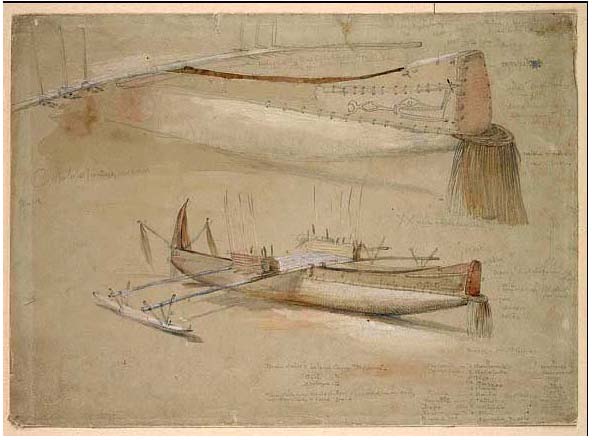
Attachment 4
Haddon’s account of the western island-PNG canoe trade
(see Haddon, The ethnography of the Western Tribe of Torres Strait, 1890, p 340-342)
The large canoes in the Straits all come from Daudai [New Guinea], about the neighbourhood of the Fly River. I was told the logs were cut and hollowed out at Wabad (Wabuda?) and fitted with a single small outrigger. Thence they passed through the hands of the Kiwai and Mowat people on the mainland of New Guinea and across to the island of Saibai. Here they are re-rigged with two outriggers, and a gunwale is fitted and the canoe decorated with a figure-head, bow-ornament, and otherwise ornamented with feathers and shells. From Saibai the canoes found their way to the other Islands of the western division of the Straits.
If a Muralug man wanted a canoe he would communicate with a friend at Moa who would speak to a friend of his at Badu; possibly the Muralug man might himself go to Badu. The Badu man would cross to Mabuiag to make arrangements and a Mabuiag man would proceed to Saibai. If there was not a canoe available at the latter place, word would be sent on, along the coast, that a canoe was to be cut out and sent down. The canoe would then retrace the course of the verbal order, and ultimately find its way to Muralug. If a man in any of the intermediate places had a new canoe to spare, he would sell it to the friend of the ultimate purchaser. If a canoe had to be made to order it would be a very long time before it arrived, as the message itself would only be transmitted when there happened to be a canoe going to the next stage, and the same applied to the delivery of the canoe. Another channel of the canoe trade was from Mowat direct to Tudu, and from thence to the central islands, and viâ Nagir to Muralug.
Payment was usually made annually until the canoe got a little broken; generally three instalments were paid. When a piece came off the canoe it was forwarded together with the final payment as a proof of the statement as to the condition of the canoe. The annual payment was, say three dibi-dibi, or goods of about equal value. Should a man be “hard up” when the annual payment became due, a certain amount of credit would be given, if the man honestly paid all he could afford. If the man could afford it he might make a single and final payment, say of a dugong harpoon (wap) or shell armlet (waiwi).
The intermediaries are paid for their service by “charging on”, the amount depending on individual cupidity, or they might be recompensed for their trouble by presents from the purchaser.
There appear to be considerable opportunities for cheating, but this is guarded against by the vigilance of the intermediary traders, who are themselves looked after by the Daudai men. If cheating occurred, the supply of canoes would cease, thus putting a stop to all commercial and fishing operations. In addition, there would be war, and the canoe confiscated.
Haddon, after his second expedition to Torres Strait in 1898, described the pattern of maritime trade in the eastern islands, revealing an even more ritualised process based on unbending long term relationships between individuals and clans, with trading rights handed down from father to son (Reports, 1935, vol 1, pp 182-183).


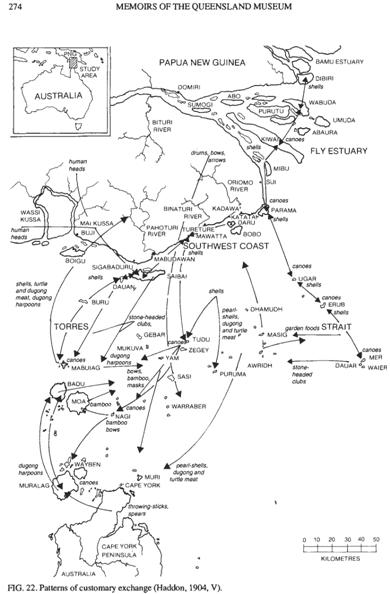
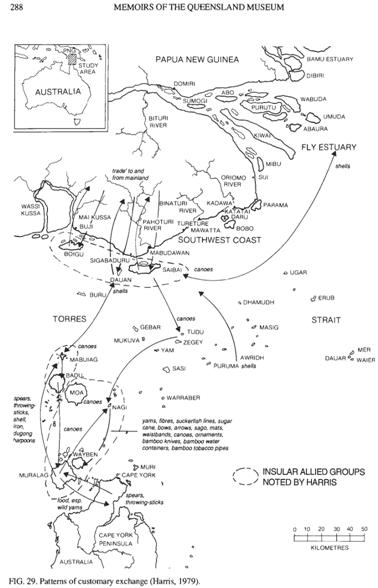
Attachment 6
PART A AND PART B SEA CLAIM AREAS
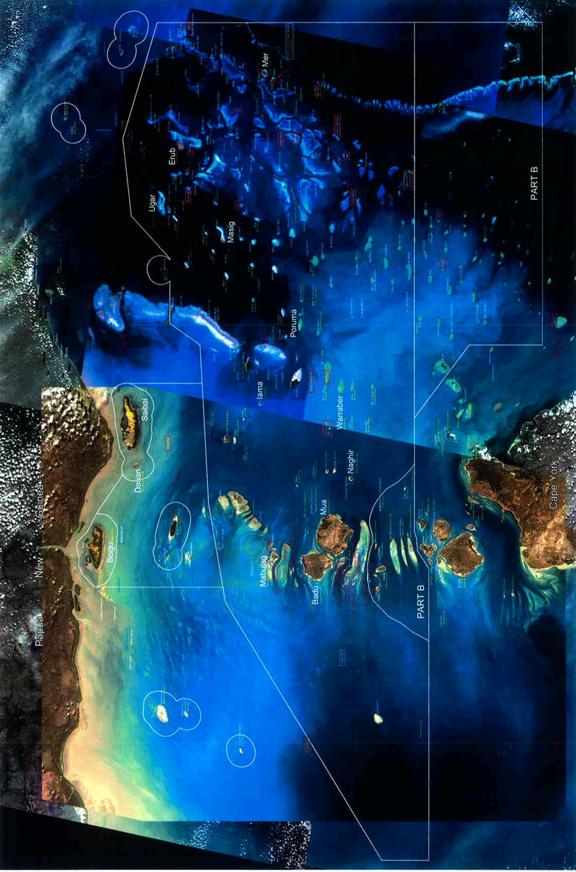


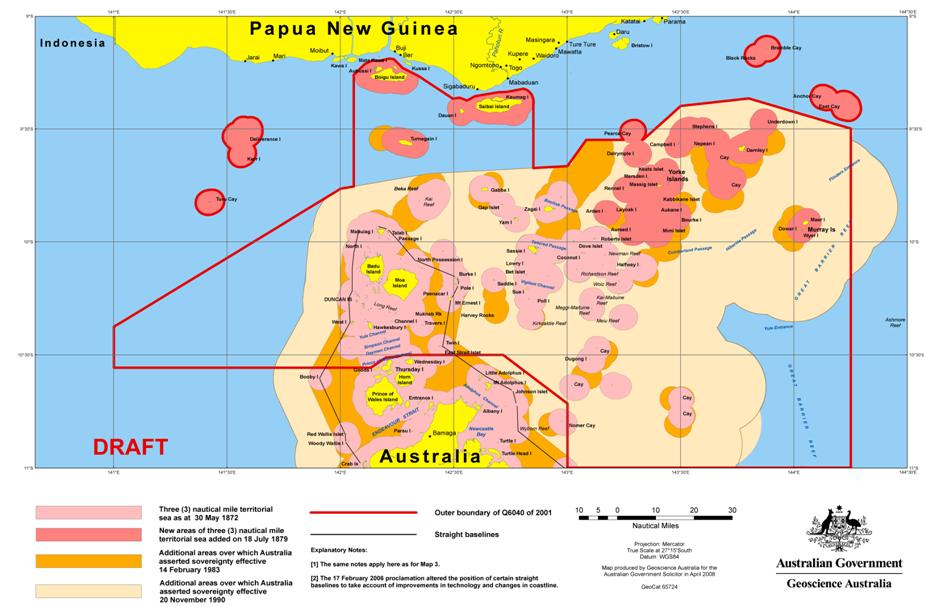
THE EXCLUSIVE AND SHARED MARINE ESTATES
The following does not purport to be a prescriptive account of the island communities’ own and shared estates. As the Islanders have emphasised, their estates are not divided by lines on water. As I have also indicated, the language used by the Islanders to describe their practices and activities in relation to waters – “used”, “shared”, “worked around” etc – either can have varying meanings (as I have indicated with “sharing/shared”) which can be context dependent, or can be quite unclear in what is signified in a given instance (eg by the word “Kulkulgal”). Necessarily what I have to say here will be inexact – but there is inexactness and inconsistency in the evidence. Nonetheless I undertake this task for these reasons.
In Bodney FC (at [178]) the Full Court, in speaking of “connection” in a context which has some parallels with the present matter commented:
It is not uncommon for the traditional laws and customs of a community to connect that community to a claim area by connecting groups within the community both to each other (often in complex ways) and, respectively and immediately, to their own particular portions of the claim area (in the latter case by granting rights to, and imposing responsibilities on, each such group in respect of its portion). In such cases, it is entirely appropriate that the connection inquiry consider not merely evidence of the general connection of the claimant community to the claim area, but also the evidence of the particular connection of the particular groups and their members to their respective portions of the claim area: see Neowarra … at [353]-[356]. The latter evidence, we would suggest, will ordinarily be necessary in some degree if the claimants’ assertion of connection is to be sufficiently manifest over the claim area as a whole – the more so, in communal claims, if rights and interests are held differentially across the community – though there can be cases where, because of long standing occupancy of the claim area, the s 223(1)(b) inquiry (as distinct from that under s 223(1)(a)) will not loom large: cf Griffiths v Northern Territory of Australia (2006) 165 FCR 300 at [561]-[562].
In this proceeding, unlike in Bodney FC, the Islander society under whose laws and customs native title rights and interests are possessed, does not claim to be a single traditional rights holding group. Rather, the Islanders are connected by membership of their Islander group to particular parts of the claim area. For this reason, in my view, the evidence of particular connection to each constituent part of the claim area and of its continuing reality is of no little importance, if s 223(1)(b) “connection” is to be satisfied for the claim area in aggregate.
Because the State has called into question connection in relation to the distant areas, I have considered it appropriate to satisfy myself of the reality of connection across the claim area. I have already indicated in dealing with problems at the extremities of the claim that there are areas in which I am not so satisfied.
What follows is a rough outline of what emerges from the Islander evidence as the owned and the shared territories of the various island communities. It is presented in a form which suggests a precision which is manifestly not there. My purpose, though, is not to delineate boundaries as such but, as I noted above, to satisfy myself as to the reality of the respective communities’ connection to their respective areas within the claim area. My “boundaries” embody my appreciation of the evidence and what can be taken from it. I have for the most part relied again upon those who have had significant marine experience in their particular regional areas, for example, Kris Billy, Kapua Gutchen and Bully Saylor in the Central and Eastern Island regions and Walter Nona in the Western Islands. The other matter that emerges from this exercise is the significant dimensions of shared areas in parts of the Strait apart altogether from those areas of sharing where waters of different communities meet.
I have indicated earlier the eastern and southern perimeters of Mer’s exclusive estate. Disregarding Misnare and Garboi, the western extremity of the northern boundary of its exclusive estate is to the north of Asmet Kep (Kapua Gutchen: “Asmet Kep … and all the reefs running from Kerged in a south-west direction towards Mer are part of the Meriam area”). It runs in a south-westerly direction to the east of Gaidan and Dautpul Nor (both of which are part of the Erub area) through Au Meri (which is regarded as the “traditional boundary between Mer and Erub) then turning in a southerly direction passing to the east of Kebi Girwai (which is in Erub’s area) then south beside Irgogob (Irgogob, Au Pizir, Kebi Pizir, Beizam, Au Derder constitute the “fishing area of all eastern islands” but which Masig also uses “on a regular basis”: Kapua Gutchen; then south-easterly to the western side of Bur and then east to Eur (which is “Mer’s: reef”: Atai Wailu). The areas within the perimeter described appear on the evidence to constitute the exclusive estate of Mer. There is, though, a quite large area which Mer shares variously with Erub and with various of the Central islands. That area begins to the east of Kebi Girwai (which is in Erub’s area) and goes south-west below Domingo Reef (also Erub), to the north of Gau Gau (George Mye: an area “commonly used by York, Darnley and Murray”) and Nepkem Kep before turning south to Megi Waireg, then south from Kebi Waireg to the northern boundary of the Part B claim (this line would appear to be where Central Island and Eastern Island waters merge), then into the Part B claim area emerging at a point east of Sunday Reef and then north to Seven Reefs and then north-east to the western side of Bur.
The northern and eastern areas of Erub’s exclusive marine estatefor NT Act purposes begin at that area on the Seabed Jurisdiction Line where the waters of Erub and Mer merge (which is to the north of Asmet Kep). The Erub and Mer waters run together in a south-westerly directionto an area to the north of Seriam Gau Gau before turning north-west to Benfadom where it merges and is shared with Masig’s estate around Benfadom. It then runs north-west merging with Masig up to Kos which provides the three way boundary between Ugar, Erub and Masig. From Kos, Erub’s estate then runs in a north-easterly direction around the western side of Maz Maz and Edgor and then in a north-easterly direction in the direction of Maizab Kaur until it reaches the Seabed Jurisdiction Line.
Erub shares the same shared area as I have described for Mer. It also shares an area with Masig which is bounded by Benfadom, Nepkem Kep and Seriam Gau Gau.
I have earlier described the northern boundary of Ugar’s exclusive marine estate as it goes west of Ugar. That part which can be acknowledged for NT Act purposes follows the Seabed Jurisdiction Line into the area of Guchen Sandbank. From Gutchen Sandbank, Ugar’s marine estate runs south-east bordering Masig’s estate to Kos. It then borders Erub’s estate north to the Seabed Jurisdiction Line.
The north-western reach of Masig’s exclusive estate appears to begin on the eastern side of Moon Passage which divides Warrior Reef. It then runs in a south-westerly direction to the east of the waters of Warrior Reef until it reaches Tidiu (Dungeness Reef). Tidiu, I note in passing, is shared by Poruma, Warraber and Iama. From the top of Tidiu, the boundary estate runs east to the north of Garboi (which belongs to Poruma and Masig), south-east to Aureed then to Mimi and Small Mimi (which belong to Masig) before meeting up with the shared area with Erub at Nepkem Kep. From Nepkem Kep, the exclusive area turns in a northerly direction to the west of Benfadom and then follows the estates of Erub and then Ugar to just south of Guchen Sandbank before turning west to Moon Passage.
The dimensions of Masig’s shared area with the Eastern Islands is very difficult to delineate on the evidence. This is largely for the reason I foreshadowed much earlier in these reasons when talking about shared areas. It relates to the infelicity in language relating to the use of areas by some of the witnesses. There is, for example, evidence of Masig using areas as far to the south-east of it as Au San, Kebi San and Toleh Toleh Nor which are very much part of the Murray line. These, Kapua Gutchen seems to suggest, were an Eastern Island preserve (“Eastern Islands boats normally worked around what is called the Murray line”). I am not able to satisfy myself that areas such as these were shared in the sense they had shared occupation by Masig and Eastern Islanders. While I do not rely simply on the names of the three reef areas to which I have referred, it is interesting that all are in the Meriam language. In attributing a range to Masig’s shared areas with the Eastern Islands, I may in fact be excluding what traditionally was shared under the Islander’s system of laws and customs. Nonetheless, given the very limited assistance the Applicant has provided in relation to the areas south of Erub, I am compelled to take a quite conservative approach. Accordingly I would regard Masig’s shared area with the Eastern Islands as beginning at Benfadom, running south-easterly through Gau Gau Kes (which is “commonly used” by Yorke, Darnley, Murray and Dauar), then south-westerly through Bazpir Kes and Der Der Kes to the south of Nepkem and then south to Kebi Waireg below which it seems the Central Island and Eastern Island waters merge along the line running south to the boundary of the Part B claim area. I will refer below to the area Masig shares with the other Central Islands.
The western boundary of Poruma’s exclusive marine estate commences to its north in the waters around Tidiu and to the south at the eastern end of Sassie. The boundary then goes in a south-easterly direction around Gagainab (which belongs to Poruma) before swinging in a north-easterly direction around Beka Sanbaink (notwithstanding the Commonwealth’s contrary concession to Warraber), around Aureed (the waters around which are shared by Masig, Warraber and Poruma), before heading in a north-westerly direction through an area where its waters merge with those of Masig until it reaches Garboi before continuing to the top end of Tidiu. I will refer below generally to Poruma’s shared area with other Central Islands but note here that Masig has a shared area with Poruma, being the waters around and between Garboi and Aureed.
The north-eastern boundary of Iama’s exclusive area begins on the eastern side of Warrior Reef at Moon Passage and runs southward through the nearby waters of Warrior Reef and then Tidiu before going south-west around Sassie, the waters of which are shared with both Poruma and Warraber before heading due west to Tekay which in turn may be shared with Mua (Mareko Kebisu’s evidence is that Tekay is part of the area that belongs to Iama; Alick Tipoti’s, that it is in the area of Mabuiag, Mua and Badu; northward across the Seabed Jurisdiction Line to a point midway between Buru and Iki (Iki, Polin and Ngazi are all part of the area that belongs to Iama: Mareko Kebisu) then turning due east to the boundary of the Top Hat where it would there pass into PNG waters and be of no present concern for NT Act purposes.
There is a large area in Warraber’s exclusive marine estate about which there is very little evidence. I have earlier indicated my findings on Warraber’s estate area to the south and south-east of Naghir before passing into the Part B area: see “The Extremities of the Claim area”. To the east, the exclusive estate emerges from Part B at a point on the boundary line north of Atub and then northwards to the west of Moegi Maitun and Koey Maitun both of which are shared with Poruma and Masig before veering to the north-west below Gagainab and onto Sassie.
(viii) The Shared Central Island Area
It is difficult to identify with any precision which are the islands that participate in the sharing to which I will now refer. The reason for this is that the Central island witnesses who deal with the matter simply refer to the area as being “Kulkulgal” which in context may mean some or all of the Central Islands: see eg Ethel Bob.
While there have been some individual claims made for Iama in the shared area (George Lui refers to Zuizin or Halfway Island being shared by Poruma, Masig, Warraber and Yam; Kris Billy asserts that Seriam Gau Gau is shared by Poruma, Warraber, Yam and Masig), the predominant view would seem to be that the sharing parties for most, if not all, of it are Masig, Poruma and Warraber. For present purposes I leave out of consideration sharing in the Part B area. Commencing at a point to the north of Atub, the shared area runs east to a point on the Part B boundary line to the south of Kebi Waireg. From there is runs to the north sharing waters with Mer and then Mer and Erub (near Kebi Waireg) and then to the eastern side of Megi Waireg, this time sharing waters with Masig, Erub and Mer into Cumberland Passage and then around Nepkem Kep and then Aureed before merging with the exclusive estates, first, of Poruma going south, and then Warraber until it reaches the point above Atub on the Part B claim line.
The south eastern boundary of Mua’s exclusive area has been referred to earlier: see “The Extremities of the Claim area”. The eastern boundary of its estate is in the waters it shares with Warraber around Naghir, Gitalai, Sauraz and probably Tekay before arcing west around Sarbi (which belongs to Mua). It then passes through the channel between Badu and Mua on the southern side of Yargas and Tik onto the Mua side of Tuin (which is shared by Mua and Badu: Nona and Manas v Queensland [2006] FCA 412), and across Dollar Reef to the boundary of the Part B sea claim. Mua also shares an area with Badu starting at the Part B sea claim boundary line at the end point of its exclusive marine estate boundary and goes west to the western edge of Dollar Reef before going north around Moegi Gua and Koey Gua and then north-westerly around Mukurad before turning east and passing through between Tukupai (which is shared by Mua and Badu: Nona and Manas v Queensland [2006] FCA 412) and Yol (which belongs to Badu) before finally joining up with Mua’s exclusive area in the waters above Tuin.
The eastern boundary of Badu’s exclusive area is shared with Mua save that where, the channel is divided by the islands above Tuin, the waters on the western side belong to Badu. The boundary line hooks north to the west of Sarbi before turning west and goes south of Kuiku Pad (which belongs to Mabuiag) through Alligator Passage. It continues north/north-westerly towards Turu Cay until it meets the Seabed Jurisdiction Line. From there, for the purposes of the NT Act claim as distinct from Mua’s marine estate, it follows the Seabed Jurisdiction line till it meets the notional point of intersection of a line running between Turu Cay and Cook Reef around which it turns south-easterly passing around the western and southern side of Cook Reef (Cook Reef and Turu Cay form the western boundary of Badu’s estate: Walter Nona) before turning to the islands shared with Mua to the south-west of Badu.
The south-western extremity of Mabuiag’s exclusive area commences adjacent to that point on the Seabed Jurisdiction Line where Badu’s northern boundary joins that line. From that point it goes south-eastwards following alongside Badu’s area and then Mua’s before turning northwards at Tekay (which it might share) from where it runs adjacent to Iama’s waters (the estates of Mabuiag and Iama meet at a point equidistant between Mabuiag and Iama) to the point where Iama’s boundary turns to the east in the Top Hat area. At around that point Mabuiag’s boundary turns to the west. It then runs into the Australian territorial waters of Buru.
Mabuiag’s exclusive estate runs to the south of Buru’s territorial waters and Aidal Maza until it reaches the Fisheries Jurisdiction Line. From there it follows that Line south until it meets with the Seabed Jurisdiction Line. The estate then runs in a south westerly direction until it intersects with the northern part of Badu’s exclusive estate.
Buru was the subject of a consent land determination in favour of the peoples of Saibai, Dauan, Boigu, Badu and Mabuiag (Nona and Ors v Queensland [2005] FCA 1118). This territorial waters area seems on the evidence to be used by all five of the consent determination communities and it is not unreasonable to regard the territorial waters as being part of the shared area. The shared area extends additionally to the south-west of Buru around Aidal Maza, then west to the Fisheries Jurisdiction Line boundary before turning north-east to re-join the territorial waters on their western extremity.
For present purposes, such is the nature of sharing between Dauan and Saibai that save for Saibai’s home areas, it is unnecessary to distinguish between them. The northern, eastern and western boundaries for the Top Western Islands are set by the Fisheries Jurisdiction Line. The southern boundary is set by the boundaries of Iama, Mabuiag and the area around Buru which is shared by Boigu, Dauan, Saibai, Mabuiag and Badu. As between Boigu and Saibai, the evidence is that the boundaries of the waters of each respectively are divided in the middle between them. As I have already indicated shared use is made by all three of the waters of each of Saibai and Boigu (ie Dauan and Saibai can use Boigu waters; Boigulgal can use Saibai and Dauan waters).