

FEDERAL COURT OF AUSTRALIA
Parker, In the matter of Purcom No 34 Pty Limited (In Liq) (No 2)
[2010] FCA 624
|
|
Citation: |
Parker, In the matter of Purcom No 34 Pty Limited (In Liq) (No 2) [2010] FCA 624 |
| ||
|
|
| ||||
|
|
Parties: |
GREGORY JAY PARKER and PURCOM NO 34 PTY LIMITED (IN LIQUIDATION) (ACN 006 794 672) v ROBERT FREDERICK LEE TUCKER, RICHARD JAMES TUCKER, PURCOM NO 34 ADMIN PTY LIMITED (ACN 134 158 508) (RECEIVER AND MANAGER APPOINTED), ANDREW ZISSIMOU, PRAHRAN TYRE CENTRE PTY LIMITED (ACN 138 747 225), GERARD CONLON and JUNE DANKS |
| ||
|
|
| ||||
|
|
File number: |
VID 636 of 2009 |
| ||
|
|
| ||||
|
|
Judge: |
GORDON J |
| ||
|
|
| ||||
|
|
Date of judgment: |
17 June 2010 |
| ||
|
|
| ||||
|
|
Legislation: |
Bankruptcy Act 1966 (Cth) Corporations Act 2001 (Cth) Federal Court of Australia Act 1976 (Cth) Federal Court Rules |
| ||
|
|
| ||||
|
|
Cases cited: |
Ainsworth v Criminal Justice Commission (1992) 175 CLR 564 Allanson v Midland Credit Ltd (1977) 30 FLR 108 Australian Competition and Consumer Commission v Danoz Direct Pty Ltd (2003) 60 IPR 296 Australian Competition and Consumer Commission v The Bio Enviro Plan Pty Ltd (2004) ATPR ¶41-998 Australian Meat Processor Corporation Ltd v O’Connor [2009] FCA 355 AWB Ltd v Cole (No 6) (2006) 235 ALR 307 Barewa Oil and Mining NL (in liq) v Isim Mineral Development Pty Ltd (1981) 38 ALR 288 Bass v Permanent Trustee Company Limited (1999) 198 CLR 334 Canson Enterprises Ltd v Boughton & Co [1991] 3 SCR 534 Chittick v Maxwell (1993) 118 ALR 728 Cruse v Multiplex Ltd (2008) 172 FCR 279 Forster v Jododex Australia Pty Ltd (1972) 127 CLR 421 Gertig v Davies (2003) 85 SASR 226 Hill v Rose [1990] VR 129 Lovell v Perkin (2008) 101 ALD 335 Macquarie Bank Ltd v Bardetta (2005) 216 ALR 670 Minister for Immigration and Ethnic Affairs v Guo Wei Rong (1997) 191 CLR 559 Nocton v Lord Ashburton [1914] AC 932 O’Halloran v RT Thomas & Family Pty Ltd (1998) 45 NSWLR 262 Parker, In the matter of Purcom No 34 Pty Ltd (in Liq) [2010] FCA 263 Re Dawson (deceased); Union Fidelity Trustee Co Ltd v Perpetual Trustee Co Ltd[1966] 2 NSWR 211 University of New South Wales v Moorhouse (1975) 133 CLR 1 Warman International Limited v Dwyer (1995) 182 CLR 544 Youyang Pty Limited v Minter Ellison Morris Fletcher (2003) 212 CLR 484 K Dharmananda and A Papamatheos (eds), Perspectives on Declaratory Relief (2009) R Meagher, D Heydon, M Leeming, Equity: Doctrines & Remedies (4th ed, 2002) |
| ||
|
|
|
|
| ||
|
|
Date of hearing: |
15 April 2010 |
| ||
|
|
|
|
| ||
|
|
Date of last submissions: |
10 June 2010 |
| ||
|
|
| ||||
|
Place: |
Melbourne | ||||
|
|
| ||||
|
Division: |
GENERAL DIVISION | ||||
|
|
| ||||
|
Category: |
No Catchwords | ||||
|
|
| ||||
|
Number of paragraphs: |
56 | ||||
|
|
|
|
| ||
|
Counsel for the Plaintiffs: |
S Wells | ||||
|
|
| ||||
|
Solicitor for the Plaintiffs: |
Farrar Lawyers | ||||
|
|
| ||||
|
First Defendant: |
No appearance | ||||
|
|
| ||||
|
Second Defendant: |
No appearance | ||||
|
|
| ||||
|
Third Defendant: |
No appearance | ||||
|
|
| ||||
|
Fourth and Fifth Defendants: |
No Appearance | ||||
|
|
| ||||
|
Sixth Defendant: |
No Appearance | ||||
|
|
| ||||
|
Solicitor for the Seventh Defendant: |
Kenna Teasdale Lawyers | ||||
|
|
| ||||
|
Solicitor for the Receiver and Manager of the Third Defendant: |
Hugh & Associates Lawyers | ||||
|
|
| ||||
|
Solicitor for JAX Quickfit Franchising Systems Pty Limited (ACN 112 050 058), a non-party: |
Macpherson & Kelley Lawyers | ||||
|
IN THE FEDERAL COURT OF AUSTRALIA |
|
|
VICTORIA DISTRICT REGISTRY |
|
|
GENERAL DIVISION |
636 of 2009 |
IN THE MATTER OF PURCOM NO 34 PTY LIMITED (IN LIQUIDATION) (ACN 006 794 672)
|
GREGORY JAY PARKER First Plaintiff
PURCOM NO 34 PTY LIMITED (IN LIQUIDATION) (ACN 006 794 672) Second Plaintiff
|
|
AND: |
ROBERT FREDERICK LEE TUCKER First Defendant
RICHARD JAMES TUCKER Second Defendant
PURCOM NO 34 ADMIN PTY LIMITED (ACN 134 158 508) (RECEIVER AND MANAGER APPOINTED) Third Defendant
ANDREW ZISSIMOU Fourth Defendant
PRAHRAN TYRE CENTRE PTY LIMITED (ACN 138 747 225) Fifth Defendant
GERARD CONLON Sixth Defendant
JUNE DANKS Seventh Defendant
|
|
JUDGE: |
|
|
DATE OF ORDER: |
17 JUNE 2010 |
|
WHERE MADE: |
MELBOURNE |
THE COURT DECLARES THAT:
1. The First Defendant breached his fiduciary duties and duties under ss 180(1), 181(1) and 182(1) of the Corporations Act 2001 (Cth) (the Act) which were owed to the Second Plaintiff by embarking on a scheme designed to divert the Second Plaintiff’s assets and business undertaking away from the Second Plaintiff to the Third Defendant, and the steps taken to give effect to that scheme are set out in Schedule 1.
2. The Second Defendant knowingly participated and assisted in the First Defendant’s scheme and breaches of duty to the Second Plaintiff by taking the steps set out in Schedule 2.
3. The Third Defendant knowingly participated and assisted in the First Defendant’s scheme and breaches of duty to the Second Plaintiff by taking the steps set out in Schedule 3.
4. The Third Defendant received the trust property of the Second Plaintiff listed in Schedule 4 in breach of trust.
5. Without prejudice to the Receiver and Manager of the Third Defendant’s (the Receiver) lien and right of indemnity in respect any property of the Second Plaintiff or Third Defendant (Property), the Third Defendant holds all of its rights as lessee under the lease of premises located at 386 High Street, Prahran in the State of Victoria entered into with the Seventh Defendant dated 6 March 2009 (Lease) on constructive trust for the Second Plaintiff.
6. Pursuant to s 588FF(1)(h) of the Act, the agreement styled “Agreement for the Sale of Stock” bearing the date 28 February 2009 signed by the First Defendant on behalf of the Second Plaintiff and signed by the Second Defendant on behalf of the Third Defendant, is void ab initio.
7. Pursuant to s 588FF(1)(h) of the Act, the agreement styled “Agreement for the Sale of Equipment” bearing the date 1 March 2009, is void ab initio.
AND THE COURT ORDERS THAT:
8. Subject to the payment of the liabilities, remuneration, costs and expenses of the Receiver (the Receiver’s Costs), the Receiver transfer to the Second Plaintiff such property identified below to the extent it is within the Receiver’s possession, custody or control and not otherwise required to satisfy the Receiver’s Costs:
(a) in Schedule 4 excluding one hoist and the Ford Utility motor vehicle (registration no. UEZ 085) (the Ford Ute);
(b) the assets listed in a report prepared by Professional Valuation and Auction Services dated 30 October 2009 which is at Schedule 5, excluding:
1. the Tecalemit 4 point hoist;
2. advanced automotive 2 point hoist;
3. the Ford Ute;
4. 1 Megabus Tower Pentium Computer (R) E5200;
5. 1 Megabus Tower Intel ® Core 2 Duo E8500;
6. 1 Lexmark E260d Monochrome Printer;
7. Brother MFC-7340 Printer/Scanner/Fax Machine; and
8. those assets which are listed in Schedule 4 and transferred pursuant to order 8(a), above.
(c) stock in Schedule 6 which is in the possession of the Receiver as at the date of these Orders.
8A. The Receiver is authorised to realise any of the Property, which is within his possession, custody or control to satisfy the Receiver’s Costs, provided that if the Receiver realises any interests under the Lease referred to in Order 5 above, he must do so in accordance with the terms of the Lease.
8B. Nothing in these Orders will:
(a) affect the Receiver’s lien or right of indemnity over the Property, which is within his possession, custody or control, in respect of the Receiver’s Costs; and
(b) operate to make the Receiver liable for any obligation or liability of the Third Defendant.
9. Subject to Order 10, the First, Second and Third Defendants make equitable compensation to the Second Plaintiff comprising:
(a) the First Plaintiff’s costs of the liquidation of the Second Plaintiff, including the costs of the provisional liquidation, in the sum of $104,217.00;
(b) future economic loss in the sum of $93,750.00;
(c) the sum of $43,601.74 for stock;
(d) the amounts (if any) of the debts or claims which the unsecured creditors of the Second Plaintiff prove to the satisfaction of the First Plaintiff in the liquidation of the Second Plaintiff;
(e) the amount (if any) of the debt or claim (after recourse to its security) which Enterprise Finance Solutions proves to the satisfaction of the First Plaintiff in the liquidation of the Second Plaintiff;
(f) the amount (if any) of the debt or claim (after recourse to its security) which JAX Quickfit Franchising Systems Pty Ltd proves to the satisfaction of the First Plaintiff in the liquidation of the Second Plaintiff; and
(g) an indemnity from the First, Second and Third Defendants to the extent that the secured debt of the Second Plaintiff owed to Westpac Banking Corporation was paid by the guarantor and that guarantor successfully seeks to exercise a right of subrogation in the liquidation of the Second Plaintiff.
10. The amount due to be paid by the First, Second and Third Defendants to the Plaintiffs on account of equitable compensation pursuant to Order 9 and costs taxed pursuant to Order 13, be reduced by deducting the following amounts:
(a) $250,000 paid by the Sixth Defendant; and
(b) any further sums paid by the Fourth and Fifth Defendants to the Plaintiffs pursuant to the agreement titled “Terms of Settlement” dated 3 March 2010.
11. Subject to Orders 8, 8A and 8B above, upon the transfer of the trust property referred to in Order 8, the Receiver cease trading and attend to completion of statutory duties and thereafter retire as the Receiver.
12. The First, Second and Third Defendants pay interest on the amount referred to in Order 9 above pursuant to s 51A of the Federal Court of Australia Act 1976 (Cth) (the FCA) and thereafter, pursuant to s 52 of the FCA, at the rates fixed by the Rules of Court.
13. The First, Second and Third Defendants pay to the Plaintiffs, the Plaintiffs’ costs of these proceedings (including all reserved cost orders), to be taxed.
14. The Plaintiffs be forthwith released from all undertakings given to the Court.
15. All Exhibits and all documents produced pursuant to Orders for Production in the First Plaintiff’s examinations (proceedings number NSD 233 of 2009) be returned to the Plaintiffs’ solicitors within 28 days.
16. To the extent that such leave is necessary by reason of s 58(3) of the Bankruptcy Act 1966 (Cth) (the Bankruptcy Act) in respect of the Estate of the First Defendant, the Plaintiffs have leave nunc pro tunc with effect from 26 February 2010 to continue these proceedings upon the following terms:
(a) such leave does not extend to the taking of any step to enforce any judgment obtained in these proceedings against the person or property of the First Defendant without the prior leave of the Federal Court of Australia in its bankruptcy jurisdiction;
(b) the Plaintiffs shall not, without such prior leave, prove in respect of the whole or any part of a judgment in the bankruptcy of the First Defendant; and
(c) the Plaintiffs will not oppose the First Defendant’s trustee in bankruptcy being joined to these proceedings at any time.
17. The Plaintiffs’ costs of the application for leave to proceed pursuant to s 58(3) of the Bankruptcy Act be costs in the cause of these proceedings.
Note:Settlement and entry of orders is dealt with in Order 36 of the Federal Court Rules.
The text of entered orders can be located using Federal Law Search on the Court’s website.
Schedule 1
The steps taken by the First Defendant to implement the scheme designed to divert the Second Plaintiff’s assets and business undertaking away from the Second Plaintiff to the Third Defendant were:
1. In September 2008, the First Defendant sought advice from Mason Sier Turnbull, as to whether there was any legitimate basis upon which the Second Plaintiff could terminate the franchise agreement (the Franchise Agreement) between the Second Plaintiff and JAX Quickfit Franchising Systems Pty Limited (ACN 112 050 058) (JAX Quickfit) and subsequently received advice that the Second Plaintiff could not validly terminate the Franchise Agreement and that steps should be taken to attempt to obtain the consent of JAX Quickfit to the surrender of the Franchise Agreement: see [11] to [14] of the reasons for decision dated 24 March 2010;
2. On 17 September 2008, in the course of communication between the First Defendant and Mason Sier Turnbull, the First Defendant stated, “…I am very keen to surrender it, but we need to keep in mind I also want to keep trading in the industry afterwards in my own right”: see [15] of the reasons for decision dated 24 March 2010;
3. The First Defendant prepared a document entitled “Prahran Action Report” which he provided to the Sixth Defendant and in which he set out all of the actions necessary to implement the scheme which included, inter alia:
(a) the incorporation of the Third Defendant with his son as the sole director;
(b) a new lease at 386 High Street, Prahran (the Premises), to the Third Defendant;
(c) the opening of new bank accounts in the name of the Third Defendant;
(d) the rearrangement of ownership of assets of the Second Plaintiff;
(e) a change-over of insurance cover to the Third Defendant;
(f) contacting suppliers;
(g) new signage;
(h) a new computer system;
(i) advertising and new artwork for the Third Defendant;
(j) new stationery for the Third Defendant;
(k) development of a new website for the Third Defendant;
(l) new uniforms for the staff of the Second Plaintiff;
(see [17] of the reasons for decision dated 24 March 2010)
4. The First Defendant instructed the Sixth Defendant to register a company with the name of the Third Defendant: see [17] and [22] of the reasons for decision dated 24 March 2010;
5. On 11 November 2008, the First Defendant attended a two hour meeting with the Sixth Defendant during which:
(a) he communicated to the Sixth Defendant his decision to attempt to surrender the Lease and get a new lease simultaneously in the name of the new company;
(b) he communicated to the Sixth Defendant that he was aware that in all probability JAX Quickfit, under the Franchise Agreement, would seek to pursue damages from him for breach of the Franchise Agreement; and
(c) he had knowledge that by taking the action he was proposing to take of surrendering the lease that he would cause the Second Plaintiff to be in breach of the Franchise Agreement.
(see [18] of the reasons for decision dated 24 March 2010)
6. The First Defendant arranged for his son, the Second Defendant, to be appointed a director of the Third Defendant and to be issued shares in the Third Defendant: see [20] to [23] of the reasons for decision dated 24 March 2010;
7. The First Defendant procured the consent of his son, the Second Defendant, to execute company documentation notwithstanding the Second Defendant’s concern about the possible bankruptcy from action that might be taken by JAX Quickfit and the possibility of an injunction being granted: see [20] to [23] of the reasons for decision dated 24 March 2010;
8. The First Defendant gave instructions to the Sixth Defendant to prepare a Deed of Trust whereby all shares held by the Second Defendant in the Third Defendant were to be held on trust for him: see [26] of the reasons for decision dated 24 March 2010;
9. The First Defendant took steps to negotiate with the Seventh Defendant for the surrender of the Lease of the Premises to be granted to the Third Defendant: see [22] and [28] of the reasons for decision dated 24 March 2010;
10. Between 15 January 2009 and 22 January 2009, the First Defendant instructed the Sixth Defendant to register the business name “Prahran Tyre Centre” to be owned by the Third Defendant: see [25] and [27] of the reasons for decision dated 24 March 2010;
11. On 24 February 2009, the First Defendant attended a meeting with the Sixth Defendant and advised him he was ready to proceed with the “changeover” on 6 March 2009: see [30] of the reasons for decision dated 24 March 2010;
12. On 2 March 2009, the First Defendant emailed two draft letters to the Sixth Defendant which he planned to send to JAX Quickfit at specified times (the first letter on the evening of 3 March 2009; the second letter at close of business on Friday, 6 March 2009) which were designed to mislead the franchisor, JAX Quickfit, by giving notice of an intention to relocate the business of the Second Plaintiff, which was not his true intention: see [32] to [34] of the reasons for decision dated 24 March 2010;
13. On or about 6 March 2009, the First Defendant:
(a) caused the Second Plaintiff to enter into an agreement with the Seventh Defendant entitled “Surrender of Lease” whereby the Second Plaintiff surrendered all of its rights under the Lease of the Premises;
(b) executed a new lease of the Premises to the Third Defendant.
(see [34] of the reasons for decision dated 24 March 2010)
14. At close of business on 6 March 2009, the First Defendant sent a letter to JAX Quickfit and, in the knowledge that the Second Plaintiff was, by reason of implementing his scheme, in breach of its obligations under the Franchise Agreement, gave notice that as at close of business on 6 March 2009, the Second Plaintiff’s franchise would cease to operate out of the Premises and that he intended to relocate the Second Plaintiff’s franchise to another site within the Second Plaintiff’s franchise territory: see [34] and [35] of the reasons for decision dated 24 March 2010;
15. Over the long weekend on 7, 8 and 9 March 2009, the First Defendant caused the JAX Quickfit sign to be removed from the Premises and the Premises painted and re-branded as “Prahran Tyre Centre”: see [35] of the reasons for decision dated 24 March 2010;
16. The First Defendant caused the Second Plaintiff to enter into an agreement titled “Agreement for the Sale of Stock” dated 28 February 2009 whereby all of the Second Plaintiff’s stock was sold to the Third Defendant for the sum of $41,514.60: see [31] of the reasons for decision dated 24 March 2010;
17. On or about 21 March 2009 and after the appointment of the First Plaintiff as provisional liquidator of the Second Plaintiff, the First Defendant caused the Second Plaintiff to enter into an agreement titled “Agreement for the Sale of Equipment” which was backdated to 1 March 2009 whereby all of the Second Plaintiff’s stock and equipment was purportedly sold to the Third Defendant: see [44] to [46] of the reasons for decision dated 24 March 2010;
18. The First Defendant continued to be involved in the management and operation of the business of the Third Defendant after 9 March 2009: see [38] to [63] of the reasons for decision dated 24 March 2010.
Schedule 2
The steps taken by the Second Defendant to assist the First Defendant in the implementation of the scheme were:
1. on 13 January 2009, the Second Defendant was appointed the sole director and shareholder of the Third Defendant: see [20] and [23] of the reasons for decision dated 24 March 2010;
2. on 21 January 2009, as sole director and shareholder of the Third Defendant, the Second Defendant executed a declaration of trust of his entire shareholding in the Third Defendant for the benefit of the Prahran Tyre & Service Centre Unit Trust, a trust created on the same day: see [26] of the reasons for decision dated 24 March 2010;
3. in late February / early March 2009, the Second Defendant ordered business cards for the business to be conducted by the Third Defendant and, despite being the sole director and shareholder, did not order a business card with his name on it: see [29] of the reasons for decision dated 24 March 2010;
4. by no later than 28 February 2009, on behalf of the Third Defendant, the Second Defendant executed the “Agreement for the Sale of Stock” to purchase the Second Plaintiff’s stock for $41,514.60, the price to be paid by instalments: see [31] of the reasons for decision dated 24 March 2010;
5. on 21 March 2009, on behalf of the Third Defendant, the Second Defendant executed the backdated “Agreement for the Sale of Equipment” (bearing the date 1 March 2009) to purchase the Second Plaintiff’s assets and business for $12,800.00, the price to be paid by instalments: see [45] to [46] of the reasons for decision dated 24 March 2010;
6. on 30 April 2009 (six days after the appointment of an official liquidator to the Second Plaintiff and the day after the Fourth Defendant resigned as a director of the Third Defendant), the Second Defendant accepted a transfer of shares of the Third Defendant from the Fourth Defendant and then transferred those shares to his sister: see [51] of the reasons for decision dated 24 March 2010;
7. on 6 August 2009 (two days after the liquidator’s examination of his father and mother and the day after the liquidator’s examination of Mr Mavrodis, his accountant, and the Fourth Defendant), the Second Defendant contacted the Fourth Defendant and offered to sell the Third Defendant’s business to him: see [54] of the reasons for decision dated 24 March 2010. The next day, the sale was effected: see [55] of the reasons for decision dated 24 March 2010.
Schedule 3
The steps taken by the Third Defendant to assist the First Defendant in the implementation of the scheme were:
1. The Second Defendant was the directing mind and will of the Third Defendant: see [86] of the reasons for decision dated 24 March 2010.
2. As the directing mind and will of the Third Defendant, the Second Defendant took the following steps:
(a) on 21 January 2009, as sole director and shareholder of the Third Defendant, the Second Defendant executed a declaration of trust of his entire shareholding in the Third Defendant for the benefit of the Prahran Tyre & Service Centre Unit Trust, a trust created on the same day: see [26] of the reasons for decision dated 24 March 2010;
(b) in late February / early March 2009, the Second Defendant ordered business cards for the business to be conducted by the Third Defendant and, despite being the sole director and shareholder, did not order a business card with his name on it: see [29] of the reasons for decision dated 24 March 2010;
(c) by no later than 28 February 2009, on behalf of the Third Defendant, the Second Defendant executed the “Agreement for the Sale of Stock” to purchase the Second Plaintiff’s stock for $41,514.60, the price to be paid by instalments: see [31] of the reasons for decision dated 24 March 2010;
(d) on 21 March 2009, on behalf of the Third Defendant, the Second Defendant executed the backdated “Agreement for the Sale of Equipment” (bearing the date 1 March 2009) for the Third Defendant to purchase the Second Plaintiff’s assets and business for $12,800.00, payable by instalments: see [45] to [46] of the reasons for decision dated 24 March 2010;
(e) on 30 April 2009 (six days after the appointment of an official liquidator to the Second Plaintiff and the day after the Fourth Defendant resigned as a director of the Third Defendant), the Second Defendant accepted a transfer of shares of the Third Defendant from the Fourth Defendant and then transferred those shares to his sister: see [51] of the reasons for decision dated 24 March 2010;
(f) on 6 August 2009 (two days after the liquidator’s examination of his father and mother and the day after the liquidator’s examination of Mr Mavrodis, his accountant, and the Fourth Defendant), he contacted the Fourth Defendant and offered to sell the Third Defendant’s business to him: see [54] of the reasons for decision dated 24 March 2010. The next day, the sale was effected: see [55] of the reasons for decision dated 24 March 2010.
Schedule 4
This page and the following four pages comprise Schedule 4 of the Orders dated 17 June 2010.
Equipment
1. two tyre fitting machines;
2. two hoists;
3. two wheel balancing machines;
4. motor vehicle, Ford AU Utility registration number UEZ 085; and
5. tools, shelving and equipment.
Stock
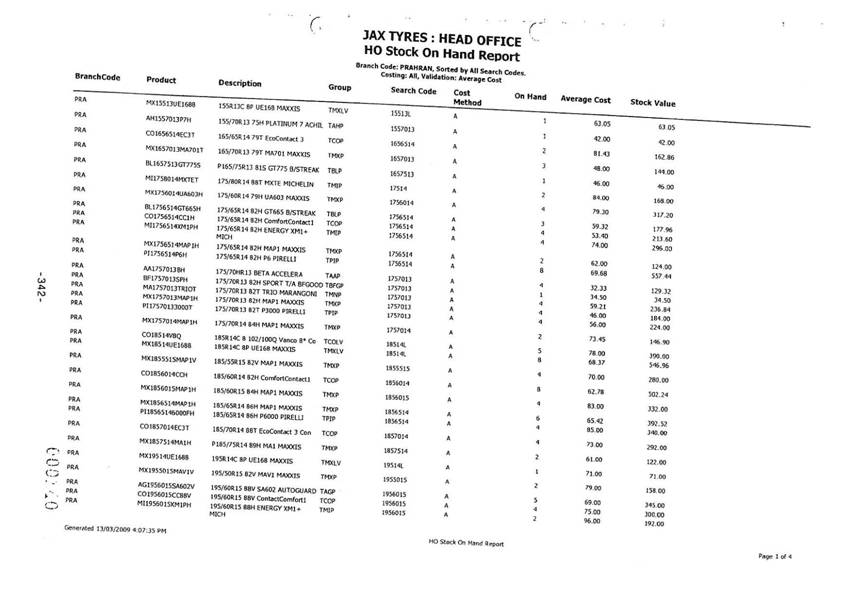
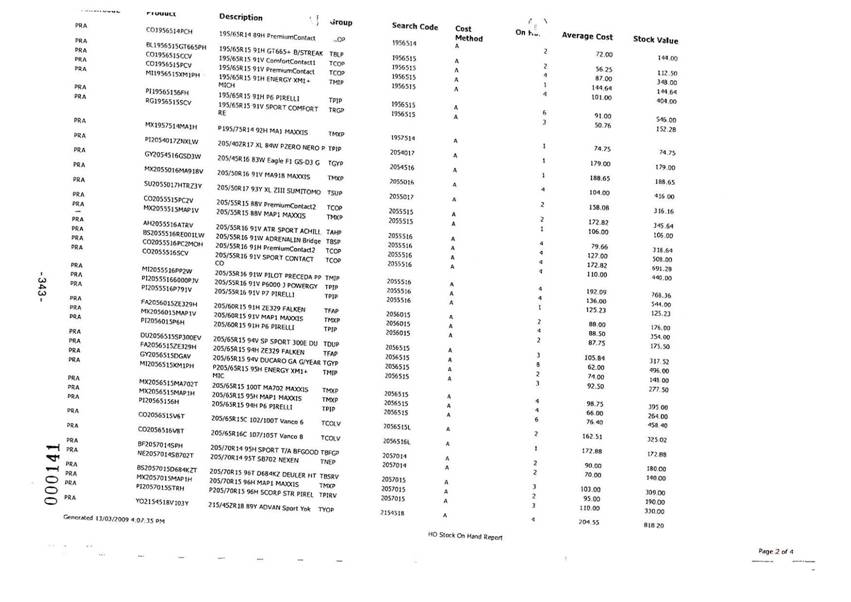
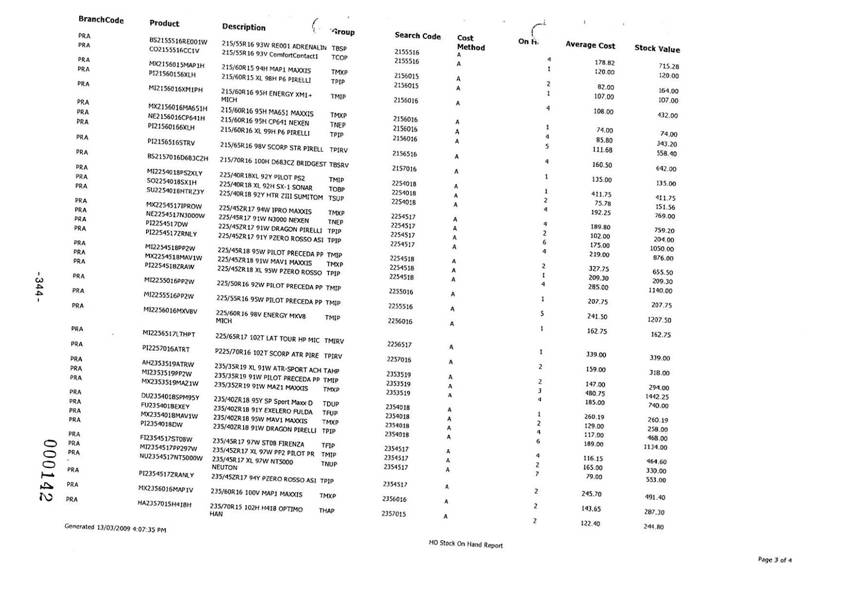
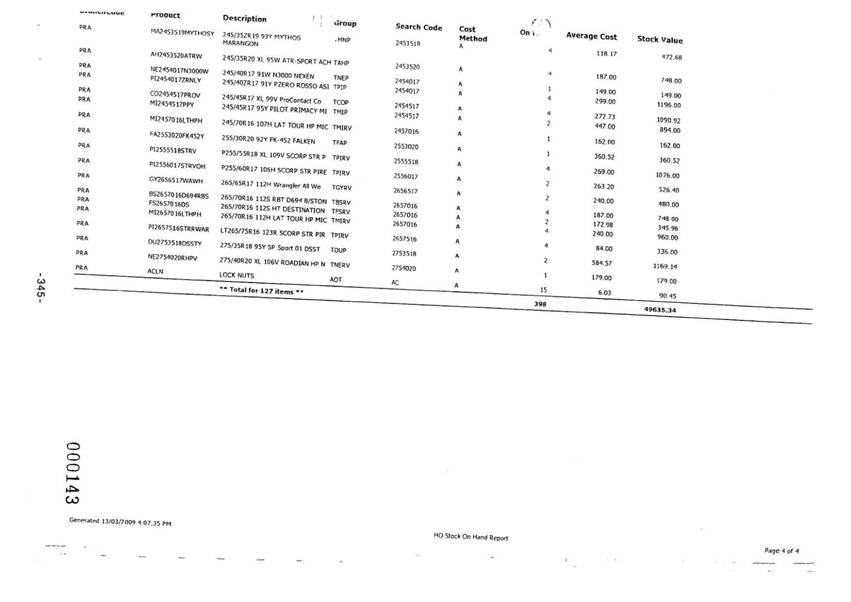
See attached list of stock.

Schedule 5
This page and the following four pages comprise Schedule 5 of the Orders dated 17 June 2010.
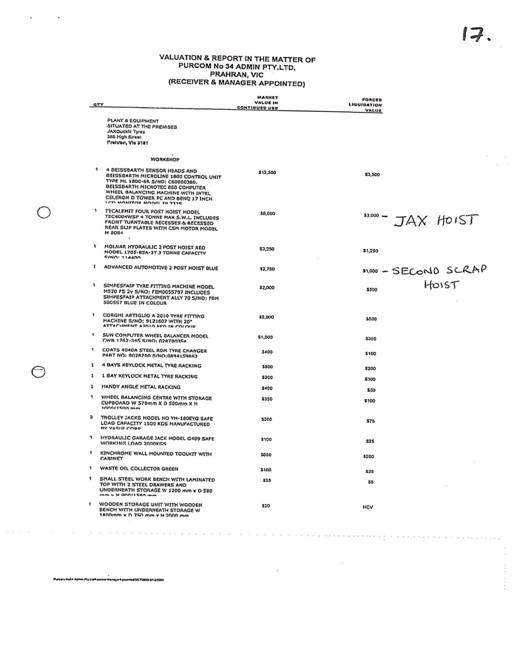
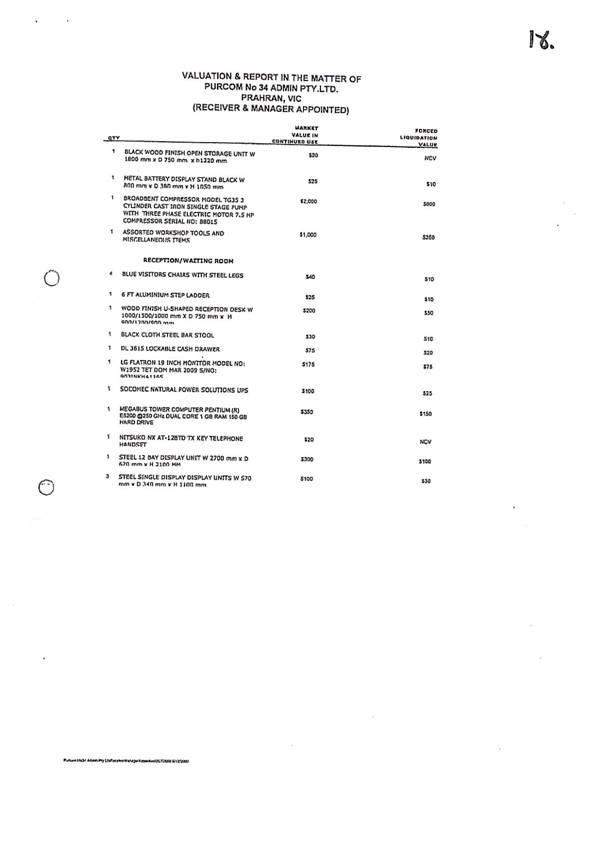
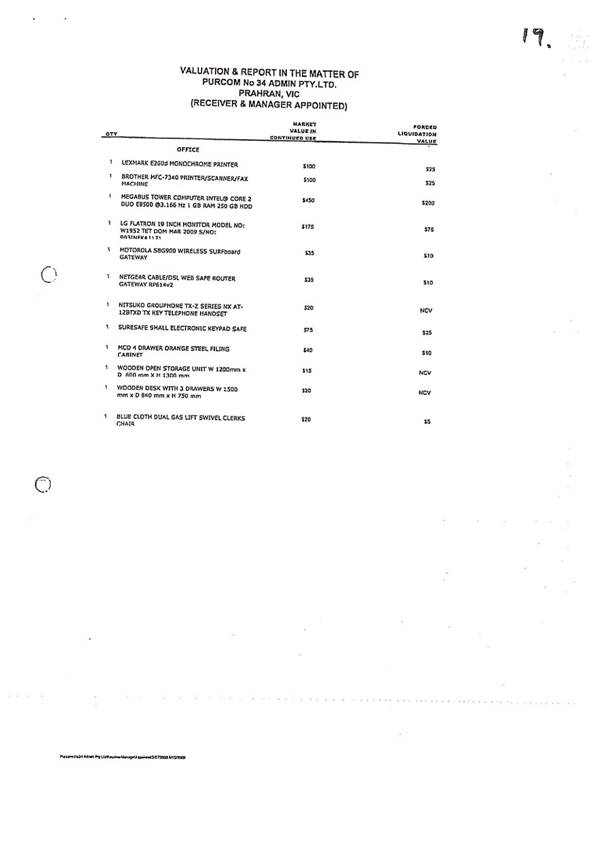

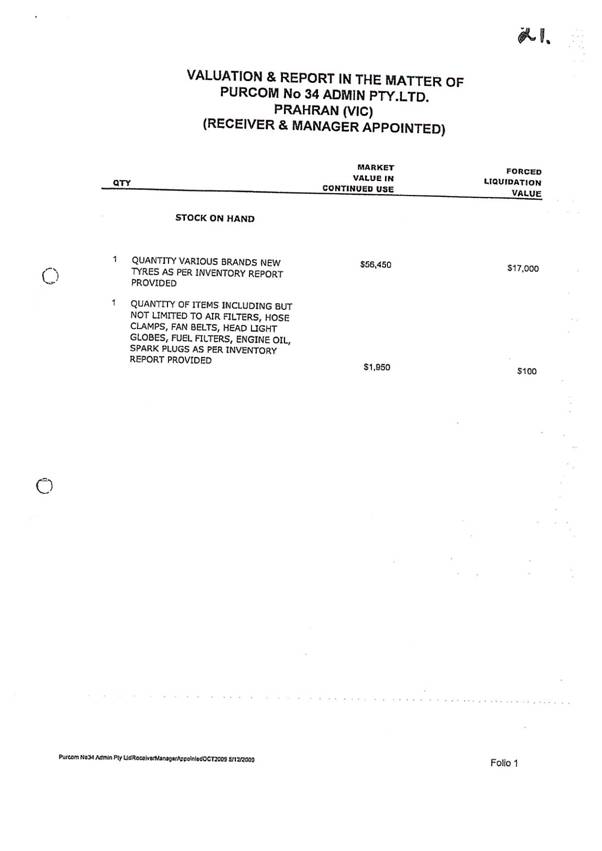
Schedule 6
This page comprises Schedule 6 of the Orders dated 17 June 2010.
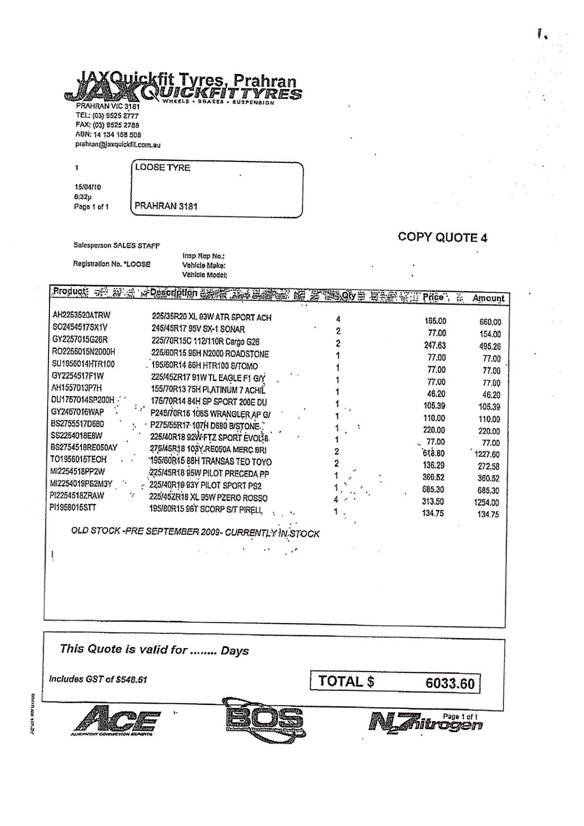
|
IN THE FEDERAL COURT OF AUSTRALIA |
|
|
VICTORIA DISTRICT REGISTRY |
|
|
GENERAL DIVISION |
VID 636 of 2009 |
IN THE MATTER OF PURCOM NO 34 PTY LIMITED (IN LIQUIDATION) (ACN 006 794 672)
|
BETWEEN: |
GREGORY JAY PARKER First Plaintiff
PURCOM NO 34 PTY LIMITED (IN LIQUIDATION) (ACN 006 794 672) Second Plaintiff
|
|
AND: |
ROBERT FREDERICK LEE TUCKER First Defendant
RICHARD JAMES TUCKER Second Defendant
PURCOM NO 34 ADMIN PTY LIMITED (ACN 134 158 508) (RECEIVER AND MANAGER APPOINTED) Third Defendant
ANDREW ZISSIMOU Fourth Defendant
PRAHRAN TYRE CENTRE PTY LIMITED (ACN 138 747 225) Fifth Defendant
GERARD CONLON Sixth Defendant
JUNE DANKS Seventh Defendant
|
|
JUDGE: |
GORDON J |
|
DATE: |
17 JUNE 2010 |
|
PLACE: |
MELBOURNE |
REASONS FOR JUDGMENT
INTRODUCTION
1 On 24 March 2010, the Court published its substantive reasons for decision: Parker, In the matter of Purcom No 34 Pty Ltd (in Liq) [2010] FCA 263 (Reasons). The Court directed the Plaintiffs to file and serve an outline of submissions identifying the Orders the Plaintiffs proposed to give effect to the Reasons and any additional material in support of the proposed relief. These reasons for decision address the Plaintiffs’ submissions directed to those issues and the Orders they proposed, and adopt the following defined terms:
|
ABBREVIATION |
DESCRIPTION |
|
Admin |
Purcom No 34 Admin Pty Limited (ACN 134 747 225), the Third Defendant. |
|
Conlon |
Gerard Conlon, the Sixth Defendant. |
|
Danks |
June Danks, the Seventh Defendant. |
|
JAX Quickfit |
JAX Quickfit Franchising Systems Pty Limited (ACN 112 050 058). |
|
Parker |
Gregory Jay Parker, the Liquidator of Purcom No 34 Pty Limited (ACN 006 794 672) and First Plaintiff. |
|
PTC |
Prahran Tyre Centre Limited (ACN 138 747 225), the Fifth Defendant. |
|
Purcom |
Purcom No 34 Pty Limited (ACN 006 794 672), the Second Plaintiff. |
|
Receiver |
Peter Ngan, the Receiver and Manager of Admin. |
|
Richard Tucker |
Richard James Tucker, the Second Defendant. |
|
Tucker Senior |
Robert Frederick Lee Tucker, the First Defendant. |
|
Zissimou |
Andrew Zissimou, the Fourth Defendant. |
2 On 15 April 2010, the Court conducted a hearing about the appropriate relief. Relief was sought by the Plaintiffs against Tucker Senior, Richard Tucker, Admin, the Receiver and Danks. No relief was sought against Zissimou, PTC or Conlon. The Plaintiffs served a copy of the submissions and proposed Orders on Tucker Senior, Richard Tucker, Admin, the Receiver and Danks. Danks opposed the Orders sought against her and her solicitors filed and served correspondence proposing alternative Orders as against her. The Receiver’s solicitors also objected to some aspects of the form of Orders proposed by the Plaintiffs and filed and served correspondence proposing alternative orders. Despite having notice of the further hearing, neither Tucker Senior nor Richard Tucker appeared or made any submissions. In addition to the evidence tendered at the hearing on 1, 2 and 3 March 2010, the Plaintiffs also sought to rely upon a summary of receipts and payments of Purcom and another summary of receipts and payments of Admin. A copy of the two summaries was annexed to the Plaintiffs’ submissions.
3 During the course of the hearing on 15 April 2010, it became apparent that several of the Plaintiffs’ proposed Orders would affect JAX Quickfit, which holds a registered fixed and floating charge over all the assets of Purcom. At the end of the hearing, arrangements were made for the affected parties and JAX Quickfit to attend a mediation to discuss the final form of the Orders to give effect to the Reasons. At the conclusion of the mediation, further Orders were proposed and served on all parties, the Receiver and JAX Quickfit. The areas of dispute were then more limited.
4 I will deal with the form of the proposed declarations and Orders in turn.
DECLARATIONS OF BREACH OF FIDUCIARY DUTIES AND BREACH OF DUTIES UNDER SECTIONS 180(1), 181(1) AND 182(1) OF THE ACT BY TUCKER SENIOR AND RELATED DECLARATIONS
5 The Plaintiffs initially sought the following declarations:
1. A declaration that [Tucker Senior] breached his fiduciary duties and duties under ss 180(1), 181(1) and 182(1) of the [Act] which were owed to [Purcom] by embarking on a scheme designed to divert [Purcom’s] assets and business undertaking away from [Purcom] to [Admin] by taking the steps set out in paragraphs [6] to [63] of the [Reasons].
2. A declaration that [Richard Tucker] knowingly participated and assisted in [Tucker Senior’s] scheme and breaches of duty to [Purcom].
3. A declaration that [Admin] knowingly participated and assisted in [Tucker Senior’s] scheme and breaches of duty to [Purcom].
6 The declarations sought were pleaded in the Originating Process and reflected the findings in the Reasons. In particular:
1. the first declaration was sought in paragraph 1 of the Originating Process and reflects the findings in paragraphs [65], [71], [74] and [75] of the Reasons;
2. the second declaration was sought in paragraph 3 of the Originating Process and reflects the findings in paragraphs [85] and [87] of the Reasons; and
3. the third declaration was sought in paragraph 4 of the Originating Process and reflects the finding in paragraph [87] of the Reasons.
7 Having ascertained that the declarations were sought in the Originating Process and reflect findings in the Reasons, two further issues arise for consideration. Are the declarations necessary and if so, are they in an appropriate form?
8 The making of a declaration and the terms in which it should be framed are in the Court’s discretion (see Forster v Jododex Australia Pty Ltd (1972) 127 CLR 421 at 437–9 per Gibbs J; and Ainsworth v Criminal Justice Commission (1992) 175 CLR 564 at 581–2 and 596–7; AWB Ltd v Cole (No 6) (2006) 235 ALR 307 at [5]). However, any declaration made by the Court should reflect the final outcome of the case with certainty and precision: see Minister for Immigration and Ethnic Affairs v Guo Wei Rong (1997) 191 CLR 559 at 579 citing University of New South Wales v Moorhouse (1975) 133 CLR 1; Bass v Permanent Trustee Company Limited (1999) 198 CLR 334 at [49]; Australian Competition and Consumer Commission v Danoz Direct Pty Ltd (2003) 60 IPR 296 at [260] and K Dharmananda and A Papamatheos (eds), Perspectives on Declaratory Relief (2009) at 101.
9 In my view, it is appropriate for the Court to grant declarations of contravention by Tucker Senior, Richard Tucker and Admin. In the present case, the contravening conduct is serious. Two of the contravenors did not attend the trial. The third, Richard Tucker, attended for one day. Absent the making of the declarations, the only formal record of the disposition of the proceeding would be Orders for compensation and delivery up of equipment, without the basis for the Orders being stated: cf Goldberg and Jessup JJ said in Cruse v Multiplex Ltd (2008) 172 FCR 279 at [59]. It is therefore both appropriate and, in my view, necessary for the Court record to state with specificity what was the contravening conduct of each of Tucker Senior, Richard Tucker and Admin. That brings me to the form of declarations initially proposed by the Plaintiffs. They were inappropriate. They did not reflect the final outcome of the case with certainty and precision.
10 After the hearing, the Plaintiffs submitted an alternative form of declarations. In my view, the Court should grant the Plaintiffs those declarations in the amended form. They are in an appropriate form and are clear and precise. None of the defendants opposed the granting of these declarations.
DECLARATION OF TRUST
11 The Plaintiffs initially sought the following:
4. A declaration that [Admin] received the following trust property of [Purcom] in breach of trust:
· the stock in trade set out in the document entitled “HO Stock on Hand Report” …valued at $49.635.34;
· the equipment identified in cll 1.1(a) – (e) of the document entitled “Agreement for Sale of Equipment”…;
· the furnishings, plant and equipment set out in the document entitled “Inventory of Furnishings, Plant and Equipment”… .
12 The declaration sought was pleaded in paragraph 5 of the Originating Process. The Plaintiffs submitted that the findings on which the proposed declaration was based are in paragraphs [45], [46], [87] and [89] of the Reasons.
13 Having ascertained that the declaration was sought in the Originating Process and reflected findings in the Reasons, two further issues again arise for consideration. Is the declaration necessary, and if so, is it in an appropriate form? In my view the declaration is necessary but the proposed initial form of declaration was inappropriate. That issue (the form of the declaration) has now been addressed. The form of declaration now sought by the Plaintiffs is certain and precise. It appropriately identifies the trust property. I would grant a declaration in the amended form. None of the defendants opposed the granting of this declaration.
RELIEF UNDER SECTION 588FF OF THE ACT
14 The Plaintiffs initially sought three orders under s 588FF of the Act as follows:
5 An order pursuant to s 588FF(1)(h) that the agreement styled “Agreement for the Sale of Stock” signed by [Tucker Senior] on behalf of [Purcom] and signed by [Richard Tucker] on behalf of [Admin] referred to in paragraph [31] of the Reasons, be declared void ab initio;
6 An order pursuant to s 588FF(1)(h) that the agreement styled “Agreement for the Sale of Equipment” bearing the date 1 March 2009 referred to in paragraph [45] of the Reasons, be declared void ab initio;
7 An order pursuant to s 588FF(1)(b) directing [Admin] and [the Receiver]…to transfer at no cost all of the trust property … which is in the possession of [Admin] to [Purcom].
15 None of the defendants opposed the Court granting declarations in the terms of proposed Orders 5 and 6. The Receiver opposed an order in terms of proposed Order 7. He proposed an order in the following terms:
7. Subject to the payment of the liabilities, remuneration, costs and expenses of the receiver and manager of the property of [Admin] (Receiver's Costs), [the Receiver] transfer to [Purcom] such property identified below to the extent it is within the Receiver’s possession, custody or control and not otherwise required to satisfy the Receiver's Costs:
(a) in schedule 4 … excluding one hoist, the Ford Ute (registration no. UEZ 085) (“the Ford Ute”) and the Holden Ute;
(b) as the assets listed in a report prepared by Professional Valuation and Auction Services dated 30 October 2009 which is at schedule 5, excluding:
· the Tecalemit 4 point hoist;
· advanced automotive 2 point hoist;
· the Ford Ute;
· 1 Megabus Tower Pentium Computer (R) E5200;
· 1 Megabus Tower Intel ® Core 2 Duo E8500;
· 1 Lexmark E260d Monochrome Printer;
· Brother MFC-7340 Printer/Scanner/Fax Machine; and
· those assets which are listed in Schedule 4 and transferred pursuant to order 7(a), above.
(c) as stock in schedule 6 … which is in the possession of [the Receiver] as at the date of these orders.
7A. The Receiver is authorised to realise any property of [Purcom] or [Admin] (Property), which is within his possession, custody or control to satisfy the Receiver’s Costs, provided that if the Receiver realises any interests under the Lease referred to in Order 8 below, he must do so in accordance with the terms of the Lease.
7B. Nothing in these Orders will:
(a) affect the Receiver’s lien or right of indemnity over the Property, which is within his possession, custody or control, in respect of the Receiver's Costs; and
(b) operate to make the Receiver liable for any obligation or liability of the [Admin].
16 The Plaintiffs do not oppose the making of these Orders. In my view, subject to some minor amendments, the orders properly identify the property to be delivered up by the Receiver and also preserve the Receiver’s statutory rights. No less importantly, the form of the order removes the uncertainties that were evident with the initial form of proposed order. I will make Orders substantively in those terms.
RELIEF IN RELATION TO THE LEASE
17 The Plaintiffs initially sought the following declaration in relation to the lease:
9 A declaration that [Admin] holds all of its rights as lessee under the lease of the premises located at 386 High Street, Prahran in the state of Victoria entered into with [Danks] dated 6 March 2009 (Lease) on constructive trust for [Purcom].
18 The Plaintiffs also initially sought the following Orders:
10 An order that [Danks] forthwith execute all documents necessary to assign the Lease to [Purcom].
…
19 The Court notes the agreement between the [P]laintiffs and [Danks] that:
(a) [Danks] will not rely upon the fact that [Admin] has a Receiver [and] Manager appointed to it or any other matter whatsoever as a basis for terminating the Lease at any time up until the Lease is assigned;
(b) [Danks] will not rely upon the fact that [Purcom] is in liquidation as a basis for terminating the Lease once assigned;
(c) [Parker] acknowledges that he will remain liable for all obligations under the Lease including the payment of rent, outgoings and liabilities and will provide a personal guarantee in respect of the liabilities of the [Purcom] as lessee under the Lease;
(d) the liabilities of [Parker] under sub-paragraph (c), directly above, and the personal guarantee will only subsist whilst the [Purcom] is lessee and will not continue beyond any further assignment of the Lease.
19 The solicitors for Danks advised the Court that they objected to orders being made against Danks. Danks submitted alternative orders which deleted proposed Order 10 and amended proposed Order 19. (These orders were later renumbered but that fact may be put to one side).
20 Since then, there has been further discussion between the Plaintiffs, the Receiver and Danks. The Plaintiffs and the Receiver have agreed that a declaration should be made in the following terms:
Without prejudice to the Receiver’s lien and right of indemnity in respect of the Property, a declaration that [Admin] holds all of its rights as lessee under the lease of premises located at 386 High Street, Prahran in the State of Victoria entered into with [Danks] dated 6 March 2009 (Lease) on constructive trust for [Purcom].
In my view, that declaration is necessary and in an appropriate form. None of the other defendants opposed the granting of this declaration.
21 No agreement has been reached in relation to the matters the subject of the orders proposed in paragraph [18] above and those orders are no longer sought by the Plaintiffs.
EQUITABLE COMPENSATION
22 The Plaintiffs initially sought orders for equitable compensation to be paid to Purcom. The form of orders sought was amended by them and is now in the following terms:
10 An order that [Tucker Senior], [Richard Tucker] and [Admin] make equitable compensation to [Purcom] in an amount to be calculated by adding the following amounts:
(a) [Parker’s] costs of the liquidation of [Purcom], including the costs of the provisional liquidation in the sum of $104,217.00;
(b) the [P]laintiffs’ legal costs and disbursements of the liquidation (but not including the legal costs and disbursements of these proceedings which are to be taxed pursuant to Order 15 below) in the sum of $57,338.84;
(c) creditor’s claims in the sum of $506,528.71;
(d) future economic loss in the sum of $601,616.50;
(e) the sum of $43,607.74 being the difference between the value of the stock transferred in March 2009 in the sum of $49,635.34 and the stock on hand available to [the Receiver] upon his appointment as Receiver and Manager of [Admin] on 2 September 2009, being $6,033.60.
23 A number of principles are worth restating:
1. It is a “cardinal principle of equity” that the remedy is “fashioned to fit the nature of the case and the particular facts”: Warman International Limited v Dwyer (1995) 182 CLR 544 at 559; see also Hill v Rose [1990] VR 129 at 143.
2. Where a breach of fiduciary obligation occurs, compensation is available in equity to make good the loss (Nocton v Lord Ashburton [1914] AC 932) and the plaintiff must elect between the remedy of equitable compensation and account of profits: Nocton [1914] AC 932 at 956-957; Warman 182 CLR 544 at 558; R Meagher, D Heydon, M Leeming, Equity: Doctrines & Remedies (4th ed, 2002) at 837.
3. Equitable compensation is assessed at the time of trial, with the full benefit of hindsight and common sense, not at the date of breach: Youyang Pty Limited v Minter Ellison Morris Fletcher (2003) 212 CLR 484 at [35]; Re Dawson (deceased); Union Fidelity Trustee Co Ltd v Perpetual Trustee Co Ltd [1966] 2 NSWR 211 at 216; O’Halloran v RT Thomas & Family Pty Ltd (1998) 45 NSWLR 262 at 273 and 276.
4. The objective of equitable compensation is compensatory – to restore the principal to the position it was in prior to the breaches and to make good any loss caused by the fiduciary’s wrongful conduct: see [75] of the Reasons; Nocton [1914] AC 932 at 952; Re Dawson (deceased)[1966] 2 NSWR 211; O’Halloran 45 NSWLR 262 at 272-273. No element of penalty is involved: R Meagher, D Heydon, M Leeming, Equity: Doctrines & Remedies (4th ed, 2002) at 837-839.
5. Unlike common law damages, equitable compensation is not limited or influenced by common law principles of remoteness of damage, forseeability or causation: Hill v Rose [1990] VR 129 at 144; Canson Enterprises Ltd v Boughton & Co [1991] 3 SCR 534 at 556; O’Halloran 45 NSWLR 262 at 273.
6. However, there does have to be some causal connection between the breach of fiduciary obligation and the loss for which compensation is recoverable. It is necessary for the plaintiff to establish that the loss would not have occurred but for the breach: O’Halloran 45 NSWLR 262 at 275–6. The necessary enquiry is whether the loss would have happened had there been no breach, not whether the loss was caused by or flowed from the breach: O’Halloran 45 NSWLR 262 at 276–277.
24 In light of these principles, I am required to award equitable compensation to Purcom so as to put it back in the position it was in before the breach. It cannot recover compensation that would put it in a better position than if the breach had not occurred. As Spigelman CJ stated in O’Halloran 45 NSWLR 262 at 276–277, I consider that policy favours a stringent test in the circumstances of this case.
25 I will deal with each element of the claim for equitable compensation in turn.
Costs of the Liquidation
26 First, the Plaintiffs submitted that the costs and expenses of the liquidation (excluding legal costs of these proceedings) should form part of the equitable compensation claim. The Plaintiffs submitted that Purcom was entitled to these costs on the basis that it was necessary to restore Purcom to the position it was in prior to the breaches of fiduciary duty and to make good the loss occasioned by Tucker Senior, Richard Tucker and Admin’s conduct. The Plaintiffs provided minutes of the meeting of creditors of Purcom which resolved that the costs and expenses of the liquidation were $104,217.00.
27 In my view, it is appropriate to order that Tucker Senior, Richard Tucker and Admin make equitable compensation to Purcom in the terms of proposed Order 10(a) (see [22] above). The loss (the costs) would not have been incurred if there had been no breach by Tucker Senior, Richard Tucker and Admin.
Legal Costs of the Liquidation
28 Secondly, the Plaintiffs sought to recover Purcom’s legal costs and disbursements of the liquidation (excluding legal costs and disbursements of these proceedings). In the proposed Orders, the Plaintiffs sought to recover legal costs of the liquidation in the sum of $57,338.84. The documentary material tendered in relation to this head of claim was unsatisfactory. The documentary material in fact identified a different figure of some $89,165.48. Subsequently, the Plaintiffs’ solicitors submitted that the correct figure was $69,801.83.
29 I am not satisfied that the Plaintiffs have established that Purcom is entitled to any amount. The Plaintiffs have had ample opportunity to provide the Court with an accurate (and consistent) claim but have failed to so and despite repeated opportunities to do so. The claim is rejected.
Creditors’ Claims
30 Thirdly, the Plaintiffs sought to recover creditors’ claims in the sum of $506,528.71. Those creditors’ claims are, of course, claims against Purcom and it is that plaintiff, rather than the First Plaintiff as liquidator of Purcom, that has sustained the relevant loss. A list of creditors was provided to the Court. The creditors were divided into three categories – secured, partially secured and unsecured. I accept that the unpaid creditors would not be outstanding at the date of the trial if there had been no breach by Tucker Senior, Richard Tucker and Admin. The claims would have been paid in the ordinary course of Purcom’s business or would not have become due and payable.
31 The unsecured creditors totalled $60,254.99. These creditors have not been paid. However, two of the amounts listed as owing to unsecured creditors and totalling $34,000 were described as “approx”. No evidence was adduced by the Plaintiffs explaining what “approx” meant. The amount in fact owed to those creditors may be more or less than the amount listed. That creates a difficulty for the Plaintiffs. If the amount ultimately owing to an unsecured creditor is less than the amount listed, any award of equitable compensation of a higher amount would place Purcom in a better position than it would have been in but for the breaches by Tucker Senior, Richard Tucker and Admin. In the circumstances of this case, Purcom’s position will be appropriately protected if Purcom is awarded equitable compensation in relation to those amounts (if any) which the unsecured creditors of Purcom prove to the satisfaction of the liquidators in the liquidation of Purcom.
32 In relation to the secured creditors, two creditors are listed. First, a sum of $295,234.79 is said to be owing to Westpac Banking Corporation. However, that sum has been paid out by the guarantor (Tucker Senior’s wife). The Plaintiffs submitted that this amount should not be excluded from an award of equitable compensation because Tucker Senior’s wife may have, by discharging the debt owed by Purcom, a right of subrogation in the liquidation of Purcom. In the circumstances of this case, Purcom’s position will be appropriately protected if Purcom receives an indemnity from Tucker Senior, Richard Tucker and Admin to the extent to which the guarantor successfully seeks to exercise her right of subrogation in the liquidation of Purcom: see, by way of example, Hill v Rose [1990] VR 129 at 144.
33 The second secured creditor is listed as “Jax Quickfit Franchising Systems … $150,000.00 approx before advances”. The Plaintiffs have adduced no evidence to support this claim other than to state that the claim has not been paid. Again, the amount in fact owed to this secured creditor may be more or less than the amount listed. That creates a difficulty for the Plaintiffs. If the amount ultimately owing to this creditor is less than the amount listed, any award of equitable compensation of a higher amount would place Purcom in a better position than it would have been in but for the breaches by Tucker Senior, Richard Tucker and Admin. In the circumstances of this case, Purcom’s position will be appropriately protected if Purcom is awarded equitable compensation in relation to the amount (if any) which this secured creditor proves to the satisfaction of the liquidators in the liquidation of Purcom. That claim will, of course, have deducted from it any amount recovered by that creditor as a result of the security that it held.
34 In relation to the partially secured creditor, Enterprise Finance Solutions, the Plaintiffs have adduced no evidence to support this claim other than to state that the claim has not been paid. In the circumstances of this case, Purcom’s position will be appropriately protected if Purcom is awarded equitable compensation in relation to an amount (if any) which the partially secured creditor proves to the satisfaction of the liquidators in the liquidation of Purcom. That claim will, of course, have deducted from it any amount recovered by that creditor as a result of the security that it held.
Future Economic Loss
35 Fourthly, the Plaintiffs sought to recover equitable compensation for future economic loss in the sum of $601,616.50. Initially, the Plaintiffs submitted that the sum “ought to be paid notwithstanding the foreshadowed assignment of the Lease and retransfer of equipment” because two of Purcom’s “critical rights” would remain lost, namely the right to conduct the JAX Quickfit business and the right to derive an income from that business. At the hearing on 15 April 2010, I expressed concern that an award of equitable compensation on that basis could result in Purcom recovering more than was necessary to place it back in the position it was in prior to the breaches by Tucker Senior, Richard Tucker and Admin.
36 The Plaintiffs subsequently filed additional submissions concerning the future economic loss claim. The Plaintiffs reasserted their view that the proposed orders for the retransfer of the stock and for the potential assignment of the lease would not fully restore Purcom to the position it enjoyed prior to the implementation of Tucker Senior’s scheme. The Plaintiffs further submitted:
It is difficult to place a value on the difference between what [Purcom] lost in March 2009 and what it will get back pursuant to the orders giving effect to the Reasons for two main reasons:
(a) using the financial performance information supplied [by the Receiver] is of limited utility because pursuant to the supply agreement, [the Receiver] has conducted the business effectively with the similar or same rights as a [JAX Quickfit] franchisee. Using [Admin’s] trading figures whilst it has been in receivership would therefore not give any meaningful indication as to how the business of [Purcom] is likely to perform on the basis that [Purcom] has irretrievably lost its rights as a franchisee under the [JAX Quickfit] agreement; and
(b) the financial information necessary to conduct an analysis of the financial performance of the business of [Purcom] from the premises without any rights as a [JAX Quickfit] franchisee (ie as the “Prahran Tyre Centre”) is not available as the first to fifth defendants did not give adequate discovery of such information.
37 The sum of $601,616.50 was in fact calculated by reference to a document which itemised the projected net operating profit per annum for 17 years (being the unexpired term of the franchise agreement with JAX Quickfit). According to that calculation, the total projected net operating profit for 17 years was between $441,185.43 (based on a profit of $55,000 per annum) and $601,616.50 (based on a profit of $75,000 per annum). No explanation was proffered by the Plaintiffs as to why the upper end of the projected net profit “fairly represent[ed] the loss suffered by [Purcom]”. This submission was also made notwithstanding the acknowledgment that certain stock and assets would be returned to Purcom.
38 The Plaintiffs further submitted:
Alternatively, if the [C]ourt does not accept this submission and considers that the best way of valuing this aspect of [Purcom’s] loss is to undertake a comparison of [Purcom’s] business immediately prior to March 2009 with the business undertaken by [the Receiver] over the period of receivership …, it is submitted that:
(a) the financial information provided [by the Receiver] … suggests that with the [JAX Quickfit] supply agreement in place the business made a trading loss of $104,445.20 over a period from 2 September 2009 to 19 April 2010. This period was for 198 days. This amounts to an annualised loss of $192,537.87 …
(b) if this annualised loss of $192,537.87 is compared with the financial position of [Purcom] immediately prior to March 2009 (which was an annualised profit of $76,704), it can be seen that even with the benefit of the [O]rders and with the benefit of a supply agreement in place, the business previously conducted by [Purcom] will likely run at a substantial loss … .
In the result, it is submitted that on this alternative analysis there is no requirement to make a further discount to the loss calculated by [Parker] in the sum of $601,616.50.
39 Then again in the alternative, the Plaintiffs submitted:
[I]f, contrary to the [P]laintiffs’ primary submissions, the Court does not accept that the [P]laintiffs are entitled to equitable compensation which includes an amount for future economic [loss] over the full unexpired term of 17 years under the franchise agreement, it is submitted that the period over which future economic loss is calculated should at least cover the period from 6 March 2009 (the Friday just prior to…when the changeover took place) up until the time orders are made giving effect to the Reasons. This is currently a period of approximately 15 months. Using an annualised profit of $75,000, this amounts to a lost potential profit of $93,750.00 in respect of the claim set out in proposed [O]rder 10(d).
40 In my view, the Plaintiffs are only entitled to recover the lost profit for the period from 6 March 2009 (the Friday just prior to when the changeover from JAX Quickfit to “Prahran Tyre Centre” took place) up until the time orders are made giving effect to the Reasons in the sum of $93,750. Consistent with the principles earlier identified (see [23] above), this is the loss suffered by Purcom for the period of approximately 15 months and, at the date of the trial, puts Purcom back in the position it was in before the breaches of fiduciary obligation. Purcom cannot recover compensation that would put it in a better position than had the breaches not occurred. In my view, any additional sum (including an amount for future economic loss for any further part of the unexpired term of the franchise agreement) would be contrary to that proposition. I do not accept that it is open to conclude that the balance of the claim for future economic loss would have happened had there been no breaches by Tucker Senior, Richard Tucker and Admin.
The Value of the Stock
41 Finally, the Plaintiffs sought to recover the value of the stock that will not be retransferred. The value of the stock that cannot be retransferred is $43,601.74. According to the Plaintiffs, this sum comprises the value of the stock transferred in March 2009 of $49,635.34 (based on the computer generated “HO Stock on Hand Report” which was tendered in evidence and which comprises schedule 4 to the Orders attached to these reasons for decision) less the value of the stock (as at 15 April 2010) which remains at the premises and that was available to the Receiver upon his appointment as receiver on 2 September 2009 of $6,033.60. The $6,033.60 worth of stock is addressed at paragraph [15] above.
42 In my view, it is appropriate to order that Tucker Senior, Richard Tucker and Admin make equitable compensation to Purcom in the terms of proposed Order 10(e) (see [22] above). That stock would not have been lost but for the breaches by Tucker Senior, Richard Tucker and Admin.
ANCILLARY ORDERS
43 A number of ancillary orders were agreed between the Plaintiffs and the Receiver:
12 An order that the amount due to be paid by [Tucker Senior], [Richard Tucker] and [Admin] to the [P]laintiffs on account of equitable compensation and costs fixed pursuant to Orders 10 and 15, be reduced by deducting the following amounts:
(a) $250,000.00 paid by [Conlon]; and
(b) any further sums paid by [Zissimou and PTC] to the Plaintiffs pursuant to the agreement titled “Terms of Settlement” dated 3 March 2010.
13. Subject to Orders 7, 7A, 7B above, an order that upon the transfer of the trust property referred to in Order 7, [the Receiver] cease trading and attend to completion of statutory duties and thereafter retire as receiver and manager of [Admin].
14. An order that the [Tucker Senior], [Richard Tucker] and [Admin] pay interest on the amount referred to in [O]rder 10 above pursuant to section 51A of the Federal Court Act 1976 (Cth) (sic) and thereafter, pursuant to [section] 52 of the Federal Court Act 1976 (Cth) (sic), at the rates fixed by the Rules of Court.
15. An order that [Tucker Senior], [Richard Tucker] and [Admin] pay to the [P]laintiffs the [P]laintiffs’ costs of these proceedings (including all reserved cost orders) in an amount to be taxed.
16. An order that the [P]laintiffs be forthwith released from all undertakings given to the Court.
17. An order that all Exhibits and all documents produced pursuant to Orders for Production in [Parker’s] examinations (proceedings no NSD 233 of 2009) be returned to the [P]laintiffs’ solicitors within 28 days.
44 Subject to some minor amendments, I would make orders substantively in the terms proposed by the Plaintiffs and the Receiver. None of the defendants opposed the making of these Orders.
RECEIVER’S COSTS
45 The Receiver sought an order that the Plaintiffs pay his costs and expenses in relation to discovery and his appearance at the substantive hearing when he was cross-examined by Counsel for Zissimou and PTC. The application for costs is made under O 15A r 11 of the Federal Court Rules. The costs claimed by the Receiver total $11,244.86. The Receiver submits that he is not a party to the proceedings but has incurred the costs referred to above and is therefore entitled to an order for his costs from the Plaintiffs.
46 The Plaintiffs oppose the order. The Plaintiffs submit that the order has “no legal foundation”. In particular, the Plaintiffs submit that the Receiver has the benefit of the liens and indemnities in the proposed orders (see [15] and [16] above).
47 I accept the submissions of the Plaintiffs. The work undertaken by the Receiver is an ordinary incident of his appointment and his right to costs is protected in the manner described. I refuse to make an order in the terms proposed by the Receiver, whether under O 15A r 11 of the Federal Court Rules or on the basis that his costs should be “agreed and assessed”.
TUCKER SENIOR’S BANKRUPTCY
48 Since the last hearing, the Plaintiffs received notification that Tucker Senior became bankrupt on 26 February 2010 by presenting his debtor’s petition to the Insolvency and Trustee Service of Australia.
49 Section 58(3) of the Bankruptcy Act 1966 (Cth) (the Bankruptcy Act) provides:
(3) Except as provided by this Act, after a debtor has become a bankrupt, it is not competent for a creditor:
(a) to enforce any remedy against the person or the property of the bankrupt in respect of a provable debt; or
(b) except with the leave of the Court and on such terms as the Court thinks fit, to commence any legal proceeding in respect of a provable debt or take any fresh step in such a proceeding.
50 Sections 82(1) and (2) of the Bankruptcy Act are also relevant and provide:
(1) Subject to this Division, all debts and liabilities, present or future, certain or contingent, to which a bankrupt was subject at the date of the bankruptcy, or to which he or she may become subject before his or her discharge by reason of an obligation incurred before the date of the bankruptcy, are provable in his or her bankruptcy.
…
(2) Demands in the nature of unliquidated damages arising otherwise than by reason of a contract, promise or breach of trust are not provable in bankruptcy.
51 The Plaintiffs submit that a number questions arise:
1. are the Plaintiffs’ claims in respect of “provable debts”?
2. does the making of the declarations and orders proposed by the Plaintiffs amount to taking a “fresh step” in the proceedings within the meaning of s 58(3)(b) of the Bankruptcy Act?
3. if yes to [51(2)], is leave of the Court required pursuant to s 58(3)(b) of the Bankruptcy Act for the making of the declarations and orders proposed by the Plaintiffs and, if so, should leave be granted and on what terms?
52 The Plaintiffs concede, properly in my view, that:
1. the Plaintiffs’ equitable compensation claim is in respect of a debt which is provable within the meaning of s 82(1) of the Bankruptcy Act and the exception in s 82(2) is not engaged: see, by way of example, Chittick v Maxwell (1993) 118 ALR 728 at 739-740 and Barewa Oil and Mining NL (in liq) v Isim Mineral Development Pty Ltd (1981) 38 ALR 288 at 292;
2. by providing further material in support of the relief sought, making further submissions as to the appropriate form of declarations and orders and filing proposed orders, they are taking “fresh steps” within the meaning of s 58(3)(b) of the Bankruptcy Act: see, for example, Australian Competition and Consumer Commission v The Bio Enviro Plan Pty Ltd (2004) ATPR ¶41-998 at [6] – [9] and Gertig v Davies (2003) 85 SASR 226;
3. leave is required under s 58(3)(b) of the Bankruptcy Act for the making of the declarations and orders proposed by the Plaintiffs.
53 As a result, the question which remains to be determined is whether the Court should grant leave and if so, on what terms.
54 The Plaintiffs submit that it would be appropriate to grant leave to proceed for the following reasons:
(a) the calculation of the sum of equitable compensation is complicated and should not be left to [Tucker Senior’s] trustee to determine. It is intended that once the sum of equitable compensation is calculated a proof of debt for that amount will be lodged with the [Tucker Senior’s] trustee in bankruptcy;
(b) the proceedings are at a very advanced stage and a substantial amount of time, effort and cost has been allocated to bring to proceedings to this point;
(c) there are number of matters which cannot be stayed indefinitely. Such a result would increase in the costs in connection with the receivership of [Admin] and ultimately be to the detriment of [Purcom] and its creditors generally because the transfer of assets from [Admin] would be held up;
(d) creditors of [Tucker Senior] would not be adversely affected by permitting the taking of steps in the proceedings as the leave sought does not extend to enforcing any judgment obtained without further leave being granted prior to any enforcement proceedings.
(citations omitted).
55 The Plaintiffs submitted that the orders sought granting them leave, and the proposed conditions, adopted the form of orders made in Australian Meat Processor Corporation Ltd v O’Connor [2009] FCA 355 and Lovell v Perkin (2008) 101 ALD 335; see also Macquarie Bank Ltd v Bardetta (2005) 216 ALR 670 and Allanson v Midland Credit Ltd (1977) 30 FLR 108.
56 In my view, the Court should grant the Plaintiffs leave and on the conditions proposed by them. The proceedings are well advanced to the point of there being a determination of the respective legal position of a number of parties. The facts are complex. A substantial amount of time, effort and cost has been spent in bringing these proceedings to this point: see, by way of example, Allanson v Midland Credit Ltd (1977) 30 FLR 108 at 114. The proposed conditions are designed to protect, so far as possible, the estate and the trustee in bankruptcy of that estate.
|
I certify that the preceding fifty-six (56) numbered paragraphs are a true copy of the Reasons for Judgment herein of the Honourable Justice Gordon. |
Associate:
Dated: 17 June 2010


