

FEDERAL COURT OF AUSTRALIA
Betfair Pty Ltd v Racing New South Wales [2010] FCA 603
|
Citation: |
Betfair Pty Ltd v Racing New South Wales [2010] FCA 603 |
|
|
Parties: |
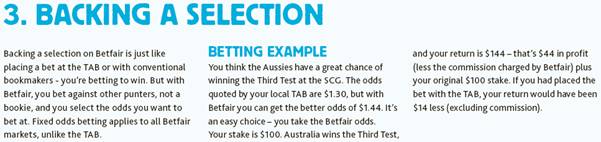
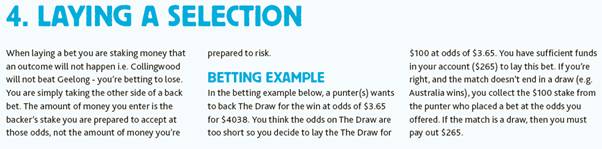
||
|
File number: |
NSD 1566 of 2008 |
|
|
Judge: |
PERRAM J |
|
|
Date of judgment: |
16 June 2010 |
|
|
Catchwords: |
||
|
Legislation: |
Australian Jockey Club Act 1873 (NSW) Betting Tax Act 2001 (NSW) ss 5A, 8, 9, 10 Constitution ss 90, 92 Copyright Act 1968 (Cth) Corporations Act 2001 (Cth) Crimes Act 1900 (NSW) ss 316, 545B Crimes (Sentencing Procedure) Act 1999 (NSW) s 17 Federal Court of Australia Act 1976 (Cth) s 50 Gaming Control Act 1993 (Tas) ss 3, 76I, 76N, 76VA, 76ZDB, 76ZDD, 150A, 150AC Gaming Control Regulations 2004 (Tas) r 5A Harness Racing Act 2002 (NSW) Harness Racing Act 2009 (NSW) ss 5, 9 Interactive Gambling Act 2001 (Cth) ss 5, 8A, 15, 15A Racing Administration Act 1998 (NSW) ss 4, 16, 18, 24, 27, 32A, 33, 33A, 33B, 33D, 33E; Sch 1 [1] Racing Administration Amendment Act 2008 (NSW) Sch 1[11] Racing Administration Regulation 2005 (NSW) rs 14, 16, 25 Racing Legislation Amendment Act 2006 (NSW) s 2 Recovery of Imposts Act 1963 (NSW) s 4 State Revenue Legislation Amendment (Budget) Act 2002 (NSW) Sch 2 Statute Law (Miscellaneous Provisions) Act 2008 (NSW) Sch 2[2] Statutory and Other Offices Remuneration Act 1975 (NSW) Sydney Turf Club Act 1943 (NSW) s 3 Thoroughbred Racing Act 1996 (NSW) Pt 2A; ss 4, 5, 6, 7, 10, 13, 15, 29, 29M, Totalizator Act 1997 (NSW) ss 6, 11, 13, 14, 15, 17, 21A, 69 Trade Practices Act 1974 (Cth) s 52 Unlawful Gambling Act 1998 (NSW) ss 4, 8, 9 |
|
|
Cases cited: |
Automatic Totalisators Ltd v Federal Commissioner of Taxation (1920) 27 CLR 513 cited Bath v Alston Holdings Pty Ltd (1988) 165 CLR 411 applied Betfair Pty Ltd v Racing New South Wales (No 1) [2009] FCA 111 cited Betfair Pty Ltd v Western Australia (2008) 234 CLR 418 applied Campomar Sociedad Limitada v Nike International Ltd (2000) 202 CLR 45 cited Castlemaine Tooheys Ltd v South Australia (1990) 169 CLR 436 applied Cole v Whitfield (1988) 165 CLR 360 applied Fingleton v Lowen (1979) 20 SASR 312 cited IceTV Pty Ltd v Nine Network Australia Pty Ltd (2009) 239 CLR 458 cited James v Cowan (1930) 43 CLR 386 cited Public Services Board (NSW) v Osmond (1986) 159 CLR 656 cited Sportsbet Pty Ltd v New South Wales [2010] FCA 604 cited Telstra Corporation Ltd v Hurstville City Council (2002) 118 FCR 198 cited Telstra Corporation Ltd v Phone Directories Co Pty Ltd (2010) 264 ALR 617 cited Tom & Bill Waterhouse Pty Ltd v Racing New South Wales (2008) 72 NSWLR 577 cited Totalisator Agency Board v Wagner [1963] WAR 180 cited Victoria Park Racing and Recreation Grounds Co Ltd v Taylor (1937) 58 CLR 479 cited |
|
|
|
|
|
|
Texts cited: |
J Kirk, “Constitutional Guarantees, Characterisation and the Concept of Proportionality” (1997) 21 Melbourne University Law Review 1 R I Palgrave (ed), Dictionary of Political Economy (1896) vol 2 C Ward, “The margin of appreciation in Australian Jurisprudence” (2003) 23 Australian Bar Review 189 |
|
|
|
|
|
|
Date of hearing: |
18-20, 23-24, 26-27, 30 November & 1-2 December 2009 |
|
|
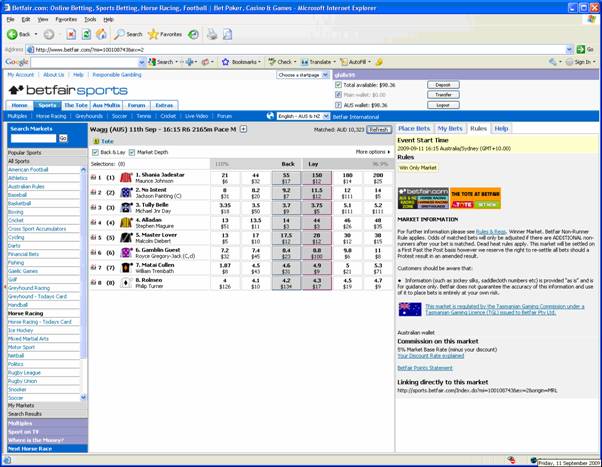
|
|
|
|
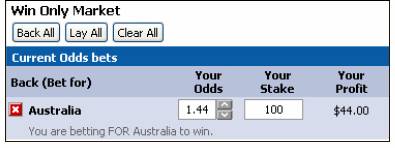
Date of last submissions: |
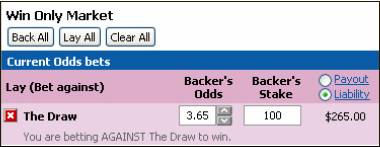
4 June 2010 |
|
|
|
|
|
|
Place: |
Sydney |
|
|
|
|
|
|
Division: |
GENERAL DIVISION |
|
|
|
|
|
|
Category: |
Catchwords |
|
|
|
|
|
|
Number of paragraphs: |
335 |
|
|
|
|
|
|
Counsel for the Applicant: |
Mr A Robertson SC with Mr A J Meagher SC, Ms K C Morgan |
|
|
|
|
|
|
Solicitor for the Applicant: |
Gilbert & Tobin |
|
|
|
|
|
|
Counsel for the First and Second Respondents: |
Mr J T Gleeson SC with Mr S A Kerr SC, Mr J Emmett and Mr S Robertson |
|
|
|
|
|
|
Solicitor for the First and Second Respondents: |
Yeldham Price O'Brien Lusk |
|
|
|
|
|
|
Counsel for the Intervenor: |
Mr J Kirk with Ms A Mitchelmore |
|
|
|
|
|
|
Solicitor for the Intervenor: |
New South Wales Crown Solicitor's Office |
|
|
IN THE FEDERAL COURT OF AUSTRALIA |
|
|
NEW SOUTH WALES DISTRICT REGISTRY |
|
|
GENERAL DIVISION |
NSD 1566 of 2008 |
|
BETFAIR PTY LTD Applicant
|
|
|
AND: |
RACING NEW SOUTH WALES First Respondent
HARNESS RACING NEW SOUTH WALES Second Respondent
ATTORNEY-GENERAL (NEW SOUTH WALES) Intervenor
|
|
JUDGE: |
|
|
DATE OF ORDER: |
16 JUNE 2010 |
|
WHERE MADE: |
SYDNEY |
THE COURT ORDERS THAT:
1. The application be dismissed.
2. These orders not be taken out without the leave of a Judge of the Court.
3. Vary all pre-existing orders made pursuant to s 50 of the Federal Court of Australia Act 1976 (Cth) to permit the publication of these reasons.
4. Stand over for further directions at 9.30 am on 24 June 2010.
Note:Settlement and entry of orders is dealt with in Order 36 of the Federal Court Rules.
The text of entered orders can be located using Federal Law Search on the Court’s website.
|
IN THE FEDERAL COURT OF AUSTRALIA |
|
|
NEW SOUTH WALES DISTRICT REGISTRY |
|
|
GENERAL DIVISION |
NSD 1566 of 2008 |
|
BETWEEN: |
BETFAIR PTY LTD Applicant
|
|
AND: |
RACING NEW SOUTH WALES First Respondent
HARNESS RACING NEW SOUTH WALES Second Respondent
ATTORNEY-GENERAL (NEW SOUTH WALES) Intervenor
|
|
JUDGE: |
PERRAM J |
|
DATE: |
16 JUNE 2010 |
|
PLACE: |
SYDNEY |
REASONS FOR JUDGMENT
These reasons for judgment are divided as follows:
|
I |
Introduction...................................................................................................... |
[1] |
|
II |
Backing and laying............................................................................................ |
[6] |
|
III |
Bookmakers..................................................................................................... |
[15] |
|
IV |
Totalizators....................................................................................................... |
[30] |
|
V |
Betting Exchanges............................................................................................. |
[38] |
|
VI |
The relationship between Betfair and the respondents........................................ |
[60] |
|
VII |
The race fields fee............................................................................................. |
[70] |
|
VIII |
Betfair’s case and the principal questions to be resolved.................................... |
[101] |
|
IX |
Is the fee discriminatory?................................................................................... |
[118] |
|
X |
Is the fee protectionist?..................................................................................... |
[154] |
|
XI |
Are the motives of the respondents relevant to s 92?.......................................... |
[207] |
|
XII |
Is the fee reasonably and appropriately adapted to some legitimate end?............ |
[238] |
|
XIII |
What relief, if any, should be granted?............................................................... |
[253] |
|
XIV |
Particular findings of fact................................................................................... |
[262] |
|
XV |
Rulings on interlocutory matters......................................................................... |
[324] |
I – Introduction
1 Section 92 of the Constitution provides, relevantly, that “trade, commerce and intercourse among the States…shall be absolutely free”. Perhaps somewhat unfortunately, the provision does not descend to the more mundane topic of the identity of the mischief from which the founding fathers were so very emphatic that interstate trade, commerce and intercourse was to be kept “absolutely free”. Early in the Federation’s history the obscurity of the immunity thus conferred was famously lamented by Rich J in James v Cowan (1930) 43 CLR 386 at 422 who only wished that:
Some hint at least might have been dropped, some distant allusion made, from which the nature of the immunity intended could afterwards have been deduced by those whose lot it is to explain the elliptical and expound the unexpressed.
2 For most of the last century s 92 was a continuing source of uncertainty. That state of affairs, however, came to an end with the High Court’s unanimous decision in Cole v Whitfield (1988) 165 CLR 360 which held that s 92 is concerned to stamp out discriminatory protectionism by the States and the Commonwealth within Australia. The Federation arising from the Constitution was, therefore, not merely a political union but was to be seen as a commercial union as well. As the editor (1877-1883) of The Economist noted in 1896 “[f]ree commercial intercourse, indeed, seems one of the most distinctive marks of national unity” (Sir Robert Inglis Palgrave (ed), Dictionary of Political Economy (1896) vol 2, pp 45-46, cited in Betfair Pty Ltd v Western Australia (2008) 234 CLR 418 at 455 [23] per Gleeson CJ, Gummow, Kirby, Hayne, Crennan and Kiefel JJ) (hereafter “Betfair”).
3 The Constitution itself, by s 90, banned the States from levying their own excise taxes and thereby did away with the potential for explicitly protective tax regimes on the free trade of goods. But s 92 goes far beyond the trading in goods and applies to all forms of trade, commerce and intercourse among the States and so operating extirpates from the Federation the almost infinite variety of forms by which protectionism may manifest itself.
4 The applicant, Betfair, conducts business from Hobart in Tasmania. Its complaint is against the regulators of thoroughbred racing and harness racing in New South Wales who are the first and second respondents and to whom I shall refer as “RNSW” and “HRNSW” respectively. It claims that a particular fee imposed by RNSW and HRNSW for the right to use “race fields information” discriminates against it and in favour of a New South Wales trader, TAB Limited (“the TAB”), and that the fee does so in a way which is properly to be characterised as protectionist. It seeks relief from the obligation to pay the fee and the return to it of so much of the fee as it has already paid. The questions to be determined are many but the important ones are:
(a) does the fee discriminate against Betfair and in favour of the TAB?
(b) if it does, is the fee to be seen as protectionist in character?
(c) if it is, is there some legitimate purpose which the fee can be seen as serving?
(d) if there is, are the means adopted to achieve that end reasonably appropriate and adapted for that purpose?
(e) can the intentions of officials of RNSW and HRNSW who made the decision to impose the fee be relevant to the questions posed by s 92 of the Constitution?
(f) if they can be, did some or all of the members of the boards of the regulators put the fee in place intending it to hinder Betfair from competing with the TAB?
(g) assuming all of these questions are answered in Betfair’s favour are RNSW and HRNSW obliged to refund the fee?
5 I have come to the clear conclusion that the race fields fee imposed by the respondents discriminates in favour of the TAB and against Betfair. However, I have also come to the conclusion that Betfair has failed to prove that the fee is protectionist in nature. The authorities indicate that protectionism is generally to be demonstrated by a close examination of the competitive consequences of the impugned measure. In this case, Betfair eschewed showing that the adverse discriminatory effect which the race fields fee undoubtedly burdens it with is protectionist in kind. It did not seek, for example, to demonstrate that the discriminatory adverse effect of the fee decreased some competitive advantage it had over the TAB consisting of the fact that it was required to pay lower betting taxes in Tasmania than the TAB was obliged to pay in New South Wales. Nor did it seek to show, for example, that the discriminatory effect of the fee might be seen as neutralising some competitive disadvantage that the TAB might have had by reason of its need to incur the substantial expenditure in running a retail network when Betfair was an internet operator. Nor did Betfair allege, as it was alleged in Sportsbet Pty Ltd v New South Wales [2010] FCA 604 (hereafter “Sportsbet”), that the fee was discriminatory in a protectionist sense because the TAB had the fee paid by it returned or that NSW on-course bookmakers were also relieved of their obligation to pay the fee. In the end, Betfair’s case was simply that the fee discriminated against it. Although it formally alleged protectionism it was plain from the way its case was pleaded that it meant by that allegation no more than that the fee discriminated against it. The authorities required Betfair to allege and prove discriminatory protectionism; in the end, all that it proved was discrimination. Structured in that way, Betfair’s case was bound to fail and I so conclude. The application should be dismissed.
II – Backing and laying
6 The fee which lies at the heart of this case is a fee imposed upon persons who derive revenue from those members of the public who gamble on the outcome of horse races and harness races held in New South Wales. In order to understand the fee it is necessary, in the first instance, to understand some basic concepts involved in betting and, in particular, the difference between the bet involved in “backing” an event and the bet involved in “laying” or accepting such a bet from another person.
7 A wagering operator, such as a bookmaker, accepts wagers from members of the public who wish to bet on the outcome of an event. Those persons are generally referred to as “punters”. The punter will place a bet with the wagering operator and will put up an amount of money known as the stake which he or she agrees will become the operator’s in the event that the final outcome is not the one backed by the punter. On the other hand, should the event backed by the punter also be the final outcome then the operator, in turn, agrees to return the stake to the punter together with an agreed return on the stake, sometimes referred to as the “price” or the “premium”.
8 In this litigation the parties have referred to the kind of wager placed by the punter in such a situation as a “back bet” and the kind of wager accepted by the operator as a “lay bet”. The parties were in agreement on the pleadings that a back bet was a bet that something would occur whereas a lay bet was a bet that something would not occur. That view of things is consistent with some statements made by the High Court in Betfair 234 CLR at 465 [52]. Similar was the description of backing and laying contained in Betfair’s “Punters’ Guide”, which it publishes on its website and which was placed into evidence. It explained the difference between the positions as following:
9 For reasons which will become apparent later in this judgment, I do not think that either of those descriptions fully captures the relevant difference. There are a number of critical matters which deserve emphasis. First, a back bet is not inevitably linked to whether an event occurs. A back bet can just as easily be made that an event does not occur. For example, one might place a back bet with a bookmaker that a particular test match is not drawn or that a particular tennis player does not proceed to the finals of a tennis tournament. As such, the laying of a bet is not inevitably linked to the non-occurrence of that event as the laying of the bets corresponding to the above examples reveals. Thus the bookmaker who accepts a bet from a punter that a test match is not drawn is, in substance, betting that the game is drawn. The essence of the difference between backing and laying is not therefore winning and losing or occurring or not occurring. Rather, it is that the backer and the layer always have opposite positions on an event’s outcome: if the punter backs a particular outcome then the layer is betting on the opposite outcome. However, that statement says nothing about whether the outcome is an event of occurrence or non-occurrence.
10 Secondly, the critical difference between a back and lay bet lies not in the occurrence or non-occurrence of an event but rather in the terms of the single contract which the lay and the back bet together constitute. The punter, on the one hand, promises to give the layer the stake on one outcome. The layer, on the other hand, promises to return the stake with a premium on the stake on the opposite outcome. These are two ends of the same contract but, as such, they are structurally and financially different. The backer’s maximum exposure under the single contract is the amount of the stake whereas the layer’s maximum exposure is the amount of the premium. On the other hand, the backer’s maximum gain is the premium whereas the layer’s maximum gain is the amount of the stake. What flows from that observation is that the backer’s profits are a function of the price but his losses are not whereas the layer’s losses are a function of price but his profits are not.
11 What is important to grasp is that every back bet is connected to a lay bet and vice versa and that together such pairs form one single contract. There is no such thing as a back bet disconnected from a lay bet just as there is no shadow without light. When an offer to lay an event is accepted by a backer (or an offer by a backer accepted by a layer) a wagering contract comes into existence between the two of them. Each such contract contains terms dealing with the stake placed by the backer with the layer and the premium offered on the stake in return. But there is no amount of money staked by the layer as there is in the case of the backer. It is possible to imagine a world in which layers do put up a stake with backers consisting of the premium which is returned to the layer if the backer loses and combined with the backer’s original stake which is already being held by the layer. However, there was no evidence before me that any wagering market operates in that mirror image way. No doubt, this is because the layers tend to be professional businesses (such as bookmakers) whereas backers tend to be members of the public in respect of whom questions of credit may arise.
12 I emphasise these matters because the submissions of all parties in this litigation often assumed that there was such a thing as a layer’s stake. For example, in paragraph 104(e) of RNSW and HRNSW’s closing submissions it was said that Betfair received “both the backer’s stake and the layer’s stake” and in paragraph 180 of the closing submissions on behalf of New South Wales it was said:
The one qualification is that it is only back bet turnover that is counted. In other words, half of the transactions engaged in by Betfair are not subject to the turnover fee. And that is so even though that consumer on the lay side themselves opened their wallet to Betfair, where they might otherwise have spent the money on other wagering products with other wagering operators who would have had to pay the fee. The qualification is thus which favours Betfair.
13 The consumers on the lay side (scil. the layers) did not open their wallets. They receive the backer’s stake. Half the transactions were not overlooked. Every lay bet is the other half of a back bet.
14 It is necessary then to turn to the differing wagering operators which exist. For present purposes, there are three kinds of operators: bookmakers, totalizators and betting exchanges. It is useful to deal with bookmakers first.
III – Bookmakers
15 The issues in this case are concerned with the operation of New South Wales law. Whilst the law of that State does define the term “bookmaker” in various statutes, none of those definitions contributes much in the way of content. Section 4 of the Racing Administration Act 1998 (NSW) helpfully defines a bookmaker to include a person who carries on the business of a bookmaker or endeavours to gain a livelihood by betting or making wagers. The same definition can be found in s 4 of the Unlawful Gambling Act 1998 (NSW) and s 3 of the Sydney Turf Club Act 1943 (NSW).
16 In Betfair (234 CLR at 465 [51]) the plurality adopted a statement by Zelling J in Fingleton v Lowen (1979) 20 SASR 312 at 314 as to the original meaning of the expression “bookmaker”:
A bookmaker was one who made up a book on all the horses in a given race, adjusting the odds and the volume of money he took on any particular horse, so that if his calculations were correct, at the end of the race, no matter what horse won, the book would show a profit to the bookmaker.
17 The evidence before me took the matter a little further. All parties agreed that in substance bookmakers generally engaged in fixed price betting which meant that the price to be paid to the successful punter was agreed at the time the bet was placed rather than being determined after the winner was ascertained (as happens with pari-mutuel or totalizator betting discussed infra at Section IV). The parties were also in agreement that bookmakers generally sought to make their money through what is known as “overround”. To understand the nature of overround one needs to understand the relationship between prices and odds. A bookmaker and a punter may agree that the wager on a particular horse is to be at a price of 5-1. What this means is that if that horse wins the race then the bookmaker will return the punter’s stake to him together with a premium which is five times the stake. Thus, if a punter places a $100 fixed price bet on Dred Scott with a bookmaker at 5-1 and Dred Scott wins the race then the bookmaker will pay the punter $600 consisting of the return of the $100 stake initially advanced by the punter to the bookmaker together with a $500 premium (being five times the stake of $100).
18 Yet another common way of expressing the same relationship is as a price expressed as a dollar rate of return such that when the rate is multiplied by the initial stake the product is the full payout by the bookmaker to the punter including the return of the initial stake. Using the above example, the price would be $6 which tells one that a winning $100 bet results in a payout of $6 x $100 = $600. Of course, so expressed, the price does not express the profit made for it includes the initial stake in the payout. To obtain the rate of profit one needs to deduct $1 from the price.
19 Another way of looking at the odds offered is to convert them into a number between 0 and 1 which has the appearance of being a measure of probability. Thus 5-1 means 1 chance in 6 (i.e. 1 chance of winning in (5+1)) or 0.1666. This can also be expressed as a percentage, 16.66%. Generally, the probability implied by a price is its reciprocal (ie. $6 implies a probability of 1/6 = 0.1666 or 16.66%). Necessarily, the price is the reciprocal of the probability expressed as a decimal. For example, race odds of 9-1 suggest one chance in ten of winning, i.e. 10%, or, in decimal notation, 0.1. The corresponding price is 1/0.1 = $10.
20 Odds may be short or they may be long. Thus a horse running at 50-1 is at long odds as it implies a probability of winning of 1 in 51 and correspondingly a high price of $51 (the inverse of the decimal odds). Further, odds may be expressed in favour (“odd on”) or against (“odds against”) a particular event. “Odds against” are displayed, for example, as 6-1 and their conversion into price and probability has been demonstrated above. Such odds are expressed this way as the first number (six) represents the number of possible outcomes that are against the backed event, whilst the second number (one), represents the number of possible ways the backed outcome may arise (i.e. six against, one on). Conversely, “odds on” are displayed, for example, as 15-1 on, which reflects a 1 in 16 chance of the backed event not being the final outcome (i.e. 15 on, one against). Their expression this way is for the same reason given above, that is, the second number (one) represents the number of possible outcomes against the backed event, whilst the first number (15), represents the number of possible ways the backed event may arise. This can also be expressed as a price by adding one to the offered odds of 15-1 on (that is 1 + (1/16)), resulting in a price of $1.06. This format is often used to express short odds on an event, for instance, the odds that a favourite horse will win a race. Lastly, since the price is always $1 plus a positive number of cents (no matter how short the odds are) the price must always be more than $1. The $1 itself, of course, reflects the 100% rate of return the backer gets on his own stake (if he or she wins). Correspondingly, there is no theoretical upper bound capping the level to which prices may go.
21 I turn then to the question of overround. The business of bookmaking is largely arithmetical and not complex. At its core is a straightforward concept, an explanation of which follows. It is to be noted that the explanation is simplified and, to an extent, idealised.
22 Let it be assumed that there is a three horse race between Grumpy, Dopey and Doc. It is a certainty that one of these horses will win the race so the probability of that event occurring is 100%. If the bookmaker ensures that all of the prices he offers imply probabilities which add up to 100% and he ensures that his exposure for each horse – that is, how much he will have to pay if the particular horse wins – is the same then he will neither win nor lose but will break even. However, to ensure that his exposure to the risk of each horse winning is the same he must adjust the size of the bet he takes to the price he is offering on that horse, for his exposure is the product of the price he has offered and the stake wagered. Thus, if the bookmaker assigns probabilities to Grumpy, Dopey and Doc of 50%, 35% and 15% then the prices will be $2.00, $2.86 and $6.67 (that is 1/0.5, 1/0.35 and 1/0.15). He will be indifferent to the outcome of the race (a state of affairs referred to as having a “square book”) if he budgets on a payout on any horse of $100. To square the book he must accept, therefore, bets totalling $50 on Grumpy ($2 x $50 = $100), $34.96 on Dopey ($2.86 x $34.96 = $100) and $14.99 on Doc ($6.67 x $14.99 = $100). The following table indicates the outcome:
|
Horse |
Implied probability |
Price |
Wagers accepted |
Potential payout |
|
Grumpy |
50% |
$2.00 |
$50.00 |
$100 |
|
Dopey |
35% |
$2.86 |
$34.96 |
$100 |
|
Doc |
15% |
$6.67 |
$14.99 |
$100 |
|
Total |
100% |
|
$99.95 |
|
|
Maximum payout |
|
|
|
$100 |
23 In this case, a guaranteed loss of five cents occurs generated by rounding errors. The book thus depicted is essentially square. If the bookmaker then structures his book such that the sum of the implied probabilities exceeds 100% this will imply from the backers’ perspective acceptance by them (viewed as a class) of a set of prices which means that the probability that one of the horses in the race will win is more than 100% (when, in fact, it is precisely 100% – one of the horses is bound to win). Viewed from that perspective such a set of prices ensures a guaranteed loss by them and, for that reason, a guaranteed profit by the bookmaker. One intuitive explanation for why this is so may be gleaned by observing that a person who bets $1 on the toss of a coin at a price implying a probability of 66.6%, that is, a price of 2-1 on or $1.50, will lose in the long run. Each successful toss of a coin will net 50 cents but each unsuccessful toss will lose $1. Since, in the long run, these outcomes are equally frequent a guaranteed loss ensues.
24 The amount by which the bookmaker’s probabilities exceed 100% is known as the overround. These concepts are a little abstract but are clearer if an example is given. If the overround on the race above is 4% then the bookmaker’s odds will need to total 104%. If the chances of Doc in the above example are increased from 15% ($6.67) to 19% ($5.26) this will achieve an overround of 4% as the following table illustrates:
|
Horse |
Implied probability |
Price |
Wagers accepted |
Potential payout |
|
Grumpy |
50% |
$2.00 |
$50.00 |
$100 |
|
Dopey |
35% |
$2.86 |
$34.96 |
$100 |
|
Doc |
19% |
$5.26 |
$19.01 |
$100 |
|
Total |
104% |
|
$103.97 |
|
|
Maximum payout |
|
|
|
$100 |
25 The bookmaker therefore is bound to make $3.97. It will be seen that the $3.97 profit arises from adjusting the price of Doc downwards from $6.67 to $5.26 which suggests the greater the bookmaker’s overround the lower his prices will be. In a betting ring bookmakers compete with each other and are exposed to twin opposing forces. Their own commercial interests will naturally incline them to increase their overround and, therefore, decrease their prices. But punters in the ring are inclined to self-interest in the opposite direction and are inclined to place their wagers with the bookmaker offering the highest price.
26 The example just given is very simplified and not just because there are only three horses. In practice, bookmakers are confronted with problems of liquidity, volume and sometimes the placing of bets with them by punters which exceed the volumes implied by their prices. The above example is to be taken only as a general indication of what overround is. When those kinds of considerations intrude the process becomes more complex. However, the above basic outline suffices for the purposes of these reasons.
27 There are a number of different kinds of bookmakers. In New South Wales the conduct of fixed price betting by bookmakers was originally confined to racecourses. Off-course bookmaking did occur but was a criminal enterprise. In 1994 a decision was made to permit bookmakers who were physically located at racecourses to accept bets by means of a telephone from customers not at the track. Later there came to be permitted corporate bookmakers who could take bets from customers off-course via the telephone or the internet. However, the law of New South Wales required (and still requires) that such businesses be conducted only from racecourses and only during the time at which the race meeting being held at the racecourse was underway: s 8 Unlawful Gambling Act 1998. The practical effect of that prohibition is that bookmakers are confined to racecourses and to trading times associated with race meetings. Unlike many countries, there are no shop-front bookmakers in New South Wales.
28 Independently, in the mid-1990s the Northern Territory and the Australian Capital Territory established different regimes governing “stand up” bookmakers at racecourses and corporate bookmakers. The latter were licensed to conduct an operation 7 days per week from a racecourse, providing wagering markets via the internet and telephone.
29 Having described the nature of the bookmaking business it is useful then to turn to the dominant form of wagering operator in this country, the totalizator.
IV – Totalizators
30 Totalizator betting or pari mutuel betting is a system of betting in which persons wishing to back an event or contingency do so by placing the bet with an operator who then pools all of the bets together. When the outcome is known the operator deducts a commission and the remainder of the pool is divided amongst the successful punters. The prices which result are not fixed and necessarily cannot be known before the outcome of the event in question. In that sense totalizator betting differs in obvious ways from the fixed price wagering offered by bookmakers.
31 Pari mutuel means mutual bet and reflects its French origins. Pari mutuel betting was invented in about 1867 by the Catalan, Joseph Oller, who is perhaps better known as one of the founders of the Moulin Rouge, a fact disappointingly omitted from the parties’ submissions. As a style of betting it spread rapidly around the world. In Totalisator Agency Board v Wagner [1963] WAR 180, Hale J referenced (at 190) the then Oxford English Dictionary whose entry for the word cited a passage from the Standard newspaper for 7 September 1881, which had stated that “Pari mutuels would perhaps be better understood by English people under their other appellation of totalisators, instruments much in vogue on the race-courses of Australia”. One of the practical difficulties originally encountered in operating pari mutuel betting was the extensive calculations which needed to be made. The totalizator was originally a mechanical computer directed to that end and was invented in about 1913. The first was apparently installed at the Ellerslie Racecourse in Auckland, New Zealand. The calculations involved in the process of conducting a totalizator are significant in number although not in sophistication. In an age prior to the rise of the computer, elaborate machinery was necessary to carry them out which gave rise to what Hale J described in Totalizator Agency Board v Wagner [1963] WAR at 191 as “a highly complex machine”. As calculating dividends from pools has become less onerous the word “totalizator” now does little more than denote a pari mutuel arrangement.
32 Consistent with the concept of pari mutuel s 6 of the Totalizator Act 1997 (NSW) defines “totalizator” in s 6 in these terms:
For the purposes of this Act, “totalizator” means:
(a) a system used to enable persons to invest money on events or contingencies with a view to successfully predicting specified outcomes of those events or contingencies and to enable the money left after the deduction of commission to be divided and distributed among those persons who successfully predict those outcomes, and
(b) any instrument, machine or device through or by which the system is operated.
33 The two key concepts here are the deduction by the totalizator operator of what s 6 calls a “commission” and the division of the remaining pool amongst the successful punters. The industry refers to the commission in s 6 as the “take out”.
34 There are similarities between a lottery and a totalizator. In both cases the punters share amongst themselves their pooled contributions and in both cases the operator takes out a commission prior to distribution. However, in Automatic Totalisators Ltd v Federal Commissioner of Taxation (1920) 27 CLR 513 at 518 per Knox CJ, Gavan Duffy and Starke JJ, the High Court concluded that a lottery was a game of “chance and nothing but chance” whereas the distribution of moneys to punters on a totalizator was not “determined purely by chance”. Another view might be that in a lottery all outcomes are equally probable but this is not so with animal racing.
35 There are three kinds of totalizators being conducted on New South Wales horse races. First, there are on-course totalizators operated by racing clubs such as the Australian Jockey Club (AJC), which operates Randwick Racecourse, or the Sydney Turf Club (STC), which operates Rose Hill Racecourse. The TAB is also permitted to operate on-course totalizators: s 15 Totalizator Act 1997. Secondly, there are totalizators operating from interstate; thirdly, there is a single off-course totalizator operated by the TAB. This third totalizator is a monopoly; s 14(2) of the Totalizator Act 1997 prohibits the grant at present of any more than one licence to conduct an off-course totalizator in NSW. Additionally, when the TAB operates its off-course totalizator on an event which is also being offered by an on-course totalizator, the latter acts as the TAB’s agent and pays any money collected by it into the TAB’s totalizator: s 17(3) Totalizator Act 1997. Thus, because bookmakers in New South Wales are confined to racecourses and are only able to operate during race meetings the TAB’s off-course totalizator monopoly is not only free from competition from other on-course totalizators but also any intrastate off-course bookmakers.
36 The TAB was formerly a government monopoly but was privatised in 1998. It is presently owned by Tabcorp Holdings Limited. The TAB is the dominant operator in New South Wales. For those unfamiliar with the size of the racing industry the amounts of money involved may be surprising. The Australian Racing Fact Book for 2007/2008 reveals that the total wagering turnover on thoroughbred racing in New South Wales for the 2007 and 2008 racing season was $3,505,370,000 of which $2,767,870,000 was placed through the off-course totalizator conducted by the TAB in New South Wales; put another way, 78.96% of all money wagered on New South Wales thoroughbred races was wagered on the TAB’s off-course totalizator. These figures leave out of account the betting on harness racing and greyhound racing. A report prepared for persons including HRNSW by BIS Shrapnel Pty Ltd entitled “Revenue Outlook for TAB Limited” suggested that in the preceding three years the TAB had collected 95% of the amount wagered on New South Wales thoroughbred, harness and greyhound racing across Australia and overseas, although it is not clear whether this related solely to the operations of its off-course totalizator.
37 The TAB’s off-course totalizator is a very significant undertaking. It is conducted through 1,971 retail agencies throughout the State and its green and yellow livery is a familiar sight in retail shopping areas. Moreover, it has a significant presence in the public hotels of New South Wales in which it often maintains betting facilities and television screens offering live footage of racing events. Because it is not lawful to conduct a totalizator or the business of a bookmaker from anywhere but a racecourse in New South Wales, it follows that the TAB has an unchallenged high street monopoly on betting shops. The encounter of that high street monopoly with the internet sets the stage for the present litigation.
V – Betting Exchanges
38 As has already been noted the business of bookmakers is the making of an overround by, in theory, the judicious laying of back bets. This endeavour is not always successful. On occasions, the bookmaker may be driven by the market to have a negative overround, or in other words, a guaranteed loss. At other times, the bookmaker may accept a wager which unbalances his book on account of its size leading to the possible result that if the wager succeeds the stakes collected on the remaining bets will not be sufficient to cover the payout arising on that event. It is not unusual in such situations for a bookmaker to seek to remove or ameliorate that risk by himself making a wager on the same event such that the amount to be won on the second wager will cover the outstanding liability on the first. This practice is called laying off. Its relevance for present purposes is to demonstrate that the business of a bookmaker includes not only the laying of back bets from punters but also, when the pressing need arises, the making of back bets with other bookmakers or sometimes totalizators.
39 A betting exchange, by contrast, involves the idea of providing a facility to punters so that they can bet with each other on a fixed price basis. Although totalizator betting is, in a sense, a mode of wagering where the punters are betting with each other because the successful punters take their winnings from the bets placed by other punters, they are not doing so as a matter of contract and the prize cannot be known until the identity of the winning horse is ascertained and the number of successful punters determined.
40 If punters are permitted to lay bets from each other then the possibility of matching back bets with lay bets becomes possible. A betting exchange is a facility whereby persons wishing to wager on the outcome of an event may make and accept offers to do so. Since each wager has a backer and a layer, the offers which may be made are necessarily offers to back and offers to lay. An offer to lay an occurrence would be open to acceptance by a person who wished to back that occurrence. Correspondingly, an offer to back an occurrence would be open for acceptance by a person wishing to lay it. The exchange model facilitates the making and acceptance of such offers.
41 Those familiar with the operations of futures and options markets will notice a similarity between these two kinds of operations. For example, a futures trader may offer to sell 1000 tonnes of wheat at $200 per tonne on 1 August 2010. Such an offer is an offer to sell. It is open for acceptance by a person who may wish to buy at that price and at that time. On the other hand, a purchaser may offer to enter into a contract to buy wheat at a different price and time. Such an offer is an offer to buy.
42 The making of back and lay bet offers is similar to such offers to buy and sell, although not identical. Both are offers to enter into contracts – one a contract of sale, the other a contract of wager – both inherently have two parties – the vendor and purchaser, the backer and layer. Both contractual positions have fluctuating values depending on an uncertain outcome in the future. If the price of wheat in the above example is trading above $200 per tonne on 1 August 2010 then the trader who previously agreed to sell the wheat will make a loss and the counterparty a corresponding profit. But this will not be known until 1 August 2010. Similarly, the precise value of a back bet of $100 at 6-1 on Crayfish will not be known until the outcome of the race.
43 Likewise, in both situations a party may exit his or her position by entry into the opposing contract. The wheat trader may crystallise his position in the example above by entering into a contract to buy on 1 August 2010 what he has offered to sell under the first contract. Once he has done that the price of wheat on 1 August 2010 will no longer be of concern to him. This is because his net economic position will be driven entirely by the difference between his agreed sale price (under the first contract) and his agreed purchase price (under the second contract). So too, a person who has entered into a wagering contract to back Equine Derivative on the first at Randwick on Saturday for $10 may crystallise his position by laying a bet on the same horse. In both situations, the crystallisation which occurs by entry into the opposing contract may result in a profit or a loss depending upon the price at which the second contract is entered into. But the example illustrates the structural similarity between the two arrangements nevertheless. There are of course obvious differences between futures and wagering contracts. For instance, the final payoffs for both parties on a wagering contract are distinctly known at the time of entry whilst the same is not true for parties to a futures contract. This significantly differentiates the potential profit and liability of a backer and layer of a bet as opposed to counterparties on a futures exchange, the latter of whom can theoretically face infinite profit or loss.
44 As with a futures exchange, a market on events will not operate efficiently, or probably at all, unless counterparty risk is removed. In a futures exchange, this is done by the exchange operator assuming the position of principal on all contracts and ensuring that its members maintain with it sufficient security to cover their outstanding positions (most commonly accomplished by requiring sufficient funds to be kept in a “margin account”). No different principle pertains to the case of a betting exchange. Since punters may be in different jurisdictions, the model is unlikely to work unless the exchange operator assumes the position of principal on all wagers. For those reasons at least one model of a betting exchange will have the following features.
(a) a market will be provided on a particular event upon which wagering is to take place, e.g. the winner of a horse race, the outcome of a tennis match, the outcome of a federal election, the place getters on a horse race and so on;
(b) the exchange operator will facilitate through some kind of platform the making of offers to lay and back bets and also for the acceptance of such offers as have been made;
(c) the exchange operator will assume the position of principal on all successfully formed wagers;
(d) the exchange operator will ensure that it is sufficiently in funds from the punters using the exchange to avoid credit risk to it; and
(e) the exchange will make its profit by charging, on some basis, a commission on transactions.
45 Having sketched the essential features of a betting exchange, it is useful then to note some similarities and differences between, on the one hand, betting exchanges and, on the other, bookmakers and totalizators. One thing which may at once be observed is that by reason of its position as a principal, the exchange operator enters into both back and lay wagers. As has already been noted, the nature of a bookmaker’s business also involves entry into back and lay wagers. However, this does not mean that the business of a betting exchange is the same as the business of a bookmaker. The bookmaker lays bets and backs bets with a view to generating an overround. A betting exchange, on the other hand, backs and lays in precisely equal proportions and is not seeking its profit by way of overround. Its profit derives not from winning more than it loses – as a bookmaker does – but from charging a commission. For the same reasons that a futures exchange cannot really be said to be in the business of trading futures contracts on its own behalf, so too a betting exchange is not in substance a bookmaker.
46 A comparison with the business of a totalizator operator results in a similar conclusion. It is true that Joseph Oller’s insight was to facilitate betting between the punters pari mutuel in an economic sense. But in a contractual sense the punters never wager with each other on a totalizator and, on any view, no punter enters, either contractually or financially, into the lay side of any wager. However, just as a betting exchange charges a commission, for instance, on the winnings of successful punters, so too a totalizator can be seen as doing something similar. The pool collected by a totalizator operator goes to the winning punters but only after the totalizator’s commission has been deducted. In a sense, a totalizator and a betting exchange have those two things in common: the earning of positive amounts of revenue does not depend on the outcome of the event and both effectively charge a commission which is deducted from the winnings of punters.
47 Having made those general observations about betting exchanges, it is useful to turn to the case of Betfair itself. In Australia, Betfair operates an exchange along the lines set out above. Its commission is charged upon the net winning positions held by customers in any particular market. It offers markets on sporting and other events and, in particular, offers markets on New South Wales horse races both of the thoroughbred and harness racing kind. For a given race there is a market conducted for the winner of the race. There is also usually a separate market conducted for place getters.
48 In keeping with the exchange model punters may back or lay an event. This they may do either by making offers to back or lay an event or by accepting offers which have already been made to back and/or lay an event by other punters. The exchange is operated over the internet and may be accessed via www.betfair.com.au. Betfair Australia itself is a joint venture essentially between Crown Ltd and the English company Betfair Group Ltd, whose wholly owned subsidiary, The Sporting Exchange Ltd (TSEL), was the innovator of internet-based betting exchanges. That group, using the Betfair brand, conducts an international betting exchange the website for which is connected directly to www.betfair.com.au. Generally, all exchange operations on Australian events are done through Betfair’s Australian website.
49 To utilise the exchange a customer must first be registered which involves a verification of identification procedure and the allotment of a user name and password. Before any betting can take place a customer must put his or her account in credit and funds thus deposited are held in trust by a company related to Betfair as security for exposures entered into by the customer. The exchange does not permit the entry into wagers for which sufficient funds are not held. All customers agree to be bound by the rules of the exchange. When a customer views the market for a particular event he or she sees a screen as follows (being a market on the 4.15 pm harness race at Wagga Wagga on 11 September 2009):
50 There are a number of features of the screenshot to be noted. The blue lined boxes indicate back wagers which are presently on offer (that is being layed) and which may be accepted by clicking on the relevant blue lined box. It is implicit that the blue lined boxes actually indicate offers by persons to lay a bet for it is the acceptance of a lay offer which gives rise to a back bet. The price on the blue lined box is the offered price which, if one is so minded, can be converted into odds and probabilities – $2 is 1:1 (50%), $3 is 2:1 (33.3%) and so on. The figure underneath the price in each blue lined box is the total amount which the layer or layers have indicated a willingness to accept as a stake. There may in fact be multiple layers at one price and the exchange may match a single lay offer with many back bets or a vice versa (just as in a futures market).
51 The boxes running to the left are also offers, but it will be seen, the prices trend down. The existence of these boxes indicates the depth of the market. On the right hand side there appear pink lined boxes which are lay wagers presently capable of acceptance. Again, those pink lined boxes reflect offers to back which have been made. The boxes to the right show increasing prices. Useful comparison with what is going on may be made with the system of bids and offers obtaining on stock exchanges. In many markets, particularly the larger ones, these prices are given to moving at considerable speed, with smaller price intervals between each box as well as greater amounts capable of being accepted by a backer or layer.
52 On the top right hand corner there is a figure following the word “matched” which indicates the amount staked in wagers which have been formed. It will be noted that the prices on the back side are lower than those on the lay side. Keeping in mind that the offers on the back side are made by layers and that the offers on the lay side are made by backers it will be seen that layers offer lower prices than the backers. This accords with common sense. The layers profit from lower pay-outs; the backers from higher ones. The percentage figures appearing on the backers’ and layers’ side are a measure of the probabilities implicit in the prices presently being offered. In the example shown, the prices being offered by the layers (that is the back prices on offer) reflect a probability exceeding 100%. On the other hand, the prices being offered by the backers (that is the lay prices on offer) reflect a probability below 100%. This curious result indicates that, taken as a class altogether, the layers are bound to make a profit and the backers, again taken as a class altogether, a loss at the indicated market prices. This phenomenon – which appears in most of the markets conducted on the exchange – was discussed during argument but there was no evidence which explained why it occurred.
53 When a back bet is accepted, the customer is presented with the following screen (being a market on a cricket match between Australian and South Africa):
54 When a lay bet offer is accepted (on the same market) the customer is presented with the following screen:
55 As has previously been noted, the mechanics of lay and back bets are different. In particular, there is no stake put up by the person laying a bet although Betfair does require there to be sufficient funds to cover any liability.
56 Not every offer is matched. Sometimes, particularly in the smaller markets, there is no liquidity. At other times the price offered is not consistent with the then prevailing market price and will languish unaccepted. Although the platform permits the placing of bets over the internet there is also a facility for the placing of bets by telephone. That facility is provided presumably to permit betting on events which are already in play such as cricket test matches. For reasons which are not altogether clear the Interactive Gambling Act 2001 (Cth) prohibits betting on events which are “in play” – that is, actually underway – where the bets are placed via the internet but not where they are placed via the telephone: ss 5(1), 5(3)(a), 5(3)(aa), 8A(1), 8A(2), 15 and 15A.
57 Betfair operates from premises in Glenorchy, north-west Hobart. It holds a gaming licence from the State of Tasmania issued under the Gaming Control Act 1993 (Tas). That licence permits Betfair to conduct its betting exchange from various locales including Glenorchy. The precise terms of that licence are set out in Section XIV below.
58 Nice questions may be posed by Betfair’s authority under Tasmanian law to conduct a business rendered unlawful by the laws of other States (for why this is so in New South Wales, see infra [79]-[84]). The Constitution does not provide an immediate resolution to the difficulties arising from such conflicts. However, no such issue arises in this litigation. No party suggested that the conduct of Betfair’s exchange in Glenorchy on New South Wales races infringed New South Wales’ or any other State’s law.
59 The original Betfair exchange commenced operations in June 2000 and was conducted by TSEL in the United Kingdom. Subsequently the operational parts of that business were transferred to Betfair Group Limited, which as stated before is the sole shareholder of TSEL. No other betting exchanges operate in Australia. There was no direct evidence before me of the identity of any other betting exchanges although it was plain enough from the “Report of the Betting Exchange Taskforce” (10 July 2003) that other exchanges residing internationally do exist.
VI – The relationship between Betfair and the respondents
60 As has already been mentioned, the TAB was privatised in 1998 and now holds the exclusive off-course totalizator licence by reason of s 14 of the Totalizator Act 1997. Section 21A of that Act prohibited the Minister from granting an exclusive off-course totalizator licence to the TAB unless he was satisfied that it had entered into a commercial relationship with the racing industry that was satisfactory to that industry. On 11 December 1997 an agreement was entered into between the TAB, RNSW, HRNSW, Greyhound Racing New South Wales (“GRNSW”) and another body corporate which was entitled the “Racing Distribution Agreement” (“the RDA”). That agreement has been changed over time. My references to it are to it in its current form. The TAB carries on a number of businesses. One is the off-course totalizator to which reference has already been made. However, it also provides fixed price betting on New South Wales racing events and fixed price and totalizator betting on non-racing events (such as the tennis). Under the RDA the TAB is obliged to pay fees to RNSW, HRNSW and GRNSW in respect of all of these revenue streams even though some of them have nothing to do with the racing of horses or hounds. The fees payable by the TAB under the agreement were usefully summarised in a report prepared for the New South Wales Minister for Gaming and Racing by Mr Alan Cameron AM as follows:
|
Wagering category |
Type of payment |
Basis of payment |
|
Totalizator |
Product fee |
21.9965% of net wagering revenue |
|
race wagering |
Fixed product fee |
$12m payable in FY07 indexed at CPI thereafter |
|
|
Wagering Incentive fee |
25% of notional wagering earnings of the NSW wagering business |
|
Totalizator |
Product fee |
21.9965% of net wagering revenue |
|
sports wagering |
Wagering Incentive fee |
25% of notional wagering earnings of the NSW wagering business |
|
Fixed odds race wagering |
Fixed odds product fee |
21.9965% of fixed odds revenue
|
|
|
Wagering Incentive fee |
25% of notional wagering earnings of the NSW wagering business |
|
Fixed odds sports betting |
Wagering Incentive fee |
25% of notional wagering earnings of the NSW wagering business |
|
Virtual racing games |
Wagering Incentive fee |
25% of notional wagering earnings of the NSW wagering business |
Source: Tabcorp
61 It is important to be clear, I think, about what this means. It signifies that the NSW racing industry, in its various forms, derives profit not only from the gambling public’s fascination with hound and horse races but also from the same public’s gambling interests in other sporting activities having no connexion whatsoever with horse or hound. The amounts of money distributed are very large. In the years 2005 to 2008 the TAB distributed close to $900 million to the New South Wales racing industry as the following table, drawn from paragraph 66 of the respondents’ submissions, illustrates:
|
Financial Year |
Amount Distributed |
|
2005 |
$220.5 million |
|
2006 |
$215 million |
|
2007 |
$221 million |
|
2008 |
$206.9 million |
62 It is useful then to note the identity of the other persons partaking in the rich harvest which is the TAB’s totalizator business. They are, first, the State of New South Wales which obtains the proceeds of a betting tax of either 10.91% or 19.11% (see ss 8-10 Betting Tax Act 2001 (NSW)) on each bet, the Commonwealth which obtains GST of 9.09% on each bet, the racing industry which appears to obtain about 30% and, finally, the TAB itself which gets the balance of about 40%. It will be seen, therefore, that the racing industry has nearly as much economic interest in the profitability of the TAB as the TAB does. The revenues derived by the three codes is split between them by an arrangement called the “Intercode Agreement”.
63 It has been convenient until now to describe the payments made by the TAB as being made to the racing industry. However, this is not a precise statement. The parties to the RDA include, inter alia, RNSW, HRNSW and GRNSW. RNSW is a body corporate established by s 4 of the Thoroughbred Racing Act 1996 (NSW). Before 1996 the Australian Jockey Club, itself established originally under the Australian Jockey Club Act 1873 (NSW), exercised a number of regulatory functions for thoroughbred horse racing in New South Wales. Those functions were taken from it in 1996 and conferred upon RNSW. Section 13 of the Thoroughbred Racing Act provides:
13 Functions of Racing NSW
(1) Racing NSW has the following functions:
(a) all the functions of the principal club for New South Wales and committee of the principal club for New South Wales under the Australian Rules of Racing,
(b) to control, supervise and regulate horse racing in the State,
(b1) such functions in relation to the business, economic development and strategic development of the horse racing industry in the State as are conferred or imposed by this Act,
(c) to initiate, develop and implement policies considered conducive to the promotion, strategic development and welfare of the horse racing industry in the State and the protection of the public interest as it relates to the horse racing industry,
(d) functions with respect to the insuring of participants in the horse racing industry, being functions of the kind exercised by the AJC on the commencement of this section, and such other functions with respect to insurance in the horse racing industry as may be prescribed by the regulations,
(e) such functions as may be conferred or imposed on Racing NSW by or under the Australian Rules of Racing or any other Act,
(f) such functions with respect to horse racing in New South Wales as may be prescribed by the regulations.
(2) The functions of Racing NSW are not limited by the Australian Rules of Racing and are to be exercised independently of the Australian Racing Board.
(3) The AJC ceases to have the functions that are solely the functions of the principal club for New South Wales or committee of the principal club for New South Wales under the Australian Rules of Racing.
(4) In this section:
“AJC” means the club known as the Australian Jockey Club as referred to in the Australian Jockey Club Act 1873 on the commencement of this section.
64 Section 5 of the Thoroughbred Racing Act declares that RNSW does not represent the Crown and that it is not subject to direction by or on behalf of the government. Other provisions in the Act, however, suggest a less than exiguous connexion with the State of New South Wales. Section 6 provides that RNSW is to consist of a chief executive officer and five appointed members. Those five members are appointed by the Minister acting on the recommendation of “the Selection Panel”: s 6(1)(a). However, the selection panel is established by the Minister: s 7(1). The base amount of a member’s remuneration is determined by the Statutory and Other Offices Remuneration Tribunal (s 10), a body established under the Statutory and Other Offices Remuneration Act 1975 (NSW). RNSW is obliged to give its annual report to the Minister and the Minister, in turn, must lay the report before both Houses of Parliament: s 29. Certain decisions of RNSW may be appealed to the Administrative Decisions Tribunal of New South Wales: s 29M(3). Likewise, the Minister may remove a member of RNSW from office for misbehaviour: s 15(2). The position of HRNSW is broadly similar. It is now incorporated under the provisions of the Harness Racing Act 2009 (NSW) although at the commencement of this litigation it existed under the Harness Racing Act 2002 (NSW). Its functions are set out in s 9 in these terms:
9 Functions of HRNSW
(1) HRNSW has the functions conferred or imposed on it by or under this or any other Act or law.
(2) Without limiting subsection (1), the functions of HRNSW include the following:
(a) to control, supervise and regulate harness racing in the State,
(b) to register harness racing clubs, harness racing horses, owners, trainers and drivers of harness racing horses, bookmakers for harness racing and other persons associated with harness racing,
(c) to initiate, develop and implement policies considered conducive to the promotion, strategic development and welfare of the harness racing industry in the State,
(d) to distribute money received as a result of commercial arrangements required by the Totalizator Act 1997,
(e) to allocate to harness racing clubs the dates on which they may conduct harness racing meetings.
(3) HRNSW may affiliate with such organisations, whether in or out of New South Wales, as HRNSW considers appropriate.
(4) The functions of HRNSW are not limited by the rules and are to be exercised independently of Harness Racing Australia or any successor.
65 Like RNSW it is said to be independent of the New South Wales government: s 5. But, also like RNSW, its structure indicates a substantial connexion with the State of New South Wales. In my opinion, the correct characterisation of both bodies is that they are independent statutory authorities which are part of, but do not represent, the State.
66 RNSW also has conferred upon it a number of “special functions” by Part 2A of the Thoroughbred Racing Act 1996. For example, it is empowered to provide minimum standards for the conduct of race meetings (Division 1); to regulate the radio broadcast of race meetings (Division 2); and, importantly, for present purposes, to enter into “Totalizator distribution arrangements” (Division 3). That division contemplates the existence of an intra-code agreement regulating the distribution of totalizator funds between different thoroughbred organisations, effectively, race clubs. RNSW is also party to the Intercode Agreement, to which reference has already been made, and which regulates the distribution of totalizator revenues between thoroughbred racing, harness racing and greyhound racing. The parties to the Intercode Agreement are RNSW, HRNSW, GRNSW and Racingcorp which acts as their agent for the purposes of receiving funds from the TAB. The sharing formula is rather complex but, for example, in the financial year 2006-2007 the $220.8 million distributed by the TAB to the industry was split 72.3%, 14.6% and 13.1% to RNSW, HRNSW and GRNSW respectively, ie, $159.63 million, $32.24 million and $28.92 million.
67 The profound economic dependency thereby exhibited is not just one way. The different codes are bound under the RDA to provide a New South Wales racing programme which is to consist at a minimum of 123 metropolitan thoroughbred meetings, 127 provincial thoroughbred meetings, 186 major country thoroughbred meetings, 55 minor country thoroughbred meetings, 342 harness meetings and 593 greyhound meetings. For each such meeting the TAB likewise must conduct its off-course totalizator and must pay liquidated damages if it does not. On the other hand, if a race meeting is not conducted which should have been under the New South Wales racing programme then Racingcorp must correspondingly pay to TAB liquidated damages.
68 What is presented therefore, is very close in an economic sense to a joint venture. The industry promises to provide, on pain of damages, races; the TAB promises to provide, on pain of damages, its off-course totalizator on each such race meeting. The parties share the bounty. Consistent with such a view there are clauses in the RDA designed to foster co-operation. The agreement provides for the establishment of a business and strategy committee made up of four representatives from the TAB and four from Racingcorp with at least one representative from each code. That committee is to make, as might naturally be expected, recommendations on strategic and business issues relating to wagering.
69 It follows that it is deeply contrary to the interests of RNSW and HRNSW that the revenue of the TAB from its off-course totalizator business be decreased. Below I conclude that the TAB’s average take out or commission from its off-course totalizator is about 16% of the quantum of all bets placed. On this view, for every $100 bet on that totalizator, $16 of take out or commission is thereby generated of which about 30% – $4.50 – goes to the industry. Each time, therefore, $100 of the punters’ money migrates from the TAB to a non-TAB wagering operator, the industry loses $4.50. No person involved in the funding and administration of the New South Wales racing industry could rationally ignore a substantial threat to the revenues of the TAB. This is not a criticism but, rather, a recognition of the commercial realities of the situation. It is also a sign that the New South Wales Parliament has created a regulatory structure with an in-built conflict of interest.
VII – The Race Fields Fee
70 In order for two people to have a wager upon the outcome of a horse race it is necessary for them to know the name or number of the horse, the race it is running in and whether it has been scratched from the racing event or not. It is convenient to refer to this information as race fields information. With that information they may then agree a price and stake and thereby conclude the wagering contract. Generally speaking it is only with those integers that such a wagering contract may be formed. It is theoretically possible that certain kinds of wagers can be concluded without the relevant race field information. For example, it is not needed for a wager that horses trained by a particular trainer will win at least ten races in a given year. However, there was no evidence that there is any market for wagers of that kind.
71 It is not clear whether, and if so, what kind of property rights may subsist in this sort of information or, assuming that property rights do subsist, who might own them. It may be that a collation of such information into a race guide constitutes some species of literary work protected under the Copyright Act 1968 (Cth) although there may be difficulties reconciling that proposition with the High Court’s decision in IceTV Pty Ltd v Nine Network Australia Pty Ltd (2009) 239 CLR 458 which holds there to be no copyright in the weekly schedules of television programming prepared by a free-to-air broadcaster. Recently, that principle has been applied to conclude, inter alia, that the publishers of the yellow and white pages do not own copyright therein: Telstra Corporation Ltd v Phone Directories Co Pty Ltd (2010) 264 ALR 617. How race fields information collated by racing clubs might be usefully distinguished from either of those scenarios is not an issue which need presently be further pursued. Nor, is it necessary to determine how the High Court’s decision in Victoria Park Racing and Recreation Grounds Co Ltd v Taylor (1937) 58 CLR 479 at 498 per Latham CJ, 511 per Dixon J and 527 per McTiernan J which denied that race fields information was the subject of copyright might be usefully distinguished.
72 On 1 July 2008 there commenced in New South Wales amendments to the Racing Administration Act 1998 designed to regulate the use of information identifying the competing horses and hounds in races. The amendments were brought about by the Racing Legislation Amendment Act 2006 (NSW). There were some subsequent amendments to that legislation to which it will be necessary to return. However, the present form of the Racing Administration Act 1998 has the following important features. The expression “ NSW race field information” is defined in s 27 to mean:
“NSW race field information” means information that identifies, or is capable of identifying, the name or number of a horse or greyhound:
(a) as a horse or greyhound that has been nominated for, or is otherwise taking part in, an intended race to be held at any race meeting on a licensed racecourse in New South Wales, or
(b) as a horse or greyhound that has been scratched or withdrawn from an intended race to be held at any race meeting on a licensed racecourse in New South Wales.
73 The “use” of New South Wales race fields information is an offence. Section 33(1) of the Act provides:
33 Use of NSW race field information restricted
(1) A wagering operator or prescribed person must not use NSW race field information unless the wagering operator or person:
(a) is authorised to do so by a race field information use approval and complies with the conditions (if any) to which the approval is subject, or
(b) is authorised to do so by or under the regulations.
Maximum penalty:
(a) in the case of a corporation – 500 penalty units, or
(b) in any other case:
(i) for a first offence – 50 penalty units or imprisonment for 12 months (or both), and
(ii) for a second or subsequent offence – 100 penalty units or imprisonment for 2 years (or both).
74 A penalty unit is presently defined by s 17 of the Crimes (Sentencing Procedure) Act 1999 (NSW) to be $110. Section 33(1) therefore imposes a fine of $55,000 on corporations, $5,500 for individuals on a first offence and $11,000 on individuals for subsequent offences with a possibility of two years imprisonment. In that regard it is to be compared with other offences in New South Wales carrying the same penalty such as, for example, concealing a serious indictable offence (s 316(1) Crimes Act 1900 (NSW)) and violent intimidation (s 545B Crimes Act 1900). Just why the offence of using New South Wales race fields information is regarded as such a social menace was not explained in the evidence before me but it is, I think, unlikely to be connected to any desire on the part of the Parliament to address the social ills attending gambling. Whatever the source of the legislative animus against the unauthorised use of race fields information it suffices to observe that the concern is such that New South Wales not only prohibits its use within that State but, in fact, throughout the world. So much emerges from s 32A which defines the expression “use NSW race field information” in these terms:
32A Meaning of “use NSW race field information
For the purposes of this Division, a person “uses NSW race field information” only if the person, whether in Australia or elsewhere:
(a) publishes any NSW race field information, or
(b) communicates any NSW race field information to a person (regardless of whether the person already knew the information), or
(c) acknowledges or confirms any NSW race field information communicated to the person (including acknowledging or confirming the information by accepting, or facilitating the making of, a bet), or
(d) makes a written or electronic record (such as a betting ticket, statement of account or notice) that contains or refers to any NSW race field information (regardless of whether the record is communicated to any person), or
(e) uses any NSW race field information in a manner prescribed by the regulations, or
(f) causes any of the activities referred to in paragraphs (a)-(e) to occur.
75 To reiterate, the prohibition only applies to “wagering operators” and “prescribed persons”. There are presently no prescribed persons. “Wagering operator” is defined in s 27 to mean:
“wagering operator” means a bookmaker, a person who operates a totalizator or a person who operates a betting exchange.
76 “Betting exchange” is defined in the same provision to mean:
… a facility, electronic or otherwise, that enables persons:
(a) to place or accept, through the operator of the facility, wagers with other persons, or
(b) to place with the operator of the facility wagers that, on acceptance, are matched with opposing wagers placed with and accepted by the operator,
but does not include a facility, electronic or otherwise, that enables persons to place wagers only with a bookmaker or a totalizator.
77 At various points during the argument it was submitted that Betfair was essentially a bookmaker with a perfectly balanced book. This was because its rôle as a principal in every wager made meant that for every back bet placed with it there was a corresponding lay bet (or bets). I have already rejected that argument above.
78 This is an additional reason for rejecting the argument which arises from the definition of “betting exchange”. It excludes facilities which permit persons to place wagers with bookmakers and totalizators. If the respondents were correct and Betfair were a bookmaker it would follow that it would thereby be providing a “facility … that enables persons to place wagers only with a bookmaker” and hence would be within the exception to the definition of a “betting exchange” which is internally inconsistent. The Act contemplates that whatever a betting exchange might be, it is not a facility for dealing with a bookmaker or totalizator. The law of New South Wales does not admit of the concept of a betting exchange which is a bookmaker or a totalizator.
79 A related issue which arose was whether it was lawful to conduct a betting exchange in New South Wales at all. Betfair submitted that it was not; RNSW and HRNSW that it was; the State of New South Wales adopted a position of studied silence. Section 8 of the Unlawful Gambling Act 1998 provides:
8 Offences relating to unlawful betting
(1) For the purposes of this section, the following forms of betting are prohibited:
(a) betting on any event or contingency if the person is not present at a licensed racecourse and the bet is made with a bookmaker,
(b) betting on any event or contingency (other than a horse race, harness race, greyhound race or sports betting event) when the person is present at a licensed racecourse,
(c) betting on any event or contingency when the person is present at a racecourse and a trial meeting (within the meaning of the Racing Administration Act 1998 ) is being held at that racecourse,
(d) betting on any event or contingency when the person is present at a racecourse and a race meeting is being held at that racecourse in contravention of the Racing Administration Act 1998.
(2) A person who engages in betting that is prohibited by subsection (1) is guilty of an offence.
Maximum penalty: 50 penalty units or imprisonment for 12 months (or both).
(3) A person must not make a bet on any horse race, harness race or greyhound race that is to be held anywhere in Australia if:
(a) the bet is made by telephone or electronically by means of the Internet, subscription TV or other on-line communications system, and
(b) the bet is made with another person whom the person making the bet knows (or would be reasonably expected to know):
(i) is not a legal bookmaker, or
(ii) is not a person who is authorised under the law of any State or Territory to conduct totalizator betting.
Maximum penalty: 50 penalty units or imprisonment for 12 months (or both).
(4) For the purposes of subsection (3):
“legal bookmaker” means:
(a) a licensed bookmaker, or
(b) a person who is authorised under the law of any other State or Territory to carry on bookmaking activities.
(4A) Subsection (3) extends to a bet that is made by a person while in the State even though the other person with whom the bet is made is outside the State (including outside Australia).
(5) To remove any doubt, subsection (3) does not operate to impose any criminal liability on any person other than the person making the bet as referred to in that subsection.
(6) The following forms of betting are not prohibited by or under this section (except subsection (3)):
(a) betting on a horse race, harness race or greyhound race if the betting takes place at a race meeting that is held at a licensed racecourse on any day approved by the controlling body responsible for the type of racing concerned,
(b) betting on a horse race, harness race, greyhound race or sports betting event if the betting takes place in an authorised betting auditorium,
(c) betting on a sports betting event if the betting is carried on by an authorised sports betting bookmaker at a licensed racecourse in accordance with a sports betting authority,
(d) betting on any event or contingency if the betting is carried on by a licensed bookmaker in accordance with an authority under section 16 of the Racing Administration Act 1998,
(e) betting on a horse race, harness race, greyhound race or sports betting event if the betting is made with a totalizator conducted by a licensee under the Totalizator Act 1997 or is otherwise authorised under that Act,
(f) betting on a horse race, harness race, greyhound race or sports betting event if the betting takes place at a licensed racecourse:
(i) during so much of the day arranged for a race meeting at the racecourse as remains after the conclusion, postponement or abandonment of the race meeting, or
(ii) at any time on a day arranged for a race meeting (after the time arranged for the start of the meeting) if the race meeting was cancelled or postponed the day before.
(7) In subsection (6), “authorised betting auditorium”, “authorised sports betting bookmaker”, “controlling body”, “sports betting authority” and “sports betting event” have the same meanings as in the Racing Administration Act 1998.
80 This provision might appear to present little encouragement to the argument that a betting exchange could be conducted in New South Wales. The argument of RNSW and HRNSW was, however, that the exchange could be conducted from an “authorised betting auditorium” by a bookmaker taking back and lay bets. There are four reasons this should be rejected. First, as already noted the definition of “betting exchange” does not extend to cover a bookmaker engaging in such an enterprise.
81 Secondly,even if it did, for reasons already given, the business so conducted would not be the business of bookmaking. Assuming therefore one could overcome the legal impossibility of a bookmaker conducting a betting exchange brought about by s 27, this victory would only come at the price of depriving the bookmaker of his ability to be described as such.
82 Thirdly, whilst it is true that on occasion bookmakers place back bets to lay off excessive risk which has accumulated in their books, this placing of a back bet does not happen with members of the public. This is, of course, another way of saying that bookmakers do not accept lay bets made by members of the public.
83 Fourthly, s 16(1) of the Racing Administration Act 1998 provides (relevantly):
16 Authority to conduct telephone or electronic betting
(1) The Minister may, in writing, authorise a licensed bookmaker to accept or make bets:
(a) by telephone, or
(b) electronically by means of the Internet, subscription TV or such other on-line communications systems as may be approved by the Minister,
while the bookmaker is at a licensed racecourse at a time when it is lawful for betting to take place at the racecourse.
84 I discuss these restrictions in more detail below at paragraph [304]-[308]. The effect of this provision is that internet betting can only be conducted by a bookmaker from a racecourse at a time at which it is lawful for betting to take place at the racecourse. The practical consequence of that provision is that even if the respondents’ argument that a betting exchange could be conducted by a bookmaker from an authorised betting auditorium were correct that betting exchange would itself only be able to operate whilst the race meeting was in play. The inevitable consequence is that the conduct by Betfair of its business from a server located in New South Wales would be illegal. The respondents did not argue that Betfair was entitled to conduct a betting exchange in New South Wales by reason of s 92 of the Constitution, an argument which may have found support in the High Court’s decision in Betfair 234 CLR 418. Its argument was limited to the one set out above which I do not accept.
85 A wagering operator may apply under s 33B for a “race field information use approval”. By s 33B(3) the “relevant racing control body” (that is RNSW, HRNSW or GRNSW) must consult with each racing club which conducts the events in respect of which approval is sought and must take into account the criteria specified in the regulations.
86 Section 33A authorises RNSW, HRNSW and GRNSW both to grant approval and also to impose conditions on such approvals including, explicitly, a condition requiring the payment of a fee. It provides:
33A Relevant racing control body may grant race field information use approvals
(1) The relevant racing control body in relation to an intended race (or class of races) to be held at any race meeting on a licensed racecourse in New South Wales may grant approval to a person to use NSW race field information (a “race field information use approval”) in respect of that race or class of races if the person has made an application for that approval under this Division.
(2) A relevant racing control body may (but need not) impose any of the following kinds of conditions on a race field information use approval that it grants:
(a) a condition that the holder of the approval pay a fee or a series of fees of an amount or amounts and in the manner specified in the approval (being a fee or fees imposed in accordance with any requirements prescribed by the regulations),
(b) such other conditions as may be specified in the approval (being conditions of a kind that are prescribed as permissible conditions by the regulations).
(3) Any fee that is payable under a race field information use approval is a debt due to the relevant racing control body that granted the approval and is recoverable as such in a court of competent jurisdiction.
(4) A relevant racing control body that grants a race field information use approval may, by written notice to the holder of the approval, cancel or vary the terms of the approval on any grounds prescribed by the regulations.
(5) If a relevant racing control body cancels or varies a race field information use approval, the body must provide the holder of the approval with written reasons indicating why the approval was cancelled or varied (as the case may be).
(emphasis added).
87 The regulations in fact provide for a fee. Clause 16 of the Racing Administration Regulation 2005 (NSW) provides:
16 Fees for race field information use approvals: section 33A(2)(a)
(1) A relevant racing control body may impose a condition on an approval (in addition to any other condition relating to fees) that the holder of the approval must pay a fee to cover the cost of assessing the application for the approval.
(2) A relevant racing control body may impose a condition on an approval that the holder of the approval must pay the following fees:
(a) in relation to a use in Australia of NSW race field information made in the course of the wagering operations of a licensed wagering operator – a fee that does not exceed 1.5% of the holder’s wagering turnover that relates to the race (or class of races) covered by the approval plus any amount of GST payable in respect of the fee,
(b) in relation to any other use of NSW race field information – a fee determined by the relevant racing control body.
(3) In this clause, “GST” has the same meaning as in the A New Tax System (Goods and Services Tax) Act 1999 of the Commonwealth.
(emphasis added)
88 “Wagering turnover” is defined in cl 14 to mean “the total amount of wagers made on the backers [sic] side of wagering transactions in connection with that race or class of races”. The parties in this litigation referred to this as “back bet turnover”. For present purposes, it suffices to observe that it is the quantum of the stakes put up by those placing the back bets. There is no corresponding notion of lay bet turnover because there is no stake on the layer’s side.
89 Section 33A contemplates the making of two administrative decisions. The first is whether an approval should be granted to a wagering operator at all: s 33A(1); the second is concerned with the imposition of a condition (for instance a fee) upon an approval. The Act permits a full review on the merits of a decision by a racing control authority to refuse an application for an approval by the Minister and thereafter to the Administrative Decisions Tribunal (ss 33D(1)(a) and 33E). It also permits that kind of appeal in relation to any conditions which are imposed on the grant of a licence (s 33D(1)(b)). There is one exception, however, and this is in the decision to impose a fee condition. No merits review is permitted of that kind of decision: s 33D(1)(b).
90 The legislation introducing the fee commenced on 1 July 2008. There are suggestions in the evidence that the penalty provisions of the amendments did not commence until 1 September 2008. This does not accord with my reading of the Racing Legislation Amendment Act 2006. Section 2 of that Act provided:
(1) This Act commences on a day or days to be appointed by proclamation, except as provided by this section.
(2) Schedule 1.1 and 1.3 commence on the date of assent to this Act.
91 The Act received the assent on 21 November 2006 so that Schedule 1.1 and 1.3 commenced on that day. The material amendments were contained in Schedule 1.2 and the Governor of New South Wales pursuant to s 2(1) of the Racing Legislation Amendment Act 2006 appointed 1 July 2008 as “the day on which the uncommenced provisions of that Act commence”: see Commencement Proclamation 25 June 2008, New South Wales Government Gazette No 76, 27 June 2008 at p 5869. However, regulation 25(1) of the Racing Administration Regulation 2005 (as amended) presently provides (and then provided too):
A person does not commit an offence against section 33 of the Act (as inserted by the Racing Legislation Amendment Act 2006) during the period commencing on 1 July 2008 and ending on 1 September 2008.
That regulation is, prima facie, inconsistent with the Act but may be authorised by cl 1 of Schedule 1 to the Act. However, nothing turns on this.
92 For about five months after 1 July 2008 the prohibition introduced by the Act was not directed, as it is now, at the “use” of race fields information but instead at the “publication” of that information. A decision by Palmer J sitting in the Supreme Court of New South Wales – Tom & Bill Waterhouse Pty Ltd v Racing New South Wales (2008) 72 NSWLR 577 – held that the word “publish” was not sufficient to catch certain aspects of the bookmaking business and, in particular, telephone betting. On 3 December 2008 that problem was eliminated by the introduction of the present prohibition on “use”: Racing Administration Amendment Act 2008 (NSW), Sch 1[11].
93 On 18 June 2008 RNSW resolved at a board meeting as follows:
2.3 Race Fields Legislation
It was resolved that the report and the draft regulations be noted.
It was also resolved that the Board approve of a fee of 1.5% of turnover in excess of $5 million per annum being imposed on all wagering operators who were given approval to publish NSW thoroughbred race fields.
The Chairman opposed this latter resolution and requested that his dissenting vote be so recorded.
94 This resolution led to the drafting of standard conditions. Clause 2.1 of those standard conditions was as follows:
Fees
(a) The Approval Holder must pay to Racing NSW a fee of an amount equal to 1.5% of the Approval Holder’s Net Assessable Turnover in respect of the Approval Period.
(b) The Approval Holder must pay the fee referred to in clause 2.1(a) in accordance with this clause 2, including by paying:
(1) all instalments in accordance with clause 2.4 and 2.5; and
(2) any amount payable by the Approval Holder in accordance with clause 2.6.
95 The decision to set the 1.5% fee was taken before the legislation took effect on 1 July 2008. On 25 July 2008, after the legislation’s commencement, the board of RNSW resolved as follows:
2.3.2 The Board noted this correspondence and after considering the submissions it resolved to endorse previous decisions in respect of:
· conditions relating to fees to be imposed on race fields publication approvals granted by Racing NSW to wagering operators who hold a licence of approval under the legislation of any Australian State or Territory being 1.5% of the wagering operator’s wagering turnover on NSW thoroughbred race meetings to the extent that turnover exceeds an “exempt turnover threshold” of $5 million over a financial year (adjusted pro-rata where the approval relates to a part of a financial year) for each group of related wagering operators;
· other standard conditions (as tabled at the meeting and attached to these minutes) to be imposed on race fields publication approvals granted by Racing NSW to wagering operators who hold a licence of approval under the legislation of any Australian State or Territory; and
· the application form to be used by wagering operators who hold a licence under the legislation of any Australian State or Territory to apply for a race fields publication approval.
….
2.3.4 It was resolved that in addition to all other previous delegated authorities and subject only to the express provisions set out in 2.3.5, the Board also delegate to the Chief Executive the functions, authority and power of Racing NSW to:
(a) assess and determine applications for race fields publication approvals;
(b) grant race fields publication approvals; and
(c) impose conditions on race fields publications approvals granted by Racing NSW being conditions of a kind permitted under the Racing Administration Act 1998 (NSW) and the Racing Administration Regulations 2005 (NSW).
The Board also authorises the Chief Executive to sub-delegate any of those functions, authorities or powers to any “authorised person or body” (as defined in section 24(3) of the Thoroughbred Racing Act 1996 (NSW)).
96 The power to grant approvals was given to the Chief Executive Officer, Mr Peter V’landys and with it a power of sub-delegation.
97 On 5 August 2008 Betfair applied for an approval from RNSW. On 15 August 2008 the chairman of the licensing committee of RNSW signed “on behalf of Racing NSW” an approval subject to the standard conditions including condition 2.1 (set out above), which was done by him pursuant to a sub-delegation from Mr V’landys.
98 The letter granting the approval does not explicitly state the amount of Betfair’s assessed back bet turnover but the result was the imposition of a monthly instalment of $154,000. The approval was to expire on 30 June 2009. On 22 June 2009 RNSW granted a further approval to Betfair subject to the same terms although, on that occasion, the monthly instalment fee had increased to $241,370 (exclusive of GST). That approval expires on 30 June 2010.
99 A similar situation obtains with respect to HRNSW. Prior to the commencement of the legislation HRNSW had resolved at board level thus:
7. RACE FIELDS LEGISLATION:
The CEO’s report and recommendations in relation to the Race Fields Legislation were received and noted.
Discussion as to whether to allow a fee free threshold ensued with the Chairman advising Members that he will come back to the Board with a recommendation after further consideration.
Resolution: The Board resolved that a fee of 1.5% of turnover be charged to Australian wagering and non-wagering operators who derive a commercial benefit from the use of NSW Harness race fields.
The Chairman stated that all of HRNSW’s documentation in relation to the legislation must be reviewed by legal counsel prior to being issued to applicants.
100 On 21 August 2008 Betfair applied to HRNSW for an approval. Subsequently, HRNSW granted Betfair an approval for the two year period from 1 September 2008 to 31 August 2010. Clause 3 of the conditions imposed the 1.5% fee in these terms:
3 Fees
The Approval Holder must pay to HRNSW a fee of an amount equal to 1.5% of the Approval Holder’s NSW Harness Turnover for the Duration of Approval in instalments as follows:
(a) Approval Holders with annual NSW harness wagering turnover (as defined in the Regulation) in excess of $10M will pay amounts owed to HRNSW in quarterly instalments due on the fifteenth working day of October, January, April and July each year.
(b) Approval Holders with annual NSW harness wagering turnover between $1M and $10M will pay amounts owed to HRNSW in six monthly instalments due on the fifteenth working day of January and July each year.
(c) Approval Holders with annual NSW harness [wagering] turnover less than $1M will pay amounts owed to HRNSW in two annual instalments due on the fifteenth day of July each year.
VIII – Betfair’s case and the principal questions to be resolved
101 Betfair’s pleaded case was straightforward. First, it alleged that the takeout rate of the TAB had “typically been approximately 16% on average over all events and contingencies”. Secondly, it alleged that the commission earned by the TAB by the operation of its off-course totalizator had a fixed and direct relationship with the betting turnover which took place on it. The pleading referred to this as gross revenue, rather than, as I do, commission. However, as these reasons will show, references in Betfair’s further amended statement of claim to “gross revenue” are plainly references to commission both for the TAB and for Betfair itself.
102 Thirdly, it alleged that there was no direct relationship between Betfair’s commission and the turnover on its exchange. Fourthly, it alleged that the imposition of a fee calculated on 1.5% of back bet turnover represented between 55.86% and 60.79% of its commission earned from punters betting with each other on its exchange on thoroughbred races for the years 2005/06 – 2008/09 and between 54.83% and 61.41% over the same period in respect of harness racing. Only the years 2008/09 are directly relevant to these proceedings for it is only in those years that the fee was actually levied. The allegation suggests, however, a continuity of outcome rather than a statistical anomaly, which I accept.
103 At the heart of the case is Betfair’s next allegation that, by contrast, the imposition of a 1.5% back bet turnover fee on the TAB’s off-course totalizator turnover will result in a drop in its commission of 9.375%.
104 Another way of putting this allegation is that since the TAB’s commission or takeout is approximately 16% of its turnover, the imposition of a 1.5% fee charged on back bet turnover will reduce its commission to 14.5% because of the alleged direct relationship between turnover and the totalizator’s take out. That 1.5% drop in commission represents 1.5% of 16% or, as Betfair alleges, 9.375% of the TAB’s commission.
105 Fifthly, Betfair alleges that the fee, in its practical operation, requires an interstate operator, Betfair, to pay a sum that exceeds, in terms of a proportion of their respective commissions, the amount imposed upon an in-State operator, the TAB. Sixthly, therefore, it is alleged that the fee imposes a burden on interstate trade that is not imposed on intrastate trade and, in its legal or practical effect, protects the TAB from competition by reason of which its imposition is protectionist in character. Seventhly, Betfair alleges that there is no other object consistent with s 92 to which the fee can be seen as being reasonably appropriate and adapted. Finally, in that regard Betfair points to a series of statements made by officials from RNSW and HRNSW which, Betfair submits, show that the fee was intended to discriminate in a protectionist way and that it breaches s 92 by reason of that intention. Taken altogether, the case is that the fee is discriminatory in a protectionist sense and was always intended so to be.
The principal issues
106 The principal questions which arise are as follows:
(a) Whether the fee is discriminatory as between the TAB and Betfair
107 The respondents, supported by the Attorney-General for New South Wales, contended that Betfair had failed to prove any of the following:
(i) that the effect of the fee was to reduce Betfair’s commission by between 54.83% and 61.41%;
(ii) that there was a direct and fixed relationship between the commission earned by a totalizator and the amount of its back bet turnover;
(iii) that there was no fixed or direct relationship between the commission earned by Betfair and the amount of back bet turnover.
108 Each of these is a factual question to be resolved on the evidence. These matters are determined in Part IX below. In summary, I have concluded all of these matters in favour of Betfair. The fee plainly discriminates against Betfair and in favour of the TAB.
(b) Whether the fee is protectionist
109 Betfair’s pleaded case was that the fee was protectionist because:
(i) it required Betfair to pay a larger portion of its commission revenue than the TAB was required to pay;
(ii) that fact meant that a burden was placed on Betfair which was not placed on the TAB even though they were relevantly engaged in the same kind of trade or commerce;
(iii) that fact meant that the TAB – an in-State trader – was protected from competition from an out of State trader, Betfair.
110 The respondents submitted that s 92 was concerned with protectionism which, on the authorities, required Betfair to show that the fee was not competitively neutral. It was not enough to show that the fee discriminated against Betfair; rather, it needed to be shown that any discrimination which was proved either imposed some competitive disadvantage on Betfair or ameliorated some competitive disadvantage otherwise burdening the TAB.
111 This question raises important issues about how Betfair went about running its case. I deal with them below at Part X. In summary, I have concluded that the respondents and the intervenor are correct; that Betfair has not alleged that the discriminatory effect of the fee is not competitively neutral beyond proving that the fee is discriminatory. Betfair has not alleged or proven any of the following (by way of example):
(i) that Betfair is more affected by the fee because it is a low margin operator and that its status as such derives from the competitive advantage it has as an interstate trader in not paying New South Wales betting taxes or payments to the racing industry under the Racing Distribution Agreement; or
(ii) that Betfair’s status as a low margin operator is a result of a competitive advantage it has over the TAB in not having to maintain a retail network in New South Wales.
112 Further, Betfair has not alleged as part of its case on protectionism that the fee operates as an equalising tax falling only on interstate operators and is therefore protectionist. Without allegations of that kind, Betfair has only shown that the fee discriminates against it; it has not shown that that discrimination is protectionist.
(c) Are the motives of the respondents relevant?
113 Betfair submits that various public statements by officers of the respondents together with a number of documents show that the fee was introduced precisely to protect the TAB from competition from Betfair. The respondents deny that this is so as a matter of fact. However, even if it were to be established, they deny that it would show that the fee infringed s 92. Rather, they submit that the questions which arise under s 92 are solely concerned with competitive effect. On that view of things, the fee either is or is not competitively neutral and the intentions of those who fashioned it are irrelevant.
114 I deal with these issues at Part XI. In summary, I have concluded that the respondents plainly intended the fee to protect the TAB from competition from Betfair and that their intentions were protectionist. However, I have accepted the respondents’ argument that this is irrelevant to a s 92 case. This apparent (although not actual) disjunct between that conclusion and my rejection of the principal s 92 case arises from the failure of Betfair to point to the effects of the discrimination on the competitive position of the parties or to allege that the fee was part of an equalising arrangement.
(d) Is the fee reasonably appropriate and adapted to some legitimate end?
115 This question does not arise on the conclusions I have reached. The respondents submitted that the fee should be seen as serving the legitimate object of ensuring that those who derive benefits from the use of the race fields information should make a contribution to the industry which generates that information. I deal with that argument in Part XII. In summary, making the assumption that the object is legitimate I conclude that the fee is not reasonably appropriate and adapted to that object.
(e) What relief should be granted?
116 This question does not arise on the conclusions I have reached. The respondents submitted that relief should be denied to Betfair because:
(i) the Recovery of Imposts Act 1963 (NSW) barred recovery;
(ii) sundry miscellaneous matters.
117 Had it been relevant, I would have rejected these arguments for the reasons I give in Part XIII below.
IX – Is the fee discriminatory?
118 To determine whether the fee discriminates in favour of the TAB and against Betfair it is necessary to consider the pleaded effect of the fee on each. The pleaded case was that there was discrimination between them in two ways. First, it was said that the imposition of a 1.5% fee on back bet turnover reduced Betfair’s commissions by between 54.83% and 61.41% but the TAB’s by only 9.375%. Secondly, it was alleged that whilst there was a fixed and direct relationship between the commissions of a totalizator and its back bet turnover this was not the case with a betting exchange.
119 My conclusions in summary on these arguments are as follows. As to the first argument, Betfair has plainly succeeded in showing that its commission is reduced by about 54%-61% as a result of the fee and that the TAB’s is reduced by about 9.375%. As to the second argument, Betfair has succeeded in showing that its commission bears no fixed or direct relationship with its back bet turnover and that the TAB’s, in contrast, does. However, it has not shown that this difference in relationship between commission rates and back bet turnover is one which favours the TAB over Betfair. It is sufficient that Betfair succeeds on only one of these arguments. It follows that I conclude that the fee discriminates in favour of the TAB and against Betfair.
120 This section is divided as follows:
(a) the effect of the fee on the TAB’s commission;
(b) the effect of the fee on Betfair’s commission;
(c) whether the TAB’s commissions bear a direct and fixed relationship with its back bet turnover;
(d) whether Betfair’s commissions bear a direct and fixed relationship with its back bet turnover;
(e) whether the fee discriminates against Betfair and in favour of the TAB.
It is useful to consider these in turn.
(a) The effect of the fee on the TAB’s commission
121 Betfair’s allegations about this were contained in paragraph 48 of the further amened statement of claim which alleged:
For totalizators conducted by TAB Limited under its exclusive off-course totalizator licence, the take out rate has typically been approximately 16% on average over all events and contingencies, which until 1 July 2007 was the statutory maximum.
122 This allegation was admitted by the respondents at paragraph 48 of their defence on these terms:
The first and second respondents admit paragraph 48 of the further amended statement of claim and say further:
48.1 the take out rate in respect of events and contingencies where TAB competes directly with Betfair has decreased during the period of time since TAB and Betfair commenced competition and can vary depending on the event or contingency; and
48.2 the take out rate on average in respect of events and contingencies where TAB competes directly with Betfair is lower than 16%.
123 It was admitted therefore that the TAB’s take out rate had typically been 16% on average over all events.
124 Next it is alleged in paragraph 67 of the further amended statement of claim that:
A fee of 1.5% of turnover imposed on a totalizator which has a take out rate of 16% will mean that the totalizator is required to pay a fee representing 9.375% of its gross revenue.
125 The respondents admitted this in paragraph 67 of their defence which was in these terms:
As to paragraph 67 of the further amended statement of claim, the first and second respondents:
67.1 admit the paragraph on the basis that “gross revenue” had the meaning ascribed in paragraph 66.3 of this further amended defence; and
67.2 otherwise do not omit the paragraph.
126 The reference to “gross revenue” in Betfair’s pleading is a reference to its “commission”. As I explain below, these were alleged by Betfair to be one and the same thing. In their closing written submissions – specifically paragraph 24 thereof – the respondents sought to argue that Betfair had not proved this allegation and that it was not, in fact, so, but this endeavour rested on a view – untenable so it seems to me – that “gross revenue” was not “commission”. However, the average take out rate of 16% as commission was admitted in the defence and that the respondents did not seek leave to withdraw that admission. In those circumstances, I consider that issue no further. For reasons given below at paragraph [315] I do not find RNSW and HRNSW’s positive allegations in paragraph 48 of their defence to be proven.
127 On the question of “gross revenue” and “commission” the following should be said. One begins by noting that Betfair’s use of the expression “gross revenue” meant no more and no less than the commission earned by it as the result of the operation of its Exchange. This is so because no other result is reconcilable with the particulars accompanying the further amended statement of claim and because both it and Betfair’s amended reply explicitly refer to gross revenue as being commission.
128 As to the first point, paragraph 66 alleges:
The turnover of a totalizator, in mathematical terms, has a fixed and direct relationship with its gross revenue.
Particulars
This relationship is the take out rate, referred to in paragraph [47] above. For example, if a totalizator has a take out rate of 16%, its gross revenue is 16% of its turnover.
129 The particular thus provided shows that gross revenue is the same as the take out rate. It was plainer still that Betfair’s reference to its own gross revenues were to its commission. Section 76ZDD(1) of Gaming Control Act 1993 provides:
A Tasmanian gaming licence with a betting exchange endorsement entitles its holder to such commission in respect of brokered wagering as the Commission from time to time authorises in writing.
130 It is this provision which authorises Betfair to charge a commission. Consistent therewith, paragraph 71(b) of the further amended statement of claim alleges that the “commission or gross revenue” received by Betfair is a particular value, a proposition impossible to reconcile with some broader notion of gross revenue as including other revenues not directly generated as commission. Any doubt about this – and, in my view, there was none – is extinguished by paragraph 3 of Betfair’s amended reply which expressly stated its gross revenue to be its commission.
131 I labour what might otherwise appear to be obvious because RNSW and HRNSW erected on those two words a case which occupied a not inconsiderable time at the trial and which was, so it seems to me, of little merit. The argument was this: Betfair had alleged that the fee impacted on its gross revenues in a particular way; gross revenue included various kinds of revenue extending beyond the commission earned by it on the net winnings of its successful punters; these included one known as the “premium charge” imposed upon some of Betfair’s more successful and frequent punters and other charges as well. Thus, if Betfair wished to prove anything about its “gross revenues”, it had to lead evidence of those matters. As it has not led any such evidence it had failed to prove its pleaded case. That argument rests on a misreading of the further amended statement of claim. No such allegation was made by Betfair.
(b) The effect of the fee on Betfair’s commission
132 Betfair’s particular allegations about the effects on its gross revenues – I will call them commissions – was that the imposition of the race fields fee affected those commissions arising from New South Wales thoroughbred racing as follows:
71. The following table sets out, for the years ended 30 June 2006, 2007, 2008 and 2009:
(a) the sum of the value of all back bets made with Betfair in relation to NSW thoroughbred racing;
(b) the commission, or gross revenue, received by Betfair in relation to all bets (back and lay bets) on NSW thoroughbred racing; and
(c) the proportion of Betfair’s gross revenue that a fee of 1.5% of turnover (as defined in the RA Regulations) would have represented (or, since the introduction of the fee, does represent).
|
Financial Year |
Turnover |
Commission |
1.5% of turnover as a proportion of gross revenue
|
|
2005/06 |
$102,216,942 |
$2,701,270 |
56.76% |
|
2006/07 |
$121,810,834 |
$3,270,705 |
55.86% |
|
2007/08 |
$130,577,495 |
$3,225,085 |
60.73% |
|
2008/09 |
$192,176,723 |
$4,741,682 |
60.79% |
133 Substantial documentary evidence was placed before me on this topic. RNSW and HRNSW objected to the admissibility of this material which objection I rejected at the trial and for the reasons I give at the end of this judgment. That material justifies the conclusion that in the years 2005/06 to 2008/08 Betfair’s commission would have been reduced (or was reduced) by between 54% to 61% which I find.
134 Betfair’s allegations as to the effect of the race fields fee on its revenues arising from harness racing were as follows:
72. The following table sets out, for the years ended 30 June 2006, 2007, 2008 and 2009:
(a) the sum of the value of all back bets made with Betfair in relation to NSW harness racing;
(b) the commission, or gross revenue, received by Betfair in relation to all bets (back and lay bets) on NSW harness racing; and
(c) the proportion of Betfair’s gross revenue that a fee of 1.5% of turnover (as defined in the RA Regulations) would have represented (or, since the introduction of the fee, does represent).
|
Turnover |
Commission |
1.5% of turnover as a proportion of gross revenue
|
|
|
2005/06 |
$37,882,358 |
$928,267 |
61.21% |
|
2006/07 |
$34,085,705 |
$892,493 |
57.29% |
|
2007/08 |
$22,037,343 |
$602,915 |
54.83% |
|
2008/09 |
$34,109,911 |
$833,226 |
61.41% |
135 The evidence before me justifies the conclusion that in the years 2007/08 and 2008/09 the fee would have reduced Betfair’s commission by between 54% and 61%. In those circumstances I conclude that Betfair has proved that the imposition of a 1.5% fee on back bet turnover would have reduced the commission earned by it in the past and in 2008/09 by between approximately 54% to 61% both on thoroughbred and harness racing. It was not suggested by the respondents that the future effect of the fee was likely to differ substantially from its past effect. I conclude, therefore, that the fee is likely, going forward, to reduce Betfair’s commission on thoroughbred and harness racing by between 54% to 61%.
136 During his cross-examination, Mr Twaits, the Chief Executive Officer of Betfair, agreed that the commission generated by Betfair’s exchange on New South Wales racing events expressed as a percentage of back bet turnover was about 2.5% but trending down slowly. It is to be noted that this is consistent with the conclusion I have just reached: if Betfair’s commission is, on average, about 2.5% of back bet turnover, a fee of 1.5% of back bet turnover will constitute a reduction in its commission of about 1.5 divided by 2.5 or, putting it another way, about 60%. If the 2.5% figure is trending down slowly then the discriminatory effect will increase slowly too as the denominator in the previous sentence decreases thereby increasing the percentage.
(c) Whether the TAB’s commission bears a direct and fixed relationship with its back bet turnover
137 It follows from the admissions set out above in section (a) (specifically paragraph 66.3 of the further amended defence) that the respondents admit this allegation. I disregard their written submissions to the contrary which were outside the pleadings.
(d) Whether Betfair’s commission bears a direct and fixed relationship with its back bet turnover
138 Betfair’s commission is charged at a percentage between 2% and 5% on the net winnings of successful punters on a given event. If a punter makes a loss on that event (taking into account all bets) no commission is charged by Betfair. If a punter places multiple bets on the same event with some winning and some losing but the aggregate of losses is less than the value of winnings, the losses will be set off against the winnings before the calculation of Betfair’s commission.
139 Every wager placed on the Exchange will have both a winner and a loser so that the maximum commission Betfair can hope to make on a particular wager will be the product of its commission rate and the winnings of the successful punter. This is a maximum figure because it is possible, of course, that the punter who wins may have suffered other losses on the same event which can be set off against those winnings.
140 If the successful punter has laid a bet then the winnings will be the size of the wager, that is, the size of the back bet accepted and the commission will be earned by Betfair on a figure no larger than that. If on the other hand, the successful punter was the backer, the winnings will be the product of the backer’s original stake and the price. The commission will be earned by Betfair on a figure no larger than that.
141 What is plain is that on any particular event there is no way that the amount of Betfair’s commission can be directly calculated from knowing only the total of all back bets. Indeed, Betfair’s commission cannot be known in advance of the outcome of the event. This is because, until then, it cannot be known who the successful punters are or how much they have won.
142 It follows – consistently with commonsense – that Betfair’s commission on particular events has no fixed or direct relationship to its back bet turnover. A practical example illustrates the point. Consider a two horse race featuring Nag and Nell with two punters Hamm and Clov. Hamm backs Nag for $100 at 5 to 1; Clov lays that bet. The back bet turnover is $100 – the amount of Hamm’s wager. But one cannot know Betfair’s commission until one knows the outcome of the race. If Nag wins the race then Hamm gets $500 and pays Betfair a 2% commission of $10. If Nell wins, Clov gets Hamm’s $100 stake as winnings and pays Betfair a 2% commission of $2. Betfair’s commission is, therefore, a function not only in part of the size of the back bet but also of the prices agreed between the punters and the outcome of the event itself.
143 That, however, is a statement about the relationship between Betfair’s commission and its back bet turnover on an isolated and particular event. It is possible that there may be a statistical relationship between the two over the long term. Betfair’s allegation about the relationship was, however, set out in paragraph 70 of the further amended statement of claim, which is as follows:
The turnover of a betting exchange does not have a fixed and direct relationship with its gross revenue. A betting exchange, including Betfair’s, will only generate revenue from a punter in relation to a particular market to the extent that the net position of the punter is positive.
144 I do not read thus to be an allegation about the long term statistical relationship between the two notions.
145 The respondent’s ultimate position on this issue became somewhat unclear. Their pleaded defence admitted that there was no direct or fixed relationship between the commission and back bet turnover but their written submissions denied that this had been proved. Part of that denial was based on a misinterpretation of Betfair’s allegations as not being about commission. Part of it, however, depended on an admission by Mr Twaits during his cross-examination that, on average, Betfair’s commission was about 2.5% of its back bet turnover. This then formed the foundation for the respondents’ written contention – contrary to their defence – that Betfair’s allegation about the fixed and direct relationship between its commission and its back bet turnover was not made good.
146 I do not regard it as open to the respondents to pursue this course for two reasons. First, it involves a reversal of their pleaded case. Secondly, it is without substance. Betfair’s allegation was not about long term average performance, rather, it was about the commission earned on individual events. Put another way, there is no inconsistency between Betfair’s claim that the relationship between its commission and its back bet turnover is not fixed and direct – I prefer the expression linear – on any particular event and the proposition that it might be linear in the long term. The point to be made is that complex questions attend the proving of such issues which would require the presence of expert testimony to resolve. Betfair could have put its case on a statistical basis but it did not: so too, the respondents could have mounted a statistical defence but they did not do so either. It would be productive only of confusion to permit such concepts now to be raised without a foundation in the pleadings and without the assistance of expert testimony.
147 Accordingly, I accept that the commission on Betfair’s exchange does not bear a direct or fixed relationship with its back bet turnover.
(e) Whether the fee discriminates against Betfair and in favour of the TAB
148 Betfair’s pleaded case put in issue two discriminating effects. First,it alleged that the relationship between Betfair’s commission and its back bet turnover was non-linear whereas the TAB’s was linear (in the sense I use the word above). Secondly, it submitted that its commission was reduced by the fee by between 54.83 to 61.41%, whereas the TAB’s was reduced by only 9.375%.
149 No attempt was made by Betfair to disaggregate these matters from each other. It is necessary, therefore, to deal with them in turn.
(i) Betfair’s commission bears a non-linear relation to its back bet turnover whereas the TAB’s is linear
150 I have found the factual allegations for this proposition to be made out above. The revenue models of the two businesses are plainly different and, in particular, Betfair’s commission has a non-linear relationship with its back bet turnover whereas the TAB’s commission has a linear relationship with its back bet turnover.
151 However, Betfair does not take the next step and state whether the plain difference between the two models is a difference which discriminates in favour of Betfair or not. There is no express allegation that the difference between earning commission on net winnings (in a non-linear fashion) and earning commission on wagering turnover (in a linear fashion) is a difference which discriminates in favour of the TAB and against Betfair. Instead, there is only the allegation that the commission rates of Betfair and the TAB are different and the allegation that the effect of the 1.5% fee on Betfair’s commission is to reduce it by 54.83% to 61.41%. There was no attempt to show how much of that percentage decrease was caused, on the one hand, by the substantial difference between Betfair and TAB’s commission rates and, on the other hand, by earning commission on net winnings as opposed to wagering turnover. It is possible that the amount of net winnings of punters on Betfair’s exchange exceeds, on average, the amount of wagering turnover, that is, the total sum of all back bets placed on the exchange. If that were so, the fact that there was a difference between the revenue structures of the two platforms would not be a proposition which assisted Betfair because the difference would be one which discriminated against the TAB. Nor would the decrease in commission of between 54%-61% be an answer to that proposition without some kind of attempt to disaggregate the effect of the difference between the commission levels of Betfair and the TAB (that is, 2% to 5% as opposed to 16%) from the difference in their revenue structures (commission on net winnings as opposed to back bet turnover).
152 No attempt was made in Betfair’s further amended statement of claim or its submissions to show that the difference in the two models was one which discriminated against Betfair. I have considered whether I may conclude this matter need not be proved because it is obvious, however, I do not think that I can. In particular:
(a) I cannot attribute the 54%-61% drop in Betfair’s commission to the difference in the business model without the impact of the differences in the TAB’s commission (16%) and Beftair’s (2%-5%) being brought to account;
(b) in the long term, Betfair’s claim that its model is more disadvantaged by the fee than the TAB’s model must amount to an assertion that the average net winnings of its customers is less then its average back bet turnover. On this view the discrimination arises because the TAB’s commission is earned on its back bet turnover. No attempt was made to prove such a relationship. The difficulties in this area may be underscored by observing that at the fine detail level of individual wagers, Betfair’s commission structure:
(i) is affected by the fee in the same way as the TAB when a layer wins because the amount won is the same as the amount of the back bet;
(ii) is more affected by the fee than the TAB when a backer wins at a price below $2. In that case, the amount won by the backer will be less than the amount staked so that the net winning is less than the back bet;
(iii) is less affected by the fee than the TAB when a backer wins at a price of more than $2. In that case the net winning exceeds the amount of the back bet;
(iv) is equally affected by the fee when a backer wins at $2.
The complexity of this increases significantly when the fact that commission is charged on net and not actual winnings is incorporated into the analysis. The simple assertion by Betfair that its model was more affected by the fee conceals complex and unresolved questions.
(c) whilst it might be possible to calculate the aggregate effect in question arithmetically from Betfair and the TAB’s respective commission rates and the proved differential effect of the fee, it is not appropriate to do so because, first, Betfair did not suggest that it should be done and, secondly, because the respondents have not, in any event, been heard on such an argument.
(ii) Reduction in Beftair’s commission by between 54-61% as opposed to reduction in the TAB’s commission of 9.375%
153 I have already found that the fee operates to reduce Betfair’s commission by between 54% to 61% and the TAB’s by 9.375%. Although the fee is facially neutral it discriminates against Betfair because it treats two wagering operators who earn commission at different rates as if they were the same. Put another way, the fee discriminates against a low margin operator like Betfair and in favour of a high margin operator like the TAB. Whether that kind of discrimination is protectionist, or even objectionable, is a different question to which it is now appropriate to turn.
X – Whether the fee is protectionist
154 The respondents insisted upon their right to confine Betfair to its pleaded case and made it clear that the only case they were meeting was that case. It is, therefore, convenient to state what Betfair’s pleaded case actually is. Paragraphs 98 and 99 allege:
98. The conduct of Betfair in:
(a) having information (including NSW race fields) uploaded onto its server in Tasmania that is able to be downloaded and viewed by a registered player in New South Wales or another State;
(b) communicating information (including NSW race fields) from Tasmania by telephone to a registered player in New South Wales or another State;
(c) receiving, by telephone and through the internet, in Tasmania offers to bet from registered players in New South Wales or another State;
(d) accepting in Tasmania offers to bet from registered players in New South Wales or another State;
(e) offering bets, by telephone and through the internet, in Tasmania, to registered player [sic] in New South Wales or another State; and/or
(f) receiving, by telephone and though the internet, in Tasmania, from registered players in New South Wales or another State, acceptances of offers to bet,
in the course of operating its betting exchange is, or is in, interstate trade, commerce and intercourse.
99. The 2008 Racing NSW Approval and the 2009 Racing NSW Approval (Racing NSW Approvals) and the RNSW Turnover Fee Condition, in their practical operation, require a wagering operator in another State (being Betfair) to pay a fee in a sum that exceeds, in terms of a proportion of gross revenue, the amount of the fee imposed on TAB Limited for its equivalent approval.
155 Particulars are provided for paragraph 99 as follows:
Betfair refers to and repeats the matters in paragraphs [26], [27], [48] and [67] in relation to TAB Limited, and the matters in paragraphs [56]-[58], [70] and [71] in relation to Betfair.
156 Paragraphs 26, 27 and 28 are each allegations relating to TAB’s commission being in the order of 16% – an allegation which I have found proven. Paragraph 67 is as follows:
A fee of 1.5% of turnover imposed on a totalizator which has a take out rate of 16% will mean that the totalizator is required to pay a fee representing 9.375% of its gross revenue.
157 Paragraph 66 is not relied upon in the particulars I have quoted but is relevant too. It has been provided above but for the sake of cogency will be set out again:
The turnover of a totalizator, in mathematical terms, has a fixed and direct relationship with its gross revenue.
158 So far as the particulars concerning Betfair are concerned, paragraphs 56 to 58 are allegations which I have found to be proved showing that Betfair charges a commission of 2% to 5% on the net winnings of punters. Paragraph 70 is set out above, but I include it again so the argument may be followed:
The turnover of a betting exchange does not have a fixed and direct relationship with its gross revenue. A betting exchange, including Betfair’s, will only generate revenue from a punter in relation to a particular market to the extent that the net position of the punter is positive.
159 This is to be contrasted with paragraph 67 above which sets out the corresponding allegation applying in the case of totalizators. Finally, paragraph 71 alleges that a fee of 1.5% of wagering turnover reduces Betfair’s commission by 54.83% to 61.41% or, as I have found, 54%-61%.
160 The case thus disclosed is this:
(a) Betfair’s commission rate is between 2% to 5% and the TAB’s is 16%;
(b) the TAB’s commission bears a direct and fixed relationship with its wagering turnover but Betfair’s does not;
(c) the fee reduces Betfair’s commission by between 54.83% to 61.41% but reduces the TAB’s commission by only 9.375%.
161 Proposition (b) involves reading the reference to paragraph 67 in the particulars to paragraph 99 as including, in effect, a reference to paragraph 66. I am content to proceed on that basis and despite the respondent’s insistence the case be conducted on the pleadings. This is for three reasons. First, paragraph 67 implicitly includes paragraph 66 – it is a numerical example of its truth. Secondly, the case was conducted on this basis. Thirdly, there was no objection raised by the respondents, apart from their general common refrain about the need for the case to be conducted on the pleadings, that they had any difficulty with that case being advanced. This may be because they took it as implicit in paragraph 67; it may be because they believed such a claim to be untenable as a matter of law and hence to pose no threat.
162 Cole v Whitfield 165 CLR 360 establishes that what is needed to enliven s 92 is not just discrimination but discriminatory protectionism. As one might expect, therefore, Betfair alleged that the fee was, in fact, protectionist and this it did at paragraphs 100 and 100A:
100. By reason of the matter [sic] referred to in paragraphs [98] and [99] above:
(a) the Racing NSW Approvals and the RNSW Turnover Fee Condition impose on interstate trade, commerce and intercourse a burden or disadvantage which they do not impose on intrastate trade, commerce and intercourse of the same kind; and
(b) the legal and practical effect of the Racing NSW Approvals and the RNSW Turnover Fee Condition is to protect a wagering operator in New South Wales (being TAB Limited) from competition from a wagering operator in another State (being Betfair).
100A. By reason of the matters referred to in paragraphs [99] and [100] above, the Racing NSW Approvals and the RNSW Turnover Fee Condition are protectionist in character and are thereby contrary to s 92 of the Constitution and invalid, or are invalid to the extent that they impose a discriminatory fee contrary to s 92 of the Constitution.
(emphasis added)
163 But it is quite obvious that those paragraphs did no more than rely on what was alleged in paragraphs 98 and 99 which, as I have already noted, contained only allegations of discrimination.
164 The first allegation of protection is in paragraph 100(b). The matter in paragraph 100(b) flows, however, “by reason of the matter[s] referred to in paragraphs [98] and [99]”. The second allegation of protection in paragraph 100A likewise arises “by reason of the matters referred to in paragraphs [99] and [100]”. Whichever way one looks at it, the factual matters underlying the two allegations of protection are those in paragraphs 100 and 100A and they lead one inevitably back to paragraphs 98 and 99. But the only allegations in those paragraphs are that Betfair is engaged in interstate trade and commerce and that it has to pay a larger proportion of its commission than the TAB does. That, on the face of things, is not an allegation of protectionism.
165 To understand that, it is important to emphasise some matters which are not alleged by Betfair in its pleading. It does not allege that the discriminatory effect of the fee on it and the TAB:
(a) reduces some competitive advantage which Betfair enjoys over TAB; or
(b) ameliorates the effect of some competitive disadvantage by which the TAB is burdened; or
(c) is the result of an equalising fee or tax.
166 Another way of putting this is to observe that Betfair does not allege in paragraph 99 of its pleading (or in any other part of its pleading) that the imposition of the fee is not competitively neutral. Be that as it may, it is not difficult to imagine ways in which it might have been alleged that the discriminatory effect of the fee was not competitively neutral. It might, as I have already noted, have been argued, for example, that the TAB’s position in New South Wales was such that it was required to maintain an extensive retail network, pay significant betting taxes to the New South Wales Government as well as making substantial contributions to the racing industry under the RDA all of which could be characterised (perhaps controversially) as competitive disadvantages. The discriminatory effect of the fee could be seen to ameliorate the competitive disadvantages of the TAB vis à vis Betfair by subjecting the latter to an equalising or compensatory burden which severely impacted its operating margin in NSW and thereby levelled the playing field.
167 Neither that allegation, nor allegations of any similar kind (such as those relating to equalising taxes), were made in Betfair’s pleaded case. One might have some sympathy with the proposition that the fee’s lack of competitive neutrality was so obvious that it went without saying. However, whilst it is always tempting to accede to the obvious I do not think that is a correct way to proceed in this case for four reasons.
168 First, the short and perhaps unpalatable fact is that such a case has not been pleaded. Secondly, although the proposition may look obvious that may well be because it is presently unchallenged as the respondents have declined (as they are fully entitled so to do) to meet anything but the case pleaded against them. Thirdly, the evidence does not disclose why Betfair’s commission rate is between 2% and 5% and why the TAB’s is 16%. It may be that the lower commission rate is caused, in part or in whole, by any of the following:
(a) the absence of the need to maintain a retail network;
(b) the deliberate generation of losses by Betfair in order to increase its market share;
(c) the presence of other streams of revenue, apart from the commission earned on the exchange, which are operating as a form of internal cross-subsidy;
(d) undemanding shareholders; or
(e) very large numbers of customers.
169 So too, the reasons why the TAB’s commission is over three times higher than Betfair’s and why that state of affairs continues despite the presence of low margin operators are also matters of conjecture not having been explored in evidence. They may include, for example:
(a) the ability of the TAB to trade at high rates given its monopoly with respect to operating an off-course totalizator on New South Wales racing events;
(b) the costs and expense involved in maintaining a substantial retail network;
(c) the size of New South Wales betting taxes and the expenses incurred by the TAB under the RDA; or
(d) the brand strength of the TAB.
170 I mention these points not to give any of them any particular credence but to indicate that to determine whether the fee is protectionist these matters would need to be examined. None of the propositions set out above, nor any like them, were put as part of the s 92 case and none have been factually investigated in a context where the respondents have been obliged to meet them. In those circumstances, it is not open to proceed upon the basis that the pleading should be taken, on the grounds of obviousness, to include an allegation that the discriminatory impact of the fee upon the respective commissions of Betfair and the TAB is not competitively neutral.
171 Fourthly, by not saying what the competitive effect of the fee is Betfair denies the respondents any opportunity to make a defence to that case. This is the point which the respondents sought to make, I think, in paragraph 100.1(d) of their defence, which was in the following terms:
Betfair cannot establish that the burden is offensive to section 92 of the Constitution without alleging and proving the economic or financial impact of the alleged burden on the relevant interstate trader including:
(i) whether the interstate trader is able to pass the alleged burden onto its customers, either at all or in a manner that is competitively neutral vis-à-vis the relevant intrastate trader;
(ii) the profitability of the interstate trader in light of the imposition of the alleged burden;
(iii) whether it is uneconomic for the interstate trader to engage in the relevant interstate trade in light of the imposition of the alleged burden;
(iv) whether the interstate trader does conduct or is able to conduct its business in such a way that the alleged burden does not place the interstate trader at a discernible competitive disadvantage vis-à-vis a relevant intrastate trader;
(v) whether the interstate trader is able to achieve an amelioration of fees which it faces from other regulators relative to the same business, in whole or in part, such that the alleged burden does not place the interstate trader at a discernible competitive disadvantage vis-à-vis a relevant intrastate trader.
172 There is a similar allegation in the case of HRNSW. The Attorney-General for New South Wales essentially made the same point. On the form that Betfair’s case took all that was alleged was that Betfair was a low margin operator. Whilst it was true that fixed charges were apt to discriminate against low margin operators and in favour of high margin operators such discrimination could not, without more, constitute protectionism. For that, one needed to go further and to put that the low margin operator’s status as such sprang from some competitive advantage over the high margin operator which the fee could be seen as reducing or eliminating. Low margins, per se, did not demonstrate the existence of a competitive advantage but might well arise from other extraneous circumstances which might not necessarily bespeak the presence of a competitive advantage; for instance, as already mentioned, a deliberate competitive tactic in order to attract market share.
173 Betfair’s written submission in reply recognised, I think, the problem with which it was confronted. At paragraph 8 of those submissions it was said:
Section 92 is concerned with the “practical effect” of a law or executive action and whether it burdens interstate trade to a “significantly greater extent” than it burdens intrastate trade and the burden is “of a protectionist kind”. A burden has that characteristic if in its differential effect it is likely to remove or diminish significantly any competitive advantage which the interstate trader enjoyed over the intrastate trader before the imposition of the fee or is likely to impose a competitive disadvantage on the interstate trade alone. A law or administrative decision which does not have that effect is one which can be described as “competitively neutral”. Here the issue is whether the fee is “competitively neutral” as between TAB Limited (the trader within NSW) and Betfair (the trader outside NSW): Betfair v Western Australia at [146].
174 Having then said in paragraph 10 of the same document that the question was “whether in its operations the fee is not competitively neutral” the submission went on to say (at paragraph 11):
At the time of the imposition of the fee Betfair enjoyed competitive advantages over TAB Limited as a result of its cost structure and operating margin. The competitive advantages which the betting exchange model enjoyed were the result of a lower cost structure partly because Betfair does not take any risk on the outcome of the wagering transaction, partly because it does not support retail outlets and oncourse facilities and partly because of the level of NSW tax and industry contributions paid by TAB under the RDA.
175 The submission continued at paragraph 13:
To identify any competitive effects of the fee it is necessary to understand what it means in terms of revenue or expense to Betfair and TAB Limited. It is only by reference to its revenue and expense consequences that likely competitive effects can be considered. (Such an analysis was in fact undertaken by Racing NSW in June 2008.)
176 These submissions are, with respect, on the mark. They single out Betfair’s competitive advantages and seek to show that the fee protects the TAB from them. The difficulty, as the respondents pointed out, was that this case was neither really in reply nor, more seriously, in Betfair’s pleading. I am bound to accept the respondents’ argument as correct. The pleading does not make the allegations about the competitive effects of the fee.
177 The raising by Betfair of these allegations in its closing written submissions gave rise to an application by the respondents to be permitted to put on further written submissions which, ultimately, was pursued by way of a notice of motion dated 16 December 2009. Having examined Betfair’s closing submissions in writing, I am of the view that the respondents should be permitted to rely upon those written submissions. Betfair also sought to put on further submissions in reply to those submissions which I also propose to permit. Betfair replied in detail challenging the proposition that its pleaded case did not include an allegation of protectionism. Of course, that was not quite the respondents’ complaint which was rather that Betfair now sought to prove its allegation of protectionism by means of a previously unalleged case based on Betfair’s possession of competitive advantages as an interstate trader which the fee might be seen as removing. Given the significance of this conclusion to the disposition of the litigation, it is useful to deal with each of Betfair’s claims about this in detail.
178 Betfair submitted that it was not rising a new case and was not going outside its pleaded case for four reasons. These were as follows:
(a) The case was pleaded in paragraphs 100 and 106.
179 I have already set out above my analysis of paragraph 100 (and also paragraph 100A which also appears to be relevant). Whilst it is true that paragraph 100 does refer to the effect of the fee being to protect the TAB from competition from Betfair the same paragraph also makes clear that this is a conclusion flowing from paragraphs 98 and 99 which contain no allegations at all about competitive neutrality.
180 Paragraph 106 deals with the position of HRNSW and no different result obtains in its case as the pleading structure is the same.
(b) The case on competitive neutrality was pleaded to by the respondents
181 Betfair pointed to paragraphs 100.1(a)(iv) and (v) of the respondents’ defence. One starts with the proposition that this paragraph was a response to Betfair’s allegation contained in paragraph 100 which does not allege anything about the competitive effect of the fee. Paragraph 100.1(a)(iv) and (v) respond in part:
100 As to paragraph 100 of the further amended statement of claim:
100.1 The first respondent denies the paragraph and says further that:
(a) …
(iv) TAB would continue to compete with other wagering operators, including Betfair, utilising the competitive advantages available to TAB through TAB’s business model;
(v) Betfair would continue to compete with other wagering operators, including TAB, utilising the competitive advantages available to Betfair through Betfair’s business model;
…
182 This is an allegation that there was a reasonable likelihood that in the future Betfair and the TAB might utilise their respective, but unidentified, competitive advantages. As a denial of paragraph 100 – and its allegation of protectionism based on paragraph 99’s allegation of discrimination – I am unable to read this as showing that the respondents have pleaded to a case concerning Betfair’s position arising from competitive advantages.
(c) Betfair’s opening written submissions disclosed a case based on competitive neutrality
183 Betfair submitted that paragraphs 21, 24 and 25 of its opening written submissions showed that it had advanced the case that Betfair’s status as a low margin operator derived from competitive advantages accruing to it by reason of it being an out-of-State operator. I reject this submission. Paragraph 21 reads:
There can be no issue that TAB Limited competes with Betfair for wagering on thoroughbred and harness racing in New South Wales (along with many other products both operators offer) and that the respondents saw Betfair, along with corporate bookmakers licensed in the Northern Territory, as gaining market share at the expense of TAB Limited.
184 This is not an allegation that Betfair’s ability to operate at a low margin was connected to competitive advantages possessed by it. It does not assist Betfair in meeting the respondents’ claim that it has stepped outside its pleaded case.
185 Paragraph 24 provides:
Further, Betfair is recognised by the respondents as a low-cost, low margin operator that offers a cheaper price for its product. As Mr V’Landys explains to the Board of Racing NSW on 18 June 2008, “an increase in revenue margin – i.e. an increase in player losses per dollar bet – can be expected to reduce turnover as the ‘cost’ of the wagering is increased”. A higher differential fee for a necessary input on the low-cost, low margin operator is protectionist when the high-cost competitor is the intrastate trader. Thus the disproportionate fee is protectionist.
186 The penultimate sentence is an allegation of protectionism. However, pointedly it is a claim of protectionism arising merely from the fact that the fee discriminates against an-out-of-State low margin operator. The submission does not attempt to put a case that Betfair, as an out-of-State operator, has some competitive advantage lacking in the intrastate market which permitted it to have lower margins. The sentence is, therefore, consistent with Betfair’s pleaded case which does not seek to link Betfair’s lower margins to any particular competitive advantage it might have. It follows that I am unable to accept that this paragraph showed that Betfair put such a case in its opening written submissions.
187 Paragraph 25 of the closing written submissions was in the following terms:
The contribution is not neutral as between traders within New South Wales and Traders outside it. The contribution depends on what the respondents uniformly stipulated in the conditions of approval without allowing for the different position of the applicant Betfair. Instead of providing in terms for a neutral contribution to the persons conducting New South Wales races, the uniform fee condition has a tendency to exclude persons in the position of the Betfair [sic], competitors from outside New South Wales into the trade of supplying wagering services to gamblers, from that trade. That tendency operates to the advantage of TAB Limited, the major New South Wales supplier of those services.
188 This is not a claim that Betfair had a competitive advantage over the TAB which the fee might be seen as adjusting.
(d) Betfair orally opened the case that its low margin status was linked to competitive advantages it had over the TAB
189 Betfair pointed to four passages in its oral opening during the trial. The first was at T 5.10 to 5.10 and was in these terms:
… While your Honour has the defence there and to give other examples, if your Honour turns to paragraph 100 of the defence you’ll see, in paragraph 100.1(a)(iv) and (v) and (viii) that each of them involve an assertion of competition between TAB on the one hand, and Betfair on the other. The same appears in paragraph 106, which is the position of the second respondent, Harness Racing New South Wales.
190 Counsel was not addressing on anything to do with whether the fee was competitively neutral and the passage does not assist. The next passage relied upon was at T 6.27 to 6.36. It was in these terms:
Now that, in our submission, shortly stated, is the discriminatory burden. In paragraph 20, we set out why, in our submission, it is protectionist, that is, Betfair is required to pay, as a proportion of its gross revenue, a disproportionate fee, when compared to its competitor, TAB Limited, and the object, that is, the object, or the substantial object, or the dominant object, of the imposition of the fee on the applicant, was to protect the intrastate operator TAB from competition from an interstate operator, that’s Betfair, and in the alternative, even if the court accepts that the object was to raise funds to contribute to the racing industries in New South Wales, then the fee and the basis for it is not reasonably appropriate and adapted to that object.
191 This submission reveals the same defect that exists in paragraph 100 of the pleading and that is the defect of seeking to prove that the fee is protectionist because it is discriminatory. In any event, leaving that aside, this part of the opening did not advance any case about competitive neutrality.
192 The next passage relied on was at T 7.33 to 7.40 and was in these terms:
So why, going back to where I was, paragraph 24 and 25 a high differential fee for a necessary input on the low cost, low margin operator is protectionist when the high cost competitor is the intra state trader and in 25 the contribution is not neutral as between traders within New South Wales and traders outside of it and the uniform fee condition or the apparently uniform fee condition has a tendency to exclude persons in the position of Betfair from outside New South Wales from the intra state trade to the advantage of TAB Limited, the major New South Wales supplier of those services.
193 Again, far from showing that Betfair was running a case about the fee’s competitive neutrality this shows that Betfair’s case was simply about its status as a low margin operator without any corresponding attempt to connect that status to its competitive advantages. Perhaps putting the matter slightly differently, Betfair’s status as a low margin operator was not a competitive advantage in the relevant sense. The necessary sense was the one that Betfair eventually raised in its closing submissions and that was that its status was as a low margin operator was the result of certain advantages it had – like not having retail premises, not paying New South Wales betting taxes and not making contributions to the industry under the RDA – which the TAB did not have. However, that was not the case which was run.
194 Finally, I was taken to T 27. However, the passage relied upon involved a quotation from RNSW document which shows, as I discuss further later in these reasons, that RNSW intended the fee to have a differential impact on Betfair’s commission. However, that allegation was part of a short chronological opening on the documents (see T 34.25: “so that’s the short chronological version of the train of events, your Honour”). I am not prepared to read that reference as an indication that Betfair was running a separate case that its status as a low margin operator could be linked to competitive advantages it had over the TAB springing from its status as an out-of-State operator.
195 It follows that Betfair did not run a case that its status as a low margin operator was derived from competitive advantages it enjoyed as a result of its being an out-of-State trader. Nor, for completeness, did Betfair’s pleaded case allege that the fee was to be seen as an equalising measure to which the principles in Bath v Alston Holdings Pty Ltd (1988) 165 CLR 411 might apply. For the reasons delivered simultaneously with these reasons in Sportsbet [2010] FCA 604, the fee in question was, in fact, refunded to the TAB and the New South Wales on-course bookmakers so that it was a measure that fell substantially only on interstate traders and was to be seen as an equalising measure designed to reduce the burden imposed by the RDA and to prevent revenue leakage away from the TAB. Such a case was not run by Betfair.
Relevant principles
196 A governmental measure will contravene s 92 if it imposes a discriminatory burden upon interstate trade or commence, which may be characterised as protectionist and the is not proportionate to a legitimate end: Cole v Whitfield 165 CLR at 407-409; Castlemaine Tooheys Ltd v South Australia (1990) 169 CLR 436 at 471-476 per Mason CJ, Brennan, Deane, Dawson and Toohey JJ; Betfair 234 CLR at 476-478 [101]-[104], 481-482 [118]-[122]. The fee on its face does not discriminate against interstate trade. However, discriminatory protectionism may be discerned in provisions which, although apparently neutral, transpire to be protectionist in their practical operation or effect: Cole v Whitfield 165 CLR at399, 407-408; Castlemaine Tooheys 169 CLR at 466.
197 This case was put on a practical operation or effect basis. I accept as correct the following statement from Betfair’s closing submissions as to when a burden imposed on interstate trade will be protectionist:
A burden has that characteristic if in its differential effect it is likely to remove or diminish significantly any competitive advantage which the interstate trader enjoyed over the intra-state trader before the imposition of the fee or is likely to impose a competitive disadvantage on the interstate trader alone.
198 Betfair submitted that authority for that proposition was to be found in Bath v Alston Holdings 165 CLR at 426-427 per Mason CJ, Brennan, Deane and Gaudron JJ. In substance, I accept that submission. There the Court said of the position of the out-of-State trader:
If wholesalers of tobacco products in another State already pay taxes and bear other costs which are reflected in wholesale prices equal to or higher than those charged by Victorian wholesalers, the practical effects of the discrimination involved in the calculation of the retailer’s licence fee would be likely to be that the out of State wholesalers would be excluded from selling into Victoria and that the products which they would otherwise sell in interstate trade would be effectively excluded from the Victorian market. On the other hand, if out of State wholesalers pay less taxes and other costs than their Victorian counterparts, and in particular, if they pay no (or a lower) wholesale licence fee, the effect of the discriminatory tax upon retailers will be to protect the Victorian wholesalers and the Victorian products from the competition of the wholesalers operating in the State with the lower cost structure. Either way, the operation and effect of the provisions of the Act imposing the retail tobacconist’s licence fee are discriminatory against interstate trade in a protectionist sense.
199 It is important to note the significance the Court attached to the competitive advantages or disadvantages enjoyed by the interstate wholesaler, in that case, from differing interstate taxation regimes.
200 Nor is there any doubt that the analysis the plurality undertook in Castlemaine Tooheys was one which involved the weighing of the various competitive advantages and disadvantages enjoyed by the interstate trader. That process of weighing led to this statement (169 CLR at 464):
The practical effect of the 1986 Act and regulations and the notice under s 5(b) was to prevent the Bond brewing companies obtaining a market share in packaged beer in South Australia in excess of 1 per cent whilst their competitors used refillable beer bottles. It is uneconomic for the Bond brewing companies to convert their existing interstate plants to use refillable bottles.
201 An earlier measure, which was not impugned, was described by the plurality this way (169 CLR at 459):
To this extent the Bond Brewing companies were at a disadvantage because the mandatory deposit of 5 cents applied to its non-refillable bottles. However, there were other advantages flowing from the use of non-refillable bottles and the exemption did not therefore place the plaintiffs at a discernable competitive disadvantage so long as the amount of the deposit differential did not exceed 5 cents.
202 Essentially the same connexion between protectionism and the disruption of competitive advantages is to be seen in Betfair 234 CLR at 481 [118]:
[The] effects of s 27D(1) operate to the competitive disadvantage of Betfair and to the advantage of RWWA and the other in-State wagering operators. The law in its application to Betfair answers the description of a discriminatory burden on interstate trade of a protectionist kind.
203 The plurality went on to say (234 CLR at 481-482 [122]):
The effect of s 24(1aa) is to prohibit Betfair, an out-of-State wagering operator, from providing a betting exchange for registered players in Western Australia, leaving the in-State operators able to supply customers with their services without the competition to their revenue which Betfair would present. This is another discriminatory burden of a protectionist kind.
204 Heydon J pursued the same kind of analysis (234 CLR at 488 [146]):
However, s 27D(1) does not in terms provide for any operator of a wagering business to make any contribution, whether by fee or otherwise, let alone a contribution which was neutral as between traders within Western Australia and traders outside it. … Instead of providing in terms for a neutral contribution to the persons conducting Western Australia races, s 27D(1) has a tendency to exclude persons in the position of the first plaintiff, namely would-be entrants from outside Western Australia into the trade of supplying wagering services to gamblers, from that trade. That tendency operates to the advantage of Western Australian suppliers of those services.
205 I accept, therefore, the proposition that Betfair needs to demonstrate that the fee is not only discriminatory (as I have found) but that the burden imposed is protectionist. Further, I accept that to demonstrate the protectionist effect it needs to prove that the fee is not competitively neutral. However, as I have endeavoured to show, the absence of the competitive neutrality was not put as part of Betfair’s pleaded case. It follows that its case must fail.
206 It is necessary to add a postscript to these conclusions. The respondents pursued an argument that Betfair was obliged by Castlemaine Tooheys 169 CLR 436 to prove some actual competitive effect upon its business (for instance the raising of the rate of commission on winning bets). Mr Twaits’ evidence was that Betfair had not yet done anything in response to the fee. It followed, as I understood the submission, that Betfair could have no claim under s 92. I reject this argument. There is a distinction to be drawn between requiring a plaintiff in a s 92 case to allege and prove the existence of some competitive advantage possessed by it (or correspondingly some competitive disadvantage possessed by the in-State trader) and requiring it to prove the effect of the impugned measure on its actual business decisions. If Betfair had alleged that its lower margins derived from the competitive advantage accruing to it then this may well have shown the fee to be protectionist. What Betfair did, however, in response to the fee is irrelevant.
XI – Are the motives of the respondents relevant?
207 In its pleading, Betfair contended that the breach of s 92 was apparent not only from the fact that the fee was discriminatory in a protectionist sense but also because that effect was, in fact, intended by RNSW and HRNSW. During the course of the trial this version of the argument was sometimes referred to as the subjective intention case or, at other times, the separate purpose case.
208 It is important to be clear about the nature of the allegation. One interpretation of it is that the fee condition infringed s 92 because the actual purpose that RNSW and HRNSW had in imposing it was protectionist and that the infringement occurred regardless of whether the fee condition was, in fact, discriminatory in a protectionist sense. Another interpretation might be that the power to impose the fee condition was one which could not be used for an improper purpose, correspondingly an intention to infringe s 92 was an improper purpose and that, accordingly, the decision to impose the fee condition was liable to be set aside as the result of an exercise of a statutory power for an improper purpose. The actual decisions to impose the fee conditions were administrative decisions made pursuant to s 33A Racing Administration Act 1998.
209 These arguments are not, by any means, the same. The first is a constitutional argument which depends upon a finding that the fee condition infringed s 92 directly by reason of the respondents holding the particular alleged purpose. The second does not engage s 92 at all but merely identifies an intention to breach s 92 as being an improper purpose as a matter of administrative law.
210 The case run by Betfair was concerned with the first argument and not the second. That this is so is to be discerned from two matters. First, it is what is alleged in Betfair’s further amended statement of claim. Paragraph 101 alleges that the fee condition and the approvals infringe s 92 of the Constitution. Paragraph 102 then says:
In particular, without limiting the generality of the previous paragraph:
(a) the only object of the Racing NSW Approvals and the RNSW Turnover Fee Condition is to protect the turnover and income of TAB Limited in New South Wales from being diminished through competition from another wagering operator (being Betfair) in another State;
…
211 The allegation is repeated in subparagraphs (b) and (c) with only the difference being the object is said to be dominant or substantial rather than sole. Extensive particulars are also provided to which I shall return. I do not read this paragraph as invoking the ground of improper purpose in administrative law but rather as further reasons why a breach of s 92 has occurred. So much springs from the words “without limiting the generality of the previous paragraph” which, to my mind, links the forensic endeavour in paragraph 102 to that in paragraph 101. This reading of paragraph 102 is supported by paragraph 104 which indicates, again, that paragraph 102 is connected directly to the question of whether or not a breach of s 92 has occurred. Paragraph 104 alleges a breach of s 92 and begins with the prefatory words “by reason of the matters referred to in paragraphs [99]-[100], [101]-[102] and/or [103]”. This is also consistent with the declaratory relief sought in the further amended application which are all expressed in terms of breaches of s 92.
212 Secondly, paragraph 176 of Betfair’s closing written submission was in these terms:
Furthermore, the evidence demonstrates that the fee was expected and intended to have a differential operation and competitive consequences as between Betfair and TAB Limited. That is relevant to whether it has that effect and whether an object of the imposition of that fee was that it have that effect.
This argument appears to be a factual argument rather than a legal one. More particularly, it is an invocation of a general principle that what a person intends to do can throw light on characterising what he or she has done. Thus, for example, whilst intention is not part of the requirements of a claim under s 52 of the Trade Practices Act 1974 (Cth)nevertheless it is established that an intention to mislead provides support for a conclusion that the conduct in question was misleading or deceptive: cf. Campomar Sociedad Limitada v Nike International Ltd (2000) 202 CLR 45 at 63 [33] per the Court. As I understand Betfair’s argument, if the respondents intended to engage in discriminatory protectionism then this makes more likely that what occurred was, in fact, discriminatory protectionism. Since no actual case of substantive protectionism was advanced, there is no relevant forensic endeavour for this doctrine to assist.
213 Two issues therefore arise: first, whether as a matter of fact the respondents had the pleaded purpose of protecting the revenues of TAB from competition with Betfair; secondly, whether, if they did have such a purpose, this amounts to, or assists in the detection of, a contravention of s 92.
214 As to the factual question, it is convenient to deal, first, with the position of RNSW. Betfair submitted and I accept, that in determining the “purpose” or “object” which RNSW had in issuing the approvals and imposing the fee condition thereon one may look at all the available evidence. The critical inquiry is the identification of RNSW’s reasons for imposing the fee conditions. If it had produced written reasons for its decision then it is a reasonable inference that its written reasons constituted its actual reasons for decision. However, where no written reasons have been provided the task of identifying the reasons for an administrative decision can be more difficult. Sometimes the absence of reasons may permit the drawing of an inference that the decision-maker had no reasons at all and in that case the decision may, in certain circumstances, be set aside: Public Service Board (NSW) v Osmond (1986) 159 CLR 656 at 663-664 per Gibbs CJ, 675-676 per Deane J and 678 per Dawson J. Ordinarily, however, that inference is not readily to be drawn.
215 Where it is clear that the decision-maker did have reasons for a decision but has not stated them then the identification of those reasons is a legitimate undertaking in judicial review proceedings. Sometimes the decision-maker will give evidence and in such cases the task at hand will be a relatively straightforward one. In other cases, the party seeking to prove the reasons of the decision maker will need to proceed by way of a circumstantial case. A common example afforded in the case of ministerial decisions is the tender of the briefing note with which the Minister was provided. The three links in the circumstantial case are: the Minister received the briefing note, the Minister read the briefing note and the Minister approved its recommendations. The inference in the absence of written reasons or direct evidence from the Minister is that the Minister did so for the reasons appearing in the briefing note.
216 More generally, it is legitimate to have regard to documentary material put before a decision-maker in seeking to ascertain what its reasons were: cf Telstra Corporation Ltd v Hurstville City Council (2002) 118 FCR 198 at 221 [50] per Sundberg and Finkelstein JJ. At the level of principle, I do not see that this principle is limited to documentary material. Because what is involved is no more and no less than an attempt to prove by circumstantial evidence what the reasons of the decision-maker were, there are no more limits on the material that can be used in that endeavour than there are limits on the kinds of circumstantial case which might be imagined. The real question is not whether some material should or should not be considered; rather, it is whether the circumstantial case has been made good.
217 Betfair put forward 14 matters in the particulars to paragraph 102 of the further amended statement of claim to make good its claim that RNSW’s purpose or object in imposing the fee was to protect the revenues of the TAB. During the trial, however, focus shifted to a number of other documents which were not referred to in the particulars. There is no present need to set all of them out. Instead reference need only be made to the following:
(i) Report of Mr V’landys, the Chief Executive Officer of RNSW, placed before the Board in June 2008
218 In deliberations as to whether to impose the fee the board of RNSW sought from its chief executive officer an analysis of the effects the fee would have on different wagering operators. A detailed report was prepared by Mr V’landys (probably with the assistance of Mr Vance). Since the report was placed before the board I infer that each board member who took part in the subsequent decision to impose the fee read it and, due to the gravity of the situation, read it with care. It is a complex document of considerable sophistication. For present purposes, there are three parts of it to which attention needs to be drawn. The first two are as follows:
The current financial dependence on a single wagering operator – NSWTAB – creates a material exposure for the NSW racing industry, giving rise to strategic, financial and risk management imperatives to supplement and diversify the industry’s revenue streams.
The growth of inter-State wagering operators also raises further strategic issues for the NSW racing industry:
· these operators commercially exploit NSW racing product without paying any fees to the NSW racing industry for the use of that product. In addition to the absence of any direct recompense for the use of racing product, the absence of fees distorts the wagering market as TABs bear the financial burden of funding the racing industry while other wagering operators have made their pricing decisions without reflecting costs which should be paid to the suppliers of the underlying product.
219 The first of these quotations is apt to convey an anxiety to move to a fee structure which would not depend upon the TAB as the sole or predominant source of the industry’s revenue. That purpose may, I think, properly be described as not being protectionist.
220 The second passage is a reference to the problem of free riders and, in context, the existence of interstate free riders. The second passage needs then to be read with the third which is as follows:
It can be expected that, if the NSW race fields fees are imposed on these wagering operators, they will take action to mitigate what would otherwise be a 25% reduction in their margins. Such action may include, for example:
…
· an increase in revenue margin – ie an increase in player losses per dollar bet – can be expected to reduce turnover as the “cost” of the wagering is increased. Assuming price elasticity of –1, if the corporate bookmakers were to seek to increase their revenue margins by the 1.5% of turnover (ie the same proportion of turnover as the NSW race fields fee), the corporate bookmaker turnover would be expected to decline by approximately 20%, and, as a result of that decline in turnover the corporate bookmakers’ aggregate margin on NSW racing will still be approximately $9.7 m (20%) lower than they were prior to the introduction of NSW race fields fees – costs which will need to be absorbed by the wagering operators.
221 Although densely expressed, there is no doubt in my mind that this passage and, in particular, the first sentence after the bullet point, refers to the possibility that the prices available through interstate bookmakers and Betfair would go down – that is, the player profits would decrease (which is, of course, the same as player losses increasing). Properly understood, the second and third passages signify that the fee may result in adverse competitive effects on interstate traders. The understanding that such might be the outcome is an understanding that the effect of the fee might well be protectionist.
(ii) Minutes of RNSW board meeting of 19 November 2007
222 Other documents suggest a similar result. The minutes of a meeting of the board of RNSW on 19 November 2007 disclosed that a discussion about the proposed race fields fee took place. The minutes of that meeting record:
2.4 Race fields legislation
It was resolved that the report be noted.
The Chairman tabled a report he had prepared on the leakage of NSW totalizator turnover to interstate TAB’s [sic]. The paper highlighted the fact that some TABs are paying inducements/rebates to selected punters which is responsible for much of this leakage.
The Board agreed with the Chairman’s suggestion that the NSW racing industry should only consent to pooling if it is persuaded that adequate financial compensation is available to offset incentivised leakage or if minor States are precluded from the pool.
223 It is apparent that at that meeting a document was tabled. That document was in evidence and part of it read as follows:
Stemming the leakage requires immediate action by the NSW Government and the racing industry
...
3. Ensure that all competitors pay a fair price for the racing product:
Ø Introduce a fee of 1.5% – 2.0% of turnover on all corporate bookmakers and betting exchanges who wish to publish NSW race fields. This change should be the same irrespective of the operators’ betting model.
Ø Introduce taxation reform to ensure that all wagering operators in NSW are treated equally, and can compete on the same terms.
224 These documents were outside the pleaded case in the sense that they were not included in the particulars. However, I propose to entertain argument based upon them because:
(a) no objection was raised by the respondents or the intervenor against such a course being taken;
(b) the respondents filed submissions expressly dealing with them, particularly a detailed document entitled “Response to the Applicants’ case based on the purpose (rather than the effect) of the impugned fee”.
225 Betfair’s argument was that these documents showed that the respondents’ concern to introduce the fee was to prevent revenue leakage to Betfair and other interstate operators. The respondents’ response to those arguments were as follows:
(a) documents predating the High Court’s decision in Betfair 234 CLR 418 were irrelevant. After that decision made clear that s 92 meant that betting exchanges were permissible, the Court would or could not draw the inference that the respondents subsequently nurtured protectionist intentions;
(b) in any event, the respondents’ concern was not to prevent leakage to revenue to interstate operators but rather to ensure that RNSW was indifferent to that leakage by making the fee payable by all operators.
226 The argument in (a) is not responsive to either of the documents just referred to each of which post-dates the High Court’s decision in Betfair 234 CLR 418. As to (b), I would accept that there are indications in RNSW’s documents, including those set out above, that the fee would apply to all operators equally. This is not the same, of course, as having a desire to be indifferent to the identity of the wagering operators with whom punters bet but I accept it is consistent with such a desire. Other matters too, are relevant. The fact is that RNSW had a very significant commercial interest in the revenues of the TAB as a result of the terms of the RDA. Given that about $200 million per year flowed to the industry from the revenues of the TAB I find it difficult, indeed impossible, to accept that the principal purpose of the fee was to render RNSW indifferent to where the punter’s dollar went. So long as the RDA remains in place, such a view of things is surreal.
227 In those circumstances, the two documents to which I have referred can support the following inferences:
(a) the members of the board of RNSW were, at the time of the decision to impose the fee, of the view that the fee would render RNSW disinterested in the identity of the wagering operators with whom punters placed their bets; and/or
(b) that the members of the board of RNSW were, at the time of the decision to impose the fee, of the view that the fee would limit revenue leakage away from the TAB and thereby protect its revenues from competition with interstate traders.
228 I do not draw the inference in (a). Whilst it has some support in the first document referred to above, it is inconsistent with the essential commercial relationship obtaining between RNSW and the TAB.
229 I do draw the inference in (b). I am minded to do so because:
(a) it is consistent with RNSW’s commercial imperatives – it is most unlikely that an entity dependent upon the TAB for a substantial part of its revenues would not be concerned to prevent revenue leakage from it to aggressively competitive interstate operators. The short fact is that leakage of revenue from the TAB to interstate operators represents a significant budgetary concern for RNSW. It was entirely in RNSW’s interests to prevent that leakage;
(b) it is open on the documents;
(c) I assume that the board members read their board papers and, given the significance of the issue for RNSW, were familiar with the contents. With the exception of the Chairman, all voted in favour of the fee. In the absence of any statement by them as to their intentions on imposing the fee I draw the inference that they acted on Mr V’landys’ report in light of their own certain knowledge of the commercial connexion between RNSW and the TAB.
230 I may more confidently draw these inferences in circumstances where no person involved in the decision-making process has given any evidence before me and I do.
231 I conclude, therefore, that RNSW’s purpose in imposing the fee was to protect its revenues from competition from low margin interstate operators such as Betfair and other interstate corporate bookmakers. I reject RNSW’s protestations to the contrary.
(iii) HRNSW annual report for 2008
232 I reach the same conclusion for much the same reasons in the case of HRNSW. There was in evidence its annual report for 2008. The Chief Executive’s report in that document contains this statement:
Considerable effort was also invested in the preparation of the NSW Race Fields legislation brought in by the NSW Government to support the racing industry in reducing leakage to corporate bookmakers and other parties that use industry information without making a commensurate financial contribution to the running of the industry.
233 Largely similar in effect was the submission made by HRNSW to the Independent Review of Wagering in New South Wales in July 2008. The Executive Summary of that submission contained the following statement:
On this basis HRNSW would openly state that for as long as harness racing continues to receive the majority of its funding through its commercial arrangements with TAB Ltd, it would not be in the best interests of harness racing if any regulatory change adversely affected the TAB Ltd wagering business.
The assurances required by the racing industry, which may be perceived as protectionist by other parties, need to be considered within this context of dependency until and unless new entrants and other parties seeking increased access to the market are prepared to contribute financially to the racing industry in the same manner and to the same extent as TAB Ltd.
234 I draw the inferences from these documents that:
(a) this view was shared by each member of the board of HRNSW who permitted both the annual report and the submission to be made; and
(b) that HRNSW’s purpose in imposing the fee was to prevent leakage of TAB revenue to interstate operators.
235 In those circumstances I conclude that the principal purpose that RNSW and HRNSW had in imposing the fee was to protect the TAB’s revenues from competition from interstate operators.
236 However, having concluded that the respondents were actuated by protectionism this does not, thereby, establish a breach of s 92. As matters presently stand, there appear to be two ways an infringement of the guarantee erected by s 92 may be established. First, a plaintiff may show that a law or measure directly discriminates against interstate trade or commerce. Secondly, it may be shown that the law or measure in its practical operation or effect is discriminatory in a protectionist sense: see Cole v Whitfield 165 CLR at 408.
237 I can discern no room on either of those limbs for a role for the intention of the decision maker. In Betfair Pty Ltd v Racing New South Wales (No 1) [2009] FCA 111 at [51] I held that a subjective purpose case was not so obviously frail that it should be struck out of the present proceeding. Having heard full argument I now conclude that such a case is untenable. In reaching that view I say nothing about a claim based on improper purpose in administrative law or about the ability of intention to throw light on the proper characterisation of subsequent events. Neither is presently material.
Part XII – Is the fee reasonably and appropriately adapted to a legitimate end?
238 Two questions arise. Was there a legitimate end to which the fee can be seen as being directed? If so, is the fee reasonably and appropriately adapted to that end? The object relied upon by the respondents was set out in paragraph 101.1(a) of their further amended defence as follows:
... to ensure that those who use the products of the New South Wales racing industry (more specifically race field events) for profit, make a contribution to the industry commensurate with their use of those products, having regard to the following considerations:
(i) the extent to which each wagering operator uses the product in question, being racefields information;
(ii) the administrative ease of quantifying and enforcing any fee;
(iii) the importance of the First Respondent being impartial, and being seen to be impartial, in its position as regulator of the New South Wales racing industry.
239 I do not think that this was the object that either RNSW or HRNSW had in mind. Rather, their actual purpose was to protect the revenues of the TAB from competition from interstate operators. However, the question which arises in this context is not about the subjective intentions of RNSW or HRNSW. Rather, it is whether the fee itself can be seen as serving the legitimate object nominated.
240 I am prepared to assume that the object identified by the respondents is a legitimate one. Making that assumption, the critical aspect of the respondents’ identified object is the need for the contribution to be made which is “commensurate with their use” and here the respondents’ case encounters other difficulties. There are three ways in which “use” by a wagering operator of race fields information might be measured. They are:
(a) counting the number of times the information is actually used to form a wager. For example, if 100,000 bets are placed then each ensuing wagering contract would involve a single use of the information and hence 100,000 bets would involve 100,000 uses of the information.
(b) measuring the commercial benefit derived from the use by the wagering operator of the information. In the TAB’s case this would be the commission deducted from the back bets placed with it on each event. For a bookmaker, it would be the overround. For Betfair it would be the commission earned by it on the net winnings of its successful punters.
(c) identifying some proxy either for (a) or for (b).
241 The race fields fee is directly neither (a) nor (b). If it is a measure of use it is only because it is a proxy either for the number of times the information is used or the commercial benefit derived by an operator from its use.
242 What is the utility of turnover as a measure of the number of times race fields information is used? The answer is none. The use of race fields information in a $1.00 bet is the same as that involved in a bet for $1 million although they differ by six degrees of magnitude. As a proxy for numerical use the fee is hopeless. Further, not only is it hopeless but a much better measure is available – counting the number of bets.
243 I do not think, therefore, that it can be plausibly be said to be reasonably necessary to impose the fee on the basis that it is a measure of the number of bets placed and hence a measure of the “use” of the race fields.
244 Is it a good proxy for commercial benefit derived from use? I am not certain whether the respondents actually advanced an argument that the quantum of back bets was a good proxy for the profit of a wagering operator. If they did, it is a slightly better argument but still one with few redeeming features. Since all wagering operators are, at the core of things, making money from the placing of bets then the more money wagered the better for all operators. In a sense, the evidence before me bore this out. Betfair’s commission turned out, in the long term at least, to equate to about 2.5% of its back bet turnover (although that figure was beginning to trend down slowly) and the TAB’s commission was about 16% of its back bet turnover. At least in the case of the use of back bet turnover as a proxy for commercial benefit there is some connexion between the two concepts. But the proxy is poor and unattractive. It is at its best when the operator is a totalizator and commission is essentially a linear function of back bet turnover. It is at its worst when a wagering operator does not generate income on back bet turnover but instead, as in Betfair’s case, on some other quantity such as the net wining positions of its customers.
245 In order to be satisfied that back bet turnover was a reasonable proxy for commercial benefit derived by wagering operators from use of the race fields information one would need evidence directed to showing:
(a) the relationship – both numerical and statistical – between a betting exchange’s back bet turnover and the net winnings of its customers; and
(b) the relationship – both numerical and statistical – between back bet turnover and bookmakers’ overround.
246 No party attempted to enter these turbid waters although, of course, it was the respondents who were bound to prove the reasonable adaptation to the nominated legitimate object. Yet without embarking on such a course it is impossible to form the view that back bet turnover is a reasonably appropriate method of measuring the commercial benefit derived from the use of race fields information by those kinds of operators. The only evidence touching upon this at all was Mr Twaits’ evidence that Betfair’s commission was about 2.5% of its back bet turnover in the long term and trending down. However, for reasons I have already given, this information throws no direct light on the question which arises without an attempt first being made to disaggregate from that result the effect of Betfair’s commission rates. To test the reasonableness or appropriateness of the fee as a measure to quantify the commercial benefit derived by wagering operators from their use of race fields information, it would be necessary to examine the situation after factoring out the effects of commission rates.
247 The respondents pointed to the merits of a fee charged on back bet turnover. I apprehended these arguments to be as follows. First, it was said that the fee ensured that for every $100 wagered $1.50 went to the industry thereby ensuring that RNSW and HRNSW were indifferent as between operators, an outcome said to be consistent with their role as independent regulators. The difficulty is that RNSW and HRNSW’s desire to be independent regulators is a hope rendered entirely theoretical by the RDA. If the respondents were not effectively in a joint venture with the largest operator regulated by them one might be able to regard seriously a submission that the fee structure should be seen as preserving their independence. However, for so long as the conflict of interest generated by the RDA exists, I do not regard as credible assertions that the fee serves the object of maintaining regulatory independence. The respondents also pointed out to the historical pedigree of calculating betting taxes on back bet turnover. I do not regard that pedigree as assisting in assessing the reasonableness of the fee as a proxy for the use of race fields information, a purpose for which it has never previously been used.
248 Betfair submitted that a much better fee would be one imposed on gross revenue, that is, commission. The respondents spent much time seeking to show that gross revenue – as defined as revenue less dividends paid to successful punters – was a most impractical fee structure. Given that the income taxes of this country are collected on just such a basis it is difficult to be very sympathetic to this argument. It is made yet more difficult by the fact that the TAB itself pays the industry under the RDA by reference to its revenue and not to its back bet turnover. Although the respondents were quick to condemn the collection of fees based on gross revenue, they called no witness to swear to the existence of those difficulties.
249 I see no particular difficulties with imposing a fee based on commission. It has the distinct advantage of not discriminating against low margin operators, and, hence, of promoting competition, it is a readily calculable and it is not subject to difficulties in terms of operators seeking to increase their expenses.
250 In truth, only two submissions of substance were advanced by the respondents in this part of the case. First, it was said that a fee on back bet turnover meant that the respondents were not hostage to the commercial fortunes of wagering operators. This argument is difficult to reconcile, however, with their nominated object of imposing a fee which is commensurate with those operators’ use of the information.
251 The second was that the Court should show due deference to the decisions which had been made by those who imposed the fee. The argument was that when the measure fell within the range of available decisions which a regulator might make, the Court would be slow to conclude that the measure in fact adopted was not reasonably appropriate or adapted. There may be issues as to whether the test of reasonably appropriate or adapted carries with it what is sometimes known as the margin of appreciation. A consideration of that issue raises questions about the application of civilian notions proportionality in different aspects of Australian law. Conflicting views exist, see: J Kirk, “Constitutional Guarantees, Characterisation and the Concept of Proportionality” (1997) 21 Melbourne University Law Review 1 at 56-63; C Ward, “The margin of appreciation in Australian Jurisprudence” (2003) 23 Australian Bar Review 189. However, there was no need to enter into that debate. Assuming such a margin exists this fee falls very far outside it. It is plainly not adapted to the purpose of ensuring that those who derive commercial benefit from the use of race fields information make a contribution commensurate with that use. The fee simply fails altogether as an adequate proxy for measuring use and questions about the effect of any margin of appreciation do not arise.
252 Accordingly, had Betfair demonstrated that the imposition of the fee was discriminatory in a protectionist sense (and not just discriminatory as I have held) I would readily have concluded, on the assumption that there was a legitimate object to which the fee might be seen as being directed, that it was not a reasonably and appropriately adapted measure to achieve that end.
Part XIII – What relief should be granted?
253 If Betfair had succeeded I would have granted declarations that the approvals were invalid. It would not have been appropriate to declare, as the respondents sought, parts of the approvals to be valid or to seek to work out some other fee which did not contravene s 92. Such a course would be alien to the judicial power which declares rights rather than generating them.
254 The respondents submitted that I should not make the declarations sought by Betfair because it would mean that Betfair had been operating illegally since the inception of the fee. Mr Robertson SC indicated on Betfair’s behalf that it was untroubled by that outcome. I agree – if the respondents were to prosecute Betfair for operating without a valid approval that is a matter for them.
255 Had the issue arisen I would also have ordered the respondents to repay the fee they had collected. I reject the argument that Betfair is only entitled to recover the non-discriminatory portion of the fee. The correct analysis is that Betfair would have paid the fee under a species of duress. The approvals gave the respondents no entitlement to recover the fees because they were invalid. The fee would need, in those circumstances, to be returned. Nor, for the same reason, do I accept that relief would only be available for New South Wales customers. The respondents also placed reliance upon s 4 of the Recovery of Impost Act 1963 which provides:
4. Passing on of tax
(1) Proceedings referred to in section 2 or 3(4) to recover an amount paid are however maintainable only to the extent that the person bringing the proceedings (“the claimant”) satisfies the court that the claimant has not charged to or recovered from, and will not charge to or recover from, any other person any amount in respect of the whole or any part of the amount paid. This applies whether or not any such amount has been itemised or otherwise separately identified in any invoice or other documentation.
(2) A reference in this section to the claimant extends to a predecessor, successor or assignee of the claimant.
(3) This section has effect despite anything in section 2 or 3, or in any other Act.
256 This provision requires Betfair to satisfy the Court that it has not charged the fee to any other person or recovered it from any other person. Mr Twaits’ evidence was that, pending this litigation, Betfair had not made any decision to increase its commission in response to the fee. I accept this evidence. I conclude therefore that Betfair has discharged the obligation in s 4. The respondents argued that Betfair had introduced a premium charge at about the same time as the introduction of the fee, that it had at the same time reduced the value of Betfair points and that its average commission also seemed to have increased. There is, however, no evidence to link any of those events to the introduction of the fee and I do not draw the inference that they are so linked. In those circumstances Mr Twaits’ evidence that no decision had been made to increase the commission charged discharges the obligations imposed by s 4.
257 The respondents also argued that that Betfair could only succeed in a suit for a writ of mandamus. I apprehend that this point is directed to an administrative law challenge which I have held not to be pursued.
258 However, for the reasons I have already given, the application should be dismissed.
259 The effect of these reasons is that I have rejected Betfair’s claim that the fee condition is not authorised by s 33A Racing Administration Act 1998 because it infringes s 92 of the Constitution. This conclusion, however, is based upon the particular argument which Betfair advanced. That argument did not include a claim that the condition was invalid because the fee was repaid to the TAB or because the on-course bookmakers were protected from it by reason of the effect of the thresholds at which the fee became payable or by reason of an arrangement reached by RNSW with the racing clubs under which on-course thoroughbred bookmakers were partially rebated the fee.
260 Those arguments were advanced in Sportsbet [2010] FCA 604 and, in that case, I have reached the conclusion that the same fee condition is invalid because of those reasons. To mind, a number of potential issues arise:
(a) whether there is any contradiction between the order dismissing this proceeding and the declarations in Sportsbet [2010] FCA 604;
(b) whether, regardless, the judicial power can properly be used to arrive at apparently contradictory decisions, that is, whether I can conclude that a measure that has been declared to infringe s 92 does not infringe s 92;
(c) whether the declarations in Sportsbet [2010] FCA 604 have an effect beyond the parties thereto; that is, whether declarations of constitutional invalidity have a public aspect to them;
(d) how the system of pleadings interacts with any such principle;
(e) how procedural fairness interacts with any such principle.
261 There may well be other issues. Those questions are apparently subtle. In the circumstances, I will direct that my orders dismissing the proceedings not be entered without my leave and that any party file any application it wishes to make arising from Sportsbet [2010] FCA 604 by 4pm on Wednesday 23 June 2010. I will stand this proceeding over for further directions on Thursday 24 June 2010 at 9.30am. Until those questions are resolved it would be premature to enter upon the question of costs. I will vary all pre-existing orders made pursuant to s 50 of the Federal Court of Australia Act 1976 (Cth) sufficiently to permit publication of these reasons. There is an outstanding issue about confidentiality orders which will be dealt with separately in a subsequent judgment.
XIV – Particular findings of Fact
262 This litigation was conducted with a degree of zeal which is not to be encouraged. A very large number of factual allegations were made most of which were not relevant. Lest I be wrong in the conclusion I have reached it is appropriate that I resolve all of the remaining pleaded factual debates to the extent they have not been otherwise resolved. Accordingly, I find as follows:
263 Betfair is registered under the Corporations Act 2001 (Cth) in Victoria and has its registered office in that State. Its principal place of business is in Tasmania and, in that State, it is the holder of gaming licences issued to it pursuant to s 76I of the Gaming Control Act 1993. It has held three such licences issued respectively on 10 January 2006, 25 May 2007 and 3 April 2008. Each of those licences is endorsed with a “betting exchange endorsement” under s 76VA of the Gaming Control Act 1993. Such an endorsement authorises it to operate a betting exchange by way of a telecommunications device, to broker wagering through such a betting exchange and to do all things necessarily incidental to carrying on those activities. Betfair is presently the only licensed operator of a betting exchange in Australia.
264 On 10 January 2006 the Tasmanian Gaming Commission granted a Tasmanian Gaming Licence to Betfair which took effect on 7 February 2006. That licence bore a betting exchange endorsement which permitted it to undertake licensed activities from certain identified premises. A further licence was issued to Betfair on 25 May 2007 which added to the premises from which the exchange could be conducted – the Technopark in Glenorchy, a suburb of Hobart. The further licence was issued to Betfair on 3 April 2008. That licence is valid until 7 February 2011. The betting exchange endorsement on the licence provides for the exchange to be operated from a further number of specified premises including the Technopark in Glenorchy.
265 All three of those licences have been endorsed with a betting exchange endorsement. Section 76N(1) of the Gaming Control Act 1993 provides:
Each gaming endorsement endorsed on a Tasmanian gaming licence must specify the approved location in which the licence provider may undertake the activities authorised by the endorsement.
266 Section 76VA of the same Act provides:
A Tasmanian gaming licence endorsed with a betting exchange endorsement authorises the licensed provider, subject to this Act and any conditions to which the Tasmanian gaming licence is subject, to –
(a) operate a betting exchange by way of a telecommunications device; and
(b) broker wagering through that betting exchange; and
(c) do all things necessarily incidental to carrying on the activities referred to in paragraphs (a) and (b).
267 The expression “betting exchange” is defined in s 76ZDB to mean a facility that enables persons to:
(a) place or accept, through the betting exchange operator, wagers with other persons; or
(b) place with the betting exchange operator wagers that, on acceptance, are matched with opposing wagers placed with and accepted by the operator (so as to offset all risk to the operator).
268 The expression “telecommunications device” used in s 76VA is itself defined in s 3 of the Act to mean:
(a) a computer adapted for communicating by way of the Internet or other communications network; and
(b) a television receiver adapted to allow the viewer to transmit information by way of a cable television network or another communications network; and
(c) a telephone; and
(d) any other electrical or electronic device for communicating at a distance.
269 Consequently, the licences issued on 25 May 2007 and 3 April 2008 authorised Betfair to conduct a betting exchange by means of a computer connected to the internet or a telephone, to broker wagerer through that betting exchange and to do all things necessarily incidental to carrying out those activities from its premises at the Technopark in Glenorchy. Betfair alleged that it was entitled to carry out those activities from the Technopark at Glenorchy under the licence issued on 10 January 2006 but the locations endorsed upon that licence do not include those premises. Since that matter was not admitted by the respondents I do not find that it is proved. However, on 16 June 2006 the Tasmanian Gaming Commission wrote to Betfair and appended to the locations endorsed upon the licence the Technopark at Glenorchy. From that date it was entitled to conduct its betting exchange from those premises.
270 Since 16 June 2006 Betfair has operated its betting exchange by means of a telephone call centre accessible to persons using a telephone anywhere in Australia by dialling 1800 759 354. This has been done from the premises in Glenorchy. Since 28 August 2006 Betfair has operated its betting exchange by means of a computer server located in Glenorchy accessible to persons using a computer connected to the internet anywhere in Australia and overseas by entering www.betfair.com.
271 The events occurring in Australia on which registered players may place wagers with Betfair on its betting exchange include races of various descriptions involving horses and hounds, sporting and other events including AFL football, basketball, boxing, cricket, golf, rugby league, rugby union, soccer and tennis.
272 When operating its betting exchange, Betfair uploads onto its computer server information about each race, sporting event or other event occurring in Australia on which registered players may place wagers. This fact was not admitted by the respondents however I conclude that it is established. Mr Twaits gave evidence about the operation of Betfair’s website and there was placed into evidence a document maintained on that site entitled “Your Betfair Punters’ Guide – How to Bet with Betfair”. That document suggests, and I accept, that Betfair maintains more than 7000 markets upon which the punters may bet. It is apparent from the same guide that the operation of Betfair’s website involves a web page for each event which features salient information. For example, the screen shot of a webpage contained within the “Your Betfair Punters’ Guide” includes a section dealing with the various markets covered and displays a sample from the event entitled “Men’s tournament winner” which gives the names of the various tennis players competing in that tournament. A similar screen shot under the heading “Telephone Betting” includes for a particular horse race held at Sale in Australia on 16 April the names of the 13 running horses and their barrier draws. I conclude that for the purpose of providing a platform on which betting activity may occur Betfair uploads the requisite information onto its server. Further, I conclude that this is done for nearly all Australia sporting events of any moment.
273 The information uploaded by Betfair onto its website for each race, sporting event or other event occurring in Australia can be downloaded and viewed by any registered player of Betfair using a computer connected to the internet. The same information is communicated orally on request to any of Betfair’s registered players who telephone its call centre. This allegation too was not admitted but I find it proved. It is obvious from the guide to which reference has already been made that the information uploaded by Betfair is available to a person accessing its website. The same guide – in section 7 – indicates that all of Betfair’s online services are available via its telephone betting service. A person using a telephone or a computer connected to the internet who wishes to place a wager with Betfair must first register with it as a registered player and agree to its standard terms and conditions.
274 The standard terms of conditions include at least the following terms:
(a) Betfair and the registered player agree to be bound by Betfair’s “Rules and Regulations” which are incorporated by reference: cl 1.1;
(b) the registered player represents that he or she is at least 18 years of age and is permitted by the law of the jurisdiction in which the registered player is located to place or accept bets online or by telephone: cls 2.1, 2.4;
(c) the registered player must have placed funds into the trust administered by The Sporting Exchange (Clients) Limited before being able to start betting: cl 4.1.1;
(d) the registered player may then make an offer to bet on an event (either by backing or laying at odds chosen by the player) provided always that the player has sufficient funds in that trust to cover the bet if it is accepted: cl 6 and 4.1.1;
(e) an offer made by the registered player is open for acceptance only by Betfair: cl 6.3 and 6.4;
(f) Betfair posts offers to bet on its exchange on the terms in which they are made by the registered player and such offers constitute an offer by Betfair to each of its other registered players: cl 6.4;
(g) offers so made by Betfair are open for acceptance by its registered players: cl 6.4;
(h) Betfair will only accept offers from its registered players to the extent that it can exactly match the risk of accepting the offer through one or more other registered players contemporaneously accepting an offer by it in the same terms: cl 6.3;
(i) the registered player appoints Betfair as his or her agent to communicate the offer and any acceptance: cl 6.2;
(j) the parties agree that settlement of bets will occur in accordance with Betfair’s Rules and Regulations: cl 11.4;
(k) the registered player agrees to pay Betfair a commission, generally between 2% and 5%, calculated on the registered player’s net winnings: cl 13.1.1;
(l) the parties agree that their agreement is governed by the laws of Tasmania: cl 16.1.
275 On 19 September 2008 the Tasmanian Gaming Commission approved particular commission rates which Betfair was authorised under its gaming licence to levy. One of these was termed the “premium charge commission”. Under the terms of the authorisation Betfair was permitted to collect an additional commission from the accounts of registered players when the aggregate of the registered player’s activity across the global exchanges conducted by Betfair exceeded bets on 250 markets in the previous 60 weeks. When that occurred Betfair was authorised to charge the lesser of either of the following:
(a) the difference between 20% of the players previous week’s gross profit and the total charges paid during that week; or
(b) the difference between 20% of the players previous 60 weeks’ gross profit and the total charges paid during that period.
276 The same authorisation required Betfair to exempt from any gross profits a major win that singularly comprised more than 50% of the gross profit during the relevant period. For the 60 week calculation the authorisation also required Betfair to exempt each account holder for the first £1,000 of premium charge commission payable.
277 The respondents contended that as a matter of fact Betfair was able to set commissions for particular wagering services in a way that passed on (in whole or in part) to customers the impact of any particular input cost such as the race fields fee. This was a positive assertion contained within the respondents’ defence. No evidence was led by them to prove it. To my mind the proposition that a trader may pass on an input expense raises the potential for questions of some economic subtlety including, for example, the price elasticity of demand prevalent in the market. In their closing written submissions the respondents put this argument (paragraph 96(e)):
Betfair has made no attempt to establish that the fee cannot be passed on (either that Betfair cannot pass on the fee at all or that Betfair is less able to pass on the fee than TAB).
278 That submission overlooks the burden of proof resting upon the respondents to prove their own contention in para 16.2 of their defence. In those circumstances I find that the allegation that Betfair is able to set its commissions for particular wagering services in a way that passes on (in whole or in part) to its customers the impact of any particular input cost to be unproven.
279 Betfair publishes on its website a list of participants in any market it offers its registered players, where a market means a type of betting in relation to a particular event. The list includes race fields for thoroughbred and harness horse racing and greyhound racing in each State and Territory and includes New South Wales race fields. A race field is the identity of the horses running in a race. These matters were not admitted by the respondents but they are abundantly obvious even from the most cursory inspection of the screen shots placed into evidence.
280 The only wagering operators licensed under the law of New South Wales are the TAB, licensed bookmakers and racing clubs licensed to conduct on-course totalizators under the Totalizator Act 1997.
281 Bets on races made by persons in New South Wales are accepted by wagering operators outside New South Wales who are authorised under the law of another State or Territory to engage in or conduct betting on races, being the operators of off-course totalizators in each State and Territory, bookmakers authorised under the law of another State or Territory who engage in telephone or internet betting, and Betfair. Additionally, bets on races occurring in New South Wales made by persons outside New South Wales are accepted by the same wagering operators.
282 The TAB holds the exclusive licence to conduct the off-course totalizator in New South Wales under the Totalizator Act 1997. In 1998 TAB paid $303 million to the State of New South Wales for a licence to conduct an off-course totalizator. Section 14 of the Totalizator Act 1997 provides that that licence entitles the TAB to conduct an off-course totalizator on race meetings on any racecourse within or outside Australia (being horse racing, harness racing or greyhound racing) together with other events. Section 14(2) provides:
No other person may be granted a licence for the conduct, during the exclusivity period, of an off-course totalizator in respect of an event or contingency referred to in subsection (1).
283 Section 11 defines the expression “exclusivity period” to be the period beginning on the date of the commencement of s 11 and ending 15 years after a date declared by the Minister by order published in the Gazette. It would appear that the exclusivity period expires some time in 2013. The TAB has been approved under s 13 of the Totalizator Act 1997 to conduct betting activities other than off-course totalizator betting including fixed odds betting on particular events and contingencies.
284 The TAB has established a retail network of 1,971 agencies and licensed venues in New South Wales, a telephone call centre accessible to persons using a telephone anywhere in Australia by dialling 131 822 (for totalizator betting on races), 133 390 (for fixed odds betting on races, sports and other events) and a computer server connected to the internet accessible to a person using a computer connected to the internet anywhere in Australia by entering www.tab.com.au. By means of those arrangements the TAB provides wagering services to punters on events including betting on New South Wales thoroughbred racing and New South Wales harness racing.
285 There was admitted in evidence the Australian Racing Fact Book for 2007/08. No objection was taken to its contents being used to prove their truth. Table 77 in that book set out the total amount of thoroughbred wagering turnover taking place through the TAB’s totalizators (including those conducted on its behalf) in the financial years 2004 to 2008. Those figures, which I accept, were:
|
2003/04 |
$3,219,280,000 |
|
2004/05 |
$3,285,000,000 |
|
2005/06 |
$3,199,810,000 |
|
2006/07 |
$3,258,490,000 |
|
2007/08 |
$3,036,390,000 |
286 A number of pages from the Australian Racing Fact Book for years 2003/04 to 2007/08 were also in evidence. They suggested, and I accept, that the total amounts bet with the TAB on NSW harness and greyhound racing, was in the last five years as follows:
|
2003/04 |
$1,405,620,000 |
|
2004/05 |
$1,426,840,000 |
|
2005/06 |
$1,369,610,000 |
|
2006/07 |
$1,368,980,000 |
|
2007/08 |
$1,386,770,000 |
287 The Totalizator Act 1997 commenced on 1 July 1997. At that time s 69(1) and (2) provided:
(1) A licensee may deduct, or cause to be deducted, as commission out of the total amount invested in each totalizator conducted by the licensee on one or more events or contingencies, an amount not exceeding 25% of the amount so invested.
(2) A licensee must not under subsection (1) deduct, or cause to be deducted, in respect of a financial year an amount that exceeds 16% (or such other percentage as the Minister may direct by order in writing published in the Gazette) of the total amount invested during that financial year in totalizators conducted by the licensee on events or contingencies.
288 On 14 April 2008 s 69 was amended with retrospective effect to 1 July 2007 so that it now provided:
(1) A licensee may deduct, or cause to be deducted, as commission out of the total amount invested in each totalizator conducted by the licensee on one or more events or contingencies, an amount not exceeding the amount prescribed by the rules in respect of a totalizator of that class or description.
(2) An amount prescribed by the rules for the purposes of subsection (1) must be expressed as a percentage of the total amount invested in the class or description of totalizator concerned, and must not exceed 25% of the total amount invested.
289 A cognate amendment was made by the insertion of s 53(2A) which mandated the creation of requisite rules referred to in s 69. The effect of the amendment was that since 1 July 2007 the annual cap of 16% on the amount the TAB may deduct in respect of all events and contingencies has been removed and it may now deduct out of the total amount invested in each totalizator conducted by it an amount prescribed in the rules made by it provided that that amount does not exceed 25% of the total amount invested.
290 TAB is required to pay betting taxes. The commission earned by it from its off-course totalizator is subject to a betting tax of 19.11%: s 8 Betting Tax Act 2001. To the extent that TAB generates revenue from the taking of bets on approved betting activities those are subject to tax of 10.91%: see s 10 Betting Tax Act 2001. An “approved betting activity” is a betting activity approved under s 13 of the Totalizator Act 1997 which, broadly speaking, is the conduct of non-totalizator wagering on horse racing, harness racing or greyhound racing and also upon any event declared by the Minister under s 18 of the Racing Administration Act 1998 which, in substance, means sports other than horse racing, harness racing or greyhound racing. The tax at 10.91% is payable on the amount obtained by subtracting from the total amount of bets placed with the TAB in respect of betting activities approved under s 13 of the Totalizator Act 1997 from the total amount payable as dividends or other returns to investors in respect of those bets.
291 The issue of exclusive licences to TAB under the Totalizator Act 1997 was conditional upon a commercial agreement being reached between the TAB and the racing industry. Section 21A of the Totalizator Act 1997 provided that the Minister could not grant the licence unless satisfied that commercial arrangements of that kind had been reached and also that the racing industry had provided to him a written acknowledgment “to the effect that the racing industry is satisfied” with the arrangement. On or about 11 December 1997 in fulfilment of that obligation, TAB entered into an agreement with New South Wales Racing Pty Ltd – now called Racingcorp Pty Ltd – called the Racing Distribution Agreement or “RDA”. The original RDA was between the TAB and the three codes of New South Wales racing represented by Racingcorp. Pursuant to cl 2.1 of the RDA, Racingcorp was a party to the agreement in its capacity as agent for each of the three representative bodies, that is, RNSW, HRNSW and GRNSW and each such body was severally responsible for the performance by Racingcorp of its obligations under the agreement. In December 2004 the parties to the RDA along with Tabcorp Holdings Ltd, which had acquired the TAB, entered into a deed of accession, cooperation and amendment which, inter alia, amended the RDA.
292 When the RDA was originally executed cl 6.1 provided:
NSWR to supply NSW Racing Information
NSWR [Racingcorp] must procure the supply to TAB of NSW Racing Information in respect of each of the Races included in each NSW Racing Programme at the times and in the manner specified in Schedule 4.
293 The expression “New South Wales Racing Information” was defined in cl 1.1 to mean:
… in respect of a Race in New South Wales, the information described in Schedule 2 which, for the avoidance of doubt, does not include the racing spectacle itself or any reintroduction thereof.
294 Clause 8.2 of the RDA provided:
Permitted receipt and disclosure of NSW Racing Information
The TAB shall be entitled, subject to clauses 8.3 and 8.4, to (and to the extent required, NSWR will procure the grant to TAB of a non-exclusive, royalty-free licence (“Licence”) to):
(a) disclose, use, copy, publish and transmit to the public (using any form of technology) (“use”) the NSW Racing Information and each NSW Racing Programme;
(b) sub-licence or otherwise permit others to use the NSW Racing Information and each NSW Racing Programme,
on the following conditions:
…
295 Clause 9.1 provides:
Fees due to NSWR
(a) Subject to clause 9.1B, in consideration of all the services to be provided by NSWR under this Agreement TAB agrees to pay to NSWR and in accordance with this clause 9 and clause 9B:
(i) the Fixed Product Fee;
(ii) the Product Fee:
(iii) any product fee payable pursuant to cluase 9B;
(iv) the Wagering Incentive Fee; and
(v) the gaming Incentive Fee.
(b) TAB shall make payments due to NSWR under this Agreement in accordance with written directions from NSWR from time to time.
296 The effect of these clauses is that prior to 22 December 2004, when the Deed of Accession was executed, the RDA provided the TAB with a non-exclusive right to use, and authorise others to use, specified information in relation to races in New South Wales, being the information defined in Schedule 2 of the RDA and including information comprising New South Wales race fields without charge. This, however, was subject to the condition that no fee was charged or benefit received by TAB or any person the TAB authorised to use the New South Wales racing information and that the information was to be used only for the purpose of totalizator betting and any other wagering business conducted by TAB in Australia.
297 The execution of the Deed of Accession appeared to result in the deletion of Schedule 2 of the RDA. If this were correct then the definition of New South Wales racing information after that date no longer made sense. All parties submitted, and I accept, that Schedule 2 was not deleted from the RDA and that its apparent deletion was the result of a computer generated indexing problem. An affidavit of a Mr Rein, the solicitor who acted for RNSW involved in the deed of accession’s drafting, made this clear. This affidavit was provided on 27 May 2010 and, given its uncontroversial nature, now forms part of the evidence.
298 As noted already, cl 9.1 obliges the TAB “in consideration of all services to be provided by NSWR” for the payment of, inter alia, a “Product Fee”. That expression is defined in cl 1.1 to mean, in the case of events conducted after 1 July 2003, “21.9965% of Net Wagering Revenue”. The expression “Net Wagering Revenue” is defined to be the sum of “Off-Course Race Receipts, On-Course Race Receipts and Other Totalizator Receipts”. “Off-Course Race Receipts” is defined to mean:
… all off-course totalizator bets received or deemed received by or on behalf of TAB, its Related Bodies Corporate or Associates on a Licensed Totalizator in respect of a Race, less any cancellations and refunds but excluding Pooled Receipts.
299 The expression “On-Course Race Receipts” is defined to mean:
… all totalizator bets received or deemed received by a Racing Club either as an agent for TAB, its Related Bodies Corporate or Associates under section 17 of the Act or from the operation of an Authorised Betting Auditorium to which clauses 11.2(c), 11.3 or 11A apply in respect of a Race, less any cancellations and refunds.
300 The expression “Other Totalizator Receipts” is defined to mean:
… all revenue, whether actual or accrued, arising directly or indirectly from the conduct of a totalizator by TAB, its Related Bodies Corporate or Associates pursuant to a licence or approval granted under any New South Wales legislation in respect of any event of contingency, including overseas totalizator wagering and totalizator sports betting (but does not include Off-Course Race Receipts or On-Course Race Receipts or Derivative Receipts) less any cancellations or refunds but excluding Pooled Receipts.
301 The effect of these definitions is that the TAB is required to pay Racingcorp not only 21.9965% of the revenue stream flowing from the operation of its totalizator on horse racing and greyhound racing but also 21.9965% of all of the other revenue derived by the TAB under New South Wales licences which need have no necessary connection with hounds or horses at all. This means that the stream of income flowing to the racing industry under the RDA includes revenue derived by the TAB from persons who are betting on other sporting events apart from horse racing and greyhound racing.
302 In New South Wales bookmakers are licensed by the controlling bodies, authorised by the racing club that conducts race meetings at the relevant racecourse and authorised pursuant to Part 3A of the Racing Administration Act 1998.
303 Betfair did not direct my attention to any evidence as to how many licensed bookmakers there were in New South Wales who offered wagering on racing although, in paragraph 35 of the further amended statement of claim they alleged that there were approximately 267 such bookmakers. The particulars provided for that allegation refer to a document which does not appear to be in evidence. The evidence does contain a report by the Chief Executive Officer of RNSW to his board of 23 April 2007 which contained a list of all the bookmakers in New South Wales which totalled 273 which I find.
304 Section 9 of the Unlawful Gaming Act 1998 provides (relevantly):
(1) A person must not carry on bookmaking unless the person is a licensed bookmaker.
Maximum penalty:
· For a first offence – 100 penalty units or imprisonment for two years (or both),
· For a second or subsequent offence – 500 penalty units or imprisonment for two years (or both).
(2) A person who is a licensed bookmaker must not carry on bookmaking except:
(a) at a licensed racecourse, and
(b) when it is lawful for betting to take place at the racecourse.
…
305 Those prohibitions apply not only to bookmakers laying bets on horse and greyhound racing but also to bookmakers laying bets on other sporting events.
306 When it is lawful for betting to take place at a racecourse? Section 8(6) of the Unlawful Gambling Act 1998 permits betting to take place on horse races, harness races and greyhound races if the betting takes place at a racecourse during the pendency of a race meeting. It also permits betting on such events and also sports betting events if the betting takes place in an “authorised betting auditorium” a concept relevantly elucidated by s 24 of the Racing Administration Act 1998 to be a place at a racecourse conducted by, effectively, the club running the racecourse, which is approved by the Minister. From such an auditorium betting appears able to be able conducted at any time. So too s 8(6)(c) of the Unlawful Gambling Act 1998 appears to permit sports betting with an “authorised sports betting bookmaker” so long as it takes place at a licensed racecourse, however, it does appear to require that it take place at any particular time.
307 Since bookmakers are permitted to conduct their business by means of telephone and the internet the upshot of these provisions would appear to be as follows: bookmakers are necessarily physically confined to the limits of licensed racecourses. If they step foot outside a licensed racecourse and attempt to conduct the business of bookmaking from anywhere else in New South Wales they will be in breach of the law. Whilst on a licensed racecourse they may take bets from persons who are also at that racecourse and from persons who are placing bets over the internet or by telephone on any horse race, harness race or greyhound race (not limited to those taking place at the racecourse at which the bookmaker is present) but may do so only during that race meeting. The bookmaker may also conduct bookmaking activities from a betting auditorium on horse racing, harness racing, greyhound racing or sports betting events and those activities are not limited as to time. The practical limitations on that, however, are the facts that the betting auditorium must be physically situated at a racecourse and, being operated by the club, is subject to the opening hours imposed thereby. There was no evidence before me as to what the opening hours of betting auditoria were.
308 In New South Wales, therefore, a licensed bookmaker may, subject to any terms of the licence, the authorisation by the racing club which operates the relevant racecourse and the terms of the Racing Administration Act 1998 accept bets at a licensed racecourse from punters in person and accept bets at a licensed racecourse or betting auditorium from punters by telephone or electronically.
309 Since 31 March 2002 licensed bookmakers have not been required to pay betting tax. So much flowed from the insertion of s 5A into the Betting Tax Act 2001 by Schedule 2 of the State Revenue Legislation Amendment (Budget) Act 2002 (NSW). Later amendments to the Betting Tax Act 2001 (including the repeal of s 5A via the Statute Law (Miscellaneous Provisions) Act 2008 (NSW) Schedule 2[2])have not resulted in the reimposition of betting tax on bookmakers.
310 Licensed bookmakers in New South Wales pay a levy to the racing club which they operate. Betfair alleged that for metropolitan thoroughbred race meetings the levy was capped at 1% of turnover, a fact which was not admitted by the respondents. I was taken to no evidence which would indicate that the levy was capped in that way and I do not so find. The total amount bet with bookmakers in New South Wales on thoroughbred racing in the period 2003/04 to 2007/08 was as follows:
|
2003/2004 |
$635,020,000 |
|
2004/2005 |
$626,700,000 |
|
2005/2006 |
$547,710,000 |
|
2006/2007 |
$523,550,000 |
|
2007/2008 |
$468,980,000 |
311 The total amount bet with bookmakers in New South Wales on harness and greyhound racing including New South Wales harness and greyhound racing in the last five years was as follows:
|
2003/2004 |
$77,300,000 |
|
2004/2005 |
$50,510,000 |
|
2005/2006 |
$81,490,000 |
|
2006/2007 |
$74,160,000 |
|
2007/2008 |
$53,730,000 |
312 In paragraph 41 of the further amended statement of claim Betfair alleged that most licensed bookmakers have an annual turnover in respect of New South Wales thoroughbred racing which is less than $5 million. The particular provided for this is a reference to a report prepared by the Chief Executive of RNSW dated 21 May 2007. My reading of that document is that it does not make good that proposition. However, Mr V’landys’ report to the Board of 18 June 2008 shows that the threshold was expected to operate so that most bookmakers were not affected. I accept this allegation as proven.
On-course totalizators
313 Section 15(2) of the Totalizator Act 1997 provides:
Each racing club (whether or not in existence on the commencement of this section) is also entitled to a licence (a “club on-course licence”) to conduct an on-course totalizator during the exclusivity period in respect of betting on any event or contingency scheduled to be held at a race meeting or any racecourse within or outside Australia.
314 Thus the racing clubs are themselves entitled to conduct on-course totalizators in respect of betting on any event or contingency scheduled to be held at any other racecourse. Pursuant to s 8(1) of the Betting Tax Act 2001 each club is required to pay a betting tax of 19.11% of its commission from its on-course totalizator to the Chief Commissioner of State Revenue. The operation of club totalizators however has to be understood in the light of s 17(3) of the Totalizator Act 1997 which has the effect that if the TAB is conducting a totalizator on the same event as the racing club, the latter collects its revenues for the TAB. Section 17(3) provides as follows:
If both TAB and a racing club are conducting a totalizator in respect of the same event or contingency, all bets made with the racing club in respect of the event or contingency:
(a) are to be received by the racing club as agent for TAB, and
(b) are to be paid by the racing club into the totalizator conducted by TAB and are to form part of the money invested in that totalizator event or contingency.
315 For totalizator betting conducted by the TAB under its exclusive off-course totalizator licence, the takeout rate has typically been approximately 16% on average over all events and contingencies, which until 1 July 2007 was the statutory maximum. That proposition was alleged by Betfair and admitted by the respondents. The respondents allege that the takeout rate in respect of events and contingencies where the TAB competed directly with Betfair had decreased during the period of time since the TAB and Betfair had commenced competition and could vary depending upon the event or the contingency. They also alleged that the takeout rate on average in respect of events and contingencies where the TAB competed directly with Betfair was lower than 16%. The respondents led no direct evidence to this effect and I was not taken to any documentary material suggesting it was so. Mr Twaits agreed under cross-examination that Tabcorp, the TAB’s parent, provided a product known as “Powerplay” in which the TAB dropped its takeout rate to about 6% on specific events. However, I do not regard that statement by Mr Twaits as making good any allegation made by the respondents. Accordingly, I find the factual allegations in paragraphs 48.1 and 48.2 of the further amended defence not proved.
316 Wagering regulation has until recently proceeded on the basis of the “Gentleman’s Agreement”, pursuant to which wagering operators in one State are free to accept bets on races in any other State without the payment of a product fee to any entity in the jurisdiction in which the race is held. From 1 July 2008 amendments to the Racing Administration Act 1998 provided that a controlling body for a racing code may charge a fee to a wagering operator as a condition of approval to publish a New South Wales race field, or use New South Wales race field information, whether in New South Wales or elsewhere. These amendments represented a departure from the Gentleman’s Agreement in New South Wales. From 1 September 2008 until 2 December 2008, s 33 of the Racing Administration Act 1998 prohibited a person from publishing in New South Wales or elsewhere a New South Wales race field unless the person was authorised to do so by a race field publication approval and complied with the conditions (if any) to which the approval was subject, or was authorised to do so by or under the Racing Administration Regulation 2005. This provision was inserted into the Racing Administration Act 1998 on 1 July 2008 but was not operative until after 1 September 2008. Since 3 December 2008 s 33 of the Racing Administration Act 1998 prohibited a person using NSW race field information unless the person was authorised to do so by a race field information use approval and complied with the conditions (if any) to which the approval was subject or was authorised to do so by or under the Racing Administration Regulation 2005.
317 Betfair was required by reason of its Tasmanian gaming licence and the Gaming Control Act 1993 to pay to the Tasmanian Treasurer a product levy at the rate of 20% of its commission on Australian racing and a tax at the rate of 15% of its commission in respect of brokered wagering events held in Australia: see ss 150A(7A)(b) and 150AC(2). From 1 July 2009 Betfair’s commission is calculated as prescribed by Regulation 5A of the Gaming Control Regulations 2004 (Tas). Prior to 1 July 2009 all of the products levy described above and two-thirds of the tax described above was required to be paid by the Tasmanian Treasurer to Tote Tasmania Pty Limited for the purposes purporting to the Tasmanian racing industry.
318 The respondents alleged that as at September 2008 and at the time of the trial Betfair would continue to take steps to expand its betting exchange system in relation to many different kinds of events. Mr Twaits accepted this in cross-examination and I find it to be the fact.
319 The respondents alleged that it was likely that Betfair would conduct its business with a view to building a customer base and increasing goodwill across the whole of that integrated business and, again, Mr Twaits agreed that this was so and I so find.
320 The respondents alleged that Betfair would consider which decisions to make in response to the race fields fee and, again, Mr Twaits agreed that this was so only if, however, Betfair was unsuccessful in these proceedings. I so find.
321 The respondents also alleged that Betfair would continue to compete as best it could with all other wagering operators in the broader market and in the narrower sector of internet gambling using such competitive advantages as were available to it through its model. The cross-examination on this topic did not elucidate what the competitive advantages under discussion were. Whatever they were, however, Mr Twaits did not accept that all of them were, in fact, competitive advantages. No party to this litigation made any actual allegations about the nature of the competitive advantages or disadvantages that Betfair had. Without some guidance in the pleadings, this allegation – and its accompanying questions – are simply too vague to afford any useful meaning. The fact that Mr Twaits did not agree that all of them – whatever they were – were advantages only makes things less comprehensible. Mr Twaits did give evidence that he thought that the question was broadly right, but in the circumstances, I can take that as meaning only that Betfair would continue to try to compete. The respondents alleged that the effective price of Betfair’s exchange product would continue to be a function of the aggregate relative odds available from Betfair’s product as against competitors, taken together with the commission Betfair charges which was said in no way to be constant. I am not at all sure what this means but Mr Twaits agreed with a question to that effect.
322 I should say this in relation to these findings. One interesting omission in this case was any expert witness skilled in economics. Much of the respondents’ cross-examination of Mr Twaits seemed directed towards eliciting from him statements possibly designed to remedy, at least from their perspective, that absence. With no disrespect to Mr Twaits I do not regard his evidence about these matters as especially cogent. The cross-examination never revealed the import of the questions being asked and there was about the entire cross-examination, at least from my perspective, an air of mystery. If the questions were designed to show that there were no competitive advantages of Betfair which were affected by the fee I would regard the matter which I have just found as having little or no bearing on that issue. For that kind of conclusion to be made there would have needed to have been an examination by properly qualified expert witnesses who could identify competitive advantages and disadvantages and the effect of the fee on them. Mr Twaits did but answer the questions which he was asked. But his answers, in light of the questions which were put was obscure and, ultimately, of little value. I do not regard the above findings as establishing any useful economic propositions.
323 For completeness, I should also note that I otherwise accept all of Mr Twaits’ evidence. A number of criticism were made of his evidence and his credit. I find none of those allegations in any way substantiated. He gave his evidence over two days, in circumstances of some provocation, and he did so in a careful and forthright manner. Subject to the single matter I have referred to above I accept his evidence entirely. That single matter, of course, does not in any way reflect adversely on Mr Twaits but is a function of the questions he was asked.
XV – Rulings on interlocutory matters
(a) Objections to affidavits
324 On 16 October 2009 I ordered that the parties serve objections to affidavits, including exhibits, which had been served on or before 30 October 2009 by 3 November 2009. On the same day, I made an order that the parties were permitted to “file and serve by 11 November 2009 any affidavits arising from the objections” thereto.
325 One of the affidavits relied upon by Betfair was the affidavit of Mr Twaits sworn on 16 September 2009. Paragraphs 143 to 147 of that affidavit set out evidence of Betfair’s back bet turnover and commission for the financial years 2005/06, 2006/07, 2007/08 and 2008/09 both for thoroughbred racing and harness racing. It also set out certain information about the Tote Tasmania product. Paragraph 147 of that first affidavit of Mr Twaits provided:
I have caused the figures in paragraphs 143 to 146 above to be generated from interrogation of Betfair’s relevant financial records.
326 The evidence set out in these paragraphs provided the basis for the general allegations contained in paragraphs 71 and 72 of the further amended statement of claim; that is, they provided the platform upon which rested Betfair’s basic allegation that the race fields fee impacted on its revenues in a discriminatory fashion. They also provided a similar basis for the allegations in paragraphs 96 and 97.
327 As contemplated by the order, objection to proof in this form was taken by RNSW and HRNSW although this course was not taken until 5 November 2009, that is, two days late. Subsequently, on 13 November 2009 Betfair served another affidavit of Mr Twaits in apparent compliance with the order made on 16 October 2009 permitting filing of further evidence in response to objections. This, too, was two days late no doubt because the objections had been late.
328 Mr Twaits’ affidavit of 13 November 2009 set out in detail the financial records of Betfair which underpinned his first affidavit. Mr Twaits’ evidence was accompanied by over 1,100 pages of exhibits.
329 RNSW and HRNSW objected to the use by Betfair of this affidavit on three bases. First, it was submitted that the evidence was evidence in chief which should have been served by 11 September 2009 (when Betfair’s evidence in chief was due). Secondly, it was said that most of the 1,100 pages exhibited to Mr Twaits’ affidavit had not been discovered. Thirdly, it was said to be unfair to RNSW and HRNSW to provide this material to them after 5.00 pm on the Friday before the Wednesday on which the trial was due to start.
330 Each of these arguments is without merit. The orders specifically contemplated affidavits to overcome the effect of form objections which is all that has occurred. The two days slippage in the timetable which occurred was caused by the respondents and not by Betfair. The documents may well have been voluminous but they had also been largely provided to the respondents in their capacity as regulators in the past. Betfair is obliged to lodge its financial materials showing its turnover and commissions with RNSW and HRNSW which it has done frequently and in an audited form.
331 Nor is there any substance to the argument as to discovery. The financial records in question come from two sources. One is an electronic data warehouse containing the electronic records of over 2.52 million customers and occupying some 21 terabytes of memory growing at 70 gigabytes per day. The second is Betfair’s accounting system which consists of files generated from the warehouse each day. These documents were, as Betfair correctly submitted, agreed by RNSW and HRNSW not to be required by the discovery régime as long ago as 17 April 2009.
332 So too, since RNSW and HRNSW have been kept informed in their statutory roles of Betfair’s back bet turnover and commission, the proposition that they are somehow taken by surprise by the provision of such information is not one that I can accept. More is this so when that information is the subject of this litigation and where Betfair’s revenues have been analysed precisely by officials within the respondents at the level of Mr V’landys. The respondents’ professed surprise about these matters sits uncomfortably, for example, with Mr V’landys’ board memorandum of June 2008 which seems to be very well informed indeed about the impact of the fee on the position of Betfair.
333 It was for those reasons that I permitted to use of paragraphs 40 to 43 of Mr Twaits’ third affidavit to which objection was taken.
(b) Use by Betfair of draft Productivity Commission Report
334 Betfair sought to rely upon aspects of a draft report prepared by the Productivity Commission. That report shows that Betfair enjoyed competitive advantages over the TAB including those arising from the TAB’s exposure to New South Wales taxes and contributions under the RDA. I accept that, in principle, I may receive those materials as a form of constitutional fact outside the evidence. However, this is not the case that Betfair pleaded and it would be unfair effectively to permit Betfair to run such a new case. I do not rely on the materials.
(c) The respondents’ application to put on further evidence
335 On 22 February 2010, that is, after the conclusion of the hearing, Tasmania and Betfair announced that they had reached an in-principle agreement with Betfair that it would reduce betting taxes to 5% of Betfair’s gross revenue. The respondents sought to put this in evidence. The evidence for it was contained in an affidavit of Mr Price of 25 February 2010. Although this was opposed by Betfair I see no reason not to permit it. Plainly it was not available at trial; just as plainly it was relevant to paragraphs 96-97 of the further amended statement of claim. The affidavit of Mr Price of 25 February 2010 will form part of the respondents’ evidence.
|
I certify that the preceding three hundred and thirty-five (335) numbered paragraphs are a true copy of the Reasons for Judgment herein of the Honourable Justice Perram. |
Associate:
Dated: 16 June 2010


