

FEDERAL COURT OF AUSTRALIA
Construction, Forestry, Mining and Energy Union v BHP Coal Pty Ltd [2010] FCA 590
|
Citation: |
Construction, Forestry, Mining and Energy Union v BHP Coal Pty Ltd [2010] FCA 590 |
|
|
Parties: |
CONSTRUCTION, FORESTRY, MINING AND ENERGY UNION v BHP COAL PTY LTD (ACN 010 595 721) and STEVEN RAE |
|
|
File number: |
QUD 270 of 2009 |
|
|
Judge: |
COLLIER J |
|
|
Date of judgment: |
11 June 2010 |
|
|
Catchwords: |
Held: application dismissed |
|
|
Legislation: |
Fair Work Act 2009 (Cth) ss 340, 342 Workplace Relations Act 1996 (Cth) |
|
|
Cases cited: |
Employment Advocate v Williamson (2001) 111 FCR 20 cited Patrick Stevedores Operations No 2 Pty Ltd v Maritime Union of Australia (No 3) (1998) 195 CLR 1 cited |
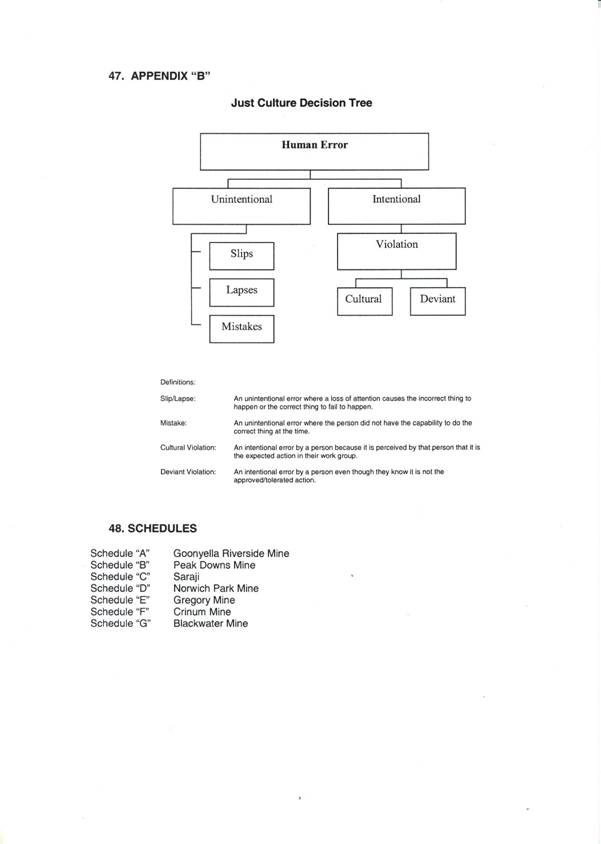
|
|
|
|
|
|
Date of hearing: |
29 and 30 March 2010 |
|
|
|
|
|
|
Place: |
Brisbane |
|
|
|
|
|
|
Division: |
GENERAL DIVISION |
|
|
|
|
|
|
Category: |
Catchwords |
|
|
|
|
|
|
Number of paragraphs: |
72 |
|
|
|
|
|
|
Counsel for the Applicant: |
Mr WL Friend |
|
|
|
|
|
|
Solicitor for the Applicant: |
Hall Payne |
|
|
|
|
|
|
Counsel for the First and Second Respondents: |
Mr A Herbert |
|
|
|
|
|
|
Solicitor for the First and Second Respondents: |
Freehills |
|
|
IN THE FEDERAL COURT OF AUSTRALIA |
|
|
QUEENSLAND DISTRICT REGISTRY |
|
|
GENERAL DIVISION |
QUD 270 of 2009 |
|
CONSTRUCTION, FORESTRY, MINING AND ENERGY UNION Applicant
|
|
|
AND: |
BHP COAL PTY LTD (ACN 010 595 721) First Respondent
STEVEN RAE Second Respondent
|
|
JUDGE: |
|
|
DATE OF ORDER: |
11 JUNE 2010 |
|
WHERE MADE: |
BRISBANE |
THE COURT ORDERS THAT:
The application be dismissed.
Note:Settlement and entry of orders is dealt with in Order 36 of the Federal Court Rules.
The text of entered orders can be located using Federal Law Search on the Court’s website.
|
IN THE FEDERAL COURT OF AUSTRALIA |
|
|
QUEENSLAND DISTRICT REGISTRY |
|
|
GENERAL DIVISION |
QUD 270 of 2009 |
|
BETWEEN: |
CONSTRUCTION, FORESTRY, MINING AND ENERGY UNION Applicant
|
|
AND: |
BHP COAL PTY LTD (ACN 010 595 721) First Respondent
STEVEN RAE Second Respondent
|
|
JUDGE: |
COLLIER J |
|
DATE: |
11 JUNE 2010 |
|
PLACE: |
BRISBANE |
REASONS FOR JUDGMENT
1 This case involves, in summary, an interpretation of clause 44 of the BHP Coal Pty Ltd Workplace Agreement 2007 (“clause 44”).
2 The applicant (“the union”) claims that a meeting called by the first respondent (“BHP Coal”) on 30 October 2009 was pursuant to clause 44, and that according to the terms of clause 44 its member (Mr Chris Lohmann) was entitled to insist on the participation at the meeting of only Mr Lohmann, Mr Lohmann’s representative, and Mr Lohmann’s supervisor or department manager/superintendent. The union claims further that this entitlement was a workplace right of Mr Lohmann, and that BHP Coal had acted adversely towards Mr Lohmann in contravention of s 340 of the Fair Work Act 2009 (Cth) (“the Act”) by threatening to dismiss Mr Lohmann or otherwise injure him in his employment or alter his position to his prejudice should he not participate in the meeting of 30 October 2009 with the presence of a BHP Coal human resources staff member.
3 The union seeks the following orders:
1. A declaration that clause 44 of the BHP Coal Pty Ltd Workplace Agreement 2007 requires that (other than in cases of serious misconduct) the sole participants in a disciplinary procedure shall be the employee concerned, a representative of the employee and employee’s supervisor or department manager/superintendent.
2. A declaration that the first respondent has contravened s 340 of the Fair Work Act 2009 (Cth) by threatening to dismiss Mr Christopher Lohmann (“Lohmann”) or injuring him in his employment or altering his position to his prejudice because he has exercised or proposed to exercise a workplace right.
3. A declaration that the second respondent has contravened s 340 of the Fair Work Act 2009 (Cth) by threatening to dismiss Lohmann or injuring him in his employment or altering his position to his prejudice because he has exercised or proposed to exercise a workplace right.
4. The imposition of penalties on the first respondent for contraventions of s 340 of the Fair Work Act.
5. The imposition of penalties on the second respondent for contraventions of s 340 of the Fair Work Act.
6. An order pursuant to s 546(3) of the Fair Work Act that any penalty imposed upon the respondents be paid to the applicant.
4 A threshold issue for determination in these proceedings is whether the meeting of 30 October 2009 was in fact a “clause 44 meeting” as the parties believed, and, if so, what that meant so far as concerned attendance at the meeting.
BACKGROUND
5 The relevant background facts to these proceedings are as follows.
6 The Goonyella Riverside Mine near Moranbah in central Queensland (the Mine) is operated by the BHP Billiton Mitsubishi Alliance (BMA). BHP Coal is the employer of staff engaged in the conduct of the Mine.
7 The union and BHP Coal are parties to the BHP Coal Pty Ltd Workplace Agreement 2007 (the Workplace Agreement).
8 Mr Christopher Lohmann and Mr Christopher Sammut were employed by BHP Coal under the terms of the Workplace Agreement to perform work at the Mine. Mr Sammut is a Vice President of the Goonyella Riverside Lodge of the union.
9 On 17 October 2009 at approximately 2.40 pm, Mr Lohmann and two other employees of BHP Coal entered a Hilux Duel Cab Ute at the Mine. Mr Lohmann subsequently drove the vehicle along a road on the mine site towards a reject dump where they were working. Mr Lohmann gave evidence that on the way to the reject dump he unsuccessfully attempted to take a right hand corner in the road. The vehicle rolled over. Fortunately no-one in the vehicle was seriously injured.
10 On 19 October 2009, Mr Lohmann attended a meeting in the preparation plant conference room at the Mine as part of the safety investigation into the incident. It is common ground that other persons attending the meeting were:
· Ms Dayle Wilke, a human resources officer;
· Mr Peter Anderson, the Mine’s safety manager;
· Mr Shawn Classen, the manager of the preparation plant and Mr Lohmann’s supervisor;
· Mr Murray Franks, the Mine’s superintendent; and
· Mr Ross Ogden, a union lodge check inspector.
11 BHP Coal also claims that Mr Barry Denny, a production coordinator with the Mine, attended the meeting.
12 On 21 October 2009, another meeting was held attended by the same people (although possibly this time excluding Mr Denny), as well as an external investigator, Mr George Foessel.
13 On 22 October 2009, Mr Classen rang Mr Lohmann and requested him to attend a further meeting on 26 October 2009. Mr Lohmann’s evidence was that Mr Classen said words to the following effect:
We would like you to come in for a meeting on Monday. The meeting is being held under Clause 44 of the Workplace Agreement and its purpose is to discuss disciplinary action in relation to the accident last Saturday.
(affidavit of Christopher Lohmann sworn 16 February 2010 para 31)
14 In comparison, Mr Classen’s evidence was that when he made the telephone call to Mr Lohmann he read from a script prepared for him by Ms Wilke, and that the script said in part:
Calling to advise that we would like to meet with him to discuss how his behaviour contributed to the incident that occurred on 17 October 2009.
This meeting will be held in accordance with clause 44 of the Workplace Agreement 2007 (disciplinary procedure) and therefore, if you would like, you are invited to arrange for an employee representative to accompany you to this meeting.
(affidavit of Shawn Classen affirmed 9 March 2010 paras 28-30)
(It is, however, not in dispute that Mr Classen referred to clause 44 in his conversation with Mr Lohmann.)
15 On 23 October 2009, Mr Classen forwarded an interim investigation report to Mr Rae providing a summary of the evidence which he had gathered as part of the investigation.
16 On 26 October 2009 a meeting was held attended by:
· Mr Lohmann
· Mr Sammut
· Mr Classen
· Mr Ogden
· Ms Wilke
· Ms Kim-Sherie Hornhardt, a human resources manager employed by BHP Coal
· Mr Chris Ungerer, the Secretary/Treasurer of the Goonyella Riverside Lodge.
17 There is considerable common ground between the parties as to events which occurred at that meeting. Mr Lohmann’s evidence was as follows:
34. The meeting commenced by Ms Wilke saying in words to the following effect:
“I am going to ask Ross to leave as this meeting is about industrial matters and does not concern safety in any respect.”
35. At this point Mr Sammut then said in words to the following effect:
“In that case, I would also like to ask Ms Wilke to leave as Clause 44 of the Workplace Agreement does not provide for HR to be involved in disciplinary meetings.”
36. Ms Wilke said in words to the following effect:
“Clause 44 is silent about the involvement of HR. Therefore I am entitled to participate in meetings conducted under Clause 44.”
37. Mr Sammut disagreed with Ms Wilke and as a consequence of the disagreement, Ms Wilke went and got Human Resources Manager, Ms Kim Sheri Hornhardt. Ms Wilke returned shortly after that with Ms Hornhardt. Ms Hornhardt then said in words to the following effect:
“Clause 44 is silent on the role of the HR. Therefore HR Representatives are entitled to participate. In any event, it is HR Roles (sic) to run such meetings so they wouldn’t be excluded.”
38. Mr Sammut then said in words to the following effect:
“That is not right, Clause 44 is clear. Meetings have been conducted between the employee, the employee’s representative and the employee’s supervisor. There is clearly no role for HR in that process.”
39. Ms Hornhardt then said in words to the following effect:
“That is not right.”
40. At this point Ms Hornhardt looked at me and said in words to the following effect:
“The representation that Chris is providing to you is inappropriate and you should seek alternative representation.”
41. At this point Mr Sammut then said in words to the following effect:
“I am not doing anything inappropriate. We are just insisting on Chris’s rights as contained in the workplace agreement.”
42. At this time Mr Ogden said in words to the following effect:
“As this is not about safety I am prepared to bow out of the meeting if it will make things go easier.”
43. At this point Mr Ungerer had a brief discussion with myself and the other CFMEU officials. At this point Mr Sammut said in words to the following effect:
“We are prepared to proceed but we want your non compliance with the workplace agreement noted for the record.”
18 Mr Lohmann’s evidence was that Ms Wilke then asked him numerous questions in relation to the incident involving the vehicle.
19 On 27 October 2009, Ms Wilke forwarded an interim investigation report into the incident to Mr Classen, Mr Rae and Ms Hornhardt.
20 On 28 October 2009, Mr Foessel’s report was received by BHP Coal. A further report from Mr Foessel correcting some typographical and spelling errors was received by BHP Coal on 29 October 2009.
21 On 29 October 2009, Ms Wilke forwarded an amended interim investigation report into the incident to Mr Classen, Mr Rae and Ms Hornhardt. These amendments incorporated the findings of the Foessel report.
22 On 29 October 2009, Ms Wilke rang Mr Lohmann to request him to attend a further meeting scheduled for the following day. A key purpose of the meeting was to discuss the inconsistencies between the findings in Mr Foessel’s report and the version of events provided by Mr Lohmann at the meeting on 26 October 2009. In his affidavit Mr Lohmann deposed as follows:
53. On Thursday 29 October 2009 I received a telephone call from Ms Dayle Wilke. Ms Wilke said in words to the following effect:
“We want to have a meeting with you about the accident. Your version hasn’t lined up with the crash investigator’s results.”
54. Ms Wilke then advised me that I was to attend the mine site at 9.00am the next morning for a meeting.
23 On 30 October 2009, a meeting was held attended by:
· Mr Lohmann
· Mr Classen
· Ms Wilke
· Mr Sammut
· Mr Stephen Rae, the Mine manager.
24 The events at this meeting are the basis of the dispute between the parties. In his affidavit Mr Lohmann summarised events as follows:
58. The meeting commenced at approximately 9.30am and it was in the Human Resources Conference Room. In attendance at the meeting were Mr Sean Classen, Ms Dayle Wilke, Mr Chris Sammut and myself. When the meeting commenced, Mr Sammut said in words to the following effect:
“Under Clause 44 of the Workplace Agreement, HR has no right to be involved in meetings such as this. Therefore I think Dayle should leave the meeting.”
59. At this time Ms Wilke then said in words to the following effect:
“Clause 44 is silent on the involvement of Human Resources. Therefore we are entitled to be in the meeting. It is HR’s job to run these type of meeting. (sic)”
60. Mr Sammut then said in words to the following effect:
“It doesn’t matter. Clause 44 says what the process is to be and it doesn’t provide for HR to be involved.”
61. At this point Ms Wilke indicated that she would go and get the HR Manager to resolve the issue. Ms Wilke then left the room and returned shortly after with the Human Resources Manager. The Human Resources Manager said in words to the following effect:
“Of course HR is entitled to be in these meetings.”
62. Mr Sammut then said in words to the following effect:
“That is not the Union’s view and that is not what Clause 44 says.”
63. At this point the HR Manager then said to me in words to the following effect:
“Are you refusing to participate in this meeting?”
64. I then said in words to the following effect:
“No, I am just following the advice that my representative has given me.”
65. Mr Sammut then said in words to the following effect:
“It is our right for HR to be removed from this meeting. It is a matter for the mine as to whether or not they are going to comply with the obligations in place by the Workplace Agreement. We are just insisting on our rights.”
66. At this point there was some further back an forth (sic) between Ms Wilke, the HR manager and Mr Sammut to the effect of the foregoing statement. After a brief exchange, Mr Sammut then said in words to the following effect:
“Why don’t you go and ask Mr Steve Rae?”
67. Mr Steve Rae is the Mine Manager and the most senior BMA representative on this site.
68. At this time Ms Hornhardt then left to go and get Mr Steve Rae. Whilst Ms Wilke was out of the room, Mr Sammut indicated that he and myself would like to leave the room so that we could make a phone call.
69. Whilst we were out the front and Mr Sammut was on the phone trying to speak with Mr Stuart Vaccaneo, a Vice President of the CFMEU, Mr Rae stuck his head through the door and said in words to the following effect:
“Come back to the meeting.”
70. Mr Sammut then covered the mobile phone and said in words to the following effect:
“In a minute, I am just on the phone.”
71. At this point Mr Rae then angrily said in words to the following effect:
“I am directing you to return to the meeting.”
72. At this point Mr Sammut then said in words to the following effect:
“Fine.”
73. Mr Sammut then terminated the telephone call that he was on and we both immediately returned to the meeting. Mr Sammut advised Mr Rae what our concerns were in relation to the presence of HR. Mr Rae said in words to the following effect:
“The clause is silent and it is to the involvement of HR. Therefore, they are entitled to be involved.”
74. Mr Rae then looked at me and said in words to the following effect:
“The representation that Chris is providing you is not appropriate, you should seek alternative representation because the advice that you are getting is to refuse to participate in this meeting.”
75. At this point Mr Sammut then said in words to the following effect:
“We are not refusing to take part in the meeting. We are merely insisting that the meeting be conducted in accordance with the terms of the Workplace Agreement.”
76. Mr Rae then said in words to the following effect:
“Chris, it is up to you. If you don’t take part in the meeting, things will not go in your favour. The outcome will clearly not be the same as if you participate in the meeting. You are getting bad representation and you should think about that.”
77. At this point Mr Sammut asked for a five (5) minute break so that we could consider what Mr Rae had said and seek some advice from the senior officials of the Union. After Mr Sammut had made the request for a short break, Mr Ray said in words to the following effect:
“Well, will it be exactly five (5) minutes? If I time you will you be any longer than five (5) minutes?
78. When he said this Mr Rae was clearly being argumentative. His response did not strike me as an appropriate way to respond to our request. At this point, Mr Sammut agreed to be no longer than five (5) minutes.
79. One of the BMA representatives then said in words to the following effect:
“If you go and make a phone call, that’s fine but there is no reason for Chris to leave.”
80. At this point Mr Sammut then said in words to the following effect:
“I am not leaving Chris in the room with you without a representative.”
81. At this point there was some disagreement between Mr Rae and Mr Sammut as to whether or not both of us were entitled to leave the room while Mr Sammut made a phone call. During this period Mr Sammut made it clear that he wished to speak with the senior officials of the Union to discuss the issue that was presently in dispute. After a short while, Mr Sammut and myself left the room and walked outside of the building so that Mr Sammut could telephone either the Vice President or the Secretary of the Union.
82. Mr Sammut and I then left the room. Mr Sammut attempted to call Mr Stuart Vaccaneo or Mr Steve Pierce, another Vice President of the CFMEU. After several attempts, Mr Sammut was able to speak with Mr Vaccaneo. Mr Sammut had a brief conversation with Mr Vaccaneo and when he got off the phone with Mr Vaccaneo he said to me in words to the following effect:
“Stuart says that Steve Rae should call him because BMA and the Union have agreed on this matter and HR have no role to play.”
83. We then returned to the meeting. Upon returning to the meeting, Mr Sammut said in words to the following effect:
“Steve, you should call Stuart Vaccaneo because he tells me that this has been sorted out between BMA and the Union.”
84. Mr Rae then said in words to the following effect:
“I don’t feel like calling him right now. I am very busy. I might be able to call him in an hour or two.”
85. … At this point Mr Sammut then renewed his request that HR leave the meeting. Mr Rae then said in words to the following effect:
“So you are refusing to participate in the meeting?”
86. Mr Sammut then said in words to the following effect:
“No. We just want the meeting conducted in accordance with the Workplace Agreement. HR should leave the meeting now and we will participate.”
87. Mr Rae then said in words to the following effect:
“So you are refusing to participate in the meeting?”
88. Mr Sammut then said in words to the following effect:
“No. It is you who are refusing to follow the Workplace Agreement.”
89. Mr Rae then said in words to the following effect:
“If you are not going to participate, we are going to continue the meeting in your absence and you will be notified of the outcome by way of correspondence.”
90. At that point there was an exchange of Mr Rae and Mr Sammut as to how long Mr Sammut had been released from work. Mr Sammut advised that he had been release for one (1) hour and Mr Rae then said in words to the following effect:
“Well then, I suggest you get back to work in a timely fashion.”
91. Mr Sammut and I then left the Administration building.
25 Again, there is considerable common ground between the parties as to the events which occurred at that meeting. However in his evidence Mr Rae denied saying the words attributed to him by Mr Lohmann in para 76 of Mr Lohmann’s affidavit. Mr Rae’s evidence was:
Again, the only comment I made was that it was in Mr Lohmann’s best interests for the meeting to continue. This was based on the view that Mr Lohmann needed the opportunity to present his side of the story and that it was in his best interests if he was able to present it.
(affidavit of Stephen Rae sworn 8 March 2010 para 87)
26 Evidence of Ms Hornhardt (para 118) and Ms Wilke (para 243) was consistent with Mr Rae’s evidence.
27 Mr Rae also denied that he had been peremptory in response to Mr Sammut’s request for a five minute break (affidavit of Stephen Rae sworn 8 March 2010 para 88).
28 Subsequent meetings were held at the premises of BHP Coal in respect of the investigation of the incident. However Mr Lohmann attended no further meetings despite being informed of the meetings, directed to attend, and asked about his subsequent non-attendance. Mr Vaccaneo of the union contacted Ms Wilke on 7 December 2009 indicating that Mr Lohmann was prepared to participate in the investigation process by correspondence. Communications subsequently took place, primarily between Ms Wilke, Mr Lohmann, and Mr Vaccaneo, including questions by the union as to the reliability of the “In Vehicle Monitoring System” recovered from the vehicle Mr Lohmann had been driving at the time of the incident.
29 On 19 January 2010, Ms Wilke prepared a memorandum to Mr Rae outlining the investigation process and its findings. In summary, the investigation revealed that Mr Lohmann had failed to operate a vehicle in a safe manner by speeding, not wearing a seatbelt, driving on the wrong side of the road, and not driving to conditions; that Mr Lohmann had failed to comply with BMA’s Safety and Health Management System; and that Mr Lohmann’s failure to operate a vehicle in a safe manner placed the health, safety and welfare of the two passengers and other persons on site in serious and imminent risk. Ms Wilke recommended that Mr Rae accept that Mr Lohmann’s behaviour constituted serious misconduct, and that a show cause letter be issued to him.
30 Considerable correspondence was exchanged between Ms Hornhardt, Mr Lohmann and the union. On 23 February 2010 Ms Wilke forwarded a further report to Mr Rae regarding the show cause process and recommending Mr Lohmann’s employment be terminated.
31 Mr Rae signed a termination letter terminating Mr Lohmann’s employment on 26 February 2010.
CLAUSE 44 OF THE WORKPLACE AGREEMENT
32 The Workplace Agreement was made under the Workplace Relations Act 1996 (Cth). Clause 44 provides as follows:
44. DISCIPLINARY PROCEDURE
44.1 The following disciplinary procedure is consistent with the philosophy contained in the Just Culture Decision Tree (Appendix “B”).
44.2 Except for instances of serious misconduct, the following four step disciplinary process will be applied.
44.3. The application of the Just Culture Decision Tree, together with the particular circumstances and severity of each case, will determine the appropriate step/s to be taken with respect to an employee. The relevant steps are as follows:
Step 1 An employee will be verbally counselled by their Supervisor. Where requested by the employee, the Supervisor will conduct the counselling in the presence of an employee representative. Written notice of the verbal counselling will be provided to the employee and a copy placed on the employee’s file; or
Step 2 An employee will be counselled by their Supervisor in the form of a formal warning. Where requested by the employee, the Supervisor will conduct the counselling in the presence of an employee representative and have the warning confirmed in writing. A copy will be provided to the employee and also be placed on the employee’s file; or
Step 3 An employee will be issued a final warning by their Supervisor and Department Manager/Superintendent. Where requested by the employee, the company representatives will conduct the counselling in the presence of an employee representative, and have the final warning confirmed in writing and the employee will be advised that dismissal may result from any further act of misconduct. The employee can also be placed on a period of suspension without pay for a period of up to twenty-one (21) calendar days. A copy will be provided to the employee and placed on the employee’s file; or
Step 4 Disciplinary action, which is commensurate with the severity and/or frequency of the act/s of misconduct, which will then be taken.
44.4 Where an employee, in receipt of a warning under Steps 1,2 or 3 above, receives no further warning under Steps 1,2 or 3 for a period of twelve (12) months, the severity of the warning will revert to the previous step, if any, in the disciplinary process. When no further warnings are issued in the proceeding twelve (12) months, then any remaining warnings under Steps 1 or 2 will be removed. Written notification of these changes shall be provided to the employee. A copy of all letters issued shall be retained on the employee’s file.
44.5 Any disputes arising from the application of this process may be progressed through the disputes settlement procedure.
33 The Just Culture Decision Tree to which reference is made in clauses 44.1 and 44.2 appears in the BMA “Guideline to Fair Play Policy” exhibited to Ms Hornhardt’s affidavit. According to this policy, the Just Culture Decision Tree is a flowchart which provides a guide to the appropriate discipline level when inappropriate behaviour occurs. It is also designed to ensure a consistent and fair approach in the organisation, and is as follows:

WAS CLAUSE 44.3 RELEVANT IN RESPECT OF THE MEETING OF 30 OCTOBER 2009?
34 The primary contention of the union in these proceedings is that the meeting of 30 October 2009 was held in accordance with clause 44, that clause 44 prescribes the identity of persons entitled to attend meetings held in accordance with the clause, and finally that clause 44 creates workplace rights for an employee subject to the disciplinary procedure described in the clause including the attendance of persons at relevant meetings. By reference to a meeting being held in accordance with clause 44, it is clear that the union means a meeting held in accordance with clause 44.3 steps 1-3.
35 Of BHP Coal staff, it appears that the belief that clause 44 applied to the meeting of 30 October 2009 originated in Ms Wilke, who prepared the script for Mr Classen to request Mr Lohmann to attend the meeting of 26 October 2009, and later produced an interim investigation report into the incident referring to the meeting of 26 October 2009 in connection with clause 44. Ms Wilke deposed that she believed that clause 44 of the Workplace Agreement included the investigation process as well as the implementation of the disciplinary outcome. Mr Lohmann’s evidence was that he believed clause 44 continued to apply in respect of the meeting of 30 October 2009 (TS p 34 ll 35-50, p 35 ll 1-13). Mr Sammut’s view appeared to be similar to that of Mr Lohmann (affidavit of Christopher Sammut affirmed 15 February 2010 para 48).
36 In my view this meeting was not held in accordance with clause 44.3, and accordingly the identity of personnel in attendance was in no way determined by clause 44.3, which is the only subclause prescribing attendance at meetings. I form this view for the following reasons.
1. Framework of the Workplace Agreement so far as concerns clause 44 and the Just Culture Decision Tree (Appendix B)
37 First, it is clear from an examination of clause 44 and the Just Culture Decision Tree (Appendix B) in the Workplace Agreement that these provisions together prescribe a process following the occurrence of an incident which is attributable to human error. It is also clear that the Just Culture Decision Tree specifically provides for categorisation of error – either as intentional or unintentional – and that clause 44.3 lists forms of possible disciplinary approach dependent (in part) upon the categorisation of the error under the Just Culture Decision Tree. More specifically, it is clear that:
· Once an incident occurs BHP Coal is required to investigate to determine whether the incident was the result of human error. An incident which is not the result of human error falls outside the scope of either clause 44 or the Just Culture Decision Tree.
· When it is clear that the incident is attributable to human error, the Just Culture Decision Tree applies to determine whether the incident was the result of unintentional or intentional human error.
· It appears that clause 44.3 is applicable whether the incident arises from intentional or unintentional human error.
· If the incident was a result of human error which constitutes serious misconduct, the steps listed in clause 44.3 never become relevant (clause 44.2).
· If the incident was a result of human error which did not constitute serious misconduct, then BHP Coal will consider the error together with the particular circumstances and severity of each case. It will then determine the appropriate step/s to be taken with respect to an employee in accordance with clause 44.3.
· Clause 44.3 describes four steps in a disciplinary procedure. Three of those steps include counselling and a meeting at which the counselling is delivered. Step 4 simply provides for the taking of disciplinary action commensurate with the severity and/or frequency of the act/s of misconduct.
· Clause 44.3 appears to contemplate that more than one of the steps listed in that subclause can be taken in appropriate circumstances. So, for example, it is possible within the scope of clause 44.3 in response to conduct of an employee that BHP Coal could issue a final warning to the employee (step 3) and discipline the employee otherwise than through the counselling measures in steps 1-3 (step 4).
· Not all steps in clause 44.3 contemplate meetings. Step 4 in clause 44.3, for example, contemplates the imposition of discipline without the occurrence of a meeting.
38 From this analysis, it is clear that the steps in clause 44.3 only become relevant when:
· It is clear that an incident was the result of human error; and
· It is clear that an incident does not give rise to serious misconduct by the employee.
39 It also follows that, once an incident occurs, not every meeting called by BHP Coal falls within the parameters of clause 44.3. If, for example, BHP Coal concludes that the incident gave rise to serious misconduct by the employee, no meetings will be held pursuant to clause 44.3 because none of the disciplinary procedures listed in that clause are relevant. Further, meetings called as part of an investigation to determine if the incident resulted from human error are not called pursuant to clause 44.3.
2. Investigation of events prior to application of the Just Culture Decision Tree and clause 44.3
40 In her affidavit sworn 9 March 2010 Ms Hornhardt deposed as to the sequence of events which ordinarily occurs following a serious or high potential safety incident at the Mine. Her evidence was as follows:
9. When a serious or high potential safety incident or accident occurs at the Mine, an investigation is conducted. This may have a safety or a behavioural component. It may also involve convening an ICAM (Incident Cause and Analysis Methodology). An ICAM is a root cause analysis investigation, which is normally conducted by a trained facilitator. The ICAM investigation attempts to identify what led to the safety incident, so that corrective and preventive actions can be implemented to prevent recurrence.
10. During the safety investigation or once it is complete, consideration will be given to whether a behavioural investigation is required and whether disciplinary action is appropriate. This behavioural investigation will investigate how the behaviour of particular individuals may have contributed to the safety incident or accident.
11. Once the behavioural investigation is concluded, the Just Culture Decision Tree in BMA’s Guideline to Fair Play Policy and Appendix 2 of the Agreement will be applied to the outcomes of the investigation…
12. The Just Culture Decision Tree form should be completed prior to the implementation of a disciplinary outcome. The Just Culture Tree form is a 7 step process used to determine whether an event or breach, which has been previously fully investigated as to its cause, was intentional or unintentional.
13. Where it has been determined under the Guideline to Fair Play Policy and the Just Culture Decision Tree that disciplinary action is warranted, clause 44 of the Agreement becomes relevant. Clause 44 of the Agreement deals with the meetings to be held to implement the disciplinary outcome. It does not refer to any stage of the investigation process, prior to a decision being finally made about the disciplinary outcome. The exception to this is that the requirements prescribed by clause 44 do not apply in cases of serious misconduct.
41 This uncontroverted evidence of Ms Hornhardt is consistent with the framework of the Workplace Agreement, in particular clause 44 and Appendix B. It supports the conclusion apparent on the face of the Workplace Agreement – namely that when an incident occurs the first task of BHP Coal is to determine its cause, and whether there are safety and/or behavioural elements.
42 Ms Hornhardt’s evidence also supports an inference that meetings may be held involving employees, management, and third parties during the course of an investigation into an incident at the Mine. Indeed in my view it is to be expected that such meetings would be held, in order to ascertain, for example, whether the incident had occurred because of a systemic breakdown in safety issues or because serious misconduct had occurred as contemplated by clause 44.2. It is difficult to contemplate how BHP Coal could possibly form a view as to such matters without a meeting involving relevant employees and management to identify the cause of an incident.
3. What was the purpose of the meeting of 30 October 2009?
43 In my view it is clear that the purpose of the meeting of 30 October 2009 was to ascertain whether behaviour of Mr Lohmann had contributed to the incident, and, if so, the extent to which his behaviour had contributed. In particular, it is clear that Mr Lohmann’s presence was required at the meeting in order for him to comment upon his version of events leading to and concerning the incident in light of the apparent inconsistencies with this version and the findings of the investigator (affidavit of Christopher Lohmann affirmed 15 February 2010 paras 53-54, affidavit of Dayle Wilke sworn 9 March 2010 paras 78-82). It was not to counsel, warn, or otherwise discipline Mr Lohmann within the meaning of clause 44.3. Mr Lohmann knew that this was the purpose of the meeting – he had been so informed by Ms Wilke. Ms Wilke’s evidence was that she did not refer to clause 44 in her conversation with Mr Lohmann of 29 October 2009 (affidavit of Dayle Wilke sworn 9 March 2010 para 81). Her evidence is consistent with Mr Lohmann’s evidence on this point.
4. Statement by BHP Coal that the meeting was a “clause 44” meeting
44 The evidence demonstrates that those participating in the meeting of 30 October 2009 believed that it was governed by clause 44 of the Workplace Agreement. Although there was disagreement at the meeting between Mr Sammut on the one hand, and Mr Rae and Ms Hornhardt on the other, this disagreement appeared to be as to the right of human resources staff to attend the meeting in light of clause 44, rather than its relevance to the meeting. However this mutual belief does not in itself mean that attendance at this meeting was restricted in terms of clause 44.3. I agree with the submission of Mr Herbert for BHP Coal that the existence of a workplace right is an objective fact, not the result of a subjective belief. In other words, whether the meeting of 30 October 2009 was a “clause 44 meeting”, was restricted as to attendance by clause 44, and conferred rights on employees, is a question to be determined objectively, not subjectively. Relevant observations were made by Gray J in Employment Advocate v Williamson (2001) 111 FCR 20 at 29 where his Honour said:
What is clear, however, is that, for a contravention of s 298K to occur, there must be a person or persons who fall within the description in one or more of the prohibited reasons. To take a simple example, even if an employer believes he or she is dismissing an employee because the employee is a member of an industrial association, there will be no contravention of s 298K(1)(a) if it turns out that the employee is not a member of the industrial association. Compare Burgess v John Connell-Mott, Hay and Anderson Pty Ltd (1979) 37 FLR 386. Similarly, a threat to engage in conduct of one or more of the kinds referred to in s 298K(1) for what appears to be a prohibited reason will not be a contravention if there is no basis for the prohibited reason.
45 As I have already observed, the purpose of the meeting was communicated to Mr Lohmann as being for him to explain the inconsistencies in his explanation with the report of the investigator, and it is clear that this was the actual purpose of the meeting.
46 I also note that, notwithstanding the belief of the participants, the union does not contend that BHP Coal is estopped from denying that the meeting was regulated by clause 44 (TS p 180 ll 7-16).
47 Mr Friend submitted, in summary, that:
· BHP Coal called a meeting for 30 October 2009, describing it as a meeting under clause 44.
· A “clause 44” meeting is only a meeting held in accordance with steps 1, 2 or 3 of clause 44.3.
· Although Mr Lohmann had been told that the purpose of the meeting was to elicit further information from him, Mr Lohmann and Mr Sammut had to expect that BHP Coal could take a clause 44.3 step, because BHP Coal would have been fully entitled to do so.
· Even if the intention of BHP Coal at that time was not to exercise any of those rights, while the meeting was described as a clause 44 meeting BHP Coal had that ability.
48 This is a powerful submission which has given me pause. However after careful consideration I do not accept it.
49 First, I note the uncontroverted evidence of Ms Wilke that, in requesting Mr Lohmann to attend the meeting of 30 October 2009, she had informed him that the purpose of the meeting was to talk about the incident because Mr Lohmann’s version had not lined up with the crash investigator’s results, and that she deliberately had not mentioned clause 44 because of the events which had occurred at the meeting of 26 October 2009. However more to the point, in light of the circumstances surrounding the meeting I am not persuaded that either:
· Mr Lohmann or Mr Sammut had any expectation that the meeting of 30 October 2009 – which was understood by all participants to be an opportunity for Mr Lohmann to provide further explanation – would metamorphose into a meeting of the type listed in clause 44.3; or
· In light of the knowledge of all participants that the investigation was still ongoing as at 30 October 2009, that BHP Coal had “an entitlement” to proceed directly to the administration of disciplinary procedures in clause 44.3 in the same meeting.
50 Significantly, as at 30 October 2009 it is clear that no decision had been made by BHP Coal in respect of whether Mr Lohmann’s conduct had contributed to the incident. Indeed it was made clear to Mr Lohmann that BHP Coal required further information from him before the company could make any such decision. Mr Lohmann knew that this was the reason for the meeting, because he knew that as at 30 October 2009 the investigation into the causes of the incident was only half completed and that he would be given an opportunity to explain his version of events before any decision was made about his behaviour and its contribution to the incident (TS p 35 ll 15-26, p 37 ll 33-34). The prospect of Mr Lohmann’s supervisor, Mr Classen, during the course of the meeting of 30 October 2009, suddenly announcing the disciplinary procedure to which Mr Lohmann would be subjected and, assuming that it was one of the steps listed in clause 44.3, applying it to Mr Lohmann, is remote in the extreme in light of:
· the workplace policies of BHP Coal (including the requirement that the seven step process contemplated by the Just Culture Decision Tree be completed); and
· the practical need of BHP Coal to complete the process of considering Mr Lohmann’s explanation in light of the investigator’s report before it.
51 Mr Friend’s analogy of a person being invited to attend the police station and “end(ing) up in the cells” does not support his submission in this context. In the case of a person being invited to attend a police station for questioning, the substantive “discipline” which could be imposed, such as conviction for an offence and incarceration in prison, are events which would occur in the future and not at the time of the attendance at the police station. While theoretically Mr Friend’s submission is superficially plausible, in reality it paints an unrealistic picture of events which could have occurred at that meeting of 30 October 2009.
5. Relevance of clause 44
52 To the extent that the meeting of 30 October 2009 was called as part of an investigation into the relevant incident in circumstances where human error appeared to have played a part, and accordingly the process of the Just Culture Decision Tree was potentially applicable, it is perhaps understandable that the parties should have initially believed that the meeting was a “clause 44 meeting”. As is clear from the document “Guideline to Fair Play Policy” (which provides guidance and explanation in respect of the Just Culture Decision Tree), the seven-step process outlined in the Just Culture Decision Tree is utilised by BHP Coal once an objective investigation reveals a breach or infringement of policy, procedure, process or contractual arrangement. The philosophy of and the process contemplated by the Just Culture Decision Tree are in turn referenced in clause 44.1 and clause 44.2 of the Workplace Agreement. Indeed it appears that clause 44 is the only clause in the Workplace Agreement which refers, albeit obliquely in clause 44.1 and clause 44.2, to categorisation of conduct or serious misconduct following an incident. At the time of the meeting of 30 October 2009 it was clear that the safety investigation had been completed, and that BHP Coal had turned to investigate the conduct of Mr Lohmann and whether his behaviour had contributed to the incident. That is not to say, however, that clause 44.3 or any of the prescriptions as to attendant personnel in that clause were relevant – indeed it is clear from the evidence that as at 30 October 2009 none of the disciplinary steps listed in clause 44.3 were in play, and that at least until the investigation had been completed it was not envisaged that Mr Lohmann would be the subject of any disciplinary action, let alone the types of discipline the subject of steps 1-3 in clause 44.3.
Conclusion
53 Finally, to the extent that clause 44 prescribes attendance at meetings held pursuant to that clause, I consider that the prescription would apply only to meetings held specifically for the purpose of administering discipline according to individual steps listed in clause 44.3.
54 Examining clause 44 as a whole, it follows that:
· In circumstances where an employee is disciplined for serious misconduct, which according to clause 44.2 falls outside the parameters of clause 44.3, there is no prescription or limitation in respect of the persons who may attend any meeting called.
· In circumstances where an employee is subject to a disciplinary procedure in accordance with step 4 of clause 44.3, and the disciplinary procedure may involve a meeting, there is no prescription or limitation in respect of the persons who may attend such meeting.
· Any prescription or limitation in respect of persons who may attend any meeting called pursuant to clause 44.3 steps 1-3 appears, from the terms of clause 44.3, to apply only to the meeting where the counselling and/or warning is administered. A meeting held to obtain information so as to allow BHP Coal to decide which disciplinary procedure to follow is outside the scope of clause 44.3.
55 It is only in clause 44.3 steps 1-3 that specific persons are identified as attending particular meetings. In my view the meeting of 30 October 2009 was not a meeting to which any of the steps listed in clause 44.3 applied, and, even if those steps do prescribe the persons who may attend a meeting contemplated by those steps, the meeting of 30 October 2009 was not a meeting at which attendance was so limited. The parties to the meeting of 30 October 2009 were mistaken in believing that clause 44.3 was relevant to that meeting.
ADVERSE ACTION
56 My findings in respect of the application of clause 44.3 are sufficient to dispose of this application. However I note that:
· even had I found that the meeting of 30 October 2009 was a meeting within the meaning of clause 44.3 steps 1, 2 or 3; and
· even were the terms of those steps read prescriptively such that the persons in attendance at such meetings were confined to those listed as submitted by the union; and
· even were a workplace right conferred upon Mr Lohmann as a result
I am not persuaded that the statements of Mr Rae to Mr Lohmann at that meeting constituted “adverse action” within the meaning of s 340 of the Act. I make the following comments in relation to the statements of Mr Rae in case my findings in relation to the application of clause 44 are wrong, and also because the issue whether Mr Lohmann was the subject of adverse action was the subject of extensive submissions.
57 The evidence before the Court as to whether Mr Rae’s conduct constituted adverse action against Mr Lohmann can be summarised as follows:
1. In his affidavit Mr Lohmann deposed:
92. Mr Rae then looked at me and said in words to the following effect:
“The representation that Chris is providing you is not appropriate, you should seek alternative representation because the advice that you are getting is to refuse to participate in this meeting.”
93. At this point Mr Sammut then said in words to the following effect:
“We are not refusing to take part in the meeting. We are merely insisting that the meeting be conducted in accordance with the terms of the Workplace Agreement.”
94. Mr Rae then said in words to the following effect:
“Chris, it is up to you. If you don’t take part in the meeting, things will not go in your favour. The outcome will clearly not be the same as if you participate in the meeting. You are getting bad representation and you should think about that.”
2. In his affidavit Mr Sammut deposed:
96. At this point Mr Rae then said in words to the following effect:
“Are you sure Chris? This is not in Chris’s best interests. We are going to continue on with the meeting without Chris and he will be informed of the outcome by correspondence.”
3. Mr Rae’s evidence was:
“Again, the only comment I made was that it was in Mr Lohmann’s best interests for the meeting to continue. This was based on the view that Mr Lohmann needed the opportunity to present his side of the story and that it was in his best interests if he was able to present it.”
(affidavit of Stephen Rae sworn 8 March 2010 para 87)
4. Evidence of Ms Hornhardt (para 118) and Ms Wilke (para 243) was consistent with Mr Rae’s evidence.
58 So far as concerns action by an employer against an employee, s 342(1) of the Act defines “adverse action” as meaning where the employer:
(a) dismisses the employee; or
(b) injures the employee in his or her employment; or
(c) alters the position of the employee to the employee’s prejudice; or
(d) discriminates between the employee and other employees of the employer.
59 Section 342(2) extends the definition to include threatening to take action covered in s 342(1).
60 In para 24 of the Statement of Claim the union pleads as follows:
Shortly after the request referred to in paragraph 23 Rae attended the meeting and stated to Lohmann that if he did not take part in the meeting with the Human Resources Officer, Wilke, and Classon present things would not go in his favour.
61 Further, para 29 states:
By reason of the matters alleged in paragraph 24 BHP Coal took adverse action against Lohmann within the meaning of s342 of the Fair Work Act 2009 (Cth) (FWA).
Particulars
BHP Coal threatened to dismiss Lohmann, alternatively injure him in his employment, alternatively alter his position to his prejudice.
62 The union also claims in para 32 of the Statement of Claim that Mr Rae:
(a) aided, abetted, counselled or procured;
(b) induced; or
(c) by way of his acts or omissions directly or indirectly was knowingly concerned in, each of the contraventions of s 340 of the FWA by BHP Coal referred to in para 29 and para 31.
63 Mr Lohmann’s version of Mr Rae’s statements appears potentially the most favourable to the claims of the union. However even adopting Mr Lohmann’s version of events, I am unable to see how Mr Rae’s statements constituted adverse action.
64 First, they do not constitute a dismissal or threat to dismiss Mr Lohmann.
65 Second, they do not constitute an injury or threat to injure Mr Lohmann. In my view, at most they constituted encouragement to Mr Lohmann to provide information which would be taken into account by BHP Coal in the investigation, because BHP Coal was continuing to investigate the behavioural issues relevant to the incident and Mr Lohmann’s version of events pertaining to the incident did not correspond with the report already obtained from an independent crash investigator. Even if Mr Rae used the words “If you don’t take part in the meeting, things will not go in your favour” I do not consider that Mr Rae was threatening a result – he was concerned that the outcome of the investigation would be worse for Mr Lohmann if BHP Coal was only able to have regard to the investigator’s report, and not able to consider Mr Lohmann’s explanation.
66 Alternatively, Mr Friend for the union submitted that the statements of Mr Rae constituted a threat to alter Mr Lohmann’s position to his prejudice because:
· Mr Rae threatened to continue with the process notwithstanding Mr Lohmann’s insistence that the meeting be conducted in accordance with clause 44; and
· Mr Rae also threatened Mr Lohmann with a worse outcome as a result of Mr Rae’s decision to continue in Mr Lohmann’s absence.
67 In Patrick Stevedores Operations No 2 Pty Ltd v Maritime Union of Australia (No 3) (1998) 195 CLR 1 at 18, the High Court described alteration of an employee’s position to his or her prejudice as:
a broad additional category which covers not only legal injury but any adverse affection of, or deterioration in, the advantages enjoyed by the employee before the conduct in question.
68 In my view however Mr Rae’s statements did not threaten to alter Mr Lohmann’s position to his prejudice in the sense explained by their Honours in Patrick Stevedores (1998) 195 CLR 1. There was no threat of adverse affection or deterioration in the advantages enjoyed by Mr Lohmann. Indeed as I have already found, Mr Rae’s statements at the meeting of 30 October 2009 constituted encouragement to Mr Lohmann to provide information in relation to the incident. At most, Mr Rae’s statements could be considered blunt and exasperated. However they did not constitute a threat by him to make the situation worse for Mr Lohmann.
69 Further, the evidence demonstrates that there was in fact no alteration to the position of Mr Lohmann to his prejudice as a result of comments by Mr Rae. I note that:
· The meeting of 30 October 2009 did not continue after Mr Lohmann refused to participate in the presence of human resources staff.
· Mr Lohmann, through the union, subsequently indicated a preparedness to provide his version of events to BHP Coal by written communications, and did so. Mr Lohmann’s evidence was that the investigation proceeded in the ordinary course with the involvement of the union (TS p 40 ll 29-31).
· It appears that a decision was made by Mr Rae in February 2010 to terminate Mr Lohmann’s employment, based on all material before the company including Mr Lohmann’s input.
CONCLUSION
70 The meeting of 30 October 2009 was not a meeting held in accordance with any of the steps listed in clause 44.3. Accordingly in the circumstances it is not necessary for me to decide whether clause 44.3 should be read prescriptively, so that human resources staff were not entitled to attend the meeting of 30 October 2009. There are no grounds to infer that attendance at a meeting, which is held at a time prior to a meeting at which discipline is to be administered pursuant to clause 44.3 steps 1-3, would be similarly restricted. Accordingly, it is not appropriate in the circumstances of this case for me to make a declaration one way or the other in respect of clause 44.
71 However, I note by way of comment that, had the meeting of 30 October 2009 been a meeting at which counselling and/or a warning was given to Mr Lohmann in accordance with any of clause 44.3 steps 1-3, it would be open to the Court to find that the persons permitted to attend the meeting were limited to the personnel listed in each step. Notwithstanding Mr Herbert’s submissions in relation to the ubiquitousness of attendance at such meetings by human resources staff, and the fact that step 4 does not prescribe either a meeting or persons who are permitted to attend such a meeting, it is appropriate to assume that the terms of a detailed workplace agreement of this kind were the result of lengthy negotiations between experienced parties with considerable resources (including legal advice). If steps 1-3 specifically identified the persons who would attend, it is reasonable to infer that the parties to the Workplace Agreement intended that those persons, and those persons alone, would be the appropriate persons to attend such a meeting. It does not necessarily follow, in my opinion, that all parties would take it as read that human resources staff would always be in attendance at a discipline session of the type envisaged by steps 1-3 of clause 44.3. It may have been the intention of the parties that human resources staff would, for example, brief the relevant supervisor prior to the delivery of the warning in accordance with steps 1-3, in a similar fashion to the apparent preparation of a script by Ms Wilke for Mr Classen prior to his telephone call to Mr Lohmann of 22 October 2009. This is, however, speculation, as there is no evidence before me to support such a conclusion. Whether a workplace right may be conferred on a relevant employee by clause 44.3 steps 1-3 in respect of the persons in attendance does not arise for determination on the facts before me.
72 The appropriate order is to dismiss the application.
|
I certify that the preceding seventy-two (72) numbered paragraphs are a true copy of the Reasons for Judgment herein of the Honourable Justice Collier. |
Associate:
Dated: 11 June 2010


