

FEDERAL COURT OF AUSTRALIA
Specsavers Pty Ltd v The Optical Superstore Pty Ltd (No. 2) [2010] FCA 566
| Citation: | Specsavers Pty Ltd v The Optical Superstore Pty Ltd (No. 2) [2010] FCA 566 | |
| | | |
| Parties: | SPECSAVERS PTY LTD (ACN 097 147 932) v THE OPTICAL SUPERSTORE PTY LTD (ACN 095 737 894) | |
| | | |
| File number: | NSD 119 of 2010 | |
| | | |
| Judge: | KATZMANN J | |
| | | |
| Date of judgment: | 4 June 2010 | |
| | | |
| Catchwords: | TRADE PRACTICES – misleading or deceptive conduct – comparative advertising – 30 second television commercials for prescription spectacles –whether ordinary and reasonable consumer would believe there were no qualifications or limitations in the offer made in the commercial - whether commercials misleading without express qualifications or limitations – whether offers in commercials limited to the locations of telecasts. | |
| | | |
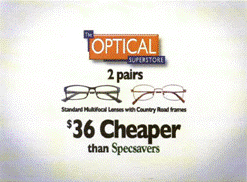
| Legislation: | Federal Court of Australia Act 1976 (Cth), s 50 Trade Practices Act 1974 (Cth) ss 52, 53(e) | |
| | | |
| Cases cited: | Campomar Sociedad, Limitada v Nike International Limited [2000] HCA 12; (2000) 202 CLR 45 applied CCP Australian Airships Ltd v Primus Telecommunications Pty Ltd [2004] VSCA 232; (2005) ATPR ¶42-042 cited Equity Access Pty Ltd v Westpac Banking Corporation & Westpac Savings Bank Ltd (1990) ATPR ¶40-994 cited Eveready Australia Pty Limited v Gillette Australia Pty Limited [1999] FCA 1824; (2000) ATPR ¶41-751 cited Gillette Australia Pty Ltd v Energizer Australia Pty Ltd [2002] FCAFC 223; (2002) 193 ALR 629 applied Global Sportsman Pty Ltd v Mirror Newspapers Pty Ltd (1984) 2 FCR 82 applied Hornsby Building Information Centre Pty Limited v Sydney Building Information Centre Limited (1978) 140 CLR 216 cited Kimberly-Clark Australia Pty Ltd v Carter Holt Harvey Tissue Australia Ltd (1997) 37 IPR 293 cited McWilliam’s Wines Pty Ltd v McDonalds System of Australia Pty Ltd (1980) 33 ALR 394 cited National Exchange Pty Ltd v Australian Securities & Investments Commission [2004] FCAFC 90; (2004) ATPR ¶42-000 applied Parkdale Custom Built Furniture Pty Ltd v Puxu Pty Ltd (1982) 149 CLR 191 applied Puxu Pty Ltd v Parkdale Custom Built Furniture Pty Ltd (1980) 31 ALR 73 applied SAP Australia Pty Ltd v Sapient Australia Pty Ltd [1999] FCA 1821; (1999) 169 ALR 1 applied Stuart Alexander & Co (Interstate) Pty Ltd v Blenders Pty Ltd (1981) 37 ALR 161 cited Taco Company of Australia Inc v Taco Bell Pty Ltd (1982) 42 ALR 177 applied Tobacco Institute of Australia Ltd v Australian Federation of Consumer Organisations Inc (1992) 38 FCR 1 applied | |
|
|
| |
| Date of hearing: | 29 March to 7 April 2010 | |
|
|
| |
| Place: | Sydney | |
|
|
| |
| Division: | GENERAL DIVISION | |
|
|
| |
| Category: | Catchwords | |
|
|
| |
| Number of paragraphs: | 189 | |
|
|
| |
| Counsel for the Applicant: | Mr D Studdy SC | |
|
|
| |
| Solicitor for the Applicant: | Minter Ellison | |
|
|
| |
| Counsel for the Respondent: | Mr M O’Bryan | |
|
|
| |
| Solicitor for the Respondent: | Maddocks | |
IN THE FEDERAL COURT OF AUSTRALIA |
|
| NEW SOUTH WALES DISTRICT REGISTRY |
|
| GENERAL DIVISION | NSD 119 of 2010 |
| BETWEEN: | SPECSAVERS PTY LTD (ACN 097 147 932) Applicant
|
| AND: | THE OPTICAL SUPERSTORE PTY LTD (ACN 095 737 894) Respondent
|
| JUDGE: | KATZMANN J |
| DATE OF ORDER: | 4 June 2010 |
| WHERE MADE: | SYDNEY |
THE COURT ORDERS THAT:
1. The injunctions granted by Edmonds J on 9 February 2010 are discharged.
2. The proceeding is adjourned for further hearing on the questions of relief and costs.
Note: Settlement and entry of orders is dealt with in Order 36 of the Federal Court Rules.
The text of orders can be located using Federal Law Search on the Court’s website.
IN THE FEDERAL COURT OF AUSTRALIA |
|
| NEW SOUTH WALES DISTRICT REGISTRY |
|
| GENERAL DIVISION | NSD 119 of 2010 |
| BETWEEN: | SPECSAVERS PTY LTD (ACN 097 147 932) Applicant
|
| AND: | THE OPTICAL SUPERSTORE PTY LTD (ACN 095 737 894) Respondent
|
| JUDGE: | KATZMANN J |
| DATE: | 4 June 2010 |
| PLACE: | SYDNEY |
REASONS FOR JUDGMENT
Introduction
1 This is a case involving comparative advertising. Comparative advertising promotes the products of a business by unfavourably comparing those of a competitor with its own. There is nothing wrong in principle with comparative advertising. Indeed, provided it is accurate and does not involve half-truths, it promotes competition and helps consumers make informed choices. Compare Gillette Australia Pty Ltd v Energizer Australia Pty Ltd [2002] FCAFC 223; (2002) 193 ALR 629 (Gillette v Energizer) at [20] per Heerey J.
2 The parties are rivals in the fiercely competitive world of spectacles retailing. For some time they have been waging a price war. This dispute relates to the content of two television advertisements produced for The Optical Superstore and telecast in various parts of the country in February this year. The advertisements unfavourably compared the prices offered at Specsavers’s stores with those available at The Optical Superstore’s outlets.
3 Specsavers complains that the advertisements contravene the Trade Practices Act 1974(Cth) (the Act) in that they were misleading or deceptive and made false or misleading representations with regard to the price of The Optical Superstore’s multifocal spectacles contrary to ss 52(1) and 53(e) of the Act.
4 There is no dispute about the legal principles to be applied. The issues are purely factual: were the pleaded representations made and were they false or misleading? The onus of proof, of course, lies on Specsavers (Parkdale Custom Built Furniture Pty Ltd v Puxu Pty Ltd (1982) 149 CLR 191 (Parkdale v Puxu) at 210).
5 Specsavers seeks declaratory and injunctive relief, an order for corrective advertising and damages.
6 As the proceeding was expedited, I made an order for the separate determination of any question of damages and I propose to hear further from the parties about the appropriate form of relief after this judgment is published. Thus, this judgment is concerned only with the question of whether the Act has been contravened.
History of the proceeding
7 On 9 February 2010 Edmonds J granted Specsavers ex parte injunctions restraining The Optical Superstore from continuing to broadcast or to publish or cause to be published or otherwise make available to consumers the first of the two advertisements and from making (in other advertising, marketing or promotional material) the representations Specsavers then claimed were made in that advertisement. Those injunctions remain in force.
8 Specsavers’s evidence largely came from “mystery shoppers”. They are individuals recruited to test the truth of the claims made in an advertisement by seeking to purchase the advertised products at the advertised price. They are so-called because their purpose is concealed from the seller. On 15 February and 22 February 2010 I made and then varied certain orders under s 50(1) of the Federal Court of Australia Act 1976 (Cth) prohibiting the disclosure to the world at large of the names of those witnesses and certain information about the purchases they made at The Optical Superstore’s stores: Specsavers Pty Ltd v The Optical Superstore Pty Ltd [2010] FCA 151. For this reason, where it is necessary for me to do so, I shall refer to them by their agreed pseudonyms.
The advertisements
9 Both advertisements promoted the sale of spectacles with multifocal lenses, the first with what are known as standard lenses (Standard TVC) and the second with tailor‑made lenses and anti‑reflective coating (Tailor-made TVC). The first advertisement was telecast between 4 February 2010 and 10 February 2010 and the second from 6 February 2010 to 10 February 2010. They were shown in Brisbane and regional Queensland, Adelaide, the Australian Capital Territory, Melbourne, Perth and regional NSW.
10 Multifocal lenses are lenses with multiple points of focus that allow the wearer to see at all distances. They are also known as varifocal or progressive lenses. Standard multifocal lenses are the entry level or cheapest kind. Tailor‑made multifocal lenses are produced using the latest generation technology, ensuring a higher quality more closely matching an individual’s prescription. As a result, they are the most expensive multifocal lenses. Anti‑reflective coating (called “UltraClear” at Specsavers stores) refers to a coating added to the lens to reduce front surface reflections, improve the cosmetic appearance of the spectacles and avoid glare.
11 Both advertisements are similar and opened in the same way:
The Optical Superstore has price comparison advertised against Specsavers 9 times…
9 times Specsavers have reduced their prices.
Can we make it 10?
12 Each statement appeared as one image and each was accompanied by an authoritative‑sounding male voice uttering the words that appeared on the screen. At this point the contents deviated from each other.
13 The Standard TVC then showed a picture (frame 4) simulating an advertisement Specsavers had run against another competitor in the industry, OPSM, showing in one column two pairs of spectacles priced at $329 under the Specsavers logo, and in the other column two pairs of different spectacles priced “up to $998” under the OPSM logo and then in fine print at the bottom the words: “Excludes health fund rebates. Based on 24 mystery shoppers nationally between 8/12/09 and 13/01/10.” Frame 5 showed a similar picture, also with the Specsavers price of $329 on the left, but now with two pairs of different spectacles priced at $292.50 under the The Optical Superstore logo. This time the fine print read: “Excludes health fund rebates. Based on prices 27/1/10”. The audio accompanying these pictures was in the following terms:
[Frame 4] Specsavers are advertising that they’re cheaper than OPSM
[Frame 5] but Specsavers failed to advise you that The Optical Superstore is cheaper again.
14 Frame 6 of the Standard TVC looked like this:
15 It was accompanied by the voiceover:
The Optical Superstore’s two pairs of Standard Multifocal glasses are $36 cheaper than Specsavers.
16 Frames 7, 8 and 9 of the Standard TVC depicted an optometrist fitting a pair of glasses and the voiceover teased Specsavers:
Come on, Specsavers.
Can you reduce your price?
You’ve done it 9 times before.
17 The last frame of the versions of the Standard and Tailor-made TVCs shown in Adelaide and Brisbane showed a photograph taken from the entrance to a branch of The Optical Superstore, a picture of a telephone with the 1300 phone number for The Optical Superstore and the words:
Always check prices at The Optical Superstore.
There’s a store near you.
18 The audio commentary to the last frame of the Standard TVC repeated the first sentence on the screen, “always check prices at The Optical Superstore”. There was a small variation in the Tailor-made TVC, with the voiceover to the last frame urging “always check prices first at The Optical Superstore”.
19 The last frame of the versions of both commercials telecast in locations other than Adelaide and Brisbane were identical, except that in place of the concluding words “There’s a store near you” on the screen, the address (or addresses) of the local store (or stores) were displayed.
20 Frames 4-9 of the Tailor-made TVC showed a customer selecting spectacles from a display (frame 4) and an optometrist fitting the spectacles to her (frames 5-9) accompanied by the same authoritative male voice saying:
The Optical Superstore highly recommends the latest technology tailor-made multifocal lenses with anti-reflective coating. Much better than Specsavers’s advertised standard multifocals.
21 Each frame also carried the caption:
The Optical Superstore [logo]
recommends
Tailor-made
multifocal lenses
with
anti-reflective
coating
22 Frame 10 looked very similar to the picture in frame 6 of the Standard TVC, but this time, around the photograph of the two pairs of spectacles the following words appeared:
2 pairs [of] Country Road frames with Tailor-made multifocal lenses
& anti-reflective coating.
over $100 Cheaper
than Specsavers.
23 In very small print underneath the words was added “Based on prices 27/1/10”. The words “$100 Cheaper” appeared in very large font, “than Specsavers” in a smaller font.
24 There was no dispute that The Optical Superstore’s prices can vary according to the customer’s prescription, the manufacturer of the lenses, the quality and type of lens chosen, whether additional lens coatings are used, the brand, type, size and material of the frames and whether the frames have certain extras, such as spring hinges or titanium. Not all components are compatible with each other. A particular prescription, for example, may be incompatible with a particular type of frame or lens. Consequently, it is possible that a product advertised by The Optical Superstore would not be clinically appropriate for a particular customer. Margaret Douglas, the sole director of The Optical Superstore, gave uncontested evidence that The Optical Superstore does not have a practice of selling an advertised product to a customer if it is clinically unsuitable.
25 But none of these qualifications was made in either of the advertisements the subject of this proceeding.
The applicant’s case
26 Specsavers alleges that the Standard TVC contained four representations, each of which it claims was false or misleading:
(1) All consumers will pay $292.50 for two pairs of standard multifocal glasses with Country Road frames at The Optical Superstore’s stores;
(2) Two pairs of standard multifocal glasses from The Optical Superstore’s stores are $36 cheaper than two pairs of standard multifocal glasses at Specsavers’s stores;
(3) All consumers can purchase two pairs of exactly the same frames and lenses at The Optical Superstore’s stores for $36 less than they would pay for them at Specsavers’s stores; and
(4) The frames depicted were capable at the time of the broadcast of being utilised with standard multifocal lenses.
27 The last of these representations was added by leave (and, ultimately, by consent) during the course of the hearing.
28 Specsavers alleges that the Tailor-made TVC contained the following representations:
(1) Two pairs of the latest technology tailor-made multifocal lenses with anti-reflective coating at The Optical Superstore’s stores are over $100 cheaper than two pairs of standard multifocal glasses at Specsaver’s stores based on prices as at 27 January 2010;
(2) Two pairs of the latest technology tailor-made multifocal lenses with anti-reflective coating with Country Road frames at The Optical Superstore’s stores are over $100 cheaper than two pairs of standard multifocal glasses at Specsaver’s stores based on prices as at 27 January 2010;
(3) Two pairs of the best quality multifocal glasses at the The Optical Superstore’s stores are over $100 cheaper than two pairs of standard multifocal glasses at Specsavers’s stores based on prices as at 27 January 2010;
(4) Two pairs of the best quality multifocal glasses with Country Road frames at The Optical Superstore’s stores are over $100 cheaper than two pairs of standard multifocal glasses at Specsavers’s stores based on prices as at 27 January 2010;
(5) Two pairs of the latest technology tailor-made multifocal lenses with anti-reflective coating at The Optical Superstore’s stores are over $100 cheaper than two pairs of standard multifocal glasses with anti-reflective coating at Specsaver’s stores based on prices as at 27 January 2010;
(6) Two pairs of the latest technology tailor-made multifocal lenses with anti-reflective coating with Country Road frames at The Optical Superstore’s stores are over $100 cheaper than two pairs of standard multifocal glasses with anti-reflective coating at Specsaver’s stores based on prices as at 27 January 2010;
(7) Two pairs of the best quality multifocal glasses at The Optical Superstore’s stores are over $100 cheaper than two pairs of standard multifocal glasses with anti-reflective coating at Specsaver’s stores based on prices as at 27 January 2010;
(8) Two pairs of the best quality multifocal glasses with Country Road frames at The Optical Superstore’s stores are over $100 cheaper than two pairs of standard multifocal glasses with anti-reflective coating at Specsaver’s stores based on prices as at 27 January 2010;
(9) Two pairs of the latest technology tailor-made multifocal lenses with anti-reflective coating at The Optical Superstore’s stores are over $100 cheaper than two pairs of tailor-made multifocal lenses with anti-reflective coating at Specsaver’s stores based on prices as at 27 January 2010;
(10) Two pairs of the latest technology tailor-made multifocal lenses with anti-reflective coating with Country Road frames at The Optical Superstore’s stores are over $100 cheaper than two pairs of tailor-made multifocal glasses with anti-reflective coating at Specsaver’s stores based on prices as at 27 January 2010;
(11) Two pairs of the best quality multifocal glasses at The Optical Superstore’s stores are over $100 cheaper than two pairs of tailor-made multifocal glasses with anti-reflective coating at Specsaver’s stores as at 27 January 2010;
(12) Two pairs of the best quality multifocal glasses with Country Road frames at The Optical Superstore’s stores are over $100 cheaper than two pairs of tailor-made multifocal glasses with anti-reflective coating at Specsaver’s stores based on prices as at 27 January 2010;
(13) Two pairs of the latest technology tailor-made multifocal lenses with anti-reflective coating at The Optical Superstore’s stores are over $100 cheaper than two pairs of best quality multifocal lenses with anti-reflective coating at Specsaver’s stores based on prices as at 27 January 2010;
(14) Two pairs of the latest technology tailor-made multifocal lenses with anti-reflective coating with Country Road frames at The Optical Superstore’s stores are over $100 cheaper than two pairs of best quality multifocal glasses with anti-reflective coating at Specsaver’s stores based on prices as at 27 January 2010;
(15) Two pairs of the best quality multifocal glasses at The Optical Superstore’s stores are over $100 cheaper than two pairs of best quality multifocal glasses with anti-reflective coating at Specsaver’s stores based on prices as at 27 January 2010;
(16) Two pairs of the best quality multifocal glasses with Country Road frames at The Optical Superstore’s stores are over $100 cheaper than 2 pairs of best quality multifocal glasses with anti-reflective coating at Specsaver’s stores based on prices as at 27 January 2010.
29 Specsavers case with respect to the Standard TVC was that it was false or misleading because it represented that at The Optical Superstore outlets:
(a) all consumers will pay $292.50 for two pairs of standard multifocal glasses with Country Road frames when the mystery shopping exercise had shown that customers paid between $292.50 and $555 for them;
(b) two pairs of standard multifocal glasses are $36 cheaper than two pairs of standard multifocal glasses at Specsavers’s stores when the mystery shopping exercise had shown that customers paid between $292.50 and $555 for them and Specsavers’s price was $329;
(c) all customers can purchase two pairs of exactly the same frames and lenses at The Optical Superstore’s stores for $36 less than they would pay for those same frames and lenses at Specsavers’s stores when the mystery shopping exercise had shown that customers paid between $292.50 and $555 for them and Specsavers’s price was $329; and
(d) at the time the advertisement was telecast The Optical Superstore’s frames depicted in the Standard TVC could be used with standard multifocal lenses when those very frames could not.
30 The Optical Superstore contends that the Standard TVC contained only two representations, neither of which was misleading:
(a) The Optical Superstore’s stores referred to in the Standard TVC were offering for sale two pairs of standard multifocal glasses, including standard multifocal glasses with Country Road frames, for $292.50; and
(b) The price at which those stores were making the offer was $36 cheaper than the price at which Specsavers were offering for sale two pairs of standard multifocal glasses as at 27 January 2010, excluding health fund rebates.
31 With respect to the Tailor-made TVC the real issue is whether the advertisement was comparing the price at which The Optical Superstore offered for sale its tailor-made multifocals and anti-reflective coating with Specsavers’s tailor-made mutlifocals and anti-reflective coating or its tailor-made product with Specsavers’s standard multifocals. If the latter, The Optical Superstore concedes the representation was both misleading and false. If the former, The Optical Superstore contends the representation was accurate. There is no issue that The Optical Superstore sold its tailor-made product for a total amount of $442.50, but its case is that the Specsavers product was offered for sale at a price higher than $542.50 (usually $604). Specsavers’s case is that it sold such glasses for $529, so that even if the comparison is like with like (tailor-made with tailor-made), the representation is false or misleading as the price difference is less than $100.
The contested allegations of fact
32 There are five categories of factual dispute:
(a) the nature or scope of the representations made by each advertisement;
(b) the price at which The Optical Superstore offered for sale two pairs of standard multifocal glasses, including those with Country Road frames;
(c) the price at which Specsavers offered for sale two pairs of tailor-made multifocal lenses with anti-reflective coating;
(d) whether representations were made in the advertisements to consumers who lived in parts of the country where the advertisements were not telecast; and
(e) whether The Optical Superstore operated stores in Tasmania.
33 It is convenient to deal with the last two questions first.
“There’s a store near you”: Were representations made in the advertisements to consumers who lived in parts of the country where the advertisements were not telecast?
34 Both advertisements were telecast in Adelaide and Brisbane, in regional Queensland (Bundaberg, Rockhampton, Townsville, Cairns, Toowoomba, the Gold Coast and the Sunshine Coast), the ACT, regional NSW (Coffs Harbour, Port Macquarie, Wollongong and Wagga Wagga), Melbourne and Perth. Neither advertisement was shown in Sydney or Tasmania. As I said above, the advertisements that were run in Adelaide and Brisbane, concluded with the words “there’s a store near you” and gave the 1300 phone number for The Optical Superstore. When they were shown elsewhere, instead of the words “there’s a store near you”, the address (or addresses) of the outlet (or outlets) in the area where the advertisement was telecast.
35 The Optical Superstore argues, in effect, that the words “there’s a store near you” were words of limitation: they signified that when a viewer watched the advertisement s/he would have believed that the advertised offer was available only in the stores in the place where s/he was situated when s/he saw them. More particularly was that so in the case of the advertisements that concluded with the advice of the location(s) of store(s) in the area where they were telecast. Specsavers submits that an ordinary viewer would understand that the offer was available at any of The Optical Superstore’s Australian stores. An alternative way of putting the argument is that The Optical Superstore contends that the final frame of the advertisements informed the viewer of the location of the offer whereas Specsavers contends that it merely pointed out the location of the nearest store(s).
36 In my opinion, there is little room for doubt. Specsavers’s argument prevails. The Optical Superstore is a national business. The evidence was that it operates 59 stores across the mainland of Australia.
37 In his written submissions counsel for The Optical Superstore argued:
It is not reasonable to assume that prices advertised by a company in a particular location are available wherever that company trades throughout Australia…..
It is commonly the case that a company will price its products differently throughout the country, responding to different supply and demand factors in different locations (in particular, costs of supply may differ in different locations and competition may differ). Companies do not include a statement at the conclusion of each advertisement identifying which parts of the country that the advertised prices are available from. It is understood that the location of the broadcast or publication of the advertisement conveys an implicit representation about the location in which the products are available. Advertisements would become expensive and unworkable if section 52 operated to require detailed specification of the localities throughout Australia in which the advertised products were available. The Applicant’s argument in this respect is an example of an erroneous assumption that would not be caused by the advertisement itself but by an unreasonable assumption of the viewer.
38 I do not agree. Whilst it is true that price structures may differ throughout the country, there is no evidence to support the argument that advertising would become expensive or unworkable if businesses were required to make that clear. It beggars belief that a few extra words on the screen would have such an effect. In any event, such a consideration must take second place to the objective of consumer protection. As Mason J said in Parkdale v Puxu at 205 in the context of an argument about the need to allow freedom of competition:
Given the statutory context here it is more likely that Parliament intended to promote free competition within a regulatory framework that prohibits a trader from engaging in misleading or deceptive conduct, even if it means that one trader cannot in particular cases compete with another trader because the opposite view would give a paramountcy to freedom of competition not accorded to it by the statute.
39 These remarks apply with equal force to the argument put here concerning the perceived inhibition of a trader’s capacity to advertise its wares.
40 In my view the plain representation made in these advertisements was that anyone who was watching the advertisements could make a purchase at the advertised price at any branch of The Optical Superstore. For the convenience of the viewer, in some cases s/he was given the address or addresses of the nearest store or stores, in others not. I accept the evidence that the advertisements were not shown in Tasmania or in Sydney. But anyone who saw them whilst on holidays where they were shown or when visiting friends or relatives or working away from home could reasonably infer from the advertising that the same deal was available at an outlet of The Optical Superstore near where s/he lived. In my opinion a retailer with a national presence advertising an offer for the sale of its products without qualifying the advertisement with such words as “this offer is [or may] not [be] available at all stores” is representing to the ordinary or reasonable consumer that the offer is in fact available at all of its stores.
Did The Optical Superstore operate stores in Tasmania?
41 This question arises because of a sale of two pairs of spectacles to the mystery shopper TAS 1 at the Island Optical store in Hobart at well above the advertised price. She attended the store after receiving an email from Kathleen Schmidt of GAPbuster. GAPbuster’s business is to conduct mystery shopping exercises and Specsavers used its service to conduct the majority of the mystery shopping exercises on which its allegations in this proceeding are based. The email informed TAS 1 that she had “an urgent Mystery Shop Assignment available in [her] area for The Optical Superstore”. TAS 1 agreed to the assignment. An annexure to her affidavit indicates that Ms Schmidt gave her the address of the Island Optical store. It seems she took it from The Optical Superstore’s website. It is apparent from the typeface of the address in Ms Schmidt’s email that, as in other cases, such as the cases of NSW 1 and QLD 1, the details of the address were copied from the website into an email to the mystery shopper.
42 Ms Douglas testified that the company does not trade in Tasmania. She said that Ian Melrose (who happens to be her husband) owned and operated a business known as Island Opticalin Hobart and Launceston and The Optical Superstore did not own that business name. She also said that on occasions Island Optical offered the same discounts and promotions as The Optical Superstore but it did not market the two promotions the subject of this proceeding. I took her to mean that the advertised deals were never offered or available at Island Optical. The Business Name search confirmed that the business was conducted by Mr Melrose and had been since 1992.
43 Despite Ms Douglas’s attempt to distance her business from Island Optical,there are strong connections between it and The Optical Superstore. Although she mentioned in her first affidavit that Island Opticaloccasionally offered the same discounts and promotions that are marketed by The Optical Superstore, she neglected to mention that the two stores in Hobart and Launceston operating under the name Island Opticalwere at the time of the hearing listed on the website of The Optical Superstore as branches of The Optical Superstore. Thus, anyone who searched The Optical Superstore website for the locations of The Optical Superstore stores would reasonably believe that it operated two stores in Tasmania. Additionally, the White Pages on-line entry for The Optical Superstore included the Hobart store. It listed a 1300 number. That number is the 1300 number for The Optical Superstore. At the time of the hearing the White Pages entry for Hobart read as follows:
Island Optical
Contact Lenses Frames Spectacles Glasses
13004SPECS
National 1300 477 327
Hobart (03) 6231 3640
Hobart
Centrepoint
Shop 302 Murray St
Hobart TAS 7000
44 There is no doubt that the representations on the website and in the Online White Pages are misleading but does that mean that the advertisements are misleading? Does the statement that “there’s a store near you” imply that the goods can be bought at the advertised prices at a store with another name? In my view the answer is no.
45 It is reasonable to believe that a consumer, who saw the advertisement on the mainland and was looking to benefit from The Optical Superstore’s offer, might turn to The Optical Superstore’s website to find the location of a nearby store in Tasmania. S/he might be a Tasmanian who had been working or holidaying interstate when s/he saw the advertisement or a non-Tasmanian who had seen the advertisement and was now working or holidaying in Tasmania. In that case s/he would be directed to Island Optical. Alternatively, the consumer might search the Online White Pages where s/he would also be referred to an Island Optical store or to The Optical Superstore’s 1300 phone number and website. This is not a case where there is a mere link to another website. But the evidence is clear that The Optical Superstore does not own Island Optical. There is no evidence about who profits from the earnings of that business. The mere fact of the marriage between its sole director and the owner of Island Optical proves nothing. Perhaps the two businesses were engaged in a joint venture in Tasmania. There is, however, no evidence about any trading relationship. There is also insufficient evidence to prove an agency relationship. The consumer might reasonably infer from the website or the White Pages that The Optical Superstore conducted business in Tasmania under the trading name Island Optical, but s/he would be wrong. S/he would have been led into that false belief, however, not by the advertisement, but by the online representations and the case as pleaded does not complain about those.
46 For this reason the evidence of the Tasmanian sale is irrelevant.
The Standard TVC
47 Specsavers alleges that this advertisement conveyed four representations. They are set out above. I will deal with them in the order in which they are pleaded.
The first representation
48 Specsavers alleges that the advertisement represented that all consumers will pay $292.50 for two pairs of standard multifocal glasses with Country Road frames at The Optical Superstore’s stores.
49 Specsavers argues that, because there are no qualifications or limitations on the price comparison, the ordinary or reasonable viewer of the Standard TVC would understand that s/he would invariably pay $292.50 for “two pairs of the advertised glasses”. It emphasises that there was no qualification that the price was available “while stocks last”, “at certain stores only,” or while stock was in the store.
50 The Optical Superstore argues that the representation is limited to the stores referred to in the advertisement and contends that it merely represents that the stores were offering for sale two pairs of standard multifocal glasses, including standard multifocals with Country Road frames, for the stated price. I have already dismissed The Optical Superstore’s argument about the suggested geographical limitations. But my view about the other limitations it suggests is different.
51 Specsavers points out that the advertisement did not specify that standard multifocal lenses were not suitable for some people for clinical or aesthetic reasons or that only certain Country Road frames are suitable to take standard multifocal lenses. Thus, the real representation for which Specsavers contends is that all consumers will pay the stated price for two pairs of standard multifocal glasses with any or all Country Road frames.
52 I think the submission is disingenuous. When Specsavers dispatched its employees to conduct mystery shops, it armed them with written instructions telling them to get “full frame” glasses, not rimless or semi-rimless (sometimes called “nylon”) frames and ensure that the frames they purchased were large enough to house the “cheapest available multifocal”. The instructions GAPbusters provided to its mystery shoppers at Specsavers’s behest similarly directed them not to buy frames that were semi-rimless, made of titanium or had spring hinges. Why would Specsavers so limit their mystery shoppers if it did not perceive that the advertisement was similarly limited?
53 In my opinion, if the representation were designed to catch all Country Road frames, the ordinary or reasonable viewer would expect it to say so, as a promotion for a low price on all frames or the entire range of frames from a particular brand would be a valuable selling point.
54 I do not accept that ordinary or reasonable viewers would expect to pay the same price even if there were clinical or aesthetic reasons that precluded them from purchasing particular styles of frame. These are not standard grocery items. If a store were advertising the sale of Country Road suits for a bargain price, no consumers would reasonably expect that the suits would necessarily fit or suit them or that there would be any left in the store or at all by the time they inquired. Neither do I believe that such viewers would expect to pay the advertised price for every style of Country Road frame. To return to the example of the Country Road suits, the consumer seeing an advertisement for the sale would not reasonably expect that the full range of Country Road suits were included in it.
55 I also agree with the submission put for The Optical Superstore that the representation was not confined to Country Road frames. Rather, it related to a range of frames, amongst them, a reasonable selection of the Country Road brand. Frame 5 did not refer to Country Road. Neither did the voiceover for any of the frames. The evident purpose of the brand name shown in Frame 6 was to inform the viewer that the advertised price was available not just for any old frames but also for a well-known brand.
56 I conclude that the advertisement represented that The Optical Superstore offered for sale at $292.50 two pairs of spectacles, including a reasonable selection of the Country Road brand, with standard multifocal lenses.
The second representation
57 The advertisement also boasted that at The Optical Superstore two pairs of standard multifocal lenses with Country Road frames were $36 cheaper than Specsavers (that conclusion being reached by deducting $292.50 from $329 after rounding off the $292.50, there being no dispute that Specsavers’s price was $329).
58 I do not think there can be any doubt that the advertisement represents that two pairs of standard multifocal glasses from The Optical Superstore’s stores can be purchased for $36 less than two pairs of standard multifocal glasses at Specsavers’s stores. The Optical Superstore would seek to limit the representation as applying only to the state of affairs as at 27 January 2010 and excluding health fund rebates. The qualifications arise from the small print in frame 5 of the Standard TVC. They are not the subject of the audio commentary. An ordinary or reasonable consumer would be unlikely to see, read or appreciate them. Rather s/he would believe that the products were available for sale at the advertised price at the time the advertisements were broadcast and not at any different or earlier time. Nothing appears to turn on this point, however, or on the exclusion of health fund rebates.
The third representation
59 Again relying on the absence of any express qualifications or restrictions in the advertisement, Specsavers also claims that the advertisement represents that consumers can purchase two pairs of exactly the same frames and lenses at The Optical Superstore’s stores for $36 less than they would pay for them at Specsavers’s stores. The Optical Superstore disputes this. For my part, I am not satisfied that this representation arises. In my opinion, an ordinary or reasonable consumer would not expect that the two competing businesses would necessarily stock the same brands or the same frames from that brand.
The fourth representation
60 Finally, Specsavers contends that the advertisement represents that the two particular Country Road frames featured in the advertisement were capable of holding standard multifocal lenses.
61 The Optical Superstore argues that no such representation is made. It contends that the advertisement was to do with price only. But that begs the question: the price of what? If the advertisement concerned the price of Country Road frames with standard multifocal lenses, as it plainly did, then, as I observed earlier, it represented that The Optical Superstore sold a reasonable selection of Country Road frames that could house such lenses.
62 The question whether the representation, as pleaded, arises, however, is a different matter.
63 The model number of the frames featured in the advertisement is not visible. I would be astonished if an ordinary or reasonable consumer who saw the advertisement would be able to recall the particular set of frames featured in it sufficiently well or at all so as to match the model to the description. In my opinion, a reasonable viewer would merely see the frames depicted in the advertisement as illustrative or descriptive of the brand. In other words, it is a pictorial representation of what appears in words on the screen.
64 Consequently, I do not consider that the fourth representation arises, not because the advertisement deals with price only (as The Optical Superstore contended), but because the frames featured in it were descriptive only.
What does the Act prohibit?
65 Section 52 of the Act provides:
(1) A corporation shall not, in trade or commerce, engage in conduct that is misleading or deceptive or is likely to mislead or deceive.
(2) Nothing in the succeeding provisions of this Division shall be taken as limiting by implication the generality of subsection (1).
66 Section 53(e) relevantly provides:
A corporation shall not, in trade of commerce,…in connexion with the promotion by any means of the supply or use of goods or services:
…
(e) make a false or misleading representation with regard to the price of goods or services.
67 The legal principles are well established and were uncontroversial.
68 There is no relevant distinction between misleading or deceptive. Both mislead and deceive can mean “to lead into error” (which is the relevant meaning). For this reason the expression has been called tautologous and the use of “deceptive” redundant: Parkdale v Puxu at 198 per Gibbs CJ.
69 Conduct will be likely to mislead or deceive if there is a real or not remote chance or possibility of it doing so, irrespective of whether the chance is greater or less than 50%: Global Sportsman Pty Ltd v Mirror Newspapers Pty Ltd (1984) 2 FCR 82 at 87; Equity Access Pty Ltd v Westpac Banking Corporation & Westpac Savings Bank Ltd (1990) ATPR ¶40-994 at 50-950.
70 The conduct should be viewed as a whole, taking into account all the circumstances and the context in which the conduct occurred: Parkdale v Puxu at 199.
71 A statement may be literally true but at the same time convey a meaning that is false: Hornsby Building Information Centre Pty Limited v Sydney Building Information Centre Limited (1978) 140 CLR 216 at 227; Global Sportsman Pty Ltd v Mirror Newspapers Pty Ltd (1984) 2 FCR 82 at 88. For example, it may contain a half-truth or require explanation or qualification in order to convey the correct impression.
72 It is not necessary for the applicant to prove that the respondent had an intention to mislead - an innocent misrepresentation will suffice: Hornsby Building Information Centre Pty Limited v Sydney Building Information Centre Limited (1978) 140 CLR 216 at 228; Parkdale v Puxu at 197. But it will not be enough to show that the conduct is confusing or caused people to wonder about its source, for example: McWilliam’s Wines Pty Ltd v McDonalds System of Australia Pty Ltd (1980) 33 ALR 394.
73 There are no special principles that apply to comparative advertising and there is no higher threshold than for unilateral promotions, despite observations made in some of the case law about the need for caution in cases of comparative advertising: Gillette v Energizer at [20] per Heerey J, at [43]-[44] per Lindgren J and at [91]-[93] per Merkel J.
74 The question, then, is whether, taking into account all the circumstances and the context in which they were made, the representations (or any one of them) would lead an ordinary or reasonable member of the relevant class to fall into error or there is a real, rather than a remote, prospect that they (or any one of them) might do so.
Which, if any, of the representations was false or misleading or likely to be such?
75 Before this question can be answered it is necessary to determine the membership of the class of consumer likely to be affected by The Optical Superstore’s conduct because, where the conduct is made to the public at large or to a section of it, what matters is its effect on an ordinary or reasonable member of the relevant class: Parkdale v Puxu at 199 per Gibbs CJ and 209-210 per Mason J; Campomar Sociedad, Limitada v Nike International Limited [2000] HCA 12; (2000) 202 CLR 45 (Nike) at [102]-[105]; National Exchange Pty Ltd v Australian Securities & Investments Commission [2004] FCAFC 90; (2004) ATPR ¶42-000 at [18] per Dowsett J, Jacobson and Bennett JJ agreeing at [45]. As the advertisements were shown throughout the country, in urban, suburban and regional areas, the class will include a wide cross-section of the community: cf. Kimberly-Clark Australia Pty Ltd v Carter Holt Harvey Tissue Australia Ltd (1997) 37 IPR 293 at 298 per Lehane J. Here, the relevant class consists of the purchasers of multifocal spectacles and the target audience is those who are looking to buy the products at the cheapest (or, at least, a competitive) price. The question has to be answered by reference to all the members of that class “including the astute and the gullible, the intelligent and the not so intelligent, the well educated as well as the poorly educated, men and women of various ages pursuing a variety of vocations” (Puxu Pty Ltd v Parkdale Custom Built Furniture Pty Ltd (1980) 31 ALR 73 at 93 per Lockhart J, approved in Taco Company of Australia Inc v Taco Bell Pty Ltd (1982) 42 ALR 177 (Taco Bell) at 202 per Deane and Fitzgerald JJ). After all,
[s]ection 52 is intended to protect consumers; the fact that many consumers are unwary should not deprive them of protection; it is the very reason why they need it and have been given it. (JD Heydon, Trade Practices Law [11.470]).
76 But there is a limit. As Heydon went on to observe, it is unlikely the law will be infringed if the ordinary consumer is not just “careless and imperceptive”, but also inclined to “unbounded flight of fancy” (citing FTC v Sterling Drug Inc 317 F 2d 669 at 676 (1963)). Moreover, the apparent breadth of Lockhart J’s description of the class in the passage quoted above was qualified by Gibbs CJ in the appeal (Parkdale v Puxu at 199) and the qualification was approved by seven members of the High Court in a joint judgment in Nike at [103]. Thus, although the class includes the gullible and the astute etc., the section must be read as contemplating the effect of the conduct on reasonable members of the class. The question, then, is “whether the misconceptions, or deceptions, alleged to arise or to be likely to arise are properly to be attributed to the ordinary or reasonable members of the classes of prospective purchasers”: Nike at [105]. They do not include those who do not take reasonable care for their own interests and otherwise behave unreasonably: Parkdale v Puxu at 199 per Gibbs CJ and at 209 per Mason J; Nike at [102].
77 I consider that the ordinary purchaser of multifocal spectacles would reasonably understand that there is no “one size fits all”. An ordinary or reasonable consumer on the market for multifocals would not reasonably expect that the advertised product would necessarily be suitable for her or him. Such a consumer would reasonably appreciate that not all frames would be aesthetically pleasing and that those that were might not be covered by the advertised low price. In my view, a reasonable multifocals purchaser would interpret the advertisements as offering certain products for sale for those whom they suited, not for everyone and not necessarily for her or him.
78 As the section itself makes clear, conduct will contravene s 52 irrespective of whether an actual consumer has in fact been misled or deceived. That does not mean that evidence of actual deception is irrelevant or unimportant in determining whether the conduct offends the section and it is certainly relevant to the question of relief: see Taco Bell at 199. So the question of whether The Optical Superstore has contravened s 52 could be answered in Specsavers’s favour even if the purchases by mystery shoppers at prices higher than the advertised price can be explained.
79 Specsavers’s case, in short, is that if the mystery shoppers indicated they wanted to purchase two pairs of the cheapest glasses with multifocal lenses and they were not sold that product, or were charged more than $292.50, then The Optical Superstore has contravened s 52 of the Act.
80 But more is required. There must be a causal connection between the alleged misrepresentation and the consumer’s error or likely error. No conduct can mislead or deceive unless the representee labours under an erroneous assumption: Taco Bellat 200 per Deane and Fitzgerald JJ, cited with approval in Nike at [104].
81 Thus, there will be no contravention of the Act unless the applicant can show that the error or misconception results from the misleading conduct rather than from other factors for which the respondent is not responsible: Global Sportsman Pty Ltd v Mirror Newspapers Pty Ltd (1984) 2 FCR 82 at 91.
82 Moreover, as the Full Court explained in SAP Australia Pty Ltd v Sapient Australia Pty Ltd [1999] FCA 1821; (1999) 169 ALR 1 at [51]:
The characterisation of conduct as “misleading or deceptive or likely to mislead or deceive” involves a judgment of a notional cause and effect relationship between the conduct and the putative consumer’s state of mind. Implicit in that judgment is a selection process which can reject some causal connections, which, although theoretically open, are too tenuous or impose responsibility otherwise than in accordance with the policy of the legislation.
83 It is at this point that it is necessary to turn to the question of the price at which The Optical Superstore offered for sale two pairs of standard multifocal glasses including those with Country Road frames.
84 The answer to this question is not a simple one. The Optical Superstore argues that the price was always the same (as long as the Country Road frames were capable of housing standard multifocal lenses). Ms Douglas testified that The Optical Superstore offered its standard multifocal glasses with Country Road frames for $292.50. She also explained how the price was calculated (involving percentage discounts on frames and lenses) but it is not necessary to set out that evidence here.
85 Several witnesses gave evidence of purchasing two pairs of multifocal glasses, in each case after requesting two of the cheapest pairs, but the prices differed.
86 A number did buy the advertised product at the advertised price or less.
87 VIC 2 bought the advertised product at the advertised price. He was a Specsavers’s employee despatched on 5 February to do a mystery shop at the Brighton outlet of The Optical Superstore. He informed the sales assistant that he did not have private health insurance and was after the cheapest multifocals. He mentioned that he had seen the advertisement for “special Country Road stock” and was shown three pairs of frames. The assistant told him that one of them was unsuitable for multifocals as it was “too narrow” and VIC 2 settled on two pairs of Country Road frames of the same design but in different colours. He also informed the sales assistant that he wanted “the cheapest lenses”. He was then charged the advertised price of $292.50.
88 QLD 3 paid less than the advertised price for two pairs of spectacles with standard multifocal lenses. She was engaged by GAPbuster to do a mystery shop at The Optical Superstore’s Loganholme store on 8 February 2010. She was approached by a sales assistant whilst browsing. She told the sales assistant that she was looking for two frames and needed multifocal lenses. While the sales assistant was pulling out some frames from the display cabinet she asked her whether there were Country Road frames. The sales assistant then moved to another part of the store and returned with some Country Road frames. QLD 3 then asked: “How are they priced?”, adding “I am on a tight budget”. The sales assistant replied: “$150 each with a 70% discount if you purchase two pairs”. QLD 3 then asked: “Which are the cheapest?”. The sales assistant removed some other frames that were not Country Road frames and told QLD 3 they would work out to be the cheapest. QLD 3 then selected two of those frames and bought them with standard multifocal lenses according to her prescription. The total price she paid for the two pairs was $279.
89 QLD 2, a Specsavers’s employee, was contacted by Richard Owens, Director of Retail Advancement at Specsavers, on 5 February and asked to do a mystery shop at “TOSS” (The Optical Superstore). She was told that she needed to buy “two pairs of the cheapest multifocal glasses with no lens extras and the cheapest frames”. She was also told to get two Country Road frames if the store had any. She later received a briefing document from Mr O’Leary in the same form as that supplied to VIC 1 and VIC 2 (also Specsavers employees) which she, like them, said she had read before going to the shop. She attended The Optical Superstore’s Capalaba store the same day. She was served by Samuel Williams. Mr Williams could not remember the transaction so QLD 2’s evidence is uncontradicted. She said she entered the store around 2 pm and started browsing. She was approached by Mr Williams when she was looking at what she described as “two pairs of the cheapest Country Road frames on display”. She then said to Mr Williams: “I’m really on a budget, what would your cheapest glasses for this prescription be? I need a pair for home and one pair for work” and handed him her prescription. The Country Road frames she was holding were priced at $150. She said that when she asked whether there were any cheaper frames she was told there were not, although it is plausible that Mr Williams thought she was referring only to Country Road frames, which the evidence shows were invariably priced at $150. But she did not pay the advertised price of $292.50. That is because Mr Williams told her the frames she had chosen would require a more expensive lens because they were “too shallow”. The price he quoted her for the lenses was $240. She then asked him: “Do you have any Country Road frames that would fit the cheaper lens because I like Country Road but I’m on a budget”. According to QLD 2 Mr Williams replied “No, all these Country Road frames are too small and would need a $240 lens”. When he quoted the price for the spectacles to her, she said she again asked: “Are you sure I can’t get a cheaper lens in that frame?” He replied: “No, we have to use the $240 lens”. In the result he sold QLD 2 two pairs of multifocal lenses with Country Road frames for $427.50.
90 Mr Williams swore an affidavit and gave oral evidence. He said that on 5 and 6 February the store had about 40 or 50 Country Road frames in stock, all priced at $150. He also said the store stocked other, cheaper frames as well, some selling for as little as $10. Although he had no memory of the transaction, he said in his affidavit that he expected he would have told QLD 2 that a more expensive lens would be needed with the frames she had chosen because they were too shallow, as this was consistent with the price of the lenses she purchased.
91 Ms Douglas readily acknowledged that “not all Country Road frames are compatible with the advertised standard multifocal lenses” because not all are “sufficiently deep to accommodate [them]”. She also stated the particular frames QLD 2 had chosen:
are not as deep as other Country Road frames and, as a result, [QLD 2] purchased short corridor “elite” multifocal lenses rather than the standard multifocal lenses advertised in the Standard TVC. The purchase of the “elite” lenses led to the price which [QLD 2] paid of $427.50 being more than $292.50.
92 The corridor in a multifocal lens is a term for the area encompassing the multiple points of focus that progressively increase the power from the distance to the near vision. Long corridor lenses (usually of not less than 18mm in length) were the norm before shallower frames became fashionable.
93 QLD 1 attended The Optical Superstore’s Capalaba store on 6 February, the same store QLD 2 visited the previous day. She, too, was served by Mr William. She had also received a telephone call from Ms Schmidt of GAPbusters and an email to which written instructions were attached. Unlike SA 1 and ACT 1 she asked Mr Williams “Do you have any of the glasses advertised on TV?”. He questioned whether she was referring to an advertisement displayed in the store for a discount on the purchase of a second pair of glasses but QLD 2 replied “No, it was an advertisement for Country Road glasses”. He replied: “That ad might be for another optical store”. QLD 1 then asked whether the store had any Country Road glasses and when she was told that it did, she asked Mr Williams “What are the cheapest for two pairs?”. She said she was told that “Country Road would be the cheapest”. She then chose two frames and said she was assured by Mr Williams that they were the cheapest. She presented her prescription and she was charged $442.50 for the two frames. She queried two extra items that appeared on the sales docket. The assistant told her they were included in all sales lenses and, even if they were removed, the price would be the same.
94 In fact QLD 1 was sold two pairs of Country Road frames but with more expensive tailor-made lenses. QLD 1 did not request tailor-made lenses. Based on the dates the two advertisements were telecast, it seems possible, but unlikely, she had seen the Tailor-made TVC at this time. In any event, her evidence under cross-examination made it quite clear that she was referring to the Standard TVC.
95 Mr Williams had no memory of this transaction either but I accept that it is unlikely he would have said that “Country Road would be the cheapest” as his evidence that cheaper frames were available was unchallenged and is consistent with the evidence of other witnesses at other branches of The Optical Superstore.
96 On her evidence QLD 1 asked for the cheapest pairs of glasses but did not specify that she wanted the cheapest or standard multifocal lenses. As the reference to glasses could just as easily be a reference to frames, particularly in the context of the request for Country Road glasses, and in the face of the sales assistant’s ignorance of the advertisement, there was room for confusion.
97 Evidence was also called from other mystery shoppers in Victoria, South Australia, NSW and the ACT. As the conversations with sales staff in each case were disputed, it is convenient to set out their evidence at some length.
98 VIC 1 attended The Optical Superstore’s Camberwell store at around 2.15 pm on 5 February 2010. He is a Specsavers’s employee. He said he asked for two pairs of the cheapest multifocal glasses, preferably with Country Road frames, and the sales assistant confirmed that the Country Road frames were the cheapest because of a 70% discount. The sales assistant asked him whether he wanted coatings or transitions (referring to transition lenses, which I understand to mean lenses that adapt to light). Additional lens coatings available included anti-reflective, superhard, anti-scratch, ultra violet and multicoat – a hard coat with an anti-reflective quality – and hydrophobic – an anti-reflective coat that does not smudge. He said he did not. He then chose and bought two pairs of multifocal lenses with Country Road frames and paid $457.50, which is $165 or 56% more than the advertised price. There is no dispute that he bought Country Road frames.
99 VIC 1 was served by two sales assistants, one male and one female. Only the female sales assistant, Carmen Jones, gave evidence. She was also cross-examined. In her affidavit Ms Jones said she did not remember VIC 1 specifying any particular type of multifocals and, in particular, did not remember him at any stage asking for the cheapest kind of lenses or for standard multifocals and under cross-examination expressly denied that he asked for “the cheapest multifocal glasses”. She purported to have a strong recollection of him in part because, she said, he had told her that he was a soldier, had been fighting in Afghanistan, was always losing his glasses and wanted to buy two spare pairs before he returned. Her evidence about his claimed war service was not contradicted. There is no reason why I should not accept it. Equally, however, there is no reason why I should not accept VIC 1 when he said he asked for the cheapest glasses. First, no explanation for the absence of the male assistant was offered and I therefore infer that nothing he could have said would have assisted The Optical Superstore’s case: Jones v Dunkel (1959) 101 CLR 298. But there is a more significant reason. VIC 1 was provided with written instructions before he attended the store. Those instructions included a simple script. It read:
The two questions below must be asked:
▪ What is your cheapest price for 2 pairs of standard multifocal glasses?
▪ Will the frames be Country Road?
OR
▪ I saw your ad, does the price include Country Road frames?
100 The instructions continued:
If the answer to the Country Road request is NO, the shopper should ask “Do you have available Country Road frames?” If the answer is YES, ask “What will be your cheapest price for 2 pairs of standard multifocal glasses with Country Road frames?
101 The document emphasised the need to purchase two pairs of the cheapest spectacle frames available with cheapest multifocal lenses available and the word “cheapest” was often emboldened and/or underlined. The instructions concluded with the following description of the purpose of the exercise:
We need to establish what is their cheapest price for 2 pairs of standard multifocal glasses and second, whether the price offered includes Country Road frames. If not, whether they have Country Road frames available and if so, what is their cheapest price for two pairs of multifocal glasses with Country Road frames.
102 Whilst it is true that he did not follow all of the instructions (for example, he purchased semi-rimless frames when he was specifically directed not to by those instructions and in his oral evidence he conceded that he was not aware of this instruction), I think it is highly unlikely that he would not have mentioned the word “cheapest” at any time during the transaction. Moreover, he has an explanation for the purchase of the semi-rimless frames, given under cross-examination. That was that he originally chose full rimmed spectacles but was persuaded by the shop assistant to buy semi-rimless ones instead. I accept that Ms Jones remembered VIC 1 but I do not think her memory for the conversation was a strong one. Nor would I expect it to be. VIC 1 had good reason to remember the transaction. Ms Jones, on the other hand, would not have perceived any need to recall it. Not only that, but she would have had numerous conversations with customers of a similar kind and there is no evidence to suggest she made any contemporaneous note of this one. She affirmed her affidavit on 23 March, nearly seven weeks later, whereas VIC 1 affirmed his affidavit three weeks after the event. Accordingly, on the question whether VIC 1 asked for the cheapest glasses I prefer his evidence to that of Ms Jones.
103 But the fact that VIC 1 was led into error is not conclusive. The question whether the conduct is misleading or likely to misled is for the Court. The test is an objective one: Taco Bell at 202-3 per Deane and Fitzgerald JJ and the cases referred to there. As their Honours noted at 199:
…it is sufficient to enliven s 52 that the conduct, in the circumstances, answers the statutory description, that is to say, that it is misleading or deceptive or is likely to mislead or deceive. It is unnecessary to go further and establish that any actual or potential consumer has taken or is likely to take any positive step in consequence of the misleading or deception.
104 Here, there is a simple explanation for the discrepancy in prices. VIC 1 said only that he asked for the cheapest glasses, not specifically the cheapest or standard multifocal lenses and, in fact, he bought premium multifocal lenses, not standard ones, and they come with superhard and ultra-violet coating. These lenses were necessary, as he had purchased semi-rimless frames, which are unsuitable for standard lenses because they require a higher tensile strength lens to prevent chipping or breakage. It is common ground that the advertisement dealt with standard multifocal lenses and, although the Standard TVC did not make the offer contingent on purchasing certain types of frames, it did not purport to cover all frames and none of the styles of frames depicted in the advertisement was semi-rimless. As I have already observed, it seems that Specsavers appreciated this, as it instructed its mystery shoppers not to buy them. Thus, VIC 1’s evidence does not prove that the advertised product was not available for sale at the advertised price at The Optical Superstore’s Camberwell store.
105 SA 1, an experienced mystery shopper, was instructed by GAPbuster to carry out an urgent assignment. He received instructions orally and in writing. The written instructions were pro forma and detailed. They contained the following criteria:
1 Must be an existing spectacle wearer.
2 Must be a multifocal lens wearer.
3 Must have own prescription/copy.
4 Do not use or mention Health Fund.
5 To receive the assignment fee, all of the tasks below must be completed as requested.
106 The last point was reiterated in the next part of the instructions. He was also informed that the assignment involved two visits, the first to order the glasses, the second to collect them.
107 The instructions for the first visit began with the following box:
| Purchase two pairs of the cheapest frames with the cheapest multifocal lenses available Please don’t accept any extra lens coatings (no transition, no anti-reflection). If lenses are supplied with anti-scratch coating as a standard it’s ok, but shopper must ensure that it’s standard and no extra-coating. Frame material: can either be plastic or metal, not semi rimless (nylon), not titanium and no spring hinges. Check that your receipt shows that you have purchased the correct items and the staff didn’t add any extras. The codes for your product on the receipt will look like this: Item Code stands for 110 = Frames 512 = MF Lenses 652 = Anti-Scratch (sometimes incl. as standard) |
108 They urged shoppers to be aware of staff trying to “up-sell” and counselled them to be “firm that they don’t require additional extras”. They suggested going to the shop with a story in mind such as “you broke your glasses last week/lost them and are on a tight budget right now”. They told customers to “[e]mphasize that you want the cheapest”. They then went on to direct the shopper :
Two questions must be asked:
▪ What is your cheapest price for 2 pairs of standard multifocal glasses?
▪ Will the frames be Country Road?
OR
▪ I saw your ad, does the price include Country Road frames?
If the answer to the Country Road request is NO, the shopper should ask
“Do you have available Country Road frames?” If the answer is YES, ask “What will be your cheapest price for 2 pairs of standard multifocal glasses with Country Road frames?”
109 SA 1 attended The Optical Superstore’s Northpark store on 6 February. After browsing for about ten minutes he said he was approached by a sales assistant named “Katherine”. He said he told her he was looking for some new multifocal glasses and wanted two pairs of the cheapest glasses available. He added “I’m quite rough on my glasses”. He claimed Katherine replied: “Well, it’s no good to be cheap if they don’t look good on you”. He replied that he was unconcerned about that. He then went on to say that Katherine found him several pairs of glasses, none of which was Country Road. So he asked for them by name, adding that his wife had requested he ask for them. He said that Katherine replied that they only had a few pairs left as they were discounted to clear. SA 1 said he clarified with her that the ones he had chosen were the cheapest and she assured him they were. He then went ahead to purchase the glasses at which time Katherine told him the lenses for his prescription were a set price and the total for his purchase would be $300.50. The receipts for the transaction confirm this.
110 Under cross-examination SA 1 adhered to the evidence in his affidavit. No attack was made on his credit.
111 The Optical Superstore called Catherine Watling, a sales assistant at the Northpark store. She was the sales assistant who served SA 1. She claimed in her affidavit to remember him in part because he appeared nervous and shaking and she said that, for this reason, she thought he was a mystery shopper. She confirmed that he bought standard multifocal lenses, that the frames were not Country Road and that they were priced at $170 each. She said she selected frames like this to show him because it was obvious from his appearance that the distance between his pupils was “quite wide” and that feature limited the choice of potential frames. She said she did not recall him asking for the cheapest glasses available. Rather, she said her recollection was that he told her he was on a tight budget and didn’t want to spend much money. In any event, she said that, even if he had asked for the cheapest available glasses, she would have directed him to the same range. She said that she did not believe she would have used the words “Well it’s no good to be cheap if they don’t look good on you” because “the statement is somewhat rude and abrupt and that is not my manner with customers”. She also denied telling him that the frames she gave him were the cheapest, as they were not, although she concedes she might have told him that “they” were the cheapest, meaning generally those frames in the shelves in the store to which she took him, as they housed all the store’s lower priced frames.
112 Again, there is an explanation for the higher price that does not reflect adversely on the advertisement. SA 1 had bought two pairs of frames with spring hinges, a Roberto Lanzi and a Sovereign Lite, each of which carried a price tag $20 more than the tagged price of the Country Road frames.
113 SA 1 was an impressive witness. He was knowledgeable, forthright and candid. In cross-examination he adhered to the evidence he had given on affidavit but also admitted to telling the sales assistant that he was on a tight budget and did not want to spend much money. He said the frames he was shown were removed from drawers and were not displayed.
114 As it transpires, it is unnecessary to resolve the conflict in the evidence.
115 Although it was clear from SA 1’s evidence that he knows what spring hinges are, he claimed he was unaware that the frames had spring hinges, said that neither he nor the sales assistant had referred to spring hinges but conceded that he had not specified that he did not want ones without spring hinges. The failure to purchase glasses without spring hinges involved a departure from the instructions he was given. SA 1’s evidence does not prove that the advertised product was not available for sale at the Northpark store at the advertised price. Indeed, in an email to Kathleen Schmidt apparently sent the same day as the transaction or within a couple of days of it, SA 1 informed Ms Schmidt that Country Road frames were available, although the range was limited, and that he could have bought Country Road and received a 70% discount “as the price is now below $200”. This evidence tends to indicate that the advertised product was in fact available at The Optical Superstore’s Northpark store. What is more, Ms Watling confirmed in her affidavit there were Country Road frames for $150, as well as cheaper frames, in the store that day.
116 ACT 1 attended The Optical Superstore Canberra store on 6 February 2010. Unlike SA 1, she said she specifically asked for both the cheapest frames and the cheapest available lenses. She also said she looked all over the store for Country Road frames but could not find any. She paid $354 for her pair but, according to Ms Douglas, she did not receive the cheapest available lenses. Rather, she paid for premium lenses and that accounts for the higher price.
117 Nicole Nunan, who served ACT 1, also gave evidence. At the time of the transaction she had only been working for The Optical Superstore on a casual basis for about a year. She stated in her affidavit that she would generally recommend to customers that they purchase at least a premium quality lens and would be particularly reluctant to recommend a standard multifocal lens to a customer who (like ACT 1) was unable to produce her own multifocals, as she would assume they already had premium quality lenses. Consequently, she said that she usually recommended to customers who ask for the cheapest available lenses, the cheapest available premium lenses.
118 ACT 1 conceded in cross-examination that she had not asked (by name) for standard multifocal lenses. However, she denied that Ms Nunan had ever spoken to her about the different types of lenses. She said that until she read Ms Nunan’s affidavit she had never even heard of premium lenses, was unaware that she had purchased them, and would not have done so had she known, because her instructions were clear – that she must purchase the cheapest lenses available. She was unshaken about this in cross-examination. Ms Nunan was an anxious witness but I do not believe she was lying. I think it quite likely that she honestly believes she told the customer because it was her practice to do so, but for reasons unknown, on this occasion she did not follow that practice.
119 ACT 1 had mentioned in her evidence in chief that Ms Nunan had told her the best way to get the cheapest pair of glasses was to find frames for under $140. Ms Nunan denied this account and I accept her denial. It is, indeed, unlikely that she would have mentioned $140 as the discounts were pitched at $150 frames. I consider that ACT 1 is mistaken on this question. Overall, however, I accept her evidence. I am sure she focussed on her instructions and tried to carry them out. She knew that if she did not do so, GAPbuster would not reimburse her and she might be left with the expense. I also think it likely that Ms Nunan, who said she knew nothing of The Optical Superstore’s advertisement, was trying to do the right thing by selling the customer premium lenses. But where there is a difference between the accounts of the conversation that each witness gave, I generally prefer the evidence of ACT 1, who, unlike Ms Nunan, had every reason to remember the conversation.
120 Accordingly, I accept that ACT 1 bought two pairs of multifocals for $354 and did not receive standard multifocal lenses, although she had asked for the cheapest lenses as well as the cheapest frames.
121 NSW 1 received (more or less) the standard GAPbuster instructions and went to her local The Optical Superstore outlet in Chatswood on 8 February. On behalf of her husband she asked for “two of your cheapest pairs” of glasses. After some discussion during which she was shown frames that she said the assistant told her were priced at $180, $130 and $100, she inquired of the sales assistant: “Isn’t there some promotion for Country Road at the moment? I saw something on TV”. She said he replied “[t]here are only a few left” but told her they would be more expensive than the ones she had chosen. She ended up choosing cheaper frames and paying $260 for two pairs, significantly less than the advertised price.
122 Shawn Sabetti, who served NSW 1, confirmed that at least once, possibly twice, NSW 1 asked him for “the cheapest frames”, showed her frames costing, he said, $120 and $100, and that she then specifically asked for Country Road frames. He said he explained to her that Country Road frames were dearer and generally corroborated NSW 1. He also testified that Country Road frames were available and that, had NSW 1 chosen to buy them, the total price for the spectacles with standard multifocal lenses would have been $292.50 – as advertised.
123 NSW 2 attended The Optical Superstore’s Chatswood store two days earlier. The day before her visit she had received a call from Ms Schmidt from GAPbusters. She testified that during that telephone call Ms Schmidt said to her:
You need to go into the store and purchase two pairs of glasses. Ask for the cheapest and say you saw the advertisement on TV for Country Road frames. You have to purchase multi-focals and get the cheapest you can. No extras, no spring hinges or titanium.
124 Soon afterwards she received an email from Ms Schmidt confirming the assignment and attaching the same GAPbuster instructions sent to NSW 1.
125 NSW 2 paid $297 for two pairs of multifocals - $4.50 more than the advertised price. She was not sold Country Road frames, although she said she looked for them and, indeed, asked for them. She recounted that when the sales assistant approached her, they had the following conversation:
NSW 2: “I have lost my glasses so this purchase is not in my budget. I am not prepared to spend a lot. I want the cheapest. I saw the ad on TV for the Country Road frames.
Sales assistant: “You can’t have the Country Road frames because of the size of your lenses and in any event, the Country Road frames are more expensive.”
126 NSW 2 then said she looked further and found two pairs which she saw were the cheapest and went ahead with the purchase. In fact, it transpired that NSW 2 had selected “Timeless” frames, which were $10 dearer than the Country Road frames and that accounts for the difference in the price she ended up paying. There is no issue that she purchased standard multifocal lenses.
127 In her affidavit Anna Coloma, who sold the glasses to NSW 2, claimed to remember her because she insisted the customer first mentioned Country Road frames only after she had paid the deposit. She said that NSW 2 had selected the Timeless frames and told her she wanted two identical pairs. As there was only one pair of Timeless frames in stock, Ms Coloma told her she would have to order anther pair. Ms Coloma said she also remembered NSW 2 asking her about some other frames but telling her that they were metal frames (perhaps they were titanium) and that they were unsuitable for multifocal lenses.
128 Ms Coloma was called to give oral evidence. She said that on the day NSW 2 visited it, the store had in stock about 150 frames selling for $150 or less. She also said that the store sold Country Road frames, that they were priced at $150 a pair, that one pair sold at 70% off the marked price (or 30% of the ticketed price) and if you bought a second pair you got a further 50% off (or 15% of the ticketed price). In other words, the first frame would sell for $45 and the second for $22.50. This evidence accorded with the evidence Ms Douglas gave about the company’s pricing policy. On the day in question Ms Coloma said that the store had about 20 Country Road frames in stock.
129 When she was first cross-examined, Ms Coloma was adamant that NSW 2 had not mentioned that she had seen an advertisement for Country Road glasses and that the only time she uttered the brand name was after the transaction had concluded. Yet, she had trouble recalling other parts of the conversations.
130 NSW 2 was also cross-examined. She denied that she first asked for Country Road frames after buying the glasses and confirmed she checked with the sales assistant the glasses she was buying were the cheapest. But she did contradict the evidence she gave in her affidavit in one, possibly significant, respect. In her affidavit she deposed that she selected two pairs and paid for them. In cross-examination, however, she conceded there was only one pair available and the shop assistant told her she would have to order another.
131 Ms Coloma swore her affidavit on 22 March, some six weeks after the transaction had taken place. Ms Coloma had made no notes of her conversations with NSW 2. She agreed she would have spoken to “dozens and dozens of people” the day she served NSW 2. It was a Saturday, which, she explained, was the store’s busiest day. She also said she worked for The Optical Superstore five days a week, at two locations, in Hurstville and in Chatswood, but mostly at the Chatswood branch. In addition to serving customers she would also attend to telephone inquiries. She conceded that since 1 January she had probably spoken to in excess of 200 customers.
132 I have no doubt that both NSW 2 and Ms Coloma were doing their best to give an accurate account of their conversations. It is true that NSW 2’s recollection was patchy and that in some respects (such as the need for Ms Coloma to order a second pair of frames) Ms Coloma’s memory was better. It is also unlikely that the sales assistant used the precise words NSW 2 attributed to her in her affidavit and the words more likely than not represent an amalgam of bits of a conversation. It is certainly plausible that she did not mention the brand name of Country Road until after the transaction was complete. But I think it is unlikely. After all, she was being paid to carry out an assignment the object of which was to test whether she could purchase two pairs of County Road frames with standard multifocals for $292.50. For Ms Coloma this was one of numerous conversations about spectacles she had had that day and has had for weeks, indeed, months since. Whereas NSW 2 had every reason to remember the transaction and to focus on its details, Ms Coloma had none. Ms Coloma conceded that she did not have a good memory for parts of the conversation. Although I accept that she appeared to have a good memory for aspects of the transaction and was firm about other parts of her evidence, that does not mean that in all those respects she should be accepted. Honest witnesses are often convinced that they are correct, but memory is very fallible and honest witnesses are often mistaken. Nevertheless, even if Ms Coloma’s version were correct and NSW 2 did inquire about Country Road only after she had paid the deposit, that would not have prevented a purchase of Country Road frames with standard multifocal lenses if they were available, as Ms Coloma said they were. All the sales assistant would have to do is abort the transaction and start again. Whether or not the conversation was precisely as NSW 2 recalled it, it seems likely that Ms Coloma told the customer that there was some kind of problem fitting lenses to the Country Road frames. Perhaps the metal ones Ms Coloma recalled NSW 2 selecting were Country Road. In all the circumstances, I conclude that NSW 2 was not given the opportunity to buy Country Road frames with standard multifocal lenses. But does that mean they were unavailable for sale?
The representations in the Standard TVC were not false or misleading
133 The evidence is that the offers in both of the advertisement were standard offers, not special discounts, and that they had been available since, at least, October last year. It is a logical fallacy that, merely because some of the mystery shoppers did not purchase two pairs of spectacles at the advertised price, the advertisement is false or misleading.
134 It is clear from the evidence that The Optical Superstore did sell two pairs of Country Road frames with standard multifocal lenses at the advertised price. VIC 2’s evidence shows that. Although there is no direct evidence about the type of lens he purchased, I infer that it must have been a standard multifocal lens because the evidence is that any other type was more expensive. That QLD 1 did not pay the advertised priced does not reflect on the advertisement but on her failure to specify her requirement for standard lenses. She did not buy the advertised product. In QLD 2’s case she selected particular frames that did not accommodate standard lenses. ACT 1 bought frames with premium lenses, not standard ones. SA 1 bought more expensive frames with spring hinges, which the instructions it gave to its mystery shoppers showed that Specsavers, itself, recognised were outside the scope of the advertisement. Had NSW 1 bought her spectacles with Country Road frames the evidence is that she would have paid the advertised price. NSW 2 paid more because she bought a more expensive set of frames.
135 It is common ground that neither SA 1 nor ACT 1 asked whether he or she could purchase two pairs of multifocal glasses with standard lenses for the advertised price, although ACT 1 removed one area of confusion by separately asking for both the cheapest frames and the cheapest lenses. I accept the argument for Specsavers that shoppers should not necessarily have to ask for the product in precisely the terms the offer was put in the advertisement. It would have been sufficient if they had asked for the cheapest frames and the cheapest lenses provided they were not dissuaded from purchasing such a product or did not change their minds. If the advertisement contained a genuine offer, then the advertised price should have been the price at which the goods were sold irrespective of whether the customer drew the sales assistant’s attention to it or was aware of its contents. But the failure to effect a sale at the advertised price does not of itself prove that the advertisement was false or likely to mislead or deceive. In some cases the customer and the sales assistant appeared to be at cross-purposes. In others the customer was persuaded to buy a product different from that which s/he first sought. There was, of course, also the possibility that the sales assistants had engaged in upselling, but that was not Specsavers’s complaint. It is for Specsavers to prove that the prices the customers paid resulted from the allegedly misleading conduct and not from an extraneous cause, such as a failure on the part of a customer to adhere to his or her original request, a mistake on the part of the sales assistant, or the assistant persuading the customer to buy a better quality or an otherwise more suitable product for the customer’s apparent or perceived needs.
136 With the exception of Ms Nunan, each of The Optical Superstore employees who served the mystery shoppers gave evidence that the stores where the purchases were made had Country Road frames in stock as well as other frames that would have enabled the shoppers to purchase two pairs of glasses with standard multifocal lenses for $292.50 or less. The Optical Superstore had over 9,500 Country Road frames in stock with a tagged price of $150 at the relevant time but it could not prove the quantities in each store at the time of the sales to the mystery shoppers. Specsavers made much of this but in my view this omission was unimportant The failure of one store to have sufficient stock to meet the demands of an eager consumer population or to have a particular product at the precise moment a customer asked for it does not render the representation that the company was selling the product at the advertised price false or misleading. Provided that The Optical Superstore had the product for sale at the advertised price, it does not matter that the customer may have had to wait a day or two to receive them.
137 The fact is that the evidence showed that customers were able to purchase two pairs of multifocal spectacles with standard lenses, including Country Road frames, at or below the advertised price, when they asked for them and adhered to that position.
138 Importantly, as Mr O’Bryan, who appeared for The Optical Superstore, submitted, none of the mystery shoppers paid more than $292.50 for two pairs of Country Road frames with standard multifocal lenses and anyone who bought Country Road frames bought them for a tagged price of $150 but received (as with all frames) a 70% discount on the first pair and an additional 50% discount on the second pair. Moreover, anyone who purchased standard multifocal lenses did so at a cost of $150 for the first pair and $75 for the second pair.
139 In the case of the two Queensland sales Mr Williams made, I am not satisfied that the advertised product was not available to be sold at the advertised price in the Capalaba store. I think that the true position is that Mr Williams was mistaken in his view that there were no pairs of Country Road frames which accommodated standard multifocal lenses. There was no issue that some models of Country Road frames could house standard multifocal lenses. It is possible, but unlikely, that none was available for sale at Capalaba on either of the days that QLD 1 and 2 attended, particularly as that was within a day or two of the advertisement first going to air. And if none was in fact available, the evidence indicates they were obtainable from other stores or from the warehouse.
140 These two transactions do not prove that the advertisement was misleading. In both these cases the customers were led into error, not by the advertisements, but by a misconception on the part of the sales assistant or a failure of communication.
141 In the case of ACT 1 who asked for both the cheapest pair of frames and the cheapest lenses, the mistake came about because of the sales assistant’s ignorance of the advertisement and her preference for superior lenses, not because of anything suggested by the advertisement.
142 Unless Specsavers can prove that The Optical Superstore did not have available for sale a range of frames, including a reasonable selection of Country Road frames, capable of accommodating standard multifocal lenses, then there was no false or misleading representation. For the reasons I have given above, the evidence from the mystery shoppers fails to do this.
143 Specsavers also relied, however, on a report prepared by The Optical Superstore of all its sales of Country Road frames with multifocal lenses for the period 27 January 2010 to 11 February 2010. It purported to show only sales of Country Road frames with multifocal lenses, which Ms Douglas said (rightly or wrongly) related only to the sale of Country Road frames with standard multifocal lenses. Of the 88 entries, there were only two sales of two pairs of Country Road frames with standard multifocal lenses at the advertised price. Specsavers argued that this information proved the advertisement was false or misleading. I disagree. As Mr O’Bryan pointed out there are several reasons why this is not so.
144 First, the evidence is that The Optical Superstore does not actively push the sales of two pairs of glasses and fewer than 10% of its sales of glasses involve two pairs. That is understandable. The Optical Superstore’s advertising was designed to attract custom at the expense of Specsavers, rather than to sell the advertised product as such. The advertising was also designed to meet Specsavers’s advertising, which was based on the prices of two pairs of glasses. Not everyone needs or can afford two pairs. Some people would doubtless prefer one pair of glasses with premium lenses to two pairs with inferior quality lenses.
145 Secondly, the evidence is that (despite the pitch in the advertisement) The Optical Superstore does not actively promote the sale of Country Road frames. The advertised price was available for all frames (irrespective of brand) with a tagged price of $150.
146 Thirdly, the advertisement was telecast for a relatively brief period of time – only six and a bit days.
147 In addition, the evidence was that sales staff could not charge more than the advertised price for the advertised product because of the way the computer was programmed. The price for standard multifocal lenses was generated by the computer.
148 On the question of the availability for sale of the advertised product, some assistance can be gleaned from the evidence two opticians gave about whether two particular models of Country Road frames The Optical Superstore sold could accommodate standard multifocal lenses.
149 One of those opticians was Mr O’Leary. He testified that, for a frame to house a standard multifocal lens, a frame depth (that is, the distance from the top to the bottom of the frame) of at least 28 mm was required, and models 4101 and 4089 were 23 mm and 26 min in depth, so they were unsuitable for standard multifocal lenses.
150 Steven Dorz, an optician, employed by The Optical Superstore as its National Operations Manager, gave evidence that The Optical Superstore sold Hoya VMax (now called Optieze) short corridor lenses as standard multifocal lenses at its standard price of $150 and that frames with a depth of 23 mm (or more) could house Hoya VMax short corridor lenses.
151 There is an apparent tension between the evidence of Mr Dorz and Ms Douglas. As I mentioned earlier, Ms Douglas said in her affidavit:
[n]ot all Country Road frames are compatible with the advertised standard multifocal lenses. Some frames are not sufficiently deep to accommodate the advertised lenses and would require a more expensive lens such as a short corridor “elite” multifocal lens, rather than the advertised “standard” multifocal lenses.
152 But Mr Dorz demonstrated that at least some Country Road models could accommodate short corridor lenses that The Optical Superstore sold as standard. Indeed, at one point, to which I will shortly come, his evidence went even further.
153 Mr Dorz examined the same models as Mr O’Leary and found that they were capable of accommodating the Hoya VMax short corridor standard multifocal lenses. He also explained that it was the fitting height (that is, the height between the distance and reading area of the lens), rather than the depth (as Mr O’Leary had said), that presented the major restriction for fitting multifocal lenses to certain frames. His opinion is supported by the technical specifications for the Hoya VMax lenses, which provide measurements for the fitting height and not the frame depth. Mr O’Leary conceded that he was unfamiliar with the Hoya VMax product range. In all the circumstances, I prefer the evidence of Mr Dorz on this question.
154 The significance of this dispute, however, diminished somewhat during the course of the hearing after some evidence from Ms Douglas. Although she originally thought the models featured in the advertisement were 4101 and 4089, which was the reason for this part of Mr O’Leary’s evidence, she later realised that the advertisement featured models numbered 4104 and 4075.
155 As it transpired, one of the models QLD 2 was sold was 4075, one of the frames actually depicted in the advertisement. Mr O’Leary did not give evidence about whether the frames sold to QLD 2 could accommodate standard multifocal lenses. That is unsurprising given Ms Douglas’ evidence that they could not. Mr Dorz was never asked to express an opinion on whether the Hoya VMax short corridor lenses could fit those models. The result is that there is no direct evidence that the particular frames that QLD 2 bought could house standard multifocal lenses (like the Hoya VMax brand).
156 The Optical Superstore produced a record of its purchases of Hoya VMax lenses during roughly the same period. That record showed that in November it purchased 14, in December 213, in January 358 and in February 313. Thus, in total over the period it purchased 898 short corridor lenses that it sold as standard. Mr Studdy SC, who appeared for Specsavers, argued that such evidence did not assist The Optical Superstore because there was no evidence that the Hoya VMax short corridor lenses were suitable for particular frames, no evidence that they could fit the frames QLD 2 purchased and no evidence of them being sold to consumers. I reject the submission. Mr Dorz’s evidence was that Hoya VMax short corridor lenses fitted the two models to which his attention was drawn and that each lens bought from Hoya Lens Australia Pty Ltd was made to a customer’s order – in other words, that the lenses were ordered for particular frames. It follows that 898 frames were sold in that period with Hoya VMax short corridor multifocal lenses. True it is that there is no direct evidence that QLD 2’s frames would have housed them (and the combined effect of the evidence from Mr Williams and Ms Douglas might suggest otherwise). There is, however, evidence from which it can be inferred that Hoya VMax lenses would fit those models. The Optical Superstore tendered a list of sales of Country Road frames with Hoya VMax multifocal lenses. None of those sales related to the frames depicted in the advertisement. But the list did show that 21 pairs were sold in South Australia and Queensland during the period between 18 November 2010 and 10 February 2010. The 21 pairs included 13 different models. Moreover, Mr Dorz testified that the most common fitting height for short corridor tailor-made multifocals was “effectively the same as” the Hoya VMax short corridor lenses.
157 There was also evidence about the quantity of Country Road frames The Optical Superstore had for sale. Between 1 July 2009 and 18 March 2010, 6,713 Country Road frames were dispatched from The Optical Superstore’s warehouse to retail outlets. During roughly the same period the stores sold 4.377 Country Road frames. In the light of Mr Dorz’s evidence, a large proportion (if not all) of those frames more probably than not could accommodate the standard multifocal lenses The Optical Superstore also sold.
158 Finally, there is the question about the absence of qualifications in the advertisements.
159 The only limitation referred to in the Standard TVC was that the customer bought two pairs of glasses (including Country Road) with standard multifocal lenses. While it is clear that the marked or tagged price of a pair of Country Road frames was $150, and it is implicit that upgrades or coatings were not included in the deal, nothing was mentioned in the advertisement to indicate that not all Country Road frames could hold standard multifocal lenses. In this respect the advertisement was silent. It is well accepted that there can be a misrepresentation by silence. But silence or non-disclosure about a fact or state of affairs will only give rise to a misrepresentation where, in all the circumstances, the representee would reasonably expect that the representor would speak or make the disclosure. See, for example, Gillette v Energizer at 646 per Lindgren J and the cases to which his Honour refers.
160 For the reasons I gave earlier about the scope of the representations, I do not accept that the reasonable purchaser of multifocals would expect the retailer to make the qualifications in the advertisement.
161 As Lockhart J put it in Stuart Alexander & Co (Interstate) Pty Ltd v Blenders Pty Ltd (1981) 37 ALR 161 at 164-5 (a case which also concerned a 30 second television advertisement),
a robust approach is called for when determining whether television commercials of this kind are false, misleading or deceptive. The public is accustomed to the puffing of products in advertising. Although the class of persons likely to see this commercial is wide, it is inappropriate to make distinctions that are too fine and precise.
162 I am not satisfied that any of the representations as to price was false or misleading.
163 Having regard to the conclusion I have reached about the fourth representation it is unnecessary for me to say anything more about the Standard TVC. But even if I am wrong about whether that representation arises, Specsavers has not proved that those particular frames depicted in the advertisement could not house standard multifocal lenses.
The Tailor-made TVC
164 I now turn to the Tailor-made TVC.
What representations were made in the Tailor-made TVC?
165 Despite the large number of representations pleaded, Specsavers submission was that the Tailor-made TVC “is clearly comparing two pairs of The Optical Superstore’s glasses with tailor-made lenses with anti-reflective coating [$442.50] with Country Road frames with two pairs of Sepcsavers’s glasses with standard multifocal lenses [$329]”.
166 Alternatively, Specsavers argued that the advertisement compares the prices of two pairs of The Optical Superstore’s spectacles with tailor-made lenses, especially with Country Road frames ($442.50), with two pairs of Specsavers’s spectacles with tailor-made lenses (which Specsavers claims, but The Optical Superstore disputes, were $529). The Optical Superstore accepts that if the Court finds that the former representation was made, then it was false and misleading but it argues that only the latter was made and that it is correct. In that event, the issue is the price at which Specsavers sold its tailor-made multifocals, as there is no dispute about The Optical Superstore’s prices.
167 In fact, however, the advertisement makes two representations, one as to quality, the other as to price. It represents to the prospective multifocals purchaser first, that Specsavers’s standard multifocals are inferior to The Optical Superstore’s tailor-made spectacles (the representation as to quality) and secondly, in any event, two pairs of The Optical Superstore’s tailor-made variety with anti-reflective coating and Country Road frames sell for more than $100 less than Specsavers’s sells two pairs of the best quality (or tailor-made) multifocals (the representation as to price).
Was there a real chance that the consumer would be led into error in the case of the Tailor-made TVC?
168 The advertisement is capable of bearing more than one meaning.
169 If an advertisement is capable of bearing more than one meaning, it will be misleading or deceptive or likely to mislead or deceive if any reasonable interpretation of it would lead a member of the class who could be expected to watch it into error: Tobacco Institute of Australia Ltd v Australian Federation of Consumer Organisations Inc (1992) 38 FCR 1 at 50 per Hill J citing Keehn v Medical Benefits Fund of Australia Ltd (1977) 14 ALR 77 at 81.
170 I bear in mind that, unlike the legal representatives and the Court, a viewer would not approach the advertisement by carefully analysing the words uttered or their implications. After all, the advertisement took only 30 seconds to air. For this reason, a close textual analysis is inappropriate. As Nettle JA observed in CCP Australian Airships Ltd v Primus Telecommunications Pty Ltd [2004] VSCA 232; (2005) ATPR ¶42-042 at [24]:
[T]he effect of misleading and deceptive conduct is not ordinarily to be measured by hermeneutic analysis. Generally speaking one is more concerned with common sense questions of fact and degree than precise semasiology [that branch of philology which deals with the meanings of words]. And as often as not the problem is with whether words have had or are likely to have had the purpose or effect of misleading or deceiving, despite rather than because of any supposed literal meaning. The tool of textual analysis has a role to play — logically it is the starting point of inquiry and practically it informs the range of meanings liable to be considered — but the outcome of the analysis depends as much upon the subject matter, circumstances and the personalities of the dramatis personae as upon a dictionary. Common experience, and consequent cynical appreciation of the human capacity to shape meaning as much by what is not said as by what is uttered allows for no other conclusion.
171 In Eveready Australia Pty Limited v Gillette Australia Pty Limited [1999] FCA 1824; (2000) ATPR ¶41-751 at [38] Lindgren J also referred to the rarefied atmosphere in which a judge comes to consider these kinds of questions, contrasting them with the circumstances in which an ordinary member of the public watches them.
First, it would be very unlikely that members of the public would have viewed any of the commercials in isolation: rather, they would almost certainly have viewed them after and before viewing other things on the television screen. Second, unlike myself, they would not have viewed the commercials with a special interest in them and many would probably have viewed the commercials against a background of distractions, such as domestic activity or simply pre-occupation with other more interesting concerns. Third, members of the viewing public would not know in advance that the commercials were about to commence.
172 These warnings are salutary. I have taken them on board. I have vacillated between a preference for the competing contentions. At first I was drawn to Specsavers’s argument. First impressions are important in this area (cf. Stuart Alexander & Co (Interstate) Pty Ltd v Blenders Pty Ltd at 163), but only, in my view, if the circumstances in which they are formed are comparable to the circumstances in which an ordinary viewer would form them. In the present case, I have no doubt that my first impressions were coloured by the fact that I was introduced to the advertisement by the opening submissions of Specsavers’s counsel, which differs markedly from the way in which an ordinary viewer would come to form hers or his.
173 Ultimately, I do not consider that the representation as to quality was false or misleading but I am persuaded that the representation as to price was.
174 The representation as to quality is similar in kind to the representation with which the Full Court was concerned in Gillette v Energizer. That was also a case of comparative advertising. At issue was a television advertisement showing what was described in the judgment as a cartoon story of bunnies in a race won by a bunny powered by Gillette’s Duracell battery over a bunny powered by Eveready’s Super Heavy Duty battery. The voiceover asserted that the Eveready Super Heavy Duty battery “just can’t keep up” and that “with up to three times more power Duracell always wins”. That was unsurprising to those in the know, for the Duracell battery powering the winning bunny was an alkaline one and the loser’s was made of carbon zinc and an alkaline battery is more powerful, in the sense of providing energy for longer, than a carbon zinc battery of equivalent size. The difficulty was that Eveready manufactured an alkaline battery, too, and that it retailed at about the same price as the Duracell alkaline battery. So, as Lindgren J put it on the appeal ([53] at 644/25), there was a third and obvious competitor, from the Eveready stable, which was not given a start in the race and about which a consumer, who wished to be fully informed, might want to know. Eveready complained that the advertisement contravened ss 52 and 53 of the Act amongst other reasons because it did not point out that the Eveready Super Heavy Duty battery (the carbon zinc one) was considerably cheaper than Duracell’s alkaline battery and that the Eveready battery depicted in the advertisement was only the fifth most powerful in its range. Although Eveready succeeded at first instance, it failed on appeal. Lindgren J said at [53] at 646/40 that:
It cannot be accepted as a general proposition that in order not to be misleading or deceptive, comparative advertising must refer to all of the criteria by reference to which the goods must be compared. Most goods have several “selling features” and consumers understand that a comparative advertisement referring to only one of them does not necessarily exhaust the field. Consumers understand that the advertiser has selected a feature which favours the advertised product, in the hope that that feature will be so important to consumers that they will not be interested to inquire into other potential bases for comparison.
175 As the Duracell alkaline battery was a better product than the Eveready carbon zinc one (in that it was more powerful and lasted longer), The Optical Superstore’s tailor-made spectacles were “much better than Specsavers’s advertised standard multifocals” in that they were of a higher quality. There was no implied representation that Specsavers did not sell tailor-made multifocals of equivalent quality. That Specsavers also sold tailor-made spectacles and that there was no material difference between the quality of those sold by The Optical Superstore and those sold by Specsavers did not make the representation false or misleading.
176 This is not a case of misrepresentation by silence because - in the same way Duracell’s alkaline batteries compete in the marketplace with Eveready’s carbon zinc batteries – The Optical Superstore’s tailor-made multifocals compete in the marketplace with Specsavers’s standard multifocals. Any sense of grievance a consumer who buys a pair of The Optical Superstore’s tailor-made multifocals might feel at the failure of the advertisement to mention Specsavers’s equivalent product would be misplaced. To paraphrase Heerey J in Gillette v Energizer (at [28]),if viewers of the advertisement thought that Specsavers did not also sell tailor-made multifocals which were just as good as those The Optical Superstore sold, such a belief would spring from their own mistaken assumptions and not from anything said in the advertisement.
177 The representation about Specsavers’s price for tailor-made multifocals, however, is in a different category. So at what price did Specsavers offer for sale two pairs of spectacles housing tailor-made lenses with anti-reflective coating?
178 Mr O’Leary testified that at the relevant time Specsavers sold spectacles with entry level or cheapest frames, tailor-made lenses and anti-reflective coating for $529 ($179 for the frames and $350 for the lenses with the anti-reflective coating). As I observed earlier in these reasons, it is common ground that The Optical Superstore charged $442.50. The difference between the two prices, then, on Mr O’ Leary’s evidence, was $86.50, not in excess of $100.
179 According to The Optical Superstore, the difficulty with Mr O’Leary’s evidence is that on the occasions when The Optical Superstore employees inquired at Specsavers’s stores about the prices it sold such glasses, they were given different information. Belinda Stratford went into a Specsavers store in Melbourne in late January and asked an unidentified sales assistant what was the price for two pairs of “freeform lenses with anti-reflective coat”. “Freeform” is another name for tailor-made. She said that the assistant then produced a copy of Specsavers’s price guide and wrote down the price for the products on it. It is evident from the notations on the price guide and from Ms Stratford’s affidavit that the price she was quoted was $624 – over $100 more than the price at which The Optical Superstore would sell them. Most importantly, she was told that in addition to the $350 for the lenses that Mr O’Leary mentioned, she would have to pay for the cost of the “UltraClear” (Specsavers’s name for anti-reflective coating).
180 Mr Dorz gave evidence that on 22 January 2010 he telephoned his nearest Specsavers store in Coffs Harbour. He intimated to an unidentified sales assistant that he was shopping around for the best price for two pairs of tailor-made multifocals with anti-reflective coating. He was quoted $604 made up as follows: $179 for the two frames, $350 for the lenses, $50 for the anti-reflective coating on the first lens and $25 for the second. That conformed to the information on the price guide given to Ms Stratford and her understanding of what the sales assistant had told her. The difference in the two quotes appears to reflect an additional amount in Ms Stratford’s case for ‘flex-hinges’, which I take to be a reference to what was elsewhere referred to as spring hinges. Neither of them went ahead with a purchase so we do not know whether they would in fact have been charged an additional amount for the coating.
181 The price guide given to Ms Stratford makes it plain that “UltraClear” was an optional extra and would cost $50 for the first pair and $25 for the second. It may not have been Mr O’Leary’s intention that customers be charged the additional amounts. But that price guide did not reflect that intention and it is clear that not all Specsavers’s employees were aware of it. Mr O’Leary testified (and I accept his testimony) that in mid November 2009, in direct response to earlier comparative advertising The Optical Superstore had conducted, the marketing division of Specsavers issued a “partner update” advising that “in order to continue to be the consumer champion and maintain credibility” and “to remove the basis of comparison”, for a limited period Specsavers would include an UltraClear coating free with every tailor-made multifocal (the offer). Presumably this is one of the nine times Specsavers reduced its prices to which The Optical Superstore referred in its advertisements. A small quantity of “Clear Price”leaflets which contained the offer were to be dispatched to stores and partners were directed to remove the existing leaflets and “keep them in a safe place for future use”. That price guide was also in evidence. It showed the lowest price for two pairs of “advanced styling and colour” frames was $179 and stated that “for a limited time only” the price of tailor-made lenses ($350 for two pairs) included UltraClear and thus supported Specsavers’s case that its price for two pairs of spectacles with tailor-made lenses including anti-reflective coating was $529 and not in excess of $442.50 as the advertisement claimed. The limit of the period was nowhere specified and, according to Mr O’Leary, the offer was still in place at the time Ms Stratford and Mr Dorz made their inquiries. Mr O’Bryan made much of the new price guide handed to Ms Stratford which showed the separate price for UltraClear coating. But that price guide did not refer to tailor-made lenses. Mr O’Bryan also submitted that an invoice for a purchase made at the Specsavers store in Camberwell on 13 March 2010 showing a separate charge for UltraClear coating for a pair of spectacles with 1.5 index tailor-made lenses proved that Mr O’Leary was mistaken and the offer was in fact no longer in place. But one swallow doesn’t make a summer. This evidence simply confirms that not all Specsavers’s employees were aware that the offer was still available.
182 A record of sales data Mr O’Leary produced for the period from 1 January to 11 February 2010 tends to confirm that the sales assistants who charged the extra price were mistaken. That record showed that of 38 transactions, save for three instances, no sales of two $179 frames with 1.5 index tailor-made lenses sold for more than $529. In other words, 92% of sales were no higher than $529. In the shorter period up to and including 27 January 2010, which The Optical Superstore claimed was the date at which The Optical Superstore was selling its spectacles for more than $100 less than Specsavers, this means that in over 88% of cases Specsavers was selling tailor-made glasses with anti-reflective coating for less than $100 more than The Optical Superstore.
183 In all the circumstances, and despite the quotations given to Ms Stratford and Mr Dorz, I consider that the price at which Specsavers was selling two pairs of spectacles with tailor-made lenses was $529 and for this reason the representation was false and misleading. Just as some of The Optical Superstore’s sales assistants made mistakes, so did some of the Specsavers’s staff. Specsavers should not be held to the odd, anomalous price. Two pairs of the best quality multifocal glasses at The Optical Superstore were not over $100 cheaper than at Specsavers; they were over $86 cheaper. Whether this difference is material is another matter but that question is for another day.
Conclusions
184 Specsavers has proved that the Standard TVC makes the following representations.
§ That The Optical Superstore offered for sale at all its stores two pairs of a selection of Country Road frames with standard multifocal lenses for a cost of $292.50.
§ That two pairs of standard multifocal glasses could be purchased from The Optical Superstore’s stores at $36 less than they could be purchased from a Specsavers’s store.
185 I am not satisfied that either of them is false or misleading.
186 The Tailor-made TVC represents that Specsavers’s standard multifocals are inferior to The Optical Superstore’s tailor-made spectacles (the representation as to quality) and that two pairs of The Optical Superstore’s tailor-made variety with anti-reflective coating and Country Road frames sell for more than $100 less than Specsavers’s sells 2 pairs of the best quality (or tailor-made) multifocals (the representation as to price).
187 I am not satisfied that the representation as to quality is false or misleading but I am satisfied that the representation that two pairs of the best quality multifocal glasses at The Optical Superstore were over $100 cheaper than at Specsavers is false.
Orders
188 Having regard to my findings on the Standard TVC, I order that the injunctions originally granted by Edmonds J on 9 February 2010 be discharged.
189 I will hear the parties further on the questions of relief and costs.
| I certify that the preceding 189 numbered paragraphs are a true copy of the Reasons for Judgment herein of the Honourable Justice Katzmann. |
Associate:
Dated: 4 June 2010


