

FEDERAL COURT OF AUSTRALIA
AA v Board of the Australian Crime Commission [2010] FCA 553
| Citation: | AA v Board of the Australian Crime Commission [2010] FCA 553 |
| | |
| Parties: | AA v BOARD OF THE AUSTRALIAN CRIME COMMISSION, AUSTRALIAN CRIME COMMISSION and JOHN PLANTA HANNAFORD
EE v BOARD OF THE AUSTRALIAN CRIME COMMISSION, AUSTRALIAN CRIME COMMISSION and JOHN PLANTA HANNAFORD
FF v BOARD OF THE AUSTRALIAN CRIME COMMISSION, AUSTRALIAN CRIME COMMISSION and JOHN PLANTA HANNAFORD
HH v BOARD OF THE AUSTRALIAN CRIME COMMISSION, AUSTRALIAN CRIME COMMISSION and SE (TIM) SAGE
GG v BOARD OF THE AUSTRALIAN CRIME COMMISSION, AUSTRALIAN CRIME COMMISSION and JOHN PLANTA HANNAFORD
LL v BOARD OF THE AUSTRALIAN CRIME COMMISSION, AUSTRALIAN CRIME COMMISSION and JOHN PLANTA HANNAFORD
MM v BOARD OF THE AUSTRALIAN CRIME COMMISSION, AUSTRALIAN CRIME COMMISSION and SE (TIM) SAGE
EE, AA and BB v AUSTRALIAN CRIME COMMISSION and BOARD OF THE AUSTRALIAN CRIME COMMISSION; AUSTRALIAN CRIME COMMISSION v EE, AA and BB
DD v AUSTRALIAN CRIME COMMISSION and BOARD OF THE AUSTRALIAN CRIME COMMISSION; AUSTRALIAN CRIME COMMISSION v DD
BB v BOARD OF THE AUSTRALIAN CRIME COMMISSION, AUSTRALIAN CRIME COMMISSION and JOHN PLANTA HANNAFORD
CC v BOARD OF THE AUSTRALIAN CRIME COMMISSION, AUSTRALIAN CRIME COMMISSION and JOHN PLANTA HANNAFORD; AUSTRALIAN CRIME COMMISSION v CC
DD v BOARD OF THE AUSTRALIAN CRIME COMMISSION, AUSTRALIAN CRIME COMMISSION and TIM SAGE
JJ v BOARD OF THE AUSTRALIAN CRIME COMMISSION, AUSTRALIAN CRIME COMMISSION and JEFFREY ANDERSON
KK v BOARD OF THE AUSTRALIAN CRIME COMMISSION, AUSTRALIAN CRIME COMMISSION and JEFFREY ANDERSON |
| | |
| File numbers: | SAD 64 of 2009 NTD 8 of 2009 NSD 436 of 2009 NSD 459 of 2009 NSD 460 of 2009 NSD 515 of 2009 NSD 522 of 2009 NTD 10 of 2009 NTD 13 of 2009 SAD 65 of 2009 SAD 66 of 2009 SAD 67 of 2009 SAD 70 of 2009 SAD 71 of 2009 |
| | |
| Judge: | FOSTER J |
| | |
| Date of judgment: | 2 June 2010 |
| | |
| Catchwords: | |
| | |
| Legislation: | Acts Interpretation Act 1901 (Cth), s 20, s 25D Administrative Decisions (Judicial Review) Act 1977 (Cth), s 5 and s 6 Australian Crime Commission Act 2002 (Cth), ss 7B, 7C, 7D, 7E, 7F, 7G, 7H, 7J, 7K, 22, 28 and 29 Australian Federal Police Act 1979 (Cth), s 17(1) and s 19 Evidence Act 1995 (Cth), s 118 and s 122 Judiciary Act 1903 (Cth), s 39B |
| | |
| Cases cited: | AA v Board of the Australian Crime Commission [2009] FCA 642 cited Australian Crime Commission v NTD 8 (2009) 177 FCR 263 cited AWB Ltd v Cole (No 5) (2006) 155 FCR 30 cited C Inc v Australian Crime Commission (2010) 113 ALD 226 cited and followed Fernando v Minister for Immigration and Multicultural Affairs [1999] FCA 1375 cited GG v Australian Crime Commission [2009] FCA 759 cited and followed GG v Australian Crime Commission (2010) 182 FCR 513 cited, followed in part and distinguished in part Hicks v Minister for Immigration and Multicultural and Indigenous Affairs [2003] FCA 757 cited Mann v Carnell (1999) 201 CLR 1 applied Norman v O’Mahony [2006] FCA 1169 cited Undershaft (No 1) Ltd v Commissioner of Taxation (2009) 175 FCR 150 cited |
|
|
|
| Dates of hearing: | 3, 4 and 5 August 2009 |
|
|
|
| Place: | Sydney |
|
|
|
| Division: | GENERAL DIVISION |
|
|
|
| Category: | Catchwords |
|
|
|
| Number of paragraphs: | 222 |
|
|
|
| NSD 436 of 2009, NSD 459 of 2009, NSD 460 of 2009, NSD 515 of 2009 and NSD 522 of 2009: |
|
| Counsel for the Applicants: | Mr B Clark appeared on 3 August 2009 only. |
|
|
|
| Solicitor for the Applicants: | DPH Lawyers |
|
|
|
| Counsel for the Respondents: | Ms S Maharaj QC, Dr S Donaghue |
|
|
|
| Solicitor for the Respondents: | Australian Government Solicitor |
|
|
|
| NTD 8 of 2009, NTD 10 of 2009, NTD 13 of 2009, SAD 64 of 2009, SAD 65 of 2009, SAD 66 of 2009, SAD 67 of 2009, SAD 70 of 2009 and SAD 71 of 2009: |
|
| Counsel for the Applicants and Cross-Respondents: | Mr M Abbott QC, Mr T Cox |
|
|
|
| Solicitor for the Applicants and Cross-Respondents: | Patsouris & Associates |
|
|
|
| Counsel for the Respondents and Cross-Claimants: | Ms S Maharaj QC, Dr S Donaghue |
|
|
|
| Solicitor for the Respondents and Cross-Claimants: | Australian Government Solicitor |
| IN THE FEDERAL COURT OF AUSTRALIA |
|
| NEW SOUTH WALES DISTRICT REGISTRY |
|
| GENERAL DIVISION | SAD 64 of 2009 |
| AA Applicant
| |
| AND: | BOARD OF THE AUSTRALIAN CRIME COMMISSION First Respondent
AUSTRALIAN CRIME COMMISSION Second Respondent
JOHN PLANTA HANNAFORD Third Respondent
|
| JUDGE: | |
| DATE OF ORDER: | 2 June 2010 |
| WHERE MADE: | SYDNEY |
THE COURT ORDERS THAT:
1. The Application be dismissed.
2. The applicant pay the respondents’ costs of and incidental to the Application.
Note: Settlement and entry of orders is dealt with in Order 36 of the Federal Court Rules.
The text of entered orders can be located using Federal Law Search on the Court’s website.
| IN THE FEDERAL COURT OF AUSTRALIA |
|
| NEW SOUTH WALES DISTRICT REGISTRY |
|
| GENERAL DIVISION | NTD 8 of 2009 |
| BETWEEN: | EE Applicant
|
| AND: | BOARD OF THE AUSTRALIAN CRIME COMMISSION First Respondent
AUSTRALIAN CRIME COMMISSION Second Respondent
JOHN PLANTA HANNAFORD Third Respondent
|
| JUDGE: | FOSTER J |
| DATE OF ORDER: | 2 June 2010 |
| WHERE MADE: | SYDNEY |
THE COURT ORDERS THAT:
1. The Application be dismissed.
2. The applicant pay the respondents’ costs of and incidental to the Application.
Note: Settlement and entry of orders is dealt with in Order 36 of the Federal Court Rules.
The text of entered orders can be located using Federal Law Search on the Court’s website.
| IN THE FEDERAL COURT OF AUSTRALIA |
|
| NEW SOUTH WALES DISTRICT REGISTRY |
|
| GENERAL DIVISION | NSD 436 of 2009 |
| BETWEEN: | FF Applicant
|
| AND: | BOARD OF THE AUSTRALIAN CRIME COMMISSION First Respondent
AUSTRALIAN CRIME COMMISSION Second Respondent
JOHN PLANTA HANNAFORD Third Respondent
|
| JUDGE: | FOSTER J |
| DATE OF ORDER: | 2 June 2010 |
| WHERE MADE: | SYDNEY |
THE COURT ORDERS THAT:
1. The Application be dismissed.
2. The applicant pay the respondents’ costs of and incidental to the Application.
Note: Settlement and entry of orders is dealt with in Order 36 of the Federal Court Rules.
The text of entered orders can be located using Federal Law Search on the Court’s website.
| IN THE FEDERAL COURT OF AUSTRALIA |
|
| NEW SOUTH WALES DISTRICT REGISTRY |
|
| GENERAL DIVISION | NSD 459 of 2009 |
| BETWEEN: | HH Applicant
|
| AND: | BOARD OF THE AUSTRALIAN CRIME COMMISSION First Respondent
AUSTRALIAN CRIME COMMISSION Second Respondent
SE (TIM) SAGE Third Respondent
|
| JUDGE: | FOSTER J |
| DATE OF ORDER: | 2 June 2010 |
| WHERE MADE: | SYDNEY |
THE COURT ORDERS THAT:
1. The Application be dismissed.
2. The applicant pay the respondents’ costs of and incidental to the Application.
Note: Settlement and entry of orders is dealt with in Order 36 of the Federal Court Rules.
The text of entered orders can be located using Federal Law Search on the Court’s website.
| IN THE FEDERAL COURT OF AUSTRALIA |
|
| NEW SOUTH WALES DISTRICT REGISTRY |
|
| GENERAL DIVISION | NSD 460 of 2009 |
| BETWEEN: | GG Applicant
|
| AND: | BOARD OF THE AUSTRALIAN CRIME COMMISSION First Respondent
AUSTRALIAN CRIME COMMISSION Second Respondent
JOHN PLANTA HANNAFORD Third Respondent
|
| JUDGE: | FOSTER J |
| DATE OF ORDER: | 2 June 2010 |
| WHERE MADE: | SYDNEY |
THE COURT ORDERS THAT:
1. The Application be dismissed.
2. The applicant pay the respondents’ costs of and incidental to the Application.
Note: Settlement and entry of orders is dealt with in Order 36 of the Federal Court Rules.
The text of entered orders can be located using Federal Law Search on the Court’s website.
| IN THE FEDERAL COURT OF AUSTRALIA |
|
| NEW SOUTH WALES DISTRICT REGISTRY |
|
| GENERAL DIVISION | NSD 515 of 2009 |
| BETWEEN: | LL Applicant
|
| AND: | BOARD OF THE AUSTRALIAN CRIME COMMISSION First Respondent
AUSTRALIAN CRIME COMMISSION Second Respondent
JOHN PLANTA HANNAFORD Third Respondent
|
| JUDGE: | FOSTER J |
| DATE OF ORDER: | 2 June 2010 |
| WHERE MADE: | SYDNEY |
THE COURT ORDERS THAT:
1. The Application be dismissed.
2. The applicant pay the respondents’ costs of and incidental to the Application.
Note: Settlement and entry of orders is dealt with in Order 36 of the Federal Court Rules.
The text of entered orders can be located using Federal Law Search on the Court’s website.
| IN THE FEDERAL COURT OF AUSTRALIA |
|
| NEW SOUTH WALES DISTRICT REGISTRY |
|
| GENERAL DIVISION | NSD 522 of 2009 |
| BETWEEN: | MM Applicant
|
| AND: | BOARD OF THE AUSTRALIAN CRIME COMMISSION First Respondent
AUSTRALIAN CRIME COMMISSION Second Respondent
SE (TIM) SAGE Third Respondent
|
| JUDGE: | FOSTER J |
| DATE OF ORDER: | 2 June 2010 |
| WHERE MADE: | SYDNEY |
THE COURT ORDERS THAT:
1. The Application be dismissed.
2. The applicant pay the respondents’ costs of and incidental to the Application.
Note: Settlement and entry of orders is dealt with in Order 36 of the Federal Court Rules.
The text of entered orders can be located using Federal Law Search on the Court’s website.
| IN THE FEDERAL COURT OF AUSTRALIA |
|
| NEW SOUTH WALES DISTRICT REGISTRY |
|
| GENERAL DIVISION | NTD 10 of 2009 |
| BETWEEN: | EE First Applicant
AA Second Applicant
BB Third Applicant
|
| AND: | AUSTRALIAN CRIME COMMISSION First Respondent
BOARD OF THE AUSTRALIAN CRIME COMMISSION Second Respondent
|
| AND BETWEEN: | AUSTRALIAN CRIME COMMISSION Cross-Claimant
|
| AND: | EE First Cross-Respondent
AA Second Cross-Respondent
BB Third Cross-Respondent
|
| JUDGE: | FOSTER J |
| DATE OF ORDER: | 2 June 2010 |
| WHERE MADE: | SYDNEY |
THE COURT DECLARES THAT:
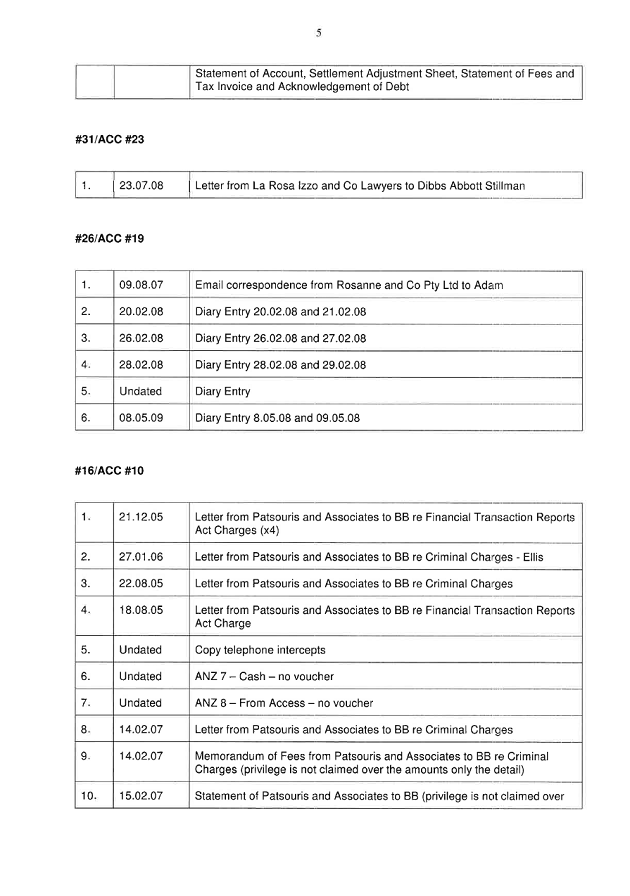
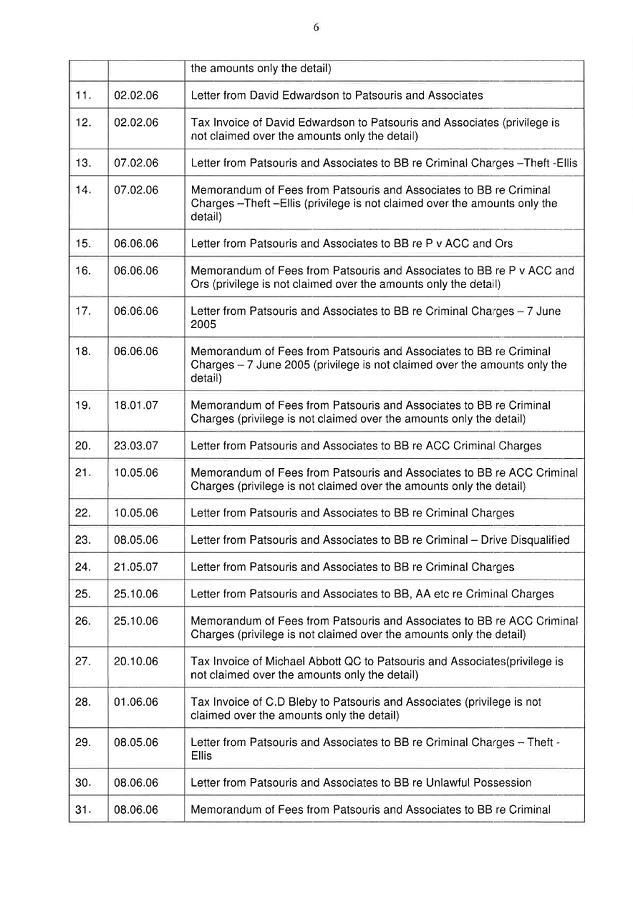
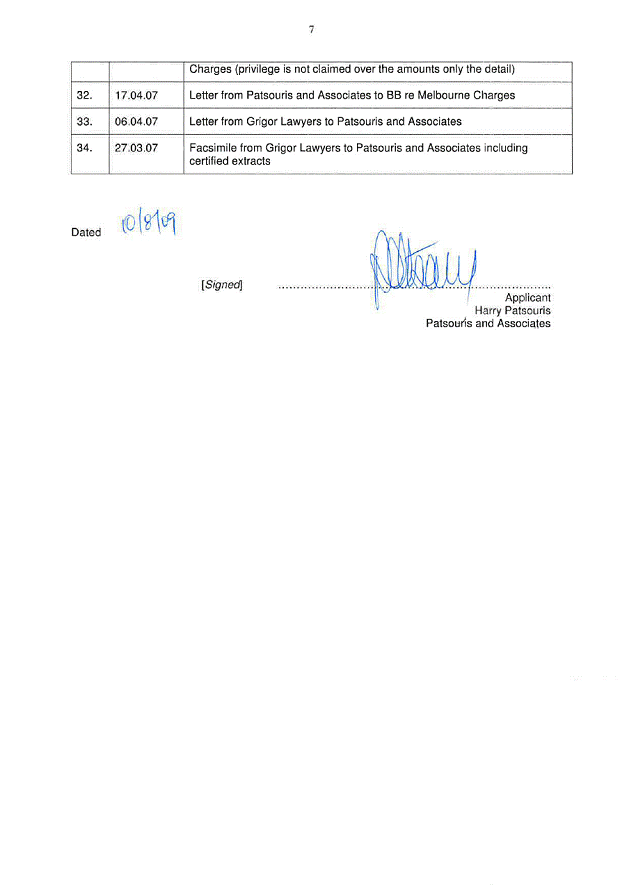
1. Legal professional privilege attached to the following documents held by the Court in the envelopes listed in Exhibit E, a true copy of which is attached to these orders and marked with the letter “A”, at the time that they were created, namely:
(a) In envelope #37/ACC #29, documents 1 to 11.
(b) In envelope #32/ACC #24, documents 2, 4, 5 and 6.
(c) In envelope #33/ACC #25, documents 7 to 12.
(d) In envelope #26/ACC #19, documents 1 and documents 3 to 6.
(e) In envelope #16/ACC #10, documents 1 to 4, 18, 20, 21, 22, 24, 25, 31, 32, 33 and 34.
2. Privilege in the said documents has been waived.
THE COURT ORDERS THAT:
3. The Application be dismissed.
4. The applicants pay the respondents’ costs of and incidental to the Application.
5. The cross-respondents pay the cross-claimant’s costs of and incidental to the Cross-Claim.
Note: Settlement and entry of orders is dealt with in Order 36 of the Federal Court Rules.
The text of entered orders can be located using Federal Law Search on the Court’s website.
“A”
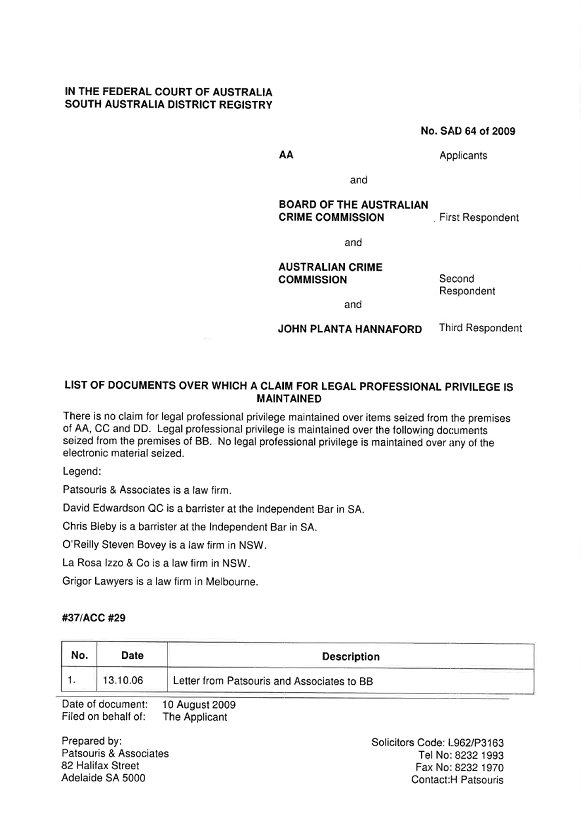
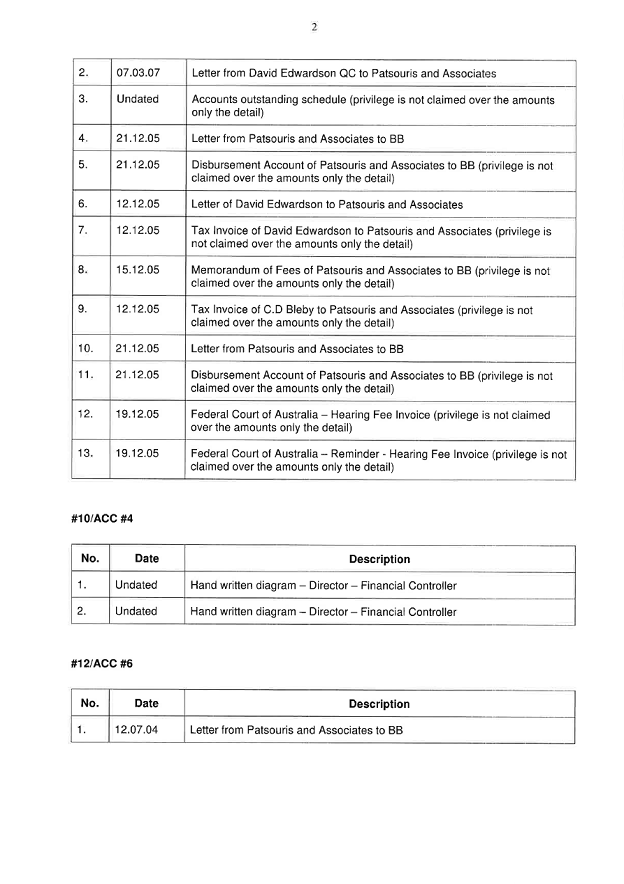
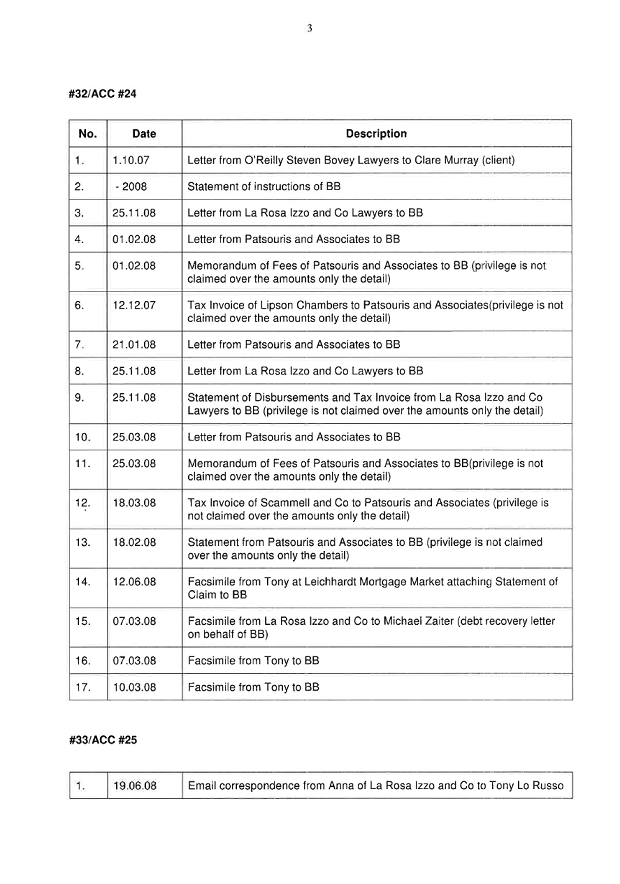
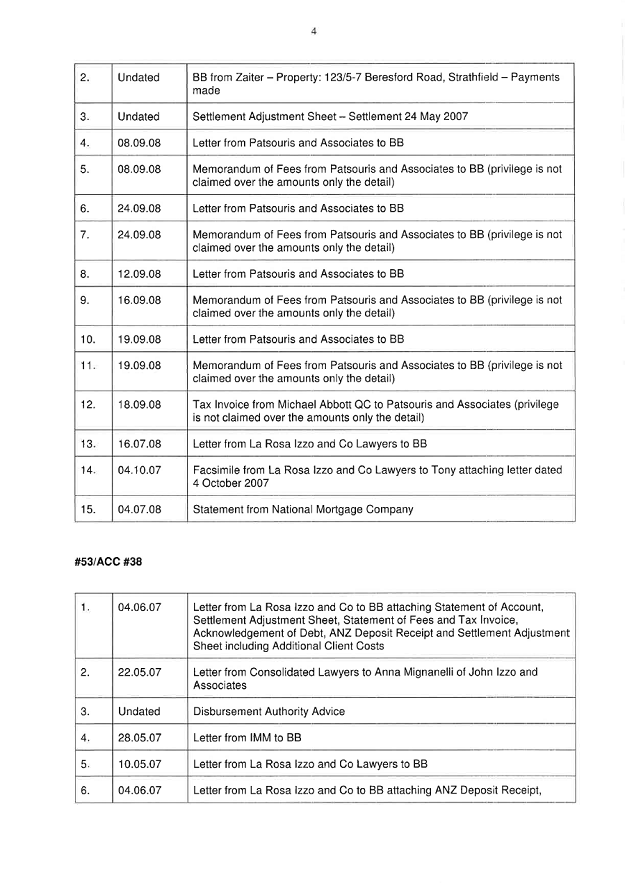
| IN THE FEDERAL COURT OF AUSTRALIA |
|
| NEW SOUTH WALES DISTRICT REGISTRY |
|
| GENERAL DIVISION | NTD 13 of 2009 |
| BETWEEN: | DD Applicant
|
| AND: | AUSTRALIAN CRIME COMMISSION First Respondent
BOARD OF THE AUSTRALIAN CRIME COMMISSION Second Respondent
|
| and between: | AUSTRALIAN CRIME COMMISSION Cross-Claimant
|
| AND: | DD Cross-Respondent
|
| JUDGE: | FOSTER J |
| DATE OF ORDER: | 2 June 2010 |
| WHERE MADE: | SYDNEY |
THE COURT ORDERS THAT:
1. The Application be dismissed.
2. The applicant pay the respondents’ costs of and incidental to the Application.
3. The Cross-Claim be dismissed.
4. The cross-respondent pay the cross-claimant’s costs of and incidental to the Cross-Claim.
Note: Settlement and entry of orders is dealt with in Order 36 of the Federal Court Rules.
The text of entered orders can be located using Federal Law Search on the Court’s website.
| IN THE FEDERAL COURT OF AUSTRALIA |
|
| NEW SOUTH WALES DISTRICT REGISTRY |
|
| GENERAL DIVISION | SAD 65 of 2009 |
| BETWEEN: | BB Applicant
|
| AND: | BOARD OF THE AUSTRALIAN CRIME COMMISSION First Respondent
AUSTRALIAN CRIME COMMISSION Second Respondent
JOHN PLANTA HANNAFORD Third Respondent
|
| JUDGE: | FOSTER J |
| DATE OF ORDER: | 2 June 2010 |
| WHERE MADE: | SYDNEY |
THE COURT ORDERS THAT:
1. The Application be dismissed.
2. The applicant pay the respondents’ costs of and incidental to the Application.
Note: Settlement and entry of orders is dealt with in Order 36 of the Federal Court Rules.
The text of entered orders can be located using Federal Law Search on the Court’s website.
| IN THE FEDERAL COURT OF AUSTRALIA |
|
| NEW SOUTH WALES DISTRICT REGISTRY |
|
| GENERAL DIVISION | SAD 66 of 2009 |
| BETWEEN: | CC Applicant
|
| AND: | BOARD OF THE AUSTRALIAN CRIME COMMISSION First Respondent
AUSTRALIAN CRIME COMMISSION Second Respondent
JOHN PLANTA HANNAFORD Third Respondent
|
| and between: | AUSTRALIAN CRIME COMMISSION Cross-Claimant
|
| AND: | CC Cross-Respondent
|
| JUDGE: | FOSTER J |
| DATE OF ORDER: | 2 June 2010 |
| WHERE MADE: | SYDNEY |
THE COURT ORDERS THAT:
1. The Application be dismissed.
2. The applicant pay the respondents’ costs of and incidental to the Application.
3. The Cross-Claim be dismissed.
4. The cross-respondent pay the cross-claimant’s costs of and incidental to the Cross-Claim.
Note: Settlement and entry of orders is dealt with in Order 36 of the Federal Court Rules.
The text of entered orders can be located using Federal Law Search on the Court’s website.
| IN THE FEDERAL COURT OF AUSTRALIA |
|
| NEW SOUTH WALES DISTRICT REGISTRY |
|
| GENERAL DIVISION | SAD 67 of 2009 |
| BETWEEN: | DD Applicant
|
| AND: | BOARD OF THE AUSTRALIAN CRIME COMMISSION First Respondent
AUSTRALIAN CRIME COMMISSION Second Respondent
TIM SAGE Third Respondent
|
| JUDGE: | FOSTER J |
| DATE OF ORDER: | 2 June 2010 |
| WHERE MADE: | SYDNEY |
THE COURT ORDERS THAT:
1. The Application be dismissed.
2. The applicant pay the respondents’ costs of and incidental to the Application.
Note: Settlement and entry of orders is dealt with in Order 36 of the Federal Court Rules.
The text of entered orders can be located using Federal Law Search on the Court’s website.
| IN THE FEDERAL COURT OF AUSTRALIA |
|
| NEW SOUTH WALES DISTRICT REGISTRY |
|
| GENERAL DIVISION | SAD 70 of 2009 |
| BETWEEN: | JJ Applicant
|
| AND: | BOARD OF THE AUSTRALIAN CRIME COMMISSION First Respondent
AUSTRALIAN CRIME COMMISSION Second Respondent
JEFFREY ANDERSON Third Respondent
|
| JUDGE: | FOSTER J |
| DATE OF ORDER: | 2 June 2010 |
| WHERE MADE: | SYDNEY |
THE COURT ORDERS THAT:
1. The Application be dismissed.
2. The applicant pay the respondents’ costs of and incidental to the Application.
Note: Settlement and entry of orders is dealt with in Order 36 of the Federal Court Rules.
The text of entered orders can be located using Federal Law Search on the Court’s website.
| IN THE FEDERAL COURT OF AUSTRALIA |
|
| NEW SOUTH WALES DISTRICT REGISTRY |
|
| GENERAL DIVISION | SAD 71 of 2009 |
| BETWEEN: | KK Applicant
|
| AND: | BOARD OF THE AUSTRALIAN CRIME COMMISSION First Respondent
AUSTRALIAN CRIME COMMISSION Second Respondent
JEFFREY ANDERSON Third Respondent
|
| JUDGE: | FOSTER J |
| DATE OF ORDER: | 2 June 2010 |
| WHERE MADE: | SYDNEY |
THE COURT ORDERS THAT:
1. The Application be dismissed.
2. The applicant pay the respondents’ costs of and incidental to the Application.
Note: Settlement and entry of orders is dealt with in Order 36 of the Federal Court Rules.
The text of entered orders can be located using Federal Law Search on the Court’s website.
| IN THE FEDERAL COURT OF AUSTRALIA |
|
| NEW SOUTH WALES DISTRICT REGISTRY |
|
| GENERAL DIVISION | SAD 64 of 2009 |
| BETWEEN: | AA Applicant
|
| AND: | BOARD OF THE AUSTRALIAN CRIME COMMISSION First Respondent
AUSTRALIAN CRIME COMMISSION Second Respondent
JOHN PLANTA HANNAFORD Third Respondent
|
| IN THE FEDERAL COURT OF AUSTRALIA |
|
| NEW SOUTH WALES DISTRICT REGISTRY |
|
| GENERAL DIVISION | NTD 8 of 2009 |
| BETWEEN: | EE Applicant
|
| AND: | BOARD OF THE AUSTRALIAN CRIME COMMISSION First Respondent
AUSTRALIAN CRIME COMMISSION Second Respondent
JOHN PLANTA HANNAFORD Third Respondent
|
| IN THE FEDERAL COURT OF AUSTRALIA |
|
| NEW SOUTH WALES DISTRICT REGISTRY |
|
| GENERAL DIVISION | NSD 436 of 2009 |
| BETWEEN: | FF Applicant
|
| AND: | BOARD OF THE AUSTRALIAN CRIME COMMISSION First Respondent
AUSTRALIAN CRIME COMMISSION Second Respondent
JOHN PLANTA HANNAFORD Third Respondent
|
| IN THE FEDERAL COURT OF AUSTRALIA |
|
| NEW SOUTH WALES DISTRICT REGISTRY |
|
| GENERAL DIVISION | NSD 459 of 2009 |
| BETWEEN: | HH Applicant
|
| AND: | BOARD OF THE AUSTRALIAN CRIME COMMISSION First Respondent
AUSTRALIAN CRIME COMMISSION Second Respondent
SE (TIM) SAGE Third Respondent
|
| IN THE FEDERAL COURT OF AUSTRALIA |
|
| NEW SOUTH WALES DISTRICT REGISTRY |
|
| GENERAL DIVISION | NSD 460 of 2009 |
| BETWEEN: | GG Applicant
|
| AND: | BOARD OF THE AUSTRALIAN CRIME COMMISSION First Respondent
AUSTRALIAN CRIME COMMISSION Second Respondent
JOHN PLANTA HANNAFORD Third Respondent
|
IN THE FEDERAL COURT OF AUSTRALIA |
|
| NEW SOUTH WALES DISTRICT REGISTRY |
|
| GENERAL DIVISION | NSD 515 of 2009 |
| BETWEEN: | LL Applicant
|
| AND: | BOARD OF THE AUSTRALIAN CRIME COMMISSION First Respondent
AUSTRALIAN CRIME COMMISSION Second Respondent
JOHN PLANTA HANNAFORD Third Respondent
|
| IN THE FEDERAL COURT OF AUSTRALIA |
|
| NEW SOUTH WALES DISTRICT REGISTRY |
|
| GENERAL DIVISION | NSD 522 of 2009 |
| BETWEEN: | MM Applicant
|
| AND: | BOARD OF THE AUSTRALIAN CRIME COMMISSION First Respondent
AUSTRALIAN CRIME COMMISSION Second Respondent
SE (TIM) SAGE Third Respondent
|
| IN THE FEDERAL COURT OF AUSTRALIA |
|
| NEW SOUTH WALES DISTRICT REGISTRY |
|
| GENERAL DIVISION | NTD 10 of 2009 |
| BETWEEN: | EE First Applicant
AA Second Applicant
BB Third Applicant
|
| AND: | AUSTRALIAN CRIME COMMISSION First Respondent
BOARD OF THE AUSTRALIAN CRIME COMMISSION Second Respondent
|
| AND BETWEEN: | AUSTRALIAN CRIME COMMISSION Cross-Claimant
|
| AND: | EE First Cross-Respondent
AA Second Cross-Respondent
BB Third Cross-Respondent
|
| IN THE FEDERAL COURT OF AUSTRALIA |
|
| NEW SOUTH WALES DISTRICT REGISTRY |
|
| GENERAL DIVISION | NTD 13 of 2009 |
| BETWEEN: | DD Applicant
|
| AND: | AUSTRALIAN CRIME COMMISSION First Respondent
BOARD OF THE AUSTRALIAN CRIME COMMISSION Second Respondent
|
| AND BETWEEN: | AUSTRALIAN CRIME COMMISSION Cross-Claimant
|
| AND: | DD Cross-Respondent
|
| IN THE FEDERAL COURT OF AUSTRALIA |
|
| NEW SOUTH WALES DISTRICT REGISTRY |
|
| GENERAL DIVISION | SAD 65 of 2009 |
| BETWEEN: | BB Applicant
|
| AND: | BOARD OF THE AUSTRALIAN CRIME COMMISSION First Respondent
AUSTRALIAN CRIME COMMISSION Second Respondent
JOHN PLANTA HANNAFORD Third Respondent
|
| IN THE FEDERAL COURT OF AUSTRALIA |
|
| NEW SOUTH WALES DISTRICT REGISTRY |
|
| GENERAL DIVISION | SAD 66 of 2009 |
| BETWEEN: | CC Applicant
|
| AND: | BOARD OF THE AUSTRALIAN CRIME COMMISSION First Respondent
AUSTRALIAN CRIME COMMISSION Second Respondent
JOHN PLANTA HANNAFORD Third Respondent
|
| AND BETWEEN: | AUSTRALIAN CRIME COMMISSION Cross-Claimant
|
| AND:
| CC Cross-Respondent
|
| IN THE FEDERAL COURT OF AUSTRALIA |
|
| NEW SOUTH WALES DISTRICT REGISTRY |
|
| GENERAL DIVISION | SAD 67 of 2009 |
| BETWEEN: | DD Applicant
|
| AND: | BOARD OF THE AUSTRALIAN CRIME COMMISSION First Respondent
AUSTRALIAN CRIME COMMISSION Second Respondent
TIM SAGE Third Respondent
|
| IN THE FEDERAL COURT OF AUSTRALIA |
|
| NEW SOUTH WALES DISTRICT REGISTRY |
|
| GENERAL DIVISION | SAD 70 of 2009 |
| BETWEEN: | JJ Applicant
|
| AND: | BOARD OF THE AUSTRALIAN CRIME COMMISSION First Respondent
AUSTRALIAN CRIME COMMISSION Second Respondent
JEFFREY ANDERSON Third Respondent
|
| IN THE FEDERAL COURT OF AUSTRALIA |
|
| NEW SOUTH WALES DISTRICT REGISTRY |
|
| GENERAL DIVISION | SAD 71 of 2009 |
| BETWEEN: | KK Applicant
|
| AND: | BOARD OF THE AUSTRALIAN CRIME COMMISSION First Respondent
AUSTRALIAN CRIME COMMISSION Second Respondent
JEFFREY ANDERSON Third Respondent
|
| JUDGE: | FOSTER J |
| DATE: | 2 June 2010 |
| PLACE: | SYDNEY |
REASONS FOR JUDGMENT
Introduction
1 The Australian Crime Commission (the ACC) was established in 2002 to fight serious and organised crime which does or might affect Australia. It is the successor to the National Crime Authority.
2 In 2005, the ACC began investigating and gathering information about Outlaw Motor Cycle Gangs (OMCGs). At that time, the ACC established a special investigation into such gangs within the meaning of the Australian Crime Commission Act 2002 (Cth) (the Act). That investigation was codenamed Operation Wolsley. A special investigation is defined in s 3 of the Act and must be established in accordance with the requirements laid down in s 7C(3) and s 7C(4) of the Act.
3 Operation Wolsley continues. In 2006, 2007, 2008 and 2009, steps were taken by the ACC to authorise the continuation of Operation Wolsley beyond its original end date (30 June 2006). Subject to the outcome of these proceedings, the end date of that operation which was in place when these proceedings were heard was 30 June 2010.
4 In 2009, the ACC planned a nationally co-ordinated set of actions designed to increase the tempo of Operation Wolsley. By late April 2009, plans were in place for police to carry out raids in early May 2009 simultaneously at 25 separate premises located in New South Wales and for examinations under the Act of certain persons of interest to take place soon thereafter.
5 The execution of 25 search warrants on 5 May 2009 and the issue and service subsequently of examination summonses to 12 persons of interest were the catalysts for the present litigation.
6 In the proceedings heard by me in early August 2009, 12 individuals in 14 separate actions (the applicants) sought judicial review pursuant to s 5 and s 6 of the Administrative Decisions (Judicial Review) Act 1977 (Cth) and also pursuant to s 39B of the Judiciary Act 1903 (Cth) (s 39B) of various decisions and actions taken by the ACC which underpinned the execution of the search warrants and the issue of the examination summonses to which I have referred.
7 The applicants sought to set aside all of the examination summonses and three of the search warrants. They also sought consequential relief.
8 Some of the applicants also claimed legal professional privilege over certain documents seized at the time when the search warrants were executed. Those claims were refined during the course of the hearing and immediately afterwards. The extant claims are to be determined by me in these Reasons. The ACC contended that, even if these documents were once privileged, they are no longer privileged because the privilege has been waived. The ACC’s waiver claim in respect of these documents is also to be determined by me in these Reasons.
Some Procedural Matters
9 Proceeding SAD 64 of 2009 was the first proceeding to be commenced. That proceeding was commenced on 11 May 2009 in the South Australia Registry of the Court. The parties to that proceeding are AA (as applicant), the Board of the ACC (as first respondent), the ACC (as second respondent) and John Planta Hannaford, who is one of the Examiners appointed under the Act, as third respondent. Mr Hannaford has issued several summonses as part of Operation Wolsley. The identity of the applicant has been and is to be kept confidential by the procedure of describing the applicant with the letters “AA”.
10 The Application for an Order of Review filed in proceeding SAD 64 of 2009 is in the following terms:
A. Details of Claim.
Application under Sections 5 and 6 of the Administrative Decisions (Judicial Review) Act 1977 (Cth) and under Section 39B of the Judiciary Act 1903 (Cth) to review the following decisions and conduct of the Respondents:
1. The decision (‘the first decision’) of the First Respondent to make the instrument entitled “Australian Crime Commission Special Investigation Authorisation and Determination (High Risk Crime Groups No 2) 2009” (‘the instrument’).
2. The decision (‘the second decision’) of the Second Respondent to seek the making of the instrument by the First Respondent.
3. The decision (‘the third decision’) of the Second Respondent to seek from the Third Respondent the issuing of summons referred to in paragraph 4 hereof.
4. The decision (‘the fourth decision’) of the Third Respondent to issue the summons dated 4 May 2009 at 12.53 hours (‘the summons’) to the Applicant pursuant to Section 28(1) of the Australian Crime Commission Act 2002 (Cth) (‘the Act’).
5. The conduct (‘the conduct’) of the Third Respondent in issuing the summons.
The Applicant is aggrieved by each of the decisions and the conduct because the Third Respondent has issued a summons purportedly under the Act as a result of which he has been summonsed to appear before an examiner of the Second Respondent to give evidence at an examination for the purposes of a special investigation purportedly determined by the First Respondent to exist at the time of the summons.
The grounds of the application are as follows:
1. that a breach of the rules of natural justice occurred in connection with the making of each of the decisions and the conduct.
2. that procedures that were required by law to be observed in connection with the making of each of the decisions and the conduct were not observed.
3. that the person who purported to make each of the decisions and who was engaged in the conduct did not have jurisdiction to make each of the decisions.
4. that each of the decisions was not authorized by the enactment in pursuance of which it was purported to be made.
5. that the making of each of the decisions was an improper exercise of the power conferred by the enactment in pursuance of which it was purported to be made.
6. that each of the decisions involved an error of law, whether or not the error appears on the record of the decision.
7. that each of the decisions was otherwise contrary to law.
The Applicant claims:
1. A declaration that the Australian Crime Commission Special Investigation Authorisation and Determination (High Risk Crime Groups No 2) 2009 is invalid.
2. A declaration that the summons issued to the Applicant is invalid.
3. An order setting aside the summons requiring the applicant to attend before an examiner of the Australian Crime Commission.
4. Costs.
5. Such further and other orders as the Court deems fit.
11 Subsequently, in proceeding SAD 64 of 2009, a Statement of Claim was filed. It was answered by a Defence. The grounds advanced by the applicant in the Statement of Claim in support of his applications for judicial review differed from those set out in the Application. It is the pleaded grounds with which I will deal.
12 On 11 May 2009, the following proceedings were also commenced in the South Australia Registry of the Court:
(a) Proceeding SAD 65 of 2009 between BB and the same respondents as had been named in proceeding SAD 64 of 2009;
(b) Proceeding SAD 66 of 2009 between CC and the same respondents; and
(c) Proceeding SAD 67 of 2009 between DD and the same respondents.
13 On 22 May 2009, the following proceedings were also commenced in the South Australia Registry of the Court:
(d) SAD 70 of 2009 between JJ and the Board of the ACC (as first respondent), the ACC (as second respondent) and Jeffrey Anderson, who is also one of the Examiners appointed under the Act who has issued summonses as part of Operation Wolsley (as third respondent); and
(e) SAD 71 of 2009 between KK and the same respondents as were sued in proceeding SAD 70 of 2009.
14 The persons identified as AA, BB, CC, DD, JJ and KK (the South Australian applicants) have been represented by the same solicitors at all times since the proceedings were commenced. At the hearing before me, those persons were represented by the same Counsel.
15 In late May and early June 2009, a second group of proceedings was commenced. These actions were started in the New South Wales District Registry of the Court. These proceedings are:
(a) NSD 436 of 2009 between FF and the Board of the ACC, the ACC and Mr Hannaford (as Examiner) commenced on 18 May 2009;
(b) NSD 459 of 2009 between HH and the Board of the ACC, the ACC and SE (Tim) Sage, who is also one of the Examiners appointed under the Act who has issued summonses as part of Operation Wolsley, commenced on 22 May 2009;
(c) NSD 460 of 2009 between GG and the Board of the ACC, the ACC and Mr Hannaford (as Examiner) commenced on 22 May 2009;
(d) NSD 515 of 2009 between LL and the Board of the ACC, the ACC and Mr Hannaford (as Examiner) commenced on 2 June 2009; and
(e) NSD 522 of 2009 between MM and the Board of the ACC, the ACC and Mr Sage (as Examiner) commenced on 3 June 2009.
16 The persons identified as FF, HH, GG, LL and MM have been represented by the same firm of solicitors at all times since the proceedings were commenced. This firm is not the same firm as is representing the South Australian applicants. I shall refer to FF, HH, GG, LL and MM as the NSW applicants.
17 At the hearing before me, those persons were represented by Mr B Clark, of Counsel.
18 At the commencement of the final hearing, I was informed by Mr Clark, on behalf of the NSW applicants, that his clients supported the position adopted and submissions made on behalf of the South Australian applicants and that his clients agreed to be bound by my decision notwithstanding the fact they did not intend to participate actively in the hearing. Mr Clark sought leave to be excused from further attendance after making clear his clients’ position. I granted that leave. Thereafter he did not take any further part in the proceedings. Nor did the NSW applicants.
19 In addition to the above proceedings, the following proceedings were commenced in the Northern Territory Registry of the Court:
(a) NTD 8 of 2009 between EE (as applicant) and the Board of the ACC, the ACC and Mr Hannaford (as Examiner) (as respondents) commenced on 12 May 2009;
(b) NTD 10 of 2009 between EE, AA and BB (as applicants) and the ACC and the Board of the ACC (as respondents) commenced on 25 May 2009; and
(c) NTD 13 of 2009 between DD (as applicant) and the ACC and the Board of the ACC (as respondents) commenced on 1 June 2009.
20 Each proceeding commenced in the Northern Territory Registry of the Court was commenced by the same solicitors who had commenced the proceedings in the South Australia Registry of the Court.
21 The proceedings brought by the South Australian applicants, the proceedings brought by the NSW applicants and proceeding NTD 8 of 2009 brought by EE all involve the same issues. The only difference between them is that the form of Orders 3, 4 and 5 in each case is tailored to the particular circumstances of the individual applicant in each case.
22 Proceeding NTD 10 of 2009 and NTD 13 of 2009 are the two sets of proceedings where challenges to search warrants are made. Each of these proceedings raises the same issues. The only difference between them is that they concern different applicants and different premises. The issues raised in the search warrant proceedings do not correspond exactly with the issues raised in the other proceedings, although there are some common issues between the search warrant proceedings and the remaining proceedings.
23 In proceeding NTD 10 of 2009, warrants executed at two New South Wales addresses on 5 May 2009 are challenged. The relief sought is claimed pursuant to s 39B. In proceeding NTD 10 of 2009, the applicants seek a declaration that the search warrants executed at the two premises with which the proceeding is concerned are invalid. The following additional relief is sought, namely:
As against the First Respondent (the ACC):
1. An injunction restraining the First Respondent from examining or otherwise dealing with all things seized pursuant to the search warrants.
2. Prohibition against the First Respondent, prohibiting it from examining or otherwise dealing with all things seized pursuant to the search warrants.
3. An order that the First Respondent do forthwith deliver up to the applicants all things seized pursuant to the search warrants.
As against the Second Respondent (the Board of the ACC):
1. A declaration that the Australian Crime Commission Special Investigation Authorisation and Determination (High Risk Crime Groups) 2005 (as amended) is invalid.
24 I shall refer to the two premises where the warrants which are challenged in proceeding NTD 10 of 2009 were executed as premises A and premises B.
25 Identical relief is sought in proceeding NTD 13 of 2009 in respect of different premises, also in New South Wales. I shall refer to these premises as premises C.
26 The ACC’s claims that the relevant persons had waived any claims which they may once have had that documents seized at premises A, B and C were protected from disclosure and inspection by legal professional privilege have been brought forward in Cross-Claims filed in proceedings NTD 10 of 2009 and NTD 13 of 2009. The ACC also filed a Cross-Claim in proceeding SAD 66 of 2009 raising its waiver argument in respect of documents seized at a raid at other premises in NSW which I shall call premises D. The three Cross-Claims filed by the ACC raise the same issues. I shall deal with the relevant applicants’ claims for privilege and the ACC’s waiver arguments in a separate section later in these Reasons for Judgment.
27 In proceedings SAD 64, SAD 65, SAD 66 and SAD 67 of 2009, on 11 June, 15 June and 18 June 2009, Besanko J heard applications in which the applicants in those proceedings sought interlocutory injunctions restraining the respondents from conducting the examinations contemplated by the summonses issued to those persons. In a judgment delivered on 22 June 2009, his Honour refused to grant the injunctions sought (AA v Board of the Australian Crime Commission [2009] FCA 642).
28 In mid June 2009, with the consent of all parties, the 14 sets of proceedings referred to at [9]–[19] above were allocated to my docket. At a directions hearing held on 24 June 2009, I fixed all of the proceedings for final hearing before me to commence on 3 August 2009 and made a number of other directions and orders designed to ready the matters for hearing. Included within those orders were orders that all proceedings be heard together and that evidence in each of the proceedings be evidence in each of the others. Subsequently, on 30 June and on 2 July 2009, the South Australian applicants applied for interlocutory injunctions by which they sought to restrain the respondents in the South Australian proceedings from conducting the examinations contemplated by the summonses which had been served upon the South Australian applicants and upon EE. In effect, those applicants made a further attempt to secure the relief which Besanko J had declined to grant to them.
29 On 2 July 2009, I refused that application. At the same time, the South Australian applicants applied for leave to appeal from the decision of Besanko J delivered on 22 June 2009. On 2 July 2009, I also refused that application.
30 Subsequently, on 20 July 2009, I heard various applications concerning discovery, including claims that certain documents need not be disclosed by the respondents to the applicants because those documents were protected from disclosure by public interest immunity. I made specific rulings on 20 July 2009 in respect of all issues concerning discovery which were litigated on that day.
31 On 24 June 2009, I ordered that pleadings be filed and served in proceeding SAD 64 of 2009 and in NTD 10 of 2009. It was agreed amongst all parties (including the NSW applicants) that the issues to be decided in all proceedings in which examination summonses were under challenge were those which would be articulated in the pleadings which I directed to be filed in SAD 64 of 2009 and that the issues to be determined in the search warrant proceedings would be those articulated in the pleadings which I directed to be filed in NTD 10 of 2009. The issues raised in respect of the examination summonses were the same in all proceedings in which those summonses were challenged and the issues raised in the search warrant proceedings were the same in the two sets of proceedings in which those warrants were challenged. SAD 64 of 2009 and NTD 10 of 2009 were thus designated as the lead vehicles through which all of the issues in the 14 actions being tried by me would be determined. As mentioned at [26] above, all questions of legal professional privilege and waiver of privilege in respect of documents seized at premises A, B, C and D were to be dealt with in the determination of the ACC’s Cross-Claims in proceedings SAD 66 of 2009, NTD 10 of 2009 and NTD 13 of 2009.
The Decisions and Actions of the ACC under Challenge
The Board Resolutions of 2007 and 2008
32 On 27 July 2005, the Board of the ACC resolved and determined that there should be a special investigation into certain federally relevant criminal activity. This resolution established Operation Wolsley. The resultant Determination was entitled Australian Crime Commission Special Investigation Authorisation and Determination (High Risk Crime Groups) 2005. I shall refer to that Determination as the 2005 Determination. The investigation authorised by the 2005 Determination was permitted to be carried on up to and including 30 June 2006.
33 On 7 June 2006, the Board of the ACC resolved and determined that the term of Operation Wolsley should be extended to 30 June 2007. That Determination was entitled Australian Crime Commission Special Investigation Authorisation and Determination (High Risk Crime Groups) Amendment No 1 of 2006. By that Determination, the Board of the ACC extended the time within which Operation Wolsley had to be concluded to 30 June 2007. I shall refer to that Determination as the 2006 Determination.
34 No challenge is made either to the 2005 Determination or to the 2006 Determination.
35 In the search warrant proceedings, an order is sought setting aside the 2005 Determination … “as amended ”. It is not clear to me precisely what is intended by that claim for relief. However, the applicants made no submission to the effect that the original Determination (the 2005 Determination) was invalid. All of their efforts were directed to challenging the 2007, 2008 and 2009 Determinations. I presume that the reference to the Determination (as amended) is to the extensions to Operation Wolsley effected by those Determinations.
36 For the purposes of these proceedings, I propose to proceed upon the basis that each of the 2005 and 2006 Determinations was validly made and took effect in accordance with its terms.
37 On 14 June 2007, the Board of the ACC resolved and determined that Operation Wolsley be permitted to be continued up to 30 June 2008. That Determination was entitled Australian Crime Commission Special Investigation Authorisation and Determination (High Risk Crime Groups) Amendment No 1 of 2007. I shall refer to that Determination as the 2007 Determination.
38 The applicants contend that the resolution of the Board authorising the making of the 2007 Determination was not a valid resolution of the Board. That contention is based upon a single proposition, namely that:
The meeting at which the purported resolution was adopted was not presided over by the Chair or another eligible Commonwealth Board member as required by section 7E of the Act [referring to the Australian Crime Commission Act 2002 (Cth)].
39 On 25 June 2008, the Board of the ACC resolved and determined that the term of Operation Wolsley be further extended. That Determination was entitled Australian Crime Commission Special Investigation Authorisation and Determination (High Risk Crime Groups) Amendment No 1 of 2008. By that Determination, the Board of the ACC extended the time within which that investigation had to be concluded to 30 June 2009. I shall refer to this Determination as the 2008 Determination.
40 The applicants contend that the resolution of the Board authorising the making of the 2008 Determination was not a valid resolution of the Board. The ground of challenge is precisely the same as the ground of challenge made to the 2007 Determination.
41 The applicants then assert that, by reason of the invalidity of the two resolutions made by the Board in 2007 and 2008:
(a) Neither the Purported Determination of 14 June 2007 nor the Purported Determination of 28 June 2008 were [sic] valid authorisations and determinations in writing for the purposes of subsection 7C(1)(c), 7C(1)(d) and 7C(3) of the Act; and
(b) The ACC was not authorised to undertake the Former Investigation after 30 June 2007.
42 The reference to the “Former Investigation” in the pleading is a reference to the investigation authorised by the 2005 Determination.
43 The applicants also contend that material obtained as a result of compulsory processes undertaken by the ACC between 14 June 2007 and 30 April 2009 (which is called in the Statement of Claim the post 1 July 2007 material) was obtained by unauthorised and invalid means. This proposition, if made good, is said to lead to the invalidity of several subsequent decisions and actions taken by the ACC because those decisions and actions were infected by the post 1 July 2007 material (which had been unlawfully obtained).
The 2009 Challenges
Attacks on the Twelve Summonses
44 As already mentioned, 12 summonses were issued and served in early May 2009. Three examiners were responsible for issuing those summonses. Several of those summonses have been tendered before me. Those summonses which are in evidence are substantially in the same form. I have been asked to proceed upon the basis that all 12 summonses are substantially in the same form.
45 The reasons documents prepared by Mr Hannaford in respect of the summonses issued by him are the same in every case. Those prepared by Mr Anderson are the same in the case of every summons issued by him and are substantially the same as those prepared by Mr Hannaford. The reasons documents prepared by Mr Sage are the same in the case of every summons issued by him. They differ slightly from those prepared by Mr Hannaford and by Mr Anderson.
46 The 12 summonses require the persons served to attend before the named Examiner for the purpose of answering questions relating to the subject matter of the latest determination made by the ACC in respect of Operation Wolsley. This Determination is dated 1 May 2009 and is entitled Australian Crime Commission Special Investigation Authorisation and Determination (High Risk Crime Groups No 2) 2009. I shall refer to that Determination as the 2009 Determination. The 2009 Determination is said to have been authorised by an out of session resolution of the Board of the ACC made either on 30 April 2009 or on 1 May 2009.
47 The applicants submit that each of the summonses was issued in reliance on and on the basis of the post 1 July 2007 material and is thus invalid for that reason.
48 The applicants also contend that the 2009 Determination was not authorised by a valid resolution of the Board of the ACC and was thus not a valid determination for that reason. The attack on the validity of the resolution of the Board of the ACC authorising the making of the 2009 Determination is itself based upon several grounds. If any of those grounds are made out, the requirements of s 7J of the Act will not have been met. The defects from which the resolutions purportedly made pursuant to s 7J of the Act are said to suffer are that:
(a) The resolutions in respect of which Board members contacted in the afternoon of 30 April 2009 indicated support were in a form different from the resolutions considered by a group of Board members earlier that day at a meeting in Darwin;
(b) The resolutions in their final form were not referred to all members of the Board in that form;
(c) The final resolutions were declared to have been carried prior to all members of the Board voting on any form of resolution, whether at the Darwin meeting or otherwise; and
(d) The requirement that at least nine members of the Board indicate by telephone or otherwise to the Chair that they were in favour of the resolutions was not satisfied.
49 The applicants go on to assert that the purported authorisation of the 2009 Determination by the Board was not valid; that the 2009 Determination was not a valid determination; that the summonses issued in May 2009 were all invalid because the 2009 Determination was invalid; and that there was no proper authorisation for the issue of any of the summonses issued to the applicants.
50 A third broad challenge made to the summonses is that they are all invalid because the Examiner in each case failed to record in writing the reasons for the issue of the summons as required by s 28(1A) of the Act and s 25D of the Acts Interpretation Act 1901 (Cth) (the Interpretation Act).
51 A fourth broad challenge made to the summonses is that they are all invalid because the Examiner in each case could not and should not have been satisfied that it was reasonable in all the circumstances to issue the summons. The applicants contend that the Reasons document said to support the issue of the summonses contain no findings by the Examiner in respect of the person served with the summons. They submit that the Examiner in each case had regard to the post 1 July 2007 material to which he should not properly have had regard given the circumstances in which that material was obtained because the material had been obtained by unauthorised and invalid means. In support of this argument, the applicants rely upon the challenges which they have articulated to the 2007 Determination and to the 2008 Determination.
52 The final challenge made to the issue of the summons is a challenge based upon an assertion that each summons was oppressive. It is said to be oppressive because it requires the applicant in each case:
(a) To appear before an examiner to answer questions concerning allegations:
(i) As to the possible past, present or future involvement;
(ii) of anyone;
(iii) in activities of an indeterminate class and range;
(iv) over a period commencing 19 years ago and extending into the future; and
(b) To attend from day to day until excused or released from further attendance.
53 These conclusions are said to arise from the terms of each summons and the scope of the investigation set out in the 2009 Determination, a copy of which is attached to each summons.
54 Issue is taken by the respondents with all of the substantive contentions made on behalf of the applicants. In addition, two positive assertions are made by the respondents. These are:
(a) Section 20 of the Interpretation Actenables the Court to conclude that the Board meetings of 2007 and 2008 were presided over by the Chair of the Board as was required by s 7E of the Act; and
(b) If the Examiner in each case has failed to record in writing the reasons for the issue of the summons in each case as required by s 28(1A) of the Act, that circumstance is irrelevant to the validity of the summons by reason of the terms of s 28(8) of the Act (as it stood in 2009).
Challenges to the Search Warrants
55 The first basis upon which the search warrants are challenged is that the purported resolution of the Board of the ACC made on 30 April 2009 (or on 1 May 2009) was not valid and that the 2009 Determination itself was not valid. The arguments advanced by the applicants in support of these contentions are the same as those advanced in the summons proceedings in support of the same assertions made in those proceedings.
56 The applicants also contend that the search warrants were issued in breach of s 22 of the Act because the person who issued the warrants had not been furnished with an affidavit as required by s 22 of the Act and had not set out in that affidavit the material upon which he relied in issuing the warrants as required by s 22 of the Act.
57 The two grounds referred to at [56] above were abandoned at the hearing when it became apparent that they were unsustainable. For this reason, I will not consider those grounds.
58 The next challenge to the search warrants mounted by the applicants is that the Issuing Officer in each case could not and should not have been satisfied that there were reasonable grounds to issue the search warrant. Satisfaction of this matter is a precondition to the issue of a search warrant under the Act. Particulars furnished in support of this ground refer to the absence of the requisite affidavit in support of the application for the warrants (a ground which was abandoned) but also refer to two further grounds, namely that:
(a) The Issuing Officers made no findings concerning the grounds for issuing the search warrants; and
(b) The Issuing Officers relied upon the post 1 July 2007 material in deciding whether or not there were reasonable grounds to issue the search warrants and they should not have had regard to such material for the same reasons as the Examiners should not have had regard to such material when issuing the examination summonses.
Consideration and Decision
The 2007 and 2008 Determinations
59 The 2007 Determination is said by the ACC to have been authorised at a meeting of the Board of the ACC held on 14 June 2007. As I have noted at [38] above, the only challenge to the validity of the 2007 Determination is that the resolution by which it was authorised is said to be invalid because it was made at a meeting of the Board which was not chaired by the Chair of the ACC at the time (Commissioner Keelty) but rather was chaired by Mr John Lawler who, at the time, had been appointed Acting Commissioner of the Australian Federal Police. Mr Lawler was fulfilling that role whilst the Commissioner of the Australian Federal Police was absent from Australia.
60 The same point is taken in respect of the meeting of the Board held on 25 June 2008. That is the meeting at which the 2008 Determination is said to have been authorised. On this occasion, Mr Tony Negus chaired the meeting. As at the date of that meeting, he had been appointed Acting Commissioner of the Australian Federal Police. As had been the case with Mr Lawler, Mr Negus was fulfilling that role whilst Commissioner Keelty was absent from Australia.
61 It is, therefore, not in dispute that Commissioner Keelty did not chair either of the meetings to which I have referred.
62 Section 7B to s 7K of the Act are found in Subdivision B—The Board of the ACC—Div 1—Establishment and functions of the Australian Crime Commission, the Board and the Inter-Governmental Committee—in Pt II—The Australian Crime Commission. Those sections are in the following terms:
7B Establishment of the Board
(1) The Board of the ACC is established by this section.
Board members
(2) The Board consists of the following members:
(a) the Commissioner of the Australian Federal Police;
(b) the Secretary of the Department;
(c) the Chief Executive Officer of Customs;
(d) the Chairperson of the Australian Securities and Investments Commission;
(e) the Director General of Security holding office under the Australian Security Intelligence Organisation Act 1979;
(f) the Commissioner or head (however described) of the police force of each State and of the Northern Territory;
(g) the Chief Police Officer of the Australian Capital Territory;
(h) the CEO.
Chair
(3) The Commissioner of the Australian Federal Police is the Chair of the Board.
7C Functions of the Board
(1) The Board has the following functions:
(a) to determine national criminal intelligence priorities;
(b) to provide strategic direction to the ACC and to determine the priorities of the ACC;
(c) to authorise, in writing, the ACC to undertake intelligence operations or to investigate matters relating to federally relevant criminal activity;
(d) to determine, in writing, whether such an operation is a special operation or whether such an investigation is a special investigation;
(e) to determine, in writing, the class or classes of persons to participate in such an operation or investigation;
(f) to establish task forces;
(g) to disseminate to law enforcement agencies or foreign law enforcement agencies, or to any other agency or body of the Commonwealth, a State or a Territory prescribed by the regulations, strategic criminal intelligence assessments provided to the Board by the ACC;
(h) to report to the Inter-Governmental Committee on the ACC’s performance;
(i) such other functions as are conferred on the Board by other provisions of this Act.
Note: The CEO must determine, in writing, the head of an intelligence operation or an investigation into matters relating to federally relevant criminal activity: see subsection 46A(2A).
Special operations
(2) The Board may determine, in writing, that an intelligence operation is a special operation. Before doing so, it must consider whether methods of collecting the criminal information and intelligence that do not involve the use of powers in this Act have been effective.
Note 1:See also subsection 7G(4) for the voting rule that applies in relation to such a determination.
Note 2:See also Division 2 for the examination powers available if there is a special operation.
Special investigations
(3) The Board may determine, in writing, that an investigation into matters relating to federally relevant criminal activity is a special investigation. Before doing so, it must consider whether ordinary police methods of investigation into the matters are likely to be effective.
Note 1:See also subsection 7G(4) for the voting rule that applies in relation to such a determination.
Note 2:See also Division 2 for the examination powers available if there is a special investigation.
Further details
(4) A determination under subsection (2) or (3) must:
(a) describe the general nature of the circumstances or allegations constituting the federally relevant criminal activity; and
(b) state that the relevant crime is, or the relevant crimes are or include, an offence or offences against a law of the Commonwealth, a law of a Territory or a law of a State but need not specify the particular offence or offences; and
(c) set out the purpose of the operation or investigation.
Informing the Inter-Governmental Committee
(5) The Chair of the Board must, within the period of 3 days beginning on the day a determination under subsection (2) or (3) is made, give a copy of the determination to the Inter-Governmental Committee.
When determination takes effect
(6) A determination under subsection (2) or (3) has effect immediately after it is made.
7D Board meetings
(1) The Chair of the Board may convene meetings of the Board.
(2) The Chair, in exercising his or her power to convene meetings, must ensure that meetings of the Board are scheduled to meet the following requirements:
(a) the first meeting of the Board must be within 2 months after the commencement of this section;
(b) there must be a minimum of 2 meetings each calendar year;
(c) the Board must meet in accordance with the schedule of Board meetings determined by the Board under this section.
(3) The Board, at its first meeting, must determine, in writing, a schedule of Board meetings.
7E Presiding at Board meetings
A meeting of the Board must be presided over by:
(a) if the Chair of the Board is present—the Chair; or
(b) otherwise—another eligible Commonwealth Board member who is present and who is nominated, in writing, by the Chair to preside.
7F Quorum at Board meetings
At a meeting of the Board a quorum is constituted by 7 Board members (not including the CEO).
7G Voting at Board meetings
(1) Subject to this section, a question arising at a meeting of the Board is to be determined by a majority of the votes of Board members present.
Person presiding has a casting vote
(2) The person presiding at a meeting has:
(a) a deliberative vote; and
(b) if necessary, also a casting vote.
CEO is not a voting member
(3) The CEO is not entitled to vote on any question arising at a meeting of the Board.
Voting for special ACC operations/investigations
(4) The Board cannot determine that an intelligence operation is a special operation, or that an investigation into matters relating to federally relevant criminal activity is a special investigation, unless at least 9 Board members (including at least 2 eligible Commonwealth Board members) vote in favour of making the determination.
7H Conduct of Board meetings
(1) The Board may regulate proceedings at its meetings as it considers appropriate.
Note: Section 33B of the Acts Interpretation Act 1901 provides for people to participate in meetings by various means of communication (e.g. telephone).
(2) The Board must ensure that minutes of its meetings are kept.
7J Resolutions outside of Board meetings
(1) This section applies to a resolution:
(a) which, without being considered at a meeting of the Board, is referred to all members of the Board; and
(b) of which:
(i) if subparagraph (ii) does not apply—a majority of those members (not including the CEO); or
(ii) if the resolution is that the Board determine that an intelligence operation is a special operation, or that an investigation into matters relating to federally relevant criminal activity is a special investigation—at least 9 Board members (not including the CEO but including at least 2 eligible Commonwealth Board members);
indicate by telephone or other mode of communication to the Chair of the Board that they are in favour.
(2) The resolution is as valid and effectual as if it had been passed at a meeting of the Board duly convened and held.
7K Board committees
(1) The Board may, with the unanimous agreement of all the members of the Board (not including the CEO), establish a committee or committees to assist in carrying out the functions of the Board.
(2) The Board may dissolve a committee at any time.
Functions
(3) The functions of a committee are as determined by the unanimous agreement of all the members of the Board (not including the CEO).
(4) However, the Board cannot determine that a committee has the function of determining whether an intelligence operation is a special operation or whether an investigation into matters relating to federally relevant criminal activity is a special investigation.
(5) In performing its functions, a committee must comply with any directions given to the committee by the Board.
Voting
(6) A question arising at a meeting of a committee is to be determined by a majority of the votes of committee members present.
(7) However, the CEO is not entitled to vote on any question arising at a meeting of a committee of which he or she is a member.
Informing other Board members of decisions
(8) A committee must inform the other members of the Board of its decisions.
Conduct of committee meetings
(9) A committee may regulate proceedings at its meetings as it considers appropriate.
(10) A committee must ensure that minutes of its meetings are kept.
63 It is clear that the Commissioner of the Australian Federal Police is the Chair of the Board (s 7B(3)); that the Chair is the person who has the power to convene meetings of the Board (s 7D(1)); and that the Chair is the person who must preside over meetings of the Board subject to the provisions of s 7E(b).
64 The ACC answers the applicants’ challenge to the validity of the resolutions authorising the 2007 and 2008 Determinations by contending that, as at 14 June 2007, Mr Lawler was deemed to be the Commissioner of the Australian Federal Police and thus was the Chair of the Board of the ACC at that time and, as at 25 June 2008, Mr Negus was deemed to be the Commissioner of the Australian Federal Police and was thus the Chair of the Board of the ACC at that time.
65 The evidence before me established the following:
(a) In the period from 2001 until August 2009, Michael Joseph Keelty (also known as Mick Keelty) held the position of Commissioner of the Australian Federal Police;
(b) Since at least May 2007, the most senior member in the Australian Federal Police is the Commissioner and the next most senior members are the Deputy Commissioners;
(c) The Commissioner and the Deputy Commissioners of the Australian Federal Police are appointed directly by the Governor-General of Australia pursuant to s 17(1) of the Australian Federal Police Act 1979 (Cth) (the Australian Federal Police Act). No other commissioned role in the Australian Federal Police requires direct appointment by the Governor-General;
(d) Since 29 May 2007, there have been two Deputy Commissioners, each holding a position of equal seniority;
(e) Between 8 July 2004 and 28 February 2009, Federal Agent John Lawler was a member of the Australian Federal Police holding the position of Deputy Commissioner; and
(f) Since 19 October 2007, Federal Agent Anthony Negus (also known as Tony Negus) has been a member of the Australian Federal Police holding the position of Deputy Commissioner. Mr Negus was appointed as the Commissioner of the Australian Federal Police in August 2009.
66 On 24 May 2007, Commissioner Keelty wrote to Federal Agent Lawler requiring him to perform the functions of Commissioner of the Australian Federal Police from 8.00 am on 2 June 2007 to 9.00 pm on 14 June 2007. The text of Commissioner Keelty’s letter was as follows:
PERFORMING THE FUNCTIONS OF COMMISSIONER
I require you to perform the functions of Commissioner from 8.00 am on Saturday 2 June 2007 until 9.00 pm Thursday 14 June 2007. During this period I will be travelling overseas.
Under Part IV, Section 19(1) of the Australian Federal Police Act you are to exercise all the powers and perform all the functions and duties of the Commissioner, including disciplinary matters.
67 On 3 June 2008, Commissioner Keelty wrote a letter in similar terms to Mr Negus, covering the period from 3.00 pm on Saturday 14 June 2008 until 9.00 am on Friday 27 June 2008.
68 Section 19(1) of the Australian Federal Police Act is in the following terms:
19 Absence etc. of Commissioner or Deputy Commissioner
(1) At any time when the Commissioner or a Deputy Commissioner is absent from duty or from Australia or is, for any other reason, unable to perform the functions of the Commissioner or a Deputy Commissioner, as the case may be, the next most senior member who is available has, and may exercise, all the powers (except a power to make a declaration under subsection 40D(4)), and shall perform all the functions and duties, of the Commissioner or the Deputy Commissioner, as the case may be.
69 Subsections (3), (4) and (5) of s 19 are in the following terms:
(3) The validity of anything done by a person purporting to act in accordance with this section shall not be called in question on the ground that the occasion for his or her so acting had not arisen or had ceased.
(4) For the purposes of subsection (1), the order of seniority of members is as determined by the Commissioner.
(5) In this section, except so far as the contrary intention appears, a reference to the Commissioner or to a Deputy Commissioner shall be read as including a reference to an acting Commissioner or acting Deputy Commissioner, as the case may be, appointed under section 18.
70 Section 20 of the Interpretation Act provides:
20 Mention of an officer in general terms
Where in an Act any person holding or occupying a particular office or position is mentioned or referred to in general terms, such mention or reference shall unless the contrary intention appears be deemed to include all persons who at any time occupy for the time being, or perform for the time being the duties of, the said office or position.
71 It was submitted on behalf of the ACC that, by reason of the operation of s 20 of the Interpretation Act, the expression Commissioner of the Australian Federal Police when used in s 7B(3) of the Act is a reference to the person who is, for the time being, performing the functions and duties of the Commissioner of the Australian Federal Police. In those circumstances, so it was submitted, Mr Lawler in 2007 and Mr Negus in 2008, having been appropriately required to perform the functions of the Commissioner of the Australian Federal Police in accordance with the relevant statutory provisions, was the Commissioner of the Australian Federal Police within the meaning of that expression when used in s 7B(3) of the Act. For that reason, each of those persons at the relevant time was the Chair of the Board of the ACC for the purposes of the Act at the time that each of them purported to preside over a meeting of the Board of the ACC.
72 This argument was accepted by Besanko J in AA v Board of the Australian Crime Commission [2009] FCA 642 and in GG v Australian Crime Commission [2009] FCA 759. In the former case, at [62]–[64], his Honour said:
62 The applicant submits that s 20 of the Acts Interpretation Act is not engaged by s 7B(3) and s 7E of the ACC Act because the reference to the Commissioner of the Australian Federal Police in s 7B(3) is not a mention or reference to a person holding or occupying a particular office or position in general terms. The submission is that a mention or reference in an Act to, for example, a director of a company or an officer of an organisation would be a mention or reference in general terms, but a mention or reference to an office occupied by one person is not a mention or reference in general terms.
63 A similar issue arose in the case I have heard (see [12]) and I had the benefit of detailed submissions on the point in that case. Both parties referred me to the submissions in that case.
64 In my opinion, the Commissioner of the Australian Federal Police is mentioned or referred to in the ACC Act in general terms, such that the deeming provision in s 20 of the Acts Interpretation Act is engaged. I have reached that conclusion for a number of reasons. First, there are some authorities that touch on s 20 of the Acts Interpretation Act and, so far as they go, they suggest that there is no distinction of the type advanced by the applicant: Smith Kline & French Laboratories (Aust) Ltd v Secretary, Department of Community Services and Health (1990) 22 FCR 73 at 75 per Gummow J; Registrar of Aboriginal Corporations v Barker (1997) 81 FCR 53; Lim v Secretary, Department of Education, Employment and Workplace Relations (No 2) [2008] FCA 1752 at [44] per Bennett J; Gazal Apparel Pty Ltd v Davies (2007) 247 LSJS 391 at 396 [35] per Doyle CJ. Secondly, the subject of what is to be mentioned or referred to in general terms is not the office or position itself, but the person holding or occupying a particular office or position. There is no reason why that should be restricted only to those cases where the person is a member of a class of persons. The distinction suggested by the applicant seems to me to be an artificial one. It is not obvious why the deeming provision in s 20 of the Acts Interpretation Act would apply in the case of a deputy commissioner of an organisation, assuming there were two or more deputy commissioners, but not apply in the case of the commissioner of an organisation, or why it would not apply to a person lower down in the hierarchy of an organisation who happens to be the only holder of a particular office or position. Such, however, are the consequences of the interpretation of s 20 of the Acts Interpretation Act proposed by the applicant. Finally, the interpretation of s 20 which I think is the correct one, will not frustrate or impede the intention of Parliament because the deeming provision itself does not apply if a contrary intention appears in the relevant legislation. I should add that I do not think the ACC Act reveals a contrary intention in this case.
73 In the latter case, at [82]–[84], his Honour said:
82 The same conclusion applies in this case, subject to my consideration of the applicant’s submission that the Act reveals a contrary intention. He referred to the composition of the Board (s 7B(2)), its important functions (s 7C), the quorum and voting requirements (s 7F and s 7G) and the provisions dealing with the passing of resolutions outside of Board meetings (s 7J). He submitted that the Act contains only a limited power to delegate (s 59A) and that the Commissioner’s power in s 7E(b) of the Act to nominate a person to preside at a meeting of the Board is quite limited. To a point, those matters may be accepted, but I do not think that they reveal a contrary intention within s 20 of the Acts Interpretation Act.
83 The applicant also submitted that if each State Act had an equivalent to s 19(1) of the AFP Act (a matter which was not established) then a consequence of the respondents’ argument is that the Board might, at a particular meeting, be composed of quite junior members. It seems to me that is an unlikely possibility, but, in any event it can be said on the other side that it is unlikely that Parliament intended that the Board be unable to transact its business in the event that, for example, a number of police commissioners are absent from duty or from Australia.
84 The determination is not invalid because Mr Negus was Chair of the Board meeting held on 25 June 2008.
74 Senior Counsel for the ACC submitted that I should follow the decisions of Besanko J to which I have referred in accordance with the comity principle (see Fernando v Minister for Immigration and Multicultural Affairs [1999] FCA 1375; Hicks v Minister for Immigration and Multicultural and Indigenous Affairs [2003] FCA 757 at [75]–[76]; Undershaft (No 1) Ltd v Commissioner of Taxation (2009) 175 FCR 150 at [76] (p 166)). It was submitted that I should invoke that principle and follow those judgments unless I was satisfied that they were “clearly wrong”.
75 It was also submitted that, in any event, his Honour was correct in the views which he expressed in AA [2009] FCA 642 and in GG [2009] FCA 759.
76 After the hearing of these proceedings had concluded, the Full Court (Downes, Jessup and Tracey JJ) delivered judgment in the appeal from the decision of Besanko J in GG [2009] FCA 759 (GG v Australian Crime Commission (2010) 182 FCR 513). Although the appeal was allowed, the Full Court agreed with the conclusions which Besanko J had reached in respect of the point presently under consideration. The observations of the Full Court are directly in point in principle and also on the facts. The meeting under consideration in GG v Australian Crime Commission was the very same meeting of the Board of the ACC held on 25 June 2008 which is under challenge in the present proceedings. However, no issue estoppel arises because the person named as “GG” in GG 182 FCR 513 is not the same person named as “GG” in proceeding NSD 460 of 2009.
77 In June 2007 and also in June 2008, the next most senior officers in the Australian Federal Police after Mr Keelty were Messrs Lawler and Negus who were of equal rank. It was not suggested by the applicants in the present proceedings that, in June 2007, Mr Lawler was not, in the terms of s 19(1) of the Australian Federal Police Act, the next most senior member of that organisation who was available to act as Commissioner in the absence of Mr Keelty. Nor was it suggested that, in June 2008, Mr Negus was not in the same position.
78 After referring to the facts concerning Mr Keelty’s nomination of Mr Negus by his letter dated 3 June 2008, Jessup and Tracey JJ (with whom Downes J agreed at [3]), at [12]–[16] of their Reasons said:
12 The appellant resisted the respondents’ use of s 20 of the AI Act on two grounds. First, it was submitted that s 7B(3) of the ACC Act did not refer to the Commissioner of the Australian Federal Police “in general terms”. Quite what terms would have been more “general” than those used by the subsection was never made clear. Section 20 is concerned with ensuring that the operation of a statute is not defeated when the occupant of an office referred to as such (and without any conspicuous concern with the identity of that occupant under particular circumstances) happens not to be in actual occupation of, or performing the duties of, the office at a particular time. As a matter of ordinary language, we consider that s 7B(3) uses general terms in the sense that it identifies a person by reference to the position occupied by him or her, rather than by reference to any special or particular characteristics of the person as an individual. Legislation which referred, for example, to “the Governor-General”, to “the Solicitor-General”, to the secretary of a Department or to the chief executive officer of an authority would, in our view, rightly be described as referring to any such officer “in general terms”. Thus we reject the submission that s 7B(3) of the ACC Act does not refer to the position of Commissioner of the Australian Federal Police “in general terms”.
13 The appellant’s second point with respect to s 20 is that the terms of the ACC Act evince a “contrary intention”. We do not, however, perceive any contrary intention in the terms of s 7B of the ACC Act itself. If anything, quite the opposite. The reference, for example, to “the Commissioner or head (however described) of the Police Force of each state and of the Northern Territory” is a generic one. The concern of s 7B is to constitute the Board with whatever officials happen to be occupying the offices so identified. There is no concern with the individual identity of those officers so described. Further, s 7B identifies the most senior person in each of a number of relevant authorities and bodies, thereby constituting the Board in a representative way. We see absolutely no concern in these provisions with the individual identity of Board members.
14 As we understand the appellant’s submissions, it was not ultimately suggested that s 20 of the AI Act could not apply to Board members generally. However, it was submitted that, when one came to the position of Chair, the ACC Act evinced a contrary intention. However, apropos the application of s 20, we are unable to discern, in the terms of s 7B of the ACC Act, any relevant distinction between the Chair, and the other members, of the Board.
15 The appellant also relied on s 7E of the ACC Act. It was said that, by providing for a mechanism for the nomination of another “eligible Commonwealth Board member” to preside at a meeting of the Board, s 7E in effect amounted to a comprehensive statement of what should happen, and therefore of what was permissible, in the absence of the Chair. So much may be accepted, but, with respect to the problem presently at hand, the submission begs the question. Section 20 of the AI Act operates by reference to s 7B(3), not s 7E, of the ACC Act. That is to say, the Chair of the Board is either the Commissioner of the Australian Federal Police or, by the operation of s 20, the person who is occupying, or is performing the duties of, that position. So long as there is such a person, there will be a “Chair” for the purposes of s 7E. There may still be circumstances where that person will not be present at a particular meeting of the Board, and it is then that another eligible Commonwealth Board member may be nominated under s 7E(b). We do not see in s 7E of the ACC Act any intention contrary to the operation of s 20 of the AI Act with reference to s 7B(3) of the ACC Act.
16 For the above reasons, we reject the appellant’s contention that the meeting of the Board on 25 June 2008 was not properly constituted.
79 These observations are a strong endorsement of the views of Besanko J. They are also binding upon me. In any event, I agree with them.
80 For the reasons given by all the judges in GG [2009] FCA 759 and GG 182 FCR 513 (both at trial and on appeal) , the present applicants’ challenge to the validity of the resolution of the Board of the ACC made on 14 June 2007 which authorised the 2007 Determination and their challenge to the validity of the resolution of that Board made on 25 June 2008 which authorised the 2008 Determination both fail. It also follows that the applicants’ contentions that both the 2007 Determination and the 2008 Determination were not valid authorisations and determinations in writing for the purposes of ss 7C(1)(c), 7C(1)(d) and 7C(3) of the Act must also be rejected.
81 The basis upon which the activities of the ACC in relation to OMCGs in the period between 1 July 2007 and 30 April 2009 was challenged also falls away. Since the post 1 July 2007 material is defined by reference to that period of time, the applicants must also fail in their contention that the post 1 July 2007 material was obtained by unauthorised and invalid means.
The 2009 Board Resolutions in Respect of Operation Wolsley
Brief Overview
82 The arguments advanced by the applicants in support of their challenge to the validity of the 2009 Determination and their challenge to the validity of the Board resolutions relied upon by the ACC as supporting that Determination (as to which, see my summary at [48] above) require a detailed analysis of the events which took place on 30 April 2009. On that day, conversations took place involving Mr Lawler, who at that time was the CEO of the ACC; Ms Wass, an employee of the ACC; various members of the Board of the ACC; and several other persons. Consideration must also be given to various emails and certain other records of the ACC.
83 The evidence of what occurred on that day is in the control of the ACC and its operatives. The applicants were not involved in the relevant dealings. If the various assertions advanced by the applicants were to be made good, Counsel for the applicants were obliged to attempt to prove the facts which the applicants needed to prove by cross-examining Ms Wass (the only witness called by the ACC who gave evidence about these events), by critically examining the relevant documents and by devising and presenting arguments based upon the evidence of Ms Wass and the relevant documents as to why the assertions made by them on behalf of the applicants had been made good.
84 The nub of the applicants’ case was that, on the evidence as presented, the Court could not be satisfied that the requirements of s 7J of the Act had been met in respect of the resolutions of 30 April 2009. In reality, the applicants had to satisfy me that the requirements of s 7J of the Act had not been met. The onus of establishing the s 7J defects or shortcomings pleaded by the applicants rested squarely on the applicants.
85 In the end, as will be apparent from the balance of this section of these Reasons, I have concluded that the applicants have failed to prove any of the alleged grounds of invalidity advanced by them in respect of the resolutions which underpin the 2009 Determination and the Determination itself.
Communications to and from Board members
86 There are 14 persons who are members of the Board of the ACC, 13 of whom have a right to vote in respect of matters coming before the Board and one of whom (the CEO) is not permitted to vote. Control of the day to day operations and management of the ACC is the responsibility of the CEO. In addition, the ACC employs Ms Karla Louise Wass (Ms Wass) as its Manager, Board and Ministerial. One of Ms Wass’s many duties is to act as the ACC Board Secretariat. Prior to April/May 2009, Ms Wass had personally performed the duties of the ACC Board Secretariat for a little over four years. She is well qualified to give evidence as to the practices of the ACC in relation to the arranging and the conduct of Board meetings of the ACC and in relation to the recording of proceedings at such meetings. In her capacity as Manager, Board and Ministerial, Ms Wass ordinarily attends meetings of the Board of the ACC and is personally responsible for providing Secretariat support to the Board. That responsibility includes taking the minutes at meetings of the Board, managing the Board’s records and managing communications between the head office of the ACC and Board members and between the head office of the ACC and other persons.
87 As is common in the operations of private enterprise and government in modern times, the ACC operates an intranet facility. The ACC’s facility is called ALEIN (the Australian Law Enforcement Intelligence Net) (ALEIN). ALEIN is an electronic document storage system to which all Board members and Board Liaison Officers (BLOs) have access. Each Board member has a BLO. In each case, the individual Board member nominates a specific person (who is usually someone who is employed by that member’s home organisation) who is to act as the person who is to receive and deal with communications from the ACC’s head office. The way in which the Board Secretariat and the CEO ordinarily communicated with individual members of the Board in April and May of 2009 (and for some time before then) was that Ms Wass would upload the relevant communication to ALEIN and then email that communication to all BLOs with a request that each BLO bring the particular email to the attention of that BLO’s Board member. In this way, a particular individual was designated as the specific person within the particular Board member’s home organisation to whom important and confidential communications from the head office of the ACC might be sent in the expectation that each of those designated individuals would promptly draw the relevant communication or communications to the attention of the particular Board member to whom he or she was assigned. Having an identified focal point within the Board member’s home organisation to whom such communications might be sent seems to me to be something which enhances efficient communication, rather than impedes it. It is the Board Secretariat (Ms Wass personally) who was and remains the focal point for communications from Board members to the ACC head office. Similarly, having one person within that office designated as the focal point for such communications seems to me to aid the prompt and efficient dissemination of information, rather than to impede it.
The Preparations for the Out of Session Meeting of the Board of the ACC intended to be held on 29 April 2009
88 On 28 April 2009, the head office of the ACC gave early warning to the Board members of the ACC that there was to be an out of session consideration on 30 April 2009 of an application for a revised High Risk Crime Groups (HRCG2) special investigation in advance of co-ordinated national action against OMCGs.
89 On 29 April 2009, Ms Wass prepared two letters, each of which was signed by Mr Lawler, as CEO of the ACC, and uploaded to ALEIN in the usual way. Those letters were then disseminated to the relevant BLOs on behalf of all Board members.
90 Each of these letters was on the letterhead of the Chief Executive of the ACC. Each had an attachment.
91 The first of these letters contained the following statements:
Dear Board members
URGENT OUT OF SESSION CONSIDERATION DETERMINATION APPLICATION
As advised on 28 April 2009 the ACC proposed to seek urgent out of session consideration of an application for a revised High Risk Crime Groups (HRCG2) special investigation in advance of co-ordinated national action against OMCGs.
Please find attached a statement in support (SIS) to establish a HRCG No.2 special investigation. The attached document has been reviewed and cleared by ACC legal officers. A draft instrument will follow shortly.
…
I thank you for you co-operation in considering this important request at short notice.
92 The Statement in Support was headed: “Australian Crime Commission Special Investigation Authorisation and Determination (High Risk Crime Groups No. 2) 2009 ”. At p 7 of the Statement in Support, the following appeared:
PROPOSED BOARD RESOLUTIONS
The Board:
a) agreed that the current High Risk Crime Groups Special Investigation work continue through to completion and be further reported on under the new Special Investigation Authorisation and Determination (High Risk Crime Groups No. 2) 2009;
b) noted the estimated resource impact of the proposed Special Investigation until 30 June 2010;
c) considered whether ordinary police methods of investigation into the matters are likely to be effective; and
d) resolved, in the terms of the instrument Australian Crime Commission Special Investigation Authorisation and Determination (High Risk Crime Groups No. 2) 2009, provided to Board in the papers for this item (ADAMA Ref 09/45205), to authorise the ACC to investigate the matter, determined to be a special investigation, until 30 June 2010 by which time it will be reviewed by the Board.
93 Prior to the hearing before me, the respondents claimed public interest immunity in respect of the whole of this Statement in Support with the exception of the material on p 7 of the document extracted at [92] above. After hearing argument and considering certain evidence tendered in support of that claim, I upheld that claim. For that reason, only the heading of the document and the material which I have extracted at [92] above were made available to the applicants and only those portions of the document were tendered in evidence.
94 The second letter signed by Mr Lawler on 29 April 2009, omitting certain parts of the letter which were masked, was in the following terms:
Dear Board members
Please find attached the draft instrument to support the proposed establishment of a High Risk Crime Groups No. 2 Determination.
As a precaution, … an additional resolution has been included in the statement in support. The additional resolution reads:
The Board …
e) resolves that the Chair of the Board is authorised, on behalf of the Board, to sign a copy of the instrument the subject of the resolutions of the Board contained in subparagraph (d) above as soon as practicable after the resolutions have been made.
This has been inserted to remove any doubt that the copy of the signed instrument attached to a summons issued under section 28 of the Australian Crime Commission Act 2002 is authentic. This point has been the subject of previous legal challenges.
…
A revised statement in support has been loaded to ALEIN for the information of your Board member.
Arrangements have been made with most Board members for me to contact you personally to discuss your vote. My office will continue to finalise arrangements for those Board members for whom a teleconference is yet to be organised.
95 There was attached to the email communication which circulated that letter a draft of the proposed Authorisation and Determination.
96 Clauses 4, 6, 7, 8, 9 and 10 of the draft instrument circulated with the second letter dated 29 April 2009 were in the following terms:
4 Authorisation
Pursuant to paragraph 7C(1)(c) and subsection 7A(c) of the Act, the Board authorises the ACC to investigate the matter mentioned in Schedule 1 relating to federally relevant criminal activity until 30 June 2010.
…
6 Determination
Pursuant to paragraph 7C(1)(d) and subsection 7C(3) of the Act, the Board:
(a) has considered whether ordinary police methods of investigation into the matter mentioned in Schedule 1 relating to federally relevant criminal activity are likely to be effective; and
(b) determines that the investigation mentioned in Schedule 1 is a special investigation.
7 Description of general nature of the circumstances or allegations
The general nature of the circumstances or allegations constituting the federally relevant criminal activity are described in Schedule 1.
8 Activities to which this Instrument applies
The federally relevant criminal activity to which this Instrument applies includes offences against a law of the Commonwealth, a law of a State or a law of a Territory.
9 Purpose of the investigation
The purpose of the investigation is:
(a) to collect and analyse criminal information and intelligence relating to the federally relevant criminal activities, to disseminate that information and intelligence in accordance with the Act and to report to the Board; and
(b) to identify persons involved in the federally relevant criminal activities, to collect evidence about those activities, to facilitate the apprehension of such persons, and to reduce the incidence and effect of those activities; and
(c) to make appropriate recommendations to the Board about reform of:
(i) the law relating to relevant offences; and
(ii) relevant administrative practices; and
(iii) the administration of the courts in relation to trials of relevant offences.
10 Classes of persons to participate in investigation
Pursuant to paragraph 7C(1)(e) of the Act, the classes of persons to participate in the investigation are those mentioned in Schedule 2.
97 It is not necessary for present purposes to set out in detail the terms of Schedule 1 or Schedule 2 to that draft instrument. It is sufficient to note that the description of the activities said to constitute federally relevant criminal activity was lengthy and detailed and that the classes of persons involved in those activities were identified by reference to particulars provided by various law enforcement agencies operating in Australia.
98 The revised Statement in Support referred to in the second letter of 29 April 2009 was tendered in evidence before me with its heading and par 1 unmasked. The Proposed Board Resolutions set out on p 7 of that document were also unmasked. The document commenced with the following:
STATEMENT IN SUPPORT
PURPOSE OF THIS STATEMENT
1. This statement supports a request from the Australian Crime Commission (ACC) for the Board of the Australian Crime Commission (ACC Board) to-
(a) authorise the ACC under Section 7C(1)(c) of the Australian Crime Commission Act 2002 (the Act) to conduct an investigation into federally relevant criminal activity;
(b) determine under Section 7C(1)(d) and 7C(3) of the Act that the investigation is a special investigation.
99 Consistent with the particular notifications contained in the covering letter, the proposed Board resolutions set out in the revised Statement in Support differed from those which had been notified in the earlier draft of that document. The precise text of the proposed Board resolutions set out in the revised Statement in Support circulated in the second letter of 29 April 2009 was as follows:
PROPOSED BOARD RESOLUTIONS
The Board:
a) agrees that the current High Risk Crime Groups Special Investigation work continue through to completion and be further reported on under the new Special Investigation Authorisation and Determination (High Risk Crime Groups No. 2) 2009;
b) notes the estimated resource impact of the proposed Special Investigation until 30 June 2010;
c) considered whether ordinary police methods of investigation into the matters are likely to be effective;
d) resolves, in the terms of the instrument Australian Crime Commission Special Investigation Authorisation and Determination (High Risk Crime Groups No. 2) 2009 (ADAMA Ref 09/45515), provided to Board in the papers for this item, to authorise the ACC to investigate the matter, determined to be a special investigation, until 30 June 2010 by which time it will be reviewed by the Board; and
e) resolves that the Chair of the Board is authorised, on behalf of the Board, to sign a copy of the instrument the subject of the resolutions of the Board contained in subparagraph (d) above as soon as practicable after the resolutions have been made.
100 The second set of proposed Board resolutions circulated to BLOs on 29 April 2009 differed from the first set of resolutions in the following respects:
1. In line 1 of subpar (a), the word agreed was replaced with the word agrees;
2. In line 1 of subpar (b), the word noted was replaced with the word notes;
3. In subpar (d), the word resolved was replaced with the word resolves;
4. In subpar (d), the ADAMA reference was altered from 09/45205 to 09/45515 and moved to an earlier place within that subparagraph; and
5. A new proposed resolution in the terms of subpar (e) was included.
101 Either on or shortly before 29 April 2009, Mr Lawler informed Ms Wass that Commissioner Keelty and five other members of the Board would be in Darwin the next day (30 April 2009) and that he (Mr Lawler) had arranged a telephone conference between him and Ms Wass, both of whom would be in the ACC’s head office in Canberra, and the six Board members who would be in Darwin. The telephone conference had been arranged for 8.45 am Australian Eastern Standard Time (AEST).
102 The communications uploaded to ALEIN and circulated on 29 April 2009 made clear to those who were intended to read them that:
(a) The CEO was organising an out of session “vote” on certain proposed resolutions which were intended to establish a revised special investigation (HRCG2) before the ACC embarked upon co-ordinated national action against OMCGs. The proposed revision was to the earlier instrument by which the original HRCG special investigation into those groups had been established in 2005 and revised subsequently;
(b) The intention of the ACC in proceeding in this way was to address various technical criticisms of previous decisions of the ACC made in earlier litigation;
(c) The intention of the ACC was to have the Board consider whether ordinary police methods of investigation into the relevant matters were likely to be effective and then to determine that the revised special investigation is a special investigation within the meaning of the Act. The two steps referred to are implicit in the language of the Act and were clearly spelt out in the draft instrument and proposed Board resolutions; and
(d) A decision was expected from each Board member on 30 April 2009. The contemplated decision might be a “vote” for the resolutions as circulated, a “vote” against the resolutions as circulated or a “vote” in favour of amended resolutions.
103 I have placed quotation marks around the word “vote” because the relevant statutory provision (s 7J of the Act) does not use the word “vote” but rather uses the expression “indicate that (he or she) is in favour”. Pursuant to s 7J of the Act, that indication is to be conveyed to the Chair.
104 The subject matter of these communications was serious and significant and had to be dealt with urgently. It is in that context that I come to consider and weigh the evidence of what occurred on 30 April 2009 and on 1 May 2009.
The Events of 30 April 2009
105 Given the nature of the present challenges made by the applicants to the actions of the ACC, it is necessary to set out in some detail the events of 30 April 2009 with particular reference to the time at which particular things occurred on that day.
106 The planned telephone conference between Mr Lawler and Ms Wass, who were both in Canberra, and the six Police Commissioners (including one person who was an Acting Commissioner at the time) who were meeting in Darwin took place as arranged. The telephone conference commenced at 8.45 am AEST on 30 April 2009. During the course of that telephone conference, Ms Wass took handwritten notes. These notes, in redacted form, were tendered in evidence before me. As the day wore on, Ms Wass added to the handwritten notes which she made during the telephone conference call with the Darwin participants further handwritten notes of subsequent telephone conversations with particular Board members in which she took part. All of Ms Wass’s handwritten notes were made at the time when the respective discussions covered by the notes were actually taking place.
107 Ms Wass testified that, shortly after the telephone conference with the Board members in Darwin had concluded, she began to prepare a typed version of the document which ultimately became the document entitled: Out of session vote 30 April 2009 Record of Discussion (the typed record). This document was a work-in-progress throughout the day on 30 April 2009. It was amended and supplemented as events unfolded. This document was tendered before me. It appears to have been finalised by no later than some time on 4 May 2009. It contains some minor errors, none of which operate to render the record relevantly unreliable. I find that the typed record, when understood in the light of and read with Ms Wass’s handwritten notes, is a substantially reliable contemporaneous record of events as they occurred on 30 April 2009. I also find that Ms Wass’s handwritten notes constitute a substantially reliable contemporaneous record of the various discussions which took place throughout the day on 30 April 2009.
108 The Police Commissioners in Darwin had gathered together in the one place and were in the same room throughout the telephone conference. The particular individuals who were present in Darwin were: Commissioner Mick Keelty, the Commissioner of the Australian Federal Police, who was at the time the Chair of the ACC; Commissioner Paul White, the Commissioner of the Northern Territory Police; Commissioner Robert Atkinson, the Commissioner of the Queensland Police; Commissioner Malcolm Hyde, the Commissioner of the South Australia Police; Commissioner Andrew Scipione, the Commissioner of the New South Wales Police; and Acting Commissioner Darren Hine, who was then acting as the Commissioner of the Tasmania Police. There is a question as to whether Commissioner Hine was, in fact, a Board member at this time and whether he was entitled to vote on the proposed resolutions. I shall deal with this point later in these reasons.
109 At the commencement of the teleconference, Commissioner Keelty outlined to those present in Darwin and to Mr Lawler and to Ms Wass that, because of technical legal challenges which had been made to previous actions of the Board of the ACC, he was of the view that a further relevant instrument should be considered and authorised by the Board in order to make the Board’s determination more resilient to challenge. He told those who had gathered together in Darwin that the documents which they had before them were a new authorisation and a new determination.
110 Mr Lawler then specifically and formally drew the attention of those in Darwin to the fact that they should have received prior to the teleconference a seven page Statement in Support which concluded with proposed Board resolutions comprising five separate paragraphs. Mr Lawler specifically adverted to the fifth (ie the last) paragraph of the proposed Board resolutions and said that that paragraph had been included on the advice of Senior Counsel in order to address the last appeal point taken by certain persons in other litigation. Because the initial 29 April 2009 draft of the proposed Board resolutions contained only four paragraphs, the reference made by Mr Lawler to the proposed Board resolutions at this point in the discussion must have been a reference to the revised set of proposed Board resolutions contained in the revised Statement in Support because, of the two sets of resolutions circulated on 29 April 2009, only the latter had five separate paragraphs ((a) to (e)). The fact that five resolutions were referred to by Mr Lawler at this point in the discussion is established by a specific note to that effect made by Ms Wass in her contemporaneous handwritten notes.
111 The applicants submitted that there was no evidence or no cogent evidence of the precise form of resolution or resolutions which the Board members meeting in Darwin had under consideration. I do not agree. The five paragraph set of proposed resolutions had been circulated in the usual way via ALEIN and the BLOs. Further, Mr Lawler, in effect, expressly verified that those who were meeting in Darwin had received the second letter dated 29 April 2009 and had received a copy of, or an email showing, the precise terms of the five paragraph set of resolutions when he drew the attention of those persons to “5 resolutions”. No-one in Darwin said that he had not received the five paragraph set of proposed resolutions. In those circumstances, I am satisfied that each Board member who met in Darwin together between 8.45 am and 9.14 am AEST on 30 April 2009 had in mind and under consideration at that time resolutions in the form of those contained in the five paragraph set of proposed resolutions set out on p 7 of the Statement in Support (revised) referred to in Mr Lawler’s second letter of 29 April 2009 which had been circulated on 29 April 2009. I shall call this set of resolutions the five paragraph set of resolutions. I have set out this set of resolutions in full at [99] above.
112 The typed record of this discussion continued at this point as follows:
The CEO advised the Board of the legal basis on which out of session votes could be sought (section 7J ACC Act). He advised of the operational imperatives for the determination application, including the intended execution of search warrants and subsequent examinations of OMCG members.
The CEO advised that legal challenges were expected as a result of this action and this supported the proposal for improving the instrument through a new determination. He noted that this proposal would otherwise have been brought before the Board at the June Board meeting.
The Chair confirmed his understanding that a valid determination vote required a positive vote from at least 9 members (including at least 2 Commonwealth members). The CEO indicated that this was correct.
113 According to Ms Wass’s handwritten notes, Mr Lawler then went on to say that he intended to have telephone conferences with other Board members later that day, to talk through the documents with them and to seek a vote from them. He said that the responses from the Board members would be collated by the Secretariat and communicated to the Chair on the morning of Friday 1 May 2009 so that the Determination could be signed on that day. These latter details do not appear in the typed record. However, I see no reason to doubt that Mr Lawler said these things to the Board members in Darwin during this teleconference and I find that he did so. The terms of Mr Lawler’s email communications to Board members of 28 April 2009 and 29 April 2009, the substance of the discussion during the teleconference up to this point, and the nature of the subject matter under consideration all point to the conclusion that the six persons who met in Darwin must have appreciated that each of them was being asked to indicate formally whether he was for or against the five paragraph set of resolutions or, for that matter, whether amendments were required. This complexion on the discussion is an important factor in determining what else was said during this teleconference and, indeed, in subsequent teleconferences held on that day.
114 Commissioners Hyde and Scipione then indicated support for the five paragraph set of resolutions. That indication came at 9.00 am.
115 Immediately after Commissioners Hyde and Scipione had indicated their support, Commissioner Atkinson indicated support for the five paragraph set of resolutions and went on to propose that that set of resolutions be amended to reflect the experience of the Qld CMC (referring to the Crime and Misconduct Commission) that not only should the minutes record that the Board had considered an issue (in this case, whether ordinary policing methods were likely to be effective) but that the minutes should also record that the Board had, in addition, formally resolved that ordinary policing methods were unlikely to be effective.
116 The typed record then continued as follows:
It was noted that due to the sophistication of high risk crime groups, their methods of operation, understanding of police methodologies and use of technology these groups have been and are to be considered to continue to be in the future, resistant to ordinary policing methods.
117 The handwritten notes make clear, in my view, that those present agreed that the Board should formally and specifically state that it had considered that ordinary police methods of investigation are unlikely to be effective against high risk crime groups and that the Board should, in addition, formally pass a resolution to the effect that it had determined that ordinary police methods of investigation into the relevant matters were unlikely to be effective. This conclusion is borne out by both the typed record and the handwritten notes.
118 The typed record includes the following:
After some discussion, the Board members present in Darwin and the CEO agreed that a change to the resolution should be made to reflect this point. The ACC was to confirm the inclusion of this point with legal advisers and report back to the Chair the outcome of those discussions.
119 The handwritten notes of Ms Wass contain the following:
det. ordin. would not be effective
+ made this resolutn.
Hyde – change to “considered that….
are unlikely
Atkinson
“and determined that…
120 The handwritten notes continued a little further down the page as follows:
Hyde – happy to support for sake of caution
Chair
this gp considered + determined ordinary police methods
noted felt issues project future concerns
… were not likely to be effective …
Reachg view – predicated on org nature
+ sophistican, awareness ord police methods
[revised (c) resolutn]
…
New (d) – separate considered + determined pt
change from implicit to explicit
circulate new resolutns to other members
White – get legal confirmatn
CEO – be in commn with Chair if any concern
Chair
minutes avail – confirm time
121 The typed record notes that Commissioner Atkinson indicated his support for the revised resolution (my emphasis) at 9.12 am and that Commissioners White and Keelty and Acting Commissioner Hine all indicated their support for the revised resolution (my emphasis) at 9.13 am. In my judgment, the reference to the revised resolution (my emphasis) in the third paragraph on p 3 of that record is a reference to the five paragraph set of resolutions as amended during the discussion in the manner suggested by Commissioner Atkinson and refined in discussion amongst the Darwin group with particular input from Commissioners Keelty and Hyde. This finding is supported by the handwritten notes of Ms Wass and by her evidence given at the hearing.
122 The notes of Ms Wass were supplemented by evidence which she gave in an affidavit which was read at the hearing. In that affidavit, she said that, during the telephone conference with the Darwin group:
… Commissioner Atkinson proposed that the proposed Board resolution be amended to record that the Board had determined that ordinary policing methods were unlikely to be effective. There was discussion as to whether a whole new paragraph was required in the resolutions, or whether the existing paragraph (c) could merely be amended in order to reflect the suggested amendment. The Board members agreed that a separate paragraph was to be included to reflect the amendment proposed by Commissioner Atkinson. Voting on the proposed resolution, as revised, then continued. The relevant votes are recorded in the record of discussion and the voting record.
123 There was also tendered in evidence before me a version of the Statement in Support which had been circulated under cover of the second letter of 29 April 2009, upon which Ms Wass had made some handwritten notes. In my view, those notes reflect Ms Wass’s shorthand reminder to herself of what it was that had been decided during the telephone conference. In my judgment, what had been decided was that:
(a) A new and separate resolution in the terms set out below was to be included immediately after the existing resolution (c), namely:
Determined that ordinary police methods of investigation into the matters are unlikely to be effective; and
(b) Consequential alterations to the subsequent lettering of the paragraphs of the proposed resolutions were required to be made.
124 The substance of the matter clearly was that the Board members with whom discussions took place between 8.45 am and 9.13 am on 30 April 2009 had decided that, in light of technical arguments raised in prior litigation, it was preferable for the Board not only to consider whether ordinary police methods of investigation into the matters were likely to be effective but also to make a determination amounting to a resolution that ordinary police methods of investigation would be unlikely to be effective. That was the substance of the matter. Commissioner Keelty specifically referred to the notion that there should be two separate resolutions and to the substance of what should be covered by each (“… this gp considered + determined ordinary police methods …”). Four of the five Police Commissioners who were gathered together in Darwin expressly said that they were in favour of making the five paragraph set of resolutions with the amendments to which I have just referred which had been initiated by Commissioner Atkinson. These were Commissioners Keelty, Hyde, Atkinson and White. Acting Commissioner Hine also said that he was in favour of making the same resolutions. Ms Wass’s handwritten notes specifically record Commissioner Hyde’s further support for the revised resolutions which took into account Commissioner Atkinson’s suggestions. Commissioner Scipione remained in the room with the other Police Commissioners during the course of the discussion which took place between about 9.00 am and about 9.13 am. Commissioner Scipione did not say anything further in relation to the proposed amendments instigated by Commissioner Atkinson. However, having previously indicated his support for the five paragraph set of resolutions, I think that the only sensible conclusion for me to draw is that, in the absence of some manifestation of dissent or disagreement from Commissioner Scipione, he should be taken to have indicated agreement with the amendments proposed by Commissioner Atkinson. Commissioner Scipione was present throughout the discussion, heard what was proposed by Commissioner Atkinson and also listened to the discussion which followed the first mention of Commissioner Atkinson’s suggested amendments. He had previously indicated support for the five paragraph set of resolutions. In the circumstances, I find that his silence at the end of the discussion should be taken as assent and I so find. His approval was confirmed by an email which was sent to Ms Wass later on 30 April 2009.
125 The applicants also submitted that the evidence of what transpired during the teleconference between Mr Lawler and Ms Wass and the Police Commissioners in Darwin on 30 April 2009 did not enable the Court to conclude what, if anything, was the attitude of each Board member to the matters under discussion nor, so it was submitted, did it enable the Court to determine the precise terms of what, if anything, was the form of the resolutions for which each Commissioner indicated approval. Furthermore, it was submitted that there was no evidence to demonstrate that any of Commissioner Keelty, Commissioner Scipione or Commissioner Hyde voted on anything.
126 I reject all of those submissions.
127 The evidence strongly supports the conclusions which I have expressed at [123] and [124] above. The evidence also shows that each of Commissioners Keelty, Hyde, Atkinson and White and Acting Commissioner Hine stated that he supported the five paragraph set of resolutions with the amendments set out at [123] above. For the reasons which I have already given, I infer that Commissioner Scipione supported resolutions in that form. Therefore, by the end of the first teleconference held on 30 April 2009, the six persons who had gathered in Darwin had indicated support for those resolutions. Commissioner Keelty was one of them. Each of the other five had personally conveyed his approval of those resolutions to Commissioner Keelty during the teleconference.
128 I do not think that these “votes” were conditional on or subject to satisfactory legal advice being given subsequently by Senior Counsel. Rather, it seems to me that what was intended was that each “vote” should have immediate effect and that the amendments made at the instigation of Commissioner Atkinson would be put to Senior Counsel in order to ensure that they caused no problem for the validity of the resolution. Only if Senior Counsel advised that they caused such a problem would there be a need to revisit the matter.
129 Immediately after the teleconference with those assembled in Darwin had concluded, Ms Wass sought legal advice from Senior Counsel in relation to the form of the proposed Board resolutions which I have held were approved by each of the Police Commissioners assembled in Darwin (including Acting Commissioner Hine). That advice was provided to Ms Wass at about 9.35 am AEST on 30 April 2009.
130 At 9.52 am AEST on 30 April 2009, Ms Wass sent an email to Ms Ashley Milroy, the BLO for the Northern Territory Police Commissioner (Commissioner White), in which there was set out in writing the resolutions which Ms Wass believed had been approved by the Darwin group with a request that the email be distributed to that group.
131 The proposed Board resolutions set out in the email sent to Ms Milroy were in the following terms:
The statement in support’s resolution now reads, in accordance with this morning’s discussions:
PROPOSED BOARD RESOLUTIONS
The Board:
a) agrees that the current High Risk Crime Groups Special Investigation work continue through to completion and be further reported on under the new Special Investigation Authorisation and Determination (High Risk Crime Groups No. 2) 2009;
b) notes the estimated resource impact of the proposed Special Investigation until 30 June 2010;
c) considered whether ordinary police methods of investigation into the matters are likely to be effective;
d) determined that ordinary police methods of investigation into the matters are unlikely to be effective;
e) resolves, in the terms of the instrument Australian Crime Commission Special Investigation Authorisation and Determination (High Risk Crime Groups No. 2) 2009 (ADAMA Ref 09/45515), provided to Board in the papers for this item, to authorise the ACC to investigate the matter, determines it to be a special investigation, until 30 June 2010 by which time it will be reviewed by the Board; and
f) resolves that the Chair of the Board is authorised, on behalf of the Board, to sign a copy of the instrument the subject of the resolutions of the Board contained in subparagraph (e) above as soon as practicable after the resolutions have been made.
132 The only changes reflected in this email from the form of resolutions ultimately arrived at during the course of the teleconference which had taken place earlier that day were that, in the second last line of proposed resolution (e), the word determined was replaced with the word determines and the word it was added immediately after the word determines. I infer that this was done on the advice of Senior Counsel. Ms Wass made clear in the introductory portion of the email that the form of resolutions set out in that email were “… in accordance with this morning’s discussions”.
133 At 10.07 am AEST on 30 April 2009, a teleconference took place between Mr Lawler and Ms Wass and Chief Police Officer Phelan of Australian Capital Territory Policing. At the commencement of that teleconference, Mr Lawler confirmed that Mr Phelan had the Statement in Support forwarded with the second letter of 29 April 2009 and the proposed instrument. This version of that Statement contained the five paragraph set of resolutions. Mr Lawler reported to Mr Phelan the substance of the teleconference which he and Ms Wass had had with the six Commissioners in Darwin and informed Mr Phelan that all six had indicated support for the proposed Determination.
134 Mr Lawler specifically drew Mr Phelan’s attention to the fact that the Darwin participants had amended the five paragraph set of resolutions during the teleconference which had taken place earlier on 30 April 2009. Mr Lawler explained the amendments to that set of resolutions. He said that there were now six paragraphs ((a) to (f)) in the proposed resolutions. Mr Lawler read out to Mr Phelan the final form of resolutions which had resulted from the amendments made by the Darwin participants. What he read out was the text of the amendments to the five paragraph set of resolutions. Mr Lawler told Mr Phelan that he would forward a copy of the final version of the resolutions for his records. Mr Phelan told Mr Lawler that he supported the resolutions in their revised form and indicated that, when the final set of resolutions was received by him, he would confirm his support in writing via email.
135 At 10.32 am AEST on 30 April 2009, Ms Wass sent an email to Ms Candice El-Asmar, the BLO for Mr Phelan, in which the precise text of the final revised resolutions was set out. The text of the final revised resolutions sent to Ms El-Asmar was the same as the text of those resolutions which had been forwarded to Ms Milroy at 9.52 am AEST on 30 April 2009. In the email, Ms Wass said:
I will be sending this to all BLOs, so apologies but you’ll get a duplicate email.
136 At 10.34 am AEST on 30 April 2009, Ms Wass sent to all BLOs on behalf of all Board members an email in the following terms:
Dear Liaison Officers
As you are aware, the ACC is seeking votes today for an urgent out of session determination decision. After discussion with Commissioners Keelty, Scipione, Atkinson, White, Hyde and Acting Commissioner Hine in Darwin this morning, an additional resolution point (see d below) has been added. It would be appreciated if you could pass this information to your Board member. The CEO will bring the change to the attention of members in his discussions.
regards
Karla
revised resolution text:
PROPOSED BOARD RESOLUTIONS
The Board:
a) agrees that the current High Risk Crime Groups Special Investigation work continue through to completion and be further reported on under the new Special Investigation Authorisation and Determination (High Risk Crime Groups No. 2) 2009;
b) notes the estimated resource impact of the proposed Special Investigation until 30 June 2010;
c) considered whether ordinary police methods of investigation into the matters are likely to be effective;
d) determined that ordinary police methods of investigation into the matters are unlikely to be effective;
e) resolves, in the terms of the instrument Australian Crime Commission Special Investigation Authorisation and Determination (High Risk Crime Groups No. 2) 2009 (ADAMA Ref 09/45515), provided to Board in the papers for this item, to authorise the ACC to investigate the matter, determines it to be a special investigation, until 30 June 2010 by which time it will be reviewed by the Board; and
f) resolves that the Chair of the Board is authorised, on behalf of the Board, to sign a copy of the instrument the subject of the resolutions of the Board contained in subparagraph (e) above as soon as practicable after the resolutions have been made.
137 With the exception of a minor alteration made subsequently by Ms Wass (viz the insertion of the word the between the words to and Board in line 3 of par (e)) (about which no complaint is made or point taken in the proceedings), the proposed Board resolutions set out in this email communication were in precisely the form which the ACC asserts constituted the final resolutions as made and which had earlier been sent to Ms Milroy and to Ms El-Asmar. The only differences between the text set out in this email and the form of the resolutions which I have found were approved by all six Police Commissioners who met in Darwin earlier on 30 April 2009 are the changes in par (e) from determined to determines and the insertion of the word it in the same paragraph. The first is a change in the tense of one verb from the past tense to the present tense. The second is the insertion of a pronoun. The applicants contend that these changes were very significant. They attempt to use these changes as the foundation for the proposition that the Police Commissioners who met in Darwin never voted on the final set of resolutions now relied upon by the ACC. The changes are inconsequential and do not alter the meaning or effect of that which was approved. I reject the applicants’ submissions based upon those differences.
138 The applicants submitted that there was no evidence that the terms of the 10.34 am AEST email came to the notice of all Board members. Given the well-established communication practices of the ACC which were then in play, I think that, based upon the evidence of those practices alone, I would be justified in finding that each member (save perhaps Chief Commissioner Overland) was alerted to this email at some time during the day on 30 April 2009. In any event, there is direct evidence which proves that each of those Board members did learn of the contents of this email. I will discuss this evidence when dealing with other email communications which took place later on 30 April 2009 and on 1 May 2009.
139 At 10.48 am AEST on 30 April 2009, Ms Wass and Mr Lawler conducted a teleconference with Mr Roger Wilkins AO, who is now and was then the Secretary of the Commonwealth Attorney-General’s Department. As he had done with Mr Phelan, Mr Lawler gave to Mr Wilkins a summary of what had occurred to date. Mr Lawler explained the amendments to the five paragraph set of resolutions which had come out of the teleconference with the Darwin group and read out the terms of new par (d). Mr Wilkins informed Mr Lawler and Ms Wass that he supported the resolutions in the revised form and confirmed that an email recording this vote would be forwarded to the ACC.
140 At 10.56 am AEST on 30 April 2009, Ms Wass and Mr Lawler had a further teleconference, on this occasion with Acting Commissioner Dawson of the Western Australia Police Service. Mr Lawler introduced the subject matter of the conversation in similar fashion to the way in which he had done with Mr Phelan and with Mr Wilkins. Mr Lawler informed Acting Commissioner Dawson that he had already spoken with eight members of the Board of the ACC and that they had all indicated their support for resolutions in the form of the revised resolutions. He specifically drew the attention of Acting Commissioner Dawson to the changes to the five paragraph set of resolutions which had resulted from the earlier discussions with the Darwin group. Mr Lawler read out paragraphs (c), (d) and (f) of those resolutions, and asked Acting Commissioner Dawson if he would indicate his support or otherwise for the five paragraph set of resolutions as amended by the Darwin participants. Acting Commissioner Dawson indicated his support for the resolutions and the Determination and said that he would confirm that indication via email.
141 At 11.12 am AEST on 30 April 2009, Mr Lawler and Ms Wass conducted a further teleconference, on this occasion with Mr David Irvine, who is the Director-General of Australian Security Intelligence Organisation. This conversation generally followed the course of the previous conversations which had occurred on 30 April 2009 subsequent to the teleconference with the Darwin participants. Mr Irvine indicated his support for the five paragraph set of resolutions as amended by the Darwin participants and said that he would confirm this in writing to the ACC Board Secretariat.
142 At 12.17 pm AEST on 30 April 2009, Mr Lawler and Ms Wass conducted a further teleconference, on this occasion with Michael Carmody, who is the Chief Executive Officer of the Australian Customs and Border Protection Service. Mr Lawler explained in brief terms the reasons for the out of session vote. This explanation was broadly similar to the explanation he had given earlier that day to other Board members. Mr Lawler conveyed the substance of the five paragraph set of resolutions, as amended by the Darwin group in light of Commissioner Atkinson’s suggestions. Mr Carmody said that he supported the resolutions in that form.
143 No contact was made on 30 April 2009 with Commissioner Karl O’Callaghan (the Commissioner of the Western Australia Police Service), with the Commissioner of the Tasmania Police, with Commissioner Simon Overland (the Chief Commissioner of the Victoria Police) or with Mr Tony D’Aloisio (the Chairman, Australian Securities and Investments Commission).
144 In the period from 11.36 am AEST on 30 April 2009 to 4.13 pm AEST on the same day, confirmatory emails were forwarded by Board members either to Ms Wass or to Mr Lawler as follows:
| 11.36 am | Mr Irvine |
| 12.01 pm | Mr Phelan |
| 12.33 pm | Acting Commissioner Dawson |
| 12.42 pm | Commissioner Hyde |
| 1.48 pm | Commissioner Scipione |
| 2.16 pm | Mr Carmody |
| 3.39 pm | Commissioner White |
| 4.13 pm | Mr Wilkins |
145 Some of the language deployed by the senders of these emails is said by the applicants to be sufficiently imprecise or ambiguous as not to amount to an appropriate confirmation of support previously indicated in the telephone discussions. I do not agree with this submission. The expressions used in the emails have to be understood in light of the telephone discussions which had taken place on 30 April 2009 prior to the sending of the emails and, when looked at in that light and in a common sense way, plainly indicate support for all six paragraphs of the resolutions ((a) to (f)) in their final form. In addition, the emails from or sent on behalf of Messrs Phelan, Dawson, Scipione, White and Wilkins expressly refer to a six paragraph set of resolutions (comprising pars (a) to (f)) and some of these include the full text of the resolutions. The text of the resolutions included in those emails where text was included was precisely in accordance with the text of the final set of resolutions set out in the email circulated to all BLOs at 10.34 am AEST on 30 April 2009. Given the importance of the subject matter of this email traffic and the practices of the ACC in relation to communications with Board members which I have already discussed, I am satisfied that the confirmatory emails all relate to the final version of the Board resolutions (that is to say, the six paragraph version sent out generally to BLOs at 10.34 am AEST on 30 April 2009).
146 At the conclusion of the teleconference with Mr Carmody on 30 April 2009 (ie by about 12.27 pm on 30 April 2009), a total of seven Board members had considered the proposed Board resolutions in their final form and indicated their support for those resolutions in that form to the ACC’s head office. These were Messrs Carmody, Hyde, Irvine, Phelan, Scipione, White and Wilkins. Two Acting Commissioners had also indicated support for the resolutions in that form (Mr Hine and Mr Dawson). Two Board members (Chief Commissioner Overland and Mr D’Aloisio) had not been spoken to by the close of business on 30 April 2009. Two other members (Commissioners Keelty and Atkinson) had approved a resolution in terms which did not include the tense change and other change made in par (e) of the final set of resolutions. The permanent Commissioner of the Western Australia Police Service and the permanent Commissioner of the Tasmania Police had not been spoken to at all. Presumably this was because they were unavailable.
The Events of 1 May 2009
147 At 8.02 am AEST on 1 May 2009, Commissioner Keelty arrived at the ACC’s head office in Canberra. He remained at the offices of the ACC for approximately 10 minutes. He met with Mr Lawler and Ms Wass on this occasion. During this meeting, Ms Wass gave to Commissioner Keelty a document called the Vote on ACC Board Out-of-Session Resolution (the voting record). This document too had been a work in progress throughout the day on 30 April 2009 and in the morning of 1 May 2009. It was finalised on 4 May 2009. In that document, Ms Wass recorded in summary form the substance of the various teleconferences that had occurred the day before as well as, in most cases, the substance of any confirmatory email responses. The voting record set out the final form of Board resolutions in precisely the terms in which they had been recorded in Ms Wass’s 10.34 am AEST email to all BLOs. Ms Wass’s voting record noted that Messrs Keelty, Atkinson, Carmody, Hyde, Irvine, Phelan, Scipione, White, Wilkins, Dawson and Hine had all indicated their support for resolutions of the Board in the terms of the final resolutions circulated by email to all BLOs at 10.34 am AEST on 30 April 2009. Ms Wass informed Commissioner Keelty that she had not counted the votes of Acting Commissioner Hine and Acting Commissioner Dawson and also that she had not recorded the positive votes of Commissioners Scipione and Hyde until receipt of the confirmatory emails from each of them. This was because, prior to receipt of those emails, she had had doubts about whether each of those two gentlemen had, in fact, voted in favour of the resolutions in their final form. Mr Wilkins was the last of the Board members who had been contacted on 30 April 2009 to send in a confirmatory email. Ms Wass took the view that the vote was passed as an out-of-session resolution of the Board upon receipt of that email from Mr Wilkins. That email was received at 4.13 pm on 30 April 2009. This approach taken by Ms Wass resulted in her forming the view that the final resolutions had been passed at 4.13 pm on 30 April 2009. She arrived at this conclusion because she believed that Messrs Keelty, Atkinson, Carmody, Hyde, Irvine, Phelan, Scipione, White and Wilkins had all supported the final resolutions by that time. These matters were all conveyed in substance to Commissioner Keelty when Ms Wass and Mr Lawler met with him on 1 May 2009. The notes made on the voting record indicate that Commissioner Keelty agreed with Ms Wass’s view that the resolutions in their final form had been passed at 4.13 pm on 30 April 2009.
148 At [32] of her affidavit sworn on 24 July 2009, Ms Wass said:
At the meeting on the morning of 1 May 2009, I also provided the Chair of the Board with the then current version of the record of discussion, the draft instrument for signature (09/45515) and the final version of the statement in support, containing the revised resolution (in six paragraphs) detailed at paragraph 19 above. I advised the Chair that a hard copy of all the email votes received were with me at the meeting, should he wish to review them. As the Chair was perusing the voting sheet, the CEO gave the Chair an oral briefing. The CEO said that all the Board members had supported the revised resolutions with the exception of Chief Commissioner Overland and Mr D’Aloisio who had not yet voted. The CEO also noted that he had a telephone conference scheduled with Chief Commissioner Overland shortly thereafter.
149 This evidence makes clear that Mr Lawler informed Commissioner Keelty that all Board members (other than Chief Commissioner Overland and Mr D’Aloisio) had voted in favour of the resolutions in their final form. The resolutions were set out in full in the voting record itself. The reference in [32] of Ms Wass’s affidavit to “ the revised resolution (in six paragraphs) detailed at paragraph 19 above” is a reference to the form of resolutions set out in Ms Wass’s 10.34 am AEST email sent to all BLOs. The resolutions in their final form were also fully and accurately set out in the Statement in Support shown to Commissioner Keelty on 1 May 2009.
150 After the brief meeting which occurred on 1 May 2009 at the ACC’s head office in Canberra, Commissioner Keelty signed a copy of the proposed instrument in the presence of Ms Wass and in the presence of Mr Lawler. The instrument signed on this occasion is relied upon by the ACC as a valid instrument authorised by the resolutions of the Board passed on 1 May 2009.
151 Very soon after the meeting which Mr Lawler and Ms Wass had with Commissioner Keelty on 1 May 2009, Mr Lawler and Ms Wass held a further telephone conference. On this occasion, it was with Chief Commissioner Overland. Mr Lawler explained to Chief Commissioner Overland what had occurred to date in much the same way as he had done in previous teleconferences. Chief Commissioner Overland queried whether passing fresh resolutions constituted the making of unnecessary concessions to the various challenges to the ACC’s decisions which had been mounted by certain affected parties. Mr Lawler advised that all but one other Board member had been spoken to and had supported the proposed resolutions. Chief Commissioner Overland said that he would look at the matter over the weekend and provide his response on the following Monday (4 May 2009). Chief Commissioner Overland’s attention was specifically drawn to the Atkinson amendments. He was told that the latest set of proposed resolutions had six paragraphs.
152 Subsequently, at 4.47 pm AEST on 4 May 2009, Chief Commissioner Overland informed Mr Lawler that he supported the proposed Board resolutions in their final form.
153 In the meantime, Mr D’Aloisio had sent an email to Ms Wass at 9.42 am on 1 May 2009 in which he specifically indicated his support to all six paragraphs ((a) to (f)) of the final form of the proposed resolutions.
154 The instrument as made on 1 May 2009 is headed Australian Crime Commission Special Investigation Authorisation and Determination (High Risk Crime Groups No. 2) 2009, is signed by Commissioner Keelty and was stated to be signed by him on 1 May 2009. The first three lines of the instrument are in the following terms:
The Board of the Australian Crime Commission made this instrument under section 7C of the Australian Crime Commission Act 2002 by resolution at 4.13 pm on 30 April 2009.
155 The evidence of Ms Wass makes clear that the draft instrument considered by the members of the Board on 29 April, 30 April and 1 May 2009, was in the same terms as the instrument actually signed by Commissioner Keelty on 1 May 2009.
156 Given the findings which I have made at [144]–[149] above, I conclude and find that:
(a) By about 12.27 pm on 30 April 2009, the following seven members of the Board of the ACC had indicated directly to Mr Lawler and to Ms Wass by telephone that they were in favour of the proposed resolutions in their final form, namely:
| Mr Carmody |
| Mr Hyde |
| Mr Irvine |
| Mr Phelan |
| Mr Scipione |
| Mr White |
| Mr Wilkins |
(b) By about the same time, two acting Commissioners (Messrs Hine and Dawson) had also indicated directly to Mr Lawler and to Ms Wass by telephone that they too were in favour of the proposed resolutions in their final form;
(c) By about the same time, two other members of the Board of the ACC had indicated directly to Mr Lawler and to Ms Wass by telephone that they were in favour of the proposed resolutions in a form which did not differ in any material respect from the proposed resolutions in their final form. These were Messrs Keelty and Atkinson.
(d) By that time, four members of the Board had not been spoken to at all. These were the Commissioner of the Western Australia Police Service (Mr O’Callaghan), the Commissioner of the Tasmania Police, the Chief Commissioner of Victoria Police (Mr Overland) and the Chairman of ASIC (Mr D’Aloisio);
(e) By that time, the acting Commissioners of the Western Australia Police Service and of the Tasmania Police had been fully and accurately informed of the terms of proposed resolutions and they both had indicated that they were in favour of them;
(f) By that time, the BLOs for Messrs Overland and D’Aloisio had received the proposed resolutions in their final form;
(g) By 4.13 pm on 30 April 2009, confirmatory emails had been sent to Ms Wass by the eight persons listed at [144] above, seven of whom were members of the Board;
(h) Therefore, by 4.13 pm on 30 April 2009, at least nine of the members of the Board had indicated by telephone or other mode of communication to Mr Lawler and to Ms Wass that they were in favour of the proposed resolutions in their final form or in a form which did not differ materially from their final form;
(i) Ms Wass accurately conveyed to Mr Keelty in person in the morning of 1 May 2009 the position as it then stood. Her communication of that position to Mr Keelty was sufficient for the purposes of s 7J(1)(b)(ii) as it constituted “… another mode of communication …” for the purposes of that subsection; and
(j) Mr Overland and Mr D’Aloisio also subsequently indicated that they were in favour of the proposed resolutions in their final form.
157 I find that, for the purposes of s 7J(1)(a) of the Act, the resolutions in their final form were referred to all members of the Board. As far as the Commissioners of the Western Australia Police Service and of the Tasmania Police were concerned, I infer that the Acting Commissioners (Messrs Dawson and Hine) were standing in for their permanent superiors at the time. They were told of the resolutions in their final form and approved them. I conclude that they were acting as the relevant Board members at the time, just as Mr Lawler and Mr Negus had acted as the Chair of the Meetings of the Board in June 2007 and 2008.
158 It must be remembered that Mr Keelty did not count the votes of Messrs Dawson and Hine.
159 Nine members of the Board (excluding Messrs Dawson and Hine) had indicated that they were in favour of the proposed resolutions in their final form by the time Mr Keelty received Ms Wass’ report in the morning of 1 May 2009. That position had been reached by 4.13 pm on 30 April 2009, at the latest. That group of nine included four eligible Commonwealth Board members (Messrs Keelty, Wilkins, Irvine and Carmody). All Board members (or their nominees in the case of the Commissioner of the Western Australia Police Service and the Commissioner of Tasmania Police) had received notice of the proposed resolutions in their final form. Messrs Overland and D’Aloisio subsequently approved them.
160 In s 7J of the Act, the word indicate means “signify” or “make known”. The persons with whom Mr Lawler and Ms Wass spoke on 30 April 2009 after the Darwin teleconference had concluded did not speak directly to Mr Keelty or communicate directly with him. Those who were meeting with him in Darwin did make known to him directly their support for the five paragraph set of resolutions as amended by the Atkinson amendments.
161 I find that s 7J of the Act does not require that the mode of communication used to convey to the Chair that a particular Board member is in favour of a resolution must be direct. That is to say, the mode of communication is not confined to communications made directly between the particular Board member and the Chair. The expression other mode of communication includes the conveying of the Board member’s “vote” to the Chair by an intermediary—as happened here (the “votes” were conveyed by Ms Wass).
162 But the resolution is only passed when the requisite number of “votes” is conveyed to the Chair and acknowledged by him. In the present case, this did not happen until the morning of 1 May 2009.
163 Therefore, the resolutions in their final form were not passed until 1 May 2009. When acknowledged by Mr Keelty, they became valid resolutions of the Board of the ACC. They operated to authorise Mr Keelty to sign the 2009 Determination which he then did. The fact that, in the Determination itself, he misdescribed the time at which the resolutions had been passed does not matter.
164 The applicants’ contention that the requirements of s 7J of the Act were not complied with in respect of the 1 May 2009 resolutions has not been made out.
The Other Challenges to the Validity of the Summonses
165 The remaining grounds advanced by the applicants in support of their claims that the 12 summonses should be set aside are summarised at [50]–[53] above.
Grounds 3 and 4: Failure to Give or Record Reasons and Absence of the Requisite Degree of Satisfaction
166 Several (but not all) of the 12 summonses which the applicants seek to have set aside were tendered in evidence before me. Those summonses are in substantially the same form. I have been asked to assume that all of the 12 summonses under challenge are in substantially the same form.
167 The summons issued to AA was issued at 12.53 hours on 4 May 2009. After naming the recipient, the text of the summons was in the following terms:
The Australian Crime Commission is conducting a special investigation pursuant to a determination of its Board, a copy of which is annexed to this summons as Annexure A.
Being satisfied that it is reasonable in all the circumstances to do so, pursuant to subsection 28(1) of the Australian Crime Commission Act 2002, I summon you to:
(a) attend at 10:00 am on Friday 5 June 2009 before an examiner at an examination to be held for the purposes of the said special investigation at the Australian Crime Commission, Tower B, Centennial Plaza, Level 10, 280 Elizabeth Street, SYDNEY NSW to give evidence of federally relevant criminal activity involving criminal activity by members and associates of Outlaw Motorcycle Gangs (OMCGs) including your knowledge of any and all persons that may have been, may presently be, or may in the future be, involved in the commission of federally relevant criminal activity as set out in Schedule 1, Item 3 ‘Allegations’ of the attached (Annexure A) “Australian Crime Commission Authorisation and Determination” in particular your knowledge of serious drug offences and offences involving violence; and
(b) attend from day to day unless excused or released from further attendance.
168 The 2009 Determination was attached to the summons as Annexure “A” and a Statement of Rights and Obligations was attached as Annexure “B”.
169 The document signed by Mr Hannaford in which he set out his reasons for issuing the summons to AA was created shortly before the summons to AA was issued and was in the following terms:
MATERIAL FACTS
I had regard to the following material for the purposes of being satisfied under subsection 28 (1A) of the Australian Crime Commission Act 2002 (Cth) (the Act) that it was reasonable in all the circumstances to issue the summons:
(a) A statement of facts and circumstances dated 1 May 2009
(b) Legal submissions dated 1 May 2009
PURPOSE OF SUMMONS
The purpose of the Summons is to require the attendance of [AA] (‘the person’) to attend an Examination before an Examiner for the following reason:
(a) to give evidence of federally relevant criminal activity involving criminal activity by members and associates of Outlaw Motorcycle Gangs (OMCGs) including your knowledge of any and all persons that may have been, may presently be, or may in the future be, involved in the commission of federally relevant criminal activity as set out in Schedule 1, Item 3 ‘Allegations’ of the attached (Annexure A) “Australian Crime Commission Authorisation and Determination” in particular your knowledge of serious drug offences and offences involving violence; and
(b) attend from day to day unless excused or released from further attendance.
Based upon my consideration of the statement of facts and circumstances and the legal submissions which are referred to above:
(1) I was satisfied that the Special ACC investigation was within the terms of the Determination and that the Determination was still operative.
(2) I was satisfied that it was reasonable in all the circumstances that the Summons be issued to the person to whom it is directed.
(3) I was satisfied that it was reasonable in all the circumstances that the Summons be issued in the terms approved by me.
(4) I was satisfied that the summons does, so far as is reasonably practicable, set out the general nature of the matters in relation to which it is intended to question the person.
(5) I was satisfied that, in the particular circumstances of the special ACC investigation to which the examination relates, it would prejudice the effectiveness of the special ACC investigation for the summons to state beyond that which it does the general nature of the matters in relation to which the examiner intends to question the person.
(6) I was satisfied that this was an appropriate Summons for the inclusion of a notation pursuant to subsection 29A(1)of the Australian Crime Commission Act 2002 because if such a notation were not included it would reasonably be expected to prejudice the effectiveness of the investigation and that a failure to do so might be contrary to the public interest.
(7) I was satisfied that it was also appropriate that the notation pursuant to subsection 29A (1) of the Australian Crime Commission Act 2002 be in the terms approved by me.
170 None of Messrs Hannaford, Sage or Anderson gave evidence at the hearing.
171 Neither the statement of facts and circumstances dated 1 May 2009 nor the legal submissions dated 1 May 2009 referred to in the statement of reasons signed by Mr Hannaford in respect of AA was tendered in evidence.
172 It is sufficient for present purposes to treat the summons issued to AA as being in substantially the same form as the remaining 11 summonses and to treat the reasons document signed by Mr Hannaford in respect of that summons as being in substantially the same form as the reasons documents signed in respect of the remaining 11 summonses.
173 At all relevant times, s 28 of the Act provided:
28 Power to summon witnesses and take evidence
(1) An examiner may summon a person to appear before an examiner at an examination to give evidence and to produce such documents or other things (if any) as are referred to in the summons.
(1A) Before issuing a summons under subsection (1), the examiner must be satisfied that it is reasonable in all the circumstances to do so. The examiner must also record in writing the reasons for the issue of the summons. The record is to be made:
(a) before the issue of the summons; or
(b) at the same time as the issue of the summons; or
(c) as soon as practicable after the issue of the summons.
(2) A summons under subsection (1) requiring a person to appear before an examiner at an examination must be accompanied by a copy of the determination of the Board that the intelligence operation is a special operation or that the investigation into matters relating to federally relevant criminal activity is a special investigation.
(3) A summons under subsection (1) requiring a person to appear before an examiner at an examination shall, unless the examiner issuing the summons is satisfied that, in the particular circumstances of the special ACC operation/investigation to which the examination relates, it would prejudice the effectiveness of the special ACC operation/investigation for the summons to do so, set out, so far as is reasonably practicable, the general nature of the matters in relation to which the person is to be questioned, but nothing in this subsection prevents an examiner from questioning the person in relation to any matter that relates to a special ACC operation/investigation.
(4) The examiner who is holding an examination may require a person appearing at the examination to produce a document or other thing.
(5) An examiner may, at an examination, take evidence on oath or affirmation and for that purpose:
(a) the examiner may require a person appearing at the examination to give evidence either to take an oath or to make an affirmation in a form approved by the examiner; and
(b) the examiner, or a person who is an authorised person in relation to the ACC, may administer an oath or affirmation to a person so appearing at the examination.
(6) In this section, a reference to a person who is an authorised person in relation to the ACC is a reference to a person authorised in writing, or a person included in a class of persons authorised in writing, for the purposes of this section by the CEO.
(7) The powers conferred by this section are not exercisable except for the purposes of a special ACC operation/investigation.
(8) A failure to comply with any of the following provisions does not affect the validity of a summons under subsection (1) of this section:
(a) subsection (1A) of this section, in so far as that subsection relates to the making of a record;
(b) subsection (2) of this section;
(c) section 29A, in so far as that section relates to a summons under subsection (1) of this section.
174 The applicants submitted that:
(a) In the present case, the examiners could not and should not have been satisfied that it was reasonable to issue the summonses which are challenged; and
(b) The reasons documents relied upon as conforming to the statutory requirements specified in s 28(1A) are not documents which record reasons for the issue of the summons.
175 In support of these contentions, the applicants relied upon Australian Crime Commission v NTD 8 (2009) 177 FCR 263. In that case, the Full Court criticised a reasons document expressed in terms similar to those in the present case as appearing to be formulaic (at [23] (p 268)). But in that case, the statement of facts and circumstances and the legal submissions were both tendered in evidence and carefully considered and reviewed by the Court. The examiner also gave evidence. The decision in NTD8 177 FCR 263 turned on issues which do not arise in the present case. Further, the ground of attack being advanced by the applicants in the present case was not considered in NTD8 177 FCR 263. What is clear, however, from NTD8 177 FCR 263 is that, in considering the adequacy of the reasons which an examiner gives under s 28(1A) of the Act, the Court is entitled to look at the reasons document and any documents specifically incorporated into that document. The Court may even be entitled to have regard to evidence given by the Examiner which supplements the written reasons, although this proposition is doubtful, in my view. This point was not finally decided by the Full Court in NTD8 177 FCR 263.
176 Here, as in NTD8 177 FCR 263, in the reasons documents, all of the examiners expressly referred to a statement of facts and circumstances and legal submissions as containing the material which each of them used to form the requisite satisfaction under s 28(1A). Each of the examiners appears to have relied upon the same statement of facts and circumstances and the same legal submissions.
177 The reasons document, on its face, does not set out “… the reasons for the issue of the summons”. It refers to other documents and then records a number of matters of which, apparently, the examiner in each case was satisfied.
178 But that is not the end of the matter. The statement of facts and circumstances and legal submissions must also be considered in order to come to a view as to whether or not the reasons document truly does meet the requirements of s 28(1A). Those documents are not in evidence. It is likely that they are highly relevant to the determination of the present question. In the absence of those documents, I am not prepared to find that the reasons documents (which include the statement of facts and circumstances and the legal submissions) do not adequately record the examiner’s reasons for the issue of the summonses. The present case may be contrasted with GG 182 FCR 513 where the incorporated documents were tendered in evidence and taken into account in relation to an allegation made in that case that the reasons document was not a document which conformed to the requirements of s 29(1A). At [39], the Full Court also held that, on the evidence before the Court in that case, the examiner had fundamentally misunderstood the statutory basis of authority which he had for the issue of the summons.
179 For the same reasons that I am not prepared to hold that the examiners did not adequately record their reasons for issuing the summonses in question, I am also not prepared to conclude that the examiners were not satisfied that it was reasonable to issue the summonses which each of them issued. In any event, there is simply no evidence to support this assertion.
180 The applicants also submitted that the examiners were required to set out their findings on material questions of fact and refer to the evidence or other material on which those findings were based. These obligations were said to be imposed upon each examiner because he was a decision-maker who was required to give (my emphasis) written reasons for his decision and was therefore subject to the requirements of s 25D of the Interpretation Act.
181 In C Inc v Australian Crime Commission (2010) 113 ALD 226, the Full Court held (at [90] and [96]) that the obligation to record (my emphasis) reasons for the issue of a notice under s 29(1A) of the Act was not an obligation to give reasons within the meaning of s 25D of the Interpretation Act.
182 In the same case, at [89], the Full Court said:
89 We agree that the sufficiency of the Statement of Reasons was open to criticism. The appellant was correct to draw attention to what counsel described as the ‘formulaic approach’ of the reasons and to the importance of observing the requirements of s 29(1A). As Flick J observed in AB Pty Ltd v Australian Crime Commission (2009) 175 FCR 296 (AB) at [54], an observation that was endorsed by this Court in NTD8 at [73], “[t]hose against whom the powers conferred by the 2002 Act are exercised are entitled to have confidence that the power is being lawfully invoked”. In NTD8, as here, the Statement of Reasons, the Statement of Facts and Circumstances and the Legal Submissions in Support were formulaic and uninformative and did not focus attention on the specific considerations to which the Examiner had regard. Again they seem to bear the hallmarks of a standard form document (see the observations of this Court in NTD8 at [34]; Flick J in AB at [54] and Besanko J in GG v Australian Crime Commission [2009] FCA 759 at [51]). However, deficiencies of this nature will not necessarily invalidate a notice: see, for example, AB at [59] per Flick J and SS v ACC [2009] FCA 580 at [97] per Jagot J.
And at [96], the Court said:
96 As to the purpose of the reasons, the appellant’s essential point was that although the legislation does not provide specifically for a right to reasons for the decision, such a right should be implied by reason of the existence of the right to judicial review of the decision, the terms of s 29(1A) itself, and the requirements of s 25D of the Acts Interpretation Act. The submission that the ACC was under an obligation to serve a statement of reasons must fail. There is no room for the suggested implication, especially since, as we have held, s 25D of the Acts Interpretation Act does not apply to s 29(1A) of the Act (see above at [90]) and since the obligation is to record, rather than give, reasons. The better view is that expressed by Finn J in Barnes v Boulton (2004) 139 FCR 356 at [29] in relation to the analogous provisions of s 28(1A) that the omission of any express obligation to give, or any right to receive, reasons should be seen as deliberate. We see no basis for distinguishing Barnes v Boulton, by reference to the quite different situation considered by Smith J in Australian Crime Commission v Magistrates Court (Vic) (2007) 173 A Crim R 572 where the matter in issue was a subpoena. Finally, it cannot be that the right to judicial review – at least insofar as the right is founded upon the provisions of the ADJR Act – founds an implied obligation to serve written reasons in circumstances where decisions of the ACC in relation to intelligence operations are expressly exempted from the requirement to give reasons under s 13 of the ADJR Act (see s 13(11)(c) and Schedule 2 of the ADJR Act).
183 These observations are apt to be applied to s 28(1A).
184 In C Inc 113 ALD 226, at [91], the Full Court held that s 29(5) would have saved the s 29(1A) notice from invalidity even if the reasons had been inadequate. That reasoning is apt to be applied in respect of s 28(8) for the purposes of the present case.
185 The applicants submitted that the amendments made to s 28 in 2007 which inserted subsection (8) into that section were directed at curing one ill and one ill only, namely, the failure of the examiner to record his or her reasons before issuing the summons.
186 In light of the observations made by the Full Court in C Inc 113 ALD 226 at [91], that submission must be rejected.
187 In any event, I think that subsection 28(8)(a) cannot be so confined. The language of the subsection is clear and operates to defeat any complaint based upon the alleged failure of the examiners in this case to make the necessary record. The Act has recently been amended by the Crimes Legislation Amendment (Serious and Organised Crime) Act (No 2) (No 4 of 2010). Included within the amendments effected by that Act are amendments to s 28. Those amendments commenced on 20 February 2010 and thus do not apply in the present case.
Oppression
188 I am not convinced that oppression can operate as a ground for setting aside a summons issued under s 28 of the Act. In the present case, in any event, given the very serious nature of the matters under investigation, I am not prepared to conclude that the summonses are oppressive on their face.
189 There was no evidence tendered by the applicants to support this ground.
190 This contention must be rejected.
Conclusions (Summonses)
191 The applicants have failed in their attacks on the 12 summonses issued in the present case. Their claims for orders that those summonses be set aside therefore fail.
Challenges to the Validity of the Search Warrants
192 I have already held that the 2009 Determination was valid. The contention that the search warrants were invalid because the 2009 Determination was invalid must therefore fail.
193 The remaining ground is that the issuing officers could not and should not have been satisfied that there were reasonable grounds for issuing the warrants (s 22(3)(c) of the Act). There is no evidence to support this allegation.
194 The applicants also argued that the issuing officers had regard to the post 1 July 2007 material and should not have had regard to that material. The applicants failed to prove that the issuing officers had regard to such material and also failed to establish that, if they did have regard to that material, they should not have done so. This latter contention depends entirely on the proposition that the 2007 Determination was invalid, a proposition which I have rejected.
195 It was also submitted on behalf of the applicants that the issuing officers made no findings concerning the grounds for issuing the search warrants. That allegation, even if relevant, was not supported by any evidence.
196 Ultimately, the applicants relied upon three unpleaded alleged defects in the affidavit furnished to the issuing officers. These were that:
(a) There was a global approach to the deponent’s belief or suspicion referable to 25 premises;
(b) The deponent of the affidavit failed to state that he had the suspicion required of him by s 22(1)(a) (namely, that on a particular day he suspected that there may be material relevant to Operation Wolsley at certain identified premises); and
(c) The deponent failed to address the requirement laid down by s 22(1)(b) (namely, that, if a summons were issued for the production of the material, the material might be destroyed or otherwise mutilated or disposed of).
197 The affidavit presented to the issuing officers was tendered in evidence in a heavily redacted form (Exhibit D).
198 I am not satisfied that any of the three defects referred to above have been made out. So much of the affidavit is redacted that I cannot safely conclude that any of the alleged defects actually exist. It might well be that the defects relied upon are not defects at all because the alleged omissions are all dealt with by material which has been masked.
199 In any event, as far as the first alleged defect is concerned, I think that there is nothing wrong with the deponent referring to various classes of documents and things and then listing 25 different premises where those things are expected to be found. The deponent is not required to list each premises and repeat in each case the list of material to be searched for.
200 For these reasons, all of the challenges to the search warrants fail.
The ACC’s Cross-Claims
201 At the commencement of the hearing, a number of claims for legal professional privilege over documents seized at premises A, B, C and D remained unresolved. During the course of the hearing and in the week immediately after the hearing, the relevant applicants refined their claims for privilege.
202 By 13 August 2009, the only outstanding claims that documents were protected from production and disclosure were those claims made by BB. Therefore, the only cross-claim which now requires attention from the Court is the Cross-Claim made by the ACC in proceeding NTD 10 of 2009.
203 The premises which concern BB are the premises which I have described as premises B.
204 The extant claims that documents were protected by legal professional privilege made by BB were confined to documents contained in nine separate envelopes. As I have already said, these documents were all part of the papers and other things seized by the police when they executed the search warrant at premises B.
205 The claim of BB is that these documents were prepared for the dominant purpose of:
(a) seeking legal advice;
(b) providing instructions to lawyers for the purpose of seeking legal advice; or
(c) providing legal advice.
206 With the consent of the parties I have inspected all of the documents. I consider that many of the documents in the nine separate envelopes are not privileged. Whilst, for the most part, these unprivileged documents are communications passing between BB and his lawyer, most of them are routine communications in the nature of reports as to what occurred at mentions or directions hearings in proceedings in which BB is or was involved or routine communications in respect of conveyancing transactions. Such documents are not privileged because they do not constitute confidential communications of the kind described at [205] above.
207 In my view, some of the documents in the nine envelopes were privileged when they were created.
208 The solicitors for the applicants provided to the Court a list of the documents in respect of which privilege was claimed. That list is dated 10 August 2009. I will mark that list as Exhibit “E”. By reference to Exhibit E, I hold that the following documents were privileged at the time they were created:
(a) In envelope #37/ACC #29, documents 1 to 11.
(b) In envelope #32/ACC #24, documents 2, 4, 5 and 6.
(c) In envelope #33/ACC #25, documents 7 to 12.
(d) In envelope #26/ACC #19, documents 1 and documents 3 to 6.
(e) In envelope #16/ACC #10, documents 1 to 4, 18, 20, 21, 22, 24, 25, 31, 32, 33 and 34.
209 In respect of those documents which I have held were privileged when created, the ACC claimed in its Cross-Claim that, by his conduct during the execution of the relevant search warrant and in the 10 days after the warrant was executed, BB waived the privilege which attached to the documents seized on that occasion. The waiver is said to be constituted by silence on the part of BB during and immediately after the execution of the search warrant at premises B and his failure to claim privilege in respect of any of the documents seized on that occasion until about 10 days after the search warrant was executed.
210 Detective Senior Constable Peroni, of the New South Wales Police Force, attended at premises B when the relevant search warrant was executed. His evidence was:
At the time of the execution of the search warrant, [premises B] were occupied by the Third Cross-Respondent [BB] and his partner, who were both present throughout the search. At the execution of the search warrant, the Third Cross-Respondent contacted a legal representative by telephone. The Third Cross-Respondent and his partner were both compliant with Police during the execution of the search warrant.
During the execution of the warrant, the Third Cross-respondent objected to the seizure of his ‘colours’, being two leather vests bearing the crest of the Hell’s Angels Outlaw Motorcycle club and as a result these items were not seized.
At the conclusion of the warrant the Applicant signed the property seizure record. Annexed hereto and marked SP-2 is a copy of the property seizure record for [premises B].
…
No claims for legal professional privilege were made over any of the items seized at [premises B] by either the Third-Cross Respondent or his partner, during or at the conclusion of the execution of the warrant on 5 May 2009.
211 In support of its waiver argument, the ACC submitted that the claims for privilege and the waiver arguments were required to be resolved by reference to the common law rather than by reference to s 118 and s 122 of the Evidence Act 1995 (Cth). The ACC submitted that waiver of legal professional privilege occurs where the party entitled to claim the privilege performs an act which is inconsistent with the confidence preserved by the privilege even if the party does not subjectively intend to waive the privilege. These submissions are correct and I accept them.
212 In Mann v Carnell (1999) 201 CLR 1 at [29] (p 13), Gleeson CJ, Gaudron, Gummow and Callinan JJ said:
29 Waiver may be express or implied. Disputes as to implied waiver usually arise from the need to decide whether particular conduct is inconsistent with the maintenance of the confidentiality which the privilege is intended to protect. When an affirmative answer is given to such a question, it is sometimes said that waiver is “imputed by operation of law” [eg, Goldberg v Ng (1995) 185 CLR 83 at 95]. This means that the law recognises the inconsistency and determines its consequences, even though such consequences may not reflect the subjective intention of the party who has lost the privilege. Thus, in Benecke v National Australia Bank [(1993) 35 NSWLR 110], the client was held to have waived privilege by giving evidence, in legal proceedings, concerning her instructions to a barrister in related proceedings, even though she apparently believed she could prevent the barrister from giving the barrister’s version of those instructions. She did not subjectively intend to abandon the privilege. She may not even have turned her mind to the question. However, her intentional act was inconsistent with the maintenance of the confidentiality of the communication. What brings about the waiver is the inconsistency, which the courts, where necessary [sic] informed by considerations of fairness, perceive, between the conduct of the client and maintenance of the confidentiality; not some overriding principle of fairness operating at large.
213 The above “inconsistency” test for waiver applies where legal professional privilege could be claimed in an investigative context (see AWB Ltd v Cole (No 5) (2006) 155 FCR 30 at [128]–[129] (p 67)).
214 BB did not give evidence at the hearing directed to the question of waiver of privilege. The evidence before me was that BB spoke to his lawyer by telephone while the search warrant was being executed, did not claim privilege while the search warrant was being executed and maintained that position for approximately 10 days after the search warrant had been executed. .
215 The evidence established that no officers of the ACC inspected the materials and documents seized from premises B until 22 May 2009.
216 It is clear that that inspection took place after the solicitors for BB first indicated that there would be a claim for privilege over some of the documents seized during the execution of the search warrant at premises B.
217 The essence of the ACC’s waiver claim is BB’s silence in the face of the seizure of his documents, even after BB spoke to his lawyer, and his continued silence for 10 days or so. BB did not give evidence as to what passed between him and his lawyer in the conversation which, on the evidence, took place between him and his lawyer while the search warrant was being executed. The lawyer to whom he spoke was also not called to give evidence before me. It is difficult to imagine that the question of privilege was not raised in that telephone discussion. If, in fact, the discussion had covered other topics and had not touched upon the topic of privilege and if BB had no basic understanding that he might claim privilege in respect of certain documents being seized during the execution of the search warrant, those matters should have been the subject of evidence from BB and, probably, his lawyer. In the absence of some explanation of the terms of the telephone conversation between BB and his lawyer and some evidence of BB’s understanding of his right to claim privilege, I think that I should infer that it was very likely that the topic of privilege was discussed between BB and his lawyer at the time that the search warrant was being executed. If that were the case, it is likely BB received advice to the effect that he might claim privilege in respect of his documents in appropriate circumstances.
218 The facts of the present case are similar to but not as strong as the facts in Norman v O’Mahony [2006] FCA 1169. In Norman v O’Mahony [2006] FCA 1169, the party who had failed to claim privilege was found to have been well aware of her entitlement to do so at the time the search warrant was executed. The police officer who executed the warrant told her that she could claim legal professional privilege over documents, if that was appropriate. On the facts of that case, Cowdroy J considered that she should have made the claim either at the time the search warrant was executed or immediately thereafter. No claim was made for some time. In those circumstances, his Honour held that the applicant had waived the privilege.
219 For reasons more fully explained at [217] above, I am satisfied that the failure of BB to claim privilege during the execution of the search warrant and for a period of approximately 10 days thereafter constituted waiver of his entitlement to claim such privilege. His silence in the circumstances was inconsistent with the maintenance of any privilege which may have otherwise attached to the documents. Accordingly, I propose to grant appropriate relief on the Cross-Claim in NTD 10 of 2009.
220 The Cross-Claims in NTD 13 of 2009 and SAD 66 of 2009 should be dismissed because they have been rendered otiose by reason of the abandonment of the claims for privilege made by DD and CC which led to the making of those Cross-Claims. The applicant in each of those proceedings should pay the costs of the Cross-Claim in each case. The failure of each applicant in those cases to properly consider and formulate his privilege claims provoked the Cross-Claims in both cases.
221 In NTD 10 of 2009, I propose to order that the cross-respondents pay the ACC’s costs of and incidental to that Cross-Claim.
Conclusions on the Applicants’ Claims
222 The applicants in all of the proceedings with which I am currently dealing have failed to obtain any of the relief which they claimed in those proceedings. All of the Applications must therefore be dismissed with costs. The orders on the Cross-Claims made by the ACC against various of the applicants will be as specified at [219]–[221] above.
| I certify that the preceding two hundred and twenty-two (222) numbered paragraphs are a true copy of the Reasons for Judgment herein of the Honourable Justice Foster. |
Associate:
Dated: 2 June 2010


