FEDERAL COURT OF AUSTRALIA
Rana v Musolino [2010] FCA 476
| Citation: | Rana v Musolino [2010] FCA 476 | |
| Appeal from: | Rana v Musolino [2009] FCA 1050 | |
| Parties: | ||
| File number: | SAD 141 of 2009 | |
| Judge: | MCKERRACHER J | |
| Date of judgment: | 14 May 2010 | |
| Catchwords: | ||
| Legislation: | Bankruptcy Act 1966 (Cth) ss 58(1)(a), 60(2), 60(3), 60(4), 116(1), 116(2), 178 Federal Court of Australia Act 1976 (Cth) s 31A
Federal Court RulesO 20 r 5, O 52 r 10 | |
| Cases cited: | Bryant v Commonwealth Bank of Australia(1997) 75 FCR 545 Cox v Journeaux (No 2) (1935) 52 CLR 713 Daemar v Industrial Commission of New South Wales and Others (1988) 12 NSWLR 45 Decor Corp Pty Ltd v Dart Industries Inc (1991) 33 FCR 397 Faulkner v Bluett (1981) 52 FLR 115 Fitzpatrick v Keelty [2008] FCA 35 Hamilton v Young [2008] 1 Qd R 507 Kowalski v MMAL Staff Superannuation Fund Pty Ltd and Another (2009) 178 FCR 401 Niemann v Electronic Industries Ltd (1928) VR 431 Rana v University of Adelaide [2008] FCA 365 Rogers v Asset Loan Co Pty Ltd [2007] FCA 195 Sharp v Deputy Commissioner of Taxation (Cth) (1988) 88 ATC 4184 Worchild v University of Queensland Law Society Inc (2006) 234 ALR 179 | |
|
|
| |
| Date of hearing: | 8 February 2010 | |
|
|
| |
| Place: | Perth (via video link to Adelaide) | |
|
|
| |
| Division: | GENERAL DIVISION | |
|
|
| |
| Category: | Catchwords | |
|
|
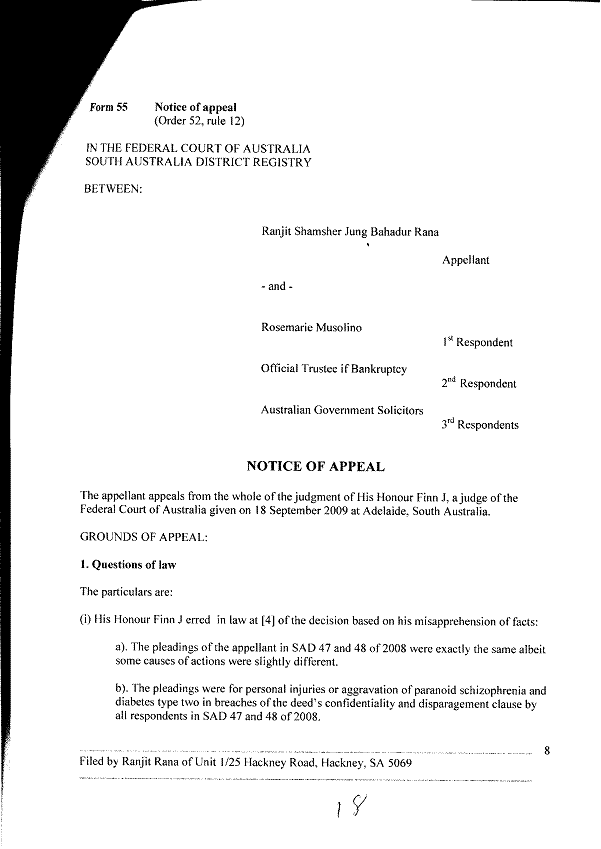
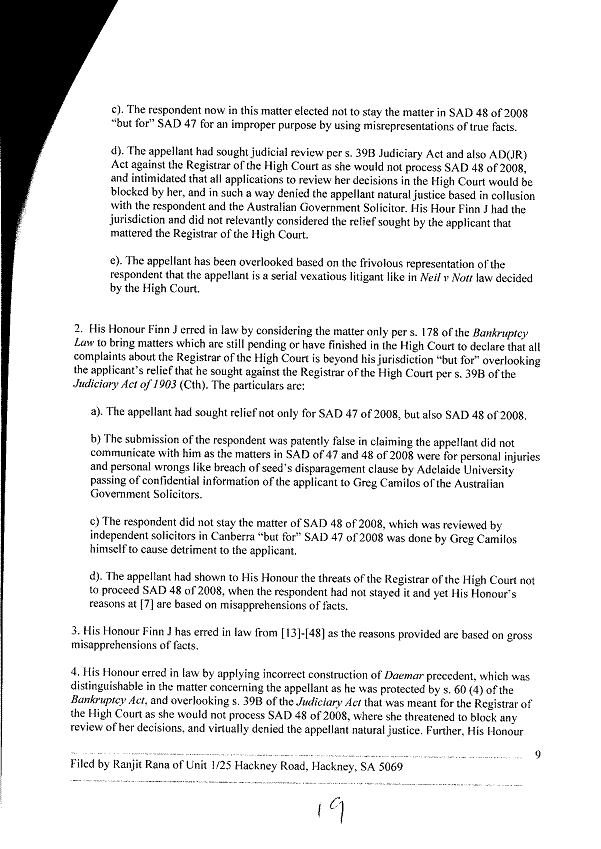
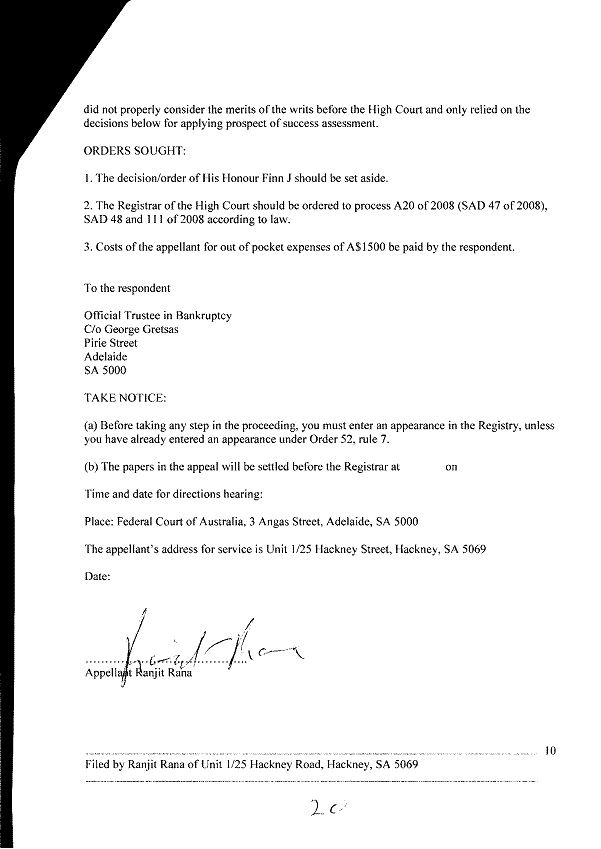
| |
| Number of paragraphs: | 65 | |
|
|
| |
| The Applicant represented himself. | ||
|
|
| |
| Counsel for the Second Respondent: | G Gretsas | |
|
|
| |
| Solicitor for the Second Respondent: | Gretsas & Associates | |
| IN THE FEDERAL COURT OF AUSTRALIA |
|
| SOUTH AUSTRALIA DISTRICT REGISTRY |
|
| GENERAL DIVISION | SAD 141 of 2009 |
| RANJIT SHAMSHER JUNG BAHADUR RANA Applicant
|
| AND: | ROSEMARIE MUSOLINO First Respondent
OFFICIAL TRUSTEE IN BANKRUPTCY Second Respondent
AUSTRALIAN GOVERNMENT SOLICITOR Third Respondent
|
| JUDGE: | |
| DATE OF ORDER: | 14 May 2010 |
| WHERE MADE: | Perth (via video link to Adelaide) |
THE COURT ORDERS THAT:
1. The application for leave to appeal is refused.
2. The applicant is to pay the costs of the respondents, to be taxed if not agreed.
Note:Settlement and entry of orders is dealt with in Order 36 of the Federal Court Rules.
The text of entered orders can be located using Federal Law Search on the Court’s website.
| IN THE FEDERAL COURT OF AUSTRALIA |
|
| SOUTH AUSTRALIA DISTRICT REGISTRY |
|
| GENERAL DIVISION | SAD 141 of 2009 |
| BETWEEN: | RANJIT SHAMSHER JUNG BAHADUR RANA Applicant
|
| AND: | ROSEMARIE MUSOLINO First Respondent
OFFICIAL TRUSTEE IN BANKRUPTCY Second Respondent
AUSTRALIAN GOVERNMENT SOLICITOR Third Respondent
|
| JUDGE: | MCKERRACHER J |
| DATE: | 14 may 2010 |
| PLACE: | Perth (via video link to Adelaide) |
REASONS FOR JUDGMENT
INTRODUCTION
1 The applicant, Mr Rana, applies for leave to appeal. The decision from which leave to appeal is sought is a judgment under s 31A of the Federal Court of Australia Act 1976 (Cth) (FCA) and O 20 r 5 of the Federal Court Rules (FCR) dismissing an amended application against the respondents for a variety of forms of relief (the application).
2 The first respondent is a Deputy Registrar of the High Court of Australia and has agreed to abide by any order of the Court save as to costs. The primary judge correctly held (and it does not appear to be the subject of challenge in this application) that the proceeding against the first respondent was incompetent. As to the third respondent (the AGS), the proceedings were discontinued by the Official Trustee in Bankruptcy (the Trustee). As the primary judge correctly noted, the action against the AGS was also incompetent. No ground of appeal is pursued in relation to that aspect of the matter.
3 The application related to a number of proceedings in this Court involving the Trustee. In relation to some of those proceedings, the complaints purported to anticipate various decisions of the Trustees. In relation to others it was alleged that the Trustee had already made decisions which were adverse to Mr Rana. In all instances, the primary judge concluded that the allegations were without foundation. (In some of the decisions, the Trustee had decided favourably to Mr Rana).
4 Mr Rana now focuses primarily on the Trustee’s filing of a notice of discontinuance of Mr Rana’s application in the High Court of Australia (the notice of discontinuance). That application had sought an order to ‘show cause’ against a judge of this Court in relation to an earlier decision.
5 The real question ventilated by the argument before the primary judge, as before me, was the existence or otherwise of power on the part of the Trustee to file the notice of discontinuance.
BACKGROUND
6 Mr Rana appears in person. On 13 August 2008 he became bankrupt. On 25 August 2008, notwithstanding his bankruptcy, he issued the proceeding in the High Court. His trustee in bankruptcy discontinued that proceeding on 23 December 2008.
7 Mr Rana contends that the High Court proceeding which, in turn, challenged an earlier dismissal by another judge of this Court was a proceeding in the nature of a personal wrong to him and as such, could not be discontinued by the Trustee.
8 The primary judge treated the application as being a challenge under s 178 of the Bankruptcy Act 1966 (Cth) (the Bankruptcy Act). That section provides that a bankrupt may apply to the Court (if he or she is affected by an act, omission or a decision of the Trustee) for the Court to make such order in the matter as it thinks just and equitable. The application must be brought within 60 days from the day the bankrupt became aware of the Trustee’s act. The original application which his Honour dismissed did not purport to be cast as an application under s 178 of the Bankruptcy Act. His Honour treated it as such as that provision was the only legislative or other lawful basis for a challenge to be brought to the Trustee’s action.
THE APPROPRIATE TEST FOR LEAVE TO APPEAL
9 Although the effect of his Honour’s decision was to finally dismiss the proceedings, an application under s 31A FCA is to be treated as an interlocutory application and, accordingly, leave to appeal the decision must be sought and obtained before an appeal may be pursued: Kowalski v MMAL Staff Superannuation Fund Pty Ltd and Another (2009) 178 FCR 401 per Spender, Graham and Gilmour JJ (at [32]-[44]).
10 Leave to appeal from interlocutory judgments of the Court is governed by O 52 r 10 FCR. In order to justify the grant of leave to appeal from an interlocutory judgment, the Court must be satisfied that:
· in all its circumstances the decision is attended by sufficient doubt to warrant it being reconsidered by the Full Court; and
· substantial injustice would result if leave were refused, supposing the decision to be wrong (Decor Corp Pty Ltd v Dart Industries Inc (1991) 33 FCR 397; Niemann v Electronic Industries Ltd (1928) VR 431).
11 It has also been observed (by Burchett J in Sharp v Deputy Commissioner of Taxation (Cth) (1988) 88 ATC 4184 at 4186) that those two considerations bear on each other ‘so that the degree of doubt which is sufficient in one case may be different from that required in another. Ultimately a discretion must be exercised on what may be a fine balancing of considerations’.
STATUTORY FRAMEWORK
12 In relation to the rights and obligations of the Trustee arising as and from the date of bankruptcy, the provisions of ss 58, 60 and 116 of the Bankruptcy Act provide relevantly:
58 Vesting of property upon bankruptcy – general rule
(1) Subject to this Act, where a debtor becomes a bankrupt:
(a) the property of the bankrupt, not being after-acquired property, vests forthwith in the Official Trustee …
60 Stay of legal proceedings
(1) …
(2) An action commenced by a person who subsequently becomes a bankrupt is, upon his or her becoming a bankrupt, stayed until the trustee makes election, in writing, to prosecute or discontinue the action.
(3) If the trustee does not make such an election within 28 days after notice of the action is served upon him or her by a defendant or other party to the action, he or she shall be deemed to have abandoned the action.
(4) Notwithstanding anything contained in this section, a bankrupt may continue, in his or her own name, an action commenced by him or her before he or she became a bankrupt in respect of:
(a) any personal injury or wrong done to the bankrupt, his or her spouse or de facto partner or a member of his or her family …
13 An ‘action’ is defined in s 60(5) to mean any civil proceedings, ‘whether in law or in equity’.
116 Property divisible among creditors
(1) Subject to this Act:
(a) all property that belonged to, or was vested in, a bankrupt at the commencement of the bankruptcy …; and
(b) the capacity to exercise, and to take proceedings for exercising all such powers in, over or in respect of property as might have been exercised by the bankrupt for his or her own benefit at the commencement of the bankruptcy or at any time after the commencement of the bankruptcy and before his or her discharge;
…
is property divisible amongst the creditors of the bankrupt.
(2) Subsection (1) does not extend to the following property:
…
(g) any right of the bankrupt to recover damages or compensation:
(i) for personal injury or wrong done to the bankrupt, the spouse or de facto partner of the bankrupt or a member of the family of the bankrupt;
…
and any damages or compensation recovered by the bankrupt (whether before or after he or she became a bankrupt) in respect of such an injury or wrong or the death of such a person.
14 The wording of these provisions has been considered in several cases. In Daemar v Industrial Commission of New South Wales & Others (1988) 12 NSWLR 45, Kirby P with whom Samuels and Clarke JA agreed, noted (at 50-51) that the scheme and purpose of the Bankruptcy Act is that:
… upon the debtor's becoming a bankrupt, to transfer property rights, including the right to sue in respect of claims to property, from the bankrupt to his trustee. This is so, notwithstanding that it involves personal inconvenience to the bankrupt: see Faulkner v Bluett (1981) 52 FLR 115 at 119. It is so notwithstanding the fact that it deprives the bankrupt of important civil rights which he or she would otherwise normally enjoy.
15 His Honour observed that:
It is of the essence of bankruptcy, as provided for by the Act, that property which belongs to the bankrupt, including choses in action (other than those which are specifically exempted) are vested upon bankruptcy in the bankrupt's trustee.
16 Dealing with the question of whether a prerogative writ was ‘an action’ for the purposes of the Bankruptcy Act, Kirby P concluded (at 54) that ‘action’, particularly as ‘action’ is defined in the Bankruptcy Act, is a word of wide meaning. Its width is emphasised by the very limited exceptions which Parliament has specifically provided for in s 60(4):
The width of the expression, quite apart from the statutory definition is stressed in many cases: see, eg, Bradlaugh v Clarke (1883) 8 App Cas 354. In R v Westminster Assessment Committee; Ex parte London and Provincial Victuallers Ltd [1917] 2 KB 215, in the context of the English Judicature Acts, it was held that the prerogative writ of mandamus was an order in an "action". True it is, the action is not only for recovery of an individual right or redress of an individual wrong. But it is that as well as a claim for vindication of a public right.
17 In Daemar, the claimant's principal contention that his action in this court was commenced in respect of a ‘wrong’ done to him and therefore fell within the exception provided by s 60(4) was rejected by Kirby J, who said (at 55):
It is understandable that a person unversed in the principles of statutory construction and unaware of legal authority on the meaning of s 60(4)(a) of the Act should have taken the words "wrong done to the bankrupt" in isolation and concluded as the claimant did about their meaning.
However, the words cannot be taken in isolation. They must, in accordance with the ordinary canons of construction, be read in the context in which they appear. The meaning of the expression, taken from that context, has been explained in numerous cases. In Australia, the classic expression is that contained in the judgment of Dixon J in Cox v Journeaux [No 2] (1935) 52 CLR 713 at 721. Speaking of the appellant in that case, Dixon J said:
"... He is a bankrupt and there is no prospect of his satisfying any order for costs made against him in this, or as I infer, in previous litigation. Notice was given under sec 63(3) of the Bankruptcy Act 1924-1933 to the official receiver requiring him to elect to prosecute or discontinue the action and he has elected not to prosecute it. The plaintiff says that he himself is entitled to prosecute it under the proviso as an action for personal injury or wrong done to himself. The test appears to be whether the damages or part of them are to be estimated by immediate reference to pain felt by the bankrupt in respect of his mind, body or character and without reference to his rights of property. (Wilson v United Counties Bank Ltd [1920] AC 102 at 111 and 128-133)."
See also Faulkner v Bluett.
Applying that test to the present case, the action brought by the claimant cannot be categorised as he submits. Although it is true that the claimant contends that a "wrong" has been done to him and that he has suffered hurt and even "defamation" in the course of the judgments of the Commission, these contentions are irrelevant to the task of identifying, for the purpose of s 60(4)(a) of the Act, the nature of the action exempted from the stay. The exemption is limited to those cases where it has been considered appropriate to sever the personal interests of the person subsequently made bankrupt from his property, and to reserve to him the prosecution of and benefits derived from such litigation as not being legitimately entitlements of the creditors. In the present case the so called "wrong" of which the claimant complains is the very source of the financial problems which have led to his bankruptcy. It is therefore to be classified not as a "wrong" which is exempted from the operation of s 60(2) and the statutory stay provided for but as of the very essence of the subject matter to which s 60(2) is addressed.
18 I have added emphasis to the passage cited from Cox v Journeaux (No 2) (1935) 52 CLR 713. See also Fitzpatrick v Keelty [2008] FCA 35 per Moore J (at [39]-[50).
THE DECISIONS REQUIRING CONSIDERATION
19 As has been seen, if a chose in action is in respect of personal injuries and/or wrongs done to a bankrupt, different considerations apply as to how it should be treated. Before addressing the basis of the challenge, it is necessary therefore to appreciate the content of the ‘show cause’ proceeding to which the notice of discontinuance related. More importantly, the nature of the decision attacked in the show cause proceeding must also be understood.
20 The notice of discontinuance relates to Mr Rana’s challenge (in the High Court) to the earlier dismissal of proceedings by another judge of this Court, Lander J in SAD 12 of 2008 (Rana v University of Adelaide [2008] FCA 365) (SAD 12). That case arose as a result of a Medico Legal Report written by a Professor Goldney at the request of the AGS. The AGS itself was joined as a fourth respondent in that proceeding. The Report was requested for use in a proceeding in the Administrative Appeals Tribunal (AAT) which had been brought by Mr Rana against the Repatriation Commission. That proceeding in turn, amongst several others in which Mr Rana had been involved, raised questions as to the circumstances of his discharge from the Army in which he had served as a member from October 1980 to July 1982.
21 For the purposes of the AAT proceedings, the AGS, representing the Chief of Army, (the fifth respondent in SAD 12) and also the Repatriation Commission, sought to have Mr Rana examined by Professor Goldney. Professor Goldney was at the relevant time the Professor of Psychiatry at the University of Adelaide. At the time that assistance was sought, the AGS and its client (the Repatriation Commission) were not aware of a Deed of Settlement between Mr Rana and the University of Adelaide. In particular, the AGS was unaware of the restrictions the Deed imposed on Mr Rana being within the University and its grounds. Mr Rana in fact raised with the AGS and the University the fact that he could not be examined by Professor Goldney at the University of Adelaide because that would put him in breach of the Deed between himself and the University. The University of Adelaide pointed out that the Deed did not prevent Mr Rana from having access to Professor Goldney but, in any event, there was no legal impediment to Mr Rana being examined by Professor Goldney in Professor Goldney’s private capacity provided that the examination occurred at premises other than the University premises. That is what ensued and Professor Goldney duly gave his opinion.
22 Mr Rana contended that the responses given in the Report by Professor Goldney were in breach of the University’s obligations under the Deed not to disparage or otherwise adversely comment upon him. In addition to that breach of the provision of the Deed, it was asserted that the University had contravened s 52 TPA, breached a duty of care owed to Mr Rana and had defamed him.
23 Lander J rejected those causes of action, dismissing the proceeding on the basis of a conclusion (at [20]) that there could be no doubt that Professor Goldney carried out his examination and provided his Report in his private capacity, not as an employee of the University. (Mr Rana was examined off the University premises at a private practice and the Report was provided following that examination). Moreover, his Honour concluded that the Report provided by Professor Goldney was not a response to a request by the University for a reference or other information but was, rather, a medico legal report given by the Professor, again in his private capacity to the AGS.
24 In any event, Lander J concluded that the Report did not disparage or otherwise adversely comment on Mr Rana but simply offered a professional opinion as to Mr Rana’s medical condition.
25 For those reasons, his Honour concluded that the action was bound to fail and had to be dismissed.
THE BASIS OF THE CHALLENGE
26 Although Mr Rana’s precise argument is somewhat less than clear, the focus of attention is on the Professor Goldney report in SAD 12. This is evident from the first paragraph of Mr Rana’s written submissions which reads:
1. This omnibus litigation is all about the principles appearing in New York Court of Appeals in USCOA, 2 No. 16, Stanley Murdza v Robert Zimmerman & Ors, 2003 NY Int 13, February 18, 2003. The question arising in this matter is:
1. Did the employee (Professor Goldney) of University of Adelaide had constructive consent or agreed and/or implied consent to use in his report to the Australian Government Solicitor about this applicant the use of insignia of University of Adelaide to s. 5B University of Adelaide Act 1972 (SA)?
2. Did the first respondent effectively rebut the presumption of consent to use its insignia by Dr. Goldney; so as to make it immune as a matter of law from imposition of employer’s liability under the deed of contract’s disparagement, adverse comments and confidentiality clauses between the applicant, and the first respondent in these circumstances by reason of the restrictive provision in its employee manual?
The applicant relies on the precedent on matters of insignia, employee and employer and much more per USCOA, 2 No. 16 Stanley Murdza Appellant v, Robert Zimmerman, Defendant, D.L. Peterson Trust, Brown & Williamson Tobacco Corporation and PHH Fleet Corporation, Respondents, 2003 NY Int. 13, February 18, 2003. New York Court of Appeals Source: …
27 Mr Rana’s application was supported by an affidavit contending that he has been totally misunderstood by the primary judge and by Lander J about his pleadings which were based on the fraudulent conduct of a member of AGS in ‘making a brief to Dr Goldney’.
28 Mr Rana complained in the affidavit that:
… page 11 and footnotes related numbers 53 to 58 were illegally obtained from University of Adelaide without my permission, in doing so I suffered aggravation of paranoid schizophrenia and diabetes type two …
… I will convince this court that [the solicitor] obtained private and confidential information without my express or implied permission from Adelaide University, which was also protected by a deed between me and University of Adelaide. [The solicitor] obtained Dr Carmine De Pasquale’s report and allegations that I was using identity of [another person] and the purpose was to link me suffering from an underlying personality disorder.
29 The affidavit continues:
I had linked breaches of Trade Practices Act by University of Adelaide for selling my private records to Repatriation Commission, University of South Australia and the remainder of the respondents. I had also other causes of actions, which was pleaded in plain English and formulated with the associated and accrued jurisdiction of the Federal Court.
30 The affidavit appends as Exhibit “C” a notice of appeal which is attached as appendix A to these reasons.
31 The affidavit continued:
7. I have now irrefutable evidence that Chief of Army’s delegate falsified his decision and made me bankrupt, and now Dr. Goldney claims for the Military Rehabilitation and Compensation Commission that in hearing of 10.12.2008 at pages162 in lines 35 to lines 30 in page 163 that the applicant was suffering from adjustment disorder with mixed emotional features or reactive depression, which is the same thing, and TWO Tribunals found that I was incapacitated to perform Army duties from August 1981 to mid April 1985. This was fact and I was given compensation. This was contrary to the basis of me being declared bankrupt. This will be exhibit “F”.
8. I cannot show you all the details as most of my papers have been taken away from me by the Trustee in Bankruptcy and the High Court. I need them to return all of my writ actions that have not been processed back from High Court and the Trustee in bankruptcy.
9. I rely on these documents to prove that miscarriage of justice has occurred at all tiers of the Courts and by the respondents.
10. I should be granted leave to appeal as I have significant merit in what I am saying, and [the primary judge] overlooked all of the evidences I presented to him, where he compared me with the case of Neil v Nott. The particulars are:
a). I had relied on ss. 5 and 6 of the ADJR Act, S.39B of the Judiciary Act 1903 and s. 178 of the Bankruptcy Act. His Honour did not give me equity and fairness and was contrary to Section 178 of the Act confers on the Court the power of ← judicial review → in the following terms:
“178. If the bankrupt, a creditor or any other person is affected by an act, omission or decision of the trustee, he may apply to the Court, and the Court may make such order in the matter as it thinks just and equitable.
It was said by Dean J in Re Tyndall; Ex parte Bankrupt (1977) 30 FLR 8 at pages 9-10 that “… the wording of s 178 of the Act is such as to confer upon the Court the widest possible discretion as to the appropriate order which should be made in the particular case …”. In this proceeding before me the order sought is to set aside the creditors’ special resolution, which, of itself, could hardly be described as seeking an order in the nature of a prerogative writ. However, I am of the view that when the Court is called upon by a debtor to exercise its discretion under s 178 to make such orders as it thinks just and equitable, it is being asked to make orders that may include the order the debtor seeks and any other ancillary supervisory orders to achieve a just and equitable outcome. Of necessity those ancillary orders may include orders directed to the Trustee’s future conduct in the administration of the Deed and any order of this kind may be construed as an order in the nature of a prerogative writ. Because no submissions were made to the Court concerning my delegated powers and, further, because I am not satisfied that my delegated powers include the powers conferred on the Court by s 178 of the Act, I am unable to exercise the power to hear and determine the further application and, therefore, the Debtor’s application to hear the further application if the Debtor is unsuccessful in persuading the Court to grant the declaratory relief is denied.
b). I was totally at a loss as to how His Honour [the primary judge] used the no utility test and doomed to fail test per dismissing my matter per Kowalski case at [32]-[44], and now I have to seek leave to appeal, and I do not have right automatically per Jefferson Ford Motor case.
c). I seek leave to appeal per Décor Corporation Pty Ltd v Dart Industries (1991) FCR 397 (sic-33 FCR 397) at 398-400. I should be able to convince this Court, which is that [the primary judge’s] decision is attended to sufficient doubt to warrant its reconsideration by a full court and substantial injustice would result if leave were refused supposing the decision to be wrong.
d). I should with alacrity propose that [the primary judge] accepted that my writs before the High Court belonged to the Trustee in Bankruptcy, which is to say he/she is the Officer of the Court, and it (sic-it is) his jurisdiction he/she inherited to protect the prerogative of the Crown and public interest or utility or creditors do not have to bear more costs from alleged vexatious litigants like me.
e). I do not accept such dubious nonsense as my reliance is based on wisdom of Gaudron and Gummow JJ in Re Refugee Review Tribunal; Ex parte Aala (2000) 204 CLR 82 at 92, 93, 133-134, 141, 143, [128] and [198].
f). I was denied my right to approach a Ch III Court for relief against an invalid purported exercise of Commonwealth legislative power by Lander J, and executive authority of the respondents in SAD 47 of 2008 that arose from statute, namely, covering cl 5 of the Constitution.
g). I was told by the Trustee in Bankruptcy that he was the agent of the Monarch to protect the prerogative of the Crown.
11. I seek return of my original documents from the Trustee of Bankruptcy (i.e. my pleadings in SAD 47 and 48 of 2008), and DP Registrar Musolino in the matters of A 20 of 2008, and writs that have not been processed in the former SAD 48 and 111 of 2008 (i.e. based on the decisions of the full court), which will allow me to prepare my case, or else it will doom to fail. Sealed orders of [the primary judge] is exhibit “G” in this affidavit. (emphasis added in original)
32 Mr Rana’s written submissions contend that the primary judge provided reasons (at [1]-[7]) which are not supported by evidence. Mr Rana argued that all of the causes of action in the case before Lander J were ‘integrated and were for aggravation of paranoid schizophrenia and diabetes type two’. Thus, he argues, the causes of action were cast in language of personal injury or wrong as to fall within the exception in s 60(4) of the Bankruptcy Act. Similarly it was argued that the causes of action were exempted by s 116(2)(g) of the Bankruptcy Act being a right to recover damages or compensation for personal injury or wrong done to him.
33 It was also complained that the primary judge erred in law by denying Mr Rana natural justice or procedural fairness as the primary judge had already made up his mind, considered and reached his conclusion. This ground can be immediately rejected. There is no evidence at all to support it other than the fact that Mr Rana lost before the primary judge. That outcome taken alone and in the absence of more, can never support such complaints.
34 The third ground of complaint appears to be that the Trustee misrepresented the claim as being a claim about contract in relation to the deed of settlement as distinct from a claim for personal injury or wrong done to Mr Rana. This is really the heart of the issue.
35 Further, Mr Rana complained that the primary judge’s decision was ‘unfair, unlawful, illogical, irrational and unreasonable as at [43], which in fact the applicant sought damages for aggravation of paranoid schizophrenia and diabetes type 2, which was specifically pleaded in the statement of claim and related heads of causes of action’.
36 Mr Rana complains that the primary judge did not read the pleadings in the original matter and that the primary judge was misled by the Trustee who substituted his own version of false construction of the pleadings. Mr Rana complains that the finding by the primary judge that his claims were illusionary (at [45]) is manifestly unreasonable, not supported by the evidence or arguable at law. Mr Rana concluded by complaining that the primary judge gave too much credence to the affidavit of the Trustee which it was said was contrary to the requirements of s 75 of the Evidence Act 1995 (Cth) but, nevertheless, accorded significant weight by the primary judge.
37 He also claims the primary judge exceeded his jurisdiction by deciding the matter and the proper forum was the High Court (at 3(iv) of the outline of submissions).
38 Mr Rana complains that this assessment and analysis of the cause of action misunderstands the substance of his amended statement of claim. It is undesirable to repeat all 14 pages of the amended statement of claim but it is sufficient to point to the fact that with the possible exception of the claim in defamation, the pleading and the substantive allegation leads to claims for damages of $4 million in respect of the alleged contraventions (of the Deed, of the TPA, of a duty of confidentiality, of a duty of care and the such like).
39 Reference to the headings alone is sufficient to broadly reveal the nature of the proposed claim being pursued:
Cause of action for breach of s. 52 of the Trade Practices Act 1974 (Cth) (and related section of the Fair Work Act of South Australia – First respondent
Breach of contract of deed of settlement
The contract of deed
The breach of the contract of deed
The loss caused by the breach
Negligence
The duty of care
The breach of duty
The loss caused by the breach
Misrepresentation (under ss. 1 to 7) Misrepresentation Act 1972 (SA) and “picked up” by s 79 of Judiciary Act 1901 (Cth))
The representation
The falsity of the representation
Claim for damages for libel and slander by Professor Goldney’s report to Repatriation Commission – pleading natural and ordinary meanings and true/legal innuendoes
Claim for injunction and damages of confidence per the deed of settlement
Claim by the applicant against second to the fifth respondents; as third parties in the stolen personal information of the applicant – Breaches of confidentiality covenant
Claim against the second respondent – Repatriation Commission – Negligence
Claim against the third respondent – University of South Australia (under accrued and associated jurisdiction of the Federal Court of Australia)
Breach of s. 52 of the Trade Practices Act (the “Act”) and similar section in the Fair Work Trading Act
Breach of Contract of deed
The Contract of deed
The breach of the contract of deed
Negligence – Australian Government Solicitor (AGS) -4th Respondent
Negligence – Chief of Army – 5th Respondent
40 The primary judge pointed out that although the medical condition of Mr Rana had been a topic which gave rise to the Deed and a topic of the report prepared, allegedly in contravention of the provisions of the Deed, the cause of action was not an action in respect of personal injuries. Rather it was, his Honour concluded, a cause of action for a collection of other alleged contraventions, none of which could be described as being actions for personal injuries.
THE RESPONSE BY THE TRUSTEE TO THE COMPLAINTS
41 The Trustee in opposing the application for leave to appeal contends there is no error of law in the primary judge’s decision. This is for a variety of reasons including the fact that the primary judge was correct to classify the substantive proceedings as not being for personal injury damages and, therefore, not exempt pursuant to 116(2)(g) of the Bankruptcy Act. Lander J in the substantive proceedings was also correct in coming to the same view. Further, the primary judge was correct to conclude that at the centre of Mr Rana’s claims were actions for breach of contract against a number of respondents and breaches of confidence with a satellite claim for negligence and defamation and contraventions of s 52 TPA and his observation that the damages sought were not estimated by immediate reference to pain felt by the bankrupt in respect of his mind, body or character and without reference to his rights of property: Cox v Journeaux.
42 On the additional matters raised in Mr Rana’s notice of motion, the Trustee also observed that the orders sought for the return of the pleaded causes of action from the Trustee were not competent and, in any event, the Trustee had no such original documentation. I should clarify that before me the only documentation identified in this regard was the amended statement of claim in SAD 12. I assured Mr Rana that I would obtain a copy of that document so that I could review it in the context of the balance of his arguments. Mr Rana accepted that this was an appropriate course. I have done so and have referred above to that pleading (at [22]).
43 In relation to the declaratory relief sought by the motion, the Trustee submitted that it was not competent for Mr Rana to seek declarations against the respondents not to interfere in his proceedings in the High Court on an application for leave to appeal. This submission is correct and requires no further analysis. It was not pursued in argument before me by Mr Rana.
44 In relation to the security for costs application and the application seeking to declare Mr Rana as a vexatious litigant, the Trustee submitted that there have been no such applications pursued by the Trustee. This being so, it is unnecessary to further consider the relief sought by Mr Rana and this aspect was not pursued in argument before me.
45 Mr Rana’s limited application for costs was opposed and the Trustee sought costs of the motion.
46 Mr Rana filed a ‘rebuttal submission’ which adds nothing new to the matters thrown into issue by the primary and responsive submissions but the first, fourth and tenth paragraphs give a representative flavour of the response:
1. The applicant opposes the misrepresentation made by the respondent based on false assumptions and misrepresentations it has made at trial and even now vigorously. The applicant argues that it is arguable that this Court should grant leave based on denial of procedural fairness by [the primary judge]. Further, the conclusion [the primary judge] made was erroneous in law was based on unreasonable, irrational and unfair analysis based on false or fraudulent assumptions and the decision is to be disturbed ‘in the interest of justice’. The decision of Lander J also was tainted with false assumptions and was before the High Court, and in an underhanded and devious way the respondent has oppressed this applicant to gain justice. Thus, the Lander J decision, which the respondent relies bears ditto analysis or verbatim is same as [the primary judge].
…
4. The applicant argues that in essence this matter should have bared the same result as the respondent claims in paragraph 4 of its submissions. For example action SAD 48 of 2008 is exactly the same as this matter before this Court, and the applicant’s affidavit dated 24/9/2009 at [1]-[12] clearly has outlined as this matter and SAD 48 of 2008 being pleaded in same terms. The legal question is then why is the respondent unreasonably and illogically and irrationally denying the applicant procedural fairness by reliance on Daemar law, which is distinguishable in this case any way. Thus, it is arguable that the Full Court should set aside the decision of [the primary judge] as he was in precedent not going to grant relief to this applicant based on Daemar law and the false and fraudulent assumptions the respondent provided him in comparative terms with Lander J for a legal conclusion. For example, why the respondent allowed SAD 48 of 2008 to be favourable to the applicant and not this matter, which is to say both of them had same facts and was pleaded in same presentation, which Lander J did not liked (sic-like) and both of them were dismissed by him with the caption doomed to fail per s. 31 of the FCA Act?
…
10. The applicant argues per paragraph 10 of the respondent that it is not for this Court or the respondent to be gypsy joker in star gazing what may occur in future. The applicant has arguable case as the respondent has misrepresented to the Trial judge with false and fraudulent assumptions, and he reached conclusion based upon it. It is therefore arguable that Daemar law is not applicable in this case as it is distinguishable in this matter.
CONSIDERATION
47 A bankrupt does not have standing to commence proceedings unless the action falls into an exception in s 116(2)(g) of the Bankruptcy Act. Where a number of causes of action are raised, some of which would vest in the trustee and others would not and if it is impossible to estimate a part of the damages claimed by the applicant without reference to his or her property, the causes of action are not severable and the exemption in s 116(2)(g) of the Bankruptcy Act cannot be enlivened. If the causes of action are severable, the bankrupt has locus standi to bring and maintain those actions that claim damages for personal injury.
48 In relation to actions that vest in the trustee, unless consent of the trustee to bring the proceedings has been obtained, the action should be dismissed as incompetent. In relation to causes of action that are severable and vest in the bankrupt, they should be addressed separately.
There is no personal injury claim
49 To qualify for s 116(2) of the Bankruptcy Act, the right to compensation must be one for any personal injury or wrong done to the bankrupt where ‘the damages or part of them are to be estimated by immediate reference to pain felt by the bankrupt in respect of his mind, body or character and without reference to his rights of property’: (Cox v Journeaux (at 714)) (emphasis added).
50 In determining whether a chose in action is property which remains with the Trustee or a right which does not, it is the character of the cause of action as pleaded or claimed that is important. Where the primary and substantial right of action is direct pecuniary loss to property or the estate of the bankrupt, the right to sue passes to the trustee notwithstanding that it may have produced personal inconvenience to the bankrupt. Where the essential cause of action is injury to the personal feelings of the bankrupt, the right to sue remains with the bankrupt: Faulkner v Bluett (1981) 52 FLR 115 at 119. In Rogers v Asset Loan Co Pty Ltd [2007] FCA 195, Greenwood J noted (at 49) that the accepted test, as formulated by Sir Owen Dixon in Cox v Journeaux at 721 was:
whether any part of the damages arising out of the contravention are to be estimated by immediate reference to pain felt by the bankrupt in respect of his mind, body or character and without reference to his rights of property.
51 In Bryant v Commonwealth Bank (1997) 75 FCR 545, O’Loughlin and Merkel JJ concluded that (at 564):
…Mr Bryant’s causes of action, as pleaded in his statement of claim, are essentially claims which are referable to his financial and property rights. That is not to deny him his right to allege “personal injury or wrong done to” him or members of his family. But if the injury that was suffered or the wrong done arose as a direct result of the alleged infringements of his financial or property rights, as was the case in Faulkner v Bluett, then “the primary and substantial right of action is direct pecuniary loss to the property or estate of the bankrupt” (at 119) To apply the language of Handley JA in Manningell v Hewlett to Mr Bryant’s circumstances his claims for stress and suffering were “consequential upon alleged breaches” of duty said to be owed to him by the Bank as a mortgagee or secured creditor and were not claims “without reference to [his] rights of property”, within the principle stated by Dixon J in Cox v Journeaux.
52 In Fitzpatrick v Keelty, the applicant challenged the termination of his employment with the Australian Federal Police. The application primarily invoked the ADJR Act, although various other legislation, such as the Human Rights Act 2004 (ACT) and the Workplace Relations Act 1996 (Cth), were mentioned. The applicant indicated he wanted to rely on all the material he had put before the Court, and not just the most recent pleadings. Moore J noted the statements of claim were discursive and more in the form of submissions, and tended ‘to be repetitive and difficult to follow’. A number of orders were made along the way in an attempt to encourage the applicant to frame his case more succinctly, but to no avail. The applicant sought review of countless ‘decisions’, which included various forms of conduct by numerous people.
53 His Honour found that all the decisions that the applicant sought to challenge were incidental to the termination of his employment and did not fall within the exemption in s 60(4) of the Bankruptcy Act (the action had been commenced before bankruptcy). His Honour then addressed the causes of action which could be said to fall within the exemption when taken on their own, including defamation and negligence. He shortly concluded for each of these causes of action that the applicant had no reasonable prospect of success and gave judgment for the respondents.
The severance of causes of action
54 An issue that has arisen in a number of cases is whether it is possible to sever certain causes of action which would fall within s 60(4) of the Bankruptcy Act from other aspects of the proceedings. In Bryant v Commonwealth Bank of Australia (at 547‑549), Lockhart J distilled the principle that a claim for damages for injury to personal and mental health will not fall within the exemption in s 60(4) of the Bankruptcy Act where the claim cannot be made without reference to the bankrupt’s rights of property. In Hamilton v Young [2008] 1 Qd R 507, the Queensland Supreme Court considered the issue of severance. The claim in that case was for damages for the costs of raising an unplanned child. Douglas J considered that the cost of raising an unplanned child could not be considered a ‘personal injury or wrong’. He considered the word ‘wrong’ in s 60(4) of the Bankruptcy Act identified a personal tort affecting the person or feelings of the bankrupt, and not, as in the circumstances of Hamilton v Young, the loss of her property caused by the expense of bringing up a child (at [11]).
55 In Worchild v University of Queensland Law Society Inc (2006) 234 ALR 179, the applicant brought an action for damages for the amount lost in an adverse costs order in a previous action. His statement of claim alleged contraventions of the Trade Practices Act 1974 (Cth) and Fair Trading Act 1989 (Qld), as well as fraud and negligence. Spender J found that the applicant had no locus standi to bring the action because the essential character of the applicant’s claim was that the respondents, through representations, induced him to commence proceedings in the Federal Court in 2004, which led to his losses. The adverse costs order made against him formed the basis of bankruptcy proceedings. As such, the alleged losses could only be pursued through the machinery of the Bankruptcy Act and the various claims could not be severed. (In any event, Spender J found that if the applicant was capable of bringing the proceedings, they should be stayed as an abuse of process). Spender J decided the appropriate order was to dismiss the proceedings as incompetent.
56 In Bryant v Commonwealth Bank of Australia’s case, the wrong complained of by the bankrupt was found to be the ‘very source of the financial problems which led to his bankruptcy’ (at 563). Such a claim was the ‘very essence’ of property divisible among the creditors and vested in the trustee.
57 Insofar as the purported claim in defamation is concerned, for the reasons expressed by Lander J and by the primary judge, the claim has no prospects of success. In a comparable legal (if not factual) context, Moore J said in Fitzpatrick v Keelty (at [53]):
One of these potential actions is defamation. The pleadings filed by the applicant refer in a general sense to damage to his character and reputation and to "defamation", as well as more specifically in relation to the contents of the reports and statements made by the respondents' solicitor in Court. As the respondents have submitted, the applicant has not particularised the statements, other than in the case of the alleged statements of the solicitor in relation to which he has provided more detail. He has not particularised the effect of any statements on his reputation. As the respondents have submitted, even if statements made by the solicitor were defamatory, the express defence of absolute privilege may well apply. I am satisfied that to the extent that the applicant has raised a cause of action in defamation there is no reasonable prospect of successful prosecution.
58 In my view, that approach is correct. The fact that a viable defamation claim may fall within a s 60(4) of the Bankruptcy Act exemption does not mean that a hopeless claim should be permitted to stand.
59 In the present case, Mr Rana’s claim did not, in any way, seek to sue any of the respondents to those proceedings by way of damages directly for inflicting personal injury or any other personal wrong within the meaning described by Dixon CJ in Cox v Journeaux.
60 Although various causes of action are widely cast, at their centre are claims for breaches of contract, breaches of confidence, satellite claims for negligence, defamation and s 52 TPA and other statutory claims all said to arise from breaches of terms of settlement deeds. However these are said to have given rise to ‘the loss and damage occurring to the applicant’s compensation and benefits claims against the Commonwealth and its various agencies.
61 The point is, however, that those claims had already been settled by the deed. The assessment by the primary judge at [43] is correct.
62 It follows that by the very substance of any of the claims they have passed to the Trustee to the exclusion of Mr Rana. The primary judge said (at [45]) ‘Distinctly I am not satisfied that Mr Rana is seeking to vindicate or establish a personal wrong or injury for s 116(2)(g) purposes’
63 The process of reasoning adopted by the learned primary judge, in my view, is without error. As found by the primary judge, there is no basis for relief at all in relation to any of the first four actions in respect of which complaint was raised.
CONCLUSION
64 For all those reasons, it is manifestly clear that the decision of the primary judge was correct. Further, even if that is wrong, no injustice arises as the original dismissal by Lander J was also clearly correct.
65 For those reasons the application for leave to appeal will be refused. The applicant is to pay the costs of the respondents, to be taxed if not agreed.
| I certify that the preceding sixty-five (65) numbered paragraphs are a true copy of the Reasons for Judgment herein of the Honourable Justice McKerracher. |
Associate:
Dated: 14 May 2010
APPENDIX A