

FEDERAL COURT OF AUSTRALIA
Rose on behalf of the Kurnai Clans v State of Victoria [2010] FCA 460
| Citation: | Rose on behalf of the Kurnai Clans v State of Victoria [2010] FCA 460 | |
| | | |
| Parties: | ||
| | | |
| File number: | VID 398 of 2005 | |
| | | |
| Judge: | NORTH J | |
| | | |
| Date of judgment: | 14 May 2010 | |
| | | |
| Catchwords: | NATIVE TITLE – overlapping claims – issue of group composition – whether application as currently defined includes all persons who hold native title – Native Title Act 1993 (Cth) - effect of s 67(1) | |
| | | |
| Legislation: | Native Title Act 1993 (Cth) ss 67, 223, 225 | |
| | | |
| Cases cited: | Kokatha Native Title Claim v State of South Australia [2006] FCA 838 Yorta Yorta Aboriginal Community v Victoria [2002] HCA 58; 214 CLR 422 | |
|
|
| |
| Date of hearing: | 12-14 December 2007, 20 December 2007, 31 January 2008, 6 February 2008, 14 February 2008, 19 February 2008, 11 March 2008, 5-9 October 2009, 12 October 2009 | |
|
|
| |
| Date of last submissions: | 12 February 2010 | |
|
|
| |
| Place: | Melbourne | |
|
|
| |
| Division: | GENERAL DIVISION | |
|
|
| |
| Category: | Catchwords | |
|
|
| |
| Number of paragraphs: | 208 | |
|
|
| |
| Counsel for Applicant: | Mr R. Skinner (12-14 December 2007, 20 December 2007, 31 January 2008, 6 February 2008, 14 February 2008, 19 February 2008, 11 March 2008) | |
|
|
| |
| Counsel for the First Respondent: | Mr T. Neal SC & Mr P. Willis | |
|
|
| |
| Counsel for the Second Respondent: | Mr T. Keely | |
|
|
| |
| Solicitor for the First Respondent: | Victorian Government Solicitors Office | |
|
|
| |
| Solicitor for the Second Respondent: | Native Title Services Victoria | |
| IN THE FEDERAL COURT OF AUSTRALIA |
|
| VICTORIA DISTRICT REGISTRY |
|
| GENERAL DIVISION | VID 398 of 2005 |
| REGINA ROSE, DOT MULLETT, PAULINE MULLETT, FLO HOOD-FINN and FRANK HOOD ON BEHALF OF THE KURNAI CLANS Applicant
| |
| AND: | STAte of VICToria & ors respondents
|
| JUDGE: | |
| DATE OF ORDER: | 14 MAY 2010 |
| WHERE MADE: | MELBOURNE |
THE COURT ORDERS THAT:
1. The application is dismissed.
Note:Settlement and entry of orders is dealt with in Order 36 of the Federal Court Rules.
The text of entered orders can be located using Federal Law Search on the Court’s website.
| IN THE FEDERAL COURT OF AUSTRALIA |
|
| VICTORIA DISTRICT REGISTRY |
|
| GENERAL DIVISION | VID 398 of 2005 |
| BETWEEN: | REGINA ROSE, DOT MULLETT, PAULINE MULLETT, FLO HOOD-FINN and FRANK HOOD ON BEHALF OF THE KURNAI CLANS Applicant
|
| AND: | STAte of VICToria & ors respondents
|
| JUDGE: | NORTH J |
| DATE: | 14 MAY 2010 |
| PLACE: | MELBOURNE |
REASONS FOR JUDGMENT
| Introduction.............................................................................................................. | [1] |
| The Gunai/Kurnai application.......................................................................... | [6] |
| Judgment overview................................................................................................ | [8] |
| Attempts to resolve the group composition issue............................ | [19] |
| The applicable law.................................................................................................. | [28] |
| History of the Aboriginal people of Gippsland.................................... | [32] |
| The course of the hearing and the evidence before the Court | [48] |
| The Kurnai Case............................................................................................................. | [48] |
| The Evidence of Pauline Mullett............................................................................... | [48] |
| The Position at the end of Ms Mullett’s evidence..................................................... | [55] |
| The Evidence of Cheryl Drayton............................................................................... | [57] |
| The Evidence of Regina Rose.................................................................................... | [58] |
| The Evidence of Marion Flo Hood-Finn.................................................................. | [60] |
| The Evidence of Lynette Hayes.................................................................................. | [61] |
| Further Evidence of Pauline Mullett........................................................................ | [62] |
| The State Case............................................................................................................... | [63] |
| The Evidence of Dr Sue Wesson................................................................................ | [63] |
| The Gunai/Kurnai Case.................................................................................................. | [83] |
| The Evidence of Belinda Burbidge........................................................................... | [83] |
| The Evidence of Dr John Morton.............................................................................. | [84] |
| Consideration........................................................................................................... | [94] |
| Ancestral Set Two........................................................................................................... | [97] |
| Conclusion concerning AS2...................................................................................... | [146] |
| Ancestral Set Six............................................................................................................ | [147] |
| Conclusion concerning AS6...................................................................................... | [183] |
| Further considerations..................................................................................... | [184] |
| Disposition................................................................................................................... | [194] |
| Some concluding observations..................................................................... | [203] |
| Annexure 1 – List of Respondent Parties by category...................... | |
Introduction
1 Before the Court is an application made pursuant to s 61(1) of the Native Title Act 1993 (Cth) (the Act) for a determination of native title. The application was filed on 29 April 2005. The applicant group comprises Mrs Regina Rose, Ms Dot Mullett, Ms Pauline Mullett, Mrs Flo Hood-Finn and Mr Frank Hood. Mrs Rose, the first named applicant, died in the course of these proceedings in October 2008. She was the sister of Euphemia Mullett. Euphemia Mullett was the mother of Ms Dot Mullett, the second named applicant, Ms Pauline Mullett, the third named applicant, and Mr Frank Hood, the fourth named applicant. Ms Hood-Finn is the second cousin of the second, third and fourth named applicants, being the daughter of Margaret Bryant Marks and Jock Hood.
2 The State of Victoria (the State) was the original respondent. In August 2008, following a process of notification by the National Native Title Tribunal (the Tribunal) some 300 respondents were also added as parties to the proceedings. On 14 October 2008 a further group of respondents, including the Gunai/Kurnai People, were added as parties to the application. A full list of these respondents is annexed to these reasons.
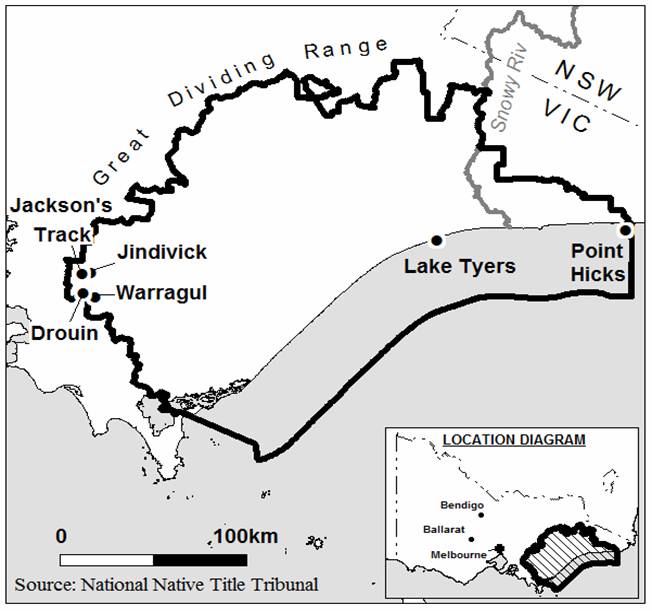
3 The area covered by the application is the Gippsland region of south-east Victoria. In general terms the area is bounded on the west by a line starting from the eastern side of Wilson’s Promontory, then travelling northwest towards Warrigal, then west to Drouin, then to Jindivick and on to the Great Dividing Range. The northern boundary is then east along the Great Dividing Range to the upper reaches of the Snowy River. The eastern boundary then follows the Snowy River to near the coast where it diverges east to the Thurra River which joins the coast at Cape Everard/Point Hicks. The southern boundary is 22 nautical miles seaward of the coast. The area will be referred to in these reasons as the Gippsland area, and is illustrated in the map below.
4 The application was brought on behalf of a group of people who are referred to in these reasons as the Kurnai. The application identified the group of people in whose favour a determination of native title should be made as the descendants of Larry Johnson and Kitty Perry Johnson. This couple were born and lived in Gippsland in the second half of the 19th century.
5 The application was filed by the Kurnai as a result of a long running controversy between themselves and a larger group of Aboriginal people from the Gippsland area who will be referred to in these reasons as the Gunai/Kurnai. The controversy was over the appropriate group of people in whose favour a determination of native title in the Gippsland area should be made (the group composition issue). That controversy surfaced in the earlier application for a determination of native title brought by the Gunai/Kurnai.
The Gunai/Kurnai application
6 On 4 April 1997 an application for a determination of native title in the Gippsland area was filed. It identified the group of people in whose favour a determination of native title should be made as the descendants of a number of apical ancestors. Following further research the number of ancestral sets now stands at 25. Included in the ancestral sets relied upon in the Gunai/Kurnai application is the couple Larry Johnson and Kitty Perry Johnson. Thus, the Gunai/Kurnai application includes the Kurnai as persons in whose favour a determination of native title should be made.
7 However, the Kurnai do not accept that a determination should be made in favour of the larger group. They base this on two contentions. First, the Kurnai claim that the Gunai are a separate and distinct group from the Kurnai. The term ‘Gunai’, according to the Kurnai, is a Kurnai word referring to an Aboriginal person, a “blackfella” but not to a Kurnai person. Second, and most significantly, the Kurnai contend that only the descendants of Larry and Kitty Johnson have rights to country in Gippsland. As a result, they do not accept that those members of the larger group who are not the descendants of Larry and Kitty Johnson have rights to country in Gippsland.
Judgment overview
8 The way in which this litigation has evolved, including the issues which the Court is now required to resolve, and the way in which the parties have presented their cases, is a little out of the ordinary. An overview of the approach taken in these reasons for judgment should assist in understanding those matters.
9 These reasons first deal with the attempts which have been made through mediation and other processes to seek to resolve the issue of group composition without a judicial determination. This section outlines the procedural steps rather than the content of the discussions and negotiations which have occurred. A large portion of that content is confidential because the discussions took place in the course of mediation and is therefore unknown to the Court. The content of the early and preservation evidence in the Kurnai application is outlined later in these reasons. The purpose for describing the attempts to resolve the group composition issue is to explain the shape of the case presented by the Kurnai at the final hearing of the application for a determination of native title. As a result of these attempts, the focus of the Kurnai has been on the issue of group composition.
10 However, the Kurnai are required by law to satisfy all the requirements of the law applicable to the establishment of native title and not merely provide an answer to the question of who might be the holders of any such native title. Thus, in the next section of these reasons the law applicable to the establishment of native title is briefly explained. That section aims to show that it is not sufficient for the Kurnai to demonstrate that they form a group descended from a common ancestor or ancestors. They must also show that together they adhere to a set of rules connecting them to the land and waters of Gippsland, and that the group has had a continuous and vital existence since sovereignty.
11 A brief history of the Aboriginal community of Gippsland is then outlined in order to set the context in which the other evidence must be considered.
12 Following this section, these reasons describe the relevant evidence given during the hearing. The sequence in which that evidence was given, and hence how it is described, must be understood against the following background. In support of the Kurnai case, most of the evidence given by Ms Pauline Mullett, the main witness for the Kurnai, involved a detailed refutation of the Kurnai ancestry of each of the 25 ancestral sets. In that sense it was a negative case centred on answering the Gunai/Kurnai argument in favour of a much wider society. Although the 25 ancestral sets were not, at that point, in evidence in the Kurnai case, the Kurnai were aware of the Gunai/Kurnai claims from the long history of disputation between them, as well as from their participation in the Gunai/Kurnai early and preservation evidence hearing at which the 25 ancestral sets were relied upon by the Gunai/Kurnai.
13 Following this summation of the Kurnai case, these reasons then refer to the evidence called by the State. The State’s sole witness, Dr Wesson, an historian, gave evidence about the background and reliability of the historical source material relied upon to compile the ancestral sets and also gave her views on some of the historical controversies.
14 Then, these reasons refer to the evidence called by the Gunai/Kurnai. It was only at this point that the ancestral sets were tendered in evidence. Evidence was given by Ms Belinda Burbidge, an anthropologist, concerning the methodology used to compile the ancestral sets. Finally, Dr Morton, also an anthropologist, gave evidence in relation to the two reports which he had provided in relation to the issues concerning the Gunai/Kurnai and the Kurnai. His evidence was focused on the question of who are the appropriate people to hold native title. Although he dealt with wider questions of the laws acknowledged and customs observed by the relevant group, he was not asked to address the wide range of broader questions which would be required if he were addressing the entire positive case of the Gunai/Kurnai.
15 The Kurnai case, at least implicitly, accepted that there were Aboriginal people in Gippsland at sovereignty who, at that time, formed a society of which Larry Johnson and Kitty Perry Johnson were part. The Gunai/Kurnai case is that the members of that society are the descendants of the 25 ancestral sets. The Kurnai case is that none of the descendants of those Aboriginal people, apart from the descendants of Larry Johnson and Kitty Perry Johnson, remain today as part of the continuing society. The Kurnai thus took on the burden of establishing that, apart from the descendants of Larry Johnson and Kitty Perry Johnson, none of the descendants of the 25 ancestral sets are part of the alleged Kurnai society existing today and dating back to sovereignty. If the Kurnai are wrong in relation to the descendants of any of the 25 ancestral sets, save for the descendants of Larry Johnson and Kitty Perry Johnson, their application for a determination of native title must fail because it would omit relevant ancestors. Thus, in the end, there was a particular focus in the evidence on the validity of the ancestral sets.
16 In the next section of these reasons the arguments relating to two of the ancestral sets are addressed. In each case the Kurnai arguments are rejected. As explained in the previous paragraph the failure in relation to any of the ancestral sets means that the application by the Kurnai for a determination of native title must fail. Although much evidence was given concerning all of the ancestral sets it is unnecessary in these circumstances to traverse all of it in detail. Consequently, these reasons concentrate on the evidence which is critical to the determination in relation to the two ancestral sets on which the result depends.
17 Finally, these reasons outline a number of other reasons why the Kurnai application cannot succeed, and discusses the appropriate disposition of the application.
18 As foreshadowed in this overview, the discussion starts with a reference to the attempts to resolve the group composition issue.
Attempts to resolve the group composition issue
19 The dispute between the Gunai/Kurnai and the Kurnai was first manifested in applications brought by certain members of the Gunai/Kurnai applicant group to have certain other members of the applicant group removed from the application pursuant s 66B of the Act. These applications were resolved through mediation by registrars of the Court, first in April 2000 and then again in December 2002, and finally by an order of the Court of 26 October 2004 removing Mrs Rose and Mr Mobourne from the applicant group in the Gunai/Kurnai application.
20 The Kurnai, including those two named applicants who had been removed from the Gunai/Kurnai application, then filed the present application, bringing into stark relief the controversy between the two groups. The Gunai/Kurnai application seeks a determination in favour of the descendants of 25 apical ancestral sets, and the Kurnai seek a determination in favour of the descendants of just one half of one of those sets.
21 Since that time, an enormous amount of time and effort by the Indigenous parties and registrars of the Court has gone into attempting to bridge the divide between the Gunai/Kurnai and the Kurnai. The Kurnai and the Gunai/Kurnai claim groups, along with their lawyers attended mediation sessions at the Tribunal during 2005; on 28 January, 2 May, 23 May, 20 June, 7 September and 7 December. Unfortunately, these mediations failed to resolve the issues between the two groups.
22 A further strategy was tried when, on 19 December 2005, the Court made orders for the appointment of an expert to report to the Court on the laws and customs of the Gippsland Aboriginal society at sovereignty and on the identification of the ancestors of the people who constituted that society. In March 2006, Dr John Morton, an anthropologist, was engaged to provide the report, which he did in May 2006.
23 The appointment of an expert by the Court is an unusual course for the Court to adopt. That course was taken in the hope that the Gunai/Kurnai and the Kurnai might be assisted in resolving their dispute by having the opinion of an independent professional anthropologist who was able to assess the facts objectively. In the event that the report did not result in any resolution between the parties, the Court considered that the report might assist the Court in determining the group composition issue in a contested hearing. Unfortunately, despite further mediation in the Tribunal following the delivery of the report, the report of Dr Morton did not bring the parties together on the issue.
24 Nonetheless, there were still factors which suggested that the Gunai/Kurnai and the Kurnai might be able to resolve the group composition issue amongst themselves. One factor was that the Gunai/Kurnai always included the Kurnai in the native title holding group, and the other was that there had been a number of mediations of the interlocutory applications which had resulted in agreement, albeit that such agreement was temporary. It seemed to the Court that all efforts should be made to provide the Gunai/Kurnai and the Kurnai with the opportunity to resolve the question within their own community. It was clear to the Court from the many appearances over the years that the Gippsland Aboriginal community was strong and active. It had internal mechanisms for addressing contentious issues and in these circumstances litigation over the sensitive issue of personal identity should be the last resort.
25 In accordance with these views, a final process was adopted by the Court to attempt to bring the Gunai/Kurnai and the Kurnai together. Orders were made for a hearing of early evidence and of preservation evidence. In relation to preservation evidence the main purpose was to ensure that the evidence of elderly witnesses was not lost by the passage of time. Additionally, it was thought that the exposure of some parts of the evidence prior to the commencement of a full trial might cause the Indigenous parties to reassess the chances of resolving the group composition issue without a judicial determination. As the two applications for determinations of native title were independent, the hearing of the early and preservation evidence was heard separately for each of the applications. In respect of the Gunai/Kurnai application, the evidence was heard between 3 and 11 December 2007. In respect of the Kurnai application the evidence was heard on 12, 13 and 14 December 2007, 31 January 2008 and 6, 14 and 19 February 2008. Some submissions relating to the early and preservation evidence were heard on 11 March 2008.
26 One of the values of the early and preservation evidence hearing was that the evidence was exposed to the State. As a result, the State was able to make some assessment of that evidence and to address submissions to the Court concerning its view of the cogency of the evidence at that stage. On 11 March 2008, the State indicated that it was willing to enter into negotiations with the Gunai/Kurnai. Again, this created a dynamic which appeared to hold some possibility of moving the positions of the Gunai/Kurnai and the Kurnai on the group composition issue. Following this part of the proceedings some members of the Gunai/Kurnai and of the Kurnai applicant groups held discussions about a way forward which might avoid a curial determination of the group composition issue. At one stage they were further assisted in a case management conference conducted by a registrar of the Court. Unfortunately, yet again, the attempts at a non-litigious resolution did not succeed.
27 On 17 July 2008, the Kurnai asked the Court to set down their application for trial. In accordance with this request, the Court fixed a timetable for preparation for a trial of the Kurnai application, and the Tribunal notified approximately 300 non-State respondents of the application who were then made respondents to the application. In December 2008, the Gunai/Kurnai and the State started negotiations directed to resolving the Gunai/Kurnai application. As those negotiations were proceeding positively, the parties did not wish the Court to program a hearing of the Gunai/Kurnai application.
The applicable law
28 Section 223(1) of the Act provides:
(1) The expression native title or native title rights and interests means the communal, group or individual rights and interests of Aboriginal peoples or Torres Strait Islanders in relation to land or waters, where:
(a) the rights and interests are possessed under the traditional laws acknowledged, and the traditional customs observed, by the Aboriginal peoples or Torres Strait Islanders; and
(b) the Aboriginal peoples or Torres Strait Islanders, by those laws and customs, have a connection with the land or waters; and
(c) the rights and interests are recognised by the common law of Australia.
29 This definition requires the applicant to establish that rights and interests are held under a system of rules which has a normative content. The applicant must show that the claimants constitute a group bound together by adherence to that system of rules. The system of rules and the society which adheres to it must have existed at the time of acquisition of sovereignty. They must have had a continuous existence and vitality since that time. The claim group must have had a connection with the land and/or waters through those laws and customs: Yorta Yorta Aboriginal Community v Victoria [2002] HCA 58; 214 CLR 422.
30 It follows from these requirements that when the Court makes a determination of native title it must determine who are the parties holding the rights and interests (s 225(a)) and the nature and extent of those rights and interests (s 225(b)).
31 Before outlining the course of the hearing it is useful to set out the history of the Aboriginal people in Gippsland because it is the setting in which the evidence of the particular personal histories unfolded, and in which the various historical sources were created.
History of the Aboriginal people of Gippsland
32 Archaeological studies conducted across south-eastern Victoria indicate that Aboriginal people have inhabited the area now known as Gippsland for up to 18,000 years. This period corresponds closely with estimates of the age of the current Gippsland coastline. Although the exact dates of the arrival of Aboriginal people in Gippsland remain imprecise, the evidence indicates that Aboriginal people have occupied the area for many generations, and for many thousands of years.
33 In 1770, Lieutenant James Cook’s Endeavour sailed along the coast of East Gippsland. It was at Point Hicks, within what is now the claim area, that Lieutenant Zachariah Hicks became the first European to sight the Australian mainland. In 1788, sovereignty over the colony of New South Wales was declared by the Crown.
34 It was not until 1797, however, that the Aboriginal people of Gippsland first came in contact with Europeans, when the shipwrecked crew of the Sydney Cove struggled overland from 90 Mile Beach to Sydney. Subsequent meetings between Aboriginal people and Europeans were sporadic, and largely confined to whalers sailing along the coast of East Gippsland to Westernport Bay.
35 It was not for another four decades that Europeans began to arrive by land in Gippsland. Throughout the 1820s and 30s, drought periods in NSW coupled with the increased need for grazing land pushed settlers south, increasing contact between settlers and the Aboriginal population. Cattle stations were established around Bateman’s Bay, Bega and Twofold Bay in the 1820s, and a whaling station was constructed at Twofold Bay in 1828.
36 Although initially the contact between Aboriginal people and the settlers was minimal, the effect of the settlers’ arrival was keenly felt, primarily through the spread of disease, most notably smallpox. As a result of smallpox outbreaks in 1790 and again in 1830, it is estimated that the Aboriginal population in Gippsland decreased to approximately 25% of the pre-contact population.
37 Alongside the devastating effect of the spread of disease, the period of early settlement by Europeans in Gippsland also saw an increase in conflict between the Aboriginal population and the settlers. Early records show major conflicts as early as 1838, by Aboriginal people attempting to prevent settlement and to remove settlers from their land. The superior firepower of the settlers resulted in further loss to the Aboriginal community.
38 In 1844, Charles Tyers, the newly appointed Commissioner of Crown Lands arrived in Gippsland. His brief was to overcome the lawlessness that had come to characterise the region, and to protect the settlers from the Aboriginal people attempting to remove settlers from their country. At his disposal were the Border Police and the Native Police. Significantly, Commissioner Tyers was also responsible for the granting of licences to land in Gippsland.
39 The increase in the provision of licences to settlers increased the hostilities between Aboriginal people and the settlers. Violence was largely directed at settlers in the hope that they would leave the country, or at Aboriginal people in retaliation for the theft or slaughter of cattle. In 1844, Commissioner Tyers led an assault against the Aboriginal community. The population was subjected to “murders at will by both settlers and police” many of which “were explained away as self-defence” (Pepper, Phillip, & De Araugo, Tess, The Kurnai of Gippsland (Hyland House, Melbourne, 1985, p49)).
40 In 1860, the Reverend John Bulmer moved to Gippsland and established the Lake Tyers Mission, with the support of the Anglican Church. More will be said about this later in these reasons for judgment. At around the same time, the Ramahyuck Mission was also established on the Avon River. Many Aboriginal people from the Gippsland area either moved or were forced onto one or other of these missions. This began a period of significant movement of communities off their traditional lands and into larger communities, often resulting in the fragmentation of families and communities.
41 Forced migration increased after 1869 with the establishment of the Board for the Protection of Aborigines (the Board) under the Aborigines Protection Act 1869 (Vic). The Board was provided with the power to prescribe where Aborigines could live, to control the employment of Aboriginal people, including their earnings, to control marriage of Aboriginal people and to take charge of children deemed in need of state care. Increasingly, those Aboriginal people still living on country were forced onto Lake Tyers. Children were particularly vulnerable, often being sent to Lake Tyers alone whilst their parents avoided capture. The increase in land clearing resulting from European settlement also compromised the availability of bush foods, forcing more people onto Lake Tyers to ensure access to food. Economic independence became increasingly difficult.
42 In 1886, the Aborigines Protection Act 1886 (Vic) marked a shift from government policies of segregation to policies of assimilation. This Act altered the definition of an Aborigine, excluding ‘half-castes’ under 34 years, and putting in place mechanisms for removing these people from the missions. Central to the 1886 Act was the view that half-castes could be assimilated into white society, and such assimilation should be promoted, by force if necessary. Consequently, half-castes were systematically separated from their families, moved off the missions and further dispersed. A quarter of a century later, only elderly and full-blood Aborigines remained at Lake Tyers.
43 In 1907 the Ramahyuck Mission was closed, and its remaining occupants moved to Lake Tyers. The closure of a number of other missions around Victoria, including Framlingham, in the State’s west and Corranderk, near Healesville, meant large increases in the number of Aboriginal people stationed at Lake Tyers. In 1908, control of the mission was transferred from the church to the Board. Increasing migration augmented the fragmentation of communities and increased the levels of intermarriage between members of different clan groups.
44 Throughout the 1930s, the increased production of peas and beans saw more Aboriginal people employed in agriculture. During the war years the population of Lake Tyers began to decline, as more and more people settled in surrounding areas. In 1958, the Board was replaced by the Aborigines Welfare Board, which made improvements to the facilities at Lake Tyers, and once again altered the definition of an Aborigine to include any person of Aboriginal descent.
45 Soon after its establishment the Board renewed attempts at assimilation and attempted to move more and more people off Lake Tyers. In 1962, the Board announced that it would close Lake Tyers by the end of 1965. This led to widespread protest and the resignation of Pastor Doug Nicholls from the Board. Those living on the mission petitioned extensively for the mission to be handed back to Aboriginal people.
46 In the late 1960s, many of the facilities at Lake Tyers were made permanent. In 1971, Lake Tyers was handed over to the Lake Tyers Aboriginal Trust by the Ministry of Aboriginal Affairs, Victoria, which had by this stage replaced the Board. The mission at Lake Tyers continues to function under the auspices of the Trust to this day.
47 It is in this historical context that the current dispute arises. These reasons for judgment now set out the relevant evidence called by the parties in the hearing of the application.
The course of the hearing and the evidence before the Court
The Kurnai Case
The Evidence of Pauline Mullett
48 The early and preservation evidence hearing commenced at Lake Tyers on 12 December 2007. The Kurnai were represented by Mr Skinner of counsel. Ms Pauline Mullett was the first witness. She has at all times been the main spokesperson for the Kurnai. She gave evidence in chief for over a day. She was then cross examined by Mr Neal SC who appeared with Mr Willis as counsel for the State. This occurred on 13 and 14 December 2007 at Lake Tyers, save for some short further examination in chief at Jemmy’s Point, Lakes Entrance on 13 December 2007. On 20 December 2007, the cross examination continued at Jackson’s Track and in Drouin after some further short examination in chief. The cross examination was continued in Melbourne on 31 January 2008 and 14 February 2008. At this stage therefore, the evidence of Ms Mullett had lasted for about 5 days.
49 Ms Mullett’s evidence told of her family, its blood linkage to Larry Johnson and Kitty Perry Johnson, the laws and customs of the Kurnai, and the boundaries of Kurnai country. In relation to her family background Ms Mullett told of her childhood growing up at Jackson’s Track near Jindivick where she still lives and where the Court took some of her evidence. Her father, a white man, Daryl Tonkin, came from Queensland and established a timber mill at Jackson’s Track. Ms Mullett’s grandfather, Stewart Hood (Pop Stewie) worked in the area and came to work for Daryl Tonkin and his brother. He established a camp at Jackson’s Track and eventually bought land which became a centre for a close knit group of Aboriginal people. Pop Stewie went to Lake Tyers with Daryl Tonkin to bring his relatives from the mission to live with him at Jackson’s Track.
50 However, the primary focus of Ms Mullett’s evidence concerned the rules relating to membership of the Kurnai. The following exchange occurred early in her examination in chief:
MR SKINNER: Alright. I wanted to ask you about membership of the Kurnai and how it is that the Kurnai define themselves. What do you have to be to be a member of the Kurnai?
PAULINE MULLETT:To be a member of the Kurnai you have to have a blood inheritance on one of the five tribes. Everybody else that – that is not a blood inheritance from one of those five tribes are called strangers, people who are not of our nation. So we identify by – we identify it through our mother who has told us that we’re Kurnai, and therefore our elders then recognise that we’re Kurnai. We do not recognise any other group outside our nation.
…
MR SKINNER: Just coming back to the definition, you said it’s a blood inheritance from one of the five tribes. It’s a blood inheritance from who?
PAULINE MULLETT:It’s a blood inheritance from Kitty and Larry being one of the – one connected to one of the five tribes. Like I said, Kitty is Brabralung and Larry is Tatungalung. They are the pairing of the – pairing – the pairing of the Kurnai.
51 Thereafter, most of the examination was directed to each of the 25 ancestral sets relied upon by the Gunai/Kurnai, and an explanation by Ms Mullett as to why the descendants other than the descendants of Larry Johnson and Kitty Perry Johnson were not Kurnai.
52 Each of the entries in the 25 ancestral sets was derived from a documentary source disclosed in the material accompanying the ancestral sets. The sources included the results of censuses taken at the missions at Lake Tyers by Reverend John Bulmer and Ramahyuck by Reverend Hagenauer, births, deaths and marriage certificates, the writings of anthropologists such as Howitt and Tindale, and further writings by others, including Bulmer, about the traditions and stories of the Gippsland Aborigines. In examination in chief Ms Mullett rejected the ancestral sets as establishing existing Kurnai descendants other than those with a bloodline to Larry Johnson and Kitty Perry Johnson. She gave various explanations for this view. In some cases she said that the records were wrong and unreliable. In other cases she said that the documents were accurate but they should be interpreted in a way different from that proposed by the Gunai/Kurnai. In yet other cases Ms Mullett relied on certain laws of the Kurnai which she said excluded people from membership of the group. For example, people born off country or who left country could not be Kurnai. People who were adopted by Kurnai parents could not be Kurnai or could not exercise full rights as Kurnai. People who identified as Gunai could not be Kurnai. The source of the knowledge of these rules of exclusion were largely said to come from information provided to Ms Mullett by her mother, Euphemia.
53 In cross examination, Ms Mullett was challenged in detail in respect of each ancestral set as to the basis of her rejection of the descendants as Kurnai.
54 In final submissions the State and the Gunai/Kurnai criticised the evidence of Ms Mullett in strong terms. Much of the criticism was well founded. However, the application may be determined without the need to address most of the criticism of Ms Mullett’s evidence. I therefore do not intend to address much of that criticism but make the following observations for the purpose of explaining the course of the proceedings following Ms Mullett’s evidence.
The Position at the end of Ms Mullett’s evidence
55 It was evident to the Court at the end of Ms Mullett’s evidence that she has a passionate conviction that the only proper people for the Gippsland area are those who have a blood linkage to Larry Johnson and Kitty Perry Johnson. She has an impressive knowledge of the history of most of the hundreds of people recorded in the 25 ancestral sets. However, her evidence demonstrated that she was not open to any rational persuasion against her view about who was a Kurnai. She appeared to retain an overriding control of the Kurnai case. She said that she had been given authority to speak on behalf of all Kurnai by the elders and to put the case for the group. She indicated to the Court at this point in the hearing that the elders had decided that only she would give evidence on behalf of the Kurnai.
56 In response, the Court explained that there would be value in hearing from more than one person on contentious issues. Shortly afterwards, the Court was advised that the elders had reconsidered the position and had decided to permit Ms Mullett’s sister, Mrs Cheryl Drayton, and her aunt, Mrs Regina Rose, to give evidence in support of the Kurnai case.
The Evidence of Cheryl Drayton
57 Mrs Cheryl Drayton gave evidence on 14 February 2008, in Melbourne. She is the sister of Ms Mullett. She is employed in implementing government programs for Aboriginal people by Southern Health in the Gippsland region. She lives at Labertouche. She grew up at Jackson’s Track. She had little close involvement with the bringing of the Kurnai application. Her evidence concerning the potential native title holding group was markedly different to the evidence of Ms Mullett. She recalled her mother, Euphemia Mullett, speaking of people in their bloodline. This was in the context of explaining family relationships. However, she also believed that people could be Kurnai without being in the Larry Johnson and Kitty Perry Johnson bloodline. Further, the exclusionary rules known to her were different and less stringent than those outlined by Ms Mullett. For instance, on her understanding leaving Kurnai country would not necessarily disqualify a person from membership of the Kurnai. A number of further inconsistencies between the evidence of Ms Drayton and her sister are detailed in the discussion of particular ancestral sets.
The Evidence of Regina Rose
58 Mrs Regina Rose gave evidence on 19 February 2008 at the Longwarry Bowling Club close to where she was living in Labertouche. She is the sister of Euphemia Mullett and aunt of Pauline Mullett and Cheryl Drayton. She is recognised as an elder of the Kurnai. She was born in or about 1930. She had a very good recollection, albeit with some understandable memory blocks, of a wide group of relatives and Gippsland Aboriginal people among whom she had spent her life. Although she did not have much knowledge of Kurnai laws, she thought that a person would not lose Kurnai status by leaving Kurnai country for the purpose of obtaining work, or by calling oneself Gunai. And significantly, for an argument to be addressed later, she recalled being told by her mother that her great grandmother, Kitty Perry Johnson, had a brother called Billy The Bull.
59 Mrs Rose gave evidence at the preservation evidence hearing stage. She has since died.
The Evidence of Marion Flo Hood-Finn
60 The trial commenced in Sale on 5 October 2009. The Kurnai were not legally represented. Ms Mullett conducted the case for the Kurnai. She called Marion Flo Hood-Finn who had affirmed an affidavit on 14 September 2009. This stood as her examination in chief. She was cross examined by Mr Willis and then by Mr Keely, the latter acting as counsel for the Gunai/Kurnai. Ms Hood-Finn is a Kurnai tracing her ancestry from Larry Johnson and Kitty Perry Johnson through Julian Hood to her father, Jock Hood. She said that a Kurnai person lost membership of the group if they went off country, but not if they went off to another place in Victoria. In relation to Olive Tregonning and Lloyd Hood, who have a bloodline linkage to Larry Johnson and Kitty Perry Johnson, she said that they lost their Kurnai membership because they identified as Gunai through their support of the Gunai/Kurnai application. Her evidence on this topic was blindly supportive of Ms Mullett’s approach. She asserted that these two people had done wrong by the Kurnai and therefore were excluded. She was not able to explain the basis of such wrongdoing and gave the impression that her evidence was given solely to back up the case of the Kurnai as conceived by Ms Mullett.
The Evidence of Lynette Hayes
61 The Kurnai next called Ms Lynette Hayes, who is also called Grace. She gave evidence on 5, 6 and 7 October 2009 also at Sale. Her evidence in chief was contained in an affidavit, affirmed on 14 September 2009. She is a cousin of Ms Mullett, being the daughter of Regina Rose. Like Ms Mullett she has a direct blood link with Larry Johnson and Kitty Perry Johnson through her mother, her grandfather Stewart Hood, and her great grandmother Ellen Johnson. She is a close friend of Ms Mullett. She regards Ms Mullett as a sister and has collaborated with her in the preparation of the Kurnai case. On the basic rule of membership of the Kurnai people, Ms Hayes adhered adamantly to the requirement of bloodline connection to Larry Johnson and Kitty Perry Johnson as advocated by Ms Mullett. She accepted that there were other Aboriginal people in Gippsland at the time of Larry Johnson and Kitty Perry Johnson, but had no coherent explanation why their descendants were not Kurnai. At one stage she suggested that the descendants of all these ancestors had died out. This is demonstrably not the case. Ms Hayes said that if people identified as Gunai they were no longer part of the Kurnai. She said Olive Tregonning, a living descendant recorded in ancestral set 14, was not a Kurnai because she called herself Gunai, although Ms Hayes had not spoken to Olive Tregonning nor did she have any other basis to say that Olive Tregonning called herself Gunai. The conclusion seemed to follow from the fact that Olive Tregonning supported the Gunai/Kurnai application. Her evidence of other rules of exclusion was sometimes consistent with Ms Mullett’s, and other times inconsistent. For instance, she said consistently with one part of the evidence of Ms Mullett that a child adopted by Kurnai parents was not Kurnai, but inconsistently with the evidence of Ms Mullett, that going off Kurnai country would not exclude a person from membership of the Kurnai. She told of her Kurnai father going off country, albeit that she said that he was forced to go because he was not permitted to stay on the mission.
Further Evidence of Pauline Mullett
62 Then on 7 and 8 October 2009, also at Sale, Ms Mullett sought to rely on an affidavit, affirmed by her on 14 September 2009. Much of this document repeated evidence already given at the early and preservation stage, or was irrelevant in that it addressed matters not relied upon by the respondents. In the end, two paragraphs and part of a third were admitted into evidence. Ms Mullett was then further cross examined by Mr Neal SC on the matters raised in those paragraphs. Those issues related to the contents of certain ancestral sets. Mr Keely then cross examined Ms Mullett about the scope of the knowledge of Kurnai law held by Mrs Rose, about whether membership by the Kurnai of the GunaiKurnai Land and Waters Aboriginal Corporation which included Gunai/Kurnai people would disqualify a Kurnai from membership of the Kurnai, and the reasons why acknowledged Kurnai, including Russell Hood, one of Ms Mullett’s brothers namely, Rueben Hood, Shannon Hood, and Bradley Boon, who lived off Kurnai land were able to maintain membership of the Kurnai. At the conclusion of this evidence Ms Mullett closed the case for the Kurnai.
The State Case
The Evidence of Dr Sue Wesson
63 The hearing continued in Sale. The State called evidence from an historian, Dr Sue Wesson. She is an expert in archival information on the Aboriginal occupation of eastern Victoria. She has a Doctorate of Philosophy from Monash University. The doctorate examined the impact of European land use on traditional patterns of movement of South-East Australian Aborigines and, as part of her research, she developed a genealogical database of information concerning the historical movement and key ancestors of Aboriginal people in south-eastern Australia. She was commissioned to provide a report to the State. The report dated 9 March 2009 had two components. Dr Wesson first gave her assessment of the historical source material, namely public records, primary sources and secondary sources, on which the 25 ancestral sets were based. Then, she addressed specific questions relating to the ancestral sets which called for expertise in historical research and which were identified by the State from the early and preservation evidence. Her views on these specific questions will be addressed later in these reasons to the extent necessary when dealing with the relevant ancestral sets.
64 At this point it is useful to describe her evidence concerning the value of the source material relied upon because the same sources were used generally in the compilation of the ancestral sets. Further, the breadth and volume of the material demonstrates that the Aboriginal community of Gippsland has been subject to much attention and there is a significant storehouse of information about the people and their social organisation. The historical sources and Dr Wesson’s assessment of them are referred to below. She first addressed the public records in the way described in the following paragraphs:
Victorian register of births, deaths and marriages for the period 1863 to 1925; including records from Lake Tyers Aboriginal Station, Ramahyuck Aboriginal Mission Station, Ebenezer Aboriginal Mission Station, Coranderrk Aboriginal Mission Station.
65 Dr Wesson reported that death records have a particular value because they record the names and occupation of the parents, place and date of birth of the deceased, and names of spouses and children, whether living or not. In relation to the mission managers who recorded much of the information in the public records she said at page 32 of her report:
John Bulmer, the reserve manager at Lake Tyers, spent forty six years living amongst the Gippsland people and is reputed to have been able to speak the local (Lake Tyers) version of their language fluently. He appears, from the content and tone of his surviving letters and other papers, to have been a thoroughly good and humane man despite the religious zeal that he shared with others in his role. Therefore, in my opinion his records are as good as could be achieved in the historical and social context. Frederick Hagenauer, the mission manager at Ramahyuck, had a stern moral agenda for the Aborigines within his orbit and facilitated name changes at the time of baptisms which have caused researchers some confusion. For example, Wallaby Jack became John Ellis and Louise Arbuckle became Mary Louise Clark.
…
The mission managers who succeeded Hagenauer and Bulmer at Lake Tyers are not reputed to have had the same commitment to, length of tenure or knowledge of the Gippsland people as their predecessors. Therefore I do not accord the records between 1908 and 1925 the same status as to information and accuracy as those created by Bulmer and Hagenauer.
66 Then Dr Wesson dealt with the primary sources in the way described in the following paragraphs:
Board for the Protection of Aborigines [NAA B313/ITEM 230- Board for the Protection of Aborigines Lake Tyers Correspondence Files: General Correspondence 1884-1935] Folio 131 and 130 List no. 5, list of natives in the vicinity of Lake Tyers Station who have relatives of the Station and frequent the Station, 26th May 1921.
67 These lists were compiled by the Station Manager at Lake Tyers at the time, Mr Bruce Ferguson, who was also responsible for the registration of all births, deaths and marriages on the mission. Save for several specified inaccuracies this list was consistent with other records seen by Dr Wesson.
Central Board for the Aborigines (n.d.) [NAA B312/ITEM 9 – Central Board Appointed to Watch over the interests of the Aborigines Correspondence Files; Population and Statistics (& Correspondence), 1863] Folio 38-32A Correspondence from Bulmer to Smyth, 3rd August including Bulmer’s 1863 census lists of the Swan Reach and Mitchell River and Snowy River region, and Folio 31 And 31a Correspondence from Hagenauer to Smyth, 29th July 1863 including Hagenauer’s 1863 census lists of Gippsland.
68 Dr Wesson explained that both Bulmer and Hagenauer were familiar with the resident and non-resident Gippsland people. Bulmer worked with the people on a daily basis. At this time within the first decade of the existence of the mission at Lake Tyers the Aboriginal people visited for a few days or weeks rather than residing there full-time. In the lists families are grouped together, although this was not uniformly done. Dr Wesson remarked that at this early stage of his time at the mission Bulmer described the places from which people came in broader terms than in his later writings when his knowledge had become greater.
Hagenauer, F.A. Table showing the tribes, numbers and sexes of the Aborigines in Gippsland in 1863.
69 Dr Wesson said that this record is useful in conjunction with other sources. It is valuable as a record of total numbers of people for a region, numbers at Ramahyuck Mission and relative numbers of men, women and children. But is does not readily reveal family groups.
Thomas, W. Account of a journey through Gippsland Nov-Dec 1860, journal notes and draft census lists from Gippsland.
70 Dr Wesson’s report stated:
Thomas’ censi for Gippsland comprise a number of lists covering eleven years from 1849 (ML MSS 214/16) during which time he was the sole Protector of Aborigines for the Port Phillip region. His 1860 census was recorded at Bushy Park, and the Mitchell, Nicholson, Bruthen and Buchan Rivers. It is particularly valuable as it groups family members and provides both European and Aboriginal names, gender and approximate age.
Tindale., N. Lake Tyers Anthropological expedition 1938-1939, Genealogies sheets 1, 4, 5, 6 and 7.
71 Norman Tindale visited Lake Tyers mission in early January 1939 where he photographed, measured and recorded genealogical information as part of the Australia wide Harvard Anthropological Expedition. In 1939 Lake Tyers was the only extant Aboriginal station in Victoria and housed people from all over Victoria and some from interstate. The Tindale genealogies typically provide names of apical ancestors back to the generation that were adults and children when Europeans first arrived. They also record whether the people are full blood or of mixed descent and if so, in what proportion, from which parent the white blood comes, the region of birth or tribe, marital/de facto relationships and an attempt at recording the births and deaths of all children and whether they are still alive.
72 Dr Wesson regards these genealogies as a good guide if used in conjunction with primary documents. Some errors have been found. Dr Wesson analysed each of the sheets referred to and concluded that all but sheet seven were generally reliable.
Vanderwaal, R. (ed) (1994) John Bulmer’s recollections of Victorian Aboriginal life 1855-1908, Museum Victoria, Melbourne. Compiled by A. Campbell, revised edition.
73 This work is a collection of the writings of John Bulmer organised by reference to anthropological topics such as religion and mythology, authority and social control. It includes observations spanning 53 years from Bulmer’s time at Yelta Aboriginal Station on the Murray River with the Wimmera and Monaro people, and at Lake Tyers. Dr Wesson’s report said:
Bulmer appears to have been an exceptional, humane and dedicated man who undertook his task with intelligence and compassion. His lack of understanding of the Gippsland people’s culture and his religious zeal are obvious from some of the material, however I trust that he recorded what he saw, heard and understood to the best of his ability. Certainly after his death in 1908, and under the regime of his successors, his life and times were remembered as the golden years by Lake Tyers residents (Pepper and De Araugo 1980: 83).
74 Bulmer was born in England in 1833. He came to Australia as an apprentice to a cabinet maker who was attracted by the gold rush. The introduction to this collection records:
The British occupation of Victoria reduced the Victorian Aboriginal population from more than 15,000 in 1834 to less than 3,000 in 1851. Violence, dispossession of hunting grounds, starvation and introduced disease had all contributed to this disaster. The survivors were living under appalling conditions, existing by begging, by prostitution, and sometimes by working for a pittance. The conquest of the land had been completed and many of the more recent migrants, such as Bulmer, were appalled at the condition of the Aboriginal survivors. The Church of England decided to establish a mission for the Aborigines.
75 Bulmer converted to Anglicanism so he could assist in the establishment of a mission station at Yelta. He travelled to Yelta in August 1855. The introduction continues:
The aims of the mission were to attract the Aborigines to the station, preach to them about Jesus, educate their children and give them food for work (Annual Report 1856:7). Immediately Bulmer commenced to learn the local Maroura language. He was soon able to communicate with the Aborigines and to learn ‘their ancient lore’. He was able to make use of the Aboriginal beliefs when preaching Christianity to them. The work was certainly a most unromantic one. ‘The people’, he wrote, ‘were interesting from an ethnological point of view, otherwise they showed great apathy as to the object of our mission. I dare say their mode of life was against their adopting Christianity, for they were most immoral amongst themselves’.
76 Bulmer left Yelta in December 1860. His story continues:
In the meantime, questions had been asked in Parliament and a Select Committee was appointed in 1857 to inquire into the condition of the Victorian Aborigines. The Committee found that the situation required government intervention, and recommended that reserves be established for various tribes within their traditional ‘hunting range’ to enable them to farm the land. In regions where this was inappropriate, local guardians should be appointed to distribute food and clothing. These band-aid measures were urgently needed at the time, serving to reduce the public display of pauperisation and to train Aborigines as farm labourers and domestics. Motivated by benevolence and evangelism, the Anglican and Presbyterian Churches supported the proposals and were prepared to pay the salaries of missionaries who were to administer the reserves. A Church of England mission in Gippsland had been proposed, and in May Bulmer travelled to Gippsland to select a site, guided by Tulaba (Billy McLeod). After examining sites at Orbost, Buchan and Bairnsdale, he at first settled at a site, Yellow Waterholes, near Buchan, but the Aborigines informed him of Lake Tyers where they fished. He was guided there by an Aborigine names Kun-dhero-billeyman (William Flanner) and he found the site to be ideal for a reserve.
On selecting Lake Tyers he returned to Melbourne and married Caroline Blay in January 1862. In the same year, Bulmer returned to Gippsland and Lake Tyers with his wife, sailing in the Keera in the company of Rev. F.A. Hagenauer who, after some delay, was to establish a Presbyterian-supported mission at Ramahyuck on the Avon River, Lake Wellington.
With the help of the Aborigines, Bulmer built huts which were occupied by those who settled at Lake Tyers, although some continued to live in mia-mias (traditional huts). Government supplies were often inadequate, and the Aborigines continued to fish in the lake and hunt in the surrounding bush.
Bulmer built a home, church and other structures at Lake Tyers Mission, assisted by Aborigines. He was manager until the Government Aboriginal Board replaced him with Captain Howe from 1 January 1908. Against Howe’s wishes the Bulmers were allowed to live at Lake Tyers until Bulmer’s death on 13 August 1913, aged 80.
77 Finally, Dr Wesson made the following assessment of the secondary sources:
Fison, L. and Howitt, A.W. (1880) Kamileroi and Kurnai: group marriage and relationship, and marriage by elopement drawn chiefly from the usage of the Australian Aborigines; also the Kurnai tribe; their customs in peace and war. George Robertson, Melbourne; and
Howitt. A.W. (1904) The Native tribes of south-eastern Australia, Macmillan and Company Ltd, London.
78 Both of these works were reproduced by the Australian Institute of Aboriginal and Torres Strait Islander Studies. Dr Wesson regards this as recognition of their enduring importance. The latter 1904 work is described as a great classic anthropological work. It has chapters on anthropological subjects such as tribal organisation and social organisation. It was a result of Howitt’s observations over forty years. The earlier 1880 work was a result of answers to an 1874 questionnaire sent to local Aboriginal protectors. Howitt, who lived from 1830 to 1908, has been criticised for his evolution conscious theories and questionable methods. But Dr Wesson regards both works as valuable for the stories they tell of individuals and their lives rather than for their theorising and systematising.
Leason, P. (1934) The Last of the Victorian Aborigines [booklet issued in connection with an exhibition of portraits at the Atheneum Gallery, Collins Street, Melbourne in September 1934].
79 In 1934 Leason together with several anthropologists went to Lake Tyers to measure and photograph the 46 full blood Aboriginal people living there. On this trip he made paintings of three of these people, and returned later to make paintings of the rest. The biographical notes need careful scrutiny. Eighty five per cent of them agree with records kept by Dr Wesson. They contain very interesting personal information but should be used together with other sources.
Pepper, P. and De Araugo, T. (1980) You are what you make yourselves to be: the story of a Victorian Aboriginal family 1842-1980. Hyland House, Melbourne; and
Pepper, P. And De Araugo, T. (1985) The Kurnai of Gippsland: What did happen to the Aborigines of Victoria; Volume 1. Hyland House, Melbourne.
80 Phillip Pepper was an Aboriginal man born in Gippsland in 1907. He wanted to record his family history and the stories and legends passed down to him so his descendents would know how his ancestors had lived. The first work is a personal history of the Pepper family as well as an account of rural life in Gippsland for Aboriginal people from 1842 to the mid 20th century. Phillip Pepper provided the family details to Tess De Araugo who then researched the context of the stories from the public record. The second work has 41 chapters covering consecutive periods of the history of the Kurnai people from pre-contact times, before the 1840s, to 1958. Dr Wesson said:
I find Pepper and De Araugo’s books to be invaluable on a number of counts. They are well written and engaging, the supporting public documents are relevant and appropriately referenced. And the text is complemented and supported by photographs from both private and public collections. The books provide not only the first in depth expositions of Gippsland Aboriginal history but also the first Victorian Aboriginal histories from an Aboriginal perspective supported by the public record.
…
Among academics and researchers Pepper and De Araugo’s books have the reputation of providing a useful set of personal, local history and documentary evidence. Although the books have flaws, they have this in common with many descriptive historical books produced without the benefit of academic peer review. In my opinion The Kurnai of Gippsland is an exceptionally valuable work and can be generally relied upon to provide the perspective of a well informed local Aboriginal man and his oral tradition, a fresh analysis of Victorian Aboriginal affairs and supporting factual information from private and public records.
Smyth, R.B. (1876) The Aborigines of Victoria; with notes relating to the habits of the natives of other parts of Australia and Tasmania – Volume 1, Victorian Government Printer, Melbourne.
81 Dr Wesson said:
Smyth was considered to be Victoria’s most brilliant young scientist in the 1860s, beginning his career as a public servant with the survey department and moving on to become Secretary of the Department of Mines. This book for which he is best remembered comes from his period as Secretary for the Board for the Protection of the Aborigines starting in 1860. He claims that he felt a calling to collect information about the habits and customs of Australian Aborigines and this was provided by William Thomas (Protector of Aborigines of 25 years), John Bulmer (manager of Lake Tyers Aboriginal Station), John Green (manager of Coranderrk Aboriginal Station, Alfred Howitt (Warden and Police Magistrate at Bairnsdale and amateur anthropologist), Frederick Hagenauer (manager of Ramahyuck Aboriginal Mission Station) and many other interested parties including Honorary guardians for the Protectorate who distributed rations and blankets. The first volume is an account of cultural practices of the tribes of Victoria as named by his informants. The descriptions in volume one are very general and comparative but, nevertheless, contain a vast quantity of information on Victorian Aborigines which predates the major works of Howitt and Curr (1886). The footnotes of the book are full of useful and interesting anecdotes and information that is relevant to Aboriginal historical reconstructions. The second volume is devoted to language and theories about the evolution and connections between languages and people.
The Aborigines of Victoria is generally considered to be a valuable resource for both Aboriginal culture and the early history of Australia despite its clearly outdated methodologies, such as they are. I regularly use this material for its language lists, its tribal map and most particularly for the anecdotes about individuals.
82 Finally, the State sought to rely on [1] – [4] and [81] of the affidavit of Regina Rose sworn 10 September 2003 and filed in the Gunai/Kurnai application. Arguments concerning the admissibility of the evidence, in view of the death of Mrs Rose, were addressed in final written submissions. In the event it is not necessary to rule on this issue as the application is to be determined in favour of the State without this evidence.
The Gunai/Kurnai Case
The Evidence of Belinda Burbidge
83 The Gunai/Kurnai began their case on 9 October 2009 also in Sale. Their first witness was Ms Belinda Burbidge, an anthropologist employed by Native Title Services Victoria which represents the Gunai/Kurnai. Ms Burbidge filed two affidavits, one affirmed on 28 June 2009, and the other on 5 October 2009. The 25 ancestral sets were exhibited to the first affidavit. The second affidavit recorded certain amendments to the ancestral sets as a result of some further research. Ms Burbidge prepared a methodology statement in which she related how the ancestral sets were produced. She explained how she worked with a team of four researchers experienced in constructing genealogies for native title purposes. The ancestral sets were compiled from the genealogical database held by Native Title Services Victoria. The sources used were those upon which Dr Wesson was asked to report by the State. Dr Wesson’s views on these sources is referred to in the previous section of these reasons. Ms Burbidge explained the process of checking and cross-checking the ancestral sets against these sources. She said that there were unlikely to be any additional sources which would come to light and which would result in significant changes to the genealogies. Ms Burbidge was cross examined by Mr Willis for the State and Ms Mullett for the Kurnai. In that evidence she explained that the process of compiling the ancestral sets had occurred over a period of ten years. She said that oral histories had been taken from some of the Gippsland Aborigines and this material had been taken into account in compiling the ancestral sets. Furthermore, two workshops had been conducted at which the proposed ancestral sets were discussed with the descendants recorded in the ancestral sets. Ms Burbidge said that the ancestral sets had been refined to the point that she thought that she could not improve upon them. She also explained that the ancestral sets were truncated at the lower levels going only as far as to show the older living descendants of apical ancestors. To extend the ancestral sets to all living descendants would have been unwieldy and unnecessary for the purposes of showing that there were people alive today descended from the apical ancestors.
The Evidence of Dr John Morton
84 The final witness called by the Gunai/Kurnai was Dr John Morton. He was cross examined by Mr Neal SC from the State and Ms Mullett for the Kurnai on the 12th day of October 2009 in Melbourne. Dr Morton had previously filed two reports dealing with matters of anthropology. He was awarded a Doctorate in Anthropology by the Australian National University in 1986 and has worked continuously in Aboriginal studies since 1980. He has undertaken consultancy projects in Aboriginal land tenure since 1981 and has been involved in four other native title applications.
85 His first report was provided to the Court in May 2006. It was commissioned by the Court to assist the parties as part of the process of mediation particularly concerned with the group composition controversy. The report was directed to answering specific questions delineated in the contract between the Court and Dr Morton.
86 The first matter which Dr Morton was asked to consider was the name of the Aboriginal society in Gippsland at sovereignty. There was disagreement between the Gunai/Kurnai and the Kurnai on this question. The Kurnai contended that the name of the society at sovereignty was Kurnai. They contended that Gunai referred to Aboriginal people generally. Thus, people who identified as Gunai were not claiming to be descendants of the Aboriginal society of Gippsland at sovereignty. Dr Morton considered many references to the Aboriginal inhabitants of Gippsland in the writings concerning the history of the people, and he also considered features of the language used by the people. He concluded that the name of the group at sovereignty was Ganai, although there were many different spellings of that name in the literature. He said that the current spellings of Gunai and Kurnai are variants of the same word, that is to say, they stem from the word Ganai. This word meant man in the ethnocentric sense of “us familiars” as distinct from “those strangers”. Dr Morton said that over time with the influx of white people and other Aboriginal people, Ganai was transformed into Gunai and Kurnai and that Gunai took up the meaning of all Aboriginal people as opposed to all white people.
87 Then, Dr Morton was asked to identify the laws and customs concerning group membership at sovereignty of the Gippsland Aboriginal society. At the time the report was written, the Kurnai had not given evidence of the exclusionary rules relied on at the trial. Consequently, the section on group membership explained that the Ganai at sovereignty was a group united by a common language albeit with dialectical differences. These people occupied the five geographical divisions of the region and different dialects were spoken in each of those divisions. Ownership of the land was held at this regional level. There was however a degree of local governance. Whilst there was a unity at the regional level there were different degrees of rights and duties attributable to each of the smaller units down to the level of family networks.
88 In the final section of the first report Dr Morton addressed the identification of the people who are the ancestors of the Aborigines of the Gippsland region. Having been provided with 28 volumes of the source material, Dr Morton said that the ancestral sets were unchallengeable and accurate as a record of the objective historical ancestry of the Gippsland Aborigines. He observed that the ancestral sets establish the biological descent which might demonstrate the continuity of a society which is required by the concept of native title. But they do not demonstrate the requirements of cultural and social anthropology which begins by an understanding of the categories by which people define themselves – the emic view. For instance, in the present case ancestral set 2 establishes that Kitty Perry Johnson had a brother Billy the Bull but “the association between Billy the Bull and Kitty Perry does not reference the Kurnai people’s sense of who they actually are, as that is defined by their understanding of traditional law and custom. More specifically, they do not regard descent through Billy the Bull as defining membership of ‘the Hood Family’”. Dr Morton said:
Genealogical charts which depict relationships beyond known apical ancestors are not emic accounts, although they may fairly be used in reconstructing a past social or cultural situation out of which another has grown. This is precisely their function here – to assist in illustrating continuity in laws and customs since sovereignty, but it is important not to confuse the genealogies with an adequate representation of contemporary ‘Gunai’ or ‘Kurnai’ groups.
Dr Morton then concluded that the operation of Ganai laws and customs at sovereignty was such that there was considerable internal diversity in the language group’s structure. The position today, he suggested, is similar in that some level of conflict is endemic to the group. He concluded:
I see no apparent reason why this conflict should not be understood in terms of continuity of laws and customs since sovereignty. …
89 Dr Morton provided his second report to Native Title Services Victoria on their instructions in June 2009. Again his brief was to answer specific questions. He reflected on the conclusions reached in his first report and confirmed them in most instances, although he clarified his previous explanations of the system of local organisation. He then considerably elaborated on the subject of governance of the society and outlined a detailed and extensive model of governance of Ganai society at the time of sovereignty.
90 Then Dr Morton considered in detail the evidence given by Ms Mullett in the early and preservation evidence about certain exclusionary rules. In view of his opinion that the original people of Gippsland were called Ganai, there was no basis for Ms Mullett’s conclusion that people who identify as Gunai did not identify as descendants of the original Gippsland Aborigines. Dr Morton also disputed Ms Mullett’s evidence that a Kurnai person, using Charles Hammond as an example, lost their status as a Kurnai by living off country, for instance, on his wife’s country. Then, Dr Morton contested Ms Mullett’s evidence concerning that non-Kurnai adopted children had no rights in Ganai society.
The Affidavits of Katherine O’Bryan and Belinda Guest
91 In an affidavit affirmed on 11 October 2009, Katherine O’Bryan, a solicitor employed by Native Title Services Victoria, exhibited the constitution of the GunaiKurnai Land and Waters Aboriginal Corporation which was incorporated on 15 May 2007 under the Aboriginal Councils and Associations Act 1976 (Cth). The objectives of the corporation include to:
(a) be the peak body representing the Gunaikurnai people’s interests in the Gunaikurnai Region, including in negotiations concerning native title and other related matters and to hold in trust such lands and monies that might be granted in accordance with such negotiations;
(b) be the subject of a determination under section 57 of the Native Title Act;
(c) be a registered native title prescribed body corporate in relation to a determination area for the purposes of the Native Title Act;
(d) perform the functions of a registered native title prescribed body corporate under the Native Title Act;
(e) protect the native title rights and interests of the Gunaikurnai people; and
(f) promote the recognition of the native title rights and interests of the Gunaikurnai people.
92 Membership of the corporation is open to the descendants of the 25 apical ancestral sets. Ms O’Bryan exhibited a list of members which included people who are part of the Kurnai claim group. For instance, Ms Mullett’s brother, the second applicant and her sister, the fourth applicant, are members of the corporation. It was said by the Gunai/Kurnai to be significant that many members of the Kurnai claim group are also members of the corporation.
93 The evidence tendered by the Gunai/Kurnai also included an affidavit sworn by Belinda Guest which was affirmed on 29 October 2009. The purpose of this affidavit was to respond to several new pieces of evidence tendered by the Kurnai after the close of their case. So far as this affidavit made reference to evidence relevant to the determination of the issues raised in this judgment, including the veracity of the ancestral sets later discussed, that evidence is dealt with in the relevant discussion of the ancestral sets.
Consideration
94 As explained in the overview section of these reasons, in the end the application can be determined by consideration of a quite narrow question. To make good the Kurnai case that the only people constituting the native title holding group are the descendants of Larry Johnson and Kitty Perry Johnson, the Kurnai had to show that none of the living descendants of the 25 ancestral sets, save for the descendants of Larry Johnson and Kitty Perry Johnson, formed part of the potential native title holding group.
95 This question is examined in detail in respect of ancestral sets 2 and 6 (AS2 and AS6). A detailed analysis of these two ancestral sets reveals the fundamental flaws in the Kurnai case. In both instances the analysis reveals the significant body of evidence drawn upon by the Gunai/Kurnai in establishing the ancestral sets, the lack of expert evidence in favour of the Kurnai propositions and the inconsistent and generally illogical nature of that evidence which the Kurnai did provide. Whilst these reasons undertake a detailed analysis of two ancestral sets, the same inadequacies in the Kurnai case as are seen in those two ancestral sets can be seen in most of the other ancestral sets.
96 In this analysis, the Kurnai proposition that the laws of the Kurnai in relation to group composition include the requirement that there is a direct bloodline linkage from the asserted descendant is accepted for the purpose of argument. In the case of AS2, the relevant ancestors are Larry Johnson and Kitty Perry Johnson. In relation to AS6, the relevant ancestor is Bungil-Tay-A-Bung. In both cases the Kurnai have failed to establish that the descendants proposed by the Gunai/Kurnai are not members of the potential native holding group.
Ancestral Set Two
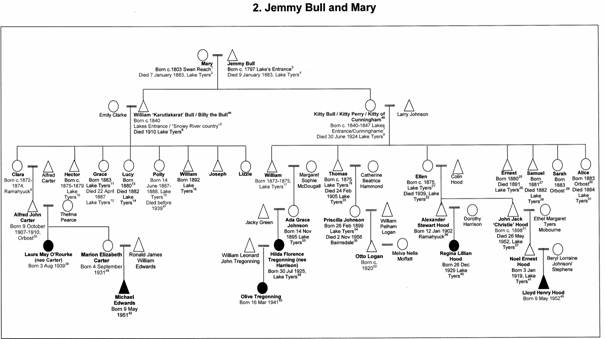
97 AS2, shown above, illustrates the lines of descent from the apical ancestors Jemmy and Mary Bull. It includes the descendents of Jemmy and Mary’s two offspring, Kitty Bull (also referred to as Kitty Perry, Kitty Johnson and Kitty of Cunningham, and referred to in these reasons as Kitty Perry Johnson) who, according to the genealogy above, married Larry Johnson, and William ‘Karutlakarat’ Bull, also known as Billy the Bull (and referred to in these reasons as such) who, it is claimed, married Emily Clarke. The Gunai/Kurnai and the State contend that both Mary and Jemmy Bull were Kurnai and therefore so too are their descendants. Thus all living descendants represented on AS2 form part of the Gunai/Kurnai claim group.
98 The Kurnai accept the veracity of only one segment of the ancestral set, namely that which represents the descendants of Larry Johnson and Kitty Perry Johnson. This particular line of descent reflects the claim group as defined by the Kurnai in their application. It is in favour of the living descendants of Larry Johnson and Kitty Perry Johnson (with the exception of some people excluded on the basis of law and custom), that the Kurnai claim a native title determination should be made.
99 However, the Kurnai argue that the line of descent which represents the descendants of Larry Johnson and Kitty Perry Johnson is a separate, stand alone ancestral set, and not linked to the other descendants of Jemmy and Mary illustrated on the genealogy, namely those descendants of Billy the Bull. These descendants are not recognised by the Kurnai as being Kurnai, and as a result do not form part of the claim group as defined in the Kurnai application.
100 The Kurnai argued the following grounds as the reasons for the exclusion of the living descendants of Billy the Bull as part of the Kurnai claim group:
1. Jemmy Bull and Mary were not Kurnai.
2. Jemmy and Mary were not Kitty Perry Johnson’s parents. Kitty Perry Johnson’s parents died in the massacres.
3. Kitty Bull and Kitty Perry Johnson are not the same person.
4. Billy the Bull is not the brother of Kitty Perry Johnson.
5. Billy the Bull was from Yass and was a Ngunnawal warrior who was a member of the Waalgalu community with a traditional name of Murangilly. As he was not born on Kurnai country he is not a Kurnai ancestor.
6. Clara Bull was not Kurnai. Clara Bull is not the daughter of Billy the Bull.
Each of the grounds will be considered in turn.
Jemmy and Mary Bull were not Kurnai
101 The Kurnai claim that Jemmy and Mary Bull, the apical ancestor represented in AS2, and parents of Kitty Perry Johnson and Billy the Bull, were not Kurnai. In her oral evidence, Ms Mullett stated:
HIS HONOUR: And Mary and Jemmy: were they Kurnai people?
PAULINE MULLETT: No, your Honour. They were not identified by
mother as being Kurnai as well.
HIS HONOUR: Did she know about them?
PAULINE MULLETT: It was before her time.
HIS HONOUR: Oh, yes, of course, it was, but - - -
PAULINE MULLETT: Yes, of course. And from - from her parents - from her father's passing her the genealogical information and making sure that, because of her seniority of the - of the nation, of the - of our class - clan, it was her responsibility to recognise and to identify who were Kurnai and who were not, and that information is then passed on to the clan group. So it's very well noted that people that are not from here are actually not of our blood and therefore are from other countries, your Honour.
102 The contention of the Kurnai that Mary and Jemmy were not Kurnai is based entirely on oral information to that effect, which Ms Mullett claimed was passed to her by her mother. They have not provided any documentary evidence in support of this contention.
103 By contrast, the State and the Gunai/Kurnai rely on inferences which they claim can be drawn from a number of documentary sources. The primary materials relied upon include the death certificate of Jemmy Bull, which indicates his birthplace as Lakes Entrance, Gippsland, and the death certificate of Mary, which records her place of birth as Swan Reach, Gippsland. Both these documents were registered by John Bulmer, manager of the Lake Tyers Mission at the time. By reference to the location of their births, the Gunai/Kurnai and the State argued that an inference can be drawn that both Mary and Jemmy were Kurnai.
104 Further, the death certificates of both Mary and Jemmy show that they had two children, Billy the Bull and Kitty Perry Johnson. Tindale’s genealogies sheets 4 and 7 show that both those children were Kurnai. On the basis that Kurnai children must have had Kurnai parents, the State and the Gunai/Kurnai argued that it should be inferred that Jemmy and Mary were Kurnai.
Jemmy and Mary Bull were not the parents of Kitty Perry Johnson. Kitty Perry Johnson’s parents died in the massacres.
105 The Kurnai do not accept that Jemmy and Mary Bull were the parents of Kitty Perry Johnson. Ms Mullett gave the following evidence:
PAULINE MULLETT: The - the generation before that, my mother tells me that she does not identify Mary and Jemmy as the parents of Kitty the - Kitty of Cunningham. They could very well have been the parents of William the Bull, my mother said, but her main concern, my mother's, was that they've mixed Kitty of Cunningham to taking her to be another person, and my mother told me that they are two different people, your Honour.
106 In cross-examination by Mr Neal for the State, Ms Mullet went on to say:
MR NEAL: Yes. Now, the Gunai/Kurnai claimants suggest that Kitty Johnson's parents are Jemmy and Mary Bull, and you don't agree with that. Is that right?
PAULINE MULLETT: Correct.
MR NEAL: Have you researched that issue?
PAULINE MULLETT: Yes.
MR NEAL: And the reason that you don't accept them as the parents is what?
PAULINE MULLETT: Because they're the parents of Billy the Bull.
107 Ms Mullett then said that both Larry and Kitty Johnson’s parents died in the massacres:
HIS HONOUR: What about Larry and Kitty's parents?
PAULINE MULLET: They died in the massacres your Honour.
HIS HONOUR: Who were they though?
PAULINE MULLET: My mother did not receive that information, your Honour.
108 The assertion by Ms Mullett that Jemmy and Mary Bull were not the parents of Kitty Perry Johnson is neither supported nor refuted by the other Kurnai witnesses. For example, Mrs Drayton said in chief:
MR SKINNER: Yes, alright. Now, could you go to the next page, which is headed Jemmy Bull and Mary Bull. Were they, Jemmy Bull and Mary Bull, people that you recall your mother speaking about?
CHERYL DRAYTON: No.
109 And then in cross examination:
MR NEAL: Okay. Whether Kitty’s parents were Mary and Jemmy Bull?
CHERYL DRAYTON: I don’t have any knowledge of that.
MR NEAL: Is there – is it the case that you’ve never heard your mother or others knowledgeable talk about that?
CHERYL DRAYTON: That’s – that is correct. I have – mum has not said anything about that.
110 Therefore, the claim that Mary and Jemmy were not the parents of Kitty Perry Johnson is supported only by the claim by Ms Mullett that information was passed to her by her mother to that effect. The Kurnai have not produced any documentary evidence in support of this contention.
111 By contrast, the Gunai/Kurnai and the State rely on the death certificates of Mary and Jemmy, referred to above, both of which indicate that Kitty was the daughter of Mary and Jemmy Bull. The Gunai/Kurnai and the State also rely on inferences which they claim can be drawn from extensive evidence which shows that Billy the Bull was the son of Mary and Jemmy, and that Billy the Bull and Kitty Perry Johnson were siblings. This evidence includes the death certificate of William Bull which records Mary and Jemmy as his parents, and Tindale’s genealogies Sheets 4 and 7 which both indicate that Kitty Perry Johnson and Billy the Bull were siblings. From this evidence the Gunai/Kurnai and the State contend that the Court should be satisfied that Kitty Perry Johnson was the issue of Mary and Jemmy.
112 The State and the Gunai/Kurnai also argue that there is sufficient evidence to refute the assertion that Kitty and Larry Johnson’s parents died in the massacre. Primarily, they rely on the two death certificates, referred to above, which indicate that both Mary and Jemmy died at the age of 80 and 86 respectively of “senile decay”. The Gunai/Kurnai also point to a lack of evidence of ongoing or widespread massacres as late as 1886 to refute the contention that they were killed in the massacres.
Kitty Bull and Kitty Perry Johnson/Kitty of Cunningham are not the same person
113 The Kurnai contended that Kitty Perry Johnson and Kitty Bull are two different people. Ms Mullett gave evidence as follows:
PAULINE MULLETT: Yes. Again, your Honour, I'll explain it. On this diagram [AS2], it shows you the naming of Kitty Bull.
HIS HONOUR: Yes.
PAULINE MULLETT: Kitty Bull is not Kitty Perry.
HIS HONOUR: I understand that.
PAULINE MULLETT: I'm just saying that there are two Kitty - people named Kitty. One was called Kitty Bull - - -
HIS HONOUR: Yes.
PAULINE MULLETT: - - - the other one was called Kitty Perry, Kitty Johnson, Kitty of Cunningham.
HIS HONOUR: But Kitty of Cunningham and Larry Johnson - - -
PAULINE MULLETT: Yes.
HIS HONOUR: - - - had the children that are shown on this diagram.
114 The Kurnai acknowledged that it is possible that Mary and Jemmy Bull had a daughter called Kitty, and indeed that Billy the Bull had a sister called Kitty. They do not accept that they were the same person. This assertion is based on the evidence of Ms Mullett that this information was passed to her by her mother. There is no documentary evidence provided in support of the assertion.
115 The Gunai/Kurnai relied on a number of pieces of evidence which they say point to Kitty Perry Johnson and Kitty Bull being the one person. This includes the death certificates of both Jemmy and Mary Bull, referred to above, which indicate that Kitty Johnson was their issue.
116 Similarly, the birth certificates of two of Kitty Perry Johnson’s children, Samuel and Sarah, informed by Bulmer and Emily Bull, an aunt, record their mother as “Kitty Johnson m.n Bull” and the father as Larry Johnson. The marriage certificates of another of Larry and Kitty Johnson’s daughters, Ellen, who was married twice, also record her parents as Larry and Kitty Johnson.
117 Ms Burbidge, in cross-examination by Ms Mullett, gave evidence to the effect that her investigations had indicated that they were the same person, with different sources recording different surnames. Ms Burbidge stated:
MS BURBIDGE: Yes, there's different sources that have different names. That's why the three of them were put in.
MS MULLET: So you believe that Kitty Bull is the same person as Kitty Perry?
MS BURBIDGE: Yes.
MS MULLET: That Kitty Perry was actually Kitty Bull?
MS BURBIDGE: Yes.
MS MULLET: Did you speak with those families with that sort of conflicting information?
MS BURBIDGE: I didn't have - I haven't had anybody tell me that those - those people are conflicting, no.
Billy the Bull was not the brother of Kitty Johnson and was not Kurnai because he was born off country.
118 The Kurnai contend that Billy the Bull was not the brother of Kitty Johnson. Whilst they accept that it is possible that he did have a sister called Kitty, they do not accept that his sister was the Kitty from whom they trace their Kurnai ancestry. Ms Mullett stated:
PAULINE MULLETT: Yes, your Honour…We further discovered, through the
National Library of Australia, that - and just to support what my mother had
told me, was a document indicating that Billy the Bull was from Yass, and he
had a sister called Kitty King.
HIS HONOUR: That he was from Yass and - - -
…
PAULINE MULLETT: And his sister was Kitty King. And they weren't from Gippsland, your Honour.
119 As indicated in this passage, the Kurnai also claim that Billy the Bull was not Kurnai. Rather, they assert that Billy the Bull was from Yass, was a Ngunnawal warrior who was a member of the Waalgalu community with a traditional name of Murangilly. The Kurnai base this conclusion on a screen dump from The National Library of Australia Archives which summarises the journals of a Phillip Johnson (1852-1861). The screen dump stated:
Some of the details Johnson records, such as the fact that Kitty King was the daughter of Billy Bull and that Binalong and Kingiara were part of their traditional country, as well as other parts of the Yass-Booroowa area of the Booroowa River, fill in important details missing from other contemporary records.
120 The Binalong and Kingiara referred to above are in central NSW. The Kurnai rely on this as evidence that Billy the Bull was not Kurnai on the basis that he was from the Yass area. However, there is no basis for concluding that this is a reference to the Kurnai Billy the Bull. The way in which Ms Mullett obtained the information was explained as follows:
HIS HONOUR: But did you find this yourself?
PAULINE MULLETT: Yes.
HIS HONOUR: And what, you, in effect, put in a search for Billy Bull?
PAULINE MULLETT: Correct. You can - your Honour, internet is quite
useful today in technology. You just jot down somebody's name and you come
up.
This methodology confirms the lack of any proper link with the Gippsland Billy the Bull. In any event the screen dump contradicts one of the Kurnai propositions, namely that Billy had sister called Kitty.
121 The Kurnai also rely on a transcript from the launch of a new website – the Indigenous Communities Coordination Trial. At this event, Carl Brown, a Ngunnawal elder, in his welcome to country, was quoted as saying:
I’m a direct descendant for the Ngunnawal warrior who’s [sic] name was King Billy the Bull, or traditionally known as Murajanilly of the Walgalu community between Yass, booroaw, Gunning
122 Based on this evidence, the Kurnai contend that Billy the Bull was not Kurnai, and therefore could not have been the brother of Kitty Perry Johnson.
123 There is, however, extensive evidence provided by the State and the Gunai/Kurnai, which establishes that Billy the Bull and Kitty Perry Johnson were siblings. This evidence, referred to above, includes the death certificates of both Jemmy and Mary Bull, which indicates that Billy the Bull was their son and Kitty was their daughter.
124 There is also evidence that Billy the Bull was a Kurnai from Gippsland. The Gunai/Kurnai and the State say that this can be inferred from the place of his birth. There is, however, some variation between the records as to the place of Billy the Bull’s birth. For example, Billy the Bull’s marriage certificate shows that he was born in Snowy River Country, whilst his death certificate indicates that he was born at Lake Tyers. Furthermore, the birth certificates of his daughters, Grace and Lucy, indicate that he was born at Lakes Entrance. Despite these variations, in all cases his place of birth is recorded as having been in Gippsland. As a result, the State and the Gunai/Kurnai argue that an inference can be drawn that Billy the Bull was a Kurnai.
125 This is further supported by Tindale’s genealogies which were written during his time at Lake Tyers in 1938 and 1939. On sheet 4 Tindale records that Kitty and Billy the Bull were siblings and that Billy the Bull was a full blood Kurnai. It also indicates that Billy the Bull was also known as William of Cunningham. Sheet 7 of these genealogies confirms Tindale’s view that Kitty and Billy the Bull were siblings. The same sheet also indicates that Kitty Perry Johnson was married to Larry Johnson and that both Kitty and Larry were Kurnai.
126 Further evidence relied upon by the Gunai/Kurnai and the State includes the Thomas census of 1860, which records Billy the Bull as of the “Bruthuon Tribe at Swan Reach” and the 1863 Bulmer census, which records the name Billy the Bull under the heading “names of the Swan Reach and Mitchell blacks”.
127 Evidence produced by the Kurnai themselves is also referred to by the State and the Gunai/Kurnai as evidence of the Kurnai identity of Billy the Bull. In Attachment A to the Kurnai application, the Kurnai include a passage which refers to a Jeraeil, an important Kurnai initiation ceremony, which was reconstructed by Howitt in 1884, many years after it had last been practised. Howitt describes the ceremony at length in The Native Tribes of South-East Australia. The passage included by the Kurnai, in their application reads:
In 1884, Howitt assembled the initiated Kurnai, that is those entitled to land tenure under their system of laws. Only a handful attended and the men have been identified by Sue Wesson in her An Historical Atlas of the Aborigines of E Victoria and Far S-E NSW at p. 52 as Big Joe, Billy the Bull, Wild Harry and Larry Johnson. It is a matter of historical record that some of these such as Billy McLeod died without issue, others married outside women. As Kurnai initiates received their totems from their mother’s patriline, their children could not become estate holders and were not regarded as Kurnai. One example is furnished by Billy the Bull. He married outside Kurnai law. Of ten children only three survived infancy and only one, Clara Bull had any offspring…
128 The photographs of this event, shown in Dr Wesson’s An Historical Atlas of the Aborigines of E Victoria and Far S-E NSW and included in Attachment A, includes in its caption reference to Billy the Bull. This passage and the accompanying photograph would appear to be a clear indication that Billy the Bull was an accepted initiated Kurnai man. When questioned on this issue, Ms Mullett said:
MR NEAL: Are you saying to me or are you saying to the Court that at one time the position represented by this document was that Billy the Bull was a Kurnai man, initiated, and now you’re no longer saying that?
PAULINE MULLETT: I’m - no - yes, I’m saying that Billy the Bull is not initiated man.
MR NEAL: But at one time you were saying he was.
PAULINE MULLETT: No, I did not say that. This is not my words.
MR NEAL: Pauline, it would be very fair to you to say, would it not, that you’ve been really unusually hands-on in the making of this application?
PAULINE MULLETT: No, I didn’t make this application. The barrister made this application. We supplied whatever evidence she asked us to do but she put this application together and put it before the Court.
…
MR NEAL: …What I’m saying to you is that when this document was first produced and the application was issued ---
PAULINE MULLETT: Yes.
MR NEAL: ---that you were a person who would have vetted it very carefully. Indeed, you would have given many of the instructions that went into it. And if it represents a position, it’s because it was your position.
PAULINE MULLETT: That’s correct, I would have checked the documents before she put them in but I hadn’t checked the document when it was lodged. It is probably a further amendment we would see in the future when Justice North finished this process.
MR NEAL: So somebody else not authorised by you has introduced a pretty significant piece of evidence that Billy the Bull was an initiated Kurnai man without your noticing it?
PAULINE MULLETT: That’s correct.
MR NEAL: Thank you.
129 Mr Neal then cross-examined Ms Mullet on the question of whether Billy Bull, as identified in Johnson’s journals tendered by the Kurnai Clans as being from Yass, and the Kurnai Billy the Bull were not the same person. In the following exchange Ms Mullett acknowledged that it is possible that they were not:
MR NEAL: On the face of it, they’re just not the same.
PAULINE MULLETT: That’s - that’s correct on the - on the face value of
that information that’s come out of Phillip Pepper book done by a non-Indigenous person.
MR NEAL: Thank you.
130 The evidence of other Kurnai witnesses did little to support this point. In cross-examination by Mr Neal, Ms Hayes indicated that her reason for disbelieving the evidence that Billy the Bull was Kurnai was because she never heard it spoken about by her grandmother. When questioned about how she knows that Kitty Perry Johnson did not have a brother, she stated:
MR NEAL: And how do you know that?
LYNETTE HAYES: How do I know? Because I thought that grandmother Kitty - I didn't know whether she had any brothers and sisters. I thought grandmother - I didn't know that she had brothers and sisters.
131 In cross-examination, Mrs Rose, cast doubt on the assertions made by Ms Mullett. She gave evidence on behalf of the Kurnai as follows:
MR NEAL: And I'm asking you, not about the husband for Kitty, I'm asking you whether Kitty had any brother - - -
REGINA ROSE: Oh, no, I can't answer that.
MR NEAL: Alright.
REGINA ROSE: Can't remember.
MR NEAL: Now, let me see if I can jog your memory at all. We've been given the name William -William the Bull, in fact, or Billy the Bull - - -
REGINA ROSE: Yes.
MR NEAL: - - - as being a brother for Kitty.
REGINA ROSE: Yes, well, that's probably - most - might be right - - -
MR NEAL: Why do you think it's most likely right? Have you - - -
REGINA ROSE: Well, I - - -
MR NEAL: - - - you heard about that?
REGINA ROSE: I heard it, too.
MR NEAL: Yes?
REGINA ROSE: But I'm - - -
MR NEAL: Yes. Who do you think you heard that from?
REGINA ROSE: Oh, the - the others, you know, relatives.
MR NEAL: Yes?
REGINA ROSE: Yes.
132 And then later she said:
MR NEAL: Yes. But your mum - your mum, Dora, did tell you about family - family for your dad.
REGINA ROSE: Yes, she told me who the mother and father were of my dad, yes.
MR NEAL: Yes. Alright.
REGINA ROSE: And grands - - -
MR NEAL: Do you remember whether she spoke about that - that man that I've just referred to, William the Bull, or Billy the Bull.
REGINA ROSE: Yes, she spoke of him, yes. Yes.
MR NEAL: Yes.
REGINA ROSE: Yes.
MR NEAL: And what did she say about him? Can you recall?
REGINA ROSE: No, not really.
MR NEAL: Do you know whether she - - -
REGINA ROSE: But she spoke well of him.
MR NEAL: That's good to hear. Do you know whether she spoke of him as being related to - to Kitty, being the brother for Kitty?
REGINA ROSE: Well, yes, she did mention that to me.
133 Furthermore, the evidence of both Mrs Drayton and Mrs Hood-Finn was not clear on the issue. Mrs Drayton said:
HIS HONOUR: Yes, Kitty, are you aware of whether Kitty had a brother or not?
CHERYL DRAYTON: Don't know.
HIS HONOUR: You don't know that?
CHERYL DRAYTON: No.
134 Mrs Hood-Finn said:
MR WILLIS: And she had a brother Billy; have you ever heard of her, of
him, I should say?
MARION-FLO HOOD-FINN: Yes. I think I've - I don't know. I've read
about, just can't think straight.
Clara Bull is not the daughter of Billy the Bull. Clara Bull is not Kurnai.
135 Ms Mullett said in her oral evidence:
PAULINE MULLETT: Clara Bull. She [my mother] remembers that woman at Lake Tyers as a young girl.
HIS HONOUR: Yes.
PAULINE MULLETT: I asked her specifically was she of our blood, was she a Kurnai descendant. She said “No”.
136 In support of this assertion, Ms Mullett points to evidence which, she claims, indicates that the parentage of Clara is ambiguous. This includes first that Clara was not listed on the death certificate of Billy the Bull as his offspring, and second that Clara was described on the death certificate of a no-named child to Billy the Bull and Emily Clarke as that child’s half-sister. By implication, the Kurnai claim that it is questionable whether Clara was the daughter of Billy the Bull (whilst maintaining that Billy the Bull was also not Kurnai).
137 Whilst the State and the Gunai/Kurnai concede the evidence referred to above, both contend that there is sufficient evidence to conclude that Clara was the daughter of Billy the Bull. In the alternative, they contend that Clara’s Kurnai status can also be traced through her mother, Emily Clarke. Such a course proves unnecessary however, as there is sufficient evidence to warrant a finding by the Court that Clara was the daughter of Billy the Bull.
138 First, the evidence which points to Clara being a half-sister of Billy the Bull and Emily Clarke’s other children is contradicted by Billy the Bull and Emily Clarke’s marriage certificate, which indicates that they were both childless when they married. Similarly, there is other evidence which points to her being the sister of the other children of Billy the Bull and Emily Clarke, including Aboriginal Station Lake Tyers List No 5 (26 May 1921) as well as Leason’s The Last of the Victorian Aborigine which records Clara as the sister of William and Hector Bull.Such evidence makes it unlikely that Clara was the child of a former union.
139 Second, a number of documents indicate that Clara was the daughter of Billy the Bull. This includes Clara Bull’s marriage certificate to George Hunt, which records her parents as Billy Bull and Emily Clarke. Tindale also shows Clara as the daughter of Emily Clarke and Billy the Bull on his sheet 4. Furthermore, Leason, in The Last of the Victorian Aborigines writes:
21. HUNT, Mrs Clara (nee Bull). Born at Ramahyuck 1872; daughter of William the Bull, of Cunningham, and Emily Clarke, of Ramahyuck;
140 Finally, the State also pointed, in cross-examination of Ms Mullett, to the statements referred to above made by the Kurnai in their application which suggest that Clara was the daughter of Billy the Bull as well as indicating that Billy the Bull was an initiated Kurnai man. In Attachment A, the Kurnai state:
It is a matter of historical record that some of these such as Billy McLeod died without issue, others married outside women. As Kurnai initiates received their totems from their mother’s patriline, their children could not become estate holders and were not regarded as Kurnai. One example is furnished by Billy the Bull. He married outside Kurnai law. Of ten children only three survived infancy and only one, Clara Bull had any offspring.
141 It would appear therefore that it was, at least initially, accepted by the Kurnai that Clara was the daughter of Billy the Bull.
142 In the course of her cross-examination of Dr Morton, and well after the Kurnai had closed their case, Ms Mullett sought to tender further evidence with respect to Clara Bull. At that time, the State and the Gunai/Kurnai were granted liberty to file further affidavits with respect to that evidence if they thought it necessary. In the event, the affidavit affirmed by Belinda Guest regarding this evidence was filed. She identified the document relied on by the Kurnai as a Family History Report 2. The Family History Reports were generated from the genealogical database compiled by NTSV.
143 According to Ms Guest, Family History Report 2 shows the direct descendants of Jemmy Bull. In her affidavit, Ms Guest states that the direct descendants of Jemmy Bull “are identified in bold type and by the use of a code which appears to the left of the relevant names”.
144 Two things emerge from Ms Guest’s analysis of this document. First, Clara Bull is identified in bold, as a descendant of Jemmy Bull. Second, upon close analysis of the code, Ms Guest states the following:
18. Taking the second entry in relation to Clara Bull as an example, it is clear that the various elements of the code ‘(3) 1.1.2c f.’ have the following meanings:
· The ‘(3)’ indicates the 3rd generation, with Jemmy Bull being the first generation;
· The first ‘1’ refers to Jemmy Bull, Clara Bull’s father’s father;
· The second ‘1’ refers to Clara Bull’s father, William ‘Karitlakarat’ Bull;
· The ‘2’ refers to the Clara being the 2nd born child of her parents;
· The ‘c’ refers to Clara’s 3rd husband, Alfred Carter;
· The ‘f’ refers to the fact that Clara Bull was female.
145 This evidence therefore supports the case that Clara Bull was the daughter of Billy the Bull and that they are all descended from Jemmy Bull.
Conclusion concerning AS2
146 The evidence in this proceeding establishes that the sources relied upon to construct AS2 are reliable. I find that AS2 reflects the historical descent from Mary and Jemmy Bull. In particular I find that Billy the Bull was the son of Mary and Jemmy and the sister of Kitty Perry Johnson, who married Larry Johnson. I also find that Clara Bull was the daughter of Billy the Bull. Thus, the basis on which the Kurnai reject the living descendants represented in AS2 as Kurnai is not made out.
Ancestral Set Six
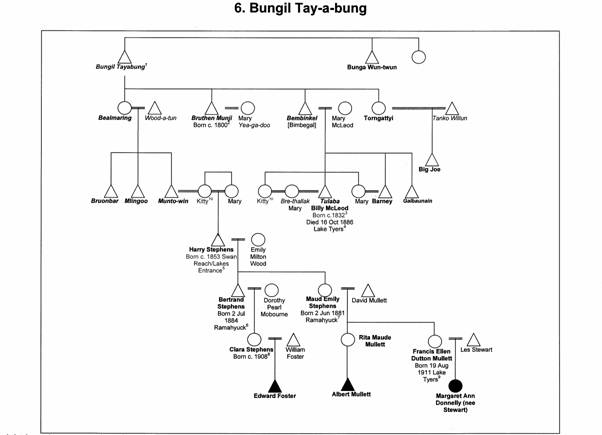
147 AS6 illustrates the descendants of the apical ancestor Bungil Tay-a-bung. A number of the descendants of this ancestor are living today, all of whom form part of the Gunai/Kurnai native title claim group and are considered by the Gunai/Kurnai to be rightful native title holders for Gippsland.
148 The Kurnai accept the veracity of a number of aspects of AS6, including that Bungil Tay-a-bung himself was Kurnai. Ms Mullett stated in her oral evidence:
PAULINE MULLETT: Bungil Tay-a-bung was the only identified ancestor to us, and we say, yes, he was clearly an identified Kurnai ancestor.
149 Bungil Tay-a-bung’s Kurnai identity was also accepted in the letter dated 13 November 2007 from solicitors then acting for the Kurnai, Waters Timms, to Native Title Services Victoria. This letter also accepted the Kurnai identity of a number of other descendants of Bungil Tay-a-bung represented in AS6. It read in part:
Our Client accepts that the following ancestors are Kurnai ancestors in relation to the claim area:
Number 6: Bungil Tay-a-bung
In addition, Belmearing, Bimbegal and Billy “Tuleba’ McLeod are Kurnai, but they [the Kurnai Clans] do not accept that the descendants of Bimbegal are Kurnai. They say the evidence is equivocal as to whether Harry Stephens, who it is asserted was the son of Munto-Win, son of Belmearing, was Kurnai. Tindale refers to Harry Stephens as “fb Bidewal”. Billy Tuelba has no issue.
150 Based on the content of this letter, coupled with the oral evidence of Ms Mullett regarding the Kurnai identity of Bungil Tay-a-bung, the tribal identity of Belmearing and Bimbegal is not in dispute.
151 The tribal status of Billy “Tuleba” McLeod however remains ambiguous. On the one hand, the Waters Timms letter appears to accept that Billy was Kurnai. On the other hand, it appears to refute the contention that Bimbegal’s descendants - of which Billy is one - were Kurnai. Ms Mullett said of Billy McLeod in her evidence:
PAULINE MULLETT: The Kurnai men was Barney and Billy McLeod Tubala.
152 It would appear therefore, despite the apparent contradiction in the Waters Timms letter, that it is accepted by the Kurnai that Billy McLeod was a Kurnai. This fact is largely academic however, as it is accepted by both the Gunai/Kurnai and the Kurnai that Billy McLeod had no issue, and therefore has no living descendants.
153 The remaining disagreement between the Kurnai and the Gunai/Kurnai regarding AS6 relates to the second line of descent, through Bealmaring. In particular, it is not accepted by the Kurnai that Harry Stephens was a Kurnai, and therefore not accepted that those people represented on AS6 as the descendants of Harry Stephens are Kurnai. In particular, the Kurnai make the following assertions about the tribal identity of Harry Stephens:
1. Harry Stephens was not a descendant of Bungil Tay-a-bung. The evidence as to Harry Stephen’s parentage is not conclusive.
2. Harry Mutton and Harry Stephens were the same person. As Harry Mutton’s father was Peter Mutton, Harry Stephens cannot have been Kurnai.
3. Harry Stephens was a Bidawal. Harry Stephens was from Monaro.
4. Harry Stephens was a cannibal and therefore cannot have been Kurnai.
5. If Harry Stephens was a Kurnai, he would have been included on the Bulmer censuses.
154 In order to prove that the living descendants of Bungil Tay-a-bung represented on AS6 are not the rightful native title holders for Gippsland, the Kurnai sought to show that Harry Stephens was not Kurnai. Each of the above contentions will now be addressed in turn.
Harry Stephens is not a descendant of Bungil Tay-a-bung/The evidence as to Harry Stephen’s parentage is not conclusive.
155 The Kurnai argue that Harry Stephens is not a descendant of Bungil Tay-a-bung because the evidence is equivocal as to whether Harry Stephens was the son of Munto-win. In early evidence, Ms Mullett first contended that Harry Stephens was the son of Munto-win, but that Munto-win was not Kurnai. She said:
PAULINE MULLETT: Harry Stephens is not - is the blood of Munto-win, who's not Kurnai. Barney is the Kurnai man. Mary's first husband, Barney, dies, but Harry Stephens is the son of Mary, but not the son of Barney, who is Tubala's brother. So therefore Harry Stephens comes off the line of Mary and another identified person on the other side, Munto-win.
156 However, later on in her evidence Ms Mullett accepted that Munto-win was Kurnai. She said:
MR NEAL: Yes, I was - in terms of the status as Kurnai was relying on the Waters Timms’ letter of the I think 13 November which has an admission in respect of Belmearing, Bungil Tay-a-bung and others, and that’s - I was just proceeding on that basis. So in any event, Bungil Tay-a-bung has a daughter called Belmearing who marries (Muttatun) and I think your evidence to the Court has been that Muttatun was also Kurnai?
PAULINE MULLETT: That’s correct.
MR NEAL: And if you look down to their children.
PAULINE MULLETT: Yes.
MR NEAL: You have Munto-win as one.
PAULINE MULLETT: Yes.
MR NEAL: And it would necessarily follow that Munto-win was also Kurnai.
PAULINE MULLETT: Yes.
157 Then later, she said, in no uncertain terms:
PAULINE MULLETT: Munto-win is Kurnai; Harry Stephens is not.
158 Having accepted that Munto-win was Kurnai, Ms Mullett then retracted her earlier acceptance that Harry Stephens was the son of Munto-win. She first stated, in examination in chief:
PAULINE MULLETT: … Harry Stephens is not a Kurnai, your Honour, like I've stated, my mother clearly tells me this, because she remembers the Stephens, Harry Stephens, and she tells me that Harry Stephens is from over New South Wales, if you like me to put it in that perspective, your Honour. And it is clearly - she said there is clear evidence that Harry Stephens is not of bloodline lineage to Bungil Tay-a-bung, who is the identified Kurnai.
159 In cross-examination however, Ms Mullett first appeared to accept that Harry Stephens was the son of Munto-win and then went on to deny it. She stated:
MR NEAL: Now, staying with that line, you have - it appears Munto-win marrying Kitty.
PAULINE MULLETT: That’s correct.
MR NEAL: And then Munto-win marrying Mary.
PAULINE MULLETT: Mary, which is her sister.
MR NEAL: Yes. Well, there are two marriages at least.
PAULINE MULLETT: That’s correct.
MR NEAL: And the product of the marriage is Harry Stephens.
PAULINE MULLETT: That’s correct.
MR NEAL: Now, if Munto-win is the father of Harry Stephens, it should
follow that Harry Stephens himself is a Kurnai.
PAULINE MULLETT: No, he’s not.
MR NEAL: Well, just accept the idea from me for the moment, in principle,
that if Munto-win is Kurnai that his son is Kurnai.
PAULINE MULLETT: No.
MR NEAL: If it is his son.
PAULINE MULLETT: If it is his son.
MR NEAL: Okay. So we agree about that much. Then the question might be,
is it his son?
PAULINE MULLETT: No.
160 Ms Mullett explained the position thus:
MR NEAL: Okay. Now, in saying that, do I understand your position to be this: that Harry Stephens is not a Kurnai person?
PAULINE MULLETT: That’s correct.
MR NEAL: And by going backwards, if you like, he can’t have had a Kurnai father?
PAULINE MULLETT: That’s correct.
MR NEAL: And therefore Munto-win’s not his father?
PAULINE MULLETT: That’s correct.
161 Ms Mullett has therefore accepted, at various stages of her evidence, both that Munto-win was Kurnai and that Harry Stephens was his son. Nevertheless, she continued to deny that Harry Stephens was Kurnai.
162 The Kurnai base their views on the parentage of Harry Stephens on a number of pieces of information. The primary piece of information, according to Ms Mullett, was the oral evidence passed to her by her mother. She stated:
PAULINE MULLETT: My mother told me that Harry Stephens came from New South Wales. That's all she told me. Didn't recognise who his parents were, but said he wasn't a Kurnai man. Further on, her evidence was then supported through the recordings of people like Tindale, who's recorded that family and spoke to them, and they told him he was from Bidawal.
163 However, as indicated in the above statement, the Kurnai also relied on documentary evidence as proof of the tribal identity of Harry Stephens. This evidence includes reference by Tindale on sheet 5 of his genealogy to Harry Stephens being Bidawal, as well as evidence which they said indicated that Harry Stephens was a cannibal. As cannibalism was not an accepted Kurnai practice he could not have been Kurnai. The Kurnai also contended that the absence of reference to Harry Stephens on the Bulmer censuses is evidence that he was not a Kurnai. The reliability of this evidence is outlined in detail below. Before looking at this evidence however, it is useful to first analyse the evidence before the Court as to the parentage of Harry Stephens.
164 Both the Gunai/Kurnai and the State have accepted that there is some ambiguity as to the parentage of Harry Stephens. The State submitted that there are two possible fathers for Harry Stephens, the first being Munto-win and the second being Barney. Both these respondents argued however, that there is sufficient evidence to reach the conclusion that Munto-win was the father of Harry Stephens. The confusion, they contended, is the result of two factors. The first is made clear by Bulmer, who stated in his correspondence to Howitt of 12 April 1899 that “a man of course may only have one father but he might have ½ doz tribal fathers and mothers”. The second issue is the fact that Munto-win had two wives, Kitty and Mary. Following the death of Munto-win, Mary then married Barney. As a result, the State and the Gunai/Kurnai contended that there is some confusion as to whether Harry Stephens was the son of Munto-win and Barney became his step-father, or whether Barney was his actual father. Nevertheless, they contended that both Munto-win and Barney were Kurnai, and that therefore it must be accepted that Harry Stephens was Kurnai.
165 In support of the contention that Munto-win was the father of Harry Stephens, the State first relied on notes by Howitt, in which he stated both that “The name of Harry Stephens father was Mundowin” and also that “Harry Stevens father was Birrark”. Furthermore, correspondence from Bulmer to Howitt dated 25 April 1899 stated that “Birrarark was the father of Harry Stephens by his wife Dookalanern who afterwards married Barney his stepfather”. This letter appears to correct an earlier letter from 12 April 1899 in which Howitt suggested that Barney was the father of Harry Stephens.
166 The State then pointed to Howitt The Native Tribes of South-east Australia, (1904, p392), which indicated that Munto-win was Birrarark at the time. It stated:
When the whites first came into Gippsland in 1842 the following were the Birrarks, of whom there was one in each clan…
(2) Mundauin at Bruthen-munji, that is, of the Bruthren division of the Brabralung clan.
Thus, the Court should be satisfied, it was argued, that Munto-win was the father of Harry Stephens.
167 In addition, the State and the Gunai/Kurnai identified a number of sources produced by Fison. The Reverend Lorimer Fison was a Methodist minister and anthropologist who worked closely with Howitt. Many of his documents point to Munto-win as the father of Harry Stephens. The first of these, Memorandum D, indicates on a genealogy that Harry Stephens was fathered by Munto-win, and states that “Muntowin has two wives, Mary and Kitty, who were sisters. He has no children by Kitty. By Mary he has two sons, Toby 19 and Harry 20 Stevens”.
168 In her oral evidence, Dr Wesson agreed that Munto-win was Harry Stephens’ father, despite her earlier view that Harry was fathered by Barney. She stated:
DR WESSON: At the time that I wrote the Atlas [her earlier work] it was my, I think that my understanding was that Harry Stephens' father was Bunadine, but since, through this Court I've actually seen new information that shows pretty strongly that Harry Stephens' father was Mundo-win, and that Barney Bunadine was his step-father, his mother's second husband.
169 Apart from Howitt’s letter dated 12 April 1899, which was later corrected by him, the other evidence supporting the view that Barney was Harry Stephens’ father was Harry Stephens’ marriage certificate to Emily Woods which records his parents as ‘King Barney and Mary, wandering aborigines”.
170 It was submitted that the weight of evidence warrants a finding that Munto-win was the father of Harry Stephens. Nevertheless, as the State submitted, whether or not Harry Stephens was the son of Barney or Munto-win is largely academic because the Kurnai accept that both of them are Kurnai and as a result, Harry Stephens must also be Kurnai.
171 Despite this evidence, the Kurnai maintained that Harry Stephens was not Kurnai. Each of their contentions in this regard will now be examined.
Harry Mutton and Harry Stephens are the same person. As Harry Mutton’s father was Peter Mutton, Harry Stephens cannot be Kurnai.
172 In her cross-examination of Dr Wesson, Ms Mullett appeared to suggest that Harry Mutton and Harry Stephens were the same person. She drew Dr Wesson’s attention to the Thomas census list from 1853, which identifies a Harry Mutton with a mother Mary Mutton and father Peter Mutton. From this, Ms Mullett appeared to suggest that it could be concluded that Harry Stephens was the son of Peter Mutton. The basis seems to be the suggestion that Harry Mutton and Harry Stephens are the same person. However, the Kurnai have provided no evidence that there is any connection between the Harry Mutton identified on the Thomas census and Harry Stephens. Dr Wesson made the point:
DR WESSON: Well I haven't yet seen anything to connect Harry Stephens and Harry Mutton so I find it difficult to comment on your point.
Harry Stephens was a Bidawal. Harry Stephens was from Monaro.
173 The Kurnai contend that Harry Stephens was a Bidawal man, and not a Kurnai. They base this assertion on Tindale’s ascription of Harry Stephens as Bidawal in one of his genealogies. Both the State and the Gunai/Kurnai argue that this ascription flies in the face of the extensive evidence outlined above, which points to Harry Stephens being the son of the Kurnai man Munto-win.
174 Furthermore, the State and the Gunai/Kurnai pointed to a number of inconsistencies with respect to Harry Stephens even in Tindale’s materials. For example, sheet 5, which, as the Kurnai stated, indicates that Harry Stephens was Bidawal, also stated that he was “of E. Gippsland near Snowy River”. The Gunai/Kurnai contended that, because the Snowy River largely runs through Kurnai country, these two factors are inconsistent. Similarly, on sheet 4, Tindale indicated that Harry Stephens was both “f.b” and “of Ramahyuck”, again in Kurnai country. Sheet 4 makes no reference to his tribal affiliation. Whilst it is true that Tindale’s identification of Harry Stephens supports the view of the Kurnai, it would appear to be an anomaly, inconsistent both with the other records made by Tindale himself and also the other evidence already referred to above that points to Harry Stephens being a Kurnai man.
175 In addition, the Kurnai contended that Harry Stephens was from Monaro country, in New South Wales. This submission is inconsistent with the Kurnai claim that Harry Stephens was Bidawal. Nevertheless, as the passage extracted at [162] shows, this was the position which Ms Mullett took.
176 No documentary evidence was produced in support of this point. There is, however, some evidence to contradict the argument. First, Harry Stephens’ marriage certificate to Emily Woods indicates that Harry Stephens was born at Swan Reach, in Kurnai country, and the birth certificates of Harry Stephens’ children Fanny and Frederick indicate the same. Both record his date of birth as 1853.
Harry Stephens was a cannibal and therefore cannot be Kurnai.
177 The Kurnai contend that Harry Stephens could not have been Kurnai, because of a reference to a Harry in Brough Smyth’s The Aborigines of Victoria. The passage recounts Howitt’s account of cannibalism, informed by a “Long Harry” also known as “Toorl-bourn” or “Bungil Wunkin”.
178 By inference, the Kurnai claim that Harry Stephens could not have been Kurnai as the Kurnai did not practice cannibalism on other Kurnai. Ms Mullett said of this evidence:
PAULINE MULLETT: It just states that we believe that Harry Stephens was a Monaro; Monaro people were known to be cannibalisms, they eat their own enemies, their own people, and we believe that Harry Stephens is from that group.
179 Both the Gunai/Kurnai and the State said that there was no evidence from which it can be inferred that Long Harry and Harry Stephens are the same person. Indeed, there is no evidence that Harry Stephens was ever known by either of the alternative names given to Long Harry. When put to Ms Mullett in cross-examination, she conceded as much in the following exchange:
MR NEAL: Righto. Well, to the extent that this document could be identified with Harry Stephens, do you say in fact it does identify Harry?
PAULINE MULLETT: It identifies a Harry, but I don't know if it's the same
Harry.
MR NEAL: Okay.
If Harry Stephens was a Kurnai he would have been included in the Bulmer Census of 1863.
180 The Kurnai submitted that, if Harry Stephens was a Kurnai, he should have been included in Bulmer’s 1863 census. They contended that, because Barney and Mary were both listed on the census, Harry Stephens should have been.
181 However, there are a number of references to a person who may be Harry Stephens in Bulmer’s census. The first of these occurs in the 1863 census, under the title “Swan Reach and Mitchell Blacks”. Bulmer listed Barney and his wife “Duckallanern” and beside them states “Mr Harvey”, or “Mr Harrey” and then “- boy”. Furthermore, down the same list, Bulmer makes mention of a “Harry young man”. Whilst it is unclear whether these refer to Harry Stephens, it is not possible, the State contends, to claim that no record of Harry exists on the Bulmer censuses. Ms Mullett conceded as much in cross examination as follows:
MR NEAL: Now, I'm not sure that I'm understanding you correctly, but are you saying look, these are the people who are in the genealogy as being relevant to the line generally; they're here, why isn't Harry here? Is that how you're putting it?
----
MR NEAL: Yes. Yes.
PAULINE MULLETT: Yes, Harry's at the bottom, but what I'm saying is that there's a few of these Census reports and Harry pops up later, but he's not always consistent with Kitty and Barney.
MR NEAL: He's not shown - - -
PAULINE MULLETT: He's there on the Census list for the Swan Reach Mitchell blacks he is; I think he's ancestor, he's number 25?
MR NEAL: Okay.
PAULINE MULLETT: It's a Harry, is that how you would see that, it's a Harry?
MR NEAL: Mr Harry boy?
PAULINE MULLETT: Yes, under Barney's wife.
MR NEAL: Well, yes.
PAULINE MULLETT: It doesn't say that it's Barney's son.
MR NEAL: No.
PAULINE MULLETT: It just says Harry, Mr Harry boy.
MR NEAL: Yes.
PAULINE MULLETT: What I understand it could be the son of Barney's wife, but may not be the blood of Barney.
MR NEAL: Well, there are endless possibilities, but I understood your first proposition to have been Harry's not on the list.
PAULINE MULLETT: He's not on some of the, the Census list you're showing me here he is.
MR NEAL: Yes.
PAULINE MULLETT: But on some of the Censuses no, he's not.
HIS HONOUR: Well, he's only on this one if Mr Harry - - -
PAULINE MULLETT: Yes, that's correct.
HIS HONOUR: - - - which I actually would rather read as Mr Harvey.
PAULINE MULLETT: Yes, I thought it was too, but I think you're wrong, your Honour; I think it's Mr Harry.
MR NEAL: We don't suggest this is ever going to be put as a conclusive, your Honour, but if you go over the page to 44 - - -
HIS HONOUR: Yes, 44 is Harry young man.
PAULINE MULLETT: Yes.
MR NEAL: Now, it's probably not the time to have the debate about the ultimate significance of the list; I was really just trying to understand a global position from the witness.
PAULINE MULLETT: Yes.
MR NEAL: And that may be Harry Stephens?
PAULINE MULLETT: Could be.
MR NEAL: Okay, well thank you.
182 It is possible that the reference to Harry in this document is a reference to the son of Mary, who married Barney after the death of Munto-win. However, whatever the census records reveal they do not reduce the force of the evidence which indicates that Harry Stephens was Kurnai.
Conclusion concerning AS6
183 The Kurnai argument that Harry Stephens was not Kurnai cannot reasonably be sustained on the evidence. Whilst some of the Kurnai submissions had a basis in certain inconsistencies in the public records, when those records are examined as a whole there is no real doubt that Harry Stephens’ father was a Kurnai. This conclusion means that the living descendants, Albert Mullett, Edward Foster and Margaret Donnelly, cannot be excluded from the native title holding group if one accepts the laws and customs asserted by the Kurnai. The fact that the Kurnai application does exclude these ancestors means that, for that reason alone, the application by the Kurnai for a determination on the basis sought cannot succeed.
Further considerations
184 The conclusions reached in relation to either AS2 or AS6 are sufficient to determine the application. However, it is desirable to record in briefer terms a number of other reasons why the Kurnai application must be dismissed.
185 The evidence of Dr Wesson, Ms Burbidge and Dr Morton establish that the remaining ancestral sets are an accurate reflection of the source material used to construct them. The evidence of Dr Wesson satisfies me that the sources used are generally accurate, particularly when used in association as they were. Consequently, the ancestral sets establish the ancestry of the people shown on those genealogies. The Kurnai have not established that the ancestral sets fail to evidence the ancestry portrayed in them. Thus the Kurnai claim that some of the ancestral sets did not properly reflect historical ancestry is rejected.
186 The Kurnai argued that certain of the ancestral sets depicted a link to Kurnai ancestors where the linkage was broken by operation of certain exclusionary traditional rules such as the exclusion for living off country, the exclusion for identifying with the Gunai/Kurnai application, or the exclusion of non-Kurnai children adopted by Kurnai parents. The evidence of these rules given by Ms Mullett, Mrs Hood-Finn, and Mrs Lynette Hayes, was inconsistent. Some of the evidence was contradicted by the other Kurnai witnesses, Mrs Rose and Mrs Cheryl Drayton. It is hard to accept that Kurnai are excluded from membership if they support the Gunai/Kurnai application when members of the Kurnai claim group are members of the corporation established to hold native title rights in favour of the Gunai/Kurnai. Dr Morton’s evidence which was based on the wide literature concerning the Gippsland Aboriginal people did not support the exclusionary rules propounded by the witnesses. The evidence of the supposed exclusionary rules was in such disarray that it cannot be relied upon. Consequently, the attempt by the Kurnai to exclude certain ancestors by operation of these alleged rules must fail.
187 I accept Dr Morton’s view that the difference between the words “Gunai” and “Kurnai” do not reflect a difference in the grouping of Gippsland Aborigines entitled to a determination of native title. Rather, they stem from the same root which referred to the original Gippsland aboriginal society. The later usages do not provide a basis to exclude the Gunai/Kurnai as the proper people for Gippsland as the Kurnai would contend.
188 In one respect the evidence of the Kurnai witnesses was consistent. All claimed that they were linked by a common bloodline to Larry Johnson and Kitty Perry Johnson. It was, however, clear throughout their evidence that the bloodline identifier concerned their family affiliation. It was the answer to the question “who is my family?” This was the sense and the context in which Euphemia Mullett, the main claimed source of this identifier, seems to have referred to bloodline relationships. However, this is not the level at which the relevant native title holding group is ascertained. The family identification is something akin to local governance units referred to by Dr Morton in his evidence about the traditional structure of the society of Gippsland Aborigines. Indeed, he said that conflict between groups within that society was a characteristic of its history. The present day disharmony between the Kurnai and the Gunai/Kurnai is a reflection of that same characteristic of the particular society. But, in Dr Morton’s opinion, the traditional land holding group was at the level of the conglomeration of the types of local group typified by the Kurnai people. I accept his view, based as it was on a considerable body of public records and respected anthropological, ethnographical and historical writings.
189 Indeed, in many respects the Kurnai case was a case focused on upholding the separate identity of the family of Ms Mullett – the Hood family. The elements which need to be established in an application for a determination of native title were left largely unaddressed. There was thus no cohesive body of evidence which sought to establish a society existing at sovereignty or to establish a present day society with the necessary continuity. There was almost no evidence about laws and customs which linked people with the land and waters. Whilst this application was not the vehicle for the Gunai/Kurnai to prove their entitlement to a determination of native title in favour of the wider Aboriginal society of Gippsland, the evidence, particularly from the voluminous historical and anthropological sources gave a clear indication of a strong basis for such an entitlement.
190 Several important observations should be made at this point. Some Kurnai witnesses expressed concern, or else it was implicit in their evidence, that if the Court rejected the application then that judgment would rob them of their identity as Kurnai people. This is not the case. The identity which the Kurnai witnesses exhibited is a deeply felt sense of their place in the world relative to other people. The judgment of the Court cannot change that personal perception. Nor is it the function of the Court to do so. The Court must determine whether there is a particular grouping of people for the purposes of holding native title. The elements required by the law to constitute the group may or may not correspond with a particular personal identity claimed by people. Thus, the Kurnai will be Kurnai whether the Court determines that the Kurnai grouping is the native title holding group or not. Personal identity is one thing, being part of a native title holding group is not necessarily the same thing.
191 This discussion gives rise to a related point. The State, in particular, sought to explain the reason for the cohesion between the Kurnai and the antagonism of the Kurnai to the larger Gippsland Aboriginal community. It is sufficient for the purpose of this application for the Court to determine that the Kurnai have not established that they are the native title holding group for Gippsland without establishing the reasons why the Kurnai regard themselves as separate from the other descendants of Gippsland Aboriginal ancestors. On the other hand, to identify such a reason or reasons may give some support to the conclusions reached. The State suggested that the independence of the Kurnai may stem from the community established by Pop Stewie at Jackson’s Track. On the uniqueness of the people associated with Jackson’s Track Ms Mullett said:
PAULINE MULLETT: Yes, anybody could come to Jackson’s Track; it was owned by my father, because he allowed Aboriginals to come onto the property, but when it came to the camp where my grandfather was he was very particular on who came into the camp.
MR NEAL: So that's Pop Stewart Hood?
PAULINE MULLETT: Yes.
MR NEAL: He was very particular about who was in his immediate camp?
PAULINE MULLETT: Yes, that's correct.
MR NEAL: Alright. And are you saying that he limited his camp to people whom he regarded as the, of the blood?
PAULINE MULLETT: That's correct.
MR NEAL: He, again judging from the book [written by Ms Mullett’s father], he was a particularly independent man?
PAULINE MULLETT: Correct.
MR NEAL: Who rejected the white mission system?
PAULINE MULLETT: Correct.
MR NEAL: And rejected generally relying on the white society? He didn't like to live that dependent lifestyle?
PAULINE MULLETT: He didn't rely on the white society.
MR NEAL: Yes?
PAULINE MULLETT: He worked to gain a living as money became the exchange from getting the food; he still lived on the bush tucker and that knowledge, but because he had to work, because the day money changes hands for anything that you might - because they were utilising the general store for food as well.
MR NEAL: Sure, and I understand that, but he was a man who rejected the idea of living in dependent circumstances where you were dictated to, like on a mission?
PAULINE MULLETT: Correct.
MR NEAL: And he'd go out and earn his own daily wage and he could obviously pay for things?
PAULINE MULLETT: Correct.
MR NEAL: Generally speaking, did you have the view that people who were living on your father's property, most of whom were obviously involved in the timber industry, were living a more independent life than the people back on say Lake Tyers mission?
PAULINE MULLETT: Correct.
MR NEAL: And a more traditional life?
PAULINE MULLETT: That's correct.
MR NEAL: More traditional at least in the sense that they weren't subject to white fella laws nearly as much as mission people were?
PAULINE MULLETT: Correct.
MR NEAL: The property, as I understand it, was something of a haven in the sense that it was your father's freehold property and people could go and stay there with his permission obviously, and got some sense of protection from police and Welfare? Not entirely, but perhaps more so than otherwise?
PAULINE MULLETT: That's correct, they were protected from the white authorities.
MR NEAL: Did you perhaps grow up with the view that the people who, the Aboriginal people at Jackson’s Track were really a more authentic sort of Aboriginal people than the ones who were living in the mission system and in the broader community?
…
PAULINE MULLETT: Authentic?
MR NEAL: Genuine.
PAULINE MULLETT: Genuine?
MR NEAL: Yes.
PAULINE MULLETT: Yes.
MR NEAL: And is that the reason why today you prefer, yourself, to live where you are?
PAULINE MULLETT: Yes.
192 This community was set apart from the Aborigines living at the mission at Lake Tyers. They were also set apart from the white community. They had an ethos of individuality and self sufficiency, if not a tinge of contrarianism – characteristics which might be observed in the most vocal advocates of the Kurnai cause among the Kurnai witnesses in this case. This seems a plausible historical explanation for the current disharmony between the Kurnai and the rest of the Gippsland Aboriginal community.
193 The final observation addresses a suggestion made by Ms Mullett that accepting the ancestral sets and the source material upon which they are based over the testimony of the Kurnai witnesses was yet another example of whitefella law preferring the written word, formally recorded by white people, over the oral tradition of the Indigenous people. This is not so. The ancestral sets were compiled in part from sources derived from the Aboriginal people themselves. Tribal affiliations were explained by the Aboriginal residents of Gippsland to the likes of Bulmer, Hagenauer, Tindale and Howitt. But, in any event, to the extent that the testimony of the Kurnai witnesses is rejected, it is not rejected simply because it competes unfavourably with written records. Rather it is assessed as unreliable by reference to the totality of the oral evidence given by all of the Kurnai witnesses.
Disposition
194 If follows from these reasons for judgment that the Kurnai have not established an entitlement to a determination of native title. Hence, their application should be dismissed.
195 The State and the Gunai/Kurnai drew attention to s 67(1) which provides:
(1) If 2 or more proceedings before the Federal Court relate to native title determination applications that cover (in whole or in part) the same area, the Court must make such order as it considers appropriate to ensure that, to the extent that the applications cover the same area, they are dealt with in the same proceeding.
196 They contended that, in order to comply with this provision, the Court should first order that the Kurnai application be consolidated with the Gunai/Kurnai application. It was said that O 29 r 5(a) of the Federal Court Rules would permit consolidation in this instance. That rule provides:
Where several proceedings are pending in the Court, then, if it appears to the Court:
(a) that some common question of law or fact arises in both or all of them;
…
the Court may order those proceedings to be consolidated …
197 Next it was submitted that the Court should then dismiss so much of the consolidated application as represented the issues determined in the Kurnai application. It was said that O 29 r 2 of the Federal Court Rules would allow this. Order 29 r 2 provides as follows:
The Court may make orders for:
(a) the decision of any question separately from any other question, whether before, at or after any trial or further trial in the proceedings; and
(b) the statement of a case and the question for decision.
198 There are difficulties with this proposed course. It is not appropriate to consolidate two proceedings where they are at completely different stages of progress. Further, the circumstances provided for in O 29 r 2 do not apply. There was no separate question raised for determination in this case. Indeed the proposed course seems directed to providing an appearance of having the two applications dealt with in the same proceeding when in substance they have been treated independently.
199 There was good reason for treating the applications independently. That was the wish of the parties. The Kurnai sought a litigated outcome. The Gunai/Kurnai sought to enter into negotiations with the State and not to advance their application whilst those negotiations were continuing. There was reason to think that the Kurnai application was unlikely to succeed, because, it seemed to run counter to the extensive literature which recognised a Gippsland wide Aboriginal society rather than a limited Kurnai society. The State in exercise of its role as guardian of the rights and interests of the people of the State had indicated a willingness to commence negotiations with the Gunai/Kurnai based on investigations into the proper people for Gippsland. The Gunai/Kurnai and Kurnai had access to the report of Dr Morton which lent support to the Gunai/Kurnai case. In these circumstances it was necessary for the Court to provide different management programs for each application.
200 In Kokatha Native Title Claim v State of South Australia [2006] FCA 838 at [5] Finn J said:
The policy informing s 67(1) is plain enough. Fully informed decision-making and finality in respect of determinations relating to the same area are central to it: see also s 13(1) and s 61A(1). This said the section provides no real guidance in making orders under s 67(2) though it is unsurprising that it does not given the varying circumstances that can attend overlap claims. Nonetheless, its purpose seems clearly to be tied to facilitating the orderly and efficient administration of justice where claims overlap …
201 The orderly and efficient administration of justice was served in the case of these two applications by allowing them to proceed in different ways. Section 67(1) does not require the Court to ensure that two or more applications are dealt with in the same proceeding if to do so would be inefficient or would not advance the proper administration of justice. That interpretation would conflict with the obvious purpose of the section. The intent of the section is to require the Court to determine whether it is in the interests of justice that the applications be dealt with in one proceeding and, if the Court so determines, then to require the Court to make appropriate orders to achieve that purpose. The section was not brought into operation in the present circumstances because it was not in the interests of the administration of justice for the two applications to be dealt with in the same proceeding.
202 The result of an order that the Kurnai application now be dismissed will be that the Gunai/Kurnai application will remain on foot and will be resolved either by agreement or by a judicial determination. There will only be one application on foot in relation to the land and waters claimed and the policy of the Act reflected in s 67(1) will be effectuated.
Some concluding observations
203 This case has had some remarkable features which should be referred to before concluding these reasons.
204 The conduct of the Kurnai case has been dominated by Ms Mullett. For much of the case she has conducted the Kurnai side of the proceeding without legal representation. Her knowledge of the ancestors, the history of Gippsland Aborigines, and the evidence led in this case and in the Gunai/Kurnai application is very impressive. Her commitment to and passion for the cause of the Kurnai is absolute. Indeed, in some instances it goes to the point of blindness to the evidence and arguments put against the Kurnai.
205 Whilst there is much to admire in the dedication and application shown by Ms Mullett, there is a darker side to it. By her resolute and unbending pursuit of the Kurnai case, and in the way she has at times conducted it, she has caused unjustified offence, worry, and intense frustration to the Gunai/Kurnai. She has made baseless hurtful allegations about personal histories of some of the Gunai/Kurnai descendants. And yet they have continued to embrace her and hold out to her their principled position that she is a member of the Gippsland Aboriginal community.
206 It is a matter of sadness to the Court that the evident strength of the group of Aboriginal people of Gippsland which has been clear throughout the proceedings, including during the Gunai/Kurnai early and preservation evidence, was not able to resolve the issue through its own internal mechanisms. However, in that they are, of course, no different to the many litigants who pursue their cases to trial. Perhaps it was a particular hope that the matter could be resolved internally because the issue in contention relates to such fundamental issues of identity and long historical grievances and divisions in, albeit from the native title point of view, probably one society.
207 The final word concerns counsel for the State, Mr Neal SC and Mr Willis, and counsel for the Gunai/Kurnai, Mr Keely. No doubt these comments also apply to the solicitors instructing them. They were all faced with not only a case of detail and complexity as well as conceptual difficulty, but for much of the time with an unrepresented opponent who was intensely and fiercely committed to her side of the cause. Ms Mullett had moments of anger and of lack of proper decorum. But, so far as this was observed by the Court, the opposing lawyers were not only tolerant of a sometimes difficult opponent, but went out of their way to assist her. They explained what they were doing in ways designed to allow Ms Mullett to understand the process of the law. Many times they assisted her in finding documents and references amongst the extensive documentary cases on both sides. They ensured by their conduct that the courtroom was a place of respect for all views and for people whether familiar with the ways of the law or not. Of course, no less is expected of the legal profession. But the circumstances were at times confronting and challenging. Consequently, the conduct of the lawyers for the State and the Gunai/Kurnai should be particularly acknowledged. Whilst performing to the highest standards of legal practice, these lawyers did not compromise the quality of the service provided to their own clients.
208 The result of this proceeding is that the application by the Kurnai for a determination of native title must be refused.
| I certify that the preceding two hundred and eight (208) numbered paragraphs are a true copy of the Reasons for Judgment herein of the Honourable Justice North. |
Associate:
Dated: 14 May 2010
Annexure 1 – List of Respondent Parties by category
| 01 Government Interests – State of Victoria |
East Gippsland Region Water Authority
Gippsland Water
South Gippsland Region Water Authority
Southern Rural Water Authority
State of Victoria
West Gippsland Catchment Management Authority
| 02 Government Interests- Commonwealth |
Commonwealth of Australia
| 03 Government Interests - Local |
Alpine Shire Council
Baw Baw Shire Council
East Gippsland Shire Council
Latrobe City Council
South Gippsland Shire Council
Wellington Shire Council
| 04 Land Users 1 |
A & J Morphett Nominees
Ashlin, Walter R & Nenita G
Bairnsdale Archery Club
Beasley, Graeme John and Carol Anita
Bila, Hermann & Pam May
Bilney, Roger John
Boger, David V
Brimee Holdings Pty Ltd
Brooks, Warwick
Brown, Ian
Brown, Ian R
Brown, Martin Robert and Beverly Joan
Bubb, Herbert (estate of)
Carruthers, Penelope Anne
Christine A. Bowen and Thomas Morgan
Code, Grahame
Coleman, Albert F & Marion J
Collingbourne, Robert Arthur Charles
Cook, Anthony Norton Pym
Costanzo, John Michael Martteo
De Voil, Thomas Robin & Philippa Hamilton
Dickinson, TW & CR
DMT Investments Pty Ltd
Downie, Noelene & Clive
Doyle, Carole Margaret & Graeme Arthur
Dubelaar, Jacobus
Edgar, Bruce Kenneth & Virginia Beverly
Feely, Gerald Anthony
Fleischer, DF
Fleming, Brian Charles
Foards Freeholds Pty Ltd
Garner, Frank Allan
Gary Rogers Motors Pty Ltd
Gibbons, John F
Greacen, Jane Helen
Greenhill, William Geoffrey
Harper, Maurice Edward and Silvia Mary
Hartrick, HR (estate of)
Hector McLeod & Robyn Elizabeth Stagg
Hurley, David Michael & Colleen Therese
Keogh, Thomas Maurice & Marion Joyce
Kirton, David Clifford
Lovitt, Martin David and Lorinda Therese
Maron, Jeana Leigh
Matthews, Graham Lesley and Marie Lynette
McCooey, AW (estate of)
McKenzie, Neil Lachlan & Kerry Therese
Mills, Daryl Wayne
Morrell, E.G.
Mt Hotham Alpine Resort Management Board
Mulvany, Thelma Jean
O'Sullivan, Leo Vincent
Pagels, Albert Gordon
Poynton, Albert John Tomlyn
Prictor, Anthony Terrence
Pritchard, Peter Bruce
Purcell, Terrence Arthur & Peggy Evelyn
Reakes, Nigel Keith & Susan
Reddish, HR & CA
Sherar, Glenda Joy
Scripture Union of Victoria
Sonogan, Henry L
Stuart, Kenneth John
Sutherland, Kevin Laurence
Tevet Pty Ltd
Thurlby, HC (estate of)
Treasure, Maxwell John
Turra, J & G
Vaccaro, Ugo & Teresa
Vale, Geoffrey Roger
Voigt, Peter and Wendy
Whelan, Peter Thomas
Whiteley, Patricia Ann
Wilson, Ian Geoffrey & Tana Lorraine
Wilson, Ross
Wise, Peter John & Beverley Anne
Woodbridge, Peter and Lynette
| 05 Land Users 2 (VFF) |
Adams, David Granter
Ah Sam, Albert John and D
Albert, F.T.
Attenborough, Charles Henry
Baldwin, Reginald David & Mary Winifred
Balfour, Davie & Sue Ellen
Barton, Nicholas John and Melvyn
Bennett, John
Betts, DW & TA
Blackshaw, David Robin & Roger Gordon and Watson, Neil Jeffrey & William Hamilton
Blandford, Rory & Percy Brian & Simon Clive
Boulton, Cyril & Ruby Lillian
Bulmer, Willian Ernest
Bye, Samuel John and Kathleen
Chesterfield Pty Ltd
Coates, John R and Janice E
Coleman, P.A. & M.J.
Colin Ivan Trewin Snowy Downs Ltd
Coulson, Margaret Ann
Coverdale, Harold Edward and Janice Nola
Crawford, Maxwell Irving
Cropley, Raymond Searle
Crowe, Edward James
D Trewin & Son
Davies, Judith Haydon
Dent, Peter Gregory
Evans, Phillip John
Ferguson, Anthony and Bernadette
Fiddelaers, Henricus Hubertus Franciscus & Gail
Gallagher, D.C.
Garrow, Eric John and Annette Margaret
Gates, Tanya & Ashley
Geary, Gerald Patrick and Barbara Marie
Gell, John William and Leonie Adele
Gooch, Geoffrey Norman
Graeme Alcara Foard Turner and Michelle Joy Murphy
Gunter, JDS
Heywood, Bruce Alfred & Elsie Faye
Hopkins, Graham Donald and Glenda Janis
Kee, A and Allen, representing Friends of Wongungarra Trust
Kingham, Rex William and Elizabeth Rosamond
Knee, Bruce William and Rae
Knott, Margaret
Kuch, William John (estate of)
Kurrawong Pty Ltd
Lady Ruby Disney Settlement
Lafferty, John Anthony
Laidlaw, Alan Maxwell & Patricia Eileen
Lancaster, S
Lawlor, Simon and Sonia Nicole
Melton Park Pty Ltd
Missen, Andrew Randle and Alison Joy
Morley, Ian Donald and Faye Lorraine
Moyes, Ray & Diane
Nardino, Peter John & Paula Alice
Nicholls, John William
Paynter, Graham Gordon
Peters, Robert Frederick and Carol Margaret
Petersen, G (estate of)
Ramsay, Andrea Christine
Rendell, Clement Allen
Riley, Kenneth Thompson (estate of)
Rodwell, Marjory Jean
Ryson's Creek Stud Pty Ltd
Santucci, Giovanna Santucci C/o Tony Santucci
Stewart, Murray John & Debra Joy
Stringer, Dennis Webster
Stuckey, Joan Margaret
Sykes, RJ, HR, PJ & DN
Tabuteau, Boyd Sylvester and Sandra May
Trewin, DE and TD
Waddell, Rosemary Patricia
Walker, Adrian Hurst
Walker, Robert Anthony & Dianne Elizabeth
Witchell, John Haden and Marie Grace
| 06 Water Rights 1 |
Amsil Pty Ltd
Beazer, Michael & Margaret
Body Corporate CS1156
Bolding, Rachael Yvette Hanora & Dean Lesley
Chartres, J
Clancy, Ian Thomas
Coulton, Kaye Lynn and Margaret
Deane, David
Dunbar, Hugh (estate of)
Gardner, James and Joan L
Goris, Gerard
Guy, D and D
Harrison, Jacqueline Ann and Kate Jessica
Hasthorpe, Trevor
Heaney, Michael David
Hourigan, Margaret Gertje
Knight, Ronald M and Lorraine J
Lansbury, Raymond
Malcholm, Ruth
Marsden, Peter Harris
Murphy, Francis and Margaret Josephine
Neate, Lois Mae and John Kenneth
Onley, LA and SM
Pitman, Robert F and Barbara M
Rogers, Gary Francis
Stevenson, Douglas Frederick
Treasure, Kenneth George Charles and Lynette Joan
Williams, HE and GA
Wood, Jon David
| 07 Water Rights 2 (VFF) |
Anderson, Kevin Joseph and Karen Frances
Bonaccord Ingram Pty Ltd
Bridle, Richard John and Lynne Maree
Broadbent, Alan Robert and Amelia Mary
Chambers, John Sydney
Christensen, Christopher Albert
Clay, Gary J and Trudy K
Cliff, Barry Selwyn and Suzanne Jane
Condron, Allan Desmond, Barbara May and Gary Allan
Crooke, Richard Alister James
Daly, Brian James and Marie Patricia
Dean, KF
Di Marco, Gino
Donahoe, Timothy John and Margaret Mary Jose
Duggan, James Marshall and Peter Francis
Duggan, Peter Francis and Jeanette Marie
Durkin, Sean and Maria
Edgar, Michael and Wendy
Estate of RA Deppeler
Evenden, Reginald Robert
FH Grumley & Co
Goodwin, Kevin John and Beverley Dawn
Greenaway, Albert William, Eric John and Margaret Ann
Heesom, William and Edith
Hillbrich, Bronwyn Hamlyn and Gordon Mark
Hobson, Harold Rex, Hilary, Ronald James, Jennifer Lillian, Peter John and Louana Jane
Hourigan, Ambrose Anthony
Jones, Alexander Dunbar
Kennedy, Charles Hector and Heather Margaret
Killeen, Kevin Francis and Marion Enid
Killeen, Michael D
Kleinitz, Gregory Phillip and Leanne Myrtle
Langskaill, Charles
Lavery, E and BM
Lee, Albert
Logan, James Raymond and Barbara Dianne
Mancarella, P JNR
Matarczyk, Paul
McArthur, Andrew
McCormack, Wallace J and Heather M
McGregor Bolton, Arnold Jack and Marguerita
Morrison, Glenn Alan and Belinda Lucia
Mosley, Jane
Newcomen, Barry Chisholm and Alicen Joan
Newcomen, Evan Owen
Nielsen, Otto Christian and Orla Sigfred
Osborn, Eileen Heather
Ross, Tanya, Nigel, Nicholas, Susan and Haydn
Smith, David Ian and Heather Grace
Snape, Petter Clifford
Stewart, Peter James and Margaret May
Stuart, Kenneth John
Thomson, AW and RC
Warren, Allan Arthur and Susan Gail
White, Lindsay Robert and Fay Lynette
White, Peter Charles Armitstead and Wendy
| 08 Beekeeping Interests |
Cane, Ian Alfred & Robyn Joy
Dedic, Walter
Niklaus, A
Williamson, Stephen Robert
| 09 Telecommunication Interests |
Telstra Corporation Limited
| 10 Forestry Interests 1 |
Alex Demby Timber Co P/L
Auswest Timber
Harris-Daishowa (Australia) Pty Ltd
Midway Pty Ltd
Paper Australia Ltd
Ryan & McNulty Pty Ltd
Victorian Plantations Corporation
| 11 Tourism Interests |
Echidna Walkabout
| 12 Recreational User Interests |
Howard, Gary Michael
O'Reilly, Esmonde John
Pelican Association Inc
Surf Life Saving Association of Australia, Victorian State Centre Incorporated
Yarram Rifle Club
Yinnar South Pony Club
| 13 Public Access 1 |
SPI Powernet Pty Ltd
Hazelwood Power Corporation Pty Ltd & International Power Hazelwood
| 14 Public Access 2 |
Freight Victoria Limited
GasNet Australia (Operations) Pty Ltd
| 15 Public Access 3 |
Airservices Australia
| 16 Indigenous Interests |
Gunai/Kurnai Native Title Claim Group
| 18 Mining Interests 2 |
Australian Gold Mines NL
CBM Resources Pty Ltd
Goldsearch Ltd
Jabiru Metals Ltd
Loy Yang Power
Monash Energy Coal Limited
Mt Wills Gold Mines NL
Orion Gold NL
Robert & John Moreland and Silvester Pazlar
Waygara Mines Pty Ltd
| 19 Mining Interests 3 |
Esso Australia Pty Ltd
HRL Developments Pty Ltd
Plamanco Pty Ltd & VEMCO Environmental Pty Ltd
| 20 Mining Interests 4 |
TRUenergy Yallourn Pty Ltd
| 21 Victorian Commercial Fishing Licence |
A & A Reynolds Pty Ltd
Alcock, Robert James
Allen, Arthur
Anedda, Nicolino
Arendsen, Christopher Richard
Australian Aquaculture Products
Avery, Kenneth Norman
Barrett, John M
Beaulee Pty Ltd
Bell, Keith James
Buck Diving Enterprises Pty Ltd
Carabott, Robert Joseph
Chandler, Gilbert Wayne
Clarke, Neville David
Clyde Thomas Pty Ltd
Cottee, Graeme B
Cripps, Alan Charles
Cripps, Brett Charles
Cripps, Gary Alan
Cripps, Kelvin Wayne
Cunningham, Donald George
Davis, Ross
DB Watson Nominees Pty Ltd
Deftereos, Dimitrios
Dunstone, Raymond Leslie
Empress Pearl Pty Ltd
Extraband Pty Ltd
Fearnley, DL and KF
Fischer, Horst Dieter
Gabes Investments Pty Ltd
Garland, Eugene R
Gary Braid and Awabi Pty Ltd
Goulden, Matthew Charles
Gray, Geoffrey Raymond
Guillot, John C
Haliotis Fisheries Pty Ltd
Hawkins, Kraig
Hoskins, David
Hunt, David Anthony
Hyslop, Ronald Maurice
Ingram Abalone Pty Ltd
J & M Armstrong Pty Ltd
K & C Fisheries Pty Ltd
K and R Bryce and E and R Jones
Kavadas, Gerry
Kavadas, Labro and Afrudite
Kazakas, Tony
Killara River Pty Ltd
Kivelos, Gail
Kivelos, Gloria
Knibbs, William
Laub, Maxwell John and Dianne Patricia
Leckford Pty Ltd
LeMaitre, Peter Mark
M.I. Lee Marine Holdings Pty Ltd
Marriott, Marcus
McAdam, Phillip
Melissakis, Steve
Minehan, John Michael
Mitchelson, Harry Kevin
Mitchelson, Harry Michael
Mollusc Pty Ltd
Mouzakis, Petros
Newman, FC and MAM
Newman, Kevin Ronald
P and D Clarke and G Hutchison
P Welsby Pty Ltd
Pinzone, Joseph Domonic
PJ and H Johnston Pty Ltd
Pollard, Anthony Thomas
Preswon Pty Ltd
R Carstairs and "Mako" Fishing Charters
Radon, Mark Vladimir
Seyah Pty Ltd
Shannessy, Michael Dennis
Shorland Fisheries Pty Ltd
Simon Tidswell and Ocean Depths Pty Ltd
Standerwick, Paul Geoffrey
Strauss, Marcus
Thirteenth Mount Cope Pty Ltd
| 22 Australian Commercial Fishing Licence |
Austral Fisheries Pty Ltd
Gill, David Faraday & June Rosemary
Goulden, Mark John
Hobson, Allan Wynne and Carol Anne
Jones, Edward Winston & Victoria Christina
Lakes Entrance Fishermen's Co-Operative Society Limited
Logan Farm Pty Ltd
Magnetic Industries Pty Ltd and Two’s Company Pty Ltd
Lucas & Margaret Hill and Theodorus & Miranda Van Boom
| 23 Work Authority Holder |
Campbell, Stuart Richard
Ian Sloan Pty Ltd
Orbost Civil and Civic Pty Ltd
| 24 Petroleum 1 |
Basin Oil Pty Ltd
Santos Ltd
Santos Offshore Pty Ltd
| 25 Forestry Interests 2 |
Grand Ridge Plantations Pty Ltd & Hancock & Hancock Plantations Pty Ltd
| 28 Others Interests 2 |
Wilkin, John
| 29 Public Access 5 |
Alinta DEGP Pty Ltd & Alinta DEEGP Pty Ltd
Alinta DTH Pty Ltd
| 30 Victorian Recreational Fishing Interests |
Trevor Stow
Patrick Washington
Robert Caune
Gippsland Lakes Fishing Club Inc


