

FEDERAL COURT OF AUSTRALIA
Luxottica Retail Australia Pty Ltd v Specsavers Pty Ltd [2010] FCA 423
|
Citation: |
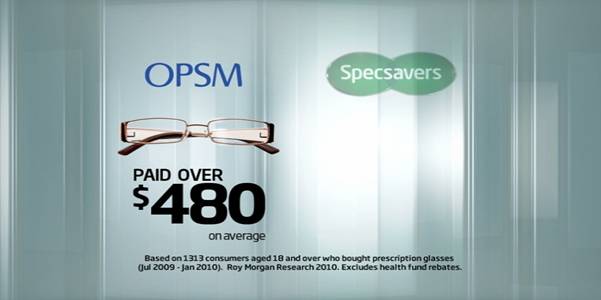
Luxottica Retail Australia Pty Ltd v Specsavers Pty Ltd [2010] FCA 423 |
|
|
Parties: |
LUXOTTICA RETAIL AUSTRALIA PTY LTD (ACN 000 025 758) v SPECSAVERS PTY LTD (ACN 097 147 932) |
|
|
File number(s): |
NSD 353 of 2010 |
|
|
Judges: |
PERRAM J |
|
|
Date of judgment: |
5 May 2010 |
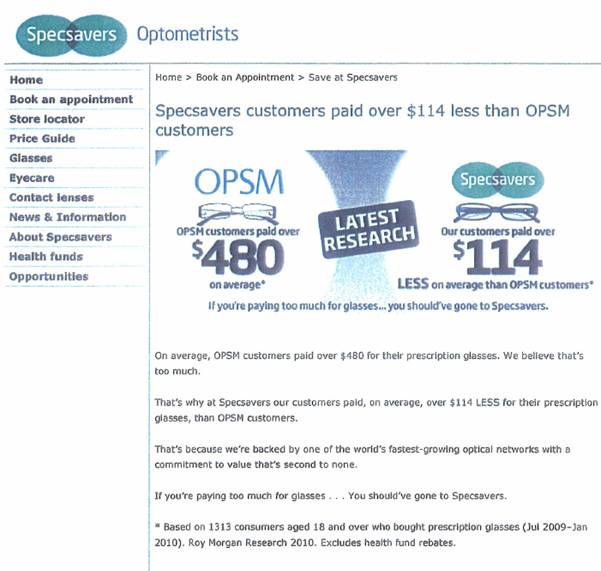
|
|
Corrigendum: |
25 May 2010 |
|
|
Catchwords: |
||
|
Legislation: |
||
|
Cases cited: |
Gillette Australia Pty Ltd v Energizer Australia Pty Ltd (2002) 193 ALR 629 cited Medical Benefits Fund of Australia Ltd v Cassidy (2003) 135 FCR 1 cited R v Smith (1986) 7 NSWLR 444 cited Telstra Corporation Ltd v Optus Communications Pty Ltd (1996) 36 IPR 515 applied |
|
|
|
|
|
|
Date of hearing: |
29-30 April 2010 |
|
|
|
|
|
|
Date of last submissions: |
30 April |
|
|
|
|
|
|
Place: |
Sydney |
|
|
|
|
|
|
Division: |
GENERAL DIVISION |
|
|
|
|
|
|
Category: |
Catchwords |
|
|
|
|
|
|
Number of paragraphs: |
44 |
|
|
|
|
|
|
Counsel for the Applicant: |
Mr A S Bell SC with Mr M R Hall |
|
|
|
|
|
|
Solicitor for the Applicant: |
Mallesons Stephen Jaques |
|
|
|
|
|
|
Counsel for the Respondent: |
Mr R Cobden SC |
|
|
|
|
|
|
Solicitor for the Respondent: |
Minter Ellison |
|
|
IN THE FEDERAL COURT OF AUSTRALIA |
|
|
NEW SOUTH WALES DISTRICT REGISTRY |
|
|
GENERAL DIVISION |
NSD 353 of 2010 |
|
BETWEEN: |
LUXOTTICA RETAIL AUSTRALIA PTY LTD (ACN 000 025 758) Applicant
|
|
AND: |
SPECSAVERS PTY LTD (ACN 097 147 932) Respondent
|
|
JUDGE: |
PERRAM J |
|
DATE OF Corrigendum: |
25 MAY 2010 |
|
WHERE MADE: |
SYDNEY |
Corrigendum:
1. In paragraph 30 of the Reasons for Judgment, in the first sentence, the word “reflect” should read “deflect”.
|
I certify that the preceding one (1) paragraph is a true copy of the Corrigendum to the Reasons for Judgment herein of the Honourable Justice Perram. |
Associate:
Dated: 25 May 2010
|
IN THE FEDERAL COURT OF AUSTRALIA |
|
|
NEW SOUTH WALES DISTRICT REGISTRY |
|
|
GENERAL DIVISION |
NSD 353 of 2010 |
|
LUXOTTICA RETAIL AUSTRALIA PTY LTD (ACN 000 025 758) Applicant
|
|
|
AND: |
SPECSAVERS PTY LTD (ACN 097 147 932) Respondent
|
|
JUDGE: |
|
|
DATE OF ORDER: |
5 MAY 2010 |
|
WHERE MADE: |
SYDNEY |
THE COURT ORDERS THAT:
Note:Settlement and entry of orders is dealt with in Order 36 of the Federal Court Rules.
The text of entered orders can be located using Federal Law Search on the Court’s website.
|
IN THE FEDERAL COURT OF AUSTRALIA |
|
|
NEW SOUTH WALES DISTRICT REGISTRY |
|
|
GENERAL DIVISION |
NSD 353 of 2010 |
|
BETWEEN: |
LUXOTTICA RETAIL AUSTRALIA PTY LTD (ACN 000 025 758) Applicant
|
|
AND: |
SPECSAVERS PTY LTD (ACN 097 147 932) Respondent
|
|
JUDGE: |
PERRAM J |
|
DATE: |
5 MAY 2010 |
|
PLACE: |
SYDNEY |
REASONS FOR JUDGMENT
1 This is a case about spectacles. The applicant, Luxottica Retail Australia Pty Ltd, is better known by the name under which it trades, OPSM, and by which name I shall refer to it. It operates in Australia around 300 stores from which it provides optometry services and optical products such as spectacles, contact lenses and sunglasses. The respondent, Specsavers Pty Ltd (“Specsavers”), is a more recent entrant in the Australian optical services market. It operates stores through a company-owned and franchise structure and, at the moment, there would appear to be about 200 stores. Specsavers commenced its Australian retail operations in 2008. It is clear that it conducts business overseas although the evidence before me did not indicate that its operations extended beyond Western Europe. A Vice-President of OPSM gave evidence and she described her perception of the difference between OPSM and Specsavers as being, at least in metropolitan areas, similar to the difference between, on the one hand, David Jones and Myers and, on the other, Target or Kmart. It is not necessary to express any concluded view on the correctness or otherwise of that opinion but there seems to be little doubt that Specsavers is directed at more value conscious customers.
2 To the uninformed the sale of optical products and, more particularly, the sale of spectacles is a surprisingly large business. In the 2009-2010 year it is expected that the combined revenues of the industry will be approximately $1.34 billion and that it will employ roughly ten thousand persons. Because poor eyesight is often enough correlated with increasing age there is an expectation that as the Australian population ages the spectacle market will grow.
3 Given the revenues at stake it is, therefore, no surprise that the marketing tactics of industry participants can be both fierce and aggressive. The present case provides a convenient example of the vigorous nature of the competition in that market. It concerns an advertisement which was run both on national free-to-air television and the internet by Specsavers which compared, or sought to compare, the expense associated with its services with those of OPSM. I have used the word “expense” rather than “price” because one of the controversies in this case concerns whether the advertisements in question were about price or whether a viewing member of the public might regard them as being about something else. In any event, OPSM says that the advertisements are false and misleading. The advertisements in question have since ceased but OPSM nevertheless seeks orders that Specsavers be compelled to publish corrective advertising so that the misleading perception which OPSM alleges has been engendered in the public mind might be expunged.
4 Naturally enough, therefore, the issues turn upon the advertisements themselves. Specsavers called as one of its witnesses Mr Hawkins who it employs under the perhaps disconcerting job description of “Director of Special Projects-Marketing”. He gave evidence of the background to and history of the advertising programme which I accept. Two different versions of the television commercial were created. For reasons which will become apparent the two advertisements are very similar. Both are 30 seconds in length. In the first advertisement a blue screen appears with, as Mr Bell SC who appeared with Mr Hall for OPSM described it “horizontal aqua waves washing across the screen”. A voice then commences to speak and says the words:
On average OPSM customers paid over $480 for their prescription glasses. We believe that’s too much
As the voiceover reaches the words “OPSM” the OPSM brand logo appears on the screen and then as the word “customers” was said a pair of spectacles appeared beneath the word “OPSM”. As the words “paid over $480 on average” were said those same words then appeared underneath the spectacles followed by a disclaimer in smaller font. At the end of this first part of the advertisement the screen appeared as follows:
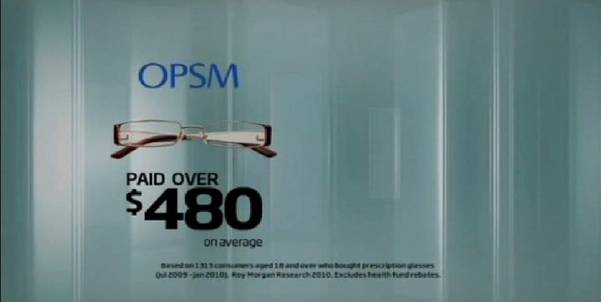
5 The voiceover did not read out the disclaimer but its words were as follows:
Based on 1313 consumers aged 18 and over who bought prescription glasses (Jul 2009-Jan 2010). Roy Morgan Research 2010. Excludes health fund rebates.
6 At that point the voiceover says:
That’s why at Specsavers our customers paid on average $114 less for their prescription glasses than OPSM customers.
7 As the words “that’s why at Specsavers” are said the Specsavers logo appears immediately to the right of the OPSM brand name and then, as in its case, a pair of spectacles appears immediately below it. As the voiceover gets to the word “paid” the words “paid over $114 less on average” appears on the screen as the remaining words are said. At the end of this part of the advertisement the screen appears as follows:
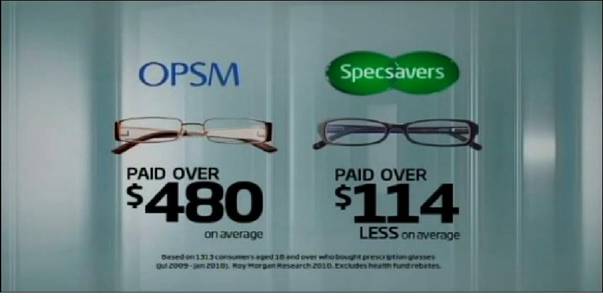
8 It will be observed that the words “paid over” appear in the same font under both the OPSM and Specsaver spectacles and that the words “on average” appear under the respective numbers, also in the same font. However, the word “less” appears only under the figure “$114”. It is important to understand that the voiceover puts the words “on average” before the words “over $114”; that is, the order of the words on the screen is not precisely the same as that in the voiceover. This assumes a larger significance than might otherwise be expected because the voiceover places extra emphasis on the word “less”. Words are no ready substitute for the effect of listening to the voiceover itself but exchanging capitalised words for the effect of the emphasised expressions the voiceover is probably more usefully transcribed as:
That’s why at Specsavers our customers paid on average over $114 LESS for their prescription glasses than OPSM customers.
9 Immediately after that the screen changes entirely and cuts to what appears to be an office environment with a person standing in front of it. The image thus depicted is operating in two timeframes. The speaking figure is in real time but the background office environment depicts individuals moving around at extremely high speed as in a film which had been speeded up by a factor of 10 to 20 times. Additionally, the image of the office is suffused with an undulating motif which perhaps reflects the wavy pattern of the first part of the advertisement.
10 The rapidity of the motion going on in the background may reflect what the person in the foreground is saying which is thus:
That’s because we are backed by one of the world’s fastest growing optical networks with a commitment to value that’s second to none.
11 The identity of the speaker is simultaneously revealed in words which then appear on the lower left-hand side of the screen which inform the viewer that the speaker is Mr Peter Larsen who is an optometrist and the Managing Director, presumably, of Specsavers. Mr Larsen speaks with obvious enthusiasm for Specsavers and a degree of gesticulation not naturally associated with optometrists. At the end of this part of the advertisement the screen appears as follows:
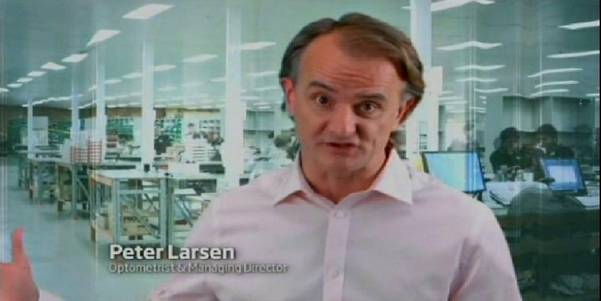
12 After the words “second to none” have been said the screen changes once more and now appears as follows:
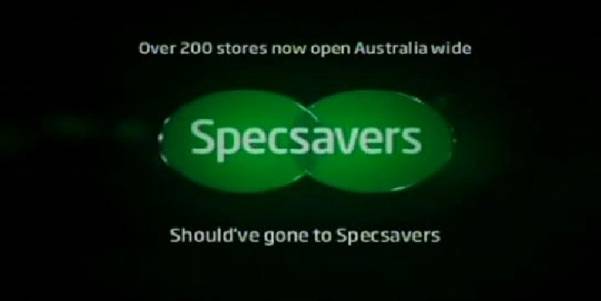
13 Whilst that screen is in view the voiceover says:
If you’re paying too much for glasses you should’ve gone to Specsavers.
14 Throughout the entire advertisement there is playing in the background a non-descript and innocuous tune strummed on a guitar. The music is of a similar kind to that which one hears for insurance products, cars and other everyday household products. It suggests a quotidian air of relaxation. The Specsavers logo in the final part of the advertisement has a moving shining motif around its edges. As the voiceover to the last part of the advertisement concludes the guitar tune comes to an end and the advertisement is completed. In all, the whole experience lasts 30 seconds.
15 For the purposes of the parties’ arguments it is useful first to take note that the first part of the advertisement contains an assertion that “on average OPSM customers paid over $480”; secondly, that although the effect of health fund rebates was said to be excluded in the disclaimer appearing at the bottom of the screen in the first part of the advertisement, there is no other reference in the advertisement to the figures referred to in it being calculated on a basis which excludes the effect of any health fund rebate to which a customer might otherwise be entitled; thirdly, so far as the screen in the second part of the advertisement is concerned, the only difference between the OPSM statement and the Specsaver statement is the addition of the word “less”. If that word is excised then the OPSM statement is “paid over $480 on average” and the Specsaver statement is “paid over $114 on average” whose wording and structure is identical. This matter is important because, as will be seen, OPSM contends that the advertisement effectively suggests to the casual viewer that OPSM customers paid over $480 whereas Specsaver customers paid over $114. The word “less” is said to be sufficiently small not to make clear that the $114 figure is a difference between two figures rather than an actual figure itself.
16 It was contended by OPSM that, as a matter of fact, the owner of the voice in all parts of the advertisement was Mr Larsen himself and not just those parts where he appears in person. Written reasons can provide no adequate basis for explaining why one voice is different to another and, of course, in the criminal law voice identification evidence has always been treated with considerable care: cf. R v Smith (1986) 7 NSWLR 444 at 457 per Lee J (with whom Street CJ and Maxwell J agreed). However, I have listened to this advertisement many times now and I have no doubt that the voice doing the voiceover in the first two parts of the advertisement is not Mr Larsen’s voice. The voice in the voiceover has a distinctly professional television tone to it and a clear style of diction. Mr Larsen’s manner of speaking, by contrast, is somewhat more hurried, slightly more nasal and more variable in pitch than the disembodied voice in the voiceover. However, the voiceover for the final portion of the advertisement is Mr Larsen’s voice. Put another way, the advertisement is divided voicewise into two halves. In the first half there is a generic television voice and in the second, Mr Larsen’s.
17 This commercial was run in all capital cities except Perth between 7-20 February and 5-10 March this year. In Perth it was run between 14-27 February and 6-10 March. Following a complaint from OPSM that the disclaimer was too small and did not adequately signal the fact that the figures quoted did not include the effect of any health fund rebate, the advertisement was amended to increase the size of the font of that disclaimer. This second advertisement is otherwise identical. With the increased font size the disclaimer now appeared as follows (this particular screen shot has evidently been taken during the transition from the first part of the advertisement to the second part) :
18 This version of the advertisement was run in all capital cities between 10-13 March. There was no evidence before me that the advertisement appeared on free-to-air television in regional areas but it was accepted by Mr Cobden SC, who appeared for Specsavers, that the advertisement was, in fact, so run. No issue was taken before me as to the extent, if any, of any advertising on subscription television services.
19 OPSM called a Mr Ulbricht to give evidence as to the nature and extent of the advertisement as it was run. It was not suggested that Mr Ulbricht’s evidence was incorrect and I accept it. That evidence indicated that the cost of the advertising had been around $1 million (a figure with which Mr Hawkins agreed), that during the period in which the advertisement was run it had been shown up to eleven times a day, although generally between three and seven times a day, and that it had been shown not only frequently but during programmes which were popular with the viewing public or some segments of that public. These included the Cricket, Better Homes and Gardens, the Winter Olympics, My Kitchen Rules and, of course, Top Gear. Mr Ulbricht’s evidence suggested, and I accept, that a very large number of people reaching into the many millions of viewers are likely to have seen the commercial. This is an unsurprising conclusion since it was precisely such an effect which was intended by Specsavers. So much is apparent from the evidence of Mr Hawkins who, it will be recalled, was Specsavers’ Director of Special Operations-Marketing. During his cross-examination the following interchange took place:
Your aim was this assault… on OPSM and its market share to be as powerful as possible within your financial constraints. Correct? --- I believe it was to have a significant impact on consumers, yes.
Right. And you’ve no doubt that it did, do you? --- It certainly had an effect, yes.
20 Subsequently, the following exchange took place:
You don’t regard the campaign as having been a failure, do you? --- I don’t, no.
You regard it as having been a significant success? --- I wouldn’t say that because I haven’t been able to analyse it with something like brand tracking or some other measure.
You regard it as having been a success, though, don’t you? --- I think it has been a good campaign for us.
21 Commencing on 9 February and ending on 1 April this year Specsavers also maintained on its website www.specsavers.com.au an advertisement in the following form (unfortunately, the evidence led indicated that the website had not been cached and was thus unable to be reproduced in a higher quality format):
22 It will be seen that the advertisement has similar, although not identical, features to the television commercial. One important matter to note about the website is, of course, its static nature compared to the dynamic advertisement and also the quite different mental attitude of a person looking at an internet page on a web browser to that attending a person exposed to a television commercial. OPSM also drew attention to the fact that the internet advertisement remained available for the period from 13 March to 1 April after the completion of the television campaign. This was, so OPSM submitted, to catch any customers whose interest might have been piqued by the commercial and whose curiosity might have been provoked into a visit to the website. So viewed the internet commercial was to be seen as an adjunct to the television commercial. I accept this submission.
23 OPSM makes three complaints about the commercial. They are:
(a) The rebate issue. Very many, indeed a majority, of OPSM’s customers are members of private health insurance funds and in consequence are entitled to various degrees of indemnity against the cost of spectacle frames and lenses. The inclusion of the $480 average figure is misleading and deceptive says OPSM because, in fact, that is not the sum which most of its customers would ever pay. This is because so widespread is the practice of obtaining rebates from health funds that there exists a system known as HICAPS which allows an instantaneous rebate to be rung up in favour of a customer at the point of sale regardless of the health fund to which the customer belongs. In practice, therefore, the health fund rebate is taken out before the customer is called on to tender payment. The actual amount of the rebate is not known until the customer’s health fund card is swiped through the system which is ordinarily after the customer and the sales assistant have moved to the payment area. The amount of the rebate itself fluctuates between funds and is also affected by prior claims having been made by the customer.
(b) The $114 issue. OPSM submits that the advertisement appears to compare an average price of $480 on its behalf with an average price of $114 on Specsavers’ behalf. This, of course, is not what the advertisement says for the word “less” appears immediately beneath the figure of $114. OPSM, however, submits that the font of the two figures and the wording surrounding them is identical so that the word “less” is, as a matter of substance, ineffective to dispel the suggestion otherwise implicit in the advertisement that what is being compared is two average sums of money.
(c) The single spectacles issue. OPSM submits that the advertisement suggests that the average figure of $480 is the price paid by OPSM customers for a single pair of spectacles based upon the survey referred to in the disclaimer. Specsavers, in fact, commissioned a survey to be carried out and it was in evidence. It became clear during the hearing that what the survey showed was not the average price paid by OPSM customers per pair of spectacles but rather the average amount of money spent by an OPSM customer on his or her most recent visit to an OPSM store within the last six months. It did not say that the average price paid by OPSM customers for their glasses was $480 per pair. OPSM submitted that to see the advertisement was to see, at once, that it was being suggested that the average price paid for glasses at OPSM was $480. Accordingly, OPSM submitted that the advertisement was misleading and deceptive.
24 It is useful to deal with these arguments in turn.
Case One: Prices without rebates
25 OPSM submitted that a person seeing the advertisement would understand it to be making a claim about what it was that OPSM customers, on average, had to pay in order to obtain their spectacles. Put another way, the amount paid necessarily reflected what it was, in terms of cash or credit card debits, that they had actually been required to contribute themselves to the purchase. So much was obvious from the word “paid” which to a lay person was said to connote a bottom line figure concerned with real cost and real money in the hip pocket. So too, the same emphasis on real cost could be discerned from the words “customers paid over” which were apt to cover the situation obtaining where part of the purchase price had been paid by a third party such as a health fund. An additional matter lending support to that view was the fact that the advertisement at no time referred to the price of the spectacles. Mr Bell SC accepted that had the advertisement referred to price it would have been much more difficult to say that the advertisement was concerned with a bottom line figure. However, the absence of a reference to price was likely to engender in a viewer a greater propensity to receive the words “paid over” as denoting the amount of money handed over by the customer. This was even more likely in circumstances where the existence of private health insurance is very widespread and its utility to those who buy spectacles well-known.
26 In Telstra Corporation Ltd v Optus Communications Pty Ltd (1996) 36 IPR 515 Merkel J reviewed a number of authorities on the approach to be taken in determining whether a television commercial infringed s 52 of the Trade Practices Act 1974 (Cth) (“the Act”). Of the Optus advertisements before him he said (at 523-524):
They will be seen by the casual but not overly attentive viewer viewing a free-to-air program with only a marginal interest in the advertisements shown between the segments of the program. In that context it will be the first impressions conveyed to that viewer, rather than an analysis of the cleverly crafted constituent parts of the commercial, which will be determinative.
27 That statement, with respect, not only accords with commonsense but has been applied by a Full Court, in a slightly different context, in Medical Benefits Fund of Australia Ltd v Cassidy (2003) 135 FCR 1 at 23 [60] per Stone J (with whom, on this point, Moore and Mansfield JJ agreed). Leaving to one side the effect of the disclaimer the question is really whether the casual but not overly attentive viewer would understand the advertisement as saying something about the prices of spectacles or as about the amount of money actually spent by customers on spectacles.
28 OPSM submitted that it would be over-intellectualising to think that actual viewers would understand the statements as being about price rather than the amount of actual money with which they had to part. OPSM advanced this argument with some passion but I confess I can find within it no redeeming features. The dollar figures which appear in television commercials are usually prices and this is an important aspect of the background context in which the advertisements appear. I do not for a moment think that a person viewing this advertisement would think that what was being discussed was anything other than the average list price of spectacles. Any person watching the advertisement would dimly appreciate that what they were seeing was one spectacle merchant suggesting that a better deal was to be had with it than with another spectacle merchant. The level at which the casual consumer mind would grasp that debate as occurring is at the obvious one, namely, at the level of price. Accepting OPSM’s warning against the perils of over-analysis it seems to me that it is its argument which runs that risk. No doubt health fund rebates are important to the persons who sell spectacles but I doubt that they loom large in the mind of the casual viewer of television commercials.
29 Quite apart from that, it is plain that the class of viewer who does not have private health insurance is most unlikely to understand the commercial as containing any kind of statement as to a rebate about which that viewer most likely knows nothing. Further, amongst that happy class who do hold private health insurance there is bound to be an appreciation that private health insurance is not universal, that not everyone gets a rebate and that the advertisement is directed to the insured and uninsured alike.
30 Mr Bell SC sought to reflect the consequences of that conclusion by placing particular emphasis upon the word “average” which would be seen, so he submitted, as suggesting a taking into account of both the amounts paid by those having private health insurance and the prices paid by those who do not. With respect, I regard the chances of a casual observer of this commercial as appreciating such a complex statement as vanishingly small.
31 In my opinion, the advertisement would not be understood by the casual viewer as saying anything about the price of spectacles after health fund rebates.
32 For completeness I should note that Specsavers placed reliance upon the words in the disclaimer “excludes health fund rebates” and drew attention to the Full Court’s decision in Gillette Australia Pty Ltd v Energizer Australia Pty Ltd (2002) 193 ALR 629. I do not regard it as necessary to resolve that debate. Nor do I think it is possible to do so having concluded that the principal part of the advertisement is not misleading in this regard. This is because in order to work out whether the disclaimer was sufficient to dispel the misleading nature of the balance of the advertisement it would be necessary to gauge just how misleading it was. In circumstances where I have concluded it was not misleading at all, it is not possible coherently to perform that calculus.
Case Two: Comparative price of spectacles
33 OPSM submitted that the second portion of the advertisement was likely to convey to the viewer that what was paid by Specsavers’ customers was just over $114 whereas what was paid by OPSM customers was just over $480. OPSM accepted that the word “less” meant that that was not what the consumer was actually told. However, it submitted that the similarities between the ways in which the two figures were presented was so overwhelming that whatever clarifying effect the word “less” had was lost in the surrounding material.
34 It is true that the presentation of the $480 figure and the $114 figure is very similar; the figures themselves as well as the words “paid over” and “on average” are in identical font, of identical size and in corresponding locations. It is only the word “less” which is different as between the two. If the advertisement were to be viewed in isolation and divorced from the soundtrack which accompanies it, this argument might well have some force. However, the voiceover puts significant emphasis on the word “less” and, having listened to the advertisement and having striven to put myself in the position of the casual viewer of the kind referred to above, I am left in no doubt that the advertisement does not seek to convey, and indeed does not convey, a comparison between a payment of $480 and a payment of $114.
Case Three: Price paid per pair of spectacles
35 OPSM submits that the advertisement clearly conveys that the average price referred to is the price in respect of a single pair of spectacles. It says so much flows from the words in the voiceover “on average OPSM customers paid over $480 for their prescription glasses.” It points out that the advertisement does not say “for some prescription glasses”. It also submits that the words “we believe that’s too much” naturally invites the viewer’s mind to alight upon the question of “too much for what?”, the only natural answer to which can be “a pair of spectacles”. That view of things is confirmed, so it was submitted, by the presence of a single pair of glasses in the advertisement.
36 Mr Cobden SC who appeared for Specsavers said everything which could, I think, fairly be said in favour of Specsavers’ position on this issue. The point to be grasped, in his submission, was that the advertisement suggested to the viewer the amount paid by an OPSM customer on his or her last visit to an OPSM shop. So viewed, it was a statement about the customer’s spend. I regret, however, that I am unable to extract anything like that from the advertisement whether by means of close parsing of the advertisement or through the kind of deliberately cultured inattentiveness required of a trial judge by the casual observer test. The short fact is that the advertisement plainly suggests a connection between the $480 figure, the $114 figure and a pair of spectacles. It is a spectacles advertisement; what it is talking about is spectacles.
37 Specsavers called as a witness Mr Kornides who is the Project Director for Roy Morgan Research which conducted the survey referred to in the advertisement. He gave evidence that the average price paid per pair of spectacles by the respondents to the survey conducted on Specsavers’ behalf was $417.59 for OPSM and $204.97 for Specsavers, which meant, on average, that OPSM was $212.62 more expensive per pair of glasses than Specsavers. It follows from my conclusion that the advertisement plainly suggests that it is talking about a single pair of glasses and that its suggestion that the figure of $480 is supported by the survey referred to in the disclaimer is simply wrong. In my opinion, a plain breach of s 52 of the Trade Practices Act is established.
38 Mr Cobden SC submitted that to reach that conclusion involved placing excessive emphasis on the first part of the advertisement (in which the horizontal aqua waves held sway) and was apt to overlook the effect of the advertisement as a whole. So viewed, the advertisement was not really trying to say anything particular about the price of spectacles; rather, its focus was on the difference revealed by the $114 comparison figure. This was not an idle point because the evidence of Mr Kornides, to which I have referred, shows that the true difference is in fact $212 rather than $114. Put another way, it may well have been the case that the $480 figure was misleading insofar as it represented that it was OPSM’s price per pair of spectacles; however, the advertisement was, in that case, also misleading because it suggested that customers would save $114 if they went to Specsavers whereas, in fact, they would save $212. Accordingly, if one got to this part of the case the advertisement did as much harm to Specsavers as it did to OPSM.
39 The focus of s 52 is upon the protection of consumers. The injunction contained within the provision serves, as has often been emphasised, the public interest. The ability of individual traders to deploy s 52 in suits such as the present entirely derives from the concern of Parliament to ensure the provision of accurate information to consumers. I do not accept that because consumers were also misled by the advertisement in a way which may have been detrimental to Specsavers that this can have the effect of rendering the advertisement, as a whole, other than misleading. I do not apprehend that when the pressing moment arose that Mr Cobden SC really advanced such an argument.
40 In the circumstances I reject the first two arguments advanced by OPSM but I accept the third argument based on a single glasses price.
41 I turn then to the question of remedy. The issue of damages has been deferred. The two immediate questions are whether there should be a permanent injunction to restrain a further breach from occurring and whether corrective advertising should be ordered. As to the first, the advertisement has now run its course; broadcasting ceased on 13 March 2010 and the internet advertisement finished on 1 April 2010 some 34 days ago. There was no evidence which suggested that a repetition was contemplated. However the terms of s 80 of the Act make plain that an injunction may be issued in respect of a past contravention and even, as subsection (5) emphasises, if there is no intention on the part of the respondent to repeat the conduct. There may be circumstances when it will be appropriate to grant such an injunction where, for example, future breaches may be expected not because of deliberate conduct but rather by reason of deficient systemic controls. So too, a court may feel that there is a risk that without an injunction a respondent may be tempted into contravention. In this case, whilst I am of the view that Mr Hawkins, in all likelihood, knew that the advertisement was misleading, or at least knew that there was a real risk that it was, I do not think that I can deduce therefrom a future risk of repetition. It would, I think, be wrong to impose an injunction in order to punish perceived deliberate wrongdoing – this is not the point of s 80. It is, however, appropriate to grant declaratory relief in the form set out in prayer 4 of the application.
42 This leaves the question of corrective advertising.
43 The parties were in agreement that if I concluded that OPSM failed on its first two grounds but succeeded on its third ground alone then it would be necessary to hear further argument on the question of whether corrective advertising should be ordered. There remains unresolved an application by OPSM to set aside a Notice to Produce issued by Specsavers which, if answered, would seek to demonstrate what is the actual average price of OPSM spectacles. The point of that argument would be, as I apprehend, to show that even if the advertisement was misleading because, in fact, the survey did not support the $480 figure, nevertheless the Court would not order corrective advertising in circumstances where, in truth, the price of OPSM glasses was around $480.
44 I will entertain argument on that question at a time convenient to the parties. I direct the parties to bring in short minutes of order reflecting these reasons for judgment within seven days.
|
I certify that the preceding forty-four (44) numbered paragraphs are a true copy of the Reasons for Judgment herein of the Honourable Justice Perram. |
Associate:
Dated: 5 May 2010


