

FEDERAL COURT OF AUSTRALIA
Australian Competition & Consumer Commission v Powerballwin.com.au
Pty Ltd [2010] FCA 378
|
Citation: |
Australian Competition & Consumer Commission v Powerballwin.com.au Pty Ltd [2010] FCA 378 |
|
|
Parties: |
||
|
File number(s): |
VID 678 of 2009 |
|
|
Judge: |
TRACEY J |
|
|
Date of judgment: |
23 April 2010 |
|
|
Catchwords: |
||
|
Legislation: |
Federal Court of Australia Act 1976 (Cth) s 21 Trade Practices Act 1974 (Cth) ss 51A, 52, 53, 75B, 80, 83, 87, Part V |
|
|
Cases cited: |
Australian Competition and Consumer Commission v Star Promotions Club Pty Ltd [2010] FCA 139, compared Australian Competition and Consumer Commission v Z‑Tek Computer Pty Ltd (1997) 78 FCR 197, approved I & L Securities Pty Ltd v HTW Valuers (Brisbane) Pty Ltd (2002) 210 CLR 109, applied Tobacco Institute of Australia Ltd v Australian Federation of Consumer Organisations Inc (No 2) (1993) 41 FCR 89, applied OD Transport Pty Ltd v WA Government Railways Commission (1987) 13 FCR 500, approved Yorke v Lucas (1985) 158 CLR 661, applied |
|
|
|
|
|
|
Date of hearing |
25 March 2010 |
|
|
|
|
|
|
Place: |
Melbourne |
|
|
|
|
|
|
Division: |
GENERAL DIVISION |
|
|
|
|
|
|
Category: |
Catchwords |
|
|
|
|
|
|
Number of paragraphs: |
55 |
|
|
|
|
|
|
Counsel for the Applicant: |
Mr P Cosgrave SC and Ms R L Enbom |
|
|
|
|
|
|
Solicitor for the Applicant: |
Australian Government Solicitor |
|
|
|
|
|
|
|
No appearances for the Respondents |
|
|
IN THE FEDERAL COURT OF AUSTRALIA |
|
|
VICTORIA DISTRICT REGISTRY |
|
|
GENERAL DIVISION |
VID 678 of 2009 |
|
AUSTRALIAN COMPETITION & CONSUMER COMMISSION Applicant
|
|
|
AND: |
POWERBALLWIN.COM.AU PTY LTD First Respondent
CONSTANTINE BARRIS Second Respondent
DAVID WALKER Third Respondent
MICHAEL DUGGAN Fourth Respondent
MARK ADAMS Fifth Respondent
|
|
JUDGE: |
|
|
DATE OF ORDER: |
23 ApRIL 2010 |
|
WHERE MADE: |
MELBOURNE |
THE COURT DECLARES THAT:
(a) had been discovered by the First Respondent;
(b) was based on mathematics, statistics, computer modelling and the complex study of the theory of random probability;
(c) disputed the theory of random probability;
(d) had totally shocked the experts;
(e) had not previously been provided to consumers in Australia; and
that would;
(f) 100% guarantee the Powerball number;
(g) help subscribers to choose the five remaining numbers other than the Powerball number; and
(h) help subscribers win all divisions of Powerball.
In each draw of the Powerball lottery conducted weekly in Australia by Tattersall’s Sweep Pty Ltd (“Tattersall’s”), when in fact the First Respondent did not have proprietary information with the characteristics described in paragraphs (a) to (e) above.
2. The First Respondent by representing on the internet and in its promotional material in trade and commerce in the period December 2008 to September 2009 to prospective purchasers of business opportunities offered by it and to prospective subscribers that it had proprietary information that had the performance characteristics, uses or benefits described in paragraphs (f) to (h) of paragraph 1 above, when in fact the First Respondent’s proprietary information did not have such performance characteristics, uses or benefits, engaged in conduct that contravened s 53(c) of the Act.
3. The First Respondent engaged in conduct which was misleading or deceptive or was likely to mislead or deceive in contravention of s 52 of the Act by representing on the internet and in its promotional material in trade and commerce in the period December 2008 to September 2009 to prospective purchasers of business opportunities offered by it and to prospective subscribers that it had proprietary information that had the performance characteristics, uses or benefits described in paragraphs (f) to (h) of paragraph 1 above, when in fact the first respondent’s proprietary information did not have such performance characteristics, uses or benefits.
4. The Second Respondent, in respect of the contraventions of the Act by the First Respondent referred to in paragraphs 1 to 3 above:
(a) aided and abetted the first respondent to engage in the conduct; and
(b) was knowingly concerned in and party to the First Respondent’s conduct;
by reason of:
(c) his involvement in the First Respondent:
(i) as the sole director of the First Respondent; and
(ii) as the holder of 35% of the issued shares in the First Respondent and by being only one of two shareholders in the First Respondent;
(d) his involvement in arranging the printing of promotional pamphlets and their distribution to distributors and subscribers;
(e) his involvement as the “decision maker” in relation to the page of the Seek website operated by the First Respondent;
(f) his involvement in dealing with and administering the funds held in the bank accounts of the First Respondent;
(g) insofar as the representation referred to in paragraph 1 above was with respect to future matters, his knowing:
(i) that the First Respondent made the representation referred to in paragraph 1; and
(ii) that the said representation was false or untrue; and/or
(iii) that the First Respondent had no reasonable grounds for making the said representation,
and accordingly was a person:
(h) involved in those contraventions of ss 52 and 53(c) of the Act within the meaning of s 75B(1) of the Act;
(i) who aided and abetted the First Respondent to engage in the conduct within the meaning of s 80(1)(c) of the Act;
(j) who was knowingly concerned in the party to the First Respondent’s conduct within the meaning of s 80(1)(e) of the Act.
AND THE COURT ORDERS THAT:
5. Each of the First and Second Respondents be restrained, by themselves or their servants or agents or otherwise howsoever from making, or being involved in the making of, in any manner whatsoever representations to the effect that they will supply to subscribers proprietary information that:
(a) has been discovered by the First Respondent;
(b) was based on mathematics, statistics, computer modelling and the complex study of the theory of random probability;
(c) disputes the theory of random probability;
(d) has totally shocked the experts;
(e) has not previously been provided to consumers in Australia;
that would:
(i) 100% guarantee the Powerball number;
(ii) help subscribers to choose the five remaining numbers other than the Powerball number;
(iii) help subscribers win all divisions of Powerball,
in each draw of the Powerball lottery conducted weekly in Australia by Tattersall’s.
6. Each of the First and Second Respondents be restrained, by themselves or their servants or agents or otherwise howsoever from making, or being involved in the making of, in any manner whatsoever representations to the effect that they have proprietary information that will:
(a) 100% guarantee the Powerball number;
(b) help subscribers to chose the five remaining numbers other than the Powerball number; and
(c) help subscribers win all divisions of Powerball,
in each draw of the Powerball lottery conducted weekly in Australia by Tattersall’s.
7. Each of the First and Second Respondents be restrained, by themselves or their servants or agents or otherwise howsoever from:
(a) distributing or causing to be distributed promotional material, including the pamphlet in the form of Attachment A hereto; and
(b) publishing or causing to be published advertisements or material in newspapers, on the internet and in promotional material,
to members of the public that contain the representations set out in paragraphs 5 and 6 above or any representation to the same or similar purport or effect.
8. The First and Second Respondents jointly and severally pay to the persons listed in Attachment B hereto the amounts set out in the said attachment within 28 days of the date of service of these orders upon the First and Second Respondents.
9. A copy of the final order of the Court and the reasons for judgment, with the seal of the Court applied, be placed on the Court file for the purposes of s 83 of the Act.
10. The First and Second Respondents pay the Applicant’s costs of the proceeding, including all reserved costs.
11. The application in respect of the Third, Fourth and Fifth Respondents is adjourned to 25 June 2010 at 9:30 am.
ATTACHMENT A
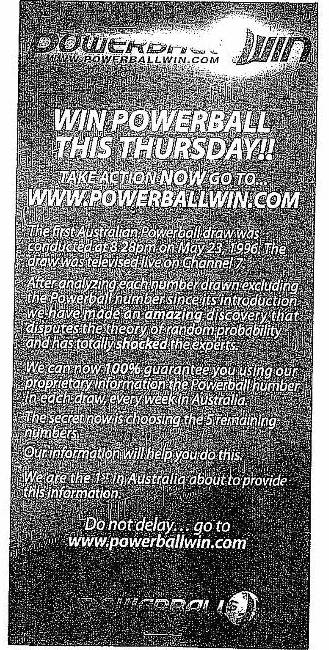
ATTACHMENT B
|
No. |
Person |
Loss |
|
1. |
Hieu Tam Pham |
$5,880.00 |
|
2. |
Michelle Therese Saliba |
$8,116.00 |
|
3. |
Perry John Weibel |
$5,820.00 |
|
4. |
Gary Robert Prendergast |
$314.05 |
|
5. |
Robert Garry Plunkett |
$6,320.00 |
|
6. |
Stanley Kevin Burke |
$250.00 |
|
7. |
Andrew John Smyth |
$281.00 |
|
8. |
Kaye Lorraine Solomon |
$249.00 |
|
9. |
Trevor Alan Spencer |
$39.00 |
|
10. |
William Robert Reid |
$59.00 |
|
11. |
Pamela Dawn Whiteroad |
$147.35 |
|
12. |
Carol Anne Roebuck |
$9,009.00 |
|
13. |
Lawrence Ganrish Chand |
$7,009.00 |
|
14. |
Hasmukh Patel |
$4,670.00 |
Note:Settlement and entry of orders is dealt with in Order 36 of the Federal Court Rules.
The text of entered orders can be located using Federal Law Search on the Court’s website.
|
IN THE FEDERAL COURT OF AUSTRALIA |
|
|
VICTORIA DISTRICT REGISTRY |
|
|
GENERAL DIVISION |
VID 678 of 2009 |
|
BETWEEN: |
AUSTRALIAN COMPETITION & CONSUMER COMMISSION Applicant
|
|
AND: |
POWERBALLWIN.COM.AU PTY LTD First Respondent
CONSTANTINE BARRIS Second Respondent
DAVID WALKER Third Respondent
MICHAEL DUGGAN Fourth Respondent
MARK ADAMS Fifth Respondent
|
|
JUDGE: |
TRACEY J |
|
DATE: |
23 APRIL 2010 |
|
PLACE: |
MELBOURNE |
REASONS FOR JUDGMENT
1 All too often unscrupulous individuals seek to enrich themselves by devising schemes under which unsuspecting victims are induced to part with their money and other property. This case provides a salutary example of the marketing of a bogus scheme under which members of the public were encouraged to make payments to a company in the expectation that they would obtain information which would enable them to make a great deal of money. The victims did not pause to reflect on why the proponent of the scheme would wish to share such potentially valuable information with them for a relative pittance in circumstances in which the fewer persons who were privy to the information, the more each stood to gain if it proved to be accurate.
2 Powerball is a well-known lottery conducted by Tattersall’s Sweeps Pty Ltd (“Tattersall’s”). Each week a draw takes place under Government supervision. Forty-five balls, numbered from 1 to 45, are placed in each of two drawing devices. Five balls are drawn from one of the devices and a single “powerball” from the other. Members of the public lodge entries in which they seek to choose the six winning numbers. If they are successful in doing so they receive the prize or a share of the prize allocated to division 1. There are six other divisions which reward those who have succeeded in selecting some but not all of the numbers which are drawn.
3 The legislation under which the lottery is conducted requires that it be a game of chance in which no knowledge or skill could be applied by a person to improve his or her chances of winning. To this end the equipment and the numbered balls are regularly checked to ensure, respectively, that they are in good working order and are all of equal size and weight. The equipment is kept in a secure location so that it cannot be tampered with.
4 The First Respondent (“the company”) was incorporated in January 2009. The Second Respondent (“Mr Barris”) was its sole director and the holder of 35% of its issued shares. The other respondents were, at various times, employees of the company.
5 In August 2009 Mr Barris arranged for a pamphlet to be printed. It read:
6 One hundred thousand copies were printed. Later in the month a further one hundred thousand were printed but, of these, thirty-seven thousand remain with the printer.
7 Similar claims to those made in the pamphlet were also made on the website to which readers were directed. (“the Powerballwin website”). The information was also contained on a second website established by the company (the “Seek commercial website”).
8 On the Powerballwin website readers were told that they could subscribe through the website by making a payment of $59 per annum. In return they were to receive, each week, the so-called “proprietary information” which included the Powerball number for that week and additional information which would help them to choose the remaining five numbers needed to obtain a first division prize. A “subscribe now” facility was provided.
9 The Seek commercial website was used to recruit distributors who were required to deliver copies of the pamphlet into residential letterboxes. The website said that the company had invested “over two years of due diligence, math, statistics, computer modelling and the complex study on the theory of random probability…in order to provide [their subscribers] with this proprietary information.” It then repeated much of the information contained in the pamphlet. It concluded by inviting readers to contact the company “and secure your future.” To become a distributor an investor was required to pay the company $6,950.
10 Persons who became distributors were required to deliver a thousand copies of the pamphlet each day in designated areas. On each Friday they were to receive a payment from the company based on the number of subscriptions that had come from the designated areas in the previous week.
11 At least seven individuals paid the company to become distributors. At least nine people (including two of the distributors) paid to become subscribers.
12 The money paid by these people was paid into a bank account, held in the name of the company. The only signatory to the account was Mr Barris. Mr Barris drew about $45,000 from this account using cheques made out to cash.
13 When the Australian Competition & Consumer Commission (“the ACCC”) became aware of the activities of the company it sought and obtained an urgent injunction from Goldberg J which restrained the respondents from making the representations contained in the pamphlet and from distributing any promotional material which contained the representations.
14 The ACCC now seeks final orders against the First and Second Respondents. These respondents have, I am satisfied, been served with all relevant material. They did not appear when the proceeding was called on for hearing on 25 March 2010.
15 The other three respondents have not been served with the application and supporting affidavits because the ACCC has not been able to discover their whereabouts.
16 The ACCC contends that the company has engaged in conduct that was misleading or deceptive or was likely to mislead or deceive in contravention of s 52 of the Act. It also submits that the company made representations in connection with the supply or possible supply of services or in connection with the promotion of the supply of services that the services had performance characteristics, uses or benefits that they did not have, thereby contravening s 53(c) of the Act.
THE REPRESENTATIONS
17 The ACCC contends that the company made the following representations in the pamphlet and on its two websites. It represented that it would supply proprietary information that:
· had been discovered by the company;
· was based on mathematics, statistics, computer modelling and the complex study of the theory of random probability;
· disputed the theory of random probability;
· had totally shocked “the experts”; and
· had not previously been provided to consumers in Australia.
This proprietary information, according to the company, would:
· “100% guarantee” the number of the powerball in a given week;
· help people to choose the five remaining numbers; and
· help subscribers win all divisions of the lottery in each weekly draw.
18 The company was the operator of each of the two websites. It was responsible for the contents of the pamphlet and arranged for copies of the pamphlet to be distributed on its behalf. The representations were made in trade or commerce or both.
19 The representations were also made in connection with the supply or possible supply by the company of services (the provision of the winning numbers) or the promotion of such supply.
20 The ACCC submits that the representations, made by the company, were misleading or deceptive. This is so, according to the ACCC, even if the representations are understood to have been made as to future matters because the company would not have reasonable grounds for making the representations and, as a result, the representations are taken to be misleading. The absence of reasonable grounds is presumed in the absence of any evidence from the company: see s 51A(2) of the Act.
EVIDENCE
Relating to the company
21 The ACCC relies principally on the evidence of managers employed by Tattersall’s and expert evidence from a statistician.
22 Mr Ronald Fuhrmann is the Commercial Development Manager of Tatts. He deposed that “powerball has been designed by Tatts to be a game of chance, such that there is no knowledge or skill that could be applied by a person playing the game to improve their chance of winning.”
23 Mr Dale Harrington is the Draw and Prize Manager of Tattersall’s. He deposed that the equipment used to conduct the lottery had been inspected by an external consultant. On 17 October 2005 the consultant reported that the equipment “appears to be capable of drawing sets of 5 from 45 or 1 from 45 balls, depending on mode of operation, at random. This should continue to be the case so long as the regular maintenance and inspection schedules are continued.” Mr Harrington said that the maintenance and inspection regime had been continued since the report had been received.
24 Dr Ian Gordon is the Director of the Statistical Consulting Centre at the University of Melbourne and is an associate professor in the Department of Mathematics and Statistics at the University. It was his opinion that:
· “…it is impossible to “100% guarantee” the particular Powerball number in a future draw, provided the draw is conducted as specified in the affidavits of Roland Fuhrmann and Dale Anthony Harrington, and, in particular, according to the “Principle of operation” of the Powerball Draw Equipment…[used to conduct the lottery]”;
· “…a draw of the Powerball lottery cannot be predicted in advance, using any method whatsoever, assuming that the draw is conducted according to the specifications in the affidavits, and that no tampering is involved”; and
· “…the chance of any one ball being drawn may be very slightly different to the chance of any other ball being drawn in a draw of the Powerball lottery. Very small differences of this nature would be very difficult to detect this empirically: many millions of Powerball draws would be required…Even if the probability of any one ball been chosen is very slightly different to the probability of any other ball been chosen, this would definitely not enable a future draw of Powerball to be predicted with certainty.”
25 The ACCC also seeks to rely on the experience of those who were induced to subscribe to the company’s service. Ms Carol Roebuck was both a subscriber and a distributor. In her capacity as a subscriber she was provided by the company with 11 numbers in advance of the powerball lottery which was conducted on 3 September 2009. None of the 11 numbers was drawn on that night.
26 This evidence satisfies me that the proprietary information and the alleged foundation upon which the company said it was based was, at the very least, misleading. There could be no “100% guarantee” that a number provided by the company would be the powerball number in any given draw. Nor could any other information, supplied by the company, assist anybody to choose the five remaining numbers. They would have been in no better position than if they had relied on their own intuition.
27 I am also satisfied, for the purposes of s 53(c) of the Act that this evidence further supports the ACCC’s case that the services provided by the company to subscribers did not have the performance characteristics, uses or benefits which the company claimed on its website and in the pamphlet.
Relating to Mr Barris
28 Mr Barris was the sole director of the company and the holder of 35% of its issued shares. He controlled its day-to-day operations. He arranged for the printing of the pamphlet. He gave instructions to the printer as to the names and addresses of various distributors and the number of pamphlets to be sent to them. Mr Barris paid the printing and distribution costs.
29 Mr Barris established the company banking account into which payments were made by the subscribers and distributors. He was the only person authorised to sign cheques which were drawn on the account. Mr Barris also withdrew most of the money paid into the account. The withdrawals were made in cash.
30 Mr Barris was recorded by the operator of the Seek commercial website as being the contact at and decision-maker in the company in relation to the operation of the site.
31 The ACCC seeks relief against Mr Barris on the basis that he was knowingly involved in the contraventions of the Act which were perpetrated by the company. Section 75B of the Act provides that a person is to be taken as being “involved in” a contravention if, inter alia, the person:
· has aided or abetted a contravention; or
· has been knowingly concerned in, or party to, a contravention.
A person will be knowingly concerned in a contravention of the Act if he or she has knowledge of the facts constituting the contravention and has intentionally participated in it: see Yorke v Lucas (1985) 158 CLR 661 at 670.
32 It may readily be inferred (as I do) that Mr Barris provided the “guiding mind” which conceived the idea of marketing the scheme and acted, on behalf of the company, in implementing it.
33 He was, in my view, a person who:
· was involved in the contraventions of ss 52 and 53(c) of the Act by the company within the meaning of s 75B(1) of the Act;
· who aided and abetted the company to engage in the company’s impugned conduct within the meaning of ss 75B and 80(1)(c) of the Act; and
· was knowingly concerned in and a party to the company’s conduct within the meaning of ss 75B and 80(1)(e) of the Act.
RELIANCE ON THE REPRESENTATIONS AND LOSS
34 As already noted there were nine people who were induced by the company’s representations to subscribe to the service offered by the company. There were seven people who were induced to pay the fee which enabled them to become distributors.
35 The amounts paid by various people in the two categories varied because the fees fluctuated over time and, in some cases, discounts were offered to attract distributors. Although the amounts varied, all those involved lost their money.
36 In addition, some of these individuals, having secured distributorships, incurred expenses in the course of making the leaflet drop. Such expenditure also contributed to their loss.
37 The subscribers, not unnaturally, used the information provided to them to complete entry forms and pay to enter the lottery. None of them succeeded in winning a prize.
RELIEF
38 The ACCC applies for the following remedies:
· declarations of contraventions;
· injunctions restraining further contraventions of the Act; and
· orders for the payment of compensation to those who have suffered loss.
39 At this stage these remedies are only sought against the company and Mr Barris.
DECLARATIONS
40 The Court has power, pursuant to s 21 of the Federal Court of Australia Act 1976 (Cth), to grant declarations that particular persons have engaged in conduct which contravenes the Act: see Tobacco Institute of Australia Ltd v Australian Federation of Consumer Organisations Inc (No 2) (1993) 41 FCR 89 (“Tobacco Institute”) at 97-8.
41 This is a discretionary remedy. Considerations which will influence the Court’s decision as to whether or not to grant a declaration in a context such as the present will include:
· whether the declaration will have any utility;
· whether the proceeding involves a matter of public interest; and
· whether the circumstances call for the marking of the Court’s disapproval of the contravening conduct.
See: Tobacco Institute at 99-100.
42 The declarations proposed by the ACCC are carefully drafted. They expose the vices of the company’s conduct and the nature of that conduct. They identify the provisions of the Act which have been contravened. The proposed declarations will, therefore, provide a useful educative tool which can be deployed by the ACCC in the event that others are tempted to engage in similar conduct or, having engaged in it, are disposed to challenge the ACCC’s assertion that the conduct contravenes the Act. The declarations may also have a wider educative effect if published by the ACCC: cf Australian Competition and Consumer Commission v Star Promotions Club Pty Ltd [2010] FCA 139 at [31]-[33]. In my view the declarations will have utility.
43 There is, in addition, a public interest to be served by making the declarations which are sought by the ACCC. It is in the public interest that the regulatory and educative functions of the ACCC are assisted in the manner just outlined. Furthermore, the declarations will serve as a warning to gullible members of the public who might, in future, be tempted to succumb to the inducements of others who seek to persuade them that they can predict the outcome of public lotteries. It is also in the public interest that the Court should mark its disapproval of such conduct and thereby provide a measure of deterrence for those tempted to make money from “get rich quick” schemes of their devising.
INJUNCTIONS
44 The Court has power, under s 80 of the Act, to restrain the respondents from making any further public representations of the kind to which the ACCC objects. The power may be exercised whether or not it appears that a respondent intends to continue to engage in the relevant conduct and whether or not there is imminent danger of substantial damage to any person should the respondents continue to engage in that conduct: see s 80(4)(a) and (c) of the Act.
45 The Court is not, however, at large. The power conferred by s 80, whilst extensive, is subject to certain limitations. They include:
· any injunction granted must be designed to prevent a repetition of the conduct about which complaint is made in the proceeding;
· there must be a sufficient nexus between the contraventions and the terms of the injunction; and
· the injunction must relate to the controversy the subject of the proceeding.
See: Australian Competition and Consumer Commission v Z-Tek Computer Pty Ltd (1997) 78 FCR 197 at 203-4.
46 The power to grant an injunction under s 80 is discretionary. It is to be exercised having regard to the scope and purpose of the Act: see OD Transport Pty Ltd v WA Government Railways Commission (1987) 13 FCR 500 at 508. Relevantly, Part V of the Act, in which ss 52 and 53 appear, is intended to protect consumers from the ill effects of misleading or deceptive business practices: see s 2 and Part V. Injunctions granted under s 80 may serve to protect both the public interest in preventing commercial malpractice which harms consumers and the private rights of individuals: see Australian Competition and Consumer Commission v Dataline.Net.au Pty Ltd (in liq) (2007) 161 FCR 513 at 544.
47 The injunctions sought by the ACCC in the present case are framed in precise terms. They seek to prevent the company and Mr Barris from continuing to make the representations which are contained in the pamphlets and on the websites. These respondents will also be prevented from distributing or publishing documents containing the impugned representations.
48 It is, in my view, necessary and desirable to restrain the company and Mr Barris from continuing to solicit and obtain money from potential subscribers and distributors by representing that they can predict that which they cannot, namely, the winning numbers in a forthcoming public lottery.
COMPENSATION
49 The Court has power, pursuant to s 87(1A)(b) of the Act, to order that the respondents compensate those who have suffered loss or damage as a result of (“by”) the respondents’ contraventions of the Act. In this case the ACCC seeks such compensation on behalf of certain named individuals who were subscribers and/or distributors who paid money to the company having been induced to do so by the misleading and deceptive representations.
50 The losses suffered by the various individuals, on whose behalf the ACCC seeks relief, are described in general terms above at [34]-[37]. Most of the losses were sustained by the payment of subscriptions or distributorship fees. In addition, there were some expenses incurred by some distributors when carrying out or arranging for others to carry out the distribution of the pamphlets. In each case such losses are directly attributable to contraventions of Part V of the Act by the company, aided and abetted by Mr Barris. Compensation orders should be made in respect of these losses. While the contraventions may not have been the sole reason that the losses were sustained, the necessary causal link between the contraventions and the losses exists: see I & L Securities Pty Ltd v HTW Valuers (Brisbane) Pty Ltd (2002) 210 CLR 109 (“I & L Securities”) at 127-8.
51 Four of the individuals also lost relatively small amounts when they bought lottery tickets, using numbers provided by the company. The numbers (or not enough of them) were not drawn and no prize money was paid.
52 Each of the individuals concerned gave evidence that they lodged entries in the lottery using the numbers given to them by the company. No doubt they did so because they believed that these numbers would be drawn and they expected to win a substantial prize. They did not, however, say that they would not have entered the lottery had they not been provided with the numbers. As the lottery was a genuine game of chance, it was possible that the individuals could have won prizes using the numbers given to them by the company, notwithstanding that the company had made misleading representations about the basis upon which the numbers were selected. They may, therefore, have been tempted to enter even if they had not received the company’s representations.
53 The four individuals will be entitled to compensation under s 87 if the contraventions, by the company, of ss 52 and 53 of the Act were “a cause of (in the sense of materially contributed to) the loss” which they incurred in paying for the entries: see I & L Securities at 130 (per Gaudron, Gummow and Hayne JJ). I have concluded that it may reasonably be inferred that the four individuals lodged their entries which contained numbers given to them by the company because those numbers had been provided with the assurance that the Powerball would bear the number identified by the company and they would be assisted in choosing the other numbers by resort to the other numbers suggested by the company. It can, therefore, be fairly concluded that these individuals’ losses were caused (in the necessary sense) by the contravening conduct of the company.
DISPOSITION
54 The relief sought by the ACCC should be granted. The company and Mr Barris should pay the ACCC’s costs of the proceeding, including all reserved costs.
55 The ACCC also seeks an order that a sealed copy of the orders made and the reasons for judgment given in the proceeding be placed on the Court file for the purposes of s 83 of the Act. This section provides that, if a person has been found to have contravened or to have been involved in a contravention of a provision of Part V of the Act, a finding to that effect constitutes prima facie evidence of that fact and the finding may be proved by production of a document, under the seal of the Court, in which the finding appears. In the circumstances, I consider it appropriate that such an order should be made.
|
I certify that the preceding fifty-five (55) numbered paragraphs are a true copy of the Reasons for Judgment herein of the Honourable Justice Tracey. |
Associate:
Dated: 23 April 2010


