

FEDERAL COURT OF AUSTRALIA
Arbitron v Telecontrol Aktiengesellschaft [2010] FCA 302
| Citation: | Arbitron v Telecontrol Aktiengesellschaft [2010] FCA 302 | |
| | | |
| Parties: | ARBITRON INC v TELECONTROL AKTIENGESELLSCHAFT and AC NIELSEN (HOLDINGS) PTY LTD (ACN 008 417 874) | |
| | | |
| File number: | NSD 627 of 2005 | |
| | | |
| Judge: | EMMETT J | |
| | | |
| Date of judgment: | 31 March 2010 | |
| | | |
| Catchwords: | PATENTS – double claiming – whether invention claimed is the same as the invention claimed in grandparent patent as per s 64(2) of the Patents Act 1990 (Cth) – whether contravention of that provision is a ground for revocation under s 138 of the Patents Act 1990 (Cth) – whether patentee not entitled to the Patent as per s 138 – whether contravention is a basis upon which the Court may make an order removing the patent from the Register of Patents under s 192 of the Patents Act 1990 (Cth) – whether entry of patent in Register was made without sufficient cause or whether entry is wrongly existing PATENTS – infringement – purportedly infringing device is a system for audience research where participants wear wrist devices that receive signal broadcast through the air – whether impugned device infringes integers of patent | |
| | | |
| Legislation: | Administrative Decisions (Judicial Review) Act 1977 (Cth) Judiciary Act 1903 (Cth) s 39B Patents Act 1990 (Cth) ss 7(2), 13, 14, 18(1), 61, 64(2), 79B, 79C, 88, 89, 101B(6), 120(1), 138(3)(a), 186, 187, 188, 192(1) Real Property Act 1900 (NSW) Registration of Deeds Act 1897 (NSW) Patent Cooperation Treaty (Washington, 19 June 1970) | |
| | | |
| Cases cited: | H Lundbeck A/S v Alphapharm Pty Ltd (2009) 177 FCR 151 Fresenius Medical Care Australia Pty Ltd v Gambro Pty Ltd (2005) 224 ALR 168 Kimberly-Clark Australia Pty Ltd v Arico Trading International Pty Ltd (2001) 207 CLR 1 Kinabalu Investments Pty Ltd v Barron & Rawson Pty Ltd [2008] FCAFC 178 Lockwood Security Products Pty Ltd v Doric Products Pty Limited (2004) 217 CLR 274 Nikaro Holdings Pty Ltd v Martin Engineering Co (1990) 91 ALR 513 Rehm Pty Ltd v Websters Security Systems (International) Pty Ltd (1988) 81 ALR 79 Sartas No 1 v Koukourou & Partners Pty Ltd (1994) 30 IPR 479 Welch Perrin & Co Pty Ltd v Worrel (1961) 106 CLR 588 | |
|
|
| |
| Dates of hearing: | 9-17 March 2009 | |
|
|
| |
| Date of last submissions: | 24 April 2009 | |
|
|
| |
| Place: | Sydney | |
|
|
| |
| Division: | GENERAL DIVISION | |
|
|
| |
| Category: | Catchwords | |
|
|
| |
| Number of paragraphs: | 273 | |
|
|
| |
| Counsel for the Applicant: | DK Catterns QC with SJ Goddard SC | |
|
|
| |
| Solicitor for the Applicant: | Spruson and Ferguson Lawyers | |
|
|
| |
| Counsel for the Respondents: | D Shavin QC with JR Baird SC | |
|
|
| |
| Solicitor for the Respondents: | Griffith Hack | |
|
|
| |
| Counsel for the Commissioner of Patents: | GC McGowan SC | |
|
|
| |
| Solicitor for the Commissioner of Patents: | Australian Government Solicitor | |
| IN THE FEDERAL COURT OF AUSTRALIA |
|
| NEW SOUTH WALES DISTRICT REGISTRY |
|
| GENERAL DIVISION | NSD 627 of 2005 |
| ARBITRON INC Applicant
| |
| AND: | TELECONTROL AKTIENGESELLSCHAFT First Respondent
AC NIELSEN (HOLDINGS) PTY LTD (ACN 008 417 874) Second Respondent
|
| JUDGE: | |
| DATE OF ORDER: | 31 MARCH 2010 |
| WHERE MADE: | SYDNEY |
THE COURT REVOKES:
1. Orders 2, 3 and 4 made on 20 February 2009 in relation to Australian Patent Number 678163.
THE COURT ORDERS THAT:
2. The application be dismissed.
3. The first respondent’s cross-claim be dismissed.
4. The second respondent’s cross-claim be dismissed.
5. The question of costs be reserved for further argument on 12 April 2010.
Note:Settlement and entry of orders is dealt with in Order 36 of the Federal Court Rules.
The text of entered orders can be located using Federal Law Search on the Court’s website.
| IN THE FEDERAL COURT OF AUSTRALIA |
|
| NEW SOUTH WALES DISTRICT REGISTRY |
|
| GENERAL DIVISION | NSD 627 of 2005 |
| BETWEEN: | ARBITRON INC Applicant
|
| AND: | TELECONTROL AKTIENGESELLSCHAFT First Respondent
AC NIELSEN (HOLDINGS) PTY LTD (ACN 008 417 874) Second Respondent
|
| JUDGE: | EMMETT J |
| DATE: | 31 MARCH 2010 |
| PLACE: | SYDNEY |
REASONS FOR JUDGMENT
| INTRODUCTION.......................................................................................................... | [1] |
| THE EVIDENCE............................................................................................................ | [9] |
| HISTORY OF THE GRANT OF THE PATENT......................................................... | [13] |
| SOME COMMON GENERAL KNOWLEDGE......................................................... | [22] |
| THE SPECIFICATION.................................................................................................. | [27] |
| Objects and Summary of the Claimed Invention....................................................... | [31] |
| The Drawings of the Specification............................................................................. | [36] |
| Audio Signature Generation....................................................................................... | [37] |
| THE CLAIMS OF THE PATENT................................................................................. | [55] |
| THE TELECONTROL SYSTEM AND DEVICE........................................................ | [65] |
| CONSTRUCTION OF THE CLAIMS OF THE PATENT......................................... | [75] |
| Relevant Principles of Construction.......................................................................... | [76] |
| Telecontrol’s Contentions.......................................................................................... | [78] |
| Application of the Principles....................................................................................... | [85] |
| VALIDITY OF THE PATENT...................................................................................... | [91] |
| Fair Basis.................................................................................................................... | [93] |
| Novelty........................................................................................................................ | [115] |
| The Grandparent Patent........................................................................................ | [118] |
| The Seiko Patent and the TRT Patent................................................................. | [120] |
| The Claims of the Patent are Novel...................................................................... | [130] |
| Inventive Step............................................................................................................. | [135] |
| Double Claiming / Whether Arbitron Entitled to the Patent..................................... | [140] |
| Contravention of Section 64(2).............................................................................. | [142] |
| Revocation.............................................................................................................. | [160] |
| Rectification of the Register.................................................................................. | [166] |
| Conclusion as to Validity............................................................................................ | [178] |
| THE ALLEGED INFRINGEMENT............................................................................. | [179] |
| WHETHER TELECONTROL INFRINGES............................................................... | [193] |
| Integer A..................................................................................................................... | [209] |
| Integer B..................................................................................................................... | [219] |
| Integer C..................................................................................................................... | [232] |
| Differencing and Comparing................................................................................. | [233] |
| Pre-formed Groups................................................................................................. | [247] |
| The Conversion Operation..................................................................................... | [253] |
| Integer D..................................................................................................................... | [256] |
| Claims 4 to 10............................................................................................................. | [266] |
| Conclusion as to Infringement................................................................................... | [269] |
| CONCLUSION............................................................................................................... | [273] |
| SCHEDULE 1: THE DRAWINGS OF THE PATENT................................................ | |
| SCHEDULE 2: DESCRIPTION OF THE DRAWINGS............................................. | |
| SCHEDULE 3: THE CLAIMS OF THE PATENT...................................................... | |
| SCHEDULE 4: REPRESENTATION OF THE TELECONTROL SYSTEM........... | |
| SCHEDULE 5: BLOCK DIAGRAM OF CLAIM 1 OF THE PATENT.................... | |
| SCHEDULE 6: BLOCK DIAGRAM OF SEIKO PATENT........................................ | |
| SCHEDULE 7: BLOCK DIAGRAM OF TRT PATENT............................................ | |
INTRODUCTION
1 This proceeding is concerned with the validity of Australian Patent No. 747044 (the Patent) and alleged infringement of the Patent. The claimed invention of the Patent is a “method and system for recognition of broadcast segments”. It relates to the automatic recognition of widely disseminated audio signals such as television and radio broadcasts. The applicant, Arbitron Inc (Arbitron), is the patentee of the Patent under the Patents Act 1990 (Cth) (the Act).
2 Arbitron asserts that the first respondent, Telecontrol Aktiengesellschaft (Telecontrol), has infringed the Patent by sale or supply or other disposition of devices variously known as Watch Meter, Media Watch, Radiocontrol or Media Control. It says that Telecontrol does so by the exploitation of its devices in Australia and its conduct in authorising the second respondent, AC Nielsen (Holdings) Pty Ltd (Nielsen) to exploit its devices. Nielsen has not participated in the hearing.
3 The idea behind the claimed invention of the Patent is to enable an interested person to determine whether a particular piece of audio material has been broadcast during a particular period of time through a particular audio channel. The essence of the claimed invention appears to be the extraction, from the material of interest, data that uniquely characterises or identifies that material. That data is described in the Patent as a signature. The broadcast material is then monitored in order to ascertain whether the broadcast material contains the data that constitutes that signature. The object of the claimed invention is to avoid the necessity of having someone listen to the whole of the broadcast material, either live or in reproduction after it is recorded, to determine whether the broadcast material from a particular audio channel includes the material of interest.
4 The object of the Telecontrol device is not to determine what has been broadcast by a particular source of transmission. Rather, it is to determine which of all sources of transmission have been listened to by a particular class of individuals. That is to say, its primary object is audience measurement or survey. That object could be achieved by surveyed individuals recording complete details of all of the material listened to by them. That could be done by recording the whole of the material or by each surveyed individual making a note of what the individual listens to. The object of the Telecontrol system is to obviate the cumbersomeness of those kinds of steps. An individual who participates in the Telecontrol system, instead of recording or making a note of everything listened to, simply wears a wrist device containing a microphone that is capable of recording everything that can be heard by the wearer. The device records only sufficient data to determine whether the material heard is the same as one of the sources of interest.
6 However, Telecontrol also asserts that each of the Claims of the Patent is invalid. By its cross-claim, Telecontrol claims revocation of the Patent on the following grounds:
· The Claims of the Patent are not fairly based on the matter described in the complete specification of the Patent (the Specification) as required by s 40(3) of the Act:- s 138(3)(f).
· The claimed invention of the Patent is not a patentable invention in that it is not novel within s 7(1) of the Act:- s 138(3)(b).
· The claimed invention of the Patent is not a patentable invention in that it does not involve an inventive step within s 7(2) of the Act:- s 38(3)(b).
· Arbitron is not entitled to the Patent:- s 138(3)(a).
Alternatively to the last ground, Telecontrol seeks rectification of the Register of Patents (the Register) pursuant to s 192 of the Act on the basis that, by the operation of s 64(2) of the Act, the entry of the Patent in the Register was made without sufficient cause or is wrongly existing. The further amended particulars of invalidity filed with the cross-claim also relied on failure to comply with s 40(2). That ground was not ultimately pressed.
7 Telecontrol formulated six questions for determination in the proceeding. Arbitron did not dispute that formulation. The questions are as follows:
(1) Whether the Claims of the Patent, fairly understood, incorporate either express definitions from the Specification or implicit definitions and limitations from disclosure in the body of the Specification.
(2) Whether there is a sufficient disclosure within the relevant parts of the body of the Specification to support the Claims, properly construed, if they are not subject to the limitations referred to in question (1).
(3) Whether, if the Claims of the Patent are construed as Arbitron contends they should be, they were anticipated by publication of the following patents in the Patent Office Library in Canberra on the dates specified:
· Australian Patent 678163: 29 November 1993 (the Grandparent Patent);
· European Patent 385799: 6 September 1996 (the Seiko Patent);
· United Kingdom Patent 1456103: 22 March 1977 (the TRT Patent).
(4) Whether the claimed invention of the Patent involved an inventive step.
(5) Whether the Patent was granted contrary to s 64(2) of the Act, with the consequence either that Arbitron is not entitled to the Patent or that the Register ought to be rectified by removing the entry of the Patent from the Register.
(6) Whether Telecontrol’s devices infringe any valid Claims of the Patent, properly construed.
8 Before dealing with the issues in the proceeding, it is necessary to say something about the history of the Patent. It will then be convenient to say something about the Specification and the Claims of the Patent. I shall first say something about the evidence.
THE EVIDENCE
9 The evidence in the proceeding was given primarily by affidavit and by tender of documents. Arbitron relied upon the evidence of Mr David Bull, the managing director of BCS Technologies Group Pty Limited. Mr Bull has electrical trade and industrial electronics certificates from Hornsby Technical College, a Bachelor of Science (Comp and Elec) and Master of Science (Research) from Macquarie University. The topic of Mr Bull’s thesis for his Master’s research was the optimal design of speech compression predictors, which are able to model human speech allowing high data compression rates for digital storage and transmission. Mr Bull has provided engineering consultancy services since June 1989 to a variety of businesses in Australia, particularly in the area of digital signal processing, which is a branch of electrical engineering. Mr Bull was cross-examined extensively and was prepared to make concessions where appropriate in the course of cross-examination. I consider that he gave evidence fairly and frankly. However, Telecontrol contended that little weight can safely be placed on Mr Bull’s evidence. Ultimately, I do not consider that any issue depends upon the credibility of Mr Bull.
10 Telecontrol relied on affidavits sworn by Dr Khok Khee Pang, who unfortunately died shortly before he was to give oral evidence. Accordingly, his affidavit evidence was not tested by cross-examination. Dr Pang graduated as Bachelor of Engineering with Honours from the University of Melbourne in 1964 and was awarded the degree of Doctor of Philosophy by Monash University in 1968. Dr Pang was reader in the Department of Electrical Engineering at Monash University from 1985 until 2006. Since June 1999, Dr Pang held the position of Deputy Director of Research with the Centre for Telecommunications and Information Engineering at Monash University. That centre conducts leading edge telecommunications and information engineering research.
11 Telecontrol also relied upon affidavit evidence of Mr Andreas Koschak. Since February 2002, Mr Koschak has been employed by Liechti AG (Liechti) as a system design engineer and subsequently as Head of Research and Development for product engineering. Liechti is a related company of Telecontrol. During his studies in systems engineering, majoring in electronics, Mr Koschak worked on signal processing technologies. He has carried out development projects for video technology consisting of digital front-end filters for baseband video signals and for embedded code recognition. During 2002 he began work on the RadioControl system, his task being to build a new version of the system. That version was completed in 2004 and is in commercial use by Telecontrol. In addition, Mr Koschak builds and designs software for wireless data transceivers, mostly in the short wave range.
12 Mr Koschak’s affidavits were made in English. However, German is his mother tongue. Mr Koschak was cross-examined in English, although an interpreter was available. Mr Koschak appeared to have no difficulty in comprehending and answering quite complex questions in English. Mr Koschak was also prepared to make concessions where appropriate in the course of cross-examination. I consider that he gave evidence fairly and frankly.
HISTORY OF THE GRANT OF THE PATENT
13 Australia is a party to the Patent Cooperation Treaty signed at Washington on 19 June 1970 (the Treaty). Article 3(1) of the Treaty provides that applications for the protection of inventions in any of the contracting States may be filed as international applications under the Treaty. An international application, as specified in the Treaty, must contain a request, a description, one or more claims, one or more drawings, where required, and an abstract. Article 4(1)(ii) relevantly provides that the request must contain the designation of the contracting State or States in which protection for the invention is desired on the basis of the international application. Article 11(1) of the Treaty provides that the national office with which an international application has been filed is to record, as the international filing date, the date of receipt of any international application.
14 Part 1 of Chapter 8 of the Act, which consists of ss 88 to 93 inclusive, deals with PCT applications. A PCT application is defined in the Dictionary in Schedule 1 to the Act as an international application filed under the Treaty, in which Australia is specified as a designated State under Article 4(1)(ii) of the Treaty and which has been given an international filing date under Article 11 of the Treaty. Section 88(1) provides that a PCT application must be treated as a complete application under the Act for a standard patent. The description, drawings and claims contained in a PCT application must be treated as a complete specification filed in respect of the application and the filing date of a PCT application is to be taken to be the date given to the international application under Article 11 of the Treaty.
15 Under s 89 of the Act, a PCT application is to be taken to comply with the prescribed requirements of the Act that relate to patent applications. However, a PCT application is not to be taken, merely because of s 88, to comply with any other requirements of the Act that apply to it. In particular, the description, drawings and claims contained in a PCT application are not to be taken, merely because of s 88, to comply with the requirements of s 40 of the Act.
16 On 30 April 1993, Application PCT/US93/04082 (the PCT Application) was filed at the United States Patent and Trade Marks Office, acting as a receiving office under the Treaty. The PCT Application specified Australia as a designated State. Accordingly, by the operation of s 88 of the Act, the PCT Application was treated as an Australian application and was allocated Australian patent application number 42260/93. On 29 November 1993, that application was open to public inspection in Australia. On 22 May 1997, application number 42260/93 was accepted and it became the Grandparent Patent.
17 Chapter 6A of the Act, which consists of ss 79B and 79C, deals with Divisional Applications. Under s 79B(1), if a complete application (the First Application) for a patent is made, the applicant may make a further complete application for a patent for an invention disclosed in the specification filed in respect of the First Application and falling within the scope of the claims of the specification of the First Application.
18 On 19 August 1997, an application was filed claiming divisional status in relation to the Grandparent Patent and was allocated application number 34272/97. That application was published on 6 November 1997 and was accepted on 13 April 2000. Application Number 34272/97 became Australian Patent Number 718227 (the Parent Patent).
19 On 12 July 2000, an application was filed claiming divisional status in relation to the Parent Patent and was allocated application number 47161/00. That application was published on 14 September 2000 and was accepted on 9 May 2002. Application Number 47161/00 was republished as Australian Patent Number 747044, namely, the Patent. On 6 May 2004, after the grant of the Patent, Application Number 47161/00 was amended and republished as Australian Patent Application Number 47161C/00. That publication contains the Claims of the Patent as they presently stand.
20 As at 22 May 1997, the date of acceptance of the Grandparent Patent, the claims of the Grandparent Patent included claims numbered 17 to 20 inclusive. Pursuant to the PCT Application, those claims have a priority date of 30 April 1992. The persons named as the inventors of the claimed invention of the Grandparent Patent are Michael D. Ellis, Stephen M. Dunn, Michael W. Fellinger, Fancy B. Younglove, David M. James, David L. Clifton and Richard S. Land. They are also the persons named as the inventors of the claimed invention of the Patent.
21 At the date of the acceptance of the Patent, 9 May 2002, the Claims of the Patent consisted of Claims 1 to 4, which have remained unchanged. Claims 1 to 4 of the Patent are substantially the same as Claims 17 to 20 of the Grandparent Patent. By the amendment allowed on 6 May 2004, Claims 5 to 10 were included in the Patent. Claims 5 to 10 variously depend upon Claim 1 or Claim 4 of the Patent.
SOME COMMON GENERAL KNOWLEDGE
22 By the priority date of the Grandparent Patent, April 1992, it had become practicable to digitise images and audio signals in data files of reasonable size. At that time the most widely available and most practical technique that was suitable for recognition of content of a broadcast signal was audio signal characterisation. Audio signal characterisation involves extracting, from an audio signal that is being processed, data that will be sufficient to enable it to be compared to reference data. Apart from audio and video compression, word recognition was also a popular field of research at the time. However, as at April 1992, there appears to have been no off-the-shelf product in the field of audio processing that was being used to recognise the content of broadcast radio or television signals in Australia. By then, characterisation of audio signals was a well-developed technology and it was possible to perform sophisticated audio signal processing using widely available signal processing chips or computer programs for signal processing.
23 As at April 1992, audio signals were characterised by performing analysis in the time domain and in the frequency domain. An audio signal is captured in the time domain as an analogue signal, which represents how the amplitude or the strength of a signal varies over time. The analogue signal is converted to digital data by sampling it at a sampling rate defined by the sampling time between consecutive samples. The digitised data that results from that process represents the amplitude or strength of the signal at each of the times when the signal was sampled.
24 Frequency domain data was routinely obtained by performing a Fast Fourier Transform (FFT) of the digitised time domain data. FFT involves a large amplitude in the frequency domain representing a relatively large portion of the original signal being composed of that frequency component. It was possible to examine how the frequency components vary over time by processing successive sets of samples. That is to say, each set of samples, once processed by a FFT, represents the different frequency components during the sampling period. By examining the frequency component of successive sampling periods, it was possible to observe how frequency components varied over time. That can be represented as a spectrogram.
25 By April 1992, word recognition employed spectrograms to produce a reference library of spectrograms, which visually represented different words. Sampled speech could be processed to produce a spectrogram and compared to the library to identify the word.
26 By April 1992, both time domain analysis and frequency domain analysis were straightforward to carry out and were commonplace. In particular, FFT computing programs were widely available for converting data from the time domain to the frequency domain and the use of FFTs for frequency analysis was commonplace.
THE SPECIFICATION
27 The claimed invention of the Patent relates, relevantly, to the automatic recognition of widely disseminated signals, such as television and radio broadcasts. The Specification gives the example of the broadcast of television signals that are transmitted as electromagnetic radiation and received by an antenna, resulting in a radio frequency (RF) signal. The Specification states that the television signal can also be transmitted from a cable television head end station. In such a case, the broadcast signal would be in electrical form. A television signal contains both video and audio signals.
28 The Specification refers to the fact that an advertiser will want to confirm that its advertisements have been broadcast by a designated broadcaster in their entirety and at the scheduled times. An advertiser may also wish to know what advertisements of its competitors have been broadcast. A conventional technique for monitoring the advertisements that have been broadcast involves employing a large number of people to watch designated broadcast channels over the course of a day in order to record such information in a written diary. Such conventional techniques have a relatively high recurring cost. In order to reduce such costs, automatic pattern recognition systems have been developed. It is desirable to achieve the highest possible accuracy in such recognition of broadcast segments, as well as the greatest possible efficiency.
29 The Specification describes problems encountered in achieving the highest possible accuracy in the recognition of a broadcast segment. The problems encountered include that broadcast signals are subject to time shifts, such as a shift in the edge of a video picture that occurs from time to time. Video signals are also subject to jitter. Each of those effects will adversely affect a technique for segment recognition that relies upon sampling pre-determined portions of the video signal unless such effects are somehow compensated for.
30 The Specification then goes on to describe a further difficulty encountered in the recognition of a broadcast of a segment based on video signals, namely, that the signatures that they generate tend to be distributed unevenly in value because of the similarities between video signals of different segments. The Specification states that it had been thought impractical to carry out pattern recognition of audio broadcast segments because of the difficulties encountered in extracting sufficient information from audio signals. The Specification refers to the fact that television audio signals are predominantly speech signals that are concentrated below approximately 3,000 Hz and possess very similar frequency spectra from one segment to the next. The Specification says that, because of those effects, as well as signal noise, it is difficult to implement a pattern recognition technique for broadcast segment identification that possesses high accuracy.
Objects and Summary of the Claimed Invention
31 The Specification then describes the claimed invention under the heading “Objects and Summary of the Invention”. Definitional material at the end of the body of the Specification must be taken into account when considering that description. Thus, the Specification says the following:
· The term “broadcast” refers to various modes for the wide dissemination of information, such as radio and television broadcasts (whether distributed over the air, by cable, CAT, satellite or otherwise) as well as other modes for the wide dissemination of data and information.
· The word “comprise” and variations such as “comprises” and “comprising” are to be understood to imply the inclusion of a stated integer or step or group of integers or steps but not the exclusion of any other integer or step or group of integers or steps.
· While video frame or field intervals are utilised in the disclosed embodiment, they are utilised merely for convenience and different intervals may be selected for signature generation and other purposes. Any arbitrary interval may be utilised for signature generation and other purposes, provided that sufficient information is included in the selected interval.
· The system and methods for continuous pattern recognition of broadcast signals in accordance with the claimed invention may be utilised for other purposes, such as determining what programs, songs or other works have been broadcast, for example, for determining royalty payments, or else for determining the programs, commercials or other segments that have been received by audience members participating in an audience measurement survey.
· The systems and methods of the claimed invention may be implemented in whole or in part using either analogue or digital circuitry or both and the elements and steps of the systems and methods may be implemented or carried out utilising any of a variety of system and subsystem configurations and devices.
· Although specific embodiments are described in detail, the claimed invention is not limited to those precise embodiments and various changes and modifications may be effected to the embodiments described by a person skilled in the art, without departing from the scope or spirit of the claimed invention as defined in the Claims.
32 Arbitron says that the material that appears under the heading “Objects and Summary of the Invention” can fairly be regarded as consistory clauses, notwithstanding that they do not match all of the Claims. Thus, the Specification states that it is an object of the claimed invention to provide methods and apparatus for use in broadcast segment recognition and the like, providing improved recognition accuracy and system efficiency. Arbitron says that, in the context of the definitions described above, that includes use in audience measurement and audience surveys. The passages of the Specification that follow describe several methods or systems for use in broadcast segment recognition.
33 The Specification says that the claimed invention of the Patent provides a method and system of broadcast segment recognition comprising the following steps:
· producing a signature for each of a plurality of broadcast segments to be recognised,
· storing each such signature to form a database of broadcast segment signatures,
· monitoring a broadcast segment,
· forming another signature representing the monitored broadcast segment from a signal of the monitored broadcast segment,
· comparing the second signature, representing the monitored broadcast segment, with at least one of the broadcast segment signatures of the database, to determine whether a match exists between them,
· evaluating the validity of the match of the monitored broadcast segment by determining whether the match conforms with a predetermined profile of false matching segments.
34 The Specification also says that the claimed invention provides a method and system of broadcast segment recognition comprising two other series of steps similar to, but not identical to, the steps just described. The differences relate to the step of evaluating the validity of the match.
35 The Specification says that the embodiments of the claimed invention may be applied to a system for monitoring a continuous stream of broadcast signals and providing recognition information. The system generally comprises a central site, one or more work stations located at the central site and one or more local sites. Each of the local sites monitors broadcasting in a corresponding geographic region. The central site communicates with each of the local sites to receive data regarding detection of known broadcast segments and potentially new, unknown segments, and to provide segment signature and detection information corresponding to new broadcast segments. The communication may be, for example, by telephone line. The central site compiles the received data and formulates it into a report that, for example, could be supplied to broadcast advertisers.
The Drawings of the Specification
Audio Signature Generation
37 A detailed description of preferred embodiments is set out in the Specification. A critical part of the Specification for present purposes is the section headed “Audio Signature Generation”. In that section, the Specification describes preferred embodiments by reference to the drawings.
38 Thus, the Specification states that audio signatures are generated by an audio signature generation assembly (250) incorporated in each of the channel boards for each broadcast channel of audio data that is to be monitored. The audio signature generation assembly generally comprises:
· an audio signal conditioning and sampling circuit (202),
· an analogue/digital conversion and input buffer circuit (204),
· a transformation and signature extraction module (206), and
· an output circuit (208).
39 The audio signature generation assembly thus includes an analogue portion, which contains the audio signal conditioning and sampling circuit (202), and a digital portion, which contains the analogue/digital conversion and input buffer circuit (204) and the output circuit (208) as well as the transformation and signature extraction module (206).
40 The audio signal conditioning and sampling circuit (202) comprises an automatic gain control circuit, a switched capacitor filter and a sample and hold circuit. A base band audio signal from one broadcast channel is supplied to the automatic gain control circuit to maintain a relatively uniform audio power level.
41 The signal from the audio signal conditioning and sampling circuit is supplied to the analogue/digital conversion and input buffer circuit for conversion into digital form. The digitised signal from the analogue/digital conversion and input buffer circuit is supplied to the transformation and signature extraction module, which utilises FFT for generating audio frame signatures and corresponding mask words.
42 The specification refers to the notion of a mask word in terms that suggest that that might be something different from the signature. Mr Bull suggested that they are different aspects of the same thing. The position is not entirely clear to me one way or the other. I have proceeded on the basis that the mask word is not an additional element of the claimed invention.
43 The audio signatures and mask words are supplied to the output circuit for conversion to a form suitable for output from the segment recognition subsystem (26) shown in Figure 2. The output circuit (208) comprises a first-in-first-out buffer circuit (268), a microprocessor (270), a dual port RAM (272) and an interface circuit (274). The microprocessor extracts the audio signature data received by the buffer circuit at predetermined intervals.
44 The Specification then describes in more detail the processing performed by the digital signal processor in creating the audio signatures. The processing performed by the digital signal processor is synchronised to the corresponding video fields such that a complete processing sequence is repeated every video frame. More specifically, the digital signal processor transforms words of audio data received from the buffer circuit into 128 complex data points, by averaging adjacent ones of the 256 words and by setting the imaginary words to zero. That reduces the data rate to approximately 7.5 K digital samples per second. The input data rate for FFT processing satisfies the minimum sampling frequency required so that aliasing is avoided.
45 The transformation and signature extraction module (206) or digital signal processor (264)transforms successive samples of an electrical signal representing speech into successive groups of sub-band values using FFT, then extracts a signature by comparing the groups of values. The module first transforms 256 words of audio data received from the FIFO buffer into 128 complex data points. This halves the data rate to 7,600 digital values a second, but still keeps it high enough for satisfactory FFT processing.
46 Thereafter a window module multiplies the complex data points by window coefficients. That is, the magnitude of each complex number, representing the amplitude of the signal at an instantaneous point in time, is multiplied by a coefficient whose value depends on the point in time. The multiplication process is performed in order to reduce the presence of signal spikes at either end of the frame interval and to inject a degree of periodicity into the audio data signal to improve the results of the FFT processing. More specifically, since FFT processing is primarily designed for use with periodic signals, if the signal being transformed is not substantially periodic, the transformed signal may be incorrectly spread across several frequency bands. Processing the complex data points with window coefficients is said to minimise the tendency for such signal spreading.
47 The block of data output by the windowing module is then processed by the FFT module. The module converts the values representing the strength of the signal at different points in time (i.e. amplitude and time information) to data representing the accumulated strength of the different frequency components of the whole sample (i.e. amplitude and frequency information). Information about how the signal varied in time during the sample period is lost. The process is called a transformation, because information in the amplitude/time domain is transformed into information in the amplitude/frequency domain.
48 The FFT module “performs a complex radix-2 DIF (decimation in frequency) transform” and thereby “effectively implements bandpass filters.” The output produced by the FFT module is then squared. That data represents both magnitude and phase information of the audio signal in each band and is supplied to a magnitude squared module (306) to obtain a power or magnitude-squared value for each of the bands within the frequency spectrum.
49 Certain of the values are then selected by a band selection module (308), which is set to select a predetermined number of bands. In a preferred embodiment, the frequency band values of 16 bands are selected. The 16 frequency band values are then processed by a finite impulse response (FIR), or low pass, filter module (310), which “performs a 15-stage finite impulse response filter operation on each of the received 16 frequency band values”.
50 The values output from the FIR filter are processed by a clamping module (311). The output of the clamping module is then processed by a normalisation module (313) which “normalizes” the values in a predetermined manner. The normalised band values produced by the normalisation module (313) are then supplied to and processed by a signature generation module (312). The module utilizes a NOW-THEN processing technique to produce 16-bit audio signatures such that each signature bit is obtained based on a current value (NOW value) of a corresponding frequency band and a previously obtained value (THEN value) of the same frequency band produced from a frame preceding the current frame by a predetermined frame offset. The normalized frequency band values are written into a NOW-THEN circular buffer and the THEN values are obtained utilizing the predetermined frame offsets.
51 Specifically, a 16-bit value “DVAL” for each frequency band is produced in accordance with the equation:

The value of each of the 16 bits in the audio signature for the current frame and the bit values of the corresponding mask word are determined in accordance with the value DVAL. A signature bit is set to 0 if DVAL for the corresponding band is greater than 0, otherwise it is set to a value of 1. The signature is thereby produced.
52 Mask bits for each band are set using a different process. If the absolute value of DVAL is greater than a predetermined guard band value the mask bit is set to “0”, otherwise it is set to “1”. The 16 mask bits so set, that is to say the “Mask Word” as that term is used in the Patent, provide an indication of the reliability of the signature by indicating the susceptibility of the corresponding bit of the signature to noise. The produced audio signature and its corresponding mask word for each frame interval are thereafter supplied from the audio digital signal processor.
53 The Audio Signature Generation section ends by stating that a technique for producing audio signatures described in that section compares corresponding frequency band values displaced in time for each of a plurality of frequency bands. The Specification asserts that that technique can provide advantages over a technique that is based only on frequency or time displaced values, since the technique disclosed includes relatively more information in a given signature and provides a better balance of the types of information included in the signature.
54 In the example described in the Specification, only 16 out of the 256 frequency band values generated by the FFT module are selected for further processing. So, only 1/16th of the information about the signal is retained. Then, these values are averaged over 16 successive frames by the FIR module. Once again only 1/16th of the information about the signal input into the FIR module is retained. Clamping results in further loss of information. Further information is lost in the signature generation step. Each respective frequency band value (a 16-bit number) in the two groups is compared in the signature generation module to produce a binary outcome. In other words, for each frequency band, two 16-bit numbers are converted into a single bit. This results in further loss of information about the signal.
THE CLAIMS OF THE PATENT
55 The Claims refer to methods “comprising the steps of” forming values, comparing groups and forming a signature and to systems “comprising … means” for forming values, comparing groups and forming a signature. Claim 1 of the Patent is for a method of producing a signature characterising an audio broadcast signal for use in broadcast signal recognition, comprising several steps. Claim 4 of the Patent is for a system for producing a signature characterising an audio broadcast signal for use in broadcast signal recognition, comprising means for carrying out the steps described in Claim 1.
56 There are then two groups of three dependent claims. Claims 5, 6 and 7 are methods that narrow Claim 1. Claims 8, 9 and 10 are systems that narrow Claim 4. There is a symmetry between Claims 5 and 8, 6 and 9 and 7 and 10. Claims 5 and 8 narrow the third step or means, relating to forming the signature. Claims 6 and 9 narrow the second step or means, relating to comparing a first group of frequency band values with a second group of frequency band values. Claims 7 and 10 also narrow the third step or means, relating to forming the signature.
57 There are four Integers in Claim 1. The third Integer has three sub-integers. The Integers are as follows:
| A | A method of producing a signature characterizing an audio broadcast signal for use in broadcast signal recognition, comprising the steps of: |
| B | forming a plurality of frequency band values each representing portions of said audio broadcast signal within [a] respective predetermined frequency band. |
| C (1) | comparing each of a first group of said plurality of frequency band values with a respective one of a second group of said plurality of frequency band values |
| C (2) | representing portions of said audio broadcast signal within the same respective predetermined frequency band, |
| C (3) | each respective one of the second group of said plurality of frequency band values representing portions of said audio broadcast signal at least a part of which were broadcast prior to the portions of said audio broadcast signal represented by the corresponding one of said first group of said plurality of frequency band values; and |
| D | forming said signature based upon the comparisons of the first and second groups of said plurality of frequency band values |
[Emphasis added]
58 As indicated above, “comprise” and its variations are not to be understood as meaning “consisting of”, which has as a notion of exhaustive definition. It is common ground that the phrase “for use” in Integer A is to be construed as meaning “suitable for use in”.
60 Much turns on the meaning of the term “signature” in the Claims. A signature is a representation of something that is unique to the thing being represented. Its uniqueness identifies a particular segment of a broadcast signal. To say, as Claim 1 does, that a signature characterises a broadcast signal implies that the signature characterises the broadcast signal uniquely. The signature must be a signature unique to a single broadcast signal. A signature identifies a unique piece of audio signal. The term refers to data or a signal identifying and describing the pertinent components of other data or signals from which the first data or signal are derived. Claim 1 requires that the signature produced by the method described in the Patent, must characterise an audio broadcast signal uniquely, in that sense. It identifies and describes, or characterises, the relevant signal in another form.
61 The predetermined frequency bands referred to in Integer B can be described as a partitioning of the audio broadcast signal in the frequency domain. There is a plurality of such frequency bands. An example given in a table in the body of the Specification describes 16 such bands as follows:
Band Centre Frequency
Band1 120Hz
Band2 150
Band3 180
Band4 210
Band5 240
Band6 300
Band7 360
Band8 420
Band9 480
Band10 600
Band11 720
Band12 840
Band13 960
Band14 1440
Band15 1920
Band16 2400
Each frequency band has an upper and lower boundary frequency. The table shows the centre frequency, or mid-point of each band. Each band is of 30 Hz. For example, band 1 is 30 Hz, from 105 Hz to 135 Hz, of which 120 Hz is the centre frequency or mid point of the band.
62 Integer C of Claim 1 involves a first group of frequency band values at one point of time and a second group of frequency band values at another point of time. Curiously, the second group is prior in time to the first group. The reference to a group of frequency band values is a reference to predetermined band values for each band.
63 Under Integer D, a signature is formed. That is to be based on data resulting from the comparisons referred to in Integer C. Mr Bull described the signature as being based upon differences between the spectra, signifying the direction, but not the magnitude, of the difference.
64 The full text of the Claims is set out in Schedule 3. Arbitron does not allege infringement of Claim 2 or Claim 3 and it is not necessary to mention them further.
THE TELECONTROL SYSTEM AND DEVICE
65 Telecontrol’s alleged infringement is a system for audience research, namely, measuring what people are listening to, in circumstances where comparing whole programs with whole programs would, as a practical matter, be impossible. Under its system, the persons who are part of the audience measurement or survey panel, the sample group, wear wrist devices that receive the signal broadcast through the air where the persons are located. Various processes in the wrist devices store data relating to the signal that has been received by them. The data that is stored is matched with initial data that was prepared at the point of transmission.
66 Mr Koschak described the Telecontrol system and device in oral evidence, accompanied by diagrams. The diagrams are set out in Schedule 4 to these reasons. Mr Koschak described six steps in the Telecontrol process. It is common ground that the compression method described in European Patent 887958 (the Liechti Patent) is identical to the compression method employed in the Telecontrol system and device. In summarising Mr Koschak’s evidence as to the six steps below I have used values disclosed in the Liechti Patent, which are given by way of example and do not necessarily represent the values employed in the Telecontrol system and device.
67 Step 1 is concerned with the sampling of ambient sound. A microphone is built into the wrist device and picks up ambient sound. Such ambient sound could be from the loud speaker of a radio or television receiver, or from some other source, such as a vacuum cleaner or a barking dog. The sound picked up by the microphone is then processed by a converter. By that process, the sound is converted from analogue to digital form. That process involves generating a signal that is discrete in time and in amplitude. That is to say, the signal is sampled at certain intervals. At the end of Step 1, there is a digitised wave form with a number of sample points. That is approximately four seconds of audio recorded by the wrist device.
68 Step 2 is concerned with sub band decomposition. The step involves a Discrete Wavelet Transform (DWT) process. The audio signal that is picked up by the microphone and converted to digital form in step 1 is then split into eight frequency bands. The lowest two bands are discarded because of noises associated with the wearing of the device. Step 2 is carried out by a “dyadic tree”, which is the way in which the DWT process is implemented. There are three stages, which work the same way and are cascaded. One stage of the dyadic tree consists of a low pass filter below and a higher pass filter above. The process takes the original sound signal and puts it evenly into the higher frequency band and the lower frequency band. Each band has half the number of sample points. The result of Step 2 is six frequency bands, which contain the respective part of the audio signal in those frequency bands.
69 Step 3 is concerned with squaring or averaging. There are three processes. By Step 3, the audio signals are converted to energy signals that are then averaged and down sampled. The three processes are a squaring process, a low pass filtering and a down sampling by a fixed factor (Factor Y). The result of step 3 is six time sequences. Each time sequence contains the smoothed energy contour of the respective frequency bands of the input signal over the four seconds sampling time. If there is a noisy signal, for example a vacuum cleaner or a barking dog near the speaker of the radio receiver, there would be disturbance in the audio signal. Since the signals are squared, the signals are put into the positive part of the amplitude. By that means, the whole entry profile will be slightly lifted.
70 Step 3 is the last step of the real time processing part of the Telecontrol process. The real time part is carried out while the sound samples are being taken from the microphone and converted and, after sampling finishes, the process becomes offline. Each time sequence of the four seconds of time contains a fixed number (the Fixed Number) of values. The result of the squaring operation in Step 3 is a stream of data comprising a specified number of 32-bit digital values for each of six frequency bands. That represents four seconds of ambient noise collected and processed.
71 Step 4 is concerned with converting values and differencing. Step 4 contains two processes. The first is a conversion function (shown as D in the diagram in schedule 4) and the second process is a differencing function (shown as E in the diagram in schedule 4). The squaring process of Step 3 results in significantly larger values. It is necessary to change that because the numbers will otherwise be too large. Every sample is therefore converted, resulting in smaller values. The purpose of the differencing process is to discard the constant elements of a signal, which cannot be used in the later process. The two processes of converting and differencing are carried out for each band sequentially. Thus, one time sequence is taken and the conversion operation is applied for each element of that sequence. The differencing operation is then applied for each element of the time sequence. The old values are then overwritten. The result of Step 4 is that there are six time sequences containing information as to how the energy within the respective frequency bands changes over the four seconds of the sampling period. At the end of Step 4, there are six time sequences, each containing a fixed number (the Sample Number) of sample points. Each of the Sample Number of values is 32 bits. Those values are written over the pre-existing data such that the only data that is retained for each time sequence is the Sample Number of values, each of which is 32 bits.
72 Step 5 is concerned with normalisation. Its purpose is to ensure that there is no difference according to whether one is listening to a sound source with a high sound volume or a sound source with a low sound volume. The maximum value in each time sequence is identified. Each value in the time sequence is then divided by the maximum value so that there is a range between -1.0 and +1.0. The result of that normalisation is a peak in absolute value at either +1.0 or -1.0 in amplitude. Thus the maximum amplitude range is -1.0 to +1.0. The result of the normalisation process is six time sequences, each containing the Sample Number of values. Each of the time sequences contains the normalised energy variations of the respective frequency band over the four seconds of sampling time.
73 Step 6 is concerned with non-linear quantisation. The values from -1.0 to +1.0 are packed into a specified number of values. The result of Step 6 is six time sequences containing the Sample Number of 4-bit values. The 4-bit values determine how the normalised energy within the respective frequency bands changes over the four second sampling time. In total, a certain number of bytes or bits of data is generated for the four seconds of sampling time.
74 The data that is derived from those six steps are stored in the wrist device. The device is subsequently sent to a central station and the samples are correlated to central samples to see if the wearer of the device has listened to a radio channel or station and, if so, to which channel or station they have listened.
CONSTRUCTION OF THE CLAIMS OF THE PATENT
75 The question of construction is whether the Claims of the Patent, in particular the steps of Claim 1, should be construed narrowly, as disclosing only the detailed method of producing a signature described in the body of the Specification. That is Telecontrol’s contention. Arbitron says that the Claims should not construed narrowly by reference to the body of the Specification in the way suggested by Telecontrol.
Relevant Principles of Construction
76 In determining the nature and extent of the monopoly granted by a patent, the complete specification must be read as a whole. However, that whole is made up of several parts, each of which has a different function. The claims mark out the legal limits of the monopoly claimed and granted. The body of the specification, on the other hand, describes how to carry out the invention claimed and the best method known to the patentee of doing so. While the claims must be construed in the context of the specification as a whole, it is not legitimate to narrow or expand the boundaries of the monopoly as fixed by the words of the claims. If a claim is clear and unambiguous, it is not to be varied, qualified or made obscure by statements found in other parts of the complete specification. Thus, it is not permissible to add to the words of the claim glosses drawn from other parts of the complete specification. On the other hand, it is legitimate to refer to the body of the specification to explain the background of the claims, to ascertain the meaning of technical terms and to resolve ambiguities in the construction of the claims (see Kinabalu Investments Pty Ltd v Barron & Rawson Pty Ltd [2008] FCAFC 178 at [44]).
77 It is not permissible to confine the claims of a patent by reference to the preferred embodiment or other passages in the body of the complete specification (Welch Perrin & Co Pty Ltd v Worrel (1961) 106 CLR 588 at 610, Kimberly-Clark Australia Pty Ltd v Arico Trading International Pty Ltd (2001) 207 CLR 1 at [15]). While the specification must be read as a whole, the claims are not to be read down by reference to preferred embodiments described in the body of the specification (see Lockwood Security Products Pty Ltd v Doric Products Pty Limited (2004) 217 CLR 274 at [68] – [69]; Rehm Pty Ltd v Websters Security Systems (International) Pty Ltd (1988) 81 ALR 79 at 94).
Telecontrol’s Contentions
78 The essential features of the method or systems described in Claim 1 and in Claim 4, and their respective dependent claims, are:
· B: formation of a plurality of band values;
· C: comparison of one group of such band values with a second group of such band values;
· D: formation of a signature from that comparison of the groups.
The first sub-integer of Integer C requires that each of the first group of a plurality of frequency band values be compared with the second group of a plurality of frequency band values. Telecontrol says that that requires that the system must expressly take a value from each of the two groups and compare them in order to satisfy the requirement that the process must treat collections of values as groups.
79 Dr Pang said that the step of comparing in Integer C does not, on its own, clearly describe the type of comparison that is being performed. The comparison could be a subtraction operation, with the result being a real number, a division operation of two energy values or a threshold operation, with the results being logical outcomes either “1” or “0”. The frequency band values, as described in Claim 1, are very general and could be frequency transform values, obtained directly from the FFT, of the time samples or magnitudes of the discrete frequency transform or energy values for the frequency bands. The claims impose no upper limits on the number of frequency bands that are employed in the formation of the signature. Accordingly, there could be as few as two frequency bands. The Specification discloses no range of numbers of frequency bands that will provide a signature that can be used effectively in a signal recognition process. On the other hand, an example of 16 frequency bands is contained in the Specification.
80 Telecontrol places considerable significance on the use of the term “group” in Integer C. The embodiment of the claimed invention described in the Specification discloses a method or process by which actual blocks of values are formed, each value relating to a single frequency band at a point of time. The groups are formed, identified and compared, in order to produce a “signature”. Thus, Telecontrol says, the signature must actually be produced.
81 Further, Telecontrol argues, hypothetical groups would not satisfy Claim 1. Telecontrol contends that the term “group” in Claim 1, read in the context of the Specification as a whole, must refer to actual groups physically created, recognised and used, since the only reference in the body of the Specification is to such groups. It says that there is no justification for construing Claim 1 as encompassing hypothetical groups.
82 The body of the Specification discloses a process utilising the FFT process. That process utilises blocks of data, where each block consists of a value relating to each of the 16 frequency bands. Those blocks are treated as groups. Those groups are treated as the plurality. It is the comparison made between those groups, once formed that results in a signature being formed, produced and supplied. The signature identifies the sign, positive or negative, of the difference between each of the respective values. That sign is the single bit that is inserted into the signature. Thus, the signature consists of the 16 bits and is itself the direct product of the comparison of the two groups formed by the FFT process. Telecontrol says that that is essential to the process disclosed in the body of the Specification.
83 Telecontrol says that the formation of groups containing a value from each of the frequency bands is a defining characteristic of the FFT process described in the Specification. It says that the fact that FFT produces “blocks” of values demonstrates that the reference to groups is a reference to actual and not to hypothetical groups.
84 Telecontrol says that, therefore, the following are essential features of the method or systems described in Claim 1 and Claim 4 and their respective dependent claims:
· formation of an actual plurality of band values consisting of actual groups;
· the comparison of those actual groups;
· the formation of a signature from the comparison of the groups.
Application of the Principles
85 The Specification contains many passages that make it clear that the claimed invention is not limited to the preferred embodiments disclosed in the body of the Specification. The preferred embodiments are no more than the best method known to the patent applicant of performing the invention, as required by s 40(2)(a). Thus, the Specification makes clear that other objects, features and advantages of the claimed invention will become apparent from the detailed description of the illustrative embodiments when read in conjunction with the drawings forming part of the Specification.
86 Phrases such as “illustrated”, “embodiments” and “specifically” recur throughout the relevant parts of the Specification. A description in general terms in the Specification refers to:
…the above technique for producing audio signatures which compares corresponding frequency band values displaced in time for each of a plurality frequency bands…
That is effectively a consistory clause. Further, the passages at the end of the body of the Specification, while in part conventional, make it clear that broadcasts include radio and television broadcasts and that the broadcast signal recognition can be useful, inter alia, for audience measurement surveys.
87 Thus, the Specification asserts that the elements and steps of the systems and methods of the claimed invention may be implemented or carried out:
utilising any of a variety of system and subsystem configurations and devices, and that the various steps and elements may be carried out and implemented either with the use of hardwired or software based processors.
Although specific embodiments of the invention may have been described in detail herein with reference to the accompanying drawings, it is understood that the invention is not limited to those precise embodiments, and that various changes and modifications may be effected therein by one skilled in the art without departing from the scope or spirit of the invention as defined in the appended claims.
89 The essence of the claimed invention of the Patent is the production of a signature that identifies a broadcast signal. Claim 1, without anything further, does not describe with any particularity or precision the way in which the signature is produced. Standing by itself, Claim 1 may not disclose a way of performing the claimed invention, namely, the production of a signature that identifies what has been broadcast on a particular audio channel or station.
90 The particular embodiments of the claimed invention in the body of the Specification explain how the claimed invention of the Patent operates. Thus, the particular embodiments, while they are not to be treated as an exhaustive statement of the extent of the claims, convey information as to the way in which the patentee says the signature is to be produced. It is unhelpful to endeavour to construe the Claims in a vacuum. Questions of construction may arise in relation to the validity of a Claim. Such questions may also arise in the context of a particular alleged infringement.
VALIDITY OF THE PATENT
91 As indicated above, Telecontrol impugns the validity of the Patent on four grounds as follows:
· failure to comply with s 40(3) of the Act in that the claimed invention of the Patent is not fairly based on the matter described in the Specification;
· the claimed invention of the Patent is not novel;
· the claimed invention of the Patent does not involve an inventive step;
· Arbitron is not entitled to the Patent within s 138(3)(a).
In addition, Telecontrol contends, alternatively to the last ground, that the Register should be rectified pursuant to s 192(1) of the Act to remove registration of the Patent. That contention and the fourth ground are based on contravention of s 64(2).
92 It is convenient to deal with each of those grounds separately. The last ground involves a question of the construction of Chapter 6A of the Act, dealing with divisional applications, that goes beyond the dispute between the parties to the present proceeding. Accordingly, the Commissioner of Patents was invited to make, and made, submissions on that question.
Fair Basis
93 The question of whether an invention as claimed in any claim is fairly based on the matter described in the complete specification is a distinct question that should not be conflated with other issues going to validity, such as novelty (see Lockwood Security Products Pty Ltd v Doric Products Pty Ltd (No 1) (2004) 217 CLR 274 at [48] (Lockwood’s Case No 1)). The question is whether, assuming the prerequisites of s 18(1) for a patentable invention are satisfied, a claim of a patent travels beyond the complete specification of that patent.
94 Thus, there must be a real and reasonably clear disclosure, in the body of the specification, of what is then claimed, so that the claimed invention, in a general sense, is described in the body of the complete specification (see Lockwood’s Case No 1 at [69]). Such a comparison requires attention to the construction of the complete specification as a whole. In assessing whether a claimed invention is fully described or fairly based, it is necessary to take into account, apart from common general knowledge, so far as such common general knowledge may cast light on questions of construction, only what is said about the claimed invention in the specification, independently of whether it is otherwise a patentable invention (Lockwood’s Case No 1 at [72]).
95 Telecontrol contends that the disclosure made in the body of the Specification is confined to a very particular and specific process, certain elements of which give precise, specific and individual benefits. It says that there is no disclosure, or even any suggestion, that any other system or process can give the benefits identified: there are no passages that generalise on the very specific process described for obtaining the frequency band values. It says, further, that there is no description of how the identified benefits can be obtained in any way other than by the use of the particular process described. Thus, it says, if the Claims are not to be constrained by reference to the body of the Specification, they are not fairly based on the material in the Specification.
96 Arbitron describes Telecontrol’s strategy in relation to validity as relying on a number of alleged “squeezes” or “two-edged swords”, the principal elements of which are:
· To assert that there is no consistory clause, even though, if there is no consistory clause, that has no legal consequence, since the only question is what the Specification, read as a whole, describes; in any event, Arbitron says, there is a consistory clause in the Specification.
· To assert a doctrine of the law of fair basing or sufficiency that requires conformity between the claims and the body of the specification, notwithstanding disconformity between claims and specification is no longer a ground of invalidity.
· To imply that something improper has occurred by reason of a divisional of a divisional.
97 Thus, says Arbitron, Telecontrol’s case is that:
· It is only if a wide construction is given to the Claims, such that they are not limited to the particular embodiments described in the body of the Specification, that Telecontrol’s system infringes or may infringe.
· However, if the Claims are not so limited, they fall foul of s 40(3) because they are not fairly based on the body of the Specification.
· Alternatively, if the Claims are not so limited, they are so broad that they are neither novel nor inventive.
98 Telecontrol says that there is no description of a method or system that would enable the procedures described in the Audio Signature Generation section of the Specification to be used for determining what programs were watched, listened to or heard, rather than what programs were broadcast. The Specification states that, while an embodiment of the claimed invention has been disclosed for recognising television broadcast commercials, the systems and methods for continuous pattern recognition of broadcast segments of the claimed invention may be utilised for other purposes, such as determining what programs, songs or other works have been broadcast, or for determining the programs, commercials or other segments that have been received by audience members participating in an audience measurement survey. However, Telecontrol characterises those statements as being “loose or stray” in nature and not a decisive guide as to the construction of the whole of the Specification (see Lockwood’s Case No 1 at [98]). According to Telecontrol, the statements describe other uses for the system and processes of the claimed invention and do not describe broader principles or processes for obtaining a “signature” as is described in the Audio Signature Generation section of the body of the Specification.
99 Telecontrol asserts that there is no disclosure in the body of the Specification of a method or principle of general application and that there is no discussion of the prior art relevant to the method claimed or the problem that was to be solved by the claimed invention. Further, Telecontrol says, there is no consistory clause: that is to say, there is no general description of that of which the claimed invention of the Patent is said to consist. The disclosure in the body of the Specification is limited, relevantly for present purposes, to the description contained in the Audio Signature Generation section, in the context of the title of the Patent.
100 The description in the Audio Signature Generation section spells out a method for generating audio frame signatures and corresponding mask words up to, but not including, the signature generation module. Telecontrol says that that disclosure is of a very specific and detailed process for achieving a signature heavily based upon FFT. The Audio Signature Generation section refers only to FFT. Telecontrol says that that description also describes steps to be taken to optimise the method, again utilising FFT. Telecontrol points to the statement that the transformation and signature extraction module utilises FFT for generating audio frame signatures and corresponding mask words. No other method of forming a plurality of frequency band values, as required by Integer B, is mentioned.
101 Telecontrol says that the processes designed to facilitate the use of FFT are defined in intricate detail in the Audio Signature Generation section of the Specification. It says that there is no foundation to be found within the body of the Specification for a method of producing a signature utilising a DWT. Telecontrol says that, therefore, the Claims of the Patent are not fairly based on the disclosure in the Specification, in that there is no disclosure supporting the Claims if, as asserted by Arbitron, properly construed, the Claims encompass the following:
· a group that is never formed or compared with another such group, but which simply includes values that share common characteristics, and
· a signature that is never actually produced or supplied.
102 Telecontrol says that the Claims, construed as asserted by Arbitron, are not limited by integers that reflect:
· the conditioning processes performed by the “conditioning and sampling circuit” in order to make the signal suitable for FFT;
· parameters relating to sampling performed by the “analogue to digital conversion circuit”;
· the windowing processes performed to make the signal more periodic and to remove signal spikes in order to make the signal suitable for FFT;
· the filtering and averaging processes performed by the FIR module to improve signature stability; or
· the normalisation process that is the subject of Claims 2 and 3, which are not asserted against Telecontrol, to adduce “clumping”.
Telecontrol asserts that the Specification does not disclose how a process of forming a plurality of frequency band values, as referred to in Integer B, which does not include those steps, will work.
103 Telecontrol says that there is no disclosure, in the body of the Specification, of the benefits to be obtained from the claimed invention, other than for the specific embodiment described. Thus, it says, there is no basis provided in the body of the Specification for all processes having the three generalised steps of Claims 1 and 4, regardless of whether they utilise the specific processes with specific advantages identified within the body of the Specification. Accordingly, says Telecontrol, Claim 1 is not fairly based on the disclosure in the Specification. Telecontrol contends that Claim 4, which is for a system producing a signature, suffers from the same deficiencies as Claim 1.
104 Similarly, Telecontrol says, there is no foundation for Claim 5. Claim 5 is for the method of Claim 1, modified such that the step of forming the signature comprises including in the signature, data produced from the comparisons of the first and second groups of frequency band values. There is no articulation in the body of the Specification of including, in the signature, data produced from comparisons. Claim 6 must fall with Claim 1 for the same reasons and Claim 7 suffers from the same deficiency as Claim 5. Claims 8, 9 and 10, which are system claims, must fall for the same reasons as lead to invalidity of the counterpart methods of Claims 5, 6 and 7.
105 Arbitron accepts that the Claims claim one aspect of a broader system but says that, as a matter of law, that does not give rise to a lack of fair basis within the meaning of s 40(3). Putting it another way, Arbitron says that the Claims are based on the detailed description of a crucial element of the broad group of methods and systems disclosed in the body of the Specification. Arbitron readily accepts that, as could be expected with a divisional patent, much of the text of the Specification is presently irrelevant. However, Arbitron says that Telecontrol’s construction of the Patent is not a fair reading in so far as it would confine the Claims to the particular preferred embodiment described in the Specification.
106 Telecontrol asserts that the function of the processes and systems described in the Patent is to identify the programs that broadcasters are broadcasting and not to gather, for rating purposes, information as to what is being watched or listened to; the processes and systems described identify what is being broadcast on a particular station or channel, and do not identify what station or channel audiences have their particular television or radio turned to. However, the body of the Specification expressly refers to an audience measurement survey and refers to the use of the systems and methods of the claimed invention for determining the programs that have been received by audience members. Arbitron says that is precisely what the Telecontrol system does. I do not consider that it is a fair characterisation of those passages to describe them as “loose or stray”.
107 Arbitron contends that the Claims relate to a particular crucial step in a larger process. There is no requirement that each claim of a patent must claim every such step. In any case, where there is more than one claim, each claim will always be based on more or less of the disclosure in the body of the specification. The preferred embodiment in the body of the specification may be the subject of the narrowest claim. Arbitron contends that the Specification makes it clear that the particular embodiments are merely illustrative.
108 The Audio Signature Generation section of the body of the Specification deals with audio signal recognition and describes some of the particular elements that appear in the Claims. The Claims are not limited, and are not required to be limited, to every detail of the embodiment disclosed in the body of the Specification. It is an illustrative embodiment designed to make the claimed invention apparent.
109 Arbitron describes the process as follows:
· The audio data is received.
· It is converted to a digital signal.
· It is processed by an audio digital processor included in the transformation and signature extraction module.
· The processor processes the received audio data to create audio signatures.
· The audio signatures are then supplied to digital signal processors.
The processing performed by the digital signal processor in creating the audio signatures is then described in more detail. FFT processing is used, together with other normalisation or compression techniques, to obtain a power or magnitude-squared value for each of the bands within the frequency spectrum.
110 I consider that that, by that point of the Specification, Integer A and Integer B of Claim 1 are clearly disclosed. The Specification contains the table referred to above (paragraph [61]). That table shows, by way of example, the break up of the signal into sixteen bands of 30 Hz each. The centre frequency is given. Thus, for Band 1, of 105 to 135 Hz, the centre frequency of 120 Hz is stated. The Specification says that the table summarises an advantageous selection of frequency bands for a signature generation technique based primarily upon the speech content of a television audio signal. It states, however, that a different selection of bands and band widths may be adopted.
111 Integer C is then described in the Specification. Thus, the signature generation module is said to utilise a NOW-THEN processing technique to produce 16-bit audio signatures such that each signature bit is obtained based on a current (or NOW) value of a corresponding frequency band and a previously obtained (or THEN) value of the same frequency band produced from a frame preceding the current frame by a predetermined frame offset. The Specification states that the signature generation module produces a value for each frequency band in accordance with the following equation:
The value of each of the 16 bits in the audio signature for the current frame is determined in accordance with the value DVAL. The signature bit is set to 0 if DVAL for the corresponding band is greater than 0, otherwise it is set to a value of 1. That is fairly described as a comparison, as contemplated by Integer C.
112 Integer D contemplates the forming of the signature, based upon the comparisons of the first and second groups of frequency band values. The Specification states that the produced audio signature for each frame interval is thereafter supplied from the audio digital signal processor. That discloses Integer D.
113 The Specification then concludes that the technique described for producing audio signatures can provide advantages over a technique that is based only on frequency of time displaced values, since the disclosed technique includes relatively more information in a given signature and provides a better balance of the types of information included in the signature. The Specification describes the technique as one that compares corresponding frequency band values displaced in time for each of a plurality of frequency bands.
114 I consider that the disclosure in the Specification, including what Arbitron characterises as the consistory clauses and other passages of general description, provides a real and reasonably clear disclosure of the invention claimed in Claims 1 and 4 to 10 so as to satisfy s 40(3) of the Act.
Novelty
115 Telecontrol contends that the Patent was anticipated by the following:
· The Grandparent Patent;
· The Seiko Patent;
· The TRT Patent.
116 For a prior publication to anticipate a claimed invention, such that the claimed invention is not novel, the prior publication must disclose to a person skilled in the art the claimed invention, in that it must disclose subject matter that, if performed, would necessarily result in an infringement; and must enable that skilled addressee to produce something within each claim without new inventions or additions or prolonged study of matters presenting initial difficulty (Nikaro Holdings Pty Ltd v Martin Engineering Co (1990) 91 ALR 513 at 530-2).
117 Telecontrol begins by asserting that Arbitron construes the phrase “an audio broadcast signal” as having a very broad meaning, thus rendering the potential scope of Claims 1 and 4 very wide. It says that it is a precondition of Arbitron’s infringement case to do so, because Telecontrol’s system collects ambient noise, rather than a broadcast signal. Secondly, Telecontrol says that, in the Specification, the audio signal is treated as a signal representing speech because, as the Specification says, television audio signals are predominantly speech signals. Therefore, any process suitable for coding for a speech signal is also suitable for coding an audio broadcast signal. Indeed, Telecontrol says, if the Claims are to be construed as contended for by Arbitron, any circuit or process that splits a speech signal into two or more frequency band components and codes the components using common coding techniques anticipates the Claims of the Patent .
The Grandparent Patent
118 Arbitron accepts that the Claims must be fairly based on the Grandfather Patent, otherwise, Arbitron loses priority in respect of the Patent. Telecontrol contends that, for the reasons stated above, the Claims of the Patent are not fairly based on the disclosure in the Parent Patent, which is identical to the disclosure in the Patent. Further, no broader support for the claims is to be found by referring to the Grandparent. Telecontrol says that, even if textual identity between the claims and the consistory clause in the Grandparent were sufficient to provide fair basis for the Claims of the Patent, the claims are not entitled to reach through the Parent Patent to the priority date of the Grandparent, because the consistory clause does not appear in the Parent Patent. Publication of the Grandparent Patent would therefore anticipate the Claims of the Patent.
119 Thus, Telecontrol says, for claims of a divisional patent to be entitled to the priority date of a grandparent, there must be a real and reasonably clear disclosure of the invention that is the subject of the claims of the divisional patent in each link in the chain, namely, the parent, the grandparent and the application from which the grandparent claims priority. However, that does not add anything to the propositions advanced by Telecontrol in relation to fair basing as between the Claims of the Patent and the Specification. If the Claims are fairly based on the Specification, they are fairly based on the Grandfather Patent and the Parent Patent, which contain the same material as the Specification and are therefore entitled to the priority date of the Grandparent Patent. They are therefore not anticipated by the Grandparent Patent or the Parent Patent. If they are not, fairly based of course, cadit quaestio: that is to say, the Patent would be invalid in failing to comply with s 40(3) of the Act.
The Seiko Patent and the TRT Patent
120 In order to illustrate the alleged anticipation of the Patent by the Seiko Patent and the TRT Patent, Telecontrol provided a block diagram of part of the material in the Audio Signature Generation section of the Specification as it relates to the Integers of Claim 1. The diagram is set out in Schedule 5 to these reasons. Telecontrol also provided block diagram comparisons between the Integers of Claim 1 of the Patent and relevant disclosure in the Seiko Patent and between the Integers of Claim 1 and relevant disclosures in the TRT Patent. Those diagrams are set out in Schedules 6 and 7 respectively.
121 The title of the Seiko Patent is “Speech Signal Processing Method”. The specification of the Seiko Patent states that the invention claimed addresses the problem of providing a coding method for a speech signal that is effective to increase the data compaction rate, without complicating the processing of the speech signal. The abstract of the Seiko Patent states that the invention of the Seiko Patent provides a method of coding a speech signal employing adaptive differential pulse code modulation. A non-periodic part of the speech signal is coded directly by the adaptive differential pulse code modulation. A periodic part of the speech signal undergoes Fourier Transformation in synchronisation with a pitch period of the periodic part to produce spectrum data, and is then coded on the basis of the spectrum data.
122 The system of the Seiko Patent first determines whether the signal represents silence (being pauses in speech), or is periodic in nature or is non-periodic in nature. The speech signal is divided or partitioned into different frequency bands using a Fourier Transform, which is conceptually the same as FFT.
123 Telecontrol contends that, accordingly, the Seiko Patent describes the following process, which, it says, corresponds with the Integers of Claim 1:
A. a method of producing a signature characterising an audio broadcast signal for use in broadcast signal recognition, by
B forming a plurality of frequency band values, each value representing the signal in one of the predetermined sub-bands, the plurality comprising preceding and succeeding spectrum data,
C comparing each sub-band value in a first group of the said plurality with a respective sub-band value in a second group of the said plurality,
D forming a signature based upon the comparison of the first and second groups of sub-band values.
The amount of compression that one can live with is a design choice and was a standard technique at the priority date of the Patent. Under the Seiko Patent, the signal is not collected directly from an RF antenna or cable, but is generated by a microphone. Telecontrol says, the speech signal being dealt with by the Seiko Patent is the same as a comparable speech signal being dealt with by the Telecontrol device. Telecontrol says, therefore, that Claim 1 of the Patent is anticipated by the Seiko Patent if, properly construed, Claim 1 encompasses the Telecontrol system.
124 The Seiko Patent describes the calculation of differential data and the subsequent coding of differential data to compact it further. Whether the signature is the differential data or the data after compaction, Claim 1 is anticipated, Telecontrol says, because, either way, data produced from the comparison is included in the signature as claimed.
125 Further, Telecontrol says, since the comparison involves producing difference values, and since the data is included in the signature, the Seiko Patent also anticipates Claims 6 and 7 of the Patent. It would also follow that Claims 8, 9 and 10 are also anticipated.
126 The title of the TRT Patent is “Vocoder System”. The specification of the TRT Patent states that the invention relates to a vocoder system of a kind for transmitting a voice signal from a transmitter to a receiver. The transmitter comprises a means for deriving from the voice signal a base band signal representative of components in a lower frequency range of the voice signal and a spectral analyser for deriving from the voice signal narrow band control signals representative of the energy distribution of individual components in an upper frequency range of the voice signal. It also comprises a means for transmitting the base band signal and the control signals to the receiver, the receiver comprising a spectral synthesiser controlled by the control signals for selectively employing a voice excitation signal derived from the base band signal to generate artificial signals representative of the individual components in the upper frequency range. Finally, it comprises a means for combining the artificial signals with the base band signal to produce a reconstruction of the voice signal.
127 Telecontrol characterises the TRT Patent as describing a voice coder system of the kind used for decades by telephone companies. The purpose of such systems is to compress speech signals to make transmission more efficient. Telecontrol asserts that that anticipates Integer A of the Patent, as construed by Arbitron.
128 The voice signal is split into a number of sub-bands and the sub-bands are coded. One of the coding methods recommended is delta modulation, which involves comparing the amplitude of a current sample of a signal with the amplitude of the previous sample and in coding the data as a 1 or a 0 as a result of the comparison.
129 Telecontrol says that, in the TRT Patent, the speech signal is split into N+1 bands, N of the bands being the high frequency bands and the other band being a base band. It says that a clock pulse generator is used to control the sampling frequency. Accordingly, the requisite groups of N+1 sub-band values representing time slices of the signal are created. That involved the creation of a signature in that it produces an output that characterises the signal that is transmitted. Thus, Telecontrol asserts that Integers B and C(2) and C(3) are present. The output of each delta modulation is a binary signal of 1 or 0. The delta modulation on each frequency band thus performs the comparison and forms the said signature simultaneously. Accordingly, Telecontrol says, Integers C and D are thus present. Therefore, Telecontrol says, the TRT Patent anticipates Claims 1 and 5 of the Patent .
The Claims of the Patent are Novel
130 Integer A of Claim 1 has a number of essential elements that neither the Seiko Patent nor the TRT Patent disclose. Thus, Integer A requires a signature characterising an audio broadcast signal for use in broadcast signal recognition (a limitation by result) and a method for the production of the signature comprising the three steps described. Neither the Seiko Patent nor the TRT Patent discloses a signature suitable for broadcast signal recognition. Further, neither discloses the steps of Integers B, C and D of the Claims with sufficient clarity.
131 Telecontrol’s approach fails to address the limitation by result in Integer A, namely, that what is being produced in the claimed method and system is a signature characterising an audio broadcast signal for use in broadcast signal recognition. The limitation by result characterises the signature in that it must be sufficiently compressed to be suitable for use in broadcast signal recognition. Neither the Seiko Patent nor the TRT Patent discloses that feature. On the contrary they are designed to allow decompression, whereby the original voice signal can, in effect, be recovered without unacceptable loss of quality. A signature useful for broadcast signal recognition must be compressed far beyond the point where the original signal can be decompressed and recovered. The system described in the Patent of the highly compressed type.
132 The Seiko Patent attempted to obtain more natural reproduction of the coded speech signal. It achieves a higher data compaction rate than the usual 50% by identifying periods of silence as distinct from utterance and distinguishing the periodic part, vowels, from the non-periodic part, consonants. Telecontrol relies on the coding for the periodic part. There is a reference to the use of FFT in order to produce a spectrum of data in order to calculate differential spectrum data. While Mr Bull agreed, in effect, that that describes Integer B and Integer C, that was the answer of a helpful, or inventive, witness, skilled in the issues of the case. The description in the Seiko Patent does not correspond with the integers of Claim 1 of the Patent.
133 The TRT Patent is not directed at a signature such as is described in the Patent. The delta modulation step, relied on by Telecontrol as being a comparison in terms of Integer B, is most likely a comparison only with predicted values, as opposed to actual values, as required by the Claims. Further, the delta modulation step is not depicted in Figure 2 as being done with respect to the split up values. Finally, the delta modulation step is mentioned as optional and then only as an alternative.
Inventive Step
135 Telecontrol contends that it is difficult to identify an inventive step in the Patent. It says that, if there is one, it can be no more than the very specific method, the steps of which are described in great detail in the Audio Signature Generation section of the Specification.
136 Telecontrol points to a number of propositions, which were accepted by Mr Bull, as follows:
· The technical field with which the Patent is concerned is the broad field of digital signal processing, which includes audio processing, sampling and compression. That field has been around for a very long time and its development is significantly impacted by the development of the power of processors available.
· For a long time it has been a standard skill in the field to balance design criteria with requirements for the need to compress data, the processing power available and taking into account constraints such as space, storage media and the purpose for which it is to be used.
· It was known that the extent to which data is recoverable in a recognisable form is a function of the level to which the data has been compressed.
· The use of FFT for partitioning a signal into frequency bands was well known by the mid to late 1980s and was used for characterising part of the data, which are matters that were part of the body of knowledge Mr Bull had by the 1990s.
137 Thus, Telecontrol says, there could be nothing new or inventive about using such techniques to create reference libraries of broadcast signals overwhelmingly containing speech. Telecontrol points to the statement in the Specification that the overwhelming majority of television audio signals contain human speech. Telecontrol says that, if there is an inventive step, it is very narrow and specific, involving FFT.
138 However, Telecontrol failed to make good the precondition of s 7(2) of the Act, namely, the requirement that the claimed invention would have been obvious to a relevantly skilled person in the light of common general knowledge considered together with:
· any single piece of prior art information, or
· a combination of any two or more pieces of prior art information,
being information that the relevantly skilled person could be reasonably expected to have ascertained, understood, regarded as relevant and, where necessary, combined as mentioned above.
Common general knowledge about the storing and transmission of speech data in a way that is reproducible or recognisable is very far from the signature described in the claimed invention of the Patent. That signature is too highly compressed for the purpose of voice coding, because it is suitable for the quite different purpose of broadcast signal recognition.
139 While in cross-examination, Mr Bull identified some common general knowledge and identified a broad field of digital signal processing, that fell well short of establishing a lack of inventive step. Neither the Seiko Patent nor the TRT Patent was part of common general knowledge and there was no other evidence concerning the question of obviousness. I am not persuaded that the claimed invention of the Patent did not involve an inventive step.
Double Claiming / Whether Arbitron Entitled to the Patent
140 Telecontrol contends that the Patent is invalid and ought to be revoked, pursuant to s 138(3)(a) of the Act, on the ground that Arbitron is not entitled to the Patent. Section 138(3)(a) relevantly provides that the Court may revoke a patent, either wholly or so far as it relates to a claim, on the ground that the patentee is not entitled to the patent. The particulars of Telecontrol’s claim require a consideration of the history of the various applications that led to the grant of the Patent.
141 Ultimately, Telecontrol contends that the Patent was granted in contravention of s 64(2) of the Act. That section provides that, where an application for a standard patent claims an invention that is the same as an invention that is the subject of a patent and is made by the same inventor and the relevant claim or claims in each of the complete specifications have the same priority date or dates, a standard patent cannot be granted on the application.
Contravention of Section 64(2)
142 Arbitron, and the Commissioner, contend that the meaning of s 64(2), which relates only to standard patents, must be understood in the light of the operation of s 101B(6), which deals with innovation patents. Unlike s 64(2), s 101B(6) provides that double patenting is a discrete and specific basis for revocation of an innovation patent. Section 101B concerns revocation by the Commissioner after examination for certification. Thus, the grounds in s 101B might be regarded as supplementary to s 138(3) for the purposes of revocation of an innovation patent.
143 An analogy might be drawn between an uncertified innovation patent and a pre-grant, pre-examination/pre-opposition standard patent application. The regimes concerning double patenting, would then be equivalent for both innovation patents and standard patents. That is to say, in both cases, only the Commissioner can act to prevent enforceable patent rights issuing on the basis of double patenting, subject of course to any appeal, review or prerogative writ in relation to the Registrar’s decision. Thus, the Court cannot revoke a sealed standard patent or a certified innovation patent on the basis of double patenting in its original jurisdiction under the Act. It can only do so in the exercise of supervisory or appellate jurisdiction in relation to actions of the Commissioner.
144 The Commissioner accepts that any decisions by the Commissioner under s 64(2) or under s 101B(6), whether allowing or disallowing a patent, whether a positive decision or an absence of decision, may be reviewable. While there do not appear to be any specific appeal rights in respect of such decisions, and there do not appear to be any specific administrative review rights under the Administrative Decisions (Judicial Review) Act 1977 (Cth) (the Judicial Review Act), if the decision involved jurisdictional error, it would be amenable to Constitutional writ relief under s 39B of the Judiciary Act 1903 (Cth) (the Judiciary Act). There is, therefore, a potential remedy where there has been a grant of a patent in contravention of s 64(2). However, no relief either by way of appeal from the Commissioner’s decision in sealing the Patent (perhaps pursuant to s 60) or under the Judicial Review Act or under the Judiciary Act has been claimed by Telecontrol.
145 Telecontrol asserts that the claimed invention of the Patent is the same as the claimed invention of the Grandparent Patent. Telecontrol says that, therefore, Arbitron was not entitled to the grant of the Patent as it:
· sought only Claims 1 to 4, which were for Claims 17 to 20 of the Grandparent Patent,
· stated that the claimed invention of the Patent was made by the same inventors identified in respect of the Grandparent Patent,
· claimed the same priority date as that claimed in the Grandparent Patent.
Telecontrol also says that, in the circumstances, Arbitron was not entitled to seek amendment of the Patents to introduce Claims 5 to 10, depending, as they do, on Claims 1 to 4, which, by the above reasoning, Telecontrol says, were improperly granted.
146 Telecontrol contends that, pursuant to s 64(2) it is a prerequisite to the grant of a patent that the claimed invention of that patent is not already the subject of a patent made by the same inventor and with claims having the same priority date. It says that an applicant is not entitled to apply for monopoly in respect of an invention in respect of which a monopoly has already been granted under an earlier patent. Telecontrol contends that Arbitron has obtained two patents for the same invention. It says that that is prohibited by s 64(2) of the Act and the Commissioner ought not to have granted the Patent. Telecontrol says that, therefore, Arbitron is not entitled to the Patent within the meaning of s 138(3)(a): it is not entitled to obtain something that it has already obtained.
147 Alternatively, Telecontrol contends that the Commissioner’s error, in granting the Patent in contravention of s 64(2), should be rectified pursuant to s 192 of the Act. Under s 192(1) a person aggrieved by an entry made in the Register without sufficient cause or an entry wrongly existing in the Register may apply to the Court for an order to rectify the Register. On hearing such an application, the Court may make any order it thinks fit for the rectification of the Register. Under s 192(3), the Commissioner must be given notice of such an application and may appear and be heard in the proceeding. The Commissioner was notified of Telecontrol’s application and has appeared and made submissions to the Court.
148 Arbitron accepts that Claims 1 to 4 of the Patent are similar to Claims 17 to 20 of the Grandparent Patent. However, Arbitron says that they are not identical and that, accordingly, the Patent does not claim an invention that is the same as the invention that is the subject of the Grandparent Patent.
149 However, there is nothing in s 64(2) that requires identity between the claims. The requirement is that a patent claim an invention that is the same as an invention that is the subject of a patent already granted. Arbitron contends that the only question is whether the claims are relevantly the same within the meaning of s 64(2). Arbitron draws attention to the distinction between the language of s 64(1) and the language of s 64(2).
150 Thus, s 64(1) refers to the circumstance where there are two or more applications for patents for identical, or substantially identical, inventions. Section 64(2), on the other hand, speaks of an invention that is the same as another invention. The notion of “substantial identity” falls outside the notion that is conveyed by the phrase “the same”. Substantial identity will not be sufficient to render one invention the same as the other (see Sartas No 1 v Koukourou & Partners Pty Ltd (1994) 30 IPR 479 and 505-6). The fact that the claims of one patent are not literally identical to the claims of another patent does not necessarily means that they are not for the same invention. If the differences in the wording of the claims are inconsequential, the two sets of claims may nevertheless relate to the same invention.
151 Claims 17 to 20 of the Grandparent Patent are identical to Claims 17 to 20 of the PCT Application. The question is whether the invention that is the subject of those claims is the same as the invention of the Claims 1 to 4 of the Patent. It is clear enough, from inspection of Claims 1 to 4 of the Patent and Claims 17 to 20 of the PCT Application, that the former were produced by means of photocopying the latter and making several changes to the words. Indeed, at least one of the changes was not properly thought through. Further, the critical material in the Audio Signature Generation section of the Specification also appears to be the result of photocopying corresponding pages of the PCT Application.
152 Prior to the amendment of the Patent to include Claims 5 to 10, the changes to Claims 1 to 4 affected the number of frequency bands permitted. Thus, Claim 17 of the Grandparent Patent allows the formation of the frequency band values, each representing portions of the audio broadcast signal, to be “within respective predetermined frequency bands”. Claim 1 of the Patent described forming a plurality of frequency band values “within respective predetermined frequency band”. Thus, the word “bands”, which is plural in Claim 17, was made singular in Claim 1, although the author of the change appears to have omitted to insert the indefinite article “a” between the words “within” and “respective”. That is to say, Claim 1 was probably intended to say “within a respective predetermined frequency band”.
153 That change was followed through in Claims 2, 3 and 4 of the Patent. Thus, the phrase “within a respective one of said predetermined frequency bands” in Claims 18 and 19 was amended to read in Claims 2 and 3 as follows:
Within a respective predetermined frequency band
Finally, Claim 20 was amended the same way as Claim 17 to produce Claim 4 with the same omission of the indefinite article. In addition, in the third Integer of Claim 20, the phrase “a first group of said plurality of frequency band signals” was replaced, in Claim 4, with the phrase “a first group of said plurality of frequency band values”.
154 The background narrative in the body of the Specification is identical to the background narrative in the Grandparent Patent and the PCT Application. Arbitron contends, nevertheless, that the invention of Claims 1 and 4 to 10 of the Patent uses the contribution of the audio signal from only one frequency band at a time in forming an audio signature: that frequency band will correspond with the one being processed. Thus, in order to form the frequency band value of Integer B of Claim 1, which corresponds to Band 1, whilst the value for Band 1 will be used, there will be no use of the values of any additional bands in Table 1 contained in the Specification in forming the signature.
155 Arbitron contends that the onus is on Telecontrol to show that the changes described above do not result in a relevant difference between the respective inventions of the Patent and the Grandparent Patent. Arbitron says that the contribution of audio signal from only one band at a time to form the signature is a difference of sufficient substance to result in the conclusion that the invention is not the same. That is to say, a claim that refers to values from plural bands, that is to say one or more, is of a different scope from one that refers to values from a single band. The Claims are not limited to the preferred embodiment in the Specification. Claim 1 is not limited to the particular bands, or combination of bands, of the preferred embodiment in the Specification.
156 Arbitron says that the reference to multiple bands is to the normalisation step with adjacent bands in the Specification but neither Claim 1 nor Claim 4 does that. By contrast, Claim 17 of the Grandparent Patent would include one or more bands, that is, one value per band or one value transformed for a number of bands. The same comment would apply to Claim 20.
157 Telecontrol, on the other hand, says that the invention is the same. It accepts that there are minor typographical and grammatical differences between the claims of the Grandparent Patent and the corresponding claims of the Patent. It says, however, that those minor differences do not affect the identity of the invention.
158 Alternatively, Telecontrol says, if those typographical and grammatical differences are sufficient to exclude the operation of s 64(2), it must follow that Arbitron cannot rely on s 79B to claim priority from the Parent Patent and, through the Parent Patent, from the Grandparent Patent. The consequence is that, if the priority date cannot be claimed from the Grandparent Patent, the disclosure of the invention in the complete specification of the Grandparent Patent destroys the novelty of the claimed invention of the Patent.
159 I am not persuaded that the changes made to the Claims of the Patent from those of the Grandparent Patent result in there being an invention claimed in the Patent that is different from the invention that is the subject of the Grandparent Patent. I do not consider that the change to a single band is material. I consider that the invention claimed in the Patent is the same as an invention that is the subject of the Grandparent Patent. That being so, it follows that s 64(2) was enlivened to prohibit the grant of the Patent on the application filed on 12 July 2000. The question then is whether the grant in contravention of that prohibition is a ground for revocation of the Patent under s 138 or whether it is a basis upon which the Court may make an order removing the Patent from the Register by way of rectification of the Register pursuant to s 192 of the Act.
Revocation
160 Telecontrol contends that Arbitron is not entitled to the Patent within the meaning of s 138(3)(a). It says that Arbitron was not entitled to obtain something that it had already obtained.
161 The policy underling s 64(2) is to discourage double patenting in order to minimise confusion of the public. If there were no restriction on double patenting, a patentee would be able to engage in double licensing. That is to say, a patentee under two patents in respect of the same invention could licence the rights under one patent to one party and identical rights under the other patent to another party. That could result in undesirable confusion in the market place. However, the practice of double licensing cannot be entirely eradicated and, to some extent, is tolerated by the phenomenon of divisional applications under Chapter 6A. Nevertheless, strict double patenting is prohibited by s 64(2).
162 The grounds of revocation provided for in s 138 are directed to serious defects in a patent. The Act does not permit the grant of a patent in respect of a claimed invention that is not a patentable invention within the meaning of s 18(1). Further, the Act does not tolerate the grant or the continued existence of a patent obtained by fraud, false suggestion or misrepresentation or an amendment made or obtained by fraud, false suggestion or misrepresentation. Finally, a patent must comply with the basic requirements of s 40 that a complete specification must describe the invention fully and end with a claim or claims defining the invention that are clear and succinct and are fairly based on the matter described in the specification. Failure to satisfy any of those requirements is a matter of critical significance to the grant of monopoly rights.
163 On the other hand, putting possible confusion to one side, double patenting has no significant undesirable consequences. A double patent does not enlarge the monopoly of the patentee and does not involve the grant of monopoly rights that are inconsistent with the scheme of the Act.
164 The ground of revocation in s 138(3)(a), that a patentee is not entitled to a patent, must be understood in the light of that context in which it appears in s 138(3). Section 15 deals with the identity of the persons to whom a patent for an invention may be granted. Section 15 is concerned with ownership of the invention that is to be the subject of a patent. Thus, the basic assumption is that the inventor is, prima facie, the person to whom a patent may be granted. The other persons to whom a patent may be granted derive entitlement from the inventor. If a patent for an invention is granted to a person other than the inventor or a person who claims to derive title to the invention otherwise than through the inventor, the underlying assumption of the Act would be defeated. The ground in s 138(3)(a) is therefore also directed to a serious defect in a patent.
165 However, while s 64(2) may constitute a prohibition on the Commissioner of Patents from granting a double patent, the consequences of contravention are of a completely different order from the consequences of granting a patent with a defect of the nature contemplated by s 138(3). Entitlement within s 138(3) is concerned with the entitlement in relation to the invention, not entitlement in relation to a grant. An inventor to whom a patent has been granted in respect of an invention is none the less still the person who is entitled to that invention. The inventor, or a person who derives rights through the inventor, is the person to whom the exclusive rights to exploit the invention and to authorise another person to exploit the invention are given by the operation of ss 13 and 61. Double patenting does not create any greater right to a person to exploit the invention since, by the terms of s 64(2) the same invention is involved and the priority dates are the same. Thus, notwithstanding that s 64(2) may have constituted a prohibition on the Commissioner from granting Arbitron’s application of 12 July 2000, it does not follow that Arbitron was not entitled to the Patent within the meaning of s 138(3)(a).
Rectification of the Register
166 Telecontrol contends that the error of the Commissioner, in granting the Patent in contravention of s 64(2), should be rectified pursuant to s 192(1) of the Act. Telecontrol says that the Commissioner should not have sealed the Patent pursuant to s 61 by according the Patent a number and entering the details of the Patent, as granted, in the Register of Patents. It says that the entry in the Register was made without sufficient cause, in so far as it was made contrary to s 64(2) and is an entry wrongly existing in the Register, being contrary to s 64(2).
167 Telecontrol contends that s 192(1) operates to enable rectification where a grant is wrongly made (see H Lundbeck A/S v Alphapharm Pty Ltd (2009) 177 FCR 151). Section 192(1)(b) provides, relevantly for present purposes, that a person aggrieved by an entry made in the Register without sufficient cause may apply to the Court for an order to rectify the Register. Section 192(1)(c) relevantly provides that a person aggrieved by an entry wrongly existing in the Register may also apply to the Court for an order to rectify the Register. Under s 192(2), the Court may decide any question which it is necessary or expedient to decide in connection with the rectification and may make any order it thinks fit for rectification of the Register. Arbitron and the Commissioner do not dispute that Telecontrol is relevantly a person aggrieved for the purpose of s 192(1).
168 Telecontrol draws attention to s 13 of the Act. Under s 13(1), a patent gives the patentee the exclusive rights to exploit the invention and to authorise another person to exploit the invention. Under s 13(2) the exclusive rights are personal property and are capable of assignment and of devolution by law. Section 120(1) provides that infringement proceedings may be started in a prescribed court by the patentee or an exclusive licensee. Under the dictionary in Schedule 1 to the Act, patentee meansthepersonfor the time being entered in the Register as the grantee or proprietor of a patent. Proprietor must be taken to refer to an assignee from a patentee or a former assignee, particulars of which have been entered in the Register. Exclusive licensee is defined as meaning a licensee under a licence granted by the Patentee.
169 Thus, Telecontrol says, a person who is not registered as patentee does not enjoy exclusive rights and cannot bring an action for an infringement of a patent. It is the exclusive rights owned by a patentee that are, according to s 13(2) personal property. The entry on the Register, therefore, is critical. Even if a patent has been sealed, if the particulars of the Patent have not been entered on the Register, that grantee cannot bring suit for infringement and is afforded none of the exclusive rights to exploit the invention conferred by s 13.
170 The Register of Patents is a record of the rights conferred under the Act. The presence of an entry in the Register does not of itself confer any rights. In that regard, the Register might be contrasted with the Register maintained under the Real Property Act 1900 (NSW) (the Real Property Act). Under the Real Property Act, title depends upon registration. Without registration, there is no title. In that regard, the title of a registered proprietor of an interest in land under the Real Property Act is to be contrasted with the title of the owner of land that is subject to common law or old system title in New South Wales. Under the Registration of Deeds Act 1897 (NSW) (the Registration of Deeds Act) title might be determined by the order of registration of deeds. However, title to land under the common law depends upon the juridical consequences of successive conveyances of the fee simply by deed, tracing title back, at least in theory, to a grant from the Crown.
171 The Register of Patents is more analogous to the register maintained under the Registration of Deeds Act than the register maintained under the Real Property Act. That is to say, ownership of a patent is not determined by reference to what is recorded in the Register of Patents. Rather, the Register of Patents is intended to record particulars of patents in force that have been the subject of a grant.
172 Under s 186, the Register is to contain, relevantly, a part dealing with standard patents. The Register may be kept wholly or partly by use of a computer. Under s 187(1), particulars of standard patents in force, and other prescribed particulars relating to standard patents, if any, must be registered in that part of the Register dealing with standard patents. Section 188 provides that notice of any kind of trust relating to a patent or licence is not receivable by the Commissioner and must not be registered.
173 Sections 195 and 196 makes clear that the analogy of the Registration of Deeds Act is more apt than that of the Real Property Act. Thus, s 195(1) provides that the Register is prima facie evidence of any particulars registered in it. Further, under s 196, a document in respect of which particulars have not been entered in the Register is not admissible in any proceedings in proof of the title to a patent or to an interest in a patent unless the Court or a Tribunal before which the proceedings are brought otherwise directs or the proceedings are for an order under s 192 or to enforce equities in relation to a patent or licence. It is clear, therefore, that the Register is not determinative of title or ownership of a patent.
174 Section 189 provides that a patentee may, subject only to any rights appearing in the Register to be vested in another person, deal with the patent as the absolute owner of it. Section 189 does not protect a person who deals with a patentee otherwise than as a purchaser in good faith for value and without notice of any fraud on the part of the patentee and equities in relation to a patent may be enforced against the patentee, except to the prejudice of a purchaser in good faith for value.
175 Section 14 of the Act makes clear that a patent is assignable. Under s 14(1), an assignment of a patent must be in writing, signed by or on behalf of the assignor and assignee. An instrument of assignment will be registered. Further, the validity of the assignment and its juridical effect is in no way dependent upon registration. The Register of Patents is merely a public record of rights and their history. Thus, entries in the Register are never removed. Rather, they are only ever altered in a way that shows what changes have occurred. Even when the patent is revoked by order of a court, the entry in the Register is not removed. Rather, the entry is marked and endorsed with the terms of the order.
176 As a consequence of sealing a patent pursuant to s 61, the Commissioner records the details of the patent in the Register. It is the sealing of the patent that creates the rights of the patentee, not the entry of the consequences of sealing in the Register. The Commissioner’s obligations are to register particulars of standard patents in force in that part of the Register dealing with standard patents. Even if a patent is sealed in contravention of s 64(2), it is nonetheless sealed and the Commissioner is therefore obliged to register particulars of it in the Register.
177 Since the Patent was sealed pursuant to s 61, albeit in contravention of s 64(2), the Commissioner was required to register particulars of the Patent in the Register. The entry of particulars of the Patent in the Register was not made without sufficient cause. It was made because the Commissioner was bound to make it. Similarly, since the Patent was granted by being sealed, in accordance with s 61, the entry of particulars of the Patent in the Register does not wrongly exist.
Conclusion as to Validity
178 It follows from the above that the Patent is valid. Telecontrol has failed to establish any ground of invalidity under s 138 and has not established any basis for rectification of the Register.
THE ALLEGED INFRINGEMENT
179 Mr Bull described the circuit arrangement in the Telecontrol system and device as involving:
· the conversion of an acoustic signal into an electrical form, by use of a microphone, and its subsequent conversion from analogue electrical form to digital form; and
· conversion of the digital form from the time domain to the frequency domain and separation into six independent frequency bands and
for each of the six frequency bands:
· a root mean square value of the frequency values, to give a first energy averaged value, is formed;
· the difference of consecutive energy averaged values is calculated, by subtracting one from the other;
· the difference in the values is converted into a compressed form, which Mr Bull says represents a portion of the signature; and
· the resultant frequency band values are stored in a memory in the wrist device.
Mr Bull considered that a signature, representing a portion of the audio broadcast signal, is thus formed by the six constituent frequency band compressed values. Arbitron says that, accordingly, the Telecontrol system falls within the Claims of the Patent.
180 Telecontrol says that its system and its device do not infringe any of the Claims of the Patent because they do not:
· produce a signature characterising an audio broadcast signal, as required by Integer A,
· form relevant groups of frequency band values, each representing portions of the audio broadcast signal within pre-determined frequency bands, as required by Integer B,
· compare each of the first group of frequency band values with a respective one of a second group of frequency band values as required by Integer C, or
· form a signature based upon the comparisons of the first and second groups of frequency band values, as required by Integer D.
181 Thus, Telecontrol identifies three infringement issues as follows:
· Signature: whether or not the hearing sample as collected and compressed in the Telecontrol system is a signature, formed within the meaning of the Claims, in circumstances where no such signature is produced from the steps of the Telecontrol process.
· Groups of frequency band values: whether or not the Claims require the formation of a plurality of frequency band values comprising at least two groups of such values, where such groups are formed before the respective frequency band values in each group are compared; the data array of the Telecontrol system is never organised in groups of a plurality of frequency band values.
· Comparing: whether or not the differentiation operation performed in the Telecontrol system is a comparison within the meaning of the Claims.
182 Under the Claims of the Patent, the first concept is to split the signal into a number of frequency bands. Then one obtains what are called frequency band values. There is no dispute that Telecontrol does something that creates values for various bands. However, there is a debate about the groupings of those values.
183 Both systems involve a signal being split into portions. A signal has both frequency and amplitude, being the total content of the signal and the loudness of the signal. Before the Arbitron system processes data relating to the signal, it breaks the signal up into bands and then gives a value. The embodiment of the claimed invention of the Patent described in the Specification splits up into sixteen bands the range of frequencies of which a signal consists that are audible to a human ear. Under the Telecontrol system, the signal is split up into six bands.
184 Arbitron uses a FFT process in the preferred embodiment described in the Specification. Telecontrol uses a DWT process. However, the result of both is to split a given signal up into a number of bands for which one can calculate a value.
185 Claim 1 of the Patent requires that the groups of values be compared. One group of values is compared with an earlier group of values. It is the changes from one instant of time to the next, over whatever time span is chosen, that builds up a picture of the uniqueness of a particular broadcast segment. Under the embodiment described in the Specification, one obtains a first group of values that represent the energy of 16 frequencies. That is compared with the group of values before it in time. Telecontrol does a subtraction, which it characterises as differentiation. Telecontrol says that it is not a comparing.
186 Telecontrol says that, under the Patent, one must compare the values, group against group. Telecontrol says that, therefore, it is necessary to form a group before the group can be compared. Under the Telecontrol system, a set of values is derived, but the comparison takes place one value at a time. Arbitron says that that nevertheless constitutes comparing the whole group. What is involved is the comparison of one group of frequency band values with the prior group. The question is whether Telecontrol’s subtraction constitutes comparing within the meaning of Claim 1 and whether the Claim requires comparison of a discretely formed group.
187 Integer D involves forming the signature, based upon the comparisons of the first and second groups of frequency band values. Telecontrol does not accept that its system produces a signature. Telecontrol also says that, even if a signature were produced, the signature is not relevantly “based upon” a comparison such as is described in Integer C.
188 Telecontrol says that, under the Patent, one must proceed directly to the signature without any intervening steps. Arbitron accepts that Telecontrol has some intervening steps, being further compression steps. Arbitron says, however, that Telecontrol does not escape infringement by the addition of such steps, albeit for a proper reason.
189 The focus of the Patent is on the formation of a signature at the receiving end. The signature must characterise an audio broadcast signal for use in recognising a broadcast signal. That is the matching process. Arbitron stresses that the phrase “characterising an audio broadcast signal for use in broadcast signal recognition” in Claim 1 is a limitation by result, which effectively defines the area of discourse. That is to say, one must have a signature suitable for use in broadcast signal recognition. Arbitron says that there is no doubt that Telecontrol wants to use its system for recognition of broadcast signals.
190 The phrase “for use in broadcast signal recognition” qualifies “signature”. It is the production of the signature at the point of reception, not the point of transmission, on which focus is placed. The case is concerned about a method for producing the signature at the point of reception, whether or not that method is used for producing the signature at the point of transmission.
191 For the signature to be useful, it must be something vastly different from comparing full signal with full signal or whole program with whole program. Each must be radically compressed. Both Arbitron’s description in the Patent and Telecontrol’s system undertake complex systems of compression, which are to some extent similar and to some extent different.
192 Telecontrol uses a matching process that is different from the one that Arbitron describes in the Specification. However, Arbitron says that the Claims of the Patent are not limited to the matching process described in the Specification. Further, the Telecontrol device receives a signal through the air by means of a microphone inside the device, which then converts the signal to an electrical signal. Arbitron says that that does not matter.
WHETHER TELECONTROL INFRINGES
193 Telecontrol placed considerable store on the presence of two differences:
· the distinction as to the mode of input of the signal: the Arbitron system receives the signal through channel boards, whereas the Telecontrol system receives ambient sound, which would include such things as simultaneous TV and radio programs, vacuum cleaners, barking dogs and the like, and
· the square root step that forms part of the Telecontrol system.
When Mr Koschak set out what he described as the technical differences between the Telecontrol system, on the one hand, and the Arbitron system, as described in the Patent, on the other, did not initially mention those differences. Arbitron draws comfort from the fact that Mr Koschak did not regard them as sufficiently significant to mention them.
194 Arbitron says that it does not follow, from the fact that there are additional steps in the Telecontrol system, such as between the differencing or comparing step and the formation of the signature, that the Telecontrol system does not infringe the Patent. Arbitron says that those steps do not affect the fact that results derived from the comparisons are stored in the Telecontrol system.
195 The claimed invention of the Patent, as described in the Specification, involves the collection and processing of an audio signal on a continuous basis. The Telecontrol system, on the other hand, collects four seconds of a sound sequence at regular intervals, for example, every minute. The hearing sample is converted into digital form and split into two, then four bands, by passing through filters. The lowest band is abandoned and the remaining three bands are further split into six bands. The digital values in each band are then squared to convert amplitude into energy signals.
196 The stream of information for each sub-band is then down sampled by Factor Y. The process is carried out on each band separately, one at a time. At the end of the real time processing part of the Telecontrol process, each time sequence contains the Fixed Number of 32-bit values. Within the first frequency band, the 32-bit sub band values are converted into another sequence of the Sample Number of 32-bit values by:
· calculating the square root of each value;
· subtracting the first square root value from the second square root value;
· subtracting the second square root value from the third square root value; and
· so on for each square root value in the sequence.
197 That process, involving square root and differencing, or subtracting, operations is then repeated for the other five frequency bands. The result is a stream of the Sample Number of 32-bit values for each four second time sample, collated sequentially, one sequence after another in a one dimensional array. Thus, the square root operation is performed on a single frequency band value. Another square root operation is performed on the next value. The results of those two square roots are differenced, or subtracted. The number resulting from that operation is then compressed. The transient square roots are not retained.
198 In Step 5 of the Telecontrol system, each new value in the first frequency band is normalised, each new value in the next frequency band is normalised and so on for each successive frequency band. In Step 6, each new value in the first frequency band is compressed by a non-linear quantisation process into a 4-bit number. Each new value in the second frequency band is compressed into a 4-bit number and so on sequentially through all six frequency bands. The compressed hearing sample of the Sample Number of 4-bit values for each of the six frequency bands is stored in the memory.
199 The square root operation in Step 4 of the Telecontrol system transforms the energy values into amplitude values and limits the range of the signal. That is to say, the square roots of numbers tend to be closer together than the numbers themselves. That allows a more accurate representation of the signal after the down stream quantisation process. The importance of the square root operation is that the processing becomes more efficient and there are better matching results. The improvement in matching performance is more important than the improvement in processing speed.
200 The purpose of the differencing operation is to cancel the time constant component of the signal. That is to say, the differencing operations filter the signal to remove that part of it that does not change with time. That in turn makes compression more efficient. Losing the absolute value of the frequency band value that Telecontrol starts with is an advantage because it makes the matching process better.
201 Telecontrol says that the comparison of actual groups of frequency band values and the formation of the signature from the comparison of those groups are essential features of the method of Claim 1 and the system of Claim 4 and their respective dependent claims. Thus, Telecontrol says, actual groups of values must be formed and respective values from each group must be compared.
202 Telecontrol asserts that the process claimed and the integers of the Claims of the Patent are not present in the Telecontrol system, because, at no time during the processing in the Telecontrol system are the groups referred to in Integer B and Integer C formed. Further, there is no comparing of such groups of frequency band values as required by Integer C and no signature is produced by the Telecontrol system, based on that comparing step, as required by Integer D.
204 Accordingly, Integer B must itself require the formation of a plurality of frequency band values that contain a first group of frequency band values and a second group of frequency band values. The first group of values must represent a time window of the signal and the second group must represent an earlier window, although the windows may overlap. Thus, a group of the said plurality is a set of values formed from different frequency bands (being predetermined bands) representing the signal at the same time.
205 To fall within the scope of Claim 1, a process must involve the following sequence of steps:
· Formation of a plurality of frequency band values.
· That plurality comprising two groups of values.
· Comparison of the respective values in the first group with the respective values in the second group.
· Formation of the signature based on the comparisons of the first and second groups of values.
Telecontrol says that Integer B requires the formation of a plurality of values that contains a first group of frequency band values and a second group of frequency band values, being values that will be compared in Integer C. The two groups must be formed before the comparison process of Integer C is performed. Telecontrol says that its system does not form two groups of frequency band values and does not compare such values, one at a time or contemporaneously.
206 The term group in the Claims must refer to actual groups physically created and recognised before they are used in a subsequent step. Telecontrol denies that that requirement for the presence of groups, for the purposes of Integers B and C, is satisfied if, hypothetically, groups may be ascertained by reference to individual elements at a common point in time, one from each frequency band, notwithstanding that Telecontrol’s system does not treat such values as a group.
207 Telecontrol attaches considerable significance to the different ways in which the audio signals are obtained. The Telecontrol system uses a microphone to collect the ambient noise present in the environment where the wrist device is worn. It does not collect data from a single source, such as a circuit or channel board tuned into a particular station or channel, as is described in the Specification. The Telecontrol system captures all ambient sounds, by way of a microphone, so that whatever it is that the Sample Number of 4-bit values are at the end of the process, they do not characterise a unique broadcast but encompass whatever is being heard, including ambient sounds. It is necessary to get rid of the unwanted, undesirable but unavoidable ambient sound as quickly as possible and that is what is done within the Telecontrol process. Thus, the Telecontrol system collects enough audio signal data from the ambient sound to be useful for the subsequent matching process.
208 However, Claim 1 is not limited as to the means by which the signal is obtained. Accordingly, so long as the signature is produced as required by Integers B, C and D, Integer A is present in the Telecontrol system. On the other hand, the signature of Claim 1 must be formed by the succeeding steps of the Claim. The Telecontrol system will not infringe if it does not produce any such signature by those steps. The real dispute is as to how elements of the Telecontrol system should properly be characterised. It is useful to consider each Integer of Claim 1 separately.
Integer A
209 The signature of the Patent is a set of data or an array of data representing, or based on, or derived from, the comparison of Integer C. The signature is data or a signal identifying and describing the pertinent components of other data or signal from which the first data or signal are derived. Thus, the signature is an array of data that is the result of the differencing and the compression. That data is stored in memory, at identifiable places able to be accessed for the purpose of matching. The items of data have in common that they relate to two consecutive instants of time and that they are the result of the comparison described in Integer C.
210 The purpose of the signature described in the Patent is to enable recognition of broadcast audio signals by using a digitally altered and highly compressed representation of the signal. Arbitron contends that the phrase “for use in broadcast signal recognition” is a limitation by result, which characterises the signature, such that the signature must be suitable for such use. Arbitron says that what it asserts is that the Telecontrol signature is suitable for such use. A characterising feature of the signature of the claimed invention is that it is irreversible in that it cannot be used to reconstruct the original audio signal broadcast. That is so because of the purpose of the signature just described.
211 The signature represents the audio signal and is far smaller than the signal itself. The size of the signature means that it requires less storage space. That is significant for Telecontrol’s portable device. The size of the signature also requires less computing power in the matching or identification process. Arbitron says that the management of data in a way suitable for broadcast signal recognition in that way is the advance over the prior art.
212 Thus, neither the 16 x 1 bit signature of the claimed invention of the Patent nor the 6 x 4 bit signature or the Sample Number x 6 x 4 bit alleged signature of Telecontrol’s system can be used to reproduce the original broadcast signal. That is to say, Telecontrol’s signature, as identified by Arbitron, is sufficiently compressed to meet the limitation by result that Arbitron contends characterises its signature.
213 Arbitron contends that the Telecontrol system possesses the features of Integer A of Claim 1. Claim 1 is directed to a method of producing a signature characterising an audio broadcast signal for use in broadcast signal recognition. Signature, in digital signal processing, means data or signal identifying and describing the pertinent components of other data or signal from which the first data are delivered.
214 It is not disputed that the Telecontrol device is used for the purposes of recognition of an audio broadcast signal. Mr Koschak, in summarising the Telecontrol system, said that the reference monitors, used for the matching process, are first set to the audio channel to be measured. His description demonstrates that the system is attempting to capture the audio signal.
215 Arbitron says that the “hearing samples” collected by Telecontrol’s device represent a signature that is intended for use in subsequent evaluation. The simultaneous captured samples of each program are each recorded by a stationary unit and compared to the hearing samples of each monitor.
217 The Telecontrol process then seeks to get rid of the non-varying components of the ambient noise. That does not transform the sample into one that is unique to a single audio broadcast signal. The match between the sample collected and compressed by the device and the reference segment is assessed by reference to a percentage likelihood of a match, not by identity. Telecontrol says that, therefore, the sample of its system is not a signature that characterises, or is unique to, a particular audio broadcast signal. It is therefore not a signature within the meaning of Integer A, read and construed in the context of the Patent as a whole.
218 The distinction between the signature described in Claim 1 and the compressed sample of noise stored in the Telecontrol system reflects the distinction between the purpose of the claimed invention of the Patent and the purpose of the Telecontrol system. The purpose of the former is to monitor material that has been broadcast. The purpose of the latter is to monitor material to which a particular individual listens. Claim 1 does not relate to the formation of a signature of an audio broadcast signal as heard, rather, it relates to the signal as broadcast. The Patent does not disclose a method or means for identifying who, if anyone, listens to what is broadcast over a particular channel. It looks only at what is inserted into the channel at the production stage.
Integer B
219 The first step of claim 1 involves forming a plurality of frequency band values, each representing portions of the particular audio broadcast signal within a predetermined frequency band. Under the Telecontrol system, once the audio signal has been received and converted into a digital signal, the signal is split into discrete frequency bands. That is done by way of a DWT process. The result is to separate the signal into discrete bands.
· the automatic gain control circuit is included to maintain a relatively uniform audio power level specifically to optimise the process for FFT.
· the sampling rate is chosen so that it is high enough for satisfactory FFT processing.
· a windowing process is used to make the sampled values appear more periodic in nature and therefore more suitable for FFT.
The sub-band values then selected from the output of the FFT process then undergo significant further processing before they are, ultimately, input to the signature generation module.
221 Most of the processes and parameters are not described as optional. The addressee is given only the following choices:
· whether or not the signal is low pass filtered at the outset to focus on the frequencies found in speech;
· whether or not an automatic gain control circuit is used to make the signal power more uniform;
· the precise sampling frequency (provided that it is high enough for FFT);
· the choice of windowing coefficients (provided that the windowing process makes the values suitable for FFT);
· which frequency bands output by the FFT module are selected;
· the manner of normalisation of the frequency band values (but not whether they are normalised).
222 The result of all of the FFT processing is a group of frequency band values representing a time slice of the original signal – the “THEN” group. Identical subsequent processing results in a “NOW” group. The plurality of frequency band values consisting of these two groups are stored, then respective values in each group are compared.
223 Telecontrol asserts that different techniques used by Telecontrol and Arbitron, being FFT and DWT have different purposes and one or the other is used depending upon what it is hoped to achieve. If one wants to know how the frequency components of a signal look at one point of time, a fast way to do so is to apply FFT. It is a very fast processing step but only if one wants to have the frequency components at one point in time. If one needs to have the frequency components at several points of time it would be necessary to do one FFT operation for each of the points in time. If one needs to process streaming data, as one does with the Telecontrol wrist device, one can use the DWT process because that is then much faster and much more efficient.
224 FFT is a block processor and the outcome is presented as a block consisting of a value for each of the sixteen bands, for one point of time. FFT transforms a block of amplitude/time data into frequency spectrum information for that block. Telecontrol says that FFT lies at the heart of Integer B of Claim 1. A block of amplitude time values is input and a block of frequency band values is output, successively from the FFT module. The FFT outputs frequency band values sliced across each pre-determined frequency band at a point in time.
225 In contrast, the DWT process involved splitting a signal into its different frequency components. It does that by passing the signal through filter banks, which is the dyadic tree structure, being the best technical way to implement the DWT process. Information about how the amplitude of the relevant frequency components changes with time is retained. The output that comes from the DWT process is six separate bands time sequenced. Thus, a DWT process produces a set of values by band, whereas FFT produces a set of values across the bands.
226 Telecontrol says that a key distinction between the FFT process, utilised in the process described in the Specification, and the DWT process utilised by Telecontrol, is that the DWT process does not form groups consisting of a value from each frequency band but rather forms groups consisting of the Sample Number of values in a single frequency band or time sequence for a predetermined time period of approximately four seconds. Arbitron, on the other hand, contends that that argument is a distinction without a difference, a matter relevant to both Integer A and Integer B.
227 Arbitron says that there is, relevantly, functional identity between the FFT and DWT processes, in terms of preparation of discrete values for each band at successive instants. Thus, Mr Bull said that the outcome of the DWT is very similar to the FFT. He said that the FFT approach is a co-relator in and of itself and the DWT is a band pass filter. However, once it goes through the next stages, the multiplication and the averaging, it is reduced to snap shots. That is the effect of the down sampling. He was asked in cross-examination whether a key difference is that, with FFT, the snap shot you have is across the 16 bands, whereas with DWT, what you get is a series of snap shots along a band frequency. Mr Bull responded that that is how it is calculated but it produces those six frequencies almost simultaneously. Mr Koschak agreed that the Telecontrol process produces the Sample Number of values at the Sample Number of points of time and that the values representing instants of time are prepared in relation to bands produced by a DWT process. He agreed that, as implemented by Telecontrol, DWT also gives frequency values at one point of time.
229 The frequency band values are formed by squaring the signal to convert amplitude into energy. Then there is a low pass filtering step. A number of values is thus calculated for each band. That is done to give an approximate energy value for each frequency band. There is thus a plurality of frequency band values. The forming of the value involves, first, squaring each value. The energy values are then averaged by a low pass filter over 48 samples. Thus, the Telecontrol system forms a plurality of frequency band values.
230 When the Telecontrol device is picking up samples of ambient sound, which include an audio signal, the system produces a plurality of frequency band values, each representing portions of the audio broadcast signal, within each of six predetermined frequency bands. The respective values for each of the six bands, at two successive instants of time, are stored.
231 Much of Telecontrol’s contention in relation to Integer B depends on acceptance of its construction of Claim 1, as being limited by the description in the body of the Specification. As I have said above, I do not consider that Integer B should be construed as being limited to a method of forming a plurality of frequency values by an FFT process.
Integer C
232 Arbitron postulated three related issues in relation to Integer C, in the light of the contentions advanced Telecontrol. The three issues are:
· Whether the differencing process in the Telecontrol system comes within the comparing step of Integer C.
· Whether the groups have to be formed, as such, before the comparison takes place.
· The impact of the square root operation on the presence of the comparing step.
Differencing and Comparing
233 Arbitron says that Integer C is represented in the Telecontrol system by a differentiation step, which calculates the difference of the consecutive mean energy values. Arbitron contends that the mean energy values, or the result of conversion of the mean energy values over consecutive samples in the Telecontrol system, are subtracted to form a difference value. Mr Bull described that as a time based differencing step to measure how the frequency band values change with time, rather than their actual value.
234 In the Telecontrol system, values are at no time grouped across frequency bands, at a common instant of time. At no time is a value taken from groups of such values and compared with a value from another group of such values formed at an earlier instant in time, as required by Integer C.
235 For each difference operation in Step 4 of the Telecontrol system, the input to the operation comprises two transient converted values and the output is a 32-bit value representing their difference. The differencing operation proceeds value by value in the first sub-band at a time when the converted values in the second sub-band, or in any of the other frequency bands, have not even been formed. The converted values that are differenced are values within the one frequency band. They are not part of a group of said plurality of frequency band values prepared in advance for the purpose of then being compared with the values in another group of frequency band values formed at another time.
236 Telecontrol says that a performance of a difference or subtraction operation does not involve a comparison and is not a comparison operation, as Arbitron claims. Further, while a difference operation is not a comparison, a comparison might involve, as one step in the process, a difference operation. However, some further determination must be undertaken in order to make the comparison.
237 Telecontrol says that the contrast between a difference operation and a comparison is starkly illustrated by the Specification itself. The calculation of DVAL involves a difference operation (NOW–THEN). Two comparisons are then performed after DVAL is calculated. Those comparisons demonstrate that the difference operation, NOW-THEN, is not the comparison. First, the signature bit is formed by comparing DVAL with 0. If it is less than 0, the bit is set to 1 and if it is greater than 0, that is positive, the bit is set to nought. Secondly, the masked bit is set by comparing DVAL to a pre-selected guard band value. If DVAL is greater than the guard band value, the mask bit is set to 1. If it less than the guard band value, it is set to 0. The Patent does not describe how the comparison between DVAL and the guard band value is performed.
238 The differencing equation, NOW-THEN, is not, of itself, sufficient to constitute the comparing step of the Patent. The comparison is completed only after the signature bit is set according to the outcome.
239 Further, the differencing step in the Telecontrol system is undertaken to filter out the constant elements of a signal, not as a comparison within the meaning of Integer C, the result of which is included in the signature of Integer D. Averaging to remove signal spikes caused by noise, as performed by the FIR filter described in the Patent, does not result in the same effect as the differencing in the Telecontrol process because averaging of a static value will result in the same static value.
240 Telecontrol’s process occurs in the digital domain rather than the analogue or “time” domain. Signals in the “time” domain are continuous, whereas digital signals are discrete samples. Analogue or “time” domain signals are therefore capable of mathematical differentiation. On the other hand, digital signals cannot be mathematically differentiated: rather, there is a subtraction. Telecontrol’s aim is to filter out ambient noise, namely, unchanging signals, rather than to obtain a contour.
241 Differentiation in the digital domain can only be approximated by differencing, namely, subtracting one sample from the preceding sample. A signal in the digital domain, therefore, cannot be represented as an energy contour, because it is made up of discrete samples. Mr Bull said that this step of Telecontrol’s process is a differencing or subtracting operation and not a differentiation operation. Accordingly, Mr Bull concluded that Claim 1 and Telecontrol’s system are both concerned with taking the difference of the sample values representing different time periods for each frequency band.
242 Arbitron points to the preferred embodiment of the claimed invention in the body of the Specification as explaining the relevant comparing step in Integer C. Thus, the Specification provides that the normalised band values produced by the normalisation module are then processed by a signature generation module. For each corresponding video frame interval, 16 such normalised band values are supplied to the signature generation module, one for each of the 16 frequency bands. The signature generation module utilises a NOW-THEN processing technique to produce 16-bit audio signatures, such that each signature bit is obtained based on a current value, or NOW-VALUE, of a corresponding frequency band and a previously obtained value or THEN-VALUE, of the same frequency band produced from a frame preceding the current frame by a pre-determined frame off-set. Mr Bull said that that indicates that comparing in Integer C includes a difference operation.
243 Thus, in the preferred embodiment, there is a first group of frequency band values formed from the broadcast at a particular point in time (Time 1). The second group of frequency band values is formed from a broadcast earlier in time, but referred to as the second point in time (Time 2). The comparison step is a subtraction of one of the respective frequency band values for each frequency band at one instant from the values at the next instant.
244 Arbitron rejects Telecontrol’s answer to that proposition. First, Arbitron says that Telecontrol would construe the term “comparing” in other contexts rather than in the context of the Patent. Mr Bull said that the distinction between comparing, on the one hand, and differencing, on the other, is an artificial one. Secondly, Arbitron says that Telecontrol relies on the contour metaphor and the idea of differentiation. Arbitron says that the Telecontrol system produces discrete digital values and differences. It merely subtracts one from the other. It does not differentiate them to obtain the slope of a curve. Thirdly, Arbitron says that Telecontrol misreads the Patent, which describes a differencing as the comparison. Mr Koschak agreed that the description of the preferred embodiment in the body of the Specification describes the formation of the signature bit as representing the sign (+ or -) of the NOW-THEN subtraction.
245 Thus, the Specification provides that the received normalised frequency band values are written into a NOW-THEN circular buffer and the THEN values are obtained utilising the predetermined frame offsets. The frame offsets may vary from band to band. The signature generation module produces a value DVAL for each frequency band in accordance with the following equation:

The value of the 16 bits in the audio signature for the current frame and the bit values of corresponding mask word are determined in accordance with the value DVAL. That is, a signature bit is set to 0 if DVAL for the corresponding band is greater than 0, otherwise it is set to a value of 1. Similarly, each mask bit is set to a value of 0 if the absolute value of DVAL for the corresponding band is greater than a predetermined guard band value (GRDVAL). For example, if DVAL has a range of 0 to -7FFF (Hex), a guard band value of 600 (Hex) may be employed, although different values of GRDVAL may yield acceptable results. The produced audio signature and its corresponding mask word for each frame interval are thereafter supplied from the audio digital signal processor. Mr Koschak agreed that the differencing there described determines the sign and the result is stored as the signature bit as 0 or 1.
246 Mr Bull said that in the equation set out above, the operation in the numerator is the differentiation, or differencing, step and the operation in the denominator is a normalisation step. He said that, following that step, the Patent describes a process of 2-bit quantisation, where the (+/-) sign and the magnitude of DVAL, respectively the “signature bit” and the “mask bit”, are determined. The sign indicates whether the value is increasing or decreasing in size and the magnitude corresponds to the size of the difference represented by the calculation, “NOW-THEN”. Mr Bull said that the sign and magnitude of the frequency band values are also determined in the Telecontrol system.
Pre-formed Groups
247 Arbitron characterises this issue as Telecontrol’s main defence to its infringement allegation. Arbitron says that the short answer to Telecontrol’s argument is that Integer C does not require preformed groups, collected together, to be compared on block. It says, further, that subject to the conversion of values point, the Telecontrol system does prepare preformed groups, which are set up and ready to be differenced or compared, at the end of the real time processing.
248 Arbitron asserts that, while Integer B requires forming a plurality of frequency band values, it says nothing about how they are to be stored or arranged. Integer C then defines a comparison. What is compared with each of a first group is a respective one of a second group, representing portions within the same respective pre-determined frequency bands. That is to say, Arbitron says, each value for one instant of time is compared with the respective value, for the same band, for a prior instant of time. “Each respective one” of the second group is defined as representing a portion of the signal broadcast prior to the portion represented by “the corresponding one” of the first group of values.
249 Thus, Arbitron says, the focus of Integer C is the comparison of each respective one value of a later (first) group with the corresponding one of a prior (second) group of values. The concept of “respective” and “corresponding”, Arbitron says, means that the individual values that are being compared relate to the same frequency band. The concept of “group” is used to identify an important characteristic possessed by the values being compared: the second group is prior to the first. A group may be defined as a number of persons or things, regarded as forming a unity on account of any kind of mutual or common relation, or classed together on account of a certain degree of similarity” (see Oxford English Dictionary). Thus, Arbitron says, contrary to Telecontrol’s contention, Integer C requires the comparison of individual values, which form a group only in the sense that they are values formed with respect to a later (first) or prior (second) period of time.
250 Arbitron contends that Claim 1 makes it clear that the attribute that characterises the first group, and then the second group, is that one is formed with respect to a later time and one with respect to a prior time. Telecontrol’s construction attempts to impose on the claim, the attributes of FFT as against those of DWT. For example, Mr Koschak said that, with FFT, one gets the frequency values at one point of time. Arbitron says that that is precisely what the Telecontrol process also gets.
251 Arbitron points again to the statement in the Specification that, for each corresponding video frame interval, 16 such normalised band values are supplied to the signature generation module, one for each of the 16 frequency bands: the Specification does not say “as a group”. Arbitron then points to the next part of the Specification, which states that the signature generation module utilises a NOW-THEN processing technique to produce 16-bit audio signatures, such that each signature bit is obtained based on a current value (or NOW value) of a corresponding frequency band and a previously obtained value (or THEN value) of the same frequency band produced from a frame preceding the current frame by a predetermined frame offset. Arbitron says that that is a description of the comparison of each “respective one” value with each “corresponding one” value from a prior time as described in Claim 1.
252 The Specification then describes the comparison by reference to values for each of the 16 frequency bands and the signature generation module produces a value DVAL for each frequency band in accordance with the equation described above. Thus, the value of each of the 16 bits in the audio signature for the current frame, that is to say instant of time, is determined. In short, the result of a comparison between each pair of values is obtained, for each of the 16 bands. Accordingly, Arbitron says, the contention of Telecontrol that groups must be formed, as such, before the comparison takes place, is without substance.
The Conversion Operation
253 Arbitron contends that, if its contentions as outlined above are accepted, there is no requirement for a preformed group and the presence of the conversion operation before the differencing in the Telecontrol system does not matter. Alternatively, if they are not, Telecontrol relies on the conversion as, in effect, dispersing the groups that are undoubtedly formed at the end of Step 3 in the Telecontrol process.
254 Under the Telecontrol process, the frequency band values are all formed and stored, each of the Fixed Number of values for the first point in time is then converted and then the pairs are differenced and the result is stored, that process being repeated for each of Bands 2 to 6. Arbitron says that there are three ways of looking at that process:
· first, the values formed, band by band, after the conversion operation but before the differencing, are frequency band values, they are a group to the extent required by Claim 1 and they are compared in the way described above;
· secondly, the conversion does not make a difference, the values grouped at the end of step 3 of the Telecontrol process are subject to an additional step before the differencing, but the claim does not exclude that, or
· thirdly, the converted value can be viewed as part of the comparison, where for reasons of process and convenience, the 32-bit values are converted into 16-bit values.
Arbitron says that, on each of those three approaches, Integer C is literally present.
255 Arbitron says that Telecontrol cannot escape infringement by contending that adding the conversion operation before the differencing destroys the groups formed at the end of Step 3 of the Telecontrol process. Mr Koschak said that the conversion function in the “DSP Code” was used because of a digital constraint of the DSP. He said that the Telecontrol system uses a 16-bit DSP and squaring a 16-bit signal yields a 32-bit signal. In order to process the energy contour efficiently, the Telecontrol system must, he says, calculate a corresponding 16-bit value by using a conversion operation. However Arbitron attaches significance to the fact that Mr Koschak’s earlier description of the technical differences between the Telecontrol system and the system described in the Patent did not mention the conversion function.
Integer D
256 Integer D describes a step or integer of forming the signature based on the comparisons of the first and second groups of the plurality of frequency band values. Arbitron says that Integer D is present in Telecontrol’s system by the resultant difference value forming the basis of the comparison process to give a 4-bit digital value. Mr Bull said that the relevant step in the Telecontrol system involves the energy difference values being normalised and then converted to an integer value, then to an ordinal value and finally to a reduced form.
257 Arbitron says that Telecontrol seeks to limit Claim 1, impermissibly, by reference to the preferred embodiment in the body of the Specification. Thus, Telecontrol argued that in the only embodiment described in the Specification, the signature described is the direct consequence of a comparison that delivers a binary outcome to the question whether “THEN values are bigger or smaller than their counterpart NOW values”. The inclusion of additional integers to a claimed combination does not necessarily avoid infringement. If such additional integers are properly characterised as inessential or do not make a new working of the combination, and all of the essential integers of the claimed combination are present, there will still be infringement (see Fresenius Medical Care Australia Pty Ltd v Gambro Pty Ltd (2005) 224 ALR 168 at [70]).
258 Telecontrol contended that, because there is no comparison of the respective frequency band values of two groups of frequency band values displaced in time, Telecontrol does not form a signature in the manner claimed. Arbitron says that, if its submissions concerning groups are accepted, Telecontrol’s contention is misconceived. Arbitron says that Telecontrol’s contention accepts that a defining characteristic of the signature is that it is based upon the comparison between the groups of frequency values formed at successive instants of time. Arbitron says that that is what the members of the first and second groups respectively have in common: that is how the groups are defined.
259 Arbitron also dealt with what it described as Telecontrol’s characterisation of Telecontrol’s results as being the result of a differencing operation that is performed on the sequence of values that represents a contour of amplitude of the signal in each band of frequencies during a time period. Information about how the amplitude of the signal evolves over a period of time, namely, four seconds, in each of the six bands, is retained. Arbitron says that Telecontrol’s system produces discrete digital values representing energy at instants of time. The references to “contour of amplitude” and its “evolution” are, Arbitron says, merely approximate metaphors. Arbitron says that, in the discourse of the Claims, values at a second instant are compared with, or subtracted from, values at a first instant and the results of those comparisons are stored, as a 4-bit number after further compression steps.
260 Accordingly, Arbitron says, Integer D is present, whether what is stored as a result of Step 6 of the Telecontrol system is regarded as one signature, being the Sample Number x 6 x 4 bit values, or as the Sample Number of signatures, each of 6 x 4 bit values. Arbitron says that, as a matter of English, it is possible to regard that result as 6 x the Sample Number x 4 bit values. Arbitron says that Claim 1 dictates, by way of defining the groups and the signature, that they relate to successive instants of time and they are derived from, or based upon, the comparison between two groups respectively formed at the successive instants of time. Thus, Arbitron says, Integer D is present in the Telecontrol System.
261 Telecontrol contends that, when Claim 1 is read as a whole, it is clear that the signature that is to be formed in Integer D is to be a signature characterising the audio broadcast signal. It follows, Telecontrol says, that the signature must encompass each of the predetermined frequency bands and must represent the outcome of the comparison of at least two groups of values of such bands, where the groups are displaced in time.
262 According to Integer D, the signature must be “formed”. The body of the Specification provides as follows:
The produced audio signature and its corresponding mask word for each frame interval are thereafter supplied from the audio digital signal processor… (Emphasis added)
Thus, the audio signature is produced and then supplied. That is to say, the process must actually create a signature. It is not sufficient that it might be possible, from a data array, to identify values with common characteristics, some of which are “differenced” and then to identify subsequent data arrays that contain, among other values, those differenced values. Telecontrol says that it is the essence of Claim 1 that a signature is produced by following the method of the claim. Thus, Telecontrol says, Integer D must be construed as requiring the actual formation of an identifiable signature “based upon the comparisons of the first and second actual, formed groups of said plurality of frequency band values”.
263 The words of Integer D require that the signature be formed based on the comparisons of the first and second groups of frequency band values. An actual signature must be so formed. Telecontrol says that the Claims, read in the context of the Specification as a whole, require that there must be an actual product created from the operation of Integers B and C and that it must encompass each of the predetermined frequency bands and represent the outcome of the comparison of at least two groups of values of such bands, where the groups are displaced in time.
264 Telecontrol says, however, that its system does not perform Integer D. No such signature is formed. As I have said, while it might be possible, within a one-dimensional data array to identify values with common characteristics, some of which are differenced, and then at a later point in the processing of that single data array, identify amongst other values, those differenced values, spaced the Sample Number of 4-bit values apart, that does not satisfy the requirements of Integer D.
265 The only embodiment described in the Specification is the direct consequence of a comparison that delivers a binary outcome to the question:
Are the THEN values bigger or smaller than their counterpart NOW values?
In the Telecontrol system, the differencing operation performed on the sequence of values that represents a snap shot of the signal in each band produces a time sequence that is more compact by eliminating the constant part of the signal. By contrast, the Specification and the Claims of the Patent involve taking two snap shots, displaced in time, of the complete group of bands and comparing differences between the groups to produce a signature.
Claims 4 to 10
266 Arbitron contends that, on the basis of the matters outlined above in relation to Claim 1, Claim 4, which is for a system, is also infringed. Claims 5 and 8 refer expressly to including in the signature “data produced from the comparisons of the first and second groups”. If necessary, Arbitron says that it is even clearer that the values in the Telecontrol system are “produced from” its differencing step.
267 Claims 6 and 9 express the step or means of comparing as “producing different values representing differences between the first and second frequency band values”. Arbitron says that that reads directly on to Telecontrol’s differencing step.
268 Claims 7 and 10 combine both of the additional integers. It follows, Arbitron says, that those claims are also infringed.
Conclusion as to Infringement
269 I do not consider that the Telecontrol system and device infringe Claim 1 of the Patent. As I have indicated above, Telecontrol has not established that, as a matter of construction, Claim 1 and the other Claims of the Patent should be construed narrowly so as to be restricted to the preferred embodiments described in the body of the Specification. Nevertheless, I am not persuaded that the Telecontrol system and device exhibit all of the integers of Claim 1 of the Patent.
270 It may be that there is a similarity in some of the processes employed in the Telecontrol device. However, the essence of the invention claimed in Claim 1 is the production of a signature by the steps set out. While the Claims are not to be constrained by reference to the preferred embodiments, the body of Specification is nevertheless relevant in explaining the claimed invention. That is to say, the Claims must be fairly based on the matter described in the body of the Specification. The preferred embodiments described in the Specification inform the Claims: they add flesh to the skeleton of Claim 1.
271 Thus, the essence of Integer D is that the signature is formed by being based upon the comparisons of groups of frequency band values. The Telecontrol system does not involve groups of frequency band values in the way prescribed by Integer C of Claim 1. The concept of comparing required by Integer C is not without difficulties. However, the Telecontrol system does not produce values grouped across frequency bands at a common instant of time as is required by Integer C. I am not persuaded that the differencing step in the Telecontrol system can be equated to the comparing of groups of frequency band values as is required by Integer C. That is sufficient to conclude that the Telecontrol device, operating as described above, does not infringe Claim 1 of the Patent.
272 It follows that the Telecontrol device and system do not infringe Claim 4. Since Claims 5 and 6 are derived from the method of Claim 1, and Claim 7 is derived from the method of Claim 6, there is no infringement of Claims 5, 6 or 7. The system of Claims 8 and 9 is based on Claim 4 and the system of Claim 10 is based on Claim 9. It follows that none of Claims 8, 9 or 10 is infringed. Arbitron does not assert that Claim 2 or Claim 3 is infringed by the Telecontrol system or device.
CONCLUSION
273 It follows from the conclusions set out above that Arbitron’s claims for relief in respect of alleged infringement by Telecontrol must be dismissed. It also follows that Telecontrol’s cross-claim for revocation of the claims of the Patent fails and must be dismissed. Having regard to the highly technical nature of the dispute and the fact that the proceeding has involved the examination of confidential material concerning Telecontrol’s system, I made available to the legal representatives of the parties my reasons in provisional form. I directed that, after the legal representatives had had a reasonable opportunity to consider the provisional reasons, they indicated whether there were any parts of the reasons that should be kept confidential and to indicate any technical aspects of the subject matter of the reasons that required amendment. That exercise has been carried out and a number of amendments were made to the provisional reasons as a consequence.
SCHEDULE 1: THE DRAWINGS OF THE PATENT
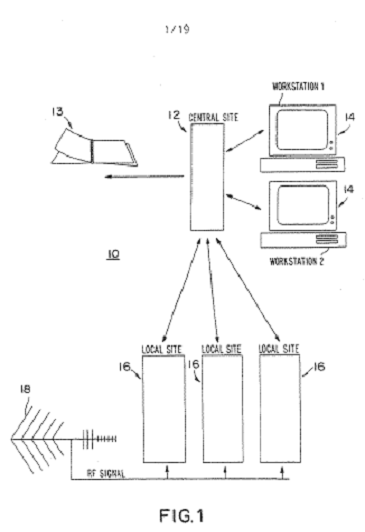
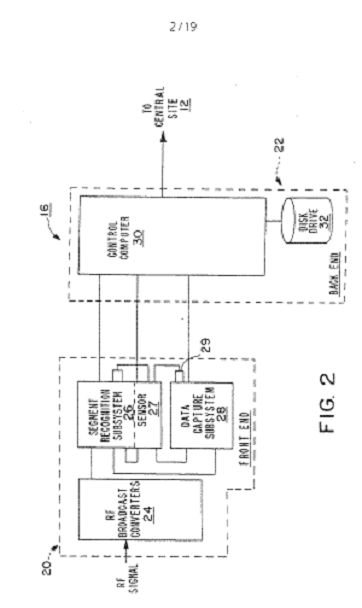
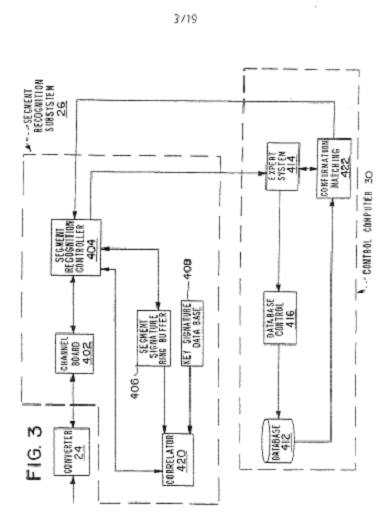
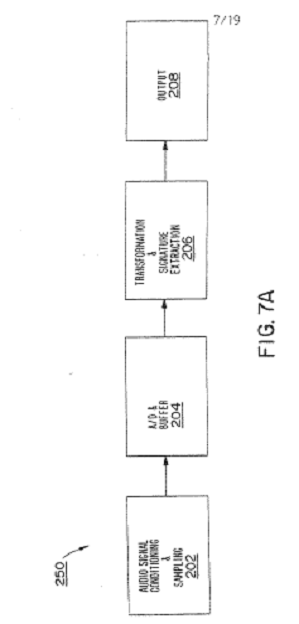
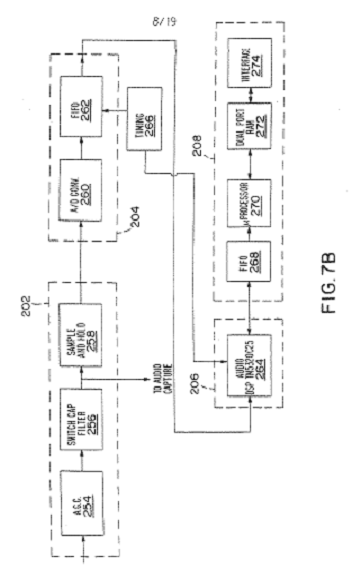
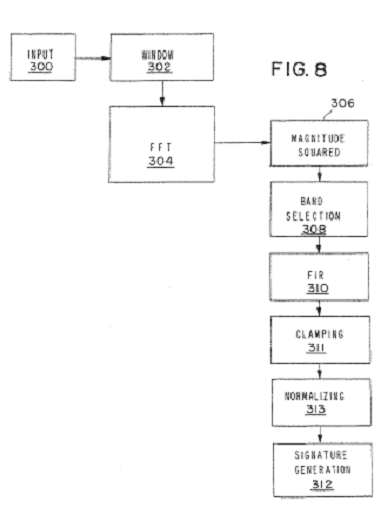
SCHEDULE 2: DESCRIPTION OF THE DRAWINGS
1. Figure 1 illustrates a system for monitoring a continuous stream of broadcast signals. The claimed improved methods and apparatus are implemented at the local sites (16) of the system shown in Figure 1. Each local site is adapted to receive an RF signal from, for example, an antenna (18) or a cable television head end station and is capable of recognising and identifying known broadcast segments by date, time, duration, channel and other desirable information.
2. Figure 2 illustrates one of the local sites in block form. Each of the RF broadcast converters (24) receives television broadcast signals over a respective channel and demodulates the received signals to provide base band, video and audio signals. The video and audio signals are thereafter supplied to the segment recognition subsystem (26) in which frame signatures for each of the video and audio signals are generated, which are thereafter compared with stored key signatures to determine whether a match exists.
3. Figure 3 illustrates the data flow for a typical matching operation. One of the converters (24) receives a desired channel of broadcast signals which are supplied as base band video and audio signals to the segment recognition subsystem (26). That subsystem includes a plurality of channel boards (402), one for each channel monitored by the local site (16), each of which serves to generate a corresponding frame sub-signature and mask word for each frame of the base band video signal. In addition, each channel board generates a frame sub-signature and mask word for each interval of the audio signal corresponding with a frame of the video signal and having the same format as the video sub-signatures and mask words.
4. Figures 7A and 7B are flow diagrams representing the audio signature generation assembly (250) (Assembly) described in the Audio Signature Generation section of the specifications. The Assembly is incorporated into a channel board that monitors a single television channel of interest received by the RF antenna. The signal received by each channel board is converted to a baseband audio signal. The baseband audio signal is then input to the Assembly. The Assembly processes the electrical signal and extracts a signature representing that signal. Figure 7A illustrates the four components of the Assembly diagrammatically. Each of those four components is made up of subcomponents, details of which appear in Figure 7B.
5. Figure 8 illustrates diagrammatically the sequence of processing steps performed by the Transformation and Signature ExtractionModule (206/264). The function and purpose of the module 206 is summarised in the specification. That is, it “utilizes a Fast Fourier Transform process (FFT) for generating audio frame signatures and corresponding mask words.” The processing “is synchronized to the corresponding video fields such that a complete processing sequence is repeated every video frame”.
SCHEDULE 3: THE CLAIMS OF THE PATENT
1. A. A method of producing a signature characterizing an audio broadcast signal for use in broadcast signal recognition, comprising the steps of:
B. forming a plurality of frequency band values each representing portions of said audio broadcast signal within respective predetermined frequency band;
C. comparing each of a first group of said plurality of frequency band values with a respective one of a second group of said plurality of frequency band values representing portions of said audio broadcast signal within the same respective predetermined frequency brand, each respective one of the second group of said plurality of frequency band values representing portions of said audio broadcast signal at least a part of which were broadcast prior to the portions of said audio broadcast signal represented by the corresponding one of said first group of said plurality of frequency band values; and
D. forming said signature based upon the comparisons of the first and second groups of said plurality of frequency band values.
2. The method of claim 1, wherein the step of forming a plurality of frequency band values comprises forming first frequency band signals each representing a characteristic of said audio broadcast signal within a respective predetermined frequency band, and transforming each of said first frequency band signals to a corresponding one of said plurality of frequency band values based upon at least one other first frequency band signal.
3. The method of claim 2, wherein the step of forming said first frequency band signals comprises forming a plurality of power level signals each representing a power level of said audio broadcast signal within a respective predetermined frequency band, and the step of transforming said first frequency band signals comprises dividing each of said plurality of power level signals by a linear combination of others of said first frequency band signals.
4. A system for producing a signature characterizing an audio broadcast signal for use in broadcast signal recognition, comprising:
means for forming a plurality of frequency band values each representing portions of said audio broadcast signal within respective predetermined frequency band;
means for comparing each of a first group of said plurality of frequency band values with a respective one of a second group of said plurality of frequency band values representing portions of said audio broadcast signal within the same respective predetermined frequency band, each respective one of the second group of said plurality of frequency band values representing portions of said audio broadcast signal at least a part of which was broadcast prior to the portions of said audio broadcast signal represented by the corresponding one of said first group of said plurality of frequency band values; and
means for forming said signature based upon the comparisons of the first and second groups of said plurality of frequency band values.
5. The method of claim 1, wherein the step of forming said signature comprises including in the signature data produced from the comparisons of the first and second groups of said plurality of frequency band values.
6. The method of claim 1, wherein the step of comparing the first and second frequency band values comprises producing difference values representing differences between the first and second frequency band values.
7. The method of claim 6, wherein the step of forming said signature comprises including in the signature data produced from the difference values.
8. The system of claim 4, wherein the means for forming said signature comprises including in the signature data produced from the comparisons of the first and second groups of said plurality of frequency band values.
9. The system of claim 4, wherein the means for comparing the first and second frequency band values comprises producing difference values representing differences between the first and second frequency band values.
10. The system of claim 9, wherein the means for forming said signature comprises including in the signature data produced from the difference values.
SCHEDULE 4: REPRESENTATION OF THE TELECONTROL SYSTEM
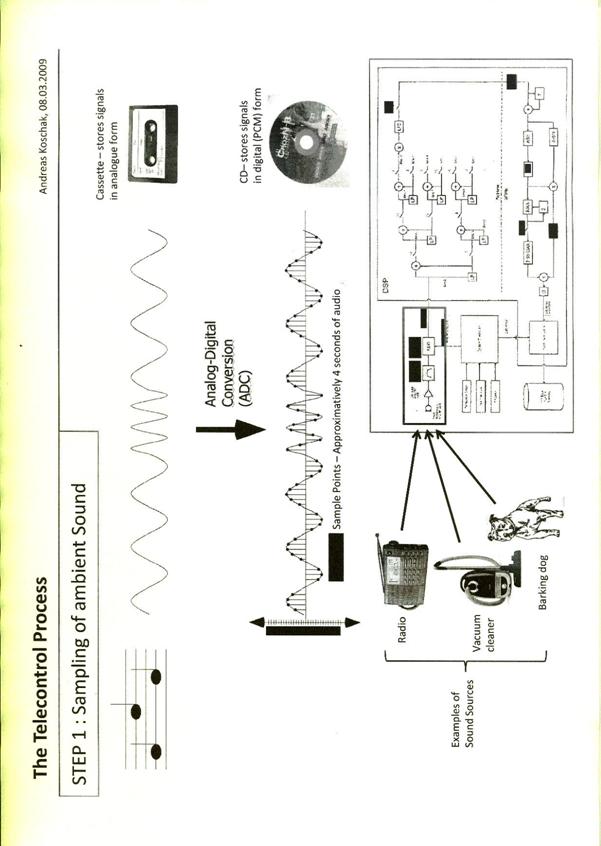
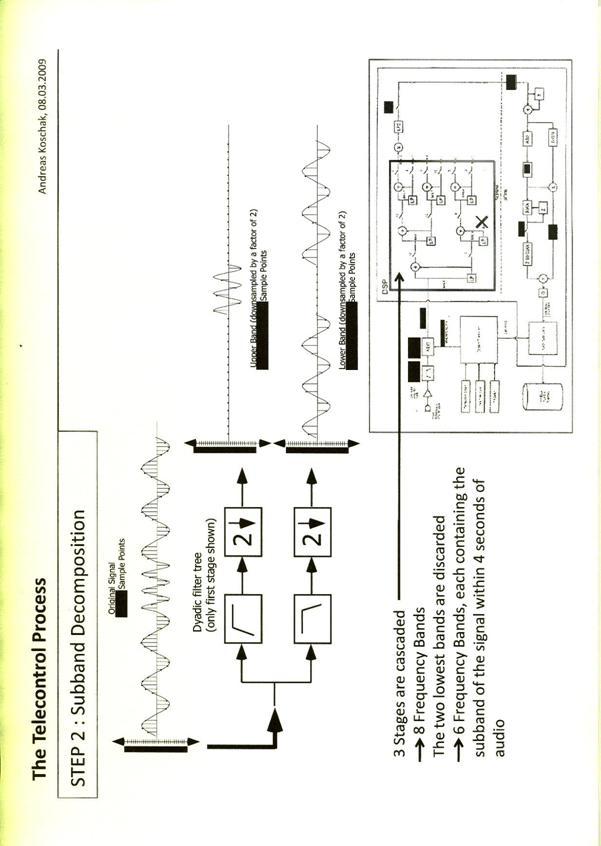
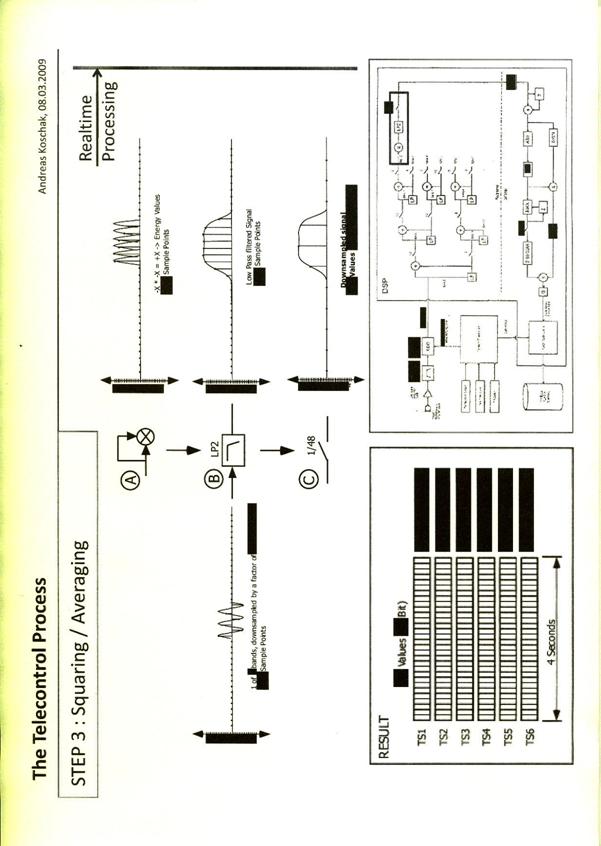
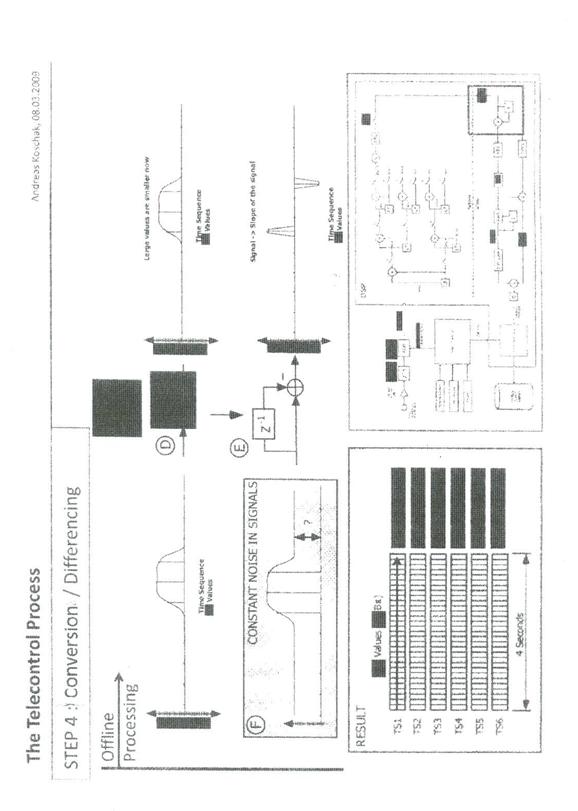
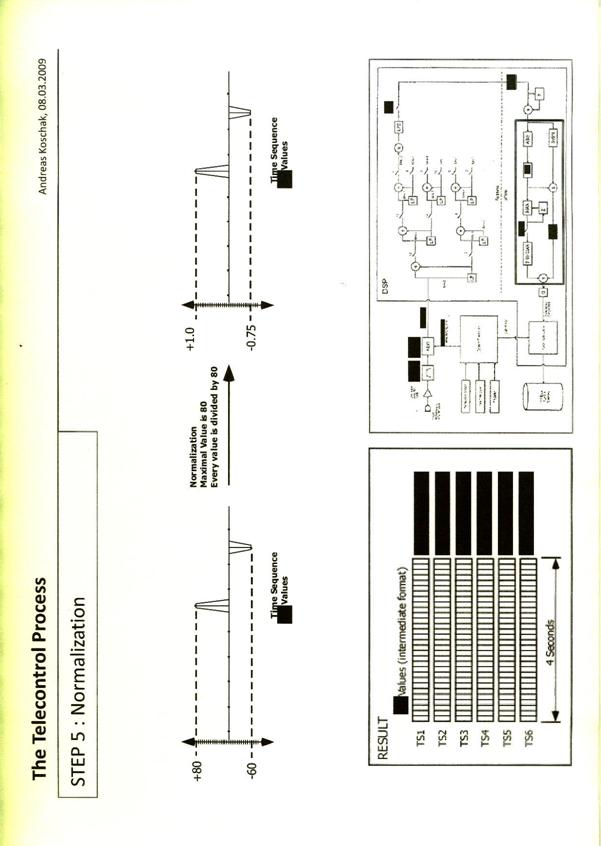
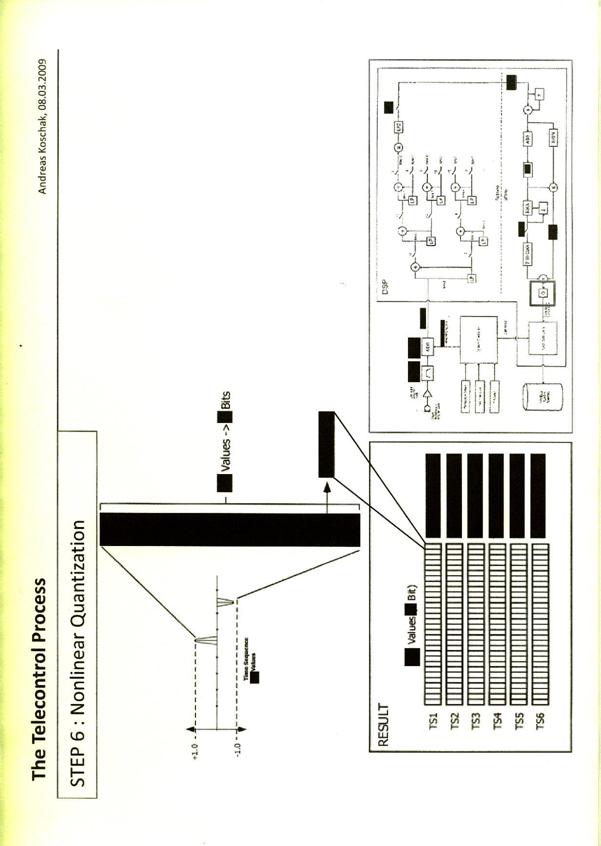
SCHEDULE 5: BLOCK DIAGRAM OF CLAIM 1 OF THE PATENT
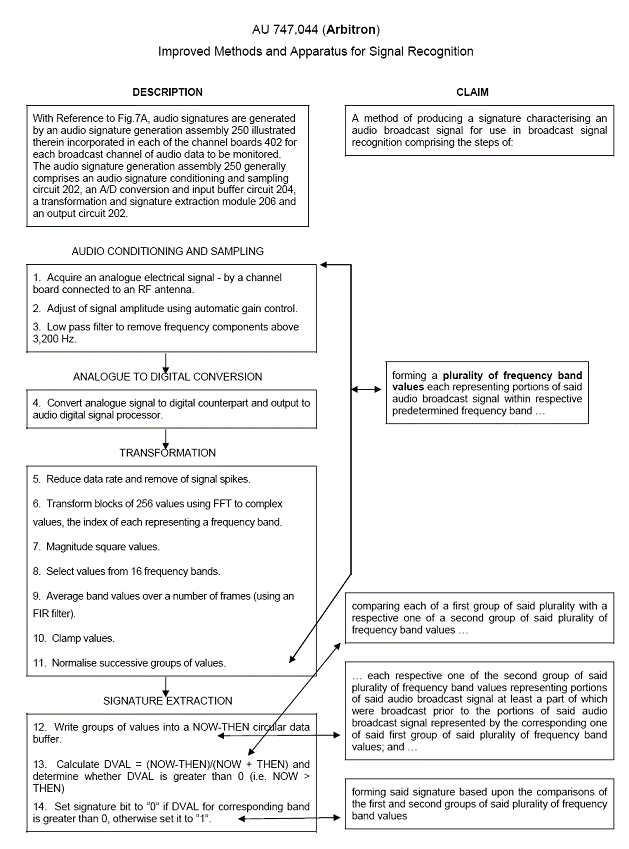
SCHEDULE 6: BLOCK DIAGRAM OF SEIKO PATENT
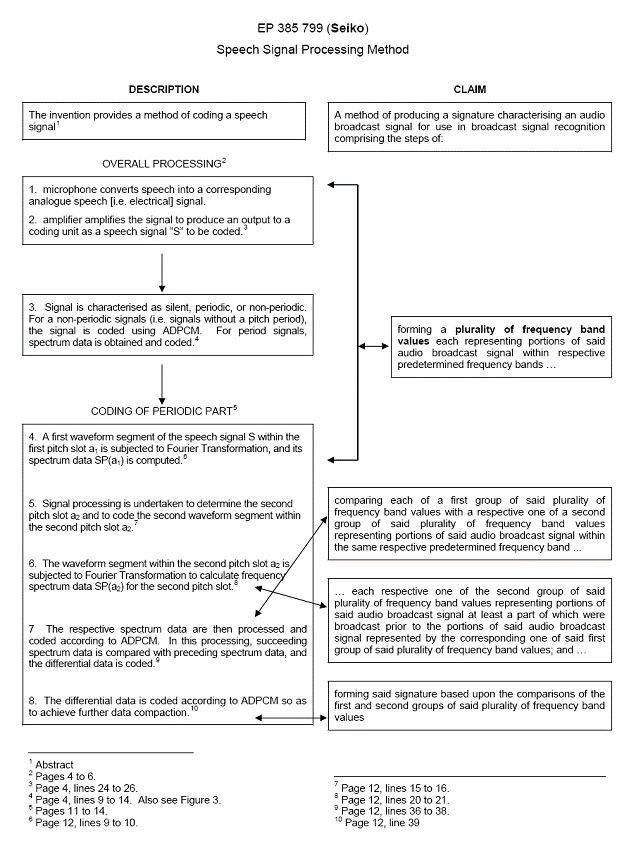
SCHEDULE 7: BLOCK DIAGRAM OF TRT PATENT
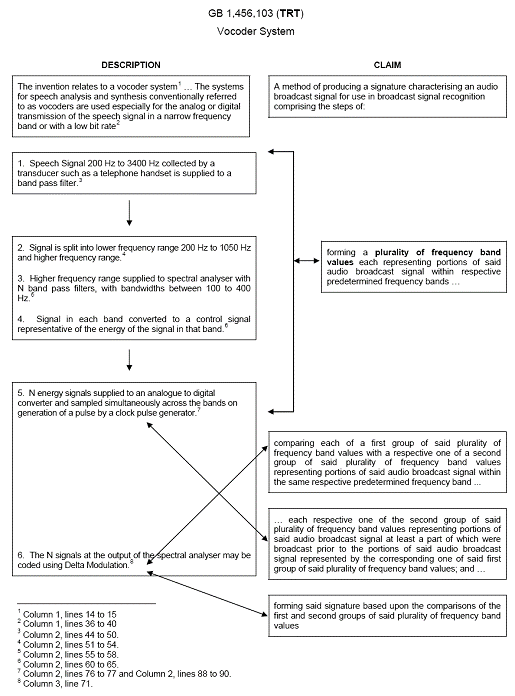
| I certify that the preceding two hundred and seventy-three (273) numbered paragraphs are a true copy of the Reasons for Judgment herein of the Honourable Justice Emmett. |
Associate:
Dated: 31 March 2010


