

FEDERAL COURT OF AUSTRALIA
Westport Insurance Corporation, in the matter of Westport Insurance Corporation (No 2) [2009] FCA 1598
Insurance Act 1973 (Cth) ss 17B, 17C, 17F, 116, 116A
In the matter of GIO Personal Investment Services Ltd and AMP Life Ltd [2000] FCA 1871 referred to
In the matter of Reward Insurance Ltd [2004] FCA 151 referred to
Mercantile & General Reinsurance Company of Australia Ltd [2004] FCA 1773 discussed
PMI Indemnity Ltd [2005] FCA 1842 cited
Re Armstrong Jones Life Assurance Limited (1997) 74 FCR 160 cited
Re Calliden Group Ltd [2007] FCA 2019 cited
Re Insurance Australia Ltd (2004) 139 FCR 450 referred to
Re MDU Australian Insurance Co Pty Ltd [2008] FCA 490 referred to
Re Royal & Sun Alliance Life Assurance Ltd (2000) 104 FCR 37 cited
IN THE MATTER OF WESTPORT INSURANCE CORPORATION
(ABN 48 072 715 738)
WESTPORT INSURANCE CORPORATION (ABN 48 072 715 738)
NSD 1220 of 2009
LINDGREN J
17 December 2009
SYDNEY
|
IN THE FEDERAL COURT OF AUSTRALIA |
|
|
NEW SOUTH WALES DISTRICT REGISTRY |
|
|
GENERAL DIVISION |
NSD 1220 of 2009 |
IN THE MATTER OF WESTPORT INSURANCE CORPORATION
(ABN 48 072 715 738)
The application of: |
WESTPORT INSURANCE CORPORATION (ABN 48 072 715 738)
|
|
JUDGE: |
|
|
DATE OF ORDER: |
17 DECEMBER 2009 |
|
WHERE MADE: |
SYDNEY |
THE COURT ORDERS THAT:
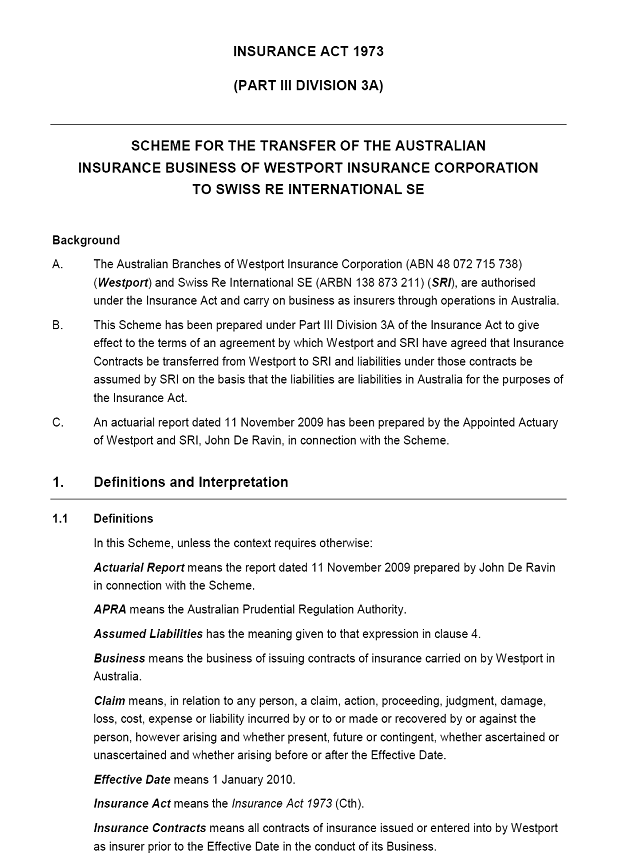
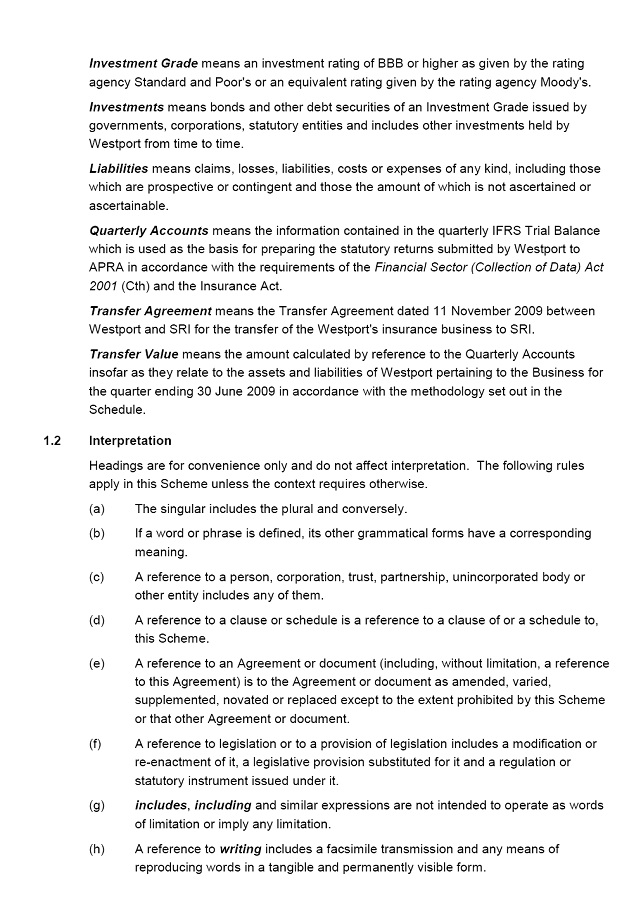
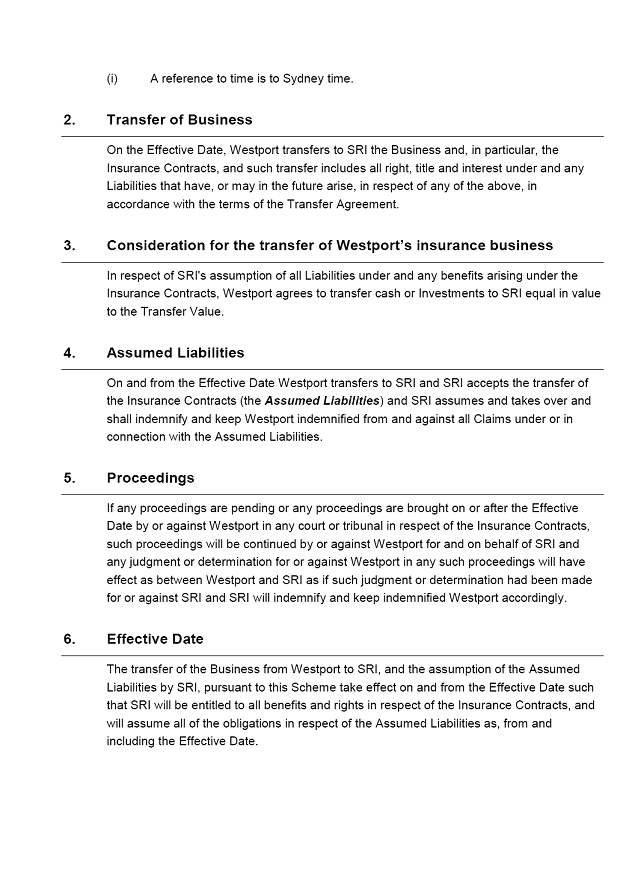
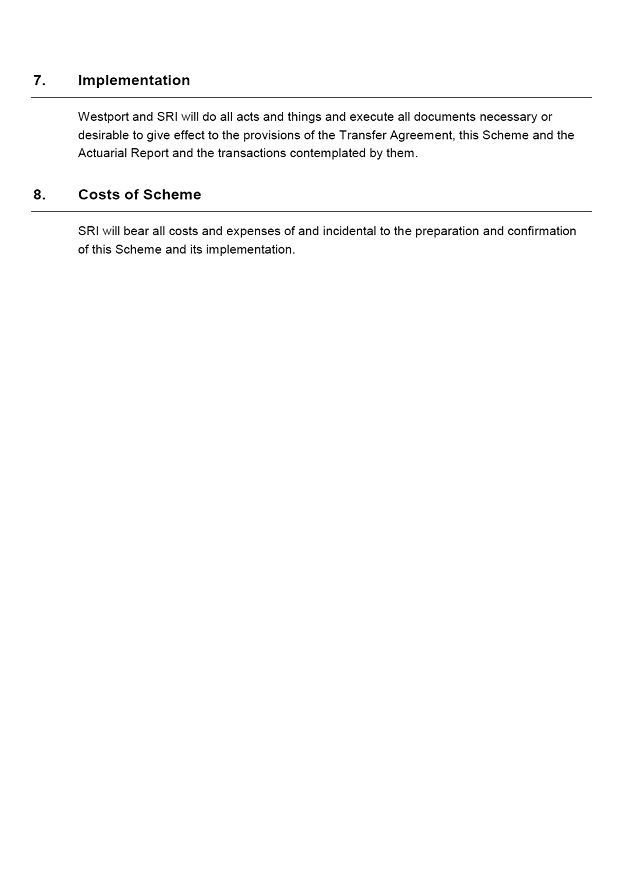
1. Subject to order 2, pursuant to s 17F(1) of the Insurance Act 1973 (Cth) (the Act), the scheme for the transfer of the general insurance business of the Australian branch of the applicant (Westport) to the Australian branch of Swiss Re International SE (SRIAU and SRI respectively), in the form of Annexure A to these orders, be confirmed without modification.
2. Order 1 shall have effect only if, by 31 December 2009:
(a) the Missouri Department of Insurance, Financial Institutions & Professional Registration (the Regulator) issues a letter or other writing to the effect that it approves, or otherwise confirms that it has no objection to, the transfer of the business of issuing Insurance Contracts carried on by Westport in Australia to SRIAU, within the meaning and for the purposes of cl 2(c) of the Transfer Agreement dated 11 November 2009 between Westport and SRI; and
(b) Westport serves on the Australian Prudential Regulation Authority, with a copy to the Associate to Lindgren J, a letter or other writing issued by the Regulator satisfying para (a) above.
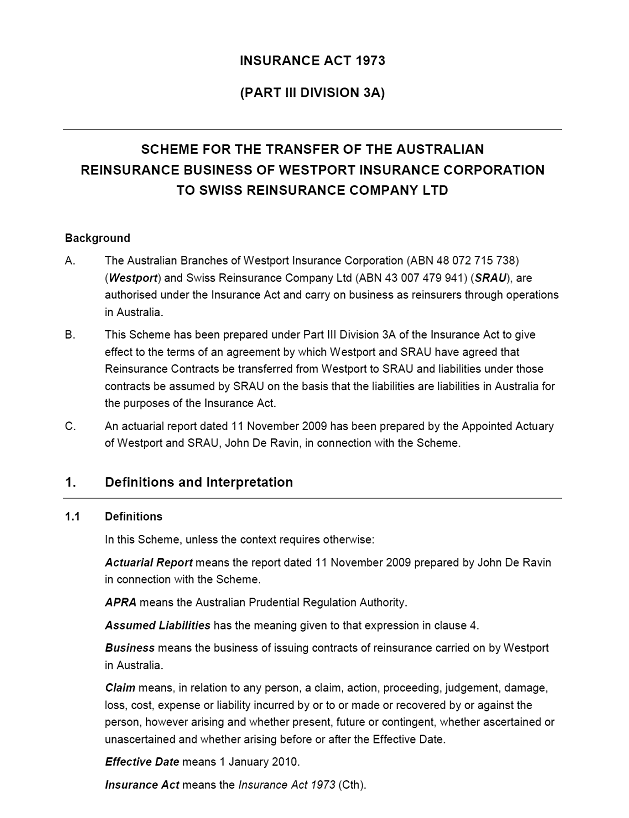
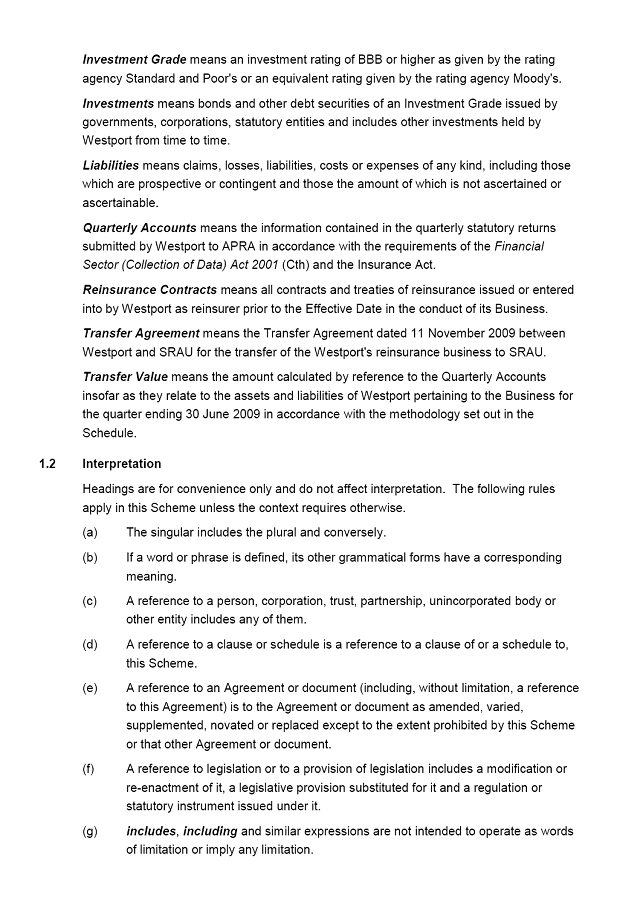
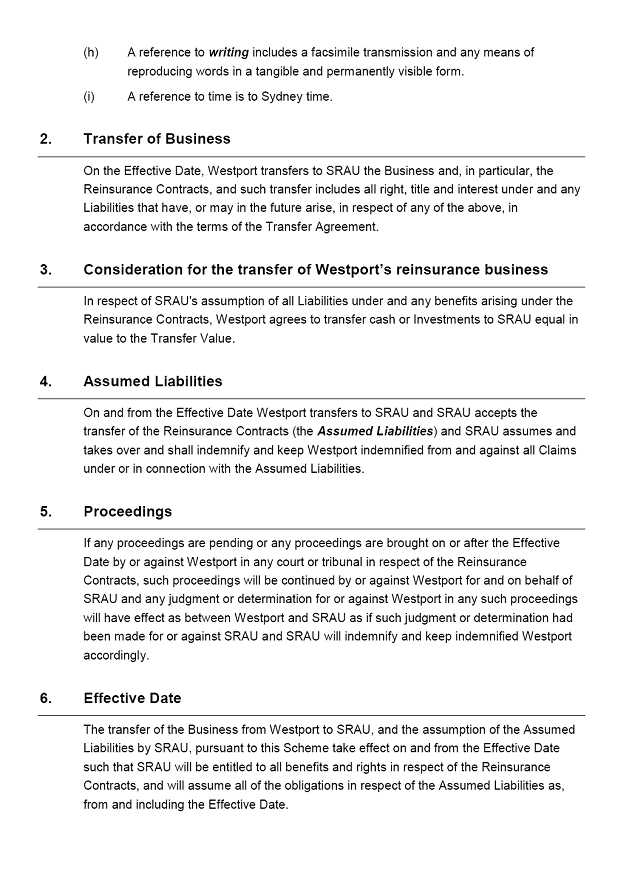
3. Subject to order 4, pursuant to s 17F(1) of the Act, the scheme for the transfer of the reinsurance business of the Australian branch of Westport to the Australian branch of Swiss Reinsurance Company Limited (SRCAU and SRC respectively), in the form of Annexure B to these orders, be confirmed without modification.
4. Order 3 shall have effect only if, by 31 December 2009:
(a) the Regulator issues a letter or other writing to the effect that it approves, or otherwise confirms that it has no objection to, the transfer of the business of issuing Reinsurance Contracts carried on by Westport in Australia to SRCAU, within the meaning and for the purposes of cl 2(c) of the Transfer Agreement dated 11 November 2009 between Westport and SRC; and
(b) Westport serves on the Australian Prudential Regulation Authority, with a copy to the Associate to Lindgren J, a letter or other writing issued by the Regulator satisfying para (a) above.
5. Westport have liberty to apply on three hours’ notice.
6. Westport pay the costs of APRA as agreed or, if agreement cannot be reached, as taxed.
Note: Settlement and entry of orders is dealt with in Order 36 of the Federal Court Rules.
The text of entered orders can be located using eSearch on the Court’s website.
A
B
|
IN THE FEDERAL COURT OF AUSTRALIA |
|
|
NEW SOUTH WALES DISTRICT REGISTRY |
|
|
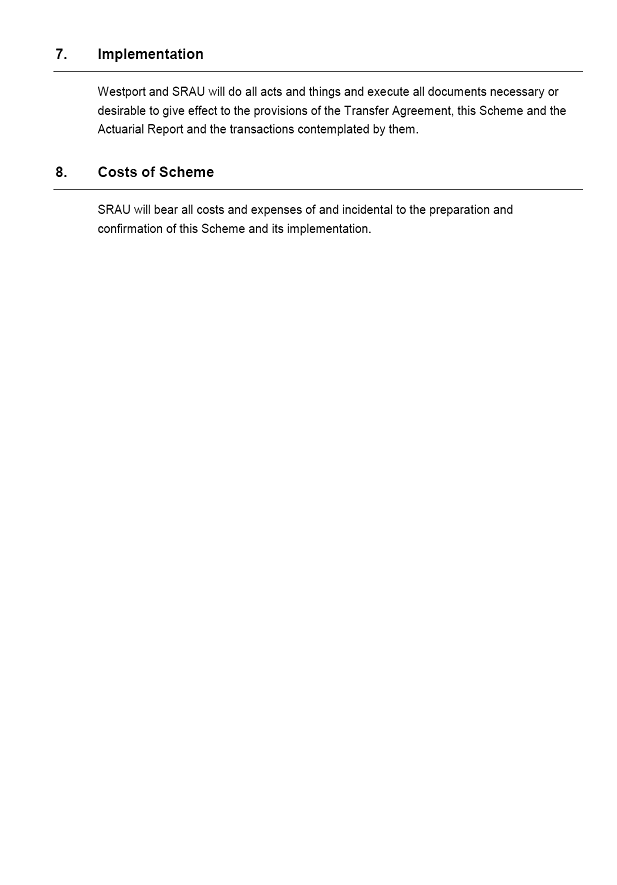
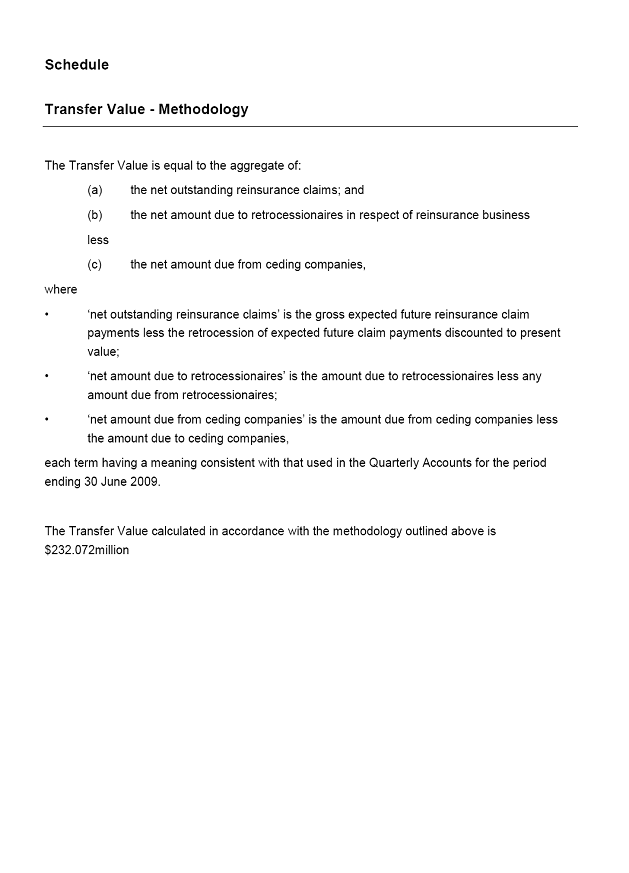
GENERAL DIVISION |
NSD 1220 of 2009 |
IN THE MATTER OF WESTPORT INSURANCE CORPORATION
(ABN 48 072 715 738)
The application of: |
WESTPORT INSURANCE CORPORATION (ABN 48 072 715 738)
|
|
JUDGE: |
LINDGREN J |
|
DATE: |
20 JANUARY 2010 |
|
PLACE: |
SYDNEY |
REASONS FOR JUDGMENT (No 2)
Introduction
1 On 13 November 2009 I made orders to the effect that in relation to two proposed schemes for the transfer of insurance businesses from the applicant, Westport Insurance Corporation (Westport), to Swiss Re International SE (the Insurance Scheme) and to Swiss Reinsurance Company Ltd (the Reinsurance Scheme) respectively, the need for the applicant to comply with s 17C(2)(c) of the Insurance Act 1973 (Cth) (the Act), be dispensed with under s 17C(5) of the Act, provided the applicant complied with certain other orders which I made at that time: see Westport Insurance Corporation, in the matter of Westport Insurance Corporation [2009] FCA 1357 (Earlier Reasons).
2 On 17 December 2009 I made the orders that appear at the front of these reasons, confirming both Schemes subject to satisfaction of the condition referred to in them by 31 December 2009.
3 The reasons why I made the orders on 17 December 2009 are found in the Earlier Reasons and these present reasons.
4 By the Insurance Scheme, the direct insurance business of Westport’s Australian branch was to be transferred to the Australian branch of Swiss Re International SE (I will refer to the company as SRI and to its Australian branch as SRIAU).
5 By the Reinsurance Scheme, the reinsurance business of Westport’s Australian branch was to be transferred to the Australian branch of Swiss Reinsurance Company Ltd (I will refer to the company as SRC and to its Australian branch as SRCAU).
6 There is confusion in the papers concerning the addition or omission of “AU”. Because I will be recounting things stated in the papers, it is impossible to avoid all ambiguity below. It must be remembered, however, that while the Australian branches are important for APRA and actuarial purposes, the legal entities are the bodies corporate themselves. Westport, SRI and SRC are all incorporated in foreign countries and are registered in Australia as foreign companies.
7 Westport, SRI and SRC are all foreign general insurers as defined in s 3 of the Act because they are all (a) foreign corporations within the meaning of s 51(xx) of the Constitution; (b) authorised to carry on insurance business in a foreign country; and (c) authorised under s 12 of the Act to carry on insurance business in Australia. The expression “insurance business” is defined in s 3 of the Act. The expression “general insurer” is defined to mean a body corporate that is authorised under s 12 of the Act to carry on insurance business in Australia (ss 3, 11 of the Act). A foreign general insurer is therefore a species of general insurer.
8 Westport is a member of the Swiss Re group of companies. Westport’s Australian branch has both general insurance and reinsurance liabilities. Other members of the Swiss Re group with Australian branches are SRI and SRC. The Schemes are propounded principally in order to effect an internal reorganisation of the Australian operations of the Swiss Re group. Following the implementation of the Schemes, the general insurance business of Swiss Re in Australia will be conducted by SRI through SRIAU, and the reinsurance business of Swiss Re in Australia will be conducted by SRC through SRCAU.
9 All of Westport’s policyholders will be “transferred” from Westport (which, as at 30 June 2009, and if adjusted to take into account a capital reduction in September 2009, had a solvency ratio of 158%) either to SRI (SRIAU is projected to have a solvency ratio of 191%) or to SCR (SRCAU is projected to have a solvency ratio of 160%) (see [67] below), according to whether their policies are in the nature of direct insurance or reinsurance respectively.
10 The Schemes have the support of Westport’s appointed actuary.
Australian branches of foreign general insurers
11 An Australian “branch” of a foreign general insurer is a notional entity representing the assets and liabilities of that company in Australia. The branch is not a legal entity. However, the Australian Prudential Regulation Authority (APRA) is concerned only with the Australian branch and with the protection of the holders of policies issued by the Australian branch. There is a general requirement under the Act (s 28) that general insurers maintain “in Australia” assets of a value equal to or greater than the value of their liabilities “in Australia”. Other provisions of the Act also express the test of ability to meet a general insurer’s liabilities in Australia from its asset in Australia: see ss 62M, 62ZZC, 62ZZE. The meaning of assets and liabilities in Australia is refined and elaborated upon in s 116A of the Act. Prudential Standards require foreign general insurers to maintain assets in Australia in excess of their liabilities in Australia in an amount at least equal to a variant of a certain Minimum Capital Requirement (MCR) (see Prudential Standard GPS 110 Capital Adequacy, esp para 11). Foreign general insurers must therefore maintain a separate balance sheet in respect of their Australian operations in order to depict the financial condition of the Australian branch.
12 This notional division between a foreign general insurer’s Australian operations and its other operations is reinforced by restrictions that APRA places on a foreign general insurer’s liberty to deal with its assets in Australia. It may not reduce its assets in Australia (save to the extent of repatriation, to a certain extent, of current year profits) without APRA’s approval.
The companies involved
Westport
13 Westport is incorporated in Missouri, USA. It commenced writing insurance and reinsurance business in Australia through a branch in 1996.
14 Westport was acquired by SRC in 2006. Following the acquisition, Westport ceased to write reinsurance business, focussing instead on commercial insurance. The reinsurance portfolio is in “run-off”. As at 31 December 2008, Westport’s insurance liabilities were approximately 18% direct insurance, and 82% reinsurance.
15 Claims made on Westport are currently handled by SRC’s claims division.
16 As at 30 June 2009, on an APRA accounting basis, Westport’s Australian branch had total assets of $529,232,159, and total liabilities of $314,027,590, giving a net asset position of $215,204,569. (The position on an ASIC accounting basis is only slightly different, with a net asset position of $212,813,775). As at 30 June 2009, after taking into account a subsequent capital reduction, Westport has been calculated to have had assets equal to 158% of its MCR.
SRC
17 SRC is incorporated in Switzerland. It is a large, global, general, life and health reinsurer. SRC has 54 offices in 34 countries and employs approximately 10,000 people worldwide.
18 In the financial year ended 31 December 2008, SRC made a net loss of CHF 0.9 billion. As at 31 December 2008 it had total assets of CHF 239.9 billion, and total liabilities of CHF219.4 billion, giving a net asset position of CHF 20.5 billion.
19 SRC is rated A+ (stable) by Standard & Poor’s, A1 (good) by Moody’s, and A (excellent) by AM Best.
20 SRC has carried on business in Australia through its branch, SRCAU, since 1956.
21 As at 31 December 2008, on an APRA accounting basis, SRCAU had total assets of $2,285,137, and total liabilities of $1,806,403, giving a net asset position of $478,734. As at 31 December 2008, SRCAU held assets equal to 167% of its MCR. As at 30 June 2009, that solvency coverage had increased to 182%, primarily because no funds have been repatriated out of SRCAU since 31 December 2008.
SRI
22 SRI is a Luxembourg company. SRI has not previously conducted business in Australia. In 2009, APRA authorised SRI to carry on a new and renewal insurance business in Australia through an Australian branch, subject to a condition that it not issue any policies until 1 January 2010.
23 SRI does not have any employees in Australia. Its operations are (and will be) conducted by employees of SRC, pursuant to services agreements.
The legislative framework
24 Section 17B(1) of the Act provides that no part of a general insurer’s business may be transferred to another general insurer or amalgamated with the business of another general insurer except pursuant to a scheme confirmed by this Court. This provision is subject to an exception provided for in subs (4). Subsections (1) and (4) are discussed further below.
25 Section 17E(1) (read in conjunction with s 17A) provides that any party or proposed party to a transfer scheme may apply to the Court for confirmation of the scheme.
26 Such an application cannot be made until the steps outlined in s 17C(2) have been taken. The application must be made in accordance with the prudential standards (s 17E(2)).
27 Section 17F(1) provides that the Court may confirm the scheme, either as presented or as modified by the Court, or refuse to confirm the scheme.
Preconditions to making an application
28 Steps required to be taken prior to the “making” of an application need only be taken prior to the time at which the Court is moved for the order of confirmation of the scheme, not prior to the filing of the application in the Court registry: Re Armstrong Jones Life Assurance Limited (1997) 74 FCR 160 at 163, per Emmett J; Re Royal & Sun Alliance Life Assurance Ltd (2000) 104 FCR 37 at 39, per Katz J; Re Insurance Australia Ltd (2004) 139 FCR 450 (Re Insurance Australia Ltd) at [30] – [37], per Lindgren J.
29 A reading of s 17C(2) of the Act with Prudential Standard GPS 410 – Transfer and Amalgamation of Insurance Business for General Insurers discloses that the following steps must be taken before an application for confirmation is made.
(a) The applicant must provide a copy of the scheme and of any actuarial report on which it is based to APRA: s 17C(2)(a). That must be done before the steps outlined at (d) and (e) below are taken: Prudential Standard GPS 410,para 5. The Schemes were first provided to APRA on 4 November 2009. Drafts of the actuarial reports in respect of the Schemes were provided to APRA on 26 October 2009.
(b) The applicant must obtain APRA’s approval of its summary of the scheme (Scheme Summary) before the step outlined at (d) below is taken: Prudential Standard GPS 410, para 8. APRA approved the Scheme Summaries on 12 November 2009.
(c) The applicant must obtain APRA’s approval of its notice of intention to make the application: Prudential Standard GPS 410,para 9. APRA approved the notices of intention on 12 November 2009.
(d) The applicant must publish a notice of intention to make the application: s 17C(2)(b). That notice must contain the information specified in Prudential Standard GPS 410, para 10. The notice must be published in (a) the Government Gazette, and (b) one or more newspapers approved by APRA circulating in each State and Territory in which an affected policyholder resides: Prudential Standard GPS 410,para 9. The notice must be published before the step outlined at (f) below is taken: Prudential Standard GPS 410, para 11. APRA required that, in addition to publication in the Government Gazette, the notice of intention be published in The Australian and The Australian Financial Review. The present notices of intention (which were approved by APRA on 12 November 2009) were published once in each of those publications on 17 November 2009 (in the Government Gazette) and on 19 November 2009 (in The Australian Financial Review and The Australian).
(e) The applicant must give to every affected policyholder a copy of the Scheme Summary. This requirement was waived by my order made on 13 November 2009 on condition that certain other steps were taken as outlined below.
(f) The applicant must make a copy of the scheme available for public inspection from 9.00 a.m. until 5.00 p.m. every day (except weekends and public holidays) for a period of at least 15 days at an office of the applicant or some other location approved by APRA in each State and Territory in which an affected policyholder resides: Prudential Standard GPS 410,para 16. The inspection period in this case ran from 20 November 2009 to 11 December 2009, and copies of the Schemes were made available at locations approved by
APRA being various offices of Allens Arthur Robinson, the solicitors for Westport, or of other firms appointed by them for the purpose.
30 The additional steps required to be taken by the applicant in this case by the Court’s orders of 13 November 2009 were as follows:
(a) in relation to the Insurance Scheme, Westport was required to send a copy of the Scheme Summary by pre-paid post to:
i. all policyholders of Westport identified by the searches referred to in the affidavit of Karen Lancaster read in support of the application, and for whom Westport had an address;
ii. MGA Insurance Brokers Pty Ltd, AssetInsure Pty Ltd, Australis Group Underwriting, Howard Insurance Australia Pty Ltd, SRS Underwriting Agency, Dexta Corporation Pty Ltd and Gallagher Broking Services.
(b) in relation to the Reinsurance Scheme, Westport was required to send a copy of the Scheme Summary by pre-paid post to:
i. all policyholders of Westport identified by the searches referred to in the affidavit of Xenia Zumbach-Hauenstein read in support of the application, and for whom Westport had an address;
ii. all insurers authorised with APRA listed in the “List of Authorised Insurers” maintained by APRA as at 13 November 2009.
31 Evidence was read at the hearing on 17 December 2009 demonstrating compliance with the requirements mentioned at [29] and [30] above.
The discretion to confirm the scheme
32 A review of some of the decided cases (including cases decided under similar provisions of the Life Insurance Act 1995 (Cth)) suggests that, in general terms, the Court has treated the critical factor governing the exercise of its discretion as being whether “policyholders” will be materially detrimentally affected by the implementation of the scheme: Re Insurance Australia Ltd at [76]; In the matter of GIO Personal Investment Services Ltd and AMP Life Ltd [2000] FCA 1871 at [27].
33 The expression “affected policyholder” is defined and used in s 17C of the Act. That section is concerned with steps to be taken before the application for confirmation is made. In Re Insurance Australia Ltd, I held at [19]-[24] that an “affected policyholder” within the meaning of s 17C is a holder of a policy being transferred under the scheme. Accordingly, in the present case it is the policyholders of Westport who are “affected policyholders” for the purposes of s 17C of the Act. I also held, however, that this does not mean that the effect that the scheme will have on other policyholders is irrelevant to the exercise of the Court’s discretion: Re Insurance Australia Ltd at [25]. SRIAU has no existing policyholders (see [22] above), but SRCAU does (see [20]-[21] above).
34 The Court’s discretion to confirm a scheme for the transfer of an insurance business is conferred by s 17F. In In the matter of Reward Insurance Ltd [2004] FCA 151, Heerey J observed (at [3]) that the discretion was a general one and that the Act did not specify any criteria that were to be considered. His Honour described as “a prime consideration” the nature of the actual and potential claims to which the transferor insurer is subject and the financial viability of the transferee insurer (ibid). In Re MDU Australian Insurance Co Pty Ltd [2008] FCA 490, Emmett J identified (at [7]) “[t]he critical consideration” as being whether the affected policyholders would be detrimentally affected. His Honour also said (at [9]) that the interests of the existing policyholders of the transferee insurer must be considered. Earlier, in Mercantile & General Reinsurance Company of Australia Ltd [2004] FCA 1773, his Honour had raised (at [23]) the question of the desirability of legislative amendment to make consideration of the interests of the latter mandatory (but see [44] below).
35 The position must now be considered in the light of s 17F(1A) of the Act. Subsection (1A) was inserted into s 17F by the Financial System Legislation Amendment (Financial Claims Scheme and Other Measures) Act 2008 (Cth)(No 105, 2008), s 3 Schedule 3, Item 7. Subsection (1A) provides:
In deciding whether to confirm a scheme (with or without modifications), the Federal Court must have regard to:
(a) the interests of the policyholders of a body corporate affected by the scheme; and
(b) if a report relevant to all or part of the scheme has been filed with the Court under section 62ZI—that report; and
(c) any other matter the Court considers relevant.
Paragraph (b) has no application in the present case.
36 The present application for confirmation has raised an important question, namely, whether para (a) of the new subs (1A) of s 17F encompasses the interests of the holders of policies issued otherwise than as part of the business of an Australian branch. In other words, must the Court have regard to the interests of the holders of policies issued in any of its branches anywhere in the world by a foreign general insurer that is affected by the scheme?
37 The argument in favour of a positive answer to this question depends on what may be described as a “literal” construction of para (a) of s 17F(1A).
38 In the present case, the bodies corporate that are affected by the Insurance Scheme are Westport (incorporated in Missouri) and SRI (incorporated in Luxemburg), and the bodies corporate that are affected by the Reinsurance Scheme are Westport (incorporated in Missouri) and SRC (incorporated in Switzerland). All three bodies corporate have written insurance business overseas. It could be argued that the interests of the holders of policies issued as part of the business of an overseas branch of any of these insurers are indirectly “affected” by the Schemes even though the Schemes directly affect only the interests of the holders of policies issued by the Australian branches.
39 It should be acknowledged at the outset that the literal construction referred to is at odds with the Act’s concern with Australian branches; would give rise to inconvenience; and was almost certainly not intended.
40 On the question of inconvenience, the Court was informed, and in any event takes judicial notice of the fact, that global insurers are likely to have many branches located in several and possibly many countries, and thousands and possibly tens or even hundreds of thousands of policyholders. For example, the Court was informed that “Swiss Re operates in over 35 different countries”, while “the Australian branch of Swiss Re Insurance Company Ltd represents only approximately 2.5% of Swiss Re Insurance Ltd’s global premium income and claims liabilities”.
41 If subsection (1A) requires the Courtto have regard to the interests of policyholders world wide, it may be necessary on applications for confirmation of a scheme to have actuarial evidence relating to the interests of the policyholders of overseas branches and of the legislative or regulatory requirements (or both) applicable in each overseas jurisdiction in which the body corporate operates.
42 It is difficult to accept that this is what the Parliament intended. I would so construe para (a) of the new subsection (1A) of s 17F in this way only if constrained to do so.
43 Neither my own researches nor those of Westport’s legal representatives or of APRA (which exercised its right to be heard under s 17E(3) of the Act) have revealed any statement in the Explanatory Memorandum or the Parliamentary Debates associated with the Bill for Act No 105 of 2008 that throws any light on the intended scope of para (a).
44 An intention that might suggest itself is that of making mandatory a consideration that this Court was already at liberty to take into account and has taken into account, namely, the interests of non-transferred (remaining) Australian branch policyholders of the transferor insurer, and existing (continuing) Australian branch policyholders of the transferee insurer, neither of which categories would fall within s 17C’s concept of “affected policyholder”: see Re Insurance Australia Ltd, above at [25], [70], [75], [76]; Mercantile & General Reinsurance Company of Australia Ltd, above, at [23]; PMI Indemnity Ltd [2005] FCA 1842 at [25] ff; Re Calliden Group Ltd [2007] FCA 2019 at [90]-[91]. Importantly, in no case has the Court had regard to the interests of policyholders of an overseas branch or discussed the desirability of their being considered. In Mercantile & General Reinsurance Company of Australia Ltd, above, for example, Emmett J referred to the effect of a scheme on the Australian branch policyholders of the transferee foreign general insurer, and not the policyholders of its overseas branches. His Honour also said (at [3]) that the non-Australian assets and liabilities of the transferee foreign general insurer could be ignored. Justice Emmett’s comment relating to the desirability of legislative amendment to which I referred at [34] above is to be understood against the background of the fact that his Honour took into account the interests of only the Australian branch policyholders of the transferee foreign general insurer.
45 It seems a fair summary to say that in all applications for confirmation involving foreign general insurers, the parties and the Court have treated the interests of policyholders of branches other than Australian branches as a consideration irrelevant to the exercise of the discretion under s 17F of the Act. The literal construction of para (a) of s 17F(1A) would therefore mark a fundamental change.
46 Section 17A, the first section within Div 3A of Pt III of the Act, provides that a reference in that division to “a body corporate affected by a scheme” is a reference to a body corporate that is a party or proposed party to an agreement or deed by which the transfer or amalgamation provided for in the scheme is, or is to be, carried out. The present Schemes identify the parties as the respective Australian branches, but it seems clear that it is the three legal entities that are the parties to the two Schemes.
47 In my opinion it is not possible to construe the expression “the policyholders of a body corporate affected by the scheme” in s 17F(1A)(a) as simply the plural number of “affected policyholder” in s 17C, subs (1) of which defines that expression as “the holder of a policy affected by a scheme”. Parliament would have used the expression “affected policyholders” if that had been its intention. Similarly, it is not possible, in my view, to read para (a) as referring to [policyholders of a body corporate] [affected by the scheme] and so to make the definition in s 17A irrelevant. Rather, the paragraph refers to [policyholders of] [a body corporate affected by the scheme], and s 17A’s definition of the latter expression is applicable. In the present respect my views are consistent with the submissions of APRA and not with those of Westport.
48 Parliament may be taken:
· to have legislated with knowledge of the course of decision referred to above to the effect that “affected policyholder” in s 17C means “holder of a policy to be transferred under the scheme”;
· to have been content not to interfere with that construction of s 17C’s notification requirement;
· to have legislated with knowledge of the course of judicial practice referred to above according to which the interests of Australian branch policyholders were, but the interests of non-Australian branch policyholders were not, treated as relevant to the exercise of the discretion to confirm a scheme; and
· to have intended the expression “policyholders of a body corporate affected by the scheme” to bear a wider meaning than “affected policyholders”.
49 The question is “how much wider”. The choice is between the holders of policies issued anywhere in the world by bodies corporate affected by the scheme on the one hand, and the holders of policies issued in their Australian branches by bodies corporate affected by the scheme on the other hand. As appears below, I think that, in effect, the latter is the correct construction because it is only the interests of such policyholders to which the Court is required to have regard.
50 I referred to at [11]-[12] above to the Act’s and APRA’s concern as being with the Australian branch businesses, assets and liabilities of foreign general insurers. Parliament should also be understood to have introduced subs (1A) into s 17F with knowledge of that background. A concern with the interests of policyholders world wide would represent a radical new point of departure which Parliament should be understood to have intended only if its intention to that effect is clear.
51 In my opinion, two provisions, in particular, show that para (a) is concerned with the interests of the holders of policies that give rise to a liability of a foreign general insurer in Australia.
52 The first of these provisions is found in subs (4) of s 17B of the Act. Subsection (4) with subs (1) of that section, is as follows:
(1) No part of the insurance business of a general insurer may be:
(a) transferred to another general insurer; or
(b) amalgamated with the business of another general insurer;
except under a scheme confirmed by the Federal Court.
…
(4) Subsection (1) does not require that a transfer or amalgamation of insurance business be made under a scheme approved by the Federal Court if:
(a) immediately before the transfer or amalgamation, the insurance business is carried on outside Australia; and
(b) the transfer or amalgamation will result in the insurance business being carried on outside Australia.
53 Subsection (1) of s 17B is the first and principal substantive provision of Div 3A. The remaining provisions of Div 3A are dependent on it. And subs (1) is subject to subs (4)’s exclusion or carving out.
54 Subsections (1) and (4) of s 17B contemplate a division of the insurance business of a general insurer into “parts” – a part carried on in Australia and a part carried on outside Australia. The requirement of confirmation does not apply to the latter. The whole of Div 3A, including the recently introduced subs(1A) of s 17F, is to be read subject to that exclusion.
55 APRA submits that s 17F is not to be read subject to s 17B and that once a transfer or amalgamation is found to fall within s 17B(1) and therefore to require confirmation by the Court, s 17F applies without any limitation or reading down.
56 While I appreciate the force of this submission, I do not accept it. It seems to me that the effect of s 17B is not spent once a transfer or amalgamation scheme is found to require confirmation. Rather, the section’s division of an insurance business into the part carried on in Australia and the part carried on overseas exposes an intention as to “the interests of the policyholders” which respectively the Court must and must not treat as relevant for the purposes of s 17F(1A)(a). Division 3A leaves to overseas legal systems and regulators the interests of the holders of policies issued in the carrying on of that part of an insurance business that is carried on outside Australia.
57 It is a mistake, in my view, to read para (a) of s 17F(1A) as indicating that the interests of all policyholders of a body corporate that is a party to a scheme are necessarily to be treated as potentially affected by the scheme. The paragraph leaves open the possibility that it may be able to be said a priori and by reference to the other provisions of the Act that for the purposes of the paragraph there is a class of policyholders whose interests are not affected by the scheme. In my opinion, the Act’s provisions to which I have referred above and will refer below, require that that view be taken of the interests of policyholders of non-Australian branches.
58 The second provision to which I referred is found in s 116(3) of the Act which is as follows:
(3) In the winding up of a general insurer, the insurer’s assets in Australia must not be applied in the discharge of its liabilities other than its liabilities in Australia unless it has no liabilities in Australia.
Section 116A of the Act elaborates on the meaning of the expressions “asset in Australia” and “liability in Australia” for the purposes of s 116 (as well as for the purposes of ss 28, 62M, 62ZZC and 62ZZE as mentioned at [11] above).
59 This provision also gives context to para (a) of s 17F(1A). The interests of the holders of policies issued in the course of that part of the business of a foreign general insurer, such as Westport, SRI and SRC, that is carried on outside Australia are based on liabilities of the foreign general insurer arising under contracts of insurance made outside Australia. Those liabilities are therefore not liabilities “in Australia” and s 116(3), like s 17B(4), makes the interests of policyholders based on those liabilities an irrelevant consideration for the purposes of s 17F(1A)(a).
60 Notwithstanding the conclusion that I have reached, I respectfully suggest that legislative amendment is desirable to put the intended meaning of para (a) of s 17F(1A) beyond doubt.
Outline of the Schemes
61 Both Schemes are subject to three conditions, namely:
1. confirmation by the Court;
2. approval by a delegate of the Treasurer under s. 38 of the Insurance Acquisitions and Takeovers Act 1991 (Cth); and
3. approval of Westport’s regulator in Missouri, namely, the Missouri Department of Insurance, Financial Institutions & Professional Registration (the Regulator).
62 Condition (b) was satisfied prior to the hearing. My orders of 17 December were expressed to be subject to satisfaction of condition (c) by 31 December 2009. On 17 December 2009, the Regulator issued two letters stating that it had no intention of disapproving the Insurance Scheme or the Reinsurance Scheme and in fact referring to its “approval” of them. Of course, as the Regulator’s letters made clear, the approvals did not imply approval of accounting treatments, admissibility of assets or any other conditions.
63 Both Schemes provided that on and from the “Effective Date”, 1 January 2010, the “Insurance Contracts” in the case of the Insurance Scheme, and the “Reinsurance Contracts” in the case of the Reinsurance Scheme, would be transferred to, in effect, SRI and SRC respectively, including any liabilities that had arisen or might arise under them (see cl 4 of each Scheme). Each of SRI and SRC indemnifies Westport in respect of the liabilities assumed.
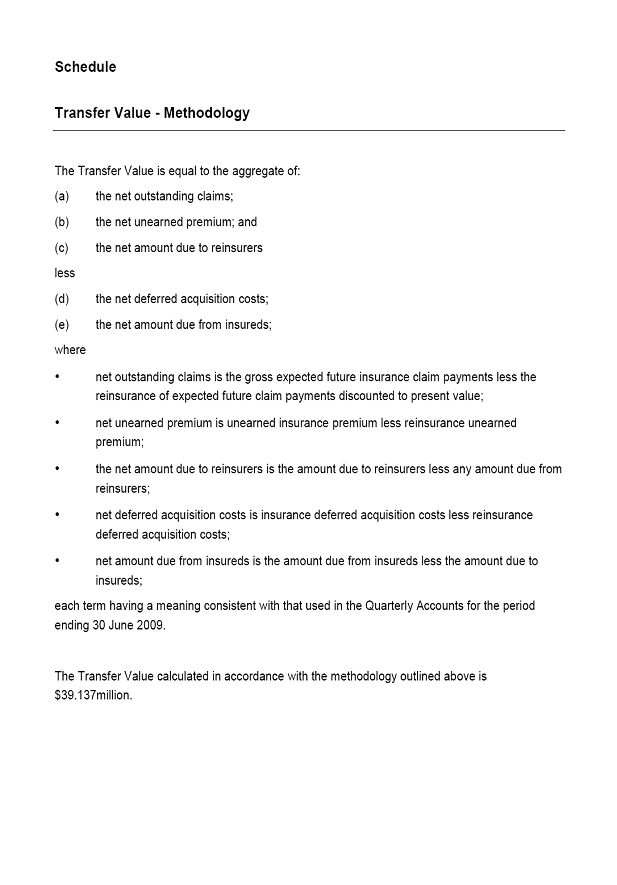
64 As consideration for the transfer, Westport is to pay to each of SRI and SRC an amount known as the “Transfer Value”. This is an amount intended to be the value of the liabilities being transferred. For the Insurance Scheme the Transfer Value is $39.137 million and for the Reinsurance Scheme the Transfer Value is $232.072 million.
65 There is to be no change to the terms of any of Westport’s insurance or reinsurance policies other than the substitution of SRI or SRC as the insurer liable.
The Schemes’ rationale
66 The Schemes are part of a rationalisation or consolidation of the Swiss Re group’s Australian operations. The Australian policyholders of one Swiss Re group company (Westport) are transferred to other members of the group (SRI and SRC). In the result, the Swiss Re group’s insurance and reinsurance businesses in Australia will be carried on through separate entities.
67 Several benefits are intended to be achieved through the transfer. It is expected that the legal structure of the group’s business in Australia will be simplified, and that there will be improved capital and operational efficiencies and a corresponding savings in costs and expenses.
68 The Schemes will also permit the more efficient use of capital within the Swiss Re group of companies by facilitating the release of surplus capital currently held in Westport. It is intended that that capital will be repatriated and applied for the corporate purposes of the group.
69 Westport intends, following the transfers under the Schemes, to apply to APRA to have its insurance authorisation under the Act revoked. It is planned that the capital remaining in Westport will be repatriated.
Solvency
70 The financial condition of Westport, SRCAU and SRIAU is set out in the actuarial reports. The following is a brief summary account of their effect.
The Insurance Scheme
(a) The current position is as follows:
i. SRI does not currently carry on business in Australia, so no financial information exists in relation to SRIAU;
ii. Westport had a solvency ratio of 232.9% as at 31 December 2008;
iii. Westport had a pre-scheme solvency ratio of 252% as at 30 June 2009;
iv. In the September quarter of 2009, with APRA approval, Westport repatriated A$70 million. If this reduction in capital is taken into account in the 30 June 2009 calculation of solvency, Westport’s solvency ratio would have been 158% as at that date.
(b) It is calculated that following the transfer SRIAU will have a solvency ratio of 191%.
(c) It follows that Westport’s direct insurance policyholders are expected to enjoy a higher solvency ratio (191%) following the transfer than they did previously (158%).
The Reinsurance Scheme
(a) The current position is as follows:
i. SRCAU had a solvency ratio of 167.3% as at 31 December 2008;
ii. SRCAU had a solvency ratio of 182% as at 30 June 2009;
iii. Westport had a solvency ratio of 232.9% as at 31 December 2008;
iv. Westport had a solvency ratio (once the A$70m repatriation is taken into account, as described above) of 158% as at 30 June 2009.
(b) It is calculated that following the transfer SRCAU will have a solvency ratio of 160%.
(c) It follows that Westport’s reinsurance policyholders are expected to enjoy an approximately equivalent (but probably slightly higher) solvency coverage ratio following the transfer (160% as against 158%).
71 On the evidence, there is no disadvantage to the affected policyholders as a result of either Scheme.
72 Each of SRIAU and SRCAU has a capital management plan under which it intends to maintain a solvency ratio of at least 150% of the MCR set by APRA.
Policy terms and conditions
73 There will be no change in the terms and conditions of the policies of affected policyholders, apart from the substitution of SRI or SRC as insurer.
Claims handling procedures and culture
74 Claims made on Westport are already handled by SRC’s claims division. There will be no change in this respect following the implementation of the Schemes. Each transfer is an intra-group transfer, not a transfer of policies to an entirely new corporate group.
The De Ravin reports
75 The approved actuary for Westport, SRIAU and SRCAU, John De Ravin, prepared two reports dated 11 November 2009 concerning the respective Schemes. They support the findings referred to at [70]-[72] above which I need not repeat.
76 Mr De Ravin concludes in relation to both Schemes that the interests of the affected policyholders will not be materially adversely affected by the Scheme. As previously noted, in the case of the Insurance Scheme there are no existing policyholders of SRIAU whose interests are to be considered (see [22] above).
77 In relation to the Reinsurance Scheme Mr De Ravin concludes that the interests of the continuing policyholders of SRCAU will not be materially adversely affected by the Reinsurance Scheme. The following two extracts from Mr De Ravin’s report are relevant to their positions (I have substituted my “SRCAU” for his “SRAU”):
Continuing SRCAU policyholders
Solvency Ratio of SRCAU as at 31 December 2008 167%
Pre-Scheme Solvency Ratio of SRCAU as at 30 June 2009 182%
Post-Scheme Solvency Ratio of SRCAU as at 30 June 2009 160%
As noted above, the above analysis ignores the impact of any potential diversification on the valuation of SRCAU’s policy liabilities and the potential development of the Solvency Ratio between 30 June 2009 and 31 December 2009.
In summary, the Solvency Ratio relevant to SRCAU policyholders will reduce on the Effective Date of the Scheme. However, even after the Scheme is implemented, the likely post-Scheme SRCAU Solvency Ratio is nevertheless in excess of SRCAU’s target Solvency Ratio (as per its Capital Management Plan) of 150%.
Continuing SRCAU policyholders will under the Scheme and Transfer:
· immediately post-transfer, experience a reduction in the Solvency Ratio of SRCAU but to a level which is nevertheless expected to be in excess of the SRCAU target capital of 150% of APRA’s MCR;
· continue to benefit from APRA’s “inside Australia” assets protection under the Insurance Act for Australian policyholders;
· continue to be protected by a balance sheet that is managed under a Capital Management Plan that targets 150% of the APRA minimum with the additional protection of the /standard & Poor’s A+ SRC balance sheet if required; and
· continue to be subject to the same general management and claims management practices, philosophy and culture as they were, immediately prior to the Scheme implementation.
The Atkins reports
78 Westport instructed Geoffrey Michael Atkins, an experienced actuary, to conduct an independent peer review of the De Ravin reports. The Atkins reports review the methodology underpinning the De Ravin reports, comment on whether the conclusions reached in the De Ravin Reports are soundly based, and consider whether there were any additional issues to which attention should be drawn.
79 Mr Atkins found (at 3.1 of each report) that:
(a) The methodology used by Mr De Ravin to assess the impact of the Schemes on policyholders “correctly addresses the interests of policyholders”;
(b) Mr De Ravin’s conclusions were fully supported by the information given to him;
(c) It would be prudent to confirm that there have been no major changes to the financial position of any of the companies and if any changes have occurred, that these do not have an impact on the conclusions made.
(d) Mr De Ravin had made all desirable and appropriate enquiries, and no matters of significance have been withheld from the Court.
Conclusion
80 I considered that interests of policyholders were adequately protected because:
(a) The terms and conditions of the transferred policies will remain unaltered, save for the substitution of SRI or SRC as the insurer liable on them;
(b) The claims management procedures in respect of the transferred policies will be unaltered;
(c) SRIAU and SRCAU will hold adequate capital to protect the interests of policyholders, both the existing (continuing) reinsurance policyholders of SRCAU and the insurance and reinsurance policyholders being transferred by Westport, being capital above 150% of APRA’s MCR.
(d) The expert opinion evidence before the Court is that the interests of none of the classes of policyholders referred to will be materially adversely affected by the implications of the Schemes.
81 APRA appeared on the hearing and raised no objection to confirmation of the two Schemes.
82 There was no objection to either Scheme by any policyholder, despite the Schemes and the right of appearance and objection having been widely publicised.
Conclusion
83 As indicated earlier, it was for the Earlier Reasons and those set out above that I made the orders on 17 December 2009.
|
I certify that the preceding eighty-three (83) numbered paragraphs are a true copy of the Reasons for Judgment herein of the Honourable Justice Lindgren. |
Associate:
Dated: 20 January 2010
|
Counsel for the Applicant: |
Mr N J Owens |
|
|
|
|
Solicitor for the Applicant: |
Allens Arthur Robinson |
|
|
|
|
Solicitor for the Australian Prudential Regulation Authority: |
Mr L B Weate |
|
Date of Hearing: |
17 December 2009 |
|
|
|
|
Date of Judgment: |
17 December 2009 |
|
|
|
|
Date of Publication of Reasons: |
20 January 2010 |


