FEDERAL COURT OF AUSTRALIA
Australian Securities & Investments Commission v Fortescue Metals Group Ltd [No 5] [2009] FCA 1586
CORPORATIONS - continuous disclosure - obligation to disclose information to ASX under Chapter 6CA Corporations Act 2001 (Cth) - relationship between continuous disclosure provisions of ASX Listing Rules and Corporations Act - agreements contemplating execution of fuller and more detailed agreements - mining project contingent upon completion of definitive feasibility study - notification to ASX in purported compliance with continuous disclosure provisions under s 674 - asserted binding legal effect of agreements - whether information disclosed by listed disclosing entity as to legal effect of agreements was incorrect or unreasonably based - whether entity ought reasonably to have come into possession of different information as to legal effect of agreements - relevance of subjective belief or opinion as to legal effect - whether opinion as to legal effect honestly held - whether legal effect of agreements as asserted by plaintiff was information that was not generally available for the purposes of s 674(2) - whether entity received legal advice as to effect of agreements and disclosure obligations - ex ante and ex post consideration of materiality for purposes of s 674(2) - correct approach - whether contravention of s 674(2A) by director allegedly involved in entity's alleged contravention of s 674(2)
CORPORATIONS - misleading or deceptive conduct under s 1041H – public disclosures made as to the binding legal effect of agreements - whether conduct in relation to a financial product or a financial service - relevance of belief or opinion - relevance of context at the time disclosures were made to market - whether disclosures were misleading or deceptive
CORPORATIONS - director’s duties - whether director breached duty to exercise reasonable care and diligence required by s 180(1) - whether disclosure about legal effect of agreements was honest and reasonable – legal advice obtained consistent with belief.
EVIDENCE - allegations of dishonesty no reasonable evidentiary basis for such allegations
EVIDENCE - standard of proof - Briginshaw standard - prescription of civil standard of proof in a civil penalty proceeding by s 1332 of the Corporations Act - prescription of balance of probabilities as standard of proof in a civil proceeding by s 140 Evidence Act 1995
EVIDENCE - applicability of rule in Jones v Dunkel to civil penalty proceedings - rule in Browne v Dunn - consequences of failure to comply with rule in Browne v Dunn
EVIDENCE - admissibility of transcripts of examinations under s 19 Australian Securities and Investments Commission Act 2001 - whether transcripts contain admissions
EVIDENCE - relevance of expert opinion of statisticians, stockbrokers and analysts in determining contraventions of continuous disclosure provisions
WORDS AND PHRASES – “information”, “aware”, “not generally available”,
Evidence Act 1995 (Cth), ss 81, 87(1)(b), 140
Trade Practices Act 1974 (Cth), ss 45D, 52, 155
Financial Services Reform Act 2001 (Cth)
Australian Securities & Investments Commission Act 2001 (Cth), s 19, 87
Corporations Regulations 2001, reg 7.1.01(a)
Criminal Code Act 1995 (Cth)
ASX Listing Rule 3A, 3.1, 19.12
SupplementaryCorporate Law Economic Reform Program (Audit Reform and Corporate Disclosure) Bill 2004 (Cth)
The Explanatory Memorandum to the Corporations Bill 1988, s 995
The Explanatory Memorandum to the Financial Services Reform Bill 2001
Adler v Australian Securities & Investments Commission (2003) 179 FLR 1 referred to
Anaconda Nickel Ltd v Tarmoola Australia Pty Ltd (2000) 22 WAR 101 considered
Ansett Transport Industries (Operations) Pty Ltd v The Commonwealth of Australia (1977) 139 CLR 54considered
Aspdin v Austin (1844) 5 QB 671 cited
Australian Broadcasting Commission v Australasian Performing Right Association Ltd (1973) 129 CLR 99 cited
Australian Broadcasting Corporationv XIVth Commonwealth Games (1988) 18 NSWLR 540 referred to
Australian Competition & Consumer Commission v Leahy Petroleum (2004) 141 FCR 183 considered
Australian Competition & Consumer Commission v Mayo International Pty Ltd (1998) ATPR 41-653 cited
Australian Competition and Consumer Commission v Universal Music Australia Pty Ltd (2001) 115 FCR 442 referred to
Australian Securities & Investments Commission v CyccloneMagnetic Engines Inc [2009] QSC 58 referred to
Australian Securities & Investments Commission v Fortescue Metals Group Ltd [No 2] (2009) 176 FCR 529 cited
Australian Securities & Investments Commission v Macdonald (No 11) (2009) 256 ALR 199 distinguished
Australian Securities & Investments Commission v Maxwell (No 2) (2006) 59 ACSR 373 referred to
Australian Securities & Investments Commission v Narain (2008) 169 FCR 211 referred to
Australian Securities & Investments Commission v Rich [2009] NSWSC 1229 referred to
Australian Securities & Investments Commission v Rich (no 3) (2003) 21 aclc 920 referred to
Australian Securities & Investment Commission v Southcorp Ltd (2003) 130 FCR 406 considered
Australian Securities & Investments Commission v Sydney Investment House Equities Pty Ltd (2008) 69 ACSR 1 cited
AWA Ltd v Daniels t/as Deloitte Haskins & Sells (1992) 7 ACSR 759 referred to
Azzopardi v The Queen (2001) 205 CLR 50 referred to
Bateman v Slayter (1987) 71 ALR 553 cited
Baulkham Hills Private Hospital Pty Ltd v G R Securities Pty Ltd (1986) 40 NSWLR 622 considered
Briginshaw v Briginshaw (1938) 60 CLR 336 considered
Buckland v Buckland [1900] 2 Ch 534 cited
Cadbury-Schweppes Pty Ltd v Pub Squash Co Pty Ltd [1980] 2 NSWLR 851 cited
Campomar Sociedad, Limitada v Nike International Ltd (2000) 202 CLR 45 referred to
Coal Cliff Collieries Pty Ltd v Sijehama Pty Ltd (1991) 24 NSWLR 1 referred to
Communications, Electrical, Electronic, Energy, Information, Postal, Plumbing & Allied Services Union of Australia v Australian Competition and Consumer Commission (2007) 162 FCR 466 referred to
Council of the New South Wales Bar Association v Power (2008) 71 NSWLR 451 referred to
Dyers v The Queen (2002) 210 CLR 285 considered
Ex parte Dawes; in re Moon (1886) 17 QBD 275 cited
Fame Decorator Agencies Pty Limited v Jeffries Industries Ltd (1998) 16 ACLC 1,235 referred to
Faulkner v Thomas [2000] TASSC 159 considered
Fletcher Challenge Energy Ltd v Electricity Corporation of New Zealand Ltd [2002] 2 NZLR 433 referred to
Foley v Classique Coaches Limited [1934] 2 KB 1 considered
Global Sportsman Pty Ltd v Mirror Newspapers Pty Ltd (1984) 2 FCR 82 referred to
Glorie v WA Chip and Pulp Co Pty Ltd (1981) 55 FLR 310 referred to
Godecke v Kirwan (1973) 129 CLR 629 considered
G R Securities Pty Ltd v Baulkham Hills Private Hospital Pty Ltd (1986) 40 NSWLR 631 considered
Hall v Busst (1960) 104 CLR 207 considered
Harold Holdsworth & Co (Wakefield) Ltd v Caddies [1955] 1 WLR 352 cited
Heydon v NRMA (2000) 51 NSWLR 1 considered
Hillas & Co Ltd v Arcos Ltd [1932]All ER Rep 494 considered
Hornsby Building Information Centre Pty Ltd v Sydney Building Information Centre Ltd (1978) 140 CLR 216 cited
International Air Transport Association v Ansett Australia Holdings Ltd (2008) 234 CLR 151 cited
James v Australia and New Zealand Banking Group Ltd (1986) 64 ALR 347 cited
Jobern Pty Ltd v Breakfree Resorts (Victoria) Pty Ltd [2007] FCA 1066 referred to
Jones v Dunkel (1959) 101 CLR 298 considered
Jubilee Mines NL v Riley (2009) 253 ALR 673 considered
MacKenzie v Childers (1889) 43 Ch D 265 cited
Manly Council v Byrne and Anor [2004] NSWCA 123 referred to
Masters v Cameron (1954) 91 CLR 353 referred to
Moffat Property Development Group Pty Ltd v Hebron Park Pty Ltd [2009] QCA 60 considered
Narain v Australian Securities and Investments Commission [2008] HCATrans 408 cited
National Exchange v Australian Securities and Investments Commission (2004) 22 ACLC 609 considered
Neat Holdings Pty Ltd v Karajan Holdings Pty Ltd (1992) 110 ALR 449 referred to
Pacific Carriers Ltd v BNP Paribas (2004) 218 CLR 451 cited
Pagnan SpA v Feed Products [1987] 2 Lloyd’s Rep 601 considered
Parkdale Custom Built Furniture Proprietary Limited v Puxu Proprietary Limited (1982) 149 CLR 191 cited
Payne v Parker [1976] 1 NSWLR 191 considered
Permanent Building Society v Wheeler (1994) 11 WAR 187 cited
Qantas Airways Limited v Gama (2008) 167 FCR 537 referred to
Randall v Aristocrat Leisure Ltd [2004] NSWSC 411 referred to
Re Bradberry; National Provincial Bank Ltd v Bradberry (1943) Ch 35 cited
Rich v Australian Securities & Investment Commission (2003) 203 ALR 671 cited
Rich v Australian Securities & Investment Commission (2004) 220 CLR 129 referred to
Rivkin Financial Services Ltd v Sofcom Ltd (2004) 51 ACSR 486 cited
RPS v The Queen (2000) 199 CLR 620 considered
S & I Publishing Pty Ltd v Australian Surf Life Saver Pty Ltd (1998) 88 FCR 354 cited
Secured Income Real Estate (Australia) Ltd v St Martins Investments Pty Ltd (1979) 144 CLR 596 cited
Sinclair, Scott & Co Ltd v Naughton (1929) 43 CLR 310 considered
Singh v Minister for Immigration (2001) 109 FCR 152 referred to
Southern Cross Financial Group (Newcastle) Pty Ltd v Rodrigues (2005) 66 IPR 166 distinguished
Tasman Capital Pty Ltd v Sinclair [2008] NSWCA 248 referred to
Thorby v Goldberg (1964) 112 CLR 597 cited
Tillmanns Butcheries Pty Ltd v Australasian Meat Industry Employees’ Union (1979) 42 FLR 331 considered
Toll (FGCT) Pty Ltd v Alphapharm Pty Ltd (2004) 219 CLR 165 cited
Toyota Motor Corporation Australia Ltd v Ken Morgan Motors Pty Ltd (1994) 2 VR 106 distinguished
Trade Practices Commission v Abbco Ice Works Pty Ltd (1994) 52 FCR 96 cited
Uranium Equities Ltd v Fewster (2008) 36 WAR 97 referred to
Vines v Australian Securities and Investments Commission (2007) 62 ACSR 1 considered
Vrisakis v Australian Securities Commission (1993) 9 WAR 395 cited
Walford v Miles [1992] 2 AC 128 considered
Weissensteiner v The Queen (1993) 178 CLR 217 considered
Wheeler Grace & PierucciPty Ltd v Wright (1989) 16 IPR 189 cited
Wilkinson v Feldworth Financial Services Pty Ltd (1999) 17 ACLC 220 referred to
Willis v Commonwealth (1946) 73 CLR 105cited
Wright v Wheeler Grace & Pierucci Pty Ltd (1988) ATPR 40-865 cited
York Air Conditioning and Refrigeration (A/sia) Pty Ltd v The Commonwealth (1949) 80 CLR 11 cited
WAD 55 of 2006
GILMOUR J
23 December 2009
PERTH
| IN THE FEDERAL COURT OF AUSTRALIA |
|
| WESTERN AUSTRALIA DISTRICT REGISTRY |
|
| GENERAL DIVISION | WAD 55 of 2006 |
| AUSTRALIAN SECURITIES & INVESTMENTS COMMISSION Plaintiff
| |
| AND: | FORTESCUE METALS GROUP LTD (ACN 002 594 872) First Defendant
JOHN ANDREW HENRY FORREST Second Defendant
|
| JUDGE: | |
| DATE OF ORDER: | 23 December 2009 |
| WHERE MADE: | PERTH |
THE COURT ORDERS THAT:
1. The application is dismissed.
Note: Settlement and entry of orders is dealt with in Order 36 of the Federal Court Rules.
The text of entered orders can be located using eSearch on the Court’s website.
| TABLE OF CONTENTS | |
| PART 1: INTRODUCTION........................................................................................ | [1] |
| ASIC’s Application..................................................................................................... | [12] |
| Two important allegations.......................................................................................... | [27] |
| Relief........................................................................................................................... | [29] |
| FMG’s defence........................................................................................................... | [30] |
| Forrest’s defence........................................................................................................ | [34] |
| Dramatis Personae..................................................................................................... | [38] |
| PART 2: SUMMARY OF PRINCIPAL CONCLUSIONS......................................... | [40] |
| ASIC’s claims fail....................................................................................................... | [40] |
| Postscript..................................................................................................................... | [69] |
| PART 3: EVIDENTIARY MATTERS........................................................................ | [72] |
| Standard of proof........................................................................................................ | [72] |
| Jones v Dunkel........................................................................................................... | [85] |
| Browne v Dunn........................................................................................................... | [109] |
| Section 19 admissions................................................................................................. | [114] |
| PART 4: THE FRAMEWORK AGREEMENTS....................................................... | [134] |
Early developments | [134] |
The CREC Framework Agreement | [140] |
Expediting the rail project | [156] |
CHEC and CMCC Framework Agreements | [168] |
| PART 5: PUBLICLY KNOWN FACTS PRIOR TO THE AUGUST AND NOVEMBER 2004 ASX NOTIFICATIONS............................................................... | [182] |
DFS | [186] |
An early stage project development concept | [199] |
Summary of publicly known facts | [203] |
| PART 6: THE AUGUST AND NOVEMBER 2004 NOTIFICATIONS TO THE ASX................................................................................................................................. | [205] |
| The 23 August Letter................................................................................................. | [207] |
| The 23 August Media Release.................................................................................. | [209] |
| The 5 November Letter.............................................................................................. | [210] |
| The 5 November Media Release.............................................................................. | [212] |
| The 8 November Letter.............................................................................................. | [214] |
| PART 7: THE CONTINUOUS DISCLOSURE PROVISIONS................................. | [218] |
| History......................................................................................................................... | [218] |
| The provisions............................................................................................................. | [227] |
| PART 8: CONTINUOUS DISCLOSURE: THE FOUR REQUIREMENTS............ | [240] |
| 8.1: INFORMATION................................................................................................... | [242] |
| 8.2: AWARENESS OF INFORMATION................................................................... | [253] |
| Were ASIC’s opinions as to the legal effect of the framework agreements self evident having regard to their terms?....................................................................... | [266] |
| Was CREC arguably obliged to actually build or transfer the railway?............ | [282] |
| The price issue........................................................................................................ | [291] |
| The scope of work................................................................................................... | [320] |
| ASIC’s other contentions....................................................................................... | [323] |
| Modern contract law............................................................................................... | [328] |
| Was the opinion of FMG and Forrest honestly and reasonably held?.................... | [353] |
| Legal oversight and advice..................................................................................... | [358] |
| The position adopted by the Chinese Contractors................................................ | [395] |
| FMG’s internal records.......................................................................................... | [414] |
| FMG’s external communications.......................................................................... | [418] |
| The position adopted by FMG executives............................................................. | [424] |
| Advanced framework agreements............................................................................. | [455] |
| Draft Contract No: ABC123...................................................................................... | [460] |
| Comparison with other FMG documents................................................................... | [463] |
| Conclusion as to awareness of alleged information by FMG directors................... | [465] |
| 8.3: WAS INFORMATION “GENERALLY AVAILABLE”..................................... | [469] |
| 8.4: MATERIAL EFFECT ON FMG’S SHARE PRICE............................................ | [472] |
| Materiality: s 674(2)(c)(ii) and s 677 | [474] |
| Materiality: a commercial judgment | [481] |
| Materiality: the expert evidence | [491] |
| The ex ante expert evidence | [517] |
| Hypothetical disclosure CREC, CHEC and CMCC Information instead of the actual notifications (Questions 4 and 5) | [518] |
| Notifications actually made by FMG on 23 August, 5 and 9 November 2004 (Question 6) | [531] |
| Hypothetical release of CREC, CHEC and CMCC Information after the actual notifications (Question 8) | [549] |
| Hypothetical release of the actual framework agreements or their terms | [560] |
| The ex post statistical evidence: effect of the actual notifications in August and November (Question 7) | [565] |
| 23 August notification: the facts | [565] |
| 23 August notification: the experts | [574] |
| 5 and 9 November 2004 notifications: the facts | [595] |
| 5 and 9 November 2004 notifications: the experts | [598] |
| Materiality of the statements in the AFR Article | [609] |
| PART 8.5: SUMMARY OF FINDINGS AS TO MATERIALITY | [626] |
| Ex ante evidence: hypothetical disclosure to the market of the CREC, CHEC and CMCC Information instead of the actual announcements | [626] |
| Ex ante evidence: the announcements actually made | [627] |
| Ex ante evidence: the hypothetical disclosure of the CREC, CHEC and CMCC Information at some time after the announcements actually made | [628] |
| Ex post statistical evidence: effect of the actual announcements in August and November (Question 7) | [629] |
| The statements in the AFR Article | [630] |
| PART 9: ASIC’S SECTION 1041H CASE | [631] |
| Misleading and deceptive conduct under the Act | [633] |
| Section 1041H: general principles | [642] |
Was certain conduct in relation to a financial product or a financial service | [648] |
| General principles in relation to s 52 are applicable | [660] |
| The Representees | [671] |
| Relevance of media commentary | [672] |
| Reasoning | [681] |
| Approvals and Chinese requests for equity | [687] |
| Misleading and deceptive conduct – additional claims | [831] |
| Set price and DFS | [835] |
| Amounts “under agreement” | [858] |
| Deletion of “binding” | [865] |
| A diversionary tactic | [869] |
| PART 10: ASIC’S SECTION 180(1) CASE AGAINST FORREST | [883] |
| Conclusion | [903] |
| PART 11: ORDERS | [906] |
| Schedule ‘A’: Dramatis Personae | |
| Schedule ‘B’: CREC Framework Agreement | |
| Schedule ‘C’: CHEC Framework Agreement | |
| Schedule ‘D’: CMCC Framework Agreement | |
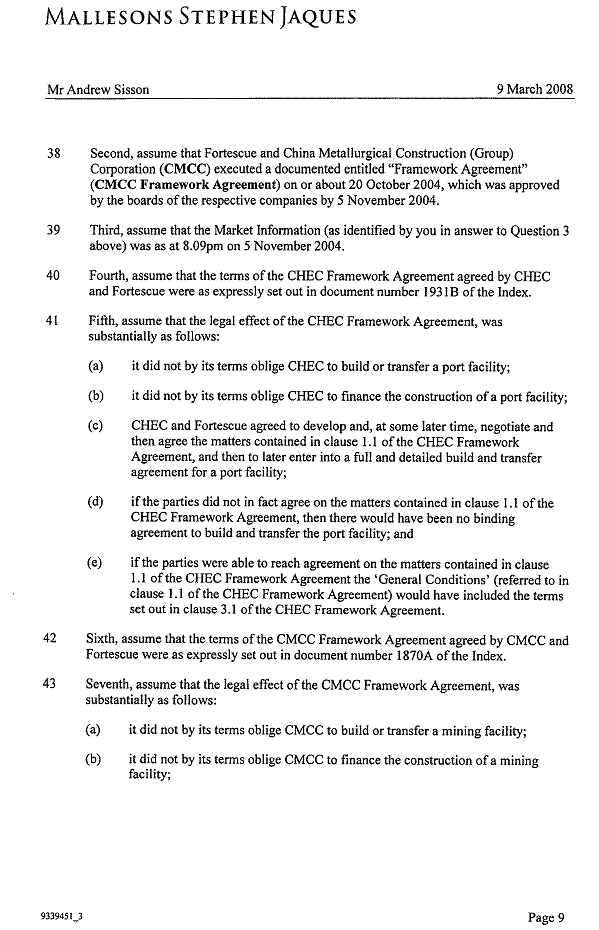
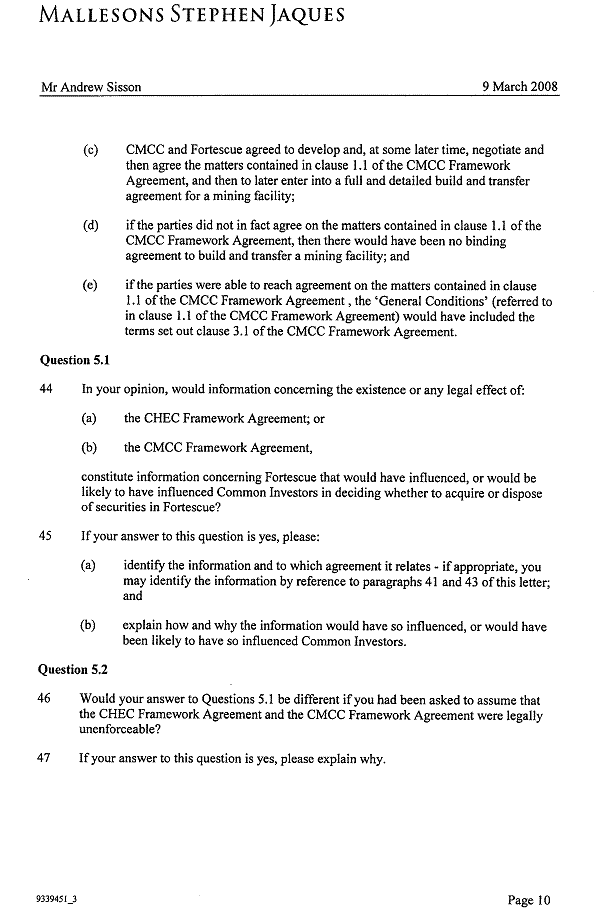
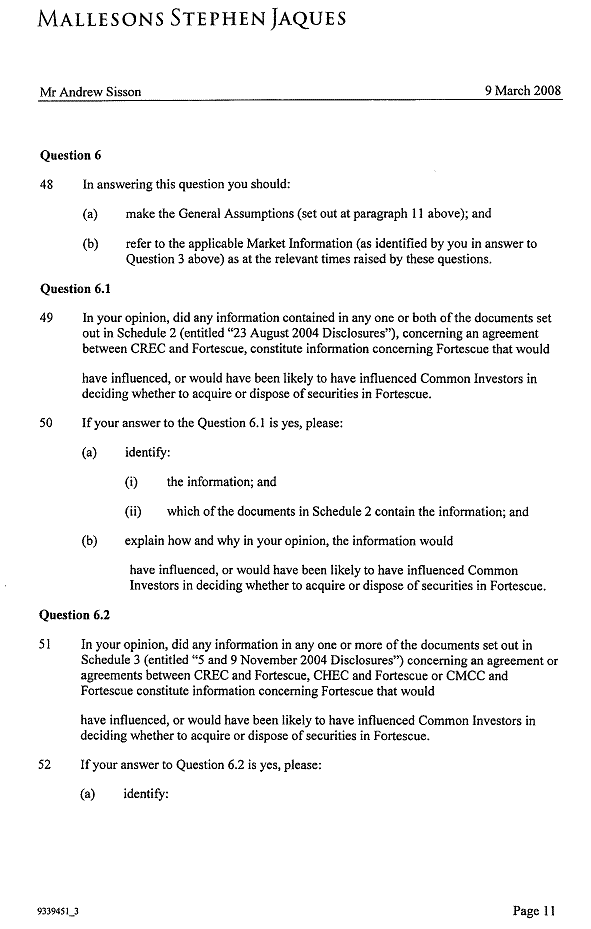
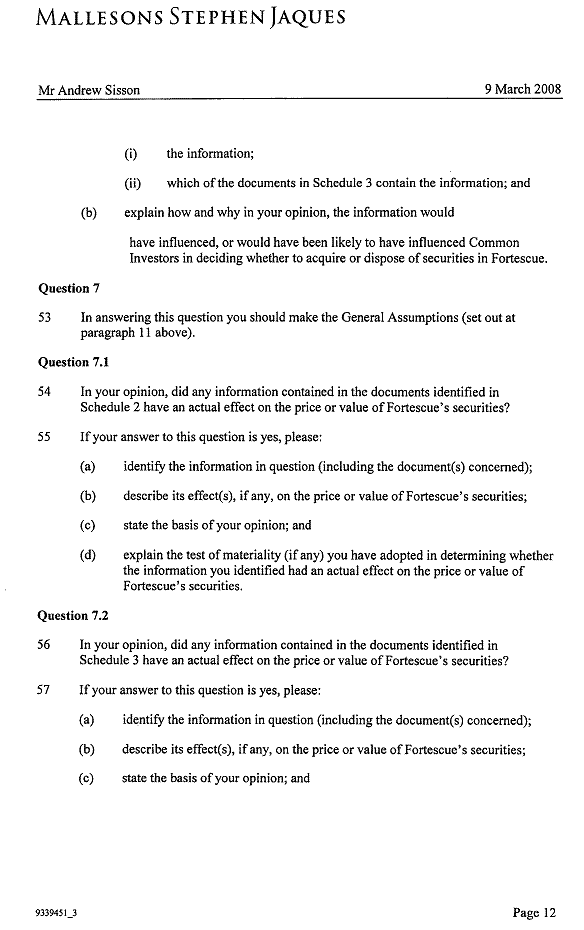
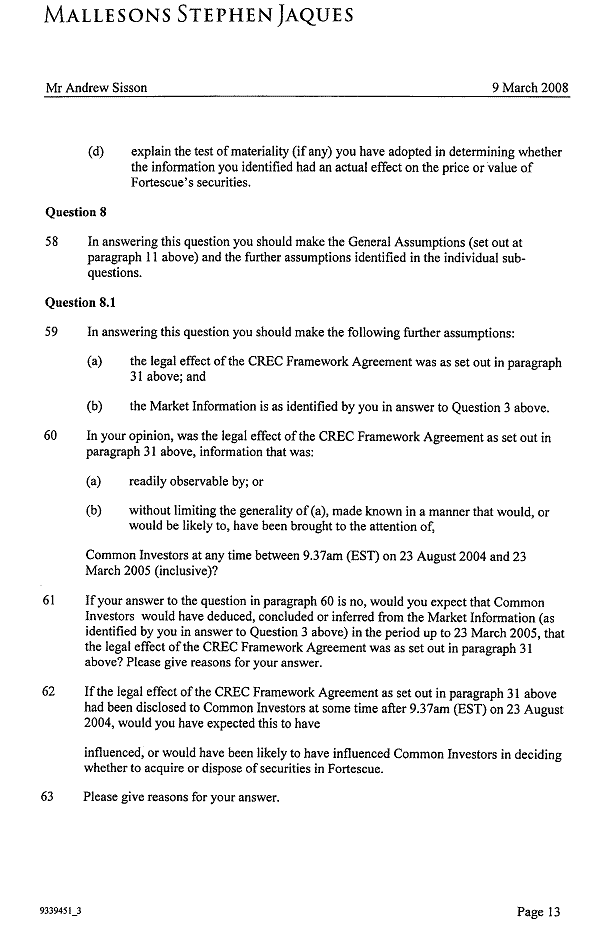
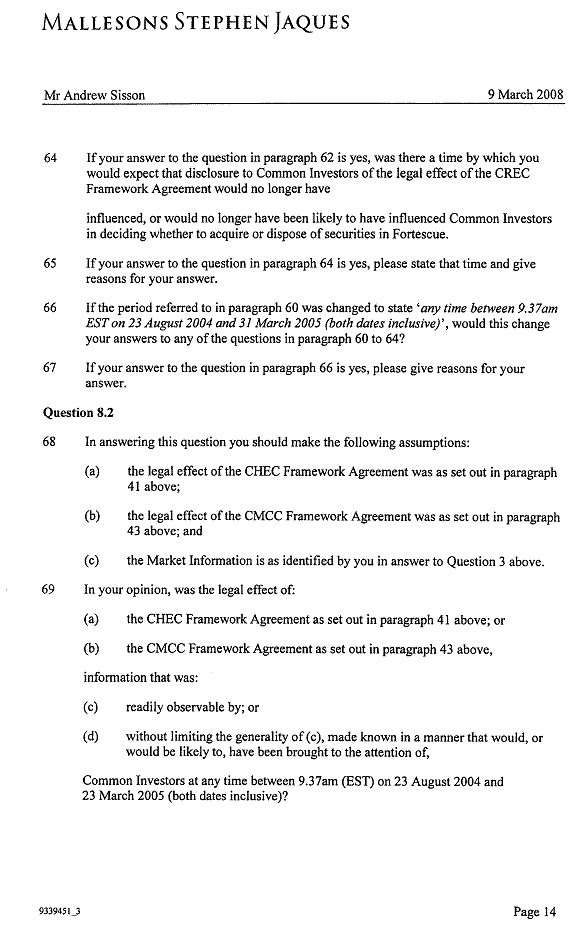
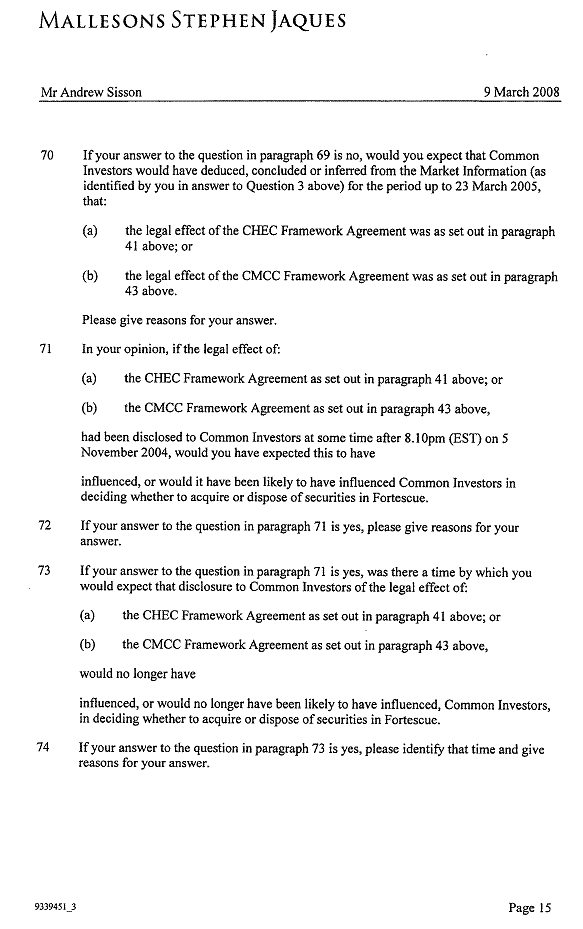
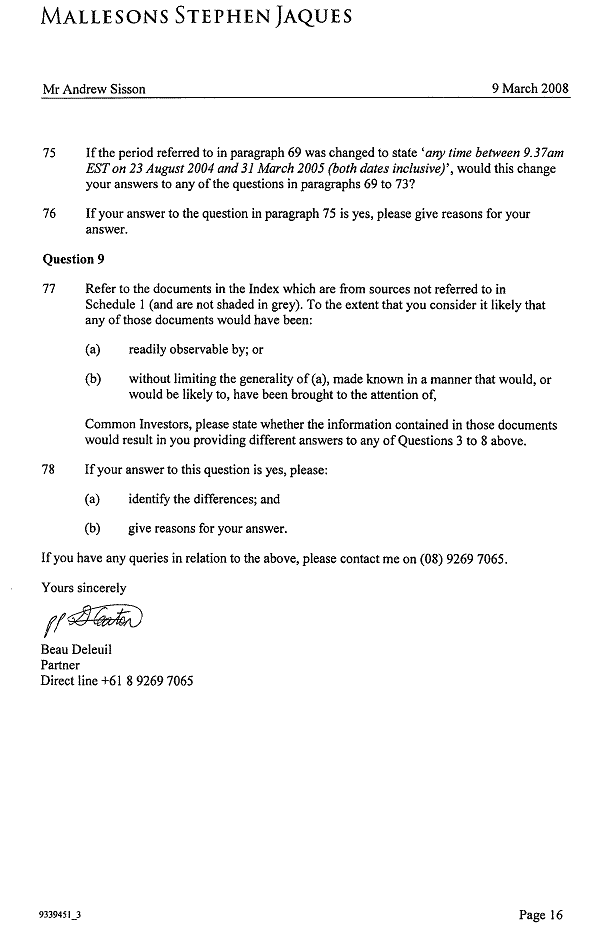
| Schedule ‘E’: Mallesons Letter | |
| IN THE FEDERAL COURT OF AUSTRALIA |
|
| WESTERN AUSTRALIA DISTRICT REGISTRY |
|
| GENERAL DIVISION | WAD 55 of 2006 |
| BETWEEN: | AUSTRALIAN SECURITIES & INVESTMENTS COMMISSION Plaintiff
|
| AND: | FORTESCUE METALS GROUP LTD (ACN 002 594 872) First Defendant
JOHN ANDREW HENRY FORREST Second Defendant
|
| JUDGE: | GILMOUR J |
| DATE: | 23 December 2009 |
| PLACE: | PERTH |
REASONS FOR JUDGMENT
PART 1: INTRODUCTION
1 In 2004 and 2005 the first defendant, Fortescue Metals Group Ltd (FMG), was pursuing its aim to become a ‘new force’ in Western Australia’s iron ore industry, in competition with the BHP Billiton Group and the Rio Tinto Group. FMG is a publicly listed company on the Australian Securities Exchange (ASX). The second defendant, Mr John Andrew Henry Forrest (Forrest) was, at all material times, FMG’s chairman and chief executive officer. FMG held mining tenements in the Pilbara region of Western Australia. It planned to establish a mine there, and to construct a port at Port Hedland as well as a railway from the mine to the port in order to mine and export iron ore (the Project).
2 In July 2004, FMG appointed Worley Pty Ltd (Worley) to manage the all-important Definitive Feasibility Study (DFS). The Project, including the mine, rail and port infrastructure, was entirely contingent upon the DFS proving to be ‘bankable’, that is to say sufficient to underpin the necessary finance required for the Project including the construction of the mine, railway and port. At that time it was estimated that the cost of building this infrastructure was $1.85 billion.
3 From earlyin 2004, FMG and Forrest were negotiating with three Chinese building and construction companies over proposals for those companies to build the Project infrastructure. In the second half of 2004, FMG executed three framework agreements, substantially in similar terms, with China Railway Engineering Corporation (CREC), China Harbour Engineering Company (Group) (CHEC) and China Metallurgical Construction (Group) Corporation (CMCC) (collectively the Chinese Contractors), concerning the construction, respectively, of the railway, port and mine. Copies of the framework agreements, named respectively the CREC Framework Agreement, the CHEC Framework Agreement and the CMCC Framework Agreement, are contained in Schedules B, C and D respectively to these reasons.
4 These framework agreements and in particular their arguable meaning and effect are at the heart of this complex case, which concerns the provisions of the Corporations Act 2001 (Cth) (the Act) dealing with continuous disclosure (Chapter 6CA), prohibited conduct (other than insider trading prohibitions) (Chapter 7, Part 7.10) and directors’ duties (Chapter 2D, Part 2D.1).
5 FMG made notifications in August and November 2004concerning the frameworkagreements to the Australian Stock Exchange Limited, as the ASX was then known, in the form of letters dated 23 August 2004, 5 November 2004 and 8 November 2004 and related media releases dated 23 August 2004 and 5 November 2004. The media release dated 23 August 2004 was incorporated by reference into the letter of 23 August 2004. The media release of 5 November 2004 was incorporated by reference into the letter of 5 November 2004. Properly understood therefore, for the purposes of s 674 of the Act there were accordingly only three notifications to the ASX. It is convenient to adopt the labels used by the plaintiff, Australian Securities and Investments Commission (ASIC), in its pleading for these as follows:
(1) Letter from FMG to the ASX dated 23 August 2004, ‘the 23 August Letter’; and FMG media release dated 23 August 2004, ‘the 23 August Media Release’
(2) Letter from FMG to the ASX dated 5 November 2004, ‘the 5 November Letter’ and FMG media release dated 5 November 2004, ‘the 5 November Media Release’
(3) Letter from FMG to the ASX dated 8 November 2004, ‘the 8 November Letter’.
6 FMG made these notifications to the ASX in purported compliance with the continuous disclosure provisions under s 674 of the Act and ASX Listing Rule 3.1. Section 674(2) requires a listed disclosing entity to notify the ASX as a market operator of information that is not generally available and is information that a reasonable person would expect, if it were generally available, to have a material effect on the price or value of the entity’s securities.
7 The notifications taken together reported, among other things, that FMG had executed binding agreements with each of CREC, CHEC and CMCC for each to build, finance and transfer the railway, port and mine respectively for the Project.
8 In addition, over the period August 2004 to March 2005 FMG made further public statements to the same effect. I will refer to the notifications and statements collectively, whether in whole or in part as ‘disclosures’.
9 In March 2005 the framework agreements were the subject of an article in the Australian Financial Review newspaper (the AFR Article). This article contained a number of negative assertions about the Project, including that the agreements did not impose any legally binding obligations on the Chinese Contractors. This was contrary to the prior public position of the Chinese Contractors to the effect that the framework agreements bound them to construct the infrastructure.
10 The AFR Article attracted widespread interest and further media commentary.
11 ASIC commenced these proceedings in March 2006. The statement of claim was substituted and amended several times before and at trial, culminating in an amended statement of claim of 1 May 2009 which ASIC labels ‘ASC’. I will adopt that abbreviation.
ASIC’s Application
12 ASIC alleges that FMG did not have a genuine and/or reasonable basis for making these disclosures concerning the framework agreements. It alleges that FMG engaged in a course of knowing and deliberateconduct to make the disclosures, by the notifications to the ASX and other statements, which were false, unqualified and emphatic as to the significance and effect of the framework agreements. This puts in issue the alleged dishonesty of FMG, its board, and in particular, Forrest in making those disclosures.
13 Accordingly, it says FMG contravened the continuous disclosure provisions under s 674 of the Act and engaged in misleading and deceptive conduct under s 1041H of the Act as well as under s 52 of the Trade Practices Act 1974 (Cth) (TPA). I have set out, by way of introduction, the allegations made by ASIC under s 1041H in Part 9 below.
14 ASIC says that Forrest was the architect of this course of conduct or, at the least, he was aware of it and did not prevent it, when he was evidently in a position to do so. ASIC says that, on the basis that Forrest authorised or approved the notifications to the ASX, he was involved in FMG’s contraventions of s 674(2) and consequently himself contravened s 674(2A) and, in turn, s 180(1) of the Act.
15 ASIC contends that the notifications to the ASX, which were republished by the ASX, had a positive material effect on the price of FMG’s shares. ASIC does not contend that the other statements had such an effect.
16 ASIC also contends that Forrest breached his duty as a director to exercise care and diligence as required by s 180(1) of the Act by failing to ensure that FMG both complied with its disclosure obligations and did not engage in misleading or deceptive conduct and, as a result, he exposed FMG to a risk of serious harm, including, among other things, these civil penalty proceedings.
17 Broadly ASIC’s factual contentions are as follows. In its disclosures, FMG said that the agreements with CREC, CHEC and CMCC bound each of them to build, transfer and finance the Project infrastructure. It also represented that a contract price existed, although the 8 November Letter, according to ASIC, said it was subject to an agreed confirmation process. As well, FMG represented that the agreements were in the common form of a well-known industry standard precedent for building infrastructure.
18 ASIC says the misleading character of FMG’s disclosures appears clearly from a simple comparison of these with the actual terms of the framework agreements they were purporting to describe.
19 The core of ASIC’s case under s 674 is its contentionthat the framework agreements did not, in their effect, oblige the Chinese Contractors to build, finance and transfer the infrastructure but at best, merely bound the parties to negotiate agreements which would have that effect, or, alternatively, were not binding at all. ASIC thus offers two alternative interpretations of the legal effect of the framework agreements. It is this “information” as to the asserted legal effect of each of the framework agreements which is central to what is described as the “CREC Information”, the “CHEC Information” and the “CMCC Information” (the Informations), which ASIC pleads ought to have been disclosed, variously, between 23 August 2004 and 24 or 29 March 2005 in the case of the CMCC framework agreement and 24 or30 March 2005 in the case of the other two framework agreements. ASIC says that FMG was obliged to disclose the Informations to the ASX under s 674(2) because that information, for the purposes of s 677, a provision which interprets s 674(2)(c)(ii) by providing for when a reasonable person would be taken to expect information to have a material effect on the price or value of an entity’s securities was information which would, or would be likely to, influence persons who commonly invest in securities in deciding whether to acquire or dispose of FMG’s securities.
20 ASIC pleads the allegedcontraventions of s 674(2) by FMG under three categories applying to FMG's alleged failure to disclose each of the Informations. There are three contraventions alleged under each category, one in respect of each of the Informations, but ASIC only presses a total of six rather than nine contraventions of s 674(2) as the alleged contraventions under the second category are pleaded in the alternative.
21 FMG submits, and I accept, that upon analysis, there are in substanceonly three possible contraventions of s 674(2), one in respect to each of the CREC, CHEC and CMCC Framework Agreements. I do not accept, as ASIC would have it,that there are 6 (or 9) possible contraventions because the alleged contraventions of s 674(2) relate to the omission to inform the market about the material terms and legal effect of the framework agreements.
22 The three categories are as follows. First, ASIC asserts that FMG failed to disclose the Informations: ASC [136]-[140]. Second and alternatively, it is asserted that FMG’s purported compliance with the requirement that it notify information to the ASX under s 674(2) and Listing Rule 3.1 was not substantially accurate; further or alternatively was misleading or deceptive or likely to mislead or deceive persons who commonly invest in securities: ASC [141]-[145]. This was described in ASIC’s pleading as FMG’s disclosure of false information. Third and alternatively, it is asserted that FMG failed to correct these earlier false disclosures of information: ASC [146]-[153].
23 I agree, as FMG submits that the first and the third categories are almost identical. This is because the first complains about the omission from disclosure of the Informations and the third complains about the omission from disclosure of effectively the same information.
24 As to the second category, ASIC’s assertion is that, on their proper construction, s 674(2) and Listing Rule 3.1 forbid substantially inaccurate disclosure, or disclosure that is misleading or deceptive or likely to mislead or deceive. FMG submits that on their proper construction, these provisions do not target such matters in that way but rather require the disclosure of omitted material. I accept this submission. Section 674(2) does not, in terms, impose an obligation upon FMG to correct information already provided to the ASX. The focus of the provision is upon the notification of information. It is a continuing obligation. This is ASIC’s first category. The fact that the later provision of information may, in its effect, correct a misstatement in a notification made earlier, is merely a consequence of compliance.
25 Accordingly, the pleaded s 674(2) claims, properly characterised, amount to a case that FMG failed or omitted to disclose the material terms and legal effectof the three framework agreements over the following periods:
(1) for the CREC Framework Agreement: 23 August 2004 to 30 March 2005
(2) for the CHEC Framework Agreement: 5 November 2004 to 30 March 2005
(3) for the CMCC Framework Agreement: 5 November 2004 to 29 March 2005.
26 There is some confusion in the pleading as ASIC also alleges that the contraventions continued up to 24 March 2005 (e.g. ASC [140]-[153]). The pleading, in effect, alleges three continuing contraventions of s 674(2) across the relevant periods, one in respect of each of the three framework agreements. The significance of the respective end dates for these periods is this. The AFR Article was published on 24 March 2005. A copy of the CMCC Framework Agreement was provided to the ASX on 29 March 2005 and copies of the other two framework agreements were provided to the ASX on 30 March 2005.
Two important allegations
27 ASIC's cases include two further important allegations - that FMG and Forrest were aware at the latest by 17 August 2004, alternatively by 5 November 2004, that:
· Chinese government approval would be required in order for the Chinese Contractors to finance and build the Project infrastructure; and
· a condition of Chinese government approval would be that a Chinese investor take some form of equity interest in the Project.
28 The evidence demonstrates that at the relevant times various Chinese government agencies had a supervisory oversight of the overseas contracting activities of Chinese companies. These agencies are the State-Owned Assets Supervision and Administrative Commission (SASAC), the Ministry of Commerce (MOC) and the National Development and Reform Commission (NDRC).
Relief
29 ASIC seeks, under various provisions of the Act, and the Federal Court of Australia Act 1976 (Cth)declarations of contravention of s 674(2) and s 1041H as against FMG; and s 674(2A) and s 180 as against Forrest as well as related pecuniary penalty; and compensation orders against each of FMG and Forrest, and an order under s 206C alternatively s 206E of the Act disqualifying Forrest from managing corporations.
FMG’s defence
30 FMG contends that its disclosures concerning the framework agreements were correct and that each was a binding first agreement for the construction, financing and transfer of the respective infrastructure, intended to have immediate legal effect. FMG also emphasises the importance of context, namely what was known concerning the Project by the market, when disclosures were made. In context it says the agreements were made at a time when, as the market knew, a number of matters were still in the process of development, particularly the DFS, but, despite that, they were agreements under which:
(a) CREC, CHEC and CMCC agreed to build and transfer the infrastructure on the basis that FMG had to pay 10% of the value of the works before completion, such that the Chinese Contractors had agreed to take the financial risks involved in return for security over the resources;
(b) the parties agreed that there would be more fulsome agreements in addition to, or in substitution for, the framework agreements but these would not detract from the binding nature of the framework agreements.
31 As such, FMG says, it did not breach the continuous disclosure requirements of the Act and Listing Rules nor mislead the market.
32 Further, FMG says its disclosures, to the effect that the framework agreements were binding agreements for the Chinese Contractors to build, finance and transfer the railway, port and harbour for the Project, were, in each case, an expression of opinion which was honestly and reasonably held.
Forrest’s defence
34 Forrest adopts FMG’s submissions in addition to his own. He filed a limited defence relying on the privilege against self-incrimination and further or in the alternative the privilege against exposure to penalty. His defences were not fully advanced until he filed a lengthy outline of written submissions at the conclusion of the trial.
35 He makes three submissions as to why he did not contravene s 674(2A) of the Act. First, FMG did not contravene s 674(2), and therefore he could not have been a person who was involved in a contravention of that subsection pursuant to sub-s (2A). Second, even if ASIC makes out its allegations pursuant to sub-s (2A)(which is denied), he did not contravene that subsection because, for the purposes of sub-s (2B), which is the due diligence defence to an allegation of a contravention of sub-s (2A), he:
(1) took all steps that were reasonable in the circumstances to ensure that FMG complied with its obligations under sub-s (2); and
(2) believed on reasonable grounds that FMG was complying with its obligations under that subsection.
Third, he cannot be found to have contravened sub-s (2A) of the Act as the threshold element of being ‘involved in’ pursuant to s 79 of the Act has not been established, as he was not aware of the information ASIC says FMG was required to announce to the ASX.
36 Forrest then says that ASIC’s claim that he contravened s 180(1) of the Act is contingent upon ASIC:
(1) succeeding in its claim(s) that FMG breached ss 674(2) and 1041H of the Act; and
(2) proving that FMG’s contraventions were serious under s 1317G(1)(b)(iii) of the Act.
37 Further, Forrest says, if (which is denied) FMG contravened ss 674(2) and 1041H of the Act, the Court ought to find that Forrest did not contravene s 180(1) because:
(1) he exercised a reasonable degree of care and diligence in the discharge of his duties;
(2) at all material times, he acted honestly and reasonably believed he was acting in FMG’s best interests;
(3) his conduct did not expose FMG to a foreseeable risk of harm;
(4) FMG has not suffered damage as a result of his conduct; and
(5) FMG benefitted from his actions; or
(6) the Business Judgment Rule applies.
Dramatis Personae
38 Annexed in Schedule ‘A’ is a dramatis personae.
39 In order to avoid constant repetition of formalities, I have referred to persons, including the second defendant, by surname. In doing so, I do not intend to cause offence to any individual. Where I have departed from this practice by including a title and/or a first name, this has been done to avoid confusion, for example when referring to a person sharing a surname with another person, or when reference is made to Mr “He” of NDRC, or when the context of the reference otherwise requires it.
PART 2: SUMMARY OF PRINCIPAL CONCLUSIONS
ASIC’s claims fail
40 I have concluded that ASIC’s Application should be dismissed.
41 Under s 674(2) of the Act and Listing Rule 3.1, FMG was obliged to immediately disclose to the ASX information which a reasonable person would expect, if generally available, to have a material effect on the price or value of FMG’s shares. This is information that its directors or executive officers were in possession of, or ought reasonably to have come into possession of, in the performance of their duties. The information which ASIC contends ought to have been disclosed (the Informations) in this case principally comprises an assertion as to the meaning and legal effect of the framework agreements. This assertion is necessarily the product of a judgment or opinion as to what is the meaning and legal effect of these agreements. There is no evidence that FMG by any of its directors or officers, including Forrest, ever held the opinions postulated by ASIC and which underpin its case as to what FMG ought to have disclosed as to the meaning and legal effect of the framework agreements. I find that the opinions contended for by ASIC do not self-evidently or obviously emerge upon merely reading the terms of the framework agreements.
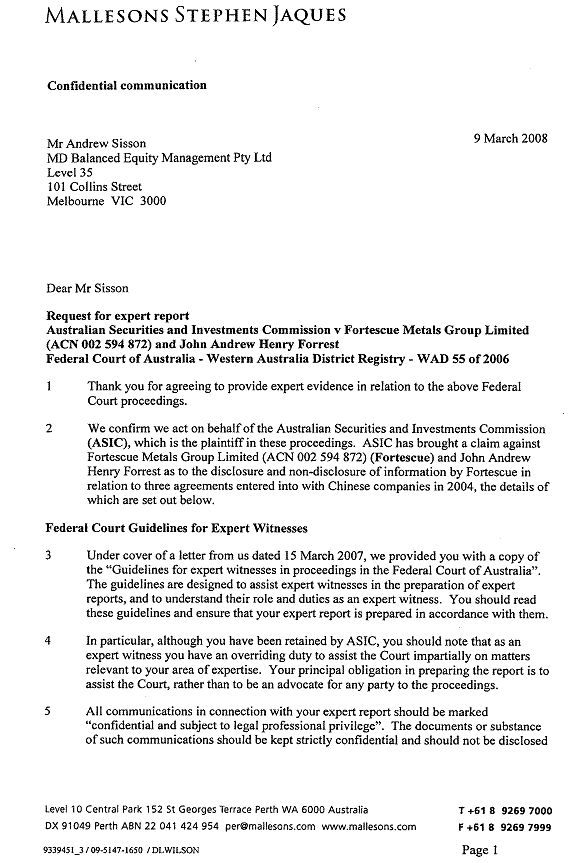
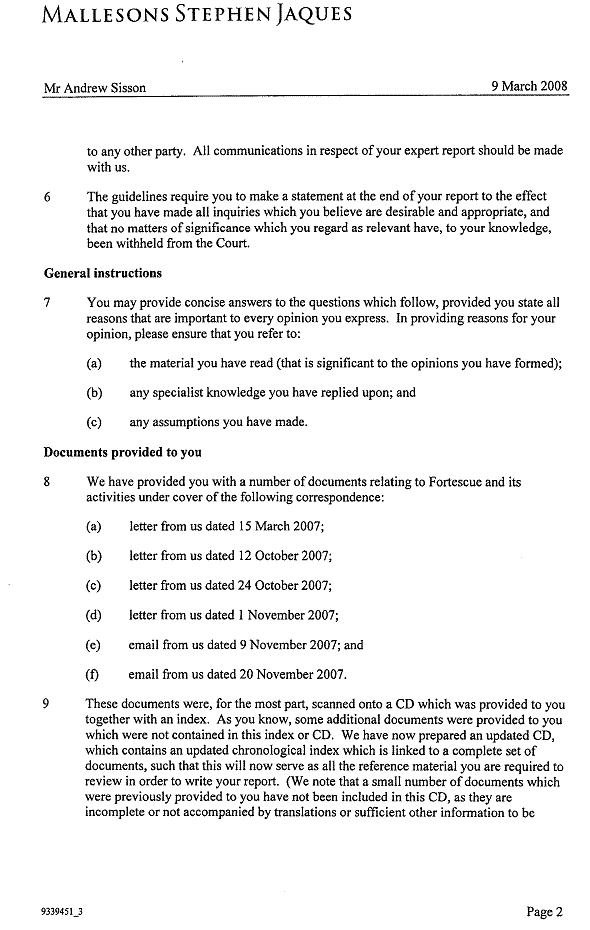
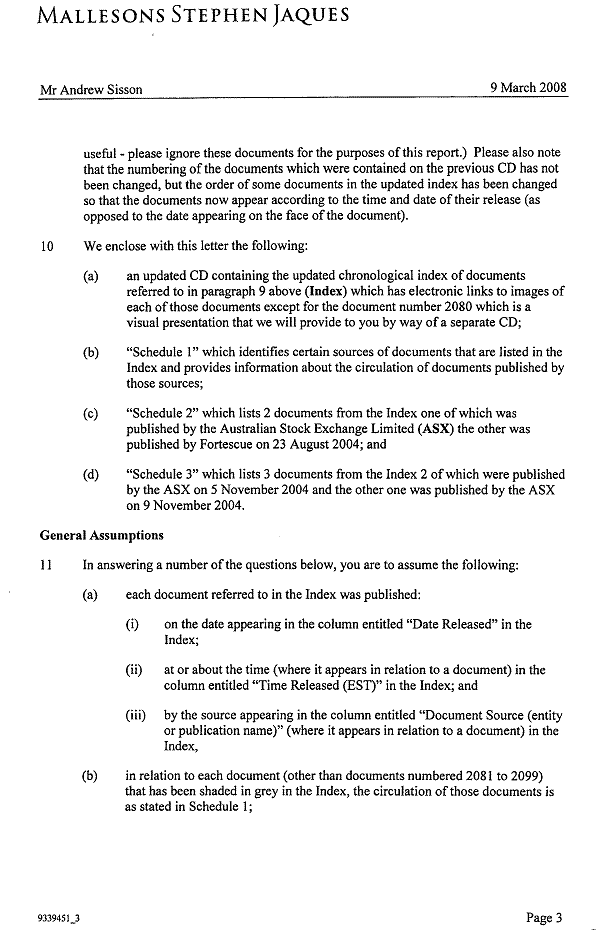
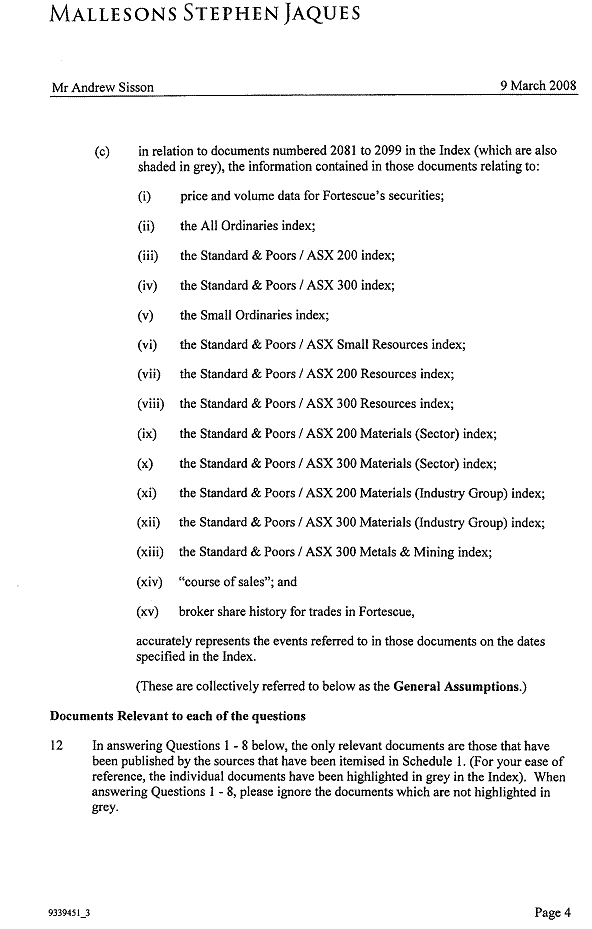
42 ASIC contends that FMG through Forrest had no genuine and or reasonable basis for making its claims that the framework agreements were binding build and transfer agreements. It has accused FMG, its board and in particular Forrest, of deliberate dishonesty in making those claims knowing that they were false, unqualified and emphatic. It says that there is no evidence that FMG obtained any legal advice concerning the agreements, and that if it had obtained competent legal advice, it would have been aware of the legal effect of the framework agreements asserted by ASIC and forming part of the Informations. It says that, in those circumstances, the misleading disclosures could not have been made by a responsible company or board of directors.
43 This transpired to be a surprising submission for ASIC to make.
44 In fact FMG did have the benefit of competent professional legal oversight and advice in relation to its agreements, including the framework agreements. Mr Peter Huston and his assistant Hsin-Luen Tan of Troika Legal Ltd had, prior to October 2004, been available to advise FMG. Huston was described by ASIC in its pleading as a qualified, experienced and practising commercial solicitor. From early October 2004, Huston and Tan joined FMG as employees. It is apparent that one of Huston’s principal roles, at least from that time, was to oversee and ensure the legal enforceability, or as Forrest sometimes said, the “bankability” of FMG’s agreements. This is evident from an email dated 3 October 2004 sent by Forrest to FMG’s senior executives and Graeme Rowley, another of FMG’s directors.
45 Forrest had known Huston for a number of years prior to this. Huston acted as solicitor for Anaconda Nickel Ltd in proceedings in the Supreme Court of Western Australia culminating in an appeal to the Full Court: Anaconda Nickel Ltd v Tarmoola Australia Pty Ltd (2000) 22 WAR 101. These proceedings concerned the enforceability of a short letter said to be a “heads of agreement”. In certain respects it bears a remarkable similarity to the framework agreements. The majority (Ipp J; Pidgeon J agreeing) held that the heads of agreement was a valid and binding agreement.
46 Huston helped prepare the draft as well as the final 8 November Letter concerning the three framework agreements provided by FMG to the ASX that day. He attended a meeting with Mr Tony Walsh, Assistant Manager Issuers of the ASX, on 8 November 2004 relevantly to discuss this draft for the purpose of providing further information to the ASX as to the terms of the framework agreements. I have concluded that, for this purpose, Huston would have considered the terms of the related 5 November Letter and the three framework agreements referred to in that letter. He did not advise the FMG Board or Forrest that these agreements were not legally binding or that the 5 November Letter was to that extent incorrect or not reasonably based. Given his role in FMG, had he formed that view, I find that he should have and would have informed the board. That he did not, entitled the board and Forrest to continue to regard the disclosures concerning the legal effect of the framework agreements as correct, or at least that they were reasonably based.
47 That this was so is fortified by evidence of actual advice given by Huston to the FMG board that the framework agreements were legally binding as disclosed.
48 The FMG board minutes of its 22 January 2005 meeting, attended by Huston, record his advice to the board that the CMCC Framework Agreement was binding. So too did an email sent by him on 30 March 2005 to Forrest, Christopher Catlow, David Liu, Rowley, Alan Watling and other FMG executives concerning the AFR Article in which he repeated this advice, relying in particular upon the Anaconda decision. The 30 March 2005 email was not disclosed in ASIC’s pleading. While the minutes of the 22 January board meeting were set out as a particular of two allegations concerning FMG’s and Forrest’s knowledge of the Chinese Contractors’ attitude towards the framework agreements and of the legal effect of the agreements, ASIC did not particularise the material passage in the minutes where Huston’s legal advice to the board was set out, nor did it refer to this passage in its opening or closing submissions. This is so, despite the fact that, in relation to ASIC’s s 674 case, it asserted, amongst other things, that FMG ought to have been aware of the legal effect of the framework agreements asserted by ASIC by first obtaining competent legal advice. Huston was a very experienced and competent commercial solicitor.
49 I was not referred to these documents during the trial until the closing address by Forrest’s senior counsel, Mr Myers QC. Their content, combined with other evidence, demonstrates that there was no basis for ASIC to assert dishonesty on the part of FMG, its board and in particular, Forrest. I make the same criticism of the description applied to FMG and by implication its board and particularly Forrest in the way ASIC’s case was opened. It was asserted that FMG engaged in a concerted and designed course of conduct in which it made false, misleading and exaggerated statements to the ASX of which Forrest was the architect. In my view the evidence does not support such serious allegations. The principal basis, it seems, depends on ASIC’s submission that the framework agreements are self-evidently not binding build and transfer agreements. I rejected that argument. I consider that there was a reasonable basis for FMG, through its board, including Forrest, to have held the view that the framework agreements were binding as claimed. It was supported by Huston’s professional oversight to ensure the legal enforceability of FMG’s agreements as well as his later positive advice to the effect that they were such. It was a view consistent with Forrest’s knowledge of the Anaconda case. It finds arguable support in other authority.
50 Significantly too, CREC approved the terms of the 23 August Media Release before FMG made the notifications to the ASX on 23 August 2004. The release described the CREC Framework Agreement as a “binding agreement to build and finance the railway component of Fortescue Metals Group Ltd’s $1.85 billion Pilbara iron ore project”. In the release Mr Qin Jiaming (Qin), the President of CREC, is quoted as saying that the contract presented an excellent opportunity for CREC to develop internationally and that CREC was fully confident about its capacity to build the rail project. It was described by him as a ‘marriage’ immediately following the high level ceremony when the parties signed the Joint Statement which rendered the agreement binding.
51 I find that the terms of the 5 November Media Release provided to CHEC and CMCC was likewise approved, at least not disavowed, by them before disclosure to the ASX by FMG.
52 The AFR Article, which reported that, according to the Chinese parties, the framework agreements did not impose on them legally binding obligations, was engineered by Mr He of the NDRC as a blunt commercial tactic in an attempt to wrest majority control of the Project from FMG. This was quite contrary to the clear understanding which existed prior to the execution of the framework agreements that FMG would never agree to this but that a minority equity position would be given to a Chinese entity. I find FMG was entitled to regard Mr He’s unwarranted actions, which resulted in publication of the AFR Article, as a plank in his attempt to renegotiate the equity question. FMG was ultimately successful in reducing the demands from a majority to a minority equity position.
53 The AFR Article did not reflect the actual views of the Chinese Contractors who, on the evidence, prior to and after its publication, regarded themselves bound by the framework agreements to build the infrastructure.
54 I have had no hesitation in finding that FMG, its board and Forrest held their opinion as to the meaning and legal effect of the framework agreements honestly and reasonably. FMG submits that the framework agreements actually do have the legal effect claimed in its disclosures. It is unnecessary for me to reach a concluded view as to that. I have concluded that FMG’s and Forrest’s opinion, which underpinned the disclosures, in each case was honestly and reasonably held at the times of the disclosures and thereafter. This is sufficient for present purposes.
55 Accordingly, they were not in possession of, nor ought reasonably have been in possession of, the Informations, which include ASIC’s opinion as to the meaning and legal effect of the respective framework agreements. ASIC’s case under s 674(2) against FMG fails for this reason alone.
56 As a consequence of my finding that FMG did not contravene s 674(2), Forrest could not have been a person who was involved in a contravention of that subsection pursuant to sub-s (2A).
57 For the sake of completeness, although finding that ASIC’s case under s 674 fails at this threshold, I have considered the further issue of materiality, assuming, contrary to my finding, that the Informations constituted, respectively, information which, in each case, was or ought to have been in the possession of FMG’s directors and, accordingly, was information of which FMG was aware. By materiality I refer to the question whether the Informations constituted information that a reasonable person would expect, if it were generally available, to have a material effect on the price or value of FMG’s securities. This is a question which may be approached on an ex ante or an ex post basis. ASIC and FMG each called expert witnesses to give evidence on the question of materiality. ASIC’s expert witnesses were Mr Andrew Sisson, Mr Reginald Keene and Dr Iain Watson. FMG’s expert witness was Mr Gregory Houston.
58 Given the view I have come to about the materiality of the Informations, if my conclusion that FMG was not aware of this information for the purposes of Listing Rules 3.1 and 19.12 and s 674(2) of the Act is wrong, and the correct position is that FMG was or became aware of the legal effect of the framework agreements contended for by ASIC, beginning with knowledge of the legal effect of the CREC Framework Agreement on 23 August 2004, then I find that FMG was obliged to disclose the CREC Information not from 23 August 2004 but from 5 November 2004 when the notifications in respect of the CHEC and CMCC Framework Agreements were also made. That is because the CREC Information during the period 23 August to 5 November, in my view, was not information which would have or would be likely to have influenced common investors in the way provided for in s 677. The position is different from 9 November, in light of the actual notifications made, when in my view the release of the Informationswould have had or would be likely to have had the relevant influence on common investors.
59 I have found that FMG did not contravene s 1041H of the Act. The disclosures complained of by ASIC did not constitute misleading or deceptive conduct. FMG’s disclosures concerning the binding nature of the framework agreements were assertions, necessarily underpinned by an opinion that the agreements were such. In my view, such an opinion was reasonably based and honestly held by FMG and Forrest. The expression, in effect, of that opinion, by its assertions as to the effect of the framework agreements misrepresented nothing. That there was scope for alternative opinions to be held as to the legal effect of the framework agreements does not mean that FMG engaged in misleading or deceptive conduct.
60 The gravamen of ASIC’S additional or alternative case under s 1041H is that FMG’s disclosures as to the meaning and legal effect of the framework agreements were misleading or deceptive or likely to be so in circumstances where FMG did not have a genuine and/or reasonable basis for making the statements and ought reasonably to have known that the Chinese Contractors would not or probably would not carry out the works necessary for the Project without the approval of NDRC. ASIC then says that the NDRC would, or probably would, withhold its approval for CREC, CHEC or CMCC to enter contracts binding them to build, finance and transfer the infrastructure necessary for the Project unless a Chinese entity obtained an equity interest in the Project.
61 I find that FMG and Forrest knew that financial investment by the Chinese Contractors in building the infrastructure required NDRC approval and that Mr He of the NDRC in turn tied that approval to the requirement that a Chinese entity, likely ultimately to have been CMCC, obtain a minority equity in, it seems, an FMG mine(s). However, I find that the NDRC and probably also by the MOC had approved the Chinese Contractors entering into the framework agreements.
62 I have concluded that FMG’s disclosures were not misleading or deceptive. The additional allegations, concerning NDRC approval and equity do not alter my conclusion. In any event, although I have found that Chinese commercial reality dictated NDRC approval as a prerequisite to the provision of finance, this does not mean that the need for approval operated at a contractual level. Neither NDRC approval nor the provision of equity was a condition of the framework agreements, nor was it contained in the drafts of later documents known as Advanced Framework Agreement although they could have been. ASIC’s primary claim is that the disclosures made as to the meaning and legal effect of the framework agreements were misleading or deceptive. The need for approval tied to equity does not, in my opinion, at least in the way ASIC pleaded its case, impact upon that question.
63 I find that, in respect of the CREC Framework Agreement, the trigger for NDRC approval for financial investment, being the provision of a minority equity interest to a Chinese entity, whether by shareholding or joint venture, was almost a formality. FMG had, for a long time prior to execution of the CREC Framework Agreement, been pursuing such Chinese investment, and more, and the Chinese side was anxious to obtain it.
64 The NDRC had given every indication that it fully supported the Project and was keen for Chinese involvement. FMG had over a long period made it clear it was prepared to give a Chinese contractor or steel mill a minority equity stake. Mr He, of the NDRC, in August 2004 also made it clear that this was all that was being sought. It was, as at 5 November 2004, when the last two framework agreements had been executed and when disclosures were made on 9 November 2004, then only a matter of negotiating the actual amount of the equity interest and its price. There was not even the hint of a suggestion that this could not or would not be achieved. Indeed the position, as at 9 November was to the contrary.
65 In other words, FMG and Forrest, quite reasonably, considered that the matter of NDRC approval for financial investment and the allied question of the provision of equity was no barrier to the performance of the executed framework agreements. ASIC’s case concerned statements about the legal effect of the framework agreements, not that there was a practical barrier to their performance. The market was already aware that significant aspects of the framework agreements still had to be agreed upon through the DFS process and that, in any event, each of the framework agreements was ultimately dependent on a bankable DFS at the earliest in March 2005. Approval by the NDRC, linked as it was to the provision of equity, was merely another contingency. This does not go to the issue of their legal effect.
66 The grant, in due course, of NDRC approval was regarded, reasonably, by FMG, as a formality. That, from November 2004, this was complicated by the marked and unwarranted change of position taken by Mr He of the NDRC merely gave rise to negotiations as, indeed, Mr He intended.
67 FMG and Forrest were entitled, in my view, to negotiate with the Chinese Contractors through CMCC and the NDRC to resolve the impasse created by Mr He, contrary as it was to the consensus reached in August 2004 for minority equity, without having to inform the ASX. Indeed, by September 2005, FMG had succeeded in reducing the demands for majority equity down to a 50/50 joint venture although that process took many months However the DFS completion date had been extended beyond March 2005 and was only partially completed in September 2005 and not fully completed till April the following year. There was no question, as the market well knew, that any of the framework agreements would proceed until there was a completed bankable DFS.
68 As ASIC’s cases under s 674(2) and s 1041H fail it follows that its cases against Forrest in respect of accessorial liability under s 674(2A) for the alleged contraventions of the continuous disclosure provisions by FMG and for the alleged breach of directors’ duties under s 180(1) must also fail.
Postscript
69 Allegations of dishonesty made by ASIC against directors, in legal proceedings, are self evidently serious. They carry considerable weight and will often, as in this case, attract wide media coverage. That they are made by the corporate regulator may injure the business of the particular company and will tend to adversely affect the reputations of those against whom the allegations are made. Unless the allegations are withdrawn the director(s) accused have to wait until trial before these can be tested. Meanwhile they have to live and work in their shadow. In this case the proceedings have been on foot for more than three years.
70 For at least these reasons, it is important that allegations of dishonesty should be made only where there is a reasonable evidentiary basis for them. It is my opinion that on the totality of the evidence available to ASIC there was no such basis in this case. Notwithstanding that ASIC’s assertions as to the meaning and legal effect of the framework agreements differs from that disclosed by FMG to the knowledge of Forrest, this difference, which, in effect, is a difference of opinion does not of itself provide a basis for alleging dishonesty against FMG, its board and in particular Forrest. FMG’s opinion was underpinned by the oversight and advice of its in-house counsel Huston. Forrest had his knowledge and experience in Anaconda to draw upon. Documents demonstrating these significant matters were available to ASIC. In light of these it is difficult to discern why ASIC ran a case alleging that FMG’s board could not have made the disclosures it did if it had obtained competent legal advice. The board of FMG had no reason to doubt the correctness of Huston’s view as to the meaning and legal effect of the framework agreements. He was employed by FMG primarily to ensure that all of FMG’s agreements were legally enforceable. The reasonableness of FMG’s opinion was strongly contended for by senior counsel for both FMG and Forrest at trial. It was an opinion which I consider was reasonably open. In my view, these allegations of dishonesty should not have been made.
71 I have no hesitation in concluding that FMG and its board, including Forrest, honestly and reasonably held the opinion that the framework agreements were legally enforceable in the sense asserted in FMG’s disclosures. They did not hold the opinions propounded by ASIC. Those opinions do not self evidently and obviously arise upon a consideration of the terms of the framework agreements.
PART 3: EVIDENTIARY MATTERS
Standard of proof
72 Forrest submits that one important aspect of this matter is the application of the principles found in Briginshaw v Briginshaw (1938) 60 CLR 336 to himself. He points to the seriousness of the allegations made by ASIC and the severity of the penalties it seeks in the form of large financial penalties and his disqualification from managing a corporation. He submits that these are more severe than many criminal punishments and would cause enormous harm to him and FMG. He says that, in these circumstances, the level of satisfaction that the Court requires to reach before accepting any of ASIC’s contentions is as close to the criminal standard as could be in any civil proceeding.
73 FMG also cited Briginshaw 60 CLR 336, saying that, because these are civil penalty proceedings, the Court should not lightly make findings of contraventions, even applying the balance of probabilities standard, given the seriousness of the causes of action and the gravity of the matters alleged and their consequences.
74 FMG and Forrest are relying on the principle emerging from Dixon J’s judgment in Briginshaw 60 CLR at 361-362 that in considering whether an allegation is made out to its “reasonable satisfaction”, a tribunal should take into account the seriousness of the allegation and the gravity of the consequences that would follow if the allegation were to be accepted.
75 In Qantas Airways Limited v Gama (2008) 167 FCR 537, French and Jacobson JJ stated at [110]that the “so-called Briginshaw test” does not create any third standard of proof between the civil and the criminal. Their Honours said the standard of proof remains the same, that is proof on the balance of probabilities, and that the degree of satisfaction that is required in determining that that standard has been discharged may vary according to the seriousness of the allegations of misconduct that are made.
76 Pursuant to s 1332 of the Act, the standard of proof in these civil penalty proceedings is the civil standard.
77 Section 1317L of the Act requires the Court to apply the rules of evidence and procedure for civil matters when hearing proceedings for a declaration of contravention or a pecuniary penalty order.
78 Section 140(1) of the Evidence Act 1995 (Cth) (the Evidence Act) prescribes the standard of proof in a civil proceeding as the balance of probabilities, and s 140(2) provides that the Court may take into account, in deciding whether it is so satisfied, the nature of the cause of action or defence, the nature of the subject matter of the proceeding and the gravity of the matters alleged. In Communications, Electrical, Electronic, Energy, Information, Postal, Plumbing & Allied Services Union of Australia v Australian Competition and Consumer Commission (2007) 162 FCR 466 the Full Court noted at [31] that Dixon J’s classic discussion in Briginshaw appositely expresses the considerations which s 140(2) of the Evidence Act now requires a court to take into account.
79 Section 1332 of the Act differs from s 140 of the Evidence Act in that it does not contain the ‘Briginshaw’ considerations found in s 140(2) of the Evidence Act. However this does not require s 140(2) of the Evidence Act to be read down. In any eventgiven that s 1317L requires the Court to apply the rules of evidence and procedure for civil matters when hearing proceedings for a declaration of contravention or a pecuniary penalty order, the considerations expressed in Dixon J’s Briginshaw discussion are nevertheless relevant.
80 In Neat Holdings Pty Ltd v Karajan Holdings Pty Ltd (1992) 110 ALR 449 at 449-450 Mason CJ, Brennan, Deane and Gaudron JJ referred to Dixon J’s considerations in Briginshaw and said:
The ordinary standard of proof required of a party who bears the onus in civil litigation in this country is proof on the balance of probabilities. That remains so even where the matter to be proved involves criminal conduct or fraud. On the other hand, the strength of the evidence necessary to establish a fact or facts on the balance of probabilities may vary according to the nature of what it is sought to prove. Thus, authoritative statements have often been made to the effect that clear or cogent or strict proof is necessary ‘where so serious a matter as fraud is to be found’. Statements to that effect should not, however, be understood as directed to the standard of proof. Rather, they should be understood as merely reflecting a conventional perception that members of our society do not ordinarily engage in fraudulent or criminal conduct and a judicial approach that a court should not lightly make a finding that, on the balance of probabilities, a party to civil litigation has been guilty of such conduct. (Emphasis added. Citations omitted)
81 These are civil penalty proceedings, not criminal proceedings, and it would be contrary to the legislative intention underlying the civil penalty provisions to apply a de facto criminal standard of proof in such proceedings: Australian Securities and Investments Commission v Rich [2009] NSWSC 1229 at [408].
82 In conclusion, the standard of proof that I must apply is the balance of probabilities as prescribed by s 1332, and I accept that in deciding whether ASIC’s allegations are made out on the balance of probabilities I am required to take into account the causes of action and the gravity of the matters alleged and their consequences: s 140(2) Evidence Act;Briginshaw 60 CLR 336. If inferences are to be drawn, ASIC has to establish that the circumstances appearing from the evidence give rise to a reasonable and definite inference and not merely to conflicting inferences of equal degrees of probability: Australian Securities and Investments Commission v Macdonald (No 11) (2009) 256 ALR 199 at [186]; Communications, Electrical, Electronic, Energy, Information, Postal, Plumbing and Allied Services Union of Australia v Australian Competition and Consumer Commission 162 FCR 466 at [38].
83 ASIC’s case is that the conduct of FMG and Forrest between August 2004 and March 2005 was an affront to the policy considerations that underpin ss 674 and 1041H of the Act and amounted to very serious contraventions of those important provisions. ASIC also submits that Forrest failed to exercise his powers and discharge his duties with the degree of care and diligence required of him under s 180 of the Act. It says that each contravention of s 674(2) by FMG and of s 674(2A) and of s 180(1) by Forrest materially prejudiced the interests of members of FMG, further or alternatively was serious, for the purposes of sub-s 1317G(1) and 1317G(1)(1A) of the Act.
84 Accordingly, I accept that ASIC’s allegations against FMG and Forrest are serious. In addition, I accept that the penalties sought against both would have severe consequences. Any monetary penalties against FMG and Forrest would likely have been very substantial. Section 1317(G)(1) allows the court to impose a pecuniary penalty of up to $200,000 for each contravention of s 180(1). ASIC alleges a total of 22 contraventions of that subsection by Forrest, ASC [177]. ASIC sought orders for Forrest to compensate FMG for the full amount of any damage which FMG suffered by reason of being liable to pay a pecuniary penalty for each contravention of s 674(2). The relevant maximum penalty for each contravention by FMG is $1 million. ASIC also sought orders for Forrest to be disqualified from managing corporations.
Jones v Dunkel
85 FMG foreshadowed that it would call evidence from its executives, such as Rowley, David Liu and Alan Watling but it did not do so. ASIC submits that, where an inference is open from facts proved, the unexplained failure of a party to call a witness or tender a document may be taken into account as a circumstance in favour of the drawing inference: Jones v Dunkel (1959) 101 CLR 298 at 308, 312 and 320-321; RPS v The Queen (2000) 199 CLR 620 at [26]. ASIC submits that it should be inferred that Rowley, Liu and Watling were available to be called, but FMG chose not to call them for strategic reasons. As a result, ASIC says, if there are inferences to be drawn from documents in evidence, which could have been explained by these executives, or by Forrest who also elected not to give evidence, the inference should be drawn against FMG that the evidence of these executives would have been of no assistance to their case, and that the documents should bear the meaning contended for by ASIC.
86 FMG made no submissions on whether Jones v Dunkel had any application. Citing Dyers v The Queen (2002) 210 CLR 285, Forrest submitted in written closing submissions that a Jones v Dunkel inference may not be drawn against an accusedin a criminal case because the application of the rule in Jones v Dunkel is incompatible with the presumption of innocence and the rights of the accused; further, this reasoning applies with equal force to the accused calling other persons to give evidence. Forrest then submitted that the point of principle that, when an accused exercises the right not to give evidence the jury is directed that no adverse inference should be drawn, applies to a civil proceeding as against an individual defendant. He referred to the statement of Gleeson CJ, Gummow, Hayne, and Heydon JJ in Rich v Australian Securities and Investment Commission (2004) 220 CLR 129 at [24] that the privilege against exposure to penalty serves the purpose of ensuring that those who allege criminality or other (illegal) conduct should prove it, and said there is no expectation that a defendant will give evidence on matters for which the plaintiff bears the onus of proof. He said there is no authority that supports the proposition that a Jones v Dunkel inference is available against an individual defendant in a civil penalty proceeding, though, he said, the position may be different for a company. Finally, Forrest submitted that inferences are to be drawn from the documents before considering any question of Jones v Dunkel; and a Jones v Dunkel inference is not be used in determining what inference ought to be drawn from the documents, citing Singh v Minister for Immigration (2001) 109 FCR 152 at [71].
87 In RPS 199 CLR 620, Azzopardi v The Queen (2001) 205 CLR 50 and Dyers 210 CLR 285, the High Court considered the applicability of the rule in Jones v Dunkel to criminal proceedings. It decided that the rule is of very limited application to defendants in criminal cases, its reasoning based on the accusatorial nature of criminal proceedings. As an illustration of the Court’s approach, in Dyers, Gaudron and Hayne JJ stated at [9]:
As was pointed out in RPS…, it will seldom, if ever, be reasonable to conclude that an accused in a criminal trial would be expected to give evidence. Not only is the accused not bound to give evidence, it is for the prosecution to prove its case beyond reasonable doubt. The mode of reasoning which is spoken of in …Jones v Dunkel (26)ordinarily, therefore, cannot be applied to a defendant in a criminal trial. That mode of reasoning depends upon a premise that the person concerned not only could shed light on the subject but also would ordinarily be expected to do so. The conclusion that an accused could shed light on the subject-matter of the charge is a conclusion that would ordinarily be reached very easily. But given the accusatorial nature of a criminal trial, it cannot be said that, in such a proceeding, the accused would ordinarily be expected to give evidence. So to hold would be to deny that it is for the prosecution to prove its case beyond reasonable doubt. That is why the majority of the Court concluded, in RPS and in Azzopardi, that it is ordinarily inappropriate to tell the jury that some inference can be drawn from the fact that the accused has not given evidence.
88 In Azzopardi 205 CLR 50, in their joint majority judgment Gaudron, Gummow, Kirby and Hayne JJ referred to Weissensteiner v The Queen (1993) 178 CLR 217 where the High Court held it was appropriate for the trial judge to direct the jury as to the manner in which they might take into account the failure of the accused to give evidence, and their Honours stated at [61] that what was important in Weissensteiner and what warranted the remarks to the jury in that case was that, if there were facts which explained or contradicted the evidence against the accused, they were facts which were within the knowledge only of the accused, and thus could not be the subject of evidence from any other person or source. At [68], their Honours emphasised that cases in which a judge may comment on the failure of an accused to offer an explanation will be both rare and exceptional and will occur only if the evidence is capable of explanation by disclosure of additional facts known only to the accused. Their Honours said a comment will never be warranted merely because the accused has failed to contradict some aspect of the prosecution case.
89 In RPS 199 CLR 620, at [26]-[27] Gaudron A-CJ, Gummow, Kirby and Hayne JJ contrasted the reasonable expectation that a party in a civil trial would give or call relevant evidence in the circumstances described in Jones v Dunkel with the conclusion that it would seldom, if ever, be reasonable to expect an accused in a criminal trial to give evidence. Weissensteiner provides an example of where the latter would be reasonable.
90 Turning to the civil penalty authorities, in Rich, the High Court reversed a decision of the New South Wales Court of Appeal (Rich v Australian Securities & Investments Commission (2003)203 ALR 671) that the defendants in civil penalty proceedings brought by ASIC were not permitted to resist an order for discovery made by the trial judge by claiming the privilege against self-exposure to penalty. The orders sought by ASIC included disqualification orders but not pecuniary penalties. The trial judge, Austin J, did not classify the proceedings as proceedings for the imposition of a penalty: Australian Securities and Investments Commission v Rich (no 3) (2003) 21 aclc 920, at [53]. the Court of Appeal (Spigelman CJ, with whom Ipp JA agreed; McColl JA dissenting) upheld Austin J’s ruling, identifying a disqualification order as having an exclusively protective purpose and stating that it should not be characterized as a penalty for the purposes of the penalty privilege. However, the High Court (Gleeson CJ, McHugh, Gummow, Hayne, Callinan and Heydon JJ, Kirby J dissenting) decided that the disqualification order was a penalty and accordingly the proper course was to refuse any order for discovery: per Gleeson CJ, Gummow, Hayne, Callinan and Heydon JJ at [37]-[40]. The ruling was made in the joint judgment in consideration of s 1317L of the Act which requires the application of the rules of evidence and procedure for civil matters when hearing proceedings for a declaration of contravention or a pecuniary penalty order. Their honours concluded at [19] that that the statute itself requires the application of the body of law which has developed in relation to the privileges against penalties and forfeitures when deciding whether an order for discovery should be made.
91 The Rich cases therefore turned on the issue of whether a disqualification order was a penalty. It was not in dispute that the privilege against exposure to penalty protected a defendant in civil proceedings not only from being obliged to give discovery, but also from being subject to any direction that affidavits or witness statements be provided to the plaintiff prior to the hearing or at any time prior to the conclusion of the plaintiff’s case: see e.g. Austin J at first instance: (2003) 21 aclc 920, at [19]-[30]. In their judgments, neither the High Court nor the Court of Appeal considered the application of the rule in Jones v Dunkel;Austin J mentioned it briefly in passing at [58].
92 The rule in Jones v Dunkel was discussed however in Adler v Australian Securities & Investments Commission (2003) 179 FLR 1, Williams v Australian Securities & Investments Commission (2003) 46 ACSR 504, a judgment handed down before the High Court’s Rich ruling, where the New South Wales Court of Appeal ruled that the trial judge, Santow J ((2002) 41 ACSR 72), made no error in so far as his findings against Mr Adler, his company and Mr Williams were aided by Jones v Dunkel inferences against both those individuals and the company. In that proceeding ASIC had sought, inter alia, disqualification orders as well as pecuniary penalties. Giles JA, with whom Mason P and Beazley JA agreed, considered the High Court criminal cases discussed above and noted at [658] that proceedings for civil penalties do not share the same fundamental features of a criminal trial. His Honour stated that civil penalty proceedings are expressly to be maintained by civil law processes, not by a criminal trial with its fundamental features, [659]. He concluded that it was open for Jones v Dunkel inferences to be drawn against Mr Adler, his company, and Mr Williams in the proceedings, [661].
93 In relation to a submission that rules akin to prosecutorial fairness that apply in criminal proceedings should apply to civil penalty proceedings, Giles JA stated that by declaring that the proceedings were to be conducted as civil proceedings, the legislature has plainly declined to pick up the concepts that have developed in the particular circumstances of criminal proceedings such as prosecutorial fairness, [672]-[678].
94 The rulings in Adler were therefore made on the footing that the privilege against exposure to penalty was attracted through ASIC’s seeking of pecuniary penalties, but this did not prevent the trial judge from applying the rule in Jones v Dunkel, therule and privilege both falling within the rules of evidence and procedure for civil matters that the court was bound to apply pursuant to s 1317L of the act when hearing proceedings for a declaration of contravention or a pecuniary penalty order.
95 The High Court refused an application for special leave to appeal from the Court of Appeal’s decision in Adler: [2004] HCATrans 182, 28 May 2004. The transcript reveals that the special leave point argued was the issue of procedural fairness in dealing with the imposition of pecuniary penalties and disqualification under the civil penalties regime of the Act; there was no discussion of the rule in Jones v Dunkel.
96 Further, in my view, nothing that has been said by the High Court in Dyers 210 CLR 285 and the other authorities discussed above supports the proposition that the general rule proscribing the making of inferences from a defendant’s failure to give evidence in criminal proceedings should be extended to civil penalty proceedings in the form of a prohibition against applying the rule in Jones v Dunkel, notwithstanding that pursuant to Rich s 1317L also obliges the court to apply the body of law which has developed in relation to the privileges against penalties and forfeitures when deciding whether an order for discovery should be made.
97 Further authority for the availability of the rule in Jones v Dunkel in civil penalty proceedings is found in Australian Competition and Consumer Commission v Universal Music Australia Pty Ltd (2001) 115 FCR 442, where Hill J stated at [33]:
Where the proceedings are criminal (and the present proceedings are not; they are proceedings, inter alia, for the recovery of a civil penalty) it might be thought that the failure of the accused to go into evidence should not lead to the drawing of Jones v Dunkel inferences. After all it is clear that a witness can not be compelled to give evidence which is likely to incriminate the witness or expose the witness to a penalty. However, even in criminal cases it has been held that the failure of the accused, who is in a position to deny, explain or answer the evidence adduced by the prosecution, to give evidence will permit the jury to draw inferences adverse to the accused more readily: see Azzopardi v R [2001] HCA 25; (2001) 179 ALR 349, affirming Weissensteiner v R [1993] HCA 65; (1993) 178 CLR 217. A fortiori, therefore, the failure of a respondent to proceedings for recovery of a pecuniary penalty to give evidence on a matter relevant to an issue in the proceeding and deny, explain or answer the evidence adduced against the respondent will permit the Court more readily to draw the inferences to which the decision in Jones v Dunkel refers.
98 In Council of the New South Wales Bar Association v Power (2008) 71 NSWLR 451 at [21], a proceeding seeking removal of a legal practitioner from the Roll, Hodgson JA, with whom Beazley and McColl JJA agreed, referred to the High Court’s conclusion in Azzopardi 205 CLR 50 that it was open to a trial judge in a criminal case to make a comment relating to the absence of evidence of additional facts peculiarly within the knowledge of the accused. Hodgson JA went on to say at [22] concerning the case before him that:
If this had been a criminal trial, then in my opinion what the High Court said in Azzopardi would have meant that a jury could have been told that inferences from proved facts could more safely be drawn because the opponent elected not to give any explanation in terms of additional facts peculiarly within his knowledge or any evidence of such facts. In my opinion, if such Jones v Dunkel reasoning is available to a jury in a criminal trial, it must a fortiori be available to a court in civil proceedings such as the present. That would be so, even if these civil proceedings are regarded as proceedings for a civil penalty. I note that a similar view was expressed by Hill J in Australian Competition and Consumer Commission v Universal Music Australia Pty Ltd [2001] FCA 1800; (2001) 201 ALR 502 at [33].
99 In Communications, Electrical, Electronic, Energy, Information, Postal, Plumbing and Allied Services Union of Australia v Australian Competition and Consumer Commission (2007) 162 FCR 466, the Court discussed the Adler and Rich cases and concluded at [76] that there is no reason in civil proceedings for pecuniary penalties to deny the applicability of the principles in Jones v Dunkel provided that in doing so the court proceeds in accordance with the principles in relation to s 140 of the Evidence Act, which prescribes he civil standard as the applicable standard of proof. I have discussed the standard of proof earlier.
100 Finally, in Australian Securities and Investments Commission v Rich [2009] NSWSC 1229, Austin J concluded at [458] that, having considered the reasoning in Dyers and Adler, the principle in Jones v Dunkel is applicable against either party to civil penalty proceedings.
101 ASIC seeks to draw Jones v Dunkel inferences against FMG by reason of the failure of Forrest and the other executives to give evidence. ASIC does not seek to draw the inferences against Forrest himself. Forrest has relied on the privilege against self-incrimination and the privilege against exposure to penalty, privileges which are are not available to corporations: Trade Practices Commission v Abbco Ice Works Pty Ltd (1994) 52 FCR 96. However, even if ASIC had sought to draw inferences against Forrest as well as the corporate entity, on my review of the authorities it would not have been precluded from doing so. There is no reason therefore, in these circumstances, why the inferences cannot, as a matter of law, be drawn against FMG in the present proceedings. The question which then arises is whether I should draw such an inference in the manner urged by ASIC
102 The authorities state that two inferences are involved in the rule in Jones v Dunkel. First, a court might infer that the evidence of the absent witness would not have assisted the party that failed to call that witness; secondly, a court might draw, with greater confidence, any inference unfavourable to the party that failed to call that witness, if that witness appears to be in a position to cast light on whether the inference should be drawn: Manly Council v Byrne and Anor [2004] NSWCA 123 at [51]; ASIC v Macdonald 256 ALR 199 per Gzell J at [1137].
103 In Manly Council, the Court of Appeal stated that there is no compulsion on the trial judge to draw either of the Jones v Dunkel inferences. This was confirmed by the Court of Appeal in Howell v Macquarie University [2008] NSWCA 26 at [97]- [98], where Campbell JA said, with the agreement of Spigelman CJ and Bell JA (as her Honour then was):
In other words, in a civil trial by judge alone Jones v Dunkel licences, but does not compel, the drawing of inferences when a witness is not called. Whether either or both of the inferences are actually drawn is part of the trial judge's task of weighing the evidence.
104 Further, the Court of Appeal in Manly Council referred to the principles concerning the application of Jones v Dunkel set out by Glass JA in Payne v Parker [1976] 1 NSWLR 191 at 201-202 which have been widely regarded as correct although Glass JA was in dissent as to the application of the principles to the facts: per Campbell JA with whom Beazley JA and Pearlman AJA agreed, at [53]. In Payne [1976] 1 NSWLR 191, Glass JA said that whether Jones v Dunkel should be applied depends on establishing three conditions:
(a) the missing witness would be expected to be called by one party rather than the other,
(b) his evidence would elucidate a particular matter,
(c) his absence is unexplained.
105 Glass JA elaborated on condition (b), saying (omitting authorities):
According to Wigmore, par. 285, the second condition is fulfilled where the party or his opponent claims that the facts would thereby be elucidated. Under other formulations, the condition is made out when the witness is presumably able to put a true complexion on the facts…, might have proved the contrary…; would have a close knowledge of the facts…, or where it appears that he had knowledge…. I would think it in-sufficient to meet the requirements of principle that one party merely claims that the missing witness has knowledge, or that, upon the evidence, he may have knowledge. Unless, upon the evidence, the tribunal of fact is entitled to conclude that he probably would have knowledge, there would seem to be no basis for any adverse deduction from the failure to call him.
106 Before stating my conclusion on whether I ought to make any Jones v Dunkel inferences, I will deal with the final authority cited by Forrest, Singh v Minister for Immigration (2001) 109 FCR 152, from which he submits the following propositions emerge: that inferences are to be drawn from the documents before considering any question of Jones v Dunkel; and that a Jones v Dunkel inference is not to be used in determining what inference ought to be drawn from the documents. In Singh, the applicant sought judicial review of a Ministerial decision to refuse to grant a spouse visa on character grounds. The Minister’s reasons for decision were given in two documents: a decision record and a statement of reasons. The applicant argued that the Minister erred in making his decision by failing to have regard to the character references in support of the applicant which were annexed to a letter attached to the decision record. The Minister did not give evidence at trial, but Sackville J found that the statement of reasons provided affirmative evidence that the Minister gave consideration to the contents of the character references. The inferences that the applicant sought to draw by the Minister’s failure to give evidence were contradicted by the Minister’s statement of reasons.
107 In my view, what Sackville J said in Singh concerning the application of the Jones v Dunkel principle to the case before him is merely an application of the second condition given by Glass JA in Payne at p 201 as to whether the principle can or should be applied, namely whether the evidence of the missing witness would elucidate a particular matter. There was no occasion to draw an inference from the Minister’s failure to give evidence because in his Honour’s view, the question of whether he took into account the character references was adequately addressed by the statement of reasons.
108 As ASIC’s senior counsel put it, in ASIC’s closing written submissions, generally, the evidence upon which ASIC relies to establish all of the alleged contraventions is documentary, and founded upon FMG’s own business records. This evidence is supplemented by certain alleged admissions by Watling and Rowley, derived from transcripts of examinations conducted by ASIC pursuant to s 19 of the ASIC Act: ASIC’s closing submissions [47]-[48]. ASIC withdrew from tender alleged admissions made by Forrest during his s 19 examination. This was so despite the fact that Forrest who had not claimed privilege, as he might have done during his examination sought to have additional parts of his transcript admitted which he said would put in context and explained what ASIC contended amounted to admissions against Forrest’s interest. The additional evidence, I infer, would have been favourable to Forrest. If ASIC considered that, despite this additional evidence, the transcript nonetheless disclosed relevant admissions then it would, no doubt, have persisted with its tender. However, I was denied the benefit of any of this evidence. ASIC has not identified any particular matters that the evidence of the executives, including Forrest, would elucidate. For these reasons, I decline to make any Jones v Dunkel inference against FMG from the failure of Forrest and the other executives to give evidence.
Browne v Dunn
109 ASIC submitsthere is also a small amount of direct evidence from witnesses it called which mostly went unchallenged. For example, Catherine Li, a former FMG engineer, was not cross-examined about her evidence concerning a meeting on 6 November in which Forrest offered a 30% equity interest in the Project to a Chinese investor. Likewise, Wei Fisher, a former FMG executive assistant, was not cross-examined about her evidence of a letter from CMCC on about 3 February 2005, in which she recalls that CMCC claimed that the “deal” with the Chinese contractors was off.
110 In ASIC v Rich, Austin J stated at [494] that ASIC invoked the rule in Browne v Dunn by submitting that, to the extent that evidence from witnesses for ASIC went unchallenged that evidence should be accepted citing Knight v Maclean [2002] NSWCA 314 at [34]-[35]. Austin J also quoted the following from the list of consequences of failure to comply with the rule in Browne v Dunn as addressed by the learned authors of Cross on Evidence at [17460];
(b) if a witness has not been cross-examined on a particular matter, that may be a very good reason for accepting that witness's evidence, particularly if it is uncontradicted by other evidence;
111 Austin J noted that in Vines v ASIC (2007) 62 ACSR 1 at [62] Spigelman CJ stated that the rule in Browne v Dunn is a rule of practice designed to achieve procedural fairness, and therefore, when it is claimed that the rule has been departed from and that consequences should follow, the first consideration to be considered by the court is whether there has been some procedural fairness that needs to be addressed. That requires the assessment of "matters of fact and degree".
112 Austin J stated at [495] that these observations of Spigelman CJ suggest that it would not be wise to accept the general proposition that Browne v Dunn should be applied whenever the evidence of ASIC's witnesses was not challenged. Instead, he said, the correct approach is to consider each particular occasion upon which consequences are said to flow from failure to put a matter to a witness, so as to take into account matters of “fact and degree”.
113 In the present matter, ASIC did not expressly submit that the evidence of Li and Fisher on the matters that it alleges were not challenged in cross-examination should be accepted. It is however implicit. Their evidence was contradicted by contemporaneous documentary evidence in relation to the negotiations between FMG and the Chinese Contractors. This lead me to reject their evidence in those respects.
Section 19 admissions
114 Generally, as ASIC contends, the evidence upon which it relies to establish the alleged contraventions is documentary, and founded upon FMG’s own business records. It sought however to supplement this evidence by certain alleged admissions by Rowley and Watling, derived from transcripts of examinations conducted by ASIC pursuant to s 19 of the Australian Securities and Investments Commission Act 2001 (Cth) (the ASIC Act).
115 ASIC tendered signed transcripts of examinations conducted pursuant to s 19 of the ASIC Act of Rowley and Watling. The transcripts were sought to be tendered under ss 81 and 87 of the Evidence Act as evidence of admissions made on behalf of FMG. On 29 April 2009, during the trial, I ruled that, upon proof of the authenticity of the examinees’ signatures and my satisfaction that the transcripts contain relevant admissions, the transcripts were admissible: Australian Securities and Investments Commission v Fortescue Metals Group Ltd [No 2] (2009) 176 FCR 529 at [44].
116 ASIC subsequently identified the portions of the transcripts upon which it relied. It set out what it described as “propositions” emerging from those portions. Those propositions were set out in separate documents in respect of Rowley (MFI No. 4) and Watling (MFI No. 5) under the heading “Vicarious admissions against interest”. The propositions constitute the alleged admissions made by each of Rowley and Watling.
117 Rowley’s alleged admissions in his s 19 examination and proffered by ASIC as admissions by FMG pursuant to s 87 are:
At all material times Rowley was a director of FMG. The knowledge he acquired in his capacity as such was therefore FMG’s knowledge. [p 5 lines 15-36]
Rowley, and therefore FMG, knew, from at least 14 October 2004, that the Chinese Government had decided that the equity issue was to be resolved before there was to be further progress. [p 58 lines 8-9 39-45; p 59 lines 1-4]]
Rowley, and therefore FMG, knew, from around 14 October 2004, that:
· NDRC had directed the Chinese Steel Mills not to deal directly with FMG any further, but rather to deal through (C)MCC;
· the process of trying to get off take agreements signed with specific steel mills had started to slow down;
· this had been orchestrated by the NDRC; and
· there was not going to be progress until there was an agreement about equity.
[p 59 lines 6-17]
Rowley knew or believed that negotiations in relation to the equity participation were probably first raised when FMG started negotiations post CREC and started to involve (C)MCC and the wider China. At around that time NDRC became very much a party. [p 66 lines 27-34]
As at 22 January 2005, Rowley, and therefore FMG, knew or believed that CREC, CHEC and (C)MCC were not acting on their obligations because:
· the issue of equity had not been resolved; and
· as far as China was concerned, until that issue was resolved, the agreements as they stood would not be actioned. [p 67 lines 5-7; p 69 lines 8-17]
118 Watling’s alleged admissions in his s 19 examination and proffered as admissions by FMG pursuant to s 87 are:
At all material times Watling was a senior member of FMG’s management in charge of managing infrastructure development. The knowledge he acquired in his capacity as such was therefore FMG’s knowledge. [p 4 lines 34-48; p 5 lines 1-2]
Watling, and therefore FMG, knew, from some time after the signing ceremony on 5 November 2004 between November and December 2004, that:
· the size of the equity which the Chinese required was going to become a major issue;
· the NDRC was instructing (C)MCC which was instructing CREC and CHEC in that regard; and
· CREC (by Mr Kean) could not progress further because of the equity issue.
[p 85 lines 16-45]
119 ASIC said each admission by Rowley and Watling was adverse to the interests of FMG because it showed that “FMG knew matters that were inconsistent with the representations it was making to the market” in the period, in relation to:
· Rowley, from 14 October 2004 onwards; and
· Watling, from a date in November 2004 after 5 November 2004.
120 In Australian Competition and Consumer Commission v Leahy Petroleum (2004) 141 FCR 183, Merkel J, who was dealing with admissions in the context of proceedings against a company under the TPA, stated at [118]:
“(c) Admissions in the s 155 examinations
121 Merkel J noted at [120] that s 87(1)(b) of the Evidence Act has been applied in the context of cases brought pursuant to the TPA such as Australian Competition and Consumer Commission v Mayo International Pty Ltd (1998) ATPR 41-653.
122 Senior counsel for ASIC submits that s 87 of the Evidence Act may be applied to admissions in a s 19 transcript in the same way as it was applied in ACCC v Leahy 141 FCR 183 to admissions made in examinations under s 155 of the TPA. I accept that submission.
123 Senior counsel for FMG did not take issue with the authenticity of the signatures of Rowley and Watling on the transcripts. He also indicated that FMG had no objection to my reading those transcripts and deriving from them whatever assistance I could. However, he said the representations in the transcripts could not be viewed as admissions because they were not adverse to FMG’s case.
124 In Part 1 of the Dictionary of the Evidence Act, “admission” is defined as follows.
admission means a previous representation that is:
(a) made by a person who is or becomes a party to a proceeding (including a defendant in a criminal proceeding); and
(b) adverse to the person’s interest in the outcome of the proceeding.
125 As set out above, ASIC submits that Rowley’s transcript discloses that from around 14 October 2004 he, and therefore FMG, knew that the NDRC had directed the Chinese Steel Mills not to deal directly with FMG any further, but rather to deal through CMCC.
126 In this respect, at pages 58 and 59 of the transcript of the s 19 examination, Rowley was referred by the examiner to a letter he sent to Mr Bai dated 14 October 2004. Rowley agreed that he sent the letter to Bai “on around about” 14 October 2004. The examiner and Rowley continued to discuss matters relating to equity, CREC communicating with the NDRC and the MOC and the NRDC’s orchestration of the Chinese Contractors’ discussions with FMG. Rowley did send a letter to Bai of CREC dated 14 October 2004, the full text of which is set out below in these reasons. However this letter contains no reference to equity negotiations, the MOC or the NDRC and deals only with FMG’s concern about CREC’s slow progress on technical issues. There was no other letter from FMG dated on or around 14 October 2004 in which the matters discussed by the examiner and Rowley were discussed. I conclude that ASIC is incorrect in relying on 14 October 2004 as the date on or around which Rowley had knowledge of the matters he discussed with the examiner on pages 58 and 59 of the transcript.
127 Other documentary evidence, however, demonstrates that David Liu of FMG stated in an email to Rowley dated 14 November 2004 that:
I was informed that last Friday NDRC held a meeting with representatives form Provincial NDRC branches in Beijing to specifically discuss FMG. Basically the message was to tell steel mills to inform the authority first before signing contracts with FMG.
128 Rowley was not present at the meeting where the NDRC’s direction was given and nor was Liu. This is a different proposition to what Rowley said in his examination.
129 Furthermore, the notes of the discussions between FMG and CMCC on 25 November 2004 by teleconference and at CMCC’s offices in China indicate that the NDRC had appointed CMCC as the leader of the consortium of Chinese entities involved with the FMG project. These notes record the presence at those meetings of Forrest, Watling and Liu but not Rowley. This fact was not controversial.
130 It is therefore not clear how Rowley, and through him FMG knew, from at least 14 October 2004, or from around that date of the matters of which he speaks as set out in his transcript at pages 58 and 59. I conclude that Rowley’s alleged knowledge of these matters cannot qualify as an admission against FMG as he did not have any personal involvement in, or knowledge of, the relevant factual matters to enable him to make such admissions. Additionally the problems concerning the claim for majority equity did not arise until late November 2004.
131 In any event, I am not satisfied that the statements by Rowley and Watling in the s 19 transcripts relied upon by ASIC constitute admissions under the Evidence Act because they cannot be said, in my view, to be adverse to FMG’s interest in the outcome of the proceeding in the sense postulated by ASIC, namely, that those statements were inconsistent with the representations FMG was making to the market at the time.
132 I have found elsewhere in these reasons that FMG knew as a matter of commercial reality that NDRC approval was necessary at broadly two levels: contractual then provision of finance for performance. It obtained the first and reasonably expected to obtain the second. This knowledge did not, as I have found, render FMG’s announcements to the ASX and to the market misleading or deceptive.
133 Indeed the statements said to constitute admissions by FMG through Rowley and Watling presume the existence of binding agreements between FMG and the ChineseContractors. That Rowley and Watling knew of the difficulties created by the NDRC for the performance of the framework agreements does not further ASIC’s cases against FMG and Forrest. Nothing said by Rowley or Watling constitutes an admission that the framework agreements were mere agreements to negotiate an agreement to build, finance and transfer the infrastructure or that they were of no legal effect.
PART 4: THE FRAMEWORK AGREEMENTS
Early developments
134 In 2003 and early 2004, FMG had meetings in China with various Chinese parties. FMG’s Head of Marketing, Philip Kirchlechner, David Liu, then an FMG Consultant who later became FMG’s Head of China Business and Watling, FMG’s Head of Port and Rail, went there in January 2004 to establish whether Chinese companies could provide selected infrastructure equipment within a tight time frame and produce a quality product at a commercially competitive rate. FMG delivered a detailed presentation of its Project to CREC. Kirchlechner, who was called to give evidence by ASIC, said CREC expressed strong interest in building the railway for FMG.
135 According to its publicity brochure, CREC is a super-large multidisciplinary group corporation employing a total of 301,000 people whose business covers the full range of construction-related activities including surveys and designs, installation and construction, manufacturing, research and development, technical consulting, project supervising and provisional transport management. In 2003, CREC ranked number 27 among China’s ‘Top 500 Enterprises’. Since its establishment over 50 years ago, CREC has taken part in the construction of over 100 railways. Since China’s reform and opening up, CREC has worked internationally on projects involving the construction of railways in more than 50 countries and regions in Africa, Japan, the Middle East, and Asia.
136 During the January 2004 trip to China, FMG made a presentation with respect to harbour and dredging works to CHEC, one of the top three dredging companies in the world. CHEC described itself in its publicity brochure as a ‘well-known giant group’ company employing 49,000 people and as the national leading force in the field of navigational channel dredging and harbour construction. Its activities include engineering design, construction and supervision for harbour, road, and bridge construction. It has designed and constructed nearly all of the large and medium-sized ports and navigational channels in China. It had also been involved in bridge construction projects in Thailand.
137 A further FMG delegation which included Rowley, Watling and Liu visited China in April 2004. During this trip, FMG’s representatives had separate meetings with representatives of CREC and CMCC. CREC, by its Vice President Mr Bai Zhongren, (Bai) reiterated that CREC was keen to build the railway for FMG through a so-called ‘Build and Transfer’ (BT) contract and indicated that it had both the intention and the capacity ‘to bring their own finance’. Bai said that CREC intended to be repaid by either a lump sum payment or instalments upon commissioning of the rail project. He also said that he had been in contact with CHEC and CMCC and that both companies were waiting for CREC to take the lead in respect to FMG’s Project. According to Ed Heyting, Project Manager of Infrastructure of FMG, who was called to give evidence by ASIC, CREC was both very experienced and competent. On 23 April 2004, FMG hosted a cocktail party at the Australian embassy in Beijing, which representatives of CREC, CHEC, CMCC, NDRC, SASAC and other parties attended.
138 According to Heyting, it was clear from the April 2004 meetings that CREC was very anxious to “do this project” with a view to enhancing market perception of the company by building a railway in a first world country such as Australia.
139 Prior to August 2004, CREC had indicated to FMG that its preference was to be involved in the detailed designing process and to be awarded the construction work without tendering. FMG however said this was not its preferred position. The parties then contemplated entering into an MOU to start the engineering designing process.
The CREC Framework Agreement
140 Heyting prepared a first draft of a framework agreement for CREC in July 2004. A CREC delegation was due to come to Western Australia in August 2004. FMG’s aim, explained in FMG’s July 2004 monthly report, was that this delegation would carry out a due diligence on site and then negotiate the scope and general terms for a build and transfer contract for the railway. This was confirmed, in substance, in an email of 21 July 2004 from Liu of FMG to Zhang, CREC’s project manager for the Project.
141 An updated itinerary for the CREC visit over the period Monday 2 August 2004 to Saturday 7 August 2004, written in both Chinese and English, was circulated by email to FMG executives by Louise O’Reilly of FMG on 27 July 2004. This itinerary had been provided by David Liu to Zhang of CREC by email dated 26 July 2004. It included an introduction to Worley, the DFS manager and a site visit to the Pilbara. It also included for Friday 6 August at FMG’s office “Discussions on MOU on BT agreement, JV arrangement”; and for Saturday 7 August also at FMG’s office “Finalise BT Agreement”. O’Reilly sent an updated itinerary by email to Heyting on 2 August 2004. In that itinerary, it was stated that Bai would be arriving on the night of Wednesday 4 August 2004. This updated itinerary contained no mention of an MOU and instead stated that on Thursday 5 August there would be a 10.00 am presentation on “Financials” by “CC”, whom I take to be FMG’s Chief Financial Officer Christopher Catlow, followed by “Negotiations for the day” involving “Senior Management”. The only activity listed for Friday 6 August was “Signing Agreement”.
142 Heyting said the aim was not to negotiate an MOU. He gave evidence-in-chief at [40] that he was asked by an unidentified superior to use a word for the draft document that conveyed more substance than an MOU. He conceded that he would have been directed by someone at a higher level to aim to negotiate a scope and general terms for a build and transfer contract for the railway. Heyting sought to resile from his concession that he was aiming to produce a build and transfer contract, saying he aimed to produce an “agreement”, not a “contract”. This evidence was far from persuasive. He accepted that he wanted the document to record an offer by one party and an acceptance by the other, knowing these to be essential elements of a contract. In his witness statement at [43], Heyting said that to his knowledge no written or formal offer was made by CREC or accepted by FMG. However, under cross-examination he conceded that CREC made an oral offer to execute the work.
143 On 2 August 2004, Heyting distributed the draft framework agreement. The draft agreement had 2 recitals and 3 clauses. The oral offer made by CREC to carry out the works was reflected in his Recital B which stated:
CREC, having closely examined all proposed documents, has submitted an offer to execute the Works and the FMG has accepted the CREC’s offer and the parties now wish to evidence their agreement.
144 Clause 1 of the draft agreement was headed “Framework”. Clause 2 was headed “Scope of Work”. Clause 3 which later became clause 7 was headed “Further Agreements” and provided that the document “represents an agreement in itself and it is recognised a fuller and more detailed agreement not different in intent from this agreement will be developed latter (sic)”. Heyting said that he inserted this clause for the express purpose of ensuring enforceability of the agreement.
145 As planned, senior executives and technical representatives of CREC, including Bai, visited Western Australia from 3-6 August 2004. Heyting said they carried out due diligence on the Project. They had access to a very large number of documents; visited Port Hedland and the mine site; were given a number of presentations, including by Worley, and had discussions about the DFS. Even prior to the delegation, as evidenced by an email from Zhang to David Liu dated 28 July 2004, CREC had realised the importance of the DFS and its central position in a relationship with FMG.
146 Heyting said that based on his discussions with CREC prior to the signing of the CREC Framework Agreement, CREC remained anxious to “do” the project. He said that his discussions ended on the Thursday 5 August, the day prior to the signing of the agreement. Heyting said that he was not involved in all the negotiations between CREC and FMG.
147 These negotiations led to amendments to the 2 August draft. In particular, a third recital was added. Four extra clauses were added: “General Conditions of Contract” (clause 3); “Schedule” (clause 4); “Approval” (clause 5); and “Relevant Laws” (clause 6). Clause 3 made reference to payment terms, including a provision that FMG would provide security to CREC in the form of a “JORC classified resource to the value of the Works”. JORC is an acronym derived from Australasian Joint Ore Reserves Committee. Clause 5 included a provision that the agreement “will become binding upon the approval of both the Board of Directors of CREC and the Board of Directors of FMG.”
148 The CREC Framework Agreement was signed on 6 August 2004. A copy of this is contained at Schedule ‘B’. On 13 August 2004, the directors of FMG, by circular resolution, authorised Forrest to sign a joint statement with a representative of CREC to bind FMG to the CREC Framework Agreement. The joint statement recited that the parties had signed the framework agreement “in good faith” and that in accordance with clause 5 Qin, as Chairman of the board of directors of CREC and Forrest for FMG approved that the Framework Agreement “will become binding on the signing date of this Statement”.
149 Later in August 2004, Forrest, David Liu and Kirchlechner were in China for meetings with representatives of various Chinese companies, including steel mills, CREC, CHEC and CMCC as well as government authorities. On 19 August 2004, they met with CREC’s representatives, including Qin and Bai, to sign the joint statement to bind the parties to the CREC framework agreement. The occasion was recorded in an internal FMG trip report. According to that report, a formal signing ceremony was conducted in CREC’s exhibition hall; Forrest and Qin signed the joint statement on behalf of their respective boards; Qin made it clear that the FMG project was a significant one, and that it dove-tailed nicely with the strategic development of CREC; and photographs were taken, both formally at the ceremony and informally afterwards. The signing ceremony it appears was a high level, serious, and, by Chinese custom, solemn occasion. Kirchlechner accepted that the parties were entering into a serious agreement and were expecting that each party would fulfil its obligations under the agreement.
150 On 19 August 2004, Catlow sent an email to FMG’s directors and other officers advising that Forrest had signed the CREC Framework Agreement Joint Statement rendering the agreement binding and that “We are working on a public release that is acceptable to CREC and FMG”. The same day, Catlow provided a draft media release, in relation to the CREC Framework Agreement, to John Field, Managing Director of Field PR. It included the statement that CREC “has signed an [agreement type] to build” the rail infrastructure. Later that day, Catlow forwarded Field’s draft to Forrest and others, but before doing so he removed “an [agreement type]” and inserted in its place the words “a binding agreement”.
151 At the request of FMG, a trading halt was placed by the ASX in respect to FMG shares on 20 August 2004. The same day, Catlow emailed a draft media release to Bai of CREC, asking him to “consider the attached release and let me have your approval as soon as possible”. The draft release, in its first paragraph, stated that CREC “has executed a binding agreement to build and finance the railway component of Fortescue Metals Group Ltd’s (‘ASX:FMG’) $1.85 billion Pilbara iron ore project”.
152 Also on that day, a query arose within FMG as to whether the CREC Framework Agreement was binding or whether, in order to make it binding, it required Chinese government approval. This transpired to be a misunderstanding caused by the content of an email sent that day by Zhang of CREC to Heyting. In fact, the reference by Zhang, in his email, to government approval, concerned not the FMG-CREC framework agreement but a proposed MOU between CREC and Barclay Mowlem Construction Limited (Barclay Mowlem), an Australian based construction company. Later that day Forrest advised Catlow by email, referring to the FMG-CREC framework agreement: “Confirmed with Mr Bai direct. Ours is binding”. Zhang again emailed Heyting that day to confirm that government approval concerned the CREC and Barclay Mowlem MOU and not the CREC-FMG agreement.
153 Despite widespread media coverage of the release in both China and Australia, there was no correction sought by CREC to the 23 August Media Release which by reference was incorporated as part of FMG’s notification to the ASX. As is clear from the evidence of Field who also attended the November 2004 ceremony, every relevant entity in the room saw the 5 November Letter. ASIC accepted in its opening that there was evidence that CREC approved the 23 August Media Release. Senior counsel for ASIC, in opening, also advised the Court that CREC did not seek to disabuse anyone as to the correctness of the content of the 23 August Media Release prior to the publication of the AFR Article.
154 I will deal with the matter of Chinese government approval in relation to the CREC Framework Agreement in more detail later.
155 On 23 August 2004, FMG sent the 23 August Letter to the ASX and issued the 23 August Media Release. I infer that CREC approved the material wording in the media release and in particular the characterisation of the framework agreement in the release as a “binding agreement to build and finance the railway …”. I think it is very unlikely that FMG would have published the media release without CREC’s endorsement once this had been requested. Both Heyting and Forrest, as I have explained, were at pains to ensure there was no ambiguity concerning Government approval. I am persuaded that this cautionary approach would also have been taken to the matter of the media release. Furthermore, in its MOU signed with Barclay Mowlem on 1 September 2004 CREC expressly acknowledged that it had “entered into an agreement with FMG on 19th August 2004 for the build and transfer of the Project as attached hereto…”. The MOU was signed by Bai for CREC. Attached to the MOU was a copy of the CREC Framework Agreement.
Expediting the rail project
156 Following the signing ceremony with CREC on 19 August 2004, Bai of CREC invited the FMG delegation for meals on three occasions. During a farewell lunch held on Monday 23 August 2004, Bai raised issues relating to expediting the rail project. This lunch was held after the 23 August Letter had been sent to the ASX. The letter was received by the ASX at 12.41am on 23 August and it was publicly released by the ASX at 9.37am.
157 The issues raised by Bai on 23 August 2004 were set out in an email from David Liu to Forrest, Rowley and Catlow dated 24 August 2004:
- FMG needs to reach agreement with Chinese steel company(s) on Chinese investment into minority equity of FMG mine(s). This policy was clearly stated to FMG team by the Reform Commission and the Ministry of Commerce and will greatly facilitate the Chinese contractors to acquire financing for BT. (This is the most important point of all)
- FMG needs to demonstrate it is capable of financing 10% deposit before the formal signing of BT agreement. To a large extent, it is expected to show its certainty of financing arrangement for the project at the time.
- FMG needs to display legal, effective evidence when using its iron ore resources as security for BT payment.
158 Liu also reported in that email that CREC would send a team of 4-5 designers and engineers to Perth to work with Worley before September 6. He said CREC would take care of their own airfares, food and accommodation, and that FMG would assist in arranging their accommodation and would provide translation and interpretation. He also said the CREC team would most likely be stationed in Worley’s office.
159 Further, Liu reported that CREC would form a work committee specifically to handle all related work on FMG. He also said “It was suggested quietly by CREC that we need to push CHEC and CMCC to get on board asap, if they hesitate, CREC is more than willing to general contract the entire project in cooperation with several Australian partners.” It appears that FMG did contemplate getting CREC to carry out construction work for the Project additional to the work on the railway. This is evident from notes of a meeting involving Heyting and two representatives from Barclay Mowlem at the FMG office on 15 September 2004, where it is reported that FMG had approached CREC to carry out the dredging and marine structures for the port, but that the Chinese government was not keen for CREC to do that and it would look like “Harbour Works”, which I take to be a reference to CHEC, would “possibly look” at doing that work.
160 On 31 August 2004 Forrest sent a letter to Bai in which he addressed the three important issues raised by Bai at the lunch held on 23 August 2004. In relation to the first issue, minority equity participation, Forrest said FMG welcomed equity participation by Chinese steel mills in an FMG mine; that it had been encouraging Chinese entities to invest in its Project from the outset; and that all of its memoranda of intent with customers included an investment clause. As to the second issue, capacity to pay the 10% deposit, Forrest referred to FMG’s market capitalisation of more than $120 million, and its ownership by very large international institutions including JP Morgan, Goldman Sachs and Jardine Fleming as well as by management. He also referred to letters of financial support from General Electric, ThyssenKrupp, Siemens and other large international groups. Further, he said the US capital markets had expressed strong support for the Project and that major fund managers across the United States, Europe and Australia had expressed a keen interest in participating in all major capital raisings. He also said FMG would carefully assess all of the many financing options open to it and make a formal recommendation as to the optimal financing structure for the Project. In relation to the third issue, security to CREC, Forrest said FMG would provide CREC with effective security over the agreed value of the agreement by lodging iron ore bonds with CREC. He said the bonds would provide CREC with specific security over defined tonnes of iron ore and that once the payments relating to the security were made, the bonds would be returned by CREC to FMG. There was no suggestion in reply by Bai that the CREC Framework Agreement was anything other than a binding build and transfer agreement.
161 On 14 October 2004 Rowley wrote to Bai as follows:
Dear Mr Bai
We believe you understand that your sincere cooperation and success with FMG in Australia will provide a good opportunity and start for CREC to get into the International Market in the Western World. FMG’s choice of CREC as a partner can achieve a win-win situation. However, this win-win situation can only be achieved through active communication and solid effort.
We have received your advice and itinerary concerning your proposed meetings in Australia with Barclay Mowlem. However, prior to you holding meetings in Australia with potential partners and suppliers, we want you to advise us on the steps CREC propose to take to ensure that we share a common view and that our project will be completed in time to ship our first ore at the end of 2006.
As you are aware this target completion date is critical to the success of our project. While I am aware of your great personal commitment to FMG, Australia and a prosperous China, since FMG signed the Agreement I have become concerned that we have not agreed or achieved the necessary milestones to allow shipment of iron ore by the all critical fourth quarter 2006.
Consequently, I respectfully request that among the first steps in your itinerary is to make a presentation to FMG that outlines your time line and critical dates for project implementation. This presentation should include your schedule for discussions with potential partners and equipment suppliers. Since the signing of the Agreement, FMG has not progressed our discussions with such groups believing that that role more appropriately sits with CREC. However, we nor China can ill afford a delay or break in this communication if our project is to meet the proposed time line.
Your early advice on the date and time for this presentation would be appreciated.
Fortescue Metals Group Ltd
Mr Graeme Rowley
DIRECTOR OPERATIONS
162 On 20 October 2004 Rowley sent an email to Watling, Kirchlechner and David Liu, which was copied to Forrest and Catlow, stating that they had two challenges: “one, to get CREC off the fence and start moving on our project and two, to sign Agreements with CHEC and (C)MCC”. Rowley also stated: “In addition, Andrew (Forrest) is of the belief that we should take the opportunity to ensure CHEC and CMCC do not repeat CREC’s “slow motion”. Rowley went on to state in that email: “With respect to CREC, our strategy has been to put Mr Bai on notice of our concerns and this has been done”. I find that FMG had earlier implemented that strategy by Rowley’s letter of 14 October 2004.
163 Zhang of CREC replied on behalf of Bai by email to Heyting dated 18 October 2004 (21/691). In that email, he gave assurance that CREC was keeping to its commitment to work hard on the financing issues and follow up according to FMG’s proposed schedule for the Project, but that this was subject to modifications whenever needed.
164 CREC representatives visited Western Australia in late October 2004 and participated in discussions with FMG and Worley. Heyting informed representatives of Worley by email dated 15 October 2004 that:
The objective of this visit is that CREC go away with an understanding of Australian design standards, WA safety requirements and practices, Australian work practices and why they have evolved ie high labour costs, etc. This is to ensure that when CREC commence detail design and plan the construction phase they comprehend what working in the Pilbara means.
165 Worley’s meeting agenda for the CREC visit stated that the objective was: “To provide an understanding of the design standards and construction methodology proposed for the railway and exchange technical understanding or alternative approach’s (sic) which may be proposed by the CREC.”
166 The CREC representatives arrived in Perth on or around 22 October 2004, and among other things, they visited Port Hedland with Li of FMG. Li had a conversation with Liang who was the assistant to Zhang on its FMG rail project, and reported in an email a number of matters to Rowley from that conversation. Li stated that her personal feeling about the CREC was that:
CREC is genuinely interested in FMG project. FMG’s project could move forward or not is very much dependant on if some Chinese company can become the share holder of FMG mines or not; this is the regulation from Ministry of Commerce and CRED (sic) has little control over it. Therefore the potential China investors are very keen to know the grade and the reserve of FMG mines as accurately as possible, which is very understandable from their risk.
167 During the October CREC visit, CREC and Barclay Mowlem had direct discussions in relation to the Project, following the signing of the MOU on 1 September 2004. Bill Killinger, Director and General Manager (Rail), of Barclay Mowlem informed Forrest and Catlow in an email dated 3 September 2004 that the MOU between Barclay Mowlem and CREC was to “enter in to an exclusive Joint Venture to work jointly within the Framework Agreement signed between CREC and FMG”. On 16 September 2004 Barclay Mowlem issued a media release announcing its MOU with CREC. In an email dated 13 October 2004, Zhang of CREC told Heyting, with reference to its joint venture involving Barclay Mowlem: “please be assured that CREC-JV with BMCL will implement the project fully to your satisfaction without technical obstacles”.
CHEC and CMCC Framework Agreements
168 Meanwhile, CHEC’s representatives had visited FMG in Western Australia in late September/early October 2004. In addition, CMCC’s representatives visited Western Australia from 10 October 2004. The CHEC and CMCC Framework Agreements were signed by the parties around the time of those visits: the CHEC Framework Agreement on 1 October 2004 and the CMCC Framework Agreement on 20 October 2004. The board of directors of FMG approved the agreements on 3 November 2004. Copies of the CHEC and CMCC Framework Agreements are contained at Schedules ‘C’ and ‘D’ respectively.
169 Heyting had a hand in the initial drafting of the CHEC and CMCC Framework Agreements. CHEC, as well as CMCC, had informed FMG that they only wanted to sign an agreement in the same form as the CREC Framework Agreement.
170 On 23 September 2004 David Liu informed Heyting by email that plans had been made for three senior engineers from CHEC to visit FMG in Perth on 28 September 2004. The next day Heyting sent an email to Rowley, Forrest and Catlow setting out a program for the visit. The program was similar to that arranged for the earlier CREC visit.
171 Heyting produced a draft of the CMCC Framework Agreement as early as 3 September 2004. On 26 September 2004 David Liu informed Forrest in an email that he had sent a “BT agreement” to CMCC “a few weeks ago”, and that it had not honoured its promise to sign it. I infer that the agreement Liu was referring to was the CMCC Framework Agreement.
172 Prior to the CMCC visit, Liu informed Forrest by email dated 3 October 2004 (19/579) with reference to CMCC that:
I will talk to them tomorrow, making sure that they do not harbour any out of line ambitions other than replicating what CREC and CHEC have agreed with FMG.
173 By email dated 5 October 2004, Liu informed Jim Williams, FMG’s Head of Mining Operations of the impending visit to Western Australia by CMCC. Here CMCC is referred to as “MCC”.
Please find the attached Framework Agreement we intend to sign with China Metallurgical Construction Corporation. There would be five delegates from MCC who would visit us around 10th October, mainly persons in charge of Overseas Division of MCC and senior engineers. They indicated that they came with the blessing of Mr Ma, President of MCC, whom FMG delegates had met several times in Beijing. Basically MCC was told by the Chinese Government agencies like NDRC and Ministry of Commerce not to be left beind by China Rail and China Harbour. It was also indicated to me that they could not see much problem for the delegation to do the due diligence and for Andrew to sign formally the BT Framework Agreement with Mr Ma around October 20. The trip was delayed a few times, mainly due to the fact that MCC wanted to see clear government support to facilitate financing. I will keep you fully informed about the progress.
174 It is clear, in my view, that following the signing of the framework agreements, CHEC and CMCC as well as CREC were committed to performing their obligations under the agreements, though not at the level of intensity that FMG were demanding, as demonstrated by Rowley’s letter to CREC of 14 October 2004. One reason for the Chinese delay is provided by David Liu’s statement in his email of 5 October that “CMCC wanted to see clear government support” to facilitate financing.
175 FMG and Worley’s monthly reports on the progress of the DFS contain references to participation in the DFS by CHEC and CMCC. FMG’s November 2004 monthly report stated that CHEC had sent out a geotechnical engineer to view the marine and onshore geotechnical field work and testing, and that it had held discussions with FMG’s geotechnical consultant, Coffey, and Worley on design aspects associated with the interpretation of the final results. The report also stated that a CMCC delegation was undertaking a series of technical sessions in Perth with FMG, Worley and companies involved in the Project as well as a site visit. The aim of this visit was to build up CMCC’s understanding of factors including design requirements, Australian safety practices and Pilbara work practices. The report also said that in parallel, CMCC was undertaking a due diligence for potential investment in an FMG mine. FMG’s December 2004 monthly report stated that the CMCC delegation had completed its due diligence and technical session in Perth. The December report also stated that further discussions were held in China with all three Chinese companies and that planning was underway for a combined delegation to visit in January to resolve outstanding commercial issues. Subsequently, representatives of CREC, CHEC and CMCC did visit Perth in January 2005 to discuss various issues, including the matter of equity as I will explain later.
176 On 5 November 2004 a formal ceremony was held the Australian embassy in Beijing for the signing of the Joint Statements necessary to make the CHEC and CMCC Framework Agreements binding in accordance with their express provisions. Kirchlechner circulated a formal programme for the ceremony, which included speeches by: Forrest who was introduced by Mr Kym Hewett, Senior Trade Commissioner at the Australian Embassy; Dr Alan Thomas, Australia’s Ambassador to China; and Mr Wang Xiaoqi, Director General, Bureau of Planning and Development of SASAC. The programme also included the introduction of Bai of CREC; Yang Changheng (Yang), Chairman of CMCC; Chen Yongkuan (Chen), Vice President of CHEC; and Barry Haase, Federal Member for Kalgoorlie. Finally, the programme recorded the attendance of representatives of the Australian contractors ThyssenKrupp, Barclay Mowlem, BGC Contracting and Leighton Contracting.
177 Field from Field Public Relations (Field PR) placed copies of the 5 November Media Release, which announced the making of the agreements with CHEC and CMCC, as well as referring to the earlier agreement with CREC, on every chair in the auditorium and in front of the Chinese persons who were signing the agreements. This was consistent with FMG seeking approval from Bai before the release of the 23 August Media Release. ASIC does not suggest that the Chinese expressed any disagreement with the terms of the 5 November Media Release. There was no complaint at the time or anytime before 24 March 2005. The conduct of the Chinese Contractors and the NDRC was entirely consistent with the belief, of FMG and Forrest that the contents of the 23 August Media Release and the 5 November Media Release were accurate.
178 Field believed that the agreements were binding on the basis of what he observed at the signing ceremony. He knew that the 5 November Media Release had been widely distributed and observed that no-one questioned its contents. He also arrived at that conclusion from seeing the media interviews afterwards.
179 The signing of these two framework agreements on 5 November 2004 was publicised widely in China as well as Australia. For example, the Xinhua Financial Network News covered the announcement. It reported FMG’s announcement report made at a news conference which was consistent with the 5 November Media Release.
180 At no point before 24 March 2005, despite this widespread coverage in Australia and China, was there any correction made to such reporting by any of the Chinese Contractors. Nor was there any correction made by the NDRC or any other Chinese government authority. Nor was there any qualification made to any of the reporting such as that government approval had yet to be forthcoming or that the agreements were conditional upon an equity arrangement being achieved between FMG and a Chinese entity.
181 I infer that CHEC and CMCC were satisfied that the content of the 5 November Media Release as well as other media reports in China were accurate.
PART 5: PUBLICLY KNOWN FACTS PRIOR TO THE AUGUST AND NOVEMBER 2004 ASX NOTIFICATIONS
182 There is little controversy, if any, as to what was publicly known prior to the August and November 2004 notifications to the ASX by FMG and much of what follows is taken from written submissions of FMG.
183 In June 2004 a prefeasibility report (PFR) on the Project was completed. The PFR concluded that the Project had the potential to be an attractive investment proposition. The PFR recommended that the Project warranted further investment to undertake a Definitive Feasibility Study.
184 The stockbroking firm and market analyst, Patersons Securities Ltd (Patersons), observed in its 5 April 2004 report that the Project was an “early stage project development concept” in respect of which it highlighted “the risks are numerous” and that the conditions precedent to financial close of the Project were“the completion of a feasibility study, proof of financially robust project economics, completion of environmental, Aboriginal and heritage permitting and approval issues, and both equity and debt fundraising commitments”. It advised that FMG was a “speculative buy”.
185 Mr Sisson, a share portfolio manager and one of ASIC’s experts agreed with Patersons assessment and added that FMG would have been categorised by common investors or by the market as a speculative investment. He said that the share market did not value FMGon the assumption that its plans to become a producer of iron ore were likely to come to fruition.
DFS
186 In July 2004, the appointment of Worley as the manager of the DFS was announced by FMG to the ASX as well as by its own news release. This release opened with the statement:
The fight to free up greater development of Australia’s rich iron ore deposits stepped up today with a key appointment (of Worley)by Fortescue Metals Group Ltd (“Fortescue Metals”) for its $1.85 billion Pilbara Iron Ore and Infrastructure Project.
187 The news release reported Forrest as saying that completion of the DFS was targeted by the first quarter of next year. It went on to explain how the $1.85 billion figure was comprised:
a $450 million mining and processing facility, a new advanced $930 million railway open to all users between the Pilbara and Port Hedland, and the injection of $470 million of new dedicated iron ore loading and berthing facilities at Port Hedland.
188 The appointment of Worley received considerable media coverage including an article in the Australian Financial Review on 9 July 2004 14/194. In that article, it was stated:
Andrew Forrest’s Fortescue Metals Group is pushing ahead with its ambitious $1.85 billion plan to become a third force in Western Australia’s Pilbara iron ore industry by appointing Worley Group to manage a definitive feasibility study. Fortescue hopes to join the global miners Rio Tinto and BHP Billiton as a supplier of iron ore from the Pilbara by 2006-07, pending the results of the study, due by the first quarter of 2005.
189 The appointment of Worley to manage the DFS was also the subject of comment by research analysts. A report by Macquarie Research Equities dated 9 July 2004 on Worley and released to the publicstated that it had won the right to conduct a feasibility study on the proposed $1.85bn Pilbara Iron Ore and Infrastructure Project for Fortescue Metals Group. The report however cautioned:
· While the $1.85 billion number sounds impressive, FMG is a very small company with only $9 million in cash, according to its last quarterly. The company is managed by - Andrew Forrest (the person behind the original Murrin Murrin development now part‑owned by MRE).
· The project involves a $450 million mine, $930 million railway and $470 million port and aims to be producing by FY 2007. The feasibility study is the first step in the process towards obtaining finance for the project.
190 This last observation was further publicly recognised in a Reuters report dated 23 August 2004 which stated:
The railway depends on a feasibility study into the iron ore project, which is scheduled to be completed early next year.
191 According to Sisson, an expert called by ASIC, the market understood in August that the DFS was expected to define the scope, design, costs and economic viability of the works. Heyting said thatamong other things, the DFS was intended to define the scope of the works, define scheduling requirements for the building of the component parts of the project, delineate a resource base to render the project commercially viable, and consider issues such as native title and environmental studies with a view to determining the cost and viability of the Project. He added thatthe aim of the DFS was to enable finance for the Project to be raised. He conceded that these matters werewell-known in the market.
192 Accordingly a successful DFS was of the utmost importance, and would have been so understood by the market. Sisson acknowledged thatwithout a DFS concluding that there was a viable project no bank would lend to the Project, and FMG’s directors would consider that they could not proceed.
193 For the Project to proceed, FMG had to prove that it had a sufficient quantity of JORC compliant resource to support the proposed mining operations. It had not done so and there was significant doubt in the market as to whether it would do so.
194 Sisson said thatthe generally accepted view was that the Project needed close to 2 billion tonnes of iron ore to be commercial. As at 23 August 2004, FMG had only reported 390 million tonnes of JORC compliant Indicated and Inferred Resource at a very low iron grade: announcements of 10 May 2004 (iron grade 50% reported) and 29 June 2004 (average iron grade 56.7% reported). Sisson agreed that in his experience iron ore with an average grade of 50% would certainly require benefication.
195 There was publicly-expressed doubt in the media, such as the Business Review Weekly of 2 August 2004, about FMG’s capacity to extract sufficient quantities of iron ore with the requisite quality to support the Project.
196 On 16 August 2004, FMG announced that it had identified significant tonnages of ‘direct ship ore’ at its Christmas Creek tenements and significant quantities of microplaty haematite in varying concentrations from Mt Nicholas through Mt Lewin to Christmas Creek, a distance of some 100 kms. This announcement was widely reported in the press including the Australian Associated Press Financial News Wire of 16 August 2004 and The Australian newspaper of 17 August 2004. However an article in the Australian Financial Review of 17 August 2004 again expressed doubts, perhaps even cynicism, as to this new information. The announcement prompted an inquiry from the ASX on that same day as to whether the microplaty haematite was either a JORC compliant resource or reserve. FMG’s answer was that it would announce JORC indicated resources at Christmas Creek by 30 September 2004, but JORC defined resources were not currently available at Christmas Creek. Sisson considered that the market would have assumed from the 16 August 2004 announcement that the reserves were not JORC compliant.
197 In short, as Sisson explained, there was significant doubt about FMG’s capacity to extract significant quantities of ore with the requisite quality to support the Project. Investors, he said,would have been aware of these doubts, and “that’s why the share price was still 55 cents” as at 23 August 2004. In fact FMG’s share price closed at 55 cents on 19 August 2004 and opened at 65 cents on 23 August 2004.
198 FMG needed to obtain finance in order to complete the DFS. On 9 August 2004, it announced that the DFS would cost $34 million. FMG had invested $12 million, and with the investment of $7 million by JF Capital, a further $15 million approximately was required. The news that FMG needed to obtain funds to carry the DFS through to completion was widely reported in the media.
An early stage project development concept
199 By 23 August 2004, FMG had not secured any firm, long term off-take contracts for the purchase of iron ore. Sisson said this was publicly known. FMG had only secured some memoranda of intent which were announced on 8 December 2003.
200 By 23 August 2004, FMG had not obtained any of the regulatory or statutory approvals required to construct the Project infrastructure. These included state agreements, environmental approvals and Aboriginal and heritage permission. As Sisson acknowledged, all this was publicly known.
201 General market opinion of FMG in August 2004 reflected an air of scepticism. The market, according to Sisson, thought that executives of the company were imbued with a sense of over-optimism. Further, Field gave evidence that prior to October 2004, there was a lot of scepticism in the market about the prospects for the Project. Sisson said that there was also scepticism about Forrest. He referred in his report dated 10 March 2008, by way of illustration, to an article written by Mark Drummond of the Australian Financial Review of 2 February 2004 which included:
Mr Forrest has his share of sceptics who dismiss the Pilbara plan as a pipe dream pointing to the near collapse of his pioneering laterite nickel development, Anaconda Nickel’s Murrin Murrin Project.
202 By 23 August 2004, the analysis of Patersons of 5 April 2004 still held true and the publicly known facts indicated that FMG had no more than “an early stage project development concept”. Sisson agreed with that description, adding that perhaps it was at an “early to middle stage”.
Summary of publicly known facts
203 By early November 2004, the Project had to some extent progressed. However significant contingencies for its success remained unfulfilled. As at 5 November 2004, the following facts were publicly known:
· FMG was still in the process of undertaking a DFS, which was due for completion in the first quarter of 2005. FMG still needed to raise all the funds required for completion of the DFS. Subsequent to the announcement of 9 August 2004 saying that a further $15m was required, the only announcement of funds raised was as to $7 million announced on 13 October 2004.
· FMG had held numerous discussions with potential financiers and advisors in relation to the funding for the Project and a number of domestic and multinational finance groups had undertaken due diligence reviews of FMG’s data room: FMG’s Quarterly Report, 30 September 2004. However, funding was still unclear.
· The market understood that actual funding for the Project was contingent or conditional on a successful completion of a DFS.
· FMG had defined JORC compliant reserves in the order of 1.13 bt, including the 390.8 mt in respect to Mt Nicholas, before Christmas Creek became the focal point, compared to a target of 2 bt. Further drilling was to be undertaken with results to be released later in the year. The 390.8 mt was reported in FMG’s Quarterly Report of 31 March 2004. A further 744 mt was announced on 30 September 2004. It was the subject of a media release of that date, and was stated in FMG’s Quarterly Report of 30 September 2004.
· There was still reported uncertainty as to whether FMG would be capable of defining sufficient resources to support its operations, and uncertainty as to whether FMG would be capable of profitably extracting iron ore from an area which had already been tested and relinquished by BHP and Rio Tinto. This uncertainty existed in relation to both quantity and quality of its reserves. There was considerable media and analystcoverage of these matters.
· Of the 744 mt defined from drilling at Christmas Creek, Mt Lewin and Clayton’s Hammer, the estimated average iron ore grade was only about 56% which according to Sisson is low by the standards of BHP and Rio Tinto.
· FMG was in the process of finalising a State agreement with the Western Australian government, but this had not yet been approved. This too was reported in the media for example on 24 August 2004 by AAP, 1 October 2004 by the Australian Financial Review, by market consultants Patersons’ report of 30 September 2004 as well as by FMG in its Quarterly Report, 30 September 2004.
· FMG had entered into the CREC framework agreement.
· FMG had entered into three firm sales agreements for a total of 8 mt of iron ore per annum. Its target was 45 mt per annum. These sales agreements were the subject of announcements by FMG on 6, 13 and 21 October 2004. Again they received wide coverage in the media.
· FMG had reached agreement with Aboriginal elders regarding access to a highly prospective mineralisation site in a section of the Christmas Creek tenement area: FMG’s ASX announcement of 15 September 2004.
· FMG had negotiated customer prepayments under all three sales contracts and had made an additional placement of 7 million shares to one such customer at a price of $1.00 per share. The additional placement was covered in the announcement of 13 October 2004.
· Barclay Mowlem on 1 September 2004 signed an MOU with CREC to build, in joint venture, the railway component of the Project. This was publicised in media reports during September 2004.
· The railway was in the course of being planned incorporating what FMG described as innovative track mapping technology generated by Quantm Limited, with whom an agreement had been signed in March 2004: FMG’s Annual Report 2004.
204 It is in the context of these publicly-known facts that a common investor’s understanding of the announcements of August and November falls tobe assessed.
PART 6: THE AUGUST AND NOVEMBER 2004 NOTIFICATIONS TO THE ASX
205 There were three letters and two hyperlinked media releases relied upon by ASIC as notifications to the ASX by FMG in respect to its s 674 case. The two media releases are said by ASIC to form part of the notification by FMG to the ASX under s 674 as each is, in effect, imported into the respective letters by reference.
206 I have set out below the several notifications and incorporated media releases as well as ASIC’s submissions as to their effect.
The 23 August Letter
207 On 23 August 2004 at 9.37am, the ASX released a letter received that morningfrom Catlow as follows:
China Signs to Build Railway
Fortescue Metals Group Ltd (“FMG”) is pleased to announce that it has entered into a binding contract with China Railway Engineering Corporation (CREC) to build and finance the railway component of the Pilbara Iron Ore and Infrastructure Project.
The “Build and Transfer” (BT) contract covers the railway from the Company’s iron ore tenements in the Chichester Ranges to the export hub at Port Hedland. The contract covers all earthworks, culverts, bridges, rail, sleeper and rolling stock requirements, with the exception of locomotives which will continue to be sourced internationally and may form an addition to this agreement.
CREC is China’s largest construction group, having constructed 40,000 kilometres of rail networks throughout the country. FMG is confident in CREC’s ability to build the heavy axle load railway in the Pilbara pursuant to the BT contract. CREC plans to become Asia’s top construction company within 3 to 5 years and this contract provides them with a platform for further international growth. CREC has commenced discussions with Australian based engineering and construction groups with a view to forming local joint ventures to meet its obligations pursuant to the contract.
We refer to the media release on the Company’s website at www.fmgl.com.au.
208 ASIC submits that the plain wording of the notification unequivocally states that FMG and CREC have entered into a contract of the type known as a “Build and Transfer (BT) contract” legally obliging CREC to build and finance the railway component of the Project which meaning is confirmed by the following hyperlinked media release.
The 23 August Media Release
209 At or very shortly after 9.37am on 23 August 2004, FMG published that media release on its website as follows:
CHINA SIGNS TO BUILD FORTESCUE METALS’
MULTI-USER IRON ORE RAILWAY IN THE PILBARA
China’s largest construction group, China Railway Engineering Corporation (CREC), has executed a binding agreement to build and finance the railway component of Fortescue Metals Group Ltd’s (“ASX: FMG”) $1.85 billion Pilbara iron ore project.
Australian-based Fortescue Metals said it had signed the “Build and Transfer” (BT) contract in Beijing with CREC - which is also one of the world’s largest rail construction groups.
Speaking from China today, Fortescue’s Chief Executive Officer, Mr Andrew Forrest said this contract is a major breakthrough for Fortescue Metals in its development of open access and multi-user independent railway and port facilities in the Pilbara.
“This long overdue facility will liberate otherwise stranded major deposits across the Pilbara and ensure that Australia doesn’t continue to lose its share of important growing overseas markets,” he said.
“BT contracts are common in the international engineering and construction industry. Under such contracts, the provider designs to customer specification (AS 9000), builds, commissions and then transfers the facility to the customer once agreed performance specifications have been met, an achievement known as “Practical Completion”,” Mr Forrest said.
The contract underwrites the project’s independent rail line from Fortescue Metals’ mine sites at its massive Chichester Ranges iron ore deposits in the Pilbara to Port Hedland, the export hub for the province’s iron ore shipments. CREC will also source and finance the bulk of the rolling stock for the project, providing the platform for the rapid advancement of the project.
“The further development of the Pilbara has until now been restrained by the lack of an independent railway system. This agreement provides for that vital new infrastructure to be built. Finalising this contract with CREC now paves the way to finance the rest of the project in a plain, vanilla manner should the Company so wish,” said Fortescue’s Chief Financial Officer, Chris Catlow.
The rail link is the largest component in Fortescue Metal’s Pilbara project which also includes a proposed A$410 million iron ore mine and $470 million in new port facilities at Port Hedland.
The President of China Railway Engineering, Mr Qin Jiaming, said from Beijing today that the Fortescue Metals’ contract presented an excellent opportunity for CREC to develop internationally.
“This new Pilbara project dove-tails both CREC’s short and long-term development strategy,” Mr Jiaming said.
“CREC is fully confident about its capacity to build a heavy axle load railway in the Pilbara, a project able to deliver significant economic benefits to both Australia and China,” he said.
The contract covers all earthworks, culverts, bridges, rail, sleeper and rolling stock requirements for the new rail line.
CREC has already commenced discussions in Perth and Beijing with Australian and international engineering and construction groups (operating in Australia) with a view to including minority joint venture interests in the contract.
Locomotives for the Fortescue Metals’ railway will continue to be sourced internationally and may form an addition to this agreement.
“This is the catalyst we have been working on to propel our Pilbara project into real-time construction, project financing and project commencement stages,” Mr Forrest said.
Under the terms of the contract, CREC will take full risk under a fixed price agreement on the rail project which Fortescue Metals proposes be held separate to the parent company, in a new entity called The Pilbara Infrastructure (TPI).
Fortescue Metals has previously announced its intentions of retaining only a maximum 40% interest in TPI which Mr Forrest said may be listed on international stock exchanges.
“We continue to receive interest from parties seeking to invest in and develop a controlling interest in the rail and port facilities being pioneered in the Pilbara by Fortescue Metals”, Mr Forrest said.
Mr Forrest said CREC had clearly indicated an appetite to work with Australian companies on joint venture agreements covering the new rail network.
CREC is a State-owned enterprise in China with work in hand of US$12 billion, prior to signing with Fortescue Metals.
It is set to become a Fortune 500 Company next year and aims to become the top Asian construction company in three to five years.
CREC has constructed 40,000 kilometres of rail networks throughout China, as well as 1,800 kilometres of rail bridges and a similar length of rail tunnels.
Fortescue Metals earlier this month announced the discovery close to surface at its main Christmas Creek project in the Chichesters, of substantial tonnes of high quality microplaty haematite ore over only the initial iron ore deposits explored within that project area.
The ore is in high demand by Chinese and Japanese steel mills as it requires little beneficiation before processing, and offers superior blast furnace performance.
Fortescue Metals has the largest package of tenements (>16,000 sq kms) in the Pilbara province and has appointed the internationally recognised Worley Group Limited as Definitive Feasibility Study Managers for the project.
Mr Forrest said today’s agreement kept the Company’s aspirations for first iron ore deliveries in the 2006 - 2007 financial year “on track”.
The Company has previously announced that its proposed Pilbara rail network would be open to access by other users.
Media Contact:
Andrew Forrest Kevin Skinner
Fortescue Metals Group (FMG) Field Public Relations
(08) 9266 0111 / 0402 097 191 (08) 8234 9555 / 0414 822 631
A dial-in conference call is scheduled for 10:00am (WST), 12:00 noon (EST) on Monday 23 August 2004. Details as follows;
Phone No: 1800 063 720
Account No: 75104808
Guest PIN: 7643
The 5 November Letter
210 On 5 November 2004 at 8.10 pm, ASX released an unsigned letter received that morning from Mr Rod Campbell, the Company Secretary of FMG which stated as follows:
Design, Construct and Finance Agreements for Port, Rail and Processing Plant
Fortescue Metals Group Ltd (“FMG”) is pleased to announce that it has executed binding contracts with China Harbour Engineering Corporation (“China Harbour”) and China Metallurgical Construction (Group) Corporation (“China Metallurgical”) pursuant to a design, build and finance arrangement for the respective project component parts of FMG’s Port Hedland ship loading and stockyard facility and FMG’s Mine Processing Plant.
The ceremony was officiated by Mr Wang Xiaoqi, the Director General of the Bureau of Planning and Development and of the State-Owned Assets Supervision and Administration Commission of the State Council (SASAC). From Australia, Mr Barry Haase, Federal Member for Kalgoorlie, officiated with the formal support of the Premier of Western Australia, Dr Geoff Gallop, and the Minister for State Development for Western Australia, Mr Clive Brown. The ceremony was also attended by senior representatives from other major corporations already committed to the project including ThyssenKrupp, ABB, Barclay Mowlem, Leighton Contracting and BGC.
These contracts follow a binding agreement signed with China Railway Engineering Corporation (“China Rail”) in August 2004 whereby the largest project component part being the rail line from Port Hedland to the proposed mine site in the Chichester Ranges, is to be delivered under a design construct and finance structure substantially in the same form as those signed today.
FMG has now established a broad platform for the delivery of the three major component parts of its AUD1.85 billion Pilbara Iron Ore and Infrastructure Project on terms and conditions that take full advantage of the expertise and balance sheet strengths of the contracting party. This has the effect of placing the majority project risk with the construction parties. Further, the payment terms for the 90% balance are structured on a staged basis effectively providing a finance facility for this substantial portion of the total project cost. FMG in return for a bank guarantee from the contracting parties will fund the initial 10% of the project value. This balance is being quickly filled by customer pre payments and we are actively pursuing further joint ventures.
The Chinese Government owns the three companies that have committed to design, construct and finance the Fortescue project. They are all the largest and leading participants in their respective areas of operation within China.
All three enterprises have international experience and their preferred operating methodology is to involve local expertise particularly in regard to design and construction. As previously announced, China Rail signed an agreement with Barclay Mowlem pursuant to the rail project which will provide them with significant local knowledge given Barclay Mowlem were a major contractor under the Alice Springs to Darwin rail line. Currently there are a number of Australian companies in China developing working relationships with China Harbour and China Metallurgical to bring similar levels of expertise to their particular areas of interest.
FMG believes that the high level of engagement being actively sought by the various Chinese groups covering both product purchase agreements and project construction relationships is clear evidence of the desire held by many Chinese corporations to see FMG firmly established as an important supplier of iron ore into the future.
For further information we refer to the media release on the Company’s website at www.fmgl.com.au.
211 ASIC submits that the plain meaning of this notification was that the Chinese Contractors had agreed to execute and finance the infrastructure works for FMG’s Project on terms and conditions that contained an agreed price and that placed majority Project risk with the construction parties. It contends that no other meaning is reasonably available.
The 5 November Media Release
212 On 5 November 2004 at 8.12 pm, theASX also published the 5 November Media Release which had been prepared by Kevin Skinner, Senior Consultant of Field PR, in conjunction with FMG executives including Forrest, Catlow, Chief Financial Officer, and Julian Tapp, FMG’s Head of Government Relations. This was hyperlinked to the 23 August 2004 Letter and was in the following terms:
CHINA TO FUND NEW A$1.85 BILLION AUSTRALIAN IRON ORE AND INFRASTRUCTURE PROJECT
Australia’s newest iron ore project is to be financed and built by three of the largest state owned companies in China in a near A$2.0 billion fillip for Australia’s resources sector.
Binding contracts announced and signed this afternoon in Beijing commit Chinese financing and construction support for the A$1.85 billion iron ore and infrastructure project proposed by Fortescue Metals Group Limited in Western Australia’s Pilbara.
The new agreements with China Harbour Engineering Group (China Harbour) & China Metallurgical Construction (Group) Corporation (China Metallurgical) are the latest breakthrough for Fortescue Metals and Australia in opening up a major new iron ore supply source and corridor to burgeoning overseas markets by 2007.
Also in Beijing today as signatory partners to the construction commitments were some of the largest multi-national and Australian engineering, metallurgical, project management and construction firms, and equipment suppliers which will participate widely in the project’s development.
The contracts announced today follow the binding agreement with China Railway Engineering Corporation (China Rail) announced by Fortescue Metals in August this year.
The three agreements now form a total project construction and finance solution as follows:
- Mine: China Metallurgical will provide a financing, design, and construction package for the mine and beneficiation plant at Christmas Creek
- Railway: China Rail has committed to the financing, design, and construction of the heavy haul open-access rail line and associated rolling stock, between the Chichester Ranges and Port Hedland
- Port: China Harbour will provide the financing, design and construction for the large-scale works covering the dredging, train unloading, or stacking, blending and ship loading facilities at Fortescue Metals’ selected export outlet at Anderson Point in Port Hedland.
- Other Significant Multinational and Australian involvement: Corporates already committed to the project include ThyssenKrupp, ABB, Barclay Mowlem, Leighton Contracting, and BGC.
The ceremony was officiated by Mr Wang Xiaoqi, the Director General of the Bureau of Planning and Development of the State-owned Assets Supervision and Administration Commission of the State of the Council (SASAC). From Australia, Mr Barry Haase, Federal Member for Kalgoorlie, officiated with the formal support of the Premier of Western Australia, Dr Geoff Gallop, and the Minister for State Development for Western Australia, Mr Clive Brown.
“These commitments by Chinese interests now cover the financing and construction risk for the total project,” Fortescue Metals’ Chief Executive Officer, Mr Andrew Forrest, said today.
“Our approach has been to ensure that construction risk is carried by the contractors and that project payment by Fortescue Metals only follows Practical Completion,” Mr Forrest said.
Since June this year, Fortescue Metals has raised A$14.5 million in new share capital through two separate share placements and signed long term binding sales agreements that contain prepayment commitments of A$66 million payable either at financial close or during the term to first product shipment.
“The three contracts will now limit Fortescue’s initial financing requirement to less than 10% of the estimated $1.85 billion total project cost with the balance covered largely by prepayment commitments. These commitments from customers provide cost effective finance that does not have an equity dilution effect for existing shareholders in Fortescue Metals. Despite this we are not ruling out further joint ventures with Chinese and other mutli-national corporations” Mr Forrest said.
“The construction funding significantly enhances the economic value of the project by de-risking the development phase - often an issue with greenfields project financing,” he said.
“The involvement of China in the financial packaging and construction schedules for all three elements of this massive undertaking, is the birth of a new Sino-Australian partnership that will be a major boost for the Australian and Chinese economy.
Significantly it has Fortescue on target for 2007 start up as the new Australian source of long-term quality iron ore supply to mills in the Asian region.
As announced in recent weeks, FMG’s first batch of long term binding sales contracts provides for a total delivery commitment of 8 million tonnes of iron ore per annum of an estimated initial production level of 45 million tonnes per annum.
Mr Forrest said that it was significant that the “contracts were signed soon after Fortescue Metals announced its interim resources exploration results from Christmas Creek. The qualitative analysis of the materials sent a clear signal as to the product type and grade being targeted for production in the 2006/07 financial year - and has been increasingly acknowledged by international steel mills.”
213 ASIC again submits thatthe only way to understand this mediarelease is that it states that the Chinese Contractors have entered into binding obligations to execute and finance the infrastructure works for FMG’s Project on terms and conditions that limit the price to a figure less than the estimated $1.85 billion Project cost and that impose the construction risk on the contractors.
The 8 November Letter
214 The 8 November Letter delivered on that date to the ASX was almost identical, so far as it concerned the three agreements, to the draft of the Letter which was shown to Walsh of the ASX also on that date.
215 The ASX publicly released this letter on 9 November 2004 at 9.45 am. It was in the following terms:
Additional Information on China Harbour and China Rail Agreements
Fortescue Metals Group Ltd (“FMG”) is pleased to announce further developments to the agreements signed with China Harbour Engineering Corporation (“China Harbour”) and Metallurgical Group of China (“China Metallurgical”) pursuant to the design, build and finance arrangement for the respective project component parts of FMG’s Port Hedland ship loading and stockyard facility and FMG’s mine processing plant.
As mentioned in Friday’s ASX release, there were a number of Australian companies present at the signing ceremony that were in varying stages of forging closer ties with the Chinese companies.
FMG can now advise that two of those Australian companies have also recently signed separate agreements with China Harbour and China Metallurgical.
ThyssenKrupp Engineering (Australia) Pty Ltd (“ThyssenKrupp Engineering”) has signed a Memorandum of Understanding with China Harbour and China Metallurgical for the development of an ongoing working relationship with each of these companies for the FMG project.
BGC Contracting Pty Ltd (“BGC”) has also signed a similar Memorandum of Understanding (“MOU”) with China Metallurgical.
The MOU’s signed by ThyssenKrupp Engineering and BGC follow similar lines to that entered into between Barclay Mowlem and China Rail in that it creates a strategic relationship with a local operator that has the requisite experience and knowledge of Australian conditions.
BGC is a well known and highly regarded Western Australian private company. Among a range of diverse construction activities, BGC has been involved in a number of large scale resource and mining projects in northern Western Australia and has the requisite skills for a central project role.
ThyssenKrupp Engineering’s direct parent company ThyssenKrupp Foerdertechnik is the world market leader in the fields of mining, materials handling and processing equipment with ten business units operating across all five continents. The ultimate group parent ThyssenKrupp AG is a global operation and recognised as a market leader in steel, capital goods and services.
The involvement of well credentialed Australian operators with each of China Rail, China Harbour and China Metallurgical collectively provides further momentum to FMG’s inexorable progress toward becoming the “new force in iron ore” in Australia. As reported on Friday, FMG now has the three important component parts of its Pilbara Iron Ore Infrastructure Project (ie. rail, port and processing plant) covered within three separate agreements. The aggregate capital cost of the assets covered under the respective agreements is estimated at A$1.7 billion. All three Chinese companies will be working with FMG and the Worley Group within the Definitive Feasibility Study process to establish a firm price which will then be incorporated into a fixed price contract with each party.
As contemplated under the respective agreements entered into to date, the first stage of work covering design and engineering will allow for the confirmation of a mutually agreed set price for embodiment into formal construction contracts. As announced on Friday, the payment structure set within all three agreements requires an initial 10% of the contract price to be paid prior to commencement of work. When paid, the contractor will issue FMG with a corresponding bank guarantee for the same amount which will be released when 10% of the work is completed. The balance of the contract price is payable following practical completion under each agreement. FMG believes this to be one of the most important features of the arrangement as it places the majority risk with the construction entity.
As further advised on Friday the staged payment terms post practical completion then allow FMG up to three years before final payment is due which creates opportunities to refinance these obligations under longer term arrangements. FMG is in discussion with a number of capital market groups regarding such refinance opportunities. The benefit of the abovementioned staged terms and the ability to show financiers an operating history of several years is considered a further important advantage accruing under the China agreements.
Security under the respective agreements has been determined as being a charge or similar style interest pledged by FMG to the contractor over an amount of JORC defined iron ore “in ground” resource for a dollar amount to cover the value of works under contract.
In summary the project achievements of the last few days have been extensive and provide a continuing platform for these component parts of the project to be advanced in parallel to ensure the Detailed Feasibility Study process is finalised within the set timeframe.
216 ASIC submits that,by its title, this letter purported to provide “additional information”, rather than “corrective information” concerning the CREC, CHEC and CMCC agreements. It observes that there is nothing in the 8 November Letter that states that FMG is retracting or correcting anything said about the CREC, CHEC or CMCC agreements in its earlier notifications of 23 August or 5 November and in that vein, commences with information relating to subcontractor arrangements, rather than the terms of the CREC, CHEC and CMCC agreements.
217 ASIC submits that investors and other readers would continue to believe and understand that the Chinese Contractors were legally bound to design, build, construct and finance the infrastructure. Furthermore, in light of the additional information, they would believe and understand that the Chinese Contractors had assumed all or most of the construction risk. However, ASIC contends there is nothing to suggest that a discerning and informed investor reading the 8 November Letter would appreciate that all FMG had achieved was the prospect of discussing the terms for designing, constructing and financing the Project with Chinese parties.
PART 7: THE CONTINUOUS DISCLOSURE PROVISIONS
History
218 The legislative history of the continuous disclosure provisions was reviewed by Lindgren J in Australian Securities and Investment Commission v Southcorp Ltd (2003) 130 FCR 406 at [7]-[16]. I gratefully adopt his Honour’s review in part:
[7] A review of the legislative history of the continuous disclosure provisions shows the importance that the legislature and the regulator have attached to them, and the publicity which has been given to them.
[8] In June 1991 the then Commonwealth Attorney-General, Michael Duffy, requested the Companies and Securities Advisory Committee (the Committee) to examine the need for a legislatively-based continuous disclosure regime.
[9] The Committee reported in September 1991. It noted that while the Corporations Law (the Law) required disclosure of information in particular sets of circumstances, it did not contain a comprehensive scheme for the full and accurate disclosure of market sensitive information on a timely basis. The Committee noted that Australian Stock Exchange (ASX) Listing Rules required a listed company or trust to notify its home exchange “immediately” of any information that was necessary to avoid the establishment of a false market in its securities, or that was likely to affect materially the price of its securities. The Committee recommended the introduction of a statute-based enhanced disclosure regime which would:
• overcome the inability of general market forces to guarantee adequate and timely disclosure by disclosing entities;
• encourage greater securities research by investors and advisors, thereby ensuring that securities prices more closely, and quickly, reflect underlying economic values;
• ensure that equity and loan resources in the Australian market are more effectively channelled into appropriate investments, and that funds are withheld or withdrawn from poorly performing disclosing entities. This will promote capital market efficiency;
• assist debt holders in monitoring the performance of disclosing entities and thereby determine whether, or when, to exercise any right to withdraw or reinvest their loan funds, or convert debt to equity;
• act as a further, or substitute warning device for holders of charges over corporate assets, that breaches in covenants may have taken place, or the risk of default has increased;
• assist potential equity or debt holders of disclosing entities to better evaluate their investment alternatives;
• lessen the possible distorting effects of rumour on securities prices;
• minimise the opportunities for insider trading or similar market abuses;
• improve managerial performance and accountability by giving the market more timely indicators of corporate performance;
• encourage the growth of information systems within disclosing entities. This assists directors in their decision making and compliance with their fiduciary duties; and
• reduce the time and costs involved when preparing takeover and prospectus documents.
[10] Following a process of consultation, the Government decided to introduce continuous disclosure provisions into the Law. On the Second Reading Speech on the Corporate Law Reform Act (No 2) 1992 (Cth), which contained continuous disclosure provisions proposed to commence on 31 December 1993, Senator Bolkus, Minister for Administrative Services, stated:
... an effective disclosure system will often be a significant inhibition on questionable corporate conduct. Knowledge that such conduct will be quickly exposed to the glare of publicity, as well as criticism by shareholders and the financial press, makes it less likely to occur in the first place.
In essence, a well-informed market leads to greater investor confidence and, in turn, to a greater willingness to invest in Australian business. (Australia, Debates, Senate, (1992), p 3581)
[11] The continuous disclosure provisions were eventually introduced as ss 1001A, 1001B, 1001C and 1001D of the Law by the Corporate Law Reform Act 1994 (Cth) s 4, Sch 1, Item 92, and commenced on 4 September 1994. Subsection 1001A(2) provided that a listed disclosing entity must not contravene the continuous disclosure provisions of the listing rules of a securities exchange applicable to the entity, by ‘intentionally, recklessly, or negligently’ failing to notify the securities exchange of information that was not generally available, and which, if it were generally available, a reasonable person would expect to have a material effect on the price or value of the securities of the entity.
219 In November 1996, the Companies and Securities Advisory Committee (CASAC) conducted a review of the continuous disclosure regime introduced in 1994, and released a report entitled “Report on Continuous Disclosure”. In that review, a survey had been conducted of listed disclosing entities. The CASAC report concluded that the regime was operating effectively for those entities. The report stated at para 1.7:
Respondents to this survey considered that continuous disclosure had helped to keep the market, and investors in listed disclosing entities, more informed. Continuous disclosure also reinforced the obligations on directors and management to disclose material information to the market. Respondents considered that investors gained a better and more timely understanding of the issues facing the company and how these might affect the value of their shares. Continuous disclosure also encouraged listed entities to formalise their lines of internal communication to ensure that the directors and senior management were fully informed of all events affecting the price or value of the entity's securities. Overall, the respondents considered that continuous disclosure encouraged greater investor confidence in the price discovery mechanism of the securities market.
220 The majority of the 70 listed disclosing entities who responded to the CASAC survey, indicated, in relation to question 22 dealing with external advice, that they had sought professional advice, mainly from law firms, on the application of continuous disclosure requirements. That advice included whether disclosure was required in the circumstances, the operation of the provisions which created exceptions to mandatory disclosure, and whether certain information would have a material effect on the price or value of securities. The present case includes consideration of whether legal advice was given to FMG concerning FMG’s continuous disclosure obligations; the effect of any such legal advice and the reasonableness of the defendants’ reliance on any such advice.
221 On the commencement of the Financial Services Reform Act 2001 (Cth) on 11 March 2002, s 1001A, which contained the original continuous disclosure obligations, was replaced by s 674 in a new Chapter 6CA of the Act. The Revised Explanatory Memorandum for the Financial Services Reform Bill 2001 explained that the placement of the continuous disclosure provisions near Chapter 6D reflected the fact that these provisions deal with ongoing disclosure obligations in relation to securities as defined for the purposes of Chapters 6D and 7. The Revised Explanatory Memorandum also explained:
Proposed section 674…generally replicates section 1001A of the Corporations Act, subject to changes in terminology. In order to comply with the Criminal Code, the fault elements currently contained in subsections 1001A(2) and (3) have been omitted and the default fault elements under the Code will apply in future to offences against this provision. Proposed section 678 applies the Criminal Code to all offences in Chapter 6CA at commencement.
222 The Revised Explanatory Memorandum also explained that contravention of the continuous disclosure provisions would give rise to a liability for financial services civil penalty provisions, in line with the approach taken to a number of other prohibitions related to market misconduct.
223 The Criminal Code is contained in the Schedule of the Criminal Code Act 1995 (Cth) and contains principles of criminal responsibility which have applied from 15 December 2001 to all offences against Commonweath law, including the Corporations Act. The present matter does not involve consideration of the principles of criminal responsibility as ASIC seeks only orders in the way of pecuniary penalties, disqualification and compensation pursuant to the civil penalty provisions set out in s 1317E.
224 The Corporate Law Economic Reform Program (Audit Reform and Corporate Disclosure) Act 2004 (Cth) introduced further changes to the continuous disclosure regime, including:
· raising the maximum pecuniary penalty for a corporate entity from $200,000 to $1 million. However, the maximum civil penalty for an individual remained at $200,000;
· introducing personal liability for contraventions of the regime by broadening the list of continuous disclosure civil penalty provisions to include new subsections 674(2A) and 675(2A) dealing with persons “involved” in a contravention of the regime. However, an individual involved in a contravention would only face a pecuniary penalty if the contravention was “serious” (s 1317G);
· providing a mechanism for ASIC to issue an infringement notice containing financial penalty to a disclosing entity for an alleged contravention of the regime. This mechanism was intended to apply to relatively minor contraventions;
· introducing a due diligence defence for a person involved in a contravention: subsection 674(2B) in relation to a listed disclosing entity; and subsection 675(2B) in relation to other disclosing entities.
225 The due diligence defence was not part of the original Bill and was introduced by an amendment to the Bill in the Senate by Senator Coonan on 17 June 2004: Senate Official Hansard No 7 2004, 15-18 June 2004, pp 24167-24168. A Supplementary Explanatory Memorandum for the Corporate Law Economic Reform Program (Audit Reform and Corporate Disclosure) Bill 2003 stated that the due diligence defence for persons involved in a contravention of the continuous disclosure provisions, s 674(2B), would be included in the Act. The Supplementary Explanatory Memorandum explained that:
4.82 …This defence is proposed to address concern expressed that persons involved in the management of a disclosing entity may be considered to have contravened the continuous disclosure requirement even though they had done their best to ensure that the entity complied with its continuous disclosure obligations.
4.83 The defence requires that the person took all steps that were reasonable in the circumstances to ensure that the disclosing entity complied with its continuous disclosure obligations, and believed on reasonable grounds that the disclosing entity was complying with those obligations. Paragraph (a) of each proposed defence encompasses the assessment whether particular information is required to be disclosed and the process for disclosing it.
4.84 The notion of reasonable steps is obviously for the court to decide on the facts of a particular case and may include, in appropriate circumstances, instances of delegation and reliance on others.
4.85 The phrase 'in the circumstances' refers to all the conditions surrounding the disclosing entity's compliance with its subsection 674(2) (and 675(2)) obligations and may include, for example, the circumstances of the person taking the steps (including his or her role) and of the disclosing entity, and the nature of the information.
4.86 Further, the defence relates to the steps taken to ensure compliance in relation to the particular information referred to in subsection 674(2)(b) or 675(2), as appropriate.
226 In his reply following the second reading speech on 16 February 2004, the then Treasurer, Mr Costello, stated in relation to the due diligence defence:
It is not the government’s intention that a person who has taken all reasonable steps to comply with their individual responsibility should be liable for contravening the act. It is the government’s intention that the showing of due diligence by persons in relation to this responsibility should be a defence…The defence would operate so that an individual would not be personally liable where a breach of the continuous disclosure obligation occurs where the person took all reasonable steps to ensure that the disclosing entity complied with its continuous disclosure obligations and, after doing so, believe on reasonable grounds that the disclosing entity had complied with its obligations. The approach is modelled on a similar defence applying in relation to the prospectus provisions of the act.
The provisions
227 Sections 674, 676 and 677 relevantly provide as follows:
674 Continuous disclosure—listed disclosing entity bound by a disclosure requirement in market listing rules
Obligation to disclose in accordance with listing rules
(1) Subsection (2) applies to a listed disclosing entity if provisions of the listing rules of a listing market in relation to that entity require the entity to notify the market operator of information about specified events or matters as they arise for the purpose of the operator making that information available to participants in the market.
(2) If:
(a) this subsection applies to a listed disclosing entity; and
(b) the entity has information that those provisions require the entity to notify to the market operator; and
(c) that information:
(i) is not generally available; and
(ii) is information that a reasonable person would expect, if it were generally available, to have a material effect on the price or value of ED securities of the entity;
the entity must notify the market operator of that information in accordance with those provisions.
(2A) A person who is involved in a listed disclosing entity’s contravention of subsection (2) contravenes this subsection.
(2B) A person does not contravene subsection (2A) if the person proves that they:
(a) took all steps (if any) that were reasonable in the circumstances to ensure that the listed disclosing entity complied with its obligations under subsection (2); and
(b) after doing so, believed on reasonable grounds that the listed disclosing entity was complying with its obligations under that subsection.
…
(4) Nothing in subsection (2) is intended to affect or limit the situations in which action can be taken (otherwise than by way of a prosecution for an offence based on subsection (2)) in respect of a failure to comply with provisions referred to in subsection (1).
676 Sections 674 and 675—when information is generally available
(1) This section has effect for the purposes of sections 674 and 675.
(2) Information is generally available if:
(a) it consists of readily observable matter; or
(b) without limiting the generality of paragraph (a), both of the following subparagraphs apply:
(i) it has been made known in a manner that would, or would be likely to, bring it to the attention of persons who commonly invest in securities of a kind whose price or value might be affected by the information; and
(ii) since it was so made known, a reasonable period for it to be disseminated among such persons has elapsed.
(3) Information is also generally available if it consists of deductions, conclusions or inferences made or drawn from either or both of the following:
(a) information referred to in paragraph (2)(a);
(b) information made known as mentioned in subparagraph (2)(b)(i).
677 Sections 674 and 675—material effect on price or value
For the purposes of sections 674 and 675, a reasonable person would be taken to expect information to have a material effect on the price or value of ED securities of a disclosing entity if the information would, or would be likely to, influence persons who commonly invest in securities in deciding whether to acquire or dispose of the ED securities.
228 Listing Rule 3.1 relevantly provides:
Immediate notice of material information
3.1 General rule
Once an entity is or becomes aware of any information concerning it that a reasonable person would expect to have a material effect on the price or value of the entity's securities, the entity must immediately tell ASX that information.
229 Listing Rule 19.12 defines various expressions. Among the defined expressions is “aware” which is said to have the following meaning:
an entity becomes aware of information if a director or executive officer (in the case of a trust, a director or executive officer of the responsible entity) has, or ought reasonably to have, come into possession of the information in the course of the performance of their duties as a director or executive officer of that entity.
230 The ASX is, by virtue of reg 7.1.01(a) of the Corporation Regulations 2001, a “prescribed financial market”. At all material times FMG has been listed for quotation on the ASX. The ASX Listing Rules have applied, according to their terms, to FMG’s shares. Hence, the ASX is a “listing market”, and FMG’s shares are “ED securities” (enhanced disclosure securities) for the purposes of s 111AE of the Act. Pursuant to s 111AM of the Act, the ED securities of FMG are “quoted ED securities”. It follows that, according to the definition in s 111AL(1), FMG is a “listed disclosing entity”, because the ED securities of FMG are quoted ED securities.
231 In summary:
· s 674(2) applies to a listed disclosing entity if provisions of the listing rules of a listing market in relation to that entity require the entity to notify the market operator of information about specified events or matters as they arise for the purpose of the operator making that information available to participants in the market: s 674(1). That requirement is satisfied by Listing Rule 3.1 in combination with the definition of ‘aware’ in Listing Rule 19.12;
· s 674(2) requires notification to the ASX of materially value orprice sensitive information that is required by the Listing Rules to be notified to ASX, and notification is to be made in accordance with the Listing Rules.
· S 677 is effectively an interpretative provision as to when a reasonable person would expect information to have the requisite material effect on the price or value of securities.
232 There is an apparent distinction between Listing Rule 3.1 which requires that the information be expected to have a “material” effect on the price or value of the securities and the deeming provision in s 677 of the Act which requires only that the information would or would be likely to “influence” common investors. This was considered by the Court of Appeal of Western Australia in Jubilee Mines NL v Riley (2009) 253 ALR 673 in respect of equivalent provisions inthe continuous disclosureprovisions in the Corporations Law and the ASX Listing Rules.
233 In Jubilee Mines 253 ALR 673 the provisions of the Act relating to continuous disclosure were at that time located in Chapter 7, Part 7.11, Div 2. They were relocated to Chapter 6CA by the Financial Services Reform Act 2001. The relevant continuous disclosure Listing Rule was Rule 3A(1) – the equivalent of that Rule is now Rule 3.1. The equivalent of s 674, s 675 and s 677 that were considered are s 1001A, s 1001B and s 1001D respectively.
234 In Jubilee Mines 253 ALR 673 the issue was whether Jubilee, a small listed gold exploration company that wanted to transition into a gold producing company had to disclose information that it received, in 1994, of drilling results about the nickel development potential of its tenements, on receiving that information from a neighbouring tenement holder Western Mining Corporation Ltd, which had inadvertently conducted drilling on Jubilee's tenements. When such information was released in 1996, there was a resultant increase in Jubilee’s share price. But, in 1994, Jubilee was focussed on gold and was short of cash, without the necessary ability to develop any nickel assets. The Court of Appeal allowed the appeal from a judgment of a master of the Supreme Court, and held that there had been no contravention of s 1001A essentially because the information was held to be not material in 1994. Martin CJ delivered the main judgment with which Le Miere AJA agreed. McLure JA delivered a separate judgment.
235 Martin CJ rejectedthe argument that the Listing Rule can only be contravened if a reasonable person would expect the information to have a material effect on the price or value of a company’s securities quite independently of the question posed by s 1001D. His Honour said the better view is that s 1001D applies to the Listing Rule, with the consequence that if information has the characteristic defined in that section, it should be taken to be information falling within the scope of the Listing Rule: [34], [54]-[62]. This was for the reason that acceptance of the argument would create an inconsistency between the Listing Rule on the one hand and ss 1001A and 1001D on the other, which would not have been intended by Parliament. The inconsistency would be that the Listing Rule would require notification only when there was a reasonably expected material impact on share price or value, whilst ss 1001A and 1001D would require notification whenever the information would, or would be likely to influence common investors: [60]-[61].
236 In a separate judgment, McLure JA considered whether s 1001D supplants the third element of the Listing Rule, namely materiality and concluded that because s 1001D was stated to apply for the purposes of s 1001A and s 1001B but not the Listing Rule; and because s 1001A and s 1001B apply only if information is not generally available, unlike the Listing Rule, which applies regardless, s 1001D did not describe materiality for the purposes of the Listing Rule: [149]-[150]. At [165] McLure JA also referred to the “obvious terminological differences” between the tests in s 1001D and the Listing Rule. Her Honour stated that the test in s 1001D does not rely on a hypothetical reasonable person and does not require a material effect on the price of securities. However, in the circumstances of the case, her Honour held it was unnecessary to determine whether the differences are capable of producing different outcomes, because the concession of the parties that the price of shares in the relevant company were determined by the conduct and motivations of share traders would apply to both tests and the outcome would have been the same.
237 On 31 July 2009, the High Court refused application for special leave to appeal the Court of Appeal’s decision.
238 In my opinion, in substance, the approach adopted by the majority is correct. It is a matter of the proper construction of Listing Rule 3.1. I would construe“information” which “would, or would be likely to influence” common investors in deciding whether to acquire or dispose of securities as information, for the purposes of Listing Rule 3.1, that a reasonable person would expect to have a material effect on the price or value of the securities. This is merely an approach to the construction of the words “material effect on the price or value of the entity’s securities” in Listing Rule 3.1 which provides harmony with the provisions of ss 674 and 677 of the Act.
239 Paragraph 20 of Guidance Note 8 to Listing Rule 3.1, which refers to s 674 and s 677, supports this construction.
PART 8: CONTINUOUS DISCLOSURE: THE FOUR REQUIREMENTS
240 The relevant requirements of Listing Rule 3.1 and s 674(2)(c), as applicable to FMG at the time it made the notifications to the ASX in August and November 2004 were as follows:
(a) there must have existed “information” within the meaning of Listing Rule 3.1 and s 674(2);
(b) FMG must have been aware of that information: s 674(2)(b), Listing Rule 3.1;
(c) that information must not have been generally available: s 674(2)(c)(i), cf Listing Rule 3.1A.1; and
(d) a reasonable person would have expected that information to have had a material effect on the price or value of FMG’s shares, if it had been generally available: s 674(2)(c)(ii), Listing Rule 3.1.
The meaning and operation of the last two requirements is governed by ss 676 and s 677 respectively.
241 I will now deal with each of these requirements in turn.
8.1: INFORMATION
242 Each of the CREC Information, CHEC Information and CMCC Information was mutatis mutandis in the same terms.
243 Illustratively, the CREC Information, as pleaded at ASC [136] consists of the following information:
(1) the fact of the signing of the CREC Framework Agreement on or about 6 August 2004
(2) the fact of the approval of the agreement by the boards of CREC and FMG by 19 August 2004
(3) some of the terms of the agreement selected by ASIC and set out in ASC [19], namely clauses:
· 1.1: the matters to be jointly developed and agreed, including “a General Conditions of Contract suitable for a Build and Transfer type contract in good faith”
· 2.1: items included in the “Works”, the Works having earlier been defined in Recital A as the Build and Transfer of the railway
· 2.2: details of engineering, procurement and construction that would be included in the “Agreement”
· 3.1: the matters that would be included in the General Conditions of Contract (a document to be executed subsequently)
· 5: that the agreement would become binding on approval by the boards of directors of FMG and CREC
· 7: that the framework agreement represented an agreement in itself and that it was recognised that a fuller and more detailed agreement not different intent from the framework agreement would be developed later.
(4) the legal effect of the framework agreement as pleaded at ASC [20]:
(a) it did not by its terms oblige CREC to build or transfer a railway facility;
(b) it did not by its terms oblige CREC to finance the construction of a railway facility;
(c) CREC and the First Defendant agreed to develop and, at some later time, negotiate and then agree the matters contained in clause 1.1 of the CREC Framework Agreement, and then to later enter into a full and detailed build and transfer agreement for a railway facility;
(d) if the parties did not in fact agree on the matters contained in clause 1.1 of the CREC Framework Agreement, then there would be no binding agreement to build and transfer a railway facility; and
(e) if the parties were able to reach agreement on the matters contained in clause 1.1 of the CREC Framework Agreement, the ‘General Conditions’ (referred to in clause 1.1 of the CREC Framework Agreement) would include the terms set out in clause 3.1 of the CREC Framework Agreement.
244 ASIC’s selection of text from the CREC Framework Agreement to be included in the CREC Information was partial. It did not include the Recitals to the agreement, which disclosed that CREC, after closely examining all proposed documents had submitted an offer to build the railway which FMG had accepted and that it was this agreement which the parties wished to evidence. Nor did it include the following clauses:
(1) cl 1.2, dealing with technical peer review and independent review of the schedule and value of the Works: Recital A;
(2) cl 4, dealing with the scheduling of the Project and which included the target delivery date of last quarter 2006 for the first shipment of ore; and
(3) cl 6, dealing with the application of relevant Australian and Chinese laws and regulations to the agreement.
245 ASIC, in its written submissions submitted in paraphrase, in effect, that the “information” which existed, to theknowledge of FMG, for the purposes of s 674(2)(b) of the Act and which FMG ought to have disclosed was the material terms and the legal effect of the framework agreements expressed in the following way.
(a) each of the framework agreements, if they had any effect at all, only required the parties to develop and agree the general conditions of contract suitable for building and transferring the relevant infrastructure, the scope of works, proposed sub-contractors and joint venture parties and security arrangements;
(b) the framework agreements did not actually oblige the Chinese counterparties to build, transfer or finance the relevant infrastructure, and if the parties failed to develop and agree suitable terms then there would be no binding agreements to build and transfer the project infrastructure;
246 I do not think that what is set out under the first part of (b), namely what the legal effect of the agreement was not, constitutes information, relevantly, for the purposes of s 674. What is required to be disclosed, in my opinion, is the fact of the agreements and what was their legal effect in substance. I also doubt whether the second part of (b) constitutes such information. However because of the view that I have come to as to whether any of this information ought to have been disclosed it is not necessary to resolve this doubt.
247 This information when applied mutatis mutandis to each of the framework agreements is pleaded as “the CREC Information”, “the CHEC Information” and “the CMCC Information”. I have adopted Forrest’s case specific collective description of these as “Informations”. It was not suggested by ASIC that compliance, with its disclosure obligations, in such circumstances, required FMG to provide the ASX with a copy of the framework agreements, merely their material terms and legal effect. Although not pleaded this way by ASIC, the Information in each case in so far as it includes the material terms and legal effect of the framework agreements is the expression of an opinion. As ASIC implicitlysubmits its opinion as to the substance of the legal effect of the framework agreements is unarguably and obviouslycorrect.
248 Ultimately ASIC submits that the content of the Informations which was of primary significance was that:
(a) the terms or legal effect of the framework agreements only required the Chinese parties to jointly develop and agree the terms of relevant build and transfer agreements;
(b) the terms or legal effect of the framework agreements did not allocate risk of constructing the necessary infrastructure to the Chinese parties.
249 What is set out at (a) is capable of constituting “information” for the purposes of s 674 and the Listing Rules but, again, I doubt, in the circumstances of this case, that what is set out under (b) is so capable.
250 These written submissions ignore ASIC’s alternative characterisation of the framework agreements as having no binding effect. I nonetheless deal with this issue in these reasons.
251 ASIC submits thatwhether information existswithin Listing Rule 3.1 and s 674(2), is an objective question. Further,ASIC submits that this does not depend upon the company’s perception of the information, otherwise, idiosyncratic and unreasonable notions as to the effect of information would prevent the market being kept fully informed. It is irrelevant, ASIC says, to the existence of such information whether FMG believed that the framework agreements obliged the Chinese Contractors to build and transfer the relevant pieces of infrastructure, even if there were matters yet to be agreed. I do not agree. Where “information” is constituted by or includes the expression of an opinion, then the belief, or opinion, of the disclosing entity is, in my view, relevant. The question will be whether the particular opinion was reasonably and, in some circumstances, also honestly held. I do not accept ASIC’s submission that, in this case, a consideration of FMG’s beliefwould mark a return to questions of intentionality, which were removed from the continuous disclosure provisions upon the introduction of Ch 6CA: ASIC v Southcorp 130 FCR at 408-411, particularly at 409.
252 I conclude that each of the CREC, CHEC and CMCC Information which is a combination of fact and opinion is information for the purposes of s 674(2) of the Act.
8.2: AWARENESS OF INFORMATION
253 The first task for a company in contemplating its obligations under s 674(2) of the Act is to identify the relevant “information”. This is a concept of very broad import. Here the information in each case included both fact and opinion. Even if FMG’s disclosures as to the meaning and legal effect of the framework agreements be characterised as assertions of fact they were assertions necessarily underpinned by an opinion. FMG necessarily was required to exercise judgment in the formation of that opinion. The disclosures conveyed that the effect of each framework agreement was a binding agreement for each Chinese Contractor to carry out and complete the build, finance andtransfer of the relevant Project infrastructure.
254 ASIC’s case however is, despite what was stated in the disclosures as to the effect of the agreements, that FMG knew or at the least ought to have known of the Informations concerning the effect and operation of the framework agreements having regard to the plain terms of the agreements, their brevity, lack of essential terms and genesis. This reflects in each case a very different characterisation of the legal effect of the framework agreements to that contained in the disclosures. The Informations, in this respect, are to the effect that the framework agreements were either not legally binding upon the parties, or if they were, bound the parties only to negotiate and conclude agreements to build, transfer and finance the respective Project infrastructure.
255 ASIC contends further that once the notifications of August and Novemberhad been made, FMG became aware of further information. This was information to the effect that these notifications already made were misleading and inaccurate because they did not properly state the effect and operation of the framework agreements.
256 Listing Rule 3.1 requires an entity to be “aware” of information before it is obliged to notify the ASX of this information. The notion of awareness in Listing Rule 3.1 is extended to constructive awareness by the definition of “aware” in Listing Rule 19.12. An entity is treated as being aware of information if a director or executive officer has, or ought reasonably to have, come into possession of the information in the course of performing their duties.
257 ASIC’s primary case is that FMG through Forrest actually knew of the Informations, this information being self-evident from the terms of each framework agreement to those executive officers and board members who read them. This raises the question of whether Forrest honestly held the opinion necessarily underpinning the disclosures as to the legal effect of the framework agreements.
258 ASIC also alleges that FMG executives, including Forrest, knew or reasonably ought to have known from their position and experience as executives or board members that a binding agreement obliging CREC, CHEC and CMCC to build and finance the railway, port and mine could not exist where the parties had not actually agreed on the following matters as set out in clause 1.1 of the CREC and CMCC Framework Agreements and clause 1.2 of the CHEC Framework Agreement.
· General Conditions of Contract suitable for a Build and Transfer type contract in good faith
· the scope of work to be included in the contract
· a list of nominated Australian and Chinese joint venture partners and/or subcontractors
· definitive engineering design (to Australian Standards)
· scheduling of the ‘Works’
· determination of the value of the Works.
259 The question then is whether Forrest and/or other directors and executive officers of FMG possessed or “ought reasonably” to have come into the possession of the alternative opinions as to the meaning and legal effect of the framework agreements postulated by ASIC. As to the former, there is no evidence that FMG by its directors ever “possessed” the opinions as to the meaning and legal effect of the framework agreements propounded by ASIC. As to the latter, ASIC’s case is that the legal effect of the framework agreements accords with what is in the Informations, a conclusion which it says is self-evident and obvious simply from a consideration of the terms of each framework agreement. I will first consider this argument. ASIC also contends that FMG ought to have obtained competent legal advice and that if it had it could not reasonably have made the disclosures it did. It did not seek to prove, by expert legal opinion evidence that such competent advice would have matched its own opinions.
260 I will deal with this latter claim by ASIC as part of my consideration of the related question whether FMG, by its board, actually held the opinion, in effect, contained in the disclosures and if it did, whether it was reasonable for it to hold that opinion. If such an opinion was in fact honestly and reasonably held by FMG’s directors including Forrest, and who held no other opinion, then it could not be said that Forrest and/or other directors “ought reasonably” to have come into possession of the markedly different opinion postulated by ASIC.
261 Accordingly, the question for resolution is not whether each of the framework agreements actually has the meaning and legal effect contended for by ASIC set out in the Informations in each case, but rather whether, in effect, ASIC’s opinion as to their meaning and legal effect is the only reasonable opinion which could and should have been attributed to the framework agreements by FMG’s directors, particularly Forrest, at the time its notifications were made to the ASX.
262 If FMG, through Forrest, reasonably and honestly held the opinion that each framework agreement was an enforceable agreement to build, transfer and finance the relevant Project infrastructure then, in my view, it cannot be said that it had an obligation under s 674 to disclose the Informations which, to the extent that this contains matters of opinion as to the legal effect of the framework agreements, was the antithesis of its own opinion.
263 If it were otherwise then, relevantly, a corporation and its directors could be liable to pecuniary penalties, and more, for contravention of s 674(2) on the basis of disclosures as to the meaning and legal effect of an agreement, even although it was objectively reasonable to do so, but failing to disclose to the ASX “information” as to the meaning and legal effect of an agreement based on another and different opinion which the corporation and relevant officers never held.
264 I find support, in my approach to the issue of opinion, in the context of Listing Rule 3.1, from the judgment of McLure JA in Jubilee Mines 253 ALR 673. This case involved competing opinions as to the significance of geological information (the WMC information) supplied to Jubilee.
265 Jubilee had obtained an expert opinion from a geologist, Mr Cooke, who was also an executive of Jubilee. In light of his opinion, Jubilee’s managing director decided there was no need to disclose the information to the ASX. The respondent’s expert opinion given at trial was to the contrary. McLure JA observed at [160] that expert opinions held in good faith on reasonable grounds may differ. Her Honour also stated at [185]:
However, the fact that there are competing expert opinions on the level of significance of the WMC information does not justify a conclusion that the appellant ought to have been aware that the WMC information was highly significant. No doubt if Mr Cooke's assessment was negligent (not based on reasonable grounds) there may be room for such a finding. However, I see no basis in the evidence for a finding that Mr Cooke’s opinion was other than honestly held on reasonable grounds. Subsequent drilling results do not support a finding that Mr Cooke’s 1994 assessment was unreasonable.
Were ASIC’s opinions as to the legal effect of the framework agreements self evident having regard to their terms?
266 ASIC’s case is that the opinions, in effect, expressed in the Informations were obvious and the only opinions reasonably open objectively. I say opinions, because even on ASIC’s case there are competing opinions. First ASIC submits that the framework agreements have no legal effect and are therefore unenforceable. Second ASIC submits that if they are enforceable they are merely agreements to enter into negotiations.
267 It follows that ASIC’s contention necessarily extends to a submission that FMG’s opinion as to the meaning and legal effect of the framework agreement, in effect contained in the disclosures opinion was not reasonably open.
268 ASIC’s submits that each framework agreement is obviously and self-evidently, upon a mere reading ofthe terms of cl 1 in each framework agreement, at most a binding agreement to negotiate. I do not accept this. The agreements in each case require to be considered as a whole.
269 The resolution, were it necessary, of the meaning and legal effect of the framework agreements, upon a consideration of their text, is neither straightforward nor, in my opinion, upon the analysis which follows, obvious. For example, were a court to embark upon such a task it would undoubtedly be informed by extrinsic material, such as, in the case of the CREC Framework Agreement “all (the) proposed documents” examined by CREC before submitting its offer to FMG to carry out and complete the Build and Transfer of the railway (Recital B). These documents may well, for example, have been capable of ascertaining to a sufficient degree the “Works” to be performed.
270 Indeed, CREC performed a due diligence of the Project prior to the execution of the framework agreements and which is acknowledged in Recital B of the framework agreements. This occurred during a visit by representatives to Perth between 2 and 6 August 2004, including a detailed presentation on the Project by FMG executives, a presentation by Worley Parsons representatives and a site visit to Port Hedland. CREC was given access to many FMG documents.
271 As I said earlier, it is not the Court’s task, in this case, to decide what actually is the meaning and legal effect of the framework agreements. This is not an action on the agreements. The issue is whether FMG actually held or ought to have held the opinions propounded by ASIC as to the meaning and legal effect of the framework agreements and to have informed the ASX accordingly. It also involves, in turn, whether the opinions in effect contained in the disclosures to the ASX were not capable of being reasonably held.
272 I have concluded, for reasons which I explain later in this Part that, in the case of each of the framework agreements, there was an intention to contract. This, as a starting point considerably strengthens the case for the defendants because in such circumstances a Court will always strive to give effect to that intention: Hillas & Co Ltd v Arcos Ltd [1932] All ER Rep 494; York Air Conditioning and Refrigeration (A/sia) Pty Ltd v The Commonwealth (1949) 80 CLR 11; G R Securities 40 NSWLR 631; Fletcher Challenge Energy [2002] NZLR 433.
273 ASIC cites the recent decision in ASIC v Macdonald (No 11) 256 ALR 199. It submits that the information about the Deed of Covenant and Indemnity which formed the basis of ASIC’s claim against James Hardie Industries Limited made under the predecessor section to s 674 was information about the significance and effect of that Deed: at [484], as to which the defendants were too emphatic in understating the effect of this information in market releases. Yet what occurred there was the complete failure by the company to disclose the existence of certain covenants, an indemnity and the obligation to make certain payments. It was not a case, such as the present, involving, in effect, differing opinions as to the meaning and effect of agreements as a whole. I do not find it, in that respect, to be of any assistance.
274 I will then, against this background, consider whether the only reasonable opinion as to the meaning and legal effect of each framework agreement is as expressed in the Informations or whether the opinion of FMG that each was an enforceable agreement to build, transfer and finance the relevant Project infrastructure was reasonably held.
275 It is accepted that, in substance, each framework agreement is mutatis mutandis to the same effect. I will consider then the CREC Framework Agreement. However my conclusions will apply to all three framework agreements.
276 ASIC submits that, on a plain reading of the agreement, clauses 2-7 are subject to clause 1 which purports to set out the “framework” the parties had agreed to in relation to jointly developing and agreeing on matters.
277 ASIC says the absence of agreement and attendant lack of certainty in respect to the terms foreshadowed by clause 1 is not in any way altered by the later clauses. Clause 1.1 provides that the parties will jointly develop and agree on identified components for a Build and Transfer type contract, namely, a detailed engineering contract of a kind well known in the international construction industry. The components, ASIC says, are no more than broad headings. The reference to “good faith” only applies to the development and agreement of “General Conditions of Contract suitable for a Build and Transfer type contract”. ASIC says discussions relating to each heading category are not confined or bounded by the later clauses, as they only require certain matters to be included if the parties can otherwise agree. The parties, ASIC says, are totally at large in their negotiation of the value of the works, and much the same applies to design details and specifications, the definition of the scope of the works, the identification of supplies and subcontractor performance specifications for commissioning, ramp-up and transfer and scheduling. The notion that the later clauses impose real constraints on the parties is, according to ASIC, illusionary. For example, it says, clause 1.2 of the agreement does not define the “Scope of Works”, and clause 2.2 provides no more than broad matters to be included in a “Scope of Works” if that scope was to be agreed. It may be seen already that ASIC has brought a considerable degree of legal sophistication to its analysis. It is not the kind of analysis that would be self-evident to lay people.
278 FMG submits that the agreement was a binding first agreement that was intended to have immediate legal effect. It was made at a time when a number of matters were still in the process of development, particularly the DFS but, despite that, it was an agreement under which:
(a) CREC agreed to build and transfer the railway on the basis that FMG had to pay 10% of the value of the works before completion, such that CREC had agreed to take the financial risks involved, in return for security over the resources;
(b) the parties agreed that there would be a more fulsome agreement in addition to, or in substitution for, the first agreement but such fulsome agreement would not detract from the binding nature of the CREC framework agreement, nor be different in intent.
279 Further, FMG says, even though the value of the works and price were not agreed, because independent technical reviews were contemplated and because principles of reasonableness inform the position, the authorities demonstrate that those matters are not impediments to the binding nature of what was agreed.
280 Forrest submits that the agreementfalls under the first category of agreement identified in Masters v Cameron 91 CLR 353 such that the parties have agreed all terms and intend to be bound immediately but propose ‘to have the terms restated in a form which will be fuller or more precise but not different in effect’. Like FMG, Forrest submits that the agreement was abinding first agreement for the build, finance and transfer of the railway,with a further agreement to be executed at a later date.
281 ASIC submits, however, that the most noteworthy aspect of the agreement is the absence of agreement on critical matters, and the complete absence of detail about other matters. ASIC makes the following submissions regarding the terms of the CREC Framework Agreement in support of its contentions that the agreement was a bare agreement to negotiate the scope and terms of a further contract to build, transfer and finance the infrastructure, and that it did not impose any legally enforceable obligations:
(a) CREC was not obliged to actually build or transfer the railway;
(b) there was no agreed price in the agreement nor any mechanism to achieve or confirm a price;
(c) there was no definition of the scope of the works to be performed;
(d) there was no provision for choice of contractors or the selection of materials;
(e) there was no definition of “practical completion”;
(f) there were no specifications for any design elements of the infrastructure.
I will deal with each of these in turn.
Was CREC arguably obliged to actually build or transfer the railway?
282 FMG makes the following submission which I accept as a correct statement of the law. The proper construction of an agreement should be determined by what reasonable people in the position of the parties would have understood by the relevant clauses by considering not only their text, but also the surrounding circumstances and the purpose and object of the transaction: e.g. Pacific Carriers Ltd v BNP Paribas (2004) 218 CLR 451 at [22]; Toll (FGCT) Pty Ltd v Alphapharm Pty Ltd (2004) 219 CLR 165 at [40]; International Air Transport Association v Ansett Australia Holdings Ltd (2008) 234 CLR 151 at [8] and [53]. The whole of the document should be considered and its provisions given harmonious effect: Australian Broadcasting Commission v Australasian Performing Right Association Ltd (1973) 129 CLR 99 at 109 (Gibbs J, in dissent, but not on the applicable principle).
283 Recital A makes plain that CREC had represented that it was able to complete the “Build and Transfer” of the railway Works, and Recital B makes plain that it had offered to do those Works. FMG had accepted that offer, and the parties wished to evidence their agreement. FMG says these recitals have all the hallmarks of an intention to contract for the build, transfer and financing of each component of the Project infrastructure.
284 Authority supports an argument that the agreement recorded in the recitals for CREC to build or “execute” the railway should be given effect and should be treated as an agreement between FMG and CREC even where the operative provisions of the framework agreement do not contain such a provision and there is nothing inconsistent with such a construction in the operative provisions: Buckland v Buckland [1900] 2 Ch 534 at 540.3; MacKenzie v Childers (1889) 43 Ch D 265 at 274.7, 275.4-276.1; Ex parte Dawes; in re Moon (1886) 17 QBD 275, 286.8, 288.2, 289.7; Aspdin v Austin (1844) 5 QB 671 at 683. This is even more so where, as here, the framework agreements were not drawn by lawyers. They were drafted by Heyting, an engineer, who also holds a Masters of Business Administration and who had some training in contract management. In those circumstances, arguably, a distinction between recitals and operational clauses should not be rigorously applied in an attempt to determine the parties’ intention, determined objectively. Expressly, the recitals proceed on the basis that there is an agreement for the relevant Chinese contractor to build the infrastructure which is sought to be recorded in the framework agreements. The recitals do not say or imply that what follows is merely an informal arrangement, or a mere agreement to negotiate.
285 In Ansett Transport Industries (Operations) Pty Ltd v The Commonwealth of Australia (1977) 139 CLR 54 at 72.7, Mason J said:
No doubt it is correct to say that, where in the recitals to a deed or an agreement it is acknowledged that the parties have agreed to do, or will do, certain acts, a promise to do those acts will be read into the agreement in the absence of an express promise to that effect. Then, there being no indication of a contrary intention, it may safely be inferred that the absence of a contractual provision was due to oversight or inadvertence.
287 Applying Mason J’s proposition in Ansett Transport Industries 139 CLR 54, CREC’s promise to build and transfer the railway may, arguably, be read into the operational part of the agreement, there being no indication of a contrary intention.
288 Accordingly, in my view, it is arguable and reasonably so that the Recitals of the agreement record the parameters of the intended agreement, that is, the offer and acceptance of the obligation to build and transfer the railway. Clause 1.1 arguably does not derogate from this obligation. This clause lists the matters which would be the subject of further development and agreement including definitive engineering design to Australian standards. Arguably this is a reference to the definitive feasibility study process which the parties knew had to be completed in order for details of their agreement to be worked out and in particular woulddefine the scope of the Works, the scheduling of the Works and the cost of the Works.
289 Clause 7 provides that:
This document represents an agreement in itself and it is recognised a fuller and more detailed agreement not different in intent from this agreement will be developed later.
290 It seems clear enough that this further detailed agreement is one for the build and transfer of the railway. It would make no commercial sense for it to be merely a more detailed agreement to negotiate. The “intent” referred to, which the parties considered was revealed within the terms of the framework agreement must, it seems to me, be the intent that CREC build and transfer the railway. At least there is a very respectable argument that this was what the parties were seeking to achieve. Recitals A and B support such a construction.
The price issue
291 There is authority for the proposition that merely because price is not specified in an agreement it does not follow that the agreement is not binding. It is always a question of properly construing the particular agreement.
292 In Foley v Classique Coaches Limited [1934] 2 KB 1, the sale of land under a written contract was subject to the buyer entering into a supplemental agreement to purchase petrol and/or oil from the seller, the terms of which had been agreed between them. The supplemental agreement stated that petrol would be purchased “at a price to be agreed by the parties in writing and from time to time”, and provided for arbitration in the event of any dispute or difference arising on the subject matter or construction of the agreement. Scrutton LJ agreed at p 10 that there was an effective and enforceable contract, although as to the future no definite price had been agreed with regard to the petrol. Greer LJ held at p 12 that it was appropriate to imply a term in the contract that the price of the petrol supplied shall be reasonable and in no way inconsistent with the agreement. Maugham LJ held that the contract was enforceable, inter alia, because implied in the obligation to sell and purchase the petrol at an agreed price was words to the effect that, in the absence of agreement, the arbitration clause provided a means for the determination of a reasonable price for the petrol.
293 Godecke v Kirwan (1973) 129 CLR 629 involved an agreement for the sale of land which contained a provision that, if required, a further agreement would be executed containing the agreed terms and such other terms as the seller’s solicitors may ‘reasonably require’. Despite this provision, it was held that there was a binding contract. Walsh J, with whom Mason J agreed, stated at 642: ‘It is clearly established that a binding agreement may be made which leaves some important matter, e.g. the price, to be settled by the decision of a third party’. Gibbs J concurred but cast the principles slightly more narrowly in some respects (646-8). He stated at 648 that the fact that the further agreement contemplated in the case before him would contain additional covenants and conditions if the vendor’s solicitors reasonably required them did not mean that the parties had not reached complete agreement. This case was decided after Hall v Busst (1960) 104 CLR 207, an authority relied on by ASIC.
294 In Pagnan SpA v Feed Products Ltd [1987] 2 Lloyd’s Rep 601 the English Court of Appeal held that a binding contract had been made in circumstances where no price, quantity, delivery date, loading rate, rate of demurrage and despatch or date of commencement in regard to the sale of corn gluten feed pellets had been agreed in an exchange of telexes between the parties. The fact that the terms yet to be agreed were of economic significance did not prevent a contract being binding if that was what the parties intended. Further, the fact that the parties continued to negotiate after the first agreement had been entered had no effect on whether the agreements were binding because ‘...it was only to be expected that they would continue negotiating the terms that remained without delay’ (at 620.8). Lloyd LJ’s listing of the principles to be derived from the authorities included at 619.1 that:
...the parties may intend to be bound forthwith even though there are further terms still to be agreed or some further formality to be fulfilled’.
295 Lloyd LJ also stated at 619.5:
It is sometimes said that the parties must agree on the essential terms and that it is only matters of detail which can be left over. This may be misleading, since the word “essential” in that context is ambiguous. If by “essential” one means a term without which the contract cannot be enforced then the statement is true: the law cannot enforce an incomplete contract. If by “essential” one means a term which the parties have agreed to be essential for the formation of a binding contract, then the statement is tautologous. If by “essential” one means only a term which the Court regards as important as opposed to a term which the Court regards as less important or a matter of detail, the statement is untrue. It is for the parties to decide whether they wish to be bound and, if so, by what terms, whether important or unimportant. It is the parties who are, in the memorable phrase coined by the Judge, “the masters of their contractual fate”. Of course the more important the term is the less likely it is that the parties will have left it for future decision. But there is no legal obstacle which stands in the way of parties agreeing to be bound now while deferring important matters to be agreed later. It happens everyday when parties enter into so called ‘heads of agreement’. (Emphasis added).
296 ASIC submits in written closing submission that the authorities such as Anaconda, Pagnan SpA, Australian Broadcasting Corporation v XIVth Commonwealth Games Ltd (1988) 18 NSWLR 540 and Uranium Equities v Fewster(2008) 36 WAR 97 relied on by FMG state that whether or not the parties intended to contract, they must agree on such terms, normally described as essential terms, such that the contract could be enforced or made complete by implying terms or applying considerations of reasonableness. I will consider these authorities further. In Anaconda 22 WAR 101, the Court of Appeal found that a binding contract had been made when a heads of agreement containing five clauses was signed, the last paragraph of which said that the heads of agreement “constituted an agreement in itself intended to be replaced by a fuller agreement not different in substance or form”. At [28], Ipp J referred to the following statement by Sugerman J, approved by Menzies J in Thorby v Goldberg (1964) 112 CLR 597 at 607:
It is a first principle of the law of contracts that there can be no binding and enforceable obligation unless the terms of the bargain, or at least its essential and critical terms, have been agreed upon. So, there is no concluded contract where an essential or critical term is expressly left to be settled by future agreement of the parties. Again, there is no binding contract where the language used is so obscure and incapable of any precise or definite meaning that the court is unable to attribute to the parties any particular contractual intentions.
297 But at [29] Ipp J also referred to the statement of Lloyd LJ in Pagnan SpA [1987] 2 Lloyd’s Rep 601 that I have extracted above, where his Lordship emphasised that that the meaning of ‘essential’ in the context of agreeing upon essential terms was ambiguous and that there was no legal obstacle standing in the way of the parties agreeing to be bound now while deferring important matters to be agreed later.
298 In Uranium Equities 36 WAR 97, a recent judgment of the Supreme Court of Western Australia (Court of Appeal), the Court stated at [127]:
There is some overlap between the requirements of intention to create legal relations and certainty. If a contract is legally uncertain, this might indicate that the parties did not intend to create legal relations. A contract can be uncertain in various ways, one of these being incompleteness, in the sense that essential terms are lacking: Thorby v Goldberg (1964) 112 CLR 597, 603 (Kitto J); Godecke v Kirwan (1973) 129 CLR 629, 646 ‑ 647 (Gibbs J). The overlap between intention and uncertainty is at its greatest in cases in which agreement on some matters is deliberately postponed. If what is postponed is essential to the agreement (itself a question that largely depends upon the intention of the parties), the agreement, to the extent that it has been reached, will be void. Also, the fact that essential terms have been left over for later agreement will militate against a finding that the parties intended to create contractual relations. (Emphasis added)
299 In Uranium Equities 36 WAR 97, the parties to the putative agreement had been negotiating over a proposed mining joint venture, but no heads of agreement had been executed. The Court found that the trial judge was right in concluding that the parties did not intend to be bound by anything said or done by them until such time as the heads of agreement had been executed. The Court went on to state on the question of uncertainty at [257] that it is “trite” that, even when the requisite intention is present, a contract can fail for uncertainty. The Court said it is also trite that only the omission of an essential term will have the effect that a contract is so incomplete or uncertain as to render it invalid, citing Ipp J in Anaconda 22 WAR 101 at [29]. The Court referred to the statement of Lloyd LJ from Pagnan SpA [1987] 2 Lloyd’s Rep at 619 and found that when regard was had to all the circumstances the parties did not intend to be bound by anything said or done by them until such time as the heads of agreement had been executed. The Court concluded that although some of the matters left over by the parties for future negotiation were important, none were essential to the efficacy of the alleged agreement in the sense that the agreement could not be enforced without it.
300 InAustralian Broadcasting Corporation v XIVth CommonwealthGames 18 NSWLR 540 Gleeson CJ, with whom Hope and Mahoney JJA agreed, confirmed at 584E-F the importance in a Masters v Cameron type of dispute of assessing the parties’ intention to make a concluded bargain, and stated that the question of intention is distinct from, although it may be closely related to, the question whether the parties have reached agreement upon such terms as are, in the circumstances, legally necessary to constitute a contract. His Honour stated:
Nevertheless, in the ordinary case, as a matter of fact and commonsense,
other things being equal, the more numerous and significant the areas in
respect of which the parties have failed to reach agreement, the slower a
court will be to conclude that they had the requisite contractual intention.
301 Gleeson CJ stated at 549 that it was not a case where the parties to the purported contract had signed a single document which, because it contained some expression as “subject to contract”, gave rise to the problem in question. His Honour found there was no intention to make a concluded bargain, 551. The communications relied upon as constituting a contract, construed with regard to the subject matter of the negotiations and the surrounding circumstances, and in the light of subsequent communications between the parties, did not appear to evidence to his Honour an intention to make a concluded bargain.
302 What the authorities demonstrate is that even when important matters that may be described as ‘essential’, including price, are left over for future negotiation, agreements may be enforced by the courts upon satisfaction of contractual intention. The present case involves admitted contractual intention and the construction of an agreement which on its face has arguably made provision for price in a manner that is certain and legally enforceable.
303 I will now turn to the cases cited by ASIC in support of its submission that the framework agreements were unenforceable because they were uncertain due to a lack of essential terms such as price: Hall v Busst 104 CLR 207; Toyota Motor Corporation Australia Ltd v Ken Morgan Motors Pty Ltd (1994) 2 VR 106 at 168-177 per Tadgell J; Faulkner v Thomas [2000] TASSC 159 at [34]; and Southern Cross Financial Group (Newcastle) Pty Ltd v Rodrigues (2005) 66 IPR 166 at [36], [44].
304 The judgment of the High Court in Hall v Busst 104 CLR 207, illustrates how judges have disagreed as to the enforceability of a contractual clause dealing with the issue of price, where the clause leaves an aspect of the price for determination at a later time. This judgment is in relative terms an old decision, but the High Court was divided 3-2 which underscores the difficulty in construing such clauses and in a case such as the present case the unfairness which would attach to fixing on one opinion over others where those others were reasonably based and honestly held. The dispute involved a contract of sale in relation to an island off the coast of Queensland. The contract included an indenture which included an option which was in effect (in the words of Dixon CJ at 212) an option for the buyer of the land to take the land back with a refund of the sale price payment for the additions and improvements at their value less deficiences and depreciation. The clause referred to “the value of all additions and improvements to the said property” and “the value of all deficiences of chattel property and a reasonable sum to cover depreciation of all buildings and other property”.
305 The appeal to the High Court was brought on the ground that the price payable on the exercise of the option under the indenture was prescribed or expressed in terms which left it uncertain so that the option was unenforceable. Dixon CJ held at 217 that the price described in the relevant clause was unascertained and was too uncertain to be the basis of an enforceable contract. His Honour said:
There could be no external standard of value of additions and improvements to the island: no standard yielding a figure reasonable fixed or ascertainable. Still less would it be possible to find an external standard for the reasonable sum to cover depreciation even if one knew what ‘other property’ is referred to.
306 Fullagar J also held that the clause was uncertain because the price was not fixed with certainty. However, his Honour stated (222) that it would be sufficient if the sale was expressed to be for a price or value to be fixed by a named or described person. It was not sufficient for the sale to be expressed to be “for the value of the land” or “for the fair value of the land” or “for a reasonable price”. Menzies J took a similar view, stating that no means of authoritative determination was provided by the agreement, and the necessity for further agreement revealed that there was no binding contract (231).
307 Kitto J dissented stating that the meaning of the clause providing for additions and subtractions to the price did not seem to be uncertain, and that the value of the additions, improvements and deficiencies were capable of being ascertained when the time arrived. The provision as to “a reasonable sum to cover depreciation” appeared to his Honour to be definite in meaning and capable of being rendered certain in application, and he referred to a number of authorities. Windeyer J also dissented, saying that the parties expressed their intention in language that was sufficiently certain to create legal obligations. His Honour stated, following reference to a range of authorities (245):
When parties agree to sell for a reasonable price or at a fair valuation they do not leave an essential term of their bargain for further agreement, so that their agreement is incomplete. It is complete. They have fixed the price by a measure that the law knows. If they disagree as to what sum of money fills that measure, a court will determine it, at common law by a jury.
308 Toyota Motor Corporation 2 VR 106, a judgment of the Appeal Division of the Supreme Court of Victoria concerned the enforceability of a purported agreement set out in a letter for two Toyota companies to rescue a motor vehicle dealer group of companies that was in financial trouble. The purported agreement contained 12 conditions relating to the rescue offer. Brooking J referred to many examples in the purported agreement of ambiguity, uncertainty and incompleteness. Tadgell J held that the Toyota companies did not send the letter to the dealer group as an offer, and accordingly, they could not have assented to it as embodying the terms of a contract. Furthermore, as Brooking J stated at 132:
Each case is different. A relatively short letter may be held to record a binding agreement in a matter of great consequence and considerable complexity, in which numerous formal documents will have to be prepared and executed to give effect to the transaction, as in Custom Credit Corporation Ltd v Cenepro Pty Ltd (unreported, Court of Appeal of New South Wales, 7 August 1991).
309 I respectfully agree with Brooking J. The brevity of the framework agreements does not of itself point to those agreements as lacking legal effect in circumstances where the agreements expressly referred to the preparation of fuller and more detailed agreements not different in intent. Toyota Motor Corporation 2 VR 106, does not assist ASIC.
310 Each member of the court in Toyota Motor Corporation 2 VR 106, concluded that there was no contractual intention evident: Brooking J at 136; Tadgell J at 177; JD Phillips J at 201. This, of itself, distinguishes this decision from the present case. It is correct that no price was specified in the CREC Framework Agreement, but it is explicit as to the pricing mechanism that was agreed to apply: FMG had to make a down payment of only 10% of the value of the Works in exchange for a bank guarantee from CREC, which bank guarantee was to be returned when 10% of the Works had been completed; and thereafter FMG’s obligations of payment were to arise progressively after practical completion. This was an agreement on the pricing mechanism, which meant that FMG was not required to raise capital before the Works were effected, save for the first 10% of the value. It was not an agreement to agree but arguably rather an agreement as to what would be in the general conditions.
311 Faulkner v Thomas [2000] TASSC 159 concerned a partnership agreement which included a clause containing an elaborate mechanism for the determination of the purchase price of the assets and goodwill of a deceased partner, with the price to be fixed by a valuer. Underwood J held at [34] that the rule imposed on the valuers for the ascertainment of the value of the goodwill was completely meaningless by virtue of the omission of a dollar figure from a particular subparagraph of the clause. Underwood J stated that the rule that had to be applied for the ascertainment of the value of the goodwill was incomplete in just the same way as if a contract specified that “the purchase price of the goods sold is $____”. Accordingly, the uncertainty created by this omission rendered the whole contract void for uncertainty. Underwood J went on in that paragraph to state: “It is not for the Court to supply the omission upon some notions of general fairness” and cited Hall v Busst as authority for that proposition. In the present matter, my view is that the pricing mechanism in the framework agreements is arguably certain for reasons I will explain below.
312 In Southern Cross Financial Group 66 IPR 166, Young CJ in Eq stated at [36] that in a contract for the sale of any article there are at least three basic requirements: precise identification of the parties to the contract; the property to be sold; and the price at which it is to be sold. In connection with the price requirement, his Honour referred to the analysis of Fullagar J in Hall v Busst 104 CLR at 222, and stated at [44] that this analysis made it quite clear that with “very, very, very few” exceptions, a contract to sell property at fair value is not binding and is incomplete. The exceptions included ‘an industry which has a measure of what a fair value is or there is some other criteria’. I would add that Fullagar J stated at 222 that it would be sufficient if the sale was expressed to be for a price or value to be fixed by a named or described person. The CREC Framework Agreement did not simply state that the infrastructure items would be transferred at fair value or in like terms. Rather, the agreement expressly provided a pricing mechanism. Further, Southern Cross Financial Group 66 IPR 166 is distinguishable from the present matter because Young CJ found that the case was one where the parties intended there not to be a concluded contract unless and until a formal document had been executed.
313 Arguably cl 3.1 of the CREC framework agreement builds on cl 1.1 and gives more detail to another of the itemised matters in cl 1.1 namely, the general conditions suitable for a build and transfer contract.
314 Clause 3.1 also contains an agreement that FMG would provide security to CREC in the form of a JORC classified resource to the value of the Works. This arguably is not uncertain. It augments the agreed pricing mechanism. It was agreed that, save for 10% of the value, CREC was to fund the costs of the Works, and was to have security for that risk.
315 I think it is arguable that the opening words of cl 3.1 that the “Parties agree that the following will be included in the General Conditions of Contract” contemplate a more fulsome agreement in substitution but one that does not destroy the nature of the contractual intention disclosed by the CREC Framework Agreement nor render it a non-binding agreement. The same may be said about the language in cl 2.2.1.
316 Clause 3.1 refers to standard liquidated damages and performance bonds clauses and the need for CREC to issue bank guarantees for any warranty period. Agreement on these contemplated machinery provisions arguably was capable of ascertainment by applying standards of reasonableness or by the implication of terms.
317 It was not possible for FMG to announce to the market a “firm price” until the completion of the DFS. In the August notification all that could be provided was the cost estimate for the Project infrastructure being $1.85 billion reduced to an estimated $1.7 billion in the 8 November Letter. I will refer to this letter in greater detail later. So much was evident from the terms of that letter on the question of price which, relevantly, stated:
All three Chinese companies will be working with FMG and the Worley Group within the Definitive Feasibility Study process to establish a firm price which will then be incorporated into a fixed price contract with each party.
318 The CREC Framework Agreement contemplates, at least arguably, that the price would equate to the “value of the Works”. This is because payment by FMG to CREC was initially 10% of the “value of the Works” with subsequent percentages of the value of the Works together totalling 100% of the value of the Works (cl 3.1). The price would likely have been established in due course through the DFS process and settled by a third party. The value of the Works was to be subject to independent review (cl 1.2). It is arguable that once the scope of work was, in due course, established, that the value of the Works could be established, upon review,by reference to an appropriately qualified independent party such as Worley, upon considerations of reasonableness. Such an approach, arguably, is contemplated in the agreement. The “Works” are broadly defined in Recital A. The documents relevant to the Works and upon which the offer to execute the Works was made are referred to in Recital B.
319 Accordingly it is reasonably arguable that, because independent reviews were contemplated, informed by principles of reasonableness, good faith and a mutual duty to co-operate, the authorities demonstrate that even the absence of an agreed price is not inevitablyan impediment to the enforceability of the CREC Framework Agreement.
The scope of work
320 Again, reasonably arguably, the scope of work was well capable of being identified.
321 The scope of the Works was a matter dealt with by clause 1.1 of the CREC Framework Agreement. This clause relevantly provides that the parties would ‘jointly develop and agree … the Scope of Work’. Consistent with their intention to be immediately bound to build and transfer the relevant Project infrastructure, the parties set out matters to be included in the scope of the Works in clause 2 of the Framework Agreements.
322 Clause 2.1 builds on cl 1.1 and gives more detail to one of the itemised matters in cl 1.1 namely, the scope of work, providing a sufficiently general description of the Works to be carried out by CREC. The Works are further particularised in cl 2.2. In cl 2.2.1, CREC was responsible for design, project management, procurement, construction and commissioning of the works. FMG was able to effect the technical review of the Works, referring back to cl 1.2, so that, objectively, the price for the Works could be finalised. Accordingly whilst the final scope of work was to be determined in detail through the DFS, as confirmed by Heyting, insofar as it was possible at the date of execution and having regard to the review of FMG’s documents by the Chinese Contractors (Recital B of the framework agreements), the parties had already reached agreement on the broad categories of Works that were required to be undertaken by the Chinese entities. Again the market knew by 9 November 2004 from the 8 November Letter that “(a)s contemplated under the respective agreements entered into to date, the first stage of work covering design and engineering …” was yet to be performed.
ASIC’s other contentions
323 ASIC also points to the absence of the following from the framework agreements: no provision for choice of contractors or the selection of materials; no definition of “practical completion”; and no specifications for any design elements of the infrastructure. The documents referred to in the Recitals to each agreement would have, no doubt, assisted in clarifying the matters absent from the agreements. In light of those documents, following the approach of Ipp J in Anaconda 22 WAR 101 at [61], it may have been possible to conclude that, despite the long list of matters said to render the framework agreements uncertain and incomplete, there was a binding contract, workable by implying terms or on the proper construction of the agreement. The court will apply orthodox principles of implying terms by reference to the implied duty to co-operate and use considerations of reasonableness, to give effect to that intention: Australian Broadcasting Corporation v XIVth Commonwealth Games 18 NSWLR 540; Moffat Property Development Group Pty Ltd v Hebron Park Pty Ltd [2009] QCA 60. The asserteduncertainty or incompleteness may therefore be overcome once the requisite intention to contract is found to be present.
324 As noted previously, this is not an action on the agreements, and the issue is whether FMG’s opinions as to the legal effect of the framework agreements were not capable of being reasonably held. I am not satisfied that it is unequivocally correct to say that the absence of the abovementioned matters from the framework agreements necessarily renders the agreements uncertain or incomplete and that the asserted omissions could not have been filled by a court having regard to orthodox legal principles.
325 I am satisfied that an objective assessment of the CREC Framework Agreement is reasonably capable of supporting an argument that it was intended to be an agreement binding CREC to build and finance and transfer the railway for FMG and was as FMG submits a first binding agreement contemplating a further detailed binding agreement having the same intent. The position is the same in respect of the other two framework agreements.
326 As I have already mentioned, I do not consider it necessary to arrive at a determinative conclusion as to whether the framework agreements were actually binding agreements to build, finance and transfer. Reasonably arguably they were such. The parties thought that this was what they were. FMG had the legal oversight of Huston to ensure that at least in his professional opinion they were. They had the later confirmation of this from Huston in clear terms that they were such.
327 Were it necessary, in those circumstances, and in this case I do not think it is, to have regard to the authorities, they demonstrate, in principle, that agreements of the kind under consideration may well be enforceable. I will now consider those authorities.
Modern contract law
328 ASIC relies upon the following authorities in support of its submissionthat the framework agreements are bare agreements to negotiate the scope and terms, in each case, of a further agreement to build transfer and finance the relevantProject infrastructure and that such agreements are not enforceable: Coal Cliff Collieries Pty Ltd v Sijehama Pty Ltd (1991) 24 NSWLR 1; Jobern Pty Ltd v Breakfree Resorts (Victoria) Pty Ltd [2007] FCA 1066; Walford v Miles [1992] 2 AC 128.
329 I will accordingly consider these and other authorities on the subject. However, it is important to emphasise that I am not being asked in this case to finally determine whether the framework agreements were legally enforceable as FMG described them in the disclosures. The authorities to that extent, merely expose matters of principle relevant to an objective assessment as to whether the opinions pressed by ASIC as to the legal effect of the agreements in this case are the only opinions reasonably open and conversely whether the opinion expressed in the disclosures could not reasonably have been held by FMG.
330 Coal Cliff Collieries 24 NSWLR 1 concerned the enforceability of an agreement to negotiate a complex coal mining joint venture. The parties had agreed on a heads of agreement document for the proposed joint venture which included the statement: “…The parties will forthwith proceed in good faith to consult together upon the formulation of a more comprehensive and detailed Joint Venture Agreement…”. The Court of Appeal (Kirby P, Handley JA and Waddell A-JA) held that the statement was not binding as a contractual promise. Kirby P, with whom Waddell A-JA agreed, held at p 27 that the promise, having regard to the context in which it was made,should be classified as too illusory or too vague and uncertain to be enforceable. Handley JA held at pp 42-43 that a promise to negotiate in good faith is illusory and therefore cannot be binding because there are no identifiable criteria by which the content of the obligation to negotiate in good faith can be determined.
331 Kirby P did not state that an agreement to negotiate would never be enforceable. His Honour approved Lord Wright’s speech in Hillas & Co Ltd v Arcos Ltd [1932]All ER Rep 494 such that, provided there was consideration for the promise, in some circumstances a promise to negotiate in good faith will be enforceable, depending on its precise terms. The proper approach to be taken in each case depends on the construction of the particular contract. His Honour stated: “In many contracts it will be plain that the promise to negotiate is intended to be a binding legal obligation to which the parties should then be held”.
332 Jobern [2007] FCA 1066 involved a contractual dispute where the parties had executed a document entitled ‘Heads of Agreement’ (HofA), clause 3.3 of which stated: “Each party will conduct all such negotiations in good faith to ensure that the terms set out in these Heads of Agreement are given full effect”. It was not in dispute in Jobern that the parties were bound by the HoFA, which Gordon J stated to be a final agreement within the first category described in Masters v Cameron 91 CLR 353 at[106]. However Gordon J considered that cl 3.3 was uncertain because it suffered from the same problems referred to by Kirby J in Coal Cliff Collieries 24 NSWLR 1 at [130].
333 Walford v Miles [1992] 2 AC 128 was an appeal to the House of Lords. The parties had been negotiating over the sale of a business. Their Lordships considered the validity of a ‘lock-out’ agreement, an agreement committing the seller not to negotiate with anyone other than the buyer over the sale of the business. The plaintiffs, the disappointed buyers, claimed that not only were the sellers “locked-out” for some unspecified time from dealing with any third party, but were “locked-in” to dealing with the plaintiffs for an unspecified period. The court considered the “lock-in” agreement in terms of an obligation on the parties to negotiate in good faith. Lord Ackner (with whom all the other Law Lords agreed) stated that an agreement to negotiate, like an agreement to agree, is unenforceable, because it lacks the necessary certainty. Lord Ackner said at [138G]:
A duty to negotiate in good faith is as unworkable in practice as it is inherently inconsistent with the position of a negotiating party. It is here that the uncertainty lies. In my judgment, while negotiations are in existence either party is entitled to withdraw from these negotiations, at any time and for any reason. There can be thus no obligation to continue to negotiate until there is a ‘proper reason’ to withdraw. Accordingly a bare agreement to negotiate has no legal content.
334 In my view Coal Cliff Collieries 24 NSWLR 1, Jobern [2007] FCA 1066 and Walford [1992] 2 AC 128 do not assist ASIC. I do not take Coal Cliff Collieries as authority for the proposition that a bare agreement to negotiate in good faith is not enforceable, as submitted by ASIC. In my view, that case is authority for the proposition that a promise to negotiate in good faith may, in particular circumstances, be enforceable, depending on the precise terms as construed from the contract. In Jobern [2007] FCA 1066, it was not in dispute that the heads of agreement document was binding – only the negotiation clause was held to be uncertain. In Walford [1992] 2 AC 128, the agreement that was found to be uncertain was a ‘lock-in’ agreement committing the parties to negotiate with each other, which is to be distinguished from the types of obligations found in the framework agreements under consideration in the present case.
335 In Masters v Cameron 91 CLR 353, Dixon CJ, McTiernan and Kitto JJ explained in a joint judgment that where parties who have been in negotiation reach agreement upon terms of a contractual nature and also agree that the matter of their negotiation shall be dealt with by a formal contract, the case may belong to any of three classes, the first two involving binding contracts (360):
(1) The parties have agreed all terms and intend to be bound immediately but at the same time propose ‘to have the terms restated in a form which will be fuller or more precise but not different in effect’;
(2) The parties have agreed all terms but intend to make performance of one or more terms conditional on the execution of a formal document;
(3) The intention may be not to make a concluded bargain at all unless and until the parties execute a formal contract.
336 The judgment went on to explain that the question depends upon the intention disclosed by the language the parties have employed (362.5) and that there is no formula, such as “subject to contract” which is so intractable as always and necessarily to produce a result that there is no binding contract (363.6).
337 The courts have also recognised a fourth class of case additional to the three mentioned in Masters v Cameron 91 CLR 353, a class identified by Knox CJ, Rich J and Dixon J in Sinclair, Scott & Co Ltd v Naughton (1929) 43 CLR 310 at 317 as:
… one in which the parties were content to be bound immediately and exclusively by the terms which they had agreed upon whilst expecting to make a further contract in substitution for the first contract, containing, by consent, additional terms.
338 This fourth category was recognised by McLelland J in Baulkham Hills Private Hospital Pty Ltd v G R Securities Pty Ltd (1986) 40 NSWLR 622 and on appeal in G R Securities Pty Ltd v Baulkham Hills Private Hospital Pty Ltd (1986) 40 NSWLR 631 where McHugh JA delivered the Court of Appeal’s judgment and observed that the magnitude, subject matter or complexities of a transaction may indicate that an agreement was a limited one not intended to have legal effect (634D) but that what was critical was the parties’ intention objectively ascertained, and that this intention should prevail (634E-F). In Uranium Equities Ltd 36 WAR 97, the Supreme Court of Western Australia (Court of Appeal) stated at [129] that the fourth Masters v Cameron category was a variation of the first category.
339 In Tasman Capital Pty Ltd v Sinclair [2008] NSWCA 248, the NSW Court of Appeal emphasised that determining whether parties have come to a concluded agreement is a matter of their objectively ascertained intention in the particular case. Giles JA stated that the Masters v Cameron categories and a possible fourth category are intellectual aids, and that categorisation does not greatly contribute to the decision in the particular case, which is concerned with finding what agreement, if any, the parties came to, [26]. Similarly, in Moffat Property Development Group Pty Ltd [2009] QCA 60, Keane JA, with whom McMurdo P and Atkinson J agreed, said at [37] in relation to classifying the putative agreement in that case under one of the four Masters v Cameron categories:
In my respectful opinion, however, there is little purpose to be served in seeking to resolve the issue of classification. A concern as to classification should not be allowed to obscure or distract from the real task of the court which is to ascertain and give effect to the intentions of the parties.
340 Keane JA referred to Sir Anthony Mason’s opening address to the Journal of Contract Law 20th Anniversary Conference ((2009) 25 Journal of Contract Law 1, 6):
… [T]he categories (or classifications of Masters v Cameron ((1954) 91 CLR 353), be they three or four, are no more than exemplifications of the general principle that, in the case of written documents, the intention of the parties is to be resolved objectively and as a matter of construction of the relevant documents. The categories are necessarily subject to the general principle.
341 The question therefore, which is of paramount importance hereis whether or not the parties to the framework agreements intended them, objectively, to be legally binding.
342 In the same vein in Fletcher Challenge Energy Ltd v Electricity Corporation of New Zealand Ltd [2002] 2 NZLR 433 at 445, Blanchard J observed:
The court has an entirely neutral approach when determining whether the parties intended to enter into a contract. Having decided that they had that intention, however, the Court’s attitude will change. It will then do its best to give effect to their intention and, if at all possible, to uphold the contract despite any omissions or ambiguities.
At 448, Blanchard J referred tothe statement of the English Court of Appeal in Pagnan SpA v Feed Products [1987] 2 Lloyd’s Rep 601:
Merely because an important term is deferred to be settled on a future occasion that does not mean that there is no intention to be bound.
343 Significantly, ASIC, by its senior counsel, correctly in my view,conceded that, as a matter of objective inference, the agreements were intended to be legally binding: T149.30-35.
344 I would have arrived at this conclusion, absent this concession. Each framework agreement is expressed to be “an agreement in itself” and to become “binding” upon the approval of both boards. On 19 August a joint statement of the Boards of Directors signed in Beijing by Forrest as chairman for FMG and Mr Qin Jiaming, as chairman for CREC stated:
As per Item 5-Approval of the Framework Agreement, Mr Qin Jiaming, Chairman of Board of Directors of CREC and Mr Andrew Forrest, Chairman of Board of Directors of FMG have reviewed the Framework Agreement and hereby approve that the Framework Agreement will become binding on the signing of this Statement.
345 FMG’s board had on 13 August 2004 resolved to ratify the CREC framework agreement and had authorised Forrest to execute the joint statement on behalf of FMG’s board. I infer that Qin had a similar authority to act on behalf of CREC.
346 The use of such expressions supports a finding of an intention to contract. In Baulkham Hills Private Hospital Pty Ltd v G R Securities Pty Ltd 40 NSWLR 622, McLelland J, in finding that by an exchange of letters the parties to an alleged agreement mutually communicated their respective assents to be legally bound by terms capable of having contractual effect, afforded the expression “legally binding” primacy despite the expression “agreement in principle” also found in the relevant agreement (628). His Honour thought that the case fell into the fourth category as recognised in Sinclair, Scott & Co 43 CLR 310 (629F). The appeal from McLelland J’s judgment G R Securities v Baulkham Hills Private Hospital 40 NSWLR 631 was dismissed. McHugh JA accepted in line with Sinclair, Scott & Co 43 CLR 310, that it was possible for the parties to be bound immediately and agree to substitute for the first contract a further contract containing additional terms (634G). Further, McHugh JA applied the general rule applicable to every contract explained by Mason J in Secured Income Real Estate (Australia) Ltd v St Martins Investments Pty Ltd (1979) 144 CLR 596 at 607 that each party was obliged to do all that was necessary on his part to enable the other party to have the benefit of the contract.
347 The present case is, if anything, stronger in this respect. There was an executed agreement between FMG and CREC, not just an exchange of letters. The question remains however, in respect of what, reasonably arguably, was the CREC Framework Agreement legally binding.
348 In Anaconda 22 WAR 101, the issue was whether a binding contract for Anaconda, a company interested in lateritic nickel, to explore and mine for base metals on the tenements of Tarmoola, a company interested mainly in gold, had been made when a heads of agreement containing five clauses was signed, the last paragraph of which said that the heads of agreement ‘constitutes an agreement in itself intended to be replaced by a fuller agreement not different in substance or form’. Tarmoola argued that there was no intention to contract, no agreement on essential terms, and that the agreement was incomplete and uncertain. By majority, the WA Full Court rejected these arguments and held that the heads of agreement was a binding contract. Ipp J (with whom Pidgeon J agreed) found that contractual intention was present. His Honour endorsed the existence of the fourth Masters v Cameron category in stating:
It is well recognised that parties may enter into a valid contract containing a limited number of terms comprising those terms essential to the bargain that they wish to conclude, in the expectation that at a later date a further contract will be arrived at containing additional terms that would facilitate and clarify the initial contract. That is to say, a binding contract may be arrived at even though it leaves unresolved many matters which might arise in future. [25]
349 His Honour found that the agreement was neither incomplete nor uncertain such as to render it void or such as to indicate that the parties did not intend to enter into legal relations, and that the agreement contained all the essential terms required for a legally binding agreement. The omission to deal with particular future problems such as water did not make the agreement uncertain or incomplete: these issues could be resolved by processes of construction and implication: [79]. His Honour stated that the parties’ failure to enter into a more detailed agreement may have made the exploring and mining operations contemplated by the heads of agreement more expensive, difficult and complex, but he did not accept that it was unworkable in the sense of it being objectively impossible for performance of its terms to be effected: [95]. In dissent, Anderson J noted that the trial judge had found this case to be in the third Masters v Cameron category, that is, a case in which the terms of the heads of agreement were not indtended to have and therefore did not have any binding effect of their own, and he agreed with the trial judge that the parties did not intend the heads of agreement to have binding effect as their concluded bargain ([121]-[124]).
350 Since Anaconda was decided by the Court of Appeal on 17 February 2000 it has been cited, considered or applied without disapproval in a number of contract law cases involving questions of incompleteness or uncertainty, for example: Duskwood Pty Ltd v Bellara Willows Pty Ltd [2001] per Steytler J at [95]; Liristis Holdings Pty Ltd v Wallville Pty Ltd [2001] NSWSC 428 per Barrett J at [38]; African Minerals Limited v Pan Palladium Limited [2003] NSWSC 268 per Einstein J at [26]; Thompson v White & Ors [2006] NSWCA 350 per Tobias JA with whom Ipp and McColl JJA agreed at [100]; Tasman Capital Pty Ltd v Sinclair [2008] NSWCA 248 per Giles JA with whom McColl JA and Young CJ in EQ agreed at [27]-[28]; Donald Fin Enterprises Pty Ltd v APIR Systems Ltd (2008) 67 ACSR 219 per Edmonds J at [131]-[132]; Strzelecki Holdings Pty Ltd v Cable Sands Pty Ltd [No 3] [2009] WASC 352 per Murray J at [90].
351 The approach taken in G R Securities 40 NSWLR 631, Anaconda 22 WAR 101 and Tasman Capital [2008] NSWCA 248 was followed very recently by the Queensland Court of Appeal in Moffat Property Development Group [2009] QCA 60, mentioned above, which underlined the importance of the parties’ manifest intention to contract. The issue was whether a contract for the sale of rural residential land had been made by an exchange of letters. The Queensland Court of Appeal held that the parties intended to be legally bound through their exchange of correspondence and that there was a contract even though matters such as the timing of completion and arrangements at settlement, the precise timing of the payment of the deposit, the place of settlement, responsibility for insurance, GST issues and the terms of a put and call option were not spelt out in the correspondence. Keane JA delivered the court’s judgment. His Honour:
(a) accepted McHugh JA’s point in G R Securities that “the decisive issue is always the intention of the parties”: [23]-[25];
(b) said “the terms of the correspondence exchanged between the parties contemplated the execution of a further contract as the means whereby the bargain which they had concluded would be implemented. It is necessarily implicit in such an agreement that the parties will co-operate to do what must be done to make the further agreement”: [30];
(c) adopted McHugh JA’s approach in G R Securities and explained that the implied obligation of each party to co-operate with the other to ensure each side obtains the benefit of its bargain serves to supply the deficiencies: [34];
(d) cited Australian Broadcasting Corporation v XIVth Commonwealth Games 18 NSWLR at 548 in stating: “I am of the view that there can be no doubt as to the orthodoxy of referring to ‘implied terms or … considerations of reasonableness’ in order to determine whether the parties’ ‘consensus is sufficiently comprehensive to be legally binding: [51].
352 Accordingly, Moffat Property Development Group [2009] QCA 60,has most recently emphasised that the central question is the parties’ manifest intention to contract, and the court will apply orthodox principles of implying terms, by reference to the implied duty to co-operate, and use considerations of reasonableness, to give effect to the parties’ contractual intention. Alleged uncertainty or incompleteness is usually able to be overcome if the requisite intention to contract is found to be present.
Was the opinion of FMG and Forrest honestly and reasonably held?
353 In my view, for the following reasons, the evidence, particularly as to the oversight and legal advice given to FMG by Huston and the adoption of FMG’s opinion by the Chinese Contractors amply supports the conclusion that the opinion of FMG through Forrest that the framework agreements were legally binding agreements to build, finance and transfer the infrastructure, were reasonably and honestly held. It also disposes of ASIC’s claim that if FMG had obtained competent legal advice it would not have made the disclosures it did as to the legal effect of the framework agreements.
354 ASIC alleges in relation to FMG’s disclosures that neither it nor Forrest genuinely held the opinion that each of the framework agreements was a legally enforceable build, finance and transfer agreement. It palpably failed to establish this allegation.
355 Indeed, I find for the following reasons that there is cogent evidence from which it may be inferred that the opinions were genuinely held.
356 FMG’s honesty in this respect depends on that of Forrest and other members of its board. That FMG’s opinion was genuine may be inferred from other facts. For reasons contained under Part 3 I draw no Jones v Dunkel inference against Forrest by reason of him not giving evidence.
357 It is instructive to consider the following:
(a) legal oversight and advice;
(b) the position adopted by the Chinese Contractors;
(c) FMG’s internal records;
(d) FMG’s external communications;
(e) the position adopted by FMG executives;
(f) Advanced framework agreements;
(g) comparison with other FMG documents.
Legal oversight and advice
358 ASIC, in respect to its case under s 674, pleads at ASC [136(3)]amongst other things, that FMG by its board, including Forrest, ought to have come into possession of the parts of the Informations concerning, on ASIC’s case, the legal effect of the framework agreements by first obtaining competent legal advice as to the legal effect of the framework agreements.
359 There is no express pleading tying this alleged failure to obtain legal advice to ASIC’s case against FMG under s 1041H of the Act or against Forrest under s 180 of the Act. Nonetheless in its written closing submissions ASIC says that the failure related to the “statements and claims in the releases and in presentation documents in subsequent months”. This is a clear reference to ASIC’s contention that these statements and claims were misleading and deceptive.
360 I will consider the allegation directly in relation to the s 674 case. If made good it would also be made good for ASIC’s other cause of action under s 1041H. There is no prejudice to FMG or Forrest in this approach.
361 Section 674(2) does not require, expressly or impliedly, that corporations obtain legal advice to inform their opinions as to what is notifiable information for the purposes of compliance. It may be that in some circumstances the taking of legal advice may be regarded as essential to the corporation putting itself in a position where it ought reasonably to know particular information. Where that advice is as to the meaning and legal effect of an agreement the position becomes problematic. Even the best of legal minds can differ. The competing submissions of the eminent senior counsel who appeared before me, as to the meaning and legal effect of the framework agreements highlights the difficulties involved for corporations generally and for FMG in particular in such circumstances.
362 ASIC submits that there is no evidence of FMG obtaining any legal advice before the key decisions were taken to make the notifications to the ASXof 23 August and 5 and 8 November 2004. ASIC pleads [ASC 136 at Particular (3)] that the executive officers and members of the FMG board ought to have come into the possession of the CREC Information, CHEC Information and CMCC Information by first obtaining competent legal advice about the legal effect of the framework agreements given their importance to FMG. In fact the question under Listing Rule 19.12, which defines “aware”, is whether the director(s) or executive officer(s) ought reasonably to have come into possession of the information.
363 ASIC submits that had such advice been obtained, the misleading statements could not have been made by a responsible company or board of directors and that the failure by FMGto obtain legal advice is a relevant consideration. ASIC did not lead expert opinion evidence as to what such an opinion was likely to have been had it been sought. ASIC referred to ASIC v Macdonald 256 ALR 199. There, Gzell J found at [1275] that ASIC had made out its case that the company, James Hardie Industries Limited, negligently failed to disclose information concerning the restructuring of the company in contravention of Listing Rule 3.1 and s 1001A(2) of the Corporations Law as carried over into the Act for reasons including that it did not obtain any legal advice as to whether it should disclose the information. The information did not consist of an opinion as to the meaning and legal effect of an agreement.
364 ASIC pleads at ASC [102] that by 26 January 2005, FMG and Forrest were aware firstly that CREC, CHEC and CMCC did not regard the framework agreements as requiring them to construct and finance the infrastructure necessary for the Project; and secondly that the agreements did not have the effect of obliging those companies to construct and finance the infrastructure. Among the particulars relied on by ASICto establish FMG’s and Forrest’s knowledge are the minutes of a meeting of FMG’s directors including Forrest on 22 January 2005, and Huston’s attendance at the meetings on 16 and 17 January 2005 involving FMG and the representatives of CREC, CHEC and CMCC, together with Huston’s status as a qualified, experienced and practicing commercial solicitor. I have discussed in some detail the meetings of 16 and 17 January in Part 9. At those meetings, FMG and the Chinese Contractors discussed their relationship and sought to reach agreement on the size of the equity interest that FMG would grant to a Chinese entity. I have found that the Chinese suggestion at the 17 January meeting that the previous agreements were merely MOUs was a negotiating tactic employed to advance their case for a majority equity interest in the Project. ASIC did not specify in its pleading what aspect of the 22 January minutes it was relying on to establish either or both of these assertions. In fact, ASIC made no reference to this document in oral or written submissions. Further, ASIC did not plead nor explain in submissions just how it was that Huston’s attendance at the 16 and 17 January meetings and his status as a qualified, experienced and practicing commercial solicitor advanced ASIC’s assertions.
365 The CHEC Framework Agreement was executed on 1 October 2004. The CMCC Framework Agreement was executed on 20 October 2004.
366 It is common ground that Huston joined FMG as in-house counsel shortly before 3 October 2004 although he had acted as FMG’s solicitor on a private basis before that. Heyting, in his written statement explained:
Before about mid 2004, FMG did not have an in-house legal team. Peter Huston, a lawyer from Troika Legal Ltd, started employment at FMG (and worked in its office) from about the latter half of 2004. His assistant, Hsin-Luen Tan also worked at FMG. Prior to that time, Huston and Tan were contactable for legal advice by telephone, email or fax as and when required. (Abbreviations omitted)
367 ASIC tendered through the witness statement of Jennifer Margaret Leonard dated 21 April 2008 details concerning Huston, amongst others, taken from FMG’s website.
Mr Huston joined Fortescue (FMG) in October 2004 and has over 20 years experience in legal and commercial advisory roles.
Prior to joining Fortescue, Mr Huston spent 14 years as a Partner of Deacons. Mr Huston is Chairman of Resolute Gold and holds several other Directorships. Mr Huston is considered a renowned corporate Lawyer in Perth.
Mr Huston is admitted as a Solicitor and Barrister of the Supreme Court of Western Australia and has a Bachelor of Jurisprudence, Bachelor of Laws (with Honours), Bachelor of Commerce and a Master of Laws.
368 Forrest had known Huston for a number of years prior to this. Huston acted as solicitor for Anaconda Nickel Ltd in proceedings against Tarmoola Australia Pty Ltd in the Supreme Court of Western Australia: (2000) 22 WAR 101. These concerned the enforceability of a short letter said to be a “heads of agreement”. In certain respects it bears a remarkable similarity to the framework agreements. The then Full Court, in 2000, by majority (Ipp J; Pidgeon J agreeing) held that the heads of agreement was a valid and binding agreement.
369 The judgment in that case was the foundation of the view held and the advice given by Huston. It was a case which was already well-known to Forrest. He had been Anaconda’s CEO at the time of the litigation and its signatory to the heads of agreement which was the subject matter in the case.
370 FMG and Forrest in particular, at least from the beginning of Oct 2004, if not before, were focused on ensuring that FMG’s agreements were legally enforceable. This included the framework agreements. It is apparent that one of Huston’s principal roles at FMG was to oversee and ensure the legal enforceability or, as Forrest sometimes described it, the “bankability” of FMG’s agreements. On 3 October 2004 Forrest distributed a lengthy email to, amongst others, FMG executives and Huston in which he welcomed Huston to the team. Paragraph 3 withthe heading “Legally binding contracts” included the following:
Some agreements have been written in an ad hoc way with the best means available to the executive responsible. Unfortunately, on a full Bankers legal due diligence some of these may not pass the enforceability test.
Gentlemen, please ensure with Peter complete legal enforceability on the agreements that we are all relying to construct FMG.
371 The text of the email, almost entirely, concerns the three framework agreements. In context, therefore, I take this request by Forrest to be referring to, or at least to include, those agreements. Forrest concluded by saying “… I am happy with the release, subject to P. Huston’s sign off on the enforceability, to go.” This appears to be a reference to a press release concerning an iron ore contract with a Chinese company called Hebei. It again evidences Forrest’s quite specific concern that FMG’s agreements were legally enforceable.
372 On 20 October 2004, after the execution of the CHEC and CMCC Framework Agreements but before the formal Joint Statement signing ceremony in Beijing on 5 November 2004when those agreements became binding, Forrest sent an email to various FMG personnel, including Huston, where he referred approvingly to David Liu and his co-ordination of the arrangements with the three Chinese Contractors. He also thanked Huston for his contribution. He said:
Peter, (Huston) thanks for the rappid (sic) fire support tonight. Hope we got your instructions right – these contract (sic) better be bankable because people are signing them. David pls get the two we worked on today down to Peter for his all clear.
I take the word “bankable” in this context to mean such as to satisfy potential FMG financiers, in the course of their due diligence process, as to the “legal enforceability” of these contracts.
373 Forrest’s emails confirm that he, on behalf of FMG, was relying on Huston in his capacity as a lawyer to oversee and ensure that agreements entered into by FMG were legally enforceable. They also confirm that Huston in performing that role had given advice (“instructions”) to FMG to that end in relation to some contracts. It is not clear that Forrest was speaking here of the framework agreements, although they may well have been included.
374 Further, against that background, and because of the following, I infer that Huston was involved in preparing the 8 November Letter to the ASX and its earlier draft. After receiving the 5 November Letter and prior to receiving the 8 November Letter, Walsh contacted Campbell of FMG and asked him to provide the material terms of the agreements and the effect of the agreements on FMG. I take him to be saying that he asked for information as to the material terms and legal effect of these agreements. A meeting was arranged for Monday 8 November 2004.
375 On Sunday, 7 November 2004, Campbell sent an email to Walsh stating that FMG would be making a further announcement regarding the signing of a state agreement with the West Australian government regarding tenure certainty for the port and rail facilities. In his email, Campbell referred to having discussed the announcement of the state agreement with Walsh on Friday afternoon. This was Friday 5 November 2004. On the Saturday, 6 November 2004, Campbell sent an email to a number of persons including Forrest, Huston and Field, the public relations adviser, in connection with a two page draft release concerning the state agreement. It states, in part:
I have attached a draft of a release for Monday. The assumption here is that the ASX does require more information on the deals signed on Friday (to be confirmed on Monday after an initial discussion with Tony Walsh and Peter Huston).
376 I understand the reference to “the deals signed on Friday” to describe the Joint Statement signing ceremony in Beijing on 5 November which rendered the CHEC and CMCC Framework Agreements binding.
377 The draft release was dated 8 November 2004 and entitled “FMG Executes State Agreement for Rail Infrastructure”. The first page of the draft dealt with the execution of the state agreement. The last paragraph on the first page of this draft referred to the three framework agreements and contained a sentence stating that the Chinese companies would be working with FMG and Worley under the DFS to establish a firm price which would then be incorporated into a fixed price contract with each party. That paragraph and sentence appears, with minor variations, in the 8 November Letter. What follows on the second page of that draft are six further paragraphs, the first two of which describe the pricing and payment arrangements under the framework agreements, the next three of which relate to the MOUs with ThyssenKrupp, and Barclay Mowlem, with the final paragraph being the letter’s conclusion containing further reference to the state agreement and the DFS and emphasizing FMG’s progress towards its stated aim of becoming the new force in iron ore.
378 The purposes of the 8 November meeting, according to Walsh, were firstly for him to determine whether the information in the notifications to the ASX from FMG conveyed sufficient information about the material terms and conditions of the framework agreements for investors to be able to make an informed decision; and secondly to discuss the state agreement. At this meeting Campbell and Huston, who was involved in this discussion on behalf of FMG as its in-house counsel, gave Walsh a draft copy of a letter from FMG to the ASX dated 8 November 2004 headed “FMG Executes State Agreement for Rail & Port Infrastructure”. This was slightly different to the draft circulated by Campbell on Saturday 6 November. The heading included a reference to port infrastructure as well as rail. The first page of the letter discussed the relevance of the state agreement to the port infrastructure as well as the rail. On the second page, the three paragraphs from the Friday draft further explaining the framework agreement pricing and payment terms were reproduced with minor variation. The paragraphs from the Friday draft concerning the MOU and the three non-Chinese contractors were not reproduced.
379 I make the following inferences. First, that Campbell’s email was copied to Huston in order for him to vet the contents of the attached draft release. Second, that Huston would have had a copy of the 5 November Letter as well as of the CREC, CHEC and CMCC Framework Agreements. Certainly the draft referred indirectly to the 5 November Letter when it stated “As advised on Friday …” and later “As further advised on Friday …” as well as directly to “three separate Agreements signed with China Rail, China Harbour and China Metallurgical respectively”. This would have been necessary for him to properly consider the ASX requests and the terms of the 8 November draft. Third, that if Huston in performing his role of overseeing FMG’s agreements to ensure that they were legally enforceable had thought the framework agreements were not legally enforceable build and transfer agreements as described in the 5 November Letter and reinforced in the 8 November Letter he would have so advised FMG.
380 According to Forrest’s 3 October 2004 email referred to, Huston had been employed by FMG principally to ensure its agreements were legally enforceable. Absent advice from Huston at that time, that the framework agreements were not, in his opinion, legally enforceable the FMG board, including Forrest, was entitled to continue to regard them as binding build and transfer agreements. I infer that they did so. This was a reasonable and responsible position for the board to adopt. It stands at the opposite end of the spectrum from the commercial dishonesty alleged against them and in particular alleged against Forrest.
381 This position was reinforced when Huston later gave FMG’s board, including Forrest, positive advice that the CMCC Framework Agreement was legally binding. A record of this is set out in the minutes of a board of directors meeting chaired by Forrest and held on 22 January 2005. A question was raised concerning the practical and legal effect of the framework agreements. The issue then was whether the agreements obliged the Chinese Contractors to build and transfer the Project infrastructure. This question may have been prompted by the comment made by Mr Ma Yanli, Chairman of CMCC, during the 17 January meeting, that the CMCC Framework Agreement was only a MOU. Forrest, as the Chairman, noted that FMG was doing all that it had to do, namely, satisfy the financial requirement to pay a 10% deposit, complete the DFS process and delineate a resource base sufficient to provide the security that was required. It was noted that the Chinese parties were being slow to fulfil their obligations. The minutes then record the following:
The Chairman referred comment on the legal side of the obligations under the agreement to Mr Huston who joined the meeting at this time. Mr Huston made reference to the obligations that had been specified under the respective agreements and the fact that they indeed could be determined through the judicial system to be binding. In support of this statement Mr Huston referred to a previous legal case where he had represented Mr Forrest as CEO of Anaconda Nickel Ltd who had brought action against Tarmoola Australia Pty Ltd pursuant to terms agreed under a “Heads of Agreement”. The obligations under this agreement were being contested by Tarmoola as not binding given the nature of the agreement signed. The case was appealed to the Supreme Court of Western Australia where it was found in favour of Anaconda and determined that obligations under a Heads of Agreement could indeed be found to be legally binding on the parties.
382 ASIC made no reference to these minutes in oral or written submissions. I consider the above passage in these minutes which records the provision of legal advice by Huston to the FMG board as to the legal effect of the CMCC Framework Agreement, to be of significant importance to the resolution of ASIC’s claims under both s 674 and s 1041H. These minutes were brought to my attention, for the first time, by senior counsel for Forrest, Mr Myers QC, on the last day of the trial.
383 A restatement of Huston’s opinion as to the meaning and legal effect of the framework agreements was contained in his email dated 30 March 2005 sent to FMG executives, including Forrest, following the publication of the AFR Article. That article asserted that the framework agreements did not bind the Chinese Contractors to build the Project infrastructure. Huston advised FMG, in effect, that it was appropriate for FMG to continue to publicly maintain that the CREC, CHEC and CMCC Framework Agreements did bind the Chinese Contractors to build the Project infrastructure. The email was entitled “Anaconda Nickel Pty Ltd v Tarmoola Australia Pty Ltd – The Extraordinary Lengths The Courts Will Go To In Order To Bind Parties to their Agreement” and stated:
There is lots of current discussion in the media and elsewhere about the meaning and differences in the terms “agreement”, “contract” “binding” and the like. As you may be aware when Andrew was at Anaconda we won an important case for him on appeal to the Supreme Court on the binding nature of a 6 paragraph Heads of Agreement dealing with a project with a value of many hundreds of millions. I enclose for your reference a copy of an article on that case issued in the Notre Dame University Law Review which just goes to show that even a document such as that Heads of Agreement for an important and complex Joint Venture with all of the many formal issues not dealt with was still held to be binding by the Western Australian Supreme Court. Thus if journalist (sic) want to know why Andrew (Forrest)considers the (C)MCC agreement to be binding he is amongst other thing relying on his own direct experience from this supreme Court Case.
384 This email was not referred to in ASIC’s pleading. Nor did ASIC refer to it in its written or oral submissions. Yet again, the email was brought to my attention, for the first time, by senior counsel for Forrest on the last day of the trial. Again, I consider the content of the email to be of significant importance to the resolution of ASIC’s claims under both s 674 and s 1041H.
385 It is clear from the combination of the 22 January minutes and Huston’s 30 March email that, in his opinion, the CMCC Framework Agreement was a binding build and transfer agreement. The case to which he referred was Anaconda Nickel Ltd v Tarmoola Australia Pty Ltd 22 WAR 101 which I have referred to previously. That case concerned the enforceability of a letter containing 5 clauses and described as a “heads of agreement” signed by Forrest who then was Chief Executive of Anaconda. The letter concluded, in terms not dissimilar to clause 7 in each of the framework agreements:
The above forms a heads of agreement which constitutes an agreement in itself intended to be replaced by a fuller agreement not different in substance or form.
386 The respondent, Tarmoola, signed the letter confirming its agreement to the tems and conditions set out in it. The parties then entered into negotiations for the “fuller agreement” but those negotiations were unsuccessful. No “fuller agreement’ was concluded.
387 Anaconda, amongst other relief, sought a declaration that the heads of agreement was a valid and binding contract. The respondent argued that it was not so bound on a number of bases, including lack of intention to create a binding legal relationship because so many important matters had been omitted, lack of certainty and completeness of the contract.
388 The appeal was successful and the declaration was granted. Tarmoola’sapplication to the High Court for special leave to appeal (P15/2000) was discontinued.
389 Huston, I infer, during the period he was overseeing FMG’s agreements, had a detailed knowledge of this case and the reasons for judgment. He was Anaconda’s instructing solicitor in that case. As ASIC pleads, Huston was an experienced and practising commercial solicitor. He had, as I have said, been directly involved in preparing the 8 November Letter which concerned all three framework agreements. One of Huston’s principal responsibilities was to ensure that FMG’s agreements were legally enforceable. He had not suggested to the FMG Board, including Forrest, that the framework agreements were not legally enforceable. His opinion expressed in the 22 January 2005 board minutes and the 30 March 2005 email that the CMCC Framework Agreement was binding necessarily must have applied to the other two framework agreements.
390 FMG’s and Forrest’s opinion as to the meaning and legal effect of the framework agreements was shaped and informed by Huston’s involvement. They had the benefit of his dedicated professional oversight and later his advice as to the legal enforceability of the framework agreements. Forrest as CEO, was directly involved in the Anaconda case and would have been well aware of the judgments both at first instance and on appeal as well as the discontinuance of Tarmoola’s application for special leave to appeal to the High Court. Forrest then had the benefit of legal advice in relation to the legal enforceability of a similar agreement. Huston alluded to this in his 30 March 2005 email when he stated, referring to the Anaconda decision:
Thus if journalist(s) want to know why Andrew (Forrest) considers the (C)MCC agreement to be binding he is amongst other things relying on his own direct experience from this (S)upreme Court Case.
391 All relevant FMG staff had been told by Forrest in early October to ensure, through Huston, that FMG agreements were legally enforceable. The evidence also demonstrates that, contrary to ASIC’s assertion, Huston did give legal advice to FMG as to the legal enforceability of the framework agreements. In particular, the 22 January minutes show that the FMG board turned its mind to the question of whether the CMCC Framework Agreement was binding following the statement by Mr Ma at the 17 January meeting, that it sought legal advice on that question from Huston and that he answered the question in the affirmative.
392 If, as I think likely, although I make no finding, he was asked to advise on the issue of the legal enforceability of the CREC Framework Agreement prior to the 23 August notification, it is reasonable to infer that his opinion and reasons for it were, or would have been, the same as he later twice provided to FMG’s board.
393 I find, for the above reasons, that FMG did have a genuine and/or reasonable basis for making the disclosures which it did concerning the binding nature of the framework agreements.
394 I have, based on this evidence, no hesitation in concluding that FMG and its board including Forrest honestly held the opinion that the framework agreements were legally binding in the way described in the disclosures. I do not consider there to have been a reasonable basis for ASIC to contend that they were dishonest in this respect.
The position adopted by the Chinese Contractors
396 In order to confirm its view as to the legal effect of the CREC Framework Agreement, it was entirely reasonable for FMG to inquire from CREC, in effect, as to whether it shared FMG’s view as to what the parties had in substance agreed so that the market could be informed. In my opinion this evidence is relevant and admissible. It is to be distinguished from the rule excluding evidence of subjective intention in a curial contest as to the proper construction of a contract. Rather, it goes to the reasonableness of the efforts byFMG by its board including Forrest to make itself “aware” of the information to be disclosed to the ASX. FMG did this by seeking CREC’s approval of the terms of the 23 August Media Release. The obtaining of this approval is also relevant to the questions whether FMG’s and Forrest’s opinion as to the legal effect of the framework agreement was reasonably andhonestly held. I will deal with this second aspect below.
397 The signing ceremony on 19 August 2004 for the “Joint Statement by the Board of Directors” in respect ofthe CREC Framework Agreement was, according to Kirchlechner, a high level, serious and solemn occasion. This event, as I earlier described, was covered by the Chinese press. At no point before 24 March 2005 did any Chinese entity or person suggest to the market that the disclosures made by FMG that the framework agreements were legally binding build and transfer agreements were in any way inaccurate. There were many opportunities over the extended period for anyone to have done so.
398 Following this and prior to the 23 August Letter hyperlinked to the 23 August Media Release being sent to the ASX and published on FMG’s website respectively, CREC approved the 23 August Media Release. A draft of the media release was emailed by Catlow to Bai of CREC on 20 August 2004 asking him to consider it and to let FMG have CREC’s approval as soon as possible. He did so in response to a written request, by email, from Juliet Morrin, Forrest’s executive assistant, on behalf of Forrest. Catlow then emailed Morrin, as well as Forrest informing them that he had sent the draft to Bai and asking Morrin to ask “David”, that is David Liu, to call Bai and to respond “ASAP” and preferably within the hour for the “Oz media”. Catlow concluded by saying that “they”, I infer the Australian media, are “getting restless on the back of the trading halt”.
399 The 23 August Media Release is not in exactly the same terms as the draft. This was amended by omission and addition as well as rearrangement of text. Those parts of the draft which describe the agreement as “a binding agreement to build and finance the railway component of Fortescue Metals Group Ltd $1.85 billion Pilbara Iron Ore Project”, and describing it as a “Build and Transfer (BT) contract”, amongst others, remained intact.
400 I infer that Bai approved those parts of the draft at least. I do not think that FMG or Forrest would have permitted the 23 August Media Release to be published without that consent. Forrest and Bai spoke by telephone on 20 August 2004. Forrest had been asked by Catlow as to whether the CREC Framework Agreement was binding or whether FMG should wait for NDRC approval before publicly announcing that it was binding. Bai told Forrest that it was binding. That conversation it appears occurred after Bai had received the draft media release. If Bai had not agreed its terms then I expect that he would have told Forrest. The fact that Forrest himself checked with Bai about NDRC approval before publicly announcing that the agreement was binding illustrates Forrest’s unwillingness to make such an important announcement without first checking with CREC directly. I infer that his approach was likely to have been the same in respect to the 23 August Media Release.
401 This fact is, in my opinion, of very great significance. CREC clearly considered that it had made “a binding agreement to build and finance the railway component of (FMG’s) $1.85 billion Pilbara iron ore project”.
402 CREC is a massive Chinese conglomerate of considerable sophistication. It was, in 2004, China’s largest construction company. It is unthinkable that Bai, on its behalf, would approve this most important aspect of the draft media release unless he honestly and genuinely believed that this properly characterised the effect of the agreement made between CREC and FMG. It is a factor of compelling force in judging the beliefs of Forrest to have been both honest and reasonable.
403 On 13 October 2004 Zhang from CREC wrote to Heyting at FMG and said, amongst other things, “please be assured that CREC-JV with BMCL (Barclay Mowlem) will implement the project fully to your satisfaction without technical obstacles”. This is cogent evidence that CREC was acting in a way consistent with the existence not only of a binding agreement with FMG but one which CREC was intent upon performing.
404 As to the CHEC and CMCC Framework Agreements there is no evidence that approval of a draft of the 5 November Media Release was expressly sought or obtained by FMG. However, the CHEC and CMCC Framework Agreements were, in substance, in the same terms as the CREC Framework Agreement. I do not think FMG or Forrest had any reason to think that the characterisation of the legal effect of these agreements was any different to that afforded to the CREC Framework Agreement.
405 The signing ceremony on 5 November 2004 at the Australian Embassy in Beijing for the approval of the CHEC and CMCC Framework Agreements to render them binding agreements pursuant to cl 5 in each case was alsoa major event. It was attended by Chinese and Australian government bureaucrats, Australia’s Ambassador to China who gave a speech, the Federal Member for Kalgoorlie, senior executives of the companies involved and media representatives. At that signing ceremony, pictures were taken of Forrest and Qin that were described by Qin as “solidifying the marriage”. Copies of the 5 November Media Release which covered each of the framework agreements were made available at the ceremony for the CHEC, CMCC, SASAC and the NDRC officials who attended as well as to members of the Chinese and Australian media. ASIC did not tender any evidence that CHEC, CMCC or the two Chinese Government authorities disputed the terms of the 5 November Media Release then or at at any later time.
406 There was a shift in the position of the Chinese Contractors orchestrated by Mr He of the NDRC using the vehicle of the AFR Article of 24 March 2005. I have considered this at length in Part 9 below and concluded that this was posturing by Mr He as a negotiation tactic and did not reflect the true opinion of CREC, CHEC and CMCC as to the legal effect of the framework agreements.
407 The acknowledgment by the Chinese Contractors that the framework agreements were binding continued well into 2005.
408 ASIC pleaded at ASC [107]-[108] that a breakdown of FMG’s Chinese relationship occurred on 10 February 2005. There is no reference in ASIC’s pleading of any negotiations between FMG and the Chinese after 10 February 2005. This allegation is not supported by the evidence.
409 By letter dated 1 March 2005 Forrest wrote to Mr He. The letter evidences the then understanding between the parties. In the second paragraph Forrest wrote:
Thank you also for sharing my absolute certainty in the project and its value to China and China’s relationship with Australia. I believe that successful implementation of the Project will bring very significant benefits to both countries.
410 The final paragraph on page 2 and the first four paragraphs on page 3 are also instructive on this question. First, FMG was informing the NDRC that it was engaged in discussions with other construction institutions if, for some reason, the framework agreements with the Chinese Contractors did not proceed. This demonstrates that negotiations were still on foot with the hope that the Project would continue with the Chinese Contractors. FMG was using this it would appear as commercial leverage with the Chinese. Second, it shows that so far as FMG was concerned the tender process for equity that Citigroup was undertaking was independent of the framework agreements.
411 On 29 June 2005 Bai confirmed in writing that he intended that CREC would meet the obligation of the existing build and transfer agreement dated 6 August 2004. He confirmed CREC’s intention to undertake the design/engineering works which he said were planned to begin in July 2005.
412 In an email of 7 September 2005, David Liu reported on a meeting with Yang, Chairman of CMCC, who “insisted repeatedly that the agreements signed between us were in fact binding”.
413 There is further evidencethat CREC held the same opinion as FMG as to the legal effect of the CREC Framework Agreement. CREC entered into a Memorandum of Understanding on 1 September 2004 with Barclay Mowlem, a potential subcontractor for the Project, in which CREC stated that CREC had ‘entered into an agreement with FMG on the 19th August 2004 for the build and transfer of the Project’.
FMG’s internal records
414 Had it been the case that Forrest on behalf of FMG was saying one thing about the CREC Framework Agreement, as to its legal effect, publicly and something different, privately within FMG, then one would expect that difference to emerge from a consideration of the internal documents of various kinds within FMG. No such difference is evidenced on the material before me. Indeed, to the contrary, FMG’s private records underpin its public announcements.
415 Illustratively,on 27 August 2004 an FMG board meeting was held. The CREC Framework Agreement was discussed. The minutes record:
A key topic was the binding agreement signed with China Railway Engineering Corporation (CREC) whereby CREC will deliver a fully commissioned iron ore railway on a fixed price fully warranted basis.
416 This evidences that Forrest and other board members considered that the CREC Framework Agreement was a binding agreement for CREC to build and transfer the railway. It was not expressed to beconditional upon NDRC approval nor the grant of minority equity to a Chinese entity.
FMG’s external communications
418 It is also instructive to consider FMG’s external communications concerning the framework agreements.
419 On 2 September 2004 Catlow on behalf of FMG wrote to GE Commercial Finance including the following:
We have now signed the binding build, transfer and finance contract with China Railway Engineering Corporation (CREC) for the railway and rolling stock, with the exception of locomotives. CREC is the largest construction group in China with plans to become the largest in Asia within 3 to 5 years. Because of the importance of this project to China, the Ministry of Commerce, SASAC and NDRC have all endorsed the CREC contract. The commercial arrangements incorporate an effective 90% completion risk from CREC with only 10% of the agreed contract value payable at financial close 10% at practical completion (PC) approximately 2 years later, 15% on the first and second anniversaries of PC and 50% on the third anniversary of PC.
420 Forrest wrote by letter of 13 September 2004 to the Western Australian Minister for State Development, Mr Clive Brown concerning state agreements which were under negotiation. He stated:
The proposed arrangements between FMG and China Railway Engineering Corporation (CREC), whilst legally binding are still evolving in their detail. CREC will build and then transfer the proposed railway to the Infrastructure company while all materials and services used will be subject to the requirement to give West Australian companies a ‘fair go’.
This too reflects the same corporate view within FMG, on this occasion disclosed to a minister of state.
421 ASIC submits that the content of an email dated 27 October 2004 from Forrest to Heyting and Huston shows that, by then, Forrest and FMG did not have a genuine and/or reasonable belief that the framework agreements contained terms that were essential to commit or bind the Chinese counterparties to construct and finance the rail, port and mine. I reject this submission. The email speaks of Bai of CREC wanting to sign a “detailed contract as detailed enough to be binding on the total delivery of the project”. Later Forrest writes
The contract on its own must be able to deliver the project, not in itself but as the key binding others to take all necessary steps (like engineering design) to deliver. It must have sufficient detail in it to really deliver the schedule, the financing and the project. It does not matter that other agreements still required are bound through this contract to be agreed but that this contract is the master and sets out what needs to be done.
422 The email is at most ambivalent. Further, arguably, such an agreement had already been made in the CREC Framework Agreement. The parties, by the terms of the 23 August Media Release, acknowledged this to be so. This was acknowledged again in the 5 November Media Release which also referred to CREC.
We therefore look forward very much to the three BT contracts being fulfilled in accordance with the original timing agreed to by all four parties (Fortescue and China Railway Engineering Corporation, Fortescue and China Rail Engineering Corporation and Fortescue and China Metallurgical Construction (Group) Corporation (“MCC”)) and hope to receive your confirmation that this will happen.
423 This is a clear statement that just before the AFR Article of 24 March 2005 FMG believed that the contracts should be fulfilled on behalf of three Chinese Contractors and that the only equity that would be going to the Chinese, at most, would be a minority equity in a mine. This confirmed that all discussions up to that point were negotiations that FMG honestly and reasonably believed would still result in the Project proceeding.
The position adopted by FMG executives
424 If there was a view within FMG as to the legal effect of the framework agreements inconsistent with that advanced in the various notifications it might be expected to be manifest in the views of FMG's senior executives such as Kirchlechner and Heyting. This evidence on behalf of ASIC was intended to expose such inconsistencies.
425 Kirchlechner was employed by FMG as Head of Marketing, reporting directly to Forrest, from July 2003 to 18 May 2006. He reported to Rowley when Forrest was absent. He speaks fluent Chinese, and has lived and worked in China for 16 years. He left FMG as a result of a continuing dispute with Forrest about shares. In his witness statement, Kirchlechner described his role with FMG as follows:
Initially, although I was focused upon marketing, I also carried out a variety of tasks which were not strictly marketing related given the small size of FMG. For example, Forrest often used to ask me to serve as a translator to and from Chinese in discussions between himself and representatives of Chinese companies and government authorities. Due to my wide ranging contacts in China, my role was also to introduce FMG to key government and steel industry decision makers. However, as FMG grew in size, my role became more focused upon marketing, and in particular marketing to international and Chinese steel mills wishing to purchase iron ore.
426 Annexed to Kirchlechner's witness statement were a number of emails and other documents concerning the negotiations with the Chinese. Kirchlechner purported to give evidence about FMG's equity discussions with the Chinese, but, in cross-examination, he agreed that documents that were important to the equity discussions were not annexed to his statement. He agreed that he was not shown these documents by ASIC’s lawyers.
427 Kirchlechner received a copy of the 23 August Media Release before it was published. He agreed, in cross-examination, that the statement in the opening paragraph referring to CREC's execution of a binding agreement to build and finance the railway accorded with his understanding of what had occurred at the Joint Statement signing ceremony in Beijing.
428 Heyting was employed by FMG, as Project Manager of Infrastructure, from February 2004 to July 2005. He left FMG's employ by mutual arrangement following a dispute over some share options. At FMG he reported to and took instructions from Watling, Rowley and Forrest. He is experienced in working on large projects of not dissimilar magnitude to the Project which involved the construction of infrastructure. In those projects he assisted with drafting engineering contracts. In his role at FMG he was principally involved in the management of the prefeasibility study and the DFS. His duties included liaising with potential contractors and investors over the more technical engineering details of the Project; compiling the overall Project schedule; and compiling monthly Project reports for submission to FMG’s senior management. Heyting was intimately involved in the preparation of the framework agreements. His evidence, significantly, was intended to diminish the force of otherwise clear language contained in the framework agreements. This aspect of his evidence was opened by senior counsel for ASIC as follows:
The actual terms of the agreement with CREC are very important to the case ASIC presents. Obviously, your Honour will need to read the entirety of the agreement. I will just point out the particular clauses that we rely upon. The recitals refer in paragraph B to an actual offer. Mr Heyting will say that there was no offer as such; there were discussions of the kind I have touched on, but Mr Heyting drafted recital B with a degree of formality that was greater than the actual discussions.
429 Heyting framed theCREC Framework Agreement in terms of offer and acceptance. In cross-examination he departed from his evidence foreshadowed in opening by ASIC. He agreed that there was an oral offer by CREC to execute the works. The transcript records the following exchange between Heyting and senior counsel for FMG, Mr Karkar QC. I have edited this portion of the transcript by attributing to the text the names of the speakers for clarity:
MR KARKAR: So there was an offer by them to execute the work, wasn’t there?
MR HEYTING: Yes.
MR KARKAR: ...you, in drafting this document, wanted to ensure that the document recorded an offer by one party and an acceptance by the other?
MR HEYTING: Yes
MR KARKAR: And you had done that because you had learned in your contract course that you did that a contract or agreement is constituted by offer and acceptance?
MR HEYTING: Yes.
MR KARKAR: Certainly recital A and B were designed to improve the enforceability of the agreement?
MR HEYTING: Yes.
MR KARKAR: And paragraph 7 was inserted [by you] for the express purpose of ensuring enforceability of the agreement?
MR HEYTING: Yes.
430 This was a significant departure from his evidence first given in support of ASIC’s case.
431 I have already discussed in Part 4 Heyting’s role in the preparation of the framework agreements. Heyting said the CREC Framework Agreement that was signed by Forrest in his presence on 6 August 2004 was generally consistent with the broad framework or structure of an AS4300 “General Conditions of contract for design and construct”, which he said is an extensive and detailed document covering all of the things required for the design and construction of the relevant works such as relevant laws, approvals payment schedules, indemnities, scope of works and specifications. Heyting was also involved in the preparation of advanced framework agreements for CREC, CHEC and CMCC as well as a draft AS4300 type contract.
432 It is also instructive to consider what Heyting stated, variously, as to the nature and effect of the framework agreements, in the period immediately following their execution.
433 On 5 October 2004 Heyting sent an email to Field where, in commenting on a proposed media release, he stated:
To use the word “binding contract” is almost a double negative, ie it’s a contract which is by its name binding so using the phrase binding contract implies we are uncertain that it is actually binding.
434 In cross-examination, Heyting agreed that he meant to say that the phrase “binding contract” was tautologous, and that his understanding was that contracts were binding.
435 This understanding was what he told ASIC during his s 19 examination in June 2005. He told ASIC:
… we had an agreement that they were going to build a railway line.
436 Heyting confirmed in cross-examination that that was a true answer. I accept this to be the cause although in certain respects I did not regard Heyting as a reliable witness because of the concessions obtained from him during cross-examination. He was evidently not well disposed toward FMG. His concessions, contrary as they were to his evidence-in-chief, were telling against him and against ASIC’s case.
437 In his witness statement at [94] Heyting said that in or about October 2004 he started drafting parts “of the build and transfer contract between CREC and FMG”. At [95] he said the starting point for this involved him sending an unsigned electronic version of the CREC Framework Agreement to his project engineer Todd Dewar together with a draft table of contents for special conditions for AS4300 type specifications for the contract. At [94] Heyting also said:
I was not specifically asked by anyone at FMG to start drafting these parts of the final build and transfer contract. I had always understood that this was what was required as the next stage following the signing of the CREC Framework Agreement. (My emphasis)
438 The addition of the word ‘final’ to Heyting’s second description in [94] of his witness statement of the contract he was preparing in conjunction with Dewar is in my view instructive. It confirms his understanding that the CREC Framework Agreement was binding, but that a fuller and more detailed agreement was to be developed later as contemplated by clause 7. It also confirms that the further agreement he was developing with Dewar was intended as the next level of detailed agreement. If Heyting understood the CREC Framework Agreement to be a non-binding MOU, then I infer that he would have said in his statement or in oral evidence that what he was drafting with Dewar was not the final build and transfer contract but the first such contract, and further, that he was under express instructions from Forrest, Rowley or Watling to prepare such a document.
439 The evidence demonstrates that Heyting used the terms ‘contract’ and ‘agreement’ interchangeably, and in each case to mean ‘binding’. Heyting never referred to the CREC Framework Agreement as an MOU. I will illustrate this with four examples. On 14 October 2004 Heyting sent an email to an employee of ABB Australia Pty Limited, a company FMG was proposing to involve in the Project to supply and install electrical and control equipment, dated, where Heyting stated:
We have now signed two supply contracts and have a build and transfer (BT) agreement for the railway with China Railway Engineering Corporation (CREC). In addition as you can imagine we are well advanced on other sales contracts and BT’s for the Port and Mine.
440 In that email, Heyting described the CREC Framework Agreement as a “build and transfer (BT) agreement”. Elsewhere, Heyting described it as a “build and transfer contract”. On 28 October 2004 Heyting sent an email to Campbell and Watling to which was attached a draft for a report, and in the draft under the heading “Project Development” it was stated:
FMG develops parallel development strategy. Worley are managing the Definitive Feasibility Study (DFS) which will allow FMG to raise finance.
Whilst FMG, in parallel, is converting the earlier discussions with potential Chinese contractors into build and transfer contracts. The first of these was formally signed 22 August with CREC.
441 The formal signing ceremony for the CREC Framework Agreement in fact occurred on 19, not 22, August 2004 as stated in Heyting’s email.
442 An FMG monthly report for November 2004 prepared by Heyting referred to “Formal signing ceremony of the port and mines design, construct and finance contracts” with CHEC and CMCC as a key highlight of the report.
443 On 2 November 2004 Heyting sent an email to an employee of an Austrian rail supplier Voestalpine, a potential tenderer in the Project. The full text of the email, where Heyting referred in the fourth paragraph to the “build and transfer contract for the railway”, is as follows:
Wolfgang
As you may be aware our Project is advancing at a great rate of knots.
We have appointed Worley as our Definitive Feasibility Study (DFS) Manager and they are undertaking among other things the DFS rail alignment design, etc and will be responsible for compiling its estimate and construction schedule.
Consideration of the supply of 50 m rail lengths is still a target for us as it reduces on site welding and hence potential weld failures.
In parallel we have signed a build and transfer contract for the railway with a large Chinese construction firm called China Railway Engineering Corporation (CREC). This obviously will include the supply of rail, turnouts, etc.
This does not preclude others from supply to the Project as the contract is about “best for project” and if CREC through its Chinese contactors and suppliers cannot supply rail of the quality required, potentially 50 m lengths or meet cost and schedule constraints then they will tender internationally or FMG will remove it from their scope.
Further like all contracts there is potential for build and transfer contract to fail at the last minute and therefore FMG will have to resort to an EPCM type contract for the railway and consequently the suppliers involved in the DFS will obviously have an advantage.
We would like to meet you and your associates on the 1 pm 29NOV04, however based on the above do you still wish to meet us.
Regards
Ed Heyting
444 In re-examination by senior counsel for ASIC, Mr Young, Heyting stated further what he meant by the parallel development strategy as referred to in the email above and in other documents emanating from FMG in late 2004:
Parallel strategy was to take forward a - I'm trying to think how you would describe this - a build and transfer path with a number of different major contractors, and in parallel to that develop an EPCM type approach such that if one of them failed with BTs, that we could still proceed on the EPCM approach.
445 In response to a request by senior counsel for ASIC for him to describe the EPCM pathway, and explain what is meant by the reference to EPCM and who it is that would be putting in place these contracts, Heyting stated:
EPCM is - the intent was there that Worley Parsons, who were undertaking the DFS, would be rolled through onto an EPCM contractor or provider where they would manage contracts on our behalf for the execution of the project, whereby it's a number of smaller contracts; sometimes horizontal, sometimes vertical. In other words, horizontal being one particular discipline or two disciplines; vertically meaning covering all disciplines from civils all the way through to electrical, including mechanical construction.
446 The transcript then records the following exchange involving Mr Young QC and Heyting. I have also edited this portion of the transcript by attributing to the text the names of the speakers for clarity:
MR YOUNG: And on the EPCM pathway, what would happen to the arrangements with the Chinese contractors?
MR HEYTING: Nothing?
MR YOUNG: What do you mean by 'nothing' in this context?
MR HEYTING: Obviously that the negotiations had failed, and therefore the contract wasn't in place.
MR YOUNG: And what is the other pathway? If you could explain that more fully?
MR HEYTING: The other pathway is to let individual contracts or, say, for the - in terms of the railway, for the civil works, for the bridges, for the rolling stock, for the signalling. So not one contract, but multiple contracts.
447 Following on from this, ASIC submits, in relation to FMG's negotiating with potential subcontractors, that FMG adopted this parallel course in case no agreement could be reached under clause 1.19 of the framework agreements. In that case, ASIC says, FMG intended to enter EPC contracts directly with the subcontractors.
448 That may have been so. However, this does not mean that the framework agreements were not binding as FMG had stated in its disclosures. Nor is it to say that FMG was bound to carry out this intention. It could for example have elected to sue the Chinese Contractors for specific performance.
449 Although, as I have concluded above, Heyting consistently described the framework agreements with the Chinese contractors as binding contracts for the Chinese Contractors to build and transfer the Project infrastructure, I also find that he was cognisant of the need to make alternative arrangements for the construction of the infrastructure in the event that the contracts with the Chinese Contractors did not proceed. He sought to make provision for the suppliers involved in the DFS process to be involved in those alternative arrangements, should their implementation become necessary, pursuant to EPCM contracts.
450 It is clear that CREC, CHEC and CMCC were intending to engage Australian contractors to be involved in the building of the port, rail and mine, as demonstrated by the making of the MOUs between the Chinese contractors and Barclay Mowlem, BGC and ThyssenKrupp, a process that had FMG’s full knowledge and support. It is hardly surprising that FMG were intending to engage those same contractors to complete the Project in the event that the Chinese could not meet their obligations under the framework agreements. It was only prudent for FMG to have back-up arrangements.
451 I conclude that FMG’s use of the parallel development strategy involving Worley and potential subcontractors was not inconsistent with FMG’s and Forrest’s understanding that the CREC Framework Agreement was a binding contract for CREC to build and transfer the railway.
452 ASIC submits that from late 2004 or early 2005 FMG began arranging contracts for the supply of equipment and for building and construction of the Project infrastructure as if the framework agreements did not exist or were not enforceable. ASIC pointed to a draft letter to Leighton Holdings dated 3 February 2005 prepared by Forrest which contained the statement: “While Fortescue is satisfied with the Chinese arrangements it has taken a number of steps to “belt and brace” its Project financing in case it, for any reason, elected not to proceed with the Chinese Contractors.” ASIC says this letter treats FMG as entitled to elect not to proceed at its discretion, particularly if the lack of progress with the Chinese risked timely Project development as FMG saw it. I do not accept this submission. The ‘election’ referred to, if used in a legal sense, could well have referred to an election to terminate for repudiatory conduct.
453 It is by no means clear that here Forrest was using the expression “elected to not proceed” in this formal way. It does not evidence a view that Forrest regarded FMG as having some discretion whether to proceed or not with the framework agreements. Such a view finds no support in the evidence as a whole.
454 Furthermore, FMG made no secret of these alternative arrangements. In its letter to the ASX, dated 29 March 2005, responding to the AFR Article, FMG stated that it had advanced discussions with alternate international finance and construction companies including Citigroup and Leighton Holdings Group concerning their involvement in the Project, in parallel to progressing the agreements with the Chinese Contractors.
Advanced framework agreements
455 On 27 October 2004, Forrest sent an email to Heyting and Huston regarding the execution of a more detailed agreement with CREC. Forrest stated in that email:
Ed (Heyting) pls carry the day in the formulation of these Construction Commissioning contracts with Peter (Huston), particularly with Alan (Watling) out of the country and me out of the State – relying on you both heavily. Peter, please draw on any support required within FMG.
So, let’s go through the plan….
Mr Bai from China Rail (CR) is under pressure I believe to sign a detailed contract, as detailed enough to be binding on the total delivery of the project.
He demanded it on my last visit. It may well be possible, if we can get it to him tomorrow, that Alan can take him through it and resolve anything contentious when he meets with CR on Monday, for signing potentially shortly thereafter
While I am pushing for CR to
?t-ake full responsibility for the commissioning and ramp up, ? a ceiling price of
A$600m with incentives, ?guarranteed schedule with shipments in 2006, ?ASO standards etc…
and these are all hard asks, due to the political pressure I sense CR is under – it may well be possible to execute this at the official ceremony after Alan has negotiated any deiscrepancies on Monday.
In fact, CR specifically requested this detailed contract execution, but may not have been aware that it could take place this quickly. He did however suggest we sign the detailed agreement at that China Harbours and MCC ceremony.
I believe he, Mr Bai from CR, will sign it. Then we start to really rock and roll!
The contract on its own must be able to deliver the project, not in itself but as The Key, binding others to take all necessary steps (like engineering design) to deliver it.
It must have sufficient detail in to really deliver the schedule, the financing and the project. It does not matter that other agreements still required are bound through this contract to be agreed but that this contract is the master and sets out what needs to be done.
456 ASIC submits that this email shows Mr Forrest’s awareness that there was anticipated a negotiation about all of the matters left out of the framework agreements that were essential for a binding BT contract. It submits those matters included ones which FMG had represented to the public and investors had already been agreed in a binding agreement such as a fixed price and performance specifications. Senior counsel for ASIC submits that Forrest knew that, without agreement on those matters, there was nothing that could deliver the schedule or the Project or the financing.
457 Additionally, advanced framework agreements were drawn up in relation to each of the three Chinese Contractors. Heyting said Forrest had said to him words to the effect that: “We need to take the Framework Agreements further and we need to involve Huston in the drafting of the further agreements.” Heyting says he drafted the clauses relating to definitions and scope of works. On 29 October 2004 Forrest sent an email to Watling under the subject “Contract Rail”. This evidently concerns the CREC Advanced Framework Agreement. Forrest wanted Heyting and Huston to consider the terms of the draft before it was sent to CREC. Accordingly, he forwarded a copy of this email himself to each of them. There was no suggestion of equity in the Advanced Framework Agreement. Heyting says he also reviewed the draft CREC Advanced Framework Agreement to ensure it was consistent with the CREC Framework Agreement and believed that the three Advanced Framework Agreements were sent to CREC, CHEC and CMCC for signing. The parties agreed that certainly the draft CREC Advanced Framework Agreement was sent to CREC. Whether Heyting’s assertion that the advanced framework agreements for CHEC and CMCC were also sent by FMG to those companies was not the subject of dispute by counsel at trial, and nor was there any documentary evidence from which I could infer that this did not occur.
458 CREC examined the draft CREC Advanced Framework Agreement and provided an amended draft to FMG during November 2004. CREC, which I infer was assisted in this process by a lawyer or other suitably qualified person with drafting skills under the English/Australian legal system, proposed, amongst others, the following amendments:
RECITALS
A. By a framework agreement dated 6 August 2004 (“Original Date”), FMG accepted CREC’s offer to carry out and complete the Build and Transfer of the railway (The “Works”) as defined in clause 4 for the Pilbara Iron Ore and Infrastructure Project (The “Project”) upon the terms and conditions there set out (“Framework Agreement”).
B. By a memorandum of understanding dated 1 September 2004 between CREC and BARCLAY MOWLEM CONSTRUCTION LIMITED (BM) agreed to enter into a joint venture for the purposes of undertaking the Works (“CREC”).
C. The Parties now wish to enter into this Build and Transfer Framework Agreement Deed (the “Deed”) in order to clarify various matters in the original Framework Agreement.
D. CREC may with the consent of FMG, appoint subcontractors or other joint venture partners who will be bound by the conditions of this Deed.
14. CONFIRMATION
The Parties confirm that, except as mentioned in this Build and Transfer Framework Agreement, the Framework Agreement will continue on in full force effect.
459 In my view the additions proposed by CREC are powerful evidence that CREC regarded the CREC Framework Agreement as a binding build and transfer agreement for the railway. They also demonstrate that CREC regarded the CREC Advanced Framework Agreement as a further agreement toward the objective of concluding the “fuller and more detailed agreement” contemplated under cl 7 of the CREC Framework Agreement. I do not regard the negotiations in respect of the CREC Advanced Framework Agreement as evidencing that FMG and Forrest knew that the framework agreements were not binding.
Draft Contract No: ABC123
460 FMG and CREC contemplated, pursuant to the CREC Framework Agreement, the execution of a general conditions of contract document containing more detail than the CREC Framework Agreement. The first draft of this was the “Contract No: ABC123 Design and construct of railway for Pilbara Iron Ore and Infrastructure Project” (Contract No: ABC123).
461 ASIC pleaded at ASC [70] that the type of terms which are essential or usual to bind each of CREC, CHEC and CMCC to construct and finance the parts of the infrastructure necessary to the Project the subject of each of the framework agreements respectively are identified in draft Contract No: ABC123. On 9 November 2004 Todd Dewar, a project engineer employed by FMG sent a document bearing that description by email to Huston with a copy to Heyting. The subject of the email was “CREC Contract draft”. Dewar wrote in his covering email: “Peter, Please find attached my attempt at the above. The document purported to be a detailed contract between FMG and CREC for the construction of the railway based on the relevant Australian Standard 4902-2000 General Conditions of Contract for Design and Construct. The document was not complete, and Dewar explained in his email that the formatting was not what he would have hoped. Documents tendered by the parties showed that Heyting and Dewar had been liaising with engineers from Worley in October and November 2004 over the content of a detailed contract between CREC and FMG in relation to various aspects of CREC’s role in the DFS and the Project itself. It does not appear to have been sent to CREC.
462 This merely evidences FMG’s drafting of the fuller and more detailed agreement contemplated in cl 7 of the CREC Framework Agreement.
Comparison with other FMG documents
463 On 23 August 2004, the day of the ASX notifications concerning the CREC Framework Agreement, another document was signed by Forrest on behalf of FMG and a representative of Sinosteel which by a comparison of the text in each assists in appreciating what objectively was intended and understood within FMG by the CREC Framework Agreement. It was a Letter of Intent (LOI) between FMG and Sinosteel. It is an example of other similar documents with Chinese companies executed in November 2003. There are significant differences between the CREC Framework Agreement and the Sinosteel Letter of Intent.
(a) The document is entitled ‘Letter of Intent’ but is nonetheless expressly stated to constitute an agreement between the parties;
(b) The Purpose is described as being ‘to facilitate the start of a long term partnership’;
(c) The Obligations were that ‘Both parties would agree to cooperate and establish a long term business partnership (and to) negotiate in good faith’ a long-term agreement that will include supply guarantee, off-take guarantee and investment or financing;
(d) Formalisation of the agreement was described as ‘Both parties agree to exchange information and negotiate with a view to signing a formal agreement during the completion of the (Definitive) Feasibility Study …’; and
(e) It ended with ‘It is not intended that this Letter of Intent is to constitute a legally binding agreement, but rather to record the tenor of the discussions held between the parties.’
464 This document and other similar documents, dealing with very important potential off-take agreements, demonstrate the very different and, indeed, plain language adopted by FMG in respect to arrangements with Chinese counterparts where the intention was not to be bound but merely to agree to negotiate a later legally binding agreement. These documents are in stark contrast to the framework agreements.
Conclusion as to awareness of alleged information by FMG directors
465 ASIC has failed to establish that FMG or Forrest, as a director and executive officer of FMG, held orought reasonably to have held, the opinions which underpin the assertions as to the meaning and legal effect of the framework agreements reflected in the Informations.
466 It follows that I am satisfied, applying the Listing Rule 19.12 definition of ‘aware’, that FMG did not become aware of the Informations. ASIC’s case under s 674(2) fails for this reason alone.
467 FMG was not aware of the Informations, and accordingly was under no obligation to disclose it to the ASX. Applying s 674(2)(b), FMG did not have information at the relevant times that the Listing Rules required it to notify to the market operator, and FMG did not contravene s 674(2) by failing to notify the asserted information to the ASX. Its obligations under s 674(2) were satisfied by making the notifications in August 2004 and November 2004 which accorded with its opinion, reasonably and honestly held, as to the meaning and legal effect of the framework agreements.
468 As a consequence of my finding that FMG did not contravene s 674(2), then Forrest could not have been a person who was involved in a contravention of that subsection pursuant to sub-s (2A). It is therefore unnecessary for me to deal with his submission that he did not contravene sub-s (2A) because, for the purposes of sub-s (2B), at all material times, he believed, on reasonable grounds, and took all necessary steps to ensure, that FMG was complying with its obligations under s 674(2) of the Act.
8.3: WAS INFORMATION “GENERALLY AVAILABLE”
469 It is beyond doubt that none of the Informations was generally available either before the August notification or the November notification or at any material time thereafter.
470 Sisson and Keene, experts called by ASIC, each reviewed the context of the August and November notifications extensively. Each identified relevant background documents, and analysed their effect. They both expressed the opinion that a common investor could not deduce, conclude or infer that the framework agreements were only agreements to develop and agree the terms upon which CREC, CHEC and CMCC would build and transfer the relevant infrastructure. I accept their opinion. These notifications do not reflect the Informations. They were not intended to do so. They each reflected the opinion of FMG as to the legal effect of the framework agreements.
471 In my view, common investors would, reading the 23 August Letter and the 23 August Media Release as a whole, read this as referring to a binding build and transfer agreement. The position is the same in respect to the CHEC and CMCC Framework Agreements and the November notifications as to these although, in addition, it was made clear in the 8 November Letter that the price of carrying out the works was not fixed yet, nor was the detailed engineering and design work completed and that there would in due course be a further binding agreement setting out that detail.
8.4: MATERIAL EFFECT ON FMG’S SHARE PRICE
472 I have found that the Informations did not constitute information of which FMG was or ought to have been aware of and that for this reason FMG did not contravene s 674(2) of the Act.
473 I propose, nonetheless, to consider the issue of the materiality under s 674(2)(c)(ii) assuming, for this purpose, that the Informations did constitute information of which FMG ought to have been aware.
Materiality: s 674(2)(c)(ii) and s 677
474 Each of ASIC and FMG submit, and I agree, that s 674(2)(c)(ii) and Listing Rule 3.1require the issue of materiality to be determined on an ex ante basis, that isa forward, not backward, looking exercise. These provisions require notification to the ASX of information that a reasonable person would expect, if it were generally available, to have a material effect on the price or value of FMG’s shares.
475 In assessing the materiality of the framework agreements, and in considering the sufficiency or adequacy of the disclosures made by FMG concerning these agreements, it is essential to have regard to the context in which the disclosures were made including, in particular, the information publicly available to the market. Watson, ASIC’s third expert witness after Sisson and Keene, agreed that the common investor would read the notifications in the context of the publicly known facts at the time. The importance of context was also recognised by Keene, and Houston who was FMG’s sole expert witness.
476 Section 677 is an interpretative provision which provides relevantly that for the purposes of s 674 such expectation arises if the information would or would be likely to influence common investors in deciding whether to acquire or dispose of FMG’s shares. A judgment as to that eventuality is required, by the provisions, to be made before the event. Accordingly the question of whether disclosure of information would or would be likely to influence common investors must necessarily be considered by the disclosing entityin the circumstances before the hypothetical notification to the ASX. Such a judgment, necessarily, cannot include knowledge of the actual effect of various disclosures which were in fact made.
477 I accept however that evidence of the actual effect of the information actually disclosed on FMG’s share price may be relevant to assist the Court in its determination of whether s 674(2) has been contravened: Rivkin Financial Services Ltd v Sofcom Ltd (2004)51 ACSR 486 by analogy at [113]-[116]; Jubilee Mines NL v Riley (2009) 253 ALR 673 at [33], [130] and [134]. This involves an ex post inquiry. Such evidencemay constitute a relevant cross-check as to the reasonableness of an ex ante judgment about a different hypothetical disclosure. Gzell J in ASIC v Macdonald (No 11) 256 ALR at [1067] said:
Where likelihood of the occurrence of an event is in issue and relevant facts are available, they are to be preferred to prophecies.
478 This, in effect, was a restatement of what was said by Dixon J in Willis v Commonwealth (1946) 73 CLR 105 at 116 who in turn hadcited a passage from Uthwatt J in In re Bradberry; National Provincial Bank Ltd v Bradberry (1943) Ch 35 at pp 42-45.
479 Tillmanns Butcheries Pty Ltd v Australasian Meat Industry Employees’ Union (1979) 42 FLR 331 was a case under s 45D of the TPA concerning secondary boycotts. It was, in that case, necessarythat the impugned conduct “would have or be likely to have” the relevant effect. Consideration was given to whether, on an ex post view, the specified effect had occurred. Deane J at 347 citing Dixon J in Willis v Commonwealth 73 CLR 105explained:
if conduct had run its ordinary course and had not had the specified effect, it would be but rarely that a court would feel justified in disregarding the lesson of the event and finding that while the conduct did not have the specified effect it had been more likely than not that it would have had that effect.
480 Tillmanns 42 FLR 331 was referred to with apparent approval by Gzell J in ASIC v Macdonald (No 11) 256 ALR at [1068] although in relation to s 1041E of the Act where the test, whilst similar, is not the same.
Materiality: a commercial judgment
481 The question is whether the Informations was information for the purposes of s 674(2) read together with s 677 which would or would be likely to influence common investors in deciding whether to acquire or dispose of FMG’s securities and thereby be information which a reasonable person would expect if it were generally available, to have a material effect on the price of FMG’s shares.
482 The threshold of relevant influence is not, in my opinion, a high one. ASIC, in this case, says that expert assistance is unnecessary for the Court. Senior counsel for ASIC submits that the question of influence for the purposes of s 677 involves primarily a commonsense test for the Court upon a consideration of the primary facts although assistance may be derived from experts who professionally buy and sell shares in large tranches and make investment decisions of the kind contemplated by s 677. I accept this submission.
483 ASIC submits that the fact or likelihood of relevant influence of the Informations is obvious having regard to the nature of this information which individually and togetherconcerned a step forward about the construction of the Project infrastructure, which was integral to FMG’s plans. ASIC says that if the threeframework agreements were to lead, as both parties evidently intended, to binding build, finance and transfer type agreements, this would be a major advance as it would secure finance and a construction agreement for FMG’s total estimated payout costs of $1.85 billion. It adds thatthe likely influence upon common investors of the Informations is a matter of common sense: it was information whichwas very significant for the Project and its prospects of being realised, as it was a step forward in arranging for the financing and construction of the rest of its Pilbara infrastructure.
484 ASIC seems ambivalent as to the effect of the Framework Agreements. It says, on the one hand, that they are merely agreements to negotiate and are probably not even enforceable as such. Then on the question of materiality under s 674(2)(c)(ii) ASIC contends thatthey represent a “major advance” if the negotiations proved successful.
485 If the opinions as to the meaning and legal effect of the CREC, CHEC and CMCC Framework Agreements contended for by ASIC, that they were either unenforceable or at most were enforceable agreements to negotiate, were the only reasonable opinions open, and, contrary to my finding, FMG should have known this, then, nonetheless, in my opinion FMG was under no obligation pursuant to s 674(2) of the Act to disclose the existence of these agreements, their terms or legal effect.
486 I do not consider, particularly given the highly contingent nature of the Project as at the relevant times, which was known by the market, the details of which are in Part 5, that information that FMG had entered into unenforceable agreements or agreements merely to enter negotiations with CREC, CHEC and CMCC to finance, build and transfer the Projectinfrastructure would or would be likely to influence common investors in deciding relevantly whether to acquire FMG securities. I will however in due course have regard to the evidence of the experts.
487 ASIC’s further and alternative case isthat FMG was in breach of s 674(2) by failing to disclose the CREC Information after FMG’s notification on 23 August 2004 and the CREC Information, the CHEC Information and the CMCC Information after FMG’s notifications on 5 or 8 November 2004. If they are established, ASIC submits thatthe three post-announcement breaches continue for the entire period until 24 March 2005. However this failure requires to be considered, on ASIC’s case, against the assumption of different market information after 23 August 2004 and then after 8 November 2004. On this aspect of its case the influence of the CREC, CHEC and CMCC Information respectivelyrequires to be evaluated on the assumption that the notifications of August and November 2004 had already been made, and applying a judgment as to what the effect of those notifications was likely to have been, or alternatively what the effect actually was. As I explain later the actual effect is the better starting point.
488 FMG made the following written submissions:
(a) Where the issue concerns whether omitted information was required to be disclosed, a consideration of what happened on the disclosure of other information, apart from the omitted information, may provide guidance about the likely impact of the omitted information, and hence its materiality. The following two paragraphs show how ex post information might be relevant.
(b) If release of more positive information than the omitted information had no ex post impact, it can be confidently said that the omitted information (if of the same genre but expressing lesser confidence) would not have been or would likely not have been relevant to price or value.
(c) Further, even if release of more positive information than the omitted information had an ex post impact, it can also be said, with confidence, that the ex post impact has to be taken into account by the court before drawing any conclusion about whether the omitted information was material. This is because the issue is always whether the "slice" of omitted information would have been expected to materially affect or influence or would likely have influenced share price or value. It is impossible to answer that question without discounting out, or taking into account and ignoring, the ex post effect of disclosed information, both information about other issues and information that was allegedly inaccurate or misleading.
(d) Thus, ex post information is highly relevant to the real inquiry, which is always whether particular omitted information would have been expected to materially affect or have influenced or would likely have influenced a common investor in securities to buy or sell the securities in the particular company.
489 If ASIC’s opinions as to the proper construction and effect of the three framework agreements were the only ones reasonably open then, upon that assumption, there can, in my view, be no doubt that the information provided in the August and Novembernotifications by FMG misstated and overstated the terms and legal effect of each of them.
490 Where earlier notifications had been made to the market that binding agreements to finance, build and transfer the Project infrastructure had been entered into and, assuming such was not the case on any reasonable grounds, then in my opinion, unaided by expert evidence, the effect of these agreements ought to have been notified to the ASX. Assuming that it was the Informations which correctly stated the meaning and legal effect of the three framework agreements and that no other opinion in this respect was reasonably open and this was known or ought to have been known by FMG, then this Information in each case should have been notified. As a matter of commercial commonsense I conclude that common investors who had been earlier told, in effect, not only that binding agreements for the construction of the main infrastructure had been entered into with three major Chinese corporations but that under the agreementsthese companies would finance the construction, they would likely be influenced in decidingto sell FMG securities if the Informations were released to the market. This, in my opinion, is subject only to it being established that the earlier notifications had a material positive effect on the price or value of FMG’s shares.
Materiality: the expert evidence
491 The parties filed voluminous expert evidence.
492 ASIC called three experts:
(a) Mr Andrew Sisson, Managing Director of Balanced Equity Management Pty Limited, an experienced share portfolio manager who ran his own investment company for 20 years.
(b) Mr Reginald Keene, a senior client adviser at Bell Potter Securities with over 40 years experience in the stock market as a stockbroker and analyst who also traded on his own account.
(c) Dr Iain Watson, Deputy Dean of the UWA Business School, an expert in business statistics and capital markets research, with extensive publications relevantly in market statistics.
493 FMG’s responsive expert report was provided by Gregory Houston, a consulting economist employed by NERA Economic Consulting. Houston did not hold himself out by academic qualification or experience as a statistician. He has used statistics on a number of occasions in the context of economics. He has not published any peer reviewed articles in the field of market statistics.
494 The expert evidence traversed an ex ante approach and an ex post, statistically based, approach.
495 Forrest did not tender any expert evidence.
496 ASIC’s experts were, for the purposes of preparing their written reports, provided with a series of questions set out in a letter from ASIC’s solicitors, Mallesons Stephen Jaques dated 9 March 2008 (“Mallesons Letter”). A copy of this Letter addressed to Sisson is attached under Schedule ‘E’. The documents provided to the experts included copies of the three framework agreements and the experts were asked to make various assumptions. The questions posed on an ex ante basis and directed in effect to s 677 and thereby to s 674(2) are numbers 4, 5, 6 and 8. The question posed on an ex post basis directed, in effect to, s 674(2) directly, is number 7.
497 The legal effect of each framework agreement which ASIC’s experts were asked to assume was put in the alternative, consistent with its case as to the legal effect of the CREC, CHEC and CMCC Information respectively. Illustratively, the first assumption in the case of the CREC Framework Agreement was as follows:
… assume that the legal effect of the CREC Framework Agreement was substantially as follows:
(a) it did not by its terms oblige CREC to build or transfer a railway facility;
(b) it did not by its terms oblige CREC to finance the construction of a railway facility;
(c) CREC and Fortescue agreed to develop and, at some later time, negotiate and then agree the matters contained in clause 1.1 of the CREC Framework Agreement, and then to later enter into a full and detailed build and transfer agreement for a railway facility;
(d) if the parties did not in fact agree on the matters contained in clause 1.1 of the CREC Framework Agreement, then there would have been no binding agreement to build and transfer a railway facility; and
(e) if the parties were able to reach agreement on the matters contained in clause 1.1 of the CREC Framework Agreement, the ‘General Conditions’ (referred to in clause 1.1 of the CREC Framework Agreement) would have included the terms set out in clause 3.1 of the CREC Framework Agreement.
498 The alternative assumption as to legal effectwas set out, in the case of the CREC Framework Agreement, again by way of illustration, at para 34 under Question 4.2 namely that this agreement was “legally unenforceable”.
499 Broadly, ASIC’s case referrable tos 677 concerning the relevant influence of the CREC, CHEC and CMCC Information respectively proceeds on two alternative assumptions as to what the market knew when this Information variously was released (“Market Information”) being:
(a) the hypothetical disclosure to the market of the CREC, CHEC and CMCC Information instead of the actual announcements;
(b) the hypothetical disclosure to the market of this Information after the actual announcements were made.
500 ASIC’s experts were accordingly asked in the Mallesons Letter in effect upon an ex ante basisto consider the question of the relevant s 677 influence alternativelyof;
(a) the hypothetical notifications of the CREC, CHEC and CMCC Information alone in August and November 2004; (Questions 4 and 5)
(b) the notifications actually made; (Question 6)
(c) the hypothetical notification of the CREC Information sometime after the 23 August 2004 notification in relation to the CREC Framework Agreement and the CHEC and CMCC Information some time after the 5 November 2004 notifications actually made by FMG. (Question 8)
501 It is necessary in dealing with the two sets of hypothetical disclosures also to consider the effect of the notifications actually made because this informs the question whether the second set of hypothetical information ought to have been notified.
502 As to para (c) above, I do not agree that an ex ante analysis, by reference to s 677, of the influence of the actual notifications is the appropriate point of comparison. Rather, in my opinion, the comparison should be made with an ex post analysis of the share price in response to the notifications actually made. As ASIC submits, the question of the likely influence of a hypothetical disclosure must necessarily be considered in the circumstances prior to the hypothetical disclosure. The hypothetical release of the Informations is best considered against the circumstance of the actual market response following the August and November notifications. This was addressed by Question 7 of the Mallesons Letter, where ASIC’s experts were then asked in effect upon an ex post basis to consider whether the actual notifications made in August and November 2004 had an actual effect on the price or value of FMG securities.
503 ASIC’s experts were also asked, by a letter from ASIC’s solicitors dated 25 February 2009 to provide their further opinion, again in effect upon an ex ante basis, upon yet another varied assumption, namely whether their opinions would alter if they each made no assumptions as to the legal effect of the Framework Agreements and that questions 4.1, 5.1 and 8 in the Mallesons Letter asked them to consider the terms of the relevant framework agreements rather than their legal effect. I do not consider this area of expert opinion to be relevant. ASIC’s case is founded upon its two alternative interpretations of the legal effect of the framework agreements: first that the agreements are merely agreements to negotiate; second, that they are of no legal effect. These, together, constitute the CREC, CHEC and CMCC Information respectively. The opinions of the experts as to the materiality of the terms of the framework agreements and their own assessments of theirlegal effect are not relevant. I will however deal later with evidence given by Keene during cross-examination on this point for the sake of completeness.
504 Dr Watson purported to give expert opinion evidence on an ex ante basis on the s 677 questions. I do not regard him as qualified to do so and have disregarded that part of his evidence.
505 Both Sisson and Keene were experienced as common investors. They were the only expert witnesses who had actual experience in making investments.
506 By letter dated 13 October 2008, FMG’s solicitors, Clayton Utz, asked Houston a series of questions concerning the materiality of FMG’s disclosures and non-disclosures of information as pleaded in the statement of claim. He was asked the ex post questions whether:
· the August announcements had a positive material effect upon the price of FMG’s shares
· the November announcements had a positive material effect upon the price of FMG’s shares.
507 These questions corresponded to the ex post questions put to the ASIC experts at Question 7 of the Mallesons Letter.
508 Houston was also asked by Clayton Utz whether the CREC, CHEC and CMCC Information was “information that a reasonable person would expect, if it were generally available, to have a material effect on the price or value of FMG’s securities.” That question was asked in the language of s 674(2)(c)(ii), not s 677. Houston was not asked whether this was information which would, or would be likely to, influence persons who commonly invest in securities in deciding whether to acquire or dispose of FMG’s securities, which is the language of s 677.
509 Houston said in his report at pages 36 and 82 in effect, that he had not assessed on an ex ante basis whether the hypothetical disclosure of the CREC Information in August 2004 and then the CREC Information and the CHEC Information in November 2004 would have been likely to have influenced common investors, if disclosed either before or after the actual notifications. Specifically, he said that in his opinion “it is of no probative value to assess whether disclosure of the CREC Information between 19 and 23 August would have had a material effect on FMG’s share price”. He therefore limited his assessment to whether or not the disclosure of the CREC Information would have had a material effect on FMG’s share price had it been disclosed at the same time or after the statements that were actually made by FMG on 23 August. In cross-examination, Houston also said he assumed that disclosure of the CREC Information would have had a positive effect, albeit a less positive effect than what was actually disclosed by FMG on 23 August 2004. His approach to the CHEC and CMCC Information was the same.
510 Obviously the statistical evidence by itself could not resolve the question on an ex ante basis of whether the relevant influence would or would likely arise for the purposes of s 677. It obviously could not address the CREC Information, CHEC Information and CMCC Information in the context of the question whether this Information respectively would have or likely would have given rise to the relevant influence on common investors for the purposes of s 677.
511 In my opinion the resolution of the question upon an ex ante approachinvolves a matter of judgment, informed by commercial common sense and, if necessary, by evidence from persons who have practical experience in buying and selling shares and in the workings of the stock market.
512 In his supplementary report Watson said that, had he been asked to consider the materiality of any hypothetical “corrective disclosure”, he would have indicated that it was not possible to determine any test based on statistical significance retrospectively in this situation as Houston had attempted to do. In his opinion, the only way to estimate the significance of such a hypothetical situation would be via a controlled behavioural finance experiment.
513 The statistical evidence of Watson and Sisson for ASIC and Houston for FMG, which approached, on an ex post basis, whether the actual notifications by FMG in August and November had an actual effect on the price or value of FMG’s securities, was complex in expression and ultimately dependent for its weight upon subsidiary judgments I would have been required to make as to methodology and relevant statistical parameters always subject to differential data inputs. A compounding difficulty was that each approached the question in different ways. One of the statistical parameters was daily volume weighted average prices (VWAP). The VWAP is calculated by taking the total traded value of shares over the day, a figure obtained by multiplying the volume of each trade with its price, and dividing that figure by the total volume of shares traded.
514 The contest as to inputs for the competing statistical analyses included use of VWAP as against use of closing prices; the percentage change in VWAP to reach a 95% confidence level as to causation; the correct control periods to be used in the analyses; the existence or not of an efficient market in FMG securities; the appropriate market model to be employed; whether or not there was a structural break in the available data occurring in October 2004; the correlation between market index returns and FMG’s share price returns; the use of a Beta of 1 or less than 1; one day returns as against two day returns; and the appropriate percentage movement in the closing price of FMG shares sufficient to be regarded as statistically significant by comparison with random chance. There was more, however this brief description of what consumed hundreds of pages of expert reports on these matters illustrates the immense difficulties in arriving at any helpful conclusion.
515 I would, were it necessary, where there was conflict in the evidence have preferred the evidence of Watson. He held, in this field, greater expertise. There was, importantly, a consensus in the evidence of Watson, Sisson and Houston that the price movements in FMG’s shares following the November notifications were statistically significant although Houston differed from the others as to the cause of this. I do not think it is necessary that I reach positive conclusions as to the expert evidence where it was in conflict. In my view the evidence available on an ex ante basis going to s 677 influence, supported by the relevant statistical evidence on an ex post basiswhere there was a broad consensus, is sufficient to resolve the issue of materiality for the purposes of s 674(2).
516 Each of Watson and Houston and, to an extent, Sisson in relation to his responsive report, was subject to unusually strong criticism. Their professional honesty in different ways was questioned. Much has been written in the closing submissions of ASIC and FMG in this respect. I do not accept these criticisms. I have no hesitation in concluding that each of them did their best, in trying circumstances, to discharge their professional obligations, as independent experts, to the Court. I do not propose to analyse at length the strident criticisms made of them. I was grateful for their attempted assistance even if, for the reasons I have given, I did not find much of their evidence of actual assistance.
The ex ante expert evidence
517 I will now deal in turn with the three scenarios contemplated by the expert evidence concerning relevant s 677 influence. I will then consider the materiality of the hypothetical notification of the actual terms of the agreements. I have already concluded that this is not relevant to ASIC’s case but it was the subject of evidence and submissions and particularly so by FMG which pressed it as of some importance. The three scenarios are:
(a) hypothetical notification to the market of the CREC, CHEC and CMCC Information instead of the actual announcements;
(b) the notifications actually made;
(c) the hypothetical notification of the CREC, CHEC and CMCC Information at some time after the announcements actually made;
Hypothetical disclosure CREC, CHEC and CMCC Information instead of the actual notifications (Questions 4 and 5)
518 I will adopt, for these purposes, Sisson’s definition for “market” as effectively a term for the aggregation of common investors.
519 Sisson gave detailed consideration to the market’s understanding of the factors influencing the value of FMG’s shares as at 23 August 2004. He said the company’s prospects depended entirely on whether it could bring to fruition plans to export iron ore from its Pilbara permits He referred to the high cost of the infrastructure, the opposition of the existing iron ore miners BHP and Rio Tinto to the Project, the difficulty in raising the very large amounts of finance required for the infrastructure investment, and the low market capitalisation of less than $100m which meant that it would not be realistic for FMG to raise the amount of money to finance a project worth over $1000m conventionally through a mixture of equity and debt. He said the management of FMG was incentivised to talk up the chance of the Project proceeding so as to increase the share price, thereby increasing the prospects of raising equity capital to allow the Project to proceed. He concluded that the market applied a high degree of scepticism to FMG’s management statements as they were seen as being imbued with a component of self-serving optimism.
520 Sisson concluded that the signing of any agreement, no matter how conditional, with a major state-owned Chinese company was of significance to a speculative mining company such as FMG. He was of the opinion that information concerning the existence or any legal effect of the CREC Framework Agreement would have had some influence on common investors in considering whether to acquire or dispose of FMG’s securities. He took this view based upon each of ASIC’s assumptions as to the legal effect of this agreement. However, given the conditionality of the agreement he was unsure as to whether that influence would have been sufficiently material to have caused an ordinary and rational investor to decide to actually acquire FMG shares or to have had a material effect on the FMG share price. He expressed the same opinion in relation to the information concerning the existence of or any legal effect of the CHEC and CMCC Framework Agreements.
521 Accordingly, Sisson graded the influence in question. The effect of this evidence properly understood is, I think, that Sisson’s opinion did not extend to concluding that the CREC Information would or would likely have influenced common investors in deciding to acquire FMG shares. He referred to the influence on investors “in considering whether to acquire …”. This is the wrong question. The relevant influence is that bearing upon common investors, relevantly, “deciding whether to acquire or dispose of” FMG securities. Influence which is productive of mere consideration but no decision either way is not the relevant statutory influence. This is so because the primary question under s 674(2) is whether the information is such that a reasonable person would expect it to have a material effect on “the price or value” of FMG securities. Information which would or would likely influence common investors merely to consider whether to buy or sell FMG securities but not decide to buy or sell could never be expected to have a material effect on the price or value of those securities.
522 As I have explained earlier, Houston’s analysis of the hypothetical and actual notifications was based on the question whether the notifications would be expected to have a material effect on the price or value of FMG’s securities, but he did not do so by considering the terms of s 677 which is interpretative of s 674(2) namely,whether they would, or would be likely to, influence common investors to buy or sell securities. Notwithstanding, I will set out a summary of his evidence.
523 Watson, by comparison, made no findings as to the materiality of the effect of these potential disclosures on FMG’s share price as he was not asked to do so. That is, he was not asked the direct question whether the disclosures of the CREC, CHEC or CMCC Information would be likely to have had a material effect on the price of FMG’s shares had it been disclosed some time after 9.37 am on 23 August 2004 or 8.10 pm on 5 November 2004.
524 In relation towhether information that was not disclosed to the market would be likely to have had a material effect on the price of a company’s shares, Houston made a judgment informed by price changes following the disclosures actually made by FMG. While he recognised that the obligations of a company to notify information involved an ex ante assessment of whether new information is likely to be price sensitive, an after-the-fact indication of whether omitted information was likely to have been price sensitive could be gained by analysing whether or not it had a material effect on a company’s share price at the time it was finally disclosed. This is because the change in a company’s share price at the time a corrective disclosure is made provides some indication as to how the company's share price may have changed had the relevant information been released at the time it first became known. In order to conduct such an assessment, Houston contended that it would be necessary to consider contextual factors to determine whether investors may have reacted differently to the relevant information at different points in time.
525 Houston attempted to apply this framework to determine whether disclosure of the ‘CREC, CHEC and CMCC Information’ respectivelyor information on the terms of the framework agreements would be likely to have resulted in a share price movement that was materially different from that which was observed on 9 November 2004. He contended that, in order for the ‘CREC, CHEC and CMCC Information’ to have been material to FMG’s share price, two conditions must hold:
(a) the statements made by FMG on 23 August, 5 November and 9 November 2004 must have had a positive material effect on the price of FMG shares; and
(b) investors must have held the view that information as to the nature and legal effect of the agreements was sufficiently important for there to have been a material difference between the price increase actually observed in response to the statements made by FMG and that which would be likely to have been observed had the ‘CREC, CHEC and CMCC Information’ been disclosed.
526 Houston concluded that:
(a) the disclosures made by FMG on 23 August 2004 did not have a positive material effect on the price of its shares. By way of corollary, there would not have been a material difference between the price increase that was observed on 23 August 2004 and that which would be likely to have been observed had the ‘CREC Information’ been disclosed on this date; and
(b) the totality of the disclosures made by FMG between 5 and 9 November did have a positive material effect on the price of its shares. It follows that it is possible that disclosure of the ‘CREC, CHEC and CMCC Information’ may have resulted in a materially different price increase than that observed on 9 November 2004, had it been disclosed on or before that date. It is also possible that it may not have resulted in a materially different price increase than that observed on 9 November 2004.
527 Whilst his conclusion was based in part on his statistical evidence I have later in these reasons accepted his view, and ultimately Watson’s view, that there was no statistical significance attaching to the price movements on 23 Aug 2004. I accept as logical that the CREC, CHEC and CMCC Information, which was far less positive than the actual announcement made on that date,would not likely have had a material effect on FMG’s shares. I do not regard his evidence as to the possibilities open following the November notifications as of any assistance.
528 In Keene’s opinion, and holding the assumption that the CREC Framework Agreement was not a binding agreement to finance, build and transfer a railway facility, information concerning the existence or any legal effect of the CREC Framework Agreement would have constituted information concerning FMG that would have influenced or would have been likely to have influenced, common investors in deciding whether to acquire or dispose of FMG's securities. He said that the agreement nevertheless had similarities to a memorandum of understanding, indicating a willingness of two parties to do a deal. As such, he said, it was still a step forward in the possible development of FMG's iron ore resources, and was better than no agreement of any kind whatsoever. He concluded that the information would have influenced common investors in deciding whether to acquire FMG shares. He said he did not believe it would have influenced common investors to dispose of FMG shares. His answer to the question of s 677 influence did not change on holding ASIC’s alternative assumption that the CREC Framework Agreement was legally unenforceable. Keene’s opinion on the s 677 influence of the information concerning the existence or any legal effect of the CHEC Framework Agreement and CMCC Framework Agreement, and his reasons for holding that opinion, were the same as he expressed in relation to information concerning the CREC Framework Agreement.
529 I do not accept Keene’s opinion in these respects. It was merely assertive. It also suffered from the vice that he obviously was influenced by his own characterization of the framework agreements as having “… similarities to a memorandum of understanding”. He had not been asked to provide his opinion against his own assumptions as to the effect of the agreements. That he did so means that this aspect of his evidence was not helpful.
530 For these reasons, I gained no assistance on this question under the first scenario from the experts and remain of the opinion I reached based in commercial commonsense that the CREC Information in August 2004 and the CREC, CHEC and CMCC Information in November 2004 would not likely have influenced common investors in FMG’s shares in deciding to acquire these. I therefore find for the purposes of s 674(2)that the CREC, CHEC and CMCC Information was not information that a reasonable person would expect, if it were generally available, to have had a material effect on the price or value of FMG’s securities.
Notifications actually made by FMG on 23 August, 5 and 9 November 2004 (Question 6)
531 I have taken the trouble of dealing with the parties’ submissions as to the ex ante likely influence under s 677, if any, of the actual notifications made. However, as I have explained this is not the preferred approach where there is evidence of what actually occurred to FMG’s share price following the actual notifications. FMG’s obligations of continuous disclosure under s 674(2) after the actual notifications were made, which is ASIC’s alternative category of alleged contravention, is best evaluated against the actual market information available to FMG, its directors and officers at that time and thereafter rather than indulging in an ex ante analysis in relation to prospective events when those events, namely the notifications, have actuallyoccurred.
532 Sisson said, in relation to the August notifications, that the 23 August Letter and 23 August Media Release could in combination be expected to have influenced, or have been likely to have influenced, common investors in deciding whether to acquire FMG securities. Indeed, in his opinion, the influence of this information would have been so strong that it could reasonably be expected to have had a material positive effect on the share price: Sisson, main report at [85], [86].
533 He said, in relation to the August notification, that the effect of the two releases must be considered in the context of the market understanding that existed prior to their release. He said the key part of the 23 August Letter was the statement referring to FMG’s entry into a binding contract with CREC to build and finance the railway. Sisson emphasised the significance of the words “binding” and “finance”. He said that the suggestion of a binding arrangement which included the provision of finance for infrastructure development on deferred payment terms would be seen as highly significant. Sisson also pointed to significant statements in the media release relating to the binding nature of the agreement, CREC’s assumption of risk, the fixing of price, the financing of the rest of the Project in a plain vanilla manner, and to the agreement being a catalyst to propel the Project into real-time construction, project financing and project commencement stages. Sisson also mentioned that there would still be uncertainties in the minds of investors following these releases. He said the market would be seeking clarification whether CREC was funding 100% of the railway and whether the “fixed price” was definitively determined. Finally, Sisson said the fact that on Friday 20 August 2004 FMG requested their shares be placed in trading halt pending the announcement is further testament that the announcement could be expected to have a material impact on the price of FMG’s shares.
534 In relation to the November notifications, Sisson again emphasised the significance of the words “binding” and “finance” in relation to the design, finance and build arrangements being extended to CHEC and CMCC. He referred to the statement in FMG’s letter to the ASX that “the CREC structure was substantially in the same form as the new contracts”, which allowed “any previous comments on the CREC contract to be extended to the new contracts” and also allowed comments on the new contracts to be extended to CREC. He noted that the comment that the terms and conditions place the “majority project risk with the construction party” sat a little oddly with the statement on 23 August that “CREC will take full risk under a fixed price arrangement”. Sisson also said that FMG’s comment that
the payment terms for the 90% balance are structured on a staged basis effectively providing a finance facility for this substantial portion of the total project cost. This balance is being quickly filled by customer prepayments and we are actively pursuing further joint ventures
was significant because it extended the arrangement to substantially all of the project and clarified that the medium-term vendor finance would cover 90% of the project value. Further, Sisson said the statement that the balance is quickly being filled by customer prepayments (which had been stated elsewhere to be $66m) also implied that the balance of the funding burden was not excessive, which could be expected to be positive to the share price and value of FMG as it sheltered shareholders from the prospect of a large capital raising.
535 Sisson also mentioned that the announcement in the 8 November Letter of the signing by two Australian companies of memoranda of understanding with CHEC and CMCC to create a relationship to be used in the FMG project was not significant in its own right because the nature of memoranda of understanding is not sufficiently definitive or binding to be treated as highly significant; and that the further details about financing given in the letter were largely a repetition of details in the previous announcement, other than the clarification that the price of the “fixed price contract” was not yet fixed. Sisson concluded that the information in the three documents released in November together constituted information concerning FMG that would have influenced, or would have been likely to have influenced, common investors in deciding whether to acquire or dispose of FMG shares.
536 Sisson however conceded in cross-examination that:
(a) commonsense and business experience would have told investors who read the 23 August announcements that the building and financing of the rail, which was announced, must be contingent upon a conclusion that a viable project is likely, which answer depended on the outcome of the DFS;
(b) it was “not very convincing” to investors for an announcement to be made on funding the rail alone, when the prospects of a viable mine were still uncertain and the DFS had just begun;
(c) the announcement about funding was insufficient for investors to change their valuation of the company in a material way - by simply announcing funding for the rail alone, when it was not known whether the mine is going to come into operation;
537 These important factors do not appear to have been factored by Sisson into his first report where he describes the provision of finance as “highly significant”. His opinion as to the likely influence of the 23 August notification appears to place undue weight on the market’s perceived reliance on the announcement of funding of the railway. This criticism does not however, in my opinion, apply to the November notifications which concerned not merely the railway but all three components of the Project infrastructure.
538 Sisson also concededin cross-examination that investors’ perceptions of the likelihood of the Project succeeding really changed very little after 23 August 2004. He conceded that the market evidence showed that the assumed probability of the Project proceeding was not as great in that first six weeks of market trading as they would have been, in his mind. He said his opinion “about the likelihood of (the Project) being built was changed by the events or by the notifications of 23 August (2004) perhaps more than the share market price indicated that the broader market had its opinion”. He also said that he did not necessarily want his view of the chance of the Project proceeding to be equated with the market’s view of the chance of it succeeding. He said these were two different things to consider. He confirmed that his perception might well be different from the market’s perception, and said that any investor, at all times, has a perception of companies which is different from other people in the market, and that this was what the market is all about.
539 These concessions made by Sisson serve to highlight that where evidence is available of what actually occurred this is to be preferred to an ex ante analysis.
540 Keene was of the opinion that there would be a relevant s 677 influence in respect to both the actual August and November notifications. Keene said that both notifications made by FMG on 23 August contained information that should have triggered interest in FMG shares. He said the August notifications were clearly the most significant made to date by the company. It was significant that CREC, China’s largest construction group, had entered into a binding agreement to build and finance the railway component, which was the largest individual component of the entire project. It was also significant that the Chinese construction group was involved as China was clearly FMG’s target market for its iron ore. Further, the chief financial officer Catlow stated that the rest of the project then could be financed in a “plain, vanilla”, or conventional, way. In relation to the November notifications, Keene emphasised that the two new arrangements announced represented a further breakthrough for FMG and a new milestone in the development of the Project. There were now three Chinese government-owned corporations committed to the finance, construction and transfer of the entire Project infrastructure.
541 I am not persuaded by the evidence of Keene in respect to the 23 August notification. Sisson, on the other hand, made appropriate concessions as to this. I remain of the opinion that the August announcement would not likely have influenced common investors in deciding to acquire FMG’s shares. My analysis later in these reasons of the actual price movement on 23 August 2004 and the common evidence that these were not statistically significant assists me in maintaining my earlier opinion.
542 The disclosures made in November included the news that the Chinese Contractors had entered into MOUs with Australian contractors. FMG submitsthat the information contained within the 9 November announcement to the effect that ThyssenKrupp and BGC had entered into MOUs with the Chinese Contractors was and, ex ante, was always likely to be, a matter of great significance to the market. It says that the clear majority of media reports at the time attributed the increase in FMG’s share price after the opening of trade on 9 November to the MOUs and therefore, by inference,not to the news of FMG’s contracts.
543 Sisson said that it was not possible to be precise about how much importance to ascribe to one class of information or the other; it was a matter of judgment. In his view, the news of the MOUs was of significance, but not as significant as the agreement between FMG and the Chinese Contractors. He went on to profess a high degree of confidence in his opinion. FMG submits that in the face of the contradictory media reporting as to the cause of the price surge, and having regard to the scepticism in the media that attached to the announcement of 5 November including as to FMG’s reserves and other aspects of the Project, Sisson’s view is absurd. Keene accepted that the market would have been impressed by the announcement of these two memoranda of understanding with the eminent contracting companies, but he too thought it was subsidiary to the contracts announced on 5 November 2004.
544 I do not accept FMG’s submission. The MOUs were dependent upon and subsidiary to the framework agreements. They added to the influence bearing on common investors but were not, in my opinion, likely to have been the main cause of the share price movements. I accept the opinions of Sisson and Keene on this issue.
545 I accept that common investors reading the notifications of 5 and 9 November would have understood that the agreements were contingent on the completion of a feasibility study and upon FMG proving sufficient quantity of resource of the requisite quality to render the Project economically viable and they would have known that the agreements contemplated more formal detailed construction agreements. They would have understood that the agreements did not establish a price, and that the parties would be working within the DFS to actually set a firm price. They would have understood that the security for the finance that the Chinese Contractors were to provide had not yet been established because it would only be established when the value of the works under the agreements were established, and when FMG had found sufficient iron ore in the ground to the value of the works. They would have understood that further agreements were going to be entered into in respect of the security position. Watson in cross-examination accepted all of these propositions.
546 Nonetheless the price movements on 9 November and the ensuing days were, in my view, of comparative significance as was the volume of shares traded. I will return to this in more detail below.
547 I am satisfied, on an ex ante basis, that the actual notifications would or would likely have had the relevant influence under s 677. I am therefore satisfied for the purposes of s 674(2)(c)(ii) that the announcement constituted information that a reasonable person would expect, if it were generally available, to have a material effect on the price or value of FMG’s securities.
548 However, as I observed at the beginning of this section I do not regard this analysis as of much assistance.
Hypothetical release of CREC, CHEC and CMCC Information after the actual notifications (Question 8)
549 As I observed earlier an ex ante analysis of the likely influence of the actual notifications followed by an ex ante analysis of the likely influence of the hypothetical information is not the preferred approach. Whether FMG ought to have announced the hypothetical information following the actual notifications made in August and November, is better informed by considering, on an ex post basis, the actual effect on the FMG share price following the actual announcements and against that market information, and then considering, on an ex ante basis, the s 677 influence, if any, of the hypothetical notifications. On and after 9 November, FMG, through its officers would have known what the share price movements were and would have been in a position to evaluate the likely reasons for those. I have approached this question therefore by a consideration of the statistical evidence as to the actual effect on FMG’s share price of the notifications made, set out below, together with the ex ante evidence of the experts set in that context.
550 As to the statistical evidence relating to the actual effect of the August and November notifications I am satisfied that the notifications made on 23 August did not have any statistically significant effect on the FMG share price, whereas those made on 5 and 8 November did have a statistically significant effect on the FMG share price.
551 The reasons for so finding are set out later in these reasons.
552 In relation to the hypothetical disclosure of the CREC, CHEC and CMCC Information at sometime after the notifications actually made, ASIC’s experts were only asked to give their opinions on the assumption that the agreements were in substance agreements to negotiate. They were not asked for their opinions on the premise that the agreements were “legally unenforceable” as had been asked in Questions 4.2 and 5.2 in relation to the hypothetical disclosure of the Informations instead of the actual notifications.
553 Sisson stated in relation to the hypothetical CREC, CHEC and CMCC Information released after the November notifications that disclosure to common investors would have influenced, or would have been likely to have influenced, common investors in deciding whether to buy or sell FMG shares. It would thereby be expected by a reasonable person to have had a material effect on the price of FMG shares as the removal of the original impression would have reversed part or all of the initial positive impact. However, Sisson said in his supplementary report that an ex post analysis would have considered the reality that in the first six weeks after the release of 23 August 2004, and excluding the first morning of trading, the actual share price increase was modest and that therefore the negative share price effect of the hypothetical subsequent disclosure would be unlikely to be material. I accept this opinion in relation to the period prior to the November notifications.
554 In ASIC v Macdonald (No 11) 256 ALR 199at the time of both alleged continuous disclosure contraventions there was a negative perception in the market place in relation to the shares of the holding company due to its asbestos liability. Gzell J noted at [507] that the reasonable person would think on receipt of the information concerning the covenants and indemnities that the company’s asbestos claim liability had been controlled and that the blight upon its share price had been removed. In relation to the second set of information, his Honour noted that the severing of the company’s connection to its asbestos liability was positive information and likely to reduce negative sentiment in the market regarding the company’s shares: [1121].
555 The position in relation to market sentiment in ASIC v Macdonald was thus the opposite of the situation that exists in the present case, following the November notification where the market held a positive view of FMG and where the tenor of the CREC, CHEC and CMCC Information was negative.
556 I note thatGzell J found both contraventions to have been made out ([507], [537], [1136]) without analysis of quantitative or statistical information. Nor did his Honour refer to the question posed by s 677 and its equivalent under the former regime, s 1001D, namely whether the omitted information would, or would be likely to, influence persons who commonly invest in securities in deciding whether to acquire or dispose of the company’s securities. Instead, his Honour referred to the direct question under ss 674(2) and 1001A(2) whether a reasonable person would expect the information, if it were generally available, to havea material effect on the price or value of the shares. Notwithstanding that, it would appear that the question under ss 677 and 1001D, namely, whether the information would have had the relevant influence on investors, would have been answered affirmatively by Gzell J on the basis that, as found by his Honour at [507] and [1121], the reduction and severing of the company’s possible connection to asbestos claims was likely to reduce negative sentiment.
557 Keene stated that the CREC, CHEC and CMCC Information would have been seen as a negative announcement compared to the actual notifications made by FMG in August and November. This information would have led to downward pressure on FMG’s share price and induced some investors to sell.
558 I accept the evidence of Sisson and also Keene but in his case only with respect to the hypothetical release of the Information after the November notifications had been made. It accords with my own independent judgment. It necessarily rests on the conclusions to which I have come that in respect to the November notifications a reasonable person would have expected them to have a positive material effect on the price of FMG’s shares but that such effect would not have been expected in respect to the August notification. I therefore find that the CREC Information:
(a) If released after the actual notification to the ASX on 23 August and prior to the November notifications would not, or would not have been likely to have influenced, persons who commonly invest in securities in deciding whether to acquire or dispose of FMG’s securities. Accordingly, the CREC Information was not during that period information that a reasonable person would expect, if it were generally available, to have had a material effect on the price of FMG’s securities for the purposes of s 674(2).
(b) If released after the actual notifications to the ASX in November would have, or would have been likely to have influenced, persons who commonly invest in securities in deciding whether to acquire or dispose of FMG’s securities. Accordingly, the CREC Information was during that period information that a reasonable person would expect, if it were generally available, to have had a material effect on the price of FMG’s securities for the purposes of s 674(2).
559 I find that the CHEC and CMCC Information, if released some time after the actual notifications were made in November, was information which would have, or would have been likely to have influenced, persons who commonly invest in securities in deciding whether to acquire or dispose of FMG’s securities. Accordingly, the CHEC and CMCC Information was during that period information that a reasonable person would expect, if it were generally available, to have had a material effect on the price of FMG’s securities for the purposes of s 674(2).
Hypothetical release of the actual framework agreements or their terms
560 Keene was cross-examined about the materiality of the CREC Framework Agreement. He was asked to ignore ASIC’s assumptions as the legal effect of the agreement.
561 He was then askedto assume that FMG had released a copy of the CREC Framework Agreement to the ASX along with the 23 August Letter and the 23 August Media Release. Keene agreed that:
(a) He would have expected analysts in the marketplace and others to have read the agreement together with the releases.
(b) If participants in the marketplace read the Recitals, they would have understood that the parties had entered into an agreement, and that would have impressed the market as a very positive step, because it would have indicated to the reader that the parties intended to enter into an agreement and would be regarded by the investor as a “very positive step” and a“matter of commercial substance”.
(c) Clauses 1.1 and 1.2 would have provided the investor with comfort that the parties have entered into an agreement on the terms set out in clause 1.1; an investor reading clause 1.2 would be provided with comfort again that these parties have entered into an agreement upon the terms set out in clause 2; similarly for paragraph 3, which made provision for the financing of the project.
(d) Clause 5 would have indicated to the reader that the parties intended the agreement to be binding upon verification by their respective boards, which would have provided the investor a great deal of comfort that the parties intended to carry out this agreement
(e) Clause 7 would have provided a great deal of comfort to the investor that the parties did indeed intend to carry out the agreement and, if necessary, enter into further, more detailed agreements consistent with this one.
562 Keene then agreed with the proposition put to him that if the CREC Framework Agreement had been released to the market together with the 23 August Letter and the 23 August Media Release, the market reaction in terms of movement in the share price would have been substantially the same as actually occurred on 23 August 2004. Keene also agreed that his answer would apply equally to the notifications made in November 2004, if he disregarded the legal effect put forward by ASIC.
563 It follows that Keene’s opinion as to the likely effect on the FMG share price of what he viewed as the commercial substance of the framework agreement was that it would have had the same effect as FMG’s notifications to the ASX as to its legal effect. However, the contest in this case does not lie between those two opinions. ASIC’s case is not that FMG ought to have disclosed the actual framework agreements. Keene’s opinion however discloses that his view as to the commercial substance of the framework agreements did not accord with ASIC’s opinions as to their legal effect which he had been asked to assume for the purposes of his opinion. It reflects his appreciation that the market understood that FMG’s disclosures that they were binding agreements sat in a qualified and contingent context where there was, even by March 2005 no certainty that the agreements would proceed because there was no certainty that the Project would proceed. The distance between Keene’s view of how the market would regard the actual terms of the framework agreements and ASIC’s view as to the legal effect of these is telling.
564 Accordingly, Keene’s opinion, in this respect, does not go to the question of the materiality or otherwise of the CREC, CHEC and CMCC Information for the purposes of s 674(2).
The ex post statistical evidence: effect of the actual notifications in August and November (Question 7)
23 August notification: the facts
565 On Friday 20 August 2004 a trading halt was put in place over FMG’s shares by the ASX at the request of FMG, pending the release of the notifications that were to be made by the company on 23 August 2004. No trading in FMG’s shares occurred on 20 August 2004. Trading reopened at the commencement of normal trading on Monday 23 August 2004 at 10:00 am, after the release of FMG’s notification at 9:37 am.
566 The closing price of FMG’s shares on 23 August 2004 was 59 cents, an increase of 7.3% over the previous trading day, 19 August 2004, when the closing price was 55 cents. The VWAP on 23 August 2004 was 61.62 cents, an increase of 11.0% from the VWAP of 55.5 cents on 19 August 2004.
567 The volume of FMG shares traded on 23 August 2004 was 2,569,182 shares which was approximately an eight-fold increase over the trading volume of 19 August 2004 when the volume was 323,199 shares.
568 A ‘Course Of Sales’ document in relation to trades for FMG on 23 August 2004 discloses the following:
(a) the opening price open was 65c
(b) a number of trades went through at that price at the same time - 10.02:13.94:
(c) there were 22 trades involving 7 buyers and 15 sellers;
(d) the price20 seconds after opening marked the high for the day.
(e) one broker bought the first to eighth trade:
o first at 67c-70c and then back to 67c
o that broker alone took the price from 65c - 67c - 69c - 67c
o the next broker took the price from 67c - 66c - 65c
(f) Within 90 seconds of the opening price, sellers could not get the price of the previous sale.
(g) The next price of 66c was not reached again for the day. The next price of 65c was the peak for the day from that point on.
(h) The price was pushed up from the open price to 70c on very small volumes with a very small number of buyers.
In fact the share price moved from:
· 65 cents to 67 cents on 10,000 shares with a value of $6,700
· 67 cents to 69 cents on 1,600 shares with a value of $1,104
· 69 cents to 70 cents on 8,400 shares with a value of $5,880
569 The share price therefore moved from the opening price of 65 cents to 70 cents on only 20,000 shares bought by two buyers at a total cost of $13,684.00. Accordingly the opening price returned within 3 minutes of reaching 70 cents. The risefrom 65 cents to 70 cents seems of little significance in context. During the day it fell backto 59 cents.
570 ASIC pointed to the fact that there were 278 sale and purchase transactions on 23 August 2004 and that the next highest volume of transactions prior to then was 58 on 2 August 2004. Further there were at least one million more shares traded on 23 August 2004 (2,569,182) than on the next highest trading day since the beginning of the 2004 financial year which was on 29 July 2004 (1,644,698). Further there were generally less than 500,000 shares traded per day prior to 23 August 2004 during the 2004/2005 financial year.
571 I do not think much turns on these statistics. Section 674(2) is concerned, in effect, with price or value sensitive information. The number of trades and the volume of shares traded are relevant in the overall mix of factors concerning materiality but the most telling factor, in my opinion, is the actual price movement which occurred on 23 August 2004.
572 Forrest’s written closing submissions assert that the price settled at “pre-open” for FMG’s shares on 23 August 2004 was 65 cents which was 10 cents higher than the closing price on 19 August 2004. However, there was no evidence as to what “pre-open”meant or the time when it was fixed or how the opening price was arrived at. The actual notification was made at 9.37 am on 23 August 2004, a little over 20 minutes before the market opened.
573 I am not able to draw inferences one way or the other as to how the opening price of 65 cents was arrived at against a closing price of 55 cents on the last trading day, 19 August 2004. This is of critical importance because ASIC calculated VWAP for 23 August 2004 as 61.62 cents representing an increase of 11% on the last available VWAP from 19 August 2004 of 55.5 cents. Furthermore, I note that of the 2,569,182 shares traded on 23 August 2004 only a little over 500,000 were transactions at or above the opening price.
23 August notification: theexperts
574 Watson and Sisson, who purported to give expert statistical evidence, on the one hand and Houston, on the other, adopted different approaches for assessing whether information that was disclosed could be said to have had either an ‘actual effect’ or a ‘material effect’ on the price of a company’s shares.
575 Each of ASIC’s experts was asked whether, in his opinion, the 23 August 2004 notification had an actual effect on the price or value of FMG's shares. Each of them answered the question in the affirmative. In answering the question, they considered whether the movement in the price of the shares on 23 August 2004 was statistically significant (Watson), significant (Sisson) or material (Keene).
576 Houston was asked whether, in his opinion, the allegations contained in ASC paras [34] and [91] were correct, namely whether the statements, further or alternatively, the representations or impressions allegedly created by FMG in the disclosures it made on 23 August, 5 November and 9 November 2004 had a positive material effect upon the price of FMG shares.
577 According to the joint expert report of Watson and Houston dated 6 April 2009, each of them conducted an event study to test the movement in the closing price of FMG’s shares on 23 August and 9 November 2004, which were defined as ‘event days’.
578 Watson tested whether the average return on FMG shares on all relevant event days was different from the average return on FMG shares on non-event days over his chosen sample period, at the 95% level of significance. He conducted, in effect, a test for differences in means. Houston assessed whether the excess return on FMG shares on each individual event day was different from the excess return on FMG shares on non-event days over his chosen sample period at the 95% level of significance. Houston explained in his main report that the excess return was the statistical significance of a share price movement after adjusting for market or industry-wide movements, and that that measurement was a critical criterion for evaluating the materiality of company-specific information.
579 Watson, like the other ASIC experts, had been asked whether any of the information contained within the documents comprising the August and November notifications had had an actual effect on the price or value of FMG’s securities.
580 In his main report dated 11 March 2008, Watson stated at [38]-[51] that the announcement of the binding contracts with CREC, CHEC and CMCC to build and finance and transfer the infrastructure and other details as provided in the notification on 23 August and over the period 5 to 9 November had an actual effect on the price or value of FMG’s securities. He said in relation to the August notification that:
· the change in price (return) of FMG’s securities (based on price atthe close of the day) from the previous trading day was an increase of 7.27%; and
· the volume of securities traded on that day was also substantially greater than on other trading days.
581 In relation to the November notifications, Watson said:
· the change in price (return) of FMG’s securities (based on price at the close of the day) from the previous trading day was an increase of 35.5 %. This was the change in price from 5 November to 9 November because a trading halt was in place on 5 and 8 November;
· the volume of securities traded on that day was also substantially greater than on other trading days.
582 Watson said that both the changes in price and volume traded in respect of both the August and November notifications were higher at the 95% significance level based on the t‑test and the Mann-Whitney test, which, he said, are tests of differences in means.
583 Watson’s main report included a table (Results Table 1) where he set out the results of his tests for differences in means between event and non-event periods. In that table it was stated that the mean of the simple return for FMG was 21.4074 per cent, a figure that was rounded-down subsequently to 21.4 per cent. The table also stated that the daily volume of shares traded for FMG was 5, 449, 479 shares. In cross-examination, Dr Watson stated that he arrived at the mean return figure of 21.4 per cent as the mean of the simple return for FMG on 23 August (the round-up figure of 7.3 per cent) and 9 November (35.5 per cent). He took the same approach in relation to arriving at the mean figure for volume of shares traded.
584 In his oral evidence Watson clarified that when he said in paragraph 43 of his main report that he conducted the t-test and the Mann-Whitney test to compare change in price (returns) and volume “over the day the information was released compared to the other trading days”, he was not referring to one day, 23 August, but to three days in respect of both the August and November notifications, and that the average return for the three days was 21.4 per cent, a figure his testing deemed to be statistically significant. Watson accepted, in cross-examination, that he had arrived at his conclusions as to the statistical significance of the price changes in August and November, as given in his main report, after incorrectly transferring the test results from his working document to Table 1. When the correct figures were employed he conceded that the t-test and the Mann-Whitney test actually yielded the result that the changes in volume and price were not statistically significant using the 95% benchmark.
585 The joint report of Watson and Houston also stated that Watson had replicated Houston’s analysis correcting for what he considered to be errors in Houston’s application of the market model in his methodology, and following that test Watson was unable to conclude that the price change observed on 23 August 2004 was statistically significant. However, Watson maintained the disclosures made by FMG did have an actual effect on the price or value of FMG’s securities. Houston said he remained unclear how Watson could draw a conclusion as to the actual effect of information on FMG’s share price when the relevant price change was not statistically significant. I too remain unclear about how Watson drew that conclusion, but given his concession in cross-examination regarding the materiality of the August and November notifications, I do not need to resolve that issue.
586 Sisson and Houston adopted different approaches for assessing whether information that was disclosed can be said to have had either an ‘actual effect’ or a ‘material effect’ on the price of a company’s shares. One of the main differences in their approach was that Sisson adopted a range of measures to assess whether information can be said to have had an actual effect on the price of a company’s shares whereas Houston assessed whether information can be said to have had a material effect on the price of a company’s shares by reference to the change in closing prices.
587 According to their joint expert report, differences in Sisson and Houston’s methodological approach caused them to draw different conclusions as to the effect of the disclosures made by FMG on 23 August 2004. Sisson took the view that, on balance, it is reasonable to conclude that the 23 August 2004 disclosures had an actual effect on the price of FMG's shares whereas Houston concluded that the disclosures did not have a material effect. Both Sisson and Houston agreed that the change in the closing price of FMG’s shares on 23 August 2004 did not breach their respective thresholds of significance. The difference in their views arose from Sisson’s decision to give additional consideration to trading volume and the percentage change in VWAP on that day. Sisson explained in his report that the use of VWAP avoids the possibility that an apparently exceptional price movement resulted from a share price change on relatively light volumes in the last few minutes of the trading day.
588 According to their joint expert report differences in Keene’s and Houston’s methodology caused them to draw different conclusions as to the effect of the disclosure made by FMG on 23 August, 2004. In Keene’s opinion, share price fluctuations do not conform to any mathematical formula and so the price reactions to any announcement can not be calculated with any precision. He therefore adopted a subjective approach to defining a threshold for significance or materiality. He defined a significant movement in any company’s share price as a movement from the previous trading day’s price greater than plus or minus 10% by reference to the VWAP. He adopted this rule of thumb measure to estimate whether any announcement was significant or material. Houston undertook an analysis of the statistical significance of share price movements relative to the market as a whole, and used this to inform his view of whether information can be said to have had a material effect on a company’s share price.
589 Keene concluded that the 23 August 2004 notification had a material effect on the price of FMG’s shares whereas Houston concluded that it did not.
590 Sisson accepted in cross-examination that it is not possible to be absolutely definitive whether the 23 August announcement had an actual effect on the price of FMG securities. In a similar vein, Keene agreed in cross-examination that whether or not share price fluctuations are attributable to any announcement cannot be calculated with any precision, that it is a subjective exercise, and that two reasonable investors can come to different views about the matter and neither of them would be wrong.
591 Sisson himself volunteered that “I’m not going to say that Houston’s approach is inappropriate”. He also agreed that it was “absolutely” correct to say that approaches to these questions by reasonable people can be different.
592 Sisson did not agree with Keene’s approach. Sisson said that it would be quite wrong to assess the impact, likely or actual, of an announcement or the materiality of that impact simply by resort to a rule of thumb of plus or minus 10 per cent. I accept the view of Sisson in this respect. This ‘rule of thumb’ as the description suggests seems an arbitrary approach without empirical or theoretical support.
593 Watson ultimately came to the view that the price movement on 23 August was not statistically significant or material.
594 I am satisfied, on balance, that the notifications made on 23 August did not have any statistically significant effect on the FMG share price. This supports my earlier conclusion made on an ex ante basis that the notifications would not or would not likely influence common investors for the purpose of s 677 and were accordingly not material for the purposes of s 674(2)(c)(ii).
5 and 9 November 2004 notifications: the facts
595 Further developments had occurred in the Project between 23 August and 9 November 2004. During that time, FMG made a number of announcements to the ASX with positive news about the development of the Project:
(a) on 15 September 2004 concerning FMG reaching an agreement with Aboriginal elders representing the indigenous community with the East Pilbara region. Under this agreement, the traditional owners gave approval for FMG to access a highly prospective mineralisation site within a section of FMG’s Christmas Creek tenement area. FMG reported that this ethnographically sensitive area had previously been avoided by the company.
(b) on 30 September 2004 concerning mineralization results following drilling at FMG’s tenement sites within the Chichester Range. FMG reported that it had defined 744 Mt of Pilbara Marra Mamba mineralization with a resource estimate average iron ore grade of 56.4% Fe in ground, and that initial testwork had demonstrated that with beneficiation, the Fe grade of this material increased to in excess of 60%.
(c) on 6 October 2004 concerning a formal contract to supply two million tonnes of iron ore per year over 20 years to a Chinese steel company, Hebei Wenfeng Iron & Steel Co Ltd, an arrangement involving a prepayment to FMG of AUD$10 million;
(d) on 13 October 2004, concerning a second 20 year contract to supply a Chinese company, Jiangsu Fengli Group Co Ltd, with iron ore together with the announcements of a prepayment of US$20 million by that Chinese company to FMG and purchase by it of 7 million shares in FMG at a value of A$7 million; and
(e) 21 October 2004, concerning a 22 year sales agreement with the Ping Xiang Iron & Steel Co. Ltd, a large regional steel mill in China, involving a prepayment amount to FMG of US$20 million.
596 On Friday 5 November 2004, the ASX placed another trading halt over FMG’s shares at the written request of FMG. I infer from the facsimile machine imprint at the top of FMG’s request letter that the request was received by the Perth branch of the ASX at 10:28 am WST on that day and further, that the trading halt was put in place at around that time. After that, according to the evidence of Walsh, the Company Announcements Platform of the ASX received two announcements dated 5 November 2004 from FMG, which were the 5 November Letter and the 5 November Media Release. The ASX publicly released the 5 November Letter and the 5 November Media Release on its website at 8:10 pm and 8:12 pm respectively. Subsequently, following discussions between Campbell and Huston for FMG and Walsh, FMG sent the 8 November Letter to the ASX on Monday 8 November 2004, and the letter was publicly released by the ASX the next day, 9 November 2004. The ASX lifted the trading halt on Tuesday 9 November 2004 before trading commenced. There was therefore no trading in FMG’s shares between approximately 10:28 am (WST) on Friday 5 November 2004 and the opening of trading on Tuesday 9 November 2004.
597 On 5 November 2004 FMG’s share price opened at $1.63 and closed at $1.66 on the imposition of the trading halt. It opened at $2.01 on Tuesday 9 November 2004, reaching an intraday high of $2.32 and a low of $1.93 before closing at $2.25. The closing price on 9 November thus increased 35.5% from the closing price of $1.66 from the previous day of trading, 5 November. Sisson pointed out that this increase was the largest percentage closing price movement of any day in the period under examination. Over this period the VWAP rose by 25.1% to $2.07. The volume of shares traded was 8, 329, 775 which was, according to Keene, some 124% higher than the previous record volume traded on 14 October 2004.
5 and 9 November announcements: the experts
598 Sisson and Houston in their written reports reached a similar conclusion as to the effect of the disclosures made by FMG on 5 and 9 November 2004. Sisson concluded that the disclosures had an actual effect on the price of FMG’s shares. Houston concluded that the disclosures had a material effect on the price of FMG’s shares.
599 Sisson’s opinion is that, on the basis of all the available information (a change in closing price of 35.5 per cent, a change in VWAP of 25.1 per cent and trading volume of 8,329,775 shares), the disclosure made by FMG did have an impact on FMG’s shares on 9 November 2004. Sisson confirmed that his use of the term “impact” could be equated to the term “actual effect” but does not necessarily equate to the term “material effect” as used by Huston.
600 Houston’s opinion is that, on the basis of closing prices alone (i.e. a change in the closing price of 35.5 per cent), the increase in the price of FMG shares observed on 9 November 2004 was of a greater magnitude than was likely to be observed due to random chance, and so was material. It follows that it can be said with a high degree of assurance that this price movement was caused by the release of company-specific information between 5 and 9 November 2004. The question is whether that information included the notifications impugned by ASIC.
601 By a qualitative analysis, Houston concluded that, in the totality of the circumstances, there would have been little or no difference between the price increase observed on 9 November 2004 and that which would be likely to have been observed had the CREC, CHEC and/or CMCC Information or the framework agreements themselves, or a summary of them, been disclosed.
602 FMG submits thatHouston’s qualitative analysis should be preferred to Sisson’s qualitative analysis which assumed that investors would place significant weight on whether or not the agreements in question were binding. It contends that Houston was right in concluding, in effect, that regardless of whether the agreements were to be characterised as binding or not, at the time and in the circumstances which prevailed, including the high contingency of the project, the truly material aspect was that investors would have looked to the commercial impact of the agreements and they would have understood that the Chinese Contractors intended to construct and finance the necessary infrastructure under the funding terms agreed by the parties. FMG then submits that in the result Sisson’s analysis assumes too much emphasis on the funding aspect as did his analysis for the August announcement.
603 I do not accept these submissions. Even accepting the highly contingent nature of the Project at that time and that more detailed agreements were yet to be executed the significant fact remains that, following other advances made by FMG since 23 August the November notifications disclosed binding agreements to finance, build and transfer all the major infrastructure for the Project. I accept the evidence of Sisson that the binding nature of the agreements would have been regarded by the market as very significant.
604 Keene again adopted his rule of thumb for share price movement significance asa movement from the previous trading day’s price greater than ±10 per cent by reference to the VWAP. He adopts this rule of thumb measure to estimate whether any announcement is significant/material. For reasons which I have given I do not regard this as a reliable approach and certainly not in comparison with the other statistical evidence.
605 Watson also considered that the disclosures had a material effect on the price of shares.
606 The November notifications also included information that MOUs had beenentered into between CMCC and each of ThyssenKrupp and BGC and between CHEC and ThyssenKrupp.
607 FMG submits that it is not possible to apportion any statistical significance to the announcement of the CHEC and CMCC agreements on the one hand, and to the announcement of the MOUs with ThyssenKrupp and BGC on the other. Even accepting that this is so, I am of the opinion, and accept the opinion of ASIC’s experts that the November announcements concerning the three framework agreements materially contributed to the price movement in FMG’s shares. As I earlier found, it was news of these agreements which was likely to have been the main cause of the share price movement and that the MOUs, dependent as they were on the framework agreements, were subsidiary to them.
608 I am satisfied that the 5 November Letter, 5 November Media Release and 8 November Letter together did have a statistically significant effect on the FMG share price.
Materiality of the statements in the AFR Article
609 At ASC [124], ASIC pleaded that the statements attributed to CMCC in the AFR Article published on 24 March 2005 had a negative material effect upon the price of FMG’s shares.
610 The statements are:
(a) CMCC was the lead negotiator for the Chinese construction companies who were to build the infrastructure necessary for the Project;
(b) the Chinese construction companies were not prepared to build and finance the Project under the existing arrangements;
(c) the Chinese construction companies had not entered binding contracts with the FMG which bound them to fund and construct the infrastructure necessary for the Project;
(d) the agreements with the Chinese construction companies lacked key elements such as price, details on the iron ore resource itself, the duties and responsibilities of each party, and time frames;
(e) the Chinese construction companies would not pursue the Project unless they could acquire a majority equity interest in it;
(f) FMG had not proved that its ore reserves were of sufficient quality and quantity to support a plant capable of processing 45 million tonnes of iron ore annually over an initial 20 years.
611 On 23 March 2005, FMG shares closed at $5.05, and the VWAP of share sales on that day was $5.11. A trading halt was put in place shortly after the opening of trade on 24 March 2005 and was not lifted until 2 hours before the close of trading on 29 March 2005. By the close of trading on 24 March 2005, the share price had fallen to $3.77, and the VWAP was $3.79. On the next trading day, 29 March 2005, FMG’s closing share price fell further to $3.70, and the VWAP was $3.65. The closing price continued to fall on 30 and 31 March 2005, and reached $3.10, with a VWAP of $2.99, representing about a 40% fall in the closing price and VWAP over this period. Over 8 million shares were traded between 29 and 31 March, which was a significant volume.
612 The date of publication of the AFR Article is pleaded by ASIC, in effect, as an end date to the alleged s 674(2) contraventions. It is not otherwiserelevant to any other part of ASIC’s case.
613 ASIC’s experts, Sisson, Keene and Watson, were not asked to comment on whether the AFR Article had a negative material effect upon the price of FMG’s shares and did not do so in their main reports, although they did comment on this issue in their respective conferral reports with FMG’s expert Houston. They did so because Houston analysed the AFR Article and its effect in his report.
614 Houston was not asked by FMG’s solicitors to comment on whether the information published in the AFR Article in March 2005 was material to investors. Nonetheless he did so in chapter 4 of his report for the following reasons. In assessing whether the CREC, CHEC and CMCC Information was price sensitive, namely. whether that was information which a reasonable person would expect, if it were generally available, to have a material effect on the price or value of FMG’s securities, Houston used a two-stage inquiry:
(a) whether FMG’s actual August and November announcements had a positive material effect on the price of FMG’s securities; and
(b) whether there was a material difference between the price increase actually observed in response to the statements made by FMG and that which would be likely to have been observed had the CREC, CHEC and CMCC Information been disclosed.
615 In order to complete the second stage of his inquiry, Houston assessed the materiality of the several disclosures made in late March 2005 which were: the AFR Article published on 24 March 2005; an announcement by FMG on 29 March 2005 in response to the AFR Article which included a copy of the CMCC Framework Agreement; and a further announcement on 31 March 2005 which included copies of the CREC and CHEC Framework Agreements. Houston’s reason for assessing the materiality of the 24-31March 2005 disclosures was, as he explained in his report, because the change in a company’s share price at the time a corrective disclosure is made provides some indication as to how the company’s share price may have changed had the relevant information been released at the time it first became known.
616 In light of his finding that the statements made by FMG on 5 and 9 November 2004 regarding the agreements that it had entered into with CHEC and CMCC had a positive material effect on the price of its shares, Houston assessed whether the information contained in the 24-31 March 2005 disclosures had a negative material effect on the price of FMG’s shares at that time. He then considered whether it was possible to estimate the effect that news relating to the nature and legal effect of the framework agreements may have had on FMG’s share price given the extent of confounding news contained in the disclosures.
617 Houston’s analysis indicated that:
(a) the estimated excess return for FMG’s share price movement on 24 March 2005 was statistically significant;
(b) the estimated excess return for FMG’s share price movement on 29-30 March 2005 was statistically significant; and
(c) the estimated excess return for FMG’s share price movement on 31 March 2005 was not statistically significant.
618 Houston concluded that the 36.8 per cent ($1.86) price drop observed between the close of trading on 24 and 30 March 2005 was of greater magnitude than was likely to be observed due to random chance, and so was material. However, the actual March 2005 share trading table demonstrates that the FMG closing price on 23 March 2005 was $5.05 and that the closing price on 30 March 2005 was $3.19, a difference of $1.86. Accordingly I infer that the date range that Houston intended to refer to in relation to the $1.86 price difference was 23 March to 30 March. The closing price on 24 March was $3.77. Furthermore the opening price on 24 March 2005 was $4.25. The drop to that figure from the closing price on 23 March is not explained. I do not know when the AFR Article was published. I do not know what effect, if any, the time difference across Australia made to investor reaction to the AFR Article prior to the opening price of $4.25 being fixed. Nonetheless Houston said it followed that it can be said with a high degree of assurance that this price movement was caused by the release of company specific information between these two dates. He concluded that the information contained in the AFR Article and FMG’s subsequent response had a negative material effect on its share price.
619 In relation to the 2.8 per cent ($0.09) price drop observed on 31 March 2005, Houston said it was not of a greater magnitude than was likely to be observed due to random chance, and so was not material. He said it followed that it cannot be said with a reasonable degree of assurance that this price movement was caused by the release of company specific news on that day. He therefore concluded that the disclosure on 31 March 2005 did not have a material effect on the price of FMG’s shares.
620 However heconcluded, and Watson agreed, that given the extent of confounding news contained in the AFR Article, and FMG’s subsequent disclosure on 29 March 2005, there is no systematic or rigorous method for separating the effect of each item of news that would be capable of supporting a statistically robust conclusion as to the materiality of any one of them.
621 Houston’squalitative assessment of media and analyst commentary at the time of the 24-30 March 2005 disclosures suggested in his viewthat uncertainty created by CMCC’s statements in relation to both FMG’s resource base and sales contracts meant that these disclosures may well have been the principal cause of the drop in FMG’s share price between 24 March and 30 March 2005. However Houston said it was not possible to state with any reasonable degree of confidence that the CREC, CHEC and CMCC Information was material to investors.
622 Keene agreed with Houston that the information contained in the AFR Article had a negative material effect on the price of FMG shares. He also agreed with Houston that it is not possible to determine whether the price drop that occurred on 24 March 2005 and between 29 and 30 March 2005 was caused by news of the legal effect of the framework agreements. Keene also agreed with Houston that the disclosure made by FMG in relation to the CREC and CHEC Framework Agreements on 31 March 2005 did not have a material effect on the price of FMG’s shares. However, he noted that the damage that would have been caused by the release of this information had already been done by way of the disclosures made in the AFR article.
623 Although Sisson was not asked to consider the effect that the disclosure made in the AFR Article on 24 March 2005 had on FMG’s share price, he Sisson agreed with Houston that the share price movements on 24 March and 29-30 March 2005 were significant. He also agreed that there were several items of news released in the AFR article and that there is no determinative method for separating the effect of each item of news that would be capable of supporting a statistically robust conclusion as to the materiality of any particular one. However, in contrast to Houston, Sisson considered that it is possible to make qualitative judgments on these matters.
624 I accept ASIC’s submission thatthe share market events of March 2005 have limited relevance to the s 674 contraventions alleged by it. The question is whether they illustrate the way in which FMG share prices could be expected to have reacted, if at some stage after 23 August 2004 or after 8 November 2004 FMG had issued announcements retracting and correcting the false statements that ASIC says were issued by FMG on 23 August 2004 and then on 5 and 8 November 2004. Any use of the March events in that way would need to take account of two main factual differences. First, both market circumstances and FMG’s circumstances in August and November 2004 were different from those of March 2005. Second, the actual terms and effect of the framework agreements were revealed over a period of days and those disclosures were triggered by the AFR Article which contained other negative information, with the result that it is not possible to attribute quantitatively what impact was the result of which piece of information.
625 I accept the evidence of Houston, Sisson and Watson that the share price movements on 24 March and 29-30 March 2005 were significant. However the content of the AFR Article and its consequences were, in the end, too far removed from the market circumstances which prevailed in both August and November 2004. I was not assisted by this evidence on the question of materiality.
8.5: SUMMARY OF FINDINGS AS TO MATERIALITY
Ex ante evidence: hypothetical disclosure to the market of the CREC, CHEC and CMCC Information instead of the actual announcements
626 The notification of CREC Information in August 2004 and the CREC, CHEC and CMCC Information in November 2004 would not likely have influenced common investors in FMG’s shares in deciding to acquire these. I therefore find that the CREC, CHEC and CMCC Information was not information that a reasonable person would expect, if it were generally available, to have had a material effect on the price or value of FMG’s securities.
Ex ante evidence: the announcements actually made
627 (a) The August notification would not likely have influenced common investors in deciding to acquire FMG’s shares.
(b) The November notifications would or would likely have influenced common investors in deciding to acquire FMG’s shares.
Ex ante evidence: the hypothetical disclosure of the CREC, CHEC and CMCC Information at some time after the announcements actually made
628 (a) The CREC Information:
(i) if released after the actual notification to the ASX on 23 August and prior to the November notifications would not, or would not have been likely to have influenced, persons who commonly invest in securities in deciding whether to acquire or dispose of FMG’s securities. Accordingly, the CREC Information was not during that period information that a reasonable person would expect, if it were generally available, to have had a material effect on the price of FMG’s securities for the purposes of s 674(2).
(ii) if released after the actual notifications to the ASX in November would have, or would have been likely to have influenced, persons who commonly invest in securities in deciding whether to acquire or dispose of FMG’s securities. Accordingly, the CREC Information was during that period information that a reasonable person would expect, if it were generally available, to have had a material effect on the price of FMG’s securities for the purposes of s 674(2).
(b) The CHEC and CMCC Information, if released some time after the actual notifications were made in November, was information which would have, or would have been likely to have influenced, persons who commonly invest in securities in deciding whether to acquire or dispose of FMG’s securities. Accordingly, the CHEC and CMCC Information was during that period information that a reasonable person would expect, if it were generally available, to have had a material effect on the price of FMG’s securities for the purposes of s 674(2).
ex post statistical evidence: effect of the actual announcements in August and November (Question 7)
629 (a) The notification made on 23 August 2004 did not have any statistically significant effect on the FMG share price.
(b) The notifications made in the period 5-9 November did have a statistically significant effect on the FMG share price.
The statements in the AFR Article
630 The share price movements on 24 March and 29-30 March were significant. However given the extent of confounding news contained in the AFR Article, and FMG’s subsequent disclosure on 29 March 2005, there is no systematic or rigorous method for separating the effect of each item of news that would be capable of supporting a statistically robust conclusion as to the materiality of any one of them.
PART 9: ASIC’S SECTION 1041H CASE
631 ASIC alleges that between 23 August 2004 and 24 March 2005, on sixteen separate occasions, FMG and Forrest on FMG’s behalf made many false and misleading statements about the CREC, CHEC and CMCC Framework Agreements.
632 The FMG notification documents and statements made between August 2004 and March 2005 are as follows. I will refer to these collectively whether in whole or in part as “disclosures”.
Notification documents
1. the 23 August Letter: a letter from FMG to ASX entitled “China Signs to Build Railway” dated 23 August 2004; ASC [24]-[27]
2. the 23 August Media Release: a media release entitled “China Signs to Build Fortescue Metals’ Multi-User Iron Ore Railway in the Pilbara”; ASC [29]-[33]
3. the 5 November Letter: a letter from FMG to ASX entitled “Design, Construct and Finance Agreements for Port, Rail and Processing Plant” dated 5 November 2004; ASC [75]-[79]
4. the 5 November Media Release: a media release entitled “China to Fund New $A1.85 Billion Australian Iron Ore and Infrastructure Project” dated 5 November 2004; ASC [80]-[85]
5. the 8 November Letter: letter from FMG to ASX entitled “Additional Information on China Harbour and China Rail Agreements” dated 8 November 2004; ASC [86]-[90]
Statements
6. Press Conference – 23 August 2004: a telephone press conference conducted by Forrest with media representatives; ASC [35]-[39]
7. FMG’s 2004 Annual Financial Report which FMG sent to ASX on 27 August 2004; ASC [41]-[45]
8. A televised interview with Forrest on the Business Sunday program on or about 17 October 2004; ASC [46]-[48]
9. FMG’s 2004 Annual Report which FMG sent to the ASX on 25 October 2004; ASC [49]-[53]
10. FMG’s September 2004 Quarterly Report which FMG sent to the ASX on 29 October 2004; ASC [54]-[58]
11. the November Presentation: a copy of PowerPoint slides used in a presentation to potential investors which FMG sent to the ASX on 24 November 2004; ASC [92]-[95]
12. FMG’s December 2004 Quarterly Report which FMG sent to the ASX on 31 January 2005; ASC [103]-[106]
13. the February Presentation: a copy of PowerPoint slides used in a presentation to potential investors which FMG sent to the ASX on 10 February 2005; ASC [109]-[112]
14. the RIU Presentation: a presentation made by Forrest on FMG’s behalf on 22 February 2005 to attendees at the RIU Explorer’s Conference; ASC [113]-[115]
15. the Bag of Rusty Nails Presentation (first disclosure): a presentation of PowerPoint slides by Forrest on FMG’s behalf on 28 February 2005 to attendees at the AJM Iron Ore & Steel Forecast Conference; ASC [116]-[118]
16. the Bag of Rusty Nails Presentation (second disclosure): a copy of the PowerPoint slides presented by Forrest in the first disclosure of the Bag of Rusty Nails Presentation which FMG sent to the ASX on 28 February 2005; ASC [119]-[122]
Misleading and deceptive conduct under the Act
633 These disclosures are said to have conveyed representations or created impressions which were false and thereby misleading and deceptive. These, says ASIC, reveal a relentless pursuit for a positive FMG story by FMG and Forrest and a persistent disregard for truth or accuracy, and, in particular a relentless pursuit of a deceitful campaign to distort and exaggerate the content and significance of the agreements that were made between FMG on the one hand and CREC, CHEC and CMCC on the other hand. ASIC’s primary case is thatboth FMG and Forrest knew full well that the framework agreements could not be characterised or described as binding BT contracts of a kind common in the international engineering and construction industry under which the Chinese contractors had undertaken legally binding obligations to build, construct, finance and transfer the relevant infrastructure and did not oblige the Chinese Contractors to build, finance and transfer the Project infrastructure.
634 ASIC alleges that FMG made, and Forrest made or was involved in these false unqualified and emphatic disclosures against a backdrop of FMG’s knowledge and appreciation of the unresolved status of their dealings with the Chinese about equity and NDRC approval. It pleads, at ASC [71], that by at least 17 August 2004, alternatively by 5 November 2004, FMG knew or ought to reasonably have known that:
(a) CREC, CHEC and CMCC would not, or probably would not, carry out the works necessary for the Project without the approval of the NDRC;
(b) the NDRC would, or probably would, withhold its approval for CREC, CHEC or CMCC to enter contracts binding them to build, finance and transfer the infrastructure necessary for the Project unless a Chinese entity obtained an equity interest in the Project;
635 This pleading seems ambiguous. The allegation at ASC [71(a)] does not refer to approval for the Chinese Contractors to “enter” contracts, as ASC [71(b)] does, but rather seems to assume that contracts had already been entered into but that NDRC approval was required in relation to performance of these contracts.
636 Further ASIC alleges that in making the false, misleading and deceptive disclosures, FMG represented to or created the impression for various audiences that it had a genuine and reasonable basis for making those statements when it and Forrest knew there to be no such basis: ASC: 27(b), 32(f), 38(b), 44(b), 47(b), 52(b), 57(b), 78(g), 84(f), 89(e), 94(e), 105(e), 111(e), 114(e), 117(e) and 121(e).
637 FMG denies these allegations.
638 The proscription on misleading and deceptive conduct was included in the Corporations Law in 1991 to protect investors from misleading conduct by those dealing in securities and thereby, preserve the integrity of the market. Section 995 of the Corporations Law was the antecedent of s 1041H. The provision is important in maintaining integrity in the securities market.
639 The Explanatory Memorandum to the Corporations Bill 1988 considered the introduction of s 995. It states that the section was drafted along the lines of s 52 of the TPA. Further :
While supporting deregulatory moves in general, the Government is concerned that investors be protected from unscrupulous activity in the securities market. This clause emphasises that persons, in their dealings in the securities industry, should not engage in misleading or deceptive conduct... A guide to what type of conduct is misleading or deceptive can be gained from the many cases decided under TPA s 52...In order to stress the undesirability of the conduct in question it was considered important to include a similar provision to s 52 in the Bill.
640 Following the referral by all Australian states of their constitutional powers in respect of corporations to the Commonwealth, the Commonwealth enacted the Act and the Australian Securities and Investments Commission Act 2001, with both statutes commencing on 15 July 2001. Section 995 of the Corporations Bill 2001 was in substantially the same terms as s 995 of the Law. Amendments made by the Financial Services Reform Act 2001 (Cth), commencing on 11 March 2002, replaced s 995 with s 1041H. According to clause 15.8 of the Revised Explanatory Memorandum for the Financial Services Reform Bill 2001, “A general prohibition on misleading and deceptive conduct will be introduced (proposed section 1041H) to replace section 995 of the proposed Corporations Act.”
641 The effect of the amendments was to expand the scope of s 1041H beyond dealing in securities to any misleading and deceptive conduct in relation to a financial product or financial services. The Full Federal Court has recognised that the scope of the operation of s 1041H is very wide: Australian Securities and Investments Commission v Narain (2008) 169 FCR 211. Special leave to appeal to the High Court was refused: Narain v Australian Securities and Investments Commission [2008] HCATrans 408 per Crennan and Kiefel JJ.
Section 1041H: general principles
642 Although ASIC pleads a case in the alternative under s 52 TPA it made no separate written closing submissions on this case. This is because, I think, it adds nothing to its case under s 1041H. I will deal then only with that case. It is accordingly unnecessary for me to deal with FMG’s submission that ASIC cannot assert that FMG contravened s 52 of the TPA without a delegation of such function and power from the Australian Competition and Consumer Commission which it says has not been given.
643 Section 1041H(1) of the Act prescribes a norm of corporate conduct. Its reach is narrower than that of s 52 of the TPA. It provides that a person must not:
(a) in this jurisdiction;
(b) engage in conduct that is misleading or deceptive or likely to mislead or deceive;
(c) in relation to a financial product or a financial service.
644 Section 1041H(2) provides, relevantly:
The reference in subsection (1) to engaging in conduct in relation to a financial product includes (but is not limited to) any of the following:
(a) dealing in a financial product;
(b) without limiting paragraph (a):
(i) issuing a financial product;
(ii) publishing a notice in relation to a financial product;
. . .
(x) carrying on negotiations, or making arrangements, or doing any other act, preparatory to, or in any way related to, an activity covered by any of subparagraphs (i) to (ix).
645 A financial product includes shares traded on the ASX: ss 764A and 761A of the Act.
646 There is no issue as between ASIC and FMG that the impugned conduct occurred in Australia and related to a financial product, namely FMG securities.
647 Forrest however contends that certain of the impugned conduct is not “in relation to a financial product or a financial service”: s 1041H(1)(c)
Was certain conduct in relation to a financial product or a financial service?
648 He submits that the words “in relation to” signify the need for there to be some relationship or correlation between FMG’s conduct and its shares: ASIC v Narain 169 FCR 211 per Jacobson and Gordon JJ at [69] and [74]. There the respondent was the managing director of Citrofresh International Ltd (CTF). The respondent was involved in the writing of an “ASX Release” which claimed that CTF’s products could reduce the spread of four major viruses including HIV/AIDS. The respondent instructed CTF’s secretary to send the statement to the Australian Stock Exchange who published it. The statement affected the price of CTF shares.
649 It was held at first instance that the ASX Release did not contain representations “in relation to” CTF’s shares pursuant to s 1041H of the Act because the statement did not refer to shares on the face of it, or deal with the shares directly. This construction was rejected by the Full Court which held that the phase “in relation to” in s 1041H of the Act only requires an indirect or less than substantial connection between the misleading conduct or statement and the financial product and that it is not necessary for a statement to expressly refer to the shares or to deal with the shares on its face.
650 In deciding that the respondent engaged in conduct in relation to a financial product, CTF’s shares, by publishing the statement on the ASX, Finkelstein J held that there was a sufficient connection between the statement and CTF’s shares by reason of (1) the content of the statements, which concerned the business of CTF; and (2) the place of their publication, namely on the the exchange where the shares were traded. Jacobson and Gordon JJ said the concept of misleading and deceptive conduct is one which embraces all of the circumstances in which the conduct takes place, and that the relevant conduct was not merely the text of the announcement. Their Honours said the statement was an announcement made to the ASX about a “landmark” test result for the company's products and was disclosure to the market.
651 Forrest submits that the Court’s ratio in Narain was that CTF's representations contained in announcements made to the ASX were “in relation to a financial product” because the representations were published where shares were traded. I do not think this was what their Honour's intended although the announcement in that case was made to the ASX. For Finkelstein J, the publication on the ASX was just one of two factors giving rise to the connection between the statement and the relevant financial product.
652 In Australian Securities and Investments Commission v CyccloneMagnetic Engines Inc [2009] QSC 58, Martin J was asked to consider whether publications including television news film made on Cycclone’s website was in relation to a financial product (at [124]). Evidence was adduced that the defendant had referred prospective shareholders to its website (at [125]). Martin J stated at [146] and [147]:
[146] The web site was, no doubt, intended to fulfil a number of functions. One would have been to publicise CME in a general way. Another was to allow interested persons to contact CME - the web site contained a feedback page. Another was, as the home page made clear, “to obtain… direct investment and to complete the development program”.
[147] The conduct of CME in placing the film on the web site and then describing it as showing the engine working is relevantly indistinguishable from writing an ASX release to the same effect, especially in the context of the introductory words on the home page about “obtaining direct investment”, that is, shares in CME. That conduct, therefore, comes within s 1041H.
653 Forrest submits that these observations suggest that publicising FMG in a general way is not conduct in relation to a financial product. I do not agree. Martin J’s comments at [147] demonstrate that he viewed the conduct in placing the film on the web site and then describing it as showing the engine working is relevantly indistinguishable from writing an ASX release to the same effect. His Honour’s use of the word ‘especially’ in that paragraph indicates that that conclusion was reinforced by, and not dependent upon, the introductory words on the home page about obtaining direct investment.
654 FMG sent the 23 August Letter, 2004 Annual Financial Report, 2004 Annual Report, September Quarterly Report, 5 November Letter, 8 November Letter, November Presentation, December Quarterly Report, February Presentation and Bag of Rusty Nails Presentation to the ASX. The letters were re-published to the market in the ordinary course by the ASX. It does not dispute that those publications were in relation to a financial product.
655 Further FMG published the 23 August Media Release, 5 November Media Release and February Presentation on its website. The 23 August Letter and the 5 November Letter referred readers to FMGs website. It does not dispute that those publications were in relation to a financial product.
656 However Forrest submits that “giving” the 23 August Press Conference, Business Sunday Interview, RIU Presentation and Bag of Rusty Nails Presentation did not amount to conduct in relation to a financial product because:
(a) the Press Conference was held between FMG and media representatives and FMG did not directly converse with potential investors or the ASX market during the conference;
(b) the Business Sunday Interview was not published on the ASX (where shares were traded) or on FMG’s website and FMG did not make any representations in the interview regarding its shares;
(c) although FMG and Forrest admit that the RIU and Bag of Rusty Nails Presentations were given ASIC has not adduced evidence that the Presentations’ audience were potential investors. No evidence has been adduced regarding the relevant attendees (if any) at those conferences or that representations were made, during the Presentations regarding the purchase of FMG’s shares.
657 I conclude that the making of statements by Forrest on behalf of FMG at each ofthe 23 August Press Conference and the Business Sunday Interview was conduct in relation to a financial product. It is to be expected that the seven media representativespresent at the Press Conference would republish those statements in some form in the broad financial press and thereby report on the statements made to the market which would include actual or potential investors in FMG securities. The Business Sunday Interview is a televised business program which is watched, I infer, by at least potential investors in FMG securities.
658 The RIU Explorers Conference brochure discloses that it was attended by representatives of a considerable number of mining companies. It appears to have been a professional conference. The RIU Presentation was not sent to the ASX. I am however not persuaded, for lack of evidence as to the attendees, that the RIU Presentation at the RIU Explorers Conference meets the statutory description as construed in ASIC v Narain 169 FCR 211.
659 There is no precise evidence as to who attended the AJM Iron Ore and Steel Forecast where the Bag of Rusty Nails Presentation was given. I have described this as the “first disclosure”. However, Kirchlechner had attended this conference for a number of years and he said that typically, amongst others, there were brokers who attended. I take him to be referring to stock brokers. A copy of the PowerPoint slides used in the presentation was sent to the ASX. I have described this as the “second disclosure”. These contain information amongst other things as to the source of FMG’s funding for the Project including $630m from “China Rail”; $571m from “China Harbour”and $306m from “China Metallurgical”. These are references to CREC, CHEC and CMCC. The amounts are said to be “under agreement”. I accept that this conveys the impression of binding agreements between FMG and each of those companies. This information lies in the context of public knowledge of the fact of the execution of these three agreements as binding agreements. They therefore constitute, in effect, a re-publication of that information to the market and therefore is conduct in relation to a financial product. I am satisfied that the first and second disclosures constituted conduct by FMG in relation to a financial product.
General principles in relation to s 52 are applicable
660 The authorities dealing with misleading and deceptive conduct under s 52 of the TPA are useful when characterising conduct for the purposes of s 1041H. As Rolfe J observed in Wilkinson v Feldworth Financial Services Pty Ltd (1999) 17 ACLC 220 at 228 in relation to s 995 of the Corporations Law:
… the engaging in conduct that is misleading or deceptive or is likely to mislead or deceive has the same meaning as, and should be treated in the same way as, those words in s 52 of the Trade Practices Act from which they have obviously been taken.
661 In Fame Decorator Agencies Pty Limited v Jeffries Industries Ltd (1998) 16 ACLC 1,235 at 1,240-1,241, a case also dealing with s 995, Gleeson CJ with whom Powell JA agreed stated that the parliament regarded is as desirable that, although s 52 of the TPA may have applied to some cases of dealing in securities, there should be a similar provision having as its focus conduct in relation to securities. His Honour added that much of the case law which has developed around s 52 will apply also to s 995.
662 In Campomar Sociedad, Limitada v Nike International Ltd (2000) 202 CLR 45, the High Court set out a number of principles in relation to s 52 of the TPA.
663 In National Exchange v Australian Securities and Investments Commission (2004) 22 ACLC 609, Dowsett J, with whom Jacobson and Bennett JJ agreed with generally, compiled at [18] a helpful summary of the propositions relevant to the application of s 52 emerging from the High Court's judgment in Campomar Sociedad. Dowsett J’s summary, to which I have added references to the paragraphs of the High Court’s judgment applicable to each proposition, is as follows. His Honour accepted that these observations are of general application in proceedings alleging contravention of s 1041H(1) of the Act, [19].
· Conduct will only be misleading or deceptive, or likely to mislead or deceive if there is a nexus between such conduct and any actual or anticipated misconception or deception. [98]
· In identifying such nexus regard must be had to the circumstances of the particular case, including the remedies sought. Section 52 of the TP Act does not confer any entitlement to a remedy for breach or anticipated breach. One must look elsewhere in the TP Act for such entitlement and construe the act as a whole. [99]
· In some cases, a representation may be made to identified individuals; in other cases the representation may be to the public at large or to a section thereof. In the former case the process of deciding whether or not the representation is misleading or deceptive or likely to be so may be ‘direct and uncomplicated’. In the latter case ‘the issue with respect to the sufficiency of the nexus between the conduct or the apprehended conduct and the misleading or deception or likely misleading or deception of prospective purchasers is to be approached at a level of abstraction not present where the case is one involving an express untrue representation allegedly made only to identified individuals’. (I infer that the word “representation” in [100] of Nike should be “misrepresentation”, relying upon the relevant passage in Taco Bell to which the High Court was referring.) [100]
· When the representation is made to the public or to a section thereof, one must consider its effect upon an ordinary or reasonable member of the class in question. Although such class may include a wide range of persons, the ordinary or reasonable member will objectively be identified as having certain characteristics. In particular he or she can be expected to take reasonable care for his or her own interests and otherwise to behave reasonably. [101]-[102]
· It is necessary to inquire as to how a particular or anticipated misconception has arisen or may arise. In so doing, the Court will consider ‘the effect of the relevant conduct on reasonable members of the class’. [103]
· Conduct will only be misleading or deceptive or likely to mislead or deceive if the representee ‘labours under some erroneous assumption’ or may be expected so to labour. Such an assumption or anticipated assumption may be obvious, predictable or fanciful. [104]
· In assessing the reactions or likely reactions of the ordinary or reasonable member of the class, the Court may decline to treat as reasonable, assumptions which are extreme or fanciful. The initial question which must be determined is whether the misconception or deception, alleged or anticipated, is properly attributable to an ordinary or reasonable member of the class. [105]
· The ‘question whether particular conduct causes confusion or wonderment cannot be substituted for the question whether the conduct answers the statutory description contained in s 52.’ [106]
664 A further relevant principle concerns the intention of the representor. Intention is not a necessary element of the contravention of s 52. The section involves no questions of intent upon the part of the corporation whose conduct is in question: Hornsby Building Information Centre Pty Ltd v Sydney Building Information Centre Ltd (1978) 140 CLR 216 at 228 per Stephen J; Parkdale Custom Built Furniture Proprietary Limited v Puxu Proprietary Limited (1982) 149 CLR 191 at 216 per Brennan J.
665 However, where there is a finding of intention to deceive, the court may more readily infer that the intention has been or in all probability will be effective: Cadbury-Schweppes Pty Ltd v Pub Squash Co Pty Ltd [1980] 2 NSWLR 851 at 861; S & I Publishing Pty Ltd v Australian Surf Life Saver Pty Ltd (1998) 88 FCR 354 at 362; Campomar Sociedad202 CLR 45 at [33] and National Exchange 22 ACLC 609 at [63] per Jacobson and Bennett JJ.
666 ASIC refers to the recent decision of Gzell J in ASIC v Macdonald (No 11) 256 ALR 199 where Mr Macdonald, the chief executive officer and a director of James Hardie Industries Limited was held to have contravened s 180(1) by:
· making false or misleading statements at a press conference; and
· approving, or failing to advise not to release, or failing to remove matters that were false or misleading from, an ASX announcement which contained over-emphatic statements and which were false or misleading.
667 Mr Macdonald and number of other directors were also held to have contravened s 180(1) by approving a draft ASX announcement which contained false or misleading or deceptive statements about the funding of a medical research and compensation fund that the company was establishing. His Honour stated that the directors ought to have been and they should have realised that they were prevented from approving the unequivocal and unqualified statements as to certainty of sufficient funding in the draft announcement.
668 In the present case, ASIC pleads (ASC [166(b)(1)]) that the information in each of FMG’s disclosures was published to “persons who commonly invest in securities in the ASX's financial market”. Further, ASIC pleads that FMG’s conduct in publishing the information, making the statements and representations, or creating the impressions associated with the disclosures was conduct “designed to encourage reasonable investors in the ASX’s financial market to invest, or to continue investments, in the First Defendant”. This formulation I regard as no different, in substance, to the language of s 677 of the Act, namely the question of the influence or likely influence of information upon common investors. I do not think it is intended by ASICto describe an actual causal consequence but merely an encouraging or influencing factor.
669 ASIC, borrowing from the language of Gzell J, submits that FMG’s and Forrest’s disclosures to the market between 23 August 2004 and 24 March 2005 were likewiseemphatic, unequivocal and unqualified.
670 Thus while ASIC is not required to prove that FMG intended to engage in misleading or deceptive conduct to establish contraventions of s 1041H, evidence of intent will allow the Court to readily infer that the intention has been effective. ASIC submits that the evidence supports a finding that FMG and Forrest in particular intended to mislead and deceive investors and potential investors in FMG shares.
The Representees
671 The various persons to whomASIC claims FMG made the disclosures were: reasonable investors in the ASX’s financial market; media publishers; the audience of the media publishers; persons obtaining access to media releases, FMG’s letters to the ASX and other company reports on FMG’s website; media representatives who attended a telephone press conference conducted by Mr Forrest on 23 August 2004; the audience of the Business Sunday television program broadcast on or about 17 October 2004; and attendees at conferences between August 2004 and March 2005 where Forrest gave presentations on behalf of FMG.
Relevance of media commentary
672 ASIC’s claim that the disclosures were false and misleading is pleaded against a factual background summarised by ASIC at ASC [18], subparas (a) to (v). That background is derived from 265 documents listed in Schedule 10 to the ASC. The documents included in the Schedule are from the following sources:
· Letters, media releases, conference and meeting presentations, progress reports and statutory reports provided to the ASX by FMG; and
· Media reports published by newswire services such as Australian Associated Press Financial News Wire; and by national and capital city newspapers including the Australian Financial Review, The Australian, The Sydney Morning Herald, The Age, and The West Australian.
673 The background as set out at ASC [18] is as follows.
Between 21 July 2003 and 28 February 2005, FMG in effect informed the ASX, which published and made public announcements, and the media published reports containing information to the effect, that:
(a) FMGaimed to become a “new force” in the iron ore industry as rapidly as possible, by mining and exporting iron ore resources from the Pilbara region of Western Australia;
(b) FMG aimed to rival two other international iron ore producers (the BHP Billiton Group and the Rio Tinto Group), by building a common user or open access port and rail system;
(c) FMG owned substantial mining tenements in the Pilbara Region, which contained large amounts of iron ore;
(d) FMG intended to take advantage of an existing opportunity to supply iron ore to international markets where international demand far exceeded international supply;
(e) FMG intended to develop the Project which involved the design, finance and construction of an iron ore mine and processing plant, a new railway line and a port facility to transport iron ore from the Pilbara to international purchasers;
(f) FMG had entered and proposed to enter Memoranda of Intent or Memoranda of Understanding or sales contracts with major Chinese steel mills to supply iron ore to these mills pursuant to which some mills would provide finance to FMG;
(g) FMG intended to have arranged all necessary approvals and all necessary finance in order to commence construction of the mine, railway and port facilities by early 2005;
(h) detailed Prefeasibility Studies for the Project had been completed, and Worley Group Limited (“Worley”) had been appointed as manager to undertake a Definitive Feasibility Study for the Project which was to be completed by February 2005;
(i) FMG proposed to work with an investment house to fully capitalise the Fortescue Metals Group of companies through to financial drawdown, which was expected to be achieved soon after the completion of the Definitive Feasibility Study;
(j) discussions had been commenced with the China Railway and Engineering Corporation (“CREC”) which centred on a potential build and transfer contract for rail infrastructure in conjunction with major Australian contractors, and that site visits by CREC were planned in the near future;
(k) FMG proposed to commence delivery of iron ore to international customers in 2006/2007;
(l) FMG had applied for access to the Mount Newman rail line operated by the BHP Billiton Group;
(m) FMG had moved its drilling program to Christmas Creek where it had found significant amounts of Australasian Joint Ore Reserves Committee (“JORC”) classified resource;
(n) FMG had entered into a binding contract with CREC to design, build, finance and transfer the railway component of the Project;
(o) FMG’s drilling results for the Chichester Ranges indicated significant amounts of JORC classified resource;
(p) FMG had entered into a binding contract with China Harbour Engineering Company (Group) (“CHEC”) to design, build, finance and transfer the ship loading and stockyard facility of the Project;
(q) FMG had entered into a binding contract with China Metallurgical Construction (Group) Corporation (“CMCC”) to design, build, finance and transfer the mine component of the Project;
(r) CHEC and CMCC had signed Memoranda of Understanding with large contracting firms for the construction of the ship loading and stockyard facility and the mine component of the Project;
(s) FMG had entered a State Agreement to facilitate the construction of its planned railway;
(t) the Federal Government of Australia had granted the Project “Major Project Facilitation Status”;
(u) FMG had raised a significant amount of additional capital;
(v) FMG had decided to target its tenements in a new project area near Christmas Creek called “Cloud Break” which had large amounts of iron ore.
674 The media reports listed in Schedule 10 were published over the period from February 2004 to February 2005. ASIC submits that whether FMG’s disclosures were misleading or deceptive is to be judged in the context of information generally available at the material times by a reasonable member of the relevant class, namely, common investors.
675 From those media reports, and from some further reports which it tendered, FMG points to those aspects of the considerable financial media commentary immediately following the disclosures of 23 August 2004 concerning the CREC Framework Agreement which reflected the highly contingent context in which they sat, as follows:
· the railway depended on a bankable DFS for which FMG still needed to raise $15 million to complete;
· the Project was still conceptual;
· the agreement did not mean the Project would go ahead;
· while the Western Australian state development minister Clive Brown had received cabinet approval to negotiate two state agreements with FMG, the Project remained contingent on environmental approval which was not expected until the first half of 2005;
· FMG had not reached the stage of defining a resource at its iron ore prospects;
· Some sections of the industry doubted if Forrest could pull it off.
676 ASIC, on the other hand, submits that the media reports on 23 and 24 August 2004, which immediately followed the disclosures of 23 August 2004, generally emphasised one or more of the following matters.
· the agreement was one to build and finance a railway line;
· CREC would bear full risk under the agreement;
· the agreement was worth between A$600-800 million;
· the effect of the agreement was to secure finance for a large part of the infrastructure costs for the Project, making it much easier for FMG to obtain finance for the rest of the capital costs of the Project.
677 FMG does not dispute ASIC’s contention that the FMG’s disclosures conveyed to the market news of a binding agreement for the construction of the railway, but it says the common investor would have understood the reference to a binding agreement as the entry by the parties into a binding first agreement with respect to the building and financing of the railway, to be followed by further, more detailed agreement or agreements, as the contingencies for the construction of the Project were fulfilled, and that the first agreement would not go ahead unless those contingencies were fulfilled.
678 FMG submits that the disclosures of 5 and 9 November would have been read together by the market in the context of the next trading decision of investors as there was no trading in FMG shares between the releases of the two letters. This was accepted by Sisson, one of the experts called by ASIC. FMG submits that the media commentary highlighted the following:
· a formal go-ahead for the Projectstill hinged on a bankable DFS, due for completion in the first half of next year;
· FMG still had relatively low grade iron ore deposits;
· there was no start-up date specified for any of the mine or infrastructure construction, and drilling in the Pilbara was a long way from being completed;
· Australian institutions remained wary of embracing Mr Forrest; the vast majority of funds ploughed into FMG had come from overseas;
· until work actually started on the Project and conditional agreements came into effect, uncertainty would remain;
· The missing element in FMG’s plans was long-term supply contracts covering the planned 45 million tonnes a year production rate; FMG had so far secured long-term binding sales contracts covering the delivery of only 8 million tonnes of iron ore a year.
679 ASIC again emphasised similar aspects as before from the media commentary relating to the November announcements as follows:
· the agreements were described as contracts to “build and finance” the infrastructure necessary for the Project;
· the agreements transferred all or most of the risk for the Project to the parties;
· the financing aspect of the Project was substantially resolved by the Chinese agreements;
· FMG’s share price had escalated significantly after the trading halt was lifted on 9 November 2004;
· that the Chinese government had “put up 90 per cent of the $1.85 billion cost of developing a new iron ore mine in the Pilbara, building a 400 km rail line and a port”; and that the agreement with CMCC, following a similar agreement with CREC, “effectively guaranteed the project will proceed”.
680 The media articles provide some objective evidence, perhaps, as to what the market understood concerning the disclosures. I say ‘perhaps’, because media reports do not always reflect general market sentiment. Understandably, each of ASIC and FMG have focused on aspects of the media commentary which most assisted their respective cases. Taken as a whole, I conclude that the market would have understood from the media commentary that binding agreements to build and transfer the Project infrastructure had been made but that, importantly, the market was under no misapprehension that such construction was going to occur immediately and indeed that it would not occur at all unless and until a bankable DFS had been completed. That such would happen was, when the disclosures were made, by no means certain and was subject to very significant contingencies some of whichthe media commentary highlighted. That they conveyed the fact of binding agreements to the market was the republication, in effect, of FMG’s opinion as to the meaning and legal effect of the framework agreements.
Reasoning
681 ASIC’s primary case, under s 1041H, that the disclosures to the effect that the framework agreements were binding build and transfer agreements were misleading and deceptive because they actually did not oblige the Chinese Contractors, amongst other things, to construct or finance, or transfer the infrastructure, depends, as I have found, upon the formulation of an opinion to that effect as to the meaning and legal effect of each of the three framework agreements.
682 In Global Sportsman Pty Ltd v Mirror Newspapers Pty Ltd (1984) 2 FCR 82, the Court (Bowen CJ, Lockhart and Fitzgerald JJ) stated at 88:
An expression of opinion which is identifiable as such conveys no more than that the opinion expressed is held and perhaps that there is a basis for the opinion. At least if those conditions are met, an expression of opinion, however erroneous, misrepresents nothing.
683 In Glorie v WA Chip and Pulp Co Pty Ltd (1981) 55 FLR 310 at 328, Morling J stated:
I do not think that a statement is necessarily misleading or deceptive if it cannot be demonstrated to be correct beyond any doubt. Nor is it necessarily misleading or deceptive merely if it is not accompanied by words indicating that a contrary view is held by others. If it were otherwise, public discussion and the free expression of opinions would be greatly inhibited. This would especially be the case where the statement is one of opinion or of mixed fact and opinion. When such a statement is made, the person to whom it is addressed will, in most cases, understand that there may be room for another opinion on the same matter. Where that is the case, I find it difficult to characterize the statement as being misleading or deceptive. The position would be different, of course, when a statement of opinion is made by a person who does not, in fact, hold that opinion.
684 It might be thought that the disclosures, to the effect that FMG had executed binding build and transfer agreements with each of the Chinese Contractors, ought be characterised as statements of fact rather than opinion. Certainly, they were assertive in nature and were not expressly said to be expressions of opinion. However, I consider that they constitute mixed fact and law. As an objective matter, an assertion as to the meaning and legal effect of an agreement is necessarily the product of an opinion formulated to that effect. However the disclosures are characterised, a question as to the reasonableness of the underlying opinion and, in this case, whether or not it was honestly held, arises.
685 A reasonable reader of the disclosures made by FMG and Forrest on FMG’s behalf would have expected FMG to have a genuine and reasonable basis for making those statements: Global Sportsman v Mirror Newspapers 2 FCR 82 at 88; James v Australia and New Zealand Banking Group Ltd (1986) 64 ALR 347 at 372 per Toohey J; Wright v Wheeler Grace & Pierucci Pty Ltd (1988) ATPR 40-865 at 49,375-49,376 per French J (affirmed in Wheeler Grace & Pierucci Pty Ltd v Wright (1989) 16 IPR 189); Bateman v Slayter (1987) 71 ALR 553 at 559 per Burchett J.
686 I have already concluded that it was reasonable, objectively, for FMG by Forrest and other members of FMG’s Board to hold the opinion, which it and they honestly held, that the framework agreements were binding upon each of the Chinese Contractors to build, finance and transfer the Project infrastructure. I found that ASIC has not established, for the purposes of its s 674 case, that FMG, by Forrest and other board members, ought reasonably to have held a different opinion, namely, the one contended by ASIC, in effect, to be the only reasonable opinion as to the meaning and legal effect of the framework agreements. FMG’s disclosures concerning the binding nature of the framework agreements reflect the underlying opinion that the agreements were such. It finds arguable support in the authorities which I have considered at length in Part 8.2. The expression of that opinion, by an assertion that the agreements were binding, misrepresented nothing. That there was scope for alternative opinions to be held as to the legal effect of the framework agreements does not mean that FMG engaged in misleading or deceptive conduct by asserting what it did based on its different opinion. I find that the disclosures complained of do not constitute misleading or deceptive conduct for the purposes of s 1041H.
Approvals and Chinese requests for equity
687 ASIC pleads at ASC [71] as an additional or alternative case to its primary case, based in the meaning and legal effect of the framework agreements, that at the latest, by 17 August 2004, alternatively by 5 November 2004, FMG and Forrest knew or ought reasonably to have known of the need for NDRC approval and the related requirement for an equity interest to be provided by FMG to a Chinese entity. I have already adverted to what I regard as the ambiguous nature of this pleading.
688 It is only the issue of approval by NDRC which is pleaded. However, the documents tendered refer to additional Chinese Government authorities involved in matters of approval and I propose to refer to these even if only to provide an accurate context.
689 It is not an easy task to distill ASIC’s case as to the alleged misleading and deceptive conduct as it bears on the matter of the NDRC approval. The relevant paragraphs of the pleading are lengthy and include cross-references to other paragraphs which themselves contain additional cross-referencing. Paragraph 85(e) of the statement of claim is an illustration of this. It refers back to paras 67-73 and 84(f). Paragraph 70 refers back to paras 19, 21, 22 59, 60, 62, 63, 64, 66, 67, 68 and 69. Paragraph 71 refers back to paras 20, 61, 65 and 67-70. Paragraph 65 refers back to para 63. Many of the paragraphs contain very lengthy particulars.
690 As FMG points outthe only pleaded reliance by ASIC on the issues of approvals and equity in connection with its continuous disclosure case is as a particular of its alternative claims that s 674 requires that information notified to the ASX not be misleading or deceptive (ASC [141]-[145]), and further that there was a failure by FMG to correct false information (ASC [146]-[153]). The statement of claim does not actually allege that there was an obligation on the part of FMG to disclose the information concerning approvals and equity. Senior counsel for ASIC in oral closing submissions clarified the position. He said:
It’s not our case that the state of equity negotiations had to be disclosed pursuant to section 674. It’s not our case that they needed to say anything about equity. Our case is that they could not make the unqualified and emphatic claims that they had binding build and transfer contracts knowing that such agreements as they had were subject to a requirement or demand from the Chinese authorities that they had to be approved and a condition of approval was equity.
691 This explanation clarifies that these matters are pleaded as circumstances informing FMG’s knowledge, actual or constructive, as to why the disclosures it made as to the legal effect of the framework agreements were misleading or deceptive or likely to be so for the purposes of s 1041H.
692 FMG also submits that the evidence demonstrates that prior to the ceremonies for the signing by the parties of the Joint Statements rendering the framework agreements binding, all communications between FMG and the Chinese governmental authorities were positive and that FMG legitimately proceeded on the basis that the necessary approvals had been granted for the execution, and had been or would be granted for the implementation, of the framework agreements.
694 From as early as November 2003, FMG was encouraging Chinese investment in the company, or related companies. It entered into two Memoranda of Intent in November 2003 with two Chinese steel mills, China Shougang International Trade & Engineering Corporation and Chiao United (Fuzhou) Steel Co Ltd which relevantly provided for the negotiation in good faith of long term agreements which would include direct equity participation in either infrastructure or mining operations.
695 FMG publicly stated in November 2003 that it wished to split the Project by vesting the port and rail into an entity known as the Pilbara Infrastructure Fund (PIF). FMG also made clear in its promotion of the Project, that it proposed to retain only 40% equity in PIF, whilst retaining all equity in the mining operations, and that it envisaged that 60%equity in FMG and PIF would be offered to infrastructure investors, iron ore customers and suppliers/construction groups.
696 By July 2004, FMG had developed a detailed “Project Brief” document for use in promoting investments into FMG, which proposed Project funding on the basis of 30% equity and 70% debt funding, whilst maintaining the position that PIF would be 40% owned by FMG and 60% owned by external investors.
697 I am persuaded by FMG’s submissionsthat from an early stage of the Project FMG encouraged Chinese entities to invest in FMG or its related companies. In January 2004, FMG met with several potential Chinese investors, including CITIC Australia Commodity Trading Pty Ltd. This company apparently is part ofthe Chinese conglomerate “China International Trust and Investment Corporation” (CITIC). On 23 August 2004 Forrest, Kirchlechner and David Liu attended a meeting with CITIC in China. In the report of that meeting it was mentioned that CITIC was run like a special entity under the State Council specialising in banking, manufacturing and service industries, and that it had total assets of USD72.3 billion and profit the previous year of USD200 million. The Chairman of CITIC, Mr Wang Jun, expressed an interest on behalf of CITICin a 20% equity in FMG. By September 2004, CITIC was being proposed by FMG as an equity investor in TPI, the successor to PIF, for the amount of $55.5m.
698 Forrest was introduced to a Mr Lou-Lin (Lawrence) Xin (Xin), a Chinese businessman with experience in the iron ore industry by Mr K C Wong, who at that time was FMG’s second largest shareholder, at the Grand Hyatt Hotel in Beijing in April 2004. Xin told Forrest that, with one exception, all overseas investment by Chinese Contractors required NDRC approval although, for what it is worth, his impression then was that Forrest did not accept what he had told him. The exception, Xin mentioned, was in the case of CITIC which was directly owned by the Chinese Government and could accordingly make its own decisions about overseas investment.
699 In late April 2004, FMG met with representatives of various Chinese entities, including the NDRC. FMG was informed that, amongst its roles, the NDRC was responsible for overseeing Chinese overseas investment and could assist FMG to identify Chinese investors and contractors. Subsequently, FMG wrote to the NDRC and other Chinese entities, referring to FMG’s intention to involve Chinese investors, contractors, and equipment and service suppliers in the Project.
700 In early 2004, FMG investigated and approached the Chinese authorities to understand what approvals would be required both for Chinese investment and Chinese contractor involvement with FMG. On 23 April 2004, FMG held a cocktail reception for Chinese parties at the Australian Embassy in Beijing, hosted by the Western Australian Minister for State Development. Numerous parties attended, including representatives of Chinese banks and contractors, along with Chinese government agency representatives such as Liu Xuhong (Mrs Liu), Deputy Director General (Foreign Capital Utilization Department)of the NDRC, and Wang, Director General of SASAC. Prior to the reception, the NDRC had requested information on FMG and its Project. Following the reception, a note was prepared by Rui Dana Du, Senior Business Analyst for FMG, in conjuction with David Liu concerning the discussions with theNDRC and SASAC. In that note, it was recorded that:
(1) The division that Mrs Liu works at is very relevant to FMG’s Project. This division is in charge of foreign investment in China and China’s overseas investment.
(2) Mrs Liu expressed the view that FMG’s project would have great value and benefits to both Australia and China, and that NDRC was interested to learn more about the Project.
(3) Mrs Liu requested more information about FMG and it was agreed that a further meeting would take place in the near future in Beijing.
(4) Mrs Liu would be able to suggest whom FMG should speak to from NDRC
(6) Wang considered it would be best for FMG if the relevant interested Chinese entities (being steel mills, contractors and investors) formed a group (rather than being dealt with individually) as this consolidated approach would assist in obtaining the relevant approvals from the Chinese government. The actual approvals required were not stated.
701 In the days following the Embassy function, FMG had further meetings in China with representatives from the NDRC and SASAC. At the meeting with the NDRC, Mrs Liu said that the NDRC would play a role with FMG if investments were to be made by Chinese companies in FMG. Mrs Liu said the NDRC would happily be involved in coordinating this process. She suggested that NDRC involvement occur through a work committee to identify investors and contractors. She stated that FMG would need to submit a detailed proposal about its intentions and the Project itself. At the meeting with SASAC, its representative stated that SASAC's role was to oversee the assets of the large state owned enterprises. The representative also said that in relation to the involvement of Chinese contractors, FMG would need to find a corporation to take the lead role, and that SASAC would be involved in coordination of the Chinese participation. The SASAC representative indicated that approvals for contracting would be dealt with by the MOC and investment would be dealt with by the NDRC.
702 In May 2004, following these meetings in Beijing, FMG officers undertook further research into the question of the roles of these Chinese governmental agencies and the approvals that may be required. FMG officers prepared two PowerPoint presentations which set out the roles of various Chinese government agencies and the approvals that may be required for the involvement of the Chinese with the Project. The email, attaching the PowerPoint presentation, prepared by O’Reilly of FMG on 11 May 2004 noted that “the big picture isn’t that clear in China”, that the transition to the market economy has the processes “in flux”, that the fact that any information that may hold more concrete “nuts and bolts” steps was in the Chinese language “doesn’t help”, and that “[i]nterpretation is also a factor to take into account”. The PowerPoint presentation sets out the various stages for Chinese Project Development one of which is “Government Approval” and which also twice later refers to NDRC Approval, disclosing that body as involved with “Chinese Investment” and the MOC for Chinese contracting. This, it seems to me, is further evidence that FMG knew or ought reasonably to have known that NDRC approval for investment by Chinese entities such as CREC, CHEC and CMCC had to be obtained. The complete position was at that time, I accept, not entirely clear.
703 FMG then drafted a 7 May 2004 written proposal to the NDRC. It mentioned that FMG had previously agreed with the NDRC that the best way forward would be to establish a Chinese Consortium under the auspices of the NDRC or its Overseas Association. It stated that FMG had, for its long term development strategy, vigorously pursued, amongst other things, potential Chinese participation by direct investment. This document proposed investment in FMG mines by Chinese steel mills and trading companies in the sum of $120m. It also proposed investment in the PIF which was to develop and operate the railway and port facilities; the proposed investment sums for infrastructure investors and iron ore customers being in the same amount of $191.25m. It then proposed that the Chinese consortium would cover both investment in FMG and contracting and that Chinese enterprises would be invited to take up a 10-20% shareholding in FMG.
704 On 12 May 2004, Forrest was told by Kirchlechner, in an email, that according tothe Senior Trade Commissioner of Austrade Beijing, the Foreign Capital Utilisation Department is the “bit of NDRC that inserts it’s (sic) bib in investment overseas” and was responsible for major foreign investment projects.
705 On 13 May 2004, Rowley of FMG sent a letter to Bai of CREC stating:
We strongly believe, as do the NDRC, MOC and SASAC, that the best and most effective competitive advantage for CREC against international contractors would be to create a Chinese consortium which would successfully deliver FMG’s project to the highest international standards required
706 On 18 May 2004, Forrest sent a letter to Mrs Liu of NDRC stating:
FMG has focused on potential partnerships with Chinese companies from the very beginning. As one of the few major Western resource developers FMG intends to explore the extensive areas where we believe Chinese investors, contractors, equipment and service suppliers can play crucial roles.
…
I have instructed my team to keep you fully informed of project progress and present a detailed report to NDRC about our intention to include Chinese investors and contractors for our project.
707 FMG engaged at least two consultants in China to assist in its negotiations with potential investors, contractors and equipment and service providers. Those two consultants were Mr Bai (not Bai of CREC) and Mr Yin. On 18 May 2004, Forrest sent a letter to Mr Bai, the consultant, stating:
... I proposed to set up an advisory committee, initially consisting of Mr Yin, yourself and up to two other industry captains. We will then work together to structure and organise an overall Chinese participation in the project. We also envisage that the committee will assist in obtaining all relevant approvals from appropriate Chinese government agencies for the many potential Chinese corporations to contribute to the Project.
709 FMG prepared a second draft proposal to the NDRC on 8 July 2004. It was broadly in the same terms as the first draft. It continued to invite Chinese enterprises to invest in the shares of FMG so as to become key strategic partners on a long term basis, although it did not express this in percentage terms.
710 I infer that FMG sent its proposal to the NDRC shortly after 8 July. On 21 July 2004, David Liu distributed to FMG executives, including Forrest, a proposal for a meeting with top officials of the NDRC in August in Beijing. That was a short document consisting of a background paragraph and a list of four points to be discussed at the meeting. The background was:
BACKGROUND: FMG has made a request for Andrew (Forrest)to meet top officials (Ministerial Level) of the National Development and Reform Commission in August in Beijing. This is separate from the workshop to be co-sponsored by the NDRC and its affiliated Industry Overseas Investment Association. The Foreign Affairs Department of NDRC has contacted us for a list of points to be discussed at the official meeting, they then make a submission for the appropriate official to meet us.
. . .
711 The fourth point on the list included the statement that “top Chinese level support is essential for the Chinese consortium, facilitated by theNDRC’s Foreign Capital Utilisation Bureau and its affiliated Industry Overseas Investment Association”. In addition, it was stated that FMG would like to know more “specifics” about theNDRC’s capacity to implement the Chinese national resource policies and co-ordination with other Government agencies.
712 The CREC Framework Agreement was signed on 6 August 2004. It contains no provision concerning equity. Clause 5 provides that the agreement would become binding upon approval of the respective boards of CREC and FMG before 31 August 2004. The Agreement did not require NDRC approval or any other Chinese government approval.
713 On 17 August 2004, Forrest, DavidLiu and Kirchlechner from FMG met with Mr He, the Deputy Director General (Foreign Capital Utilisation Department) of the NDRC. Mr He has the same job title as Mrs Liu, the NDRC official with whom FMG had previously met. It is not clear what the working relationship between Mr He and Mrs Liu was, but in any event, it appears that Mrs Liu took no further part in the discussions between FMG and the NDRC. The discussions were noted in a written report by Kirchlechner and in meeting notes prepared by David Liu contained in the China Trip Report. Forrest made specific mention of the agreement that FMG had entered into with CREC. At the meeting, Mr He advised that co-operation by the NDRC must allow Chinese investment not only in FMG’s port and rail infrastructure but also in the mines. Forrest responded that only a minority interest in FMG or its mines was available and that no “JV” could ever challenge the sovereignty of Australia’s interest in the mines. Mr He twice acknowledged that the Chinese entities would not seek majority control of FMG. Against that background Mr He stated that the NDRC would appoint “two big companies” to talk to FMG about making investments in FMG. The conclusion to David Liu’smeeting notes stated:
It is a very positive development for the supreme approval authority in China to express support for FMG and to take the trouble of recommending partners. While NDRC’s initial recommendation may not turn out to be the best and final outcome, we do need to continue the dialogue and seek to obtain NDRC’s agreement to whatever partner we may want to work with at the end.
714 “Co-operation” by the NDRC amounted, in my view, to the grant of approval by NDRC for the CREC board to approve the CREC Framework Agreement and, at a later stage, approval by it for investment of Chinese finances into the construction of the railway by CREC. Although the CREC Framework Agreement was executed by the parties on 6 August 2004 it did not, by clause 5, become binding until approved by both the board of directors of CREC and that of FMG.
715 In his oral testimony, Kirchlechner said that at this meeting the NDRC was distinctly interested in Chinese companies being involved in the Project and that Mr He expressed an interest in Chinese companies acquiring a percentage ownership in the mines or in FMG itself.
716 Forrest emailed Watling on 18 August 2004 in which is included “Waiting now with bated breath for NDRC sign off in the next 24 hours”. The email expressly refers to CHEC but I find that the “sign-off” mentioned related to CREC. I do so for a number of reasons. First the email is a response to one the same day from Watling which expressly refers to both CREC and CHEC. In it Watling suggests that Forrest contact CHEC with a view to it constructing the harbour. Forrest’s reply deals with both companies although he only mentions CHEC expressly. Second, there was at that date nothing for theNDRC to “sign off” in relation to CHEC. Third, the hoped for approval by the board of CREC was to occur the following day, that is within 24 hours. For that to occur required, as I have found, approval first by the NDRC. Fourth CREC board approval was in fact given to the CREC Framework Agreement on 19 August 2004 followed later that dayby the formal and prestigious signing ceremony.
717 On 19 August 2004, FMG represented by Forrest and Kirchlechneralso met with representatives of SASAC and the MOC at separate meetings. Meeting notes were prepared by FMG and these disclose what follows. The meeting with the MOC involved several Chinese companies relevant to FMG’s Project, namely CREC, CMCC and China Development Bank. The meeting was conducted by a senior Chinese government officer of the MOC, being the Assistant Minister, Mr Chen Jian, who said there was support for China’s companies to cooperate with foreign partners, especially Australia, and that FMG could make use of Chinese capital which explained the presence of a representative of the Chinese Development Bank at the meeting. He also said that Chinese companies were confident in their ability and would help keep capital costs low in order for FMG’s products to enter the Chinese market.
718 One of the concerns raised by Bai of CREC at the lunch on 23 August 2004 was that FMG needed to reach agreement with major Chinese steel mills for minority equity on its mines. According to the written trip report provided by David Liu, Bai said that these concerns were “the real expediters for the project as far as the Chinese companies are concerned” or words to that effect. I find that the need for equity to be provided was put to FMG by CRECas necessary to the performance of the CREC Framework Agreement.
719 Thereafter CREC was looking to enter into a memorandum of understanding with Barclay Mowlem (BMCL) in relation to the Project. On 20 August 2004, Zhang of CREC sent an email to Heyting stating:
we will complete discussion with BMCL people today to finalize our MOU as requested by them …. CREC will get due proposal or instruction from China government by the end of this month. i hope BMCL peolple (sic) can understand that the signing or not of the MOU will not soly (sic) mean success of mutual cooperation.
721 Heyting forwarded Zhang’s email to Catlow, who forwarded it to Forrest stating:
See reference to Govt approval. Is our CREC deal binding yet, or should we wait for NDRC involvement before announcing?
722 On the same day, Forrest answered to Catlow:
Confirmed with Mr Bai direct. Ours is binding.
When you say ‘get due proposal or instruction from China government by the end of this month’, is this for the FMG/CREC agreement, the CREC/BMCL agreement or both?
724 On the same day, Zhang replied:
‘get due proposal or instruction from China government by the end of this month’ is for the CREC/BMCL agreement...
726 FMG then met with representatives of Chinese companies Shanghai Baosteel Group on 20 August 2004 and Sinosteel on 22 August 2004 and discussed the issue of investment in FMG. The meetings were attended by Forrest, David Liu and Kirchlechner. At these meetings, the Chinese representatives said that it was too early to talk about investment in FMG. However, a letter of intent was entered into between FMG and Sinosteel on 23 August 2004 by which the parties agreed to negotiate in good faith a long-term agreement that would include supply guarantee, off-take guarantee, and investment or financing. The letter of intent also referred to FMG and Sinosteel continuing discussions about “investing in the project”.
727 David Liu sent an email to other FMG officers dated 24 August 2004 in which he comments on a discussion he had with Bai ofCREC following the signing ceremony for the CREC Framework Agreement. Liu had earlier referred to this in his August Trip Report. In that email Liu noted that during the farewell lunch hosted by him, Bai made a number of points with regard to the “next steps” by CREC and FMG. One of these points was as follows:
[i]n order to expedite the more substantive involvement of CREC and other contractors like CHEC and (C)MCC ... FMG needs to reach agreement with Chinese steel company(s) on Chinese investment into minority equity of FMG mine(s). This policy was clearly stated to FMG team by the Reform Commission and the Ministry of Commerce and will greatly facilitate the Chinese contractors to acquire financing for BT. (This is the most important point of all).
728 This was, in part, different to what Mr He had said to Forrest at the 17 August 2004 meeting. However, the form of equity was clearly to be “minority equity” at least in an FMG mine or mines. FMG submits that the email discloses thatreaching agreement on equity is connected with expediting the more substantive involvement of CREC and facilitating the Chinese Contractors in acquiring finance for the BT but thatreaching agreement on equity is not stated to be a precondition, or condition subsequent, to the implementation or performance of the CREC Framework Agreement.
729 Such may have been the position contractually. However, at a practical level, there can be no doubt that the position of CREC and NDRC was that without agreement on minority equity, whether in the mine(s) or otherwise the rail infrastructure project would not proceed. In his letter to CREC dated 31 August 2004 in response to the issue raised by Mr Bai as to the need for FMG to reach agreement with Chinese steel mills on equity, Forrest responded relevantly as follows:
1. Minority equity participation in an FMG's mine by Chinese steel mills.
As we explained to Mr He of the National Development and Reform Commission, Fortescue Metals welcomes equity participation by Chinese steel mills in an FMG mine. We have been encouraging Chinese entities to invest in our project from the outset, and indeed all of our Memoranda of Intent with customers include an investment clause.
730 Forrest did not directly acknowledge that the provision of equity was a prerequisite to “co-operation”, or “approval” for the CREC Framework Agreement to be implemented. Rather, he seems to treat the provision of equity as a formality, it being something which both sides wanted.
731 There is nothing to suggest that the necessary agreement concerning equity could not or would not be reached and, at that time, every reason for FMG to think that agreement would be reached. In that sense Chinese implementation or performance of the CREC Framework Agreement was not in question.
732 By facsimile letter dated27 August 2004, Mr He of the NDRC wrote to FMGconcerning the meeting that had occurred with FMG on 17 August 2004. Mr He suggested that FMG continue to contact Chinese steel mills, and “as the relevant conditions mature” that NDRC would organise coordination as well as expedite co-operation between FMG and Chinese steel mills. This information was relayed to other persons at FMG by David Liu on Monday, 30 August 2004.
733 FMG responded to this facsimile on 2 September 2004, stating that FMG would engage Chinese steel mills in discussion along the spirit of the meeting at NDRC; and that as was agreed, FMG would commit to cooperating with the Chinese Contractors to successfully complete its significant resource project in Australia, taking full advantage of the latestChinese technology and capability in rail, port and mines.
734 On 26 September 2004, David Liu reported to Forrest, by an email entitled “Last Few Days in China”, about a dinner meeting he had with two senior representatives of the NDRC (Overseas Investment Association), that:
5) OVERSEAS INVESTMENT ASSOCIATION
I invited two senior representatives for dinner. They apologised for not being able to organise the work shop earlier. Mr He is in Russia with the Premier. From the way they talked, they all had a fair bit of reverence for Mr He.
Although the association is set up under NDRC, it is only one year old and is still finding its appropriate roles. They asked me if we could give them the names of interested Chinese steel mills in FMG, so that the association could organise them together to visit FMG and approval [sic] them in one go for investment and so on. I think it would be an interesting alternative for FMG, which we need to think carefully, maybe you could take it up with Mr He when you see him next month.
FMG has been as per your instruction at our last meeting in Beijing undertaking a series of serious negotiations with major Chinese steel companies on the establishment of strategic partnership, and we envisage there will be some substantial result in the near future.
In addition, we have just received the senior delegation from China Harbour Engineering Corporation, and will welcome shortly visitors from China Metallurgical Construction Corporation to visit FMG and proposed project sites. They have all indicated that your assistance has been essential in organising the Chinese Alliance for participating FMG's major resource project, for which I feel deeply obliged.
...
The local and international construction companies and equipment suppliers have expressed to FMG strong interest in assisting the Chinese Alliance wherever they can for the project in Pilbara.
Mr He, if and when it is convenient for you and your colleagues, it would be my honour to coordinate with relevant State and Federal government representatives to send you an invitation for a comprehensive visit to Fortescue Metals Group.
737 FMG submits thata salient indication of FMG’s understanding of the position of the NDRC at this time is demonstrated by David Liu’s short paper entitled THE CHINESE SITUATION that was circulated to Forrest and other senior FMG personnel by email on 9 October 2004. It says that this document makes it clear that FMG understood that Mr He’s primary objective was to organise the “Chinese Alliance” for the Project (a reference to the involvement of the Chinese Contractors) “in addition to coordinating for a Chinese steel mill or two to participate in minority equity on a FMG mine” (emphasis added). I do not, however, think this detracts from the clear expressions by Mr He of the NDRC and Bai of CREC that investment by any Chinese organisation in FMG would require NDRC approval which in turn was dependent upon provision of minority equity to, at that time, a Chinese steel mill(s).
738 Zhang of CRECinformed Heyting by email on 18 October 2004 as follows:
1. In China, CREC have kept our commitments to work very hard on financing issues, promoting and organizing CHEC and MCC to move forward, a lot of communication with NDRC and Mofcom to clear off any possible and potential obstacles …
MCC is a reference to CMCC, and Mofcom to MOC.
740 Xin, the Chinese business associate of Mr K C Wong who had first told Forrest about the need for NDRC approval in April 2004, was called by FMG as a witness. He had considerable business experience with the Chinese government. He said that prior to their execution the framework agreements must already have been approved at some level by the NDRC. He was cross-examined about a conversation he had with Mr He of NDRC in the course of a lunch in Beijing on 9 April 2005. Xin had known Mr He for more than 40 years. He described Mr He as “difficult to deal with”, with a reputation within the Australian mining industry of “being nasty”. At the time of the lunch Mr He knew that Xin was in negotiations to become an FMG consultant. Xin said in his witness statement that Mr He told him in April 2005 that CREC, CHEC and CMCC did not themselves have the funds to finance the FMG project and therefore they required State approval for the contracts to be performed. The following exchange in cross-examination occurred. Again, I have edited this portion of the transcript by attributing to the text the names of the speakers for clarity.
MR YOUNG: Mr Xin, you knew yourself that at all times an agreement to spend $2 billion in an overseas project was always subject to NDRC approval, didn't you?
MR XIN: Yes, I ‑ yes. But also I knew unless these three entities got some approval beforehand, they wouldn’t sign anything. I mean, the previous ‑ the agreements they signed, they have got approval from NDRC beforehand.
MR YOUNG: Who told you that?
MR XIN: He (Mr He)told me that. Because otherwise ‑ I mean, this is State‑owned enterprises. They don't dare to sign anything unless there is some higher authority approval given already. But as I said, there's a phased application, sort of. Initially, they would tell NDRC: we intend to do such and such a thing, so on and so forth, but every company have their own timetable, or whatever. They apply ‑ unless they got approval ‑ preliminary approval from State NDRC, they wouldn't dare to sign anything.
4. Due to the rule from Ministry of Commerce, for CREC to be able to carry out the BT contract with FMG, it needs to see some Chinese company to be the share holder of the mine. This is not only to CREC, this is the rule for all this type of project.
5. As such, CREC has been actively working on this issue: Mr Zhang is still trying hard to convince (C)MCC to be the share holder of FMG mines.
742 It seems, however, that in the approval process the NDRC was a superior authority to the MOC. In an email from David Liu to Forrest of27 October 2004 he noted advice from Ma of CMCC that as the “BT” involved over US $100m, the normal responsibility which belonged to the MOC suddenly involved more agencies like the NDRC. The email also seems to indicate that Mr He of the NDRC had nominated CMCC as the entity to undertake the joint venture or equity participation in FMG to the exclusion of Chinese steel mills.
745 She also accepted that, in her email of 22 October 2004, the reference to a Chinese entity obtaining an equity interest (as stated by Zhang of CREC) related to FMG mines, not FMG itself. In cross-examination she said “… in my mind I thought it was FMG, because FMG is wholly listed on the market, so about 30 per cent”. She eventually stated in respect of the kind of equity interestthat “[a]ccording to my memory, I don’t think it was specified during the negotiation”.
746 There is no contemporaneous record of this alleged significant oral agreement. However, importantly, there is an FMG record, close to the time of these events that bears upon a similar subject matter. A teleconferencewas held on 25 November 2004 involving Forrest and David Liu of FMG and Ma, President of CMCC. The note of the discussions contained in an email from David Liu to Forrest dated 25 November 2004 records the following:
5) Ma mentioned again (last teleconference in China) that Chinese consortium led by MCC would like to take majority equity in the mine. AF said straight away that this project would never be majority owned by foreign interests and would not be possible in any event. AF stressed that FMG agreed with the NDRC for a minority interest of 15%, and only agreed later with Mr Yang, Chairman of (C)MCC for a 25 ? 30% interest in a mine for 250 mt ore resource to speed resolution (for US$200m). Mr Ma replied that we should discuss the details later.
748 FMG submits that this offer was clearly made independently of the framework agreements, and that there is no credible evidence that the performance of these agreements was conditional upon the acquisition by any Chinese entity of an equity stake in FMG or any of its assets and that thisis made apparent and beyond question from the express terms of the framework agreements.
749 I accept this to be the position according to the express terms of the framework agreements and that FMG reasonably considered the matters of approval and equity as separate from the parties’ obligations under the framework agreements.
750 That this was FMG’s position is evidenced, for example, when FMG took the matter up with the Minister for Trade.
751 On 7 March 2005, Russell Scrimshaw, an FMG director, sent a briefing prepared for the Minister, Mr Vaile, to Pat Farmer, Assistant Minister for Education, who was asked to forward the briefing to Mr Vaile. The briefing included the following summary:
Fortescue has been discussing various commercial arrangements with the Chinese Government and Chinese agencies since early 2003.
These discussions have resulted in several agreements whereby certain Chinese state owned construction companies have agreed to fund and construct the Fortescue iron ore project (China Build & Transfer Agreements).
In the 2H of 2004 the National Development and Reform Commission (NDRC) has attempted to intervene in many of these discussions. Since the signing of the Build & Transfer agreements in November 2004, the NDRC have reverted to Fortescue with a request for equity in the project. They have appointed China Metallurgical as their designated negotiator. There have been various proposals passed back and forth but no agreement. At times, China Metallurgical has tried to link to the China Build and Transfer Agreements to the sale of equity in Fortescue’s projects. This linkage has been suggested despite this never being part of the original deal.
752 This briefing paper contains a reference to Mr He directing CREC, CHEC, CMCC and Chinese steel mills not to advance their contractual relationships with FMG until FMG met his demands for a Chinese majority joint venture interest of between 80-90%. The letter concluded by a request to the Minister to protest strongly on behalf of FMG and to specifically call upon the NDRC to immediately cease from inducing the Chinese parties to breach contract.
753 However FMG was dealing with Chinese interests and, as I have found, knew as a matter of commercial realitythat NDRC approval was necessary at broadly two levels: first contractual then provision of finance for performance. It obtained the first and expected, reasonably in my view, that the second was a formality. The only requirement was a Chinese enterprise, probably by then CMCC, obtaining a minority equity interest in an FMG mine.
754 After the three framework agreements had been executed events took a very unexpected turn.
755 By 20 and 25 November 2004 CMCC started speaking in terms of obtaining a majority interest in the Project. This is evident from the teleconference notes of discussions between CMCC Vice President, Wang, and FMG representatives, Watling and David Liu, on 20 November 2004 and the teleconference between CMCC’s President, Ma, and FMG representatives, Forrest and Liu, on 25 November 2004. The notes of the 25 November teleconference include the following:
Mr Ma informed AF that NDRC had convened a meeting with CREC, (C)MCC, CHEC and others. At the meeting, (C)MCC was appointed “point of contact” for Fortescue on behalf of the Chinese companies on discussion of equity investment, including quick financing and marketing right in China. “Majority Equity” is the basis on which other aspects of Chinese participation will be built, and Mr Ma mentioned that this principal had indeed reached the “sky level”, meaning obviously high level top Chinese government officials.
756 David Liu was contacted by Zhang of CREC on 25 November 2004, the same day as the teleconference that had occurred between Forrest and Ma of CMCC. Zhang wanted to find out how things were going with CMCC and further stated that “while FMG should consider giving up a bit, (C)MCC should certainly not have its own way”. This is entirely consistent with the evidence given by ASIC’s witness, Kirchlechner, who recounts in his witnessstatement that in December 2004, during a visit by CMCC representatives to Perth, he was informed by Rowley that CMCC wanted to obtain 80% equity in FMG’s Project. Kirchlechner informed Rowley that “this is only a bargaining position and not their final position and them wanting equity is not unexpected”. Significantly, despite the negotiating position adopted by CMCC during this trip to Perth, a CMCC representative was involved in technical sessions with FMG officers and Worley representatives, dealing with geological and processing plant issues.
757 While CMCC was making demands for majority equity in FMG or its mines, representatives of CREC continued to encourage FMG that CREC was in a position to implement the Project, regardless of the outcome of the equity negotiations with CMCC. In David Liu’s email to FMG representatives of 29 December 2004, he stated:
Like last time to Alan (Watling)in Beijing, Mr Bai again expressed strong position of CREC that China Rail would push ahead regardless of the outcome of the equity negotiation between FMG and MCC. He would like us to send him a fax asap based on the copy provided earlier by CREC, so that he could send his engineers here without being accused of disobeying NDRC (CREC is to fund its own engineers despite the wording). If a group of engineers came to stay here in the near future, there might be a real likelihood of ? parallel process? ? BT contracting and Equity Negotiation, hence part of the competitive tensions so desired by FMG. Mr Bai believed that CREC would, with its connections and capacity, find the financing one way or another despite NDRC to carry out BT for FMG. CHEC has not shown much initiative to bypass this (C)MCC formula. Maybe this could hurry them up a bit.
758 In discussions and meetings between CMCC, and various other Chinese representatives, and FMG in January 2005 CMCC sought 80% of the equity in the Project. Further, the Chinese initially, and for the first time, asserted that there were no commitments on their side to do anything under the framework agreements, which was inconsistent with the way in which the Chinese entities, especially CREC, had conducted themselves up to this point.
759 On Sunday 16 January 2005, a Chinese delegation including representatives of CMCC and CHEC met with the FMG representatives Huston, Watling and David Liu in the FMG boardroom in Perth. Fisher, a Chinese speaking executive assistant, took minutes of the meeting and emailed them to the FMG representatives and Forrest. The minutes record Mr Zou Wei Min, General Manager of CMCC, saying:
…the purpose of his trip is to show FMG that China is serious and has gathered a team of important people to come here to dealing with us. Had no intention of delay the project.
760 The minutes also state: “There were three main issues to be settled:” but go on to list four issues, namely:
1. Equity size
2. Area of tenements
3. Agency of Marketing
4. Value – Price (left out)
This statement then follows:
China has strong interest to do business with FMG, like to take equity of the mine, not just the project.
761 The minutes also record the Chinese method for calculating the value of the whole project and resource, a method said to be used by the Chinese in relation to their copper project investments in other countries, and which took into account past and future exploration costs, due diligence and “existing resource”. Mr Sun Longjun (Sun), Second Business Department Manager of CMCC, was recorded asking when the DFS would be available and stating that: “With out (sic) the DFS no need to commit any work”. When reminded by Watling about the framework agreements, the response was: “BT agreements can only be committed if the DFS is available.” This, as I have mentioned before, was evident both to the parties and to the market. Huston was recorded as saying that “the max hold of equity is 30%”. The minutes conclude with the comment:
Meeting ended with the decision to have another meeting on Monday morning 9AM to out line of schedule of what need to be done in the next three to four months
AF raised the question about whether China side intend to honour the agreement signed in November 04, the reply was it was only a “MOU”.
But when Andrew mentioned that FMG and China consortium relationship should change, FMG would treat China side as a commercial contractor only, Ma’s reaction was no change please, China will cooperate, and China never said that not to carry out the agreement, but we don’t have enough information about the project; Don't worried about time, as China did a lot of large projects, time is nothing can be caught up very soon.
As it is a large sum of investment, the China consortium has now included the Chinese Banks as well.
Carrying out the BT contract is no problem, just have FMG appoint three personnel respectively in charge of the Rail, Mine and Port Infrastructure, and China side will get three equivalent personnel push forward the works of the contracts.
763 Fisher was called by ASIC as a witness. She explained in her statement and her evidence that she had been dismissed from FMG. In her statement she said that she had been very upset by the discussion in which she was terminated. FMG submits that she presented as a witness who was purposely adverse to FMG's interests in the litigation, and that her evidence is unreliable. Fisher gave evidence of the meeting of 17 January 2005 and as tothe passage from the minutes referred to above. She said that where she had recorded the word “agreement” spoken by Ma that, in fact, Ma had stated “MOU” in Chinese. I do not accept this evidence, particularlygiven that Fisher has in the same document separately translated from Mr Ma's discussion in Chinese the word “MOU” in the first paragraph and “agreement” in the next. Further, when asked about the reference to “BT contract” in the last paragraph, she appeared to agree that it was not an MOU and it was a “separate one”.
764 The Chinese suggestion at the 17 January meeting that the framework agreements were merely MOUs was, I find, a negotiating tactic. It did not represent their true view as to the legal effect of these agreements. When Forrest mentioned that the consortium relationship between FMG and the Chinese should change, and that FMG would treat the Chinese companies as commercial contractors only, they retreated and agreed that the framework agreements would be performed.
765 The issue of majority equity was an ambit claim by the Chinese. The desire for equity from the Chinese was part of the negotiations. There was, in my opinion, no requirement for FMG to have disclosed such negotiations. That they did not disclose them did not render FMG’s disclosures as to the legal effect of the framework agreements misleading or deceptive.
766 FMG wrote by facsimile to CMCC on 20 January 2005 naming three divisional heads, Rowley, Watling and Heyting to expedite the optimal design process for the Project. CMCC had agreed to provide its own three divisional heads for that purpose. Consistently with the above, when FMG visited CMCC and CREC in China in late January 2005, each understood the need for urgency in the design works and indicated that they intended to commit engineering resources to come to Perth in the near future. Sun of CMCC is also quoted in the FMG trip record as expressing “his personal view that CREC had committed to the BT agreements at a far too early stage”.
the 10% deposit funds required under Section 3 of our BT Agreement will be made available to China Railway Engineering Corporation, China Harbour Engineering Company, China Metallurgical Construction (Group) Corporation ("the Chinese Contractors") immediately the Chinese Contractors form the detailed Agreement with Fortescue Metals foreshadowed in Clause 7 of the BT Agreement.
768 FMG representatives met with CMCC in China in late January 2005, and FMG reiterated its commitment to move forward with the Project in line with the framework agreements as well as its willingness to pay the 10% deposit. It suggested that the equity issue should be resolved in parallel and that the equity negotiations should not in any way obstruct the earlier agreed relationships between the BT contractors and FMG.
769 As part of the meetings attended by FMG in China, CREC indicated that, provided the 10% deposit contemplated by the framework agreement was paid, CREC would be able to commence implementation of the rail project despite the issues involving CMCC and the NDRC.
770 FMG took steps to be in a position to pay the 10% deposit. It did this by meeting with GE Commercial Finance in February 2005 and receiving an outline on 1 March 2005 of the terms upon which that company would be prepared to loan $185m, representing 10% of the cost of the Chinese Contractors carrying out the construction of the Projectinfrastructure.
772 There is however evidence to which I have referred that CREC was expressing its willingness to proceed with its agreement with FMG despite the changed position taken on equity by Mr He ofthe NDRC. David Liu, in his email to Mr Forrest of 25 November 2004 which I referred to earlier in the context of the NDRC demands through CMCC for a majority interest in FMG, advised that Zhang of CREC informed him, in effect, that CREC was “smarting in a big way”. I infer that this was because of the changed position on equity taken by Mr He which negatively affected CREC. IndeedCREC’s commitment to the performance of the framework agreement continued well into 2005 when in a letter from Bai to FMG dated 29 June 2005 he wrote:
As per our several meetings recently in China, hereby we highlight the intention to meet the obligation of the existing binding Build&Transfer Agreement dated 6 August 2004 for FMG Project and confirm the intention to undertake the design/ engineering works together, planned to begin in July 05.
773 An email from DavidLiu to Watling, Forrest and others of 29 December 2004 is yet another example of this.
774 There were obviously tensions between CREC and the NDRC. No doubt CREC wanted very much to build the railway. The NDRC, and perhaps more particularly Mr He of the NDRC, had its own agenda. CREC thought it had the necessary “connections and capacity”, as David Liu described it in his email, to obtain the necessary finance. A political struggle for ascendancy loomed.
775 Despite this, I remain of the view that performance of each of the three framework agreements was subject, in a policy sense within the Chinese commercial context, to NDRC approval. It had already been given for the execution of each agreement. NDRC approval for finances to be committed by the Chinese Contractors was required. Following the unexpected demand by Mr He of the NDRC, which contravened its clear agreement, through Mr He, with FMG, that only a minority stake would be required, this further approval now faced an obstacle. It was an obstacle which FMG and indeed CREC thought could be overcome through negotiation. I find that the NDRC’s demands for majority equity were treated, on reasonable grounds by FMG, as no more than a stratagem to extract a controlling equity position contrary to what had earlier been agreed. There may even have been legal remedies within the Chinese legal system to force the NDRC to honour its earlier commitment.
776 Fisher in her statement said that on about 3 February 2005 she recalls seeing a fax sent to FMG by CMCC and that the content of the fax was to the effect that the deal with CMCC was off. No such document has been discovered by FMG, nor is there any evidence which supports that of Fisher. There is no correspondence between the parties that refers to a facsimile dated on or about 3 February 2005. There are further communications between CMCC and FMG in relation to a possible agreement on equity, which are inconsistent with CMCC having “called off the deal” on about 3 February 2005. I do not accept Fisher’s evidence in this respect.
777 By letter from FMG to CMCC dated 10 February 2005, FMG withdrew its equity offer of 20 January 2005.
778 By letter from FMG to the NDRC dated 1 March 2005 and signed by Forrest, FMG recounted the exchange of proposals between FMG and CMCC, and re-stated its commitment to the BT agreements, but noted that time was progressing and that FMG would need to take steps to involve other parties in the project if agreement could not be reached with the Chinese on equity. In this letter it was also stated that FMG had decided to appoint Citigroup, the global investment bank, to conduct an international tender for the sale of a minority equity investment in the Project.
779 On 12 March 2005, Mr He of the NDRC and CMCC representatives met with Forrest and David Liu at the Chairmans Lounge at Perth Domestic Airport. The minutes of that meeting, prepared by Liu, disclose that Mr He stated that it was the first time that he had heard FMG state that majority equity was not available. Liu responded by reminding Mr He that Forrest had clearly stated this at the meeting with him (Mr He) in Beijing on 17 August 2004, and that Mr He had expressly acknowledged on two occasions in that meeting that China was not seeking majority control of FMG. The minutes do not record any disavowal by Mr Heof the correctness of this.
780 Indeed, Mr He’s only response was to say that, now that the equity position of FMG was clear, he would “take it back home and discuss an alternative way of cooperation.”
781 Subsequently, CMCC sent a fax to Rowley at FMG on 17 March 2005. There were ongoing discussions about various matters, including equity. It was suggested that Forrest should come to Beijing with his expert term to negotiate separately the issues of equity and the technical side of the proposal on the basis of what was put by Ma at the meeting in Perth on 16 January 2005.
782 On 22 March 2005 Rowley wrote to Wang at CMCC confirming again in respect of the equity issue that the 10% cash deposit was available to be paid by FMG pursuant to the CMCC Framework Agreement. He also referred to the interest shown by CMCC in a minority joint venture partnership in Christmas Creek. CMCC’s most recent proposal prior to 22 March 2005 concerned equity in a mine. Rowley confirmed that Citigroup had been appointed to determine a fair market value for that equity. Irrespective of these negotiations as to equity, Rowley stated:
We therefore look forward very much to the three BT contracts being fulfilled in accordance with the original timing agreed to by all four parties (Fortescue and China Railway Engineering Corporation, Fortescue and China Rail Engineering Corporation and Fortescue and China Metallurgical Construction (Group) Corporation (“MCC”)) and hope to receive your confirmation that this will happen.
783 This is a clear statement that, just before the AFR Article of 24 March 2005, FMG honestly believed that the framework agreements would be fulfilled by the three Chinese Contractors and that the Chinese would be taking up a minority equity in an FMG mine.
784 The “alternative way of cooperation” fixed on by Mr He, upon his return to China, was to cause information to be provided to the Australian Financial Review newspaper with a view to it being published. FMG submits that in doing so, he provided an array of misinformation.
785 The Australian Financial Review published an article concerning the framework agreements in its edition published over the Easter period of 24-28 March 2005. The fact that the article was published two days after Rowley’s letter of 22 March 2005 suggests that it was possibly the day after receiving his letter that Mr He initiated contact with the AFR in Shanghai to convey the information, laterrecorded in the article.
786 The AFR Article contained a number of very negative assertions concerning the Project. Significantly, it did not include a statement to the effect that the framework agreements had not been approved by the NDRC. These included assertions that the Project lacked adequate ore reserves; had no firm iron ore sales contracts; and had inadequate iron-ore resource and geological data. The article attributed these assertions to Mr Shen Heting (Shen), the new president of CMCC. Most importantly the article stated that Shen, spokesman for all three of the Chinese Contractors, denied there were any binding contracts with FMG that tied the Chinese Contractors into funding and constructing infrastructure and that CMCC had legal advice to that effect.
787 Importantly too, in the context of the article Mr Shen is reported to have said that “the Chinese groups would not pursue the project unless they could acquire a majority equity interest in it”.
788 The defendants submit that CMCC, by inference, at the behest of Mr He, released this information to the AFR as a negotiating tactic directed to achieving its post-contractual aim of obtaining a majority equity interest in the Project. I find that this was the case for the following reasons.
789 The AFR Article caused considerable public commercial distress to FMG. This, I find, was Mr He’s intention. The media commentary, which was considerable, mentioned each of the negative matters raised in the AFR Article, not just the matter of the absence of any legal commitment to proceed. In some reports, the question of legal commitment was not mentioned at all.
790 FMG’s response to the AFR Article is relevant to the honesty of its belief that the framework agreements were binding build and transfer agreements. FMG responded to the AFR Article on 29 March 2005 by writing to the ASX. The early closure of the ASX for Easter meant that a response to the market about the AFR Article had not been possible earlier. In the second paragraph of its letter FMG states that the Chinese had purported to link performance under the CMCC Framework Agreement with its obtaining an acceptable equity interest but that FMG denied any such link. It stated that CMCC’s contractual obligations were not conditional upon obtaining such an equity interest. FMG also pointed out that it still stood ready to implement the framework agreement with CMCC; that it had been in negotiations with CMCC concerning the acquisition of a significant equity interest; and that there had been no discussion about an equity interest for CMCC prior to the agreements being executed and nor was equity mentioned in the framework agreements. FMG said that it hoped that CMCC’s strategy to link equity participation with commencement of its construction agreement obligations would not cause delays and that it was encouraged by CMCC’s desire to purchase an equity interest. Further, FMG asserted that CMCC’s approach to the Australian media was part of a negotiation strategy. Over the next two days FMG released copies of the three framework agreements to the market in Australia.
791 There was no media criticism of FMG’s letter generally or its particular assertion that the approach to the Australian Financial Review was a negotiating strategy. There was no challenge to the veracity of this assertion. ASIC does not contend that release of the letter to the ASXamounted to any contravention.
792 There was media analysis which was consistent with the FMG release. In an article published in The Australian on 30 March 2005, Robin Bromby and Catherine Armitage stated:
Relations between Mr Forrest’s Fortescue Metals Group and China Metallurgical have been rocked by last week’s attack by the Chinese on the viability of Fortescue’s Pilbara iron ore project. The comments, seen by observers as a tactic to force down Fortescue’s shares to snare a bigger stake in the project, carved $280 million off the company’s value before trading was suspended on Thursday.
793 The article also observed, concerning statements made by Forrest:
Without naming China Metallurgical, he tore into the company at a press briefing, accusing the Chinese group of trying to gain a negotiating advantage and fostering a whispering campaign... Mr Forrest insisted the agreement with China Metallurgical was binding.
794 On 30 March 2005 Forrest wrote to Mr He of the NDRC, in effect challenging him as to what he had done. He asked whether the position adopted by CMCC in the AFR Article was the Chinese Government’s official response to the earlier discussion at the Perth Airport or whether it was just positioning on CMCC’s part in anticipation of possible negotiations between FMG and CMCC. Mr He, rather tellingly, did not reply.
795 Indeed, the next correspondence from China was a letter dated 29 June 2005 from Bai of CREC to Forrest concerning the “FMG Project”. Bai referred to several meetings between them recently in China and advised:
… we highlight the intention to meet the obligations of the existing binding Build & Transfer Agreement dated 6th August 2004 for FMG Project and confirm the intention to undertake the design/engineering works together, planned to begin in July 05.
The “existing binding Build & Transfer Agreement dated 6th August 2004” was the CREC Framework Agreement.
796 However, about six weeks prior on 18 May 2005, Forrest met with the Chinese Ambassador Madam Fu Ying. The report on the meeting states:
AF (Forrest) touched on the subject of trust. FMG had always provided Chinese partners with up to date information and previously it had been agreed both sides would work together to complete the feasibility study. (C)MCC talking to the Australian media was a complete surprise, given that the Project was important for both countries and as indicated to Mr He of NDRC FMG had always given China priority...
Madam Fu...confirmed that (C)MCC was the authorised company with multiple Chinese partners and more importantly got the clearance from NDRC to cooperate with FMG...Her view was that we needed to repair the damaged image and work together with (C)MCC on the details. (C)MCC according to her conversation with Mr Wang was just as eager to move forward as FMG.
797 FMG’s position concerning the AFR Article was also made clear in the file notes of Mr Walsh of the ASX dated 24 March 2005, the very day the AFR Article was published which he confirmed in cross-examination. Campbell of FMG told him that the Chinese were demanding 80% of the joint venture and that they were using the AFR Article as a way to pressure FMG.
798 The connection between FMG’s refusal to grant majority equity and the involvement of the Australian Financial Review by Mr He is supported by the evidence of FMG’s witness Xin, a consultant to FMG and a childhood friend of Mr He. Xin explained in his statement that Mr He informed him in late February 2005 that:
the Chinese companies wanted control of FMG and as FMG was resisting, we would teach them a lesson.
799 Xin’s evidence is, in turn,supported by the contemporaneous records of FMG. FMG’s business records show that on 3 March 2005, David Liu was contacted by Xin and informed that Mr He had spoken about “FMG’s recent moves” by using the word “Jiaoban”, which was noted by DavidLiu as being a “harsh version of ‘raising the argument’.” Xin similarly described Mr He's statement as follows:
… He, at that time, when I talked with him he used the Chinese words called the “zhou han”, which is very unusual. He said Andrew “bu shi” - Forrest “shao han zhou han”. That means that's a semi‑underground word. That means in my territory somebody try to challenge me. … He used a word, very offensive, whatever, that means “zhou han” means, you know ‑ normally it’s a Mafia or underground word. So I thought he is very hostile. So I told Andrew, I said, “You’re in trouble,” so he is so angry at you people.
800 Xin gave evidence of a lunch meeting he had with Mr He on 9 April 2005 in Beijing, after accepting a twelve month consultancy appointment with FMG to assist with its dealings with NDRC. He gave evidence under cross-examination that at this meeting Mr He had told him, in effect, that the Chinese Contractors had each made an agreement but that the NDRC had later intervened to change the position. This as I have found, is exactly what occurred. In November, after execution of the three framework agreements, Mr He who had acknowledged in August 2004 that all that was required was a minority interest changed this to a demand for a majority interest. Xin said that during the April 2005 meeting Mr He told himthat:
… those three companies are stupid. They tried to spend money and they only got some general contracts, and, you know, if we spend this sort of money, we should have control.
801 In his witness statement at [16] Xin also said:
In relation to the CREC, CHEC and (C)MCC contracts, Mr He said that NDRC considered it a pre-condition to the contracts and the deal proceeding that (C)MCC obtain majority control of FMG. Mr He told me that (C)MCC’s comments that there was inadequate geological information was an excuse.
802 Xin said that hehad tried to persuade Mr He to honour the (framework) agreements but Mr He’s response was the situation had changed and, irrespective of these agreements, China had to obtain control as it was national policy.
803 In his witness statement at [18]-[20] Xin said:
On 12 April 2005 I attended a meeting in Beijing on behalf of FMG along with (C)MCC, CREC, CHEC and Sinosteel repesentatives. Prior to this meeting, I was unaware that, as a matter of national policy, (C)MCC had been appointed as lead negotiator on behalf of CREC, CHEC and (C)MCC, to negotiate with FMG.
Initially, during that meeting, (C)MCC referred to the inadequate resource (which was the subject matter of the Australian Financial Review article) as being the reason by (C)MCC was backing out of the deal with FMG. I recall that (C)MCC also stated that it was physically impossible for FMG to mine 45 million tonnes per annum. There was also discussion about the equity issues, and I recall that (C)MCC stated that their proposal was that there would be a joint venture with (C)MCC taking 80% ownership and FMG 20%. I recall that FMG representatives stated words to the effect that “majority ownership of FMG or the project was not available”.
I then raised and repeated the comments regarding majority control that had been made by Mr He during my conversation with him on 9 April 2005, namely that the comments about the geology of the FMG project were just an excuse which was being used for negotiating purposes. The (C)MCC representatives said to me words to the effect of “so, you know Mr He, do you?”, to which I responded “yes”. The (C)MCC representatives did not deny anything I had said about Mr He’s comments.
804 Minutes of this meeting were prepared by Sun of CMCC. These minutes were reviewed by Davi Liu and he commented as follows in an email to Xin sent on 18 April 2005:
Please find attached the Minutes of Meeting between FMG and (C)MCC in Beijing on April 12, 2005. We have made certain changes to fully reflect what was discussed during the two sessions at (C)MCC.
805 Liu amended the minutes to include the statement:
FMG again made it clear that it had never put majority equity up for sale.
806 In an email from Xin to FMG directors and executives including Forrest, Scrimshaw, Watling, Catlow and Riley of 19 July 2005 he pointed out that on 28 June 2005, under instructions from NDRC, CMCC made a proposal for equity which was 60/40, that is 60% to FMG. This was a dramatic shift from their previous position of 20/80. He points out:
once the NDRC machine sees our steel resolution not to cave into any pressure/bully/stand over tactics they will come back with more sense.
808 Further confirmation of FMG’s view that the NDRC and CMCC were negotiating is found in an email from Chris Fraser of Citigroup to Forrest and Huston on 30 March 2005. Fraser said:
Andrew/Peter, considering the recent events and your sense that (C)MCC is negotiating, we suggest a polite letter to the NDRC following on from your recent meeting might be a prudent way forward. This will allow you to hopefully attain clarity from the NDRC as to whether the (C)MCC media statements are fully sanctioned.
809 Citigroup suggested a draft form of wording for the letter to the NDRC and recommended attaching a copy of the letter FMG sent to the ASX dated 29 March 2005 which clearly disconnected equity from the terms of the framework agreements.
810 That the conduct of Mr He of the NDRC through CMCC was an attempt to obtain greater equity in FMG is further demonstrated by the fact that, following the publication of the AFR Article, meetings between FMG and CMCC and discussions over equity continued throughout 2005. During this period of time, the NDRC/CMCC position changed from a requirement that CMCC have 80% equity, to one put by Ma of CMCC in June 2005 which I mentioned earlier that FMG have 60% and CMCC 40%; later changed to a position of a 50/50 joint venture which was proposed at a meeting on 7 September 2005 attended by, amongst others, Yang of CMCC and Forrest, at Yang’s office.
811 Further, in the minutes of the 7 September 2005 meeting involving FMG and CMCC, David Liu noted, in relation to Yang of CMCC:
He insisted repeatedly that the agreements signed between us were in fact binding.
he believed that the three BT contracts were always committed to by all Parties and Fortescue should proceed with the three build and transfer agreements as they would give Fortescue the best chance of completing the project within the current schedule.
813 The minutes record Scrimshaw as reminding Wang that FMG had always said to the NDRC and CMCC that only a minority equity was available. Scrimshaw said that he wanted the CMCC publicly to retract the damaging comments it made to the Australian press in March 2005. He said that that was required for CMCC to continue in discussions. However, Wang said that what had happened between FMG and CMCC was:
…a misunderstanding that we should forget the past that such a letter was not necessary. He also added that we should not involve the press any more and the best way to eliminate the public doubts was to work together.
This, I find, was a tacit admission that CMCC had misinformed the Australian Financial Review as to the effect of the framework agreements but that as a matter of public face it could not be seen to categorically withdraw those comments.
814 FMG submits that having regard to ASIC’s pleaded case, and the evidence, ASIC's contentions concerning the issues of approvals and equity fail because:
(a) ASIC did notplead, nor prove, the relevant legal requirements in China concerning the approvals required for the implementation of the framework agreements.
(d) If there was a need forNDRC approval in order to expedite or facilitate their performance of the framework agreements, then that was an “internal risk” which the Chinese Contractors took upon themselves. They did not make either the operation of the framework agreements, or their obligations to perform the framework agreements, conditional upon gaining any such approval. FMG was entitled to insist upon performance of the agreements.
(f) None of the framework agreements was conditional on the Chinese entities or anyone else obtaining an equity interest in FMG or the Project.
816 Whatever be the case, I do not consider that FMG’s submissions, even if correct, necessarily lead to the rejection of ASIC’s case in this respect. Even if not contractually expressed or implied, the need for the NDRC approval was, as I have found, a fact of Chinese commercial life for FMG in its attempts to build its infrastructure using theChinese Contractors. It was a fact which FMG recognised and took steps to meet through its various dealings with the NDRC. The NDRC was not a party to any of the framework agreements yet FMG realised that it had to approve any overseas financial investments by a Chinese company, certainly at the amounts of finance contemplated under the framework agreements.
817 Xin told Mr Forrest as much in April 2004. This covered the financing of the infrastructure projects through the Chinese Contractors.
818 This knowledge was further underpinned by O’Reilly’s slide presentation in May 2004; the observation made by David Liu of FMG in the notes of the 17 August 2004 Beijing meeting with Mr He that it was “a very positive development for the supreme approval authority in China to express support for FMG …”; as well asthe content of the email from Liu to Forrest of 27 October 2004.
819 I have found that the matter of finance approval was tied by the NDRC to the provision to a Chinese entity of a minority interest in the Project. This was evident at least from 17 August 2004 when Mr He of the NDRC told Forrest that co-operation by the NDRC must allow Chinese investment in at least FMG’s mines, not just in the infrastructure but possibly also, in FMG itself, according to Kirchlechner. “Co-operation”, in this context, I have found to include obtaining the necessary approval from the NDRC for the financial investment by CREC in the rail project. The requirement for agreement on equity, albeit adding that it should be provided to major Chinese steel mills, was reiterated by Mr Bai of CREC a few days later.
820 FMG submits thatthere was no request for, or even mention of, equity in FMG by CHEC and CMCC during the negotiation and signing of their framework agreements on 1 and 20 October 2004, nor prior to the formal Joint Statement signing ceremony in Beijing on 5 November 2004. It was not a condition of either agreement, despite, in the case of the CMCC framework agreement, the fact that CMCC had earlier been nominated by Mr He of the NDRC as the future equity holder or joint venturer.
821 The CHEC and CMCC Framework Agreements were to be in essentially the same form as the CREC Framework Agreement. I accept ASIC’s submission that in these circumstances it is not surprising that there is no record of any discussion with CHEC representatives during their visit to Perth about the conditions of Chinese government approval. FMG knew that it was intended that CHEC and CMCC join ‘the Chinesealliance’. On 3 October 2004, Forrest emailed Field and various FMG executives saying that FMG appeared to be receiving Chinese Government support as the NDRC have called “all three (Rail, Metallurgy and Harbours) in and asked them each to become collectively involved in FMG”. David Liu’s responsive email of 3 October 2004 said that if CHEC and CMCC come on board, it would be critical for FMG to talk to Mr He of the NDRC and Mr Chen of the MOC straight away “to commence Chinese banks into action”. Thus FMG acknowledges, it seems to me,that the NDRC approval was essential to the provision of Chinese finance in respect of each of the framework agreements.
822 ASIC submits that,at the time of the release of the 5 November Letter and the 5 November Media Release, concerning the effect of the CHEC and CMCC Framework Agreements and the previous agreement with CREC, FMG was well aware of the unresolved need for NDRC approvaland it knew that this approval was contingent on FMG and CMCC reaching agreement on CMCC’s equity participation in FMG or the Project.
823 This is not entirely accurate. I find that FMG and Forrestknew that investment by Chinese entities in building the infrastructure required the NDRC approval and that Mr He of the NDRC in turn tied that approval to the requirement that a Chinese entity, likely to be CMCC, obtain a minority equity in, it seems, an FMG mine(s). However, I find that execution of the three framework agreements had been approved by the NDRC and possibly also by the MOC. I accept the evidence of Xin who said that none of the Chinese Contractors would have dared execute any of the framework agreements without that approval and that Mr He told him in April 2005 that CREC, CHEC and CMCC did not themselves have the funds to finance the Project and therefore they required State approval for the agreements to be performed. Mr He knew, as at the 17 August 2004 meeting, that the CREC Framework Agreement had been executed but did not in any way suggest that it did not have NDRC approval to that stage nor did he later seek to do so in relation to the CHEC and CMCC Framework Agreements.
824 I have already concluded that FMG’s disclosures were not misleading or deceptive. The additional allegations, concerning NDRC approval and equity do not alter my conclusions. In any event, although I have found that Chinese commercial reality dictated NDRC approval as a prerequisite to the provision of finance this does not mean that the need for approval operated at a contractual level. Neither NDRC approval nor the provisions of equity were conditions of the framework agreements, although they could have been. ASIC’s primary claim is that the disclosures made as to the legal effect of the framework agreements were misleading or deceptive. The need for approval tied toequity does not, in my opinion, at least in the way ASIC pleaded its case, impact upon that question.
825 I have already found, in respect of the CREC Framework Agreement, that the evidence demonstrates that the trigger for the NDRC approval, being the provision to a Chinese entity of a minority equity interest, whether by shareholding or joint venture, was almost a formality. FMG had for a long time been pursuing such Chinese involvement, and more, and the Chinese side was anxious to obtain it.
826 The NDRC had given every indication that it fully supported the Project and was keen for Chinese involvement. FMG had, over a long period, made it clear it was prepared to give a Chinese contractor or steel mill a minority equity stake. Mr He, of the NDRC, also made it clear that this was all that was being sought. It was, as at 9 November 2004, when the last two framework agreements had been executed and notifications had been made to the ASX, then only a matter of negotiating the actual amount of the equity interest and its price. There was not even the hint of a suggestion that this could not or would not be achieved. Indeed the position, as at 9 November was quite to the contrary.
827 In other words FMG, quite reasonably, considered that the matter of approval and equity was no barrier to the performance of the frameworkagreements. ASIC’s case concerned statements about the meaning and legal effect of the framework agreements, not that there was a practical barrier to their performance. The market was already aware that significant aspects of the framework agreements still had to be agreed upon through the DFS process and that in any event each of the framework agreementswas ultimately dependent on a bankable DFS issuing, at the earliest, in March 2005. Approval by the NDRC, linked as it was to the provision of equity, was merely another contingency. This does not go to the issue of their legal effect, once it is accepted, as I have, that arguably the framework agreements were each binding agreements for the construction of the Project infrastructure.
828 The issue of NDRC approval and equity was regarded, reasonably, by FMG, as a formality. That, from November 2004, this was complicated by the position taken by Mr He of the NDRC merely gave rise to negotiations.
829 FMG was entitled, in my view, to negotiate with the Chinese counterparties through CMCC and the NDRC to resolve the impasse created by Mr He, contrary as it was to the consensus reached in August 2004 for minority equity, without having to inform the ASX, or the market or otherwise. Indeed, as I earlier identified, by September 2005, FMG had succeeded in reducing the demands for majority equity down to a proposed 50/50 joint venture although that process took many months. However the DFS completion date had been extended beyond March 2005 and was only partially completed in September 2005 and not fully completed till April the following year.
830 FMG’s knowledge that performance of the framework agreements depended on NDRC approval and that this in turn was tied to the provision of an equity interest to a Chinese entity did not for the reasons I have mentioned render the various announcements and representations made by FMG as to the terms and legal effect of the framework agreementsconduct that was misleading or deceptive or likely to be so under s 1041H of the Act.
Misleading and deceptive conduct – additional claims
831 ASIC says that a number of additional statements made by FMG in the 8 November Letter and elsewhere were misleading or deceptive or likely to mislead or deceive. These complaints are secondary to the primary complaint that FMG made disclosures that it had entered into binding contracts with the Chinese Contractors to build, finance and transfer the Project infrastructure when the framework agreements did not oblige the Chinese Contractors to do that. A number of these statements are interrelated and need to be read in context of not only the letter but the facts that were then known to the market.
832 I accept FMG’s submissions that the disclosures in the 8 November Letter alone would have led a common investor to understand that the CHEC and CMCC Framework Agreements were first agreements pursuant to a design, build and finance arrangement for the relevant Project infrastructure in which the first part of the work covering design and engineering was yet to be performed. They expressly contemplated that the price for each of the three infrastructure projects would be established through the DFS process and that this, amongst other things such as the engineering and design specifications would be included in due course in formal construction contracts.
833 The 8 November Letter also explained that the three agreements, including the CREC Framework Agreement, were subject to contingencies and conditions and would have been so understood by investors. Sisson, as I said, accepted this to be so. Similarly, Watson agreed that any reasonable investor reading the 5 November Letter, the 5 November Media Release and the 8 November Letter would have understood that the agreements announced were contingent on the completion of a feasibility study which concluded that there was a viable economic project, and upon FMG proving a sufficient quantity of resource of the requisite quality to render the Project economically viable.
834 These contingencies included determination of the price, upon which funding was dependent, proof that there were resources of sufficient size and quality, and completion of a bankable DFS. The common investor would have understood that the three agreements would not go ahead unless the various contingencies and conditions were fulfilled. Against that background I will now consider ASIC’s particular complaints.
Set Price and DFS
835 ASIC pleads thatthe following statements were false and were misleading or deceptive, or were likely to mislead or deceive.
(a) ASC 86(g): CREC, CHEC and CMCC would be working with FMG and the Worley Group within a “Definitive Feasibility Study process” to establish a firm price which would then be incorporated into a fixed price contract with each party.
(b) ASC: 86(h): the agreements with CREC, CHEC, and CMCC provided a continuing platform for the advancement of component parts of the Project in parallel to ensure that the “Definitive Feasibility Study process” was finalised within the set timeframe.
(c) ASC 86(i): “The agreements with CREC, CHEC and CMCC contemplated the first stage of work covering design and engineering would allow for the confirmation of a mutually agreed set price for embodiment into formal construction contracts.
836 ASIC says that this is so because:
(a) CREC, CHEC or CMCC framework agreements did not refer to the DFS and did not oblige CREC, CHEC and CMCC to take any steps in respect of the DFS at all or within a set timeframe and did not contain any mutually agreed set price which could be the subject of any confirmation process and there were no terms and conditions to this effect in the framework agreements and nothing in the framework agreements contemplated the confirmation of a price.
(b) There was no provisional or estimated price in the framework agreements that could be the subject of confirmation or firming up. Nor did the framework agreements contain any provisions or agreements by the parties to the effect that whatever price they might agree should be incorporated into a fixed price agreement. The negotiation of price was left at large for further discussions and the parties could have proceeded to agree a price that was subject to variations, rise and fall or other adjustments.
(c) In addition, there were no provisions of the framework agreements which required that the Chinese contractors must work with FMG and Worley Group within the DFS process so as to confirm a price.
837 I have already referred to the fact that the market understood that the DFS was expected to define the scope and design of the works and the costs of it and its economic viability. As well as defining the scope of the works, scheduling requirements and various technical aspects, the aim of the DFS was to determine the cost and viability of the Project. With those aspects determined, it would be possible for finance for the Project to be raised. It was accordingly evident to the market that the DFS was the primary mechanism for the setting of the price.
838 Furthermore, the market knew from 9 November 2004 from the terms of FMG’s notification to the ASX dated 8 November 2004, that the price was yet to be fixed. The release stated that all three Chinese Contractors would be working with FMG and Worley within the DFS process to establish a firm price which would then be incorporated into a fixed price contract with each party. Accordingly, the market was fully aware that the “binding contracts” (CHEC and CMCC Framework Agreements) and the “binding agreement” (CREC Framework Agreement) referred to in the 5 November Letter when read together with the 8 November Letter were agreements where the price was not yet fixed and that this would be incorporated into a further contract described as a “fixed price contract”. The market knew that the Project infrastructure cost was but an estimate in the amount of $1.7 billion as at November 2004.
839 That this is how the market would have perceived the relevant content of the 8 November Letter is consistent with the perception of Walsh of the ASX. He contacted Campbell after receiving the 5 November Letter. He asked Campbell to provide the material terms of the agreements and the effect of the agreements on FMG. In seeking additional information from FMG, Walsh, consciously put himself in the shoes of an investor in order to assess whether there was enough information to enable the investor to make an informed decision. A draft notification was provided to Walsh by Campbell and Huston of FMG at a meeting on 8 November 2004. Walsh said that this draft conveyed to him, and he understood, that:
(a) the price under the contracts had not been established and it would not be established until the DFS was completed;
(b) the parties would be working together through the DFS process to establish a price;
(c) price was going to be worked out and embodied later on into formal construction contracts but no formal construction contracts were on foot;
(d) FMG was to pay a deposit of 10% and when the 10% was paid, the contractor would issue FMG with a bank guarantee;
(e) the balance of the contract price of 90% of the agreed set price would only be due after practical completion and it would be payable within up to three years of practical completion;
(f) FMG would have the opportunity to refinance the obligations under longer term arrangements;
(g) the security to be given by FMG was a charge or something like a charge over an amount of JORC defined iron ore in-ground;
(h) the ability of FMG to give security to the Chinese companies was dependent on proving sufficient amount of resource equivalent to the dollar value of the works under the contract, however the amount of security could not be worked out until the price was determined - an interpretation agreed to by Dr Watson.
840 I do not apprehend that these statements of which ASIC complains, imply that the framework agreements refer to or provide for the DFS in terms or that they provided for the Chinese Contractors to work with FMG and the Worley Group within the DFS process. The time frame referred to was that anticipated for completion of the DFS. They are statements as to what FMG was actually doing through Worley Group, the DFS Manager and the Chinese Contractors toward reaching agreement on the price for the infrastructure projects.
841 The evidence supports this conclusion. In the April2004 China Trip Report by FMG it was noted that FMG had advised Bai, vice-president of CREC, that if CREC undertook, as it wished to, the detailed engineering on the project through to “feasibility status” this would place CREC in a very advantageous position.
842 In a letter dated 17 June 2004 Forrest on behalf of FMG wrote to Bai advising him that CREC would undertake “Detailed Engineering” on the FMG railway to become the preferred contractor and that on completion of the “Definitive and Detailed Engineering Study” CREC would undertake the Build and Transfer of the rail project with an Australian Joint Venture partner.
843 On 28 July 2004, Zhang of CREC sent an email to David Liu of FMG in which he stated: “Feasibility report of mine by independent consulting firm. This is very important: it’s the project starting point.” This was a reference to Worley as DFS Manager.
844 On 4 August 2004 FMG gave a presentation to high level representatives of CREC at the FMG office in Perth during which the DFS structure, costs and schedule were discussed in detail with PowerPoint graphics. This disclosed the then present status of the DFS, its management and operational structure across the three infrastructure projects and a proposed schedule for Engineering Studies in relation to these as well as financial modelling, risk assessment and independent review. The capital cost estimates were: Railway - $805m; Port - $470m; Mine - $165m with a Capex Contingency of $216m.
845 It was not only the market that appreciated that, without a bankable DFS, there would be no Project. Mr He of the NDRC, at the 17 August 2004 meeting in China, in effect, understood this. He said to Forrest “If you don’t prove up your mines, the infrastructure is worthless”.
846 On 24 August 2004 David Liu reported to Forrest and other FMG executives on a farewell lunch meeting with CREC that was hosted by Bai of CREC, and stated: “CREC will send a team of 4-5 designers and engineers to work with Worley before September 6”.
847 ASIC submits that the statement in the 8 November Letter concerning the confirmation of a price would be read and understood by investors and potential investors in the context of FMG’s earlier announcements including the 5 November Letter and the statements made about price on 23 August. FMG made a submission to the same effect. ASIC points out that the 5 November Media Release clearly stated that the three agreements limited the total price and financing requirement to less than the estimated $1.85 billion total project cost; and that the 8 November Letter said that the aggregate cost of the assets covered under the respective agreements is ‘estimated’ at $1.7 billion. ASIC says investors would understand from the context that these statements indicated the limit that had been set on project costs, the financing commitment and the price by the framework agreements. I do not accept this to be so.
848 Reasonably understood, the statements were to the effect that the agreements entered into did not provide for a fixed price. I do not accept ASIC’s submission that the statements imply that the framework agreements must have included an estimated or provisional price to be “confirmed”. The 8 November Letter speaks of not merely the “confirmation of a mutually agreed set price” but earlier refers to the contractual parties and Worley working together to “establish a firm price”.
849 Whether or not there was a provisional or estimated price it was absolutely clear from what FMG disclosed to the market that a contract price had not yet been agreed. I hold the same view of ASIC’s argument concerning the differences between the fixed price on the one hand and a price, subject to variations, rise and fall or other adjustments. The statements made about price werehighly general, the thrust of which was that the price had not been agreed, but that price would be precisely formulated in due course. It has not been suggested that the $1.7b estimate in the November announcement was not a genuine estimate of the then likely cost of the Project infrastructure.
850 The “confirmation” of price is capable of being read as confirming the overall cost of the infrastructure as estimated, albeit not within the four corners of the agreement. I do not think investors would have understood that any limit had been set on costs. The price had been estimated, but the actual price had not yet been agreed.
851 The statements made were not false and were not misleading or deceptive or likely to have been so. I am fortified in this view by the following expert evidence given on these matters by Watson and Sisson.
852 Sisson accepted that the notification in the 8 November Lettermade it clear to the reader that the price had not been fixed. He also agreed that, from a commercial point of view, this was a fundamental matter for investors.
853 Furthermore Sisson agreed that:
· the market understood that funding for the Project was contingent or conditional on the successful completion of a DFS;
· it was publicly known that the DFS was expected to define the scope and the design of the works and the costs of it and its economic viability;
· the disclosures of 5 and 8 November would have been read together by the market, and that the market would have understood the disclosures to have said that the framework agreements did not have a price established in them but that the parties would be working through the DFS process to establish the price to be embodied in the agreements;
· the ability of FMG to give security to the Chinese Contractors for their funding as contemplated by the framework agreements was dependent on proving sufficient amount of resource equivalent in dollar value to the value of the works under the agreements.
854 Watson and Sisson agreed with Walsh’s interpretation that the 8 November Letter disclosed that the parties would be working together through the DFS process to establish a price.
855 Sisson agreed that the 8 November Letter would also have indicated to the reader that the design and engineering had not yet been done, and that only when it was done would a mutually agreed set price be agreed and embodied into construction contracts. Watson agreed, reasonably in my opinion, that a reasonable investor would view the agreements as first binding agreements, to be followed by formal detailed contracts that would embody the price.
856 Sisson considered too that the 8 November Letter conveyed that FMG was still to prove up reserves.
857 Watson agreed with Walsh’s understanding that FMG’s ability to give security depended on it proving up sufficient reserves equal to the dollar value of the work under the agreement and that the amount of the security could not be worked out until the price was determined.
Amounts “under agreement”
858 ASIC complains at ASC [92] of FMG’s statements made in the November Presentation, which was published by the ASX on 25 November 2004, that FMG had funding for the infrastructure components “under agreement” with the Chinese Contractors in the sums of: A$306 million from CMCC for the mine ASC [92(h)]; $630 million from CREC for the railway ASC [92(i)]; and $571 million for the shiploading and stockyard infrastructure from CHEC ASC [92(j)].
859 ASIC says that the framework agreements did not oblige the Chinese Contractors to provide funding in those or any other sums for the respective infrastructure components
860 An examination of the November Presentation shows those amounts were set out in two tables listing forecast sources and uses of FMG funding.
861 One table lists A$410m total funding comprised of A$306m from China Metallurgical (CMCC), described as being “under agreement”, and $104m from Steel Mills. The second table lists A$1440m in funding sourced from China Rail (CREC), China Harbour (CHEC), Iron Ore Customers and Locomotive leases. The funding from China Rail was stated at $630m and for China Harbour at $571m. This is the source of the three amounts said to be under agreement. The funding from the Iron Ore Customers is stated at $139m and locomotive leases at $100m. The combined total of the funding sources in the two tables is $1.85 billion.
862 In a news release dated 8 July 2004, FMG publicised the appointment of Worley to manage the DFS. The news release opened with the statement: “The fight to free up greater development of Australia’s rich iron ore deposits stepped up today with a key appointment by Fortescue Metals Group Ltd for its $1.85 billion Pilbara Iron Ore and Infrastructure Project.” The news release went on to state that Project comprised: “a $450 million mining and processing facility, a new advanced $930 million railway open to all users between the Pilbara and Port Hedland, and the injection of $470 million of new dedicated iron ore loading and berthing facilities at Port Hedland”. Those amounts also total $1.85 billion.
863 FMG referred in a number of disclosures to the sum of “$1.85 billion” when introducing the topic of its Pilbara iron ore Project. It is clear that $1.85 billion was FMG’s estimate of the cost of the Project. This sum was arrived at by adding the estimated costs of the mine, rail and port infrastructure. In the PFR, the grand total of the ‘Capital Cost Estimate Breakdown’, including rail, port and mine infrastructure costs, was $1,616.9 million or approximately $1.62 billion. That figure included $212 million in contingencies.
864 A comparison of the breakdown of costs for the mine, rail and port infrastructure in the PFR of June 2004, the FMG news release of 8 July 2004, and the November Presentation shows differences in the estimated capital costs of each component over the three documents, but that does not mean, in my view, that FMG engaged in misleading or deceptive conduct by saying it had the amounts “under agreement”. The estimated cost announced in the November Presentation of $1.85 billion includes the three amounts said to be “under agreement”. The figures were not plucked out of the air. The PFR is a very detailed report and sets out with some specificity the capital costs estimates for the infrastructure. There was a detailed capital cost breakdown but it was correctly and expressly described as an estimate. It was evident that the total infrastructure cost was not going to be met under the agreements with the Chinese Contractors who were to build the infrastructure – there were other sources. That the framework agreements do not refer expressly to those amounts, nor to the $1.85 billion total cost, should be viewed in the same way as the absence of the other contractual terms of which ASIC complains. As it was reasonable, in my view, for FMG to hold the view that the framework agreements were binding agreements with further agreements to follow setting out the more particularised terms for the Chinese Contractors to build, finance and transfer the infrastructure, including the capital costs of each component, which were as yet undetermined, there was no misleading or deceptive conduct in FMG making public statements about its own estimates of those capital costs. Those statements consistently represented that the total cost of the Project would be in the range $1.6 billion to $1.85 billion. The market was aware that the actual prices for the framework agreements had yet to be agreed.
Deletion of “binding”
865 In its closing submissions ASIC points to pages in copies of the November Presentation, the RIU Presentation and the Bag of Rusty Nails Presentation in support of its contention that FMG was aware in February that the framework agreements were not binding. ASIC says the deletion of the word ‘binding’ from a boxed statement saying “Contracts Signed & First subcontractors Appointed” in the RIU Presentation shows a consciousness by FMG and Forrest that it was false and misleading for FMG to make unqualified claims that it had binding BT contracts with the Chinese Contractors.
866 A comparison of the relevant page in the three presentations shows that in the November Presentation the relevant page included the boxed statement “Binding Contracts Signed & First subcontractors Appointed”, but that the word “binding” had been deleted from the corresponding statement in the presentations given in February.
867 On 25 November 2004 Heyting sent by email to Danny Broad of Downer EDI Rail a copy of a presentation he had given to that company on 18 November 2004. In cross-examination, Heyting stated that Downer EDI Rail was one of three companies that manufacture rail components in Australia. The transcript records the following exchange between senior counsel for FMG, Mr Karkar QC and Heyting in cross-examination. Again, I have edited this portion of the transcript by attributing to the text the names of the speaklers for clarity.
MR KARKAR: Could I trouble you to go to the page which has 0572 as the last digits?
MR HEYTING: Yes.
MR KARKAR: You will see there under the heading "Rail Construction": 18 months fast track. CREC build transfer and finance binding contract. ?
MR HEYTING: Yes.
MR KARKAR: You wrote that?
MR HEYTING: That is a slide that’s come from other presentations.
MR KARKAR: Did you write it?
MR HEYTING: I’ve written - I can't remember that specific text, but the majority of this text is extracted or combined from a number of different presentations.
MR KARKAR: But you were quite happy to present to Downer EDI this slide?
MR HEYTING: Yes.
MR KARKAR: Because this slide represented your honest view at the time?
MR HEYTING: Yes. As I’ve indicated, I believe that CREC acted as though they had a contract in place.
868 In my view, the deletion of ‘binding’ from the box in the presentation demonstrates nothing. As I have already stated, I consider that FMG and Forrest reasonably and honestly considered that FMG had signed binding agreements with the Chinese Contractors. As ASIC says, despite the deletion, FMG continued to make statements to that effect. The word ‘binding’ may have been deleted from the presentations given in February simply for reasons of style or layout, or because, as Heyting stated in his evidence, he thought the word ‘binding’ was tautologous when used with the word ‘contract’. Whatever the reason for the deletion, I am satisfied that it was not because FMG was of the view in February that the framework agreements were not legally binding.
A diversionary tactic
869 In the period leading up to the release of the 5 November Letter, the 5 November Media Release and the 8 November Letter, FMG was considering the release of information to the market concerning a number of matters additional to the fact of the execution of the CHEC and CMCC Framework Agreements. These matters concerned the execution of:
1. MOUs between
· CHEC and ThyssenKrupp, for ThyssenKrupp to supply and/or supply and install equipment related to the port facilities
· CMCC and ThyssenKrupp,for ThyssenKrupp to supply and install equipment related to the mining facilities of the Project
· CMCC and BGC, for BGC to “co-operate with CMCC”on the Project and other business areas
2. a state agreement between FMG and the Western Australian Government in relation to land tenure for the proposed railway from the minesite to Port Hedland.
3. a framework agreement between FMG and ThyssenKrupp on 19 October 2004 for the latter to “supply and/or supply and install equipment related to the port, railway and mines” for the Project.
870 FMG sought and obtained advice from Field PR in relation to its media strategy for making announcements about the above matters.
871 The emails annexed to the witness statement of Skinner of Field PR demonstrate that he forwarded a draft copy of the 5 November Media Release to FMG on 4 November 2004. These emails also demonstrate that on 4 November Forrest, Campbell and Tapp corresponded with Field and Skinner over the financial details disclosed in the draft media release. Field and Skinner were firmly of the view that the details of costing in the release should include dollar figures, as it would “lend considerable credence to, and quantif(y), the support of the Chinese”. The value of the Project was stated to be $1.6 billion in the initial draft circulated by Skinner.
872 During these email exchanges, discussion ensued over the content of the release, including the cost of the Project. Field said that Forrest had told him that the cost had come down from $1.85 billion to $1.6 to $1.7 billion. Tapp said that the value of the Project had not changed from $1.85 billion, and expressed the view that the statement that the Project was to be built by three Chinese companies would cause “all sorts of problems” unless it was qualified by an explanation that the work would be done through Australian subcontractors. Skinner’s response to Tapp, Forrest and other FMG executives included the comment that the release “...should not be diluted by excessive detail about which Australian companies hope to do what. That can be for another day...”.
873 On Saturday 6 November, Campbell sent an email to Forrest, Field, Skinner and Huston, amongst others, attaching a draft of the 8 November Letter. He said he was assuming that the ASX required more information about the deals signed on Friday, deals which I infer to be the signing of the Joint Statement on 5 November 2004 which rendered the CHEC and CMCC Framework Agreements binding. He said that in consideration of the ASX requiring more information, he had drafted:
a wide ranging announcement covering several topics but leading with the State Agreement which should be the primary focus.
874 Forrest's response to Campbell and others began with the comment:
Hi Rod seems a little wordy but no doubt that is intentional.
875 In response to Campbell's email, Skinner reiterated his emphasis on putting dollar amounts in this announcement, and provided several amounts in addition to the total estimated project cost of $1.85 billion, such as what China’s 90% contribution would be, for inclusion in the letter.
876 Forrest replied to Skinner in strong terms, telling him:
· that he did not want to include price figures in the letter because: “...we don't want a price (unless it is unbelievably low) as we want a feasibility study to give us the argument to make sure we get a fair price. The 3 contracters (sic) (CREC, CHEC and CMCC) have an obligation to give us that.”
· to forget putting precise numbers in the letter “unless Peter (Huston) is forced by an out of touch bureaucrat to illustrativly (sic) show an example of what it might be”.
877 ASIC submits that these emails provide evidence that FMG intended to mislead the ASX. Senior counsel for ASIC stated:
Now, what those documents show, your Honour, is this about intention. Campbell and the FMG executives knew that the ASX required more information about the deals signed on Friday but instead responding to that request in terms, a diversionary tactic is used. In consideration of that specific request for information on the deals, Mr Campbell drafts a wide-ranging announcement dealing with other matters; the State agreement and the Thyssen MOUs. The State agreement part of it couldn't proceed because the government didn't finalise its position. A trading halt was requested, or an extension to the trading halt was requested, to permit the 8 November letter to be delivered pending finalisation of the State agreement and that was refused by the ASX. So the references to the State agreement will to come out. That's shown by the whole bundle of emails around this draft 8 November letter and Mr Walsh gave evidence about it: it also shows that Mr Forrest is privy to the strategy, the diversion, and recognises that the wordiness, the emphasis on matters other than those that ASX sought details about was intentional.
878 ASIC did not plead that FMG through Campbell and Forrest devised a diversionary tactic to mislead the ASX through the 8 November Letter. Further, Field and Skinner gave no evidence on that issue beyond the emails that were attached to their statements and were not cross-examined on the content or purpose of their emails.
879 In any event, I find that these emails simply demonstrate a normal commercial deliberative process by FMG in consultation with Field PR over the manner and timing of the disclosure of the three matters that FMG was concerned with at that time as well as dealing with the request from the ASX for more information about the CHEC and CMCC Framework Agreements. It was reasonable for Campbell to describe the announcement as wide-ranging given the numerous pieces of information that FMG considered itself obliged to disclose at that time. As for Forrest’s comment that the wordiness of Campbell’s draft was intentional, it was made against the background of Skinner’s advice not to dilute the announcements with excessive detail as well as the perceived obligation on FMG to disclose information regarding the three matters and respond to the ASX’s request for extra information. I do not consider Forrest’s comment to be illustrative of an intention to mislead or deceive.
880 In relation to Forrest’s comment that he did not want to include a price in the letter because the feasibility study was being undertaken to ensure that a fair price was obtained, it is clear that in his view the framework agreements were written to allow a fair and reasonable price to be determined. I accept Forrest’s submission that what he wanted to ensure was that a fair price was obtained rather than being committed to a price which was in fact higher than what he could have otherwise achieved by negotiations with the Chinese Contractors on the basis of their costs and the DFS.
881 The 8 November Media Release disclosed that a fixed price arrangement would be entered into once that price was known at the conclusion of the DFS. This did not result in any adverse media commentary. None of ASIC’s experts have contended that such a disclosure about there not having yet been a determination of price negatively affected the perceptions of the market. Likewise no media article or ASIC expert asserted that there had been any misunderstanding in the market about the 23 August Media Release. That is, there was no suggestion that this was in any way misleading in that it gave the impression to the market that a price had been determined. There was no criticism that FMG had previously given an impression to the market that price had already been worked out. As I have found, the market knew, as ASIC’s experts agree, that the DFS was still being undertaken and that it was this which would determine amongst other things the price and the exact scope of works.
882 I conclude, for the above reasons, that FMG did not contravene s 1041H by making any of the 16 disclosures concerning the CREC, CHEC and CMCC Framework Agreements and the Project generally.
PART 10: ASIC’S SECTION 180(1) CASE AGAINST FORREST
883 ASIC pleads at ASC [177] that Forrest contravened s 180 of the Act:
(a) on each of the occasions when FMG contravened s 1041H of the Act alternatively s 52 of the Trade Practices Act 1974 (Cth) (16 contraventions); and
(b) on each of the occasions when FMG contravened s 674 of the Act (6 contraventions).
884 As ASIC’s case is pleaded, any liability of Forrest under s 180 depends upon establishing breaches by FMG of ss 674 and 1041H. I have concluded already that ASIC has not established that FMG has contravened ss 674(2) and 1041H of the Act. Accordingly, for this reason alone, ASIC’s case against Forrest fails. It was unnecessary for me to deal with ASIC’s alternative case under s 52 of the TPA.
885 Nonetheless, in the event that I am wrong as to the liability of FMG, I intend to deal with Forrest’s principal defence on the merits.
886 Section 180(1) of the Act provides that a director or other officer of a corporation must exercise their powers and discharge their duties with the degree of care and diligence that a reasonable person would exercise if they were a director or officer of a corporation in the corporation’s circumstances and occupied the office held by, and had the same responsibilities within the corporation as, the director or officer.
887 ASIC’s case is that in causing, authorizing, permitting or not preventing FMG to make the disclosures as pleaded in ASC [164, 165, 166, 168 and 169]. Forrest breached this provision.
888 ASIC submits that the elements found in ASIC v Macdonald (No 11) 256 ALR 199 that led Gzell J to find that Macdonald had breached his duties as a director are present in this case in that Forrest:
(a) was Chairman and Chief Executive Officer;
(b) had control and responsibility for the making of ASX announcements;
(c) was intimately involved in the preparation and approval of the various announcements and the later company presentations;
(d) knew full well that the statements were false, misleading and deceptive and that unqualified and emphatic statements could not be made concerning the execution of binding, build and transfer contracts by the three Chinese contractors;
(e) knew that the ASX announcements and the company presentations had been crafted to induce a positive effect on the price or value of FMG shares by positively influencing investors;
(f) knew that this conduct exposed FMG to serious risks to its reputation and placed it in likely contravention of important provisions of the Act;
(g) knew that the false announcements withheld from the market the true information concerning the terms, legal effect and significance of the actual framework agreements, which steps placed FMG at risk of likely contravention of s 674.
889 It is not in issue that Forrest was, at all material times prior to about 17 May 2005, the chairman of directors and chief executive officer of the first defendant; and that he has, since on or about 17 May 2005, been FMG’s chief executive officer.
891 Forrest says that, based on the tendered evidence, his role may be described as “being involved in FMG’s management and promotion”. However, given his admissions in his defence concerning his role in FMG, I will deal with the claims against him on the basis of those admissions. He does not dispute that, at all material times, as FMG’s chairman of directors and chief executive officer, he owed a duty to FMG to act with due care and diligence.
892 I accept ASIC’s submission that a chief executive officer or managing director may reasonably be expected to have more information available to him or her and to be more diligent than other board members. The title, Managing Director, is synonymous with Chief Executive Officer. This matter of principle may be discerned from a number of authorities. A managing director has a particular responsibility to make sure the other directors understand the potential harm in a proposed transaction: Permanent Building Society v Wheeler (1994) 11 WAR 187, at 241. A chief executive officer will be employed under a contract containing an express or implied term that he or she exercise the care and skill expected of a person in that position: AWA Ltd v Daniels t/as Deloitte Haskins & Sells (1992) 7 ACSR 759 at 1014. At p 867 the Court explained that a chairman is:
...responsible to a greater extent than any other director for the performance of the board as a whole and each member of it. The chairman has the primary responsibility of selecting matters and documents to be brought to the board’s attention, in formulating the policy of the Board and in promoting the position of the company.
893 Unique amongst other corporate officers, the chief executive officer stands at the apex of the operational and managerial structures of the company, and his or her authority is qualified only by any residual power left in the board: Randall v Aristocrat Leisure Ltd [2004] NSWSC 411. A chairperson of a listed public company may have special responsibilities beyond those of other non-executive directors. These responsibilities include such things as the public announcement of information: ASIC v Rich [2009] NSWSC 1229 at 463.
894 Einstein J in Randall v Aristocrat Leisure [2004] NSWSC 411 said at [383]:
Subject always to the terms of appointment, it is evident that the law tends to assume that where the board resolves to appoint a chief executive officer, his or her powers to control the operational and managerial aspects of the company’s business will be broad indeed. In the seminal case of Freeman & Lockyer (a firm) v Buckhurst Park Properties (Mangal) Ltd [1964] 2 QB 480, for example, Lord Diplock held (at 505) that where a board permits a person to “act in the management or conduct of the company’s business”, that delegation of executive authority alone is sufficient to vest that person with ostensible authority to bind the company to transactions usually entered into “in the course of such business” by such managers... Moreover, and equally facilitative of the exercise by a chief executive of broad powers of company management, is the replaceable rule in s 198C(1) of the Act, which provides that “[t]he directors of a company may confer on a managing director any of the powers that the directors can exercise.
895 The breadth of managerial powers delegated to the chief executive officer by the board is ultimately contingent on the terms of appointment of the CEO: Harold Holdsworth & Co (Wakefield) Ltd v Caddies [1955] 1 WLR 352 as cited in Randall v Aristocrat Leisure [2004] NSWSC 411 at [382]. There is no evidence to demonstrate that Forrest’s powers and authority as Chief Executive Officer were limited in any relevant way. I find that he was intimately and directly involved in the execution of the framework agreements, the formulation of FMG’s notifications to the ASX and other disclosures, as well as the ongoing discussions with the NDRC and CMCC seeking Chinese government approval. Likewise, Forrest was intimately and directly involved in discussions with the NDRC and CMCC concerning the NDRC precondition to approval that FMG must provide one or more nominated Chinese companies with minority equity participation in FMG or the Project.
896 The meaning and effect of s 180(1) was recently analysed by Brereton J in Australian Securities and Investments Commission v Maxwell (No 2) (2006) 59 ACSR 373 at [99]-[102] and in turn adopted by Gzell J in Australian Securities and Investments Commission v Macdonald at [236], and by Hamilton J in Australian Securities and Investments Commission v Sydney Investment House Equities Pty Ltd (2008) 69 ACSR 1 at [27].
897 Significantly, for this case, a director or other officer may breach his duties by allowing the company to contravene a provision of the Act if that contravention is likely to result in jeopardy to the interests of the company. Brereton J in ASIC v Maxwell (No 2) 59 ACSR 373 said:
898 ASIC emphasized the recent judgment in ASIC v Macdonald (No 11) 256 ALR 199, where Gzell J held that the Chief Executive Officer, Macdonald, and a number of other directors, had breached their duties under s 180. Gzell J held that Macdonald failed to advise the board of the company that the draft ASX announcement was expressed in too emphatic terms concerning the sufficiency of funds held by the foundation to meet all legitimate asbestos claims and that as a result the ASX announcement was misleading and deceptive. He also found that Macdonald failed to properly advise the board as to the fact that the cash flow model supporting the statements concerning funding had not verified the key assumptions contained in the model. I have already considered this case, which turns on its own facts. It is of no particular assistance in the resolution of this issue concerning Forrest.
900 Alternatively, Forrest says, if FMG breached s 674(2) of the Act (which is denied), for the reasons regarding Forrest’s honest and reasonable beliefs, a reasonable person in Forrest’s position and FMG’s circumstances would have acted the same way that Forrest did.
901 Further or alternatively, Forrest says that even if (which is denied) FMG breached s 674(2) of the Act, it does not follow at law that he breached s 180(1); and in the circumstances having regard to his honest and reasonable beliefs the Court ought to find that he did not breach s 180(1) of the Act.
902 Forrest then submits that the mere fact that a director participates in conduct that carries with it a foreseeable risk of harm to a company’s interest does not necessarily mean that the director failed to exercise a reasonable degree of care and diligence in the discharge of his duty: Vrisakis v Australian Securities Commission (1993) 9 WAR 395 per Ipp J at 449-450; Vines v Australian Securities and Investments Commission (2007) 62 ACSR 1 per Santow J at [598] and [599].
Conclusion
903 I have already concluded that FMG by its directors including Forrest was not “aware” of the legal effect of the framework agreements propounded by ASIC. I have also found that FMG’s opinion which underpinned its disclosures as to the legal effect of the framework agreements was reasonably and honestly held by it through its board including Forrest.
904 I consider that Forrest exercised his powers and discharged his duties with the degree of care and diligence that a reasonable person would exercise if they were a director or officer of FMG in FMG’s circumstances; and if they occupied the offices of Forrest within FMG and had the same responsibilities within FMG as Forrest. Forrest, as I have explained earlier in detail, as a consequence of his own appreciation of the decision in Anaconda; his reliance on the legal oversight and advice of Huston; and his appreciation that the Chinese Contractors held the same view that the framework agreements were legally binding, had reasonable grounds for approving or permitting to be made the disclosures, complained of by ASIC, by FMG between August 2004 and March 2005. I am well satisfied that Forrest acted reasonably to ensure that FMG both complied with s 674 of the Act and did not contravene s 1041H of the Act. He did not breach s 180(1) of the Act as alleged by ASIC or at all.
905 Given the conclusions to which I have come concerning ASIC’s case under s 1041H I do not consider it necessary to deal with Forrest’s further defence based in s 180(2) concerning the Business judgment rule.
PART 11: ORDERS
906 For all these reasons ASIC’s Application against each of the defendants should be dismissed. ASIC should pay the costs of each of the defendants. There will be orders accordingly.
| I certify that the preceding nine hundred and six (906) numbered paragraphs are a true copy of the Reasons for Judgment herein of the Honourable Justice Gilmour. |
Associate:
Dated: 23 December 2009
Counsel for the Plaintiff: | Mr N J Young QC with Mr J A Thomson, Mr D J Crennan and Mr A J Musikanth |
|
|
|
| Solicitor for the Plaintiff: | Mallesons Stephen Jaques |
|
|
|
| Counsel for the First Defendant: | Mr J Karkar QC with Mr B Dharmanada and Mr R J Price |
|
|
|
| Solicitor for the First Defendant: | Clayton Utz |
|
|
|
| Counsel for the Second Defendant: | Mr A Myers QC with Mr M Thangaraj |
|
|
|
| Solicitor for the Second Defendant: | Jackson McDonald |
| Date of Hearing: | 6-30 April 2009 1-7 May 2009 |
|
|
|
| Date of Judgment: | 23 December 2009 |
SCHEDULES ‘A’
Dramatis Personae
ABB Australia Pty Ltd
Australian Securities and Investments Commission (“ASIC”) Plaintiff
Australian Securities Exchange Limited (“ASX”)
Walsh, Tony, Assistant Manager Issuers
Australian, The (Newspaper)
Armitage, Catherine
Bromby, Robin
Barclay Mowlem Construction Ltd (“Barclay Mowlem”)
Killinger, Bill, Director and General Manager (Rail)
BGC Contracting Pty Ltd (“BGC”)
China Harbour Engineering Company (Group) (“CHEC”)
Chen Yongkuan, Vice President
Liu Huai Yuan, President
China International Trust & Investment Corporation (“CITIC”)
Wang Jun, Chairman
China Metallurgical Construction (Group) Corporation (“CMCC”)
Ma Yanli, President/ Chairman
Shen Heting, President
Sun Longjun, Second Business Department Manager
Wang Yongguang, Vice President
Yang Changheng, Chairman,
Zou Wei Min, General Manager
China Railway Engineering Corporation (“CREC”)
Bai Zhongren, Vice President
Liang, assistant to Mr Zhang
Qin Jiaming, President/ Chairman
Zhang, Kean, Project Manager
Chinese Ambassador
Madam Fu Ying
Citigroup
Fraser, Chris, Vice President Investment Bank
Downer EDI Rail
Broad, Danny, employee
Expert Witnesses
Houston, Gregory, consulting economist employed by NERA Economic Consulting
Keene, Reginald, senior client adviser at Bell Potter Securities
Sisson, Andrew, Managing Director of Balanced Equity Management Pty Limited
Watson, Iain (Dr) Deputy Dean of the UWA Business School
External Consultants to FMG
Bai
Lou-Lin (Lawrence) Xin
Yin
Field Public Relations (“Field PR”)
Field, John, Managing Director
Skinner, Kevin, Senior Consultant
Fortescue Metals Group Limited (“FMG”) First Defendant
Campbell, Rod, Company Secretary
Catlow, Christopher, Chief Financial Officer
Dewar, Todd, Project Engineer
Fisher, Wei, Executive Assistant
Forrest, John Andrew Henry, Second Defendant, Chief Executive Officer and Chairman of
Directors of First Defendant.
Heyting, Ed, Project Manager of Infrastructure
Huston, Peter, in-house legal counsel
Kirchlechner, Philip, Head of Marketing
Li, Catherine, Engineer
Liu, David, Head of China Business
Morrin, Juliet, Executive Assistant of Second Defendant
O’Reilly, Louise
Rowley, Graeme, Executive Director Operations
Rui Dana Du, Senior Business Analyst
Scrimshaw, Russell, Director
Tapp, Julian, Head of Government Relations
Watling, Alan, Chief Operating Officer and Head of Port & Rail
Williams, Jim, Head of Mining Operations
Government of Australia
Farmer, Pat, Assistant Minister for Education
Haase, Barry, Federal Member for Kalgoorlie
Hewett, Kym, Senior Trade Commissioner at the Australian Embassy
Thomas, Dr Alan, Australian Ambassador to China
Vaile, Mr, Minister for Trade
Government of Western Australia
Brown, Clive, Minister for State Development
Leighton Contracting
Leighton Holdings Group
Ministry of Commerce (“MOC”)
Chen Jian, Assistant Minister
National Development Reform Commission (“NDRC”).
He Lianzhong , Deputy Director General, Foreign Capital Utilization Department
Liu Xuhong , Deputy Director General, Foreign Capital Utilization Department
Other Chinese companies
Chiao United (Fuzhou) Steel Co. Ltd
China Shougang International Trade & Engineering Corporation
Hebei Wenfeng Iron & Steel Co Ltd
Ping Xiang Iron & Steel Co. Ltd
Jiangsu Fengli Group Co Ltd
Patersons Securities Ltd (“Patersons”)
Quantm Ltd
Shanghai Baosteel Group
Sinosteel Corporation (“Sinosteel”)
State-Owned Assets Supervision and Administrative Commission (“SASAC”)
Wang Xiaoqi, Director General of the Bureau of Planning and Development
ThyssenKrupp Engineering (Australia) Pty Ltd (“ThyssenKrupp”)
Wong K C, FMG’s second largest shareholder in 2004/05
Worley Pty Ltd (“Worley”)
SCHEDULE ‘B’
CREC FRAMEWORK AGREEMENT
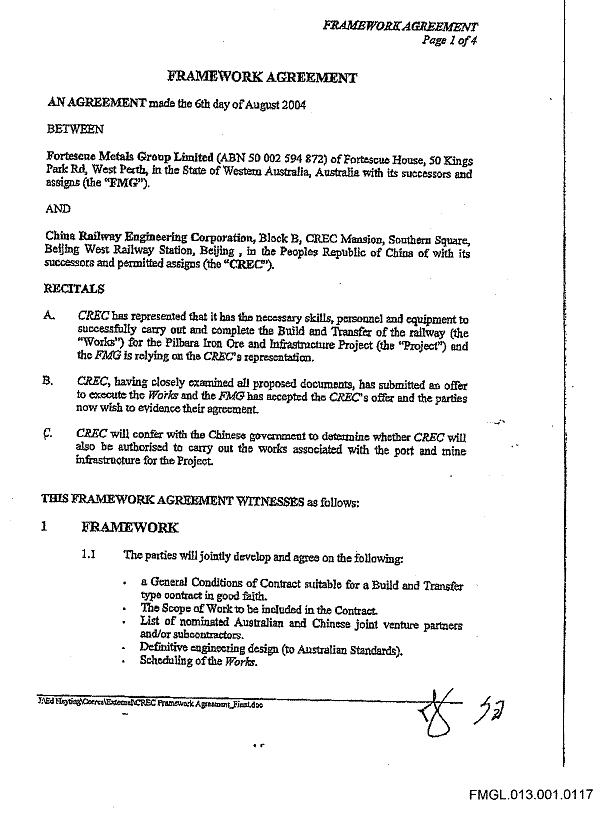
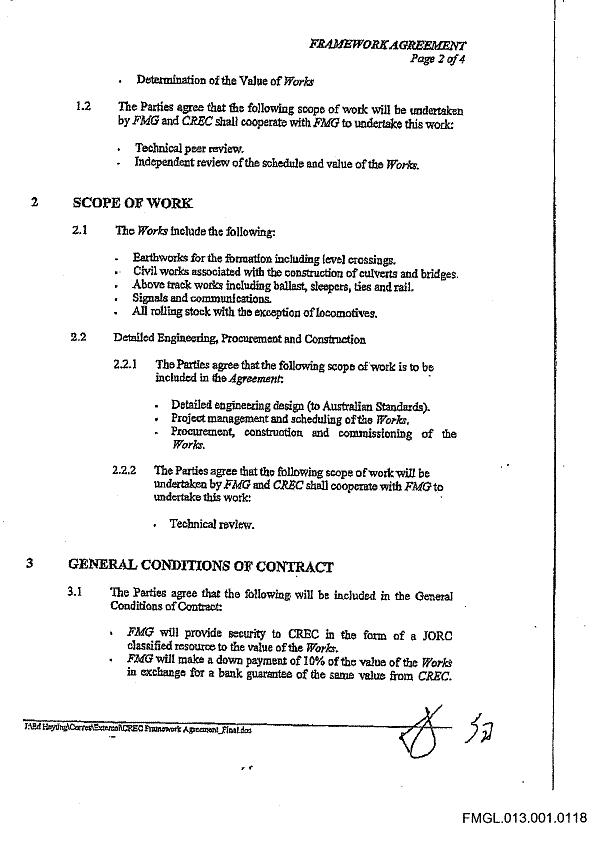
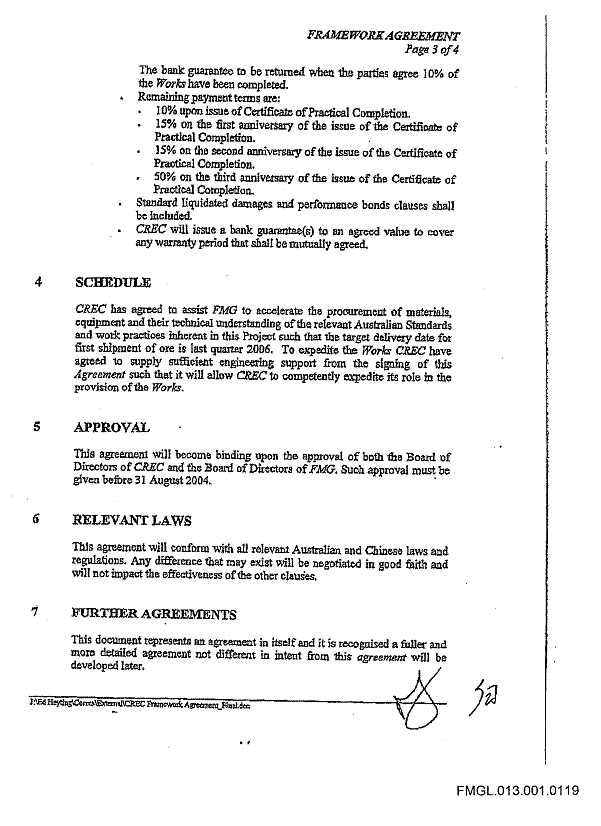
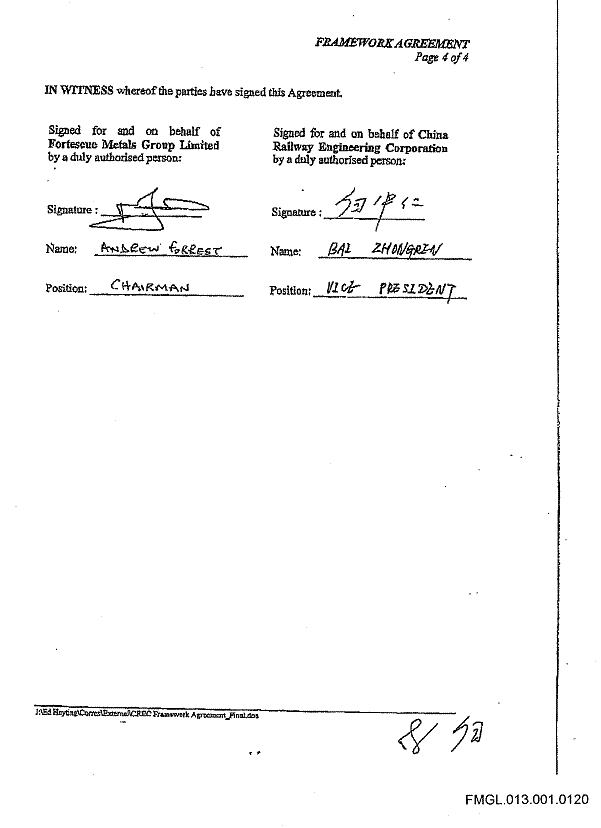
SCHEDULE ‘C’
CHEC FRAMEWORK AGREEMENT
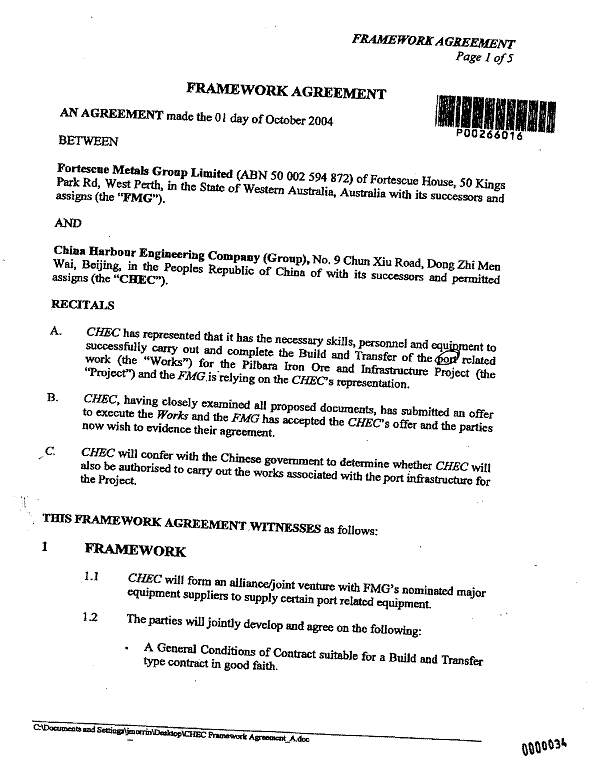
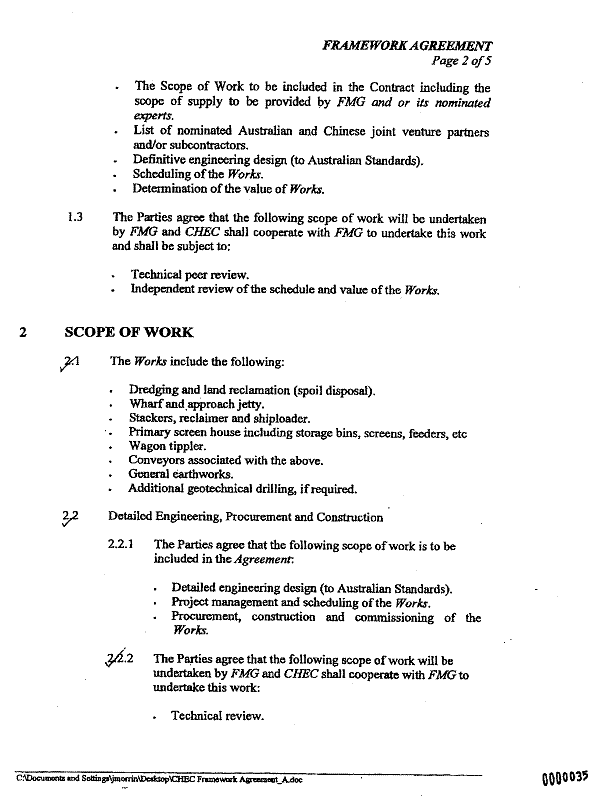
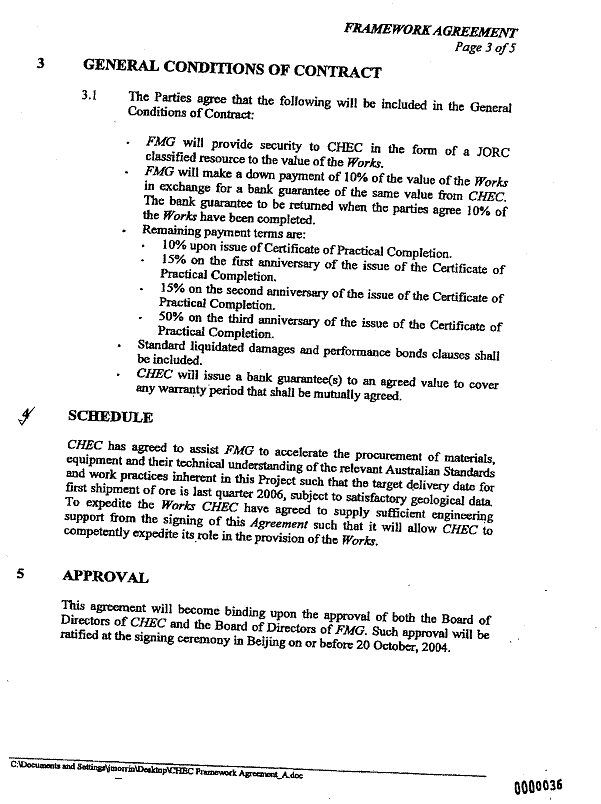
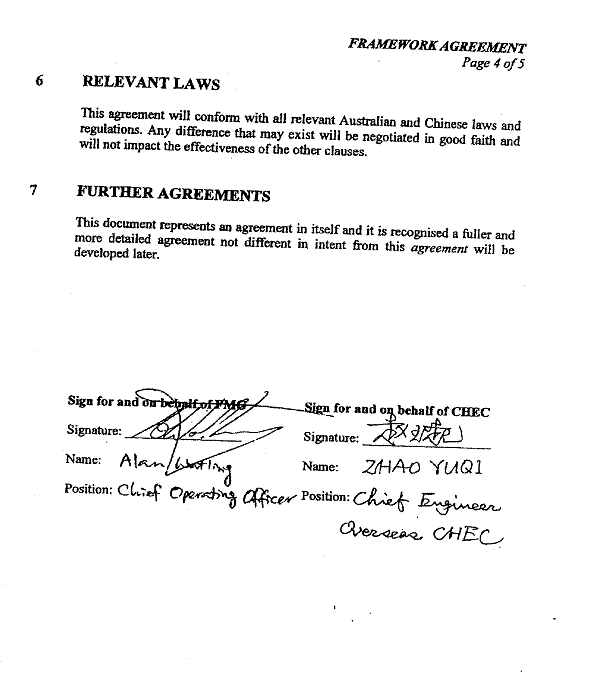
SCHEDULE ‘D’
CMCC FRAMEWORK AGREEMENT
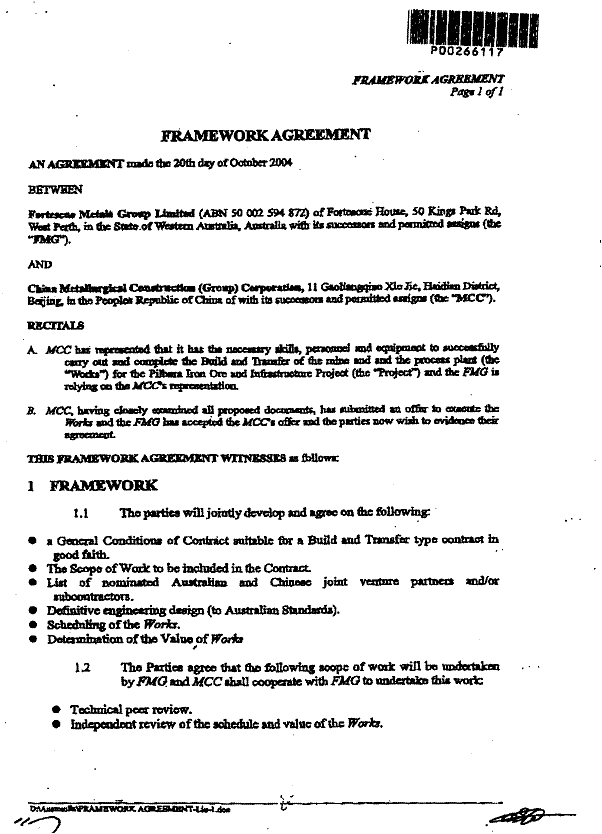
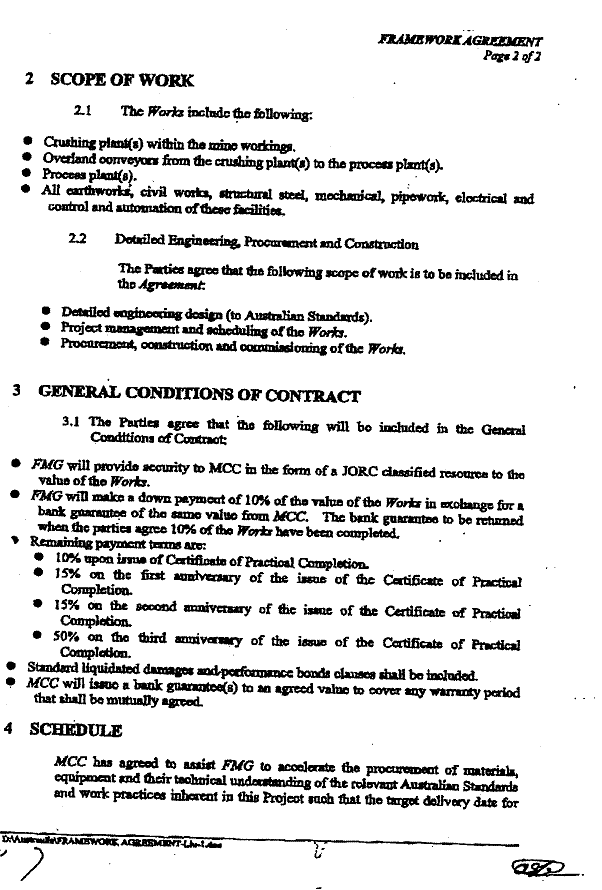
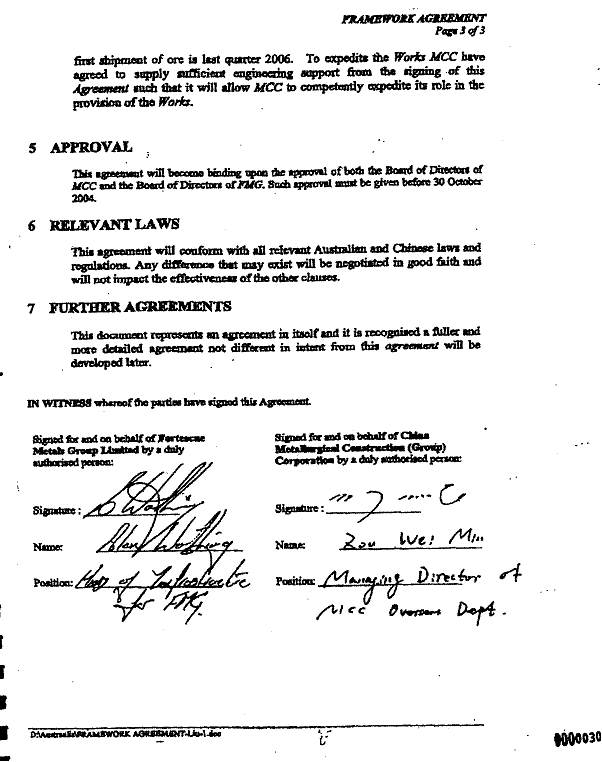
SCHEDULE ‘E’