FEDERAL COURT OF AUSTRALIA
Wilson v Nesbit [2009] FCA 1574
Building and Construction Industry Improvement Act 2005 (Cth) ss 44, 57
Workplace Relations Act 1996 (Cth)
Williams v Construction, Forestry, Mining and Energy Union (No 2) [2009] FCA 548 cited
NATHAN WILSON v TIM NESBIT and THE CONSTRUCTION, FORESTRY, MINING AND ENERGY UNION
QUD 30 of 2009
DOWSETT J
23 DECEMBER 2009
BRISBANE
| IN THE FEDERAL COURT OF AUSTRALIA |
|
| QUEENSLAND DISTRICT REGISTRY |
|
| GENERAL DIVISION | QUD 30 of 2009 |
| NATHAN WILSON Applicant
| |
| AND: | TIM NESBIT First Respondent
THE CONSTRUCTION, FORESTRY, MINING AND ENERGY UNION Third Respondent
|
| JUDGE: | |
| DATE OF ORDER: | 23 DECEMBER 2009 |
| WHERE MADE: | BRISBANE |
THE COURT ORDERS THAT:
1. the first respondent pay to the Commonwealth of Australia a pecuniary penalty fixed at $9,000;
2. the third respondent pay to the Commonwealth of Australia a pecuniary penalty fixed at $40,000; and
3. the applicant have leave to amend the application in accordance with the Reasons for Judgment herein and is directed accordingly.
Upon the admissions which the respondents made in the amended defence filed on 7 July 2009 and agreed statement of facts filed on 29 July 2009, it is declared that:
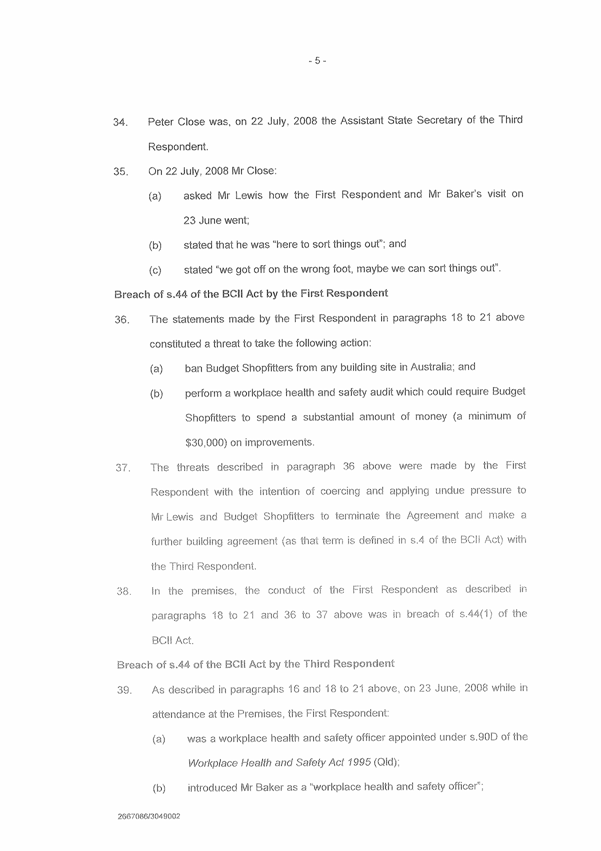
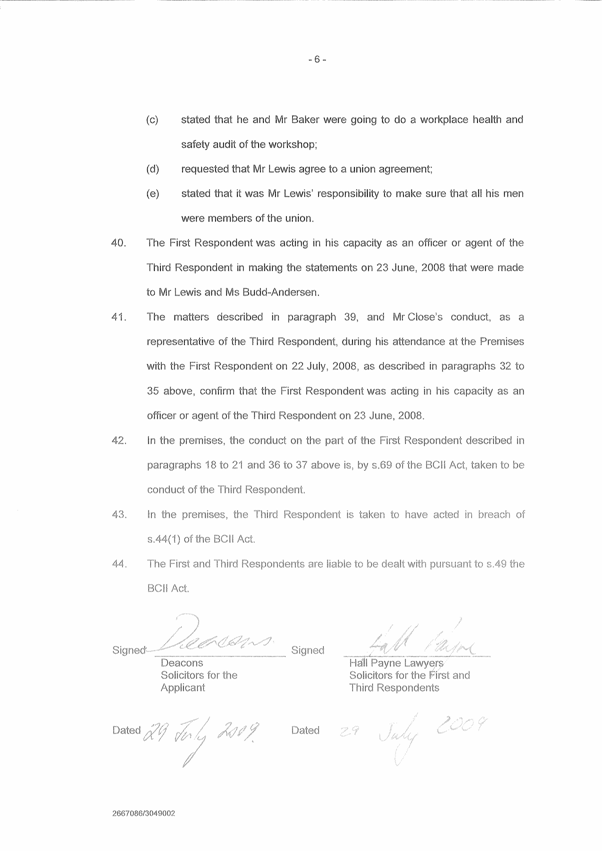
(a) On 23 June 2008, the first respondent contravened section 44(1) of the Building and Construction Industry Improvement Act 2005 (Cth) by asking an employer to:
(i) terminate its current workplace agreement; and
(ii) enter into a new workplace agreement with the third respondent (“CFMEU”);
(iii) on the basis that if the employer did not do so, the employer would be:
(A) banned from building sites across Australia; and
(B) subjected to a workplace health and safety audit which would result in the employer spending a significant amount of money, at least $30,000.
in that the first respondent intended to coerce the employer to terminate its existing workplace agreement and enter into a new workplace agreement with the CFMEU.
(b) On 23 June 2008, the CFMEU contravened section 44(1) of the Building and Construction Industry Improvement Act 2005 (Cth) by virtue of the conduct of its officer, the first respondent, in asking an employer to:
(i) terminate its current workplace agreement; and
(ii) enter into a new workplace agreement with the CFMEU;
(iii) on the basis that if the employer did not do so, the employer would be:
(A) banned from building sites across Australia; and
(B) subjected to a workplace health and safety audit which would result in the employer spending a significant amount of money, at least $30,000,
in that the first respondent intended to coerce the employer to terminate its existing workplace agreement and enter into a new workplace agreement with the CFMEU.
Note: Settlement and entry of orders is dealt with in Order 36 of the Federal Court Rules.
The text of entered orders can be located using eSearch on the Court’s website.
| IN THE FEDERAL COURT OF AUSTRALIA |
|
| QUEENSLAND DISTRICT REGISTRY |
|
| GENERAL DIVISION | QUD 30 of 2009 |
| BETWEEN: | NATHAN WILSON Applicant
|
| AND: | TIM NESBIT First Respondent
THE CONSTRUCTION, FORESTRY, MINING AND ENERGY UNION Third Respondent
|
| JUDGE: | DOWSETT J |
| DATE: | 23 DECEMBER 2009 |
| PLACE: | BRISBANE |
REASONS FOR JUDGMENT
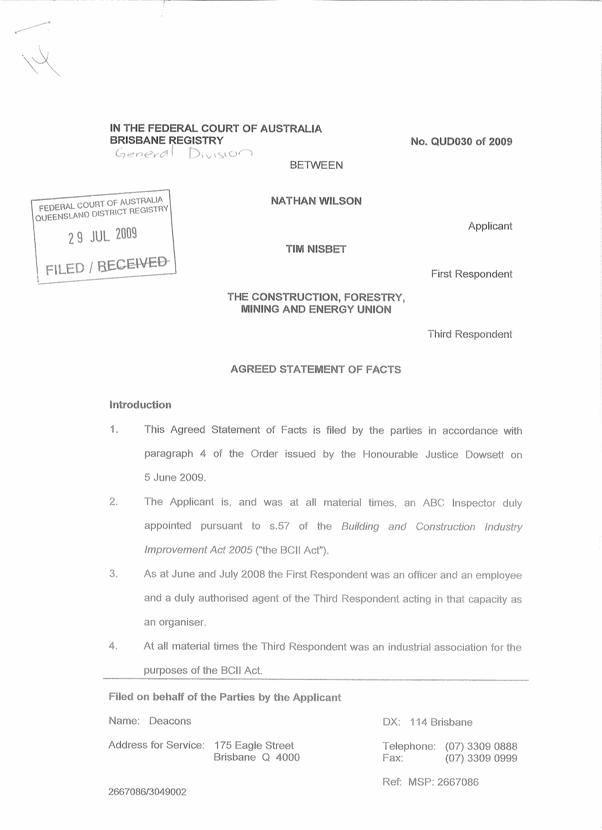
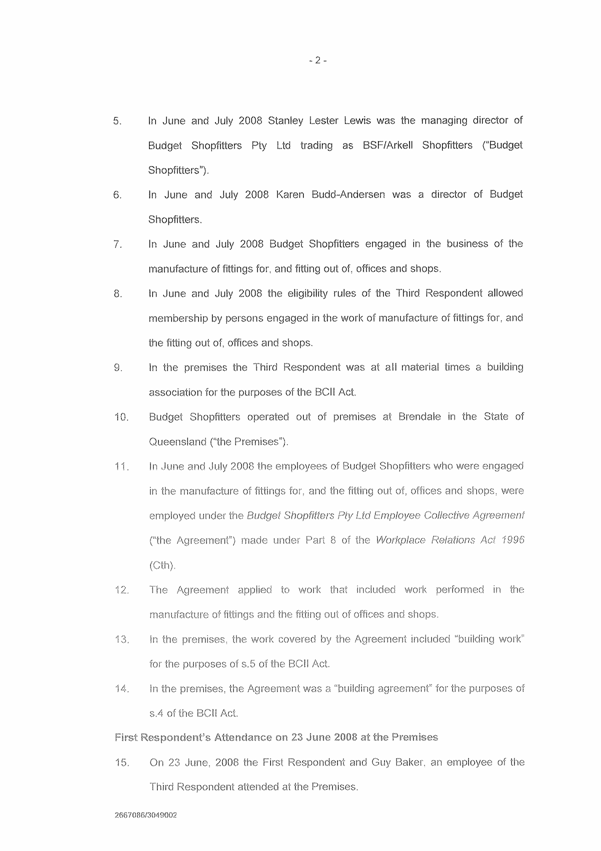
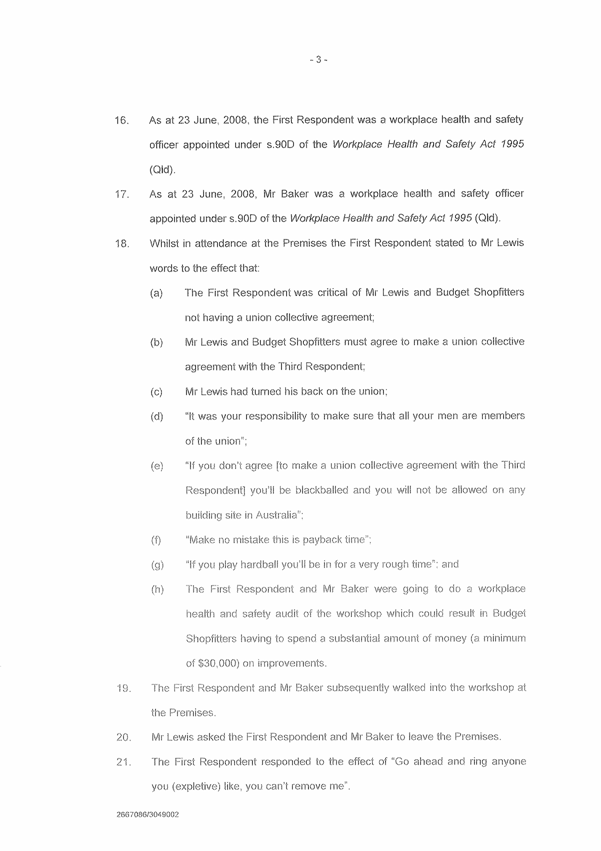
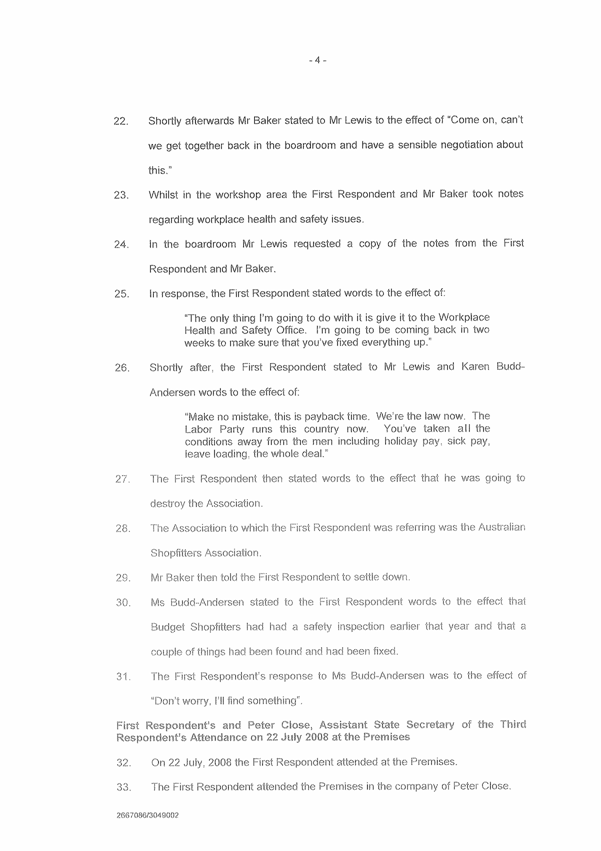
1 The applicant is an inspector appointed pursuant to s 57 of the Building and Construction Industry Improvement Act 2005 (Cth) (the “BCII Act”). The first respondent was an officer and/or employee and/or duly authorized agent of the third respondent acting in the capacity of organizer. In the application the applicant appears to have misspelt the first respondent's surname name as “Nisbet”. The correct spelling “Nesbit” is reflected in the respondent’s amended defence. I give the applicant leave to amend the application to correct this error and direct it accordingly. The third respondent is an industrial association for the purposes of the BCII Act. The second respondent was dismissed from the proceedings prior to the hearing. The applicant seeks declaratory relief and the imposition of pecuniary penalties upon the first and third respondents in connection with conduct which allegedly occurred on 23 June 2008. The parties have filed an agreed statement of facts concerning this matter which I attach to these reasons as Annexure A.
2 Section 44 of the BCII Act provides:
(1) A person must not:
(a) take or threaten to take any action; or
(b) refrain or threaten to refrain from taking any action;
with intent to coerce another person, or with intent to apply undue pressure to another person, to agree, or not to agree:
(c) to make, vary or terminate, or extend the nominal expiry date of, a building enterprise agreement; or
(d) to approve any of the things mentioned in paragraph (c).
(2) Subsection (1) does not apply to action that is protected industrial action (as affected by Part 3 of Chapter 5 of this Act).
(3) An employer must not coerce, or attempt to coerce, an employee of the employer in relation to who is to be, or is not to be, the employee’s bargaining representative.
(4) An employer must not apply, or attempt to apply, undue pressure to an employee of the employer in relation to who is to be, or is not to be, the employee’s bargaining representative.
(5) To the extent that section 343 of the FW Act relates to:
(a) the making, varying or terminating of an enterprise agreement; or
(b) the appointment, or termination of appointment, of a bargaining representative for an enterprise agreement;
that section does not apply if the agreement is a building enterprise agreement.
3 I do not understand the respondents to oppose the making of an appropriate declaration.
4 I am informed that the maximum penalty in the case of the first respondent is $22,000 and in the case of the third respondent, $110,000. The applicant submits that taking all factors into account the appropriate penalty for each of the first and third respondents is “in the vicinity of the upper end of the mid-range of potential penalties”. The respondents submit that in the case of the first respondent the appropriate penalty is in the range $8,000-$10,000 and in the case of the third respondent, $15,000-$20,000.
5 The first respondent was employed as an organizer from 7 June 1999 until 24 February 2009, during which period he was responsible for a number of industries including the shop fitting industry. He had been responsible for that industry since about 2006. The affidavit by Mr Close filed on 7 August 2009 discloses that shortly after the visit on 23 June 2008 referred to in the statement of facts, he was informed that there had been an “incident”. Mr Close was informed that:
There was a nasty argument that took place between Tim and Stan. His daughter was involved in the argument and there was a fair bit of foul language used. In addition to this there is a long lists of safety concerns at the factory that were noted and advised to Stan.
6 Subsequently Mr Close learnt that the Australian Building Construction Commission (the “ABCC”) was investigating the incident. As a result, he attended with the first respondent at Budget Shopfitters’ premises in order to see if the matter could be resolved. At one stage Mr Lewis told Mr Close that matters had become “quite ugly” and that both parties were “quite aggressive”. Certain safety issues were discussed, and there was then an inspection. Mr Close considered that many of the safety matters about which concerns had previously been raised had been remedied. The meeting on that day ended amicably. I proceed upon the basis that when Mr Close became aware that the incident was being investigated, he took steps to resolve any continuing difficulties. I also proceed upon the basis that although there may have been some safety issues requiring attention, the relevant threats were substantially motivated by broader industrial considerations.
7 The first respondent’s threats involved threatened abuse of power in order to cause ongoing disruption to Budget Shopfitters’ business undertaking through industrial action, and to compel the expenditure of substantial amounts of money. The first respondent’s refusal to provide a list of the alleged safety issues suggests that much of his conduct was not motivated by concerns about those matters. Similarly, his assertion that he would “find something” was an assertion of an intention to abuse his position and the power of his union.
8 The matter is curious in that it is unclear why the first respondent should have chosen to behave in this way on this particular occasion. Mr Close thought it to be quite out of character. One infers from some of the things which were said that his attitude may have been partly the product of what might be described as the “cultural war” associated with the industrial policy of the previous federal government and the changes which have been made under the present government. Of course I make no comment as to the correctness or appropriateness of either approach to industrial relations. The first respondent has no record of previous contraventions of the Act or the Workplace Relations Act 1996 (Cth) (the “WR Act”). In those circumstances he may be treated upon the basis that this incident was a one-off lapse, to some extent out of character. However the conduct was quite extreme and completely unacceptable. The Court must demonstrate its disapproval of that conduct by fixing a penalty which will operate as a deterrent to others. There is no real suggestion that the first respondent expressed any remorse for his conduct at the time, although he has participated in the resolution of the matter and must be given credit for that, particularly for the fact that it has resulted in the avoidance of the need for a lengthy trial. The first respondent has left the third respondent’s employ. It seems that he is no longer involved in the industrial relations field. Given that there was no previous misconduct of this kind, and that the relevant incident occurred on one discrete occasion, I am inclined to think that a penalty in excess of half of the maximum would be difficult to justify, even having regard to the seriousness of this particular conduct. The respondents suggest a range of $8,000-$10,000. I accept that submission. I fix the penalty at $9,000.
9 As to the third respondent, a great deal of attention has been paid by the applicant to previous occasions on which unlawful conduct has been demonstrated, going back to 2003. Whilst such a record is no doubt relevant, two points must be kept in mind. First, many of the earlier events related to actions in other states. The union seems to operate through a series of semi-autonomous state organizations across the country. It may be that the record of one state branch is better than that of another. This fact may be relevant to the weight attributable to prior misconduct. Similar considerations might be taken into account in considering the previous misconduct of an employer corporation which operates through semi-autonomous branches. The second consideration is that any organization will, over a period of time, acquire a history, good or bad. The dynamics within a particular organization, which may produce misconduct at one point in time, may not be present at some other time. One should be cautious about inferring that a long history of misconduct, going back over many years, necessarily reflects the current mindset of the organization.
10 Nonetheless the third respondent has a history of infringement of industrial legislation, including some infringements in Queensland. On the other hand, in this case, the conduct for which it is responsible, namely that of the first respondent, seems to have been out of character for him, and therefore not reasonably predictable. However as an employer itself, it was for the third respondent to ensure that clear guidelines were provided to its officers and reinforced so as to ensure that such behaviour did not occur. The third respondent cannot be treated as being innocent of previous infringements. The seriousness of the allegations cannot be overlooked. Further, when dealing with corporate employers or unions it is generally the case that only a substantial financial penalty is likely to have any deterrent effect. Loss will generally be borne by a relatively large number of people, so that perhaps none will actually feel any part of it. However it is also clear that the third respondent took steps to remedy the situation and has also cooperated in bringing the matter to a speedy and relatively economical conclusion.
11 In the circumstances I consider that a penalty roughly equivalent to that imposed upon the first respondent, but reflecting the difference in maximum penalties, is appropriate. I fix the penalty at $40,000.
12 I have been referred to the penalties imposed in numerous cases. However many were pursuant to the WR Act which provided for significantly lower maximum penalties. The penalties which I have imposed are generally consistent with those imposed by Jessup J in Williams v Construction, Forestry, Mining and Energy Union (No 2) [2009] FCA 548. The conduct in that case was somewhat more serious than in this. However the penalties for individual breaches were reduced to reflect the overall extent of the misconduct.
13 I will make declarations in terms of paras 48 and 49 of the applicant’s submissions as follows:
Upon the admissions which the respondents made in the amended defence filed on 7 July 2009 and agreed statement of facts filed on 29 July 2009, it is declared that:
(a) On 23 June 2008, [the first respondent] contravened section 44(1) of the Building and Construction Industry Improvement Act 2005 (Cth) by asking an employer to:
(i) terminate its current workplace agreement; and
(ii) enter into a new workplace agreement with the CFMEU;
(iii) on the basis that if the employer did not do so, the employer would be:
(A) banned from building sites across Australia; and
(B) subjected to a workplace health and safety audit which would result in the employer spending a significant amount of money, at least $30,000,
in that [the first respondent] intended to coerce the employer to terminate its existing workplace agreement and enter into a new workplace agreement with the CFMEU.
(b) On 23 June 2008, the CFMEU contravened section 44(1) of the Building and Construction Industry Improvement Act 2005 (Cth) by virtue of the conduct of its officer, Tim Nesbit, in asking an employer to:
(i) terminate its current workplace agreement; and
(ii) enter into a new workplace agreement with the CFMEU;
(iii) on the basis that if the employer did not do so, the employer would be:
(A) banned from building sites across Australia; and
(B) subjected to a workplace health and safety audit which would result in the employer spending a significant amount of money, at least $30,000,
in that [the first respondent] intended to coerce the employer to terminate its existing workplace agreement and enter into a new workplace agreement with the CFMEU.
14 I order that the first respondent pay to the Commonwealth of Australia a pecuniary penalty fixed at $9,000. I further order that the third respondent pay to the Commonwealth of Australia a pecuniary penalty fixed at $40,000.
| I certify that the preceding fourteen (14) numbered paragraphs are a true copy of the Reasons for Judgment herein of the Honourable Justice Dowsett. |
Associate:
Dated: 23 December 2009
| Counsel for the Applicant: | Mr CJ Murdoch |
|
|
|
| Solicitor for the Applicant: | Deacons |
|
|
|
| Counsel for the First and Third Respondents: | Mr DR Kent |
|
|
|
| Solicitor for the First and Third Respondents: | Hall Payne Lawyers |
| Date of Hearing: | 18 September 2009 |
|
|
|
| Date of Judgment: | 23 December 2009 |
|