

FEDERAL COURT OF AUSTRALIA
Wang v Anying Group Pty Ltd [2009] FCA 1500
Federal Court of Australia Act 1976 (Cth), s 31A
Trade Marks Act 1995 (Cth), ss 44(3)(b), 58, 60, 62, 62A, 88, 120, 122(1)(f) and 126
Trade Practices Act 1974 (Cth), ss 51AC, 52, 53
Federal Court Rules O 6 r 9, O 11 r 16, O 20 r 5
Boston Commercial Services Pty Ltd v GE Capital Finance Australasia Pty Ltd (2006) 236 ALR 720 cited
Dandaven v Harbeth Holdings Pty Ltd [2008] FCA 955 applied
Health World Ltd v Shin-Sun Australia Pty Ltd (2008) 75 IPR 478 applied
James North (Aust) Pty Ltd v Blundstone Pty Ltd (1978) 48 AOJP 2419, (1978) 1b IPR 596 applied
Jefferson Ford Pty Ltd v Ford Motor Company of Australia Ltd (2008) 167 FCR 372 cited
Radio & Records Inc v Dahlke (2005) 67 IPR 187 cited
Sebel Furniture Ltd v Acoustic & Felts Pty Ltd (2009) 80 IPR 244 applied
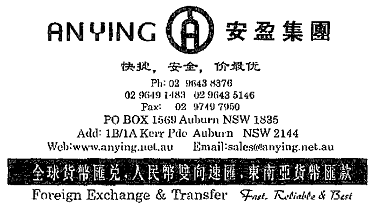
NSD 768 of 2008
FOSTER J
14 DECEMBER 2009
SYDNEY
| IN THE FEDERAL COURT OF AUSTRALIA |
|
| NEW SOUTH WALES DISTRICT REGISTRY |
|
| general division | NSD 768 of 2008 |
| BETWEEN: | HUA WEI WANG First Applicant
XINYING PTY LTD (ACN 118 548 977) Second Applicant
NEW CENTURY 2001 PTY LTD TRADING AS ANYING SYDNEY COMPANY (ACN 114 661 568) Third Applicant
|
| AND: | ANYING GROUP PTY LTD (ACN 126 282 657) First Respondent
YANYAN SUN Second Respondent
YUN CHEN Third Respondent
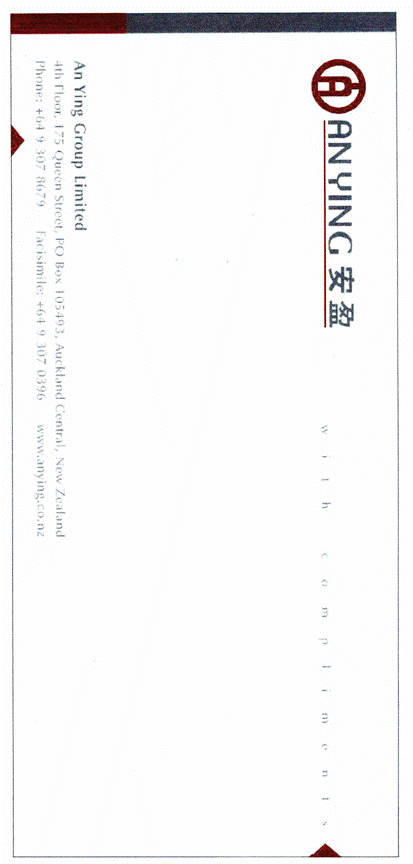
|
| AND BETWEEN: | ANYING GROUP PTY LTD (ACN 126 282 657) First Cross-Claimant
YANYAN SUN Second Cross-Claimant
YUN CHEN Third Cross-Claimant
|
| and: | HUA WEI WANG First Cross-Respondent
XINYING PTY LTD (ACN 118 548 977) Second Cross-Respondent
NEW CENTURY 2001 PTY LTD TRADING AS ANYING SYDNEY COMPANY (ACN 114 661 568) Third Cross-Respondent
REGISTRAR OF TRADE MARKS FOURTH Cross-Respondent
CHUANG WANG FIFth Cross-Respondent
ANYING INTERNATIONAL FINANCIAL PTY LIMITED (ACN 105 067 990) SIXth cross-respondent
|
|
|
|
| JUDGE: | |
| DATE OF ORDER: | 14 DECEMBER 2009 |
| WHERE MADE: | SYDNEY |
THE COURT ORDERS THAT:
1. The respondents have leave to file an Amended Cross-Claim Application substantially in the form of the document Marked for Identification 4 by Foster J on 7 April 2009, such Amended Cross-Claim Application to be filed and served by 21 December 2009.
2. The Notice of Motion filed by the applicants on 16 February 2009 be dismissed.
3. The applicants pay the respondents’ costs of and incidental to that Notice of Motion.
4. The proceedings be listed for directions at 9.30 am on 22 December 2009 before Foster J.
5. The solicitors for the parties confer as soon as possible but by no later than 17 December 2009, with a view to agreeing on a set of trial directions to be made on 22 December 2009, such agreed trial directions to be forwarded to the Associate to Foster J by no later that 5.00 pm on 21 December 2009.
6. The solicitors for the parties confer as soon as practicable with a view to arranging for all matters raised in the proceedings to be mediated by a Mediator chosen by the parties in accordance with terms to be agreed amongst the parties, such mediation to take place in Sydney or in such other place as the parties may agree by no later than 26 February 2010.
7. All parties have liberty to apply on two days’ notice.
Note: Settlement and entry of orders is dealt with in Order 36 of the Federal Court Rules.
The text of entered orders can be located using eSearch on the Court’s website.
| IN THE FEDERAL COURT OF AUSTRALIA |
|
| NEW SOUTH WALES DISTRICT REGISTRY |
|
| general division | NSD 768 of 2008 |
| BETWEEN: | HUA WEI WANG First Applicant
XINYING PTY LTD (ACN 118 548 977) Second Applicant
NEW CENTURY 2001 PTY LTD TRADING AS ANYING SYDNEY COMPANY (ACN 114 661 568) Third Applicant
|
| AND: | ANYING GROUP PTY LTD (ACN 126 282 657) First Respondent
YANYAN SUN Second Respondent
YUN CHEN Third Respondent
|
| AND BETWEEN: | ANYING GROUP PTY LTD (ACN 126 282 657) First Cross-Claimant
YANYAN SUN Second Cross-Claimant
YUN CHEN Third Cross-Claimant
|
| and: | HUA WEI WANG First Cross-Respondent
XINYING PTY LTD (ACN 118 548 977) Second Cross-Respondent
NEW CENTURY 2001 PTY LTD TRADING AS ANYING SYDNEY COMPANY (ACN 114 661 568) Third Cross-Respondent
REGISTRAR OF TRADE MARKS FOURTH Cross-Respondent
CHUANG WANG FIFth Cross-Respondent
ANYING INTERNATIONAL FINANCIAL PTY LIMITED (ACN 105 067 990) SIXth cross-respondent
|
| JUDGE: | FOSTER J |
| DATE: | 14 DECEMBER 2009 |
| PLACE: | SYDNEY |
REASONS FOR JUDGMENT
Introduction
1 The applicants have applied for the following relief:
(a) Pursuant to s 31A of the Federal Court of Australia Act 1976 (Cth) (the Federal Court Act), summary judgment in their favour in respect of all of their claims for relief (save the quantification of their loss);
(b) Pursuant to O 20 r 5 of the Federal Court Rules (FCR), an order that the whole of the Amended Cross-Claim filed by the respondents on 9 January 2009 (the Cross-Claim) be dismissed because it is frivolous or vexatious or is an abuse of the process of the Court;
(c) Pursuant to O 6 r 9 FCR, an order that Chuang Wang and Anying International Financial Pty Limited (ACN 105 067 990) (Anying Sydney No 1) be removed as cross-respondent parties;
(d) Pursuant to O 11 r 16 FCR, an order that paragraphs 43 to 79 of the Cross-Claim be struck out; and
(e) An interlocutory injunction pending the final hearing restraining the respondents from using the name Anying, the Anying logo (as described in the Statement of Claim) and the four Chinese characters also described in the Statement of Claim which, when translated, read “Safe Rich Exchange Currency” in the course of trade or in relation to:
(i) Goods or services in respect of which Australian Registered Trade Mark No 1100722 in Class 36 for which the mark is registered viz foreign currency exchange services (the Registered Trade Mark); and
(ii) Goods or services of the same description as or closely related to the services in respect of which the Registered Trade Mark is registered.
The relief described in (c) and (d) above is claimed in the alternative to the relief described in (b).
2 The claim for an interlocutory injunction is made as an alternative to all of the other claims for relief. It is, in effect, the applicants’ fallback position.
3 The applicants appear to have elected to press their claim for damages rather than the alternative form of monetary relief claimed in their Application viz an account of profits. They accept that their claim for damages should be deferred for later consideration.
4 The issues which presently call for determination are most conveniently dealt with by reference to the various claims for relief outlined in [1] above.
The Applicants’ Claims for Final Relief
5 Hua Wei Wang (Harry Wang) is the first applicant. Xinying Pty Ltd (Xinying) is the second applicant. Harry Wang is a director of Xinying and controls that company with his partner Xuan Zheng. New Century 2001 Pty Ltd (New Century) is the third applicant. New Century currently trades under the business name Anying Sydney Company. Each of Xinying and New Century conducts a foreign exchange business aimed at Chinese customers, Xinying in the CBD of Melbourne and New Century in the Haymarket area of Sydney city.
6 Anying Group Pty Ltd (ACN 126 282 657) (Anying Auburn) is the first respondent. Anying Auburn was incorporated on 29 June 2007 in New South Wales. Yanyan Sun is the second respondent. She is a director of Anying Auburn. Yun Chen (also known as Andrew Chen) is the third respondent. He is also a director of Anying Auburn.
7 Harry Wang is the registered proprietor of the Registered Trade Mark. The Certificate of Registration in respect of the Registered Trade Mark includes the following statement:
The applicant has advised that the Chinese characters appearing in the trade mark may be transliterated as AN YING HUAN HUI and may be translated into ENGLISH as SAFE RICH EXCHANGE CURRENCY.
8 The Registered Trade Mark comprises the following:

9 It thus comprises the logo depicted above (the Anying logo), the single word ANYING and the four Chinese characters to which reference is made in the text of the Certificate of Registration. Each of these integers of the trade mark is laid out as depicted above.
10 The registration of the Registered Trade Mark took effect on 24 February 2006, the date when Harry Wang applied for the registration of that trade mark. There is no dispute that Harry Wang is the registered proprietor of the Registered Trade Mark. However, there is a lively contest as to whether Harry Wang was ever entitled to become the registered proprietor of the Registered Trade Mark and whether the Register should be rectified in order to expunge that trade mark or whether other relief affecting that trade mark should be granted to the respondents.
11 The applicants allege that Xinying has a licence to use the Registered Trade Mark throughout Australia, having been granted that licence by Harry Wang pursuant to a User Agreement dated 3 November 2006. They also allege that Harry Wang and Xinying entered into a licence agreement in respect of the Registered Trade Mark by an agreement made on 7 September 2007 and subsequently varied in 2008.
12 The applicants allege that Anying Auburn began to trade in the same business as the business of Xinying and New Century by reference to a mark, name, word, device or sign that is substantially identical with or deceptively similar to the Registered Trade Mark thereby infringing that trade mark.
13 The evidence established that Anying Auburn used in its advertising and promotional material the Anying logo and the name “ANYING”. These integers were usually deployed in conjunction with four Chinese characters only one of which (the first one) appears to me to be in common with any of the four Chinese characters incorporated within the Registered Trade Mark. In the advertising material published by Anying Auburn, the four Chinese characters do not appear below a line drawn under the word “ANYING”. Rather, they usually appear either to the left or to the right of the Anying logo. On the other side of the logo, the word “ANYING” appears. An example of this can be seen on the Anying Auburn business card which is reproduced below:
14 The allegation that Anying Auburn is using a trade mark which is substantially identical with or deceptively similar to the Registered Trade Mark is not disputed by the respondents. They contend that Anying Auburn is entitled to trade in this fashion. Anying Auburn’s conduct commenced in late 2007 and has continued thereafter. The applicants first became aware of Anying Auburn’s activities in late December 2007.
15 In addition to the trade mark case brought by Harry Wang and Xinying, New Century sues Anying Auburn for damages for passing off. It also sues for contraventions of s 52 and s 53 of the Trade Practices Act 1974 (Cth) (the Trade Practices Act) based upon the same facts and matters as are pleaded in support of the cause of action for passing off. New Century also complains that Anying Auburn has falsely represented to members of the public that its business is affiliated with the business of New Century and that it has the sponsorship or approval of New Century thereby breaching s 52 and s 53 of the Trade Practices Act. New Century claims as against Yanyan Sun and Andrew Chen that each of those persons was involved as an accessory in the contraventions of the Trade Practices Act alleged against Anying Auburn.
The Defence
16 The conduct of Anying Auburn alleged to constitute infringement of the Registered Trade Mark is admitted on the pleadings. However, Anying Auburn asserts in its Defence that it is entitled to conduct its business under and by reference to the Registered Trade Mark or something very similar to it. Anying Auburn contends that none of the applicants was the owner of the Anying mark (comprising the Anying logo, the word “ANYING” in capitals and two Chinese characters translated as “safe rich”) as at 24 February 2006 and that none of them had any other right, title or interest in the Anying mark as at that date. Anying Auburn contends that the Registered Trade Mark should be expunged from the Register for the reasons explained in its Cross-Claim. It contends that it has not infringed the Registered Trade Mark, that it can legitimately avail itself of the terms of s 122(1)(f) of the Trade Marks Act 1995 (Cth) (the Trade Marks Act)and that it should be permitted to register the Anying mark pursuant to the provisions of s 44(3)(b) of that Act. Anying Auburn denies that it is committing the tort of passing off and that it has made false statements to members of the public, as alleged by the applicants. The individual respondents also deny liability as accessories to the Trade Practices Act contraventions alleged against Anying Auburn.
The Cross-Claim
17 In the Cross-Claim, Anying Auburn, Yanyan Sun and Andrew Chen are the cross-claimants. Harry Wang, Xinying, New Century, the Registrar of Trade Marks, Chuang Wang and Anying Sydney No 1 are the cross-respondents.
18 In the Cross-Claim, the cross-claimants allege that Andrew Chen “was instrumental in designing” the Anying mark. Although the matter is far from clear in the pleading, the cross-claimants appear to be contending in their Cross-Claim that it was a New Zealand corporation, An Ying Group Limited (An Ying NZ) which was the true owner of the Anying mark. It is alleged that An Ying NZ and other New Zealand corporations associated with An Ying NZ and Andrew Chen used the Anying mark in New Zealand between about May 2001 and about August 2006 in connection with various foreign exchange businesses conducted there.
19 In 2003 and 2004, Andrew Chen and An Ying NZ are said to have established two corporate entities in Australia viz Anying Sydney No 1 and An Ying International Financial (Melbourne) Pty Limited (ACN 108 780 561) (An Ying Melbourne). Anying Sydney No 1 was incorporated on 12 June 2003 and An Ying Melbourne was incorporated on 20 April 2004. In the Cross-Claim, the cross-claimants allege that Anying Sydney No 1 promoted the Anying mark and traded under that mark in Australia from about mid 2003 until late 2006 and that, in Australia, throughout that period, the Anying mark was distinctively associated with Anying Sydney No 1. These facts are admitted by the applicants on the pleadings.
20 Harry Wang and his partner have had the day-to-day practical control of An Ying Melbourne from the date of its incorporation up to the present time.
21 An Ying Melbourne also carried on business and traded under the Anying mark. This occurred between late April 2004 and late 2006. These facts are also admitted by the applicants on the pleadings.
22 The cross-claimants allege that Harry Wang expropriated the Anying mark and wrongfully registered in Australia the Registered Trade Mark under the Trade Marks Act. That trade mark is almost identical to the Anying mark. The only differences between it and the Anying mark are that the Anying mark incorporates only two Chinese characters whereas the Registered Trade Mark incorporates four Chinese characters; only one of the two Chinese characters in the Anying mark is also found in the Registered Trade Mark; and the Chinese characters in the Anying mark are next to the word “ANYING” in the same line whereas, in the Registered Trade Mark, those characters are printed underneath the word “ANYING”. In the Cross-Claim, the cross-claimants allege that:
(a) The true owner of the Anying mark was An Ying NZ;
(b) Anying Sydney No 1, An Ying Melbourne and Andrew Chen were all authorised users of the Anying mark at various times from about mid 2003 up to the present time;
(c) At no time did Harry Wang have any personal right, title or interest in the Anying mark. His conduct in applying to register the Registered Trade Mark constituted breaches of the fiduciary duties owed by him to An Ying NZ, to Andrew Chen and to An Ying Melbourne. It is alleged that he was not the owner of the trade mark which was the subject of the application for the Registered Trade Mark either as at 24 February 2006 or at any other relevant time; and
(d) By reason of the operation of various provisions of the Trade Marks Act, the Registered Trade Mark should be expunged from the Trade Marks Register and/or Anying Auburn or Andrew Chen should be permitted to register the Anying mark pursuant to s 44(3)(b) of the Trade Marks Act.
23 The cross-claimants also plead a myriad of facts and matters involving the internal management of Anying Sydney No 1, An Ying Melbourne, An Ying NZ and a number of other corporations. Allegations of impropriety are made against Chuang Wang. In particular, the cross-claimants allege that Chuang Wang improperly gained control of Anying Sydney No 1 in breach of various duties owed by him to An Ying NZ and to Andrew Chen.
24 The cross-claimants also allege that Harry Wang improperly spirited away the business of An Ying Melbourne to Xinying and thus breached the duties owed by him to An Ying Melbourne as one of its directors. It is also alleged in the Cross-Claim that New Century was implicated in the wrongful conduct of Chuang Wang whereby the business assets of Anying Sydney No 1 were transferred to New Century in breach of duties owed by Chuang Wang to Anying Sydney No 1 and to its shareholders. The cross-claimants seek to set aside the transaction involving the sale of Anying Sydney No 1’s business assets to New Century as well as the transaction whereby An Ying Melbourne’s assets and undertaking were transferred to Xinying. They also seek to undo other transactions effected in 2006 and 2007. Amongst other bases for these claims, the respondents invoke s 51AC of the Trade Practices Act.
The Respondents’ Version of Events
25 The summary of facts and matters set out in this part of these Reasons for Judgment is drawn from the affidavit evidence of Andrew Chen and Yanyan Sun. That evidence has not yet been tested by cross-examination. It was not controverted by the applicants at this stage, they being content to rely upon their evidence-in-chief to support what they assert is a simple case of trade mark infringement and passing off. I will take the evidence of Andrew Chen and Yanyan Sun at face value for present purposes unless it has been demonstrated to be wrong. I do so at this stage only for the limited purpose of considering and determining the claims for relief made in the Notice of Motion filed by the applicants on 16 February 2009.
Andrew Chen
26 Andrew Chen is now 47 years of age. He was born in Anren City in Hunan Province in China. In 1997, he migrated to New Zealand with his wife.
27 In 1999 and 2000, he worked for a sharebroking and money exchange company. In 2000, he arranged for the incorporation of a New Zealand corporation called An Ying International Financial Limited. In the period from early 2001 until about August 2006, that corporation carried on a foreign exchange business in New Zealand. An Ying International Financial Limited was placed into administration in August 2006. Its precise status at the present time was not the subject of evidence.
28 In 2001, Andrew Chen decided that he would set up other offices throughout New Zealand using, in effect, an incorporated joint venture structure. His plan was that he would establish a separate company for each of the additional offices in which a corporation controlled by him would own 51% of the issued capital and in which the remaining 49% of that capital was to be owned by his joint venture partner. He decided to acquire a separate New Zealand corporation as the 51% shareholder in these other corporations. Accordingly, he arranged for the incorporation of a second New Zealand corporation, An Ying NZ. An Ying NZ was incorporated on 16 May 2001. It was to be the 51% shareholding entity in the joint venture corporations which would subsequently be incorporated. I was told that it is currently in liquidation although it remains on the Register of Companies in New Zealand.
The Creation of the Anying Mark
29 Andrew Chen said that he conceived the name Anying in the year 2000. He said that it means “safe, rich and/or profitable” in the Chinese language. He gave a detailed explanation of the thought processes which he undertook in order to create the name. He also said that he created a logo to represent the business which he had commenced in 2001. He described how he transformed that initial logo into a second logo and explained the processes which he undertook in order to effect that transformation. He said that he created the second Anying logo in about 2003 and that it was fully formed by late August 2003. Attached to these Reasons for Judgment and marked with the letter “A” is a copy of a With Compliments slip used by An Ying NZ, probably in late 2003. That document depicts the Anying mark which I have described in [16] above. The evidence was that the second Anying logo was used in New Zealand by both An Ying NZ and An Ying International Financial Limited. The second Anying logo is identical to the Anying logo included within the Registered Trade Mark. The printed name “ANYING” as used by the New Zealand corporations in conjunction with the Anying logo is also virtually identical to the word “ANYING” as it appears in the Registered Trade Mark. As mentioned in [22] above, there is a difference between the Chinese characters which appear on the attached With Compliments slip and those which are incorporated in the Registered Trade Mark. Andrew Chen and An Ying NZ may have copyright in the name “ANYING” and in the Anying logo. No cause of action in copyright has been pleaded by the respondents although the fact that copyright may subsist in components of the trade mark may be relevant to the case which the respondents will seek to make in attempting to have the Registered Trade Mark cancelled.
30 On 8 August 2003, An Ying NZ applied to register the Anying mark as a trade mark in China. It was subsequently registered there.
The Corporate Relationships
31 Andrew Chen met Chuang Wang in 2000 when Chuang Wang was an international student in Auckland. In early 2001, Chuang Wang migrated to Australia to complete his studies at the Australian National University in Canberra. Later, in 2003, Chuang Wang approached Andrew Chen to see whether there were any business opportunities which he might be able to exploit in Australia in association with Andrew Chen.
32 After the initial approach from Chuang Wang in 2003, Andrew Chen contacted Yanyan Sun (the second respondent), a friend, and conscripted her to be his and An Ying NZ’s representative in Australia in the corporation which was likely going to be set up by Chuang Wang for the purpose of carrying on a similar foreign exchange business to that which was then being carried on in New Zealand by An Ying NZ and its associated corporations.
33 On 12 June 2003, Anying Sydney No 1 was registered. Andrew Chen was the Managing Director of Anying Sydney No 1. The other directors were Chuang Wang and Yanyan Sun. Anying Sydney No 1 was authorised by Andrew Chen and An Ying NZ to use the Anying mark in Australia.
34 At around the same time, in mid 2003, Andrew Chen was introduced to Harry Wang and his partner Xuan Zheng. Subsequently, on 20 April 2004, An Ying Melbourne was incorporated. Harry Wang is now the sole director of An Ying Melbourne. Previously, Chuang Wang, Xuan Zheng and Xuan Zheng’s father were the directors of that corporation.
35 The Anying mark (as used in New Zealand) was utilised in the businesses of each of Anying Sydney No 1 and An Ying Melbourne up to late 2006, in the former case from about late August 2003 and in the latter from its incorporation on 20 April 2004.
36 Harry Wang applied to register the Registered Trade Mark in Australia on 24 February 2006. On or about 8 April 2006, he also obtained registration of the domain name anying.com. He did not inform Andrew Chen or anyone else associated with An Ying NZ of these steps which he had taken. The respondents allege that Harry Wang had no right to make either application. In his Defence to Cross-Claim, Harry Wang admits that he was aware that the Anying mark was first used in New Zealand by, and was distinctively associated with, An Ying NZ and that it was first used in Australia by, and was distinctively associated with, Anying Sydney No 1. It is alleged that Harry Wang applied to register the Registered Trade Mark in breach of duties owed by him to An Ying Melbourne, An Ying NZ and Andrew Chen.
37 Chuang Wang is said to have dishonestly wrested control of Anying Sydney No 1 from Andrew Chen and An Ying NZ by a series of manoeuvres and transactions effected in the second half of 2006. On the face of things, Anying Sydney No 1 transferred its business assets to New Century pursuant to a contract for the sale of such assets dated 12 December 2006. A similar transaction was effected in respect of the business assets of An Ying Melbourne. Those assets were conveyed to Xinying pursuant to a contract dated 6 November 2006. Other transactions were effected at around about the same time, the result of which was to disengage Anying Sydney No 1 from An Ying NZ and to remove Andrew Chen as a director of Anying Sydney No 1. Further, real control of An Ying Melbourne passed to Harry Wang at around this time.
38 The evidence as to the circumstances in which all of these transactions were effected is somewhat scant. It is the respondents’ contention that all of these transactions were done improperly at the instigation of Chuang Wang, possibly in association with Harry Wang. The applicants have not yet descended into any detailed explanation as to why these and other transactions involving the main actors and entities took place. Chuang Wang has apparently disappeared, probably returning to China.
The Current Position
39 The net result of the transactions effected in the latter part of 2006 was as follows:
(a) Xinying, being a company controlled by Harry Wang and Xuan Zheng, took over the business and operations of An Ying Melbourne and thereafter conducted that business in its own right and for its own benefit using the Registered Trade Mark or a trade mark which closely resembled that trade mark in connection with that business;
(b) New Century, being a company controlled by Ronan He and his wife, took over the business and operations of Anying Sydney No 1 and thereafter conducted that business in its own right and for its own benefit using the Registered Trade Mark or a trade mark which closely resembled that trade mark in connection with that business; and
(c) The Registered Trade Mark remained in the name of Harry Wang, who licensed its use to Xinying and to New Century.
First Use of the Anying Mark in Australia
40 Andrew Chen asserted that An Ying NZ had itself carried on business in Australia to some extent between 2001 and 2003, before Anying Sydney No 1 was incorporated. His assertion was expressed in very general terms and was not supported by any documentary material.
Summary Judgment
41 Summary judgment is claimed against Anying Auburn in respect of the following causes of action:
(a) Infringement of the Registered Trade Mark (s 120 and s 126 of the Trade Marks Act, pars 1, 2, 5 and 16 of the Application and pars 5, 6, 7, 8, 9, 10, 11, 12, 13, 14 and 15 of the Statement of Claim);
(b) Passing off (pars 6(b), 7, 9 and 16 of the Application and pars 16, 17, 18, 19, 20, 21, 22, 23, 27, 28, 29, 30 and 31 of the Statement of Claim); and
(c) Contraventions of the Trade Practices Act (pars 6(a), 7, 8, 10 and 16 of the Application and pars 23, 24, 25 and 26 of the Statement of Claim).
Judgment is also claimed against Andrew Chen and Yanyan Sun as accessories to the Trade Practices Act contraventions alleged against Anying Auburn by New Century.
42 The applicants rely upon s 31A of the Federal Court Act as the source of power for the summary judgment which they seek. Section 31A is in the following terms:
31A Summary judgment
(1) The Court may give judgment for one party against another in relation to the whole or any part of a proceeding if:
(a) the first party is prosecuting the proceeding or that part of the proceeding; and
(b) the Court is satisfied that the other party has no reasonable prospect of successfully defending the proceeding or that part of the proceeding.
(2) The Court may give judgment for one party against another in relation to the whole or any part of a proceeding if:
(a) the first party is defending the proceeding or that part of the proceeding; and
(b) the Court is satisfied that the other party has no reasonable prospect of successfully prosecuting the proceeding or that part of the proceeding.
(3) For the purposes of this section, a defence or a proceeding or part of a proceeding need not be:
(a) hopeless; or
(b) bound to fail;
for it to have no reasonable prospect of success.
(4) This section does not limit any powers that the Court has apart from this section.
(5) This section does not apply to criminal proceedings.
43 The critical words of s 31A(1), when applied to the present case, require me to be satisfied that the respondents have “… no reasonable prospect of successfully defending the proceeding …”. The following principles may be extracted from the authorities:
(a) The moving party does not have to demonstrate that the defence is hopeless or unarguable;
(b) The Court must consider the pleadings and the evidence with a “critical eye” in order to see whether the respondent party has evidence of sufficient quality and weight to be able to succeed at trial (Jefferson Ford Pty Ltd v Ford Motor Company of Australia Ltd (2008) 167 FCR 372 at [23] (p 382) (per Finkelstein J));
(c) The respondent party is not obliged to present its whole case in order to defeat the summary judgment applicant but must at least present a sufficient outline of the evidence in order to enable the Court to come to a preliminary view about the merits for the purpose of considering the statutory test in s 31A(1)(b) (Jefferson Ford Pty Ltd 167 FCR 372 at [22] (p 382) (per Finkelstein J)); and
(d) The test may require greater scrutiny of the pleadings and evidence in some cases than in others. In my judgment, the words of s 31A(1) compel a flexible approach. The real question in every case is not so much whether there is any issue that could arguably go to trial but rather whether there is any issue that should be permitted to go to trial. This seems to be the approach of Finkelstein J in Jefferson Ford Pty Ltd 167 FCR 372 and of Gordon J in the same case (as to which see [123]–[134] (pp 406–409)), although Rares J in that case at [73]–[74] (p 394) and in Boston Commercial Services Pty Ltd v GE Capital Finance Australasia Pty Ltd (2006) 236 ALR 720 esp at [45] (p 731) favoured a test which is much closer to the older test articulated in authorities decided under Rules of Court expressed in terms different from the language of s 31A(1)).
44 I agree with the helpful summary of the relevant principles given by Gilmour J in Dandaven v Harbeth Holdings Pty Ltd [2008] FCA 955 where, at [5] and [6] of his Honour’s Reasons, his Honour said:
Section 31A of the Act
5 Section 31A lowers the bar for obtaining summary judgment: White Industries Australia Ltd v Commissioner of Taxation (2007) 160 FCR 298. The second reading speech of the Migration Litigation Reform Bill 2005 which introduced s 31A stated that its purpose was to strengthen “the power of the courts to deal with unmeritorious matters by broadening the grounds on which federal courts can summarily dispose of unsustainable cases”: Boston Commercial Services Pty Ltd v GE Capital Finance Australasia Pty Ltd (2006) 70 IPR 146 at [45]; Jefferson Ford Pty Ltd v Ford Motor Company of Australia Ltd [2008] FCAFC 60 at [124].
6 Success under s 31A does not require a demonstration that the case is hopeless or bound to fail. The following principles are of general application to an application under s 31A:
(a) the Court must be very cautious not to do a party an injustice by summarily dismissing proceedings;
(b) the Court ought not dismiss a claim based on a predictive assessment of prospects, where it is possible that if the claim went to trial, it may succeed;
(c) in a case where evidence can give colour and content to allegations, and where questions of fact and degree are important, the Court should be more reluctant to dismiss a proceeding on the face of a pleading;
(d) it is not Parliament's intention to require the Court to engage in lengthy and elaborate trials on an interlocutory basis for the purposes of determining whether or not a proceeding has no reasonable prospects of success. It may be necessary for the opposing party to provide no more than an outline of evidence, sufficient to show that there is a genuine dispute, to prevent the summary application becoming a trial;
(e) if there is a real issue of fact or law to be decided, and the rights of the parties depend upon it, it is obviously appropriate that the matter goes to trial. It cannot be said that where there is a real factual dispute and that factual dispute must be resolved to determine whether the claim succeeds that there is ‘no reasonable prospect of success’;
(g) it ought not be used to shut out proceedings where, on a proposition of law, there may be room for doubt. On questions of law, an inquiry as to their merit should not be for the purpose of resolving them and also not simply to determine whether the argument is hopeless, but in order to decide if it is sufficiently strong to warrant a trial;
(h) evidence of an ambivalent character will usually be sufficient to amount to reasonable prospects;
(i) in determining if there are real issues of fact in issue so as to preclude summary judgment the courts must draw all reasonable inferences in favour of the non-moving party.
See Genovese v BGC Construction Pty Ltd [2007] FCA 923 at [5]; Boston Commercial Services Pty Ltd v GE Capital Finance Australasia Pty Ltd (2006) 70 IPR 146 at [42]-[48]; Hicks v Ruddock (2007) 156 FCR 574 at [13]; Bond v Barry (2007) 73 IPR 490 at [46]; Commonwealth Bank of Australia v ACN 000 247 601 Pty Ltd (in Liq) (formerly Stanley Thompson Valuers Pty Ltd) [2006] FCA 1416 at [30]; Fortron Automotive Treatments Pty Ltd v Jones (No 2) [2006] FCA 1401 at [21]; Jefferson Ford Pty Ltd v Ford Motor Company of Australia Limited [2008] FCAFC 60.
45 With these principles in mind, I will now consider whether the respondents have no reasonable prospect of defending the proceeding.
46 The cause of action for infringement of the Registered Trade Mark is said to reside in Harry Wang and Xinying. Xinying’s entitlement to sue for trade mark infringement depends upon the validity and terms of the Licence or User Agreement dated 3 November 2006 entered into between Harry Wang and Xinying and thus, in turn, upon Harry Wang’s entitlement to the Registered Trade Mark and to the Anying mark in Australia. The causes of action in passing off and for contraventions of the Trade Practices Act are said to reside in New Century which, since late 2006, has traded in the Haymarket area in Sydney under the business name Anying Sydney Company.
47 The fact that Harry Wang is the registered proprietor of the Registered Trade Mark is not in dispute. The fact that the registration of that trade mark took effect from 24 February 2006 is also not disputed. The pleaded fact that, by agreement dated 3 November 2006, Harry Wang granted a licence to Xinying to use the Registered Trade Mark throughout Australia in relation to its foreign currency business is not admitted on the pleadings. That fact was not proven in evidence before me.
48 There is no doubt that, from about late 2007 or early 2008, Anying Auburn has advertised, promoted, offered for sale, supplied and sold services to the public under or by reference to a mark, name, word, device or sign that is substantially identical or deceptively similar to the Registered Trade Mark. There is also no doubt that this conduct was engaged in without the licence or the authority of either Harry Wang or Xinying. Anying Auburn continues to conduct a foreign exchange business by using the Anying mark and will continue to do so, unless restrained.
49 Paragraphs 34–36 of the Defence are in the following terms:
34. In Further Answer to the Whole of the Statement of Claim, the Respondents:
(a) say that neither the First, the Second or the Third Applicant were the owner of the mark the subject of the application for the Registered Trade Mark and had no other right title or interest in the mark the subject of the Registered Trade Mark; and
(b) say that the Registered Trade Mark should be expunged from the Register for the reasons set out in the Cross Claim.
35. By reason of paragraphs 8, 23(a) and 34 and the matters set out in the Cross Claim, the Respondents have not infringed the Registered Trade Mark by reason of s122(1)(f) of the Trade Marks Act 1995.
36. Further and in the alternative, by reason of the matters set out in the Cross Claim, it is proper to allow the First or Third Respondents to register the mark the subject of the Registered Trade Mark pursuant to s44(3)(b) of the Trade Marks Act 1995.
50 In other paragraphs of the Defence, the respondents plead that:
(a) Neither Harry Wang nor Xinying was entitled or had the right or title to grant to New Century a licence to use the Registered Trade Mark;
(b) Anying Auburn was not obliged to seek the licence or authority of either Harry Wang or Xinying before using the Anying mark or the Registered Trade Mark; and
(c) Anying Auburn was entitled to continue to conduct its foreign exchange business in the same fashion as it has done since late 2007 or early 2008 by, amongst other things, using the Anying mark and the Registered Trade Mark in connection with that business.
51 Thus, the respondents rely upon the allegations made in the Cross-Claim in defence of the applicants’ claims based upon the Registered Trade Mark. In addition, the respondents mount a multifaceted challenge to the validity of the registration of that mark. They plead that Harry Wang was not the owner of the mark as at 24 February 2006 (or, indeed, at any time); that his conduct in procuring the registration of the Registered Trade Mark was a breach of various fiduciary duties owed by him to others (including Andrew Chen); that the Registered Trade Mark should be cancelled on a number of grounds; that the respondents can avail themselves of s 44(3)(b) to effect the registration in Australia of the Anying mark; and that Anying Auburn can bring itself within the provisions of s 122(1)(f) of the Trade Marks Act and thereby be held not to have infringed the Registered Trade Mark.
52 In the Cross-Claim, the cross-claimants rely upon s 88(2)(a) and s 88(2)(e) of the Trade Marks Act as the basis for rectifying the Trade Mark Register by cancelling the Registered Trade Mark. Subsections 1, 2(a) and 2(e) of s 88 are in the following terms:
88 Amendment or cancellation—other specified grounds
(1) Subject to subsection (2) and section 89, a prescribed court may, on the application of an aggrieved person or the Registrar, order that the Register be rectified by:
(a) cancelling the registration of a trade mark; or
(b) removing or amending an entry wrongly made or remaining on the Register; or
(c) entering any condition or limitation affecting the registration of a trade mark that ought to be entered.
(2) An application may be made on any of the following grounds, and on no other grounds:
(a) any of the grounds on which the registration of the trade mark could have been opposed under this Act;
…
(e) if the application is in respect of an entry in the Register—the entry was made, or has been previously amended, as a result of fraud, false suggestion or misrepresentation.
53 Section 88(2)(a) picks up as grounds for cancellation those grounds upon which registration could have been opposed.
54 As far as s 88(2)(a) is concerned, the respondents rely upon the following grounds:
(a) Section 58 of the Trade Marks Act. Their contention is that Harry Wang was not, as at 24 February 2006, and never has been at any other time, the owner of the Anying mark or the trade mark the subject of the Registered Trade Mark;
(b) Section 60 of the Trade Marks Act. Their contention is that the Anying mark had acquired a reputation in Australia well before February 2006 and that, because of the reputation of the Anying mark in Australia, the use of the Registered Trade Mark here would be likely to deceive or cause confusion. It is said that the Anying mark acquired its reputation in Australia through use in Australia by An Ying NZ, Anying Sydney No 1 and An Ying Melbourne over several years prior to February 2006;
(c) Section 62(b) of the Trade Marks Act. It is said that the Registrar accepted Harry Wang’s application upon the basis that he was the owner of the trade mark the subject of the Registered Trade Mark when he was not the owner of that mark; and
(d) Section 62A of the Trade Marks Act. It is contended that, by reason of Harry Wang’s misrepresentation to the Registrar that he was the owner of the trade mark the subject of the Registered Trade Mark and the circumstance that his conduct in applying to register that trade mark constituted a breach of duties owed to An Ying NZ, An Ying Melbourne and Andrew Chen, Harry Wang’s application was made in bad faith.
55 Although s 60 is not specifically relied upon in the Cross-Claim, first use by another was part of the respondents’ case as presented to me. The applicants had every opportunity to address that case and did so.
56 The respondents also relied upon s 44(3)(b) as entitling Anying Auburn or Andrew Chen to a commercial registration of the Anying mark and s 122(1)(f) as a defence available to Anying Auburn.
57 For present purposes, I propose to ignore the position of Xinying as a licensee of the Registered Trade Mark. In the absence of evidence of the User Agreement between Harry Wang and Xinying, I am not prepared to proceed upon the basis that Xinying has any entitlement to use the Registered Trade Mark and therefore I am not satisfied that it has any entitlement to bring an action for infringement of the Registered Trade Mark. On the other hand, on the face of things, Harry Wang is entitled to sue for infringement of the Registered Trade Mark and the conduct of Anying Auburn appears to be conduct which amounts to an infringement of that trade mark. Xinying’s entitlement to sue has as its source, in any event, in Harry Wang’s registration.
58 But the respondents challenge Harry Wang’s entitlement to be and to remain the registered proprietor of the Registered Trade Mark. As I have already mentioned in [52] and [53] above, the gateway to that challenge is s 88(1) and s 88(2)(a) of the Trade Marks Act. In order to bring themselves within that section, the respondents, or one or more of them, must be an aggrieved person within the meaning of that expression as used in s 88. The respondents seemed to suggest that the owner at common law of the Anying mark was An Ying NZ although, at times, they seemed to be submitting that the owner was either An Ying NZ or Andrew Chen personally. An Ying NZ is not a party to the proceedings at the present time. The argument at trial, no doubt, will be that Andrew Chen is an aggrieved person within the meaning of s 88(1) as is Anying Auburn. This argument will focus on Andrew Chen’s involvement in the creation of the Anying mark and its use in New Zealand and arguably in Australia for some years prior to February 2006 and contentions on the part of Anying Auburn that, because it is using the Anying mark currently and has done so for almost two years, Anying Auburn itself is an aggrieved person within the meaning of s 88(1) (see Radio & Records Inc v Dahlke (2005) 67 IPR 187). A person who is not the true owner of a trade mark may yet be aggrieved by the false claim to ownership of another (James North (Aust) Pty Ltd v Blundstone Pty Ltd (1978) 48 AOJP 2419 at 2423, (1978) 1b IPR 596 at 604).
59 In Health World Ltd v Shin-Sun Australia Pty Ltd (2008) 75 IPR 478, Jacobson J said (at [117]–[121] (p 493–494)):
Aggrieved person
117 In order for s 88(1) to be enlivened, so as to enable Health World to invoke the grounds of opposition under ss 42, 59 and 60, Health World must be an aggrieved person.
118 The expression “an aggrieved person” is to be given a wide interpretation: see In the Matter of Powell’s Trade Mark (1893) 10 RPC 195 at 201 (CA UK); (1894) 11 RPC 4 at 7–8 (HL); see also Continental Liqueurs Pty Ltd v G F Heublein & Bro Inc (1960) 103 CLR 422 at 427.
119 An aggrieved person is one who has a real interest in having a trade mark removed from the register, or one who would be appreciably disadvantaged in a legal or practical sense if the trade mark remained on the register: Continental Liqueurs at 427; Ritz Hotel Ltd v Charles of the Ritz Ltd (1988) 15 NSWLR 158 at 193–4 ; 95 FLR 418 at 451; 88 ALR 217 at 254; 12 IPR 417 at 454; Kraft Foods Inc v Gaines Pet Foods Corporation (1996) 65 FCR 104 at 112–13; 136 ALR 68 at 77; 34 IPR 198 at 207.
120 It is not sufficient that an applicant for rectification of the register is in the same trade as the registered owner of the mark; what is required is that the applicant have a desire to use the mark, or be likely to be hampered in some other way by the registration of the mark that the applicant seeks to have expunged: Shanahan at [14.90].
121 I do not consider that Health World has any genuine desire to use the healthplus mark. It is true that Health World has filed an application No 1121282 for the series trade mark healthplus including a number of variations. That application was filed on 28 June 2006, approximately 6 months after Health World commenced the rectification proceeding, and 3 days after it commenced the Health World non-use proceeding.
60 Applying the test explained by Jacobson J, Anying Auburn appears to me at the moment to be an aggrieved person within the meaning of s 88(1) of the Trade Marks Act. Andrew Chen may also be such a person, as may An Ying NZ.
61 I am not prepared to hold for the purposes of the applicants’ summary judgment application that none of the respondents is an aggrieved person within the meaning of s 88(1) of the Trade Marks Act. In my opinion, there is every reason to think that, at the conclusion of a trial, each of Anying Auburn, Andrew Chen and probably An Ying NZ will be held to be aggrieved persons within the meaning of that section.
62 That being so, it seems to me that the respondents have some prospect of having the Registered Trade Mark cancelled pursuant to s 88 by reason of the operation of s 58 (Harry Wang not being the true owner), s 62(b) (registration procured upon the basis of false representations), s 62A (application for registration made in bad faith) and s 88(2)(e) (entry made as a result of false suggestion or misrepresentation). It is apparent from the brief summary of the respondents’ case at which I have given at [17]–[40] above, that there is material before me at the moment which suggests that Harry Wang applied for and procured the registration of the Registered Trade Mark in circumstances where he well understood that the owner of that mark was either An Ying NZ or Andrew Chen and that he did so in breach of duties owed to them or one or other of them and in breach of duties owed to An Ying Melbourne.
63 The evidence, as it stands at the moment, also suggests that Harry Wang was acting as the agent or representative or, at least, the putative joint venture partner of An Ying NZ and Andrew Chen when he established the business of An Ying Melbourne in 2004. He was familiar with the Anying mark. An Ying Melbourne was authorised by An Ying NZ and Andrew Chen to use the Anying mark but only in connection with the business of An Ying Melbourne, the corporate vehicle in which An Ying NZ was a shareholder. There is a sufficient basis in the evidence before me at the moment to justify the respondents’ contention that Harry Wang occupied a position of trust vis-à-vis An Ying NZ and Andrew Chen in relation to the establishment and operations of An Ying Melbourne and in relation to use of the Anying mark in Australia.
64 The evidence directed to the question of who was the first to use the Anying mark in Australia is not at all clear. On the evidence before me at the moment, I am not satisfied that An Ying NZ itself was the first to use the Anying mark in Australia although there is a good deal of evidence tending to establish that Anying Sydney No 1 was the first to use that mark in Australia, closely followed by An Ying Melbourne. If that is a correct view of the relevant facts, the respondents would be entitled to rely upon s 60 of the Trade Marks Act as a further basis to enable cancellation pursuant to s 88. For the purpose of engaging s 60, it does not matter that the business assets of Anying Sydney No 1 (including its business assets) were transferred to New Century after 24 February 2006 (the priority date). The respondents have a reasonable prospect of bringing the case within s 60.
65 As far as the s 62(b) and the s 88(2)(e) grounds are concerned, there is no evidence before me at the moment which proves or tends to prove the basis upon which the Registrar accepted Harry Wang’s application to register the Registered Trade Mark or whether that basis comprised or included evidence or representations that were false in material particulars. However, it is likely that Harry Wang told the Registrar that he was the owner of the trade mark and that there had been no prior use of the mark in Australia by any other person. He is also likely to have concealed his connection with An Ying NZ and Andrew Chen. These are matters which the respondents should be entitled to investigate. There is enough in the evidence before me at the moment and in the inferences available to be drawn from that material to support a conclusion that the respondents have some prospect of successfully invoking s 62(b) and s 88(2)(e). They should be permitted to do so and should not be shut out from doing so by an order for summary judgment.
66 Similar considerations arise in respect of the s 62A ground. The respondents’ position in respect of this ground is made somewhat stronger by the respondents’ evidence which, as it stands at the moment, tends to suggest that Harry Wang expropriated the Anying mark wrongfully and in breach of duty. As with the s 62(b) and s 88(2)(e) grounds, the respondents have some prospect of successfully invoking s 62A and should be permitted to try to do so at trial.
67 All of the above discussion leads me to the conclusion that it cannot be said that the respondents have no reasonable prospect of having the Registered Trade Mark cancelled. If the respondents are ultimately successful in having the trade mark cancelled, the applicants’ case for infringement will fall away.
68 The essence of the passing off case is the proposition that New Century has built up a sufficient reputation in the business associated with the Anying mark and the Anying name as to make those indications of a particular association or brand distinctive of New Century. New Century has only been trading under the name Anying Sydney Company using the Registered Trade Mark since late 2006 and has done so against a background which included the fact that Anying Sydney No 1 had traded in substantially the same fashion from about mid 2003 until late 2006 and that An Ying Melbourne had done so from about April 2004.
69 The respondents challenge New Century’s assertions that it has the reputation which it asserts that it has in its pleaded case. In circumstances where an identical business using an identical business name and trade mark had traded for some years prior to New Century commencing to do so and where, for the last two years, a newcomer (Anying Auburn) has traded in the same market using essentially the same trade mark and using the same trading name, there is a reasonable prospect, it seems to me, that the respondents will succeed in resisting New Century’s claim that Anying Auburn is guilty of committing the tort of passing off its services as those of New Century or suggesting that it has some business association with New Century merely by reason of the fact that it trades under a name which includes the word “ANYING” and does so by using the Anying mark.
70 The remaining cause of action concerns the allegations that, since about December 2007, the respondents have misrepresented to members of the public that Anying Auburn’s business is affiliated with New Century’s business, that Anying Auburn’s business is another branch of New Century’s business and that Anying Auburn sold the business currently being conducted by New Century to New Century and has relocated to another address in Auburn, thereby implying that it had initially commenced the business currently being conducted by New Century.
71 There is some evidence to support these allegations and none to counter them. In the pleadings, the respondents deny making the representations as alleged and deny contraventions of the Trade Practices Act.
72 The evidence led to support these allegations was in the form of an hearsay account given by employees of New Century of conversations with members of the public. It was asserted, in a rolled-up, conclusory fashion, that customers and potential customers of New Century had been given false information by employees of Anying Auburn. By way of example, I quote from the affidavit of Frances Ye sworn on 5 February 2009:
10. Over the following weeks (late December 2007 to early 2008) customers have made several comments to me over the telephone and in person to the following effect:
Customer comments: “Are you the same company as the Auburn branch? Is this a different company? The Auburn branch tell me you guys are the same.”
Customer comments: “I am confused, the Auburn pricing is different to your pricing.”
11. I recall one customer saying to me words to the following effect:
Customer comments: “Someone told me from the Auburn office that they used to be in the City and they sold that office and moved to Auburn.”
73 Ms Ye said that, in the period from January 2008 to February 2009, she received on average one or two phone calls every day from customers asking if Anying Auburn is a branch of Anying Sydney (meaning New Century). She said she also received similar enquiries at approximately the same rate over the counter.
74 Henry Huang, another employee of New Century, gave some very general evidence of enquiries from customers as to whether Anying Auburn was a branch of Anying Sydney (New Century). This evidence did not go so far as to support New Century’s assertion that Anying Auburn was telling customers that it was a branch of Anying Sydney (New Century).
75 As noted at [71] above, the respondents have not adduced evidence to controvert these hearsay assertions although they maintain their denials set out in their Defence.
76 The consequences for the respondents of ordering that summary judgment be entered against them in respect of these alleged contraventions of the Trade Practices Act are quite serious. It seems to me, in the face of the respondents’ pleaded denials, that the evidence is not sufficiently strong to justify summary judgment and all that summary judgment might entail for the respondents.
77 However, there can be no argument against the proposition that the respondents ought not to represent to members of the public that they have a business association with New Century. They ought not do that because to do so would be to make a plainly false representation. It is not necessary for me to consider whether this general hearsay evidence is sufficient to justify the granting of an interlocutory injunction against Anying Auburn (or, alternatively, against all respondents) as an interlocutory injunction in those terms has not been sought as part of the present Application.
78 The applicants have failed to persuade me that they are entitled to summary judgment in respect of any of the causes of action pleaded by them. Their claim for summary judgment must therefore be dismissed.
Summary Disposal of the Cross-Claim and Removal of Parties
79 Under this heading, I propose to deal with the claims for relief described in subpars (b), (c) and (d) of [1] above.
80 At [17]–[24] above, I have explained the Cross-Claim. Paragraphs 1 to 41 of the Cross-Claim plead the facts, matters and circumstances which form the basis for Anying Auburn’s attacks on the Registered Trade Mark and for the order for cancellation of that trade mark which it seeks. In my judgment, for the reasons which I have given when addressing the question of summary judgment, the applicants have not established that the causes of action pleaded in those paragraphs of the Cross-Claim are unarguable or hopeless. On the evidence before me, they should be permitted to go to trial.
81 Paragraphs 42 to 80 were added to the Cross-Claim in the latest iteration of that document because, in their Defence to an earlier version of the Cross-Claim, the applicants raised the following matters in answer to pars 1 to 41 of the Cross-Claim:
(a) Anying Sydney No 1 was the first user of the Anying mark in Australia and was thereby entitled to registration of the trade mark;
(b) By a sale agreement dated 12 December 2006, Anying Sydney No 1 sold all of its assets to New Century;
(c) New Century thereupon became entitled to registration of the trade mark;
(d) By a further written agreement dated 7 September 2007, New Century assigned its interest in the Registered Trade Mark to Harry Wang or, alternatively, to Xinying; agreed not to challenge the validity of the trade mark; and agreed to obtain registration of the trade mark should the current registration be cancelled;
(e) In the circumstances, it would be futile to cancel the Registered Trade Mark; and
(f) Alternatively, reliance could be placed upon a similar argument based upon the conduct of An Ying Melbourne and the sale of its assets to Xinying.
82 It was thus the applicants who first pleaded and sought to rely upon the various transactions effected in 2006 and 2007 involving Anying Sydney No 1 and New Century in respect of the Sydney business and An Ying Melbourne and Xinying in respect of the Melbourne business.
83 Confronted with these allegations, the respondents took steps to attack those transactions and to seek to set them aside by amending their Cross-Claim. Unfortunately, the respondents did not file an Amended Cross-Claim Application when they filed their Amended Cross-Claim but now seek leave to file such a document in the form of MFI-4. Subject to rectifying various typographical errors, the respondents should have leave to file an Amended Cross-Claim Application substantially in the form of MFI-4. The first part of that document gives effect to pars 1 to 41 of the Cross-Claim about which no complaint is made and the balance addresses pars 42 to 80. The latter part of the document should be permitted to be advanced for the simple reason that, if the respondents’ infringement defence and cancellation case is to be met with assertions by the applicants that the transactions effected in 2006 and 2007 render the claims pleaded in support of those cases nugatory (which is the present position), then the respondents should be permitted to seek to set aside those transactions in the way that they propose in circumstances where the evidence before me at the moment suggests that there may have been wrongful conduct perpetrated on Andrew Chen and his associated corporate entities designed to deny to the true owner of the Anying mark the capacity to exploit that mark as that owner sees fit.
84 Anying Sydney No 1 and Chuang Wang are necessary parties to the Cross-Claim given that they are both parties to the contract for the sale of assets of Anying Sydney No 1 and that Anying Sydney No 1 is a party to the Share Buy-Back Agreement dated 28 July 2006, both of which documents are sought to be set aside by the respondents.
85 There may be difficulties in the present respondents seeking to set aside the contract for the sale of assets of An Ying Melbourne and the September 2007 agreement between New Century, Harry Wang and Xinying and the subsequent variation of that agreement in 2008 given that neither they nor Anying Sydney No 1 were parties to those transactions. But, the respondents rely upon causes of action based upon breaches of fiduciary duties, breaches of the Corporations Act 2001 (Cth) and contraventions of s 51AC of the Trade Practices Act. The remedies available to them, should they succeed, are very flexible. I am not prepared, at this stage, to deny to the respondents a trial in respect of these matters on the basis that they lack standing to attack all of the relevant agreements. I will grant leave to the respondents to file and serve an Amended Cross-Claim Application substantially in the form of MFI-4. I do so, mindful of the concessions apparently made by Senior Counsel for the respondents concerning the claims for relief made in MFI-4 referrable to the internal management of An Ying NZ and Anying Sydney No 1. These concessions really only extended to the form of MFI-4, not to the entitlement of the respondents to agitate the substance of their complaints made in the Cross-Claim. I will permit some latitude to the respondents to reformulate their claims for relief in order to address some of the drafting criticisms made on behalf of the applicants.
86 I do not propose to strike out or dismiss any part of the Cross-Claim nor will I order that Chuang Wang and Anying Sydney No 1 be removed as parties to that Cross-Claim.
Interlocutory Injunction
87 I will assume (without deciding) for the purposes of dealing with the applicant’s claim for an interlocutory injunction (see sub-par (e) of [1] above) that there is a serious question to be tried on the applicants’ trade mark infringement case and on their passing off case. As noted in [77] above, they do not presently seek interlocutory relief in respect of the false representation case based upon statements allegedly made by employees of Anying Auburn that the business of Anying Auburn is affiliated with that of New Century.
88 On that assumption, I will now consider the questions of whether damages would be an adequate remedy, the balance of convenience and the balance of justice. In Sebel Furniture Ltd v Acoustic & Felts Pty Ltd (2009) 80 IPR 244 at [25]–[31] (pp 250–251), I explained these concepts as follows:
25 The remaining questions identified by Mason ACJ in Castlemaine require Sebel to show that:
(a) it will suffer irreparable injury for which damages will not be adequate compensation unless an injunction is granted; and
(b) the balance of convenience favours the granting of an injunction.
26 The first of these matters involves an assessment by the court as to whether the claimant would, in all material respects, be in as good a position if he were confined to his damages remedy, as he would be in if an injunction were granted: see the discussion of this aspect in ICF Spry, The principles of equitable remedies: specific performance, injunctions, rectification and equitable damages, 7th ed, Lawbook, Pyrmont, 2007, pp 383–9; 397–9 and 457–62.
27 The second of these matters requires the court to exercise a discretion.
28 In exercising that discretion, the court is required to assess and compare the prejudice and hardship likely to be suffered by the defendant, third persons and the public generally if an injunction is granted, with that which is likely to be suffered by the claimant if no injunction is granted. In determining this question, the court must make an assessment of the likelihood that the final relief (if granted) will adequately compensate the claimant for the continuing breaches which will have occurred between the date of the interlocutory hearing and the date when final relief might be expected to be granted.
29 In order to address the irreparable injury question, the balance of convenience and the balance of justice in the present case, it is necessary to consider the nature and strength of Sebel’s case and the circumstances in which the respondent decided to compete with Sebel by importing the Titan chair into Australia and by promoting and selling that chair in this country.
30 It is also necessary to consider and evaluate the impact that the grant or refusal of an injunction will have or is likely to have on third persons and the public generally.
31 In Patrick Stevedores Operations No 2 Pty Ltd v Maritime Union of Australia (No 3) (1998) 195 CLR 1; 153 ALR 643; 27 ACSR 535; [1998] HCA 30 at [65] and [66], Brennan CJ and McHugh, Gummow, Kirby and Hayne JJ, in a joint judgment, expressly adopted a passage from Spry, 1997, pp 402–3, which may be summarised as follows:
(a) In assessing the balance of convenience in an interlocutory injunction application, the interests of the public and third persons are relevant and have more or less weight according to other material circumstances;
(b) Whether those interests tend to favour the grant or the refusal of an injunction in any given case depends upon the circumstances of that case; and
(c) Hardship visited upon third persons or the public generally by the grant of an interlocutory injunction will rarely be decisive.
89 I propose to apply those principles here.
90 The applicants first learned of the existence and trading activities of Anying Auburn in December 2007. They made their initial demand for a cessation of those activities by email dated 22 January 2008. A more formal demand was sent on 23 January 2008. These demands were answered in detail by the respondents on 27 January 2008 and again on 17 February 2008. The respondents refused to give the undertakings sought by the applicants and asserted their rights to use the Anying mark.
91 The proceedings were commenced on 27 May 2008, some four months after the initial demands were made. The proceedings were first returned before the Court on 18 July 2008.
92 In their Application, the applicants notified that they would seek on an interim basis all of the injunctive relief claimed in that Application. One of those injunctions was in substantially the same terms as the interlocutory injunction which is now being sought by the applicants. On 18 July 2008, no interlocutory relief was sought. However, leave to bring forward a claim for interlocutory relief was given to the applicants on that day. No such claim was made on the next occasion that the matter came before the Court, nor subsequently, until the present Application was filed on 16 February 2009.
93 In the period from December 2007 to 16 February 2009, the applicants stood by and allowed Anying Auburn to trade in Auburn and on the internet without attempting to restrain it from doing so. It is true that Anying Auburn has undertaken to keep accounts and that, when in October 2008, the respondents attempted to expand their activities into the Haymarket area of Sydney, the applicants secured an interlocutory undertaking from them which stopped that expansion and any other expansion on an interim basis. However, these circumstances do not constitute good reasons for the applicants’ inertia.
94 The catalyst for the present Application is said to be that, in late 2008, circumstances changed in that the respondents failed to co-operate with the applicants in respect of discovery and were thus obstructing the progress of the litigation. Whilst the evidence suggests that there may be some difficulties between the parties in respect of discovery, I do not think that such problems as exist can fairly be laid at the door of the respondents. Nor does the evidence before me demonstrate an attitude of obstruction on the part of the respondents. The solicitors for the respondents propounded suggested categories for discovery to be given by the applicants under cover of a letter dated 27 October 2008. As far as the evidence before me takes the matter, the solicitors for the applicants have not responded to that letter. Rather, their answer appears to have been to file the present Application.
95 Anying Auburn, using the Anying mark and the Anying name, traded for almost 15 months in Auburn and on the internet before the applicants made any real attempt to prevent it from doing so. And this was the case notwithstanding that, throughout most of 2008, the applicants threatened to seek interlocutory relief. The effect of the applicants’ conduct in this period is that Anying Auburn has been allowed to establish and to develop and grow its foreign exchange business in Auburn and on the internet without any real attempt on the part of the applicants to prevent it from doing so. The applicants appear to me to have been content to allow Anying Auburn to trade in Auburn and on the internet until final judgment is given in the proceedings. It was only when the respondents attempted to compete more closely and directly with New Century in the Haymarket area of Sydney that steps were taken to do anything on an interim basis about Anying Auburn and about Andrew Chen’s attempts to trade in Australia using the Anying mark. Even then, the interim situation which the applicants were prepared to accept was confined to the respondents’ ambitions for expansion and did not touch the activities of Anying Auburn in Auburn and on the internet.
96 I do not think that there are any changed circumstances in the litigation which can explain and justify the applicants’ late attempt to obtain interlocutory relief by filing their Notice of Motion of 16 February 2009.
97 It would be unfair to restrain Anying Auburn at this stage. The balance of convenience and the balance of justice both favour the refusal of injunctive relief. The attitude of the applicants reflected in their unwillingness to seek interlocutory injunctive relief until February 2009 seems to be that they can live with Anying Auburn trading in Auburn and on the internet for the time being until final judgment. This tends to suggest that no irreparable harm will be caused to the applicants if their claim for an interlocutory injunction is refused. I decline to grant the interlocutory injunction sought by the applicants.
Conclusion
98 The applicants have failed to obtain any of the relief sought in their Notice of Motion filed on 16 February 2009. That Motion must be dismissed with costs. I will make orders accordingly.
99 I will also list the proceedings for directions at an early date with a view to fixing the matter for hearing and to making such further directions as may be necessary in order to ready the matter for hearing.
| I certify that the preceding ninety-nine (99) numbered paragraphs are a true copy of the Reasons for Judgment herein of the Honourable Justice Foster. |
Associate:
Dated: 14 December 2009
| Counsel for the Applicants and for the First, Second and Third Cross-Respondents: | Mr C Harris SC |
|
|
|
| Solicitor for the Applicants and for the First, Second and Third Cross-Respondents: | Colin Biggers & Paisley |
|
|
|
| Counsel for the Respondents/Cross-Claimants: | Mr J Garnsey QC, Mr C Moschoudis |
|
|
|
| Solicitor for the Respondents/Cross-Claimants: | Ren Zhou Lawyers |
|
|
|
|
| There was no appearance either by or on behalf of the Fourth, Fifth and Sixth Cross-Respondents |
| Date of Hearing: | 7 April 2009 |
|
|
|
| Date of Judgment: | 14 December 2009 |
Attachment A
 |


