

FEDERAL COURT OF AUSTRALIA
AMI Australia Holdings Pty Limited v Bade Medical Institute (Aust.) Pty Limited (No 2) [2009] FCA 1437
TRADE MARKS — function of a trade mark — deceptively similar — substantially identical
PASSING OFF — protection of applicant’s property — elements of the cause of action — relevance of intent — effect of a disclaimer — liability of directors as joint tortfeasors
PRACTICE AND PROCEDURE — interlocutory orders as an admission of all facts — construction of order made — withdrawal of an admission
Federal Court of Australia Act 1976 (Cth) ss 47A, 51A
Trade Marks Act 1995 (Cth) ss 17, 20, 120
Trade Practices Act 1974 (Cth) ss 52, 53(a), (aa), (c), (d), 75B, 82
Federal Court Regulations 2004 (Cth) regs 7, 11
Federal Court Rules O 11 r 10, O 13 r 2, O 35 rr 2, 7
10th Cantanae Pty Ltd v Shoshana Pty Ltd (1987) 79 ALR 299, referred to
Allen Manufacturing Co Pty Ltd v McCallum & Co Pty Ltd [2001] FCA 1838, 53 IPR 400, cited
AMI Australia Holdings Pty Limited v Bade Medical Institute (Aust) Pty Limited [2008] FCA 1783, referred to
Anheuser-Busch Inc v Budejovicky Budvar [2002] FCA 390, 56 IPR 182, applied
The Architects (Australia) Pty Ltd v Witty Consultants Pty Ltd [2002] QSC 139, applied
Ardelle v Spastic Society of Victoria Ltd [2001] FCA 220, cited
Australian Competition and Consumer Commission v Chen [2003] FCA 897, 132 FCR 309, cited
Australian Competition and Consumer Commission v Francis [2004] FCA 487, 142 FCR 1, applied
Australian Competition and Consumer Commission v Wizard Mortgage Corporation Limited [2002] FCA 1317,(2002) ATPR 41-903, referred to
Australian Woollen Mills Ltd v FS Walton & Co Ltd (1937) 58 CLR 641, applied
Baxter v Obacelo Pty Limited [2001] HCA 66, 205 CLR 635, cited
Betta Foods Australia Pty Ltd v Betta Fruit Bars Pty Ltd (1998) 41 IPR 347, applied
Bing! Software Pty Ltd v Bing Technologies Pty Ltd (No 1) [2008] FCA 1760, 79 IPR 454, applied
CA Henschke & Co v Rosemount Estates Pty Ltd [2000] FCA 1539, 52 IPR 42, applied
Cadbury Schweppes Pty Ltd v Darrell Lea Chocolate Shops Pty Ltd [2007] FCAFC 70, 159 FCR 397, cited
Cadbury Schweppes Pty Ltd v Pub Squash Co Pty Ltd [1980] 2 NSWLR 851, cited
Campomar Sociedad Limitada v Nike International Limited [2000] HCA 12, 202 CLR 45, applied
Cash Converters Pty Ltd v Tallut Pty Ltd [2005] FCA 939, (2005) ATPR 42-074, cited
Chase Manhattan Overseas Corporation v Chase Corporation Ltd (1986) 12 FCR 375, cited
Coca-Cola Co v All-Fect Distributors Ltd [1999] FCA 1721, 96 FCR 107, cited
ConAgra Inc v McCain Foods (Aust) Pty Ltd (1992) 33 FCR 302, applied
Cooper v Universal Music Australia Pty Ltd [2006] FCAFC 187, 156 FCR 380, discussed
CSR Ltd v Resource Capital Australia Pty Ltd [2003] FCA 279, 128 FCR 408, applied
Dodds Family Investments Pty Ltd v Lane Industries Pty Ltd (1993) 26 IPR 261, cited
Domain Names Australia Pty Ltd v .au Domain Administration Ltd [2004] FCAFC 247, 139 FCR 215, cited
E & J Gallo Winery v Lion Nathan Australia Pty Ltd [2008] FCA 934, 77 IPR 69, cited
E & J Gallo Winery v Lion Nathan Australia Pty Ltd [2009] FCAFC 27, 175 FCR 386, cited
E & J Gallo Winery v Lion Nathan Australia Pty Ltd [2009] HCATrans 180, referred to
Equity Access Pty Ltd v Westpac Banking Corporation (1989) 16 IPR 431, cited
Erven Warnink BV v J Townend & Sons (Hull) Ltd [1979] AC 731, applied
GEC Marconi Systems Pty Ltd (t/as Easams Australia) v BHP Information Technology Pty Ltd [2003] FCA 688, 201 ALR 55
Ghazal v Government Insurance Office of New South Wales (1992) 29 NSWLR 336, cited
Global Brand Marketing Inc v YD Pty Ltd [2008] FCA 605, 76 IPR 161, cited
Hanave Pty Limited v LFOT Pty Ltd (formerly Jagar Products Pty Ltd) (in liq) [2003] FCA 1154, cited
HK Frost Holdings Pty Ltd (in liq) v Darvall McCutcheon (a firm) [1999] FCA 795, applied
Hornsby Building Information Centre Pty Ltd v Sydney Building Information Centre Ltd (1978) 140 CLR 216, referred to
ICT Pty Ltd v Sea Containers Ltd [2006] NSWSC 1280, referred to
Interlego AG v Croner Trading Pty Ltd (1992) 39 FCR 348, cited
Johnson Matthey (Aust) Ltd v Dascorp Pty Ltd [2003] VSC 291, 9 VR 171, cited
Jones v Dunkel (1959) 101 CLR 298, cited
LED Technologies Pty Ltd v Elecspess Pty Ltd [2008] FCA 1941, 80 IPR 85, referred to
Londish v Gulf Pacific Pty Ltd (1993) 45 FCR 128, applied
Louis Vuitton Malletier SA v Toea Pty Ltd [2006] FCA 1443, 156 FCR 158, referred to
Macquarie Bank Ltd v Seagle [2008] FCA 1417, 79 IPR 72, applied
Mark Foys Pty Ltd v TVSN (Pacific) Ltd [2000] FCA 1626, 104 FCR 61, cited
McDonald’s Systems of Australia Pty Ltd v McWilliams Wines Pty Ltd (1979) 28 ALR 236, considered
Medical Benefits Fund of Australia Ltd v Cassidy [2003] FCAFC 289, 135 FCR 1, discussed
Microsoft Corporation v Auschina Polaris Pty Ltd (1996) 71 FCR 231, cited
Moorgate Tobacco Co Ltd v Philip Morris Ltd (No 2) (1984) 156 CLR 414, cited
Namol Pty Ltd v A W Baulderstone Pty Ltd (No 2) (1993) 47 FCR 388, applied
Osgaig Pty Ltd v Ajisen (Melbourne) Pty Ltd [2004] FCA 1394, 213 ALR 153, applied
Pacific Publications Pty Ltd v Next Publishing Pty Ltd [2005] FCA 625, 222 ALR 127, cited
Parkdale Custom Built Furniture Pty Ltd v Puxu Pty Ltd (1982) 149 CLR 191, cited
Performing Right Society Ltd v Ciryl Theatrical Syndicate Ltd [1924] 1 KB 1, discussed
In re Powell’s Trade-Mark [1893] 2 Ch 388, cited
Quinlivan v Australian Competition and Consumer Commission [2004] FCA 175, 160 FCR 1, applied
R & C Products Pty Ltd v SC Johnson & Sons Pty Ltd (1993) 42 FCR 188, applied
Readymix Holdings International Pty Ltd v Wieland Process Equipment Pty Ltd (No 2) [2008] FCA 1480, referred to
Registrar of Trade Marks v Woolworths Ltd [1999] FCA 1020, 93 FCR 365, applied
Rosebanner Pty Ltd v EnergyAustralia [2009] NSWSC 43, 223 FLR 406, cited
RPS v The Queen [2000] HCA 3, 199 CLR 620, applied
SAP Australia Pty Ltd v Sapient Australia Pty Ltd [1999] FCA 1821, 169 ALR 1, applied
Select Personnel Pty Ltd v Morgan & Banks Pty Ltd (1998) 12 IPR 167, cited
Shell Company of Australia Ltd v Esso Standard Oil (Australia) Ltd (1963) 109 CLR 407, cited
Southern Cross Refrigerating Co v Toowoomba Foundry Pty Ltd (1954) 91 CLR 592, applied
Star Industrial Company Ltd v Yap Kwee Kor [1976] FSR 256, applied
State Bank of NSW Ltd v Commissioner of Taxation (1995) 62 FCR 371, cited
Taco Co of Australia Inc v Taco Bell Pty Ltd (1982) 42 ALR 177, applied
TEC & Tomas (Australia) Pty Ltd v Matsumiya Computer Company Pty Ltd (1984) 1 FCR 28, applied
Thompson v Australian Capital Television Pty Limited (1996) 186 CLR 574, applied
Thomson Australian Holdings Pty Ltd v The Trade Practices Commission (1981) 148 CLR 150, distinguished
Totalizator Agency Board v Turf News Pty Ltd [1967] VR 605, cited
TS & B Retail Systems Pty Ltd v 3Fold Resources Pty Ltd (No 3) [2007] FCA 151, 158 FCR 444, applied
Turner v General Motors (Australia) Pty Ltd (1929) 42 CLR 352, cited
Ward Group Pty Ltd v Brodie & Stone plc [2005] FCA 471, 143 FCR 479, cited
Wardley Australia Ltd v The State of Western Australia (1992) 175 CLR 514, cited
WEA International Inc v Hanimex Corporation Ltd (1987) 17 FCR 274, cited
Whitaker v Commissioner of Taxation (1998) 82 FCR 261, cited
Wingate Marketing Pty Ltd v Levi Strauss & Co (1994) 49 FCR 89, cited
Yorke v Lucas (1985) 158 CLR 661, discussed
Andreazza A, “Barefoot Gets the Boot: Trade Mark Infringement and Removal for Non-Use” (2008) 21(5) IPLB 85
Gummow WMC, “Carrying On Passing Off” (1974) 7 Syd LR 224
Morison WL, “Unfair Competition and ‘Passing Off’: The Flexibility of a Formula” (1956) 2 Syd LR 50
Pearce M, “Accessorial Liability for Misleading or Deceptive Conduct” (2006) 80 ALJ 104
NSD 2448 of 2007
FLICK J
4 December 2009
SYDNEY
| IN THE FEDERAL COURT OF AUSTRALIA |
|
| NEW SOUTH WALES DISTRICT REGISTRY |
|
| GENERAL DIVISION | NSD 2448 of 2007 |
| AMI AUSTRALIA HOLDINGS PTY LIMITED (ACN 095 238 645) First Applicant
ADVANCED MEDICAL INSTITUTE PTY LIMITED (ACN 117 372 915) Second Applicant | |
| AND: | BADE MEDICAL INSTITUTE (AUST.) PTY LIMITED (ACN 119 950 739) First Respondent WORLD WIDE INTERNET SERVICES (AUST.) PTY LIMITED Second Respondent BUDDY PAUL BEAINI Third Respondent DAVID JOHN WADE Fourth Respondent GEORGINA WADE Fifth Respondent |
| JUDGE: | |
| DATE OF ORDER: | 4 DECEMBER 2009 |
| WHERE MADE: | SYDNEY |
THE COURT ORDERS THAT:
1. The matter is listed for Directions on 21 December 2009 at 9.30 am for the making of orders giving effect to these reasons for judgment.
2. The parties are to provide the Associate to Justice Flick with draft short minutes of order giving effect to these reasons for judgment on or before 17 December 2009 at 4.00 pm.
Note: Settlement and entry of orders is dealt with in Order 36 of the Federal Court Rules.
The text of orders can be located using eSearch on the Court’s website.
| IN THE FEDERAL COURT OF AUSTRALIA |
|
| NEW SOUTH WALES DISTRICT REGISTRY |
|
| GENERAL DIVISION | NSD 2448 of 2007 |
| BETWEEN: | AMI AUSTRALIA HOLDINGS PTY LIMITED (ACN 095 238 645) First Applicant
ADVANCED MEDICAL INSTITUTE PTY LIMITED (ACN 117 372 915) Second Applicant
|
| AND: | BADE MEDICAL INSTITUTE (AUST.) PTY LIMITED (ACN 119 950 739) First Respondent
WORLD WIDE INTERNET SERVICES (AUST.) PTY LIMITED Second Respondent
BUDDY PAUL BEAINI Third Respondent
DAVID JOHN WADE Fourth Respondent
GEORGINA WADE Fifth Respondent
|
| JUDGE: | FLICK J |
| DATE: | 4 DECEMBER 2009 |
| PLACE: | SYDNEY |
REASONS FOR JUDGMENT
1 Since about 1993 the First Applicant and its predecessors have carried on business in Australia, providing medical and health services to consumers in relation to the treatment of human sexual dysfunction. The Second Applicant is a wholly-owned subsidiary of the First Applicant.
2 The present proceeding was commenced by an Application filed on 14 December 2007. The issues now to be resolved are set forth in a Statement of Claim filed on 8 August 2008.
3 In summary form, the Applicants allege that the Respondents have:
(a) engaged in conduct in contravention of ss 52 and 53(a), (aa), (c) and (d) of the Trade Practices Act 1974 (Cth) (the “Trade Practices Act”), in respect to which damages are sought pursuant to s 82 and/or other orders pursuant to s 87 of that Act;
(b) contravened s 120 of the Trade Marks Act 1995 (Cth) (the “Trade Marks Act”), in respect to which damages or an account of profits is sought; and
(c) passed off their own goods as those of the Applicants, for which an account of profits is sought.
Each of these bases of liability is alleged as against each of the Respondents. Interest is also sought pursuant to s 51A of the Federal Court of Australia Act 1976 (Cth) (the “Federal Court Act”).
4 Although the position has varied over time, it is sufficient for present purposes to note that there was a close relationship between each of the Respondents. The Third Respondent (Dr Beaini) and the Fourth Respondent (Mr Wade) became directors of the First Respondent in May 2006. At the time the proceeding was commenced, the Fourth Respondent was the sole director of the First Respondent, the Third Respondent having ceased to be a director of the First Respondent in the days immediately before the Application was filed. At that point of time, the Fifth Respondent (Ms Wade) was a director of the Second Respondent. The Fourth and Fifth Respondents have been married for many years and, although separated for a number of years, remain married. The Third Respondent is a medical practitioner. The First Respondent was deregistered on 10 March 2009. The Second Respondent was deregistered on 9 November 2008. Relief is now claimed only against the Third, Fourth and Fifth Respondents.
5 The acts of the Respondents relied upon by the Applicants are said to have occurred from about May 2006 until January 2008. As early as December 2007, when the matter was first brought before the Court, all of the Respondents consented to injunctive relief. Notwithstanding their consent to injunctive relief in December 2007, each of the Respondents denies that there has been any contravention of the Trade Practices Act or the Trade Marks Act or that there has been any passing off.
6 The hearing was initially set down for final hearing in December 2008. An application made prior to that date by the Fourth Respondent for the vacation of those dates was rejected: AMI Australia Holdings Pty Limited v Bade Medical Institute (Aust) Pty Limited [2008] FCA 1783. But the final hearing did not in any event proceed in December 2008 because of the absence of the Fifth Respondent. She was unfit to attend because she had recently undergone dental treatment.
7 After the vacation of the December 2008 hearing dates, the final hearing of the proceeding was listed to take place on 8 and 9 April 2009. But on those dates the hearing again did not proceed due to what was said to be a “psychological disorder” of the Fifth Respondent which rendered her “unfit for court”. So much, at least, was the assertion in what could only be described as a cursory medical certificate of a medical practitioner. No further details were provided. Indeed, the Fifth Respondent was not present in Court when the matter was called for hearing. The hearing was adjourned for a short period and she ultimately appeared later in the morning.
8 Notwithstanding reservation as to whether the hearing should nevertheless proceed on 8 and 9 April 2009, the hearing was adjourned until 1 and 2 June 2009. The Fifth Respondent was informed that no further adjournment would be entertained unless a medical certificate was provided which set forth sufficient detail such that an informed view could be formed as to her condition and the doctor providing any such further certificate was made available for such questioning as was considered appropriate.
9 The final hearing ultimately did commence on 1 June 2009.
10 The vacation of the December 2008 and April 2009 hearing dates proved to be only the start of further procedural difficulties. Those difficulties arose out of repeated attempts to ensure as far as possible that the physical ailments claimed by the Fourth and Fifth Respondents did not deny them an effective opportunity to be heard and to participate in the proceeding, whilst at the same time ensuring that the Applicants were not denied the opportunity to have their claims heard and determined. Further difficulties emerged from an application made by the Third Respondent, Dr Beaini, to amend his Defence.
The December 2007 Orders
11 Upon it becoming apparent that the hearing was not to proceed on 8 April 2009, the prospect was explored of whether there was a sufficiently discrete issue which presented little if any factual dispute which could then be resolved, such that some use could be made of the two days otherwise set aside for hearing.
12 It was in this context that Counsel for the Applicants proposed for resolution whether the orders made in December 2007 were conclusive as to liability, such that the only question outstanding was the assessment of loss or damage or the quantification of any lost profit.
13 The December 2007 orders were made with the consent of all Respondents and at a time when those Respondents were represented by legal practitioners. Those orders relevantly:
(a) required the First, Second, Fourth and Fifth Respondents to undertake a number of tasks, including the transfer or deregistration of specified domain names; and
(b) granted injunctive relief “until further order”.
14 The only evidence the Applicants sought to rely upon in making their submissions in April 2009 was the form of the December 2007 orders themselves and a search disclosing the deregistration of the First Respondent in March 2009.
15 Counsel for the Third Respondent, with respect, vacillated between an acceptance that the evidence relevant to the resolution of this issue was so confined and a submission that the relevant evidence was more wide-ranging. The more extensive evidential inquiry could extend, it was submitted on behalf of Dr Beaini, to a review of the intention of the Respondents when consenting to the December 2007 orders and the subsequent conduct of the parties. Given that this issue emerged for resolution at a far earlier time than may otherwise have been expected, no criticism can be directed at Counsel for such vacillation as initially emerged during the course of his submissions. On the morning of 9 April 2009, Counsel for the Third Respondent sought to tender an Affidavit containing such further evidence as was sought to be relied upon by that Respondent.
16 The Applicants’ submission that the conclusiveness of the 2007 orders could be resolved by reference to the form of those orders alone, and without any examination of the facts, is rejected: if the contention to be resolved is the “effect” of the 2007 orders and any submission is to be advanced that those orders exposed an “agree[ment] to permanent injunctions”, evidence relevant to any such “agreement” extends beyond simply the orders themselves. No attempt was made by the Applicants, however, to establish any such agreement.
17 No submission was advanced by either party, however, that denied the importance of resolving the question as to whether the December 2007 orders confined the Respondents to a dispute as to loss or damage. This was so notwithstanding the fact that the question did not clearly emerge from a reading of the Statement of Claim as filed in August 2008 or the subsequent Defences. Submissions addressing this question were contained within written Outlines of Submissions as provided by the Applicants in April (and subsequently August) 2009. Indeed, Counsel for the Third Respondent placed some reliance upon both the filing of the Statement of Claim subsequent to the making of the December 2007 orders and the absence of reference either in the Statement of Claim (or perhaps in a Reply to the Defences, had one been filed at that point) to the asserted conclusiveness of those orders. If this submission was to be advanced on behalf of the Applicants, Counsel for the Third Respondent contended that it should have been raised on the pleadings.
18 Notwithstanding what may be regarded by some as a commendable departure from the strictures previously imposed by rules of pleadings, it is considered that it would have been far more desirable for the conclusiveness of the December 2007 orders to have been addressed in the pleadings. Parties, it is considered, should not be left to identify the issues by reference to some combination of the pleadings together with written submissions or possibly even oral submissions made during the course of a hearing. Order 11 r 10 of the Federal Court Rules indeed imposes an obligation upon a party to specifically plead “any matter of fact or point of law … that … if not specifically pleaded might take the other party by surprise …”. The conclusiveness of the December 2007 orders as asserted by the Applicants, it is considered, is such a matter and should have been specifically pleaded.
19 If necessary, an application could have been made by the Applicants to specifically plead the conclusiveness of the December 2007 orders. In the absence of this step, a submission potentially available to all Respondents was that the Applicants were estopped from asserting that the only live issue remaining to be resolved was an assessment as to loss or damage. It is unnecessary to resolve this question, however, because neither of the Applicants’ submissions as to the conclusiveness of the December 2007 orders succeeds.
20 Whatever may have been the preferable course, the question was addressed and submissions advanced. Liability, it was contended by the Applicants, had been accepted by all Respondents either by reason of:
· the grant of injunctive relief by consent; or
· the form in which the orders of the Court had been published and entered.
The former way in which the Applicants advanced their submissions is more easily rejected than the latter.
21 The Applicants’ written Outline of Submissions states in part:
206. The language is clear and unambiguous and there were no reservations in relation to the orders sought or included in the consent orders.
207. The effect of those orders is that the respondents agreed to permanent injunctions, and thus foreclose any argument before the Court now that liability is denied.
In support of their submission, the Applicants relied upon the following observations of Gibbs CJ, Stephen, Mason and Wilson JJ in Thomson Australian Holdings Pty Ltd v The Trade Practices Commission (1981) 148 CLR 150 at 164:
In deciding whether consent orders sought are in conformity with legal principle the Court is entitled to treat the defendants’ consent as involving an admission of all facts necessary or appropriate to the granting of the relief sought.
The orders there in issue were orders giving effect to terms of settlement. They were final orders.
22 The difficulty confronting the Applicants, however, is that notwithstanding that all Respondents consented to the orders made in December 2007 granting injunctive relief, those orders weremade “until further order”. The order as then made was not a “permanent injunction” as contended by the Applicants. There may well be reasons why a respondent may not wish to oppose interlocutory relief at the outset of a proceeding but may seek to preserve an entitlement to defend the proceeding at a final hearing. Consent to the grant of interlocutory relief cannot be construed as an admission of all facts necessary to establish liability at a final hearing. To contend otherwise would be a submission without substance. It was for that reason that no reliance was ultimately placed by the Applicants upon the grant of the injunctive relief.
23 This way in which the Applicants sought to advance their submission is thus rejected. The 2007 orders do not have the conclusive effect they assert. “Reservation” is expressed on the face of those orders in that the orders are not “permanent injunctions”. The interlocutory nature of the relief, it is thus considered, does not preclude any of the Respondents from now denying liability.
24 The alternative manner in which the Applicants contended that all questions of liability had been conceded presents greater difficulty.
25 The primary difficulty emerged from the form in which the orders were entered in December 2007. The orders as made on 19 December 2007 and as then initialled and placed with the records of the Court were expressed at the outset to be “by way of interlocutory relief”. The form of order as published and entered, however, did not contain this phrase. The error occurred within the administrative processes of the Court. The parties, of course, were not responsible for this error.
26 The Applicants nevertheless contended that liability had been conclusively resolved, not by the form of orders as made and as retained in the records of the Court, but by the form of those orders as they were ultimately published and entered. On this approach, all contraventions of the Trade Practices Act and the Trade Marks Act, together with the requisite elements of the tort of passing off, had been conceded. Short of an application to amend or vary the orders as published pursuant to O 35 r 7 of the Federal Court Rules, the orders as published — so it was contended — were conclusive.
27 There is a self-evident need for the published orders of the Court to mirror precisely the terms of orders as made. Where, however, a mistake does occur within the Court process itself, it would be invidious to visit the consequences of that mistake upon the parties. In circumstances where it is readily apparent from the face of the order as initialled and placed with the records of the Court that orders are made “by way of interlocutory relief”, no conclusion should be drawn that the orders are anything other than interlocutory. Where a mistake does occur, it remains open to the parties — or the Court itself — to rectify that mistake. Even in the absence of an application being made to vary the orders as entered, it would occasion an injustice to the Respondents to give an effect to the December orders different to that intended by all parties at the time and, indeed, an effect different to that intended by the Court itself.
28 The alternative manner in which the Applicants seek to contend that the December 2007 orders are conclusive as to all aspects of liability is also rejected.
29 It may also be noted, perhaps, that a further potential difficulty confronted the Applicants. This further potential difficulty was that the order as to the transfer and deregistration of domain names, the deregistration of business names and the removal of online “blogs”, among other steps to be taken, was not an order made as against the Third Respondent. But it is unnecessary to further pursue the significance, if any, of the form in which this order was made.
The Resumed June 2009 Hearing
30 The hearing of evidence ultimately commenced on Monday 1 June and continued on 2, 3, 5, 12, 19 and 25 June 2009. Final submissions were heard on 2 September 2009.
31 At the outset of the hearing on 1 June 2009 the Fourth Respondent, Mr David Wade, was not present. The hearing of the case commenced in his absence. He had been advised by the Applicants by way of a letter dated 28 May 2009 that the case would proceed in the absence of any application being made for a further adjournment.
32 During the Fourth Respondent’s absence from Court that morning, an application made by the Third Respondent to amend his Defence was resolved. Mr Wade’s absence whilst that took place occasioned him no prejudice. The issues as remained to be resolved were also clarified whilst Mr Wade was absent. Those issues were identified as being:
(a) whether there had been any breach of ss 52 or 53 of the Trade Practices Act;
(b) whether there had been infringement of the trade mark relied upon by the Applicants;
(c) whether or not one or other of the Respondents was liable for the tort of passing off;
(d) whether the Applicants had suffered any loss or damage or whether there had been any profits impermissibly appropriated by one or other of the Respondents;
and
(e) if so, the quantum of any such loss or damage or profits.
This outline, of course, did not depart from the issues as identified in the Statement of Claim.
33 The Fifth Respondent, Ms Georgina Wade, then informed the Court that Mr Wade wished to attend. A short adjournment was allowed to permit a phone call to Mr Wade to be made. Mr Wade then attended. He advised the Court that he had voluntarily left St Vincent’s Hospital the previous weekend and sought a further adjournment. In support of that application, the name of a Registrar at the Hospital was provided but she was unable to be contacted by telephone. Mr Wade was advised as to what had happened in his absence and the case proceeded. The further adjournment sought was refused.
34 The view formed during the course of the first morning of the hearing on 1 June 2009 was that Mr Wade was able to competently represent himself. He effectively asked two witnesses questions going to the issues in the proceeding as he perceived them. He was, however, obviously in considerable discomfort and there was no reason to question his assertions as to the pain he was experiencing. Steps were thus taken to accommodate his physical condition, such as adjourning for short periods as Mr Wade’s health required. In order to reclaim some of the time lost during the first morning of the hearing, and whilst Mr Wade was able to effectively participate in the hearing, the Court sat until 1.30 pm.
35 On 25 June 2009 the Fifth Respondent gave evidence. She was cross-examined by Counsel on behalf of the Third Respondent. But the Fourth Respondent was not then present.
36 The hearing of the evidence concluded on 25 June 2009. An extended timetable was then set down so that the Respondents, especially the unrepresented Fourth and Fifth Respondents, would have an adequate opportunity to see the manner in which the case was ultimately to be put against them and an opportunity to respond.
37 The matter was set down for the hearing of final submissions on 2 September 2009.
38 But on 10 August 2009 a faxed copy of a statement from an Associate Professor at St Vincent’s Hospital was received by the Registry. That handwritten statement was provided in respect to the medical condition of the Fourth Respondent and stated:
David is a patient under my care in St Vincents Hospital. He was admitted on July 13 2009 and is still in hospital. He is being treated for malignant lymphoma and is having intensive chemotherapy. This therapy will extend over 6 months so he is unlikely to be able to attend court over this period.
That statement was made available to the Applicants and the matter was relisted for directions on 17 August 2009 with a view to determining their position. They opposed the vacation of the 2 September 2009 date.
39 The qualified nature of the statement made by the Associate Professor is only to be expected. The opinion expressed was, not surprisingly, expressed in terms of likelihood. More importantly, the statement was dated 30 July 2009 and offered no specific comment in respect to the Fourth Respondent’s expected medical condition as at 2 September 2009. On 17 August 2009 no order was made further adjourning the September 2009 date for submissions, but two options were explored. One was the prospect of a further medical certificate being provided closer to the date for the hearing of final submissions with a view to then resolving whether or not an adjournment should be granted. The second option was to proceed with the hearing of submissions on 2 September 2009 but with the need to accommodate the then medical condition of the Fourth Respondent firmly in mind. If short adjournments during the course of that day were required, or even if the Fourth Respondent wanted to present his oral submissions later in the week, those matters could then be addressed. The Applicants did not oppose that course.
40 On 17 August 2009 the Fourth Respondent indicated that he in fact wished to proceed on 2 September 2009 but would be unable to file prior to that date the Outline of Written Submissions the subject of a previous direction. There was no opposition to the Fourth Respondent not providing a written outline of his submissions and for the entirety of those submissions to be presented orally on 2 September 2009.
41 This was what finally transpired — but not without a yet further application for an adjournment. On 2 September 2009 the Fourth Respondent sought an adjournment so as to allow further evidence to be obtained. A parliamentary inquiry into the affairs of the Applicants, it was said, was taking place. An opportunity was sought to adjourn the hearing so that either the results of that inquiry or evidence obtained in that inquiry could be made available to the Court. Whether or not such evidence would be admissible may be left to one side. Whatever may be the scope of the inquiry or the evidence obtained, it was considered, it would have at best marginal relevance to the issues to be resolved. The adjournment was refused.
42 Oral submissions proceeded — but not without a yet further complication. On 2 September 2009 oral submissions were heard first from the Fourth Respondent. That course was not opposed by Counsel for the Applicants and was pursued so as to accommodate the Fourth Respondent’s physical condition. His oral submissions, it should be noted, were coherent and presented his case, it is considered, in as persuasive a manner as possible. His physical condition, it is further considered, did not impair his ability to present his case. Oral submissions on behalf of the Fifth Respondent were far more confined and repeated the case advanced during her evidence.
43 The complication on 2 September 2009 emerged from an unexpected quarter — the Third Respondent, Dr Beaini. Notwithstanding the fact that Dr Beaini had been represented throughout the hearing by Counsel, on 2 September 2009 Counsel did not appear. Nor did the solicitor on the record. An employed solicitor appeared merely to state that Dr Beaini sought to rely upon detailed written submissions which had been filed on his behalf on 25 August 2009. But that employed solicitor had not read those written submissions and did not wish to be heard orally. Indeed, if anything, he appeared anxious not to be heard orally. He maintained that he had been “waylaid” on his way to appear in a different jurisdiction and had been instructed to simply convey his short message to the Court. No explanation was forthcoming as to why the solicitor who had had the carriage of the matter throughout the hearing of evidence, who had been present throughout whilst instructing Counsel and who remained the solicitor on the record, did not attend. Such a course did little to assist the Court. The detailed written submissions as filed on behalf of Dr Beaini have, however, been considered and have provided considerable assistance.
44 An ambitious application made on behalf of the Applicants, ostensibly pursuant to O 32 r 2 of the Federal Court Rules, for the written submissions filed on behalf of Dr Beaini to be disregarded, was rejected.
The Third Respondent — The Withdrawal of an Admission
45 Before attention is focussed upon the evidence given during the June 2009 hearing, a further procedural issue should be addressed.
46 An application was made at the outset of the hearing on 1 June 2009 by Counsel then appearing for the Third Respondent by way of a Notice of Motion filed on 29 April 2009. The substantive relief sought in that Motion was to amend the Defence as filed by the Third Respondent on 1 October 2008; in particular, to amend the Defence to withdraw an admission in relation to paragraphs [3] and [4] of the Statement of Claim, which alleges:
3. At all material times, the Third Respondent (Mr Wade) and Fourth Respondent (Dr Beaini) have been the sole directors of Bade.
4. By reason of the matters pleaded in paragraph 3 above, at all material times Mr Wade and Dr Beaini have been the controlling minds of and in positions to control and/or have controlled, Bade.
The identification in paragraph [3] of the two Respondents is an obvious error — it is Dr Beaini who is the Third Respondent; Mr Wade is the Fourth Respondent. But nothing turns on that error. The amendment sought to be made to the Defence was to “not admit” paragraphs [3] and [4]. The reference to “Bade” is a reference to the First Respondent, the Bade Medical Institute.
47 There was no dispute that Dr Beaini was a director of the Bade Medical Institute from 30 May 2006 to 10 December 2007.
48 It is the departure from the admission that Dr Beaini was a “controlling mind” of the Bade Medical Institute that Dr Beaini sought to achieve. Affidavits relied upon in support of the Motion and filed on 29 April 2009 annex correspondence dating back to December 2008. It was at that stage that those appearing for Dr Beaini first flagged a desire to withdraw the admission. The Applicants’ solicitors sought particulars in December 2008 of “the basis upon which your client wishes to now be released from his admissions”. The response to that request in April 2009 was to contend “that your request for particulars is not an appropriate request …”.
49 The Affidavit filed on 29 April 2009 by Dr Beaini exposes the case sought to be advanced. That Affidavit annexes a Joint Venture Agreement dated 21 July 2006 between Jacs Angels Pty Limited and Lust & Love (Aust.) Pty Limited. Dr Beaini was a director of the former company and Mr Wade was a director of the latter company.The Affidavit of Dr Beaini asserts:
[4] It was the intention of the parties when forming [Bade Medical Institute Pty Limited] that the division of responsibilities and legal obligations be conducted in accordance with the joint venture agreement.
If the intent of the proposed amendment was to advance a contention that Dr Beaini was not a “controlling mind” of Bade, it may well be the case that an amendment which did more than simply “not admit” paragraph [4] of the Statement of Claim was appropriate.
50 The power to allow the amendment is not in issue. Order 13 r 2 of the Federal Court Rules provides in part as follows:
General
(1) Subject to the following provisions of this rule, the Court may, at any stage of any proceeding, order that any document in the proceeding be amended, or that any party have leave to amend any document in the proceeding, in either case in such manner as the Court thinks fit.
(2) All necessary amendments shall be made for the purpose of determining the real questions raised by or otherwise depending on the proceeding, or of correcting any defect or error in any proceeding, or of avoiding multiplicity of proceedings.
Rule 2(1), it will be noted, permits the Court to grant leave to amend “at any stage of any proceeding”. The central principle is to do justice between the parties and, broadly speaking, amendments should be allowed unless the embarrassment or prejudice caused to the opposing party (if any) cannot be cured by an adjournment and costs: Londish v Gulf Pacific Pty Ltd (1993) 45 FCR 128. The object of the Court is not to punish parties for mistakes in presenting their case, unless fraudulent or intended to overreach, but to ensure a decision can be made on the real matters of controversy.
51 Leave was given to withdraw the admission to para [4] and in its place, the defence was amended such that the Third Respondent admits that:
· at all material times he was a director of theFirst Respondent; and
· at all materials time he owed the duties of a director; but
· at all material times the arrangement as between himself and the Fourth Respondent was that those duties were to be discharged in accordance with the Joint Venture Agreement dated 21 July 2006.
An amended Defence was filed pursuant to this leave on 19 June 2009. The Notice of Motion was otherwise dismissed. On the day the Motion was heard, the Applicants sought costs of the Motion and the question of costs was reserved. It is now concluded that the Third Respondent is to pay the costs of the Motion.
The Business and Reputation of the Applicants
52 AMI Australia Holdings Pty Limited (“AMI”) was first registered in Australia in November 2000. It was originally named Advanced Medical Institute Pty Limited. There was a corporate restructure in November 2005 and, as a result, Advanced Medical Institute Pty Limited was renamed AMI Australia Holdings Pty Limited and a new wholly-owned subsidiary of this entity was incorporated under the name Advanced Medical Institute Pty Limited.
53 AMI offers treatment for people suffering from sexual dysfunction. It has done so since early 2001. Three treatments offered to male patients suffering from sexual dysfunction are:
· a self-administered nasal spray;
· a self-administered lozenge; and
· a self-administered auto-injection into the penis.
The nasal spray took approximately one year and cost approximately $200,000 to develop. AMI now spends between $200,000 and $400,000 annually on research and development.
54 Until December 2003, AMI operated approximately 38 clinics in capital cities and various regional locations throughout Australia. As a result of an increased importance attached to the internet, videoconferencing and the use of telephone consultations, AMI now operates 20 clinics.
55 AMI attracts customers through direct advertising and marketing and through its existing customer base, which exceeds 300,000 people. It advertises its services through radio, newspapers, television and billboards. It advertises on 80 to 100 radio stations and its television advertisements feature on both free to air and cable channels nationwide.
56 AMI also employs internet advertising. It first established an internet presence in January 2005 but did not focus on internet advertising until late 2006. AMI has the following registered internet domain names:
· amiaustralia.com.au;
· advancedmedicalinstitute.com.au;
· healthservicesformen.com.au;
· impotencyanonymous.com.au;
· australianmomentumhealth.com.au; and
· avmd.com.au.
These domain names were all registered during the period of time in issue in this proceeding. From August 2007 to October 2007, AMI spent approximately $8,000 per month on internet-based advertising and from November 2007 onwards it has spent $15,000 per month.
57 A key aspect of AMI’s marketing strategy is the promotion of its registered trade mark. Since at least 2000 it has also extensively used the acronym “AMI” in its marketing. That acronym appears in almost all of AMI’s advertising. It also appears in documentation sent to customers.
58 For the year ended 30 June 2006, AMI had audited revenues of approximately US$30 million; for the year ended 30 June 2007, it had audited revenues of approximately US$39.4 million.
Competitors
59 The Bade Medical Institute is not AMI’s only competitor in its field. Other entities also provide services in respect to sexual dysfunction, including the Boston Medical Group.
60 Other products such as viagra (produced by Pfizer), cialis (produced by Eli Lilly) and levitra (produced by Bayer) are also available and are dispensed through retail pharmacies. These products are advertised to the same consumers. A limited number of private medical practitioners also run clinics directed to those suffering sexual dysfunction.
The Trade Practices Act — General Principles
61 To the extent that the Applicants place reliance upon both ss 52 and 53 of the Trade Practices Act, it is unnecessary to do anything more than set forth some general principles. The dispute between the parties focussed more upon the resolution of questions of fact than upon any real dispute as to the manner in which those provisions were to be interpreted or applied.
62 Sections 52 and 53 are found within Part V of the Trade Practices Act. They are provisions designed to protect members of the public who are consumers of goods and services from unfair trading practices: Mark Foys Pty Ltd v TVSN (Pacific) Ltd [2000] FCA 1626 at [38], 104 FCR 61 at 72 per Beaumont, Tamberlin and Emmett JJ (citing Hornsby Building Information Centre Pty Ltd v Sydney Building Information Centre Ltd (1978) 140 CLR 216). They are not provisions specifically designed to protect traders, although the operation of those provisions may incidentally have that effect. As stated by Barwick CJ, with whom Aickin J agreed, in Hornsby Building Information Centre at 220:
Section 52 is concerned with conduct which is deceptive of members of the public in their capacity as consumers of goods or services: it is not concerned merely with the protection of the reputation or goodwill of competitors in trade or commerce.
63 The terms of s 52 are well-known but bear repetition. The section provides as follows:
Misleading or deceptive conduct
(1) A corporation shall not, in trade or commerce, engage in conduct that is misleading or deceptive or is likely to mislead or deceive.
(2) Nothing in the succeeding provisions of this Division shall be taken as limiting by implication the generality of subsection (1).
Principles relevant to the construction and application of s 52 are well settled. For present purposes it is sufficient to note that conduct will be “misleading or deceptive” if it induces or is capable of inducing error: Parkdale Custom Built Furniture Pty Ltd v Puxu Pty Ltd (1982) 149 CLR 191 at 198. Gibbs CJ there further observed that “[t]he words ‘likely to mislead or deceive’ … add little to the section; at most they make it clear that it is unnecessary to prove that the conduct in question actually deceived or misled anyone”.
64 Section 52 has been discussed and applied in innumerable authorities. In Domain Names Australia Pty Ltd v .au Domain Administration Ltd [2004] FCAFC 247, 139 FCR 215, Wilcox, Heerey and RD Nicholson JJ outlined some of the matters to be proved and the manner of proof as follows (citations omitted):
[17] It has long been established that:
· When the question is whether conduct has been likely to mislead or deceive it is unnecessary to prove anyone was actually misled or deceived …
· Evidence of actual misleading or deception is admissible, and may be persuasive, but is not essential …
· The test is objective and the Court must determine the question for itself …
· Conduct is likely to mislead or deceive if that is a real or not remote possibility, regardless of whether it is less or more than 50% …
[18] The likelihood of recipients of a representation being misled or deceived is not a matter to be proved by evidence (testimony, documents or things), or by judicial notice or its statutory equivalent … The existence or otherwise of such a likelihood is a jury question for the trier of fact …
It is not necessary to prove an intention to mislead or deceive but proof of such an intention has a very strong evidentiary value: Interlego AG v Croner Trading Pty Ltd (1992) 39 FCR 348 at 389.
65 Registration of a domain name may constitute conduct falling within s 52: e.g. CSR Ltd v Resource Capital Australia Pty Ltd [2003] FCA 279, 128 FCR 408; Macquarie Bank Ltd v Seagle [2008] FCA 1417, 79 IPR 72. Indeed, as in the present proceeding, in intellectual property cases it is not uncommon for a plaintiff to contend that the conduct of a respondent in using a domain name or a business name constitutes not only a contravention of ss 52 and 53 of the Trade Practices Act and the tort of passing off, but also a contravention of the Trade Marks Act: Bing! Software Pty Ltd v Bing Technologies Pty Ltd (No 1) [2008] FCA 1760, 79 IPR 454; SAP Australia Pty Ltd v Sapient Australia Pty Ltd [1999] FCA 1821, 169 ALR 1.
66 There remain, however, a number of differences of potential significance between each of the causes of action. Where consideration is being given to passing off, there may be a requirement of some exclusive reputation — but there is no such requirement in relation to Part V: Cadbury Schweppes Pty Ltd v Darrell Lea Chocolate Shops Pty Ltd [2007] FCAFC 70 at [99], 159 FCR 397 at 418 to 419 per Black CJ, Emmett and Middleton JJ. For the purposes of the Trade Practices Act, the question is not whether an applicant has shown a sufficient reputation in a particular get-up or name; the question is whether a respondent’s use of the particular get-up or name is likely to mislead or deceive persons familiar with the applicant’s product to believe that the two products are associated: Bing! Software Pty Ltd [2008] FCA 1760 at [71], 79 IPR at 475 per Collier J.
67 Section 53 provides as follows:
False or misleading representations
A corporation shall not, in trade or commerce, in connexion with the supply or possible supply of goods or services or in connexion with the promotion by any means of the supply or use of goods or services:
(a) falsely represent that goods are of a particular standard, quality, value, grade, composition, style or model or have had a particular history or particular previous use;
(aa) falsely represent that services are of a particular standard, quality, value or grade;
(b) falsely represent that goods are new;
(bb) falsely represent that a particular person has agreed to acquire goods or services;
(c) represent that goods or services have sponsorship, approval, performance characteristics, accessories, uses or benefits they do not have;
(d) represent that the corporation has a sponsorship, approval or affiliation it does not have;
(e) make a false or misleading representation with respect to the price of goods or services;
(ea) make a false or misleading representation concerning the availability of facilities for the repair of goods or of spare parts for goods;
(eb) make a false or misleading representation concerning the place of origin of goods;
(f) make a false or misleading representation concerning the need for any goods or services; or
(g) make a false or misleading representation concerning the existence, exclusion or effect of any condition, warranty, guarantee, right or remedy.
Reliance in the present proceeding is placed upon s 53(a), (aa), (c) and (d). There is no reason to give these provisions anything other than their normal meaning. In McDonald’s Systems of Australia Pty Ltd v McWilliams Wines Pty Ltd (1979) 28 ALR 236 at 247, Franki J considered the meaning of the terms “sponsorship” and “approval”. His Honour there concluded as to the meaning of these two terms as follows:
In Weitmann v Katies Ltd (1977) 29 FLR 336 at 344, I had occasion to consider the meaning of the word “sponsorship” in s 53(c) and I said: “The word ‘sponsorship’ in connection with trade marks or trade names seems to envisage something more along the lines of a certification mark.” I see no reason to change this view and I consider that the word “sponsorship” in s 53(c) should be construed in a way appropriate to the construction of such a word in a section creating a criminal offence. …
The next question is whether there was a representation by the respondent that its wine had “approval” which it did not have. … The Oxford Dictionary defines “approval” as “the action of approving; sanctioning, approbation”. The most appropriate meanings of “approve” in the Oxford Dictionary are, in my opinion, “to confirm authoritatively; to sanction; to pronounce to be good; commend”. …
It has, however, been questioned whether these definitions place “too narrow a meaning upon these terms, attached as they are to the verb ‘represent’…”:10th Cantanae Pty Ltd v Shoshana Pty Ltd (1987) 79 ALR 299 at 325 per Gummow J. Nor should any constrained meaning be placed upon the term “affiliation” as used in s 53(d).
68 As with s 52, it is unnecessary for the purposes of s 53(c) or (d) “for there to be evidence that any natural person intended to mislead and deceive … or even that any natural person knew that the representations were misleading or deceptive or likely to be so”: Australian Competition and Consumer Commission v Francis [2004] FCA 487 at [82], 142 FCR 1 at 26 to 27 per Gray J.
69 In Mark Foys [2000] FCA 1626, 104 FCR 61, conduct was held to fall within s 53(c) and (d) in circumstances where a television sales company pursued a marketing strategy of associating itself with the defunct Mark Foys department store. See also: 10th Cantanae (1987) 79 ALR 299. A breach of s 53(c) was made out in Australian Competition and Consumer Commission v Chen [2003] FCA 897, 132 FCR 309 in circumstances where a person operating an internet web site falsely represented that the site had some affiliation with or association with the Sydney Opera House. See also Australian Competition and Consumer Commission v Wizard Mortgage Corporation Limited [2002] FCA 1317,(2002) ATPR 41-903.
70 Conduct does not fall within ss 52 or 53 merely because a member of the public is caused to wonder whether goods may come from the same source: Chase Manhattan Overseas Corporation v Chase Corporation Ltd (1986) 12 FCR 375. Lockhart J there observed at 377:
Conduct does not contravene s 52 merely because members of the public would be caused to wonder whether it might not be the case that two products come from the same source or two services are provided by the same source or two business names suggest that they come from the same stable. The purpose of Pt V of the Trade Practices Act 1974 is to protect consumers by eliminating unfair trade practices. The object of s 52 is to prevent misleading or deceptive conduct which will affect the identification of goods or services. Conduct which merely causes some uncertainty in the minds of the public does not infringe s 52.
Beaumont J there further observed that a likelihood of deception will readily be inferred where the parties are engaged in “allied or related” fields of activity: (1986) 12 FCR at 392. And in Campomar Sociedad Limitada v Nike International Limited [2000] HCA 12 at [105], 202 CLR 45 at 87, Gleeson CJ, Gaudron, McHugh, Gummow, Kirby, Hayne and Callinan JJ observed that:
[105] … The initial question which must be determined is whether the misconceptions or deceptions, alleged to arise or to be likely to arise are properly to be attributed to the ordinary or reasonable members of the classes of prospective purchasers.
These were the decisions Siopis J had in mind when considering claims for contravention of ss 52 and 53(d) in Cash Converters Pty Ltd v Tallut Pty Ltd [2005] FCA 939, (2005) ATPR 42-074.
71 The entitlement to loss or damages springs from s 82(1) of the Trade Practices Act, which provides as follows:
… a person who suffers loss or damage by conduct of another person that was done in contravention of a provision of Part … V … may recover the amount of the loss or damage by action against that other person or against any person involved in the contravention.
In order to obtain relief under s 82, a person must have suffered loss or damage “by” conduct in contravention of (relevantly) Part V: Wardley Australia Ltd v The State of Western Australia (1992) 175 CLR 514. Mason CJ, Dawson, Gaudron and McHugh JJ there observed at 525:
By virtue of s. 82(2) of the Act, the period of limitation begins to run at the time when the cause of action under s. 82(1) accrues. As loss or damage is the gist of the statutory cause of action for which s. 82(1) provides [Elna Australia Pty. Ltd. v. International Computers (Australia) Pty. Ltd. [No. 2] (1987), 16 F.C.R. 410, at p. 418], the cause of action does not accrue until actual loss or damage is sustained. The statutory cause of action arises when the plaintiff suffers loss or damage “by” contravening conduct of another person. “By” is a curious word to use. One might have expected “by means of”, “by reason of”, “in consequence of” or “as a result of”. But the word clearly expresses the notion of causation without defining or elucidating it. In this situation, s. 82(1) should be understood as taking up the common law practical or common-sense concept of causation recently discussed by this Court in March v. Stramare (E. & M. H.) Pty. Ltd. [(1991) 171 CLR 506], except in so far as that concept is modified or supplemented expressly or impliedly by the provisions of the Act. Had Parliament intended to say something else, it would have been natural and easy to have said so.
72 Section 87 provides for the making of further orders by the Court.
The Trade Marks Act — General Principles
73 Again, and to the extent that the Applicants allege an infringement of a trade mark within the meaning of s 120 of the Trade Marks Act, it is unnecessary to do more than outline some general principles.
74 A “trade mark” is defined by s 17 of the Trade Marks Act as being:
… a sign used, or intended to be used, to distinguish goods or services dealt with or provided in the course of trade by a person from goods or services so dealt with or provided by any other person.
Registration of a trade mark confers “exclusive rights”. Section 20(1) provides as follows:
If a trade mark is registered, the registered owner of the trade mark has, subject to this Part, the exclusive rights:
(a) to use the trade mark; and
(b) to authorise other persons to use the trade mark;
in relation to the goods and/or services in respect of which the trade mark is registered.
The function of a trade mark is “to give an indication to the purchaser or possible purchaser as to the manufacture or quality of the goods — to give an indication to his eye of the trade source from which the goods come, or the trade hands through which they pass on their way to the market”: In re Powell’s Trade-Mark [1893] 2 Ch 388 at 403 to 404 per Bowen LJ. Use “as a trade mark” in s 120(1) is use of the mark as a “badge of origin” in the sense that it indicates a connection in the course of trade between goods and the person who applies the mark to the goods: Coca-Cola Co v All-Fect Distributors Ltd [1999] FCA 1721 at [19], 96 FCR 107 at 115 per Black CJ, Sundberg and Finkelstein JJ; Global Brand Marketing Inc v YD Pty Ltd [2008] FCA 605 at [45], 76 IPR 161 at 171 per Sundberg J; E & J Gallo Winery v Lion Nathan Australia Pty Ltd [2008] FCA 934 at [19], 77 IPR 69 at 73 to 74. Noted: Andreazza A, “Barefoot Gets the Boot: Trade Mark Infringement and Removal for Non-Use” (2008) 21(5) IPLB 85. For subsequent proceedings, see E & J Gallo Winery v Lion Nathan Australia Pty Ltd [2009] FCAFC 27, 175 FCR 386; E & J Gallo Winery v Lion Nathan Australia Pty Ltd [2009] HCATrans 180.
75 The function of a trade mark is to identify the source of goods. By way of contrast, “the purpose of s 52 [of the Trade Practices Act] is to prohibit misleading or deceptive conduct which will affect the recognition or identification of goods”: Parkdale Custom Built Furniture (1982) 149 CLR at 210 per Mason J.
76 Section 120 of the Trade Marks Act provides as follows:
When is a registered trade mark infringed?
(1) A person infringes a registered trade mark if the person uses as a trade mark a sign that is substantially identical with, or deceptively similar to, the trade mark in relation to goods or services in respect of which the trade mark is registered.
(2) A person infringes a registered trade mark if the person uses as a trade mark a sign that is substantially identical with, or deceptively similar to, the trade mark in relation to:
(a) goods of the same description as that of goods (registered goods) in respect of which the trade mark is registered; or
(b) services that are closely related to registered goods; or
(c) services of the same description as that of services (registered services) in respect of which the trade mark is registered; or
(d) goods that are closely related to registered services.
However, the person is not taken to have infringed the trade mark if the person establishes that using the sign as the person did is not likely to deceive or cause confusion.
(3) A person infringes a registered trade mark if:
(a) the trade mark is well known in Australia; and
(b) the person uses as a trade mark a sign that is substantially identical with, or deceptively similar to, the trade mark in relation to:
(i) goods (unrelated goods) that are not of the same description as that of the goods in respect of which the trade mark is registered (registered goods) or are not closely related to services in respect of which the trade mark is registered (registered services); or
(ii) services (unrelated services) that are not of the same description as that of the registered services or are not closely related to registered goods; and
(c) because the trade mark is well known, the sign would be likely to be taken as indicating a connection between the unrelated goods or services and the registered owner of the trade mark; and
(d) for that reason, the interests of the registered owner are likely to be adversely affected.
(4) In deciding, for the purposes of paragraph (3)(a), whether a trade mark is well known in Australia, one must take account of the extent to which the trade mark is known within the relevant sector of the public, whether as a result of the promotion of the trade mark or for any other reason.
77 In the absence of any statutory definition of the phrase “substantially identical”, the meaning of that phrase is to be determined by its ordinary or usual meaning, namely that which is “in substance” the same or “essentially” the same: Registrar of Trade Marks v Woolworths Ltd [1999] FCA 1020 at [70], 93 FCR 365 at 387 per Branson J. Whether marks are “substantially identical” requires a side by side comparison and depends on the Court’s own judgment: Shell Company of Australia Ltd v Esso Standard Oil (Australia) Ltd (1963) 109 CLR 407 at 414. Windeyer J there observed (some citations omitted):
In considering whether marks are substantially identical they should, I think, be compared side by side, their similarities and differences noted and the importance of these assessed having regard to the essential features of the registered mark and the total impression of resemblance or dissimilarity that emerges from the comparison. “The identification of an essential feature depends”, it has been said, “partly on the Court’s own judgment and partly on the burden of the evidence that is placed before it”: de Cordova v Vick Chemical Co [(1951) 68 R.P.C. 103, at p. 106]. Whether there is substantial identity is a question of fact …
In order to determine whether marks are “substantially identical”, they should thus be compared side by side with their similarities and differences noted: Coca-Cola Co [1999] FCA 1721 at [38], 96 FCR at 121 per Black CJ, Sundberg and Finkelstein JJ. See also: E & J Gallo Winery [2008] FCA 934 at [41] to [43], 77 IPR at 78.
78 By way of contrast, whether a mark is “deceptively similar” is not to be determined by a side by side comparison, but rather by reference to whether there is a likelihood of deception or confusion from a recollection or impression of the registered mark: Anheuser-Busch Inc v Budejovicky Budvar [2002] FCA 390 at [143], 56 IPR 182 at 216. Allsop J there observed (citations omitted):
[143] The question of deceptive similarity must be judged by a comparison different from the side by side comparison undertaken to assess substantial identity; the question being the likelihood of deception or confusion from a recollection or impression of the registered mark. Thus, a side by side comparison is inadequate, and too narrow a test. The comparison is between, on the one hand, the impression based on recollection of the registered mark used in a normal or fair manner that persons of ordinary intelligence and memory would have, and, on the other hand, the impressions that such persons would get from the impugned mark as it appears in the use complained of …
See also: E & J Gallo Winery [2008] FCA 934 at [53] to [55], 77 IPR at 79 to 80. It is not appropriate when making this comparison to undertake a wider enquiry of the kind undertaken in a passing off action or in a proceeding in which a contravention of Part V of the Trade Practices Act is alleged: CA Henschke & Co v Rosemount Estates Pty Ltd [2000] FCA 1539 at [44], 52 IPR 42 at 62 per Ryan, Branson and Lehane JJ.
Passing Off — General Principles
79 The origins of the tort of passing off have been extensively canvassed: Morison WL,“Unfair Competition and ‘Passing Off’: The Flexibility of a Formula” (1956) 2 Syd LR 50; Gummow WMC, “Carrying On Passing Off” (1974) 7 Syd LR 224. And, again, it is unnecessary to do more than outline some of the more generally accepted principles.
80 The essence of the action in passing off, it may thus be noted, is the protection of a plaintiff’s goodwill attaching to a business or commercial venture. In Campomar [2000] HCA 12 at [108], 202 CLR at 88, Gleeson CJ, Gaudron, McHugh, Gummow, Kirby, Hayne and Callinan JJ thus observed that “… passing-off, at least so far as concerns equitable relief, protects against injury to the goodwill built up by the activities of the plaintiff”. It is not concerned with an invasion of privacy: 10th Cantanae (1987) 79 ALR at 317 per Gummow J.
81 Passing off is a remedy for the invasion of a right of property in the business or goodwill likely to be injured by misrepresentations made by the passing off of one person’s goods as those of another: Star Industrial Company Ltd v Yap Kwee Kor [1976] FSR 256 at 269; Pacific Publications Pty Ltd v Next Publishing Pty Ltd [2005] FCA 625 at [25], 222 ALR 127 at 135 per Tamberlin J. It is not a remedy for the invasion of a right of property in a mark, name or get-up which has been improperly used. Nor is it, unlike s 52 of the Trade Practices Act, designed to protect consumers.
82 Notwithstanding these different objectives, it is not uncommon for a plaintiff to place reliance upon both s 52 of the Trade Practices Act and the tort of passing off: e.g. The Architects (Australia) Pty Ltd v Witty Consultants Pty Ltd [2002] QSC 139. There are “close similarities” between the two causes of action: Osgaig Pty Ltd v Ajisen (Melbourne) Pty Ltd [2004] FCA 1394 at [80], 213 ALR 153 at 167 per Weinberg J. Indeed, authorities which have considered the common law tort of passing off provide guidance by analogy as to the type of conduct which would be likely to mislead or deceive the public for the purposes of s 52: R & C Products Pty Ltd v SC Johnson & Sons Pty Ltd (1993) 42 FCR 188 at 192 per Davies J.
83 The tort includes “… circumstances involving the deceptive or confusing use of names, descriptive terms or other indicia to persuade purchasers or customers to believe that goods or services have an association, quality or endorsement which belongs or would belong to goods or services of, or associated with, another or others …”: Moorgate Tobacco Co Ltd v Philip Morris Ltd (No 2) (1984) 156 CLR 414 at 445 per Deane J. The tort is not confined to cases where loss consists in the diversion of trade: Turner v General Motors (Australia) Pty Ltd (1929) 42 CLR 352 at 368 per Dixon J. The tort extends to those cases where a plaintiff and defendant are not engaged in a “common field of activity” and where a defendant is not in direct competition with a plaintiff: Totalizator Agency Board v Turf News Pty Ltd [1967] VR 605 at 608 to 609 per Smith J; 10th Cantanae (1987) 79 ALR at 324 per Gummow J.
84 But precise definition of the elements of the tort of passing off remains elusive: ConAgra Inc v McCain Foods (Aust) Pty Ltd (1992) 33 FCR 302 at 355 per Gummow J; Dodds Family Investments Pty Ltd v Lane Industries Pty Ltd (1993) 26 IPR 261 at 268 per Gummow, French and Hill JJ.For present purposes, however, it may be accepted that the elements of the modern law of passing off were summarised in Erven Warnink BV v J Townend & Sons (Hull) Ltd [1979] AC 731 at 742 by Diplock LJ as follows:
My Lords, A. G. Spalding & Bros. v. A. W. Gamage Ltd., 84 L.J.Ch. 449 and the later cases make it possible to identify five characteristics which must be present in order to create a valid cause of action for passing off: (1) a misrepresentation (2) made by a trader in the course of trade, (3) to prospective customers of his or ultimate consumers of goods or services supplied by him, (4) which is calculated to injure the business or goodwill of another trader (in the sense that this is a reasonably foreseeable consequence) and (5) which causes actual damage to a business or goodwill of the trader by whom the action is brought or (in a quia timet action) will probably do so.
His Lordship continued:
In seeking to formulate general propositions of English law, however, one must be particularly careful to beware of the logical fallacy of the undistributed middle. It does not follow that because all passing off actions can be shown to present these characteristics, all factual situations which present these characteristics give rise to a cause of action for passing off. True it is that their presence indicates what a moral code would censure as dishonest trading, based as it is upon deception of customers and consumers of a trader’s wares but in an economic system which has relied on competition to keep down prices and to improve products there may be practical reasons why it should have been the policy of the common law not to run the risk of hampering competition by providing civil remedies to every one competing in the market who has suffered damage to his business or goodwill in consequence of inaccurate statements of whatever kind that may be made by rival traders about their own wares. The market in which the action for passing off originated was no place for the mealy mouthed; advertisements are not on affidavit; exaggerated claims by a trader about the quality of his wares, assertions that they are better than those of his rivals even though he knows this to be untrue, have been permitted by the common law as venial “puffing” which gives no cause of action to a competitor even though he can show that he has suffered actual damage in his business as a result.
Lord Fraser of Tullybelton expressed perhaps a narrower statement of the cause of action: [1979] AC at 755 to 756. Lord Diplock’s statement as to the five “characteristics” of the cause of action for passing off has been adopted in Australia: Moorgate Tobacco (1984) 156 CLR at 443 to 444 per Deane J; ConAgra(1972) 33 FCRat 308 to 309 per Lockhart J; Osgaig [2004] FCA 1394 at [83] to [85], 213 ALR at 167 to 168 per Weinberg J; Ward Group Pty Ltd v Brodie & Stone plc [2005] FCA 471 at [29] to [30], 143 FCR 479 at 487 per Merkel J. The “declarations of principle” of Diplock and Fraser LLJ were also accepted by the Privy Council on appeal from the Supreme Court of New South Wales in Cadbury Schweppes Pty Ltd v Pub Squash Co Pty Ltd [1980] 2 NSWLR 851 at 856 as being of “general application”.
85 In summary form, there is a need to establish goodwill or reputation attaching to the relevant goods in the mind of the purchasing public, misrepresentation and damage or a likelihood of damage: Betta Foods Australia Pty Ltd v Betta Fruit Bars Pty Ltd (1998) 41 IPR 347 at 356 to 357 per Goldberg J. The misrepresentation relied upon need only be likely to lead the public to believe that the goods are those of the plaintiff — proof of actual deception is not required: Osgaig [2004] FCA 1394 at [85], 213 ALR at 168 per Weinberg J.
86 The tort has been applied in more recent times to circumstances in which a defendant passes off his goods or services as those of the plaintiff by means of an impermissible use of a domain name: e.g. The Architects (Australia) [2002] QSC 139 at [34] per Chesterman J.
87 There need not be any deliberate fraud or any intention on the part of a defendant to deceive: ConAgra (1992) 33 FCR at 344 per Lockhart J; Select Personnel Pty Ltd v Morgan & Banks Pty Ltd (1998) 12 IPR 167 at 170 to 171 per McLelland J. There is no requirement that a respondent has been fraudulent, malicious or negligent: R & C Products (1993) 42 FCR at 192 per Davies J. But the presence or lack of any conscious intent can be relevant as a matter of evidence in establishing whether there has been any unlawful passing off: Pacific Publications [2005] FCA 625 at [88], 222 ALR 127 at 148 per Tamberlin J.
88 In determining whether a plaintiff has established distinctiveness in the name or names with which it contends that the goodwill which it seeks to protect has become associated, useful guidance is provided by the following observations of Hill J in Equity Access Pty Ltd v Westpac Banking Corporation (1989) 16 IPR 431 at 448:
Just as the distinction between descriptive and fancy names is not a distinction of law so too it is wrong to see the distinction in black and white terms. The reality is that there is a continuum with at the extremes purely descriptive names at the one end, completely invented names at the other and in between, names that contain ordinary English words that are in some way or other at least partly descriptive. The further along the continuum towards the fancy name one goes, the easier it will be for a plaintiff to establish that the words used are descriptive of the plaintiff’s business. The closer along the continuum one moves towards a merely descriptive name the more a plaintiff will need to show that the name has obtained a secondary meaning, equating it with the products of the plaintiff (if the name admits of this — a purely descriptive name probably will not) and the easier it will be to see a small difference in names as adequate to avoid confusion.
There need not be an exact or even substantial similarity in the nature of the two businesses: The Architects (Australia) [2002] QSC 139 at [27] to [28] per Chesterman J.
89 For the purposes of a passing off action, it should also be noted at the outset that the comparison involved is different to the comparison undertaken for the purposes of resolving whether the use of a mark is “deceptively similar” for the purposes of s 120 of the Trade Marks Act: Wingate Marketing Pty Ltd v Levi Strauss & Co (1994) 49 FCR 89. Gummow J there observed at 128:
Where the comparison of the marks is necessary to determine whether that of the defendant is deceptively similar to the registered mark of the plaintiff, who sues for infringement, the primary comparison must be between the registered mark on the one hand and the mark as used by the defendant on the other. The comparison differs from that in a passing off action where the plaintiff points to the goodwill built up around the mark by reason of prior use and then points to the conduct of the defendant as leading to deception (or perhaps merely confusion) and consequent damage to that goodwill of the plaintiff.
The Liability of the Personal Respondents
90 No relief is sought as against the First or Second Respondents.
91 Liability is, however, sought to be established as against the Third, Fourth and Fifth Respondents. That liability is said by the Applicants to arise by reason of either:
· s 75B of the Trade Practices Act, in the event that there is a contravention of ss 52 or 53 of that Act; or
· the liability ascribed to directors and others for corporate wrongdoing, in the case of an infringement of the trade mark or passing off.
The liability of the Third, Fourth and Fifth Respondents arose on the Applicants’ case in respect to conduct occurring as between May 2006 and January 2008.
92 The periods of time during which each of the Third, Fourth and Fifth Respondents was a director or other office holder of the First Respondent, the Bade Medical Institute, may be summarised as follows:
| Third Respondent (Dr Beaini) |
|
| Director | from 30 May 2006 to 10 December 2007 |
| Fourth Respondent (Mr Wade) |
|
| Company secretary | from 25 October 2007 until deregistration |
| Director | from 25 October 2007 until deregistration |
| Fifth Respondent (Ms Wade) |
|
| Company secretary | from 30 May 2006 to 25 October 2007 |
| Director | from 30 May 2006 to 25 October 2007 |
Ms Wade was also the sole director and secretary of the Second Respondent from 9 March 2007.
Section 75B
93 Albeit not expressly pleaded, reliance is placed by the Applicants upon s 75B(1) of the Trade Practices Act, which relevantly provides as follows:
(1) A reference in this Part to a person involved in a contravention of a provision of Part …V … shall be read as a reference to a person who:
(a) has aided, abetted, counselled or procured the contravention;
(b) has induced, whether by threats or promises or otherwise, the contravention;
(c) has been in any way, directly or indirectly, knowingly concerned in, or party to, the contravention; or
(d) has conspired with others to effect the contravention.
In order to fall within s 75B(1)(a) it is necessary to prove that a person was aware or ought to have been aware of the facts that gave rise to the contravention and to prove that he intentionally participated in the contravention. But it is not necessary to prove that the person knew that his participation was a breach of the Act: Quinlivan v Australian Competition and Consumer Commission [2004] FCA 175, 160 FCR 1; Yorke v Lucas (1985) 158 CLR 661 at 666 to 669 per Mason ACJ, Wilson, Deane and Dawson JJ.
94 The particular provision invoked by the Applicants in the present proceeding is s 75B(1)(c). Their Honours in Yorke further relevantly observed at 670 that:
There can be no question that a person cannot be knowingly concerned in a contravention unless he has knowledge of the essential facts constituting the contravention. … In our view, the proper construction of par. (c) requires a party to a contravention to be an intentional participant, the necessary intent being based upon knowledge of the essential elements of the contravention.
The Respondent to that proceeding, Lucas, was not liable as an accessory as he did not know that the information he was giving to the prospective purchaser was false. He lacked knowledge of an essential element of the contravention. The authorities and the “controversy” as to the extent of knowledge necessary to bring a person within s 75B have been discussed in Pearce M, “Accessorial Liability for Misleading or Deceptive Conduct” (2006) 80 ALJ 104.
95 A Full Court of this Court revisited the decision in Yorke (1985) 158 CLR 661 and reviewed the previous decision of this Court as to the extent of the knowledge required to make a person “knowingly concerned” in a contravention: Medical Benefits Fund of Australia Ltd v Cassidy [2003] FCAFC 289, 135 FCR 1. There in issue was s 12GD(1)(e) of the then Australian Securities and Investments Commission Act 1989 (Cth), a provision comparable to s 75B(1)(c) of the Trade Practices Act. The Court there heard two appeals, one in which the Medical Benefits Fund was the appellant; the other in which an advertising agency, Bevins, was the appellant. The primary judge accepted that Bevins did not subjectively appreciate that the advertisements involved were false, misleading or deceptive but found Bevins liable pursuant to s 12GD(1). This conclusion was reversed on appeal. Moore J reviewed the authorities on the analogous provision here in issue, s 75B, and concluded:
[14] … It follows, on his Honour’s findings, that Bevins (through its officers and employees) was not aware of the second of the matters, as I earlier described them, constituting the contravening conduct of MBF. That is, while Bevins was aware of what the advertisements contained (necessarily so given that it created them) it was not aware that the advertisements might lead members of the public to believe that certain benefits would be enjoyed or rights conferred by taking out insurance with MBF. Accordingly, in my opinion, his Honour erred in concluding that Bevins was liable as an accessory under s 12GD(1).
[15] I should add that, in my opinion, liability as an accessory (in circumstances where the contravening conduct of the principal was making false or misleading representations) does not depend on an affirmative answer to the question whether the alleged accessory knew the representations were false or misleading. All that would be necessary would be for the accessory to know of the matters that enabled the representations to be characterised in that way. …
Mansfield J agreed with Moore J. In a separate judgment, Stone J similarly concluded:
[80] It is well established that neither knowledge nor intention is necessary for there to be a contravention of s 52 of the TPA or of s 12GA of the ASIC Act. It is sufficient (and necessary) that the conduct in question can be accurately described as “misleading or deceptive” or “likely to mislead or deceive”. This misleading or deceptive character is a question of fact that must be decided in the context of all the surrounding circumstances; Taco Co of Australia Inc v Taco Bell Pty Ltd (1982) 42 ALR 177 at 202. That “fact” is an essential element of the contravention. It follows that to be liable as an accessory one must have knowledge of the misleading and deceptive character of the relevant conduct.
…
[82] This is not to say that to be liable as an accessory to a strict liability breach of s 52 it is necessary to know that the conduct of the principal is unlawful, or indeed to have any knowledge of the provisions of the TPA or the ASIC Act. But it is necessary to know the essential elements of the contravention, by which I understand that one must know that which makes the conduct a contravention; in this case, its misleading and deceptive character. Only then can one form the intention to participate in conduct of that character.
Liability of Directors and Joint Tortfeasors
96 The Applicants seek to establish the Third, Fourth and Fifth Respondents’ liability for the tort of passing off on the basis of their involvement as directors or (more generally) their properly being characterised as joint tortfeasors.
97 Liability as joint tortfeasors arises where two or more persons act in concert in committing a tort: Thompson v Australian Capital Television Pty Limited (1996) 186 CLR 574. Brennan CJ, Dawson and Toohey JJ there observed at 580 to 581 (some citations omitted):
The difference between joint tortfeasors and several tortfeasors is that the former are responsible for the same tort whereas the latter are responsible only for the same damage. As was said in The Koursk, ([1924] P 140 at 159-160), for there to be joint tortfeasors, “there must be a concurrence in the act or acts causing damage, not merely a coincidence of separate acts which by their conjoined effect cause damage”. Principal and agent may be joint tortfeasors where the agent commits a tort on behalf of the principal, as master and servant may be where the servant commits a tort in the course of employment. Persons who breach a joint duty may also be joint tortfeasors. Otherwise, to constitute joint tortfeasors two or more persons must act in concert in committing the tort. Torts of all kinds may be joint …
Gummow J made like observations at 600. Applied: Louis Vuitton Malletier SA v Toea Pty Ltd [2006] FCA 1443 at [164], 156 FCR 158 at 196. See also: Baxter v Obacelo Pty Limited [2001] HCA 66 at [18], 205 CLR 635 at 646 to 647 per Gleeson CJ and Callinan J.
98 There must be a “joint purpose” in engaging in unlawful conduct if there is to be liability as joint tortfeasors: TS & B Retail Systems Pty Ltd v 3Fold Resources Pty Ltd (No 3) [2007] FCA 151, 158 FCR 444. Finkelstein J there thus summarised the position as follows:
Joint tortfeasors
[177] The common law rule is that one tort may be committed by two or more persons: they are usually referred to as joint tortfeasors. Although the term is commonly used, the concept is not well defined. To be joint tortfeasors it is not sufficient that the independent wrongful acts of two persons have caused the same damage. Those persons are several tortfeasors. In Sir John Heydon’s Case (1612) 7 ER 1150 at 1151 joint tortfeasors were described as “all coming to do an unlawful act, and of one party, the act of one is the act of all of the same party being present”. The rule goes back to when an action in trespass was principally criminal (Sir Charles Stanley’s Case (1663) 84 ER 1094) but has been extended. There are three classes of joint tort: where a party is vicariously responsible for the acts of another — as in master and servant, principal and agent and partnership; when there is a breach of a joint duty, be it a statutory or common law duty; and concerted action.
[178] As regards the third class (concerted action) to be joint tortfeasors the unlawful act must be for a “joint purpose” (Clark v Newsam (1847) 154 ER 55) or “concerted action … towards a common end” (The Koursk [1924] P 140 at 152). In Thompson v Australian Capital Television Pty Ltd (1996) 186 CLR 574 the High Court accepted as a correct description of joint tortfeasors that given by Sargeant LJ in the The Koursk [1924]P at 159-160, namely that “there must be a concurrence in the act or acts causing damage not merely a coincidence of separate acts which by their conjoined effect cause damage”. So, employing the language of criminal lawyers, all persons who aid or counsel direct or join in the commission of a tort are joint tortfeasors: Pratt v BritishMedical Association [1919] 1 KB 244 at 254 citing Petrie v Lamont (1841) 174 ER 424 at 426. Intent, of course, is not an ingredient of the tort for we are dealing with the civil law, not criminal conduct.
99 Directors may, of course, be held liable as joint tortfeasors with their company: Johnson Matthey (Aust) Ltd v Dascorp Pty Ltd [2003] VSC 291 at [102], 9 VR 171 at 201 per Redlich J. However, liability as a joint tortfeasor is not confined to the potential liability of a director or officer of a corporation for a corporate tort.
100 The test to be applied before a director or other officer of a corporation is exposed to liability by reason of his involvement in the conduct of a corporationremains uncertain. The starting point, however, is the following observations of Gummow J in WEA International Inc v Hanimex Corporation Ltd (1987) 17 FCR 274 at 283 (citations omitted):
Where the infringer is a corporation questions frequently arise as to the degree of involvement on the part of directors necessary for them to be rendered personally liable. Those questions are not immediately answered by principles dealing with “authorisation” or joint tortfeasance. Rather, recourse is to be had to the body of authority which explains the circumstances in which an officer of a corporation is personally liable for the torts of the corporation …
101 Thereafter, however, there have emerged two lines of authority such that the path to be followed remains unclear. In Cooper v Universal Music Australia Pty Ltd [2006] FCAFC 187, 156 FCR 380, Kenny J expressed these two lines of authority as follows:
[160] The law concerning the liability of directors and other officers for corporate wrongdoings is unclear: see Allen Manufacturing Company Pty Ltd v McCallum & Company Pty Ltd (2001) 53 IPR 400 at 409–411 per Wilcox, French and Dowsett JJ (“Allen Manufacturing”). There are two relevant lines of authority, each supportive of a different test. As the Full Court said in Allen Manufacturing 53 IPR at 409:
One line supported … the “Performing Right Society test”: whether the director had “directed or procured” the company’s infringement. The other line supported “the Mentmore test”: whether the director had engaged in “the deliberate, wilful and knowing pursuit of a course of conduct that was likely to constitute infringement or reflected an indifference to the risk of it”.
[161] No Full Court of this Court has settled which of these two tests is to be preferred: see Allen Manufacturing 53 IPR at 410–411 and Sydneywide Distributors Pty Ltd v Red Bull Australia Pty Ltd (2002) 55 IPR 354 at [160]–[161] per Weinberg and Dowsett JJ (“Sydneywide”). In Root Quality Pty Ltd v Root Control Technologies Pty Ltd (2000) 177 ALR 231 (“Root Quality”), Finkelstein J discussed both tests and concluded at [46] that “[t]he director’s conduct must be such that it can be said of him that he was so personally involved in the commission of the unlawful act that it is just that he should be rendered liable.” I tend to agree with his Honour’s approach: compare also Universal Music 150 FCR 1 at [134].
Branson J did not express a preference for either test and the remaining member of the Court, French J, simply agreed with the conclusion ofBranson and Kenny JJ that the appeal should be dismissed.
102 The reference to the “Performing Right Society test” is a reference to Performing Right Society Ltd v Ciryl Theatrical Syndicate Ltd [1924] 1 KB 1 at 15 where Atkin LJ said:
If the directors themselves directed or procured the commission of the act they would be liable in whatever sense they did so, whether expressly or impliedly.
In Microsoft Corporation v Auschina Polaris Pty Ltd (1996) 71 FCR 231 at 243 to 244, Lindgren J said of this test:
The “procured or directed” test, sometimes referred to as the “authorised, procured or directed” test, focuses attention on the relationship between the director’s intention and the particular corporate conduct which the law characterises as tortious. What seems to underlie this test is the notion that, necessarily, companies can engage in tortious conduct only through human beings, and, at least ordinarily, where a particular human being involved and responsible to an appropriate extent can be identified, he should, as a matter of policy, be liable.After all, even if the aggrieved party did not sue him, apparently he would be liable to indemnify the company in respect of its liability to the aggrieved party.
A director who “procures or directs” his company to perform a tortious act may thus be liable along with his company: The Architects (Australia) Pty Ltd [2002] QSC 139 at [51] per Chesterman J.
103 The reference to the “Mentmore test” is a reference to Mentmore Manufacturing Co Ltd v National Merchandising Manufacturing Co Inc (1978) 89 DLR (3d) 195.
104 Notwithstanding the acknowledgment that there are these two distinct lines of authority, the Full Court has suggested that the differences may be more apparent than real. In Allen Manufacturing Co Pty Ltd v McCallum & Co Pty Ltd [2001] FCA 1838, 53 IPR 400 Wilcox, French and Dowsett JJ concluded:
[43] The difference between the two tests may be more apparent than read [sic]. We are not aware of any case in which it has been held that a director or officer of a company directed or procured the company’s infringing act, yet that person escaped liability because he or she did not deliberately, wilfully or knowingly pursue a course of conduct that was likely to constitute infringement or that reflected indifference to the risk of infringement. This may be because, in practice, an act of direction or procurement will generally meet the Mentmore test. It is notable that, in Mentmore itself, the Canadian Federal Court of Appeal declined (at 204) to “go so far as to hold that the director or officer must know or have reason to know that the acts which he directs or procures constitute infringement”. The court declined to do this because that “would be to impose a condition of liability that does not exist for patent infringement generally”.
The same conclusion was reached by Gordon J in LED Technologies Pty Ltd v Elecspess Pty Ltd [2008] FCA 1941 at [171] to [175], 80 IPR 85 at 128 to 129.
105 The written Outline of Submissions as filed on behalf of the Applicants helpfully refers to the divergence in authorities. It would appear, however, that the Applicants were content to contend that the liability of the individual Respondents was made out by reason of their having “procured the actions of the corporate respondents …”.
The Conduct of the First Respondent — The Bade Medical Institute
106 Much of the conduct of the First Respondent, the Bade Medical Institute, is not in dispute.
107 It is not in dispute that, prior to its deregistration, the Bade Medical Institute carried on a business of providing prescription medication and medical advice to customers. That business was of much the same nature as that conducted by the Applicants.
108 In carrying on that business, the Bade Medical Institute registered the following business names and used them in its trade and commerce:
· AMI Medical Institute;
· AMI Nasal Sprays; and
· AMI Australia.
109 The Bade Medical Institute also registered the following business telephone listings and used them in its trade and commerce:
· AMI Australia;
· AMI Australia Surry Hills 2010;
· AMI Medical Institute;
· AMI Nasal Sprays; and
· AMI Nasal Sprays Surry Hills 2010.
110 The Bade Medical Institute also posted online advertising in a number of internet “blogs”, employing:
· “AMI” in conjunction with “Australia”, “Medical Institute”, and/or “Nasal Sprays”;
· “Advanced Medical Institute” or “Australia Medical Institute” or “Australian Medical Institute”; and
· otherwise promoting the business of the Bade Medical Institute or its products by reference to AMI.
111 None of this conduct of the Bade Medical Institute was carried on with the consent or permission of the Applicants.
112 In engaging in this conduct, it is considered that the First Respondent contravened s 52 of the Trade Practices Act. The registration of the business names and the securing of the telephone listings and its online advertising was conduct which was unquestionably misleading or deceptive. The conduct was engaged in in trade and commerce and falsely represented that its own goods were either the goods of the Applicants or associated with the Applicants. It is also considered that such conduct contravenes s 53(d) of that Act, namely that the conduct constituted a representation that the Bade Medical Institute had an “affiliation” with the Applicants. This conclusion is only reinforced when consideration is given to the fact that both the Applicants and the Bade Medical Institute were operating in a common field of activity, namely the provision of goods to those suffering from sexual dysfunction.
113 In respect to the claim advanced by the Applicants as to an infringement of a trade mark, the mark of which the First Applicant (AMI Australia Holdings Pty Limited) is the registered owner is the following:

This trade mark has been registered from 30 June 2005 and is in respect of the “[o]peration of medical clinics; health services; sexual health services; men’s health services; impotency clinics; medical services including the treatment of impotence, premature ejaculation and sexual dysfunction”, being services in class 44.
114 The First Applicant used this trade mark in a variety of forms of advertising. The trade mark was a “key aspect” of the “marketing strategy” whereby the Applicants promoted their business. Whatever other comment may be appropriate as to the form of advertising pursued by the Applicants, their use of the trade mark cannot be questioned. One such example of this advertising by the Applicants is the following:
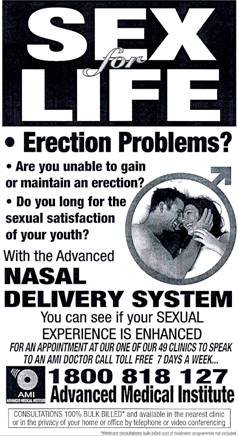
That advertisement, like other advertisements, prominently displayed the registered trade mark of the First Applicant.
115 The Applicants contend that the First Respondent infringed this trade mark in a variety of ways. Some of these ways include the very registration by the Bade Medical Institute of the business names AMI Medical Institute and AMI Nasal Sprays and the use of these business names. Another of the ways in which it is contended the trade mark has been infringed is the manner in which the Bade Medical Institute promoted itself in its telephone listings and on the internet. One form of such internet advertising by the First Respondent, for example, assumed the following format:

Another form of advertising which it is also understood is relied upon as constituting an infringement is the use of a business card by at least the Bade Medical Institute and the Fourth Respondent bearing the following logo:

· The Applicants place particular emphasis upon that part of the card which uses a semi-circular pattern similar to that contained within the registered mark.
116 But none of this conduct, it is considered, constitutes an infringement. The trade marks are neither “substantially identical”, nor “deceptively similar”.
117 Undertaking a side by side comparison, it is concluded that the marks are not “substantially identical”.


The most prominent feature of the AMI trademark is the white circular disc with the centre cut out. Attention is drawn to this image because of its position and it being set against a contrasting background. Another prominent feature of the mark is the acronym “AMI” displayed directly beneath the circular disc in bold white type. The words “Advanced Medical Institute of Australia”, positioned immediately below the acronym, attract less attention because of their smaller size and compressed typeset.
118 The Bade logo of which the Applicants complain has different salient features. In contrast to the AMI mark, in which the circular disc is a particular feature, the prominent feature of the Bade logo is the stylised text “bademedicalinstitute”. The first two words of this phrase are emphasised in bold typeface. Unlike the AMI mark, the Bade logo includes neither a circular disc image nor an acronym.
119 Perhaps the most similar feature of the two marks is the semi-circular device in the upper left portion of each mark. In the AMI mark, the device takes the form of a series of close-set lines that appear to radiate from the circular disc at the centre of the mark. In contrast, in the Bade logo it is an elongated crescent that frames the text at the centre of the mark. In this way, each of these distinct semi-circular devices operates to accentuate the main distinguishing feature of the respective marks, serving to better distinguish each mark from that of its competitor. It is thus concluded that the marks are sufficiently distinct from one another that they cannot be said to be “substantially identical”.
120 It is further concluded that the marks are not “deceptively similar” as the First Respondent’s mark is not “likely to deceive or cause confusion” with respect to the Applicants’ mark. A potential customer encountering the two marks in the course of trade is unlikely to conclude on the basis of the marks themselves that they emanate from the same source.
121 In assessing whether the marks are deceptively similar, it is relevant to consider the context in which customers are likely to form their impressions of the marks: Australian Woollen Mills Ltd v FS Walton & Co Ltd (1937) 58 CLR 641 at 658 per Dixon and McTiernan JJ; Southern Cross Refrigerating Co v Toowoomba Foundry Pty Ltd (1954) 91 CLR 592 at 595 per Kitto J; Anheuser-Busch Inc [2002] FCA 390 at [153], 56 IPR 182 at 218 per Allsop J.
122 While the Applicants and the Respondents operate in the same field of business, this field is one in which producers offer medical treatment options for a physical condition. Consumers directing their minds to purchasing a medical treatment programme are likely to give the competing products more than fleeting consideration (cf Sydneywide Distributors Pty Ltd v Red Bull Australia Pty Ltd [2002] FCAFC 157 at [74], 55 IPR 354 at 375). It is in this context of greater consideration and attention that potential consumers will form their impressions of the competing marks.
123 Accordingly, it is concluded the Bade Medical Institute logo as used by the Respondents does not infringe the Applicants’ registered mark because the First Respondent’s mark is neither substantially identical with, nor deceptively similar to, the Applicants’ mark.
124 It is, however, concluded that the First Respondent has passed off its own goods as those of the Applicants.
125 As submitted on behalf of the Applicants, it is concluded that the Applicants have established goodwill or reputation by reason of:
· their market share;
· the large number of patients treated;
· the amount spent on advertising;
· the amount spent on research and development; and
· the fact that its advertisements are well known.
126 By engaging in the conduct identified, it is considered that the First Respondent has misrepresented its own goods as those of the Applicants and that those misrepresentations were made by it in the course of trade. The misrepresentations were made to prospective customers and a reasonably foreseeable consequence was that the business or goodwill of the Applicants would be injured. Actual damage has been occasioned to the business activities of the Applicants.
127 The manner in which the Bade Medical Institute promoted and sold its own products diverted sales away from the Applicants. The apparent similarity in the names being used was supported (in part) by some evidence of those who bought the Respondents’ products. A private enquiry agent who had been retained by the Applicants thus gave evidence of a phone call made in December 2007 to the Bade Medical Institute and the following conversation:
| He said: | Hello, Jack speaking |
| I said: | Who have I called? |
| He said: | Bade. |
| I said: | I’ve rung in relation to erectile problems, and am enquiring about your products. |
There then followed a conversation as to the product itself as follows:
| I said: | … What is the cost of the spray? |
| He said: | $450, and you get about fifty doses for that. |
| I said: | Are you AMI? |
| He said: | Yes, Australian Medical Institute. |
| I said: | Are you the ones that advertise AMI everywhere? |
| He said | No, that is the Advanced Medical Institute. |
| I said: | You’re not the same? |
| He said: | No, we’re different. Can you give me your name and address to send the spray to? |
Notwithstanding the acknowledgment that “we’re different”, the association with “AMI” remained.
The Conduct of the Second Respondent — World Wide Internet Services
128 As against the Second Respondent, World Wide Internet Services (Aust.) Pty Ltd, contraventions of ss 52, 53(a), 53(aa), 53(c) and 53(d) of the Trade Practices Act were alleged.
129 Again, it is not in dispute that the Second Respondent:
· was the holder, owner and operator of all domain names used by the First Respondent; and
· provided the website and hosting capacity for the websites used by the First Respondent in relation to its business.
World Wide Internet Services (Aust.) Pty Ltd registered approximately 46 domain names, including:
· australianmedicalinstitute.com.au; and
· aminasalspray.com.au
130 In registering and using these domain names, it is concluded that the Second Respondent has likewise engaged in conduct in contravention of ss 52 and 53(d) of the Trade Practices Act. The conduct of the Second Respondent in registering these domain names was conduct that was misleading or deceptive or conduct that was likely to mislead or deceive.
131 When these domain names were accessed by Australian consumers the consumer was transferred to the website of the First Respondent, the Bade Medical Institute.
132 It is further concluded that the conduct of registering the domain names was conduct that passed off the goods being promoted by the Respondents as those of the Applicants. But it is not considered that the conduct of registering the domain names constituted an infringement by the Second Respondent of the trade mark registered to the First Applicant.
133 It should be noted that the domain names in issue were transferred by the consent orders made in this proceeding in December 2007.
The Conduct of the Fourth Respondent — Mr Wade
134 There can be no doubt that the primary driving force behind both the Bade Medical Institute and World Wide Internet Services was the Fourth Respondent, Mr David Wade. No relevant distinction can be drawn between the conduct of the First and Second Respondents and the conduct of the Fourth Respondent: cf Readymix Holdings International Pty Ltd v Wieland Process Equipment Pty Ltd (No 2) [2008] FCA 1480 at [111].
135 Mr Wade accepted that it was in 2006 that he “met Dr Buddy Beaini and we created Bade Medical Institute. … We employed a webmaster and that webmaster was Andre Nader who was experienced in HTML”.
136 He further maintained that “[t]he company, Bade Medical Institute, had spent something like $70,000 or thereabouts registering all names and trade marking certain names that we made up and phrases to put into the keywords so we could use them on Google. These names, trade marks, business names, phrases, were all in the source code and could not be seen; they were totally invisible and could only be ascertained by the Google scrawler”.
137 Further evidence as to the manner in which the Bade Medical Institute carried on business was contentious and some explanations provided by Mr Wade were less than convincing. Thus, for example, it was not contentious that there had been an exchange of emails in January 2007 addressed to “patriciawade” within the Bade Medical Institute. That which was disputed by Mr Wade was whether a particular page formed part of that exchange. The page assumed importance because it was the compilation of material intended for use in the advertising of the Respondents’ products and because it contained information which was substantially a “cut and paste” from a document prepared by the Applicants. The document contained only minor changes from the Applicants’ own document used by the Applicants in the promotion of their products. The emailed document was the same as that used by the Applicants with the exception that words referable to the Applicants were deleted and the phrase “sexual enhancement nasal spray” inserted in lieu. Mr Wade accepted that the document was “definitely … a cut and paste” but maintained that he did not write the document. It perhaps matters little whether the document was or was not an email or who wrote the document. Its significance is the fact that it exposes what was correctly put in cross-examination as an “intention to imitate, as far as possible, the approach and the products of AMI”. And, whether he wrote the advertisement or not, it is considered that Mr Wade had an intimate involvement in its preparation. The explanation advanced by Mr Wade that the document was directed to a product other than one concerned with erectile dysfunction is rejected. It is implausible and inconsistent with the content of the document itself.
138 Another contention pursued by the Applicants was that Mr Wade and the Bade Medical Institute intentionally set out to “intercept” people searching the internet for access to the Applicants’ products and to divert them to their own products. One explanation provided by Mr Wade was that the initials “AMI” stood for “acute myocardial infarction”. At one stage during the cross-examination, Mr Wade was taken to a list of searches undertaken on the internet. An exchange occurred as follows:
There is not a single instance in this list where someone has looked for acute myocardial infarction?---Oh no. Whatever I …
You accept that, don’t you?---Whatever I – AMI, you say the word AMI. It’s one of the salient acronyms for acute myocardial infarction, which is one of the cause of [impotence]. I’ve even put the word viagra alternatives but I wasn’t selling Viagra.
Mr Wade, no one would search for AMI and nasal delivery unless they intended to look for the applicant’s products and understand something about them?---Ridiculous. You have an assumption of your term AMI that you own everything between here and Botswana for the word AMI.
The explanation provided by Mr Wade for the acronym “AMI” is rejected. It is considered that it was used for the very purpose being suggested by the cross-examiner.
139 Although too much reliance should not be placed upon inconsistencies in the evidence of different witnesses, such inconsistencies as do exist are not to be disregarded and serve as a source of concern as to the reliability of the balance of the evidence being given by the Respondents. One instance may be given. The name “Maxine May” appeared on innumerable emails. The evidence of Mr Wade was as follows:
So who’s Maxine May ? ---Nobody.
…
So they were keeping records? ---No. Maxine May was like – it was just another email address. I had numerous email addresses but actually there was no Maxine May as a person.
But Ms Wade was questioned as to the identity of people variously described in emails and the following exchange occurred:
Maxine May, was that Maxine May as well?---That is his girlfriend. Why don’t you get her up?
Who is Maxine May?---His girlfriend. His girlfriend was every – his girlfriend ruled – whatever his girlfriend said, he did.
Inappropriate weight should not be given to such inconsistencies — especially in a working environment such as apparently prevailed at the Bade Medical Institute where people were known by various names and where an email may be addressed in a manner of convenience rather than specifically attempting to identify a particular person. It matters not whether the name of the “girlfriend” was “Maxine May”; that which matters is Mr Wade’s assertion that she was “nobody”. Another instance is that Mr Wade maintained that he had not “worked with” his daughters, Ms Vicky Wade and Ms Patricia Wade. Yet emails in January 2007 were sent to and from Ms Patricia Wade concerning the business of the Bade Medical Institute and Mr Wade accepted that she “did graphics” for the business.
140 Dr Beaini, like Mr Wade, maintained that Ms Vicky Wade “had no role in Bade”. Yet there was evidence of a phone-call being made to the Bade Medical Institute and the telephone being answered by a woman who identified herself as “Vicky”. Taken on its own, and given the apparent ease with which people assumed a variety of names, little weight is to be given to such an isolated telephone call. Indeed, such evidence established little. More persuasive of an involvement on the part of at least Ms Patricia Wade, however, was an exchange of emails in March 2007 when attempts were being made to establish the business of the Bade Medical Centre overseas. One email from “patriciawade” thus stated:
Subject: RE: BADE MEDICAL INSTITUTE UK/EUROPE
Mediserve have signed – I have sent you the signed agreement in pdf form – We need their site up asap. I will liase re their logos. Please print and send to Mediserve for their records.
The other daughter, Ms Vicky Wade, was also “copied in” on this exchange of emails.
141 In the present proceeding, the involvement or non-involvement in the business of the Respondents could readily have been addressed by each of the daughters. And any such involvement need not be confined to activities in Australia. No explanation was provided as to their not being called other than a statement that both were overseas. Suitable arrangements could well have been made for their cross-examination (if any) by way of videolink should each have in fact remained overseas: Federal Court Act s 47A. The failure to call evidence from the two daughters (or even one or other of them) lends some further limited support for concluding that the involvement of individual persons is better recorded in the documents than in the denials of Mr Wade and also for rejecting his assertions as to such matters as (for example) the manner in which the Respondents were seeking to promote their products and the involvement of others in that business. The more reliable source of evidence, it has been concluded, is the documents available to the Court and the inferences to be drawn from such documents. The oral evidence of Mr Wade is considered to be an unreliable basis upon which to make findings of fact.
142 It should finally be noted that an impression formed during the cross-examination of Mr Wade was that he was astute and careful in the answers he provided. He accepted that his recollection of events was “impaired because of [his] use of morphine and [his] use of other drugs”. But a re-reading of the transcript has confirmed the impression formed during the hearing itself that he suffered no prejudice by reason of his medical condition or the medication that he said he was taking. Although in discomfort, he was considered to be competent to answer the questions being put to him and to ask questions of other witnesses.
143 It is further considered that Mr Wade was attempting to shield Ms Wade from such liability as she may otherwise encounter by reason of the present litigation. He was also attempting to shield Dr Beaini in a like manner. The manner in which he gave his evidence, the explanations sought to be advanced from time to time and the inconsistencies in his evidence are such that little reliance can be placed on his account.
144 It is considered that Mr Wade was “a person involved in” the contraventions of ss 52 and 53(d) by both the First and Second Respondent for the purposes of s 75B of the Trade Practices Act. In his capacity as the driving force behind both companies, it was Mr Wade who caused the telephone listings and business names to be obtained. He secured the services of his “webmaster” in order to ensure that the internet domain names were secured. He caused the products of the Respondents to be promoted in the manner in which they were promoted. In so doing, it is considered that he “aided, abetted, counselled or procured the contravention” within the meaning of s 75B(1)(a). It is also considered that he was “knowingly concerned” in the contraventions within the meaning of s 75B(1)(c).
145 Insofar as the First and Second Respondents have been found to have passed off the goods of the Bade Medical Institute as those of the Applicants, it is further concluded that the Fourth Respondent is liable for the conduct of those Respondents by reason of his being a joint tortfeasor. He was not only a director for a period of time. He was also a person who acted “together in furtherance of a common design to commit” the tort of passing off. As in other cases, it is not necessary to resolve which line of authority should be followed to determine whether a corporation and a director may be regarded as joint tortfeasors. It is concluded that the Fourth Respondent either “directed or procured” the conduct of the First Respondent or was “deliberately, wilfully or knowingly” pursuing a course that was likely to constitute a contravention by the companies of the rights of the Applicants. Insofar as the Second Respondent is concerned, a company in respect to which he was neither a director nor apparently an “office holder”, his conduct was nevertheless such as to render him a joint tortfeasor.
The Conduct of the Third Respondent — Dr Beaini
146 The Third Respondent, Dr Beaini, is a medical practitioner. He was frequently referred to as “Buddy” Beaini.
147 Over the years he has apparently had an interest in developing a range of cosmetic products. He has also had a long-held interest in treating impotence. This latter interest emerged in 2000. He trialled a number of compounds prepared by a compounding pharmacist and concluded that they were unsatisfactory. He started his own experiments, including one on himself, and changed the dosage of the active ingredients.
148 In 2002 he opened two clinics, one in Wahroonga and the other in Double Bay in Sydney. His path ultimately crossed those of the Fourth and Fifth Respondents.
149 He first met the Fifth Respondent, Ms Georgina Wade, at his Double Bay clinic in March/ April 2006. There then occurred a discussion as to the potential involvement of the Fourth Respondent, Mr David Wade. Ms Wade suggested that her husband could assist in helping Dr Beaini’s business.
150 A meeting thereafter occurred between Dr Beaini and Mr Wade which resulted in Dr Beaini and Ms Wade becoming joint directors of a company then known as AP & PH (Aust.) Pty Ltd in May 2006. That company later changed its name to Bade Medical Institute (Aust.) Pty Ltd. The fact of his being a director of Bade Medical Institute (Aust.) Pty Limited was not in question.
151 Some of Dr Beaini’s evidence was not contentious. The fact that he wrote prescriptions, for example, for those seeking the products being offered by the Bade Medical Institute was not questioned. But the extent to which he involved himself more intimately in the activities of the Bade Medical Institute was contentious. An assessment of his evidence was not without difficulty. Both the form in which questions were put in his evidence in chief and his tendency to provide explanations rather than answers compounded that difficulty.
152 Other than his role in writing prescriptions, the case Dr Beaini sought to advance was that his “involvement was basically getting the medical information out …”. In respect to the information placed on the internet, he maintained that his “role [was] to advise patients of what is available, so I did all the medical writing up for the internet …”.
153 The case advanced against Dr Beaini on behalf of the Applicants, and which placed particular reliance upon s 75B of the Trade Practices Act, sought to establish a more intimate involvement with the conduct of the Fourth Respondent and the First Respondent, the Bade Medical Institute.
154 Although it may be accepted that the primary role discharged by Dr Beaini was this involvement in consultations and the writing of prescriptions, together with his involvement in drafting the medical component of internet material, it is not accepted that his involvement in the other activities of the First and Second Respondents was as limited as he sought to contend.
155 A convenient starting point for assessing the extent of Dr Beaini’s involvement was the accepted fact that Dr Beaini at the outset saw a business opportunity. He saw an opportunity whereby he could use the skills of the Fourth Respondent to “promote my cosmetic clinics over the internet because I believe that’s the best way to promote this sort of business …”.That was at the outset. A year later thoughts of expansion had not faded. In March 2007 there was thus an email to Dr Beaini from the daughter of the Fourth and Fifth Respondents, Ms Patricia Wade. The text of that email disclosed steps being taken in Europe to develop the business.
156 A more intimate involvement was also supported, to a limited extent, by the fact that during the period from March to June 2006 Dr Beaini attended the “offices” of the Bade Medical Institute on three or four occasions. When asked what he talked about, Dr Beaini responded:
… David Wade and Georgina, principally David Wade wanted to discuss how we would try and conduct the business over the internet which I know nothing about and he just told me that he would promote it over the internet and we would get the clients and I would just do the consultation so it was basically setting up which direction we would possibly do the business.
The “offices” turned out to be a residential address in Surry Hills. To the knowledge of Dr Beaini there was also being carried on from those “offices” what was described as “an Internet escort agency”. There were also numerous telephone conversations during the March to June 2006 period between Dr Beaini and Mr Wade.
157 A more intimate involvement was further supported by the payment of monies in respect to invoices issued by the cosmetic clinic run by Dr Beaini into the account of the Bade Medical Institute. It was also supported by the involvement of Dr Beaini in May 2007 with attempts to export “our products overseas”. These “products” were those being offered by the Bade Medical Institute. Emails to this end were exchanged directly between Dr Beaini and an officer in the Exports Unit of the Therapeutic Goods Administration.
158 If attention is confined to the involvement of Dr Beaini in respect of “advertising material”, it is difficult to accept that his involvement was as limited as he maintained.
159 This involvement in “advertising material” was evidenced in part by a series of emails in September 2006 focussed on proposed radio advertisements. Issues canvassed in those emails included the cost of the proposed advertisements, the timing of the advertisements, the need to “organise the script (which Georgina is organising)” and the target audience. By mid-October 2006 the radio advertisements had been put “on hold” and one email stated:
Buddy is up to date with everything and is speaking to the General Manager of the radio station John Williams.
The weight to be given to the exchange of emails, the extent of the involvement of Dr Beaini and his knowledge of the content of the proposed advertisements, however, are open to question. He was at least included as a person to whom the emails were forwarded. But those emails do not themselves reveal Dr Beaini as having any knowledge, for example, of the content of the “script” that was envisaged.
160 The Applicants nevertheless invited inferences to be drawn that these emails exposed a greater involvement of Dr Beaini than his simply being included as one of a number of recipients. Dr Beaini denied having knowledge of the “script” to which reference is made. Whether or not such inferences should be drawn may be left to one side. There was no necessity to draw any inference in respect to Dr Beaini’s involvement in and knowledge of another advertisement. In May 2007, an advertisement had apparently appeared in the Sun Herald. On 15 May 2007, Dr Beaini sent an email in the following terms (without alteration):
Subject: Re: sUN hERALD aDD
Vicy / Dave
I would suggest some sort of highlight for the treatments we have with suggestions of what we treat….we must make our products saleable.
We can add smaller text of your suggestion Vicky.
The add we currently have (the one Richard did) has alot of text but it does not sell our products.
Your call.
Please let me know your thoughts.
Buddy.
Dr Beaini accepted that he wrote this email. The limited significance of the advertisement in a newspaper must be accepted in the context where over 90% of the advertising of the Bade Medical Institute was carried out over the internet. But the email exposes knowledge on the part of Dr Beaini as to both the fact that the products of the First Respondent were being advertised and also a concern to ensure that such advertising as did occur served to “make our products saleable”. There was also the following exchange during the course of the cross-examination of Mr Wade:
Well, you – Bade Medical Institute, with your involvement, and with the involvement of Dr Beaini and the involvement of Mrs Wade, placed television advertising ? ---Not Georgina Wade, no.
The question could unquestionably have been better expressed, but the express exclusion of Ms Wade and the implicit acceptance of the involvement of Dr Beaini assume some importance.Dr Beaini had also been included in the earlier exchange of emails in March 2007 between “patriciawade” and “david@bademedicalinstitute”. That was the exchange of emails in respect to proposals to establish the business of the Bade Medical Institute overseas. When he read the email stating that “patricia has signed up mediserve” the email response from the Third Respondent was as follows (without alteration):
Great work.
Does that mean that Mel ( Harleys Medical ) is out of the picture?
Thanks,
DR Buddy
Such exchanges support the conclusion in fact reached that Dr Beaini had a far greater involvement in the activities of the Bade Medical Institute than he was prepared to acknowledge. He, for example, was involved in the promotion of those activities in Australia and attempts to promote the business overseas.
161 Dr Beaini also had an involvement in drafting at least some of the content of information contained on the home page of the First Respondent, the Bade Medical Institute. Reference to that home page as it appeared in December 2006 disclosed the following passage:
About Bade Medical Institute
As we become increasingly concerned about our health and appearance, the demand for medical and cosmetic treatments continues to rapidly rise.
BADE Medical Institute has responded to this increasing demand by introducing an exclusive range of medical and cosmetic treatments. Our medical institute specialises in delivering the latest medical and cosmetic treatments for conditions that have previously either been difficult to treat or have or have not been treated optimally. The popularity of these treatments has been unsurprisingly exceptional.
BADE Medical Institute has researched and developed the latest specialised treatments for improving sexual health for both men and women. Conditions such as erectile dysfunction, premature ejaculation and orgasmic dysfunction are now successfully treatable in most cases. Similarly these treatments assist with improving personal relationships by heightening sexual arousal and performance.
Further exciting developments will be launched in Jnauary [sic] 2007, when BADE Medical Institute will launch the most advanced and exclusive online shop for sexual enhancement products, cosmetic services including wrinkle treatments and injections, fat removal, acne treatments, scar treatments, and aesthetic products and services.
All medical treatments and services provided by BADE Medical Institute are performed by doctors, nurses, technicians and clinical co-ordinators who are committed to the pursuit of excellence, confidentiality and customer service.
Dr Buddy Paul Beaini is the principal doctor and a director of BADE Medical Institute.
After graduating in medicine from the University of NSW in 1988, Dr Beaini undertook further surgical and medical training at St Vincent’s Hospital, Wollongong Hospital and Westmead Hospital, Sydney. He later commenced advanced training in various cosmetic procedures including Botox, Restylane, Isologen, Laser and Aesthetic Pulsed Light treatments, in Australia and Europe.
Throughout this period, Dr Beaini continued to serve as the principal doctor and director of two medical centres – Thornleigh Medclinic and Merrylands Medclinic, Sydney – where he practiced [sic] procedural medicine for 12 years.
Why we formed BADE Medical Institute
The formation of Bade Medical Institute was made by the amalgamation of Dr Buddy Paul Beaini and his medical team, a pharmaceutical research and development team, and an international marketing team. All parties have the unified interest to further research, develop and provide advanced treatments for health and beauty.
Bade Medical Institute has had excellent success story with its medical nasal delivery treatments for sexual disorders and sexual enhancement. It now operates on an international level. Once our clients are eligible to consume our products, we can have them delivered to your door anywhere around the world.
Unlike our competitors, Bade Medical Institute is confident with its products and its personalized services. Our clients are treated as individuals and we do not need to enter into any contractual arrangements when products are ordered.
Bade Medical Institute is proud to announce that we are the first medical institution to offer free live video consultations via teleconferencing. With this advanced technology, our clients can have personalized consultations within the privacy of their own home with one of our medical consultants.
Dr Beaini at least wrote a substantial part of this extract. On any view of it, this extract certainly attempted to portray the Bade Medical Institute in the most favourable manner. Although Dr Beaini was presented as the “principal doctor”, he accepted during cross-examination that “[i]t was essentially myself because it wasn’t busy enough to have any other doctors associated”. The “international marketing team” was “David Wade and the Internet”. The extract also portrays a commercial assessment as to the need to distinguish the business being promoted from “our competitors …”.
162 There can be no doubt that, by mid-October 2006, Dr Beaini was also well aware of at least some of the concerns being advanced by the Applicants as to the manner in which the products of the First Respondent were being promoted. On 18 October 2006 there was thus an exchange of emails between the lawyers then representing the Applicants and Dr Beaini directly. A partner forwarded a copy of the Applicants’ “logo” and unequivocally stated that “[o]ur clients’ [sic] consider that the logo used by Bade Medical Institute on its various websites is deceptively similar to the logo on the attached documents”.
163 And, there is no doubt that his involvement changed over time.
164 Dr Beaini maintained that, from about March or April 2007, he no longer wanted “to deal with Bade” and from “basically around that time I was tapering off”. He continued writing prescriptions until September 2007. Certainly by late November 2007 the relationship between Dr Beaini (on the one hand) and the Fourth and Fifth Respondents (on the other) had deteriorated. On 21 November 2007, for instance, he wrote to the National Australia Bank. The subject-matter addressed in the letter was the “Bade Medical Institute” and an account held with the bank, identifying both the BSB number and the account number. Dr Beaini wrote that his “partners”, identified in cross-examination as Mr and Ms Wade, were still selling products without his involvement and this made “their action illegal”. The bank was asked to “[p]lease freeze this account as a matter of urgency”. In addition to the manner in which Dr Beaini referred to the Fourth and Fifth Respondents as his “partners”, the letter also exposed that Dr Beaini had a sufficiently detailed knowledge of the business activities of the Bade Medical Institute to know the specific details of the bank account. Notwithstanding the terms in which the letter was expressed, it is also curious to note that when asked as to the response of the bank to the letter Dr Beaini stated that he “presume[d] they froze the account. I didn’t really follow it up, to be honest”. Had his intent been to sever all ties, a more immediate interest in the state of the bank account might have been expected.
165 Notwithstanding his repeated assertions that his involvement in the business activities of the Bade Medical Institute and the promotion of the business by the Fourth Respondent was primarily confined to carrying out consultations, writing prescriptions and participating in the medical content of the advertising material contained on the internet, it is not considered that his involvement was so confined.
166 It is not considered that Dr Beaini was as forthcoming in his dealings with the Bade Medical Institute and the Fourth and Fifth Respondents as was desirable. His repeated attempts to explain what he thought was important, as opposed to answering the questions being put to him, may be understandable. As a medical practitioner, it is suspected that he may have felt as uncomfortable in the witness box as his cross-examiner would have felt on an operating table. It may also be readily understandable that Dr Beaini saw his involvement in the business activities of the Bade Medical Institute primarily through the eyes of a medical practitioner. But such an understanding does not deny him knowledge of the more general business activities of his “partners”. An apparent failure on his part to produce such documents and records as may have supported his case only serves to reinforce a lack of confidence in accepting his account unquestioningly. It is considered that his involvement was greater than he was prepared to disclose.
167 Assessing the evidence in its entirety, it is considered that Dr Beaini may well have focussed his primary attention on the medical aspects of the business activities of the Bade Medical Institute. But he also had knowledge of and was involved in the promotion of the business activities of the Bade Medical Institute and its advertising. The Fourth Respondent may well have been the driving force, but the involvement of Dr Beaini cannot be as quarantined as he would wish. It is concluded that Dr Beaini had knowledge of such basic matters as:
· the telephone listings;
· the business names; and
· the domain names
being used by the First Respondent. It is also concluded that Dr Beaini was aware of the manner in which the Fourth Respondent and the First Respondent, the Bade Medical Institute, sought to develop its business. He was aware of the advertising that was being carried out and was in fact the author of parts of that material. He may have been more intimately involved in some advertisements than others. But he knew the business was being advertised and it is concluded that he knew of the general content of the advertisements. He was commercially interested in securing the success of the business and endorsed the manner in which that business was being promoted. Without his services in the writing of prescriptions — or some other medical practitioner with a like interest — the business of the First Respondent may well not have continued.
168 That conduct on the part of Dr Beaini, it is concluded, brings him within the ambit of ss 52 and 53(d) and s 75B of the Trade Practices Act. That conduct fixes Dr Beaini with knowledge of the manner in which the Bade Medical Institute was seeking to promote its business by way of advertising on both the internet and, albeit to a limited extent, on radio and television. It is concluded that he had knowledge of the entirety of the advertisements — even though his primary focus of attention was upon the medical content of those advertisements. Dr Beaini was “a person involved in” the contraventions and was a person who “aided, abetted, counselled or procured the contravention” for the purposes of s 75B(1)(a). It is also considered that he was “knowingly concerned” in the contraventions within the meaning of s 75B(1)(c).
169 Insofar as liability is sought to be ascribed to Dr Beaini for the passing off by the First Respondent of its products as those of the Applicants, it is further considered that Dr Beaini assumes liability by reason of his position as a director. Although not as involved as Mr Wade, it is concluded that he was sufficiently involved such that it can be said that he “directed or procured” conduct on the part of the First Respondent. And it is further concluded that he deliberately or knowingly pursued a course of conduct that would occasion the First Respondent passing off its products as those of the Applicants. Like Mr Wade, but unlike Ms Wade, it is considered that irrespective of his position as a director he also acted “together in furtherance of a common design to commit” the tort of passing off.
The Conduct of the Fifth Respondent — Ms Wade
170 Ms Wade was a director and company secretary of the First Respondent, the Bade Medical Institute, from 30 May 2006 until 25 October 2007. She was also the sole director of the Second Respondent, World Wide Internet Services (Aust.) Pty Limited, at all relevant times.
171 An assessment of the evidence of the Fifth Respondent also presented its own peculiar difficulties.
172 These difficulties included:
· the fact that she was not present on 12 June 2009, when Mr Joshua Gambell gave evidence going to costs, or 19 June 2009 when Dr Beaini gave his evidence-in-chief and was exposed to cross-examination;
· the fact that medical certificates have been provided to the Court attesting to her various physical and psychological difficulties;
· the fact that when she did give evidence she stated that she was then on medication; and
· the personal circumstances as between herself and her long-estranged husband, the Fourth Respondent, which were certainly not to be envied.
Although proceedings are heard in open Court and the evidence then given is able to be heard by those members of the public who wish to attend, it is considered that some appropriate reservation should be exercised when drafting reasons for decision. Unnecessary repetition of evidence personal to a witness should be avoided. It is, however, considered appropriate to set forth the following statement made by Ms Wade at the very outset of her cross-examination:
You’re aware that you were written to by Health Complaints Commission?---No, I wasn’t. I wasn’t aware of anything. I’ve just got to tell you my husband – well, my ex-husband, him and his girlfriend – my problem at the time I was chasing a 22 year old girl who stole my husband and my business and my money. And that’s what – that’s what I – that’s what worried me at the time. He didn’t talk to me about any businesses, he didn’t want to know me. All he wanted to know was his girlfriend, his money and his business. And I was just told to sign this, do that and I’ll give you some money.
That account at least provides a context in which Ms Wade sought to have her evidence understood.
173 There were three separate accounts provided as to her involvement, namely the accounts given by:
· Ms Wade herself;
· Mr Wade; and
· Dr Beaini.
Another person — Mr Gambell — made an appearance from time to time, primarily to provide personal assistance to Mr Wade. He also gave evidence on Ms Wade’s non-attendance at Court on dates listed for hearing, his evidence going to the Applicants’ application for costs. When giving such evidence, he too gave an account of the activities of the Fifth Respondent, Ms Wade. The Applicants sought to rely upon his evidence, not only for the purposes of an application in respect to costs, but also in support of establishing her liability.
174 Although Ms Wade was unrepresented throughout the hearing, an Affidavit had been filed on her behalf at the outset of the proceeding at a time when she was represented by the then solicitors on the record. At the hearing, she was indifferent — or at least uncertain — as to whether she wished to rely upon this Affidavit. The Affidavit was, however, taken as having been read, the solicitor having been taken to have filed such an account as he at least considered was in her interest. In addition, there was her oral evidence during her cross-examination by Counsel on behalf of the Applicants.
175 The case Ms Wade sought to advance in that evidence was that she had no knowledge of anything to do with the business of the Bade Medical Institute. If there were documents which bore her signature, she maintained that she had signed because she had been told to sign by Mr Wade. And evidence as to conversations with a person identified as “Georgina” involved conversations, on her account, with someone other than herself.
176 It is accepted that there may well have been a practice whereby Mr Wade simply asked Ms Wade to sign documents and whereby she simply signed. Her account was that Mr Wade would tell her: “Just do it as I say and I’ll look after you”.
177 But the picture she sought to present of herself as someone with little (if any) knowledge of the business activities of Mr Wade and the Bade Medical Institute is open to considerably more doubt. The cross-examination commenced with Ms Wade visibly upset, but it thereafter proceeded in a more measured fashion. Notwithstanding her repeated protestations of lack of knowledge, it is considered she had far greater understanding than she was prepared to concede — at least in respect to the manner in which the Fourth Respondent, Mr Wade, sought to structure his business activities. Thus, for example, at one stage she was asked questions about a company and the following exchange occurred:
And is that Rowe’s Investments – is that where you conduct Rowe’s Investments from?---Where I conduct Rowe’s Investments from? There’s never been a company Rowe’s Investments, it was just, I think, a $2 shelf company he was opening up.
Well, you see on this page at the bottom, it says “name and address of customer: Rowe’s Investments, Unit 2, 70 Devonshire Street”?---Yes, and I just told you that it was just a company that he used to – he used to, like, opening up a lot of $2 companies, and I think that’s one of the $2 companies he used to open up – he opened up at a PO box.
So, Mrs Wade, the evidence you give is that you have come to sign various direct debit requests and other requests on behalf of companies where you had no, absolutely – your evidence you give is you have absolutely no understanding of what you were signing. Is that correct?---That’s right.
No difficulty was experienced by Ms Wade in the account voluntarily provided by her as to the manner in which Mr Wade operated and the detail provided in this exchange stands in stark contrast to that which preceded the exchange.
178 The account of Ms Wade’s involvement in the business as provided by Dr Beaini, it is considered, was less than fulsome. At one point he tried to present her as having a very limited involvement. One exchange was as follows:
They worked together there, did they? ---Georgina Wade was probably there on two occasions that I went to see David, and she was basically just making a coffee and bringing in the lunch or whatever. She didn’t have major involvement with too many discussions.
Are you sure that is the answer that she was – that that was her only role, to make coffee. Is that the answer you truthfully give?---I didn’t say that’s her only role, but I’m just saying when I was there she didn’t have any major involvement.
You deliberately gave that answer, didn’t you, Dr Beaini, to create an impression that Mrs Wade’s involvement was far less than it was actually as you know it to be, didn’t you?---No, I didn’t, because she basically had hardly anything to do with the business, she was hardly ever there and I believe all the decisions were made by David Wade and Andre Nader.
Notwithstanding this expression of opinion as to the involvement of Ms Wade, Dr Beaini went on to acknowledge that he “had very minimal contact with Georgina Wade”. And, notwithstanding his expression of opinion as to the involvement of Ms Wade in the business in which he had some involvement, he did not express any like reservation as to her involvement in another activity being jointly pursued by Mr and Ms Wade. After referring to the fact that people seem to have been known by various names and variously addressed on the internet, the following exchange occurred:
That is because, is it not, and you know this to be the case, that Mrs Wade and Mr Wade run an escort agency?---I think, I believe it’s more of an Internet service. I don’t – I’ve never, basically my business was to deal with the Internet marketing, and that’s what they were marketing as well, that was one of their businesses.
They’re marketing an Internet escort agency, aren’t they?---That’s right.
And, in his letter to the National Australia Bank in November 2007, Dr Beaini referred to Mr and Ms Wade as “my partners”.
179 On balance, it is considered that only limited weight can be given to the evidence of Dr Beaini as to his assessment of the involvement of Ms Wade in the business of the Bade Medical Institute or the assistance she gave the Fourth Respondent.
180 Irrespective of the weight to be given to the evidence of Dr Beaini as to the involvement of Ms Wade, further reason for reservation in accepting the account sought to be advanced by Ms Wade is that that account is nevertheless in some respects inconsistent with the account being advanced by Dr Beaini. Although perhaps too much weight should not be given to such inconsistencies, they remain troubling. Dr Beaini, for example, gave his account of the “escort agency” being run by Mr and Ms Wade. But her account was different. She denied conducting an “on-line escort agency”.
181 Mr Wade gave evidence that he “used her as a bunny”. Although there were, for example, letters dated 10 and 31 July 2007 from the Health Care Complaints Commission addressed to Ms Wade as the “CEO” of the Bade Medical Institute, Ms Wade denied any knowledge of the letters and Mr Wade denied that Ms Wade was known as the chief executive of the Bade Medical Institute.
182 Each of these three sources of evidence as to Ms Wade’s involvement in the business activities of Mr Wade and the Bade Medical Institute is thus subject to criticism. In such circumstances, it is again considered that a more certain understanding of her involvement is to be gleaned from the available documents — subject, of course, to constantly bearing in mind her evidence that she simply signed documents because she was asked to do so and her evidence that a reference in documents to “Georgina” is not necessarily a reference to her.
183 And those available documents expose a more intimate involvement on the part of Ms Wade with the business activities of the First and Fourth Respondents than the account given by either herself, Mr Wade or Dr Beaini.
184 This more intimate involvement is, for example, supported by an email to Dr Beaini from a radio station employee dated 30 September 2006. That email states as follows:
Here you go, not sure what happened to it.
Spoke to Georgina and David and I have already had a meeting with my creative team ( I got the Sydney Creative Director onto it) and she has already written a script and is getting approval from programming (we need to for your product category).
I moved quickly on this so we can get it on air for next week for you but so we can have the time to do it properly.
If you can please ok the attached and fax it back before Friday so we can schedule the commercials and organise the script (which Georgina is organising) by the end of the week (I gave you that price but do need the cheque before w e[sic] go to air).
The script should come across to you in the next day or so along with the Creative production quote.
I look forward to helping you have a successful campaign.
ps Thank you for offering me to try the product. My address is […].
It is unlikely that the reference to “Georgina” is a reference to anyone other than Ms Wade. Notwithstanding the evidence of Mr Wade as to the role of Ms Wade as the chief executive officer of Bade, it is nevertheless considered that a more intimate involvement is indeed further supported by the letters from the Health Insurance Commission in July 2007. Those were the letters addressed to Ms Wade as the “CEO” of the Bade Medical Institute.
185 Assessing the evidence in its entirety, the account provided by Ms Wade of her limited involvement in the business activities of Mr Wade and the Bade Medical Institute is rejected. It is concluded that she had a far greater involvement than she was prepared to acknowledge and that the true extent of her involvement is more accurately set forth in the documents than in any contrary account provided by her, Mr Wade or Dr Beaini.
186 Assessing the evidence again in its entirety, it is considered that Ms Wade had knowledge of the manner in which the Bade Medical Institute was conducting and promoting its business. It is concluded that she knew that the business was being promoted by means of telephone entries and business names, advertising on the internet and, to a far lesser extent, radio and television. But her involvement was far less than that of Mr Wade and less than that of Dr Beaini.
187 Her involvement in the business activities of the First and Second Respondents, it is considered, brings her within the ambit of ss 52 and 53(d) and s 75B of the Trade Practices Act. It is considered that she was “a person involved in” the contraventions and a person “knowingly concerned in” the contraventions for the purposes of s 75B(1)(c). But her involvement, it is considered, falls short of being a person who “aided, abetted, counselled or procured the contravention”. Nor is it considered that she had such an involvement in the business of the First or Second Respondent that liability for passing off should be assigned to her simply by reason of her position as a director and such involvement as she did have in respect to the business of the First Respondent. It is not considered that she acted “in furtherance of a common design to commit” the tort of passing off.
The Significance of a Disclaimer
188 It is thus concluded that the Third, Fourth and Fifth Respondents are each liable for the contraventions of ss 52 and 53(d) of the Trade Practices Act by reason of s 75B of that Act.
189 One contention sought to be advanced which would potentially avoid such liability should be separately addressed. This was a contention that any misapprehension which may have arisen in the minds of potential customers, in particular by the use of domain names, was of no consequence because any misapprehension was corrected prior to sale.
190 Dr Beaini in his Affidavit thus stated that he recalled “insisting that a disclaimer appear on any advertising of Bade products explicitly stating that Bade is not AMI or associated with advanced medical institute [sic]”. The private enquiry agent retained by the Applicants also gave evidence that in his telephone call to the Respondents in December 2007 he asked:
Are you the ones that advertise AMI everywhere?
And the response provided was:
No, that is the Advanced Medical Institute.
On some of the websites operated by the Bade Medical Institute, but not on all of them, there was also a disclaimer which from time to time varied in form. One such disclaimer was the following, appearing in July 2007:
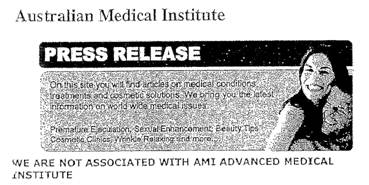
191 The contention that the Respondents could avoid liability for contravention of ss 52 or 53 by reason of such disclaimers is, however, rejected.
192 Conduct may remain misleading or deceptive even though there may only be transient confusion. A subsequent correction may seek to address any confusion which may have been initially experienced — but, by then, a consumer may have been entangled in the “marketing web” of those who engage in such conduct. A correction may, however, be relevant to the relief to be granted.
193 In SAP Australia Pty Ltd [1999] FCA 1821, 169 ALR 1, French, Heerey and Lindgren JJ thus observed (citations omitted):
[51] … it was rightly observed that misleading or deceptive conduct in trade or commerce is not limited to conduct which induces or is likely to induce entry into a transaction. So to propose would be to limit s 52 of the TP Act in a way not justified by its terms. Conduct which misleads a customer so that, under some mistaken impression of a trader's connection or affiliation, he or she opens negotiations or invites approaches may be misleading or deceptive even if the true position emerges before the transaction is concluded …
In reaching these conclusions, one of the decisions relied upon by their Honours was the earlier decision of Beaumont J in TEC & Tomas (Australia) Pty Ltd v Matsumiya Computer Company Pty Ltd (1984) 1 FCR 28 at 37 to 38. His Honour there recognised as follows that misleading conduct at the outset may be a “door opener”:
The fact that “Seiko” is a household name, at least in respect of watches, confirmed by the experience of the respondents that the name “Seiko” has been a “door opener” in marketing terms, indicates that a potential purchaser of computers may well commence to deal with the respondents in circumstances where he would not have done so if the respondents had made no mention of “Seiko” in its trade or business name and in advertising. In my view, to induce the introduction of such a dealing is conduct which contravenes s 52, even if, ultimately, the consumer becomes aware that the equipment he is purchasing is not that of the Hattori Seiko group, the deception having occurred at an earlier stage: what is relevantly induced is the dealing or the negotiations, as distinct from the subsequent purchase itself. As Taco’s caseheld, there is no reason why s 52 cannot apply to the earlier inducement, even if, as Puxu’s caseheld, the conduct in respect of the purchase itself does not offend s 52 because, by then, the consumer knows or ought to have known that he is purchasing a product other than that of the Hattori Seiko group.
194 In this respect, it may be that there is a further distinction between passing off and s 52. For the purposes of passing off, it may be that deception must continue to the “point of sale”. Whether or not there is such a requirement in respect to the tort, s 52 does not impose any such constraint: Taco Co of Australia Inc v Taco Bell Pty Ltd (1982) 42 ALR 177. Deane and Fitzgerald JJ there observed:
It is, in the circumstances, unnecessary that we form or express any concluded view on the question whether it is a principle of the law of passing-off that deception must continue, or be likely to continue, to the “point of sale”. As a matter of principle and of logic, it is difficult to see why it should be. For the purposes of the present appeal, it suffices to say that, even if such a limitation should be recognized in the law of passing-off, we see no ground for importing it into the provisions of s 52 of the Act. In our view, it is sufficient to enliven s 52 that the conduct, in the circumstances, answers the statutory description, that is to say, that it is misleading or deceptive or is likely to mislead or deceive. It is unnecessary to go further and establish that any actual or potential consumer has taken or is likely to take any positive step in consequence of the misleading or deception. That is not to say that evidence of actual misleading or deception at the point of sale and of steps taken in consequence thereof is not likely to be both relevant and important on the question whether the relevant conduct in fact answers the statutory description and as to the relief, if any, which should be granted.
195 In the circumstances of the present proceeding, it is considered that such disclaimers as were used are not sufficient to negate a conclusion that the conduct engaged in by the Bade Medical Institute which has been found to contravene s 52 remained “misleading or deceptive”. Even if, in limited instances, the “true position” may have emerged such that in a limited number of cases consumers may have realised that the Bade Medical Institute was “not associated with AMI Advanced Medical Institute”, its conduct remained misleading and deceptive and such as to occasion loss or damage to the Applicants.
196 Although the evidence of Dr Beaini was that he was “insisting” upon a disclaimer being used, there is in any event considerable uncertainty as to when any disclaimer first appeared and how uniformly it was being used. Such further evidence as Dr Beaini did give in cross-examination only reinforced the conclusion that consumers were being misled. One exchange was as follows, when Dr Beaini was being asked questions as to his involvement in the preparation of a “business plan”:
Did you prepare any business plan for Bade Medical Institute?---No.
Never participated in the formulation of any business plan whatsoever?---No.
You sure about that answer?---What do [sic] mean? Can you clarify what you mean by business plan?
Well, did you prepare, or did you participate in the preparation of it, or were you consulted about …
MR AZZI: Objection, your Honour, that’s irrelevant.
HIS HONOUR: Will you wait until the question is put first?
MR AZZI: Well, it says prepared, participated or consulted.
MR GREEN: Well, any of those possibilities, Dr Beaini, in relation to the development and marketing of the Bade Medical Institute?---My involvement was basically getting the medical information out. There was an occasional issue where they would ask me my opinion. For example, they were getting some calls, people asking them if they were AMI and I said we should have it on our website that we’re not. Because a lot of people wanted refunds and they were dissatisfied with AMI products. That was a joint agreement to have, “We are not AMI” on our website, so we wouldn’t have to deal with that. My - and basically my role was to work with other products and expanding our product range, because we wanted to do something called Bade Online Pharmacy, which was going to sell different vitamins and insomnia products and lasers and Botox treatments and things like that. So they were the sort of business dealings that we had.
But when any disclaimer was used and in what form of advertising remained unclear.
The Quantification of Loss or Damage and Profits
197 It is concluded that the contraventions of ss 52 and 53(d) of the Trade Practices Act have occasioned the Applicants “loss or damage”. The Applicants have suffered “loss or damage by conduct” that has contravened those provisions.
198 In relation to passing off, the Applicants seek either damages or an account of profits. While it is a matter for an applicant to elect between these remedies, in the present proceeding it matters not which remedy is sought as the quantum to which the Applicants are entitled is the same.
199 It is concluded that the total remedy to which the Applicants are entitled, in respect to both the action under the Trade Practices Act and passing off, is $220,000. The calculation of this amount, however, proved to be a task not without its difficulties.
200 Not the least of the difficulties confronted was the paucity and incompleteness of the records produced by the Respondents. The manifest deficiency in the records made available by the Respondents meant that any assessment must necessarily involve a considerable margin for error. The deficiency in the records was of particular importance when attempting to quantify the profits said to be derived by the Respondents by reason of their conduct.
201 Notwithstanding these difficulties, the Chief Financial Officer of the Applicants, Mr Shrestha, undertook an analysis of such materials as were available. His conclusions were variously expressed, namely that:
· AMI’s lost net income was $188,468.07;
· the total net income that AMI would have received if the patients that purchased products from the Bade Medical Institute had purchased those products from the Applicants was $202,727.99; and
· total income (not including fees and charges) lost to the Applicants was $284,081.86.
These calculations were characterised in the Applicants’ written Outline of Submissions as “conservative”. One reason justifiably relied upon by the Applicants in so characterising the calculations was the fact that no financial records were available for the period after November 2007. A further amount addressed in the Applicants’ Outline of Submissions quantified an account of profits as $237,680.93.
202 One calculation by the Applicants of the total income it was contended they had lost was as follows:
|
DATE |
TOTAL INCOME (NOT INCLUDING FEES AND CHARGES) |
| July 2006 | $1,855.01 |
| Aug 2006 | $18,390.18 |
| Sep 2006 | $26,645.18 |
| Oct 2006 | $35,222.60 |
| Nov 2006 | $36,856.00 |
| Dec 2006 | $24,373.56 |
| Jan 2007 | $16,797.31 |
| Feb 2007 | $23,100.14 |
| Mar 2007 | $20,272.66 |
| Apr 2007 | $15,893.46 |
| May 2007 | $18,335.90 |
| Jun 2007 | $14,178.04 |
| Jul 2007 | $10,920.00 |
| Aug 2007 | $13,212.82 |
| Sep 2007 | $0.00 |
| Oct 2007 | $8,030.00 |
| Nov 2007 | $0.00 |
| TOTALS | $284,082.86 |
The discrepancy between this total and that elsewhere expressed (i.e. $284,081.86) may be disregarded.
203 The attacks made upon the Applicants’ calculations by Counsel for the Third Respondent were various. One line of attack was to suggest that the calculations based upon the Applicants’ figures made no allowance for the fact that some of the sales taken into account were not sales at all but products supplied by way of trial. Other lines of cross-examination pursued were to suggest that, in calculating lost net income or loss or damage, further errors included:
· working from a figure which was said to represent the “number of products sold” as being 1097 where the cross-examiner was suggesting that the figure should have been 797;
· whatever be the figure, the failure to take into account what was acknowledged by the Applicants in a June 2007 press release to be a refund rate of 3.6% of sales and a cancellation rate of 11.3% of sales; and
· performing the process of calculation using an “average cost of sales” of 10% whereas that average did not take into account other expenses such that the 10% figure presumably should have been less.
204 It was further suggested on behalf of the Third Respondent that the calculation was unreliable because:
· whatever be the number of patients, the number represented the entirety of all patients seen by Dr Beaini, including patients prescribed medications such as “topical creams”. As these products were distinct from the nasal sprays for sexual dysfunction supplied by the Applicants, it was contended that they should be discounted;
· the rate of profit calculated at 11.74% was asserted to be unduly high; and
· the assumption in the calculation was that every patient that went to the Bade Medical Institute would have gone to the Applicants, whereas that was not necessarily to be assumed given that there were other competitors to the Applicants who offered their products at different prices to the Applicants’ products.
Moreover — and to the extent that loss or damage was said to follow from radio and television advertisements — Mr Wade contended there was only one radio and one television advertisement as those advertisements were cancelled after they were “pinged”.
205 Confronted with the difficulties presented, it is concluded that it matters not whether the Applicants claim loss or damage or elect to seek an account of profits. The best quantification that can be as to either is the same.
The Claim for Interest — Section 51A
206 Interest is claimed by the Applicants pursuant to s 51A of the Federal Court Act.
207 That section provides as follows:
Interest up to judgment
(1) In any proceedings for the recovery of any money (including any debt or damages or the value of any goods) in respect of a cause of action that arises after the commencement of this section, the Court or a Judge shall, upon application, unless good cause is shown to the contrary, either:
(a) order that there be included in the sum for which judgment is given interest at such rate as the Court or the Judge, as the case may be, thinks fit on the whole or any part of the money for the whole or any part of the period between the date when the cause of action arose and the date as of which judgment is entered; or
(b) without proceeding to calculate interest in accordance with paragraph (a), order that there be included in the sum for which judgment is given a lump sum in lieu of any such interest.
(2) Subsection (1) does not:
(a) authorize the giving of interest upon interest or of a sum in lieu of such interest;
(b) apply in relation to any debt upon which interest is payable as of right whether by virtue of an agreement or otherwise;
(c) affect the damages recoverable for the dishonour of a bill of exchange;
(d) limit the operation of any enactment or rule of law which, apart from this section, provides for the award of interest; or
(e) authorize the giving of interest, or a sum in lieu of interest, otherwise than by consent, upon any sum for which judgment is given by consent.
(3) Where the sum for which judgment is given (in this subsection referred to as the relevant sum) includes, or where the Court in its absolute discretion, or a Judge in that Judge’s absolute discretion, determines that the relevant sum includes, any amount for:
(a) compensation in respect of liabilities incurred which do not carry interest as against the person claiming interest or claiming a sum in lieu of interest;
(b) compensation for loss or damage to be incurred or suffered after the date on which judgment is given; or
(c) exemplary or punitive damages;
interest, or a sum in lieu of interest, shall not be given under subsection (1) in respect of any such amount or in respect of so much of the relevant sum as in the opinion of the Court or the Judge represents any such amount.
(4) Subsection (3) shall not be taken to preclude interest or a sum in lieu of interest being given, pursuant to this section, upon compensation in respect of a liability of the kind referred to in paragraph (3)(a) where that liability has been met by the applicant, as from the date upon which that liability was so met.
208 Section 51A(1), it will be noted, provides (inter alia) that there is to be included in the sum for which judgment is given an order for interest “unless good cause is shown to the contrary”. The provision, introduced by way of amendment in 1984, “is a facultative provision intended to confer power on the Court to do justice between parties in relation to pre-judgment interest; a matter of some importance in these days of high interest rates and extensive delays in finalising litigation”: State Bank of NSW Ltd v Commissioner of Taxation (1995) 62 FCR 371 at 385 per Wilcox J. The primary purpose of an award of pre-judgment interest is to compensate a successful applicant for the loss or detriment which has been suffered by reason of being kept out of money: Whitaker v Commissioner of Taxation (1998) 82 FCR 261 at 269 per Lockhart J.
209 The general principles applicable to s 51A have been helpfully summarised by Finn J in HK Frost Holdings Pty Ltd (in liq) v Darvall McCutcheon (a firm) [1999] FCA 795 at [6] to [11] as follows (citations omitted):
[6] (1) It is well settled that the objective of provisions of this type is to compensate an applicant for the loss it suffers in being kept out of its money or damages …
[7] (2) The award of interest under s 51A(1) is mandatory “unless good cause is shown to the contrary” … Ordinarily it will be for the respondent to establish such “good cause” … Furthermore, it is open to the court, for example, to take into account such considerations of public policy as may be relevant in the circumstances …
[8] (3) Though the matter is and remains one of judicial discretion, it is the usual practice of this Court in applying s 51A(1) to adopt the rates of interest applied by the Supreme Court of the State or Territory in which this Court is dealing with the matter … though, no less so than a State court, the Court may then depart from those rates as a matter of discretion given the circumstances of the case … A justification for this practice is that it helps to ensure that damages are awarded on the same basis at least as to rates of interest whether a proceeding is instituted in this Court or in a Supreme Court. Parity in the making of interest awards will, though, often be unattainable because the legislation of a particular State may prescribe varying periods for which pre-judgment interest may be awarded (depending upon the nature of the cause of action in question) that differ from what is allowable under s 51A(1) …
[9] (4) Given the variations in the language and structure of the pre-judgment interest provisions of the various Australian States, care must be taken in using the decisions of State courts on their own statutes to elucidate the meaning of s 51A(1). For example, for the purposes of s 51A(1) the formula “good cause to the contrary” would appear on its proper construction to mean only good cause for not allowing interest at all … The subsection itself otherwise provides discretions as to the rate and the period of an interest award. In contrast, the same formula as used in s 58 of the Supreme Court Act 1986 (Vic) has been interpreted to mean good cause for allowing interest otherwise than in accordance with the terms of that section … But s 58, notably, does not provide the same discretions as does s 51A(1).
[10] (5) It is neither possible nor desirable to define what will constitute “good cause” disentitling a party to interest under s 51A(1); each case must be considered by reference to its own circumstances …
[11] (6) There is considerable diversity in judicial opinion as to the extent to which, if at all, the rate or (more usually) the period selected for an interest award should as a discretionary matter be moulded adversely to a party that delays in the prosecution or defence of a claim where no resultant detriment to the other party is shown … Nonetheless, insofar as concerns a successful applicant who has been guilty of unreasonable delay, the view I am prepared to follow in the absence of binding authority is that the period for which the interest award is made can properly be adjusted if to allow interest for the whole period for which it could otherwise be ordered would work an injustice to the respondent in the circumstances … Such would seem to be consistent with the policy of the [sic] s 51A(1) in that an applicant that has been held out of the benefit of its money because of its own unreasonable actions should not be allowed as of course to cast the effects of a ‘self-inflicted burden’ onto the respondent …
Cited: Hanave Pty Limited v LFOT Pty Ltd (formerly Jagar Products Pty Ltd) (in liq) [2003] FCA 1154 at [31].
210 Of particular relevance to the present proceeding is the significance to be given to the delay that has been experienced. As noted by Finn J in HK Frost Holdings [1999] FCA 795, delay may be relevant to both the rate at which interest is awarded and the period of time during which interest is to be paid. See also: ICT Pty Ltd v Sea Containers Ltd [2006] NSWSC 1280 at [15].
211 The Application was filed in December 2007 but the hearing as to evidence did not take place until June 2009. Final submissions were heard in September 2009. Such delay as has been occasioned may be variously attributed to either the Fourth or Fifth Respondent — but not the Third Respondent, Dr Beaini.
212 Considerable reservation has been previously expressed as to the medical evidence sought to be relied upon by the Fourth Respondent when seeking a vacation of the December 2008 hearing dates: AMI Australia Holdings [2008] FCA 1783 at[8] to [11].
213 And considerable reservation is expressed as to whether or not the Fifth Respondent was in fact “unfit for Court” in April 2009, as claimed.
214 For whatever reason, there has been a substantial period of delay between December 2007, when the Applicants were ready to proceed, and June 2009. There was also a further, more limited delay between the conclusion of the hearing in June 2009 and the hearing of final submissions in August 2009. To a large extent that latter delay was occasioned by a desire to ensure that the case for the Applicants was outlined in a sufficiently detailed manner that the unrepresented Respondents would have an adequate opportunity to comprehend how the Applicants sought to marshal the law and the facts against them.
215 The purpose of an award of interest, however, is compensatory and not punitive: Ardelle v Spastic Society of Victoria Ltd [2001] FCA 220 at [13].
216 Whatever be the reason for the delay in the resolution of the present proceeding, it is not a delay that can be attributed to the Applicants. Nor can it be said that the Applicants delayed in promptly commencing the present proceeding. Interest, it is considered, should be awarded to compensate the Applicants for being kept out of their money. The only question is as against which Respondent and for what period of time. Any assessment is necessarily imprecise and certainly involves no mathematical certainty.
217 It is considered that both the Fourth and Fifth Respondents should pay interest pursuant to s 51A as from 30 August 2008. But for the delays occasioned by either the Fourth or Fifth Respondent the proceeding would in all likelihood have been heard and resolved by that date.
218 Neither the Fourth nor Fifth Respondents has shown any “good cause” not to make such order. The usual practice of this Court, which should be followed in the present proceeding, is to award interest at the rate applied in the Supreme Court of the State or Territory in which this Court is dealing with the matter: Namol Pty Ltd v A W Baulderstone Pty Ltd (No 2) (1993) 47 FCR 388 at 389 per Davies J. That is the usual practice unless it is shown that those rates are penal or not commercial (GEC Marconi Systems Pty Ltd (t/as Easams Australia) v BHP Information Technology Pty Ltd [2003] FCA 688 at [7], 201 ALR 55 at 58 per Finn J) and there is no such suggestion in the present proceeding.
219 The Third Respondent, Dr Beaini, however, has not occasioned any delay. In such circumstances it is not considered appropriate that he be ordered to pay interest pursuant to s 51A for any period of time.
Outstanding Matters
220 A number of miscellaneous matters should be briefly addressed lest it be thought that they have been overlooked, namely:
(i) a number of Jones v Dunkel submissions advanced on behalf of both the Applicants and the Third Respondent, Dr Beaini;
(ii) a submission advanced on behalf of the Applicants as to the non-production of documents;
(iii) the use that could be made of the evidence of Mr Gambell;
(iv) the need to address the manner in which the evidence given by the Fourth and Fifth Respondent should be assessed; and
(v) an application made by the Applicants for the waiver of hearing fees otherwise payable pursuant to reg 7 of the Federal Court of Australia Regulations 2004 (Cth) (the “Regulations”).
Jones v Dunkel
221 Both the Applicants and the Third Respondent made submissions founded upon the failure to call available witnesses.
222 These competing submissions invoked the following observations of Kitto J in Jones v Dunkel (1959) 101 CLR 298 at 308:
… any inference favourable to the plaintiff for which there was ground in the evidence might be more confidently drawn when a person presumably able to put the true complexion on the facts relied on as the ground for the inference has not been called as a witness by the defendant and the evidence provides no sufficient explanation of his absence.
The rule is one of common sense reasoning. An unexplained failure by a party to call a witness may, in appropriate circumstances, lead to an inference that the uncalled evidence would not have assisted the case of the party who might have been expected to call the witness: Ghazal v Government Insurance Office of New South Wales (1992) 29 NSWLR 336 at 343 per Kirby P. A court must see that a person who has not given evidence not only could shed light on a matter, but also would ordinarily be expected to do so: RPS v The Queen [2000] HCA 3 at [25], 199 CLR 620 at 632per Gaudron ACJ, Gummow, Kirby and Hayne JJ.
223 The Applicants maintain that a number of witnesses were available to be called on behalf of the Respondents, but were not called. These witnesses include the two daughters of the Fourth and Fifth Respondents and the accountant of the First and Second Respondents. For his part, the Third Respondent maintains that the founder of the Applicants, Dr Jacov Vaisman, should have been called.
224 But reliance upon Jones v Dunkel, it is considered, is of limited assistance to either the Applicants or the Third Respondent.
225 The Applicants are correct in their submission that one or both of the two daughters could have been called to give evidence as to their involvement in the business of the Bade Medical Institute and that the accountant for that business could also have been called. Indeed, the accountant may have been able to assist in the calculation of (for example) the profits earned by that business.
226 But it is considered that little significance is to be attached to the failure to call such witnesses. All Respondents were represented at the outset of the proceeding — but only the Third Respondent was represented at the hearing itself. The Fourth and Fifth Respondents were unrepresented and both experienced their own medical disabilities, especially the Fourth Respondent. The Fourth and Fifth Respondents conducted their cases with as much care and skill as they were able to muster. It is not considered an appropriate course to pursue — in the present case — to proceed to draw inferences based solely upon the fact that one or other possible witness was not called. Some limited significance has been attributed to the failure to call one or other of the daughters. But the preferable course, and the course in fact pursued, has been to assess what each witness said by reference to the available documentary evidence.
227 A failure to call the “compounding pharmacist” attracts potentially different considerations. It may have been expected that the Third Respondent, being a party who was represented by both Counsel and instructing solicitors for a large part of the hearing, may have called this witness. He, again, may have been a witness who could have provided assistance as to the calculation of profits of the Bade Medical Institute.
228 The failure of the Applicants to call Dr Vaisman also attracts different considerations. The Applicants were at all material times represented by both solicitors and Counsel.
229 The Applicants accepted that Dr Vaisman was their founder and a person available to give evidence. Notwithstanding his availability, the course pursued by the Applicants was to rely upon the evidence of Mr Richard Doyle, the principal of a company that provides legal and other services to the Applicants. Some of Mr Doyle’s evidence was given “on information and belief”. The evidence given in that manner was within a narrow compass and was admitted as the detail of the evidence was not considered to be truly in dispute.
230 The prospect of the Third Respondent himself calling Dr Vaisman was raised during the course of a Directions hearing shortly prior to the commencement of the June 2009 hearing. The Applicants undertook to make Dr Vaisman available to give evidence upon the Third Respondent providing an outline of the facts sought to be established. Such an outline was sought so that agreement could be reached, if possible, as to those facts which were not in dispute. Even short of such an undertaking, a course available to the Third Respondent was to issue a subpoena seeking his attendance. It remained a matter for the Third Respondent to decide whether he wished to:
· rely upon Jones v Dunkel and seek to gain such assistance as was possible from whatever inferences may have been available;
· attempt to secure agreement with the Applicants as to uncontentious facts; or
· simply seek leave to serve a subpoena for the attendance of Dr Vaisman.
If called by the Third Respondent, Dr Vaisman could not ordinarily be cross-examined by that Respondent. But no outline of the facts sought to be established was provided. The Applicants were released from the undertaking and (as events transpired) no subpoena was sought by the Third Respondent to secure Dr Vaisman’s attendance.
231 Submissions were nevertheless invited at the outset of the hearing as to the “inferences favourable” to the Respondents which it was said were available and which should be drawn by reason of the failure to call Dr Vaisman. There may perhaps be no need for a party to foreshadow at the outset of a hearing what particular inferences the Court may ultimately be invited to draw at the conclusion of the hearing. There is no necessity for a party to in effect provide at the outset an “advice on evidence” to his opponent. There may be no necessity for a party to even foreshadow that a submission will be made founded upon Jones v Dunkel.
232 In the case where both the Applicants and the Third Respondent were represented by Counsel, the manner in which each sought to run its own case may safely be left in their hands.
233 But the skirmish over whether Dr Vaisman was to be called or by which party ultimately assumed little relevance. Although it remained unclear what inferences the Third Respondent wanted the Court to draw by reason of the Applicants’ failure to call this witness, at the end of the day it is not considered that the state of the evidence was affected by the fact that he did not give any evidence.
234 In short, the course pursued was to resolve the case by reference to the evidence in fact available. Questions of onus and standard of proof were applied to the available evidence. That available evidence, it has ultimately been concluded, provided a satisfactory basis upon which the conclusions and findings already expressed could be reached.
The Non–Production of Documents
235 One submission which the Applicants advanced with a degree of conviction was that a large number of potentially relevant documents were not produced or otherwise made available by the Respondents. Submissions advanced by the Applicants as to why these documents might not be available ranged from deliberate destruction of documents to a deliberate decision not to produce them. Those were submissions only to be made after a careful and professional assessment of the facts. The submissions alleged serious wrongdoing and interference with the processes of this Court.
236 In advancing the present submission as to the non-production of documents, the Applicants rely upon the following observations of Ward J in Rosebanner Pty Ltd v EnergyAustralia [2009] NSWSC 43, 223 FLR 406:
[454] Where particular evidence (or types of evidence) can be identified as having been deliberately or recklessly lost, or destroyed, or not disclosed, this gives rise to a presumption at least that the contents of that evidence would have been entirely against the defaulting party in accordance with the maxim omnia praesumuntur contra spoliatorem (which has been translated as “all things are presumed against the wrongdoer” per Mozley and Whitley’s Law Dictionary as cited in NWR FM t/as North West Radio v Broadcasting Commission of Ireland [2004] IEHC 109). (It is difficult to find a use of spoliator as “wrongdoer” in any except the most recent authorities, many of which cite Mozley. A more precise translation of the Latin word might be “robber, pillager, plunderer or spoiler” which accords with the maxim’s usage in the older authorities.)
[455] The High Court in Allen v Tobias (1958) 98 CLR 367 at 375, adopted the statement of this maxim given in The Ophelia [1916] 2 AC 206:
If any one by a deliberate act destroys a document which, according to what its contents may have been, would have told strongly either for him or against him, the strongest possible presumption arises that if it had been produced it would have told against him; and even if the document is destroyed by his own act, but under circumstances in which the intention to destroy evidence may fairly be considered rebutted, still he has to suffer. He is in the position that he is without the corroboration which might have been expected in his case.
Her Honour there went on to observe at [457] that there is a divergence as to the amount of “wrongdoing” or fault required to enliven the maxim — namely, whether it is necessary to establish some malus animus or mala fide or whether it is sufficient to establish that it cannot be shown that the destruction of evidence was proper or justifiable.
237 The written submissions filed on behalf of the Third Respondent deny that the non-production of documents was as great or as flagrant as contended by the Applicants.
238 The non-production of documents assumes perhaps most relevance when attention is focussed upon the manner in which the Applicants sought to quantify their loss or damage or lost profits. That evidence was self-evidently less than what may have been desirable. But the evidence was sufficient to make out the case and to support the findings sought by the Applicants. It was thus unnecessary to resolve any submission as to documents which may have been available but not produced.
Mr Gambell and his Evidence
239 Mr Gambell gave evidence on 12 June 2009. He had previously been in attendance in Court and provided personal assistance to the Fourth Respondent in particular.
240 On that day an application was made by the Fifth Respondent for an adjournment. Indeed, on that day she did not even appear. A telephone call was made to a medical practitioner who had signed a medical certificate for the Fifth Respondent. The evidence of the medical practitioner was of considerable use in assessing the ability of Ms Wade to give evidence on a subsequent occasion and in identifying those steps which should be taken to ensure that any cross-examination exposed her to no unfairness.
241 For present purposes, however, on that occasion Counsel on behalf of the Applicants called Mr Gambell “to give evidence in relation to the subject matter of the application for an adjournment”. Since the question of the adjournment had by that stage been resolved, the relevance of any further questioning seemed elusive. Counsel maintained, however, that the evidence of Mr Gambell would be of relevance to a later submission as to costs. Counsel agreed that he was “calling Mr Gambell as a witness in [his] case on the question of costs”. Mr Gambell was called to give such evidence — but it was stated at the outset that “the evidence will be confined to that issue unless further application is made”.
242 An application was later made to have his evidence received as evidence on the substantive matters to be resolved.
243 Mr Gambell gave evidence that he was known by a number of names, being Joshua Gambell and Joshua Luders. During his evidence, the following exchange occurred:
MR GREEN: What was the occasion which led to Ms Wade relocating to Newcastle?---AMI.
What do you mean by that?---Since the AMI dramas she has not been coping mentally; she has gone to stay with her daughter; she has got no money; any other businesses she had that were actually doing anything for her have all been destroyed because she cannot focus; she cannot do anything; she wouldn’t know what day it is.
What are the other business [sic] you’re talking about, Mr Luders – Mr Gambell?---Just businesses.
Which business? Can you identify them, please?---I can’t recall the names of them.
Well, can you tell me what - - -?---Business a business, you know, you can buy something, you can sell something.
Well, what business is that. Mr Gambell, can you please tell his Honour the nature of the business and remember you’re on oath?---I clearly remember I’m on oath. Advertising.
What kind of advertising?---Advertising billboards, magazines, selling advertising space, on-selling advertising space, helping businesses with advertising.
And that’s what Ms Wade has been doing?---Mrs Wade made a profit from those business [sic] when she had them. When her husband ran them – ran the businesses it generated income for her and has not been able to do it. There is absolutely nothing more I can say.
So the address in Newcastle is Ms Wade’s daughter’s address. Is that correct?---Yes, it is.
This evidence, if it is to be used for any purposes other than costs, certainly provides further support for the conclusion already reached, namely that the Fifth Respondent had a greater capacity to understand and involve herself in the activities of the Bade Medical Institute than she was prepared to acknowledge. This evidence of Mr Gambell certainly presents Ms Wade as being a person who had at least some business acumen in advertising. The evidence also lends support to a conclusion that there would have been little difficulty in the daughters being available to give evidence. The time during which she was involved in the “businesses” to which reference was made remained, however, unspecified.
244 But it is not considered that the evidence of Mr Gambell should be used for any purpose other than that for which it was originally called — i.e. costs. That was the purpose initially identified by Counsel on behalf of the Applicants and it was difficult to see how the evidence being adduced (or at least some of it) went to that issue. A series of objections had been taken on that very basis by Counsel on behalf of the Third Respondent. On the occasion when the evidence was given, neither Mr Wade nor Ms Wade was present in Court and there was thus no opportunity for any further questions to be put to Mr Gambell that may have thrown a different light on what he had said.
245 Although the relevance and forensic advantage in admitting the evidence on a basis not confined to costs is readily apparent, it is considered on balance that it would be fundamentally unfair to the Fourth and Fifth Respondents to allow Counsel for the Applicants to use the evidence for any purpose other than that for which it was initially adduced.
The Evidence of the Fourth and Fifth Respondents
246 The evidence sought to be advanced by the Fourth Respondent in support of his case, and the submissions he sought to advance, have to be assessed from the outset against a very clear impression as to his medical condition.
247 Although considerable reservation is expressed as to the utility of the medical certificates provided on his behalf in support of various applications for adjournment, there is no doubt that he was in a poor physical condition. His physical condition noticeably deteriorated from his first appearance before the Court in September 2008 to that point of time when he attended in Court in June 2009. Even after that date, his condition had very noticeably deteriorated even further by the time he attended in August and September 2009.
248 The attempt to accommodate his physical condition by the granting of short adjournments during the course of days set aside for hearing or submissions was one thing. None of the legal representatives obviously opposed the extension of such basic courtesies to him.
249 There remained however the difficulty of attempting to make some assessment as to the extent to which his physical condition precluded or inhibited his ability to adduce evidence, to cross-examine witnesses and to advance submissions. Any failure on his part to adduce available evidence by reason of his medical condition cannot be supplemented by speculation as to evidence that he may or may not have given. But it is considered appropriate to attempt to construe such evidence as he has adduced in a manner which is not critical of potential deficiencies and which attempts to give full effect to that which he has said in his evidence. The difficulties are most clearly exposed by a potential inability to adduce evidence; submissions can only be advanced in respect to the available evidence. But a further manner in which it is considered appropriate to address the medical condition of the Fourth Respondent is to not draw any sharp and indivisible line between the evidence he has given and the submissions he has made. In the absence of real prejudice to the Applicants, it is not considered appropriate in the present case to conclude that such facts as may be discernible from the submissions — but which are not otherwise contained in his evidence — should be disregarded.
250 It should further be recognised at the outset that the difficulties confronting the Fourth Respondent not only had the potential to impact upon his own case — they had the potential to impact upon so much of his evidence as may have assisted the case advanced by the Third and Fifth Respondents.
251 The position of the Fifth Respondent raised similar considerations, but to a lesser extent. Her physical condition was far less serious than that of her estranged husband. She, however, did not advance any oral submissions after the conclusion of evidence. A one page letter continued to deny liability. The same approach has nevertheless been taken to the assessment of her evidence as was taken in respect to that of the Fourth Respondent.
252 Accordingly, such has been the approach taken in respect to both the evidence and submissions of the Fourth and Fifth Respondents. It is not considered that the physical or mental condition of these Respondents, or the medication they said they were taking, has prejudiced the ability to make such findings of fact as have been made. Indeed, such findings are largely based upon those facts which were not contentious and upon a reading of the available documents.
Hearing Fees and the Federal Court Regulations
253 Regulation 7 of the Regulations imposes upon the Applicants a liability to pay a hearing fee. The Applicants seek exemption from the requirement to pay four days’ hearing fee (for dates set down in June), and to pay a sum equivalent to two days’ hearing fee instead.
254 Exemptions from hearing fees are governed by reg 11 of the Regulations. None of the grounds for exemption contained in reg 11 is available to the Applicants. The Applicants seek exemption on the basis that Court sittings were abridged on each of these four days to accommodate the Fourth and Fifth Respondents’ medical conditions.
255 Notwithstanding the fact that the Court did not sit a full day through no fault of the Applicants, it is not considered that there should be an exemption.
256 Such fees as are paid will be recoverable as costs against the Respondents. Although the present proceeding may have had more than its fair share of adjournments, such is the fate of all litigation.
Conclusions
257 It is thus considered that the Fourth Respondent is liable for the contraventions by the First and Second Respondents of ss 52 and 53(d) of the Trade Practices Act. He is also liable by reason of his position as a director of the First Respondent and the role he played in the business of the First and Second Respondents for their passing off their goods and services as those of the Applicants.
258 The Fourth Respondent should also be required to pay interest pursuant to s 51A of the Federal Court Act as from 30 August 2008.
259 The Third Respondent, Dr Beaini, is also liable for the contraventions by the First and Second Respondents of ss 52 and 53(d) of the Trade Practices Act. He also is liable for passing off. Like the Fourth Respondent, Dr Beaini assumes liability by reason of the role he played in the affairs of the First and Second Respondents. But it is not considered that he should be required to pay interest pursuant to s 51A for any period of time.
260 The Fifth Respondent, too, is liable for the contraventions by the First and Second Respondents of ss 52 and 53(d) of the Trade Practices Act. She too is liable to pay interest pursuant to s 51A as from 30 August 2008. But she assumes no liability in respect to passing off.
261 There is no reason why costs should not follow the event. The costs to be paid by the Third Respondent should, however, be confined to the costs associated with the hearing of the Applicationas took place on 1, 2, 3, 5, 12, 19 and 25 June and 2 September 2009. The Third Respondent was not the reason why earlier hearing dates were vacated.
ORDERS
262 The orders of the Court are:
2. The parties are to provide the Associate to Justice Flick with draft short minutes of order giving effect to these reasons for judgment on or before 17 December 2009 at 4.00 pm.
| I certify that the preceding two hundred and sixty-two (262) numbered paragraphs are a true copy of the Reasons for Judgment herein of the Honourable Justice Flick. |
Associate:
Dated: 4 December 2009
| Counsel for the Applicants: | Mr M Green with Ms E Peden |
|
|
|
| Solicitor for the Applicants: | Bruce Stewart Dimarco |
|
|
|
| Counsel for the Third Respondent: | Mr J Azzi (1, 2, 3, 5, 12, 19 and 25 June 2009) |
|
|
|
| Solicitor for the Third Respondent: | John B Hajje & Associates |
|
|
|
| The Fourth Respondent: | The Fourth Respondent appeared in person |
|
|
|
| The Fifth Respondent: | The Fifth Respondent appeared in person |
| Dates of Hearing: | 1, 2, 3, 5, 12, 19 and 25 June, 2 September 2009 |
|
|
|
| Date of Judgment: | 4 December 2009 |


