

FEDERAL COURT OF AUSTRALIA
AXA Asia Pacific Holdings Ltd v Commissioner of Taxation [2009] FCA 1427
Taxation − Income tax − Capital gains tax − Complex transaction for sale and purchase of subsidiary company structured so as to attract operation of scrip-for-scrip roll-over relief provisions of Subdiv 124−M of Income Tax Assessment Act 1997 (Cth) −Purchaser company specifically established as non-wholly-owned subsidiary − Whether amounted to scheme for purposes of Pt IVA of Income Tax Assessment Act 1936 (Cth) − Whether it might reasonably be concluded that transaction would have proceeded other than by way of exchange of shares, or in every respect as it did but where purchaser was wholly-owned subsidiary − Whether taxpayer derived tax benefit from scheme.
Income Tax Assessment Act 1936 (Cth) ss 177A, 177C, 177F
Commissioner of Taxation v Peabody(1994) 181 CLR 359, 385
Federal Commissioner of Taxation v Lenzo (2008) 167 FCR 255
Baxter v Commissioner of Taxation (2002) 196 ALR 519
Collis v Federal Commissioner of Taxation (1996) 33 ATR 438
Granby Pty Ltd v Federal Commissioner of Taxation (1995) 129 ALR 503
Trustee for the Estate of the Late AW Furse (No 5) Will Trust v Federal Commissioner of Taxation (1990) 21 ATR 1123
Re Hains (decd);Barnsdall v Federal Commissioner of Taxation (1988) 81 ALR 173
Australian Trade Commission v WA Meat Exports Pty Ltd (1987) 75 ALR 287
ACI Operations Pty Ltd v Berri Ltd (2005) 15 VR 312
AXA ASIA PACIFIC HOLDINGS LTD v COMMISSIONER OF TAXATION
VID 1593 of 2005
JESSUP J
4 December 2009
MELBOURNE
| IN THE FEDERAL COURT OF AUSTRALIA |
|
| VICTORIA DISTRICT REGISTRY General Division | VID 1593 of 2005 |
| AXA ASIA PACIFIC HOLDINGS LTD Applicant
| |
| AND: | COMMISSIONER OF TAXATION Respondent
|
| JUDGE: | |
| DATE OF ORDER: | 4 DECEMBER 2009 |
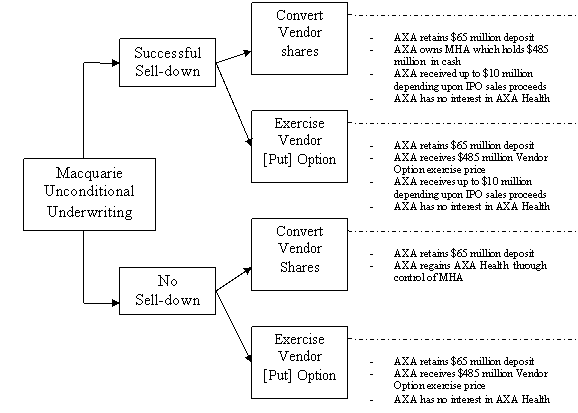
| WHERE MADE: | MELBOURNE |
THE COURT ORDERS THAT:
1. The proceeding be listed for the purpose of hearing the parties on the question of the orders that should be made conformably with the reasons of the Court published this day at 9:30 am on 11 December 2009.
Note: Settlement and entry of orders is dealt with in Order 36 of the Federal Court Rules.
The text of entered orders can be located using eSearch on the Court’s website.
| IN THE FEDERAL COURT OF AUSTRALIA |
|
| VICTORIA DISTRICT REGISTRY General Division | VID 1593 of 2005 |
| BETWEEN: | AXA ASIA PACIFIC HOLDINGS LTD Applicant
|
| AND: | COMMISSIONER OF TAXATION Respondent
|
| JUDGE: | JESSUP J |
| DATE: | 4 December 2009 |
| PLACE: | MELBOURNE |
REASONS FOR JUDGMENT
THE EVIDENCE
2 Before the transaction which is presently controversial, AXA Australia Health Insurance Pty Ltd (“AXA Health”) was a wholly-owned subsidiary of the applicant. It operated what I have been told was a profitable health insurance business trading as “HBA” in Victoria and as “Mutual Community” in South Australia. Elsewhere, it wholesaled its products through other financial institutions and advisers. In 2000, the applicant undertook a strategic review of its health insurance business, conducted by a steering committee under the chairmanship of the applicant’s Group Chief Executive, Mr Les Owen. By the end of 2000, the committee had determined that the position of AXA Health in the health insurance market was not sustainable in the long term because it lacked a national footprint and was not well positioned to compete with Medibank Private. The committee had considered a number of courses that might be open to the applicant with respect to AXA Health, including the acquisition of Medical Benefits Fund of Australia Ltd (“MBF”), the acquisition of Medibank Private, the acquisition of a combination of smaller health insurers, a strategic alliance with MBF and, if none of those courses proved viable, the divestment of AXA Health. However, Mr Owen came to the view that the most propitious options were either a merger with MBF (under which arrangement the applicant would have effective control of the combined business) or the sale of the existing business to MBF. It seems that some kind of transaction with MBF was seen as an ideal means by which to maximise the value at which AXA Health was merged or sold because of the “synergies” which would arise from combining the two businesses. MBF operated predominantly in New South Wales and Queensland, and a combined business would, therefore, have much closer to a national footprint than either of the existing businesses had.
3 In early 2001, the applicant engaged the services of Macquarie Bank Limited (“MBL”) through its advisory arm (“MBL Advisory”) to assist it with a consideration of, and with the implementation of, an approach to MBF. Negotiations between the applicant and MBF followed and, although I do not need to refer to them in detail, on any view there was, in the first half of 2001, a serious and determined endeavour to find a way in which the business of MBF might be merged with that of AXA Health to the advantage of both. However, largely because both companies sought to achieve control of any merged business, by July 2001 the negotiations concluded without resolution.
4 But the negotiations had aroused a degree of interest in AXA Health on the part of MBF. By letter to the applicant dated 27 July 2001, MBF made what it described as “an indicative proposal” for the acquisition of AXA Health. That proposal involved a headline price of $430m, of which $250m would be paid on settlement and the balance would be the subject of vendor finance in various alternative ways set out in the letter. On 13 August 2001, MBF made a revised proposal, in which the headline price was increased to $535m, but which left the sum to be paid on settlement unchanged at $250m. That proposal was considered by the Board of the applicant on 29 August 2001. It had before it a paper which dealt with various aspects of the proposal and of the applicant’s own valuation of AXA Health. The paper included a chart which indicated that the applicant’s “stand alone” valuation of AXA Health was $570m, subject to the following note: “Tax effect (CGT and revenue loss tradeoffs) will impact on net proceeds….” To that the chart added $105m, being one-half of the applicant’s valuation of the “agreed synergies”, giving a total valuation of $675m. The MBF proposal was shy of this figure by a considerable margin. The paper included the following note (where, as in a number of documents to which I shall refer, the applicant was referred to as “AXA”):
Given that the sale of AXA Health may crystallise a CGT liability for [the applicant]… from a cost base of $40m (tax liability of $140m+), the offer remains significantly below AXA’s current value expectations for a sale
The Board resolved to give MBF a short period of exclusivity (as it had requested), with appropriate milestones, to enable the parties to move towards a more satisfactory price and funding structure.
5 Within broadly the same time frame, MBL Advisory was assisting the applicant to locate other potential sources of interest in the acquisition of AXA Health. One of those was British United Provident Insurance Ltd (“BUPA”) of the United Kingdom. In August 2001, Ms Marianne Birch, a Division Director within MBL Advisory, was part of a group which met with representatives of BUPA in London. Those representatives informed the group from MBL Advisory that an outright acquisition of an Australian health insurer was “neither contemplated nor achievable”. MBL Advisory also contacted several Australian financial service providers, and ultimately formed the conclusion that there was little or no domestic or foreign interest in the acquisition of AXA Health.
6 By October 2001, MBL Advisory had become concerned that, in the words of Ms Birch, “there were no competitive forces driving the negotiations with MBF”. There was concern also about the ability of MBF to fund any acquisition. MBL Advisory, therefore, commenced to investigate the viability of an initial public offering (“IPO”) of AXA Health, and sought input from MBL’s Equity Capital Markets Group in this regard. MBL Advisory also began to explore the option of a leveraged buy out (“LBO”) of AXA Health. According to Ms Birch, an LBO was “the purchase of a company by an investor or a consortium of investors that would fund the acquisition using predominantly debt finance”. For this purpose, MBL Advisory contacted another arm of MBL, the “Principal Transactions Group” (“MBL PTG”). The role of MBL PTG, within MBL, was to originate, participate in and generate revenue from, mergers, acquisitions and other corporate transactions through the utilisation of MBL’s balance sheet. Mr Richard Facioni, an Executive Director of MBL, was the head of MBL PTG. He was one of a number of recipients of an email sent on 18 November 2001 by another Division Director of MBL Advisory, Mr Mark McLean. In the email, Mr McLean set out in some detail the state of the applicant’s negotiations with MBF and various pricing and funding parameters involved therein, together with comments about the possibility of an IPO or an LBO. He noted that Ms Susan Foster, the Strategic Projects Manager of the applicant, had raised the idea of an LBO the previous week, and that Mr Facioni was “running with this”. He said that a meeting had been arranged for 21 November 2001, which would be attended by Ms Foster and Mr Andrew Penn, the General Manager of Operations of the applicant. MBL Advisory would make a presentation at that meeting. Mr McLean said (in his email):
Andy [Penn] is the key person here: we need to structure the presentation so that it is over in 45 minutes, and we can spend the rest of the hour talking through issues with Andy and Susan.
7 The presentation went ahead on 21 November 2001. Mr Owen, Mr Penn and Ms Foster were present on behalf of the applicant. In the presentation (as recorded in a documentary version thereof) the LBO part of the proposal was developed in some detail. It was proposed that AXA Health could be sold “into an unlisted, leveraged structure”, the process being described as a “structured sale”. A company would be established to acquire AXA Health, in which MBL, together with other investors yet to be identified, would hold the equity. Debt finance of the order of $300m would be obtained. It was noted that the process could be conducted in parallel with a trade sale to MBF, at no additional cost to the applicant. I understand this to mean that, if the applicant’s negotiations with MBF came to fruition, AXA Health could be on-sold from the MBL structure to MBF.
8 The events to which I have just referred did not reflect a diminution in the applicant’s interest in a sale of AXA Health to MBF. Correspondence in the first week of November 2001 between Mr Owen and the chairman of the Board of MBF, Mr John Conde, made it clear that both men were keen for such a sale to occur. Mr Owen gave MBF a further period of exclusivity, to run until 31 December 2001, during which the applicant would not negotiate with any other party for the sale of AXA Health. A paper, prepared by Mr Penn and considered by the Board of the applicant at its meeting on 30 November 2001, made it clear that, save for a sale to MBF, the prospects of disposing of AXA Health for a price in line with the applicant’s expectations were limited. Mr Penn (who was the executive charged with the overall responsibility of disposing of AXA Health on the most favourable terms) proposed that the Board should consider an IPO or an LBO as suggested by MBL Advisory. The Board resolved to continue discussions with MBF, but at the same time to progress investigations into the IPO and LBO options to determine price and feasibility.
9 A confidential memorandum was prepared in MBL PTG on 7 December 2001. It proposed the use of a new entity – “BidCo” – to acquire AXA Health from the applicant. It contemplated that the shareholders in BidCo would be investors in the acquisition. There would also be a need for some debt finance. The acquisition as such was diagrammatically represented as a transfer of AXA Health shares from the applicant to BidCo in return for “Purchase Price”. The memorandum dealt, in rather broad outline, with the advantages to MBL of such a transaction, and with the commercial and financial risks involved. Under the heading “Potential Upside” the following appeared:
Transaction structuring opportunities:
Manage capital gains tax exposure for AXA on sale (share in up to $100m NPV uplift to AXA)
Of that notation, Mr Facioni said in his evidence:
… we were aware of the potential exposure that AXA had and to the extent that AXA was able to reduce that exposure that would provide us with an opportunity … to capture some of that value.
At this stage, there was no mention of a scrip-for-scrip share exchange, but the memorandum, and Mr Facioni’s evidence about it, leaves little doubt that at least someone in MBL PTG had it in mind to structure the transaction in such a way that capital gains tax would not be payable. A form of the memorandum (in terms which, relevantly for present purposes, were unchanged from those referred to or set out above) was sent to the chief executive officer of MBL and to the head of the Investment Banking Group within MBL on 9 December 2001.
10 The applicant’s Board met on 20 December 2001. It considered a paper which compared various options for the disposal of AXA Health. Evidently, MBL Advisory had made an important contribution to the contents of the paper. Of the LBO option, the paper recorded the following:
Macquarie have confirmed their indicative estimate of value to be $550-600m, where Macquarie would partner with 2-3 private investors to hold the equity (up to 250m) and seek a commercial bank (ANZ) to hold the debt (up to 350m)
The paper concluded with the following recommendation:
· We retain a tough line with MBF and largely hold our current position
· We state that our position is on a non financing basis give [sic] their lack of willingness to negotiate these terms
· We do not extend exclusivity with them beyond the end of December unless there is agreement on value
· If this is achieved we give them one month to sort out financing
· If not we pursue IPO/LBO alternative but without precluding ongoing discussions with MBF
· We request a Board sub-committee be appointed to approve the commercial terms should they be agreed over January
This recommendation was endorsed, and the Board appointed a sub-committee to “approve the commercial terms”. Because of the then exclusivity which had been granted by the applicant to MBF, however, the opportunity for negotiations between the applicant and MBL was limited.
11 On 2 January 2002 (ie almost immediately after the expiration of the period of exclusivity that had been provided to MBF), Mr Ed Westhead of MBL Advisory sent Mr Penn a table setting out the net present value (@ 12%) of the various options that were then potentially available for the sale of AXA Health. The tax payable by the applicant was indicated in each case. That estimated to be payable under the “LBO” option (ie the contemplated proposal from MBL) was in the range $48m to $93m. The tax payable in respect of the other options was shown to be in the range $131m to $177m. When asked whether anybody from the applicant’s end was then in discussions with MBL about how much tax would be payable in respect of the sale of AXA Health, Mr Penn said:
Well, the tax that was payable was one of the economic implications of the – economic implications of the transaction, so, yes, undoubtedly we would have discussed it with our corporate advisers as well as our Board during the process of the transaction.
I do not read this as indicating that there were any discussions as between the applicant and MBL PTG: the applicant’s “corporate advisers” were MBL Advisory.
12 A confidential memorandum prepared in MBL PTG on 22 January 2002 identified the following “key steps” in its proposal for an LBO of AXA Health:
1. MBL would establish a new group company (Bidco) and will fund Bidco by an issue of redeemable preference shares (RPS).
2. AXA would sell AXA Health to Bidco for, say, $575 million, comprising $50 million cash and $525 million of vendor finance. The $50 million would effectively be a non-refundable deposit paid by Bidco at the time AXA Health is acquired by Bidco.
3. The vendor finance would be provided against the issue of converting shares issued by Bidco to AXA (Vendor Shares) with a face value of $525 million. Indicative terms of Vendor Shares follows:
| Vendor Shares – Indicative Terms |
Face Value: $1 per Vendor Share
Number Issued: 525 million
Term: Perpetual, subject to Vendor’s right to convert.
Conversion: Convertible, at AXA’s option, into ordinary shares in Bidco at a 1:1 ratio anytime after 6 months from the date of issue
Security: Vendor Shares can be put to MBL (Vendor Option)
in certain circumstances (described below). N
4. MBL would have the option to put to AXA its ordinary shares in Bidco for their nominal market value (MBL Option). The MBL Option would be exercisable anytime within the first 6 months from the date of issue of the ordinary shares in Bidco. MBL requires the MBL Option for the following reasons:
- in the event that MBL has not been able to on-sell AXA Health, MBL is able to return AXA Health to AXA with MBL foregoing the non-refundable deposit of $50 million; or
- in the event that MBL has been able to on-sell AXA Health, MBL is able to rationalise the residual corporate structure.
In the event that MBL fails to on-sell AXA Health, it will have the choice of either foregoing the non-refundable deposit or providing the remainder of the vendor finance from its own sources – this would be a commercial decision that would be addressed at the time if the situation arose.
5. The RPS held by MBL will be automatically redeemed as follows:
- upon the sale of AXA Health (or its assets) by Bidco – for the excess of the sale consideration over the face value of the Vendor Shares; or
- upon the exercise of the MBL Option, the Vendor Option or upon expiry of 6 months – for no consideration.
Accordingly, if Bidco sell the shares in AXA Health, for, say, $575 million, the RPS would be automatically redeemed for $50 million (ie $575 million less $525 million) and Bidco would replace the remaining cash (ie $525 million) on deposit with a financial institution.
6. To provide AXA with a fallback exit mechanism, MBL will grant AXA an option to put its Vendor Shares to MBL for $525 million plus an agreed premium (Vendor Option). This option would be exercisable 6 months after the date of issue of the Vendor Shares and only in the event that the MBL Option has not been exercised.
The memorandum represented the first documentary reference to the idea of providing that the non-deposit part of the consideration for the applicant’s shares in AXA Health be in the form of convertible shares in BidCo.
13 Also in January 2002, representatives of BUPA visited Australia, and requested a meeting with MBL Advisory. That meeting took place on 16 January. The BUPA representatives indicated that BUPA’s strategy was either to leave the Australian market or to adopt a growth strategy, the acquisition of Medibank Private being of particular interest. When the nature of BUPA’s thinking was communicated to Mr Owen, he authorised MBL Advisory to raise with BUPA the possibility of it participating in the LBO proposed by MBL PTG, or of it making a bid for the outright acquisition of AXA Health. That was done, and Mr Dean Holden, Managing Director of BUPA International, later told Ms Birch that BUPA could not finance an outright acquisition of AXA Health, but was keen to participate in an LBO by contributing equity. Ms Birch gave Mr Holden Mr Facioni’s telephone number, and made it clear to him that she and others at MBL Advisory could not deal with BUPA on the matter of equity participation in an LBO, since “Chinese Wall” procedures had been put in place between MBL Advisory and MBL PTG in relation to the disposition of AXA Health.
14 Mr Holden did speak to Mr Facioni by telephone. In one of their conversations, Mr Holden said that BUPA’s commitment to the equity consortium had been internally approved by BUPA. He said that participation in the LBO as a consortium member made sense for BUPA because, although its financial capacity to acquire AXA Health was constrained, it nevertheless wanted to expand its business internationally. On 12 February 2002, Mr Facioni sent a detailed briefing paper to Mr Holden. In the “overview” section of the paper, Mr Facioni said (referring to the LBO as an “MBO”):
The MBO of AXA Health would be undertaken by an independently capitalised investment vehicle (BidCo), financed through a combination of:
- Equity, to be provided by private equity investors, which could include existing AXA management, Macquarie and other private equity investors; and
- Acquisition financing of $350 million to be provided by banks and institutions.
The “key financial and operating characteristics” were explained under the following headings: market leading positions, with well-established brand names; long-life asset with high barriers to entry; lowest claims and management expense ratios; low fixed costs; experienced management team; a growing market; favourable regulatory environment; financial performance being insulated from economic conditions; and consolidation opportunities within the industry.
15 In his briefing paper for BUPA, Mr Facioni summarised the financial position of AXA Health, and described the characteristics of the private health insurance industry in Australia. He explained various features of the business of AXA Health. In the section headed “Acquisition Funding”, Mr Facioni said that MBL was “seeking an indication from a number of banks … as to their preparedness to provide and/or underwrite senior and secured credit facilities of $350 million to partly fund the acquisition of AXA Health by BidCo”. He set out the proposed financing structure as follows:
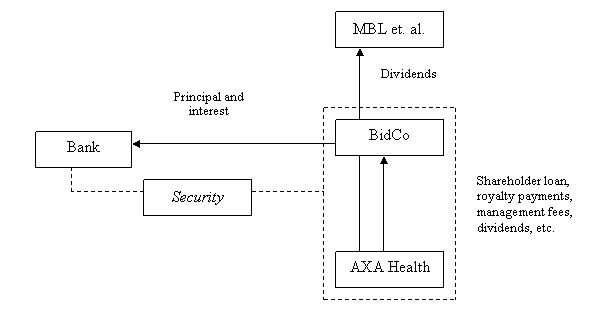

The sources and uses of funds were summarised as follows:
Use of funds $m Source of funds $m
Acquisition Price 480 Equity* 215
Deferred Consideration 65 Senior Debt 350
Transaction Costs 20
Total Acquisition Cost 565 Total Acquisition Cost 565
Under the heading “Bidding Consortium”, Mr Facioni said:
Macquarie is seeking two to three co-investors to participate in the transaction through an equity investment in BidCo, the independently capitalised vehicle that would acquire AXA Health. Equity would also include around $65 million of deferred, contingent consideration which would be payable to AXA in the event certain financial targets are achieved. The amount and terms of deferred consideration are yet to be agreed with AXA.
Macquarie would be retained as financial advisors to BidCo, and, as such would receive fees in regard to financial advice and debt and equity arranging. Costs incurred by BidCo, including legal fees and consulting fees charged by an industry expert, are to be shared equally between consortium investors.
Finally, Mr Facioni set out what he described as “exit options”, namely an immediate IPO, a deferred IPO within 2-3 years and a trade sale within 2-3 years.
16 Meantime, the applicant was still considering a sale of AXA Health to MBF. Indeed, in a memorandum to Mr Owen on 11 February 2002, Mr Penn as good as expressed a preference for such a sale over the proposal then offered by MBL PTG. Mr Penn said that he had had MBF confirm that they were “working to a deal based on $590m on completion plus $10m on approval of 2003 price increase and a marketing agreement”. Mr Penn also said:
[MBF] are targeting the end of the month for the above at which point it is contemplated we could go straight to contracts subject only to regulatory approvals, confirmatory due diligence identifying something of a very material nature and some limited conditions around financing. I had to negotiate them back from early March to end of Feb although I am not convinced they will meet the timetable. I have warned them we are advancing other options and timing is an issue if they take too long they may miss out.
In the same memorandum, Mr Penn said that the “LBO team” (ie MBL PTG) had “come back below their indicative value range” and that, in his view, this had much to do with the internal rate of return which had been built into the assumptions used by that team. Mr Penn said that he had extended “their timetable” to 22 February 2002, and that he did not want an offer from MBL PTG “too much before we are able to get something concrete” from MBF. He concluded his memorandum with the following paragraph:
[F]inally regarding structure I have now had a chance to get my own head around this. I will brief you verbally. At this stage however I am not convinced that their [sic] is any upside in the LBO deal over and above that available in the [MBF] deal after taking all risks and probabilities into account. I am therefore only comparing the gross value of the two deals at the moment. On this basis [MBF] is looking better but we have a way to go.
17 An internal briefing note prepared within MBL PTG on 22 February 2002 identified the members of the consortium that was then proposed to make up the participation in BidCo. They were MBL and three “equity participants”, one of which was BUPA. Mr Facioni considered it to be advantageous to have as a member of the proposed consortium a company that operated in the health insurance industry. The same briefing paper referred to the fees that MBL then expected to derive from the overall transaction which was proposed, including a “structuring fee” of up to $10m and a “consortium advisory fee” of up to $10m.
18 In February 2002, drafts of what was then described as an “indicative bid” for AXA Health were prepared within MBL PTG. In a draft of 25 February 2002, under the heading “Bidder Details”, it was said that the acquisition would be undertaken through a special purpose company, “99.9% owned” by MBL, called Macquarie Health Acquisitions Pty Ltd (“MHA”). A diagram representing the proposed structure and transaction is as follows:
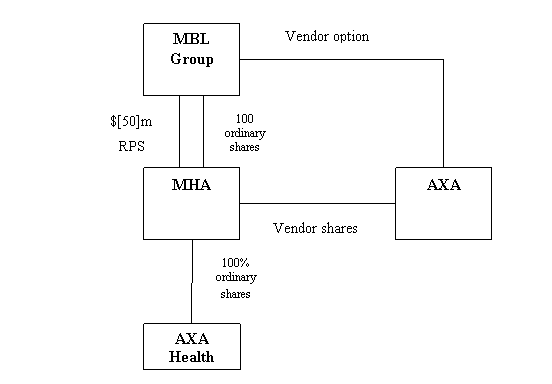

An annexure to the document, titled “Terms of Vendor Shares” identified the issuer of the vendor shares as MHA, “a non-wholly owned member of the Macquarie group”.
19 A later draft of the same document, prepared on 27 February 2002, stated that the consideration for the acquisition would take the form of a deposit (then suggested to be $50m), a special dividend payable by AXA Health to the applicant, and vendor financing in the form of converting vendor shares in AXA Health. Under the heading “Bidder Details”, it was said that the acquisition would be undertaken through MHA, but there was no reference in the text to the extent to which it would be owned by MBL. However, a diagram represented the proposed structure and transaction as follows:
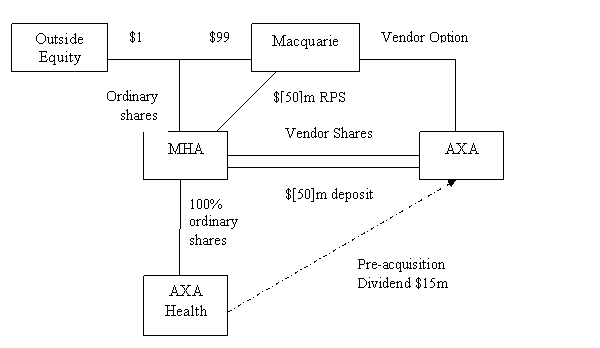

Beneath that diagram, Mr Facioni wrote: “Do we need to show ‘Outside Equity’ above? It looks a little contrived.” Under cross-examination, Mr Facioni said that he could not recall making that endorsement, but accepted that it was a reasonable assumption that he did so because “MHH” (a company which had not then been introduced into the structure and to which I shall refer further below) had no role other than to hold shares in MHA. Further, beneath the diagram, under the heading “Pre-Signing Steps”, it was stated that MHA would be established with nominal ordinary equity “with Macquarie holding 99%”. Mr Facioni crossed out that last quoted passage. Mr Facioni did not, however, make changes to the annexure, which still stated that MHA would be a non-wholly owned member of the Macquarie group.
20 At the time of these events, Mr Patrick Upfold was an executive within MBL PTG. He and those who worked with him were responsible for devising the details of the structure by which AXA Health would be acquired (if there were to be an acquisition). His instructions from Mr Facioni were to structure the transaction in a way that would facilitate a commercially attractive offer to the applicant and enable MBL to on-sell its stake in AXA Health in an efficient manner as soon as possible following completion, preferably at a profit, and with minimal risk to MBL. Mr Upfold had very little recollection of the details of discussions involving the development of the structure for the proposed acquisition of AXA Health. He thought it likely that he would have followed his usual practice of conducting “brainstorming” sessions with staff, with ideas being formulated, drawn on a whiteboard and debated. In his evidence, Mr Upfold referred to the feature of the structure then being developed which involved the holding of 1% of a company, otherwise owned by MBL, by outside interests. He said:
I do not now recall the particular reasons at the time for deciding upon those shareholdings. I have not been able to locate any contemporaneous document recording any such reasons that would assist me to refresh my memory. However, I do recall that it was a feature of the structure that it could provide the applicant with the choice of obtaining for [sic] scrip for scrip roll-over relief under the income tax legislation.
Something else which Mr Upfold did recall was that the process of structuring the transaction did not involve any input from the applicant.
21 Mr Upfold said that the proposed structure of MHA – by which 1% would be held outside the MBL Group – had the additional “feature” that MHA would not form part of the MBL tax consolidated group when it was formed. In his affidavit sworn on 23 September 2009, Mr Upfold said:
At the time the structure for the transaction was being developed, the tax consolidation regime had been announced but legislation had not yet been finalised. I recall at that time that there was still some uncertainty as to the details of the final legislation. I also recall that MBL was contemplating forming a tax consolidated group during the period covered by the transaction. I was concerned that MHA and AXA Health should not form part of the consolidated group, and that the transaction should not affect the timing of the decision to form the group. I was aware that it was MBL’s intention to on-sell AXA Health at the earliest opportunity. I was also aware that there was no intention for MBL to integrate the AXA Health business, staff or systems within the broader MBL business. In those circumstances, it was desirable that the tax outcomes associated with AXA Health should remain isolated from MBL. Furthermore, I was concerned that if MHA or AXA Health were consolidated with MBL for tax purposes, MBL would be required to provide tax indemnities to any third party purchaser of AXA Health. Having to provide such indemnities would have been commercially undesirable and would have entailed risk to MBL
22 Returning to the applicant’s consideration of the proposals for the sale of AXA Health, on 27 February 2002 Mr Owen prepared a paper for consideration at the meeting of the Board. Both MBF and MBL PTG were expected to submit offers within the ensuing days or weeks. Mr Owen concluded his paper as follows:
We continue to make progress, albeit slow, on both options for the sale of our health business.
Whilst the MBF deal offers a higher gross value on the face of it, they have not yet finished their commercial due diligence and we believe, based on experience to date, that there is significant completion risk associated with this option.
The LBO team look to be very well placed to put in their offer on 22 February and we believe that were we to accept their offer there would be a very high probability of completion. Their offer is however, likely to be at a value which is unacceptable to us.
It is feasible that we will be able to lift the value of the LBO offer through some economic exposure however this may also expose us to some downside risk.
The recent speculation regarding our strategy for our health business has not exposed any other interested parties and we therefore remain convinced that the best options for the sale of the business are those currently under consideration.
Our strategy is to continue to work with both parties with a view to maximising the value of their respective offers and getting them to a position where completion risk on either option is at a minimum. At that point we would proceed with the preferred offer. Managing this situation and keeping “both balls in the air at once” is, however, extremely delicate.
The minutes of the Board meeting record the following:
Discussion turned to the leveraged buy out proposal. The Macquarie Bank team appear to have strong lines of equity participation with possible participation by BUPA, a substantial United Kingdom based private health company. It seems likely that the LBO team is intending to realise their investment through a subsequent IPO. We are seeking to ensure participation in any excess over the offer from the LBO team.
23 On 1 March 2002, MBL made a “non-binding bid” for AXA Health. The form of the bid was devised by MBL PTG and other groups within MBL, not including MBL Advisory. The applicant had no input into the structure or the form of the bid. By the bid, MBL proposed to acquire 100% of the shares in AXA Health “by way of unconditional underwriting”. The bid provided:
Macquarie is not a strategic acquirer nor a long-term owner of AXA Health. Macquarie understands that AXA wishes to divest AXA Health and is seeking certainty regarding the timing and price of such a sale within a relatively short timeframe. Macquarie believes that Macquarie Unconditional Underwriting achieves these objectives for AXA, whilst providing AXA with some continued upside exposure to any IPO of AXA Health in the short-term. Under the Macquarie Unconditional Underwriting, Macquarie would assume the risk of on-selling AXA Health.
Macquarie proposes to sell-down all or a substantial share of its investment in AXA Health … within 6 months of Completion Date…. It is envisaged that the Macquarie Sell-down would be undertaken either by way of an on-sale to a private equity consortium … or an IPO on the Australian Stock Exchange.
The bid provided for the applicant to receive a minimum of $550m for the sale of AXA Health, plus “up to a further $10 million if AXA Health is subsequently sold by way of an IPO within 12 months.” An attractive feature of the arrangement, so it was said, was that the applicant would have to deal with one party only (MBL), and MBL would assume the risk of failure of the proposed IPO. The consideration proposed by the bid was –
- $65 million Deposit; plus
- 485 million Vendor Shares issued by MHA with a face value of $1 each; plus
- an additional payment of up to $10 million in the event that AXA Health is sold by way of an IPO within 12 months of Completion Date, calculated as 30% of the net proceeds received from an IPO (ie. net of IPO costs) above $575 million.
24 Because MBL did not intend to be a long-term equity owner of AXA health, the bid was structured to provide MBL with a period of six months during which it would have effective control of AXA Health without the applicant yet having received full consideration for the sale. The idea was, however, that it would be MBL which would bear the risk of there being no third party investor interested in acquiring AXA Health. Broadly, that was done in two ways: first, by providing for a cash payment of $65m by way of non-refundable deposit, and secondly, by giving the applicant a range of options exercisable at the end of the six-month period that would enable it either to require MBL to proceed with the acquisition for the total price of $550m or to resume full ownership of AXA Health.
25 In its non-binding bid, MBL proposed that the acquisition of AXA Health would be by way of a “special purpose company”, MHA. That company (which was the company previously referred to as “BidCo”and which did not then exist) would be established as a subsidiary of MBL with a nominal capital (suggested to be $100). It would issue 65,000,000 $1 redeemable preference shares to MBL. By subscribing for these shares, MBL would put MHA in funds to the extent necessary to enable it to pay the $65m non-refundable deposit for AXA Health to the applicant. The remaining component of the consideration passing from MBL to the applicant – to make up the total price of $550m – would be 485,000,000 convertible $1 “vendor shares” in MHA. During the six-month period to which I have referred, these shares would carry voting rights only on the basis of one vote for every 100 shares. By reason of its 100 ordinary shares and its 65,000,000 redeemable preference shares (which were to carry ordinary voting rights), therefore, MBL would control MHA on the proposed figures; (the applicant’s vote at a general meeting would be of the order of 6.9%). MHA, in turn, would own 100% of the shareholding in AXA Health. The commercial effect of this was that the applicant would – save to the extent of the $65m deposit – be providing vendor finance for the sale of AXA Health to MBL.
26 At the end of the six-month period, it was proposed that the applicant would have the option to convert its vendor shares in MHA into ordinary shares with full voting rights. It could then either keep them, or put them to MBL at a price of $1 per share. Should the applicant exercise the put option, it would have effectively disposed of its interest in AXA Health for a total consideration of $550m. Alternatively, should the applicant retain its shareholding in MHA, it would control whatever assets MHA then had, which would in turn depend on MBL’s measure of success in selling the business of AXA Health to a third party (or parties). Effectively, the applicant would have either a cash box company or the continuing business of AXA Health.
27 The arrangements just described were depicted schematically in the bid document as follows:
Macquarie AXA Choice AXA Outcomes
Sell-down

28 The entities involved in the transactions contemplated by the bid, and the movement of shares and funds, were represented by the following diagram:

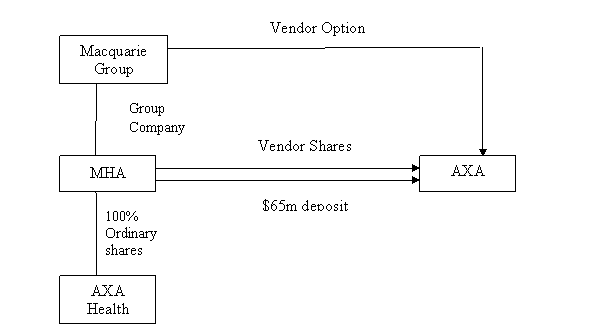

29 Although the bid document no longer (ie since Mr Facioni’s deletions from the draft of 27 February) contained any explicit reference to the 1% outside shareholding, the annexure (now Annexure 1) identified the issuer of the vendor shares, MHA, as “a non-wholly owned member of the Macquarie group”. It was put to Mr Upfold that there was an inconsistency between that indication and the above diagram. He rejected that, saying that the words “group company” in the diagram was “an accounting concept rather than a legal concept”, and that the diagram did not tell him too much about the legal ownership of MHA by MBL. By contrast, the annexure was “essentially a … sheet of legal terms” which served a different purpose.
30 Mr Upfold said that he was, in April and May 2002, familiar with the requirements for scrip-for-scrip rollover under the tax legislation. He also had a recollection, albeit not a specific one, that, in the transaction which he and his colleagues were preparing, it was necessary for the vendor shares to be issued by a company that was an ultimate holding company. He accepted that the need to satisfy that requirement was a factor in the decision to insert a small component of outside equity into the structure.
31 MBL was, of course, a financial institution with no long-term desire to operate the business of a health insurance fund. It seems that it saw the sale of AXA Health as an opportunity to earn revenue from a facilitation of that sale, in part by the assumption of risk that third party equity investors could not be found. Thus it described the proposed transactions referred to above as “underwriting”. In the bid, MBL proposed that the applicant would pay an “underwriting fee” of $10m on completion of the transaction. As it happened, at the time of the bid MBL already had non-binding commitments from a number of investors (including BUPA), and indications from other banks of a preparedness to provide debt finance to the extent necessary.
32 Mr Penn informed Mr Owen of the receipt of the non-binding bid from MBL in an email sent on 2 March 2002. He referred, in summary, to the features of the bid. In the course of that email, Mr Penn said:
There is a $10m structuring fee proposed, you know what this is for. It is not conditional on the actual structural outcome, it is payable on our acceptance of the offer which incorporates the proposed structure.
Mr Penn was asked about this in cross-examination. He accepted that, in the light of his comment in the email, MBL PTG most probably described the fee to him as a “structuring fee”, adding:
I understood it to be a fee for the overall structure of the transaction, which included the on-sale and the shifting of risk to Macquarie during a period of six months, and then the potential clawback of the business to us.
As to the passage “you know what this is for”, Mr Penn at first said that he had previously spoken to Mr Owen about the fee, and that the latter did indeed know what it was for. When pressed, he offered the view that it was “a fee associated with us accepting the offer from Macquarie in relation to this transaction”. When it was put to him that it was a payment for devising the structure, rather than a payment for underwriting as such, Mr Penn did not agree. He said:
It was a payment which was associated with accepting the transaction, and Macquarie were shifting risk to them. It was a fee associated – it was a fee which was – that the transaction was conditional on accepting.
33 By letter dated 8 March 2002, the applicant gave limited, provisional and somewhat cautious support to the MBL bid. It required a number of issues to be addressed. It required the voting entitlements of the vendor shares in MHA to be increased to a level which was greater than 25% and the distribution entitlements to match the voting entitlements. This was (although not then expressed in the letter in terms) because the applicant wanted to be in a position, during the period when MHA would be controlled by MBL, to block the passage of any resolution at a general meeting which required 75% shareholder approval. The applicant required certain amendments to be made to the constitution of MHA, and indicated that it may require representation on the Board. It also required an adjustment to the rights associated with the put option attaching to the vendor shares, and the creation of a call option over MBL’s shares in MHA, as follows:
d) Vendor Option – Amend the rights to reflect that in the event of a successful sell-down for an amount less that [sic] the underwritten amount, the option is to act as a guarantee to AXA to top up to the underwritten amount; and
e) Call Option – AXA will require a call option over Macquarie Bank’s ordinary shares in MHA with an exercise price of $1.00 per ordinary share. In the event that AXA converts its Vendor Shares, AXA will require total control of AXA Health.
In its letter of 8 March 2002, the applicant also proposed a number of other modifications to MBL’s bid. Included amongst them was a requirement for a “base” price of $560m and a requirement that the applicant share, to the extent of 50%, in any profit made from the on-sale of AXA Health (under certain conditions).
34 Also on 8 March 2002, Mr Facioni wrote to four potential investors in the proposed consortium, including BUPA. He attached a summary of the applicant’s response to the non-binding bid of 1 March 2002. I infer that those investors were already privy to the details of that bid. In his letter, Mr Facioni said that the applicant’s comments on the bid fell into three broad categories: bid value, process and structure. He gave brief details of the response under each of these headings. He set up a teleconference with representatives of the investors for 12 March 2002.
35 On 16 April 2002, MBL submitted a revised non-binding bid for AXA Health, which followed the same general approach as the original bid of 1 March 2002, but was more favourable to the applicant in a number of respects. The total price was now to be $560m, made up of a $65m cash deposit and convertible vendor shares to the value of $495m. The applicant was to be entitled to a share of 50% (reducing pro-rata to 30% over 12 months) of the profit made from any on-sale of AXA Health for more than $575m (net of costs) within 12 months of the completion date agreed as between MBL and the applicant. The revised bid contained further details about MHA: it was to be majority-owned by MBL, “with the other shareholder … being a non-wholly owned subsidiary of [MBL] that is controlled by [MBL]”. As MHA would be controlled by MBL, it would be “a member of the [MBL] consolidated accounting group”. The applicant was to have the call option on which it had insisted in its letter of 8 March 2002. The way that option was expressed gave an indication of the ownership structure which MBL had in mind for MHA. As to 99 ordinary shares in MHA, the call option would be granted by MBL. As to one ordinary share, it would be granted by a company not otherwise mentioned in the revised bid, and not then incorporated, Macquarie Health Holdings Pty Ltd (“MHH”). It was also proposed that, subject to negotiation, the applicant would have 25% of the voting power at a general meeting of MHA, and would have one seat on the Board.
36 On 17 April 2002, the Board of the applicant considered the options that were then potentially available for the disposal of AXA Health. Two of those options were the sale to MBF and the non-binding bid from MBL. The documents which were then before the Board leave little doubt but that the capital gains tax consequences of proceeding by way of a scrip-for-scrip roll-over were a significant matter for consideration. One of those documents was a detailed briefing paper, in which a table headed “Impact on AXA APH financials” compared the overall financial impact of the various options, in each case showing the best and worst case scenarios. For the “LBO” option (ie the one being proposed by MBL) there were best and worst cases of $-17m and $-133m respectively shown with respect to “Tax paid by AXA APH”. Mr Richard Allert, the chairman of the applicant, accepted that, at its meeting on 17 April 2002, the Board understood that the way an LBO might be structured could bring about the consequence that less tax was payable. Indeed, a notation on the final page of the briefing paper (not referred to Mr Allert by counsel for the Commissioner) was as follows:
Tax & Accounting
- No CGT payable by AXA on transaction as consideration for AXA Health shares equals cost base of shares
That comment did, of course, reflect a technical misunderstanding of what was being proposed by MBL PTG, but it at least demonstrated an awareness of the undoubted circumstance that the proposal was structured in a way that delivered capital gains tax benefits. In his evidence, Mr Owen made it clear that he then understood what was being proposed. He said:
I understood that under the offer we have received from Macquarie that there would be roll-over relief on the capital gain. We took counsel’s opinion to, as far as possible, satisfy ourselves that that would be the position. I guess we always knew that that may be contested by the ATO and therefore we were looking at both scenarios. We were pointing out to the board what might happen in the worst case.
He acceded to the proposition that the difference between $17m and $133m was either getting the roll-over relief or not getting the roll-over relief.
37 On 17 April 2002 the Board of the applicant also had before it a document headed “Note to the Board” which contained a very brief comparison of the options which were then under consideration. Quite clearly, this short note dealt only with the most fundamental of factors involved in the various options. The note opened as follows:
The purpose of this note is to illustrate to the Board the key structural implications of each option regarding the possible sale of AXA Health as set out in the Board paper for April’s meeting.
It includes an opinion from Counsel. Given the “privileged” nature of this document we have deliberately separated it from the Board papers. Directors will find it helpful to reference this document during the presentation planned for the meeting.
It is clear from that passage, and from other parts of the note, that the Board had the advice of counsel about the matters under consideration. Again, a table showed the tax consequences of the options: the MBL proposal would involve the applicant paying anything from $118m to $139m less tax than the other options. According to the document, a feature of the MBL bid was –
The LBO structure takes advantage of the “scrip for scrip” Capital Gains Tax roll-over provisions. The effect of the structure is to defer CGT of $122m. The period of deferral is indefinite.
Although Mr Penn said that he could not recall the document, he accepted that the availability of the scrip-for-scrip roll-over provisions would have been covered in his presentation to the Board on 17 April 2002. The Board resolved that the bid from MBL should be progressed to the point of having a heads of agreement, and that MBF should be informed that it was no longer the preferred buyer (but also that negotiations with MBF should continue). From this point, the applicant and MBL proceeded to prepare the documentation necessary to give effect to the sale of AXA Health according to the revised bid of 16 April 2002.
38 Mr Lewis Culliver, the Group Tax Manager of the applicant, was present at Board meetings at which the proposal from MBL PTG was considered, and advised the Board in relation to taxation issues connected with it. In April and May 2002, he gave specific consideration to the requirements of the scrip-for-scrip roll-over relief provisions of the 1997 Act. He took advice, and thereby satisfied himself, that those requirements would be met in the transaction being proposed. He does not now recall giving specific consideration to whether MHA would be an ultimate holding company, but he said (in his evidence) that “it was always the case that [MHA] would not be a wholly owned subsidiary of the Macquarie Group”. He accepted that he was looking closely at the requirements of s 124–780 of the 1997 Act in April and May 2002.
39 By this stage, all of the potential members of an equity consortium previously identified by MBL, save BUPA, had lost interest. On 18 April 2002, Mr Julian Davies, Director Corporate Finance of BUPA, wrote to Mr Facioni to confirm (“so far as I can”) BUPA’s participation in the equity consortium to acquire AXA Health, adding “and indeed to the possible acquisition of the entire share capital” of AXA Health. He said that he and Mr Holden had “had a succession of discussions and followed the due diligence process in detail”. He said that they (Mr Holden and himself) were “fully supportive of the proposed bid valuing [AXA Health] at A$560 million subject to the terms and conditions set out in your bid document”. Mr Davies said that he did not then have the approval of the BUPA Board to participate in the bid, but the terms of his letter made it clear that he expected that approval to be forthcoming. He concluded by saying that funding was available and that, “indicatively although not contractually”, that funding would be sufficient for the acquisition of a 47% stake in the consortium.
40 In April 2002, the applicant was concerned to ensure that MBL PTG not on-sell AXA Health to BUPA alone without itself participating substantially in any profit arising from such a transaction. This concern was amongst a number of things discussed at a meeting on 29 April 2002 between representatives of MBL PTG, BUPA and MBL Advisory (representing the interests of the applicant) which was, in my perception of it, important, if for no other reason because it seems to have been the first occasion upon which such a tripartite coming together had occurred in the context of the applicant’s attempts to sell AXA Health.
41 Mr John Green (from MBL Advisory) opened the meeting by summarising the background to BUPA’s level of involvement in the proposed LBO. Then the BUPA representatives said that they were very serious. There was to be a BUPA Board meeting on 9 May 2002 to give formal approval to participation in the LBO, as to which no problems were anticipated. The representatives said that they had had “first class” access to the management of AXA Health, and that they had found “strong cultural similarities and similar ways of doing business”. They referred to other recent acquisitions by BUPA. They said that BUPA’s first acquisition in this region had to be “a really strong business” and that BUPA was keen to have a base in the region from which to approach other opportunities. They said that funding was not a concern. After some discussion of the possibility of a sale to MBF, the applicant’s concern about the potential embarrassment that might arise if AXA Health were on-sold by way of an IPO at a profit, or were effectively sold to BUPA, was raised by the representatives of MBL Advisory. As recorded in the minutes of the meeting, the response of the BUPA representatives was:
- BUPA are very much a long term player in market
- BUPA’s capacity to act earlier in year was limited but its appetite to participate has been increasing and hence the increased equity stake, and preparedness to continue in consortium whilst others have dropped out.
However, the BUPA representatives did not go so far as to say that they were contemplating an outright acquisition of AXA Health.
42 On 7 May 2002 Mr Owen sent an email to Mr Green in which he said that he understood that BUPA was “getting more excited and [was] taking a larger equity stake”. He said that the applicant would “not be at all happy” if a trade sale to BUPA took place. He said of BUPA: “…if they are changing their position on their interest in the whole business I think we should be talking to them direct”. Mr Green replied on 8 May 2002. He referred to the history of BUPA’s involvement in the consortium, and said that, at the meeting “a week or so ago” (which I infer was the meeting of 29 April 2002), there was no indication that BUPA would acquire 100% of AXA Health. Mr Green’s email continued (and concluded) as follows:
- The news yesterday that BUPA has offered Macquarie a put option over a proportion of Macquarie’s stake in AXA Health (taking MBL down to a $50m exposure as I understand it) is something that was also news to us and needs to be explored to AXA’s satisfaction.
- Bear in mind that it is in the context of Macquarie Bank now taking 50% of the equity (with Bupa alone the other equity player). ie because of the withdrawal of other equity, the MBL and Bupa positions have each increased to $112.5m, an amount of equity beyond Macquarie’s expressed ‘natural’ position of $50m.
- I see a put in two ways here:
- 1 it could be a positive for AXA if it keeps the bid alive by giving Macquarie Bank sufficient comfort that its exposure is ultimately limited to its comfort level of equity (before it seeks further institutional investors). Please tell me if you disagree.
- 2 BUT, to my thinking it may depend on the terms of the put. If Macquarie is covering downside and it is not a closet method of selling to Bupa, that is one thing. If it is a way for Macquarie to sell to Bupa and realise further profit, that is quite another. (I note that you have been assured before that a trade sale to Bupa is not the intention.)
- Mark and I are also taking up the issues as to BUPA’s current level of interest and the put terms with the Huey team this morning and will revert to you.
- We also believe that a way to address this may be for Huey to agree that if there is any sale to Bupa in the short term that AXA gets the lion’s share of benefit of it if it is as a profit
In his affidavit affirmed on 8 December 2008, Mr Green said that he could not recall any subsequent conversations on this subject. Neither could Mr Owen.
43 The process of drafting a heads of agreement was the responsibility of the applicant, and its solicitors produced a first draft on 3 May 2002. The parties to the agreement were to be the applicant, MBL, MHA and MHH. Sections of the draft set out the warranties that were to be given by the applicant and MBL. The only one presently necessary to mention is the following, to be given by MBL:
[I]mmediately prior to Completion:
(1) the issued share capital of MHA will comprise 100 ordinary shares and 65 million RPS;
(2) 99 ordinary shares of MHA and all the RPS will be legally and beneficially owned by MBL and one ordinary share of MHA will be legally and beneficially owned by MHH;
In a mark-up of that draft done on 7 May 2002, MBL’s solicitors deleted the reference to “99” and to the one share to be held by MHH, and converted the provision into a requirement that all the shares in MHH be held by MBL or a “related party”, defined so as to include a company that was controlled by MBL. However, in the second draft prepared by the applicant’s solicitors on 10 May 2002, the original wording was restored, and that wording was thereafter retained.
44 On 8 May 2002, Mr Bob Herbert, an executive within MBL who worked with Mr Upfold, sent an email to many others (within MBL) including Mr Facioni and Mr Andrew McWhinnie, an Executive Director of MBL and head of its taxation division. It attached a draft of a transaction description by which AXA Health was to be acquired. It is an important document, as it set out compendiously, yet in some detail, a description of the whole arrangement, including aspects which had been negotiated with the applicant and aspects that had been negotiated with BUPA.
45 Mr Herbert’s draft said that prior to “announcement”, MBL would establish “the following acquisition structure to facilitate a scrip-for-scrip bid for AXA Health”. The following diagram was set out:
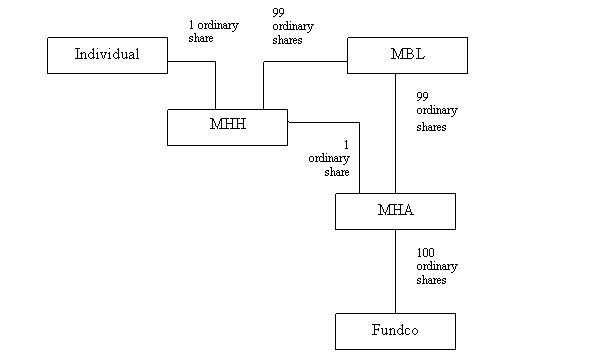
The details of the companies and relationships in the diagram were explained. It was said the “individual” referred to was to be an “unrelated individual (expected to be a partner of Blake Dawson Waldron, [MBL’s] legal advisers)”. The structure would be capitalised by MBL (through MHH) subscribing for 65,000,000 $1 redeemable preference shares in MHA. The funding of that was to be assisted by an interest-free capital injection of $35m by BUPA.
46 According to the draft, at “financial close” FundCo would enter into a sale and purchase agreement under which it would acquire all the shares in AXA Health for a price of at least $560m, consisting of $65m paid in cash and $495m in convertible shares issued by MHA to the applicant. A further element of the consideration was that the applicant would have the right to share in any profit made on the on-sale of AXA Health by MHA.
47 The draft referred next to the means by which MBL would sell down its interest in AXA Health. There was to be a consortium constituted by a company (“NewCo”) owned 50/50 by MBL and BUPA. MHA would on-sell its shareholding in FundCo (and thereby its recently-acquired interest in AXA Health) to NewCo. The arrangements made as between MBL and BUPA were described as follows:
Macquarie has entered into arrangements with BUPA governing the equity and debt contributions of the Consortium to reduce Macquarie’s initial exposure to AXA Health.
Prior to announcement, Macquarie and BUPA will execute the [Equity Participation Agreement (“EPA”)]. The EPA will legally bind BUPA to sub-underwrite $120 million of the equity (being 50% of total equity) in the Consortium. BUPA will also grant Macquarie a put option over $70 million of Macquarie’s equity with an exercise price of $70 million (“Macquarie Put”). The Macquarie Put will expire within 6 months from financial close.
This leaves Macquarie with an equity risk exposure of $50 million and a risk on BUPA’s performance of $190 million. This BUPA performance exposure will be secured by a letter of credit from HSBC or similar financier prior to Financial Close. Due to the importance of BUPA to the Consortium, Appendix 1 [to the proposition summary] sets out some information about BUPA.
Macquarie will grant BUPA a pre-emptive right (“BUPA Pre-emptive Right”) to acquire the remaining equity held by Macquarie (ie the $50 million in the event that the Macquarie Put has been exercised or Macquarie sells to institutional investors and $120 million in the event that it has not). The BUPA Pre-emptive Right will be exercisable for market value at the earlier of:
- the Consortium proceeding with an IPO; or
- 18 months after Financial Close.
Macquarie will grant BUPA a call option (“BUPA Call”) over Macquarie’s residual $50 million exposure. The BUPA Call will have an exercise price of $60 million and will expire six months from the financial close.
Thus it will be seen that MBL’s maximum net exposure was $50m, but it was contemplated, but not then agreed, that BUPA would call for MBL’s residual interest in NewCo which represented that exposure.
48 Mr Herbert wrote another memorandum on 8 May 2002, this time jointly with Mr Greg Pahek, another executive who worked with Mr Upfold. Mr McWhinnie was one of the recipients. The purpose of the memorandum was to seek approval for the establishment of three special purpose companies required for the transaction which, as was then contemplated, would involve the acquisition of AXA Health. The first was MHH. Of its 100 ordinary shares, 99 were to be held by MBL and one was held by BDW Nominees Pty Ltd, a special purpose holding company owned by the partners of MBL’s legal advisers, Blake Dawson Waldron. The second was MHA. Of its 100 ordinary shares, 99 were to be held by MBL and one was to be held by MHH. The third was Macquarie Health Funding Pty Ltd (“MHF”), which was to be wholly-owned by MHA. The memorandum contained the same diagram as was set out in the email of the same date (see par 45 above), save that “Individual” had been replaced by “BDW Co” and “FundCo” had been replaced by “MHF”. On 10 May 2002, those companies were incorporated as requested.
49 Mr McWhinnie said that the memorandum from Messrs Herbert and Pahek was his first written notification of the intended structure of the MBL side of the entities proposed to be involved in the acquisition of AXA Health. He gave no evidence about, and was not asked about, Mr Herbert’s email, but it is a fair inference that he read that also on 8 May 2002. He said that, in the first half of 2002, one of the principal matters engaging his attention was the proposed introduction of the tax consolidation regime, which was eventually introduced in October of that year with effect from 1 July 2002. The regime would have allowed a wholly-owned group of companies to elect to be treated as a single taxpayer for income tax purposes. In February 2002, an exposure draft of the legislation had been released, and it had been announced that it would take effect from 1 July. In his affidavit affirmed on 10 September 2009, Mr McWhinnie continued:
One of the key consolidation issues that I was considering in and after February 2002, was the treatment of entities upon the formation of (or upon joining) a tax consolidated group. Because the ownership structure of a subsidiary member would be ignored, and the head company would be treated as if it were the owner of the subsidiary member’s assets, the tax cost of those assets would need to be ascertained. It was proposed that for the entities joining a pre-existing group the tax value of assets would be “reset”, effectively by attributing the costs to the head company of its interest in the subsidiary entity across the assets of that subsidiary entity. This method of determining the tax cost of a subsidiary member’s assets is commonly described as a “push down” of the head company’s ownership costs. On the other hand, if an entity entered a consolidated group upon formation it was permissible for the head entity to adopt the entity’s pre-existing tax values. I recognise that the ascertaining of the tax cost of an entity’s assets upon its entry into a tax consolidated group could be an administratively burdensome process involving external valuation costs. I was also mindful that the calculations required upon the exit of a member from a consolidated group could be equally administratively burdensome and expensive (these calculations would be required to be done in order to calculate the amount of any gain or loss arising as a result of the company’s exit from the group).
One of the other issues of the consolidation regime which I was considering at around that time was the liability of subsidiary members and former subsidiary members of a consolidated group for the tax debts of the entire group. One of the effects of the proposed legislation was that a member of a consolidated group would be jointly and severally liable for the tax debts of the group as a whole in circumstances where those debts were not met by the head company by the time they became due and payable. In effect, this meant that an entity which had left a group could still be held liable for the group’s unpaid tax debts to the extent that those debts were incurred while it was a member of the group. While joint and several liability is now managed through the implementation of tax sharing agreements, which have the effect of displacing the general rule, prior to the introduction of the consolidation regime tax sharing agreements had not been tested and their operation and effect was generally unknown. The prospect of ongoing joint and several liability issues was expected to further complicate the exit of entities from consolidated groups.
Mr McWhinnie said that MBL had decided to consolidate its group for tax purposes with effect from 1 October 2002 (the commencement of its 2002/2003 substituted accounting period). Mr McWhinnie was not involved in the early development of the proposals for the acquisition of AXA Health by MBL. When he received the memorandum of 8 May 2002 in which the proposal was explained in outline, he turned his mind to the question whether the incorporation of special purpose companies with the shareholding then proposed would give rise to any significant tax risks, particularly from a consolidation perspective. He concluded that it would not do so. Because MHA would not be owned 100% by MBL, Mr McWhinnie was satisfied that it would not form part of the consolidated group.
50 Although not specifically referred to in the evidence, I infer that the Board of BUPA did give approval to participation in the MBL consortium at its meeting on 9 May 2002.
51 By 16 May 2002, the heads of agreement being prepared by the applicant’s solicitors had reached its fourth draft. Of the drafts in evidence, that was the first to contain the subject of “Consolidation” amongst the warranties to be given by the applicant (but I note that the text contains mark-up, from which I infer that the subject had been introduced in the third draft). By these warranties, the applicant undertook not to make any choice or election that had the effect of causing AXA Health to be a member of a consolidated group for the purposes of the 1936 Act or the 1997 Act. It was also as a result of this (fourth) draft that the heads of agreement came to be called the “Underwriting Agreement”.
52 On 19 May 2002, a sixth draft of the Underwriting Agreement was prepared. On 20 May 2002, this was marked up by MBL’s solicitors, thereby becoming the seventh draft. No changes to the warranties to be given by the applicant were then made, but a new warranty was to be given by MBL in the following terms:
MHH will not be a wholly-owned subsidiary of MBL either at Completion or at any time whilst MHH owns ordinary shares in MHA.
Mr Culliver said that this provision was inserted on his insistence. In his affidavit sworn on 10 September 2009, he said:
I insisted that the warranty be included in the transaction documents because I was concerned about the implications that the proposed tax consolidation regime may have on the Applicant’s interest in AXA Health in the event that MBL was unsuccessful in its attempts to on-sell AXA Health and the Applicant decided to regain ownership of the company (by converting its vendor shares in MHA and exercising its call options). At the time, the Federal Government had announced that the tax consolidation regime would be introduced with effect from 1 July 2002, and that on and from that date the parent company of a wholly owned group would be able to elect to form a tax consolidated group irrespective of its accounting period. While the introduction date of the new regime had been announced, it was far from clear what form the provisions would ultimately take or what consequences they would have for the purchasers of companies that were members of such groups. At the time I recall that I was aware that there were concerns held generally among tax professionals that companies exiting a consolidated group would remain jointly and severally liable for the tax debts of their former group after the leaving time. Adding to this concern, and to the general uncertainty around the operation of the provisions, was the fact that an election to form a tax consolidated group could be made retrospectively or with effect from an earlier date. This meant that the purchaser of a wholly owned company of a consolidatable group faced the prospect of having the tax attributes of the company significantly altered as a result of an election being made following completion of the acquisition.
In the context of the LBO, I was mindful of the possibility that through the exercise of its rights attaching to the vendor shares and the call options, the Applicant may end up as the owner of MHA. MHA would hold significant assets, being either the proceeds of the on-sale of AXA Health or the shares in AXA Health. At the time I was concerned that if that happened and MHA had been a wholly owned subsidiary of MBL during the underwriting period, then an election by MBL to form a tax consolidated group from a date within that period could cause MHA and its wholly owned subsidiary, AXA Health, to become members of the MBL tax consolidate group. In that case, MHA and AXA Health, if it had not then been on-sold, would have been leaving members of the MBL tax consolidated group upon MHA ceasing to be a wholly owned subsidiary of MBL. I wanted to ensure that this could not occur. It was for that reason that I sought the warranty referred to above. That warranty together with the changes to the constitution of MHA required by the Underwriting Agreement and the terms of the vendor shares (refer to Schedule 3 of the Underwriting Agreement) meant that without the consent of the Applicant, MHA could not become a wholly owned subsidiary of MBL for the entire underwriting period. With that warranty I was satisfied that there could be no circumstances in which a transaction contemplated by the Underwriting Agreement would fall within the proposed tax consolidation regime.
Mr Culliver was cross-examined on this evidence. It was put to him that the purpose of this new warranty in the seventh draft was to ensure that the ultimate holding company requirement in the scrip-for-scrip roll-over relief provisions was satisfied. He denied it. He said:
This was one instruction that I gave to have in [the agreement] to cover the tax consolidation issue. This was a warranty that ensured that Macquarie Health Acquisitions maintained its financial condition and its governance during the underwriting period. It had nothing to do with scrip-for-scrip rollover.
53 On 22 May 2002, MBL and BUPA Australia Pty Ltd (“BAPL”) (the wholly-owned subsidiary of BUPA) procured the incorporation of a company called MB Health Holdings Pty Ltd (“MB Health”). It was jointly owned by MBL and BAPL. It was to be the entity referred to in Mr Herbert’s draft as “NewCo”.
54 By 22 May 2002, the price being offered by MBL had risen to a total of $595m, made up of a deposit of $57.6m and vendor shares in MHA to the value of $537.4m. Meanwhile, the applicant continued to deal with MBF as a possible, although no longer the preferred, buyer.
55 On 27 May 2002, Mr Facioni put the proposal for the acquisition of AXA Health to senior executives in MBL for approval. It was proposed that MBL would enter into the following transactions:
(a) a binding conditional underwriting agreement with the applicant;
(b) a binding equity participation agreement with BUPA and BAPL;
(c) two put options granted by BAPL to MBL, and one call option granted by MBL to BAPL, the net effect of which was to reduce MBL’s gross equity exposure (before fees) to $20m plus “contingent acquisition exposures”; and
(d) credit-approved commitments from two named banks.
56 Mr Facioni’s proposal explained that the overall transaction would be undertaken in four stages, namely, the establishment of the transaction entities (which had already been done), the announcement of the transaction, what was called “financial close” (about August 2002) and completion (about February-April 2003). The entities which would participate in the transaction were represented as follows:
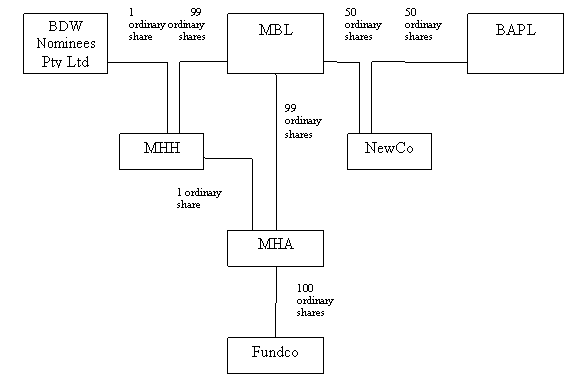

The one share owned by BDW Nominees Pty Ltd in MHH made the latter a non-wholly owned subsidiary of MBL controlled by MBL. The entity called “Fundco”, which would actually acquire the applicant’s shares in AXA Health, was MHF. The entity called “NewCo” was MB Health. Its role would be to acquire AXA health either by the exercise of a put option by the applicant to provide the applicant with a “fallback” method of completing the sale of AXA Health, or, in the event that that option were not exercised, by the acquisition of MHF from MHA. MB Health would also have the task of raising debt funding from the banks, and equity funding from MBL and BAPL, to fund the acquisition of AXA Health.
57 There were, of course, many other elements to the proposal put by Mr Facioni to the executives of MBL on 27 May 2002. A number of them are disclosed in the documents executed as between MBL and the applicant on 4 June 2002, to which I refer below. Others of them related to MBL’s own financing of the proposed transactions, to its risk and benefit analyses and to the interface between MBL and BUPA (and BAPL). It is not necessary to refer to them here. The executives approved the proposal, subject to 14 conditions, one of which (insisted on by Mr McWhinnie) was “receipt of all tax advices in final in accordance with verbal indications/drafts”.
58 On 30 May 2002, MBL, BAPL, MB Health and BUPA entered into an “Equity Participation Agreement”. The recitals referred to the Underwriting Agreement which was then shortly to be executed as between MBL and the applicant, and noted that MBL and BAPL had agreed to establish a consortium to own and operate AXA Health, and had established MB Health as the “vehicle” through which they would do so. A central term of the agreement was the following:
Subject to the terms of this document, Macquarie and BAPL establish themselves as a consortium to complete the Consortium Acquisition and for the other purposes described in this document.
The term “Consortium Acquisition” was defined as:
(a) if the Vendor Put Option is not exercised, the acquisition by MB Health of 100% of the issued shares in Fundco, subject to Fundco having been since MHA Close, the legal, equitable and beneficial owner of 100% of the issued shares in AXA Health and otherwise on the terms set out in the Consortium Acquisition Agreement; or
(b) if the Vendor Put Option is exercised, the acquisition by MB Health of 100% of the issued shares in MHA, subject to MHA having been since MHA Close, the legal, equitable and beneficial owner of 100% of the issued shares in Fundco and Funco having been since MHA Close, the legal, equitable and beneficial owner of 100% of the issued shares in AXA Health and otherwise on the terms of the Vendor Put Option and the MHA Acquisition Agreement.
The agreement defined “MHA Close” as “completion under the Underwriting Agreement” (as to which, see para 66 below). The “vendor put option” was the put option proposed to be granted to the applicant under the Underwriting Agreement in relation to its shares in MHA. By the Equity Participation Agreement, MB Health agreed to be nominated by MBL to grant that option.
59 In the Equity Participation Agreement, the “Interests” of the consortium members were identified as 50% for each of MBL and BAPL. That reflected their then shareholding in MB Health, the consortium vehicle. The word “Interest” was defined as:
… the agglomeration of interests and rights subject to the obligations and liabilities to or by which each of the Consortium Members is entitled or bound under this document, expressed as a percentage of 100% ownership. With effect from completion of the Consortium Acquisition, the Interests of the Consortium Members will be reflected in their respective holdings of MB Health Shares.
The interests of the consortium members were to be adjusted to take account of factors which included “any sell-down” by MBL under the agreement. As to that aspect, the agreement provided:
Macquarie, as a financial investor, intends to reduce its Equity Share by the Settlement Date. It may do this:
(a) by exercise of its put Options under clauses 11.1 and 11.3 (or as a result of exercise by BAPL of its call Option under clause 11.2); or
(b) by introducing additional financial investors (who are not Industry Participants) to the Consortium.
As the provisions just set out suggested, the Equity Participation Agreement provided for two put options (granted by BAPL to MBL) and for one call option (granted by MBL to BAPL) in relation to MBL’s shareholding in MB Health. Of those options, Mr Facioni said (in his affidavit sworn on 8 December 2008):
Under the restated EPA, BAPL granted MBL two put options and MBL granted BAPL a call option and certain pre-emptive rights. The put options allowed MBL to sell its shares in MB Health to BAPL at a discount. The first put option allowed MBL to sell approximately 60 per cent of its shares in MB Health at a discount. The second put option allowed MBL to sell the remaining 40 per cent of its shares in MB Health at a greater discount.
In the event that an IPO of AXA Health or other divestment option could not be achieved, MBL could, by exercising its put options, sell its interest in MB Health to BAPL at a pre-determined maximum loss. In the same circumstances, BAPL could, by exercising its call option, buy MBL’s interest in MB Health at a pre-determined price which would generate a profit to MBL. If an IPO could be achieved, the pre-emptive rights would allow BAPL to acquire MBL’s interest in MB Health (and thereby AXA Health) at a price set by reference to a broker valuation of the IPO.
60 The Equity Participation Agreement also required MB Health to enter into a “Consortium Acquisition Agreement”, the conditional terms of which were set out in a schedule to the agreement. By that conditional agreement, MHA would sell to MB Health all of the issued share capital in MHF. Such an agreement was in due course entered into, and I shall refer further to its terms below.
61 Also on 30 May 2002 (which was a Friday), MBL forwarded its “proposed offer” for the sale of AXA Health to the applicant, attaching agreements in executable form, in which it made its preparedness to execute those agreements conditional upon the applicant confirming in writing, by 7.00 pm on Monday 3 June 2002, that it (the applicant) had ceased discussions and negotiations with all other prospective bidders, including MBF. Indeed, MBL’s letter of 30 May stated that, absent the applicant indicating its intention to “proceed with [the] proposal” by 7.00 pm on 3 June, the proposal would be withdrawn. The applicant’s sub-committee met on the afternoon of 3 June 2002. It considered a further letter of that day from MBL which pointed out certain benefits which the MBL proposal involved for the applicant, and which extended the 7.00 pm deadline for acceptance to midnight. On the same day, Mr Owen wrote to Mr Conde indicating a preparedness to sign an agreement for the sale of AXA Health to MBF that day, so long as certain conditions could be met. Mr Owen spoke to Mr Conde by telephone on the evening of 3 June, in the course of which it became clear that the applicant would be unable to conclude an agreement with MBF. Mr Owen so informed the sub-committee at about 9.15 pm. The sub-committee then decided that the applicant should accept the offer from MBL.
62 MBL was informed of that decision. Negotiations between the applicant and MBL re-commenced at about 11.30 pm on 3 June 2002, an in-principle agreement was reached at about 9.00 am on 4 June 2002, the transaction documents were circulated for comment at about 1.00 pm, and the documents were executed at about 8.00 pm. The transaction documents so executed were the Underwriting Agreement, to which the parties were the applicant, MBL, MHA and MHH, and an “Equity Sell Down Agreement”, to which the parties were the applicant, MBL and MHA.
63 By cl 3.1 of the Underwriting Agreement, the structure thereof was explained as follows:
This agreement:
(a) gives effect to various rights in and imposes various obligations upon the parties which will subsist up until Completion. The rights and obligations are documented in the body of this agreement;
(b) requires AXA to exchange the Shares and MHA to acquire the Shares;
(c) requires the parties agree to enter into a number of subsequent commercial agreements (Subsequent Agreements); and
(d) sets out the broad commercial principles and terms which will form the basis of the Subsequent Agreements between the parties. These agreements will come into effect on Completion and include:
(1) an acknowledgement of the exchange of the Shares by AXA and purchase of the Shares by MHA (the Share Exchange Agreement) which will provide for an acknowledgement by AXA of receipt of the Purchase Price payable on Completion and an acknowledgement by the parties that the obligations of the parties that are required to be performed on Completion have been performed, but without prejudice to the parties’ rights under the Covenant Agreement;
(2) an agreement containing warranties, indemnities, undertakings and other rights and obligations of the parties that reflect the commercial and other terms contained in schedule 1 (the Covenant Agreement);
(3) documents recording the terms of the Vendor Put Option and the Call Options;
(4) a new constitution of MHA that reflects the provisions of schedules 2 and 3;
(5) the marketing and distribution agreement, service level agreement and head office lease agreements referred to in clauses 10, 11 and 14 respectively;
(6) an agreement reflecting the commercial and other terms in the Equity Sell Down Agreement.
By cl 3.2, the parties were to use their reasonable endeavours to negotiate and to enter into the “transaction documents” on or before 7 August 2002. The “transactions documents” were the binding agreements listed in cl 3.1(d), set out above. If the parties did not execute those documents by 7 August 2002, a dispute resolution procedure was to be invoked. That process would involve a mediator, whose function was to resolve disputed matters and to determine, not later than 4 October 2002, the form of the transaction documents which the parties were required to execute. The parties were, in such an event, required to execute the necessary documents no later than 11 October 2002.
64 Central provisions of the Underwriting Agreement were cll 4.1 and 4.2, which provided for the exchange of shares in AXA Health, as follows:
4.1 Exchange of Shares
The parties agree that on the Completion Date, AXA will exchange and MHA will buy the Shares for the Purchase Price free of Encumbrances and other third party rights.
4.2 Purchase Price
In exchange for the Shares:
(a) MHA will pay $57,600,000, which will be paid in cash to AXA on Completion, subject to adjustment in accordance with clause 4.3; and
(b) MHA will issue to AXA 537,400,000 fully paid Vendor Shares on Completion, which the parties agree will have a value of $537,400,000.
65 The Underwriting Agreement contemplated that, before completion, AXA Health might make an inter-company loan to the applicant of $25m. If no such loan were made, or if one were made yet repaid before completion, the applicant was obliged to procure AXA Health to reduce its capital and to pay a dividend to the applicant (such that the net tangible assets of AXA Health did not fall below $108m). In such an event, it was provided that a range of amendments would be deemed to have been made, including the substitution of the figures of $57m and $513m for the figures of $57.6m and $537.4m set out above. As events transpired, these amendments became active, such that the total price to be paid for AXA Health was $570m.
66 By the Underwriting Agreement, “completion” was defined as completion of the exchange of shares and, by cl 6, this was required to occur on the latest of 31 August 2002 (later amended to 30 August 2002), 20 days after the satisfaction of all conditions precedent and 20 days after the execution of the “transaction documents” (being the documents referred to in subcl (d) of the extract set out in par 63 above). It was provided that, on completion, the applicant was to transfer the shares in AXA Health to MHA, and MHA was to pay the sum of $57.6m to the applicant, and to deliver to the applicant a share certificate in respect of 537,400,000 vendor shares.
67 The Underwriting Agreement required MBL, on completion, to “procure that a Qualifying Person grants a put option on the terms set out in Schedule 4”. A “Qualifying Person” was defined as –
… a company which holds sufficient collateral in the form of cash on deposit or has procured the provision of one or more letters of credit issued by OECD banks with a minimum rating of BBB- from Standard & Poors or Baa3 from Moody’s in favour of [the applicant] which, if enforced, would enable that company to fulfil its obligations under the Vendor Put Option in a timely manner ….
Schedule 4 provided that the put option might be exercised at any time after “commencement” and before “expiry”, subject to certain presently irrelevant conditions. “Commencement” was defined as the earlier of six months after the grant of the option and the liquidation of MHA. It was provided that the option would “expire” if it had not been exercised within eight months of grant or by the time a notice of conversion of the vendor shares had been given by the applicant to MHA (whichever first occurred).
68 The Underwriting Agreement also required MBL and MHH, on completion, to grant to the applicant a call option over their ordinary shares in MHA (99 shares in the case of MBL and one share in the case of MHH). These options could be exercised only if the vendor shares were converted, and would expire if not exercised within two months after conversion or upon the exercise of the vendor put option (whichever first occurred). The exercise price under the call options was $1 per share. There was to be a “nominal consideration” paid by the applicant for the grant of these options.
69 The “vendor shares” were to be “convertible ordinary shares” in the capital of MHA, with the rights set out in Sch 3 to the Underwriting Agreement. The shares were to have an issue price of $1 each. The schedule defined an “initial period” as six months after completion, and provided:
At any time after the Initial Period, upon giving not less than 18 days notice to MHA the holder of a Vendor Share may irrevocably elect to convert each Vendor Share into one ordinary share in MHA, provided that conversion shall not be effected before cancellation redemption or buy-back of the RPS.
The “RPS” were the redeemable preference shares in MHA, to which I shall refer in the following paragraph. Schedule 3 further provided that the holder of the vendor shares would have four votes for every 100 such shares held at a general meeting. This would have given the applicant a 27.2% or, under the amendments referred to in para 65 above, a 26.5% vote at a general meeting of MHA. Holders of vendor shares were to have no entitlements on a distribution of the income or capital of MHA, save to the extent of four cents per share on a liquidation. The holders of the vendor shares were to be entitled to appoint one person as a non-executive director of MHA. It was also provided in Sch 3 that the constitution of MHA would be amended to provide for an extensive list of things that could not be done unless first approved by a special resolution of that company.
70 Schedule 2 of the Underwriting Agreement dealt with the redeemable preference shares to be held by MBL in MHA. There were to be 57,600,000 (or, under the amendments referred to in para 65 above, 57,000,000) such shares, carrying the same voting rights as ordinary shares. They were to mature on the earliest of the conversion of the vendor shares, the exercise of the vendor put option and the passing of eight months and one day after the date of issue. Upon maturity, the shares were to be cancelled, redeemed or bought back by MHA in consideration for MHA paying (presumably to MBL) the “maturity amount”, which was a sum which might vary depending upon which of certain events occurred. It is sufficient for present purposes to say that if MHA were liquidated or the vendor put option were exercised, the sum of $57.6m (or $57m) was to be paid. Otherwise, there would be no consideration.
71 By the Underwriting Agreement the applicant also agreed to pay MBL an “underwriting fee” of $5m on the completion date.
72 As provided in cl 3.1(d)(2) of the Underwriting Agreement, Sch 1 thereto set out the provisions that were to be the subject of a further agreement called the “Covenant Agreement”. The warranties – by the applicant and by MBL – referred to in the fourth and seventh drafts of the Underwriting Agreement were covered by this schedule. The only other provision presently necessary to note is par 11.3 of the schedule as follows:
11.3 Introduction of Newco
(a) The parties agree that MHA may, on Completion, direct [the applicant] to execute an instrument of transfer of the Shares to a wholly owned subsidiary (Newco) of MHA. The Transaction Documents will allow for this and, if required by MHA, will provide for Newco to be a party to the Transaction Documents and for Newco to enjoy such rights of MHA as are specified by MHA. The Transaction Documents will also ensure that no party is prejudiced by the introduction of Newco (including by ensuring that the arrangements in the Equity Sell Down Agreement operate in a manner which return the same profit to [the applicant]).
(b) If MHA gives a direction in accordance with paragraph 11.3(a) the duly executed instruments of transfer to be delivered by [the applicant] on Completion must be in favour of Newco.
73 The other document executed on 4 June 2002 was the Equity Sell Down Agreement, made between the applicant, MBL and MHA. The first three recitals thereto give an indication of its subject matter:
A. The parties have agreed in principle that [the applicant] will exchange and MHA will buy the Shares in accordance with the Underwriting Agreement.
B. The parties have also agreed to enter into a separate arrangement whereby MBL will procure that, in the event of a subsequent Sale or IPO and subject to certain conditions applying, an Equity Sell Down Payment may be made to [the applicant].
C. [the applicant] has agreed to make a payment to MBL in consideration for MBL procuring that MHA satisfies its obligations as set out in this agreement.
74 The agreement referred to the “transaction documents” which were later to be executed (being the documents set out in cl 3.1(d) of the provision referred to in para 63 above) and required that those documents contain detailed provisions governing the making of “equity sell down payments” in accordance with principles set out in the agreement. The agreement stated the circumstances in which a payment would, or would not, be made and how the level of the payment would be calculated. It is not necessary to refer further to the detail of these provisions. It is sufficient to say that they were calculated to enable the applicant to participate in such profit as may be made by the on-sale of AXA Health, while at the same time allowing MBL a return on its investment. The agreement treated differently a direct on-sale by MHA itself and a subsequent on-sale by any consortium which obtained AXA Health shares from MHA. The agreement also expressly allowed for the possibility that MHA might wish “to interpose a wholly owned subsidiary (Newco) between itself and [AXA Health]”: in such a case, the applicant was not to be any the worse off for that interposition such that, in general terms, its entitlements as against “Newco” would be no inferior to those which it would otherwise have as against MHA. The applicant also agreed to pay MBL an “equity sell down fee” of $5m “in consideration for MBL procuring that MHA satisfies its obligations under this agreement….” The fee was payable six months after the completion date.
75 The parties’ activities between 4 June 2002 and 30 August 2002 were explained in the affidavit of Ms Birch:
Following the execution of the Underwriting Agreement and the Equity Sell Down Agreement on 4 June 2002, there was a period of intense negotiations between the parties. These negotiations were in respect of the subsequent legal agreements to be entered into by the parties on or before 30 August 2002 as a condition to completion of the transaction….
The most important transaction document was the Covenant Agreement. I recall that there were a number of negotiations and disputes between the parties in relation to the warranties to be provided by the parties under the Covenant Agreement. The warranties to be provided by MBL had the purpose of ensuring that the profitability of AXA Health would be maintained throughout the underwriting period. This would safeguard the Applicant’s position in the event that an on-sale of AXA Health could not be successfully achieved and the Applicant chose to re-acquire AXA Health. The negotiations continued right up to 30 August 2002 and were both intense and vigorous until the transaction documents were executed. During August 2002, the parties and their advisors worked around the clock in order to have all the transaction documents negotiated and drafted in time for settlement.
76 It seems that the last week before execution of the transaction documents was a very busy time for all concerned. On 25 August 2002, the parties on the BUPA side of MBL, as it were, executed a deed to amend the Equity Participation Agreement. In relation to MBL’s shareholding in MB Health, BAPL granted to MBL a put option and MBL granted to BAPL a call option, the exercise of which in each case was tied to the exercise by the applicant of its right to convert its vendor shares in MHA, the exercise by the applicant of its put option over those shares, or the expiry of that put option, as the case required. On the same day, those parties executed a shareholders’ deed to regulate the operation and governance of MB Health.
77 On 26 August 2002 the applicant, MBL, MHA and MHH by deed amended the Underwriting Agreement. One of the amendments was to replace cl 4.1 with the following:
“4.1 Exchange of Shares
(a) The parties agree that on the Completion Date, AXA will exchange and MHA will buy the Shares for the Purchase Price free of Encumbrances and other third party rights.
(b) MHA may, on Completion, direct AXA to execute an instrument of transfer of the Shares to Newco or other nominee company.
(c) Where MHA gives a direction in accordance with clause 4.1(b), the duly executed instruments of transfer to be delivered by AXA on Completion must be in favour of Newco or other nominee company.”
On the same day, the applicant, MBL, MHA and MHF by deed replaced the Equity Sell Down Agreement. At least to the extent relevant for present purposes, what I have written in para 74 may likewise be said about the deed of 26 August (save for the fact that “NewCo” had by then been interposed in the form of MHF, and was itself a party to the deed). On the same day, the applicant, MBL, MHA, MHH and The National Mutual Life Association of Australasia Limited executed the Covenant Agreement. It contained a range of provisions calculated to govern the parties’ obligations in the intervening period while the commercial business of AXA Health was effectively under the control of MBL, but might (depending on how matters turned out) ultimately be returned to the applicant. They included a provision substantially to the effect of the non-consolidation warranty in the Underwriting Agreement (see para 51 above) and a provision in the same terms as that set out in para 52 above. They did not, however, include the provision which had been par 11.3 of Sch 1 to the Underwriting Agreement, since a provision to substantially the same effect had now become part of the Underwriting Agreement itself (the replacement cl 4.1 to which I have referred above).
78 On 29 August 2002, MHA and MHF entered into what was described as “MHA Undertaking”. By it, MHA agreed to direct the applicant to execute an instrument of transfer of its shares in AXA Health to MHF, and agreed to pay the applicant the purchase price for those shares. MHA assigned to MHF certain benefits, or expected benefits, arising under detailed provisions of other instruments then executed or expected to be executed. The consideration passing from MHF to MHA was an agreement to issue to MHA, upon completion under the Underwriting Agreement, 240,000,000 ordinary shares in MHF (of a value, it seems, of $240m). MHF also agreed to pay to MHA, on the “settlement date”, the sum of $330m, described as “deferred consideration”. The “settlement date” was the earlier of two dates, one of which was the date specified by the applicant for the conversion of its vendor shares in MHA in a notice of intention to convert (if one were given) in that behalf. As will appear, the combination of these sums ($240m and $330m) represented the agreed sale price of AXA Health ($570m).
79 On 29 August 2002, MHA and MB Health executed an agreement called “Consortium Acquisition Agreement”. A condition precedent to the operation of that agreement was that the applicant was no longer able to exercise the put option granted to it by MB Health in relation to its vendor shares in MHA. The terms of the put option were such that, if the applicant had given a notice to convert the vendor shares into ordinary shares, it could no longer be exercised. The effect of these provisions was, therefore, that the giving by the applicant of a notice of conversion in relation to the vendor shares would bring the Consortium Acquisition Agreement into operation. Under that agreement, MHA agreed to sell and MB Health agreed to buy all of the issued share capital in MHF.
80 On 30 August 2002, MHA directed the applicant to execute an instrument of transfer of its shares in AXA Health to MHF, such a transfer took place, MHA paid the applicant the sum of $57m in cash, MHA issued 513,000,000 $1 convertible preference shares to the applicant, MBL and MHH granted to the applicant call options over the ordinary shares held by them in MHA, and MB Health granted to the applicant a put option over the convertible vendor shares. The applicant also paid to MBL the underwriting fee of $5m. MBL subscribed to 57,000,000 $1 redeemable preference shares in MHA, and paid $57m to MHA in respect of that issue. The particular aspect of these transactions which is controversial in the present proceeding is that by which the applicant divested itself of its shares in AXA Health and received 513,000,000 shares in MHA by way of partial consideration.
81 On 7 February 2003 the applicant gave notice of the conversion of its vendor shares in MHA, effective on 28 February 2003. On the same date, the applicant also exercised the call options granted by MBL and MHH. As explained above, the former event triggered the operation of the consortium acquisition agreement as between MHA and MB Health and the “MHA Undertaking” as between MHA and MHF. MHA’s shareholding in MHF was acquired by MB Health for the sum of $240m, and MHF paid MHA the “deferred consideration” which, after adjustment, amounted to $317.85m. In the result, MHA’s only asset was cash in the sum of $557.85m. MHF, which owned all the shares in AXA Health, was in turn owned by MB Health.
ARM’S LENGTH
82 The assessable income of a taxpayer includes “your net capital gain for the income year”: 1997 Act, s 102-5. A capital gain occurs if a CGT event happens: s 102-20. CGT event A1 occurs on the disposal of a CGT asset: s 104-10. The applicant’s shares in AXA Health were a CGT asset: s 108-5. They were disposed of to MHF in the substituted tax year ending on 31 December 2002. The proceeds of that disposal ($570m) exceeded the cost base of the shares. A part of the consideration for the disposal of the shares – $513m in value – was given by way of shares in MHA. According to the case of the applicant, there was, to that extent, what the 1997 Act describes as a “scrip-for-scrip roll-over”. If so, the applicant was and is permitted to defer “the making of a capital gain … until a later CGT event happens”: s 112-105.
83 The rules for determining whether there was a scrip-for-scrip roll-over are set out in Subdiv 124-M of the 1997 Act. The central provision is s 124-780, which is as follows:
(1) There is a roll-over if:
(a) an entity (the original interest holder) exchanges:
(i) a share (the entity's original interest) in a company (the original entity) for a share (the holder's replacement interest) in another company; or
(ii) an option, right or similar interest (also the holder's original interest) issued by the original entity that gives the holder an entitlement to acquire a share in the original entity for a similar interest (also the holder's replacement interest) in another company; and
(b) the exchange is in consequence of a single arrangement that satisfies subsection (2); and
(c) the conditions in subsection (3) are satisfied; and
(d) if subsection (4) applies, the conditions in subsection (5) are satisfied.
(2) The arrangement must:
(a) result in:
(i) a company (the acquiring entity) that is not a member of a wholly owned group becoming the owner of 80% or more of the voting shares in the original entity; or
(ii) a company (also an acquiring entity) that is a member of such a group increasing the percentage of voting shares that it owns in the original entity, and that company or members of the group becoming the owner of 80% or more of those shares; and
(b) be one in which at least all owners of voting shares in the original entity (except a company referred to in paragraph (a)) could participate; and
(c) be one in which participation was available on substantially the same terms for all of the owners of interests of a particular type in the original entity.
(3) The conditions are:
(a) the original interest holder acquired its original interest on or after 20 September 1985; and
(b) apart from the roll over, it would make a capital gain from a CGT event happening in relation to its original interest; and
(c) its replacement interest is in a company (the replacement entity) that is:
(i) the company referred to in subparagraph (2)(a)(i); or
(ii) in any other case—the ultimate holding company of the wholly owned group; and
(d) the original interest holder chooses to obtain the roll over or, if section 124 782 applies to it for the arrangement, it and the replacement entity jointly choose to obtain the roll over; and
(e) if that section applies, the original interest holder informs the replacement entity in writing of the cost base of its original interest worked out just before a CGT event happened in relation to it.
(4) The conditions specified in subsection (5) must be satisfied if the original interest holder and an acquiring entity did not deal with each other at arm’s length and:
(a) neither the original entity nor the replacement entity had at least 300 members just before the arrangement started; or
(b) the original interest holder, the original entity and an acquiring entity were all members of the same linked group just before that time.
(5) The conditions are:
(a) the market value of the original interest holder’s capital proceeds for the exchange is at least substantially the same as the market value of its original interest; and
(b) its replacement interest carries the same kind of rights and obligations as those attached to its original interest.
(6) This section applies to the holder of a Chess Unit of Foreign Security as if the holder held the underlying interests that the unit represents.
(7) A company is the ultimate holding company of a wholly owned group if it is not a 100% subsidiary of another company in the group.
Paragraph (d) of s 124-780(3) is relevant in the present case. It refers to s 124-782, subs (1) of which reads as follows:
(1) The cost base of an original interest acquired by an acquiring entity under the arrangement from an original interest holder becomes the first element of the cost base and reduced cost base of the acquiring entity for the interest if:
(a) the original interest holder obtains a roll-over; and
(b) the holder is a significant stakeholder or a common stakeholder for the arrangement.
The concept of a “significant stakeholder” is explained in s 124-783(1) and (7) as follows:
(1) An original interest holder is a significant stakeholder for an arrangement if it had:
(a) a significant stake in the original entity just before the arrangement started; and
(b) a significant stake in the replacement entity just after the arrangement was completed.
(7) An entity has a significant stake in a trust at a time if the entity, or the entity and the entity’s associates between them, had at that time the right to receive for their own benefit 30% or more of any distribution to beneficiaries of the trust of income or capital of the trust.
84 It was submitted on behalf of the Commissioner that the applicant (“the original interest holder”) and MHF (“the acquiring entity”) did not deal with each “at arm’s length”. If they did not, by the operation of subs (4) of s 124-780 of the 1997 Act, the arrangement involved in the scrip-for-scrip exchange would have to satisfy the conditions set out in subs (5): see par (d) of subs (1). It was common ground that the arrangement in the present case did not satisfy those conditions. For the applicant, therefore, it was essential that it be held that it dealt with MHF at arm’s length. At this level, both sides conducted their cases on the basis that the question was whether the applicant dealt with MBL at arm’s length, no difference being made by the circumstance that MHF was the entity actually involved in receiving the applicant’s shares in AXA Health.
85 The Commissioner accepted that the relationship between the applicant and MBL was an arm’s length one. He accepted also that, in the broad negotiation of the terms of the transactions by which the shares in AXA Health passed to MHF, the applicant and MBL dealt with each other at arm’s length. I need only add that no position to the contrary would have been tenable. The applicant and MBL were two completely separate public companies whose commercial interests were (save arguably for the matters to which I shall next turn) in no sense aligned.
86 It was argued on behalf of the Commissioner, however, that there were two structural aspects of the arrangements entered into for the sale of AXA Health which were explicable only on the basis of a bilateral intention that those arrangements should qualify for scrip-for-scrip relief under Subdiv 124-M, and that the parties, although otherwise dealing with each other at arm’s length, had “colluded” to obtain that relief. That measure of collusion made relevant, it was submitted, certain authorities which dealt with the matter of arm’s length transactions, to which I shall refer presently. Before doing so, I should explain how the Commissioner seeks to use the provisions of Subdiv 124-M, and their operation in the context of the structural aspects of the arrangements to which I have referred, and make some findings of fact in that regard.
87 The Commissioner points first to what was described as the “de-grouping” of MHH, that is to say, to the circumstance that MHH was not wholly-owned by MBL (it will be remembered that one share, out of 100 shares in total, in MHH was owned by BDW Nominees Pty Ltd). This meant that MHA was the “ultimate holding company of the wholly-owned group” within the meaning of s 124-780(3)(c)(ii) and (7). It enabled the arrangements as a whole to satisfy that particular condition of a scrip-for-scrip roll-over. The Commissioner next points to the circumstance – which he submits was quite deliberate – that the applicant’s voting rights in MHA arising from its vendor shares before conversion were less than 30% (it will be remembered that those rights were of the order of 26.5% – just enough to enable the applicant to block the passage of a special resolution). This meant that the applicant was not a “significant stakeholder” within the terms of s 124-782, and that it was sufficient for the applicant alone to choose to obtain the roll-over within the meaning of par (d) of s 124-780(3). Otherwise, the applicant’s (low) cost base in relation to the shares in AXA Health would, in effect, have been transferred to MHF, and the latter would have itself faced a potential capital gains tax liability. Since, according to the Commissioner, it was always the intention of MBL to on-sell the shares in AXA Health, such an outcome would have impaired the achievement of MBL’s commercial objectives generally. These aspects of the arrangements, according to the Commissioner, give rise to the clearest of inferences that the parties so structured their arrangements as to maximise the prospect that the applicant would obtain scrip-for-scrip roll-over relief, and justify the conclusion that they were not in relevant respects dealing with each other at arm’s length.
88 It appears to have been within the contemplation of Mr Facioni and others within MBL PTG since at least early December 2001 that any acquisition of AXA Health would be done in a way that did not involve any consequential capital gains tax liability for the applicant (see para 9 above). In all of the evidence in the case, no explanation for a large part of the consideration flowing to the applicant in the form of stock, other than to take advantage of the scrip-for-scrip roll-over provisions, was proffered. The first documentary indication that this would require the acquiring company not to be wholly-owned by MBL, however, came on 25 February 2002. Although the explicit details of the proposed structure were not shown in the non-binding bid of 1 March 2002, the annexure made it clear that the acquiring entity would be a non-wholly owned member of the MBL group. Mr Upfold thought that he had most likely been responsible for the terms of that annexure. He could not recall why it was thought desirable to split up the equity of that entity in the way that was proposed, but he knew that the availability of scrip-for-scrip roll-over relief was a feature of the structure that would be attractive to the applicant.
89 Mr Upfold also said that avoiding the risk of AXA Health being consolidated into the MBL group was a “feature” of the structure being proposed by MBL PTG. Although he was cross-examined on his evidence about consolidation generally, he was not challenged as to the timing of his group’s concern about consolidation. The evidence was that the exposure draft of the relevant amendments to the legislation was released in February 2002. The first documentary evidence of the intention to “de-group” MHA was dated 25 February 2002. It is conceivable, therefore, that a concern to avoid AXA Health being consolidated into the MBL group was a part of the reason for that aspect of the structure. On the other hand, as I have indicated, recourse to the scrip-for-scrip roll-over relief provisions was, it seems, intended from at least the first week of December 2001. On this state of the evidence, the furthest I can go is to find that the establishment of MHH as a non-wholly-owned subsidiary of MBL was done at least to satisfy the condition in s 124-780(3)(c)(ii), and may also have been done in part because of a concern about consolidation.
90 So far as the applicant is concerned, more or less from the outset it was aware that the MBL bid was structured so that capital gains tax would not arise on any resulting transaction. That circumstance was recognised as an attractive feature of the bid. I so find, notwithstanding the evidence of Mr Allert, that the applicant would have proceeded with the sale to MBL even in the absence of capital gains tax relief. Mr Culliver took the necessary advice and satisfied himself that the applicant would be able to avail itself of the scrip-for-scrip roll-over provisions. He does not now recall the minutiae of his deliberations in that regard, but he accepts that he closely reviewed the requirements of s 124-780. I infer (and the contrary was not seriously submitted by the applicant) that he satisfied himself that, on completion under the Underwriting Agreement, MHA would be the ultimate holding company within the meaning of s 124-780(3)(c)(ii) and (7).
91 Likewise, I consider it to be almost self-evident that MBL’s intention was that capital gains tax not be payable by any relevant entity at any stage of the proposed transactions. MBL took the taxation consequences of those transactions into account at a high level: Mr McWhinnie approved of the bid for AXA Health. He ensured that MBL took counsel’s advice. If the structure were designed to ensure that the applicant would not pay capital gains tax on the transfer of the shares, I consider it to be quite improbable that MBL would have intended that a CGT liability would fall upon MHF. Such a liability would have arisen if the applicant were a significant stakeholder in MHA, that is to say, if it ended up with 30% or more of the voting rights in MHA. As it happens, MBL originally proposed that the applicant’s voting power in MHA, during the six-month period, would be little more than nominal. It was the applicant which insisted on having more than 25% voting rights. It did so for reasons which had nothing to do with tax. So long as it got what it wanted in that regard, there seems no particular reason why it should insist on having more than 30%. On any view, it was a significant commercial aspect of the arrangement that MBL should have more than 50% – to give it effective control – and I can think of no particular reason to suppose that 35%, 40% or 45%, for instance, should have been regarded by the applicant as more obviously appropriate than the 26.5% which it eventually got.
92 In the outline of submissions filed on behalf of the Commissioner, it was proposed that the court should find that “the parties colluded to achieve [the purpose of minimising tax], independently of and in addition to, the commercial purposes they were pursuing.” “Collusion” finds no express mention in Subdiv 124-M, but counsel for the Commissioner submitted that, where present, it would disqualify an arrangement from “arm’s length” status. That was said to be the result of the judgment of Dodds-Streeton J in ACI Operations Pty Ltd v Berri Ltd (2005) 15 VR 312. I shall refer to that presently, but before doing so I propose to turn to the jurisprudence of this court on the matter of arm’s length dealings.
93 The starting point is the judgment of the Full Court in Australian Trade Commission v WA Meat Exports Pty Ltd (1987) 75 ALR 287, an appeal from the Administrative Appeals Tribunal. The question before the Tribunal had been whether the respondent was entitled to an export grant with respect to consultants’ fees which it had paid. There was no such entitlement if the payee was a “prescribed associate” within the meaning of the Export Market Development Grants Act 1974 (Cth); and a “prescribed associate” was defined to include “any person determined by the Board to be a person not at arm’s length with the claimant ….” The Full Court said (75 ALR at 291):
The first matter to be determined is the meaning of the phrase “not at arm's length” where used in s 4(8). It is, of course, often found in revenue statutes (see, eg Income Tax Assessment Act 1936 (Cth) s 136 ad; cf Robson Leather Co Ltd v M N R 77 DTC 5106). The ordinary meaning of the phrase is explained in Osborn's Concise Law Dictionary, 6th ed, p 32: “The relationship which exists between parties who are strangers to each other, and who bear no special duty, obligation, or relation to each other, eg vendor and purchaser: cf undue influence.”
A similar explanation is given by Black's Law Dictionary, 5th ed, p 100: “Arm's length transaction. Said of a transaction negotiated by unrelated parties, each acting in his or her own self interest; the basis for a fair market value determination. Commonly applied in areas of taxation when there are dealings between related corporations, eg parent and subsidiary. Inecto Inc v Higgins, DCNY, 21 F Supp 418. The standard under which unrelated parties, each acting in his or her own best interest, would carry out a particular transaction. For example, if a corporation sells property to its sole shareholder for $10,000, in testing whether $10,000 is an ‘arm's length’ price it must be ascertained for how much the corporation could have sold the property to a disinterested third party in a bargained transaction.”
The Full Court held, in the circumstances of the case before it, that there was no reason not to apply these meanings of the concept of being at “arm’s length”, which their Honours considered were the ordinary meanings.
94 Re Hains (decd);Barnsdall v Federal Commissioner of Taxation (1988) 81 ALR 173 was an income tax case in which, under s 26AAA of the 1936 Act, property could be deemed to have been sold for a consideration equal to what the legislation called “the relevant amount” where, amongst other things, “the Commissioner [was] satisfied that, having regard to any connection between the taxpayer and the person to whom the property is … sold or any other relevant circumstances, the taxpayer and the other person were not dealing with each other at arm’s length….” It was tolerably clear that the taxpayer and the person to whom the property in question was sold were not at arm’s length as a matter of relationship, since the other person was the taxpayer’s own company. However, Davies J accepted the submission on behalf of the taxpayer that there was a distinction between parties who were not at arm’s length as a matter of relationship, on the one hand, and parties who dealt with each other at arm’s length, on the other hand. His Honour held that parties not at arm’s length might nonetheless deal with each other at arm’s length, and it was the latter concept that was the subject of the legislation with which he was concerned.
95 The distinction referred to in Hains was adopted by Hill J in Trustee for the Estate of the Late AW Furse (No 5) Will Trust v Federal Commissioner of Taxation (1990) 21 ATR 1123. This was also an income tax case which came to the court from the Administrative Appeals Tribunal. The question was whether certain distributions made by a trust were “excepted trust income” in relation to particular beneficiaries. An aspect of that question invoked considerations arising under s 102AG(3) of the 1936 Act, which was as follows:
Subject to subsection (4), if any 2 or more parties to:
(a) the derivation of the excepted trust income mentioned in subsection (2); or
(b) any act or transaction directly or indirectly connected with the derivation of that excepted trust income;
were not dealing with each other at arm’s length in relation to the derivation, or in relation to the act or transaction, the excepted trust income is only so much (if any) of that income as would have been derived if they had been dealing with each other at arm’s length in relation to the derivation, or in relation to the act or transaction.
Hill J said (21 ATR at 1132):
The first of the two issues is not to be decided solely by asking whether the parties to the relevant agreement were at arm's length to each other. The emphasis in the subsection is rather upon whether those parties, in relation to the agreement, dealt with each other at arm's length. The fact that the parties are themselves not at arm's length does not mean that they may not, in respect of a particular dealing, deal with each other at arm's length. This is not to say that the relationship between the parties is irrelevant to the issue to be determined under the subsection.
His Honour referred to the judgment of Davies J in Re Hains, and continued (at 1132):
What is required in determining whether parties dealt with each other in respect of a particular dealing at arm's length is an assessment whether in respect of that dealing they dealt with each other as arm's length parties would normally do, so that the outcome of their dealing is a matter of real bargaining.
96 Granby Pty Ltd v Federal Commissioner of Taxation (1995) 129 ALR 503 was a capital gains tax case which came to the court from the Administrative Appeals Tribunal. Section 160ZH(9) of the 1936 Act was a deeming provision which operated in the working out of the cost base, or the reduced cost base, of an asset. An aspect of the operation of that subsection (expressed alternatively) was that the consideration paid or given by the taxpayer in respect of the acquisition of the asset would be greater or less than the market value of the asset, “and the taxpayer and the person from whom the taxpayer acquired the asset were not dealing with each other at arm’s length in connection with the acquisition of the asset ….” Lee J said (129 ALR at 506):
The expression “dealing with each other at arm's length” involves an analysis of the manner in which the parties to a transaction conducted themselves in forming that transaction. What is asked is whether the parties behaved in the manner in which parties at arm's length would be expected to behave in conducting their affairs. Of course, it is relevant to that inquiry to determine the nature of the relationship between the parties, for if the parties are not parties at arm's length the inference may be drawn that they did not deal with each other at arm's length.
For the purpose of s 160ZH(9), Lee J considered that the expression “at arm’s length” meant “at least, that the parties to a transaction have acted severally and independently in forming their bargain”. His Honour continued (at 507):
If the parties to the transaction are at arm's length it will follow, usually, that the parties will have dealt with each other at arm's length. That is, the separate minds and wills of the parties will be applied to the bargaining process whatever the outcome of the bargain may be.
That is not to say, however, that parties at arm's length will be dealing with each other at arm's length in a transaction in which they collude to achieve a particular result, or in which one of the parties submits the exercise of its will to the dictation of the other, perhaps, to promote the interests of the other. As in Minister of National Revenue v Merritt 69 DTC 5159 at 5166 where the parties to the transaction were parties at arm's length, the terms of a loan transaction made between them had been dictated by a unilateral decision of one of them and no independent will in the formation of that transaction had been exercised by the other. It followed that it could not be said that the parties had dealt with each other at arm's length at the material time: cf Robinson v Minister of National Revenue [1987] 1 CTC 2055.
97 Collis v Federal Commissioner of Taxation (1996) 33 ATR 438 was also an income tax appeal from the Administrative Appeals Tribunal, this time in connection with the early resale of a parcel of land recently acquired. The parcel had been purchased for the sum of $200,000, and was promptly resold, together with three adjoining parcels (of approximately equivalent dimensions, so it seems) for the sum of $1,430,000. All four parcels were resold to a stranger on the fall of the auctioneer’s hammer. The taxpayer (the vendor) requested the purchaser to sign two contracts for sale, one in respect of the parcel of land recently purchased (with a sale price of $200,000) and the other in respect of the three parcels of land previously owned (with a sale price of $1,230,000). Acting under s 26AAA(4) of the 1936 Act, the Commissioner took the view that “having regard to any connection between the taxpayer and the person to whom the property is sold or any other relevant circumstances, the taxpayer and the other person were not dealing with each other at arm’s length ….” Jenkinson J held that the Tribunal had been entitled to conclude that the purchaser was indifferent to whether he made two contracts with the taxpayer, or one. His Honour referred to the extracts from Granby which I have set out above, and agreed with them. He drew the inference that the purchaser “being indifferent, submitted the exercise of his will to the applicant’s wishes in acceding to their request [ie to have two contracts]”.
98 It is apparent from the foregoing authorities that the inherent content of the expression “arm’s length” is the “ordinary meaning” to be extracted from the legal dictionaries, referred to by the Full Court in WA Meat Exports. To that conclusion, however, must be added three related riders. First, there is a difference between an arm’s length relationship and an arm’s length dealing. Secondly, the fact that parties are not in an arm’s length relationship will not disqualify a dealing between them from characterisation as an arm’s length one, if other facts and circumstances favour such a result. Thirdly, and obversely, it does not follow from the fact that parties are in an arm’s length relationship that a dealing between them must be characterised as an arm’s length one, if the facts and circumstances generally suggest otherwise. Hains was an example of the second situation. Collis was an example of the third.
99 It is the third situation which, on the submission of the Commissioner, arises in the present case. The Commissioner relies upon the reference in Granby to collusion (and the adoption of that notion in Collis) to submit that, on the facts of the present case, the applicant and MBL colluded to structure their transaction in a way that would attract scrip-for-scrip roll-over relief. Indeed, it is submitted on behalf of the Commissioner that the present is a stronger case than one in which a third party merely submits the exercise of his or her will to the wishes of the putative taxpayer: it is said that the third party (MBL) actively and consciously participated in steps which would be to the taxpayer’s fiscal advantage, and which were otherwise commercially irrelevant.
100 Here it is necessary to return to ACI Operations, from which the Commissioner claims to derive the most directly relevant support. That was not a tax case. It concerned a contract for the exclusive right to supply the manufacturer of fruit juices with certain packaging products. The contract provided for exceptions to this right (to the specific content of which it is unnecessary to turn) in circumstances in which the manufacturer received a “bona fide arm’s length” offer from a third party to supply similar packaging products. On the facts of the case, the manufacturer had entered into a contract with a third party for the supply of similar products, which caused the original supplier to seek, and to obtain, a judgment from the Supreme Court of Victoria against the manufacturer. Relying on that judgment, the manufacturer rescinded the contract it had made with the third party, whilst, it seems, at the same time inviting the third party to enter into a further contract for the supply of packaging materials, this time pursuant to what was said to be an obligation to mitigate its damages. Thus a second contract came into existence. Unsurprisingly perhaps, that contract was also challenged by the original supplier, and that challenge was the subject of the judgment of Dodds-Streeton J upon which the Commissioner relies.
101 Her Honour did not hold that the new offer from the third party (ie the one said to be by way of mitigation) was not bona fide. However, she did hold that it was not an “arm’s length” offer. Her Honour rehearsed the taxation judgments of this court to which I have referred, and said (15 VR at 334 [223]-[224]):
The above authorities indicate that an arm’s length relationship is that of strangers, or parties who are unaffected by existing mutual duties, liabilities, obligations, cross-ownership of assets, or identity of interests which might: (a) enable either party to influence or control the other; or (b) induce either party to serve that common interest in such a way as to modify the terms on which strangers would deal.
The concept of an arm’s length relationship is distinct from that of an arm’s length dealing or transaction, despite the potential overlap. Unrelated parties may collude or otherwise deal with each other in an interested way, so that neither the dealing nor the resultant transaction may properly be considered arm’s length.
Her Honour’s conclusion on the facts of the case were as follows (15 VR at 336 [239]-[241]):
The overriding requirement that the third party offer be “arm’s length” is, in my view, incompatible with Berri’s liability to pay a sum of dual character, which is both essential to procure the extended term of the offer and also constitutes the prepayment of estimated damages for an antecedent breach of legal obligation.
In my opinion, Berri and Brickwood commenced and conducted negotiations in relation to the Brickwood offer as parties who shared a common interest in minimising damages for the breach of the Brickwood contract. Berri’s breach of the Brickwood contract, its solicitation of the Brickwood offer, and the making of the Brickwood offer were interdependent.
Although “real bargaining” occurred between Berri and Brickwood, their dealings were, throughout, permeated and dominated by the mutual claims arising from the breach of the Brickwood contract. It cannot be said that neither party had any interest to pay more or receive less for the specified products, Australian Trade Commission v WA Meat Exports Pty Ltd (above) at 291, the prices of which ACI would be obliged to match in order to keep Berri’s business. The evidence of the dealings does not rebut, but rather confirms, the inference that the parties were not dealing arm’s length. An integral element of the resultant Brickwood offer as extended is the provision for a series of payments by Berri to Brickwood which simultaneously secures its extended term and satisfies Brickwood’s estimated damages claim.
Counsel for the Commissioner relied particularly on so much of Dodds-Streeton J’s judgment as commences “Unrelated parties…”. I would, with respect, regard that passage as unobjectionable, but it expresses the point at a very high level of generality. It leaves open the factual, and I consider more problematic, questions which will arise in every case whether there was “collusion” or rehearsed dealings to the extent sufficient to justify the conclusion that the parties did not deal with each other at arm’s length. Her Honour had to grapple with those questions in the second group of paragraphs which I have set out above, from which it appears that the facts and dynamics of the case before her were very different from those of the present case.
102 As against the authorities to which I have referred, counsel for the applicant relied upon Baxter v Commissioner of Taxation (2002) 196 ALR 519. That was a sales tax case concerning a yacht imported from Finland. The yacht was the subject of a “lease” which, as found by Gyles J, had the main purpose of facilitating the importation of the yacht without payment of sales tax. In this respect, Gyles J made the following findings (196 ALR at 531 [37]):
Indeed, I am satisfied that the main purpose of the lease was in order to import the yacht without payment of sales tax. The terms of the lease were quite uncommercial. The return on capital was minuscule, there was no substantial business or personal advantage to the lessor, the risk was with the lessor and there were maintenance obligations. The contemporaneous documents relevant to taxation show that the applicant was working on the basis that the lease would be an eligible long-term lease. I am satisfied that the intention of the applicant was to use the yacht as pleasure craft for his personal use once the statutory period expired. I do not accept that any inchoate and sketchy intentions as to business dealings with Bell were likely to interfere with his use of the yacht in the medium and long-term. I place no reliance upon the further leases which have in fact taken place. Firstly, there is no acceptable evidence that they were envisaged at or around the time of import of the yacht. Secondly, the further leases were entered into at a time when the relationship was under known scrutiny by the respondent.
The statutory provision under which Gyles J was obliged to consider the “arm’s length” point was s 94(1) of the Sales Tax Assessment Act 1992(Cth), which made a distinction between a “non-arm’s length transaction” and an “arm’s length transaction”. His Honour said (at 532 [38]):
I have particular difficulty in isolating and understanding the nature and characteristics of a non-arm's length transaction between parties who are at arm's length. In the present case, Messrs Baxter and Bell were at arm's length – there was no relevant relationship between them. The lease had advantages for each, albeit in the case of the applicant they were, substantially, collateral revenue advantages. I have found that the lease was a genuine transaction. The fact that it was fairly obviously devised in order to obtain a revenue advantage does not, in my opinion, make it a non-arm's length transaction, no matter how widely that concept is construed.
His Honour held that the lease was not a “non-arm’s length transaction” within the terms of s 94(1).
103 Returning to the facts of the present case, Mr Owen and Mr Penn denied that the applicant, in relation to the proposed sale of AXA Health, colluded with MBL to devise a means to avoid the incidence of capital gains tax (or at all). I accept that evidence. Indeed, if counsel for the Commissioner pressed (in their final address) the submission that there had been collusion, they did so faintly. There was no evidence of any collaboration between the applicant and MBL with respect to what the Commissioner referred to as the de-grouping of MHH. There is no suggestion in the evidence that the applicant, or any of its directors or senior executives, knew before 1 March 2002 that MBL proposed a structure in which the acquirer of AXA Health shares would not be wholly-owned by MBL. The applicant understood that, under the MBL bid, there would be what Mr Allert described as “roll-over relief on the capital gain”. I consider that at least those with an appreciation of how the 1997 Act relevantly worked within the applicant, most notably Mr Culliver, understood those aspects of the architecture of the bid that would achieve that result. But this, in my opinion, amounts neither to collusion nor to the submission of the will of MBL to the wishes of the applicant (or vice-versa).
104 Neither do I accept the Commissioner’s submission that the present is a stronger case than Collis for the reason that the putative disinterested party (MBL) actively co-operated to achieve the fiscal advantage sought by the putative taxpayer (the applicant). In my view, the present is a different case from Collis. There, the parties, having made their commercial bargain on the fall of the auctioneer’s hammer, manipulated the legal expression of that bargain for fiscal purposes. That could only be done by a consensus driven either by a mutual desire to achieve those purposes or by the submission of the will of one to the wishes of the other. Here, by contrast, the corporate structure lying behind MHA was the doing of MBL alone. The architecture of that structure was integral to the MBL offer which the applicant accepted. It truly reflected the commercial reality of what was agreed. True it is that that architecture made the MBL bid the more attractive for the applicant, but I cannot, with respect to the Commissioner, appreciate how that circumstance made the dealing between them other than an arm’s length one.
105 Of the authorities referred to above, I consider that Baxter is the most obviously helpful in the present case. I agree, with respect, with Gyles J, when his Honour held that the fact that a transaction is devised in a certain way to obtain a revenue advantage does mean that the transaction is a non-arm’s length one. In my view, the applicant and MHF dealt with each other at arm’s length within the meaning of s 124-780(4) of the 1997 Act.
PART IVA
106 Under s 177F of the 1936 Act,
[w]here a tax benefit has been obtained, or would but for this section be obtained, by a taxpayer in connection with a scheme to which this Part applies, the Commissioner may:
(a) in the case of a tax benefit that is referable to an amount not being included in the assessable income of the taxpayer of a year of income—determine that the whole or a part of that amount shall be included in the assessable income of the taxpayer of that year of income….
In the present case, the Commissioner took the view that, but for s 177F, the applicant would have obtained a tax benefit in connection with a scheme constituted by the omission from its assessable income of the sum of $383,125,293 “(or some other lesser amount)”. By s 177A, a “scheme” is –
(a) any agreement, arrangement, understanding, promise or undertaking, whether express or implied and whether or not enforceable, or intended to be enforceable, by legal proceedings; and
(b) any scheme, plan, proposal, action, course of action or course of conduct.
By s 177C(1), a reference to the obtaining by a taxpayer of a tax benefit in connection with a scheme is to be read as a reference (relevantly)to:
(a) an amount not being included in the assessable income of the taxpayer of a year of income where that amount would have been included, or might reasonably be expected to have been included, in the assessable income of the taxpayer of that year of income if the scheme had not been entered into or carried out; or
107 For reasons which will appear, the identification of the scheme, and of the counterfactual implied by the terms of s 177C(1)(a), have become rather critical in the facts of the present case. In his Appeal Statement in the court, the Commissioner relied upon a single scheme, identified as follows:
The scheme comprised:
(a) establishing the corporate structure to acquire AXA Health from the taxpayer and in particular:
(i) the incorporation of MHF as a wholly owned subsidiary of MHA;
(ii) the incorporation of MHA as a subsidiary of MBL (which owned 99 $1 shares), with one share being owned by MHH; and
(iii) the incorporation of MHH as a subsidiary of MBL (which owned 99 $1 shares), with one share being owned by BDW Nominees Pty Ltd (BDW);
(b) the incorporation of MB Health as a special purpose company jointly owned as to 50% by MBL and as to 50% by BUPA, through BAPL.
(c) issuing the taxpayer with a replacement interest in MHA on the disposal of the shares to MHF;
(d) attaching special rights to the vendor shares so that the replacement interest was not a significant stake (within the meaning of s 124-783(1)) in MHA thereby enabling the taxpayer to make the choice unilaterally to obtain the roll-over;
(e) the agreements by and under which the vendor shares were created and issued by MHA to the taxpayer;
(f) all of the agreements and steps taken up to and on 28 February 2003 to complete the sale of AXA Health to MB Health;
(g) the taxpayer purportedly choosing to obtain the roll-over; and
(h) The relevant scheme was entered into or carried out by one or more of the taxpayer, MHF, MHA, MHH, MB Health, MBL and their legal and taxation advisers, with the requisite purpose.
I was informed that, in response to a request from the applicant for particulars of the “agreements” referred to in (f), the Commissioner advised that “all agreements that are in evidence before the Court form part of the scheme”.
108 The Commissioner identified the counterfactual in the following terms:
If the taxpayer had not entered into the scheme, it would have disposed of AXA Health directly to MB Health, a company jointly owned by MBL and British United Provident Association Limited (BUPA).
Particulars of Sale to MB Health
1. On 9 May 2002 the Board of Directors of BUPA (a UK health insurer and foreign investor) decided to proceed with the acquisition of AXA Health, either directly or though an Australian holding company and either as sole purchaser or as a member of a consortium that included MBL.
2. On 30 May 2002 MBL, BUPA, BUPA’s Australian subsidiary, BUPA Australia Pty Limited (BAPL) and MB Health entered into the Equity Participation Agreement for the purchase of AXA Health by MB Health.
3. Under the Equity Participation Agreement MBL and BUPA granted each other two put options and a call option over their shares in MB Health (refer clause 11 of the Equity Participation Agreement and related schedules). The put and call options equated to a forward purchase of AXA Health by MB Health.
4. On or about 1 July 2002 BUPA (being a foreign company) requested the Foreign Investment Review Board for approval for MB Health to acquire AXA Health and the Foreign Investment Review Board granted such approved in or about August 2002.
5. Under the Shareholders Deed dated 25 August 2002 between MBL, BAPL, MB Health and BUPA, AXA Health and MHF were treated as subsidiaries of MB Health from the date of MHF’s acquisition of AXA Health. As part of this agreement, from the date of the MHA acquisition of AXA Health the board of directors of AXA Health and MHF were the same as that of MB Health.
6. From the date of MHF’s acquisition of AXA Health, MB Health took over the management of AXA Health.
7. At no time was MBL exposed to the risks and rewards associated with ownership of AXA Health.
109 In his Outline of Submissions filed three working days before the commencement of the trial, the Commissioner relied on the scheme identified in his appeal statement. He did, however, then propose two counterfactuals, namely:
a. the taxpayer would have sold AXA Health directly to MB Health/BUPA for $570m;
b. alternatively, the taxpayer would nonetheless have sold to MBL for on-sale to MB Health/BUPA involving as it did the share exchange, but without those features that had no commercial rationale – viz: the de-grouping of MHA from the MBL group and the less than 30% voting rights attaching to the replacement shares.
110 At trial, the Commissioner did not lead any witness evidence, but tendered some documents after the applicant’s case had been closed. Although the significance of those documents was explained, there was no opening by counsel for the Commissioner. Counsel for the applicant addressed first. Counsel for the Commissioner commenced their address on the morning of the fifth day. In the course of that address, counsel submitted that there was a scheme as identified in the Commissioner’s appeal statement. They sought leave to rely also, and in the alternative, upon narrower schemes identified as follows:
· the steps leading up to and including the share exchange, plus the conversion of the applicant’s vendor shares in MHA and the exercise by the applicant of the call options with respect to the ordinary shares in MHA held by MBL and MHH;
· the interposition of MHH between MBL and MHA, and the issue of one share in MHH to BDW Nominees Pty Ltd.
111 Counsel for the Commissioner relied on the counterfactual set out in their client’s appeal statement, namely, a disposition of the shares in AXA Health to MB Health. In the course of their submissions, they sought leave to rely on a number of additional counterfactuals, each of which, it was said, might reasonably be expected to have taken place in the absence of the scheme, or one of the schemes, on which they relied. They submitted that, in the absence of the scheme or schemes –
· the applicant would have disposed of its AXA Health shares to MBL, either by direct sale or by share exchange, and MBL would have on-sold them to MB Health;
· the applicant would have disposed of its AXA Health shares directly to BUPA (or, presumably, to BAPL), either by direct sale or by share exchange; or
· the transaction would have proceeded exactly as it did, but without the existence of MHH (ie, with MBL owning 100% of MHA).
112 Although the applicant objected to leave being granted to the Commissioner in either of the respects referred to above, its counsel accepted that the first of the two alternative schemes proposed “does not appear to have any great practical consequences to it”. However, they submitted that, in other respects, the amended case proposed by the Commissioner would have practical consequences. In those respects, the applicant strongly resisted the granting of leave to amend, and did so on what were essentially procedural fairness grounds. Some time after I reserved judgment, and in the course of preparing these reasons, I came to the provisional view that the Commissioner ought be permitted to rely upon the second of his proposed alternative schemes, and upon the third of his proposed alternative counterfactuals, but only if that could be done without denying the applicant procedural fairness.
113 On 17 June 2009, my Associate communicated to the parties in terms which included the following:
His Honour is provisionally of the view that leave to rely upon the scheme, and the counterfactual, referred to should be granted, but only if that can be done without denying the applicant procedural fairness. In the circumstances, his Honour proposes that the parties should indicate, by memoranda filed within 14 days:
- whether the Commissioner accepts that to grant the leave which he seeks, and to decide the points upon which he seeks to rely on the merits, without giving the applicant an opportunity to call further evidence and/or to make further submissions would amount to a denial of procedural fairness;
- if that course would amount to a denial of procedural fairness, whether the case should nonetheless proceed to judgment as things stand, or whether the applicant should be given an opportunity to call further evidence and/or to make further submissions;
- if the applicant is to be given that opportunity, what form should that opportunity take, and what conditions (as to timing, costs and otherwise) should be imposed in relation thereto.
In their memoranda, the parties need not confine themselves to the above matters. The basic question is whether, if otherwise there would be a want of procedural fairness, that deficiency could and/or should be cured at this stage, and if so how, and on what terms.
In a memorandum filed on 15 July 2009, counsel for the Commissioner stated that her client sought to rely only on the scheme as set out in his Appeal Statement. It was made clear that the two alternatives advanced in oral submissions were not pressed. In the same memorandum, counsel sought to amend the Commissioner’s Appeal Statement by adding a further counterfactual, namely,
… in the absence of the scheme, it could reasonably be expected that the applicant would have disposed of AXA Health in the same way as it did, with MBL holding 100% of MHA.
114 In a Ruling given on 13 August 2009, I indicated that I would give the Commissioner leave to amend his Appeal Statement as sought, but I said:
The course I propose to take is the following. I shall grant the Commissioner leave to amend. I shall lay out a program for the filing and service of affidavits limited to the question whether, in the absence of the scheme, the applicant would have proceeded in accordance with the new counterfactual now relied on by the Commissioner. I shall fix a date for the hearing of that question. I shall, however, reserve to the applicant liberty to apply for the revocation of the leave to amend. I have in mind that if, after using all its best endeavours to call the evidence necessary to meet the Commissioner’s new counterfactual, the applicant finds itself unable to do so by reason of the passage of time, I would then be sympathetic to an application to revoke the leave I now grant to the Commissioner, and if I did revoke that leave, I would decide the case on the strength of the Commissioner’s Appeal Statement in its present form.
115 In the result, I sat again to receive the additional evidence which the applicant wished to lead in connection with the new counterfactual. The Commissioner also led some further documentary evidence. The applicant did apply, by notice of motion, to have the leave to amend revoked, but asserted no inability to make contact with the witnesses necessary to deal with the Commissioner’s amended case. The proceeding in its re-configured form was contested on the merits and, although the additional witnesses called by the applicant professed some difficulty in recalling events now more than seven years old, in the way I propose to dispose of this proceeding the applicant will not be disadvantaged merely by the circumstance that, as the party with the onus of proof, it was unable to lead the necessary evidence. I propose, therefore, to dismiss the applicant’s notice of motion.
116 The case now before me, therefore, involves a consideration of the scheme referred to in para 107 above, and of the counterfactuals referred to in paras 109 and 113. The applicant submitted that this was a case in which the Commissioner needed some kind of transaction by way of the sale of AXA Health for there to be any capital gains tax payable at all. It was not a case in which, if the scheme were stripped away, the counterfactual would be there for all to see (as might, most obviously, be the situation where a claim to a deduction is disallowed under Pt IVA). Here, the Commissioner needed to replace the presumptively eliminated scheme with some positive transaction, as indeed the Commissioner proposed in his counterfactuals.
117 At this point the applicant relied on Federal Commissioner of Taxation v Lenzo (2008) 167 FCR 255 in support of the proposition that the words of s 177C(1)(a) “if the scheme had not been entered into or carried out” do not permit consideration of a counterfactual in which part of the scheme is retained. In Lenzo, the Full Court was concerned with par (b) of the subsection, which deals with deductions. There was no dispute as to the definition of the scheme. However, it was contended on behalf of the taxpayer that, absent the scheme, he would nonetheless have entered into similar transactions which would have entitled him to a deduction of the same order as he achieved by reason of the scheme, and, therefore, that it could not be said that the deduction would not then have been allowable within the terms of s 177C(1)(b). Sackville J, who delivered the main judgment on this point, held first that what had to be assumed out of existence under the statute was the scheme as a whole, not a part of the scheme. His Honour then turned to the question whether the taxpayer had established that, notwithstanding the absence of the scheme, it ought reasonably be expected that the taxpayer would have entered into the other transactions to which I have referred. This raised issues of fact, upon which the taxpayer was assisted neither by the findings of the primary Judge nor by the state of the evidence. Sackville J said (167 FCR at 280-281 [133]-[135]):
Thirdly, the Court was not taken to evidence that would justify a finding that, in the absence of the scheme, the promoters of the Project would have been willing and able to invite investors to participate in it. Obviously, resolution of the factual issue would depend on the terms on which the Project might have been offered, but this is a matter of speculation.
118 In my view, Lenzo is authority for the proposition that the starting point under s 177C(1)(a) is one which the whole scheme identified by the Commissioner must be assumed out of existence. The question then arises: what then might reasonably have been expected to have been included in the assessable income of the taxpayer? Here the court is engaged in a “prediction as to events which would have taken place” in the absence of the scheme: Commissioner of Taxation v Peabody (1994) 181 CLR 359, 385. The exercise thus postulated, in my view, is wholly one of fact-finding. A fact is not disqualified, a priori as it were, from consideration merely by reason of it having been an element of the scheme which was in place. To the contrary: what the taxpayer and his or her associates in fact did in the commercial circumstances which existed is likely to shed much light on what they would have done in the absence of the scheme, and in some cases to be, as a matter of prediction, elements of that counterfactual. Nothing in Lenzo requires me to hold otherwise. Indeed, the way Sackville J approached the task of prediction was entirely consistent with the counterfactual in any particular case involving elements of the presumptively discarded scheme, assuming always that the facts of the case indicated such an outcome.
119 It was not seriously suggested on behalf of the applicant that the scheme identified by the Commissioner – effectively every element of the transaction and arrangements by which the sale of AXA Health was structured and carried out – was not a scheme as defined in s 177A. The real issue in this part of the case is what might reasonably be expected to have occurred in the absence of the scheme. Here the Commissioner proposed first that the applicant would have sold AXA Health directly to MB Health. For such an eventuality now to be regarded as a matter of reasonable expectation requires a consideration of how the applicant, MBL and BAPL would have acted in the absence of the scheme.
120 In his affidavit sworn on 14 November 2008, Mr Owen said that an offer directly from MB Health –
… would have given rise to different commercial considerations to the ones which were addressed by the MBL PTG offer. Among other things, timing issues, the inclusion of vendor finance, and the provision of security in relation to the payment of the purchase price would have required careful consideration and detailed review.
In chief, Mr Owen was asked whether, in the absence of the bid for AXA Health which was in fact made by MBL, the applicant would have sold that company (or its business) to MB Health. He responded:
Well, look, the reality of the situation is, I don’t recall – I’m not sure … I was aware at the time. I mean, Andy Penn did all the detailed negotiation. I mean, my concern at the time was to ensure that we could sell at an acceptable price, and with a number of protections, and at very, very low risk completion risk. And I’m not sure I concerned myself at the time – and I certainly don’t recall now – the detail of the structure that Macquarie Bank had put in place. So – yes. I can’t recall specifically the difference between – what was it, MB Health Holdings and – what was it, Macquarie Bank – MHA, yes, that’s right. I don’t think I can come at it any further on that one.
Under cross-examination, Mr Owen was asked whether, if, instead of using the acquisition structure that was devised by MBL, an offer had come to the applicant directly from MB Health “for the same headline price, with the proceeds payable in the same timeline and with acceptable security being offered in respect of the proceeds”, the applicant would have accepted such an offer. His response was:
The offer didn’t come and therefore that was not a consideration and so that’s a purely hypothetical question. I had always assumed that the structure from – I mean, Macquarie had their own objectives in relation to wanting to minimise their own balance sheet risk and to me the structure met their objectives and to the extent that they had objectives that was not our consideration. Our consideration was to look after our objectives. There never was an alternative offer, so we never considered what our view would be had there been one.
Notwithstanding the caution expressed in that response, Mr Owen made it clear that the applicant would have sold AXA Health for “an acceptable price and an acceptable set of conditions that gave [the applicant] a high degree of certainty of completion”. He said that the applicant “would have seriously considered alternative bids that gave us the same headline price and the same degree of security”. However, he stressed that the offer from MBL (in the terms that it contained) was the only one before the applicant capable of acceptance. Pressed to say whether the applicant would have sold to MB Health directly, Mr Owen said:
Well, it’s a purely hypothetical – I can’t say what we would have done in a hypothetical set of circumstances. We were not put in those circumstances and therefore, you know, I can’t answer the question.
Senior counsel for the Commissioner then asked Mr Owen whether the applicant would have accepted an offer, with the same headline price and the same degree of security, made directly by BUPA. He replied:
We would have seriously considered it subject again to the same thing I just said. Headline price is clearly very important, but so is the certainty of completion. So we would have seriously considered alternative offers. There weren’t any, as you will know from the papers. …. So again, I can only repeat: I can’t tell you what my view would have been of other offers that were never received.
121 From the tenor of this evidence, I would be prepared to find that it might reasonably be expected that, had an offer with the same headline price and the same certainty of completion been made by MB Health, the applicant would have accepted it. However, ought it reasonably be expected that, absent the scheme, such an offer would have been made, or that MB Health would have existed at all?
122 In his affidavit sworn on 8 December 2008, Mr Facioni said:
In the course of preparing this affidavit I have become aware that the respondent has suggested that if the Applicant had not sold AXA Health to MHA, it would have sold AXA Health directly to MB Health. That suggestion is incorrect. The transaction with the Applicant to purchase AXA Health had been originated, structured, negotiated and executed by MBL. MB Health, BUPA and BAPL were participants in the transaction, with MBL as the overall transaction sponsor. MBL stood to receive certain financial benefits for arranging and leading the transaction and for assuming certain material risks (financial and reputational) and devoting significant resources throughout the course of the transaction. At no time was MB Health in a position independently to offer to acquire AXA Health and, as a 50 per cent shareholder in MB Health with significant commercial benefit at stake, MBL would not have permitted such a transaction to occur.
Objection was taken to the final sentence in that extract. I deferred my ruling on that objection pending Mr Facioni being asked in chief what was the basis for the statement contained in that sentence. He was so asked, and responded as follows:
I was the transaction leader, so I was directing the transaction on behalf of Macquarie Bank and I was reporting through to Macquarie Bank’s executive committee and ultimately board of directors. The transaction had been arranged in a way that Macquarie stood to make quite significant economic benefits by virtue of how the transaction was anticipated to proceed; that is, AXA Health to be acquired by Macquarie Bank and then on-sold to a consortium. That was the nature of the transaction that we structured. That was how Macquarie Bank stood to make an economic benefit. If Macquarie Bank were to be bypassed in that sequence, it would sacrifice quite significant fees and it wasn’t in its interests for that to occur. So Macquarie Bank was highly incentivised to ensure that the transaction proceeded along those lines. I guess, further to that, MB Health itself had no resources, had no employees, had no financial resources, and was only able to ultimately acquire AXA Health through the work that Macquarie Bank and Macquarie Bank’s executives – being myself and the team – were conducting.
On the strength of that evidence, counsel for the Commissioner did not pursue their objection. Under cross-examination, Mr Facioni confirmed that the transactions which MBL negotiated with the applicant were separate from those which it negotiated with BUPA. He agreed that the “significant commercial benefit” to which he referred in the final sentence in the passage from his evidence set out above was the selldown fee of $5m provided for in the Equity Sell Down Agreement and the underwriting fee of $5m provided for in the Underwriting Agreement, adding “plus also any profits that [MBL] could make through an on-sale”. He was challenged about that latter aspect, and explained that, as at the time when the Underwriting Agreement was executed with the applicant on 4 June 2002, MBL had obtained a commitment from BUPA that it (or presumably BAPL) would take 100% of AXA Health if MB Health were not able in the meantime to sell it to third parties at a profit. It was only later, when no such third parties could be found, that it was agreed as between MBL and BUPA that the latter would assume complete ownership of MB Health (and, presumptively, of AXA Health).
123 I consider that the question whether it might reasonably be expected that MB Health would have made an offer to buy AXA Health directly from the applicant must be asked, notionally, at 3 June 2002, or some other point in time thereabouts when MBL and the BUPA interests had executed the Equity Participation Agreement but before the execution of the Underwriting Agreement. It was the latter that primarily set up the structure that was employed for the sale of AXA Health, a structure that could not be described as a direct sale from the applicant to MB Health. Put another way, the execution of the Underwriting Agreement necessary destroyed any prospect of a direct sale, thereby excluding it from the range of outcomes that might reasonably be expected to have occurred.
124 As at 3 June 2002, MBL had established a consortium for the acquisition of AXA Health. The vehicle for that was MB Health. MBL and BAPL each held 50% of the equity in that company. By a put option granted by BAPL, MBL knew that, if no better prospect arose, it would be able to sell its shareholding in MB Health to BAPL at an agreed price. The size of that price depended upon a formal valuation of AXA Health, the terms of which were agreed in the Equity Participation Agreement. However, MBL then (ie at 3 June 2002) held out at least the optimistic prospect that some greater return on the disposition of its interest in MB Health might be achievable, either by an IPO or by some other disposition of the interest. It would be wrong to conclude, therefore, that before the execution of the Underwriting Agreement it had been finally resolved as between MBL and BUPA that, one way or the other, BAPL would inevitably eventually hold 100% of the equity in MB Health. But these considerations, it seems to me, would all apply however AXA Health were transferred from the applicant to MB Health. The risk-taking, the potential for profit from the on-sale of MBL’s interest in MB Health and the security which was provided by the put option are all to be viewed, in my view, as consistent with a putative process in which the objective was for MB Health to acquire AXA Health directly from the applicant – no less than was the case under the events which in fact occurred. These considerations do not, therefore, count against the expectation for which the Commissioner contends.
125 The same conclusion cannot, in my view, be reached with respect to the position which MBL would occupy in its relations with the applicant, if it be assumed that there was to be a direct sale to MB Health. As I have pointed out above, it must be here assumed that there would have been no Underwriting Agreement. Thus MBL would have foregone the underwriting fee of $5m. Neither would the Equity Sell Down Agreement have made any sense under a direct sale scenario. There would, therefore, have been no equity sell down fee of $5m. Thus MBL itself would have been $10m the worse off for the absence of the mechanism by which AXA Health was sold indirectly to MB Health. Mr Facioni was adamant that MBL would never have made itself part of a direct acquisition of AXA Health by MB Health for the reason (at least) that it would not then derive this fee income. Although his apprehension that a direct sale would have denied MBL the prospect (which existed on 3 June 2002) of profiting from the on-sale of its interest in MB Health is not, I have found, a relevant point of difference between the two scenarios, I accept what he said about the loss of the fees to which I have referred. I therefore consider it to be outside the range of reasonable expectation that, if AXA Health had not been sold in the way that it was, it would have been sold directly by the applicant to MB Health at the same price.
126 The alternative contention of the Commissioner as to what might reasonably be expected to have happened in the absence of the scheme involved all the events and transactions which did occur, but with MBL holding 100% of MHA. On the Commissioner’s case, that would have disqualified MHA from status as an “ultimate holding company” for the purposes of s 124-780, with the result that the condition set out in subs (3)(c)(ii) thereof would not have been satisfied. As a matter of construction, the applicant did not accept that proposition, but the more important question is the factual one of what might reasonably be expected to have occurred if MHA had been a wholly-owned subsidiary of MBL.
127 Both of the main commercial parties involved in the sale of AXA Health – the applicant and MBL – were concerned about the risk of MHA being consolidated as an incident of the transactions that were proposed. Schedule 1 to the Underwriting Agreement as executed on 4 June 2007 contained the relevant protections against that eventuality which both sides sought. I am here concerned with the possibility that MHA might have become part of the MBL group on consolidation on 1 October 2002 (as was proposed at about the start of June that year). The applicant did not want that to happen. After the passages from Mr Culliver’s affidavit to which I have referred in para 52 above, he continued:
Had MBL made an offer to the Applicant for the acquisition of AXA Health in the same or substantially the same terms as it did, but with MHA as a wholly-owned subsidiary of MBL, I would have recommended to the board of directors of the Applicant that the offer not be accepted. Such an offer in the context of the proposed tax consolidation regime would have meant that the certainty and value to the Applicant of the security to be given to it in the form of the vendor shares and the call options would have been significantly undermined.
Mr Culliver was tested on this evidence when under cross-examination, but he maintained his position and, in my assessment of it, did so credibly. I accept his evidence that there might have been another way to avoid the consolidation problem, such as by extracting a warranty from MBL in the terms given by the applicant itself. He accepted that, if MBL had given an undertaking not to consolidate, “that would have resolved the issue”. However, the evidence is that, by mid-2002, MBL did propose to consolidate with effect from 1 October 2002 and, as I was informed (apparently uncontroversially), the new legislative provisions circulating in draft at that time would not have permitted a holding company to consolidate some but not all of its 100% subsidiaries.
128 In an affidavit sworn on 11 September 2009, Mr Allert said that, had Mr Culliver recommended that the offer from MBL not be accepted because of the risk of consolidation, he and the other members of the AXA Health sub-committee of the applicant’s Board would not have accepted the offer. That evidence was not challenged by the Commissioner.
129 On the MBL side, when Mr McWhinniereceived the memorandum from Messrs Herbert and Pahek on 8 May 2002, he considered whether the proposed corporate structure would give rise to any significant tax risks, particularly from a consolidation perspective. Because of the small shareholding to be allotted to BDW Nominees Pty Ltd, he took the view that it would not. When he received Mr Facioni’s proposal of 27 May 2002, he again took the view that “tax consolidation or other issues or difficulties” would not be created, because MHH, MHA and MHF were not to be wholly-owned subsidiaries of MBL. In his affidavit of 10 September 2009, Mr McWhinnie continued:
Given the MBL group’s interest in consolidating from 1 October 2002, if the acquisition of AXA Health had been effected using wholly-owned vehicles, I would have been concerned based on the understanding of the proposed tax consolidated regime that I had when I reviewed the Proposition Summary, that MBL would be required to bring MHA (or whichever other entity held the shares in AXA Health) into the consolidated group. The tax implications of such consolidation/deconsolidation would have been substantial unless AXA Health could be acquired and on-sold before 1 October 2002. This was not what the Proposition Summary contemplated. I was not involved in the timing of the acquisition or on-sale. The issues may have been substantial because if AXA Health had been acquired prior to 1 October 2002, the tax values in respect of the AXA Health assets may have affected the tax values of the other assets of the MBL group and other members of the MBL group may have been liable for tax liabilities of AXA Health. If AXA Health had been acquired after 1 October 2002, then the inclusion of AXA Health in a pre-existing consolidated group would have required the burdensome process of re-setting the tax values of the AXA Health assets to be undertaken. This, and the fact that AXA Health may have been liable for tax liabilities of other members of the MBL group may have complicated any on-sale to a significant extent.
After considering various other aspects of the proposal, I gave my approval for the proposed transactions to be entered into because the consolidation of AXA Health was not a possibility under the proposed structure, by reason of the fact that the acquisition was to be effected using non-wholly owned vehicles. In the event, I understand that AXA Health was acquired in August 2002, with sale occurring approximately six months later. Whether or not the Applicant would be able to obtain scrip for scrip roll-over relief was of no concern to me and so far as I can recall, was not a matter that I particularly turned my mind to at the time. My focus was directed to identifying tax risks to MBL.
….
Given the above, especially in the light of the complexity of AXA Health’s business, had it been proposed that the acquisition of AXA Health be undertaken using a vehicle or vehicles wholly-owned by MBL, it is most unlikely that I would have given my approval for either the incorporation of the special purpose companies or for the proposed transactions set out in the Proposition Summary. This was particularly the case in the circumstances given that the tax consolidation legislation was still pending.
Had wholly-owned companies been proposed, I would have discussed the ownership structure with the MBL executives responsible for formulating the transaction and with Mr Greg Ward, the Chief Financial Officer, and advised them of my concerns in relation to the tax consolidation issues discussed above and recommended that the transactions as proposed should not be entered into on that basis. Had I made such a recommendation, I consider that the use of wholly-owned vehicles would not have been accepted by MBL
130 Under cross examination, it was put to Mr McWhinnie that, once the vendor shares had been issued by MHA to the applicant, there was no prospect of consolidation. He replied:
I became aware of the vendor shares proposal at the end of May when I received the proposition summary. At that time, I had already approved the fortnight previously the incorporation of companies, which obviated the whole question.
It was put to Mr McWhinnie that, as at May 2002, the contemplation was that the vendor shares would be issued in August, and that MHA would not, even absent MHH, have been a wholly-owned subsidiary of MBL on the intended consolidation date, 1 October 2002. His response was that he could not “risk a delay”. He added that:
With respect to the vendor shares, experience tells us that the timeframes envisaged by deal teams are not always met, so therefore primary reliance cannot be placed – I didn’t place primary reliance on the deal team achieving a particular timeframe.
And later:
I couldn’t have justified to my superiors on our board, taking a risk of having wholly owned vehicles and telling them that the intended plans to consolidate on 1 October 2002 were in jeopardy because a deal team had failed to complete a transaction on time.
Although Mr McWhinnie accepted that the issue of the vendor shares, if done as proposed in August 2002, would have removed MHA from the consolidation proposed by MBL, he made it quite clear that in May 2002 he was relying primarily upon the 1% shareholding that lay outside the MBL Group as a basis for his own satisfaction that there would be no relevant consolidation risk. I accept that evidence, and Mr McWhinnie’s evidence that, absent that 1%, he would have recommended that the transactions not go ahead. He was not challenged on his evidence that, had he made such a recommendation, the use of wholly-owned vehicles would not have been accepted by MBL.
131 Although attention was drawn to the aspect of the matter to which I now refer neither by counsel nor by Mr McWhinnie, as it happens he had every reason to be cautious about the prospect of the vendor shares being issued to the applicant before MBL’s consolidation date of 1 October 2002. As noted in para 64 above, on 4 June 2002 the Underwriting Agreement required the vendor shares to be issued on “Completion”, which was defined as the latest of three dates, one of which was 31 August 2002, but another of which was 20 days after the execution of the “transaction documents”. Clause 3.2 of the Underwriting Agreement required the parties to use their “reasonable endeavours” to negotiate and to enter into the transaction documents on or before 7 August 2002. If that was not achieved, the dispute resolution procedure to which I referred in para 63 was required to be invoked. Depending on how things might have gone under that procedure, one possibility was that the mediator’s determination would not be made until 4 October 2002, and the transaction documents would not be executed in the form required by the mediator until 11 October 2002. That is to say, the Underwriting Agreement, in the form it took on 4 June 2002, left open the possibility that the vendor shares might not be issued until 11 October 2002. By then, MBL would have consolidated its group. Properly advised, and taking a no-risks approach to matters, Mr McWhinnie would, in my estimation, have had every reason to insist that there was some other, ideally structural, ingredient of the proposed transaction that insulated MBL from the risk of having MHA, and thereby AXA Health, included as part of its consolidated group.
132 In final submissions, counsel for the Commissioner submitted that I should take the view that MBL had no reason to be worried about the consolidation of MHA, even if the vendor shares were not issued until some short time after 1 October 2002, since MHA would, in that intervening period, have been no more than a $100 company the presence of which in the MBL accounts could have been of no practical significance. This submission was based on the silent proposition that, once the vendor shares were issued and MHA was no longer wholly-owned by MBL, it would, ipso facto as it were, be deconsolidated. The legal and accounting supports for this proposition were assumed rather than articulated, and when I drew this to the attention of counsel for the Commissioner, they proposed that they should investigate the matter and give me the benefit of a further memorandum on the subject, after I had (again) reserved judgment. I did not encourage such a process, as it would, almost inevitably, have led to further forensic contention about the interface between laws which might have applied in a hypothetical situation which never existed and the ways in which the parties might reasonably be expected to have reacted to those laws and to the facts then confronting them. The more significant problem with this submission on behalf of the Commissioner is that the scenario was not put to Mr McWhinnie. There may have been a very good answer to the question whether the short-term existence of MHA as a $100 company in the MBL consolidated accounts would have given rise to accounting or financial issues which MBL would want to avoid. Mr McWhinnie was not given the opportunity to provide that answer. While he was in the witness box, the evidence in par 15 of his affidavit, set out at para 129 above, went largely unchallenged. I am obliged to accept that evidence, and to approach the matter of reasonable expectation under s 177C(1)(a) of the 1936 Act by reference to it.
133 Earlier in these reasons, I have found that the need to satisfy the scrip-for-scrip roll-over provisions of the 1997 Act was a reason – possibly the reason – why it was originally intended that MHA would not be a wholly-owned subsidiary of MBL. However, by the time MHA came to be incorporated, the intended shareholding structure was recognised (by Mr McWhinnie) as meeting a further purpose, which he regarded as important. At least as significant for present purposes was Mr Culliver’s insistence, on about 20 May 2002, that MBL provide a warranty that MHH would not be a wholly-owned subsidiary of MBL. No doubt he recognised the part which the structure of MHH would play under s 124-780, but he also insisted on a maintenance of that structure for other reasons which I should regard as valid and legitimate.
134 I accept the evidence called on behalf of the applicant that, if MHA had been a wholly-owned subsidiary of MBL, the transaction would not have taken place in respects which were otherwise the same as those which did obtain in the period May-August 2002. I reject, therefore, the Commissioner’s alternative counterfactual that it might reasonably have been expected that, in the absence of the scheme, MHA would have been a wholly-owned subsidiary of MBL but that, in other respects, the same transactions would have taken place. I hold, for the purposes of s 177C(1)(a) of the 1936 Act, that there is no amount that would have been included, or might reasonably be expected to have been included, in the assessable income of the applicant − being an amount that was not otherwise part of that assessable income − if the scheme identified by the Commissioner had not been entered into or carried out. I would, therefore, uphold the applicant’s challenge to the Commissioner’s determination under s 177F of the 1936 Act.
135 The applicant made a number of alternative submissions to the effect that, even if the same transactions had occurred with MHA being a wholly-owned subsidiary of MBL, it would still have been entitled to scrip-for-scrip roll-over relief. In the circumstances, the questions raised by these submissions, which were of some complexity, involving, as they did, a consideration of the application of the 1997 Act to events which did not happen, do not need to be addressed. Neither am I called upon to consider the application of s 177C(2)(a) of the 1936 Act, upon which the applicant also relied.
DISPOSITION OF THE PROCEEDING
136 For the foregoing reasons, I consider that the appeal should be allowed, and that the applicant should be assessed for income tax in respect of the substituted year ended 31 December 2002 on the basis of an entitlement to scrip-for-scrip roll-over relief as provided for in Subdiv 124-M of the 1997 Act, and in the absence of a disentitling determination under s 177F of the 1936 Act. I shall hear the parties as to the terms of the orders necessary to give effect to these conclusions, and with respect to costs.
| I certify that the preceding one hundred and thirty-six (136) numbered paragraphs are a true copy of the Reasons for Judgment herein of the Honourable Justice Jessup. |
Associate:
Dated: 4 December 2009
| Counsel for the Applicant: | Mr G R Davies QC and Mr A T Broadfoot |
|
|
|
| Solicitor for the Applicant: | Mallesons Stephen Jaques |
|
|
|
| Counsel for the Respondent: | Ms J Davies SC, Mr M Moshinsky SC, Mr K Pose and Ms D Mandie |
|
|
|
| Solicitor for the Respondent: | Australian Government Solicitor |
| Date of Hearing: | 23 - 27 March, 13 August and 22 October 2009 |
|
|
|
| Date of Judgment: | 4 December 2009 |


