FEDERAL COURT OF AUSTRALIA
Chamberlain v RG&H Investments Pty Limited, in the matter of Hardy Bros (Earthmoving) Pty Limited (in liq) [2009] FCA 1214
CORPORATIONS – application under s 477(2B) of Corporations Act 2001 (Cth) (the Act) for approval nunc pro tunc of two litigation funding agreements between creditor and liquidator – whether liquidator had adequately explained omission to seek approval before agreements were entered into and his delay in remedying that omission – application under s 564 of the Act for order that funding creditor be paid in full out of monies recovered as a result of the funding agreements – other main creditor’s proof of debt had been rejected by liquidator – pending proceeding by that creditor in Supreme Court of New South Wales to establish its entitlement – premature for Court to deal with application under s 564 at this stage.
Corporations Act 2001 (Cth) ss 477(2B), 479(3), 564, 1322(4)
IN THE MATTER OF HARDY BROS (EARTHMOVING) PTY LIMITED (IN LIQUIDATION) (ACN 051 066 669)
CHRISTOPHER MEL CHAMBERLAIN v RG&H INVESTMENTS PTY LIMITED (ACN 000 599 477) and DEPUTY COMMISSIONER OF TAXATION
NSD 820 of 2009
LINDGREN J
29 OCTOBER 2009
SYDNEY
|
IN THE FEDERAL COURT OF AUSTRALIA |
|
|
NEW SOUTH WALES DISTRICT REGISTRY |
|
|
GENERAL DIVISION |
NSD 820 of 2009 |
IN THE MATTER OF HARDY BROS (EARTHMOVING) PTY LIMITED
(IN LIQUIDATION) (ACN 051 066 669)
|
|
CHRISTOPHER MEL CHAMBERLAIN Plaintiff
|
|
|
RG&H INVESTMENTS PTY LIMITED (ACN 000 599 477) First Defendant
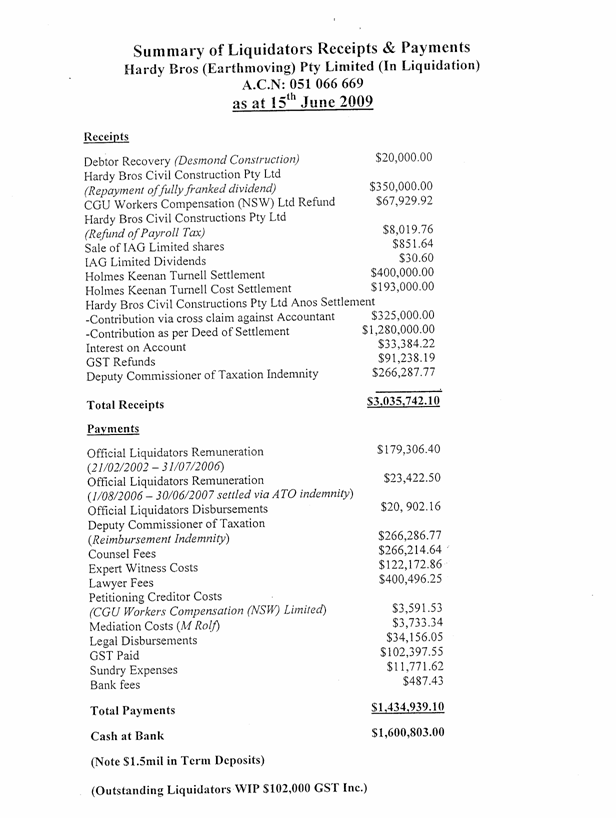
DEPUTY COMMISSIONER OF TAXATION Second Defendant
|
|
JUDGE: |
|
|
DATE OF ORDER: |
29 OCTOBER 2009 |
|
WHERE MADE: |
SYDNEY |
THE COURT ORDERS THAT:
1. The proceeding be stood over to Wednesday 4 November 2009 at 9.30am.
Note: Settlement and entry of orders is dealt with in Order 36 of the Federal Court Rules.
The text of entered orders can be located using eSearch on the Court’s website.
|
IN THE FEDERAL COURT OF AUSTRALIA |
|
|
NEW SOUTH WALES DISTRICT REGISTRY |
|
|
GENERAL DIVISION |
NSD 820 of 2009 |
IN THE MATTER OF HARDY BROS (EARTHMOVING) PTY LIMITED (IN LIQUIDATION) (ACN 051 066 669)
|
|
CHRISTOPHER MEL CHAMBERLAIN Plaintiff
|
|
|
RG&H INVESTMENTS PTY LIMITED (ACN 000 599 477) First Defendant
DEPUTY COMMISSIONER OF TAXATION Second Defendant
|
|
JUDGE: |
LINDGREN J |
|
DATE: |
29 OCTOBER 2009 |
|
PLACE: |
SYDNEY |
REASONS FOR JUDGMENT
Introduction
1 The plaintiff, Christopher Mel Chamberlain (Mr Chamberlain), is the liquidator of Hardy Bros (Earthmoving) Pty Limited (in liq) (the Company).
2 Mr Chamberlain entered into two agreements with the second defendant, the Deputy Commissioner of Taxation (DCT), under which Mr Chamberlain was funded and indemnified against any adverse costs order by the DCT, in order to enable Mr Chamberlain to pursue proceeding 6867 of 2004 in the Equity Division of the Supreme Court of New South Wales (the Transactions Proceeding). As a result of prosecuting that proceeding Mr Chamberlain has recovered money which would not otherwise have been available to unsecured creditors in the liquidation of the Company.
3 Mr Chamberlain now applies for:
· approval nunc pro tunc under s 477(2B) of the Corporations Act 2001 (Cth) (the Act) of the making by him of the two agreements with the DCT;
· a declaration under s 1322(4)(a) of the Act that those agreements are not invalid by reason of the fact that at the time when Mr Chamberlain entered into them he lacked the Court’s approval under s 477(2B); and
· a direction under s 479(3) of the Act that he was justified in entering into the two agreements.
4 Further, and of a different order, Mr Chamberlain seeks an order under s 564 of the Act that the DCT be given an advantage over other unsecured creditors of the Company. The advantage sought is that the DCT be paid out of surplus funds remaining after payment of all priority debts and claims in the order prescribed by s 556 of the Act, 100% of the DCT’s claim proved in the winding up, or, if that surplus is less than 100% of the amount of that claim, then the entire surplus.
5 The first defendant, RG&H Investments Pty Limited (RGH), claims to be an unsecured creditor of the Company. It opposes the making of the order under s 564.
6 The DCT appeared on the hearing but did not take an active role. Ms A Bryant, solicitor, appeared for Robert Hardy, Danny Hardy and Evelyn Hardy (see below). She indicated that her clients had no objection to the granting of the relief sought, and she was excused from further attendance.
Background
7 On 21 February 2002 the Company was ordered to be wound up by the Supreme Court of New South Wales in proceeding 5901/01 in the Equity Division of that Court (the Winding Up Proceeding). Mr Chamberlain’s partner, Alan Nicholls, was appointed liquidator of the Company.
8 Mr Nicholls subsequently resigned as liquidator. His resignation was to take effect on 20 July 2007. On 9 July 2007, the Supreme Court filled the vacancy to occur on 20 July 2007 by appointing Mr Chamberlain as liquidator under s 473(7) of the Act.
9 The business of the Company was earthmoving and excavation. The Company was the corporate vehicle of members of the Hardy family.
10 The directors and members of the Company were Robert Hardy, Danny Hardy and Evelyn Hardy (the Directors). The secretaries of the Company were Lynette Hardy and Jennifer Hardy.
11 The Company entered into two series of transactions, both of which had the effect of reducing the Company’s assets. The first transaction involved the formation of, and contributions by the Company to, a non-resident, non-complying superannuation fund (First Transaction). As part of the First Transaction, the Company borrowed money from the Directors and paid that money to them for their sole use and benefit personally.
12 The second transaction involved the transfer of all of the assets (and certain of the liabilities) of the Company to related persons, being a partnership between Hardy Bros Civil Constructions Pty Ltd (HBCC) and Hardy Bros Nominees Pty Limited (HBN) (Partnership). The divesting of the Company’s assets was for less than their fair market value. Their fair market value has been calculated by Alan Weeks, a partner of Deloitte Touche Tohmatsu, Chartered Accountants, to be $5,877,000. Mr Weeks has calculated the liabilities assumed by the Partnership to be $3,636,000. The Company’s assets were therefore transferred for $2,241,000 less than their fair value.
The First Transaction – the Hardy International Super Fund
13 The non-complying superannuation fund was styled “the Hardy International Super Fund”. The Company borrowed $2,500,000 from the Directors which it contributed to that Fund. The Company claimed that amount as a tax deduction. The DCT did not allow the deduction and issued amended notices of assessment to the Company as follows:
|
Income Tax for the year ended 30 June 1999 |
$553,044.97 |
|
Income Tax for the year ended 30 June 2000 |
$636,762.56 |
|
Income Tax for the year ended 30 June 2001 |
$110,466.00 |
|
Total |
$1,300,273.53 |
14 This total of $1,300,273.53 is the amount of the DCT’s proof of debt in the winding up. The amount does not include interest. The DCT will seek to amend its proof of debt to claim interest if there is a surplus remaining after all unsecured creditors have been paid their admitted debts. In that case, as at 28 September 2009 interest of $1,034,000 would be claimed by the DCT, making a total of principal and interest as at that date of $2,334,273.53.
The Second Transaction - Restructure
15 By the Second Transaction, the Partnership took over the assets of the Company as from 1 April 2001. This was achieved through a “restructure” (Restructure). The assets were transferred at their historical cost in accordance with the Company’s financial statements as at 31 March 2001. An amount of $104,571 was ascribed to the Company’s goodwill. As consideration for the transfer, the Partnership assumed responsibility for the Company’s liabilities recorded in its financial statements as at 31 March 2001.
16 As mentioned earlier, according to Mr Weeks’s estimate, the undervalue was $2,241,000.
Dividend of $350,000
17 Following the Restructure, the Company had net assets of $350,016.00. Those assets comprised cash of $16 representing the Company’s issued capital, and $350,000 representing (a) retained profits as at 30 June 2000 of $24,805.72, and (b) operating profit for the year ended 30 June 2001 of $325,194.28.
18 On 2 July 2001 the Directors resolved that the Company declare a dividend of $350,000 payable to the holder of C class shares in the Company. As part of the Restructure, HBCC held the one and only C class share in the capital of the Company. Accordingly, the sum of $350,000 was paid to HBCC.
19 On 22 August 2002 Mr Chamberlain demanded repayment of that sum from HBCC. HBCC repaid it by instalments over a period from 9 December 2002 to 22 April 2004.
The Transactions Proceeding
20 As a result of his investigations into the First Transaction and the Second Transaction, Mr Chamberlain obtained legal advice as to various courses of action that were available to the Company and to himself as liquidator.
21 Based on that advice, on 21 December 2004 he and the Company commenced the Transactions Proceeding. The first and second defendants were the two companies, HBCC and HBN, that were members of the Partnership. The third, fourth, fifth and sixth defendants were the Directors and Lynette Hardy (the Hardys). The seventh to twelfth defendants were the Company’s accountants (the Accountants).
22 The Transactions Proceeding was complex. In his affidavit Mr Chamberlain explained the nature of the claims made by the Company and himself as liquidator as follows:
(a) The Restructure was entered into at a time when the Company and its officers knew, or ought to have known, of liabilities outstanding, whether contingent or otherwise, to the DCT and CGU Workers Compensation Pty Limited [CGU];
(b) In the circumstances that existed the Restructure comprised an alienation of property with the intention to defraud creditors within the meaning of section 37A of the Conveyancing Act (NSW) 1919;
(c) The Restructure constituted an uncommercial transaction, an insolvent transaction and a void transaction within the meaning of sections 588FC and 588FE of the Corporations Act (Cth); and
(d) The Hardys, as officers of the Company, had breached their fiduciary duties, duty of care and diligence, duty to act in good faith and duty not to use their position [t]o the detriment of the Company;
(e) The Hardys, as officers of the Company, allegedly advanced monies to the Company in order to fund the contributions to the Hardy International Super Fund. These director loans were outstanding at the time of the Restructure. As part of the Restructure the directors’ loans were repaid. The Liquidator alleged that the repayment of the directors’ loans constituted “unfair preferences” within the meaning of sections 588FA, 588FC and 588FE of the Corporations Act (Cth).
(f) The Accountants who provided the advice in relation to the Hardy International Super Fund and the Restructure were in breach of their duty of care to the Company and were liable as accessories to the breaches of the duty by the directors.
Settlement of the Transactions Proceeding
23 By terms of settlement dated 20 November 2008, the Transactions Proceeding was settled. That was at a time shortly prior to its being listed for hearing. Four weeks had been set aside for the hearing in November and December 2008.
24 The first to sixth defendants (HBCC, HBN and the Hardys) agreed to pay the plaintiffs $2,200,000 plus costs as agreed or assessed. The costs were agreed at $500,000.
25 The total sum of $2,700,000 was to be paid by way of $500,000 within 30 days of execution of a Deed of Settlement and Release; $600,000 within 90 days of execution of that document; and the balance in equal monthly instalments of $60,000 each.
26 The Hardys were to be admitted to proof in the liquidation in the amount of $375,000.
27 Judgment was entered for the plaintiffs against the Accountants for $400,000. They were also ordered to pay the plaintiffs’ costs of the proceeding against them as agreed or assessed. Those costs were agreed at $193,000. Accordingly, the total amount payable by the Accountants was $593,000.
Funding and indemnities
28 Prior to the recovery of the settlement amounts, the funds available in the winding up were only approximately $450,000 made up as follows:
(a) $350,000 recovered from HBCC (referred to at [17]-[19] above);
(b) $20,000 recovered from Desmond Constructions Pty Ltd;
(c) $8,019.76 being a payroll tax refund recovered from the Commissioner of State Revenue, Wollongong; and
(d) $67,929.92 recovered from CGU.
29 According to Mr Chamberlain, by about May 2007 these monies were exhausted in carrying out steps in the winding up. Mr Chamberlain therefore approached the DCT. At that time the DCT was the only creditor who had submitted a proof of debt. Mr Chamberlain enquired of the DCT about funding the Transactions Proceeding (which, it will be recalled, he and the Company had commenced on 21 December 2004) and indemnifying him against any adverse costs order in it.
30 At the time, Mr Chamberlain was aware of a damages claim against the Company by RGH. Kemp Strang acted for RGH. Mr Chamberlain says that he raised the possibility of RGH’s funding the Transactions Proceeding with Kemp Strang, but no offer of funding or of an indemnity was forthcoming.
31 Mr JDM Graham of Kemp Strang gives a different account of events. He gives a detailed account of a meeting he had with Ms KP Farmer, the solicitor for Mr Chamberlain. The effect of Mr Graham’s evidence is that he has no recollection of funding by RGH being requested; that he made detailed notes of his conversation with Ms Farmer; and that if the matter had been raised it would have been in accordance with his practice to include a reference to it in his notes: they included no such reference. Mr Graham does state, however, that Ms Farmer told him that Mr Chamberlain had sought funding to pursue the Transactions Proceeding from the DCT and was awaiting a reply from the DCT.
32 The First Indemnity was dated 8 October 2007. By it the DCT agreed to indemnify Mr Chamberlain in respect of funding up to a maximum sum of $350,000 inclusive of GST. The First Indemnity provided for how this amount was to be paid and expended. It included an unlimited indemnity by the DCT in respect of any costs order made against Mr Chamberlain.
33 The Second Indemnity was dated 18 September 2008. By the Second Indemnity the DCT undertook to indemnify Mr Chamberlain in respect of funding up to a maximum sum of $198,665.47 inclusive of GST, payable progressively. The Second Indemnity also contained an indemnity against any costs order made against Mr Chamberlain but subject to a limit of $1,973,400.
34 Under both the First Indemnity and the Second Indemnity, Mr Chamberlain agreed that in respect of any amount recovered, he would apply under s 564 of the Act for an order “that the DCT receive priority in [the Second Indemnity says “for”] the distribution of any amounts recovered or received by the Liquidator”. Neither Indemnity spelled out the nature or extent of the “priority” that Mr Chamberlain was required to seek in favour of the DCT.
35 The DCT in fact funded Mr Chamberlain to the extent of $266,286.77 to prosecute the Transactions Proceeding. Mr Chamberlain has reimbursed the DCT in that sum.
36 Mr Chamberlain has expressed the opinion in his affidavit that the DCT assumed a significant risk by entering into the First Indemnity and the Second Indemnity, including the risks of the substantial costs of Mr Chamberlain of pursuing the Transactions Proceeding and of the exposure to possible adverse costs orders. In the Transactions Proceeding each party was represented by solicitors and senior and junior counsel and retained various experts. The Transactions proceeding was fixed for a four week hearing in November/December 2008.
Result of the Transactions Proceeding
37 Annexed to these reasons is Mr Chamberlain’s summary of his receipts and payments as liquidator. The amount of $1,600,803.00 is held by him as cash at the bank. This will be increased by $1,095,000 if he receives the monthly instalments of $60,000 from the Hardys. As at 15 June 2009 they had paid $1,605,000 out of their total liability of $2,700,000. At the rate of $60,000 per month, it will take 19 months for them to pay the remaining $1,095,000.
38 Mr Chamberlain says that there are three unsecured creditors who have lodged proofs of debt in the winding up:
|
DCT |
$1,300,273.53 |
|
The Directors |
$375,000.00 |
|
RGH |
$2,295,008.00 |
It will be noted that it was the Directors (Robert Hardy, Evelyn Hardy and Danny Hardy) who lodged the proof of debt for $375,000, but according to the terms of settlement of the Transactions Proceeding dated 20 November 2008, it was the Hardys (the Directors and Lynette Hardy) who were to be admitted to proof in the liquidation in that sum (see [26] above).
39 Until 6 November 2008, when RGH lodged its proof of debt, the DCT was the only creditor that had lodged a proof of debt. The plaintiff in the winding up proceedings was CGU, but it transpired that it was not a creditor and in fact was indebted to the Company for $67,929.92 (see [28] above). The Directors did not lodge their proof of debt for $375,000 until 2 March 2009.
40 I noted earlier that the DCT’s claim for interest will fall to be considered only if there is a surplus. Subject to that, the DCT seeks a priority distribution under s 564 for the sum of $1,300,273.53 (referred to at [13]-[14] above).
41 In its proof of debt, RGH claims interest under s 563B of the Act on its claimed debt of $2,295,008.
42 Mr Chamberlain has admitted the proofs of debt of the DCT and the Directors, but on 5 February 2009 he disallowed that of RGH.
RGH’s claim
43 The circumstances that give rise to RGH’s claim concern the construction of a dam on its property at Orange in 1999. The Company constructed the dam. The work was completed in or about August 1999.
44 On 16 August 2004 RGH commenced a proceeding in the Technology & Construction List of the Supreme Court of New South Wales (Construction List Proceeding) against Geolyse Pty Limited (Geolyse) and Parsons Brinckerhoff Australia Pty Limited (PPK). Neither defendant had any association with the Company or with the Hardys. Geolyse was a consulting engineer engaged by RGH to provide design works and supervision associated with construction of the dam. PPK was a geotechnical engineer retained by RGH to carry out a geotechnical investigation of the site.
45 At the time of the commencement of the Construction List Proceeding, the Company had been wound up and a liquidator appointed. On 18 August 2006 the Supreme Court granted RGH leave under s 471B of the Act to proceed against the Company; ordered that the Company be added as third defendant; and ordered that no step be taken to enforce any judgment against the Company without the liquidator being informed and without the leave of the Supreme Court.
46 Geolyse wished to plead proportionate liability pursuant to s 109ZJ of the Environmental Planning & Assessment Act 1979 (NSW).
47 On 20 December 2006 the Company filed a submitting appearance. Geolyse and PPK then filed defences pleading s 190ZJ.
48 When the Company filed its submitting appearance, RGH’s Amended Summons dated 20 May 2006 made no allegations against the Company. However, on 27 March 2007 RGH filed a Further Amended Summons which included a claim against the Company based on the allegations made by Geolyse in its defence and apportionment claim. The Further Amended Summons was not served on the Company.
49 In June 2008, the claims made by RGH against Geolyse and PPK were settled at mediation and the Construction List Proceeding was discontinued as against them on 7 July 2008. The sum of $2,295,008 claimed in RGH’s proof of debt in the winding up of the Company was the balance remaining after a deduction of $730,000 received from Geolyse and PPK as part of RGH’s settlement with those companies.
50 On 17 October 2008 RGH filed a notice of motion seeking leave to file a Second Further Amended Summons to plead a cause of action against the Company in tort. It obtained that leave. The Second Further Amended Summons claims that RGH suffered loss and damage as a consequence of the Company’s having allegedly breached obligations owed to RGH both in contract and in tort in respect of the construction of the dam.
51 On 20 October 2008 the Company filed a notice of motion seeking leave to file a defence and affidavits and to take other steps to defend the claims made against it.
52 On 6 November 2008 RGH lodged its proof of debt with Mr Chamberlain which, as noted earlier, he disallowed by notice of rejection dated 5 February 2009.
53 By interlocutory process filed on 17 February 2009 in the Winding Up Proceeding, RGH sought an order that the rejection of its proof of debt be reversed (Proof of Debt Interlocutory Proceeding). On 23 February 2009 RGH filed a notice of motion seeking an order that the Proof of Debt InterlocutoryProceeding be entered in the Construction List and be heard with the Construction List Proceeding.
54 The notices of motion and interlocutory process were listed for hearing before Hammerschlag J in the Construction List on 27 February 2009. His Honour ordered that the Proof of Debt Interlocutory Proceeding be transferred to the Construction List and be heard with the Construction List Proceeding, the evidence in each proceeding being evidence in the other. His Honour rejected the Company’s submission that it would be appropriate for the Proof of Debt Interlocutory Proceeding to remain in the Corporations List and case managed by a judge in that list and for the Construction List Proceeding to be stayed.
55 Apparently the Company obtained the leave to file a defence and affidavits and to take other steps to defend the claims.
56 The Construction List Proceeding and the Proof of Debt Interlocutory Proceeding have been set down for a 10 day hearing commencing on 23 November 2009.
Notional winding up scenarios
57 Mr Chamberlain has compared the likely dividends for unsecured creditors under three scenarios:
Scenario 1 potential dividend as at the date of the winding up order;
Scenario 2 potential dividend assuming the DCT is not given any priority and all unsecured creditors are admitted and treated equally;
Scenario 3 potential dividend assuming the DCT is paid its primary debt in priority and the remaining two unsecured creditors, RGH and the Directors, are admitted in full.
Scenario 1
58 At the time of the making of the winding up order on 21 February 2002, there would have been no dividend payable to unsecured creditors. The Company had nominal assets of only $16 and liabilities of $3,280,526, being amounts said to be due to the DCT (then $2,982,347) and CGU ($298,178). Subsequently, the DCT reduced the amount for which it was seeking to prove, and CGU was found not to be a creditor. Nonetheless, there would still have been no dividend.
Scenario 2
59 If the funding and indemnity against any adverse costs order had not been forthcoming from the DCT, Mr Chamberlain would not have assumed the risk of the Transactions Proceeding and would either have:
(a) discontinued or settled the Transactions Proceeding on the best terms available; or
(b) sought funding from a commercial litigation funder.
60 If the Transactions Proceeding had been discontinued or settled, Mr Chamberlain’s view is that no dividend would have been paid to unsecured creditors after allowing for the costs of the winding up. If the Transactions Proceeding had been funded by a litigation funder, in Mr Chamberlain’s experience the terms of the arrangement would have involved a disgorgement of 40 of the net proceeds of the litigation to the litigation funder.
61 Mr Chamberlain did not pursue either (a) or (b) above because the DCT had agreed to provide the funding and an indemnity against any adverse costs order, without claiming any proportion of the net proceeds of the litigation.
62 If the DCT were not now to be afforded priority for its debt and all three creditors were admitted to prove equally in the winding up, Mr Chamberlain’s estimate is that the three creditors would receive a dividend of approximately 60 cents in the dollar. His calculations are as follows:
|
Est. Available Funds for Distribution Present Day |
$2,400,000.00 |
|
ATO Principal Claim Present Day |
$1,300,273.53 |
|
Hardy Bros. Claim Present Day |
$375,000.00 |
|
RGH Claim Present Day |
$2,295,008.00 |
|
Total Unsecured Creditors Claimed |
$3,970,281.53 |
|
Dividend to unsecured Creditors |
60% |
Scenario 3
63 Mr Chamberlain states that if the DCT receives an advantage for its principal claim of $1,300,273.53, the remaining creditors would, in Mr Chamberlain’s estimate, receive a dividend of approximately 41 cents in the dollar calculated as follows:
|
Est. Available Funds for Distribution Present Day |
$2,400,000.00 |
|
Less: ATO Principal Claim Present Day (priority) |
$1,300,273.53 |
|
Funds Available to Unsecured Creds |
$1,099,726.47 |
|
Hardy Bros. Claim Present Day |
$375,000.00 |
|
RGH Claim Present Day |
$2,295,008.00 |
|
Total Unsecured Creditors Claimed |
$2,670,008.00 |
|
Dividend to unsecured Creditors |
41% |
64 As noted earlier, the DCT will prove for interest, to which the DCT is entitled, if the other unsecured creditors are paid in full and there is a surplus available.
65 If Mr Chamberlain’s rejection of RGH’s proof of debt is upheld, he expects that the remaining unsecured creditors will be paid in full.
66 Finally, Mr Chamberlain states that even allowing for an advantage in favour of the DCT for its debt, the prosecution of the Transactions Proceeding has created a pool of funds of approximately $1,000,000 after taking into account the costs and expenses of the winding up, which would not otherwise have been available to creditors.
67 Through their solicitors, the Directors have indicated that they do not object to the DCT being given priority to the extent of $1,300,273.63.
Consideration
Section 477(2B) of the Act
68 Section 477(2B) of the Act provides:
Except with the approval of the Court, of the committee of inspection or of a resolution of the creditors, a liquidator of a company must not enter into an agreement on the company’s behalf (for example, but without limitation, a lease or a charge) if:
(a) without limiting paragraph (b), the term of the agreement may end; or
(b) obligations of a party to the agreement may, according to the terms of the agreement, be discharged by performance;
more than 3 months after the agreement is entered into, even if the term may end, or the obligations may be discharged, within those 3 months.
Section 477(2B) implies that the time for applying for and obtaining the Court’s approval is prior to the liquidator’s making of the agreement in question.
69 The First Indemnity and the Second Indemnity were both agreements falling within the description contained in s 477(2B). Mr Chamberlain was therefore prohibited from entering into them except with the Court’s approval or, relevantly, the approval of a resolution of the creditors.
70 It is established, however, that approval may be granted nunc pro tunc: see Empire (Aust) Nominees Pty Ltd (in liq) v Vince (2000) 35 ACSR 167; Stewart, in the matter of Newtronics Pty Ltd [2007] FCA 1375 (Newtronics).
71 Mr Chamberlain submits that the present case is a strong one for the giving of approval under s 477(2B) because as at the dates when both Indemnities were entered into the DCT was the only creditor that had proved in the winding up and could have resolved to approve Mr Chamberlain’s making of the two agreements with itself.
72 However, Mr Chamberlain’s explanation for his delay in seeking approval is quite unsatisfactory. He says that although he was aware of the necessity of seeking the Court’s approval, the DCT requested that he defer making the application as “it was conducting a review of all funding agreements entered into with liquidators and … required time to carry out that review”.
73 This is a poor explanation, and a troubling one.
74 First, Mr Chamberlain was aware of the prohibition yet contravened it knowingly – twice!
75 Second, Mr Chamberlain seems to have treated the DCT’s direction as overriding the statutory mandate which he accepted was not rendered inapplicable by reason of the DCT’s being the only known creditor.
76 Third, Mr Chamberlain has not explained the length of the delay until this proceeding was commenced on 10 August 2009.
77 Fourth, it is difficult to understand how the explanation proffered could apply to both the First Indemnity and the Second Indemnity. If Mr Chamberlain was aware on both occasions of the prohibition contained in s 477(2B), it is unlikely that he would have accepted at face value a statement by the DCT on or before the date of the Second Indemnity, that it was carrying out a second review or that the DCT was still carrying out the review that it had been carrying out some eleven months earlier.
78 I will not grant the approval sought until I am satisfied that the original failure to seek approval and the delay in seeking to remedy that omission are adequately explained. The proceeding will be stood over to give Mr Chamberlain the opportunity of supplementing his explanation by further affidavit evidence from himself, an officer of the DCT, or otherwise as he may be advised.
79 Section 1322(4)(a) and (d) of the Act provides:
Subject to the following provisions of this section but without limiting the generality of any other provision of this Act, the Court may, on application by any interested person, make all or any of the following orders, either unconditionally or subject to such conditions as the Court imposes:
(a) an order declaring that any act, matter or thing purporting to have been done, or any proceeding purporting to have been instituted or taken, under this Act or in relation to a corporation is not invalid by reason of any contravention of a provision of this Act or a provision of the constitution of a corporation;
(b) …
(c) …
(d) an order extending the period for doing any act, matter or thing or instituting or taking any proceeding under this Act or in relation to a corporation (including an order extending a period where the period concerned ended before the application for the order was made) …
and may make such consequential or ancillary orders as the Court thinks fit.
80 Where an approval nunc pro tunc is to be given, it is appropriate that there also be an order extending the period for applying for the approval to the date of the giving of the approval nunc pro tunc, and an order declaring that the making of the agreement without an approval in place at the time did not render the agreement invalid by reason of the liquidator’s contravention of s 477(2B).
81 The considerations that are relevant to the grant or withholding of approval under s 477(2B) have been discussed in several cases: see, for example, Newtronics at [26]. In that case, Gordon J helpfully identified a number of the relevant considerations. I will not repeat them here.
82 Factors which favour the granting of approval in the present case are that:
(a) the First Indemnity and the Second Indemnity promised to provide substantial benefits to the unsecured creditors and, as is now known, have in fact done so;
(b) neither of the other two creditors (the Directors and RGH) oppose the application;
(c) as noted above, at the time or times the DCT was the only creditor that had submitted a proof of debt, and if the DCT had “resolved” to approve of Mr Chamberlain’s executing the First Indemnity and the Second Indemnity, the Court’s approval would not have been necessary.
83 Subject to Mr Chamberlain’s providing satisfactory evidence explaining his omission to obtain approval prior to the making of the two agreements, which may need to include affidavit evidence from a relevant officer of the DCT, I propose to grant the approval nunc pro tunc that he seeks and to make the ancillary orders to which I have referred.
Section 564
84 RGH’s primary submission is that the application under s 564 is premature and should await the outcome of the hearing of the Proof of Debt Interlocutory Proceeding and the Construction List Proceeding to commence in the Supreme Court on 23 November 2009. As a secondary position, RGH accepts that the DCT should be afforded some priority or advantage but contends that that priority or advantage should be by reference to the funds currently at Mr Chamberlain’s disposal (cash at bank of $1,600,803) rather than what Mr Chamberlain may expect, and that there should be taken into account the full amount of RGH’s claim to debt of $2,295,008.
85 Section 564 of the Act provides:
Where in any winding up:
(a) property has been recovered under an indemnity for costs of litigation given by certain creditors, or has been protected or preserved by the payment of money or the giving of indemnity by creditors; or
(b) expenses in relation to which a creditor has indemnified a liquidator have been recovered;
the Court may make such orders, as it deems just with respect to the distribution of that property and the amount of those expenses so recovered with a view to giving those creditors an advantage over others in consideration of the risk assumed by them. [My emphasis]
86 In State Bank of New South Wales v Brown (2001) 38 ACSR 715, the New South Wales Court of Appeal approved the following statement by Brownie J in Household Financial Services Pty Ltd v Chase Medical Centre Pty Ltd (1995) 18 ACSR 294 at 296-7:
The last words of s 564 provide for, and the authorities accent the need to assess the risk run by the indemnifying creditors, for whose benefit an application is made, but the authorities show that it is also appropriate to look to the sum recovered (or the value of the property recovered), the failure of other creditors to provide the indemnity, the proportions between the debts of the indemnifying creditors and-the other debts, the public interest in encouraging creditors to provide indemnities so as to enable assets to be recovered, and, generally, the totality of the circumstances; and there has been a tendency in recent times to adopt a more liberal approach, in favour of indemnifying creditors. …
87 In the same case Spigelman CJ indicated (at [40]) that the exercise of the statutory power to give a funding creditor 100% of recovery will be rare. His Honour indicated that the cases in which 100% of the recovery has been awarded to the indemnifying creditor have had particular features which the Chief Justice discussed.
88 I accept RGH’s submission that it is premature for the application under s 564 to be determined at this stage. The considerations that lead me to this conclusion are set out in the following paragraphs.
89 First, as just noted, it is not known with certainty what the final size of the fund available for unsecured creditors will be because, although the liquidator has cash in hand of $1,600,803.00, whether this amount will be augmented by the sum of $1,095,000 over the next nineteen months (bringing the amount available up to $2,695,803) by the monthly payments of $60,000 by the Hardys, depends upon whether they default. Mr Chamberlain has only their unsecured promise to make the payments.
90 Second, while Mr Chamberlain does not seek an order disturbing the priorities provided for in s 556(1) of the Act, the amount of his remuneration, legal costs and disbursements and other expenses in defending the Proof of Debt Interlocutory Proceeding and the Construction List Proceeding will not be known until after those Proceedings are heard and determined. That amount would apparently enjoy priority over other unsecured creditors.
91 Third, the Court is not in a position to determine the relativity between the DCT’s debt and that of the other unsecured creditors so long as the Proof of Debt Interlocutory Proceeding and Construction List Proceeding remain undetermined. RGH may fail completely in those proceedings and therefore not be a creditor at all, or it may be a creditor to the full extent of its claim of $2,295,008 plus interest plus the costs of both Supreme Court proceedings, or it may prove to be a creditor for some intermediate amount.
92 Fourth, there appears to be no urgency touching the determination of the application.
93 Fifth, although the further affidavit evidence explaining Mr Chamberlain’s delay in seeking the Court’s approval under s 477(2B) will no doubt be prepared and admitted at an early date, the fact is that that hearing is likely to take place only two to three weeks before the commencement of the hearing in the Supreme Court on 23 November 2009.
94 Mr Chamberlain’s approach has been to treat the sum of $1,095,000 as if it were cash in hand that has been recovered as a result of the funding provided by the DCT, but it is not. I note in passing that the proposed advantage is not that the DCT is to be entitled to the instalments if and when they are paid and that it be paid the remainder of its debt ($1,300,273.63-$1,095,000 = $205,273.63) out of the cash in hand, leaving $1,395,529.37 as cash in hand to satisfy Mr Chamberlain’s further remuneration, costs and expenses and other admitted creditors.
95 If the application were to be determined now and the orders sought by Mr Chamberlain made, apparently he would immediately pay $1,300,273.63 to the DCT, leaving him with $300,529.37 as cash at bank. In addition, he would have the Hardys’ unsecured promise to pay $1,095,000 over 19 months. Let it be assumed that the Hardys paid none of the monthly instalments and that RGH had total success in the Supreme Court proving as a creditor for $2,295,008 plus interest plus costs. In that case it would transpire that Mr Chamberlain’s further remuneration, costs and expenses in this proceeding and, more significantly, in defending the Supreme Court proceedings, would almost certainly absorb the sum of $300,529.37. If not, those amounts together with RGH’s legal costs and expenses associated with the Supreme Court proceedings would certainly do so. In the circumstances hypothesised, neither RGH nor the Directors would receive anything, and so it would transpire that DCT would have had 100% of the recovery.
96 No doubt it is possible that the decision in the two Supreme Court proceedings will be reserved and in any event there is the possibility of an appeal to the New South Wales Court of Appeal. Nonetheless, the position will at least be somewhat clearer than it is at present if this proceeding is adjourned, first to a date to deal with the supplementary evidence in relation to s 477(2B) to which I referred, and then to a further date following the conclusion of the hearing in the Supreme Court.
97 There are too many unknowns at present to enable the Court to decide Mr Chamberlain’s application under s 564 with confidence that its order would be just.
Conclusion
98 For the above reasons, the proceeding will be adjourned in the first instance to Wednesday 4 November 2009 by which time any further evidence addressing Mr Chamberlain’s delay should be filed and served.
|
I certify that the preceding ninety-eight (98) numbered paragraphs are a true copy of the Reasons for Judgment herein of the Honourable Justice Lindgren. |
Associate:
Dated: 4 November 2009
|
Counsel for the Plaintiff: |
Mr M J Dawson |
|
|
|
|
Solicitor for the Plaintiff: |
Shaw Reynolds Bowen & Gerathy |
|
|
|
|
Counsel for the First Defendant: |
Mr B A J Coles QC and Mr S B Docker |
|
|
|
|
Solicitors for the First Defendant: |
Kemp Strang |
|
|
|
|
Solicitor for the Second Defendant: |
Mr Y Acheampong of the Australian Taxation Office |
|
|
|
|
Solicitor for Robert Hardy, Danny Hardy and Evelyn Hardy |
Ms A Bryant of HWL Ebsworth Lawyers |
|
Date of Hearing: |
30 September 2009 |
|
|
|
|
Date of Judgment: |
29 October 2009 |