

FEDERAL COURT OF AUSTRALIA
Holborow v State of Western Australia [2009] FCA 1200
PRACTICE AND PROCEDURE – principles applicable to an application under O 20 r 4 FCR for summary dismissal
Federal Court of Australia Act 1976 (Cth) s 31A
Native Title Act 1993 (Cth) ss 13(1), 61, 61A(2), 84C, 84(5), 86, 85A, 223, 223(1)
Federal Court Rules O 20 r 2, O 20 r 4
Australian Building Industries Pty Ltd v Stramit Corporation Limited & Anor [1997] FCA 1318
Australian Competition and Consumer Commission v Australian Safeway Stores Pty Ltd (No 3) (2001) 119 FCR 1
Blair v Currun (1939) 62 CLR 464
Bodney v Bropho (2004) 140 FCR 77
Canada and Dominion Sugar Company Limited v Canadian National (West Indies) Steamships Limited [1947] AC 46
Carl Zeiss Stiftung v Rayner & Keeler Ltd [No.2] [1967] 1 AC 853
Commonwealth of Australia v Cockatoo Dockyard Pty Ltd [2006] NSWCA 322
Dale v Moses [2007] FCAFC 82
Daniel v State of Western Australia [2003] FCA 666
Daniel v Western Australia [2005] FCA 536
De Rose v South Australia (No 2) (2005) 145 FCR 290
Dey v Victorian Railways Commissioners (1949) 78 CLR 62
DP World Australia Ltd v Fremantle Port Authority [2009] WASCA 16
Egri v DRG Australia Ltd (1988) 19 NSWLR 600
General Steel Industries Inc v Commissioner for Railways (NSW) (1964) 112 CLR 125
Hoysted v Federal Commissioner of Taxation (1921) 29 CLR 537
Kokatha Native Title Claim v South Australia (2005) 143 FCR 544
Kuligowski v Metrobus (2004) 220 CLR 363
Lancee v Willert [2008] WASCA 120
Lombardo v Stuart Bros Pty Ltd (1967) 68 SR(NSW) 159
Lonrho Plc v Fayed (No 2) [1992] 1 WLR 1
Members of the Yorta Yorta Aboriginal Community v Victoria (2002) 214 CLR 422
Moran v Minister for Land & Water Conservation for the State of New South Wales [1999] FCA 1637
Moses v Western Australia (2007) 160 FCR 148
Munn v State of Queensland [2002] FCA 486
North Ganalanja Aboriginal Corporation v Queensland (1996) 185 CLR 595
Phillips v State of Western Australia [2000] FCA 1274
Quall v Northern Territory of Australia [2009] FCA 18
Risk (on behalf of Larrakia People) v Northern Territory and Others (No NTD 5 of 2006) (2007) 240 ALR 75
Risk v Northern Territory of Australia [2006] FCA 404
Rubibi Community v Western Australia (2002) 120 FCR 512
Seven Network Ltd v News Ltd (No 4) (2005) 214 ALR 686
Squires Transport Pty Ltd v Turnor [2004] WASCA 245
Supreme Court of the United States in Cromwell v County of Sac (1876) 94 US 351
Taylor v Ansett Transport Industries Ltd (1987) 18 FCR 342
Van Hemmen on behalf of The Kabi Kabi People #3 v State of Queensland [2007] FCA 1185
Walker on behalf of The Noonukul of Minjerrabah v State of Queensland [2007] FCA 967
Webster v Lampard (1993) 177 CLR 598
Williams v Grant [2004] FCAFC 178
Wyatt v MR and RC Smith Pty Ltd [2008] WASCA 55
VALERIE HOLBOROW (NEE COSMOS), KEVIN KELVIN COSMOS and ROBERT BOONA v STATE OF WESTERN AUSTRALIA, COMMONWEALTH OF AUSTRALIA, SHIRE OF ROEBOURNE, BHP PETROLEUM PTY LTD, EAST COAST MINERALS NL, MINERALOGY PTY LTD, DONALD KIMBERLEY NORTH, HAMERSLEY IRON PTY LTD, BORAL CONTRACTING PTY LTD, BORAL RESOURCES (WA) LTD, ROBE RIVER MINING CO PTY LTD, YALLEEN PASTORAL COMPANY PTY LTD, APACHE NORTHWEST PTY LTD, WOODSIDE OFFSHORE PETROLEUM PTY LTD, FLORENCE MERILYN ADAMS, TERENCE JOHN ADAMS, MG KAILIS GULF FISHERIES PTY LTD, WESTERN AUSTRALIAN FISHING INDUSTRY COUNCIL (INC), EXMOUTH PEARLS PTY LTD, JEAN LOCKYER & ORS FOR THE KURAMA/MARTHUDUNERA PEOPLE (WAD 6090/98) and TELSTRA CORPORATION LIMITED
WAD 127 of 1997
MCKERRACHER J
23 October 2009
PERTH
| IN THE FEDERAL COURT OF AUSTRALIA |
|
| WESTERN AUSTRALIA DISTRICT REGISTRY |
|
| GENERAL DIVISION | WAD 127 of 1997 |
| VALERIE HOLBOROW (NEE COSMOS) KEVIN KELVIN COSMOS ROBERT BOONA Applicants
| |
| AND: | STATE OF WESTERN AUSTRALIA First Respondent
COMMONWEALTH OF AUSTRALIA Second Respondent
SHIRE OF ROEBOURNE Third Respondent
BHP PETROLEUM PTY LTD Fifth Respondent
EAST COAST MINERALS NL, MINERALOGY PTY LTD, DONALD KIMBERLEY NORTH Sixth Respondents
HAMERSLEY IRON PTY LTD Respondent 6B
BORAL CONTRACTING PTY LTD BORAL RESOURCES (WA) LTD Respondents 6C
ROBE RIVER MINING CO PTY LTD YALLEEN PASTORAL COMPANY PTY LTD Respondents 6D
APACHE NORTHWEST PTY LTD Respondent 7A
WOODSIDE OFFSHORE PETROLEUM PTY LTD Eighth Respondent
FLORENCE MERILYN ADAMS, TERENCE JOHN ADAMS, MG KAILIS GULF FISHERIES PTY LTD, WESTERN AUSTRALIAN FISHING INDUSTRY COUNCIL (INC) Ninth Respondents
EXMOUTH PEARLS PTY LTD Twelfth Respondent
JEAN LOCKYER & ORS FOR THE KURAMA/MARTHUDUNERA PEOPLE (WAD 6090/98) Fourteenth Respondents
TELSTRA CORPORATION LIMITED Nineteenth Respondent
|
| JUDGE: | |
| DATE OF ORDER: | 23 October 2009 |
| WHERE MADE: | PERTH |
THE COURT ORDERS THAT:
1. The State of Western Australia’s motion be allowed.
2. The Ngarluma People’s motion for joinder of parties be adjourned, with liberty to apply.
3. There will be no order as to costs.
Note: Settlement and entry of orders is dealt with in Order 36 of the Federal Court Rules.
The text of entered orders can be located using eSearch on the Court’s website.
| IN THE FEDERAL COURT OF AUSTRALIA |
|
| WESTERN AUSTRALIA DISTRICT REGISTRY |
|
| GENERAL DIVISION | WAD 127 of 1997 |
| BETWEEN: | VALERIE HOLBOROW (NEE COSMOS) KEVIN KELVIN COSMOS ROBERT BOONA Applicants
|
| AND: | STATE OF WESTERN AUSTRALIA First Respondent
COMMONWEALTH OF AUSTRALIA Second Respondent
SHIRE OF ROEBOURNE Third Respondent
BHP PETROLEUM PTY LTD Fifth Respondent
EAST COAST MINERALS NL, MINERALOGY PTY LTD, DONALD KIMBERLEY NORTH Sixth Respondents
HAMERSLEY IRON PTY LTD Respondent 6B
BORAL CONTRACTING PTY LTD BORAL RESOURCES (WA) LTD Respondents 6C
ROBE RIVER MINING CO PTY LTD YALLEEN PASTORAL COMPANY PTY LTD Respondents 6D
APACHE NORTHWEST PTY LTD Respondent 7A
WOODSIDE OFFSHORE PETROLEUM PTY LTD Eighth Respondent
FLORENCE MERILYN ADAMS, TERENCE JOHN ADAMS, MG KAILIS GULF FISHERIES PTY LTD, WESTERN AUSTRALIAN FISHING INDUSTRY COUNCIL (INC) Ninth Respondents
EXMOUTH PEARLS PTY LTD Twelfth Respondent
JEAN LOCKYER & ORS FOR THE KURAMA/MARTHUDUNERA PEOPLE (WAD 6090/98) Fourteenth Respondents
TELSTRA CORPORATION LIMITED Nineteenth Respondent
|
| JUDGE: | MCKERRACHER J |
| DATE: | 23 october 2009 |
| PLACE: | PERTH |
REASONS FOR JUDGMENT
INTRODUCTION
1 The first respondent (the State) applies by motion for orders that the Yaburara/Mardudhunera native title determination application be dismissed over the townsites of Karratha and Dampier (the application). The technical descriptions of these towns are annexed as ‘A’ and ‘B’ respectively to these reasons. The application is pursued under O 20 r 4 of the Federal Court Rules (FCR) on the basis that no reasonable cause of action is disclosed. The application regarding Dampier is also based on s 84C of the Native Title Act 1993 (Cth) (NTA) on the ground that the application does not comply with s 61A(2) NTA.
2 At the hearing of the application, counsel for the Yaburara/Mardudhunera made it clear that the Yaburara/Mardudhunera no longer pursue the determination of native title over the townsite of Dampier. That leaves the townsite of Karratha for consideration. It also raises the question of what should be done in respect of the presently existing application for native title over the townsite of Dampier.
MOTION FOR JOINDER OF PARTIES
3 In addition to the State’s motion for dismissal, there is a notice of motion for joinder of parties to these proceedings. The motion is brought by Violet Samson, Pansy Hicks, Norman Smith, Jim Fredericks, Max Sambo, Kerry Churnside and John Wedge representing the Ngarluma People who are also the applicant in matter WAD 165 of 2008 (the Ngarluma Townsites Claim).
4 The Court has power to join any person as a party to proceedings if it satisfied that the person has an interest that may be affected by a determination in the proceedings and that it is in the interests of justice to do so (s 84(5) NTA). The assertion of native title rights may provide a sufficient basis for allowing respondent party status: Kokatha Native Title Claim v South Australia (2005) 143 FCR 544 (Kokatha). Further, a member of a claimant community asserting a competing communal native title right and interest which is inconsistent with substantive native title rights and interests being asserted in the claim may be joined as a respondent under s 84(5) NTA: Rubibi Community v Western Australia (2002) 120 FCR 512 (Rubibi).
5 The Ngarluma People contend that their joinder will ensure that their interests would not be adversely affected by a determination in the proceedings without the Ngarluma People having the opportunity to be heard. It would also enable all matters in dispute arising from competing native title claims to the area to be adjudicated upon within the same proceeding if required (Rubibi at [9]). As there can be only one determination of native title over a particular area, those who claim to be entitled to such rights should be able to become a party to a claim in which the rights may be determined (Munn v State of Queensland [2002] FCA 486 per Emmett J.
6 Of particular significance to the Yaburara/Mardudhunera claim is the fact that native title has already been determined in favour of the Ngarluma People in the surrounding area. A claim lodged on behalf of the Ngarluma and Yindjibarndi Peoples was lodged with the National Native Title Tribunal (NNTT) on 27 July 1994 and transferred to this Court on 21 November 1996. The Yaburara/Mardudhunera claim was subsequently lodged with the NNTT on 1 August 1996 and transferred to this Court on 7 November 1997. There was a substantial overlap between the Yaburara/Mardudhunera claim and the Ngarluma/Yindjibarndi claim. In the course of the Ngarluma/Yindjibarndi proceedings orders were made by Nicholson J that so much of the Yaburara/Mardudhunera claim that overlapped with the Ngarluma/Yindjibarndi application be heard as part of the same proceedings as the Ngarluma/Yindjibarndi application.
7 The underlying reasons supporting most aspects of the claim at first instance are to be found in the extensive decision of Daniel v Western Australia [2003] FCA 666, determined on 3 July 2003 (Daniel).
8 The four townsites of Karratha, Dampier, Point Samson and Wickham were omitted from the original Ngarluma/Yindjibarndi claim and were therefore not included in the determination but native title in the area surrounding the townsites of Point Samson, Wickham and Karratha was determined as being held by the Ngarluma People. When making a determination of native title in favour of the Ngarluma People and the Yindjibarndi People, Nicholson J also dismissed that part of the Yaburara/Mardudhunera claim that overlapped the Ngarluma/Yindjibarndi claim. As there was no direct overlap between the two claimants in respect of the townsites’ area, there has been no specific determination at the precise location of Karratha.
9 The Yaburara/Mardudhunera claim (subject to amendment by deletion of Dampier), covers two of the four townsites (Karratha and Dampier) as well as a substantial further area which does not presently fall for consideration in the State’s application.
10 The Ngarluma People are entitled to be joined as respondents. However, in light of my intended disposition of the summary judgment motion, I will make no order at this stage joining the Ngarluma People. The position can be reviewed should their motion be maintained. For the present, I will adjourn the motion with liberty to apply.
The argument on the issue estoppel point
11 It is important to appreciate the precise argument on the issue estoppel point. The State argues that:
· the Yaburara/Mardudhunera People are estopped from raising the argument that they hold native title to Dampier as Yaburara People or descendents of the Yaburara People;
· the Yaburara/Mardudhunera have no other basis for claiming in respect of Dampier other than as Yaburara People or descendants of the Yaburara People; and
· an issue estoppel is raised because of key findings made by Nicholson J in Daniel concerning the Yaburara People. (emphasis added)
12 The alternative position of the State is that it is highly implausible that the Yaburara/Mardudhunera People could establish native title over Dampier given that Nicholson J found in Daniel and determined in Daniel v State of Western Australia [2005] FCA 536 (Daniel Determination) that native title does not exist on the Burrup peninsula which surrounds Dampier on all sides.
13 Accordingly, the State argues that the Yaburara/Mardudhunera claim also discloses no reasonable cause of action over Karratha because of findings made by his Honour in Daniel and reflected in the DanielDetermination to the effect that native title to the Ngarluma area surrounding Karratha is held only by the Ngarluma People. His Honour held that the Yaburara/Mardudhunera People do not hold native title to the area surrounding Karratha and dismissed their claim to this extent in the Daniel Determination (Order 24).
THE CLAIM
14 In Yaburara/Mardudhunera’s outline of case filed on 23 October 1998, the boundaries of the claim area were illustrated by reference to a map and a description of the boundaries within the longitude and latitude coordinates there described.
15 For present purposes it is not necessary to identify with precision the detail of the area of the claim. It suffices to say that the claim included the Dampier townsite, the Karratha townsite, an area seaward to the west and the north of those townsites and substantially to the south. In total, the area was some hundreds of square kilometres and very substantially more than the two townsites mentioned. It was said that the land and waters claimed were part of the traditional homelands of the Yaburara and Mardudhunera Peoples; that the ancestors of the Yaburara and the Mardudhunera Peoples, both at the time of sovereignty and the time of contact with various Europeans in the 1800s occupied and resided on the land claimed; camped on it; travelled over it; travelled over the waters; hunted on the land; fished in the waters; foraged for food on the land claimed and for shellfish on the edge of the waters claimed; quarried and knapped stoned on the land claimed; dug for ochre on the land claimed; made tools and weapons with raw materials found on the land claimed; made shelters on the land claimed from raw materials found on the land claimed; educated and guided their children with regard to ownership of the land and other matters; placed etchings and paintings of cultural significance on the rocks and trees on the land claimed; conducted ceremonies and rituals with regard to the birth and death and different life stages of members of the society; enjoyed recreation on the land and waters claimed; created and maintained sites of spiritual and cultural importance; cared for and maintained the land the subject of the claim; prepared medicines and religious artefacts from materials found on the land; used the Yaburara and the Mardudhunera languages which belonged exclusively to the area; gave names to landmarks on the land claimed in the Yaburara and Mardudhunera languages; asserted ownership of the land and waters claimed as against members of other language groups; resisted invasion and settling of the claimed land and waters by Europeans; conducted trade and commerce with other language groups around the claimed land and waters; and burned the land claimed for hunting and other reasons. In the following year certain amendments were made to the claim area and other features of the claim.
16 It is to be noted that although the original claim relies upon connections to the claim area held by both the Yaburara People and the Mardudhunera People, the manner in which the case was presented in Daniel was somewhat different. As will be seen from the summaries of evidence and findings appearing below, in Daniel essentially the claim in relation to the Burrup was pursued on behalf of the Mardudhunera People who claimed their link to the land through the Yaburara People. That claim failed as Nicholson J found in Daniel that the Yaburara People or any other group were not in occupation of the Burrup beyond a period early in the Twentieth Century. The State argues that no other basis has been advanced to support the Yaburara claim in Daniel.
17 It is unclear whether the balance of the overlap area was claimed by the Yaburara/Mardudhunera People as Yaburara or Mardudhunera or partly Yaburara and partly Mardudhunera or joint Yaburara/Mardudhunera. Nevertheless, Nicholson J observed at [352] of Daniel that those of the Yaburara/Mardudhunera who claimed to be Yaburara had not established that to be the case and that evidence supported the view that the Yaburara/Mardudhunera claimed as Mardudhunera. Nicholson J then went on to consider whether the Yaburara/Mardudhunera, being Mardudhunera, had continuity as a group since sovereignty. At [375] and [501] Nicholson J found that although the Mardudhunera group had held the requisite continuity since sovereignty, the evidence did not establish that the Mardudhunera had exercised the remaining two rights found to be presently observable continuously back to sovereignty. On that basis, Nicholson J found that no requisite connection was established and that even if they had connection at the time of sovereignty, it had not survived the passage of time. The State contends that it would be inherently implausible that, within the relatively small area of the townsite of Karratha, the situation were somehow different from the entirety of the area surrounding Karratha and which was closely examined in Daniel.
CONCESSION CONCERNING DAMPIER
18 Counsel for the Yaburara/Mardudhunera conceded that the Dampier townsite could not be claimed primarily on the second ground when, in the course of argument, he said:
We maintain the position that if it is true that the special leases over the townsite at [Dampier] alienate the land, then it brings within the exception that appears in our claim and it’s not claimed. So we would invite your Honour, in the light of my friend’s evidence and in the absence of our opposition and subject to whatever else might be said to you, to find accordingly that that land is alienated, and that would then take it clearly out of our claim.
19 While the concession of counsel was confined to the alternative basis raised by the State pursuant to s 84C NTA, for the reasons which follow and which are primarily directed to the Karratha townsite (although to some extent distinguishing between small locations on the European boundary bases is artificial), I would have reached the same conclusion in respect of Dampier, not only on the secondary argument of the State but also on the primary argument as I did in relation to Karratha.
PRINCIPLES GOVERNING DISMISSAL
20 The application by the State is made pursuant to O 20 r 4 FCR which is in the following terms:
4 Stay or dismissal (proceedings commenced before 1 December 2005)
(1) This rule applies to a proceeding commenced before 1 December 2005 if the Court is satisfied that, for the proceeding generally or for a claim for relief in the proceeding:
(a) no reasonable cause of action is disclosed; or
(b) the proceeding or claim is frivolous or vexatious; or
(c) the proceeding or claim is an abuse of the process of the Court.
(2) The Court may order that the proceeding be stayed or dismissed generally or in relation to the claim for relief.
(3) The Court may receive evidence on the hearing of an application for an order under subrule (2).
21 Those terms are substantially similar to O 20 r 2 FCR which was repealed in the amendments to the Rules made in 2007. There is no reason to believe that the principles applicable to the current form of the Rule are any different from those applying to the Rule in its previous terms. No party has suggested otherwise.
22 The amendment to the Rules occurred on the introduction of the provisions for summary judgment contained in s 31A of the Federal Court of Australia Act 1976 (Cth) (FCA). That section lowered the bar for summary dismissal but it is important to note in these proceedings that it is O 20 r 4 FCR which is the basis of the State’s motion. That is the appropriate provision because the Yaburara/Mardudhunera claim was lodged with the Registrar of the NNTT on 1 August 1996. It was transferred to this Court on 10 November 1997. Such an application is a proceeding in the Federal Court (s 13(1) and s 61 NTA and Phillips v State of Western Australia [2000] FCA 1274 at [8]).
APPROPRIATE PRINCIPLES FOR DETERMINING WHETHER ‘NO CAUSE OF ACTION’ IS DISCLOSED
23 The principles are well established and warrant repetition only to reinforce the high level that is to be satisfied in a motion such as the present. The principles are conveniently collected in Dey v Victorian Railways Commissioners (1949) 78 CLR 62 at 91 per Dixon J (as his Honour then was) and in General Steel Industries Inc v Commissioner for Railways (NSW) (1964) 112 CLR 125 per Barwick CJ at 128-130. From the principles there stated it is clear that no court proceeding should be summarily dismissed except in a very clear case. The General Steel test as explained by Barwick CJ at 129 is that:
The test to be applied has been variously expressed; "so obviously untenable that it cannot possibly succeed"; "manifestly groundless"; "so manifestly faulty that it does not admit of argument"; "discloses a case which the Court is satisfied cannot succeed"; "under no possibility can there be a good cause of action"; "be manifest that to allow them" (the pleadings) "to stand would involve useless expense".
24 If there is a real question of fact or law to be determined and the rights of the parties depend upon it, a proceeding should not be summarily dismissed.
25 It does not follow from this collection of principles that it is only in blindingly obvious cases that summary dismissal should be ordered. The fact that detailed argument may be necessary to highlight the basis of the contention should not be determinative of the issue.
26 The High Court reiterated over forty years later in Webster v Lampard (1993) 177 CLR 598 (Mason CJ, Deane and Dawson JJ) (at 602) that:
The power to order summary judgment must be exercised with "exceptional caution" … and “should never be exercised unless it is clear that there is no real question to be tried”.
27 The Court should have regard to the version of facts most favourable to the applicant but this does not mean that every fact pleaded has to be accepted. Were it otherwise, an issue estoppel argument could never be relied upon (and it has), to justify summary dismissal.
28 The summary judgment principles have been applied in the context of native title determinations on a number of occasions. In Moran v Minister for Land & Water Conservation for the State of New South Wales [1999] FCA 1637 Wilcox J dismissed proceedings for lack of authorisation (at [44]-[48]). In Williams v Grant [2004] FCAFC 178 the Full Court (North, Dowsett and Lander JJ) (at [48]-[49] also on an authorisation basis); Bodney v Bropho (2004) 140 FCR 77 (at 88-89, at [50]-[51] where Stone J examined the Senate debate on the topic of summary judgment); Walker on behalf of The Noonukul of Minjerrabah v State of Queensland [2007] FCA 967 (at [17]-[18] again for lack of authorisation); and Van Hemmen on behalf of The Kabi Kabi People #3 v State of Queensland [2007] FCA 1185 (at [8] and, again, for lack of authorisation).
29 Most recently in Quall v Northern Territory of Australia [2009] FCA 18 the claim was struck out for reasons which will be examined below in more detail but are presently pertinent.
ISSUE ESTOPPEL
30 The leading case remains Blair v Currun (1939) 62 CLR 464. Dixon J at (531-532) said of issue estoppel that:
A judicial determination directly involving an issue of fact or of law disposes once and for all of the issue, so that it cannot afterwards be raised between the same parties or their privies. The estoppel covers only those matters which the prior judgment, decree or order necessarily established as the legal foundation or justification of its conclusion, whether that conclusion is that a money sum be recovered or that the doing of an act be commanded or be constrained or that rights be declared. (emphasis added)
In other words, an issue estoppel is created in relation to any issue of fact or law that is legally indispensable to a prior decision involving the same parties.
31 In Carl Zeiss Stiftung v Rayner & Keeler Ltd [No.2] [1967] 1 AC 853, Lord Guest noted that the doctrine of issue estoppel had been accepted by Australian courts for a number of years and indicated that, for the doctrine to apply in a later set of proceedings, the requirements were:
(1) that the same question has been decided; (2) that the judicial decision which is said to create the estoppel was final; and, (3) that the parties to the judicial decision or their privies were the same persons as the parties to the proceedings in which the estoppel is raised or their privies.
Quall
32 Before considering the application of those principles in a number of cases, it is necessary to consider a recent similar case. In the recent decision of Quall [2009] FCA 18, an order similar to that now sought was made by Reeves J. In Risk v Northern Territory of Australia [2006] FCA 404 (Risk), parts of native title determination applications relating to a particular area near Darwin described as being ‘Area A’ had been consolidated into one set of proceedings. The second native title applicant in those proceedings, Mr Quall (on behalf of the Danggalaba and Kulumbiringin People), alleged the existence of a particular Aboriginal society that held native title. However, Mansfield J held, (as did Nicholson J in this case) that a different society to the one alleged by Mr Quall was the relevant society which held native title at sovereignty. His Honour held that society had ceased to hold native title due to a ‘substantial interruption’ in the observance of traditional laws and customs in the Twentieth Century. Claims over Area A were therefore dismissed.
33 On the motion before Reeves J the Northern Territory applied to dismiss the balance of the Quall native title application. The balance of that application related to an area of land termed Area B. It was not the land which had been the subject of dismissal in Risk.
34 Mr Quall argued the existence of the same society as asserted in Risk (as the Yaburara/Mardudhunera are arguing in this proceeding) and alternatively, the existence of another different society that he had not asserted in Risk but he had asserted unsuccessfully on appeal in Risk (on behalf of Larrakia People) v Northern Territory and Others (No NTD 5 of 2006) (2007) 240 ALR 75.
35 It was held that to the extent the applicants relied on the same society they had asserted in Risk in relation to Area A, they were estopped from doing so because the continued existence of that society had been determined adversely and therefore there was an issue estoppel. His Honour also held that to the extent that the applicants proposed to rely on a different society to that asserted in Risk, they were also estopped from doing so because the society ‘issue’ had been determined (adversely against them, in effect, in Risk) (Quall at [99]).
36 The Court took the view that it did not matter that a different area was involved (at [98] and [115]) nor that the alternative society argument had not been considered and determined in Risk (at [97]). It was held that it was an abuse of process to argue that a different alternative society existed in relation to Area B. At [115] his Honour said:
As I have already observed above, I consider the findings made by Mansfield J in Risk are in clear terms and they deal directly with the various components of the definition of native title in s 233 of the NT Act, as explained by the High Court in Yorta Yorta. Those findings followed an exhaustive examination of a large body of evidence and they resulted in the final orders made by Mansfield J to the effect that native title does not exist for Larrakia lands in Area A (see [43] above). In my view, the findings and orders of Mansfield J are final, in the sense that they foreclose on any other Aboriginal society being able to establish that the laws and customs under its normative system gave rise to rights and interests in Larrakia lands in Area A. Indeed, they constitute a judgment in rem that no native title exists in those lands (see the cases set out in [63] above). While the decision in Risk does not have the same status in relation to the lands in Area B, I do not consider that detracts from the final effect of the findings on the ultimate issues upon which that decision is founded. Specifically, that the Larrakia peoples were the relevant Aboriginal society at sovereignty that possessed rights and interests in Larrakia lands. I consider this constitutes a final finding as to the relevant Aboriginal society that possessed rights and interests in those lands whether they fell within Area A or B.
37 Nicholson J concluded in Daniel (at [370]-[371] and see also Moses v Western Australia (2007) 160 FCR 148 (Moses) at [281]-[284] and [349]) that the only society holding native title over the Ngarluma native title area at sovereignty and at present was and is the Ngarluma society. That conclusion was reached following examination of extensive evidence.
Was the determination of the status of the Yaburara/Mardudhunera essential to the determination of the native title question?
38 After exhaustive analysis, Nicholson J in Daniel concluded that the Yaburara/Mardudhunera as Yaburara could not establish native title over the Burrup and that the Yaburara/Mardudhunera did not hold native title in the area surrounding Karratha as the Mardudhunera group did not have the requisite connection with the claim area. To appreciate the significance of the conclusion (in order to determine whether the Yaburara/Mardudhunera is issue estopped), it is necessary to consider what it was that Nicholson J had to determine in Daniel.
39 Section 223 NTA relevantly provides that ‘native title’ or ‘native title rights and interests’ means:
… communal, group or individual rights and interests of Aboriginal peoples or Torres Strait Islanders in relation to land or waters, where:
(a) the rights and interests are possessed under the traditional laws acknowledged, and the traditional customs observed, by the Aboriginal peoples or Torres Strait Islanders; and
(b) the Aboriginal peoples or Torres Strait Islanders, by those laws and customs, have a connection with the land or waters; and
(c) the rights and interests are recognised by the common law of Australia.
40 The statutory definition in s 223(1) NTA is clearly the crucial question and the starting point. In De Rose v South Australia (No 2) (2005) 145 FCR 290 (at [38]), the Full Court said:
It is hardly likely that the traditional laws and customs of Aboriginal peoples will themselves classify rights and interests in relation to land as "communal", "group" or "individual". The classification is a statutory construct, deriving from the language used in Mabo (No 2). If it is necessary for the purposes of proceedings under the NTA to distinguish between a claim to communal native title and a claim to group or individual native title rights and interests, the critical point appears to be that communal native title presupposes that the claim is made on behalf of a recognisable community of people, whose traditional laws and customs constitute the normative system under which rights and interests are created and acknowledged. That is, the traditional laws and customs are those of the very community which claims native title rights and interests. By contrast, group and individual native title rights and interests derive from a body of traditional laws and customs observed by a community, but are not necessarily claimed on behalf of the whole community. Indeed, they may not be claimed on behalf of any recognisable community at all, but on behalf of individuals who themselves have never constituted a cohesive, functioning community.
41 In Members of the Yorta Yorta Aboriginal Community v Victoria (2002) 214 CLR 422, Gleeson CJ, Gummow and Hayne JJ said after observing that native title has its origin in the traditional laws acknowledged and the customs observed by the indigenous people who possess the native title, that native title is neither an institution of the common law nor a form of common law tenure but is recognised by the common law.
42 Their Honours asked (at [31]):
…Is it a body of traditional law and custom as it existed at the time of sovereignty? Is it a body of law and custom as it exists today but which, in some way, is connected with a body of law and custom that existed at sovereignty? How, if at all, is account to be taken of the inescapable fact that since, and as a result of, European settlement, indigenous societies have seen very great change?
43 And continued to note (at [33]) that:
..."Native title" means certain rights and interests of indigenous peoples. Those rights and interests may be communal, group or individual rights and interests, but they must be "in relation to" land or waters. The rights and interests must have three characteristics. The first is that they are possessed under the traditional laws acknowledged and the traditional customs observed by the peoples concerned. That is, they must find their source in traditional law and custom, not in the common law. …
44 Further, the Court said (at [34]) that:
…the rights and interests must have the characteristic that, by the traditional laws acknowledged and the traditional customs observed by the relevant peoples, those peoples have "a connection with" the land or waters. Again, the connection to be identified is one whose source is traditional law and custom, not the common law.
45 And, (at [35]) that the rights and interests in relation to land must be ‘recognised’ by the common law of Australia.
46 Native title rights and interests to which the NTA refers, the Court reinforced, are rights and interests finding their origin in pre-sovereignty law and custom, not rights or interests which are a creature of that Act.
47 Then, coming to the current issue, the Court said:
51 What is the position if, as is said to be the case here, the content of the laws and customs is passed on from individual to individual, despite the dispersal of the society which once acknowledged and observed them, and the descendants of those who used to acknowledge and observe these laws and customs take them up again? Are the laws and customs which those descendants acknowledge and observe "traditional laws" and "traditional customs" as those expressions are used in the Native Title Act, and are the rights and interests in land to which those laws and customs give rise possessed under traditional laws acknowledged and traditional customs observed?
52 Again, it is necessary to consider the several elements of the issues that thus arise. Has the society ceased to exist? Does not the survival of knowledge of the traditional ways suggest that it has not? Or is it shown that, although there is knowledge, there has been or is no observance or acknowledgment? These may be very difficult questions to resolve. Identifying a society that can be said to continue to acknowledge and observe customs will, in many cases, be very difficult. In the end, however, because laws and customs do not exist in a vacuum, because they are socially derivative and non-autonomous, if the society (the body of persons united in and by its observance and acknowledgment of a body of law and customs) ceases to acknowledge and observe them, the questions posed earlier must be answered, no.
53 When the society whose laws or customs existed at sovereignty ceases to exist, the rights and interests in land to which these laws and customs gave rise, cease to exist. If the content of the former laws and customs is later adopted by some new society, those laws and customs will then owe their new life to that other, later, society and they are the laws acknowledged by, and customs observed by, that later society, they are not laws and customs which can now properly be described as being the existing laws and customs of the earlier society. The rights and interests in land to which the re-adopted laws and customs give rise are rights and interests which are not rooted in pre-sovereignty traditional law and custom but in the laws and customs of the new society.
AN ADVERSE FINDING TO THE YABURARA/MARDUDHUNERA WAS MADE IN DANIEL
48 In addition to advancing some arguments of his own for the Yaburara/Mardudhunera, Counsel for the Yaburara/Mardudhunera has adopted the submissions of senior counsel for Wong-Goo-TT-OO to which I have referred in the reasons for decision in Wong-Goo-TT-OO (WAD 6256 of 1998). An application in Wong-Goo-TT-OO in similar terms to the current application was argued concurrently with this application. It is therefore necessary to consider an important aspect of that argument in which it was contended that no relevant ‘finding’ was made by Nicholson J in Daniel that is capable of operating as an issue estoppel.
49 The most important issue in the present debate is whether Nicholson J relevantly made a ‘finding’ in terms for which the State contends. If there was no ultimate finding, there can be no issue estoppel. Although issue estoppel can operate as to fact and to law, it must be an issue for the doctrine to arise. Simply to discard one aspect of a claim would not raise an issue for the purposes of issue estoppel. Frequently a party may fail or succeed on one aspect of a claim while having a different result on others.
50 On this issue, the Yaburara/Mardudhunera, like Wong-Goo-TT-OO in the related application relied heavily on Kuligowski v Metrobus (2004) 220 CLR 363 at [60] and particularly the passage reading:
A failure to find a matter alleged does not establish the truth of the contrary of that which is alleged. There are many general statements about the operation of issue estoppel, approved in this Court, which require more than non-satisfaction to establish an estoppel in later proceedings.
51 However, this passage without amplification does not assist.
52 In Kuligowski, Metrobus wished to contend that Mr Kuligowski was issue estopped from advancing a common law negligence claim in respect of an ankle injury sustained at work and in respect of which a second review officer had, for workers’ compensation purposes, recorded the following:
It is also necessary for the applicant to prove incapacity for work and in this regard I am of the view that Mr Kuligowski has not satisfied the onus upon him on this point.
53 The ratio of the decision in Kuligowski appears before the heading ‘Immaterial Matters’ in which the passage on which the Yaburara/Mardudhunera wish to rely is to be found. The ratio of the decision is at [45]-[46] in which the Court held that the second review officer had a different question to decide from the question which might confront the District Court on a common law claim. Notwithstanding that difficulties may be encountered in the common law claim in light of the conclusions reached by the second review officer, the matters which that officer had to decide were different from those which would arise on the common law claim.
54 The reasoning of the High Court makes it clear that the proper approach to determining what has been decided in a matter can only be assessed having regard to the pleaded and argued issues. Plucking a sentence out here or there does not answer all the questions.
55 The comments made by the Court on which the Yaburara/Mardudhunera rely appear under the heading ‘Immaterial Matters’ as part of a collection of other issues which arose and on which, in the circumstances, it was unnecessary to decide.
56 The full paragraph in which the sentence on which the Yaburara/Mardudhunera relies reads as follows (footnotes omitted):
In general, disbelief in a witness's evidence does not establish the contrary. Similarly, disbelief in the case presented by the moving party does not necessarily permit the court to conclude that the positive case of the opposing party is correct. In particular cases it may not be possible to reach a conclusion either way:
"[T]he judge is not bound always to make a finding one way or the other with regard to the facts averred by the parties. He has open to him the third alternative of saying that the party on whom the burden of proof lies in relation to any averment made by him has failed to discharge that burden."
A failure to find a matter alleged does not establish the truth of the contrary of that which is alleged. There are many general statements about the operation of issue estoppel, approved in this Court, which require more than non-satisfaction to establish an estoppel in later proceedings.
57 As the Court explained at [61], in finding whether or not something has been solemnly found against a party, the form of the first proceeding, particularly the issues joined or admitted on the pleadings will be important. In other words, as Dixon J observed in Blair v Curran 62 CLR 464 (at 532):
[J]udicial determination concludes, not merely as to the point actually decided, but as to a matter which it was necessary to decide and which was actually decided as the ground work of the decision itself, though not then directly the point at issue.
58 More importantly for present purposes, Dixon J went on to distinguish findings concerning only ‘evidentiary facts’ rather than the ‘ultimate facts’ which found the very title to rights in dispute. In Kuligowski, however, the High Court observed that that important issue was not the subject of the primary submissions of the parties and was not necessary to decide in the present case so was put to one side.
59 In Kuligowski, the High Court referred to the decision in the Privy Council which upheld the dissenting judgment of Higgins J in Hoysted v Federal Commissioner of Taxation (1921) 29 CLR 537. In Hoysted, Higgins J had referred to the use of the phrase ‘actually litigated and determined’ - in turn, an expression coined by the Supreme Court of the United States in Cromwell v County of Sac (1876) 94 US 351 at 353. Higgins J observed in Hoysted that the particular point (in relation to joint ownership for the purposes of land tax) was by virtue of the formal objections and from the nature of the judgment ‘actually litigated and determined’ in the former proceedings and that whether the judgment in its actual form was due to the Commissioner’s consent or admission or to his neglect, he is bound by the finding of joint ownership which the judgment necessarily involves.
60 In Kuligowski, the High Court went on to say that in the proceedings under the Workers’ Compensation and Rehabilitation Act 1981 (WA), no findings were made which operated in the manner alleged as issue estoppels nor was the structure of the legislation in the nature of the proceedings such that there could be said that the necessary findings must be treated as having been actually litigated and determined.
61 Unlike Kuligowski, in the present case it is central to the issue estoppel argument to determine whether or not Nicholson J made findings on the topic of whether the Yaburara/Mardudhunera had the ability to hold native title as a group.
62 A number of cases have considered the passage in the joint High Court judgment in Kuligowski where the Court says that a failure to find a matter alleged does not establish the truth of the contrary of that which is alleged (at [60]): Commonwealth of Australia v Cockatoo Dockyard Pty Ltd [2006] NSWCA 322; DP World Australia Ltd v Fremantle Port Authority [2009] WASCA 16; Lancee v Willert [2008] WASCA 120; Wyatt v MR and RC Smith Pty Ltd [2008] WASCA 55; Squires Transport Pty Ltd v Turnor [2004] WASCA 245.
63 One of the decisions cited in Kuligowski was Egri v DRG Australia Ltd (1988) 19 NSWLR 600, a decision of the Court of Appeal of New South Wales in a Court constituted by Mahoney, McHugh and Clarke JJA. (McHugh JA was also a member of the Court in Kuligowski). In Egri, the Court of Appeal upheld a conclusion by the primary judge that there had been an issue estoppel by virtue of the primary judge having said ‘I am not satisfied that the theory of the disc lesion has been established… I am not satisfied that the injury has resulted in disc lesion’.
64 The approach taken by the Court of Appeal as is evident from the judgment of McHugh JA was that unlike the case of Lombardo v Stuart Bros Pty Ltd (1967) 68 SR(NSW) 159 (and I might say, unlike Kuligowski), the finding relied upon for an issue estoppel in Lombardo as to an infarction was not an indispensable step in making the ultimate findings. However, in the case of Egri, the finding that there was no disc lesion was fundamental in determining what was the nature of the injury and whether the worker was still incapacitated (at 605).
65 It was because of the fundamental nature of what was being decided as distinct from the language employed that an issue estoppel was created. Even in Blair v Curran 62 CLR 464, Dixon J (as he then was) observed at (at 531-532) that the essential task is to distinguish between those matters fundamental to the decision or necessarily involved in its legal justification or foundation from matters which are not in point of law the essential ground work of the conclusion.
66 Indeed, in Egri, it was argued that because there had been no positive finding as to a failure to establish on balance of probabilities the existence of a disc lesion that the conclusion reached was insufficient to create an estoppel. That submission was expressly rejected in Egri (at [601F], [604D], [608D]). The Yaburara/Mardudhunera advance the same argument in this proceeding, that a negative conclusion such as not being satisfied, cannot constitute a finding. The argument should be rejected as it was in Egri.
67 The High Court in Kuligowski saysthat in relation to ultimate facts which form the very title to rights in dispute would it require more than non-satisfaction. I take this to be indicating that conclusions reached about ultimate facts as distinct from evidentiary facts must necessarily be findings. That does not necessarily conflict with the observation that a failure to find a matter alleged does not establish the truth of the contrary of that which is alleged. As all the cases indicate, it is a matter of examining the real issues in dispute, the task for the Court, and the basis on which the Court arrived at its conclusion in order to assess whether a determination is, for the purposes of an issue estoppel, in the nature of an ultimate finding, however it may have been expressed.
68 One example of the cases in point is Wyatt v MR and RC Smith Pty Ltd in which Buss JA with whom Wheeler JA and Pullin JA agreed, said:
42 It is essential, in examining reasons for decision which are alleged to create an issue estoppel, to understand with precision what the judicial officer was required to determine. See Murphy v Abi-Saab (1995) 37 NSWLR 280, where Gleeson CJ (with whom Kirby P and Rolfe AJA agreed) said:
The difficulty is to distinguish between decisions of fact or law fundamental or cardinal to the judgment and other decisions. One thing, however, is clear. Only a decision about a matter which it was necessary to decide can create an issue estoppel. It is, therefore, essential to approach reasons for judgment which are said to create an estoppel with an accurate understanding of what the author of the reasons was required to decide (288).
…
46 In Kuligowski, the High Court noted that in some cases it may not be possible for a court or tribunal to reach a conclusion either way in relation to a specific issue [60], and cited the following passage from the speech of Lord Brandon of Oakbrook in Resa Shipping Co SA v Edmunds [1985] 1 WLR 948:
[T]he judge is not bound always to make a finding one way or the other with regard to the facts averred by the parties. He has open to him the third alternative of saying that the party on whom the burden of proof lies in relation to any averment made by him has failed to discharge that burden (955).
The High Court then said that a failure to find a matter alleged does not establish the truth of the contrary of that which is alleged. Their Honours added:
There are many general statements about the operation of issue estoppel, approved in this Court, which require more than non-satisfaction to establish an estoppel in later proceedings [60].
WAS KARRATHA AFFECTED BY THE ISSUES DETERMINED IN DANIEL?
69 The question is whether the findings reached in the Daniel litigation also mean that the Yaburara/Mardudhunera People are precluded from pursuing a claim in native title over the only remaining area relevant to the current application, namely, the townsite of Karratha. To decide this question, it is necessary to trace not only the history of the claim but also its resolution.
70 The Yaburara/Mardudhunera native title determination application was first lodged with the NNTT on 1 August 1996. It included land that was already under claim by the Ngarluma/Yindjibarndi People in WAD 6017 of 1996 and land which was later claimed by the Wong-Goo-TT-OO People in WAD 6256 of 1998.
71 The map which is annexed and marked ‘C’ depicts the Yaburara/Mardudhunera claim area vis a vis the Ngarluma/Yindjibarndi and Wong-Goo-TT-OO claim areas. To the extent that the Yaburara/Mardudhunera and Wong-Goo-TT-OO applications overlap the Ngarluma/Yindjibarndi claim area, they were consolidated with the Ngarluma/Yindjibarndi application which was heard by Nicholson J, first, in 1999. The Ngarluma/Yindjibarndi People were ultimately described as the first applicants in the proceeding, the Yaburara/Mardudhunera People became the second applicants and the Wong-Goo-TT-OO People became the third applicants. The State was the first respondent and there were other respondents.
72 On 3 July 2003, Nicholson J handed down his reasons in Daniel. Subsequently, on 2 July 2005, his Honour made a determination under the NTA of non-exclusive native title rights and interests in respect of the claim area (Daniel Determination).
73 The holders of the native title rights and interests so determined were the Ngarluma People and the Yindjibarndi People. His Honour dismissed, to the extent that they overlap with the claim of the Ngarluma/Yindjibarndi People, any competing claims of the Yaburara/Mardudhunera and the Wong-Goo-TT-OO Peoples.
74 There were two appeals pursued from the reasons and orders of Nicholson J. They were heard together. The first appeal was that lodged by Ngarluma/Yindjibarndi. It concerned certain portions of the claim area in which his Honour had found that native title had been wholly extinguished. The Full Court delivered judgment in Moses on 7 June 2007. Then on 27 August 2007, the Full Court made final orders and a substituted determination of native title. That determination is annexed and marked ‘D’.
75 In a second appeal lodged by the Wong-Goo-TT-OO People, it was contended that the proceedings at first instance involved a wholly inadequate appraisal of the evidence of Wong-Goo-TT-OO and a misdirection of what was required to establish the elements of native title under s 223(1) NTA. That appeal was dismissed by the Full Court on 7 June 2007 in Dale v Moses [2007] FCAFC 82 (Dale).
76 The townsites (of Dampier and Karratha) were not, however, claimed by the Ngarluma/Yindjibarndi and therefore were not the subject of the determination made by Nicholson J. This is also reflected in the determination and orders made by his Honour on 2 May 2005 and was not disturbed on appeal. Until further order, because the Yaburara/Mardudhunera’s claim was only dismissed to the extent that it overlapped with the claim of the Ngarluma/Yindjibarndi, the Yaburara/Mardudhunera claim over the townsites remains on foot. It is that claim which is the subject of attack in the State’s application for summary dismissal.
SPECIFIC CONCLUSIONS IN DANIEL
77 In relation to the Yaburara/Mardudhunera claim, the State contends that Nicholson J in Daniel made a number of key findings which operate against the Yaburara/Mardudhunera as an issue estoppel. Specifically, it contends that the following are the applicable findings:
(1) The second applicants [the Yaburara /Mardudhunera claimants] claim the lands said to have originally been occupied by the Yaburara people, being the Burrup and surrounding islands, and the country said to have traditionally been occupied by the Mardudhunera people. (Daniel at [99])
(2) I accept the submission for the first respondents that it is not clear on the pleadings whether the overlap area is said to be Yaburara or Mardudhunera or partly Yaburara and partly Mardudhunera or joint Yaburara/Mardudhunera. The evidence from the second applicants on the point was inconsistent. (Daniel at [103])
(3) The second applicants have identified themselves in the title of their application as ‘Coastal Mardudhunera and Yaburara people’ … [and] [t]he claimant group is said to be a joint community of Yaburara and Mardudhunera people, composed of three inter-related family groups. (Daniel at [340])
(4) …I find those of the second applicants who claim to be Yaburara have not established that to be the case. The evidence supports the view that the second applicants having a claim in the claim area claim as Mardudhunera. (Daniel at [352]; Moses at 41]).
(5) There remains the question whether the second applicants as Mardudhunera people are a community or group. There is ample evidence of the Mardudhunera people as a tribe in the coastal zone of the claim areas. It is not apparent, however, whether the second applicants comprise all presently living Mardudhunera people. Nor is it apparent in the evidence whether the second applicants are recognised socially as a community of Mardudhunera people. The relevant common purpose is that of being Mardudhunera. While there is not evidence the second applicants are recognised by others as such apart from their role in these proceedings, I consider they fall within the broader connotation of the word ‘group’. (Daniel at [353]; Moses at [29])
(6) … In the case of the second applicants the issue arises as to whether the Yaburara tribe, of which some of the second applicants claim to be descendents, ceased to exist. The nature of the issue, the submissions of the parties, the expert evidence and the lay evidence relating to that issue is set out in Appendix G. In reliance upon the matters there set out, I find that there has been no discharge of the onus of proof by the second applicants or in the circumstances of all the evidence that the Burrup was inhabited by the Yaburara. If, contrary to that finding, the evidence supports the finding that the Yaburara or a group by any other name inhabited the Burrup, the evidence establishes that that group disappeared as an identifiable group early in the Twentieth Century. (Daniel at [373]; Moses at [43])
(7) Further, there are a number of reasons why I consider that the claim for succession by either the first or second applicants from Iniarba as a Yaburara cannot succeed. Firstly, there is the unsubstantiated character of the evidence of the two second applicants Colin Cosmos and Valerie Holborow on this issue. Secondly, the evidence does not support a finding that Iniarba was Ngarluma. Thirdly, the argument that Yaburara was a sub-set of Ngarluma is not supported by the evidence. (Daniel at [374])
(8) The question remains whether the second applicants being Mardudhunera are members of a group which has had continuity from sovereignty and so has not ceased to exist. In reliance on the evidence set out in relation to the Mardudhunera as a Group in Part X, I find the group has had the requisite continuity. (Daniel at [375])
(9) The evidence does not establish that the Mardudhunera second applicants exercised the remaining two rights found to be presently observable continuously back to sovereignty. If they had connection at the time of sovereignty it has not survived the passage of time. I find no requisite connection is established in their case. (Daniel at [501])
(10) The trial judge dismissed the Yaburara/Mardudhunera application to the extent that it overlapped with the Ngarluma/Yindijibarndi claim. (Order 24 of the Daniel Determination; Moses at [92]). (emphasis added)
78 The Yaburara/Mardudhunera are correct in saying that not all of the portions of the Daniel decision on which the State rely, constitute findings. Some are comment but I have emphasised those that are findings. The remaining matters are necessarily stated to put the findings in perspective.
79 Nicholson J found in Daniel (at [373]) that no society has inhabited the Burrup area since the beginning of the early Twentieth Century (see also Moses at [43]). The Yaburara/Mardudhunera acknowledge that they are bound by that finding.
80 The State contends that it must follow that the applicants are estopped from asserting the continuity of any society since sovereignty over the area of the Burrup. Once that is acknowledged, it is fatal to the applicants’ claim to Dampier which is geographically part of the Burrup and surrounded on all sides by the area in which Nicholson J found that there was no native title.
81 As to Karratha, Nicholson J held in Daniel (at [370]-[371]) that the society holding native title over the Ngarluma native title area at sovereignty and at present is the Ngarluma society. That area fully surrounds the relatively small area of Karratha townsite.
82 The Yaburara/Mardudhunera contend that the townsites present different issues from the surrounding areas under consideration in Daniel. The State contends that the townsite of Dampier, in particular, presents the same issues as were considered by Nicholson J in Daniel in relation to the Burrup and secondly, that Karratha presents the same issues as were decided in relation to the Ngarluma native title area because:
(a) Dampier and Karratha are surrounded on all sides by the Burrup and Ngarluma native title area respectively;
(b) the claim does not distinguish between Dampier and Karratha and the surrounding areas;
(c) Dampier and Karratha were not considered in Daniel only because the Ngarluma/Yindjibarndi claimants decided not to include those towns in their original claim. It is now asserted (in WAD165/2008) that they do hold native title over each of those towns;
(d) the judgment in Daniel indicates that extensive evidence was given of the nature of asserted native title rights in relation to the Burrup and the Ngarluma native title area including by the applicants (see the Summary in Daniel at [1374]-[1383]). In the course of giving that evidence, no distinction was drawn between the areas and the towns;
(e) because of the arbitrary distinction between the towns and the surrounding areas, it is reasonable to expect that any evidence capable of supporting the existence of native title within the towns would not have been limited to the towns and would have been led. The fact that such evidence was not led by the applicants even though certain of their evidence was in fact led about areas not included in the proceedings (as evident from Daniel at [308]) and also referred to in the Daniel Summary at [1379]-[1380]) would indicate that the applicants do not distinguish between the towns and the surrounding areas.
83 The State contends that if the issues relating to Karratha are not identical to the issues concerning the surrounding areas, they are so similar as to disclose no reasonable chance of success for the claim in relation to the towns.
84 Further, the State argues, it would be an abuse of process for the applicants to assert a different basis for their claim over Karratha to the one that was asserted in Daniel. It is argued that there is no value whatsoever in the applicants leading evidence of native title over either of the towns.
85 The State also contends that in the interests of certainty, the strike out claim to the extent it includes Dampier, should be allowed in accordance with the State’s motion or, alternatively, there should be a declaration that the claim does not include Dampier or, alternatively, an order that the claim is amended such that it excludes Dampier.
MOSES
86 The Full Court summarised the findings of Nicholson J as to the boundaries of the Ngarluma country (in Moses at [243]) where the Full Court said:
243 In Part II of the July 2003 reasons, his Honour described the claim areas and made findings concerning the boundaries of those areas. The area claimed by the Ngarluma people was described as the lowlands between the Chichester Ranges and the sea found between Poverty Creek to the east of Whim Creek on the eastern side of the claim areas, to the vicinity of the Maitland River on the western side of the claim areas, as well as the adjacent portion of the sea. His Honour found that the boundaries as claimed were established on the evidence. The technique used by his Honour in this section, and followed in later sections, was to record the claims and findings in the body of his reasons for judgment and then to refer to the evidence on which the findings were based in appendices to the reasons for judgment. The evidence concerning boundaries is collated in Appendix A. It is a comprehensive review of the primary evidence of Aboriginal witnesses, as well as a review of the evidence of experts in history, linguistics and anthropology.
244 His Honour also pointed out that the major population centres of west Pilbara, namely Dampier, Karratha, Wickham, Point Sampson, Roebourne and Cossack are located in the north-west coastal portion of the claim area, and that the remainder of the region is sparsely settled.
…
305 Much evidence was given as to the boundaries of Ngarluma country. His Honour made findings that this evidence established that the Ngarluma country included the Karratha area. Such evidence supported an inference that the Ngarluma people have retained a continuous connection with the Karratha area. (emphasis added)
87 The Full Court also noted (at [313]) in Moses that the Ngarluma area had been treated as a whole for the reason that Nicholson J formed the view on the evidence that it was all part of Ngarluma lands.
88 Subject only to the important qualification that the specific townsite of Karratha was not part of the claim, the conclusion expressed (at [305]) in Moses, appears to fully and finally conclude any possibility of the Yaburara/Mardudhunera establishing a claim over the Karratha townsite.
89 The State and Ngarluma contend that these findings were all essential to the ratio of the conclusions that the Ngarluma People had native title throughout the area. Those conclusions, it is contended, are all that is required for issue estoppel for the reason that the Yaburara/Mardudhunera will not be permitted to allege facts that contradict the relevant foundational facts established in the Daniel decision. There is no doubt, it is contended, that it is open to look not only at the final judgment and order but also the reasons as well. This submission is correct (Australian Competition and Consumer Commission v Australian Safeway Stores Pty Ltd (No 3) (2001) 119 FCR 1 at [1153]-[1154] per Goldberg J).
90 The findings in Daniel were not only positive for the Ngarluma People but also, necessarily, negative to the claim of the Yaburara/Mardudhunera. To the extent that the findings were based on the failure to be satisfied by the evidence of the Yaburara/Mardudhunera, the Yaburara/Mardudhunera are estopped by the finding that they do not hold native title in the area and by the finding that any use and enjoyment of resources and protection of important places that they engaged in did not have the required continuity back to sovereignty and thus not traditional. Those negative findings can still constitute an estoppel: see the analysis in Egri.
FINDINGS AGAINST THE YABURARA/MARDUDHUNERA IN DANIEL
91 The Yaburara/Mardudhunera claim brought in Daniel was brought on the basis that the areas claimed were the areas where the Yaburara and the Mardudhunera People held native title. They claimed that the claim areas were traditionally occupied by them (Daniel at [99]). Nicholson J rejected and dismissed the claims insofar as they overlapped the Ngarluma/Yindjibarndi claim and found that the areas were areas over which only the Ngarluma or Yindjibarndi People held native title. Accordingly, his Honour’s finding was, in effect, that the areas surrounding the townsites were not Yaburara or Mardudhunera country and the Yaburara/Mardudhunera People did not hold any native title rights within it.
92 Evidence given by the Yaburara/Mardudhunera witnesses in Daniel as to boundaries of the Yaburara/Mardudhunera country or Yaburara country or Mardudhunera country included parts of the Ngarluma determination. Such evidence did not draw a distinction between areas surrounding the townsites and the townsites themselves which had been excluded from the hearing. This is apparent from the following passages in Daniel (at [1199]-[1200], [1374]-[1383], [1666]-[1667] (emphasis added):
1199 Robert Boona (Y) had been told by his father that the boundary of their land went from the mouth of the Nickol River, back into the Leopold Ranges, then went further down south to the Fortescue. The boundary followed Princup Hill to the Leopold ranges (T 2966). His father told him never to look at the Burrup (T 2970). Valerie Holborow had no knowledge of the boundaries of her land (T2974) and relied upon the boundaries as presented in evidence by Robert Boona (Y), Colin Cosmos (Y) and Lawrence Kerr (N) (T 3063). Colin Cosmos (Y) had been told nothing of the boundaries of Mardudhunera land but Algie Patterson (M) had told him that they were from the mouth of the Fortescue up to Leopold Hill and towards the Fortescue River (T 2974). The following day he corrected this, saying that the boundaries were from the mouth of the Nickol River, to Mount Leopold and towards the Fortescue River and that he had been told this by his grandfather (T 2999). Lawrence Kerr (N) said that Algie Patterson (M) had told him that Mardudhunera country stretched from Fortescue, to Peters Creek and back to Nickol (T 3005). In cross examination he said that the territory between Miaree Pool on the Maitland River and Karratha town, in other words the area of Karratha station, was Mardudhunera country. He knew nothing of Yaburara country apart from the name (T 3036). Robert Boona (Y) agreed that the boundaries claimed as Mardudhunera in the overlap claim area were those of Karratha station. He denied that his father may have been referring to the station as the area for which they had responsibility when they were doing their mill run (T 3074). Colin Cosmos (Y) said that the Yaburara people were different from the Mardudhunera, and had distinct territories. He only knew the boundary from what he had recently read (T 3084).
1200 Robert Boona (Y), whom Mr Robinson identified as a Mardudhunera man, told Mr Robinson that the Maitland River was the boundary (T 5453). Mr Robinson accepted the view that Yindjibarndi people regarded the Mardudhunera as the people who lived downstream from them on the lower Fortescue River (T 5519). Mr O'Connor agreed under cross-examination that he had earlier conducted ethnographic survey work for the second applicants and had formed a view that they were entitled to lodge a native title claim (T 6111). In a site survey he conducted in 1997, he described the Yaburara as ‘coastal people whose territories were centred upon the Burrup Peninsula, the present towns of Dampier and Karratha and the surrounding coastal plain’. He qualified that to mean ‘coastal flats’ and noted that Karratha town is built partly on the coastal flats. He agreed that boundaries in Aboriginal Australia are not a matter of general agreement.(T 6114)
(a) POSSESS, OCCUPY, USE AND ENJOY
(a) ‘The right to possess the land and waters claimed.’
(b) ‘The right to occupy the land and waters claimed.’
(c) ‘The right to use and enjoy that land and waters claimed.’
1374 Dorrie Wally testified that Valerie Holborow’s and Colin Cosmos’ father had been Mardudhunera and had been initiated (T 3003). Colin Cosmos considered his father Yaburara but had not been told anything about the law from him (T 2952). To his knowledge his father had no connection to the Burrup (T 3095). Colin Cosmos grew up on Karratha station. It was like a little Aboriginal village then. He could remember some people who lived there including Kenny Jerrold (T 3009). He was told of his ancestors by Algie Paterson , but not which tribe they belonged to (T3020). He lived separately from the other Aboriginal people on Karratha station (T 3065). He was not taught anything about the Burrup (T 2991). He felt his family’s claim to the land came from their descent from Inarba, his father’s step-father, who was a Yaburara man (T 2952; 3021). He only concluded he was Yaburara from reading material published recently, not from his own knowledge of Aboriginal groups and culture which was poor (T 3020). Even if Inarba were shown to be Ngarluma he would still consider himself most entitled to the Burrup through descent (T 3022). He heard from an old man on Karratha station that his land stretched from the mouth of the Nickol River to Leopold Hill and towards the Fortescue River (T 2975; 2999). His maternal grandmother’s brother was Fred Hicks, and he acknowledged being related to Wilfred and Cane Hicks (T 3012).
1375 Lawrence Kerr testified that he had been initiated the Ngarluma way because his father was Ngarluma. His mother and step-father were Mardudhunera and he could have been initiated the Mardudhunera way. He knew of only one other surviving Mardudhunera man, Algie Paterson (T 3004-3005). Algie Paterson had told him of certain Mardudhunera places, from Fortescue River to Peters Creek and across to the Nickol River. He did not mention the Burrup (T 3006).
1376 Robert Boona’s mother was related to the Hicks family but he did not know details (T 3044). His mother was Yindjibarndi and his father was Mardudhunera which he equated with Yaburara. His father had pointed out the boundaries of his country which roughly coincided with the boundaries of Karratha station (T 3073). He knew no Aboriginal place names in that area (T 3074). He said their traditional land extended to the small offshore islands (T 2969). He had never been told by any of the old people of any fishing out among those islands (T 3033).
1377 Dorene Wescombe regarded herself as Mardudhunera after her father. She was related through her father with the Cosmos and Boona family (T 2956). She grew up on Mardi (not in the overlap area between the first and second applicants claims) and Karratha stations (T 2984). Margaret Boona grew up on Mardi and later Karratha stations (T 2988-2989). Valerie Holborow testified that her grandmother was Yaburara, from the Burrup, as was her father. She had no knowledge of the boundaries of her country (T 2974).
(b) MAKE DECISIONS ABOUT USE AND ENJOYMENT
(d) ‘The right to make decisions about the use and enjoyment of the land and waters claimed.’
(c) ACCESS AND CONTROL
(e) ‘The right to free access to the land and waters claimed.’
(f) The right to control the access of others to the land and waters claimed.’
1378 See ‘Possess, occupy, use and enjoy’
(d) USE, ENJOY RESOURCES
(g) ‘The right to use and enjoy the resources of the land and waters claimed.’
(h) ‘The right to control the use and enjoyment of others of the resources of the land and waters claimed.’
(i) ‘The right to trade in the resources of the land and waters claimed.’
(j) ‘The right to receive a portion of any resources taken by others from the land and waters claimed.’
1379 Dorene Wescombe was shown how to hunt and cook goanna and gather witchetty grubs and sweet potato by her grandparents and parents on Mardi station (T 2979; 2982-2983). She lived in Derby when her children were young and didn’t take them fishing or hunting there (T 2985). Mardi station and Derby are outside the overlap area between the first and second applicants’ claims. Dorene Wescombe still hunts kangaroo inland from Karratha (T 2984). She fished in the Fortescue River. She was taught by her grandmother (T 2979). She fished in the sea at Karratha, gathered shellfish and watched her father catch turtles (T 2984). She teaches her grandchildren to gather bush tucker (T 2986).
1380 Margaret Boona was taught hunting and gathering bush tucker by her parents. She fished in the Fortescue River and around Roebourne (T 2988-2989). Roebourne is outside the overlap area between the first and second applicants’ claims.
1381 Colin Cosmos takes his son hunting, and teaches him what he knows about skinning kangaroo and traditional methods of cooking of goanna (T 2991). He fished with his father at Wajabi waterhole on the upper Fortescue River near Karratha station and in the ocean at the mouth of the Yanari River (T 2976). He takes his family fishing on day trips to Nguria Point (‘ 40 Mile’), Withnell Bay and Hearson Cove on the Burrup, The Landing, the Yanari River (T 2990; 3085). He fishes from the shore (T 3100).
(e) MAINTAIN AND PROTECT PLACES OF IMPORTANCE
(k) ‘The right to maintain and protect places of importance on the land and in the waters claimed.’
1382 Colin Cosmos has been on one heritage survey on the Burrup. His brothers and sisters do not attend because they know nothing of the law for that area. Robert Boona does any ‘heritage work’ (T 3057). Robert Boona testified that his father warned them as children not to look at the Burrup or their spirit would be taken away (T 3029). Colin Cosmos was told by his father the Maitland could be a dangerous place because of a snake that lived in a permanent waterhole there (T 2992), and a waterhole at Leopold Hills upon which one should never allow one’s shadow to cast (T 2975).
(f) PROTECT AND PREVENT MISUSE OF CULTURAL KNOWLEDGE
(l) ‘The right to maintain, protect and prevent misuse of cultural knowledge associated with the land and waters claimed.’
1383 Valerie Holborow and Colin Cosmos testified that their father had scarification on his body. He had never discussed it with them (T 2972; 2978). Colin Cosmos did not know if they were ‘sorry scars’ (T 3051). Valerie Holborow testified she did not know their meaning because she was a woman (T 3090). Her father took his law and culture seriously and would not divulge it to his daughter. Nor did he speak of it to his son Colin (T 2952). He would engage in ritual such as spraying water at water holes (T 2973). Lawrence Kerr had been initiated. He testified that scarification indicated a person had been initiated and was a senior lawman. The practice was no longer continued. He did not know why (T 3006-3007). Robert Boona’s father had not been initiated (T 3043). Robert Boona testified that he was not an initiated tribal person, because all traditional Mardudhunera law, songs, dance had been extinguished (T 2953). He had been prevented from undergoing initiation at Woodbrook for that reason (T 3046). His and Colin Cosmos’ fathers conversed in Mardudhunera. Very few could (T 2955). Dorene Wescombe testified her father and the older men on Mardi and Karratha stations would talk in a language she assumed was Mardudhunera. They did not teach any of it to her. Her father forbade her going anywhere near men’s meetings by the river (T 2980). She only speaks her mother’s language, Yindjibarndi, which she teaches to her grandchildren (T 2985). Colin Cosmos acknowledged that when he was growing up there were men on his country who knew and practiced the law of that country, including Mibbin Lowe and Tim Kerr (T 3025). He did not know the law himself (T 3026), but expressed a desire to learn it, if necessary from Ngarluma men who knew it (T 3028). His father had never taught him anything about it (T 2975). Dorene Wescombe (T 2981), Margaret Boona (T 2988), Colin Cosmos (T 2991) all recounted that their family was only permitted to kill and eat the yellow goanna. The black goanna would harm them. Margaret Boona was taught to placate the yellow goanna’s spirit by cutting off its tail.
Mardudhunera’s rights not exercised continuously back to sovereignty
93 Further and more fundamentally to the current assertion of issue estoppel, his Honour (crucially) found that the rights claimed were not exercised continuously back to the time of sovereignty. That finding was expressed in Daniel (at [501]) where the following appears:
501 The evidence does not establish that the Mardudhunera second applicants exercised the remaining two rights found to be presently observable continuously back to sovereignty. If they had connection at the time of sovereignty it has not survived the passage of time. I find no requisite connection is established in their case. (emphasis added)
94 There is a summary of some of the evidence leading to the conclusion set out in Daniel (at [1656]-[1658]) where the following appears:
1656 Radcliffe-Brown writing in 1913 relevantly described the Mardudhunera people’s country as bordering that of the Ngarluma people at the Maitland River. He said they probably did not number a hundred, and they mostly lived on sheep stations. The tribe was divided into a number of local groups each with its own defined country. He identified important camping places in each of these groups’ areas. He did not indicate the existence of such a group within the relevant overlap claim area. He was able to establish genealogical links between the Mardudhunera he met and those living before the European occupation of their country.
…
…
…
(e) Maintain and protect places of importance
‘The right to maintain and protect places of importance on the land…claimed’
1657 A report in 1893 remarked the Aboriginal people on Mardi station were much stricter in their observance of tribal law than those nearer Roebourne, and that they held regular corroborees.
1658 Radcliffe-Brown, writing in 1913 observed that some of the customs of the Mardudhunera resembled those of the ‘Fortescue tribes’ (which includes the Yindjibarndi). The Mardudhunera had a system of totems resembling those of the Kariyarra (which in turn he found resembled the Ngarluma system), and performed ceremonies, called talu for the purpose of increasing these totems.
95 Those rights, such as they were, were not found to be rights and interests satisfying the Yorta Yorta tests of continuity (Members of the Yorta Yorta Aboriginal Community v Victoria (2002) 214 CLR 422).
96 The State, supported by the Ngarluma People, now submit that no valid distinction could be made between the townsites and the rest of the Ngarluma determined area as there is, not only, no distinction made in the course of the evidence given but, more importantly, that the Yaburara/Mardudhunera People were found not to have exercised rights continuously back to the time of sovereignty.
97 In the proposed determination reflecting the findings of Nicholson J on this topic, it was originally intended to record that the Yaburara/Mardudhunera People do not hold native title in the determination area (see Daniel at [1163] - Daniel Determination at [5]). Subsequently that finding was not included. It was unnecessary in the final determination because the determination could only mean that the Ngarluma People were the only people found to be native title holders in the area.
SAME PARTIES OR PRIVIES
98 The Yaburara/Mardudhunera, the State and the Ngarluma People were all parties to the previous proceedings. The Ngarluma People as part of a Ngarluma/Yindjibarndi claim received their own determination. Even if not parties, they were clearly ‘privies’ as that expression has been used. They had the key interest in that decision and a benefit from it. ‘Privies’ refer to people with such a community of interest (see Carl Zeiss Stiftung [1967] 1 AC 853). The existence of (or addition of) any different respondents makes no difference to the issue estoppel. In Quall (at [78]) the Court held that the existence of a different respondent in the form of a Shire Council made no difference to the question of issue estoppel nor did the fact that there are other parties to the earlier proceedings who are not parties to the current action. It was the same party seeking to agitate the same issues. See also Taylor v Ansett Transport Industries Ltd (1987) 18 FCR 342 per Fisher J at 356-358, with whom Ryan J agreed at 365.
CONCLUSION ON ISSUE ESTOPPEL
99 The conclusion at [501] in Daniel to the effect that the evidence did not establish that the Mardudhunera second applicants exercised the remaining two rights found to be presently observed or continuously back to sovereignty and that if they had connection at the time of sovereignty, it did not survive the passage of time, is sufficient to establish an issue estoppel as against the Yaburara/Mardudhunera. That conclusion, taken with the conclusion of the Full Court in Moses ([at 305]) and the analysis by his Honour collected in the summary appearing in [77] above make it clear that his Honour reached a finding which it is no longer open for the Yaburara/Mardudhunera to challenge. It would be wholly artificial, in my view, to suggest that those findings in a circumstance where no distinction was made in any of the evidence led between the townsite of Karratha and the surrounding area, that a different conclusion might be reached as to the status of the Yaburara/Mardudhunera within the townsite of Karratha as distinct from the entirety of the surrounding claim area.
100 Such a conclusion would be inconceivable.
101 I conclude, therefore, that the Yaburara/Mardudhunera are estopped from advancing a claim for native title in respect of the townsite of Karratha.
Are there policy considerations which militate against issue estoppel?
102 Although elements of flexibility and discretion can be found in the NTA, the concept of issue estoppel is more than a rule of evidence. It is more correctly viewed as a substantive rule of law: Canada and Dominion Sugar Company Limited v Canadian National (West Indies) Steamships Limited [1947] AC 46, 56 per Lord Wright for the Privy Council. An issue estoppel is not lightly found but if found, there does not appear to be any discretionary basis to ignore it.
103 It is strongly contended by the State and the Ngarluma People that all factors point in any event in favour of the estoppel being applied. It is contended that the Yaburara/Mardudhunera simply wish to relitigate their whole claim to native title in the remainder of the claim area on the same grounds on which they had previously failed. As in Quall, even if the two issues were not identical for the purposes of an issue estoppel, they were sufficiently similar for the purposes of an abuse of process. The same logic applies in the present circumstances: see Quall at 116.
104 The underlying philosophy is compelling. In Quall (at [119]) the view expressed by Reeves J was that it was in the interests of justice to ensure that Court resources are devoted to the resolution of real and genuine native title determination applications which have not been provided with a determination on their merits. Further, it would not be in the interests of justice to create a situation of conflicting determinations.
105 The Yaburara/Mardudhunera stress that the submissions of the State of Western Australia (the State) assume that any future trial court will have no ‘discretion’ about the application of issue estoppel. However, this assumes there is a discretion when it comes to issue estoppel.
106 The Yaburara/Mardudhunera also fortify their submission with the flexibility with which it is said that s 86 NTA is cast. Section 86 relevantly provides as follows:
86 Evidence and findings in other proceedings
(1) Subject to subsection 82(1), the Federal Court may:
(a) receive into evidence the transcript of evidence in any other proceedings before:
(i) the Court; or
(ii) another court; or
(iii) the NNTT; or
(iv) a recognised State/Territory body; or
(v) any other person or body;
and draw any conclusions of fact from that transcript that it thinks proper; and
(b) receive into evidence the transcript of evidence in any proceedings before the assessor and draw any conclusions of fact from that transcript that it thinks proper; and
(c) adopt any recommendation, finding, decision or judgment of any court, person or body of a kind mentioned in any of subparagraphs (a)(i) to (v).
(2) Subject to subsection 82(1), the Federal Court:
(a) must consider whether to receive into evidence the transcript of evidence from a native title application inquiry; and
(b) may draw any conclusions of fact from that transcript that it thinks proper; and
(c) may adopt any recommendation, finding, decision or determination of the NNTT in relation to the inquiry. (emphasis added)
107 The Yaburara/Mardudhunera contend that the word ‘may’ in the opening passage of s 86(1) makes it clear that any future trial court will have a discretion as to whether or not to adopt or not adopt a recommendation, finding, decision or judgment falling within s 86(1)(c). The respondents contend that the findings and judgment on which the State seeks to rely are all caught by s 86(1)(c) such that there is a discretion in the future trial court to adopt or not adopt the findings on which the State seeks to rely.
108 However if the State is correct as to the issue estoppel argument, the Yaburara/Mardudhunera claim over the townsites should be dismissed. Section 86 NTA will not be engaged. Nor is there any other discretion.
109 It is doubtful whether there is room for any discretionary factor. The threshold for establishing an issue estoppel is high. The requirements are exact and have been clearly prescribed. None of those requirements appears to invoke any overriding discretionary aspect. Nevertheless, the underlying doctrine as it has been explained in the cases behind the doctrine of issue estoppel can be seen to have relevance to the present case. The Yaburara/Mardudhunera assertion that the Yaburara/Mardudhunera People form a society that has existed continuously since sovereignty and the assertion that they have maintained their traditional lifestyle and connection with the land has been exhaustively and extensively ventilated in previous hearings. The duration of the Daniel hearing and appeal and the extensive analysis in the respective judgments would all have been wasted if the Yaburara/Mardudhunera were permitted to progress the present claim in respect of Karratha townsite. There is a real interest in achieving finality of litigation. It would also be an undesirable conflict if a Judge hearing future proceedings reached a different conclusion than that reached by Nicholson J on the same point in relation to the issue.
110 By its adoption of Wong-Goo-TT-OO’s arguments, Yaburara/Mardudhunera complains that the State is failing in its model litigant obligation by refusing to negotiate with the Yaburara/Mardudhunera. This submission misconceives any statutory obligation under the NTA. There is certainly an obligation to negotiate in good faith for a period of six months in relation to future acts but there is no reason to believe that in circumstances where there is a proper foundation for a view that a claim has no basis, the State should continue to negotiate for resolution of it. That would clearly produce an impractical outcome (North Ganalanja Aboriginal Corporation v Queensland (1996) 185 CLR 595 at 615).
Is the fact that Yaburara/Mardudhunera’s claim has been registered relevant to issue estoppel?
111 Also by adoption of Wong-Goo-TT-OO’s arguments, Yaburara/Mardudhunera contend that the fact that the claim has been registered adds support to the Yaburara/Mardudhunera position giving rise to a presumption that the claimed rights and interests exist. This presumption, it is contended, adds to the burden on behalf of the State in establishing that no reasonable cause of action is disclosed.
112 In my view, registration does not fortify the presumption that the asserted native title rights exist, at least for the purposes of this motion. Registration is an administrative act. It involves no real assessment of the actual merits of the claim. Registration itself may be conducted on the basis of an assumption that the facts asserted in the relevant native title application are true but it does not follow that in the context of an issue estoppel challenge the Court must operate on the same presumption. If it did, there would never be a successful challenge on the basis of issue estoppel. Further, there was such registration prior to the decisions in Daniel and Dale which judgement’s plainly rebutted any presumption which may have previously existed. There is no longer any presumption.
ALTERNATIVE ARGUMENT
113 The State has advanced the following alternative argument. Technically, none of the findings identified relate specifically to the townsite of Karratha because it and other towns were excluded from the original Ngarluma/Yindjibarndi claim. However, it is submitted that these findings apply equally to Karratha in substance because Karratha is surrounded by the area to which the orders apply. It is not plausible, it is said, that different orders could be made in relation to Karratha.
114 The submission is supported by the fact that the holders of native title in the area surrounding Karratha, the Ngarluma People, assert native title over Karratha as well. Given two competing claims over the town (as opposed to a single claim by two claim groups asserting overlapping rights, as was the case with Ngarluma and Yindjibarndi Peoples in relation to part of the Ngarluma/Yindjibarndi claim), it is implausible that any claim other than the Ngarluma claim to the townsite of Karratha could succeed.
115 Having reached a conclusion on the basis of issue estoppel, it is unnecessary to rule on this argument. As an aside, however, were that the only argument, I would be less inclined to allow it as a basis for dismissal of the claim, notwithstanding that it has a logical appeal. I would not be prepared to conclude that the present Yaburara/Mardudhunera claim should be dismissed as disclosing no reasonable cause of action on the basis that it is ‘seriously implausible’ that a claim could succeed in respect of Karratha despite having failed all around the townsite. It may be highly unlikely that such a claim could succeed because there is little doubt that the evidence in Daniel was relevant to the entirety of the area. The real basis for dismissal is the conclusion at [501] in Daniel and at [352], [353], [373], [374] and 375].
116 Barwick CJ adopted a number of expressions from earlier decisions encapsulating the extent to which the Court would have to be satisfied that a case should be dismissed for showing no reasonable cause of action. I do not consider that any of those expressions descends into the arena of implausibility whether it be at the high end of the implausibility scale or the low end. The degree of certainty that a court must have as to the absence of a reasonable cause of action is at a level above implausibility: see Australian Building Industries Pty Ltd v Stramit Corporation Limited & Anor [1997] FCA 1318, Seven Network Ltd v News Ltd (No 4) (2005) 214 ALR 686 at [14] and Millet J in Lonrho Plc v Fayed (No 2) [1992] 1 WLR 1 (Ch 9) at 5.
117 Of course the new lower threshold introduced by legislation in s 31A FCA sets a different test. The very need for that legislative amendment fortifies the view that under the former Rules applicable to this motion, serious implausibility or serious improbability fall a little short of the mark.
IMPLAUSIBILITY COMPARED WITH INCONCEIVABILITY
118 Although the State contends that summary judgment may be given on the basis of a claim being implausible, for my part, this lowers the bar under the old General Steel test a little too far. Implausibility would be more in line with the new test under s 31A FCA. However, in a circumstance in which the prospect of a claim succeeding is inconceivable (that is, beyond any rational as distinct from theoretical possibility), in my view, the position is different. In my view, it is inconceivable that in the circumstances described, particularly where no distinction is drawn between the small area now occupied by a modern mining town which did not exist until a century or more after sovereignty, that connection evidence would be any different from evidence as to the entire surrounding areas. As has been pointed out, evidence was not given in the context of conventional European boundaries by reference to longitude, latitude etcetera but rather by reference to primary physical geographical features such as mountain ranges, rivers, the ocean and such like.
DECLARATION IN RELATION TO DAMPIER
119 I fully accept that counsel, properly instructed, has made very clear in open Court in a manner which is intended to be a binding concession, that the townsite of Dampier is not pursued in this claim. Notwithstanding this, having regard to the very substantial resources which have been devoted to litigation in this area in relation to native title, it seems to me desirable to put beyond doubt the question of whether or not the Yaburara/Mardudhunera People have any entitlement to pursue a claim in respect of the Dampier townsite. In that regard, I propose to order that the claim for native title in respect of the townsite of Dampier as defined in Annexure ‘B’ to these reasons be dismissed.
CONCLUSION
120 I do not underestimate the exceptional caution required to exercise the power to dismiss on a summary basis. Nor do I underestimate the demanding standards required of a dismissal on the basis of issue estoppel. However, that said, I have no doubt that the Yaburara/Mardudhunera are estopped in the manner asserted by the State. It follows that the State’s motion is to be allowed. Pursuant to s 85A NTA, there will be no order as to costs.
| I certify that the preceding one hundred and twenty (120) numbered paragraphs are a true copy of the Reasons for Judgment herein of the Honourable Justice McKerracher. |
Associate:
Dated: 23 October 2009
| Counsel for the Yaburara Applicant: | P Marsh |
|
|
|
| Solicitor for the Yaburara Applicant: | Corser & Corser |
|
|
|
| Counsel for the State of Western Australia: | G Ranson |
|
|
|
| Solicitor for the State of Western Australia: | State Solicitors Office |
|
|
|
| Counsel for the Pastoralists: | J Steenhof |
|
|
|
| Solicitor for the Pastoralists: | Cornerstone Legal |
|
|
|
| Counsel for Jean Lockyer & Ors | R Webb QC with S Burnside |
|
|
|
| Solicitor for Jean Lockyer & Ors | Yamatji Marlpa Barna Baba Maaja Aboriginal Corporation |
|
|
|
| Counsel for the Ngarluma People: | C Tan |
|
|
|
| Solicitor for the Ngarluma People: | Pilbara Native Title Service |
| Date of Hearing: | 10 June 2009 |
|
|
|
| Date of Judgment: | 23 October 2009 |
Annexure ‘A’
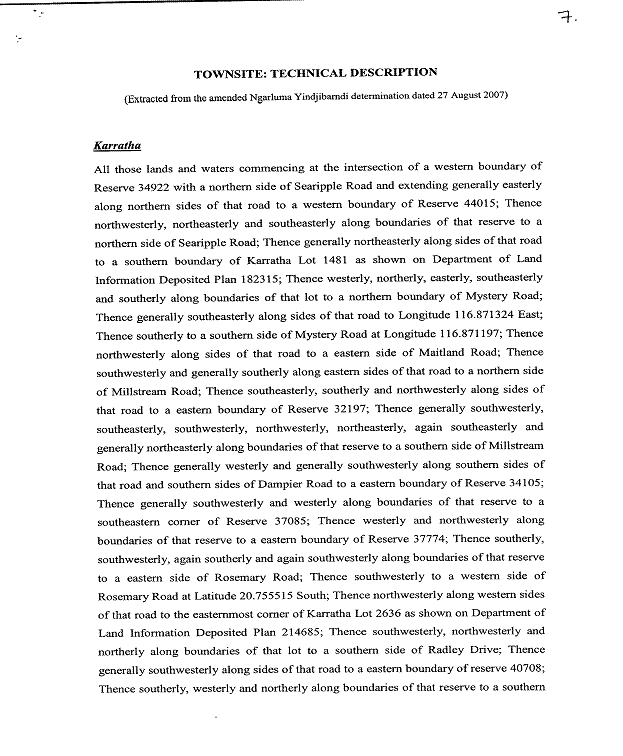
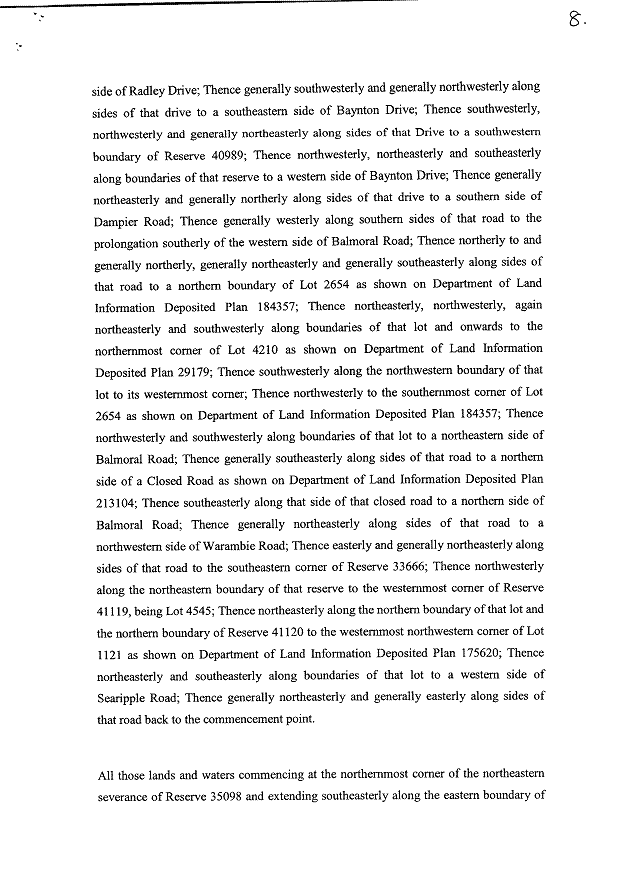
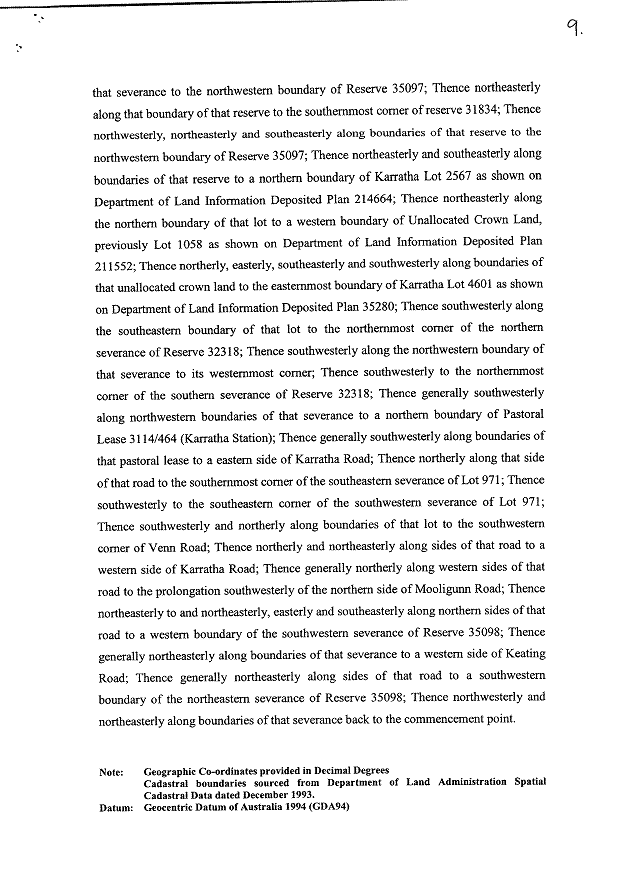
Annexure ‘B’
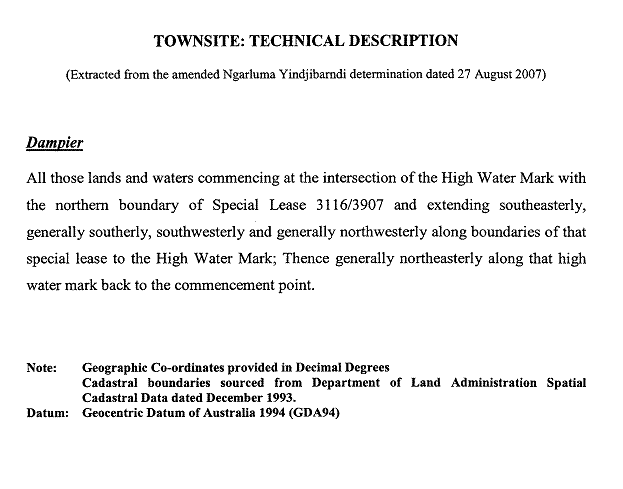
Annexure ‘C’
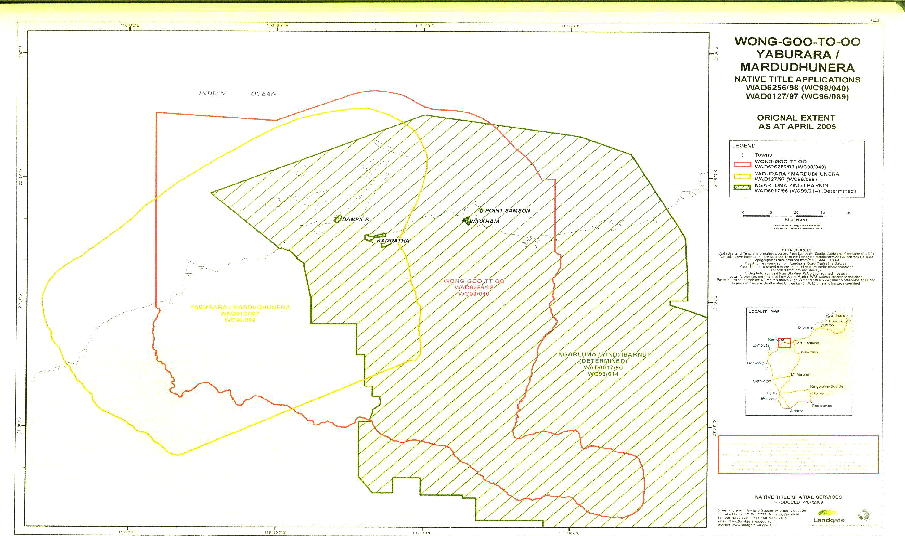
Annexure ‘D’
IN THE FEDERAL COURT OF AUSTRALIA
WESTERN AUSTRALIA DISTRICT REGISTRY
No: (P)WAD114/2005
DAISY MOSES, ROGER BARKER, JILL CHURNSIDE, TREVOR SOLOMON & LES HICKS (on behalf of the Ngarluma People) and BRUCE MONADEE, MARY WALKER, BRUCE WOODLEY, MICHELLE ADAMS, JIMMY HORACE, LINDA RYDER & JUDY ALBERT (on behalf of the Yindjibarndi People)
Appellants
THE STATE OF WESTERN AUSTRALIA
First Respondent/First Cross Appellant
P & D COOK, PETER COOK, COOLWANYAH PASTORAL COMPANY PTY LTD, MALLINA STATION, PEDO PTY LTD (MALLINA STATION)
Second Respondent
COMMONWEALTH OF AUSTRALIA
Third Respondent/Second Cross Appellant
ORDER
| JUDGE: | Justice Moore |
| DATE OF ORDER: | 27 August 2007 |
| WHERE MADE: | Perth |
THE COURT ORDERS THAT:
1. In respect of the amended appeal filed 28 July 2005:
(a) paragraphs 2 and 5 are allowed;
(b) paragraph 4 is allowed in part;
(c) the appeal is otherwise dismissed.
2. The determination of native title made by the trial judge, being orders 1 to 17 (inclusive) on 2 May 2005, is set aside and a new determination is substituted in the terms of the Schedule to these orders.
3. The State of Western Australia's cross appeal filed on 10 June 2005 is dismissed;
4. In respect of the Commonwealth of Australia's cross appeal filed on 21 June 2005;
(a) paragraphs 8 to 12 are allowed; and
(b) the cross appeal is otherwise dismissed.
5. No order as to costs
SCHEDULE – SUBSTITUTED DETERMINATION OF NATIVE TITLE
THE COURT ORDERS AND DETERMINES THAT:
Determination Area
1. The ‘Determination Area’ is the land and waters described and depicted in the First Schedule.
Existence of native title
2. Native title does not exist in relation to the following parts of the Determination Area:
(a) the ‘Burrup’ (as described and depicted in the First Schedule);
(b) ‘Offshore Waters’ (as described and depicted in the First Schedule);
(c) ‘Depuch Island’ (as described and depicted in the First Schedule);
(d) the ‘Hamersley Ranges Area’ (as described and depicted in the First Schedule);
(e) the ‘Total Extinguishment Area’ (as described and depicted in the First Schedule).
3. Subject to paragraph 2 above, native title rights and interests exist in the following parts of the Determination Area:
(a) ‘Ngarluma Native Title Area’ (as defined in the First Schedule); and
(b) ‘Yindjibarndi Native Title Area’ (as defined in the First Schedule),
including the ‘Section 47A Area’ and the ‘Section 47B Area’ (as described in the Fifth Schedule) in respect of which extinguishment is disregarded in accordance with sections 47A and 47B of the Native Title Act 1993 (Cth).
4. The native title rights and interests:
(a) do not confer possession, occupation, use and enjoyment of land or waters on the native title holders to the exclusion of others; and
(b) are not exercisable otherwise than in accordance with and subject to traditional laws and customs for personal, domestic and non-commercial communal purposes (including social, cultural, religious, spiritual and ceremonial purposes).
Native title holders
5. The non-exclusive native title rights and interests which exist in the Determination Area are held by:
(a) ‘Ngarluma People’ (as defined in the Third Schedule) in relation to the Ngarluma Native Title Area; and
(b) ‘Yindjibarndi People’ (as defined in the Third Schedule) in relation to the Yindjibarndi Native Title Area.
Native title rights and interests
6. Subject to paragraphs 4 and 8 to 15 inclusive, the Ngarluma People have the following non-exclusive native title rights and interests in relation to the Ngarluma Native Title Area:
(a) A right to access (including to enter, to travel over and remain);
(b) A right to engage in ritual and ceremony (including to carry out and participate in initiation practices);
(c) A right to camp and to build shelters (including boughsheds, mias and humpies) and to live temporarily thereon as part of camping or for the purpose of building a shelter;
(d) A right to fish from the waters;
(e) A right to collect and forage for bush medicine;
(f) A right to hunt and forage for and take fauna (including fish, shell fish, crab, oysters, sea turtle, dugong, goanna, kangaroo, emu, bush turkey, echidna, porcupine, witchetty grub, swan);
(g) A right to forage for and take flora (including timber logs, branches, bark and leaves, gum, wax, Aboriginal tobacco, fruit, peas, pods, melons, bush cucumber, seeds, nuts, grasses, potatoes, wild onion and honey);
(h) A right to take black, yellow, white and red ochre;
(i) A right to take water for drinking and domestic use;
(j) A right to cook on the land including light a fire for this purpose;
(k) A right to protect and care for sites and objects of significance in the Ngarluma Native Title Area (including a right to impart traditional knowledge concerning the area, while on the area, and otherwise, to succeeding generations and others so as to perpetuate the benefits of the area and warn against behaviour which may result in harm, but not including a right to control access or use of the land by others).
7. Subject to paragraphs 4 and 8 to 15 inclusive, the Yindjibarndi People have the following non-exclusive native title rights and interests in relation to the Yindjibarndi Native Title Area:
(a) A right to access (including to enter, to travel over and remain);
(b) A right to engage in ritual and ceremony (including to carry out and participate in initiation practices);
(c) A right to camp and to build shelters (including boughsheds, mias and humpies) and to live temporarily thereon as part of camping or for the purpose of building a shelter;
(d) A right to fish from the waters;
(e) A right to collect and forage for bush medicine;
(f) A right to hunt and forage for and take fauna (including fish, shell fish, crab, oysters, goanna, kangaroo, emu, turkey, echidna, porcupine, witchetty grub and swan but not including dugong or sea turtle);
(g) A right to forage for and take flora (including timber logs, branches, bark and leaves, gum, wax, Aboriginal tobacco, fruit, peas, pods, melons, bush cucumber, seeds, nuts, grasses, potatoes, wild onion and honey);
(h) A right to take black, yellow, white and red ochre;
(i) A right to take water for drinking and domestic use;
(j) A right to cook on the land including light a fire for this purpose;
(k) A right to protect and care for sites and objects of significance in the Yindjibarndi Native Title Area (including a right to impart traditional knowledge concerning the area, while on the area, and otherwise, to succeeding generations and others so as to perpetuate the benefits of the area and warn against behaviour which may result in harm, but not including a right to control access or use of the land by others).
9. The non-exclusive native title rights and interests in relation to the ‘Offshore Islands’ (defined in the First Schedule) do not include any of the native title rights and interests in subparagraphs (a)-(j) of paragraph 6 above.
10. The non-exclusive native title rights and interests in relation to the ‘Cemetery Reserve Area’ (defined in the First Schedule) do not include:
(a) the right to engage in ritual and ceremony referred to in subparagraph (b) of paragraph 6 above, save to the extent it relates to ritual and ceremony for the dead; or
(b) any of the rights in subparagraphs (c), (d), (h), (j) and (k) of paragraph 6 above.
11. The non-exclusive native title rights and interests in relation to the ‘Telstra Area’ (defined in the First Schedule) do not include:
(a) a right to remain (part of right (a) in paragraphs 6 and 7 above); and
(b) right (c) in paragraphs 6 and 7 above.
12. The non-exclusive native title rights and interests in relation to the ‘Telstra Cable Routes’ (defined in the First Schedule) do not include right (h) in paragraphs 6 and 7 above, to the extent that the right involves digging beneath the surface of that land.
Qualifications
13. Notwithstanding anything in this determination, there are no native title rights and interests in or in relation to:
(a) minerals (including ochres to the extent they are minerals) as defined in the Mining Act 1904 (WA), or in the Mining Act 1978 (WA) before the date of this determination; or
(b) petroleum as defined in the Petroleum Act 1936 (WA), or in the Petroleum Act 1967 (WA) before the date of this determination.
14. There are no native title rights and interests in respect of ‘Subterranean Waters’ (as defined in the First Schedule) in the Determination Area.
Other interests
(a) to the extent that any other interest is a category D past act, a category D intermediate period act or a future act under the Native Title Act 1993 (Cth), or is an act to which sections 47A or 47B Native Title Act 1993 (Cth) applies, and is inconsistent with the continued existence, enjoyment or exercise of the native title rights or interests, the native title continues to exist in its entirety, but the native title rights and interests have no effect in relation to the other interests to the extent of the inconsistency during the currency of those other interests;
(b) in the case of mining leases, pastoral leases, easements and licences granted prior to 1 January 1994, the construction or erection of an improvement required or permitted under such a lease or easement or licence will prevent the exercise of the non-exclusive native title rights and interests at the location of that improvement to the extent that the exercise of those rights are inconsistent with the improvement for so long as the holder of the lease, easement or licence retains the improvement; and
(c) otherwise, the existence and exercise of the native title rights and interests does not prevent the doing of any activity required or permitted to be done by or under the other interests, and the other interests, and the doing of any activity required or permitted to be done by or under the other interests, prevail over the native title rights and interests and may prevent any exercise of the native title rights and interests, but does not extinguish them.
FIRST SCHEDULE
DEFINITIONS
‘Burrup’ means the land and waters shaded in green on the maps marked ‘Map 1’ which are Attachment 2 to this First Schedule.
‘Cemetery Reserve Area’ means the land and waters the subject of reserves 5698, 30904 and 41146, as shaded in orange on the maps marked ‘Map 1’ which are Attachment 2 to this First Schedule.
‘Depuch Island’ means Depuch Island and Sandy Island, West Moore Island and East Moore Island landward of the low water mark, as shaded in dark green on the maps marked ‘Map 1’ which are Attachment 2 to this First Schedule.
‘Determination Area’ means the land and waters described in Attachment 1 to this First Schedule, being the land and waters bordered in light blue on the maps marked ‘Map 1’ which are Attachment 2 to this First Schedule.
‘Hamersley Ranges Area’ means the land and waters shaded light brown on the maps marked ‘Map 1’ which are Attachment 2 to this First Schedule.
‘Inter-tidal Zone’ means that part of the Ngarluma Native Title Area which is between mean high water mark and mean low water mark, as shaded in orange on the maps marked ‘Map 1’ which are Attachment 2 to this First Schedule.
‘Ngarluma Area’ means the land and waters bordered and hatched in dark blue on the maps marked ‘Map 1’ which are Attachment 2 to this First Schedule.
‘Ngarluma Native Title Area’ means the Ngarluma Area but not including the Ngarluma Total Extinguishment Area.
‘Ngarluma Total Extinguishment Area’ means the land and waters the subject of the following interests:
(1) Certificates of Title
| CT Number | Parcel Identification |
| 3/239 | Roebourne Town Lot 124 |
| 10/118 | Roebourne Town Lot 174 |
| 11/48 | Roebourne Town Lot 130 |
| 11/60 | Roebourne Town Lot 166 |
| 11/91 | Cossack Town Lot 164 |
| 14/174 | Roebourne Town Lot 150 |
| 15/341 | Roebourne Suburban Lot 3 |
| 15/345 | Cossack Town Lot 165 |
| 18/329 | North Location 39 |
| 18/330 | North Location 38 |
| 18/331 | North Location 37 |
| 20/36 | Roebourne Town Lot 271 |
| 21/329A | Cossack Lot 151 |
| 31/373 | Cossack Town Lot 170 |
| 33/39 | Cossack Town Lot 160 |
| 35/14 | Roebourne Town Lot 152 |
| 35/15 | Roebourne Town Lot 153 |
| 35/16 | Roebourne Town Lot 154 |
| 35/17 | Roebourne Town Lot 155 |
| 35/18 | Roebourne Town Lot 156 |
| 35/177 | Cossack Town Lot 135 |
| 35/178 | Cossack Town Lot 136 |
| 35/283 | Roebourne Town Lot 57 |
| 35/284 | Roebourne Town Lot 58 |
| 38/44A | North Location 6 |
| 39/380A | Roebourne Town Lot 190 |
| 79/189A | Roebourne Town Lots 144 and 145 |
| 124/188A | Roebourne Town Lot 114 |
| 186/197 | Roebourne Town Lots 380 and 381 |
| 136/2 | Roebourne Town Lots 174 and 175 |
| 156/22 | Cossack Town Lot 116 |
| 193/174 | Balla Balla Town Lot 45 |
| 221/143 | Lot 1 on Deposited Plan 528 |
| 228/9 | Roebourne Lot 385 |
| 265/56 | Cossack Town Lot 152 |
| 267/54 | Cossack Town Lot 424 |
| 319/143 | Roebourne Lot 115 |
| 354/50 | Cossack Town Lot 176 |
| 390/172A | Roebourne Lot 394 |
| 405/11A | Roebourne Lot 396 |
| 416/2 | Roebourne Suburban Lot 4 |
| 416/3 | Roebourne Suburban Lot 5 |
| 421/143 | Balla Balla Lot 73 |
| 424/127 | Balla Balla Lot 68 |
| 445/76 | Roebourne Town Lots 134, 135, 146 and 147 |
| 451/184A | Roebourne Town Lots 99, 100, 101, 102, 103, 106, 107 and 108 |
| 451/185A | North Location 4 |
| 451/186A | North Location 9 |
| 451/187A | North Location 54 |
| 451/190A | North Location 72 |
| 451/192A | North Location 23 |
| 451/193A | North Location 70 |
| 451/194A | North Location 26 |
| 456/131 | Roebourne Town Lot 1 |
| 464/35A | Portion Roebourne Town Lot 53 |
| 466/103A | Roebourne Town Lot 21 |
| 475/37A | Lot 1 on Diagram 41164 |
| 475/38A | Lot 2 on Diagram 41164 |
| 486/44A | Portion Roebourne Lots 49 and 50 |
| 481/143 | Cossack Town Lot 153 |
| 488/164 | North Location 34 |
| 506/197A | Lot 13 on Diagram 41455 |
| 508/149A | Roebourne Lot 438 |
| 508/165A | Roebourne Lot 436 |
| 523/114 | Cossack Town Lot 121 |
| 541/78A | Lot 2 on Plan 528 |
| 541/82A | Lot 4 on Plan 528 |
| 550/87 | Cossack Town Lot 145 |
| 570/65 | Roebourne Town Lots 266, 267, 268, 269, 270, 272, 273, 274, 275, 276, 278, 279, 280, 281, 282, 283, 284, 285, 286, 287, 288 and 289 |
| 583/51 | Roebourne Townsite 149 |
| 610/193A | Roebourne Lot 471 |
| 762/156 | Roebourne Town Lot 123 |
| 839/108 | De Witt Location 11 (but not insofar as it covers the Section 47B Area) |
| 1002/353 | Cossack Town Lot 125 |
| 1020/864 | Roebourne Town Lots 128, 145, 151, 265 and 271 |
| 1022/225 | De Witt Location 14 |
| 1024/426 | Part Lots 5 and 7 on Plan 528 |
| 1031/75 | North Location 71 |
| 1031/76 | Balla Balla Town Lots 43 and 44 |
| 1040/615 | Peawah Location 6 |
| 1046/512 | Roebourne Town Lot 27 |
| 1093/705 | Roebourne Suburban Lot 16 (but not insofar as it covers the Section 47A Area) |
| 1093/889 | De Witt Location 15, Roebourne Suburban Lot 9, North Location 36 (part) and Roebourne Suburban Lot 16 (part) (but not insofar as it covers the Section 47B Area) |
| 1107/653 | Roebourne Lots 162 and 163 |
| 1113/927 | Cossack Town Lot 124 |
| 1130/580 | Cossack Town Lot 141 |
| 1156/380 | North Location 3 |
| 1160/901 | Roebourne Lot 19 |
| 1188/398 | Roebourne Lot 105 |
| 1188/526 | Roebourne Lot 176 |
| 1188/965 | Roebourne Lot 169 |
| 1200/267 | Roebourne Lot 54 and Portion Roebourne Town Lot 53 |
| 1203/514 | Roebourne Lot 121 |
| 1203/515 | Roebourne Lot 28 |
| 1222/113 | Roebourne Part Lot 18, Lots 116, 117 |
| 1225/674 | Roebourne Town Lot 29 |
| 1238/195 | Roebourne Lot 119 |
| 1238/229 | Roebourne Lot 6 |
| 1238/230 | Roebourne Lot 10 |
| 1238/231 | Roebourne Lot 259 |
| 1238/595 | Roebourne Lot 127 |
| 1245/348 | De Witt Location 12 |
| 1247/338 | Roebourne Lot 188, 189 |
| 1249/383 | Lot 11 on Plan 528 |
| 1252/43 | Roebourne Lots 399, 400 |
| 1259/853 | Roebourne Lot 416 |
| 1266/926 | Balla Balla Lot 97 |
| 1316/148 | Roebourne Lots 428, 437, 439, 440, 441, 442, 443, 445 |
| 1316/347 | Roebourne Lot 196 |
| 1318/889 | Roebourne Lot 434 |
| 1320/11 | Roebourne Lot 59 |
| 1320/12 | Roebourne Lot 60 |
| 1320/17 | Roebourne Lot 146 |
| 1322/526 | Lot 1 on Diagram 42823 |
| 1322/0527 | Lot 2 on diagram 42823 |
| 1322/528 | Roebourne Lot 397 |
| 1323/681 | Roebourne Lot 111 |
| 1328/400 | Roebourne Lot 435 |
| 1329/912 | Roebourne Lot 421 |
| 1329/913 | Roebourne Lot 422 |
| 1335/179 | Portion Roebourne Lot 9 |
| 1336/708 | Roebourne Lot 428 |
| 1346/865 | Roebourne Lot 113 |
| 1348/518 | Roebourne Town Lot 167 |
| 1349/725 | Roebourne Lot 194 |
| 1349/726 | Roebourne Lot 195 |
| 1352/369 | Roebourne Lot 188 |
| 1363/796 | Cossack Town Lot 170 |
| 1363/797 | Balla Balla Town Lots 65, 66 & 67 |
| 1363/798 | Roebourne Town Lot 168 |
| 1364/592 | Roebourne Lot 415 |
| 1364/593 | Roebourne Lot 479 |
| 1364/594 | Roebourne Lot 484 |
| 1364/595 | Roebourne Lot 485 |
| 1364/596 | Roebourne Lot 508 |
| 1364/597 | Roebourne Lot 509 |
| 1364/598 | Roebourne Lot 515 |
| 1364/599 | Roebourne Lot 521 |
| 1364/600 | Roebourne Lot 527 |
| 1365/847 | North Location 42, 43, 51, 36 (part), 55 (part), 56 (part) & 65 (part) |
| 1368/185 | Roebourne Lot 492 |
| 1368/186 | Roebourne Lot 496 |
| 1368/187 | Roebourne Lot 499 |
| 1369/444 | Roebourne Lot 519 |
| 1369/461 | Roebourne Lot 522 |
| 1376/584 | Roebourne Lot 440 |
| 1376/585 | Roebourne Lot 441 |
| 1381/810 | De Witt Location 17 |
| 1381/811 | De Witt Location 70 & 71 |
| 1382/158 | Roebourne Lot 413 |
| 1382/159 | Roebourne Lot 401 |
| 1382/160 | Roebourne Lot 412 |
| 1382/161 | Roebourne Lot 408 |
| 1382/162 | Roebourne Lot 403 |
| 1384/491 | Karratha Lot 1143 |
| 1387/780 | Roebourne Lot 143 |
| 1387/781 | Roebourne Lot 482 |
| 1387/782 | Roebourne Lot 477 |
| 1387/783 | Roebourne Lot 483 |
| 1387/784 | Roebourne Lot 497 |
| 1387/785 | Roebourne Lot 498 |
| 1390/918 | Lot 3 on Plan 528 |
| 1390/952 | North Location 47 |
| 1390/953 | North Location 2 |
| 1391/354 | Roebourne Lot 474 |
| 1396/5 | Roebourne Lot 545 |
| 1397/994 | Lot 1 of North Location 67 |
| 1397/995 | North Location 67 |
| 1401/992 | De Witt Location 83 |
| 1405/827 | Roebourne Lot 443 |
| 1435/582 | North Location 16 |
| 1437/701 | Roebourne Town Lot 30 |
| 1442/176 | North Locations 10 & 11 |
| 1443/601 | Karratha Lot 1485 |
| 1445/635 | Roebourne Lot 534 |
| 1453/191 | Roebourne Lot 669 |
| 1453/192 | Roebourne Lot 667 |
| 1453/193 | Roebourne Lot 665 |
| 1453/194 | Roebourne Lot 661 |
| 1453/195 | Roebourne Lot 660 |
| 1453/196 | Roebourne Lot 658 |
| 1453/197 | Roebourne Lot 651 |
| 1453/198 | Roebourne Lot 645 |
| 1453/199 | Roebourne Lot 642 |
| 1453/200 | Roebourne Lot 640 |
| 1455/603 | Roebourne Lot 630 |
| 1455/604 | Roebourne Lot 629 |
| 1462/999 | North Location 32 |
| 1484/784 | Part of Lot 15 on Diagram 42138 |
| 1490/126 | Roebourne Lot 140, 141, 142 |
| 1500/542 | Roebourne Town Lot 14 |
| 1500/543 | Roebourne Town Lot 16 |
| 1517/780 | Lot 1 on Diagram 53119 |
| 1517/781 | Lot 2 on Diagram 53119 |
| 1518/440 | Roebourne Town Lot 31 |
| 1519/118 | Roebourne Lot 571 |
| 1519/119 | Roebourne Lot 574 |
| 1519/120 | Roebourne Lot 575 |
| 1519/121 | Roebourne Lot 576 |
| 1519/122 | Roebourne Lot 577 |
| 1519/123 | Roebourne Lot 578 |
| 1519/125 | Roebourne Lot 581 |
| 1519/126 | Roebourne Lot 582 |
| 1519/127 | Roebourne Lot 583 |
| 1519/128 | Roebourne Lot 584 |
| 1519/129 | Roebourne Lot 585 |
| 1519/130 | Roebourne Lot 586 |
| 1519/131 | Roebourne Lot 587 |
| 1519/132 | Roebourne Lot 588 |
| 1519/133 | Roebourne Lot 589 |
| 1519/134 | Roebourne Lot 590 |
| 1519/135 | Roebourne Lot 591 |
| 1519/136 | Roebourne Lot 592 |
| 1519/137 | Roebourne Lot 593 |
| 1519/138 | Roebourne Lot 594 |
| 1519/139 | Roebourne Lot 596 |
| 1519/140 | Roebourne Lot 597 |
| 1519/141 | Roebourne Lot 598 |
| 1519/142 | Roebourne Lot 599 |
| 1519/143 | Roebourne Lot 602 |
| 1519/144 | Roebourne Lot 603 |
| 1519/145 | Roebourne Lot 604 |
| 1519/146 | Roebourne Lot 605 |
| 1519/147 | Roebourne Lot 606 |
| 1519/148 | Roebourne Lot 607 |
| 1519/149 | Roebourne Lot 608 |
| 1519/150 | Roebourne Lot 609 |
| 1519/151 | Roebourne Lot 610 |
| 1519/152 | Roebourne Lot 612 |
| 1519/153 | Roebourne Lot 613 |
| 1519/154 | Roebourne Lot 614 |
| 1519/155 | Roebourne Lot 615 |
| 1519/156 | Roebourne Lot 616 |
| 1519/157 | Roebourne Lot 617 |
| 1519/158 | Roebourne Lot 618 |
| 1519/159 | Roebourne Lot 619 |
| 1519/160 | Roebourne Lot 621 |
| 1519/161 | Roebourne Lot 622 |
| 1519/162 | Roebourne Lot 623 |
| 1519/163 | Roebourne Lot 624 |
| 1519/164 | Roebourne Lot 625 |
| 1519/165 | Roebourne Lot 626 |
| 1519/166 | Roebourne Lot 627 |
| 1519/167 | Roebourne Lot 688 |
| 1519/168 | Roebourne Lot 570 |
| 1519/169 | Roebourne Lot 569 |
| 1519/994 | Cossack Lot 117 |
| 1523/780 | Roebourne Lot 649 |
| 1523/781 | Roebourne Lot 650 |
| 1525/178 | Roebourne Lot 407 |
| 1526/90 | Roebourne Lot 400 |
| 1526/946 | North Location 48 and portion North Location 64 |
| 1527/151 | Roebourne Lot 546 |
| 1531/382 | Roebourne Lot 489 |
| 1531/439 | Roebourne Lot 480 |
| 1532/262 | Roebourne Lot 33 |
| 1546/495 | Roebourne Town Lot 112 |
| 1550/99 | Roebourne Town Lot 23 |
| 1563/652 | Roebourne Lot 487 |
| 1564/269 | Roebourne Lot 644 |
| 1566/568 | Roebourne Lot 659 |
| 1566/569 | Roebourne Lot 704 |
| 1566/570 | Roebourne Lot 705 |
| 1567/519 | Karratha Lot 1996 |
| 1567/578 | Roebourne Lot 662 |
| 1581/605 | Roebourne Lot 409 |
| 1581/606 | Roebourne Lot 410 |
| 1581/607 | Roebourne Lot 411 |
| 1585/796 | Roebourne Lot 531 |
| 1590/377 | Roebourne Lot 631 |
| 1590/378 | Roebourne Lot 524 |
| 1590/379 | Roebourne Lot 420 |
| 1598/311 | Roebourne Lot 32 |
| 1598/312 | Roebourne Lot 34 |
| 1599/430 | Roebourne Lot 507 |
| 1602/758 | Roebourne Lot 494 |
| 1604/987 | Roebourne Lot 513 |
| 1608/922 | Roebourne Lot 643 |
| 1610/761 | Roebourne Town Lot 264 |
| 1613/0306 | Roebourne Lot 634 |
| 1617/564 | Roebourne Lot 635 |
| 1617/565 | Roebourne Lot 637 |
| 1619/336 | Roebourne Lot 517 |
| 1624/832 | Roebourne Lot 469 |
| 1624/833 | Roebourne Town Lot 193 |
| 1624/0834 | Roebourne Lot 552 |
| 1626/166 | Roebourne Lot 264 |
| 1628/574 | Roebourne Lot 512 |
| 1632/643 | Roebourne Lot 675 |
| 1634/0234 | Roebourne Lot 652 |
| 1634/0235 | Roebourne Lot 653 |
| 1642/0893 | Roebourne Lot 488 |
| 1644/525 | Roebourne Lot 126 |
| 1644/526 | Cossack Town Lot 167 |
| 1646/278 | Roebourne Lot 495 |
| 1654/988 | Roebourne Lot 525 |
| 1654/989 | Roebourne Lot 526 |
| 1659/66 | Roebourne Lot 429 |
| 1659/67 | Roebourne Lot 486 |
| 1659/68 | Roebourne Lot 490 |
| 1659/69 | Roebourne Lot 503 |
| 1659/71 | Roebourne Lot 514 |
| 1659/72 | Roebourne Lot 516 |
| 1659/73 | Roebourne Lot 523 |
| 1659/74 | Roebourne Lot 657 |
| 1659/75 | Roebourne Lot 668 |
| 1659/869 | Roebourne Suburban Lot 1 (Part Lot 12 on Plan 528) |
| 1667/5 | Roebourne Lot 417 |
| 1677/989 | Roebourne Lot 424 |
| 1683/785 | Cossack Town Lot 149 |
| 1683/787 | Cossack Town Lot 150 |
| 1685/729 | Roebourne Lot 423 |
| 1685/866 | Roebourne Lot 418 |
| 1687/59 | Roebourne Lot 520 |
| 1691/19 | Roebourne Lot 405 |
| 1692/99 | Roebourne Lot 454 |
| 1694/689 | Roebourne Lot 504 |
| 1694/857 | Lot 100 on Diagram 67860 |
| 1694/858 | Portion Roebourne Lot 448 |
| 1697/31 | Roebourne Lot 753 |
| 1705/771 | Roebourne Lot 424 |
| 1708/691 | Roebourne Lot 426 |
| 1713/478 | Roebourne Lot 459 |
| 1713/554 | Roebourne Lot 461 |
| 1714/861 | Roebourne Lot 666 |
| 1719/18 | Roebourne Lot 547 |
| 1722/82 | Roebourne Lot 427 |
| 1723/39 | Roebourne Lot 752 |
| 1724/734 | Roebourne Lot 432 |
| 1726/177 | Roebourne Lot 452 |
| 1728/883 | Roebourne Lot 431 |
| 1728/884 | Roebourne Lot 437 |
| 1738/703 | Roebourne Lot 110 |
| 1738/766 | Roebourne Lot 120 |
| 1740/598 | Roebourne Lot 656 |
| 1748/823 | Lot 1 on Diagram 70971 |
| 1751/134 | Roebourne Lot 447 |
| 1751/0412 | Roebourne Lot 512 |
| 1751/413 | Roebourne Lot 749 |
| 1753/164 | Roebourne Lot 151 |
| 1773/240 | Roebourne Lot 632 |
| 1773/241 | Roebourne Lot 636 |
| 1773/242 | Roebourne Lot 648 |
| 1773/243 | Roebourne Lot 663 |
| 1773/867 | Roebourne Lot 638 |
| 1778/353 | Lot 6 on Plan 528 |
| 1783/174 | Roebourne Lot 466 |
| 1785/795 | Lot 12 on Diagram 72573 |
| 1785/796 | Lot 11 on Diagram 72573 |
| 1789/434 | Lot 14 on Diagram 41455 |
| 1792/87 | Karratha Lot 4202 |
| 1792/687 | Lot 12 on Diagram 72573 |
| 1795/967 | Roebourne Lot 655 |
| 1800/365 | Roebourne Lot 501 |
| 1802/855 | Roebourne Lot 548 |
| 1810/175 | Roebourne Lot 755 |
| 1812/355 | Roebourne Lot 564 |
| 1814/928 | Roebourne Lot 475 |
| 1817/551 | Roebourne Lot 558 |
| 1821/191 | Roebourne Lot 419 |
| 1827/408 | Roebourne Lot 147 |
| 1827/409 | Roebourne Lot 148 |
| 1837/802 | Roebourne Lot 529 |
| 1838/757 | Roebourne Lot 530 |
| 1845/991 | Roebourne Lot 491 |
| 1845/992 | Roebourne Lot 481 |
| 1849/424 | Roebourne Lot 476 |
| 1857/926 | Roebourne Lot 701 |
| 1861/571 | Lot 1 on Diagram 41696 |
| 1861/572 | Lot 2 on Diagram 41696 |
| 1861/573 | Lot 3 on Diagram 41696 |
| 1866/336 | Roebourne Lot 478 |
| 1872/17 | Lot 100 on Diagram 77649 |
| 1881/279 | Lot 710 on Diagram 78197 |
| 1881/325 | Roebourne Lot 518 |
| 1892/697 | Lot 1 on Diagram 78763 |
| 1903/131 | Roebourne Lot 533 |
| 1940/136 | Roebourne Lot 464 |
| 1940/559 | Roebourne Lot 664 |
| 1946/77 | Lot 1 on Diagram 80812 |
| 1948/185 | Lot 17 on Diagram 52876 |
| 1958/220 | Roebourne Town Lot 25 |
| 1972/692 | Peawah Location 58 |
| 1977/98 | De Witt Location 153 |
| 1986/554 | Roebourne Lot 414 |
| 1991/48 | Karratha Lot 1090 |
| 1991/423 | Roebourne Lot 537 |
| 1994/185 | Roebourne Lot 678 |
| 2009/631 | Roebourne Town Lot 49 |
| 2023/664 | Roebourne Lot 563 |
| 2032/535 | Karratha Lot 2637 |
| 2052/356 | Lot 10 on Diagram 89258 |
| 2073/140 | Roebourne Lot 460 |
| 2073/141 | Roebourne Lot 540 |
| 2081/501 | Roebourne Lot 511 |
| 2084/921 | Roebourne Lot 500 |
| 0029/1996 CL |
|
(2) Town Enrolments:
| ET Number | Parcel Identification |
| 2351 | Roebourne Town Lot 26 |
| 2354 | Roebourne Town Lot 40 |
| 2356 | Roebourne Town Lot 39 |
| 2359 | Roebourne Town Lots 23 and 24 |
| 2360 | Roebourne Lots 2, 3 |
| 2366 | Roebourne Lot 5 |
| 2368 | Roebourne Town Lot 41 |
| 2500 | Roebourne Suburban Lot 1 |
| 2919 | Roebourne Suburban Lot 123 |
| 3047 | Roebourne Suburban Lot 122 |
| 3087 | Cossack Town Lot 129 |
| 3088 | Roebourne Town Lot 22 |
| 3092 | Cossack Town Lot 121 |
| 4125 | Roebourne Lot 4 |
| 4386 | Cossack Town Lot 142 |
| 4387 | Cossack Town Lot 143 |
| 4388 | Cossack Town Lot 144 |
| 4466 | Roebourne Town Lot 20 |
| 4470 | Roebourne Town Lot 47 |
| 4495 | Roebourne Town Lot 38 |
(3) Town Grants:
| GT Number | Parcel Identification |
| 2/481 | Cossack Town Lot 10 |
| 3/536 | Cossack Town Lot 110 |
| 3/629 | Cossack Town Lot 112 |
| 3/748 | Roebourne Town Lot 122 |
| 3/778 | Roebourne Town Lot 12 |
| 3/793 | Cossack Town Lot 154 |
| 4/980 | Roebourne Town Lot 48 |
| 4/1031 | Cossack Town Lot 139 |
| 4/1032 | Cossack Town Lot 140 |
| 5/1177 | Roebourne Town Lot 109 |
| 5/1310 | Roebourne Town Lot 55 |
| 5/1313 | Roebourne Town Lot 157 |
| 5/1314 | Roebourne Town Lot 158 |
| 5/1321 | Cossack Town Lot 174 (but not insofar as it covers the Section 47B Area) |
| 5/1322 | Cossack Town Lot 175 (but not insofar as it covers the Section 47B Area) |
| 5/1327 | Roebourne Town Lot 173 |
| 5/1403 | Cossack Town Lot 162 |
| 5/1407 | Roebourne Town Lot 104 |
| 6/257 | Roebourne Town Lot 208 |
| 6/258 | Roebourne Town Lot 177 (but not insofar as it covers the Section 47B Area) |
| 6/260 | Roebourne Town Lot 199 |
| 6/263 | Cossack Town Lot 163 |
| 6/291 | Roebourne Town Lot 164 |
| 6/292 | Roebourne Town Lot 165 |
| 6/357 | Roebourne Town Lot 178 (but not insofar as it covers the Section 47B Area) |
| 7/28 | Roebourne Town Lot 207 |
| 7/71 | Roebourne Suburban Lot 2 |
| 7/198 | Roebourne Town Lot 220 |
| 8/209 | Roebourne Suburban Lot 7 |
| 8/389 | Cossack Town Lot 166 |
| 8/395 | Roebourne Town Lot 180 |
| 8/447 | Roebourne Town Lot 179 |
| 8/450 | Roebourne Town Lot 183 |
| 8/458 | Roebourne Town Lot 181 |
| 8/459 | Roebourne Town Lot 182 |
| 8/449 | Roebourne Suburban Lot 15 |
| 8/478 | Cossack Town Lot 169 |
| 8/484 | Roebourne Town Lot 206 |
| 8/485 | Roebourne Town Lot 210 |
| 8/584 | Roebourne Suburban Lot 16 (but not insofar as it covers the Section 47A Area) |
| 8/588 | Roebourne Town Lot 56 |
| 8/635 | Cossack Town Lot 106 |
| 8/636 | Cossack Town Lot 107 |
| 8/639 | Cossack Town Lot 156 |
| 9/89 | Roebourne Town Lot 160 |
| 9/98 | Roebourne Town Lot 159 |
| 9/657 | Cossack Town Lot 206 |
| 10/434 | Roebourne Suburban Lot 9 |
| 15/111 | Roebourne Town Lot 382 |
(4) Country Grants:
| GC Number | Parcel Identification |
| 2/394 | North Location 5 |
| 2/397 | North Location 7 |
| 5/77 | North Location 12 |
| 5/78 | North Location 13 |
| 7/7 | North Location 38 |
| 7/127 | North Location 49 |
| 7/128 | North Location 50 |
(5) Land Grant:
| LG Number | Parcel Identification |
| 1/135 | Roebourne Town Lot 36 |
(6) Memorial of Conveyance:
| Number | Parcel Identification |
| 19/270 | Part Lot 8 on Plan 528 |
(7) Special leases:
| 3116/00798 (but not insofar as it covers the Section 47B Area) | 3116/04629 | 3116/07616 | 3116/10363 |
| 3116/01173 | 3116/04659 | 3116/07842 | 3116/10364 |
| 3116/01310 | 3116/04826 | 3116/07936 | 3116/10424 |
| 3116/01815 | 3116/04837 | 3116/08193 | 3116/10640 |
| 3116/02482 | 3116/04866 | 3116/08252 | 3116/10702 |
| 3116/03211 | 3116/04873 | 3116/08303 | 3116/10707 |
| 3116/03354 | 3116/04878 | 3116/08543 | 3116/10865 |
| 3116/03469 | 3116/04896 | 3116/08861 | 3116/10889 |
| 3116/03470 (but not insofar as it covers the Section 47B Area) | 3116/04907
| 3116/08870 | 3116/11041 |
| 3116/03471 | 3116/04976 | 3116/09123 | 3116/11084 |
| 3116/03725 | 3116/04977 | 3116/09124 | 3116/11104 |
| 3116/03806 | 3116/04984 | 3116/09125 | 3116/11217 |
| 3116/03807 | 3116/05154 | 3116/09126 | 3116/11281 |
| 3116/04002 | 3116/05503 | 3116/09127 | 3116/11311 |
| 3116/04011 | 3116/05552 | 3116/09128 | 3116/11346 |
| 3116/04358 | 3116/05603 | 3116/09129 | 3116/11465 |
|
| 3116/05828 | 3116/09130 | 3116/11543 |
| 3116/04384 | 3116/05947 | 3116/09131 | 3116/11567 |
| 3116/04538 | 3116/05969 | 3116/09132 | 3116/11580 |
| 3116/04596 | 3116/06037 | 3116/09133 | 3116/11588 |
| 3116/04597 | 3116/06221 | 3116/09435 | 3116/11611 |
| 3116/04598 | 3116/06282 | 3116/09503 | 3116/11623 |
| 3116/04599 | 3116/06499 | 3116/09578 | 3116/11668 |
| 3116/04600 | 3116/06691 | 3116/09678 | 3116/11671 |
| 3116/04621 | 3116/06702 | 3116/09914 | 3116/11780 |
| 3116/04622 | 3116/06806 | 3116/10115 | 3116/4892 |
| 3116/04623 | 3116/06829 | 3116/10135 | 3116/10694 |
| 3116/04624 | 3116/06940 | 3116/10136 |
|
| 3116/04625 | 3116/06967 | 3116/10179 |
|
| 3116/04628 | 3116/07615 | 3116/10252 |
|
(8) Other leases:
| 1444/152 | 332/1842 | 333a/2190 |
| 1508/152 | 332/1930 | Lease of Reserve 35798 |
| 1509/152 | 332/2096 | Lease of Reserve 39161 |
| 494/153 | 333/721 | I88601 |
| 519/153 | 333/722 |
|
| 524/153 | 333/726 |
|
| 525/153 | 333/734 |
|
(9) Roads:
| Road ID | Road No | Road Name |
| 1 | 155 |
|
| 2 | 156 |
|
| 3 | 279 |
|
| 4 | 371 |
|
| 5 | 388 | North West Coastal Highway |
| 6 | 390 | Roebourne Wittenoom Road |
| 7 | 391 |
|
| 8 | 392 |
|
| 9 | 393 |
|
| 10 | 407 |
|
| 11 | 432 | North West Coastal Highway |
| 12 | 656 |
|
| 13 | 657 |
|
| 14 | 658 |
|
| 15 | 1206 |
|
| 16 | 1644 |
|
| 18 | 7694 |
|
| 19 | 7695 |
|
| 20 | 7696 |
|
| 21 | 14625 |
|
| 22 | 14780 |
|
| 25 | 15215 |
|
| 26 | 15389 |
|
| 27 | 16088 |
|
| 28 | 18651 |
|
| 29 |
| Road |
| 30 |
| Sams Creek Road |
| 31 |
| Point Samson Roebourne Road |
| 32 |
| Point Samson Roebourne Road |
| 33 |
| Point Samson Roebourne Road |
| 34 |
| Point Samson Roebourne Road |
| 35 |
| Road |
| 36 |
| Point Samson Roebourne Road |
| 37 |
| Point Samson Roebourne Road |
| 39 |
| North West Coastal Highway |
| 40 | 15863 | North West Coastal Highway |
| 41 |
| Croul Road |
| 42 |
| Road |
| 43 | 15863 | North West Coastal Highway |
| 44 | 432 | North West Coastal Highway |
| 45 | 15863 | North West Coastal Highway |
| 46 |
| Burrup Road |
| 47 | 18785 | Mof Road |
| 48 |
| Burrup, Village and Bay Roads |
| 49 | 18741 | Griffin Road |
| 50 |
| Hearson Cove and Burrup Roads |
| 51 |
| Burrup Road |
| 52 | 16312 |
|
| 53 |
| Cinders Road |
| 54 |
| Cinders Road |
| 55 | 16211 | Cinders Road |
| 56 | 16211 | Cinders Road |
| 57 | 15444 | Dampier Road |
| 58 | 15444 | Dampier Road |
| 59 | 15444 |
|
| 60 | 15444 | Dampier Road |
| 61 |
| Road |
| 62 | 17821 | Madigan Road |
| 63 |
| Rosemary Road |
| 64 |
| Gwen Road |
| 65 |
| Karratha Road |
| 66 |
| Corral Road |
| 67 |
| Mystery Road |
| 68 |
| Robins Road |
| 69 | 18673 | Kennels Road |
| 70 | 388 |
|
| 71 |
| Karratha Road |
| 72 | 14530 |
|
| 73 | 17922 | Madigan Road |
| 74 |
| Rankin Road |
| 75 |
| Roads |
| 76 |
| Roads |
| 77 |
| Roads |
| 78 |
| Roads |
| 79 |
| Jager Street |
| 80 |
| Jager Street, Samson Road and Murray Road |
| 81 | 15861 | Watson Street |
| 82 | 14273 | Samson Road |
| 83 | 14274 | Nairn Street |
| 84 | 14272 | Cleaverville Road |
| 85 | 14275 |
|
| 86 |
| Burrup Road and Lockyer Way |
| 87 |
| Roads |
| 88 |
| Cleaver Court |
| 89 |
| Roads |
| 90 |
| Roads |
| 91 |
| Roads |
| 92 |
| Roads |
| 93 | 390 | Scholl Street |
| 94 | 390 | Scholl Street |
| 95 | 15597 | Fisher Drive |
| 96 | 13979 | De Grey Street |
| 97 | 13979 | De Grey Street |
| 98 | 15864 | Jiwuna Way |
| 99 |
| Jiwuna Way |
| 100 | 15863 | North West Coastal Highway |
| 101 |
| Road |
| 102 | 15863 | North West Coastal Highway |
| 103 | 15863 | North West Coastal Highway |
| 104 | 15863 | North West Coastal Highway |
| 105 |
| Roads |
| 106 | 13959 | North West Coastal Highway |
|
|
| Section of road 390 shown in Government Gazette 31 August 1893 page 869 |
|
| 3705 | Portion of Point Samson - Roebourne Road |
|
|
| Road on Deposited Plan 217003 |
|
|
| Portion of Point Samson-Roebourne Road (shown on Deposited Plans 214781 and 214782) |
|
|
| Hakea Place (shown on Deposited Plan 214782) |
|
|
| Portion of Spinifex Road (shown on Deposited Plan 214782) as shown on Map 1 |
|
|
| Tamarind Place (shown on Deposited Plan 214782) |
(10) Resumptions:
| Parcel No (Whole or part of) | Parcel Type | Government Gazette Details (containing extent of resumption) |
| 3116/4629 | Special Lease | 21.02.1995 pp 576, 577 |
| 394/439 | Pastoral Lease | 09.08.1974 p 2966 |
| 3114/439 | Pastoral Lease | 09.08.1974 p 2966 |
| 3114/464 | Pastoral Lease | 18.05.1979 p 1329 |
| 3114/466 | Pastoral Lease | 09.08.1974 p 2966 |
| 3114/716 | Pastoral Lease | 18.05.1979 p 1329 |
|
|
| 28.01.1983 p 356 |
| 1240/869 | Freehold | 23.08.1985 p 3005 |
| 1240/868 | Freehold | 23.08.1985 p 3005 |
| 1240/867 | Freehold | 23.08.1985 p 3005 |
| 1067/369 | Freehold | 23.08.1985 p 3005 |
| R 611 | Reserve | 21.02.1995 pp 576, 577 |
| R 613 | Reserve | 21.02.1995 pp 576, 577 |
| part R 9701 | Reserve | 18.05.1979 p 1330 |
| R 30948 | Reserve | 28.10.1997 p 5977 |
| part R 31113 | Reserve | 18.05.1979 p 1330 |
| part R 31114 | Reserve | 18.05.1979 p 1330 |
| R 41012 | Reserve | 28.10.1997 p 5977 |
| Land marked off and more particularly described on Plan PWD WA 48208-1-3-4-5-6-7-8 |
| 18.05.1979 p 1329 |
| Karratha Lot 4631, Crown land volume 3113 folio 465 | Unallocated Crown land | Taking order dated 20.11.2001 |
| Land shown on Deposited plans 194628 & 28085 | Unallocated Crown land | Taking order dated 05.01.04 |
(11) Vested reserves:
| 492 | 30717 | 33666 | 36424 | 37967 | 40877 |
| 715 | 30871 | 33812 | 36633 | 38009 | 40879 |
| 1186 | 30872 | 33861 | 36708 | 38193 | 40896 |
| 1564 | 30948 | 33864 | 36778 | 38287 | 41012 |
| 1721 | 31289 | 33945 | 36800 | 38387 | 41049 |
| 1724 | 31429 | 34034 | 36813 | 38616 | 41092 |
| 1729 | 31446 | 34129 | 36889 | 38773 | 41275 |
| 4562 | 31624 | 34254 | 36907 | 38962 | 41594 |
| 12346 | 31815 | 34403 | 36908 | 39095 | 41636 |
| 12464 | 31950 | 34588 | 36909 | 39140 | 41666 |
| 12654 | 31999 | 34631 | 36910 | 39141 | 41739 |
| 15645 | 32059 | 34687 | 36911 | 39161 | 41764 |
| 17500 | 32209 | 34922 | 36912 | 39202 | 42039 |
| 18301 | 32318 | 34944 | 36913 | 39775 | 42080 |
| 24006 | 32465 | 35053 | 36915 | 39776 | 42311 |
| 24116 | 32980 | 35140 | 36991 | 39777 | 42337 |
| 24573 | 32981 | 35385 | 37120 | 39778 | 42399 |
| 25208 | 32987 | 35452 | 37121 | 39973 | 42820 |
| 25981 (but not insofar as it covers the Section 47B Area) | 33023 | 35776 | 37140 | 40071 | 42850 |
| 27211 | 33134 | 35798 | 37294 | 40121 | 43195 |
| 28352 | 33135 | 35813 (but not insofar as it covers the Section 47B Area | 37314 | 40146 | 43302 |
| 29092 | 33250 | 35823 | 37315 | 40174 | 43303 |
| 29304 | 33354 | 35892 | 37349 | 40206 | 43734 |
| 30071 | 33360 | 36408 | 37526 | 40457 | 44103 |
| 30450 | 33361 | 36409 | 37669 | 40599 | 44292 |
| 30617 | 33577 | 36416 | 37835 | 40718 | 44452 |
| 30649 | 33643 | 36423 |
| 40858 |
|
(12) Part of vested reserves
| 21807 | Not insofar as it covers the same land as Reserve 35802 or insofar as it covers the Section 47B Area |
| 31768 | Not insofar as it covers the Section 47B Area |
(13) Reserves containing public works:
| 187 | 1732 | 12253 | 33876 | 37780 |
| 188 | 1766 | 12254 | 34034 | 38492 |
| 268 | 3357 | 12255 | 34255 | 40877 |
| 347 | 3619 | 17074 | 34403 | 41012 |
| 898 | 3841 | 18301 | 35053 | 44452 |
| 1190 | 3950 | 25592 | 35360 | 46193 |
| 1449 | 5908 | 30506 | 36633 |
|
| 1468 | 5923 | 31191 | 36800 |
|
| 1718 | 5933 | 31446 | 37120 |
|
| 1722 | 7319 | 32058 | 37121 |
|
| 1723 | 8532 | 32059 | 37349 |
|
| 1725 | 9355 | 32181 | 37543 |
|
| 1728 | 12246 | 33354 | 37680 |
|
(14) Easements containing public works:
| Number | Vestee/Owner |
| 3134B/211 | State Energy Commission of WA |
| 3134B/327 | State Energy Commission of WA |
| 3134B/342 | State Energy Commission of WA |
| 3134B/350 | State Energy Commission of WA |
| 3134B/351 | State Energy Commission of WA |
| 3134B/353 | State Energy Commission of WA |
| 3134B/372 | State Energy Commission of WA |
| 3134B/373 | State Energy Commission of WA |
| 3134B/389 | State Energy Commission of WA |
| 3134B/39 | State Energy Commission of WA |
| 3134B/40 | State Energy Commission of WA |
| 3134B/41 | State Energy Commission of WA |
| 3134B/42 | State Energy Commission of WA |
| 3134B/43 | State Energy Commission of WA |
| 3134B/44 | State Energy Commission of WA |
| 3134B/45 | State Energy Commission of WA |
| 3134B/46 | State Energy Commission of WA |
| 3134B/47 | State Energy Commission of WA |
| 3134B/48 | State Energy Commission of WA |
| 3134B/55(1) | State Energy Commission of WA |
| 3134B/55(2) | State Energy Commission of WA |
| 3134B/56 | State Energy Commission of WA |
(15) Other public works:
| Description | Area no. |
| Harding Dam Supply Main (De Witt loc 187) | 554 |
| Cape Lambert Supply Main extension (including Wickham, Cape Lambert, Roebourne and Point Samson tanks) | 130, 308 and land described in Government Gazette 9 August 1974 page 2966 |
| Cossack Radio Transmitter and the land on which it is constructed within the meaning of section 251D of the Native Title Act 1993 (Cth), being a square area of no greater than 100m2 (10m x 10m) within Roebourne Suburban Lot 127 | Part of 533 |
(16) Mining tenements:
| Tenement no. |
| BA 47/035 |
| BA 47/093 |
| BA 47/101 |
| RA 47/102 |
| TL 11 |
| ML 253SA |
(17) Port areas:
| Dampier Port Area |
| Port Walcott Port Area |
| Balla Balla Port Area |
| Point Samson Boat Harbour |
(18) Legislation:
|
| Area extinguished |
| Cossack-Roebourne Tramway Act 1886 | All of Area no.568 |
(19) Seabed lease:
| Seabed Lease (Product Loading Jetty) to Woodside Joint Venturers |
‘Offshore Islands’ means the land landward of the mean low water mark of islands in the Offshore Waters, excluding the Burrup and Depuch Island and the Ngarluma Total Extinguishment Area, as shaded in red on the maps marked ‘Map 1’ which are Attachment 2 to this First Schedule.
‘Offshore Waters’ means the waters within the Determination Area seaward of the mean low water mark of the coastline, as shaded in light blue on the maps marked ‘Map 1’ which are Attachment 2 to this First Schedule.
‘Subterranean Waters’ means waters which are for the time being contained in aquifers underneath the natural surface of the Determination Area; but does not include such waters to the extent they have percolated to the natural surface of the Determination Area.
‘Telstra Area’ means the land comprising Telstra Corporation Limited's:
(1) customer terminal sites; and
(2) Mount Fraser Optical Fibre Regenerator site, being Peawah Location 63, as shown on the maps marked ‘Map 1’ which are Attachment 2 to this First Schedule.
‘Telstra Cable Routes’ means the land and waters through which Telstra Corporation Limited's underground cabling is installed.
‘Total Extinguishment Area’ means the Ngarluma Total Extinguishment Area and the Yindjibarndi Total Extinguishment Area, as shaded in olive on the maps marked ‘Map 1’ which are Attachment 2 to this First Schedule. In the event of an inconsistency between the written description of the Ngarluma Total Extinguishment Area or the Yindjibarndi Total Extinguishment Area and the Total Extinguishment Area as depicted on the Maps in Attachment 2, the written description prevails.
‘Yindjibarndi Area’ means the land and waters bordered and hatched in orange on the maps marked ‘Map 1’ which are Attachment 2 to this First Schedule.
‘Yindjibarndi Native Title Area’ means the Yindjibarndi Area but not including the Yindjibarndi Total Extinguishment Area.
‘Yindjibarndi Total Extinguishment Area’ means the land and waters the subject of the following interests:
(1) Certificates of Title
| CT Number | Parcel Identification |
| 582/121 | North Location 18 |
| 1193/65 | North Location 15 |
(2) Country Grants:
| GC Number | Parcel Identification |
| 2/720 | North Location 8 |
| 9/209 | North Location 24 |
(3) Special leases:
| 3116/04001 | 3116/04621 | 3116/06431 | 3116/08475 |
| 3116/04002 | 3116/04622 | 3116/07842 | 3116/08476 |
| 3116/04011 | 3116/04892 | 3116/08474 | 3116/4984 |
(4) Other leases:
| Lease of Reserve 35798 |
(5) Roads:
| Road ID | Road No | Road Name |
| 1 | 155 |
|
| 6 | 390 | Roebourne Wittenoom Road |
| 16 | 1644 |
|
| 17 | 1645 |
|
| 23 | 14832 |
|
| 24 | 14833 |
|
(6) Resumptions:
| Parcel No. (Whole or part of) | Parcel Type | Government Gazette Details (containing extent of resumption) |
| 394/475 | Pastoral Lease | 21.09.1973 p 3534 |
| 394/978 | Pastoral Lease | 15.06.1973 p 2274 |
|
|
| 21.09.1973 p 3534 |
| 394/1468 | Pastoral Lease | 15.06.1973 p 2274 |
| 3114/788 | Pastoral Lease | 12.03.1982 p 823 (but not including the area of Reserve 41013) |
| North Location 8 | Freehold | 12.03.1982 p 823 |
(7) Vested reserves:
| 382 | 14687 | 31429 | 38333 | 40091 |
| 1780 | 24392 | 35798 | 38790 | 40743 |
| 3305 | 30071 | 36991 | 38991 |
|
(8) Reserves containing public works:
| 365 | 5514 | 12252 | 38492 |
| 3305 | 12251 | 12260 |
|
(9) Other public works:
| Description | Area no. |
| Asburton location 55 | 72 |
| Ashburton location 58 | 95 |
| Ashburton location 59 | 94 |
| De witt location 93 | 90 |
| De witt location 182 | 181 |
| North location 18 | 100 |
FIRST SCHEDULE - ATTACHMENT 1
EXTERNAL BOUNDARY DESCRIPTION
DETERMINATION AREA
All those lands and waters commencing at a point in the Indian Ocean at Latitude 20.563408 South and Longitude 116.275471 East and extending northeasterly and generally southeasterly passing through the following co-ordinate positions:
| LATITUDE (SOUTH) | LONGITUDE (EAST) |
| 20.248663 | 117.001327 |
| 20.334568 | 117.530137 |
| 20.405810 | 117.703908 |
| 20.683758 | 117.858200 |
| 20.697005 | 117.865980 |
| 20.697002 | 117.865984 |
| 20.740812 | 117.889433 |
Thence southerly to the easternmost northeastern corner of Pastoral Lease 3114/558 (Sherlock Station); Thence southerly, westerly and again southerly along boundaries of that pastoral lease to a southeastern corner; Thence southeasterly to Latitude 21.025485 South, Longitude 117.880424 East; Thence southeasterly to Latitude 21.029842 South, Longitude 117.892260 East; Thence southeasterly to the westernmost northwestern corner of Reserve 31427; Thence southerly, easterly and again southerly along boundaries of that reserve to the northern boundary of Reserve 31429 (Mungaroona Range Nature Reserve); Thence easterly and generally southeasterly along boundaries of that reserve to a eastern corner at Latitude 21.809846 South; Thence westerly to Latitude 21.813716 South, Longitude 118.422139 East; Thence westerly to Latitude 21.817967 South, Longitude 118.301556 East; Thence westerly to a western corner of Pastoral Lease 3114/1173 (Hooley Station) at Latitude 21.827702 South; Thence westerly and southerly along boundaries of that pastoral lease to a northern boundary of Reserve 5515; Thence southerly to the intersection of the southern boundary of Reserve 5515 with a western boundary of Pastoral Lease 3114/1173 (Hooley Station); Thence southerly along that western boundary to a western corner of that pastoral lease and onwards to Latitude 21.955976 South, Longitude 118.020315 East; Thence westerly to a southeastern corner of Pastoral Lease 3114/1228 (Coolawanyah Station); Thence westerly along a southern boundary of that pastoral lease to a southeastern corner; Thence westerly to Latitude 21.955893 South, Longitude 117.494065 East; Thence westerly to Latitude 21.955894 South, Longitude 117.411064 East; Thence north to a eastern corner of Unallocated Crown; Thence northerly along a eastern boundary of that unallocated crown land to a southern boundary of Reserve 38991; Thence northerly and generally westerly along boundaries of that reserve to a northeastern boundary of Ashburton Location 148 (Reserve 38991); Thence northwesterly along that boundary to a eastern corner of Pastoral Lease 3114/1013 (Yalleen Station); Thence northerly, easterly and generally northwesterly along boundaries of that pastoral lease to Longitude 116.819303 East; Thence westerly to a western boundary of Special Lease 3116/4622 at Latitude 21.474046 South; Thence generally northerly along western boundaries of that special lease to a northern boundary of Reserve 38991; Thence westerly along that boundary of that reserve to a eastern boundary of Pastoral Lease 3114/1013 (Yalleen Station); Thence northerly and westerly along boundaries of that pastoral lease to Longitude 116.800532 East; Thence northerly to a southern boundary of Pastoral Lease 3114/716 (Mt Welcome Station) at Longitude 116.800535 East; Thence westerly, northerly, again westerly and again northerly along boundaries of that pastoral lease to its westernmost northwestern corner; Thence northerly to the southwestern corner of the southern severance of Reserve 356; Thence northerly along the western boundary of that severance to its northwestern corner; Thence northerly to and northerly along the western boundary of the northern severance of Reserve 356 to Latitude 20.844722 South; Thence northwesterly to Latitude 20.841057 South, Longitude 116.589897 East; Thence northwesterly to Latitude 20.836480 South, Longitude 116.582319 East; Thence northwesterly to a eastern corner of Reserve 9701 at Longitude 116.572288 East; Thence generally northwesterly along northeastern boundaries of that reserve to a northern corner; Thence northwesterly to the High Water Mark of the Indian Ocean at Longitude 116.546795 East; Thence generally northwesterly along that high water mark to Longitude 116.510163 East; Thence northwesterly to Latitude 20.783849 South, Longitude 116.508825 East; Thence northwesterly back to the commencement point.
EXCLUSIONS
Dampier
All those lands and waters commencing at the intersection of the High Water Mark with the northern boundary of Special Lease 3116/3907 and extending southeasterly, generally southerly, southwesterly and generally northwesterly along boundaries of that special lease to the High Water Mark; Thence generally northeasterly along that high water mark back to the commencement point.
Karratha
All those lands and waters commencing at the intersection of a western boundary of Reserve 34922 with a northern side of Searipple Road and extending generally easterly along northern sides of that road to a western boundary of Reserve 44015; Thence northwesterly, northeasterly and southeasterly along boundaries of that reserve to a northern side of Searipple Road; Thence generally northeasterly along sides of that road to a southern boundary of Karratha Lot 1481 as shown on Department of Land Information Deposited Plan 182315; Thence westerly, northerly, easterly, southeasterly and southerly along boundaries of that lot to a northern boundary of Mystery Road; Thence generally southeasterly along sides of that road to Longitude 116.871324 East; Thence southerly to a southern side of Mystery Road at Longitude 116.871197; Thence northwesterly along sides of that road to a eastern side of Maitland Road; Thence southwesterly and generally southerly along eastern sides of that road to a northern side of Millstream Road; Thence southeasterly, southerly and northwesterly along sides of that road to a eastern boundary of Reserve 32197; Thence generally southwesterly, southeasterly, southwesterly, northwesterly, northeasterly, again southeasterly and generally northeasterly along boundaries of that reserve to a southern side of Millstream Road; Thence generally westerly and generally southwesterly along southern sides of that road and southern sides of Dampier Road to a eastern boundary of Reserve 34105; Thence generally southwesterly and westerly along boundaries of that reserve to a southeastern corner of Reserve 37085; Thence westerly and northwesterly along boundaries of that reserve to a eastern boundary of Reserve 37774; Thence southerly, southwesterly, again southerly and again southwesterly along boundaries of that reserve to a eastern side of Rosemary Road; Thence southwesterly to a western side of Rosemary Road at Latitude 20.755515 South; Thence northwesterly along western sides of that road to the easternmost corner of Karratha Lot 2636 as shown on Department of Land Information Deposited Plan 214685; Thence southwesterly, northwesterly and northerly along boundaries of that lot to a southern side of Radley Drive; Thence generally southwesterly along sides of that road to a eastern boundary of reserve 40708; Thence southerly, westerly and northerly along boundaries of that reserve to a southern side of Radley Drive; Thence generally southwesterly and generally northwesterly along sides of that drive to a southeastern side of Baynton Drive; Thence southwesterly, northwesterly and generally northeasterly along sides of that Drive to a southwestern boundary of Reserve 40989; Thence northwesterly, northeasterly and southeasterly along boundaries of that reserve to a western side of Baynton Drive; Thence generally northeasterly and generally northerly along sides of that drive to a southern side of Dampier Road; Thence generally westerly along southern sides of that road to the prolongation southerly of the western side of Balmoral Road; Thence northerly to and generally northerly, generally northeasterly and generally southeasterly along sides of that road to a northern boundary of Lot 2654 as shown on Department of Land Information Deposited Plan 184357; Thence northeasterly, northwesterly, again northeasterly and southwesterly along boundaries of that lot and onwards to the northernmost corner of Lot 4210 as shown on Department of Land Information Deposited Plan 29179; Thence southwesterly along the northwestern boundary of that lot to its westernmost corner; Thence northwesterly to the southernmost corner of Lot 2654 as shown on Department of Land Information Deposited Plan 184357; Thence northwesterly and southwesterly along boundaries of that lot to a northeastern side of Balmoral Road; Thence generally southeasterly along sides of that road to a northern side of a Closed Road as shown on Department of Land Information Deposited Plan 213104; Thence southeasterly along that side of that closed road to a northern side of Balmoral Road; Thence generally northeasterly along sides of that road to a northwestern side of Warambie Road; Thence easterly and generally northeasterly along sides of that road to the southeastern corner of Reserve 33666; Thence northwesterly along the northeastern boundary of that reserve to the westernmost corner of Reserve 41119, being Lot 4545; Thence northeasterly along the northern boundary of that lot and the northern boundary of Reserve 41120 to the westernmost northwestern corner of Lot 1121 as shown on Department of Land Information Deposited Plan 175620; Thence northeasterly and southeasterly along boundaries of that lot to a western side of Searipple Road; Thence generally northeasterly and generally easterly along sides of that road back to the commencement point.
All those lands and waters commencing at the northernmost corner of the northeastern severance of Reserve 35098 and extending southeasterly along the eastern boundary of that severance to the northwestern boundary of Reserve 35097; Thence northeasterly along that boundary of that reserve to the southernmost corner of reserve 31834; Thence northwesterly, northeasterly and southeasterly along boundaries of that reserve to the northwestern boundary of Reserve 35097; Thence northeasterly and southeasterly along boundaries of that reserve to a northern boundary of Karratha Lot 2567 as shown on Department of Land Information Deposited Plan 214664; Thence northeasterly along the northern boundary of that lot to a western boundary of Unallocated Crown Land, previously Lot 1058 as shown on Department of Land Information Deposited Plan 211552; Thence northerly, easterly, southeasterly and southwesterly along boundaries of that unallocated crown land to the easternmost boundary of Karratha Lot 4601 as shown on Department of Land Information Deposited Plan 35280; Thence southwesterly along the southeastern boundary of that lot to the northernmost corner of the northern severance of Reserve 32318; Thence southwesterly along the northwestern boundary of that severance to its westernmost corner; Thence southwesterly to the northernmost corner of the southern severance of Reserve 32318; Thence generally southwesterly along northwestern boundaries of that severance to a northern boundary of Pastoral Lease 3114/464 (Karratha Station); Thence generally southwesterly along boundaries of that pastoral lease to a eastern side of Karratha Road; Thence northerly along that side of that road to the southernmost corner of the southeastern severance of Lot 971; Thence southwesterly to the southeastern corner of the southwestern severance of Lot 971; Thence southwesterly and northerly along boundaries of that lot to the southwestern corner of Venn Road; Thence northerly and northeasterly along sides of that road to a western side of Karratha Road; Thence generally northerly along western sides of that road to the prolongation southwesterly of the northern side of Mooligunn Road; Thence northeasterly to and northeasterly, easterly and southeasterly along northern sides of that road to a western boundary of the southwestern severance of Reserve 35098; Thence generally northeasterly along boundaries of that severance to a western side of Keating Road; Thence generally northeasterly along sides of that road to a southwestern boundary of the northeastern severance of Reserve 35098; Thence northwesterly and northeasterly along boundaries of that severance back to the commencement point.
Point Samson
All those lands and waters commencing at the northernmost corner of Point Samson Lot 197 as shown on Department of Land Information Deposited Plan 186712 and extending southeasterly along the northeastern boundary of that lot to a northeastern side of Meares Drive; Thence southeasterly and southerly along sides of that drive to a northwestern boundary of Reserve 23664; Thence northeasterly along that boundary of that reserve to the Point Samson Townsite Boundary; Thence generally southeasterly, generally southwesterly, generally northerly, generally easterly and again generally northerly along that townsite boundary to the westernmost corner of Point Samson Lot 197 as shown on Department of Land Information Deposited Plan 186712; Thence northeasterly along the northwestern boundary of that lot back to the commencement point.
Wickham
All that land comprising Reserves 35972, 35973 and 37370.
All those lands and waters commencing at the northeastern corner of Wickham Lot 103 as shown on Department of Land Information Deposited Plan 175534 and extending southerly and southwesterly along boundaries of that lot to a eastern side of Mulga Way; Thence southerly along that side of that way to a northeastern corner of Lot 104 as shown on Department of Land Information Deposited Plan 175534; Thence southerly, westerly and northerly along boundaries of that lot to a southern side of Mulga Way, a point on a present boundary of portion of Special Lease 3116/4629; Thence southwesterly, generally northwesterly, northeasterly and southerly along boundaries of that special lease back to the commencement point.
All those lands and waters commencing at the northwestern corner of Walcott Drive, a point on a present boundary of portion of Special Lease 3116/4629 and extending northeasterly, generally southeasterly and southwesterly along boundaries of that special lease to the southeastern corner of Walcott Drive road reserve; Thence southwesterly and northwesterly along sides of that drive back to the commencement point.
All those lands and waters commencing at Latitude 20.662706 South and Longitude 117.141458 East, a point on a present boundary of portion of Special Lease 3116/4629 and extending southeasterly, generally southwesterly and northwesterly along boundaries of that special lease to a northern corner; Thence northeasterly back to the commencement point.
All that land comprising Reserve 31274 and Unallocated Crown Land, being Wickham Town Lot 112.
All those lands and waters commencing at Latitude 20.658647 South and Longitude 117.146449 East and extending easterly to the northernmost northwestern corner of Wilson Way; Thence easterly along the northern boundary of that way to the northwestern corner of Wickham Lot 44 as shown on Department of Land Information Deposited Plan 211961; Thence easterly along the northern boundary of that lot and continuing easterly along the northern boundaries of Lots 45 to 51 inclusive to a western side of the Point Samson Roebourne Road; Thence generally easterly and generally southwesterly along sides of that road to the northeastern corner of portion of Special Lease 3116/4629; Thence northwesterly and southwesterly along boundaries of that special lease to a southern boundary of Wickham Lot 97 as shown on Department of Land Information Deposited Plan 211961; Thence northwesterly along that boundary of that lot to its westernmost corner; Thence northwesterly to Latitude 20.663391 South, Longitude 117.144469 East; Thence northeasterly back to the commencement point.
Note: Geographic Co-ordinates provided in Decimal Degrees
Cadastral boundaries sourced from Department of Land Administration Spatial Cadastral Data dated December 1993.
Datum: Geocentric Datum of Australia 1994 (GDA94)
FIRST SCHEDULE - ATTACHMENT 2
‘MAP 1’
[to view images, see Court file]
SECOND SCHEDULE
OTHER INTERESTS
The nature and extent of other interests in those parts of the Determination Area where native title exists, as at 1 June 2004, are as follows:
(a) the interests of the public in the use of, and of the State and local government in the care control and management of, the road being lot 4688 on Deposited Plan 31421;
(b) the interests of the holders of the following pastoral leases:
| 3114/ 464 | 3114/ 0716 |
| 3114/465 | 3114/ 1228 |
| 3114/ 490 | 3114/ 1173 |
| 3114/ 492 | 3114/1209 |
| 3114/ 558 | 398/ 824 |
(c) the interests of persons in whom the following reserves are vested and of persons who have the care, control and management of the reserves, and interests of persons entitled to access and use those reserves for the respective purposes for which they are reserved, and interests of persons in leases of the reserves:
| Reserve 341 | Reserve 5932 |
| Reserve 342 | Reserve 6207 |
| Reserve 343 | Reserve 8304 |
| Reserve 345 | Reserve 9701 |
| Reserve 348 | Reserve 12790 |
| Reserve 349 | Reserve 12797 |
| Reserve 350 | Reserve 12799 |
| Reserve 352 | Reserve 14094 |
| Reserve 356 | Reserve 18267 |
| Reserve 363 | Reserve 18571 |
| Reserve 611 | Reserve 22681 |
| Reserve 612 | Reserve 24954 |
| Reserve 613 | Reserve 26246 |
| Reserve 1388 | Reserve 26581 |
| Reserve 1392 | Reserve 29484 |
| Reserve 1539 | Reserve 30432 |
| Reserve 1540 | Reserve 30433 |
| Reserve 1726 | Reserve 30659 |
| Reserve 1730 | Reserve 30717 |
| Reserve 1733 | Reserve 31113 |
| Reserve 1795 | Reserve 31115 |
| Reserve 1874 | Reserve 31409 |
| Reserve 2377 | Reserve 33775 |
| Reserve 5069 | Reserve 34253 |
| Reserve 5510 | Reserve 34256 |
| Reserve 5511 | Reserve 34869 |
| Reserve 5515 | Reserve 35802 |
| Reserve 5698 | Reserve 38901 |
| Reserve 5922 | Reserve 40201 |
| Reserve 5924 | Reserve 40617 |
| Reserve 5925 | Reserve 41013 |
| Reserve 5926 | Reserve 41146 |
| Reserve 5927 | Reserve 42726 |
| Reserve 5928 | Reserve 42727 |
| Reserve 5929 | Reserve 46200 |
| Reserve 5930 | Reserve 46888 |
(d) the interests of the holders of the following mining and petroleum tenements including the interests of those holders in statutory rights of access to such tenements:
| E 4700562 | G 4700044 | M 4700238 | P 4701015 |
| E 4700566 | L 4700010 | M 4700243 | P 4701016 |
| E 4700574 | L 4700013 | M 4700248 | P 4701059 |
| E 4700651 | L 4700016 | M 4700249 | P 4701076 |
| E 4700653 | L 4700020 | M 4700251 | P 4701081 |
| E 4700760 | L 4700024 | M 4700253 | P 4701106 |
| E 4700871 | L 4700037 | M 4700257 | P 4701139 |
| E 4700878 | L 4700042 | M 4700272 | P 4701140 |
| E 4700905 | L 4700057 | M 4700293 | P 4701141 |
| E 4700938 | L 4700124 | M 4700297 | P 4701142 |
| E 4700956 | M 4700003 | M 4700298 | P 4701143 |
| E 4700966 | M 4700027 | M 4700312 | P 4701144 |
| E 4700967 | M 4700029 | M 4700313 | P 4701145 |
| E 4701015 | M 4700042 | M 4700314 | P 4701146 |
| E 4701048 | M 4700043 | M 4700323 | P 4701147 |
| E 4701049 | M 4700045 | M 4700324 | P 4701148 |
| E 4701063 | M 4700046 | M 4700330 | P 4701149 |
| E 4701088 | M 4700055 | M 4700339 | P 4701150 |
| E 4701103 | M 4700056 | M 4700346 | P 4701151 |
| E 4701105 | M 4700062 | M 4700349 | P 4701152 |
| E 4701107 | M 4700081 | M 4700350 | P 4701153 |
| E 4701124 | M 4700113 | M 4700357 | P 4701154 |
| E 4701156 | M 4700135 | M 4700359 | P 4701155 |
| E 4701160 | M 4700145 | M 4700360 | TR 7005461 |
| E 4701168 | M 4700161 | M 4700363 | TR 7005975 |
| G 4700002 | M 4700169 | M 4700389 | TR 7005976 |
| G 4700022 | M 4700223 | M 4700464 |
|
| G 4700025 | M 4700236 |
|
|
| G 4700043 | M 4700237 |
|
|
(e) the interests of the holders of the following easements:
| EA259 | EA293 | EA307 |
| EA260 | EA294 | EA308 |
| EA261 | EA295 | EA309 |
| EA270 | EA297 | EA310 |
| EA271 | EA303 | EA311 |
| EA287 | EA306 | 3134B/225 |
| EA292 |
|
|
(f) the interests of the DBNGP Land Access Minister in the land in the DBNGP Corridor, including State corridor rights, under the Dampier to Bunbury Pipeline Act 1997 (WA), and the interests of any other person in land in the DBNGP Corridor under sections 34 and 36 of the Dampier to Bunbury Pipeline Act 1997 (WA), the subject of the following taking orders (which land is depicted on ‘Map 1’):
| Description | Tenure | Taking order |
| Portion of De Witt location 264 on Deposited Plan 220363 as shown on Deposited Plans 215501, 215502, 220810 and 220811 | Pastoral lease 3114/464 | I209652 |
| De Witt Location 494 on Deposited Plan 220811 | Unallocated Crown land | I209611 |
| Portion of De Witt location 112 on Deposited Plan 214329 as shown on Deposited Plans 215501 and 220811 | Reserve 356 | I209634 |
| Portion of De Witt location 28 on Deposited Plans 241372, 219363 and 192898 as shown on Deposited Plans 215501 and 220810 | Unallocated Crown land | I209623 |
| Portion of Lot 648 on Deposited Plan 29591 as shown on Deposited Plans 215501 and 220810 | Reserve 9701 | I209619 |
(g) the interests of the holders of the following petroleum pipeline permits:
| PL 8 | PL 38 |
| PL 22 | PL 40 |
(h) the interests of the Crown and the public in the following dedicated roads (which are depicted on ‘Map 1’ as ‘Second Schedule - Roads’):
| Portion of Point Samson-Roebourne Road (shown on Deposited Plans 214781 and 214782) |
| Portion of Spinifex Road (shown on Deposited Plan 214782) |
| Portion of Carse Street (shown on Deposited Plans 216664) |
| Ghost Gum Street (shown on Deposited Plan 216664) |
| Mallee Way (shown on Deposited Plan 216664) |
| Kurrajong Road (shown on Deposited Plan 214781) |
| Walcott Drive (shown on Deposited Plan 214781) |
(i) the public right to fish in tidal waters;
(j) the public right to navigate in tidal waters;
(k) the interests of persons to whom valid and validated rights and interests have been granted by the Crown pursuant to statute or otherwise in the exercise of its executive power;
(l) the right to access land by an employee or agent or instrumentality of the State, Commonwealth or any local government or other statutory authority as required in the performance of his or her statutory or common law duties;
(m) so far as confirmed pursuant to section 14 of the Titles (Validation) and Native Title (Effect of Past Acts) Act 1995 (WA) as at 5 May 1999, public access to and enjoyment of:
(i) waterways;
(ii) beds and banks or foreshores of waterways;
(iii) coastal waters;
(iv) beaches;
(v) areas that were public places at the end of 31 December 1993;
(n) the interests of Telstra Corporation Limited, being:
(i) rights and interests as the owner or operator of telecommunications facilities within the Determination Area, including customer radio terminals and overhead and underground cabling;
(ii) rights and interests pursuant to the Post and Telegraph Act 1901 (Cth), the Telecommunications Act 1975 (Cth), the Australian Telecommunications Corporation Act 1989 (Cth), the Telecommunications Act 1991 (Cth) and the Telecommunications Act 1997 (Cth);
(iii) rights of access by employees, agents or contractors of Telstra Corporation Limited to its facilities in and in the vicinity of the Determination Area in the performance of their duties;
(iv) the right to occupy the Mount Fraser Optical Fibre Regenerator site (Peawah location 63); and
(v) interests as the holders of easements 3134B/622, 3134B/625 and 3134B/627;
(o) any interests of the Crown in any capacity, or of any statutory authority, in any public works within the Determination Area which were constructed or commenced to be constructed or used after 23 December 1996;
(p) the interests of holders of licenses issued under the:
(i) Land Act 1933 (WA) and the Land Administration Act 1997 (WA);
(ii) Fish Resources Management Act 1994 (WA);
(iii) Mining Act 1978 (WA);
(iv) Jetties Act 1926 (WA);
(v) Wildlife Conservation Act 1950 (WA);
(vi) Conservation and Land Management Act 1984 (WA);
(vii) Rights in Water and Irrigation Act 1914 (WA);
(viii) Transport Co-ordination Act 1966 (WA); and
(ix) Water Services Coordination Act 1995 (WA);
(q) the interests of holders of permits issued under the:
(i) Land Act 1933 (WA);
(ii) Land Administration Act 1997 (WA); and
(iii) Country Areas Water Supply Act By-laws under the Country Areas Water Supply Act 1947 (WA);
(r) the interests of the Crown, Water Corporation and the local government in the enforcement of, and the exercise of rights and responsibilities under, the following by-laws:
(i) Country Areas Water Supply Act By-lawsunder the Country Areas Water Supply Act 1947 (WA);
(ii) The Municipality of the Shire of Roebourne By-laws Relating to Parks, Public Reserves, Sports Grounds, Recreation Grounds or Open Space Areas vested in the Council under the Local Government Act 1960 (WA);
(s) rights or interests held by reason of the force and operation of the laws of the State or of the Commonwealth;
(t) the agreement as amended and ratified by the Iron Ore (Robe River) Agreement Act 1964 and rights and interests comprised in, conferred under or in accordance with or pursuant to that agreement;
(u) the agreement as amended and ratified by the Dampier Solar Salt Industry Agreement Act 1967 and rights and interests comprised in, conferred under or in accordance with or pursuant to that agreement; and
(v) the agreement as amended and ratified by the Iron Ore (Hamersley Range) Agreement Act 1963 and rights and interests comprised in, conferred under or in accordance with or pursuant to that agreement
THIRD SCHEDULE
NATIVE TITLE HOLDERS
‘Ngarluma People’ are Aboriginal persons who recognise themselves as, and are recognised by other Ngarluma People as, members of the Ngarluma language group.
‘Yindjibarndi People’ are Aboriginal persons who recognised themselves as, and are recognised by other Yindjibarndi People as, members of the Yindjibarndi language group.
FOURTH SCHEDULE
OVERLAPPING CLAIMS
The extent to which Applications WAD 127 of 1997 and WAD 6256 of 1998 and WAD 6169 of 1998 overlap with application WAD 6017 of 1998 is depicted on the attached map marked ‘Map 2’.
FOURTH SCHEDULE - ATTACHMENT
‘MAP 2’
[to view images, see Court file]
FIFTH SCHEDULE
SECTIONS 47A and 47B NATIVE TITLE ACT AREAS
Extinguishment of native title is disregarded, in accordance with section 47A of the Native Title Act 1993 (Cth), in the following areas as depicted in purple on the maps marked ‘Map 1’ which are Attachment 2 to the First Schedule (‘Section 47A Area’):
| Area No. | Tenure no. |
| 54 | part Reserve 612 |
| 327 | Reserve 677 |
| 186 | Reserve 22681 |
| 333 | Reserve 26246 |
| 278 | Reserve 26581 |
| 295 | Reserve 29484 |
| 124 | Reserve 30432 |
| 140 | Reserve 30433 |
| 288 | Reserve 30659 |
| 359 | Reserve 31409 |
| 343 | Reserve 35802 |
| 331 | Reserve 38901 |
| 85 | Reserve 40617 |
| 396 | Reserve 41013 |
Extinguishment of native title is disregarded, in accordance with section 47B of the Native Title Act 1993 (Cth), in the following areas as depicted in pink on the maps marked ‘Map 1’ which are Attachment 2 to the First Schedule (‘Section 47B Area’):
| Area No. | Location (general) | Extinguishing act(s) disregarded | But not including the following areas: |
| 132 | Point Samson | Part vested reserve 35813 and vested reserve 37932 |
|
| 133 | Point Samson | Special lease 3116/04371 |
|
| 148 | Cossack | Part vested reserve 25981 | Not part covered by E47/650 |
| 183 | Roebourne | Part vested reserve 31768, part De Witt Location 15, part De Witt Location 11, part North Location 36 | Not part within townsite, part covered by easements 3134B/604, 3134B/55(1) and 3134B/43, road 42 and Cape Lambert Supply Main Extension |
| 241B | Karratha Station | Part special lease 3116/03470 | Not part covered by ML253SA |
| 241C | Karratha Station | Part special lease 3116/03470 | Not part covered by E47/635, E47/645, easement 3134B/211 |
| 322 | Roebourne | Town grant 5/1324, part town grants 6/258 and 6/357 |
|
| 342 | Roebourne | Part special lease 3116/00798; part vested reserve 21807 |
|
| Part 502 | Cossack | Town grants 11/92 and 11/94 |
|
| 512 | Cossack | Town grants 5/1320 and 6/82, part town grants 5/1321 and 5/1322 | Not part covered by E47/512 |
| 515 | Cossack | Town grant 8/479 |
|
| 532 | Cossack | Town enrolments 2915, 2925, 3085 and 3093; Town grants 2/231, 2/482, 2/484, 2/499, 3/500, 3/630, 5/1211, 5/1319, 7/245 |
|
| 533 | Cossack | Certificates of title 3/231 and 7/397; Town enrolments 2918, 3089, 3091; Town grant 5/1212 | Not part covered by Cossack Radio Transmitter |
| 535 | Cossack | Town grants 2/468, 2/483, 3/535, 5/1265, 5/1272, 5/1282, 5/1317 and 9/656 |
|
| Part 538 | Cossack | Town grants 9/550, 9/551, 9/552, 9/553 and 9/544 |
|
| 542 | Cossack | Lease 1138/152 |
|


