

FEDERAL COURT OF AUSTRALIA
Kowanyama People v State of Queensland [2009] FCA 1192
Native Title Act 1993 (Cth), ss 13, 61, 57, 87A, 94A, 223, 225
Native Title (Prescribed Bodies Corporate) Regulations 1999 (Cth), Reg 4
Members of the Yorta Yorta Aboriginal Community v State of Victoria (2002) 214 CLR 422 - cited
Wik and Wik Way Native Title Claim Group v State of Queensland [2009] FCA 789; (2009) 258 ALR 306 - cited
Other Material
“Native Title – A Constitutional Shift?” , University of Melbourne Law School, JD Lecture Series, Chief Justice French, 24 March 2009
QUD 6119 of 1998
GREENWOOD J
22 OCTOBER 2009
KOWANYAMA, CAPE YORK
|
IN THE FEDERAL COURT OF AUSTRALIA |
|
|
QUEENSLAND DISTRICT REGISTRY |
|
|
GENERAL DIVISION |
QUD 6119 of 1998 |
|
GLENETTE GREENWOOL, GARY HUDSON, EVANS JOSIAH, GRIFFITH PATRICK, DENNIS MICHAEL, RAVIN GREENWOOL, RICHARD BARNEY, JENNY PAUL, DONNA BRUMBY, PRISCILLA MAJOR, ROSLYN GILBERT, UNA CLAUDE, CORRINE DANIEL, KELVIN GREENWOOL, DOUGLAS ERIC, TEDDY BERNARD, ROSEMARY HENRY, GEORGE WILLIAM ADAMS, CHRISTOPHER HENRY, ROGER INKERMAN, LYNDELL MICHELLE ANNE JIMMY, ROY DENNIS MAGGABLE, HAZEL PAUL, ANGELA FIONA EDWARDS, SHAUN KALK EDWARDS, MAY EDWARDS, LINDSAY EDWARDS, GLENNIS ROSE MUDD, SHENANE JAGO, COLIN LAWRENCE, ARTHUR LUKE, CHRISTINE LAWRENCE, IVAN JIMMY, SHIRLEY YAM, MARIA DICK AND ROBERT HOLNESS ON BEHALF OF THE KOWANYAMA PEOPLE Applicant
|
|
|
AND: |
STATE OF QUEENSLAND, COMMONWEALTH OF AUSTRALIA, KOWANYAMA ABORIGINAL SHIRE COUNCIL, GREG HOOK, JUSTIN HOOK, PETER TONON, CLAUDINE ELIZABETH WARD, GARY DAVID WARD, SHANE ANDREW WARD, YAN WARD, TELSTRA CORPORATION LIMITED, CARPENTARIA SHIRE COUNCIL, COOK SHIRE COUNCIL, TABLELANDS REGIONAL COUNCIL, ERGON ENERGY CORPORATION LIMITED, AIRSERVICES AUSTRALIA, MDH PTY LTD, HERBERT JAMES FALOON, INKERMAN STATION PTY LTD, DOUGLAS PRICE, BERNARD JAMES STUMER AND HARVEST HOME HOLDINGS PTY LTD First Respondent
|
|
JUDGE: |
GREENWOOD J |
|
DATE OF ORDER: |
22 OCTOBER 2009 |
|
WHERE MADE: |
KOWANYAMA, CAPE YORK |
THE COURT NOTES THAT:
A. The applicants represented by the Cape York Land Council Aboriginal Corporation, the State of Queensland, the Commonwealth of Australia, the Kowanyama Aboriginal Shire Council, Greg Hook, Justin Hook, Peter Tonon, Claudine Elizabeth Ward, Gary David Ward, Shane Andrew Ward and Yan Ward, and Telstra Corporation Limited have reached agreement for the purposes of s 87A of the Native Title Act 1993 (Cth) as to the terms of a determination of native title to be made in relation to the Determination Area as defined by that Agreement and each party consents to the making of an order for a determination of native title in terms of paragraphs 1 to 11 of the orders that follow.
AND BEING SATISFIED that a determination in the terms sought by the parties is within the power of the Court, and it appearing appropriate to the Court to do so
BY CONSENT THE COURT ORDERS THAT:
1. Native title exists in relation to the Determination Area.
2. The native title is held by the persons described in Schedule 1 (“the native title holders”).
3. Subject to paragraphs 6 and 7, the nature and extent of the native title rights and interests in relation to that part of the Determination Area identified in Schedule 2, other than in relation to Water, are the rights to possession, occupation, use and enjoyment to the exclusion of all others.
4. Subject to paragraphs 6, 7 and 8, the nature and extent of the native title rights and interests in relation to that part of the Determination Area identified in Schedule 3, other than in relation to Water, are the non-exclusive rights to:
(a) be present on, including by accessing, traversing and Camping on the area;
(b) light fires on the area for cultural, spiritual or domestic purposes, including cooking, but not for the purpose of hunting or clearing vegetation;
(c) take, use, share and exchange Traditional Natural Resources for non-commercial, cultural, spiritual, personal, domestic or communal purposes; and
(d) maintain places of importance and areas of significance to the native title holders under their traditional laws and customs and protect those places and areas from harm.
5. Subject to paragraphs 6, 7 and 8 the nature and extent of the native title rights and interests in relation to Water within the Determination Area are the non-exclusive rights to:
(a) hunt and fish in or on, and gather from, the Water for non-commercial cultural, spiritual, personal, domestic or communal purposes; and
(b) take and use the Water for non-commercial cultural, spiritual, personal, domestic or communal purposes.
6. There are no native title rights in or in relation to minerals as defined by the Mineral Resources Act 1989 (Qld) and petroleum as defined by the Petroleum Act 1923 (Qld) and the Petroleum and Gas (Production and Safety) Act 2004 (Qld).
7. The native title rights and interests are subject to and exercisable in accordance with:
(a) the Laws of the State and the Commonwealth; and
(b) the traditional laws acknowledged and traditional customs observed by the native title holders.
8. The native title rights and interests referred to in paragraphs 4 and 5 do not confer possession, occupation, use or enjoyment to the exclusion of all others.
9. The nature and extent of any other rights and interests in relation to the Determination Area (or respective parts thereof) are set out in Schedule 5.
10. The relationship between the native title rights and interests described in paragraphs 3, 4, and 5 and the other rights and interests described in Schedule 5 (the “other rights and interests”) is that:
(a) the other rights and interests continue to have effect, and the rights conferred by or held under the other rights and interests may be exercised notwithstanding the existence of the native title rights and interests;
(b) where the non-extinguishment principle applies to the other rights and interests, to the extent the other rights and interests are inconsistent with the continued existence, enjoyment or exercise of the native title rights and interests:
(i) the native title continues to exist in its entirety but the native title rights and interests have no effect in relation to the other rights and interests to the extent of the inconsistency; and
(ii) if the other rights and interests are later removed or otherwise permanently cease to operate, either wholly or partly, the native title rights and interests will again have effect to the extent of the removal or cessation of the other rights and interests; and
(c) the other rights and interests and any activity that is required or permitted by or under and done in accordance with the other rights and interests, prevail over the native title rights and interests and any exercise of the native title rights and interests.
11. If a word or expression is not defined in this order and is defined in the Native Title Act 1993 (Cth), it has the meaning given to it in the Native Title Act 1993 (Cth).
In addition to the other words defined in this order, the words and expressions used have the same meanings as they have in the Native Title Act 1993 (Cth) except for the following defined words and expressions:
“Camping” does not include permanent residence or the construction of permanent:
(a) structures; or
(b) fixtures;
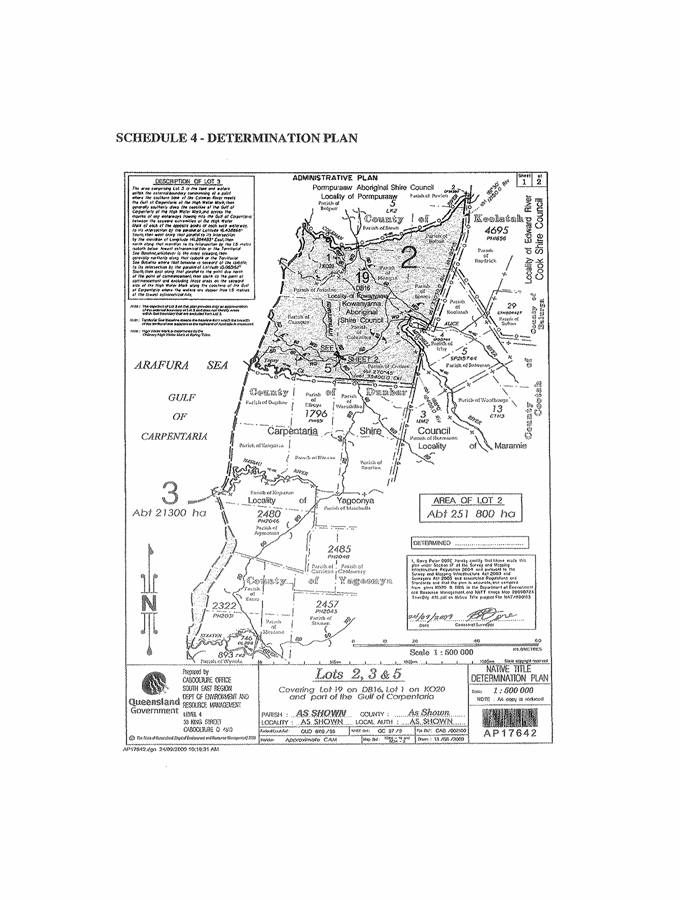
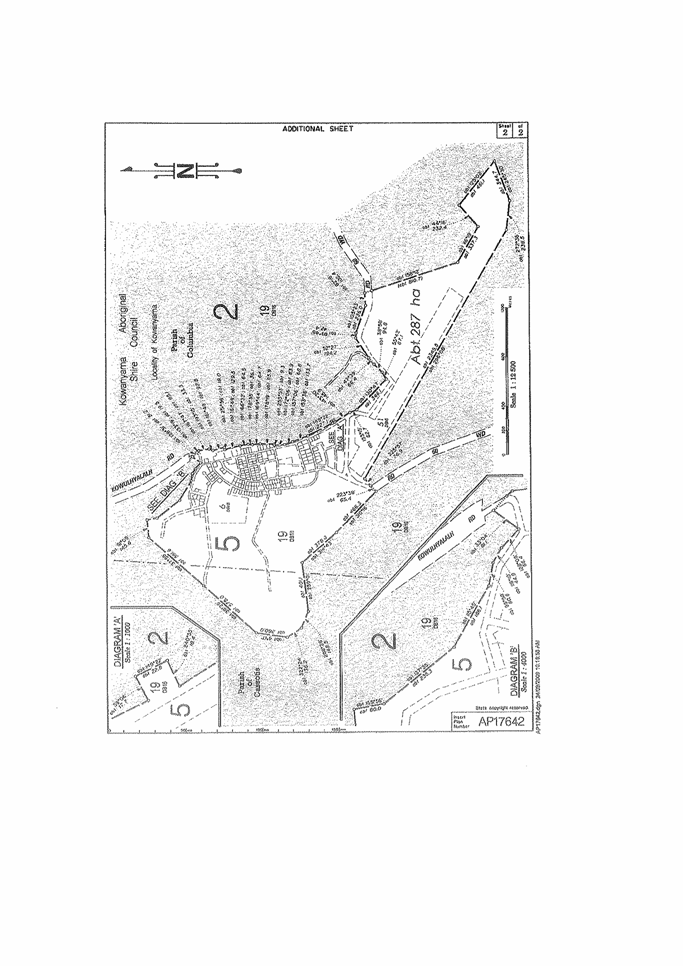
“Determination Area” means the land and waters described in Schedules 2 and 3 and shown on the plan in Schedule 4, and to the extent of any inconsistency between them, Schedules 2 and 3 prevail;
“High Water Mark” has the meaning given in the Land Act 1994 (Qld);
“Laws of the State and the Commonwealth” means the common law and the laws of the State and the Commonwealth of Australia, and includes legislation, regulations, statutory instruments, local planning instruments and local laws;
“Local Government” has the meaning given in the Local Government Act 1993 (Qld);
“Traditional Natural Resources” means:
(a) animals;
(b) plants; and
(c) charcoal, wax, resin, clay, soil, sand, shell, gravel, rock or other such material naturally occurring in the land and waters of the Determination Area
that have traditionally been taken and used by the native title holders;
“Tidal River” means a river, creek or stream, connecting to the sea, whether in a natural state or otherwise, as far up as the spring tide ordinarily flows and reflows;
“Tidal Water” means any part of the sea (including any Tidal River and the beds and banks of such river) ordinarily within the ebb and flow of the tide at spring tides; and
“Water” has the meaning given in the Water Act 2000 (Qld) and Tidal Water.
THE COURT FURTHER ORDERS THAT:
12. The native title is not held in trust.
13. The Abn Elgoring Ambung Aboriginal Corporation, incorporated under the Corporations (Aboriginal and Torres Strait Islander) Act 2006 (Cth) is to:
(a) be the prescribed body corporate for the purpose of s 57(2) of the Native Title Act 1993 Cth; and
(b) perform the functions mentioned in s 57(3)of the Native Title Act 1993 (Cth)
14. There be liberty to apply in relation to matters arising out of paragraph 13 of this order.
15. Each party to the proceeding is to bear its own costs.
SCHEDULE 1 – NATIVE TITLE HOLDERS
The native title holders are the Kowanyama People who comprise those people known as the Yir Yoront (sometimes called Kokomenjen), Koko Bera, Kunjen and Koko Berrin Peoples. The Yir Yoront, Koko Bera, Kunjen and Koko Berrin Peoples are those Aboriginal people who are:
1. the cognatic descendants of:
(i) Solomon Minyalk;
(ii) Thin Mitin Mart;
(iii) Min Yal Panaurin;
(iv) Art Kadlaurin
(v) any of the siblings Kal Koral, Kor Mart, Min Koko Taren or Mad Len;
(vi) Pow Mon Alithanem;
(vii) Kauan Kor Mar’pen;
(viii) any of the siblings Paul, Rio or Biddy;
(ix) Yor Kantl Yamen;
(x) any of the siblings Mark, Barnabas or Kate;
(xi) Arthur, the father of Smiler Misson;
(xii) Luke;
(xiii) any of the siblings Native, Wilson, Akul Edngan, Uyan or Ginger;
(xiv) any of the siblings Major, Sergeant, Bobella or Gregory;
(xv) Mickey;
(xvi) Boandonolly (aka Puntanolli);
(xvii) George Black (aka Thamil Polp);
(xviii) either of the brothers “Barramundi” Charlie or Lamp;
(xix) Gilbert;
(xx) Eagleman, the father of Barney Jubilee;
(xxi) Joe Highbury;
(xxii) Jackson;
(xxiii) Tent (aka Thol Kol Kith);
(xxiv) Bruno (aka Wurrpwin)
(xxv) Min Kawlto Tower Moilin;
(xxvi) Wo Pam Mal Yamin;
(xxvii) Mokara Hudson;
(xxviii) either of the siblings George or Purt Ngon;
(xxix) Bob Patterson;
(xxx) Moses (aka War’luran);
(xxxi) Yowalyamen;
(xxxii) Jolly;
(xxxiii) either Mailman or his siblings;
(xxxiv) any of the siblings Stephen, Louie, Reubin (aka Robin), Jimmy Braddsley, Mabel Rio or Poppy;
(xxxv) Old Mokara;
(xxxvi) Taw Wil Yir;
(xxxvii)Colin Dinghy;
(xxxviii)Fred Dunbar;
(xxxix) Alick (aka Alec and Kauwunbengk);
(xl) Goanna (aka Melder);
(xli) Pluto;
(xlii) either Mundie Shalfo or his sister;
(xliii) Piper;
(xliv) Willie Daphney;
(xlv) any of the siblings Fanny, Lucy Tommy, Waterloo, Elsie or Tommy Burns;
(xlvi) Nipper;
(xlvii) Dick;
(xlviii) Peppo;
(xlix) Ben;
(l) Smiler;
(li) Bernard;
(lii) Monday;
(liii) Kangaroo;
(liv) Mosquito;
(lv) either of the brothers Billy Flower or Goggle-Eye or their siblings;
(lvi) Jimmy;
(lvii) either of the brothers Rainbow Christie or Bowyang Charlie;
(lviii) Nellie;
(lix) either of the brothers Bob Dunbar or Bendigo or their siblings;
(lx) any of the siblings Jimmy Koolatah, Coglin Dick, Kunjen Dick or George Murray;
(lxi) Frank Yam;
(lxii) Brumby (aka Jack Brumby)
(lxiii) Old Mud;
(lxiv) Charlie Inkerman;
(lxv) any of the siblings Mimosa, Alison or May; or
(lxvi) Maggie; or
2. recruited by adoption, in accordance with the traditional laws and customs of the Yir Yoront, Koko Bera, Kunjen and Koko Berrin Peoples.
SCHEDULE 2 – DETERMINATION AREA
AREAS WHERE EXCLUSIVE POSSESSION IS TO BE RECOGNISED
The land and waters within the area described as commencing at the north western corner of Lot 19 on DB16 (Kowanyama DOGIT) and extending generally easterly along the northern boundaries of that Lot and northern boundaries of Lot 1 on KO20; then southerly, north-westerly, south-westerly, south-easterly, southerly and westerly along the boundary of Lot 19 on DB16 (Kowanyama DOGIT) to its intersection by the High Water Mark on the northern bank of Topsy Creek; then generally northerly along the coastline of the Gulf of Carpentaria at the High Water Mark, and across the mouth of any waterways flowing into the Gulf of Carpentaria between the seaward extremities at the High Water Mark of each of the opposite banks of each such waterway, to the point of commencement and referred to as Lot 2 on Plan AP17642 in Schedule 4.
The following areas are included in the determination area:
(a) Lot 19 on DB16*
(b) Lot 1 on KO20*
(c) Land and waters below the High Water Mark within the external boundary
The following areas are excluded from the determination area:
(d) All dedicated roads within the external boundary
(e) Lot 5 on AP17642
‘*’ denotes an area to which s 47A of the Native Title Act 1993 (Cth) may apply
SCHEDULE 3 - DETERMINATION AREA
AREAS WHERE NON-EXCLUSIVE RIGHTS ARE TO BE RECOGNISED
The land and waters within the external boundary commencing at a point where the southern bank of the Coleman River meets the Gulf of Carpentaria at the High Water Mark; then generally southerly along the coastline of the Gulf of Carpentaria at the High Water Mark, and across the mouths of any waterways flowing into the Gulf of Carpentaria between the seaward extremities at the High Water Mark of each of the opposite banks of each such waterway , to its intersection by the parallel of Latitude 16.438868° South; then west along that parallel to its intersection by the meridian of Longitude 141.284483° East; then north along that meridian to its intersection by the 1.5 metre isobath below lowest astronomical tide or the Territorial Sea Baseline, whichever is the more seaward; then generally northerly along that isobath, or the Territorial Sea Baseline where that baseline is seaward of the isobath, to its intersection by the parallel of Latitude 15.065162° South; then east along that parallel to the point due north of the point of commencement; then south to the point of commencement and excluding those areas on the seaward side of the High Water Mark along the coastline of the Gulf of Carpentaria where the waters are deeper than 1.5 metres at the lowest astronomical tide and referred to as Lot 3 on Plan AP17642 in Schedule 4.
Note
Reference datum
Geographical coordinates have been provided by the State of Queensland and are referenced to the Geocentric Datum of Australia 1994 in decimals of a degree.
SCHEDULE 5 – OTHER INTERESTS IN THE DETERMINATION AREA
1. The rights and interests of the beneficiaries under deed of grant No. 21345064.
2. The rights and interests of the holder of the term lease for pastoral purposes dated 21 December 1989 being title reference No. 17717222 comprising Lot 1 on KO20.
3. The rights and interests of the holders of water licences WL404167, WL45068K and WL178186 granted under the Water Act 2000 (Qld).
4. The rights and interests of the holders of exploration permits EPM 15554 and EPM 15560 granted under the Mineral Resources Act 1989 (Qld).
5. The rights and interests of the Kowanyama Aboriginal Council as the trustee under deed of grant No. 21345064, including as the grantor of any rights and interests under that deed of grant, granted on or before the date on which these orders are made.
6. The rights, interests, powers and functions of the Kowanyama Aboriginal Council under the Local Government Act 1993 (Qld) for that part of the Determination Area declared to be its local government area under the Local Government (Areas) Regulation 2008 (Qld), including:
(a) to enter the Determination Area by its employees, agents or contractors to:
(i) exercise any of the rights and interests referred to in this paragraph;
(ii) undertake operational activities in its capacity as a Local Government such as feral animal control, weed control, erosion control, waste management, fire management and management of land relating to the operation of the airstrip in the Kowanyama township; and
(iii) operate, inspect, maintain and repair the infrastructure, facilities and other improvements referred to in paragraph 6(b) of this Schedule;
(b) as the owner, operator or holder of any interest (including an equitable interest) in infrastructure, facilities, or other site improvements, including but not limited to:
(i) constructed roads that have not been dedicated, except for those determined by Council not to be operated by it;
(ii) water bores and other infrastructure for the supply of water;
(iii) drainage facilities;
(iv) sand extraction areas;
(v) improvements at homelands (outstations) constructed by or on behalf of Council.
7. The rights and interests of the Kowanyama Cattle Company Pty Ltd:
(a) in the operation of cattle grazing activities over those parts of the Determination Area where those activities were taking place on or before the date of these orders; and
(b) as the owner, operator or holder of any other interest (including an equitable interest) in infrastructure, facilities or other improvements relating to its cattle grazing activities including but not limited to:
(i) dams used for watering cattle;
(ii) cattle yards and fencing;
(iii) sheds, buildings and other structures.
8. The rights and interests of Telstra Corporation Limited:
(a) as the owner or operator of telecommunications facilities within the Determination Area;
(b) as the holder of a carrier licence under the Telecommunications Act 1997 (Cth), including:
(i) the right to install and operate telecommunications facilities within the Determination Area; and
(ii) the right to be present on the Determination Area for the purposes of installing, inspecting, operating, maintaining and repairing its telecommunications facilities in and in the vicinity of the Determination Area;
(c) created under the Telecommunications Act 1975 (Cth), the Australian Telecommunications Corporation Act 1989 (Cth), the Telecommunications Act 1991 (Cth) and the Telecommunications Act 1997 (Cth), including the right to install and operate telecommunications facilities within the Determination Area;
(d) as the holder of a lease dated 29 September 2009 in respect of the area depicted on deposited plan SP230794; and
(e) for its employees, agents or contractors to enter the Determination Area to access its telecommunications facilities in and in the vicinity of the Determination Area.
9. The rights and interests of the State of Queensland in those parts of the Staaten-Gilbert and Nassau River fish habitat areas within the Determination Area, as shown on Plan 015-053A and Plan 015-054A held by the Department of Employment, Economic Development and Innovation, and the interests of persons entitled to access and use those habitats.
10. The rights and interests granted by the State of Queensland pursuant to statute or otherwise in the exercise of its executive power including, but not limited to, the rights and interests of persons holding licences, permits or authority pursuant to the Fisheries Act 1994 (Qld) and regulations, declarations or management plans made under that Act.
11. The rights and interests granted by the Commonwealth pursuant to statute or otherwise in the exercise of its executive power including, but not limited to, the rights and interests of persons holding licences, permits, statutory fishing rights, or other statutory rights pursuant to:
(a) the Fisheries Management Act 1991 (Cth), or regulations or management plans made under that Act; and
(b) any other legislative scheme for the control, management and exploitation of the living resources within the Determination Area.
12. The rights and interests of members of the public arising under the common law, including but not limited to:
(a) the public right to fish; and
(b) the public right to navigate.
13. So far as confirmed pursuant to s 212(2) of the Native Title Act 1993 (Cth) and s 18 of the Native Title (Queensland) Act 1993 (Qld) as at the date of this Determination any existing rights of the public to access and enjoy, the following places in the Determination Area:
(a) waterways;
(b) beds and banks or foreshores of waterways;
(c) coastal waters;
(d) beaches;
(e) stock routes; and
(f) areas that were public places at the end of 31 December 1993.
14. The rights under the international right of innocent passage.
15. Any other rights and interests:
(a) held by the State or Commonwealth; or
(b) existing by reason of the force and operation of the Laws of the State and the Commonwealth.
Note: Settlement and entry of orders is dealt with in Order 36 of the Federal Court Rules.
The text of entered orders can be located using eSearch on the Court’s website.
|
IN THE FEDERAL COURT OF AUSTRALIA |
|
|
QUEENSLAND DISTRICT REGISTRY |
|
|
GENERAL DIVISION |
QUD 6119 of 1998 |
|
BETWEEN: |
GLENETTE GREENWOOL, GARY HUDSON, EVANS JOSIAH, GRIFFITH PATRICK, DENNIS MICHAEL, RAVIN GREENWOOL, RICHARD BARNEY, JENNY PAUL, DONNA BRUMBY, PRISCILLA MAJOR, ROSLYN GILBERT, UNA CLAUDE, CORRINE DANIEL, KELVIN GREENWOOL, DOUGLAS ERIC, TEDDY BERNARD, ROSEMARY HENRY, GEORGE WILLIAM ADAMS, CHRISTOPHER HENRY, ROGER INKERMAN, LYNDELL MICHELLE ANNE JIMMY, ROY DENNIS MAGGABLE, HAZEL PAUL, ANGELA FIONA EDWARDS, SHAUN KALK EDWARDS, MAY EDWARDS, LINDSAY EDWARDS, GLENNIS ROSE MUDD, SHENANE JAGO, COLIN LAWRENCE, ARTHUR LUKE, CHRISTINE LAWRENCE, IVAN JIMMY, SHIRLEY YAM, MARIA DICK AND ROBERT HOLNESS ON BEHALF OF THE KOWANYAMA PEOPLE Applicant
|
|
AND: |
STATE OF QUEENSLAND, COMMONWEALTH OF AUSTRALIA, KOWANYAMA ABORIGINAL SHIRE COUNCIL, GREG HOOK, JUSTIN HOOK, PETER TONON, CLAUDINE ELIZABETH WARD, GARY DAVID WARD, SHANE ANDREW WARD, YAN WARD, TELSTRA CORPORATION LIMITED, CARPENTARIA SHIRE COUNCIL, COOK SHIRE COUNCIL, TABLELANDS REGIONAL COUNCIL, ERGON ENERGY CORPORATION LIMITED, AIRSERVICES AUSTRALIA, MDH PTY LTD, HERBERT JAMES FALOON, INKERMAN STATION PTY LTD, DOUGLAS PRICE, BERNARD JAMES STUMER AND HARVEST HOME HOLDINGS PTY LTD First Respondent
|
|
JUDGE: |
GREENWOOD J |
|
DATE: |
22 OCTOBER 2009 |
|
PLACE: |
KOWANYAMA, CAPE YORK |
REASONS FOR JUDGMENT
1 The Federal Court of Australia convenes here at Kowanyama today on country to make, and explain the reasons for making, orders under s 87A of the Native Title Act 1993 (Cth) (the “Act”) that take effect as a determination of the traditional native title rights and interests of the Kowanyama People in the lands and waters of the Determination Area described as Part A within the area of the claim the subject of proceedings QUD 6119 of 1998. The Kowanyama People assert a continuous exercise of traditional rights and interests by their people prior to and since sovereignty over the areas the subject of the claim, and in particular, the Part A area.
2 The land and waters of the Determination Area described in detail in Schedules 2 and 3 of the orders made today and illustrated in the Determination Plan in Schedule 4 to the orders are more broadly described as comprising two sections of land and waters on the Western Cape which the applicant claim group describes, put simply, as a shape similar in its configuration, to the shape of a flag and flagpole. The first section of the Determination Area representing the flag shape is the land forming part of the Kowanyama Deed of Grant in Trust and term lease (more generally described as the “Kowanyama DOGIT land”). The second section is described as the flagpole part of the configuration otherwise described as the “coastal section”. The Kowanyama DOGIT land (excluding the Kowanyama township within the DOGIT) is that part of the Determination Area where exclusive native title rights and interests are to be recognised by the determination. The Kowanyama DOGIT land is an area of approximately 2,520 square kilometres bounded in the north by the Coleman River, in the south by the Rutland Plains pastoral lease, in the east by the Mitchell‑Alice Rivers National Park and in the west by the Gulf of Carpentaria.
3 The coastal section of land and waters is that part of the Determination Area where non‑exclusive native title rights and interests are to be recognised by the determination. The coastal section is an area of approximately 213 square kilometres. The coastal section runs along the western coastal boundary of the application area and is bounded in the north by the southern bank of the Coleman River, in the south by the latitudinal line at the southern end of the Fauna Sanctuary (Pelican Rookery) to the south of the Staaten River, and in the east by a line generally following the high water mark. The coastal section is bounded in the west in an unusual way. Consistent with customary patterns, the western boundary is defined by a line in the Gulf of Carpentaria which approximates a water depth to which a grown Kowanyama person can wade at low tide which is approximately 1.5 metres.
4 The coastal section is adjacent to the Kowanyama DOGIT land, Rutland Plains pastoral lease and the Inkerman pastoral lease.
5 The application is brought by Glenette Greenwool, Gary Hudson, Evans Josiah, Griffith Patrick, Dennis Michael, Ravin Greenwool, Richard Barney, Jenny Paul, Donna Brumby, Priscilla Major, Roslyn Gilbert, Una Claude, Corrine Daniel, Kelvin Greenwool, Douglas Eric, Teddy Bernard, Rosemary Henry, George William Adams, Christopher Henry, Roger Inkerman, Lyndell Michelle Anne Jimmy, Roy Dennis Maggable, Hazel Paul, Angela Fiona Edwards, Shaun Kalk Edwards, May Edwards, Lindsay Edwards, Glennis Rose Mudd, Shenane Jago, Colin Lawrence, Arthur Luke, Christine Lawrence, Ivan Jimmy, Shirley Yam, Maria Dick and Robert Holness, on their own behalf and for and on behalf of the members of the Kowanyama People.
6 The parties who have joined the proceeding as respondents and who remain as respondents to the broader application are the State of Queensland, the Commonwealth of Australia, Kowanyama Aboriginal Shire Council, Cook Shire Council, Carpentaria Shire Council, Queensland Seafood Industry Association (representing nominated individuals), Telstra Corporation Limited, Tablelands Regional Council, Ergon Energy Corporation, Airservices Australia, Queensland Lapidary and Allied Craft Clubs Association, Herbert James Faloon, Bernard James Stumer, Inkerman Station Pty Ltd, Douglas Price and MDH Pty Limited.
7 The Cape York Land Council is the native title representative body for the area the subject of the broader application and is the legal representative for the Kowanyama People in relation to the application and the proposed Part A determination.
8 The application was lodged with the National Native Title Tribunal (the “Tribunal”) on 25 March 1997. Federal Court proceeding QUD 6119 of 1998 was commenced on 30 September 1998. A proposed amended application was filed on 28 February 2001 and leave was granted to amend the application on 29 March 2001. Meetings of the members of the claim group took place in Kowanyama on 2 December 2008 together with representatives of the Cape York Land Council and an anthropologist, Dr John Taylor, with a view to considering amendments to the application and related matters. A further meeting took place on 26 August 2009 to consider and authorise amendments to the application for the purpose of framing the proposed Part A determination. The proposed draft Part A determination was circulated to the parties in September 2009. Leave pursuant to a notice of motion dated 23 September 2009 was granted by the Court to further amend the application.
9 On 24 December 2001, the application passed the registration test pursuant to s 190A of the Act and has remained on the Register of Native Title claims. The application was notified by the Native Title Registrar in accordance with the Act and the notification period for the purposes of s 66 of the Act expired on 20 May 2002.
10 The applicant, the State of Queensland and the Commonwealth of Australia agreed to prioritise mediation of the application in several parts. As a result of that mediation process, the applicant, State of Queensland, Commonwealth of Australia, Kowanyama Aboriginal Shire Council, Queensland Seafood Industry Association and Telstra Corporation Limited after mediation, to their great credit, reached agreement for the purposes of s 87A(1) of the Act to the terms of a proposed consent determination for part of the claim area the subject of the principal application. The determination area represents approximately 13 per cent of the application area. The above respondents are the consenting parties to the proposed Part A determination as these parties hold an interest in the land and waters within the Part A area.
11 The agreement signed by these parties between 5 October 2009 and 9 October 2009 was filed under s 87A(2) of the Act by the Cape York Land Council on 9 October 2009. The consent orders which the parties ask the Court to make are attached to the agreement.
12 Section 13(1) of the Act provides that an application for a determination of native title may be made under Part 3 of the Act in relation to an area for which there is no approved determination of native title. The present application is made under s 61 of the Act within Part 3 and there is no approved determination in relation to the land and waters within the Determination Area. I am familiar with the material in this application having been involved in the case management of the proceedings and having conducted a number of directions hearings in the proceedings.
13 Section 87 of the Act provides, that if, after a particular date, the parties to a determination application reach agreement, in writing, on the terms of a proposed order the Court might make in relation to a part of the proceeding, the Court may, if the proposed orders are within the power of the Court (i.e. within jurisdiction) and, if it appears to the Court to be appropriate to do so, make orders in, or consistent with, the terms of the agreement without conducting a hearing of the proceeding.
14 More particularly, s 87A of the Act provides, among other things, that if at any stage of the proceeding after the relevant date, agreement is reached on a proposed determination of native title in relation to an area included in the area covered by the native title determination application, the Court may make an order in, or consistent with, the proposed determination of native title without holding a hearing if the Court is satisfied that the proposed determination for that area is within power and that it would be appropriate to make the order.
15 There are four factors prescribed by s 87A(1). The section applies if firstly there is a proceeding for a determination of native title on foot; secondly, an agreement has been reached on a proposed determination for a part of the claim area after the s 66 notification period; thirdly, all of the following persons are parties to the agreement, the applicant, each registered native title claimant in relation to any part of the determination area who is a party to the proceeding, each representative Aboriginal/Torres Strait Islander body for any part of the determination area, each person who holds and interest in any part of the determination area, each person who claims to hold native title in relation to land or waters in the determination area, the Commonwealth, and the relevant State and local government bodies; and fourthly, the terms of the proposed determination are in writing and signed by or on behalf of those parties.
16 I am satisfied as to these matters.
17 Section 87A(4) requires the Court to be satisfied that the orders are within power and that it would be appropriate to make the orders sought.
18 Orders made under s 87A of the Act not only take effect inter‑parties in the resolution of the claims made in the proceedings but represent an independent judicial determination, in the exercise of the judicial power of the Commonwealth, that may be asserted, as a matter of law, against anyone. Although the Act by s 223(1)(c) in part defines native title or native title rights and interests by reference to the rights and interests recognised by the common law of Australia, a determination of native title expresses the recognition and protection of those rights and interests in relation to land and waters defined and described in s 223 of the Act which find their origin in traditional laws and customs, not the Act (Members of the Yorta Yorta Aboriginal Community v State of Victoria (2002) 214 CLR 422 at [75] and [76] per Gleeson CJ, Gummow and Hayne JJ).
19 I am satisfied that the proposed orders are consistent with the proposed determination and within power.
20 A number of considerations are to be taken into account in determining whether the proposed orders appear appropriate to the Court. Firstly, the Act recognises and encourages the resolution of applications by mediation, negotiation and ultimately agreement without the need for a hearing and the assessment of evidence and fact‑finding by the Court necessary in the course of resolving a controversy. Similarly, the Act recognises and encourages the determination of native title in relation to an area within the area covered by an application, by mediation, negotiation and ultimately agreement without the need for a hearing.
21 Secondly, the Court will be concerned to understand and place emphasis upon whether the agreement is freely made on an informed basis by all parties to the determination and whether the parties are represented by experienced independent lawyers. In the case of a State party representing the public interest, the Court will consider whether appropriate consideration has been given to the issues raised by the proposed consent determination.
22 Thirdly, so far as the State is concerned, the Court recognises that a State has access to its own archival material and generally has had a long period of engagement with Aboriginal communities and is therefore likely to be familiar with the historical arrangements within those communities.
23 Fourthly, although it is not necessary for the Court to consider the body of material that would be available to it in the course of a contested hearing, the Court ought to have regard to sufficient material which is capable of demonstrating that the agreement and the proposed orders are “rooted in reality” (“Native Title – A Constitutional Shift?”, University of Melbourne Law School, JD Lecture Series, Chief Justice French, 24 March 2009): Wik and Wik Way Native Title Claim Group v State of Queensland [2009] FCA 789; (2009) 258 ALR 306.
24 In that sense, the Court ought to be satisfied that the proposed orders are prima facie appropriate in order to satisfy the test under s 87A(4) of the Act.
25 In this case, the parties to the proposed determination are represented by lawyers experienced in the conduct of native title proceedings and the analysis of issues arising in such proceedings. During the course of the processes leading to the proposed consent determination, the State of Queensland has been provided with extensive material between May 1996 and August 2009. It is not necessary to set out the content of that material in these reasons. Some of that material has been considered by other respondents with an interest in the proposed determination area. I am entirely satisfied that the parties to the Part A agreement have been represented by lawyers experienced in these issues and that the parties have come to a fully informed agreement. In addition, the State of Queensland has had a long engagement with the Aboriginal people of the Determination Area.
26 In this application the applicants have been assisted by Dr John Taylor. Dr Taylor has been retained as an anthropological consultant in relation to the Kowanyama native title claim since 1997. More importantly, Dr Taylor has carried out studies of the Kowanyama native title claim group and worked with members of the group and their predecessors since 1971. During the course of his studies of the Kowanyama native title claim group, Dr Taylor has carried out research into the anthropological, historical, linguistic, genealogical and cultural materials that relate to members of the group and their predecessors in the Kowanyama region. Dr Taylor has mapped Aboriginal landscapes and ownership patterns which has involved extensive site mapping and the study of the principles of land ownership in the Kowanyama region. The nature and extent of Dr Taylor’s research work in relation to the Kowanyama region including the land and waters the subject of the primary application is the subject of a document described as “Overview of Connection Materials in support of the Kowanyama Part A Native Title Determination”. That report was filed in the Court on 28 September 2009.
27 Dr Taylor in his affidavit filed on 28 September 2009 expresses this opinion at paragraph 12:
I am of the opinion that the research conducted in relation to the Kowanyama native title claim group’s determination application demonstrates that:
(a) the members of the Kowanyama native title claim group are descended from the traditional society in occupation of the land and waters identified as the determination area at the time of sovereignty;
(b) the society in occupation of the determination area at the time of sovereignty observed traditional laws and customs which have continued to be acknowledge and observed by the members of the Kowanyama native title claim group and their predecessors;
(c) through the continued acknowledgement and observation of the traditional laws and customs, the members of the Kowanyama native title claim group and their predecessors have maintained a connection to the determination area;
(d) the activities undertaken by the members of the Kowanyama native title claim group on the determination area are referable to the rights and interests identified in the proposed consent determination of native title, as regulated by their traditional laws and customs.
28 The facts on which Dr Taylor relies in asserting that opinion either lie within his own knowledge based on his own field work with the Kowanyama People or alternatively derive from findings and data assembled by other researchers or facts contained in historical, government or mission records which Dr Taylor has considered in the course of his own research. Dr Taylor’s work on these anthropological questions is the subject of many publications.
29 I have considered the detailed Overview of Connection Materials in support of the Part A determination application. I am entirely satisfied that it is appropriate to make the proposed orders.
30 However, a number of things should be said about the elements of the Part A determination on behalf of the Kowanyama People.
31 The archaeological evidence demonstrates that Aboriginal people have occupied Cape York Peninsula for over 37,000 years. The first European contacts with Aboriginal people inhabiting the claim area were recorded in the logs of the second Dutch expedition from Batavia to the Gulf of Carpentaria in 1623. The Pera and the Arnhem under the direction of Carstenez made landfall on 12 April 1623 on Cape York Peninsula near Cape Keerweer. Aboriginal people were observed burning grass near the shoreline. On 17 April 1623, the Pera stood off the coast just south of the mouth of the Mitchell River in the vicinity of Topsy Creek which now forms the northern boundary between the DOGIT lands and Rutland Plains Station. The Carstenez log contains this entry for 18 April 1623:
About midday (of the 18th) having seen persons on the beach, we anchored, and the skipper of the Pera was ordered to row ashore with both boats armed for defence. Later in the afternoon, when the boats returned, the skipper reported that as soon as the party had landed a great mob of blacks, some with arms and some without, had come up to them and were so bold and free as to touch the men’s muskets and try to take them off their shoulders, and in fact, wanted to take everything they thought they might have a use for. These being kept interested with iron and beads, an opportunity was espied, and one of them was seized by a string which he had round his neck and taken on board the boat. The others who were on the beach made a great hubbub and outcry, but those who were concealed in the bush remained there. The said people are pitch black, thin in body, and stark naked, with basketwork or nets around their heads. As regards their hair and figure, they are like the blacks of the coast of Coromandel, but they seem to be less cunning, bold and wicked than the blacks at the west end of New Guinea. Their weapons, some of which we are bringing with us, are assegais, shields, clubs and sticks about 1½ fathoms in length, and are not as formidable as those we have seen among other blacks. As regards their manners and policy, and the nature of their country, Your Worships will in time perhaps be able to elicit some information from the captured blacks to whom I refer you.
32 These engagements took place in and around the areas the subject of the primary claim. In June 1845, Ludwig Leichhardt’s expedition entered the claim area. He observed Aboriginal people diving for water lily bulbs, and engaged in other activities. In 1864 and 1865, the Jardine brothers took a herd of 250 cattle from Carpentaria Downs to Somerset at the tip of Cape York Peninsula. The Jardine party entered the claim area along the Staaten River which they followed westwards until they reached the coastal plains. The party noted many signs of human occupation at campsites and fish weirs and often came upon Aboriginal groups hunting or fishing.
33 Permanent European settlement commenced during the 1880s when large areas of land around the lower reaches of the Mitchell River were taken up for pastoral purposes including the Dunbar Station Selection in 1882. In 1897, Queensland’s colonial legislature took steps to set aside significant areas of coastal land stretching from below the Mitchell River to the tip of Cape York Peninsula for the purpose of forming Aboriginal reserves. In 1902, Dr Gilbert White, the Anglican Bishop of the newly created diocese of Carpentaria, declared his intention to set up missions dedicated to the pastoral and physical care of Aboriginal people within the diocese. Dr White chose an area of 1,300 square kilometres between the Mitchell and Nassau Rivers observing that the area was:
… The most densely populated Aboriginal centre in Queensland and probably the only one where the natives have not come into more or less disastrous contact with civilisation.
[emphasis added]
34 Mission workers also set up their tents on a fresh water lagoon not far from the tidal reaches of Topsy Creek in the claim area. The mission was abandoned in 1915. A new site was chosen by J.W. Chapman on a creek in the western end of Koko Bera country. The site was called Kowanyama which was an English rendering of the Yir Yoront “kawn yama” meaning “many waters”. In the 1950s, the Anglican Church began to critically examine its role in the advancement of the Aboriginal communities of Cape York Peninsula and its capacity to sustain its missions and pastoral role. In 1967, the Anglican Church transitioned the administrative control of Kowanyama and Pormpuraaw to the State of Queensland. Aboriginal people have consistently asserted access to their homelands for traditional owners which, on the anthropological evidence, has not been denied by station managers. In 1987, following the enactment of the Land Act (Aboriginal and Islander Land Grants) Amendment Act 1982 (Qld), the Land Act (Aboriginal and Islander Land Grants) Amendment Act 1984 (Qld) and the Community Services (Aborigines) Act 1984 (Qld), the title to the Mitchell River Aboriginal Reserve was vested in the Kowanyama Aboriginal Council as a Deed of Grant in Trust. This initiated a period of increasing community autonomy and control over lands and resources.
35 Anthropological field research began in the claim area in the mid 1930s when Lauriston Sharp commenced his studies among the Yir Yoront and neighbouring groups (1934, 1937, 1939, 1940, 1952, 1958). Donald Thompson conducted brief kinship research among the “Koko Minjena” at the Mitchell River Mission (1929, 1933, 1972). For several months Thompson camped on the Coleman River in company with a large party of Aborigines. Dr Taylor, stationed at Kowanyama as a medical anthropologist attached to the Queensland Institute of Medical Research, commenced his work in 1971. The work included detailed genealogical studies and work to document land affiliations. Dr Veronica Strang commenced fieldwork at Kowanyama and on neighbouring pastoral properties in 1992. Work was undertaken by Dr Bruce Sommer in 1998 in relation to linguistic and communication patterns. Dr Taylor also prepared indexed family trees based on patrilines to assist others in coming to terms with Kowanyama families and their members. In 1996, Dr Taylor’s genealogies were converted to digital format. Most family lines extend back to apical ancestors whose birth dates occurred well before the establishment of the Mitchell River Mission and the pastoral properties in the claim area. Dr Taylor also documented the landscape in such a way as to reflect the understandings and meanings that Aboriginal people project onto the landscape. These landscape mapping processes are called “close‑grained mapping”.
36 Based on the anthropological research and access to historical documents and records, the Kowanyama People are properly understood as comprising those people known as the Yir Yoront (sometimes called Kokomenjen), Koko Bera, Kunjen and Koko Berrin Peoples, including the applicants and other claimants who together form the native title group. The Kowanyama People are those people who are the cognatic descendents of the individuals identified in Schedule 1 to the orders and those people recruited by adoption in accordance with the traditional laws and customs of the Yir Yoront, Koko Bera, Kunjen and Koko Berrin.
37 The anthropological material demonstrates that the laws and traditions of the Kowanyama People flow from a totemic ideology constituting a normative system that is widely shared and has been reproduced over generations. The system of laws and traditions specifies obligations and duties and provides for sanctions and punishment. The interests of the claimants in land are acquired through descent which is why identifying family lines (patrilines) associated with parcels of land (estates) in the claim area has been important to identifying the scope of the claimant group. The material demonstrates that the regulation of land tenure has been one of the most important aspects of the totemic system in relating clans to clan domains and individual members to individual clan domains. The contemporary native title rights and interests of the claimants derive from what is described as a “uniquely Aboriginal world view” which has been substantially maintained by the Kowanyama community since it was first described. Dr Taylor identifies 10 central features characterising that world view as the foundation of the Kowanyama system of fundamental laws and principles and traditional ideology. Dr Taylor documents the substantial continuity of practice of Kowanyama traditional law and custom. Dr Taylor concludes that it is reasonable to infer that just as the contemporary system is descended from the classical system, so the classical system is descended from the traditional laws and customs in operation at the time of sovereignty. Dr Taylor identifies eight separate reasons why that is so.
38 The four “interdependent and interlocking” traditional and customary “general rights” identified by Dr Taylor are:
1. The physical possession, occupation, use and enjoyment of the claim area as of right.
2. The carriage of responsibility for the care and maintenance of the claim area.
3. The right to hold the claim area as the cultural property of the native title group and the source of its identity.
4. The right to act as sole authority to speak for the country.
39 Dr Taylor identifies the scope and content of each of those four general rights in considerable detail in his reports.
40 Dr Taylor concludes that the anthropological material establishes that:
(a) The claimants are members of a continuously vital society identified as the Kowanyama People.
(b) The claimants possess a body of traditional laws and customs that constitute a body of normative rules or a normative system.
(c) The claimants’ systems of rules have continued to operate without any substantial interruption from the time of the assertion of sovereignty by the British Crown over the claim area to the present.
(d) The claimants’ laws and customs that make up their contemporary system have their origins in the laws and customs observed and acknowledged by those who held native title to the claim area at the time of the assertion of sovereignty.
(e) The claimants’ rights and interests in land and waters, originate in the rights and interests observed and acknowledged by their predecessors at the time of the assertion of sovereignty.
(f) The claimants’ rights and interests in relation to the land and waters of the claim area have their origins in traditional laws and customs that also specify the collection of individuals and families to that land and those waters.
41 Accordingly, the parties to the s 87A(2) Agreement have agreed that the native title rights and interests in that part of the Determination Area identified in Schedule 2 to the orders (other than in relation to water) being the land generally described as the Kowanyama DOGIT land, are the rights to possession, occupation, use and enjoyment to the exclusion of all others, subject to paragraphs 6 and 7 of the orders. The nature and extent of the native title rights and interests in relation to that part of the Determination Area identified in Schedule 3 to the orders (other than in relation to water) generally described as the coastal section, are the non‑exclusive rights to:
(a) be present on, including by accessing, traversing and Camping on the area;
(b) light fires on the area for cultural, spiritual or domestic purposes, including cooking, but not for the purpose of hunting or clearing vegetation;
(c) take, use, share and exchange Traditional Natural Resources for non‑commercial, cultural, spiritual, personal, domestic or communal purposes; and
(d) maintain places of importance and areas of significance to the native title holders under their traditional laws and customs and protect those places and areas from harm.
42 The nature and extent of the native title rights and interests in relation to water within the Determination Area are the non‑exclusive rights to:
(a) hunt and fish in or on, and gather from, the Water for non‑commercial cultural, spiritual, personal, domestic or communal purposes; and
(b) take and use the Water for non‑commercial cultural, spiritual, personal, domestic or communal purposes.
43 The native title rights and interests described at [41] and [42] are subject to the express terms of the orders.
44 Section 94A of the Act requires that an order for a determination of native title must set out details of the matters mentioned in s 225 of the Act which must be read together with s 223 of the Act. These sections give meaning to the terms “determination of native title” and “native title” and “native title rights and interests”. In Members of the Yorta Yorta Aboriginal Community v State of Victoria (supra) at [76], Gleeson CJ, Gummow and Hayne JJ treated the statutory elements contained in s 223 as central. The mandatory requirements for a determination of native title are these. The native title rights and interests must be communal, group or individual. They must be rights and interests in relation to land or waters. They must be possessed under the traditional laws acknowledged and the traditional customs observed by Aboriginal peoples; Aboriginal people by their law and customs must have a connection with the land or waters; and the native title rights and interests must be recognised by the common law of Australia.
45 I am satisfied that the anthropological material demonstrates that the Kowanyama People are descended from a society of Aboriginal people who were in occupation of the land and waters of the Determination Area, being a part of the claim area, at sovereignty and who formed a society united by their acknowledgement and observance of a normative body of traditional laws, customs and beliefs. Through their continued acknowledgement and observance of these normative laws and customs, the Kowanyama People have, since sovereignty, maintained a connection with the Determination Area. I am satisfied that the content of those native title rights and interests which derive from the practice of traditional laws and customs have been identified and established through the anthropological material. The agreement provides for orders entirely consistent with the anthropological material.
46 I am satisfied the proposed orders address each of the elements of s 225 of the Act. Thus, I am satisfied that the orders appear appropriate in accordance with s 87A of the Act.
47 Order 12 of the proposed orders provides that native title is not to be held in trust. By Order 13, Abn Elgoring Ambung Aboriginal Corporation (the “Corporation”) is to be the prescribed body corporate for the purposes of s 57(2) of the Act and is to perform the functions set out in s 57(3) of the Act.
48 Section 59 of the Act provides that regulations may prescribe the kinds of body corporate that may be determined to be a prescribed body corporate for the purposes of s 57(2)(b) of the Act. Regulation 4(1) of the Native Title (Prescribed Bodies Corporate) Regulations 1999 (Cth) (“the Native Title Regulations”) provides that an Aboriginal and Torres Strait Islander corporation is prescribed if it is registered for the purposes of being the subject of a s 57 determination. It will be taken to be registered if the following three requirements of Regulation 4(2) are satisfied:
(a) all members of the corporation are persons who, at the time of making of the section 56 or 57 determination, are included, or proposed to be included, in the native title determination as native title holders; and
(b) the purpose of becoming a registered native title body corporate is set out in the objects of the corporation; and
(c) at all times after the section 56 or 57 determination is made, all members of the corporation are persons who have native title rights and interests in relation to the land or waters to which the native title determination relates.
49 The Kowanyama People took steps to incorporate Abn Elgoring Ambung Aboriginal Corporation under the Corporations (Aboriginal and Torres Strait Islander) Act 2006 (Cth) (“the Registration Act”) on 17 December 2008. The members of the claim group met in Kowanyama on 2 December 2008 and authorised the establishment of the Corporation and the adoption of its draft rule book and the making of an application for registration of the Corporation. Rule 3 of the rule book sets out the objectives of the Corporation which include the following:
3.1 To act as agent prescribed body corporate in respect of a native title determination under s 55 of the Native Title Act 1993 (Cth);
3.2 To fulfil the role and functions of a prescribed body corporate in accordance with the Native Title Act 1993 (Cth).
50 On 26 August 2009 at a meeting of members of the claim group in Kowanyama, the claim group nominated the Corporation to act as a prescribed body corporate for the purposes of native title application QUD 6119/98 to perform the s 57(2) functions. At the first annual general meeting of the Corporation held on 26 August 2009 in Kowanyama, the Corporation consented to its nomination to act as prescribed body corporate consistent with its rule book. Consistent with the rule book, nomination and consent, two directors consequent upon a meeting of directors signed a notice of consent on behalf of the Corporation to so act.
51 The only people eligible to hold membership of the Corporation are individuals of at least 15 years of age who are either a descendent of a person listed in Schedule 4 to the rule book (being those persons listed in Schedule 1 to the orders) or a person adopted by those descendents in Schedule 4 (Schedule 1 to the orders) in accordance with the traditional laws acknowledged and traditional customs observed by those descendents (rule 5.2.2).
52 I am satisfied that the Corporation is a prescribed body corporate for the purposes of s 57 of the Act and Regulation 4(1), and that Regulation 4(2) is satisfied.
Conclusion
53 For the reasons I have indicated, I make the orders and determination sought by the parties. These orders made today give recognition within the Australian legal system to the native title rights and interests of the Kowanyama People in relation to the Determination Area, being Part A of the claim area, born out of traditions honoured and customs practised by the ancestors of the claimants and observed and practised by their descendents continuously over time and recognised and protected under the Native Title Act 1993 (Cth).
54 This is a proud day for the Kowanyama People.
|
I certify that the preceding fifty-four (54) numbered paragraphs are a true copy of the Reasons for Judgment herein of the Honourable Justice Greenwood. |
Associate:
Dated: 22 October 2009
|
Solicitor for the Applicant: |
Ms Ann Daniel |
|
|
|
|
Solicitor for the State of Queensland: |
The Crown Solicitor, represented by Ms Eve Fraser, Solicitor |
|
|
|
|
Solicitor for the Commonwealth of Australia: |
The Australian Government Solicitor, represented by Mr Baden Powell |
|
|
|
|
Solicitor for the Cook Shire Council: |
Mr Andrew Kerr, Preston Lawyers |
|
|
|
|
Solicitor for the Carpentaria Shire Council: |
Mr Andrew Kerr, Preston Lawyers |
|
|
|
|
Solicitor for Greg Hook, Justin Hook, Peter Tonon, Claudine Elizabeth Ward, Gary David Ward, Shane Andrew Ward and Yan Ward: |
Mr Peter Gore, Gore & Associates |
|
|
|
|
Solicitor for Telstra Corporation Limited: |
Ms Clare Lawrence, Blake Dawson, Lawyers |
|
|
|
|
Solicitor for the Kowanyama Aboriginal Council: |
Mr P Gore, Gore & Associates as agent for Mr Oliver Gilkerston |
|
Date of Hearing: |
22 October 2009 |
|
|
|
|
Date of Judgment: |
22 October 2009 |


