

FEDERAL COURT OF AUSTRALIA
SCOR Switzerland Ltd (ACN 098 315 176), in the matter of SCOR Switzerland Ltd (ACN 098 315 176) [2009] FCA 1114
In the matter of SCOR SWITZERLAND LTD (ACN 098 315 176);
SCOR SWITZERLAND LTD (ACN 098 315 176) and SCOR REINSURANCE ASIA-PACIFIC PTE. LTD (ACN 071 103 092)
NSD 732 of 2009
LINDGREN J
1 OCTOBER 2009
SYDNEY
|
IN THE FEDERAL COURT OF AUSTRALIA |
|
|
NEW SOUTH WALES DISTRICT REGISTRY |
|
|
GENERAL DIVISION |
NSD 732 of 2009 |
IN THE MATTER OF SCOR SWITZERLAND LTD (ACN 098 315 176)
|
The application of |
SCOR SWITZERLAND LTD (ACN 098 315 176) and |
|
|
SCOR REINSURANCE ASIA-PACIFIC PTE. LTD (ACN 071 103 092)
|
|
JUDGE: |
|
|
DATE OF ORDER: |
22 SEPTEMBER 2009 |
|
WHERE MADE: |
SYDNEY |
THE COURT ORDERS THAT:
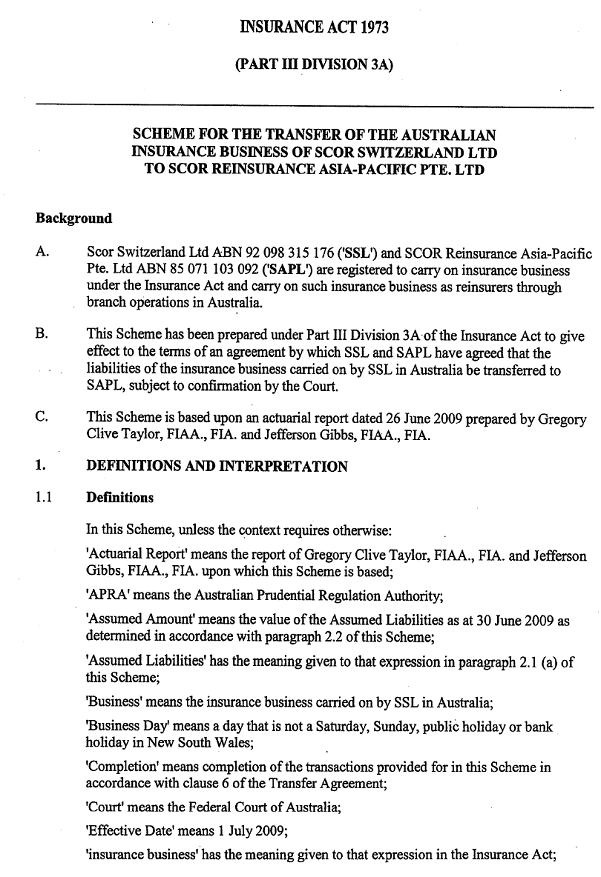
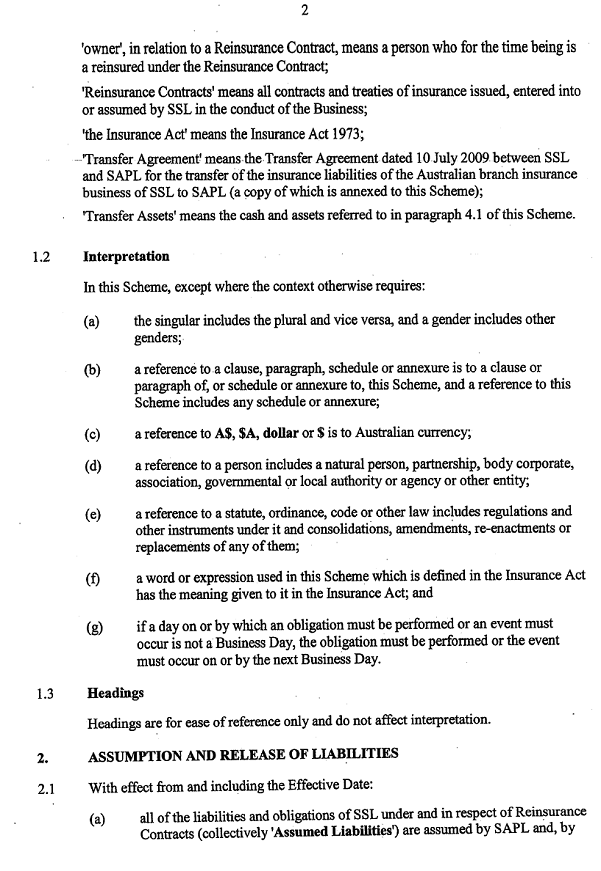
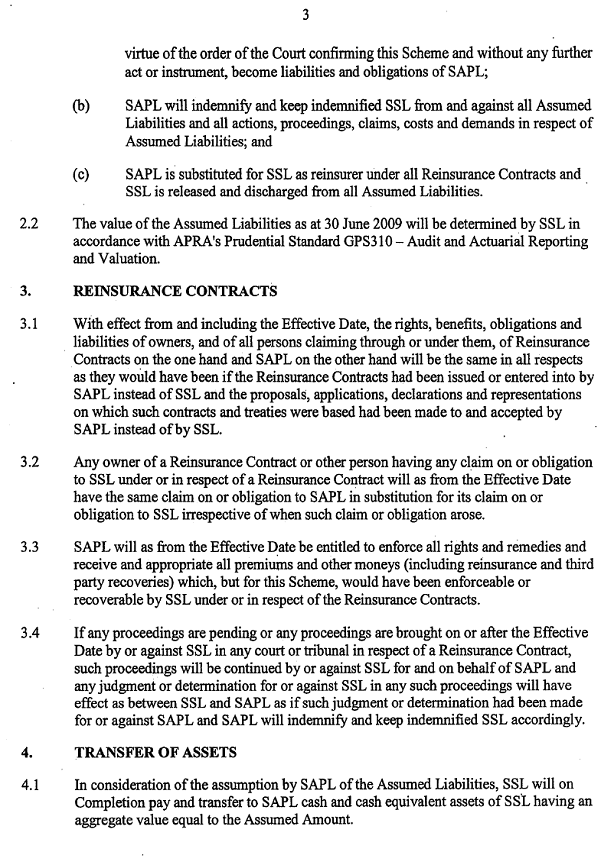
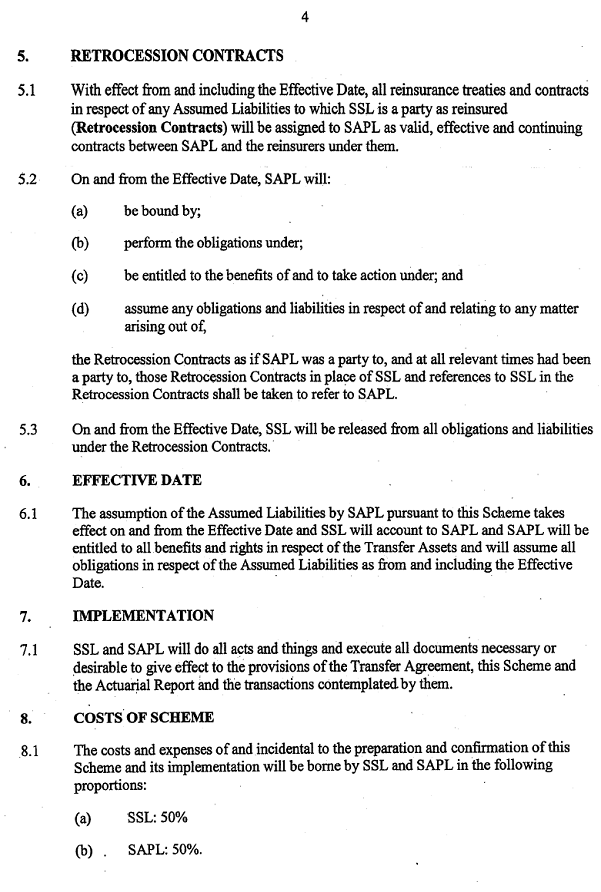
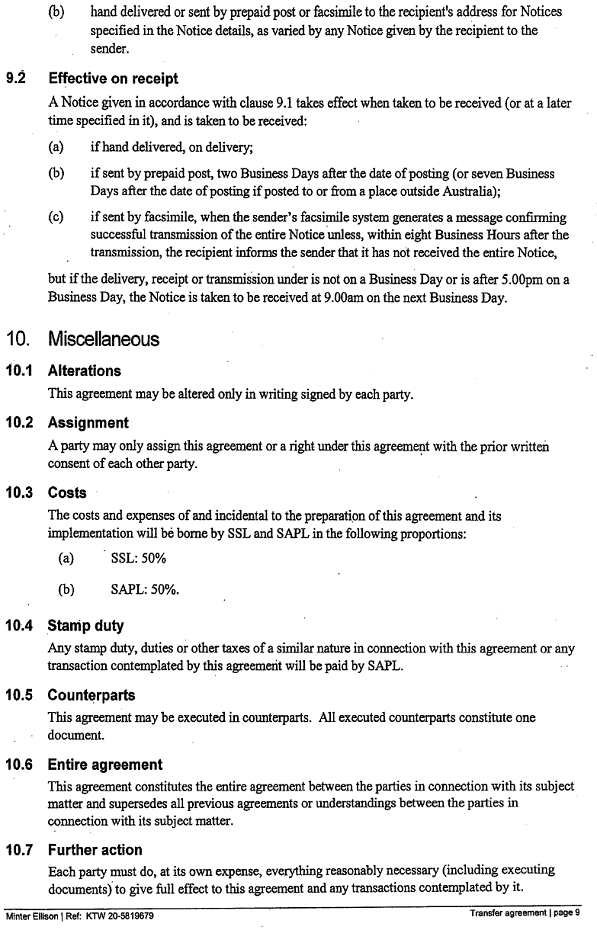
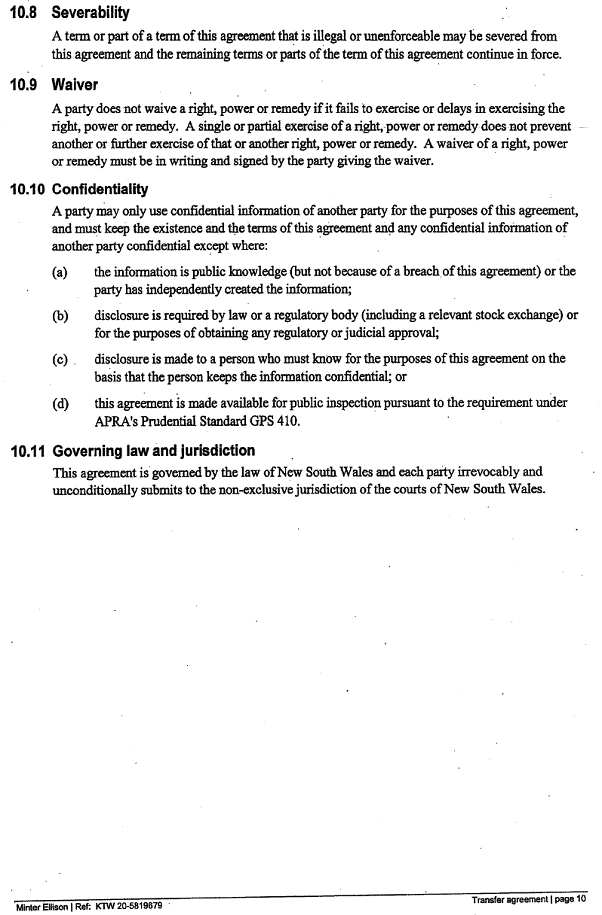
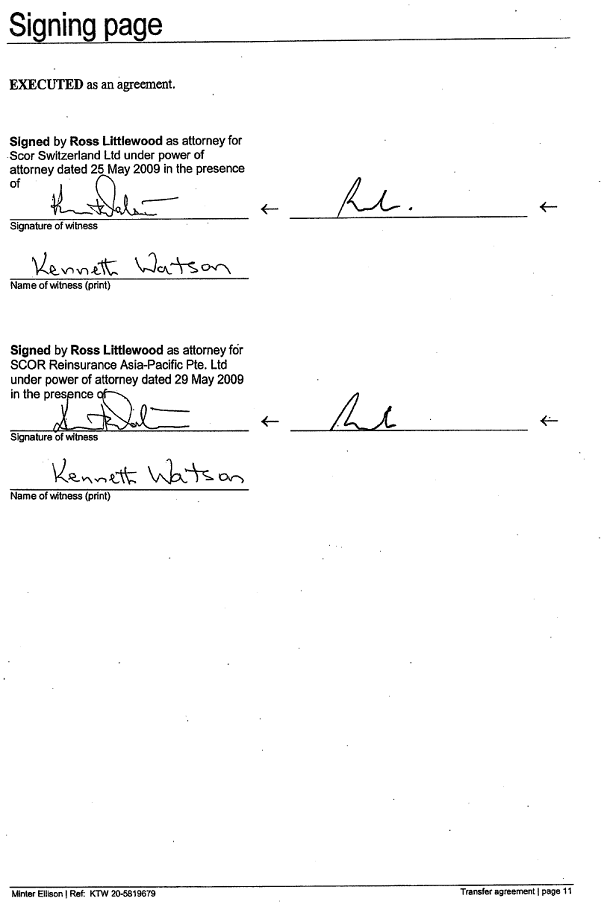
1. Pursuant to section 17F(1) of the Insurance Act 1973 (Cth), the scheme for the transfer of the Australian insurance business of Scor Switzerland Ltd to Scor Reinsurance Asia-Pacific Pte. Ltd, a copy of which is annexed hereto and marked “A”, be confirmed.
2. The applicants pay the costs of the proceedings of the Australian Prudential Regulation Authority as agreed or taxed.
3. These Orders be entered forthwith.
Note: Settlement and entry of orders is dealt with in Order 36 of the Federal Court Rules.
The text of entered orders can be located using eSearch on the Court’s website.
|
IN THE FEDERAL COURT OF AUSTRALIA |
|
|
NEW SOUTH WALES DISTRICT REGISTRY |
|
|
GENERAL DIVISION |
NSD 732 of 2009 |
IN THE MATTER OF SCOR SWITZERLAND LTD (ACN 098 315 176)
|
The application of |
SCOR SWITZERLAND LTD (ACN 098 315 176) and |
|
|
SCOR REINSURANCE ASIA-PACIFIC PTE. LTD (ACN 071 103 092)
|
|
JUDGE: |
LINDGREN J |
|
DATE: |
1 OCTOBER 2009 |
|
PLACE: |
SYDNEY |
REASONS FOR JUDGMENT
Introduction
1 The applicants, SCOR Switzerland Ltd (SSL) and SCOR Reinsurance Asia-Pacific Pte. Ltd (SAPL), apply under s 17E of the Insurance Act 1973 (Cth) (the Act) for an order under s 17F of the Act confirming a scheme prepared in accordance with Div 3A, Pt III of the Act to give effect to a transfer of SSL’s Australian insurance business to SAPL (the Scheme).
2 On 22 September 2009 I made an order confirming the Scheme. These are the reasons why I did so.
3 Mr R S Hollo of counsel who appeared for the applicants provided detailed written submissions. In substance, I accepted his submissions. I will ensure that a copy is placed on the Court file. My acceptance of Mr Hollo’s submissions means that they express in part my reasons for making the order. In the circumstances I will deal only with issues that seem to call for some discussion.
Consideration
4 The Scheme contemplates the transfer of the Australian reinsurance business of one reinsurer (SSL) to another (SAPL) within the SCOR Group of companies. Accordingly, the policyholders affected by the Scheme are themselves insurers. No changes are proposed to the terms and conditions of the contracts and treaties of insurance to which SSL is a party.
5 In addition to affidavit evidence, there were before the Court:
(a) the Scheme;
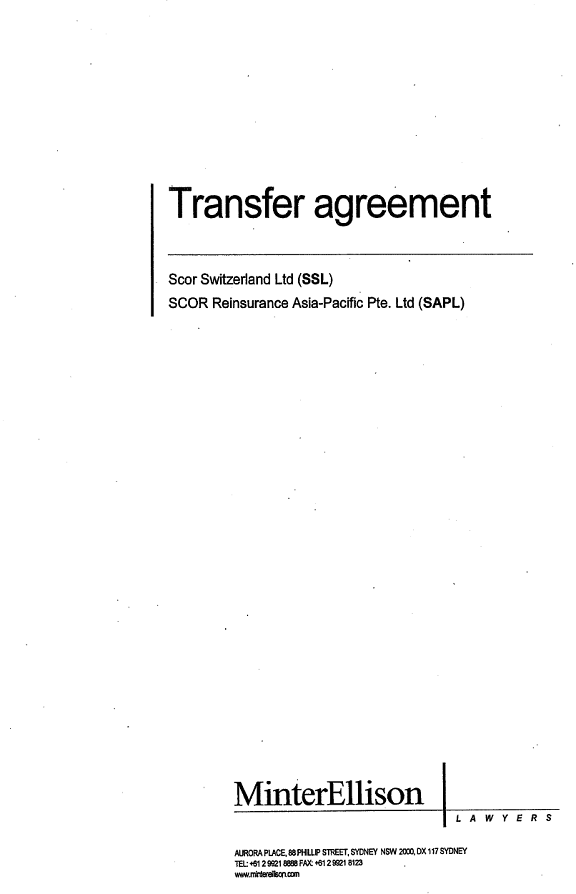
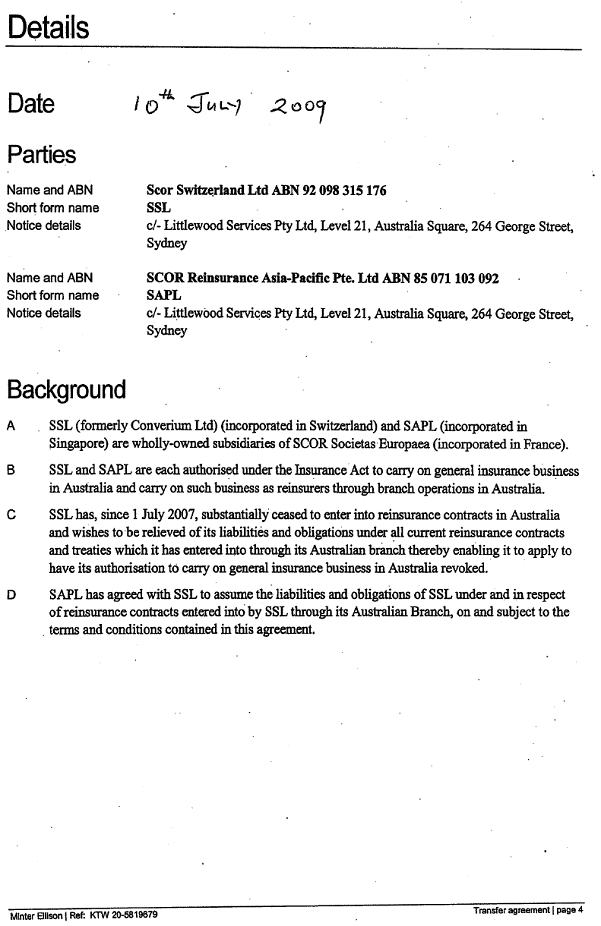
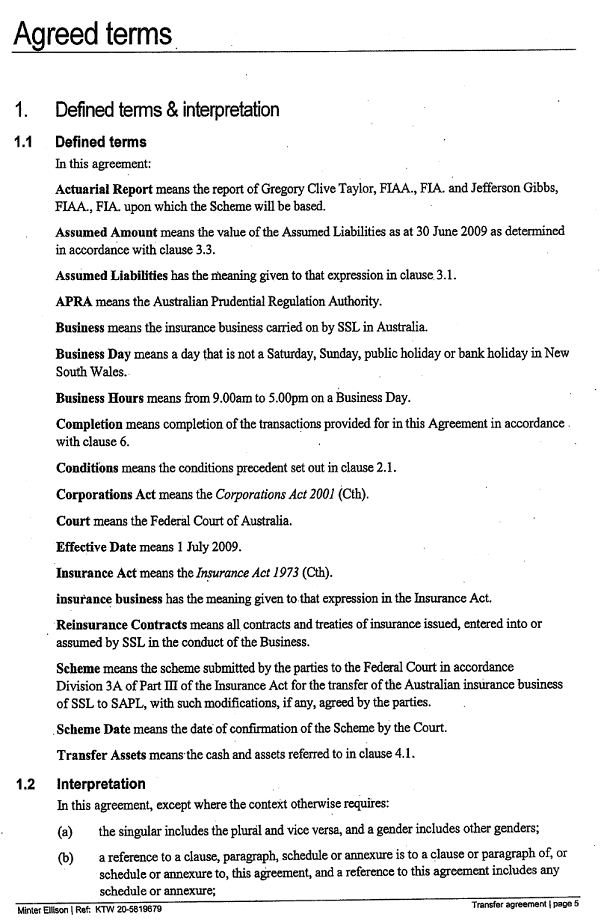
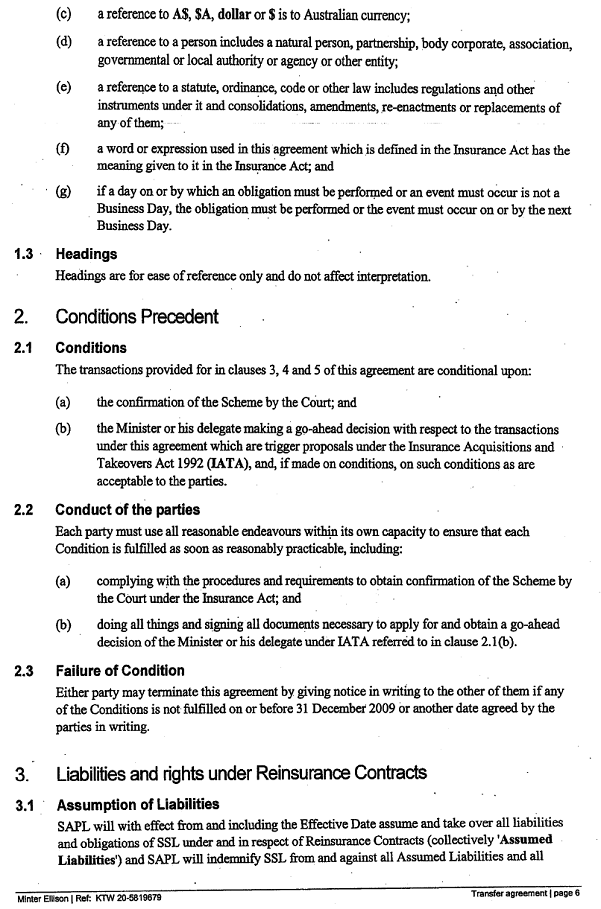
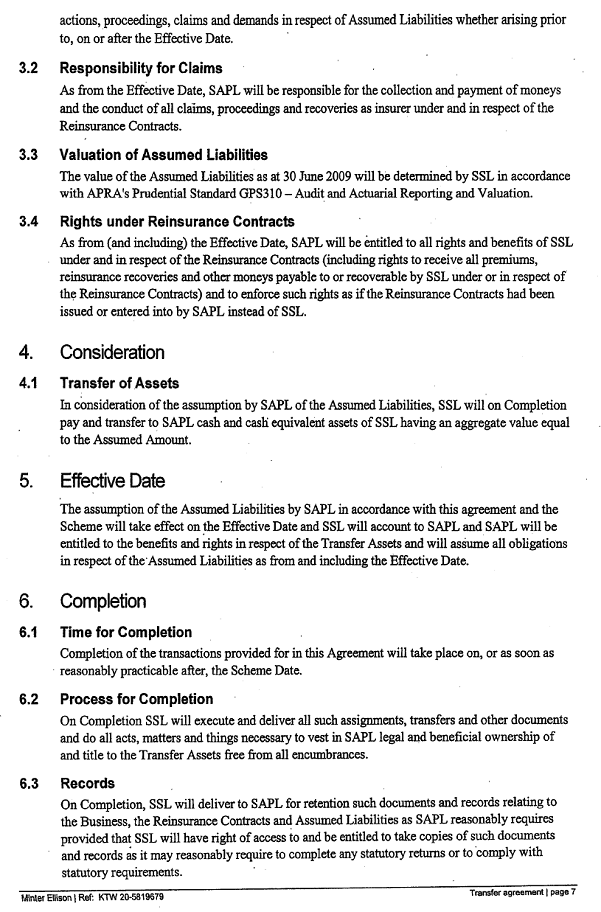
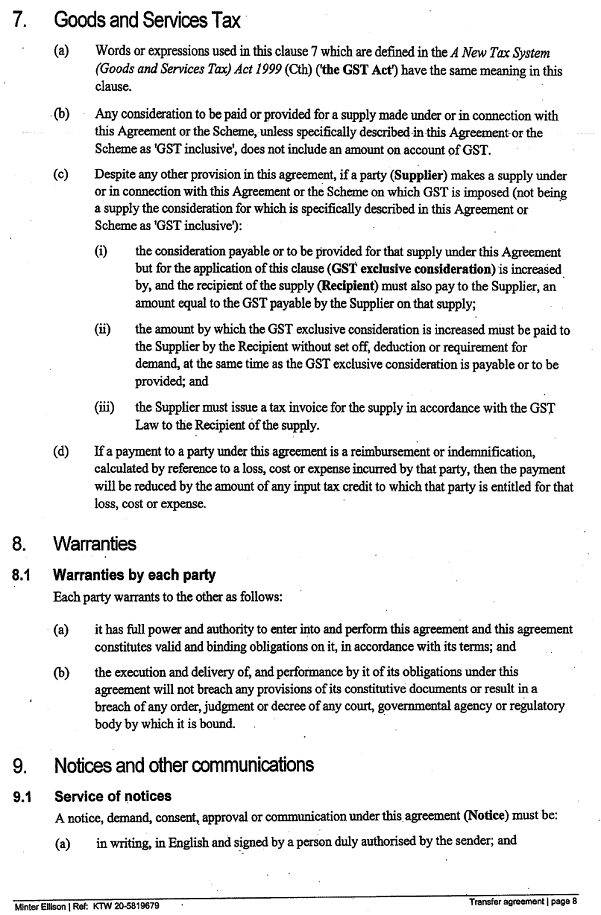
(b) a Transfer Agreement dated 10 July 2009 between SSL and SAPL for the transfer of the insurance liabilities of the Australian branch insurance business of SSL to SAPL (Transfer Agreement);
(c) an actuarial report on the Scheme prepared jointly by Gregory Clive Taylor of Taylor Fry Consulting Actuaries, and Jefferson Robert Gibbs of KPMG Actuaries Pty Ltd (Actuarial Report); and
(d) an update to the Actuarial Report prepared by Mr Taylor and Mr Gibbs using financial information as at 30 June 2009 (Supplementary Actuarial Report).
6 Mr Taylor is a Fellow of the Institute of Actuaries of Australia and a Fellow of the Institute of Actuaries (London). He is the Appointed Actuary for the purposes of s 39 of the Act of the Australian branch of SSL. Mr Gibbs is a Fellow of the same Institutes and is the Appointed Actuary for the same purposes of Australian branch of SAPL.
7 I was satisfied that the requirements of ss 17B(3), 17C(2), 17C(3) of the Act and of Prudential Standard GPS 410 (Transfer and Amalgamation of Insurance Business for General Insurance) were met.
8 Pursuant to its right to be heard (see s 17E(3) of the Act), the Australian Prudential Regulation Authority (APRA) was represented on the hearing. Its solicitor informed the Court that APRA had no objection to the Scheme’s being confirmed.
9 APRA did not arrange for an independent actuary to make a written report on the Scheme: cf s 17D of the Act.
10 SSL and SAPL are registered in Australia as foreign companies under the Corporations Act 2001 (Cth) and are authorised to conduct insurance business under the Act.
11 SSL has not underwritten any new reinsurance business in Australia since 1 July 2007. The coverage provided by its contracts is due to expire on 31 December 2009.
12 SSL was formerly named “Converium Limited” which was registered as a foreign company in Australia on 2 October 2001 and was authorised to conduct insurance business under the Act. With one exception, SSL’s insurance liabilities derive from its own underwriting. The exception is that the insurance liabilities of Zurich Insurance Company were assumed by portfolio transfer on 1 October 2003: see The Application of Zurich Insurance Company [2003] FCA 1519. Converium Limited’s parent, Converium Holding AG, a company which was incorporated in Switzerland and which carried on reinsurance business as a branch operation in Australia, was acquired by the SCOR Group in 2007. SSL changed its name from Converium to SSL in September 2007 following that takeover.
13 SAPL commenced its insurance operations as a branch in Australia in 1976. Following a corporate restructuring in 2004, the insurance authority of SAPL was maintained through an external servicing agreement with Littlewoods Services Pty Ltd, SAPL’s agent in Australia. SAPL has recently (in February 2008) re-established its Australian branch office. SAPL writes both facultative and treaty reinsurance business for underlying risks arising predominantly in the Australian and New Zealand markets. It also accepts retrocession risks from London market subsidiaries in the SCOR Group, where the underlying risks exist in Australia.
14 With the absorption of SSL into the SCOR Group in September 2007, SSL ceased underwriting new reinsurance business in Australia from 1 July 2007 and went into run-off with a view to a transfer of its liabilities to SAPL. The purpose of the Scheme is to transfer to SAPL the liabilities of SSL in respect of contracts and treaties of reinsurance, and to release SSL from such liabilities. It is intended that subsequently SSL’s authorisation under the Act will be revoked and that its remaining net assets will be repatriated to its parent.
15 On 12 June 2009, the SCOR Group injected US$12 million (equivalent to A$14.8 million based on the exchange rate at that date) into SAPL.
16 Under the Scheme, SSL must pay and transfer to SAPL consideration for its undertaking SSL’s liabilities in the form of cash and cash equivalent assets of SSL, having an aggregate value equal to the value of the “Assumed Liabilities” as at 30 June 2009. The Assumed Liabilities are all the liabilities and obligations of SSL under and in respect of reinsurance contracts. SAPL is to indemnify SSL against all Assumed Liabilities and all actions, proceedings, claims and demands in respect of them, whether arising prior to, on or after the “Effective Date” which is 1 July 2009. On the basis of data to 30 June 2009, the amount of the consideration as calculated by the actuaries is $33.1 million. This is, of course, separate from the sum of US$12 million mentioned in the preceding paragraph.
17 As Mr Hollo submitted, the discretion conferred by s 17F is a general one, and the Act does not specify any criteria to be satisfied: see Re Reward Insurance Limited [2004] FCA 151 at [3]; PMI Indemnity Limited (No 2) [2005] FCA 1842 at [23]. However, the decided cases (including those under comparable provisions of the Life Insurance Act 1995 (Cth)), reveal that a critical consideration is whether affected policy holders will be detrimentally affected by the implementation of the scheme: see Re Insurance Australia Limited (2004) 139 FCR 450 at [76]; PMI Indemnity Limited (No 2) [2005] FCA 1842 at [24]; In the Application of Budget Insurance Company Ltd and Auto & General Insurance Company Ltd [2008] FCA 636 at [13]. Relevant cases under the Life Insurance Act 1995 are: Application of Advance Life Insurance Limited (ACN 003 182 670) (unreported, Sheppard J, 18 February 1997) at p 4; Re Royal & Sun Alliance Life Assurance Ltd (2000) 104 FCR 37 at [32]; Re GIO Personal Investment Services Limited [2000] FCA 1871 at [27].
18 An “affected policyholder” is defined in s 17C(1) of the Act to mean the holder of a policy affected by a scheme, and is the holder of a policy being transferred under the scheme. The Court may, however, take into account, as relevant to the exercise of its discretion, the effect of the scheme on other policyholders, notably the holders of policies issued by the transferee insurer: see Re Insurance Australia Limited (2004) 139 FCR 450 at [19]; Mercantile & General Reinsurance Company of Australia Ltd [2004] FCA 1773 at [23]; PMI Indemnity Limited (No 2) [2005] FCA 1842 at [25]; Re Calliden Group Limited [2007] FCA 2019 at [90].
19 Section 32 of the Act empowers APRA to determine “prudential standards” relating to prudential matters that must be complied with. The subject of Capital Adequacy is addressed in APRA’s Prudential Standard GPS 110 and in its Prudential Practice Guide – GPS 110 Capital Adequacy: Capital Management. In substance, in the case of a run-off insurer, APRA insists that the forecast of insurance liabilities valued in accordance with the methodology set out in GPS 310 (Prudential Standard GPS 310 Audit and Actuarial Reporting and Valuation) must be sufficient to cover the insurer’s insurance liabilities to a 99.5% level of sufficiency, plus any other liabilities as calculated by the insurer’s Appointed Actuary: see GPS 110, para 40(b). APRA also envisages that an insurer’s minimum target capital specified in its Business Plan would be, in the case of a Category C insurer such as SSL and SAPL, 1.2 times its Minimum Capital Requirement (MCR): see para 6(a) of the Prudential Practice Guide.
20 The two Appointed Actuaries referred to earlier determined the MCR of SSL and SAPL. However, they prefer to use the expression “solvency coverage ratio”.
21 SSL’s solvency coverage ratio as at 31 December 2008 was 8.63, its projected solvency ratio as at 30 June 2009 was 13.71, and its actual solvency coverage ratio at 30 June 2009 was 18.09. The Appointed Actuaries have described that solvency coverage ratio as being “to some extent illusory” because the evidence shows that if the Scheme were not to proceed, SSL would seek APRA’s approval to the maximum repatriation of capital. That maximum was estimated to be $106.9 m. If the maximum repatriation were allowed, SSL’s solvency coverage ratio as at 30 June 2009 would be reduced from 18.09 to 3.12. It is with this figure that SSL’s post-Scheme position is more appropriately compared.
22 SAPL’s solvency coverage ratio as at 30 June 2009 was 2.07 times the MCR required by APRA but without the capital injection of US$12 million it would have been less. I was told that it would certainly have been less than 1.76 and would in fact have been 1.56 or 1.64. SAPL’s post-Scheme solvency coverage ratio is 1.76 – higher than either of those figures although still less than the 3.12 solvency ratio that SSL would have enjoyed even following the hypothetical maximum capital repatriation mentioned above.
23 SAPL is required to maintain a capital management plan which is monitored by APRA. In its most recent capital management plan, SAPL’s capital trigger ratio is 1.5 times its MCR. This is higher than the 1.2 times MCR minimum target capital base for an insurer stipulated in para 6(a) of APRA’s Prudential Practice Guide noted earlier.
24 Although SAPL’s post-Scheme solvency coverage ratio of 1.76 is less for both SSL policyholders and SAPL policyholders than SSL’s pre-Scheme ratio of 3.12 and SAPL’s pre-Scheme (with the US$12 million) ratio of 2.07, 1.76 remains above SAPL’s prescribed capital trigger ratio and well above APRA’s MCR.
25 The capital backing from SAPL’s parent, which is conferred by SCOR Asia-Pacific’s management plan, is additional to the current regulatory capital backing.
26 The probability of SAPL’s post-Scheme adequacy of assets to meet liabilities is well above the one year probability of 99.5% referred to earlier.
27 In several cases the Court has confirmed schemes under Div 3A of Pt III of the Act on the basis that the financial interests of policyholders have been adequately protected even though, as a consequence of the implementation of the scheme, there will be a reduction in excess capital or solvency coverage ratio for the policyholders: see Mercantile and General Reinsurance Company of Australia Ltd [2004] FCA 1773 at [19]-[24]; PMI Indemnity Limited (No 2) [2005] FCA 1842 at [71]-[74]; Calliden Group Limited in the matter of Calliden Group Limited [2007] FCA 2019 at [88]-[91]; MMIA Pty Limited and QBE Insurance (Australia) Limited [2008] FCA 1239 at [16]-[18], [32]-[33]; Calliden Limited, in the matter of Calliden Limited [2009] FCA 186 at [12]-[21].
28 In those cases there was actuarial evidence generally of the kind that was before the Court in the present proceeding, to the effect that the solvency coverage ratio of the transferee insurer following implementation of the proposed scheme would still remain above the minimum requirements of APRA.
29 In the present case the Appointed Actuaries have concluded in section 11 (p 44) of the Actuarial Report that in their opinion the financial security provided to the policyholders of SSL and SAPL immediately after the implementation of the Scheme significantly exceeds the minimum requirement of APRA and also that the operational changes arising from the Scheme are not anticipated to materially disadvantage policyholders of SSL or SAPL.
Conclusion
30 It was for the above reasons and those expressed in Mr Hollo’s written submissions to which I referred at [3] above, that I made the order confirming the Scheme on 22 September 2009.
|
I certify that the preceding thirty (30) numbered paragraphs are a true copy of the Reasons for Judgment herein of the Honourable Justice Lindgren. |
Associate:
Dated: 1 October 2009
|
Counsel for the Applicants: |
Mr R S Hollo |
|
|
|
|
Solicitor for the Applicants: |
Minter Ellison |
|
|
|
|
Solicitor for the Australian Prudential Regulation Authority: |
Mr D C Sun |
|
Date of Hearing: |
22 September 2009 |
|
|
|
|
Date of Judgment: |
22 September 2009 |


