FEDERAL COURT OF AUSTRALIA
Alcock v Commonwealth of Australia [2009] FCA 820
ROBERT JAMES ALCOCK v COMMONWEALTH OF AUSTRALIA and STATE OF VICTORIA
VID 435 of 2008
RYAN J
4 AUGUST 2009
MELBOURNE
|
IN THE FEDERAL COURT OF AUSTRALIA |
|
|
VICTORIA DISTRICT REGISTRY GENERAL DIVISION |
VID 435 of 2008 |
|
BETWEEN: |
ROBERT JAMES ALCOCK Applicant
|
|
AND: |
COMMONWEALTH OF AUSTRALIA First Respondent
STATE OF VICTORIA Second Respondent
|
|
JUDGE: |
RYAN J |
|
DATE OF ORDER: |
4 AUGUST 2009 |
|
WHERE MADE: |
MELBOURNE |
THE COURT ORDERS THAT:
1. The amended statement of claim filed on 8 September 2008 be struck out.
2. The applicant have leave, if so advised, to file and serve by 11 September 2009 a further amended statement of claim in substitution for the amended statement of claim referred to in paragraph 1 of this Order.
3. In the event of an exercise by the applicant of the leave granted by paragraph 2 of this Order, the applicant by 11 September 2009 file and serve a further amended application conforming with the further amended statement of claim filed and served pursuant to such leave.
4. The applicant pay the costs of each respondent of and incidental to the motions on notice herein each dated 24 September 2008.
5. Liberty be reserved to any party to apply on not less than 48 hours notice in writing to the other parties.
Note: Settlement and entry of orders is dealt with in Order 36 of the Federal Court Rules.
The text of entered orders can be located using eSearch on the Court’s website.
|
IN THE FEDERAL COURT OF AUSTRALIA |
|
|
VICTORIA DISTRICT REGISTRY GENERAL DIVISION |
VID 435 of 2008 |
|
BETWEEN: |
ROBERT JAMES ALCOCK Applicant
|
|
AND: |
COMMONWEALTH OF AUSTRALIA First Respondent
STATE OF VICTORIA Second Respondent
|
|
JUDGE: |
RYAN J |
|
DATE: |
4 AUGUST 2009 |
|
PLACE: |
MELBOURNE |
REASONS FOR JUDGMENT
1 On 15 June 2008, an application was instituted in this Court claiming relief in relation to fishing for abalone in areas (“the disputed areas”) in waters off the coast of Victoria which have been proclaimed by the second respondent (“Victoria”) to be marine parks and marine sanctuaries. The application was later amended but, in essence, maintained a claim for compensation from Victoria and the Commonwealth in respect of the applicant’s having been precluded from fishing for abalone in the disputed areas.
2 By notice on motion filed 24 September 2008, the Commonwealth has sought that;
‘1. Judgment be entered for the First Respondent pursuant to s 31A of the Federal Court of Australia Act 1976; or
2. The proceeding be dismissed pursuant to Order 20 rule 5 of the Federal Court Rules in relation to the claims against the First Respondent set out in the amended application and amended statement of claim; or
3. The claims against the First Respondent set out in the amended application and amended statement of claim be struck out pursuant to Order 11 rule 16 of the Federal Court Rules …’
3 By its own motion, also on notice dated 24 September 2008 Victoria has sought;
‘1. The Amended Application dated 8 September 2008 and the Amended Statement of Claim dated 8 September 2008 (‘the pleadings’) be struck out pursuant to Order 11 Rule 16 of the Federal Court Rules on the grounds that:
(a) The pleadings disclose no reasonable cause of action;
(b) The pleadings have a tendency to cause prejudice, embarrassment or delay in the proceeding;
(c) The pleadings are otherwise an abuse of process.’
2. In the alternative, that the proceeding or the claims for relief against the Second Respondent in the proceeding, be stayed or dismissed pursuant to Order 20 rule 5 of the Federal Court Rules on the ground that the proceeding is frivolous or vexatious.
3. In the alternative, that there be summary judgment given for the Second Respondent in relation to the proceeding pursuant to s 31A of the Federal Court Act 1976 (Cth) on the ground that the Applicant has no reasonable prospect of successfully prosecuting the proceeding.’
4 In order to understand the competing contentions of the parties, it is necessary, first, to set out some of the history of legislative control of the disputed areas. Section 71 of the Fisheries Management Act 1991 (Cth) (“the FMA”) enables the Commonwealth to make an arrangement with the State or States represented on a Joint Authority that the Joint Authority is to have the management of a particular fishery in waters relevant to that State or to any of those States. “Joint Authority” is defined in s 4 of the FMA to mean an authority established by or under s 61 of that Act which, in turn, empowers the Commonwealth to make an arrangement with a State or States for the establishment of a Joint Authority “consisting of the Commonwealth Minister together with the appropriate Minister or Ministers of that State or those States.” Section 72 then provides, in relation to a particular fishery in waters relevant to a State the management of which has not been entrusted to a Joint Authority under s 71, that;
‘(1) The Commonwealth may make an arrangement with a State with respect to a particular fishery in waters relevant to the State, not being a fishery to which an arrangement under section 71 applies:
(a) that the fishery (being a fishery wholly or partly in the coastal waters of the State) is to be managed in accordance with the law of the Commonwealth; or
(b) that the fishery (being a fishery wholly or partly in waters on the seaward side of the coastal waters of the State) is to be managed in accordance with the law of the State.
(2) If, under an arrangement, a fishery is to be managed in accordance with the law of a State, the arrangement may, if required by the Commonwealth, provide for giving effect to Australia’s obligations under international law (including international agreements) in relation to the fishery.’
5 Section 77 of the FMA then provides, so far as is relevant, that;
‘If an arrangement under this Division provides that:
(a) a particular fishery is to be managed in accordance with the law of a State; … …
this Act, other than this Division, does not apply in relation to that fishery, or that part of the fishery, except in relation to:
(c) foreign boats; and
(d) operations on and from foreign boats; and
(e) persons on foreign boats; and
(f) matters that occurred before the arrangement took effect.’
6 An “arrangement under this Division” referred to in s 77 includes an arrangement of the kind contemplated by s 72 for the management of a particular fishery in waters relevant to a State. In October 1997 an arrangement (“the Arrangement”) was entered into between the Commonwealth and Victoria “in relation to the fishery for invertebrates to be managed under State law in waters relevant to Victoria.” The Arrangement was expressed to commence “at 0.00 hours on 1 November 1997” and to apply to:
‘all activities by way of fishing in all waters relevant to Victoria described in clause 4 of this Arrangement for all invertebrates of Phylum Crustacea, Phylum Mollusca and Phylum Echinodermata when taken by any fishing method other than trawling (including but not limited to board trawling, midwater or pelagic trawling and Danish seining)’
7 Subject to exclusions in respect of areas in the vicinity of Wilson’s Promontory, the Bunurong Marine Park and the Harold Holt Marine Reserves, the Arrangement was expressed to apply to;
‘… the area of waters bounded by the line:
(a) commencing at the intersection of the coastline at mean low water by the boundary between the States of New South Wales and Victoria;
(b) running south easterly along the geodesic toward a point of Latitude 37º 35’ South, Longitude 150º 10’ East to its intersection with a line parallel to and 3 nautical miles distant from the coastline at mean low water; and
(c) from there along that line to its intersection with the geodesic which is a continuation of the landward boundary between the States of New South Wales and Victoria; and
(d) from there south easterly along the geodesic to its intersection by the outer limit of the Australian fishing zone; and
(e) from there generally southerly along that outer limit to its intersection with the parallel of Latitude 39º 12’ South; and
(f) from there westerly along the parallel to its intersection by the meridian of Longitude 143º 40’ East; and
(g) from there southerly along the meridian to the parallel of Latitude 40º 00’ South; and
(h) from there westerly along the parallel to its intersection by the meridian of Longitude 140º 57.9’ East; and
(i) from there northerly along that meridian to its intersection with the coastline at mean low water; and
(j) from there along the coastline of the State of Victoria at mean low water to the point of commencement.’
8 Clause 5 of the Arrangement stipulated that “the fishery is to be managed in accordance with the laws of the State of Victoria.”
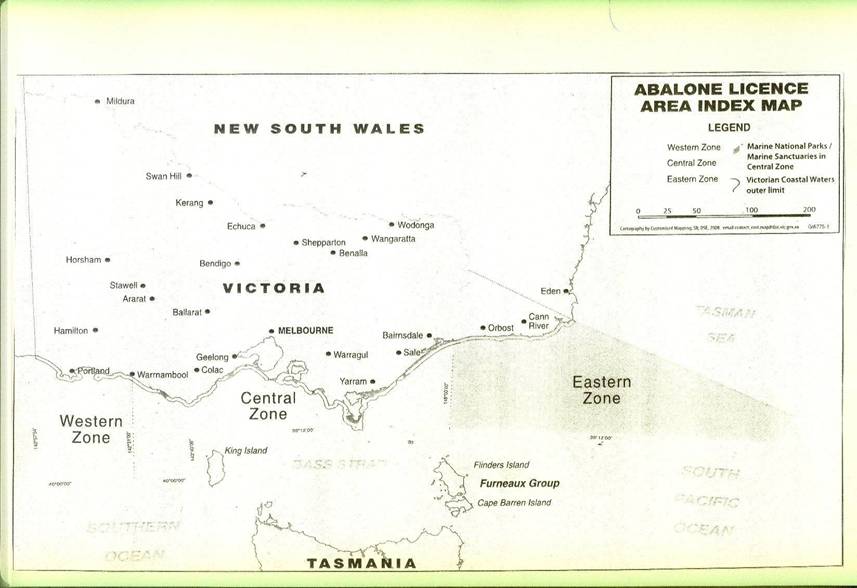
9 The abalone fishery in which the applicant has been licensed to take abalone is regulated pursuant to the Fisheries Act 1995 (Vic). That fishery is divided into an Eastern Zone, a Western Zone and a Central Zone for which Abalone Fishery Access Licences (“AFALs”) have been issued. The three Zones are shown on the map appended as Appendix 1 to these reasons. The applicant holds an AFAL for the Central Zone.
10 By the National Parks (Marine National Parks and Marine Sanctuaries) Act 2002 (Vic) amendments were made to, amongst others, the National Parks Act 1975 (Vic) and the Fisheries Act 1995 (Vic). The relevant effect, for present purposes, of those amendments was to create marine national parks and marine sanctuaries and to provide a regime for the control and management of each marine national park and each marine sanctuary. The amending Act of 2002 also inserted into the National Parks Act a new s 45A which provided, by sub-ss (1), (7) and (8);
‘(1) A person must not, in a marine national park or a marine sanctuary, take or attempt to take fish or fishing bait for sale.
Penalty: 200 penalty units or 12 months imprisonment or both, in the case of a natural person. 400 penalty units, in the case of a body corporate.
… …
‘(7) A licence, permit or other authority (however described) issued under the Fisheries Act 1995 does not authorise the holder to act in a manner that is prohibited by this section.
(8) An Order in Council, order, notice, direction or plan (however described) under the Fisheries Act 1995 does not authorise any person to act in a manner that is prohibited by this section.’
11 One of the amendments made to the Fisheries Act 1975 (Vic) by the amending Act of 2002 was the insertion of a new s 165 in these terms;
‘(1) Except as provided in this Part, compensation is not payable by the State of Victoria to a person who is, or has been at any time, the holder of—
(a) a fishery licence; or
(b) a general permit under section 49—
for any loss, damage or injury whatsoever resulting from or arising out of—
(c) the enactment of the National Parks (Marine National Parks and Marine Sanctuaries) Act 2002; or
(d) the existence of any marine national park or marine sanctuary (within the meaning of the National Parks Act 1975) created by the operation of the National Parks (Marine National Parks and Marine Sanctuaries) Act 2002.
(2) Nothing in this section prevents any proceeding to recover damages for any loss, damage or injury whatsoever resulting from or arising out of any person negligently or unlawfully exercising, purporting to exercise or failing to exercise any power, duty or authority conferred by or under this Act or the National Parks Act 1975.’
The case which the applicant seeks to make
The amended statement of claim
13 In the course of oral arguments on the motions by Victoria and the Commonwealth, Mr Fitzgibbon of Counsel for the applicant acknowledged that the applicant’s “pleadings have their problems” and later that “the pleadings aren’t satisfactory.” It is therefore convenient to examine in order the paragraphs of the amended statement of claim which appear to articulate the contentions which I have imputed to the applicant at [12] of these reasons. Of course, it is not appropriate for the Court to re-plead the applicant’s case but some analysis of the form of the amended statement of claim may assist in illuminating the fundamental constitutional and other issues which have been agitated on the hearing of the motions.
Paragraphs 4 - 9
14 Under the sub-heading “Cause of Action”, the amended statement of claim recites;
‘4. The Applicant submits that a standard feature of all legislation enacted by State governments establishing marine national parks throughout the Commonwealth has been the provision of compensation or adjustment payments for the numerous fisheries displaced or disadvantaged by the reduction in available resource resulting from the exclusion of fishing activity from all areas within the boundaries of the marine national parks.
5. The Applicant submits the Victorian section of the wild abalone fishing industry, being the Applicant and those he represents, is the subject of unique discrimination being the only section of any fishery throughout the Commonwealth which has been totally denied compensation for any losses arising from the establishment of marine parks.
6. The Applicant submits that it has been previously held and reaffirmed in various jurisdictions that abalone licences are tradeable property with a recognised market value.
7. The Applicant further submits that the discrimination exhibited against the Victorian wild abalone fishing industry by the State of Victoria and the denial of just compensation for the loss of property and reduction in property values wilfully negligently and in breach of duty discriminated without cause against the applicant and is contrary to the provisions of Commonwealth legislation and the Commonwealth Constitution which are the primary source of authority in respect of fishing in sea waters.
8. Further the Applicant states that although the Fisheries Act 1995 (Vic) as amended in 2002 allows designation of the abalone fishery for compensation the policy of the Second Respondent is to exclude the abalone industry.
9. The Applicant submits that the First and Second Respondents as the managing authority and the delegated manager respectively are jointly and severally responsible for the compensation and damages sought.’
Paragraphs 10 - 14
16 The statement of claim next proceeds, under the heading “Statement of Facts”, to recite;
‘10. All wild abalone fishing in waters adjacent to Australia is conducted under the provisions of Commonwealth fishing law.
11. This primary authority has been acknowledged by each of the states which have entered into individual management arrangements signed by both Commonwealth and State Ministers responsible for fisheries.
12. For the State of Victoria the management arrangement was entered into on 29 January 1988 under Section 12H(4)(b) of the Fisheries Act 1952 (Cth) then modified and extended by a further arrangement entered into in 1997 and gazetted 31 October 1997 under Section 76 of the Fisheries Management Act 1991 (Cth) and the transitional provisions relating to the Fisheries Act 1952.
13. By means of these arrangements the Commonwealth at all material times has exercised fundamental jurisdiction over the abalone fishery in waters adjacent to Victoria with management power delegated to the State of Victoria by the gazetted arrangements.
14. Under the Seas and Submerged Lands Act 1973 (Cth) the Commonwealth holds sovereignty of the lands under the territorial sea of Australia, over the seas, and over the air above the seas including ownership of all the fish and other wild life therein.’
17 I regard paragraph 10 as embarrassing because it does not identify “the provision of Commonwealth fishing law” under which “all wild abalone fishing” is said to be conducted. Nor does it indicate the meaning which the pleader says is borne by the expression “waters adjacent to Australia.” If that is a term of art or is defined by a particular statutory provision, its meaning and source should be identified in the body of the pleading. As well, if it is intended to assert that all waters comprised in the Central Zone of the fishery regulated pursuant to the Fisheries Act 1995 (Vic) are subject to “Commonwealth fishing law”, that assertion should be made explicitly on the face of the statement of claim. Paragraph 10 of the amended statement of claim in its present form must therefore be struck out.
18 If “primary authority” over relevant waters, including the Central Zone of the Victorian abalone fishery resides, as the pleader seems to suggest, in the Commonwealth, it does not add any material fact to assert that the existence of that primary authority has been “acknowledged by each of the States which has entered into Commonwealth / State fishing management arrangements”. Accordingly, paragraph 11 of the amended statement of claim should also be struck out.
19 Paragraph 12 of the amended statement of claim seems unobjectionable as a narrative of background facts explaining how the applicant came to hold an AFAL in respect of the Central Zone of the Victorian abalone fishery. However, if those facts are said to entail some consequential limitation on the power of either Victoria or the Commonwealth to cut down or otherwise alter the rights attaching to a relevant AFAL, the pleading should indicate, with a statement of any material additional facts, how that consequence is alleged to follow.
20 Paragraph 13 of the amended statement of claim does not perform the function just indicated because it does not make clear what is the “fundamental jurisdiction” said to have been exercised by the Commonwealth over the Victorian abalone fishery. Nor is any definition given to the expression “waters adjacent to Victoria.” If, as seems to be implied, “waters adjacent to Victoria” comprehend all the area comprised in the Central Zone of the Victorian abalone fishery, that should be expressly pleaded and the legislative provision having that effect should be identified. Moreover, paragraph 13 appears to identify a dichotomy between “fundamental jurisdiction” reposed in the Commonwealth and “management power” vested in Victoria. If that dichotomy is said to import a limitation on the power of Victoria to limit or exclude fishing for abalone in “waters adjacent to Victoria” the pleading should expressly say so and, preferably, indicate the statutory or other provision which creates the dichotomy and the alleged consequential limitation of power. In its present form paragraph 13 must be struck out.
21 Paragraph 14 does not reproduce, as far as I can discern, the terms or effect of any identified provision of the Seas and Submerged Lands Act 1973 (Cth). More significantly, no other paragraph of the amended statement of claim identifies the consequences said to attach to the sovereignty declared by the Seas and Submerged Lands Act to be vested in and exercisable by the Commonwealth. Paragraph 14 therefore should not be preserved in isolation from the preceding paragraphs 10, 11, 12 and 13.
Paragraph 15
22 This paragraph is in these terms;
‘The Applicant submits that abalone fisheries management in these waters has been exercised by Second Respondent under fisheries laws and regulations enacted by the Parliament of the State of Victoria and further submits that these laws have been enacted contrary to the provisions of Section 51(x) and Section 108 of the Commonwealth Constitution because the state territorial jurisdiction does not include sea waters and terminates at the low water mark.’
23 Section 51(x) of the Constitution provides that;
‘The Parliament shall, subject to this Constitution have power to make laws for the peace, order and good government of the Commonwealth with respect to;
…
(x) fisheries in Australian waters beyond territorial limits.’
24 That power given to the Commonwealth is concurrent with, and not exclusive of, the legislative power of the States. Accordingly, if it were intended to allege that some “fisheries laws and regulations enacted by the Parliament of Victoria” are inconsistent with some exercise by the Commonwealth of legislative power over “fisheries in Australian waters beyond territorial limits”, it would be necessary also to plead that some part of the Central Zone of the Victorian abalone fishery over which a marine national park or marine sanctuary has been established is “in Australian waters beyond territorial limits” within the meaning of s 51(x). See also the observations at [31] below of these reasons about pleading an inconsistency of the kind contemplated by s 109 of the Constitution.
25 Section 108 of the Constitution provides;
‘Every law in force in a Colony which has become or becomes a State, and relating to any matter within the powers of the Parliament of the Commonwealth, shall, subject to this Constitution, continue in force in the State; and, until provision is made in that behalf by the Parliament of the Commonwealth, the Parliament of the State shall have such powers of alteration and of repeal in respect of any such law as the Parliament of the Colony had until the Colony became a State.’
26 That section is in the nature of a transitional provision intended to preserve in force Colonial and State laws related to an enumerated head of Commonwealth power unless and until provision is made “in that behalf” by the Commonwealth. As I understand the respective positions of the parties, it is common ground that the FMA makes provision “in that behalf” in respect of Australian waters beyond territorial limits. If that understanding be correct, any claim for relief based on inconsistency between the Victorian amending Act of 2002 and the FMA must identify the alleged inconsistency. In any event, paragraph 15 of the amended statement of claim in its present form cannot stand.
Paragraphs 16 - 18
27 These paragraphs are in the following terms;
‘16. For the enactment of fisheries laws in respect of territorial waters the Second Respondent relies upon the provisions of the Coastal Waters (State Titles) Act 1980 (Cth) and the Coastal Waters (State Rights) Act (Cth) 1980.
17. In the alternative the Second Respondent claims to rely upon the extra territorial operation of Victorian law where the interests of Victoria extend beyond the boundary of the state. Establishment of marine national parks outside the state of Victoria does not concern the interests of Victoria.
18. The clear purpose for establishment of marine national parks relates to environmental concerns not fishing. Environmental protection of Commonwealth waters is not mentioned in the Coastal Water (State Powers) Act 1980 (Cth) and is not part of fisheries management powers delegated to the Second Respondent.’’
28 These paragraphs anticipate reliance which may be placed by Victoria on the named Commonwealth Acts or the inherent power of Victoria to enact laws with extra-territorial effect as supporting the validity of the amending Act of 2002 and the creation of marine national parks and marine sanctuaries in waters forming part of the Central Zone of the Victorian abalone fishery. None of the three paragraphs, therefore, contains a statement of material facts as required by O 11 r 2 and each should be struck out. That is not to say that, if Victoria were to raise, in defence to a properly pleaded allegation that the relevant provisions of the amending Act of 2002 are beyond power, any provision of the Coastal Waters (State Titles) Act 1980 (Cth) or the Coastal Waters (State Rights) Act 1980 (Cth) or the inherent power of extra-territorial legislation, the applicant could not, by way of reply, assert the unavailability of those defences. Depending on the form which, on this hypothesis, Victoria’s defence might take, the applicant’s reply might adapt the language used in paragraphs 17 and 18 of the present amended statement of claim.
Paragraph 19
29 By this paragraph of the amended statement of claim, the applicant alleges that;
‘Under the Fisheries Act 1995 (Vic) the Second Respondent without cause or justification and in breach of Section 109 of the Commonwealth Constitution claims the ownership of fish vested in the Commonwealth by the Seas and Submerged Lands Act 1973 (Cth) and by reason of this claim exercises extreme control of the fishery.’
30 Section 109 of the Constitution provides;
‘When a law of a State is inconsistent with a law of the Commonwealth, the latter shall prevail, and the former shall, to the extent of the inconsistency, be invalid.’
Paragraph 20
32 By this paragraph of the amended statement of claim it has been pleaded that;
‘The Victorian wild abalone fishery is the most tightly controlled fishing industry in Australia and many of the controls applied by the state contravene Section 92 of the Commonwealth Constitution in respect of handling the product of this major export industry.’
33 Section 92 of the Constitution provides, relevantly, that;
‘trade, commerce, and intercourse among the States, whether by means of internal carriage or ocean navigation, shall be absolutely free.’
Paragraphs 21 - 23
35 These paragraphs appear to describe in a narrative way the extent of control exercised by Victoria over its abalone fishery and the effect on the operations of AFAL holders of the excision from the fishery of the reefs and fishing grounds comprised in the marine national parks and marine sanctuaries. These matters may be relevant to the quantification of a claim for compensation but they do not satisfy the minimum requirements indicated at [34] above for an allegation of invalidity arising from a contravention of s 92. Paragraphs 21 to 23 must therefore be struck out.
Paragraphs 24 - 30
36 Under the heading “Marine National Parks – Not Established for Fishing Purposes”, these paragraphs recite;
‘24. The Applicant submits that because of Commonwealth sovereignty over territorial waters the Second Respondent has no inherent sovereign rights or capacity to establish marine parks beyond the tidal mean low water mark.
25. In establishing the Parks, the Second Respondent claims to have exercised the plenary power of the Parliament of Victoria which the Applicant contends is not unlimited but constrained by the Commonwealth of Australia Constitution Act 1900 (Imp) by which the states were established and by the sovereign rights of the nation of Australia which are not exercisable by component parts of the Commonwealth.
26. The Applicant contends that the Coastal Waters (State Titles) Act 1980 (Cth) being the primary legislation which purports to confer authority over undersea land on the States is subject to the provisions of Section 123 of the Commonwealth Constitution which requires that any alteration to the area or boundaries of the states be subject to a referendum of the people of the state.
27. The Applicant submits that until such a referendum is held the boundaries of the State of Victoria remain unchanged from 1900.
28. The Applicant submits that the Second Respondent cannot exercise any acquired rights conferred by the above Act until a referendum has been held seeking the approval of the people of Victoria. No such referendum has been held in the period since Federation.
29. The Second Respondent has previously claimed that the decision of the High Court in the matter of the Port MacDonnell Professional Fishermans’ Association Inc and Another v. The State of South Australia and Another [1989] HCA 49; (1989) 168 CLR 340 F.C. 89/043 applies in Victoria.
30. The Applicant claims that because the pre-federation boundaries of the State of South Australia were established on a different constitutional basis than Victoria, being created under a Royal Charter and by a Constitution domestically created within South Australia which included various sea waters within the territory of the colony, instead of the Letters Patent and United Kingdom imposed colonial constitutions for Victoria and other territories which excluded all bays and coastal waters, the decision of the High Court in the above matter is distinguishable and does not apply to the State of Victoria.’
37 Many of the paragraphs which I have just reproduced are tendentious or argumentative in form and simply rehearse submissions which the applicant proposes to advance in support of a cause of action which is not adequately disclosed elsewhere in the pleading. More fundamentally, the paragraphs seem to be predicated on a notion that the National Parks (Marine National Parks and Marine Sanctuaries) Act 2002 (Vic) purports to effect an increase of the limits of Victoria which is impermissible by reason of s 123 of the Constitution. That section provides;
‘The Parliament of the Commonwealth may, with the consent of the Parliament of a State, and the approval of the majority of the electors of the State voting upon the question, increase, diminish, or otherwise alter the limits of the State, upon such terms and conditions as may be agreed on, and may, with the like consent, make provision respecting the effect and operation of any increase or diminution or alteration of territory in relation to any State affected.’
38 The validity of an arrangement between the Commonwealth and the State of South Australia in respect of a rock lobster fishery extending some 200 nautical miles seaward from the coast of South Australia was upheld by the High Court in Port MacDonnell Professional Fishermens’ Association Inc v South Australia (1989) 168 CLR 340. That arrangement was similar in effect to the Arrangement with which the present case is concerned. The High Court specifically upheld the validity of s 5(c) of the Coastal Waters (State Powers) Act 1980 (Cth) which stipulates;
‘The legislative powers exercisable from time to time under the constitution of each State extend to the making of:
… …
(c) laws of the State with respect to fisheries in Australian waters beyond the outer limits of the coastal waters of the State, being laws applying to or in relation to those fisheries only to the extent to which those fisheries are, under an arrangement to which the Commonwealth and the State are parties, to be managed in accordance with the laws of the State.’
39 The High Court in Port MacDonnell (supra) did not, in terms, refer to the Coastal Waters (State Titles) Act 1980 (Cth) which is invoked in paragraph 26 of the amended statement of claim. What that Act does is to vest in the Crown in the right of each State, subject to certain exceptions principally in favour of the Commonwealth;
‘the same right and title to the property in the sea-bed beneath the coastal waters of the State as extending [on 14 February 1983], and the same rights in respect of the space (including space occupied by water) above that sea-bed, as would belong to the State if that sea-bed were the sea-bed beneath waters of the sea within the limits of the State’ [ie, the traditional 3 mile limit].
40 Accepting for the purposes of the argument that neither the Coastal Waters (State Powers) Act 1980 (Cth) nor the Coastal Waters (State Titles) Act 1980 (Cth) purported to surrender to any State Commonwealth “sovereignty” over coastal waters or to confer on any State “sovereign rights” over those waters, I have not been referred to anything in the Fisheries Act 1995 (Vic) or the National Parks (Marine National Parks and Marine Sanctuaries) Act 2002 (Vic) which purports to assert sovereignty or sovereign rights in Victoria over the disputed areas. In the absence of any feature which distinguishes the Victorian legislation from the Fisheries Act 1982 (SA), the following observations of the Full High Court in Port MacDonnell (supra) at 373, appear to apply to the present case;
‘Putting to one side the provisions of s 5(c) of the Coastal Waters (State Powers) Act (see below), possible inconsistency with Commonwealth law may be shortly disposed of. Clearly the State Fisheries Act does not purport "to vest or make exercisable any sovereignty or sovereign rights" and thus escapes any possible inconsistency with s 16(b) of the Seas and Submerged Lands Act; see Robinson v Western Australian Museum [(1977) 138 CLR, at p 306], per Gibbs J. Nor can the operation claimed for the State Fisheries Act by s 14 conflict in any way with the Commonwealth Fisheries Act. Section 12L of that Act withdraws the operation of that Act from the precise field which s 14 of the State Fisheries Act prescribes as the field of operation of the State Fisheries Act. It withdraws the operation of the Commonwealth Act from a particular fishery when there is an arrangement in force under Div 3 of Pt IVA of that Act for the management of the fishery.’
41 It is true, as Ms Doyle of Counsel for Victoria conceded, that there was no reference in Port MacDonnell to s 123 of the Constitution. That may have been because s 7 of the Coastal Waters (State Powers) Act expressly provides that;
‘Nothing in this Act shall be taken to:
(a) extend the limits of any State;
(b) derogate from any power existing, apart from this Act, to make laws of a State having extra territorial effect; or
(c) give any force or effect to a provision of a law of a State to the extent of any inconsistency with a law of the Commonwealth or with the Constitution of the Commonwealth of Australia or the Commonwealth of Australia Constitution Act’ (emphasis added).
42 At all events, it is clear that, in seeking in a further amended statement of claim to preserve what I understand to be the thrust of paragraphs 24 to 30 of the present amended statement of claim, the pleader will have to identify each element of the impugned legislation which is said to constitute arrogation by Victoria of sovereignty or sovereign rights over the disputed areas. As I perceive it, the observations of Barwick CJ in Bonser v La Macchia (1969) 122 CLR 177 which were relied on by Mr Fitzgibbon in the course of argument, will not afford any assistance to the performance of that task. In the passage to which I was referred, his Honour observed, at 197;
‘As I remarked earlier, in my opinion, there has been a misconception in the minds of the law officers of the colonies, of the States, and now I think of the Commonwealth. It has been thought that the colonies had a territorial sea which was a colonial territorial sea as distinct from an Imperial territorial sea. The concept has been carried down into the State and Commonwealth sphere after federation. Indeed, in the case of the Commonwealth it has extended so far as to include a territorial sea as appurtenant to and as part of each Territory of the Commonwealth. In the case of the Northern Territory, the supposition may have been that the State of South Australia had a northern territorial sea which remained as a territorial sea appurtenant to the ceded territory when Northern Territory became a Commonwealth Territory. I have indicated my view as to the position of the colonies and the States in this regard. In any case I find nothing in the instruments by which the Northern Territory was transferred to the Commonwealth which would justify such an assumption; see the description of the Northern Territory in the definition in the agreement scheduled to the Northern Territory Acceptance Act 1910-1919 (Cth). As I have mentioned earlier at some point of time but certainly by the time the Commonwealth became a party to the Convention on the Territorial Sea the Commonwealth acquired "sovereignty" in the territorial sea around the whole of Australia and its territories, and the subjacent soil so that the territorial limits of Australia accepted internationally extend beyond the land mass of Australia and its territories to a point, as of this time, at least three nautical miles seaward of the shores of Australia and its territories. But that "sovereignty" has not been passed away from the Commonwealth so far as I can discover. However, this is not the question here. The question is whether the words of exception in the proclamation can be read as referring to an area of waters between the coastline and three nautical miles therefrom. As I have said, I feel confident that it was the intention of the writer of the proclamation so to provide. But, though a misconception, the evident existence of the idea of a territorial sea of a colony which set its territorial limits is, I think, relevant to the construction of the proclamation. It is not an area where thinking it so may make it so: but the existence of the misconception may aid the construction of the statutory instrument. Bearing in mind this evident misconception and the other indications I have mentioned, I have come to the conclusion, though not without considerable hesitation, that it is permissible to interpret the words of exception in the proclamation as intending to describe an area of waters confined in the three-mile belt. Consequently, so construing the proclamation, I conclude that the proclamation does not include waters which are not within the ambit of the constitutional power or of the definition of the Act.’
43 Indeed, the Full High Court in Port MacDonnell expressly approved the views expressed by Windeyer J in Bonser v La Macchia (supra) at 226, where his Honour said;
‘My view therefore is that the legislatures of the Australian States have power to make laws about fishing at sea: but saying that does not presuppose that they have any sovereignty over the open sea or any title to the subjacent land of any part of that sea. The laws which they make must not be inconsistent with Commonwealth law. And, generally speaking, they will be read as referring only to the off-shore waters of the particular State, which are sometimes conveniently, but misleadingly, called its territorial waters: e.g., Green v. Burgess [[1960] VR 158]; cf. Munro v. Lombardo [[1964] W.A.R. 63]. But this territorial restriction arises rather as a matter of construction than of power. The power of a State legislature to make laws which operate upon persons, things and events beyond the State is not limited by three miles of sea. It depends upon relationship to the State, not upon distance from it--on whether the persons concerned, or their transactions, are related to the peace, order and good government of the State.’
44 It is undesirable in the circumstances for me to make any more specific suggestions about how a further amended statement of claim might be framed in order to overcome the powerful objections advanced on behalf of the Commonwealth and Victoria which are fatal to the pleading in its present form. It suffices, for present purposes, to indicate that paragraphs 24 to 30 must be struck out.
Paragraph 31
45 This paragraph alleges that “Despite the above constitutional restrictions” Victoria has, by the amending Act of 2002, “established 16 marine parks and marine sanctuaries outside the boundaries of the territory of the State of Victoria.”
46 If the preceding paragraphs were amended so that they properly identified respects in which the relevant part of the National Parks (Marine National Parks and Marine Sanctuaries) Act 2002 (Cth) is arguably beyond the legislative power of Victoria or otherwise unconstitutional, a paragraph to the effect of the present paragraph 31 would have to specify each area of a national marine park or marine sanctuary which is alleged to be affected by that lack of constitutional power. Given the present form of the amended statement of claim, paragraph 31 must be struck out.
Paragraph 32
47 This paragraph of the amended statement of claim recites;
‘The Applicant claims that by this action and by the included amendments to the Fisheries Act 1955 (Vic) the Second Respondent unilaterally deprived the Applicant of his rights to fish for abalone in 11 of the areas of coastal waters established as marine parks and marine sanctuaries within the Central Zone for which he is licensed and possess catch allocation.’
48 The prefatory words “The Applicant claims …” and the allegation that Victoria “unilaterally” deprived the applicant add nothing to the contribution which this paragraph might make to a cause of action justiciable in this Court. They should not appear in any further amended statement of claim. As well, any corresponding paragraph in a further pleading should identify each of the 11 marine national parks and marine sanctuaries which is said to have the impugned effect and is to any, and what, extent within “coastal waters” if that is to continue to be relied on as the basis of the alleged unconstitutionality.
Paragraph 33
49 This paragraph is in the following terms;
‘The Applicant claims that the Second Respondent has at all material times denied compensation to the Applicant for the loss of exploitable resource with consequent loss of earnings, loss of capital and additional operations costs.’
50 The prefatory words “The Applicant claims …” are again objectionable as a matter of form, but more fundamentally, the paragraph fails to lay any basis for an assertion that Victoria is obliged to compensate the applicant for the alleged diminution in value of his AFAL or increased costs of his fishing operations. That defect cannot be overcome by referring to the allegations in paragraph 7 of the existing pleading of “wilful negligence” or “breach of duty” by Victoria. It would have to be remedied in any attempt to re-plead.
Paragraph 34
51 In its amended form, this paragraph alleges;
‘As a result of the aforementioned gazetted arrangement between the First Respondent and the Second Respondent under Section 12 of the Fisheries Act 1952 (Cth) in relation to the Victorian Abalone Fishery the Applicant submits that the Commonwealth Constitution and subordinated laws, including the Fisheries Management Act 1991 (Cth), which replaced the 1952 Commonwealth Act, are applicable to the commonwealth waters in which the marine parks were established.’
52 As well as containing the objectionable formula “the Applicant submits”, this paragraph does not indicate the effect of the applicability to “the Commonwealth waters in which the marine parks were established” of the FMA and the Arrangement under the Fisheries Act 1995 (Vic). It is a curiosity left unresolved by the pleading in its present form that the AFAL on which the applicant relies as establishing his right to participate in the Victorian Abalone Fishery has been issued pursuant to the Fisheries Act 1995 (Vic) as contemplated by the Arrangement made in accordance with s 72 of the FMA.
Paragraph 35
53 This paragraph recites;
‘The Applicant further submits that Section 51(xxxi) of the Commonwealth Constitution and Section 167A of the Fisheries Management Act 1991 (Cth) provide for compensation by the First Respondent in the absence of compensation from the Second Respondent.’
54 Paragraph (xxxi) of s 51 of the Constitution empowers the Commonwealth Parliament to make laws with respect to;
‘The acquisition of property on just terms from any State or person for any purpose in respect of which the Parliament has power to make laws.’
55 Section 167A of the FMA exemplifies an exercise of the power granted by s 51(xxxi) by providing;
‘(1) If, apart from this section, the operation of this Act would result in the acquisition of property from a person otherwise than on just terms, the Commonwealth is liable to pay reasonable compensation to the person.
(2) If the Commonwealth and the person do not agree on the amount of the compensation, the person may apply to the Federal Court to determine a reasonable amount of compensation.
(3) The jurisdiction of the Federal Court is exclusive of the jurisdiction of all other courts except that of the High Court.
(4) Any damages or compensation recovered, or other remedy given, in a proceeding begun otherwise than under this section must be taken into account in assessing compensation payable in a proceeding begun under this section and arising out of the same event or transaction.
(5) In this section:
acquisition of property and just terms have the same meaning as in paragraph 51(xxxi) of the Constitution.’
Paragraph 36
57 This paragraph claims compensation from the Commonwealth and Victoria for “loss of earnings, direct financial losses arising from the loss of earnings, additional costs arising from the need to travel longer distances to fishing grounds, loss of capital value of licences and units purchased with certain fishing rights attached and other associated losses and costs.” It does not assert any new facts giving rise to any alleged right to compensation separate from, or independent of, that asserted or implied in paragraphs 33 and 35. As I have already indicated that those paragraphs cannot stand, it follows that paragraph 36 must also be struck out.
Paragraph 37
58 This paragraph recites;
‘The Applicant is aware and submits that other States of The Commonwealth have proclaimed Marine National Parks but have in fact all compensated Fishery Licence holders for the loss of value to their licences as a result of no longer being able to fish in waters now designated as National or Marine Parks or made arrangement for compensation where the parks are not yet proclaimed.’
59 Paragraph 37 is not linked to any assertion of a right by the applicant. It is also inconsistent with the assertion made in earlier paragraphs of the amended statement of claim that the creation by Victoria of the impugned marine national parks and marine sanctuaries is ultra vires or otherwise unconstitutional. As explained at [15] of these reasons, a general allegation of “discrimination” cannot be sustained unless it is supported by reference to facts said to make the alleged discrimination unlawful. Nor does the present paragraph 37 contain an allegation of discrimination against interstate trade, or in favour of intrastate trade, in abalone so as to support a permissible invocation of s 92 of the Constitution in the way discussed at [34] above. In its present form, paragraph 37 must be struck out.
Paragraph 38
60 In this paragraph of the amended statement of claim it is pleaded;
‘The Applicant claims that all abalone in the sea waters adjacent to Australia, the resource to which the Applicant was denied continued access by the above actions of the Second Respondent, are the property of the First Respondent and no other party.’
61 What are called “particulars” appended to that paragraph assert that;
‘… the waters outside the tidal low water mark, the land beneath those waters and the resources therein are the property of [the Commonwealth] and therefore it is submitted under Section 109 of the Commonwealth Constitution Section 10 of the Fisheries Act 1995(Vic) claiming ownership on behalf of Victoria is null and void ab initio.’
62 Section 10 of the Fisheries Act 1995 (Vic) provides;
‘(1) The Crown in right of Victoria owns all wild fish and other fauna and flora found in Victorian waters.
(2) The property in any wild fish and other fauna and flora found in Victorian waters passes –
(a) to the holder of an access licence, a recreational fishery licence, an aquaculture licence or a relevant licence or permit when taken from Victorian waters in accordance with the licence or permit;
(aa) to the holder of the abalone quota unit when taken from Victorian waters in accordance with an Abalone Fishery Access Licence by the holder of the Abalone Fishery Access Licence under an individual abalone quota unit;
(b) to any other person when –
(i) lawfully taken from Victorian waters;
and
(ii) where no licence or permit is required under this Act for the purpose.’
63 By s 8(2) of the same Act, it is provided, so far as is relevant;
‘(2) In this Act, reference to Victorian waters or to waters generally is a reference –
(a) to all waters that are within the limits of the State;
… …
(c) in relation to a fishery that is to be managed in accordance with the law of the State pursuant to an arrangement under Part 2, to any waters to which the legislative powers of the State extend, with respect to that fishery, whether pursuant to section 5 of the Coastal Waters (State Powers) Act 1980 of the Parliament of the Commonwealth or otherwise’.
64 It will be apparent that paragraph 38 is inconsistent with the applicant’s assertion elsewhere in the amended pleading of a right to compensation for a detriment occasioned to his AFAL. That AFAL derives its efficacy from s 10 of the Fisheries Act 1995 (Vic) which the applicant claims by the “particulars” to paragraph 38 to be “null and void ab initio.” In addition, as with the pleading discussed at [31] above, there is no identification in either paragraph 38 or the “particulars” of a specific law of the Commonwealth with which s 10 of the Victorian Fisheries Act is said to be inconsistent. For these reasons, paragraph 38 must be struck out.
Paragraphs 39 and 40
65 These paragraphs are apparently intended to recite the effect of Victoria’s alleged non-compliance with s 123 of the Constitution. They are in these terms;
‘39. The Applicant submits further the Second Respondent has at all material times acted as if the territorial limits of the State of Victoria have been extended beyond the tidal low water mark without compliance with the constitutional requirements of Section 123 of the Commonwealth Constitution.
40. The Applicant submit that because of non-compliance with Section 123 of the Commonwealth Constitution any laws of the Commonwealth and any laws of the State of Victoria extending jurisdiction of the State beyond the law [sic] water mark are incomplete and cannot come into effect until the referendum required by Section 123 is held and passed by the people of the state.’
66 The “submissions” contained in these paragraphs do not embody any fresh or further allegation of fact material to the non-compliance with s 123 of the Constitution which has already been alleged in paragraphs 26, 27 and 28. Accordingly, like those paragraphs, paragraphs 39 and 40 should be struck out.
Paragraph 41
67 This paragraph is in the following terms;
‘The Applicant submits that the Second Respondent acting in excess of its jurisdiction therefore had no lawful capacity to legislate to deprive the Applicant of access to a fisheries resource which was not the property of the Second Respondent whilst the Second Respondent only possessed authority to manage the fishery under the arrangement with the Commonwealth.
68 As indicated by the prefatory words “The Applicant submits …” which I have already indicated are objectionable, this paragraph is purely conclusionary. It does not plead any new material facts tending to establish that Victoria lacked power to create the impugned marine national parks and marine sanctuaries in the disputed areas or to preclude holders of AFALs from taking abalone in those national parks and sanctuaries. For these reasons, paragraph 41 must also be struck out.
Paragraph 42
69 This paragraph asserts a claim for compensation from Victoria under the “marine parks compensation loss and damage provisions of the Fisheries Act 1995 (Vic)”. Presumably, that is intended as a reference to Pt 10 of the Fisheries Act 1995 (Vic) which was inserted by the National Parks (Marine National Parks and Marine Sanctuaries) Act 2002 (Vic). On the face of Pt 10, the compensation regime which it establishes has no application to the holders of AFALs affected by the creation of marine national parks or marine sanctuaries. As well as being inconsistent with the assertion that Victoria had no power to legislate in respect of abalone fishing in the disputed areas, paragraph 42 does not disclose, or contribute to disclosing, any separate cause of action sounding in compensation recoverable from Victoria in this Court. It must therefore be struck out.
Paragraph 43
70 This paragraph restates “in the alternative” the claims for compensation from the Commonwealth made by paragraph 35 in reliance on s 51(xxxi) of the Constitution and s 167A of the FMA. As it does not add anything to that paragraph, for the reasons explained at [56] above, paragraph 43 must be struck out.
Paragraph 44
71 This paragraph recites;
‘The Applicant concedes that Marine communities in Australia’s southern waters are unique and are worthy of ecological protection, however the Applicant refers to his aforesaid pleadings and requests compensation on just and equitable terms to be determined by this Honourable Court.’
72 The prefatory concession is embarrassing and neither respondent could be required to plead to it. The rest of the paragraph relies on the “aforesaid pleadings”, all of which, as I have endeavoured to explain, are significantly flawed. There therefore remains no basis on which this Court, in the exercise of its jurisdiction at law or in equity, can award compensation to the applicant.
Paragraph 45
73 This paragraph embodies a claim for “loss and damage” from each of the Commonwealth and Victoria “as a result of all the matters aforesaid.” As I have come to the clear conclusion that none of the preceding paragraphs which purports to articulate a cause of action against either respondent can stand, it follows that paragraph 45, too, must be struck out.
Conclusion
74 It will be apparent from the examination undertaken above of the substantive allegations in the present amended statement of claim that almost all of them are defective in one way or another. Because of the manifest lack of precision and the ambiguity which infects many of the defective paragraphs, I have not been able to reach a concluded view, as required by s 31A(2)(b) of the Federal Court of Australia Act 1976 (Cth), that the applicant has no reasonable prospect of successfully prosecuting the proceeding. That is not to say that there is any lack of cogency in the arguments addressed by Counsel for the Commonwealth and Victoria to substantive principles of constitutional law. I have endeavoured to indicate in the foregoing reasons respects in which those principles most obviously restrict or preclude one or other of the claims for relief which the applicant apparently wishes to pursue. However, against the possibility that the conceded defects in the amended statement of claim may have concealed a claim on which the applicant could have reasonable prospects of success against one or other of the respondents, I have decided not to dismiss the proceedings summarily under s 31A or pursuant to O 20 r 5 of the Rules of this Court as frivolous or vexatious or an abuse of process. Instead, I shall order pursuant to O 11 r 16 that the whole of the amended statement of claim be struck out. As French J did in Matheson Engineers Pty Limited v El Raghy (1992) 37 FCR 6, where his Honour characterised an amended statement of claim as “plainly inadequate”, I shall grant the applicant leave to file a further amended statement of claim in substitution for the existing pleading. The applicant must pay the costs of the Commonwealth and Victoria of and incidental to the motions on notice each dated 24 September 2008.
|
I certify that the preceding seventy-four (74) numbered paragraphs are a true copy of the Reasons for Judgment herein of the Honourable Justice Ryan. |
Associate:
Dated: 4 August 2009
|
Counsel for the Applicant: |
Mr D C Fitzgibbon |
|
|
|
|
Solicitor for the Applicant: |
Waters Timms |
|
|
|
|
Counsel for the First Respondent: |
Mr P Gray |
|
|
|
|
Solicitor for the Respondents: |
Australian Government Solicitor |
|
|
|
|
Counsel for the Second Respondent: |
Ms R Doyle |
|
|
|
|
Solicitor for the Second Respondent: |
Victorian Government Solicitor |
|
Date of Hearing: |
11 November 2008 |
|
|
|
|
Date of Judgment: |
4 August 2009 |