

FEDERAL COURT OF AUSTRALIA
Wilson v Northern Territory of Australia [2009] FCA 800
NATIVE TITLE – consent determination - request for orders to be made under s 87 of the Native Title Act 1993 (Cth) – consideration of whether the orders appear appropriate to the Court and whether orders ought to be made as sought determining native title rights and interests in the Gurungu/Kulumintini and other groups.
Native Title Act 1993 (Cth), ss 47B, 66, 87, 94A, 223, 225
King v Northern Territory of Australia [2007] FCA 944 - cited
Lota Warria (on behalf of the Poruma and Masig Peoples) v State of Queensland (2005) 223 ALR 62 – cited
Lovett on behalf of the Gunditjmara People v State of Victoria [2007] FCA 474 - cited
Munn (for and on behalf of the Gungari People) v Queensland (2001) FCA 1229 - cited
HEATHER WILSON, SUSAN RAYMOND AND LINDSAY BOSTOCK ON BEHALF OF THE ELLIOTT (GURUNGU/KULUMINTINI) GROUP AND OTHERS v NORTHERN TERRITORY OF AUSTRALIA
NTD 6046 of 2001
REEVES J
31 JULY 2009
Elliott
|
IN THE FEDERAL COURT OF AUSTRALIA |
|
|
NORTHERN TERRITORY DISTRICT REGISTRY GENERAL DIVISION |
6046 of 2001 |
|
Applicant
|
|
AND: |
NORTHERN TERRITORY OF AUSTRALIA Respondent
|
|
DATE OF ORDER: |
|
|
WHERE MADE: |
elliott |
BEING SATISFIED that a determination in the terms sought by the parties is within the power of the Court, and it appearing appropriate to the Court to do so by consent of the parties and pursuant to section 87 of the Native Title Act 1993 (Cth),
THE COURT ORDERS THAT:
1. There be a determination of native title in terms of the determination set out below.
2. The native title is not to be held on trust.
3. An Aboriginal corporation whose name is to be provided within 12 months, or such further time as the Court may allow, is:
(a) to be the prescribed body corporate for the purposes of subs 57(2) of the Native Title Act 1993 (Cth) (“the Act”);
(b) to perform the functions outlined in subs 57(3) of the Act after becoming a registered native title body corporate.
4. There be no order as to costs.
5. The parties have liberty to apply for the following purposes:
(a) to establish the precise location and boundaries of the public works and adjacent land and waters identified in relation to any part or parts of the determination area referred to in Schedule D of this determination; and
(b) to establish whether any of the improvements referred to at Schedule D of this determination have been constructed unlawfully.
THE COURT DETERMINES THAT:
The determination area
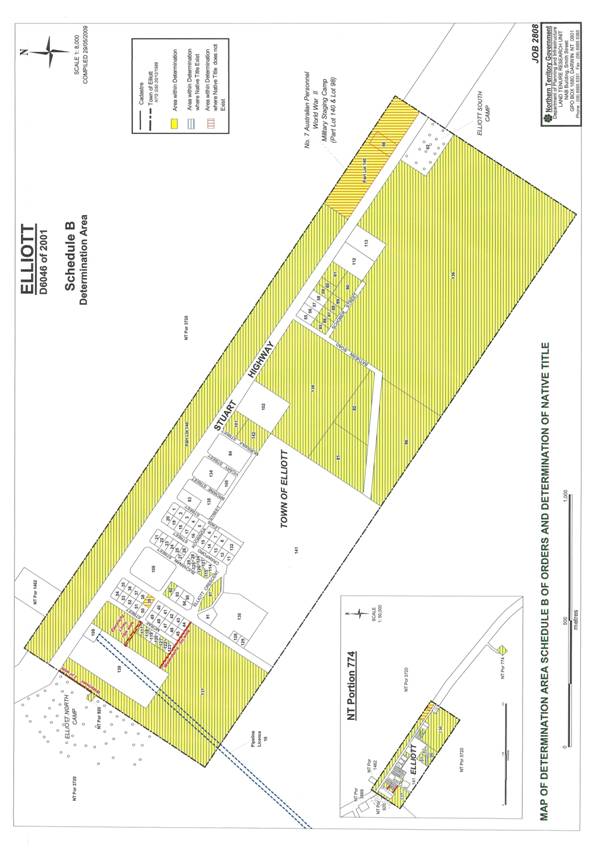
1. The determination area is the land and waters described in Schedule A hereto and depicted on the map comprising Schedule B (“the determination area”).
2. Native title exists in those parts of the determination area identified in Schedule C, being made up of:
(a) the areas of land and waters to which s. 47B of the Act applies, and more particularly described in item 1(a) of Schedule C (“the exclusive areas”); and
(b) the remaining areas of land and waters, being the areas more particularly described in item 1(b) of Schedule C (“the non-exclusive areas”).
3. Native title does not exist in those parts of the determination area identified in Schedule D.
The native title holders
4. The land and waters of the determination area comprise part of Mudburra-Jingili country, which is held by the members of the Elliott (Gurungu/Kulumintini) estate group.
These persons, together with the Aboriginal people referred to in clause 6 hereof, are collectively referred to as “the native title holders”.
5. The Elliott (Gurungu/Kulumintini) estate group referred to in clause 4 hereof includes persons who are members of the group by reason of:
(a) patrilineal descent;
(b) his or her mother, father’s mother or mother’s mother being or having been a member of the group by reason of patrilineal descent;
(c) having been adopted or incorporated into the descent relationships referred to in (a) or (b) hereof.
(These persons are collectively referred to as “the estate group members”.)
6. In accordance with traditional laws and customs, other Aboriginal people have rights and interests in respect of the determination area, subject to the rights and interests of the estate group members, such people being:
(a) members of the following 14 Mudburra or Jingili estate groups from neighbouring estates:
(i) the Marlinja (Collins) group;
(ii) the [Y]Ijiparta (Kingston) group;
(iii) the Warranangku (Beetaloo) group;
(iv) the Kulaja (North Waterhole) group;
(v) the Powell Creek (Walanpiri) group;
(vi) the Ngapurr (Nellis Waterhole) group;
(vii) the North Western group;
(viii) the Murranji (Narlwan/Nyirrinji) group;
(ix) the Tururrutpa (Hidden Valley) group;
(x) the Powell Creek (Japurla-japurla / Yapa-yapa / Mali-mali) group;
(xi) the Top Springs (Yingawunarri) group;
(xii) the Badpa (Daly Waters) group;
(xiii) the Bamarrnganja (Walanja) group;
(xiv) the Kinbininggu (Peter’s Hole), Abie Thomas and Major Taylor group; and
(b) spouses of the estate group members.
7. Each of the estate groups referred to in clause 6(a) hereof includes persons who are members of the group by reason of:
(a) patrilineal descent;
(b) his or her mother, father’s mother or mother’s mother being or having been a member of the group by reason of patrilineal descent;
(c) having been adopted or incorporated into the descent relationships referred to in (a) or (b) hereof.
The native title rights and interests
8. In relation to the exclusive areas, the native title rights and interests that are possessed under their traditional laws and customs are, subject to the traditional laws and customs that govern the exercise of the native title rights and interests by the native title holders, possession, occupation, use and enjoyment to the exclusion of all others.
9. In relation to the non-exclusive areas, the native title rights and interests of the estate group members that are possessed under their traditional laws and customs are, subject to the traditional laws and customs that govern the exercise of the native title rights and interests by the native title holders, non-exclusive rights to use and enjoy those areas being:
(a) the right to travel over, to move about and to have access to those areas;
(b) the right to hunt and to fish on the land and waters of those areas;
(c) the right to gather and to use the natural resources of those areas such as food, medicinal plants, wild tobacco, timber, stone and resin;
(d) the right to take and to use the natural water on those areas,
(e) the right to live, to camp and for that purpose to erect shelters and other structures on those areas;
(f) the right to light fires on those areas for domestic purposes, but not for the clearance of vegetation;
(g) the right to conduct and to participate in the following activities on those areas:
(i) cultural activities;
(ii) cultural practices relating to birth and death, including burial rites;
(iii) ceremonies;
(iv) meetings;
(v) teaching the physical and spiritual attributes of sites and places on those areas that are of significance under their traditional laws and customs;
(h) the right to maintain and to protect sites and places on those areas that are of significance under their traditional laws and customs;
(i) the right to share or exchange subsistence and other traditional resources obtained on or from those areas;
(j) the right to be accompanied on to those areas by persons who, though not native title holders, are:
(i) people required by traditional law and custom for the performance of ceremonies or cultural activities on the areas;
(ii) people who have rights in relation to the areas according to the traditional laws and customs acknowledged by the estate group members;
(iii) people required by the estate group members to assist in, observe, or record traditional activities on the areas;
(k) the right to conduct activities necessary to give effect to the rights referred to in (a) to (j) hereof.
These native title rights and interests do not confer on the estate group members possession, occupation, use and enjoyment of the non-exclusive areas to the exclusion of all others.
10. In relation to the non-exclusive areas, the native title rights and interests of the native title holders referred to in clause 6 hereof that are possessed under their traditional laws and customs are, subject to the traditional laws and customs that govern the exercise of the native title rights and interests by the native title holders, non‑exclusive rights to use and enjoy those areas being:
(a) the right to travel over, to move about and to have access to those areas;
(b) the right to hunt and to fish on the land and waters of those areas;
(c) the right to gather and to use the natural resources of those areas such as food, medicinal plants, wild tobacco, timber, stone and resin;
(d) the right to take and to use the natural water on those areas;
(e) the right to camp on those areas;
(f) the right to light fires on those areas for domestic purposes, but not for the clearance of vegetation;
(g) the right to conduct activities necessary to give effect to the rights referred to in (a) to (f) hereof.
These native title rights and interests do not confer on the native title holders referred to in clause 6 hereof possession, occupation, use and enjoyment of the non‑exclusive areas to the exclusion of all others.
Other interests in the determination area
11. The nature and extent of other interests in relation to the determination area are the interests, created by the Crown or otherwise, as follows:
(a) in relation to Lot 39, the interests of the Elliott District Community Government Council under Building Lease No. 361;
(b) in relation to Lot 137, the interests of NT Gas Pty Ltd as the holder of Pipeline Licence No. 10 granted on 25 July 1989 under the Energy Pipelines Act (NT) in connection with the gas pipeline the subject of that instrument;
(c) in relation to NT Portion 774, valid rights of use for the passage of travelling stock;
(d) the rights of Aboriginal persons (whether or not native title holders) by virtue of the Northern Territory Aboriginal Sacred Sites Act 1989 (NT);
(e) rights of access by an employee, servant, agent or instrumentality of the Northern Territory or Commonwealth, or other statutory authority, as required in the performance of statutory duties;
(f) the interests of persons to whom valid and validated rights and interests have been:
(i) granted by the Crown pursuant to statute or otherwise in the exercise of executive power; or
(ii) otherwise conferred by statute.
12. To the extent, if at all, that the exercise of the native title rights and interests referred to in clauses 8, 9 and 10 conflicts with the exercise of the rights and interests of the persons referred to in clause 11, the rights and interests of the persons referred to in clause 11 prevail over, but do not extinguish, the native title rights referred to in clauses 8, 9 and 10.
Other matters
13. There are no native title rights and interests in:
(a) minerals (as defined in s. 2 of the Minerals (Acquisition) Act (NT));
(b) petroleum (as defined in s. 5 of the Petroleum Act (NT));
(c) prescribed substances (as defined in s. 3 of the Atomic Energy (Control of Materials) Act 1946 (Cth) and/or s. 5(1) of the Atomic Energy Act 1953 (Cth)),
in the determination area.
14. The native title rights and interests are subject to and exercisable in accordance with the valid laws of the Northern Territory of Australia and the Commonwealth of Australia.
15. In relation to the non-exclusive areas, the native title rights and interests are for the personal or communal needs of the native title holders which are of a domestic or subsistence nature and not for any commercial or business purpose.
Note: Settlement and entry of orders is dealt with in Order 36 of the Federal Court Rules.
The text of entered orders can be located using eSearch on the Court’s website.
Schedule A
Description of Determination Area
The determination area comprises the following areas of land:
(a) 27 lots within the Town of Elliott (as proclaimed by the Governor-General on 2 August 1950 and published in the Commonwealth of Australia Gazette CG46 on 10 August 1954; Corrigendum published in the Northern Territory Government Gazette G50 on 20 December 1989), namely:
(i) Lot 39
(ii) Lot 59
(iii) Lot 60
(iv) Lot 61
(v) Lot 81
(vi) Lot 82
(vii) Lot 85
(viii) Lot 86
(ix) Lot 87
(x) Lot 88
(xi) Lot 89
(xii) Lot 90
(xiii) Lot 92
(xiv) Lot 96
(xv) Lot 97
(xvi) Lot 98
(xvii) Lot 101
(xviii) Lot 115
(xix) Lot 117
(xx) Lot 118
(xxi) Lot 121
(xxii) Lot 122
(xxiii) Lot 136
(xxiv) Lot 137
(xxv) Lot 138
(xxvi) Lot 140
(xxvii) Lot 142
(b) NT Portion 774, being land the subject of Reserve No. 1323 which is reserved pursuant to s103 of the Crown Lands Ordinance 1931-1940 (NT) for the purposes of a travelling stock reserve; and
(c) NT Portion 920.
In the event of an inconsistency between the written description provided above and the map at Schedule B, the written description shall prevail.
Schedule B
Map of Determination Area
Schedule C
Areas where native title exists
Item 1(a) – the areas of land and waters in respect of which the exclusive native title rights and interests in clause 8 apply
(a) The following lots within the Town of Elliott:
(i) Lot 59
(ii) Lot 60
(iii) Lot 61
(iv) Lot 81
(v) Lot 82
(vi) Lot 85
(vii) Lot 86
(viii) Lot 87
(ix) Lot 88
(x) Lot 89
(xi) Lot 90
(xii) Lot 92
(xiii) Lot 96
(xiv) Lot 97
(xv) Lot 101
(xvi) Lot 115
(xvii) Lot 117
(xviii) Lot 118
(xix) Lot 121
(xx) Lot 122
(xxi) Lot 136
(xxii) That part of Lot 137 not covered by public works or Pipeline Licence 10
(xxiii) Lot 138
(xxiv) That part of Lot 140 not covered by public works
(xxv) Lot 142
(b) NT Portion 920.
Item 1(b) – the areas of land and waters in respect of which the non-exclusive native title rights and interests in clauses 9 and 10 apply
1. That part of Lot 137, Town of Elliott, covered by Pipeline Licence 10
2. NT Portion 774
Schedule D
Areas where native title does not exist
1. Lot 39, Town of Elliott
2. Those parts of Lot 137, Town of Elliott covered by:
(a) three 150mm underground water mains (pipes):
(i) one running along part of the north western boundary of Lot 137 from NT Portion 920 to the Stuart Highway; and
(ii) two running across the eastern half of Lot 137 from Lot 139 to Bray Street, along the southern boundaries of Lot 123, McRae Street and Lots 45 and 44,
and adjacent land to a width of 3 metres (1.5 metres on either side of the centre line) in respect of each water main;
(b) one .415v overhead electricity line running across the north eastern part of Lot 137 from Lot 139 to McRae Street, and adjacent land to a width of 3 metres (1.5 metres on either side of the centre line); and
(c) one 11kv overhead electricity line running across the north eastern part of Lot 137, from Lot 139 to McRae Street, and adjacent land to a width of 10 metres (5 metres on either side of the centre line).
3. Part of Lot 140, including the whole of Lot 98, covered by works constructed for the purposes of the No. 7 Australian Personnel / World War II Military Staging Camp on the eastern part of Lot 140 from the north-easterly prolongation of the south-eastern boundary of Lot 113 to the south-eastern boundary of Lot 140.
The areas where native title has been extinguished are depicted on the map of the determination area at Schedule B.
|
IN THE FEDERAL COURT OF AUSTRALIA |
|
|
NORTHERN TERRITORY DISTRICT REGISTRY GENERAL DIVISION |
ntd 6046 of 2001 |
|
BETWEEN: |
HEATHER WILSON, SUSAN RAYMOND AND LINDSAY BOSTOCK ON BEHALF OF THE ELLIOTT (GURUNGU/KULUMINTINI) GROUP AND OTHERS Applicant
|
|
AND: |
NORTHERN TERRITORY OF AUSTRALIA Respondent
|
|
JUDGE: |
REEVES J |
|
DATE: |
31 JULY 2009 |
|
PLACE: |
elliott |
REASONS FOR JUDGMENT
INTRODUCTION
1 This is an application for a determination of native title in respect of an area of approximately 143.9 hectares (‘the claim area’) comprising various allotments in the locality of the town of Elliott. The application was filed with the Court on 6 July 2001 and registered with the National Native Title Tribunal (‘the NNTT’) on 3 August 2001. Leave was granted to the applicants to amend the application by this Court on 25 February 2003. The amended application was accepted for registration by the Registrar of the NNTT on 17 March 2004. A further amendment to the application was made on 4 February 2009.
2 The parties to the application have reached agreement about the existence of native title and about the nature and extent of those native title rights. They now ask the Court to make an order in the terms that they have agreed.
3 The order sought gives recognition to a native title claim group comprising fifteen Mudburra or Jingili or mixed Mudburra/Jingili estate groups. The primary estate group is the Elliott (Gurungu/Kulumintini) estate group who, in accordance with traditional law and custom are recognised to have exclusive and non-exclusive native title rights and interests within the claim area. The other fourteen neighbouring estate group members and their spouses, in accordance with their and the Elliott (Gurungu/Kulumintini) estate group’s traditional law and custom are also recognised to have exclusive and non-exclusive native title rights and interests within the claim area. These fourteen estate groups are described in the following way:
· The Marlinja (Collins) group;
· The [Y]Ijiparta (Kingston) group;
· The Warranangku (Beetaloo) group;
· The Kulaja (North Waterhole) group;
· The Powell Creek (Walanpiri) group;
· The Ngapurr (Nellis Waterhole) group;
· The North Western group;
· The Murranji (Narlwan/Nyirrinji) group;
· The Tururrutpa (Hidden Valley) group;
· The Powell Creel (Japurla-japurla/Yapa-yapa/Mali-mali) group;
· The Top Springs (Yingawunarri) group;
· The Badpa (Daly Waters) group;
· The Bamarrnganja (Walanja) group; and
· The Kinbininggu (Peter’s Hole), Abie Thomas and Major Taylor group.
4 In support of the orders sought the parties have filed their minute of proposed orders, joint submissions in support of the minute, and a statement of agreed facts. In addition to this material the Applicants have filed a number of supporting documents, including two anthropological reports by Mr. Robert Graham.
THE CLAIM AREA
5 The area for which the determination is sought is, as mentioned above, various allotments in the locality of the town of Elliott. The determination area is part of Mudburra-Jingili country lying to the south and east of the determination area recognised in the matter of King v Northern Territory of Australia [2007] FCA 944. (Hereafter referred to as the Newcastle Waters matter.) The proximity of the determination area to that of Newcastle Waters is relevant to this proceeding as the Applicants are the same estate groups recognised as Native Title Holders by the Newcastle Waters Determination.
6 Schedule A of the parties minute of proposed orders describes the determination area by reference to lot and portion numbers and an accompanying map (referred to as schedule B) clearly identifies the location of all parcels. The parties’ joint submission informs the Court that section 47 B of the Native Title Act 1993 (Cth) (the Act) have been met in relation to a number of the parcels, with the effect that any prior extinguishment of native title over these parcels can now be disregarded.
WHETHER THE PROPOSED CONSENT DETERMINATION SHOULD BE MADE
7 Section 87 of the Act sets out the Court’s power to make orders sought by consent of the parties. That section requires the period of notice under s 66 of the Act to have elapsed, that a signed copy of the agreed orders has been filed with the Court, and that the Court is satisfied that the orders are within its power and appropriate to make.
8 In this application the period of notice under s 66 of the Act expired on 16 January 2002. A written agreement, signed by the parties, relating to the whole of the application area was filed on 15 July 2009.
9 It remains for the Court to be satisfied that the orders sought are within power and are appropriate to make. For the reasons that follow, I am satisfied that the Court can, and should, make an order in the terms the parties seek.
10 The material before the Court in support of the application informs the Court of the history of the application and the process that the parties engaged in to reach the agreement. The joint submission explains the agreement and informs the Court that the peoples who comprise the fifteen estate groups relationship with the land is governed by a body of laws and customs which are expressed through spiritual, religious and physical associations, and through descent and processes of succession. This material supports the finding that the peoples have native title in the determination area.
11 That native title is regulated by the law and custom of the groups. The material speaks in support of this and the observance of it is reflected in the order sought. In relation to that part of the determination area where native title rights and interests are to be recognised to the exclusion of all others, the rights and interests are to be held by members of all of the fifteen estate groups. In relation to those parts of the determination area where non-exclusive native title rights and interests are to be recognised, the determination sought differentiates between the primary rights of the Elliott (Gurungu/Kulumintini) estate group members and the secondary rights and interests of the other fourteen estate groups.
Is it appropriate to make the orders?
12 The discretion conferred by s 87(1) of the Act must be exercised judicially, and in exercising it, the Court must have regard to the object and purposes of the Act, one of the most important being the resolution of disputes by negotiation and agreement, rather than litigation Lota Warria (on behalf of the Poruma and Masig Peoples) v State of Queensland (2005) 223 ALR 62 at [7].
13 The words of the section make it clear that the question for the Court is whether it is appropriate to make an order in the terms of the agreement reached between the parties, with the central focus of the section being the existence of an agreement.
14 Satisfying the Court that it is appropriate for an order to be made should not be seen as the last hurdle to be overcome before the parties reach their ultimate goal of a consent determination of native title. Instead s 87 should be regarded as the opportunity for the Court to recognise the parties’ success in reaching the ultimate goal of a negotiated agreement, and facilitating that agreement by making an appropriate determination in accordance with its terms.
15 As North J said in Lovett on behalf of the Gunditjmara People v State of Victoria [2007] FCA 474 at [61]:
“ … when the Court is examining the appropriateness of an agreement, it is not required to examine whether the agreement is grounded on a factual basis which would satisfy the Court at a hearing of the application. The primary consideration of the Court is to determine whether there is an agreement and whether it was freely entered into on an informed basis….”
16 In Munn v Queensland [2001] FCA 1229 Emmett J observed that the Court’s deliberations on an application under s 87:
“… would include a consideration of the extent to which the State is a party, on the basis that the State, or at least a Minister of State, appears in the capacity of parens patriae to look after the interests of the community generally. The mere fact that the State was a party may not be sufficient. The Court may need to be satisfied that the State has in fact taken a real interest in the proceeding in the interests of the community generally. That may involve the Court being satisfied that the State has given appropriate consideration to the evidence that has been adduced, or intended to be adduced, in order to reach the compromise that is proposed. The Court, in my view, needs to be satisfied at least that the State, through competent legal representation, is satisfied as to the cogency of the evidence upon which the applicants rely.”
17 The terms of the agreement between the parties are in writing, the agreement is signed by or on behalf of the parties and the agreement is filed with the Court. The parties have had the benefit of independent and competent legal representation in arriving at this agreement, the terms of the order are clear and the agreement has been produced as a result of a process of negotiation. In this matter the Northern Territory is the sole respondent party. It is clear on the evidence before me that it has taken a real and significant interest in the proceedings. Before the proposed consent orders were signed the Northern Territory had Emeritus Professor Sansom, who had also been the expert anthropologist for the Northern Territory in the Newcastle Waters matter, consider the anthropological material going to the existence of native title. Professor Sansom’s queries in relation to the material initially provided in this matter were subsequently answered to his satisfaction by the applicants. Furthermore, the Northern Territory Cabinet considered the proposed consent orders and instructed the Solicitor for the Northern Territory to agree to the proposed consent determination of native title. I am therefore satisfied that the interests of the community generally have been properly considered by the Northern Territory.
18 There can be no doubt about the jurisdiction of the Court to make the orders sought (see s 81 of the Act) and there is nothing in the agreed terms that would suggest that the power of the Court would be exceeded. The proposed order set out details of each of the matters mentioned in s 225 thus satisfying the requirements of s 94A of the Act.
19 I am therefore satisfied that it is appropriate that the Court make the orders sought.
PRESCRIBED BODY CORPORATE
20 The parties have not nominated a corporation to be the prescribed body corporate, however provision has been made in the orders for an Aboriginal corporation to be nominated within 12 months.
CONCLUSION
21 Finally, I wish to make some remarks about the process by which the proposed consent determination has come about. Because of a long history with the Northern Territory land claims process and native title claims, the legal practitioners employed with both the Northern Land Council and the Central Land Council are generally very experienced and competent. The legal practitioners employed to deal with land claims and native title claims in the Northern Territory government are similarly experienced and competent. Moreover from my experience with the native title list in the Northern Territory, all of the legal practitioners involved appear to be willing to progress the matters in the list, as quickly and efficiently as possible.
22 There is, however, a large number of outstanding native title applications in the Northern Territory native title list. The Court and the parties are presented with a considerable challenge - to ensure that they are dealt with appropriately in accordance with the provisions of the Act, but in an efficient and timely manner. To that end, and with the support generally of the parties, the Court adopted a strategy of hearing selected cases to determine particular issues of principle, or perhaps more accurately, issues which relate to the decided case and to a number of others with similar geographical, cultural, social or legal characteristics. That process has now been completed. It was and continues to be my expectation that, as a result of those cases having been decided and the commitment of the parties in 2008 to finalise all matters in the Northern Territory native title list by 2013, most of the outstanding applications will be progressively resolved by a series of consent determinations. I therefore hope this is the first of many consent determinations that the Court will be making in the Northern Territory as a result of this strategy.
23 I congratulate the parties to the agreement, in so doing I congratulate the native title holders whose rights are now recognised over two areas of land and waters within the Northern Territory. I am encouraged by this determination and encourage the parties to continue with their active engagement in the resolution of native title cases by consent. I now make the order sought.
|
I certify that the preceding twenty-three (23) numbered paragraphs are a true copy of the Reasons for Judgment herein of the Honourable Justice Reeves. |
Associate:
Date: 31 July 2009
|
Solicitor for the Applicant: |
Matthew Moharich |
|
|
|
|
Counsel for the Northern Territory |
Sonia Brownhill |
|
|
|
|
Solicitor for the Northern Territory |
Kathleen Chong-Fong |
|
Date of Hearing: |
31 July 2009 |
|
|
|
|
Date of Judgment: |
31 July 2009 |


