

FEDERAL COURT OF AUSTRALIA
Telstra Corporation Limited v Australian Competition and Consumer Commission [2009] FCA 757
(A) whether ACCC misconstrued s 152CR(1)(d) of Act by adopting pooling and allocation method in dealing with specific costs –
(B) whether ACCC’s failure to take into account model terms that it had determined under s 152AQB(2) of Act involved procedural ultra vires and failure to take into account a relevant consideration –
(C) whether it was beyond the power conferred on ACCC by s 152CP of Act to make a determination that included a charge for call diversion when call diversion was provided as part of a new connection – whether call diversion when provided in those circumstances was a matter “relating to” access to the declared service within s 152CP(2) of Act –
(D) whether ACCC erred in law by inconsistently using Capital Asset Pricing Model (CAPM) in order to estimate cost to Telstra of equity capital while rejecting Telstra’s contention that there should be an uplift in the element to be included for Weighted Average Cost of Capital (WACC) to allow for welfare asymmetry connected with overestimating or underestimating the WACC – whether use of CAPM involved acceptance of its underlying assumptions – whether inconsistency established – whether inconsistency in economic methodology an error of law –
(E) whether, by not including in the monthly charge to be paid by access seekers an element for line costs, ACCC erred in law and failed to observe s 152DB(1)(b) of Act – construction of s 152DB(1)(b) of Act –
(F) whether later pricing principles for declared service impliedly revoked earlier ones – whether ACCC erred by taking later ones into account – whether later ones invalid by reason of having been made when earlier ones still in force and not expressly revoked – whether later ones validly backdated into period when earlier ones had been on foot.
Trade Practices Act 1974 (Cth) ss 152AF, 152AQA, 152AQB, 152AR, A52CP, 152CR, 151DB, 152DN, 152DNA
Application by GasNet Australia (Operations) Pty Ltd [2004] ATPR 41-978; [2003] ACompT 6 cited
Associated Provincial Picture Houses Ltd v Wednesbury Corporation [1948] 1 KB 223 cited
Australian Broadcasting Tribunal v Bond (1990) 170 CLR 321 cited
Australian Securities and Investments Commission v Narain (2008) 169 FCR 211 cited
Brisbane City Council v The Valuer-General for the State of Queensland (1978) 140 CLR 41 distinguished
Caloundra City Council v Netstar Pty Ltd [2008] 1 Qd R 258 cited
Esber v Commonwealth (1992) 174 CLR 430 cited
Goodwin v Phillips (1908) 7 CLR 1 cited
Hatfield v Health Insurance Commission (1987) 15 FCR 487 cited
HP Mercantile Pty Ltd v Commissioner of Taxation (2005) 143 FCR 553 cited
Maurici v Chief Commissioner of State Revenue (2003) 212 CLR 111 distinguished
Melwood Units Pty Ltd v Commissioner of Main Roads [1979] AC 426 distinguished
Minister for Aboriginal Affairs v Peko-Wallsend Ltd (1986) 162 CLR 24 followed
Minister for Immigration and Multicultural Affairs v Eshetu (1999) 197 CLR 611 followed
Minister for Immigration and Citizenship v Le (2007) 164 FCR 151 cited
Minister for Immigration and Multicultural and Indigenous Affairs v SGLB (2004) 207 ALR 12; [2004] HCA 32 cited
Minister for Immigration and Ethnic Affairs v Teoh (1995) 183 CLR 273 cited
Mitchell v Scales (1907) 5 CLR 405 cited
New South Wales Coal Compensation Board v Nardell Colliery Pty Ltd [2004] NSWCA 35 distinguished
Prasad v Minister for Immigration and Ethnic Affairs (1985) 6 FCR 155 cited
Project Blue Sky Inc v Australian Broadcasting Authority (1998) 194 CLR 355 cited
Re Eckersley and Minister for Capital Territory (1979) 2 ALD 303
Re Martin and Commonwealth of Australia (1983) 5 ALD 277
Re Minister for Immigration and Multicultural Affairs; ex parte Applicant S20/2002 (2003) 198 ALR 59; [2003] HCA 30 followed
Repatriation Commission v Harrison (1997) 78 FCR 442 distinguished
Telstra Corporation Ltd v Australian Competition and Consumer Commission (2008) 171 FCR 174 referred to
Telstra Corporation Ltd v Australian Competition and Consumer Commission (No 2) (2008) 251 ALR 372; [2008] FCA 1640 referred to
Telstra Corporation Ltd v Commonwealth (2008) 234 CLR 210 cited
Visa International v Reserve Bank of Australia (2003) 131 FCR 300 cited
Walker Corporation Pty Ltd v Sydney Harbour Foreshore Authority (2008) 242 ALR 383 cited
Ward v Repatriation Commission (1997) 46 ALD 454 followed
NSD 69/2008
TELSTRA CORPORATION LIMITED (ACN 051 775 556) v AUSTRALIAN COMPETITION AND CONSUMER COMMISSION and ADAM INTERNET PTY LIMITED (ACN 055 495 853)
NSD 70/2008
TELSTRA CORPORATION LIMITED (ACN 051 775 556) v AUSTRALIAN COMPETITION AND CONSUMER COMMISSION and PRIMUS TELECOMMUNICATIONS PTY LIMITED (ACN 071 191 396)
NSD 72/2008
TELSTRA CORPORATION LIMITED (ACN 051 775 556) v AUSTRALIAN COMPETITION AND CONSUMER COMMISSION and AMCOM PTY LTD (ACN 009 336 341)
NSD 73/2008
TELSTRA CORPORATION LIMITED (ACN 051 775 556) v AUSTRALIAN COMPETITION AND CONSUMER COMMISSION and NETWORK TECHNOLOGY (AUST) PTY LTD (ACN 096 864 836)
NSD 75/2008
TELSTRA CORPORATION LIMITED (ACN 051 775 556) v AUSTRALIAN COMPETITION AND CONSUMER COMMISSION and TPG INTERNET PTY LTD (ACN 068 383 737)
NSD 77/2008
TELSTRA CORPORATION LIMITED (ACN 051 775 556) v AUSTRALIAN COMPETITION AND CONSUMER COMMISSION and PRIMUS TELECOMMUNICATIONS PTY LIMITED (ACN 071 191 396)
NSD 78/2008
TELSTRA CORPORATION LIMITED (ACN 051 775 556) v AUSTRALIAN COMPETITION AND CONSUMER COMMISSION and MACQUARIE TELECOM PTY LIMITED (ACN 082 930 916)
NSD 105/2008
TELSTRA CORPORATION LIMITED (ACN 051 775 556) v AUSTRALIAN COMPETITION AND CONSUMER COMMISSION and XYZED PTY LIMITED (ACN 092 450 783)
NSD 529/2008
TELSTRA CORPORATION LIMITED (ACN 051 775 556) v AUSTRALIAN COMPETITION AND CONSUMER COMMISSION and POWERTEL LIMITED (ACN 001 760 103)
NSD 531/2008
TELSTRA CORPORATION LIMITED (ACN 051 775 556) v AUSTRALIAN COMPETITION AND CONSUMER COMMISSION and REQUEST BROADBAND PTY LTD (ACN 091 530 586)
NSD 533/2008
TELSTRA CORPORATION LIMITED (ACN 051 775 556) v AUSTRALIAN COMPETITION AND CONSUMER COMMISSION and OPTUS NETWORKS PTY LIMITED (ACN 008 570 330)
NSD 717/2008
TELSTRA CORPORATION LIMITED (ACN 051 775 556) v AUSTRALIAN COMPETITION AND CONSUMER COMMISSION and CHIME COMMUNICATIONS PTY LTD (ACN 073 119 285)
NSD 718/2008
TELSTRA CORPORATION LIMITED (ACN 051 775 556) v AUSTRALIAN COMPETITION AND CONSUMER COMMISSION and PRIMUS TELECOMMUNICATIONS PTY LIMITED (ACN 071 191 396)
NSD 719/2008
LINDGREN J
17 JULY 2009
SYDNEY
| IN THE FEDERAL COURT OF AUSTRALIA |
|
| general division | NSD 69 of 2008 |
| TELSTRA CORPORATION LIMITED (ACN 051 775 556) Applicant
|
| AND: | AUSTRALIAN COMPETITION AND CONSUMER COMMISSION First Respondent
AGILE PTY LTD (ACN 080 855 321) Second Respondent
|
| JUDGE: | |
| DATE OF ORDER: | 17 JULY 2009 |
| WHERE MADE: | SYDNEY |
THE COURT ORDERS THAT:
1. The proceeding be dismissed.
2. The applicant pay the respondents’ costs.
Note: Settlement and entry of orders is dealt with in Order 36 of the Federal Court Rules.
The text of entered orders can be located using eSearch on the Court’s website.
| IN THE FEDERAL COURT OF AUSTRALIA |
|
| gENERAL dIVISION | NSD 70 of 2008 |
| BETWEEN: | TELSTRA CORPORATION LIMITED (ACN 051 775 556) Applicant
|
| AND: | AUSTRALIAN COMPETITION AND CONSUMER COMMISSION First Respondent
ADAM INTERNET PTY LIMITED (ACN 055 495 853) Second Respondent
|
| JUDGE: | LINDGREN J |
| DATE OF ORDER: | 17 JULY 2009 |
| WHERE MADE: | SYDNEY |
THE COURT ORDERS THAT:
1. The proceeding be dismissed.
2. The applicant pay the respondents’ costs.
Note: Settlement and entry of orders is dealt with in Order 36 of the Federal Court Rules.
The text of entered orders can be located using eSearch on the Court’s website.
| IN THE FEDERAL COURT OF AUSTRALIA |
|
| gENERAL dIVISION | NSD 72 of 2008 |
| BETWEEN: | TELSTRA CORPORATION LIMITED (ACN 051 775 556) Applicant
|
| AND: | AUSTRALIAN COMPETITION AND CONSUMER COMMISSION First Respondent
PRIMUS TELECOMMUNICATIONS PTY LIMITED (ACN 071 191 396) Second Respondent
|
| JUDGE: | LINDGREN J |
| DATE OF ORDER: | 17 JULY 2009 |
| WHERE MADE: | SYDNEY |
THE COURT ORDERS THAT:
1. The proceeding be dismissed.
2. The applicant pay the respondents’ costs.
Note: Settlement and entry of orders is dealt with in Order 36 of the Federal Court Rules.
The text of entered orders can be located using eSearch on the Court’s website.
| IN THE FEDERAL COURT OF AUSTRALIA |
|
| General Division | NSD 73 of 2008 |
| BETWEEN: | TELSTRA CORPORATION LIMITED (ACN 051 775 556) Applicant
|
| AND: | AUSTRALIAN COMPETITION AND CONSUMER COMMISSION First Respondent
AMCOM PTY LTD (ACN 009 336 341) Second Respondent
|
| JUDGE: | LINDGREN J |
| DATE OF ORDER: | 17 july 2009 |
| WHERE MADE: | SYDNEY |
THE COURT ORDERS THAT:
1. The proceeding be dismissed.
2. The applicant pay the respondents’ costs.
Note: Settlement and entry of orders is dealt with in Order 36 of the Federal Court Rules.
The text of entered orders can be located using eSearch on the Court’s website.
| IN THE FEDERAL COURT OF AUSTRALIA |
|
| General Division | NSD 75 of 2008 |
| BETWEEN: | TELSTRA CORPORATION LIMITED (ACN 051 775 556) Applicant
|
| AND: | AUSTRALIAN COMPETITION AND CONSUMER COMMISSION First Respondent
NETWORK TECHNOLOGY (AUST) PTY LTD (ACN 096 864 836) Second Respondent
|
| JUDGE: | LINDGREN J |
| DATE OF ORDER: | 17 july 2009 |
| WHERE MADE: | SYDNEY |
THE COURT ORDERS THAT:
1. The proceeding be dismissed.
2. The applicant pay the respondents’ costs.
Note: Settlement and entry of orders is dealt with in Order 36 of the Federal Court Rules.
The text of entered orders can be located using eSearch on the Court’s website.
| IN THE FEDERAL COURT OF AUSTRALIA |
|
| General Division | NSD 77 of 2008 |
| BETWEEN: | TELSTRA CORPORATION LIMITED (ACN 051 775 556) Applicant
|
| AND: | AUSTRALIAN COMPETITION AND CONSUMER COMMISSION First Respondent
TPG INTERNET PTY LTD (ACN 068 383 737) Second Respondent
|
| JUDGE: | LINDGREN J |
| DATE OF ORDER: | 17 july 2009 |
| WHERE MADE: | SYDNEY |
THE COURT ORDERS THAT:
1. The proceeding be dismissed.
2. The applicant pay the respondents’ costs.
Note: Settlement and entry of orders is dealt with in Order 36 of the Federal Court Rules.
The text of entered orders can be located using eSearch on the Court’s website.
| IN THE FEDERAL COURT OF AUSTRALIA |
|
| General Division | NSD 78 of 2008 |
| BETWEEN: | TELSTRA CORPORATION LIMITED (ACN 051 775 556) Applicant
|
| AND: | AUSTRALIAN COMPETITION AND CONSUMER COMMISSION First Respondent
PRIMUS TELECOMMUNICATIONS PTY LIMITED (ACN 071 191 396) Second Respondent
|
| JUDGE: | LINDGREN J |
| DATE OF ORDER: | 17 july 2009 |
| WHERE MADE: | SYDNEY |
THE COURT ORDERS THAT:
1. The proceeding be dismissed.
2. The applicant pay the respondents’ costs.
Note: Settlement and entry of orders is dealt with in Order 36 of the Federal Court Rules.
The text of entered orders can be located using eSearch on the Court’s website.
| IN THE FEDERAL COURT OF AUSTRALIA |
|
| General Division | NSD 105 of 2008 |
| BETWEEN: | TELSTRA CORPORATION LIMITED (ACN 051 775 556) Applicant
|
| AND: | AUSTRALIAN COMPETITION AND CONSUMER COMMISSION First Respondent
MACQUARIE TELECOM PTY LIMITED (ACN 082 930 916) Second Respondent
|
| JUDGE: | LINDGREN J |
| DATE OF ORDER: | 17 july 2009 |
| WHERE MADE: | SYDNEY |
THE COURT ORDERS THAT:
1. The proceeding be dismissed.
2. The applicant pay the respondents’ costs.
Note: Settlement and entry of orders is dealt with in Order 36 of the Federal Court Rules.
The text of entered orders can be located using eSearch on the Court’s website.
| IN THE FEDERAL COURT OF AUSTRALIA |
|
| General Division | NSD 529 of 2008 |
| BETWEEN: | TELSTRA CORPORATION LIMITED (ACN 051 775 556) Applicant
|
| AND: | AUSTRALIAN COMPETITION AND CONSUMER COMMISSION First Respondent
XYZED PTY LIMITED (ACN 092 450 783) Second Respondent
|
| JUDGE: | LINDGREN J |
| DATE OF ORDER: | 17 JULY 2009 |
| WHERE MADE: | SYDNEY |
THE COURT ORDERS THAT:
1. The proceeding be dismissed.
2. The applicant pay the respondents’ costs.
Note: Settlement and entry of orders is dealt with in Order 36 of the Federal Court Rules.
The text of entered orders can be located using eSearch on the Court’s website.
| IN THE FEDERAL COURT OF AUSTRALIA |
|
| General Division | NSD 531 of 2008 |
| BETWEEN: | TELSTRA CORPORATION LIMITED (ACN 051 775 556) Applicant
|
| AND: | AUSTRALIAN COMPETITION AND CONSUMER COMMISSION First Respondent
POWERTEL LIMITED (ACN 001 760 103) Second Respondent
|
| JUDGE: | LINDGREN J |
| DATE OF ORDER: | 17 JULY 2009 |
| WHERE MADE: | SYDNEY |
THE COURT ORDERS THAT:
1. The proceeding be dismissed.
2. The applicant pay the respondents’ costs.
Note: Settlement and entry of orders is dealt with in Order 36 of the Federal Court Rules.
The text of entered orders can be located using eSearch on the Court’s website.
| IN THE FEDERAL COURT OF AUSTRALIA |
|
| General Division | NSD 533 of 2008 |
| BETWEEN: | TELSTRA CORPORATION LIMITED (ACN 051 775 556) Applicant
|
| AND: | AUSTRALIAN COMPETITION AND CONSUMER COMMISSION First Respondent
REQUEST BROADBAND PTY LTD (ACN 091 530 586) Second Respondent
|
| JUDGE: | LINDGREN J |
| DATE OF ORDER: | 17 JULY 2009 |
| WHERE MADE: | SYDNEY |
THE COURT ORDERS THAT:
1. The proceeding be dismissed.
2. The applicant pay the respondents’ costs.
Note: Settlement and entry of orders is dealt with in Order 36 of the Federal Court Rules.
The text of entered orders can be located using eSearch on the Court’s website.
| IN THE FEDERAL COURT OF AUSTRALIA |
|
| General Division | NSD 717 of 2008 |
| BETWEEN: | TELSTRA CORPORATION LIMITED (ACN 051 775 556) Applicant
|
| AND: | AUSTRALIAN COMPETITION AND CONSUMER COMMISSION First Respondent
OPTUS NETWORKS PTY LIMITED (ACN 008 570 330) Second Respondent
|
| JUDGE: | LINDGREN J |
| DATE OF ORDER: | 17 july 2009 |
| WHERE MADE: | SYDNEY |
THE COURT ORDERS THAT:
1. The proceeding be dismissed.
2. The applicant pay the respondents’ costs.
Note: Settlement and entry of orders is dealt with in Order 36 of the Federal Court Rules.
The text of entered orders can be located using eSearch on the Court’s website.
| IN THE FEDERAL COURT OF AUSTRALIA |
|
| General Division | NSD 718 of 2008 |
| BETWEEN: | TELSTRA CORPORATION LIMITED (ACN 051 775 556) Applicant
|
| AND: | AUSTRALIAN COMPETITION AND CONSUMER COMMISSION First Respondent
CHIME COMMUNICATIONS PTY LTD (ACN 073 119 285) Second Respondent
|
| JUDGE: | LINDGREN J |
| DATE OF ORDER: | 17 july 2009 |
| WHERE MADE: | SYDNEY |
THE COURT ORDERS THAT:
1. The proceeding be dismissed.
2. The applicant pay the respondents’ costs.
Note: Settlement and entry of orders is dealt with in Order 36 of the Federal Court Rules.
The text of entered orders can be located using eSearch on the Court’s website.
| IN THE FEDERAL COURT OF AUSTRALIA |
|
| General Division | NSD 719 of 2008 |
| BETWEEN: | TELSTRA CORPORATION LIMITED (ACN 051 775 556) Applicant
|
| AND: | AUSTRALIAN COMPETITION AND CONSUMER COMMISSION First Respondent
PRIMUS TELECOMMUNICATIONS PTY LIMITED (ACN 071 191 396) Second Respondent
|
| JUDGE: | LINDGREN J |
| DATE OF ORDER: | 17 july 2009 |
| WHERE MADE: | SYDNEY |
THE COURT ORDERS THAT:
1. The proceeding be dismissed.
2. The applicant pay the respondents’ costs.
Note: Settlement and entry of orders is dealt with in Order 36 of the Federal Court Rules.
The text of entered orders can be located using eSearch on the Court’s website.
| IN THE FEDERAL COURT OF AUSTRALIA | NSD 69 of 2008 |
| BETWEEN: | TELSTRA CORPORATION LIMITED (ACN 051 775 556) Applicant
|
| AND: | AUSTRALIAN COMPETITION AND CONSUMER COMMISSION First Respondent
AGILE PTY LTD (ACN 080 855 321) Second Respondent
|
| IN THE FEDERAL COURT OF AUSTRALIA | NSD 70 of 2008 |
| BETWEEN: | TELSTRA CORPORATION LIMITED (ACN 051 775 556) Applicant
|
| AND: | AUSTRALIAN COMPETITION AND CONSUMER COMMISSION First Respondent
ADAM INTERNET PTY LIMITED ACN (055 495 853) Second Respondent
|
| IN THE FEDERAL COURT OF AUSTRALIA | NSD 72 of 2008 |
| BETWEEN: | TELSTRA CORPORATION LIMITED (ACN 051 775 556) Applicant
|
AND: | AUSTRALIAN COMPETITION AND CONSUMER COMMISSION First Respondent
PRIMUS TELECOMMUNICATIONS PTY LIMITED (ACN 071 191 396) Second Respondent
|
| IN THE FEDERAL COURT OF AUSTRALIA | NSD 73 of 2008 |
| BETWEEN: | TELSTRA CORPORATION LIMITED (ACN 051 775 556) Applicant
|
| AND: | AUSTRALIAN COMPETITION AND CONSUMER COMMISSION First Respondent
AMCOM PTY LTD (ACN 009 336 341) Second Respondent
|
| IN THE FEDERAL COURT OF AUSTRALIA | NSD 75 of 2008 |
| BETWEEN: | TELSTRA CORPORATION LIMITED (ACN 051 775 556) Applicant
|
| AND: | AUSTRALIAN COMPETITION AND CONSUMER COMMISSION First Respondent
NETWORK TECHNOLOGY (AUST) PTY LTD (ACN 096 864 836) Second Respondent
|
IN THE FEDERAL COURT OF AUSTRALIA | NSD 77 of 2008 |
| BETWEEN: | TELSTRA CORPORATION LIMITED (ACN 051 775 556) Applicant
|
| AND: | AUSTRALIAN COMPETITION AND CONSUMER COMMISSION First Respondent
TPG INTERNET PTY LTD (ACN 068 383 737) Second Respondent
|
| IN THE FEDERAL COURT OF AUSTRALIA | NSD 78 of 2008 |
| BETWEEN: | TELSTRA CORPORATION LIMITED (ACN 051 775 556) Applicant
|
| AND: | AUSTRALIAN COMPETITION AND CONSUMER COMMISSION First Respondent
PRIMUS TELECOMMUNICATIONS PTY LIMITED (ACN 071 191 396) Second Respondent
|
| IN THE FEDERAL COURT OF AUSTRALIA | NSD 105 of 2008 | |
| BETWEEN: | TELSTRA CORPORATION LIMITED (ACN 051 775 556) Applicant
| |
| AND: | AUSTRALIAN COMPETITION AND CONSUMER COMMISSION First Respondent
MACQUARIE TELECOM PTY LIMITED (ACN 082 930 916) Second Respondent
| |
| IN THE FEDERAL COURT OF AUSTRALIA | NSD 529 of 2008 |
| BETWEEN: | TELSTRA CORPORATION LIMITED (ACN 051 775 556) Applicant
|
| AND: | AUSTRALIAN COMPETITION AND CONSUMER COMMISSION First Respondent
XYZED PTY LIMITED (ACN 092 450 783) Second Respondent
|
| IN THE FEDERAL COURT OF AUSTRALIA | NSD 531 of 2008 |
| BETWEEN: | TELSTRA CORPORATION LIMITED (ACN 051 775 556) Applicant
|
| AND: | AUSTRALIAN COMPETITION AND CONSUMER COMMISSION First Respondent
POWERTEL LIMITED (ACN 001 760 103) Second Respondent
|
IN THE FEDERAL COURT OF AUSTRALIA | NSD 533 of 2008 |
| BETWEEN: | TELSTRA CORPORATION LIMITED (ACN 051 775 556) Applicant
|
| AND: | AUSTRALIAN COMPETITION AND CONSUMER COMMISSION First Respondent
REQUEST BROADBAND PTY LTD (ACN 091 530 586) Second Respondent
|
| IN THE FEDERAL COURT OF AUSTRALIA | NSD 717 of 2008 |
| BETWEEN: | TELSTRA CORPORATION LIMITED (ACN 051 775 556) Applicant
|
| AND: | AUSTRALIAN COMPETITION AND CONSUMER COMMISSION First Respondent
OPTUS NETWORKS PTY LIMITED (ACN 008 570 330) Second Respondent
|
| IN THE FEDERAL COURT OF AUSTRALIA | NSD 718 of 2008 |
BETWEEN: | TELSTRA CORPORATION LIMITED (ACN 051 775 556) Applicant
|
| AND: | AUSTRALIAN COMPETITION AND CONSUMER COMMISSION First Respondent
CHIME COMMUNICATIONS PTY LTD (ACN 073 119 285) Second Respondent
|
| IN THE FEDERAL COURT OF AUSTRALIA | NSD 719 of 2008 |
| BETWEEN: | TELSTRA CORPORATION LIMITED (ACN 051 775 556) Applicant
|
| AND: | AUSTRALIAN COMPETITION AND CONSUMER COMMISSION First Respondent
PRIMUS TELECOMMUNICATIONS PTY LIMITED (ACN 071 191 396) Second Respondent
|
|
|
|
| JUDGE: | LINDGREN J |
| DATE: | 17 JULY 2009 |
| PLACE: | SYDNEY |
TABLE OF CONTENTS
| Section |
| Para
|
|
| Introduction | [1]
|
| A | Pooling and Allocation Method | [24]
|
| B | ULLS Model Terms | [64]
|
| C | Call Diversion | [124]
|
| D | Weighted Average Cost of Capital (WACC) | [190]
|
| E | Line Costs | [285]
|
| F | 2007 LSS Pricing Principles | [400]
|
|
| Annexure – Acronyms and Terms |
|
REASONS FOR JUDGMENT
INTRODUCTION
1 These reasons for judgment relate to 14 proceedings that were heard together. The evidence in each was evidence in the others, subject to all just exceptions on grounds of relevance.
2 The fourteen proceedings concern Part XIC (ss 152AA-152EQ) of the Trade Practices Act 1974 (Cth) (the Act) headed “Telecommunications access regime”. That Part provides for a regulated access régime specific to telecommunications services.
3 The proceedings relate to access to two services that are “declared services” under s 152AL of the Act: the Line Sharing Service (also known as the High Frequency Unconditioned Local Loop Service) (LSS) and the Unconditioned Local Loop Service (ULLS). The applicant in each proceeding (Telstra) owns the lines over which the LSS and the ULLS are provided.
4 There was an access dispute between Telstra and the second respondent in each proceeding. The first respondent in each proceeding, the Australian Competition and Consumer Commission (ACCC), was the arbitrator. Some access disputes related to the LSS and the others to the ULLS. The following table identifies the LSS and the ULLS proceedings, the names of the respective second respondents, and the abbreviations by which I will refer to them:
| Second Respondent | Abbreviation | Proceeding |
| LSS
|
|
|
| Agile Pty Ltd | Agile | 69/2008 |
| Adam Internet Pty Limited | Adam | 70/2008 |
| Primus Telecommunications Pty Limited | Primus | 72/2008 |
| Amcom Pty Ltd | Amcom | 73/2008 |
| Network Technology (Aust) Pty Ltd | Network | 75/2008 |
| TPG Internet Pty Ltd | TPG | 77/2008 |
|
|
|
|
| ULLS
|
|
|
| Primus Telecommunications Pty Limited | Primus | 78/2008 |
| Macquarie Telecom Pty Limited | Macquarie | 105/2008 |
| XYZed Pty Limited | XYZed | 529/2008 |
| PowerTel Limited | PowerTel | 531/2008 |
| Request Broadband Pty Ltd | Request | 533/2008 |
| Optus Networks Pty Limited | Optus | 717/2008 |
| Chime Communications Pty Ltd | Chime | 718/2008 |
| Primus Telecommunications Pty Limited | Primus | 719/2008 |
In referring to the respective proceedings I will incorporate a reference to the LSS or ULLS, as the case may be; for example, “the Agile LSS proceeding”, “the PowerTel ULLS proceeding”. It will be noted that there are three proceedings, NSD 72/2008, NSD 78/2008 and NSD 719/2008, in which Primus is the second respondent. I will call the first “the Primus LSS proceeding” and the second “the Primus ULLS proceeding” in accordance with the convention just mentioned. I will call the third “the Primus ULLS (Connections) proceeding”.
5 In certain circumstances Part XIC of the Act permits an access dispute to be arbitrated by ACCC (referred to as “the Commission” in the Act and in various parts of the evidence and in the parties’ submissions). Arbitration takes place under Div 8 of Pt XIC.
6 In these fourteen proceedings Telstra challenges final determinations (FDs) made by ACCC in its arbitrations under Div 8 of the access disputes between Telstra and the 14 second respondents.
7 I have previously heard and determined three proceedings in which Telstra challenged FDs made by ACCC in relation to access disputes under Div 8: see Telstra Corporation Ltd v Australian Competition and Consumer Commission (2008) 171 FCR 174 (Earlier Reasons) and Telstra Corporation Ltd v Australian Competition and Consumer Commission and Others (No 2) (2008) 251 ALR 372; [2008] FCA 1640.
8 In those proceedings, Telstra sought review of FDs made by ACCC in respect of LSS access disputes between Telstra of the one part and Request, Chime and Primus respectively of the other part.
9 The grounds on which Telstra relies in these proceedings are set out in the following table (Table), the numerals being the number of the ground in the relevant current form of the application for an order of review:
|
TELSTRA’S GROUNDS | PROCEEDINGS | ||||||||||||||
| Agile LSS 69/2008 | Adam LSS 70/2008 | Primus LSS 72/2008 | Amcom LSS 73/2008 | Network Tech LSS 75/2008 | TPG LSS 77/2008 | Primus ULLS 78/2008 | Macquarie ULLS 105/2008 | XYZed ULLS 529/2008 | PowerTel ULLS 531/2008 | Request ULLS 533/2008 | Optus ULLS 717/2008 | Chime ULLS 718/2008 | Primus ULLS (Connections) 719/2008 | ||
| A | Pooling and Allocation Method – s 152CR(1)(d) - error of law
|
5 |
5
|
5 |
5 |
5 |
5 |
2 |
2 |
1 |
1 |
1 |
1 |
1 |
|
| B | ULLS Model Terms – s 152AQB(9) –procedural ultra vires and failure to take into account relevant consideration
|
|
|
|
|
|
|
4 |
4
|
3 |
3
|
3
|
3
|
|
|
| C | Call Diversion – FD not authorised by Act and made in excess of jurisdiction
|
|
|
|
|
|
|
|
|
|
|
|
4 |
4 |
1 |
| D | WACC (Weighted Average Cost of Capital) – error of law and Wednesbury unreasonableness
|
6 |
6
|
6 |
6 |
6 |
6 |
3
|
3
|
2 |
2 |
2 |
2 |
2 |
|
| E | Line costs – error of law, no evidence and statutory procedural ultra vires
|
3, 4 |
3, 4 |
3, 4 |
3, 4 |
3, 4 |
3, 4
|
|
|
|
|
|
|
|
|
| F | 2007 LSS Pricing Principles – s 152AQA(6) – Errors of law and taking into account irrelevant consideration
|
2 |
2 |
2 |
2 |
2 |
2 |
|
|
|
|
|
|
|
|
10 The second respondents can be conceived of as falling into groups according to their legal representation. Mr A Robertson SC with Mr S J Free of counsel appeared for Optus and XYZed. I was told that those companies form part of the Singtel Optus group. Ms M Sloss SC with Mr M J Hoyne of counsel appeared for Agile, Adam, Amcom, Network, Macquarie, PowerTel, Request, Chime and Primus. Mr M J Hoyne of counsel appeared for TPG.
11 In all proceedings Dr J E Griffiths SC and Ms M N Allars appeared for Telstra. Mr J S Hilton SC and Mr M H O’Bryan appeared for ACCC.
12 Although any particular ground referred to in the Table may have borne different numbers in the respective applications for an order of review, the ground was mutatis mutandis the same as between the various proceedings in which reliance was placed upon it. The parties agreed that:
· the Adam LSS proceeding (NSD 70/2008) was representative of the LSS proceedings;
· the Chime ULLS proceeding (NSD 718/2008) was representative of the ULLS proceedings, except in respect of the ULLS Model Terms ground;
· in respect of the ULLS Model Terms ground, the Optus ULLS proceeding (NSD 717/2008) was the representative proceeding.
13 Accordingly, submissions were made by reference to the representative proceedings on the basis that a decision on the issues in them would also resolve the same issues in all ofthe proceedings of which they were representative.
14 The hearing took place in two tranches. The first tranche related to the Pooling and Allocation Method and the ULLS Model Terms grounds (A and B in the Table). The second tranche related to the Call Diversion, WACC, Line Costs, and 2007 LSS Pricing Principles grounds (C, D, E and F in the Table).
15 As can be seen from the Table:
· the Pooling and Allocation Method ground (A in the Table) is Ground No 5 in the Adam LSS proceeding and Ground No 1 in the Chime ULLS proceeding. It features in all proceedings except the Primus ULLS (Connections) proceeding;
· the ULLS Model Terms ground (B in the Table) is Ground No 3 in the Optus ULLS proceeding and does not form part of any of the LSS proceedings;
· the Call Diversion ground (C in the Table) is Ground No 4 in the Chime ULLS proceeding and does not form part of any of the LSS proceedings (it occurs only in the Optus ULLS proceeding, the Chime ULLS proceeding, and the Primus ULLS (Connections) proceeding);
· the WACC ground (D in the Table) is Ground No 6 in the Adam LSS proceeding and Ground No 2 in the Chime ULLS proceedingand occurs in all proceedings except for the Primus ULLS (Connections) proceeding;
· the Line Costs ground (E in the Table) is Grounds Nos 3 and 4 in the Adam LSS proceeding. It occurs in all of the LSS proceedings but does not form part of any of the ULLS proceedings; and
· the LSS Pricing Principles ground (F in the Table) is Ground No 2 in the Adam LSS proceeding, and occurs in all of the LSS proceedings but in none of the ULLS proceedings.
16 Inthe Earlier Reasons at [11]-[14] I referred to some technical matters and gave a summary at [15]-[46] of the provisions of Pt XIC that were relevant to the three proceedings the subject of the Earlier Reasons (the Earlier Proceedings). I will take those paragraphs as read, rather than encumbering these reasons with them.
17 Annexure A to these reasons is a list of acronyms and terms of present relevance.
18 One technical matter to which it is useful to refer at this stage is the nature of the LSS and the ULLS. First, I quote [12] and [13] from the Earlier Reasons:
12. Telstra owns a variety of networks which it uses to provide telecommunication services. One such network is the Public Switched Telephone Network (PSTN). Through the PSTN, Telstra provides to end-users various telephony and data services such as local, long distance, national and international calls and dial-up internet connections. Another Telstra network is its “Broadband” network. The PSTN and the Broadband network use what is called the Customer Access Network (CAN). Generally speaking, the CAN can be understood to be the network of connections between end-users, whether business or private, and some aggregation point within the network, which is usually a local exchange building.
13. Connection between the end-user and that point within the network is normally achieved by way of “line” (or “metallic pair” or “twisted pair”) of copper or aluminium wire, or where there is no fixed line, by radio. The copper or aluminium wire is often referred to as “unconditioned communications wire”. It forms a continuous copper or aluminium path between the premises of end-users and exchanges and is commonly referred to as the Unconditioned Local Loop (ULL), “local loop” or, simply, “line”. The word “unconditioned” signifies that the wire is bare or unqualified, that is, the equipment required to make it serviceable is not yet attached to it.
19 Both the LSS and the ULLS are provided over Telstra’s Customer Access Network (CAN). They are provided to an access seeker such as any of the second respondents (access seekers) which provides them to a retail customer (end-user) over an Unconditioned Local Loop (ULL). The CAN is the generic expression that applies to all of the ULLs; the ULLs, taken together, constitute the CAN. The LSS and ULLS are provided by Telstra to the access seeker, not to the end-user. However, once the access seeker has access to the LSS or the ULLS, it becomes a “service provider” vis-à-vis the end-user, that is to say, it provides to the end-user the service that the LSS or the ULLS, as the case may be, permits it to provide.
20 In its declaration of the LSS as a declared service, ACCC also identified the LSS as the “High Frequency Unconditioned Local Loop Service”. The formal definition of the LSS is as follows:
The High Frequency Unconditioned Local Loop Service is the use of the non-voiceband frequency spectrum of unconditioned communications wire (over which wire an underlying voiceband PSTN service is operating) between the boundary of a telecommunications network at an end-user’s premises and a point on a telecommunications network that is a potential point of interconnection located at, or associated with, a customer access module and located on the end-user side of the customer access module.
21 The other declared service of present concern, the ULLS, gives the access seeker the use of the entirety of a ULL. In substance, it enables an access seeker to supply both voice (telephony) and broadband services to end-users. The formal definition of the ULLS is as follows:
The unconditioned local loop service is the use of unconditioned communications wire between the boundary of a telecommunications network at an end-user’s premises and a point on a telecommunications network that is a potential point of interconnection located at or associated with a customer access module and located on the end-user side of the customer access module.
22 In the case of both the LSS and the ULLS, the access seeker’s own equipment must be connected to the line in order for access by it to be realised.
A chronology of important events:
23 The following events have assumed importance in the proceedings:
1. On 4 August 1999 ACCC declared the ULLS as a declared service under s 152AL(3) with effect on the date of gazettal, 11 August 1999 (ULLS Declaration).
2. On 18 May 2000, pursuant to ss 152AL(3) and 152AO, ACCC varied the description of the ULLS with effect on the date of gazettal, 24 May 2000.
3. In March 2002 ACCC published its final report on pricing methodology for the ULLS, determining pricing principles for the ULLS in Chapter 4 (2002 ULLS Pricing Principles), and concluding that they should be based on total service long-run incremental cost (TSLRIC) principles.
4. In August 2002 ACCC published its final report on whether the LSS should be a declared service under Part XIC (LSS Declaration Final Report), chapter 7 of which set out pricing principles for a declared LSS (2002 LSS Pricing Principles).
5. On 7 October 2002, pursuant to s 152AL(3), ACCC declared the LSS a declared service with effect on the date of gazettal, 16 October 2002 (LSS Declaration).
6. In October 2003, pursuant to s 152AQB(2), ACCC determined model terms and conditions relating to access to the ULLS in Ch 14 of Final Determination for model price terms and conditions of the PSTN, ULLS and LCS services (ULLS Model Terms or 2003 ULLS Model Terms).
7. In the light of the new s 152ALA which came into force in December 2002, on 19 November 2003 ACCC specified an expiry date of 31 July 2006 for the ULLS and 31 October 2007 for the LSS, with effect on the date of gazettal, 3 December 2003
8. In March 2004 ACCC published a (revised) guide to the resolution of telecommunications access disputes (Access Dispute Resolution Guidelines), which included in section 7.4 guidelines under s 152DNA(8) relating to backdating of the date that the provisions of a final determination take effect.
9. In August 2004 ACCC published its final report on the assessment of Telstra’s proffered undertaking for the LSS.
10. In December 2005 ACCC published its final report on the assessment of Telstra’s proffered ULLS and LSS monthly charge undertakings (ULLS and LSS Monthly Charge Undertaking Assessment).
11. In July 2006 ACCC published its final determination resulting from its inquiry into, relevantly, the ULLS Declaration.
12. On 28 July 2006, pursuant to s 152AL(3), ACCC re-declared the ULLS a declared service with effect on 1 August 2006 and expiring on 31 July 2009 (ULLS Re-Declaration). This is the declaration of the ULLS that was in force at times relevant to the present proceedings.
13. In August 2006 ACCC published its final report on the assessment of Telstra’s proffered ULLS monthly charge undertaking (ULLS Monthly Charge Undertaking Assessment).
14. In October 2007 ACCC published its Review of the Line Sharing Service Declaration: Final Decision (LSS Declaration Review), Chapter 3 of which discussed LSS Pricing Principles.
15. On 24 October 2007, pursuant to s 152AQA, ACCC determined pricing principles to apply to the LSS (2007 LSS Pricing Principles). They contained price related terms and conditions that consisted of indicative prices for the LSS applicable between 1 January 2008 and 31 July 2009.
16. On 26 October 2007, pursuant to s 152ALA, ACCC extended the expiry date of the LSS Declaration to 31 July 2009 with effect on the date of gazettal, 29 October 2007 (LSS Extension Declaration).
17. In November 2007 ACCC published its report as to the final pricing principles applicable to the ULLS (Unconditioned Local Loop Service (ULLS) – Final pricing principles (2007 ULLS Pricing Principles Report) ).
18. On 21 November 2007, pursuant to s 152AQA, ACCC determined pricing principles specified in Schedule 1 to apply to the ULLS (Pricing Principles for the Unconditioned Local Loop Service) (ULLS Pricing Principles or 2007 ULLS Pricing Principles).
A – POOLING AND ALLOCATION METHOD
General
24 In the amended application for an order of review filed in the Adam LSS proceeding, this ground is ground No 5 which is as follows:
5. In making the Decision, the First Respondent made an error of law by misconstruing s 152CR(1)(d) of the TPA [Trade Practices Act 1974 (Cth)] in reaching the conclusion that the pooling method and the allocation method (as defined in the particulars below) allowed the Applicant to recover its costs, including the direct costs, associated with the LSS, within ss 5(1)(f) and/or 5(1)(j) of the ADJR Act [Administrative Decisions (Judicial Review) Act 1977 (Cth)].
Particulars
(i) In making the Decision the First Respondent arrived at its calculation of the LSS annual costs by:
(A) pooling costs of the LSS with costs of the unconditioned local loop service (“ULLS”) and Telstra’s own internal costs of a nature equivalent to the specific costs of the LSS and ULLS (“pooling method”); and
(B) allocating this costs pool across the various lines over which those services are provided (“allocation method”).
(ii) The pooling method and the allocation method are methods which aggregate the costs of a number of services and average those costs across the lines over which those services are provided, rather than providing a method for identifying the direct costs of the relevant declared service (that is, the LSS).
(iii) The First Respondent found that allowing the recovery of LSS specific costs over LSS lines would result in a higher access price than the pooling method and the allocation method on which the LSS annual charge was based.
(iv) As a result, the pooling method and the allocation method do not allow the Applicant to recover LSS specific costs in the LSS annual charge, which is inconsistent with the matter referred to in s 152CR(1)(d) of the TPA.
(v) In concluding that the pooling method and the allocation method allowed the Applicant to recover its costs, including the direct costs, associated with the LSS, the First Respondent misconstrued s 152CR(1)(d) of the TPA.
(vi) In the result the Decision is invalid (or liable to be set aside) as infected by jurisdictional error and on the grounds stated in s 5(1)(f) and/or (j) of the ADJR Act.
[Original emphasis]
Notwithstanding the discrete references to “pooling method” and “allocation method”, I will use the composite expression “Pooling and Allocation Method”.
25 The Pooling and Allocation Method ground is raised in thirteen of the fourteen proceedings, the exception being the Primus ULLS (Connections) proceeding.
26 In the application for an order of review filed in the Chime ULLS proceeding, the Pooling and Allocation Method ground was Ground No 1, which was, mutatis mutandis, the same as Ground No 5 in the Adam LSS proceeding set out above.
27 A Pooling and Allocation Method ground was raised by Telstra in the Earlier Proceedings. I dealt with it at [268]–[345] of the Earlier Reasons. In the Earlier Proceedings the Pooling and Allocation Method was raised by Telstra’s Grounds 5(a), 5(b), 5(c) and 6. Of these, Grounds 5(a), 5(b) and 5(c) were forms of procedural ultra vires and failure to take into account a relevant consideration – grounds that are not repeated in the present proceedings. However, Telstra’s Ground 6 in the Earlier Proceedings was error of law in the form of a misconstruction of s 152CR(1)(d) of the Act to permit a conclusion that the Pooling and Allocation Method allowed Telstra to recover its costs, including its direct costs.
28 In respect of its present Pooling and Allocation Method ground, Telstra relies only on error of law in the form of a misconstruction of s 152CR(1)(d).
29 Virtually the entire argument took place by reference to the Adam LSS proceeding ACCC’s Statement of Reasons accompanying its FD in relation to the Adam LSS arbitration (Adam LSS FD Statement of Reasons) was, relevantly, mutatis mutandis, identical to the Chime ULLS FD Statement of Reasons. As noted in Telstra’s submissions (para 3.42):
The factual background and legal issues in the relevant proceedings concerning the ULLS are in all relevant respects the same as … in the proceedings concerning the LSS.
Telstra therefore relied on the same argument in relation to both the LSS and ULLS proceedings. Accordingly, I will refer to the Adam LSS proceeding as representative of all 13 proceedings in which an access seeker relies upon the present ground.
Prior considerations of a pooling and allocation approach by ACCC and the Tribunal
30 ACCC’s DFD Consultation Papers had proposed the Pooling and Allocation Method; see the Adam LSS DFD Consultation Paper, section 4.1.8 on “Specific costs” and the Chime ULLS DFD Consultation Paper, section 4.1.6 on “Specific costs”. Both DFD Consultation Papers referred to previous considerations of this issue.
31 Until 2005, ACCC dealt with specific costs by using the cost allocation method for which Telstra contends. Indeed, at [80] of the Adam LSS FD Statement of Reasons ACCC acknowledged that it could be argued that ACCC’s 2002 LSS Pricing Principles were inconsistent with the pooling methodology. However, in its Telstra’s Undertakings for the Unconditioned Local Loop Service – Discussion Paper of March 2005 (ULLS Undertakings Discussion Paper), ACCC noted that the approach that it had been following had been called into question. Over a period from October 2004 to March 2007 ACCC embraced the Pooling and Allocation Method. I outlined the history in the Earlier Reasons at [292] ff.
32 Adam (and Chime) submitted to ACCC that it should adhere to the Pooling and Allocation Method as proposed in section 4.1.6 of the Adam LSS DFD Consultation Paper (section 4.1.8 of the Chime ULLS DFD Consultation Paper).
33 In its present submissions (to the Court) Chime also refers to the Request LSS FD Statement of Reasons dated 1 August 2007 (the subject of consideration in the Earlier Reasons), and the more recent Tribunal decision in relation to ULLS annual charges, Re Telstra Corporation Ltd (No 3) [2007] ACompT 3 at [387]-[413].
34 The 2007 LSS Pricing Principles, determined by ACCC on 24 October 2007, were as follows:
· … TSLRIC + pricing principles should be applied to the LSS
· a specific cost component should be included in the LSS monthly price, calculated by combining ‘LSS specific costs’ with ‘ULLS specific costs” and Telstra’s internal equivalent costs for ADSL, and allocating those costs across the number of active ULLS, LSS and ADSL lines
· a contribution for line costs will not be recovered in the LSS monthly price
· connection and disconnection charges should be set with reference to the amounts charged by third party contractors to Telstra for jumpering work in exchanges, indirect costs and back-of-house costs.
[My emphasis]
35 The second of the 2007 LSS Pricing Principles set out above expresses the Pooling and Allocation Method. The 2007 ULLS Pricing Principles of 21 November 2007 also contained, mutatis mutandis, that principle.
36 I do not think it necessary to elaborate on the various prior considerations of the present issue save to note that since December 2005 ACCC and the Tribunal have consistently determined that the statutory criteria in Part XIC of the Act were better served by a pooling and allocation approach than by the method for which Telstra contends.
37 Submissions were also made by Optus and XYZed, and by TPG and Macquarie, but they did not refer to any additional instances of prior consideration of the present issue by ACCC or the Tribunal.
The Adam LSS FD Statement of Reasons
38 In section 4.1.8 of the Adam LSS FD Statement of Reasons, headed “Specific Costs”, ACCC addressed the parties’ submissions and expressed its conclusions on the present issue.
39 Earlier in the Statement of Reasons ACCC had noted (at [80]) that the 2007 LSS Pricing Principles expressly required the use of the “pooling approach”.
40 In section 3.3.4 headed “Section 152CR(1)(d) The direct cost of providing access to the declared service”, ACCC stated (at [129]) that it considered that the direct costs of providing access to a declared service were those incurred (or caused) by the provision of access, and included the incremental costs of providing access. ACCC also noted (at [132] and [133]) that more recently the Tribunal had considered that the direct costs criterion in s 152CR(1)(d) was concerned with ensuring that the costs of providing the service were recovered, and that the Tribunal had noted that direct costs could conceivably be allocated (and still recovered) in a number of ways, any of which would be consistent with s 152CR(1)(d): citing Re Telstra Corporation Limited [2006] ACompT 4 at ([139]).
41 In section 4.1.8 (at [392] ff) ACCC noted that the term “Specific Costs”, when used in respect of the LSS, referred to the incremental cost of providing the LSS, and included the costs associated with ordering, provisioning and qualifying the LSS. ACCC referred to IT system development and operational costs, connection costs, wholesale management costs and indirect costs as categories of LSS-specific costs. ACCC accepted (at [393]) that some of those categories of costs were recovered through LSS connection charges or other charges that Telstra imposed, and so were not relevant to the calculation of LSS annual charges.
42 Under the heading “Cost allocation” within section 4.1.8, ACCC explained (at [396]) that, consistently with the Tribunal’s views, it proposed an approach to cost allocation that, first, pooled the specific costs associated with (i) the LSS and (ii) the ULLS and (iii) Telstra’s own internal costs of a nature equivalent to the specific costs of the LSS and ULLS; and, second, allocated this pool to a demand base that included all downstream ADSL services, including the LSS. ACCC noted that Telstra opposed this approach ([399] ff), while Adam supported it ([406] ff). Telstra submitted (as noted by ACCC at [400]) that pooling was inconsistent with the direct cost criterion found in s 152CR(1)(d), which required, according to Telstra’s submission, that the specific costs of the LSS be recovered in the LSS access charges alone.
43 In the Earlier Reasons at [273]–[280], I gave a more detailed description of the nature of the Pooling and Allocation Method.
44 ACCC noted (at [411]ff of the Statement of Reasons) that it had previously adopted the “pooling approach”, which was also consistent with the reasons of the Tribunal, in relation to both LSS and ULLS annual charges (ACCC referred to Re Telstra Corporation Ltd [2006] ACompT 4 at [150] and Re Telstra Corporation Limited (No 3) [2007] ACompT 3 [at 396]-[413]). ACCC stated (at [415]) that it concurred with the Tribunal’s reasoning on the issue of cost allocation.
45 ACCC went on to note ([at 416]) that adopting the method proposed by Telstra would lead to a higher access charge than the Pooling and Allocation Method would do. ACCC explained, however, that contrary to Telstra’s submission, this was not its motive for adopting the Pooling and Allocation Method; rather, its preference resulted from “its detailed consideration of the alternative approaches assessed against the subsection 152CR(1) criteria and the LSS pricing principles”. ACCC concluded that the higher charges that result from Telstra’s proposed method could not be supported by those criteria and the 2007 LSS Pricing Principles, and that having regard to them the Pooling and Allocation Method was to be preferred (at [417]).
46 At [418]-[450] of the Adam LSS FD Statement of Reasons, ACCC gave a detailed assessment of the Pooling and Allocation Method against all of the s 152CR(1) criteria. In relation to s 152CR(1)(d) ([438]-[441]), ACCC stated (at [438], which is mirrored in [612] of the Chime ULLS FD Statement of Reasons), that that criterion:
…is concerned with ensuring that Telstra will be able to recover its costs in providing access, either to itself or to LSS access seekers. In this context, the criterion involves consideration of whether Telstra will be able to recover its ‘LSS specific costs’ inclusive of a normal risk-adjusted return on its capital employed.
47 ACCC explained that the Pooling and Allocation Method could not compromise Telstra’s ability to recover its direct costs of providing access to the LSS (at [440]).
Consideration
48 Telstra submits that error of law is found in the passage set out above, because s 152CR(1)(d) speaks only of the direct costs of providing access to the declared service, in the present cases the LSS and the ULLS.
49 Telstra’s argument is framed in a similar way to the way in which it was framed in the Earlier Proceedings (see the Earlier Reasons at [283]-[284]). I dealt with that argument in the Earlier Reasons at [300]-[314] and concluded that ACCC did not misconstrue s 152CR(1)(d), which, properly construed, was not inconsistent with ACCC’s adoption of the Pooling and Allocation Method. In the result, Telstra’s error of law ground of review was not made out.
50 I am aware that it is necessary to maintain a distinction between the Earlier Proceedings and the present proceedings. They relate to different arbitrations, different FDs, and different FD Statements of Reasons. However, in oral submissions, senior counsel for Telstra conceded, as he was bound to do, that there was some overlap between the argument advanced in the Earlier Proceedings and that which he now advanced and which he described as “more refined”.
51 With respect, I have had some difficulty in identifying distinguishing refinements in Telstra’s present argument, notwithstanding the customary skill of senior counsel for Telstra. He has argued that according to the proper construction of s 152CR(1)(d):
· ACCC was bound in the Adam LSS arbitration to identify and take into account the direct costs of providing Adam with access to the LSS with a view to Telstra’s recovering those costs from Adam;
· ACCC was not at liberty to take those direct costs into account only as part of a pool that also included specific costs associated with providing access to the ULLS, and Telstra’s own internal costs of providing downstream ADSL services of a nature equivalent to those specific costs associated with the LLS and the ULLS;
· ACCC was not at liberty to introduce cross subsidisation by Telstra’s retail customers (end-users) in respect of ADSL services, of LSS (or ULLS) access seekers and their retail customers (end-users).
52 Telstra seems to disavow, however, any suggestion that s 152CR(1)(d) is to be construed as requiring that an FD have the effect that the direct costs of providing access to the declared service be in fact recoverable through the access charge for that service. Telstra accepts that ACCC is at liberty to place what weight it thinks appropriate on different aspects of the evidence, and, it must follow, on the evidentiary support for the different criteria in s 152CR(1). Telstra insists, however, that ACCC must take into account the direct costs as being recoverable through the access charge to be made for the particular declared service.
53 I have difficulty with Telstra’s argument. If the argument is that ACCC must take into account as one possibility, making direct costs recoverable through the access charge alone, the fact is that ACCC did take that possibility into account. It could hardly avoid doing so because that possibility was urged on it by Telstra. However, ACCC rejected it.
54 Forming attachments to the Adam LSS FD Statement of Reasons were certain cost models. These contained figures for various categories of costs and were the subject of confidentiality orders. Telstra does not dispute that they included the direct costs of providing access to the LSS. A similar observation applies to cost models that were attached to the Chime ULLS FD Statement of Reasons.
55 If Telstra’s contention is that ACCC did not pause to note what the direct costs were before applying the pooling and allocation methodology, the cost models to which I have referred show that it did.
56 There are several answers to Telstra’s submission.
57 First, as noted above, ACCC did take into account the direct costs of providing access to the LSS, by taking into account the direct costs particularised in the annexures to the Adam LSS FD Statement of Reasons (and to the Chime ULLS FD Statement of Reasons).
58 Second, if, as Telstra submits, ACCC is required to take into account the direct costs with a view to their being recovered out of the LSS access charge, then since the fixing of the amount of that access charge is itself a matter for ACCC, Telstra’s submission seems to become, upon analysis, a submission that ACCC was required to fix the access charge at a level that would allow for full recovery out of the LSS access charge. Yet this is a submission that Telstra seems to disavow. In any event, I would reject it. Allowing for full recovery with the access charge is not the only way in which ACCC was able to take the direct costs into account.
59 Third, Telstra’s complaint is in reality a complaint that ACCC did not take into account the direct costs to Telstra of providing access to the LSS, in the manner, to the extent, with the weight, and with the result, that Telstra would have preferred. ACCC took into account the s 152CR(1)(d) criterion but also other criteria, in particular, the promotion of the LTIE (para (a) of s 152CR(1)), and came up with the result that allowed for Telstra’s recovering its direct costs of providing access to the LSS only as part of a pool of costs. The duty imposed on ACCC by s 152CR(1) to take into account, inter alia, the direct costs of providing access to the declared service was not inconsistent with ACCC’s following that course and arriving at that conclusion.
60 Fourth, some of the criteria in s 152CR(1) pull in different directions, and it was a matter for ACCC, provided it genuinely took them all into account, to allocate influence and weight as between them. It was not required to allow the para (d) criterion full rein, unmitigated by the other s 152CR(1) criteria.
61 With respect, I see no relevant difference between the issues and submissions on the Pooling and Allocation Method ground in the Earlier Proceedings and in these proceedings, and I see no reason to depart from my reasons and conclusion in relation to that ground in the Earlier Reasons.
62 In addition to what I have said above, I adopt, mutatis mutandis, the Earlier Reasons at [300]-[314].
Conclusion
63 For the above reasons and for those which I gave at [300]-[314] of the Earlier Reasons, the Pooling and Allocation Method ground is not established.
B – ULLS MODEL TERMS
General
64 In October 2003 ACCC published the ULLS Model Terms. As canbe seenfromits title, this determination is relevant to the ULLS but not to the LSS. The ULLS Model Terms were determined under s 152AQB(2) of the Act which requires ACCC to make a written determination setting out model terms and conditions relating to access to each “core service”. The ULLS is a core services but the LSS is not: see s 152AQB(1).
65 Section 152AQB(9) provides that ACCC must have regard to a determination under s 152AQB if it is required to arbitrate an access dispute under Div 8 in relation to a core service covered by the determination. Telstra relies on this provision.
66 Section 152AQB(10), however, provides that a determination made under s 152AQB has no effect to the extent that it is inconsistent with, relevantly, any determination by ACCC under s 152AQA of principles relating to the price of access to a declared service.
67 The ULLS access seekers contend that the ULLS Model Terms are inconsistent with the 2007 ULLS Pricing Principles) determined by ACCC under s 152AQA in November 2007, with the result that s 152AQB(10) causes the latter to prevail to the extent of the inconsistency.
68 Telstra, on the other hand, submits that in making the relevant ULLS FDs, ACCC:
(a) failed to observe procedures which were required by law to be observed in connection with the making of the final determinations in respect of the ULLS, in that it failed to have regard to the ULLS Model Terms…; and
(b) failed to take into account a relevant consideration it was bound to take into account, in that it failed to have regard to the ULLS Model Terms.
69 The first form of the complaint ((a) above) is procedural ultra vires that isreflected in s 5(1)(b) of the ADJR Act – “that procedures that were required by law to be observed in connection with the making of the decision were not observed”. The procedure which ACCC is alleged to have failed to observe is the requirement in s 152AQB(9), that ACCC have regard to a determination made under s 152AQB, in this case, the 2003 ULLS Model Terms.
70 The second form of the complaint ((b) above) is a failure to take into account a relevant consideration, that is reflected in s 5(1)(e) coupled with s 5(2)(b) of the ADJR Act – improper exercise of a statutory power in the form of a failure to take into account a relevant consideration. The relevant consideration is again that specified in s 152AQB(9), namely, the 2003 ULLS Model Terms.
71 The ULLS Model Terms ground is pressed as Ground 3 in the Optus, XYZed, PowerTel and Request ULLS proceedings, and as Ground 4 in the Primus and Macquarie ULLS proceedings.
72 As noted at [12] above, although the Chime ULLS proceeding is the representative proceeding in respect of all other grounds of review concerning the ULLS, it is the Optus proceeding that is the representative proceeding in respect of the ULLS Model Terms ground. Telstra no longer presses this ground in the Chime ULLS proceeding. Notwithstanding this, the parties’ submissions frequently refer to “Chime”. In fact, Chime’s written submissions include submissions relating to the ULLS Model Terms ground, apparently because they were prepared before Telstra abandoned that ground in the Chime proceeding. For convenience I will also from time to time refer to certain submissions as having been made by Chime, but it will be understood that they are in fact made on behalf of PowerTel, Request, Primus and Macquarie, and that Telstra no longer presses the present ground in the Chime proceeding.
73 Independent submissions were made by Optus.
74 ACCC made no submissions in relation to the present ground.
Legislation
75 Section 152AQB of the Act relevantly provides:
(1) For the purposes of this section, each of the following declared services is a core service:
…
(c) the unconditioned Local Loop Service [ie the ULLS] (as described in the relevant declaration)
(2) The Commission must make a written determination setting out model terms and conditions relating to access to each core service.
…
(8) Unless sooner revoked, a determination under this section relating to a particular core service ceases to be in force at the end of:
(a) the period of 5 years beginning on the day on which the determination was made; or
(b) if a longer period is specified in the regulations in relation to the determination – that longer period.
(9) The Commission must have regard to a determination under this section if it is required to arbitrate an access dispute under Division 8 in relation to a core service covered by the determination.
(10) A determination under this section has no effect to the extent that it is inconsistent with:
(a) any Ministerial pricing determination; or
(b) any determination under section 152AQA.
76 Section 152AQA, referred to in subs (10), provides in subs (2) that the Commission must determine principles relating to the price of access to a declared service.
77 No regulation under subs (8)(b) has been made. Accordingly, unless sooner revoked, a determination under s 152AQB ceases to be in force at the end of the period of 5 years beginning on the day on which the determination was made (subs (8)(a)). The ULLS Model Terms were made in October 2003 (the evidence does not reveal the precise date in that month). Accordingly, the period of five years expired in October 2008.
78 Section 152AQB was inserted into Part XIC of the Act by the Telecommunications Competition Act 2002 (Cth), s 3, Sch 2, Item 2. Telstra points to comments made in the Explanatory Memorandum relating to the Bill for that Act, which show that the purpose of s 152AQB was, through the making of model terms and conditions, to provide certainty as to ACCC’s views on the terms and conditions of access that any FD made by ACCC in an arbitration under Div 8 would be expected to reflect. Indeed, the Explanatory Memorandum stated:
If a dispute about terms and conditions … arose between parties, any subsequent ACCC arbitration decision (determinations) would be expected to reflect the model terms and conditions.
…
This option overcomes the uncertainty that currently exists prior to regulatory arbitrations as to what the ACCC’s likely views may be concerning the eventual terms and conditions of access.
79 In relation to s 152AQB(9), the Explanatory Memorandum stated, inter alia:
While these model terms and conditions will not be binding, they will provide clear guidance about the regulator’s views as to what fair terms and conditions for access would be, including price. The model terms and conditions would be based on an assessment of the current market conditions and would be in a form that could be easily incorporated into an access undertaking. If a dispute about terms and conditions then arose between parties, any subsequent ACCC arbitration decision (determination) would be expected to reflect the model terms and conditions.
The 2003 ULLS Model Terms
80 In the 2003 ULLS Model Terms, ACCC discussed the function of model terms and conditions as follows (p 9):
The Commission considers that model price terms and conditions will provide guidance to industry participants in several circumstances. For example, they will provide guidance to access providers and seekers involved in negotiating the terms and conditions of access to the core services, particularly as they would be taken into account by the Commission in any arbitration of access disputes that arise from such negotiations. As well, it is expected that these model terms and conditions would also guide to [sic] carriers considering providing access undertakings to the Commission in respect of core services.
The availability of model terms and conditions is designed to overcome any regulatory uncertainty industry participants may have prior to regulatory arbitration of disputes. Parties will therefore have an up-front view of the likely outcome of a particular issue thereby encouraging the parties to reach commercial agreement on access or by access undertaking. [The second paragraph was taken from the Commonwealth’s Explanatory Memorandum relating to the Telecommunications Competition Bill 2002, HR, 2002, at pp 2, 32]
81 The ULLS Model Terms contained “indicative” monthly access charges for the ULLS in respect of the period from 1 July 2003 to 30 June 2006, ie the 2003-04, 2004-05 and 2005-06 financial years. Although ACCC had power also to set indicative prices for the 2006-07 and 2007-08 financial years (see s 152AQB(8)(a) set out at [75] above), it did not do so. Its construction of s 152AQB(8)(a) was that while a determination under s 152AQB remained in force for at least five years, ACCC had a discretion as to the number of years within that period for which indicative prices might be published, and it gave reasons for limiting the duration of the ULLS Model Terms to three years only (p 11).
82 The indicative prices for the ULLS were set out in Ch 14 of the ULLS Model Terms, which was headed “Model access prices for ULLS” and provided:
The following are the indicative starting prices for the ULLS for the 2003-04, 2004-05 and 2005-06 financial years:
Table 14.1: Model ULLS access prices ($ per SIO [Service in Operation]) for 2003-04, 2004-05 and 2005-06
| Indicative monthly total | |
| Band 1 | 13 |
| Band 2 | 22 |
| Band 3 | 40 |
| Band 4 | 100 |
…
The remaining two paragraphs of Ch 14 need not be set out. They provided for, inter alia, an adjustment mechanism for the years 2004-05 and 2005-06.
83 Bands 1 to 4 are references to a progression of geographical areas ranged according to the number of SIOs within them.
The 2007 ULLS Pricing Principles
84 The instrument that determined the 2007 ULLS Pricing Principles was dated 21 November 2007 and stated that the determination started on the day on which it was made, 21 November 2007 The determination was registered in the Federal Register of Legislative Instruments. Section 5(3) of the Legislative Instruments Act 2003 (Cth) (LI Act) provides that it is taken by virtue of that registration to be a legislative instrument. Section 12(1)(a) of the LI Act had the effect that the determination took effect from the day specified in the instrument for the purpose of its commencement – in the present case 21 November 2007. All of the ULLS FDs were made after 21 November 2007.
85 The 2007 ULLS Pricing Principles were contained in Schedule 1 to the determination and were as follows:
– a TSLRIC+ Pricing principles [sic] should be applied to the ULLS.
– a specific cost component should be included in the ULLS monthly price, calculated by combining ‘ULLS specific costs’ with ‘LSS specific costs’ and Telstra’s internal equivalent costs for ADSL, and allocating those costs across the number of active ULLS, LSS and ADSL lines.
– the ULLS charges should be geographically de-averaged.
– connection charges should be set with reference to the amounts charged by third party contractors to Telstra for jumpering work in exchanges, indirect costs and back-of-house costs.
ACCC’s reasons supporting the determination of the 2007 ULLS Pricing Principles were contained inthe 2007 ULLS Pricing Principles Report. Unlike the 2003 ULLS Model Terms, the 2007 ULLS Pricing Principles did not contain indicative prices.
86 Telstra submits, first, that the 2007 ULLS Pricing Principles do not purport to apply retrospectively and have no operation in relation to the price of access in any period prior to 21 November 2007. Telstra submits that the effect of s 12 of the LI Act is that the ULLS Pricing Principles could only take effect prospectively. For this reason, according to Telstra, it is not to the point to enquire into any inconsistency between the 2007 ULLS Pricing Principles and the 2003 ULLS Model Terms.
87 Telstra submits, second, as follows:
“... the ULLS Model Terms provide indicative prices for the period July 2002 to 30 June 2006. As at the relevant time in issue, the 2007 ULLS Pricing Principles determine only pricing principles, not indicative prices. They refer to the 2002 ULLS Pricing Principles and events since those pricing principles were determined, and consider what principles are now appropriate. The indicative prices referred to in paragraph 69 of the Chime Submissions were subsequently added to the 2007 ULLS Pricing Principles and commenced on 16 June 2008 (...). This was after all of the relevant final determinations were made. A variation to a legislative instrument made after the decisions under review were made and which only has prospective effect has no relevance to the matters here under review.
88 Telstra draws attention to the Explanatory Memorandum that was associated with the Telecommunications Competition Bill 2002 (Cth) which introduced s 152AQB into the Act (see [78]-[79] above) and made clear that the purpose of model terms and conditions was to give clear reliable guidance and certainty as to ACCC’s views on fair terms and conditions of access to a core service.
89 Chime points out that the 2007 ULLS Pricing Principles incorporate the Pooling and Allocation Method, which was not used in formulating the indicative prices found in the 2003 ULLS Model Terms. Chime submits that to this extent the 2003 ULLS Model Terms are inconsistent with the 2007 ULLS Pricing Principles, and that s 152AQB(10)(b) (set out at [75] above) produces the result that to the extent of the inconsistency the 2003 ULLS Model Terms had no effect once the 2007 ULLS Pricing Principles had effect..
90 Chime also points out (at para 69) that in June 2008 ACCC published Unconditioned Local Loop Service: Pricing Principles and Indicative Prices (2008 ULLS Pricing Principles and Indicative Prices), which contained new indicative prices. Chime submits that to the extent that the 2003 ULLS Model Terms are inconsistent with the 2008 ULLS Pricing Principles and Indicative Prices (which, according to Chime, they are in their totality) the latter prevail. In the result, according to the submission, the 2003 ULLS Model Terms, being inconsistent and incompatible with the indicative prices of 2008, cannot have any relevance.
The Optus ULLS FD
91 In the Optus ULLS FD, ACCC determined the Annual Access Charges, payable monthly, that are set out in Schedule 1 to that FD as follows:
1. Except where the parties subsequently agree otherwise, the ULLS Annual Charges payable by Optus to Telstra per month for the ULLS for the period from the price calculation date until the expiry date are as follows:
| Band | 2005-06 | 2006-07 | 2007-08 |
| Band 1 | $5.60 | $6.00 | $6.20 |
| Band 2 | $12.30 | $13.70 | $14.30 |
| Band 3 | $25.00 | $27.30 | $28.50 |
2. This determination does not specify Annual Charges to apply in Band 4.
Commencement
3. For the purposes of this schedule the price calculation date is 18 November 2005.
92 There was a period of some seven months from 18 November 2005 (the date of commencement of negotiations (see s 152DNA(2) of the Act) to 30 June 2006 during which the Optus ULLS FD stipulated the monthly access charges payable in Bands 1, 2 and 3 (see [91] above), and the ULLS Model Terms provided for indicative monthly access charges in Bands 1, 2, 3 and 4 (see [82] above). The indicative monthly access charges for Bands 1, 2 and 3 for 2005-06 were considerably greater than the monthly access charges for those bands for that year payable under the Optus ULLS FD, as the following comparison shows:
| Band | 2003 Model Terms | Optus ULLS FD |
| Band 1 | 13 | 5.60 |
| Band 2 | 22 | 12.30 |
| Band 3 | 40 | 25 |
The Optus ULLS FD Statement of Reasons
93 The Optus ULLS FD Statement of Reasons refers to the 2003 ULLS Model Terms in the following paragraphs (I omit footnotes but include Telstra’s responses in square brackets):
35: The ACCC has made final pricing principles for the declared ULLS pursuant to section 152AQA of the TPA [the Act].These pricing principles follow earlier pricing principles that the ACCC specified for the ULLS in 2002 and which it re-affirmed in its model prices determination in 2003 [a footnote refers to the ULLS Model Terms, but Telstra submits that the reference is purely a descriptive reference to the ULLS Model Terms, and does not indicate active intellectual engagement.]
82: The ACCC considers that Part XIC of [the Act] is relevant to the making of the final determination. The ACCC considers that the following sections are of direct relevance to the making of a final determination:
…
· Subsection 152AQB(6) [sic - s 152AQB(9)] of the TPA, which requires that the ACCC must have regard to a model terms determination (made in accordance with subsection 152AQB(2)) if the ACCC is required to arbitrate an access dispute under Division 8 in relation to a core service.
[Telstra submits that the reference in this paragraph is merely a passing reference and does not demonstrate an active intellectual engagement.]
163: Subsection 152CR(2) of [the Act] allows the ACCC to have regard to additional matters. On 28 June 2007, the ACCC sought the parties’ views on whether it should have regard to additional matters.
164: The parties nominated:
…
· the model terms and conditions
…
[Telstra submits that the reference in this paragraph is formalistic and does not demonstrate an active intellectual engagement.]
165. The ACCC has had regard to these additional matters. The ACCC also has had regard to the various documents and matters that are referred to in this statement of reasons.
[Telstra submits that the reference in this paragraph is formalistic and does not demonstrate an active intellectual engagement.]
170: Telstra submits that backdating is unnecessary and inappropriate because:
…
(d) backdating would be inconsistent with published model price terms and conditions.
175: Telstra submits that any determination on monthly prices should not be backdated in circumstances where the ACCC has previously made a determination on ULLS monthly prices and Telstra has taken these determinations [ie the ULLS Model Terms] into account in its commercial negotiations.
[Telstra submits that this is merely recounting Telstra’s submission to ACCC and does not demonstrate an active intellectual engagement with that submission.]
178: The ACCC is required to formulate guidelines about its approach to backdating and to have regard to those guidelines, as well as any such matters as the ACCC considers relevant [ss 152DNA(7) and (8) of the Act are footnoted]. In this arbitration, the ACCC has considered the guidelines in deciding whether to backdate. The ACCC has also had regard to the ULLS Pricing Principles and the section 152CR criteria in deciding the terms to apply in the backdating period.
179: The guidelines are set out in sections 7.4.2 to 7.4.6 of the Access Dispute Guidelines [a reference to ACCC’s Access Dispute Resolution Guidelines of March 2004].
187: The ACCC does not consider that its decision to publish Model Terms and Conditions in October 2003 means that it should not backdate in this instance. By the time the relevant negotiations between Telstra and Optus commenced (at 18 November 2005), the ACCC had clearly expressed concerns with the ULLS monthly charges of $14 in Band 1, $22 in Band 2 and $40 in Band 3 (October 2004 and August 2005) [a footnote refers to ACCC, Assessment of Telstra’s undertakings for ULLS and LSS – Draft decision, August 2005; ACCC, Assessment of Telstra’s undertakings for PSTN, ULLS and LCS – Draft decision, October 2004]. Therefore, it could not be said that at any time during those negotiations Telstra was following any guidance the ACCC had issued.
[Telstra says that the statement in this paragraph was made, not in relation to quantum, but in relation to backdating.]
Consideration
General
94 Telstra contends that s 152AQB(9) required ACCC to have regard to the 2003 ULLS Model Terms in arbitrating the access dispute but that ACCC failed to do so. Thesubmission relates to the 2005-06 year alone, not to the 2006-07 year or 2007-08 year for which the Optus ULLS FD also fixed Annual Charges: it will be recalled that the indicative prices that formed part of the 2003 ULLS Model Terms did not extend beyond 30 June 2006 (see [81]-[82] above).
95 Telstra submits that in respect of the relevant “overlap” period, 18 November 2005 to 30 June 2006, ACCC made only fleeting reference to the ULLS Model Terms and did not have an active intellectual engagement with them, in particular with their indicative prices.
96 ACCC’s power to make an FD is found in s 152DNA(1). I discussed the power to backdate in the Earlier Reasons at [552]ff.
97 ACCC determined the Annual Access Charges payable monthly in cl 1 of Sch 1 to the Optus ULLS FD (set out at [91] above) pursuant to the power given to it by s 152CP(1). The FD would normally have taken effect 21 days after the FD was made (on 21 April 2008): s 152DN(1). In exercising the power under s 152CP(1), ACCC was required to have regard to each of the matters referred to in s 152CR(1), the ULLS Pricing Principles (see s 152AQA(6)) and, subject to s 152AQB(10)(b), the ULLS Model Terms (see s 152AQB(9)).
98 The provision of cl 1 of Sch 1 was backdated by cl 3 to take effect from the date of commencement of negotiations, 18 November 2005, pursuant to ACCC’s power given by s 152DNA(1) as constrained by s 152DNA(2). In exercising the backdating power, ACCC was required to have regard to any guidelines made under s 152DNA(8) and any other matters that ACCC considered relevant (s 152DNA(7)), the ULLS Pricing Principles (s 152AQA(6)) and the ULLS Model Terms (s 152AQB(9)).
99 Guidelines made by ACCC pursuant to s 152DNA(8) are found in section 7.4 of ACCC’s Access Dispute Resolution Guidelines of March 2004. Paragraph 7.4.2 of the Access Dispute Guidelines is of particular relevance. It provides:
7.4.2 Approach to backdating
Given that the backdating provision is intended to improve incentives, the ACCC will, in general, be inclined to backdate determinations. That said, each case must be considered on its merits. In particular, the ACCC is likely to consider whether the manner in which the parties have conducted themselves before and during the arbitration provides grounds for not backdating the determination.
For instance, if before notification of the dispute, the access provider offered the access seeker price and non-price terms and conditions that are substantially similar to those determined by the ACCC and the access seeker refused, then it may not be appropriate to backdate. Considering the parties’ conduct in this way improves incentives for the access provider to offer reasonable price and non-price terms and conditions, and reduces incentives for the access seeker to notify a dispute in the hope that the final price will be lower and backdated.
Similarly, if the access seeker has been tardy in responding to offers put forward by the access provider, then it may not be appropriate to backdate to the start of negotiations.
To minimise incentives for delay during the arbitration, the ACCC may indicate at the outset whether it is likely to backdate the final determination. However, the ACCC would expect to reconsider this issue towards the conclusion of the arbitration to see if there are any grounds for modifying its views on backdating.
The Act provides flexibility about the nature of the retrospective terms and conditions. In some circumstances it may be appropriate to provide that the same charges apply retrospectively and prospectively, while in others it may be better to have separate retrospective and prospective charges. For instance, if a price is cost-based, it may be appropriate to determine retrospective charges based on costs for the relevant year rather than current costs. These are matters on which the ACCC is likely to seek submissions from the parties.
100 Telstra submits that while ACCC may have considered the 2003 ULLS Model Terms in deciding whether to backdate all or any of the provisions of the Optus ULLS FD (ie whether to exercise its power under s 152DNA(1)), it did not do so when deciding the quantum of the Annual Access Charges that applied in the 2005-06 year (ie in exercising its power under s 152CP(1)). For instance, ACCC could have set those access charges at a level equivalent to the indicative prices found in the 2003 ULLS Model Terms.
101 The question is whether ACCC did “have regard to” the 2003 ULLS Model Terms in arbitrating the Optus ULLS access dispute, in particular, in determining the Annual Access Charge payable monthly in the 2005-06 period (in effect, the period from 18 November 2005 to 30 June 2006). The statutory obligation imposed on ACCC by s 152AQB(9) to have regard to the ULLS Model Terms was enlivened by nothing more than the fact that ACCC was required to arbitrate an access dispute under Div 8 in relation to the ULLS.
Telstra’s submissions to ACCC in relation to the access charges in the 2005-06 period
102 Telstra’s primary submission to ACCC was that the FD should not be backdated because backdating would be inconsistent with the ULLS Model Terms. This submission was noted by ACCC in the Optus ULLS FD Statement of Reasons at [170](d)] (set out at [93] above).
103 Telstra submitted to ACCC in the alternative that if there was to be a backdating, the periodic charges for past periods should be determined on the basis of ACCC’s prior determinations (relevantly, the 2003 ULLS Model Terms). Telstra further submitted that, as set out in the Guidelines, it was possible to have separate retrospective and prospective charges. ACCC did not expressly refer to this submission in the Optus ULLS FD Statement of Reasons.
ACCC’s reasoning in the Optus ULLS FD Statement of Reasons in relation to the access charges in the 2005-06 period
104 Section 4.1 of the Optus FD Statement of Reasons dealt with the ULLS Annual Charges. ACCC discussed various matters that would have an impact on those charges, including network costs (section 4.1.8) and specific costs (section 4.1.10).
105 In section 4.1.11, ACCC set out the “Overall level of ULLS monthly costs”. Paragraphs 708 and 709 within section 4.1.11 demonstrate that ACCC arrived at the monthly access charges by estimating the total amount of the ULLS monthly costs. This was done by adding the monthly network costs and the monthly specific costs in each of Bands 1, 2 and 3 in each of the financial years 2005-06, 2006-07 and 2007-08. The ULLS monthly charges were then set by rounding the estimated ULLS monthly costs up to the next 10 cents.
106 In section 4.1, ACCC did not give special consideration to the 2005-06 year or to the fact that the ULLS Model Terms set indicative monthly prices for that year. Rather, ACCC’s reasoning in relation to the ULLS Model Terms and the 2005-06 period appears in the context of whether the access charges to be fixed should be backdated.
107 ACCC’s views on whether to backdate, relevantly, the ULLS Annual Charges, were dealt with earlier at [178]ff of the Optus FD Statement of Reasons.
108 Importantly, at [185]-[187], ACCC explained why it had decided to backdate to 18 November 2005, even though the amounts would be inconsistent with the indicative prices in the 2003 ULLS Model Terms. In doing so, ACCC was dealing with the question of the quantum of the charges in the 2005-06 period, albeit in the context of backdating. The date 18 November 2005 was the date negotiations between Optus and Telstra had commenced. In my view Telstra did have regard to the 2003 ULLS Model Terms (including their indicative prices) as required by s 152AQB(9).
109 At [187] of the Optus FD Statement of Reasons (set out at [93] above), ACCC gave reasons why the indicative prices in the 2003 ULLS Model Terms should not stand in the way of the monthly access charges in the 2005-06 period being set in the same way as the charges for the period after 30 June 2006 to which the ULLS Model Terms did not extend. ACCC’s reasoning demonstrates that, in its opinion, Telstra could not have relied on the indicative prices in the 2003 ULLS Model Terms, and that therefore those indicative prices should not bear on the access charges to apply in the 2005-06 period.
110 Senior counsel for Telstra submitted that ACCC’s statement in [187] was not made in relation to quantum, and was made only in relation to backdating. I do not think that these are mutually exclusive categories. In any event in [187] ACCC referred to the monthly charges of $14 in Band 1, $22 in Band 2, and $40 in Band 3 under the 2003 ULLS Model Terms. ACCC had quantum in mind.
111 In stating that Telstra could not, as at 18 November 2005, have relied on the indicative prices that formed part of the ULLS Model Terms, ACCC referred (at [187]) to two ACCC documents which were published after the ULLS Model Terms were determined in October 2003. One was the Assessment of Telstra’s undertakings for PSTN, ULLS and LCS – Draft decision of October 2004. The other was the Assessment of Telstra’s ULLS and LSS monthly charge undertakings – Draft decision of August 2005. In the former there was extensive discussion of the 2003 ULLS Model Terms’ indicative prices (at Appendix B pp 57-72). The conclusion is inescapable that ACCC had those indicative prices well and truly in mind when it fixed (inconsistently with them) the monthly charges for the period 18 November 2005 to 30 June 2006 in the Optus ULLS FD.
112 In my view, there was an active intellectual engagement by ACCC with the ULLS Model Terms, including their indicative prices, and ACCC did not fail to have regard to them as claimed by Telstra.
Inconsistency with 2007 ULLS Pricing Principles
113 The 2007 ULLS Pricing Principles determined under s 152AQA of the Act included the following:
· a specific cost component should be included in the ULLS monthly price, calculated by combining ‘ULLS-specific costs’ with ‘LSS-specific costs’ and Telstra’s internal equivalent costs for ADSL, and allocating those costs across the number of active ULLS, LSS and ADSL lines
This pricing principle is the Pooling and Allocation Method. It is inconsistent with the 2003 ULLS Model Terms which treated ULLS-specific costs as chargeable to the ULLS access seekers alone.
114 The 2003 ULLS Model Terms were determined prior to ACCC’s adoption of the Pooling and Allocation Method (see [31] above). In view of this inconsistency, s 152AQB(10) of the Act had the effect that the ULLS Model Terms were not operative to the extent of the inconsistency.
115 The extent of the inconsistency between the 2007 ULLS Pricing Principles and the 2003 Model Terms is measurable. It is the extent to which the indicative prices in the 2003 ULLS Model Terms exceeded the charges fixed in the Optus ULLS FD.
No difference to outcome
116 Optus argues that even if ACCC did fail to take the ULLS Model Terms into account in breach of its statutory obligation under s 152AQB(9), the Court should not grant relief because it is inconceivable that taking them into account could have had any impact on the terms of the Optus ULLS FD.
117 The argument is that this is so because in June 2008 ACCC published the 2008 ULLS Pricing Principles and Indicative Prices, Appendix 3 of which set new indicative prices that were inconsistent with those in the 2003 ULLS Model Terms. The new indicative prices were indicative ULLS monthly charges for Bands 1, 2 and 3 in the years 2005-06, 2006-07 and 2007-08 that were identical to those that had been fixed by Schedule 1 to the Optus ULLS FD dated 21 April 2008 that had taken effect 21 days later, on 12 May 2008.
118 It is not conceivable that ACCC would come to a different decision if the matter were to be returned to it: cf Minister for Aboriginal Affairs v Peko Wallsend Ltd (1986) 162 CLR 24 at 31 (per Gibbs CJ) and 40 (per Mason J). The reasoning expressed in the 2008 ULLS Pricing Principles and Indicative Terms, to which s 152AQA(6) would require ACCC to have regard, are inconsistent with the 2003 ULLS Model Terms over which they must prevail to the extent of the inconsistency: s 152AQB(10)(b).
Severance
119 In the further alternative, Optus also argues that if there was an error by ACCC, it related only to the decision to backdate and so the Optus ULLS FD, in so far as it relates to the period from 18 November 2005 to 30 June 2006, can be severed from the FD in so far as it relates to the period after the latter date.
120 Telstra, on the other hand, argues that it is not possible to identify parts of the Optus ULLS FD or of the Optus ULLS FD Statement of Reasons that can be excised so as to save the remainder, from invalidity.
121 I considered the issue of severance of a backdating provision of an FD in Telstra Corporation Ltd v Australian Competition and Consumer Commission (No 2) (2008) 251 ALR 372; [2008] FCA 1640 at [4]ff, and concluded (at [48]) that the provisions of the FDs relating to the backdated monthly access charges in those proceedings could be severed, with the result that those FDs remained effective in so far as they resolved all other aspects of the access disputes. The issue of the backdated monthly access charges was remitted to ACCC.
122 If I am wrong in concluding that ACCC did not fail to take into account the ULLS Model Terms, I would conclude that the charges in relation to the year represented in the column headed 2005-06 in Schedule 1 to the Optus ULLS FD (see [91] above) are severable, and adopt what I said in Telstra Corporation Ltd v Australian Competition and Consumer Commission (No 2) above, mutatis mutandis, in relation to the severance issue.
Conclusion
123 For the above reasons the ULLS Model Terms ground is not made out.
C – CALL DIVERSION
Introduction and Annexure
124 This ground is relied on in three ULLS proceedings. It is Ground 4 in each of the Optus and Chime ULLS proceedings and Ground 1 in the Primus ULLS (Connections) proceeding. It is the only ground relied on in that proceeding.
125 The ground is that because of the inclusion of a call diversion charge the FD was not authorised by the Act and was made in excess of the jurisdiction conferred on ACCC by s 152CP of the Act.
126 Chime is the representative proceeding. The particulars of this ground in Telstra’s application for an order of review in the Chime proceeding are that cl 10 and Schedule 4 of the FD purport to determine charges concerning “call diversion”, but call diversion is a facility or service distinct from the ULLS and does not relate to access to the ULLS. It follows that in so far as the FD purports to determine terms and conditions concerning “call diversion” it is not a “determination on access” by Chime to the ULLS (see s 152CP(1) of the Act) and does not deal with a “matter relating to [such] access” (see s 152CP(2) of the Act). In the result, the FD is invalid (or liable to be set aside) as infected by jurisdictional error and on the grounds stated in ss 5(1)(c) and 5(1)(d) of the ADJR Act.
127 Clause 10 of the Chime FD specifies “ULLS call diversion charges as per Schedule 4”.
128 Clause 1 of Schedule 4 states that except where the parties subsequently agree otherwise and subject to cl 2, the charges that are to apply “in respect of call diversion as part of a ULLS connection” are as specified in Part C of Customer Relationship Agreement 353 (see [133] below). (A Customer Relationship Agreement is sometimes referred to by the acronym “CRA”.)
129 Clause 2 provides that except where the parties subsequently agree otherwise, the connection charge in “respect of call diversion as part of a ULLS connection (as specified in table CRA353.1 in Part C of Customer Relationship Agreement 353)” is $9.20 for the year 2007-08.
130 Clause 3 provides that cll 1 and 2 do not apply to call diversion as part of the ULLS connection requested before the price calculation date or after the expiry date (see [132] below).
131 Clause 4 provides that the charges specified in cll 1 and 2 also do not apply to call diversion as part of the ULLS connection made in Band 4. The “Bands” are defined in cl 18 of the FD itself. Generally speaking, Band 4 refers to a sparsely populated exchange service area, that is to say, a geographically remote area.
132 Clause 5 identifies the “price calculation date” as 5 December 2007 and cl 6 identifies the “expiry date” as 30 June 2008.
133 Finally, cl 7 of Schedule 4 provides that a reference in that Schedule to “Customer Relationship Agreement 353” is a reference to the agreement of that name between Telstra and Chime current as at the date the FD was made, namely, 21 April 2008.
134 It is important to note that the ULLS call diversion charge is determined only in situations in which a call diversion occurs as part of a ULLS connection, and not where it occurs otherwise.
Legislation
135 Subsections (1) and (2) of s 152CP of the Act are as follows:
(1) Unless the Commission terminates the arbitration under section 152CS, the Commission must make a written determination on access by the access seeker to the declared service.
(2) The determination may deal with any matter relating to access by the access seeker to the declared service including matters that were not the basis for notification of the dispute. For example, the determination may:
(a) require the carrier or provider to provide access to the declared service by the access seeker; or
(b) require the access seeker to accept, and pay for, access to the declared service; or
(c) specify the terms and conditions on which the carrier or provider is to comply with any or all of the standard access obligations applicable to the carrier or provider; or
(d) specify any other terms and conditions of the access seeker’s access to the declared service; or
(e) require a party to extend or enhance the capability of a facility by means of which the declared service is supplied; or
(f) specify the extent to which the determination overrides an earlier determination relating to access to the declared service by the access seeker. [My emphasis]
136 The notion of “access” for the purposes of Pt XIC is defined in s 152AF as follows:
(1) A reference in this Part to access, in relation to a declared service, is a reference to access by a service provider in order that the service provider can provide carriage services and/or content services.
(2) For the purposes of this Part, anything done by a carrier or carriage service provider in fulfilment of a standard access obligation is taken to be an aspect of access to a declared service.
137 The notion of a “declared service” is central to the telecommunications access régime under Part XIC of the Act. If a carrier or carriage service provider supplies declared services, relevantly the ULLS, whether to itself or to another person, the carrier or carriage service provider (relevantly, Telstra) is an “access provider”, declared services are “active declared services” (s 152AR(2)), and the “standard access obligations” (SAOs) set out in s 152AR arise.
138 One of the SAOs is to the effect that the access provider must, if requested to do so by a service provider, supply an active declared service to the service provider in order that the service provider can provide carriage services and/or content services: s 152AR(3)(a). Another SAO is the obligation on the part of the access provider to take all reasonable steps to ensure that the technical and operational quality of the active declared service supplied to the service provider is equivalent to that which the access provider provides to itself: s 152AR(3)(b). Subsection (4A) of s 152AR provides that in order to avoid doubt, “ordering and provisioning” are taken to be aspects of the “technical and operational quality” referred to in s 152AR(3)(b).
139 Chime relies on these SAOs as showing that Telstra was obliged to provide the call diversion facility.
140 The provisions of the Act relating to arbitration where a carrier or carriage provider and an access seeker are unableto reach agreement on the terms and conditions upon which the SAOs are to be complied with were summarised at [35]ff of the Earlier Reasons.
The Chime FD Statement of Reasons
141 In the Chime FD Statement of Reasons, ACCC noted (at [1709]) that it was not in dispute that ULLS call diversion is used in conjunction with a ULLS connection “where end-user customers wish to transfer their telephone number to their new provider”. ACCC observed that the difference between the parties stemmed from their different interpretations of the Act, and in particular of s 152CP(2).
142 ACCC rejected Telstra’s submission that it lacked jurisdiction to determine charges for call diversion in the context of ULLS connections, while acknowledgingthatnot all ULLS connections require call diversion and that call diversion can be provided outside such connections (at [1710]-[1711]). ACCC considered that under certain circumstances ULLS call diversion is a required part of the provisioning process (Telstra disagrees) and that any such call diversion services are supplied by Telstra in satisfaction of its SAOs for the ULLS (para [1712]).
143 As just noted, ACCC recognised that call diversion is not required for all ULLS connections and can be provided independently of any ULLS connection. ACCC stated, however (at [1713]), that ULLS call diversion is “an essential part of the ULLS connection process when the service is completed using the D-ULLS connection process” (Telstra disagrees). Call diversion is required to facilitate an end-user’s existing telephone number being “ported” as specified by the relevant Communications Alliance Ltd codes (at [1713]) (Telstra agrees).
144 ACCC rejected certain alternative ways suggested by Telstra of porting a number, characterising them as “highly impracticable compared to the ACIF code process” (at [1714]). “ACIF” is an acronym for the Australian Communications Industry Forum. ACCC stated that it did not consider that such an alternative process changed the fact that ULLS call diversion is required under the Communications Alliance Ltd D-ULLS connection process (at [1714]).
145 Finally, ACCC noted (at [1715]) that s 152CP(2) permits it to make determinations about “any matter relating to access by the access seeker to the declared service”, and considered that call diversion was a matter relating to access by access seekers to the ULLS when call diversion occurred as part of a ULLS connection.
The parties’ submissions
146 Telstra makes two primary submissions:
(a) Call diversion is not an aspect of the provision of access to the ULLS (cf s 152CP(1)). Providing the call diversion facility is not part of the provisioning of the ULLS. It is something supplied after that provisioning is complete and after the access seeker has full access to the ULLS.
(b) Call diversion is not “a matter relating to access” (s 152CP(2)). It is a service separate from the ULLS, yet, unlike the ULLS, it is not a declared service. Call diversion does not facilitate access to the ULLS but supports the porting of a telephone number which is governed by a separate legislative régime.
There is some overlap between (a) and (b).
147 The starting point is the definition of the ULLS. It was set out at [21] above, but will, for convenience, be repeated. The service description of the ULLS in Appendix 1 to the ULLS Re-Declaration under s 152AL(3) that was dated 28 July 2006, gazetted on 9 August 2006 and effective on 1 August 2006 (and in its predecessor dated 4 August 1999 as varied with effect on 24 May 2000) was as follows:
…the use of unconditioned communications wire between the boundary of a telecommunications network at an end-user’s premises and a point on a telecommunications network that is a potential point of interconnection located at or associated with a customer access module and located on the end-user side of the customer access module.
Appendix 1 defines “boundary of a telecommunications network”, “communications wire” and “customer access module”, but I need not discuss the definitions of those expressions.
148 The nature of call diversion was described in evidence given by Craig Hartley McAinsh, a Business Processes and Systems Manager in Telstra’s Wholesale Customer Transfer Group, Adelaide, and by Stephen Charles Harris, a Senior Business Analyst in the Delivery Division of the SingTel Optus Group.
149 In his statement made in the Div 8 arbitration, Mr McAinsh stated (para 9) as follows:
When ordered at the same time as a ULLS, a CDNO [Call Diversion (Number Only)] service is used to keep a telephone number active whilst the underlying telephony service is disconnected. The CDNO service keeps the number in use by allowing for all calls to that telephone number to be diverted to another telephone number whilst the CDNO service is in place. For example, if John Citizen decided to acquire his home telephone service (including access and local calls) from SingTel Optus instead of Telstra and SingTel Optus decided to provide the home telephone service using ULLS and John Citizen wanted to keep the same telephone number, then SingTel Optus would need to order a CDNO service from Telstra. Just say John Citizen’s home telephone number is 05 9255 5555 and John Citizen decided that all calls to 05 9255 5555 should be diverted to his Optus mobile 0438 555 555. When the CDNO service is in place (whilst the ULLS is being connected) all calls dialled by third persons to John Citizen’s telephone number 05 9255 5555 would be diverted to his Optus mobile, 0438 555 555. After the ULLS has been connected John Citizen’s home phone number 05 9255 5555, is then ported to the new service applied by SingTel Optus using Telstra’s ULLS.
150 In his affidavit of 27 June 2008 in this proceeding, Mr McAinsh explained that the “call diversion” service referred to in para 9 and Schedule 4 of the Optus ULLS FD, in para 8 and Schedule 2 of the Primus ULLS (Connections) FD, and in para 10 and Schedule 4 of the Chime ULLS FD, is a service for the diversion of telephone calls from the telephone number associated with one telephone service to the telephone number associated with another telephone service, with the capacity to divert to destinations outside of Telstra’s network. The call diversion service is sometimes referred to by the acronym “CDNO” which stands for “Call Diversion (Number Only)”. According to Mr McAinsh, the CDNO service facilitates the supply of particular carriage services (such as local and long distance telephone calls) from the originating caller to the diverted telephone number: when the CDNO service is activated, the data in the network is programmed to direct a call made to the original number to the diversion number.
151 In its submissions Telstra summarised the effect of Mr McAinsh’s affidavit evidence as to the features of call diversion as follows:
· call diversion is used in a variety of circumstances, including but not limited to, assisting the porting of a telephone number to a Local loop which is already being supplied to an access seeker by way of the ULLS;
· examples of cases where call diversion is used as a service completely divorced from any supply of the ULLS include where call diversion is used by Telstra’s end-user customers who wish to divert their calls to another telephone number when they are going on an extended holiday or otherwise temporarily relocating. Telstra also supplies call diversion on a wholesale basis to other carriers and carriage service providers in circumstances which indisputably have nothing to do with a request for the supply of the ULLS;
· call diversion is also used to facilitate the porting of a telephone number to a Local loop which is already being supplied to an access seeker by way of the ULLS under the “Category D porting process” described in the “LNP Code”. “Porting” allows an end-user to change telecommunications suppliers but still retain the same telephone number, even though the new telecommunications service provider will provide the end-user with services using, at least in part, that service provider’s own network infrastructure. In essence, Local Number Portability (LNP) is a régime by which a local telephone number can be reassigned to a new telephone line or service;
· call diversion is not necessary for the supply of the ULLS. In all cases, the ULLS is already being supplied to an access seeker before call diversion is supplied. Call diversion is unrelated to the steps taken to supply the ULLS to an access seeker. The only reason call diversion is provided is to facilitate LNP;
· as set out in more detail below, one of the order types by which an access seeker can request the supply of the ULLS, includes provision for an additional request for the separate supply of call diversion in order to facilitate the porting of a telephone number (under the Category D porting process). This order type is referred to as a “D-ULLS”. D-ULLS is the only ULLS order type that involves call diversion;
· the practical significance of the Category D process is that it facilitates the porting of a local number to a Local loop that is already carrying the ULLS. It facilitates porting by enabling the underlying telephone service to remain active so that number porting can occur. The process has been developed in response to the requirement in the LNP Code requiring the quarantining of inactive telephone numbers (a requirement which is also reflected in the ROU Code and Numbering Plan, …); and
· call diversion enables the porting of telephone numbers to take place by keeping a telephone number active after the underlying telephone service has been disconnected. The call diversion service is employed to divert calls that would otherwise have been received by the end-user via the Local loop (which is being supplied by way of the ULLS) to another nominated telephone number. The other nominated telephone number can either be a number on Telstra’s own network or a number on another service provider’s network.
152 Telstra emphasises that both the ULLS Declaration and the ULLS Re-Declaration simply refer to the unconditioned communications wire (normally bare copper or aluminium) as constituting the Unconditioned Local loop (ULL), and nothing more. As noted earlier, the word “unconditioned” refers to the fact that the wire does not have equipment attached to it enabling it to carry a telecommunications service. It is only once the access seeker’s equipment is attached to a ULL that the access seeker can use the wire to supply the end-user with a telecommunication service.
153 Telstra submits (para 2.19) as follows:
The ULLS can be contrasted with call diversion. Rather than involving the bare use of a piece of physical infrastructure, call diversion [involves] supply of an active and functional telecommunications service. In particular, it involves (in the present context) Telstra supplying an active telecommunications service by which calls to one telephone number are directed to another number. This is in stark contrast to the ULLS which of its very nature does not involve Telstra supplying (and in fact, by its very nature, precludes Telstra from supplying) any such services.
154 Telstra submits that call diversion is itself an “eligible service” which was capable, like the ULLS, of being declared a declared service. Telstra’s submissions outline relevant provisions of the Telecommunications Act 1997 (Cth) that regulate LNP, the use of telephone numbers, and ULLS ordering and provisioning (paras 2.20-2.44). I do not find it necessary to recount those provisions or those of the various “Codes” under them.
155 Optus and Primus emphasise that the charge that is fixed in the FD for call diversion relates only to “call diversion as part of a ULLS connection”. The charge is not in respect of call diversion that is provided subsequently and independently. It is not to the point, they say, that call diversion could be a declared service. They also point to the close connection that has been recognised in the industry between a ULLS connection and call diversion (see [174] below).
156 ACCC also submits that it is irrelevant, if it be the fact, that call diversion itself could have been declared a “declared service”. ACCC points to the breadth of the chapeau to s 152CP(2) and to the examples found in paras (d) and (e) of that subsection. ACCC calls in aid of its construction of s 152CP the special nature of Div 8 arbitrations as exercises that are to take place in the public interest, not just the private interests of Telstra and the access seeker (ACCC refers to Telstra Corporation Ltd v Commonwealth (2008) 234 CLR 210 at [32] ff).
Consideration
157 I have concluded that s 152CP(2) authorised ACCC to include the provision for the charge to be paid “in respect of call diversion as part of a ULLS connection” in the Optus, Chime and Primus ULLS (Connections) FDs.
158 First, however, I will briefly refer to s 152CP(1).
159 The respondents submit that call diversion is an aspect of access to the ULLS so that the FDs’ provisions relating to the call diversion chargewere within the obligation that s 152CP(1) imposes on ACCC to make a determination “on” access, without the necessity of resort to s 152CP(2). Those parties rely on s 152AF(2) which provides that for the purposes of Pt XIC, anything done by a carrier or carriage service provider in fulfilment of an SAO is taken to be an aspect of access to a declared service. Subsection (3)(b) of s 152AR provides that an access provider must, if requested to do so by a service provider,
take all reasonable steps to ensure that the technical and operational quality of the active declared service supplied to the service provider is equivalent to that which the access provider provides to itself; …
Subsection (4A) of s 152AR provides that:
[t]o avoid doubt, ordering and provisioning are taken to be aspects of technical and operational quality referred to in paragraph (3)(b).
160 There was much evidence and debate relating to the question whether provision of the call diversion facility was a part of “provisioning”. I do not find it necessary to decide that question or to accept or reject the non-Telstra parties’ submission that the provisions relating to the call diversion charge were part of a determination “on” access within s 152CP(1).
161 I turn now to consider s 152CP(2).
162 There are indications that the legislature intended the expression “any matter relating to access” in s 152CP(2) to bear a broad meaning, not a meaninglimited, as Telstra would have it, to matters concerned with technical and physical access to the wire.
163 It is trite that such expressions as “relating to”, “in relation to” and “in respect of” are very wide and that their meaning will be determined by context: cf Hatfield v Health Insurance Commission (1987) 15 FCR 487 at 491; HP Mercantile Pty Ltd v Commissioner of Taxation (2005) 143 FCR 553 at [35]; Australian Securities and Investments Commission v Narain (2008) 169 FCR 211 at [68], [69]. The relationship which the expressions invoke is not a merely accidental or remote relationship (see Project Blue Sky Inc v Australian Broadcasting Authority (1998) 194 CLR 355 at [87]) and must be a relevant relationship. The sufficiency of a particular relationship, association or connection is a matter for judgment, and depends on, inter alia, the subject matter, the legislative history and the facts in the particular case.
164 It is essential to recall that the FDs provide for a charge for call diversion only when it is “part of the ULLS connection” (see [127]–[134] above). The charge does not apply when call diversion is provided in other circumstances. For example, if a customer had two telephone services provided by the same service provider, such as a home telephone and a mobile telephone, and the customer wanted to be away from home for three months, he or she might wish calls to the home number to be diverted to the mobile number. The present FDs have nothing to say to the charge that Telstra might make in such circumstances.
165 When it is “part of the ULLS connection”, however, call diversion is, in my view,a “matter relating to access by [an] access seeker to [a] declared service” within the meaning of s 152CP(2) of the Act.
166 Several considerations lead me to this view.
167 First, there is the Act’s definition of “access”.
168 Section 152AF(1) of the Act defines “access” for the purposes of Pt XIC as “access by a service provider in order that the service provider can provide carriage services and/or content services” (my emphasis). The access seekers emphasise the concluding purposive words in this definition. Access is provided in order that the access seeker can provide, relevantly, telephone services to an end-user. Telstra, on the other hand, emphasises the technical aspects of access, making the point that access to the unconditioned communications wire is complete once “cutover” or “jumpering” is complete, a step that is independent of call diversion.
169 The purposive aspect of access is repeated in s 152AR(3)(a): the first SAO is that an access provider must “supply an active declared service to a service provider who requests it in order that the service provider can provide carriage services and/or contents services”.
170 In construing the expression “relating to” in s 152CP(2), I take into account the purpose of access: to enable a service of a certain kind to be provided to an end-user. In determining the scope of the words “relating to” in the expression “any matter relating to access”, it is appropriate to have regard to the purpose of the provision of the telephony service to the end-user. It is relevant that the end-user demands call diversion as a condition of his or her acquisition of that service.
171 Second, a related consideration is the LTIE. Section 152AB(1) of the Act provides that the object of Pt XIC is to promote the LTIE of carriage services or of services provided by means of carriage services. In determining whether a particular thing promotes the LTIE of carriage services or services provided by means of carriage services, regard must be had to the extent to which the thing is likely to result in the achievement of the objective of, relevantly, promoting competition in markets for listed services: ss 152AB(2)(a), (b), (c). The LTIE are also a mandatory relevant consideration for ACCC in making an FD: see s 152CR(1)(a).
172 The significance of the meaning of the expression “relating to” in s 152CP(2) is to be ascertained in the light of these provisions.
173 If Telstra were to be unconstrained in the charge it might make for providing call diversion in response to a request by an access seeker for access to the ULLS, the LTIE would not be served because Telstra would be able to reduce the competitiveness of ULLS access seekers.
174 Third, although access may be granted to the ULLS without call diversion and call diversion is able to be provided independently of the granting of access to the ULLS, within the industry the two were treated as closely related, as the following evidence shows:
(a) There is a specific category of ULLS request known as “D-ULLS” or “DULLS” meaning “Diversion ULLS” in the ACIF’s Industry Code: Unconditioned Local Loop Service - Ordering, Provisioning and Customer Transfer (ACIF C569:2005). This Code recognises “ULLS Call Diversion” as a relevant species of call diversion which is required in the context of ULLS ordering and provisioning. The Code provides that the minimum information to be contained in the Customer Authorisation for ULLS must include information as to whether the customer will require ULLS call diversion, and, if so, to which service number.
(b) Clause 8.7 of the same Code provides that the gaining access seeker “must manage all Customer requirements and the interdependencies of ordering, provisioning and transferring ULLS and relevant ACIF Codes (eg LNP, commercial churn and multi-carrier preselection)”.
(c) Clause 8.9 of the same Code provides that transactions associated with the ordering, provisioning and customer transfer of the ULLS must be in accordance with the ACIF Industry Guideline ACIF G587:2002 [ULLS] IT Specification – Transaction Analysis. That Industry Guideline covers the functional and technical base line requirements for ordering and provisioning of the ULLS (ie for the support of ACIF C569:2001), and contains numerous references to call diversion being sought and provided as part of the ULLS connection process. For example, one of the “Industry Business Events” with which it deals is: “1.21 Acquire in Use Communications Wire with ‘Access Providers’ service number via Call Diversion” (p 36) which is then described in detail (p 38);
(d) The ACIF Industry Code, Local Number Portability (ACIF C540:2007), is stated expressly not to include “the process and procedures for Porting Telephone Numbers” where the telephone numbers, relevantly, “require Third Party Porting and are part of the ULLS process and must be on a ULLS Call Diversion” or “are associated with a Complex Telephone Service and are part of the ULLS process and must be a ULLS Call Diversion” (ACIF C540:2007 p vi). In the same Code the “Category D process” (or D-ULLS) is defined to mean:
… the process to Port a Simple Telephone Number in conjunction with an unconditioned local loop request on an existing service where the Telephone Number must have ULLS Call Diversion active.
These stipulations again show that call diversion was regarded within the industry as being, when the end-user required it, an aspect of the granting of access to the ULLS.
(e) The Access Agreement between Telstra and Optus pursuant to which Telstra had been supplying the ULLS to Optus since December 2005, dealt (in Table 4(hd) of Schedule 4) specifically with “Charges for Telstra Call Diersion [sic-Diversion] Service for Telstra Unconditioned Local Loop Service”, and in Schedule 42D with “Telstra Call Diversion Unconditioned Local Loop Service.
(f) Telstra’s own Ordering and Provisioning Manual (“OPM”): Telstra Unconditioned Local Loop Service Operations Manual (31 August 2007) provided in para 8.1.2 as follows:
Where an End-User who is electing to acquire telecommunications services using a ULLS supplied by the Customer wishes to retain their Telstra local number, and where Telstra is both the Donor C/CSP and losing party, a DULL must be ordered by the Customer. The Porting of the Service Numbers on ULLS Call Diversion must be in accordance with the Telstra LNP Number Transfer Service Schedule for Telstra Unconditioned Local Loop [CRA 352], the Telstra Call Diversion for Telstra Unconditioned Local Loop, the Telstra Call Diversion for Telstra Unconditioned Local Loop Service Schedule [CRA 353] and the LNP Code (as incorporated by those Service Schedules) [ACIF C540: 2007].
175 The evidence to which I have referred above provides a further reason to construe the expression “any matter relating to access” in s 152CP(2) as embracing call diversion where it is provided as part of a ULLS connection.
176 Fourth, absent an arrangement for call diversion being in place before the end-user’s existing service is cancelled, the end-user’s existing telephone number cannot subsequently be transferred or “ported” to the access seeker (service provider), and so remain available to the end-user once the access seeker’s equipment is connected to the Local loop. This consideration reinforces the view that call diversion, when provided as part of the ULLS connection, is a matter relating to access to the ULLS.
177 Fifth, Mr McAinsh accepted during cross-examination:
· that the D-ULLS is a type of order or process that is associated with the ULLS;
· that although it is the access seeker who submits the request to Telstra, the process can occur only with the authorisation of the end-user customer; and
· that when the end-user customer wants to change its telephony service provider but retain its existing telephone number, a D-ULLS order is placed by the access seeker in order to facilitate the porting of the telephone number.
Mr McAinsh’s acceptance of these propositions was unremarkable: they were established by the documents referred to at [174] above. His testimony is not conclusive of the present issue but points in the same direction as the first four considerations mentioned above.
178 I turn now to several submissions that were made by Telstra.
179 There was some discussion in the evidenceas to whether it is correct to say that call diversion takes place “contemporaneously” with the disconnection of the losing service provider’s equipment and the connection of the gaining access provider’s equipment. Telstra submits that it occurs after that process, called “cutover”, is complete. The relevant industry code, C540:2007 (referred to at [174(d)] above) noted “[f]or the avoidance of doubt the call diversion is to be placed on the Telephone Number at the time of the ULLS Cutover implementation”. Mr McAinsh said that the “cutover” of the ULL comprised the jumpering activity that is required “to actually physically cut it over to the access seeker’s equipment” (T229). Mr Harris agreed that “cutover” refers to the work done by the technician or technicians in the exchange in “jumpering” the wires (T261). It was Telstra’s submission that “provisioning” (see [138] above) is completed once the cutover or jumpering is completed, and that this precedes the provision of call diversion.
180 Where the end-user who wishes to commence receiving telephony services from the access seeker in question (the gaining service provider) desires to have the benefit of call diversion, the gaining service provider requests Telstra to provide call diversion at the time of applying to Telstra for access tothe ULLS. On any reckoning the CDNO is provided on the same occasion and within a very short period following the cutover.
181 I do not think that the present issue is to be decided according to whether, technically, cutover is completed first, followed by the provision of call diversion. While the temporal relationship between the two is not irrelevant to the question whether the latter is a “matter relating to access by the access seeker to declared service” within s 152CP(2), that expression is not to be construed as requiring nothing less than contemporaniety or a certain maximum time gap. It suffices, for present purposes, to say that when an access seeker requests call diversion as part of its request for access to the ULLS, Telstra in fact provides the call diversion on the same occasion as, in connection with, and pursuant to a request for, the provision of the ULLS.
182 Subsections 152CP(2)(d) and (e) (set out at [135] above) empower ACCC to specify in an FD any terms and conditions of an access seeker’s access to the declared service not referred to in paras (a), (b) and (c) (para (d)), and to require a party to extend or enhance the capability of a facility by means of which the declared service is supplied (para (e)). Section 152AC defines “facility” to have in Pt XIC the same meaning as ithas in the Telecommunications Act 1997 (Cth). Section 7 of that Act defines “facility” to mean:
(a) any part of the infrastructure of a telecommunications network: or
(b) any line, equipment, apparatus, tower, mast, antennae, tunnel, duct, hole, pit, pole or other structure or thing used or for use, in or in connection with a telecommunications network.
It follows that ACCC is empowered, by way of dealing with a matter “relating to access by the access seeker to the [ULLS]” to require Telstra to extend or enhance the capability of the “line” over which the ULLS is to be provided. I accept Telstra’s submission, however, that the provision of call diversion does not constitute an extension or enhancement of the capability of the line – a concept which seems to contemplate a physical extension or enhancement.
183 Next, Telstra submits that s 152CP does not authorise the making of an FD determining terms and conditions in respect of a matter that was itself capable of being notified under s 152CM as the subject of an access dispute. Telstra submits that the amount to be charged by Telstra for call diversion is such a matter.
184 It seems to me, however, that a dispute in relation to the charge to be made by Telstra for call diversion, when associated with the granting of access to the ULLS, could have been the subject of a notification. Inability to agree on that amount in those circumstances would be inability to agree “about the terms and conditions on which the carrier or provider is to comply with [the SAOs]” within s 152CM(1)(c).
185 Telstra’s present submission therefore raises no new point. If, contrary to my view, the dispute referred to could not be notified for the reason that the amount to be charged for call diversion is not a matter “relating to access” then, of course, Telstra’s submission would have to be accepted. Telstra’s reliance on s 152CM, however, does not advance matters on this question.
186 Telstra further makes much of the fact that, according to its submission, a call diversion facility is itself an eligible service capable of becoming a declared service (see s 152AL of the Act). Telstra contends that ACCC should not be permitted to circumvent the public inquiry and reporting obligations imposed on ACCC by s 152AL(3) in connection with a proposal to declare eligible services, by the device of dealing with call diversion in an FD relating to access to an existing declared service.
187 I am prepared to assume, without deciding, that “call diversion” is an eligible service capable of being declared a “declared service”. This does not, in my view, prevent it from being dealt with in an FD relating to a dispute over access to an already declared service, in the limited circumstances where the facility is part of the connection to that declared service.
188 In the result, in my opinion, it was open to ACCC to conclude that call diversion, when part of a ULLS connection, was “a matter relating to access by the access seeker” to the ULLS. In the alternative, I would myself now conclude that the fixing of charges for call diversion in those circumstances was such a matter.
189 It is not established that by including the provision relating to call diversion, in the three ULLS FDs identified at [124] above, ACCC exceeded the jurisdiction conferred on it by s 152CP of the Act. Telstra’s Call Diversion ground is not made out.
D – WEIGHTED AVERAGE COST OF CAPITAL (WACC)
General
190 The Weighted Average Cost of Capital (WACC) ground is raised in all of the proceedings except NSD 719/2008, the Primus ULLS (Connections) proceeding. Like the parties, I will refer to the Adam LSS proceeding, the Adam LSS FD and the Adam LSS FD Statement of Reasons as representative.
191 Telstra contends that in exercising its power under s 152CP of the Act, ACCC:
1. made an error of law when determining the WACC (Telstra’s Ground 6(a)); and
2. acted so unreasonably and irrationally that no reasonable person could have so exercised the power (Telstra’s Ground 6(b)).
192 Ground 6(a) is error of law within s 5(1)(f) of the ADJR Act and under general law principles. The error of law is that ACCC based its determination of the WACC on a manifestly erroneous methodology involving economic principle.
193 Ground 6(b) is Wednesbury unreasonableness (cf Associated Provincial Picture Houses Ltd v Wednesbury Corporation [1948] 1 KB 223),both under the general law and as reflected in s 5(1)(e) when read with s 5(2)(g) of the ADJR Act. The FD is said to be illogical, irrational and perverse because it was based on a manifestly erroneous economic analysis.
194 In its amended application for an order of review, Telstra gives particulars of Ground 6 in 10 paragraphs that can be paraphrased as follows:
(i) ACCC determined the WACC on the basis of the Capital Asset Pricing Model (CAPM);
(ii) A fundamental assumption of the CAPM is that all investors require the same return from investment in a particular asset irrespective of their risk preferences;
(iii) Telstra put a “welfare asymmetry argument” to ACCC to the effect that the WACC should be set so as to take sufficient account of the social consequences of underestimating it, such as that necessary investment may not be undertaken because of the perceived inadequacy of the return on capital invested;
(iv) ACCC rejected this submission on the ground that it was based on an assumption that all investors have homogeneous expectations as to the return required from a particular asset, when, in practice, they have heterogeneous expectations as to that return;
(v) The basis on which ACCC rejected Telstra’s submission in (iii) and made the finding in (iv), contradicted a fundamental assumption in ACCC’s setting of the WACC using CAPM, namely, that all investors have homogeneous expectations as to the return required from a particular asset;
(vi) Further, or in the alternative to (i) to (v) above, ACCC rejected Telstra’s submission referred to at (iii) on the basis of the availability of capital at a lower than normal rate of return in relation to an asset;
(vii) ACCC’s conclusions referred to in (v) and (vi), even if the CAPM economic framework is not adopted, are based on the manifestly erroneous premise of markets being in a state of disequilibrium and/or of investors being irrational;
(viii) By reason of (i) to (vi) above, ACCC’s setting of the WACC on the basis of an erroneous principle was an error of law;
(ix) By reason of (i) to (vii) above, ACCC’s setting of the WACC was illogical, irrational and perverse;
(x) In the result the FD is invalid (or liable to be set aside) as infected by jurisdictional error on the grounds stated in ss 5(1)(f) and 5(1)(e) (when read with s 5(2)(g)) of the ADJR Act.
Some principles of economics
195 It is common ground that a fair or efficient price must include as one component the fair return that Telstra is required to give in return for the equity and loan capital that it needs. In the regulatory framework, the standard practice for calculating this fair return is by reference to an estimate of the regulated firm’s WACC. The WACC is a weighted average of:
(a) the return that would be required by the providers of debt capital to the firm as a sufficient incentive to provide that debt capital;
(b) the return that would be required by the providers of equity capital to the firm as a sufficient incentive to provide that equity capital.
196 The CAPM is a standard economic model which is often used (including by Australian regulators) to estimate the normal return that would be required by the providers of equity capital. As noted above, ACCC used the CAPM as an element in its estimation of the WACC.
197 The CAPM operates on the assumption that investors are homogeneous in the sense that they are assumed to have the same information and views about the expected return from a particular asset, the variance of that return, and the correlation between the return from that asset and the returns from other assets. I will say more of this assumption below. ACCC used the standard or “Sharpe-Lintner” CAPM.
198 Equity supply schedules summarise the willingness of investors to provide equity capital to a firm. In the case of a flat or horizontal equity supply schedule, there is a single rate or range of rates, of return on equity on which allinvestors agree, so that a firm will be able to raise any amount of equity capital it requires so long as it provides this return. An upward sloping equity supply schedule, on the other hand, indicates that some investors will be satisfied with lower returns while others will require higher returns, so that as the firm requires more equity capital, it must pay ever higher returns in order to attract additional investors.
199 Exhibit A1 in the proceeding illustrates both supply schedules and appears as follows:
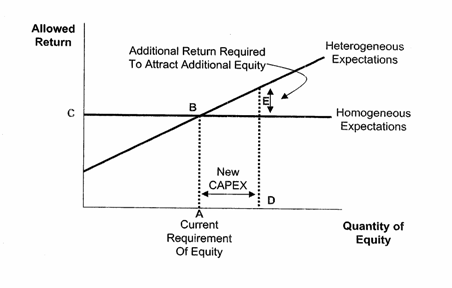
Where expectations are homogeneous, the firm can obtain any quantity of equity capital provided it is prepared to pay the return represented by the horizontal line at C. Where expectations are heterogeneous, however, in order to raise additional capital (eg from A to D) the firm will have to offer a greater return (indicated by E). In the diagram, B indicates the quantity of equity capital at which according to both homogeneous and heterogeneous expectations, the same rate of return will be required.
200 The true location of both the flat and sloping supply schedules might be higher or lower than as they appear in the diagram, just as the true slope of the schedule for heterogeneous expectations may be more or less steep.
201 Where expectations are homogeneous, if a return less than that represented by the flat supply schedule is offered, no capital will be forthcoming (there will be a “capital strike”). Where expectations are heterogeneous, on the other hand, some, albeit less, capital will be raised if the rate of return offeredis lowered.
202 The WACC cannot be precisely calculated: one can only make an estimate, which may be higher or lower than the WACC’s true value. “Welfare asymmetry” refers to the proposition that the social welfare loss associated with overestimating the WACC may not be the same as the social welfare loss associated with underestimating it. This principle is further explained as follows.
203 A range of WACCs may be generated by varying the estimates of the various inputs into the calculation. If an estimate is below the WACC’s true value, the supply of the service (or investment in infrastructure used to supply the service) may be reduced or even cease because the regulated entity is unable to earn a fair return. The reduction will consist of reduced capital expenditure, lower maintenance or a lower quality of service, with a consequent social welfare loss. On the otherhand, if the estimate is higher than the WACC’s true value, consumers will be faced with higher prices and will therefore reduce their consumption, again with a consequent social welfare loss.
204 Telstra’s “welfare asymmetry argument” was that the WACC should be set so as to take sufficient account of the social consequences of underestimating the true WACC, in particular, destruction of the incentive to invest. Telstra put its welfare asymmetry argument to ACCC as follows:
So long as investors (assumed so far to be fully informed) expect to be unable to earn a rate-of-return sufficient to recover their costs including compensation for the regulatory risk they must bear, no investment will be forthcoming. … the efficiency consequences of this are large. However, if investors expect to recover more than their efficient costs, the kinds of efficiency losses that would result are… second order losses [for example, consumers paying too much for broadband services]. Such losses are likely to be significantly smaller than the efficiency losses of no production.”
On this basis Telstra submitted to ACCC that, given the uncertainty, it would be efficient for ACCC to set the WACC somewhat above the midpoint of the range of WACCs, ie above the “normal” WACC.
ACCC’s reasons relating to the WACC
205 It is important to note in some detail exactly what ACCC’s reasons were for rejecting Telstra’s welfare asymmetry argument.
206 ACCC addressed the WACC issue at [453]-[487] of the Adam LSS FD Statement of Reasons (cf [392]-[421] of the Chime ULLS FD Statement of Reasons. Although ACCC’s reasons for rejecting Telstra’s WACC submission were not identical as between the 13 proceedings in question, they were substantially similar. It is therefore appropriate to refer to the Adam LSS FD Statement of Reasons.
207 ACCC began (at [453]) by stating that the WACC is used to calculate a normal return on capital employed, and that in its August 2007 LSS DFD Consultation Paper, ACCC had proposed using a “post-tax vanilla” WACC ranging from around 8.5% to 9.5% over the relevant years. ACCC noted (at [454]) that it had drawn to attention, inter alia, the question of whether a mark-up should be included to reflect claimed asymmetries in the social consequences of under and over estimation (the welfare asymmetry argument).
208 At [459] ACCC noted Telstra’s argument that the social consequences of underestimating the WACC were greater than those of overestimating it, so that the WACC should be set at “somewhat above the normal return”. ACCC described this issue as being whether to provide for an “above normal” WACC value on the basis of Telstra’s “welfare asymmetry argument” (at [460]).
209 ACCC observed (at [468]) that it had previously not accepted that there is welfare asymmetry in the social consequences of overestimating or underestimating the WACC, and referred to its FD entitled Assessment of Telstra’s ULLS monthly charge undertaking of August 2006 (ULLS Monthly Charge Undertaking Assessment) at p 125. In that context Telstra had relied on the expert evidence of Professor Robert Bowman, and Optus had provided a responsive report by Jason Ockerby, then of Frontier Economics (now of the Competition Economists Group and Optus’s expert witness in the present proceeding). AAPT, another service provider, had submitted a report of Associate Professor Neville Hathaway. At pp 125-131 (section D.7.3) of that document, ACCC had given its reasons for rejecting Professor Bowman’s (and therefore Telstra’s) welfare asymmetry argument. Among other things ACCC stated (at p 125) that the claims made by both Professor Bowman and Mr Ockerby were based around qualitative statements and counter-statements, and that there was lacking substantive and quantifiable evidence supporting Telstra’s claim.
210 ACCC continued in the Adam LSS FD Statement of Reasons by stating (at [469]) that it remained of the view that an unbiased estimate of the WACC that allowed for a normal rate of return on capital was appropriate, given the regulatory criteria to which it was required to have regard.
211 At [470] ACCC elaborated on Telstra’s case as follows:
Telstra presents a description of the potential cause and effects of any welfare asymmetry. Telstra contends that the consumer gains from consumption of a service are substantial and that if the WACC is set too low these gains will not be realised insofar as the necessary investment is not undertaken. Conversely, Telstra states that if the WACC is set above the normal level, the investment will always be undertaken and that the consumption gains will be realised. However, Telstra acknowledges that there will be a ‘second-order’ welfare effect from overpricing of these services. In a nutshell, Telstra submits that the ‘second-order’ effects from overpricing will be less adverse to welfare than the consumption effects of the investment not occurring in the first instance.
212 ACCC observed (at [471]) that an important assumption underlying Telstra’s submission was that investment decisions were effectively “all-or-nothing”: that either the WACC was sufficient and all investors would consider undertaking the investment, or the WACC was collectively adjudged to be too low and no investor would consider doing so. ACCC stated that Telstra’s position was that the decision whether to invest would be common to all investors as typically they would require external financing for major projects, and, it can be inferred, that capital markets tend to hold a collective view of the expected viability of different investments.
213 In two important paragraphs, [472] and [473], ACCC stated:
[472] The conceptual argument presented by Telstra obviously does not allow for heterogeneity in terms of risk profiles, or requirements as to returns among investors or participants in capital markets. Put another way, the assumption made here is that all investors – and by extension financiers in capital markets – share a common view as to an appropriate WACC for an investment project. This implies that all investors have similar expected marginal costs and revenues (as this impacts the margin necessary for the project to be considered viable). In addition, it assumes that all potential investors have a homogenous risk profile.
[Original emphasis]
[473] In the Commission’s view these assumptions are unlikely to reflect how investment decisions are actually made in practice. More generally, in the Commission’s view, the decision as to whether or not to invest in a specific project can differ among different groups of investors, and over time, is dependant on factors such as the relative risk aversion and the expected returns required on different investments. As these are likely to differ among different investors and institutions, it is unlikely that there will always be a common view among investors and capital markets as to appropriateness of a particular return on capital. Rather investors will have different risk and return profiles for investment projects, and it is precisely the possibility to take advantage of these differences which arguably drive capital markets. For this reason, it is possible to observe in practice a combination of both high risk investments being undertaken at high rates of return, and at the same time, relatively low risk investments with correspondingly lower rates of return.
214 ACCC set out (at [487]) in a table the “resulting WACC values” in respect of the years 2000-01 to 2007-08. The WACC (post-tax vanilla) ranged from a high of 9.66% (in 2000-01) to a low of 8.26% (in 2003-04). The WACC (post-tax vanilla) for the most recent year in the table (2007-08) was 9.25%.
215 In order to estimate the WACC, ACCC used the same standard CAPM that it had used in the past. This was the Sharpe-Lintner CAPM. Telstra submits (at para 3.14) that it is not disputed that this CAPM gives a flat supply schedule (a horizontal straight line) for equity capital. However, Dr Hird and Mr Ockerby say that the CAPM that was used by ACCC can also be derived using homogeneous expectations.
216 In Telstra’s submission, ACCC’s reasoning, expressed in [472] and [473] set out at [213] above, is based on the assumption of an upwardly sloping supply schedule (that is, the idea that different investors will insist on different returns if they are to commit equity capital to the firm) and associated heterogeneity of expectations. Telstra submits that both of these interrelated assumptions are fundamentally inconsistent with the CAPM which ACCC professed to use.
Telstra’s submissions
217 Telstra submits that having adopted the CAPM to estimate the cost of equity capital for the purposes of determining the WACC, ACCC erred in law because, in rejecting Telstra’s welfare asymmetry argument for the reasons that it gave, it acted inconsistently with an assumption that underlay the CAPM.
Ground 6(a) – Error of Law
218 Telstra summarises its argument relating to Ground 6(a) as involving seven steps:
(a) A decision made on the basis of erroneous methodology, principle of valuation or economic analysis is infected by error of law;
(b) In determining the regulatory WACC to be applied to the regulated asset base, ACCC adopted the standard CAPM to estimate the required return on equity capital (which is one component of the WACC);
(c) Fundamental assumptions of the standard CAPM are that:
(i) investors are homogeneous in respect of their expectations; and
(ii) while investors can have different degrees of risk aversion, in equilibrium they all agree on the same required returns for a particular asset;
(d) ACCC rejected Telstra’s welfare asymmetry argument on the ground that it was based on an assumption that investors have homogeneous expectations when in practice they have heterogeneous expectations;
(e) ACCC rejected Telstra’s welfare asymmetry argument on the ground that investors have heterogeneous risk preferences which would result in different required returns in relation to an asset;
(f) The bases on which ACCC rejected Telstra’s welfare asymmetry argument contradicted fundamental assumptions of the methodology of the standard CAPM used by ACCC to generate the WACC, which was to be the subject of “adjustment” pursuant to Telstra’s submission. (The CAPM assumes that investors have homogeneous expectations, and, while it accepts that they may have heterogeneous risk aversions, in equilibrium all will agree on a single required rate of return in relation to a given asset); and
(g) ACCC determined the regulatory WACC to apply to the regulated asset base on the basis of inconsistent and economically unacceptable reasoning amounting to the application of an erroneous methodology involving economic principle.
219 In support of proposition (a) (that a decision made on the basis of an erroneous methodology, principle of valuation or economic analysis is infected by error of law), Telstra refers to the following cases, which I need not discuss at this stage: Melwood Units Pty Ltd v Commissioner of Main Roads [1979] AC 426; Brisbane City Council v The Valuer-General for the State of Queensland (1978) 140 CLR 41; Maurici v Chief Commissioner of State Revenue (2003) 212 CLR 111; Repatriation Commission v Harrison (1997) 78 FCR 442; NSW Coal Compensation Board v Nardell Colliery P/L [2004] NSWCA 35.
220 In relation to propositions (b) and (c), Telstra submits that it is not disputed that ACCC set the WACC by adopting the methodology of the standard CAPM, fundamental assumptions of which are (i) that all investors have homogeneous expectations, and (ii) that in equilibrium all investors have homogeneous expectations as to the required returns from a particular investment, irrespective of their risk preferences. Telstra also submits that it is not disputed that under the CAPM there is a flat supply curve, or schedule, for equity capital.
221 In relation to propositions (d) and (e), Telstra submits that ACCC rejected its welfare asymmetry argument on the basis of heterogeneity of investors’ expectations and heterogeneity of investors’ required return on capital, which would result in different required returns. In so doing, according to Telstra, ACCC adopted an upward sloping curve for the supply of equity capital.
222 In support of proposition (f), Telstra submits that ACCC’s reasoning in rejecting the welfare asymmetry argument was inconsistent with fundamental assumptions of the standard CAPM on which ACCC had relied in determining the WACC. ACCC rejected the welfare asymmetry argument on the basis that it did not allow for:
(a) heterogeneity of investors’ expectations, yet the assumption underlying the CAPM is that all investors have the same expectation in relation to the return on equity capital invested in a particular asset; and
(b) heterogeneity of investors’ required return on investment, yet the assumption underlying the CAPM is that in equilibrium all investors require the same return from the same asset notwithstanding differences of risk aversion.
223 A different way in which Telstra made the present point is as follows (at para 3.40):
…the ACCC has adopted inconsistent assumptions about how equity investors determine their required return in estimating the cost of equity capital (as a component of the WACC estimate) and in assessing the issue of welfare asymmetry (in relation to setting the WACC). In considering the cost of equity capital, the ACCC has assumed a flat equity supply schedule. In considering the welfare asymmetry argument, the ACCC has inconsistently assumed an upward sloping supply schedule.
224 Telstra’s proposition (g) was, in substance, a recapitulation of the paragraphs that preceded it. Telstra emphasised that the CAPM and the concept of welfare asymmetry are inextricably linked, both being concerned with the derivation of the appropriate regulatory WACC in the relevant circumstances.
Ground 6(b) – Wednesbury unreasonableness
225 The factual foundation for Ground 6(a) is also that for Ground 6(b).
226 Telstra identifies the following steps in its argument relating to Ground 6(b):
(a) A decision which is illogical, irrational and perverse such that no reasonable decision-maker could have reached it, is invalid;
(b) Telstra repeats the five steps identified as (b) to (f) set out at [218] above;
(c) By reason of those steps, ACCC’s determination of the regulatory WACC was so unreasonable that no reasonable decision-maker could have arrived at it.
227 In support of proposition (a), Telstra refers to cases in which the ground of review often referred to as Wednesbury unreasonableness has been described.
228 In relation to Telstra’s proposition (b), Telstra refers to the discussion of steps (b) to (f) in relation to Ground 6(a) above.
229 In respect of proposition (c), Telstra submits that ACCC’s reasons for rejecting the welfare asymmetry argument were fundamentally illogical and perverse in at least two ways.
230 First, ACCC’s reasons for rejecting that argument are illogical, considered on their own terms, because they are founded on the suggestion that Telstra could raise equity capital by offering lower returns to a sub-set of investors who were less risk adverse. Telstra refers (at paras 3.64, 3.65) to evidence given by Professor Gray to the effect that ACCC’s suggestion could be borne out only if markets were in a state of disequilibrium or investors were irrational. In other words, according to Telstra, ACCC’s reasons for rejecting the welfare asymmetry argument are illogical and perverse even if they are considered independently of the use of the CAPM.
231 Second, Telstra argues that ACCC determined the regulatory WACC by adopting directly opposed assumptions. It adopted the CAPM and its assumptions for the purpose of arriving at an estimate of the WACC, but for the purpose of rejecting the welfare asymmetry argument it adopted assumptions inconsistent with them. Again Telstra refers to evidence of Professor Gray (see below). Telstra submits (para 3.71):
Illogicality arises from … internal inconsistency in the ACCC’s reasoning. It is illogical to adopt assumptions of homogeneity of investors’ expectations and homogeneity of investors’ required return, for the purposes of setting the WACC, but to abandon those assumptions when considering welfare asymmetry arguments. The result is a determination of the regulatory WACC to apply to the regulated asset base on the basis of internally opposed assumptions. Such a process can only be described as illogical and devoid of plausible justification.
Optus’s and XYZed’s submissions
232 ACCC made no submissions on the present issue.
233 I will refer to the parties making the Optus and XYZed submissions together simply as “Optus.” Optus emphasises that Part XIC of the Act does not, either expressly or by implication, require ACCC to consider the WACC or to make a finding about an appropriate WACC to be factored into its price determinations.
234 Determining a WACC is necessarily an inexact exercise involving estimation based on the application of available market data and various inputs to economic models. For the purposes of estimating returns on equity, ACCC applied a model known as CAPM.
235 ACCC expressed no view about the extent to which the assumptions underlying the CAPM, such as an assumption about the homogeneity of investors’ expectations as to return and as to risk aversion, were realistic. There is nothing to suggest that ACCC considered any of those assumptions to be an accurate reflection of reality.
236 Optus characterises the essence of the welfare asymmetry argument that Telstra advanced before ACCC as being that ACCC should arrive at an estimate of the equity component of the WACC by applying the CAPM but then increase that figure. In other words, there was a distinction between a normal return and the increased return that Telstra was seeking in order to take into account its welfare asymmetry argument.
237 Optus draws attention to the way in which Telstra put its welfare asymmetry argument to ACCC in the following terms (para 65):
So long as investors (assumed so far to be fully informed) expect to be unable to earn a rate-of-return sufficient to recover their costs, including compensation for the regulatory risk they must bear, no investment will be forthcoming. As before, the efficiency consequences of this are large. However, if investors expect to recover more than their efficient costs, the kinds of efficiency losses that would result are … second order losses … . Such losses are likely to be significantly smaller than the efficiency losses of no production.
Optus characterises Telstra’s argument as premised on the notion of a “capital strike” – that no investment, rather than merely reduced investment, would be forthcoming if all investors had a particular perception of the rate of return on equity capital. Optus points out that ACCC did not accept that the capital strike proposition reflected how investment decisions were made in practice. ACCC thought that the decision whether or not to invest in a specific project could differ as between groups of investors and over time, depending on such factors as relative risk aversion and the returns required of different investments. ACCC had stated at [473]:
… investors will have different risk and return profiles for investment projects, and it is precisely the possibility to take [sic – of taking] advantage of these differences which arguably drive[s] capital markets. For this reason, it is possible to observe in practice a combination of both high risk investments being undertaken at high rates of return, and at the same time, relatively low risk investments with correspondingly lower rates of return.
ACCC relied on the position so described as a reason for rejecting Telstra’s welfare asymmetry argument.
238 Optus submits that ACCC’s rejection of the welfare asymmetry argument, despite ACCC having relied upon the CAPM, was not illogical because the argument raised a question whether it was realistic to assume that investors would behave in a uniform way based on homogeneous investment expectations, and ACCC thought that it was not realistic to make that assumption.
239 Optus agrees that the CAPM is a model based on certain assumptions, including an assumption as to the homogeneity of investor expectations, but submits that the use of an economic model does not indicate that its assumptions are necessarily accepted as an accurate reflection of reality. CAPM operates on the basis of other self-evidently unrealistic assumptions, such as that there are no transaction costs, no inflation and no personal income taxes. In relation to the assumption that investors have homogeneous expectations, Telstra itself stated (para 67):
The assumption that investors all have the same expectations is, of course, unrealistic.
CAPM is a model that has explaining power but it does not follow that by using CAPM, ACCC was accepting that in the real world investors have homogeneous expectations.
240 Professor Stephen Faulkner Gray, Professor of Finance at UQ Business School, University of Queensland, an expert witness called by Telstra, stated in his affidavit that CAPM explicitly rules out differences of expectation among investors about the future prospects of Telstra or about the risks associated with an equity investment in Telstra. Optus submits that while it may be accepted that this is true in terms of the internal logic of CAPM, this says nothing about how ACCC could or should have approached the consideration of other issues affecting the WACC that were not part of the CAPM modelling exercise.
241 Optus submits that contrary to Telstra’s submission, ACCC did not adopt or endorse an upward sloping supply curve for capital, or suggest that Telstra could raise equity capital by offering lower returns to a sub-set of investors who are less risk averse. According to Optus, ACCC’s reasoning dealing with the welfare asymmetry argument does not touch on that issue.
242 Optus notes (para 49) Telstra’s assertion in its submissions of a general principle of law that “[w]here a regulatory agency has power to set a regulated price and makes an error in a principle it applies in order to set the price, this constitutes an error of law”. Optus contends that this submission should not be accepted because the matter depends entirely upon the terms in which the power to set the regulated price is conferred and the source of the principle which the regulator applies. The mere fact, according to Optus, that a regulatory agency such as ACCC chooses to have regard to certain models and factual considerations as part of the broader exercise of determining an access dispute which involves price terms, does not elevate any error made in the course of that exercise to the status of an “error of law”, even if the label of “principle” is attached to the error. A complaint that ACCC erred in law by taking a particular reasoning step in rejecting the welfare asymmetry argument is not to the point because ACCC was not under a legal obligation to reason in a particular way.
243 Optus submits that while an error of principle in arriving at a value may amount to an error of law, the cases in which that has been held to be so have concerned statutory valuation exercises, and in any event the approach should be treated with caution: Optus cites Walker Corporation Pty Ltd v Sydney Harbour Foreshore Authority (2008) 233 CLR 259 (Walker Corporation) at 269-272. Optus submits that in any event Telstra has failed to identify the “principle” which it says ACCC ignored or misapplied. Optus distinguishes the particular substantive principles considered in Melwood Units Pty Ltd v Commissioner of Main Roads [1979] AC 426 and the related authorities cited by Telstra (see [219] above). In Walker Corporation the High Court (at 270) cautioned against importing into one case general “principles” derived from other cases that arose in different statutory contexts. Optus submits that Telstra has not identified in Pt XIC of the Act or in the common law a source of any “principles” that control the arbitral powers conferred on ACCC by Div 8 of that Part.
244 Optus submits that Telstra’s “unreasonableness” ground has no support, in that the inconsistent reasoning Telstra alleges to have been adopted by ACCC in, on the one hand, applying the CAPM, and on the other making a determination that Telstra’s “capital strike” argument was not a realistic reflection of investor behaviour, falls far short of establishing that ACCC made a determination that was so unreasonable that no reasonable decision maker could have arrived at it.
245 Optus submits that the Wednesbury unreasonableness ground of review does not extend to an error of reasoning in making a finding of fact about a matter that is one of many factual elements in the determination of an access dispute.
Non-Optus and XYZed access seekers’ submissions
246 The non-Optus and XYZed access seekers, to whom I will refer as the non-Optus access seekers, emphasise thatthe CAPM and the WACC provide only estimates, and that it is not possible to observe whether the figures that they give are correct or not. They are only formulae, cannot take into account all of the real world effects, and their inputs are unknowns.
247 The non-Optus access seekers identify two major questions on which the expert witnesses disagree:
(a) Is it a necessary assumption of the CAPM formula used by ACCC that investors have homogeneous expectations?
(b) If it is, is there any illogicality in ACCC’s using the CAPM to arrive at the WACC, then rejecting Telstra’s welfare asymmetry argument on the basis, inter alia, that investors do not have homogeneous expectations?
248 The non-Optus access seekers suggest that the experts agreed that ACCC was required to consider two issues when setting the WACC:
(a) What is the best estimate of the WACC?
(b) Should that best estimate be adjusted to take welfare asymmetry into account?
249 In their written submissions, the non-Optus access seekers summarise the experts’ evidence in relation to these questions, but submit that it is not necessary for the Court to resolve the debate between them. Those parties submit that if the Court should conclude that ACCC’s approach is supported by a respectable body of economic thought, that suffices to defeat Telstra’s claim based on error of law and Wednesbury unreasonableness. Nonetheless, they submit that the evidence and Telstra’s submissions do not demonstrate illogicality in ACCC’s reasoning process for a number of reasons on which they elaborate.
250 The non-Optus access seekers distinguish the valuation of land cases relied on by Telstra as turning on the terms of particular statutes. They note that Telstra purports to concede (as it must) that illogicality or unreasonableness do not necessarily constitute reviewable error unless there is a legal principle or statutory provision that attracts that consequence: they cite Re Minister for Immigration and Multicultural Affairs; ex parte Applicant S20/2002 (2003) 198 ALR 59; [2003] HCA 30 (S20)at 61 per Gleeson CJ. Whether relying on Wednesbury unreasonableness or “illogicality, unreasonableness and perversity”, as in S20, one must identify a particular statutory provision or other legal principle that has been infringed. The non-Optus access seekers submit that Wednesbury unreasonableness is directed at outcomes, whereas S20 illogicality is directed at processes of reasoning: see S20 198 ALR 59at 76 per McHugh, Gummow JJ, 88 per Kirby J.
251 They also distinguish Application by GasNet Australia (Operations) Pty Ltd [2004] ATPR 41-978; [2003] ACompT 6 (GasNet) at [47] as directed to the need to apply the CAPM in a conventional way. According to their submissions, the Tribunal was not there suggesting that the CAPM formula could be applied only in a way that was consistent with an acceptance of its underlying assumptions.
Consideration
General
252 As previously noted, Telstra led expert evidence from Professor Stephen Faulkner Gray, Professor of Finance at UQ Business School, University of Queensland, and also the Managing Director of The Strategic Finance Group: SFG Consulting. Also as noted above, Optus led expert evidence from Jason Peter Ockerby, a director of the Competition Economists Group. The non-Optus access seekers led expert evidence from Dr Thomas Nicholas Hird, also of the Competition Economists Group. The three economists provided a “Joint Report of Experts” (Joint Report) to the Court. They also provided their own independent reports and gave extensive oral evidence.
The authorities
253 The authorities referred to by Telstra (see [219] above) concerned statutory contexts different from the present one. They required that a “value” or a value of a particular kind or an amount of “compensation” be determined, and in some instances the basic expressions were elaborated upon or defined. Accordingly, the argument was open in those cases that the statute had been misconstrued.
254 In contrast, the terms in which ACCC’s function as arbitrator of an access dispute under Div 8 of Pt X1C of the Act are couched are of the broadest kind. Section 152CP(1) requires ACCC to make “a written determination on access by the access seeker to the declared service”. Section 152CP(2) provides that the determination may deal with any matter relating to access by the access seeker to the declared service. Section 152CR(1) provides that ACCC must take the matters listed in that subsection into account, including, for example, the LTIE. Section 152CR(2) provides that ACCC may take into account any other matters it thinks are relevant.
255 There is no basis in the Act for a contention that ACCC was bound to consider the WACC or to arrive at an appropriate WACC in order to make a valid “determination on access”.
256 In my opinion the kind of inconsistency or error with which Telstra charges ACCC is not an error of law. If there is an error or inconsistency at all, it is an error or inconsistency in ACCC’s reasoning process, which does not necessarily constitute an error of law.
257 In para 6 of its amended application for an order of review, Adam referred to Wednesbury unreasonableness as “further or in the alternative” to the error of law ground, and gave the same particulars of both (see [194] above). In its submissions, however, while acknowledging substantial overlap between the two grounds, Telstra distinguished between them (see [218] (error of law) and [226] (Wednesbury unreasonableness) above).
258 Observations made in Minister for Immigration and Multicultural Affairs v Eshetu (1999) 197 CLR 611 (Eshetu) and S20 are, in my view, relevant to both grounds.
259 In Eshetu,at [40], Gleeson CJ and McHugh J stated:
Someone who disagrees strongly with someone else’s process of reasoning on an issue of fact may express such disagreement by describing the reasoning as “illogical” or “unreasonable”, or even “so unreasonable that no reasonable person could adopt it”. If these are merely emphatic ways of saying that the reasoning is wrong, then they may have no particular legal consequence.
260 In S20, after referring to Eshetu, Gleeson CJ stated (at [5]) that if it is suggested that there is a legal consequence of illogical, unreasonable or irrational reasoning:
[I]t may be necessary to be more precise as to the nature and quality of the error attributed to the decision-maker, and to identify the legal principle or statutory provision that attracts the suggested consequence.
261 While I will examine the alleged error, illogicality, irrationality and perversity of which Telstra alleges ACCC was guilty, in my view the alleged inconsistency in reasoning process on which Telstra seizes does not constitute either error of law or Wednesbury unreasonableness, because Telstra has not related it to a particular statutory provision or legal principle that the inconsistency is said to have infringed.
The assumptions underlying the CAPM
262 In the report annexed to his first affidavit, filed in the Adam LSS proceeding, Professor Gray noted that the CAPM is mathematically derived under a number of formal assumptions which are set out in most standard finance textbooks. Citing C Jones, Investments: Analysis and Management (John Wiley & Sons Inc, 2002) at 531, Professor Gray listed the assumptions as follows:
1. All investors have identical probability distributions for future rates of return; they have identical (or homogeneous) expectations with respect to the three inputs of the portfolio model (expected returns, the variance of returns and the correlation matrix). Therefore, given a set of security prices and a risk-free rate, all investors use the same information to generate an efficient frontier;
2. All investors have the same one-period time horizon;
3. All investors can borrow or lend money at the exogenously given risk free rate of return and there are no restrictions on short sales of any asset;
4. All assets are marketable (perfectly divisible and perfectly liquid) and there are no transaction costs;
5. There are no personal income taxes – investors are indifferent between capital gains and dividends;
6. There is no inflation;
7. There are many investors and no single investor can affect the price of a stock through his or her buying and selling decisions. Investors are price takers and act as if prices are unaffected by their own trades; and
8. Capital markets are in equilibrium.
263 In oral evidence, Professor Gray explained the nature of economic models and the unrealistic nature of the assumptions underlying them as follows (T541):
Every assumption of every economic model is unrealistic. ... I should expand upon that, perhaps. The way every economic model works is to start with a set of assumptions that are necessarily unrealistic, which is why they are called assumptions. They are not descriptions of reality. Based on those simplifying assumptions, we apply an internally consistent set of logic or mathematical derivation, and that produces some outputs. When evaluating the use or worth of an economic model, we don’t have any regard to the reality of the assumptions. We look at the effectiveness or the use to which the outputs can be put. So that might be, in terms of – in this example, determining what an appropriate return would be for a regulated monopoly asset.
If the model works, if it’s useful, if it explains something or makes some useful predictions that are supported empirically, then it will be a successful model. All of the models in economics are based on a set of assumptions that try to simplify very complex phenomena into something that can be modelled. That is the whole reason for having those assumptions. Indeed, every assumption in every economic model is for that reason unrealistic. That is the whole point of having those assumptions.
264 The expert testimony of Mr Ockerby and Dr Hird is consistent with that ofProfessor Gray recounted above.
Did the CAPM formula used by ACCC assume homogeneity of expectations?
265 It is common ground between the three experts that the Sharpe-Lintner CAPM was originally derived by assuming that investors have the same expectations about the future prospects of each firm and its stock. Mr Ockerby and Dr Hird, however, say that the CAPM formula used by ACCC is consistent with heterogeneity as well as homogeneity of expectations. Professor Gray states in the report annexed to his first affidavit, that while there is nothing in the CAPM formula that rejects heterogeneity of risk aversion among investors, “all investors have the same belief about the probability [of] distribution of future payoffs from a particular asset” (para 46). The Professor (para 47) “there is a class of models that allows for heterogeneity of investor expectation. But these models are not the CAPM and have not been used by the ACCC to estimate the required return on equity capital”.
266 In the Joint Report, the experts agreed (para 3(f)) that the Sharpe-Lintner CAPM pricing relation can be derived adopting assumptions different from those originally employed by Sharpe and Lintner, including the assumption as to homogeneity of expectations; “however other assumptions are required to arrive at the relation and the pricing relation may only hold approximately”. In para 4 of the Joint Report the experts agreed “that the pricing relationship used by the ACCC is consistent with that originally developed by Sharpe and Lintner and also that subsequently derived using the assumption of heterogeneous expectations and other additional assumptions”.
267 I do not find it necessary to resolve the conflict in the present respect as between Professor Gray on the one hand and Mr Ockerby and Dr Hird on the other: I am content to assume that the CAPM formula used by ACCC assumes homogeneity of expectations.
Telstra’s “capital strike” argument
268 It was because of the possibility of a “capital strike” (see [201] above), that Telstra submitted that ACCC should raise the WACC above the “normal”. See para 65 of its submissions to ACCC set out at [237] above.
269 As ACCC noted at [473] of the Adam LSS FD Statement of Reasons (set out at [213] above), ACCC considered that real world investment decisions were not reflected by the capital strike proposition.
270 I see no ground for criticism of ACCC’s reasoning process by which it rejected Telstra’s capital strike proposition. It was at liberty to consider that in the real world investors do not behave in the way in which the capital strike proposition would have them behave. Accordingly, in this respect ACCC did not behave unreasonably or irrationally, and neither error of law nor Wednesbury unreasonableness is made out.
Inconsistency and Application by GasNet Australia (Operations) Pty Ltd [2004] ATPR 41-978; [2003] ACompT 6
271 Telstra’s contention that there is a fundamental inconsistency in relying on the CAPM and accepting the heterogeneity of investor expectations is well expressed at [68] of Telstra’s submissions to ACCC:
…the conventional versions of the Capital Asset Pricing Model (“CAPM”), [to] which both the Commission and the Tribunal refer in their previous regulatory decisions, do not extend in any simple way to heterogeneous investor information and expectations. As a result, if the Commission and the Tribunal genuinely hold the view that investors have heterogeneous information and expectations, they cannot continue to rely on the models they have conventionally used to determine allowed rates-of-return. To do so would be to contradict the requirement the Tribunal has set out in earlier decisions that the CAPM be applied in a manner consistent with its underlying assumptions.
The reference in the last section to “earlier decisions” is a reference to the Tribunal’s decision in GasNet at [47]. The Tribunal there stated:
The ACCC erred in concluding that it was open to it to apply the CAPM in other than the conventional way to produce an outcome which it believed better achieved the objectives of s 8.1. In truth and reality, the use of different values for a risk free rate in the working out of a Rate of Return by the CAPM formula is neither true to the formula nor a conventional use of the CAPM. It is the use of another model based on the CAPM with adjustments made on a pragmatic basis to achieve an outcome which reflects an attempt to modify the model to one which operates by reference to the regulatory period of five years. The CAPM is not a model which is intended to operate in this way. The timescales are dictated by the relevant underlying facts in each case and for present purposes those include the life of the assets and the term of the investment.
The reference to “s 8.1” is a reference to s 8.1 of the National Third Party Access Code for Natural Gas Pipeline Systems. Section 8.1 set out the objectives according to which a “Reference Tariff” and “Reference Tariff Policy” were to be designed. I do not think that the Tribunal’s observation at [47] set out above is relevant to the question whether ACCC was obliged, in order to be consistent, to accept as according with the real world the assumptions according to which the CAPM was formulated.
Inconsistency and the expert evidence
272 I do not find it necessary or think it desirable to attempt to describe comprehensively the effect of the totality of the evidence of the expert witnesses, but certain aspects of the Joint Report, in particular, are noteworthy.
273 The experts agreed that:
· the required return on equity capital cannot be estimated with great precision;
· the Sharpe-Lintner CAPM relies on a number of assumptions that are unrealistic, one of which is that of homogeneous investor expectations about the future prospects of each firm;
· the Sharpe-Lintner CAPM pricing relation can be derived adopting assumptions different from those originally employed by Sharpe and Lintner, one of those different assumptions being that investors have heterogeneous expectations about the future prospects of each firm, but other assumptions are required to arrive at the relation, and the pricing relation may hold only approximately;
· the Sharpe-Lintner CAPM allows investors to have heterogeneous attitudes towards risk (different levels of risk aversion);
· the pricing relationship used by ACCC was consistent with that originally developed by Sharpe and Lintner and also that subsequently derived from it using the assumption of heterogeneous expectations and other additional assumptions;
· heterogeneity of risk aversion is already allowed for in the Sharpe-Lintner CAPM.
274 The Joint Report also set out a summary of the opinions of the respective experts on the key issues.
275 Professor Gray insists that in economics there must be internal consistency in the sense that “within a single economic framework the same approach has to be used and the same answer obtained for the same question” (T520). This, however, begs the question whether the CAPM and ACCC’s rejection of the welfare asymmetry argument were addressing “the same question”.
276 It is common ground that unrealistic assumptions underlay the CAPM model: see also the passage from Professor Gray’s testimony quoted at [262] above.
277 Professor Gray accepted (inevitably) that at [473] of its Statement of Reasons, when rejecting Telstra’s welfare asymmetry argument, ACCC was looking at a real world situation rather than one derived from a model.
278 Telstra’s welfare asymmetry argument itself required ACCC to depart from the CAPM model by elevating the WACC in order to take into account the real world risk of a capital strike. ACCC’s answer was that there would not be a capital strike in the real world because the real world was characterised by heterogeneity of investor expectations.
279 As Mr Ockerby explained, ACCC used the CAPM formula to arrive at its “unbiased” estimate of the required return on an investment in equity capital (Professor Gray agreed that the CAPM gives a “best” or “unbiased” estimate (T545, 556) and in doing so it located the equity capital supply schedule on the graph. It then relied on the upward slope of that schedule as the basis for rejecting the welfare asymmetry argument. It is important to appreciate that sloping equity supply schedules can be located at different heights on the graph. The height represents the cost of equity capital while the direction (horizontal or sloping) represents the amount of capital coming in at around that price.
280 Dr Hird similarly made the point (T526) that the cost of equity capital, according to the CAPM, does not vary with the size of the firm or the amount of capital to be raised. He explained that after making our best estimate of equity capital, the next step is to ask “if we get this wrong, what will happen?”. The answer, illustrated by the slope of the equity supply schedule, is that if the estimate is too low, some investors will be lost, but not all will be, and if it is too high there may be different adverse consequences to competition. It is not, however, to use Dr Hird’s term, a “knife edge”, or to use the terms in which ACCC described Telstra’s submission, an “all or nothing” situation.
281 ACCC found it useful to use the CAPM formula to arrive at the “unbiased” required return on an investment of equity capital, and was entitled to resort to the real world sloping nature of the equity supply schedule to reject Telstra’s welfare asymmetry argument.
282 Senior counsel for Telstra pointed out that the exercise of arriving at the FD is carried out within the framework of the TSLRIC+ pricing methodology. However, Telstra’s own capital strike proposition was an assertion of what was likely to happen in the real world (unsupported by evidence) and was answered by a real world heterogeneity of expectations.
283 It seems to me that the expression “assumptions” in relation to the CAPM is ambiguous. It may be that, outside the realm of economics, the word “assumption” is not the best word to refer to such things as homogeneity of expectations, no inflation and no personal income taxes. The CAPM does not assume those things in the real world in the sense that the CAPM loses its validity if they do not in fact reflect the real world. The CAPM makes assumptions in the sense of putting certain things to one side. The model can work and be a useful tool for the purpose of addressing only those things with which it deals.
Conclusion
284 In my view neither the error of law ground nor the Wednesbury unreasonableness ground is made out in respect of the WACC.
E – LINE COSTS
Introduction
285 Telstra raises two grounds in respect of “line costs” in the Amcom, Adam, Agile, Primus (the acronym “AAAP” has been used to refer to these four access seekers who made a joint submission in the ACCC arbitrations), Network and TPG proceedings. These are all six of the LSS proceedings. I will refer to Adam as representative.
286 Both grounds concern the access seekers’ business plans, and, in particular, the question whether those business plans provided a justification for not including a contribution to line costs in the annual charge for access to the LSS (LSS Annual Charge).
287 “Line costs” refers to the cost of a line over which the LSS is sought or accessed, in particular, the cost of maintenance of the line. Since the LSS is provided only over the high frequency spectrum, other services, such as telephony, may be provided over the same line at the same time.
288 Telstra contends that in making the Adam LSSFD, ACCC:
(a) made an error of law, within s 5(1)(f) of the ADJR Act and within the “no evidence” rule at common law, in making findings of fact concerning Adam’s business plan as a basis for rejecting the inclusion of a contribution to line costs in the LSS Annual Charge, where there was no evidence or other material before it to justify the findings (Ground 3) (the No Evidence Ground); and
(b) failed to comply with procedures that were required by law to be observed in connection with the making of the FD, by failing to comply with its duty under s 152DB(1)(b) of the Act to act as speedily as a proper consideration of the access dispute allowed, having regard to the need to carefully and quickly inquire into and investigate the dispute, and in particular, Adam’s business plan in relation to the inclusion of a contribution to line costs, being a matter affecting the merits and fair settlement of the dispute (Ground 4) (the Failure to Inquire Ground).
Section 152DB of the Act, referred to in the Failure to Inquire Ground, is entitled “Procedure of Commission”. Subsection (1) of s 152DBprovides:
(1) In an arbitration hearing about an access dispute, the Commission:
(a) is not bound by legal technicalities, legal forms or rules of evidence; and
(b) must act as speedily as a proper consideration of the dispute allows, having regard to the need to carefully and quickly inquire into and investigate the dispute and all matters affecting the merits, and fair settlement, of the dispute; and
(c) may inform itself of any matter relevant to the dispute in any way it thinks appropriate.
289 Telstra pointed out that both grounds 3 and 4 involve a contention that there was no evidence before ACCC and need to be considered against the documentary evidence that was before ACCCin each arbitration.
Facts leading up to the Adam LSS FD Statement of Reasons
2002 LSS Pricing Principles
290 Chapter 7 of ACCC’s LSS Declaration Final Report of August 2002 was entitled “Pricing principles for a declared LSS”. These are the 2002 LSS Pricing Principles that were referred to at [23](4). Within Pt 7.3.2 headed “The costs of a line over which a LSS is provided”, ACCC explained (p 87) that the LSS is provided over a subset of the full frequency spectrum of a line (or ULL), and that a key question was whether or not any allocation of the cost of the whole line should be recovered through the price of an LSS.
291 ACCC expressed the view that Telstra was already fully recovering the cost of the line through other sources of revenue (see the Earlier Reasonsat [351]), and concluded that unless Telstra could show that this was not so, it would be inappropriate to include a contribution to line costs in the price of the LSS (pp 97-98).
The Adam LSS DFD Consultation Paper
292 The Adam LSS DFD Consultation Paper that ACCC sent to Adam and Telstra on 16 August 2007 stated in section 1.5:
In preparing and providing their principal and response submissions, parties should take care to include all of the contentions and supporting materials that they wish to provide. The Commission expects that parties’ submissions will be responsive to the issues raised in this discussion paper or in other parties’ submissions. Should a party not provide information on a particular issue when it could reasonably be expected to be in a position to do so, the Commission may draw the inference that what the party could have said on the point would not have assisted its case.
Telstra relies on this statement as emphasising the necessity of Adam advancing evidence in support of its case in the ACCC arbitration.
293 Section 4.1 of the Adam LSS DFD Consultation Paper was entitled “LSS annual charges”. It outlined the background to the Adam LSS access dispute and ACCC’s approach. ACCC explained (at 4.1.1):
Consistent with the LSS pricing principles that have been in place since 2002, this $2.50 per month charge does not include a contribution to the costs of the line over which line sharing is supplied. …
The Commission has for some time recognised that economic efficiency can be enhanced by the inclusion of an appropriate contribution to line costs in LSS annual charges.
However, where line rental charges fully recover line costs, the inclusion of such a contribution in LSS annual charges would lead to an over-recovery of cost. In these circumstances, reductions … in charges for other network services, such as wholesale line rental (WLR), are needed in order to avoid any such double dipping.
The Commission recognises however, that rebalancing charges in this way may take time, has the potential to disrupt competition in DSL services if done too quickly, and is dependent upon Telstra restructuring its existing charges for other services. Accordingly, the Commission is consulting the parties on whether there is a real prospect for rebalancing to take effect before 31 December 2007, which is [the] proposed date on which the proposed determinations would expire.
294 Section 4.1.7 was entitled “Contribution to line costs”. ACCC stated that it sought submissions only on the issue whether a contribution to line costs could be implemented within the period for which the proposed FD was to operate. At that time, August 2007, it was proposed that the FD would expire on 31 December 2007 – only a few months thereafter. ACCC stated that its preliminary view was that any such contribution should be recognised only prospectively and only following a rebalancing of LSS and WLR charges. ACCC further stated that it was, at that stage, seeking submissions only to the extent necessary to reach a view as to whether or not it would be appropriate for ACCC toinclude a contribution to line costs at all, not as to how any contribution should be calculated. ACCC continued (in section 4.1.7):
The particular matters that submissions should address are:
(i) Whether, at a practical level, a rebalancing of LSS and WLR charges could be implemented during the period of the final determination.
…
(ii) The likely effect on the LTIE, and the other section 152CR(1) criteria, of implementing a rebalancing of LSS and WLR charges during the period of the final determination, including the consequences for the LTIE of not adopting a transition path approach.
The Commission has not previously recognised a contribution to line costs in LSS annual charges. On those occasions when the Commission has altered its regulatory approach to access prices, it has adopted a transition path approach, so as not to harm competition or efficient investment incentives.
295 ACCC asked the parties to calculate the effect and provide calculations for the hypotheticalscenarios where monthly LSS charges increased, and monthly WLR charges associated with LSS lines decreased, by the amounts of $2.00 in Band 1, $7.10 in Band 2, and $15.50 in Band 3. The effect and calculations were to be based upon the number and geographical distribution of LSS and WLR services that the access seekers currently acquired. ACCC also asked the parties to provide forecasts up to 31 December 2007. The parties were asked to “attach a work paper showing their calculations”. ACCC also asked them to consider whether, and if so how, the resulting change in monthly access charges would affect current or planned business operations, and any consequences for investment (made or planned) in DSL networks or alternative networks. The Adam LSS DFD Consultation Paper continued (in section 4.1.7):
If parties consider that there may be adverse consequences, parties are asked to consider whether these consequences could be avoided or reduced by adopting:
- alternative wholesale inputs that are potentially available for new services, e.g., the ULLS, …
- alternative wholesale inputs that are potentially available for existing services, e.g., the ULLS, and if so by when they would be available having regard to practicalities of migrating between network platforms – e.g., availability and cost of such migrations, and implications for service delivery to end-users during the migration.
- alternative business models, e.g., to supply both fixed voice and DSL services, and by when any such changes in business models could be implemented, …
Telstra submits that the terms of ACCC’s request should have alerted the access seekers to the necessity of their providing evidence in support of any case they might wish to make that their existing business plans did not take into account the possibility that LSS Annual Charges might include a contribution to line costs.
Parties’ submissions to ACCC
296 ACCC followed the practice of setting a timetable for the making of “submissions” by the parties. There was no oral evidence. The nature of the present grounds makes it important to note in some detail the materials that were before ACCC.
Telstra’s submissions to ACCC
297 Telstra’s submissions to ACCC were dated 20 September 2007. In Part 3, entitled “LSS Monthly Prices”, Telstra submitted that the LSS Annual Charge (payable monthly) should include a service specific cost component and a line cost component. It submitted that inclusion of a contribution to line costs would be in the LTIE, the interests of Telstra, and the interests of access seekers. Telstra submitted that contrary to ACCC’s earlierChime LSS FD Statement of Reasons and Request LSS FD Statement of Reasons (see the Earlier Reasons at [346]-[417]), Telstra was not already recovering its line costs through wholesale line rental and its own retail line rental prices.
298 Telstra submitted (paras 33, 34):
33. The Commission signalled through the LSS Pricing Principles, and therefore well before DSLAM [Digital Subscriber Line Access Multiplexer] investments were made by LSS access seekers, that it may be appropriate for LSS prices to include some contribution to line costs. Consequently, LSS access seekers have been aware of the probability of having to contribute to line costs at the time of their investment and should have factored this risk into their business plans.
34. In the Chime and Request FDs, the Commission expressed concerns as to the effect on access seekers [sic] business plans of the inclusion of line costs in the price of LSS. Given that Telstra is proposing a transitional price which has been operating in the market for some time, any business plans, on the basis of which access seekers have invested, will not be disrupted. …
Telstra also submitted, with reference to figures, that in fact it did not already recover its line costs from WLR and retail line rental charges. It also submitted that a rebalancing was not called for but that if ACCC insisted on a rebalancing, Telstra could introduce a rebate mechanism within as little as two weeks.
AAAP’s submissions to ACCC
299 In their joint submissions, AAAP called themselves “the Access Seekers”. A difficulty of nomenclature has arisen. I will use the expression “access seekers” to refer generally to access seekers and in particular to all six access seekers to which the present grounds relate, reserving “Access Seekers”, if used at all, for AAAP.
300 The AAAP submissions (also dated 20 September 2007) addressed the issue of any “Contribution to line costs” at 4.1.7. AAAP submitted that the LSS Annual Charge should not include a contribution to line costs, but that if ACCC should consider otherwise, assessment of any rebalancing of LSS and WLR charges could not be concluded before the end of the FD period as ACCC proposed (31 December 2007), or, as AAAP proposed, 30 June 2008. AAAP suggested that the assessment would take more than twelve months, and perhaps some years.
301 On the likely effect on the LTIE and other s 152CR(1) criteria of implementing a rebalancing of WLR and LSS charges during the period of the proposed FDs, including if a transition path was not adopted, AAAP submitted as follows (pp 11-12):
[AAAP] have made their investment and business decisions on the basis of the currently applying approach to LSS pricing, which has been in place since 2002 [apparently a reference to the 2002 LSS Pricing Principles – see [290] above]. In supplying LSS based services to end-users, AAAP have generally chosen to de-emphasise basic access in preference to broadband and VoIP voice solutions. As such, any rebalancing which involves an increase in the LSS price equal to the amount deducted from the WLR price will be ‘net negative’ to [AAAP].
If a transition path is not adopted for the introduction of any rebalancing between WLR and LSS pricing, [AAAP] and other access seekers will face severe financial hardship. With their existing business structure, it will be extremely difficult for [AAAP] and companies like them to compete with Telstra and other service providers which have a higher ratio of WLR to LSS customers. This will lead to an inevitable reduction in competition in the market for DSL services.
If a transition path is adopted over an adequate timeframe to enable access seekers to restructure their businesses to offset the effect of the rebalancing between WLR and LSS pricing, the logical move will be for access seekers to migrate services from LSS to ULLS. However, this will essentially force access seekers to become full service providers rather than specialist broadband providers. (Whilst access seekers could theoretically provide only DSL services across the ULLS, if customers want to also obtain a traditional phone line from another service provider, there could be a situation where two parties are seeking access to the ULLS for different purposes and the customer must have two lines. Not only is this situation inefficient and not cost effective, but the network is not configured to readily support two lines per household in all locations.)
In reality, access seekers will have little choice but to provide a bundled service as rebalancing between WLR and LSS will act as a disincentive to access seekers providing just ADSL or just voice services. Rebalancing will therefore reduce competition in both markets.
In any event, [AAAP] do not believe that the restructuring of their LSS business operations towards the provision of services over the ULL could be achieved during the period of the [FD]. Primus’s position is that it considers very few of its LSS customers will agree to obtain voice services from Primus. As such WLR/LSS rebalancing is likely to make these customers uneconomic. Amcom, Adam Internet and Agile do not resell voice services supplied over Telstra’s CAN. Any WLR/LSS rebalancing would increase their costs with no benefit and mean that their current business models, based on providing broadband internet via the LSS, may become unviable.
Mass migrations to ULL from LSS remains almost impossible. Telstra has no process for such migrations … The only option for existing customers to be migrated to ULL based services is for the customer to cancel their service, have the LSS removed and then re-apply as a new customer. [My emphasis]
302 AAAP then referred to the following choices that they said appeared to be open to them if there were to be a rebalancing of the WLR and the LSS:
- Do nothing. This will lead to a compression of margins due to a substantial increase in LSS costs, …
- Start offering voice services via WLR. By doing so, broadband competition will be harmed and the [LTIE] will be diminished. …
- Change from LSS to the ULLS and offer “naked DSL”. This resulting increase in costs that would result from paying higher monthly charges to Telstra, would make this unviable if the [access seeker] was not recouping line rental charges from its retail customers. In addition, there are a number of differences between the LSS and ULLS, including:
§Ordering: ULL services are much more complex to order, leading to more cost and complexity in IT systems. …
§Provisioning: …
§Faults: … The resolution of faults on ULL services tends to be a more drawn out process.
- change from the LSS to ULLS and offer Multiservice Access Node (MSAN) based voice products. This involves considerable investment in developing and acquiring the expertise to build and run … MSAN …
The proposed rebalancing seems most likely to effectively force “data only” providers down the path of offering bundled voice services to compete with Telstra. As stated above, competition in data services will be harmed and this development is not in the [LTIE].
[AAAP] consider that the current pricing arrangements (with WLR carrying the full line costs and LSS being the incremental cost only) are in practice more economically efficient, compared to the cost of informational and process complexity of varying the WLR based on whether there is an LSS fee being paid. For example in many cases today, a customer will have a different voice service provider. In each case and in each transition between voice service providers, the gaining service provider will need to know what broadband services a customer has and vary the line rental component accordingly to stop double dipping at both the wholesale and retail level.
303 In response to ACCC’s invitation referred to at [294] and [295] above, AAAP set out in confidential annexures “Illustrative scenarios of LSS/WLR rebalancing” (Amcomin Annexure 1(c), Adam in Annexure 2(c), Agile in Annexure 3(c)and Primusin Annexure 4(c), respectively). In each case, a table gave information including the number of LSS customers, the monthly cost increase on the basis of an increase of $2.00 in Band 1, $7.10 in Band 2 and $15.50 in Band 3, and the number of WLR customers.
304 Amcom, Adam and Agile had no WLR customers, and the following statement appeared below the tables in their cases:
The above figures show that [Amcom/Adam/Agile] will incur considerable extra expense if the LSS and WLR are rebalanced in the manner described in the consultation paper. In this illustrative scenario [Amcom/Adam/Agile] will incur approximately [c-i-c] per month extra in LSS monthly charges, with no saving in WLR, given that it has no WLR customers. [“c-i-c” means “commercial in confidence”.]
Primus, on the other hand, did have WLR customers, and the following statement appeared below the table in its case:
The above figures show that Primus will incur considerable extra LSS charges if the LSS and WLR are rebalanced in the manner described in the consultation paper. In this illustrative scenario Primus will incur approximately [c-i-c] per month extra in LSS monthly charges. Primus would recoup some of this costs [sic] by lower WLR costs, but is unable to comment on the applicable amount.
305 Annexure 2(b)(ii) to the AAAP submissions was relevant only to Adam. It was a statement by Scott Hicks, Adam’s Managing Director entitled “Opportunity Costs Analysis – Adam Direct DSLAM Network”. Mr Hicks’s statement showed that Adam’s business models were based on a certain assumed LSS price. He said that in December 2004, following a reduction by Telstra in the price for the LSS, Adam had reduced the expected LSS price that was used in its business models.
306 I discuss Mr Hicks’s statement further at [354]ff below. There was no comparable statement in relation to any of the other access seekers.
Network’s submissions to ACCC
307 Network made a submissionalso dated 20 September 2007 in response to ACCC’s DFD, which, but for the annexure mentioned, was identical, mutatis mutandis, to that made by AAAP (both sets of submissions were prepared by the same solicitors). Thus, Network addressed the issue of any “Contribution to line costs” at 4.1.7.
308 Annexure 3 to Network’s submission provided an “Illustrative scenario of LSS/WLR rebalancing” which was in the form of the scenarios provided by Amcom, Adam and Agile (see [303] above). Like those three access seekers, Network had no WLR customers.
TPG’s submissions to ACCC
309 TPG also provided a submission dated 20 September 2007 in response to ACCC’s DFD, contending that it would be inappropriate for ACCC to include a contribution to line costs in the LSS Annual Charge. TPG’s submissions stated (p 14):
Even if any so-called “rebalancing” were to be accepted, it would potentially require substantial planning and changes to TPG’s business plans and systems before it could be properly implemented.
TPG submits that any immediate “rebalancing” of LSS and WLR charges, without giving the parties a reasonable period to make necessary adjustments, would potentially cause “regulatory shock”.
In particular, TPG is concerned that any immediate change to the regulatory approach to determining LSS access prices may:
(a) adversely affect TPG’s interests (within the meaning to [sic] paragraph 152CR(1)(c) of the Act) by jeopardizing TPG’s current investment plans, business planning and commercial pressures to maintain a reasonable return on investment and stability in cash flows and operations for its business over the foreseeable future; and
(b) adversely affect the long-term interests of end-users of broadband services having regard to the fact that many of TPG’s retail customers are on fixed-term contracts.
Accordingly, TPG submits that it is premature at this stage for the Commission to make a determination in relation to the rebalancing issue, without the parties having had a sufficient and proper opportunity to consider its likely impact. [My emphasis]
310 In response to ACCC’s request to consider the scenarios where monthly LSS charges increase, and monthly WLR charges associated with LSS lines decrease, by $2.00 in Band 1, $7.10 in Band 2 and $15.50 in Band 3, TPG stated (p 15):
… since TPG does not acquire WLR, based on the material in the Consultation Paper, there appears to be a real risk that any such proposal would prejudice TPG vis-à-vis other access seekers who do acquire WLR.
Telstra’s reply submissions to ACCC
311 In Part 1 section A.2 of itsreply submissions of 1 October 2007, Telstra complained that the access seekers had made numerous unsubstantiated assertions, including::
…
(d) The [access seekers’] assertion that any rebalancing would involve “severe financial hardship” to the [access seekers] and other access seekers;
(e) The [access seekers’] assertion that any rebalancing would lead to compression of margins;
…
Telstra claimed that in the past, if ACCC came to the view that Telstra had failed to substantiate a submission, ACCC either disregarded or rejected the submission. Telstra submitted, therefore, that an unsubstantiated submission by the access seekers should similarly be disregarded or rejected, and that if ACCC did not have sufficient evidence on which to determine a particular matter, it should invoke its investigatory powers under s 152DB(1)(b).
312 Telstra addressed the issue of the practical implementation of any rebalancing in Part 2 of its reply submissions. It there responded, inter alia, to the access seekers’ assertions as to the difficulty of migrating from LSS to ULLs, and the problems associated with providing only DSL services across the ULLs. Paragraphs 3 and 4 of Telstra’s reply submission were as follows (footnote omitted):
3. The Access Seekers submit that the logical effect of any rebalancing would be for access seekers to migrate services from LSS to ULLS, but asserts [sic] that “mass migration to ULL from LSS remains almost impossible” [Access Seekers’ Submission, 4.1.7(ii)]. There are in fact no fundamental technical barriers to LSS to ULLS migration, however, Telstra has not had a managed migration process in place from LSS to ULLS as there has been very little demand to date for this service from access seekers. It is completely inappropriate for access seekers to complain about an absence of such a process, and yet to have not even requested it from Telstra on the basis of actual need.
4. The Access Seekers assert that if an access seeker wants to provide only DSL services across ULLS, and the end user wants to purchase voice services from another service provider, then it could lead to two parties seeking access to the ULLS for different purposes and as a result, the customer would require two lines. This again is ill-conceived. In fact, in such a situation, a ULLS provider could provide wholesale line rental services over the ULLS so that another access provider could provide voice services to the end user across the same line. It also ignores many of the market developments around the provision of VOIP to end-users. More generally, the Access Seekers are being self-serving in their example because they offer no rationale whatsoever for why an access seeker wishing to supply an end-user via ULLS would not seek to meet all of the end-user’s service requirements rather than arbitrarily limiting itself to a broadband-only business model.
The access seekers’ reply submissions to ACCC
313 On 1 October 2007, AAAP (and Network in a separate document that was identical, mutatis mutandis) made submissions in reply to Telstra’s submissions of 20 September 2007 (see [297]ff above). They submitted (Pt 2, section C.2.4, p 5):
Telstra argues … that, since it is proposing a transitional price that has been operating in the market for some time, [AAAP’s] business plans will not be disrupted. However, this argument ignores the fact that it has been accepted industry knowledge for some time that the Commission does not consider a monthly charge of [c-i-c] to be reasonable and would be likely to set a charge of less than half that amount in arbitration…
Since December 2006 [AAAP] have been aware of interim determinations made by the Commission in the Chime and Request LSS access disputes, setting LSS monthly charges at $3.20, followed by the recent final determinations setting the charges at $2.50. [AAAP] have obviously taken these indications of the Commission’s likely approach into account in formulating their business plans. A dramatic shift in the Commission’s approach, such as that advocated by Telstra, would clearly have a detrimental impact on [AAAP’s] plans. [My emphasis]
314 AAAP’s reply submissions did not provide any further evidence of the formulation of their business plans.
315 TPG’s reply submissions did not address the issue of its business plans either.
Telstra’s letter of request dated 12 October 2007
316 On 12 October 2007, Telstra wrote a letter to ACCC referring to Annexure 2(b)(ii) to Adam’s submission of 20 September 2007 (and to [1]-[4] of Telstra’s Confidential Annexure 1 to Part 2 of Telstra’s reply submission dated 1 October 2007). Annexure 2(b)(ii) was Mr Hicks’s statement. By its letter, Telstra submitted that the information contained in Mr Hicks’s statement (and in Telstra’s reply submission) was relevant to the issues in other access disputes. Accordingly, Telstra requested ACCC to exercise its powers under ss 152DB, 152DBA and 152DC(1) of the Act “to make the appropriate directions so as to inform itself of the above two submissions for the purposes of the other access disputes”.
317 Telstra’s letter continued as follows:
Telstra notes that section 152DBA of the Act provides that the Commission may give a party to a current arbitration information or documents received in the course of any other arbitration provided that the Commission considers that this would be likely to result in the current arbitration being conducted in a more efficient and timely manner.
The Adam Annexure [a reference to Mr Hicks’s statement] sets out Adam’s internal rate of return for its DSLAM infrastructure using LSS. The information contained in the Adam Annexure, and Telstra’s Reply to Adam, is highly relevant to the issues in other disputes, namely whether or not the price proposed by Telstra would affect the access seekers’ businesses which in turn impacts on the statutory criteria such as the access seekers’ interests and the promotion of competition. Telstra therefore considers that if the Commission were to draw upon this prior received information it will lead to the other access disputes being resolved in a more efficient and timely manner.
Telstra notes that in this, and other access disputes, the Commission has used Telstra information that it has received in a separate regulatory proceeding. Whilst Telstra considers that such an approach is inconsistent with Part XIC of the Act, given the consultation requirements under subsection 152DBA(3) of the Act, this does not apply to information which the Commission has obtained in the course of arbitrations. Accordingly, as the Adam Annexure is highly relevant to other LSS access disputes, it is most appropriate for the Commission to treat the Adam Annexure and Telstra’s Reply to Adam in the same manner and use it in other arbitrations.
I look forward to your response.
Telstra’s reminder letter dated 2 November 2007
318 On 2 November 2007, Telstra wrote a reminder letter to ACCC seeking a reply to its letter of 12 October 2007.
ACCC’s letter dated 7 November 2007 replying to Telstra’s letter dated 12 October 2007
319 On 7 November 2007, ACCC replied to Telstra’s letter of 12 October 2007. ACCC advised that having assessed the material referred to in Telstra’s letter, it had decided not to exercise the various statutory powers to which Telstra had referred, because it did not consider the information relevant or useful in its arbitration of the access disputes, or that introducing the information into the other arbitrations would be likely to result in their being conducted in a more efficient and timely manner.
Telstra’s response to access seekers’ reply submissions
320 On 15 November 2007, Telstra made submissions responding to AAAP’s reply submissions dated 1 October 2007. ACCC’s timetable did not provide for it to do so but Telstra claimed that AAAP’s reply submissions had raised new issues.
321 Telstra’s responsive submissions asserted that AAAP had made numerous unsubstantiated claims. Telstra addressed various matters concerning line costs, but the precise issue of lack of evidence of the formulation of AAAP’s business plans was not taken up again.
ACCC’s Review of the LSS Declaration: Final Decision
322 In October 2007, ACCC published itsLSS Declaration Reviewwhich contained its reasons for determining the 2007 LSS Pricing Principles and supporting the LSS Extension Declaration (see [328] below). In the Adam LSS FD Statement of Reasons, ACCC stated (at [317]) that it took the LSS Declaration Review into account in making the Adam LSS FD.
323 In Ch 3 of the LSS Declaration Review, ACCC noted that the pricing principles that s 152AQA requires ACCC to determine may contain indicative prices.
324 ACCC noted that charges for access to the LSS had not included a contribution to line costs since the original LSS Declaration of August 2002. ACCC referred to the 2002 LSS Pricing Principles that had been set out in Chapter 7 of the LSS Declaration Final Report (see [290]–[291] above).
325 ACCC concluded that Telstra was already fully recovering its line costs from a range of revenue sources and that therefore the price of the LSS should be set to recover only incremental specific costs – not line costs.
326 ACCC considered that to include a contribution to line costs in the LSS Annual Charge would be to allow double dipping by Telstra. ACCC referred to other disadvantages, as it perceived them, of including a contribution to line costs, such as “allocative inefficiencies and decreased competition” (p 98).
The 2007 LSS Pricing Principles
327 On 24 October 2007 ACCC determined LSS Pricing Principles and included in Pt 2 of Sch. 1 “Price-related terms and conditions”. One of the LSS Pricing Principles was that a “contribution to line costs would not be recovered in the LSS monthly price”.
The LSS Extension Declaration
328 On 26 October 2007 ACCC extended the expiry date for the LSS Declaration from 31 October 2007 to 31 July 2009.
DFD Supplementary Consultation Paper
329 On 7 November 2007, ACCC issued a DFD Supplementary Consultation Paper which sought submissions on various issues. One of these was the implications, if any, that the LSS Extension Declaration and the 2007 LSS Pricing Principles and indicative prices might have for the LSS FDs, including the terms of access to be specified in those FDs. Although the parties provided submissions dealing with some matters concerning line costs, such as the question whether Telstra was already recovering its line costs, they did not touch upon issues of immediate relevance.
The Adam LSS FD Statement of Reasons
330 Section 4.1.7 of the Adam LSS FD Statement of Reasons dated 20 December 2007 was headed “Contribution to line costs”. ACCC summarised the parties’ submissions. It noted that the access seekers had submitted that including a contribution to line costs in the LSS Annual Charge would disrupt their current businesses, and that doing so without a transition path would cause them severe financial hardship. It also noted that each of the access seekers had provided details of the increase in monthly charges it would face if rebalancing occurred. ACCC referred to the access seekers’ submission that the likely effect of including a line cost contribution would be to force data-only providers to switch to offering bundled voice services, and that the associated development of business processes would require time and resources which would divert the access seekers from competing strongly in the supply of DSL.
331 ACCC recorded that Telstra disputed that adopting Telstra’s proposed pricing would lead to financial hardship for access seekers or be inconsistent with their business and investment decisions, and that Telstra had stated that the access seekers had failed to provide any evidence to support many of their contentions (foreshadowing the No Evidence Ground). ACCC noted Telstra’s further submission that financial information supplied by one of the access seekers demonstrated that it could afford to pay Telstra’s preferred level of access prices (a reference to Adam and the statement of its Managing Director, Mr Hicks).
332 ACCC then outlined its views. It stated “[f]or the reasons that follow, the Commission has decided that a line cost contribution should not be included in the [LSS Annual Charge] to be specified in the FD”.
333 ACCC indicated that in reaching its views, it had had regard to the s 152CR(1) criteria and the 2007 LSS Pricing Principles. In addition, ACCC said that it had considered the 2002 LSS pricing principles as “another matter” under s 152CR(2), the parties’ submissions, and the findings in the LSS Declaration Review, since its views there expressed “were based upon an assessment of the same criteria and principles”.
334 Under the heading “Consideration against subsection 152CR(1) criteria”, and while addressing paras (a) and (b) of s 152CR(1), ACCC stated:
331. The Commission considers that introducing a contribution to line costs within the period of the FD would impede competition in downstream broadband markets. Although the parties disagree over the exact effect that would occur, such a change in approach to regulatory pricing of the LSS would require significant changes to LSS-based service providers’ businesses. These business plans have developed in reliance upon the regulatory pricing principles applying to the LSS since 2002.
332. The Commission considers that this will be the case even if the change in regulatory approach results in prices that align with Telstra’s charges. Again, LSS access seekers will have formed their business plans in the expectation that the Commission would act consistently with the LSS pricing principles (subject to any subsequent published views to the contrary), and so will have factored in the probability that as a result of arbitration, charges would be specified below those established by Telstra.
333. The Commission considers that with a contribution to line costs in LSS charges to apply during the period of the FD, actual prospective LSS-based service providers will be less able to compete such as by commencing supply in additional service areas. This will be the case even if it was established that an access seekers’ financial position meant that it could currently afford to maintain its current business operations and contribute to line costs. In any event, the Commission does not consider that the financial details provided by Adam [no doubt a reference to Mr Hicks’s statement] demonstrate its current financial position, as Telstra has suggested in one part of its submission. These details concern cost reductions Adam anticipated when choosing to acquire the LSS from Telstra. It does not establish Adam’s financial position. Further, as Telstra elsewhere notes, there is no information to suggest that Adam actually realised these cost savings.
334. …
335. Further, the manner of implementing a line cost contribution could have a disruptive effect on competition. This will be the case if it is implemented too quickly. This disruption would likely lead to a lessening of competition in markets for downstream broadband/DSL services, in particular. It will likely take the access seekers time to implement necessary changes, as they would need to consider altering input services, and retail systems, and/or winning end-user voice business. The impediment to migration of existing services from the LSS to ULLS exacerbates this. To switch between platforms, the LSS disconnection and ULLS connection cannot currently be completed in a single step. This necessitates loss of service to the end-user, and additional cost to the service provider, and makes migration to the ULLS impracticable.
…
339. Nor does this mean that a line cost contribution could not be implemented in future without harming competition. However, unless adequate notice was given and LSS-based suppliers were able to arrange their businesses so as to continue to compete efficiently in the supply of downstream services then competition would be harmed. [My emphasis]
335 In considering para (c) of s 152CR(1), ACCC stated that it was in the interests of access seekers for the LSS Annual Charge not to include a contribution to line costs because (at [376]):
…such a change would likely necessitate a shift in access seeker’s [sic] business models, and that making necessary changes would divert them from conducting their businesses. The Commission considers this will be the case even where the change in approach results in the continued application of Telstra’s previous charges, as the Commission’s published approach will have informed the access seekers’ respective business plans and operations. [My emphasis]
336 ACCC summarised its findings, stating that it considered that introducing a line cost contribution would be contrary to the s 152CR(1) criteria. ACCC determined not to consider further the inclusion of a contribution to line costs in the LSS Annual Charge for the period of the FD.
337 Although the Adam LSS FD Statement of Reasons has been referred to, similar findings were made and conclusions reached in each of the other relevant LSS arbitrations (Amcom, Agile, Primus, Network and TPG).
The no evidence ground
General
338 Telstra relies on the “no evidence” rule at common law and s 5(1)(f) of the ADJR Act, which provides for review of a decision on the ground that it “involves an error of law”.
339 In this context, a finding involves an error of law when there is no evidence at all to support it (Australian Broadcasting Tribunal v Bond (1990) 170 CLR 321 at 355-356 and 358 per Mason CJ (Bond). It is not sufficient, however, that the decision-maker draws an inference by illogical reasoning. Rather, it must be established that there was no evidence permitting the drawing of the inference by any process of reasoning(Bond at 356).
340 The factual findings in question made by ACCC in each of the LSS arbitrations are:
1. that introducing a contribution to line costs within the period of the LSS FD would require significant changes to the access seeker’s business (see [331] of Adam LSS FD Statement of Reasons set out at [334] above);
2. that the access seeker’s business plans have been developed in reliance upon regulatory pricing principles that have applied to the LSS since 2002 [a reference to the 2002 LSS Pricing Principles] (see [331] of Adam LSS FD Statement of Reasons set out at [334] above);
3. that the access seeker will have formed its business plan in expectation that ACCC would act consistently with the 2002 LSS Pricing Principles (see [331], [332] of Adam LSS FD Statement of Reasons set out at [334] above); and
4. that introducing a contribution to line costs into the LSS Annual Charge would be likely to necessitate a shift in the access seeker’s business model and divert it from conducting its business (see [335] and [376] of Adam LSS FD Statement of Reasons set out at [334] and [335] above).
I will call these “the Findings” or “the Four Findings” and will refer to them individually by number, e.g. Finding 1, 2, 3 and 4.
Telstra’s submissions in general
341 Telstra complains that there was “no material or other evidence” before ACCC in each proceeding to support the Findings (Telstra’s words are similar to those found in s 5(1)(h) of the ADJR Act, but Telstra does not raise that ground of review (see [362] below)). In particular, Telstra complains that although the access seekers’ submissions allege various matters in respect of their business plans, no document was produced (apart from the statement of Mr Hicks, discussed below):
· recording any business plan;
· showing the likely effect on a business plan of an LSS Annual Charge that included a line cost contribution;
· identifying the amount of the LSS Annual Charge that an access seeker expected to be charged;
· containing a financial model that revealed the basis of any business plan of an access seeker;
· demonstrating the effect of an LSS Annual Charge above the $2.50 level which was, in the event, set by ACCC.
342 In arbitrating an access dispute, ACCC is not bound by technicalities, legal forms or rules of evidence (see s 152DB(1)(a) set out at [288] above).
343 It is plain, and Telstra does not dispute, that s 152DB(1)(a) entitled ACCC to take facts stated in the parties’ submissions into account even though they were not presented in a familiar evidentiary form, such as in a witness statement or in a documentary exhibit. Moreover, the scope of the material on which ACCC may rely is broader than evidence admissible under the rules of evidence.
344 Telstra distinguishes, however, between evidence and probative material on the one hand, and unsupported assertions on the other. Telstra points to various provisions within Pt XIC of the Act which, it submits, shows that it was contemplated that ACCC would have regard to the former and not the latter. Telstra refers to the Act’s provisions for ACCC, when arbitrating an access dispute:
· to “inform itself of any matter relevant to the dispute in any way it thinks appropriate” (s 152DB(1)(c));
· to “require evidence or argument to be presented in writing, and [to] decide the matters on which it will hear oral evidence or argument” (s 152DB(3)); and
· to “refer any matter to an expert and accept the expert’s report as evidence” (s 152DC(1)(e)).
345 The proper question to ask is whether the material that was before ACCC, including the access seekers’ submissions and the LSS Declaration Review, provided a basis on which ACCC was entitled to rely to make the four Findings.
346 In sum, Telstra argues that in the absence of any evidence of the access seekers’ business plans, ACCC could not lawfully make the Four Findings. Telstra also contends that the access seekers bore the onus of proving the adverse impact to which they referred, citing Re Eckersley and Minister for Capital Territory (1979) 2 ALD 303 at [18], [19] and Re Martin and Commonwealth of Australia (1983) 5 ALD 277 at [41] in support.
347 Telstra draws attention to the fact that ACCC put the parties on notice that they were expected to provide evidence to support their contentions. No doubt Telstra is referring to passages from the Adam LSS DFD Consultation Paper set out at [292] and perhaps [294] and [295] above. It will also be recalled that Telstra alerted both ACCC and the access seekers to its complaint that there was no evidence to support the access seekers’ assertions about their business plans (see [311] and [321] above).
348 In relation to the LSS Declaration Review, Telstra points out that ACCC’s conclusions were drawn only from “submissions made by the access seekers”, and that the access seekers did not point to any “evidence” that had been before ACCC in the context of the LSS Declaration Review. Telstra says that its submission about the inadequacy of the access seekers’ submissions to ACCC to provide a basis for the Findings, applies equally to the findings recorded in the LSS Declaration Review. For this reason, Telstra argues that the LSS Declaration Review does not provide support for the Findings.
The access seekers’ submissions in general
349 The access seekers contend that their submissions to ACCC, the LSS Declaration Review, and the “matrix of circumstances”, including the history of the access disputes, provided a sufficient basis for the making of the Findings.
350 They also suggest that s 155(5)(b) of the Act and Div 137 of the Criminal Code Act 1995 (Cth) would have exposed them to penalties if their submissions to ACCChad contained false or misleading information. I have difficulty in understanding the relevance of this fact. If the no evidence ground is otherwise made out, it does not avail the access seekers to submit that I should infer that the reason for the absence of evidence was their fear of committing a criminal offence and that they should be excused. In any event, there is no evidence that they laboured under that fear.
351 The parties take different views of the meaning and scope of the word “business” as used in the Adam LSS FD Statement of Reasons. The access seekers argue that ACCC was referring to the “business activities” and conduct of the access seekers in a general sense, rather than to any specific financial modelling, including balance sheets and profit and loss statements. The access seekers say that the illustrative scenarios that they provided to ACCC show that in the case of all but one of them (Primus – see [304]), the access seekers provided only broadband services (that is, they did not have any WLR customers).
352 The access seekers argue that from the material provided, ACCC’s findings were both logical and obvious:
· ACCC had indicated that in order to avoid double dipping by Telstra it would not include a contribution to line costs except following a rebalancing, which would raise the price of the LSS and decrease the price of the WLR;
· It follows that this would have an impact on the revenue of the access seekers, unless they were able to recoup the increase in their LSS costs through a decrease in WLR costs that they bore in relation to customers of their own;
· Accordingly, access seekers who did not have any WLR customers would have to change their business plans to recoup the lost revenue.
Furthermore, the access seekers argue that there was material before ACCC showing that that at the time of the Adam LSS FD Statement of Reasons there were difficulties in the access seekers’ ability to change their businesses so as to be able to offset the additional cost resulting from a higher LSS price.
353 Therefore, the access seekers argue, the inferences drawn by ACCC were “reasonably open” (see Bond at 356). No profit and loss statements were necessary, so the access seekers contend, for those conclusions to be supportable.
The parties’ submissions relating to Mr Hicks’s statement
354 I turn now to Mr Hicks’s statement.
355 It will be recalled that in his statement that was annexed to AAAP’s submissions to ACCC (see [305] above), Mr Hicks referred to an assumed LSS price that was used in Adam’s business models at certain times. Telstra submits that Mr Hicks’s statement directly contradicted ACCC’s findings (in the case of Adam) as distinct from merely not supporting it. Telstra does not specify the supposed contradiction. Telstra points out in addition that Mr Hicks’s statement does not refer to any expectation on the part of Adam that the LSS price would not include a contribution to line costs.
356 Adam makes two submissions in response. First, Adam explains that Mr Hicks’s statement was not made in the context of submissions on the issues of a contribution to line costs and a rebalancing, and for that reason does not address any expectation on the part of Adam. Rather, so it is asserted, Mr Hicks’s statement was directed to the question of what Adam would have done with the additional monies that would have been available to it if the FD were to be backdated, and was directed to supporting a claim for interest to be worked out on the basis of the opportunity cost of its lost investment. In his statement, Mr Hicks sought to demonstrate that if Adam had had those additional monies, it would have undertaken greater investment which would have led to greater returns.
357 Second, Adam draws attention to the fact that although Mr Hicks’s statement shows the assumed price of the LSS on which Adam based its business models, it does so only for the period prior to December 2004. Mr Hicks’s statement does not address the change in expectations after 13 December 2004, when Telstra implemented an LSS charge of $9.00 per month.
Parties’ submissions as to the Findings going beyond the access seekers’ submissions
358 Telstra submits, not only that there was no evidence before ACCC, but also that ACCC’s findings went beyond the access seekers’ submissions. For example, TPG submitted that a line cost contribution “would potentially” require substantial planning and changes to TPG’s business plans, and that its immediate introduction “would potentially” cause rate shock and “may” have certain adverse effects. In contrast, ACCC made the findings set out at [334] and [335] above which have been distilled into the Four Findings.
359 While not conceding that ACCC’s findings go beyond TPG’s submission, the access seekers argue that even if they do, ACCC is required to have regard to the interests of access seekers generally, not only the access seeker that is a party to the particular arbitration (see s 152CR(1)(c) – “the interests of all persons who have rights to use the declared service”). This requirement has particular force, argue the access seekers, in the context of joint arbitrations, and acknowledges the desirability of all access seekers paying the same price for the same declared service.
360 Telstra replies that evidence in other arbitrations is not to be taken into account, and that para (c) of s 152CR(1) does not assist access seekers such as TPG, because ACCC’s findings about which Telstra complains were made in the course of ACCC’s consideration of paras (a) and (b), not para (c), of s 152CR(1).
Consideration
The No Evidence Ground
General
361 Telstra relies on the ground provided for in s 5(1)(f) of the ADJR Act and the no evidence ground at common law (see [288] and [338] above).
362 In discussing the ground of review provided for in s 5(1)(f) as compared with that in s 5(1)(h) (the “no evidence” ground in the ADJR Act), Mason CJ said in Bond (at 358):
The better view, one which seeks to harmonize the two grounds of review, is to treat “error of law” in s 5(1)(f) as embracing the “no evidence” ground as it was accepted and applied in Australia before the enactment of the [ADJR Act] and to treat the “no evidence” ground of review [that is, s 5(1)(h)], as elucidated in s 5(3), as expanding that ground of review in the applications for which pars (a) and (b) of s 5(3) make provision. Within the area of operation of par (a) it is enough to show an absence of evidence or material from which the decision-maker could reasonably be satisfied that the particular matter was established, that being a lesser burden than that of showing absence of evidence (or material) to support the decision.
The limitations provided for in s 5(3) of the ADJR Act therefore have no application, but the strictures associated with the no evidence ground at common law apply.
363 It is necessary to bear in mind the following features of the Div 8 arbitrations as they were conducted by ACCC:
(1) ACCC was not bound by technicalities, legal forms or rules of evidence, and was entitled to inform itself of any matter relevant to the dispute in any way it thought appropriate (s 152DB(1)(a) and (c));
(2) ACCC had power to give generally all such directions and do all such things as were necessary or expedient for the speedy hearing and determination of the access disputes (s 152DC(1)(f));
(3) In accordance with ACCC’s directions, the arbitrations were not divided into evidentiary and submissions stages as would be the case in litigation, and ACCC was entitled to “inform itself” by means of the parties’ “submissions”;
(4) ACCC had long since made it clear that ideally entities accessing the LSS should contribute to Telstra’s line costs, but that since ACCC considered that Telstra was already recovering those costs, it was a condition of the inclusion of a contribution to line costs that there be a rebalancing as between LSS on the one hand and ULLS and WLR on the other hand, in order to ensure that Telstra would recover no more than its line costs and did not “double dip”;
(5) ACCC reasoned, as it was entitled to do, that a rebalancing would create an incentive to move from LSS to ULLS or WLR because an access seeker that accessed the LSS alone would be less competitive compared with those that accessed the ULLS and WLR because of the reduction in Telstra’s charges to the latter resulting from the rebalancing.
364 Understandably, in the report accompanying the DFD, ACCC accepted that a rebalancing would take time, have the potential to disrupt competition in DSL services, and would involve Telstra in restructuring its existing charges for other services. ACCC sought submissions from the parties as to whether there was a real prospect for a rebalancing to take effect prior to the proposed expiry date of the proposed FDs (which was then only a matter of months away; see [294] above).
365 I have previously traced the course of submissions that led to the making of the Adam LSS FD and will not repeat that summary.
366 It suffices to note that in their primary submissions of 20 September 2007, AAAP stated that:
· they had made their investment and business decisions on the basis of the currently applying approach to LSS prices which had been in place since 2002 (non-inclusion of a contribution to line costs);
· in supplying LSS based services to end-users, they had generally chosen to de-emphasise basic access in preference to broadband and VoIP voice solutions;
· a rebalancing which involved an increase in the LSS price equal to the amount deducted from the WLR price would therefore be “net negative” to them;
· if a transition path was not adopted for the introduction of any rebalancing between WLR and LSS pricing, they and other access seekers would face severe financial hardship;
· under their existing business structure, it would be extremely difficult for them and companies placed as they were to compete with Telstra as well as other access seekers who had a higher ratio of WLR to LSS customers, leading to an inevitable reduction in competition in the market for DSL services;
· if a transitional period was allowed, it would be logical for access seekers to move from the LSS to the ULLS, that is to say, to become full service providers rather than specialist broadband service providers.
· access seekers would not be able to restructure their LSS business operations towards the provision of services using the ULLS within the period of the FD.
367 Adam, Agile, Amcom, Network and TPG did not sell telephony services and any rebalancing would not benefit them in the sense that they would suffer the inclusion of the line cost element in the charge for the LSS without being in a position to offset a reduction in the cost of WLR. The AAAP submissions stated that this meant that “their current business models, based on providing broadband internet via the LSS, may become unviable”. Primus’s position was that very few of its LSS customers would agree to obtain voice services from it with the result that those customers would become uneconomic to retain.
368 The evidence to which I have referred above was some evidence in support of the Four Findings. Some supportive evidence is sufficient to disengage the “no evidence” ground of judicial review.
369 It is not to the point that the submissions were a mixture of assertion of fact and argument.
370 Although not expressed as such, Telstra’s submission seems to involve a submission that ACCC was not entitled to give any weight to the access seekers’ submissions and that the access seekers’ case before ACCC would have deserved to be given greater weight if supported by evidence in a conventional form such as written statements or documentary exhibits. It was, however, a matter for ACCC what weight was to be given to the submissions.
371 Once ACCC found that the access seekers had proceeded on the basis of the existing access prices that omitted any contribution to line costs, it followed that a rebalancing would not provide a set-off against the losses of all of the access seekers except Primus, and that the competitive disadvantage referred to above would ensue. I accept that better evidence could have been provided showing that the access seekers based their business plans, including their prices to end-users, on the existing (line cost free) LSS price. But the evidence referred to at [366] above was some evidence to that effect.
372 I agree with Telstra that TPG’s submissions are not expressed as firmly as are those of AAAP and Network, but TPG did note the difficulties that would be caused by rebalancing, stating that a rebalancing “would potentially require substantial planning and changes to TPG’s business plans and systems before it could be properly implemented”. It said that immediate rebalancing could potentially cause “regulatory shock”. TPG noted that a rebalancing might adversely affect both TPG’s own interests (by jeopardising its then current business plans) and the LTIE, having regard to the fact that many of TPG’s retail customers were on fixed-term contracts.
373 ACCC also relied on the LSS Declaration Review of October 2007. In Ch 3 of that Review, ACCC noted:
(a) that LSS prices had not included a line cost component since the LSS Declaration in 2002, and that the issue of rebalancing had been considered several times but never undertaken;
(b) that Telstra had raised the issue of a rebalancing of line costs in October 2006 in the Request and Chime LSS arbitrations but ACCC had decided not to undertake it (see the Earlier Reasons at [376]-[379]);
(c) submissions by Adam, Agile, Network and Chime that due to the nature of their existing investment and business plans, they would suffer hardship from any rebalancing;
(d) that the access seekers in question had relied upon the previous pricing structure in making investment decisions;
(e) that the inclusion of a line cost element in the LSS access charge might reduce their competitiveness in the retail market for high speed broadband; and
(f) that to the extent that the access seekers in question were not full service voice providers, and because they were unable to switch readily from the LSS to the ULLS, an increase in the price of the LSS would reduce the potential for rivalry in high speed broadband services.
374 I noted Telstra’s submission in relation to ACCC’s reliance on the LSS Declaration Review at [348] above. In the Adam LSS FD Statement of Reasons, ACCC stated in relation to its decision not to include a contribution to line costs:
317. This is consistent with the views that the Commission reached in its recent review of the LSS declaration and associated pricing principles, and which are provided in the final report on the declaration that was published on 29 October 2007. [ACCC, Review of the Line Sharing Service Declaration – Final Decision, October 2007] The Commission reached its views in that public inquiry by reference to the subsection 152CR(1) criteria and information provided by Telstra and a wide cross section of other interested parties.
318. The Commission has reached its views in this determination having regard to the subsection 152CR(1) criteria and the 2007 pricing principles for the LSS under subsection 152AQA(6) of the Act. The Commission also considered the 2002 LSS pricing principles as “another matter” under section 152CR(2) of the Act. The Commission has also considered all the submissions of the parties. As the Commission’s views expressed in its final report concerning the extension of the LSS declaration were based upon an assessment of the same criteria and principles, the Commission has also considered the findings of that final report.
ACCC’s reasons for rejecting Telstra’s submission were, at least in part, of general application. To some extent the very arguments that had to be addressed in the present LSS arbitrations were the arguments that ACCC had been called upon to address in the LSS Declaration Review.
375 ACCC did not simply repeat its earlier views without considering the submissions of the parties to the arbitrations. It did address them and its course of reasoning was similar to that to be found in the LSS Declaration Review. It was inevitable that it would refer to that Review of only two months earlier.
376 It is unobjectionable that it took it into account.
Mr Hicks’s statement
377 Mr Hicks’s statement was headed “Opportunity Cost Analysis”. It is referred to at p 9 of the AAAP submissions as follows:
[Adam] has provided a detailed analysis of the opportunity cost it has incurred as a result of Telstra’s excessive charges. In brief, this analysis shows that [Adam] would have been able to use these funds to significantly increase its customer base through further investment in infrastructure and by offering lower prices to consumers. A copy of [Adam’s] analysis is attached at Annexure 2(b)(ii). …Adam Internet submits that the appropriate interest rate that should be applied to backdated credits is contained in its analysis. [Original emphasis]
378 I accept Adam’s submission (at [356] above) as to the purpose and context of the provision of Mr Hicks’s statement. This, however, could at most answer Telstra’s submission based on the omission from the statement of any evidence of an expectation on the part of Adam that a contribution to line costs would not be included.
379 The question remains whether Mr Hicks’s statement contradicts the Findings (in the case of Adam). In the absence of a precise identification of the contradiction, I have some difficulty in dealing with the submission.
380 I am not persuaded that Mr Hicks’s statement contradicts the Findings. It shows that Adam adjusted the assumed price of the LSS in its financial models as the price of the LSS fell, up until 12 December 2004. Mr Hicks’s statement is silent as to the subsequent period. The statement shows that when Telstra, on 12 December 2004, foreshadowed a price change, Adam entered the new price into its “existing cost model”, and that the following day, 13 December 2004, Telstra announced that new price. I fail to see how this evidence contradicts evidence as to the implications for Adam of including a contribution to line costs in the LSS Annual Charge in late 2007.
The issue of the Findings going beyond the access seekers’ submissions
381 I agree that TPG’s submissions were expressed more tentatively than those of AAAP and Network. Nonetheless, the statements by TPG set out at [309]–[310] above provided some evidentiary basis for the making of the Four Findings in its arbitrations. Those statements made it clear that TPG did have in place “business plans and systems”. Telstra seizes upon the use by TPG of the word “potentially”, (see [309] above), but it was open to Telstra to take the view that TPG was using that word in order to signal that it had not worked out fully or in detail the extent of the change that would have to be made to its existing business plans and systems.
382 In any event, s 152CR(1)(c)made it permissible for ACCC to take into account, not only the interests of a particular access seeker, but the interests of all other access seekers, in relation to the particular declared service in question. Obviously it was desirable, in the interests of competitive neutrality that all entities accessing a declared service at the same time should be charged the same price for doing so.
Conclusion
383 For the above reasons, the No Evidence Ground is not established.
The Failure to Inquire Ground
384 Telstra refers to its letters of 12 October 2007 and 2 November 2007 (see [316]–[318] above).
385 Telstra contends that s 152DB(1)(b) had the effect, in the circumstances of the present case, of requiring ACCC to inquire into and investigate a particular matter. Telstra submits that this statutory duty may be no less than the duty developed at common law in connection with Wednesbury unreasonableness, and refers to Prasad v Minister for Immigration and Ethnic Affairs (1985) 6 FCR 155 at 169-170 per Wilcox J; Minister for Immigration and Ethnic Affairs v Teoh (1995) 183 CLR 273; Minister for Immigration and Citizenship v Le (2007) 164 FCR 151 at [60]-[79]; Visa International v Reserve Bank of Australia (2003) 131 FCR 300 at [623]-[627]. That common law rule is that a failure by a decision maker to obtain “centrally relevant” information on a critical issue which the decision maker knows or ought reasonably to know is readily available, may be so unreasonable that no reasonable decision maker would have proceeded to make the decision without making an inquiry with a view to obtaining the information, in default of which the decision will be an invalid exercise of power.
386 Telstra, however, disclaims reliance on Wednesbury unreasonableness (Wednesbury unreasonableness is recognised by the ADJR Act as a ground of review under ss 5(1)(e) and 5(2)(g) of that Act).
387 The access seekers submit that the duty under s 152DB(1)(b) can be no greater than the common lawduty referred to above. This is because, so they argue, the legislative purpose and primary provision of s 152DB(1)(b) is to require ACCC to act as speedily as possible, while the remainder of para (b) sets a limit on this requirement. That remainder does not impose additional obligations on ACCC.
388 Telstra, on the other hand, argues that primacy must be given to the investigation and inquiry mandated by s 152DB(1)(b), and suggests that the duty to act with speed indicates the manner in which that inquiry and investigation are to be undertaken.
389 I addressed the question of the duty imposed on ACCC by para (b) of s 152DB(1) in the Earlier Reasons at [164]-[166] where I said:
164. I regard s 152DB(1) as a general exhortatory provision: it exhorts ACCC to strive to achieve broad objectives. Some of those broad objectives, at least if regarded in isolation, are antithetical to one another. The notions of “speed”, “proper consideration of the dispute”, “careful inquiry and investigation”, “quick inquiry and investigation”, “inquiry into and investigation of … all matters affecting the merits” (emphasis added) and “fairness” pull in different directions: cf the discussion of ss 420 and 476 of the Migration Act 1958 (Cth) in Sun Zhan Qui v Minister for Immigration and Ethnic Affairs (unreported, Federal Court of Australia, Lindgren J, 6 May 1997) at 39-41, and see Minister for Immigration and Multicultural Affairs v Eshetu (1999) 197 CLR 611 at [49] per Gleeson CJ and McHugh J.
165. It may be noted in passing that achievement of the objectives depends not only on the diligence, awareness and qualifications of ACCC officers: it also depends on the levels of funding and workload of ACCC as they respectively exist at any particular time and from time to time. I do not imply, however, that these extraneous considerations have the potential to give rise to a fluctuating construction of s 152DB(1)(b).
166. I find it difficult to conceive of circumstances in which a court would find that a failure to achieve the goal of speed or that of carefulness would, without more, provide a ground for the granting of relief in respect of an administrative decision. Surely the person aggrieved would have to show that the failure had had consequences in terms of one of the recognised grounds of judicial review. For example, absence of care (perhaps arising indirectly from excessive speed) could give rise to an overlooking of a relevant consideration or a failure to accord procedural fairness. It is not obvious what ground of judicial review, if any, might arise directly from a failure to act “speedily” or to inquire “quickly”. It is another question whether the decision-maker could invoke the requirement of speed “in defence” against the consequences, in terms of grounds of judicial review, of a lack of care, but it is to be doubted. [My emphasis]
I see no reason why my comments in the first sentence of [166] of the Earlier Reasons do not apply to the Failure to Inquire Ground.
390 Section 152DB(1)(b) does not give “primacy” to unqualified speed, because the provision obliges ACCC only to act as speedily as a certain “need” permits. Nor does the provision give primacy to that ill defined “need”.
391 Telstra argues that even if the provision does require a “balancing act”, in the arbitrations in question there was not necessarily a tension between the mandate to act speedily and the need to inquire and investigate. Telstra claims that ACCC’s making of an inquiry for the business plans of the access seekers would not have caused any delay in the conduct of the arbitration. Further, Telstra submits that the access seekers would not have needed time in order to prepare such material, since, on the access seekers’ own case, it already existed.
392 Telstra’s submission referred to in the preceding paragraph raises an interesting point but it is not to be accepted. Even ignoring the time taken for ACCC to initiate the inquiry and to receive and consider the access seekers’ responses, evidence comprising business plans and financial statements, is, at the best of times, voluminous, and no doubt the analysis of such information would have occupied some of the time and resources of ACCC.
393 Telstra submits that the language of s 152DB(1)(b) imposes an obligation on ACCC to investigate, and is not merely facultative (cf Minister for Immigration and Multicultural Affairs v SGLB (2004) 207 ALR 12; [2004] HCA 32 at [43]). In my view, while s 152DB(1)(b) does not expressly impose an obligation to inquire and investigate, it assumes the existence of a “need to carefully and quickly inquire into and investigate the dispute and all matters affecting the merits, and fair settlement, of the dispute”. That need is a matter that ACCC is required to take into account when it attempts to discharge the express obligation to act speedily.
394 I therefore accept that s 152DB(1)(b) implicitly requires ACCC, if it is not otherwise so required, “to carefully and quickly inquire into and investigate the dispute and all matters affecting the merits, and fair settlement, of the dispute”.
395 Whatever the precise scope of that obligation, I do not think that ACCC was obliged to make any further inquiry in the present case because I am not persuaded that there was anything in Mr Hicks’s statement that was “centrally relevant” information on a critical issue that ACCC was required to address. “Proper consideration” of the dispute and careful inquiry into and investigation of the dispute, even without reference to the calls for speed and quickness, did not demand further inquiry and investigation.
396 Even if I did consider that Mr Hicks’s statement contained something of the kind described, I doubt that any duty of ACCC to inquire into and investigate it would have been imposed by s 152DB(1)(b), as distinct from by the general law. This is because of the inescapable conflict between “carefully” and “quickly”. The general law may have imposed an obligation to inquire and investigate “carefully” but it would not, in the absence of special circumstances in a particular case, impose an obligation to investigate and inquire “quickly”.
397 I respectfully suggest that exhortatory provisions of the present kind would be better placed and identified by the drafter as a statement of objectives rather than as substantive legislative provisions.
Conclusion in respect of the Failure to Inquire Ground
398 For the above reasons, there was no breach of a duty imposed by s 152DB(1)(b) arising from ACCC’s failing to use its investigatory powers as requested by Telstra. The Failure to Inquire Ground is not established.
Conclusion
399 For the above reasons, the Line Costs ground is not established.
F – 2007 LSS PRICING PRINCIPLES
General
Grounds
400 This ground is Ground 2 in all six LSS proceedings. The first two ways in which the challenge is put (Telstra’s Grounds 2(a) and (b)) turn on the alleged invalidity of the 2007 LSS Pricing Principles which ACCC determined on 24 October 2007. The third way (Ground 2(c)) turns on their construction.
401 According to Ground 2(a), the 2007 LSS Pricing Principles were invalid because s 152AQA of the Act did not confer on ACCC power to determine new pricing principles when there was already a continuing and operative determination of pricing principles in relation to the same declared service, as there was in the present case in the form of the 2002 LSS Pricing Principles. Alternatively, s 152AQA did not empower ACCC to determine pricing principles that were inconsistent with a continuing and operative determination of pricing principles in relation to the same declared service, and the 2007 LSS Pricing Principles were in fact inconsistent in material respects with the continuing and operative 2002 LSS Pricing Principles. Yet ACCC made the LSS FDs on the basis that the 2007 LSS Pricing Principles were valid; indeed it had regard to them as a mandatory relevant consideration pursuant to s 152AQA(6) of the Act. In the result, each LSS FD was invalid (or liable to be set aside) as infected by jurisdictional error and on the grounds stated in ss 5(1)(f) and/or (j) of the ADJR Act. (As will appear below, Ground 2(a) was put rather differently in submissions from its formulation in the applications and amended applications.)
402 Ground 2(b) is that by taking into account the invalid 2007 LSS Pricing Principles, ACCC took into account an irrelevant consideration that it was bound not to take into account, with the result that all of the LSS FDs were invalid (or liable to be set aside) as infected by jurisdictional error and on the grounds stated in ss 5(1)(e) and 5(2)(a) of the ADJR Act.
403 Ground 2(c) also depends on the continued subsistence of the 2002 LSS Pricing Principles on 24 October 2007 when ACCC determined the 2007 LSS Pricing Principles. Ground 2(c) is argued in the alternative to Grounds 2(a) and 2(b) in that Ground 2(c) assumes that ACCC could lawfully take into account both the 2002 and 2007 LSS Pricing Principles in making each LSS FD, and does not depend on the invalidity of the 2007 LSS Pricing Principles. Ground 2(c) is that ACCC made the LSS FDs on the basis that s 152AQA(6) of the Act obliged it to have regard to the 2007 LSS Pricing Principles as a mandatory relevant consideration in respect of prices applicable to periods prior to the date on which they were determined. In the result, so Telstra claims, the LSS FDs were invalid (or liable to be set aside) as infected by jurisdictional error and on the grounds stated in ss 5(1)(f) and/or (j) of the ADJR Act.
Legislation
404 Subsections (1), (2), (3), (6) and (8) of s 152AQA provide as follows:
(1) The Commission must, by writing, determine principles relating to the price of access to a declared service.
(2) The determination may also contain price-related terms and conditions relating to access to the declared service.
(3) The Commission must make such a determination at the same time as, or as soon as practicable after:
(a) the Commission declares a service to be a declared service; and
(b) if the Commission varies a declared service – that variation.
...
...
(6) The Commission must have regard to the determination if it is required to arbitrate an access dispute under Division 8 in relation to the declared service.
...
(8) In this section:
price-related terms and conditions means terms and conditions relating to price or a method of ascertaining price.
405 It will be noted that subs (3) does not stipulate that pricing principles may be determined only in association with a declaration or variation or that if they are, they must form part of the declaration or variation. As will be seen, the 2007 LSS Pricing Principles were determined on 24 October 2007 in association with an extension of the expiry date of the LSS Declaration (from 31 October 2007 to 31 July 2009) that was effected by an instrument dated 26 October 2007 (the LSS Extension Declaration). Section s 152AQA(6) obliged ACCC to have regard to them in the circumstances to which that subsection applied.
406 Section 152DN provides that an FD has effect 21 days after it is made. The Adam LSS FD was made on 20 December 2007 and therefore had effect on 10 January 2008.
407 Section 152DNA relates to the backdating of FDs. It provides relevantly as follows:
(1) Any or all of the provisions of a final determination may be expressed to have taken effect on a specified date that is earlier than the date on which the determination took effect.
(2) The specified date must not be earlier than the date on which the parties to the determination commenced negotiations with a view to agreeing on the terms and conditions as mentioned in paragraph 152AY(2)(a).
...
...
(5) This section has effect despite anything in section 152DN.
(6) If:
(a) a provision of a determination is covered by subsection (1); and
(b) the provision requires a party to the determination (the first party) to pay money to another party;
the determination may require the first party to pay interest to the other party, at the rate specified in the determination, on the whole or a part of the money, for the whole or a part of the period:
(c) beginning on the date on which the parties began negotiations with a view to agreeing on the terms and conditions as mentioned in paragraph 152AY(2)(a); and
(d) ending on the date on which the determination would have taken effect if no provision of the determination had been covered by subsection (1) of this section.
(7) In exercising the powers conferred by subsection (1) or (6), the Commission must have regard to:
(a) any guidelines in force under subsection (8); and
(b) such other matters as the Commission considers relevant.
(8) The Commission must, by writing, formulate guidelines for the purposes of subsection (7).
(9) The Commission must take all reasonable steps to ensure that the first set of guidelines under subsection (8) is made within 6 months after the commencement of this subsection.
…
The 2002 LSS Pricing Principles and the 2007 LSS Pricing Principles
408 The 2002 LSS Pricing Principles are found in Ch 7 (pp 79-102) of the LSS Declaration Final Report of August 2002. There is no statement of the date of commencement or date of expiry of the 2002 LSS Pricing Principles. The preparation and publication of a report was a condition precedent to the making of the LSS Declaration: see s 152AL(3)(b).
409 In the 2002 LSS Pricing Principles, ACCC concluded that a TSLRIC pricing methodology was the most appropriate methodology for the pricing of an LSS (p 84).
410 ACCC considered that some form of incremental “LSS-specific” cost should be included in the price of an LSS (p 86).
411 Other matters with which the 2002 LSS Pricing Principles dealt are the question of the appropriate TSLRIC costing methodology for a ULL used to provide an LSS (section 7.3.2, pp 87-98) and geographic de-averaging (section 7.4.1, pp 99-100).
412 Section 7.5 is headed “Summary of pricing principles” and purports to summarise the earlier discussion.
413 I turn now to the 2007 LSS Pricing Principles. They were found in Part 1 of Schedule 1 to an instrument dated 24 October 2007. Part 2 of that Schedule comprised “Price related terms and conditions’ and in fact consisted of indicative prices for the LSS to apply between 1 January 2008 and 31 July 2009. It will be recalled that s 152AQA(2) provides that a determination of pricing principles may contain price-related terms and conditions relating to the declared service.
414 The first three boxes within Part 2 of Schedule 1 were as follows:
|
| Charge
|
|
LSS monthly charge |
$2.50 per service (1 Jan 2008 to 31 July 2009) |
|
LSS connection not made in a managed network migration (MNM) |
$41.40 per connection (1 Jan 2008 to 30 Jun 2008)
$43.10 per connection (1 Jul 2008 to 31 Jul 2009)
|
|
LSS disconnection not made in a managed network migration |
$37.10 per connection (1 Jan 2008 until 30 Jun 2008)
$38.70 per disconnection (1 Jul 2008 until 31 July 2009)
However a disconnection charge will not be payable where: · the disconnection is made pursuant to the Telstra LSS churn process, or · the access seeker is participating in the Telstra LSS churn process and Telstra (Bigpond) is not participating in the LSS churn process
|
The remaining four boxes in Part 2 of Schedule 1 deal with classes of LSS Managed Network Migration (MNM).
415 ACCC’s reasons underlying the 2007 Pricing Principles are found in Ch 3 of the LSS Declaration Review.
416 The 2007 Pricing Principles themselves, including the price-related terms and conditions, were brief – Parts 1 and 2 of Schedule 1 each consisted of only one page. In contrast, the 2002 LSS Pricing Principles contained in Ch 7 of the LSS Declaration Final Report had consisted of a discursive discussion and did not contain indicative prices or any other “price-related terms and conditions relating to access to the declared service” (cf s 152AQA(2) of the Act). Indeed, Ch 7 is similar in length and style to Ch 3 of the LSS Declaration Review.
417 The 2007 LSS Pricing Principles were as follows:
The Commission’s pricing principles for LSS are:
· a TSLRIC+ pricing principles [sic] should be applied to the LSS
· a specific cost component should be included in the LSS monthly price calculated by combining ‘LSS specific costs’ with ‘ULLS specific costs’ and Telstra’s internal equivalent costs for ADSL, and allocating those costs across the number of active ULLS, LSS and ADSL lines
· a contribution for line costs will not be recovered in the LSS monthly price
· a connection and disconnection charge should be set with reference to the amounts charged by third party contractors to Telstra for jumpering work in exchanges, indirect costs and back-of-house costs.
418 As noted earlier, the indicative prices for the LSS listed in Part 2 of Schedule 1 were to apply between 1 January 2008 and 31 July 2009 – a period that was at the time (October 2007) entirely in the future. For example, the indicative LSS monthly charge was stated to be “$2.50 per service (1 Jan 2008 to 31 Jul 2009)”.
419 The first of the four 2007 LSS Pricing Principles (“a TSLRIC+ pricing principles [sic] should be applied to the LSS”) repeated something that was contained in the 2002 LSS Pricing Principles.
420 The second principle required that the specific cost component be calculated by a pooling and allocation method – something that was absent from the 2002 LSS Pricing Principles.
421 The third principle excluded recovery of a contribution to line costs in the LSS monthly price. The 2002 LSS Pricing Principles had stated (p 102) that so long as Telstra continues to recover its line costs through other revenue sources, it was inappropriate to include any allocation of line costs in the price of the LSS, but that if Telstra were to alter its pricing structures so that it no longer fully recovered its line costs through the other sources, it might be appropriate to include an allocation of line costs in the price of the LSS. Accordingly, the price of the LSS should equal only Telstra’s LSS-specific costs, which ACCC stated it believed should not vary according to different geographic regions.
422 The fourth principle, dealing with connection and disconnection charges, had no counterpart in the 2002 LSS Pricing Principles.
423 A fifth point of comparison is that the 2002 LSS Pricing Principles had expressly provided for geographic de-averaging, whereas the 2007 LSS Pricing Principles did not. In Ch 3 of the LSS Declaration Review, ACCC noted (p 102) that given its decision not to include a line cost component in the LSS charge, the question of averaging or deaveraging of LSS monthly charges was a moot point as “specific costs” were not geographically dependent. ACCC said that if a line costs component had been included, the monthly charge would have had to be de-averaged, and that in principle prices should be geographically de-averaged. ACCC stated that where the cost differential as between regions is not great, it may be appropriate to average connection charges geographically. Moreover, it said, the concentration of the LSS and ADSL services within Bands 1 and 2 meant that the use of an averaged connection changes was not likely to have a distortionary effect (p 103).
424 A sixth point is that, as noted at [413]–[414] above, the 2007 LSS Pricing Principles contained indicative prices whereas the 2002 LSS Pricing Principles did not.
425 The determination of the 2007 LSS Pricing Principles did not state when the determination was to come into effect. The instrument was registered on 14 December 2007 in the Federal Register of Legislative Instruments. It therefore had effect on and from 15 December 2007 by the operation of s 12(1)(d) of the LI Act. It will be recalled, however, that the indicative prices were expressed to be in respect of periods running on and from 1 January 2008
426 The 2002 LSS Pricing Principles did not state that they were to cease to operate at any particular time, such as, for example, when any new LSS pricing principles were determined.
The Adam LSS FD and the Adam LSS FD Statement of Reasons
427 In the Adam LSS FD Statement of Reasons, ACCC noted (at [68]) that it was required to have regard to LSS pricing principles in an arbitration, and that while the 2002 and 2007 LSS Pricing Principles shared common elements, the later ones introduced changes in the nature of refining the existing principles or adding points of detail, and of including indicative prices.
428 ACCC stated (at [74]) that it had in fact taken into account both the 2002 and 2007 LSS Pricing Principles. It stated that it was required by s 152AQA(6) of the Act to have regard to the 2007 LSS Pricing Principles as these were the pricing principles currently applying to the LSS. It then added, however, that s 152CR(2) permitted ACCC to have regard to other matters that it considered relevant. This was its justification for taking into account the 2002 LSS Pricing Principles.
429 ACCC stated (at [74]) that it considered that, in accordance with the 2007 LSS Pricing Principles, it should determine a monthly access price for the LSS that:
· reflected a TSLRIC+ methodology;
· was based on a specific cost component calculated in accordance with the pooling and allocation method referred to in the 2007 LSS Pricing Principles; and
· did not include a contribution to line costs.
430 At [80], ACCC observed that it could be argued that some aspects of the 2002 LSS Pricing Principles were inconsistent with the “pooling approach” that had been ACCC’s published approach to “specific cost” allocation since its December 2005 decision on Telstra’s proffered LSS and ULLS access undertakings (ULLS and LSS Monthly Charge Undertaking Assessment). The 2007 LSS Pricing Principles expressly required the use of the “pooling approach”.
431 Section 3.5 of the Adam LSS FD Statement of Reasons was headed “Period to which the final determination should apply”. Within that section, ACCC stated (at [186]) that for reasons it gave, it had decided to backdate the determination. ACCC then stated (at [187]):
In deciding the quantum of LSS annual charges to apply during the backdated period, the Commission has considered the subsection 152CR(1) criteria and the 2002 and 2007 LSS pricing principles. This assessment is provided in section 4 of this statement of reasons.
432 Within section 4 at [318], ACCC stated that it had reached its views having regard to the s 152CR(1) criteria and the 2007 LSS Pricing Principles under s 152AQA(6). ACCC noted that it had “also considered” the 2002 LSS Pricing Principles as “another matter” under s 152CR(2).
433 Finally, in footnote 38 to [781] on p 102, ACCC noted that s 152AQA(6) required it to have regard to the 2007 LSS Pricing Principles and that under s 152CR(2) it “may” have regard to other matters, such as the 2002 LSS Pricing Principles. Telstra attacks this statement on the basis that ACCC did not merely have a discretion to have regard to the 2002 LSS Pricing Principles. According to Telstra, the 2002 LSS Pricing Principles were the relevant consideration made mandatory by s 152AQA(6) and it was impermissible for ACCC to have regard to the 2007 LSS Pricing Principles, either at all (Grounds 2(a) and (b)) or, alternatively, in relation to any period prior to 15 December 2007 (Ground 2(c)).
434 I turn now to the terms of the Adam LSS FD itself. That FD, by para 7, specified the terms and conditions of access found in Schedules 1, 2 and 3; Schedule 1 dealing with LSS annual charges, Schedule 2 with LSS single connection and disconnection charges, and Schedule 3 with MNM. Paragraph 14 of the FD stated that the FD took effect 21 days from the date on which it was made and ceased to have effect on 31 July 2009. As noted at [406] above, the Adam LSS FD was made on 20 December 2007 and took effect on 10 January 2008.
435 Schedule 1 specified an LSS annual charge for the period from 14 July 2006 (the date of commencement of negotiations) until 31 July 2009 of $30.00 per LSS per annum ($2.50 per LSS per month). This was the indicative price that had been stated in the price-related terms and conditions associated with the 2007 LSS Pricing Principles for the period from 1 January 2008 to 31 July 2009 (see [414] above). By providing for an annual charge from 14 July 2006 to 15 December 2007, the Adam LSS FD contained a retrospective or backdated element.
436 In cl 1 of Schedule 2, LSS single connection charges were fixed as follows:
| Until 30 June 2006 | $38.70 (per connection) |
| 2006-07 | $39.30 (per connection) |
| 2007-08 | $41.40 (per connection) |
| July 2008 – 31 July 2009 | $43.10 (per connection)
|
It will be recalled that $41.40 was the single connection charge that had been fixed as an indicative price for the period from 1 January 2008 to 30 June 2008 in the 2007 LSS Pricing Principles (see [414] above). There is an element of backdating in that charge as fixed in Schedule 2 to the Adam LSS FD in respect of a period commencing on 1 July 2007.
437 Schedule 2 to the Adam LSS FD provided for LSS single disconnection charges in cll 5, 5A, 6 and 7 as follows:
5. Except where the parties subsequently agree otherwise, and subject to clause 5A, the charge payable for the disconnection of a LSS outside of a managed network migration is as follows:
| Until 30 June 2006 | $34.70 (per disconnection) |
| 2006-07 | $35.10 (per disconnection) |
| 2007-08 | $37.10 (per disconnection) |
| July 2008 – 31 July 2009 | $38.70 (per connection) [sic – disconnection]
|
5A. A disconnection charge is not payable by Adam if either:
(a) the disconnection is made pursuant to the Telstra LSS churn process; or,
(b) Adam is participating in the Telstra LSS churn process and Telstra (Bigpond) is not participating in the Telstra LSS churn process.
6. The charges specified in clause 5 are not to apply to disconnection in Band 4.
7. Clauses 5, 5A and 6 are not to apply to disconnections that were made before 2 June 2005 or after 31 July 2009.
It will be recalled that the charge of $37.10 per disconnection was an indicative price that had been fixed for the period from 1 January 2008 to 30 June 2008 in the 2007 LSS Pricing Principles (see [414] above). Since Schedule 2 to the Adam LSS FD fixed that charge as from 1 July 2007, there is backdating in respect of a period commencing on 1 July 2007.
438 It will be noted that the backdating in the case of the LSS annual charge extends back to the commencement of negotiations on 14 July 2006, but the backdating in the cases of the connection and disconnection charges is only back to 1 July 2007.
439 The charges fixed for July 2008 (no doubt meaning 1 July 2008) to 31 July 2009 ($43.10 in the case of an LSS single connection charge, and $38.70 in the case of a LSS single disconnection charge) were the indicative prices that had been stated in the 2007 LSS Pricing Principles for that period (see [414] above), and so in that respect there was no backdating. It was likewise, in respect of the LSS monthly charge fixed from 1 January 2008 to 31 July 2009.
The parties’ submissions
Telstra’s submissions
440 Telstra’s submissions first addressed Ground 2(c).
441 Ground 2(c) is independent of Grounds 2(a) and (b). As noted at [403] above, Ground 2(c) is consistent with the proposition that ACCC was entitled to have regard to both the 2002 and 2007 LSS Pricing Principles. Again it is also consistent with the proposition that the 2007 LSS Pricing Principles implicitly repealed the 2002 LSS Pricing Principles. Ground 2(c) is concerned with the construction and application of the 2007 LSS Pricing Principles.
442 Telstra relies on the common law presumption against retrospectivity. Section 12(1) of the LI Act provides, relevantly, that a legislative instrument made after that Act came into force has effect from, relevantly:
(d) … the first moment of the day next following the day when it is registered.
As noted at [425] above, the reference is to registration in the Federal Register of Legislative Instruments, and the instrument that contained the 2007 LSS Pricing Principles, was registered on 14 December 2007 and therefore came into effect on 15 December 2007. Consistently with the presumption in favour of prospectivity and against retrospectivity, the indicative prices were fixed in respect of periods which all began on 1 January 2008.
443 Section 12(1) of the LI Act is expressed to be subject to s 12(2). Section 12(2)(a) has the effect that a legislative instrument has no effect if, apart from subs (2), the instrument would take effect before the date on which it is registered and, as a result, the rights of a person as at the date of registration would be affected so as to disadvantage that person. In substance, this provision is designed to protect existing or accrued rights of persons where there is no express provision for retrospective operation. Telstra submits that if the 2007 LSS Pricing Principles had been expressed to have any retrospective effect, s 12(2)(a) would have raised a serious question as to the effectiveness of the backdated 2007 LSS Pricing Principles.
444 Telstra’s submission is that s 152AQA(6) obliged ACCC to have regard to the 2007 LSS Pricing Principles only in relation to prices for a period from 15 December 2007, when the 2007 LSS Pricing Principles took effect. Indeed, since the indicative prices referred to periods from 1 January 2008 (see [413]–[414] above) this meant, in effect, only in relation to prices determined for a period from that date. Telstra submits that with regard to periods prior to 15 December 2007 (or in effect prior to 1 January 2008), s 152AQA(6) obliged Telstra to have regard to the 2002 LSS Pricing Principles alone.
445 In summary, in Telstra’s submission s 152AQA(6) obliged ACCC to have regard to the 2007 LSS Pricing Principles alone, assuming them to be valid, in respect of periods after 15 December 2007, and to have regard to the 2002 LSS Pricing Principles alone in respect of periods prior to that date. Yet ACCC did otherwise in the Adam LSS FD to the extent of the period preceding 15 December 2007.
446 In support of its argument, Telstra refers to the power to make an interim determination given by s 152CPA of the Act. Telstra points out that if ACCC had been called upon to make an interim determination in the present cases prior to 15 December 2007, s 152AQA(6) would have required ACCC to have regard to the LSS Pricing Principles in force at that time, namely those of 2002. Telstra submits that if an FD made with regard to the 2007 LSS Pricing Principles were backdated to a time during the period of the currency of the interim determination, there would be an inconsistency between the bases on which the interim determination and the FD had been made.
447 Telstra submits that when ACCC fixes charges for a past period, it is exercising both the ss 152CP and 152DNA powers, but that even if it can be said to be exercising the s 152DNA power alone, s 152AQA(6) applies to pick up the LSS pricing principles that were in force during that past period.
448 I turn now to Telstra’s submissions concerning Ground 2(a).
449 Telstra submits that the error of law in relation to Ground 2(a) was that ACCC gave effect to two determinations of pricing principles simultaneously, whereas s 152AQA(6) refers to a single determination. Whether the 2007 LSS Pricing Principles implicitly repealed or revoked the 2002 LSS Pricing Principles is beside the point. When s 152AQA(6) requires ACCC to have regard to “the determination” it is referring to the determination that is in force at the time when the duty to have regard to it is enlivened.
450 Telstra characterises ACCC’s process in arriving at the Adam LSS FD as “picking and choosing” as between the 2002 and 2007 LSS Pricing Principles. It will be recalled that ACCC thought that s 152AQA(6) obliged it to have regard to the 2007 LSS Pricing Principles, while s 152CR(2) permitted it also to have regard to the 2002 LSS Pricing Principles (see [433] above).
451 Finally, I turn to Ground 2(b).
452 Telstra submits that its Ground 2(b) differs from its Grounds 2(a) and 2(c) by taking a position as to which LSS pricing principles were valid and effective when ACCC made the Adam LSS FD. Underlying Ground 2(b) is the proposition that the 2007 LSS Pricing Principles were invalid, having been made in excess of the power given by s 152AQA(1). As noted at [400]–[401], however, according to Adam’s amended application for an order of review the alleged invalidity of the 2007 LSS Pricing Principles was also an element of Ground 2(a).
453 Be this as it may, Telstra’s submission in support of Ground 2(b) is that: (i) the 2007 LSS Pricing Principles did not expressly or implicitly revoke the 2002 LSS Pricing Principles; (ii) it would be unworkable to identify particular sentences of the 2002 LSS Pricing Principles that were revoked; and (iii) ACCC itself did not treat the 2002 LSS Pricing Principles as having been revoked. On the contrary, it treated them as available to be taken into account, albeit under s 152CR(2).
Adam’s submissions
454 In relation to Telstra’s Ground 2(a) Adam submits that from the time when the 2007 LSS Pricing Principles took effect, s 152AQA(6) obliged ACCC to have regard to them, and s 152CR(2) permitted ACCC also to take into account the 2002 LSS Pricing Principles if it thought them relevant. Adam submits that it is beside the point, for the purposes of s 152CP(2), that the 2002 LSS Pricing Principles were repealed by the 2007 LSS Pricing Principles. Counsel for Adam illustrates this by reference to hypothetical pricing principles issued by the Department of Justice in the United States of America addressing similar issues to those addressed by the 2002 and 2007 LSS Pricing Principles. Counsel submits that ACCC would be entitled under s 152CP(2) to take those US pricing principles into account, whether by agreeing or disagreeing with them.
455 Adam emphasises that s 152AQA(6) merely requires ACCC to “have regard to” a determination of pricing principles made under s 152AQA(1) – not necessarily to apply those principles. In response to Telstra’s charge that ACCC engaged in a “picking and choosing” of pricing principles as between those of 2002 and 2007, Adam submits that notwithstanding the pejorative expression, ACCC was required to engage in an active intellectual process when addressing the question of pricing principles and that the Adam LSS FD Statement of Reasons shows that it did so.
456 In relation to Telstra’s Ground 2(b), Adam submits that the principle of implied repeal operated in relation to the 2002 LSS Pricing Principles, so that the making of the 2007 LSS Pricing Principles repealed the 2002 LSS Pricing Principles either in their entirety or to the extent of any inconsistency.
457 In relation to Telstra’s Ground 2(c), Adam submits that backdating was an exercise of power under s 152DNA of the Act. What ACCC did, according to Adam, was to fix the charges on a forward looking basis and then to exercise the s 152DNA power. Adam submits that ACCC was entitled to consider (as it did) on the question of backdating, the 2007 LSS Pricing Principles, the 2002 LSS Pricing Principles, and the s 152CR(1) criteria.
ACCC’s submissions
458 ACCC noted that it in relation to Ground 2(a), Telstra’s ultimate submission was that ACCC erred by having regard to both the 2002 and 2007 LSS Pricing Principles, and that Telstra does not take a position as to which of the two was properly applicable.
459 ACCC submits that in accordance with subss 33(1) and (3) of the Acts Interpretation Act 1901 (Cth) (AI Act), the power given by s 152AQA to determine pricing principles may be exercised from time to time as occasion requires and is to be construed as including a power to revoke, amend or vary a determination of pricing principles.
460 ACCC refers to the ordinary principles of statutory construction that a later legislative instrument will repeal an earlier one by implication if the provisions of both cannot stand together, either because the two are inconsistent or because effect cannot be given to both. ACCC cites Mitchell v Scales (1907) 5 CLR 405 at 417 and Goodwin v Phillips (1908) 7 CLR 1.
461 ACCC submits that the 2007 LSS Pricing Principles impliedly revoked the 2002 LSS Pricing Principles because:
1. the two instruments involved the exercise of the same power;
2. the exercise of the power in 2007 coincided with the extension of the term of the LSS Declaration; and
3. the LSS Declaration Review considered the 2002 LSS Pricing Principles, elaborated on them, and superseded them.
462 ACCC submits that notwithstanding their revocation, ACCC was entitled (but not bound), when exercising powers under ss 152CP and 152DNA, to have regard to the 2002 LSS Pricing Principles.
463 ACCC submits that the power to make a determination on access given by s 152CP is exercisable only prospectively, so that when complying with the requirement of s 152AQA(6) to have regard to pricing principles in arbitrating an access dispute, ACCC will be making a prospective determination and no issue of retrospectivity will arise.
464 ACCC submits that in deciding whether to backdate the Adam LSS FD under s 152DNA, ACCC had regard (in accordance with s 152DNA(7)) to its published guidelines, the 2002 and 2007 LSS Pricing Principles, and the s 152CR criteria.
465 ACCC submits that it was entitled to have regard to the 2002 LSS Pricing Principles by reasons of s 152CR(2), just as it was bound to have regard to the 2007 LSS Pricing Principles by reason of s 152AQA(6).
466 ACCC submits that when exercising its power to backdate the Adam LSS FD, s 152DNA(7) allowed it to have regard to matters it considered relevant and those matters included, in the circumstances, the 2007 LSS Pricing Principles. Finally, ACCC submits that it is not the case that s 152AQA(6) gives anyone an accrued right to have an access arbitration determined in accordance with pricing principles that were current at the time of notification of the access dispute or at any other time. ACCC refers to Esber v Commonwealth (1992) 174 CLR 430 at 440.
Consideration
Ground 2(a)
467 The way in which Telstra’s Ground 2(a) was expressed in the amended application for an order of review in the Adam proceeding does not sit comfortably with the way in which Telstra’s submissions were put. In the amended application, Ground 2(a) depended on the invalidity in whole or in part of the 2007 LSS Pricing Principles: see [400]–[401] above. The invalidity was said to arise from the fact of the continuing and operative 2002 LSS Pricing Principles or from inconsistency between them and the 2007 LSS Pricing Principles.
468 Telstra’s submission, however, is that ACCC erred by having regard to both the 2002 and 2007 LSS Pricing Principles.
469 For the reasons that I will give in relation to Ground 2(b) at [480]ff below, I do not accept that the 2007 LSS Pricing Principles were invalid. Therefore, I do not think that Ground 2(a) as it was formulated in Adam’s amended application for an order of review is made out.
470 Did ACCC err by having regard to both the 2002 and 2007 LSS Pricing Principles? It is important to note that s 152AQA(6) requires no more than that ACCC “have regard to” a determination of pricing principles, not that it implement or apply them.
471 ACCC paid close attention to the similarities and differences as between the 2002 and 2007 LSS Pricing Principles. Paragraph 68 of the Adam LSS FD Statement of Reasons (referred to at [427] above) was as follows:
The Commission is required to have regard to the LSS pricing principles in an arbitration. While the 2002 and 2007 LSS pricing principles share common elements, the 2007 LSS pricing principles introduced particular changes. These were in the nature of refining the existing principles or adding points and detail. The 2007 LSS pricing principles also include indicative prices. This reflects the further regulatory consideration that has been given to the LSS following its declaration in 2002.
472 The reference to “the further regulatory consideration” may have been a reference to the Request, Primus and Chime arbitrations that were the subject of the Earlier Proceedings.
473 It is noteworthy that Telstra itself encouraged ACCC to have regard to the 2007 LSS Pricing Principles. At [65] of the Adam LSS FD Statement of Reasons ACCC observed:
Telstra notes there is a discrepancy between the prices set out in the [Adam] DFD and the Commission’s indicative LSS single connection and disconnection charges for 2007-08 that are provided in 2007 LSS pricing principles. Telstra submits that the indicative prices in the 2007 LSS pricing principles are likely to be more current than those in the DFD and the Commission should update its estimates to be consistent with the indicative prices.
474 ACCC considered that it was required by s 152AQA(6) to have regard to the 2007 LSS Pricing Principles and was permitted by s 152CR(2) to have regard to the 2002 LSS Pricing Principles. In my opinion, ACCC was correct in both respects. Section 152CR(2) permitted ACCC to have regard to pricing principles that, for whatever reason (including implied revocation), were not in force at the time of the making of the Adam FD, subject to ACCC’s considering them to be relevant.
475 It is true that in the light of the mandatory nature of s 152AQA(6), it would seem odd if ACCC treated the two sets of pricing principles indiscriminately. Even apart from that provision, the more recently determined pricing principles represent ACCC’s current or latest thinking. But the evidence does not suggest that ACCC failed to distinguish between the two. ACCC noted (at [74]-[80] of the Adam LSS FD Statement of Reasons) the ways in which the same issues were addressed in the 2002 and 2007 LSS Pricing Principles. In each instance of difference, ACCC preferred the more recent 2007 LSS Pricing Principles.
476 It may be difficult to conceive of ACCC deriving much assistance, except by way of historical explanation, from the 2002 LSS Pricing Principles in relation to a future period in respect of which the 2007 LSS Pricing Principles superseded the 2002 LSS Pricing Principles, that is to say, a period after 15 December 2007. In relation to a past period, however, ss 152DNA(1) and (2) make it clear that ACCC has a power to backdate to a specified date not earlier than the date of commencement of negotiations, and therefore make it clear that, by that indirect route, the 2007 LSS Pricing Principles can be taken into account even in relation to a period prior to the term of their currency.
477 It follows that Telstra’s contention that the 2002 and 2007 LSS Pricing Principles each operated during a period to the exclusion of any possibility of consideration of the other for any purpose should not be accepted.
478 It is important to recall the special nature of an arbitration under Div 8 of Pt XIC of the Act. ACCC is not determining the outworking of existing legal rights and obligations but creating new ones. It is expressly required by s 152CR(1) to take into account considerations that go beyond matters peculiar to the immediate parties’ interest, such as the promotion of the LTIE and the rights of all persons who have rights to use the declared service (the date of commencement of negotiations, however, is peculiar to the parties to the particular negotiation). The unusual character of a Div 8 arbitration explains the breadth of the matters that ACCC is able to take into account in arriving at its determination in the arbitration.
479 Ground 2(a), either as expressed in the amended application for an order of review, or as reshaped in Telstra’s submissions, is not made out.
Ground 2(b)
480 Telstra accepts that ACCC had an implied power to revoke the determination of the 2002 LSS Pricing Principles, under s 33(3) of the AI Act which provides that where an Act confers a power to make, grant or issue any instrument, “the power shall, unless the contrary intention appears, be construed as including a power exercisable in the like manner and subject to the like conditions (if any) to repeal, rescind, revoke, amend, or vary any such instrument”. Section 46 of the same Act provides that that Act applies to instruments made by an authority even if the instrument is not a legislative instrument within the meaning of the LI Act and is not a rule of court. I need not discuss the LI Act here: I discussed certain of its provisions in a different context at [84] and [443] above.
481 The 2007 LSS Pricing Principles did not expressly revoke the 2002 LSS Pricing Principles. It is well established, however, that the making of a later statutory instrument that is inconsistent with an earlier one revokes the earlier one to the extent of the inconsistency: see, for example Ward v Repatriation Commission (1997) 46 ALD 454 at 461 and the authorities there referred to, as well as Caloundra City Council v Netstar Pty Ltd[2008] 1 Qd R 258 at [8]-[14].
482 In my view the determination of the 2007 LSS Pricing Principles by necessary implication revoked determination of the 2002 LSS Pricing Principles in toto and not merely to the extent of the inconsistency. This view is supported by the following considerations:
· the 2007 LSS Pricing Principles evince an intention to deal comprehensively with the principles relating to the price of access to the LSS, i.e. to cover the subject matter that had been the subject matter of the 2002 LSS Pricing Principles, namely, the “principles relating to the price of access to a declared service [the LSS]” (cf s 152AQA(1) of the Act, and see on the implied repeal of legislation Mitchell v Scales (1907) 5 CLR 405 at 417; Goodwin v Phillips (1908) 7 CLR 1 at 7, 10);
· the 2002 and 2007 LSS Pricing Principles were made in exercise of the same statutory power;
· the LSS Declaration Review considered the 2002 LSS Pricing Principles and subsequent events, and discussed at length and comprehensively in the light of them the question of “appropriate pricing principles” to be determined;
· the 2007 LSS Pricing Principles re-stated the first of the 2002 LSS Pricing Principles rather than leaving it to remain stated in the 2002 LSS Pricing Principles.
483 If I am wrong in my conclusion that the determination of the 2007 LSS Pricing Principles impliedly revoked the determination of the 2002 LSS Pricing Principles in toto, then I would hold that the later determination impliedly revoked the earlier one to the extent of any inconsistency.
484 The fact that the 2007 LSS Pricing Principles revoked in whole or in part the 2002 LSS Pricing Principles does not mean, however, that ACCC was not at liberty under s 152CR(2) to take the earlier pricing principles into account. Even parts that were definitely supplanted by the later instrument still existed in the sense that they provided historical background and understanding of the 2007 LSS Pricing Principles, as well as a general discussion of arguments for and against particular pricing principles.
Ground 2(c)
485 I accept that the 2007 LSS Pricing Principles do not apply directly to any period prior to 15 December 2007. The operative terms of the determination are that the pricing principles and price-related terms and conditions “are to apply to the Line Sharing Service (LSS)”. The words “are to apply” suggest an operation in respect of future periods. An alternative construction is that, when dealing with the LSS in the future, one is required to regard the 2007 LSS Pricing Principles as associated with it.
486 There is nothing in Part 1 (Pricing Principles) of Schedule 1 of the 2007 LSS Pricing Principles to assist in the choice between these two constructions. The indicative prices in Part 2, however, are all set in respective periods commencing on 1 January 2008.
487 In my view the former construction is the correct one. It gives better effect to the presumption against retrospectivity. The 2007 LSS Pricing Principles are to operate and have effect in respect of prices to be charged in respect of future periods, that is to say, periods after 15 December 2007.
488 ACCC’s approach in the Adam LSS FD Statement of Reasons was consistent with the view that the 2007 LSS Pricing Principles operated only in futuro and that s 152AQA(6) required it to have regard to them only in relation to the period after 15 December 2007.
489 The backdating issue was dealt with at some length by ACCC at [176]-[195] of the Adam LSS FD Statement of Reasons: at [183]-[187] in respect of annual charges, at [188]-[191] in respect of connection and disconnection charges, and at [192]-[195] in respect of MNM charges. In relation to annual charges, ACCC stated (at [183]) that they should be backdated to take effect from 14 July 2006, being the date of the teleconference between the parties concerning LSS charges when, as both parties acknowledged, the question of the LSS Annual Charges payable by Adam was raised. This was followed by an email on 27 July 2006 from Adam to Telstra seeking review of the LSS Annual Charge.
490 After several paragraphs, ACCC stated (at [187]) that in deciding the quantum of the LSS Annual Charge to apply during the backdated period, it had considered the s 152CR(1) criteria and the 2002 and 2007 LSS Pricing Principles.
491 At [188]-[191] ACCC gave reasons for its decision to backdate the connection and disconnection charges to 2 June 2005, the date Adam e-mailed Telstra requesting a review of those charges. Again ACCC stated (at [191]) that it had considered the s 152CR(1) criteria and the 2002 and 2007 LSS Pricing Principles.
492 Similarly, ACCC concluded that the MNM charges should be backdated to 9 June 2005, being a date on which Adam and Telstra were negotiating the MNM charges. At [195] ACCC stated that it had considered the s 152CR(1) criteria and the 2002 and 2007 LSS Pricing Principles.
493 There is nothing in the Adam LSS FD Statement of Reasons suggesting that ACCC considered that s 152AQA(6) made it mandatory for it to have regard to the 2007 LSS Pricing Principles in relation to the backdated period. ACCC correctly acknowledged (at [176]) however, that it was required by s 152DNA(7) to have regard to backdating guidelines formulated under s 152DNA(8) (the backdating guidelines were found in sections 7.4.2 to 7.4.6 of the Access Dispute Guidelines).
494 ACCC was at liberty when exercising the backdating power to have regard to such other matters as ACCC considered relevant: see s 152DNA(7)(b). It did so when it had regard to the 2007 LSS Pricing Principles.
495 In one way or another, Telstra’s Ground 2(c) would constrain the power to backdate given by s 152DNA(1). There is a tension between that power on the one hand, and the facts that during the backdated period:
· the parties would have had only the then-existing pricing principles (i.e. the 2002 LSS Pricing Principles) to guide them;
· the parties may have entered into contractual arrangements in reliance on those pricing principles creating rights and obligations; and
· in making any interim determination under s 152CPA, ACCC would have been required by s 152AQA(6) to have regard to those pricing principles.
However, subject to the limitations found in s 152DNA itself (see subs (2) and (7)) and those imposed by general law principles on discretionary and administrative decision-making, in my opinion the power to backdate must be given full effect.
496 Ground 2(c) is not established.
GENERAL CONCLUSION
497 The parties asked that I publish reasons but refrain from making orders at this stage. The reason for the request was that the parties wished to have the opportunity to check whether the reasons contained any confidential information in respect of which an application for a suppression order might be made. I have taken care to ensure that they do not.
498 All 14 applications should be dismissed with costs.
| I certify that the preceding four hundred and ninety-eight (498) numbered paragraphs are a true copy of the Reasons for Judgment herein of the Honourable Justice Lindgren. |
Associate:
Dated: 17 July 2009
|
| |
| Counsel for the Applicant: | Dr J E Griffiths SC and Ms M N Allars |
|
|
|
| Solicitors for the Applicant: | Mallesons Stephen Jaques |
|
|
|
| Counsel for the First Respondent: | Mr J S Hilton SC and Mr M H O'Bryan |
|
|
|
| Solicitor for the First Respondent : | Australian Government Solicitor |
|
|
|
| Counsel for the Second Respondents: | Mr A Robertson SC and Mr S J Free |
|
|
|
| Solicitors for the second Respondents: | Clayton Utz |
Telstra Corporation Limited v ACCC and Agile Pty Ltd (proceeding NSD 69/2008), Adam Internet Pty Limited (proceeding NSD 70/2008), Primus Telecommunications Pty Limited (proceeding NSD 72/2008), Amcom Pty Ltd (proceeding NSD 73/2008) NetworkTechnology (Aust) Pty Ltd (proceeding NSD 75/2008), Primus Telecommunications Pty Limited (proceeding NSD 78/2008), Macquarie Telecom Pty Limited (proceeding NSD 105/2008, PowerTel Limited (proceeding NSD 531/2008), Request Broadband Pty Ltd (proceeding NSD 533), Chime Communications Pty Ltd (proceeding NSD 718/2008) and Primus Telecommunications Pty Limited (proceeding NSD 719/2008) | |
|
| |
| Counsel for the Applicant: | Dr J E Griffiths SC and Ms M N Allars |
|
|
|
| Solicitors for the Applicant: | Mallesons Stephen Jaques |
|
|
|
| Counsel for the First Respondent: | Mr J S Hilton SC and Mr M H O’Bryan |
|
|
|
| Solicitor for the First Respondent : | Australian Government Solicitor |
|
|
|
| Counsel for the Second Respondents: | Ms M Sloss SC and Mr M J Hoyne |
|
| |
| Solicitors for the Second Respondents, except Macquarie Telecom Pty Limited: | Herbert Geer |
|
|
|
| Solicitors for Macquarie Telecom Pty Limited: | Nicholls Legal |
| Telstra Corporation Limited v ACCC and TPG Internet Pty Ltd (proceeding NSD 77/2008)) | |
|
| |
| Counsel for the Applicant: | Dr J E Griffiths SC and Ms M N Allars |
|
|
|
| Solicitors for the Applicant: | Mallesons Stephen Jaques |
|
|
|
| Counsel for the First Respondent: | Mr J S Hilton SC and Mr M H O’Bryan |
|
|
|
| Solicitor for the First Respondent: | Australian Government Solicitor |
|
| |
| Counsel for the Second Respondent: | Mr M J Hoyne |
|
|
|
| Solicitors for the Second Respondent: | Nicholls Legal |
|
|
|
| Dates of Hearing: | 25, 26, 27 August, 8, 9, 10, 11, 12, 19 September 2008 |
|
|
|
| Date of Judgment: | 17 July 2009 |
ANNEXURE
Acronyms and Terms
| 2002 LSS Pricing Principles | Pricing principles made by ACCC pursuant to s 152AQA of the Act in August 2002 (set out in Ch 7 of the LSS Declaration Final Report). |
| 2002 ULLS Pricing Principles | Pricing principles for the ULLS that were contained in Chapter 4 of ACCC’s final report on pricing methodology for the ULLS that was published in March 2002. |
| 2003 ULLS Model Terms | See ULLS Model Terms |
2007 LSS Pricing Principles | Pricing principles made by ACCC pursuant to s 152AQA of the Act, by an instrument that was dated 24 October 2007, and registered in the Federal Register of Legislative Instruments on 14 December 2007, supported by reasons in Ch 3 of the LSS Declaration Review. |
| 2007 ULLS Pricing Principles | Pricing principles for the ULLS determined by ACCC under s 152AQA of the Act on 21 November 2007 in Pricing Principles for the Unconditioned Local Loop Service. |
| 2007 ULLS Pricing Principles Report | ACCC’s report of November 2007 on pricing principles in relation to the ULLS to be made pursuant to s 152AQA of the Act – see 2007 ULLS Pricing Principles. |
| 2008 ULLS Pricing Principles and | Pricing principles and indicative prices for the ULLS determined by ACCC under s 152AQA of the Act in June 2008 in Unconditioned Local Loop Service: Pricing Principles and Indicative Prices. |
| AAAP | Amcon, Adam, Agile and Primus, four access seekers who made a joint submission in the ACCC arbitrations. |
| ACCC | Australian Competition and Consumer Commission, the first respondent (also referred to as the Commission). |
| Access Dispute Resolution Guidelines | ACCC’s Resolution of telecommunications access disputes – a guide (revised version) made in March 2004, sections 7.4.2 to 7.4.6 of which contained backdating guidelines formulated under s 152DNA(8). |
| Access provider | Carrier or carriage service providerthat supplies declared services to itself or other persons – see s 152AR of the Act. For present purposes the only relevant access provider is Telstra. |
| access seeker | A service provider that makes, or proposes to make, a request for access to a declared service under s 152AR of the Act. In each of the present fourteen proceedings, the second respondent is an access seeker. |
| ACIF | Australian Communications Industry Forum. |
| Act | Trade Practices Act 1974 (Cth). |
| Adam | Adam Internet Pty Limited, the second respondent in proceeding NSD 70/2008. |
| ADC | Access Deficit Contribution. |
| ADJR Act | Administrative Decisions (Judicial Review) Act 1977 (Cth). |
| ADSL | Asymmetric Digital Subscriber Line. A compression technology that supports high speed digital services over conventional copper telephone lines. |
| Agile | Agile Pty Ltd, the second respondent in proceeding NSD 69/2008. |
| AI Act | Acts Interpretation Act 1901 (Cth) |
| Amcom | Amcom Pty Ltd, the second respondent in proceeding NSD 73/2008. |
| Annual Access Charges | The annual charge payable for access to a declared service, often payable monthly and sometimes referred to as a monthly access charge. |
| Broadband | Imprecise, but often used to refer to telecommunications capable of providing multiple channels of data over a single communications medium, typically using some form of frequency or wave division multiplexing. |
| CAN | Customer Access Network. The portion of the PSTN which comprises the transmission system connecting customers to an aggregation point within the network (usually a local exchange building). In Australia, that connection is normally achieved by copper wire pairs. |
| CDNO | Call Diversion (Number Only). |
| Chime | Chime Communications Pty Ltd, the second respondent in proceeding NSD 718/2008. |
| Churn | The transfer of a telecommunications customer from one provider to another, such as from Telstra to Request or from Request to Chime or from Adam to Telstra. |
| CRA | Customer Relationship Agreement |
| DFD | A Draft Final Determination that is provided by ACCC to Telstra and an access seeker in an arbitration under Div 8 of Pt XIC of the Act, on which they are invited to make submissions. |
DFD Consultation Paper | A consultation paper that is provided by ACCC to the parties to an access dispute arbitration, accompanying ACCC’s DFD in that arbitration. See DFD. |
| DFD Supplementary Consultation Paper | DFD supplementary consultation paper issued by ACCC to the parties to the ADAM LSS arbitration on 7 November 2007. |
| DSL | Digital Subscriber Line. DSL services are provided over the high frequency spectrum of a ULL. |
| DSLAM | Digital Subscriber Line Access Multiplexer |
| D-ULLS (or DULLS) | Diversion ULLS. A species of call diversion that is required in the context of ULLS ordering and provisioning. |
| Earlier Reasons | The reasons of the Court in Telstra Corporation Ltd v Australian Competition & Consumer Commission (2008) 171 FCR 174 |
| End-user | A retail customer of a service provider. |
| FD | Final Determination. It is the various FDs in the 14 arbitrations under Div 8 of Pt XIC of the Act that are the subject of Telstra’s challenge in the 14 proceedings. |
| FD Statement of Reasons | A statement of ACCC’s reasons supportive of, and accompanying, an FD. |
| Findings or Four Findings | The four factual findings made by ACCC in each LSS arbitration, identified as “Findings 1,2,3 and 4” or “the Findings” or “the Four Findings” |
| LI Act | Legislative Instruments Act 2003 (Cth) |
| Local loop | Line between end-user’s premises and a local exchange. |
| LNP | Local Number Portability. |
| LSS | Line Sharing Service (also known as the High Frequency Unconditioned Local Loop Service). The LSS was defined in the LSS Extension Declaration (the definition appearsat [20] in these reasons). |
| LSS Annual Charge | Annual charge made or to be made by Telstra to the access seekers for access to the LSS, payable monthly, and sometimes referred to as “LSS monthly charge.” |
| LSS Declaration | Declaration of the LSS as a declared service under s 152AL of the Act with effect on 16 October 2002. With effect from 3 December 2003, the expiry date of the LSS Declaration was extended to 31 October 2007. By the LSS Extension Declaration, the expiry date of the LSS Declaration was further extended to 31 July 2009 (see LSS Extension Declaration). |
| LSS Declaration Final Report | ACCC’s Line Sharing Service: Final Decision on whether or not a Line Sharing Service should be declared under Pt XIC of the Trade Practices Act 1974 published in August 2002 following ACCC’s inquiry into whether or not an LSS should be declared under Pt XIC of the Act. |
| LSS Declaration Review | ACCC’s Review of the LSS Declaration published in October 2007 which supported extension of the expiry date of the LSS Declaration resulting in the LSS Extension Declaration, and which contained in chapter 3 ACCC’s reasons for the 2007 LSS Pricing Principles. |
| LSS Extension Declaration | This declaration of ACCC dated 26 October 2007 and published in the Gazette on 29 October 2007 extended the expiry date of the LSS Declaration from 31 October 2007 to 31 July 2009. |
| LSS Monthly Charge Undertaking Assessment | See ULLS and LSS Monthly Charge Undertaking Assessment. |
| LSS Pricing Principles | Pricing principles determined by ACCC in relation to the LSS pursuant to s 152AQA of the Act. The 2002 LSS Pricing Principles were set out in Ch 7 of the LSS Declaration Final Report. The 2007 LSS Pricing Principles were determined by an instrument dated 24 October 2007 that was registered in the Federal Register of Legislative Instruments on 14 December 2007 with effect on and from 15 December 2007. |
| LTIE | Long-term interests of end-users. The object of Pt XIC of the Act is to promote the LTIE (s 152AB(1)) and the LTIE is a matter that ACCC must take into account in making a final determination in resolution of a dispute over access to a declared service (s 152CR(1)(a)). |
| Macquarie | Macquarie Telecom Pty Limited, the second respondent in proceeding NSD 105/2008. |
| MNM | Managed Network Migration. A transfer or migration of services that is achieved by a coordinated cancellation and connection of services – to be distinguished from “single” disconnections and connections. |
| Narrowband | A reference to the low frequency spectrum or voiceband frequency spectrum. |
| Network | Network Technology (Aust) Pty Ltd, the second respondent in the proceeding NSD 75/2008. |
| Optus | Optus Networks Pty Limited, the second respondent in Proceeding NSD 717/2008. |
| PowerTel | PowerTel Limited, the second respondent in proceeding NSD 531/2008. |
| Pooling and Allocation Method | A method of arriving at the specific cost component to be included in the Annual Charge for access to the LSS according to which the specific cost of providing access to the LSS is pooled with the specific cost of providing access to the ULLS and Telstra’s internal equivalent cost for ADSL, and the pool is allocated across the number of active LSS, ULLS and ADSL lines. |
| Primus | Primus Telecommunications Pty Limited, the second respondent in proceedings NSD 72/2008, 78/2008 and 719/2008. |
| PSTN | Public Switched Telephone Network. The switched telephone telecommunications network to which public customers can be connected. The infrastructure for basic telecommunications services (including telephones, switches, local and trunk lines, and exchanges), enabling any customer to call and communicate with any other customer. |
| Request | Request Broadband Pty Ltd, the second respondent in proceeding NSD 533 of 2008. |
| SAOs | Standard access obligations provided for in s 152AR of the Act. |
| Service provider | The provider of a service to an end-user. The service provider will previously have been an access seekerin respect of a declared service. |
| SIO | Service in operation. |
| Telephony | A generic term describing voice telecommunications. |
| Telstra | Telstra Corporation Limited, the applicant in each of the 14 proceedings. |
| TPG | TPG Internet Pty Ltd, the second respondent in proceeding NSD 77/2008. |
| Tribunal | Australian Competition Tribunal |
| TSLRIC | Total Service Long-Run Incremental Cost. |
| TSLRIC+ | TSLRIC plus a contribution to indirect and overhead costs. |
| TSLRIC++ | TSLRIC+ plus an additional amount as an ADC. |
| ULL | Unconditioned Local Loop. The bare or unqualified wire between the end-user’s premises and the local exchange. The LSS and the ULLS are both provided over the ULL. |
| ULLS | Unconditioned Local Loop Service.The ULLS was defined in the ULLS Re-Declaration (the definition appears at [21] of these reasons). |
| ULLS Declaration | Declaration of the ULLS as a declared service under s 152AL with effect on 11 August 1999, by an instrument dated 4 August 1999 that was gazetted on 11 August 1999. The description of the ULLS as declared was varied by an instrument dated 18 May 2000 that was gazetted on 24 May 2000 with effect on that date. By an instrument dated 28 July 2006 that was gazetted on 9 August 2006, ACCC re-declared the ULLS as a declared service with effect on 1 August 2006 and expiring on 31 July 2009. |
| ULLS Model Terms | Model terms and conditions relating to the ULLS made by ACCC in October 2003 pursuant to s 152AQB(2) of the Act in Final Determination for Model Price Terms and Conditions of the PSTN, ULLS and LCS Services. |
| ULLS Monthly Charge Undertaking Assessment | ACCC’s final report of August 2006 assessing Telstra’s proferred ULLS monthly charge undertaking. |
| ULLS and LSS Monthly Charge Undertaking Assessment | ACCC’s final report published in December 2005 on its assessment of Telstra’s proffered ULLS and LSS monthly charge undertakings. |
| ULLS Pricing Principles (or 2007 ULLS Pricing Principles) | Pricing Principles applicable to the ULLS determined pursuant to s 152AQA of the Act on, and commencing on, 21 November 2007. |
| ULLS Re-Declaration | See the last sentence under “ULLS Declaration”. |
| ULLS Undertakings Discussion Paper | ACCC’s March 2005 Telstra’s Undertakings for the Unconditioned Local Loop Service. |
| WACC | Weighted Average Cost of Capital. A reference to the average cost to Telstra of attracting equity and loan capital investment in its business, determined in accordance with a formula. |
| WLR | Wholesale Line Rental service. |
| xDSL | The “family” of DSL services, including ADSL services. |
| XYZed | XYZed Pty Limited, the second respondent in proceeding NSD 529/2008. |


