

FEDERAL COURT OF AUSTRALIA
Australian Competition and Consumer Commission v Dukemaster Pty Ltd (ACN 050 275 226) [2009] FCA 682
Retail Leases Act 2003 (Vic), ss 2, 11, 28, 37(2) and Pt 14
Retail Tenancies Reform Act 1998 (Vic), ss 4, 16, 18
Trade Practices Act 1974 (Cth), ss 51AC, 52, 53(e), 75B, 87
ACCC v Allphones Retail Pty Ltd (No 2) [2009] FCA 17
ACCC v Gary Peer and Associates Pty Ltd (2005) 142 FCR 506
ACCC v Harbin Pty Ltd [2008] FCA 1792
ACCC v Nationwide News Pty Ltd (1996) 36 IPR 75
ACCC v Prouds Jewellers Pty Ltd [2008] FCAFC 199
ACCC v Target Australia Pty Ltd (2001) ATPR 41-840
Bateman v Slatyer (1987) 71 ALR 553
Construction, Forestry, Mining and Energy Union v Hadkiss (2007) 160 FCR 151
Elders Trustee and Executor Co Ltd v E G Reeves Pty Ltd (1987) 78 ALR 193
Foxtel Management Pty Ltd v Australian Video Retailers Association Ltd (2005) 214 ALR 554
Global Sportsman Pty Ltd v Mirror Newspapers Ltd (1984) 2 FCR 82
Hannaford (trading as Torrens Valley Orchards) v Australian Farmlink Pty Ltd [2008] FCA 1591
Insight Oceania Pty Ltd v Philips Electronics Australia Ltd [2008] NSWSC 710
Melway Publishing Pty Ltd v Robert Hicks Pty Ltd (2001) 205 CLR 1
Murphy v Overton Investments Pty Ltd (2004) 216 CLR 388
Parkdale Custom Built Furniture Pty Ltd v Puxu Pty Ltd (1982) 149 CLR 191
RAIA Insurance Brokers Ltd v FAI General Insurance Co Ltd (1993) 41 FCR 164
SA Service Stations Pty Ltd v BP Australia Ltd (1989) ATPR 40-949
Spencer v The Commonwealth (1907) 5 CLR 418
Strickland v Minister for Lands for Western Australia (1998) 85 FCR 319
Taco Company of Australia Inc v Taco Bell Pty Ltd (1982) 42 ALR 177
WJ Barton Ltd v Long Acre Securities Ltd [1982] 1 All ER 465
NC Seddon and MP Ellinghaus, Cheshire and Fifoot’s Law of Contract (9th Australian Edition, 2008), [11.116].
VID 813 of 2008
GORDON J
24 JUNE 2009
MELBOURNE
| IN THE FEDERAL COURT OF AUSTRALIA |
|
| VICTORIA DISTRICT REGISTRY | VID 813 of 2008 |
| AUSTRALIAN COMPETITION AND CONSUMER COMMISSION Applicant
| |
| AND: | DUKEMASTER PTY LTD (ACN 050 275 226) First Respondent
PATRICIA SUK-KING WONG Second Respondent
|
| JUDGE: | |
| DATE OF ORDER: | 24 JUNE 2009 |
| WHERE MADE: | MELBOURNE |
THE COURT DECLARES THAT:
Shop 3
1. The First Respondent (“Dukemaster”), the landlord of the Paramount Centre at 108 Bourke Street, Melbourne (the “Paramount Centre”), in trade or commerce, engaged in conduct that was misleading and deceptive in contravention of s 52 of the Trade Practices Act 1974 (Cth) (“the TPA”), by on or about 27 November 2003 giving to Keum Mi Shin (“Mrs Shin”), the owner of the “Korean Lunch Box” and the tenant of Shop 3 (“Shop 3”) in the food court at the Paramount Centre (the “Food Court”) in relation to a lease from Dukemaster for the period from 1 February 2001 to 31 January 2004 (the “First Shop 3 Lease”), a letter (“the 27 November 2003 letter”) that:
(1) indicated that Dukemaster would agree to Mrs Shin having a further lease term of three years, with a proposed rental of $48,000 plus GST for the period from 1 February 2004 to 31 January 2005 (the “$48,000 Rent”); and
(2) stated “We believe the new rent is very reasonable and below the market value”,
thereby representing to Mrs Shin that:
(3) Dukemaster believed that the $48,000 Rent was very reasonable and below the market value (the “First Shin Representation”) when, in fact, Dukemaster did not believe the $48,000 Rent was very reasonable and below the market value; and
(4) Dukemaster had a reasonable basis for believing that the $48,000 Rent was very reasonable and below the market value (the “Second Shin Representation”) when, in fact, Dukemaster did not have a reasonable basis for that belief.
2. Dukemaster, during the period from April 2003 to February 2004, in trade or commerce, in connection with the renewal of the First Shop 3 Lease and the negotiation of the lease of Shop 3 for the period from 1 February 2004 to 31 January 2007 (the “Second Shop 3 Lease”), engaged in conduct that was, in all the circumstances, unconscionable in contravention of s 51AC of the TPA by reason of:
(1) seeking a rental for the renewal of the First Shop 3 Lease for which there was no basis beyond Dukemaster’s decision to seek the amount stated;
(2) requiring a response within 11 days of their 27 November 2003 letter without providing a sufficient or any reason;
(3) failing to acknowledge that the lease document delivered to Mrs Shin in February 2004 was not, as anticipated and previously indicated, a renewal of the First Shop 3 Lease but the Second Shop 3 Lease, in circumstances where Mrs Shin was unlikely to realise that by entering into the Second Shop 3 Lease she would lose certain rights and be subject to different conditions;
(4) conveying the First and Second Shin Representations in the circumstances outlined above in English when it knew Mrs Shin had little or no ability to speak or read English.
3. Dukemaster, in trade or commerce, engaged in conduct that was misleading and deceptive in contravention of s 52 of the TPA, by on or about 3 January 2007 giving to Mrs Shin a letter (“the 3 January 2007 letter”) that:
(1) indicated that Dukemaster would agree to Mrs Shin having a further lease term of three years, with a proposed rental of $90,000 plus GST for the period from 1 February 2007 to 31 January 2008 (the “$90,000 Rent”); and
(2) stated “We believe the new rent is very reasonable and below the market value”,
thereby representing to Mrs Shin that:
(3) Dukemaster believed that the $90,000 Rent was very reasonable and below the market value (the “Third Shin Representation”) when, in fact, Dukemaster did not believe the $90,000 Rent was very reasonable and below the market value; and
(4) Dukemaster had a reasonable basis for believing that the $90,000 Rent was very reasonable and below the market value (the “Fourth Shin Representation”) when, in fact, Dukemaster did not have a reasonable basis for that belief.
4. Dukemaster, in trade or commerce, engaged in conduct that was misleading and deceptive in contravention of s 52 of the TPA, by on or about 3 January 2007, through the Second Respondent (“Ms Wong”), making statements to Hye Min, Mrs Shin’s daughter, to the effect that the $90,000 Rent was reasonable, thereby representing to Mrs Shin that:
(1) the $90,000 Rent was reasonable (the “Fifth Shin Representation”) when, in fact, the $90,000 Rent was not reasonable; and
(2) Dukemaster had a reasonable basis for expressing its opinion that the $90,000 Rent was reasonable (the “Sixth Shin Representation”) when, in fact, Dukemaster did not have a reasonable basis for expressing that opinion.
5. Dukemaster, in trade or commerce:
(1) engaged in conduct that was misleading and deceptive in contravention of s 52 of the TPA; and
(2) in connection with the leasing of premises in the Paramount Centre, made a false and misleading representation with respect to the rental payable in contravention of s 53(e) of the TPA,
by on or about 3 January 2007, through Ms Wong, making statements to Hye Min to the effect that the $90,000 Rent was lower than the rental paid by other tenants in the Food Court, thereby representing to Mrs Shin that the $90,000 Rent was lower than the rental paid by other similar tenants in the Food Court at that time (the “Seventh Shin Representation”) when, in fact, the $90,000 Rent was not lower than the rental paid by other similar tenants in the Food Court at that time.
6. Dukemaster, during the period from January 2006 to March 2007, in trade or commerce, in connection with the renewal of the Second Shop 3 Lease and the negotiation of the lease for Shop 3 for the period from 1 February 2007 to 31 January 2010 (the “Third Shop 3 Lease”), engaged in conduct that was, in all the circumstances, unconscionable in contravention of s 51AC of the TPA by reason of:
(1) seeking a rental for the Third Shop 3 Lease for which there was no basis beyond Dukemaster’s decision to seek the amount stated;
(2) requiring a response within 7 days of their 3 January 2007 letter without providing a sufficient or any reason, particularly given that it would be difficult for Mrs Shin to obtain independent advice over that period; and
(3) conveying the Third to Seventh Shin Representations in the circumstances outlined above in English when it knew Mrs Shin had little or no ability to speak or read English.
7. Dukemaster, in March 2007, in trade or commerce, in connection with the continuing operation of the Third Shop 3 Lease, engaged in conduct, that was, in all the circumstances, unconscionable in contravention of s 51AC of the TPA by reason of:
(1) refusing to address Mrs Shin’s complaint as to the excessive nature of the rental for the Third Shop 3 Lease, including rejecting a proposal to proceed to rental determination, when the rental for the Third Shop 3 Lease had no basis beyond Dukemaster’s decision to seek the amount stated;
(2) threatening to evict Mrs Shin should she not pay the balance of the March rental at the new rate within 7 days;
(3) denying that Mrs Shin had ever objected to the rental for the Third Shop 3 Lease; and
(4) the conduct referred to in paragraph 6 of this Order.
Shop 4
8. Dukemaster, in trade or commerce, engaged in conduct that was misleading and deceptive in contravention of s 52 of the TPA, by on or about 16 March 2004 giving to Ricky Hee Hua Tan (“Mr Tan”) and Deolinda Lai (“Mrs Lai”), the owners of “East on Paramount” and the tenants of Shop 4 in the Food Court at the Paramount Centre (“Shop 4”) under a lease from Dukemaster for the period from 12 April 1999 to 11 April 2004 (the “First Shop 4 Lease”), a letter that:
(1) indicated that Dukemaster would agree to Mr Tan and Mrs Lai having a further lease term of three years, with a proposed rental of $72,000 plus GST for the period from 12 April 2004 to 11 April 2005 (the “$72,000 Rent”); and
(2) stated “We believe the new rent is very reasonable and below the market value”,
thereby representing to Mr Tan and Mrs Lai that:
(3) Dukemaster believed that the $72,000 Rent was very reasonable and below the market value (the “First Tan and Lai Representation”) when, in fact, Dukemaster did not believe the $72,000 Rent was very reasonable and below the market value; and
(4) Dukemaster had a reasonable basis for believing that the $72,000 Rent was very reasonable and below the market value (the “Second Tan and Lai Representation”) when, in fact, Dukemaster did not have a reasonable basis for that belief.
9. Dukemaster, in trade or commerce:
(1) engaged in conduct that was misleading and deceptive in contravention of s 52 of the TPA; and
(2) in connection with the leasing of premises in the Paramount Centre, made false and misleading representations with respect to the rental payable in contravention of s 53(e) of the TPA,
by on or about 16 March 2004, through Ms Wong, making statements to Mr Tan to the effect that it had asked a specialist to value the market rent for Shop 4 which was $80,000 per annum and that the $72,000 Rent was a discount on that rent, thereby representing to Mr Tan and Mrs Lai that:
(3) Dukemaster had asked a specialist to determine the market rental for Shop 4 and the specialist had determined that the market rental for Shop 4 was $80,000 per annum (the “Third Tan and Lai Representation”) when, in fact, Dukemaster had not, at the relevant time, asked a specialist or expert to determine the market rental for Shop 4; and
(4) the $72,000 Rent was a discount on the market rental of $80,000 per annum for Shop 4 (the “Fourth Tan and Lai Representation”) when, in fact, the $72,000 Rent was not a discount on the market rental for Shop 4 at that time.
10. Dukemaster, during the period from July 2003 to April 2004, in trade or commerce, in connection with the renewal of the First Shop 4 Lease and the negotiation of the lease for Shop 4 for the period from 12 April 2004 to 11 April 2007 (the “Second Shop 4 Lease”), engaged in conduct that was, in all the circumstances, unconscionable in contravention of s 51AC of the TPA by reason of:
(1) seeking a rental for the Second Shop 4 Lease for which there was no basis beyond Dukemaster’s decision to seek the amount stated;
(2) not only falsely representing to Mr Tan and Mrs Lai that it had asked a specialist to value the market rent for Shop 4 which was $80,000 per annum and that the $72,000 Rent was a discount on that rent (when it had not) but stating to Mr Tan that although Mr Tan could get another person to do a rental determination, the rental determination would be $80,000 per annum and Dukemaster would not then give Mr Tan any discount and Mr Tan would have to pay $4000 for the rental determination fee being half of the total fee with the other to be paid by Dukemaster;
(3) conveying the First to Fourth Tan and Lai Representations in the circumstances outlined above in English when it knew that Mr Tan and Mrs Lai had little or no ability to speak or read English.
11. Dukemaster, in trade or commerce, engaged in conduct that was misleading and deceptive in contravention of s 52 of the TPA, by on or about 5 March 2007 giving to Mr Tan and Mrs Lai, a letter (“the 5 March 2007 letter”) that:
(1) indicated that Dukemaster would agree to Mr Tan and Mrs Lai having a further lease term of three years, with a proposed rental of $90,000 plus GST for the period from 12 April 2007 to 11 April 2008 (the “$90,000 Rent”); and
(2) stated “We believe the new rent is very reasonable and below the market value”,
thereby representing to Mr Tan and Mrs Lai that:
(3) Dukemaster believed that the $90,000 Rent was very reasonable and below the market value (the “Fifth Tan and Lai Representation”) when, in fact, Dukemaster did not believe the $90,000 Rent was very reasonable and below the market value; and
(4) Dukemaster had a reasonable basis for believing that the $90,000 Rent was very reasonable and below the market value (the “Sixth Tan and Lai Representation”) when, in fact, Dukemaster did not have a reasonable basis for that belief.
12. Dukemaster, in trade or commerce, engaged in conduct that was misleading and deceptive in contravention of s 52 of the TPA, by on or about 5 March 2007, through Ms Wong making statements to Mr Tan that the correct rental for Shop 4 was at that time $90,000 per annum, thereby representing to Mr Tan and Mrs Lai that:
(1) the $90,000 Rent was the market rental (the “Seventh Tan and Lai Representation”) when, in fact, the $90,000 Rent was not the market rental; and
(2) Dukemaster had a reasonable basis for expressing its opinion that the $90,000 Rent was the market rental (the “Eighth Tan and Lai Representation”) when, in fact, Dukemaster did not have a reasonable basis for expressing that opinion.
13. Dukemaster, during the period from December 2006 to July 2007, in trade or commerce, in connection with the renewal of the Second Shop 4 Lease and the negotiation of the lease for Shop 4 for the period from 12 April 2007 to 11 April 2010 (the “Third Shop 4 Lease”), engaged in conduct that was, in all the circumstances, unconscionable in contravention of s 51AC of the TPA by reason of:
(1) seeking a rental for the Third Shop 4 Lease for which there was no basis beyond Dukemaster’s decision to seek the amount stated;
(2) requiring a response within 4 days of their 5 March 2007 letter without providing a sufficient or any reason;
(3) on 22 March 2007, Dukemaster’s lawyers sending a letter to Mr Tan and Mrs Lai referring to the 5 March 2007 letter and requiring a response within 4 days of their 22 March 2007 letter without providing a sufficient or any reason;
(4) on 17 April 2007, and contrary to prior practice, Dukemaster’s lawyers sending a letter of demand to Mr Tan and Mrs Lai for non payment of rent and threatening repossession of the premises;
(5) conveying the Fifth to Eighth Tan and Lai Representations in the circumstances outlined above in English when it knew that Mr Tan and Mrs Lai had little or no ability to speak or read English;
(6) on receipt of the independent rental determination, refusing to grant Mr Tan and Mrs Lai a further term on the Third Shop 4 Lease despite having made previous offers to do so;
(7) the conduct referred to in paragraph 12 of this Order.
Shops 1 and 2
14. Dukemaster, in trade or commerce, engaged in conduct that was misleading and deceptive in contravention of s 52 of the TPA, by in late 2003, through Ms Wong, making statements to Reaky Mi Yee Ho (“Mrs Ho”), a director of Australia Gomax Pty Ltd (“Gomax”), the owner of “Boxcar Café” and the tenant of Shops 1 and 2 in the Food Court (“Shops 1 and 2”) under a lease from Dukemaster for the period from 23 January 1998 to 22 January 2004 (the “First Shops 1 and 2 Lease”), to the effect that Gomax should have informed Dukemaster that it wanted to renew the First Shops 1 and 2 Lease half a year ago and Dukemaster had the right not to renew the First Shops 1 and 2 Lease, thereby representing to Gomax that the time for Gomax to exercise its option to renew the First Shops 1 and 2 Lease had expired (the “First Gomax Representation”) when, in fact, the time for Gomax to exercise its option to renew the First Shops 1 and 2 Lease had not expired.
15. Dukemaster, in trade or commerce, engaged in conduct that was misleading and deceptive in contravention of s 52 of the TPA, by on or about 3 January 2007 giving to Gomax, a letter (“the 3 January 2007 letter”) that:
(1) indicated that Dukemaster would agree to Gomax having a further lease term of three years, with a proposed rental of $96,000 plus GST for the period from 23 January 2007 to 22 January 2008 (the “$96,000 Rent”); and
(2) stated “We believe the new rent is very reasonable and below the market value”,
thereby representing to Gomax that:
(3) Dukemaster believed that the $96,000 Rent was very reasonable and below the market value (the “Second Gomax Representation”) when, in fact, Dukemaster did not believe the $96,000 Rent was very reasonable and below the market value; and
(4) Dukemaster had a reasonable basis for believing that the $96,000 Rent was very reasonable and below the market value (the “Third Gomax Representation”) when, in fact, Dukemaster did not have a reasonable basis for that belief.
16. Dukemaster, in trade or commerce, engaged in conduct that was misleading and deceptive in contravention of s 52 of the TPA, by on or about 10 January 2007, through Ms Wong, making statements to Mrs Ho, to the effect that the $96,000 Rent was the correct rental for Shops 1 and 2 at that time thereby representing to Gomax that:
(1) the $96,000 Rent was the market rental for Shops 1 and 2 (the “Fourth Gomax Representation”) when, in fact, the $96,000 Rent was not the market rental for Shops 1 and 2; and
(2) Dukemaster had a reasonable basis for expressing its opinion that the $96,000 Rent was the market rental for Shops 1 and 2 (the “Fifth Gomax Representation”) when, in fact, Dukemaster did not have a reasonable basis for expressing that opinion.
17. Dukemaster, during the period from January 2006 to August 2007, in trade or commerce, in connection with the renewal of the Second Shops 1 and 2 Lease and the negotiation of the lease for Shops 1 and 2 for the period from 23 January 2007 to 22 January 2010 (the “Third Shops 1 and 2 Lease”), engaged in conduct that was, in all the circumstances, unconscionable in contravention of s 51AC of the TPA by reason of:
(1) the 3 January 2007 letter was the first notification by Gomax of the $96,000 Rent notwithstanding that:
(a) Gomax had confirmed it wished to exercise the option for an additional term by letter dated 21 August 2006 (“the 21 August 2006 letter”);
(b) Dukemaster had decided on the $96,000 Rent by no later than 23 August 2006 but took no step to advise Gomax until 3 January 2007; and
(c) in October 2006, when Gomax contacted Dukemaster and asked them for a response to the 21 August 2006 letter, Dukemaster not only told Gomax that it “did not have any idea how much rent they should charge” (which was untrue) but Dukemaster did not respond to a reasonable request from Gomax to be told as soon as it could;
(2) the 3 January 2007 letter requiring a response within 7 days at a time when independent advice was not readily available and when there was no explanation provided by Dukemaster to justify the limited time in which Gomax could respond;
(3) in late January 2007, Dukemaster offering Gomax a longer term lease if it agreed to the $96,000 Rent and then sought to have Mrs Ho sign up to the new terms on a copy of the 3 January 2007 letter all at a time when Dukemaster knew the Boxcar business was not going well and Gomax was trying to sell the business;
(4) on 22 March 2007, Dukemaster sending a letter withdrawing the offer of a new lease with the additional term;
(5) on 17 April 2007 and contrary to prior practice, Dukemaster’s lawyers sending a letter of demand to Gomax for non payment of rent and threatening repossession of the premises;
(6) in August 2007, Dukemaster hand delivering lease documents for signing by Gomax with rent in accordance with the rental determination by Mr Sheehan but excluding any additional term;
(7) in August 2007, Dukemaster refusing to resurrect the previous offer of an additional lease term despite being asked to do so by Gomax for the stated reason that because Gomax had refused to take up the lease at the $96,000 Rent, Dukemaster was not going to extend the lease any more to Gomax; and
(8) Dukemaster conveying the Second to Fifth Gomax Representations, in English when it knew Mrs Ho had little or no ability to speak or read English.
Shop 8
18. Dukemaster, in trade or commerce, engaged in conduct that was misleading and deceptive in contravention of s 52 of the TPA, in May 2007, through Ms Wong, making statements to Hong Mei (“Mr Mei”), the owner of “Baiso” and the tenant of Shop 8 in the Food Court (“Shop 8”) under a lease from Dukemaster for the period from 28 July 2002 to 27 July 2007 (the “First Shop 8 Lease”), to the effect that for a new lease for Shop 8 the market value and a reasonable rental for the period 28 July 2007 to 27 July 2008 was $80,000 plus GST (the “$80,000 Rent”), thereby representing to Mr Mei that:
(1) the $80,000 Rent was reasonable and the market value for Shop 8 (the “First Mei Representation”) when, in fact, the $80,000 Rent was not reasonable and the market value for Shop 8; and
(2) Dukemaster had a reasonable basis for expressing its opinion that the $80,000 Rent was reasonable and the market value for Shop 8 (the “Second Mei Representation”) when, in fact, Dukemaster did not have a reasonable basis for expressing that opinion.
19. Dukemaster, during the period from January to July 2007, in trade or commerce, in connection with the negotiation of the lease of Shop 8 for the period from 28 July 2007 to 27 July 2010 (the “Second Shop 8 Lease”), engaged in conduct that was, in all the circumstances, unconscionable in contravention of s 51AC of the TPA by reason of:
(1) Dukemaster knowing from June 2004 that Mr Mei wanted a new lease;
(2) the First and Second Mei Representations being intended by Dukemaster to secure a new lease at a rental for which there was no basis beyond Dukemaster’s decision to seek the amount stated;
(3) in breach of s 16 of the Retail Tenancies Reform Act 1998 (Vic) (“RTRA”), Dukemaster failing to inform Mr Mei until April 2007 (only three months before the expiration of the lease) that it would grant him a new lease and the rental at which the new lease would be offered, when Dukemaster knew both of those facts as early as August 2006;
(4) Dukemaster refusing to consider a request to reduce the $80,000 Rent notwithstanding other tenants had sought rental determinations and the results of those determinations were imminent;
(5) Dukemaster instructing its lawyers to send a letter of demand on 26 June 2007 when it knew that Mr Mei wanted a new lease, had not rejected the lease but wished to discuss the amount of the rent; and
(6) Dukemaster refusing Mr Mei’s request for 60 days to consider the new lease notwithstanding that its failure to comply with s 16 of the RTRA resulted in the existing lease continuing for at least 6 months after the requisite notice was given in April 2007.
20. After the Second Shop 8 Lease was entered into, Dukemaster, in trade or commerce, in connection with the continuing operation of the Second Shop 8 Lease, engaged in conduct that was, in all the circumstances, unconscionable in contravention of s 51AC of the TPA by reason of:
(1) Dukemaster refusing to lower the rent payable under the Second Shop 8 Lease after the Rental Determination results for Shop 4 were announced; and
(2) the conduct referred to in paragraph 19 of this Order.
Ms Wong – the Second Respondent
21. Ms Wong was directly and indirectly knowingly concerned in, and party to, the contraventions by Dukemaster of ss 51AC, 52 and 53(e) of the TPA referred to in paras 1 to 20 of this Order by reason of her:
(1) conducting on behalf of Dukemaster all of the dealings with each of Mrs Shin, Mr Tan, Mrs Lai, Mr Mei and Gomax (the tenants) referred to in paras 1 to 20 of this Order;
(2) being aware of the oral and written statements from which the representations referred to in paras 1, 3, 4, 5, 8, 9, 11, 12, 14, 15, 16, 19 and 20 of this Order (the “Representations”) arose;
(3) being aware of the facts and circumstances by reason of which the Representations were misleading and deceptive and/or false; and
(4) knowing the facts and circumstances referred to in paras 1 to 20 of this Order.
THE COURT ORDERS THAT:
Injunctions
22. Dukemaster, whether by itself, its servants, agents or otherwise howsoever, be restrained for a period of 3 years from the date of this Order, from making representations, in any manner whatsoever, to any tenant of premises in the Food Court of the Paramount Centre (“Tenant”) or any person enquiring about becoming a tenant of premises in the Food Court at the Paramount Centre (“Prospective Tenant”) to the effect that in Dukemaster’s opinion a rental it has proposed for particular premises in the Food Court at the Paramount Centre is the current market rental, the market value, the market rental, below the market value or rental, or a reasonable rental for the premises unless Dukemaster has a reasonable basis for making the representation, including written records to evidence its basis for the opinion.
23. Dukemaster, whether by itself, its servants, agents, or otherwise howsoever, be restrained for a period of 3 years from the date of this Order, from making representations, in any manner whatsoever, to any Tenant or any Prospective Tenant to the effect that the rental paid or payable by that Tenant or Prospective Tenant to Dukemaster is less than or equal to the rental payable by any other Tenant when that is not the case.
Other Orders
24. Dukemaster and Ms Wong pay to:
(1) Mrs Shin:
(i) an amount of $65,761;
(ii) interest on $55,082 from and including 1 March 2009;
(2) Mr Tan and Mrs Lai:
(i) an amount of $119,080;
(ii) interest on $91,889 from and including 1 March 2009;
(3) Gomax:
(i) an amount of $22,309;
(ii) interest on $5,427 from and including 1 March 2009;
(4) Mr Mei:
(i) an amount of $68,306;
(ii) interest on $63,683 from and including 1 March 2009,
being the amount of the loss or damage suffered by him, her or it, by reason of the conduct referred to in this Order.
Compliance Orders
25. Dukemaster:
(1) establish the Trade Practices Compliance and Education / Training Program set out in Annexure 1 of this Order:
(a) for the employees or other persons involved in its business, being a program designed to ensure their awareness of the responsibilities and obligations in relation to the conduct declared by the Court in this proceeding to be in contravention of Part IVA and Division 1 of Part V of the TPA and any similar or related conduct; and
(b) revising the internal operations of its business which led to it engaging inthe conduct declared by the Court in this proceeding to be in contravention of Part IVA and Division 1 of Part V of the TPA;
(2) maintain and administer, at its own expense, the Trade Practices Compliance and Education / Training Program set out in Annexure 1 for a period of three (3) years; and
(3) provide, at its own expense, a copy of any documents to be provided to the Australian Competition and Consumer Commission (“ACCC”) pursuant to Annexure 1.
26. Ms Wong:
(1) no less than once annually for a period of three (3) years from the date of this Order, attend practical training regarding Part IVA and Division 1 of Part V of the TPA, such training to be conducted by a suitably qualified compliance professional or legal practitioner with expertise in the TPA; and
(2) provide to the ACCC within 14 days of the completion of each annual training an affidavit:
(a) verifying that such training has occurred; and
(b) stating precisely the date the training occurred, the topics that were covered and the name of the person who provided the training.
Costs
27. The Respondents pay the Applicant’s costs of and incidental to the proceeding.
Note: Settlement and entry of orders is dealt with in Order 36 of the Federal Court Rules.
The text of entered orders can be located using eSearch on the Court’s website.
ANNEXURE 1
TRADE PRACTICES COMPLIANCE AND EDUCATION / TRAINING PROGRAM
Interpretation
1. In this Annexure:
(a) “ACCC” means the Australian Competition and Consumer Commission;
(b) “Act” means the Trade Practices Act 1974 (Cth);
(c) “Compliance Advisor” means the person defined in paragraph 6 below;
(d) “Compliance Officer” means the person appointed under paragraph 2 or 3 below;
(e) “Compliance Policy” means the policy defined in paragraph 8 below;
(f) “Compliance Program” means the Trade Practices Compliance and Education / Training Program in this Annexure;
(g) “Compliance Program Review Report” is the report defined in paragraph 19 below;
(h) “Compliance Trainer” is defined in paragraph 14 below;
(i) “Contravening Conduct” means the conduct declared by the Federal Court of Australia in these proceedings to be in contravention of Part IVA and Division 1 of Part V of the Act;
(j) “Dukemaster: means Dukemaster Pty Ltd (ACN 050 275 226);
(k) “External Reviews” means the reviews required by paragraph 18 below;
(l) “Order of the Court” means the relevant order(s) of the Federal Court of Australia made in these proceedings;
(m) “Relevant Provisions” means sections 51AC, 52 and 53(e) of the Act which were contravened by the Contravening Conduct, and Part IVA and Division 1 of Part V of the Act which deals with similar or related conduct;
(n) “Respondent’s Program” means the steps taken by Dukemaster to comply with the Order of the Court in relation to the Compliance Program;
(o) “Reviewer” is defined in paragraph 18(b) below;
(p) “Risk Assessment” means the assessment required by paragraph 6 below;
(q) “Risk Assessment Report” means the report required by paragraph 7 below;
(r) “Training” means the training required by paragraph 13 below.
Compliance Officer
4. Dukemaster must take all reasonable steps to ensure that for the duration of the Order of the Court the Compliance Officer discharges his or her responsibility of ensuring that the Compliance Program is effectively established, maintained and administered in accordance with the Order of the Court.
5. Dukemaster must take all reasonable steps to ensure that the Compliance Officer reports in writing to Dukemaster’s board of directors every six months with respect to the on-going maintenance and administration of the Compliance Program including, in particular, whether the Respondent’s Program is effectively:
(a) ensuring an awareness by the employees and other persons involved in Dukemaster’s business of their responsibilities and obligations in relation to the Relevant Provisions; and
(b) revising the internal operations of Dukemaster’s business which led to Dukemaster engaging in the Contravening Conduct.
Risk Assessment
(a) identify the areas of Dukemaster’s business where it is at risk of contravening the Relevant Provisions;
(b) assess the likelihood of any such contravention occurring;
(c) identify where there are deficiencies in Dukemaster’s procedures for managing any such risk;
(d) make findings concerning sub-paragraphs (a) to (c) above; and
(e) make recommendations for action having regard to sub-paragraphs (a) to (d) above (Risk Assessment).
Compliance Policy
(a) a statement of commitment by Dukemaster to comply with the Relevant Provisions;
(b) a direction to all employees or other persons involved in Dukemaster’s business to report any compliance related issues and Act compliance concerns to the Compliance Officer;
(c) a statement guaranteeing that employees or other persons involved in Dukemaster’s business making a complaint or report in relation to Dukemaster’s compliance with the Relevant Provisions will not be prosecuted or disadvantaged in any way by reason of their complaint or report and that their complaint or report will be kept confidential and secure; and
(d) a statement that Dukemaster will take disciplinary action against any persons who are knowingly or recklessly concerned in a contravention of the Relevant Provisions and will not indemnify them.
9. Dukemaster must take all reasonable steps to ensure that the Compliance Program is maintained and administered in a manner that is consistent with the Compliance Policy for the duration of the Order of the Court.
10. Dukemaster will provide a copy of the Compliance Policy to all new staff at the commencement of their employment with Dukemaster.
Complaints Handling System
11. Dukemaster must establish, maintain and administer a trade practices complaints handling system.
12. Dukemaster must take all reasonable steps to ensure that the trade practices complaints handling system is in accordance with AS/ISO 10002:2006 Customer satisfaction - Guidelines for complaints handling in organizations, though tailored to its own circumstances (Complaints Handling System).
Training
15. Dukemaster must instruct the Compliance Trainer to design the Training, and must take all reasonable steps to ensure that the Training is designed, to ensure that the persons at the Training are made aware of:
(a) the responsibilities and obligations in relation to the Relevant Provisions;
(b) the potential consequences of contravening the Relevant Provisions;
(c) the areas of Dukemaster’s business where it is at risk of contravening the Relevant Provisions, as identified in the Risk Assessment Report; and
(d) the content of the Compliance Program.
16. Dukemaster must provide to the Compliance Trainer, for the purposes of conducting the Training, a copy of:
(a) the Order of the Court;
(b) the Compliance Policy;
(c) the Complaints Handling System; and
(d) the Risk Assessment Report.
17. Dukemaster must take all reasonable steps to ensure that an awareness of the Compliance Program forms part of the induction of all new directors, officers, employees, representatives and agents, whose duties could result in them being concerned with conduct that may contravene the Relevant Provisions.
External Review
18. Dukemaster musttake all reasonable steps to ensure that annual reviews of Dukemaster’s compliance with the Order of the Court are carried out in accordance sub-paragraphs (a) to (d) below (External Reviews):
(i) has made the employees and other persons involved in Dukemaster’s business aware of their responsibilities and obligations in relation to the Relevant Provisions;
(ii) has revised the internal operations of Dukemaster’s business in relation to the Relevant Provisions and the circumstances that led to the Contravening Conduct;
(iii) is effectively maintaining and administering the Compliance Program.
(b) Independence of Reviewer – Dukemaster must take all reasonable steps to ensure that all External Reviews are carried out by a suitably qualified, independent compliance professional with expertise in the Act (“Reviewer”). The Reviewer will qualify as independent on the basis that he or she:
(i) is not a present or past director, employee or officer of Dukemaster;
(ii) has no significant shareholding or other interests in Dukemaster;
(iii) has not acted for or consulted to, and does not act for or consult to, Dukemaster in any matters involving alleged contraventions of the Act;
(iv) has not acted for or consulted, and does not act for or consult to, Dukemaster or provide other services in relation to this Compliance Program, other than as the Reviewer in a previous year; and
(v) has no conflict of interest in carrying out the Reviews.
(c) Evidence – Dukemaster must take all reasonable steps to ensure that in the conduct of the External Reviews the Reviewer has access to all relevant sources of information in Dukemaster’s possession or control, including access to:
(i) any officers, employees, representatives or agents of Dukemaster;
(ii) any relevant records of Dukemaster, including its complaints register/reports and any documents relevant to the Training or its induction program; and
(iii) any documents created by Dukemaster’s consultants or legal advisers for use in relation to the Respondent’s Program.
19. Dukemaster must instruct the Reviewer to set out, and must take all reasonable steps to ensure thatthe Reviewer sets out, the findings of each of the External Reviews in a written report (“Compliance Program Review Report”) which addresses each of the following:
(a) details of the evidence gathered and examined during the External Review;
(b) the name and relevant qualifications/experience of the person appointed as the Compliance Officer;
(c) if, and to what extent, the Respondent’s Program includes all the elements and requirements of the Compliance Program;
(d) if, and to what extent, the Respondent’s Program covers the areas identified in the Risk Assessment; and
(e) recommendations that the Reviewer considers are reasonably necessary to ensure that the Respondent’s Program effectively maintains and administers the Compliance Program.
20. Dukemaster must instruct the Reviewer to complete and provide the Compliance Program Review Report to it, and must take all reasonable steps to ensure that the Compliance Program Review Report is completed and provided to it, within one month of each Review.
21. Dukemaster must retain each Compliance Program Review Report.
23. At the meeting referred to in paragraph 22 above, Dukemaster’s board of directors must consider:
(a) the Compliance Program Review Report;
(b) whether to make any changes to the Respondent’s Program to more effectively implement the Compliance Program for the purposes of:
(i) ensuring an awareness for the employees or other persons involved in Dukemaster’s business of their responsibilities and obligations in relation to the Relevant Provisions; and
(ii) revising the internal operations of Dukemaster’s business in relation to the circumstances that led to the Contravening Conduct;
(c) any recommendations of the ACCC for the purposes of sub-paragraph 0 above.
24. Within 14 days of holding the meeting referred to in paragraph22 above, Dukemaster must advise the ACCC in writing of:
(a) details of when the meeting was held and who was present;
(b) the outcome of the meeting, including:
(i) what, if any, changes Dukemaster decided to make to the Respondent’s Program to more effectively implement the Compliance Program and details of the proposed implementation of any changes; and
(ii) the decisions made by Dukemaster about each of the recommendations that had been made by the ACCC (if any).
25. Within 14 days of holding a meeting referred to in paragraph23 above at which Dukemaster decides to make changes to the Respondent’s Program it must take all reasonable steps to communicate those changes to all employees or other persons involved in Dukemaster’s business.
Supply of Documents to the ACCC
26. Dukemaster must within 14 months of the date of the Order of the Court, cause to be produced and provided to the ACCC copies of each of the following documents:
(a) documents evidencing the appointment of the Compliance Officer and Compliance Adviser;
(b) the Risk Assessment Report;
(c) the Compliance Policy and the documents evidencing its implementation; and
(d) documents evidencing the provision of Training, including all materials used in the Training.
27. Dukemaster must provide a copy of each Compliance Program Review Report to the ACCC within 14 days of its receipt from the Reviewer.
28. If requested in writing by the ACCC, Dukemaster must, at its own expense, provide copies of documents and information constituting or evidencing compliance or non-compliance with the Order of the Court.
INDEX
|
| CONTENT | PAR No.s |
| A | INTRODUCTION | [1] – [6] |
| B | RELEVANT LEGAL PRINCIPLES | [7] – [20] |
|
| (1) Section 52 of the Trade Practices Act 1974 (Cth) (“the TPA”) | [8] |
|
| (2) Section 53(e) of the TPA | [11] |
|
| (3) Unconscionable conduct – s 51AC of the TPA | [16] |
|
| (4) Section 75B of the TPA and Ms Wong | [18] |
| C | SHOP 3 - KOREAN LUNCH BOX |
|
|
| (1) Facts: | [21] – [58] |
|
| (a) 1997– Early 2003 | [21] |
|
| (b) March 2003 – Purchase of Business Conducted at Shop 3 | [23] |
|
| (c) April 2003 – November 2003 including 27 November 2003 letter | [26] |
|
| (d) February 2004 – Second Shop Lease Executed | [31] |
|
| (e) October 2006 – January 2007 including 3 January 2007 letter and January 2007 conversation | [33] |
|
| (f) March 2007 – February 2008 | [49] |
|
| (2) Conduct misleading or deceptive or likely to mislead or deceive? | [59] – [122] |
|
| (a) 27 November 2003 letter | [60] |
|
| (b) 3 January 2007 letter | [86] |
|
| (c) January 2007 conversation | [117] |
|
| (3) Conduct Unconscionable? | [123] – [140] |
|
| (a) Renewal of First Shop 3 Lease / “Negotiation” of Second Shop 3 Lease | [126] |
|
| (b) Renewal of Second Shop 3 Lease / “Negotiation” of Third Shop 3 Lease | [130] |
|
| (c) Conduct in March 2007 | [133] |
|
| (4) Relief | [141] – [143] |
| D | SHOP 4 - EAST ON PARAMOUNT |
|
|
| (1) Facts: | [144] – [171] |
|
| (a) Early April 2004 including 16 March 2004 letter and 16 March 2004 conversation | [144] |
|
| (b) April 2004 – 2007 including 5 March 2007 letter and 5 March 2007 conversation | [157] |
|
| (2) Conduct misleading or deceptive or likely to mislead or deceive? | [172] – [211] |
|
| (a) 16 March 2004 letter | [173] |
|
| (b) 16 March 2004 conversation | [184] |
|
| (c) 5 March 2007 letter | [191] |
|
| (d) 5 March 2007 conversation | [205] |
|
| (3) Conduct Unconscionable? | [212] – [222] |
|
| (a) Renewal of First Shop 4 Lease / “Negotiation” of Second Shop 4 Lease | [215] |
|
| (b) Renewal of Second Shop 4 Lease / “Negotiation” of Third Shop 4 Lease | [220] |
|
| (4) Relief | [223] |
| E | SHOPS 1 AND 2 – BOXCAR CAFÉ |
|
|
| (1) Facts | [227] – [264] |
|
| (a) 2000 – Early 2004 | [227] |
|
| (b) 2004 – 2007 including 3 January 2007 letter and January 2007 conversation | [243] |
|
| (2) Conduct misleading or deceptive or likely to mislead or deceive? | [265] – [291] |
|
| (a) Late 2003 conversation | [266] |
|
| (b) 3 January 2007 letter | [274] |
|
| (c) 10 January 2007 conversation | [286] |
|
| (3) Conduct Unconscionable? | [292] – [301] |
|
| (a) First Renewal | [294] |
|
| (b) Second Renewal | [300] |
|
| (4) Relief | [302] |
| F | SHOP 8 – BAISO JAPANESE CAFÉ |
|
|
| (1) Facts | [306] – [323] |
|
| (a) Up to 2004 | [306] |
|
| (b) 2006 - 2008 | [311] |
|
| (2) Conduct misleading or deceptive or likely to mislead or deceive? | [324] – [336] |
|
| (a) May 2007 conversation | [325] |
|
| (b) July 2007 conversation | [334] |
|
| (3) Conduct Unconscionable? | [337] –[342] |
|
| (a) “Negotiation” of Second Shop 8 Lease | [339] |
|
| (b) Conduct after entry into Second Shop 8 Lease | [342] |
|
| (4) Relief | [343] |
| G | OTHER MATTERS |
|
|
| (1) Similar Fact Evidence | [347] |
|
| (2) Tax Considerations | [349] |
| H | ORDERS | [350] |
| IN THE FEDERAL COURT OF AUSTRALIA |
|
| VICTORIA DISTRICT REGISTRY | VID 813 of 2008 |
| BETWEEN: | AUSTRALIAN COMPETITION AND CONSUMER COMMISSION Applicant
|
| AND: | DUKEMASTER PTY LTD (ACN 050 275 226) First Respondent
PATRICIA SUK-KING WONG Second Respondent
|
| JUDGE: | GORDON J |
| DATE: | 24 JUNE 2009 |
| PLACE: | MELBOURNE |
REASONS FOR JUDGMENT
A. INTRODUCTION
1 The “Paramount Centre” is a complex situated at 108 Bourke Street, Melbourne which opened in 1997 (the “Paramount Centre”). It comprises a number of levels. At the Bourke Street level, there are retail shops. At the lower ground level, there is a supermarket and a food court (the “Food Court”). Above street level, are office suites and some 200 apartments. There is also a carpark under the Paramount Centre.
2 The Paramount Centre is owned by Dukemaster Pty Ltd (ACN 050 275 226) (“Dukemaster”), the First Respondent. The Second Respondent, Patricia Suk-King Wong (“Ms Wong”), commenced employment with Dukemaster in 1997 as an accountant. In 2000, she was appointed Finance and Operations Manager of Dukemaster. In 2003, she was appointed General Manager of the Paramount Centre, a position she still retains.
3 The Australian Competition and Consumer Commission (“the ACCC”) alleges contraventions of ss 51AC, 52 and 53(e) of the Trade Practices Act 1974 (Cth) (“the TPA”) by Dukemaster in relation to certain tenancies in the Food Court of the Paramount Centre. In general terms, the ACCC contends that Dukemaster (through Ms Wong) engaged in false, misleading, deceptive and unconscionable conduct in fixing or seeking to fix increases in rent payable by four tenants on the extension of the terms of their leases in the Food Court in circumstances where, inter alia, the rental increases sought by Dukemaster were excessive and significantly greater than the market rental. The ACCC also seeks relief against Ms Wong under s 75B of the TPA in relation to her involvement in the alleged contraventions by Dukemaster.
4 There are four tenancies in issue: Shop 3 leased by Keum Mi Shin (“Mrs Shin”) trading as “Korean Lunch Box”, Shops 1 and 2 leased by Australian Gomax Group Pty Ltd (“Gomax”) trading as “Boxcar Café”, Shop 4 leased by Ricky Hee Hua Tan (“Mr Tan”) and Deolinda Lai (“Mrs Lai”) trading as “East on Paramount” and Shop 8 leased by Hong Mei (“Mr Mei”) trading as “Baiso Japanese Café”. To the extent that the leasing history of the each tenancy was not in dispute, it is summarised in Annexure A.
5 The proceedings are, in fact, four separate claims by the ACCC that the Respondents contravened the TPA in respect of each of the tenancies in issue. Each case requires separate analysis of conduct undertaken over the better part of a decade.
6 The evidence was heavily contested. Unfortunately, in many areas the evidence of both the ACCC and the Respondents was lacking, and the manner in which each party sought to rely upon the evidence they adduced was often not made clear. As a result, a far more extensive analysis of the evidence has been necessary.
B. RELEVANT LEGAL PRINCIPLES
7 There are two principal allegations – contraventions of ss 52 (and 53(e)) and 51AC of the TPA. The relevant principles were not in dispute. I will summarise each in turn.
(1) Section 52 of the TPA
8 In relation to each tenancy in dispute, the conduct concerns statements (both oral and in writing) by the landlord (Dukemaster) to a tenant concerning lease terms including statements to the effect that a proposed rent for a shop (1) was “very reasonable” and (2) was below the “market value”.
9 The parties’ submissions approached the various issues of alleged contravention of s 52 of the TPA by Dukemaster by seeking to categorise the conduct as “statements of opinion” and, then, asking whether that “statement of opinion or belief” contained a representation that the opinion or belief was held by Dukemaster. In my view, resolution of each issue is not achieved by “categorising” the conduct or by reference to slogans. It is necessary to identify the conduct complained of and then identify the proper approach to the conduct which is sought to be impugned: Global Sportsman Pty Ltd v Mirror Newspapers Ltd (1984) 2 FCR 82 at 87-90.
10 The following principles are worth restating.
1. A contravention of s 52(1) of the TPA is established by “conduct” which is misleading or deceptive or likely to mislead or deceive: Global Sportsman Pty Ltd 2 FCR 82, 87. The “conduct”, in the circumstances, must lead, or be capable of leading, a person into error (Hannaford (trading as Torrens Valley Orchards) v Australian Farmlink Pty Ltd [2008] FCA 1591 at [252] citing Taco Company of Australia Inc v Taco Bell Pty Ltd (1982) 42 ALR 177 at 200; Parkdale Custom Built Furniture Pty Ltd v Puxu Pty Ltd (1982) 149 CLR 191 at 198) and the error or misconception must result from “conduct” of the corporation and not from other circumstances for which the corporation is not responsible: Global Sportsman Pty Ltd 2 FCR 82, 91. “Conduct” is likely to mislead or deceive if there is a “real or not remote chance or possibility regardless of whether it is less or more than fifty per cent”: Global Sportsman Pty Ltd 2 FCR 82, 87.
2. Section 52(1) is concerned with the effect or likely effect of “conduct” upon the minds of that person or those persons in relation to whom the question of whether the “conduct” is or is likely to be misleading or deceptive falls to be tested. The test is objective and the Court must determine the question for itself: Global Sportsman Pty Ltd 2 FCR 82, 87. Section 52 is not designed for the benefit of persons who fail, in the circumstances of the case, to take reasonable care of their own interests: Elders Trustee and Executor Co Ltd v E G Reeves Pty Ltd (1987) 78 ALR 193 at 241. Moreover, it would be wrong to select particular words or acts which although misleading in isolation do not have that character when viewed in context: Elders Trustee 78 ALR 193 at 241 citing Parkdale Custom Built Furniture Pty Ltd v Puxu Pty Ltd (1982) 149 CLR 191 at 199.
3. “Conduct” can, of course, include making a statement which is misleading or deceptive or likely to mislead or deceive: Global Sportsman Pty Ltd 2 FCR 82, 88.
4. By making a statement of past or present fact, a corporation’s state of mind is irrelevant unless the statement involved the state of the corporation’s mind: Global Sportsman Pty Ltd 2 FCR 82, 88. Contravention of s 52(1) does not depend upon the corporation’s intention or its belief concerning the accuracy of the statement of fact but upon whether the statement conveys a meaning which is false. A false meaning will be conveyed if what is stated concerning the past or present fact is inaccurate but also if, although literally true, the statement conveys a meaning which is false.
5. Precisely the same principles control the operation of s 52(1) to statements involving the state of mind of the maker when the statement was made (e.g. promises, predictions and opinions). A statement which involves the state of mind of the maker ordinarily conveys the meaning (expressly or impliedly) that the maker of the statement had a particular state of mind when the statement was made and, commonly, that there was a basis for that state of mind: Global Sportsman Pty Ltd 2 FCR 82, 88.
6. A statement of opinion will not be misleading or deceptive or likely to mislead or deceive merely because it turns out to be incorrect, misinforms or is likely to do so: Elders Trustee 78 ALR 193, 242 and Bateman v Slatyer (1987) 71 ALR 553, 559. An incorrect opinion does not of itself establish that the opinion was not held by the person who expressed it or that it lacked any or any adequate foundation: Global Sportsman Pty Ltd 2 FCR 82, 88. An expression of an opinion which is identifiable as an expression of opinion conveys no more than that the opinion is held and perhaps that there is a basis for the opinion. If that is so, an expression of opinion however erroneous misrepresents nothing: Global Sportsman Pty Ltd 2 FCR 82, 88.
7. However, an opinion may convey that there is a basis for it, that it is honestly held and when it is expressed as the opinion of an expert, that it is honestly held upon rational grounds involving an application of the relevant expertise. If the evidence shows that the opinion was not held or that it lacked any or any adequate foundation, particularly if the opinion was expressed as an expert, a statement of opinion may contravene s 52 of the TPA: Elders Trustee 78 ALR 193, 242, proposition (4): see also Hannaford [2008] FCA 1591 at [253] and RAIA Insurance Brokers Ltd v FAI General Insurance Co Ltd (1993) 41 FCR 164; Murphy v Overton Investments Pty Ltd (2004) 216 CLR 388; NC Seddon and MP Ellinghaus, Cheshire and Fifoot’s Law of Contract (9th Australian Edition, 2008), [11.116].
(2) Section 53(E) of the TPA
11 Section 53(e) and its application to the facts in these proceedings was not separately addressed by the ACCC or the Respondents. Relevantly, s 53(e) headed “False or misleading representations” provides:
A corporation shall not, in trade or commerce, in connexion with the supply or possible supply of goods or services or in connexion with the promotion by any means of the supply or use of goods or services:
…
(e) make a false or misleading representation with respect to the price of goods or services;
12 In ACCC v Gary Peer and Associates Pty Ltd (2005) 142 FCR 506 at [57] and [58], Sundberg J described the two elements in s 53(e) as follows:
[57] A representation may be false within the meaning of s 53(e) if it is contrary to fact, irrespective of the knowledge of the representor: Given v CV Holland (Holdings) Pty Ltd (1977) 29 FLR 212 at 217.
[58] A “price” of goods or services in s 53(e) does not have to be a precise figure. There can be a “price” even though it is stated to be within a range of a particular figure or that otherwise an element of approximation is involved: Trade Practices Commission v Penfolds Wines Pty Ltd (1991) 104 ALR 601 at 612. It was submitted that the relevant issue is whether the advertisements falsely or misleadingly represented the price, namely the monetary consideration for the sale of the Property: Australian and Consumer Commission v Nationwide News Pty Ltd (1996) 36 IPR 75 at 82-83.
13 In relation to the second element of s 53(e) in its application to the present matters – price – it requires no further explanation than that the proposed rental was a “price” of goods or services: see ACCC v Nationwide News Pty Ltd (1996) 36 IPR 75; Foxtel Management Pty Ltd v Australian Video Retailers Association Ltd (2005) 214 ALR 554.
14 In relation to the first element, s 53(e) requires the representation to be “false or misleading” as opposed to “misleading or deceptive” (in s 52). I was not taken to, and I have not found, any authority which attributes a meaningful difference to this dichotomy for the purposes of the TPA. (For a discussion of the phrase “false and misleading” under a different Act, see Construction, Forestry, Mining and Energy Union v Hadkiss (2007) 160 FCR 151). Indeed, the vast majority of cases that discuss an alleged breach of s 53(e) couple it with a breach of s 52 and deal with the “false or misleading” and “misleading or deceptive” aspect of the conduct mutatis mutandis: see Foxtel Management Pty Ltd (2005) 214 ALR 554 at [94]; ACCC v Target Australia Pty Ltd (2001) ATPR 41-840; ACCC v Harbin Pty Ltd [2008] FCA 1792; ACCC v Prouds Jewellers Pty Ltd [2008] FCAFC 199 at [42].
15 That is not altogether surprising. The purpose of s 53 has been described as being to “[support] s 52 by enumerating specific types of conduct which, if engaged in by a corporation in trade or commerce in connection with the promotion or supply of goods or services, [would] give rise to a breach of the Act”: see R Miller, Miller’s Annotated Trade Practices Act (30th ed, 2009), [1.53.5]. Accordingly, and in the absence of any submission to the contrary, I see no reason why the application of s 53(e) should not fall to be determined upon the conclusions I reach in relation to s 52 – namely that the representations were misleading and deceptive or likely to mislead or deceive.
(3) Section 51AC of the TPA
16 Section 51AC of the TPA entitled “Unconscionable conduct in business transactions”, so far as is relevant, is in the following terms:
(1) A corporation must not, in trade or commerce, in connection with:
(a) the supply or possible supply of goods or services to a person (other than a listed public company); or
…
engage in conduct that is, in all the circumstances, unconscionable.
…
(3) Without in any way limiting the matters to which the court may have regard for the purpose of determining whether a corporation … (the supplier) has contravened subsection (1) … in connection with the supply or possible supply of goods or services to a person or a corporation (the business consumer), the court may have regard to:
(a) the relative strengths of the bargaining positions of the supplier and the business consumer; and
…
(c) whether the business consumer was able to understand any documents relating to the supply or possible supply of the goods or services; and
(d) whether any undue influence or pressure was exerted on, or any unfair tactics were used against, the business consumer or a person acting on behalf of the business consumer by the supplier or a person acting on behalf of the supplier in relation to the supply or possible supply of the goods or services; and
…
(j) the extent to which the supplier was willing to negotiate the terms and conditions of any contract for supply of the goods or services with the businessconsumer; and
(k) the extent to which the supplier and the business consumer acted in good faith.
17 Section 51AC has been the subject of limited judicial consideration. Most recently in Australian Competition and Consumer Commission v Allphones Retail Pty Ltd (No 2) [2009] FCA 17 Foster J summarised the relevant propositions in the following terms:
109 Section 51AC was introduced into Part IV of the TPA by the Trade Practices Amendment (Fair Trading) Act 1998(Cth). It came into effect on 1 July 1998. Sections 51AA and 51AB were already in the TPA as at 1998.
110 Subsections (3), (4), (5) and (6) set out statutory guidance as to the factors to which the Court can and cannot have regard for the purposes of determining whether a corporation has contravened either subsection (1) or (2) of s 51AC. The list of factors set out in those sub-paragraphs to which the Court is permitted to have regard is not exhaustive.
…
113 There is a body of authority in this Court which establishes the following propositions:
(a) The scope of s 51AC is wider than that of s 51AA. The meaning of unconscionable for the purposes of s 51AC is not limited to the meaning of the word according to established principles of common law and equity:per French J in Australian Competition and Consumer Commission v C G Berbatis Holdings Pty Ltd (No 2) (2000) 96 FCR 491 at [24] and [25] (p 503); per Sundberg J in Australian Competition and Consumer Commissioner v Simply No-Knead Franchising Pty Limited (2000) 104 FCR 253 at [31] (p 265); per Selway J in Australian Competition and Consumer Commission v 4WD Systems Pty Limited (2003) 59 IPR 435 at [183] (p 487) and per Jacobson J in Pacific National (ACT) Limited v Queensland Rail (2006) 28 ATPR 46-268 (p 53,515) at [918] (p 53,527).
(b) The ordinary or dictionary meaning of unconscionable, which involves notions of serious misconduct or something which is clearly unfair or unreasonable, is picked up by the use of the word in s 51AC. When used in that section, the expression requires that the actions of the alleged contravenor show no regard for conscience, and be irreconcilable with what is right or reasonable. Inevitably the expression imports a pejorative moral judgment: per Heerey, Drummond and Emmett JJ in Hurley v McDonalds Australia Limited (2000) 22 ATPR 41-474 (p 40,578) at [22] (p 40,585). This helpful articulation of the meaning of the word when used in s 51AC was followed by Selway J in ACCC v 4WD Systems Pty Ltd (2003) 59 IPR 435 at [183]-[185] (pp 487-488) and by Sundberg J in ACCC v Simply No-Knead Franchising Pty Limited (2000) 104 FCR 253 at [30] (p 264); and
(c) Normally, some moral fault or moral responsibility would be involved. This would not ordinarily be present if the critical actions are merely negligent. There would ordinarily need to be a deliberate (in the sense of intentional) act or at least a reckless act: per Selway J in ACCC v 4WD Systems Pty Ltd (2003) 59 IPR 435 at [185] (p 488).
114 The above statements of principle provide useful guidance as to the content of the concept of unconscionability or unconscionable when used in s 51AC of the TPA. Of necessity, the authorities to which I have referred do not prescribe a precise definition which would be able to be applied to every set of circumstances presented to the Court for consideration. The application of the meaning accorded to the concept will always be a matter of judgment in every case and will depend upon a careful consideration of the circumstances of each case.
115 It must also be remembered that, as is the case with other sections of the TPA contained in Parts IVA, IVB and V, s 51AC establishes a norm of conduct. Failure to observe that norm has consequences provided elsewhere in the Act. (See the judgment of the High Court in Master Education Services Pty Ltd v Ketchell (2008) 82 ALJR 1322 at [28] to [32] (pp 1329-1330) and the cases cited in those paragraphs).
(Emphasis in bold added).
(4) Section 75B of the TPA and Ms WONG
18 Mention must also be made of s 75B of the TPA. It provides that if a person is “in any way … knowingly concerned in, or party to” (inter alia) a contravention of s 52 of the TPA by another, that person will be liable for that contravention under ss 82 and 87 of the TPA: Hannaford [2008] FCA 1591 at [256].
19 The ACCC contends that the Second Respondent, Ms Wong, was a person who was knowingly concerned in, or party to the contraventions of ss 52, 53(e) and 51AC of the TPA. I accept this contention. Ms Wong commenced employment with Dukemaster in 1997 as an accountant. In 2000, she was appointed Finance and Operations Manager of Dukemaster. In 2003, she was appointed General Manager of the Paramount Centre, a position she still retains. She was the face of, and point of contact for, Dukemaster with the tenants the subject of the present matter.
20 As the following analysis will demonstrate, Ms Wong was a person who was directly and indirectly knowingly concerned in, and party to, the contraventions by Dukemaster of ss 52, 53(e) and 51AC of the TPA referred to below by reason of her:
(1) conducting on behalf of Dukemaster all of the dealings with each of Mrs Shin, Mr Tan, Mrs Lai, Mr Mei and Gomax (the tenants);
(2) being aware of the oral and written statements from which the representations referred to below arose;
(3) being aware of the facts and circumstances by reason of which the representations were misleading and deceptive and/or false; and
(4) knowing the facts and circumstances which constitute the conduct which was, in the circumstances, unconscionable.
C. Shop 3 – KOREAN LUNCH BOX
(1) FACTS
(A) 1997- Early 2003
21 Mrs Shin was born in Korea. She arrived in Australia in early 1997 with her husband and two children. She speaks Korean and gave evidence through a Korean interpreter. She speaks little English.
22 Upon her arrival in Australia, she worked part time for about one year as a waitress in a Korean restaurant. From 1998 until 2002, Mrs Shin owned and operated a Korean restaurant in Clayton known as “Korean Garden”. Mrs Shin leased the premises from which she operated the Korean Garden. The lease, executed in September 2002 for a three year period from 1 July 2001 until 30 June 2004, was the standard Law Institute of Victoria Lease of Real Estate for Commercial Property. Mrs Shin had a solicitor acting for her in relation to this lease.
(B) March 2003 – Purchase of Business Conducted at Shop 3
23 In March 2003, Mrs Shin engaged in negotiations to purchase a business known as “Bann Thai”, a Thai take away food outlet, operated at Shop 3 in the Food Court at the Paramount Centre. Shop 3 occupied an area of 48m2. Mr Yao, a solicitor, acted for Mrs Shin in relation to the purchase of “Bann Thai”. Mrs Shin also had a solicitor, Mr George Bourozikas, acting for her. (Mrs Shin’s evidence was that Mr Bourozikas last acted for her in 2007). Mrs Shin often took her daughter, Hye Min Zu (“Ms Zu”), with her when she had to communicate in English. Mrs Shin and her daughter converse in Korean. At that time, Ms Zu was approximately 18 years of age, having been born in January 1985.
24 On 13 March 2003, Mrs Shin signed a conditional purchase agreement to purchase “Bann Thai” for $70,000 plus GST. The price paid was the asking price. Mrs Shin did not recall who translated the contract for her. The contract provided that settlement was to take place on 28 March 2003. A formal contract of sale of business was executed by the vendor on 2 April 2003 with settlement on 4 April 2003. The purchaser was named as Mrs Shin. The contract did not contain a restraint of trade clause.
25 At the time of purchase, the lease for Shop 3 (which commenced on 1 February 2001) was to expire on 31 January 2004 (the “First Shop 3 Lease”). The rent was $41,600 per annum excluding GST. The lease contained an option to renew which had to be exercised not less than three months prior to expiration of the term: cl 5.8. There was no annual rental review during the first term. Clause 5.16(A) provided for Mrs Shin to proceed to rental determination at the end of the first term (“the Rental Determination”) as follows:
(a) The Lessor may by notice in writing to the Lessee fix the rent (subject as herein provided) at an amount which in the opinion of the Lessor would be the current market rent for the premises as at the commencement of the Review Period (“the Review Date”).
(b) If the Lessee considers the rent fixed by the Lessor pursuant to Clause 5.16(A)(a) hereof not to be the current market rent for the premises the Lessee may by notice in writing to the Lessor within twenty-one (21) days after being notified in writing of such rent require the rent to be determined by a valuer and upon receipt of such written notice the Lessor shall request the President for the time being of the Australian Institute of Valuers Incorporated (or its successor) to appoint a valuer who shall be a practising Estate Agent and a member of the Australian Institute of Valuers Incorporated (or its successor) and shall have not less than five (5) years experience in the determination of rentals in the locality of the premises. The fees of the valuer shall be borne equally between the Lessor and Lessee. The valuer shall act as an expert and not as an arbitrator and his determination shall be final and binding on the parties hereto. Until the valuer shall determine as aforesaid the Lessee shall continue to pay the monthly instalments of rent applying immediately prior to the Review Date and following determination of the rent the Lessee shall forthwith pay to the Lessor the amount which equals the difference between the rent so determined and the rent actually paid by the Lessee from and including the Review Date from the period commencing on the Review Date and ending on the last day of the period for which the rent is then payable by the Lessee.
(c) The amount so fixed by the Lessor pursuant to Clause 5.16(A)(a) shall be the rent payable by the Lessee as from the relevant Review Date if the Lessee for whatever reason fails to deliver to the Lessor the notice referred to in Clause 5.16(A)(b) within twenty-one (21) days of being notified by the Lessor.
(C) April 2003-November 2003 Including 27 November 2003 Letter
26 On 22 April 2003, Dukemaster’s solicitors (Lim Whalen & Co) sent a letter to Mrs Shin advising her that they acted for Dukemaster. The letter stated that:
[Dukemaster] under the Retail Tenancies Reform Act 1998 is required to notify you that your option to renew the Lease cannot be exercised after 31/10/03. Please find enclosed such a Notice. Could you please acknowledge receipt by signing where indicated and return the Notice to us as soon as possible.
An extra copy of the Notice is enclosed for your retention.
(Emphasis added).
The letter and the notice were in English. Mrs Shin acknowledged receipt of the letter by signing the enclosed notice in Korean. Her acknowledgement is dated 1 May 2003.
27 On 16 September 2003, Mrs Shin notified Dukemaster of her intention to exercise the option to renew the lease for the further three years provided in the First Shop 3 Lease. Ms Zu typed the letter for her. Mrs Shin did not seek legal advice before sending the letter. On 30 September 2003, a letter was hand delivered to Mrs Shin (from Dukemaster’s solicitors) acknowledging receipt of the notice exercising the option and advising Mrs Shin that the “Renewed Lease documents” would be forwarded to her in due course. That in fact did not occur: see [31] and [32] below.
28 Two months later, on 27 November 2003, Dukemaster delivered a letter to Mrs Shin in the following terms (“the 27 November 2003 letter”):
Thank you for your notification through our solicitors, Lim Whalen & Co, in relation to the above shop.
We refer to your exercise of option for a further term of 3 years and advise the rent for the above shop will be $48,000.00 plus GST commencing 01/02/2004.
Please advise by 5.00pm on 8th December, 2003 whether you accept this offer.
We believe the new rent is very reasonable and below the market value. If you object to our proposed rent, the matter will proceed to valuation in accordance with clause 5.16 of the lease contract.
If you have any queries in relation to this matter, please contact this office.
(Emphasis added).
29 Mrs Shin’s daughter, Ms Zu, translated the 27 November 2003 letter for her mother. Mrs Shin did not consider objecting to the proposed rent. Not long after receiving the letter, Mrs Shin instructed her daughter to accept the offer in the 27 November 2003 letter. Her daughter wrote on the letter “accepted on behalf of Mrs Shin” and then signed it. Mrs Shin did not sign it. Mrs Shin did not think to compare the rent proposed in the letter with other rents in similar buildings in the city.
30 Ms Wong, who does not speak Korean, gave evidence that after the 27 November 2003 letter was delivered to Mrs Shin she spoke in English to Mrs Shin, that Mrs Shin asked her for a further term of three years and that Ms Wong responded saying that “it should be okay”. I reject Ms Wong’s evidence in this respect. None of this conversation was put to Mrs Shin in cross examination and it does not explain how the other lease terms came to be included in the subsequent lease documents or on what basis.
(D) February 2004 – Second Shop Lease Executed
31 In early February 2004, Dukemaster delivered lease documents to Mrs Shin at her shop. The documents were not a renewal of the First Shop 3 Lease. The lease documents provided for a new and different lease (“the Second Shop 3 Lease”). In particular, the lease terms differed from the First Shop 3 Lease in critical respects – annual rental reviews by reference to CPI increases (cl 5.16(B)) and a different time period in which the tenant was able to exercise the option to renew the lease (cl 5.8): see also Annexure A. Mrs Shin’s daughter explained the rent and the lease period to her.
32 On about 9 February 2004, Mrs Shin signed the Second Shop 3 Lease to commence on 1 February 2004. Mrs Shin’s evidence was that she understood the lease to be for three years and that she did not know that it included a further term of three years. She further stated that she did not know how the rent increased or how it should have been calculated. Neither Mrs Shin nor her daughter was cross examined on these matters.
(E) October 2006 - January 2007 Including 3 January 2007 Letter and January 2007 Conversation
33 The Second Shop 3 Lease was due to expire on 31 January 2007. The option to renew had to be exercised no earlier than 12 months and no later than six months prior to the expiration of the lease: cl 5.8.
34 Just before 27 October 2006 (and not in accordance with cl 5.8), Mrs Shin’s daughter drafted a letter for her mother to send to “Dukesmaster” (sic). The letter dated 27 October 2006 read:
Dear whom it may concern (sic)
RE: Option to Renew LEASE: Korean Lunch Box Shop 3, 108 Bourke Street, Melbourne
I, Keum mi Shin of above mentioned premise, would like to renew my lease for a further period of 3 years.
Please kindly let me know if you require anything regarding the renew of the lease.
Yours faithfully,
Keum mi SHIN
The letter was signed by Mrs Shin in Korean.
3 January 2007 Letter
35 Mrs Shin heard nothing further from Dukemaster until 3 January 2007 when Mr Robert Sant (“Mr Sant”), a Dukemaster employee, hand delivered to Shop 3 a letter addressed to Mrs Shin (“the 3 January 2007 letter”). The 3 January 2007 letter was in English in the following terms:
Dear Keum
RE: SHOP 3, FOOD COURT LITTLE BOURKE STREET LEVEL
108 BOURKE STREET, MELBOURNE VICTORIA 3000
Thank you for your exercise of option for further term of 3 years in relation to the above lease.
We note the current lease expires on 31st January 2007 and we advise the following:
Commencement Date: 1st February 2007
Rent per annum 1st year $90000.00 (plus GST)
2nd year: To CPI
3rd year: To CPI
Please advise by 5.00pm 10th January 2007 whether you accept this offer.
We believe the new rent is very reasonable and below the market value. If you object to our proposed rent, the matter will proceed to valuation in accordance with clause 5-16(A) of the lease contract.
If the above proposals are acceptable to you please advise us by signing below and return a copy to us by 5pm 10th January 2007. We will instruct our solicitors to prepare the lease and forward it to you for your perusal and execution.
If you have any queries in relation to this matter, please contact this office.
PATRICIA WONG
GENERAL MANAGER
I have read and accept the terms & conditions of the above lease:
_______________________
Signature
Date:
(Emphasis added).
The form and content of this letter (subject to different particulars) was the same as a letter Dukemaster sent to East on Paramount on 5 March 2007 (see [160] below) and to Gomax in relation to Boxcar Café on 3 January 2007 (see [247] below).
36 Ms Zu (Mrs Shin’s daughter) read the 3 January 2007 letter to her mother in Korean. By this time, Ms Zu was about 22 years of age and was completing a Bachelor of Accounting and Banking and Finance. Mrs Shin started to cry and asked her daughter to read the letter to her again to make sure that the rent was $90,000 and that she had to respond by 10 January. Her daughter read the letter to her mother again at least two more times. Mrs Shin said to her daughter that the rent was nearly double what she was currently paying and the increase would mean that she could not afford to pay the rent. Mrs Shin told her daughter that she was scared that if she did not accept the offer in the letter by 10 January, she would be kicked out. Mrs Shin asked her daughter to telephone Ms Wong and try to lower the rent.
37 Ms Zu gave evidence that she read that part of the 3 January 2007 letter which mentioned objecting to the increased rent and a “valuation in accordance with clause 5.16(A)” (see [35] above) but she did not understand it. She said that she was not aware of the option to go to a rental valuation or that her mother could object and had difficulty explaining this to her mother as she did not understand what it meant.
January 2007 Conversation
38 Ms Zu’s evidence was that she telephoned Dukemaster’s offices from her mother’s shop. Her mother was also at the shop. Ms Zu’s evidence was that she said to Ms Wong that they had received the letter (the 3 January 2007 letter), the rent increase was “too high” or “too expensive” and that they “[could] not really afford [the rent]”. Ms Zu’s evidence was that she asked “can you please lower the rent” and then said “we understand you increase a little bit but this is too high”. According to Ms Zu, Ms Wong’s response was that “The rent is reasonable”, “I can’t give you a lower rent because you are asking me to be unfair to the other tenants” and the rent was “cheap against what other tenants are paying”.
39 The ACCC complains about the content of this conversation (“the January 2007 conversation”). Mrs Shin’s evidence was that Ms Zu told her Ms Wong had said that the rent that had been set for her was not any more expensive than other tenants. Although Ms Wong denied that there was any expression of concern about the rent, she ultimately admitted that Ms Zu asked her if the rent could be lower. However, Ms Wong said that this did not amount to expressing any concern about the rent. On any view, the request to lower the rent was an expression of concern on Mrs Shin’s behalf that the rent was too high. I accept that Ms Zu told Ms Wong that “they [could] not really afford [the] rent”.
40 Counsel for the Respondents did not seek to cross examine Ms Zu about the contents of the January 2007 conversation except to ascertain that it took place somewhere between 3 and 9 January 2007 and that during the conversation she stopped from time to time to translate for her mother. The Respondents’ position on this issue was not consistent. The Respondents’ amended points of defence alleged the January 2007 conversation took place on or about 9 January 2007. Ms Wong’s sworn evidence was that the conversation took place close to 3 January 2007. Ms Zu could not recall precisely when she telephoned Ms Wong but thought it might have been a day or two after receipt of the 3 January 2007 letter. In any event, the January 2007 conversation took place between receipt of the 3 January 2007 letter and 9 January 2007, at most a period of six days.
41 Counsel for the Respondents put to Ms Zu that it was during the January 2007 conversation that Ms Zu asked for a further term of three years and, in response to that request, Ms Wong said “yes”. However, both Ms Zu and her mother denied that Mrs Shin told her daughter to make sure in her discussions with Ms Wong to get an additional term on the lease. The thrust of the Respondent’s cross examination of Mrs Shin was that because Mrs Shin was seeking to sell the business, it was her that had sought the additional term on the lease. I address this issue below: see [48] below.
42 In relation to the January 2007 conversation, Ms Zu’s oral evidence did not correspond precisely with the summary given in the ACCC’s case summary. The Respondents sought to make much of the discrepancies. I do not. Ms Zu’s oral evidence, in substance, was consistent with the ACCC summary. Moreover, it would not be consistent with human nature if Ms Zu’s evidence had been entirely consistent. Such variation as there was is of no account. It is the variation that was to be expected in giving an account of events that occurred some years earlier.
43 Mrs Shin gave evidence that before signing the 3 January 2007 letter she and her husband tried unsuccessfully to contact their solicitor (but found that his office was closed for the Christmas holidays and did not reopen until 12 or 13 January, after the deadline in the 3 January letter) and then asked some of the other shop owners to recommend a solicitor but they told her that all solicitors’ offices would be closed over the holidays. By that time, Mrs Shin had only a few days to respond to the 3 January letter. Her uncontroverted evidence was that she was extremely panicky because she knew she would have to make her decision without advice.
44 Mrs Shin signed the 3 January letter and dated it 9 January 2007. Her signature was in Korean. I accept Mrs Shin’s evidence that she did so because she feared that Dukemaster would take over her business if she did not answer the 3 January 2007 letter by the due date. Ms Zu delivered the letter to Dukemaster’s office after her mother signed it. Mrs Shin was asked in cross examination why she did not go back to her solicitors after he returned from holidays to discuss whether she should sign the lease. Her response was that she had already signed the document – the 3 January 2007 letter.
Third Shop 3 Lease
45 On 16 January 2007, Lim Whalen & Co arranged for a letter to be hand delivered to Mrs Shin at the shop enclosing a copy of a lease in duplicate, a disclosure statement and a retail leases information brochure. The last paragraph of the letter read:
If you have a solicitor acting for you in this matter we suggest that you take the enclosed documents to your solicitor as soon as possible. If you execute and return the Lease to us without advice from a solicitor our client will treat your execution and return of the Lease as acknowledgement by you that you are satisfied with all the terms and conditions of the Lease.
Contrary to the contents of the 3 January 2007 letter, the lease that was sent was not a renewal of the Second Shop 3 Lease but a new lease (“the Third Shop 3 Lease”).
46 Ms Zu gave evidence that she translated the letter for her mother, checked the rent and noticed it was $90,000 plus GST per year with CPI increases each year. Again Mrs Shin was asked in cross examination why she did not contact her solicitor after she received the 16 January letter and before she signed the lease. Her response, consistent with her actions from 3 January, was:
I already signed – I already signed my signature in that letter and I thought it – everything was included in that and the rest I thought it was just a formality on the contract.
47 On 25 January 2007, the Third Shop 3 Lease was executed by the parties. The lease was for a term of three years with a further term of three years.
48 During January 2007, Mrs Shin wished to sell the Korean Lunch Box. It was put to Mrs Shin in cross examination that the additional term of three years was far more important to her than the amount of rent. Mrs Shin did not agree. Her evidence was that the rent would have been far more important. Counsel for Dukemaster also put to Mrs Shin that the additional term was sought by or on her behalf because a prospective purchaser wanted a lease that had the additional term. Mrs Shin’s response was that she did not understand the question. Correspondence in late February between the potential purchaser’s solicitors and Dukemaster was tendered in evidence. One of the letters was addressed to Mr Bourozikas and was intended to facilitate Dukemaster’s consent to the transfer of the lease. The proposed purchase did not proceed and negotiations ceased in February 2007. I accept that an additional term on the lease was an issue more likely than not raised by Ms Zu during her January 2007 conversation with Ms Wong and explains why Dukemaster provided the Third Shop 3 Lease and not a renewal of the Second Shop 3 Lease as had been initially requested by Mrs Shin: see [41] above. However, the manner in which Dukemaster behaved in this context is an issue to which I will need to return to later in these reasons for decision.
(F) March 2007-February 2008
49 By 19 March 2007, Mrs Shin had retained Jholl Lawyers & Consultants to act for her in relation to the Korean Lunch Box. At that time, her daughter was overseas. On 19 March 2007, Jholl Lawyers & Consultants sent a letter to Ms Wong entitled “Re: Shop 3, Food Court Little Bourke Street Level, 108 Bourke Street, Melbourne, 3000” which read, in part, that:
I act for [Mrs Shin] in relation to the above lease.
My client instructs that she executed a new lease in relation to the above premises. My client disputes the new rental on grounds that such a huge increase is not reasonable and by any measure rather excessive.
My client signed the lease and documents forwarded to her under pressure of being evacuated (sic) from the lease premises. As you are aware she has limited knowledge of English. She has referred the matter or dispute to the Small Business Commissioner.
I am instructed to act for her and am instructed to resolve this dispute amicably. The Lessee considers the rental fixed by the Landlord not to be the current rental. I therefore recommend that the issue of rent be referred to a valuer within 21 days of receipt of this advise in accordance with clause 5.16(A) of the lease.
In the interim pending determination of the rent, my client will pay the old rent of $4,622.70. I enclose my client’s cheque for the said sum of $4,622.70 herewith. Kindly acknowledge receipt.
My client is happy to discuss this matter in conference with you at any time and should you so desire kindly contact me to arrange the meeting.
Should you wish to discuss any matter arising herein, please do not hesitate to contact Mr Gobind Jholl …
It is in everybody’s interest to settle this dispute as quickly as possible and seek your cooperation.
50 In fact, by then, Mrs Shin had completed an application to refer the dispute to the Small Business Commissioner. The application to the Small Business Commissioner is dated 7 March 2007. It was signed by Mrs Shin in Korean. The application was completed in English by her son in her presence. The application was supported by a statutory declaration made by Mrs Shin in the following terms:
Dear to whom may I concern. At the start of this of year our shop received a letter from our landlord informing us about a rise in our annual rent fees. This figure was very extreme and unexpected. The reason for this was because of the rent fee from $50,429 going up to 90,000 and had to make a clear decision between 3/1/07 to 9/1/07. We clearly didn’t have time to think it over with ourselves and our lawyer because our lawyer was away on a holiday because of the time of year. I signed the form that the landlord gave because I was afraid of being eliminated from the shop if I didn’t agree. We were clearly not given a decent amount of time to think about this matter which felt very rushed. The rent rise is too much of an increase to handle, it was unexpected and mostly unfair. With this new rent fee figures, making profits at Paramount Centre is very hard and slim. Lastly this price is unreasonable for a shop which only sells to lunchtime customers and too expensive for a place where not a lot of customers come to eat. I very much hope that you understand this complaint and I truthfully believe these reasons I am saying is right and fair.
Making application to the Small Business Commissioner was not Mrs Shin’s idea. It was first raised at a meeting of the tenants of the Food Court at the Paramount Centre. This issue is further addressed below in the context of the allegation that Dukemaster’s conduct was unconscionable: see Section C(3) below.
51 Some time after 21 March 2007, Mrs Shin’s lawyers provided her with a copy of the letter in reply from Dukemaster’s solicitors. One of Mrs Shin’s regular customers translated the letter for her. The letter stated that Dukemaster denied putting any pressure on her to sign the lease and that the 19 March 2007 letter was the first time that Mrs Shin had complained that the rent was excessive. That was inaccurate: see [38] and [39] above. The letter also rejected the proposal that Mrs Shin continue to pay the old rent and said that if the balance of the rent for March was not paid within seven days, Dukemaster could re-enter the premises and terminate the lease without further notice. The next day, Mrs Shin paid the balance of the March rent because she was afraid that Dukemaster would terminate her lease as it had threatened.
52 Tough times continued for Mrs Shin. She was having trouble paying the rent. Eventually she sold the Korean Lunch Box to Imexinda Amite Pty Ltd on 30 November 2007 for $100,000. The purchaser took over on 1 February 2008.
53 Before turning to consider the application of the relevant legal principles to these facts, I should say something about two matters – the tenants’ committee and the evidence given by Mrs Shin and Ms Zu.
54 On 7 May 2007, Mrs Shin signed a statement that had been typed for her by a son of one of the other tenants. That statement made a number of allegations, some of which have been addressed above. Other allegations appear to be incorrect, were not the subject of evidence or are, on their face, exaggerations. The document was typed by the son of Irene Watts (but it is otherwise unclear who assisted Mrs Shin in drafting the letter), was never sent to anyone and was created sometime after March 2007 and most likely closer to the date it was apparently signed. What the Respondents sought to achieve by tendering this document was far from clear. Two possibilities exist.
55 First, although this does not seem to be the primary basis upon which the document was tendered by the Respondents, it may be said that it goes to demonstrate that Mrs Shin had access to assistance when required in the form of the Paramount Centre Tenant’s Committee (the “Committee”). The nature and relevance of this Committee is worth some explanation. The Committee was an undefined group of tenants who, from some time in late 2006 or early 2007 onwards, attempted in various ways to alter their perceived hardships in the Paramount Centre and “to make it better for tenants”. One of the most active members of the Committee was a Mr Sandro Vasta (“Mr Vasta”) who was called by the Respondents to give evidence at trial. The various mechanisms used by the Committee to improve the lot of the tenants included seeking legal advice, writing to the Paramount Centre management about particular problems and agitating for publicity in the media. The Respondents submitted that the presence of this Committee was a factor to be weighed against the claim of unconscionable conduct due to the bargaining power provided by the Committee to the tenants. That general contention is rejected. The position of each tenant needs to be considered separately.
56 Dealing with Mrs Shin, there was no evidence that the Committee played any, let alone a significant role, in the exchanges between the tenants of Shop 3 and the Respondents. Mrs Shin, at one point during re-examination, stated that it was possible that she showed the 3 January 2007 letter to Mr Vasta before it was signed. What was said in this conversation or its relevance was never explored by the Respondents. By way of submission, Counsel for the Respondents alleged that by having access to the Committee, Mrs Shin had a greater capacity to access legal advice during the 7 day period following the 3 January 2007 letter. I do not accept that submission. First, the evidence of Mrs Shin stands on its own – she did not gain access to legal advice and further, it would have been difficult to obtain access to legal advice during this period: see [43], [44] and [46] above. Secondly, even assuming for a moment that the Committee provided some alternate ability for tenants to gain legal assistance (and the evidence did not demonstrate that such advice was ever ‘on-call’, freely accessible or of such a nature that it would have ameliorated the plight of Mrs Shin in that period), the Committee in early 2007 was in its nascent stages and it was never demonstrated that it could have provided at that point in time the sort of assistance alleged by the Respondents to be available. As a result, the role of the Committee (and the 7 May 2007 statement, if used for the first purpose identified) may be put to one side.
57 The second possibility in relation to the 7 May 2007 statement is that, given its alleged flaws, it goes to credit. This seemed to be the primary purpose of the document being tendered by the Respondents. The thrust of the Respondents’ cross examination and the written submissions focused upon what the Respondents alleged were apparent falsehoods in the statement. Practically, there are evident difficulties in challenging Mrs Shin’s credit on the basis of a document that was apparently drafted by another person, never sent to anyone, in a language Mrs Shin did not speak or read well and in circumstances where her understanding of its contents was only briefly explored.
58 Secondly, and turning now more generally to the issue of credit of Mrs Shin and Ms Zu, during the course of final submissions (and contrary to the position adopted during the hearing of the evidence), the Respondents’ Counsel did not submit that I should find that they were not telling the truth. Although the Respondents submitted that I should have real doubts about the reliability of what was said in the witness box by all of the ACCC’s lay witnesses, the Respondents stated in closing address that it was not their “purpose to attack the credit of these people in relation to everything that they’ve said, but it’s quite clear that there’s been a lot of reconstruction of these events, and that their actual memories … are very dubious”. Yet, as the description of the facts records, much of the conduct said to contravene the TPA was of two kinds – documentary (about which there was no dispute) and oral conversations (the content of which the Respondents did not seek to challenge in cross examination). It is that conduct to which I now turn.
(2) CONDUCT MISLEADING OR DECEPTIVE OR LIKELY TO MISLEAD OR DECEIVE?
59 The ACCC had three complaints. Each complaint dealt with separate representations. Although some of the representations contain common elements, each must be considered separately because each is said to constitute a separate contravention of s 52 of the TPA.
(A) 27 November 2003 Letter
60 First, the ACCC contended that the contents of the 27 November 2003 letter (see [28] above) were misleading and deceptive because, by the 27 November 2003 letter, Dukemaster represented to Mrs Shin that:
1. it believed that the proposed rent for the renewal of Shop 3 of $48,000 from 1 February 2004 to 31 January 2005 (“the $48,000 Rent”) was very reasonable and below the market value (“the First Shin Representation”);
2. it had a reasonable basis for believing that the $48,000 Rent was very reasonable and below the market value (“the Second Shin Representation”),
when, in fact, Dukemaster did not believe and did not have a reasonable basis for believing that the $48,000 Rent was very reasonable and below the market value. Moreover, the ACCC submitted that Dukemaster had not obtained appropriate valuation advice or evidence in relation to the market rental for Shop 3 from 1 February 2004 to 31 January 2005 and that if it had done so, the market value was approximately $43,000 plus GST per annum.
61 Two questions arise in the context of s 52 of the TPA. (1) Was each representation conveyed and (2) if yes to (1), was it misleading or deceptive or likely to mislead or deceive?
Representations Conveyed?
62 In its terms, the 27 November 2003 letter made the First and Second Shin Representations: see [28] above.
63 From Mrs Shin’s perspective, it was apparent that Dukemaster and Ms Wong (as Dukemaster’s representative) knew what other tenants in the Food Court in the Paramount Centre were paying. Mrs Shin did not know what other tenants were paying and Mrs Shin was not in a position to know whether or not Dukemaster had sought valuation advice or information about comparable rents and Mrs Shin was not in a position to obtain information about comparable rents. That was a process which she neither had the means or ability to undertake.
Representations Misleading or Deceptive or Likely to Mislead or Deceive?
64 The 27 November 2003 letter was inaccurate when it said that notification by Mrs Shin was to Lim Whalen & Co. It was not - it was direct to Dukemaster: see [27] above. However, that is not the subject of complaint by the ACCC.
65 The ACCC’s complaint concerns the balance of the 27 November 2003 letter - the representations that the $48,000 Rent was “very reasonable” and “below the market value” and that Dukemaster had a reasonable basis for believing that the $48,000 Rent was very reasonable and below the market value. Those issues are interlinked.
66 Ms Wong did not explain, except in the most general terms, how the figure of $48,000 plus GST for Shop 3 referred to in the 27 November 2003 letter was selected as the rent to be sought for Shop 3. At its highest, her evidence was that the figure was based on what she knew “from the rent paid by tenants in the area surrounding the … Centre” and “on the rents paid by other tenants in the … Centre and in particular by Shop 4, which was of a similar size to Shop 3 and was paying a rent of $55,000”. Ms Wong’s explanation why, in this case, she fixed upon a rental of $48,000, should not be accepted. She did not identify “the area surrounding the … Centre”, she did not identify the information she had about the rent paid by tenants in that area or give any explanation of any process of comparison with such other premises that she undertook. So, for example, she did not explain which premises she treated as comparable, why they were comparable or what rent the supposedly comparable premises were commanding. No documentary evidence was tendered recording any of these enquiries. Having regard to the unsatisfactory nature of so much of Ms Wong’s evidence, I can only conclude that her assertion that she had regard to rents paid by tenants in “the area surrounding the … Centre” was an assertion that should not be accepted. As for her suggestion that she compared the rent she asked for Shop 3 with the rent payable for Shop 4, it will later be shown that the rent of $55,000 fixed for Shop 4 did not provide any basis for the general assertion about the rent. Of particular note (and this is discussed in detail below) is the fact that by the 16 March 2004 letter (see [151] below) the Respondents provided for an increase in the rent of Shop 4 to $72,000 per annum. If the reasoning of the Respondents was to be adopted, and it is assumed that Shop 3 and Shop 4 should be the subject of roughly equivalent rents, then either (a) the rent for Shop 3 as provided in the 27 November 2003 letter should, in fact, have been a great deal higher or (b) the rent in the 16 March 2004 letter should have been much lower. The fact that the two shops were the subject of rent proposals within the space of 4 months that differed by $24,000 per annum would indicate that they were not, in fact, of particular comparable value.
67 In their written submissions, the Respondents submitted that Dukemaster represented that the “proposed rents were consistent with market rents.” The statements made by Dukemaster were not that the various rentals imposed by it (including in relation to Shop 3) were “current” market rentals or “consistent with market rents”. What Dukemaster said in the 27 November 2003 letter was that the rent sought for Shop 3 was “below the market value”. It is unsurprising that an assertion not made by Dukemaster (and therefore not relied upon by the ACCC) was not put to any of the witnesses.
68 Taken as a whole, the evidence reveals no basis for Ms Wong or Dukemaster stating on 27 November 2003 that it held a belief that the rent for Shop 3 was “very reasonable” and “below the market value”. Dukemaster had not obtained valuation advice or evidence in relation to the market rental for Shop 3 for the period 1 February 2004 to 31 January 2005 that provided a basis for it holding a belief that the rental it was seeking for Shop 3 was “very reasonable” and “below the market value”. In making the finding that Dukemaster did not demonstrate any basis for holding a belief that the rental for, in this case Shop 3, was “below the market value” or, for that matter, “consistent with market rents”, I reject the evidence relied upon by the Respondents.
Conduct Induce or Capable of Inducing Error?
69 Does such a finding however provide a sufficient basis for the further finding that each representation was conduct which was misleading or deceptive or likely to mislead or deceive? Conduct is misleading or deceptive only if it induces or is capable of inducing error: see [10(1)] above. If, as here, the evidence shows that the opinion expressed by Dukemaster lacked any or any adequate basis, the conduct contravenes s 52 of the TPA only if that conduct induces or is capable of inducing error. If the rent referred to in the 27 November 2003 letter was in fact “very reasonable” and / or “below the market value”, then it would not be shown that the conduct complained of by the ACCC could induce or would be capable of inducing error. In relation to Shop 3 however, I consider that the conduct complained of is misleading or deceptive or likely to mislead or deceive because it is much more probable than not that the $48,000 Rent was not “very reasonable” and / or “below the market value”.
70 That last finding requires further explanation.
Market Rent Evidence
71 The Respondents filed no expert evidence in relation to the market rent for any of the shops in issue. Instead, they ultimately sought to rely upon the rent paid by other tenants in the Food Court at the Paramount Centre and the expert evidence called by the ACCC. A schedule summarising the rents paid by the tenants of the shops in the Food Court for each of the years ended 30 June 2003 to 30 June 2007 (inclusive) is attached as Annexure C.
72 Mr Sheehan, the valuer nominated by the Small Business Commissioner in June 2007, was called by the ACCC to provide expert evidence of the current market rent of the shops in issue in each of the relevant years. Mr Sheehan has been a qualified valuer since 1974. After describing each of the shops, summarising certain details of the leases for those shops and identifying particular features of both, Mr Sheehan expressed his opinion of the current market rent for each of the shops in the Food Court in issue in these proceedings for identified periods commencing on particular days. A chart summarising his assessment of the current market rent of each of the shops is attached as Annexure C.
73 The Respondents did not seek to challenge Mr Sheehan’s expertise or experience. Instead, the Respondents took the contents of Mr Sheehan’s report and submitted that, based on his information (which they criticised in various ways), the rents for the shops in issue in the Food Court in the Paramount Centre were in fact market rents. The Respondents’ position appeared to be based on a series of charts handed to the Court during final submissions: see Annexure B. Not all of these charts were put to a witness and all were incomplete and inaccurate. The charts appeared to be based on the premise that because Mr Sheehan had referred to rents charged in other centres which he described as commanding much larger rents than the rents charged in the Food Court at the Paramount Centre, that those other premises were somehow “comparable” with the shops in the Food Court in the Paramount Centre. (That is not what Mr Sheehan said and it was a proposition not put to him).
74 The charts produced by the Respondents’ Counsel during final submissions (which included the charts at Annexure B), even to the extent they are accurate and complete, do not assist the resolution of the issues faced in this matter. The question is not, as the charts were intended to demonstrate, whether rents in the Food Court in the Paramount Centre were on average lower than the rents commanded in other named foods courts (Target, Telstra etc). The question is whether the market rent for the shops in the Food Court in the Paramount Centre was less than the rent asked by Dukemaster, being an amount that Dukemaster represented to be “below the market value”.
75 What then was the evidence in relation to the market rent for the Korean Lunch Box? Mr Sheehan was asked to express an opinion on the current market rent of Shop 3 trading as Korean Lunch Box for the annual period commencing on 1 February 2004 (“the 2004 Report”). Mr Sheehan’s 2004 Report of the “current market rent” for Shop 3 for that period was “made pursuant to the provisions of the Lease and in particular cl 5.16(A) which relates to a market rental review”. Mr Sheehan’s 2004 Report was, in fact, prepared after his other report in relation to the market rent for Shop 3 in 2007 and the market rent for the other tenancies in issue in these proceedings (being “the 2008 Report”).
76 After setting out his appointment, Mr Sheehan’s 2004 Report dealt with cl 5.16(A) (see [18] above) and the phrase “current market rental value” in the following terms:
[T]he assessment of the Current Market Rent as at the relevant date is made pursuant to the provisions of the Lease and in particular Clause 5.16(A) which relates to a market rental review.
As applicable in definition terms, the Australian Property Institute defines “Current Market Rental Value” as follows:
The current market rental value is defined as the estimated amount for which the premises should rent, as at the relevant date, between a willing Lessor and a willing Lessee in an arm’s length transaction, wherein the parties had each acted knowledgeably, prudently, and without compulsion, and having regard to the usual market terms and conditions for leases of similar premises.
In this matter, the Lease was created under the provisions of the prevailing Retail Tenancies Legislation being the Retail Leases Act 2003 (“the Act”), which came into effect on the 1st May 2003.
Accordingly, the Act in section 37(2) makes the following provision for rent reviews based on current market rent:
The current market rent is taken to be the rent obtainable at the time of the review in a free and open market between a willing landlord and willing tenant in an arm's length transaction having regard to these matters –
(a) the provisions of the lease;
(b) the rent that would reasonably be expected to be paid for the premises if they were unoccupied and offered for lease for the same, or a substantially similar, use to which the premises may be put under the lease;
(c) the landlord's outgoings to the extent to which the tenant is liable to contribute to those outgoings;
(d) rent concessions and other benefits offered to prospective tenants of unoccupied retail premises;
but the current market rent is not to take into account the value of goodwill created by the tenant's occupation or the value of the tenant's fixtures and fittings.
77 Before leaving this aspect of the expert evidence of Mr Sheehan, it is necessary to address the Respondents’ criticisms of Mr Sheehan on the basis that s 37(2) of the Retail Leases Act 2003 (Vic) (“the Retail Leases Act”) had no application because the leases in issue were not of a kind to which s 37(2) ordinarily applied and secondly, the purpose of Mr Sheehan’s report was not consistent with the purpose of s 37(2). In the end, whether s 37(2) applied to the leases in issue may be put to one side. First, Mr Sheehan gave uncontroverted evidence that the definition of current market rental in s 37(2) of the Retail Leases Act is complimentary to the Australian Property Institute (“API”) definition. That is not surprising. The language of the two provisions is substantively identical – rent payable between a willing landlord and a willing tenant in an arm’s length transaction - the “arms’ length” test in Australia since at least 1907: see Spencer v The Commonwealth (1907) 5 CLR 418. Secondly, even in the absence of that evidence, it is apparent having regard to the two definitions that any assessment of “current market rental value” under the API definition would require consideration of the matters specified in s 37(2) of the Act. Put another way, any valuation of “current market rental value” is likely to be defective if the matters listed in s 37(2) were not considered: see Explanatory Memorandum to Retail Leases Bill 2003 (Vic) (“current market rent refers to the rent that would be paid between a landlord and tenant having regard to factors that are set out in this section”). One additional aspect of Mr Sheehan’s evidence was criticised by the Respondents in their closing submissions. The Respondents submitted that Mr Sheehan’s evidence should be rejected because he referred to s 37(2) of the Retail Leases Act which “does not include goodwill, fixtures and fittings”. Section 37(2) does exclude those items. However, I cannot find and I was not taken to any authority or principle which supports the proposition that they should be taken into account in assessing current market rent under the API definition or when applying the test in Spencer’s case. Significantly, goodwill was an issue which the Respondents never put to Mr Sheehan, is contrary to the decision in WJ Barton Ltd v Long Acre Securities Ltd [1982] 1 All ER 465 at 467, 469 and 470 (affirmed by SA Service Stations Pty Ltd v BP Australia Ltd (1989) ATPR 40-949) and, as the ACCC submitted, contrary to the Respondents’ contention that each of the shops in issue were “closely substitutable” or “completely substitutable”.
78 It is necessary then to return to consider the balance of Mr Sheehan’s 2004 Report. It referred to his 2008 Report which described, in detail, the physical layout, location and amenities of the Paramount Centre and, in particular, the Food Court in that Centre (albeit as of 2007). Consistent with usual practice, photographs of the Food Court and plans of the Paramount Centre together with locality / zoning maps were included as annexures to the 2008 Report.
79 After describing Shop 3 and the pertinent details of the lease for that shop in the 2004 Report, Mr Sheehan addressed the issue of outgoings and other rental and lease information. In relation to outgoings, no actual figures were provided to Mr Sheehan for any year. He had access only to the outgoings budget for the whole of the retail centre for the 2005/2006 financial year. Based on the budgeted figures, Mr Sheehan concluded that outgoings equated to approximately $194 per m2 per annum.
80 Mr Sheehan then referred again to his 2008 Report where he had summarised the other rental and lease information he was able to obtain, although not the body of rental information, its analysis or the recording of the physical data. Such an approach was consistent with the market rent tests outlined earlier: see [76] and [77] above. That summary recorded the name of the building, the number and areas of outlets in the food court in each building, whether the rent was gross or net of outgoings and the rental range per m2 per annum for a stated period. In seeking that rental information, Mr Sheehan stated there had been a “focus on dedicated food court premises” but identified a number of factors which distinguished some buildings from others including, but not limited to:
1. whether the food court formed part of a retail centre with dedicated common area seating, an arcade with limited seating during trading hours or within the confines of each outlet or a food shop with street frontage;
2. the emergence of “inside-outside” service outlets and the emergence of “laneway” style eateries;
3. some precincts in the central business district (“CBD”) support after hours and weekend trading while others do not.
81 Against that background, Mr Sheehan assessed the market rent for Shop 3 in the 2004 Report. The analysis incorporated, by direct reference, the matters detailed by Mr Sheehan in the 2008 Report which were, in his view, of general application to each of the tenancies in issue. After referring to s 37(2) of the Retail Leases Act, Mr Sheehan proceeded to assess the market rental for Shop 3 for the period commencing on 1 February 2004 on a basis which included the following considerations:
1. the tenant was committed to a gross rental (inclusive of Dukemaster’s outgoings);
2. Shop 3 comprised a “reasonably standard style food outlet” within a food court with a service counter and “back of house” area;
3. the lease prescribed and restricted the composition of the tenant’s menu, which was not unusual;
4. the shop was available for lease on a vacant possession basis;
5. no goodwill attributed to the tenant’s use was applied;
6. annual rental was assessed taking into account a range of food court premises within the CBD by way of comparative analysis and considered that that body of information could be applied “with adjustment noting such comparative elements as the extent of common area, nature of thoroughfare traffic, supporting retail complement, the level of services provided and the extent of peak period trading”.
82 Consistent with the approach described in [81(6)] above, Mr Sheehan described the CBD, in part, in the 2008 Report in the following terms:
…
It is generally recognised that the CBD supports a good demand for quality retail space and has an abundance of food related outlets. There has been a supply of new retail space in the prime retail precincts as a result of newer development projects or the redevelopment of former space. The outcome of the take-up of new space is that higher vacancy rates appear in less prominent locations and dated developments.
In addition, there has been a continual growth of convenience type shopping along the public transport commuter pathways of the CBD, much of which caters for the ‘take-away’ food trade.
Referring specifically to food outlets, the diversity includes kiosk, food court, shop, hotel and restaurant configurations which draw custom from commuters, daily shoppers, office workers, students, service contractors, accommodation house and permanent residents. It is well established that strong retail centres enhance the trading viability of food court outlets where in some situations major franchise operators have sought to expose their product. The QV Centre is an example which capitalises on a number of factors including its situation on Swanston Street. Other food court situations exist to capitalise on custom from the offices within the associated building and immediate surrounds. In terms of overall competition, newer food courts reflect current design elements that afford the customer comfort and ambience over other facilities which reflect a degree of obsolescence.
…
Within the various CBD food courts, there is a variance as to the size of premises and whether customer seating is specific to the outlet, common to all outlets or just sited within an existing mall thoroughfare. In the analysis and consideration of market data, the food courts as situated in the Telstra Building, the Midtown Plaza connecting to the Target Arcade and the Mid City Arcade were compared directly to the data pertaining to The Paramount Centre given their related location within the north eastern precinct of the CBD. With the exception of the Telstra Building, these food courts were more of a mall or arcade type thoroughfare in a location closer to Swanston Street and its high pedestrian complement. The Telstra Building food court, like the Paramount food court, is a dedicated eatery with a differing component of supporting retail but relatively situated on one level. To a degree, this is similar with the Collins Place food court and retail centre which has two highly visible levels and easy connecting access. It is also similar to the Australia-on-Collins Centre with its retail shops that circle the lower level food court.
83 Against that background, Mr Sheehan assessed the Paramount Centre in the 2008 Report in the following terms:
As a market commentary, [1] the situation of The Paramount Centre is not known as a retail precinct with substantial so called ‘ant trail’ custom. Rather the Centre has endeavoured to create a retail precinct on a major scale as an integral part of the overall Paramount development. The level of overall occupancy, the variety of the trading mix and the strength of the respective traders has a direct bearing on the vibrancy of the Centre. [2] As an outcome of the Paramount Centre’s occupancy complement in 2007 … there are apparent limitations on the trading period available to the … [Food Court]. By observation, lunch time appears to be the predominant trading period.
…
From a dedicated food court perspective, the Paramount Centre is located in a precinct which includes three main hotels, a number of boutique hotels, managed serviced apartments and three live theatres, which have the potential to generate custom during periods when shows are running. In addition, The Paramount Centre has a number of substantial office buildings that surround including the newly developed building which forms part of the redevelopment of the former Southern Cross Hotel site. Further, the food court has the potential to draw benefit from its Chinatown situation.
In creating The Paramount food court, there was an obvious intent to create a destination facility with its high density of food outlets, its supermarket, its street side restaurant and the basement entertainment venue. Whilst there has been some reconfiguration and the creation of additional food court outlets over time, it is apparent that the individual proprietors are unable to trade to the extent of the available hours of the Centre’s operation. [3] The Paramount Centre differs to the contemporary design of the QV Centre which has a complement of some 37 food court and restaurant outlets supported by numerous retail shops, four superstores and multi access, multi level basement carpark.
[4] It is recognised that the Paramount Centre has had a degree of publicity regarding tenancy issues …
The subject premises range in lettable area from 33.53m2 to 84.3m2, which is within an average range for food outlet space, comparable to a number of other outlets in buildings such as the Telstra food court. … It is recognised that a higher rental rate per square metre generally applies to smaller outlets.
…
The balance in the situation of The Paramount food court is that [Dukemaster] is not only supplying a modern and attractive food court environment, but in some premises is also supplying chattels and fixtures …
(Emphasis and enumeration added).
84 In dealing with Shop 3 in his 2004 Report, Mr Sheehan’s noted the previous rent for the shop for the period from 1 February 2001 to 31 January 2004 was $41,600 per annum excluding GST being the rent that had applied for the whole of the term of the previous three year lease. Shop 3 he described as “situated within the western section of the Little Bourke Street level” and, “[i]n comparison to other food service outlets within the food court … [had] a smaller than average frontage of about 7.5m”. As the summary of his evidence records (see Annexure C), Mr Sheehan expressed the view that the market rent for Shop 3 for the annual period from 1 February 2004 was $43,000 (excluding GST), not $48,000 (excluding GST). The rent charged by Dukemaster ($48,000 excluding GST) is more than 10% above the market rent identified by Mr Sheehan ($43,000 excluding GST).
85 In the absence of positive evidence from the Respondents that the rent for Shop 3 for the annual period from 1 February 2004 of $48,000 (excluding GST) was “very reasonable” or “below the market value” (as the 27 November 2003 letter stated it to be), or that Ms Wong genuinely believed the market value of the rent for Shop 3 for that period was greater than $48,000 Rent (excluding GST), I can only conclude that the First and Second Shin Representations were misleading or deceptive or likely to mislead or deceive Mrs Shin. The $48,000 Rent (excluding GST) was neither “very reasonable” nor “below the market value”.
(B) 3 January 2007 Letter
86 Secondly, the ACCC contends that the contents of the 3 January 2007 letter (see [35] above) were misleading or deceptive or likely to mislead or deceive because, by the 3 January 2007 letter, Dukemaster represented to Mrs Shin that:
1. it believed that the proposed rent for the renewal of the Second Shop 3 Lease of $90,000 from 1 February 2007 to 31 January 2008 (“the $90,000 Rent”) was very reasonable and below the market value (“the Third Shin Representation”); and
2. it had a reasonable basis for believing that the $90,000 Rent was very reasonable and below the market value (“the Fourth Shin Representation”),
when, in fact, Dukemaster did not believe and did not have a reasonable basis for believing that the $90,000 Rent was very reasonable and below the market value. Moreover, the ACCC submitted that Dukemaster had not obtained appropriate valuation advice or evidence in relation to the market rental for Shop 3 from 1 February 2007 to 31 January 2008 and that if it had done so, the market value was significantly less than $90,000 and was approximately $50,500 plus GST.
Third and Fourth Shin Representations Conveyed?
87 In its terms, the 3 January 2007 letter made the Third and Fourth Shin Representations: see [35] above. As was the position in 2003 and 2004, from Mrs Shin’s perspective, it is apparent that unlike her, Dukemaster and Ms Wong (as Dukemaster’s representative), certainly knew what other tenants in the Food Court in the Paramount Centre were paying, Mrs Shin was not in a position to know whether or not Dukemaster had sought valuation advice or information about comparable rents and Mrs Shin was not in a position to obtain information about comparable rents.
Third and Fourth Shin Representations Misleading or Deceptive or Likely to Mislead or Deceive?
88 Taken as a whole, the evidence reveals no basis for Dukemaster stating in January 2007 that it held a belief that the rent for Shop 3 was “very reasonable” and “below the market value” as at 3 January 2007. Dukemaster had not obtained valuation advice or evidence in relation to the market rental for Shop 3 for the period from 1 February 2007 to 31 January 2008 that provided a basis for it holding a belief that the rental it was seeking for Shop 3 was “very reasonable” and “below the market value”. Ms Wong’s evidence was unsatisfactory and I do not accept that on 3 January 2007 she had made any enquiries of the rents paid in comparable premises and, therefore, had not made any assessment of why premises were comparable or what rents comparable premises were commanding. Those findings require further explanation.
89 The evidence sought to be relied upon by Dukemaster concerned events which were said to have commenced in July / August 2006. On 22 August 2006, Ms Wong met with Mr Hii Eii Sing (“Mr Hii”), the Managing Director of Dukemaster. At that meeting, Ms Wong presented information about overall ‘achievable’ rental return of the Paramount Centre. Ms Wong and Mr Hii discussed a range of possible rental figures for certain shops in the Food Court at the Paramount Centre. The next day, 23 August 2006, or some time shortly thereafter, the annual general meeting of Dukemaster was held. The rents Ms Wong and Mr Hii had discussed the previous day were approved. Dukemaster took no step to inform the tenants of the proposed increases in rents for months.
90 What took place before, during and after that 22 August 2006 meeting is important and requires further consideration. As I have already indicated, I find that Ms Wong was less than a satisfactory witness. I reject critical aspects of Ms Wong’s evidence. In important respects her evidence was inconsistent, contradicted by the evidence of other witnesses and highly improbable. The starting point is her first affidavit sworn on 26 February 2009. I accept, as Ms Wong states in her first affidavit, that as early as July 2006 she knew that a number of leases in the Paramount Centre were due to expire in the next five to ten months and that Mr Hii was planning to fly to Australia to meet with her in August 2006.
91 Ms Wong then stated that she asked Mr Sant, a Dukemaster employee, to make enquiries as to what rent was being paid by tenants in the QV Shopping Centre in Lonsdale Street, Melbourne, the Target Centre in Bourke Street, Melbourne and the Telstra Centre at 222 Exhibition Street, Melbourne. According to Ms Wong, Mr Sant reported back to her several days later and provided her with the following information which she wrote down on scraps of paper she later threw out:
1. in the QV Centre, shop 28-32 which was 65m2 and sold bagels, paid an annual rental of $97,000 and shop 23-25 which was 96m2 and occupied by Kentucky Fried Chicken, paid an annual rental of $170,000;
2. in the Target Centre, Donut King paid an annual rental of $52,000 for a shop of 23m2.
92 It was this information that Ms Wong said she took with her to the meeting with Mr Hii on 22 August 2006. In the week following the meeting with Mr Hii, Ms Wong’s evidence was that she made a handwritten note of the meeting which she dated 22 August 2006. The file note, together with a transcript of the note, was tendered in evidence. Ms Wong’s evidence was that the transcript was accurate except that the second last line of the note omitted the reference to the shop number 71. The transcript was in the following form:
Present: Mr. Hii and Pat Wong 22/8/06
(1) Presented tenancy schedule for p/e 31/7/06 for discussion
(2) Noted the following shops up for renewed (sic) of further terms or new lease in the next 5-10 months.
| F/Court Level | New rent (incl outgoings) | $184.22/sm |
|
|
| Outgoings/shop |
| Shops 1&2 | $96000-102,000 | $15532.00 |
| Shop 3 | $90000-$95000 | $8400.00 |
| Shop 4 | $90000-$950000 (sic) | $8850.00 |
| Shop 6 (cannot cook) | $48000-$52,000 | $6188.00 |
| Shop 8 | $80000-$85000 | $6177.00 |
| Shops 9&10 (239.20sqm) | $180000-$190000 | $44065.00 |
appears to be comparable to other enquiries QV / Target.
(3) Noted new shop Foodcourt shop 12 (cannot cook). Originally looked for $52000 pa rent. Got $45K after negotiation. Tenant to spend $120K on fit outs.
New shop to build Food Court 6A (cannot cook) also listing for $52000 pa rent. Range ($48000-$52000pa)
(4) Projected outgoings (excluding mgnt fees) discussed (attached) estimated as $184.22/sm
(5) Need to build separate water meters if we were to be able to pass water consumption to tenants. Previous quote $50K to install
(6) Bourke Street Rental
Based on previous meeting, achieved $28K pa rent for shops
Shops 16A to 20 (on average size shops of 35-40 sqm)
Shop 1 to 6 (quiet side) $20K-$24K annual rent
Checked with Tony Tai – OK
(7) Upper Bourke Street. All offices suites
Per Tony Tai (larger>100sqm offices) $270-$300 sqm.
Smaller offices <50sqm $300-$350 sqm
No charge (sic) from previous year.
Notes on left hand corner:
Own survey:
8/06 Some QV shops 65sqm pa -$97K rent pa shop L1 (28-32) sells Bagels, (shop L1 71 $85K rent pa only 23Sqm), KFC 23-25 96sqm $170K+ rent pa.
Also check Target Centre. 7/06 Donut King $52K rent pa 23sqm.
(Emphasis added).
93 Ms Wong’s stated in evidence she updated the file note “with the information provided to [her] by [Mr] Sant to ensure that a permanent record was kept” and that the marginal notes (being the notes which appear in the transcript under the heading “Notes on left hand corner”) were added up to a year after the 22 August 2006 meeting. I accept that the marginal notes were a much later addition. In my view, in addition to the marginal notes, the phrase “appears to be comparable to other enquiries at QV / Target” which I have italicised in the extract (see [92] above) was also a later addition.
94 I reject Ms Wong’s evidence that at the meeting on 22 August 2006 she had the information recorded in the marginal notes. In fact, at one point in her evidence, Ms Wong conceded she did not obtain the shop numbers that appear in the marginal notes until some time in 2007. Ms Wong’s evidence in relation to where and when she obtained the information recorded in the marginal notes was not corroborated by the evidence from Mr Hii or Mr Sant and was inconsistent with a report Ms Wong prepared in June 2007. Moreover, the form and substance of the note itself is not consistent with Ms Wong having the information in the marginal notes at the meeting on 22 August 2006.
95 Mr Hii’s viva voce evidence on this issue was inconsistent with his sworn affidavit. The paragraph of his affidavit concerning the information recorded in the marginal notes was identical in form and substance to the contents of Ms Wong’s affidavit on that issue. It was as if the paragraph had been cut and pasted from one affidavit to the other. That conclusion is supported by the fact that during the course of his viva voce evidence, Mr Hii said he had no recollection of Ms Wong informing him of the details set out in the marginal notes (in particular the dimensions or shop number of the shops listed) at the meeting on 22 August 2006. That is not surprising.
96 Although Ms Wong repeatedly said she believed she obtained the shop numbers from Mr Sant prior to the meeting in August 2006, his evidence was not only that he did not give the shop numbers to her at that time but that he did not know any of the numbers and that the shops did not have numbers on them. In relation to the size or areas of the shops referred to in the marginal notes, Mr Sant’s evidence again contradicted Ms Wong’s affidavit evidence. Mr Sant’s evidence was that he did not give Ms Wong any information about the areas of the shops. Finally, again contradicting Ms Wong’s affidavit evidence, Mr Sant said that he did not provide Ms Wong with any information in 2006 about a bagel shop or Kentucky Fried Chicken at QV. Taken at its highest, Mr Sant’s evidence was that in 2006 he had obtained the following information:
1. in relation to the Zest Wraps food outlet in QV, that tenant was paying between $55,000 and $60,000 per annum. He had no information about area or the shop number.
2. in relation to Donut King food outlet in the Target Centre, that tenant was paying around $70,000 per annum. Again, he had no other information about that tenancy.
97 Ms Wong also stated in her evidence that Mr Sant provided her with further information in 2007 which “reconfirmed” the information she had at the meeting on 22 August 2006 and which she included in the marginal notes on the file note one year later. This evidence was also contradicted by Mr Sant. His evidence was that Ms Wong did not ask him in 2007 to make enquiries at QV or at the Target Centre and that he did not give Ms Wong any information in 2007 about those centres.
98 The conclusion that in August 2006, or even June 2007, Ms Wong did not have the information in the marginal notes is also supported by emails between Ms Wong and Mr Tony Tai (“Mr Tai”) of TT Global in late June 2007 and the contents of a submission Ms Wong prepared in June 2007 concerning the rent for a number of shops in the Food Court at the Paramount Centre. On 20 June 2007, Ms Wong sent an email to Mr Tai entitled “Re Shop rent”. The email stated:
Just a quick email re shop Star Walk and another one at The Walk.
I would still like to include them on my submission as a back up – to show that foodcourt outlets are more expensive than stand alone shops.
Eg QV foodcourt – Zest Wraps $50,000 pa for 25 sqm (No outgoings).
Target Centre – Donut King $52,000 pa for 23 sqm (No outgoings).
Galleria Foodcourt up to $2200 per sqm plus $11/sq m outgoings.
Can you advise re name of shop, sq m and annual rental and outgoings.
Thanks for your help, Tony.
99 Mr Tai responded the next day in the following terms:
Pat
Details for Star Walk Café is as follows:
SIZE = 91 M2
RENT = $100,000 (+GST) per annum gross
MARKETING LEVY = $2,000 (+GST) per annum gross
LEASE COMMENCEMENT DATE = 2/1/2006
LEASE TERM = 5 + 5 Years
RENT REVIEWS = CPI annually, Market @ Option
100 The information provided to Mr Tai did not include the details set out in the marginal notes – details that Ms Wong apparently regarded as critical to the submission she was then drafting. Moreover, it is apparent that the response from Mr Tai did not appear to support her contention that “foodcourt outlets are more expensive than stand alone shops”. In fact, the information in Mr Tai’s email of 21 June 2007 (see [99]) was included, in almost exactly the same terms, in Ms Wong’s note allegedly dated 12 July 2006. The ’12 July 2006’ note was the subject of cross examination and re-examination. It seems highly unlikely that Ms Wong had the information on 12 July 2006 and her explanation of why she needed to reconfirm the information in 2007 should be rejected. If, as Ms Wong asserted she had the precise information in 2006, why would she need to request that information again in 2007. None of the lease details would have changed – the lease for the Star Walk Café commenced in January 2006, was for a term of 5 years with annual rent increases fixed at CPI. During the course of re-examination, in an apparent attempt to explain away the fact that she did not need to reconfirm the information, Ms Wong said that she sought details of an “another tenancy” that was unspecified. I reject that evidence.
101 The submission drafted by Ms Wong for Dukemaster is dated 21 June 2007. It was provided by Ms Wong to Mr Sheehan who had been nominated in June 2007 by the Victorian Small Business Commissioner to determine the current market rent of shops 1, 2, 4, 9 and 10 in the Food Court at the Paramount Centre. It will be necessary to return to consider the submission and the determinations in further detail later in these reasons for decision. For present purposes, it is sufficient to note that Ms Wong’s submission did not include the information in the marginal notes. Under the heading “Market Rental Indications”, the submission stated:
From our associations with some of the estate agents and takeaway stores in other food courts, we have been advised the following rental indications. We believe these food court outlets are very comparable to those at The Paramount Centre.
Galleria Food Court – Jones Lang LaSalle (leasing agent)
The outlets there average $1700 per sq m and some outlets as high as $2200 per sq m. There are outgoings ($11 per sq m) to be paid for each store. Source: Spoke to managing agent for Galleria – reported by our contact at Jones Lang LaSalle – Damien Steele.
QV Food Court
Checked with some store operators there, was advised a store of about 25 – 30 sq m paid about $60000 per annum (about $2000 to $2400 per sq m). Store with area space of 50 – 60 sq m pay about $100,000 to $110,000 per year (about $1600 to $2000 per sq m).
Zest Wraps (QV) – 25 sq m Annual rent $50000 plus GST ($2000 per sq m). Previously, Zest Wraps occupied 2 store sizes with total area of about 50 sq m and annual rent was $100,000. No outgoings to be paid by tenant.
Target Centre Food Court
Stores in Target Centre pay over $2000 per sq m for eg Donut King (about 23sq m) pays $52,000 per annum plus GST ($2260.86 per sq m). Source: we spoke to the owner of the store. No outgoings to be paid by tenant.
We also like to point out that we have recently signed up new leases with new tenants or existing tenants in the Paramount Food court and have achieved the following:
Shop 3 – Korean Lunch Box
Existing tenant who asked for a new lease. New Lease commenced 1st February 2007. Area: 45.60 sq m. Annual rent $90,000 plus GST ($1974 per sq m). 1st Term – 3 years and further term 3 years. No outgoings to be paid by tenant. This tenant previously bought the business from a previous operator with premium goodwill.
Shop 6A – Duchess Anne French Patisserie (no cooking)
New lease. Lease commenced 15th September 2006. Area: 26.70 sq m. Annual rent $48,000 plus GST ($1798 per sq m). 1st Term – 5 years and further term 5 years. Tenant fitted out the whole shop (per tenant – in excess of $50,000). No outgoings to be paid by tenant.
Shop 12 – FJ Cafe (no cooking)
New lease. Lease commenced 10th August 2006. Area: 28.80 sq m. Annual rent $45,000 plus GST ($1562.50 per sq m). 1st Term – 5 years and further term 5 years. Tenant fitted out the whole shop (per tenant – about $120,000). No outgoings to be paid by tenant.
We would like to point out that these tenants had obviously checked out the market situation in relation to the rental value of takeaway outlets in the CBD. Therefore they had offered to take up the leases at the negotiated rental per annum after performing their due diligent work at the Food court.
STAND ALONE CAFE/TAKEAWAYS
We also have the honour of knowing some operators with stand alone café/takeaways i.e. not in food court environment and for the benefit of comparisons to stress the point that a food court outlet is more valuable than stand alone café in terms of rent due to common area environment as well as provision of amenities and facilities by centre management.
We provide the following:
Paninibar – Café and takeaway at 150 Exhibition Street, Melbourne Victoria (diagonally across Paramount Centre) Annual rent $55,400 plus GST p a with $3000 outgoings pa. Area – 55 sq m. Source: we spoke to the owner of the store.
Mash (previously called “Java”) – Café and takeaway (no cooking) at the lobby of Casselden Place, 2 Lonsdale Street, Melbourne Victoria. Annual rent $48,000 plus GST pa. Area – 20 sq m. Source: we spoke to the owner of the Java store (before he sold).
Star Walk Café – Café and takeaway at The Walk, Bourke Street Mall. Annual rent - $100,000 plus GST plus outgoings about $12000 pa plus marketing levy $2,000 pa. Area – 91 sq m. Source: we spoke to the managing estate agent Tony Tai (TT Global Estate Agents).
Ishiya Japanese Stone Grill – Japanese Restaurant and Takeaway Little Bourke Street, 152 Little Bourke Street, Melbourne Victoria. Annual rent $104,000 p a plus GST (inclusive of outgoings). Area – about 100 sq m. Source: we spoke to the owner of the store.
(Emphasis added).
102 During the course of her evidence, Ms Wong admitted that it was “a certainty” she would have included the information in the marginal notes in the submission if she had had the information. That admission was inevitable. The information in the marginal notes was not only relevant to the submission but, if available at the time Ms Wong drafted the submission, was central to Dukemaster’s position given the way in which Dukemaster responded to Mr Sheehan and ultimately conducted its defence of these proceedings. It was the only evidence about comparable market rents in other food courts said by Dukemaster to exist in the period prior to June 2007. The difficulty is that the evidence did not exist prior to June 2007.
103 If the information in the marginal notes did not exist in June 2006 (as I have found), then there was also no basis or reason for the inclusion of the phrase “appears to be comparable to other enquiries at QV / Target” in the 22 August 2006 note. The form of the 22 August 2006 note itself provides further evidence that that phrase was a later addition. A spare line exists between each numbered paragraph except between paragraphs (2) and (3) where the italicised phrase appears. I find that the phrase was added after 22 August 2006 and more likely “up to a year after” that meeting. Finally, the form and substance of the balance of the 22 August 2006 note itself (and the form and content of Ms Wong’s submission to Mr Sheehan in June 2007) is not consistent with Ms Wong having the information in the marginal notes at the meeting on 22 August 2006. In relation to the Bourke Street Rental and the Upper Bourke Street Rental, the 22 August 2006 note records not only that Ms Wong made enquiries of a Tony Tai, a real estate agent, but what his advice was and that she passed that advice on to Mr Hii. If Ms Wong had the information in the marginal notes at the time of the 22 August 2006 meeting, you would have expected her not only to inform Mr Hii of that advice (which she did not) but also the source of it and to record those matters in the note at or soon after the meeting. That is consistent with what Ms Wong did in the June 2007 submission to Mr Sheehan as seen by the italised sections of the extract of the submission at [101] above. Not only is the information then in her possession clearly identified in a methodical and systematic manner but also the source of each piece of information is dealt with in the same manner.
104 Before leaving the information said to have been held by Dukemaster relating to comparable rents in 2006 and 2007, it is necessary to deal with two further handwritten notes. The first note, also prepared by Ms Wong, bears the date “18/7/06” in the top left hand corner. The opening words of the note are “Robert Sant reported the following findings from his survey”. The note goes on to record an alleged survey by Mr Sant of “Donut King” trading at the Target Centre in Bourke Street and “Zest Wraps” trading at QV. Ms Wong gave evidence that the note was in a file she had with her at the 22 August 2006 meeting. I reject that evidence. The contents of the note are not consistent with the information in the marginal notes (see [92] above) or with Mr Sant’s evidence (see [96] and [97] above). In my view, the note was prepared in July 2007. The details recorded in the handwritten note were reproduced in Dukemaster’s submission to Mr Sheehan (see [101] above) in June 2007. The year in the date on the original note appears to have been written over – as if the “6” was later imposed. Whether that is so, however, is not determinative because I find that Ms Wong did not have all of the information recorded in these notes available to her in June 2006 and that the note records at least enquiries made in June 2007.
105 One other handwritten note (dated 31 July 2006) was also prepared by Ms Wong. Again, but for the handwritten date, there is nothing to suggest that Ms Wong had this information in August 2006. The first time the information is reproduced by Ms Wong to any other person or party is its inclusion in her submission to Mr Sheehan (see [101] above). I find that note also records enquiries made in 2007, not 2006.
106 Where, and when, then did Ms Wong get the information set out in the marginal notes? In relation to Donut King at Target, I found that the information was obtained in 2007 (see [98] above). In relation to QV, I find that Ms Wong obtained the information in September 2007 from Charter Keck Cramer in the following circumstances. In August 2007, Ms Wong of Dukemaster engaged Charter Keck Cramer, valuers, to “compare the [shops in the Food Court and other parts of the Paramount Centre] with the evidence of other similar quality and generally comparable holdings for the purpose of establishing the current market rent, in accordance with the existing lease terms and conditions”. On 12 September 2007, Charter Keck Cramer provided advice by letter to Ms Wong at Dukemaster. Part of the advice was tendered in evidence and included a chart of “Comparative Rental Evidence”. Part of that chart dealt separately with the “Food Court QV” and was in the following form:
| Rental Schedule – “Food Court QV” 172-254 Lonsdale Street, Melbourne | ||||
| Unit No. | Building Area (sq. m) | Net / Gross Rental p.a. | Net / Gross Rental p.s.m.p.a. | Lease Details |
| L1, 28-32 | 65 | $97,500 (gross) | $1,500 (gross) | Lessee: Expresso Bagels Lease: 1/05/2005 Term: 5 + 5 years Reviews: 4% p.a. Outgoings: Lessor responsibility |
| L1, 23-25 | 96 | $175,000 (gross) | $1,823 (gross) | Lessee: KFC Lease: 1/06/2005 Term: 10 years Reviews: 4% p.a. Outgoings: Lessor responsibility |
| L1, 19-21 | 86 | $122,500 (gross) | $1,424 (gross) | Lessee: Oporto Lease: 1/06/2005 Term: 7 years Reviews: 4% p.a. Outgoings: Lessor responsibility |
| L1, 71 | 23 | $85,000 (gross) | $3,696 (gross) | Lessee: Mrs Fields Lease: 1/01/2005 Term: 5 years Reviews: 4% p.a. Outgoings: Lessor responsibility |
| L1, 81-83 | 53 | $85,000 (gross) | $1,604 (gross) | Lessee: Feeling Fruity Lease: 1/09/2004 Term: 5 + 5 years Reviews: 4% p.a. Outgoings: Lessor responsibility |
107 As is self evident, the Rental Schedule sets out many of the details contained in the marginal notes (see [92] above). There are some minor discrepancies – the gross rental has in each relevant case in relation to QV been rounded down. How, when and why that occurred is unnecessary for me to resolve. Those discrepancies do not, however, affect or alter my finding that Ms Wong obtained the information about QV recorded in the marginal notes from this chart provided by Charter Keck Cramer in September 2007.
108 Finally, Ms Wong’s assertion, in the witness box, that Dukemaster believed that a particular range of rents was a “range reasonable to propose at that time” (in the context of a different shop but, by analogy, applicable to each of the premises listed in the 22 August 2006 file note) is an assertion that I do not accept. The rental range proposed to the tenants by Dukemaster in 2007 was frequently referred to by the Respondents’ witnesses as the “achievable rent” for the Food Court. The ACCC submitted that this notion of “achievable rent” seemed to focus on what was obtainable rather than what was reasonable or reflected the market value. I agree.
109 The notion of “achievable rent” was discussed by Ms Wong at various times throughout her evidence. At first, Ms Wong described this notion as “the range [she] thought the tenants would agree to”. In other words, the range of figures that were established in the August meeting between Mr Hii and Ms Wong, that eventually formed the basis for the figures proposed to the tenants, were the “range[s] that [Ms Wong] thought was achievable with those tenants” and were “achievable in the sense that [Ms Wong] thought that the tenant would agree to something within that range”. In response to a question from Counsel for the ACCC as to whether Dukemaster were hoping to achieve the highest figure within the range she had identified, she responded by saying that “[Dukemaster was] trying to achieve the best rental that [it could] achieve. Achievable rental”.
110 At other points in the evidence, both Mr Hii and Ms Wong appeared to contend that the notion of “achievable rental” was in some way coupled with the idea of reasonableness and was then tied, in some ill-defined fashion, to having a market value. I reject those contentions. There was no basis or no proper basis for Dukemaster to believe that the proposed rental figures reflected a market value and that they were reasonable.
111 The Respondents’ description of the rents as “achievable rents” establishes no more than the tenants might (and then ultimately did) agree to pay the rent specified by Dukemaster. The circumstances which led each of them to agree to pay the “achievable rent” specified by Dukemaster vary from tenant to tenant. For each tenant, those circumstances which led each of them to agree to pay the “achievable rent” specified by Dukemaster is an issue which raises the operation and application of s 51AC of the TPA. For present purposes, it is sufficient to note that the mere fact that the rents were “achievable rents” in the sense that the tenants agreed to pay them, does not of itself establish that they were reasonable, very reasonable, market value or below market value.
Conduct Induce or Capable of Inducing Error?
112 Again, however, a finding that the evidence reveals no basis for Dukemaster stating in January 2007 that it held a belief that the rent for Shop 3 was “very reasonable” and “below the market value” as at 3 January 2007 does not provide a sufficient basis for the further finding that each representation was conduct which was misleading or deceptive or likely to mislead or deceive. Conduct is misleading or deceptive only if it induces or is capable of inducing error: see [10(1)] above.
113 In this context, Mr Sheehan’s evidence was that the market rent for the annual period commencing on 1 February 2007 was $50,500 (excluding GST). The rent charged by Dukemaster ($90,000 excluding GST) is about 80% above the market rent identified by Mr Sheehan ($50,500 excluding GST).
114 The form and content of Mr Sheehan’s 2008 Report has been described earlier: see [71] to [83] above. As the 2008 Report reveals, not only does the Food Court lack certain characteristics, it has a number of issues identified by Mr Sheehan as affecting the market rent (see [83] above).
115 In addition, in the context of Shop 3 in 2007, the figure of $90,000 (or $1,875m2) ‘selected’ by Ms Wong, for example, was higher per m2 per annum than the upper limit of the rents for the same period for the seven food outlets in the food court in the Telstra Building of areas between 37.6m2 and 89.5m2 (which ranged from $835m2 to $1,524m2) and which were within a retail amenity of some 18 shops. Moreover, taking the so called “mid” point of a range of rents for particular premises as the Respondents sought to do to support a contention that the rents are “within range” is contrary to the evidence of Mr Sheehan that a higher rental rate per square metre generally applies to smaller outlets.
116 Again, in the absence of positive evidence from the Respondents that the market value of the rent for Shop 3 for the period from 1 February 2007 to 31 January 2008 of $90,000 (excluding GST) was “very reasonable” or “below the market rent” (as the 3 January 2007 letter stated), or that Ms Wong genuinely believed the market value of the rent for Shop 3 for that period was greater than $90,000 (excluding GST) (for which there was no evidence), I can only conclude that the Third and Fourth Shin Representations were misleading or deceptive or likely to mislead or deceive Mrs Shin. The $90,000 Rent (excluding GST) was neither “very reasonable” nor “below the market value”.
(C) January 2007 Conversation
117 Thirdly, the ACCC contends that the contents of the January 2007 conversation were misleading and deceptive because, by the January 2007 conversation, Dukemaster represented to Mrs Shin and Ms Zu that:
1. the $90,000 Rent was very reasonable (“the Fifth Shin Representation”);
2. it had a reasonable basis for expressing its opinion that the $90,000 Rent was very reasonable (“the Sixth Shin Representation”);
3. the $90,000 Rent was lower than the rental paid by other [similar] tenants in the Food Court at that time (“the Seventh Shin Representation”),
when, in fact, the $90,000 rent was not very reasonable, Dukemaster did not have a reasonable basis for expressing its opinion that the $90,000 Rent was very reasonable and further or alternatively, the $90,000 Rent was not lower than the rental paid by other tenants in the Food Court at that time. Moreover, the ACCC submitted that Dukemaster had not obtained appropriate valuation advice or evidence in relation to the market rental for Shop 3 from 1 February 2007 to 31 January 2008 and that if it had done so, the market value was significantly less than $90,000 and was approximately $50,500 plus GST.
Fifth, Sixth and Seventh Shin Representations Conveyed?
118 It must be recalled that the Respondents’ Counsel did not seek to cross examine Ms Zu about the contents of the January 2007 conversation: see [40] above. The Fifth Shin Representation was conveyed by the January 2007 conversation except that the representation was that the $90,000 Rent was “reasonable” rather than “very reasonable” and the Seventh Shin Representation was also conveyed by the January 2007 conversation: see [38]-[42] above.
119 Was the Sixth Shin Representation conveyed? Unlike the 27 November 2003 letter (see [28] above) and the 3 January 2007 letter (see [35] above), Ms Wong did not state that she believed the $90,000 Rent was very reasonable and below the market rent: see [38] – [42] above. However, that is not the end of the enquiry. As stated in the summary of principles set out above (see [10]), there will be circumstances where an opinion may convey there is a basis for it and that it is honestly held. Moreover, it is wrong to select particular words and acts in isolation without viewing them in context. In my view, the Sixth Shin Representation was conveyed. It was conveyed by the express words of the January 2007 conversation. A conclusion which is fortified by (although not dependent upon) the context in which it was made - the fact and contents of each the 27 November 2003 letter (see [28] above), the 3 January 2007 letter (see [35] above) and the Fifth and Seventh Shin Representations.
Fifth, Sixth and Seventh Shin Representations Misleading or Deceptive or Likely to Mislead or Deceive
120 Taken as a whole, the evidence reveals no basis for Dukemaster holding a belief that the rent for Shop 3 was “reasonable”, “very reasonable” and “lower than the rental paid by other tenants in the Food Court at that time”. That conclusion applies with equal force in relation to the Sixth Shin Representation. Dukemaster had not obtained valuation advice or evidence in relation to the market rental for Shop 3 for the period from 1 February 2007 to 31 January 2008 that provided a basis for it holding a belief that the rental it was seeking for Shop 3 was “reasonable”, “very reasonable” and “lower than the rental paid by other tenants in the Food Court at that time”.
Conduct Induce or Capable of Inducing Error?
121 Does such a finding however provide a sufficient basis for the further finding that each representation was conduct which was misleading or deceptive or likely to mislead or deceive: see [10(1)] above? For the reasons set out above at [88] to [111], the conduct comprising the Fifth and Sixth Shin Representations was misleading or deceptive or likely to mislead or deceive. In the absence of positive evidence from the Respondents that the market value of the rent for Shop 3 for the period from 1 February 2007 to 31 January 2008 of $90,000 (excluding GST) was “reasonable”, I can only conclude that the Fifth and Sixth Shin Representations were misleading or deceptive or likely to mislead or deceive Mrs Shin. The $90,000 Rent (excluding GST) was not “reasonable”.
122 The Seventh Shin Representation requires separate consideration. Was the representation that “the $90,000 rent was lower than the rental paid by other [similar] tenants in the Food Court at that time” misleading or deceptive or likely to mislead or deceive? The Respondents did not seek to identify who were the “other [similar] tenants in the Food Court at that time”. Annexure B (prepared by the Respondents) indicates that as at 30 June 2007, the rate per m2 varied not only between shops of different areas but between shops of the same or similar area. For example, Shops 3 and 4 were of similar size and the rate per m2 sought by Dukemaster was the same - $1,875.00 per m2. Shops 8 and 11 were of similar size but smaller than Shops 3 and 4 and the rate per m2 sought by Dukemaster varied between $2,385 per m2 and $1,615 per m2. Again, in the absence of positive evidence from the Respondents that “the $90,000 rent was lower than the rental paid by other [similar] tenants in the Food Court at that time”, I can only conclude that the Seventh Shin Representation was misleading or deceptive or likely to mislead or deceive Mrs Shin. Moreover, for the reasons earlier identified, in contravention of s 53(e) of the TPA, by the Seventh Shin Representation, Dukemaster made a false or misleading representation with respect to the price of goods or services.
(3) UNCONSCIONABLE CONDUCT?
123 The ACCC also alleged that Dukemaster’s conduct was unconscionable within the meaning of s 51AC(1)(a) of the TPA. Those allegations fall to be considered under the following headings:
(a) Renewal of First Shop 3 Lease / “negotiation” of Second Shop 3 Lease;
(b) Renewal of Second Shop 3 Lease / “negotiation” of Third Shop 3 Lease;
(c) March 2007.
124 A summary of the relevant legal principles is set out in Section B above.
125 Given my earlier findings in relation to s 52 of the TPA, and subject to the question of the appropriateness of any declarations and injunctions, a contravention of s 51AC would not otherwise add to or alter the other relief available: see generally Part VI of the TPA.
(A) Renewal of First Shop 3 Lease / “Negotiation” of Second Shop 3 Lease
126 The ACCC’s first complaint was that Dukemaster’s conduct in relation to the renewal of the First Shop 3 Lease / the “negotiation” of the Second Shop 3 Lease (see Annexure A) was unconscionable within the meaning of s 51AC(1)(a) of the TPA by reason of one or more of the following facts:
(1) Dukemaster was, or should have been, aware of the lack of bargaining power of Mrs Shin because:
(a) at the time of the renewal, Mrs Shin had only been operating the Korean Lunch Box for nine months;
(b) Mrs Shin was unable to understand the process or the documents associated with the Second Shop 3 Lease given her very limited ability to speak and read English;
(c) Mrs Shin had no knowledge of her legal rights as a tenant under the Retail Tenancies Reform Act and did not understand that Rental Determination was an option available to her;
(d) the Korean Lunch Box was a very small business with limited scope of growth in revenue; and
(e) Mrs Shin needed to renew the First Shop 3 Lease for the remaining term of three years to recoup the investment she had made in the Korean Lunch Box;
(2) Dukemaster acknowledged Mrs Shin’s exercise of her option to renew the First Shop 3 Lease and then offered Mrs Shin a new lease when it knew (or reasonably should have known) that Mrs Shin did not understand that she was entering into a new lease and by entering into that new lease (Second Shop 3 Lease), she would lose her right to Rental Determination in respect of the $48,000 Rent and that the $48,000 Rent would become subject to annual CPI adjustments;
(3) Dukemaster denied Mrs Shin adequate time to consider the $48,000 Rent including whether she should proceed to Rental Determination by not advising Mrs Shin of the $48,000 Rent until 27 November 2003, being less than three months before the First Shop 3 Lease would expire and requesting a response within 11 days, when:
(a) Mrs Shin wrote to Dukemaster about exercising the option to renew the First Shop 3 Lease on 16 September 2003;
(b) Dukemaster knew (or reasonably should have known) that Mrs Shin would need assistance in the relevant negotiations and completing the necessary documents; and
(c) Dukemaster knew (or reasonably should have known) that a rental increase of approximately 15% would be likely to decrease the profitability of the Korean Lunch Box.
(4) Dukemaster made the First and Second Shin Representations to Mrs Shin when the time made available to Mrs Shin to make her own enquiries about market value for the rent was limited particularly when Dukemaster:
(a) knew (or reasonably should have known) that the rental it was seeking was not the current market rent;
(b) had not obtained appropriate valuation advice or evidence in relation to the market rental for Shop 3 for the period from 1 February 2004 to 31 January 2005;
(c) had denied Mrs Shin adequate time to consider the $48,000 Rent;
(d) knew (or reasonably should have known) that Mrs Shin’s ability to make her own enquiries about the market value for the rental was limited; and
(e) knew (or reasonably should have known) that the First and Second Shin representations were likely to influence Mrs Shin not to proceed to Rental Determination.
(5) Dukemaster required payment of the $48,000 Rent which was significantly higher than:
(a) the then current market rental for Shop 3 which if it had been applied would have required an increase of approximately 3%, not 15%;
(b) the rental being paid by Mrs Shin immediately prior to the commencement of the Second Shop 3 Lease.
(6) Dukemaster not obtaining appropriate valuation advice or evidence in relation to the market rent for Shop 3 for the period from 1 February 2004 to 31 January 2005 and particularly before making the First and Second Shin representations.
127 As is self evident, the list of factors is long. There was much dispute between the parties whether or not the ACCC had formally proved the matters alleged. I do not consider that it is necessary for the Court to seek to resolve whether or not the ACCC should and if so, has, formally proved each fact or matter. That is not what s 51AC requires. In the end, Dukemaster supplied goods or services (in the form of lease premises) to a business consumer, Mrs Shin. The question is whether that supply was, in all the circumstances, unconscionable. In assessing that question, s 51AC(3) identifies some matters to which the Court may, but need not have regard. In the present case, the ACCC contends that the matters listed in s 51AC(3)(a), (c), (d), (j) and (k) are relevant.
128 In all the circumstances, I consider that Dukemaster’s conduct in relation to the renewal of the First Shop 3 Lease and the “negotiation” of the Second Shop 3 Lease was unconscionable. The First and Second Shin Representations were conveyed in a letter from Dukemaster to Mrs Shin and were not only misleading or deceptive or likely to mislead or deceive Mrs Shin (see Section C(2)(a) above) but:
1. were conveyed to Mrs Shin who Dukemaster knew had little or no ability to speak or read English;
2. were intended by Dukemaster to secure a renewal of the lease at a rental for which there was no basis beyond Dukemaster’s decision to seek the amount stated;
3. required a response within a period of 11 days when there was no explanation provided by Dukemaster to justify the limited time in which Mrs Shin could respond. (The Respondents contended that Mrs Shin should have taken steps to enquire about the market rent for the shop prior to being told by Dukemaster of the amount of increased rent. I reject that contention. Why would she? She had spent considerable time and capital in buying the business (with all of the fixtures and fittings), trading the business to seek to develop it and had no intention or need to shift premises. It is not surprising that a person in her position would not take steps to enquire about the market rent for the shop prior to being told by Dukemaster what rent it intended to seek from her).
Dukemaster’s conduct was irreconcilable with what was right or reasonable.
129 If that was not enough, in February 2004 Dukemaster delivered lease documents to Mrs Shin that, contrary to the 27 November 2003 letter, were not a renewal of lease but a new and different lease where the terms of the new lease were different in critical respects: see [31] above. In the covering letter, Dukemaster failed to draw any of these issues to the attention of Mrs Shin. That conduct, in the context of the earlier conduct (see [128] above) was clearly unfair and unreasonable and contravened s 51AC of the TPA.
(B) Renewal of Second Shop 3 Lease / “Negotiation” of Third Shop 3 Lease
130 With respect to the Third Shop 3 Lease, the ACCC contends that the circumstances said to give rise to a finding of unconscionability mirrored those set out in [126] in relation to the renewal of the First Shop 3 Lease / the negotiation of the Second Shop 3 Lease subject to the following modifications and exceptions:
(1) in relation to circumstance (1) in [126], the ACCC relied upon contentions 1(b) – 1(d), (though the Rental Leases Act was now in force) and further the ACCC contended that Dukemaster was, or should have been, aware of the lack of bargaining power of Mrs Shin because Mrs Shin needed a reasonable rent to enable her to continue to run the Korean Lunch Box Business and Mrs Shin needed a longer lease for Shop 3 to maximise the value of the Korean Lunch Box business;
(2) circumstance (2) in [126] was not relevant;
(3) in relation to circumstance (3) in [126], the ACCC relied upon the contentions except that the rent, of course, was not $48,000 but $90,000 and the ACCC contended that Dukemaster did not advise Mrs Shin until 3 January 2007, less than one month before the Second Shop 3 Lease would expire when:
(a) Mrs Shin wrote to Dukemaster about the lease over two months before 3 January 2007 (see [35]);
(b) Dukemaster knew the relevant rental range more than 4 months before 3 January 2007;
(c) Dukemaster knew (or reasonably should have known) that Mrs Shin would need assistance in the relevant negotiations and completing the necessary documents;
(d) Dukemaster knew (or reasonably should have known) that a rental increase of approximately 78% would be likely to significantly decrease the profitability and saleability of the Korean Lunch Box business;
(e) Dukemaster knew (or reasonably should have known) that as a result of it not giving Mrs Shin the written notice as required by s 28(1) of the Retail Leases Act, the time for Mrs Shin to exercise her option to renew the Second Shop 3 Lease was to continue until at least 6 months after the requisite notice was eventually given, which information it did not disclose to Mrs Shin;
(4) in addition to circumstance (3), the ACCC contended that Dukemaster required a response to the 3 January 2007 letter within 7 days over the New Year holiday period during which time:
(a) Mrs Shin was unable to obtain legal advice in relation to the renewal of the Second Shop 3 Lease; and
(b) Dukemaster knew (or reasonable should have known) that Mrs Shin would have difficulty contacting her own lawyer or any lawyer;
(c) when Dukemaster failed to comply with its relevant obligations under s 28(1) of the Retail Leases Act.
(5) in relation to circumstance (4), the ACCC contended that Dukemaster made the Third to Seventh Shin representations (see [86]-[122]) to Mrs Shin when the time made available to Mrs Shin to make her own enquiries about the market value of the rental was limited particularly when Dukemaster:
(a) knew (or reasonably should have known) that the rental it was seeking was not the current market rental;
(b) had not obtained appropriate valuation advice or evidence in relation to the market rental for Shop 3 for the period from 1 February 2007 to 31 January 2008;
(c) knew that many tenants in the food court were paying significantly less than the $90,000 Rent at that time for premises comparable or similar in size to Shop 3;
(d) had denied Mrs Shin adequate time to consider the $90,000 Rent;
(e) knew (or reasonably should have known) that Mrs Shin’s ability to make her own enquiries about the market value for the rental was limited; and
(f) knew (or reasonably should have known) that the Third to Seventh Shin representations were likely to influence Mrs Shin not to proceed to Rental Determination.
(6) in relation to circumstance (5), the ACCC contended that Dukemaster required payment of the $90,000 Rent which was significantly higher than:
(a) the then current market rental for Shop 3 which if it had been applied would have required an increase of approximately 0.1%, not 78%;
(b) the rental being paid by Mrs Shin immediately prior to the commencement of the Third Shop 3 Lease;
(c) the rental agreed to by Dukemaster at that time for Shop 6, Shop 11 and Shop 12 in the food court which were comparable / similar in size to Shop 3;
(7) by reason of the circumstances alleged by the ACCC above, the ACCC also contended that Dukemaster did not inform Ms Zu during the 3 January 2007 conversation that Rental Determination was an option if Mrs Shin still thought the $90,000 Rent was too high;
(8) the ACCC also contended that by Dukemaster offering Mrs Shin a new lease when it knew (or reasonably should have known) that Mrs Shin did not understand that by entering into the Third Shop 3 Lease (a new lease) she would lose her right to Rental Determination in respect of the $90,000 Rent;
(9) in relation to circumstance (6), the ACCC contended Dukemaster did not obtain appropriate valuation advice or evidence in relation to the market rent for Shop 3 for the period from 1 February 2007 to 31 January 3008 and particularly before making the Third to Seventh Shin representations.
(10) in addition, the ACCC contended that:
(a) Dukemaster refused to negotiate or to agree to reduce at all the rent payable under the Third Shop 3 Lease in the circumstances set out above;
(b) Dukemaster expressed its opinion as to the amount that would be the current market rental for Shop 3 as contemplated by cl 5.16A(a) of the Second Shop 3 Lease ($90,000 Rent) when Dukemaster did not genuinely believe that amount would be the current market rent and did not have a reasonable basis for its opinion.
131 Again, in all the circumstances, I consider that Dukemaster’s conduct in relation to the Third Shop 3 Lease was unconscionable. The Third to Seventh Shin Representations were conveyed and were not only misleading or deceptive or likely to mislead or deceive Mrs Shin (see Sections C(2)(b) and (c) above) but:
1. were conveyed to Mrs Shin who Dukemaster knew had little or no ability to speak or read English;
2. were intended by Dukemaster to secure a renewal of the lease at a rental for which there was no basis beyond Dukemaster’s decision to seek the amount stated;
3. required a response within a period of 7 days, at a time when independent advice was not readily available and when there was no explanation provided by Dukemaster to justify the limited time in which Mrs Shin could respond.
Dukemaster’s conduct was irreconcilable with what is right or reasonable.
132 The Respondents contended that what transpired after receipt of the 3 January 2007 letter was “in fact a process of negotiation which was undertaken by and on behalf of Mrs Shin”, negotiations which Mrs Shin “decided to conclude on 9 January 2007 by signing the renewal letter”. I reject the Respondents’ description of what transpired after receipt of the 3 January 2007 letter. On no view, was there a “negotiation” or for that matter a “negotiation” which Mrs Shin “decided to conclude”: see Insight Oceania Pty Ltd v Philips Electronics Australia Ltd [2008] NSWSC 710 at [166]; Strickland v Minister for Lands for Western Australia (1998) 85 FCR 319; Black’s Law Dictionary (4th ed, Thomson Reuters, 2004) “Negotiation”. A rent was established. At no point was it indicated that it would be reduced. Although an additional term was granted, it was never in any way established that Mrs Wong sought this additional term as some sort of trade-off – in fact, the evidence established that Mrs Shin simply had no choice but to accept the $90,000 Rent per annum. It was not a negotiation – it was an ultimatum.
(C) Dukemaster’s Conduct In March 2007
133 Finally, with respect to the conduct of Dukemaster that occurred after the entry into the Third Shop 3 Lease, particularly after receipt of the 19 March 2007 letter from Jholl Lawyers & Consultants (see [49] above), the ACCC contends that the circumstances said to give rise to a finding of unconscionability were that:
Dukemaster’s conduct in relation to the continuing operation of the Third Shop 3 Lease was, in all the circumstances, unconscionable because Dukemaster refused to properly address Mrs Shin’s complaint about the rent payable under the Third Shop 3 Lease particularly given Dukemaster’s conduct in [130(1)-(10)] above.
134 The Respondents contended that the rent was duly considered and addressed as an aspect of the negotiations referred to in [132] above. As I have already explained, that requires an assumption which cannot be justified. Although Mrs Shin obviously had access to legal advice at the time of this March 2007 conduct, I consider Dukemaster’s conduct was unconscionable because Dukemaster:
1. refused to address Mrs Shin’s complaint regarding the excessive rent for the Third Shop 3 Lease, including rejecting a proposal to proceed to rental determination, when that rent had no basis beyond Dukemaster’s decision to seek the amount stated;
2. denied that Mrs Shin had ever objected to the rental for the Third Shop 3 Lease, which clearly was not accurate; and
3. threatened to evict Mrs Shin should she not pay the balance of the March rent at the new rate within 7 days.
135 This conduct is not reconcilable with what is right or reasonable. Dukemaster persisted in following a course of conduct that deliberately attempted to deny Mrs Shin any opportunity to challenge the proposed rent.
136 Before leaving this issue of unconscionability, it is necessary to address a number of other contentions of the Respondents concerning the ACCC’s claim under s 51AC of the TPA. Broadly, they can be divided into two groups: (a) resources to which the tenant (in this case, Mrs Shin) could have regard that would mitigate against a finding of unconscionable conduct and (b) common aspects of the commercial leasing industry that were present in this case and would tend against a finding of unconscionable conduct. It appeared that many of these factors were directed at establishing parity of bargaining positions, being a consideration relevant to s 51AC(3)(a). Although I acknowledge that this was one of the pleaded matters to which I could have regard, ultimately I am bound to determine whether the conduct was, “in all the circumstances, unconscionable”. In all the circumstances I find that the actions of Dukemaster were deliberate (or at least reckless), showed no regard for conscience and were irreconcilable with what is right or reasonable: see discussion of relevant principles at [17] above.
137 Nevertheless, for the sake of completeness, I will address the various matters raised by the Respondents in their many submissions. First, the Respondents’ submissions about the resources available to Mrs Shin in conducting the Korean Lunch Box business. The Respondents submitted that Mrs Shin, (1) through Ms Zu, had access to a well-educated translator, (2) could readily gain access to legal advice, (3) could seek assistance from other tenants when required, (4) had the advantage of the Tenants’ Committee and (5) was a well-experienced business woman. The significance and substance of (1) is dubious. Ms Zu did an admirable job assisting her mother, but there was nothing in the sworn or viva voce evidence to suggest that the assistance she provided as a 22 year old undergraduate significantly improved her mother’s business decisions or her ability to address the serious issues raised by Dukemaster in the limited time provided by Dukemaster. In relation to (2), although it was, in a vague sense, established that Mrs Shin had used legal assistance in the past, the fact remains that the conduct of the Respondents required decisions to be made in such a limited period of time that legal advice would have been difficult to obtain, in circumstances where it seems clear that the Respondents would have maintained their position and undertaken their conduct in any case. The relevance of (3) and (4) is also problematic. No evidence was adduced to demonstrate any benefit was provided to Mrs Shin by (3) or (4) when interacting with Dukemaster that would alter my finding that Dukemaster’s conduct was unconscionable. Finally, (5) is an interesting point. It is true that Mrs Shin had the better part of a decade’s worth of experience in the take-away food industry. However, the evidence established that Mrs Shin had only a limited grasp of the various business documents supplied to her and, at the very least, did not have any grasp of the commercial and legal circumstances beyond the limited aspects I have outlined above.
138 The Respondents’ second broad series of submissions was that there were a number of endemic aspects of the commercial leasing industry that were the subject of complaint in this matter that should not be found to be aspects of unconscionable conduct. In other words, by finding that Dukemaster’s conduct was unconscionable, I risked damning large segments of the industry. These matters were that (1) there were other conditions in the lease and that it would be wrong to focus only on the rent payable, (2) the fact that the tenants’ businesses were or were not operating at a profit should not be a relevant consideration in negotiating with those tenants, (3) the market was flexible – there were other locations and the goodwill or reputation of their tenants was at least to some extent transferable, (4) the relevant lease documents were straightforward and easily understood and (5) Mrs Shin (and the other tenants) were advised of the right to go to rental determination.
139 Many aspects of the Respondents’ submission on this second category may be accepted. With respect to (1), it is obvious, perhaps so much so that it becomes trite to say that there will be many reasons a tenant ultimately agrees to a lease. Rent will be one factor, but there may be others. However, in this case, I was taken to and I cannot find any other provision of the relevant lease documents that would dissuade me from finding that in all the circumstances Dukemaster’s conduct was unconscionable. With respect to (2) – I agree that in the absence of direct evidence about profitability having been raised by a tenant with a landlord as a reason for seeking a particular outcome whether directly, by a lease term requiring a tenant to disclose profitability to a landlord on a regular basis or some other basis, it would be inappropriate to require a landlord to enquire of the financial state of parties with which they are negotiating in an arm’s length transaction lest they be found to be behaving unconscionably.
140 The situation with respect to the matters listed in (3)-(5) above is less clear. Mr Sheehan’s evidence does not support (3): see for example [82] and [83] above. Even in the absence of that evidence, it is undeniable that a tenant relying upon foot trade and repeat custom would prefer to stay in a location where it has already invested time and money to establish a presence. In relation to (4), determining the legal consequences of the many and various lease documents and the correspondence relating to them was and remains a difficult task for someone trained in the law, let alone someone who speaks and reads English poorly with no legal training. Finally, the fact that Mrs Shin was advised of her right to go to rental determination in the 27 November 2003 and 3 January 2007 letters largely ignores the subject matter of this entire dispute – the fact is that it was not shown that Mrs Shin understood other than in the most general nature what this meant, and moreover, the conduct of the Respondents in the period surrounding these letters largely destroyed any comfort such advice would have provided.
(4) RELIEF
141 In relation to these contraventions of the TPA, it is appropriate that there be declarations and injunctions. In addition, pursuant to s 87(1A) (read with s 87(1AA)) of the TPA, the Respondents should refund to Mrs Shin the amount of rent she was overcharged totalling $55,082. The sum of $55,082 is calculated by subtracting the market rent from the rent in fact paid by Mrs Shin as follows:
01/01/04 – 31/01/07 $15,144
02/02/07 – 31/01/08 $39,938
142 That leaves the question of interest. The ACCC sought interest on two bases. First, under s 51A of the Federal Court of Australia Act 1976 (Cth) (“the FCA”), the ACCC sought interest on the amounts overpaid from the date of overpayment. It selected an interest rate of 9%. The Respondents did not seek to challenge the entitlement to interest or the rate. In my view, Mrs Shin was entitled to interest on those amounts from the date of payment. That amount of interest for the period up to and including 28 February 2009 is $10,679.
143 The ACCC also sought interest on the total amount ($65,761) from 1 March 2009. The date reflects the fact that the ACCC’s calculation of interest on the overpayments was up to and including 28 February 2009. The form of the order sought by the ACCC is not appropriate. It seeks interest on interest. Instead, the Respondents should pay Mrs Shin interest on the amounts overpaid (see [141] above) from and including 1 March 2009. If the parties are unable to quantify that amount, they may have the matter re-listed.
D. SHOP 4 – EAST ON PARAMOUNT
(1) FACTS
(A) Early April 2004 Including 16 March 2004 Letter and 16 March 2004 Conversation
144 East on Paramount, a Chinese take away business, located in Shop 4 in the Food Court is operated by a married couple – Mrs Lai and Mr Tan.
145 Mrs Lai did not give viva voce evidence and was not cross examined. All but one paragraph of her affidavit evidence was tendered without objection. That affidavit disclosed that Mrs Lai was born in East Timor and speaks Hakka and that her English, Cantonese and Mandarin are limited. The balance of her affidavit describes the difficulties she and her husband have had paying the rent for Shop 4 and that any complaints by them to Mr Sant about the poor business and the rent were met with a response along the lines that they “had to take [their] complaints upstairs”.
146 Mr Tan was born in Malaysia and came to Australia in 1982. He speaks fluent Cantonese, Mandarin, Hakka and a little English. Since his arrival in Australia, Mr Tan has worked as a cook. Mr Tan provided both affidavit and oral evidence. He was cross examined. He gave evidence with the assistance of a Cantonese interpreter.
147 In 1998, Mr Tan worked part time as a cook for the previous owners of East on Paramount - Dukemaster. On his first day, Mr Tan met Ms Wong.
148 In early 1999, Ms Wong told Mr Tan that Dukemaster were selling East on Paramount and asked him if he was interested in buying the business. Mr Tan discussed the idea with his wife and after negotiations with Ms Wong and Mr Peter Cook (then the Centre Manager), Mr Tan and his wife agreed to purchase the business for $47,500 on the basis of a five year lease with two options to renew for three years. The initial rent was $55,000 per annum with the first two months rent free and rent increases of 3% each year. The lease was signed on 4 May 1999. It commenced on 12 April 1999 (“the First Shop 4 Lease”). It was not a standard lease. To the extent that the leasing history was not in dispute, it is summarised in Annexure A.
149 The first year of trading went well. By the second year, takings had fallen. Customer numbers had reduced and there was less advertising or promotion of the Paramount Centre by Dukemaster. At some time during the first term, East on Paramount ceased weekend trading because there was insufficient traffic in the Food Court to justify the costs incurred in opening for trade on the weekends. Mr Tan also gave sworn evidence, not the subject of cross examination by the Respondents’ Counsel, that during the first term he complained to Ms Wong and Mr Sant about the rent being too high and the lack of customers coming to the Food Court.
150 Sometime in early March 2004, Mr Tan telephoned Ms Wong and told her that they wanted to renew the lease that was due to expire in April of that year. Ms Wong responded saying that it would be okay to renew the lease. At that time, she did not say anything about the rent.
151 On 16 March 2004, Ms Wong came to Shop 4 and gave Mr Tan a letter from Dukemaster in the following terms (“the 16 March 2004 letter”):
We note the lease for the above shop will expire on 11/04/2004.
Please advise by 5:00pm 23/03/2004 whether you will exercise the option for a further term of 3 years.
Should you wish to exercise the option for a further term, we advise the rent for the above shop will be $72,000.00pa plus GST commencing 12/04/2004.
We believe the new rent is very reasonable and below the market value. If you object to our proposed rent, the matter will proceed to valuation in accordance with clause RC3.2 of the lease contract.
…
(Emphasis added).
152 When Ms Wong gave Mr Tan the 16 March 2004 letter, Mr Tan told her that the rental was “very expensive” and that if he accepted the $72,000 rent, he did not think he could continue with his business. Ms Wong replied saying that she had got a “specialist” for this rental determination, that the amount was $80,000 and the $72,000 rent was already discounted. Mr Tan said that he did not think he had the ability to run his business because the rent was so expensive. Ms Wong replied saying that the rent determination was correct and that Mr Tan could get another person to do the rental determination (at a cost to him of $4,000), but the rental determination would be $80,000 and she would not then give Mr Tan any discount.
153 Mr Tan was cross examined about the conversation (“the 16 March 2004 conversation”). During his cross examination, Mr Tan restated his evidence in chief. He also stated that he understood the last sentence of the 16 March 2004 letter entitled him to proceed to an independent valuation but that he did not adopt that course because of the statements made to him by Ms Wong that:
1. she had got a “specialist” for the rental determination;
2. the amount of that determination was $80,000;
3. the $72,000 rent was already a discount; and
4. although Mr Tan could get another person to do the rental determination, the rental determination would be $80,000 and she would not then give Mr Tan any discount and he would have to pay $4,000 for the rental determination fee (according to Ms Wong, this would be half of the total fee, the other half to be paid by Dukemaster).
Ms Wong’s denial of the contents of the 16 March 2004 conversation was not put to Mr Tan.
154 During examination-in-chief, Ms Wong gave evidence that she told Mr Tan that Dukemaster had checked and done comparisons. As noted earlier, that statement was false: see [66] to [68] above. Moreover, the statement is contradicted by the rents Dukemaster asked of the other tenants - the Korean Lunch Box rent was $48,000 plus GST (which was exactly the same size as Shop 4) and the rent for Boxcar café (just under twice the size of Shop 4) was $72,000 plus GST: see Annexure A.
155 Mr Tan discussed the rent increase with his wife. They decided that the $72,000 rent was too expensive and they would approach Ms Wong again. At that time, Mr Tan did not sign the 16 March 2004 letter. Mr Tan’s evidence was that subsequently he telephoned Ms Wong and spoke to her in Cantonese and told her that he would like to see her manager. Mr Tan’s evidence was that Ms Wong told him the manager was overseas in Malaysia and was very busy and had “no time to see [him]” and “there’s no negotiation over the rental”. Ms Wong’s evidence was that she did not recall this conversation and she denied telling Mr Tan that her manager was overseas and too busy to talk to him. Significantly, Ms Wong’s denial of the contents of the conversation was not put to Mr Tan by the Respondents’ Counsel. On balance, I accept Mr Tan’s evidence that he spoke to Ms Wong in the terms he stated.
156 There is a hand written annotation on the 16 March 2004 letter which reads “Tenant notified re acceptance of proposed rent on 31/3/04”. This appears to be consistent with the evidence of Ms Wong who recalled that Mr Tan orally assented to the proposed rent sometime in late March.
(B) April 2004 – 2007 Including 5 March 2007 Letter and 5 March 2007 Conversation
157 On 5 April 2004, Mr Tan and Mrs Lai received a letter from Dukemaster’s lawyers enclosing a copy of a draft lease for Shop 4. The lease was for three years with one further term of three years. The rent was $72,000 plus GST for the first year, $74,160 plus GST for the second year and $76,384.80 plus GST for the third year. The 5 April 2004 letter stated:
We enclose:
1. Lease, in duplicate for your perusal and execution. We have forwarded the Lease to you subject to approval by the Lessor of all terms and conditions contained in the Lease.
2. Retail Leases information brochure.
We look forward to the return of all Lease documents together with a copy of the Disclosure Statement previously handed to you by the Lessor.
If you have a solicitor acting for you in this matter we suggest that you take the enclosed documents to your solicitor as soon as possible. If you execute and return the Lease to us without advice from a solicitor our client will treat your execution and return of the Lease as acknowledgement by you that you are satisfied with all the terms and conditions in the Lease.
158 The enclosed lease documents were standard. Mr Tan delayed signing the documents because he was worried about the high rent. The lease commenced on 12 April 2004. It was not until about 17 May 2004 that Mr Tan and Mrs Lai signed the documents. Mr Tan’s evidence was that although the business was not good in 2004, he still signed the lease because he and his wife had put a lot of money and effort into the shop and did not want to risk losing the business (“the Second Shop 4 Lease”).
159 Sometime in December 2006, Mr Tan told Ms Wong that he and his wife wished to renew the lease for a further term. Ms Wong told Mr Tan that they were able to do so.
160 Nothing further transpired until 5 March 2007 when Ms Wong came to the shop and handed Mr Tan a letter (“the 5 March 2007 letter”). That letter stated:
Thank you for your exercise of option for further term of 3 years in relation to the above lease.
We note the current lease expires on 11th April 2007 and we advise the following:
Commencement Date: 12th April 2007
Rent per annum: 1st year $90000.00 (plus GST)
2nd year $92700.00 (plus GST)
3rd year $95481.00 (plus GST)
Please advise by 5.00pm on 9th March 2007 whether you accept this offer.
We believe that the new rent is very reasonable and below the market value. If you object to our proposed rent, the matter will proceed to valuation in accordance with clause 5-16(A) of the lease contract.
If the above proposals are acceptable to you please advise us by signing below and return a copy to us by 5pm on 9th March 2007. We will instruct our solicitors to prepare the lease and forward it to you for your perusal and execution.
If you have any queries in relation to this matter, please contact this office.
Yours sincerely,
PATRICIA WONG
GENERAL MANAGER
(Emphasis added).
The form and content of this letter (subject to different particulars) was the same as the letter Dukemaster sent to the Korean Lunch Box on 3 January 2007 (see [35] above) and to Gomax in relation to Boxcar Café on 3 January 2007 (see [247] below).
161 Ms Wong told Mr Tan that the rent would now be $90,000 per annum. In response to Mr Tan saying that it was too expensive, Ms Wong said that it was the correct amount and that the rental in “the Centre in the future would be $90,000” (“the 5 March 2007 conversation”). Ms Wong’s evidence was that she told Mr Tan that the rent was reasonable and nothing more. Despite being cross examined about the contents of this conversation, Mr Tan steadfastly maintained his position that Ms Wong had referred to “the Centre”. Moreover, the substance of the allegations is consistent with other statements Ms Wong made to other tenants which were not the subject of direct challenge.
162 Mr Tan showed the 5 March 2007 letter to Mr Vasta, another shop owner in the Food Court. Mr Vasta pointed out to Mr Tan that the 5 March 2007 letter required a response by 9 March, just four days away. Mr Vasta told Mr Tan that that was not enough time for him to consider the 5 March 2007 letter, that he should not sign it and that Mr Tan should get his own market valuation under the lease. Mr Tan then spoke with two other tenants in the Food Court and they told him that Dukemaster had also put their rent up a lot. The three tenants (Mr Tan, Irene Watts from “Chine on Paramount” and Mr Ho from “Boxcar Café”) agreed to use the same rent valuer and to share the cost.
163 On 22 March 2007, a further letter was delivered to Mr Tan. This letter was from Dukemaster’s lawyers and was in part in the following terms:
We act for the above-named Landlord.
We are instructed that you have exercised your option for a further term of three (3) years starting on 12 April 2007.
We now enclose herewith the following:-
1. Disclosure Statement in duplicate for your attention; and
Please sign both copies of the Disclosure Statement where indicated and return one (1) copy to our office.
2. Retail Leases information brochure for your retention.
We will prepare the lease and forward to you or your Solicitor when the first year rent for the Renewed Lease is agreed to by you and our client.
Our client in a letter to you of the 5 March 2007 has proposed the rent of $90,000 per annum plus GST for the first year of the Renewed Lease. Our client is of the opinion that the rent of $90,000 per annum plus GST is the market rent for the premises.
We are instructed that you have so far not agreed to the rent proposed by our client. Under Clause 5.16A of the Lease, if both parties cannot agree on the rent, then the rent is to be to be determined by a Valuer appointed by the President of the Australian Institute of Valuers.
Our client requires your response to our client’s proposed rent of $90,000 per annum plus GST by the 26 March 2007. If we do not have your response by the 26 March 2007, our client proposes that the rent be determined by a Valuer.
…
(Emphasis added).
The letter did not contain any reference to the options to renew. Mr Tan showed the letter to Mr Vasta. Again, the letter re quired a response within four days.
164 The next day, 23 March 2007, Mr Tan sent a letter to Dukemaster which stated:
This letter is to advise that the rental charges per annum offered for the three (3) years lease term commencing 12 April 2007 to Ricky Tan & Deolinda Lai is NOT accepted.
(Emphasis in original).
There was some inconsistency about the source of the contents of this letter. Mr Tan’s sworn evidence was that he copied the letter from a letter that Irene from “Chine on Paramount” had sent to Dukemaster. Mr Vasta’s evidence was that he typed the letter for Mr Tan. In the end, it is sufficient to note that the letter was not drafted by Mr Tan but drafted for him by another tenant in the Food Court.
165 Ultimately, Mr Sheehan was appointed by the Small Business Commissioner to prepare a rental valuation for shops in the Food Court including Mr Tan and Mrs Lai’s shop, Shop 4. The cost of the rental determination was shared between Dukemaster, Mr Tan, Mr Ho and Irene from “Chine on Paramount”. Mr Tan, Mr Ho and Irene from “Chine on Paramount” also engaged a valuer, Simpson Forsyth, to prepare a submission to Mr Sheehan. They also shared the cost of the preparation of the submission.
166 At 2:35 pm on 17 April 2007, Dukemaster’s lawyers hand delivered a letter of demand to Mr Tan and Mrs Lai at the shop. The letter stated:
We are instructed that you are in default under the Lease as you have failed to pay the monthly rent of $7,001.91 (inclusive of GST) due on the 1 April 2007.
We are further instructed that no arrangements have been made by you with the Landlord to pay the outstanding amount despite request to you by our client for payment.
Please note that the April rent is based on the final year’s rent of the expired Lease until you and our client come to an agreement on the rent for the first year of the Renewed Lease.
Notice is hereby given that unless outstanding amount totalling $7,001.91 is paid by 3.30pm on or before Tuesday, 24 April 2007, our client will re-enter and take possession of the premises without any further notice to you. In the event that our client re-enter (sic), and take possession of the premises, we have instructions to issue legal proceedings against you to recover all damages suffered by our client as a result of your defaulting on the Lease.
We advise that the Landlord is also entitled to charge interests (sic) on the overdue moneys.
Our client reserves all its rights under the Lease.
A copy of the letter was sent to Dukemaster.
167 Mr Tan showed the letter to Mr Vasta who explained the contents to Mr Tan. Mr Vasta told Mr Tan that if he and his wife did not pay the rent by 24 April 2007, Dukemaster would take possession of the shop. Mr Tan was upset about receiving this letter. It was the first time that he and his wife had received a letter of demand from Dukemaster about paying the rent late. On one previous occasion, Ms Wong had telephoned Mr Tan and suggested that he pay the outstanding rent in two instalments. On another previous occasion in relation to the rent for March 2007, Mr Tan did not pay the rent until 28 March but did not receive any demand or threat. Instead, Mr Sant turned up at the shop week after week to ask if they could pay the rent.
168 On 24 April 2007, Mr Tan paid $7,001.91 in arrears of rent to Dukemaster.
169 In early June 2007, Mr Vasta told Mr Tan that Mr Sant and another man had gone into Mr Tan’s shop early in the morning before Mr Tan had arrived and were taking measurements. Mr Tan rang Ms Wong straight away. He spoke to Ms Wong in English. Mr Vasta was standing next to Mr Tan. Ms Wong told Mr Tan that she was entitled to have the measurements taken. Mr Tan asked her about the rent and said it was too high. Ms Wong offered to reduce the rent for the new lease by $6,000 per year and offered Mr Tan a three by three lease, a total of six years. Mr Tan responded by saying that he was in a hurry. Mr Tan was not cross-examined about the fact or contents of this conversation and Ms Wong did not deal with this conversation either in her affidavits or in her oral evidence.
170 Mr Tan did not consider the rent reduction significant. Mr Tan discussed the offer with his wife and they decided not to accept Ms Wong’s offer of the rent reduction as they still considered the rent was too high for the shop. Mr Tan and his wife decided to take their chances on the getting a lower rent valuation from the independent valuer.
171 On about 26 July 2007, Mr Tan received a copy of Mr Sheehan’s rental determination – he determined that the rental for Shop 4 should be lowered to $40,500 per annum plus GST for the period from 12 April 2007 until 11 April 2008. On 22 October 2007, Mr Tan and his wife signed the new lease with Dukemaster. The new rent was $40,500 per annum plus GST with a 3% increase each year (“the Third Shop 4 Lease”). Ms Wong refused Mr Tan a further term on the lease. Mr Tan’s evidence was that Ms Wong said that she knew he wanted to sell. Mr Tan was not cross examined about the fact or contents of this conversation. Ms Wong did not deal with this conversation either in her affidavits or in her oral evidence. No further lease term was granted by Dukemaster. The current lease expires on 11 April 2010.
(2) CONDUCT MISLEADING OR DECEPTIVE OR LIKELY TO MISLEAD OR DECEIVE?
172 The ACCC had four complaints. Each complaint dealt with separate representations. Although some of the representations contain common elements, each must be considered separately because each is said to constitute a separate contravention of s 52 of the TPA.
(A) 16 March 2004 Letter
173 First, the ACCC contended that the contents of the 16 March 2004 letter (see [151] above) were misleading and deceptive because, by the 16 March 2004 letter, Dukemaster represented to Mr Tan and Mrs Lai that:
1. it believed that the proposed rent for the renewal of Shop 4 of $72,000 plus GST from 12 April 2004 to 11 April 2005 (“the $72,000 Rent”) was very reasonable and below the market value (“the First Tan and Lai Representation”);
2. it had a reasonable basis for believing that the $72,000 Rent was very reasonable and below the market value (“the Second Tan and Lai Representation”),
when, in fact, Dukemaster did not believe and did not have a reasonable basis for believing that the $72,000 Rent was very reasonable and below the market value. Moreover, the ACCC submitted that Dukemaster had not obtained appropriate valuation advice or evidence in relation to the market rental for Shop 4 from 12 April 2004 to 11 April 2005 and that if it had done so, the market value was approximately $43,000 plus GST.
174 As with Shop 3 (see [61]), two questions arise in the context of s 52 of the TPA. (1) Was each representation conveyed and (2) if yes to (1), was it misleading or deceptive or likely to mislead or deceive?
Representations Conveyed?
175 In its terms, the 16 March 2004 letter made the First and Second Tan and Lai Representations: see [151] above.
176 From Mr Tan and Mrs Lai’s perspective, it is apparent that Dukemaster and Ms Wong (as Dukemaster’s representative) knew what other tenants in the Food Court in the Paramount Centre were paying. Mr Tan and Mrs Lai did not know what other tenants were paying and they were not in a position to know whether or not Dukemaster had sought valuation advice or information about comparable rents and they were not in a position to obtain information about comparable rents. That was a process which they neither had the means or ability to undertake.
Representations Misleading or Deceptive or Likely to Mislead or Deceive?
177 The ACCC’s complaint concerns the representations that the $72,000 Rent was “very reasonable” and “below the market value” and that Dukemaster had a reasonable basis for believing that the $72,000 Rent was very reasonable and below the market value. Those issues are interlinked.
178 As with Shop 3 (see [66] above), Ms Wong did not explain, except in the most general terms, how the figure of $72,000 plus GST for Shop 4 referred to in the 16 March 2004 letter was selected as the rent to be sought for Shop 4. At its highest, her evidence was that the figure was based on what she knew “about the rents being paid by tenants in the area surrounding the … Paramount Centre” and “on the rents paid by other tenants in the [F]ood [C]ourt of the … Paramount Centre”. Moreover, contrary to Ms Wong’s affidavit, the statement in the letter was not that the rent was “reasonable” but that it was “very reasonable”. Ms Wong’s explanation why, in this case, she fixed upon a rental of $72,000, should not be accepted for the same reasons as I rejected her explanation in relation to Shop 3 (see [66] – [68] above).
179 Taken as a whole (see also [66] – [68] above), the evidence reveals no basis for Ms Wong or Dukemaster stating in 16 March 2004 letter that it held a belief that the rent for Shop 4 was “very reasonable” and “below the market value”. Dukemaster had not obtained valuation advice or evidence in relation to the market rental for Shop 4 for the period 12 April 2004 to 11 April 2005 that provided a basis for it holding a belief that the rental it was seeking for Shop 4 was “very reasonable” and “below the market value”.
Conduct Induce or Capable of Inducing Error?
180 As explained earlier (see [10(1)] above), if the evidence shows that the opinion expressed by Dukemaster lacked any or any adequate basis, the conduct contravenes s 52 of the TPA only if that conduct induces or is capable of inducing error. If the rent referred to in the 16 March 2004 letter was in fact “very reasonable” and / or “below the market value”, then it would not be shown that the conduct complained of by the ACCC could induce or would be capable of inducing error. In relation to Shop 4, I consider that the conduct complained of is misleading or deceptive or likely to mislead or deceive because it is much more probable than not that the $72,000 Rent was not “very reasonable” and it was not “below the market value”.
181 I have earlier analysed the market rent evidence: see [71] to [85] above. In relation to Shop 4, Mr Sheehan was asked to express an opinion on the current market rent of Shop 4 for the annual period commencing on 12 April 2004. Against the background set out in that earlier analysis (see [71] to [85] above) in dealing with Shop 4, Mr Sheehan noted that the previous rent for the shop for the period from 12 April 2003 to 11 April 2004 was $61,902.98 per annum. Shop 4 he described as “situated within the [w]estern section of the Little Bourke Street level” and, “[i]n comparison to other food service outlets within the [F]ood [C]ourt …[had] a fairly average frontage for the Food Court of about 7.5m”. As the summary of his evidence records (see Annexure C), Mr Sheehan expressed the view that the market rent for Shop 4 for the annual period from 12 April 2004 was $43,000 (excluding GST), not $72,000 (excluding GST). The rent charged by Dukemaster ($72,000 excluding GST) is more than 66% above the market rent identified by Mr Sheehan ($43,000 excluding GST).
182 In the absence of positive evidence from the Respondents that the market value of the rent for Shop 4 for the period 12 April 2004 to 11 April 2005 of $72,000 (excluding GST) was “very reasonable” or “below the market value” (as the 16 March 2004 letter stated it to be), or that Ms Wong genuinely believed the market value of the rent for Shop 4 for that period was greater than $72,000 (excluding GST), I can only conclude that the First and Second Tan and Lai Representations were misleading or deceptive or likely to mislead or deceive Mr Tan and Mrs Lai.
183 The $72,000 Rent (excluding GST) was neither “very reasonable” nor “below the market value”.
(B) 16 March 2004 Conversation
184 Secondly, the ACCC contends that the contents of the 16 March 2004 conversation (see [152] – [154] above) were misleading or deceptive or likely to mislead or deceive because, by that conversation, Dukemaster represented to Mr Tan that:
1. it had obtained a specialist to determine the market rental for Shop 4 and that specialist had determined that the market rental for Shop 4 was $80,000 per annum (“the Third Tan and Lai Representation”); and
2. the $72,000 Rent was a discount on the market rental of $80,000 per annum for Shop 4 (“the Fourth Tan and Lai Representation”),
when, in fact, Dukemaster had not, at the relevant time, asked a specialist to determine the market rental for Shop 4 from 12 April 2004 to 11 April 2005 and the $72,000 Rent was not a discount on the market rental for Shop 4 at that time and that if it had done so, the market value was significantly less than $72,000 and was approximately $43,000 GST.
185 Again, the two questions arise in the context of s 52 of the TPA. (1) Was each representation conveyed and (2) if yes to (1), was it misleading or deceptive or likely to mislead or deceive?
Representations Conveyed?
186 Despite vigorous cross examination, Mr Tan’s account of the 16 March 2004 conversation was not shaken. Moreover, Ms Wong’s denial of the conversation was not put to Mr Tan. The Third and Fourth Tan and Lai Representations were conveyed by the 16 March 2004 conversation: see [152] to [154] above.
Representations Misleading or Deceptive or Likely to Mislead or Deceive?
187 The evidence reveals no basis for Dukemaster making the Third Tan and Lai Representation. Dukemaster did not lead any evidence that it had retained a “specialist”, that it had retained a “specialist” to determine the market rental for Shop 4, that any such specialist had determined that the market rental for Shop 4 was $80,000 per annum or that the market rent was in fact $80,000.
Conduct induce or Capable of Inducing Error?
188 Again, however, that finding ([187] above) does not provide a sufficient basis for the further finding that the representation was conduct which was misleading or deceptive or likely to mislead or deceive. Conduct is misleading or deceptive only if it induces or is capable of inducing error: see [10(1)] above.
189 For the reasons set out above at [71] to [85] and [177] to [183], the conduct comprising the Third Tan and Lai Representation was misleading or deceptive or likely to mislead or deceive. In the absence of positive evidence from the Respondents that it had retained a “specialist”, that it had retained a “specialist” to determine the market rental for Shop 4, that any such specialist had determined that the market rental for Shop 4 was $80,000 per annum or that the market rent was in fact $80,000, I can only conclude that the Third Tan and Lai Representation was misleading or deceptive or likely to mislead or deceive Mr Tan and Mrs Lai.
190 That conclusion necessarily applies with equal force to the Fourth Tan and Lai Representation. In the absence of any evidence that the market rent was in fact $80,000, no other conclusion is open other than the Fourth Tan and Lai Representation was misleading or deceptive or likely to mislead or deceive Mr Tan and Mrs Lai. Moreover, for the reasons earlier identified, in contravention of s 53(e) of the TPA, by the Third and Fourth Tan and Lai Representations Dukemaster made a false or misleading representation with respect to the price of goods or services.
(C) 5 March 2007 Letter
191 Thirdly, the ACCC contends that the contents of the 5 March 2007 letter (see [160] above) were misleading or deceptive or likely to mislead or deceive because, by that letter, Dukemaster represented to Mr Tan that:
1. it believed that the proposed rent for the renewal of the Second Shop 4 Lease of $90,000 plus GST from 12 April 2007 to 11 April 2008 (“the $90,000 Rent”) was very reasonable and below the market value (“the Fifth Tan and Lai Representation”);
2. it had a reasonable basis for believing that the $90,000 Rent was very reasonable and below the market value (“the Sixth Tan and Lai Representation”),
when, in fact, Dukemaster did not believe and did not have a reasonable basis for believing that the $90,000 Rent was very reasonable and below the market value. Moreover, the ACCC submitted that Dukemaster had not obtained appropriate valuation advice or evidence in relation to the market rental for Shop 4 from 12 April 2007 to 11 April 2008 and that if it had done so, the market value was approximately $40,500 plus GST.
192 Again, the two questions arise in the context of s 52 of the TPA. (1) Was each representation conveyed and (2) if yes to (1), was it misleading or deceptive or likely to mislead or deceive?
Representations Conveyed?
193 The ACCC’s complaint concerns the representations that the $90,000 Rent was “very reasonable” and “below the market value” and that Dukemaster had a reasonable basis for believing that the $90,000 Rent was very reasonable and below the market value. Again, those issues are interlinked.
194 In its terms, the 5 March 2007 letter made the Third and Fourth Tan and Lai Representations: see [160] above. As was the position in 2004, Mr Tan and Mrs Lai were not in a position to know whether or not Dukemaster had sought valuation advice or information about comparable rents. Mr Tan did however ascertain from discussions with other tenants that Dukemaster had put up the rents of other tenants in the Food Court.
Representations Misleading or Deceptive or Likely to Mislead or Deceive?
195 I have earlier analysed the market rent evidence in 2006 and 2007: see [88] to [111] above. Dukemaster had not obtained valuation advice or evidence in relation to the market rental for Shop 4 in March 2007 that provided a basis for it holding a belief that the rental it was seeking for Shop 4 was “very reasonable” and “below the market value”.
Conduct induce or Capable of Inducing Error?
196 As explained earlier (see [10(1)] above), if the evidence shows that the opinion expressed by Dukemaster lacked any or any adequate basis, the conduct contravenes s 52 of the TPA only if that conduct induces or is capable of inducing error. In this context, we are only concerned with the latter because as the summary of facts records (see [162] to [171] above), Mr Tan and Mrs Lai were not induced into error.
197 If the rent referred to in the 5 March 2007 letter was in fact “very reasonable” and / or “below the market value”, then it would not be shown that the conduct complained of by the ACCC could induce or would be capable of inducing error. In relation to Shop 4, I consider that the conduct complained of is misleading or deceptive or likely to mislead or deceive because it is much more probable than not that the $90,000 Rent was not “very reasonable” and / or “below the market value”.
198 Mr Sheehan had earlier expressed an opinion on the current market rent of Shop 4 for the annual period commencing on 12 April 2007: see [162], [165] and [171] above. In preparation of his 2008 Report, Mr Sheehan was asked the following question in relation to Shops 1 and 2, Shop 4 and Shops 9 and 10:
Do you remain of the view of Current Market Rent you expressed in each of the rental determination reports dated 26 July 2007 (for Shops 1 & 2, Shop 4 and Shops 9 & 10)?
199 In his 2008 Report, Mr Sheehan stated:
Since concluding my assessments of current market rent applicable to each of the Determinations in July 2007, I have not become aware of any information which would affect my assessments.
It is noted that since these Determinations were made, the Lebanese Café (FJ Café), French Patisserie (Duchess Anne French Patisserie) and a Supermarket / Liquor Store have closed, the Soup & Sandwich (Soupfrenzzy) appears to have been rebranded and that the retail complement appears not to have increased in vibrancy.
200 The Respondents challenged Mr Sheehan’s finding outlined in [199] above on two bases. First, that Mr Sheehan’s valuation of rent for Shop 4 for the annual period commencing 12 April 2004 was $43,000 per annum, whereas the valuation at the time of the 26 July 2007 determination and at the time of writing the 2008 Report, (being 6 August 2008), was $40,500. Secondly, the decrease in rent between 2004 and 2007/2008 was unusual for businesses in the Melbourne CBD based upon the comparative information given to Mr Sheehan at the time of writing his various reports and, further, that they were not satisfied with Mr Sheehan’s explanation for such a decrease, particularly noting that the closure of the Supermarket mentioned in [199] above did not occur until late 2007.
201 I agree with the Respondents’ contentions that Mr Sheehan’s evidence on his findings outlined in [199] requires close examination. However, on balance, Mr Sheehan was simply asked whether his assessment in the 2008 Report had changed since making his determination on 26 July 2007 (see [198] above). His determination on 26 July 2007 was the result of a detailed analysis. There is nothing to suggest to the contrary. In responding to questions in cross examination about the reduction in his valuation of the rent between 2004 and 2007/2008, Mr Sheehan stated that he was “very conscious” that his assessment for the rent in 2004 was higher than the rent in July of 2007 and August 2008, that this had “absolutely” caused him to reflect on his findings but ultimately, he believed his valuations to be correct. Further, as Mr Sheehan’s cross examination emphasised, the closures mentioned in [199] had most certainly occurred by August 2008. The confusion that arose during the course of Mr Sheehan’s viva voce evidence was that at one point it seemed to be suggested that these were considerations relevant to his 26 July 2007 determination. Having read that determination, this is not the case. As a result, Mr Sheehan’s evidence on this point is that on 26 July 2007, when Mr Sheehan made his valuation for Shop 4 for the annual period commencing 12 April 2007, he believed that it was correct on the information provided and that in August 2008 nothing had occurred to increase his valuation (and in fact there were circumstances that could have reduced the value of the tenancy).
202 The rent proposed to be charged by Dukemaster ($90,000 excluding GST) is more than 120% above the market rent identified by Mr Sheehan ($40,500 excluding GST).
203 In the absence of positive evidence from the Respondents that the market value of the rent for Shop 4 for the period commencing on 12 April 2007 of $90,000 (excluding GST) was “very reasonable” or “below the market value” (as the 5 March 2007 letter stated it to be), or that Ms Wong genuinely believed the market value of the rent for Shop 4 for that period was greater than $90,000 (excluding GST), I can only conclude that the Fifth and Sixth Tan and Lai Representations were misleading or deceptive or likely to mislead or deceive Mr Tan and Mrs Lai.
204 The $90,000 Rent (excluding GST) was neither “very reasonable” nor “below the market value”.
(D) 5 March 2007 Conversation
205 Fourthly, the ACCC contends that the contents of the 5 March 2007 conversation (see [161] above) were misleading or deceptive or likely to mislead or deceive because, by that conversation, Dukemaster represented to Mr Tan that:
1. $90,000 was the market rent (“the Seventh Tan and Lai Representation”); and
2. Dukemaster had a reasonable basis for expressing its opinion that the $90,000 Rent was the market rental for Shop 4 (“the Eighth Tan and Lai Representation”),
when, in fact, Dukemaster did not believe and did not have a reasonable basis for believing that the $90,000 Rent was the market value. Moreover, the ACCC submitted that Dukemaster had not obtained appropriate valuation advice or evidence in relation to the market rental for Shop 4 from 12 April 2007 to 11 April 2008.
206 Again, the two questions arise in the context of s 52 of the TPA. (1) Was each representation conveyed and (2) if yes to (1), was it misleading or deceptive or likely to mislead or deceive?
Representations Conveyed?
207 The Seventh and Eighth Tan and Lai Representations were conveyed by the 5 March 2007 conversation: see [161] above. In fact, the Respondents’ amended statement of case admitted that Ms Wong stated that this was the ‘correct’ amount. Again, consistent with the legal principles in [10(2)] concerning context, Ms Wong had just delivered the 5 March 2007 letter. The reference to a ‘correct’ amount can only mean a reference to the market rental – therefore the Seventh Tan and Lai Representation was conveyed.
208 The Eighth Tan and Lai Representation is more straightforward. It was the evidence of both Mr Tan and Ms Wong that Ms Wong asserted that the $90,000 figure was “reasonable”: see [161] above. Although Mr Tan questioned this figure in the 5 March 2007 conversation, Ms Wong maintained her position. By so doing, Ms Wong conveyed the Eighth Tan and Lai Representation.
Representations Misleading or Deceptive or Likely to Mislead or Deceive?
209 As discussed earlier (see [88] to [111] above), the evidence reveals no basis for Dukemaster making the Seventh and Eighth Tan and Lai Representations. Dukemaster had not obtained valuation evidence or advice in relation to the market rental for Shop 4 for the period from 12 April 2007 that provided a basis for it holding a belief that the rental it was seeking for Shop 4 was “the market rent”.
Conduct induce or Capable of Inducing Error?
210 Again, that finding ([209]) does not provide a sufficient basis for the further finding that each representation was conduct which was misleading or deceptive or likely to mislead or deceive. Conduct is misleading or deceptive only if it induces or is capable of inducing error: see [10(1)] above.
211 I have addressed the evidence of Mr Sheehan at [196] – [204] above. In light of the market evidence considered earlier and in the absence of positive evidence from the Respondents that the market value of the rent for Shop 4 for the period commencing on 12 April 2007 of $90,000 (excluding GST) was “the correct amount” or “the market rent” or that Ms Wong genuinely believed the market value of the rent for Shop 4 for that period was $90,000 (excluding GST), I can only conclude that the Seventh and Eighth Tan and Lai Representations were misleading or deceptive or likely to mislead or deceive Mr Tan and Mrs Lai.
(3) UNCONSCIONABLE CONDUCT?
212 The ACCC also alleged that Dukemaster’s conduct was unconscionable within the meaning of s 51AC(1)(a) of the TPA. Those allegations fall to be considered under the following headings:
(a) Renewal of First Shop 4 Lease / “negotiation” of Second Shop 4 Lease;
(b) Renewal of Second Shop 4 Lease / “negotiation” of Third Shop 4 Lease.
213 A summary of the relevant legal principles is set out in Section B above.
214 As with Shop 3, given my earlier findings in relation to s 52 of the TPA, and subject to the question of the appropriateness of any declarations and injunctions, a contravention of s 51AC would not otherwise add to or alter the other relief available: see generally Part VI of the TPA.
(A) Renewal of First Shop 4 Lease / “Negotiation” of Second Shop 4 Lease
215 The ACCC’s first complaint was that Dukemaster’s conduct in relation to the renewal of the First Shop 4 Lease / the “negotiation” of the Second Shop 4 Lease (see Annexure A) was unconscionable within the meaning of s 51AC(1)(a) of the TPA by reason of a number of facts. As I said earlier (see [127]), s 51AC of the TPA does not require resolution of whether the factors listed by the ACCC are proved or not proved.
216 The question is whether the supply by Dukemaster of lease premises to Mr Tan and Mrs Lai was, in all the circumstances, unconscionable. In assessing that question, the ACCC contends that the matters listed in s 51AC(3)(a), (c), (d), (j) and (k) are relevant.
217 In all the circumstances, I consider that Dukemaster’s conduct in relation to the renewal of the First Shop 4 Lease and the “negotiation” of the Second Shop 4 Lease was unconscionable. The First and Second Tan and Lai Representations were conveyed in a letter from Dukemaster and were not only misleading or deceptive or likely to mislead or deceive them (see Section D(2)(a) above) but:
1. were conveyed to Mr Tan and Mrs Lai who Dukemaster knew had little ability to speak or read English;
2. were intended by Dukemaster to secure a renewal of the lease at a rental for which there was no basis beyond Dukemaster’s decision to seek the amount stated;
3. required a response within a period of seven days, when there was no explanation provided by Dukemaster to justify the limited time in which Mr Tan and Mrs Lai could respond.
Dukemaster’s conduct was irreconcilable with what is right or reasonable.
218 If that was not enough, two subsequent events support the conclusion that Dukemaster’s conduct in relation to the renewal of the First Shop 4 Lease and the “negotiation” of the Second Shop 4 Lease was unconscionable. First, when Ms Wong gave Mr Tan the 16 March 2004 letter and after Mr Tan having told her that the rent was very expensive and that if he accepted the $72,000 Rent he did not think he could continue with his business, the Third and Fourth Tan and Lai representations were conveyed to Mr Tan by Ms Wong and were not only misleading or deceptive or likely to mislead or deceive he and his wife (see Section D(2)(b) above) but resulted in them not exercising their legal rights to go to an independent rental determination because they feared that what had been told to them by Ms Wong would in fact occur. As the facts demonstrate (see Section D(2)(b) above), the Third and Fourth Tan and Lai Representations were false. Secondly, on Mr Tan’s second attempt to negotiate a reduction in the rent by seeking a meeting with Ms Wong’s manager (see [155] above), he was told by Ms Wong that the manager was overseas in Malaysia and was very busy and had “no time to see [him]” and “there’s no negotiation over the rental”.
219 That conduct, in the context of the earlier conduct (see [217]-[218] above) was unfair and unreasonable and contravened s 51AC of the TPA.
(B) Renewal of Second Shop 4 Lease / “Negotiation” of Third Shop 4 Lease
220 In all the circumstances, I consider Dukemaster’s conduct in relation to the renewal of the Second Shop 4 Lease and the “negotiation” of the Third Shop 4 Lease was unconscionable. The Fifth to Eighth Tan and Lai Representations were conveyed in letters from Dukemaster or its lawyers or in conversations between Ms Wong and Mr Tan and were not only misleading or deceptive or likely to mislead or deceive them (see Section D2(c) and (d) above) but:
1. the letters were conveyed to Mr Tan and Mrs Lai who Dukemaster knew had limited ability to speak or read English;
2. the representations were intended by Dukemaster to secure a renewal of the lease at a rental for which there was no basis beyond Dukemaster’s decision to seek the amount stated;
3. both letters required a response within a period of just four days, when there was no explanation provided by Dukemaster to justify the limited time in which Mr Tan could respond.
Dukemaster’s conduct was irreconcilable with what is right or reasonable.
221 Subsequent events support the conclusion that Dukemaster’s conduct in relation to the renewal of the Second Shop 4 Lease and the “negotiation” of the Third Shop 4 Lease was unconscionable. First, after Mr Tan gave notice to Dukemaster that he intended to seek an independent determination of the market rent for Shop 4 and contrary to the practice which had previously existed, Dukemaster’s lawyers sent Mr Tan and Mrs Lai a letter of demand on 17 April 2007 for unpaid rent due on 1 April 2007 and threatened that Dukemaster would re-enter and take possession of the shop if the rent remained unpaid. Secondly, on obtaining the independent market rent determination in late July 2007, Ms Wong refused to give Mr Tan and Mrs Lai a further term on the lease despite having made previous offers (including one in June 2007 – see [169]) of a further term.
222 That conduct, in the context of the earlier conduct (see [194] above) was unfair and unreasonable and contravened s 51AC of the TPA.
(4) RELIEF
223 In relation to these contraventions of the TPA, it is appropriate that there be declarations and injunctions. In addition, pursuant to s 87(1A) (read with s 87(1AA)) of the TPA, the Respondents should refund to Mr Tan and Mrs Lai the amount of rent they were overcharged totalling $91,889. The sum of $91,889 is calculated by subtracting the market rent from the rent in fact they paid from 21 May 2004 up to and including 24 April 2007.
224 For the reasons given earlier (see [142] above), on the question of interest, under s 51A of the FCA, Mr Tan and Mrs Lai were entitled to interest on those amounts from the date of payment up to and including 28 February 2009. That amount of interest is $27,191.
225 The ACCC also sought interest on the total amount from 1 March 2009. For the reasons given earlier (see [143] above), the form of the order sought by the ACCC is not appropriate. Instead, the Respondents should pay Mr Tan and Mrs Lai interest on the amounts overpaid (see [223] above) from and including 1 March 2009. If the parties are unable to quantify that amount, they may have the matter re-listed.
226 That leaves one final amount – the ACCC sought an order that the Respondents pay a further $1,650 for the valuation for the rental for the Third Shop 4 Lease. I do not consider that this it is an amount that Mr Tan and Mrs Lai should recover from the Respondents. Mr Tan and Mrs Lai exercised a legal right available to them. Contrary to the ACCC’s submissions that was necessary and, moreover, it achieved its objective.
E. SHOPS 1 AND 2 – BOXCAR café
(1) FACTS
(A) 2000 – Early 2004
227 Boxcar Café stands apart from many of the Food Court shops. The business is owned by Gomax, a company registered in Victoria on 11 September 2002. Gomax has six (6) directors: Reaky Mi Yee Ho (“Mrs Ho”) and her husband Roddy Fu Wa Ho, Ronald Yue Lung Ma (“Mr Ma”) and his wife Kam Ping Lau, Yoon Choong Lai and Maryanne Shin Quan Lau. The directors had previously operated successful portable food stalls at various markets. Boxcar Café is the company’s sole business activity.
228 Mrs Ho was born in Hong Kong in 1960 where she worked as a tailor for over 20 years. In 2000, she came to Australia with her husband and daughter. She speaks fluent Cantonese and good Mandarin. Her ability to read and write English is limited and she relies upon her husband to interpret and write documents relating to the business. She gave evidence through a Cantonese Interpreter. One of the other directors, Mr Ma was also born in Hong Kong. In July 2000, he came to Australia with his wife. He is fluent in Cantonese and can speak and read English well. He holds a Bachelor of Applied Science and is employed as the Team Leader of the advisor remuneration team at a large insurance company.
229 In early to middle 2002, the directors met and decided to contribute to buy a café and to register Gomax as a company to own the business.
230 In early October 2002, Mrs Ho and Mr Ma discovered the Boxcar Café in the Food Court was for sale. Mrs Ho went to the Paramount Centre and sat in the Food Court for one week from 7:00am until 3:00pm. The other Gomax directors also visited the Paramount Centre to observe the business.
231 From late October to early December 2002, Mr Ma and Mrs Ho negotiated with the then owner of Boxcar Café, Meng, to purchase the business. On 27 October 2002, Mrs Ho signed a contract of sale on behalf of Gomax to purchase the business subject to a successful trial period. The trial period was from 25 November 2002 until 7 December 2002. At the end of the trial period, Mrs Ho, Mr Lai and Mr Ma met with Ms Wong to obtain Dukemaster’s approval to take over the lease. At that time, the lease still had two years to run with an option for a further term of four years. To the extent that the leasing history was not in dispute, it is summarised in Annexure A. The transfer of the lease was signed by Mr Ma and Mrs Ho on about 20 December 2002.
232 Gomax purchased the Boxcar business for about $340,000. Mrs Ho paid one third of the purchase price (secured by a mortgage against her home) with Mr Ma (also secured against his family home) and Mr Lai each paying one third. Gomax took over Boxcar on 20 December 2002.
233 Boxcar Café sells sandwiches, hot and cold drinks, hot and cold breakfasts and has a hot and cold food bar. For the first seven months of trading (until around July 2003), Mrs Ho and Mr Ma worked in the business with the assistance of nine part time staff. After that time, Mrs Ho managed the day to day operations of Boxcar Café. The directors of Gomax met and continue to meet about every three months to make the key decisions about the business.
234 Events then shift towards the end of 2003. There is a dispute about the circumstances in which Gomax gave notice to Dukemaster at the end of 2003 that it wished to renew the lease. According to Mrs Ho, it was during a conversation in late 2003 that Ms Wong reminded Mrs Ho that Gomax’s lease was due to expire in January 2004. Mrs Ho says that the conversation was in Cantonese and that Ms Wong told her that the end of the lease was coming up in January, Gomax should have told her half a year ago in writing that they wanted to renew the lease, she had the right to not renew the lease but was prepared to renew it if Gomax wanted to. According to Mrs Ho, when she told Ms Wong that Gomax did want to renew the lease, Ms Wong asked that Mrs Ho write a letter to her confirming that fact and, although Mrs Ho could not produce the letter, her evidence was that Mr Ma drafted a letter for her which she sent to Ms Wong.
235 The Respondents’ position in relation to this series of events was not consistent. Initially, the Respondents’ amended points of defence contended that Mrs Ho telephoned Ms Wong and, in Cantonese, asked for a renewal of the lease which request Ms Wong acceded to but asked Mrs Ho to make the request in writing. The Respondents’ amended points of defence contended that it was during this conversation that Ms Wong offered to renew the lease for a rental of $72,000 plus GST, that the offer was accepted by Mrs Ho and that subsequently Dukemaster received a letter from Mr Ma, on behalf of Gomax, indicating Gomax’s desire to renew the lease.
236 Ms Wong’s later evidence was that first, on 27 November 2003, Dukemaster sent a letter to Gomax in the following terms (“27 November 2003 letter”):
We note the lease for the above shops will expire on 22/01/2004.
Please advise by 5.00pm 8th December, 2003 whether you will exercise the option for a further term of 4 years.
Should you wish to exercise the option for a further term, we advise the rent for the above shops will be $72,000 pa plus GST commencing 23/01/2004.
We believe the new rent is very reasonable and below the market value. If you object to our proposed rent, the matter will proceed to valuation in accordance with clause RC3.2 of the lease contract.
(Emphasis added).
237 Mrs Ho does not recall this letter. Ms Wong’s handwritten note on Dukemaster’s copy of the letter reads:
Tenant requested new lease of 1 term of 3 years & further term of 3 years with commencing rent $72,000 pa + GST for 1st year of 1st term. 12/12/03
Ms Wong’s evidence was that note recorded a later conversation she had with Mrs Ho.
238 I do not accept the Respondents’ first version of events. It is highly improbable that Mrs Ho would have contacted Ms Wong and then asked for a rent increase and to a specified sum as large as $72,000 plus GST. Not only did Ms Wong confirm Mrs Ho’s evidence that Mrs Ho did not know at the time of the conversation that she had to renew the lease but the contents of the subsequent letter sent by Gomax did not refer to the amount of the rent at all, let alone agreement that the rent would be $72,000 plus GST. In relation to the second version of events, there are two issues in dispute. First, what was the first event - the 27 November 2003 letter or a conversation between Ms Wong and Mrs Ho - and secondly, was a second term of three years raised during the conversation whenever it occurred. I find that it is more likely than not the 27 November 2003 letter was the first step and that it was the receipt of that letter that prompted an enquiry by Mrs Ho about whether Dukemaster was prepared to grant a new lease of one term for three years and a further term of three years. It was then during the subsequent conversation that they discussed a commencing rent of $72,000 per annum plus GST for 1st year of 1st term in place of a renewal for a further term of four years as then existed (as is recorded on Dukemaster’s copy of that letter: see [237] above).
239 In late December 2003 or early January 2004, Dukemaster instructed its lawyers to prepare lease documents for the new lease of one term for three years and a further term of three years with commencing rent $72,000 per annum plus GST for 1st year of 1st term.
240 On 15 January 2004, the lease documents were handed to Mrs Ho. The covering letter stated, in part:
…
If you have a solicitor acting for you in this matter we suggest that you take the enclosed documents to your solicitor as soon as possible. If you execute and return the Lease to us without advice from a solicitor our client will treat your execution and return of the Lease as acknowledgement by you that you are satisfied with all the terms and conditions in the Lease.
241 Having made the findings in [238] above about what transpired in late 2003, it follows that I reject Mrs Ho’s evidence that she was surprised to find in January 2004 that the lease contained a further term of three years. I do however accept that Mrs Ho did not understand the difference between renewal of the old lease and the granting of a new lease but that she and the other directors of Gomax signed the lease on the basis that the $72,000 Rent was acceptable to them in light of the additional lease term.
242 On 20 February 2004, Mr Ma and Mrs Ho signed the new lease on behalf of Gomax. The commencement date was 23 January 2004. On 12 March 2004, Gomax received written confirmation from Dukemaster that it had signed the new lease and received a copy of the signed lease. Again, to the extent that the history was not in dispute, it is summarised in Annexure A.
(B) 2004 – 2007 Including 3 January 2007 Letter and January 2007 Conversation
243 By late 2004, Gomax’s takings had fallen by about 25%. The position continued to decline during 2005 and 2006. Initially, some blame for this decline was attributed to the opening of two new shops that competed with Gomax for customers. Such blame seems misdirected. In cross examination it became apparent that one of these stores had opened in 2003, and the other opened in late 2006. However, regardless of the reasons for decline in profits, it is clear that such a decline occurred. In order to reduce Boxcar’s costs, Mrs Ho reduced both the number of part time staff working in the café and the hours of trading. The Gomax directors decided to try and sell the business. All the Gomax directors agreed that they would stop receiving any money from the business to fund the loans they had taken out to purchase the business.
244 In August 2006, Mrs Ho asked Mr Ma to write a letter to Dukemaster confirming that Gomax wanted to exercise the option to renew the lease for another term of three years. On or about 21 August 2006, Mrs Ho hand delivered the following letter to Mr Sant:
I am writing on behalf of all directors of ... [Gomax], to confirm that we would like to exercise the option for another term of 3 years, as stated in the lease.
Thank you kindly for your attention!
Mrs Ho’s evidence was that she wanted to renew the lease because she knew that it would be easier to sell the business if there was a longer lease.
245 The date is important. It is the date immediately preceding the 22 August 2006 meeting between Ms Wong and Mr Hii: see [89] to [100] above. Gomax received no immediate response to its letter.
246 What then happened was in dispute. Mrs Ho’s evidence was that in October 2006 she telephoned Ms Wong and asked her why she had not responded to her 21 August 2006 letter and that Ms Wong responded saying that she did not have any idea how much rent they should charge Boxcar and that she would get someone to tell her how much to charge. Mrs Ho’s further evidence was that she responded by asking Ms Wong to let her know as soon as she could. Ms Wong did not recall that this conversation. Significantly, Mrs Ho was not cross examined about the fact or contents of the conversation. I accept Mrs Ho’s evidence in relation to this conversation.
247 Despite the letter of 21 August and the October 2006 conversation, Dukemaster did not address the issue of the rent for the exercised option for Shops 1 and 2 until 3 January 2007 when Mr Sant hand delivered the following letter to Mrs Ho:
Thank you for your exercise of option for further term of 3 years in relation to the above lease.
We note the current lease expires on 22nd January 2007 and we advise the following:
Commencement Date: 23rd January 2007
Rent per annum 1st year $96000.00 (plus GST)
2nd year: To CPI
3rd year: To CPI
Please advise by 5.00pm 10th January 2007 whether you accept this offer.
We believe the new rent is very reasonable and below the market value. If you object to our proposed rent, the matter will proceed to valuation in accordance with clause 5-16(A) of the lease contract.
If the above proposals are acceptable to you please advise us by signing below and return a copy to us by 5pm 10th January 2007. We will instruct our solicitors to prepare the lease and forward it to you for your perusal and execution.
If you have any queries in relation to this matter, please contact this office.
PATRICIA WONG
GENERAL MANAGER
I have read and accept the above terms & conditions of the above lease:
_______________________
Signature
Date:
(Emphasis added).
The form and content of this letter (subject to different particulars) was the same as the letter Dukemaster sent to the Korean Lunch Box on the same date (see [35] above) and to East on Paramount on 5 March 2007 (see [160] above).
248 Mrs Ho read the letter and understood the substance of it. This was the first time that Dukemaster had told Gomax about the fact and size of the rent increase. Mrs Ho was shocked. She had expected an increase but not an increase of that size. At that time, Gomax was paying $83,000 rent per annum plus GST. Mrs Ho telephoned Mr Ma and told him about the letter. Shortly after that telephone conversation, the Gomax directors met to discuss the letter and decided that Mrs Ho should try and talk to Ms Wong about not raising the rent so high.
249 On 9 January 2007, Mrs Ho telephoned Ms Wong to make an appointment to meet with her to discuss the 3 January 2007 letter. Ms Wong agreed to meet her the next day. Before Mrs Ho met with Ms Wong she learned that she could ask for a 21 day cooling off period.
250 Ultimately, there was no dispute that Mrs Ho met with Ms Wong on 10 January 2007, being the last day for Gomax to respond to the 3 January 2007 letter. I say ultimately because the Respondents’ amended points of defence in fact denied “that any meeting was requested by Mrs Ho or [was] held.”
251 By the time of trial, the Respondents’ position had changed - there was no dispute that Mrs Ho met with Ms Wong on or about 10 January 2007 but they disputed Mrs Ho’s evidence of the contents of that conversation. Mrs Ho’s oral evidence was she asked Ms Wong if she could reduce the rent and Ms Wong replied saying that she would not reduce the rental and that the rent was correct. Mrs Ho’s evidence was that she told Ms Wong that “the business at the time was very bad, not many customer, so it’s impossible that the rental was that expensive” to which Ms Wong again said that the rent was correct, that the Paramount Centre was a good centre and that when you compared the Paramount Centre to QV, the Paramount Centre was as good a centre. Mrs Ho said she responded saying that it was impossible to compare the Paramount Centre with QV and that there was a lot more traffic at QV because they had a lot more shops there. Mrs Ho said that Ms Wong again said that the rent was correct and that there was no other way that she could help her. Mrs Ho’s evidence was that she told Ms Wong that she would go home to consider and that she was entitled to a 21 day cooling off period to which Ms Wong responded that it was “okay for [her] to go home to have a think”. Mrs Ho was not cross examined about the contents of this conversation.
252 Ms Wong’s evidence was that the conversation at the meeting with Mrs Ho was very brief and that Mrs Ho said that the rent was a bit high, asked whether Dukemaster could lower the rent and then asked for more time to consider the lease. Ms Wong agreed that she said that they should have 21 days to review the lease and gave evidence that she told Mrs Ho to take her time. I accept Mrs Ho’s version of what transpired at the meeting on 10 January 2007. At that time, the principal issue was the size of the rent increase.
253 On 30 January 2007, a further meeting was held between Ms Wong and Mrs Ho. There is no dispute that the meeting took place. The dispute concerned what transpired at the meeting. Mrs Ho’s evidence was that at this meeting she asked Ms Wong again to see whether she could lower the rent and Ms Wong responded by saying, “There’s nothing I can do. I can’t help you. The only thing I could help you that I would give you a few more years’ lease, so that it would be easier for you to sell the business”. Mrs Ho says she replied that “If you give me longer lease, but the rent was so expensive, I still have to sell the business. There’s no potential buyer would like to buy a business, which does not generate profit.” At the end of this exchange, Mrs Ho said that Ms Wong wrote on the 3 January 2007 letter saying that the lease would be five by five, showed the letter with the handwritten annotation to her and said, “That’s the only thing I could help you.” Ms Wong then explained to Mrs Ho that there would be a five by five lease with a market rent review in the fourth year and another market review two years later so that within these years, the scale of the rental increase would not be that big. After that, Mrs Ho said Ms Wong signed the letter, she said to Ms Wong that she was not willing to sign the letter but she had no option. Mrs Ho said that she then signed the letter after she said to Ms Wong that if she signs, she dies and if she does not sign, she also dies. Ms Wong then copied the letter and gave her a copy of it.
254 Ms Wong’s version of the meeting was that Mrs Ho called to make an appointment to see her again towards the end of January and that when she came she asked whether Dukemaster could lower the rent to which Ms Wong replied that they thought the rent was right and that Dukemaster could not lower the rent.
255 The dispute commences at this point. Ms Wong’s version was that Mrs Ho spoke about selling her business and asked whether she could have a further term. Ms Wong’s version was that Mrs Ho asked for a new long lease to which Ms Wong agreed and then Mrs Ho pressed for that offer to be put in writing straight away. It was the last part, the request for it to be put in writing straight away, that was said to explain why Ms Wong wrote the offer on the 3 January 2007 letter there and then. Ms Wong’s evidence was that Mrs Ho pressed for the letter so that it could be shown to her shareholders. This suggestion was never put to Mrs Ho and should be rejected. Finally, it was common ground that Ms Wong explained the rent reviews for the first year, second year and fourth year of the lease term and that the review for the fourth year of each term and the first year of the second term would be a market review as distinct from CPI increases in the other years.
256 In any event, on 5 February 2007, Dukemaster’s lawyers sent a letter to Gomax enclosing the lease in duplicate, the disclosure statement and the retail leases information brochure. The letter contained the usual closing paragraph:
If you have a solicitor acting for you in this matter we suggest that you take the enclosed documents to your solicitor as soon as possible. If you execute and return the Lease to us without advice from a solicitor our client will treat your execution and return of the Lease as acknowledgement by you that you are satisfied with all the terms and conditions in the Lease.
257 On receiving the letter and the documents, Mrs Ho decided to hold off signing the new lease for as long as possible. Mrs Ho continued to pay the rent payable under the old lease. No one from Dukemaster spoke to her about paying the old rent although Mr Sant did ask her on one occasion when she would return the new lease.
258 On 22 March 2007, Gomax received a letter from Dukemaster’s lawyers in the following terms:
…
We are instructed that despite several requests from our client, you have not signed and returned the Lease documents forwarded to you on the 5 February 2007. By your conduct, you have repudiated our client’s offer to you of the new Lease.
You have further confirmed your repudiation by failing to pay our client the rent of $8,000.00 per calendar month plus GST (i.e. $96,000.00 per annum plus GST). You have instead chosen to pay the rent of $6,943.10 per calendar month (inclusive of GST) which we note is the rent payable by you during the third and final year of the Lease which expired on the 22 January 2007.
Our client has now instructed us to inform you that due to your above-mentioned conduct, it is withdrawing its said offer of a new Lease to you. Your repudiation of our client’s said offer made it unnecessary for our client to withdraw its offer but we have been instructed to clearly put it to you that our client’s offer of the new Lease has been withdrawn.
Our client further instructs us that you have exercised your option for the further term of three (3) years under the Lease dated the 20 February 2004.
Pursuant to the option exercised by you, we now enclose herewith the following: -
...
We will prepare the Lease and forward to you or your Solicitor when the first year rent for the Renewed Lease is agreed to by you and our client.
Our client has proposed the $96,000.00 per annum plus GST for the first year of the Renewed Lease. Our client is of the opinion that the rent of$96,000.00 per annum plus GST is the market rent for the premises.
We are instructed that you have so far not agreed to the rent proposed by our client. Under Clause 5.16A of the Lease, if both parties cannot agree on the rent, then the rent is to be determined by a Valuer appointed by the President of the Australian Institute of Valuers.
Our client requires your response to our client’s proposed rent of $96,000.00 per annum plus GST by the 26 March 2007. If we do not have your response by the 26 March 2007, out client proposes that the rent be determined by a Valuer.
…
(Emphasis in original).
Mr Ma explained the letter to Mrs Ho. She understood that she still had a three year lease. Mrs Ho told the other Gomax directors that she would continue to pay the old rent in the hope that Dukemaster would lower the rent.
259 At about this time, Mrs Ho met with the owners of two other shops in the Food Court (Mrs Tan of East on Paramount and Irene Watt of Chine on Paramount) and they decided to share the cost of a rental determination as described in [162] above.
260 On 24 March 2007, Mrs Ho delivered a letter addressed to Dukemaster in the following terms:
This letter is to advise that the rental charges of $96,000.00 per annum offered in the Renewed Lease to [Gomax] is NOT accepted.
261 On about 17 April 2007, Gomax received a letter from Dukemaster’s lawyers in the following terms:
We are instructed that you are in default under the Lease as you have failed to pay the monthly rent of $7,107.45 (inclusive of GST) due on the 1 April 2007.
We are further instructed that no arrangements have been made by you with the Landlord to pay the outstanding amount despite request to you by our client for payment.
Please note that the April rent is based on the final year’s rent of the expired Lease until you and our client come to an agreement on the rent for the first year of the Renewed Lease.
Notice is hereby given that unless outstanding amount totalling $7,107.45 is paid by 3.30pm on or before Tuesday, 24 April 2007, our client will re-enter and take possession of the premises without any further notice to you. In the event that our client re-enter (sic), and take possession of the premises, we have instructions to issue legal proceedings against you to recover all damages suffered by our client as a result of your defaulting on the Lease.
We advise that the Landlord is also entitled to charge interests (sic) on the overdue moneys.
Our client reserves all its rights under the Lease.
The letter is in the same terms as the letter sent to the owners of East on Paramount on the same date with the same deadline: see [166] above. As with East on Paramount (see [167] above), this was the first time that Gomax had received a letter of demand for late payment of rent and shortly after receiving the letter, Mrs Ho paid the rent.
262 As discussed previously, Mr Sheehan released the rental determinations in late July 2007: see [171] above. Mr Sheehan determined the rent for Shops 1 and 2 for the period from 23 January 2007 to 22 January 2008 at $65,000 per annum plus GST. The rent charged by Dukemaster ($96,000 excluding GST) is more than 45% above the market rent identified by Mr Sheehan ($65,000 excluding GST).
263 About two weeks later, Mr Sant hand delivered to Mrs Ho a copy of the new lease with the annual rent in accordance with the determination by Mr Sheehan. The lease did not contain any further terms. Mrs Ho and Mr Ma each took the issue up with Ms Wong. Mrs Ho telephoned Mrs Wong. Mrs Ho’s evidence was that Ms Wong told Mrs Ho that there would be no further term because the rent was much lower. Ms Wong’s evidence was that she told Mrs Ho that there would be no further term because the renewal option was not exercised. Mr Ma’s evidence was that Ms Wong told him that because Gomax had refused to take up the lease at $96,000, she was not going to extend the lease any more for Gomax. Ms Wong’s evidence was that she told Mr Ma the same thing she told Mrs Ho – that there was no further term because the renewal option was not exercised. I reject Ms Wong’s evidence in relation to both these conversations. The reason given by her – namely that there would be no further term because the renewal option was not exercised – is improbable. That is precisely what occurred in 2004. The only difference this time was that Gomax had rejected Dukemaster’s stipulated rent and gone to a rental determination which was unsuccessful from Dukemaster’s perspective.
264 Mrs Ho did not sign the new lease. She hoped Dukemaster would agree to provide a further term. No one from Dukemaster approached Mrs Ho or Gomax about the failure of them to sign the new lease. Attempts by Gomax to sell the Boxcar Café have been unsuccessful. Mrs Ho’s evidence is that it will be very difficult to get a good price for the business because there is no guarantee of a further term when the current lease expires in 2010. The two issues – not agreeing to a higher rent and the lack of an additional term – are interrelated. As Mrs Ho said in her affidavit evidence:
Gomax was in a no-win situation: if we had agreed to the higher rent we would have paid too much as the rental determination showed that the amount Dukemaster tried to charge us was much too high, yet now we are paying a fair rent, we cannot get any further term on Gomax’s lease. In either event, the business would not have been saleable for a good price.
(2) CONDUCT MISLEADING OR DECEPTIVE OR LIKELY TO MISLEAD OR DECEIVE?
265 The ACCC had a number of complaints. Each complaint dealt with separate representations. Although some of the representations contain common elements, each must be considered separately because each is said to constitute a separate contravention of s 52 of the TPA.
(A) Late 2003 Conversation
266 First, the ACCC contended that the statements made by Ms Wong to Mrs Ho in late 2003 (see [234 and [235] above) were misleading and deceptive because Dukemaster represented to Mrs Ho that the time for Gomax to exercise its option to renew the lease for Shops 1 had 2 had expired (“the First Gomax Representation”), when, in fact, the time for Gomax to exercise its option had not expired because as a result of Dukemaster giving Gomax written notice under s 18(3) of the Retail Tenancies Reform Act 1998 (Vic) (“the RTRA”), the time for Gomax to exercise its option to renew the lease continued until at least six months after the requisite notice was eventually given.
267 Two questions arise in the context of s 52 of the TPA. (1) Was the representation conveyed and (2) if yes to (1), was it misleading or deceptive or likely to mislead or deceive?
Representations Conveyed?
268 The First Gomax Representation was conveyed by the late 2003 conversation: see [234] and [235] above.
Representations Misleading or Deceptive or Likely to Mislead or Deceive?
269 The representation was false. As the Respondents’ Counsel submitted, the lease for Shops 1 and 2 (which was entered into in 2000) was a lease subject to the RTRA: see s 4(1), (2) and (4) of the RTRAand ss 2(5) and 11(1) and Pt 14 of the Retail Leases Act. Section 18 of the RTRA (in force in late 2003) provided:
(1) In this section “option” does not include the statutory option.
(2) If a retail premises lease contains an option exercisable by the tenant to renew the lease for a further term, the lease must state—
(a) the date until which the option is exercisable; and
(b) the manner in which the option is to be exercised; and
(c) the terms and conditions upon which the lease is renewable under the option; and
(d) the manner in which the rent payable during the term for which the lease is renewed is to be determined.
(3) If a retail premises lease contains an option exercisable by the tenant to renew the lease for a further term, the landlord must notify the tenant in writing of the date after which the option is no longer exercisable—
(a) at least 6 months; and
(b) no more than 12 months—
before that date but is not required to do so if the tenant exercises, or purports to exercise, the option before being notified of the date.
(3A) If a retail premises lease contains an option exercisable by the tenant to renew the lease for a further term, the only circumstances in which the option is not exercisable is if—
(a) the tenant has not remedied any default under the lease about which the landlord has given the tenant written notice; or
(b) the tenant has persistently defaulted under the lease throughout its term and the landlord has given the tenant written notice of the defaults.
(4) If sub-section (3) requires the landlord to notify the tenant but the landlord fails to do so within the time specified by that sub-section—
(a) the retail premises lease is taken to provide that the date after which the option is no longer exercisable is instead 6 months after the landlord notifies the tenant as required; and
(b) if that date is after the term of the lease ends, the lease continues until that date (on the same terms and conditions as applied immediately before the lease term ends); and (c) the tenant, whether or not the landlord has by then notified the tenant as required, may give written notice to the landlord terminating the lease from a specified day that is—
(i) on or after the date on which the term of the lease ends; and
(ii) before the date until which the lease would otherwise have continued because of paragraph (b).
(5) If the tenant gives the landlord a notice of termination under sub-section (4)(c), the lease terminates on the day specified in the notice.
(6) If an option to renew is exercised because of subsection (4)(b) after the term of the lease ends, the lease for the further term commences on the expiry of the previous lease, disregarding for this purpose any period during which that lease continued because of that sub-section.
(7) The amendments made to this section by section 105 of the Retail Leases Act 2003 only have effect from 1 November 2003.
270 The lease for Shops 1 and 2 contained “an option exercisable by the tenant to renew the lease for a further term”: see Annexure A. And contrary to Ms Wong’s representations, the time for the exercise of that option had not expired because, contrary to s 18 of the RTRA, Dukemaster had not given notice in accordance with s 18.
Conduct Induce or Capable of Inducing Error?
271 Again, however, that finding ([269] and [270] above) does not provide a sufficient basis for the further finding that the representation was conduct which was misleading or deceptive or likely to mislead or deceive. Conduct is misleading or deceptive only if it induces or is capable of inducing error: see [10(1)] above.
272 In relation to this conduct, it did induce error. Mrs Ho understood that the time for the exercise of the option had expired when it had not. Unsurprisingly, it was never put to Mrs Ho or Mr Ma that the representation (if made) would not have induced error because they were somehow aware of s 18 of the RTRA and the obligations it imposed on Dukemaster, obligations which Dukemaster did not discharge.
273 For those reasons, the conduct comprising the First Gomax Representation was misleading or deceptive or likely to mislead or deceive.
(B) 3 January 2007 Letter
274 Secondly, the ACCC contends that the contents of the 3 January 2007 letter (see [247] above) were misleading or deceptive or likely to mislead or deceive because, by that letter, Dukemaster represented to Gomax that:
1. it believed that the proposed rent for the Third Shops 1 and 2 Lease (again, as pleaded by the ACCC) of $96,000 plus GST from 23 January 2007 to 22 January 2008 (“the $96,000 Rent”) was very reasonable and below the market value (“the Second Gomax Representation”);
2. it had a reasonable basis for believing that the $96,000 Rent was very reasonable and below the market value (“the Third Gomax Representation”),
when, in fact, Dukemaster did not believe and did not have a reasonable basis for believing that the $96,000 Rent was very reasonable and below the market value. Moreover, the ACCC submitted that Dukemaster had not obtained appropriate valuation advice or evidence in relation to the market rental for Shops 1 and 2 from 23 January 2007 to 22 January 2008 and that if it had done so, the market value was approximately $65,000 plus GST.
275 Again, the two questions arise in the context of s 52 of the TPA. (1) Was each representation conveyed and (2) if yes to (1), was it misleading or deceptive or likely to mislead or deceive?
Representations Conveyed?
276 The ACCC’s complaint concerns the representations that the $96,000 Rent was “very reasonable” and “below the market value” and that Dukemaster had a reasonable basis for believing that the $96,000 Rent was very reasonable and below the market value. Again, those issues are interlinked.
277 In its terms, the 3 January 2007 letter made the Second and Third Gomax Representations: see [247] above. None of the principals of Gomax were in a position to know whether or not Dukemaster had sought valuation advice or information about comparable rents. Mrs Ho did however ascertain from discussions with other tenants that Dukemaster had put up the rents of other tenants in the Food Court.
Representations Misleading or Deceptive or Likely to Mislead or Deceive?
278 I have earlier analysed the market rent evidence in 2006 and 2007: see [88] to [111] above. Dukemaster had not obtained valuation advice or evidence in relation to the market rental for Shops 1 and 2 in January 2007 that provided a basis for it holding a belief that the rental it was seeking for Shops 1 and 2 was “very reasonable” and “below the market value”.
Conduct Induce or Capable of Inducing Error?
279 As explained earlier (see [10(1)] above), if the evidence shows that the opinion expressed by Dukemaster lacked any or any adequate basis, the conduct contravenes s 52 of the TPA only if that conduct induces or is capable of inducing error. In this context, we are concerned with the latter because as the summary of facts records (see [259] to [264] above), Gomax was not induced into error.
280 If the rent referred to in the 3 January 2007 letter was in fact “very reasonable” and / or “below the market value”, then it would not be shown that the conduct complained of by the ACCC could induce or would be capable of inducing error. In relation to Shops 1 and 2, I consider that the conduct complained of is misleading or deceptive or likely to mislead or deceive because it is much more probable than not that the $96,000 Rent was not “very reasonable” and / or “below the market value”.
281 Mr Sheehan had earlier expressed an opinion on the current market rent of Shops 1 and 2 for the annual period commencing on 23 January 2007: see [259], [262] and [263] above. In that report, he described Shops 1 and 2 as “situated in the northwest section of the Little Bourke Street level. In comparison to the other food services outlets within the [F]ood [C]ourt, [Shops 1 and 2] has a wide frontage of about 15 m which provides for a double outlet width. [Shops 1 and 2] includes an extensive service counter behind which is a partition wall section dividing the food preparation, cooking, washing and cool room area … The condition of improvements as inspected appeared well maintained …”. In preparation of his 2008 Report, Mr Sheehan was asked the following question in relation to Shops 1 and 2, Shop 4 and Shops 9 and 10:
Do you remain of the view of Current Market Rent you expressed in each of the rental determination reports dated 26 July 2007 (for Shops 1 & 2, Shop 4 and Shops 9 & 10)?
282 In his 2008 Report, Mr Sheehan stated:
Since concluding my assessments of current market rent applicable to each of the Determinations in July 2007, I have not become aware of any information which would affect my assessments.
It is noted that since these Determinations were made, the Lebanese Café (FJ Café), French Patisserie (Duchess Anne French Patisserie) and a Supermarket / Liquor Store have closed, the Soup & Sandwich (Soupfrenzzy) appears to have been rebranded and that the retail complement appears not to have increased in vibrancy.
I addressed the substance of this evidence at [200] – [201].
283 The rent proposed to be charged by Dukemaster ($96,000 excluding GST) is more than 45% above the market rent identified by Mr Sheehan ($65,000 excluding GST): see [262] above.
284 In the absence of positive evidence from the Respondents that the market value of the rent for Shops 1 and 2 for the annual period commencing on 23 January 2007 of $96,000 (excluding GST) was “very reasonable” or “below the market value” (as the 3 January 2007 letter stated it to be), or that Ms Wong genuinely believed the market value of the rent for Shops 1 and 2 for that period was greater than $96,000 (excluding GST), I can only conclude that the Second and Third Gomax Representations were misleading or deceptive or likely to mislead or deceive Gomax.
285 The $96,000 Rent (excluding GST) was neither “very reasonable” nor “below the market value”.
(C) 10 January 2007 Conversation
286 Thirdly, the ACCC contends that the contents of the 10 January 2007 conversation (see [249] - [252] above) were misleading or deceptive or likely to mislead or deceive because, by that conversation, Dukemaster represented to Gomax that:
1. $96,000 was the market rent (“the Fourth Gomax Representation”); and
2. Dukemaster had a reasonable basis for expressing its opinion that the $96,000 Rent was the market rental for Shops 1 and 2 (“the Fifth Gomax Representation”),
when, in fact, Dukemaster did not believe and did not have a reasonable basis for believing that the $96,000 Rent was the market value. Moreover, the ACCC submitted that Dukemaster had not obtained appropriate valuation advice or evidence in relation to the market rental for Shops 1 and 2 from 23 January 2007 to 22 January 2008 and that if it had done so, the market value was approximately $65,000 plus GST.
287 Again, the two questions arise in the context of s 52 of the TPA. (1) Was each representation conveyed and (2) if yes to (1), was it misleading or deceptive or likely to mislead or deceive?
Representations Conveyed?
288 The Fourth and Fifth Gomax Representations were conveyed by the 10 January 2007 conversation: see [249] - [252] above.
Representations Misleading or Deceptive or Likely to Mislead or Deceive?
289 As discussed earlier (see [278] above), the evidence reveals no basis for Dukemaster making the Fourth and Fifth Gomax Representations. Dukemaster had not obtained valuation evidence or advice in relation to the market rental for Shops 1 and 2 for the period from 23 January 2007 to 22 January 2008 that provided a basis for it holding a belief that the rental it was seeking for Shop 4 was “the market rent”.
Conduct Induce or Capable of Inducing Error?
290 Again, that finding ([289]) does not provide a sufficient basis for the further finding that each representation was conduct which was misleading or deceptive or likely to mislead or deceive. Conduct is misleading or deceptive only if it induces or is capable of inducing error: see [10(1)] above.
291 However, in light of the market evidence considered earlier (see [278] above) and in the absence of positive evidence from the Respondents that the market value of the rent for Shops 1 and 2 for the annual period commencing on 23 January 2007 of $96,000 (excluding GST) was “the correct amount” or “the market rent” or that Ms Wong genuinely believed the market value of the rent for Shop 1 and 2 for that period was $96,000 (excluding GST), I can only conclude that the Fourth and Fifth Gomax Representations were misleading or deceptive or likely to mislead or deceive Gomax.
(3) UNCONSCIONABLE CONDUCT?
292 The ACCC also alleged that Dukemaster’s conduct was unconscionable within the meaning of s 51AC(1)(a) of the TPA. In relation to Shops 1 and 2, those allegations fall to be considered under the following headings:
(a) First Renewal in late 2003 / early 2004;
(b) Second Renewal.
293 A summary of the relevant legal principles is set out in Section B above. Again, given my earlier findings in relation to s 52 of the TPA, and subject to the question of the appropriateness of any declarations and injunctions, a contravention of s 51AC would not otherwise add to or alter the other relief available: see generally Part VI of the TPA.
(A) First Renewal
294 The ACCC’s first complaint was that Dukemaster’s conduct in relation to the renewal of the Shops 1 and 2 Lease in late 2003 / early 2004 (see Annexure A) was unconscionable within the meaning of s 51AC(1)(a) of the TPA by reason of a number of facts. As I said earlier (see [127]), s 51AC of the TPA does not require resolution of whether the factors listed by the ACCC are proved or not proved.
295 The question is whether the supply by Dukemaster of those lease premises to Gomax was, in all the circumstances, unconscionable. In assessing that question, the ACCC contends that the matters listed in s 51AC(3)(a), (c), (d) and (k) are relevant.
296 Notwithstanding that the First Gomax Representation was conveyed and was misleading or deceptive or likely to mislead or deceive Gomax, in all the circumstances, I do not consider that Dukemaster’s conduct in relation to the Renewal of the First Shops 1 and 2 Lease and the “negotiation” of the Second Shops 1 and 2 Lease was unconscionable.
297 The fact that the “partners” in Gomax decided to incorporate Gomax to conduct the business cannot be and is not determinative. Similarly, Mrs Ho’s limited command of written and spoken English is not determinative. There were other directors of Gomax. The other directors Gomax included highly educated people who met “about every three months to make the key decisions about the business”. Gomax had the ability and the means to protect its interests.
298 The failure of Dukemaster to comply with the RTRA is a serious matter. However, I am not satisfied that having regard to the composition of the board of directors of Gomax and the manner in which Gomax made key decisions about its business, that Dukemaster’s conduct contravened s 51AC of the TPA. In my view, s 51AC of the Act is not intended to provide a safety net for those corporations and individuals who have the ability and means (relative to the supplier) to deal with lease issues and yet, for reasons unexplained, fail to take any or sufficient steps to protect themselves or who make a commercial decision which ultimately proves to be the wrong decision. In this case, those “lease issues” included the requirement that Dukemaster give notice for exercise of the renewal in accordance with s 18 of the RTRA and the decision to accept rent of $72,000 under a new lease with an additional term instead of a renewal of the existing lease with a right to a rental determination.
299 In my view, although Dukemaster’s conduct was contrary to s 18 of the RTRA, it cannot be said that that conduct contravened s 51AC of the TPA. It was not irreconcilable with what is right or reasonable in the manner described by Foster J in Allphones Retail (No.2) [2009] FCA 17: see [17] above.
(B) Second Renewal
300 Although I do not consider that Dukemaster’s conduct in relation to the First Renewal of Shops 1 and 2 Lease was unconscionable, the position in relation to the Second Renewal of the Shops 1 and 2 Lease is different. Each of the Second to Fifth Gomax Representations was conveyed and was misleading or deceptive or likely to mislead or deceive Gomax. But those misrepresentations and the circumstances in which those representations were made (e.g. Dukemaster not having obtained any or any appropriate valuation evidence or advice in relation to the market rental for Shops 1 and 2 for the annual period from 23 January 2007) are only part of the picture. When the representations did not achieve Dukemaster’s desired result (a lease at $96,000), Dukemaster embarked on conduct in relation to the Second Renewal which, in all the circumstances, was unconscionable in contravention of s 51AC of the TPA by reason of:
1. the 3 January 2007 letter was the first notification to Gomax of the $96,000 Rent notwithstanding that:
(a) Gomax had confirmed it wished to exercise the option for an additional term on 21 August 2006: see [244] above;
(b) Dukemaster had decided on the $96,000 Rent by no later than 23 August 2006 but took no step to advise Gomax until 3 January 2007: see [89], [92] and [247] above; and
(c) in October 2006, when Gomax contacted Dukemaster and asked them for a response to the 21 August 2006 letter, Dukemaster not only told Gomax that it “did not have any idea how much rent they should charge” (which was untrue) but Dukemaster did not respond to a reasonable request from Gomax to be told as soon as it could. Dukemaster not only knew and did not tell Gomax, it made false statements to Gomax;
2. the 3 January 2007 letter required a response within seven days at a time when independent advice was not readily available and when there was no explanation provided by Dukemaster to justify the limited time in which Gomax could respond;
3. in late January 2007, Dukemaster offered Gomax a longer term lease if it agreed to the $96,000 Rent and then sought to have Mrs Ho sign up to the new terms on a copy of the 3 January 2007 letter all at a time when Dukemaster knew the Boxcar business was not going well and Gomax were trying to sell the business: see [253] above;
4. on 22 March 2007, Dukemaster sent the 22 March 2007 letter withdrawing the offer of a new lease with the additional term: see [258] above;
5. on 17 April 2007 and contrary to prior practice (see [261] above), Dukemaster’s lawyers sending a letter of demand to Gomax for non payment of rent and threatening repossession of the premises;
6. in August 2007, Dukemaster hand delivered lease documents for signing by Gomax with rent in accordance with the Sheehan rental determination but excluding any additional term: see [263] above;
7. in August 2007, Dukemaster refused to resurrect the previous offer of an additional term despite being asked to do so by Gomax for the stated reason that because Gomax had refused to take up the lease at $96,000, Dukemaster was not going to extend the lease any more to Gomax: see [263] above; and
8. Dukemaster conveying the Second to Fifth Gomax Representations, some in the circumstances outlined above in English when it knew Mrs Ho had little or no ability to speak or read English.
The conduct just described was deliberate and directed at achieving one objective – rent of $96,000, which was substantially in excess of the market rent. And then when that objective was threatened and ultimately not achieved, Dukemaster’s deliberate conduct continued to be irreconcilable with what is right or reasonable.
301 For those reasons, that conduct was unfair and unreasonable and contravened s 51AC of the TPA.
(4) RELIEF
302 Again, in relation to these contraventions of the TPA, it is appropriate that there be declarations and injunctions. In addition, pursuant to s 87(1A) (read with s 87(1AA)) of the TPA, the Respondents should refund to Gomax the amount of rent they were overcharged totalling $16,882. The sum of $16,882 is calculated by subtracting the market rent from the rent in fact they paid from 23 January 2004 up to and including 22 January 2007.
303 For the reasons given earlier (see [142] above), on the question of interest, under s 51A of the FCA, Gomax was entitled to interest on those amounts from the date of payment up to and including 28 February 2009. That amount of interest is $5,427.
304 The ACCC also sought interest on the total amount from 1 March 2009. For the reasons given earlier (see [143] above), the form of the order sought by the ACCC is not appropriate. Instead, the Respondents should pay Gomax interest on the amounts overpaid (see [302] above) from and including 1 March 2009. If the parties are unable to quantify that amount, they may have the matter re-listed.
305 That leaves one final amount – the ACCC sought an order that the Respondents pay a further $1,650 for the valuation for the rental for the Third Shop 4 Lease. I do not consider that this is an amount that Gomax should recover from the Respondents. As with Mr Tan and Mrs Lai, Gomax exercised a legal right available to it. Contrary to the ACCC’s submissions that was necessary and, moreover, it achieved its objective.
F. Shop 8 – Baiso Café
(1) FACTS
(A) Up to 2004
306 Baiso Japanese Café is in Shop 8 in the Food Court. The business is owned by Mr Mei who works full time in the café as a cook and is responsible for managing the business. He has owned and operated the business since July 2004. Mr Mei was born in China. He arrived in Australia in 1990 on a student visa and for the next five years worked as a cook in several take away shops in Melbourne. From 1995 to 2000, he managed a Chinese take away shop in the Chadstone Shopping Centre called “Sizzling Wok”. For the last 12 months of that period, he owned a 30% share in that business. Mr Mei’s English is limited. He speaks Mandarin. Mr Mei gave evidence through an interpreter.
307 Mr Mei is married to Xin Lei Sheng (“Mrs Sheng”). His wife also works in the café as a cook. Mrs Sheng left China in 1995 to join her husband and arrived in Australia together with their only daughter, Michelle Mei (“Ms Mei”). On her arrival in Australia, she worked in a chocolate factory and then for a food company for three years. At the end of that period, Mrs Sheng worked in another take away food shop called “Asian Gourmet” in the Chadstone Shopping Centre and other take away food shops in the Southland Shopping Centre where she made sushi. Mrs Sheng speaks fluent Mandarin but her English is limited. Mrs Sheng gave evidence through an interpreter.
308 Their daughter, Ms Mei, is currently 24 years old. Until late 2006, Ms Mei also worked in the café. She currently works full time at Monash University. She speaks English and Mandarin and sometimes translates and interprets for her parents on important matters.
309 Mr Mei gave evidence that in April 2004 (before concluding the negotiations to buy the business then being operated at Shop 8), he and the existing owner of O Bento met Ms Wong at which time he outlined his experience to Ms Wong and, in response to him asking Ms Wong for a new lease with a five year term and a five year option, Ms Wong responded by saying that there would be no more five by five leases, the new lease would be three by three, she could not offer a new lease and that if the business did well, Dukemaster would offer a new lease. Ms Wong’s evidence was that Mr Mei spoke about his previous experience and the fact that he intended to change the name of the business. Ms Wong did not refer to Mr Mei asking any question about a new lease. I accept Mr Mei’s version of what transpired. The fact that Mr Mei was looking for a new lease with a longer term and an option to renew was commercially sensible. The existing lease only had two years left to run. Moreover, Mr Mei was not cross examined about the contents of the conversation and Ms Wong (who was in Court throughout Mr Mei’s evidence) did not contradict Mr Mei’s recounting of what transpired.
310 In June 2004, Mr Mei negotiated to purchase the “O Bento” business then operating from Shop 8. Mr Mei gave evidence that he believed Ms Wong when she said that if the business did well, she would grant him a new lease and he was confident that he and his wife could do well. The transfer of the existing lease was signed on 30 June 2004. The lease was a five year lease due to expire on 27 July 2007. To the extent that the leasing history of the tenancy was not in dispute, it is summarised in Annexure A. Baiso started trading on 1 July 2004.
(B) 2006 - 2008
311 Towards the end of 2006 or early 2007, Mr Mei was aware that he would have to ask Dukemaster for a new lease. Consistent with the terms of the existing lease, the rent and promotional fee payable to Dukemaster had increased to $5,710.34 a month. At that time, the annual rent component was $63,813.76 (excluding GST). Baiso could not afford to pay a much higher rent.
312 Again, despite Dukemaster having held the 22 and 23 August 2006 meetings and having determined the rent for Shop 8 at that time (see [89] to [100] above), in contravention of s 16 of the RTRA Dukemaster took no step to contact Mr Mei to discuss granting him a new lease or advising him of the new rent. I deal with this issue in further detail below.
313 On 10 March 2007, Mr Mei (with the assistance of his daughter) wrote to Dukemaster in the following terms:
Dear Dukemaster Pty Ltd:
I am the owner of Baiso Japanese Café in the Paramount Retail Centre food court. I am aware that our lease ends on 28 July 2007, I would like [to] continue by signing a new lease with Dukemaster. Can you please arrange a time for a discussion at your convenience. Thank you very much.
314 In April or May 2007, Mr Mei met Ms Wong and Mr Sant to discuss the new lease for Baiso. The fact of the meeting was not in dispute (“the May 2007 conversation”). Mr Mei’s evidence was that Ms Wong and Mr Mei spoke in Mandarin. Ms Wong and Mr Sant spoke in English. Mr Sant did not speak Mandarin. Ms Wong offered Mr Mei a three by three year lease, first year rent of $80,000 per annum plus GST with CPI rent increases after each year, market rent review at the end of the third year and no more promotional fee. Mr Mei said the rent was too high and that it would put too much pressure on him. He asked for a lower rent. Ms Wong responded saying that she was the manager, not the boss and that Ms Wong would have to take it to the bosses. Mr Mei reiterated that the length of the lease was acceptable but not the rent. Mr Mei asked Ms Wong to write the new rent down so that he could have a comparison. Ms Wong then did some calculations on a piece of paper which she gave to Mr Mei - existing monthly rent was $5,995.84 and the future rent was $7,333.33. During the course of this meeting, Mr Mei said that Ms Wong sought to compare the rent for Shop 8 with the rents for other shops in the Food Court and said that the rent for Shop 8 was very similar or comparable to that in the Target Centre or QV Centre. Mr Mei was not cross examined about the contents of his evidence. Ms Wong (who sat in Court during Mr Mei’s evidence) did not contradict Mr Mei’s evidence. She recalled Mr Mei asking for a lower rent. The lack of contradiction is not surprising given the contents of subsequent correspondence: see [317] below.
315 Mr Mei discussed the rent increase with his wife. On 16 May 2007, a letter was sent to Dukemaster signed by Mr Mei in the following terms:
Since our discussion on 10th May, both my wife and I are very grateful for your help and consideration in many aspects of our business. As for the topics raised in this meeting, we have decided to agree on the following:
1. Rent will increase in accordance with CPI
2. Promotion fees will be cancelled
3. Rent period will by 3 by 3.
However, there are several issues that we’d still like to raise with the shopping centre:
1. Since we purchased the business in 2004, rent has increased by 5% per annum. At the same time, due to the shortage of rain and water, prices for nearly all of the raw materials we use have increased as well. Chilli prices have sky rocketed to $50/kg, snow peas to $16/kg, prices of egg (sic) have increased from $22/box to $40, and chicken meat have increased from $4.2/kg to $6.2/kg. However, we have kept our selling prices steady throughout this time. Not that we don’t want to increase, but due to the concern that our customer flow is very limited and competition in the area is very fierce. Under this sort of circumstances, the increase of rent to $88,000 per annum including GST will be too much for us to handle. Can I please invite the shopping centre management to re-consider our difficulties and give us a more acceptable rent rate?
2. In regards to the offer made by the shopping centre to lease to us the idle shop space near the lift, after careful consideration, we have decided not to accept this offer. The main reason is that we have to pay an extra $20,000 of rent per annum plus renovation costs. We are not confident that we will be able to make as much profit as the costs. Therefore, we would like to pass the offer on and sincerely thank you for your support and consideration.
I am looking forward to your reply.
316 During cross examination, another version of this letter was shown to Mr Mei and his daughter. The other version contained more sophisticated language and was more structured. The author of the letter was not established although Mr Mei’s daughter believed she might have sent the draft by email to her father. Notwithstanding the differences in language and structure, the letter was substantially in the same terms as the letter ultimately sent to Dukemaster: see [315].
317 Dukemaster responded on 26 June 2007 when Mr Sant hand delivered a letter to Mr Mei from Dukemaster’s lawyers in the following terms:
…
We refer to your letter of the 16 May 2007 to our client, and note that you have rejected our client’s offer of a New Lease for the above premises for a term of three (3) years and an option of a further term of three (3) years at the commencing rent of $80,000.00 per annum plus GST.
We note that as you have rejected our client’s offer, you will now have the following two (2) options at the expiration of the current term on the 27 July 2007:
Option 1: Continue to occupy the premises pursuant to the Holding Over provision under Clause 3.2 of the Lease, i.e. on a month-to-month basis at the rent of $80,000.00 per annum plus GST on or from the 28 July 2007 and otherwise on the same terms and conditions as the current Lease; or
Option 2: Vacate the premises at the expiration of the Lease, i.e. on or before the 27 July 2007.
Should you take Option 2, we refer to you to Clause 11 of the Lease which requires you to remove your installations / fittings and make good any damages or disfigurements caused to the premises and return the premises to the Landlord in a condition as at the Commencement Date, fair wear and tear excepted. We will also advise the Landlord to contact you to arrange for a final inspection to be conducted on the premises.
Please advise us as soon as possible whether or not you will take Option 1 or Option 2 so that we can advise our client accordingly.
We await your prompt response.
318 Mr Mei had difficulty understanding the letter. He understood that the rent was to be $80,000. He asked his daughter to translate the letter for him. Mr Mei was shocked. He did not believe that he had rejected the offer of a new lease. He knew he had disagreed with the rent but was waiting for Ms Wong to come back to him after she had spoken to her boss about the rent. As his letter of 16 May stated, he wanted a meeting to discuss the rent. Mr Mei showed the letter to his wife. Neither option in the letter was acceptable to him. However, he knew he had to get a lease to protect his business. Mr Mei decided that even if he had a rent he could not afford, it was a lesser evil than the other option given to him in the letter – lose his business and then possibly his house.
319 Mr Mei asked his daughter to respond by email to Dukemaster’s lawyers. A letter was sent by his daughter in the following terms:
Dear Mr Lim
My name is Michelle Mei and I write in regards to the letter we received from you on 26 June 2007, titled Lease: Dukemaster Pty Ltd to MEI. It was stated in the letter that because Mei rejected Dukemaster’s offer of a New Lease that he is now provided with two options at the expiration of the current lease on 27 July 2007. I do not know if you have a copy of the letter Mei wrote to Dukemaster on 16 May 2007, or maybe you can contact your client to get a copy, but there was nothing in that original letter that insinuated in anyway that Mei was going to reject the offer. The letter was set out in a format that some agreed points and some disagreed points and the main objective of that letter was to arrange a one-on-one meeting with Dukemaster to discuss about the lease. Up until now, Baiso Japanese Café has not received anything in writing that resembled a lease, all that was said previously was the rent was to increase to $80,000, but no official lease was ever provided. Therefore, I think a misunderstanding has occurred regarding Mei’s letter to Patricia Wong on 16 May 2007, and I’d appreciate it if you could contact your client and notify them that the offer of a New Lease was never rejected by Baiso in anyway. In the meantime, Mei is hoping that he will be able to receive a copy of the New Lease so that he can have someone translate it for him to Mandarine (sic). Mei’s English ability is very limited, and that might have been a vital reason that caused this misunderstanding and confusion. If it’s possible, Baiso would like to arrange for a meeting with Patricia Wong in the presence of the Small Business Commissions in the near future. Your help and understanding on this matter will be very much appreciated.
Regards
Michelle
Baiso Japanese Café
320 Several days later, Mr Sant came to Shop 8 and collected Mr Mei to attend a meeting with Ms Wong. The meeting was attended by Ms Wong, Mr Sant and Mr Mei. It lasted for about 1 hour. Again, during the meeting, Mr Mei and Ms Wong spoke in Mandarin and Mr Sant and Ms Wong spoke in English. Ms Wong told Mr Mei that the tone taken by its lawyers in the letter dated 26 June 2007 was not representative of Dukemaster’s attitude and that Dukemaster was not the sort of landlord who would just kick a tenant out. Ms Wong also told Mr Mei that he should not pay attention to what was said by the other tenants. During the course of this meeting, Mr Mei said he would accept the lease and the $80,000 rent.
321 On 2 July 2007, Mr Sant hand delivered to Mr Mei another letter from Dukemaster’s solicitors. The letter enclosed a copy of the new lease together with other documents. At about this time, Mr Mei became aware that three other tenants in the Food Court were about to renew their leases and had decided to go to a rent determination rather than pay the rent proposed by Dukemaster. One of the shops, East on Paramount, was larger than the shop operated by Mr Mei and in a similar location. Mr Mei decided to wait until these rental determinations were completed before he signed the lease for Baiso. Mr Mei did not think that $80,000 was the market rent.
322 Mrs Sheng’s sworn viva voce evidence was that at least on two occasions after receiving the 2 July 2007 letter, she discussed the proposed lease with Ms Wong. At least one of these conversations occurred about two days before the lease was due to expire. Mrs Sheng’s evidence about the timing and contents of these conversations was not altogether clear. At one point, Mrs Sheng admitted that it was possible that at least some of the matters allegedly discussed post 2 July 2007 could have been discussed as early as April 2007. However, it remained her uncontested evidence that at some point after she received the new lease, she discussed a number of matters with Ms Wong, including that she believed the rent was too high and that she was concerned that the new lease did not say that Baiso would be the only Japanese take away restaurant in the Food Court (the “July 2007 conversation”). Ms Wong denied that any oral conversation occurred regarding the lease after 2 July 2007. I reject Ms Wong’s denial. Counsel for the Respondents did not challenge Mrs Sheng’s evidence that there was at least one occasion where Mrs Sheng asked Ms Wong for 60 days to sign the lease and Mrs Wong refused, saying that someone else was waiting to take the premises if Mr Mei and Mrs Sheng did not sign the lease Moreover, the Respondents’ Counsel did not challenge Mrs Sheng’s statement that “we had many discussions, we didn’t only have one discussion, we had many discussions and definitely we had discussion that last time” (being where the conditions of the new lease were discussed).
323 Mr Mei signed the new lease on 25 or 26 July 2007, two days before the lease was to expire. A week later, Mr Mei learned that the rental determinations had been completed and that the rent for East on Paramount (a larger shop) was about $40,000 per year. Mrs Sheng’s sworn viva voce evidence was that she had a discussion with Ms Wong about the “rental determinations”. The precise circumstances in which this conversation took place were not altogether clear. Mrs Sheng’s evidence was that after she became aware of the rental determination for East on Paramount she approached Ms Wong about lowering the rent and Ms Wong refused. Counsel for the Respondents did not challenge Mrs Sheng’s evidence.
(2) CONDUCT MISLEADING OR DECEPTIVE OR LIKELY TO MISLEAD OR DECEIVE?
324 The ACCC had two complaints. Each complaint dealt with separate representations. Although some of the representations contain common elements, each must be considered separately because each is said to constitute a separate contravention of s 52 of the TPA.
(A) May 2007 Conversation
325 First, the ACCC contends that the contents of the May 2007 conversation were misleading and deceptive because, by the May 2007 conversation, Dukemaster represented to Mr Mei that:
1. the proposed $80,000 rent plus GST (“the $80,000 Rent”) for the Second Shop 8 Lease was reasonable and was the market value (“the First Mei Representation”); and
2. it had a reasonable basis for expressing its opinion that the $80,000 Rent was reasonable and was the market value (“the Second Mei Representation”),
when, in fact, the $80,000 Rent was not reasonable and Dukemaster did not have a reasonable basis for expressing its opinion that the $80,000 Rent was reasonable and the market value. Moreover, the ACCC submitted that Dukemaster had not obtained appropriate valuation advice or evidence in relation to the market rental for Shop 8 from 28 July 2007 to 27 July 2008 and that if it had done so, the market value was significantly less than $80,000 and was approximately $40,250 plus GST.
326 Again, the two questions arise in the context of s 52 of the TPA. (1) Was each representation conveyed and (2) if yes to (1), was it misleading or deceptive or likely to mislead or deceive?
First and Second Mei Representations Conveyed?
327 It must be recalled that the Respondent’s Counsel did not seek to cross examine Mr Mei about the contents of the May 2007 conversation: see [314] above. Each of the First and Second Mei Representations was conveyed by the May 2007 conversation: see [314] above.
First and Second Mei Representations Misleading or Deceptive or Likely to Mislead or Deceive
328 Taken as a whole, the evidence reveals no basis for Dukemaster holding a belief that the rent for Shop 8 was “reasonable” and “the market value”. Dukemaster had not obtained valuation advice or evidence in relation to the market rental for Shop 8 for the period from 28 July 2007 to 27 July 2008 that provided a basis for it holding a belief that the rental it was seeking for Shop 8 was “reasonable” and “the market value”: see [88] to [111] above.
Conduct Induce or Capable of Inducing Error?
329 As explained earlier (see [10(1)] above), if the evidence shows that the opinion expressed by Dukemaster lacked any or any adequate basis, the conduct contravenes s 52 of the TPA only if that conduct induces or is capable of inducing error. If the rent was in fact “reasonable” and / or “the market value”, then it would not be shown that the conduct complained of by the ACCC could induce or would be capable of inducing error. In relation to Shop 8, I consider that the conduct complained of is misleading or deceptive or likely to mislead or deceive because it is much more probable than not that the $80,000 Rent was not “reasonable” and / or “market value”.
330 I have addressed the evidence of Mr Sheehan above see: [71] to [83]. In relation to Shop 8, Mr Sheehan was asked to express an opinion on the current market rent of Shop 8 for the annual period commencing on 28 July 2007. Against the background set out in the earlier analysis (see [71] to [85] above]) in dealing with Shop 8, Mr Sheehan noted that the previous rent for the shop for the period from 28 July 2006 to 27 July 2007 was $63,813.81 per annum (excluding GST). Shop 8 he described as “situated within the eastern section of the Little Bourke Street level adjacent to the double access doors leading to the loading dock and the garbage area” and “[i]n comparison to other food service outlets within the food court it has a smaller than average frontage of about 6m”. As the summary of evidence records (see Annexure C) Mr Sheehan expressed that the market rent for Shop 8 for the annual period from 28 July 2007 was $40,250 (excluding GST), not $80,000 (excluding GST).
331 The rent proposed to be charged by Dukemaster ($80,000 excluding GST) is more than 95% above the market rent identified by Mr Sheehan ($40,250 excluding GST).
332 In the absence of positive evidence from the Respondents that the market value of the rent for Shop 8 for the annual period from 28 July 2007 of $80,000 (excluding GST) was “reasonable” or “market value”, I can only conclude that the First and Second Mei Representations were misleading or deceptive or likely to mislead or deceive Mr Mei.
333 The $80,000 Rent (excluding GST) was neither “reasonable” nor “the market value”.
(B) JULY 2007 Conversation
334 Secondly, the ACCC contends that the contents of the July 2007 conversation were misleading and deceptive because, by the July 2007 conversation, Dukemaster represented to Mr Mei that:
1. the $80,000 Rent was reasonable and the market value (“the Third Mei Representation”); and
2. it had a reasonable basis for expressing its opinion that the $80,000 Rent was reasonable and the market value (“the Fourth Mei Representation”),
when, in fact, the $80,000 Rent was not reasonable and Dukemaster did not have a reasonable basis for expressing its opinion that the $80,000 Rent was reasonable and the market value. Again, the ACCC submitted that Dukemaster had not obtained appropriate valuation advice or evidence in relation to the market rental for Shop 8 from 28 July 2007 to 27 July 2008 and that if it had done so, the market value was significantly less than $80,000 and was approximately $40,250 plus GST.
335 Again, the two questions arise in the context of s 52 of the TPA. (1) Was each representation conveyed and (2) if yes to (1), was it misleading or deceptive or likely to mislead or deceive?
Third and Fourth Mei Representations Conveyed?
336 I reject the ACCC’s contention that each of the Third and Fourth Mei Representations was conveyed by the July 2007 conversation: see [322] above. The evidence did not disclose that Ms Wong made those representations during those conversations. The claim fails at the first hurdle.
(3) UNCONSCIONABLE CONDUCT
337 The ACCC also alleged that Dukemaster’s conduct was unconscionable within the meaning of s 51AC(1)(a) of the TPA. Those allegations concern the “negotiation” of the Second Shop 8 Lease.
338 A summary of the relevant legal principles is set out in Section B above. Again, given my earlier findings in relation to s 52 of the TPA, and subject to the question of the appropriateness of any declarations and injunctions, a contravention of s 51AC would not otherwise add to or alter the other relief available: see generally Part VI of the TPA.
(a) “Negotiation” of Second Shop 8 Lease
339 The ACCC’s complaint was that Dukemaster’s conduct in relation to the negotiation of the Second Shop 8 Lease (see Annexure A) was unconscionable within the meaning of s 51AC(1)(a) of the TPA by reason of a number of facts.
340 As I said earlier (see [127]), s 51AC of the TPA does not require resolution of whether the factors listed by the ACCC are proved or not proved. The question is whether the supply by Dukemaster of lease premises to Mr Mei was, in all the circumstances, unconscionable. In assessing that question, the ACCC contends that the matters listed in s 51AC(3)(a), (c), (d), (j) and (k) are relevant.
341 In all the circumstances, I consider that Dukemaster’s conduct in relation to the negotiation of the Second Shop 8 Lease was unconscionable. Each of the First and Second Mei Representations were conveyed and were not only misleading and deceptive or likely to mislead or deceive (see [325] – [334] above) but were conveyed in circumstances where:
1. Dukemaster knew from the outset that Mr Mei wanted a new lease: see [309] above;
2. the representations were intended by Dukemaster to secure a new lease at a rental for which there was no basis beyond Dukemaster’s decision to seek the amount stated;
3. they were in breach of s 16 of the RTRA, that where a retail premises lease does not have an option under the lease to renew the lease for a further term (as was the case with the Baiso Lease), Dukemaster:
… must, at least 6 months but no more than 12 months before the lease term ends, give written notice to the tenant -
(a) offering the tenant a renewal of the lease on the terms specified in the notice (including a term setting out the rent); or
(b) informing the tenant that the landlord does not propose to offer the tenant a renewal of the lease,
Dukemaster failed to inform Mr Mei until April 2007 (only three months before the expiration of the lease) that it would grant him a new lease and the rental at which the new lease would be offered in circumstances where Dukemaster knew both of those facts as early as August 2006;
4. Dukemaster refused to consider a request to reduce the $80,000 Rent notwithstanding other tenants had sought rental determinations and the results of those determinations were imminent;
5. Dukemaster instructed its lawyers to send a letter of demand (see [317] above) when it knew that Mr Mei wanted a new lease, had not rejected the lease but wished to discuss the amount of the rent (see [315] above);
6. Dukemaster refused Mr Mei’s request for 60 days to consider the new lease notwithstanding that its failure to comply with s 16 of the RTRA resulted in the existing lease continuing for at least six months after the requisite notice was given in April 2007: see s 16(3) of the RTRA.
Dukemaster’s conduct was irreconcilable with what is right or reasonable. For those reasons, that conduct was unfair and unreasonable and contravened s 51AC of the TPA.
(B) Conduct after entry into Second Shop 8 Lease
342 Finally, the ACCC complaint was that Dukemaster’s conduct after entry into the Second Shop 8 Lease was unconscionable within the meaning of s 51AC(1)(a) of the TPA by reason of a number of facts. Again, in assessing that question, the ACCC contends that the matters listed in s 51AC(3)(a), (c), (d), (j) and (k) are relevant. In all the circumstances, I consider that Dukemaster’s conduct after the entry into the Second Shop 8 Lease was unconscionable because Dukemaster refused to address Mrs Sheng’s complaint regarding the excessive rent for Shop 8 notwithstanding that it had just been provided with a copy of the Rental Determination for a larger shop (Shop 4) which was substantially lower than the $80,000 Rent. For those reasons and the other reasons identified earlier (see [339]-[342], that conduct was irreconcilable with what is right or reasonable. It was unfair and unreasonable and contravened s 51AC of the TPA.
(4) RELIEF
343 Again, in relation to these contraventions of the TPA, it is appropriate that there be declarations and injunctions. In addition, pursuant to s 87(1A) (read with s 87(1AA)) of the TPA, the Respondents should refund to Mr Mei the amount of rent he was overcharged totalling $63,683.00. The sum of $63,683.00 is calculated by subtracting the market rent from the rent in fact they paid from 28 July 2007 up to and including 2 February 2009.
344 For the reasons given earlier (see [142] above), on the question of interest, under s 51A of the FCA, Mr Mei is entitled to interest on those amounts from the date of payment up to and including 28 February 2009. That amount of interest is $4,623.00.
345 The ACCC also sought interest on the total amount from 1 March 2009. For the reasons given earlier (see [143] above), the form of the order sought by the ACCC is not appropriate. Instead, the Respondents should pay Mr Mei interest on the amounts overpaid (see [344] above) from and including 1 March 2009. If the parties are unable to quantify that amount, they may have the matter re-listed.
346 That leaves two other issues – a continuing claim for excessive rental and an order that the Second Shop 8 Lease be varied to reduce the rental payable by Mr Mei to $40,250 for the period from 28 July 2007 to 27 July 2009 with effect from 1 March 2009 to prevent or reduce the loss or damage suffered or likely to be suffered by Mr Mei. The ACCC is not entitled to both. The first is problematic because the loss and damage has not yet crystallised – the rent has not been paid. There is power to make the second order: s 87(1A) (read with s 87(1AA)) of the TPA. However, in the circumstance, I do not propose to exercise my discretion and make an order in the terms sought. To do so would deal with first one term of the lease (rent) whereas other terms (including lease terms) were also in issue.
G OTHER MATTERS
(1) Similar Fact Evidence
347 Although the conduct complained of by the ACCC in relation to each of the tenancies shares common characteristics, Counsel for the ACCC conceded the negotiations concerning the renewal of each lease should be considered separately. I have therefore dealt with the matter on the footing that the events surrounding each tenancy should be treated separately from the events relied on in connection with other tenancies. Although I have noted at various points in these reasons for decision, for the assistance of the reader, some of the more striking similarities and points of connection between the various events that give rise to these proceedings, I have not, and I am not to be understood as having, relied on propensity or similar fact reasoning.
348 Having regard to the way in the matter was argued by the parties, I have refrained from making any finding about whether some underlying unity of conduct on the part of Dukemaster could be identified as informing or explaining what transpired with individual tenants.
(2) Tax Considerations
349 It is neither appropriate nor possible to determine, for each of the tenants the taxation consequences of the award of damages. The tenants will have to individually deal with the Australian Taxation Office in relation to them: see Melway Publishing Pty Ltd v Robert Hicks Pty Ltd (2001) 205 CLR 1 at [60].
H. ORDERS
350 The ACCC proposed draft orders in the event that it was successful in whole or in part. For the following reasons, the orders I propose to make to give effect to my findings are in some respects substantively different from the orders sought by the ACCC. The orders sought by the ACCC may be divided into a number of categories:
1. declarations of contraventions of the TPA;
2. injunctions;
3. orders under s 87 of the TPA;
4. disclosure orders; and
5. compliance orders.
351 Subject to minor matters, I have adopted the substance of the orders proposed by the ACCC in relation to categories 3 and 5.
352 In relation to category 1 (the declarations of contraventions of the TPA), I have adopted in substance the orders proposed by the ACCC in relation to the contravention of ss 52 and 53(e) of the TPA but not the orders proposed by the ACCC in relation to the contravention of s 51AC of the TPA. In my view, the declarations which I propose more appropriately reflect the needs of the case.
353 In relation to category 2 (injunctions), I consider that the conduct in this case is one which supports the grant of injunctions in the terms I have proposed. The first substantive difference is that the injunctions are limited to the Food Court, where each of the tenancies in dispute was located. The Paramount Centre (see [1] above) is a large building comprising a number of elements and numerous tenants. This proceeding was not concerned with and did not consider Dukemaster’s conduct in relation to those other elements or those other tenants. As has been said on many occasions, an injunction should relate to the conduct established by the evidence and indicate the conduct which is enjoined so that there can be no doubt what is expected of the parties enjoined: see e.g. Melway Publishing Pty Ltd v Robert Hicks Pty Ltd (2001) 205 CLR 1.
354 Secondly, I do not consider that it is appropriate to grant the ACCC the mandatory injunctions it sought requiring Dukemaster (a) to deliver a written notice to each tenant that exercises an option to renew a lease in prescribed terms by prescribed dates and (b) to make its initial offers of a proposed rental in writing. First, the Retail Leases Act contains provisions which I have little doubt that Dukemaster is now well aware of – it must comply with them and failure to do so carries with it the consequences set out in the Act. The relevant provisions of the Retail Leases Act might change. In those circumstances, it is inappropriate to grant the first kind of mandatory injunction sought by the ACCC. The second, the requirement that its initial offers of a proposed rental be in writing, is also inappropriate. It lacks specificity – for example, what is an “initial offer”? Moreover, what contravention of the TPA is the injunction addressing?
355 That brings me to the disclosure orders (category 4) proposed by the ACCC. In general terms, the order required Dukemaster to translate a letter that the ACCC had drafted into Chinese and then to send the translated letter to each tenant and each former tenant of the Paramount Centre. Putting to one side that the reference to tenants and former tenants of the Paramount Centre is inappropriate (see [353] above), the substance of the letter drafted by the ACCC lacked specificity and, in my view, raised more questions than it answered. Moreover, as these reasons for decision demonstrate, a finding of contravention of the TPA by Dukemaster in relation to one tenant does not translate into a contravention against another tenant. The facts of each tenancy must be considered separately.
| I certify that the preceding three hundred and fifty-five (355) numbered paragraphs are a true copy of the Reasons for Judgment herein of the Honourable Justice Gordon. |
Associate:
Dated: 24 June 2009
| Counsel for the Applicant: | Mr C Scerri QC and Ms Lye |
|
|
|
| Solicitor for the Applicant: | Corrs Chambers Westgarth |
|
|
|
| Counsel for the Respondents: | Mr N O'Bryan SC and Dr M Sharpe |
|
|
|
| Solicitor for the Respondents: | Kliger Partners |
| Date of Hearing: | 10-13, 16-20 March 2009 |
|
|
|
| Date of Judgment: | 24 June 2009 |
ANNEXURE “A”
| SHOP 3 – KOREAN LUNCH BOX
| |
| Area of leased premises | 48 square metres
|
| FIRST SHOP 3 LEASE (3 years plus one option for a further 3 years) | 1/2/2001 – 31/1/2004 No annual rental review during the first term. |
| Time for exercise of option to renew | Not less than 3 months prior to expiration of term: cl 5.8. |
| Ability to proceed to Rental Determination at end of term | Yes, at the end of the 3rd year: cl 5.16(A)
|
| Annual Rental Payable upon transfer of lease to Mrs Shim on 4/4/2003 | $41,600 (ex GST) |
| SECOND SHOP 3 LEASE (3 years plus one option for a further 3 years) | 1/2/2004 – 31/1/2007 1st year rental: $48,000 (ex GST) 3 rd year rental: $50,429.96 (ex GST) Annual rental increase based on CPI: cl 5.16(B). |
| Renewal or new lease? | New lease
|
| Time for exercise of option to renew | Not more than 12 months and not less than 6 months prior to expiration of the term: cl 5.8.
|
| Ability to proceed to Rental Determination at the end of the term | Yes, at the end of the 3rd year: cl 5.16(A). |
| THIRD SHOP 3 LEASE (3 years plus one option for a further 3 years) | 1/2/2007 – 31/1/2010 1st year rental: $90,000 (ex GST) Annual rental increase based on CPI
|
| Time for exercise of option to renew | Not more than 12 months and not less than 6 months prior to expiration of the term: cl 5.8.
|
| Ability to proceed to Rental Determination at the end of the term | Yes, at the end of the 3rd year: cl 5.16(A). |
| SHOP 4 – EAST ON PARAMOUNT
| |
| Area of leased premises | 48 square metres
|
| FIRST SHOP 4 LEASE (5 years plus two options for a further 3 years) | 12/4/1999 – 11/4/2004 1st year rental: $55,000 (GST not applicable) 5th year rental: $61,902.98 (ex GST) Annual rental increase of 3%
|
| Time for exercise of option to renew | Not less than 3 months nor more than 6 months before the expiration of term cl 3.3(b)
|
| Ability to proceed to Rental Determination at end of term | Yes, at the end of the 5th year (Rent Condition RC3 – which provides that the base rent on commencement of each further 3 year term can be determined by a “market rent review” undertaken by a valuer at the instigation of either the landlord or the tenant)
|
| SECOND SHOP 4 LEASE (3 years plus one option for a further 3 years) | 12/4/2004 – 11/4/2007 1st year rental: $72,000 (ex GST) 3rd year rental: $76,384.80 (ex GST) Annual rental increase of 3%
|
| Renewal or new lease? | Renewal (according to Respondents) and new lease (according to Applicant)
|
| Time for exercise of option to renew | Not more than 12 months nor less than 6 months before the expiration of term: cl 5.8 |
| Ability to proceed to Rental Determination at end of term | Yes, at the end of the 3rd year: cl 5.16(A). |
| THIRD SHOP 4 LEASE (3 years with no option for further years) | 12/4/2007 – 11/4/2010 1st year rental: $40,500 (ex GST) Annual rental increase of 3%
|
| Renewal or new lease? | Renewal
|
| SHOPS 1 AND 2 – BOXCAR CAFÉ | |
| Area of leased premises | 84.3 square metres
|
| FIRST SHOPS 1 AND 2 LEASE (4 years plus one option for a further 4 years) | 23/1/2000 – 22/1/2004 1st year rent: $44,100 (ex GST) 4th year rental: $ 63,000 (ex GST) Annual rental increase of 5% |
| Ability to proceed to Rental Determination at the end of term | Yes, at the end of the 4th year |
| Time for exercise of option to renew | Not less than 3 months nor more than 6 months before the expiration of term: cl 3.3(b) |
| Annual Rental Payable upon transfer of lease to Gomax on 20/12/2002 | $60,000 (ex GST)
|
| SECOND SHOPS 1 AND 2 LEASE (3 years plus one option for a further 3 years) | 23/1/2004 – 22/1/2007 1st year rental: $72,000 (ex GST) 3rd year rental: $75,645 (ex GST) Annual rental increase based on CPI |
| Renewal or new lease? | New lease |
| Time for exercise of option to renew | Not more than 12 months nor less than 6 months before the expiration of term: cl 5.8) |
| Ability to proceed to Rental Determination at end of term | Yes, at the end of the 3rd year: cl 5.16(A). |
| THIRD SHOPS 1 AND 2 LEASE (3 years with no option for further years) | 23/1/2007 – 22/1/2010 1st year rental: $65,000 (ex GST) Annual rental increase based on CPI |
| Renewal or new lease? | Renewal |
| SHOP 8 – BAISO JAPANESE CAFÉ
| |
| Area of leased premises | 33.53 square metres
|
| FIRST SHOP 8 LEASE (5 years with no option for further 5 years) | 28/7/2002 – 27/7/2007 (option term) 5th year rental: $63,813.76 (ex GST) Annual rental increase of 5% No ability to proceed to Rental Determination at the end of the option term
|
| Annual Rental Payable upon transfer of lease to Mr Mei on 30/6/2004 | $57,881.25 (ex GST) (from 28/7/2004) |
| SECOND SHOP 8 LEASE (3 years plus one option for a further 3 years) | 28/7/2007 – 27/7/2013 1st year rental: $80,000 (ex GST) Annual rental increase based on CPI
|
| Renewal or new lease? | New lease
|
ANNEXURE “B”
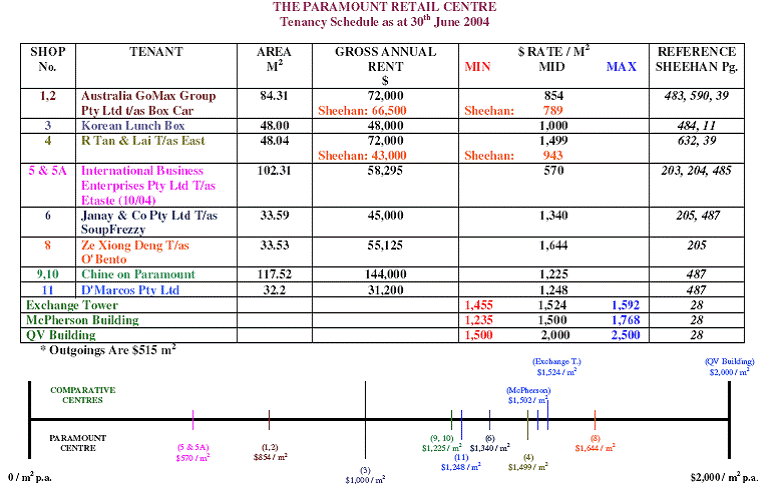
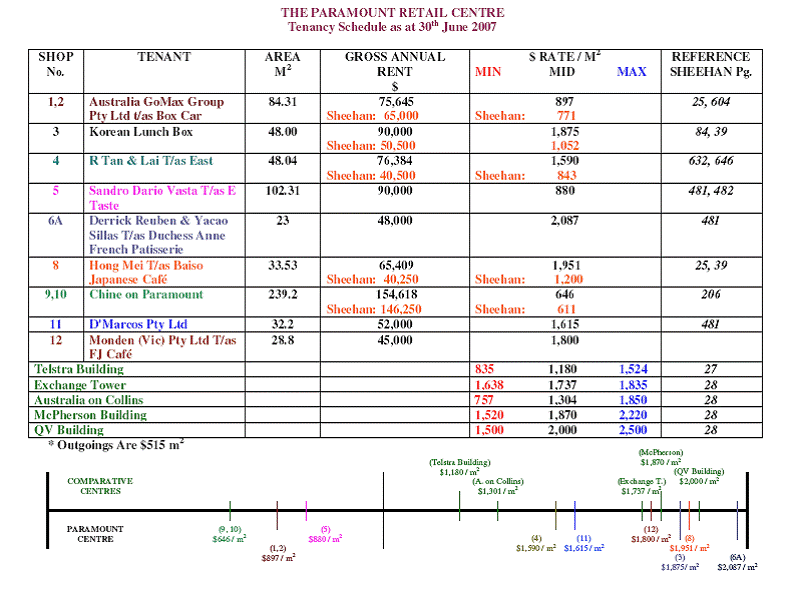
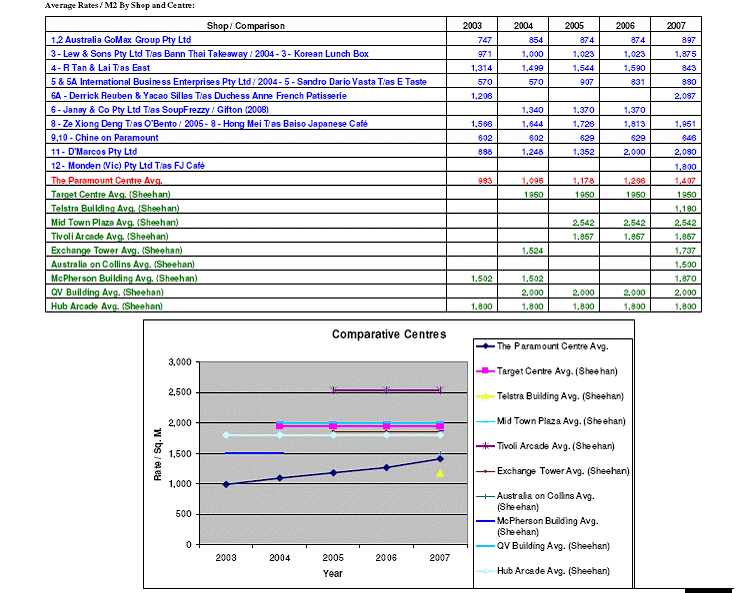
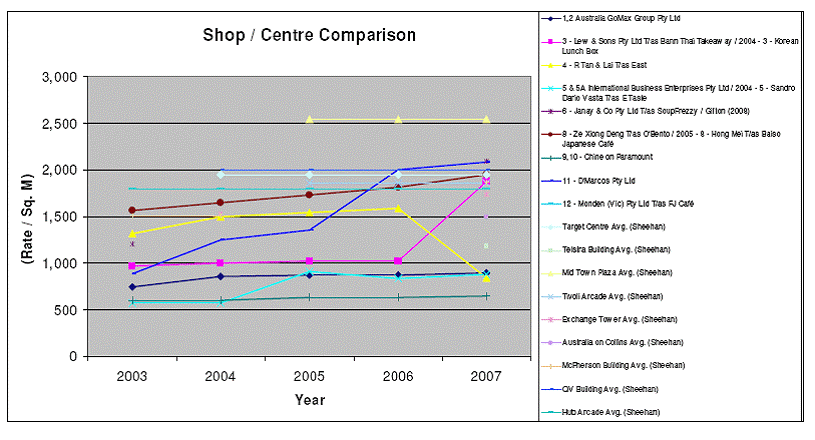
ANNEXURE “C”
As at 30 June 2003
| Shop No. | Area sqm | Tenant |
| Annual Rent (excl GST) | $ rate /sqm | Ref |
| 1, 2
| 84.31 | Australia Gomax Group Pty Ltd trading as Boxcar Café | Actual | $63,000 | $747 | KFS1 pg 488 |
| Sheehan Valuation |
|
|
| |||
| 3 | 48 | Lew & Sons P/L trading as Bann Thai Takeaway | Actual | $46,600 | $971 | KFS1 pg 489 |
| Sheehan Valuation |
|
|
| |||
| 4 | 48.04 | Tan & Lai trading as East on Paramount | Actual | $61,903 | $1,289 | KFS1 pg 20, 206 |
| Sheehan Valuation |
|
|
| |||
| 5 & 5A | 102.31 | International Business Enterprises Pty Ltd trading as E taste | Actual | $58,295 | $570 | KFS1 pg 491 |
| Sheehan Valuation |
|
|
| |||
| 6 | 33.59 | Mano & Jacqueline Marinakis trading as Ice Factory | Actual | $40,516 | $1,206 | KFS1 pg 204 |
| Sheehan Valuation |
|
|
| |||
| 7 | 915.75 | Garvon-Dale P/L trading as Paramount Supermarket & Cellars | Actual | $120,000 | $131 | KFS1 pg 204 |
| Sheehan Valuation |
|
|
| |||
| 8 | 33.53 | Ze Xiong Deng trading as O’Bento
| Actual | $52,500 | $1,566 | KFS1 pg 205 |
| Sheehan Valuation |
|
|
| |||
| 9 & 10 | 239.2 | Banksia Rose (Victoria) Investments P/L trading as Chine on Paramount | Actual | $144,000 | $602 | KFS1 pg 443 |
| Sheehan Valuation |
|
|
| |||
| 11 | 32.2 | D’Marcos Pty Ltd trading as D’Marcos Café | Actual | $28,600 | $888 | KFS1, pg 465 |
| Sheehan Valuation |
|
|
|
As at 30 June 2004
| Shop No. | Area sqm | Tenant |
| Annual Rent (excl GST) | $ rate /sqm | Ref |
| 1, 2
| 84.31 | Australia Gomax Group Pty Ltd trading as Boxcar Café | Actual | $72,000 | $854 | KFS1 pg 26 |
| Sheehan Valuation | $66,500 | $788 | KFS1 pg 39 | |||
| 3 | 48 | Keum Mi Shin trading as Korean Lunch Box | Actual | $48,000 | $1,000 | KFS1 pg 13 & 25 |
| Sheehan Valuation | $43,000 | $896 | KFS 2 pg 10 | |||
| 4 | 48.04 | Tan & Lai trading as East on Paramount | Actual | $72,000 | $1,499 | KFS1 pg 26 |
| Sheehan Valuation | $43,000 | $895 | KFS1 pg 39 | |||
| 5 & 5A | 102.31 | International Business Enterprises Pty Ltd trading as E taste | Actual | $58,295 + CPI | $569 + CPI | KFS1 pg 204 |
| Sheehan Valuation |
|
|
| |||
| 6 | 33.59 | Janay & Co Pty Ltd trading as Soup Frezzy | Actual | $45,000 | $1,340 | KFS1 pg 345 |
| Sheehan Valuation |
|
|
| |||
| 7 | 915.75 | Garvon-Dale P/L trading as Paramount Supermarket & Cellars | Actual | $120,000 | $131 |
|
| Sheehan Valuation |
|
|
| |||
| 8 | 33.53 | Hong Mei trading as Baiso Japanese Café
| Actual | $55,125 | $1,644 | KFS1 pg 25 |
| Sheehan Valuation |
|
|
| |||
| 9 & 10 | 239.2 | Banksia Rose (Victoria) Investments P/L trading as Chine on Paramount | Actual | $144,000 | $602 | KFS1 pg 206 |
| Sheehan Valuation |
|
|
| |||
| 11 | 32.2 | D’Marcos Pty Ltd trading as D’Marcos Café | Actual | $31,200 | $969 | KFS1 pg 206 |
| Sheehan Valuation |
|
|
|
As at 30 June 2005
| Shop No. | Area sqm | Tenant |
| Annual Rent (excl GST) | $ rate /sqm | Ref |
| 1, 2
| 84.31 | Australia Gomax Group Pty Ltd trading as Boxcar Café | Actual | $73,656 | $874 | KFS1 pg 489 |
| Sheehan Valuation |
|
|
| |||
| 3 | 48 | Keum Mi Shin trading as Korean Lunch Box | Actual | $49,104 | $1,023 | KFS1 pg 489 |
| Sheehan Valuation |
|
|
| |||
| 4 | 48.04 | Tan & Lai trading as East on Paramount | Actual | $74,160 | $1,544 | KFS1 pg 489 |
| Sheehan Valuation |
|
|
| |||
| 5 & 5A | 102.31 | Vacant | Actual | Vacant | Vacant |
|
| Sheehan Valuation |
|
|
| |||
| 6 | 33.59 | Janay & Co Pty Ltd trading as Soup Frezzy | Actual | $46,035 | $1,370 | KFS 1 pg 491 |
| Sheehan Valuation |
|
|
| |||
| 7 | 915.75 | Rollei Pty Ltd trading as Park & Shop Supermarket & Cellars
| Actual | $120,000 | $131 |
|
| Sheehan Valuation |
|
|
| |||
| 8 | 33.53 | Hong Mei trading as Baiso Japanese Café
| Actual | $57,881 | $1,726 | KFS1 pg 491 |
| Sheehan Valuation |
|
|
| |||
| 9 & 10 | 239.2 | Banksia Rose (Victoria) Investments Pty Ltd trading as Chine on Paramount | Actual | $150,533 | $629 | KFS1 pg 206 |
| Sheehan Valuation |
|
|
| |||
| 11 | 32.2 | D’Marcos Pty Ltd trading as D’Marcos Café | Actual | $33,800 | $1,050 | KFS1 pg 465 |
| Sheehan Valuation |
|
|
|
As at 30 June 2006
| Shop No. | Area sqm | Tenant |
| Annual Rent (excl GST) | $ rate /sqm | Ref |
| 1, 2
| 84.31 | Australia Gomax Group Pty Ltd trading as Boxcar Café | Actual | $73,656 | $874 | KFS1 pg 489 |
| Sheehan Valuation |
|
|
| |||
| 3 | 48 | Keum Mi Shin trading as Korean Lunch Box | Actual | $50,430 | $1,050 | KFS1 pg 202 Sheehan Affd pg 12 |
| Sheehan Valuation |
|
|
| |||
| 4 | 48.04 | Tan & Lai trading as East on Paramount | Actual | $76,385 | $1,590 | KFS1 pg 322 |
| Sheehan Valuation |
|
|
| |||
| 5 & 5A | 102.31 | Sandro Dario Vasta trading as E taste | Actual | $85,000 | $831 | KFS1 pg 482 |
| Sheehan Valuation |
|
|
| |||
| 6 | 33.59 | Janay & Co Pty Ltd trading as Soup Frezzy | Actual | $46,035 | $1,370 | KFS1 pg 205 |
| Sheehan Valuation |
|
|
| |||
| 7 | 915.75 | Rollei Pty Ltd trading as Park & Shop Supermarket & Cellars
| Actual | $120,000 | $131 |
|
| Sheehan Valuation |
|
|
| |||
| 8 | 33.53 | Hong Mei trading as Baiso Japanese Café
| Actual | $60,775 | $1,183 | KFS1 pg 492 |
| Sheehan Valuation |
|
|
| |||
| 9 & 10 | 239.2 | Banksia Rose (Victoria) Investments P/L trading as Chine on Paramount | Actual | $150,533 | $629 | KFS1 pg 206 |
| Sheehan Valuation |
|
|
| |||
| 11 | 32.2 | D’Marcos Pty Ltd trading as D’Marcos Café | Actual | $50,000 | $1,553 | KFS1 pg 481 |
| Sheehan Valuation |
|
|
|
As at 30 June 2007
| Shop No. | Area sqm | Tenant |
| Annual Rent (excl GST) | $ rate /sqm | Ref |
| 1, 2
| 84.31 | Australia Gomax Group Pty Ltd trading as Boxcar Café | Asking Rent | $96,000 | $1,139 | KFS 1, pg 592
|
| Sheehan Valuation | $65,000 | $771 | KFS1 pg 604 | |||
| 3 | 48 | Keum Mi Shin trading as Korean Lunch Box | Actual | $90,000 | $1,875 | KFS1, pg 25
|
| Sheehan Valuation | $50,500 | $1,052 | KFS1, pg 39 | |||
| 4 | 48.04 | Tan & Lai trading as East on Paramount | Asking Rent | $90,000 | $1,873 | KFS1, pg 634 |
| Sheehan Valuation | $40,550 | $843 | KFS1 pg 646 | |||
| 5 & 5A | 102.31 | Sandro Dario Vasta trading as E taste | Actual | $90,000 | $880 | KFS1, pg 482 |
| Sheehan Valuation |
|
|
| |||
| 6 | 33.59 | Vacant | Actual | Vacant | Vacant | Vacant |
| Sheehan Valuation |
|
|
| |||
| 7 | 915.75 | Rollei Pty Ltd trading as Park & Shop Supermarket & Cellars
| Actual | $120,000 | $131 |
|
| Sheehan Valuation |
|
|
| |||
| 8 | 33.53 | Hong Mei trading as Baiso Japanese Café
| Actual | $80,000 | $2,385 | KFS1, pg 25, 25 KFS1, pg 270 |
| Sheehan Valuation | $40,250 | $1,200 | KFS1, pg 39 | |||
| 9 & 10 | 239.2 | Banksia Rose (Victoria) Investments P/L trading as Chine on Paramount | Actual | $154,618 | $646 | KFS1, pg 686 |
| Sheehan Valuation | $146,250 | $611 | KFS1 pg 700 | |||
| 11 | 32.2 | D’Marcos Pty Ltd trading as D’Marcos Café | Actual | $52,000 | $1,615 |
|
| Sheehan Valuation |
|
|
|


