

FEDERAL COURT OF AUSTRALIA
Optus Networks Ltd v Telstra Corporation Ltd (No. 2) [2009] FCA 422
Telecommunications Act 1997 (Cth)Sch 1
Telecommunications Act 1991 (Cth)ss 88, 137
Trade Practices Act 1974 (Cth) ss 51AA, 82
Evidence Act 1995 (Cth) s 122
Federal Court of Australia Rules
ACCC v Construction, Forestry, Mining and Energy Union [2008] FCA 678 referred to
Australian Medi-Care Co Ltd v Hamilton Pharmaceutical Pty Ltd (No. 3) [2008] FCA 976 referred to
Bennett v Chief Executive of the Australian Customs Service (2004) 140 FCR 101cited
Cadbury Schweppes Pty Ltd v Amcor Ltd (2008) 246 ALR 137 referred to
Commissioner of Taxation v Rio Tinto Ltd (2006) 151 FCR 341 applied
Hadley v Baxendale (1854) 9 Exch 341 referred to
Lansing Linde Ltd v Kerr (1990) 21 IPR 529 referred to
Liberty Funding Pty Ltd v Phoenix Capital Limited (2005) 218 ALR 283 referred to
Lyall v Kennedy (1884) 27 CLD 1considered
McBride v Sandland [1917] SALR 249 considered
Mulley v Manifold (1959) 103 CLR 341 considered
OPTUS NETWORKS PTY LIMITED v TELSTRA CORPORATION LIMITED
NSD 1087 of 1997
EDMONDS J
30 APRIL 2009
SYDNEY
| IN THE FEDERAL COURT OF AUSTRALIA |
|
| NEW SOUTH WALES DISTRICT REGISTRY | NSD 1087 of 1997 |
| BETWEEN: | OPTUS NETWORKS PTY LIMITED Applicant
|
| AND: | TELSTRA CORPORATION LIMITED Respondent
|
| JUDGE: | EDMONDS J |
| DATE: | 30 APRIL 2009 |
| PLACE: | SYDNEY |
INDEX
| INTRODUCTION.......................................................................................................... | [1] |
| Background................................................................................................................. | [1] |
| Scope of the Present Hearing.................................................................................... | [14] |
| The Issues and the Respective Cases....................................................................... | [16] |
| THE ACCESS AGREEMENT...................................................................................... | [22] |
| Definition of ‘Confidential Information’.................................................................... | [23] |
| Clause 15..................................................................................................................... | [26] |
| Other Provisions......................................................................................................... | [32] |
| THE EVIDENCE............................................................................................................ | [36] |
| Affidavit Evidence...................................................................................................... | [36] |
| Documents.................................................................................................................. | [40] |
| THE LEE OUTLINE...................................................................................................... | [41] |
| MOTION TO STRIKE OUT NOTICE TO PRODUCE.............................................. | [46] |
| ISSUES 1 AND 2 | |
| Issue 1: What Information did Telstra use in the Preparation of the Market Share Reports?........................................................................................................... | [71] |
| The Pleadings......................................................................................................... | [73] |
| Interrogatories and Answers.................................................................................. | [82] |
| Summary Analysis.................................................................................................. | [86] |
| Issue 2: If Telstra used Optus’ Traffic Information in the Preparation of the Market Share Reports, was that the use of Confidential Information of Optus for the Purposes of the Access Agreement?................................................................... | [90] |
| Optus’ Submissions................................................................................................ | [92] |
| Telstra’s Submissions............................................................................................. | [100] |
| Optus’ Submissions in Reply................................................................................. | [106] |
| ANALYSIS AND REASONING ON 1 AND 2............................................................ | [114] |
| ISSUES 3 AND 4 | |
| Issue 3: If the Answer to Issue 2 is ‘Yes’, is Telstra’s use of Optus’ Traffic Information in the preparation of Market Share Reports a permissible use under the Access Agreement?.............................................................................................. | [119] |
| Issue 4: If the Answer to Issue 2 is ‘No’, is Telstra’s use of Optus’ Traffic Information in the preparation of Market Share Reports a permissible use under the Access Agreement?.............................................................................................. | [119] |
| ANALYSIS AND REASONING ON 3 AND 4............................................................ | [119] |
| ISSUES 5, 6 AND 7 | |
| Issue 5: Did the Market Share Reports themselves contain Confidential Information of Optus for the purposes of the Access Agreement?.......................... | [122] |
| Issue 6: If the Answer to Issue 5. is ‘Yes’, is the use to which the Market Share Reports are proven to be put a permissible use of such Information under the Access Agreement?.................................................................................................... | [122] |
| Issue 7: If the Answer to Issue 5. is ‘No’, is the use to which the Market Share Reports are proven to be put a permissible use of such Information under the Access Agreement?.................................................................................................... | [122] |
| ANALYSIS AND REASONING ON 5, 6 AND 7........................................................ | [122] |
| CONCLUSIONS............................................................................................................ | [128] |
| RELIEF........................................................................................................................... | [130] |
| IN THE FEDERAL COURT OF AUSTRALIA |
|
| NEW SOUTH WALES DISTRICT REGISTRY | NSD 1087 of 1997 |
| BETWEEN: | OPTUS NETWORKS PTY LIMITED Applicant
|
| AND: | TELSTRA CORPORATION LIMITED Respondent
|
| JUDGE: | EDMONDS J |
| DATE: | 30 APRIL 2009 |
| PLACE: | SYDNEY |
REASONS FOR JUDGMENT
INTRODUCTION
Background
1 The applicant (‘Optus’) and the respondent (‘Telstra’) are engaged in the provision of telecommunications services. Each maintains and operates a telecommunications network for the purpose of carrying telephone calls and other kinds of telecommunications traffic. Those networks are interconnected in accordance with Schedule 1 to the Telecommunications Act 1997 (Cth), which provides the regulatory framework for the provision of such services. The interconnection permits the carriage of telecommunications traffic generated by customers of one party on the other party’s network.
2 The terms and conditions upon which the telecommunications networks of Optus and Telstra are interconnected are set out in an agreement entered into by them (and a related entity of Optus) dated 14 August 1992 as amended from time to time (‘the Access Agreement’). This agreement was entered into pursuant to s 137 of the then Telecommunications Act 1991 (Cth).
3 Prior to 1991, telecommunications services in Australia were provided by a statutory monopoly service provider. In 1991, the Telecommunications Act 1991 partially deregulated the Australian telecommunications industry by allowing Optus to enter the Australian telecommunications market as a second general carrier.
4 Optus (and its subsidiaries) entered the Australian market at that time with no telecommunications network of its own but with the intention of developing over time its own telecommunications network infrastructure. In the interim and beyond the establishment of its own network, Optus required interconnection arrangements with Telstra’s telecommunications network. Initially, Optus required interconnection with Telstra to enable it to compete as a second telecommunications carrier immediately in relation to some telecommunications services, primarily domestic long distance services and international long distance services.
5 In November 1992, Optus commenced providing domestic and international long distance services. At that time, all customers for telecommunications services in Australia were physically connected to Telstra’s network and Optus had not established a network to which customers were able to be directly connected. Optus established its own ‘trunk network’, which enabled its own telecommunications links to be established between the major Australian metropolitan areas and between Australia and international destinations. This progressively enabled Optus to offer domestic long distance and international long distance services to the Australian market over its own network and facilities in competition with Telstra.
6 However, Optus was only able to offer such services by means of its network being interconnected with and having access to Telstra’s existing network, particularly so as to gain connection through to customers. For this purpose, Optus and Telstra agreed to provide certain services, called originating and terminating call access services, to each other to, for example, enable a customer to originate a call on Telstra’s network then connect into the Optus network for long distance trunk network carriage and then connect back off the Optus network to the Telstra network for local terminating delivery. Further, a customer had to be able to select or designate whether such a call was to be made using the services of Telstra or those of Optus for the long distance or trunk network part of the call.
7 Over time, Optus further developed and built its own network. However, the networks of Optus and Telstra were still required to be interconnected. This was because:
(1) For Optus to provide full telecommunications services to customers who were directly connected to its network, it required access to Telstra’s telecommunications network so that those customers could make calls to and receive calls from customers connected to Telstra’s network.
(2) Optus also required access to Telstra’s network so that customers who were not directly connected to the network of Optus could make calls using Optus’ services. The majority of fixed customer phone lines remain Telstra connections. In such cases, Optus’ customers could make calls using Optus as a carrier through Telstra’s network by either pre-selecting Optus networks as their preferred long distance call carrier, or by using a call override dial code prior to making a particular call.
8 Where the telecommunications networks of two carriers are interconnected, and telecommunications traffic generated by customers of one carrier passes across the network operated by the other carrier, the latter carrier has access to certain information relating to that telecommunications traffic. This includes information regarding the quantity, source, destination, duration, time of occurrence or kind of the telecommunications traffic, as well as the value of the telecommunications traffic whether in terms of its aggregate billing value or individual customer billing details and value (collectively, ‘traffic information’).
9 For a particular telephone call such traffic information could include:
(1) Quantity - the number or volume of calls made;
(2) source – the telephone number of the customer making the call and the geographic location from which the call was made;
(3) destination – the telephone number and the geographic location to which the call was made;
(4) duration – the length of the call in time;
(5) time of occurrence – the date and time at which the call took place;
(6) kind – such as whether the call was a long distance call or was made using different telecommunications services; and
(7) value – the amount to be billed for that call or for that part of the call carried by the carrier.
10 Certain kinds of traffic information are required to be recorded by the carrier across whose network such telecommunications traffic passes so that it can bill the appropriate interconnecting carrier for the passage of the traffic over its network. Telstra recorded traffic information on its network, both its own traffic information and that of Optus, and after 1997 the traffic information of other carriers that used Telstra’s network, by application of a computer system known as NUMIS 100. At [85] and [86] below I have set out Telstra’s answers to interrogatories and summarised those answers as well as Telstra’s pleadings. Those answers and that summary shed some light on what Telstra claims was (1) the information recorded on NUMIS 100; and (2) the information extracted from it,
11 In this proceeding Optus alleges that, at least since 1995 and until at least September 2003, Telstra has used Optus’ traffic information for marketing, promotional and related purposes without the knowledge and consent of Optus by the preparation and use of weekly reports containing information as to Telstra’s market share in the STD and IDD segments of the Australian telecommunications market (‘market share reports’).
12 Optus alleges that Telstra’s conduct in using Optus’ traffic information and in preparing and using the market share reports has involved:
(1) Breaches of the provisions of the Access Agreement which restrict the use of ‘Confidential Information’ as defined therein;
(2) breaches of confidence at general law; and
(3) unconscionable conduct in contravention of s 51 AA of the Trade Practices Act 1974 (Cth) (‘the TPA’).
13 Telstra denies that it used Optus’ traffic information to prepare the market share reports. The only information it admits to having used was NUMIS 100’s recordation of the aggregate traffic information over its network. Such information was, Telstra claimed, Telstra’s information and for these and other reasons relating to the definition of Confidential Information and the terms of cl 15.1 of the Access Agreement prohibiting the use of Confidential Information of a party by another party except for limited purposes, Telstra’s use of information to prepare the market share reports was neither a breach of the Access Agreement, a breach of confidence under general law principles or a contravention of s 51AA of the TPA.
Scope of the Present Hearing
14 On 21 November 2007, I ordered that certain issues be reserved for separate and later determination pursuant to O 29 r 2 of the Federal Court of Australia Rules (‘the Rules’). The issues reserved relate to Optus’ entitlement to injunctive and pecuniary relief and the quantum of any such pecuniary relief, including the extent of Telstra’s use of Confidential Information by the preparation and distribution of market share reports to officers of Telstra in the relevant years.
15 Accordingly, the hearing was confined to what might generally be called issues of liability, including the question whether the alleged breaches and contraventions have occurred, and Optus’ entitlement to consequential declaratory relief.
The Issues and the Respective Cases
16 The ultimate issue as pleaded in this case is whether Telstra used information which was Confidential Information of Optus in breach of the terms the Access Agreement; or in breach of confidence at general law; or constituted unconscionable conduct in contravention of s 51AA of the TPA.
17 At the end of the day, senior counsel for Optus conceded that if there was no breach of contract, specifically cl 15 of the Access Agreement (as to which see [26] – [31] below), neither of the alternative causes of action pleaded – breach of confidence under general law principles and unconscionable conduct in contravention of s 51AA of the TPA – had any ‘legs’. I think this concession was correctly made. On the other hand, he said that if breach of contract is established, the equitable cause is still relevant to Optus’ claim for an account of profits and that damages under s 82 of the TPA may be not the same as the claim for ‘Hadley v Baxendale’((1854) 9 Exch 341) damages in contract, although it is difficult to see how Optus could do better in damages under s 82 of the TPA for contravention of s 51AA, than it could do on the contract claim.
18 So articulated and confined, the ultimate issue as pleaded has the following underlying issues, the answers to which will determine the answer to the ultimate issue:
(1) What information did Telstra use in the preparation of the market share reports?
(2) If Telstra used Optus’ traffic information in the preparation of the market share reports, was that the use of Confidential Information of Optus for the purposes of the Access Agreement?
(3) If the answer to issue 2. is ‘yes’, is Telstra’s use of Optus’ traffic information a permissible use of such information under the Access Agreement?
(4) If the answer to issue 2. is ‘no’, is Telstra’s use of Optus’ traffic information a permissible use of such information under the Access Agreement?
(5) Did the market share reports themselves contain Confidential Information of Optus for the purposes of the Access Agreement?
(6) If the answer to issue 5. is ‘yes’, is the use to which the market share reports are proven to be put a permissible use of such information under the Access Agreement?
(7) If the answer to issue 5. is ‘no’, is the use to which the market share reports are proven to be put a permissible use of such information under the Access Agreement?
19 In respect of all but the first underlying issue, there are two collateral issues to be addressed:
(1) The proper construction of the relevant provisions of the Access Agreement; and
(2) the proper application of these provisions to the facts.
20 It lies at the heart of Optus’ case that Telstra used Optus’ traffic information in the preparation of the market share reports; that that information was Confidential Information for the purposes of the Access Agreement; and that the use of that information in that way, and the use to which the market share reports were themselves put by the management of Telstra, was an impermissible use of that information under the Access Agreement.
21 It lies at the heart of Telstra’s defence that it did not use Optus’ traffic information in its preparation of the market share reports; that irrespective of the identity of the information so used, it was not Confidential Information of Optus for the purposes of the Access Agreement; and that the use of that information in that way, and the use to which the market share reports were themselves put by the management of Telstra, was not an impermissible use of that information under the Access Agreement.
THE ACCESS AGREEMENT
22 The Access Agreement has been amended on numerous occasions since it was entered into by the parties on 14 August 1992. None of the amendments are material for present purposes.
Definition of ‘Confidential Information’
23 Clause 1.1 of the Access Agreement defines ‘Confidential Information’ in the following terms:
‘Confidential Information’ of a party means all information (excluding CLI), know-how, ideas, concepts, technology, manufacturing processes, industrial, marketing and commercial knowledge of a confidential nature (whether in tangible or intangible form) relating to or developed in connection with or in support of the business of the party and includes the contents of the schedules (and any matter concerned with or arising out of this agreement) and the licences described in clause 14.5(b) but does not include:
(i) information which is or becomes part of the public domain (other than through any breach of this agreement); or
(ii) information rightfully received by another party from a third person without a duty of confidentiality being owed by the other party to the third person, except where the other party has knowledge that the third person has obtained that information either directly or indirectly as a result of a breach of any duty of confidence owed to the first mentioned party; or
(iii) information which has been independently developed by another party.
24 The abbreviation ‘CLI’ stands for ‘calling line identification’ and is also defined in cl 1.1; it refers to information identifying a calling number which is forwarded across interconnected networks when telecommunications traffic passes from one network to the other.
25 The significance of CLI requires explanation. Telephone users could only select Optus if the network to which the user, or customer, was connected had CLI capability; that is, had the ability to both identify the caller’s calling number and could forward that number across interconnected telecommunications networks. In a small proportion of cases, CLI functionality was not available and Optus could not provide telecommunications services to that caller. The market share reports during 1994 and 1995 distinguish between contestable market and total market for IDD. The former expression means that market comprised of customers using a network with CLI capability and to whom Optus was able to provide services at that time. The latter expression (total market) includes the former and also that proportion of the market representing customers without access to a CLI network or to whom Optus was not providing services at that time; who could only be serviced by Telstra.
Clause 15
26 Clause 15 of the Access Agreement imposes restrictions on the use and disclosure of Confidential Information.
27 The key provisions are cll 15.1 and 15.2 which provide as follows:
15.1 Subject to clause 15.3 and section 88 of the Act, each party must keep confidential all Confidential Information of another party which:
(a) is disclosed, communicated or delivered to it by a party pursuant to this agreement; or
(b) comes to its knowledge or into its possession in connection with this agreement,
and must not:
(c) use or copy such Confidential Information except for the purposes of this agreement or any licence granted under clause 14.5(b) or as required by AUSTEL ; or
(d) disclose or communicate, cause to be disclosed or communicated or otherwise make available such Confidential Information to any third person other than its directors, officers, employees, agents, contractors or representatives to whom disclosure is necessary for the purpose of this agreement or any licence granted under the clause 14.5(b).
15.2 Each party must establish and observe procedures adequate to protect the Confidential Information of another party and, without limiting the generality of the foregoing, must ensure that each of its directors, officers, employees, agents and representatives to whom that Confidential Information is disclosed for the purposes of this agreement is subject to and maintains the confidentiality obligations set out in clause 15.1.
28 Clause 15.3 (to which cl 15.1 is expressed to be subject) sets out certain circumstances in which a party may disclose the Confidential Information of another party. These include disclosure to the party’s directors, officers, employees, agents, contractors or representatives (subject to compliance with cl 15.2); disclosure to the other party; disclosure to the party’s professional advisors; disclosure as required by law; disclosure with the consent of the other party; disclosure in accordance with a directive issued by AUSTEL (the relevant regulator) or the government; and disclosure to AUSTEL for the purpose of registration of the Access Agreement or any amendment to that agreement.
29 ‘Section 88 of the Act’ (to which cl 15.1 is also expressed to be subject) is a reference to s 88 of the Telecommunications Act 1991 which was in force when the Access Agreement was entered into. This was a detailed provision which, in general terms, made it an offence for employees or former employees of telecommunications service providers to disclose or use information relating to telecommunications traffic, subject to certain exceptions. The reference in cl 15.1 of the Access Agreement to this provision does not bear upon the issues in dispute in this proceeding.
30 The remaining provisions of cl 15 of the Access Agreement (cll 15.3A to 15.7) deal with ancillary matters such as conditional disclosure of Confidential Information by consent, co-operation in actions to protect confidentiality, certain acknowledgements and the permitted use of CLI (calling line identification).
31 Because the effect of cl 15.1 is to prohibit the use or disclosure of such Confidential Information falling within sub-paras (a) or (b), except for the purposes of the Access Agreement or the other purposes referred to in sub-paras (c) or (d), it is necessary to have regard to some of the other provisions of the agreement.
Other Provisions
32 Various other provisions of the Access Agreement deal with the mechanics of the interconnection arrangements. In particular, cll 3 to 9 impose requirements and set out the terms and conditions for the provision by the parties to each other of various relevant services (interconnect services, access services, transmission capacity and short order capacity, facilities access and the like), and cll 12 and 13 require the parties to take certain steps or measures in relation to the operation of their interconnected networks.
33 Clause 10 is significant. It deals with certain obligations of the parties to provide information to each other pursuant to the agreement. Relevantly:
(1) Clause 10.1 provides that the obligations of a party to provide information to another party ‘are as set out in this agreement and are subject to the requirements of confidentiality imposed by clause 15’, and include ‘this clause 10’;
(2) clause 10.4 requires each party to provide the other relevant party with ‘Communication Information in relation to each Designated Communication’. By reason of various definitions contained in cl 1.1 of the Access Agreement (the definitions of ‘Communication Information’, ‘Designated Communication’, ‘Communication’, Access Service’ and ‘POI’), this encompasses traffic information relating to telecommunications traffic carried pursuant to the interconnection arrangements, including information such as the calling number, billing number, called number, time and duration of communication, applicable fees, routing information and other details;
(3) clauses 10.3 and 10.5 require the parties to provide each other with other information required for billing purposes;
(4) clause 10.7 provides, inter alia, that information provided under the Access Agreement ‘may only be used for the purpose for which it was given’;
(5) clauses 10.8 and 10.9 made provision for certain specific exceptions to the requirement to provide information under the Access Agreement;
(6) clause 10.10 provides that, subject to Schedule 4 (which deals with the charges that the parties are to pay to one another for interconnection services, the rates and principles for the determination of such charges and applicable terms and conditions), ‘nothing in this agreement may be construed to require an Access Carrier providing International PSTN Terminating Access to provide information on its traffic volumes, routings or accounting rates with its Correspondents’. When regard is had to various definitions contained in cl 1.1 (the definitions of ‘Access Carrier’, ‘Carrier’, ‘Service’, Interconnect Carrier’, ‘International PSTN Termination Access’ (and the further definitions of the defined terms used in that definition) and ‘Correspondent’), the effect of this provision, in general terms, is that a party is not required to provide the other party with information on its traffic volumes, routings or accounting rates for international (IDD) telecommunications traffic other than as required to enable the other party to bill it for interconnection services; and
(7) clause 10.13 permits Telstra to disclose certain kinds of Confidential Information of Optus to the Commonwealth pursuant to a shareholder resolution requiring such disclosure, subject to certain conditions including that Telstra notify Optus of its intention to do so and that the Commonwealth enter into undertakings restricting the communication of such Confidential Information.
34 Optus submitted, and the submission is analysed below, these various provisions in cl 10 are relevant because they provide a context for the interpretation of cl 15. In particular, it is said that they confirm that traffic information of the kind in issue in these proceedings is Confidential Information of a kind intended to be protected by cl 15.
35 The remaining provisions of the Access Agreement deal with other matters which are not material for present purposes.
THE EVIDENCE
Affidavit Evidence
36 Optus relied on affidavits of:
(1) Alan Petts (3): the first sworn 16 December 1997 (Ex. 1); the second sworn 11 December 2007 (Ex. 2); and the third sworn 6 June 2008 (Ex. 3) in reply;
(2) Mr Gregg Rowley sworn 11 June 2008 (Ex. 4) in reply; and
(3) Mr Michael Smith sworn 17 December 2007 (Ex. 5).
37 Only Mr Petts was required for cross-examination.
38 Telstra filed affidavits by three persons:
(1) Mr Stuart Alan Newton Lee sworn 15 April 2008;
(2) Mr Noel Ian Eldridge sworn 11 April 2008; and
(3) Ms Kristen Cassandra Wood sworn 11 April 2008 (Ex. A).
39 Only Ms Wood’s affidavit was read and she was required for cross-examination. At this stage, I would merely observe that her evidence, in my view, had no utility whatsoever to a resolution of the ultimate issue identified in [16] above, nor any of its component parts. However, her evidence in cross-examination did lead Optus to seek leave to amend its Fourth Consolidated Amended Statement of Claim in a couple of minor respects (paras (15) and (29)), which was not opposed by Telstra, and I granted that leave. By the same order, I relieved Telstra from filing any amendment to its Fourth Amended Defence.
Documents
40 Optus tendered the following documents:
(1) The Access Agreement and Schedules as at the date of execution (14 August 1992): Ex. 6.
(2) Telstra Annual Reports from 1992 to 2000: Ex. 7. The relevance of these was said to be that they disclosed Telstra’s revenues per annum and total minutes sold in the IDD and STD markets. But their relevance to the ultimate issue or its component parts was not made good.
(3) Three volumes of documents being applications for access to MEIS and SAMURAI: Ex. 8. The relevance of these applications was put in the following way: MEIS was a function which was introduced in about June 1997 to access the market share information available on the NUMIS 100 system. The MEIS function of accessing information on NUMIS 100 was then replaced by the SAMURAI function. But again, their relevance to the ultimate issue or its component parts was not made good.
(4) Paragraphs (1) – (17) and (32) of the affidavit of Noel Ian Eldridge sworn 11 April 2008: Ex. 9.
(5) Paragraphs (1) – (16), (63) – (101), (140) – (177) and (279) (together with the heading on the cover page and the name and date on the final page) of Outline of Evidence of Stuart Alan Newton Lee dated 5 February 1996 (‘the Lee Outline’) and attachments ‘SL8-C’ and ‘SL26-C’ to the Lee Outline (as referred to in orders made by this Court on 26 July 1996 in proceeding No. 731 of 1995) being documents behind tabs 7A, 10 – 12, 14 – 26 and 29 of Vol. 5 of the Court Book identified in the index of documents forming part of Ex. 11: Ex. 10. The background to the Lee Outline and the issues arising on the admission of the relevant paragraphs and attachments into evidence are dealt with in [41] to [45] below.
(6) The documents behind tabs 2, 4, 6, 7, 8, 9, 13, 21, 27, 31 – 35 and 37 – 40 of Vol 5 of the Court Book; behind tabs 41 – 46 and 48 – 81 of Vol 6 of the Court Book; behind tabs 82 – 93 and 96 – 100 of Vol 7 of the Court Book; behind tabs 101 – 199 and 122 of Vol 8 of the Court Book; and behind tab 129 of Vol 11 of the Court Book, including the index describing the documents tendered, their date (if any) and their provenance: Ex 11.
(7) The interrogatories and answers to same I gave Optus leave to administer on 12 June 2007: Ex. 12.
(8) The licence to operate as a General Telecommunications Carrier dated 22 November 1991 granted to AUSSAT Pty Ltd (now Optus) effective 26 November 1991: Ex. 13.
THE LEE OUTLINE
41 On 15 December 2006 I granted Optus leave to use certain parts of the Lee Outline served by Telstra in Federal Court proceeding No. G731 of 1995 between Telstra, Optus and the Australian Telecommunications Authority, namely, paras 86 – 93 and 166 – 177, and attachments ‘SL8-C’ and SL26-C’ to the Lee Outline: SingTel Optus Pty Ltd v Telstra Corporation Ltd (No. 1) [2006] FCA 1752.
42 Telstra opposed the tender of those paragraphs of the Lee Outline and the attachments, the subject of the grant of leave to use referred to in [41] above, on the ground that they were privileged, but fairly conceded that the weight of authority, in particular authority binding on me, was against its submission. The prevailing authority in this Court is in favour of the filing and service of an outline of evidence being a full waiver of privilege, such that the outline is then protected only by the implied undertaking to the Court not to use the document other than for the purpose of the proceeding without the leave of the Court: Liberty Funding Pty Ltd v Phoenix Capital Limited (2005) 218 ALR 283 at [20] – [23]; Cadbury Schweppes Pty Ltd v Amcor Ltd (2008) 246 ALR 137 at [15] – [19] per Gordon J; ACCC v Construction, Forestry, Mining and Energy Union [2008] FCA 678 at [122] – [130] per Finn J; Australian Medi-Care Co Ltd v Hamilton Pharmaceutical Pty Ltd (No. 3) [2008] FCA 976 at [15] per Lander J. Once leave is granted to use the document, the party seeking to do so is released from the implied undertaking and may use it accordingly.
43 Optus also sought to tender the balance of the Lee Outline in opposition to the same submission, but subject to the same concession, on the part of Telstra. However, I indicated to the parties that, consistent with the leave granted on 15 December 2006, only those parts of the balance of the Lee Outline as were contextually relevant should be the subject of a grant of leave; as agreed between the parties or, in default, as I may rule.
44 I then heard the parties’ respective arguments on the question of admissibility. Optus argued that the Lee Outline was admissible as an admission adverse to interest by reference to the pleadings. Telstra argued that the Lee Outline was not an admission by Telstra; it was nothing more than an admission as to the evidence Telstra expected Mr Lee to give.
45 However, at the end of the day, senior counsel for Telstra conceded that the Lee Outline was ‘against our interest generally in the proceedings’, putting aside the confined nature of the hearing on liability. Consequently, I allowed Optus to tender paras 1 – 16, 62 – 85, 94F, 101, 104 – 165 and 279 of the Lee Outline in addition to the tender of those paragraphs and attachments referred to in [41] above. In doing so, I indicated to senior counsel for Optus that unless I was taken to a particular paragraph of the Lee Outline, I was not going to look at it.
MOTION TO STRIKE OUT NOTICE TO PRODUCE
46 In accordance with O 16 r 2(2)(b) of the Rules, Telstra’s statement in answer to the interrogatories was verified by affidavit of Tamara Joanne Paatsch sworn 14 August 2007 in the following terms:
1. I am a solicitor employed by Telstra Corporation Limited as Legal Counsel, Dispute Resolution, Telstra Legal Services and have had day to day carriage of this matter on behalf of the Respondent since I commenced my employment with the Respondent in April 2006. I am authorised to make this Affidavit on behalf of the Respondent.
2. I have no personal knowledge of any of the matters raised by the Applicant in the notice to answer interrogatories annexed to the orders of the Court made on 12 June 2007 (‘Interrogatories’).
3. The Respondent’s answers to the Interrogatories are based on:
(a) my review of relevant documents known to be in the possession of the Respondent to the extent that they were identified and available for my review;
(b) my review of relevant documents which were in the possession of third parties contracted by the Respondent in relation to Telstra’s systems and to the extent that they were identified and available for my review;
(c) enquiries made by me of current employees of the Respondent to the extent that I expected them to be in possession of material information and to the extent that they were available for such enquiry;
(d) enquiries made by me of former employees or contractors of the Respondent to the extent that I expected them to be in possession of material information and to the extent that they were available for such enquiry;
4. Having made the enquiries set out in paragraph 3 of this Affidavit, the Respondent’s answers to the Interrogatories are true to the best of my knowledge, information and belief.
47 On 26 September 2008, Optus served a notice to produce on Telstra seeking production of, relevantly:
1. ‘All documents recording or being
(a) the enquiries made by Ms Paatch referred to in paragraphs 3(c) and (d) of Ms Paatch’s affidavit verifying the Respondent’s Answers to Interrogatories dated 14 August 2007; or
(b) Communications between Ms Paatch and any other person created, made or entered into for the purposes of responding to the Interrogatories annexed to the orders of the Court made on 12 June 2007’.
48 On the second day of the hearing, I heard a motion by Telstra, by notice filed on 3 October 2008, to set aside the notice to produce, and I acceded to that motion. At the time, I indicated that I would give my reasons for setting aside the notice to produce as part of these reasons, and I now do so.
49 Telstra sought to set aside para 1 of the notice to produce on the ground that it was an abuse of process:
(1) Being, in effect, an application to go behind the affidavit verifying the answer in circumstances where the affidavit is conclusive and no basis has been demonstrated for going behind the affidavit;
(2) being, in effect, an application for further and better answer to interrogatories, which is defective in form and baseless in substance; and
(3) being issued in circumstances where the documents sought are, and must be known by Optus to be, protected by legal professional privilege.
50 Optus conceded that the communication between Ms Paatsch and any persons for the purpose of answering the interrogatories was properly the subject of a claim for legal professional privilege, but argued that the filing of the affidavit amounted to a waiver.
51 Optus did not expressly identify which of the answers to the interrogatories prompted it to issue the notice to produce, however, it became apparent in the course of submissions of senior counsel of both parties that it was the answer to para 3(e) which was the catalyst.
52 The interrogatory relevantly read:
3A. Look at paragraphs 35(a), 36(a), 38(a), 39(a), 41(a), 42(a), 44(a), 45(a), 47(a), 48(a), 50(a), 51(a), 53(a), 54(a), 56(a), 57(a), 60(a), 62(a), 63(a), 65(a), 66(a), 68(a), 69(a) of the Defence and answer the following in respect of each such paragraph:
…
(e) Was the particular market Share Report referred to in that paragraph used:
(i) For the purpose of marketing, including considering or developing strategy for marketing, products or services of Telstra to existing or prospective customers? Or
(ii) For the purpose of promotion, including considering or developing strategy for promotion, of products or services of Telstra to existing or prospective customers? Or
(iii) Or for the purpose of selling, including considering or developing strategy for selling, products or services of Telstra to existing or prospective customers?
53 The answer relevantly read:
3B. Having made enquiries of:
Ÿ for the purposes of paragraphs 3B(a) to 3B(d) of the Interrogatories, current and former employees and contractors of the Respondent including those who have knowledge of Telstra’s systems and processes; and
Ÿ for the purposes of paragraphs 3B(e) of the Interrogatories; current and former employees of the Respondent including those who received or were likely to have received the particular Market Share Report referred to in paragraphs 35(a), 36(a), 38(a), 39(a), 41(a), 42(a), 44(a), 45(a), 47(a), 48(a), 50(a), 51(a), 53(a), 54(a), 56(a), 57(a), 60(a), 62(a), 63(a), 65(a), 66(a), 68(a), 69(a)
the Respondent, in respect of each of paragraphs 35(a), 36(a), 38(a), 39(a), 41(a), 42(a), 44(a), 45(a), 47(a), 48(a), 50(a), 51(a), 53(a), 54(a), 56(a), 57(a), 60(a), 62(a), 63(a), 65(a), 66(a), 68(a), 69(a) of the Defence, answers as follows:
…
(e) the Respondent is unable to answer paragraph 3(e) of the Interrogatories as none of the persons who were the subject of the Respondent’s enquiries could recall if the particular Market Share Report referred to in each paragraph was used for at least one of the following purposes:
• for the purpose of marketing, including considering or developing strategy for marketing, products or services of Telstra to existing or prospective customers; or
• for the purpose of promotion, including considering or developing strategy for promotion, of products or services of Telstra to existing or prospective customers; or
• for the purpose of selling, including considering or developing strategy for selling, products or services of Telstra to existing or prospective customers.
54 However, on the question of the sufficiency of an answer to an interrogatory, it was established 125 years ago that the whole of the affidavit in answer had to be referred to, not just the answer to a particular interrogatory: Lyall v Kennedy (1884) 27 CLD 1 at 15 per Cotton LJ.
55 In the present case, the interrogatory in para 1(e) relevantly read:
1A. Look at paragraphs 12(b), 16(a), 18(a), 22(a), 25(a), 28(a), 30(a) and 33(a) of the Defence to the Third Consolidated Amended Statement of Claim filed 5 March 2007 (‘Defence’) and answer the following in respect of each such paragraph:
…
(e) Were any of the Market Share Reports referred to in that paragraph used:
(i) for the purpose of marketing, including considering or developing strategy for marketing, products or services of Telstra to existing or prospective customers? Or
(ii) for the purpose of promotion, including considering or developing strategy for promotion, of products or services of Telstra to existing or prospective customers? Or
(iii) for the purpose of selling, including considering or developing strategy for selling, products or services of Telstra to existing or prospective customers?
56 The answer relevantly read:
1B. Having made enquiries of:
Ÿ for the purposes of paragraphs 1B(a) to 1B(d) of the Interrogatories, current and former employees and contractors of the Respondent including those who have knowledge of Telstra’s systems and processes; and
Ÿ for the purposes of paragraph 1B(e) of the Interrogatories, current and former employees of the Respondent including those who received Market Share Reports as defined in paragraph 10 of the Defence,
the Respondent, in respect of each of paragraphs 12(b), 16(a), 18(a), 22(a), 25(a), 28(a), 30(a) and 33(a) of the Defence, answer as follows:
…
(e) Yes.
57 The sufficiency of the answer to the interrogatory in para 3(e) has to be read in this context, that is, in the context of the answer to the interrogatory in para 1(e) and so read, there cannot be any doubt, in my mind, as to its sufficiency.
58 In determining whether a party should be required to make further answer to interrogatories the court considers whether the existing answer is sufficient and not whether it is truthful: Lyall v Kennedy at 21; McBride v Sandland [1917] SALR 249 at 262. The requirement of sufficiency is now embodied in O 16 r 8 of the Rules.
59 In determining the sufficiency of an answer, the Court may only look to:
(1) The pleadings;
(2) the whole of the answers themselves;
(3) documents referred to;
(4) the nature of the interrogatory.
60 Interrogatories are a form of discovery. An affidavit verifying answers to interrogatories has the same status as an affidavit as to documents verifying discovery. The general rule in relation to such an affidavit is that it is conclusive unless it is self-evident that the discovery is insufficient: see Mulley v Manifold (1959) 103 CLR 341 at 343 per Menzies J.
61 That is not this case. I agree with Telstra’s submission that the issue of the notice to produce was a ‘backdoor’ attempt to overcome the conclusiveness of Ms Paatsch’s affidavit; in substance, an abuse of process and on that ground alone I set it aside, para 2 of the notice no longer being in issue.
62 While it was not material to my conclusion, I would add that contrary to the submission that was pressed on me by senior counsel for Optus, I am not persuaded that Ms Paatsch’s verification of the answers to the interrogatories by affidavit in accordance with O 16 r 2(2)(b) of the Rules works some waiver, under s 122 of the Evidence Act 1995 (Cth), of the privilege attaching to documents regarding or being the enquiries referred to by Ms Paatsch in paras 3(c) and (d) of her affidavit and communications between Ms Paatsch and any other person made for the purposes of responding to the interrogatories.
63 Under s 122 of the Evidence Act, privilege will be waived where the party concerned consented to the document being adduced, or if the party ‘knowingly and voluntarily disclosed to another the substance of the evidence’. Certain exceptions apply to the latter, including (but not limited to) if the disclosure was under compulsion of law (s 122(5)(a)(iii)).
64 Senior counsel for Telstra submitted that there was no voluntary disclosure because the Rules (O 16 r 2(2)(b)) mandated the verification of the answers by affidavit; indeed, he submitted that the disclosure was made under compulsion of law and so fell within the exception specifically referred to in [63] above. He further submitted that he was not seeking to read Ms Paatsch’s affidavit and that contrary to Optus’ submission, he was not deploying an answer, based on privileged communications, ‘for forensic or commercial purposes’; Bennett v Chief Executive of the Australian Customs Service (2004) 140 FCR 101 at [68] per Gyles J.
65 On the other hand, I think there is a more fundamental response to Optus’ submission that there has been a waiver of any privilege in the documents referred to in [62] above.
66 First, para 3 of Ms Paatsch’s affidavit says no more than that Telstra’s answers to the interrogatories are based on her review of relevant documents and enquiries of current and former employees of Telstra.
67 Second, it may be accepted that implied waiver at common law will occur where:
[T]he privilege holder’s conduct is inconsistent with the continued confidentiality of the communication because he or she has put in issue the character or contents of the communication in pursuing a right or claim, or has created a situation where another party must reasonably do so by way of a defence.
(Commissioner of Taxation v Rio Tinto Ltd (2006) 151 FCR 341 at [54])
68 Earlier, the same Full Court said at [52]:
These authorities show that, where issue or implied waiver is made out, the privilege holder has expressly or impliedly made an assertion about the contents of an otherwise privileged communication for the purpose of mounting a case or substantiating a defence. Where the privilege holder has put the contents of the otherwise privileged communication in issue, such an act can be regarded as inconsistent with the confidentiality that would otherwise pertain to the communication.
69 Third, nothing in Ms Paatsch’s affidavit put the contents of an otherwise privileged communication in issue, in the sense of mounting a case or substantiating a defence. The contrast with Rio Tinto is exemplified by what the Full Court said at [71] and [72]:
[71] By his answers to Rio’s requests, the Commissioner disclosed that the eight privileged scheduled documents were relevant to reaching his state of satisfaction and exercising his discretions. Although the validity of his state of satisfaction and the exercises of his discretion are key issues in the substantive proceeding, as indicated earlier, the mere acknowledgement of the relevance of privileged documents to the key issues does not amount to an act inconsistent with the maintenance of privilege. As we have seen, so far as the Commissioner was concerned the relevant inquiry was whether, having regard to the material before the decision-maker, the contested decisions were vitiated on Avon Downs grounds. If the particulars merely disclosed that the Commissioner took into account legal advice in reaching his state of satisfaction and exercising his discretions, then that disclosure would not be inconsistent with the maintenance of privilege.
[72] The Commissioner has not, however, simply said that the eight privileged scheduled communications were relevant to reaching his state of satisfaction or exercising his discretions. Nor has he said that he took them into account in so doing. We interpolate that a document may be relevant to a decision without evidencing any matter taken into consideration in the making of it (as, eg, an instrument conferring authority to make the decision). The Commissioner could have identified his bases for satisfaction and exercises of discretion by listing the matters he took into account in each case, but he did not do so. Instead, he identified his bases for satisfaction and exercises of discretion as the matters evidenced in the scheduled documents. In so doing, the Commissioner did more than make an assertion about the relevance of these communications. In his particulars, the Commissioner has said that he took into account the matters evidenced by numerous documents, including the eight privileged scheduled documents. In so doing, the Commissioner has made an assertion that puts the contents of these eight documents in issue, or necessarily lays them open to scrutiny, with the consequence that there is an inconsistency between the making of the assertion and the maintenance of the privilege.
(Emphasis added.)
70 For these reasons, I am of the view that there was no waiver of any privilege in any documents of the kind referred to in [62] above.
ISSUES 1 AND 2
Issue 1: What Information did Telstra use in the Preparation of the Market Share Reports?
71 The difficulty with determining this particular issue is that the only party which knew what information had been used in the preparation of the market share reports, Telstra, led no evidence on the matter. There was some ‘evidence from the bar table’ in the form of submissions but, apart from its answers to the interrogatories I gave Optus leave to administer, there is no direct evidence. There are documents in evidence which, arguably, enable one to draw inferences and conclusions as to what information might have been used, in particular, the market share reports and internal Telstra communications, but the element of uncertainty that attends that task, makes it a less than satisfactory course to take.
72 So confined, the starting point for determining this issue is, as it is in most cases, the pleadings.
The Pleadings
73 In response to Optus’ pleading at [12] of its Fifth Consolidated Amended Statement of Claim (‘FCASC’), Telstra admitted that in the course of carrying Optus’ telecommunications traffic on its own network pursuant to the Access Agreement, Telstra recorded traffic information in relation to Optus’ telecommunications traffic which it carried in part or in whole on Telstra’s telecommunications network. But it denied that the information, which it called ‘traffic information’, was Confidential Information within the meaning of cl 15 of the Access Agreement; see [6] of its Amended Defence to Fourth Consolidated Amended Statement of Claim (‘ADFCASC’).
74 In response to Optus’ pleading at [15] of its FCASC that Telstra has used until at least September 2003 the traffic information for purposes which are not permitted purposes pursuant to the Access Agreement, namely, in the preparation of market share reports, Telstra denied these allegations: see [9] of its ADFCASC.
75 In response to Optus’ pleading at [16] of its FCASC, Telstra admitted that at least from 1995 its prepared market share reports of the type described in Optus’ pleading which provided various estimates of percentage measures of Telstra’s share of STD and IDD traffic of the total STD and IDD traffic which was recorded in Telstra’s NUMIS 100 database, but said that it had not prepared any market share reports since about November 2000: see [10] of its ADFCASC.
76 In response to Optus’ pleading at [17] of its FCASC, Telstra admitted that weekly market share reports which were generated prior to December 1997 contained information about Telstra’s estimated percentage share of STD and IDD traffic by originating capital city, business unit and key traffic streams of the total traffic which was recorded in NUMIS 100 relevant to that traffic stream or category; and said that the information in such market share reports was usually set out by reference to traffic generated in a particular week and the reports also usually set out the estimated percentage variation in Telstra’s share of the total traffic which was recorded in NUMIS 100 between:
(i) That week and the previous week;
(ii) that week and the previous four weeks; and
(iii) that week and the previous quarter: see [11] of its ADFCASC.
77 In response to Optus’ pleading at [18] of its FCASC, Telstra said that the market share reports were partly generated from information about total calls to and from particular interconnect charging areas originating on Telstra’s network, which it called ‘Aggregated Traffic Information’, which was recorded in NUMIS 100, but denied that the information which was used to prepare the market share reports was confidential information for the purposes of the Access Agreement: see [12] of its ADFCASC.
78 In response to Optus’ pleading at [19] of its FCASC, Telstra admitted that until December 1997, the information recorded by NUMIS 100 only related to customers of Telstra and customers of Optus: see [13] of its ADFCASC.
79 In response to Optus’ pleading at [20] of its FCASC, Telstra admitted that it records information about the origin and destination of calls and the start and end times of calls made by Optus customers which pass through Telstra’s network, but said that the information used to derive the information in [17] of Optus’ pleading (see [76] above) was generated from Aggregated Traffic Information in NUMIS 100: see [14] of its ADFCASC.
80 In response to Optus’ pleading at [22] of its FCASC, Telstra said that the market share reports were partly generated from Aggregated Traffic Information which was recorded in NUMIS 100 but denied that information which was used to prepare the market share reports was confidential information for the purposes of the Access Agreement: see [15] of its ADFCASC.
81 Many of the remaining responses of Telstra to Optus’ pleadings substantially repeat the responses detailed in [73] – [80] above and do not shed any further light on the issue of what information did Telstra use in the preparation of the market share reports.
Interrogatories and Answers
82 On 12 June 2007 I gave Optus leave to administer three sets of interrogatories which were directed to the issues of what information was used by Telstra in the preparation of the market share reports, how it was used and the uses to which the market share reports were put.
83 For present purposes, it suffices to set out the first set of interrogatories and Telstra’s answer to them because the answers to the other two sets are almost identical.
84 The first set of interrogatories read:
1A Look at paragraphs 12(b), 16(a), 18(a), 22(a), 25(a), 28(a), 30(a) and 33(a) of the Defence to the Third Consolidated Amended Statement of Claim filed 5 March 2007 (‘Defence’) and answer the following in respect of each such paragraph:
(a) Did the Aggregated Traffic Information referred to in that paragraph include Traffic Information (or any of it) as defined in paragraph 6(a) of the Defence?
(b) Was the Aggregated Traffic Information referred to in that paragraph derived from or by the use of, whether wholly or partly, directly or indirectly, Traffic Information (or any of it) as defined in paragraph 6(a) of the Defence?
(c) Were the Market Share Reports referred to in that paragraph generated from or by the use of, whether wholly or partly, directly or indirectly, Traffic Information (or any of it) as defined in paragraph 6(a) of the Defence?
(d) If the answer to any of the preceding questions is yes, in each case specify:
(i) whether the Traffic Information included any (in which case which) or all of:
(A) the source of telecommunications traffic generated by customers of Optus;
(B) the destination of telecommunications traffic generated by customers of Optus;
(C) the time of occurrence of telecommunications traffic generated by customers of Optus;
(D) the kind of telecommunications traffic generated by customers of Optus; and
(E) any other information relating to telecommunications traffic generated by customers of Optus and, if so, what information.
(ii) the source or sources of the Traffic Information;
(iii) how the Traffic Information was used in the process which generated the market share data included in the Market Share Reports referred to in that paragraph, including by identifying:
(A) any computer systems or processes with which it was used;
(B) any transformation or processing to which it was subjected;
(C) any other information in conjunction with which it was used;
(D) any information that was derived from it in the course of it being used.
(e) Were any of the Market Share Reports referred to in that paragraph used:
(i) for the purpose of marketing, including considering or developing strategy for marketing, products or services of Telstra to existing or prospective customers? or
(ii) for the purpose of promotion, including considering or developing strategy for promotion, of products or services of Telstra to existing or prospective customers? or
(iii) for the purpose of selling, including considering or developing strategy for selling, products or services of Telstra to existing or prospective customers?
85 The answers read:
1B Having made enquiries of:
Ÿ For the purposes of paragraphs 1B(a) to 1B(d) of the Interrogatories, current and former employees and contractors of the Respondent including those who have knowledge of Telstra’s systems and processes; and
Ÿ For the purpose of paragraph 1B(e) of the Interrogatories current and former employees of the Respondent including those who received Market Share Reports as defined in paragraph 10 of the Defence,
the Respondent, in respect of each of paragraphs 12(b), 16(a), 18(a), 22(a), 25(a), 28(a), 30(a) and 33(a) of the Defence, answers as follows:
(a) No.
(b) Yes, in that Aggregated Traffic Information referred to in each of those paragraphs was partly derived from Traffic Information as defined in paragraph 6(a) of the Defence.
(c) Yes, in that Market Share Reports referred to in each of those paragraphs were indirectly and partly generated from Traffic Information as defined in paragraph 6(a) of the Defence, as Market Share Reports were partly generated from or by the use of Aggregated Traffic Information, which was partly derived from Traffic Information as defined in paragraph 6(a) of the Defence.
(d) In respect of paragraphs 1B(b) and 1B(c) above:
(i) the Traffic Information referred to in those paragraphs:
(A) included the following categories of information:
Ÿ record identifier / record type;
Ÿ record size;
Ÿ cause for output;
Ÿ partial record number / record number;
Ÿ call identification number;
Ÿ record sequence number;
Ÿ A-number;
Ÿ type of A-number;
Ÿ type of A-subscriber;
Ÿ A-category;
Ÿ B-number sent / B-number (controlling);
Ÿ B-number received;
Ÿ type of B-number;
Ÿ B-category;
Ÿ call status;
Ÿ date for start of charging;
Ÿ time for start of charging;
Ÿ chargeable duration;
Ÿ charged party;
Ÿ pulse charging indicator;
Ÿ number of meter pulses;
Ÿ exchange identity;
Ÿ outgoing route;
Ÿ incoming route;
Ÿ carrier access code;
Ÿ subscriber service indicator / facility type;
Ÿ tariff class / tariff group and tariff identity
Ÿ type of procedure / facility access;
Ÿ price;
(B) on occasions:
Ÿ depending on the type of telecommunications switch used in the telephone exchange through which the call passed; and/or
Ÿ depending on when the call was recorded, as system switches were upgraded or changed over time,
included the following categories of information:
Ÿ account codes;
Ÿ CLIR per call indicator;
Ÿ CLIR exchange default;
Ÿ cause code / EOS code / fault code;
Ÿ forced disconnection information;
Ÿ abnormal call release indicator;
Ÿ time from register seizure to start of charging;
Ÿ immediate service indicator;
Ÿ ring back price indicator;
Ÿ result of subscriber procedure;
Ÿ tariff identity;
Ÿ VPN call information;
Ÿ A-subscriber numbering plan indicator;
Ÿ B-subscriber numbering plan indicator;
Ÿ telecommunications service code;
Ÿ number of user-to-user messages during call; and
Ÿ number of user-to-user messages in call control messages;
The categories of information in (A) and (B) above included, amongst other things:
Ÿ the source of the telecommunications traffic generated by customers of Optus who were directly connected to Telstra’s network;
Ÿ the destination of the telecommunications traffic generated by customers of Optus who were directly connected to Telstra’s network;
Ÿ the time of occurrence of the telecommunications traffic generated by customers of Optus who were directly connected to Telstra’s network;
Ÿ the kind of telecommunications traffic, namely, whether the traffic information related to STD or IDD telecommunications traffic generated by customers of Optus.
(i) The Traffic Information was sourced from call records generated at Telstra’s telephone exchanges of telecommunications traffic which was carried on Telstra’s network and passed through one of Telstra’s telephone exchanges.
(ii) The process which generated the market share data included in the Market Share Reports referred to in those paragraphs, including how the Traffic Information was used in the process, is as follows:
Ÿ call records generated at Telstra’s telephone exchanges containing information about calls on Telstra’s network (including Traffic Information as defined in paragraph 6(a) of the Defence) were periodically collected by a system known as the Message Collection Service System (‘MCSS’);
Ÿ the call records collected by MCSS was converted into a format suitable for processing by Telstra’s downstream computer systems. This involved aggregating all of the call records which related to a single call and deleting duplicate records and correcting incorrect records. These call records were referred to by a number of names including network call records and call charge records (collectively referred to as ‘CCRs’);
Ÿ CCRs were passed as bundles of sequenced files from MCSS to Telstra’s Usage Processing System (‘UPS’), where they were translated from one computer language to another for Telstra’s downstream billing systems. UPS sent CCRs into Telstra’s NUMIS100 computer system (‘NUMIS100’);
Ÿ over the period 1997 to 1998, the feed of CCRs into NUMIS100 changed, including that CCRs for customer traffic of carriers other than Telstra were sent directly into NUMIS100 from MCSS;
Ÿ the CCRs which were sent to NUMIS100 at any point in time by UPS or MCSS did not represent a complete set of all call records generated at Telstra’s telephone exchanges as they did not include call records such as for unsuccessful calls;
Ÿ the input CCR files were received by NUMIS100, and converted on a daily basis by that system into the NUMIS100 format. As part of that process the CCRs were sorted and were aggregated by summing up the CCRs to and from different interconnect charging areas to obtain the total number of call minutes and calls to and from particular interconnect charging areas for calls originating on Telstra’s network. This aggregation process included aggregation by STD and IDD call streams and calls made by Telstra customers. The fields of information that made up the summary aggregated CCR data were as follows:
Ÿ CALL_MONTH;
Ÿ CALL_ DATE;
Ÿ CARRIER ID;
Ÿ PRESEL_CARRIER ID;
Ÿ NETWORK_ACC_TYPE;
Ÿ NETWORK_PROD_TYPE;
Ÿ ORG_DIVISION;
Ÿ SUB_DIVISION;
Ÿ CUST_SEG_REVENUE;
Ÿ CHARGE_RATE;
Ÿ CHARGE_CODE
Ÿ ORIG_ICCA_GRP_CODE
Ÿ DEST_ICCA_GRP_CODE
Ÿ COUNTRY_NAME
Ÿ MARKET_GRP_CODE
Ÿ COUNTED_CALLS
Ÿ CALL_DURATION
Ÿ NONSW_RESELLER_IND
Ÿ a number of these fields were taken directly from the input CCR files. Other fields were calculated or derived from those files. For example, the DEST_ICCA_GRP_CODE was a code which identified the Interconnect Charging Area being a geographical division of Telstra’s network where the called-party, also known as the B-party, was located. The DEST_ICCA_GRP_CODE is extracted from the B-Party number, such as an ‘02’ area code could be extracted from a B-Party number to identify that the B-Party was located in Sydney. Similarly, the CALL_MONTH is calculated from the CALL_DATE, which was in turn taken directly from the input CCR file fed into NUMIS100. In this process, individual customer level information such as the A-number was discarded;
Ÿ NUMIS100 created a weekly summary table from the aggregated CCR information. The weekly summary table contained Aggregated Traffic Information as described at paragraph 12(b) of the Defence variously grouped (for example by STD and IDD traffic stream) and Telstra’s percentage share of that traffic (collectively the ‘Market Share Information’). Telstra’s share was separately identified and reported based on Telstra CCR information. Non-Telstra CCRs are included in the Aggregated Traffic Information. Initially, the Market Share Information was provided to the author of the Market Share Reports directly;
Ÿ from some time before July 1998, NUMIS100 sent a feed of the aggregated CCR information to a front-end computer system known at various times as either MEIS, Dashboard or SAMURAI ‘SAMURAI’). The following is a description of the feed of that aggregate information from NUMIS100 to SAMURAI (‘SAMURAI Market Share Information’) (for part of the period or the whole of the period which STD and IDD traffic information was sent from NUMIS100 to SAMURAI):
Ÿ every Wednesday, NUMIS100 sent 4 flat files to SAMURAI. The flat files were identified as ‘STD Telstra’, ‘STD All carriers’, ‘IDD Telstra’, ‘IDD all carriers’;
Ÿ the flat file identified as ‘Telstra STD’ (‘Telstra STD flat file’) contained the following fields of information: call date, carrier ID (all files in the Telstra STD flat file were encoded ‘T’ in the ‘carrier ID’ field), preselection carrier ID, network access type, charge rate, ORG division, sub-division, non-switched reseller indicator, origin ICCA group code, destination ICCA group code, market segment code, number of calls and number of minutes;
Ÿ the Telstra STD flat file only contained information about STD calls for the specified week which were chargeable to end-users by Telstra and which were made by end-users connected to Telstra’s network;
Ÿ the flat file identified as ‘All traffic STD’ (‘All traffic STD flat file’) contained the same fields as the Telstra STD flat file except that all records contained in the All traffic STD flat file were encoded ‘A’ in the ‘carrier ID’ field. The All traffic STD flat file contained information about STD calls for the specified week which were made by end-users connected to Telstra’s network;
Ÿ the flat file identified as ‘Telstra IDD’ (‘Telstra IDD flat file’) contained the same fields as the Telstra STD flat file except that it contained an additional field labelled ‘product code’. The Telstra IDD flat file only contained information about IDD calls for the specified week which were chargeable to end-users by Telstra and which were made by end-users connected to Telstra’s network;
Ÿ the flat file identified as ‘All traffic IDD’ (‘All traffic IDD flat file’) contained the same fields as the All traffic STD flat file except that that all records contained in the All traffic IDD flat file were encoded ‘A’ in the ‘carrier ID’ field. The All traffic IDD flat file contained information about IDD calls for the specified week which were made by end-users connected to Telstra’s network;
Ÿ SAMURAI is a graphical interface which uses files known as ‘cube files’. These files allow the SAMURAI user to specify certain criteria so as to display on the graphical user interface particular categories of information. For example, the SAMURAI user could select from drop down menus including:
Ÿ week-ending date - eg 21 November 1998;
Ÿ product type - eg STD;
Ÿ Total Origin - eg Sydney;
Ÿ Total Destination - eg Melbourne.
Ÿ SAMURAI would then display the following information for STD calls made by end-users located in Sydney to end-users located in Melbourne for the week-ending 21 November 1998:
Ÿ ‘calls’: the number of calls;
Ÿ ‘minutes’: the number of minutes;
Ÿ ‘% call’: the number of Telstra calls as a percentage of the total Telstra calls recorded in NUMIS100;
Ÿ ‘% minutes’: the number of Telstra call minutes as a percentage of the total Telstra calls minutes recorded in NUMIS100;
Ÿ the Market Share Information and the SAMURAI Market Share Information were accessed and, together with publicly available information on the products and services of Telstra and other participants in the market, were used to produce Market Share Reports as defined in paragraph 10(a) of the Defence.
(e) Yes.
Summary Analysis
86 Summarising Telstra’s pleadings and answers to interrogatories:
(1) It admitted that market share reports were partly generated from or by the use of Aggregated Traffic Information which was recorded in NUMIS 100.
(2) It admitted that Aggregated Traffic Information was partly derived from traffic information, but denied that Aggregated Traffic Information included traffic information.
(3) In consequence of the admissions in 1 and 2, it admitted that market share reports were indirectly and partly generated from traffic information.
(4) It admitted that market share reports were used:
(a) For the purpose of marketing, including considering or developing strategy for marketing, products or services of Telstra to existing or prospective customers; or
(b) for the purpose of promotion, including considering or developing strategy for promotion, of products or services of Telstra to existing or prospective customers; or
(c) for the purpose of selling, including considering or developing strategy for selling, products or services of Telstra to existing or prospective customers’
although it was unable to make that admission with respect to specific market share reports.
(5) The means by which the market share information was calculated by the NUMIS 100 database is detailed in answers to questions 1A(d)(ii) and (iii):
(a) The source data used to prepare the market share information was individual call charge records (‘CCRs’). Those individual CCRs were generated at Telstra’s telephone exchanges, recording telecommunications traffic which was carried on Telstra’s network and passed through one of Telstra’s telephone exchanges (see answer 1B(d)(ii));
(b) those individual CCRs were aggregated in NUMIS 100 by summing up the CCRs to and from different interconnect charging areas to obtain the total number of call minutes and calls to and from particular interconnect charging areas for calls originating on Telstra’s network (see answer 1B(d)(iii));
(c) individual customer level information was discarded in NUMIS 100; details of the individual customer from whom the call was originated, such as an Optus customer, was not used (see answer 1B(d)(iii) (seventh bullet point paragraph)).
87 According to Telstra, what this all means is that Telstra measured the entirety of the traffic travelling across its network without identifying whether the call was made by a Telstra customer or a customer pre-selected to another carrier, including Optus. Telstra then reprocessed in NUMIS 100 the aggregated details of calls made by its own customers and by comparing those aggregated details to the total calls travelling over Telstra’s network, Telstra was able to estimate its market share.
88 The means by which the market share information was calculated by the NUMIS 100 database detailed in the answers to interrogatories, is confirmed in paragraphs [7] – [17] of Mr Eldridge’s affidavit sworn 11 April 2008 tendered by Optus (as part of Ex 9) and in paras [1] – [14] of Mr Lambert’s statement dated 21 April 1999 tendered by Optus (as part of Ex 11).
89 Subject to the matters referred to in [106] and [107] below, Optus seemed to accept Telstra’s description of the information it used to prepare the market share reports and how the market share information was calculated by the NUMIS 100 database. Optus nevertheless maintained that this involved the use of Confidential Information of Optus for the purposes of the Access Agreement.
Issue 2: If Telstra used Optus’ Traffic Information in the Preparation of the Market Share Reports, was that the use of Confidential Information of Optus for the Purposes of the Access Agreement?
90 Optus’ case was that even if Telstra used Aggregated Traffic Information recorded in NUMIS 100 to prepare the market share reports this involved the use of Optus’ traffic information which was Confidential Information of Optus for the purposes of the Access Agreement. This contention was advanced in reliance on a number of collateral arguments.
91 Telstra’s response was that its use of Aggregated Traffic Information to prepare the market share reports did not involve the use of Optus’ traffic information; and that even if the Aggregated Traffic Information was derived in part from Optus traffic information, this did not involve the use by Telstra of Confidential Information of Optus for the purposes of the Access Agreement.
Optus’ Submissions
92 In its outline of opening submissions, Optus submitted that its traffic information carried on Telstra’s network is ‘Confidential Information’ within the meaning of the Access Agreement. It is thereby subject to the restrictions on use and disclosure imposed by clause 15 of the agreement. That this is so, Optus submitted, is apparent from a number of matters.
93 First, it is apparent from an examination of the nature of the traffic information itself. The traffic information includes various details relating to telecommunications traffic generated by customers of Optus, including in each case the quantity, source, destination, time of occurrence and kind (e.g., long distance or international) of that telecommunications traffic. It falls within the definition of ‘Confidential Information’ in the Access Agreement because it is ‘information ... of a confidential nature ... relating to or developed in connection with or in support of the business of [Optus]’ and falls within the specific inclusion of ‘any matter concerned with or arising out of this agreement’.
94 Such information is ‘of a confidential nature’. The law recognises the information of a business concerning its customers as an established category of confidential information which attracts the protection of the Courts at general law: see, e.g., Lansing Linde Ltd v Kerr (1990) 21 IPR 529 at 536 per Staughton LJ.
95 Second, provisions of the Access Agreement expressly provide that traffic information is subject to confidentiality restrictions on use and disclosure imposed by cl 15. Clauses 10.1 (obligations to provide information under the agreement are subject to the requirements of confidentiality imposed by cl 15), 10.4 (the parties must provide each other with certain traffic information), 10.7 (the information provided under the agreement may only be used for the purpose for which it was given) and 10.10 (establishing a limitation on the obligation to provide certain traffic information), as well as cl 15.1 itself; all make express provision.
96 Third, the evidence to be given by the witnesses would confirm that such traffic information is of a confidential nature, and was intended by the parties to be subject to the restrictions imposed by cl 15. Optus referred to the nature and context of the negotiations that led up to the entry into the Access Agreement, which was dealt with in evidence by Mr Petts. Optus also relied upon the fact that the traffic information is not released or disclosed by Optus other than pursuant to the provisions of the Access Agreement.
97 Fourth, the contemporaneous documents confirm that such traffic information is in fact treated as confidential by those dealing with it. In particular, documents evidencing steps taken by Optus to seek to maintain the confidentiality of the information was tendered. For example, in notes of a meeting held on 2 March 1993, representatives of Optus (which included Mr Petts) expressed concern about the misuse by Telstra of proprietary information in the form of marketing information derived from interconnected services. As can be seen from the documents, this issue has a very long history which dates back to the entry into the Access Agreement itself.
98 Fifth, Telstra has acknowledged on many occasions that traffic information of the kind in question is of a confidential nature and should be subject to appropriate restrictions as to its use and disclosure. This is apparent from a number of documents tendered by Optus. For example:
(a) In the meeting notes of 2 March 1993, representatives of Telstra asserted in response to the concerns raised by Optus that ‘there were “solid brick walls” in place inhibiting such information misuse’;
(b) in a Confidentiality Deed between the Commonwealth and Telstra dated 24 May 1993, Telstra agreed that information about Optus’ ‘market volume in relation to a variety of telecommunications markets’ was confidential, and made provision for its protection;
(c) in a letter from Telstra to AUSTEL dated 24 April 1995, a representative of Telstra said this in relation to the operation of the Access Agreement:
I think it may assist in dealing with this matter if I outline for you the three types of Confidential Information which are governed by the Telstra/Optus Agreement:
(a) Optus confidential information: eg Optus IDD traffic stream data;
(b) Telstra confidential information: eg Telstra IDD traffic stream data; and
(c) joint Optus/Telstra confidential information: eg market shares on IDD traffic streams.
(d) Telstra’s internal documents incorporating such traffic information or information derived from it, such as the market share reports, are almost invariably marked with the word ‘confidential’ or other wording reflective of attempts to limit disclosure. Thus, the market share reports themselves are labelled ‘Telstra Secret – Do Not Copy’. It is important that Telstra regards its traffic information as confidential. The market share reports which Telstra prepared are headed ‘Telstra Secret – Do not copy’ or ‘Telstra Secret Do Not Copy or Forward’. Paragraph 175 of Mr Lee’s 1996 statement (which Optus has leave to use) claims that the market share reports are confidential to Telstra.
99 For these reasons, and others developed in the course of argument, Optus submitted that it is clear that Optus’ traffic information is ‘Confidential Information’ within the meaning of the Access Agreement.
Telstra’s Submissions
100 Telstra submitted that what is clear from the answers to interrogatories is that the market share data generated by NUMIS 100 is generated using ‘anonymous’ call charge records generated by Telstra at a local exchange as part of Telstra carrying a call across its network. Two matters are particularly important. First, that the data is generated entirely by Telstra without the assistance or provision of any information by Optus. Second, the way in which NUMIS 100 aggregates and calculates market share does not make use of the fact that a call has been made by an Optus customer. Market shares are derived by making use of the calls identified as being made by Telstra customers. Therefore, the only data that is being used is the fact that a call has been made over Telstra’s network or is a call by a Telstra customer, not that a call has been made by, for example, an Optus customer.
101 In these circumstances Telstra contended that no Confidential Information of Optus had been used. All that had been used is Telstra’s information which has been independently developed by Telstra – namely, details of the total traffic travelling across its network.
102 Further or alternatively, the information used is information which has been independently developed by Telstra. Clause 1.1(iii) of the Access Agreement has been satisfied.
103 Looked at another way, the information which has been used is not information which came into Telstra’s knowledge or possession in connection with the Access Agreement. It came into Telstra’s knowledge or possession because customers connected to Telstra’s network made calls over the network (clause 15.1(b) of the Access Agreement is therefore not satisfied).
104 Looked at another way, the information is not information only in relation to Optus’ business – it is information in relation to Telstra’s business.
105 To accept Optus’ contention that Confidential Information of Optus was used would lead to the absurd conclusion that the total traffic travelling across Telstra’s own network was in fact Confidential Information of Optus.
Optus’ Submissions in Reply
106 Optus took issue with Telstra’s submission that because NUMIS 100 did not take all the information in the CCRs, but discarded what is described as ‘individual customer level information’ (see answer 1B(d)(iii) (seventh bullet point paragraph) to interrogatories), such as the A number, means that the information which NUMIS 100 used was not Confidential Information. The information which CCRs captured included the categories of information recorded at 1B(d)(i)(A) and (B) of Telstra’s answers to interrogatories. Optus submitted that the fact that NUMIS selected from the whole field of potential Confidential Information, part of that Confidential Information does not mean that the part selected loses its character as Confidential Information. What was selected was information which Telstra regarded as important. The extent of what was not selected has not been proven by Telstra. Telstra’s answers to interrogatories show that the identity of the carrier was included in the aggregated traffic information (see 1B(d)(iii) (sixth bullet point paragraph, third and fourth bullet points): ‘CARRIER ID’ and ‘PRESEL_CARRIER ID’)). Telstra chose not to call any witness who could explain what those codes meant. Whilst relying on submissions which assert factual questions as to how the aggregated traffic information was assembled, and what information it contained, according to Optus, Telstra made a deliberate forensic decision not to call anyone who could give evidence as to what the true position was. Telstra submitted that the identity of the carrier was not included in the aggregated traffic information. It submitted that that information did not include the identity of a customer pre-selected to another carrier including Optus. Optus submitted that there was no evidence to support these submissions and that the answers to interrogatories suggest that it is not correct.
107 Optus submitted that if the whole body of information was confidential, selection of part of the whole, for the purpose of the definition, does not mean that the part is not confidential within that definition.
108 Telstra asserted that total traffic travelling across its network belonged to Telstra. Optus submitted that whether it belonged to Telstra is not the question posed by cl 15.1 of the Access Agreement. The question under cl 15.1 is whether Telstra owed an obligation under that clause with respect to traffic information recorded by Telstra of communications by Optus customers on the Telstra network because that information was Confidential Information of Optus. The definition of Confidential Information identifies what is the Confidential Information of Optus. Once a CCR records information in relation to a call made by an Optus customer, that information becomes the Confidential Information of Optus because it falls within the definition of ‘Confidential Information’. According to Optus, Telstra must prove that notwithstanding that the information satisfies the inclusory element of the definition, it is excluded because it falls within exclusion (iii). Optus makes the point that Telstra bears that onus. Traffic information recorded by Telstra of calls is developed in connection with the business of Optus. It is also developed in connection with the business of Telstra, but Telstra only records the information because an Optus customer makes a call and Telstra’s obligation to provide an access service is engaged. The expression ‘developed in connection with … the business of the party (Optus) …’ is to be compared, and contrasted with, the operation of the exception using similar language (‘independently developed by another party’ (Telstra)). The exception ‘independently developed’ is the counterpoise to the inclusionary words ‘developed in connection with’. Any information developed in connection with the business of Optus is not independently developed.
109 Optus took issue with Telstra’s submission that, because Optus and Telstra entered into an agreement which contemplated that Optus could require Telstra to provide customers of Optus with access to Telstra’s network, and Telstra provides that access service to a customer of Optus, the traffic information did not come to Telstra’s knowledge or into its possession in connection with the agreement.
110 Optus made a number of points about that submission:
(a) The first is that the customer does not request Telstra to do anything.
(b) The second is that the customer has no right to require Telstra to do anything.
(c) The third is that the customer has contractual relations with Optus.
(d) The fourth is that Optus has contractual relations with Telstra and can require Telstra to provide an access service to a customer with Optus.
111 According to Optus, Telstra submitted that information can only be confidential to one party, and not both. But Optus submitted that Telstra’s submission introduces into the definition of Confidential Information the word ‘only’. The reference to the Schedules to the Access Agreement being included as Confidential Information shows that the definition expressly contemplates that the same information can be confidential to both parties. The contents of the Schedules are treated as confidential to both parties, as are matters arising out of the agreement. Optus’ submitted that its argument does not mean that Telstra’s traffic information is Confidential Information of Optus, as Telstra submitted. Telstra does not record its traffic information in the performance of, or in order to satisfy, any obligation under the Access Agreement, or provide that information to Optus.
112 According to Optus, Telstra did not dispute that traffic information was regarded, within the telecommunications industry, as confidential. Mr. Petts said that such information was regarded as confidential as between competitors. Telstra did not seek to contradict that evidence in the cross examination of Mr. Petts. Nor did it call any evidence to contradict his evidence. That Telstra regards traffic information as confidential is, according to Optus, established by a large body of its documentary evidence. All of the market share reports are marked ‘Telstra Secret – Do Not Copy’. Telstra has an internal classification procedure which requires documents which are to be used externally to the organisation, to be marked to indicate their relative level of confidentiality.
113 Mr. Lee’s Outline [Ex 10] claims that the following classes of documents are confidential, including:
· business plans (para 76),
· pricing policies (para 82),
· extracts of a monthly BUPARIS Report which Mr. Lee received monthly as a product portfolio manager (para 87),
· weekly market share reports (para 90),
· documents recording strategies to defend Telstra’s market share (para 97(a)),
· documents recording an analysis of cultural features of its customers (para 97(f)),
· documents recording its product plans (para 97(c)).
ANALYSIS AND REASONING ON 1 AND 2
114 There can be no doubt that in preparing the market share reports Telstra used traffic information of Optus; certainly not every element of such information, but at least the aggregate quantity of Optus’ traffic that travelled over Telstra’s network; perhaps more. Telstra’s argument that it only used the total aggregate traffic that travelled over its network and calculated Telstra’s market shares in the various categories from its knowledge of Telstra’s own traffic, and therefore did not use traffic information of Optus, is facile in the face of the indisputable fact that Telstra could not calculate the total aggregate of traffic that travelled over its network without bringing to account, and in that sense using, the aggregate of Optus’ traffic that travelled over Telstra’s network.
115 Moreover, it is clear from at least December 1997, from which time carriers other than Optus were using Telstra’s network, that Telstra used traffic information of Optus, not only in calculating the total aggregate of traffic that travelled over its network, but in identifying directly the quantity of Optus’ traffic that travelled over its network independently of the traffic of other carriers that travelled over Telstra’s network and that of Telstra itself. The STD and IDD Market Share Report for the week ending December 6, 1997 illustrates such use. It relevantly reads:
TELSTRA SECRET –DO NOT COPY
LONG DISTANCE BUSINESS UNIT
B&G
STD & IDD MARKET SHARE REPORT – Week Ending December 6, 1997
MARKET SHARE REPORTING
In this week’s market share report you will notice significant reductions in Telstra’s reported market shares for STD (down to 78.8%) and IDD (down to 63.1%).
This week’s decline in reported market share is a direct result of the upgrading of the market share reporting system such that the total market now includes all other carriers rather than being restricted to Optus. The inclusion of all carriers resulted in market volumes being over 3% greater in STD and about 20% greater in IDD.
IDD
The previous basis of reporting market share related to the preselection market and hence only Telstra and Optus were included in the definition of the market. Prior to June this year the only significant other players offering IDD capability were AAPT and World Exchange, both via a product called National Connect. The volumes being carried on national Connect were increasing rapidly, albeit from a small base. By June the exclusion of the National Connect volumes was resulting in Telstra’s IDD market share being overstated by about 4%.
June also saw changes to the data capture systems which resulted in the loss of visibility of increasing amounts of traffic. Those changes have only recently been redressed such that the total market is again capable of quantification.
In the intervening months the market has undergone some significant changes. The entry of several new carriers has provided a significant volume stimulus. YTD compared to the same period last year the market is growing at a rate of about 12%. Telstra is growing at about half that rate, while Optus’ has experienced a decline of about 4%. The decline in Optus volumes accounts for about one third of the volume increase attributed to other carriers. The balance represents new volumes.
The current market share of 63.1% is not inconsistent with the view which we have developed from our submissions of market data to Austel. Our estimates of Telstra’s share of the broader outgoing international market between December quarter 95 and June quarter 97 ranged between 58.1% and 60.3%, and was in fact increasing slightly. These estimates excluded resellers, the inclusion of which would increase market share to the point that it was comparable.
The current market share is also not inconsistent with the share which forms the basis of our forward projections which again relates to a broader definition of the market than we have been reporting upon.
…
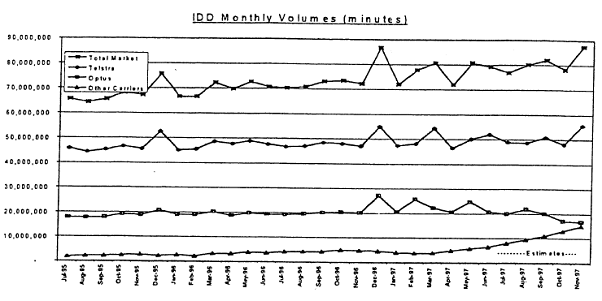
…
STD
The domestic long distance market has been far less affected by the entry of new carriers. It is estimated that other carrier volumes have about doubled in the last 6 months, but at this level the other carriers only account for 3% of the total market. The market share movement as a result of broadening the definition of the market is far less than in the IDD instance.
The revised market share series (denoted by All Carrier Share in the following figure) indicates a lesser improvement in market share than has been reported previously. This is indicative of growth in Telstra’s volumes which approximates that of the market.
The YTD year on year comparison has the total market growing by almost 12%, while Telstra’s volumes are growing by over 10%. Optus is recording volume growth in excess of that achieved by the market, but this disguises a volume outlook which has been flat for some months.
…
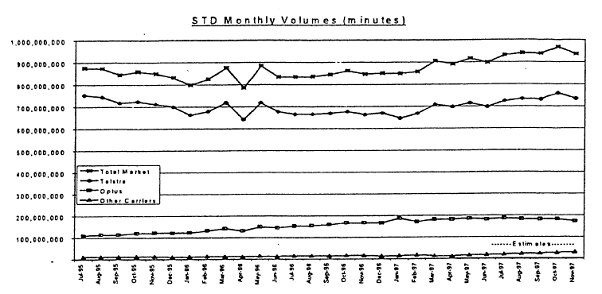
…
116 There is no less doubt that traffic information of Optus, even if confined to the aggregate of Optus’ traffic travelling over Telstra’s network, is Confidential Information of Optus within the definition of that term in cl 1.1 of the Access Agreement; it is information ‘… relating to … the business of [Optus] …’. The fact that it is also within the knowledge of Telstra by reason of Optus’ access and use of Telstra’s network, does not make it any less ‘Confidential Information’ of Optus; a party’s knowledge of confidential information of another party is contemplated by the terms of the definition itself in that it encompasses ‘the contents of the schedules (and matters concerned with or arising out of this agreement) …’.
117 Further, such traffic information of Optus is clearly not excluded from the definition of Confidential Information by the exclusions in sub-paras (i) or (ii) of the definition; nor is it excluded by the exclusion in sub-para (iii) of the definition; it is not information which has been independently developed by Telstra; it is information which Telstra had access to simply because Optus had access to and used Telstra’s network.
118 Furthermore, even if such traffic information of Optus was not ‘… disclosed, communicated or delivered to [Telstra] by [Optus] pursuant to this agreement’, within para (a) of cl 15.1 of the Access Agreement, it ‘…[came] to [Telstra’s] knowledge or into its possession in connection with this agreement’, within para (b) of cl 15.1. It is, therefore, subject to the mandatory restrictions of sub-paras (c) and (d). First, it cannot be used or copied except for the purposes of the Access Agreement or the other purposes, not presently relevant, referred to in sub-para (c). Second, it cannot be disclosed or communicated, or otherwise made available to any third person other than those specified in sub-para (d), and then only for the purposes so specified.
ISSUES 3 AND 4
Issue 3: If the Answer to Issue 2 is ‘Yes’, is Telstra’s use of Optus’ Traffic Information in the preparation of Market Share Reports a permissible use under the Access Agreement?
Issue 4: If the Answer to Issue 2 is ‘No’, is Telstra’s use of Optus’ Traffic Information in the preparation of Market Share Reports a permissible use under the Access Agreement?
ANALYSIS AND REASONING ON 3 AND 4
119 Telstra conceded that if the information extracted from NUMIS 100 is Confidential Information of Optus then the production of the market share reports was a ‘use’ of that information. On the stated hypothesis, Telstra did not submit, correctly in my view, that such a ‘use’ was a permissible use under the Access Agreement. Optus submitted that it was also an impermissible disclosure, or communication, of that information.
120 Other provisions of the Access Agreement seem to impose restrictions on the use by one carrier of the traffic information of another carrier even if it is not Confidential Information under the Access Agreement. For example, the term ‘Communication Information’ is defined in cl 1.1 in similar fashion to the way in which the term ‘traffic information’ is defined in [8] of these reasons. It is defined as meaning information in respect of ‘Designated Communications’ (a defined term) made during the relevant ‘Billing Period’ (a defined term) comprising the elements referred to at [8] above. While the quantity of such communications during the relevant period is not one of those elements, clearly the aggregate of such communications during the relevant period is part of ‘Communication information’ as defined by the threshold words of the definition. As such, it is subject to the requirements of confidentiality imposed by cl 15, by force of the operation of cl 10, even if, contrary to my conclusion in [116] above, it is not ‘Confidential Information’, as defined.
121 This result follows from cl 10.1 of the Access Agreement which provides:
10.1 The obligations of each Carrier to provide information to the Other Carrier are as set out in this agreement and are subject to the requirements of confidentiality imposed by clause 15. The obligations to provide information include:
(a) clause 8; and
(b) this clause 10; and
(c) the schedules.
And cl 10.4 which provides:
10.4 A Carrier must provide the Other Carrier with Communication Information in relation to each Designated Communication.
ISSUES 5, 6 AND 7
Issue 5: Did the Market Share Reports themselves contain Confidential Information of Optus for the purposes of the Access Agreement?
Issue 6: If the Answer to Issue 5. is ‘Yes’, is the use to which the Market Share Reports are proven to be put a permissible use of such Information under the Access Agreement?
Issue 7: If the Answer to Issue 5. is ‘No’, is the use to which the Market Share Reports are proven to be put a permissible use of such Information under the Access Agreement?
ANALYSIS AND REASONING ON 5, 6 AND 7
122 As indicated in [20] above, Optus’ case was not limited to the contention that Telstra used Confidential Information of Optus, by NUMIS 100 accessing information in CCRs brought into existence by Telstra when providing access services under the Access Agreement in preparing the market share reports. It extended to uses to which the market share reports were put.
123 Telstra submitted that it is clear from an examination of each of the market share reports that they contained considerably more information (including public information) than the market share data, none of which it is said constitutes Confidential Information of Optus. Telstra submitted therefore that it cannot be assumed that a use of a market share report, for example by circulating it within Telstra is a use of Confidential Information of Optus.
124 The following market share reports were in evidence as part of Exs. 10 and 11:
(1) IDD market share report for the week ending 03/07/93.
(2) IDD market share report for the week ending 04/12/93.
(3) IDD market share report for the week ending 06/05/95.
(4) IDD and facsimile market share report for the week ending 01/07/95.
(5) STD and IDD market share report for the week ending 04/01/97.
(6) STD and IDD market share report for the week ending 11/01/97.
(7) STD and IDD market share report for the week ending 25/01/97.
(8) STD and IDD market share report for the week ending 01/02/97.
(9) STD and IDD market share report for the week ending 08/02/97.
(10) STD and IDD market share report for the week ending 06/12/97 (see [115] above).
(11) STD and IDD market share report for the week ending 23/05/98.
(12) STD and IDD market share report for the week ending 30/05/98.
(13) STD and IDD market share report for the week ending 05/02/00.
125 There is little doubt that some, although certainly not all, of these reports contain Confidential Information of Optus for the purpose of the Access Agreement. Even where the information so identified does not qualify as Confidential Information there is no doubt that it qualifies as Confidential Information for the purposes of the Access Agreement and is subject to the same requirements of confidentiality imposed by cl 15, by force of the operation of cl 10 including the mandatory restrictions of sub-paras (c) and (d) of cl 15.1; it cannot be used or copied except for the purposes of the Access Agreement or the other purposes, not presently relevant, referred to in sub-para (c); and second, it cannot be disclosed or communicated, or otherwise made available to any third person (including employees of Telstra) when, relevantly, disclosure is necessary for the purposes of the Access Agreement (sub-para (d)) and is reasonably required to be disclosed for the purposes of the Access Agreement (cl 15.3(a)).
126 In its answer to interrogatories, Telstra admitted to using the market share reports referred to in paras 12(b), 16(a), 22(a), 28(a), 30(a) and 33(a) of the Defence to the Third Consolidated Amended Statement of Claim filed 5 March 2007:
(i) for the purpose of marketing, including considering or developing strategy for marketing, products or services of Telstra to existing or prospective customers; and
(ii) for the purpose of promotion, including considering or developing strategy for promotion, of products or services of Telstra to existing or prospective customers; and
(iii) for the purpose of selling, including considering or developing strategy for selling, products or services of Telstra to existing or prospective customers.
127 Insofar as these market share reports contained Confidential Information of Optus for the purposes of the Access Agreement or, even if they do not, insofar as they contained Communication Information of Optus for the purposes of the Access Agreement, which is subject to the confidentiality requirements of cl 15 of the Access Agreement by force of cl 10 of that agreement such uses of the market share reports, admitted by Telstra, are not permissible uses of such information under the Access Agreement. Nor, if it matters, is the disclosure of such information a permissible disclosure under the Access Agreement.
CONCLUSIONS
128 For the foregoing reasons, I find that Telstra has used traffic information of Optus, or Communication Information of Optus for the purposes of the Access Agreement, both in the preparation of market share reports and in distributing those reports among Telstra personnel. I also find that such information is Confidential Information of Optus for the purposes of the Access Agreement, or is otherwise subject to the requirements of confidentiality in cl 15 of the Access Agreement, by force of cl 10 of that agreement. I also find that neither such use of such information nor its disclosure for such purposes is permitted by the Access Agreement.
129 It follows, in my view, that Telstra has breached the relevant provisions of the Access Agreement and is liable to Optus for such breaches. In this part of the proceeding, I am not concerned with the extent of such breaches or other issues going to quantum.
RELIEF
130 Optus seeks, among other relief, a declaration going to the confidentiality to Optus of the information used by Telstra as well as a declaration that the use by Telstra of such Confidential Information for the unauthorised purposes as defined in para 15 of the Third Consolidated Amended Statement of Claim is:
(a) A breach of the Access Agreement;
(b) in breach of the duty of confidentiality and by Telstra to Optus; and
(c) unconscionable conduct within the meaning of s 51AA of the TPA.
131 I am not, at this point in time, convinced that there is any utility in making such declarations. I have found that Telstra is in breach of the relevant provisions of the Access Agreement by reason of its conduct and doubt whether, in the exercise of my discretion to grant declaratory relief, anything is to be gained by merely recording conclusions reached in my reasons for judgment. However, I am happy to hear the parties on the issue of relief in relation to the matter of liability in the proceeding at a mutually convenient date.
| I certify that the preceding one hundred and thirty-one (131) numbered paragraphs are a true copy of the Reasons for Judgment herein of the Honourable Justice Edmonds. |
Associate:
Dated: 30 April 2009
| Counsel for the Applicant: | Mr RM Smith SC and Mr C Dimitriadis |
|
|
|
| Solicitor for the Applicant: | Baker & McKenzie |
|
|
|
| Counsel for the Respondent: | Mr CRC Newlinds SC and Mr IR Pike |
|
|
|
| Solicitor for the Respondent: | Mallesons |
| Date of Hearing: | 7, 8 and 10 October 2008 |
|
|
|
| Date of Judgment: | 30 April 2009 |


