

FEDERAL COURT OF AUSTRALIA
Treecorp Australia Ltd (in liquidation) v Dwyer [2009] FCA 278
Australian Securities and Investments Commission v Takaran Pty Ltd (2002) 170 FLR 388 considered
Australian Securities and Investments Commission v West (2008) 100 SASR 496 considered
Australian Softwood Forests Pty Ltd v Attorney-General (NSW); ex rel Corporate Affairs Commission (1981) 148 CLR 121 considered
Hance v Commissioner of Taxation [2008] FCAFC 196 applied
Mier v FN Management Pty Ltd [2006] 1 Qd R 339 applied
Peter Cox Investments Pty Ltd (in liq) v International Air Transport Association (1999) 161 ALR 105 cited
Re Australian Elizabethan Theatre Trust (1991) 30 FCR 491 cited
Re Investa Properties Ltd (2001) 187 ALR 462 considered
Stephens Travel Service International Pty Ltd (receivers and managers appointed) v Qantas Airways Ltd (1998) 13 NSWLR 331 cited
VID 0881 of 2008
GORDON J
30 MARCH 2009
MELBOURNE
|
IN THE FEDERAL COURT OF AUSTRALIA |
|
|
VICTORIA DISTRICT REGISTRY |
VID 881 of 2008 |
|
TREECORP AUSTRALIA LTD (IN LIQUIDATION) First Applicant
TREECORP LIMITED (IN LIQUIDATION) Second Applicant
|
|
|
AND: |
MICHAEL JOSEPH DWYER First Respondent
ALAN ROSS JONES Second Respondent
|
|
JUDGE: |
|
|
DATE OF ORDER: |
30 MARCH 2009 |
|
WHERE MADE: |
MELBOURNE |
THE COURT ORDERS THAT:
1. The answer to the question:
Is the sum of $750,024.39 presently sitting in the accounts numbered 79-073-3371 and 083-347 81-435-5177 within the National Australia Bank in the name of Treecorp Australia Ltd (in liquidation) (“TAL”) and Treecorp Limited (in liquidation) (“TL”) plus interest accruing thereon (“Fund”) part of the property of one or other of TL or TAL to be applied in satisfaction of that company’s liabilities in accordance with the provisions of the Corporations Act 2001 (Cth)?
is no.
2. By 4.00pm on 3 April 2009, the parties file and serve proposed orders addressing the question of costs and, in the absence of agreement, file and serve written submissions on the question of costs.
|
IN THE FEDERAL COURT OF AUSTRALIA |
|
|
VICTORIA DISTRICT REGISTRY |
VID 0881 of 2008 |
|
BETWEEN: |
TREECORP AUSTRALIA LTD (IN LIQUIDATION) First Applicant
TREECORP LIMITED (IN LIQUIDATION) Second Applicant
|
|
AND: |
MICHAEL JOSEPH DWYER First Respondent
ALAN ROSS JONES Second Respondent
|
|
JUDGE: |
GORDON J |
|
DATE: |
25 MARCH 2009 |
|
PLACE: |
MELBOURNE |
REASONS FOR JUDGMENT
introduction
1 Under s 511(1) of the Corporations Act 2001 (Cth) (“the Act”), the liquidator of Treecorp Australia Ltd (in liquidation) (“TAL”) and Treecorp Limited (in liquidation) (“TL”) (the “applicant”) seeks an answer to the following question:
Is the sum of $750,024.39 presently sitting in the accounts numbered 79-073-3371 and 083-347 81-435-5177 within the [National Australia Bank (“NAB”)] in the name of TAL and TL plus interest accruing thereon (“Fund”) part of the property of one or other of TL or TAL to be applied in satisfaction of that company’s liabilities in accordance with the provisions of the [Act]?
2 The answer to that question is not straightforward.
facts
3 At the outset, a number of undisputed facts need to be stated. The respondents to the application, Michael Joseph Dwyer and Alan Ross Jones (“the respondents”) were added as parties by Finkelstein J on 25 November 2008 to represent themselves and all other investors in a managed investment scheme known as the “Clearwood Scheme”. That scheme was established under and regulated by Ch 5C of the Act.
4 The Clearwood Scheme concerned the establishment, management and conduct of all forestry services of a proposed 2,000 hectare “Clearwood” Radiata Pine plantation on Kangaroo Island (“the Project”). It was registered by the Australian Securities and Investments Commission (“ASIC”) on 23 March 2000: Pt 5.C1 of the Act.
5 TAL (previously known as Forestry Management Holdings Limited) was the Responsible Entity of the Clearwood Scheme: s 601FB of the Act (the “Responsible Entity”). Its obligations were “to operate the scheme and perform the functions conferred on it by the scheme’s constitution and [the] Act”: s 601FB(1) of the Act. The scheme’s Constitution was dated 25 February 2000. The Constitution was executed by TAL as Responsible Entity. The recitals recorded that:
(1) TAL proposed to have the Constitution registered and to use it as the “basis for a number of managed investment schemes, to be known as Projects”: recitals A and B;
(2) TAL proposed to invite applications for participation in the Projects both by Prospectus and otherwise: recital C;
(3) Each applicant who complied with the requirements set out in the Constitution would become a “Grower” and would be granted a sub-lease of land by TAL and engage TAL to “establish, develop, maintain, manage, harvest and market the silviculture enterprise carried out on that land: recital D;
(4) TAL had agreed to act as Responsible Entity for the Projects subject to the terms and conditions in the Constitution: recital E;
(5) The Applicants and Growers would be bound by the Constitution.
6 TAL agreed to act as Responsible Entity of each project and for the applicants and growers who relate to each project, and to act “as trustee of the Funds” subject to the terms and conditions of the Constitution: cl 3. Each project governed by the Constitution was registered under s 601EB of the Act as a managed investment scheme. The Clearwood Scheme project was known as the Treecorp Clearwood Project 2000: cl 4.3.
7 Under the Constitution, TAL was required to create two separate funds in relation to each stage of the project – the Application Fund and the Proceeds Fund: cl 5.1. TAL was required to lodge in a trust Bank account (“the Application Fund”) the Application Moneys received by it in respect of each Stage of the project to be held by TAL upon the trusts constituted by the Constitution: cl 5.2. Each applicant had a proportional interest but not any interest in any particular part of the Application Fund: cl 5.4. Initially, TAL held the fees in the Application Fund in a bank account numbered 06353310347919 with the Commonwealth Bank of Australia pursuant to cll 5.1 and 5.2 of the Constitution pending acceptance of the Applications.
8 “Applicant” was defined to mean a person whose application to enter the Management Agreement and the Sub-Lease (defined as the “Project Agreements”) had been accepted by TAL: cl 1. The method by which an applicant invested in the Clearwood Scheme was detailed in a Prospectus issued in April 2000 and prescribed by the Constitution. A person had to apply (by completing and signing an application form and power of attorney) to sub-lease at least two identifiable one hectare allotments of land (called Woodlots) on Kangaroo Island, South Australia (“the Application”) and pay an Application Fee of $8,250.00 per lot (stage 1) to TAL: cl 6.2 of the Constitution. The Application Fees were the only payment investors had to make until harvest in about 26 years’ time. At the time of application, each applicant was provided with the Prospectus, a sub-lease and a Management Agreement.
9 All application fees received by TAL were placed in the Application Fund and held by it as bare trustee: cl 7.2 of the Constitution. At that point in time, the scheme was registered with ASIC: see [3] above. Those applications fees constituted “scheme property” (as that term is defined in ss 9 of the Act) held on trust by TAL for scheme members: s 601FC(2) of the Act. The Constitution reinforced the statutory position that the Application Funds were held on trust for the applicants: cll 5.1, 5.2, 5.4 and 7.2 of the Constitution.
10 Upon acceptance of an Application, as prescribed in cll 9–12 of the Constitution:
1. TAL was responsible for the preparation, stamping and delivery of the Project Agreements (defined as a Management Agreement and a Sub-Lease). The Sub-Lease specified the Woodlots that TAL would allocate to a Grower;
2. an applicant became a “Grower”, was granted a Sub-Lease of land, entered into a Management Agreement and engaged TAL to harvest and market the enterprise carried out on the land.
11 When TAL was satisfied of matters specified in cl 13 of the Constitution (including that Minimum Subscription had been reached), TAL was entitled to release and did release the Application Moneys to itself as the Responsible Entity “in payment of the costs and expenses of [TAL] performing the duties and obligations of [TAL] under [the] Constitution and the relevant Management Agreements …”: cll 7.1, 13 and 14 of the Constitution.
12 At that point in time, the Application Fund which had been “scheme property” (ss 9 and 601FC of the Act) ceased to be scheme property. It ceased because:
1. cl 14.1 of the Constitution provided that:
[TAL] will upon being satisfied of the matters specified in clause 13 release the Application Moneys in payment of the costs and expenses of [TAL] performing the duties and obligations of [TAL] under this Constitution and the relevant Management Agreements …
2. under the Management Agreement between TAL and each grower, the applicants (who were now known as growers) had contracted for that scheme property (the Application Fund) to be transferred to TAL in payment of prescribed work in fact undertaken and to be undertaken by TAL: cl 6 of the Management Agreement between TAL and each grower. The work in fact undertaken and to be undertaken by TAL was prescribed in cll 4 and 5 of each Management Agreement as (1) Plantation Establishment and Development by 30 June 2001 (cl 4) and (2) assessment of the survival rate of the plantation within 2 years of completing the planting and if the survival rate was less than 90%, replanting all trees which failed to survive (cl 5).
13 Clause 14.2 of the Constitution provides that if the Application Moneys to be released pursuant to cl 14.1 were not released within 6 months after the date of the Project Agreements to which they relate, then TAL was entitled to refund the whole of the Application Moneys. Three matters are worthy of note. First, the pre-conditions to release to TAL were specified in cl 13 of the Constitution. Secondly, to the extent that the terms and conditions of the Management Agreement are inconsistent with the terms and conditions in the Constitution or the Sub-Lease, then the Constitution prevails, followed by the Management Agreement and then the Sub-Lease: cl 25 of the Management Agreement. Finally, no party submitted that TAL was not entitled to the funds in the Application Fund for non compliance with cll 13 and 14 of the Constitution, cll 4 and 5 of the Management Agreement or on any other basis. It was a fee for the performance of its functions and a fee TAL was contractually entitled to receive and did receive: cf s 601FS(2) of the Act.
14 At first blush this seems an odd result. Investors have contributed in excess of $1.68m with no obligation to contribute any further funds for 26 years in relation to a plantation which is not expected to generate income for many years and yet TAL, as the Responsible Entity, is entitled to all of the funds in the Application Fund at a point very close to the start of the scheme.
15 How then were the future steps in relation to the Plantation to be dealt with when the Application Fees were the only payment investors had to make for about 26 years? The replanting obligation I have dealt with (see [12] above). Plantation Maintenance, Harvesting and Marketing were treated separately under the Management Agreement. For present purposes harvesting and marketing may be put to one side. It is sufficient to note that under the Management Agreement, TAL was entitled to deduct from “Net Sales Proceeds” (defined as “the value of the Grower’s Trees calculated by deducting from the mill door price direct and identifiable costs of harvesting, loading and cartage to the mill”: cl 1 of the Management Agreement) not only the Maintenance Fee but also a Marketing Fee and the “Sub-Lease Rent” (defined in the Sub-Lease as 3% of the Net Sales Proceeds): cl 17 of the Management Agreement.
16 Plantation Maintenance was a responsibility of TAL “using its own funds” under cl 7 of the Management Agreement and, once performed, TAL was entitled to the “Maintenance Fee”: cl 8 of the Management Agreement. “Maintenance Fee” was defined in cl 1 of the Management Agreement to mean “the fee payable by the Grower to [TAL] expressed as a percentage of the Net Sales Proceeds described in Item 5 of the Schedule”. The percentage stipulated was 2%.
17 It is the maintenance obligation which lies at the heart of the issues in dispute. Part E of the Constitution (cll 16–19) entitled “Maintenance” dealt specifically with the issue. Clause 16 of the Constitution provided that TAL agreed that a “Plantation Services Agreement” (“PSA”) would include (1) an obligation that TL (as agent for TAL) would carry out the obligations of TAL under the Management Agreements, (2) an obligation that TL would pay for that maintenance (referred to in cl 7 of the Management Agreements) and (3) an obligation that TL would provide “Security” in relation to that obligation. The PSA contained such obligations: Pt C dealt with TL’s obligations, Pt E dealt with funding and security. I deal with these obligations in further detail later in these reasons for decision.
18 The appointment of TL by TAL was not unusual. Under the Act, TAL was entitled to appoint an agent or otherwise engage a person to do anything that TAL was authorised to do in connection with the scheme: s 601FB(2). However, in determining whether TAL had properly performed its duties under s 601GA(2) of the Act, TAL is taken to have done (or failed to do) anything that the agent or person engaged by TAL had done or failed to do: s 601FB(2) of the Act. In relation to the Clearwood Scheme, TAL engaged TL as its agent to provide plantation services for which TAL was responsible. TAL and TL shared common directors and provided forestry services to persons and entities unconnected with the Clearwood Scheme. However, the obligation to maintain the Plantations remained with TAL “using its own funds”.
19 How then was TAL’s obligation to be discharged and discharged in such a way that the scheme and the investors in the scheme were protected? Section E of the Constitution provided that before each year (defined as a “Stage” of the project in the Constitution), TAL had to procure a written report from an Independent Forestry Consultant: cl 17.1. In respect of each “Stage” of the project, the report was required to determine the aggregate amount required for the maintenance obligations for that stage referred to in cll 7.1 to 7.11 of the Management Agreements. The method of calculation was prescribed: cl 17.2.
20 Having obtained a report in relation to each “Stage”, TAL was obliged to procure from TL “Security” for each “Stage” on certain terms and conditions: cl 18 of the Constitution. The “Security” was to be provided by TL at its own cost and, at the discretion of TAL, was to be either a bank guarantee or a fixed charge over a sum of money and accrued interest in a bank account in the name of TL with a bank approved by TAL to which TAL and TL were joint signatories: cl 18.1. A form of deed of charge was provided — a fixed charge: cl 3 of the Deed of Charge. The amount of the Security was to be the value stated in the report by the Independent Forestry Consultant: cl 18.2. In the present case, that amount was $2,200 per woodlot. Neither party takes any issue with the report by the Independent Forestry Consultant or the amount of the security provided by TL.
21 Ultimately, TL granted the Responsible Entity (in this case, TAL) a Charge “to secure the performance by [it] of its obligations under the [PSA]”: Recitals to the Deed of Charge. The charge was to be first in priority and TL agreed not to grant any subsequent security over the proceeds of the Security: cl 18.3 of the Constitution. The amount of the “Security” was $2,200 per woodlot. That amount was deposited in an account subject to the Charge (defined in the Deed of Charge as “the Account” but referred to by the parties as the “TL Charge Account”). The amount of the Security could be reduced if TAL determined that “the moneys then secured exceed[ed] the amount required to fulfil the balance of the maintenance obligations of the Responsible Entity under cll 7.1 to 7.11 of the Management Agreement relating to the relevant Stage. …”: cll 18.6 and 19 of the Constitution. The amount was not reduced.
22 Enforcement of the Security was dealt with in cl 18.5 of the Constitution in the following terms:
If [TL] defaults in its obligations under the [PSA] and the Responsible Entity exercises its rights under the Security, the proceeds of the Security will be set off by the Responsible Entity towards the claim by the Responsible Entity against [TL] to fulfil the maintenance obligations of the Responsible Entity under clause 7.1 to 7.11 of the Management Agreement; …
23 The appointment of the applicants as liquidators of TL constituted an event of default under the Deed of Charge: cl 14 of the Deed of Charge.
issue and contentions
24 I was asked to proceed to determine the question in [1] on the basis that the funds remained in the TL Charge Account subject to the charge. What transpired in relation to the funds in the TL Charge Account was not adequately explained. However, neither party contended that steps which occurred after the funds were withdrawn from the “TL Charge Account” affected or altered the real issue in the case — whether the balance of that account (the TL Charge Account) formed part of the property of one or other of TL or TAL to be applied in satisfaction of that company’s liabilities in accordance with the provisions of the Act?
25 The applicant contends that the whole of the balance standing to the credit of the TL Charge Account forms part of the property of TL or TAL to be applied in satisfaction of one or other of those company’s liabilities although which entity was never made clear. On the other hand, the respondents contend that the balance of the account was either (a) scheme property as that term is defined in s 9 of the Act or (b) held on trust for the scheme pursuant to a Quistclose trust for the benefit of the Scheme.
analysis
26 At the outset, two points must be made. First, although the scheme is still registered with ASIC, it does not have a responsible entity and the land the subject of the sub-lease has been sold. Secondly, the arguments of neither party gave the necessary attention to the relevant provisions of the Act, the Constitution or the Charge. It is the Act, the Constitution and the Charge which govern entitlements to the funds the subject of the Charge.
Funds in the TL Charge Account
27 As noted earlier, the real issue is the balance that was standing to the credit of the TL Charge Account. That balance arose because TL was to provide the Security: cl 18 of the Constitution and cl 14 of the PSA. The source of funds to be deposited in the TL Charge Account as security was not prescribed. It was common ground that the funds in the TL Charge Account were in fact provided by TAL sourced from the Application Fund. The manner in which part of an Application Fee of $8,250 flowed into the TL Charge Account was not in dispute:
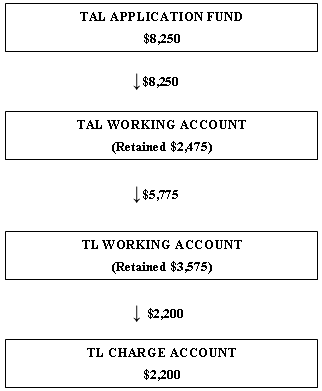
28 Given the contractual right of TAL to the funds in the Application Fund upon the preconditions to release of that fund being satisfied (see [11] - [14] above), I accept that TAL was thereafter entitled to those funds. The issue to be determined, however, is the status of the funds once deposited in the TL Charge Account. The funds in the TL Charge Account are subject to the charge: cl 14 of the PSA and the Deed of Charge. The manner in which that charge operates is not determined by the source of those funds - the answer would be the same whether the funds were sourced in the manner outlined above or were provided by TL itself. What then does the Deed of Charge provide?
Deed of Charge and the PSA
29 As noted earlier (see [21]), the Deed of Charge was provided by TL to TAL “to secure the performance by [TL] of its obligations under the [PSA]”: Recital B of the Deed of Charge. In general terms, TL’s obligations were to perform the obligations of TAL under cl 7 (Maintenance) of each Management Agreement: cl 13 of the PSA. These were defined in the Deed of Charge as the “Services”.
30 The charge was a first ranking fixed charge over the “Charged Property”: cll 3 and 5 of the Deed. It was registered with ASIC as a registered first fixed charge given by TL (Charge No 750793) on 2 June 2000.
31 “Charged Property” was defined in the Deed of Charge (cl 1) to mean:
any legal or equitable estate or interest of [TL] in any capacity in any or all of:
(a) the debts created by the deposit from time to time of money into the Account;
(b) any interest which accrues from time to time on the moneys in the Account;
(c) any other rights of [TL] relating to the Account;
(d) any documents evidencing the deposit or the terms and conditions of that deposit; and
(e) any negotiable instrument issued or endorsed in payment by the Bank of moneys deposited into the Account or interest on those moneys.
32 “Account” was defined to mean the bank account holding the sum of money which TL proposed to use towards funding the obligations under clause 13 of the PSA. There was no dispute that this was the TL Charge Account. TL’s obligations in relation to the Account were set out in cll 8 and 11 of the Deed. Under cl 11.1.1, TL warranted that it legally and beneficially owned the Charged Property.
33 Events of Default were the subject of cl 14 of the Deed. One of the events of default (cl 14.4) was that TL became an externally administered body corporate. In the event of default, the Responsible Entity was entitled, inter alia, to exercise all or any of its powers under any rule of law or equity in any statute (cl 15.1), change the account signatories (cl 15.3), make withdrawals (cl 15.4), close the Account (cl 15.5), give releases and receipts for money received or receivable by the Responsible Entity under the Deed (cl 15.6) or do anything to “protect or enforce this document or recover the Charged Property” (cl 15.7). Finally, the Responsible Entity was able to assign to any person the Responsible Entity’s interest in any Charged Property and the benefit of any term in the Deed.
34 The PSA contained similar provisions: see cll 13 and 14 of the PSA. TL had to pay for the plantation maintenance and management referred to in cl 7 of the Management Agreements: cl 13 of the PSA. TL was to provide “Security” in the form of a fixed charge over a sum of money and accrued interest in a bank account in the name of TL with a bank approved by the Responsible Entity with the amount of security to be the value stated in the Independent Report referred to in cl 17.2.1 of the Constitution: cll 14.1 and 14.2. Again, the PSA provided that the Security was to be first ranking: cl 14.3. Finally, cl 14.5 provided that if TL defaulted in its obligations under the PSA and the Responsible Entity exercised its rights under the Security, the proceeds of the security would be “set off by the Responsible Entity towards the claim by the Responsible Entity against [TL] to fulfil the maintenance obligations of the Responsible Entity under clause 7.1 to 7.11 of the Management Agreements”. These obligations mirrored the obligations cl 18 of the Constitution: see [20] and [21] above. Unsurprisingly, the provision by TL of a fixed charge over a sum of money stipulated by the Independent Forestry Consultant also formed part of the description of the PSA provided to potential investors in Section 19 of the Prospectus entitled “Material Contracts”. The provision of the Security was an essential part of the scheme and the way it was to operate.
35 Notwithstanding default on the part of TL (as defined in the Deed of Charge see [33] above), no step has been taken by the Responsible Entity to enforce its rights under the Charge because the Responsible Entity (TAL) is itself in liquidation and no temporary responsible entity has been appointed: s 601FN of the Act. In other words, the “Charged Property” remains charged in the manner prescribed by the Deed.
Not Scheme Property
36 The question which then arises is whether the rights of the chargee over the Charged Property or the “Charged Property” itself was or is “scheme property” as that term is defined in s 9 of the Act. The answer to that question is no. That conclusion requires some explanation.
37 Pt 5C.2 of the Act provides the legislative framework for managed investment schemes. One of the critical provisions is s 601FC(2). “That section declares in unequivocal terms that the responsible entity of a registered management investment scheme ‘holds scheme property on trust for scheme members’”: Re Investa Properties Ltd (2001) 187 ALR 462, 465.
38 Section 601FC(2) requires other definitions in the Act to be looked at. The Act does not define a “scheme”. As Keane JA noted in Mier v FN Management Pty Ltd [2006] 1 Qd R 339 at 350 (fn 29), the phrase “program or plan of action” has been adopted by various courts as the conventional meaning of the word “scheme”: see Australian Softwood Forests Pty Ltd v Attorney-General (NSW); ex rel Corporate Affairs Commission (1981) 148 CLR 121, 129; Australian Securities and Investments Commission v Takaran Pty Ltd (2002) 170 FLR 388, 393; Australian Securities and Investments Commission v West (2008) 100 SASR 496, 529. The Act however does define a “managed investment scheme”: s 9. That definition is important. It defines, so far as is presently relevant, a managed investment scheme as:
(a) a scheme that has the following features:
(i) people contribute money or money's worth as consideration to acquirerights (interests) to benefits produced by the scheme (whether the rights are actual, prospective or contingent and whether they are enforceable or not);
(ii) any of the contributions are to be pooled, or used in a common enterprise, to produce financial benefits, or benefits consisting of rights or interests in property, for the people (the members) who holdinterests in the scheme (whether as contributors to the scheme or as people who haveacquiredinterests from holders);
(iii) the members do not have day‑to‑day control over the operation of the scheme (whether or not they have the right to be consulted or to give directions); or
…
39 Finally, “scheme property” of a registered scheme is defined in s 9 of the Act to mean:
(a) contributions of money or money’s worth to the scheme; and
(b) money that forms part of the scheme property under provisions of this Act or the ASIC Act; and
(c) money borrowed or raised by the responsible entity for the purposes of the scheme; and
(d) property acquired, directly or indirectly, with, or with the proceeds of, contributions or money referred to in paragraph (a), (b) or (c); and
(e) income and property derived, directly or indirectly, from contributions, money or property referred to in paragraph (a), (b), (c) or (d).
…
41 As Keane JA went on to say in Mier at 350:
It follows that, if property is to be considered “scheme property”, the property in question must have been contributed to the scheme or must have been obtained in connection with such contributions. The absence of any such connection would make it doubtful that the property was really part of, or subject to, the scheme.
42 The consequence, as noted by Keane JA in Mier at 350–1, is that s 601FC(2) does not necessarily apply to all property held by a responsible entity or used in the operation of the scheme: see also Hance v Commissioner of Taxation [2008] FCAFC 196, [95]–[100]. It operates in connection with scheme property as that term is defined in s 9 of the Act.
43 What then is the position here? If “contributions” are understood, as it must be, as contributions made by members of the managed investment scheme, neither the rights of the chargee over the Charged Property nor the Charged Property itself falls within any of the 5 limbs of “scheme property” in s 9 of the Act. They are not (a) contributions of money or money’s worth to the scheme, (b) money that forms part of the scheme property under provisions of the Act or the ASIC Act, (c) money borrowed or raised by the responsible entity for the purposes of the scheme, (d) property acquired, directly or indirectly, with, or with the proceeds of, contributions or money referred to in paragraph (a), (b) or (c), or (e) income and property derived, directly or indirectly, from contributions, money or property referred to in paragraph (a), (b), (c) or (d).
44 That conclusion is supported by constituent documents of the scheme read as a whole. Under the Constitution, the term “Project Property” is defined to mean in relation to each Project “scheme property as that expression is defined in section 9 Corporations Law”: cl 1 of the Constitution. (For present purposes, the definition in the Act is in similar terms). Clauses 21.3.9 – 21.3.11 of the Constitution set out the duties of the Responsible Entity in relation to that “Project Property”. It is evident that the “Project Property” does not extend to include the Charged Property. If it did, it would be subject to s 601FC(2) and the Deed of Charge over the Charged Property would be unnecessary.
45 This conclusion has the effect that those provisions of the Act directed towards the preservation of scheme property are not engaged: eg s 601FC(1) of the Act. But that conclusion does not entail the consequences that the applicant (the liquidator) asserts — that he may apply the Charged Property in satisfaction of the debts of one or other of TAL and TL. In particular, the conclusion that neither the rights of the chargee nor the Charged Property falls within the definition of “scheme property” must not be permitted to obscure the existence of the charge and its terms.
46 It will be recalled that the Charged Property was charged by TL in favour of TAL as Responsible Entity as security for the performance by TL of its obligations to maintain the plantations. The right which TAL had as Responsible Entity under the Deed of Charge are rights which both by the terms of the charge itself (see cll 2.6 and 17) and the applicable provisions of the Act (see ss 601FS and 601FT) are transferable to a responsible entity appointed in successor to TAL and are to be held by that successor Responsible Entity on the same terms as TAL held rights under the charge. Section 601FT is important. It provides:
(1) If the responsible entity of a registered scheme changes, a document:
(a) to which the former responsible entity is a party, in which a reference is made to the former responsible entity, or under which the former responsible entity has acquired or incurred a right, obligation or liability, or might have acquired or incurred a right, obligation or liability if it had remained the responsible entity; and
(b) that is capable of having effect after the change;
has effect as if the new responsible entity (and not the former responsible entity) were a party to it, were referred to in it or had or might have acquired or incurred the right, obligation or liability under it.
(2) Subsection (1) does not apply to a right, obligation or liability that remains a right, obligation or liability of the former responsible entity because of subsection 601FS(2).
47 In the present case, the scheme no longer has a responsible entity. The Deed of Charge to which TAL was a party remains on foot. It has not been terminated. It had and continues to have effect. It was a registered charge (Pt 2K.2 of the Act) which was a fixed first ranking charge over the Charged Property: ss 279–82 of the Act. There was no suggestion that the Responsible Entity (TAL) expressly or impliedly consented to vary the priority recorded in the registered Deed of Charge: see cl 5 of the Deed of Charge. TL certainly had no power to alter or vary the priority.
48 Under the Deed of Charge, the Responsible Entity (TAL) acquired rights as chargee under the Charge as the Responsible Entity. Those rights continue to have effect and if a new Responsible Entity was appointed, the new Responsible Entity would be taken to be a party to the Deed and to have the same rights as the former Responsible Entity under the Charge: s 601FT. Significantly, the reference to “a right, obligation or liability” in s 601FT is not limited to or identified by reference to “scheme property” as that term is defined in s 9 of the Act. That is not surprising. There will often be, as in this case, contractual arrangements entered into by the responsible entity for the benefit of the scheme which will not constitute scheme property.
49 In the present case, a successor Responsible Entity would be entitled on account of an act of default by TL under the charge to take the whole of the Charged Property and apply it as security for the future performance of maintenance obligations in relation to the plantations: see [33] above. Whether, in the events that have happened, those rights remain exercisable is an issue I am neither required nor able to determine in the present proceedings.
50 In light of the reasons above, the answer to the question:
Is the sum of $750,024.39 presently sitting in the accounts numbered 79-073-3371 and 083-347 81-435-5177 within the National Australia Bank in the name of Treecorp Australia Ltd (in liquidation) (“TAL”) and Treecorp Limited (in liquidation) (“TL”) plus interest accruing thereon (“Fund”) part of the property of one or other of TL or TAL to be applied in satisfaction of that company’s liabilities in accordance with the provisions of the Corporations Act 2001 (Cth)?
is not straightforward. The funds deposited in the TL Charge Account (the “Charged Property”) were not scheme property (as that term in defined in s 9 of the Act) of the Clearwood Scheme but remain charged in favour of the Responsible Entity, its successors and assigns. Those funds were not and are not property of one or other of TL or TAL to be applied in satisfaction of that company’s liabilities in accordance with the provisions of the Act.
51 The respondents further contended that by reason of the nature of the transaction, the circumstances of the relevant parties and their relationship which I have described above, the Charged Property was held on trust for the scheme: Peter Cox Investments Pty Ltd (in liq) v International Air Transport Association (1999) 161 ALR 105, 115; Re Australian Elizabethan Theatre Trust (1991) 30 FCR 491, 503; Stephens Travel Service International Pty Ltd (receivers and managers appointed) v Qantas Airways Ltd (1998) 13 NSWLR 331, 441. In light of the earlier reasoning, it is unnecessary to decide this issue.
52 I note for completeness that whether the scheme is to be wound up and, if not, which company is to become the Responsible Entity of the scheme (see Div 2 of Pt 5C.2 of the Act), are questions which need to be resolved as a matter of urgency.
|
I certify that the preceding fifty-two (52) numbered paragraphs are a true copy of the Reasons for Judgment herein of the Honourable Justice Gordon. |
Associate:
Dated: 30 March 2009
|
Counsel for the Applicants: |
Ms S Marks |
|
|
|
|
Solicitor for the Applicants: |
Kahns Lawyers |
|
|
|
|
Counsel for the Respondents: |
Mr ML Sifris SC and Mr AP Trichardt |
|
|
|
|
Solicitor for the Respondents: |
Cornwall Stodart |
|
Date of Hearing: |
3 March 2009 |
|
|
|
|
Date of Judgment: |
30 March 2009 |


