FEDERAL COURT OF AUSTRALIA
Lamason v Australian Fisheries Management Authority [2009] FCA 245
ADMINISTRATIVE LAW – application for a declaration that item 5 of s 32 of the Eastern Tuna and Billfish Fishery Management Plan is invalid – Management Plan a legislative instrument – where statutory fishing rights allocated according to relative value of fishing permit packages – advisory panel’s assessment of relative permit values – whether determination for a particular permit package irrational, unreasonable or capricious – whether Management Plan consistent with the objectives of the Fisheries Management Act 1991 (Cth) – whether determination of the Management Plan ultra vires – Management Plan determined after prolonged public debate – held that the Management Plan was within power, not going beyond what could reasonably be adopted for the purpose of allocating statutory fishing rights consistent with the objectives of the Act – application refused
Administrative Decisions (Judicial Review) Act 1977 (Cth)
Judiciary Act 1903 (Cth) – s 39
Fisheries Management Act 1991 (Cth) ss 3, 17, 26, 32, 95
Fisheries Administration Act 1991 (Cth) ss 3, 5, 6, 7, 8, 9, 56, 57
Bienke v Minister for Primary Industries and Energy (1994) 125 ALR 151 - applied
Director of Animal and Plant Quarantine v Australian Port Ltd and Others [2005] FCAFC 206 – applied
Minister for Primary Industries & Energy v Austral Fisheries Pty Ltd (1993) 40 FCR 381 - cited
Minister for Primary Industry and Energy v Davey (1993) 47 FCR 151 - cited
Murrumbidgee Groundwater Preservation Association Inc v Minster for Natural Resources [2005] NSWCA 10 - applied
P W Adams v Australian Fisheries Management Authority (1998) 49 ALD 68 - considered
Secretary, Department of Primary Industries and Energy v Collins (1992) 34 FCR 340 - considered
South Australia v Tanner (1989) 166 CLR 161 - cited
Williams v Melbourne Corporation (1933) 49 CLR 142 - cited
QUD 62 of 2008
SPENDER J
20 March 2009
BRISBANE
| IN THE FEDERAL COURT OF AUSTRALIA |
|
| QUEENSLAND DISTRICT REGISTRY | QUD 62 of 2008 |
| ROBERT LAMASON First Applicant
ROBERT LAMASON AND ANN LAMASON Second Applicant
LAMASON TRADING PTY LTD Third Applicant
| |
| AND: | AUSTRALIAN FISHERIES MANAGEMENT AUTHORITY Respondent
|
| JUDGE: | |
| DATE OF ORDER: | 20 MARCH 2009 |
| WHERE MADE: | BRISBANE |
THE COURT ORDERS THAT:
1. The application for a declaration that item 5 of section 32 of the Management Plan is invalid is dismissed.
Note: Settlement and entry of orders is dealt with in Order 36 of the Federal Court Rules.
The text of entered orders can be located using eSearch on the Court’s website.
| IN THE FEDERAL COURT OF AUSTRALIA |
|
| QUEENSLAND DISTRICT REGISTRY | QUD 62 of 2008 |
| BETWEEN: | ROBERT LAMASON First Applicant
ROBERT LAMASON AND ANN LAMASON Second Applicant
LAMASON TRADING PTY LTD Third Applicant
|
| AND: | AUSTRALIAN FISHERIES MANAGEMENT AUTHORITY Respondent
|
| JUDGE: | SPENDER J |
| DATE: | 20 MARCH 2009 |
| PLACE: | BRISBANE |
REASONS FOR JUDGMENT
1 This proceeding concerns one aspect of the introduction of a new fisheries management regime to the Eastern Tuna and Billfish Fishery (the ETBF or the Fishery). On 24 May 2005, the Australian Fisheries Management Authority (the Authority or AFMA) determined the Eastern Tuna and Billfish Fishery Management Plan (the Management Plan) for the Fishery. An amending Management Plan was determined on 19 April 2007.
2 When the Management Plan was determined, the applicants held a number of fishing permits packages, each entitling them to fish in a number of zones of the Fishery, including Area E, a coastal zone of the Fishery around Cairns and Townsville, from approximately Shelbourne Bay to Proserpine.
3 Section 32 of the Management Plan effected the allocation of Statutory Fishing Rights (SFRs) in the Fishery.
4 The applicants in these proceedings challenge the validity of item 5 of s 32 of the Management Plan. Section 32 is a small component of the Management Plan.
5 The Management Plan is a statutory instrument, with the consequence that it, or any part of it, cannot be reviewed under the Administrative Decisions (Judicial Review) Act 1977 (Cth) (the ADJR Act).
6 The test for validity of a legislative instrument is “whether there is a ‘real connection’ between the delegated legislation and the purpose for which the Parliament conferred the authority to make the law under challenge”: Gummow J in Bienke v Minister for Primary Industries and Energy (1994) 125 ALR 151 at 163.
7 The applicant contends that the “Relative Price Factor” derived for a fishing permit package for the northern inshore and Area E areas of the Fishery in item 5 in the table in s 32 of the Management Plan was derived by a method that was irrational, unreasonable and capricious, and was against the weight of evidence and submissions to the Authority, with the consequence that item 5 should be declared invalid.
8 For the reasons which follow, the applicants’ challenge to s 32 of the Management Plan fails, and the declaration of invalidity they seek will be refused.
The Fishery
9 The Fishery extends along the entire east coast of Australia from the tip of Cape York to the southern most point of the Australian Fishing Zone generally east of 146° E. It covers waters off the coast of Queensland, New South Wales, Victoria and Tasmania and also covers water outside the Australian Exclusive Economic Zone (EEZ) in the area of the Western and Central Pacific Fisheries Commission.
10 The Fishery has been commercially exploited since the early 1950’s, when the Japanese began pelagic longlining off the east coast of Australia. A pelagic longline consists of a main line to which are attached branch lines, each fitted with one or more baited hooks or artificial lures. The longline is set in the sea in such a manner that the main line, branch lines and hooks are suspended below the surface in the water column by floats at the sea surface.
11 Fishing, particularly for yellowfin tuna, increased markedly in 1984, after local operators began air freighting fresh-chilled tuna to Japan. During the 1990s, the fishing expanded rapidly, particularly in Northern Queensland where catch rates of yellowfin and bigeye tuna were high. From 1980 up to about September 1986, Mr Lamason, the First Applicant, says that foreign and domestic pelagic longlining had been prohibited in an area off Cairns/Townsville, in response to concerns of the game fishing industry out of Cairns about the potential impact of the Japanese longlining industry on game fishing. By late 1988, there was an effective ban on longline fishing off the east coast of Australia, except under the authority of a Fishery permit. One of the criteria entitling an applicant to the grant of an Area E permit was the requirement that the grantee also hold a general fishing permit from the Authority for one of the other zones in the Fishery. In late 1997, many longliners began to fish out of southern Queensland ports, such as Mooloolaba, to target both bigeye tuna for the sashimi market and swordfish for the markets in the United States.
12 The catches in the Fishery demonstrate high inter-annual variability. The stock status of the principal species of stocks in the Fishery is uncertain. Tuna and billfish are highly migratory species and it is suspected that the variability is caused by oceanographic factors (for example, El Niño) influencing the migrations of tuna to and within the Fishery.
13 The Fishery is managed by the Authority with the assistance of the Eastern Tuna Management Advisory Committee (Eastern Tuna MAC).
14 Management arrangements in the Fishery have largely developed from the need to control the pelagic longline fishery, including the need to minimise the potential impact of the activation of latent longline effort.
15 “Effort”, in the context of these proceedings, reflects the number of hooks employed by a fisher.
16 This proceeding is concerned with that aspect of the fisheries management regime directed to the taking of tuna and tuna-like species in the Fishery.
17 The Fishery had been divided into a number of zones.
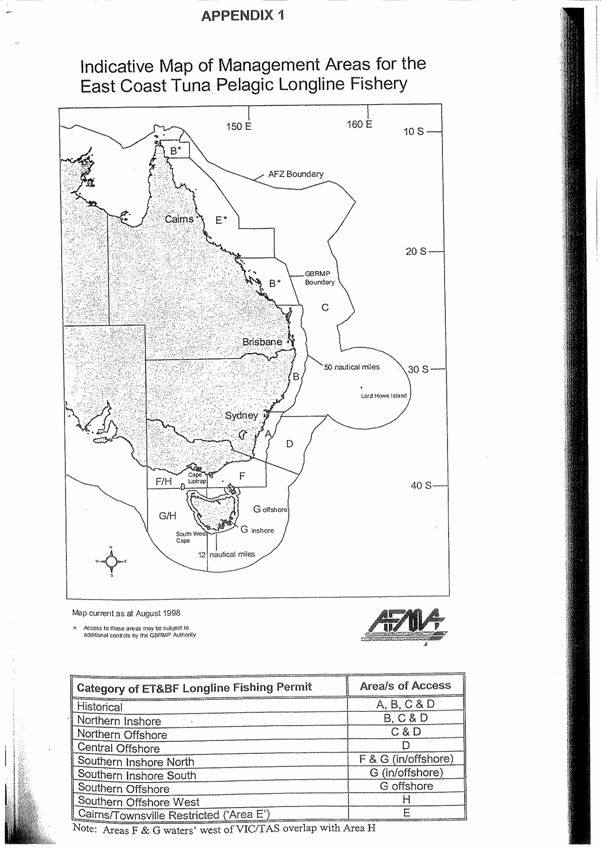
18 Attached as Appendix 1 is an Indicative Map of the Management Areas for the Fishery prior to the determination of the Management Plan. Each fishing permit provides access to a zone or a number of zones of the Fishery. Area E is of direct concern in these proceedings. Area E makes up approximately 9% of the Fishery. Each Area E permit must be associated in the same licence package with a general ETBF longline permit.
19 A large part of Area E falls within the jurisdiction of the Great Barrier Reef Marine Park Authority and longline fishing has not been permitted in the Great Barrier Reef Marine Park since 1999. The reason why Area E is a restricted area and fishing effort is restricted in that area is Area E contains the only known spawning area in the Western Pacific for black marlin. The area is also a spawning area for yellowfin and bigeye tuna. There is a large internationally recognised game fish sector that operates out of Cairns in North Queensland into Area E for blue and black marlin. That area is recognised as one of the premier game fish regions and has a large local tourism infrastructure associated with game fishing.
20 Area E operations had a number of restrictions including, inter alia, a maximum of 500 made up hooks, and 250 spare hooks; prior reporting before departure and return; no fishing in Area E on any trip where the vessel was first used in another area of the Fishery; Area E conditions apply on any trip where the vessel first fished in Area E; and the operator must hold a current (Fishery) longline entitlement (of the type “Historical”, “Northern Inshore” or “Northern Offshore”) on the same licence package.
21 An “Historical” permit, called an Area A permit, permits fishing in all areas except Area E. A “Northern Inshore” permit permits fishing in Areas B, C and D. A “Northern Offshore” permit, called an Area C permit, allows fishing in Areas C and D. A package consisting of Historical and Area E permits is referred to as A plus E package; a package consisting of Northern Inshore and Area E is referred to as a B plus E package.
22 A Factual Brief prepared by the Authority for an Independent Allocation Advising Panel showed the various combinations of fishery entitlements, being a generic name given to fishing authorisations granted under the previous Fisheries Act 1952 and the Fisheries Management Act 1991 (Cth) (the FM Act) for longline fishers, as at 17 July 2001 as follows:
| Category | Methods Permitted on Fishing Permit | No. Permits |
| 1 | Longline (Area E) only | 12 |
| 1 | Longline (non Area E) only | 3 |
| 1 | Longline/Minor Line only (includes 1 x Area E) | 214 |
| 1 | Longline/Purse Seine only | 1 |
| 1 | Longline/Minor Line/Pole only | 81 |
| 1 | Longline/Minor Line/Purse Seine only | 11 |
| 1 | Longline/Minor Line/Pole/Purse Seine only | 6 |
23 The same Brief shows the number of operators in the Fishery using the pelagic longline method of fishing, in the following table, by area:
| Method | Area Access | No. Operators at 17 July 2001- |
| Pelagic Longline | Cairns/Townsville Restricted – E | 13 |
| | Historical – A,B,C & D | 116 |
| | Northern Inshore – B,C & D | 48 |
| | Northern Offshore – C & D | 5 |
| | Central Offshore – D | 0 |
| | Southern Inshore North – F & G (in/offshore) | 198 |
| | Southern Inshore South – G (in/offshore) | 5 |
| | Southern Offshore – G offshore | 5 |
| | Southern Offshore West – H | 5 |
24 The total of licence packages is fewer than the number of permits. The reason is important for these proceedings. The reason is that, as earlier indicated, all Area E permits must be associated in the same licence package with a general fishery longline permit, for waters off the mainland.
History of the Management Plan
25 The Brief records in par 82:
The controversy over Area E management arrangements and specifically the commercial take of marlin species throughout 1995 and 1996 had substantially slowed down the implementation of the ET&BF management plan. As a result of Statutory Fishing Rights (SFRs) being introduced in other Commonwealth managed fisheries and domestic expansion of the ET&BF, operators questioned the adequacy of fishing permits as an on-going access right to a fishery. Following increasing calls by industry for the granting of SFRs in the ET&BF under a management plan, Eastern Tuna MAC 32 (1-2 November 1996) released the paper ‘Development of a management plan for the Eastern Tuna and Billfish Fishery – fishing permits or statutory fishing rights?’ on 23 December 1996 calling for submissions which would form the basis of Eastern Tuna MAC’s recommendation on Statutory Fishing Rights (SFRs) to AFMA.
26 To advance that proposal an Allocation Advisory Panel (AAP or the Panel), comprising the Honourable Daryl Davies QC, Dr David James, and Mr Tony Gibson, was appointed in September 1998. A schedule of Fishery Port meetings was published in the November 1998 edition of the AFMA News. A total of 54 written submissions were received by the AAP by mid January 1999. The AAP provided its advice to the AFMA Board on the allocation of SFRs in the Fishery under the gear unit based management plan in its report of 5 March 1999.
27 On 22 July 1999, the Board approved the public release of the AAP report and the AFMA’s Position paper on the Report prepared in respect of it. Many submissions from operators were received by AFMA as a result of industry consultation on the AAP Report and related AFMA Position Paper. On 5 October 1999, the Eastern Tuna Management Advisory Committee (Eastern Tuna MAC), noted that the vast majority of submissions received to date had expressed strong reservations about many aspects of the allocation framework as proposed by the AAP and AFMA.
28 In November 2000, Eastern Tuna MAC produced a submission entitled “Management Options for the Eastern Tuna and Southern and Western Tuna and Billfish Fisheries” which was considered by the Board of the Authority on 8 December 2000 at its 82nd meeting.
29 The Brief of July 2001 to the AAP noted (at par 114):
The aim of the new management arrangements is to pursue, to the fullest extent possible, AFMA’s legislative objectives, in particular to ensure the development of the ET&BF in an ecologically sustainable manner and to maximise the economic efficiency of the fishery. In addition to pursuing these objectives AFMA proposes to introduce a management framework which removes most of the current complexities of ET&BF management, thereby allowing operators to make rational investment decisions.
30 On 31 May 2001, at its 84th meeting, the AFMA Board approved terms of reference for a further Allocation Advisory Panel for the Fishery. The Board appointed the Honourable JF Gallop QC, Gerry Geen, and Tim Mirabella. Mr Gallop is a retired Federal Court judge, Mr Geen is a fisheries economist and Director of Fishery Research Economics and Management Pty Ltd. Mr Mirabella is an industry member.
31 The history of this AAP’s consultation process and its advice and reports to the Board, the consultation process leading to the 2005 Management Plan, will be set out in detail later.
The Applicants
32 The three applicants each held various permits in the Fishery as at 23 December 1996 (the snapshot date). As at that date, the first applicant held three A plus E packages and four B plus E packages. The second applicant held one B plus E package. The third applicant held one B plus E package and one Area A permit.
33 I set out a table (the determination table) showing those ten packages, as well as the Relative Price Factor for each package determined in accordance with s 32 of the Management Plan, and the SFRs provisionally granted in respect of each package.
| Package Number | Permit 1 | Permit 2 | Name | Area | Activity Level | RPF | Provisional Grant |
| 1 | 61298C | 61298D | ROBERT L LAMASON | Northern Inshore/Area E | Active | 0.8 | 12164 |
| 2 | 401431B | 401431A | ROBERT L LAMASON | Northern Inshore/Area E | Active | 0.8 | 12164 |
| 3 | 402202C | 402202B | ROBERT L LAMASON | Northern Inshore/Area E | Active | 0.8 | 12164 |
| 4 | 459369C | 459369D | ROBERT L LAMASON | Northern Inshore/Area E | Active | 0.8 | 12164 |
| 5 | 300009D | 300009C | ROBERT L LAMASON & ANN LAMASON | Northern Inshore/Area E | Active | 0.8 | 12164 |
| 6 | 25283C | 25283D | LAMASON TRADING PTY LTD | Northern Inshore/Area E | Active | 0.8 | 12164 |
| 7 | 458772B | 458772A | ROBERT L LAMASON | Historical/Area E | Active | 1.3 | 19766 |
| 8 | 402666D | 402666C | ROBERT L LAMASON | Historical/Area E | Active | 1.3 | 19766 |
| 9 | 402218C | 402218B | ROBERT L LAMASON | Historical/Area E | Active | 1.3 | 19766 |
| 10 | 402304 | | LAMASON TRADING PTY LTD | Historical | Active | 1 | 15205 |
| TOTAL | | | | | | 9.70 | 147487 |
34 Section 26 of the FM Act provides for registration of applicants as eligible persons for the grant of a fishing right, and specifies that the required Authority must register as an eligible person an applicant who, amongst other things, satisfies any conditions for registration specified in the plan of management in relation to the grant.
35 Section 25 of the Management Plan specifies that a person is eligible for the grant of one or more longline SFRs if:
(a) on 30 November 2002, the person held an old longline permit and;
(b) the permit forms part of a sequence of old longline permits; and
(c) before the end of the notice period, the person applied, under section 26 of the Act, for registration as an eligible person for the grant of the SFRs.
36 As on 30 November 2002, the applicants held 10 longline permits, which were deemed to form part of a sequence of longline permits. Those permits are set out in the determination table at [33].
37 By letters dated 15 August 2007, AFMA advised the applicants of its preliminary determination of the “Relative Price Factor” for each of their permit packages. Those preliminary determinations were made in accordance with ss 30 and 31, and the table in s 32 of the Management Plan.
38 The “Relative Price Factor” was based on two factors, fishing activity level during the relevant permit period 1 January 1992 to 22 December 1996, and the geographical area of the Fishery to which the person’s fishing permit applied on 30 November 2002.
39 The table in s 32 (the s 32 Table) of the Management Plan sets out the ranking of permits in accordance with these criteria. It then accords a “Relative Price Factor” which is used in the formula governing the number of longline SFRs to be granted to eligible persons under s 32 of the Plan.
40 The s 32 table, to which the applicants’ case is directed, is as follows:
Category of old longline permit or permit package
| Item | Area of fishery to which old longline permit or permit package applied | Activity level of sequence of old longline permits | Relative price factor |
| 1 | Historical | High level active | 1.65 |
| 2 | Historical and Cairns/Townsville Restricted (‘Area E’) | Active | 1.30 |
| 3 | Historical | Active | 1.00 |
| 4 | Historical and Cairns/Townsville Restricted (‘Area E’) | Inactive | 0.80 |
| 5 | Northern Inshore and Cairns/Townsville Restricted (‘Area E’) | Active | 0.80 |
| 6 | Northern Inshore and Cairns/Townsville Restricted (‘Area E’) | Inactive | 0.55 |
| 7 | Historical | Inactive | 0.50 |
| 8 | Northern Inshore | Active | 0.50 |
| 9 | Northern Inshore | Inactive | 0.25 |
| 10 | Northern Offshore | Active | 0.25 |
| 11 | Northern Offshore | Inactive | 0.13 |
| 12 | Southern Inshore North | Active | 0.13 |
| 13 | Southern Inshore South | Active | 0.13 |
| 14 | Southern Offshore | Active | 0.13 |
| 15 | Southern Offshore West | Active | 0.13 |
| 16 | Area Z | Active | 0.13 |
| 17 | Southern Inshore North | Inactive | 0.03 |
| 18 | Southern Inshore South | Inactive | 0.03 |
| 19 | Southern Offshore | Inactive | 0.03 |
| 20 | Southern Offshore West | Inactive | 0.03 |
| 21 | Area Z | Inactive | 0.03
|
41 The above Table gives a Relative Price Factor of 1.3 to an A plus E package, a Relative Price Factor of 1 to an Area A permit, and a Relative Price Factor of .8 to a B plus E package.
42 Permit packages numbered 7 to 10 in the determination table were not referred to in the affidavit of Mr Lamason filed in these proceedings, probably for the reason that those permit packages were transferred to other owners, subsequent to 30 November 2002.
43 The provisional grants of the SFRs to the applicants is based on those entities holding the 10 permits on the snapshot date. The total allocation to the Lamason interests is 147,487 SFRs, equivalent to 14.7% of the 1,000,000 longline SFRs allocated. This means that the Lamason interests will be able to set 14.7 % of the hooks under the Management Plan.
44 Patrycia Stone, the Senior Manager for Pelagic and National Fisheries employed by the Authority says that the applicants have been provisionally granted 14.7% of the SFRs based on holding the 10 permits in the table set out above. 7.3% of the SFRs have been provisionally granted based on permit packages 1 to 6 in that table, 7.4% of SFRs were provisionally granted based on permit packages 7 to 10 in that table.
45 Ms Stone agrees with the figures to which Mr Lamason deposes concerning catch history in Area E. Mr Lamason says that of the total Area E catch of 1,253,966 kilograms, the Lamason interests caught 1,112,654 kilograms. The Lamason interests therefore had 88.7% of the catch history of Area E permit packages, if all of the ten permit packages set out in the table are considered.
46 The 9 Area E package permits held by those Lamason interests received 84.5% of the provisional grant attributed to Area E permit packages.
47 In respect of packages 1 to 6 on the determination table, each respective applicant, by a letter received by the Authority on 5 September 2007, indicated that the applicant objected to the preliminary determination of the Relative Price Factor, the objection being expressed in each case:
The determination is based upon an assessment of relative price factor that is flawed and inconsistent with the objectives of the Fisheries Management Act thereby rendering it invalid.
48 The applicants contend that the Relative Price Factor of .8 for the B plus E packages numbered 1-6 in the determination table should be 1.3.
The Respondent
49 Section 3 of the Fisheries Administration Act 1991 (Cth) (the FA Act) sets out the FA Act’s objects:
3 Objects of Act
The objects of this Act are:
(a) to establish an Australian Fisheries Management Authority with functions and responsibilities relating to the management of fisheries on behalf of the Commonwealth; and
(b) to establish a Fishing Industry Policy Council with a view to ensuring the participation by persons engaged in, or having an interest in, the fishing industry in the process of formulating government policy in relation to the management of fisheries.
50 The respondent, the Authority, is established by s 5 of the FA Act.
5 Establishment
An Australian Fisheries Management Authority is established.
51 Section 6 of the FA Act sets out the objectives of the Authority. Section 6 relevantly provides:
6 Objectives
The Authority, in the performance of its functions, must pursue the objectives of:
(a) implementing efficient and cost-effective fisheries management on behalf of the Commonwealth; and
(b) ensuring that the exploitation of fisheries resources and the carrying on of any related activities are conducted in a manner consistent with the principles of ecologically sustainable development (which include the exercise of the precautionary principle), in particular the need to have regard to the impact of fishing activities on non-target species and the long term sustainability of the marine environment; and
(ba) ensuring that:
(i) the exploitation in the Australian fishing zone (as defined in the Fisheries Management Act 1991) and the high seas of fish stocks in relation to which Australia has obligations under international agreements; and
(ii) related activities;
are carried on consistently with those obligations; and
…
(c) maximising the net economic returns to the Australian community from the management of Australian fisheries; and
(d) ensuring accountability to the fishing industry and to the Australian community in the Authority’s management of fisheries resources; and
(e) achieving government targets in relation to the recovery of the costs of the Authority.
52 The Authority, has, by s 7, extensive functions, but of relevance particularly to the present proceedings are the following:
7 Functions
(1) The Authority [relevantly] has the following functions:
(a) to devise management regimes in relation to Australian fisheries;
(aa) to devise and implement management regimes that:
(i) relate to fishing for fish stocks in relation to which Australia has obligations under international agreements; and
(ii) are consistent with those obligations;
…
(b) to devise fisheries adjustment programs and fisheries restructuring programs;
(c) to consult, and co-operate, with the industry and members of the public generally in relation to the activities of the Authority;
(d) to devise exploratory and feasibility programs relating to fishing;
…
(e) to establish priorities in respect of research relating to fisheries managed by the Authority and arrange for the undertaking of such research;
…
(g) to consult and exchange information with, and make its expertise in fisheries management available to, State, Territory or overseas bodies having functions similar to the Authority’s functions;
…
(gaa) in addition to the collection of information in the exercise or performance of its other powers and functions – to collect, … information relating to the following:
…
(iii) the administration and management of fisheries or marine environments;
(iv) research or monitoring conducted, or proposed to be conducted, into fisheries or marine environments;
(m) as provided by an associated law:
(i) to establish and allocate fishing rights;
(ii) to establish and maintain a register of fishing rights;
(iii) functions relating to plans of management
(iv) functions relating to recreational fishing;
(v) to undertake, on behalf of the Commonwealth, management responsibilities in relation to fisheries management arrangements entered into with the States and Territories;
(vi) to collect, on behalf of the Commonwealth, a payment in the nature of a community return payable by persons exploiting fisheries resources;
…
53 Section 8 provides:
8 Powers
(1) The Authority may do all things that are necessary or convenient to be done for, or in connection with, the performance of its functions.
(2) However, the Authority does not have the following powers:
(a) the power to acquire, hold and dispose of real or personal property;
(b) the power to enter into contracts;
(c) the power to lease the whole or any part of any land or building for the purposes of the Authority.
(3) A right to sue is taken not to be personal property for the purposes of paragraph (2)(a).
54 Section 9 provides for consultation:
9 Consultation
The Authority, for the purpose of considering any matter, or obtaining information or advice, relating to the performance of its functions, may consult with persons, bodies or Governments, including:
(a) persons or bodies representative of the whole or a part of the industry or recreational fishing; and
(b) the Commonwealth Government or State or Territory Governments or Commonwealth, State or Territory authorities having functions relating to fisheries; and
(c) persons (including members of the scientific community) having a particular interest in matters associated with the industry.
55 By s 10 of the FA Act, the Authority is a body corporate.
56 Section 56 of the FA Act permits the Authority to establish a management advisory committee to assist it in the performance of its functions and the exercise of its powers in relation to a fishery.
57 The functions of a management advisory committee are the subject of s 57 of the FA Act:
57 Functions of management advisory committees
(1) A management advisory committee has such functions as the Authority from time to time determines.
(2) Without limiting the generality of subsection (1), the Authority may determine any of the following functions in relation to a management advisory committee:
(a) the function of being a liaison body between the Authority and persons engaged in a fishery;
(b) the function of providing advice to the Authority in relation to the preparation and operation of a plan of management;
(c) the function of monitoring, and reporting to the Authority in relation to, scientific, economic and other information relating to a fishery.
58 The function referred to in s 57(2)(b) is relevant to these present proceedings.
59 The FM Act, which is an “associated law” with the FA Act, governs the way a fishery is managed.
60 Section 3 of the FM Act relevantly provides:
3 Objectives
(1) The following objectives must be pursued by the Minister in the administration of this Act and by AFMA in the performance of its functions:
(a) implementing efficient and cost-effective fisheries management on behalf of the Commonwealth; and
(b) ensuring that the exploitation of fisheries resources and the carrying on of any related activities are conducted in a manner consistent with the principles of ecologically sustainable development and the exercise of the precautionary principle, in particular the need to have regard to the impact of fishing activities on non-target species and the long term sustainability of the marine environment; and
(c) maximising economic efficiency in the exploitation of fisheries resources; and
(d) ensuring accountability to the fishing industry and to the Australian community in AFMA’s management of fisheries resources; and
(e) achieving government targets in relation to the recovery of the costs of AFMA.
61 Subsection 3(2) directs that the Minister and the Authority are to have regard to the objectives of:
(a) ensuring, through proper conservation and management measures, that the living resources of the [Australian Fishing Zone] are not endangered by over-exploitation; and
(b) achieving the optimum utilisation of the living resources of the [Australian Fishing Zone]; and
(c) ensuring that conservation and management measures in the [Australian Fishing Zone] and the high seas implement Australia’s obligations under international agreements that deal with fish stocks; and
(d) to the extent that Australia has obligations:
(i) under international law; or
(ii) under the Compliance Agreement or any other international agreement;
in relation to fishing activities by Australian-flagged boats on the high seas that are additional to the obligations referred to in paragraph (c) – ensuring that Australia implements those first-mentioned obligations;
but must ensure, as far as practicable, that measures adopted in pursuit of those objectives must not be inconsistent with the preservation, conservation and protection of all species of whales.
62 The function given to the Authority by s 17 of the FM Act is at the core of these proceedings.
63 Section 17 provides that the Authority:
(1) … must, in writing, after consultation with such persons engaged in fishing as appear to AFMA to be appropriate and after giving due consideration to any representations mentioned in subsection (3), determine plans of management for all fisheries.
64 Subsection 17(2) provides that before determining a plan of management for a fishery, the Authority must prepare a draft plan and, by public notice, among other things, invite interested persons to make representations in connection with the draft plan. The subsection also provides how and when notice of the draft plan must be given.
65 Subsection 17(3) provides:
(3) A person may, not later than the date specified in the notice, make representations to AFMA in connection with the draft plan.
66 Subsection 17(5) provides:
(5) A plan of management for a fishery is to set out:
(a) the objectives of the plan of management; and
(b) measures by which the objectives are to be attained; and
(c) performance criteria against which the measures taken may be assessed.
67 Subsection 17(5A) provides:
(5A) The measures to be set out under paragraph (5)(b) in a plan of management for a fishery include:
(a) providing for AFMA, after such consultations (if any) as are set out in the plan of management, to direct that fishing is not to be engaged in in the fishery, or a particular part of the fishery, during a particular period or periods; and
(b) providing for holders of fishing concessions in respect of the fishery to be notified of the direction; and
(c) obliging those holders to comply with the direction.
68 Subsection 17(6C) provides that:
(6C) If a plan of management for a fishery provides for the management of the fishery by means of a system that consists of or includes statutory fishing rights, the plan:
(a) may oblige a person who holds, in respect of the fishery, a fishing concession of a particular kind or fishing concessions of particular kinds also to hold, in respect of the fishery, a fishing concession of another kind or fishing concessions of other kinds, as stated in the plan; and
(b) without limiting the generality of paragraph (a), may oblige a person who holds, in respect of the fishery, a fishing right of a particular kind or fishing rights of particular kinds also to hold, in respect of the fishery, a fishing right of another kind or fishing rights of other kinds, as stated in the plan; and
(c) in respect of each kind of fishing right that a person holds in respect of the fishery – may do either or both of the following:
(i) oblige the person to hold not fewer than such number of fishing rights of that kind as is stated in the plan or worked out using a formula so stated;
(ii) oblige the person not to hold more than such number of fishing rights of that kind as is stated in the plan or worked out using a formula so stated.
69 Section 26 of the FM Act has been referred to earlier at [34].
70 Section 32 of the FM Act deals with the grant of fishing permits, authorising the use by a person of an Australian boat for fishing in a specified area of the Australian Fishing Zone, or a specified fishery.
71 By s 4 of the FM Act, Australian Fishing Zone means:
Australian fishing zone means:
(a) the waters adjacent to Australia within the outer limits of the exclusive economic zone adjacent to the coast of Australia; and
(b) the waters adjacent to each external territory within the outer limits of the exclusive economic zone adjacent to the coast of the external Territory;
but does not include:
(c) coastal waters of, or waters within the limits of, a State or internal Territory; or
(d) waters that are excepted waters.
72 Section 95 of the FM Act creates an offence of strict liability for engaging in commercial fishing without a fishing concession.
73 By s 4 of the FM Act, fishing concession means:
fishing concession means:
(a) a statutory fishing right; or
(b) a fishing permit; or
(c) a foreign fishing licence.
Determination of the Management Plan for the Fishery
74 On 24 May 2005, the Authority determined the Management Plan under s 17 of the FM Act. That determination followed a lengthy consultation process to which it will be necessary to refer in some detail.
75 On 1 July 2005, the Authority submitted the Management Plan to the Minister for Fisheries, Forestry, and Conservation, Senator Ian Macdonald, in accordance with s 18 of the FM Act. The Minister accepted the Management Plan on 12 October 2005, and the Minister signed the instrument of acceptance. Notification of the determination and acceptance of the plan was published in the government gazette under s 19 of the FM Act on 24 October 2005.
76 The Management Plan was amended by the Eastern Tuna and Billfish Fishery Management Plan Amendment 2007 (the 2007 Amendment), pursuant to ss 17 and 20 of the FM Act. The 2007 Amendment arose from the Authority’s recognition that it was unable to proceed with the grant of Statutory Fishing Rights under the Management Plan because of a number of technical errors. The 2007 Amendment was determined by the Authority on 19 April 2007, following a period of public consultation from 15 December 2006 to 24 January 2007. On 24 April 2007, the Authority submitted the 2007 Amendment to the Minister for Fisheries, Forestry and Conservation, Senator Eric Abetz, in accordance with s 18 of the FM Act.
77 The 2007 Amendment was accepted by the Minister on 7 May 2007, who signed an instrument of acceptance on that day. The 2007 Amendment was registered as a legislative instrument under the Legislative Instruments Act 2003 (Cth) on 10 May 2007, and commenced on 11 May 2007. The 2007 Amendment was tabled in the House of Representatives on 21 May 2007, and tabled in the Senate on 12 June 2007.
78 I set out later the history of advice, consultation and submissions leading to the determination of the Management Plan by the Authority.
The Applicants’ pleaded case
79 By an application filed on 20 March 2008, the applicants sought:
1. A declaration that s.32 of the Eastern Tuna and Bill Fish Fishery Management Plan 2005 (“the Plan”) is void.
2. An order that the respondent prepare and promulgate a method of calculating statutory fishing rights for the purposes of the Plan so as to preserve the applicants’ rights to fish in the Eastern Tuna and Bill Fish Fishery (“the Fishery”) in such a way as to maintain the applicants’ proportion of the overall right to catch fish in the Fishery as it existed as at 23 December 1996.
3. In the alternative to order 1 above, an order pursuant to s.5 of the Administrative Decisions (Judicial Review) Act 1977 (“ADJR Act”) of review of the decision of the respondent to determine the allocation of fishing rights in the Fishery in the manner directed by s.32 of the Plan.
4. An injunction restraining the respondent from allocating, or an order pursuant to s.15 of the ADJR Act staying the allocation of, any statutory fishing rights in terms of the provisional statutory fishing rights issued by the respondent on or about 9 November 2007.
…
80 The applicants assert that in preparing the publishing of a management plan for the Fishery and in the allocation of fishing rights in the Fishery, the Authority was required:
(a) Not to reduce, remove or destroy any right to fish in the Fishery without assessing and paying reasonable compensation;
(b) To preserve all existing rights to fish in the Fishery;
(c) To preserve the balance of the distribution of wealth realisable from the Fishery.
(d) Have regard to the objectives in ss.3(1)(a), 3(1)(b), 3(1)(c) and 3(2)(a) of the Act.
81 The objectives referred to in (d) are set out in [60] and [61] above.
82 The Authority admits that in preparing and publishing the Management Plan and in making the allocation of fishing rights in the Fishery, the Authority was required to have regard to the four objectives referred to in (d), but deny that there was any obligation as alleged in respect of the matters identified in (a), (b), or (c).
83 The applicants assert that the Authority, by s 32 of the Management Plan, devised or decided upon a method for the allocation which:
(a) Is ultra vires its power;
(b) Results in an Allocation which is arbitrary, unfair and capricious;
(c) Removes and/or destroys rights previously enjoyed by the Applicants without compensation;
(d) Operates partially and differentially;
(e) Results in an Allocation which is manifestly unjust.
84 The Authority denies each of those five allegations.
85 The Authority asserts that insofar as the applicants seek to rely on the ADJR Act to challenge part of the making of the Management Plan or the validity of any of its terms, the Management Plan is a legislative instrument, and its making is not a decision to which the ADJR Act applied for the purposes of s 5 of the ADJR Act.
86 In the course of the hearing, Mr Lilley conceded that it was not an obligation under the Act for the Authority to maintain the economic interests of the participants. It is proper to note that that concession by Mr Lilley was in association with his observation: “It was certainly part of AFMA’s policy, and the aim of the process entered into, to maintain the economic interests”.
87 Mr Lilley also conceded that the applicants’ case could not be brought under the ADJR Act, and was based exclusively on s 39 of the Judiciary Act 1903 (Cth). The applicants abandoned any claim to compensation based on “just terms” acquisition under s 51(xxxi) of the Constitution.
88 In closing submissions, the only relief sought by the applicants was a declaration that item 5 (in s 32 of the Management Plan) was invalid.
The gravaman of the Applicants’ case
89 As at 12 November 2008, on the first day of the hearing in the Federal Court, the applicants held seven permits which permitted them to fish in Area E of the Fishery. Previously, the applicants had 11 such permits which permitted such fishing. Six of those 7 permits were B plus E permits, and one was A plus E.
90 Pursuant to the Management Plan adopted by the Authority, the method by which statutory fishing rights were allocated was to compare the values of the existing fishing permits, and then to allocate the rights according to the relative values of those permits.
91 The gravaman of the complaint by the applicants is that, in respect of the particular permits they hold, the process adopted by the Authority to reach a value (the Relative Price Factor) for those particular packages of permits was “just irrational and illogical”. Mr R Lilley SC, senior counsel for the applicants, offered this description of determining how fishing rights were to be allocated:
In the absence of sales it appears that they were able to get evidence of three things: one was that an area A permit was worth a certain amount and an area B permit was worth about half that amount, and they were able to determine that an area A permit packaged with an area E permit was worth about 30 per cent more than an area A permit. So what they did was to say that – they gave A a notional assignment of the figure 1. They gave B a notional assignment of .5, and they gave the package of A and E a notional assignment of 1.3.
92 Later, Mr Lilley said:
… we think that the system of using anecdotal evidence in the circumstances of talking to fishermen was not the best process, but having adopted that process, they had to be very careful, in our submission, with what they did next, and what they did next was a simple mathematical equation. To work out the value of the packaged B and E permits, which are the ones my client owns, they simply deducted an A from an A plus E and came up with .3 for E and then added .3 onto B to come up with .8.
…
HIS HONOUR: …. what really is your objection: that they have assessed six of your seven permits at .8?
MR LILLEY: At .8.
HIS HONOUR: And what do you say it should be?
MR LILLEY: It should be 1.3.
93 And later:
HIS HONOUR: … you disagree that if A is worth 1, A plus E is worth 1.3.
MR LILLEY: No, we don’t disagree with that. That’s what the market information showed.
…
HIS HONOUR: … and you don’t disagree that [an] area B permit, which doesn’t permit you to fish in area E, is worth .5.
MR LILLEY: No.
HIS HONOUR: But you do disagree that a B plus E permit is .8?
MR LILLEY: Yes, your Honour.
94 And further, at p 29 of the transcript:
HIS HONOUR: … now you say that a B and E permit has the same value as an A and E permit.
MR LILLEY: Yes, because of the E. … we say it is nonsensical to do the mathematical approach because you’re talking about a different source of income and a different market almost.
…
MR LILLEY: … you can’t look at these packages by their component parts.
95 The essence of the applicants’ complaint is that the Authority did not do all that it could to determine the correct values of packages which contain Area E permits: its approach to the process was to condone “a very casual and imprecise” approach to the establishment of market value for permits of any kind. It was further said that the approach to determine those values was unreasonable.
96 In the applicants’ final submissions, it was submitted:
12. … it is clear that it was an unreasonable approach to deconstruct a package in order to find the value of a component part thereof.
13. This is particularly the case where each part of the package is capable of being a separate source of income. …
97 In essence, the complaint is that the methodology adopted by the AAP was very casual and imprecise, and that the method adopted concerning valuation, particularly the valuation of packages which involved fishing in Area E, was unreasonable, in the sense of capricious or irrational. It was said that the Authority found the only way to value an Area B and E package was to deconstruct the value of an Area A and E package (which it had erroneously recorded, in any event) and then add the resulting value of Area E to a B Area value.
98 It was further submitted by the applicants that the allocation provisions of the Plan did not take into consideration the following factors:
(a) The investment made by operators. The enquiries made were about perceived values of permits at a point in time, not about what holders had been required to pay for their permits (which may have been acquired much earlier) or the other investments made by holders to develop their operations;
(b) The levels of catch able to be obtained by operators in the past and likely catch levels into the future;
(c) the resources required by those operators to achieve the catches during the relevant period and the resources that would be required to achieve catches into the future;
(d) the nature of the vessels used in the fishery or their equipment;
(e) the efficiency or otherwise of the operations of holders of permits. Catch history was not considered, except in a very indirect way, that is, so far as it had then impacted, in December 1996 to February 1999 upon the perceived values of permits;
(f) the resources required for vessels or operators to achieve a particular yield of fish.
99 It was then submitted by the applicants that the fact that the allocation provisions do not take these matters into account means that those provisions do not comply with the FM Act, and specifically with s 3(1)(c), being the objective to maximise economic efficiency in the exploitation of the resources of the Fishery.
100 It is appropriate to set out at length the relevant particulars by which the applicants allege that the method of allocation specified by s 32 of the Management Plan was ultra vires the power of the Authority; resulted in an allocation which was arbitrary, unfair and capricious; removes and/or destroys rights previously enjoyed by the applicants without compensation; operates partially and differentially; and results in an allocation which is manifestly unjust.
101 Those particulars are:
(i) Calculation of fishing rights in accordance with s.32 of the Plan is irrational in that s.32(a)(i) attributes a value to an “Area E” permit of less than one third of the value of an “historical” permit when it is not appropriate to do so;
…
(v) The Allocation in s.32 of the Plan of the relative price factor for “Area E” Permits:
(1) is manifestly arbitrary in its operation;
(2) is unsupported by any rational basis by reference to proper fisheries management principles;
(3) operates unreasonably and unfairly against the holders of Area E Permits, including the Applicants;
(4) operates partially and differentially against the interests of the holders of Area E Permits, including the Applicants;
(5) has effect contrary to the objective provided for in s.3(1)(a) of the FMA of implementing efficient and cost-effective fisheries management, in that it only serves to transfer wealth and income-earning potential from holders of Area E Permits to other permit holders;
(6) has effect contrary to the objective provided for in s.3(2)(a) of the FMA, of ensuring, through proper management measures, that fisheries resources are not endangered by over-exploitation, in that it has the effect of concentrating fishing effort in Areas A and B;
(7) has effect contrary to the objective provided for in s.3(1)(c) of the FMA, of maximising the net economic returns to the Australian community from the management of fisheries or in the alternative, as repealed by Act No 8 of 2006, to maximise economic efficiency in the exploitation of the resources of the fishery, in that it has the effect of maximising returns only to one sector of the industry whilst severely adversely impacting another sector, namely holders of Area E Permits, including the Applicants;
(8) has effect contrary to the objective provided for in s.3(1)(d) of the FMA, of ensuring the respondent’s accountability to the fishing industry in that having a stated and published policy circulated throughout the fishing industry (Paper 8 September 1997) to the effect that principles for the reallocation of fishing rights should “minimize any redistribution of wealth” the application of s.32 of the Plan significantly redistributes the wealth in the fishery when applied to the allocation of SFRs;
(vi) In determining the Plan, the Australian Fisheries Management Authority “AFMA”):
(1) failed to take into account, adequately or at all, the matters referred to in paragraph 2 above;
(2) failed to act in accordance with its objectives provided for in [s.7(1)] of the Fisheries Administration Act 1991 (“the Administration Act”), namely:
(a) implementing efficient and cost-effective fisheries management;
(b) ensuring, through proper management measures, that fisheries resources are not endangered by over-exploitation;
(c) maximising the net economic returns to the Australian community from the management of fisheries;
(3) failed to take into account, adequately or at all, the nature and extent of the rights and entitlements in relation to the Fishery held by the Applicants at the time the Plan was introduced;
(4) failed to take into account, adequately or at all, the significant and differential economic impact of the Plan, insofar as it provides, in respect of the relative price factor to be applied for the purpose of allocating Statutory Fishing Rights under the Plan.
102 It is to be appreciated that many of these “particulars” would be apposite to the pleaded claim for judicial review pursuant to the ADJR Act, a claim which the applicants later abandoned.
103 The real complaint of the applicants is that the Authority should have accepted the representations of Mr Lamason and Mr Rowley as to the values that should be found for the Area E packages. The preference by the Authority for different values expressed in s 32 of the Management Plan, it was said, was the consequence of a sloppy methodology, based on unreliable anecdotal evidence, was against the weight of the evidence and led to results that were unfair.
104 I accept that some aspects of the way the advisory panel went about its task, and the way the Authority dealt with the “Area E” problem, particularly in relation to the treatment of Mr Rowley’s submissions and his offer concerning valuations, may have been handled differently.
105 However, those criticisms, even if fully accepted, in my judgment do not found a basis on which s 32 may be declared void.
The Management Plan
106 It is necessary to deal with the way s 32 came to be as it is, and with the representations and challenges by the applicants to the method of allocation adopted in s 32.
107 The Management Plan, part of which is sought to be impugned by the applicants, provides a detailed system for the management of the fishery. In this fishery, fish are caught by hooks rather than nets. Longlining accounts for 99 % of the catch in the fishery.
108 The Management Plan permits fishing in the fishery only if a person holds a Boat Statutory Fishing Right, a Longline Statutory Fishing Right, and (relevantly to the applicants and others intending to fish in what previously was called Area E) a Coral Sea Zone Permit: s 16 of the Management Plan.
109 The Management Plan was determined by the Authority, and accepted by the Minister, after extensive consultation with interested persons (including the applicants) and lengthy consideration by various committees, independent panels, and the Board of the Authority, over a period of more than 10 years.
110 The method of regulation chosen by the Authority in the Management Plan for the take of fish was to regulate by the amount of gear, including hooks, that can be used by operators to take fish. This method of regulation can be contrasted with regulation by the imposition of quota, and a total amount of fish which can be taken each year, or by other options of how fishing in the Fishery might be regulated. The method of regulation adopted by the Management Plan is not challenged by the applicants.
111 Each longline SFR will allow the holder to use a certain number of hooks based on a proportion of the total number of hooks permitted in the fishery. Section 32 of the Management Plan allocates longline SFRs out of a total number fixed by the Management Plan of 1,000,000. Each longline SFR allows the use of a proportion of the total number of hooks (total allowable effort) set by the Authority each year, so that on an annual basis, the actual number of hooks in the Fishery might vary, but an operator’s proportion of the total hooks will not: section 13(1) and 14(1) of the Management Plan.
112 There are approximately 119 longline operators in the fishery, after a buy back in 2005, which removed about 45% of concession holders in the fishery.
113 On 16 December 2005, the then Minister for Fisheries, Senator Ian Macdonald, made a direction to AFMA under s 91 of the FA Act. As part of this package of measures, the Federal Government made available $220 million to conduct a structural adjustment program to encourage the removal of excess fishing effort. A total of 99 longline permits and 112 minor line permits were removed from the Fishery through the buyout.
114 The effect of the buyout is that there now exists a smaller pool of fishing concession holders to share in the allocation of the SFRs in the Fishery than when the AAP made its report in April 2002. The reduction in the number of concessions will work to the advantage of those remaining in the Fishery, including the applicants.
115 Because the Management Plan limits the number of SFRs to be granted to 1,000,000, the effect is that each eligible person will receive a proportionally greater allocation of SFRs than would have been the case before the buyback.
116 The applicants do not take objection to this method of allocation, nor do the applicants object to the method of determining the number of SFRs for each permit package, being information based on the Relative Price Factor of the particular package type. What the applicants object to is the derivation of a Relative Price Factor of .8 for a B plus E package. This contention was vigorously pressed on many occasions to the AAP, and to the Authority, and rejected.
117 It is said that by determining a Relative Price Factor for a B plus E package of .8 (instead of 1.3 as the applicants contend) that determination, which is expressed as item 5 of the s 32 table of the Management Plan, is invalid.
History leading to the determination of the Management Plan
118 After the appointment of the Allocation Advisory Panel on 31 May 2001, a draft report was prepared by the AAP and provided by it to AFMA in April of 2002. At the 94th meeting of the Authority in May 2002, the Board of the Authority considered the AAP’s report and the Board accepted the recommendations of the AAP. The Board requested that the panel provide additional information on the nature and processes of the consultation that it undertook in relation to relative permit prices. The Board also requested that AFMA Management investigate and provide further advice on some issues contained in the report, including the allocation of SFRs to the permit holder of the identified freezer vessels.
119 On 6 January 2004, the Authority wrote to Mr Gallop about the allocation formula submitted to AFMA in June 2002, and sought advice about two issues.
120 The first of those issues concerned whether catches of southern bluefin tuna were to be included as part of the catch history when valuing permits as “active” or “inactive”. The active/inactive threshold determined by the Management Plan, and the active characterisation determined in respect of each of the permit packages of the applicants, is not a subject of complaint by the applicants.
121 The second concerned Area E valuations. The letter from the Authority to Mr Gallop of 6 January 2004 directly pressed the contentions by Fortuna Fishing Pty Ltd, Mr Rowley’s company, and Great Barrier Reef Tuna, Mr Lamason’s firm. The letter said in part:
Your report recommended and AFMA accepted that:
the allocation of hook-day SFRs to Area E permit holders is based on relative permit prices, as for the rest of the fishery.
Your report notes that the value of a permit package that contains an Area E permit depended on the permit with which the Area E permit was associated.
I have attached a copy of a submission from Fortuna Fishing Pty Ltd. The submission asserts that the value of a package that contains an Area E permit had the same relative price regardless of the permit with which the Area E permit was associated. It has been claimed that no differences existed between Historic and Developmental packages that contained Area E permits. It has also been asserted that no industry member was approached or gave advice to the Panel on the valuation of Area E permits.
I have also attached a submission from Great Barrier Reef Tuna, which also asserts that Area E permits have been undervalued.
You will appreciate AFMA’s responsibility to ensure that all relevant issues have been considered, as part of the public comment process. In this context, I would appreciate your advice on these matters as soon as possible. The Board intends to consider this advice at the earliest opportunity.
122 The “submission from Fortuna Fishing” referred to in that letter is a letter from Mr Mike Rowley to an officer of the Authority dated November 14, 2003. The second paragraph of that letter read:
I am really taken with your advice, quote “While this process will be ongoing, I can inform you that AFMA’s initial position that we will be putting to Eastern Tuna MAC is to support the original AAP recommendation, and to not amend the relative permit values in the draft plan. This is because AFMA is of the view that the AAP explicitly considered the issues you have raised in preparing their report.”
I was not aware that you made the board’s decisions for them. Are the board aware of this?
123 He then said:
We tell you again, you and the panel are wrong; your current attitude helps nobody; it only serves to harden our resolve to set things right and have the position rectified. We explained to you that what you were doing resulted in the loss of .50 of a permit for eight of the thirteen permits in Area E. The value of this loss at current market is $2.5 to $3 million dollars. This is wealth you have taken from Area E permit holders contrary to all your legislative objectives, and the intent of the new management proposal.
124 That letter concluded:
… Area E operators have already been disadvantaged in their fishing rights when compared to every other East Coast operator. This does not sit well with AFMA’s maximum economic efficiency objective nor the maximum sustainable yield objective.
We don’t think that we can lose the argument if it comes to court and indeed, court action may serve to restore other rights that have Area E operators at a disadvantage. For example, why have AFMA sat on this report for the last ten years, made no effort to implement any of the recommendations in the report, all of which would add value to the fishery and to the sustainable exploitation of the resource which is what you are supposed to be about.
125 The letter from the Authority to Mr Gallop of 6 January 2004 also had attached Mr Rowley’s letter of 10 October 2003 to another officer of the Authority. That letter concluded:
It is not in anyone’s interest to have this matter end up in the Federal Court. It is not difficult for you to verify the claim that we make and if satisfied that we are correct, make the necessary adjustment. There are professional valuers available and we offer to meet the cost of sworn valuations if necessary.
126 On 6 October 2003, Mr Rowley had also written to another officer of AFMA. That letter was also attached to the Authority’s letter of 6 June 2004. The letter commenced:
The draft management plan has Area E permits at different values according to whether the package contains Historic or Developmental licences.
Since November 1 2002, I have advised you that the panel got it wrong.
127 The letter concluded:
… We are now formally objecting to the valuation of an Area E Developmental package which we say is the same as an Area E Historical package.
We need to hear from you what steps you intend to take to rectify and if not, why not.
128 The submission by Great Barrier Reef Tuna signed by “Bob and Annie Lamason”, referred to in the letter of 6 June 2004 from the Authority to Mr Gallop, said in part:
Market value of the permits by the AAP report stated, “An endorsement to fish in Area E was said by the fishers to be worth significantly more tha[n] the same class of permit without such an Area E endorsement.
It is not known how this decision was reach [sic]. For example two boats fishing in Area E (the priority-licensed area) have different values licenses, one boat might have Area E license and another boat an Area B yet in this case both will get a vastly different hook allocation. Area E is the predominant License.
129 In the AAP’s report under the heading, Market Value of Permits, the following appears:
In each port meeting held by the AAP, there was substantial discussion of the market values of fishing permits. Most fishers felt that the market value of their fishing permit should be recognised and “protected” in the allocation.
Information was sought by the Panel on the values of permits to fish in various zones and on the extent to which catch history influenced these prices (a summary of consultations with industry and licence brokers on this issue is outlined in Attachment 6). It was uniformly acknowledged by fishers that permits that allowed access to the historic zone of the fishery (Zone A, as well as other zones including B, C, D, F, G & H) were considerably more valuable than “developmental” permits that included areas other than Zone A. An endorsement to fish in Area E was said by fishers to be worth significantly more than the same class of permit without such an endorsement.
130 In a paragraph later, the Panel said:
Although a range of values of each permit type was provided by fishers in oral and written submissions to the Panel, there was, overall, a reasonably common view. The most commonly cited permit values have been converted into an index of relative permit values, and are given below in Table 2. It is noteworthy that where the values of permits cited by individual fishers varied significantly from those provided by other permit holders, the ratios of the values between different types of permits often differed less. For example, if a fisher suggested a price for an historic permit that was 30% higher than the commonly suggested price, the same fisher often indicated a price for a developmental permit that was also 30% higher, thus maintaining the price ratio between the permit types.
131 Great Barrier Reef Tuna made the comment, concerning the allocation process:
Relative price factors
The value of the Area E permits has been understated as the price is not and has never been on the A, B, C, D part of the package. An Area E permit is worth what it is when it stands alone, as the A, B, C, D is irrelevant, the value is on the E.
132 Mr Gallop, as presiding member of the AAP, replied on 30 January 2004 to the request by AFMA, agreeing to reopen an inquiry concerning the first issue referred to in the Authority’s letter of 6 January 2004, and saying in respect of the matters concerning Area E valuations:
With regard to the submission from Fortuna Fishing Pty Ltd, we shall consider an appropriate response, but in the meantime we do not consider it necessary to hear any further evidence or submissions about their contention.
133 There was no reference in that response to the submissions by the Lamason interests, but since the submissions were to similar effect, nothing turns on the omission of a direct express reference to those submissions.
134 On 12 March 2004, Mr Lamason made a further submission, addressed to the “Hon J.F. Gallop AM Q.C. RFD”, concerning the value of Area E permits. The thrust of the submission is in the first paragraph:
Allocation
Relative price factors.
The value of the Area E permits has been understated as the price is not and has never been on the A, B, C, D part of the package. An Area E permit is worth what it is when it stands alone, as the A, B, C, D is irrelevant, the value is on the E. We paid the same for an Area E attached to a B, C, D as we did for an E attached to an area A.
135 Later, Mr Lamason asked:
Why would you want an Area A permit with E when Area A is 3000kms away?
136 On 19 March 2004, Mr Gallop wrote to Mr Rowley thanking him for his letter dated 8 March 2004 regarding the AAP’s inquiry into Area E permits. The letter said:
The AAP are considering an appropriate response however we do not consider it necessary to hear any further evidence or submissions from Fortuna Fishing Pty Ltd regarding your contention.
137 In a supplementary report by the AAP to AFMA, under a heading “Public Comment”, the following appeared:
A submission was received from Great Barrier Reef Tuna regarding the value of Area E permits. The two main points made in the submission are as follows:
(a) Area E permits are substantially undervalued in the Panel’s report relative to both historic (Area A) and developmental permits (Areas B, C & D); and,
(b) The value of an Area E permit package is independent of the additional areas of access provided by the associated permits. That is, an Area E permit packaged with an historic Area A permit is worth the same as an Area E permit packaged with a developmental Area B, C or D permit.
138 What follows under the heading “Panel Response” indicates that there was consideration given to the substance of the submissions of both Mr Rowley and Mr Lamason. Reasons were advanced for rejecting their contention concerning the value of a package containing an Area E permit.
The relative market price of permits is a core feature of the proposed allocation model. Accordingly, the Panel acquired information on relative permit prices from fishers at all of its port meetings, from written submission[s] and from telephone conversations with licence brokers. Details pertaining to these data collections have previously been provided to the AFMA Board.
After again reviewing the information acquired from these sources, the Panel is satisfied that the relative permit prices cited in its report are appropriate.
It is notable that in its recent submission, Great Barrier Reef Tuna estimated the 1996 price of an Area A permit at $100,000.00, only one-third of the price widely reported to the Panel by other operators and licence brokers. The Panel also notes that during a port meeting it held in Cairns on 29 October 2001 that was attended by five persons, including Mr Lamason of Great Barrier Reef Tuna, it was stated that the price of an Area A permit with catch history was around $300,000.00 and that the price without catch history was around half of that. Mr Lamason did not disagree with this statement.
In its initial submission to the Panel dated 9 November 2001, Great Barrier Reef Tuna indicated that an Area E permit was worth at least 40% more than an Area A permit. In contrast, the most recent submission by Great Barrier Reef Tuna states that an Area E permit was worth at least twice as much as an Area A permit.
The Panel finds the assertion that the value of a package containing an Area E permit is independent of the value of the other permits attached difficult to accept, particularly in view of the substantial difference in the market values of Area A permits and Area B, C & D permits.
139 In a considered rejection of the correctness of the contention of Mr Rowley and Mr Lamason, the AAP recommended:
The evidence provided to the Panel at the 2001 Cairns port meeting, and in the November 2001 submission by the Great Barrier Reef Tuna, was consistent with evidence from other sources and formed a basis for the relative permit prices allocation model recommended by the Panel. The Panel finds the more recent assertions by Great Barrier Reef Tuna regarding Area E permit prices less than compelling and, accordingly, sees no reason to depart from its original recommendations in regard to relative permit prices.
140 On 23 September 2004, solicitors Thomson Rich O’Connor, on behalf of Mike Rowley of Fortuna Fishing and Bob Lamason of Great Barrier Reef Tuna, referred to the previous submissions by Mr Rowley and Mr Lamason, and enclosed statutory declarations of Mr Rowley, Mr Lamason, and three other persons. Mr Lamason’s statutory declaration referred to purchases of Area E permits from 1994 to 2001 and the prices he paid for them. Mr Rowley’s statutory declaration reiterated his contention that “all the evidence is to the effect that the price paid and the value attributed to the permit was Area E with no consideration being given to what the package contained”.
141 In written advice by Eastern Tuna MAC to the Board, a summary of third round public comments concerning the Management Plan was prepared and was the subject of comment. Submission numbered 11 in that advice referred to the submission from Thomson Rich O’Connor concerning the Area A permit holders. The O’Connor submission was summarised, as was the initial AFMA Management response.
142 The AFMA Management then recommended to Eastern Tuna MAC that there be no change to the valuation of Area E permits.
143 The Eastern Tuna MAC response concerning that recommendation, was in these terms:
The MAC agreed with the AFMA recommendation and acknowledged the receipt of statutory declarations from Area E operators suggesting that Area E had not be [sic] correctly valued. However, the majority of the MAC considered that the Area E evaluation is already generous given the premium for the permit and the fact that operators will retain exclusive access to Area E even when the management plan is implemented. In relation to the Tasmanian Sushimi submission the MAC agreed with the AFMA recommendation and noted that the Board accepted the recommendation from the independent Allocation Advisory Panel regarding the reasoning and basis of the allocation formula for longline SFRs.
144 The fact that the Eastern Tuna MAC response on Area E valuations was a majority view plainly demonstrates that the question of what was the proper value of the Area E packages as expressed in the s 32 table was a considered one, reached after hearing the arguments for a different result from Mr Rowley and Mr Lamason.
145 The 116th meeting of the AFMA Board on 25 and 26 November 2004, concerning the Management Plan, discussed the strategic assessment. The Minutes record that:
The Board discussed the paper, and:
(a) considered the summary of submissions received during the third round of public comment on the draft ETBF Management Plan;
(b) endorsed AFMA Management and Eastern Tuna MAC’s proposed responses to issues raised during the third round of public comment;
(c) agreed that minor amendments be made to the draft plan so that it aligns with recent amendments to the Fisheries Management Act;
(d) agreed that the amended ETBF Management Plan be determined by the Managing Director, forwarded to the Minister for acceptance and forwarded to the Minister for the Environment and Heritage so that he can issue a Notice of Intent to accredit the Plan.
146 The evidence is strongly against a conclusion that the determination of s 32 of the Management Plan, or indeed, one item in the s 32 table, was not reasonably appropriate and adapted to the achievement of the objectives under the Act. The issue of relative permit values was the subject of vigorous submissions and responses. The Eastern Tuna MAC gave to the Board a measured and considered response to the challenge to the correctness of its relative permit values ( Relative Price Factors) as set out in the s 32 table. The relative permit value of a B plus E package is a matter of fact and judgment.
147 Mr Rowley and Mr Lamason dispute the correctness of that conclusion, (and, it must be said, the only conclusion disputed). The correctness of the conclusion as to relative permit values is not a criterion of validity of the Management Plan, or of an item of it.
148 I find it extraordinary that what is in fact sought is a declaration of invalidity in respect of item 5 of the s 32 table. In truth, the basis for the submission is that the assignment of a relative permit value of .8 to a B plus E permit is wrong and should be 1.3. That contention was made to and rejected by the AAP, and Eastern Tuna MAC, whose recommendations were accepted by the Board.
Conclusion
149 Heerey J in Secretary, Department of Primary Industries and Energy v Collins (1992) 34 FCR 340 was concerned with the Great Australian Bight Trawl Fishery Preliminary Management Plan, determined by the Minutes under s 7B of the Fisheries Act 1958 (Cth). His Honour said, at 345:
The starting point is the proposition that the Plan has the force of law.
…
Parliament clearly intended that a plan of management …. should create detailed rights and obligations in relation to a fishery … The provisions of the Acts Interpretation Act concerning tabling before and disallowing by Parliament are to apply.
Thus a plan of management stands on quite a different legal footing from policy statements or guidelines. The Minister and the Secretary, like all other citizens, are bound by the law contained in a plan of management just as they are by the law in the Act itself.
150 It is now accepted that the Management Plan is a legislative instrument, and is amenable to challenge only under the Judiciary Act.
151 It was suggested that item 5 of the s 32 table of the Management Plan was not “reasonably appropriate and adapted to obtain the objectives” of maximising economic efficiency set out in s 3 of the FM Act.
152 Branson J observed in P W Adams v Australian Fisheries Management Authority (1998) 49 ALD 68, at 76-77:
Plainly, there is a difference between “maximising economic efficiency in the exploitation of fisheries resources”and maximising the economic efficiency of individual participants in the fishing industry. The objectives of the AFMA are objectives intended to be pursued in the public interest; they are not intended to require AFMA to pursue, assuming that it would be possible for it to do so, the separate interests of individual participants in the fishing industry. Of course, in many circumstances, the respective interests of individual participants in the fishing industry and the public interests which AFMA is required by its objectives to pursue in the performance of its functions will be consistent. In some circumstances they will not be consistent.
153 A case not dissimilar in principle to the present was Murrumbidgee Groundwater Preservation Association Inc v Minister for Natural Resources [2005] NSWCA 10.
154 In that case, the Minister had made a Water Sharing Plan for the Lower Murrumbidgee Groundwater Sources 2003, which was a legislative instrument under the Water Management Act 2000 (NSW). The appellant, who was an association of primary producers, unsuccessfully challenged the validity of the Plan in the Land and Environment Court and appealed to the Court of Appeal on a number of grounds, including one based on irrationality.
155 Spigelman CJ (with whom Beazley and Tobias JJA agreed) said, at [111]:
The Appellant’s case on irrationality has its factual foundation in the limited interconnectivity within the aquifers the subject of the Plan. Although it is accepted that each aquifer is a single geological formation, it is submitted that the absence of interconnectivity is such that it is not rational to treat this formation as a single body of water for the purposes of a plan under the Act.
156 At [121], his Honour summarised the contentions by the appellant:
[Under this plan] the transferor will receive a windfall by obtaining consideration for an asset, being the entitlement which they may never have used and which in the future could not use. The transfer of entitlements provides no environmental benefit, it could never have been utilised, but the holder of the licence receives financial consideration (which may be quite substantial) from the transferee who can utilise the licence.
157 Continuing:
The effect is that the transferee suffers a financial detriment which is to the benefit of the transferor. In these circumstances, although there may be windfall gains and losses, there is no net benefit for the acquifer or the environment.
…
… the absurdity of the Plan is emphasised by the fact that many of those who will acquire water will have expended considerable sums in developing their properties, in some cases with the active encouragement of the government, only to now pay money for water rights without which part of their capital investment in infrastructure may be lost.
…
… the applicants submit that the consequences of the Plan is to give a windfall to some and inflict financial hardship on others.
158 And at [122]:
… the limited degree of interconnectivity which is accepted by all experts leads to a level of unfairness that indicates irrationality or illogicality.
159 Where there is a challenge to the exercise of a statutory power on the basis of irrationality or unreasonableness, Spigelman CJ said, at [129]:
… Perhaps the most appropriate formulation is whether the decision is “illogical, irrational or lacking a basis in findings or inferences of fact supported on logical grounds”: Minister for Immigration and Multicultural Affairs Ex Parte Applicant S 20/2002 [2003] HCA 30; (2003) 77 ALJR 1165 at [52] and [37], [173] ….
160 Spigelman CJ said, at [130]:
With respect to a power to make a plan of the character under consideration in the present case, I find particularly helpful the formulation of Sir Owen Dixon in Williams v Melbourne Corporation (1933) 49 CLR 142 at 155:
To determine whether the bylaw is an exercise of a power, it is not always enough to ascertain the subject matter of the power and consider whether the bylaw appears on its face to relate to that subject. The true nature and purpose of the power must be determined and it must often be necessary to examine the operation of the bylaw in the local circumstances to which it is intended to apply. Notwithstanding that ex facie there seemed a sufficient connection between the subject of the power and that of the bylaw, the true character of the bylaw may then appear to be such that it could not reasonably have been adopted as a means of attaining the ends of the power. In such a case the bylaw will be invalid, not because it is inexpedient or misguided, but because it is not a real exercise of the power.
161 Spigelman CJ adopted the words of Dixon J, as he then was, in Williams v Melbourne Corporation,which involved a power to regulate traffic. Dixon J said, at 156:
… The ultimate question in the present case appears to me to be whether, when applied to the conditions of Melbourne, the bylaw involves such an actual suppression of the use of the streets for the purposes of the necessary transit of an important and ordinary commodity as to go beyond any restraint which could be reasonably adopted for the purpose of preserving the safety, convenience and proper facility of traffic in general.
162 Spigelman CJ referred, at [133] to the observations of Lockhart J in Minister for Primary Industries and Energy v Austral Fisheries Pty Ltd (1993) 40 FCR 381 at 384:
Delegated legislation may be declared to be invalid on the ground of unreasonableness if it leads to manifest arbitrariness, injustice or partiality; but the underlying rationale is that legislation of this offending kind cannot be within the scope of what Parliament intended in authorising the subordinate legislative authority to enact law.
163 And to the observation of Gummow J in Bienke v Minister for Primary Industries and Energy (1994) 125 ALR 151, at 166:
… Great caution must be shown in judicial review … of determinations resting upon factual matters where (i) the determinations in question were made after prolonged public debate and (ii) being legislative in character, the determinations were subject to disallowance by either House of Parliament and (iii) the disputed matters of fact turn upon expert knowledge and opinion, there is dispute between the experts, and there was no cross examination upon that conflict.
164 Spigelman CJ made the important observation, at [139]:
It is always necessary to commence with the identification of the particular statutory power, understood in its context, and to assess the exercise of that power against the high standard of unreasonableness or of irrationality which the outcome must reach before the Court can legitimately infer that the legal limits to the exercise of the power have not been observed so that, to adopt the formulation from Williams v Melbourne Corporation quoted above, the Plan “could not reasonably have been adopted as a means of attaining the ends of the power” and, therefore, “is not a real exercise of the power”.
165 Spigelman CJ said, at [144]:
Inevitably, when significant changes are made to an established regulatory regimes, there will be winners and losers. Considerations of equity are quintessentially matters for political decision-making. I am not satisfied that anything in the nature, scope and purpose of the Act prevents the Minister from implementing a scheme which operates to the detriment of some persons and to the advantage of others, in a manner not determined by availability of water but by broader considerations of what the Minister regards as equitable.
166 And, at [152]:
… What is fair or unfair in such a context is a matter on which reasonable minds can differ. In view of the conflicting interests involved, a broad brush approach of general application is not, in my opinion, irrational.
167 In the present case, the determination of the Relative Price Factor for a B plus E permit was reached after a very extensive public consultation and intensive lobbying, in particular by Mr Rowley and Mr Lamason, as to the value of such a package. Their contentions were based on the proposition that, for both an A plus E package and a B plus E package, the Area E component of the package was where the value of the package was to be found, and therefore, a B plus E package should be valued as the same as an A plus E package, though it was accepted that an A permit by itself was more valuable than a B permit by itself.
168 The AAP was of the view that an A plus E package was more valuable than a B plus E package and reached its conclusion about relative values on the basis of its inquiries into the values of various packages, as detailed above.
169 There is some evidence in these proceedings which puts in question the premise on which the contentions of Mr Rowley and Mr Lamason is based, namely that the value in an A plus E package or a B plus E package is to be found in the value of the right to fish in Area E.
170 On 12 January 2007 (which is, it has to be noted, subsequent to the determination of the Management Plan) Robert L Lamason sold to Riataworth Pty Ltd fishing permits number 402218B and C, and fishing permits 458772A and B. Both packages were an A plus E package. Mr Lamason, in cross-examination by Ms D Mortimer SC, senior counsel for the Authority, admitted that Mr Taylor, the principal of Riataworth Pty Ltd, did not actively fish in Area E on those permits, but was actively fishing on those permits off Mooloolaba, which, according to Mr Lamason, is “probably in Area C”.
171 The two permit packages the subject of the sale of 12 January 2007 were in respect of the packages numbered 7 and 9 on the determination table in [33]. Each of those packages had, (with the exception of the allocation to one freezer boat, which had a special allocation of 1.6), the highest allocation of SFRs, namely 19766 for each package.
172 Mr Taylor has chosen not to exploit the E part of the package, but to fish using the A part of the package, in each case.
173 In Director of Animal and Plant Quarantine v Australian Pork Ltd and Others (2005) 146 FCR 368, the Full Court of the Federal Court was concerned with the review of an administrative decision to grant a Permit to import pig meat, pursuant to the ADJR Act. It was contended that the recommendation of the Import Risk Analysis Report was infected by Wednesbury unreasonableness.
174 The nature of the decision making function in that case was described by Heerey and Lander JJ at 382, [61]:
The legislation does not suggest that quarantine decisions are to be made on an assumption that every scientific fact is known about every conceivable disease or pest that might be introduced into Australia, or that such decision are to be delayed until all such facts are discovered and accepted. On the contrary, quarantine decisions have to be made in the existing state of knowledge. Imponderables have to be weighed and value judgements made. No specific criteria are laid down, other than the condition to be established must limit the level of quarantine risk to one which is “acceptably low” – which necessarily assumes there will be some risk.
175 At [63], Heerey and Lander JJ said:
… If in some steps, or sub-steps, of the process in relation to PMWS the Panel used estimate, or analogy, or indeed speculation, the Panel might be guilty of unscientific procedures. However APL had to show that the ultimate decision was not just unreasonable, but so unreasonable that no other similarly qualified decision-maker would have made it. That test necessarily allows for some degree of unreasonableness. Even if error in reasoning is disclosed, a conclusion of Wednesbury unreasonableness requires a major step further.
(Emphasis added).
176 In the case of a legislative instrument, such as the present, the matter has to go even further than Wednesbury unreasonableness.
177 The observations of their Honours at 371, [4] have a resonance to the present proceedings:
… That process involved fact finding and the making of value judgments and risk assessments in a complex scientific setting. The good faith and scientific competence of those engaged in the task is not in question. While there is room for debate as to some aspects of the IRA Report, the Panel did not carry out its task irrationally or unreasonably. The Court is not empowered to adjudicate on the factual correctness or otherwise of the IRA Report.
178 In Bienke, Gummow J was concerned with a challenge by the owners of prawn trawlers to a management plan for the Northern Prawn Fishery promulgated in 1989. The applicants argued, amongst other things, that a number of determinations by the relevant Minister relating to the plan and changes to it were ultra vires and unreasonable. It was also said that the plan was invalid, on the basis that it deprived the applicants of the ability to fish, which was, in effect, the indirect acquisition of property without providing for just terms as required by the Constitution. A “just terms” compensation claim was pleaded in the present case, but abandoned by the applicants.
179 Gummow J noted, at 155, that the common law right or liberty to fish in the sea and in tidal navigable rivers is a public not a proprietary right, and as such, is amendable to abrogation or regulation by legislation, citing Minister for Primary Industry and Energy v Davey (1993) 47 FCR 151 at 160, 168-9.
180 In the context of the present case it is helpful to recall that par 7 of the Northern Fisheries Plan then under challenge set out the objectives and measures for obtaining them. Subparagraphs 7.1 and 7.2 stated:
7.1 For the purposes of subsection 7B(2) of the Act, the objectives of this plan are:
(a) to conserve the stocks of prawns in the area of the fishery;
(b) to reduce the fishing pressure on the stocks of prawns in the area of the fishery; and
(c) to promote the economic efficiency of the fishery.
7.2 The measures for attaining the objectives specified in paragraph 7.1 shall include:
(a) the determination of the fishing capacity of the fishery;
(b) the determination of the number of units of fishing capacity for the fishery available to a unit holder for allocation and assignment, which shall be renewable and transferable; and
(c) the facilitation of the withdrawal of units and boats from the fishery.
[Emphasis supplied.]
181 Gummow J, at 161, said that certain determinations by the Minister were said to be invalid “(a), because they were made ultra vires, and (b), because the determinations were unreasonable and irrational in the Wednesbury sense, or “disproportionate”.
182 At 163, Gummow J said:
… when the issue concerns not the exercise of discretion by the validity of delegated legislation, the question is … whether there is a “real connection” between the delegated legislation and the purpose for which the Parliament conferred the authority to make the law under challenge.
183 Adapting the words of Gummow J, the question of validity in the present case is whether the determination of the Management Plan goes beyond what could reasonably be adopted for the purpose of allocating statutory fishing rights in the Fishery and promoting the economic efficiency of the Fishery, it not being enough that the Court itself might think that the Plan as amended inexpedient or misguided: see South Australia v Tanner (1989) 166 CLR 161 at 168.
184 At 165 – 166, Gummow J said:
In Broadbridge v Stammers (1987) 16 FCR 296 at 301; 76 ALR 339, the Full Court, when considering a challenge to decision making involving evaluation of factual matters, relied upon the following passage from the speech of Lord Brightman in Puhlhofer v Hillingdon London Borough Council [1986] AC 484 at 518:
Where the existence or non-existence of a fact is left to the judgment and discretion of a public body and that fact involves a broad spectrum ranging from the obvious to the debatable to the just conceivable, it is the duty of the court to leave the decision of that fact to the public body to whom Parliament has entrusted the decision-making power save in a case where it is obvious that the public body, consciously or unconsciously, are acting perversely.
185 At 167, Gummow J said:
… it would not be enough for the applicants to persuade the court that the plan as amended was inexpedient or misguided. Even if that were a course that was open, the position which is disclosed upon the expert evidence in the state in which it was left would not, upon a judicial review application, entitle the court to reach any such conclusion, or to stamp what was done as manifesting “irrationality”.
186 In this case, the applicants made no submissions concerning the statutory power which underpins the Management Plan. There is no attack on the method adopted for the allocation of statutory fishing rights which is contained in s 32 of the Management Plan, namely the allocation of statutory fishing rights according to the relative values of the permit packages. The only challenge is to the correctness of a single item, item 5, which relates to the relative permit value of a particular fishing permit package.
187 While the applicants take exception to the correctness of the relative permit value in item 5, the evidence here merely underlines the fact that the determination of the Management Plan, including, in particular, item 5 of s 32, was made after a prolonged public debate, was legislative in character, turned on matters of fact and judgment, which involved expert knowledge and opinion. In my judgment, the AAP did not carry out its task irrationally or unreasonably, nor did the Authority.
188 The fact is that the Panel confronted the contentions of Mr Rowley and Mr Lamason, and for considered reasons rejected them. Whether the Panel was right or wrong in that regard is immaterial to the question of the validity of the Management Plan.
189 It is impossible to conclude that there was no real connection between the Management Plan and the purpose for which Parliament conferred power on the Authority to determine the Management Plan.
190 The application for a declaration that item 5 of s 32 of the Management Plan is invalid is refused.
191 There is a final matter to which reference must be made. Objections were taken to pieces of evidence at the start of the trial, but the objections were left on the basis that I should rule on them in my reasons for judgment after the conclusion of evidence and submissions in the matter. This is a most unsatisfactory course which has nothing to commend it.
192 The objections to admissibility were based on relevance. Evidence is admissible if it is relevant to a matter in issue. The fact that at the end of the day it is found not to bear on any such matter does not determine the admissibility of the evidence.
193 In all the circumstances, I think it is sufficient to indicate that evidence as to matters which were not before either the Panel or the Authority is not relevant to the question of the validity of s 32 of the Management Plan, and thus not admissible.
194 The evidence from Mr Lamason as to the effect on his income post-Management Plan, or evidence of value of fishing permit packages which might have been obtained and put before either the Panel or the Authority but was not, such as evidence in professional fishing magazines concerning the sale of permits, is not admissible.
195 On the other hand, the evidence of Dr Julian Morrison concerning the methodology adopted by the Panel in determining relative permit values is, in my view, admissible. I was impressed by Dr Morrison, and for his appropriate concessions and admissions in the course of his oral evidence.
196 It is unnecessary in my opinion to make any further ex post facto rulings on evidence other than those I have indicated above.
197 I will hear the parties on costs.
| I certify that the preceding one hundred and ninety-seven (197) numbered paragraphs is a true copy of the Reasons for Judgment herein of the Honourable Justice Spender. |
Associate:
Dated: 20 March 2009
| Counsel for the Applicants: | Mr R Lilley SC with Mr A Duffy |
|
|
|
| Solicitor for the Applicants: | Bottoms English Lawyers |
|
|
|
| Counsel for the Respondent: | Ms D Mortimer SC with Mr R Niall |
|
|
|
| Solicitor for the Respondent: | Deacons Lawyers |
| Date of Hearing: | 12 November 2008 |
|
|
|
| Date of Judgment: | 20 March 2009 |