

FEDERAL COURT OF AUSTRALIA
Harrison v P & T Tube Mills Proprietary Limited [2009] FCA 220
EMPLOYMENT LAW – alleged breaches of s 792 of the Workplace Relations Act 1996 (Cth) – whether disciplinary process imposed for a prohibited reason or reasons
EMPLOYMENT LAW – whether lawful and reasonable direction by employer – whether employee obliged to comply with direction
CONTRACTS - whether breach of employment contract – summary dismissal – distinction between breach and repudiation – whether contract repudiated
Workplace Relations Act 1996 (Cth) ss 779, 792, 793, 807, 809
Conciliation and Arbitration Act 1904 (Cth) ss 5, 9
Evidence Act 1995 (Cth) Part 4.2
Seymour v Saint-Gobain Abrasives Pty Ltd [2006] FCA 1452 explained
Australian Municipal, Administrative, Clerical and Services Union v Ansett Australia Ltd (2000) 175 ALR 173 explained
General Motors-Holden’s Pty Ltd v Bowling (1976) 51 ALJR 233 followed
The King v Darling Island Stevedoring and Lighterage Company Limited; ex parte Halliday and Sullivan (1938) 60 CLR 601 followed
Australian Telecommunications Commission v Hart (1982) 43 ALR 165 followed
Boychuk v KJ Symonds Holdings Ltd [1977] IRLR 396 cited
Davids Distribution Pty Ltd v National Union of Workers (1999) 91 FCR 463 explained
Greater Dandenong City Council v Australian Municipal and Clerical Services Union (2001) 184 ALR 641 cited
Construction, Forestry, Mining and Energy Union v BHP Steel (AIS) Pty Ltd [2000] FCA 1008 cited
Finance Sector Union of Australia v Australian & New Zealand Banking Group Limited (2002) 114 IR 352 cited
The Community and Public Sector Union v The Commonwealth of Australia [2007] FCA 1397 cited
Elliott v Kodak Australasia Pty Ltd (2001) 108 IR 23 considered
Australasian Meat Industry Employees’ Union v Belandra Pty Ltd (2003) 126 IR 165 discussed
Blyth Chemicals Ltd v Bushnell (1933) 49 CLR 66 considered
Scharmann v APIA Club Ltd (1983) 6 IR 157 considered
Adami v Maison De Luxe Limited (1924) 35 CLR 143 considered
Bruce v A W B Ltd (2000) 100 IR 129 discussed
D.T.R. Nominees Proprietary Limited v Mona Homes Proprietary Limited and Another (1976-1977) 138 CLR 423 discussed
Harvey R, Industrial Relations and Employment Law (Butterworths, 1982)
Freedland M, The Contract of Employment (Clarendon Press, 1976)
QUD 100 of 2008
DOWSETT J
17 MARCH 2009
BRISBANE
| IN THE FEDERAL COURT OF AUSTRALIA |
|
| QUEENSLAND DISTRICT REGISTRY | QUD 100 of 2008 |
| SHANE JOSEPH HARRISON First Applicant
AUTOMOTIVE, FOOD, METALS, ENGINEERING, PRINTING AND KINDRED INDUSTRIES UNION Second Applicant
| |
| AND: | P & T TUBE MILLS PROPRIETARY LIMITED Respondent
|
| JUDGE: | |
| DATE OF ORDER: | 17 MARCH 2009 |
| WHERE MADE: | BRISBANE |
THE COURT ORDERS THAT:
1. the application be dismissed; and
2. any party requiring further findings of fact to apply within seven days of the publication of these reasons.
Note: Settlement and entry of orders is dealt with in Order 36 of the Federal Court Rules.
The text of entered orders can be located using eSearch on the Court’s website.
| IN THE FEDERAL COURT OF AUSTRALIA |
|
| QUEENSLAND DISTRICT REGISTRY | QUD 100 of 2008 |
| BETWEEN: | SHANE JOSEPH HARRISON First Applicant
AUTOMOTIVE, FOOD, METALS, ENGINEERING, PRINTING AND KINDRED INDUSTRIES UNION Second Applicant
|
| AND: | P & T TUBE MILLS PROPRIETARY LIMITED Respondent
|
| JUDGE: | DOWSETT J |
| DATE: | 17 MARCH 2009 |
| PLACE: | BRISBANE |
REASONS FOR JUDGMENT
INTRODUCTION
1 The respondent (“One Steel”), was previously known as Smorgan Steel Tube Mills Pty Ltd. One Steel operates a tube-making factory at Acacia Ridge. I will refer to that factory as “Acacia Ridge”. The first applicant (“Mr Harrison”) worked as a machine operator at Acacia Ridge for some years prior to 6 May 2008.
2 From 18 February 2002 until 6 April 2003 Mr Harrison was employed by Palmer Tube Mills (Aust) Pty Ltd. From 7 April 2003 until 24 September 2003, he was employed by The ANI Corporation Ltd, trading as Smorgan Steelmark Metals. From 30 September 2003 until 6 May 2008 he was employed by One Steel. Despite the missing days, the case has been conducted on the basis that he was continuously employed from 18 February 2003 until 6 May 2008. Mr Harrison was employed pursuant to the Metal Engineering and Associated Industries Award 1998 (the “award”).
3 At some time prior to 8 June 2007 Mr Harrison became a member of the second applicant (the “union”). His application form was dated 25 May 2005. In his affidavit filed on 25 June 2008, Mr Loggie wrongly said that it was dated 25 June 2008. On 8 June 2007 Mr Harrison was elected as a workplace delegate of the union at Acacia Ridge and subsequently appointed to that position. Mr Harrison was the first delegate of the union at Acacia Ridge. As at 12 February 2007 the union had four financial members employed there. By 20 June 2008 membership had increased to 25. The union and One Steel were parties to the award which was an industrial instrument for the purposes of s 779 of the Workplace Relations Act 1996 (Cth) (the “Act”).
4 On either 1 or 2 May 2008 Mr Harrison was stood down from work until 10.00 am on Tuesday 6 May 2008, allegedly for reason of his conduct. Mr Harrison said that this event occurred on 1 May 2008, but the evidence otherwise suggests that it occurred on 2 May 2008. I will proceed on that basis. The discrepancy is of no consequence. On 6 May 2008 Mr Harrison’s employment was terminated. In these proceedings the applicants allege that One Steel contravened s 792(1)(a) of the Act for a reason set out in s 793(1)(a). Those sections provided relevantly as follows:
Sect 792
(1) An employer must not, for a prohibited reason, or for reasons that include a prohibited reason, do or threaten to do any of the following:
(a) dismiss an employee;
(b) injure an employee in his or her employment;
(c) alter the position of an employee to the employee’s prejudice;
…
Sect 793
(1) Conduct referred to in subsection 792(1) or (5) is for a prohibited reason if it is carried out because the employee, independent contractor or other person concerned:
(a) is, has been, proposes to become or has at any time proposed to become an officer, delegate or member of an industrial association;
…
(o) as an officer or member of an industrial association, has done, or proposes to do, an act or thing for the purpose of furthering or protecting the industrial interests of the industrial association, being an act or thing that is:
(i) lawful; and
(ii) within the limits of an authority expressly conferred on the employee, independent contractor or other person by the industrial association under its rules; or
…
5 Sections 792 and 793 are in Part 16 Division 4 of the Act. Section 807 (also in Part 16) provides:
Penalties etc. for contravention of civil remedy provisions
(1) The Court, on application by an eligible person, may make one or more of the following orders in relation to a person (the defendant) who has contravened a civil remedy provision of this Part:
(a) an order imposing a pecuniary penalty on the defendant;
(b) an order requiring the defendant to pay a specified amount to another person as compensation for damage suffered by the other person as a result of the contravention;
(c) any other order that the Court considers appropriate.
(2) The maximum pecuniary penalty under paragraph (1)(a) is 300 penalty units if the defendant is a body corporate and otherwise 60 penalty units.
(3) The orders that may be made under paragraph (1)(c) include:
(a) injunctions; and
(b) any other orders that the Court considers necessary to stop the conduct or remedy its effects.
(4) Each of the following is an eligible person for the purposes of this section:
(a) a workplace inspector;
(b) a person affected by the contravention;
(c) a person prescribed by the regulations for the purposes of this paragraph.
(5) A regulation prescribing persons for the purposes of paragraph (4)(c) may provide that a person is prescribed only in relation to circumstances specified in the regulation.
6 Section 809 provides:
Proof not required of the reason for, or the intention of, conduct
(1) If:
(a) in an application under section 807 relating to a person’s conduct, it is alleged that the conduct was, or is being, carried out for a particular reason or with a particular intent; and
(b) for the person to carry out the conduct for that reason or with that intent would constitute a contravention of this Part;
it is presumed, in proceedings under this Division arising from the application, that the conduct was, or is being, carried out for that reason or with that intent, unless the person proves otherwise.
(2) This section does not apply in relation to the granting of an interim injunction.
7 The applicants also assert that Mr Harrison’s termination was in breach of the terms of his contract of employment.
EVIDENCE – ONE STEEL
8 Given the provisions of s 809(1), it will be convenient if I commence with a summary of One Steel’s evidence. The relevant events, and the background to them, are primarily dealt with in the affidavits of Mr Hasemann and Mr Allard.
Mr Hasemann
9 Graham Hasemann was the Operations Supervisor at Acacia Ridge. He supervised the operation of all four mills at that site. A mill is a manufacturing line for tubular steel products. He supervised 114 staff members over three shifts. Employees’ work was heavy and could be both demanding and dangerous. As a result One Steel had strict safety policies and procedures. There were two mills in each of two bays on the shop floor. The mills were operated by three operations crews on each shift. Each shift had about 37 operators. There were also maintenance and trades people on the floor and, from time to time, administrative staff. Mr Hasemann was a member of the Electrical Trades Union from 1986 to 1995. He said that he accepted that unions had a role to play on site and claimed to have been more than willing to deal with the union in his role as Operations Supervisor.
10 One Steel communicated with its employees in numerous ways. There were monthly meetings of the Staff Advisory Board on which there were elected employee representatives. There were also tool box meetings once every three weeks. Shift supervisors held pre-shift meetings with crews before the start of each shift. Issues such as safety were discussed. There were also notice boards. A television set in the lunch-room screened general announcements. Major changes on site were implemented only after consultation with staff.
11 Early in 2007 Mr Harrison became active in union affairs. At some stage in that year Mr Harrison and two other employees, Mr Butler and Mr Wharton, commenced to wear AMWU stickers on their helmets, to distribute AMWU stickers and pamphlets in the lunch-room and to place AMWU stickers about the site. Stickers appeared on cups and notice boards in the lunch-room, on toilets and in the locker rooms. On a few occasions pamphlets were distributed at the front gate. On one occasion they held a sausage sizzle. The three men frequently spoke to employees about the benefits of joining the union. This occurred in the lunch-room and, whilst employees were working, in the maintenance and mill areas. Mr Hasemann stopped the practice of speaking to employees whilst they were working. He had received complaints from “quite a few employees on site” to the effect that Mr Harrison was heavy-handed in his methods of promoting the union. The complaints had a common thread. Such employees considered that Mr Harrison had gone about things in the wrong way. They felt “bombarded” by his campaign of union propaganda, and that there was too much of it in the lunch-room and around the site. Three people who complained were Ray Tavita, Rob Lawson and Steve Booth.
12 In May 2007 about 20 employees started wearing “Say No” stickers on their helmets. They included Graham McDonald, Richard Murphy and Ray Tavita. Mr Harrison complained about the “Say No” stickers, asking that they be removed. Other evidence suggests that he thought that the stickers demonstrated opposition to the union. Mr Hasemann said to Mr Harrison, “Shane they could be saying ‘no’ to anything”. He also said, “It’s a two-way road mate, you have your stickers, they have theirs, they’re harmless”. He also invited Mr Harrison to raise the matter at the Staff Advisory Board meeting. On another occasion Mr Harrison said that he considered that the “Say No” stickers on helmets raised a safety issue. He suggested that the glue might attack the plastic of the helmets. Again he was told to raise the matter at the Staff Advisory Board meeting.
13 On 1 June 2007 Mr Hasemann learned that Mr Tavita had made an oral complaint to Ms Rankin, contact officer for discrimination and bullying complaints, concerning harassment by Mr Harrison. Mr Tavita subsequently told Mr Hasemann and Ms Rankin that “Shane had walked in, looked at the ‘Say No’ sticker on Ray’s helmet; and then (after a short exchange of words) said twice: ‘I’m going to fuck you up the arse’.” Mr Hasemann spoke to three other employees who had been identified as witnesses, Philip Nipress, Michael Wilson and Solomon Tauo. He told Mr Harrison that he expected him to apologize to Mr Tavita. He told both men that he wanted them to work professionally together despite their differences. On one or two occasions Mr Harrison complained that Mr Tavita was favoured by Steven Booth. He regularly complained that the wrong people were promoted at Acacia Ridge and expressed vocal opinions about nepotism. Mr Booth is related to one of the managers.
14 On 1 June 2007 Mr Warren Vine complained to Mr Hasemann that Mr Harrison had harassed him whilst he was oxy-cutting. He had talked about joining the union and the benefits of so doing. Mr Vine said that Mr Harrison would not listen when he said that he was not interested. He eventually told him to “Piss Off” and walked away. Mr Vine said he was sick of seeing Mr Harrison’s union propaganda, and that there was so much of it about the site that it had become ridiculous. Mr Vine swore an affidavit in this matter but, in the end, it was not read. I therefore proceed upon the basis that he made a complaint to Mr Hasemann, but I make no finding as to its content or factual correctness. On 4 June 2007 Mr Hasemann and Mr Newbegin (from One Steel management) met with Mr Harrison, Mr Newbegin and Mr Antal to discuss complaints about Mr Harrison visiting workers on the floor and distributing union propaganda. Mr Antal seems to have been a friend or ally of Mr Harrison. He frequently accompanied him to meetings with management. Mr Hasemann told Mr Harrison that he was not to be on the shop floor unless he was working a shift. Otherwise he was to respect the fact that employees had jobs to do and were not to be distracted. There were good safety reasons why people should not be distracted in the mill and maintenance areas.
15 On 5 June 2007 there was another meeting between Mr Patterson, Mr Allard, Mr McGuire, Mr Antal, Mr Harrison and Mr Hasemann. All but Messrs Harrison and Antal were supervising or managerial staff members. Mr Hasemann said that he had suggested the meeting because he understood that Mr Harrison was telling employees that management did not listen enough and did not do enough. He wanted to give Mr Harrison an opportunity to air any concerns.
16 On 26 June 2007 there was a meeting of the Staff Advisory Board at which Mr Harrison demanded that the “Say No” stickers be removed. Two other employee representatives complained about Mr Harrison’s conduct. The meeting became heated. After the meeting Mr Hasemann discussed the question of stickers with Mr Patterson, One Steel’s Executive Manager – Operations. They agreed that there was too much tension on the site concerning stickers, and that the only solution was to ban all stickers on helmets (where they seemed to be most prominently displayed). Mr Patterson and Mr Hasemann addressed all crews on the site, informing them that stickers on helmets were banned and were to be removed. Many men had worn stickers other than “Say No” or AMWU stickers. There was substantial compliance with the direction. Shortly after the direction Mr Harrison complained to Mr Hasemann that Mr Tavita still had a sticker on his helmet. Mr Hasemann’s recollection is that it was a “Say No” sticker. Mr Hasemann spoke to Mr Tavita’s supervisor. The sticker was removed.
17 On 12 July 2007 Mr Patterson gave a presentation to staff in the training room concerning a proposed merger of the employer with another company. Other evidence suggests that some employees had expressed concern that the merger might lead to their being forced to join the union. Mr Patterson said that being in a union was like a religion and sport. It was the right of the individual to decide and keep their opinions to themselves. Over the next few weeks some of the men started wearing stickers on their ear muffs. They said that the earlier direction related only to helmets. Mr Hasemann then issued a direction banning stickers on ear muffs.
18 In the lead up to the federal election in November 2007 an increasing number of stickers and other union material appeared in the lunch-room. There was union literature on every table and union posters on the wall and on the notice board. A number of people complained about the quantity of such material. Those complaining included Warren Vine, Rob Lawson and Steve Booth. Mr Vine was particularly vocal and made derogatory remarks, apparently about Mr Harrison.
19 On 29 October 2007 Mr Hasemann learned that Mr Harrison had made a complaint concerning Mr Tavita. In effect, it was that Mr Harrison had asked Mr Tavita not to swear in the lunch-room. Mr Tavita had then allegedly threatened Mr Harrison on two occasions. Mr Hasemann and Mr Croxford interviewed the relevant witnesses, including Mr Harrison, Mr Tavita, Rob Lawson, Craig Frahm, Steven Booth and Ray Whalley. Subsequently, Mr Hasemann spoke to Mr Allard. They agreed that there had been childish behaviour by both men, and that they had probably contributed equally to the incident, given their history of conflict. Mr Allard decided to give both men final written warnings. On the same day Mr Harrison contacted Ms Rankin, handing her a written complaint of harassment against Mr Tavita arising out of the incident. Ms Rankin gave the complaint to Mr Hasemann. Later that afternoon Mr Hasemann was in the lunch-room talking to Mr Harrison and heard a few men swearing. Mr Harrison did not complain about the language.
20 On 1 November 2007 Mr Harrison advised Mr Hasemann by telephone that he was ill and not coming to work. He said that he had a medical certificate for “work stress”, excusing him from work until 6 November. He claimed that his condition was related to the incident with Mr Tavita. He was absent from work until about 16 December 2007. The medical certificate stated that his stress was due to “bullying by his ‘2IC’ ”. Mr Tavita was not Mr Harrison’s “2IC”. He was the leader of a different team, having no supervisory authority over Mr Harrison.
21 On 9 November 2007 Mr Croxford, Mr Allard and Mr Hasemann met with Mr Tavita to give him his final written warning for unacceptable workplace behaviour. Mr Hasemann told him that both he and Mr Harrison had behaved childishly, and that this was unacceptable. Mr Tavita said that he would change his behaviour and signed the record of interview. His behaviour had subsequently been exemplary. At about that time One Steel proposed to give employees a bottle of wine or spirits. On 16 November 2007 Mr Hasemann rang Mr Harrison at home to ask him about his choice of liquor. His wife said that he drank rum.
22 On 28 November 2007 there was a meeting in Mr Allard’s office, attended by Mr McGuire, Mr Croxford, Mr Harrison, Mr Antal and Mr Hasemann. The purpose of the meeting was to give Mr Harrison his final written warning for unacceptable workplace behaviour. He was told that the substance of his complaint had not been substantiated, that both he and Mr Tavita had behaved childishly, and that this was unacceptable. Mr Harrison refused to sign the “record of interview”. That afternoon, Mr Croxford spoke to Mr Bradley from the union. As a result the final written warning was amended by removing any reference to childish behaviour. A copy of the amended final written warning was later faxed to the union. The union notified the Australian Industrial Relations Commission (the “AIRC”) of a dispute. On 20 December 2007 a conciliation conference was held in the AIRC. At the conference Mr Hasemann raised other aspects of Mr Harrison’s behaviour which had not formed part of the final written warning. They included ignoring directions as to the parking of his motor cycle, continually putting his cap on mugs in the lunch-room or inside the refrigerator and chanting union slogans in the lunch-room or on the shop floor in a manner that other employees found annoying. It was agreed that there would be a further meeting in the new year to discuss Mr Harrison’s behaviour.
23 On or about 24 January 2008 Mr Newbegin, Mr Allard, Mr Harrison, Mr Bradley and Mr Hasemann met on site to discuss the issues raised at the conciliation conference on 20 December 2007. Mr Harrison agreed to stop putting his cap on the mug rack in the lunch-room or in the lunch-room refrigerator, to stop singing “loud” union chants in the lunch-room or on the shop floor and to stop parking his motor cycle in the shift workers’ car park. Mr Allard and Mr Hasemann agreed to look into the possibility of providing Mr Harrison with a notice board in the lunch-room.
24 In late 2007 or early 2008 Mr Harrison, Mr Butler and Mr Wharton started wearing AMWU stickers on their clothes. On a few occasions they did not remove them before putting them into the site washing machine. The stickers clogged the washing machine. Mr Hasemann had to unclog it. He raised the matter in tool box meetings, asking that stickers be removed from shirts before they were put in the wash. On one occasion Mr Hasemann asked Mr Harrison why he was wearing stickers on his shirt. He said words to the effect that, “Well, you know, you can’t wear them on your helmet”. At around this time stickers on lockers started to be a problem. Some lockers were plastered with stickers. Complaints became more frequent. It seemed that stickers had become a real point of contention amongst the staff. Mr Wharton complained several times that stickers were being taken off other lockers and put on his. Mr Harrison also complained that stickers which he had placed around the site, and material which he had placed around the lunch-room, were missing. He said that this was stealing. He wanted Mr Hasemann to dismiss the person responsible. On one occasion he said that he thought Mr Tavita was responsible. He had no proof. Mr Harrison made similar complaints at a tool box meeting and at a pre-shift meeting.
25 In January and February 2008 Mr Patterson called a series of staff meetings involving all crews. Mr Hasemann was present at all meetings. Mr Patterson and Mr Hasemann gave a ten or fifteen minute presentation, asking staff to respect each other’s property, not to put stickers on other people’s lockers and not to remove other people’s stickers. Mr Patterson said words to the effect of, “Guys, I do not care if you are in the union or not in the union. I treat it the same as religion or sport. You should keep your opinions to yourself. We are here about making tube and keeping the harmony.” A few months later Mr Hasemann had to address the crew again on the same issue.
26 In or about March 2008 Mr Hasemann saw Mr Wharton carrying a very large union sign upstairs. Mr Wharton asked if it could be hung in the lunch-room. This may not have been a serious suggestion. Mr Hasemann said, “I doubt it very much. You’d probably have to ask Jason [Mr Allard].” He next saw the sign in a supervisor’s office.
27 In or around February or March 2008 a meeting was held in Mr Allard’s office to discuss with Mr Harrison and Mr Wharton their proposal to put AMWU signs on notice boards. As a result of the meeting permission was refused for the hanging of large AMWU notice boards and signs, including a sign at the gate saying “AMWU Site”. However One Steel agreed to erect an additional cork board in the lunch-room for Mr Harrison’s use.
28 In or about April 2008 Mr Hasemann heard that Mr Harrison was telling employees on the shop floor that One Steel was going to adopt an eight hour shift roster. Mr Hasemann received numerous enquiries about the matter. He was unaware of any such proposal. One employee said that he had joined the union because of the threat. Mr Hasemann inquired of various persons as to the source of the rumour and was told by two men that they had heard it from Mr Harrison who said he had got it from “high authority”. Mr Hasemann was concerned that the matter was upsetting both employees and their families and so spoke to Mr Harrison on 15 April 2008. Mr Harrison attended the meeting with Mr Antal. Mr McGuire was also present. Mr Harrison said that he had heard a rumour about the matter. Mr Hasemann said that two people had alleged that he had told them about it. In the course of the interview Mr Hasemann formed the view that Mr Harrison was yawning in an exaggerated manner. He terminated the meeting and Mr Harrison said, “I’ll just write in my diary, ‘Graham is exiting the room during an interview’ ”. Mr Hasemann then called a meeting of the three crews and said that he was distressed and disappointed about the rumour. He said that no change to the roster was planned.
29 By later April 2008 stickers were still creating friction amongst employees. In particular Mr Hasemann received complaints from Robert Moreton, Matty Parr, Chris Durham and James Patterson. At a supervisors’ meeting on 23 April 2008, (Mr Allard and Mr Newbegin also attending) one of the supervisors said that the issue was out of control. The others agreed. It was said that the crews were constantly bickering about it. Mr Allard said that he would issue a memorandum regarding the matter. On the afternoon of 23 April 2008, at a tool box meeting attended by Mr Hasemann, both Mr Harrison and Mr Antal complained about AMWU stickers being stolen or vandalized. Mr Antal said that the matter was getting personal and that something had to be done about it. Mr Harrison and Mr Antal criticized Mr Hasemann for not having identified the culprit. Mr Hasemann said, “You’re right, I haven’t caught the person, and it’s obvious I’m going to have to do something about this to bring it to a halt.” He again discussed the matter with Mr Allard and Mr Newbegin and suggested that they ban all stickers on site. As a result Mr Allard issued a memorandum dated 24 April 2008. It provided as follows:
It has been brought to my attention by a number of unhappy employees that stickers are being used in a way to target certain individuals by placing them on their lockers and some employees are retaliating by removing stickers from other people’s lockers.
In view of this behaviour and in line with maintaining workplace harmony, effective the 30th April 2008, all stickers will be removed from lockers and company issued clothing and the use of stickers will need to be approved by management.
Your support in the removal of these stickers is appreciated.
Thanks.
Jason Allard
Site Operations Manager
30 The words “and the use of stickers will need to be approved by management” probably meant that the use of all stickers was banned unless so approved. However it may be arguable that it only applied to the use of stickers on clothing and lockers. On 29 April 2008 Mr Hasemann sent a memorandum to all supervisors, asking them to enforce the memorandum from 30 April 2008.
31 Mr Harrison’s next day shift after publication of the memorandum was on 2 May 2008. On that day there was a barbeque for staff. At the barbeque Mr Hasemann saw Mr Harrison showing other workers something on his neck. It was an AMWU sticker. Later, Mr Hasemann spoke to Mr Allard about the sticker. Mr Allard said that he had asked Mr Harrison to remove it. At about 10.15 am Mr Hasemann saw Mr Harrison in the office area. He spoke to him. Mr Gerry Witt was standing nearby. Mr Hasemann referred to the fact that Mr Allard had asked him to remove the sticker. Mr Harrison replied, “I’m not removing the sticker and I won’t remove the sticker until I get it in writing.” Mr Hasemann said, “He’s given you an instruction to remove the sticker”. Mr Harrison again said, “When I get it in writing I’ll do that. I have all the information in my diary.” Mr Hasemann said, “Well if that’s the case I’ll organize a meeting with Jason Allard to discuss it.” Mr Harrison said, “I’m just here to keep everyone happy and make [tons].” At 1.00 pm there was a birthday cake for employees in the lunch-room. Mr Hasemann asked Mr Harrison to “Come and have a chat in Jason’s office”. He invited Mr Harrison to bring someone with him if he wished. Mr Harrison said, “That’s fine. I’ll just finish my cake.”
32 At 1.15 pm the meeting convened. Mr Newbegin, Mr Harrison, Mr Antal, Mr Hasemann and Mr Allard attended. The sticker was still on Mr Harrison’s neck. Mr Hasemann asked why he had not obeyed Mr Allard’s direction to remove it. Mr Allard asked the same question and referred to the memorandum. Mr Harrison said, “If management want to be childish about stickers I’ll be childish as well. Give me the instruction in writing and I’ll take it to the union. They’ll reply within 7 days.” Mr Allard said, “I have given you the instruction to remove it. I do not have to give every instruction in writing and we don’t usually give every instruction in writing. We couldn’t possibly run a business that way.” Mr Harrison leaned back and yawned, allegedly in an exaggerated way. Mr Allard then outlined the disciplinary procedures which would be followed. He referred to possible outcomes, including summary dismissal for serious misconduct. He said this on two or three occasions. Mr Allard said, “This is serious, you are disobeying a reasonable instruction from the site manager.” Mr Harrison said, “The meeting is over. I am being victimised.” Mr Allard said, “The meeting is not over. Am I clear as to how serious the issue is?” Mr Harrison again leaned back and yawned in an exaggerated style and said, “Well, Jason, do what you need to do.” At this point Mr Allard suspended Mr Harrison. Mr Hasemann followed Mr Harrison out of the office and heard him telling employees in the lunch-room that, “I’ve been suspended for wearing a sticker.” He said to Mr Harrison, “Shane, you’ve been asked to leave the site.” Mr Harrison said, “I’ve come to get my helmet.” Mr Hasemann said, “Mate, you do not need your helmet, your helmet doesn’t leave site.” He then told the other employees in the lunch-room that, “Shane has been suspended for disobeying a reasonable work instruction from Jason Allard three times. This has nothing to do with the sticker.”
33 On 6 May 2008 there was a further meeting attended by Mr Hasemann, Mr Allard and Mr Newbegin (from One Steel), Mr Bradley (from the union) and Mr Harrison. Mr Newbegin took notes of the meeting which Mr Hasemann inspected after the meeting and found to be accurate. Mr Allard said to Mr Harrison, “This is an opportunity to respond to your failure to follow a lawful and reasonable instruction”. Mr Allard said that the purpose of the meeting was:
· to discuss events leading up to the meeting, including Mr Harrison’s suspension;
· to give Mr Harrison the opportunity to comment on the detail and respond to the allegations;
· to discuss the issues as One Steel saw them;
· to allow Mr Harrison to add anything further;
· to then break to discuss the situation and come back with a decision; and
· to give Mr Harrison a final opportunity to respond to One Steel’s decision.
34 Mr Harrison did not say very much at the meeting. Mr Bradley used the words “freedom of expression” and said, “you should be able to wear what you want on your body”. He discussed turbans and tattoos, saying, “It’s unlawful to request the removal of a sticker”.
35 Mr Harrison said in his own defence that, “If management are being childish I’ll be childish as well”. Mr Allard said that, “It is a serious breach of the disciplinary policy and Shane could face dismissal”. Mr Harrison was invited to add any further comments. The meeting was then adjourned. Mr Allard had a telephone conversation with Mr Clement, the National Operations Business Manager. The meeting was resumed, and Mr Allard said to Mr Harrison, “I have found your response inadequate. I have followed our disciplinary process and I am summarily dismissing you”. There was then a discussion concerning Mr Harrison’s entitlements. Mr Bradley also said, “This won’t be the end of it”. Mr Hasemann escorted Mr Harrison to his locker and said to him, “I’m sorry it has come to this. I don’t understand why you pushed the issue.” Mr Harrison looked teary and said words to the effect that, “I did what I believed in.” “You’ve got to start giving the jobs to the right people.” “There’s heaps of work out there I’ll find a job pretty quick.” “Unemployment is low. It will be no drama to get a job.” Mr Hasemann then escorted Mr Harrison to the front of the site where they met Mr Bradley. As Mr Harrison reached the maintenance area he called out “Workers united will never be defeated”.
36 Mr Hasemann gave evidence concerning a number of incidents at the site between mid-2007 and January 2008 involving Mr Harrison, being the incidents referred to in the AIRC proceedings and associated meetings. Car parking on the site was limited. The front car park was generally reserved for shift workers. However, during 2007, Mr Harrison frequently parked his motor cycle in the car park rather than in a designated motor cycle parking space. Some staff, particularly those who started after 7.00 am, complained about this. On a number of occasions Mr Hasemann asked Mr Harrison to park his motor cycle in the motor cycle park. Mr Harrison’s initial response was to argue that One Steel was discriminating between motor cycles and cars. Mr Hasemann replied on those occasions, “Are you refusing to move your bike?” Mr Harrison would generally reply with words to the effect of, “I’m just here to make [tons]. I want to keep everyone happy”. He would then move his motor cycle. Such conduct occurred frequently, particularly when Mr Harrison was on day shift for a period of weeks. On one occasion he moved his motor cycle but parked it in front of the door to the first aid hut in the maintenance department. Mr Hasemann told him, “That’s a safety hazard, you know people can’t get in there”. He then moved it. The issue was raised at a Staff Advisory Board meeting on 26 June 2007. Mr Harrison continued to park his motor cycle in the car park. He said that the motor cycle park did not have 24 hour security.
37 On a number of occasions Mr Hasemann heard Mr Harrison chanting in the lunch-room, sometimes after tool box meetings. He frequently used the well-known chant “Workers united will never be defeated”. Some non-union members took offence at this. Mr Hasemann raised the matter with Mr Harrison, asking him to desist from the practice because it was offending other workers. Mr Harrison said, “I’m just trying to make the place better for everyone”, or “I just want to make [tons],” or, “I just want to keep everyone happy.” Such responses were usually accompanied by laughter. Mr Hasemann also received complaints from other employees that Mr Harrison was leaving his AMWU hat on the coffee cup rack. The unhygienic nature of this practice was pointed out to him, and he was asked to stop. He then put his hat in the refrigerator. He would remove it from the refrigerator when asked to do so, but it would be back the next day. After a meeting on 21 January 2008 Mr Harrison relocated his hat to the top of the coke machine where it remained until he left the site.
38 Another matter of complaint was that Mr Harrison was talking loudly on the two-way radio about union issues so that everybody could hear him. Mr Hasemann was told that other employees had become annoyed. He asked Mr Harrison to stop doing so. It was in response to this incident that Mr Patterson said that opinions about things such as sport, religion and union membership should be kept “to yourselves”. Other evidence indicates that Mr Harrison used the two-way radio for union purposes on only one occasion. He said that he had used it only to say that he could not discuss union business.
39 In cross-examination it was put to Mr Hasemann that the union stickers had appeared after the “Say No” stickers. He considered that they had appeared at about the same time. Concerning Mr Harrison’s complaint against Mr Tavita, Mr Hasemann agreed that there had been a difference in their versions of the incident. Mr Harrison claimed to have said, “Do you mean say no to being fucked up the arse”. He was cross-examined about the decision that Mr Harrison should apologize to Mr Tavita. He said that the decision was taken by anti-harassment personnel, and not by him.
40 Mr Hasemann was cross-examined about his instruction that Mr Harrison not go on to the shop floor before his shift commenced. He said that Mr Harrison was regularly early to work. He agreed that it was not unusual for him to go to the shop floor prior to the shift meeting. He agreed that employees were permitted to sell raffle tickets on site. He did not agree that Mr Harrison had sold them on the shop floor. Mr Harrison’s own evidence suggests that he sold raffle tickets on one occasion. Mr Hasemann also said that Mr Harrison would go to the shop floor 10 or 15 minutes before his shift to “do a changeover with his shift partner”. When Mr Hasemann gave Mr Harrison his final written warning he said that it was for childish behaviour between him and Mr Tavita. The relevant conduct was the continual bickering between Mr Tavita and Mr Harrison. Prior to 27 October 2007 Mr Hasemann had spoken to both men “one on one in different times throughout that period where one complained about the other about what I call trivial things”. Mr Harrison had complained about stickers on Mr Tavita’s helmet. Mr Tavita had complained about Mr Harrison hanging his hat on a cup handle. Mr Harrison had also complained about Mr Tavita removing union literature. However Mr Harrison had no proof that he had done so. Mr Hasemann said that such conduct was occurring every two weeks over a period of about six months.
41 Mr Hasemann was aware of an allegation that Mr Tavita had assaulted Ben Wharton. He did not consider Mr Tavita to be aggressive towards other employees. He had heard a rumour that there had been trouble and had inquired of Mr Wharton. Mr Wharton said that an incident had occurred, but that it was finished with, and that there was no ongoing problem. They had got into a fight. Both had been drinking. Mr Hasemann accepted that Mr Harrison genuinely believed that Mr Tavita had threatened him. However there were inconsistencies in the statements and a “history” between the two men. Mr Hasemann agreed that he and other managers believed that people should keep views about unions to themselves. He did not regard Mr Harrison as a trouble maker simply because he spoke about unionism.
42 Mr Hasemann had asked a Mr Edwards about his reasons for joining the union. He was cross-examined as to why he had done so. Mr Hasemann said that he thought it was unharmonious and wanted to know what had occurred to cause Mr Edwards to make that decision. He considered that such information would provide “feedback” about his own performance. He said that he had never had a bad relationship with Mr Harrison. He was not aware of any suggestion that the “Say No” stickers had been produced by One Steel.
Mr Allard
43 Jason David Allard, the Site Operations Manager at Acacia Ridge, had been employed by One Steel since 1994. He was first employed as an operator. Acacia Ridge had not been a union site during the time he worked there, although there had always been a fair proportion of union members on the site comprising approximately 20-25% of the workforce. Union membership was concentrated in the maintenance area which employed about 42 workers. In the mill area, where about 115 workers were employed, the level of union membership was lower. About a year prior to May 2008 the union increased its activity at the site. Organizers attended at the site about once every two months and, sometimes, twice a week. Mr Allard considered that the relationship between the “site” and the union was not “great” but was improving. There was some friction between a number of workers who were “anti-union” and others who were vocally “pro-union”. The level of agitation increased, particularly in the mill area. It was not a significant problem as the workforce generally appeared to be fairly happy with the terms and conditions of their employment. The union delegates on site were Shane Harrison and Ben Wharton.
44 In the months leading up to the 2007 federal election a number of anti-union workers began wearing “Say No” stickers on their helmets. Mr Allard understood the reference to be to union membership. The stickers were causing friction on the shop floor. Mr Harrison complained to Mr Hasemann about them. Mr Vic Patterson, the National Operations Manager of One Steel, issued a directive that all stickers be removed from helmets. Mr Harrison complained thereafter that another employee, Ray Tavita, had a sticker on his helmet. According to Mr Allard it was not a “Say No” sticker. Mr Tavita was a prominent “anti-union” employee. He was directed to remove the sticker. He complied with that direction. In early 2008 Mr Allard became aware that some mill workers on the shop floor were wearing union stickers on their uniforms. Mr Allard was not greatly concerned about this, although he understood that some employees were unhappy about it.
45 Over the twelve months prior to May 2008, Mr Harrison had become more vocal regarding the union and the benefits which, as he perceived it, employees would derive from membership. Mr Allard did not consider this to be a problem from management’s point of view. At some time prior to November 2007, Mr Harrison began to have issues with Mr Tavita. Although there is some ambiguity in Mr Allard’s affidavit, it seems that Mr Tavita worked on a different shift from Mr Harrison, so that contact was minimal. In any event, there was a personality clash between them, involving threats of physical violence. At this stage Mr Allard intervened, issuing a final written warning to each of them regarding their conduct. The union filed a notice of dispute in the AIRC, challenging the final written warning to Mr Harrison. Following a conciliation conference, both final written warnings were downgraded to first written warnings.
46 The union distributed promotional material such as cups, posters and the like on the site. Management had no issue with this, but some of the “anti-union” employees were unhappy about it and began to remove or damage such material. Mr Harrison and Mr Wharton approached Mr Allard and Mr Hasemann, saying that people were disposing of union literature left in the lunch-room. They asked that a notice board be erected for union literature. This was done. Mr Allard was not aware of any interference by employees with material which was posted on the board.
47 In early April 2008 Mr Hasemann drew to Mr Allard’s attention the fact that union members were wearing union stickers on their uniforms and were placing them on lockers, to which conduct some workers had taken objection. Union stickers were being placed on the lockers of both union members and non-members. Mr Allard told Mr Hasemann to, “let it go”, in the hope that it would resolve itself. On 23 April 2008 Mr Hasemann reported to Mr Allard that he had received complaints from some employees at tool box meetings. Both union and non-union employees had complained to him about the stickers. He considered that the stickers were causing significant disharmony and agitation on the shop floor, and that something should be done about it. On 24 April 2008 Mr Allard issued the memorandum to which I have previously referred.
48 Mr Allard said that the shop floor was a potentially dangerous place. Employees worked with very heavy loads and were exposed to a range of potential workplace health and safety hazards including sudden recoil, hot material, falling loads, swinging loads and exposed electrical wiring. All of this led him to conclude that disharmony on the shop floor should be minimized. Following his directive Mr Allard received no representations from employees or the union as to his decision. He was aware that the union had other material on site which displayed union affiliation including mugs, caps, posters and the like but had no problem with those things. He had no problems with the stickers until they started to cause trouble.
49 On 2 May 2008, which was Mr Harrison’s first day shift following the memorandum, Mr Allard observed that he was wearing an AMWU sticker on his neck. Mr Allard directed him to remove it. Subsequently, there was a meeting between Mr Allard, Mr Hasemann, Mr Newbegin and Mr Harrison (who was accompanied by Mr Antal). Mr Harrison was still wearing the sticker on his neck. Mr Allard asked him why he had failed to follow the direction to remove the sticker. Mr Harrison said that he wanted the direction in writing, that he would send it to the union, and that they would reply in seven days. Mr Allard said that he could not run the site in that way, that management could not put every instruction in writing, that Mr Harrison had been given a direct instruction and that he expected him to follow it. Mr Harrison yawned at this point. Mr Allard considered that this action was “intentional, pre-meditated and designed to display Shane’s contempt for my position”.
50 Mr Allard emphasized the seriousness of the situation and said that Mr Harrison could be dismissed for his failure to follow a direct instruction. He asked if Mr Harrison understood the seriousness of the situation. Mr Harrison said that the meeting was over and complained that he was being victimized. Mr Allard said that the meeting was not over and asked him again if he understood that the matter was serious. Mr Harrison yawned again and said, “Do what you need to do”. Mr Allard then told him that he was suspended from duty until 6 May 2009, and that the matter would be discussed further at 10.00 am on that date. Mr Harrison said, “Well, that’s it then”, and left.
51 Subsequently, Mr Allard spoke to Mr Loggie from the union explaining that:
· the reason for banning the stickers had nothing to do with the union and everything to do with the fact that it was causing friction in the workplace;
· the decision to suspend Mr Harrison was taken because, on three separate occasions on that day, he had refused to follow a reasonable direction relating to the removal of the sticker;
· Mr Allard did not care that it was a union sticker; it could have been a Brisbane Broncos sticker, a motorcycle sticker or a fishing sticker; he and Mr Hasemann had given a reasonable direction to removal all stickers, not just union stickers from lockers and clothing, unless the sticker was authorized by management; and
· Mr Harrison had not only disobeyed the direction but, in a clear act of defiance, had attached a sticker to his person, clearly designed to be defiant and to make management look ineffective.
52 On 6 May 2008 Mr Allard, Mr Newbegin and Mr Hasemann (from One Steel) and Mr Harrison and Mr Bradley (from the union) met. Mr Bradley said that he was not taking any minutes and asked if One Steel personnel would be doing so. Mr Newbegin indicated that he intended to take notes. Mr Bradley said that he might want a copy. Mr Allard said that the meeting was to discuss prior events, including the suspension of Mr Harrison; to give him an opportunity to comment on the detail and respond to the allegations; to discuss the issues as One Steel saw them; to allow Mr Harrison to add anything further; to break in order that One Steel could discuss the situation and return with a decision; and to give Mr Harrison a final opportunity to respond to that decision.
53 Mr Allard then gave an account of his instruction to Mr Harrison. Mr Harrison nodded in apparent agreement. He was asked if he agreed with Mr Allard’s version of events and said that it was spot on and about 99% accurate. He said, however, that he had not said that he would not remove the sticker, but that he would remove it if he got the instruction in writing. He said that he had not heard Mr Hasemann say that he had arranged to get together with “Jason” to sort the matter out (referring to the conversation at the birthday function).
54 Mr Allard then said that Mr Harrison had yawned twice during the meeting on 2 May 2008. Mr Harrison said, “Well you guys had the witnesses, so you should know”. Mr Allard said that the meeting on 2 May was for the purpose of giving him a chance to respond and he had not done so. Mr Allard said that it was disappointing that, at the meeting, he still had the sticker on his neck and did not remove it, although he had been told to do so. He asked Mr Harrison if he realized that he was not following an instruction from him as site manager. Mr Harrison agreed and said that he wanted the instruction in writing. He said that he had seen the memorandum, thought that it was childish and had told others that he could be just as childish.
55 Mr Bradley said that the sticker was on Mr Harrison’s person, and that it was unlawful for One Steel to request that he remove it. He said that the sticker was much like a tattoo or a ring, and that a person could not be asked to remove such a thing. Mr Allard said that the issue did not relate to the sticker but to the fact that Mr Harrison had failed to follow a direction. Mr Bradley said that he had discussed the issue with union members at the May Day march. Many were vocal about Mr Harrison being entitled to ask for the direction in writing. Mr Allard said that the request to remove the sticker was not unreasonable, and that it and the original memorandum were clear about what was required. He reiterated the position communicated in the memorandum: that any further use of stickers had to be authorized by management. He again said that the matter was not about stickers but about Mr Harrison’s blatant disregard for instructions given by him, by Mr Hasemann and at the meeting on 2 May 2008. He said that his instructions were reasonable and that he was concerned about other instructions which Mr Harrison might ignore such as safety instructions. Mr Bradley said that safety instructions were lawful, and that Mr Harrison would follow them. The instruction to remove the sticker was not lawful. Mr Allard again asserted that Mr Harrison had ignored instructions and wilfully disobeyed them.
56 Mr Bradley again said that Mr Allard had no right to ask Mr Harrison to remove anything from his body. Mr Allard again said that his instruction was reasonable and lawful, and that the issue was Mr Harrison’s refusal to follow his direction. Mr Allard then said that it was impossible to run the business and the floor safely and effectively if an employee refused to follow a reasonable and lawful direction. He then asked Mr Harrison if he had anything further to say about the matter. Mr Harrison said that there were plenty of stickers in the workplace, on walls and cups, and that management was not addressing them. Mr Allard asked Mr Hasemann if stickers had been removed since he issued the memorandum. Mr Hasemann said that the majority had been removed, but that some had been hard to remove. The supervisors were still addressing the matters. Mr Harrison said that the AMWU stickers had probably gone first. Mr Hasemann said that, in fact, company stickers such as “Be Smart” safety stickers were removed first.
57 Mr Allard again asked Mr Harrison if he understood how serious the situation was. He made no response. He was asked if he had anything further to add and said that he had nothing to say. Mr Allard then told Mr Harrison and Mr Bradley that they would adjourn for 15 minutes whilst the One Steel representatives considered the matter. Mr Harrison asked if he could have a drink of water. Mr Allard said, “Of course mate”. Mr Harrison said, “Okay, good, as long as I follow a directive”.
58 Following that meeting Mr Allard considered the matter and consulted with One Steel’s solicitors and senior management. He then decided that Mr Harrison’s behaviour constituted misconduct justifying his termination. In so doing he took account of the fact that the direction had not specifically targeted union stickers, but had applied to all stickers; that Mr Harrison had provided no reasonable excuse for his decision wilfully and unreasonably to disobey an instruction; that he appeared to have no insight into the seriousness of his actions; and that he had shown no remorse, despite it being clear that management viewed the matter very seriously. Mr Allard was mindful of the fact that Mr Harrison was a union delegate, and that his decision was likely to result in trouble with the union. However he felt that he had no reasonable alternative.
59 The meeting then resumed. Mr Harrison was asked if he wanted to say anything further. He made no response. Mr Allard apologized for the delay. He said that he had taken legal and corporate advice, and that he had decided to dismiss Mr Harrison, effective immediately, for wilful disobedience of a work instruction. Mr Harrison said that he knew it was coming and was not surprised. He said that he was lucky that there were plenty of jobs out there, and that he would have no trouble finding something else. He also asked about his entitlements. He was told that as he had been summarily dismissed he was only entitled to annual leave and long-service leave. He was not entitled to payment in lieu of notice. There was a discussion about his age. Mr Bradley said that there were levels of summary dismissal. Mr Allard then agreed to pay Mr Harrison five weeks’ wages in lieu of notice. Mr Harrison said that union membership would double on site because of the incident and said something to Mr Bradley about getting flyers made up with his face on them, stating that he had been terminated for wearing a sticker.
60 With regard to other matters which Mr Harrison raised in his affidavit, Mr Allard said that overtime had been available on site for Mr Harrison if he chose to work it. One Steel had been supportive of Mr Harrison’s education as a union delegate. He had been provided with time off to attend to union issues. One Steel had, on occasions, asked him for suggestions as to improved productivity.
61 In a second affidavit Mr Allard elaborated upon certain aspects of his earlier affidavit. When he first told Mr Harrison to remove the sticker, he asked that the instruction be given in writing. At the meeting on 6 May 2008, after he had advised Mr Harrison that his employment would be terminated, there had been a discussion with Mr Bradley concerning entitlements. Mr Bradley suggested that Mr Harrison was entitled to four or five weeks pay. Mr Allard eventually agreed, after discussions with the payroll section, that he should have five weeks’ pay in lieu of notice. Mr Allard said that his decision to dismiss Mr Harrison had nothing to do with his union membership or position as a delegate.
62 In cross-examination Mr Allard was asked about an email from Mr Newbegin dated 2 May 2008 which read as follows:
Got the full story from Graham about Shane and his neglect to follow orders over the sticker issue on his neck.
My current thoughts are that we could capitalise on this situation and in line with what we were told at the last conciliation regarding his behaviour give him a final written warning. When he arcs up, we’ll tell him we’ll see him at arbitration with the same judges that presided. She won’t take to him lightly.
We should probably inform Doug Loggie of our intent should we go this way.
Call me when you are finished with Bill Gately and we’ll talk.
63 Mr Newbegin is the National Training and Human Relations Manager for One Steel. Mr Allard said that he did not know what was meant by the statement “we could capitalise on the situation”. He agreed that Mr Newbegin’s email suggested that Mr Harrison was a problem. He had not previously realized that Mr Newbegin had that opinion. Mr Allard did not consider Mr Harrison to have been a problem. He was generally a good worker.
64 Mr Allard was then asked about a letter dated 7 May 2008 from One Steel’s solicitors to Mr Harrison’s solicitors in which the “key factors” in the decision to terminate were said to have been:
1. The failure of your client to obey a reasonable and lawful direction on repeated occasions;
2. The significant disruption to the normal commercial operations of the site due to your client’s deliberate and wilful conduct over a period of time and which conduct was calculated by your client to cause maximum disruption;
3. The potentially adverse health and safety consequences that may have followed if the deliberate disruption were allowed to continue.
65 Mr Allard said that he thought point 1 was the most important of the grounds, and that Mr Harrison’s previous disruptive conduct had not been a key factor in his decision. He did not agree that Mr Harrison had been significantly disruptive in his conduct. He was asked about the matters referred to in point 2 and said:
It’s probably the – again, the issues that were raised at the AIRC, including, I suppose, petty things like not parking your motor bike in the designated area, putting your union hat in the fridge and hanging it on cups in the smoko room.
66 He was then asked:
Just staying with those matters; do you say those matters caused a significant disruption to the normal commercial operation of the site?
67 He replied:
Yes, unfortunately they did because there is such a strong – I suppose there’[s] a few people that are very strong in my work force, of – I’d probably say pro-union, very for the union, and there’s a few that really don’t want the union to represent them.
68 Mr Allard also said that time had been taken up in meetings concerning aspects of Mr Harrison’s conduct and in connection with the AIRC proceedings. Mr Allard said that stickers first appeared in about May 2007, and that the “Say No” stickers were first in time, ahead of the union stickers. He said that the “Say No” stickers appeared to have been printed on a label printer. He did not know whether One Steel’s resources had been used to print them. He had not heard anything about that subject. However he knew that at some stage it had been alleged that they were so produced. He said that the stickers looked as if they might have been made on the label printers at One Steel. There had been complaints about the “Say No” stickers. As to the question of threats of violence between Mr Harrison and Mr Tavita, he said that in October (presumably 2007) Mr Harrison complained that Mr Tavita had said something about taking him outside the gate. Mr Hasemann and Mr Croxford investigated the matter. He said he did not really believe that there were any threats, but he accepted that Mr Harrison thought that there had been. Earlier in the year Mr Tavita had made a complaint about Mr Harrison. There was a certain degree of “tit-for-tat” about their relationship.
69 Mr Allard was referred to the company’s disciplinary policy which provided:
When disciplinary measures are called for the standard practice for PTM is to be on the following sequence:
Step 1 A formal counselling session; …
Step 2 The first written warning; …
Step 3 The final written warning, …
Step 4 Termination …
70 He was asked about the warnings issued to Mr Tavita and Mr Harrison and if it was his decision to “leap frog over steps 1 and 2 and go straight to step 3”. He agreed that it was. He said that the reason for the final warning was the “niggling between both Shane and Ray, that had occurred over the … months leading up to this incident and some of the other … issues that were causing disharmony on site that were also raised at the AIRC”.
71 Mr Allard agreed that in June 2007 Mr Harrison was told not to go to the shop floor outside of his shift hours. He agreed that he had, for some years, visited the shop floor when he arrived early for work. Mr Allard was asked if he agreed that Mr Harrison had been told to stop this practice at about the time he was appointed a delegate. Mr Allard agreed that the times seemed to match, but said that the reason for the ban was that there had been complaints about his hassling people over joining the union. It was suggested that the final written warning in 2007 was given because of Mr Harrison’s position as a union delegate. Mr Allard denied this.
72 I should refer to two particular aspects of Mr Allard’s evidence. Firstly, he obviously considered that Mr Harrison and Mr Tavita had been in conflict on an ongoing basis over an extended period of time. Although he was not able to give particulars of the conduct it was, in my view, his honest perception of the relationship between the two men. Secondly, in his email Mr Newbegin seems not to have contemplated Mr Harrison’s dismissal, although he seems to have contemplated his reacting to a final written warning. The email certainly suggests that as far as Mr Newbegin was concerned, Mr Harrison’s behaviour had been a significant issue at the last conciliation conference in the AIRC. Mr Allard appears to have been less concerned by Mr Harrison’s previous conduct.
Mr McGuire
73 Daniel McGuire was a shift supervisor employed by One Steel. During 2007 and early 2008 he was shift supervisor for Crew No. 1 which included Mr Harrison. He said that from mid-2007 Mr Harrison, Mr Butler and Mr Wharton became active in promoting the union on site. During early 2007 Mr McGuire became aware that some employees on site were not happy with such promotion, Mr Harrison’s conduct and, to a lesser extent, that of the other two men. There were five common areas of complaint. Some men simply did not want to be represented by the union. Mr McGuire responded to them by saying that they did not have to be represented, and that they were entitled to their own views, as Mr Harrison was entitled to his. A second group complained about Mr Harrison’s methods in talking to them about the union and in trying to convince them to join. They felt that he had intimidated and harassed them. Mr McGuire told these people to complain to Mr Hasemann. The third group were employees who complained about Mr Harrison’s conduct simply because it was persistent and annoying. Some said that they would not go to the lunch-room when Mr Harrison was there. A fourth group complained about Mr Harrison’s use of stickers and pamphlets. This was “more of a petty, niggling issue and one that I didn’t take much notice of at the time, though it did become more serious later in the year and during early 2008”. Fifthly, some employees complained about Mr Harrison singing union chants at the top of his voice. He did this in the lunch-room, the change room or when walking around the mill area.
74 On or about Monday 4 June 2007 Mr McGuire was present at a meeting with Mr Hasemann, Mr Newbegin and Mr Harrison to discuss an issue which had occurred on a previous shift. Mr Harrison had been seen on the mill floor at 5.20 am, handing out a union T-shirt and talking to employees about the union. Mr Tavita had told him to leave the floor. During the meeting Mr Hasemann and Mr Newbegin reminded Mr Harrison that he was not allowed on the mill floor before the start of his shift. It was disturbing the men whilst they were working. He was not to do it again. Mr Harrison replied, “The wave is coming”.
75 On 5 June 2007 there was another meeting on site attended by Mr Patterson, Mr Allard, Mr Hasemann, Mr McGuire, Mr Antal and Mr Harrison. Mr Harrison had been agitating for some time for the union to become involved in site issues. Mr McGuire understood that the meeting had been suggested by Mr Patterson and Mr Hasemann to enable Mr Harrison to identify the issues in question. At the meeting he was invited to raise his concerns. Amongst other issues was an allegation that jobs were going to “knee padders”. The meaning of the term is not immediately clear. It may have been related to Mr Harrison’s perception that there was nepotism on the site.
76 Mr McGuire said that in early June, 2007 a number of workers in the mill started wearing “Say No” stickers on their helmets. Mr Harrison complained about this and asked that they be banned. At about the same time Mr McGuire became aware that AMWU stickers and the “Say No” stickers were causing friction in the workforce. In about June 2007 Mr Patterson and Mr Hasemann directed that all stickers on helmets, other than company logo stickers and workers’ names, be removed. This was an unpopular decision with employees. They had the custom of personalizing their helmets with stickers. However they generally complied with the direction. They later tried to avoid it by putting stickers on their ear muffs. This practice was also banned.
77 On 27 October 2007 Mr McGuire walked into the smoko room (this may be the room elsewhere described as the “lunch-room”) at about 5.20 am. He saw Mr Harrison and Mr Edwards sitting at a table. Mr Tavita came into the room and said something which Mr McGuire could not hear. Mr Harrison told him to stop swearing in the lunch-room. Mr Harrison and Mr Tavita then exchanged comments. Mr McGuire told them to stop doing so and then left. A few moments later Mr Harrison came into the supervisors’ office and said, “I want to make a complaint. Ray just threatened to take me out the gate”. Mr McGuire said, “Are there any witnesses?” Mr Harrison identified three witnesses. Mr McGuire said, “Where is Ray?” Mr Booth then left the room to get him. Mr Harrison said, “What are you going to do about it? He threatened to take me out the gate”. Mr McGuire said that as there were no managers at the site (it being a weekend) it would have to wait until Monday morning. About half-an-hour later Mr Harrison burst into the room again, saying, “Ray just threatened me again. That’s twice! This is bullshit. He said he’s gunna get me”.
78 On 29 October 2007 Mr McGuire met with Mr Croxford, Mr Antal and Mr Harrison for the purpose of discussing the complaint. Mr Harrison repeated his allegation and said that he was offended by Mr Tavita’s swearing. Mr McGuire found this difficult to believe given his experience with Mr Harrison’s own language. Further, he had never previously heard him complain about bad language. On Wednesday 31 October, the crew had a rostered day off and played golf together, followed by a few drinks. Mr Harrison attended, playing with Mr Antal. On 1 November Mr McGuire learned that Mr Harrison was suffering from stress and would not be coming to work for his night shift. On 28 November 2007 there was a meeting on site at which Mr Harrison was informed of the outcome of his complaint against Mr Tavita. Present at the meeting were Mr Hasemann, Mr Croxford, Mr Harrison, Mr Antal and Mr McGuire. Mr Hasemann said that the witnesses did not support Mr Harrison’s version of what had occurred. He said to Mr Harrison, “This childish behaviour is to cease immediately”. He said that Mr Tavita had been given a final written warning about the incident, and that Mr Harrison would also be given a final written warning. Mr Harrison said that he was disgusted with the way in which he had been treated. He refused to sign the “record of interview”.
79 Towards the end of 2007, or at the beginning of 2008, Mr Harrison, Mr Butler and Mr Wharton commenced to wear stickers on their clothing. The issue of stickers on lockers also became a problem amongst employees. On 4 March 2008, Mr McGuire told Mr Wharton to put a large union sign in his car. He had left it in an office. Mr Allard subsequently complained that it had been propped up on the outside of the car and wrapped around the windscreen. Mr McGuire told Mr Wharton to put it inside the car.
80 On 2 May 2008 Mr McGuire saw Mr Harrison at the pre-shift meeting at 5.55 am. He had a sticker on his neck. Mr McGuire said to him, “You’re asking for trouble with that sticker on your neck mate”. He next saw him in the smoko room prior to the barbeque. The sticker was still on his neck. He said to him, “Sometimes it’s better to live to fight another day”. Mr Harrison replied, “You know me Dan, I’m a shit stirrer. I gotta wear it. I can’t take it off”. Mr McGuire said, “You’re being foolish”. The barbeque started at 6.00 am, and at about 6.30 am, Mr McGuire saw that Mr Harrison still had the sticker on his neck. He subsequently heard from Mr Allard that he had directed Mr Harrison to remove the sticker, and that Mr Harrison had refused. Mr Hasemann told Mr McGuire that he was meeting with Mr Harrison at 1.15 pm and asked him to attend. Subsequently Mr McGuire spoke to Mr Harrison saying, “Mate, I think you’ve made your point. You probably want to remove the sticker off your neck please”. Mr Harrison did not do so. He again said words to the effect of, “Come on Dan you know me. I’m a shit stirrer. I gotta stir the shit”.
81 Mr McGuire was late for the meeting and arrived as Mr Harrison was leaving. He said, “I’ve been suspended. This is fucking bullshit”. Mr McGuire said, “Shane, I told you to take it off your neck. You made your point at the barbeque”. Mr McGuire did not attend the meeting on 6 May 2008 at which Mr Harrison was dismissed. He saw him afterwards. Mr Harrison said that he would be back.
82 Mr McGuire said that Mr Harrison frequently arrived at work early and went on to the floor before the commencement of his shift to obtain information about the state of work that he was to undertake when the shift started. At some stage, however, it was decided that employees should not go on to the shop floor before the start of the shift. Only team leaders were allowed to do so. Shift operators would attend the pre-shift meetings, presumably for the purpose of providing the information previously supplied on the floor.
Mr Clement
83 Richard Paul Clement was One Steel’s National Operations Business Manager, based in Newcastle. On 14 April 2008 he attended a meeting at Acacia Ridge with Mr Newbegin, Mr Harrison and Mr Loggie. The mood of the meeting was “very jovial and friendly”. It was a “meet and greet” meeting and not a “union and management” meeting. At the commencement of the meeting Mr Harrison stood at the door and removed about five stickers from his work shirt. He then said words to the effect that, “I have removed them so you don’t need to worry”. Mr Clement did not understand the significance of these actions. The following conversation then took place. Mr Loggie said:
Hello Richard, I am Doug Loggie and I am a state organizer from the AMWU. Sorry Terry cannot be here today, he’s been called away, but I still wanted to meet with you to introduce myself and meet you.
The relationship between the union and the site management has not been good here in the past and I am keen to see that change. I know Vic Patterson and Terry did not get on and I know Vic has gone now and I am looking for a better relationship with management.
I know Terry can be a little forward and hard to get on with and I am not saying the problem was all yours. He is from Victoria you know [laughing].
84 Mr Harrison said, “Yeah, they’re different down there you know”. Mr Clement said, “Ok, let me give you a brief run down on myself and where I am from”.
85 Mr Clement then told Mr Loggie that he was once a delegate with the Electrical Trades Union, had a long association with unions and had worked at most levels in the company, starting at the shop floor. He said that his management style was to involve people, that he was not anti-union and intended to focus his energies on improving the business. He then explained his own role in the company. He was performing an operational role until a new manager was recruited. Mr Loggie again said that the union was keen to work with management to improve the business. Mr Clement then said:
Guys, we need to be clear on a few things moving forward. This site and in fact our whole business needs to improve. We have very strong opposition from importers and we have been given a chance to survive by the merging of the two companies. If the unions or anyone else for that matter has ideas or solutions to make this happen I am more than happy to listen and work through the problems. This site survived over the Newcastle business because it has a “can do” attitude and it is a leaner, more productive lower cost pipe maker.
86 There was some discussion about how many union members were on site and whether they wanted a collective agreement. Mr Loggie agreed to send Mr Clement a copy of a recent survey. He said that he was there to talk about moving the relationship forward rather than about a collective agreement. He said that the union had experienced problems in visiting the site to meet potential members. Mr Clement said:
My understanding is that Jason has been far more accommodating than previous guys; that you have had at least 3 visits in the last few months; that Jason has provided a meeting room for you to use; and he has also communicated your presence to the site. Yet, on each occasion you have not had a single person from the floor come to see you. I am not going to help or hinder this process.
87 He denied saying that Acacia Ridge had survived because it was non-union. He also denied that there was any conversation concerning stickers.
88 On 2 May 2008 Mr Clement received a telephone call from Mr Allard concerning Mr Harrison. Mr Allard said that an issue had arisen that morning. He described the history of the dispute concerning stickers. He said that the dispute had led him to issue a written memorandum banning all stickers on clothing and lockers. He outlined Mr Harrison’s conduct on that day and at the meeting and said that Mr Harrison was stood down until 6 May 2008. He said that Mr Harrison was a union delegate, and that the sticker was a union sticker. Mr Clement said that Mr Harrison should be treated as any other employee would be treated and advised Mr Allard as to the conduct of the meeting. He also said that he would speak to the company’s Employee Relations Adviser. He subsequently did so and then had a further telephone conversation with Mr Allard, reassuring him as to the approach which he was proposing to follow. On 5 May 2008, Mr Clement sent Mr Allard an email. The email is quite detailed. I will return to it in a moment.
89 On Tuesday 6 May 2008 the Employee Relations Adviser, Mr Dunleavy, and Mr Clement had a telephone conference with Mr Allard before his meeting with Mr Harrison. They discussed legal advice which they had received and also the need to extend procedural fairness to Mr Harrison. About 40 minutes later Mr Allard telephoned to say that the meeting with Mr Harrison had been adjourned in order to consider the action to be taken. They discussed options. Mr Allard said that he thought termination was his only option, given Mr Harrison’s conduct and attitude. Mr Clement advised him that he should not be influenced by any fear of union action.
90 Returning to the email of 5 May 2008, it primarily recommended that Mr Allard focus upon the conduct in question, Mr Harrison’s attitude towards it and his reasons for his conduct. The second last paragraph was as follows:
In the end if you are comfortable with the session simply dismiss his [sic] for misconduct in that he has failed to follow a request etc etc and leave it to them to pursue along commission lines if they see fit. Be clear with the wording – document everything up.
91 It seems that by this time, Mr Harrison’s conduct was seen as justifying dismissal. However Mr Clement left open to Mr Allard the option of not proceeding in that way, depending upon his feelings concerning the meeting.
92 In cross-examination Mr Clement said that he was responsible for the three sites owned by One Steel. He said that the other two sites were covered by union collective agreements. The company had not, at that stage, considered the possibility of an enterprise agreement at Acacia Ridge. He was aware that the union was interested in negotiating such an agreement. He said that Acacia Ridge had “a lower conversion cost and was a more productive unit on a tonnes per man measure as well as a cost measure than the equivalent mills in the Newcastle business”.
93 He was cross-examined as to whether labour costs were lower at Acacia Ridge than at the other sites. He claimed only to know that the conversion cost was lower. I understand the term “conversion cost” to be the cost of turning raw product into pipe. Concerning the meeting on 14 April 2008 Mr Clement did not recall saying that he was happy to keep the site as a non-union site or that its success was because it was a non-union site. He agreed that he probably made it clear that in view of the large number of non-union employees, his focus would not be on “dealing with … unions or non-unions”, but rather on improving the business. He did not want to go too far down the path of dealing with any group at this stage, given that he was in an acting role. He did not recall Mr Loggie saying that the company had, in the past, encouraged a division between union and non-union personnel. He had no recollection of Mr Loggie saying that the “Say No” stickers had been produced by somebody using company equipment.
Mr Croxford
94 Bruce Croxford was the Manager (Electrical Maintenance and Process Improvement) at Acacia Ridge. From 27 August 2007 to 31 March 2008 he was the acting Operations Manager. On 29 October 2007 Mr Hasemann asked him to participate in a number of interviews in relation to a complaint by Mr Harrison against Mr Tavita. Mr Harrison was asked to attend a meeting on 28 November 2007 to finalize the investigation. Those attending were Mr Croxford, Mr Hasemann, Mr McGuire, Mr Antal and Mr Harrison. Mr Harrison was told that both he and Mr Tavita had acted inappropriately by engaging in childish behaviour. In the course of the meeting Mr Harrison responded by standing up and swearing. He received a final written warning and was told that Mr Tavita had been similarly warned. At about 1.30 pm on 28 November 2007 Mr Croxford received a telephone call from Mr Bradley. He objected to the words “childish behaviour” in the warning. Mr Croxford subsequently wrote to Mr Bradley indicating that the words “childish behaviour” would be deleted and the words “inappropriate and unacceptable behaviour” inserted.
95 Mr Croxford was not cross-examined.
Mr Newbegin
96 Darren Newbegin was the National Organizational Development and Training Manager for One Steel. Mr Newbegin’s knowledge of matters relevant to this case was largely second-hand. He was, however, present at a meeting on 2 May 2008 between Mr Harrison, Mr Antal, Mr Allard and Mr Hasemann. When Mr Harrison entered the room he had a sticker on his neck. Mr Allard asked why he had not removed it as directed. Mr Harrison said that he wanted the instruction in writing, that he would send it to the union and that they would reply within seven days. Mr Allard said that he could not run the site in that way; that management could not put every instruction in writing; and that Mr Harrison ought to have acted on the instruction. Mr Harrison yawned intentionally. Mr Allard reiterated the seriousness of the situation and advised Mr Harrison that he could be dismissed for failure to follow a direct instruction. He asked Mr Harrison if he understood the seriousness of the situation. Mr Harrison said that the meeting was over, and that he was being victimized. Mr Allard said that the meeting was not over. He asked Mr Harrison again if he clearly understood the seriousness of the matter. Mr Harrison again yawned intentionally and said, “Do what you need to do”. Mr Allard suspended Mr Harrison until Tuesday 6 May 2008, indicating that the meeting would reconvene on that date to discuss the outcome of Mr Harrison’s actions. Mr Harrison said, “Well, that’s it then”, and left.
97 Mr Newbegin was also present at the meeting on 6 May 2008, together with Mr Allard, Mr Hasemann, Mr Harrison and Mr Bradley. Mr Allard outlined the purposes of the meeting. He again said that he had instructed Mr Harrison to remove the sticker. He asked Mr Harrison if he agreed with his version of events. Mr Harrison said that it was “spot on” and “about 99% accurate”. He said that there were only two points which he wished to address. Firstly, he had not said he would not remove the sticker. He had said that he wanted the direction in writing. If he had received it in writing he would have removed the sticker. Secondly, he had not heard Mr Hasemann say that he had arranged to get together with Mr Allard and sort out the matter.
98 Mr Allard said that the meeting held on 2 May 2008 had been for the purpose of giving Mr Harrison a chance to respond to the allegation that he had disobeyed a direction. He had not done so. Mr Allard said that it was disappointing that at that meeting, he still had the sticker on his neck and did not remove it during the meeting. He asked Mr Harrison if he realized that he had not followed an instruction from the site manager. Mr Harrison said that he wanted the instruction in writing. He had seen Mr Allard’s memorandum and thought that it was childish. He had told others that he could be just as childish.
99 Mr Bradley said that the sticker had been on Mr Harrison’s person, and that it was unlawful to request that he remove it. He described the sticker as being much like a tattoo or ring and said that you could not ask people to remove such things. Mr Bradley said that he had discussed the issue with union members at the May Day march. Many were vocal in supporting Mr Harrison’s entitlement to ask for the direction in writing. Mr Allard said that the request to remove the sticker was not unreasonable, and that it and the original memorandum were clear about what was required. He said that any further use of stickers had to be authorized by management. The issue was not about stickers but about Mr Harrison’s blatant disregard of an instruction. Mr Allard said that his instruction was reasonable, and that he was concerned that Mr Harrison might ignore other instructions such as safety instructions. Mr Bradley said that a safety instruction was lawful, and that Mr Harrison should follow it. The direction to removal a sticker was not. Mr Bradley again said that Mr Allard had no right to ask Mr Harrison to remove anything from his body. Mr Allard said that the request was lawful and reasonable, and that the issue was Mr Harrison’s failure to comply with his direction.
100 Mr Allard asked Mr Harrison if he had anything to say about the matter. Mr Harrison said that there were plenty of stickers in the workplace, on walls and cups, which were not being addressed. Mr Allard asked Mr Hasemann if stickers had been removed since the memorandum was issued. Mr Hasemann said that the majority had been removed, but that some had been hard to remove. The supervisors were still addressing the matter. Mr Harrison said that the AMWU stickers probably went first. Mr Hasemann said that company stickers, such as “Be Smart” stickers, were removed first. Mr Allard asked Mr Harrison if he understood how serious the situation was. Mr Harrison made no response. He was asked if he had anything further to add and said that he had nothing. Mr Allard then indicated that he would adjourn the meeting for 15 minutes so that the issue could be discussed. Mr Harrison asked if he could have a drink of water. Mr Allard said, “Of course mate”. Mr Harrison said, “Ok. Good. As long as I follow a directive”.
101 The meeting adjourned for 30 minutes during which Messrs Allard, Hasemann and Newbegin discussed Mr Harrison and Mr Bradley’s comments. The meeting was reconvened and Mr Allard asked if there was any further response from Mr Harrison. He made no response. Mr Allard apologized for the delay, explained that he had sought legal and corporate advice and said that, on the basis of wilful disobedience of a work instruction, he had decided summarily to dismiss Mr Harrison, effective immediately. Mr Harrison said that he knew that it was coming and was not surprised. He said that he was lucky that there were plenty of jobs, and that he would have no trouble finding something else. He asked about his entitlements. Mr Allard said that on summary dismissal the company had only to pay annual leave and long service leave and did not have to pay money in lieu of notice. Nonetheless, One Steel was willing to pay Mr Harrison for two weeks. Mr Harrison and Mr Bradley were not happy with that as Mr Harrison was over 45 years of age. Mr Bradley said, “There is summary dismissal and there is summary dismissal”. Mr Allard agreed to pay five weeks’ pay in lieu of notice. Mr Harrison said that union membership would now double on site and, addressing Mr Bradley, said something about getting flyers made up with his face on them and stating that he was terminated for wearing a sticker.
102 Mr Newbegin swore a further affidavit in which he set out the various events in rather more detail. However it is not necessary that I summarize it. He also responded to statements in other witnesses’ affidavits but again, the matters are not of great significance. Little in his cross-examination added to, or detracted from, his other evidence save that he expressly denied having said that an employee had been counselled about the production of “Say No” stickers. He said, concerning his email, that the Commissioner had, on the previous occasion, expressed a desire to see Mr Harrison again if his behaviour should deteriorate. Whether or not that was a fair assessment of events in the AIRC is disputed. I cannot readily resolve that dispute.
Mr Patterson
103 From July 1997 Mr Victor Patterson was the Executive Manager - Operations for One Steel. He was responsible for the Melbourne and Brisbane sites. He reported directly to the General Manager. From January 2008 he was also responsible for the Newcastle site. He said that staff were free to choose whether or not to join a union, a message which he reinforced whenever the opportunity arose.
104 Between early and mid-2007 there was difficulty at Acacia Ridge concerning stickers. A small group of employees, including Mr Harrison, were distributing union stickers and material in the lunch-room and around the site. They also wore union stickers on their helmets. Mr Patterson considered that they were entitled to have their views. However another group of employees, who were opposed to union representation on site, felt that Mr Harrison and his colleagues were being “a little too heavy-handed in their approach”. A number of workers approached him to complain. Such workers commenced to wear “Say No” stickers on their helmets. The matter was raised at a Staff Advisory Board meeting on 26 June 2007. Other employees at the meeting expressed concern about Mr Harrison’s conduct. In particular they objected to the volume of union material in the lunch-room and on notice boards and to Mr Harrison’s harassment aimed at persuading them to join the union. The meeting became heated. Eventually Mr Schreiber told them that they needed to get back to the basics, doing what they did best. That was making tube. Mr Patterson said that he would consider directing that stickers on helmets be removed, and that Mr Harrison had to stop harassing employees about joining the union.
105 In about June or early July 2007 Mr Patterson and Mr Hasemann spoke to all staff on site, informing them that stickers on helmets were banned. A small number of employees then put stickers on their ear muffs. A further direction was issued, banning that practice.
106 In the lead-up to the federal election in November 2007 Mr Harrison, Mr Wharton and Mr Butler placed quite a lot of union literature in the lunch-room, either on tables or on notice boards. Again, a number of complaints were received about this practice. Mr Patterson asked Mr Harrison to, “tone it down a bit”. He said that if he wanted to be in the union that was his business. However he was offending some people by being a little too aggressive in his approach. Mr Patterson spoke to him in this vein on a few occasions during 2007. Each time Mr Harrison said that he would try to be more sensitive to others’ views. In late 2007 and early 2008 Mr Harrison and a few other workers started to wear AMWU stickers on their shirts. Initially, Mr Patterson did not intervene. However unidentified persons then started to put stickers on other people’s lockers. Some stickers on lockers were vandalized. The general mood of the workplace was becoming tense and unhappy.
107 On 12 July 2007 Mr Patterson, with Mr Schreiber, attended a meeting organized by Mr Harrison and Mr Butler. The purpose of the meeting, as explained by Mr Harrison, was to give him and Mr Butler an opportunity to raise matters which were “issues … on site”. Initially only Mr Schreiber, Mr Patterson, Mr Harrison and Mr Butler were present. Then Mr Loggie and Mr Bradley (both of whom were union officials) arrived, apparently expecting to participate in the meeting. Mr Schreiber and Mr Patterson had not been told that they were attending. This seems to have caused some tension.
108 In cross-examination Mr Patterson agreed that as compared to the Melbourne and Newcastle sites, the Acacia Ridge site had a relatively low level of union membership. It was also the only site which did not have a collective agreement. He denied that One Steel wished to maintain that situation at Acacia Ridge. He said that it was more an agreement between the company and the employees. There had never been any indication that the employees wanted a collective agreement.
109 He was referred to certain slides, copies of which were attached to his affidavit. He used them at a staff meeting, also held on 12 July 2007, concerning a proposed corporate merger. Some of the slides explained the course of negotiations where a union was involved. They would have been appropriate to inform a largely non-union audience concerning such matters. Others related to corporate amalgamation. Some compared operations at the three One Steel sites, although the point of the comparison is not clear. It was suggested to Mr Patterson that this meeting had occurred after the union had notified a bargaining period, and that the purpose of his presentation had been to give the company’s perspective on that process. Mr Patterson said that the purpose of the meeting was rather to answer questions which employees had raised.
110 Mr Patterson conceded that there may be less disruption during any bargaining period if there are fewer, rather than more, union members on site. However he denied that One Steel had an interest in minimizing the level of union activity. He denied that the company had a “strong preference” against union activity in support of an enterprise agreement. However he agreed that it was important that any disruption be minimized. He agreed that on the day on which he left One Steel, he had a conversation with Mr Harrison in which he said that he had seen militant unions in Melbourne, and that “it” just did not work.
Ms Rankin
111 Delma Rankin was Executive Secretary to the Chief Executive Officer, Mr Schreiber. She was also the contact officer for bullying or harassment complaints. On 1 June 2007 she received a complaint from Mr Tavita concerning an incident in the lunch-room involving Mr Harrison. She attended a meeting with Mr Tavita, Mr Frazer and Mr Hasemann to discuss the complaint. Minutes of that meeting were annexed to her affidavit, as were minutes of the Staff Advisory Board meeting held on Tuesday 26 June 2007, which meeting Mr Harrison attended. The motor cycle parking issue was raised at the latter meeting, although without any suggestion (in the minutes) that Mr Harrison was involved. Mr Harrison raised a number of matters. The following is a summary of part of the discussion:
Stickers on helmets – Say No stickers can have removed if both parties do their part ie stop getting bailed up at gate. Need to get back to basics what we do best in is making tubes. SAB provides venue to bring these issues for resolution. Each member takes responsibility for presenting issues, listening and informing their team.
112 Another issue was “Witch hunt Union members join up – have right to listen or not.” Ms Rankin said that an employee other than Mr Harrison had used the term “witch hunt”.
113 On or about 29 October 2007 Mr Harrison handed to Ms Rankin a written complaint against Mr Tavita, arising out of an incident said to have occurred on 27 October 2007. The complaint is set out in my summary of Mr Harrison’s evidence.
Mr Schreiber
114 Anthony William Schreiber was the Chief Executive Officer of One Steel, based at Acacia Ridge. Generally, neither he nor the company considered that membership or non-membership of a union was relevant to a person’s capacity to do a job. It was a matter of complete indifference to him whether or not Mr Harrison was a member of the union and whether or not he expressed his views on site. For a long time One Steel accepted Mr Harrison’s conduct in distributing stickers and placing union pamphlets and notices in the lunch-room and elsewhere on the site. During 2007 and 2008 the company provided the union with meeting facilities for use during visits to the site. It also allowed Mr Harrison to post notices advising staff of the times, dates and locations of such visits.
115 At some time in mid or late 2007 Mr Harrison’s behaviour started to cause concern. Mr Schreiber received reports of an increasing number of formal and informal complaints by workers. They were to the effect that Mr Harrison was pressing them to join the union and/or was otherwise harassing or annoying them. As a result various directives concerning stickers were issued. Mr Schreiber was concerned that the tensions on site generated by the issue might lead to some form of physical altercation.
116 On 26 June 2007 Mr Schreiber, Mr Patterson, Mr Allard and a number of workers’ representatives, including Mr Harrison attended a Staff Advisory Board meeting. This was the meeting referred to by Ms Rankin. Mr Harrison particularly complained about the “Say No” stickers. Mr Schreiber understood that those stickers had emerged in response to the appearance of AMWU stickers. Mr Harrison said that the “Say No” stickers were anti-union and asked management to ban them. He was quite passionate about the issue. Two other employee representatives interrupted Mr Harrison to complain about his conduct towards them. They said that he had been conducting a witch hunt to recruit new union members, and that his aggressive style was inappropriate and offensive to them and others. They felt that they were being pressed by him to join the union and/or to share his views, or at least not to oppose them. Mr Harrison did not take these comments with good grace. The meeting became heated. One of the other workers said words to the effect of, “Stop jamming it down my throat”. At some stage Mr Patterson said that he would be willing to consider banning the “Say No” stickers if Mr Harrison also did his part and stopped bailing people up at the gate and doing other things that upset and annoyed them. It was as a result of this meeting that helmet stickers were banned.
117 In early July 2007 Mr Harrison came to Mr Schreiber’s office. This seems to have been the meeting which, according to Mr Harrison, occurred on 11 June 2007. Mr Schreiber denied that any meeting occurred on that day. Mr Harrison said that he “represented the employees”. Mr Schreiber said that the Staff Advisory Board represented the employees. He said that if Mr Harrison were elected to the Staff Advisory Board he would represent employees. (Other evidence suggests that Mr Harrison was already a member of that board.) Mr Harrison said nothing about being an elected union delegate. It may be that at this meeting, whenever it occurred, Mr Harrison intended to tell Mr Schreiber that he was now a union delegate, but that Mr Schreiber had not understood him. Mr Schreiber said that he had not expected union representatives at the meeting on 12 July 2007. He also disputed a complaint by Messrs Bradley and Loggie that the room provided for meetings with employees during visits was unsuitable. There was more private access to the room through an outside entrance.
118 On 2 May 2008 Mr Schreiber was in Mr Clement’s office in Newcastle when Mr Allard rang concerning Mr Harrison’s refusal to remove a sticker from his neck. They discussed the handling of the matter. Mr Schreiber stressed the need for Mr Allard to put the complaint to Mr Harrison and offer him an opportunity to respond. It was said that if Mr Harrison apologized suitably, Mr Allard should record “the kind of behaviour he would promise to abide by in the future”. Mr Schreiber did not, at that time, contemplate the possibility of dismissal. Later that day Mr Allard advised him of the outcome of the meeting. Mr Schreiber was shocked by Mr Harrison’s refusal to explain or apologize for his behaviour and by the fact that he had worn the sticker to the meeting.
Mr Tavita
119 Lomi Tavita had been employed as a mill operator at Acacia Ridge since February 2002. Since February 2007 he had been team leader for Crew No. 3. During 2007 and 2008 he was not in the same crew as Mr Harrison, nor had he ever been his supervisor. He had never been his “2IC”. Mr Tavita had always understood One Steel’s position to be that union membership was a matter of choice for individual employees. He remembered a presentation by Mr Patterson in July 2007. There had been concern amongst employees that a proposed merger would mean that they would have to join a union. Mr Patterson made it clear that this was not the case.
120 In the first half of 2007 Mr Harrison became very aggressive in connection with union membership. Mr Tavita started to avoid the lunch-room in order to avoid Mr Harrison and Mr Harrison’s talk about the union. Mr Tavita found such talk to be loud and annoying. Mr Harrison also left union material around the lunch-room and put union notices on the notice board. He would complain loudly that they had been thrown into the bin. At about 5.30 am on 1 June 2007 Mr Tavita was in the lunch-room talking to colleagues. He was wearing a hat with a “Say No” sticker on it. He had attached the sticker some weeks previously because he was “sick and tired” of Mr Harrison trying to force his union views upon him and others. A group of employees, including Mr Tavita, made the stickers and handed them to people who, they thought, were similarly “sick of being pressured” by Mr Harrison. On that morning Mr Harrison walked into the lunch-room with a couple of “Say No” stickers in his hand. He said to Mr Tavita words to the effect of, “I suppose you are one of those who said no”. Then, according to Mr Tavita, he said that he was going to “fuck me up the arse” and repeated that comment. Mr Tavita said that the comment “came out of the blue”, and that there had been no previous words between them at that time, although there was tension in the workplace between union members and people wearing “Say No” stickers. Mr Tavita became angry and left the lunch-room without saying anything to Mr Harrison. He went to Mr Hasemann’s office to make a complaint. Three other people heard Mr Hasemann’s comment: Michael Wilson, Philip Nipress and Solomon Tauo. Later that day Mr Tavita attended a meeting concerning his complaint. Also present were Mr Frazer, Ms Rankin and Mr Hasemann.
121 In late June 2007 Mr Harrison was on the shop floor when Mr Tavita’s crew were working. Mr Harrison was trying to talk to some of the men about the union. Mr Tavita, as team leader, told Mr Harrison to leave the floor immediately. He said that Mr Harrison was not happy about this direction. Mr Tavita said that he did not think it was a good idea to distract the men whilst they were doing dangerous work on the shop floor. It seems probable that this was the incident which other witnesses identified as having occurred on 4 June 2007. Other evidence suggests that Mr Hasemann directed Mr Tavita to tell Mr Harrison to leave the floor.
122 Mr Tavita understood that in late 2007, Mr Harrison made a formal complaint to Mr Hasemann about the “Say No” stickers. The complaint was made at a meeting of the Staff Advisory Board. Mr Tavita was not present. Subsequently, Mr Patterson and Mr Hasemann spoke to staff on site, directing them to remove all stickers from helmets, including AMWU stickers and “Say No” stickers. At that stage Mr Tavita had two stickers on his helmet, a “Say No” sticker and another that said “Big Black Playboy King” which he wore as a reference to his Samoan heritage. He was very fond of it. Following Mr Patterson’s direction he removed the “Say No” sticker but did not remove the other sticker. He was subsequently told to do so and complied with the direction.
123 Towards the end of 2007 Mr Harrison caused friction amongst employees in a number of ways. He frequently hung his AMWU cap over one of the coffee mugs, or on a coffee mug hook, or put it in the refrigerator. The refrigerator had a clear door so that the union logo was visible. A number of people told Mr Harrison that this was a disgusting habit, and that he should hang his hat on the hat rack. Mr Harrison regularly sang union chants in the lunch-room, including the chant “Workers united will never be defeated”. A number of employees asked him to stop. Mr Tavita found it annoying. Mr Harrison persisted. He often parked his motor cycle in a car park which was reserved for shift workers. Frequently, he used the “employee of the month” car park. Designated undercover parking for motor cycles was located about 100 metres away.
124 On 27 October 2007 Mr Tavita walked into the lunch-room, talking and laughing. In response to something said to him he replied, “Bull shit”. The comment was not directed at Mr Harrison. Swearing was quite common in the lunch-room. Nonetheless Mr Harrison said to Mr Tavita, “No swearing in the [lunch-room]”. Mr Tavita responded, “Every day I hear you swearing in the [lunch-room]”. Mr Harrison said, “You should respect people in the [lunch-room]”. Mr Tavita said, “I do respect people in the [lunch-room]”, and, “Does that mean that if I see you at the gate I can swear at you?” Mr Harrison walked out of the room. Later that morning Mr Tavita heard another employee in the lunch-room swear in the presence of Mr Harrison. Mr Harrison did not say anything. Mr Tavita walked past Mr Harrison and said to him, “Why didn’t you say anything to Chris while he was swearing?” Mr Harrison asked him to repeat what he had just said. Mr Tavita did not reply and kept walking. Mr Tavita considered his language to have been relatively mild. He had frequently heard Mr Harrison swear in the lunch-room, including the occasion in June 2007 when Mr Harrison had insulted him. Mr Tavita had not had much to do with him since that incident.
125 On 29 October Mr Hasemann and Mr Croxford interviewed Mr Tavita about the incident. He denied having said words to the effect of “out the gate”. On 9 November 2007 he attended a meeting with Mr Croxford, Mr Hasemann and Mr McGuire in relation to the incident. He was told that his childish behaviour with Mr Harrison had to cease and he was given a final written warning which he signed.
126 In about April 2008 Mr Tavita was talking to Mr Baker, a training officer, in the locker room. He noticed that someone had put an AMWU sticker on his locker. He was not happy about it. He showed it to Mr Baker and then ripped it off. Concerning the manufacture of the “Say No” stickers, he said that he and a number of other employees had conceived the idea of such stickers but he was not aware of how, or by whom, they had been manufactured. In this respect he seems to have resiled or, at least, qualified his affidavit evidence.
127 Mr Tavita said that he was not opposed to unions. A statement made by him on 22 November 2007 was put to him. In it he said that, “historically I have been against unions”. The statement was prepared in connection with a claim by Mr Harrison arising out of Mr Tavita’s alleged threats. Mr Tavita asserted that he had not read the statement carefully before signing it. He said that he had been a member of a union prior to coming to Australia. He had no recollection of Mr Harrison ever apologizing to him for the incident which occurred in early June 2007. As to the assertion that he had previously had a physical exchange with Mr Wharton, he denied having “king hit” him. He said that after both of them had taken a considerable amount of liquor, Mr Wharton provoked him, threw a punch at him and missed. However Mr Tavita responded in kind and did not miss.
Mr Baker
128 Albert William Baker is a training officer employed by One Steel. In mid-2007 Mr Harrison was becoming increasingly vocal in support of the union. He often wore a union T-shirt or cap and often spoke to workers in the lunch-room about the benefits of joining the union. During his employment at Acacia Ridge Mr Baker had not previously known union membership to be an issue. The company always made it clear that it was a matter for each individual employee to decide whether or not to join a union. However, in 2007, there were union notices on notice boards in the lunch-room, including notices about future site visits. The issue of union membership was raised in mid-2007 in connection with a proposed corporate merger. A number of workers were concerned that they might be pressed to join a union at Acacia Ridge. Mr Patterson defused this concern in a presentation given in July 2007.
129 Mr Baker did not take much notice of Mr Harrison’s activities until workers suggested that he was upsetting or annoying them. They complained that Mr Harrison was harassing them about joining the union, that he would talk loudly about the union in the lunch-room and that he would “bombard” them with union literature and stickers. Mr Baker would normally respond by telling people that it was a matter for them whether or not they joined the union. He would also tell them that if they wanted to make a formal complaint about Mr Harrison they should speak to a supervisor. At some stage a number of the lockers in the locker room had stickers on them. The stickers were of all types. In addition to union stickers there were Harley Davidson stickers, West Coast Choppers sticker, and an Independent sticker (a clothing brand). From about the first half of 2007 union stickers started appearing around the site. They were in the lunch-room, on portable toilets, on mugs and on notice boards. This occurred at about the same time as the complaints about Mr Harrison’s conduct. Mr Baker noticed that other employees were wearing “Say No” stickers, and that this caused considerable tension. Subsequently, Mr Patterson directed that all stickers be removed from helmets. He subsequently extended the direction to ear muffs. A few employees, including Mr Harrison, started wearing them on their clothing.
130 In late 2007 or early 2008 stickers on lockers became a problem. Mr Baker received complaints from workers, including Mr Tavita, concerning AMWU stickers on lockers. Mr Tavita removed the sticker on his locker. Mr Baker said to Mr Tavita, “If you’re really annoyed about it, you should go talk to Graham,” meaning Mr Hasemann. Mr Tavita indicated that he would do so. About a week later, Mr Baker received a similar complaint from a mill operator called Minh Nguyen. Mr Nguyen said, “I see I’ve got more union stickers on my locker again. I don’t like them”. Mr Baker said that he should take the matter up with Mr Hasemann if he was concerned about it.
131 In cross-examination Mr Baker said that he first became aware of the “Say No” stickers after union material started to appear on the site. It was put to him that stickers on lockers did not become an issue until after stickers on helmets and ear muffs were banned. He disagreed with that proposition.
Mr Dunleavy
132 Geoffrey Michael Dunleavy was One Steel’s Employee Relations Manager, based at its New South Wales plant. His duties included giving advice and guidance in relation to industrial and employee relations issues. He received a telephone call from Mr Clement in the late afternoon of 2 May 2008. It concerned Mr Harrison. Mr Clement had no personal knowledge of the matter but had received information from Mr Allard. A telephone hook-up with Mr Allard was arranged for 6 May 2008. Mr Dunleavy advised Mr Allard that as Mr Harrison was a union delegate their actions would be scrutinized by the union and probably challenged. He told Mr Allard that he had to make sure that he did everything by the book. Mr Dunleavy’s evidence was not otherwise particularly relevant.
Mr Durham
133 Christopher John Durham was employed as an operator at Acacia Ridge. There had been a number of issues arising out of union members placing union stickers on other employees’ lockers. Mr Harrison had been involved in these incidents. Mr Durham had seen Mr Harrison wearing stickers on his uniform. Mr Harrison had not approached Mr Durham about joining the union. Mr Durham said that, on occasions, there were literally dozens of stickers on lockers. He did not know whether the relevant lockers belonged to union members. On occasions, stickers were damaged or removed. Stickers were a subject of conversation on the shop floor. He heard suggestions that stickers were vandalized in retaliation for stickers being placed on non-union, or anti-union, employees’ lockers. Between October 2007 and April 2008 employees regularly made comments about the sticker issue, demonstrating annoyance concerning the AMWU stickers. In cross-examination Mr Durham said that pushing of the union cause seemed to be the major problem rather than the stickers themselves.
Mr McClintock
134 Nicholas Charles McClintock was an operator employed at Acacia Ridge. In early to mid-2007 Mr Harrison, Mr Butler and Mr Wharton became very vocal concerning union affairs. At about this time AMWU stickers commenced to appear on the site. They were offered to employees who wore them on their helmets. In or around June 2007 a few employees made their own “Say No” stickers and wore them on their helmets. The “Say No” stickers annoyed Mr Harrison, Mr Butler and Mr Wharton. Mr Harrison, in particular, said that he thought that the stickers should be banned by management. At the same time the employees who wore the “Say No” stickers were asserting that Mr Harrison and his associates were going too far in promoting the union on site and harassing people about joining. Mr McClintock did not support either side.
135 There was a fair bit of unrest in 2007 and 2008. Previously, the site had been happy and “pretty great”. A few weeks after the “Say No” stickers appeared, Mr Hasemann issued a direction to all employees to remove all stickers from helmets. People then started wearing stickers on their ear muffs, which practice was also banned. Stickers then started appearing on lockers. People became unhappy about that. Some complained that stickers had been removed from their lockers. Others complained that they had been scratched off. A number of people said that they had made complaints to management. In late 2007 and early 2008 rectangular AMWU stickers and round white AMWU stickers appeared. About the same time Mr Harrison and others started wearing stickers on their clothing. On at least two occasions at the beginning of 2008, Mr Hasemann addressed employees concerning stickers. He said that people should leave other people’s lockers alone, and that childish behaviour over stickers was to cease. On 24 April 2008 Mr Allard issued a written memorandum banning all stickers on lockers and on clothing. Mr McClintock was relieved by this. Other employees said that they were glad it was over.
Mr McDonald
136 Graham Leslie McDonald was an operator employed at Acacia Ridge. During 2007 and early 2008 Mr Harrison constantly approached him, talking about the union and hassling him to join. He complained to Mr Hasemann about Mr Harrison’s conduct, but it did not stop. On one occasion Mr McDonald said, “Shut up about the union, I’m sick of talking about it”. However Mr Harrison persisted. In about February 2008 he asked Mr Harrison for “papers”, saying that he was going to join. He did this simply to get Mr Harrison to leave him alone. He did not join, but his actions had the desired effect.
137 In mid 2007 he noticed that Mr Harrison’s AMWU cap was hanging on the coffee mug rack, touching mugs. He said, “What’s this dirty thing doing here?” He put it on the hat rack. On the next day the cap was again hanging on the mug rack, touching mugs. He again removed it. On the next day it was again there. Eventually, a complaint was made to Mr Hasemann. At some point Mr Harrison stopped hanging his cap on the cup hooks and put it in the refrigerator. He always positioned it so that the AMWU logo was visible through the door. On occasions Mr McDonald saw that Mr Harrison had parked his motor cycle in the car park during the week.
138 Mr McDonald was one of the employees who had worn a “Say No” sticker on his helmet before such stickers were banned. He said that he had seen union and non-union stickers on lockers. His locker was in a different area. He had not had any problem with stickers on it. However he knew that stickers were causing dissatisfaction in the workplace.
139 On 7 May 2008 Mr McDonald received an SMS message which said, “AMWU update: you will be aware that ATM One Steel sacked AMWU delegate Shane. Legal action is being prepared. Further updates to follow soon. Text or call 0425 784 811”. Mr McDonald did not know who had sent the message.
140 In cross-examination he was asked how many times he had complained to Mr Hasemann about Mr Harrison. He said that he had complained on three or four occasions over a period of two or three months, probably in mid-2007. He said that this was at about the same time as he was wearing the “Say No” sticker. He said that he had found a “Say No” sticker on the table and simply put it on his helmet. He had no idea who had placed it on the table. He did not think that the expression “Say No” related to anything in particular. It could have related to almost anything.
Mr Millard
141 From 23 March 2008 Dennis Alan Millard was a Site Safe Adviser employed at Acacia Ridge. On 2 May 2008 Mr Harrison came into the office which Mr Millard shared with Mr Hasemann. He had a sticker stuck to his neck. It was a large sticker with blue writing. Although Mr Harrison is a big man (over six feet tall) it took up the whole of one side of his neck. Mr Millard was aware that Mr Allard had issued a strong written direction concerning stickers. As site safety officer he was concerned that Mr Harrison was wearing a sticker on his skin. He considered that there was a risk of skin irritation in the event of any break in the skin. Mr Hasemann asked Mr Harrison to remove the sticker from his neck saying, “Look Shane, you’ve been told to take off the sticker. Come on mate, take it off”. Mr Harrison replied, “I’m not removing the sticker unless I see it in writing so that I can pass it on to my local union member to review”. Mr Hasemann said, “Look Shane, it’s getting pretty serious now, I’m going to have to go and tell Jason”. Mr Harrison said, “Do what you have to do”. He walked away. At this stage Mr Millard was not aware that Mr Harrison had union connections or of any other aspect of his employment history. He had seen him with union stickers on his shirt.
142 As a safety officer, Mr Millard believed that in a dangerous work environment such as that at Acacia Ridge, employees must follow managerial directions. Employees could not be allowed to pick and choose the directions which they would obey. Small slips about seemingly irrelevant matters could often have larger, potentially fatal, safety consequences. In the end it was a question of workplace culture. Workplaces which had good cultures generally tended to have good safety cultures.
Mr Murphy
143 Richard Alan Murphy was an operator employed at Acacia Ridge. He had previously been a member of a union but was not a member at the time of swearing his affidavits. He did not see any need to be a union member, although he would have had no objection to joining if he had to. He said that over the six months prior to May 2008 there had been significant agitation between, on the one hand, employees who were committed to the union and, on the other, those whom he would describe as anti-union. This agitation impacted upon the work environment. In mid-2007 Mr Patterson requested that both union and non-union workers remove stickers and “paraphernalia” promoting political views from their helmets. Some anti-unionists were wearing “Say No” stickers in response to increased activity by members of the union on the shop floor. This was in the period leading up to the federal election. The stickers were removed, but some union members decided to place AMWU stickers on their uniforms. As far as Mr Murphy was aware, such practice was not prohibited by management. Subsequently, a small number of union members commenced to place stickers on their lockers. He saw Mr Harrison with a roll of AMWU stickers. The stickers appeared to have been placed “indiscriminately” on lockers.
144 Mr Murphy was aware of complaints from both union and non-union members concerning the use of the stickers. These matters were discussed on the shop floor and at tool box meetings. He heard disputes concerning stickers placed on non-union supporters’ lockers and disputes concerning the removal of stickers from union members’ lockers. The matter was distracting and caused Mr Murphy to have concerns about safety.
145 A couple of weeks prior to May 2008 Mr Harrison told Mr Murphy that One Steel was implementing eight hour shifts. Such a change was very significant as it would affect the earning capacity of employees. He asked Mr Harrison how he knew this. Mr Harrison said, “from an excellent source”. This caused Mr Murphy concern. He was aware that Mr Harrison had made similar statements to other people on the shop floor. It caused great anxiety amongst staff.
146 In a later affidavit, Mr Murphy said that he was a member of Crew No. 3 of which Mr Tavita was the team leader and Mr Booth, the shift supervisor. Mr Harrison was not in the crew. He said that in early to mid-2007 Mr Harrison, Mr Wharton and Mr Butler started to be “very vocal on site about the AMWU”. They started putting pressure on people to join; holding sausage sizzles at the front gate; handing out union paraphernalia; talking to people about how good the union was and how bad the company was; and plastering stickers around the lunch-room and site. He found Mr Harrison’s behaviour over the issue to be harassing and intimidating. He and a number of other employees decided to be a little more vocal in their opposition and created their own stickers which said “Say No” and stuck them on their helmets. Mr Murphy did not consider himself to be anti-union. The “Say No” stickers annoyed Mr Harrison. He raised the matter at shift hand-over meetings. At the time he was wearing an AMWU sticker on his helmet or an AMWU cap. A few weeks after the “Say No” stickers appeared, Mr Patterson and Mr Hasemann issued a direction that all stickers on helmets, other than names, be removed. Mr Murphy resented the direction because he thought it was motivated by Mr Harrison’s complaints. However he complied with it. Some employees started wearing stickers on ear muffs. This practice was also banned.
147 In late 2007 and early 2008 a few employees, including Mr Harrison, started to wear AMWU stickers on their clothing. Other AMWU stickers appeared in the locker room, the lunch-room and elsewhere on the site. AMWU propaganda material also appeared. Mr Murphy found this very annoying. He thought that Mr Harrison and his associates were taking the AMWU stickers and union propaganda to ridiculous lengths. Mr Harrison complained that unknown persons were throwing his pamphlets and notices in the bin and removing AMWU stickers. In cross-examination Mr Murphy said that he thought that the AMWU stickers had appeared before the “Say No” stickers.
Mr Thomasson
148 Michael Thomasson was the Maintenance Manager at Acacia Ridge. He was aware of tension arising out of the placing of stickers on lockers and the practice of wearing stickers on clothing. He was also aware of the memorandum from Mr Allard dated 24 April 2008. On 2 May 2008 he saw Mr Harrison with a sticker on his neck. He reached out as if to flick it off, saying, “What’s that on your neck?” Mr Harrison responded, “It’s my bandaid”.
Mr Witt
149 Gerry Witt was a laboratory technician employed at Acacia Ridge. On 2 May 2008 he noticed Mr Harrison in the lunch-room with a sticker attached to his neck. Later in the day he was in the production office talking to Mr Hasemann. Mr Harrison spoke to Mr Hasemann about an operational matter. Mr Hasemann then said, “Mate, I heard Jason ask you to remove the sticker, can you please do it”. Mr Harrison said, “Put it in writing”. Mr Hasemann said, “Shane, can you remove the sticker? I don’t have to put it in writing because a notice went on the board about stickers on lockers and clothing”. Mr Witt then heard Mr Hasemann ask Mr Harrison a third time to remove the sticker. Mr Harrison said again, “Put it in writing,” and walked out of the office.
150 Mr Witt said that from early 2007 Mr Harrison had often visited the maintenance workshop to create interest in the union cause. He would walk through the maintenance area calling out union slogans like “We’ll win” and “Workers united will never be defeated”. Mr Witt complained about it and about the fact that Mr Harrison was in the area without any reason for being there. In the lunch-room he would often hear Mr Harrison calling out slogans such as “Come on brothers, join up, they can’t beat us if we join up”. He could not get a moment’s peace in the lunch-room and so tried to avoid it when Mr Harrison was there.
151 On a couple of occasions in early 2007 Mr Harrison tried to talk to Mr Witt about the union. They then agreed that Mr Harrison would leave him alone. This followed an incident in mid-2007 when Mr Harrison spoke to Mr Witt about the union, telling him that they would get better pay. Mr Witt replied that every April, the company gave him a 4.5% pay rise without his asking for it. He said that in the 22 years in which he had been with the company, 90% or more of any problems had been sorted out without hassles. He said that Mr Patterson was a good manager, that he had faith in him and that if he could do something for his staff he would do it. Mr Witt asked why he should pay union dues of $700 a year when it was hardly likely to do a better job than he had been doing for himself. Mr Harrison did not like this and started talking over the top of him in a loud and aggressive voice. Mr Witt said that he’d given him his five minutes and now “I wanted my 5 minutes”. Mr Harrison started yelling at him. Mr Witt yelled back. This developed into a full-blown argument. He told Mr Harrison that he was not interested in joining the union, and that if he ever approached him again to talk about it, or ever tried telling him that his views were wrong, he would make a complaint to management. Mr Harrison had not thereafter approached him.
152 Mr Witt was aware that from early to mid-2007 Mr Harrison and others were wearing AMWU stickers on their helmets. Other employees were wearing “Say No” stickers. He was aware of tension concerning stickers, although it did not affect him or the maintenance area. In about June 2007 Mr Patterson gave a direction that everyone on site was to take all stickers off their helmets, except for the company logo and their names. Mr Witt had a sticker saying “Hell Yeah” on his helmet. It had been there for over ten years. He was very attached to it. He did not want to remove it. His supervisor said, “Gerry, without causing Vic any more hassles would you mind taking off the sticker?” Because he respected Mr Patterson, he removed the sticker within five minutes.
153 By late 2007 or early 2008 there were stickers all over the site and union material all over the tables and notice boards in the lunch-room. When the memorandum of 24 April 2008 was issued, Mr Witt thought, “Oh no, this silly garbage has started again”. Mr Witt said that he had often heard Mr Harrison swearing. He was no worse than anybody else.
154 In his evidence Mr Harrison said that he would not have sought to recruit Mr Witt to the union. He was a supervisor. However he probably talked to him about the union.
THE APPLICANTS’ EVIDENCE
155 I turn to the applicants’ evidence.
Mr Harrison
156 Prior to his becoming a union delegate Mr Harrison had encountered no difficulties with his employer. He had “a perfect employment record”. After he became a delegate he had “a number of difficulties in dealing with management”. Mr Harrison said that he became a union delegate on 8 June 2007 and then began to have difficulties with Mr Tavita. He said that he had no such difficulties prior to his becoming a delegate. However he gave details of an incident which allegedly occurred on 4 June 2007. On that day Mr Harrison was talking to other employees on the shop floor. During the conversation he offered a union member a union T-shirt. He spoke to him for no longer than a few minutes. Mr Tavita asked him to leave the shop floor until his shift began. Subsequently, Mr Hasemann said, “I don’t want you talking to workers on the floor before your shift starts because it’s taking their minds off the job”. Mr Harrison said that he would not do so. He said that for six and a half years, he had been going to the floor for half-an-hour before his shift in order to find out how the mills were going and how the boys were going. Prior to his becoming a union delegate nothing had been said to him about it. He said that on one occasion he remembered raffling a jacket and flag for charitable purposes and selling tickets on the floor. Mr Harrison said that after the event on 4 June 2007, he had little contact with Mr Tavita until 27 October 2007. Obviously, this incident occurred prior to his becoming a union delegate. Hence it is a little difficult to understand its relevance. I will later refer to other evidence concerning it.
157 After he became a union delegate Mr Tavita treated Mr Harrison in a way which made him feel intimidated. Apart from the incident on 4 June 2007 his first difficulty with Mr Tavita occurred later in June 2007 in the lunch-room. Mr Tavita was wearing his helmet with a “Say No” sticker on it. Mr Harrison said words to the effect of, “Ray, what does the ‘Say No’ sticker mean - does it mean, ‘Say ‘no’ to getting fucked up the arse?’ ” Mr Tavita looked at him and walked out of the room without saying a word. Mr Harrison understood that a complaint was made to Mr Hasemann about this matter. He subsequently met with Mr Hasemann and Mr Patterson. He agreed to apologize to Mr Tavita. He said that he apologized to him a few days later. Mr Tavita refused to shake hands with him. Mr Harrison said that Mr McGuire and Mr Booth were present and witnessed this incident. On the following day Mr Tavita approached Mr Harrison on the mill floor saying, “The only time I’ll accept your apology is outside the gate”. Mr Harrison claims to have been shocked by this statement, taking it to mean that he was being challenged to a fight outside the gate. He replied, “I don’t care, Ray”. He felt intimidated because Mr Tavita was a big man. He was also aware that Mr Wharton had alleged that Mr Tavita had assaulted him after a Christmas party.
158 Other evidence demonstrates that the incident to which Mr Harrison referred occurred on 1 June 2007, prior to Mr Harrison’s election as a union delegate. It may be that his attempt to apologize occurred after his election. In any event it is difficult to attribute the incident to any pre-existing hostility towards Mr Harrison on the part of Mr Tavita. Mr Harrison points to the alleged threat by Mr Tavita as being relevant in assessing a later incident involving the two men.
159 In his affidavit filed on 27 May 2008, Mr Harrison said that in or around late 2007 he noticed that various employees were wearing “Say No” stickers on their helmets. He understood the message to be “Say No to the AMWU”. He was offended by these stickers and thought that they would be divisive. He raised the issue with management. Clearly, Mr Harrison’s suggestion that he first noticed the “Say No” stickers in late 2007 is incorrect. He was aware of them at least as early as 1 June 2007. His dispute with Mr Tavita concerned such stickers. In his oral evidence, he said that he first saw the “Say No” stickers in July 2007.
160 On 27 October 2007, at about 5.30 am, Mr Harrison was sitting in the lunch-room with Craig Frahm and Rob Lawson, awaiting the start of his shift. Another co-worker named Tony was also present. Mr Tavita came into the room and started swearing. Mr Harrison cannot recall the words used, or to whom Mr Tavita was speaking, but he claimed that he was swearing quite loudly and disturbing his conversation. Mr Harrison said that he said to Mr Tavita, “Ray, do you mind not swearing?” Mr Tavita replied with words to the effect, “Shut up and drink your coffee”. Mr Harrison said, “It’s not coffee, it’s water”. Mr Tavita again said, “Shut up”. Mr Harrison said, “Don’t tell me to shut up”. Mr Tavita said, “Oh well, outside the gate then”. Mr Harrison took this to mean that Mr Tavita wanted to fight him outside the gate. He found this very intimidating. Mr Harrison left the lunch-room and went to see Mr Booth and Mr McGuire in the supervisor’s office. He made a complaint that Mr Tavita had threatened him.
161 At about 6.00 am Mr Harrison was again in the lunch-room for the pre-start shift meeting. Mr Tavita came up to him and whispered, “I’ll get you”. Mr Harrison said quite loudly so that it could be heard by others, “Hey Ray, speak louder so everyone can hear you!” He said this because he was intimidated and wanted Mr Tavita to back off. Mr Tavita left the room and as he walked past a window, smiled and waved at Mr Harrison. Mr Harrison took this to be an intimidating gesture. He again went to the supervisor’s office and saw Mr Booth saying, “Steve, Ray Ray’s just threatened me again and I want to make another complaint”. Mr Booth laughed and did not appear to take him seriously. Mr Harrison said words to the effect of, “What, Do you think this is funny Steve?” He walked out of the room in disgust.
162 On the following Monday, 29 October 2007, Mr Harrison made a written complaint to Delma Rankin, the contact officer for bullying complaints. The complaint was as follows:
Hello my name is Shane Harrison and I am writing a Official complaint against Ray Tivita on the threat he made against me on Saturday the 27-10-07, 5.35am morning. I felt very intimadated [sic] and vunerable to his threat he made on me. I feel like he could attack me at any given time, as he knows I come to and from work on a motor-bike. I feel he could be waiting for me when I come to work and when I am leaving work, and run me off the road in his car and injure me and at any possible time. Ever since I became a union delicate I have felt intimidated by Ray Tivita.
I only ask Ray not to use profanity because it had offended me and there was other people in the room, that also may have been offended. Then Ray Tivita offered me outside the gate, and I took this as he was going to attack me. After the first threat against me, as I am of forty-six years of age, and Ray was a lot younger than me I feared for my life and I am very stressed.
At 5.55am we have a team meeting before we go to work. As Daniel Mcguire finished his talk I proceeded to get my helmet and Ray threatened me again. As he was whispering in front of me, “I’ll get you”. I asked Ray to speak up so everybody could hear what he was saying. As Ray proceeding past the glass window outside the smoko room, waving and smiling I was shocked. I went into the supervisor’s office and made another report about another incident to Steve Booth he laughed at me when I told him about another threat made against me. I said “Do you think this is funny Steve do you” and I walked out of the office in disgust at Steve’s attitude about this attack made against me.
Thankyou for your time reading this, Shane Harrison. ps I feel that Ray Tivita should not be in the position of 2IC as he groesly [sic] abuses this position.
Thankyou, Shane Harrison.
163 Mr Harrison made the complaint because he felt threatened. Mr Booth and Mr McGuire had done nothing about it. He was also motivated by Mr Wharton’s allegations concerning Mr Tavita, as Mr Harrison understood them, and by Mr Tavita’s “intimating manner and his size”.
164 Mr Harrison claimed that on Wednesday 31 October 2007, whilst playing golf on his rostered day off, he began to feel ill and could not concentrate. He was depressed by the threats. On 1 November 2007 he called in sick and went to see his doctor. The doctor diagnosed work-related stress. On or about 28 November 2007, whilst he was still on sick leave, he was called to a meeting with Mr Hasemann, Mr Croxford and Mr McGuire. Mr Antal attended with him. He was told by Mr Hasemann that the purpose of the meeting was to tell him the outcome of the investigation into his complaint against Mr Tavita. He was handed a final written warning which cited the reason as “childish behaviour”. He refused to sign the warning. He had done nothing wrong and was a victim. Mr Allard said to him at some stage, “The reason I am giving you a final warning is because you and Ray Tavita have been acting inappropriately for a long time”. Mr Harrison’s reference to Mr Allard was erroneous. Other evidence suggests that Mr Hasemann gave the warning.
165 There is evidence from other witnesses concerning a union complaint to the AIRC and associated meetings. Mr Harrison gave evidence concerning a meeting on 5 December 2007. At that meeting, Mr Allard raised a list of complaints about Mr Harrison’s behaviour. The list included:
· putting his delegate’s cap on top of his lunch in the refrigerator where it was in plain view through a glass door;
· hanging his hat on a rack in the smoko room which had coffee mugs in it;
· singing union songs before and after work and whilst he was entering and leaving his work area; and
· parking his motor cycle in an incorrect part of the car park.
166 Mr Harrison said that of these matters, only that concerning parking had been previously drawn to his attention. At a meeting held on 24 January 2008 Mr Harrison agreed that he would not place his union hat in the refrigerator or on the coffee mug hooks in the smoko room, and that he would refrain from singing union songs. He also agreed to park his motor cycle in the designated parking space. One Steel agreed to separate him and Mr Tavita. Mr Harrison claimed to have taken six and half weeks off work on sick leave as a result of the incident with Mr Tavita.
167 As to stickers, he said that since he commenced work at Acacia Ridge, employees had displayed various types of stickers. He had two union stickers on his locker, as had a number of other members. In February 2008 he noticed that union stickers were being defaced or removed. He complained to Mr Hasemann who told all employees to leave one another’s lockers and stickers alone. On 4 March 2008 Mr Wharton told him that Mr McGuire had instructed him to remove an AMWU sign that was in his car in the car park. He was using it as a sun visor. Mr Harrison claimed that at some time in 2007, on a date that he could not recall, he was two minutes late for work as the result of a flat tyre on his motor cycle. He was docked half-an-hour’s pay. He said that he raised the matter with Mr McGuire and was told that it was not his decision. Mr Harrison decided not to take the matter any further.
168 On 15 April 2008 Mr Harrison was called to see Mr Hasemann. He went with Mr Antal. Mr Hasemann accused Mr Harrison of spreading rumours concerning the introduction of eight hour shifts. Mr Harrison denied the allegation. Mr Hasemann said that he had witnesses. Mr Harrison said that he should call them. Mr Hasemann then said, “This meeting is over”, and walked out of the room. Mr Harrison said that in March 2008 he had heard rumours that the company would be switching from twelve hour shifts to eight hour shifts and made a note in a diary about it as follows “8 hours day? Closing? Rumour”. He said that there was a lot of talk about the rumours. He discussed them with a few people but did not start the rumours.
169 In late 2007 or early 2008 Mr Harrison noticed a three page article on the notice board in the smoko room, headed “Union Rules and Hookers”. The article was exhibited to his affidavit. Whilst it might be thought to have been in poor taste and, perhaps, offensive to women, it is otherwise little more than a satirical comment upon trade unions. It is difficult to believe that any adult would have been seriously offended by it. In any event Mr Harrison removed the document. I cannot see that it has any great relevance in these proceedings. In particular, there was no suggestion that One Steel or managerial staff members had put the notice up or failed to remove it. Mr Harrison did not complain to management about the incident.
170 Mr Harrison said that union material would not remain on the general notice board for very long. In early March 2008 he approached Mr Hasemann about putting up a union notice board. He said that Mr Hasemann refused. However Mr Allard said that a union notice board was erected. Mr Harrison said that he had a coffee mug with a union logo on it. He noticed that it was often turned so that the logo faced the wall. He put a union sticker on it, apparently so that either the logo or the sticker would always be visible.
171 After the parking issue was raised with him, Mr Harrison began to keep notes about where people parked. He felt that he was being singled out, and that other people were not being reprimanded for parking outside designated areas. He said that on 8 February 2008 he noticed a black Honda motor cycle parked in the car park. He did not know who owned it. On another occasion he was forced to park outside the designated area because of absence of space. When he returned he found a note on his motor cycle saying, “Don’t park your bike here”. Mr Harrison made a number of other comments concerning the parking of motor cycles, but none of them demonstrated anything significant for present purposes. No doubt he invites the inference that he was treated unfairly, but it is a little difficult to deal with these allegations in the absence of any detailed evidence as to times, places and persons involved.
172 I turn to Mr Harrison’s evidence concerning the circumstances surrounding his dismissal. On 1 May 2008 he arrived at work at about 5.30 am in order to start at 6.00 am. I have previously mentioned the discrepancy concerning the date. When he checked the computer to identify the jobs for the day he noticed that there were, “some things that were wrong with the jobs and which required alteration”. He went to the office to speak to one of the managers and there saw Mr Allard. He said to Mr Allard, “I have got some things to get sorted out”. Mr Allard said, “What have you got on your neck?” Mr Harrison said, “What?” Mr Allard said, “Take it off your neck. It looks stupid”. Mr Harrison said, “Put it in writing. Jason, I am not here about the sticker on my neck. I am here to get this all sorted out”. The sticker was circular in shape, about eight centimetres in diameter with the words “Protecting Workers” and “Union Made” around the circumference. The letters “AMWU” were in the bottom half of the sticker. The top half featured the union logo. He said that he had placed the sticker on his neck, “to make a point in a humorous way about the attitude of the employer to attempts to promote the union in the workplace”. The sticker was partially obscured by the collar of his shirt. It was on the right side of his neck, towards the back and below and behind his ear. He said that he would have complied with the direction had he received an instruction in writing. The requirement for writing was “to highlight the extent to which the employer was prepared to go to close off opportunities for the union to be promoted in the workplace”.
173 Later in the day he returned to the office and there saw Mr Hasemann. Mr Hasemann said, “Didn’t Jason tell you to take that sticker off?” Mr Harrison replied, “As I told him, put it in writing”. He pulled a diary out of his pocket and showed it to Mr Hasemann, asking him whether he wanted to look at what was in his diary. He said that he had recorded his conversation with Mr Allard. Mr Hasemann ignored this, grunted and did not take the matter any further.
174 At about 1.00 pm there was a “get-together” to mark the birthday of another employee. Mr Harrison attended, wearing his union delegate’s cap, with the sticker still on his neck. There were about 50 people in the room. Mr Hasemann came up to him and said that there was to be a meeting in Mr Allard’s office, and that Mr Harrison could bring a witness. Mr Harrison inferred that there was to be a discussion about the sticker. Between 1.00 pm and 1.15 pm he went to Mr Allard’s office with Mr Antal. Present in the office, apart from Mr Harrison and Mr Antal, were Mr Allard, Mr Newbegin and Mr Hasemann. Mr Allard said, “Shane, this is a serious matter”. Mr Harrison said that there were three people there from One Steel and only two from “my side”, and that he wanted somebody else. Mr Allard said that the meeting would continue. He then said that he had told Mr Harrison to remove the sticker. Mr Harrison said that if the instruction was put in writing, he would remove it. Mr Harrison said in his affidavit that as the meeting did not appear to be going well, he wanted to bring it to an end. He had not expected the issue to be taken so seriously. He said to Mr Allard that he wanted the matter put in writing and a copy sent to him and to the union. There would be a response within seven days. There was further discussion about the sticker and about Mr Harrison being stood down. At some stage he said that the meeting was going nowhere, that it was over and that he was leaving. Mr Allard said that the meeting was not over. Subsequently, after further discussion, Mr Allard told Mr Harrison that he would be stood down until 10.00 am on Tuesday 6 May 2008. Mr Hasemann then escorted him off the premises.
175 He did not remember yawning during the meeting. He said that he wanted Mr Allard’s direction put in writing so that he would be able to document the event. It is not clear why it would not have been sufficient to record it in his diary. He said that when he was working in Western Australia in 1979 his union had told him that if he did not agree with something from management he should ask for it to be put in writing. He said that he had found this to be good advice and maintained the practice.
176 On Tuesday 6 May 2008 Mr Harrison attended a further meeting at the site with Mr Bradley, the state organizer of the union. Mr Allard, Mr Newbegin and Mr Hasemann were also present. Mr Newbegin took notes of the meeting. Mr Allard said that it was a serious matter and read out a record of what had occurred on the previous Friday. Mr Harrison said that, with a couple of exceptions, it was reasonably accurate. He denied that Mr Hasemann had said to him “Take the sticker off” and that he had replied, “No, I am not going to take it off”. He said that he had never said that he would not take it off. His position had always been that he would take it off if directed to do so in writing. Mr Harrison also said that he had no recollection of yawning at the Friday meeting.
177 After Mr Allard had read out his account of events at the Friday meeting, Mr Bradley said that the complaint against Mr Harrison was discrimination. He said that if an Islamic woman was wearing a burqa with “AMWU” on it, she would not be made to take it off. If a Sikh was wearing a turban with “AMWU” on it, he would not be made to take it off. If the letters were tattooed on a person’s neck, that person would not be made to take it off. There was then a discussion between Mr Allard and Mr Bradley as to whether it was possible to remove a tattoo. Mr Allard, Mr Hasemann and Mr Newbegin went upstairs and were gone for about 40 minutes. When they returned, Mr Allard said words to the effect of, “This is a very serious charge and we are going to have to summarily dismiss you”. He also said that he would check with the accountant as to Mr Harrison’s entitlements. Mr Bradley said that as Mr Allard was the manager he should know his entitlements. Mr Allard left the room. He returned and told Mr Harrison that he was entitled to pro-rata long service leave, his holiday pay and his sick leave, and that he would receive two weeks’ pay in lieu of notice. Mr Bradley said that Mr Harrison was entitled to four weeks’ pay in lieu of notice and asked Mr Harrison whether he was older than 45 years of age. Mr Harrison said that he was. Mr Bradley said that he was therefore entitled to a further week, a total of five weeks. Mr Allard considered the matter and indicated that Mr Harrison would be paid for five weeks. Mr Hasemann then escorted him to his locker. He said that he was sorry to see Mr Harrison go as he was a good worker.
178 Mr Harrison’s evidence is spread over three affidavits which are not organized in temporal sequence. They are therefore a little difficult to summarize. I have summarized most of the material which appears in the first two affidavits. The third affidavit primarily contains responses to specific allegations in One Steel’s material. I will not refer to all of the matters there mentioned. Some appear to be of little or no relevance for present purposes.
179 Mr Harrison agreed that before the meeting held on 14 April 2008 Mr Loggie had suggested that he remove the stickers from his shirt, and that he had done so. Mr Harrison said that he was never made aware of any complaints concerning his conduct as a union delegate. He denied having harassed anybody, although he admitted regularly handing out literature, stickers and T-shirts. He did not intimidate anybody. He said that he would sometimes say things like, “Workers united will never be defeated” and make other comments about the union socially as a way of letting people know that he was involved with it. Mr Harrison disagreed with Mr Hasemann’s statement that he did not regularly attend work celebrations. He denied that Mr Patterson had ever spoken to him about his union activities, asking him to, “Tone it down a bit”. He said that he had spoken to Mr Patterson mainly about the Broncos football team. They were both supporters. Had Mr Patterson spoken to him he would have asked for details of the problem. He said that he did not recall ever speaking to Mr Witt about joining the union. Mr Witt was a supervisor, and so there would have been no point in so doing. He may have spoken to him generally about the union. He denied ever arguing with Mr Witt.
180 Mr Harrison also referred to various industrial matters which he had raised at Staff Advisory Board meetings. They seem not to be particularly relevant for present purposes. He denied that at the meeting held on 26 June 2007 other employees had complained about his behaviour. He said that had they done so he would have asked for details. He said that there was no mention in the minutes of the complaints. However, as I have previously observed, other evidence suggests that some of the notes relate to such matters. Mr Harrison said that he had been elected as a union delegate on 8 June 2007 and told Mr Hasemann, and perhaps Mr Schreiber, of his election, probably on 12 June 2007. He accepted that he had not told Mr Schreiber or Mr Patterson about his intention to invite Mr Loggie and Mr Bradley to the meeting in July 2007.
181 Mr Harrison gave brief oral evidence-in-chief. He agreed that Mr Hasemann had spoken to him on four or five occasions about parking his motor cycle in the incorrect area. He said that on occasions, the cycle parking area was full. He said that he had first seen people wearing the “Say No” stickers in about July 2007. Five or six people were wearing them. The stickers were on their helmets. He said that he and others then commenced to wear union stickers.
182 In cross-examination Mr Harrison agreed that union literature had been distributed in the workplace prior to the “Say No” stickers appearing. It was left on lunch-room tables and posted up around the workplace. He said that whilst working, he was required to wear company-issued clothing including shirt, trousers, helmet, shoes, ear muffs and safety glasses. He agreed that Acacia Ridge was involved in heavy industry, and that there were particular workplace hazards and risks. He agreed that he had been supplied with a dedicated notice board for union notices. Mr Harrison agreed that although other people used bad language in the lunch-room, he had not chastised them as he had chastised Mr Tavita. At the meeting at which his employment was terminated he had claimed that he was entitled to wear stickers on his neck. He agreed that had he continued in employment, he would have continued to assert such a right. He wanted the direction in writing because he was gathering evidence to show that the company was anti-union and did not want the union on site. He denied that he had that purpose when he wore the sticker. He had not wanted to provoke a reaction from management. He wanted to show how silly the company was about the sticker issue. He said that the written direction concerning stickers had been concerned with lockers and clothing and not with wearing them on the skin.
183 In re-examination he said that he did not consider that the earlier dispute concerning Mr Tavita had been resolved to his satisfaction. He felt that he was a victim, and that if he had not complained about Mr Tavita, he would not have received the final written warning.
Mr Antal
184 Ludovic Antal was employed by One Steel as a bundler operator. He was a union member. He attended numerous meetings with Mr Harrison. On 11 November 2007 he attended a meeting with Mr Croxford, the Production Manager, and Mr Hasemann. During that meeting Mr Hasemann handed Mr Harrison a final written warning for “inappropriate and unacceptable workplace behaviour – childish behaviour”. This related to Mr Harrison’s complaint about Mr Tavita. Mr Hasemann said that there was no evidence to prove Mr Harrison’s allegations, and that both men were being given final warnings. Mr Harrison said that he was disgusted with the outcome, and that he felt he was being victimized. He refused to sign the warning. Mr Antal signed it. It was exhibited to his affidavit. Later that day, in the absence of Mr Harrison, Mr Antal was called to a further meeting at which a new warning was produced. He was asked to sign it. The reference to “childish behaviour” had been removed. He signed it.
185 On 15 April 2008 Mr Antal attended a further meeting with Mr Harrison. Others in attendance were Mr McGuire and Mr Hasemann. Mr Hasemann told Mr Antal not to speak. He said to Mr Harrison, “I have evidence that you have been spreading rumours around the mill about a move from the current roster to eight-hour shifts”. People had been complaining about the alleged proposal. Mr Harrison’s name had come up. He asked Mr Harrison if he had been spreading rumours. Mr Harrison denied it. Mr Hasemann said that he would come back with evidence proving that he had spread rumours. Subsequently, Mr Hasemann called a meeting to advise employees that the rosters were not going to be changed.
186 Mr Antal said that a memorandum had been circulated by the site manager, (Mr Allard) concerning stickers. Mr Antal had not previously been aware that management had any concern about stickers. After the memorandum was issued all stickers were removed. There were different types of stickers on lockers, including union stickers. Union stickers had been removed and vandalized.
187 On 2 May 2008 Mr Antal noticed that Mr Harrison had a sticker on his neck. Later in the day he and Mr Harrison went to a meeting with Mr McGuire, Mr Allard, Mr Newbegin and Mr Hasemann. He was again told not to say anything. Mr Allard said that he had instructed Mr Harrison to remove the sticker. Mr Harrison said, “I never said that I wouldn’t remove the sticker, just that I had asked Jason to put the request to remove it in writing and copy it to the union, and that I would remove it if the request was written”. Mr Allard said, “Not taking an instruction from the Site Manager is a sackable offence”. Mr Harrison said, “I am disgusted by the company’s attitude. The meeting is over, and I will call the union about it”. Mr Allard said that Mr Harrison would be suspended with pay until Tuesday. Mr Antal did not notice Mr Harrison yawning during the meeting. He said that Mr Harrison took the meeting quite seriously and was upset. Mr Antal considered that the company was uncomfortable with the union, discouraged anything that was considered pro-union and “takes whatever steps it can to prevent the union spreading its message in the company”.
188 In Mr Antal’s second affidavit, he said that he had nominated Mr Harrison for membership of the Staff Advisory Board. He had raised the matter with Mr McGuire. Mr Harrison was appointed shortly thereafter. He referred to a meeting “around June 2007” and to evidence from Mr McGuire and Mr Hasemann concerning that meeting. Mr Patterson was also present with Mr McGuire and Mr Hasemann. He said that at the meeting Mr Patterson asked Mr Harrison, “What issues do you have with the workforce”. Mr Harrison made comments about “knee-padders”, referring to leadership positions and the fact that he thought that jobs were going to people on the basis of friendship or family connections rather than merit. He also was concerned that jobs were not being advertised. Mr Patterson reacted badly to this because his son was working in the office. He asked Mr Harrison, “Are you talking about my son, Shane?” Mr Harrison said, “I was never talking about your son - your son hasn’t ever crossed my mind”.
189 Mr Harrison raised other issues at the meeting, but Mr Antal could not remember their subject matter. He recalled, however, that at about this time Mr Harrison was raising issues concerning work conditions and pay. The union was not very strong at the site. Few people knew anything about it until Mr Harrison started to become more vocal. Mr Antal referred to the affidavits of Mr Croxford, Mr McGuire, Mr Newbegin and Mr Hasemann. He accepted that the meeting which he had described as occurring on 11 November 2007 had, in fact, occurred on 28 November 2007. He referred to the meeting on 2 May 2008 and to the affidavits of Mr Hasemann, Mr Newbegin and Mr Allard, saying that he did not think that Mr Harrison had been acting in a manner that was rude or disrespectful. Nor did he recall that he had yawned. However he said that they had both done two consecutive night shifts, and that shift changes affect the level of tiredness. He was tired during the meeting because he was still adjusting to a shift change. All of this was apparently designed to raise the possibility that if Mr Harrison had yawned, it may have been involuntarily.
190 In oral evidence-in-chief Mr Antal said that he had been employed at Acacia Ridge since 2007. In May or June 2007 he became aware that some employees were wearing “Say No” stickers on their helmets and elsewhere on their clothing. He noticed that other employees commenced to wear union stickers. This was towards the end of June. He saw two or three members wearing such stickers. Ten or more employees were wearing “Say No” stickers. In cross-examination Mr Antal said that he had heard complaints about the “Say No” stickers. The matter was raised at tool box meetings on two occasions. Mr Hasemann was present at those meetings, as was Mr McGuire. He thought that Mr Orton and, possibly, Mr Harrison had made the complaints. There were also complaints at tool box meetings about the damaging or removal of stickers on lockers. This occurred on at least four occasions. He did not recall who had complained about that matter. He recalled a meeting on 12 July 2007 at which Mr Patterson said that union membership was a matter of employee choice.
191 In re-examination he said that the stickers which were being damaged or removed from lockers were union stickers. Management had indicated that it would put a stop to the practice, but nothing was done prior to the memorandum issued in April 2008.
Mr Bradley
192 Terry Bradley has sworn two affidavits in this matter. He was an organizer with the union, based in Brisbane. In April or May 2007, as a result of a complaint by employees at Acacia Ridge, Mr Bradley claimed the right to enter the site for a safety inspection. However it was made clear to him that he would only be allowed to go to the sites which he had nominated for such inspection. He was not allowed to speak to workers on the shop floor. He said:
Because of the restrictive approach by management to the inspection, the Inspection was not worthwhile because I was unable to form a comprehensive view about the safety issues which had been referred to me by members.
193 Mr Bradley considered that One Steel had, on occasions, been “quite uncooperative towards allowing [union] access to the site”. He was campaigning for a collective agreement at Acacia Ridge and thought that union members at the site were “quite keen for a collective agreement”. He therefore filed a bargaining period notice with the AIRC. He and Mr Loggie met with Mr Patterson and Mr Schreiber. He said that Mr Patterson and Mr Schreiber refused to speak to them. They were only willing to speak to Mr Harrison and Mr Butler who were also present. Other evidence demonstrates that Mr Patterson and Mr Schreiber had not expected Mr Bradley or Mr Loggie to be present at the meeting. Any apparent lack of enthusiasm for speaking to them was apparently a result of that fact.
194 Mr Bradley said that in the period leading up to the 2007 federal election the union was running a recruitment drive at Acacia Ridge. He understood that the “Say No” stickers appeared in the course of that campaign. The campaign involved the handing out of leaflets and stickers. Mr Bradley considered that One Steel had a “very negative attitude” towards the union. This view appears to have been based, at least in part, upon the fact that when he and other union representatives attended for meetings they were not allowed to speak to workers in the lunch-room. They were given a separate room for such meetings. Mr Bradley said that access to the nominated room was past management offices, and that management could identify persons who attended the meeting. This deterred workers from attending. Mr Schreiber’s evidence suggests that there was another, more private, entrance.
195 In November 2007 Mr Bradley became involved in the incident between Mr Harrison and Mr Tavita. After speaking to Mr Harrison about the warning which he had received, he spoke to Mr Croxford saying, “The company cannot give someone a final written warning because they have acted ‘childishly’. This is not a proper basis for a final written warning”. He said that neither Mr Harrison nor Mr Tavita deserved a final written warning on such a flimsy basis. Mr Croxford later said that the reference to “childish behaviour” would be removed, but that the company was firm in maintaining the final written warnings in relation to inappropriate and unacceptable behaviour. There was a subsequent meeting between union representatives and management concerning the final written warning, but no agreement was reached. As a result the union sought resolution in the AIRC. At a conciliation conference it was agreed that the parties would continue discussions on site, and that the dispute would remain open. No recommendation was made. On 24 January 2008, a subsequent meeting on site was attended by Mr Newbegin, Mr Allard, Mr Hasemann, Mr Bradley, Mr Loggie and Mr Harrison. The One Steel representatives identified aspects of Mr Harrison’s conduct which they said should cease. He was to:
· stop putting his [union] hat in the work fridge over his lunch box;
· stop hanging his [union] hat on the mug rack in the company’s lunch-room;
· stop putting union stickers on company property;
· stop singing union songs; and
· stop parking his motor bike in the company car park rather than in the motor bike area provided.
196 Mr Harrison agreed to these requests.
197 On the afternoon of 2 May 2008 Mr Bradley first learned that Mr Harrison had been suspended. Mr Harrison told him by telephone. On 6 May 2008 he and Mr Harrison attended a meeting at Acacia Ridge. The meeting was said to be “off the record”. Mr Allard said that Mr Harrison had been suspended because he had disobeyed a lawful direction. Mr Bradley said that the direction had not been lawful. There was a discussion about a turban or a burqa bearing an AMWU sticker or a tattoo. Mr Bradley said that as Mr Allard’s direction was not related to safety, Mr Harrison was not obliged to comply with it. He denied having made remarks about there being levels of summary dismissal. Mr Harrison was disappointed at being dismissed over such a trivial offence. He was cooperative during the meeting. He did not make any comment about his dismissal affecting union membership on the site.
198 In a second affidavit Mr Bradley said that on the occasion of his visit on 1 June 2007, he and Mr O’Neill were not given an opportunity to speak to employees and were not provided with a space in which to meet them.
Mr Loggie
199 Douglas James Loggie was a union organizer employed by the union. From early 2007 Mr Loggie had been actively focussing on expanding union membership and awareness at Acacia Ridge. He found it difficult to contact the majority of workers at the site. The difficulty was caused by the company’s control of the union’s right of entry. One Steel would not allow it to meet workers in the lunch-room. Further, the shift breaks were staggered so that it was difficult to assemble groups of workers. He produced posters to be used as part of the campaign. He also conducted a survey as to whether or not workers would be in favour of a union-negotiated collective agreement. He asked Mr Harrison and Mr Butler to distribute the survey and collect the results. At other One Steel sites there were collective agreements. That was not the case at Acacia Ridge. The survey resulted in 112 workers indicating that they were in favour of a negotiated agreement and 31 workers indicating that they were not.
200 On 12 July 2007 Mr Loggie and Mr Bradley went to the site to discuss with management the possibility of a collective agreement and other aspects of the relationship between One Steel and the union. This meeting had been organized by Mr Harrison who did not tell Mr Patterson or Mr Schreiber that union representatives would be attending. Mr Patterson and Mr Schreiber were unwilling to speak to them.
201 On 14 November 2007 Mr Loggie sent a notice seeking access to the site at 5.45 pm on 15 November 2007. One Steel responded, saying that access would have to be during normal business hours, namely between 7.00 am and 4.00 pm Monday to Friday. Nonetheless Mr Loggie went to the site at the time which he had specified. He found Mr Allard and Mr Arnold waiting for him. He was taken to a training room. Mr Allard and Mr Arnold closely examined his documentation. Mr Arnold asked if he and another staff member could remain in the room during any discussions with employees. Mr Arnold said that he had notified workers that they could come to the room if they wished. Two workers came and had discussions with Mr Loggie in the presence of Mr Arnold and the other One Steel staff member.
202 Towards the end of 2007 Mr Harrison told Mr Loggie that he was having difficulty with a co-worker, Mr Tavita. As a result Mr Loggie attended a meeting on 5 December 2007 at Acacia Ridge. Also present were Mr Bradley, Mr Harrison, Mr Allard and Mr Newbegin. The meeting finished with Mr Allard undertaking to consider a proposal that the warning be withdrawn or down-graded. He subsequently indicated that he would not do so, and the matter was referred to the AIRC. On 24 January 2008 Mr Loggie attended another meeting with Mr Bradley and Mr Harrison. Mr Newbegin, Mr Allard and Mr Hasemann also attended. Mr Loggie prepared a note of this meeting which is exhibited to his affidavit. In some respects it seems to differ from the account which he gave in the affidavit itself. In the affidavit paras 27, 28 and 29 are as follows:
27. During the meeting Mr Newbegin, Mr Allard and Mr Hasemann raised a list of things against Shane that they had not previously raised, including grievances that:
a. Shane was parking his motor bike in the car park rather than the motor bike shed on site;
b. Shane was singing union songs on site;
c. Shane was putting his AMWU cap on his lunch in the fridge in the worker’s lunch-room and also hanging it off the mug rack;
d. Shane was putting up AMWU stickers on company property.
28. During the meeting Jason Allard, Shane and I exchanged mobile phone numbers and it appeared to me that communication between the AMWU and P & T Tube was going to get better. I could not get the company to retract Shane’s final written warning, which had been issued on 11 November 2007, or get it removed or downgraded to a written warning, and the company was still refusing to allow the AMWU to meet with workers in their [lunch-room].
29. I recall that Mr Newbegin, Mr Allard and Mr Hasemann also agreed to look into providing the AMWU with an exclusive notice board in the [lunch-room], but they would not commit to providing a notice board.
203 The relevant paragraphs in the summary are as follows:
As per recent commission directive we meet to discuss a range of long-standing and niggling issues
Motor bike shed and availability of parking
Further discussion required due to difference of opinion
Cup rack issue resolved
Singing union chants ??
Union material around the place, stickers and flyers thrown in bin
Material removed from board and stickers defaced
JA > Possible union notice board to resolve the issue
All agreed to all work towards harmony?
Generally shit meeting for us because company still will not withdraw written warning against Shane even after we copped a raft of anti-union tactics
TB > company is still obstructionist and anti-union
Right of entry refused to [lunch-room]
JA > expected to apply law across site
Meeting concluded
204 It is a little difficult to reconcile the assertion in the affidavit that many of the issues raised had not previously been raised as complaints about Mr Harrison when they are described in the notes of the meeting as being a “range of long-standing and niggling issues”. It is also curious that Mr Loggie said in his affidavit that communications seemed to be improving, given the assessment of the meeting in his notes.
205 On 17 March 2008 Mr Loggie sent two notices seeking access to the site on 19 March 2008 in order to hold a general meeting of members. He attended on that day with Mr Bradley. They were escorted to a room at the top of the stairs, away from the working area. Nobody came to the meeting. Mr Loggie thought that the room was in an inconvenient location. Management would have been able to see who attended. He had no recollection of there being another entrance as alleged by Mr Schreiber. He also referred to the fact that lunch breaks were short. Workers did not have much time to attend such meetings. One Steel would not allow union representatives to go into the lunch-room or any other area apart from the designated room. When they left, Mr Bradley said to Mr Newbegin that it had been a waste of time for them to be sitting in a room by themselves, and that the company should relax its opposition to the union approaching workers in the lunch-room. Mr Newbegin said, “this is how OneSteel [sic] does it and this is how it is going to stay”.
206 On 14 April 2008 Mr Loggie attended a meeting with Mr Clement, Mr Newbegin and Mr Harrison to discuss the relationship between the union and One Steel. He hoped that problems of the past could be avoided, and that it would improve the ability of the union to come on site and meet with workers in the lunch-room. Much of what occurred at the meeting is largely irrelevant for present purposes. Mr Clement indicated that he thought that the non-union situation at Acacia Ridge site was a favourable environment from One Steel’s point of view. As union membership on the site was very low he saw no reason to involve the union in One Steel’s relationship with workers or to discuss agreements with it.
207 Mr Loggie said that the arrangements for meetings were unsatisfactory, and that he wanted to meet employees in the lunch-room. Mr Clement indicated that he was not agreeable to that. Mr Loggie said that in his view the company had encouraged division between union and non-union members and referred to the “Say No” stickers, suggesting that they had been made by a staff member who had access to the company printers. Mr Newbegin said that they had been withdrawn soon after they appeared, and that the staff member involved had been counselled as the stickers were not authorized by management. (Mr Newbegin denied the latter statement.) Mr Loggie said that at the recent meeting with Mr Allard and Mr Newbegin, they “have finally begun to turn some of management[’s] suspicion and distrust around”. He hoped to continue the progress achieved at that meeting. Mr Clement said that his role was to manage the company in such a way that the workers had no reason to join the union. Mr Loggie again referred to the unsatisfactory nature of the room provided for meetings. Mr Clement thought that the arrangements were serving the company well. He did not intend to change them. Mr Loggie said that he would like to talk to the maintenance workers in the future, and that the training room was totally out of the question. Mr Newbegin said that he would look for a room closer to the maintenance area.
208 On 2 May 2008, Mr Loggie heard that Mr Harrison had been suspended. He spoke to Mr Allard, saying that he was disappointed that he had not been called. He suggested that Mr Allard had over-reacted. According to his notes he said, “Everyone know[s] Shane is passionate about [the] union – and the company”. He asked what might happen at the Tuesday meeting. Mr Allard said, “a final warning or [dismissal]”. Mr Loggie said that neither was appropriate. He wanted to discuss the matter in advance. Mr Allard was unwilling to do so. Mr Loggie reminded Mr Allard that Mr Harrison had complied with the company direction that all union stickers be removed from the site, and that he should understand Mr Harrison a little better than he apparently did.
209 In his second affidavit Mr Loggie responded to material in One Steel’s affidavits. He gave some information concerning the survey, but this seems to be of no present relevance. He said, concerning the meeting on 14 April 2008, that he had met Mr Harrison in the car park prior to the meeting. Mr Harrison had an AMWU sticker on each arm of his shirt. Mr Loggie said to him, “Shane, you don’t need the stickers mate”. Mr Harrison removed them. When Mr Harrison entered the meeting room, he made a comment to Mr Clement and Mr Newbegin to the effect that, “Look, I don’t have any stickers on my shirt”. Mr Loggie said that there was some discussion about relative productivity at the various One Steel sites. It was said that Acacia Ridge had always been more productive than the other sites, particularly the Newcastle site which had a significant union presence. Mr Clement said that he had been a delegate for the Electrical Trades Union and had been involved in industrial disputes. Mr Clement claimed to have been a bit embarrassed or ashamed concerning his previous actions. Mr Clement denied that he had said this. Mr Loggie apparently had a note of the conversation.
210 On 23 and 24 April 2008, Mr Loggie had attempted to speak to two shifts. On 24 April 2008 Mr Newbegin escorted him to a room where he was to meet workers. Mr Newbegin told him that later that day, the company would be putting out a memorandum requiring that stickers be removed from lockers, and that there would be a “no sticker” policy on site. Mr Loggie said, “It is crazy that it has got to this”. Mr Newbegin said that the problem was “going both ways”. He said, “There is a possibility that non-Union guys were putting Union stickers on lockers to wind up the union members. We don’t know who is doing it”. He also referred to Mr Harrison and said, “I don’t know if this is going to cause any problems”. The meeting room in question was in an alcove in the Maintenance Foreman’s office. Workers had to walk past the Foreman’s office and two planners’ desks in order to get to it. Mr Loggie said that it was impossible to have a private conversation. He was not permitted to go to the lunch-room.
211 Concerning the meeting on 12 July 2007, Mr Loggie said something about his intentions concerning it, but that matter seems not to have any relevance in view of the explanation given by Mr Schreiber and Mr Patterson for being reluctant to speak to Mr Loggie and Mr Bradley. Concerning the text message received by Mr McDonald, it was sent by Mr Loggie as the result of an error, possibly arising out of the fact that another employee had the same surname.
212 Mr Loggie said that his database showed that as at 12 February 2007 there were four financial members of the union at the Acacia Ridge site. On 20 June 2007 there were 25 financial members. There may have been one or two other members who had not yet been entered into the database. Mr Loggie also said that Mr Harrison’s application for union membership was filled out on 25 May 2008. In fact, it appears to have been dated 25 May 2005.
Mr Wharton
213 Ben Sydney Wharton had been a machine operator at Acacia Ridge since mid-2004. He was a member of the union, having joined on 8 May 2007. Towards the end of 2007 union material was regularly removed from notice boards and/or vandalized. At a meeting Mr Hasemann told employees that the union could use one of the notice boards in the lunch-room. Material continued to be removed or vandalized. At one stage Mr Wharton took two large union promotional signs into the smoko room and left there. He understood that Mr Harrison was to seek Mr Allard’s approval for their being hung in that room. His supervisor, Daniel McGuire, asked him to remove the signs and put them in his car. He did so. However he placed them in such a way that they could be seen through the front and rear windows. He said that Mr McGuire told him that Mr Allard wanted to see him as soon as possible. The meeting never took place. Mr Wharton assumed that the proposed meeting had something to do with his placing the signs in the car.
214 Before the 2007 election Mr Harrison and Mr Wharton erected union stickers, placing them on helmets, clothing and lockers. Mr Harrison told him that he had approached management about the “Say No” stickers which other workers were putting on their helmets. Management told Mr Harrison that nobody should wear stickers on their helmets. Most people had stopped doing so. Mr Wharton said that when anybody wore a “Say No” sticker, he or Mr Harrison would complain to Mr Hasemann. They found the stickers offensive. He understood them to mean “Say no to the AMWU”. He started putting stickers on his locker and on his uniform. Nobody raised the matter with him. He kept a pile of stickers in his locker and offered them to members and non-members of the union if they asked. People became more confident and commenced putting them on their lockers. On or about 17 March 2008 he took leave and subsequently became ill. He gave some details of the alleged incident between him and Mr Tavita, but they were excluded, Mr Wharton not being available for cross-examination. However his evidence establishes that there was an incident, and that Mr Hasemann asked him about it. He said that the incident was over and done with. He told Mr Harrison about it.
215 Other matters canvassed in Mr Wharton’s affidavits add little to the body of evidence generally.
OTHER WITNESSES
216 The applicants relied on a number of other affidavits, but they were as to procedural matters. It is not necessary that I refer to them.
GENERAL OBSERVATIONS CONCERNING CREDIBILITY
217 Much of the evidence in this case concerns events which, when they occurred, were not likely to have significant consequences. It is therefore probable that the evidence concerning those events has involved reconstruction. Exceptions to this general proposition are the disciplinary proceedings arising out of the incident in October 2007 and the proceedings leading to Mr Harrison’s dismissal on 6 May 2008. No doubt persons participating in those incidents would have treated them seriously. The case arises against a background of “doctrinal” differences concerning the role of the union at Acacia Ridge. Most, if not all, witnesses had views about that question. Such views may have influenced their recollections of relevant events. Although witnesses have different recollections of many events, most of the differences appear to be understandable in the circumstances. They are more likely to be the result of unconscious reconstruction or differing points of view than of deliberate dishonesty.
MR HARRISON AND ONE STEEL
218 I have come to the conclusion that much of the difficulty which is disclosed in the evidence was the result of Mr Harrison’s failure to understand that not everybody agreed with his view as to the value of union membership. I will explain this conclusion at a later stage. Clearly, Mr Harrison was dedicated to the cause and did not understand that he had to co-exist with others who were not so dedicated, and indeed even hostile to it. I am, at this point, speaking primarily about employees other than supervisors and managers. It is probable that, from time to time, employees who did not share his views acted unreasonably towards him and his supporters. However there is little or no evidence of such conduct, save for Mr Harrison’s allegations concerning Mr Tavita’s conduct after the incident on 1 June 2007, the incident on 27 October 2007 and, possibly, the incident on 5 June 2007.
219 I am satisfied that One Steel had a formal policy of allowing employees freedom of choice as to whether or not they joined the union. I infer that One Steel would have preferred no union activity on site. However there is no evidence that the minimal level of union membership which existed on the site was seen as a problem. There is no reason to believe that One Steel was actively encouraging union members to resign from the union. One Steel provided facilities for union representatives to use for the purpose of meeting with members and other employees who might wish to speak to them. I do not accept that One Steel’s unwillingness to allow the union representatives to use the lunch-room was in any sense evidence of an anti-union attitude. Given the differences of opinion concerning union membership amongst the workforce, it was quite reasonable for One Steel to provide meeting accommodation elsewhere at the site, particularly in view of complaints concerning Mr Harrison’s union activities in the lunch-room. I do not accept that One Steel tried to discourage employees from meeting with union representatives. I accept Mr Schreiber’s evidence that there was another, more private, door to the room which One Steel made available for such meetings. Mr Loggie said that he was unaware of it. That is no answer to Mr Schreiber’s clear statement that there was such a door. Had One Steel regularly insisted that meetings occur in the presence of designated staff members, I may have reached a different conclusion as to One Steel’s attitude. The evidence demonstrates that this occurred on only one occasion.
220 I accept that One Steel considered that the Acacia Ridge plant was more productive than its other plants. Mr Clement was probably less than frank in saying that he did not know whether wage levels at Acacia Ridge were lower than those at other plants where unions were better established. I would be surprised if he did not have some idea of the makeup of the respective conversion costs. I accept, however, that comparisons between plants may have been a rather more complex exercise than was suggested by the applicants, given that some products are more labour-intensive than others.
221 Mr Harrison commenced to be active in union affairs from about June 2007. One Steel probably became aware of his status as a union delegate during that month, or perhaps a little later. There has been no allegation that Mr Wharton or Mr Butler, the other identified union activists, encountered any personal hostility or discrimination. The applicants might suggest that Mr Harrison was chosen for special attention so as to provide an example to others. If so, then One Steel certainly chose the right candidate. Each of the major incidents which occurred appears to have been directly provoked by him. I refer particularly to the occasion on which he spoke to Mr Tavita on 1 June 2007, provoking a complaint by him; the incident in October 2007 when he gratuitously reprimanded Mr Tavita for relatively minor offensive language; and the incident on 2 May 2008. I will say more about these incidents at a later stage. It was impossible for One Steel to ignore any of them.
222 It is Mr Harrison’s case that many incidents which occurred between June 2007 and May 2008 were as a result of his union activity. In his affidavit filed on 27 May 2008 he said that his trouble with Mr Tavita commenced with his becoming a union delegate on 8 June 2007. He did not, at that stage, refer directly to the incident on 1 June 2007. In his affidavit filed on 30 June 2008 he said that his conflict with Mr Tavita started at about the time he “was becoming more prominent in the workplace regarding the union”. He then outlined his version of the incident on 1 June 2007. That incident arose out of Mr Harrison’s own conduct, but he claimed that a few days later, Mr Tavita threatened him. In exhibit 1, which was tendered by the applicants, Mr Tavita said that he had no contact with Mr Harrison after the incident on 1 June 2007 until the incident on 27 October 2007. Curiously, Mr Tavita was cross-examined on that basis, suggesting that Mr Harrison’s allegation of threatening behaviour a few days after 1 June 2007 was not part of the applicants’ case. There was also an ambivalent approach to the incident on 4 June 2007. In cross-examining One Steel’s witnesses, counsel for the applicants sought to establish that it was evidence of some form of hostility towards Mr Harrison as a delegate. He was not, at that time, a delegate. Perhaps it was known that he was standing for election, but there is no evidence to that effect. Mr Harrison seems not to have attributed that event to any hostility on Mr Tavita’s part when he referred to it in paras 2 and 3 of his affidavit filed on 27 May 2008.
223 From about June 2007 until May 2008, Mr Harrison was very active in promoting union affairs on the site. He distributed literature, put up notices, handed out stickers and sang union chants. No doubt he also spoke to other employees about union business and about the benefits of union membership. He dealt directly with management. None of this, in itself, seems to have caused particular friction with management, save for the occasion on which he invited Mr Bradley and Mr Loggie to a meeting with Mr Schreiber and Mr Patterson, without telling the latter persons that the former persons would be there. It is neither unreasonable nor surprising that Mr Schreiber and Mr Patterson were concerned at being confronted in that way. Their reactions do not lead me to conclude that they were actively hostile to union activity on site.
224 At the trial there was a significant factual dispute as to whether the “Say No” stickers appeared before or after the union stickers. There is evidence both ways. The preponderance of evidence probably favours the view that the “Say No” stickers appeared first. However they clearly appeared in the context of increased union activity on the site involving the distribution of union material. Although it was suggested that the “Say No” stickers had been printed using One Steel’s facilities, there is no evidence to that effect, save for the suggestion that Mr Newbegin had said that somebody had been counselled concerning the matter. He denied that he had said that. Mr Allard agreed that the stickers looked as if they could have been produced on One Steel’s label printers, but there is no evidence that there was anything particularly distinctive about them.
225 Mr Harrison complained that the “Say No” stickers were offensive because their message was opposed to the union. I find it difficult to understand why he would feel offended by opposition to his own propaganda. At the very least he demonstrated a lack of sensitivity to other people’s views, or their rights to have such views. There was a relatively low level of union membership on the site, particularly in the mill area. I am satisfied that numerous employees were either uninterested in union promotional activities or opposed to them. I accept, too, that there were complaints from other employees concerning the level of union activity generated by Mr Harrison and his supporters. I do not understand these matters to be in dispute. In those circumstances, it is difficult to see how One Steel could have responded to Mr Harrison’s demands that the “Say No” stickers be banned without also banning union stickers. One can also understand why, for reasons of simplicity, the ban would have been extended to include all stickers other than those which related either to One Steel itself or identified employees by name, and that the ban should have been extended to ear muffs.
226 Mr Harrison seems not to have considered that his involvement in bringing about the ban should have caused him to be circumspect in his own conduct concerning the use of stickers. His attitude was demonstrated by the events which occurred prior to, and at, the meeting with management on 14 April 2008. Mr Loggie said that Mr Harrison proposed to enter the meeting with AMWU stickers on his shirt. Mr Loggie showed appropriate prudence in suggesting that he remove them. He accepted the advice but nonetheless felt the need, when he entered the room, to draw attention to the fact that he was not wearing stickers. Despite Mr Harrison’s involvement in initiating the ban on stickers, he was determined to demonstrate disapproval of it to the extent that it applied to him.
227 Stickers on helmets were banned in late June or early July 2007, very soon after Mr Harrison became a delegate. The ban on ear muffs was imposed in either late July or early August 2007. However stickers continued to appear in other places on site including, in particular, on lockers. The memorandum banning stickers from lockers, company-issued clothing and more generally, was not issued until 24 April 2008 with effect from 30 April 2008. It cannot be suggested that One Steel was eager to exclude stickers, including union stickers, from the site. Further, there is no evidence of any attempt to prevent the distribution or display of other union material apart from the large signs to which specific reference has been made. To some extent One Steel facilitated the distribution of union information by providing a dedicated notice board.
228 As I have said, I accept that One Steel generally considered that it was in its interests that union involvement not increase. I accept that One Steel tried to keep employees contented so that union membership was not particularly attractive. Mr Witt’s attitude suggests that they had been successful in that approach, at least in his case. However management was also aware that some employees supported the union and were active in union affairs. Save for Mr Antal’s very general assertion, there is no evidence that union members were discouraged from renewing membership or participating in union activities. One Steel was aware of its legal obligations concerning the union and seems to have been careful to fulfil them. The union complains of various matters but does not suggest breach of any legal obligation, other than in connection with Mr Harrison. It may be that One Steel was not inclined to do more than it was legally obliged to do in facilitating union activity, but it was entitled to take that approach.
229 In the AIRC proceedings in late 2007 and early 2008, a number of aspects of Mr Harrison’s conduct were raised with him. It was, at one stage, suggested that they had not previously been so raised. Mr Harrison subsequently agreed that the parking issue had previously been raised. Mr Hasemann said that in response to complaints from other employees he had spoken to Mr Harrison about his union chants and his habit of putting his hat on the cup hooks and in the refrigerator. The other matter raised, according to Mr Bradley, was putting union stickers on company property. Of course, the question of stickers on helmets and ear muffs (company property) had been dealt with by the ban. It may be that management had not raised the question of stickers on other company property, but Mr Harrison could have been in no doubt that stickers, including his stickers, were causing problems on the site. In any event, he agreed to desist from such conduct. These aspects of Mr Harrison’s conduct were clearly resented by other employees. It is not surprising that, as Mr Hasemann claimed, they had complained to him about them. In those circumstances, it is also not surprising that he should have raised them with Mr Harrison. I accept Mr Hasemann’s evidence that he had raised most of these matters with Mr Harrison on numerous occasions prior to their being raised in connection with the incident on 27 October 2007.
230 For the purposes of meetings in connection with the AIRC proceedings, Mr Newbegin produced a table of the issues which One Steel had concerning Mr Harrison’s conduct. I set it out below. In some minor respects, it may go beyond the evidence, but I have not used it otherwise than as a reflection of the position as management saw it.
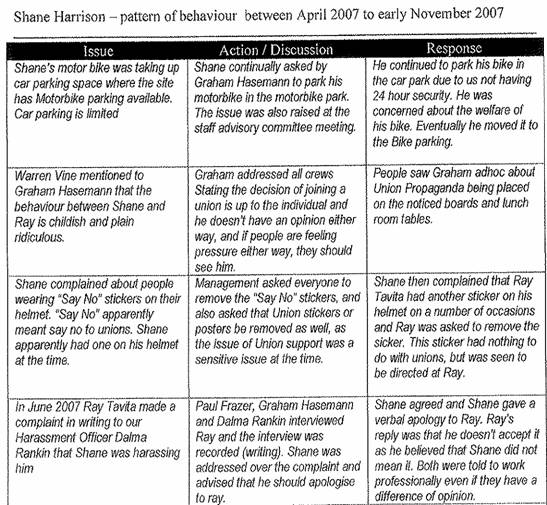
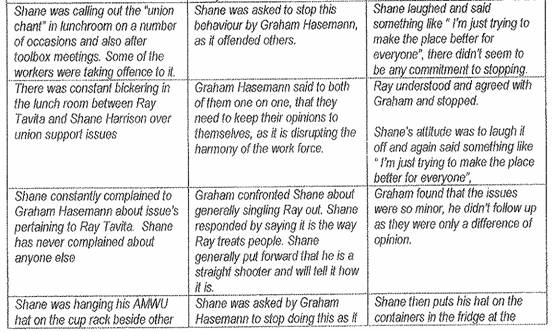
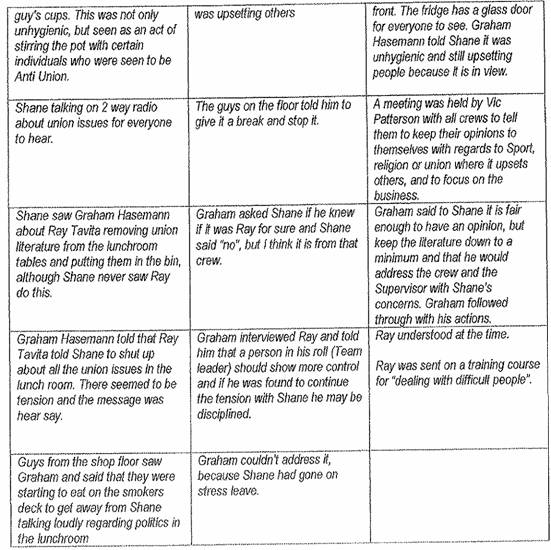
231 I should deal with two other matters raised in evidence. Mr Harrison claimed that he had been docked half-an-hour’s pay for being two minutes late for work as a result of a flat tyre and being delayed in traffic. This incident was no doubt advanced as a basis for inferring some sort of hostility towards him on the part of One Steel. He raised the issue with his supervisor, Mr McGuire, who said that it was not his decision. Mr Harrison did not take the matter any further. There is no evidence as to how or when this incident occurred. Indeed, Mr Harrison said that he could not recall the dates. In those circumstances it is difficult to see how One Steel could be expected to respond to the allegation. Mr McGuire did not refer to the matter, and it was not put to him in cross-examination. It cannot be the basis for any adverse inference as to One Steel’s attitude towards Mr Harrison.
232 It was also implicitly suggested that Mr Hasemann’s allegation, that Mr Harrison was spreading rumours about proposed shift changes, was evidence of hostility towards him. Mr Hasemann had received information from other employees that Mr Harrison was making such allegations. Mr Harrison admitted discussing the matter but denied starting the rumours. He may not have done so, but it is entirely understandable that Mr Hasemann should have raised the matter with him.
INCIDENT ON 1 JUNE 2007
233 Mr Tavita was standing next to Mr Harrison in the lunch-room, wearing a helmet with a “Say No” sticker on it. Without any other provocation Mr Harrison, on his version, said to him, “Ray, what does the ‘Say No’ sticker mean? Does it mean Say ‘no’ to getting fucked up the arse?” According to Mr Tavita, Mr Harrison said, “I suppose you are one of those who said ‘No’ ”. He then said that he was going to “fuck me up the arse”. The comment was repeated. The difference between the versions is minimal. It is not surprising that management should have asked Mr Harrison to apologize.
234 Three points must be made concerning this incident. First, it seems to have occurred prior to Mr Harrison becoming a union delegate. Second, there was absolutely no provocation by Mr Tavita, save possibly for his wearing the “Say No” sticker. Finally, Mr Harrison’s words had a real potential to cause offence. They were directed at Mr Tavita and repeated. Mr Harrison has offered no explanation for his conduct. I infer that his intention was to be provocative. Whether or not Mr Harrison apologized to Mr Tavita, as he was asked to do, is in dispute. Mr Harrison said that he did. There is some support for this in Mr Newbegin’s table which indicates that Mr Harrison had given an oral apology to Mr Tavita, and that Mr Tavita had not accepted it, saying that he did not believe that Mr Harrison meant it. Mr Tavita said that there was no apology. I accept Mr Harrison’s evidence on this score. It seems unlikely that management would have allowed the matter to have passed without comment, had Mr Harrison failed to comply with the requirement that he apologize. It may have been ungracious for Mr Tavita to reject the apology, but Mr Harrison’s conduct was unprovoked and could have been quite insulting to some people. From Mr Harrison’s point of view, the significance of the incident was that, some days later, Mr Tavita threatened him. Mr Tavita seems not to have denied that allegation, but it was not put to him in cross-examination. In any event, at the time Mr Harrison did not complain about such threat.
INCIDENT ON 4 JUNE 2007
235 According to Mr Harrison, on the morning of 4 June 2007 he was on the mill floor with another union member. He offered him a union T-shirt and had been talking to him for no longer than a few minutes when he was approached by Mr Tavita, who asked him to leave the floor. Later that day Mr Hasemann called him to a meeting and said that he was not to talk to workers on the floor before his shift because it took their minds of their work. Mr Harrison agreed not to do so.
236 Mr Hasemann said that he had received a complaint on 1 June 2007 from a worker that Mr Harrison had harassed him whilst he was oxy-cutting and had persisted, although the worker asked him to stop. Mr Hasemann called Mr Harrison to a meeting on 4 June 2007 to discuss the complaint and told him that he needed to respect the fact that employees had jobs to do; that they were not to be distracted by him; and that there were good safety reasons why people should not be distracted in the mill and maintenance areas. Mr Hasemann said that Mr Harrison was not to be on the shop floor unless he was working a shift. Mr Antal, who accompanied Mr Harrison to the meeting, understood that the meeting was about an incident which had occurred on that day. Mr Newbegin attended the meeting, as did Mr McGuire. Mr Newbegin made notes of the meeting. They were as follows:
Complaint
Shane has been pulled up for going on the floor before his shift begins and he is not happy about the way he was treated by being asked by Ray Tavita to leave the floor.
Facts
Shane on the floor handing out AMWU T-shirts and talking with operators. Graham Hasemann asked Ray to remove Shane from the floor. Shane was upset.
Issue
Shane feels he should be allowed to go on the floor before his shift as he is just catching up with the boys. We stipulated to Shane that if he was checking his workstation before his shift then this was being pro-active. But just talking can be disruptive to those still working. We also said that spruiking or handing union info out is no different to Religion or Politics. It should be left to his own time and/or meal breaks and that others rights should be respected who don’t want to hear it.
Result
Shane agreed he would not go on shift earlier to discuss anything else but his work and he would leave union issues to breaks and after work.
Other
We also discussed the desired company (?) communication channel for issues:
Open door – Managers
Staff advisory
OHS committee.
We encouraged Shane and others to use it. Shane said there were issues and employees felt they were not being heard so it has caused them to look at the union membership.
Shane said he would try to be more open and will raise issues at the next Staff advisory but he says the fact remains this will be a Union site by the years end.
Main driver → Money
Comparison with other sites as Patto presented.
Shane said it didn’t present a good picture and we are being underpaid.
What next
Complete wage and conditions comparison of various sites, in preparation of challenge for increase.
237 It may be that these notes combine events at two meetings, one held on 4 June 2007 and the other held on 5 June 2007. The notes concerning the second meeting seem to commence with the heading “Other”. Mr Hasemann gave evidence of two meetings. Save in that respect, I see no reason to doubt the accuracy of Mr Newbegin’s notes. None of the other evidence discloses that Mr Hasemann had instructed Mr Tavita to tell Mr Harrison to leave the floor. I accept that Mr Newbegin’s notice is accurate in that respect.
238 There is nothing unreasonable, or even surprising, about the attitude taken by management to casual conversation in a relatively dangerous work environment, whether the topic of conversation was union membership or anything else. Further, the notes suggest that management had no objection to Mr Harrison discussing union activities on site other than with employees who were working. The notes of the meeting on 5 June 2007 suggest a fairly open relationship between Mr Harrison and management. He was certainly encouraged to raise matters of concern in the appropriate forum.
239 Mr Harrison invites the inference that he was stopped from going on to the shop floor because he was discussing union affairs, claiming that for many years, he had gone on to the floor for other purposes. Neither Mr Hasemann nor Mr Newbegin seemed to be aware of any such long-standing practice involving Mr Harrison socializing with other employees on the shop floor or being there for any purpose other than to facilitate the shift change. It seems unlikely that there would have been as liberal an approach to entering the shop floor as Mr Harrison suggested, given the dangers present there. I accept that Mr Harrison was always early to work. It may be that, on occasions, he went on to the floor for his own purposes. However I do not accept that any such conduct was known to, or approved by, management. Mr Hasemann intervened on 4 June 2007 because of complaints from another employee and his own views as to safety. To intervene was both rational and responsible. I accept his evidence on that score. There may previously have been no clearly formulated policy as to this matter, but that may reflect the fact that it is little more than a matter of commonsense that people should not go into a dangerous work environment unless it is necessary that they do so. It may also suggest that such visits were not a common occurrence.
INCIDENT ON 27 OCTOBER 2007
240 Mr Harrison said that on 27 October 2007 Mr Tavita came into the lunch-room, speaking to somebody else and “swearing quite loudly”. There was no suggestion that he was addressing his remarks to Mr Harrison. Mr Harrison claimed that Mr Tavita’s conduct disturbed his conversation. He said, “Ray, do you mind not swearing”. Mr Tavita said, “Shut up and drink your coffee”. Mr Harrison said, “It’s not coffee, it’s water”. Mr Tavita said, “Shut up”. Mr Harrison said, “Don’t tell me to shut up”. Mr Tavita said, “Oh well, outside the gate then”. Mr Tavita said that he used the word “Bullshit” and that Mr Harrison responded, “No swearing in the [lunch-room]”. Mr Tavita said, “Every day I hear you swearing in the [lunch-room]”. Mr Harrison said, “You should respect people in the [lunch-room]”. Mr Tavita said, “I do respect people in the [lunch-room]. Does that mean that if I see you at the gate I can swear at you?” Subsequently, Mr Tavita heard another employee swearing in Mr Harrison’s presence and said, “Why didn’t you say anything to Chris while he was swearing?” Mr Harrison said that on the second occasion Mr Tavita said to him, “I’ll get you” and Mr Harrison responded, “Hey Ray, speak louder so everyone can hear you”.
241 These allegations should be seen in light of Mr Harrison’s assertion that he had been intimidated by the incident on 1 June 2007 and the subsequent threat. However Mr Harrison’s willingness to chastise Mr Tavita concerning his language was not consistent with any continuing feeling of intimidation. Further, the evidence suggests that Mr Harrison was no stranger to bad language. His language on 1 June 2007 demonstrated the contrary. There is also evidence that on other occasions he had sworn in the lunch-room, or had heard swearing in the lunch-room and not chastised the relevant person. Mr Harrison could not recall Mr Tavita’s words, although he disputed Mr Tavita’s version of events. Given that Mr Harrison could not recall the words used, there is no reason to reject Mr Tavita’s account of them. Such language was relatively mild as compared to the remarks made by Mr Harrison on 1 June 2007. Once again, I infer that Mr Harrison was trying to provoke Mr Tavita. In my view the description of both men’s conduct as “childish” was accurate.
242 Counsel for the applicants suggests that the failure by management to follow the protocol established for dealing with misconduct demonstrated bad faith in One Steel’s treatment of Mr Harrison, inviting an inference that he was discriminated against because of his union association. I see no justification for this submission. The relevant parts of the disciplinary policy were contained in para 4.1 of the protocol which provided:
When disciplinary measures are called for the standard practice for PTM is to be on the following sequence:
Step 1 – A formal counselling session; (Format Appendix 1).
Step 2 – The first written warning; (Appendix 2).
Step 3 – The final written warning; (Appendix 3).
Step 4 – Termination Forms No’s PTM-1544, PTM-1545, PTM-1546 & PTM-1547 (Format Appendix 4).
243 Paragraph 4.2 provided:
Separate measures are identified for a Summary Dismissal (Format Appendix 5).
244 Clause 4.3 provided:
Palmer Tube Mills reserves the right to skip one or more of the formal steps outlined above subject to the nature of the incident.
245 In Part 6 headed “Authority Levels” it was said at para 6.5 that:
Authority to deviate from the sequence of disciplinary procedures contained herein is only to occur in special circumstances and then only authorised by a member of the PTM Executive.
246 The applicants submit that there was something “inexplicable” about Mr Allard deciding to give final written warnings in connection with the incident on 27 October 2007. Mr Allard certainly considered that he was authorized to vary the process. There is no reason to doubt that he was correct in that view. The evidence suggests that management perceived there to have been a history of disagreement between the two men. The incident which occurred on 1 June 2007 is evidence of such disagreement. As far as I can see, it was provoked by Mr Harrison, suggesting some previous animosity. There is little evidence concerning relations between the two men between early June 2007 and 27 October 2007. Mr Harrison’s affidavits suggest ongoing difficulties. Mr Tavita said that they had little contact. Management perceived an ongoing problem although actual incidents were identified only in a very general way. I am inclined to accept that view. If Mr Allard’s conduct in giving a final written warning could readily be characterized as unreasonable or inexplicable (as was suggested by counsel for the applicants) then it may have been a basis for inferring some hostility on his part towards Mr Harrison. However I accept that there was justification for Mr Allard taking a serious view of the matter and choosing to impose a higher, rather than a lower, level of sanction, even if this involved the exercise of his discretion to depart from the usual course as prescribed in the protocol. Further, Mr Tavita and Mr Harrison received the same treatment. Given that management was not satisfied as to Mr Harrison’s version of events this was understandable, and probably inevitable, particularly as he had, at least in part, provoked the incident by criticizing Mr Tavita for conduct which was common in the lunch-room.
247 I am satisfied that the issue of the final written warning was not, itself, evidence of any hostility towards Mr Harrison, or of any desire to discriminate against him because of his union membership, status as a delegate, union activity or by any other feeling of personal animosity.
INCIDENT ON 2 MAY 2008
248 Mr Harrison’s conduct on 2 May 2008 must be seen in the context of Mr Allard’s instruction concerning stickers issued on 24 April 2008 and Mr Harrison’s role in causing One Steel to ban stickers in the workplace. He had brought about a situation in which employees were prevented from wearing stickers on their helmets and their ear muffs. Nonetheless he persisted in wearing them on his shirt and putting them on his locker. On one occasion he was advised by Mr Loggie that it was inappropriate for him to go to a meeting with management, wearing stickers on his shirt, presumably having regard to the history of stickers on the site. Notwithstanding such advice he subsequently chose to put a sticker on his neck and, so adorned, to go to the office where he was likely to encounter management personnel. He approached Mr Allard, wearing the sticker. He said that his purpose was to make a point in a humorous way about the attitude of One Steel to attempts to promote the union in the workplace. He said, at para 17 of his first affidavit, that he would explain the full background to his wearing the sticker later in the affidavit. However he only referred to the fact that stickers on lockers had been removed and defaced, making no reference to his own role in trying to have the “Say No” stickers removed from the workplace.
249 Given the history of the ban on stickers, his conduct could not reasonably be seen as a humorous satirical comment on management’s attitude towards promotion of the union. The ban applied to all stickers, including some to which the wearers had been emotionally attached, and the “Say No” stickers. Those wearing the “Say No” stickers may have held their views as strongly as Mr Harrison held his. His conduct could only be seen as a deliberate assertion of his capacity to defy management’s attempts to avoid conflict in the workplace. If management had not responded, other employees would inevitably have wondered why they were not able to wear their stickers. As Mr Allard said, the issue was not about stickers. It was about solving a human relations problem and enforcement of management’s solution.
250 Much was made of Mr Harrison’s request that the direction be put in writing. It was said that he had not refused to comply with the instruction, and that he would have complied with it, had it been given in writing. However his own evidence was not clear on this score. Mr Harrison said that he wanted the instruction in writing to, “highlight the extent to which the employer was prepared to go to close off opportunities for the Union to be promoted in the workplace”. In his evidence he said that he had told both Mr Allard and Mr Hasemann that he wanted the direction in writing. However he did not say, in his evidence, that he would comply with the direction if it were given in writing. In cross-examination, Mr Allard agreed that on 2 May 2008, Mr Harrison said, on a number of occasions, that he would remove the sticker if the direction were put in writing. This concession did not necessarily apply to the first occasion on which the direction was given. Mr Hasemann said in his evidence that Mr Harrison had said to him that he told Mr Allard that he would remove the sticker if he received a written instruction. Mr Harrison’s conversations with Mr McGuire did not suggest an intention to remove the sticker, nor did he refer to any request that the instruction be given in writing. Mr Allard, Mr Newbegin and Mr Hasemann all claimed that at the meeting on 2 May 2008 Mr Harrison said that if the direction were reduced to writing, he and the union would reply in seven days. Mr Harrison gave similar evidence at para 36 of his affidavit filed on 8 May 2008. He also said, at para 35, that at the meeting, he had said that he would remove the sticker if the direction were given in writing.
251 One wonders why Mr Harrison should have asked that the direction be in writing. He said that Mr Loggie had advised him that if he felt that there was some difficulty with his employer, he should follow this course. However he also said, at para 29 of his affidavit filed on 27 May 2008, that he had asked for the direction in writing because he wanted to “document the event”. He said that when he was working as a shop steward in Western Australia in 1979 his union told him that if he did not agree with something from management, he should ask for it to be put in writing. He had found this to be good advice and had maintained the practice. None of this advice appears to have involved advice that he need not comply with the direction until it was reduced to writing. His desire to document the event could easily have been satisfied by his own written note of the event or by later written confirmation. In any event, there was no reason to believe that management would deny that the direction had been given. The direction was either lawful and reasonable or it was not, regardless of whether it was in writing.
252 There is a certain tension between an intention to make a humorous comment upon the policy concerning stickers (which intention, as Mr Harrison claimed, underlay his initial decision to wear the sticker on his neck) and the subsequent decision to use Mr Allard’s inevitable direction to remove it as a basis for demonstrating One Steel’s opposition to the promotion of unionism on site. The formalization of disobedience could only aggravate the situation. Further, as far as the evidence goes, the only steps taken by One Steel to limit union promotional material appear to have been in connection with the stickers and large signs. One Steel accepted the presence of union material in the lunch-room and, for a long time, accepted the placement of union stickers around the site. The restriction on stickers did not arise out of any desire to limit union publicity, but out of a desire to avoid conflict amongst employees. Mr Harrison knew that. He had demanded that the “Say No” stickers be banned, which demand eventually led to the banning of all stickers. It is also difficult to reconcile his claimed purpose in demanding the explanation in writing, namely to highlight One Steel’s opposition to union propaganda, with his claim that he demanded it because of advice he had received from union officials.
253 One wonders why Mr Harrison would distinguish between acting upon an instruction given orally and acting upon an instruction given in writing. A request for an instruction in writing is usually made where the recipient of the instruction is concerned as to the consequences of complying with it and wishes to record the fact that he or she is acting pursuant to an order given by a superior. Usually, this will be because the consequences of such compliance may be serious, perhaps themselves raising doubts about the legality of the order or its appropriateness. No significant consequences attached to compliance with Mr Allard’s direction. Indeed, there may have been consequences as a result of non-compliance, in the form of renewed conflict on site.
254 In any event, there was no reason to expect that Mr Allard would, at any later time, deny having given the direction. As the day went on, other managerial staff reiterated it, including Mr Hasemann (in the presence of Mr Millard) and Mr McGuire. Mr McGuire had also raised the matter before Mr Allard issued his instruction. Mr Allard, Mr Hasemann and Mr Newbegin were all at the meeting which was held later in the day. There can have been no perception of any risk that management would deny having given the direction, nor was there any room for ambiguity about it. Mr Harrison told Mr McGuire that, in effect, he was wearing the sticker to cause trouble, although he used more colourful language. I infer as much. It is probable that his request that the direction be put in writing was a further manifestation of this purpose. There is no basis for suggesting, and it has not been argued, that the lawfulness of the direction depended upon its being given in writing. Nor can I see that the request that it be given in writing went to the reasonableness of the order. However I will deal with these matters in more detail at a later stage.
255 Another theme of the applicants’ case was that Mr Harrison was acting on union advice that the instruction was unlawful. The first indication that the union had any view on the question of legality arose out of Mr Bradley’s remarks at the meeting on 6 May 2008. Mr Harrison’s own evidence did not suggest any earlier assertion that the order was unlawful, although he may have suggested that the memorandum of 24 April 2008 did not prohibit his wearing a sticker on his skin. However Mr Loggie’s record of his conversation with Mr Allard on 2 May 2008 suggests that Mr Allard said that Mr Harrison had challenged One Steel’s right to prohibit his wearing the sticker on his skin, as opposed to putting it on company property. The actual basis of any allegation of unlawfulness is unclear. It may have been that the memorandum of 24 April 2008 did not apply to stickers worn on skin. It may have been based upon an assertion of some alleged personal right. It may have been based upon an assertion that it was not sufficiently connected to Mr Harrison’s employment and/or was unreasonable.
256 On 6 October 2007, Mr Bradley asserted that the direction was unlawful, but also advanced no basis for that assertion. He referred to what may have happened in the case of a woman wearing a burqa with an AMWU insignia on it, a man wearing a turban with such an insignia, or a tattoo or ring. The first two examples appear to have been ineffective and irrelevant attempts to raise the spectre of anti-discrimination legislation. I see no reason why such an employee should not be ordered to remove the sticker from the turban or the burqa, without ordering removal of the turban or burqa itself. If the insignia were part of the fabric of the garment, I would have thought that management could insist on the employee wearing a garment without the insignia. As to the question of a tattoo, the question may be more difficult. A tattoo might be so offensive to others (for example, women, homosexuals, Jewish people or Aboriginal Australians) that it should be kept covered. If that were not possible, the person might not be suitable for employment. I see no reason to doubt that an employer could direct that an offensive ring not be worn. It is not necessary that these questions be resolved for present purposes.
257 Probably, the allegation that the instruction was unlawful merely raised the question of whether it was reasonably incidental to the relationship of master and servant and whether it was reasonable in all the circumstances. I will address these questions at a later stage.
OTHER FACTUAL SUBMISSIONS
258 I should deal expressly with a number of other factual matters raised in the applicants’ written submissions. In para 8 of the applicants’ opening outline it is submitted that until Mr Harrison became a union delegate in mid 2007, there had been no complaint about his conduct. This is not correct. As I have pointed out, the incidents on 1 and 4 June 2007 preceded his election. At para 10 the applicants submit that Mr Harrison’s vigorous campaigning on behalf of the union caused some concern amongst managers and employees. That misrepresents the situation. It is true that his actions caused concern amongst some employees, and that such concern was, in turn, a matter of concern for management. Management’s only other concern was with his attempts to speak to employees on the shop floor and, possibly, with the sheer volume of material which he was distributing.
259 In para 13 it is submitted that the allegations about Mr Harrison’s conduct raised in the AIRC were, “almost all … associated directly or indirectly with his role as AMWU delegate”. That assertion should be put in perspective. Of the five matters identified by Mr Bradley as having been raised at the meeting, that involving parking had nothing to do with his union membership, status or activities. The other matters had some association with his union activities. That inevitably raises the question of the extent to which conduct is to be tolerated simply because it is allegedly done in the name of the union. No reasonable person would be surprised by the fact that other employees complained that Mr Harrison was placing his hat on the cup rack or in the refrigerator. One would not have to be particularly fastidious about personal hygiene to be concerned at such conduct in shared kitchen facilities. Nor can it be asserted that a union member or delegate is entitled to place union stickers on an employer’s property. In any event, it seems that One Steel only became concerned about stickers when they commenced to cause conflict with other employees. It is unlikely that the occasional singing of a union song or chant would have attracted managerial opposition or discontent amongst other employees. However repeated conduct of that kind might well cause annoyance. In other words, the gravamen of management’s concern was the effect of Mr Harrison’s conduct on others rather than the conduct itself. Mr Newbegin’s schedule of conduct identified rather more issues arising out of Mr Harrison’s conduct. However it also generally focussed on the effects of his conduct on other people rather than upon his union membership, position or activities.
260 Mr Allard (who made the decision to dismiss Mr Harrison) said that the reason for his decision was his conduct in declining to remove the sticker from his neck when told to do so. However, in correspondence from One Steel’s solicitors, it was said that:
The decision to terminate the employment of your client was very carefully considered by management and took into account several key factors including:
1. The failure of your client to obey a reasonable and lawful direction on repeated occasions;
2. The significant disruption to the normal commercial operations of the site due to your client’s deliberate and wilful conduct over a period of time and which conduct was calculated by your client to cause maximum disruption; and
3. The potentially adverse health and safety consequences that may have followed if the deliberate disruption were allowed to continue.
261 Mr Allard stressed the importance of the first point. The applicants point to the second point and suggest that it probably relates to the conduct raised with Mr Harrison following the incident on 27 October 2007, such conduct being largely union-related. Mr Allard suggested that such other matters were of little importance to his decision. However it is most unlikely that he did not, to some extent, consider Mr Harrison’s previous conduct. It is important to note, however, that point 2 in the letter focusses upon the “significant disruption” caused by Mr Harrison’s conduct rather than upon the conduct itself. Much of his prior conduct had the potential to cause disruption. I refer particularly to the incidents on 1 June 2007, 4 June 2007 and 27 October 2007, his conduct with respect to his cap in the lunch-room and, perhaps, his parking habits.
262 In para 49 of the submission it is asserted that One Steel had led an “overwhelming” amount of evidence raising complaints about Mr Harrison’s conduct in promoting the union and seeking to recruit employees, and that none of the issues raised pre-dated his appointment as a delegate. The issues to which the submission relates are not identified. As I have observed, the incidents on 1 and 4 June 2007 occurred prior to his becoming a union delegate. It is hard to say whether they were raised by the applicants or One Steel. In any event, I again point out that One Steel’s focus was upon the consequences of Mr Harrison’s conduct, rather than the conduct itself.
263 At para 50 it is submitted that the sticker on his neck was not a safety issue. However Mr Millard (as a site safety adviser) had a different view. He was concerned at the possibility of skin irritation in the factory environment and at the possible threat to safety caused by disobedience. It is true that Mr Allard seems not to have been concerned about the safety aspect. In para 54 the question of the lawfulness of the direction is again raised. It is said that, “The respondent knew that it was sacking Mr Harrison for abiding by the advice of his union”. Mr Harrison did not claim that he had been advised to refrain from compliance with a direction, or to require that a direction be in writing before he complied with it. The extent of the advice was that he might, in some circumstances, ask that an instruction be reduced to writing. There was no apparent reason for seeking a written direction in this case. Mr Bradley’s advice was given after the event and was more argumentative than helpful. The applicants also submit that Mr Harrison’s disobedience did not constitute a basis for terminating his contract of employment. I will refer to that matter at a later stage.
264 In their final submissions, the applicants re-visit many of these matters, in some cases merely relying upon their opening outline. I will attempt to avoid unnecessary repetition. In para 16 it is asserted that until Mr Harrison became a union delegate Mr Harrison had a perfect employment record. This is, of course, his own assessment. It is not true to the extent that he had been involved in the incidents on 1 and 4 June 2007. In para 17 it is said with respect to the incident on 27 October 2007 and the subsequent final written warnings that, “No witness for the respondent was able to identify any specific conduct on Mr Harrison’s part justifying a final (or any) warning”. This submission overlooks the fact that management investigated the event and found that Mr Harrison’s allegations could not be substantiated. Further, on his own version, he had, to some extent, provoked it. Various One Steel witnesses asserted as much when they said that they had previously heard Mr Harrison swearing and/or other people swearing in his presence without his reprimanding them. In para 18 it is submitted that there was no evidence of a history of differences between Mr Harrison and Mr Tavita. However management clearly had the view that there was ongoing disagreement between them. As much appears from the table prepared by Mr Newbegin. A long history of niggling conduct may not always be easily reduced to specifics. However I see no reason to doubt that those management witnesses who identified such history were accurately reflecting their observations.
265 At para 31(ii) it is submitted that, “An explicit denial from the relevant decision-makers that a prohibited reason formed part of their decision-making will not generally discharge the onus of showing the conduct was not for a prohibited reason”. Reliance is placed upon the decision of Buchanan J in Seymour v Saint-Gobain Abrasives Pty Ltd [2006] FCA 1452 at [128]-[129] and to that of Merkel J in Australian Municipal, Administrative, Clerical and Services Union v Ansett Australia Ltd (2000) 175 ALR 173 at [76]. However neither citation supports the proposition. Both references contain observations concerning the evidence of particular witnesses. It would be curious if witnesses appearing on behalf of an employer were to be put into a special category in which their evidence was to be treated as generally not discharging the onus of proving a matter which was peculiarly within their knowledge. It is one thing to say that denials which are self-serving should be closely scrutinized in the light of all other evidence. It is quite another to say, as the applicants have in the present case, that a particular class of evidence will not generally discharge an onus to which it relates. In General Motors-Holden’s Pty Ltd v Bowling (1976) 51 ALJR 233, at 239, Gibbs J expressly disapproved of such an approach. His Honour said:
… However, it would in my opinion be wrong to think that there is any special difficulty in the way of an employer who seeks to prove that in dismissing an employee he was not actuated by the fact that the employee was a shop steward or other delegate of an organization. The onus of proving that the fact that the employee held the position was not a substantial and operative factor in the dismissal is to be discharged according to the balance of probabilities and is not to be made heavier by any presumption that if an employee who is dismissed for disruptive activities happens to be a shop steward the later circumstance must have had something to do with his dismissal. If in the present case evidence had been given by the directors responsible that the employee was dismissed because he was guilty of misconduct or because his work was unsatisfactory, and that in dismissing him they were not influenced by the fact that he was a shop steward or indeed that he was dismissed in spite of that fact, and that evidence had been accepted, the onus would have been discharged.
266 Mason J did not address the question. His Honour’s remarks at 241 concerning the reliability of evidence reflected only the fact that the evidence of relevant witnesses had not been accepted at first instance, and that other necessary witnesses had not been called.
267 The applicants’ erroneous proposition is repeated at para 32 where it is said, concerning Mr Allard’s evidence, that:
As discussed above, mere assertions by relevant officers will not generally discharge this onus, particularly where the dismissal and associated conduct has puzzling and irrational aspects when considered in the absence of the prohibited reason. In the present case, in the absence of a prohibited reason, the dismissal is extremely puzzling and irrational.
I see nothing puzzling or irrational about Mr Allard’s conduct or Mr Harrison’s dismissal.
268 The submission then addresses the reasons advanced by the solicitors for Mr Harrison’s dismissal, particularly the point concerning significant disruption. To the extent that Mr Allard implied that the letter may have been written other than on appropriate instruction, I do not draw that conclusion. As I have said, I think it unlikely that Mr Harrison’s previous history could have been overlooked. However, as I have also said, it was the disruption, rather than the conduct, to which the letter referred. Counsel suggests that it was strange that Mr Allard identified the matters raised at the meeting in January 2008 as being the matters referred to in the solicitors’ letter. It is submitted that there was no suggestion that any of these issues, “had any currency after the meeting of 24 January 2008”. This seems to imply that such matters were no longer relevant to the assessment of any future misconduct by Mr Harrison. It may well be that between January and May 2008 there had been no repetition of the conduct raised at the January meeting. It does not follow that such conduct was irrelevant in considering the seriousness of Mr Harrison’s conduct in May.
269 It is then submitted that by analogy to the position addressed by the High Court in Bowling, the evidence indicated that Mr Harrison was treated as a troublemaker, and that such categorization of him must have had something to do with his position in the union. I will deal with the decision in Bowling at a later stage. For present purposes it is sufficient to say that even if Mr Harrison could be accurately described as a troublemaker, he was not a troublemaker in the sense in which that expression is generally used in the context of industrial relations. Whatever else he might have done, there is no suggestion that his conduct provoked industrial unrest directed against One Steel. One Steel’s concern was, at all times, that he was causing conflict amongst employees.
270 It is then submitted that Mr Harrison’s dismissal was “so disproportionate to [his] conduct … as to confirm that factors other than the sticker incident were operative”. For reasons which I have touched upon, I do not accept that proposition. I similarly do not accept that the acceleration of the disciplinary process was inexplicable. I do not accept that in the circumstances of this case Mr Harrison’s conduct in wearing the sticker was “a relatively trivial matter”. Nor do I accept that it was arguable that One Steel had no lawful right to direct Mr Harrison to remove the sticker, or that such direction was unreasonable. I do not accept the characterization of the final warning given in connection with the incident on 27 October 2007 as being inexplicable other than by reference to Mr Harrison’s union activity.
271 It is said that Mr Harrison was not given an opportunity to respond or comment before he was given the final written warning. However he was absent on sick leave from shortly after the incident and was called in specifically to be given the warning. He had been interviewed by Mr Hasemann on 27 October 2007, in the presence of Mr Croxford, Mr McGuire and Mr Antal. He subsequently filed a written complaint with Ms Rankin. It is difficult to see that any useful purpose would have been served by a further interview. There were clear differences between his and Mr Tavita’s versions. There was some, apparently independent, support for both versions. Mr Lawson supported Mr Tavita’s version. Mr Wally supported Mr Harrison’s version. However he said that he had not heard what was said, and that it was “something along the lines of, ‘What if we take it outside?’ ”. He heard Mr Tavita say, “Shut up!” Mr Frahm’s evidence supported aspects of both versions. In any event, it was open to Mr Harrison to raise any further concerns at the meeting on 28 November 2007 when he was given his warning. It may have been prudent for management to have asked Mr Harrison if he had any further comments, but I do not accept that the failure to do so could, in the circumstances, be taken as indicative of some prejudice against him, attributable to his union position or otherwise.
272 Concerning the warning, it is submitted (at para 54) that, “Mr Allard stated that other matters (which were never mentioned to Mr Harrison even at the time of issue of the Final Warning but were raised for the first time in subsequent AIRC proceedings) were taken into account”. This is said to be supported by Mr Allard’s evidence at TS 20 ll 25-43. The page reference is incorrect. It should be TS 80. Mr Allard said that in issuing the final written warning he took into account the matters which were subsequently raised in the AIRC. I have demonstrated that those matters, or most of them, had been previously raised with Mr Harrison. I do not accept that Mr Harrison was treated unfairly in connection with the final warning. The thrust of Mr Allard’s evidence was that the decision was based upon the ongoing friction between him and Mr Tavita and a desire to stop it. As I have previously said, much of the applicants’ criticism of One Steel’s conduct in connection with the final written warning was based upon the misconception that the incident on 27 October 2007 was provoked by Mr Tavita when it was, at least in part, provoked by Mr Harrison. Mr Tavita’s response may have been extreme (if Mr Harrison’s version be accepted), but he did not initiate the confrontation. For reasons which I have given, I also do not accept that Mr Harrison was singled out for special treatment when he was directed not to discuss union matters on the shop floor. I decline to draw any adverse inference from his allegation that he was docked half-an-hour’s pay for being two minutes late for work.
273 At para 59 reference is made to Ms Rankin’s note of a meeting concerning the incident on 1 June 2007. The note said:
Shane Harrison is a Union member and has talked to the Union on the phone after this incident saying that ‘they are trying to fuck me over’. Graham H said that Shane is a ring leader to push union involvement and membership and he has his followers.
274 This note is also said to evidence hostility towards Mr Harrison because of his union activities. Given that the incident was apparently provoked by Mr Harrison’s dislike of the “Say No” stickers on the basis that they were “anti-union”, it is hardly surprising that the question of his union membership and the possible involvement of the union should have been discussed. Whilst the expression “ring leader” can be derogatory, it is not necessarily so. Mr Harrison was leading the union push for increased union involvement on the site and increased membership. He certainly had his followers. Mr Hasemann was counselling caution, not demonstrating hostility.
275 At para 61 the applicants submit that Mr Newbegin’s email suggested some ulterior motive concerning Mr Harrison. Whatever “opportunity” Mr Newbegin had identified, it seems not to have involved dismissal. Mr Newbegin rather contemplated a final warning which Mr Harrison might not readily accept. The email certainly suggested that Mr Newbegin saw Mr Harrison’s conduct as a problem which might be dealt with by further proceedings in the AIRC. However it is significant that Mr Newbegin also said that if One Steel proposed to proceed in that way, it should inform Mr Loggie “of our intent”. This seems to have meant that Mr Loggie should be told of the intention to give Mr Harrison a final written warning. That would have given him the opportunity to advise Mr Harrison as to his response to the warning. I infer that Mr Newbegin expected that Mr Loggie would not be able to persuade Mr Harrison to control himself in face of such a warning.
276 In cross-examination Mr Newbegin said that in the previous AIRC proceedings the Commissioner had said that she would like to see Mr Harrison again should his conduct deteriorate in the future. He thought that she would support the company in issuing a final written warning. As I have said, this view of the Commissioner’s position is disputed. If Mr Newbegin saw Mr Harrison as posing a problem, Mr Allard did not have quite the same view. No doubt they had different degrees of contact with him.
277 At para 62 it is submitted that the instruction to Mr Wharton to remove a union sign from his car parked in the car park was evidence of antipathy towards union activism. It certainly demonstrates that One Steel was not willing to permit the display of large union signs on the site. However the fact remains that One Steel continued to tolerate the display and distribution of union literature. It had intervened in connection with the use of stickers only because it was causing conflict. Even then, it was almost a year before the total ban was announced. The applicants then submit that dismissal for wearing a sticker is itself dismissal for union membership or status as a delegate. I will deal with that matter at a later stage.
278 One Steel’s submissions comprise a series of factual assertions, most of which I have already accepted. To the extent necessary, its other submissions can best be dealt with later in these reasons. The applicants’ submissions in reply will also be best treated in that way.
A LAWFUL AND REASONABLE DIRECTION
279 The extent of an employee’s obligation to comply with directions given by an employer appears from the reasons of Dixon J (as his Honour then was) in The King v Darling Island Stevedoring and Lighterage Company Limited; ex parte Halliday and Sullivan (1938) 60 CLR 601 at 621-622. His Honour said:
If a command relates to the subject matter of the employment and involves no illegality, the obligation of the servant to obey it depends at common law upon its being reasonable. In other words, the lawful commands of an employer which an employee must obey are those which fall within the scope of the contract of service and are reasonable. … But what is reasonable is not to be determined, so to speak, in vacuo. The nature of the employment, the established usages affecting it, the common practices which exist and the general provisions of the instrument, in this case an award, governing the relationship, supply considerations by which the determination of what is reasonable must be controlled.
280 For present purposes a useful example of the application of the general rule is to be found in the decision of the Full Court in Australian Telecommunications Commission v Hart (1982) 43 ALR 165. In that case an employee of Telecom was charged with disciplinary offences for refusing to obey a direction that he refrain from wearing a caftan and thongs to work. The majority (Fox and Sheppard JJ) concluded that the employee was obliged to comply with the direction. At 170, Fox J (Sheppard J concurring) cited Harvey: Industrial Relations and Employment Law 1982 and the decision in Boychuk v K.J. Symons Holdings Ltd [1977] IRLR 396 as authority for the proposition that:
… a reasonable employer … can be allowed to decide what, upon reflection and mature consideration, could be offensive to the customers and the fellow employees … .
281 There can, I think, be little doubt that Mr Allard’s direction was both lawful and reasonable. By its directions concerning the wearing of stickers on helmets, ear muffs, clothing, lockers and otherwise, One Steel had established a usage or common practice which was to be the norm in the workplace. The applicants have not suggested that it was not entitled to do so. In formulating those directions it had regard to the fact that the wearing of stickers had become a source of conflict within the workplace, thus taking into account the effect of the wearing of stickers upon other employees. It is true that the various directions had dealt specifically with helmets, ear muffs, company-supplied clothing and lockers. However the concluding words of the memorandum of 24 April 2008, “and the use of stickers will need to be approved by management”, were clearly intended to have a more general application. Even if the memorandum, on its proper construction, did not apply to a sticker worn on the skin, it was open to Mr Allard to extend the operation of the ban in face of Mr Harrison’s conduct. One Steel’s authority did not depend solely upon its owning the property to which stickers had previously been attached. Its authority arose out of the relationship of master and servant and its status as occupier of the site. If Mr Harrison was not in breach of the direction contained in the memorandum (because it should be construed as applying only to lockers and clothing), he was nonetheless obliged to obey Mr Allard’s direction.
282 There can be no doubt that the wearing of stickers on the person had caused a substantial degree of dissatisfaction and conflict. In those circumstances, both the memorandum and the direction to Mr Harrison were reasonable. He was fully aware of the history of the problem. Notwithstanding such knowledge, he took it upon himself to ridicule management and the course which it had chosen in order to ensure harmony on the site. If he were permitted to ignore the memorandum or the direction, there would be no reason why other employees, including those who had previously used the “Say No” stickers, should do otherwise. The atmosphere of conflict would have been regenerated, and the ban would have been ineffective. One Steel had a legitimate interest in maintaining harmony on site and an obligation to its employees to do so. In the circumstances the direction was both lawful and reasonable.
283 In my view, Mr Harrison was obliged to comply with the direction, whether or not it was given in writing. Nothing about the direction justified his insistence upon its being in writing. He had no reason to believe that any adverse consequences would flow from it. He had no valid reason to doubt its legality. I do not accept that he did so. His purported willingness to comply with it if it were given in writing demonstrates this. However his failure to mention his expression of such willingness in his account of his first conversation with Mr Allard suggests that it was not an important part of his plan. His subsequent assertion that he and the union would respond within seven days was also inconsistent with his alleged intention of complying with a written direction. Finally, his statements to Mr McGuire suggested an intention to cause trouble. His request for a direction in writing was probably a further manifestation of this intention.
284 In those circumstances Mr Harrison was obliged to obey the instruction. The only questions remaining, then, are whether the decision to dismiss him was to any extent motivated by his membership of the union or his position as a delegate, and whether his disobedience justified summary dismissal.
A PROHIBITED REASON
285 To some extent the applicants’ case focussed on Mr Harrison’s conduct rather than upon his union membership or status as a delegate. This focus led One Steel to submit that the applicants were, in effect, relying on s 793(1)(o) although the pleaded case relied upon s 793(1)(a). The applicants eschewed reliance on s 793(1)(o), asserting that s 793(1)(a), “applies to conduct associated with union membership and office, as well as the mere holding of such status”.
286 There is, at least superficially, a difficulty in treating s 793(1)(a) as including conduct as opposed to actual, proposed or previous union membership or position as an officer or delegate. Prima facie, the section deals with membership or status and not conduct. On the other hand, s 793(1)(o) deals with conduct of an officer or member of a union, but only if such conduct is:
· for the purpose of furthering or protecting the industrial interests of the union;
· lawful; and
· within the limits of the authority expressly conferred by the union.
287 If union-related conduct is within the proscriptive effect of s 792 and s 793(1)(a), then s 793(1)(o) is otiose. Further, much conduct would be protected by virtue of its being within s 793(1)(a), which conduct would not be protected by its being within s 793(1)(o).
288 The applicants submit that analogues of s 793(1)(a) in earlier legislation have been construed as protecting conduct, and that there is no justification for giving it a narrower operation. It is therefore necessary to examine the cases. A convenient starting point is the decision of the High Court in Bowling. That was an appeal from a decision of the Australian Industrial Court convicting the appellant of an offence against s 5(1) of the Conciliation and Arbitration Act 1904 (Cth) (the “1904 Act”) which provided relevantly:
An employer shall not dismiss an employee, or injure him in his employment, or alter his position to his prejudice, by reason of the circumstance that the employee –
(a) is or has been, or proposes, or has at any time proposed, to become, an officer, delegate or member of an organization, or of an association that has applied to be registered as an organization; or
…
(f) being an officer, delegate or member of an organization, has done, or proposes to do, an act or thing which is lawful for the purpose of furthering or protecting the industrial … interests of the organization or its members, being an act or thing done within the limits of authority expressly conferred on him by the organization in accordance with the rules of the organization.
289 The 1904 Act contained an evidentiary section similar in effect to s 809(1) of the Act. The appellant had dismissed the respondent who was a shop steward. The putative reason for the dismissal was that he was a “bad operator”, meaning that he was not competent in his work. There was also some suggestion that he was considered to be a troublemaker, deliberately disrupting production and thereby setting a bad example to others. Although the plant superintendent was called to give evidence as to the reason for his dismissal, it appeared that the decision had actually been made at head office in Melbourne. At first instance the Industrial Court concluded that the dismissal was not for the stipulated reason, namely the respondent’s poor work record and attitude to his job, this conclusion being based upon an assessment of the credibility of the witnesses. One member of the Industrial Court (Woodward J) concluded that the superintendent had been influenced in his decision by a belief that the respondent had deliberately disrupted production on several occasions and was setting a bad example to others. On appeal the appellant asserted that this was the real reason for the dismissal. The majority (Gibbs, Stephen, Mason and Jacobs JJ) appear to have accepted such assertion. However, as Mason J observed at 241:
It is to my mind a very considerable leap forward to say that this finding in itself is a comprehensive expression of the reasons for dismissal and that they were disassociated from the circumstance that the respondent was a shop steward. No doubt this is an advance which could be made if officers of the appellant had said in evidence “We dismissed him because he was a troublemaker, because he was deliberately disrupting production and setting a bad example and we did so without regard at all to his position as a shop steward” and that evidence had been accepted. Yet this evidence was not given and, even if it had been given, there may have been a question as to its reliability. Once it is said that the appellant dismissed him because he was deliberately disrupting production and was setting a bad example it is not easy to say without more that this had nothing to do with his being a shop steward. Although the activities in question did not fall within his responsibilities as a shop steward his office gave him a status in the workforce and a capacity to lead or influence other employees, a circumstance of which the appellant could not have been unaware. It would be mere summise or speculation, unsupported by evidence, to suppose that the appellant’s management, if concerned as to the bad example he was setting, divorced that consideration from the circumstance that he was a shop steward.
290 Of more general importance is the following extract which appears at 242:
It was suggested that even if the appellant’s management had regard to the respondent’s position as a shop steward in dismissing him, that was not enough to bring the case within s 5(1)(a). The short answer to this suggestion is that s 5(1)(a) does not proscribe the circumstances which it lists as the sole or predominant reasons for dismissal. It is sufficient if the circumstance is a substantial and operative factor. And it does not cease to be such a factor because it is coupled with other circumstances or because regard is had to it in association with other circumstances not mentioned in the section.
The appellant sought to give emphasis to the distinction to be drawn between section 5(1)(a) and s 5(1)(f) and argued that the activities of a shop steward fall under par (f) and not par (a). So much may be conceded, but this does not avail the appellant in the present case because we are concerned not with activities undertaken by the respondent in his capacity as a shop steward but with activities otherwise undertaken and the example that he set to others in which his position as a shop steward was of particular significance.
291 Merkel J, in Ansett at [72], explained the last paragraph as follows:
Subject to one qualification, the authorities establish that a clear line exists between a dismissal for activities that fall within para (n) (previously para (f)) and a dismissal by reason of the holding of a union office which falls within para (a). The qualification is that a dismissal based on the activities of a union delegate or officer must fall within para (n), rather than para (a), if it is to be for a proscribed reason, unless the reasons proffered by the employer and accepted by the Court do not “exclude the possibility that (the dismissal) was associated with the circumstance that the (employee) was a (delegated officer)”: see Mason J at 619 in GMH v Bowling. As noted above and relevantly, for present purposes, his Honour added that if the possibility was no more than “slender” the circumstance might be disregarded as one which was not a substantial and operative factor in the decision. … Rather, his Honour was stating that in a case in which the dismissal of a union official or delegate occurs in circumstances that are closely associated with the activities of the employee in that capacity, the employer carries the onus of rebutting the very real possibility that the dismissal was associated with the circumstance that the employee was an official or delegate. A failure to do so can result in the Court determining that, under the statutory scheme, the dismissal was for a proscribed reason.
(Original Emphasis)
292 In the present case One Steel must demonstrate that it did not dismiss Mr Harrison for reason of his membership of the union or his position as a delegate. As it asserts that it dismissed him by reason of his conduct, it must show that notwithstanding any apparent association between such conduct and his union membership or position, such membership or position played no part in the decision.
293 The applicants, at para 27 of their opening outline of submissions, effectively submit that:
Part 16 protects more than the formal right to belong to a trade union. It also protects the rights to participation in the lawful activities of a trade union. Prior to the 2006 amendments to the [Workplace Relations Act], Part XA of the pre-reform Act contain similar provisions dealing with freedom of association. The corresponding provisions of the pre-reform and post-reform Act are as follows:
• S 298K became s 792;
• S 298L became s 793; and
• S 298V became s 809.
294 The submission appears to be inconsistent with the observations made in Bowling as explained in Ansett. The applicants also rely upon the decision of the Full Court in Davids Distribution Pty Ltd v National Union of Workers (1999) 91 FCR 463 at [107], that of Merkel J in Ansett at [63] and that of Wilcox J in Greater Dandenong City Council v Australian Municipal and Clerical Services Union (2001) 184 ALR 641 at [72]-[73], citing his Honour’s earlier remarks in Construction, Forestry, Mining and Energy Union v BHP Steel (AIS) Pty Ltd [2000] FCA 1008. I suspect that the applicants have misunderstood these cases. The proposition identified at [107] in Davids related to the purpose of the former Act as a whole and, in particular, Part XA. It was not concerned with the distinction between status as a member, office holder or delegate, on the one hand, and actions in advancing the industrial interests of the union, on the other. Further, I note that the quotation of the relevant extract in the applicants’ opening outline is inaccurate in one respect. In the report the relevant extract is as follows:
In the context of the Act, Part XA does not stand alone. It is aimed at ensuring that employees may band together, if they wish, for collective bargaining of the type provided for in the Act to achieve the broader objectives of the Act as contained in s 3. … That which is protected by such legislation is more than the right to be a member. It is the right to participate in protected union activities, including the taking of collective industrial action against an employer to seek to obtain better industrial conditions … .
295 In the outline, the word “collective” has been deleted before the word “industrial” in the last sentence. Mr Harrison’s conduct could hardly be described as “collective action”. However, as I have said, the decision in Davids says nothing about the respective areas of operation of s 793(1)(a) and s 793(1)(o).
296 The applicants also refer to the decision in Ansett at [63] where Merkel J said:
The object of ss 298K, 298L and 298V, as well as their statutory predecessors, has not been in doubt. It has been said to be to “remove fear of adverse action by an employer against an employee taking union office and performing the functions of that office” (Bowling v GMH at 210 per Smithers and Evatt JJ) and to “ensure the threat of dismissal or discriminatory treatment cannot be used by an employer to destroy or frustrate an employee’s right to join an industrial association and to take an active role in that association to promote industrial interests to both the employee and the association …”.
297 This proposition, too, was concerned with the overall effect of the sections and not with the areas of operation of the individual paragraphs of s 298K, the predecessor of s 793(1). Similar comments apply to the extract from the judgment of Wilcox J in BHP Steel to which his Honour referred in Greater Dandenong. In Finance Sector Union of Australia v Australian & New Zealand Banking Group Limited (2002) 114 IR 352, Wilcox J applied the decision in Bowling as I have explained it. See that decision at [173] and [187]. See also the decision of Branson J in The Community and Public Sector Union v The Commonwealth of Australia [2007] FCA 1397 at [114].
298 The applicants also refer to the decision of Marshall J in Elliott v Kodak Australasia Pty Ltd (2001) 108 IR 23 and to that of North J in Australasian Meat Industry Employees’ Union v Belandra Pty Ltd (2003) 126 IR 165 at [150]. Each case involved an examination of the history of the relevant industrial legislation. Both North and Marshall JJ concluded that s 298L(1)(a) of the Act, itself an analogue of s 793(1)(a), had an analogue in s 9(1) of the 1904 Act. Their Honours concluded that s 298L(1)(a) should be given the same breadth of operation as had been attributed to s 9(1), notwithstanding the fact that in s 298L(1) (as in s 793(1)) subsequent provisions might suggest that s 298L(1) should be given a narrower meaning. In Kodak, this view led Marshall J to conclude that the word “delegate” in s 298L(1)(a) should have a wider meaning than might be suggested by other parts of s 298L(1). In Belandra North J concluded that s 298L(1)(a) was intended to cover “conduct taken against employees because they had taken action as members of a union, and because a union had taken action as an incident of that employee’s membership of a union.” To the extent that this implies that s 793(1)(a) addresses conduct as well as union membership or standing as an officer or delegate, it is inconsistent with the observations made by Mason J in Bowling. Unfortunately, it seems that neither his Honour nor Marshall J was referred to that decision or to the decision of Merkel J in Ansett. I proceed upon the basis that ss 792(1)(a) and 793(1)(a) proscribe dismissal because of union membership or status as an officer or delegate, but not because of conduct. However conduct is relevant to the question in the way explained by Mason J in Bowling.
299 The question, then, is whether or not One Steel has satisfied me on the balance of probabilities that Mr Harrison’s union membership or position as a delegate was not a reason for Mr Allard’s decision. Mr Allard impressed me as a conscientious manager and an honest witness. He was willing to concede that, generally, Mr Harrison had been a good employee. He did not agree with Mr Newbegin’s view that Mr Harrison posed a problem. His reluctance to put great weight upon the other grounds set out in the solicitors’ letter seemed to reflect his own recollection of events rather than any perception that there was danger to One Steel in his so doing. If his evidence stood alone, I would have been inclined to accept that Mr Harrison’s union membership and position as a union delegate were not reasons for his decision to dismiss him.
300 However his denial does not stand alone. Notwithstanding attempts by the applicants to find sinister undertones in all aspects of One Steel’s conduct and that of its managerial and supervisory staff, I am persuaded that management saw itself as facing a serious problem which had first emerged in the middle of 2007. The problem was, to some extent, caused by Mr Harrison’s views concerning his position as a union delegate and his desire to advance the union cause. However the problem lay in the effects of his conduct, not the conduct itself. I accept that One Steel would have been happier without union activity on the site, but I see nothing in the evidence to suggest that it was other than proper in its attitude towards the union and its representatives. It co-operated with them without being enthusiastic about doing so. Further, One Steel was willing to accept Mr Harrison’s conduct in distributing literature and other material in the lunch-room and in distributing stickers about the site. It was only when his conduct, and that of those opposed to him, raised the risk of conflict on the site that it intervened. Even then it did so in a measured way, limited to areas in which the conflict was emerging. Thus it was not until April 2008 that a general ban on the use of stickers on the site was enforced.
301 I also see no real evidence of any hostility towards Mr Harrison personally on the part of management. I have previously referred to Mr Allard’s views concerning him. Mr McGuire’s approach to him on 2 May 2008, asking him to remove the sticker, appears to have been more designed to protect Mr Harrison’s position than to advance any cause being espoused by One Steel. Mr Harrison claimed to have relations with Mr Patterson which involved discussions about their shared interest in a football team. Following the incident on 27 October 2007 concerning Mr Tavita, Mr Harrison played golf as a member of Mr McGuire’s crew. Mr Hasemann went to the trouble of ringing him while he was on sick leave to inquire as to his choice of liquor and, on 6 May 2008, seemed to regret that Mr Harrison had provoked his own dismissal.
302 Further, it is clear that Mr Allard’s decision was not taken in haste, nor was it a foregone conclusion that Mr Harrison would be dismissed at any time prior to his refusal to resile from his position at the meeting on 2 May 2008. Indeed, had he resiled from his position at the meeting on 6 May 2008, Mr Allard might still have decided not to dismiss him. None of this is consistent with his union membership being a reason for his dismissal. Taking into account all of these things, I conclude that One Steel has satisfied me on the balance of probabilities that Mr Harrison’s union membership and position as a delegate were not reasons for his dismissal.
BREACH OF CONTRACT
303 I have already concluded that Mr Allard’s direction was both lawful and reasonable, that Mr Harrison was obliged to comply with it and that he did not do so. The only remaining question is whether or not his conduct entitled One Steel to terminate his employment summarily. The applicants submit that Mr Harrison could only be dismissed summarily for serious misconduct, relying upon the following passage from the reasons for judgment of Dixon and McTiernan JJ in Blyth Chemicals Ltd v Bushnell (1933) 49 CLR 66 at 81-82:
Conduct which in respect of important matters is incompatible with the fulfilment of an employee’s duty, or involves an opposition, or conflict between his interest and his duty to his employer, or impedes the faithful performance of his obligations, or is destructive of the necessary confidence between employer and employee, is a ground of dismissal … . But the conduct of the employee must itself involve the incompatibility, conflict or impediment or be destructive of confidence. An actual repugnance between his act and his relationship must be found. It is not enough that ground for uneasiness as to its future conduct arises.
304 A number of other cases are of interest. The first is the decision of Wootten J in Scharmann v APIA Club Ltd (1983) 6 IR 157. At 164 his Honour said, concerning summary dismissal:
Some of the older cases virtually treated it as a rule of law that disobedience to a lawful order gave the employer a right to dismiss, but the modern is that: “One act of disobedience or misconduct can justify dismissal only if it is of a nature which goes to show (in effect) that the servant is repudiating the contract, or one of its essential conditions. …” The disobedience must at least have the quality that it is “wilful”: it does (in other words) connote a deliberate flouting of the essential contractual conditions.
305 Wootten J then referred to the decision of Isaacs ACJ in Adami v Maison De Luxe Limited (1924) 35 CLR 143 at 148-9. In that case the Acting Chief Justice rejected the proposition that, “wilful disobedience of a lawful order”, meant, “simply conscious disobedience of an order, obedience to which is found after litigation to be in fact and in law within the range of duty”, and continued:
The proposition asserts that, provided ultimately the order is found to be within the scope of the contract, it matters not how isolated and trivial the occasion may have been, how unimportant the disobedience in relation to the employer’s affairs, how doubtful in fact or law the legality of the order may have been, how bona fide and reasonable may have been the contention of the employee or how clearly his action was intended and explained at the time as defence only and not in any way as defiance. That is a proposition I find it impossible to accept.
306 The other members of the Court (Gavan, Duffy and Starke JJ) did not address this question. At 151-152 Isaacs ACJ continued:
But the effect of the word “wilful” varies, and, as I have said, the only universal guide is to ascertain from its surroundings what the word is intended to connote. One commanding circumstance is to ascertain the subject matter as a totality of which it is predicated that it must be wilful. Here the subject matter is not “disobedience”, but “disobedience of a lawful order.” It is the whole compound expression that must be “wilful,” and not the one word “disobedience” adding a provision “if the order be lawful.” It is no doubt a correct principle that, once the relation of employer and employee is established, obedience to lawful orders is, if not expressly, then impliedly, contemplated by the contract creating the relation, and mere disobedience of such orders is a breach of the bargain. But whether disobedience in a given case is of such a character as to justify a complete dissolution of the contract by one of the parties and, as here, a forfeiture by the other of the valuable accruing rights, together with some degradation – altogether a severe penalty – is, in my opinion, quite a different matter. Such a justification requires the disobedience to be as phrased “wilful disobedience of a lawful order.” That is, it must be not merely a breach but a radical breach of the relation, and inconsistent with its continuance.
Once the element of “wilfulness” is introduced for the purpose of the summary rescission by one party of the whole contractual relation, with penal results on the other, then, as the “wilfulness” is the attitude of the employee, so far as it is conveyed by words or acts to the employer, the subject must be looked at from a new standpoint. “Wilfully” does not necessarily connote in that connection anything criminal or immoral, but it does connote some deliberate design or purpose to derogate from duty.
307 In Bruce v A W B Ltd (2000) 100 IR 129, an employee had been employed upon certain conditions, including that he report directly to the managing director and be a member of the executive committee. He was subsequently told that the organization was to be changed so that he would no longer be a member of the executive committee or report directly to the managing director. The employee asserted that the changes were in breach of his contract of employment, and that he was not willing to perform his duties on that basis. He remained willing to perform them in accordance with his understanding of the contract. He was dismissed upon the basis that he had repudiated his contract of employment. The contract provided that: “The duties of the above position are set out under establishment No 7100 or as directed by the Managing Director”. The employer argued that the managing director was therefore empowered to dispense with the employee’s “duties” of reporting to him and sitting on the executive committee, and to impose the duty of reporting to the general manager. Sundberg J concluded that the managing director was authorized to make the proposed changes. His Honour then had to consider the validity of the dismissal. At [15] his Honour said:
Two conditions must be satisfied at common law in order to justify a summary dismissal. First, there must be a breach by the employee of the terms of the contract or a demonstrated intention not to be bound by those terms. Secondly, the conduct must be sufficiently serious to allow summary termination. Freedland observes:
“The right to rescind a contract for breach of condition arises by reason of a failure of performance which has occurred in the past, provided the failure is of sufficient gravity or relates to a sufficiently major term of the contract. The right to rescind a contract in response to repudiation arises, not so much by reason of a failure of performance in the past as by reason of the manifestation of an intention not to perform contractual obligations in the future.”
See The Contract of Employment (1976) at p 217.
308 The applicants also rely upon the decision of the High Court in D.T.R. Nominees Proprietary Limited v Mona Homes Proprietary Limited and Another (1976-1977) 138 CLR 423. That case concerned a contract for the sale of land, completion being conditional upon registration of a plan of subdivision, a copy of which was attached to the contract. At the date of the contract the vendor had not lodged the plan but had lodged a plan for a larger subdivision of which the subject land was part, seeking approval of so much of the subdivision as related to that land. That plan was approved and registered. The vendor then required completion within 14 days. The purchasers purported to rescind the contract on the basis that the plan attached to the contract had not been registered, and that the vendor had thereby repudiated the contract. The vendor asserted that the purchasers had wrongfully repudiated the contract and purported to rescind, forfeiting the deposit. The purchasers commenced proceedings seeking a declaration that the contract had been validly rescinded upon the basis that in lodging the plan of subdivision the vendor had repudiated the contract, or that subsequent correspondence, asserting compliance with the term as to registration and calling for completion, had constituted repudiation. In the High Court the first question was whether or not an intention to repudiate the contract could be inferred from the vendor’s conduct. At 432 Stephen, Mason and Jacobs JJ said (Aickin J concurring):
No doubt there are cases in which a party, by insisting on an incorrect interpretation of a contract, evinces an intention that he will not perform the contract according to its terms. But there are other cases in which a party, though asserting a wrong view of a contract because he believes it to be correct, is willing to perform the contract according to its tenor. He may be willing to recognize his heresy once the true doctrine is enunciated or he may be willing to accept an authoritative exposition of the correct interpretation. In either event an intention to repudiate the contract could not be attributed to him. As Pearson LJ observed in Sweet & Maxwell Ltd v Universal News Services Ltd:
“In the last resort, if the parties cannot agree, the true construction will have to be determined by the court. A party should not too readily be found to have refused to perform the agreement by contentious observations in a course of discussions or arguments … .”
In this case the appellant acted on its view of the contract without realizing that the respondents were insisting upon a different view until such time as they purported to rescind. It was not a case in which any attempt was made to persuade the [vendor] of the error of its ways or indeed to give it any opportunity to reconsider its position in the light of an assertion of the correct interpretation. There is therefore no basis on which one can infer that the [vendor] was persisting in its interpretation willy nilly in the face of a clear enunciation of the true agreement.
309 The passage from Freedland which was cited in Bruce recognizes a distinction between breach and repudiation. In Bruce, as far as the report goes, there had been no actual failure by the employee to perform his duties in accordance with the proposed changes in arrangements, or any exercise of a purported right to do that which he was no longer required to do. Similarly, in Mona Homes, time not being of the essence of the contract, either the vendor had not yet breached the contract, or any breach did not provide a basis for determining it. In the present case, however, Mr Harrison not only indicated that he would not comply with the direction, but did not do so. This conduct continued from the time at which Mr Allard first raised the matter with him until he left the meeting on 2 May 2008. He has not demonstrated any basis for believing the direction to be unlawful. On his own version he wanted it reduced to writing for reasons that were extraneous to his employment. Whilst it is true that on 6 May 2008 Mr Bradley suggested that there was some question of discrimination or, perhaps, illegality about the direction, he also made no attempt to demonstrate any basis for that view. I see no basis upon which such a submission could be made. I do not accept that either man genuinely believed the direction to be unlawful. There is no basis for asserting that on 2 May 2008 Mr Harrison refused to comply with the direction because he considered it to be unlawful, or that he asserted a construction of his contract of employment which was inconsistent with that impliedly advanced by Mr Allard in giving the direction.
310 The only remaining question, then, is whether or not Mr Harrison’s disobedience was of a kind which justified summary dismissal by connoting some deliberate design or purpose to derogate from his duty. Did it constitute a repudiation of the contract or one of its essential conditions? Did it evince an intention no longer to be bound by the contract?
311 It is possible, at a superficial level, to characterize Mr Allard’s direction as concerning only the employer’s right to regulate the way in which employees present themselves for work. It may be suggested that Mr Harrison’s departure from his employer’s requirements in that regard was minimal and temporary. However such an approach would misrepresent the matter. The process of banning stickers had commenced in, or shortly after, June 2007 and had been progressively expanded in its operation to reflect the ways in which employees were seeking to avoid its effect. Mr Harrison was fully aware of the circumstances in which the ban had been imposed, including the fact that the wearing of stickers had caused considerable conflict on the site. He knew that the “Say No” stickers had been banned, at least partly as the result of his opposition to them. He could not reasonably have expected One Steel to tolerate his wearing a union sticker on any part of his person. In my view such conduct was prohibited by the concluding words of the memorandum of 24 April 2008. Even if it was not, Mr Allard made it clear to Mr Harrison that he was prohibiting his wearing of the sticker. Mr Allard also made it clear, if not initially, then at the meeting on 2 May 2008, that he intended to insist upon compliance. By that time Mr Harrison had also been asked by both Mr McGuire and Mr Hasemann to remove the sticker. The fact that Mr McGuire, Mr Allard and Mr Hasemann had all received negative responses indicated a clear commitment by Mr Harrison to his chosen course of conduct.
312 One Steel’s conduct in banning the stickers, and Mr Allard’s conduct in directing Mr Harrison to remove his sticker were not capricious. The history of the matter, and the ill-feeling which had been generated, demonstrated the importance of the issue. Management was both obliged and entitled to ensure that the site was as harmonious as possible. Employees generally would not wish to work in an unharmonious workplace. Further, there was always the risk, mentioned on numerous occasions, that disharmony would lead to increased risk in a potentially dangerous workplace. In those circumstances Mr Harrison’s stated intention of humorously commenting upon management’s attitude amounted to nothing more than a desire to ridicule attempts to resolve a potentially serious situation. He must have realized that other employees were likely to respond adversely to his continued wearing of a union sticker whilst they were subject to the general restriction imposed by management, partly at Mr Harrison’s behest. In short, Mr Harrison was mischief-making in an area in which the risk was only too obvious. In particular, he was trying to undermine management’s capacity to resolve the problem and maintain harmony on the site. In those circumstances there can be no doubt that his conduct was deliberate, calculated to cause disharmony and likely to undermine management’s capacity to manage the enterprise. It demonstrated his intention not to be bound by directions in respect of serious matters, if such directions were contrary to his own inclinations. It is impossible to see such conduct as other than fundamentally inconsistent with his obligations under his contract of employment. In my view summary determination was justified in the circumstances.
DAMAGES
313 Although it is not necessary that I do so, I should say something about the quantum of Mr Harrison’s claim for damages for breach of contract. The case has been conducted upon the basis that certain documents exhibited to Mr Hasemann’s affidavit constituted his contract of employment, notwithstanding the fact that there was a change in the identity of the actual employer. The terms are primarily to be found in a letter dated 3 April 2003. Clause 11 provided:
11.1 Either party to this Agreement may terminate your employment with the company provided the following notice is provided:
Less than one year 1 week
1 year but less than 3 years 2 weeks
3 years but less than 5 years 3 weeks
5 years plus 4 weeks
11.2 Notwithstanding Clause 11.1 the Company may terminate your employment without notice in the event of misconduct, in which case you will be paid up to the time of dismissal only.
314 In One Steel’s disciplinary protocol cl 5 provided:
5.1 For a termination of employment an employee must be provided with notice on the following scale:
| Employee’s period of continuous service with PTM | Period of notice |
|
|
|
| • Not more than 1 year | At least 1 week |
|
|
|
| • More than 1 year but not more than 3 years | At least 2 weeks |
|
|
|
| • More than 3 years but not more than 5 years | At least 3 weeks |
|
|
|
| • More than 5 years | At least 4 weeks |
|
• Notice is increased by 1 week if the employee is over 45 years of age and has completed two years continuous service with PTM | |
315 The provision for an extra week’s notice in the disciplinary protocol, but not in the general notice provision, is anomalous. As Mr Harrison received payment for the fifth week, the anomaly is of no consequence.
316 These provisions explain the discussion which took place between Mr Allard and Mr Bradley after notification of the decision to terminate Mr Harrison’s employment. He was dismissed summarily for serious misconduct. The question of notice did not technically arise. However Mr Allard indicated that he would be given two weeks’ pay. Mr Bradley said that he was “entitled” to five weeks’ pay. Mr Allard agreed.
317 The applicants submit that a reasonable period of notice is nine months. It is impossible to understand that submission in light of the above provisions. If the employer could, in any event, have dismissed him pursuant to the letter of appointment with four weeks’ notice or, pursuant to the disciplinary policy, with five weeks’ notice, then an actual loss of nine months’ wages cannot be demonstrated.
318 One Steel put the matter slightly differently. It submitted that Mr Harrison’s employment had been subject to the award, and that his entitlement should be fixed accordingly. Such entitlement was five weeks’ notice. However the applicants submit that the award was not tendered in evidence, and that its terms cannot be considered. That is a curious submission, given that the applicants pleaded in para 12 of the statement of claim that both the union and One Steel were parties to the award, giving a print reference to it. It is difficult to avoid the conclusion that they intended to incorporate the award in their statement of claim. One Steel admitted the allegation contained in para 12. It may also be that I should take judicial notice of the terms of the award pursuant to Part 4.2 of the Evidence Act 1995 (Cth), although the point has not been argued.
319 The applicants also submit that the award was not part of Mr Harrison’s contract of employment. However the evidence establishes that his employment was subject to its terms. There is no suggestion of any more generous terms concerning notice in the contract of employment. Indeed, I have referred to the relevant term. The applicants seem to suggest that I should find an implied term in the contract, requiring reasonable notice of termination, although such evidence as there is suggests a quite different term concerning notice.
320 In any event it is clear that at the meeting on 6 May 2008, Mr Bradley and Mr Allard negotiated concerning Mr Harrison’s entitlements. At TS 45 ll 39 to TS 46 ll 14 the following exchange occurred in Mr Bradley’s cross-examination:
And Jason Allard said:
“Under summary dismissal you’re only entitled to your annual leave but at this site we pay out your long service leave as well. We don’t have to pay you any notice in lieu but we are willing to pay you two weeks.”
Do you recall that?---Yes, words to that effect, yes.
All right. And then you then said:
“Look, we are not happy with that. Shane has been here long enough that he should get four weeks and he is over 45 years of age so he should get an extra week which would make it five weeks. Come on, Jason, there is summary dismissal and then there is summary dismissal.”
No. I didn’t say the words, “There’s summary dismissal and there’s summary dismissal.” What I said was that if Shane is being terminated for serious conduct which is summary dismissal then he could lose his entitlements. My intentions there were to make sure that Shane got all of his entitlements. That was the context of that conversation.
But there was discussion over the period of payment in lieu?---Yes, there was.
All right. And you nominated five weeks?---Yes.
321 As I have said, Mr Allard agreed to pay five weeks’ pay in lieu of notice. I would have expected Mr Harrison’s present claim to be met by a plea of accord and satisfaction. However that has not been pleaded. In any event, it is clear that Mr Bradley was seeking to ensure that Mr Harrison would not lose any entitlements which he would have had in the event that he had not been dismissed summarily for serious misconduct. In other words, the discussion concerned his entitlements in the absence of summary dismissal. Mr Bradley asserted Mr Harrison’s entitlement, and Mr Allard agreed to pay it. Both men could reasonably be expected to have known Mr Harrison’s legal entitlements or to have been able to ascertain such information. Their agreement is adequate evidence as to Mr Harrison’s entitlements had his employment not been summarily determined for serious misconduct. It is supported by the letter of appointment and the disciplinary protocol. This evidence offers a reliable guide to any award of damages for wrongful dismissal. I find that had Mr Harrison’s dismissal been wrongful, he would have been entitled to five weeks’ pay. He has received that amount. Damages for breach of contract would therefore be nominal.
ORDERS
322 The application must be dismissed. Should the parties require further findings of fact, they are to apply within seven days.
| I certify that the preceding three hundred and twenty-two (322) numbered paragraphs are a true copy of the Reasons for Judgment herein of the Honourable Justice Dowsett. |
Associate:
Dated: 17 March 2009
| Counsel for the Applicants: | Ms CM Howell |
|
|
|
| Solicitor for the Applicants: | Carne Reidy Herd Lawyers |
|
|
|
| Counsel for the Respondent: | Mr JE Murdoch QC and Ms S Moody |
|
|
|
| Solicitor for the Respondent: | Sparke Helmore Lawyers |
| Date of Hearing: | 3, 4 and 17 July 2008 |
|
|
|
| Date of Judgment: | 17 March 2009 |


