FEDERAL COURT OF AUSTRALIA
Terry White Chemists Australia Fair v Secretary, Department of Health and Ageing [2008] FCA 1033
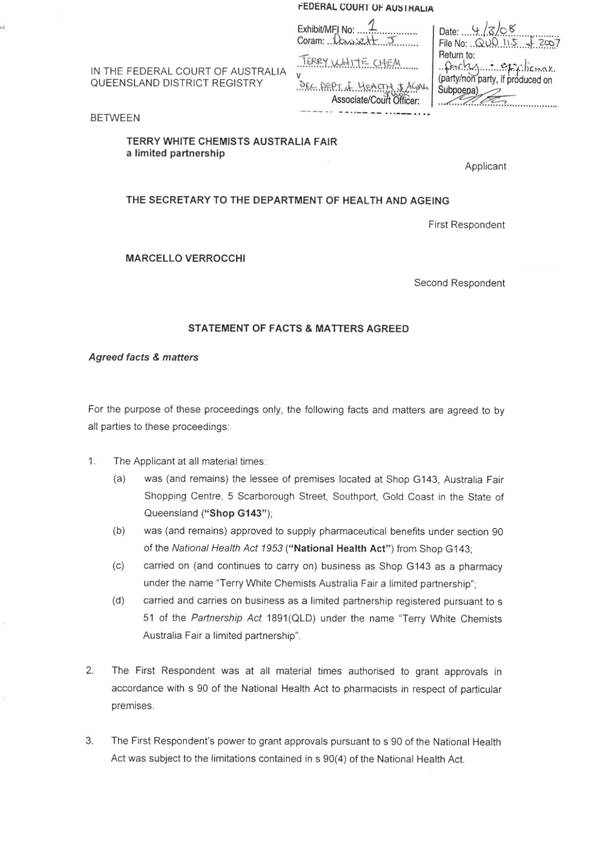
Administrative Decisions (Judicial Review) Act 1977 (Cth) s 5
National Health Act 1953 (Cth) ss 90, 99J
National Health Amendment Act 1995 (Cth)
Integrated Planning Act 1997 (Qld)
Battalis v Secretary, Department of Health, Housing and Community Services (1994) 34 ALD 483
Australian Community Pharmacy Authority v Eaves; Lowe v Australian Community Pharmacy Authority & Ors (1997) 47 ALD 664
QUD 115 of 2007
DOWSETT J
11 JULY 2008
BRISBANE
|
IN THE FEDERAL COURT OF AUSTRALIA |
|
|
QUEENSLAND DISTRICT REGISTRY |
QUD 115 of 2007 |
|
BETWEEN: |
TERRY WHITE CHEMISTS AUSTRALIA FAIR A LIMITED PARTNERSHIP Applicant
|
|
AND: |
THE SECRETARY TO THE DEPARTMENT OF HEALTH AND AGEING First Respondent
MARCELLO VERROCCHI Second Respondent
|
|
DOWSETT J |
|
|
DATE OF ORDER: |
11 JULY 2008 |
|
WHERE MADE: |
BRISBANE |
THE COURT ORDERS THAT:
1. the application filed 19 April 2007 be dismissed; and
2. the applicant pay the respondents’ costs of the application.
Note: Settlement and entry of orders is dealt with in Order 36 of the Federal Court Rules.
|
IN THE FEDERAL COURT OF AUSTRALIA |
|
|
QUEENSLAND DISTRICT REGISTRY |
QUD 115 of 2007 |
|
BETWEEN: |
TERRY WHITE CHEMISTS AUSTRALIA FAIR A LIMITED PARTNERSHIP Applicant
|
|
AND: |
THE SECRETARY TO THE DEPARTMENT OF HEALTH AND AGEING First Respondent
MARCELLO VERROCCHI Second Respondent
|
|
JUDGE: |
DOWSETT J |
|
DATE: |
11 JULY 2008 |
|
PLACE: |
BRISBANE |
REASONS FOR JUDGMENT
1 This is an application pursuant to s 5 of the Administrative Decisions (Judicial Review) Act 1977 (Cth) (the “ADJR Act”) for review of a decision made by the first respondent (the “Secretary”) pursuant to s 90 of the National Health Act 1953 (Cth) (the “National Health Act”). Section 90 provides relevantly as follows:
(1) Subject to this section, the Secretary may, upon application by a pharmacist who is willing to supply pharmaceutical benefits on demand at particular premises, approve that pharmacist for the purpose of supplying pharmaceutical benefits at or from those premises.
(2) Where a pharmacist desires to supply pharmaceutical benefits at or from several premises, … a separate application shall be made in respect of each of the premises and, where approval is granted in respect of two or more of the premises, a separate approval shall be granted in respect of each of the premises.
(3) Subject to this section, where an approved pharmacist desires to supply pharmaceutical benefits at or from premises … other than premises in respect of which approval has been granted, the Secretary may on application by the approved pharmacist, grant approval in respect of those other premises.
(3A) Subject to subsections (3AA) and (3AE), an application under this section must be referred to the Authority.
…
(4) Nothing in this section authorizes the Secretary to grant approval to a pharmacist in respect of premises at which that pharmacist is not permitted, under the law of the State or Territory in which the premises are situated, to carry on business.
…
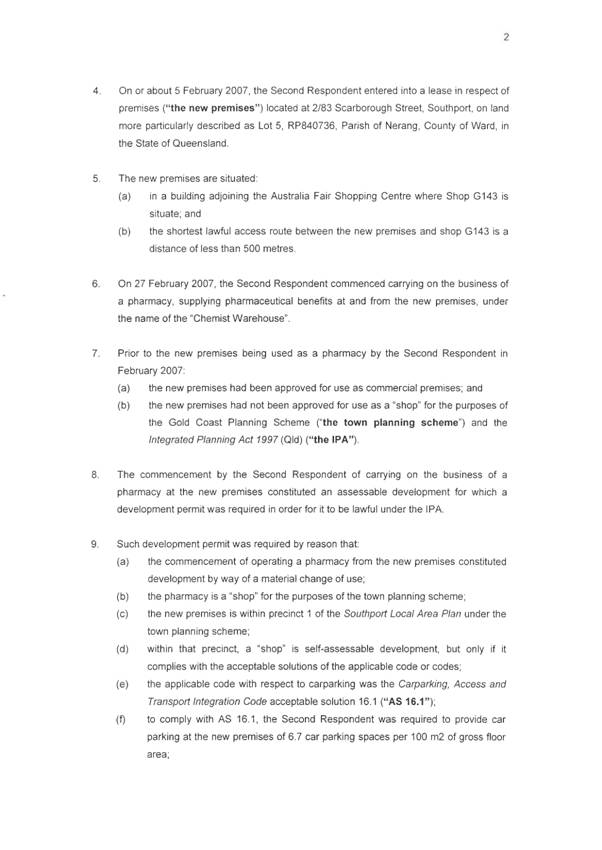
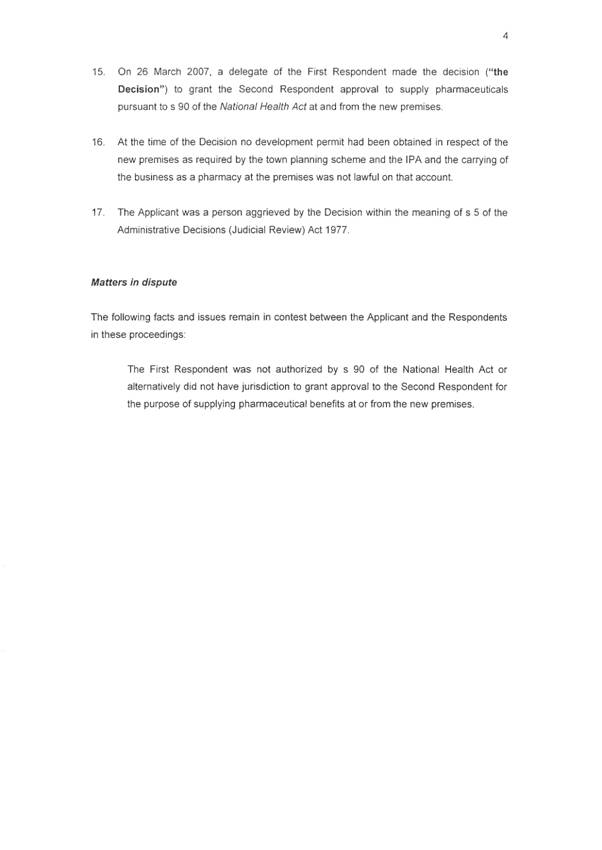
2 The parties have presented an agreed statement of facts and matters, a copy of which is attached to these reasons. Relevantly, the applicant (“White”), a limited partnership, is the lessee of premises situated at Australia Fair Shopping Centre in Southport where it carries on a pharmacy business. It is approved, pursuant to s 90, to supply pharmaceutical benefits from those premises. On or about 5 February 2007 the second respondent (“Verrocchi”) entered into a lease of premises in Scarborough Street, Southport (the “Scarborough St premises”) in relatively close proximity to those occupied by White. On 27 February 2007 Verrocchi commenced to carry on the business of a pharmacy at the Scarborough St premises. On 26 March 2007 a delegate of the Secretary granted him an approval to supply pharmaceutical benefits from those premises, acting pursuant to s 90. That decision is the subject of this application.
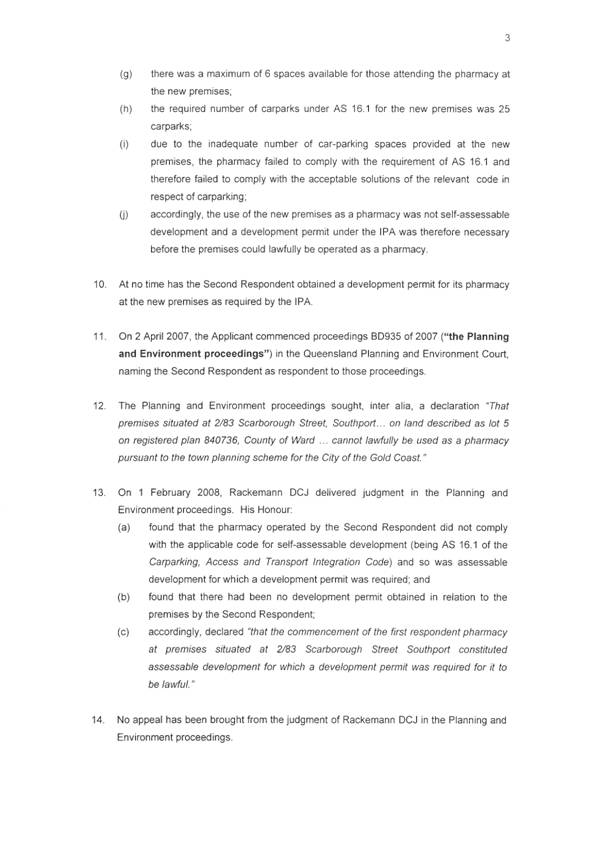
3 At all material times the Scarborough St premises were zoned pursuant to the Gold Coast Planning Scheme and the Integrated Planning Act 1997 (Qld) (the “Planning Scheme”) for use as commercial premises but had not been approved for use as a shop, the use appropriate to use as a pharmacy. Under the Planning Scheme use as a shop is as a “self-assessable development”, provided that the premises comply with applicable codes. This seems to mean that the occupier must decide whether the proposed use is permissible by assessing compliance with such codes. In the event of non-compliance, the occupier must apply for an appropriate permit. One applicable code was the Car Parking, Access and Transport Integration Code. To comply with this it was necessary that Verrocchi provide 6.7 car parking spaces per 100 square metres of gross floor area at the Scarborough St premises. This translated into a requirement that he supply 25 car parks. Only six car parking spaces were available. Thus the premises could not lawfully be used as a shop unless an appropriate permit had been obtained. No such permit was obtained.
4 These factual matters were, as I have said, agreed between the parties. Presumably acting upon that basis Rackemann DCJ, sitting in the Queensland Planning and Environment Court, concluded that the Scarborough St premises could only be used as a pharmacy if an appropriate permit had been obtained. I proceed upon that basis.
5 White submitted that in those circumstances s 90(4) deprived the Secretary of authority to grant approval to Verrocchi pursuant to s 90(1) with regard to the Scarborough St premises, he not being permitted under the law of Queensland to carry on business at those premises. The case has proceeded upon the basis that the words “carry on business” in s 90(4) mean to carry on the business of a pharmacist.
6 Whilst White’s argument seems to be substantial, it is inconsistent with the decision of the Full Court in Secretary, Department of Health, Housing, Local Government and Community Services v Kaderbhai (1994) 51 FCR 416. In order to understand this decision and some others, it is necessary to understand that at least until 30 June 2005 the Secretary could exercise the power conferred by s 90(1) only if the Australian Community Pharmacy Authority (the “Authority”) established under s 99J of the National Health Act had recommended that such approval be granted. (See s 90(3B).) Pursuant to subs 90(3C), that section and certain other subsections of s 90 were to cease to have effect not later than 30 June 2005. It is not necessary for me to address the current status of those provisions. Until 1995 the Authority was known as the “Pharmacy Restructuring Authority”, the present name being adopted pursuant to the National Health Amendment Act 1995 (Cth).
7 In Kaderbhai, the Authority had recommended that a particular application not be approved upon the basis that no public need had been demonstrated. As a result the application was rejected by the Secretary’s delegate. The relevant applicant applied to the Administrative Appeals Tribunal (the “AAT”) for review of the Authority’s recommendation and of the Secretary’s decision. The AAT set aside both the recommendation and the decision. Both the Secretary and the Authority appealed from that decision to this Court. The factual basis of the case was complex, but for present purposes the only relevant aspect is the following extract from the judgment which appears at 421-422:
These submissions require consideration of s 90(4), which is a curiously worded provision. It does not say that the Secretary shall not approve a pharmacist whose premises are not approved and who is not registered as the owner of the relevant business under State or Territory law relating to control of pharmacies. At first glance it may seem to amount to no more than an expression of intention that the Act should not displace any such State or Territory law in accordance with s 109 of the Constitution. The Secretary, however, evidently takes the view that s 90(4) operates as a limitation on power and that an applicant must show that he is permitted under a law, such as the Pharmacy Act, to carry on business at the premises in respect of which approval is to be granted.
The Secretary is plainly correct. The expression “Nothing in this section authorizes” signals a limitation on power. This expression is similar to the language limiting the legislative power of the Parliament employed in s 51(xxiiiA) of the Constitution. The permission contemplated by s 90(4) must be specific to “that pharmacist” in respect of the premises for which approval is to be granted. The permission required is not of a town planning or land use type, which would relate only to the premises.
French J explained s 90(4) in Pharmacy Restructuring Authority v Chatfield (1993) 18 AAR 34 at 51 …:
In truth, the subsection provides that the Secretary has no power to make an approval where State law would not permit the pharmacist to carry on business at the subject premises. Because of the disempowering effect, the subsection requires the Secretary to at least consider whether a proposed approval would be nugatory where by reason of State law the pharmacist would not be permitted to carry on business at the proposed premises.
8 Clearly, the Full Court considered that State town planning law was not the source of the permission contemplated by subs 90(4). The reason for this view appears to have been that s 90(4) was concerned with permission for the pharmacist to carry on business at particular premises, and not with any general limitation upon the use of such premises. White submitted that the passage in question was not a necessary part of the reasoning process in that case and that it should not be treated as binding for present purposes. Even if it is not part of the ratio of the case, it is a clear statement concerning the construction of the subsection. It was followed by Carr J in Battalis v Secretary, Department of Health, Housing and Community Services (1994) 34 ALD 483 at 488-489. Carr J considered that the relevant passage was part of the ratio of the decision.
9 White referred to two decisions of Judges of this Court in support of its interpretation of s 90(4). The first of these was the decision of French J in Chatfield. It is curious that the decision should be cited as being contrary to that in Kaderbhai, particularly as the passage relied upon was approved by the Full Court in that case. French J considered that “… the Secretary has no power to make an approval where State law would not permit the pharmacist to carry on business at the subject premises.” (Emphasis added) Whatever French J may have intended, the Full Court apparently considered that the statement was consistent with its decision in Kaderbhai.
10 White also referred to the decision of Kiefel J in Australian Community Pharmacy Authority v Eaves; Lowe v Australian Community Pharmacy Authority & Ors (1997) 47 ALD 664 at 667 and 669. That case was concerned only with a decision of the Authority, and not with a decision of the Secretary. The Authority was required to act in accordance with rules made by the Minister. One such rule provided that the Authority was to recommend approval if the pharmacist had demonstrated that he or she had a right to occupy the relevant premises. It was submitted that the right to occupy must include the ability lawfully to use the premises as a pharmacy. Kiefel J rejected this view, holding that the requirement of a right to occupy should not be given such an extended meaning. Her Honour seems to have accepted that the absence of town planning approval would be a relevant matter for consideration by the Secretary in deciding whether to grant an approval pursuant to s 90(1). It is, however, not clear that her Honour considered that absence of such approval would deprive the Secretary of power to grant approval. Her Honour was not referred to the decision in Kaderbhai.
11 The point involves construction of s 90(4) and concerns the circumstances in which the subsection operates to deny the Secretary authority to grant approval pursuant to s 90(1). White submitted that a town planning restriction was sufficient to activate the subsection. In Kaderbhai, the Full Court held, or at least proceeded upon the basis, that only a law of a State which prevented the relevant pharmacist from carrying on the business of pharmacy at the premises was relevant to the operation of the subsection, and that a town planning restriction upon use of the premises was not sufficient. None of the cases seems clearly to support White’s submission, and Kaderbhai is to contrary effect. I am by no means satisfied that the decision in Kaderbhai was wrong. Whether the relevant passage in Kaderbhai be obiter or part of the ratio of the case, I should follow it, leaving it to the Full Court or the High Court to determine its correctness.
12 In the course of the hearing, I raised a question concerning White’s standing as an applicant. I am satisfied that it had appropriate standing.
13 The application should be dismissed with costs.
|
I certify that the preceding thirteen (13) numbered paragraphs are a true copy of the Reasons for Judgment herein of the Honourable Justice Dowsett. |
Associate:
Dated: 11 July 2008
|
Counsel for the Applicant: |
Mr G Gibson QC and Ms S Brown |
|
|
|
|
Solicitor for the Applicant: |
Wendy Hart Solicitor |
|
|
|
|
Counsel for the First Respondent: |
Ms M Brennan |
|
|
|
|
Solicitor for the First Respondent: |
Australian Government Solicitor |
|
|
|
|
Counsel for the Second Respondent: |
Mr R Gotterson QC and Mr A Musgrave |
|
|
|
|
Solicitor for the Second Respondent: |
DLA Phillips Fox |
|
Date of Hearing: |
4 March 2008 |
|
|
|
|
Date of Judgment: |
11 July 2008 |