

FEDERAL COURT OF AUSTRALIA
Bonnell v Deputy Commissioner of Taxation (No 5) [2008] FCA 991
TAXATION – remission of additional tax payable by way of penalty under a provision of Part VII of the Income Tax Assessment Act 1936 (Cth) – whether an invalid exercise of discretion to remit within the Hickman provisos could invalidate a Notice of Amended Assessment of the amended taxable income of a taxpayer and of the tax payable thereon into which notice of assessment of additional tax has been incorporated under s 227(2) of the Act – whether the Commissioner’s discretion to remit additional tax under s 227(3) of the Act stands apart from the Commissioner’s obligation to make an assessment of the additional tax payable under s 227(1) of the Act
PRACTICE AND PROCEDURE – summary dismissal – striking out of pleadings –inadequate particulars
Income Tax Assessment Act 1936 (Cth) ss 166, 170(1), 173, 174, 175 ,177, 204, 226K and 227
Acts Interpretation Act 1901 (Cth) s 33(1)
Federal Court of Australia Act 1976 s 31A
Federal Court Rules Order 11 r16, Order 12 r2, Order 20 r5
Bonnell v Deputy Commissioner of Taxation [2008] FCA 60
The King v Murray; Ex parte Proctor (1949) 77 CLR 387
Deputy Commissioner of Taxation v Richard Walter Pty Limited (1995) 183 CLR 168
Daihatsu Australia Pty Limited v Federal Commissioner of Taxation (2001) 47 ATR 156
SZFDE v Minister for Immigration and Citizenship [2007] 81 ALJR 1401
F. J. Bloeman Proprietary Limited v Federal Commissioner of Taxation (1981) 147 CLR 360
Theseus Exploration N.L. v. Foyster (1972) 126 CLR 507
General Steel Industries Inc. v. Commissioner for Railways (N.S.W.) (1964) 112 CLR 125
Jefferson Ford Pty Ltd v Ford Motor Company of Australia Limited [2008] FCAFC 60
Boston Commercial Services Pty Ltd (ACN 114 658 070) v GE Capital Finance Australasia Pty Ltd (ACN 070 396 020) (2006) 236 ALR 720
White Industries Australia Ltd v FC of T (2007) ATC 4441
DAVID NEIL BONNELL v DEPUTY COMMISSIONER OF TAXATION
NSD 1963 of 2006
GRAHAM J
30 JUNE 2008
SYDNEY
|
IN THE FEDERAL COURT OF AUSTRALIA |
|
|
NEW SOUTH WALES DISTRICT REGISTRY |
|
Applicant
| |
|
AND: |
DEPUTY COMMISSIONER OF TAXATION Respondent
|
|
DATE OF ORDER: |
|
|
WHERE MADE: |
THE COURT:
1. Orders that the proceedings stand over to 2.15 pm on Tuesday 1 July 2008 for the making of final orders.
2. Directs that the parties bring in Short Minutes of Order.
Note: Settlement and entry of orders is dealt with in Order 36 of the Federal Court Rules.
|
| |
|
NEW SOUTH WALES DISTRICT REGISTRY |
NSD 1963 of 2006 |
|
BETWEEN: |
DAVID NEIL BONNELL Applicant
|
|
AND: |
DEPUTY COMMISSIONER OF TAXATION Respondent
|
|
JUDGE: |
GRAHAM J |
|
DATE: |
30 JUNE 2008 |
|
PLACE: |
SYDNEY |
REASONS FOR JUDGMENT
Background
1 The matter presently before the Court is a Notice of Motion filed by the respondent on 6 June 2008. It is a sequel to two Notices of Motion which were the subject of decision in Bonnell v Deputy Commissioner of Taxation [2008] FCA 60. The earlier motions were referred to at [46] and [48] of that judgment of 8 February 2008.
2 The substantive orders sought in the Notice of Motion filed by the respondent on 9 March 2007 were as follows:
‘1. The proceedings be dismissed pursuant to section 31A of the Federal Court Act 1976 and Order 20 rule 2 of the Federal Court Rules.
2. Alternatively, the proceedings be stayed pursuant to Order 20 rule 2 of the Federal Court Rules.
3. Further and in the alternative, the statement of claim be struck out pursuant to Order 11 rule 16 of the Federal Court Rules, and the application be dismissed.
…’
3 The Notice of Motion filed by the applicant on 5 March 2007 was superseded by an Amended Notice of Motion filed on 11 April 2007 at the conclusion of the hearing on 4, 5 and 11 April 2007. The orders sought by the applicant in the Amended Notice of Motion were as follows:
‘1A Granting leave to the applicant to file and serve an amended application in the form of the draft amended application attached to the affidavit of Bruce Elliott Rowntree, sworn and affirmed (sic) 5 March 2006;
1. Granting leave to the applicant to file and serve an amended statement of claim in the form of exhibit NM1 on the hearing of the notice of motion filed 5 March 2007.
2. that should the statement of claim be struck out, leave to amend or an order under Order 10 Rule 1(2)(b) that the application proceed on affidavits;
3. that should the application be struck out, the court grant preliminary discovery under Order 15A Rule 6;
4. that any associated proceedings transferred from the Federal Magistrates Court be heard sequentially at the conclusion of the current proceedings;
5. that the matter proceed on affidavits.’
4 The orders made on 8 February 2008 disposed of both Notices of Motion. Relevantly those orders were as follows:
‘THE COURT:
1. Grants leave to the applicant to file and serve a Notice For Discovery on the respondent on or before 29 February 2008 requiring the respondent, within 28 days after service of the Notice, to give discovery with verification of documents relating to the exercise, or possible exercise, by the Commissioner, whether before or after 29 July 2004, of the discretion conferred upon him by s 227(3) of the Income Tax Assessment Act 1936 (Cth) (‘the Act’) to remit the whole or any part of the additional tax payable by the applicant under s 226K of the Act and referred to in the Notice of Amended Assessment issued on 29 July 2004.
2. Grants leave to the applicant to amend the Application filed 10 October 2006 by filing and serving an Amended Application on or before 18 April 2008.
3. Grants leave to the applicant to amend the Statement of Claim filed 10 October 2006 by filing and serving an Amended Statement of Claim on or before 18 April 2008.
4. Orders that, in the event that an Amended Statement of Claim is not filed on or before 18 April 2008, the Statement of Claim filed 10 October 2006 shall, without further order, be struck out.
5. Orders that, in the event that an Amended Application is not filed on or before 18 April 2008, the application filed 10 October 2006 shall, without further order, be dismissed generally.
…
7. Orders that the applicant pay one half of the respondent’s costs of the applicant’s Amended Notice of Motion filed 11 April 2007 and that such costs may be taxed and shall be payable forthwith.
8. Orders that the respondent’s Notice of Motion filed 9 March 2007 be dismissed.
9. Orders that there be no order as to costs in respect of the respondent’s Notice of Motion filed 9 March 2007.
…’
5 On 28 February 2008 the applicant filed and served a Notice for Discovery on the respondent which called for the discovery of a number of documents in relation to a decision said to have been made by the respondent not to remit additional tax imposed by s 226K of the Income Tax Assessment Act 1936 (Cth) (‘the Assessment Act’) in connection with ‘the amended income tax assessment of the applicant for the year of income ended 30 June 1999’. The Notice for Discovery also called upon the respondent to give discovery with verification of a number of documents which related to other matters.
6 On 16 April 2008 an order was made setting aside paragraphs 1(k), 1(l), 1(q), 1(r), 1(s), 2, 3 and 4 of the Schedule to the Notice for Discovery. The Court also ordered that a revised expression of subparagraph 1(q) could stand as part of the Notice for Discovery.
7 On 16 April 2008 a further order was made extending the time for compliance with the Notice for Discovery until Monday 21 April 2008. In addition an order was made substituting the date 26 May 2008 for 18 April 2008 in orders 2, 3, 4 and 5 as made on 8 February 2008.
8 In the foregoing context, the applicant filed an Amended Application on 26 May 2008 and an Amended Statement of Claim on the same day.
9 The original Application had been filed on 10 October 2006. When the earlier motions were heard a proposed Amended Application was considered as was a proposed Amended Statement of Claim (see prayers for relief 1A and 1 at [3] above). However, neither of those documents was ever filed, no leave to do so having been granted.
The Notice of Motion filed 6 June 2008
10 The Notice of Motion filed by the respondent on 6 June 2008 seeks orders as follows:
‘1. That this motion be heard with expedition.
2. That the following words from the first substantive paragraph of the Amended Application (filed 26 May 2008) be struck out:
… to contest the validity of a Notice of Amended Assessment for the year of income ended 30 June 1999, which was communicated to the Applicant in a purported Notice of Assessment issued on 29 July 2004.
3. That proposed order 2 in the Amended Application be struck out, or alternatively summarily dismissed pursuant to s 31A of the Federal Court of Australia Act 1976 (Cth).
4. That proposed order 2 in the Amended Statement of Claim (filed 26 May 2008) be struck out pursuant to rule 16 of Order 11 of the Federal Court Rules.
5. That the paragraphs 36 and 37 of the Amended Statement of Claim be struck out and that in consequence the balance of the Statement of Claim be struck out.
6. That the Amended Application be summarily dismissed pursuant to s 31A of the Federal Court of Australia Act 1976 (Cth).
7. The applicant pay the respondent’s costs of the motion.
8. The applicant pay the respondent’s costs, including reserved costs.
9. Such other orders as the Court deems necessary or desirable.’
11 Given that the present motion is truly a sequel to the two Notices of Motion which were the subject of decision in Bonnell v Deputy Commissioner of Taxation [2008] FCA 60 it is inappropriate to recount all of the relevant facts again. The facts and matters and statements of legal principle as recorded in the earlier judgment should be treated as having been restated in full in these reasons.
12 By way of introduction, it is necessary to refer to the Notice of Amended Assessment issued on 29 July 2004 whereby the Commissioner disallowed the claimed deduction by the applicant of an amount of $5 million with the consequence that tax of approximately $2.4 million became payable in respect of the applicant’s amended taxable income for the year of income ended 30 June 1999.
13 In accordance with s 226K of the Assessment Act, the appellant became liable to pay additional tax, by way of penalty, in the sum of $606,250.00, none of which was remitted by the Commissioner in accordance with s 227(3) of the Assessment Act (see [11]-[12] of the earlier judgment).
14 In the Statement of Claim filed 10 October 2006 a number of allegations of fact were made by the applicant (see [45] of the earlier judgment). One of the allegations was to the effect that the Notice of Amended Assessment was invalid because the amendment decision to impose penalties was not a bona fide attempt by the Respondent or the Respondent’s officers to exercise the Respondent’s power to amend.
15 In an email dated 5 December 2005 the applicant had said ‘one of the allegations I have made consistently is that the levying of penalties against me was done for an improper purpose’. At [121] of the earlier judgment the matter so alleged by the applicant was rejected, but the possibility of an alternative allegation being sustained, was entertained.
‘121 …
Such an allegation in respect of the “levying of penalties” cannot be sustained in these proceedings. However, an allegation that a decision taken by the Commissioner in exercise of his discretion under s 227(3) of the Assessment Act not to remit the whole or any part of the additional tax payable by the applicant by way of penalty under s 226K of the Assessment Act was taken for “an improper purpose” may be sustained. On my understanding it is this second allegation which underpins the case which the applicant now wishes to bring.’
16 Section 227 of the Assessment Act provided follows:
‘227(1) The Commissioner shall make an assessment of the additional tax payable by a person under a provision of this Part.
(2) Nothing in this Act shall be taken to preclude notice of an assessment made in respect of a person under subsection (1) from being incorporated in notice of any other assessment made in respect of the person under this Act.
(3) The Commissioner may, in the Commissioner’s discretion, remit the whole or any part of the additional tax payable by a person under a provision of this Part, but, for the purposes of the application of subsection 33(1) of the Acts Interpretation Act 1901 to the power of remission conferred by this subsection, nothing in this Act shall be taken to preclude the exercise of the power at a time before an assessment is made under subsection (1) of the additional tax.’
17 Section 33(1) of the Acts Interpretation Act 1901 (Cth), to which reference was made in s 227(3) of the Assessment Act, provided:
‘33(1) Where an Act confers a power or imposes a duty, then, unless the contrary intention appears, the power may be exercised and the duty shall be performed from time to time as occasion requires.’
18 Section 227(1) of the Assessment Act required the Commissioner to make an assessment of the additional tax payable by a person under, relevantly, s 226K of the Assessment Act. Section 227(2) empowered the respondent to incorporate notice of the assessment of additional tax payable under s 226K in a notice of amended assessment under s 170(1) of the Assessment Act.
19 The power of remission, which is central to the issues presently before the Court, was contained in s 227(3) of the Assessment Act. It permitted the Commissioner, in his discretion, to ‘remit the whole or any part of the additional tax payable by a person under a provision of this Part’.
20 The Commissioner contended that he addressed the discretion conferred upon him by s 227(3) of the Assessment Act and made a decision not to remit any part of the additional tax payable by the applicant prior to the issue of the Notice of Amended Assessment on 29 July 2004.
21 As indicated at [114] in the earlier judgment, it seemed to me that what, relevantly, occurred in this case was:
(a) the Commissioner, in exercise of his power to do so under s 170(1) of the Assessment Act, amended his assessment of the amount of the applicant’s taxable income and of the tax payable thereon. This amendment resulted from a disallowance of the applicant’s claimed deduction from his assessable income of $5 million by way of contribution to, I assume, the ‘Bonnell No. 2 Superannuation Fund’;
(b) by s 226K of the Assessment Act, the applicant became liable to pay, by way of penalty, additional tax equal to 25% of the amount of the tax shortfall. That amount was $606,250.00;
(c) in fulfilment of his duty under s 227(1) of the Assessment Act to do so, the Commissioner made an assessment of the additional tax payable by the applicant under s 226K;
(d) as required by s 174 of the Assessment Act, the Commissioner served the Notice of Amended Assessment issued on 29 July 2004 upon the applicant which Notice included notice of the assessment of the additional tax under s 227(1), as authorised by s 227(2).
22 At [85] of the earlier judgment I expressed the opinion that the privative provisions of the Assessment Act (ss 175 and 177 – see [20] and [21]) did not apply where the applicant’s present challenge was not, in reality, to any assessment of the amount of his taxable income or of the tax payable thereon, but rather to a failure on the part of the Commissioner to remit the amount of the additional tax for which he was liable under s 226K of the Assessment Act or some part thereof, whether before or after the issue of the Notice of Amended Assessment.
23 In the foregoing context I said at [115] and [116]:
‘115 Whether and when the Commissioner addressed his discretion to remit the whole or any part of the additional tax payable by the applicant is a matter of some conjecture. It is clear that the Commissioner had the power, under s 227(3) of the Assessment Act, to remit the additional tax or part thereof before the Commissioner made the assessment of the additional tax as required by s 227(1). …
116 There is no evidence to suggest that the applicant has called on the Commissioner to exercise the discretion conferred on him by s 227(3) in the applicant’s favour. What is clear is that if the Commissioner addressed his discretion before 29 July 2004, he did not exercise it in the applicant’s favour.
As previously indicated (at [13]) the Commissioner contends that he did address the discretion before the issue of the Notice of Amended Assessment on 29 July 2004 and that he made a decision not to remit any part of the additional tax payable by the applicant. However there is no evidence to support that contention and no evidence to indicate that the applicant was ever informed of that fact, if it was the case.’
24 At [121] I concluded:
121 On the material presently available and in the absence of any evidence as to the Commissioner’s exercise of his discretion under s 227(3) of the Assessment Act, I am not satisfied that the applicant has no reasonable prospect of successfully prosecuting the proceeding insofar as it may claim relief in relation to the exercise of that discretion under s 39B of the Judiciary Act, reliance being placed on one or other of the Hickman provisos.
…’
Good faith within the meaning of Hickman
25 Detailed consideration was given to the Hickman provisos at [15] – [43] of the earlier judgment.
26 In The King v Murray; Ex parte Proctor (1949) 77 CLR 387 at 400 Dixon J, as his Honour then was, treated the Hickman provisos as being satisfied if ‘there has been an honest attempt to deal with a subject matter confided to [in a case such as the present, the Commissioner] and to act in pursuance of the powers of the [Commissioner] in relation to something that might reasonably be regarded as falling within [the Commissioner’s] province’.
27 As Brennan J said in Deputy Commissioner of Taxation v Richard Walter Pty Limited (1995) 183 CLR 168 at 194 privative clauses such as ss 175 and 177 of the Assessment Act are:
‘… given effect despite non-compliance with the provisions governing the exercise of the power, but only if the purported exercise is a bona fide attempt to exercise the power, it relates to the subject matter of the legislation and it is reasonably capable of reference to the power given to the body purporting to exercise it. The validating provision cannot be so construed if the impugned act by the repository of the power is not referable to the power given to the repository or exceeds the power which can constitutionally be given to the repository.’
28 In relation to the Hickman provisos in the context of the Assessment Act Finn J said in Daihatsu Australia Pty Limited v Federal Commissioner of Taxation (2001) 47 ATR 156 at [29]-[38]:
‘[29] As has recently been indicated by the full court of this court in Kordan Pty Ltd v FCT (2000) 44 ATR 131, it is the clear intendment of ss 175 and 177 of the ITAA 1936 that taxpayers not be permitted to seek judicial review of the processes leading to, and the making of, assessments by the Commissioner of Taxation. Rather taxpayers are to be confined to the objection and appeal remedy now contained in Pt IVC of the TAA: see Kordan's case at [1].
[30] Sections 175 and 177 are, though, subject to the rule of construction enunciated in R v Hickman; Ex parte Fox & Clinton, in relation to privative clauses: DCT v Richard Walter (1995) 183 CLR 168; 29 ATR 644; 95 ATC 4067; see also, Sunrise Auto Ltd v FCT (1995) 61 FCR 446; 32 ATR 347; 95 ATC 4840; with the consequence that an assessment will lose the protection of ss 177(1) and 175, and its validity will be open to challenge, if it is not made in compliance with the Hickman principle: Briglia v FCT (2000) 44 ATR 166 at 168; ATC 4247 at 4249 and the cases referred to therein.
[31] For present purposes it can be said that that principle will not be breached if in making the assessment in question (1) there was a bona fide attempt by the Commissioner to exercise the power of assessment; (2) that attempt related to the subject matter of the ITAA 1936; and (3) it was reasonably capable of reference to the Commissioner’s power of assessment: but see Vanmeld Pty Ltd v Fairfield City Council (1999) 46 NSWLR 78 per Spigelman CJ where additional possible elements in the principle are considered. In the present case the assessments in question have been impugned principally in reliance on the first of these propositions (bona fide attempt) although it is alleged as well that the third of the propositions (reasonably capable of reference to the power of assessment) was not satisfied.
[32] In Kordan’s case, the full court observed that:
[t]he allegation that the Commissioner, or those exercising his powers by delegation, acted other than in good faith in assessing a taxpayer to income tax is a serious allegation and not one lightly to be made. It is, thus, not particularly surprising that applications directed at setting aside assessments on the basis of absence of good faith have generally been unsuccessful. Indeed one would hope that this was and would continue to be the case. As Hill J said in San Remo Macaroni Company Pty Ltd v Commissioner of Taxation 99 ATC 5138 at 5154 it would be a rare case where a taxpayer will succeed in showing that an assessment has in the relevant sense been made in bad faith and should for that reason be set aside.
This view resonates with observations of other judges of this court: see eg Dan v FCT (2000) 44 ATR 338 at 345; 2000 ATC 4350 at 4356 affirmed in Kordan’s case: “proof of bad faith necessitates proof of extreme circumstances”.
[33] It is unsurprising that the above view has been expressed. A premise of the rule of construction embodied in the Hickman principle is that, but for the privative clause in question (here s 175 with its s 177(1) overlay), a decision taken in the exercise of a power to which the clause relates might otherwise be invalidated in judicial review proceedings because, for example, the decision-maker “has not conformed to the requirements governing its proceedings or the exercise of its authority or has not confined its acts within the limits laid down by the instrument giving it authority”: Hickman's case at 615. To the extent that it is effective the clause saves from invalidation an assessment that would otherwise be potentially reviewable for defect or irregularity: Richard Walter, above, at 180. Something more is required.
[34] It is likewise unsurprising that courts have shrunk from attempting a comprehensive exposition of what is and is not countenanced by the formula “a bona fide attempt to exercise [a] power”. Rather the burden of the formula has been illustrated by example as in the observations (i) “[p]lainly enough, an incorrect assessment does not demonstrate an absence of bona fides": Briglia at 4250; or (ii) “once the Commissioner forms the view that there is no substantial possibility that the item of income is assessable income of a person, it could not be a bona fide exercise of the assessing power to assess that person to tax in respect of that income. Likewise here where it is conceded that there is no possibility at all that the assessments made were correct, there can be no assessment”: Darrell Lea Chocolate Shops Pty Ltd v FCT (1996) 72 FCR 175 at 187; 34 ATR 491 at 502; 97 ATC 4040 at 4050.
[35] The formula likewise has been illustrated by resort to some alternate formula which is appropriate to the particular context in which it is used. In R v Comr of Taxation (WA); Ex parte Briggs (1986) 12 FCR 301, for example, the formula used (at 308) was “a genuine attempt to ascertain the taxable income of the taxpayer” in a setting in which it was conceded that the Commissioner never intended to, and did not, embark upon the process of ascertaining the taxpayer's income. And references commonly have been made to the terminology of “abuse of power” to characterise what was not a bona fide exercise of a power: see eg Richard Walter, above, at 219.
[36] What is clear both from the premise of the Hickman principle itself and from judicial treatment of the “bona fide attempt” formula is that, in the setting of ss 175 and 177(1), the cases will be rare and extreme in which a bad faith assessment will be able to be made out for Hickman purposes. Often, I do not say invariably, they will be cases (i) where, knowingly, the assessment power has been exercised for an improper purpose; or (ii) where the purported assessment involved no actual attempt to ascertain or calculate the taxpayer's income as, for example, where the assessment was made on facts “known ... to be untrue”: Darrell Lea Chocolates, at 188.
[37] Given its possible significance in this proceeding, I should also note that uncertainty arising from, or deficiency in, the information available to the Commissioner will not of itself preclude a bona fide attempt to assess being made: see Richard Walter, above, at 200-201. In the case of a determination under s 136AD(4), an insufficiency of information available to the Commissioner can be the very trigger justifying resort to that provision.
[38] Finally, whether or not a denial of natural justice can in some circumstances defeat the bona fides requirement: cf O'Toole v Charles David Pty Ltd (1991) 171 CLR 232 at 305; or else some other requirement of the Hickman principle: O'Toole, at 287; Vanmeld’s case, above, 105ff; Aronson and Dyer, Judicial Review of Administrative Action, 689ff (2nd ed, 2000); and on natural justice and “jurisdiction” see Re Refugee Review Tribunal; Ex parte Aala (2000) 75 ALJR 52; are not matters into which I need inquire in this proceeding. …’
29 In SZFDE v Minister for Immigration and Citizenship [2007] 81 ALJR 1401, a case where the High Court found that the effect of a migration agent’s fraud on his client in respect of an invitation to attend a hearing before the Refugee Review Tribunal was to stultify the invitation, it said in respect of fraud in public law at [12]-[13]:
‘[12] The attachment by courts of equity of the term “fraud”, with related notions of “bad faith” and “abuse of power”, when stigmatising exercises of powers of appointment and fiduciary powers as falling short of the standards equity required of the repositories of those powers, has proved influential in the development of public law. What came to be known as the principle of “Wednesbury unreasonableness” was developed in the case law by analogy to the principles controlling the exercise of powers of discretions vested in trustees and others.
[13] However, several points should be made here. First, given the equitable nature of their origins described above, principles of public law concerning impropriety in the exercise of statutory powers have not had the focus upon what might be called the “red blooded” species of fraud which engages the common law. Second, with respect to references in the public law decisions to good and bad faith and the like, the following observation in a leading English text [17] is in point:
These add very little to the true sense, and are hardly ever used to mean more than that some action is found to have a lawful or unlawful purpose. It is extremely rare for public authorities to be found guilty of intentional dishonesty: normally they are found to have erred, if at all, by ignorance or misunderstanding. Yet the courts constantly accuse them of bad faith merely because they have acted unreasonably or on improper grounds. Again and again it is laid down that powers must be exercised reasonably and in good faith. But in this context “in good faith” means merely “for legitimate reasons”. Contrary to the natural sense of the words, they impute no moral obliquity.
Aickin J made observations to similar effect in R v Toohey; Ex parte Northern Land Council.’
(Footnotes omitted)
30 In considering the Commissioner’s discretion under s 227(3) of the Assessment Act it is important to observe that it is a discretion going to remission of additional tax otherwise payable. It is not a discretion which, if exercised, will impose a burden. Rather, it is a discretion which, if exercised, will provide relief from a burden.
The Commissioner’s Discovered Documents
31 The case which the applicant now wishes to advance in relation to the non-remission by the Commissioner of the whole or any part of the additional tax payable by the applicant under s 226K of the Assessment Act has been propounded with the benefit of access to the documents discovered by the Commissioner on 22 April 2008 in response to the applicant’s Notice for Discovery filed 28 February 2008 as amended. Copies of the documents discovered by the respondent were tendered in evidence on the hearing of the current Notice of Motion and became Exhibit NMB.
Those documents reveal that an Assistant Commissioner, Small Business, Aggressive Tax Planning within the Australian Taxation Office was a party to a series of email communications with a Senior Tax Counsel within the office and others relating to the preparation of a ‘Tax Penalty Submission’. As part of the Office’s consideration of the matter a telephone hook-up took place between a number of officers including the Assistant Commissioner, Small Business, Aggressive Tax Planning and the Senior Tax Counsel on 12 July 2004. Minutes of the telephone hook-up meeting included the following:
‘As a result of the deliberations of the attendees, it was determined that there is nothing material in Mr Bonnell’s response that would change the ATO’s technical position as stated in the Position Paper. That is to say, that on the evidence available:
· The established facts support the position that Mr Bonnell was not an employee of Windoval P/L for the purpose of Section 82AAA.
· the fund was not a fund established for the purposes of provision of superannuation benefits.
· The contributions were not made for the purpose of providing superannuation benefits.
· that Mr Bonnell had not “retired”.
Action Items
1. Prepare letter to issue to Bonnell stating that his response has not provided a sufficient basis to alter the opinion as outlined in the Position Paper. Also to advise him that the deduction would be disallowed and an amended assessment would issue in due course.
...’
32 The eight page ‘Tax Penalty Submission’, dated 22 July 2004, stated the ‘Issue’ as:
‘To consider what penalty, if any, should be imposed if the taxpayer’s $5 million deduction in respect of superannuation contributions to a non-complying superannuation fund is to be disallowed.’
33 The submission proceeded to include material under the headings ‘Facts & Evidence’, ‘Decision’ and ‘Reasons for Decision’. Under the heading ‘Decision’ the following appeared:
‘Penalty tax under section 226K of the ITAA 1936 should be imposed at the rate of 25%.
Also, section 170AA/GIC interest is to be charged.’
34 Amongst other things, the ‘Reasons for Decision’ section of the submission included:
‘The three significant assumptions, as described in the ruling application, and stated in Bonnell’s ruling, were not present in the implementation of the CIS arrangement. Namely, that the fund would be a superannuation fund, the contributions would be made for the purposes of providing superannuation benefits and that Mr Bonnell would be an employee of Windoval Pty Ltd for the purposes of section 82AAA.’
35 In relation to the discretion conferred on the Commissioner by s 227(3) of the Assessment Act the submission concluded:
‘The Commissioner also has the discretion under section 227(3) to remit tax shortfall penalties imposed under section 226K. The remission of penalty under a shortfall section will be exercised in only exceptional circumstances. In the present case it is not considered that any exceptional circumstances exist, and accordingly, no penalty remission is warranted’
36 The last mentioned passage was the only part of the extensive material contained in Exhibit NMB which directly bore upon the Commissioner’s discretion under s 227(3) of the Assessment Act.
37 Somewhat surprisingly, no document appears to have been discovered by the respondent answering the description of being a document recording the decision made by the respondent not to remit additional tax imposed by s 226K of the Assessment Act in connection with the amended income tax assessment of the applicant for the year of income ended 30 June 1999, nor does it appear that any document has been discovered recording the reasons for such a decision. All that has been included in exhibit NMB is an apparent instruction from the Senior Tax Counsel to the Assistant Commissioner, Small Business, Aggressive Tax Planning of 16 July 2004 which provided:
‘Please take the necessary action to excise the claim [by Mr Bonnell for a purported superannuation contribution in his 1999 income tax return] and impose penalties.’
38 On the hearing of the Notice of Motion presently before the Court senior counsel for the applicant drew attention to the lack of any minute or other document recording a decision taken by the Commissioner in the exercise of his discretion under s 227(3) of the Assessment Act, or the reasons for it. He submitted that a tender of the bundle of documents comprising Exhibit NMB at a final hearing would not, without explanation or further evidence, prove the basis for the decision and an absence of bad faith.
Plainly, the submission overlooks the fact that on a final hearing it would be for the applicant to prove that a purported exercise by the Commissioner of his discretion under s 227(3) did not constitute a bona fide attempt by him to exercise the power to remit or forgive the additional tax payable by the applicant by way of penalty under s 226K of the Assessment Act or some part thereof. No onus would rest upon the respondent requiring her to prove an absence of bad faith.
Be that as it may, the applicant submits that the documents comprising Exhibit NMB do not provide a sufficient evidentiary basis for an order for summary judgment under s 31A(2) of the Federal Court of Australia Act 1976 (Cth) (the ‘Federal Court Act’), a matter to which I will return later.
The Amended Application
39 The Amended Application filed 26 May 2008 relevantly provided as follows:
‘This Application is made under section 39B of the Judiciary Act 1903 to contest the validity of a Notice of Amended Assessment for the year of income ended 30 June 1999, which was communicated to the Applicant in a purported Notice of Amended Assessment issued on 29 July 2004.
A. DETAILS OF CLAIM
On the grounds stated in the accompanying Amended Statement of Claim, the Applicant claims:
1. A declaration that the Remission Decision [an undefined expression] is invalid;
2. An order pursuant to section 39B of the Judiciary Act 1903 quashing the Notice of Amended Assessment and such consequential orders as this Honourable Court sees fit;
…’
The Amended Statement of Claim
40 The Amended Statement of Claim filed 26 May 2008 introduced a number of alterations to the first 30 odd paragraphs and omitted two of them. These were followed by the following new or significantly altered paragraphs 32 – 37:
‘32. In or about late July 2004, the Respondent disallowed the $5 million deduction claimed by the Applicant in his return for the year ended 30 June 1999, and inter alia assessed additional tax payable by the Applicant in accordance with s.226K of the Act in the sum of $606,250.
33. In or about late July 2004, the Respondent decided that the additional tax imposed upon the Applicant under s.226K of the Act was not to be remitted under s.227(3) of the Act (“Remission Decision”).
34. On or about 29 July 2004, the Respondent purported to issue to the Applicant a Notice of Amended Assessment for the year of income ended 30 June 1999 which included the additional tax.
35. At the time that the Remission Decision was made the Respondent knew all of the facts alleged at paragraphs 1 to 31 above.
36. In making the Remission Decision, the Respondent:
i. was under an obligation to make it in good faith;
ii. could only make it if and to the extent that it related to the subject matter of the Act; and
iii. could only make it if and to the extent that it was reasonably capable of reference to the powers given to the Respondent under s.227(3).
37. In making the Remission Decision, the Respondent:
i. acted arbitrarily and or capriciously and or without any intelligible basis;
ii. failed to have regard to any matter material to whether the power conferred by s.227(3) should be exercised;
iii. failed to adhere to his publicly announced policy in relation to the remission of penalties against participants in CIS fund arrangements;
iv. acted on the assumption that the Applicant was a promoter of CIS fund arrangements;
v. sought to punish the Applicant for the advice which he had given to the Applicant’s clients in connection with implementing CIS fund arrangements;
vi. acted upon a suspicion or belief that the Applicant had obtained the Ruling improperly.
vii. acted upon an assumption that the Applicant was an associate of First Assistant Commissioner Petroulias.’
41 The matters pleaded in paragraph 37 of the Amended Statement of Claim were said to amount to allegations of non fulfilment of the Hickman provisos as summarised in paragraph 36.
42 During the course of his submissions on 27 June 2008 senior counsel for the applicant made an application for leave to amend the Amended Statement of Claim filed 26 May 2008 by inserting the words ‘In breach of each of the matters pleaded in paragraph 36(i), (ii) and (iii) of paragraph 36’ in paragraph 37 before the words ‘In making the Remission Decision’. The proposed amendment was opposed by senior counsel for the respondent but only in part. The respondent’s opposition was to the inclusion of references to (ii) and (iii).
43 The applicant pressed for leave to amend paragraph 37 in the manner originally proposed by him. Had the matter been free from consent I would have dismissed the application in its entirety. However, given the consent of the respondent to a partial amendment an order was made on 27 June 2008 to the effect that the Amended Statement of Claim filed 26 May 2008 be amended by inserting before the words ‘In making the Remission Decision’, the words ‘In breach of the matter pleaded in paragraph 36(i)’.
Relevant evidentiary material
44 In support of the matters contained in paragraph 37 of the Amended Statement of Claim filed 26 May 2008 the applicant relied upon certain other material in Exhibit NMB. In a draft audit report of 26 March 2004 in relation to the applicant, which appears to have been superseded by a later draft audit report of 14 April 2004, the following, inter alia, appeared:
‘Prior to entering into a CIS scheme, Bonnell applied for, and received a favourable Private Binding Ruling (ruling or PBR) in relation to CIS arrangements. This matter is discussed later in this report. At this juncture, it should be noted that there was some doubt as to the bone (sic) fides regarding the issue of this ruling due to the involvement of the then Assistant Commissioner of Taxation, Strategic Intelligence and Analysis, Mr Nick Petroulias.
As part of a joint investigation into possible fraudulent activities perpetrated by Petroulias … Bonnell was interviewed by the Australian Federal Police … [see page 5]
…
On 9 September 1998, Bonnell applied to the Tax Office, via Petroulias, for a ruling regarding a non complying CIS arrangement or scheme. On 29 September 1998, a favourable Private Binding Ruling (ruling) was issued to Bonnell in relation to his scheme for the 1999 and 2000 years. The ruling was prepared by a junior officer … working for Petroulias. …
…
Due to considerable doubt concerning the bona fides of a number of rulings with which Petroulias was associated, Bonnell was interviewed by the Australian Federal Police … and had documents seized under AFP warrants. It would appear that the AFP has not identified any criminal activities in the dealings between Bonnell and Petroulias. … [see page 11]
…
Bonnell used his personal ruling as a basis for promoting similar arrangements to high wealth individuals. This promotional activity culminated in a referral to the Aggressive Tax Planning area … for further review … . Over 370 taxpayers have been identified as participating in the arrangements promoted by Bonnell. All other identified participants have had their assessment adjusted to disallow claims made under S82AAE. …
…
At this meeting a number of matters were discussed including:
…
o Was the ruling issued in good faith - the Petroulias issue;
…
Where a taxpayer has a favourable ruling (private or public) they should be assessed on whichever regime is more favourable (i.e. the general law, the PBR or the public ruling). However, this assumes that the PBR was issued in good faith …[pages 12-13]
…
The Tax Office Prosecutions area were also pursuing a prosecution against Bonnell for his failure to respond to the S264 Notices, dated 1 August 2001 … Bonnell was found guilty and was fined $700 plus Costs of $59. Bonnell appealed against this conviction and the severity of penalty. The appeal was heard on the 3 April 2003. The District Court dismissed the appeal and ordered Bonnell to supply the information by 16 June 2003. [see page 15]
…
The prosecution for non compliance with … Notices issued on 27 May 2002 was initially heard in the District Court on 3 June 2003. Bonnell pleaded not guilty and the matter was adjourned until 17 June [see page 16] …
…
Bonnell defended this prosecution on the grounds that the Notices were invalid for one or more of the following reasons:
…
2. A purpose of the issue of the notices was to try to obtain evidence of the payment of “secret commissions” and possible offences under the New South Wales Crimes Act;
…
The Magistrate found that the first two of the three alleged improper purposes had been established by the defendant and accordingly dismissed the summonses [see page 17] …’
45 The applicant also relied on certain passages from a draft ‘Priority Technical Issue Proposal’ dated 29 January 2004 which included under ‘Part B: Potential PTI”:
‘Preliminary Priority Level (1,2 or 3): 1
The basis of the Preliminary Priority Level 1 allocation is the ‘Community Confidence’ issues involved with this matter. Potential risk is assessed to be High – likely adverse media with some loss of support. Given associations between the taxpayer and Petroulias, issues affecting the bona fides of the PBR have an immediate and consequent impact on current prosecution action. These are issues of extreme sensitivity and an early allocation of TCN is requested.
The fact is that this matter is happening now and it has real potential to have a significant adverse impact on the community’s perception of how the ATO administers the Rulings system. In a worst case scenario these factors in conjunction with the Petroulias association could potentially lead to a challenge of (sic) the Commissioner’s credibility. [see pages 6-7]’
46 The applicant also relies upon two media releases issued by the Australian Taxation Office in 1999 and 2003 which were referred to in paragraphs 17 and 30 respectively of the Amended Statement of Claim filed 26 May 2008. The media release Nat 99/16 which bears date 19 May 1999 included in respect of controlling interest superannuation schemes the following statement amongst others attributed to the Commissioner:
‘If participants come forward voluntarily by 30 June 1999, penalties will be reduced to five per cent and only a single and appropriate tax liability will be applied.’
47 The media release identified as Nat 03/30 which bears the notation ‘Last modified Friday, March 14, 2003’ included in respect of controlling interest superannuation arrangements:
‘• The Tax Office accepts that decision [the recent Federal Court case of Prebble v Commissioner of Taxation [2002] FCAFC 1434] and will waive penalties imposed in other controlling interest superannuation schemes provided a genuine contribution was made to a superannuation fund.’
48 It is possible that there was an exercise by the Commissioner of his discretion to remit the whole or part of the additional tax payable by the applicant under s 226K of the Assessment Act at some stage between the creation of the 22 July 2004 ‘Tax Penalty Submission’ and the date of issue of the Notice of Amended Assessment, i.e. 29 July 2004. There is nothing to suggest that the Commissioner’s discretion was exercised favourably to the applicant.
The applicant’s case
49 The applicant’s case is that the alleged failure on the part of the Commissioner to comply with the Hickman provisos rendered the exercise by the Commissioner of his discretion to remit under s 227(3) of the Assessment Act, if there was one, invalid and that such invalidity tainted and rendered invalid the whole of the Notice of Amended Assessment issued on 29 July 2004. Hence, I would assume, the use of the expression ‘purported to issue’ in paragraph 34 of the Amended Statement of Claim filed 26 May 2008.
In the applicant’s written submissions on the motion presently before the Court it was said:
‘Although the applicant accepts that the Hickman provisos apply only in respect of the decision not to remit the additional tax, the applicant contends (and has always contended) that a consequence of the invalidity of that part of the assessment is that it taints and renders invalid the whole of the Notice of Amended Assessment.’
50 This submission is, in my opinion, fallacious and should be rejected.
51 The applicant acknowledged that there was ‘no case directly in point which could be relied upon by way of precedent’ to support this submission.
52 In relation to the operation of s 226K and s 227(1) of the Assessment Act it may be observed that s 226K provided that ‘the taxpayer is liable to pay, by way of penalty, additional tax equal to 25 per cent of the shortfall or part’ in the event that the preconditions set out in the section were satisfied. It is common ground in the present case that either the preconditions were satisfied or it is not open to the applicant to say that they were not satisfied.
53 Section 227(1) of the Assessment Act is mandatory in its terms and requires the Commissioner to ‘make an assessment of the additional tax payable’ by a person under a provision of Part VII, relevantly, in the circumstances of this case, s 226K.
54 The respondent accepts that, notwithstanding the wording of s 226K, the liability imposed by that section to pay, by way of penalty, additional tax could not be enforced without an assessment first being made under s 227(1), regardless of whether that assessment was incorporated in notice of any other assessment as permitted by s 227(2) of the Act or not. This is because s 204 of the Assessment Act relevantly provided:
‘204(1) … any income tax assessed shall be due and payable by the person liable to pay the tax on the date specified in the notice as the date upon which tax is due and payable, not being less than 30 days after the service of the notice, or, if no date is so specified, on the thirtieth day after the service of the notice.
…
(2) In subsection (1), “income tax” includes additional tax under Part VII
…’
See also F. J. Bloeman Proprietary Limited v Federal Commissioner of Taxation (1981) 147 CLR 360 at 371-372 and Deputy Commissioner of Taxation v Richard Walter Pty Limited (1995) 183 CLR 168 at 196.
55 The Notice of Amended Assessment, a certified copy of which became Exhibit NMA on the hearing of the earlier motions and a copy of which exhibit became Exhibit NMC on the hearing of the motion filed 6 June 2008, showed the date of issue as ‘29 JUL 04’ and included the statement ‘This amount is payable by 02 SEP 04’. A copy of Exhibit NMC is attached to these reasons as Appendix ‘A’.
56 It may be seen that the additional tax of $606,250.00 referred to in the Notice of Amended Assessment became due and payable on 2 September 2004. I would construe the expression ‘This amount is payable by 02 SEP 04’ as so providing.
57 The Commissioner’s discretion to remit the whole or any part of the additional tax was a discretion which operated in respect of additional tax ‘payable by a person under a provision of this Part’ and, but for the qualification contained in the second part of s 227(3), was only engaged after an assessment had been made under s 227(1) of the additional tax and, arguably, after the additional tax had become ‘due and payable’ under s 204 of the Assessment Act.
58 The second part of s 227(3) had the effect of permitting the Commissioner to exercise his discretion to remit the whole or any part of the additional tax payable by a person such as the applicant before the Commissioner made the assessment of the additional tax payable as required by s 227(1) of the Act.
59 However, in my opinion, the Commissioner’s discretion to remit the whole or any part of the additional tax payable by a person under a provision of Part VII did not allow the Commissioner any discretion in respect of the determination of the amount of the additional tax payable. That was governed by the relevant provision of Part VII, in this case s 226K. Section 227(3) simply empowered the Commissioner to remit, or forgive, the whole or some part of such additional tax.
60 The applicant’s reliance upon cases dealing with assessment and ‘plucking figures out of the air’, making ‘bona fide judgments on a taxpayer’s taxable income’ and ‘colourable assessments’ have no relevance to the matter presently before the Court. Section 226K of the Assessment Act determines the amount of the additional tax payable by the applicant by way of penalty. The Commissioner has no discretion in relation to that determination.
61 The current proceedings cannot be used to mount a collateral attack on the assessment of the amount of the applicant’s amended taxable income and of the tax payable thereon nor can it be used a vehicle for a collateral attack on the assessment of the amount of the additional tax payable by the applicant under s 226K of the Assessment Act. The current Application must be confined to the exercise of the power of remission or forgiveness of the additional tax payable by the applicant by way of penalty, or part thereof. The applicant’s submission that an exercise of discretion under s 227(3) of the Assessment Act is ‘part of the assessment process’ is misconceived and has been previously rejected (see, inter alia, [85], [126] and [127] of the earlier judgment).
62 When dealing with the applicant’s Amended Notice of Motion filed 11 April 2007, the applications for leave to file and serve the then proposed Amended Application and the then proposed Amended Statement of Claim were considered at [126]-[129] of the earlier judgment as follows:
‘126 I would not be disposed to grant leave to the applicant to file and serve an Amended Application in the form of the draft Amended Application attached to the affidavit of Bruce Elliott Rowntree sworn and affirmed (sic) 5 March 2006. However an opportunity should be afforded to the applicant to file and serve an Amended Application. The claims for relief in such an application would have to be confined to the applicant’s challenge to the Commissioner’s exercise or failure to exercise his discretion under s 227(3) of the Assessment Act. It could not ‘contest the validity of’ the assessment in accordance with s 170(1) of the Assessment Act of the amount of the applicant’s taxable income and of the tax payable thereon or the validity of the assessment under s 227(1) of the Assessment Act of the additional tax payable by the applicant under s 226K of the Assessment Act.
127 Were the Application and the Statement of Claim to remain in the form of the documents filed on 10 October 2006, it would plainly be appropriate to order that the proceedings be summarily dismissed. Nothing in the present proceedings can affect the amended assessment by the Commissioner of the amount of the applicant’s taxable income and of the tax payable thereon resulting from the disallowance of the claimed deduction of $5 million under s 170(1) of the Assessment Act. However, the applicant should not, in my opinion, be denied an opportunity to put his house in order and bring his application into line with the case which he has indicated he wishes to bring in relation to the Commissioner’s exercise or failure to exercise his s 227(3) discretion favourably to the applicant.
128 Turning to the proposed Amended Statement of Claim which is Exhibit NM-1, I am of the opinion that paragraph 36 should be struck out and further that paragraphs 33A, 34A, 35, 35A and 35B should be struck out but with an opportunity afforded to the applicant to replead his case in a manner consistent with these reasons for judgment and his declared limitation of his case to one brought within the Hickman provisos in relation to the s 227(3) exercise of discretion issues, under s 39B of the Judiciary Act.
129 In the foregoing circumstances, leave ought not to be granted to the applicant to file and serve an Amended Statement of Claim in the form of Exhibit NM-1. However, leave should be granted to the applicant to file and serve a Statement of Claim consistent with these reasons following the giving of discovery by the respondent as contemplated above.’
63 It is appropriate that emphasis be given to the second sentence of [127] as quoted above. To better understand the sentence, it is necessary to turn to the terms of ss 166, 170(1), 173 and 174 of the Assessment Act. These sections provided:
‘166 From the returns, and from any other information in his possession, or from any one or more of these sources, the Commissioner shall make an assessment of the amount of the taxable income of any taxpayer, and of the tax payable thereon.
…
170(1) The Commissioner may, subject to this section, at any time amend any assessment by making such alterations therein or additions thereto as he thinks necessary, notwithstanding that tax may have been paid in respect of the assessment.
…
173 Except as otherwise provided every amended assessment shall be an assessment for all the purposes of this Act.
174(1) As soon as conveniently may be after any assessment is made, the Commissioner shall serve notice thereof in writing by post or otherwise upon the person liable to pay the tax.
…
(3) In subsection (1), “tax” includes additional tax under Part VII.’
64 In this context, the importance of s 227(2) of the Assessment Act cannot be understated. That subsection allows a Notice of Assessment of additional tax payable under a provision of Part VII of the Assessment Act to be ‘incorporated’ in a notice of ‘any other assessment made in respect of the person’ under the Assessment Act.
65 The applicant’s submission that a consequence of the alleged invalidity of a decision by the Commissioner under s 227(3) not to remit additional tax which may be made in breach of one or other of the Hickman provisos ‘taints and renders invalid the whole of the Notice of Amended Assessment’ does not bear analysis. Any invalidity of a decision reached by the Commissioner in the exercise of his discretion under s 227(3) of the Assessment Act could not affect that part of the Notice of Amended Assessment which records the Commissioner’s assessment of the applicant’s amended taxable income ($5,936,606) and of the tax payable thereon ($2,780,806.82). The fact that an assessment of additional tax under s 227(1) of the Assessment Act may have been incorporated in the Notice of Amended Assessment of the applicant’s amended taxable income and of the tax payable thereon could not affect the validity of the other parts of the Notice of Amended Assessment.
66 When the copy of the certified copy of the Notice of Amended Assessment which became Exhibit NMC was tendered on 26 June 2008 senior counsel for the applicant, who also appeared for the applicant on the hearing of the earlier motions in April 2007, said in respect of the tender at transcript p16:
‘… I’m happy to have the document admitted on this application subject to the same limitations on [,] upon the same basis as it was admitted on the last occasion.’
67 On 4 April 2007 a dialogue took place between counsel for the applicant and counsel for the respondent each of whom are presently appearing for the same parties. At pp59-60 of the transcript of that day the following was recorded:
Senior counsel for the applicant: ‘… If all that is sought to be achieved by this tender is for the respondent to gain, in respect of the amended assessment, such protection as sections 175 and 177 afford, then I don’t have a problem, because the whole debate between the parties in the written submissions starts from the premise that there is - those clauses are in effect in combination a prohibitive [privative] clause, and we’ve got to get around them. …
…
… as I understand it, it is intended [tendered] also to establish, or to give the amended assessment, such protection as sections 175 and 177 will afford to it, and if that is – they are the only purposes for which the document is being tendered, I have no problem, because the debate between the parties will be whether those two sections do afford protection against this kind of attack or not. But if my assumption is correct, I have no problem with the tender. …’
Senior counsel for the respondent: ‘… it is to invoke the protection offered by s 177, together with s 175 …’
Senior counsel for the applicant: ‘Well, if it’s put on the basis of what my learned friend has just said, I have no objection to the tender.’
68 At [71] of the earlier judgment reference was made to a letter sent to the Commissioner of Taxation by the solicitor for the applicant under cover of which the application filed 10 October 2006 and the Statement of Claim filed 10 October 2006 were served. That service occurred in the context of a creditor’s petition having been served on the applicant, seeking the making of a sequestration order in respect of his estate, earlier in the day on 10 October 2006. The solicitor for the applicant wrote:
‘We have been instructed to commence proceedings in the Federal Court under section 39B of the Judiciary Act 1903, to contest the validity of the assessment issued to our client on 29 July 2004. …’
(Emphasis added)
69 It was in the foregoing context that the following was stated at [126] of the earlier judgment as quoted above:
‘… an opportunity should be afforded to the applicant to file and serve an Amended Application. The claims for relief in such an application would have to be confined to the applicant’s challenge to the Commissioner’s exercise or failure to exercise his discretion under s 227(3) of the Assessment Act. It could not ‘contest the validity of’ the assessment in accordance with s 170(1) of the Assessment Act of the amount of the applicant’s taxable income and of the tax payable thereon or the validity of the assessment under s 227(1) of the Assessment Act of the additional tax payable by the applicant under s 226K of the Assessment Act.’
(Emphasis added)
70 I have given emphasis to the words ‘contest the validity of’ where used at [71] and [126] of the earlier judgment to make it clear that the opportunity which was granted to the applicant to file an Amended Application on 8 February 2008, did not allow the applicant to raise a collateral attack on the Notice of Amended Assessment. As I said at [119] of my earlier judgment:
‘119 One thing that is clear is that the present proceedings cannot be used to revive the appeals to this Court against the Commissioner’s objection decisions which were the subject of proceedings NSD 117 of 2005. Furthermore, the applicant does not seek to do so.’
71 At [113] of the earlier judgment I had also said:
‘113 The Commissioner did not have power to make a decision to impose penalties. The applicant became liable to pay additional tax by way of penalty by dint of s 226K of the Assessment Act and the Commissioner was obliged by s 227(1) of the Assessment Act to make an assessment of that additional tax.’
72 At [81]-[82] of the earlier judgment I drew attention to the fact that there was no provision in the Assessment Act enabling taxpayers who were dissatisfied with remission decisions of the Commissioner under s 227(3) of the Assessment Act, to object against such decisions.
The different bases for the Notice of Motion
73 The relevant provisions under which the application presently before the Court is made include s 31A of the Federal Court Act which relevantly provided:
‘31A …
(2) The Court may give judgment for one party against another in relation to the whole or any part of a proceeding if:
(a) the first party is defending the proceeding or that part of the proceeding; and
(b) the Court is satisfied that the other party has no reasonable prospect of successfully prosecuting the proceeding or that part of the proceeding.
(3) For the purposes of this section, … a proceeding or part of a proceeding need not be:
(a) hopeless; or
(b) bound to fail;
for it to have no reasonable prospect of success.
(4) This section does not limit any powers that the Court has apart from this section.’
74 The relevant provisions in the Federal Court Rules for the purposes of the application include Order 11 rule 16 which relevantly provided:
‘16 Where a pleading –
(a) discloses no reasonable cause of action … or other case appropriate to the nature of the pleading;
(b) has a tendency to cause prejudice, embarrassment or delay in the proceeding; or
(c) is otherwise an abuse of the process of the Court
the Court may at any stage of the proceeding order that the whole or any part of the pleading be struck out.’
75 Order 12 of the Federal Court Rules deals with particulars. Order 12 rule 2 relevantly provided:
‘2. A party pleading shall give particulars of any fraud … [or] wilful default … on which he relies.’
76 Order 20 rule 5 of the Federal Court Rules dealt with applications staying proceedings or orders for dismissal in respect of proceedings commenced on or after 1 December 2005, as was the case in the present matter. It relevantly provided:
‘5(1) This rule applies to a proceeding … if the Court is satisfied that, for the proceeding generally or for a claim for relief in the proceeding:
(a) the proceeding or claim is frivolous or vexatious; or
(b) the proceeding or claim is an abuse of the process of the Court.
(2) The Court may order that the proceeding be stayed or dismissed generally or in relation to the claim for relief.
(3) The Court may receive evidence on the hearing of an application for an order under subrule (2).’
77 Section 31A of the Federal Court Act 1976 (Cth) was inserted into the Act by the Migration Litigation Reform Act 2005 (Cth). Section 31A made provision for the Court to give summary judgment for an applicant in relation to the whole or any part of a proceeding upon it being satisfied that the respondent had no reasonable prospect of successfully defending the proceeding or that part of the proceeding. More importantly for the purposes of the present case, it also provided for a judgment in the nature of summary dismissal of the whole or any part of a proceeding on the application of a respondent, in the event that it was satisfied that the applicant had no reasonable prospect of successfully prosecuting the proceeding or that part of the proceeding.
78 The effect of s 31A was to soften the test for a successful application for summary judgment as stated by the High Court in Theseus Exploration N.L. v. Foyster (1972) 126 CLR 507 (‘Theseus Exploration’) and also the test for a successful application for summary dismissal as stated by Barwick CJ in General Steel Industries Inc. v. Commissioner for Railways (N.S.W.) (1964) 112 CLR 125 (‘General Steel Industries’). See also Jefferson Ford Pty Ltd v Ford Motor Company of Australia Limited [2008] FCAFC 60 (‘Jefferson Ford’) at [45], [57], [63], [124]).
79 The Explanatory Memorandum circulated by authority of the Attorney-General in relation to the Migration Litigation Reform Bill 2005 (Cth) revealed the purpose of the new s 31A of the Federal Court of Australia Act. It relevantly provided:
‘21 … Section 31A provides that the Court may give summary judgment in a matter where it is satisfied that a proceeding or part of a proceeding, or a defence to a proceeding or part of a proceeding, has no reasonable prospect of success.
22. Subsection 31A(3) provides that for the purposes of giving summary judgment, a proceeding or part of a proceeding, or a defence to a proceeding or part of a proceeding, need not be hopeless or bound to fail for it to have no reasonable prospect of success. This moves away from the approach taken by the courts in construing the conditions for summary judgment by reference to the ‘no reasonable cause of action’ test, in Dey v Victorian Railways Commissioners … and General Steel Industries Inc v Commissioner for Railways (NSW) … [both of which were summary dismissal cases]. These cases demonstrate the great caution which the courts have exercised in regard to summary disposal, limiting this to cases which are manifestly groundless or clearly untenable.
23. Section 31A will allow the Court greater flexibility in giving summary judgment and will therefore be a useful addition to the Court’s powers in dealing with unmeritorious proceedings.
…’
80 In his Second Reading Speech in the House of Representatives (Hansard 10 March 2005 at p.3) the Attorney-General said, amongst other things:
‘The bill also strengthens the power of the courts to deal with unmeritorious matters, by broadening the grounds on which federal courts can summarily dispose of unsustainable cases. …’
A like observation was made by the Minister delivering the Second Reading Speech in the Senate (Hansard 11 May 2005 at p.139).
81 It may be observed that the word ‘may’ in the expression ‘may give judgment’ in s 31A(1) and s 31A(2) is, in the context in which it is used, permissive, not mandatory. Furthermore the use of the word ‘unmeritorious’ in the Explanatory Memorandum and both of the second reading speeches, along with the use of the word ‘unsustainable’ in both of the second reading speeches, indicates that a cautious approach should still be adopted to the exercise of the Court’s powers under s 31A.
In relation to the use of the word ‘may’ it is instructive to note the recent observations of Gordon J in Jefferson Ford at [128]. However, in my respectful opinion, the preconditions for the exercise of the relevant power, which require value judgments to be made in the absence of a full and complete factual matrix and full argument thereon, lead me to the view that a discretion is reposed in the judge hearing the relevant application to grant summary judgment.
82 The concept of ‘no reasonable prospect of successfully prosecuting’ a proceeding, which is a relevant issue where summary dismissal is sought under s 31A(2) of the Federal Court of Australia Act, was addressed by Rares J in Boston Commercial Services Pty Ltd (ACN 114 658 070) v GE Capital Finance Australasia Pty Ltd (ACN 070 396 020) (2006) 236 ALR 720. At [43] his Honour said:
‘… The concept of a party having “no reasonable prospect of successfully prosecuting a proceeding” has some similarity to the test at common law for determining whether a jury properly instructed could reach a verdict for the plaintiff. …’
[Emphasis added]
At [44] Rares J said:
‘[44] In a case to which s 31A applies, where there is a real issue of fact to be decided in the sense identified in the above principle [a reference to [43] and to Hocking v Bell (1945) 71 CLR 430 at 441-2], and, possibly, where there is a real issue of law of a similar kind, it is obviously appropriate that the matter goes to trial. …’
83 In White Industries Australia Ltd v FC of T (2007) ATC 4441 Lindgren J said at [50] that s 31A ‘is concerned with the bringing and defending of proceedings, not just with pleadings; with substance, not just with form’.
84 It remains a matter for a judge hearing a summary dismissal application to exercise some discretion as to whether questions of law that have been raised are so difficult that they ought not to be decided summarily. In the present case, the questions of statutory construction have been fully argued, if they were not already so argued in April 2007. There can be no utility in reserving them for further consideration at a final hearing of these proceedings. The factual matters that remain outstanding could not alter the effect, if any, of an exercise of a discretion to remit under s 227(3) of the Assessment Act, made otherwise than in good faith or either of the other Hickman provisos, on the Notice of Amended Assessment issued on 29 July 2004. In my opinion such an exercise of discretion, even if otherwise than in good faith, could not ‘taint’ or ‘invalidate’ the Notice of Amended Assessment.
85 Somewhat surprisingly, no evidence was adduced by the applicant to verify the facts and matters alleged in the Amended Statement of Claim filed 26 May 2008, beyond the tender of the Media Releases referred to in the Particulars provided under paragraphs 17 and 30 thereof. There was no evidence to establish the association between the applicant and Mr Petroulias which was pleaded in paragraph 4, which provided as follows:
‘4. In or about May 1998, while the Applicant was a partner of Gadens Lawyers, Mr Petroulias represented to the Applicant and to other partners of that firm that tax practitioners could avoid being targeted for investigation if arrangements which they considered tax effective were disclosed to the Strategic Intelligence Analysis Unit by seeking a private ruling before they advised clients to implement the arrangement in question, thereby:
i. providing the Respondent with timely information without resort to more aggressive methods of information gathering; and
ii. providing practitioners and their clients with certainty of treatment by the Respondent.’
86 No evidence was led to suggest that any exercise by the Commissioner of his discretion to remit additional tax payable by the applicant was otherwise than in good faith, that it did not relate to the subject matter of the Assessment Act or that it was not reasonably capable of reference to the power given to him.
87 It is true that the evidence contained in the bundle of documents produced by the respondent in response to the Notice for Discovery suggested that the Commissioner may have had doubts about the propriety of a number of rulings with which Mr Petroulias had been associated and may have considered the applicant to have been a promoter of tax schemes directed at taking advantage of rulings, which had been provided by or influenced by Mr Petroulias, nevertheless, no evidence was led to support any suggestion of impropriety on the applicant’s behalf, beyond his failure to respond to s 264 notices dated 1 August 2001, for which failure to respond he was charged and convicted.
The Australian Taxation Office draft Audit Report of 26 March 2006, upon which the applicant relied, indicated that after the interview of the applicant by the Australian Federal Police and consideration of documents seized by the Australian Federal Police from the applicant, the Australian Federal Police had not identified any criminal activities in the dealings between the applicant and Mr Petroulias.
88 Nothing was placed before the Court to suggest that in any exercise by the Commissioner of his discretion under s 227(3) of the Assessment Act in relation to the additional tax payable by way of penalty by the applicant, the Commissioner acted arbitrarily or capriciously or without any intelligible basis, that he failed to have regard to matter material to whether the discretion should be exercised or not, that he failed, in the case of the applicant, to adhere to any publicly announced policy in relation to the remission of penalties against participants in CIS fund arrangements, that he acted on the assumption that the applicant was a promoter of CIS fund arrangements, that he sought to punish the applicant for advice which he had given to his clients in connection with implementing CIS fund arrangements, that he acted upon a suspicion or belief that the applicant had obtained a ruling on or about 29 September 1998, improperly or that he acted upon an assumption that the applicant was an associate of Mr Petroulias.
Conclusion
89 I am not satisfied that I have a power to ‘strike out’ the Amended Application or any part thereof. The Court’s power, as I would see it, is, relevantly, to dismiss an application under Order 20 rule 5(2) of the Federal Court Rules or to give judgment for a respondent against an applicant under s 31A(2) of the Federal Court Act.
90 In my opinion the inclusion in the Amended Application filed 26 May 2008 of those words to which the respondent takes exception in paragraphs 2 and 3 of the Notice of Motion filed 6 June 2008, constitute an abuse of process. They take the Amended Application outside the grant of leave of 8 February 2008. In any event the claims in question and in particular the claim in paragraph 2 of the Amended Application is unsustainable for the reasons set out in detail above. At the least, the respondent is, in my opinion, entitled to an order that the Amended Application be dismissed in relation to prayer for relief number 2.
91 In relation to the Amended Statement of Claim filed 26 May 2008 claims for relief are made which are repetitive of the claims for relief made in the Amended Application. Those claims are embarrassing and should be struck out. It goes without saying that the second prayer for relief included at the end of the Amended Statement of Claim is itself an abuse of process for the same reasons as were given in respect of prayer for relief 2 in the Amended Application.
92 In my opinion, paragraph 36 of the Amended Statement of Claim is not bad as a matter of pleading.
93 Given the amendment that was made on 27 June 2008 to paragraph 37 of the Amended Statement of Claim filed 26 May 2008 the case for striking it out is less clear. However, whilst it is superficially sufficient to enable a case to be made out of lack of good faith on the part of the Commissioner in relation to the exercise by him of his discretion to remit additional tax under s 227(3) of the Assessment Act, it fails, in my opinion, to give appropriate particulars under Order 12 rule 2 of the Federal Court Rules. Paragraph 37 does not indicate, for instance, how it is said that the respondent acted arbitrarily or capriciously or without any intelligible basis. Similarly, there is no identification of any matter said to be material to whether the Commissioner’s discretion should be exercised or not to which the Commissioner is said to have failed to have regard. No particulars have been provided as to what constituted a failure, in the applicant’s case, of the Commissioner to adhere to his publicly announced policy in relation to the remission of penalties against participants in CIS fund arrangements. Again there are no particulars as to how the Commissioner is said to have acted on the assumption that the applicant was a promoter of CIS fund arrangements. No particulars have been provided as to how it is alleged that the respondent sought to punish the applicant. No particulars are provided as to any suspicion or belief of the respondent that the applicant obtained on or about 29 September 1998 a ruling improperly and as to how the respondent is said to have acted upon such a suspicion or belief. Finally, no particulars were provided to support the allegation that the Commissioner had an assumption that the applicant was an associate of Mr Petroulias upon which the respondent is said to have acted in the exercise of a discretion under s 227(3) of the Assessment Act in relation to the additional tax payable by the applicant by way of penalty under s 226K of the Assessment Act.
94 In the circumstances, I am inclined to the view that the applicant has had more than an ample opportunity to properly plead and particularise his case. His failure to do so, especially in respect of paragraph 37 of the Amended Statement of Claim, should lead to the making of orders striking out paragraph 37.
95 However, I am of the opinion that relief should be granted under s 31A(2) of the Federal Court Act. I am satisfied that were prayer for relief 2 to remain in the Amended Application, the applicant would have no reasonable prospect of successfully prosecuting that part of the proceeding. Judgment should be given for the respondent against the applicant in relation to the relief sought in paragraph 2 of the Amended Application filed 26 May 2008. This, relevantly, leaves for consideration paragraph 1 in the Amended Application. In my opinion the lack of relevant evidence advanced by the applicant to support its case, on the hearing of the motion and the paucity of the evidence relied upon by the applicant indicate that the applicant has no reasonable prospect of successfully prosecuting the claim for relief contained in paragraph 1 of the Amended Application either. Were it to transpire that no exercise of discretion under s 227(3) occurred in about July 2004 that would be the end of the matter. If there was a positive exercise of discretion to refrain from remitting the whole or any part of the additional tax payable by the applicant under s 226K, then there seems to me to be no way that such an exercise of discretion could be rendered invalid, having regard to the material presently before the Court.
96 In the foregoing circumstances I am of the opinion that the respondent is entitled to summary dismissal of the whole of the matter in accordance with s 31A(2) of the Act.
97 The orders which I would propose are:
(1) There be judgment for the respondent against the applicant in relation to the whole of the proceeding.
(2) The applicant pay the respondent’s costs of the motion.
(3) The applicant pay the respondent’s costs of the proceedings, including reserved costs.
98 Given the alternative bases on which orders may be made that are favourable to the respondent, I will stand the matter over for the making of final orders to 2.15pm on Tuesday 1 July 2008 and direct the parties to bring in Short Minutes of Order.
Appendix A
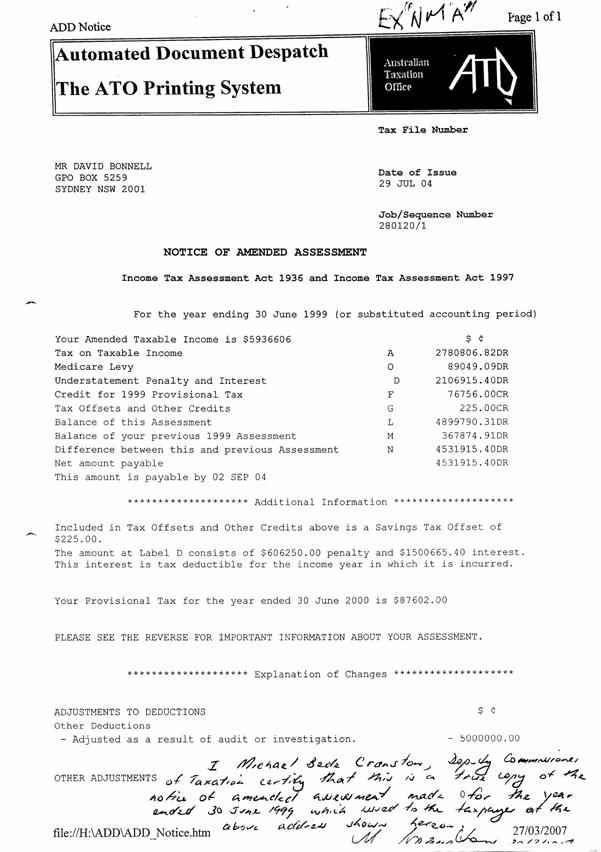
I certify that the preceding ninety-eight (98) numbered paragraphs together with Appendix A are a true copy of the Reasons for Judgment herein of the Honourable Justice Graham. |
Associate:
Dated: 30 June 2008
|
|
|
|
Solicitor for the Applicant: |
BHS Legal Pty Limited |
|
|
|
|
Counsel for the Respondent: |
K M Connor SC and B D O'Donnell |
|
|
|
|
Solicitor for the Respondent: |
Australian Government Solicitor |
|
|
|
|
Date of Judgment: |


