

FEDERAL COURT OF AUSTRALIA
E. & J. GALLO WINERY v LION NATHAN AUSTRALIA PTY LIMITED [2008] FCA 934
Evidence Act 1995 (Cth), ss 69, 146, 147
Trade Marks Act 1995 (Cth), ss 6, 7, 8, 10, 17, 92, 100, 101, 120
Trade Marks Act 1955 (Cth), s 23(1)(b)
Federal Court Rules 1979 (Cth), O 11, r 10
Anheuser-Busch Inc v Budejovický Budvar [2002] FCA 390, 56 IPR 182 followed
Asia Television Ltd v Yau’s Entertainment Pty Ltd (No 2) [2000] FCA 838, 49 IPR 264 followed
Australian Woollen Mills Ltd v F S Walton & Co Ltd (1937) 58 CLR 641 followed
Banque Commerciale SA en liquidation v Akhil Holdings Ltd (1990) 169 CLR 279 followed
Brother Industries Ltd v Dynamic Supplies Pty Ltd [2007] FCA 1490, 163 FCR 530 followed
Buying Systems (Australia) Pty Ltd v Studio Srl (1995) 30 IPR 517 distinguished
C A Henschke & Co v Rosemount Estates Pty Ltd [2000] FCA 1539, 52 IPR 42 followed
Campomar Sociedad Limitada v Nike International Ltd [2000] HCA 12, 202 CLR 45 followed
Carnival Cruise Lines Inc v Sitmar Cruises Ltd (1994) 120 ALR 495 considered
Coca Cola Co v All-Fect Distributors Ltd [1999] FCA 1721, 96 FCR 107 followed
Colorado Group Ltd v Standbags Group Pty Ltd [2007] FCAFC 184, 243 ALR 127 distinguished
Conagra Inc v McCain Foods (Aust) Pty Ltd (1992) 33 FCR 302 considered
Crazy Ron’s Communications Pty Ltd v Mobileworld Communications Pty Ltd [2004] FCAFC 196 followed
“Daiquiri Rum” Trade Mark [1969] RPC 600 cited
de Cordova v Vick Chemical Co (1951) 68 RPC 103 considered
Delta Metallics v Hawley-Jacobs t/as Fightboi Health & Fitness Centre [2006] FCA 334 followed
Dyno Wesfarmers Ltd v Orica Australia Pty Ltd [1999] FCA 554, 46 IPR 386 followed
Estex Clothing Manufacturers Pty Ltd v Ellis and Goldstein Ltd (1967) 116 CLR 254 followed
Figgins Holdings v Beltrami SpA (1998) 46 IPR 411 followed
Global Brand Marketing Inc v YD Pty Ltd [2008] FCA 605 followed
Health World Ltd v Shin-Sun Australia Pty Ltd [2008] FCA 100, 75 IPR 478 considered
Hermes Trade Mark [1982] RPC 425 considered
In re Australian Wine Importers’ Trade Mark (1889) 6 RPC 311 considered
In re Powell’s Trade Mark [1893] 2 Ch 388 followed
In re Turney and Sons’ Trade Mark (1893) 11 RPC 37 cited
Jackson & Co v Napper (1886) 35 Ch D 162, 4 RPC 45 considered
Johnson & Johnson Australia Pty Ltd v Sterling Pharmaceuticals Pty Ltd (1991) 30 FCR 326 followed
Jonathan Ross Sceats v Jonathan Sceats Design Pty Ltd (1990) 17 IPR 28 distinguished
Kowa Co Ltd v Organon [2005] FCA 1282, 223 ALR 27 followed
McCormick & Co Inc v McCormick [2000] FCA 1335, 51 IPR 102 followed
Moorgate Tobacco Co Ltd v Philip Morris Ltd (No 2) (1984) 156 CLR 414 distinguished
Murray Goulburn Co-operative Co Ltd v NSW Dairy Corporation (1990) 24 FCR 370 followed
Nordstrom Inc v Starite Distributors Inc (2008) 75 IPR 418 considered
NSW Dairy Corporation v Murray Goulburn Co-operative Co Ltd (1990) 171 CLR 363 cited
NSW Dairy Corporation v Murray Goulburn Co-operative Co Ltd (No 1) (1989) 14 IPR 26 followed
Paragon Shoes Pty Ltd v Paragini Distributors (NSW) Pty Ltd (1988) 13 IPR 323 followed
Pioneer Kabushiki Kaisha v Registrar of Trade Marks (1977) 137 CLR 670 followed
Polo Textile Industries Pty Ltd v Domestic Textile Corporation Pty Ltd (1993) 42 FCR 227 distinguished
Re Carl Zeiss Pty Ltd’s Application (1969) 122 CLR 1 followed
Re J Lyons & Co Ltd’s Application [1959] RPC 120 followed
Registrar of Trade Marks v Woolworths Ltd [1999] FCA 1020, 93 FCR 365 followed
Ritz Hotel Ltd v Charles of the Ritz Ltd (1988) 12 IPR 417 followed
Rowntree plc v Rollbits Pty Ltd (1988) 10 IPR 539 followed
San Remo Macaroni Co Pty Ltd v San Remo Gourmet Coffee Pty Ltd [2000] FCA 1842, 50 IPR 321 considered
Shell Co of Australia Ltd v Esso Standard Oil (Australia) Ltd (1964) 109 CLR 407 followed
Southern Cross Refrigerating Co v Toowoomba Foundry Pty Ltd (1954) 91 CLR 592 followed
Tavener Rutledge Ltd v Specters Ltd [1959] RPC 355 followed
Wingate Marketing Pty Ltd v Levi Strauss & Co (1994) 49 FCR 89 followed
Woolly Bull Enterprises Pty Ltd v Reynolds [2001] FCA 261, 107 FCR 166 followed
Woolworths Ltd v Registrar of Trade Marks (1998) 42 IPR 615 followed
Yau’s Entertainment Pty Ltd v Asia Television Ltd [2002] FCA 338, 54 IPR 1 followed
Burrell R, The Requirement of Trade Mark Use: Recent Developments in Australia (2005) 16 AIPJ 231
Colman W J, Use of a Trade Mark in Australia (1968–1971) 6 Syd LR 52
Crowley-Smith L, The Evidence Act 1995 (Cth): Should Computer Data Be Presumed Accurate? (1996) 22 Mon LR 166
Davison M, Johnston K, Kennedy P, Shanahan’s Australian Law of Trade Marks and Passing Off (3rd ed, 2003)
Explanatory Memorandum, Trade Marks Bill 1995 (Cth) (Senate, 1995)
Loughlan P, Trade Marks: Property Rights and Their Limits (2005) 31 Mon LR 273
Luck J, Case Note (1990) 1 IPJ 63
McKeough J, Stewart A and Griffith P, Intellectual Property in Australia (3rd ed, 2004)
Morcom C, Roughton A, Graham J and Malynicz S, The Modern Law of Trade Marks (2nd ed, 2005)
Rothnie W, Gray Goods Billow onto the Open Main: Section 123 of the Trade Marks Act 1995 (1996) 7 AIPJ 87
Working Party to Review the Trade Marks Legislation, Recommended Changes to the Australian Trade Marks Legislation (1992)
E. & J. GALLO WINERY v LION NATHAN AUSTRALIA PTY LIMITED
(ACN 008 596 370)
NSD 1950 OF 2007
FLICK J
20 JUNE 2008
SYDNEY
| IN THE FEDERAL COURT OF AUSTRALIA |
|
| NEW SOUTH WALES DISTRICT REGISTRY | NSD 1950 OF 2007 |
| BETWEEN: | E. & J. GALLO WINERY Applicant
|
| AND: | LION NATHAN AUSTRALIA PTY LIMITED (ACN 008 596 370) Respondent
|
| FLICK J | |
| DATE OF ORDER: | 20 JUNE 2008 |
| WHERE MADE: | sydney |
THE ORDERS OF THE COURT ARE:
1. The parties are to draft Short Minutes of Proposed Orders within 7 days which give effect to these reasons.
2. The proceedings be stood over to 27 June 2008 at 9.30 am with a view to then making final orders disposing of the proceedings.
Note: Settlement and entry of orders is dealt with in Order 36 of the Federal Court Rules.
| IN THE FEDERAL COURT OF AUSTRALIA |
|
| NEW SOUTH WALES DISTRICT REGISTRY | NSD 1950 OF 2007 |
| BETWEEN: | E. & J. GALLO WINERY Applicant
|
| AND: | LION NATHAN AUSTRALIA PTY LIMITED (ACN 008 596 370) Respondent
|
| JUDGE: | FLICK J |
| DATE: | 20 JUNE 2008 |
| PLACE: | sydney |
REASONS FOR JUDGMENT
1 The Applicant in these proceedings, E. & J. Gallo Winery (Gallo Winery) began operations on 1 December 1933, the day on which Prohibition ended in the United States. It is incorporated in California in the United States of America and is the second largest wine-producing company in the world. It distributes its alcoholic beverages in over 90 countries and its international business is managed from offices located around the world, including California, Canada, England, Florida, Germany, Hong Kong, Japan, Mexico, the Netherlands, Poland and Sweden.
2 By way of a Further Amended Statement of Claim filed on 22 February 2008, the Applicant contends that it is the registered owner under the Trade Marks Act 1995 (Cth) of the word “BAREFOOT”. That trade mark has been registered with effect from 9 March 1999 in respect of “wines”. Prior to 17 January 2005, the registered owner of that mark was Mr Michael Houlihan; E & J Gallo Winery became the registered owner after that date. It contends that it sells wine in Australia under the trade mark BAREFOOT. That trade mark, it is further contended, has been and is being infringed by the conduct of the Respondent by using as a trade mark the words “BAREFOOT” or “BAREFOOT RADLER” in relation to its new radler beer.
3 Declaratory and injunctive relief is sought together with an account of profits.
4 The Respondent, Lion Nathan Australia Pty Limited (Lion Nathan), on 5 September 2007 lodged an Australian trade mark application for the mark “BAREFOOT RADLER” in relation to beers and other goods in class 32. On 20 September 2007 the Respondent also lodged an application for the mark “LIFE’S BETTER BAREFOOT” and on 17 December 2007 it lodged an application for the mark “BAREFOOT RADLER” with a bare foot design in relation to beers and other goods in class 32, and “alcoholic beverages (except beers)” in class 33.
5 The Respondent, by way of an Amended Cross-Claim filed on 2 April 2008, contends that there has been a non-use by Gallo Winery of the trade mark BAREFOOT in Australia. The Respondent seeks an order for the removal of the trade mark relied upon by the Applicant pursuant to s 94(2)(b) of the 1995 Act. Gallo Winery denies that there has been a non-use of the mark and further contends, in the alternative, that if there has been a non-use the Court should exercise the discretion conferred by s 101(3) and not remove the mark from the Register.
The Facts: A Very Summary Overview
6 In the United States a company, Grape Links Inc, carried on business under the trading name “Barefoot Cellars”. The principals of that business were Mr Michael Houlihan and Ms Bonnie Harvey. The business had its headquarters in Santa Rosa, California. Mr Houlihan was the President and Ms Harvey was the Vice-President.
7 In January 2005 Gallo Winery acquired the share capital of Grape Links Inc and acquired the rights to the BAREFOOT brand. The brand was perceived to be “an attractive acquisition for Gallo Winery because its carefree, slightly irreverent, California ‘surf and sand’ lifestyle positioning had significant consumer appeal”.
8 By early 2006 there were discussions between officers of Gallo Winery and McWilliams Wines Pty Ltd (McWilliams Wines) for the sale of BAREFOOT wine in Australia. McWilliams Wines is one of Australia’s largest family-owned wine companies. Samuel McWilliams first planted vines at Cowra in New South Wales in 1877. Gallo Winery has owned approximately 10% of the shares in McWilliams Wines since September 2004.
9 Difficulties began to emerge, however, in mid-July 2007 when Gallo Winery became aware of an application made by Lion Nathan for the removal of Gallo Winery’s BAREFOOT trade mark from the Register.
10 In September 2007 Gallo Winery licensed its Australian BAREFOOT trade mark and associated intellectual property rights to McWilliams Wines. On 14 September 2007 the first bottles of BAREFOOT wine were placed on the market in Australia by McWilliams Wines. Twelve thousand 750ml bottles were then released, being cabernet/merlot and semillon/sauvignon blanc. In December 2007 Gallo Winery commenced to ship from California to McWilliams Wines four different types of BAREFOOT wine. The first 225 cases of each type were air-freighted.
11 A limited quantity of BAREFOOT wine originating from California had previously been sold by a wholesaler of wine in Melbourne, Beach Avenue Wholesalers Pty Ltd (Beach Avenue Wholesalers), from 2004 to 2007.
12 Proceeding in tandem with the activity of Gallo Winery during 2006 to 2007 were the steps being undertaken by Lion Nathan to attract legal-aged drinkers who did not drink beer. These steps commenced in about August 2006 and involved developing the concept of a beer that was less bitter to the taste than traditional beers. The concept was developed of adding a lemon flavouring which was intended to be “a suitably refreshing taste for the warmer weather”.
13 That was the concept. It was then necessary to create a brand name.
14 The term “RADLER” had already been decided upon as part of the branding. That term is apparently the German word for “cyclist” and describes a traditional Bavarian beer flavoured with a mixture of lemon and lime. The use of the term to describe a beer has its origins in June 1922 when a Munich publican, Franz Kugler, “started mixing dark beer with lemonade to meet the high demand from large groups of cyclists who wanted a more refreshing drink so they could continue on their journey without falling off their bicycles!”.
15 Other distinctive words in addition to the word “RADLER” were also being considered by Lion Nathan. It was in February 2007 that the Consumer Insight Manager for that company, Mr Ralph Simpson, came up with the marketing term “BAREFOOT”. Mr Simpson came up with the idea of using that term from his reading of a “Form Guide” for horse racing where the name of a horse attracted his attention, namely “Barefootonbondi”. He thought that it was an “interesting name” as it “conjured up a positive mental image and feeling of relaxation, summer and the beach”.
16 Checks made of registered trade marks in February 2007 revealed the trade mark BAREFOOT in relation to wine. That did not cause Mr Simpson any concern as beer was his principal focus of attention. Prior to February 2007, Mr Simpson had never heard of a BAREFOOT branded wine in Australia or heard of Barefoot Cellars or E. & J. Gallo Winery.
17 In January 2008 the beer BAREFOOT RADLER was launched on the Australian market. It was launched across all States and Territories.
Infringement: Section 120?
18 Gallo Winery contends that the Respondent has infringed its trade mark and will continue to do so unless restrained.
19 A “trade mark” is defined by s 17 of the Trade Marks Act 1995 (Cth) as being:
… a sign used, or intended to be used, to distinguish goods or services dealt with or provided in the course of trade by a person from goods or services so dealt with or provided by any other person.
The function of a trade mark, it has repeatedly been said, is “to give an indication to the purchaser or possible purchaser as to the manufacture or quality of the goods — to give an indication to his eye of the trade source from which the goods come, or the trade hands through which they pass on their way to the market”: In re Powell’s Trade Mark [1893] 2 Ch 388 at 403–4 per Bowen LJ. Use “as a trade mark” in s 120(1) is use of the mark as a “badge of origin” in the sense that it indicates a connection in the course of trade between goods and the person who applies the mark to the goods: Coca Cola Co v All-Fect Distributors Ltd [1999] FCA 1721 at [19], 96 FCR 107 at 115 per Black CJ, Sundberg and Finkelstein JJ; Global Brand Marketing Inc v YD Pty Ltd [2008] FCA 605 at [45] per Sundberg J. See also: Shell Co of Australia Ltd v Esso Standard Oil (Australia) Ltd (1964) 109 CLR 407 at 424–5 per Kitto J; Rothnie W, Gray Goods Billow onto the Open Main: Section 123 of the Trade Marks Act 1995 (1996) 7 AIPJ 87 at 89–90.
20 One of the principal matters in issue in these proceedings is whether there has been a breach, or a threatened breach, within the meaning of s 120(2) of the 1995 Act by Lion Nathan.
21 Section 120(2) provides as follows:
When is a registered trade mark infringed?
…
A person infringes a registered trade mark if the person uses as a trade mark a sign that is substantially identical with, or deceptively similar to, the trade mark in relation to:
(a) goods of the same description as that of goods (registered goods) in respect of which the trade mark is registered; or
(b) services that are closely related to registered goods; or
(c) services of the same description as that of services (registered services) in respect of which the trade mark is registered; or
(d) goods that are closely related to registered services.
However, the person is not taken to have infringed the trade mark if the person establishes that using the sign as the person did is not likely to deceive or cause confusion.
22 In addition to contending that the Gallo Winery trade mark should be removed for non-use, the Respondent further maintains (at least in its written submissions) that the “sign” that it uses in marketing its beer is the words “BAREFOOT RADLER” and the image of a bare foot; denies that the sign BAREFOORT RADLER is “substantially identical or deceptively similar to” Gallo Winery’s BAREFOOT trade mark; denies that the goods in relation to which the sign is used are “goods of the same description as wines” and contends that its use is “not likely to deceive or cause confusion”.
23 The resolution of these competing submissions involves a resolution of the following questions, namely:
(i) what is the “sign” being used as a trade mark by Lion Nathan?
(ii) is the “sign” being used by Lion Nathan “substantially identical with” the trade mark of Gallo Winery?
(iii) is the “sign” being used by Lion Nathan “deceptively similar to” the trade mark of Gallo Winery?
(iv) are the radler beers of Lion Nathan “goods of the same description” as the BAREFOOT wine of Gallo Winery?
(v) is the manner in which Lion Nathan uses its sign “not likely to deceive or cause confusion”?
(vi) has there been a “non-use” of the BAREFOOT trade mark during the period from 7 May 2004 to 8 May 2007? The resolution of this question, as it was advanced in submissions, separately involves a consideration as to:
(a) whether there were sales of the BAREFOOT wine during the non-use period;
(b) whether the wine was offered for sale during the non-use period;
(c) if the wine was sold or offered for sale during the non-use period, whether there was a use of the trade mark by Barefoot Cellars as an authorised user;
(d) if the wine was sold or offered for sale during the non-use period, whether there was a use of the trade mark by Beach Avenue Wholesalers as an authorised user;
(e) whether the negotiations as between Gallo Winery and McWilliams Wines during the non-use period constituted a use of the trade mark;
(f) whether there was an “obstacle” to the use of the Gallo Winery trade mark;
(g) even if there was a use, which mark was in fact being used; and
(h) whether any use was a use “in good faith”.
(vii) if there has been a “non-use” of the trade mark by Gallo Winery, should the discretion conferred by s 101(3) of the 1995 Act be exercised so as to allow its trade mark to remain on the Register?
Depending upon the manner in which one or other of these questions may be answered, other questions may not necessarily have to be answered. With the concurrence of the parties, however, the course has been taken of answering each of these questions should the matter proceed further.
The “Sign” As Used by Lion Nathan?
24 Section 120(2) dictates that Lion Nathan infringes the trade mark of Gallo Winery if Lion Nathan “uses as a trade mark a sign that is substantially identical with, or deceptively similar to” the trade mark of Gallo Winery. The term “sign” is itself broadly defined by s 6 as including:
… the following or any combination of the following, namely, any letter, word, name, signature, numeral, device, brand, heading, label, ticket, aspect of packaging, shape, colour, sound or scent.
25 The trade mark of Gallo Winery is the word “BAREFOOT”.
26 In the present proceedings there is a dispute at the outset as to the ability of Lion Nathan to rely upon any sign other than the word “BAREFOOT” or the combination of words “BAREFOOT RADLER”. The dispute centres upon whether the Amended Defence so confines Lion Nathan or whether Lion Nathan is otherwise free to contend that its sign also incorporates the image of a bare foot.
27 Gallo Winery contends that that sign is the simple use of the word “BAREFOOT” or, in the alternative, that the sign is “BAREFOOT RADLER”. Gallo Winery contends that that is the way in which the proceedings have been pleaded and the basis upon which the proceedings have been conducted — at least for its part.
28 In support of that contention, Gallo Winery relies upon the allegations in its Further Amended Statement of Claim that Lion Nathan intends to offer for sale alcoholic beverages “under the name BAREFOOT” and is offering for sale its “radler beer under the name BAREFOOT”. In response, Lion Nathan in its Amended Defence says that it“intends to offer for sale and sell an alcoholic product (not wine) under the trade mark BAREFOOT RADLER” and says that it“commenced to promote, advertise, offer for sale and sell in Australia a beer under the name BAREFOOT RADLER”. It also denies that its beer is called “BAREFOOT”.
29 Significantly, contends Gallo Winery, there is nowhere stated in the Amended Defence a contention that the sign being used by Lion Nathan is a combination of the words “BAREFOOT RADLER” and the image of a bare foot. Indeed, Gallo Winery contends with some force that the Amended Defence identifies the sign being used as that of the combination of words alone.
30 Albeit only during the course of closing submissions by Lion Nathan, Gallo Winery supplemented its earlier contentions by placing reliance upon O 11, r 10 of the Federal Court Rules. That rule requires a matter to be specifically pleaded if it “might take the other party by surprise”: Dyno Wesfarmers Ltd v Orica Australia Pty Ltd [1999] FCA 554, 46 IPR 386; Delta Metallics v Hawley-Jacobs t/as Fightboi Health & Fitness Centre [2006] FCA 334 at [8] per Kenny J.
31 Lion Nathan contends that as a matter of fact, the “sign” which it is using for the purposes of s 120 is a combination of the words and the image — and further contends that such a finding of fact is not to be denied by the pleadings. Its position is that:
(i) its Amended Defence is simply a response to the allegations being made against it and there was no obligation or requirement placed upon it to positively set forth what was the “sign” in fact being used by it for the purposes of s 120; and
(ii) any unfairness to the Applicant is removed by reason of its written Outline of Opening Submissions, available at the outset of the hearing, which stated that:
[46] The Court should find that the trade mark used by the Respondent to distinguish the Respondent’s beer from other beers on the market comprises the words BAREFOOT RADLER and an image of a bare foot. …
32 Notwithstanding paragraph [46] of its Outline of Opening Submissions, it is considered that the Amended Defence confines Lion Nathan to the position that the “sign” upon which it places reliance for the purposes of defending the current proceedings is the combination alone of the words “BAREFOOT RADLER”. Albeit in response to the allegation in the Further Amended Statement of Claim that it has infringed Gallo Winery’s BAREFOOT trade mark, the Amended Defence states in part that it “denies that the sign to be used by the Respondent, BAREFOOT RADLER, is substantially identical or deceptively similar to the Applicant’s BAREFOOT Trade Mark”. This can only be construed as conveying to the Applicant at least two things: (i) the position that the Respondent denies that the sign to be used is substantially identical with or deceptively similar to the Applicant’s sign; and (ii) the sign “to be used” by the Respondent, and to be relied upon in resisting the Applicant’s claim, is the sign it then identifies, namely “BAREFOOT RADLER”.
33 Had the Amended Defence simply denied the infringement being alleged, Lion Nathan may well have been able to advance submissions that the sign to be used was a combination of the words and the image. But the fact is that the Amended Defence goes on to expressly identify the sign which it says is not substantially identical with or deceptively similar to that being relied upon by Gallo Winery, and it identifies that sign as being “BAREFOOT RADLER”. At the very least, that express statement in the Amended Defence is productive of such uncertainty that it was thereafter incumbent upon Lion Nathan to identify in its Amended Defence the sign upon which reliance was to be placed — if that sign was to be anything other than the combination of words. Without that further express clarification, a contention that the “sign” is the words and the image would be a contention that would “take the other party by surprise” within the meaning of O 11, r 10.
34 The function of pleadings is to state with sufficient clarity the case to be met: Banque Commerciale SA en liquidation v Akhil Holdings Ltd (1990) 169 CLR 279 at 286–7 per Mason CJ and Gaudron J. And written submissions can be no substitute for a properly pleaded case.
35 It is thus considered that Lion Nathan is confined by its pleadings to placing reliance upon the combination of words alone. Its Amended Defence, it is considered, does not state with sufficient clarity the defence that it was raising in respect to the claims of Gallo Winery; indeed, as pleaded, it was only likely to have misled Gallo Winery. No application was made by Lion Nathan to amend its pleadings. Had such an application been made, it most probably would have been granted. Such limited cross-examination as there had been by Senior Counsel for Gallo Winery was not such as to have given rise to any irremediable prejudice that could not have been accommodated by recalling witnesses.
36 But for its pleadings, there was otherwise no reason not to conclude that the “sign” Lion Nathan was in fact the following, incorporating both a combination of the words and the image:


Such is what appears on the cardboard packaging for its “six pack”; such is what appears on the individual bottles of beer and in its advertisements for its beer. And each of the elements of that “sign” has a degree of prominence. Prominence is attracted to the image of the bare foot and the word “BAREFOOT” by reason of their being printed in white; prominence is also equally attracted to the word “RADLER” by reason of it being printed in green. The words and the image of the bare foot are given additional prominence by all being set against a blue background encircled by a roughly drawn white circumference. The word “BAREFOOT” is also given additional prominence by that word dissecting the image of the bare foot.
37 Given the constraint imposed by the pleadings, however, there is similarly no reason not to conclude that the “sign” being used by Lion Nathan is the combination of the words “BAREFOOT RADLER” alone. This was the sign identified in the Amended Defence. Even without the image of the bare foot, the prominence and distinctiveness of those words remains sufficiently discrete as to be the “sign” used.
38 What is the “sign” being used by Lion Nathan, it is accepted by both parties, is a question of fact.
Substantially Identical?
39 The second of the questions posed requires resolution of whether the “sign” being used by Lion Nathan is “substantially identical with” the trade mark of Gallo Winery.
40 There is no dispute between the parties as to the meaning of the phrase “substantially identical” as used in s 120(1) — the dispute is as to the manner in which that phrase is to be applied to the facts.
41 There is no definition in the 1995 Act of the phrase “substantially identical”.
42 The meaning of that phrase is to be determined by its ordinary or usual meaning, namely that which is in substance the same or essentially the same: Registrar of Trade Marks v Woolworths Ltd [1999] FCA 1020 at [70], 93 FCR 365 at 387 per Branson J.
43 And whether marks are “substantially identical” requires a side by side comparison and depends on the Court’s own judgment: Shell Co of Australia Ltd v Esso Standard Oil (Australia) Ltd (1963) 109 CLR 407 at 414. Windeyer J there observed:
In considering whether marks are substantially identical they should, I think, be compared side by side, their similarities and differences noted and the importance of these assessed having regard to the essential features of the registered mark and the total impression of resemblance or dissimilarity that emerges from the comparison. "The identification of an essential feature depends", it has been said, "partly on the Court's own judgment and partly on the burden of the evidence that is placed before it": de Cordova v. Vick Chemical Co. [(1951) 68 RPC 103 at] [2], at p. 106. Whether there is substantial identity is a question of fact…
In order to determine whether marks are “substantially identical”, they should thus be compared side by side with their similarities and differences noted: Coca-Cola Co v All-Fect Distributors Ltd [1999] FCA 1721 at [38], 96 FCR 107 at 121. Black CJ, Sundberg and Finkelstein JJ there observed that the similarities and differences should be noted and the importance of these similarities and differences assessed having regard to the essential features of the registered mark and the total impression of resemblance or dissimilarity that emerges from the comparison.
44 A “side by side” comparison of the trade mark of Gallo Winery and the “sign” as used by Lion Nathan — as confined by its pleadings — discloses, it is considered, no substantial identity. The two marks are certainly not “identical”. The two marks have in common the word “BAREFOOT”. But the “sign” as used by Lion Nathan also employs the additional word “RADLER”. The question is thus whether there is a substantial identity. Section 120(2), it will be noted, does not require that the two marks be “identical”; s 120(2) is infringed if the mark of Lion Nathan is “substantially identical with” that of Gallo Winery.
45 In reaching the conclusion that the marks are not substantially identical, it has been recognised that the word “BAREFOOT” is both an ordinary English word and a word which has been used in a variety of contexts advertising many different types of goods. An internet search undertaken by a law graduate employed by the solicitors for Lion Nathan (Mr Campbell) disclosed the word “BAREFOOT” being used in the promotion of a beach-side resort; a water-skiing club; a sailing cruise; a coffee roaster; weddings; horse saddles; furniture; and vacations. Other instances were also exposed. Not surprisingly, many of these products had some association with the beach or water.
46 It is a word, however, common to both marks and a word which is strongly associated with a carefree lifestyle.
47 But it is the addition of the word “RADLER” which denies any substantial identity as between the trade mark of Gallo Winery and the “sign” as used by Lion Nathan. Rejected is a submission advanced by Gallo Winery that the word “RADLER” is but a description of a particular type of beer and that it is the word “BAREFOOT” alone which distinguishes its beer from that of others. It is the combination of the words which distinguishes the Lion Nathan beer — an essential and prominent feature of the sign as used by Lion Nathan is thus not only the word “BAREFOOT” but also the word “RADLER”. Lion Nathan’s use of the word “RADLER” is an important and integral part of the sign it uses and is an obvious source of distinction.
48 Of limited assistance in confirming such a conclusion is the following exchange between the Deputy Chairman of McWilliams Wines (Mr Kevin McLintock) and his cross-examiner:
But your reaction at the time when you saw the product was that the name of the product was Barefoot Radler capital B, capital R, wasn’t it? --- Correct.
…
… because you think that the name of this product is Barefoot Radler don’t you? --- Yes.
49 Had Lion Nathan not been confined by its pleadings and had it been free to also include as part of its sign the image of the bare foot, any finding of fact that there was substantial identity would have been more easily denied. The differences would be such that — and the total impression would be such that — any similarity as would have been occasioned by the word “BAREFOOT” alone would be of little significance. The similarity, of course, would remain the single word “BAREFOOT”. But the differences would be even more significant if the prominent image of the bare foot were able to be included.
Deceptively Similar?
50 Section 120(1) is expressed in the alternative and requires a consideration of whether the “sign” being used by Lion Nathan is “substantially identical with, or deceptively similar to” the trade mark of Gallo Winery.
51 Again, there is no dispute between the parties as to the meaning to be given to the phrase “deceptively similar” — the dispute is as to the manner in which that phrase is to be applied to the facts.
52 A trade mark is taken to be “deceptively similar to” another trade mark if it so nearly resembles that other trade mark that it is likely to deceive or cause confusion: s 10.
53 Whether a mark is “deceptively similar” is not to be determined by a side by side comparison, but rather by reference to whether there is a likelihood of deception or confusion from a recollection or impression of the registered mark: Anheuser-Busch Inc v Budejovický Budvar [2002] FCA 390 at [143], 56 IPR 182 at 216. Allsop J there observed:
[143] The question of deceptive similarity must be judged by a comparison different from the side by side comparison undertaken to assess substantial identity; the question being the likelihood of deception or confusion from a recollection or impression of the registered mark. Thus, a side by side comparison is inadequate, and too narrow a test. The comparison is between, on the one hand, the impression based on recollection of the registered mark used in a normal or fair manner that persons of ordinary intelligence and memory would have, and, on the other hand, the impressions that such persons would get from the impugned mark as it appears in the use complained of…
54 It is necessary to make an attempt to estimate the effect or impression produced on the mind of persons of ordinary intelligence and memory. It is the impression or recollection which is carried away and retained that is necessarily the basis of any mistaken belief that the challenged mark is the same: Australian Woollen Mills Ltd v F S Walton & Co Ltd (1937) 58 CLR 641 at 658 per Dixon and McTiernan JJ. See also: Global Brand Marketing Inc v YD Pty Ltd [2008] FCA 605 at [84]–[89] per Sundberg J. The “recollection” may be imperfect: Crazy Ron’s Communications Pty Ltd v Mobileworld Communications Pty Ltd [2004] FCAFC 196 at [87], 209 ALR 1 at 21 per Moore, Sackville and Emmett JJ.
55 Whether a mark is likely to deceive or cause confusion is, in the end, a question of impression and common sense: Murray Goulburn Co-operative Co Ltd v NSW Dairy Corporation (1990) 24 FCR 370 at 377 per Lockhart, Pincus and von Doussa JJ. (On appeal, see: NSW Dairy Corporation v Murray Goulburn Co-operative Co Ltd (1990) 171 CLR 363).
56 The comparison, it should be noted, is different to that undertaken in a passing off action where the plaintiff points to the goodwill built up around a mark by reason of prior use and then points to the conduct of the defendant as leading to deception, or perhaps merely confusion, and the consequent damage to that goodwill of the plaintiff: Wingate Marketing Pty Ltd v Levi Strauss & Co (1994) 49 FCR 89 at 128–9 per Gummow J. Essentially what is required when considering whether a mark is deceptively similar to another is a comparison between the mark of the registered owner and that of the alleged infringer: C A Henschke & Co v Rosemount Estates Pty Ltd [2000] FCA 1539 at [44], 52 IPR 42 at 62. Ryan, Branson and Lehane JJ there considered that it was not appropriate to undertake a wider inquiry of the kind undertaken in a passing off action or in a proceeding in which a contravention of Part V of the Trade Practices Act 1974 (Cth) is alleged.
57 The impression based on a recollection of the “sign” as used by Lion Nathan and a recollection of Gallo Winery’s trade mark, it is considered, would lead to a likelihood of deception or confusion.
58 It is considered that the impression which would be left on the mind of a person of ordinary intelligence would be that there was a deceptive similarity as between the mark used by Gallo Winery and that used by Lion Nathan and as pleaded in its Amended Defence. The similarity is such that persons would wonder whether the products came from the same source; an actual probability of deception need not be established: Southern Cross Refrigerating Co v Toowoomba Foundry Pty Ltd (1954) 91 CLR 592. Kitto J was there dealing with an application for registration of a trade mark and the statutory phrase “likely to deceive” and observed (at 595):
… It is not necessary, in order to find that a trade mark offends against the section, to prove that there is an actual probability of deception leading to a passing-off. While a mere possibility of confusion is not enough—for there must be a real, tangible danger of its occurring … —it is sufficient if the result of the user of the mark will be that a number of persons will be caused to wonder whether it might not be the case that the two products come from the same source. It is enough if the ordinary person entertains a reasonable doubt. …
No intention to deceive or cause confusion is required and there is no element of culpability to be inferred from the word “deceive”: Coca Cola Co v All-Fect Distributors Ltd [1999] FCA 1721 at [39], 96 FCR 107 at 122 per Black CJ, Sundberg and Finkelstein JJ.
59 In reaching this conclusion considerable assistance has been gained from the decision of Burchett J in Polo Textile Industries Pty Ltd v Domestic Textile Corporation Pty Ltd (1993) 42 FCR 227. Polo Textile was there the registered proprietor of the mark “Polo” in respect of manchester, including sheets and towels. It was concluded that Domestic Textile did not avoid infringing that mark by selling bed linen products using the mark “Polo Club”. Burchett J concluded that it was of importance that the distinctive impact of the word “Polo” was likely to affect the mind while the presence or absence of the blander word “Club” may escape notice. See also: de Cordova v Vick Chemical Co (1951) 68 RPC 103.
60 In the present proceedings, the strong impression left on the mind of persons of ordinary intelligence by the use of the word “BAREFOOT” would not relevantly be affected by Lion Nathan’s use of the word “RADLER” as well. The addition of that word is sufficient to preclude a finding that the two marks are “substantially identical”; but the addition of that word is not sufficient, it is considered, to preclude their being “deceptively similar”.
61 A distinction may be drawn as between the present case and that in Polo Textile — but that distinction does not lead to any different conclusion. Unlike the use of a bland word such as “Club” — as in the Polo Textile decision — the word “RADLER” adds an additional and important distinguishing feature to the product. The word “RADLER” is not an ordinary English word and its use, it is considered, adds an element of both distinction and curiosity, such that persons will query what that particular word means.
62 The word “RADLER” is not a word having any meaning found in either the Macquarie or Shorter Oxford Dictionaries. It is a German word and, not being a word of everyday usage in the English language, its use would unquestionably leave an impression on the mind of a person. The word “RADLER”, it is considered, would leave an impression on the mind of a person who knew what the word meant and would leave an even firmer impression upon the mind of a person who had no such knowledge. And it is a word given prominence in the Lion Nathan sign. But those factors either alone or in combination would not be such as to remove the likelihood of deception or confusion. Contrast: Crazy Ron’s Communications Pty Ltd v Mobileworld Communications Pty Ltd [2004] FCAFC 196, 209 ALR 1.
63 An essential feature common to both the mark of Gallo Winery and the sign as pleaded by Lion Nathan remains the word “BAREFOOT” which, it is considered, would leave a considerable impression on the mind of a consumer of ordinary intelligence. Notwithstanding the distinctiveness which the word “RADLER” brings to the sign of Lion Nathan, it would not be sufficient to remove the likelihood of deception otherwise arising.
64 Again, it should be noted, any deceptive similarity with the Gallo Winery mark would not have arisen had Lion Nathan been free to rely upon the combination of words and the image of the bare foot.
Goods of the Same Description?
65 Section 120(2)(a) of the 1995 Act provides that it is an infringement if a person uses as a trade mark a sign that is substantially identical with, or deceptively similar to, the trade mark “in relation to goods of the same description”.
66 Again there is no dispute between the parties as to the meaning of the phrase “goods of the same description”.
67 It is again accepted that it is a question of fact and impression whether goods are “of the same description”: Rowntree plc v Rollbits Pty Ltd (1988) 10 IPR 539 at 545 per Needham J.
68 In resolving this question, the fact that goods serve different purposes is not conclusive; nor is any one particular consideration conclusive. Assistance, however, has been provided as to those matters which may be taken into account: Southern Cross Refrigerating Co v Toowoomba Foundry Pty Ltd (1954) 91 CLR 592. Dixon CJ, McTiernan, Webb, Fullagar and Taylor JJ there, at 606–7, gave content to the task to be undertaken as follows:
The fact that examination of the nature of the applicant's goods may, by itself, induce an observer to conclude that they are different in character from those of an opponent, and designed to serve different purposes, is by no means conclusive. Nor is the fact that the applicant's goods are not specified by the regulations as being within the same class of goods… There may be many matters to be considered apart from the inherent character of the goods in respect of which the application is made and some indication of what matters are relevant to this inquiry was given by Romer J. in In re Jellinek's Application [(1946) 63 RPC 59]. Romer J. thought it necessary to look beyond the nature of the goods in question and to compare not only their respective uses but also to examine the trade channels through which the commodities in question were bought and sold. Shortly after the decision in Jellinek's Case the Assistant-Comptroller elaborated on the observations of Romer J. in the following manner:
"In arriving at a decision upon this issue the reported cases show that I have to take account of a number of factors, including in particular the nature and characteristics of the goods, their origin, their purpose, whether they are usually produced by one and the same manufacturer or distributed by the same wholesale houses, whether they are sold in the same shops over the same counters during the same seasons and to the same class or classes of customers, and whether by those engaged in their manufacture and distribution they are regarded as belonging to the same trade. In the case of Jellinek's Application [(1946) 63 RPC 59], Romer J. classified these various factors under three heads, viz., the nature of the goods, the uses thereof, and the trade channels through which they are bought and sold. No single consideration is conclusive in itself, and it has further been emphasized that the classifications contained in the schedules to the Trade Marks Rules are not a decisive criterion as to whether or not two sets of goods are ‘of the same description’": In re an Application by John Crowther & Sons (Milnsbridge) Ltd. [(1948) 65 RPC 369 at 372].
Much the same considerations are evident in the observation of Dixon J. (as he then was) in Reckitt & Colman (Australia) Ltd. v. Boden [(1945) 70 CLR 84 at 94] when he said:
"What forms the same description of goods must be discovered from a consideration of the course of trade or business. One factor is the use to which the two sets of goods are put. Another is whether they are commonly dealt with in the same course of trade or business. In the present case, the goods are quite different, their uses are widely separated and they are not commonly sold in the same kinds of shops or departments".
69 In McCormick & Co Inc v McCormick [2000] FCA 1335, 51 IPR 102, Kenny J also identified some of the factors to be taken into account when determining whether goods were of the same description. Her Honour there observed:
[18] The authorities establish that there are three principal factors to be considered in this regard. They are: (1) the nature of the goods, including their origin and characteristics; (2) the uses made of them, including their purpose; and (3) the trade channels through which the goods are bought and sold.
70 The Applicant accepts that other cases which have resolved whether the goods there in issue were “goods of the same description” are not determinative. But it does contend that some guidance may be gleaned from decisions which have held or suggested that the following are “goods of the same description”: namely, “rum and a rum cocktail or a Daiquiri” (“Daiquiri Rum” Trade Mark [1969] RPC 600 at 609 per Lord Reid, at 613 per Lord Morris, at 615 per Lord Pearce); wines and spirits (In re Australian Wine Importers’ Trade Mark (1889) 6 RPC 311); and beer and rum (In re Turney and Sons’ Trade Mark (1893) 11 RPC 37 at 44–5). Of these decisions, it is of significance to note that in the Australian Wine Importers case the Court of Appeal dismissed an appeal from a decision of Kay J. Cotton LJ held at 316:
… Well, it is not confined to the same goods, but it is “the same goods or description of goods ;” and if it were necessary to decide it absolutely on that point, my opinion would be that there was an application for registration with respect to the same description of goods ; because although wine and whiskey, and wine and spirits are in a great many ways considered as different goods, yet we are not considering here how chemists would describe them, but whether manufacturers would describe them as being the same description of goods or not. We find that they are goods which are generally sold by the same persons, and for the purposes of trade may, in some respects, be considered as the same description of goods; for they are both alcoholic, and although there may be differences in them, they may fairly be considered as coming within the same description of goods, though they are not the same goods. …
Lindley LJ similarly concluded at 318–19:
Of course one has to look at the trade. One must look at it from a business point of view. They are alcoholic and spirituous. They are sold in this country constantly by the same people. Wine and spirit dealers are common enough in this country, and I am not sure that they are not the same description of goods ; but whether they are or not, it seems to me that they are so uncommonly near the line that we ought not to depart from the view taken by Mr. Justice Kay, and say to the Comptroller, “You must register in favour of these wine merchants a mark which is already on the Register in favour of a spirit merchant who is also a wine merchant.” It appears to me that Mr. Justice Kay has taken the right view of the case, and that we ought not to interfere with his Order.
These observations disclose, at the very least, that questions of fine judgment may be involved.
71 Overall, the matter is to be determined from a business point of view: San Remo Macaroni Co Pty Ltd v San Remo Gourmet Coffee Pty Ltd [2000] FCA 1842 at [35], 50 IPR 321 at 330 per Goldberg J.
72 The fact that both types of goods may be consumed does not, of itself, make them goods of the same description: Re J Lyons & Co Ltd’s Application [1959] RPC 120 at 127–8 per Lord Evershed MR (Romer and Ormerod LJJ agreeing). (Applied: San Remo Macaroni [2000] FCA 1842 at [35]–[36], 50 IPR 321 at 330 per Goldberg J).
73 It is not considered, however, that the Lion Nathan radler beers are “goods of the same description” as wine.
74 It may be accepted that a number of considerations support a contrary conclusion. Thus, for example:
(i) both the BAREFOOT RADLER beer and the Gallo Winery wine, obviously enough, are types of alcoholic beverage. And they are generally distributed by the same major wholesale distributors such as Australian Liquor Marketers, Independent Liquor Group and National Independent Liquor Wholesalers Association;
(ii) to a considerable extent, the BAREFOOT RADLER beer was intended to appeal to what Lion Nathan regarded as both its “core” beer drinkers and to “marginal beer drinkers” and was intended to be an appealing alternative to wine. Indeed, when developing its new beer product, Lion Nathan deliberately set out to attract people who did not drink beer. To many people, it was recognised, beer had a “bitter taste” and it was to overcome this “hurdle” that the lemon flavouring was added. Later in the development of the product, lime was also added. The product developed by Lion Nathan was developed with the deliberate objective of enticing consumers who previously drank wine but not beer.
Extracts from Lion Nathan’s website set forth photographs of the BAREFOOT RADLER beer and sought to promote that beer by stating:
… And if beer has never been your first choice of beverage, chances are you’ll be pleasantly surprised by Barefoot Radler’s smooth, refreshing taste.
A “Business Plan” dated November 2007 provided as follows a “RECAP” in its “Executive summary”:
RECAP: Barefoot Radler is a ‘phenomenally’ refreshing beer infused with lemon and lime. Inspired by the German ‘Radler’ tradition but adapted for the Australian climate, the brand is designed to appeal to bring marginal beer drinkers more into the beer category.
In developing the “Business Plan” it was recognised that “the types of alcohol with the greatest increases in consumer spending are the lighter, less bitter, easier drinking styles – such as Vodka and Sauvignon Blanc”. The way in which the “Business Plan” developed was to recognise that there was a “significant – and as yet untargeted – group of consumers”. This “marginal group” was estimated as comprising approximately 2.5 million drinkers. The “Business Plan” continued:
In terms of the source of volume for this product, research has indicated that this will be drawn from both beer and non beer products. Approximately 2/3 of the projected volume will be sourced from beer, with 22% from wine and 14% from spirits/RTDs.
A “media strategy” developed for 2007/2008 also expressly recognised that the radler beer was also competing with other alcoholic beverages, including wine. In addressing the “Competitive context – who are we competing with on premise?”, the media strategy went on to state:
·Although BF Radler is a beer, we are competing with a much broader competitive set: all light and refreshing beers (Corona with lemon, TED), lighter RTDs (Bacardi Breezer), wine, cocktails and refreshing soft drinks (Coke, lemon lime bitter)
A further document addressing the “launch strategy” recognised that there was a “need to arouse curiosity with consumers who may not shop the beer aisle” and that there was a need to “place” the beer in publications where “beer doesn’t normally go”, including “women’s mags, enviro mags”.
(iii) both the BAREFOOT wine and the BAREFOOT RADLER beer were intended for consumption during the summer months; and
(iv) producers of alcoholic beverages are no longer confined to the production of beer, as opposed to wine, or even as opposed to other alcoholic beverages such as rum or whisky. The large producers now produce a range of products and market themselves as doing so. Corporations which were once brewers now seek to develop their business through the acquisition of wineries, and joint ventures are developed as between producers of rum and spirits and the brewers. Companies which were once brewers now market and distribute a range of products including beer, wine, spirits, ciders and non-alcoholic drinks. Also distributed are “ready to drink” beverages.
Where there is a range of alcoholic beverages, and where the source of that variety may be the same producer or distributor, no clear distinction can any longer be drawn between beer and wine.
(v) wine and beer are now frequently distributed by the same retailers.
These considerations leave open a finding of fact that the BAREFOOT RADLER beer and wines are “goods of the same description”.
75 But it is not considered that such a finding of fact should be made.
76 One consideration relied upon in reaching a contrary finding is the simple fact that the goods have a different origin.
77 The Sales Strategy Director of Lion Nathan, Mr Kelly, gave evidence that beer is made of water, a fermentable source of starch and yeast. A flavouring, such as hops, can also be added. Malting barley is usually used as the source of starch, although a mixture of sources may be used including corn, rice and sugar. Mr Kelly gave further evidence as to the stages of manufacture and production of beer. According to Mr Kelly, the sooner that beer is consumed the better.
78 The General Manager of the Wine Group for Lion Nathan, Mr Anthony Roberts, gave evidence as to the manner in which wine is made. Wine, according to Mr Roberts, is made of crushed grapes to which are added certain varieties of yeast. The yeast converts the sugars in the grapes into various ingredients, including alcohol and aroma and flavoured compounds. Sulphur dioxide is added to many wines as a preservative. The grapes are grown in vineyards managed on an annual cycle. The details of the production processes adopted for particular wines vary significantly depending upon the type of wines being produced. A wine’s shelf life is typically expressed as its “peak drinking period”. In contrast to beer, Mr Roberts stated that wines are typically characterised by reference to the region from which they come.
79 A second consideration which indicates that the BAREFOOT RADLER beer and wine are not “goods of the same description” is the manner in which beer and wine may be sold.
80 Both beer and wine may be sold through restaurants and liquor stores.
81 But within restaurants, wine selection is generally made by reference to a wine list. Beer is usually sold by reference to brand name or sometimes by strength, such as “light”. A typical beer consumer, apparently, has a “repertoire” of perhaps three to four brands that are consumed on a regular or semi-regular basis.
82 Within retail outlets, wine is generally displayed by reference to categories with red and white wines being displayed separately. Within each section, wines are further categorised by reference to wine type and country of origin. Beer, according to Mr Kelly, is rarely sold by reference to where it was produced or from where its ingredients were sourced. Within retail outlets, approximately 20% of shelf space is usually given over to beer and 80% of the coolroom. It is the coolroom which is the main selling area of beer. This evidence of Mr Kelly was also supported by a director of three Porter’s Liquor retailers in New South Wales and a person involved in the liquor retail sector since 1973, Mr Malcolm Higgs. Mr Higgs maintained that a lot more wine is stored on the shop floor than beer, the wine displays taking up approximately 80% of the floor space. Within the coolroom, beer is generally not categorised or organised but placed where it is most convenient. In addition, beer producers also tend to rely heavily on signage both inside and outside retail and bar premises. Beer producers also market the products by sponsoring major national and international sporting and music events, such as motor racing, football and cricket.
83 A third consideration is the manner in which beer is consumed. Beer, again according to the Sales Strategy Director for Lion Nathan, is consumed for its thirst quenching and refreshing qualities. Indeed, the labelling of the BAREFOOT RADLER beer states that that beer is “phenomenally refreshing”. In part, beer’s thirst quenching and refreshing qualities are due to its lower alcohol content relative to other alcoholic beverages, such as wines and spirits, which tend to be consumed in a “sipping fashion”. Beer can also be served at very low temperatures. For males in particular, according to the Sales Strategy Director, beer performs an important role in bonding and “rights of passage” bringing groups, such as sports teams, closer together.
84 A further consideration is the fact that, although there may be instances provided of producers now brewing beer and making wines, within Lion Nathan the responsibility for the production and distribution of beer and wine is separated. Within Lion Nathan it is Lion Nathan Australia which produces and distributes beer; it is Lion Nathan Wine Group Australia Limited which produces and distributes wines. The two aspects of the business are almost entirely separate in Australia with distinct production, marketing and sales organisations.
85 Within Australia, the major competitors of Lion Nathan are Foster’s, Coca-Cola Amatil (which acquired Bluetongue Brewery) and Coopers. With the exception of Foster’s, none of these other competitors also produce wine in Australia. Mr Higgs, in this regard, said that he generally dealt with separate sales representatives for beer and for wine as the knowledge and processes used to assist a liquor store to order and sell wine is very different to that used to order and sell beer. Mr Higgs also said that Foster’s attempted to send a single sales representative to his stores for both beer and wine following the acquisition by Foster’s of the Southcorp wine group in 2005. The Foster’s group, however, now sends separate sales representatives with specialist knowledge of wine to two of Mr Higgs’ stores.
86 The evidence of Messrs Roberts, Kelly and Higgs, none of whom were cross-examined, as to these differences is accepted.
87 The fact that consumers may drink both BAREFOOT RADLER beer and wine, and the fact that deliberate steps were undertaken to entice some wine drinkers into drinking beer, does not lead to a conclusion — either by itself or in conjunction with other considerations — that the beer and wine are “goods of the same description”. As was the case in NSW Dairy Corporation v Murray Goulburn Co-operative Co Ltd (No 1) (1989) 14 IPR 26 it was not suggested that BAREFOOT RADLER beer and wines are “commonly used as substitutes or alternatives”: 14 IPR 26 at 43. And, as was the like assessment of Gummow J in that decision, some reliance may also be placed upon the initial reaction of the Consumer Insight Manager for Lion Nathan (Mr Simpson) when he first learned of the trade mark registration of the word “BAREFOOT” for wines — he “was not overly concerned about the wine mark as beer was the main category that the project team was initially focusing on”.
88 It is thus considered that the Lion Nathan BAREFOOT RADLER beers are not “goods of the same description” as wine.
Not Likely to Deceive or Cause Confusion?
89 The concluding words of s 120(2) of the 1995 Act further provide a “defence” as follows:
However, the person is not taken to have infringed the trade mark if the person establishes that using the sign as the person did is not likely to deceive or cause confusion.
To fall within this provision, Lion Nathan must establish that its use of the sign is “not likely to deceive or cause confusion”. Lion Nathan bears the onus by reason of the phrase “if the person establishes”.
90 There is little guidance provided to date in respect to the concluding words of s 120(2): Davison M et al, Shanahan’s Australian Law of Trade Marks and Passing Off at [18.130] (3rd ed, 2003).
91 Senior Counsel for Lion Nathan, however, submitted that the terms of s 120(2) permit consideration to be given to the way in which its sign is being used. Thus, in the present proceedings, it is contended that consideration may be given to the shape of the beer bottle in which the BAREFOOT RADLER beer is sold and to contrast that with the traditional wine bottle such as those containing the BAREFOOT wine. Consideration, it was further submitted, could be given to the emphasis placed by Lion Nathan upon the manner in which it has presented its product as a refreshing drink. Both the cardboard carton of its “six pack” and the individual beer bottles themselves thus prominently state that the beer is said to be “phenomenally refreshing”.
92 In support of the submission that reliance may be placed upon not only the sign being used by Lion Nathan but also upon a wider ranger of considerations, including the manner in which that sign is being used and the differences between the competing products, reference was made to Woolworths Ltd v Registrar of Trade Marks (1998) 42 IPR 615. In allowing an appeal from a decision refusing to register a trade mark, Wilcox J concluded (at 624):
The questions whether one mark is deceptively similar to another and whether the first mark is used in respect of services closely related to particular goods (or similar to other particular services) are conceptually distinct. However, the first question cannot be addressed in isolation from the second. The closer the relationship between the services and particular goods, the more likely any similarity in marks will prove deceptive. The examples offered by Lockhart J in Caterpillar Loader Hire make the point. There are extremely close associations between the sale of data processing equipment and the provision of programs for its operation, the sale and sewing of curtains and the sale and tailoring of clothes. Because the relevant service is so specialised, and focused on the particular goods, it would be natural for any member of the public to treat a similarity of name as being an indication of a link between the origin of the goods and that of the service. At the other extreme, the use of even the same name, by traders in different industries, would not usually cause members of the public to assume a link between the traders.
On appeal, the decision of Wilcox J was upheld: Registrar of Trade Marks v Woolworths Ltd [1999] FCA 1020, 93 FCR 365.
93 Reference may also be made to Tavener Rutledge Ltd v Specters Ltd [1959] RPC 355. Lord Evershed MR there referred to the prospect of a plaintiff being able to establish the mark of a defendant causing confusion. His Lordship continued at 359–60:
… If the plaintiffs establish that then, as I have said, the defendants may still have another line of defence and may say, “Though it may generally be as you say a mark likely to cause confusion, in fact the way I have used it and in the circumstances and environment in which I have used it, it is not likely to cause confusion.”
Cited: Coca-Cola Co v All-Fect Distributors Ltd [1999] FCA 1721 at [43], 96 FCR 107 at 123.
94 If, and by way of example, the BAREFOOT wine and the BAREFOOT RADLER beer were to be sold at the same retail outlet, and if the wine and beer were to be displayed for sale in the manner common to those outlets, it is not considered that a consumer would be likely to conclude that they both came from the same source. The manner in which the BAREFOOT wine and the BAREFOOT RADLER beer are presented for sale in liquor outlets, in particular, is such as to negative any likelihood of deception or confusion. A comparison of the two marks may give rise to a deceptive similarity; but any such confusion would be removed when the two products are displayed and stored separately (for example) in a liquor retail outlet. In March 2008 Mr Simpson visited the retail outlets for a number of liquor stores in Pyrmont and Camperdown in Sydney. Exhibited to his Affidavit was a series of photographs revealing the promotion and storage of the BAREFOOT RADLER beer. Those photographs revealed that beer being stored in the coolroom together with other beers and offered for sale in those fridges storing other beers. It is considered that it is this degree of segregation and separation from wines, together with the manner in which the BAREFOOT RADLER beer is stored and sold and consumed, which assists a conclusion that there is no likelihood of deception or confusion.
95 The fact that both products have in common the word “BAREFOOT” is all that they have in common. And that is a word which has been used in respect to a diverse range of goods and services. The submissions advanced by Lion Nathan are accepted. The “circumstances and environment” in which Lion Nathan uses the sign as pleaded is such as to bring it within the concluding words to s 120(2).
96 Albeit of limited assistance, the internet search undertaken by Mr Campbell exposed the word “BAREFOOT” being used in a variety of contexts. A “Buying Guide” annexed to an Affidavit of Mr Raymond, an industry consultant retained by Gallo Winery, also provided instances of beer and wine bearing the same name. A commonality of name, by itself, is not considered to be a sufficient factual basis upon which a consumer would be likely to be deceived or confused.
97 Even though it may be accepted that different minds may have reached a different factual conclusion as to whether the sign of Lion Nathan is “substantially identical with, or deceptively similar to” that of Gallo Winery, it is considered that if reference may be made to the manner in which Lion Nathan actually uses its sign, there is little doubt that Lion Nathan’s use of the sign as pleaded is “not likely to deceive or cause confusion” within the meaning of the concluding words to s 120(2).
98 That conclusion would only be further reinforced if Lion Nathan could also place reliance upon its sign being the combination of the words and the image of the bare foot. Even in the context of reliance being placed upon the concluding words to s 120(2), however, the Amended Defence “says that use of the Respondent’s BAREFOOT RADLER sign in its intended manner is not likely to deceive or cause confusion”.
Non-Use: Section 92(4)(b)
99 The non-use of a trade mark, or the non-use of a trade mark in good faith in Australia, for a continuous period of three years is a basis upon which an application may be made for the removal of the mark: Trade Marks Act 1995 (Cth), s 92(4)(b).
100 The Cross-Claim in the present proceedings asserts that during the period 7 May 2004 to 8 May 2007 there was no use of the BAREFOOT trade mark in Australia in relation to wines. The Cross-Claim further contends, in the alternative, that there was no use of the trade mark “in good faith” during the period 2004–2007. Not surprisingly, Gallo Winery denies that there was a non-use, denies that there was not a use in good faith and further contends that, if there was a non-use, there was “an obstacle to the use of the Trade Mark during that period”.
101 Section 92(1) and (4)(b) of the 1995 Act provide as follows:
Application for removal of trade mark from Register etc.
(1) Subject to subsection (3), a person may apply to the Registrar to have a trade mark that is or may be registered removed from the Register.
…
(4) An application under subsection (1) or (3) (non-use application) may be made on either or both of the following grounds, and on no other grounds:
…
(b) that the trade mark has remained registered for a continuous period of 3 years ending one month before the day on which the non use application is filed, and, at no time during that period, the person who was then the registered owner:
(i) used the trade mark in Australia; or
(ii) used the trade mark in good faith in Australia;
in relation to the goods and/or services to which the application relates.
Section 7 further defines that which constitutes the “use” of a trade mark. An “authorised use” of a trade mark is taken to be a use of the trade mark by the owner: s 7(3). Section 8 defines that which constitutes an “authorised use”. See: Yau’s Entertainment Pty Ltd v Asia Television Ltd [2002] FCA 338 at [75]–[81], 54 IPR 1 at 16 per Hely J (Sundberg and Finkelstein JJ agreeing). The term “during” does not mean “throughout” so as to require a regular and continuous course of conduct for the whole period: NSW Dairy Corporation v Murray Goulburn Co-operative Co Ltd (No 1) (1989) 14 IPR 26 at 44 per Gummow J. See: Luck J, Case Note (1990) 1 IPJ 63.
102 The use of a trade mark is an authorised use only to the extent that the user uses the trade mark “under the control of the owner of the trade mark”: s 8(2). The essential requirement is that there must be a connection in the course of trade with the registered proprietor: Pioneer Kabushiki Kaisha v Registrar of Trade Marks (1977) 137 CLR 670. Aickin J there observed (at 683):
These cases demonstrate that the essential requirement for the maintenance of the validity of a trade mark is that it must indicate a connexion in the course of trade with the registered proprietor, even though the connexion may be slight, such as selection or quality control or control of the user in the sense in which a parent company controls a subsidiary. Use by either the registered proprietor or a licensee (whether registered or otherwise) will protect the mark from attack on the ground of non-user, but it is essential both that the user maintains the connexion of the registered proprietor with the goods and that the use of the mark does not become otherwise deceptive. Conversely registration of a registered user will not save the mark if there ceases to be the relevant connexion in the course of trade with the proprietor or the mark otherwise becomes deceptive.
103 When addressing the requirement for a “use in good faith” for the purposes of the former s 23(1)(b) in the Trade Marks Act 1955 (Cth), in Johnson & Johnson Australia Pty Ltd v Sterling Pharmaceuticals Pty Ltd (1991) 30 FCR 326 at 354, Gummow J observed:
Section 23(1)(b) of the Act also uses the expression "use in good faith" as a criterion for expungement for non-use. There is, in relation to the comparable provisions in the Trade Marks Act 1938 (Eng), authority to the effect that in order to qualify as such use there must be a real or genuine use in a commercial sense, rather than colourable activity and "token" use designed to lead trade rivals to think that the registered proprietor was using its mark in a way which gave it the protection of the legislation: see Imperial Group Ltd v Philip Morris & Co Ltd [1982] FSR 72; KODIAK Trade Mark [1990] FSR 49; D R Shanahan, Australian Law of Trade Marks and Passing Off (2nd ed, 1990), pp 272-274.
104 If an allegation is made that there has been a non-use of a trade mark under s 92(4)(b), the burden is on the opponent to rebut the allegation of non-use: s 100(1)(c). And that burden can be discharged if there has been “an obstacle to the use of the trade mark”: s 100(3)(c).
105 Section 100 provides in relevant part as follows:
Burden on opponent to establish use of trade mark etc.
(1) In any proceedings relating to an opposed application, it is for the opponent to rebut:
…
(c) any allegation made under paragraph 92(4)(b) that the trade mark has not, at any time during the period of 3 years ending one month before the day on which the opposed application was filed, been used, or been used in good faith, by its registered owner in relation to the relevant goods and/or services.
(3) For the purposes of paragraph 1(c), the opponent is taken to have rebutted the allegation that the trade mark has not, at any time during the period referred to in that paragraph, been used, or been used in good faith, by its registered owner in relation to the relevant goods and/or services if:
…
(c) the opponent has established that the trade mark was not used by its registered owner in relation to those goods and/or services during that period because of circumstances (whether affecting traders generally or only the registered owner of the trade mark) that were an obstacle to the use of the trade mark during that period.
See: McKeough J, Stewart A and Griffith P, Intellectual Property in Australia (3rd ed, 2004) at [19.76].
106 To fall within s 100(3)(c) it is not sufficient for the owner of a trade mark to point to circumstances peculiar to himself. There must be some circumstance which in a practical business sense caused the non-use of the mark: Woolly Bull Enterprises Pty Ltd v Reynolds [2001] FCA 261, 107 FCR 166. Drummond J there summarised the approach to be adopted as follows:
[46] It can be accepted that the wording of s 100(3)(c) was deliberately adopted to give the subsection a wider operation than the narrowly worded provision contained in s 23(4) of the 1955 Act. It is now not necessary to show unusual or abnormal, as opposed to normal or usual, trading conditions (a difficult concept to comprehend and apply) before s 100(3)(c) can operate. Ordinary incidents of the trade cycle commonly encountered by traders, as well as abnormal ones, are now within the provision. Further, it is clear that a circumstance of a trading nature that has an impact only on the registered owner can also now be relied on to justify non-use of the mark.
[47] In the context of s 100(3)(c), there are, however, good grounds for reading "circumstances" as not embracing any event of any kind. The circumstances must be "an obstacle to the use of the trade mark by the registered owner". This suggests that they must arise from or comprise events external to the registered owner in the sense of not having been brought about by the voluntary act of the owner.
[48] But if any circumstance external to the owner, in the sense of being a circumstance not brought about by the voluntary act of the owner, is within the provision, the Court would be drawn into inquiries of a kind that it is difficult to accept were in the contemplation of the Parliament. Financial impecuniosity could excuse non-use of a trade mark, irrespective of how enduring and intractable the owner's impecuniosity might be. Illness of the registered owner could also excuse non-use of the registered trade mark (as is the contention of the applicants here). A falling out between joint registered owners of a mark that disrupts the use by either of the mark might also be capable of excusing non-use. In all such situations, questions could arise requiring investigation by the Court into whether the obstructing circumstances were due to the conduct of the registered owner.
[49] If the Parliament intended any circumstance external to the owner to be capable of providing an excuse for non-use, little purpose would be served by the words in parenthesis in s 100(3)(c), namely, "whether affecting traders generally or only the registered owner of the trade mark". The presence of these words is some indication that the circumstances comprising an obstacle to use of the mark must not only arise externally to the registered owner, but must also be circumstances of a trading nature.
His Honour considered that s 100(3)(c) was “sufficiently obscure” to occasion recourse to extrinsic material, including the Second Reading Speech. His Honour continued:
[54] It is apparent from these extrinsic materials that s 100(3)(c) was not intended by the Parliament to provide a defence to an attack on a registered trade mark for non-use on any grounds, including grounds entirely personal to the trade mark owner that do not bear any trading character, so long only as they do not arise from the voluntary actions of the owner.
[55] In my opinion, circumstances within s 100(3)(c) will only exist when events arise that are capable of disrupting trade in the area of commercial activity in which goods bearing the registered owner's mark are traded. For the statutory excuse to be made out, those circumstances must cause (in a practical business sense) non-use of the particular mark by the owner, whether or not they have an impact on any persons other than the owner of that mark who are also involved in that same area of commercial activity. There must be a causal link shown between the relevant circumstances and the mark's non-use. This requirement arises from the fact that s 100(3)(c) creates an excuse only where the mark has not been used by the registered owner "because of" circumstances etc. It will not assist the opponent to removal to show the existence of an impediment to use of the kind referred to in s 100(3)(c) if he does not also establish that, but for that impediment, he would have used the mark. Compare Re James Crean & Son Ltd's Trade Mark[(1921) 38 RPC 155] at 162.
[56] Circumstances that do not have a trade character but which only affect a mark owner in his personal character, such as illness afflicting the owner of the mark that is sufficiently disabling to prevent the owner using the mark, can never therefore found an answer within s 100(3)(c) to an application for removal of the mark for non-use.
107 An overseas manufacturer uses a trade mark in Australia if he “projects” his goods into the course of trade in Australia, by means of sales to Australian retail houses, goods bearing his mark and the goods bearing his mark are displayed or offered for sale or sold in Australia: Estex Clothing Manufacturers Pty Ltd v Ellis and Goldstein Ltd (1967) 116 CLR 254 at 271.
Use of the BAREFOOT Trade Mark during 2004–2007?
108 The period of the alleged non-use is said by Lion Nathan to have been from 7 May 2004 to 8 May 2007.
109 Prior to the acquisition of the trade mark in January 2005 by Gallo Winery, there is no evidence that the then registered owner (Mr Michael Houlihan) exported BAREFOOT wine to Australia or caused it to be sold in Australia. And as from January 2005 to May 2007, there is no evidence that Gallo Winery itself exported BAREFOOT wine to Australia or caused it to be sold or offered for sale in Australia.
110 Notwithstanding the fact that neither Mr Houlihan nor Gallo Winery sold or offered for sale BAREFOOT wine in Australia during the 2004–2007 period, it is nevertheless contended by Gallo Winery that there has been a relevant use of the registered mark BAREFOOT during the period from 7 May 2004 to 8 May 2007. In support of that contention Gallo Winery advanced three arguments, namely:
(i) that Beach Avenue Wholesalers’ offering for sale and sale of BAREFOOT wine in the non-use period was a use of the BAREFOOT mark, in good faith, by Barefoot Cellars as an authorised user;
(ii) that Beach Avenue Wholesalers’ offering for sale and sale of BAREFOOT wine in the non-use period was a use of the BAREFOOT trade mark, in good faith, by Beach Avenue Wholesalers as an authorised user; and
(iii) that Gallo Winery used the BAREFOOT mark, in good faith, between September 2006 and the end of the non-use period in negotiating and preparing for the distribution of BAREFOOT wine in Australia by its Australian distributor, McWilliams Wines.
Sale of BAREFOOT Wine during 2004–2007?
111 Common to both of the former two ways in which Gallo Winery contends that there has been a use of its trade mark is the contention that BAREFOOT wine was sold and was offered for sale during the period 2004–2007.
112 The fact of actual sales during this period cannot be denied. The wine sold during that period — at least in part — can be traced back to wine originally exported from the United States to Germany and later imported into Australia.
113 The BAREFOOT wine which ultimately found its way to Australia had initially been exported by Barefoot Cellars in the United States to Germany in 2001. The German purchaser, Einig-Zenzen GmbH & Co, had placed the order for 60 cases of wine on 12 February 2001 and the wine had been shipped from the United States on 14 February 2001. Barefoot Cellars, by 2000, had arrangements in place for the international distribution of wine under the BAREFOOT brand with a number of companies, one of them being Einig‑Zenzen.
114 What happened to that wine after its arrival in Germany is not known, except to the extent that some of those wines were later imported by Beach Avenue Wholesalers into Australia in July 2002. To the limited extent that it assumes any relevance, the fact that the wine shipped to Australia was part of the shipment to Germany was evidenced by the serial number disclosed in the approval given by the United States Department of Territory on 14 February 2001 to the export of that wine corresponding with the serial number on the carton of wine purchased in September 2007 from Beach Avenue Wholesalers.
115 That wholesaler thereafter sold some quantity of the wine imported from Germany. The first sale took place prior to May 2004, namely on 14 March 2003. During the relevant period, and without being exhaustive, there was a sale of a dozen bottles of BAREFOOT Red Zinfandel to a tavern in Queensland in October 2004. There was also a sale of three bottles of the same wine in Victoria in December 2004. There was a cash sale of a single bottle in July 2005.
116 In addition to these sales there was the supply of BAREFOOT wine during the non‑use period to a company related to Beach Avenue Wholesalers, Centre Euro Wines. Centre Euro Wines was supplied some wine free of charge and some was supplied at a price comparable to other sales.
117 In addition to these sales, there was also a purchase of two dozen bottles in September 2007 at the instigation of the solicitors for Gallo Winery. Although that purchase was outside the three year period concluding in May 2007, it was the serial number on this carton of wine which corresponded with the United States Department of Treasury approval.
Offering for Sale?
118 Gallo Winery contends that there were not only sales of the BAREFOOT wine during the non-use period; it further contends that that wine was also offered for sale during that period.
119 This contention attracted some argument.
120 The argument, it is considered, was somewhat surprising. Gallo Winery’s position was that the “offering for sale” was either established:
(i) by drawing an inference from the fact that wines were in fact sold during the non-use period (and thereafter — as in September 2007) that it was hitherto “offered for sale”; and/or
(ii) by means of a computer search of archived material carried out by a solicitor following prompts thrown up by an internet search.
121 If the inference may properly be drawn, the importance of the admissibility of the solicitor’s search of archived material assumes less (if any) significance.
122 It is considered that the inference may be drawn and should properly be drawn. Wine was imported by Beach Avenue Wholesalers and thereafter sold throughout the 2004–2007 period. There was not an isolated sale to an isolated purchaser on an isolated occasion. The inference that the BAREFOOT wine was offered for sale during the non-use period may safely be drawn from the sales both during and after the non-use period. And that inference, it is considered, may be drawn even though little is known as to the business in fact conducted by Beach Avenue Wholesalers other than the fact that its letterhead includes the statement: “Importers & Exporters of Australian and International Wines, Spirits & Beer”. Nothing is known as to whether the wholesaler has a shop-front or the manner in which its products are displayed, if at all. Notwithstanding those shortcomings, it nevertheless remains a wholesaler which sells wines and, by way of inference, offers its products for sale.
123 Although it may thus assume little continuing significance, it should be noted that had it been necessary to resolve the question as to the admissibility of the solicitor’s search, that evidence would have been rejected. The results of the search sought to establish that there were in fact available brochures which had been archived and which offered BAREFOOT wine for sale during the 2004–2007 period. Reliance upon the results of internet searches became necessary because a subpoena issued by Lion Nathan for the production of copies of such brochures resulted in no copies being produced. Access to archived material, on one view, thus became necessary.
124 The solicitor (Mr Gregory Weeks), whose evidence was the subject of objection by Lion Nathan, had accessed a website for Beach Avenue Wholesalers and thereafter accessed what was described as an “Internet Archive WayBack Machine”. A webpage offered the following description of the facility being accessed:
The Internet Archive Wayback Machine is a service that allows people to visit archived versions of Web sites. Visitors to the Wayback Machine can type in a URL, select a date range, and then begin surfing on an archived version of the Web.
Having accessed the facility, two brochures were said to have been found — one dated May 2004 and the other dated February 2007. Those brochures offered wines for sale, including “Barefoot 2000 Zinfandel”.
125 In support of the admissibility of the results of the internet search evidencing not only what was found if the prompts were followed, but also in support of the proposition that those results were also evidence of what was set forth, reliance was placed by Gallo Winery upon both s 69(1) and (2) and s 146 (and s 147) of the Evidence Act 1995 (Cth). Those provisions are as follows:
69 Exception: business records
(1) This section applies to a document that:
(a) either:
(i) is or forms part of the records belonging to or kept by a person, body or organisation in the course of, or for the purposes of, a business; or
(ii) at any time was or formed part of such a record; and
(b) contains a previous representation made or recorded in the document in the course of, or for the purposes of, the business.
(2) The hearsay rule does not apply to the document (so far as it contains the representation) if the representation was made:
(a) by a person who had or might reasonably be supposed to have had personal knowledge of the asserted fact; or
(b) on the basis of information directly or indirectly supplied by a person who had or might reasonably be supposed to have had personal knowledge of the asserted fact.
…
146 Evidence produced by processes, machines and other devices
(1) This section applies to a document or thing:
(a) that is produced wholly or partly by a device or process; and
(b) that is tendered by a party who asserts that, in producing the document or thing, the device or process has produced a particular outcome.
(2) If it is reasonably open to find that the device or process is one that, or is of a kind that, if properly used, ordinarily produces that outcome, it is presumed (unless evidence sufficient to raise doubt about the presumption is adduced) that, in producing the document or thing on the occasion in question, the device or process produced that outcome.
126 It is not considered that the brochures accessed by Mr Weeks “is or form[ed] part of records belonging to or kept by a person, body or organisation in the course of, or for the purpose of, a business” within the meaning of s 69(1); nor is it considered that the representations contained within those brochures were made either “by a person who had or might reasonably be supposed to have had personal knowledge of the asserted fact” or “on the basis of information directly or indirectly supplied by a person who had or might reasonably be supposed to have had personal knowledge of the asserted fact” within the meaning of s 69(2).
127 Nothing is known as to the “business” of the “Internet Archive Wayback Machine” other than the hearsay statement itself that it “allows people to visit archived versions of Web sites”. And nothing is known as to the knowledge of the persons who recorded the information.
128 Section 146, it should further be noted, does not provide an exception to the hearsay rule. It simply provides a mechanism of proof. Writing in respect to ss 146 and 147 it has been said that:
… Put simply, business records stored and produced from a business data base are presumed accurate. As with s 146, evidence as to the working accuracy of a particular device or process in producing documents is no longer required …
Crowley-Smith L, The Evidence Act 1995 (Cth): Should Computer Data Be Presumed Accurate? (1996) 22 Mon LR 166, 168.
Section 146, it is considered, does not assist Gallo Winery. The difficulty confronting the admissibility of the brochures is the hearsay nature of the representations contained within those brochures and the failure to satisfy the requirements of s 69(1) and (2).
129 Although it remains unnecessary to resolve this further submission, the reliability of the results of the web search undertaken by Mr Weeks was also open to serious doubt and raised questions as to who it was that recorded the information and how accurately that task was undertaken. One step in the process of searching thus produced a document which set forth pictures of both beer and wine and stated in part as follows (without alteration):
… The portfolio is out of premium products from Germany, bah blah……….Please provide General discription.
BAW distributes premium wines, beer and spirits throughout Australia. Our customers are retailers, restaurants, bars and clubs. The portfolio is out of premium products from Germany, bah blah……….Please provide General description. …
No criticism, of course, is directed to the competence of the searches undertaken by Mr Weeks; he undertook the task entrusted to him and followed the “prompts” set forth on a computer screen. It is just that the product of those tasks remains, it is considered, inadmissible — or, even if admissible — of little reliability.
130 But it was not necessary for Gallo Winery to rely upon Mr Weeks’ searches — the inference of BAREFOOT wine being offered for sale during the non-use period was otherwise available to be drawn from the fact of sales.
Authorised Use By Barefoot Cellars For Mr Houlihan?
131 Albeit not in reliance upon the brochures said to be advertising brochures offering for sale the BAREFOOT wine during the non-use period, it is nevertheless accepted that Beach Avenue Wholesalers both had BAREFOOT wine in stock during the non-use period and sold that wine during that period. It is also accepted that Beach Avenue Wholesalers offered that wine for sale during that period.
132 The first contention advanced on behalf of Gallo Winery was that the prior registered owner of the trade mark, Mr Houlihan, licensed it to Barefoot Cellars and exercised quality control over the BAREFOOT wine to which the mark was applied. The fact that such wines were sold and offered for sale by Beach Avenue Wholesalers during the relevant period — it was submitted — was sufficient to constitute a use of the mark by Barefoot Cellars and, in turn, Mr Houlihan. That was a “use”, so it was contended, by the then registered proprietor during the non-use period.
133 Neither Mr Houlihan nor any officer of Barefoot Cellars knew that the BAREFOOT wine exported to Germany in 2001 may ultimately find its way to Australia. But knowledge on the part of Mr Houlihan or Barefoot Cellars that its wine would or may find its way to Australia and be offered for sale, is said by Gallo Winery to be irrelevant.
134 Reliance is placed by Gallo Winery upon both the decision, and the following observations of Windeyer J, in Estex Clothing Manufacturers Pty Ltd v Ellis & Goldstein Ltd (1967) 116 CLR 254 at 266–7:
… As a proposition of law it is no doubt perfectly correct that the goods when sold and delivered in London no longer belonged to the manufacturer. But when it is said that a trade mark is used to distinguish the goods of one man from those of another, that abbreviated statement obviously does not refer to the goods of the owner of the mark in the sense of goods which he owns or possesses. After the goods have been sold by him his mark may still, using the definition of trade mark in the Act, be used in relation to those goods for the purpose of indicating a connexion in the course of trade between them and him, the registered proprietor of the mark. The manufacturer who sells goods, marked with his mark, to a warehouseman, wholesaler or retailer does not, in my view, thereupon cease to use the mark in respect of those goods. The mark is his property although the goods are not; and the mark is being used by him so long as the goods are in the course of trade and it is indicative of their origin, that is as his products. Goods remain in the course of trade so long as they are upon a market for sale. Only when they are bought for consumption do they cease to be in the course of trade. …
Reliance is also placed upon the commentary on that decision by the authors of Shanahan’s Australian Law of Trade Marks and Passing Off (3rd ed, 2003).
135 The decision of Windeyer J, it may be noted, was affirmed by Barwick CJ, McTiernan, Taylor and Owen JJ. On appeal their Honours relevantly concluded as follows:
By the Act a trade mark means "a mark used or proposed to be used in relation to goods for the purpose of indicating, or so as to indicate, a connexion in the course of trade between the goods and a person who has the right, either as proprietor or as registered user, to use the mark, whether with or without an indication of the identity of that person" and "use" in s. 23 must be understood in this context. Its denotation is not limited by any concept of the physical use of a tangible object and we have no doubt that when an overseas manufacturer projects into the course of trade in this country, by means of sales to Australian retail houses, goods bearing his mark and the goods, bearing his mark, are displayed or offered for sale or sold in this country, the use of the mark is that of the manufacturer. Indeed, in this case, the respondent is the only person who has the right to use the mark and the retailer to whom the goods have been sold for re-sale does not, in any relevant sense, use it.: (1967) 116 CLR 254 at 271.
Their Honours also went on to conclude:
It is conceded that there is a use of the mark in this country by an overseas proprietor where he advertises his mark in this country. Further, it is conceded that there is a use by such a manufacturer of his mark where the property in the goods sold by him by wholesale to traders in this country does not pass until their arrival into Australia. It would, in our view, be an extraordinary result if the maintenance of the Australian trade mark of an overseas manufacturer who is projecting goods of his manufacture on to the Australian market by means of sales to retail houses here can be made to depend upon whether the property in the goods the subject of such sales passes on shipment or upon or after their arrival in Australia.: (1967) 116 CLR 254 at 271–2.
See also: Colman W J, Use of a Trade Mark in Australia (1968–1971) 6 Syd LR 52.
136 The commentary on that decision in Shanahan’s Australian Law of Trade Marks and Passing Off is as follows:
Use through intermediaries
[2.175] If a trader uses a sign to distinguish the origin of a product, that sign should continue to do so as the product passes through the hands of others on its way to the ultimate consumer. Each time that the product is “traded” there will be, for the purposes of the 1995 Act, a use of the sign by the first trader to distinguish that trader’s dealing with the product.
The “ultimate consumer”, submits Gallo Winery, was the Australian purchaser.
137 Notwithstanding the views expressed by those authors, it is not considered that there could have been a “use” of the BAREFOOT trade markduring the 2004–2007 period by the registered owner simply by reason of the fact that BAREFOOT wine happened to be offered for sale or was in fact sold in Australia during that period.
138 There was certainly no agreement or other arrangement as between either Mr Houlihan or Barefoot Cellars and Beach Avenue Wholesalers whereby the BAREFOOT wine was to be imported, whether from Germany or elsewhere, and later sold or offered for sale in Australia.
139 In the circumstances of the present proceedings, it is not considered that there was any “use” of the BAREFOOT trade mark by the registered proprietor in Australia arising merely by reason of the fact that the BAREFOOT wine, or some of the wine exported originally to Germany, by some unexplained circuitous route ultimately arrived on Australian shores and was thereafter available for sale in Australia.
140 In Estex Clothing the London manufacturer knew that its goods had been sold into Australia. But Gallo Winery contends that the result in that decision would have been the same even had the manufacturer not known to whom the goods were sold or the market into which they were to be sold. So much, contends Gallo Winery, is supported by the reliance placed by Windeyer J on Jackson & Co v Napper (1886) 35 Ch D 162, 4 RPC 45 at 57–9, a decision which Windeyer J observed “contains much that is instructive”. In a passage commencing at 178, Stirling J observed:
The case as to the other five classes of goods rests on different considerations, and raises the question what is meant by the user of a trade-mark in England. Now, in considering that, I do not think I can do better than refer to what Lord Westbury said in McAndrew v. Bassett [4 DJ&S 380] with respect to the essential ingredients of a trade-mark. He says [4 DJ&S 384]: “An element of the right to the property in a trade-mark may be represented as being the fact of the article being in the market as a vendible article, with that stamp or trade-mark, at the time when the defendants imitate it. The essential ingredients for constituting an infringement of that right probably would be found to be no other than these : first, that the mark has been applied by the plaintiffs properly (that is to say), that they have not copied any other person’s mark, and that the mark does not involve any false representation ; secondly, that the article so marked is actually a vendible article in the market ; and, thirdly, that the defendants, knowing that to be so, have imitated the mark for the purpose of passing in the market other articles of a similar description.” It seems to me, according to that passage from Lord Westbury’s judgment, that the trade-mark has been used in England if you find that the articles marked with it have been actually vendible articles in the market in England ; and that is the test which I proceed to apply to the various classes of goods which remain.
Gallo Winery’s contention is that knowledge or intention on the part of the registered proprietor is not determinative; that which matters is whether its goods, to which its trade mark had been applied, were on the market at all. The trade mark, it is contended, is used in Australia if the product to which the mark is applied is on the Australian market.
141 The decision in Estex Clothing, it is considered, does not support such a contention so widely expressed.
142 Rejected in Estex Clothing was the proposition that the fact that property had passed in the goods outside of Australia was sufficient in itself to establish that there had not been a use of the trade mark in Australia. And, as is correctly submitted by Lion Nathan, if the sale by the retail house of the goods bearing the overseas trader’s mark was sufficient on its own to constitute use by the overseas trader, there would have been no reason for the Full Court to have gone on to emphasise the acts of the overseas trader in projecting the goods into the Australian market.
143 In the circumstances of the present proceedings, and leaving intention or knowledge aside, there are no objective criteria comparable to those that existed in Estex Clothing such that it can be concluded that the registered proprietor of the trade mark “projected” its goods into any market other than Germany.
144 Such authorities as have discussed Estex Clothing have not confronted the factual situation where goods have been exported to one country and thereafter arrived in Australia without the knowledge of the registered owner of the trade mark, or without any agreement or understanding being in place whereby the goods exported were to make their way or may make their way into Australian trade, or without any objective criteria such that it could be concluded that goods had been projected into the Australian market.
145 In Estex Clothing the goods exported were being forwarded from England to Australia, and it is not considered that the language employed by their Honours should be construed as contemplating anything beyond what they literally said. By exporting the goods from England into Australia the “overseas manufacturer projects into the course of trade in this country … goods bearing his mark”. Such other authorities also seem to contemplate that there has to be an export of goods from overseas into Australia. Thus, in Brother Industries Ltd v Dynamic Supplies Pty Ltd [2007] FCA 1490, 163 FCR 530,Tamberlin J referred to Estex Clothing and summarised its effect as follows:
[42] … Put another way, where an overseas company has registered a trade mark in Australia for products it exports to the Australian market, then it is that company, when and if it distributes the goods into Australia, which can be said to have "used" its trade mark.
See also: Asia Television Ltd v Yau’s Entertainment Pty Ltd (No 2) [2000] FCA 838 at [9], 49 IPR 264 at 268 per Gyles J.
146 In the present proceedings there was thus no “projection” of the BAREFOOT wine by the registered proprietor of the BAREFOOT trade markinto the Australian market. The only projection of those wines by the registered proprietor into any market was the export of that wine from the United States in February 2001 into the German market.
147 Estex Clothing, it is considered, provides no support for a conclusion that the export of wine from the United States into Germany in February 2001 was also the projection in a comparable manner of that wine into the Australian market as it occurred over a year later in July 2002.
148 This conclusion is consistent with the interpretation of Estex Clothing provided by Aickin J in Pioneer Kabushiki Kaisha v Registrar of Trade Marks (1977) 137 CLR 670. His Honour there referred to Estex Clothing and continued (at 688):
It was argued that Estex Clothing Manufacturers Pty. Ltd. v. Ellis and Goldstein Ltd. decided that a retailer who sold imported goods bearing an Australian registered trade mark did not use the mark, and that therefore a "distributor" did not use a mark which was already on the goods. In my opinion the Estex Case is not authority for that proposition. It is authority for the proposition that the foreign owner of an Australian mark uses it in Australia when he sells goods for delivery abroad to Australian retailers and those retailers import them into Australia for sale and there sell them. It demonstrates that such a situation does not differ from that where he sells the goods for delivery in Australia to the retailer or where he advertises the goods in Australia. …
149 This conclusion is further supported by the recommendations made in 1992 by a Working Party prior to the enactment of the 1995 Act, which endorsed the necessity for the registered proprietor to retain “a sufficient connection” with the goods to which the mark had been affixed: eg, Working Party to Review the Trade Marks Legislation, Recommended Changes to the Australian Trade Marks Legislation (1992) at 78–9 and Recommendation 23B at 80. The Explanatory Memorandum to the then Trade Marks Bill 1995 (Cth) referred to the fact that the Bill incorporated changes implementing the report of the Working Party and further stated that “noteworthy provisions of the Bill include[d] … recognition of authorised use of a trade mark, that is, use of a trade mark by a person other than its owner, but under the control of the owner”: Explanatory Memorandum at 1 (Senate, 1995). Neither the report of the Working Party nor the Explanatory Memorandum provide much more clarification of the word “control” as used in s 8 of the 1995 Act — but they do support a conclusion that a registered proprietor does not use a mark in the Australian market unless he retains some connection with or control over the goods when they enter that market.
150 In the present proceedings it is considered that there was no “authorised use” of the trade mark by Barefoot Cellars during the non-use period.
151 Whatever use there had been of the trade mark by its registered proprietor in the course of trade, that use had ended outside Australia. See: Carnival Cruise Lines Inc v Sitmar Cruises Ltd (1994) 120 ALR 495 at 510 per Gummow J.
Beach Avenue Wholesalers as an Authorised User for Mr Houlihan?
152 The second way in which Gallo Winery contends that there has been a use of the mark during the non-use period is again to rely upon the fact that BAREFOOT wine was sold by Beach Avenue Wholesalers and offered for sale during the non-use period. This, together with the quality control exercised by Mr Houlihan, it is submitted, made Beach Avenue Wholesalers an “authorised user” of the mark within the meaning of s 8(1) of the 1995 Act. Its use of the mark, it is contended, is an “authorised use” within the meaning of s 8(2).
153 Section 8 of the 1995 Act provides as follows:
Definitions of authorised user and authorised use
(1) A person is an authorised user of a trade mark if the person uses the trade mark in relation to goods or services under the control of the owner of the trade mark.
(2) The use of a trade mark by an authorised user of the trade mark is an authorised use of the trade mark to the extent only that the user uses the trade mark under the control of the owner of the trade mark.
(3) If the owner of a trade mark exercises quality control over goods or services:
(a) dealt with or provided in the course of trade by another person; and
(b) in relation to which the trade mark is used;
the other person is taken, for the purposes of subsection (1), to use the trade mark in relation to the goods or services under the control of the owner.
(4) If:
(a) a person deals with or provides, in the course of trade, goods or services in relation to which a trade mark is used; and
(b) the owner of the trade mark exercises financial control over the other person’s relevant trading activities;
the other person is taken, for the purposes of subsection (1), to use the trade mark in relation to the goods or services under the control of the owner.
(5) Subsections (3) and (4) do not limit the meaning of the expression under the control of in subsections (1) and (2).
154 The “quality control” relied upon by Gallo Winery was the control originally exercised by Mr Houlihan when he owned Barefoot Cellars, and later his retention as a consultant, his responsibilities including the monitoring of the quality of the wine.
155 Section 8(3), contends Gallo Winery, is to be contrasted with s 8(4) and is to be given a more expansive operation. The latter sub-section contemplates circumstances where the “owner of the trade mark exercises financial control over” the “trading activities” of the person who deals with or provides the goods in relation to which the mark is used. That degree of control, it is said, emphasises the more expansive terms of s 8(3) where involvement in the trading activities is not required, but rather the more broadly expressed requirement that there be an exercise of quality control over goods.
156 It matters not, contends Gallo Winery, that Beach Avenue Wholesalers had no idea that such control had been exercised, because of the expansive terms of s 8(3). This provision, it was said, was to be contrasted with s 8(4) which is directed to control over the wholesaler — as opposed to control over the goods, as required by s 8(3).
157 Even though s 8(3) may be given a more expansive operation than s 8(4), it nevertheless remains necessary to satisfy the requirements of that sub-section that the owner of the trade mark continues to “exercise quality control”. The provision is not expressed in terms of an owner having at some time in the past “exercised quality control”; the provision is expressed in the present tense of an owner who “exercises quality control”.
158 At no time during the period 2004–2007, or for that matter at any point of time after the wine was shipped from California to Germany in 2001, did Mr Houlihan exercise any quality control over the wines exported.
159 The second of the two ways in which Gallo Winery contends that it has used its trade mark during the period 2004–2007 is rejected.
Negotiations with McWilliams Wines
160 The final way in which Gallo Winery contends that it has used the BAREFOOT trade markin Australia during the 2004–2007 period is to rely upon the negotiations with McWilliams Wines for the distribution of BAREFOOT wine in Australia.
161 During the non-use period, namely at a time commencing in about September/October 2006, there were discussions between officers of Gallo Winery and McWilliams Wines. At a meeting in Sydney in October 2006, an officer of Gallo Winery broached the prospect of a licensing arrangement using wine from McWilliams Wines or an import/distribution structure with wine from California. McWilliams Wines at that meeting was “certainly interested in the BAREFOOT opportunity in Australia and [thought it was] a good concept for this market”. The question as to whether the wine to be sold in Australia was to be sourced from Australia or California was left “for a later occasion”. The “main point of contention was whether McWilliams Wines would produce and distribute the wine (as its executives wanted) or only distribute it”.
162 By March 2007 there were further discussions that centred on “the prospect of launching BAREFOOT wine in Australia under the label ‘BAREFOOT ON THE BEACH’”. And in March 2007 Gallo Winery were informed that McWilliams Wines had allocated some of its wine production to BAREFOOT wine.
163 These negotiations, contends Gallo Winery, constituted a use of the BAREFOOT trade mark in Australia. Such negotiations, contends Gallo Winery, provide evidence which is at least as strong, if not stronger, than that which constituted a use in Buying Systems (Australia) Pty Ltd v Studio Srl (1995) 30 IPR 517.
164 In Buying Systems there was activity aimed at setting up a new fashion magazine. That activity included obtaining business cards, printing letterheads, and obtaining advertising space. Gummow J concluded (at 520):
These steps amount to sufficient activity by the opponent to produce the result that the applicant for registration at the date of its application on 8 December 1983 could not accurately put itself forward as claiming to be proprietor of the relevant mark. The activities of the opponent were sufficient to constitute a relevant use of the mark in Australia for the purpose of indicating or so as to indicate a connection in the course of trade between it and the new magazine. This is not a case where those activities occurred without any existing intention to offer or supply the magazine in trade. The case is quite different from activities of the nature discussed in Moorgate. As I have already indicated, the material before this court is far more extensive than that which was before the registrar.
165 The reference to Moorgate is a reference to Moorgate Tobacco Co Ltd v Philip Morris Ltd (No 2) (1984) 156 CLR 414. Gummow J referred to that decision as setting forth the “applicable principles” and set forth (at IPR 518–19) the following passages from the judgment of Deane J (at CLR 433–4):
To establish prior use of the mark in Australia, Moorgate relies upon evidence that, during or in connexion with discussions between Loew's and Philip Morris about the introduction of the low tar and nicotine cigarette in Australia, packets of cigarettes and associated advertising material displaying the name "KENT GOLDEN LIGHTS" were handed personally, or in one instance sent by mail, to representatives of Philip Morris in Australia. That evidence indicates that there were at least three occasions on which such cigarette packets and advertising material were so delivered. At the times when those items were so delivered, there was no intention on the part of Loew's that it would itself trade in the goods in Australia. Nor, for that matter, had it been decided what name would be used if Philip Morris were, under licence from Loew's, to commence to manufacture and market the goods in Australia at some indefinite future time.
… In the present case, there was not, at any relevant time, any actual trade or offer to trade in goods bearing the mark in Australia or any existing intention to offer or supply such goods in trade. There was no local use of the mark as a trade mark at all; there were merely preliminary discussions and negotiations about whether the mark would be so used. The cigarette packets and associated advertising material were delivered to Philip Morris to demonstrate what Loew's was marketing in other countries and what Philip Morris might market, under licence from Loew's, if it decided to manufacture and trade in the goods in Australia and to use the mark locally at some future time. There was no relevant trade in the goods in Australia and the delivery of the cigarette packets and associated material to Philip Morris did not, in the circumstances, constitute a relevant user or use in Australia of the mark "KENT GOLDEN LIGHTS" for the purpose of indicating or so as to indicate a connexion in the course of trade between the new cigarettes and Loew's.
166 Buying Systems, it is considered, provides no support to the case now sought to be advanced by Gallo Winery. Reference may also be made to NSW Dairy Corporation v Murray Goulburn Co-operative Co Ltd (No 1) (1989) 14 IPR 26. Gummow J there concluded that there had been a use of the mark in issue by reason of such facts during the statutory period as the provision of art work to enable the manufacture of packaging and the production of promotional videos.
167 In the present proceedings there were undoubtedly discussions between Gallo Winery and McWilliams Wines as to the launch in Australia of BAREFOOT wine. But by May 2007 the negotiations had not proceeded beyond just that, negotiations. Compare: Woolly Bull Enterprises Pty Ltd v Reynolds [2001] FCA 261 at [40], 107 FCR 166 at 179. There was unquestionably an intention to launch BAREFOOT wine in Australia “in around September 2007”. But, and unlike the position in Buying Systems, there had been no step taken during the non-use period comparable to the placing of advertisements or the printing of letterheads or business cards. The only step which had been taken was the unilateral step taken by McWilliams Wines to allocate some of its wine. Gallo Winery was pleased that such a step had been taken as it preserved the possibility of a launch in September 2007. That was a step taken, however, by McWilliams Wines and not by Gallo Winery.
168 Gallo Winery, it is considered, had only engaged in preliminary or preparatory acts: Woolly Bull Enterprises Pty Ltd v Reynolds [2001] FCA 261 at [28], 107 FCR 166 at 175 per Drummond J. See also: Burrell R, The Requirement of Trade Mark Use: Recent Developments in Australia (2005) 16 AIPJ 231 at 238.
169 Moorgate Tobacco is not authority for the proposition that an intention alone to use a trade mark constitutes a use sufficient to defeat an application for removal for non-use.
An Obstacle: The Logan Wines Trade Mark?
170 Gallo Winery further contends that, in the event that there was a non-use of the trade mark, there was an“obstacle” to its use. This obstacle was the fact that Logan Wines Pty Ltd (Logan Wines) had a registered trade mark which it considered was remarkably similar to the BAREFOOT design which Gallo Winery had acquired from Barefoot Cellars.
171 The trade mark of Logan Wines had been registered in April 2004 and was as follows:

The trade mark of Gallo Winery was of course the word BAREFOOT, but not the image of the bare foot as depicted in the mark of Logan Wines.
172 Notwithstanding the difference, Gallo Winery contends that there was an “obstacle” to its use of its trade mark until it acquired the right to use the image previously registered to Logan Wines. It should also be noted that even prior to the acquisition by Gallo Winery of Grape Links Inc in January 2005, Barefoot Cellars and Logan Wines had been contesting their respective rights. Logan Wines had successfully opposed Barefoot Cellars’ application to register its bare foot design as a trade mark in New Zealand and had warned Barefoot Cellars not to use the design in Australia.
173 Negotiations as between Gallo Winery and Logan Wines commenced in January 2005 and by June 2006, Logan Wines had agreed to cease using its bare foot design in the European Union. Negotiations as to the use of the design in Australia, New Zealand and Mexico occurred from August 2006 to September 2007. Those negotiations concluded in September 2007 when an agreement was reached with Gallo Winery paying “a confidential six figure sum” for the rights to the trade mark.
174 Lion Nathan, however, contends that there was no “obstacle”. Indeed, Lion Nathan relies upon the release on 14 September 2007 by McWilliams Wines of 12,000 bottles of the cabernet/merlot and semillon/sauvignon blanc wines on the Australian market and points to the fact that that wine was labelled without the image of the bare foot and labelled relevantly with the word BAREFOOT. The label as used on the cabernet/merlot bottle, as pointed out by Lion Nathan by way of example, was as follows:
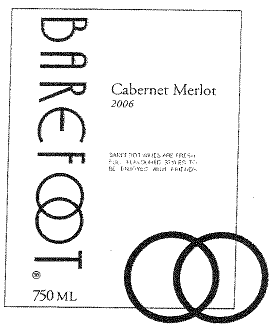
There was no “obstacle”, Lion Nathan correctly contends, to the use of the mark BAREFOOT, had Gallo Winery so wished. This label, according to Mr Kalabokes, a Vice President of Gallo Winery, was not designed by Gallo Winery. The label, described as a “basic label”, was designed by McWilliams Wines and approved by Gallo Winery. The “design process” was “very short”.
175 Mr Kalabokes also gave evidence that the wine was so marketed to increase the leverage that could be placed upon Logan Wines in negotiations to assign its trade mark to Gallo Winery. The marketing of the wine without the image was said to be a demonstration that Gallo Winery could market its wine in Australia with or without the use of the image. But the strategy, according to Mr Kalabokes, was always for Gallo Winery to use the image of the bare foot on its wine together with its trade mark.
176 Although Mr Kalabokes gave no evidence of any conversation with Mr Logan, the Deputy Chairman of McWilliams Wines (Mr Kevin McLintock) did give an account of a conversation which he said took place in July 2007. The parties to that conversation included Mr Kalabokes and himself and there was a telephone “hook-up” with Mr Logan. Relevantly, Mr Kalabokes informed Mr Logan that there was to be a release of BAREFOOT wine and that the wine would be sold “with or without him”. The response of Mr Logan was that he would review his position and put a “counter-offer” to Gallo Winery.
177 It is accepted that the reason for the sale of the BAREFOOT wine without the image of the bare foot was for the purpose stated by Mr Kalabokes, namely to use the fact of such sales as “negotiation leverage to demonstrate to Mr Logan we’re going to be in Australia with him or without him”.
178 Even so, the fact remains that there was the ability to use the trade mark — without the image of the bare foot — as demonstrated by the release of wine in September 2007. It matters not whether the release of the wine in September 2007 was regarded as a “launch” of the product or a “placement for market research purposes”. In this context Senior Counsel for Gallo Winery took Mr McLintock to his Affidavit and the following exchange thereafter occurred:
Just looking at the first line of paragraph 27, Mr McLintock, is there any change that you would wish to make to the way you’ve expressed yourself there? --- Yes, the word “undertook a launch”, I think is incorrect. That was more placement for market research purposes. A launch of a wine of this size would be significantly greater than that.
Thank you? --- So the word “launch” is wrong.
You would prefer the word “placement”? Is that so? --- Placement, yes.
However the release of the wine be described, and whatever may have been the reason for the release of that wine, the fact that it was released demonstrates that there was no obstacle to the use of the trade mark. Had Gallo Winery wanted to use its trade mark, namely the word “BAREFOOT”, it could readily have done so.
179 The absence of any relevant “obstacle”, Lion Nathan contends, was also demonstrated by both the placing of that wine on the market and the fact that there was always available to Gallo Winery the ability to obtain from McWilliams Wines a supply of wine that could be similarly bottled. The ability to obtain the supply of wine was not confined to 2007 and could have been obtained from as early as 2005 had Gallo Winery so wished. The following exchange thus occurred as between Mr Kalabokes and his cross-examiner:
… You weren’t made aware in September or August or October 2007 of any difficulty encountered in finding wine to put in a bottle labelled Barefoot? --- I wasn’t aware of any difficulty.
It’s correct, is it not, that if Gallo had wanted to sell in Australia or have McWilliams sell in Australia a wine with a label which just had the word “Barefoot” on it and without an image of a foot, it could have done so a lot earlier than August/September 2007? --- Yes. That’s correct.
It could have done it in 2005 if it had wanted to? --- If we wanted to, yes, that’s correct. …
180 Gallo Winery confront, however, a further and more fundamental difficulty in establishing that there was an “obstacle” to its use of its trade mark in the 2004–2007 period. This difficulty is the recognition by Mr Kalabokes of the fact that Gallo Winery never had any intention of marketing its BAREFOOT wine in Australia prior to the end of 2007. The strategy which had been developed was to develop the market initially in the United States and thereafter in Europe. That strategy apparently worked well. In 2005, Gallo Winery sold world-wide approximately 942,000 nine litre cases; in 2006 it sold 2.6 million nine litre cases; and in 2007 it sold 4.3 million nine-litre cases.
181 It was only after those markets had been developed, however, that the attention of Gallo Winery was to shift to Australia. And the planned timing of the launch of its BAREFOOT wine was to be late 2007. Mr Kalabokes thus gave the following evidence:
You see commercially you were – or Gallo had its sights set on the latter half of 2007, when it was hoping to have bottled wine available for sale in Australia? --- That’s correct.
He was then further cross-examined as follows:
So when you were talking earlier about having an intention to sell in effect which would take effect at the end of 2007 that was only an intention insofar as it had a precondition, namely resolution with Logan. Correct? --- I felt we had a lot of time to work with Mr Logan and we could use the year 2007 to try to make a resolution.
But unless and until you got that resolution there was no point setting your sight or identifying a single individual bottle of wine or wine vat for sale to Australia, was there? --- There was a program put in place to start researching the opportunity to start launching a brand here in the latter half of 2007. Our international executive in charge for Gallo sales abroad had begun conversations with the McWilliams chief executive officer.
But until you could resolve with Logan you just did not have a path forward, did you? --- Without the foot it was a very difficult launch.
…
Is it correct to say that leaving the Logan issue to one side, in any event Gallo’s focus was firstly America, correct? --- We chose to focus first on America, correct.
Yes, and secondly, Europe? --- Yes, that’s correct, we had prior rights in Europe.
…
Right, but in any event the – for its own commercial reasons, Gallo was proposing to develop the market firstly in America, secondly [i]n Europe and thereafter other places in the world, one of which included Australia? --- That’s correct
That timetable as to which market to concentrate on meant that you would not have been here until the end of 2007 anyway, Logan or no Logan, correct? --- That was our plan, yes.
The strategy, according to Mr Kalabokes, “was to have the foot along with the Barefoot name presented on the label. That was our strategy … The foot very much was the brand and the brand was the foot, Barefoot”.
182 In such circumstances, it is not considered that the non-acquisition of the Logan Wines trade mark until September 2007 provided an “obstacle” to the use by Gallo Winery of the trade mark during May 2004 to May 2007. The non-acquisition of the Logan Wines trade mark may have been an “obstacle” to the use by Gallo Winery of the BAREFOOT trade mark in conjunction with the image of the bare foot had there been any intention on the part of Gallo Winery to launch its product at an earlier point of time. But that was not the intention or the strategy.
Which Mark Was Being Used?
183 Separate from any question as to whether there has been any use of the mark — by reason of either Barefoot Cellars or Beach Avenue Wholesalers being an authorised user, namely the first two ways in which Gallo Winery contends that there has been a use of the BAREFOOT mark during the non-use period — is a further question: namely, if there was a use of a trade mark during that period, which mark was being used?
184 Even if there was a use of a mark during the non-use period, Lion Nathan contends that the trade mark which was used by Gallo Winery was not the word BAREFOOT alone — it was a combination of that word together with the image of the bare foot. The labelling of the wine as purchased in 2007 from Beach Avenue Wholesalers was thus as follows:
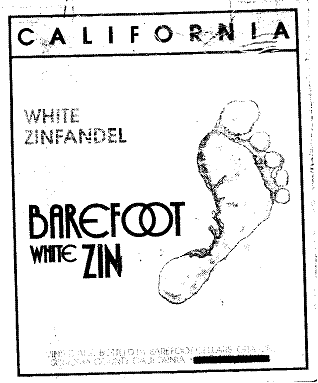
That label appears to be the same as that set forth in the archived brochures also sought to be relied upon by Gallo Winery.
185 Lion Nathan placed reliance upon Colorado Group Ltd v Standbags Group Pty Ltd [2007] FCAFC 184, 164 FCR 506. Just as in the Colorado case, Lion Nathan contends that the image cannot be divorced from the word such that the words alone had the capacity to distinguish the wine. In reaching a like conclusion in the Coloradocase, Allsop J concluded:
[110] Here, though the evidence was less than precise as to what the mark plus device use was by CGL, the examples in evidence reveal an important, perhaps even dominant, effect of the word "Colorado", but always with a device. That device was part of the trade mark use; it had a capacity to distinguish. It did not, in my view, operate as a separate mark, nor as a mere descriptor. It operated as part of a combination with the word "Colorado", in part reinforcing it. In these circumstances, I agree with the primary judge's concluded view that though the word "Colorado" is important in the impression, it cannot be said to have been used alone, rather than as part of a composite mark (with the device) to show origin.
Kenny and Gyles JJ gave separate judgments but also agreed with Allsop J.
186 Although it may be accepted that a combination of a word and an image may in some circumstances strip, in the mind of a consumer, the association with a trade source previously associated with the word alone, such is not the present case. Rejected is the contention of Lion Nathan that — if there was a use of a trade mark during the non-use period — it was the use of a mark other than the word“BAREFOOT”. If there was a use of a mark during the non-use period, the addition of the image of the bare foot did not have the consequence that the word itself as a trade mark was not also being used.
A Use “in good faith”?
187 One of the final contentions advanced by Gallo Winery was that any such use as there was of the trade mark during the non-use period was a use “in good faith” within the meaning of s 100(1)(c) of the 1995 Act.
188 Lion Nathan denies that any use was a use “in good faith”. Upon its analysis, during the non-use period there were 59 bottles provided to customers, of which 18 were given away free. Forty-three bottles, according to their analysis, were provided to Centro Euro Wines.
189 A single use during the non-use period, it should be accepted, is sufficient: Woolly Bull Enterprises Pty Ltd v Reynolds [2001] FCA 261 at [14]–[17], 107 FCR 166 at 171–2 per Drummond J.
190 And “good faith” means a real as opposed to a token use in a commercial sense. It requires a “substantial and genuine” use: NSW Dairy Corporation v Murray Goulburn Co‑operative Co Ltd (No 1) (1989) 14 IPR 26 at 45. Gummow J concluded:
In these circumstances, it is clear that in the three year period ending 6 June 1988 (being the period specified in s 23(1)(b)) the moo mark had been used by the registered proprietor not only in relation to cheese, but also in relation to flavoured milk in the sense required to preserve the registration, subject only to the further requirement that the use answered the description of having been bona fide.
In “Concord” Trade Mark [1987] FSR 209; Falconer J held that to be bona fide within the meaning of the equivalent provision in the British legislation (s 26 of the 1938 Act) use should be substantial and genuine judged by ordinary commercial standards considered in relation to the trade concerned. …
I should add that use by the first respondent would not cease to be bona fide even if the evidence had been that it used the trade mark only after it appreciated that the registration was vulnerable to an attack on the ground of non-use by reason of the lack of activity of the second respondent; nor would it cease to be bona fide, even though, as is the case on the evidence, neither the officers of the first respondent nor its patent attorney, who dealt with the second respondent at the time the assignment was taken in 1987, had enquired closely of the second respondent as to the extent of its previous user of the trade mark…
Aff’d: NSW Dairy Corporation v Murray Goulburn Co-operative Co Ltd (1990) 171 CLR 363. This approach was endorsed by Drummond J in Woolly Bull Enterprises Pty Ltd v Reynolds [2001] FCA 261 at [16], 107 FCR 166 at 171.
191 Lion Nathan’s contention is essentially that the limited number of sales of the BAREFOOT wine during the non-use period was not “substantial and genuine”.
192 That contention of Lion Nathan is rejected. If there was a use of the mark during the non-use period, a single use of the mark is sufficient. If there was a use during that period, there is no reason to question the genuineness of the repeated — albeit limited — sales in fact made.
Discretion: Section 101(3)
193 In the event that there has been found to be non-use of a trade mark, the Court may order the Registrar to remove the trade mark from the Register: s 101(2). The Register is that kept by the Registrar pursuant to s 207 of the 1995 Act.
194 Lion Nathan’s Cross-Claim seeks an order that the mark be removed.
195 If the condition of exercise of the Court’s power has been established, the trade mark should be removed “unless sufficient reason appears for leaving it there”: Ritz Hotel Ltd v Charles of the Ritz Ltd (1988) 12 IPR 417 at 481–2 per McLelland J. In Re Carl Zeiss Pty Ltd’s Application (1969) 122 CLR 1, Kitto J similarly concluded (at 11):
It has been urged upon me that no deception of any particular purchaser has been proved, and that there is no practical interest of the public to be served by removing the mark from the register. This seems to me to put the matter the wrong way round. The Stiftung's omission to use the mark for the statutory period entitles the applicant to have the mark removed from the register unless sufficient reason appears for leaving it there. …
One fundamental consideration to be taken into account is the public interest: Paragon Shoes Pty Ltd v Paragini Distributors (NSW) Pty Ltd (1988) 13 IPR 323. Woodward J there considered that the existence of the discretion was “clear” and continued at 345:
There are several points which emerge from this line of authority. The first is the importance of the public interest — whether anyone has been deceived or is likely to be if the mark remains on the register; whether, on the other hand, the public has an interest in the preservation of an established mark. The second is the significance of an unimpeached title to the mark and its continuous use in good faith by the person entitled to it. Finally, if the public interest is not adversely affected and such title and use are shown, then technicalities or defects in legal formalities may be overlooked.
One aspect of the “public interest” is thus the public interest in the integrity of the Register: NSW Dairy Corporation v Murray Goulburn Co-operative Co Ltd (1989) 14 IPR 75 at 79 per Gummow J.
196 The discretion to allow a mark which has not been used to remain registered is that now set forth in s 101(3) of the 1995 Act. That sub-section provides as follows:
If satisfied that it is reasonable to do so, the Registrar or the court may decide that the trade mark should not be removed from the Register even if the grounds on which the application was made have been established.
The discretion, it has been said, requires there to be “special facts and circumstances, or an overriding question of public interest”: Figgins Holdings v Beltrami SpA (1998) 46 IPR 411 at 418–19.
197 In applying the terms of the discretion previously conferred by s 23(1) of the Trade Marks Act 1955 (Cth), Foster J observed that it was a discretion only to be exercised in “exceptional circumstances”: Jonathan Ross Sceats v Jonathan Sceats Design Pty Ltd (1990) 17 IPR 28. Foster J there observed at 29–30:
The section to which I have just made reference has been the subject of consideration by courts of high authority. It is quite clear that the word “may”, used in the section, requires that a court, in determining whether relief should be granted, exercise a discretion. Accordingly, a court in considering the matters raised by s 23 may, even though it be satisfied that the desiderata of the section have been made out, nevertheless refrain from ordering the removal of the trade mark in the manner contemplated by the section.
The question of the operation of this discretion is considered in Shanahan's Australian Trade Mark Law and Practice, 1982 ed, p 212, under the heading, “Discretion under s 23(1)”. The learned author refers to the decision of Kitto J in Carl Zeiss Pty Ltd's Application (1969) 122 CLR 1, which clearly establishes the existence of the residual discretion in the court, to which I have made reference.
It is also clear, as the learned author points out, that the discretion is one of general application and not restricted specifically to sections of the Act. However, he also goes on to say: “It has been said that the discretion should be exercised only in ‘exceptional circumstances’; however, there may well be cases where the public interest requires that the registration be retained.”
Reference is made to the case of J Lyons & Co Ltd's Application [1959] RPC 120 at 130. I consider that the law is quite clear in this regard: although the discretion not to make an order of removal exists even though the enabling circumstances required by the section are proved, the discretion to refuse such an order is only to be exercised in the exceptional circumstances referred to.
198 The discretion presently conferred by s 101(3) of the 1995 Act, it has been said, confers a “broad discretion”: C A Henschke & Co v Rosemount Estates Pty Ltd [2000] FCA 1539 at [72], 52 IPR 42 at 73. And it is a discretion, it is considered, no longer constrained by any requirement to establish “exceptional circumstances”; it is a discretion which may be exercised “when it is reasonable to do so”: Kowa Co Ltd v Organon [2005] FCA 1282, 223 ALR 27. Lander J there indicated that he was of the view that it was not reasonable not to remove the mark in issue. Of the discretion, his Honour concluded:
[97] … There are significant differences in the section considered by the Court of Appeal in Lyons [(1959) 76 RPC 120] and s 101(3). In the English section, regard had to be had to the bona fide use of the trade mark during the relevant period. No such regard is had in s 101(3). It is always dangerous to have regard to a statement of principle in relation to the exercise of a discretion in a section in an Act which is not in pari materia with a section of a second Act for the purpose of considering the way in which a discretion should be exercised in that second Act.
[98] In Upjohn [(1998) 42 IPR 576] it was said that the power may be applied in “exceptional circumstances”. Section 101(3) does not say that. There is no warrant to read the expression “exceptional circumstances” into the subsection. That would be to give the subsection a construction contrary to its express terms. In my opinion, the discretion which is to be exercised under s 101(3) is to be exercised as the subsection itself says, “when it is reasonable to do so”. To suggest that the party against whom the non-use has been put in a case such as this should establish exceptional circumstances is to put too high a hurdle in that party’s path.
199 Gallo Winery’s final position is to rely upon a favourable exercise of the discretion now conferred by s 101(3).
200 Factors relied upon to support such an exercise of the discretion, so contends Gallo Winery, include the fact that its ability to use its trade mark was constrained by its negotiations with Logan Wines and what was said to be the “complex regulatory and commercial process of integrating the Barefoot Cellars business into Gallo’s business world-wide, of which use of the mark in Australia was one element”. Gallo Winery and McWilliams Wines, it is said, have gone “a long way towards commencing sales of wine in Australia under the mark”.
201 Reliance is also placed by Gallo Winery upon the fact that Lion Nathan was aware of the registered trade mark and was aware of a risk attendant upon Gallo Winery establishing sales of its wine during the non-use period. Mr Simpson thus gave the following evidence in cross-examination:
… You understood, didn’t you, by the end of 2007 that there was a risk that it might ultimately be found that Barefoot Wine had indeed been offered for sale and sold in Australia during the three-year period up to May 2007? --- Yes, I was aware that was a risk and that could be the case.
Yes, thank you. You were aware, were you not, that the decision-makers in Lion Nathan decided to take that risk ? --- Yes.
Mr Simpson, and hence Lion Nathan, were aware of the Gallo Winery registered trade mark when it undertook searches in February 2007, well prior to the launch in January 2008 of its BAREFOOT RADLER beer. But the results of the searches caused him no “concern”. Earlier during his cross-examination Mr Simpson explained as follows (without alteration) why that was his reaction:
When you say that you were not overly concerned about the wine mark, do you concede that the wine mark did give you some concern? --- No.
Because you were, of course, trying to attract people who might have previously drunk wine to make a choice in favour of this new kind of beer, weren’t you? --- We were trying to attract people who may have previously drunk wine, that’s correct, yes.
Yes, and your company, Lion Nathan Australia, engaged some people to conduct some investigation into whether the Barefoot Wine mark had been used in Australia. Correct? --- Yes.
And the Barefoot Wine mark did give you some concern, didn’t it? --- No.
Why did you bother investigating whether it had been used? --- It was just the natural thing to do. So part of our gate document process, you would see, has questions around words to the effect of IP availability, so just the logical things to do to understand what the road ahead might be like.
If I wanted to make sure – you wanted to see whether there was a legal obstacle, did you not, to using the word “Barefoot” in relation to this new kind of beer in Australia? --- Well, we got that from the trademark search, when there wasn’t in beer.
But why did you bother doing the trademark search? --- To establish if the mark was taken within beer.
Then having found that there was a trademark in relation to wine, you then retained some people at some expense to conduct investigations as to whether the Barefoot wine had been used in relation to wine, Barefoot market been used in relation to wine? --- Yes, we did go on to get them to do that, but as I say, we weren’t particularly concerned about it, it was about – seemed the natural thing to do, as I say, just clearing the road ahead.
202 Reliance is placed by Gallo Winery upon the obiter comments of Falconer J in Hermes Trade Mark [1982] RPC 425. In that decision an application was made for the removal of the trade mark “Hermes”, in relation to watches, for non-use during a five year period. That application was rejected. Falconer J nevertheless went on to observe that, had it been necessary to exercise the statutory discretion conferred by s 52 of the Trade Marks Act 1938 (UK), his Honour would have allowed the mark to remain on the Register. Relevant to that conclusion were five factors: there had been no abandonment of the trade mark; the registered proprietors still had a residual reputation in the mark; there had been sales by the registered proprietors of watches since the relevant period ended; the applicants for removal had entered the market without having taken steps to ascertain from the Register whether anyone had a right to exclude their use of the mark; and the registered proprietors were not aware of the applicant’s sales under the “Hermes” mark.
203 That list of considerations is, obviously enough, not an exhaustive catalogue of factors that may be taken into account. But it does provide some assistance. No attempt was made in the present proceedings to establish any reputation or sale of Gallo Winery’s wines in Australia under the trade mark BAREFOOT prior to May 2004. No question of any “residual reputation” thus arises in the present proceedings by reason of earlier sales in Australia. But there have been sales in Australia since May 2007 of Gallo Winery’s wines using the BAREFOOT trade mark and there certainly has been no intention on the part of Gallo Winery to abandon its use of that mark. And Lion Nathan knew that there was a risk that Gallo Winery may have been able to establish a use of its mark during the three year period 2004–2007.
204 As is frequently the case with any exercise of discretion, the considerations relevant to the exercise are seldom all one way.
205 Lion Nathan resists the exercise of the discretion in favour of allowing the mark to remain registered. Lion Nathan’s primary position is that the Court “should not be deterred from the prima facie position that unused trade marks are to be removed from the Register”. Trade mark ownership and use are “strongly interconnected” concepts: Loughlan P, Trade Marks: Property Rights and Their Limits (2005) 31 Mon LR 273, 279–80. Lion Nathan also relies upon its own steps to develop its BAREFOOT RADLER beer.
206 Notwithstanding the commercial steps undertaken by Gallo Winery to first acquire Barefoot Cellars and thereafter develop the market for the sale of that wine, it is considered that there is little reason to exercise the discretion in the manner being urged by Gallo Winery. That company acquired Barefoot Cellars in January 2005 and thereafter implemented a staged plan to market the wine world-wide. In its commercial judgment, the development of the Australian market was deliberately left until the end of 2007. It could have used its mark during the non-use period. It could have secured suitable wine and commenced selling at an earlier point of time. It did not do so. The consequences of its commercial judgment, it is considered, must now fall upon it — including an adverse exercise of the discretion conferred by s 101(3). Compare: Nordstrom Inc v Starite Distributors Inc (2008) 75 IPR 418 at 426–7.
207 The present proceedings, it is considered, stand in stark contrast to those confronting both the trial judge and the Full Court in C A Henschke & Co v Rosemount Estates Pty Ltd [2000] FCA 1539, 52 IPR 42. The trial judge there had indicated that he would have allowed the mark to remain registered, even had it not been used. The registered proprietor of the mark had died in 1972 and no steps had been taken to transfer the mark until 1997. The beneficial interest in the mark had at all times resided directly or indirectly in members of the Henschke family. The only “formal” deception which could be pointed to was an impression that it may have been the partnership, rather than the executors, who owned the “Hill of Grace” trade mark. The persons using the mark were the persons who gave the mark its value. See also: Health World Ltd v Shin-Sun Australia Pty Ltd [2008] FCA 100 at [223]–[225], 75 IPR 478 at 503 per Jacobson J.
208 More questionable as relevant to the exercise of the discretion is Lion Nathan’s reliance upon the money it has expended in promoting its product and its efforts to develop a product which was considered to be “more environmentally responsible” and a “‘carbon neutral’ beer”. The Consumer Insight Manager for Lion Nathan, Mr Ralph Simpson, gave evidence that Lion Nathan had spent in excess of $2 million prior to 29 February 2008 in “creating and developing the beer product including the BAREFOOT RADLER branding concept and imagery”. In his Affidavit he stated that he:
… thought this would appeal to consumers who are now more environmentally aware and focusing their purchasing decisions towards more environmentally responsible products. I thought that the “carbon neutral” or “green” angle would be another good point to differentiate our new BAREFOOT RADLER product in the market. It also seemed to tie into the overall theme for the product, as a summer, outdoors, relaxing beer for a more laid back lifestyle.
Objection, primarily on the grounds of relevance, was taken to this evidence. Consistent with this evidence of Mr Simpson is the fact that both the cardboard container for the beer and the bottle itself bear a green leaf logo with the words “BAREFOOT TREADS SOFTLY ON THE PLANET”.
209 Justice Woodward in Paragon Shoes was by no means attempting to set forth an exhaustive statement as to the content of the “public interest” when considering the discretion to permit a mark to remain registered. Centrally relevant to that discretion must remain a consideration of whether the public would be deceived or confused. Considerations such as those deposed to by Mr Simpson, and in particular the costs incurred in promoting a product, however, assume some limited relevance and assist the conclusion — otherwise reached — that the discretion should be exercised adversely to Gallo Winery. The objection to this portion of his evidence is thus rejected.
210 Although the“guiding principle behind the discretion is public interest, particularly in the integrity of the register” (Kowa Co Ltd v Organon [2005] FCA 1282 at [92], 223 ALR 27 at 41–2 per Lander J), the private commercial interests of both Gallo Winery and Lion Nathan remain matters which may be taken into account when exercising the discretion. Trade mark law, it has been recognised, is more complex than is suggested by the proposition that the supreme — or, at least — a predominant interest is the maintenance of the integrity of the Register: Campomar Sociedad Limitada v Nike International Ltd [2000] HCA 12 at [40], 202 CLR 45 at 65. Speaking of the 1955 Act, Gleeson CJ, Gaudron, McHugh, Gummow, Kirby, Hayne and Callinan JJ there pointed out the balance struck by the legislation between various interests. Both the interests of the consuming public and the interests of traders have to be recognised. Their Honours observed that:
[42] … the Australian legislation has manifested from time to time a varying accommodation of commercial and the consuming public's interests. There is the interest of consumers in recognising a trade mark as a badge of origin of goods or services and in avoiding deception or confusion as to that origin. There is the interest of traders, both in protecting their goodwill through the creation of a statutory species of property protected by the action against infringement, and in turning this property to valuable account by licensing or assignment. The provisions of the 1955 Act with respect to defensive registrations and certification marks were recognitions that the interests of the owners of registered trade marks may go beyond that of indicating trade origin. In Yale Electric Corporation v Robertson [(1928) 26 F 2d 972 at 973], Judge Learned Hand said of this interest:
"that one merchant shall not divert customers from another by representing what he sells as emanating from the second. This has been, and perhaps even more now is, the whole Law and the Prophets on the subject, though it assumes many guises."
In this decade, legislation in the United States, the United Kingdom, and now in Australia to varying degrees has extended the infringement action to restrain activities which are likely adversely to affect the interests of the owner of a "famous" or "well-known" trade mark by the "dilution" of its distinctive qualities or of its value to the owner.
211 It was no part of the case presently advanced by Gallo Winery to rely upon its international reputation or to advance any claim founded upon passing off: cf Conagra Inc v McCain Foods (Aust) Pty Ltd (1992) 33 FCR 302.
212 It is not considered that either at May 2004 or May 2007, or at present, that it would be “reasonable” to allow the trade mark of Gallo Winery to remain registered.
213 And there are no “special facts and circumstances” which warrant an exercise of discretion in favour of Gallo Winery. No “sufficient reason” has emerged which would warrant leaving the mark on the Register.
Conclusions
214 It is considered that the Applicant has failed to make out any case entitling it to declaratory or injunctive or other relief. No question arises as to any entitlement to an account of profits.
215 It is also considered that the relief claimed in the Cross-Claim should be ordered.
216 The parties should now be able to draft Short Minutes of Orders which give effect to these reasons. Hopefully those Orders can be agreed. Although submissions can be made in respect to costs, there is considered to be little reason why the normal approach should not here also prevail and that costs should follow the event.
Orders
217 The orders of the Court are:
1. The parties are to draft Short Minutes of Proposed Orders within 7 days which give effect to these reasons.
2. The proceedings be stood over to 27 June 2008 at 9.30 am with a view to then making final orders disposing of the proceedings.
| I certify that the preceding two hundred and seventeen (217) numbered paragraphs are a true copy of the Reasons for Judgment herein of the Honourable Justice Flick. |
Associate:
Dated: 20 June 2008
| Counsel for the Applicant: | I Jackman SC with M J Darke |
|
|
|
| Solicitor for the Applicant: | Corrs Chambers Westgarth |
|
|
|
| Counsel for the Respondent: | A J L Bannon SC with N R Murray |
|
|
|
| Solicitor for the Respondent: | Mallesons Stephen Jacques |
| Date of Hearing: | 30 May 2008 |
|
|
|
| Date of Judgment: | 20 June 2008 |


