FEDERAL COURT OF AUSTRALIA
Krueger Transport Equipment Pty Ltd v Glen Cameron Storage
& Distribution Pty Ltd
[2008] FCA 803
CONTRACT – breach of confidence – when confidentiality provision is a reasonable restraint of trade – factual and legal causation
COPYRIGHT – distinction between ideas and expression – causal connection – infringement based on indirect access – whether declaration of unjustified threat of infringement may be had as of right
EQUITY – confidential information – level of novelty or ingenuity required for information to be confidential – circumstances in which an equitable obligation of confidence is attracted – whether detriment to the confiding party is an element of the cause of action – whether design for truck trailer load restraint system was confidential – unauthorised oral disclosure of the design to competitor
Copyright Act 1968 (Cth) ss 10(1), 14(1)(a), 14(1)(b), 32, 36, 115 and 202
Trade Practices Act 1974 (Cth) s 52
Anacon Corporation Ltd v Environmental Research Technology Ltd [1994] FSR 659, cited
Ansell Rubber Co Pty Ltd v Allied Rubber Industries Pty Ltd [1967] VR 37, applied
Avel Pty Ltd v Intercontinental Grain Exports Pty Ltd (1996) 65 FCR 154, cited
Baker v Selden (1879) 101 US 99, cited
Barrett Property v Metricon Homes (2008) 74 IPR 52, applied
British Celanese Ltd v Courtaulds Ltd (1935) 52 RPC 171, applied
Coco v AN Clark (Engineering) Ltd [1969] RPC 41, applied
Desktop Marketing Systems Pty Ltd v Telstra (2002) 119 FCR 491, cited
Donoghue v Allied Newspapers Ltd [1938] Ch 106 (Ch D), cited
Elwood Clothing Pty Ltd v Cotton On Clothing Pty Ltd [2008] FCA 447, cited
Francis Day & Hunter Ltd v Bron [1963] Ch 587, cited
JMVB Enterprises Pty Ltd v Camoflag Pty Ltd (2005) 67 IPR 68, cited
Jones v Dunkel (1959) 101 CLR 298, applied
Holloway v McFeeters (1956) 94 CLR 470, applied
Interlego AG v Croner Trading Pty Ltd (1992) 39 FCR 348, cited
Ladbroke (Football) Ltd v William Hill (Football) Ltd [1964] 1 All ER 465, cited
LED Builders Pty Ltd v Eagle Homes Pty Ltd (1996) 35 IPR 215, cited
Maggbury Pty Ltd v Hafele Australia Pty Ltd (2002) 210 CLR 181, applied
Moorgate Tobacco Co Ltd v Philip Morris Ltd (No 2) (1984) 156 CLR 414, cited
New England Country Homes Pty Ltd v Moore (199) 82 FCR 500, cited
Nine Network Australia Pty Limited v IceTV Pty Limited [2008] FCAFC 71, cited
Skybase Nominees Pty Ltd v Fortuity Pty Ltd (1996) 36 IPR 529, cited
SW Hart & Co Pty Ltd v Edwards Hot Water Systems (1985) 159 CLR 466, cited
Tamawood Ltd v Henley Arch Pty Ltd (2004) 61 IPR 378, cited
Woodtree Pty Ltd v Zheng (2008) 74 IPR 484, cited
L Tsaknis, “The Jurisdictional Basis, Elements and Remedies in the Action for Breach of Confidence – Uncertainty Abounds” (1993) 5 Bond Law Review 18
VID 566 of 2003
GORDON J
30 MAY 2008
MELBOURNE
| IN THE FEDERAL COURT OF AUSTRALIA |
|
| VICTORIA DISTRICT REGISTRY | VID 566 of 2003 |
| BETWEEN: | KRUEGER TRANSPORT EQUIPMENT PTY LTD (ACN 005 296 515) Applicant
|
| AND: | GLEN CAMERON STORAGE & DISTRIBUTION PTY LTD (ACN 005 606 360) First Respondent
GLEN WILLIAM CAMERON Second Respondent
MARTYN TINDAL Third Respondent
VAWDREY AUSTRALIA PTY LTD (ACN 005 075 052) Fourth Respondent/Cross-Claimant
GLEN CAMERON NOMINEES PTY LTD (ACN 005 350 863) Fifth Respondent
|
| GORDON J | |
| DATE OF ORDER: | 30 MAY 2008 |
| WHERE MADE: |
THE COURT ORDERS THAT:
1. The Fourth Respondent’s cross-claim be dismissed.
2. The matter be set down for hearing on a date to be fixed on the limited issue of the quantum of the Respondents’ liability to the Applicant.
3. The Fourth Respondent pay the Applicant’s costs of and incidental to the cross-claim.
4. All other costs be reserved.
5. The proceedings be adjourned to 9.30am on 6 June 2008 for directions about the further conduct of the matter.
Note: Settlement and entry of orders is dealt with in Order 36 of the Federal Court Rules.
| IN THE FEDERAL COURT OF AUSTRALIA |
|
| VICTORIA DISTRICT REGISTRY | VID 566 of 2003 |
| BETWEEN: | KRUEGER TRANSPORT EQUIPMENT PTY LTD (ACN 005 296 515) Applicant
|
| AND: | GLEN CAMERON STORAGE & DISTRIBUTION PTY LTD (ACN 005 606 360) First Respondent
GLEN WILLIAM CAMERON Second Respondent
MARTYN TINDAL Third Respondent
VAWDREY AUSTRALIA PTY LTD (ACN 005 075 052) Fourth Respondent/Cross-Claimant
GLEN CAMERON NOMINEES PTY LTD (ACN 005 350 863) Fifth Respondent
|
| JUDGE: | GORDON J |
| DATE: | 30 MAY 2008 |
| PLACE: | MELBOURNE |
REASONS FOR JUDGMENT
INTRODUCTION
1 Krueger Transport Equipment Pty Ltd (“Krueger”) has been designing and building trailers for the Australian transport industry for approximately 30 years. John Krueger is its Managing Director. The First Respondent, Glen Cameron Storage & Distribution Pty Ltd (“GCSD”) and the Fifth Respondent, Glen Cameron Nominees Pty Ltd (“GCN”), are both companies in the Glen Cameron Group (together “Camerons”). Camerons is a transport and logistics group involved in transporting goods throughout Australia. The Second Respondent, Mr Glen Cameron (“Mr Cameron”), is the sole director of GCSD and GCN. The Third Respondent, Mr Martyn Tindal (“Mr Tindal”), was the Sales Manager of the Glen Cameron Group from 20 May 2002 to 22 July 2005. The Fourth Respondent, Vawdrey Australia Pty Ltd (“Vawdrey”), manufactures and sells semi-trailers and truck bodies throughout Australia. It is a competitor of Krueger.
2 In these proceedings, Krueger alleges misuse of confidential information by the Cameron parties and copyright infringement and contravention of the Trade Practices Act 1974 (Cth) (“the TPA”) by the Cameron parties and Vawdrey.
3 In its closing submissions, Krueger defined the “confidential information” in the following terms:
[C]onfidential information relating to the design of a load restraint system for a curtain sided trailer which would reduce or eliminate the lifting of gates required to be undertaken by the driver (“the Design Concept”). The Design Concept is found in:
(1) a hand sketch illustrating the Concept (“the Krueger Sketch”);
(2) a quotation no 054 dated 5 December 2002 from Krueger to Cameron (“the [Third Krueger] Quote”); and
(3) drawings, being drawing no 97-1139-1 entitled “14.62 m (48’) DROPDECK KURTAINER” and drawing no 97-1140-1 entitled “16.20 m (53’) DROPDECK KURTAINER” in their various iterations (“the Krueger Drawings”).
(Emphasis added.)
Copies of the Krueger Sketch, the Third Krueger Quote and the Krueger Drawings in their various forms are set out in Annexure 1. It will be necessary to return to consider each element of the confidential information later in these reasons for decision.
4 The “load restraint system” was to deal with cartage of palletised cardboard boxes produced by Amcor Fibre Packaging (“Amcor”). The boxes were to be carried in double stacked pallets up to 2.7 metres high on a 48 foot (“ft”) dropdeck curtain-sided trailer. A 48ft dropdeck curtain-sided trailer carries 12 pallets along each side of the truck. The nine pallets on the dropdeck are double stacked. The three pallets on the higher deck are not double stacked. Krueger asserts that it created the load restraint system to deal with the Amcor cargo and that after it disclosed the system to Camerons, Camerons disclosed it to Vawdrey and Vawdrey used it to win the contract with Camerons. These allegations are denied by Camerons and Vawdrey.
5 The “load restraint system” in issue and shown in the Krueger Drawings requires further explanation. Those drawings show at least seven posts along each side of the truck. Each post was a sliding post. Attached to or “hanging off” each post was a special light weight gate which, because of its size and shape, acted as a load restraint for two pallets. Each of the posts with the attached special gates could be slid along the side of the truck as a unit and when each was slid to the end of the truck, they formed a single stack. As will later appear, the feature of the load restraint system that is of most importance for present purposes is the gate attached to or hanging off each sliding side post.
6 Krueger submitted, on two bases, that Camerons owed Krueger an obligation of confidentiality in relation to the information specified in [3]. First, Krueger submitted there was a contractual obligation arising out of an express agreement to keep certain information confidential between Krueger and Camerons that was reached at a meeting on 2 December 2002 at Camerons’ premises (“the Cameron / Krueger meeting”). Secondly, Krueger submitted there was an equitable obligation arising from the relationship of the parties, the nature of the information in issue and the circumstances in which Krueger disclosed the information to Camerons.
7 The Cameron / Krueger meeting was attended by John Krueger and his son, Grant, on behalf of Krueger and by Mr Cameron and Mr Tindal on behalf of Camerons. Krueger contends that during the course of the meeting, a verbal agreement was reached that Camerons would keep private and confidential any ideas or designs for the load restraint system proposed by Krueger. Krueger alleges that the confidential information was then disclosed to Camerons both during the Cameron / Krueger meeting and after that meeting. Mr Cameron denies that confidentiality was discussed at any point during the meeting and denies that there was any express agreement as to confidentiality.
8 Camerons did not dispute it was obliged to keep confidential any information of Krueger’s that was not already publicly available, but submits that Krueger did not disclose to it any information that could be characterised as confidential in nature and, in any event, denies having disclosed what Krueger described as “confidential information” to Vawdrey.
9 In its closing submissions, Krueger submitted that:
It is unclear and does not matter whether this [disclosure of the confidential information by Camerons to Vawdrey] occurred by explicit disclosure of the [Third Krueger] Quote and/or the Krueger Sketch and/or the Krueger Drawings or by a more indirect method such as a verbal description of what was conveyed to Cameron[s] by one or more of those documents.
(Emphasis added.)
Krueger submitted that what mattered was the conclusion that there had been disclosure of the confidential information by Camerons to Vawdrey and that the facts proved in evidence supported the inference that there had been such a disclosure.
10 Krueger’s case was thus based on inferences, which it said should be drawn from established facts. The principles to be applied in such a case are well established. They were described by Dixon CJ in Holloway v McFeeters (1956) 94 CLR 470 at 477, and by Williams, Webb and Taylor JJ at 480 and 481 (in the context of litigation arising from a vehicle collision) by comparing and contrasting the hypotheses that could be adopted to explain proved facts and the drawing of an inference from those facts. Dixon CJ said at 477:
The state of facts reached by inferences is itself compatible with a number of hypotheses, some of them implying fault on one side, some on the other, some on both sides. Hypotheses of this kind are not inferences. What is required is a basis for some positive inference involving negligence on the part of the driver as a cause of the deceased’s death. The inference may be made only as the most probable deduction from the established facts, but it must at least be a deduction which may reasonably be drawn from them. It need not be an inference as to how precisely the accident occurred, but it must be a reasonable conclusion that the accident in one way or another occurred through the lack of due care on the part of the driver and not otherwise.
11 These principles were restated by Dixon CJ in Jones v Dunkel (1959) 101 CLR 298 at 304-305, again by comparing and contrasting hypotheses or conjecture on the one hand, and the drawing of inference on the other. He said:
[I]n any case, we are not concerned with a choice between rival conjectures. In an action of negligence for death or personal injuries the plaintiff must fail unless he offers evidence supporting some positive inference implying negligence and it must be an inference which arises as an affirmative conclusion from the circumstances proved in evidence and one which they establish to the reasonable satisfaction of a judicial mind. It is true that “you need only circumstances raising a more probable inference in favour of what is alleged”. But “they must do more than give rise to conflicting inferences of equal degree of probability so that the choice between them is mere matter of conjecture.” These phrases are taken from an unreported judgment of this Court in Bradshaw v. McEwans Pty. Ltd. [(Unreported, delivered 27th April 1951)], which is referred to in Holloway v. McFeeters [(1956) 94 CLR 470], by Williams, Webb and Taylor JJ. The passage continues: “All that is necessary is that according to the course of common experience the more probable inference from the circumstances that sufficiently appear by evidence or admission, left unexplained, should be that the injury arose from the defendant's negligence. By more probable is meant no more than that upon a balance of probabilities such an inference might reasonably be considered to have some greater degree of likelihood.” [(1956) 94 CLR 470, at 480-481] But the law which this passage attempts to explain does not authorise a court to choose between guesses, where the possibilities are not unlimited, on the ground that one guess seems more likely than another or the others. The facts proved must form a reasonable basis for a definite conclusion affirmatively drawn of the truth of which the tribunal of fact may reasonably be satisfied.
(Emphasis added)
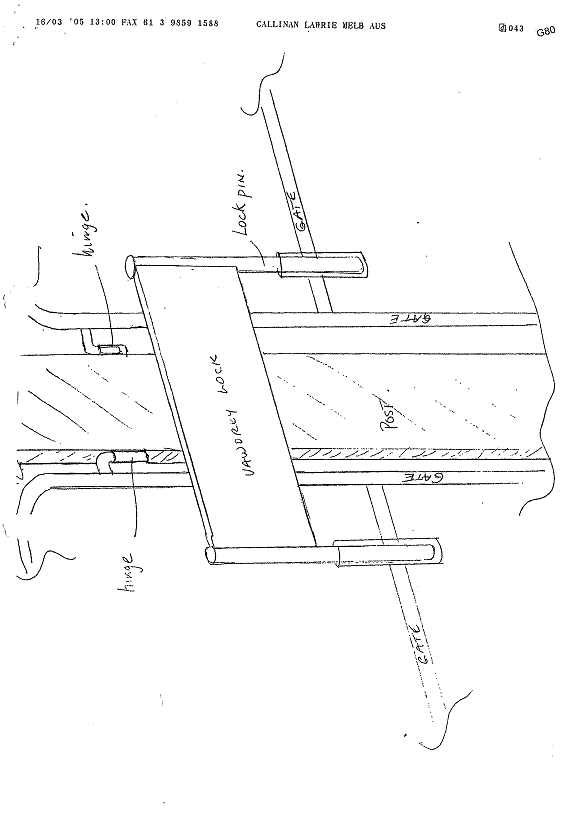
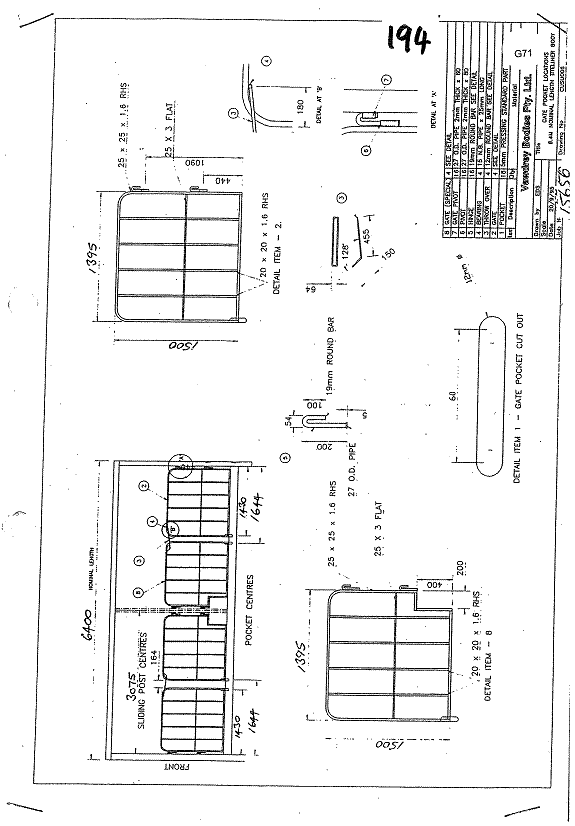
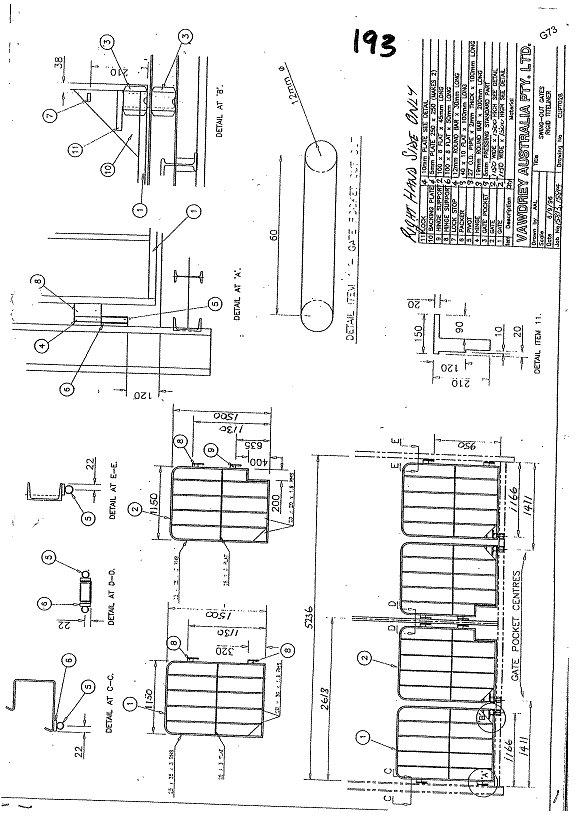
12 It is necessary, therefore, to begin by identifying the objective facts established by the evidence.
FACTS
13 On 25 November 2002, Amcor issued a Request for Proposal for the supply of distribution services for, and cartage of, the Amcor cargo (“the Tender”). Amcor invited Camerons to respond to the Tender. The closing date for responses was 13 December 2002.
14 Camerons wished to respond to the Tender. If Camerons’ response to the Tender was successful, Camerons would need to purchase at least 20 trailers to carry the Amcor cargo. On 4 October 2002, prior to receiving the Tender, Tindal obtained a quote from Vawdrey for the manufacture of one 14.6 Drop Deck ‘Titeliner’ (Curtainsided) trailer (the Vawdrey proprietary name for a48ft dropdeck curtain-sided trailer). Cameron did not seek quotes from any other manufacturer at that time. Tindal’s evidence was that he only sought one quote to avoid tipping off the industry that Camerons might be seeking a substantial number of trailers. I do not accept that explanation. It might be an explanation for why a quotation was sought for only one trailer but it does not explain why only one manufacturer was invited to quote for the manufacture of that trailer.
15 In any event, in late November 2002, Tindal sought further quotations from three manufacturers; a second quote from Vawdrey and a first quote from both Krueger and Barker Trailers Pty Ltd (“Barker”) for the manufacture of 48ft drop-deck curtain-sided trailers. The quotes submitted by the manufacturers all included, as standard, a full set of gates, together with load binders for strapping the cargo. These gates were all approximately the same size – either 1500mm or 5 feet high – and were standard lift out gates. The First Krueger Quote (of $57,695 inc GST) was cheaper than either of the Vawdrey Quotes (of, respectively, $62,000 and $58,000) and the Barker Quote (of $60,320). No drawings were submitted with the quotes.
16 After receiving the quotes, Camerons decided to meet separately with each of Vawdrey, Krueger and Barker to discuss issues of load restraint and proposals for delivery of trailers and price. The fact that Cameron met with Vawdrey and then Krueger on 2 December 2002 and subsequently with Barker on 3 December 2002 is not in dispute.
17 What is in dispute is what transpired at the meetings at Camerons’ premises between, first, Mr Cameron and Mr Tindal on behalf of Camerons and Paul Vawdrey on behalf of Vawdrey (“the Cameron / Vawdrey meeting”), and then at the Cameron / Krueger meeting. The Barker meeting may be put to one side for the moment. There was little or no evidence directed to that event.
Cameron / Vawdrey meeting
18 The first meeting on 2 December was the Cameron / Vawdrey meeting. The evidence given by Mr Cameron, Mr Tindal and Paul Vawdrey of what transpired at that meeting was far from satisfactory and substantially inconsistent. The meeting was held at Camerons’ premises and commenced at approximately 11.00am. It is not disputed that it preceded the Cameron / Krueger meeting.
19 Paul Vawdrey made handwritten notes on his copy of the Second Vawdrey Quote of what transpired at the meeting. Those notes record, in part, “11 POSTS AS COVERAGE ON”. Paul Vawdrey’s evidence was that the note recorded that a load restraint proposal was discussed by Vawdrey and Cameron that he (Paul Vawdrey) proposed. He said that he proposed to use a post per pallet space and that Mr Cameron and Mr Tindal liked the idea. Significantly, the notes do not describe anything “hanging off” or “extending from” each post, nor do they otherwise suggest that at this meeting there was any discussion of such a load restraint system.
20 Paul Vawdrey’s evidence at trial was substantially different from and inconsistent with the account he had previously provided to the Patents Office of the same events on 15 March 2005 in the context of a patent application by Krueger for what became known as the “Slide-A-Gate” system. In his statutory declaration to the Patents Office, Paul Vawdrey described the meeting in the following terms:
On the morning of 2 December 2002 I visited a customer of my company, being Glen Cameron Nominees Pty Ltd (hereinafter GCN), and met with Mr Glen Cameron and Mr Martyn Tindal. GCN were seeking to purchase 22 curtain sided semi-trailers for transporting double loaded pallets. I recall a discussion in the meeting about restraining the load and I recall the suggestion (I do not recall by whom) of using existing (“knee joint”) sliding side posts at each pallet space to restrain the load. In other words the posts would be spaced along the sides of the trailer mid-way between the ends of each pair of double loaded pallets to prevent the pallets, and hence the goods on the pallets, from moving off the sides of the trailer. I further recall some concern being expressed at the meeting, as to whether a single post at each pallet space would be sufficient to restrain the load, or whether some additional restraint should be provided on each post.
(Emphasis added.)
21 What is not now in dispute is that during the Cameron / Vawdrey meeting Paul Vawdrey drew hand sketches of the load restraint proposals discussed during the meeting. The hand sketches are entitled, respectively, “CARGO NET INNER CURTAIN TRACK”, which has been crossed through (consistent with the rejection of that proposal by Mr Cameron during the meeting, see [24] below) and “1 POST PER PALLET SPACING”. A copy of each of the sketches is in Annexure 2. The latter sketch was not crossed through. Mr Cameron recalls Paul Vawdrey drawing sketches during the meeting but does not recall what they looked like. Tindal recalls Paul Vawdrey drawing “1 Post Per Pallet Spacing”. He also recalls that Paul Vawdrey “drew some other sketches” but does not recall what they looked like. Tindal was also in the habit of making handwritten notes about the proposals. Tindal’s handwritten notes on Camerons’ copy of the Second Vawdrey Quote include:
11 Two(2) sliding posts per side.
22 These contemporaneous documents thus record that during the course of the Cameron / Vawdrey meeting the idea of a “post per pallet” was discussed. The contemporaneous documents do not suggest, however, that there was any discussion of anything “hanging off” or “extending from” each post.
23 Mr Cameron’s affidavit evidence of what transpired at the meeting referred to Tindal’s affidavit. Cameron said:
24 Mr Cameron reiterated the substance of that evidence before me. What then did Tindal’s affidavit say? So far as is relevant, his evidence was that it was he (Martyn Tindal), not Paul Vawdrey, who raised the issue of a load restraint system that would “restrain double stacked pallets and prevent them from falling out when the curtains on the side of the trailer were opened.” Tindal recalled that Paul Vawdrey suggested using cargo nets but that was immediately dismissed because the nets would have caught on the pallets. That is consistent with Paul Vawdrey having drawn the sketch labelled “CARGO NET INNER CURTAIN TRACK” and then crossing it through (see [21] above).
25 According to Tindal, it was after the rejection of the cargo net idea that Mr Cameron asked Paul Vawdrey if they could use conventional sliding posts located at each pallet space along the side of the trailer with “something hanging off or extending from each post to act as a load restraint, which was smaller and lighter than most traditional gates… [but] big enough to restrain double stacked pallets and not allow them to slip through”.
26 What then is said to have occurred, at least according to Tindal (and by him adopting it, Mr Cameron) is that Mr Cameron also said “it would not be practical to have one post per pallet space because it would be laborious to remove all the posts” (emphasis added). One post per pallet space would have required 12 posts on each side of a 48ft trailer. Paul Vawdrey is also said to have indicated that he would submit a drawing and a cost estimate.
27 That offer and the steps that followed are important. They are important because they are not consistent with either Mr Cameron or Paul Vawdrey having proposed posts with special gates hanging off or extending from each post at the meeting. I will return to consider the subsequent steps taken by Cameron and Vawdrey later in these reasons for decision (see [40]ff below).
Cameron / Krueger Meeting
28 What then transpired at the Cameron / Krueger meeting held a few hours later? It started at approximately 12.45pm when John and Grant Krueger met with Mr Cameron and Mr Tindal at Camerons’ premises.
29 Mr Cameron and Mr Tindal told John and Grant Krueger that the Tender required a solution to occupational health and safety problems associated with “lift out” gates in conventional curtain-sided trailers. There was discussion about possible solutions to those problems. Mr Cameron asked John Krueger whether it would be practical to use a sliding side post per pallet. Asking that question is consistent with the discussion of a load restraint proposal during the Cameron / Vawdrey meeting going no further than a discussion of sliding side posts without any additional element. John Krueger rejected the proposal of using only sliding side posts as inefficient, impractical and unsafe. After the nature of the Amcor cargo was revealed, John Krueger drew the Krueger Sketch, a copy of which forms part of Annexure 1. The Krueger Sketch is important. It is a concept drawing. A section of the Krueger Sketch shows the cross section of part of the pelmet or top rail on the side of the truck with two rollers. Hanging from that pelmet is a sliding post. The fact that the post is to slide is indicated by the roller either side of the post. Attached to the sliding post is a gate with cross members. The gate and the cross members appear to be fixed to each post (“the Krueger Concept”).
30 John Krueger’s evidence was that he showed the Krueger Sketch to Mr Cameron and Mr Tindal and explained the Krueger Concept to them, including how it would be necessary to slide and stack the gates to ensure sufficient clear space for loading and unloading the trailer. John Krueger’s evidence was that Mr Cameron and Mr Tindal were impressed with the Krueger Concept.
31 The evidence of Mr Cameron and Mr Tindal about the Cameron / Krueger meeting was inconsistent, both with each other and inconsistent with Mr Krueger’s evidence. In his original affidavit evidence, Mr Tindal claimed that neither he nor Mr Cameron “referred to back strain suffered as a result of lifting gates” and that it was not “a condition of tender that any safety issue (or any other issue) be resolved”. In his subsequent affidavit, however, Mr Tindal admitted that he may have referred to occupational health and safety issues in the meeting with Krueger as he was concerned about “preventing double stacked pallets from falling out when the curtains on the sides of the trailers were opened”. Mr Cameron also presented conflicting evidence. In his affidavit, he claimed he did not see John Krueger make a sketch of his proposal, but in cross examination admitted that he knew John Krueger had drawn “something”. The evidence of Mr Cameron and Mr Tindal was consistent in one respect – that neither was particularly impressed with John Krueger’s Concept. (Mr Tindal said he felt “[t]he mood of the meeting did not change as the meeting progressed”.)
32 Following the Cameron / Krueger meeting, two events occurred. First, John Krueger telephoned Adel Gerges, a Krueger engineer. John Krueger told Gerges about the Krueger Concept and explained the way it was intended to work with side gates attached to the sliding side posts. John Krueger asked Gerges to evaluate whether the concept was workable. There was discussion about whether the roof would be strong enough to carry the gates when they were open and whether or not the gates could be stacked at either end of the trailer when loading and unloading the truck. The conversation lasted approximately 22 minutes.
33 Secondly, Grant Krueger met with Gerges and drew another hand sketch of the Krueger Concept. A copy of that sketch is at Annexure 3. In his presence, Gerges drew a further hand sketch of the Krueger Concept. A copy of that sketch is at Annexure 4. These events demonstrate that as early as the afternoon of 2 December 2002, Grant Krueger (who had no relevant engineering experience) was aware of and understood the Krueger Concept so that he was able to sketch the Krueger Concept and explain it to Gerges (the Krueger engineer). Armed with these two explanations, Gerges was able to prepare his own sketch and then direct the preparation of appropriate engineering layouts depicting the Krueger Concept. This series of events is significant as will become obvious later in these reasons for decision.
34 The next day, 3 December 2002, Gerges asked another Krueger employee, Stephen Hunt, to prepare engineering layouts depicting the Krueger Concept. On 4 December 2002, Gerges approved the engineering layouts prepared by Hunt and asked Hunt to convert them into sales drawings.
35 On 4 December 2002, Hunt prepared the sales drawings, depicting respectively, a 48ft dropdeck curtain-sided trailer with eight sliding side gates and a 53ft dropdeck curtain-sided trailer with nine sliding side gates, but without Krueger’s standard copyright and confidentiality notice (“the Initial Krueger Drawings”). The drawings did, however, contain a prominent copyright symbol with the word “Copyright” immediately beneath it. Hunt provided them to Grant Krueger. The Initial Krueger Drawings are part of Annexure 1. The Initial Krueger Drawings bear the date 4 December 2002. Those drawings show at least eight posts along each side of the truck. Each post has attached to or “hanging off” from it a gate which, because of the gate's size and shape, acted as a load restraint for two pallets.
36 Despite Grant Krueger’s evidence that he believes he faxed the Initial Krueger Drawings to Camerons on 4 December 2002 at around the same time that he faxed Krueger’s second quote to Camerons at 1.38pm on 4 December 2002 (a quote over which confidentiality has not been claimed by Krueger), there is no independent objective evidence that the Initial Krueger Drawings were ever provided to Camerons, whether on 4 December 2002 or at some later time. However, the content of the Second Krueger Quote is itself important. It provided a quote for the supply of 20 dropdeck trailers with the following “options” for a 48ft trailer (and similar options for a 53ft trailer):
* One [f]ull set of lightweight Aluminium gates to maximum height
* One full set of sliding side gates fitted to side post
* Twelve loadbinders in sliding track
The Second Quote provided for and referred to, at least in part, the Krueger Concept.
37 On 5 December 2002, in response to an instruction from Grant Krueger, Hunt prepared the “Interim Krueger Drawings”(a copy of which forms part of Annexure 1),being a 48ft dropdeck curtain-sided trailer with seven sliding side gates (as opposed to the eight in the Initial Krueger Drawings), and a 53ft dropdeck curtain-sided trailer with eight sliding side gates (rather than nine). Again, the Interim Krueger Drawings did not incorporate Krueger’s standard copyright and confidentiality notice but did include the copyright logo described earlier. On the same day, Hunt prepared the “Subsequent Krueger Drawings”(a copy of which also forms part of Annexure 1), which are the same as the Interim Krueger Drawings but included Krueger’s standard copyright and confidentiality notice.
38 The Interim Krueger Drawings were sent to Camerons at 12.46pm on 5 December 2002 and accompanied the Third Krueger Quote (see [3] above). The Interim Krueger Drawings were adapted from the Initial Krueger Drawings. The Third Krueger Quote again described the “options” available for a 48ft trailer in the following terms:
* One [f]ull set of lightweight Aluminium gates to maximum height
* One full set of sliding side gates fitted to side post
* Twelve loadbinders in sliding track
39 At 4.50pm on the same day, Grant Krueger sent to Tindal by email the Subsequent Krueger Drawings, identical to the Interim Krueger Drawings, but this time including the copyright and confidentiality notice.
Subsequent events
40 What then transpired at Camerons and Vawdrey needs to be understood in the context of the events at Krueger.
41 At 3.54pm on 2 December, Vawdrey forwarded its third quoteto Camerons by facsimile. The Third Vawdrey Quote took as its starting point the Second Vawdrey Quote and amended it to take into account the matters discussed at the Cameron / Vawdrey meeting as recorded in Paul Vawdrey’s handwritten notes on the Second Vawdrey Quote and the sketch “1 POST PER PALLET SPACING”. The Third Vawdrey Quote states, in part:
OPTIONS:
1. Twelve (12) off 1800mm high light weight steel gates AN EXTRA $2242.00
2. Winch track and eleven (11) off load binder winches AN EXTRA $1219.00
3. Light weight sliding side post’s (sic), set per pallet spacing AN EXTRA $550.00
…
N.B (2) TWO SET’S [SIC] OF SIDE POST’S [SIC] ALREADY IN SPECIFICATION.
(Emphasis added).
The quote provides for 11 or 12 sliding side posts with nothing attached to any post. This is inconsistent with what Mr Tindal was later to say in evidence that Paul Vawdrey knew he was supposed to draw up, namely “a trailer with a number of posts, some number less than 12, with something hanging off each post” (emphasis added). No drawing was included. That was not surprising. There was nothing new or unique in what Vawdrey was then proposing.
42 Paul Vawdrey’s evidence was that after sending the Third Vawdrey Quote to Camerons at 3.54pm on 2 December 2002, he spoke to his father, Michael Vawdrey (who is also the person in charge at Vawdrey), and told him of the meeting earlier that day with Camerons, the Tender and the Third Vawdrey Quote. According to Paul Vawdrey, he told his father that the Third Vawdrey Quote incorporated sliding side posts at each pallet space and he then said words to the effect that “there is some concern that the posts won’t fully restrain the load” and that further restraint was required. In response to this concern, Paul Vawdrey gave evidence (contrary to the evidence of the Cameron parties) that his father immediately suggested to him to put “hoops” on the posts as existed on the Gold Wingbars manufactured by Wingliner and used in Australia and Europe for many years prior to 2002. An image of the Gold Wingbars is at Annexure 5. Paul Vawdrey’s affidavit went on to say that he and his father then attended Vawdrey’s spare parts department where they inspected the Gold Wingbars and concluded that the hoops would be suitable for use in the Cameron Tender.
43 The version of events given by Paul Vawdrey raises more questions than it answers. It is not consistent with Camerons’ version of what transpired at the Cameron / Vawdrey meeting and, in particular, it is not consistent with either Mr Cameron or Mr Tindal having already referred at that meeting to “hoops” or something hanging off the posts. Moreover, it is not consistent with Paul Vawdrey’s statutory declaration to the Patents Office where he does not refer at all to the Gold Wingbars product but to a “pogo stick” which was said to have originated from the Ancra Company of Austria. An image of the pogo stick, known as “Cargo-Sta”, is also at Annexure 5. Paul Vawdrey’s evidence was that the statutory declaration was in fact “inaccurate” in the following respects:
1. the Ancra company is American, not Austrian;
2. in December 2002, Vawdrey’s spare parts department only had in stock the Gold Wingbar, not the “pogo-stick” by Ancra;
3. in March 2005, at the time of preparing his statutory declaration, Vawdrey’s spare parts department did not have the Gold Wingbar in stock, but did have the Ancra “pogo-stick”.
44 Mr Michael Vawdrey gave evidence that his son Paul told him about the Cameron quote in the afternoon of 2 December 2002. Michael Vawdrey’s evidence was that Paul told him that he, Paul, had suggested to Camerons that they use a post per pallet but that Camerons were concerned that this might not be sufficient and upon hearing this, he (Michael) suggested the hoops idea. There is no independent objective evidence that the conversation took place on that date. It is more probable than not that the conversation actually took place in the afternoon of 4 December, given the lack of any corroborating oral or documentary evidence to suggest that Vawdrey started working on a hoop design on that date and the affirmative evidence that Vawdrey was still proposing a non-hoop design as late as the afternoon of 4 December: see [51]. However, even taking Vawdrey’s evidence at face value (ie that it was Michael Vawdrey who first suggested using hoops and that the suggestion originated on 2 December), it still undermines the Camerons and Vawdrey evidence that Paul Vawdrey, Cameron or Tindal had already suggested the Krueger Concept or even that there should be anything “attached to or “hanging off” each post at the Cameron / Vawdrey meeting earlier that day.
45 On 3 December 2002 at 2.55pm, Mr Tindal sent to Mr Cameron a spreadsheet entitled “FLEETSPEC.xls”. That document included a reference to Vawdrey’s load restraint proposal of eleven posts comprising “Sliding Side Posts: 9 of $4500” in addition to the “Side Posts: 2 Per Side Sliding”. (The spreadsheet did not include any details of the Second Krueger Quote because that second quote was not sent by Krueger to Camerons until it was included with the facsimile of 1.38pm on 4 December 2002.) Again, contrary to the evidence of Mr Cameron and Mr Tindal that they had already discussed with Vawdrey that the side posts would have something hanging off them, the spreadsheet did not describe anything hanging off the side posts.
46 The events of 4 December 2002 are important. At about 11.55am, after speaking with his engineering group about the feasibility of the Krueger Concept, John Krueger telephoned Tindal on his mobile phone. The call lasted for approximately five minutes. Neither Tindal nor John Krueger was cross examined about the content of this conversation. According to John Krueger, he told Tindal that Krueger was confident that the concept would work and that a quotation and sales drawing would be sent to Camerons later that day. John Krueger's evidence was that he then asked Tindal whether any other manufacturer had provided Camerons with a concept that Camerons believed would work and Tindal told him that none had done so. Tindal did “not recall what was discussed during [this] telephone conversation with John Krueger”. He did not deny the contents of the conversation as deposed to by John Krueger.
47 As I have said earlier, the next step in the chronology was that at 1.38pm on 4 December 2002, Krueger faxed Krueger’s Second Quote to Camerons: see [36] above. By that time, an employee of Krueger had also prepared the Initial Krueger Drawings, but there was no objective evidence that the Initial Drawings were sent to Camerons: see [35]-[36].
48 Next, at 2.13pm on 4 December 2002, there was a telephone call from the general Camerons office telephone number to a Vawdrey telephone number. The call lasted for three minutes and 24 seconds. This phone call occurred shortly after the Second Krueger Quote was received by facsimile by Camerons at 1.38pm on 4 December 2002. Krueger asserts that it was during this telephone call that someone from Camerons, probably Tindal, disclosed to someone at Vawdrey, probably Paul Vawdrey, Krueger’s Concept. Tindal could not recall whether he made that telephone call. However, he did deny that he disclosed the Krueger Concept to Paul Vawdrey during that telephone call.
49 Paul Vawdrey accepted that he may have received a telephone call on 4 December from Camerons, but believed it was Mr Cameron, not Tindal, who he spoke to and that Mr Cameron was calling to ask him to send through Vawdrey’s design drawings. Paul Vawdrey denied that during the conversation Cameron conveyed any confidential information to him.
50 Camerons submitted that the call could have been made by many people at Camerons about any number of business transactions going on between Camerons and Vawdrey at that time, including discussions about spare parts, VicRoads requirements for 53ft trailers and invoices.
51 The contemporaneous documents provide some assistance. Paul Vawdrey’s copy of the Third Vawdrey Quote sent by him to Camerons on 3.54pm on 2 December was annotated by Paul Vawdrey after it was sent to Camerons. As noted above (see [41]), the Third Vawdrey Quote contained what were described as three “options”. Paul Vawdrey annotated the quote by placing a “x” against each option. Paul Vawdrey could not recall when or explain why he placed the crosses on the page. However, there was another annotation on the facsimile cover letter enclosing the quote which supports the contention that the annotations were made during the conversation between Tindal and Paul Vawdrey at 2.13pm on 4 December. The annotation reads “Quote Xtra for 53.0ft”. It was common ground that this was a reference to Camerons asking Vawdrey to quote for a 53ft and a 48ft dropdeck curtain-sided trailer. It was that issue that Tindal addressed the very next morning.
52 At 7.35am on 5 December 2002, Tindal sent by facsimile to Paul Vawdrey a document containing VicRoads 53ft trailer requirements that Tindal had received from VicRoads at 3.13pm on the afternoon of 4 December. Tindal addressed the facsimile to Paul Vawdrey and added the notation “As per discussion, Martyn”. This evidence supports the inference that there was a temporally proximate earlier discussion between Tindal and Paul Vawdrey, namely, the telephone call at 2.13pm on 4 December 2002. The telephone call is important because Krueger would have the Court infer not only that a call was made from Tindal to Paul Vawdrey, but to take one further step – to infer that the Design Concept was disclosed by Tindal to Paul Vawdrey during that telephone call.
53 Whether to draw this further inference depends upon whether Vawdrey adopting the design concept of sliding side posts and hoops could or did result otherwise than from it first having been told by Camerons of that solution (a solution Camerons knew because Krueger had told Camerons of it). The issues may be approached by asking three questions:
1. What is the Krueger Concept?
2. Did Vawdrey design a proposal employing the same concept as the Krueger Concept on 5 December 2002?
3. If Vawdrey did employ the same concept, do the facts proved form a reasonable basis for affirmatively concluding that it is more probable than not that Vawdrey devised its solution based on disclosure of the Krueger Concept from Camerons rather than independently (ie without knowledge of the Krueger Concept)?
54 With respect to the first question, the Krueger Concept had several elements. Each had its part to play, but for present purposes, the critical element of the concept was the idea of having gates hanging off the sliding posts. As to the second question, there was no doubt that Vawdrey’s solution incorporated that element. Camerons submitted that the First Vawdrey Drawing did not employ the same concept as the Krueger Concept because the “First Vawdrey drawing [did] not show gate but hoop, and not gate to coaming”. I reject that submission. The critical element of the Krueger Concept was the idea of having gates hanging off the sliding posts. That the gate depicted on the First Vawdrey drawing did not contain cross members and did not go to the coaming (the floor of the trailer) did not result in the critical element of the concept not being present in the First Vawdrey drawing.
55 Thus, the crucial question is the third one: Is it probable that Vawdrey devised the solution it ultimately submitted (incorporating as it did the element of gates or hoops hanging off the sliding posts) based on disclosure to it of the Krueger Concept?
56 In answering this question, the fact to be borne in mind is that by the afternoon of 4 December 2002, no member of the Vawdrey staff had commenced, or had even been asked to commence, preparation of the Vawdrey drawing even though Paul Vawdrey had said that Vawdrey would provide Camerons with a drawing by Friday 5 December 2002 (and even though Michael Vawdrey had supposedly proposed the idea of hoops on the afternoon of 2 December: see [43]-[45]).
57 How then did the Vawdrey drawing come to be? Jason Underwood, an engineer and former Vawdrey employee, was called to give evidence on behalf of Vawdrey on this point. On 4 December 2002, Underwood was working from home when he received a telephone call from Michael Vawdrey asking him to attend Vawdrey’s premises that day to prepare a drawing. He does not recall the time of the telephone call. Michael Vawdrey insisted that Underwood attend the premises that afternoon because the drawing had to be submitted to Camerons the next morning. Underwood travelled to Melbourne. The trip took between three and three and a half hours.
58 Underwood arrived at Vawdrey’s premises late in the afternoon of 4 December 2002. He spoke to Michael Vawdrey who instructed him to prepare a drawing. Underwood’s affidavit recorded Michael Vawdrey’s instructions as words to the effect that:
(a) Cameron was seeking to purchase 22, 48ft, 14.6m dropdeck titeliners;
(b) Cameron was seeking to transport double stacked pallets in their trailers;
(c) Cameron was looking for a special load restraint mechanism that would prevent the load, including that in the upper pallet, from falling out of the sides of the semi-trailer during transport and when the curtain was slid open for unloading;
(d) Cameron was interested in the idea of using sliding side post, but they didn’t want the standard gates on hinges, which Vawdrey commonly manufactures;
(e) [Michael Vawdrey] had decided to weld hoops, similar to those attached to the Ancra “shoring post” or the Wingliner goldbars to Vawdrey’s standard sliding side posts in order to provide the additional load restraint sought by Cameron;
(f) he thought that with the addition of hoops, one post for every two pallets should sufficiently restrain the load.
59 I accept Underwood’s evidence about the substance of the instructions he received from Michael Vawdrey late in the afternoon of 4 December 2002. To the extent that Michael Vawdrey’s evidence was inconsistent, I reject it. It was apparent that throughout the course of evidence that Michael Vawdrey is a man who wields enormous control over operations at Vawdrey, who instils fear in many who work with him (including his son) and who embellished, whether intentionally or otherwise, the various events in issue.
60 The circumstances in which Underwood received his instructions late that afternoon are just one example of Michael Vawdrey embellishing his version of events. Michael Vawdrey’s evidence was that Underwood arrived at approximately 4.45pm and that he fixed that time because the engineers had finished work and Underwood was drinking beer with them. I reject that evidence. Underwood’s evidence was that he could not recall whether or not the engineers were finishing up but that he knew that they were not sitting around having a beer. Underwood’s evidence was that “wasn’t what they did at Vawdrey” and that he had “never had a beer at Vawdrey in [his] life”. I accept that evidence. Underwood had no reason to deny it.
61 It was not seriously disputed that Underwood commenced the drawing at approximately 6.30am on 5 December 2002 and completed the drawing at some point between 7.30am and 3.00pm. Although the Underwood drawing did not display all the features of Krueger’s Concept, it was a drawing featuring the critical element of sliding side posts with hoops attached.
62 At approximately 8.58am on 5 December 2002, Underwood telephoned Paul Vawdrey to obtain Camerons’ facsimile number. He obtained what he presumed was Camerons’ facsimile number. It was, in fact, Camerons’ telephone number. None of the telephone and facsimile records produced into evidence record a transmission or even an attempted transmission to Camerons in the morning of 5 December 2002. Moreover, none of the facsimile records produced into evidence record a successful transmission of the Underwood drawing on 5, 6, 7 or 8 December 2002. The log of transmissions from the Vawdrey facsimile number record several unsuccessful transmissions to the Cameron telephone number at approximately 3.15pm on 5 December 2002.
63 A great deal of evidence was given about a number of subsequent events. For present purposes, however, it is necessary to deal with only some of those events.
64 It was not until 11.15am on 9 December 2002 that the First Vawdrey drawing was sent by facsimile to Camerons (a copy of which is at Annexure 6). For the first time, and on at least one version of the Vawdrey evidence, without any warning or explanation, a drawing was sent to Camerons which not only featured a new restraint system described simply as “special load restraining side posts” but showed side posts with gates attached. On any view, the appearance of a new restraint system without explanation is unlikely. At the very least, in the absence of an earlier explanation or discussion one would have expected some form of contemporaneous communication from Vawdrey to explain the concept. That it did not occur supports the inference that Paul Vawdrey and Tindal had discussed the concept during the afternoon of 4 December 2002.
65 What then followed on 9 December, in quick succession, was a telephone call from Camerons to Vawdrey at 11.57am. The call was short (11 seconds). Nothing happened for a couple of days and then on 11 December at 3.33pm, Camerons again telephoned Paul Vawdrey. Again the call was short (11 seconds). At that time, Camerons were chasing Vawdrey to provide a quote for what was now to be found in the First Vawdrey drawing. On any view, the Third Vawdrey Quote forwarded at 3.54pm on 2 December by Vawdrey to Camerons was no longer relevant. It was a quote for a different load restraint system and one which had been abandoned.
66 At 1.49pm on 12 December 2002, a facsimile was sent by Paul Vawdrey to Tindal at Camerons (“the Fourth Vawdrey Quote”). The Fourth Vawdrey Quote comprised a cover sheet and two drawings – one for a 48ft trailer and the other for a 53ft trailer. The drawings were dated 12 December 2002. The cover sheet stated, in part:
Martin, please find the following drawings as per our discussion’s (sic) of a 16.1m (53,0”) dropdeck titeliner.
To supply special sliding side post’s (sic) including the removal of the two set’s (sic) of standard side post’s (sic) the extra cost would be $985.00 per set of load restraining side post’s (sic).
…
(Emphasis added.)
67 The contents of the Fourth Vawdrey Quote confirmed that Tindal and Paul Vawdrey discussed the project and, in particular, the need for Vawdrey to quote on a 53ft trailer. However, no less significant was the language used by Paul Vawdrey to describe the load restraint system. The sliding side posts were described as special, not standard. The standard sliding side posts were to be removed. The special sliding side posts cost an extra $985.00 per set of load restraining side posts. The set was the post with the gate attached. The drawings attached to the cover sheet confirmed that fact. Again the drawings not only described them as “special load restraining side posts” but also showed sliding side posts with a gate attached. As Krueger submitted, it was a different load restraint proposal at a different price and it required the removal of the standard sliding side posts and the addition of special sliding side posts.
68 As noted earlier, the closing date for responses to the Tender was 13 December 2002. Before Camerons submitted its response to Amcor, Tindal telephoned Grant Krueger and asked his permission for Camerons to include the Subsequent Krueger Drawing in its response. Grant Krueger told Tindal that Camerons were permitted to use the Subsequent Krueger Drawing in that way. It was not submitted that the authorised disclosure of the Subsequent Krueger Drawing by Camerons to Amcor robbed the information of its confidential character or released Camerons from their otherwise general obligation to maintain it in confidence. That is not surprising. The Tender expressly provided that any response to the Tender would serve as a basis for any agreements and would represent a firm offer by the supplier to contract with Amcor on the terms and conditions described in the response (cl 1.1.2). The Tender went on to provide that Amcor assumed suppliers would meet all the terms of the attached Supply Agreement unless otherwise stated (cl 3.6). Camerons did not identify any relevant exclusions. Clause 16.2 of the Supply Agreement was entitled “Confidentiality” and provided:
Both AMCOR and The Contractor will each:
16.2.1 Keep all marketing, commercial and technical information, data, records and material acquired from the other party strictly confidential.
16.2.2 Not disclose such information, data, records and material (or permit its employees or agents to do so) except as may be necessary for the purpose of this Agreement.
16.2.3 On termination of this Agreement, whether by effluxion of time or otherwise, return to the other party (or destroy) all such information, data records and material.
16.2.4 Meaning of “confidential information”
In this clause 16.2, Confidential Information means all confidential, non-public or proprietary information exchanged between the parties before, on or after the date of this Agreement relating to the business, technology or other affairs of either party but excludes information:
16.2.4.1 Which is in or becomes part of the public domain other than through breach of this Agreement;
16.2.4.2 Which a party can prove by contemporaneous written documentation was already known to it at the time of disclosure by the disclosing party (other than if such knowledge arose from disclosure of information in breach of an obligation of confidentiality); or
16.2.4.3 Which a party acquires from a third party entitled to disclose it.
(Emphasis added.)
69 On 13 December 2002, Camerons submitted their proposal for the Tender. It included a copy of the Krueger Subsequent Drawing. With respect to the load restraint system, the proposal stated: “Our load restraint proposal will satisfy OH&S issues[.]” The proposal also added:
A key difference in the proposal is the load restraint system to be used in the trailing fleet. Our proposal centres around the experience of the past that the pallets need to be retained other than by the curtain to ensure that the load is stable when the curtains are pulled back at the customer delivery point. The design provides for the retaining system to remain in the vehicle at all times. The advantage is that it can be moved on a track to allow pallets to be loaded/unloaded. The drawing below shows the system.
[A Subsequent Krueger Drawing was appended here.]
A key feature of the system is that the load restraint is fitted to the side sliding poles.
(Emphasis added.)
This language supports Krueger’s submission that the concept of restraints fitted to the side sliding poles was both innovative and key to Camerons’ proposal and its ultimate success in the Tender.
70 On 11 February 2003, Camerons’ response to the Tender was formally accepted by Amcor. The next day, 12 February 2003, Vawdrey provided its Fifth Quotation and Third Drawing to Camerons. The quotation (dated 11 February 2003 but with a facsimile header of 12 February 2003) referred to a “telephone conversation” between Paul Vawdrey and Tindal on 11 February 2003. The enclosed specifications referred to “Six (6) special sliding posts for restraint per side”. The Third Vawdrey Drawing depicted a 48ft trailer with what were still described as “special load restraining side posts” but which were now substantially larger.
71 As was properly conceded by Paul Vawdrey, the larger gates did not appear in any Vawdrey drawing until the day after Camerons were awarded the Amcor Tender in February 2003. The evidence of Paul Vawdrey and Underwood was that they could not recall why the size of the gates was increased. Both assumed that, consistent with usual practice, any increase resulted from a request of the customer and, in particular, a request from Tindal. Tindal denied making such a request. In support of his denial, he referred to the fact that Camerons did not employ any engineers and that it was incumbent on Vawdrey to ensure that the pallets were restrained adequately. I reject Tindal’s evidence. Krueger submitted, and I accept, that it is open to infer that the increase in the size of the gates resulted from Camerons’ obligation to provide to Amcor a load restraint system substantially identical to that detailed in its successful Tender proposal. That is to say, Camerons requested the amendment to the Vawdrey drawing more than two months after Vawdrey’s original submission and on the day of (or one day after) winning the Tender so that the Vawdrey drawing would more closely match the successful Subsequent Krueger Drawing. Camerons’ submission was that this inference was not open to be drawn because although Camerons were awarded the Amcor contract on the basis of the Subsequent Krueger Drawing, Camerons were not obliged to precisely follow that drawing because of the margin afforded to them in cl 14.2.5 of the Tender. That provision provided that it was up to Camerons to advise Amcor if any changes were required to the restraint mechanism to ensure the stability of the load. That submission is rejected because no changes were required to be made to the load restraint system shown in the Subsequent Krueger Drawing. Rather, the changes that were made were changes to the restraint system shown in the Vawdrey drawing to make it conform to the Subsequent Krueger Drawing. Clause 14.2.5 of the Tender, which gave Camerons the discretion (and indeed the obligation) to modify the successful (Krueger) system if it proved to be necessary for safety reasons (that is to say, it could have explained a decision by Camerons to drop the system shown in the Krueger drawing and adopt the system shown in the Vawdrey drawing on the basis that Vawdrey’s design was more stable), does not and cannot have anything to say about why the Vawdrey drawing was amended to be more like the Krueger drawing.
72 The next morning, 13 February 2003, Paul Vawdrey and Tindal met to discuss the Fifth Vawdrey Quote. What transpired at that meeting was not the subject of oral evidence, but the contemporaneous documents assist.
73 At 1.30pm on 14 February 2003, Vawdrey submitted amended pricing and specifications for the trailer (“the Sixth Vawdrey Quote”). The price was now reduced to $57,500. There are three documents in Vawdrey’s possession relevant to this issue. First, Vawdrey’s copy of the Fifth Vawdrey Quote which was crossed through (consistent with the rejection of that proposal by Camerons) and, secondly, a copy of the Third Vawdrey Quote with Tindal’s handwriting which had not been faxed by Camerons to Vawdrey. The handwritten notes on the copy of the Third Vawdrey Quote read “46645.45 + $3480 for sliding side gates = 50125”. “$3480 for sliding side gates” was the price provided by Krueger to Camerons in the Third Krueger Quote. Vawdrey did not explain when or how it came to be in possession of the document. On any view, that document must have been provided by someone at Camerons to Vawdrey.
74 The third document was a copy of the Fifth Vawdrey Quote which contained handwritten annotations by Michael Vawdrey. There was no dispute that document contained Michael Vawdrey’s handwritten annotations. Paul Vawdrey’s evidence was that he may have discussed the document with his father. The notes are dated 14 March 2003. Krueger submitted that they were in fact made much earlier and should be dated 14 February 2003. The document on its face supports the inference that at least some of the document was prepared before 14 March 2003. The quote used was the Fifth Vawdrey quote. If the calculation was done in March 2003, one would have expected Michael Vawdrey to have used the later quote that Vawdrey issued. No less significant is the fact that the notes record the conclusion reached by Michael Vawdrey – “WE WILL DO FOR $57,500 INC GST”. $57,500 was the amount specified in the Sixth Vawdrey quote dated 14 February 2003.
75 Two other annotations are significant. First, the number of special sliding posts for load restraint per side had increased from six to seven. As the notes recorded, Vawdrey’s price for seven posts was $57,500.00 (being the amount included in the Sixth Vawdrey quote for six posts).
76 Secondly, the notes recorded that the “price [Vawdrey] must do it for” was $56,653, being the price quoted by Camerons to Amcor of $51,503 plus GST. The GST exclusive price was made up of $46,645.45 (trailer price ex-GST from the Third Vawdrey Quote) plus $3,480 (price for sliding side post with gate from the Third Krueger Quote) and $1,378 (stamp duty as recorded in Camerons’ response to Tender). There were, in fact, two references in the notes to $56,663.00. It was this amount that was included in the next Vawdrey quote. That quote was submitted by Vawdrey at 1.11pm on 17 February 2003, dated 16 February 2003 (“the Seventh Vawdrey Quote”). The price specified was now $56,653 ($51,503 plus GST), being the price quoted by Camerons to Amcor.
77 The Seventh Vawdrey Quote still referred to six special sliding side posts for load restraint per side. However, handwritten annotations on Paul Vawdrey’s copy show a “(7)” noted next to the item “Six (6) special sliding posts for load restraint per side.” Although it is not clear when this annotation was added, the contemporaneous documents establish that the increase in the number of gates from six to seven was resolved during February because by 27 February 2003, Camerons and Vawdrey had a signed sales specification and order acknowledgement for 22 trailers with “seven (7) special sliding side posts for load restraint per side” at a total unit cost of $56,653.00. Michael Vawdrey’s evidence was that the number of gates increased because Mr Worboys, one of his engineers, told him to do so. That evidence is rejected. Mr Worboys gave evidence, which I accept, that he had no involvement in the relevant drawings until March 2003, when he became involved in the process leading to the final Vawdrey drawings, being the Vawdrey Engineering Drawings (a copy of which is at Annexure 7). Furthermore, Alastair Lang, another Vawdrey engineer, accepted in cross-examination that the change occurred on or before 27 February 2003 and was not made pursuant to a direction from the Vawdrey engineering department.
78 In the absence of any other plausible explanation of when, and the circumstances in which, the number of gates was increased from six to seven, the evidence above provides more than a reasonable basis to definitively conclude that Camerons requested the increase to seven posts and that change occurred before 27 February 2003.
79 Just a few months later, on 14 April 2003, Paul Vawdrey sent a letter to Mr Cameron in which he referred to the Cameron / Vawdrey meeting again without referring to anything “hanging off” the posts. In this letter, Paul Vawdrey said “I [Paul Vawdrey] suggested using one side post per pallet spacing which would form a part of load restraint for the top and bottom pallet” (emphasis added). Mr Cameron took no action to correct that statement.
80 Lang, the engineer who had responsibility for drawings prepared by other engineers at Vawdrey, gave evidence that in March or April 2005, Vawdrey’s solicitors requested the engineering department to provide electronic copies of the drawings that had previously been provided to them in hard copy. Lang’s evidence was that although Michael Vawdrey was on leave, he had left instructions with Lang that Michael Vawdrey “knew that a certain sales proposal drawing had been drawn and sent to Cameron[s] on 5 December 2002 and that [Lang] should ensure that every sales proposal drawing [Vawdrey] send[s] to Vawdrey’s solicitors is dated 5 December 2002”. Lang’s recollection, at the time, was that the original Cameron Job Package which contained the original hard copy documents had already been sent to Vawdrey’s solicitors. Lang reviewed the electronic copies of every drawing relating to the Cameron Job Package. The electronic copy of Vawdrey drawing 25-1056-1 was dated 5 December 2002. The electronic copy of Vawdrey drawing 25-1056-2 was dated 12 December 2002. After checking all the information available to him (including the Cameron Job Package), Lang could find no record of anything having been sent to Camerons on 12 December 2002. Lang then went to Paul Vawdrey or Russell Baker. (The evidence discloses that it was Paul Vawdrey that he spoke to. Baker, a former director of Vawdrey, denied that Lang ever raised with him the issue of backdating the electronic drawings. Paul Vawdrey recalled the conversation.) Lang told Paul Vawdrey that Michael Vawdrey had said words to the effect that everything had been sent on 5 December 2002. Paul Vawdrey’s response was to the effect that “well we’ve go[t] to do what Mick told us to do”. And that is what Lang did – he backdated the date on the electronic copy of Vawdrey drawing 25-1056-2 from 12 December 2002 to 5 December 2002.
CONCLUSION
81 I reject the evidence of Camerons’ witnesses and Vawdrey’s witnesses that the idea of having gates or hoops hanging off sliding posts was discussed at the Cameron / Vawdrey meeting. I consider that it is more probable than not that the idea was not present to the mind of any of Cameron, Tindal or Vawdrey before Krueger revealed, at the Cameron / Krueger meeting, that this was his solution. I further consider that the idea was not present to the mind of anyone associated with Vawdrey until immediately before instructions were given to Underwood. There is nothing in the contemporaneous documents that would support the oral evidence of Cameron, Tindal or Vawdrey that the idea of using gates or hoops was devised independently by Cameron, Tindal or Vawdrey. Each separately claimed to be the source of the idea. In my view, none of them was. Rather, I conclude that it is more probable than not that:
1. It was Krueger, not Camerons or Vawdrey, who had the idea of designing a load restraint system which used sliding posts to which there were attached special gates;
2. Krueger explained the Krueger Concept to Cameron and Tindal at the Cameron / Krueger meeting;
3. After Krueger told Cameron and Tindal that the Krueger Concept would work at 11.55am on 4 December 2002, Tindal, on behalf of Cameron, disclosed the Krueger Concept to Paul Vawdrey during the telephone call at 2.13pm and before Michael Vawdrey instructed Underwood to undertake the Vawdrey Drawing in the late afternoon of 4 December;
4. Michael Vawdrey’s instructions to Underwood would not have incorporated the Krueger Concept had he not known of Krueger’s solution via the prior disclosure from Tindal to Paul Vawdrey, and then from Paul Vawdrey to Michael Vawdrey.
82 The sequence and temporal proximity of events provides more than a reasonable basis to definitively conclude that there was a disclosure of the confidential information (in particular, the Krueger Concept) by Camerons to Vawdrey. The inference is further supported by the lack of explanation accompanying the appearance of the Krueger Concept in the First Vawdrey Drawing: see [64].
83 Against those factual findings, it is necessary to turn to consider each of the legal claims.
BREACH OF CONFIDENTIAL INFORMATION CLAIM
84 As noted earlier, Krueger submitted that Camerons owed Krueger an obligation of confidentiality in relation to the information in [3] on two bases. First, Krueger submitted there was a contractual obligation arising out of an express agreement to keep certain information confidential between Krueger and Camerons at the Cameron / Krueger meeting. Secondly, Krueger submitted there was an equitable obligation arising from the relationship of the parties, the nature of the information in issue and the circumstances in which Krueger disclosed it to Camerons.
85 Mr Cameron denies that confidentiality was discussed at any point during the Cameron / Krueger meeting, and that there was any express agreement as to confidentiality. Mr Cameron did not dispute that he, and his companies and their employees, were obliged to keep confidential any information of Krueger’s that was not already publicly available. He does submit, however, that Krueger did not disclose any information that could be characterised as confidential in nature and, in any event, denies having disclosed Krueger’s confidential information to Vawdrey. No breach of confidence claim was alleged against Vawdrey.
86 Given that Camerons denies that there was an express agreement, it is convenient to proceed on the assumption that there was no contractual obligation of confidentiality and deal first with Krueger’s claim that Camerons breached an equitable obligation.
Equitable obligation of confidence
87 Counsel for both Camerons and Krueger referred to Coco v AN Clark (Engineers) Ltd [1969] RPC 41 and the description of relevant principles given by Megarry J at 47-48. Using that framework for analysis, three elements are necessary for a successful action in breach of an equitable obligation of confidence. First, Krueger must establish that the information it claims was disseminated has the necessary quality of confidence. Secondly, Krueger must establish that the information has been imparted in circumstances importing an obligation of confidence. Thirdly, Krueger must prove an unauthorised use of that information to the detriment of the party communicating it.
88 The information submitted by Krueger to be confidential is described above (see [3]). I will deal with each element of the test in Coco in turn.
(1) Necessary quality of confidence
89 As Megarry J put it, “there can be no breach of confidence in revealing to others something which is already common knowledge” (Coco, at 47). However, the standard that must be met to establish the necessary quality of confidence is low. For example, confidentiality can attach to information that is not entirely novel or original, provided the information was not commonly or publicly known at the time of the alleged breach. Confidentiality can also attach to a design that draws on already known information to create a new solution to a problem. In British Celanese Ltd v Courtaulds Ltd (1935) 52 RPC 171 at 193, Lord Tomlin observed that there may well be inventive merit in combining in one combination, integers which are themselves old or the subject of common knowledge. In fact, that which is required to transform common knowledge into a matter of commercial confidence may involve little more than “work done by the maker upon materials which may be available for the use of anybody, so as to achieve a result which can only be achieved by somebody who goes through the same process”: Ansell Rubber Co Pty Ltd v Allied Rubber Industries Pty Ltd [1967] VR 37 at 49 per Gowans J.
90 Camerons submitted that the information was not confidential for two reasons. Its primary submission was that because the design is so simple and “routine” it cannot attract an equitable obligation. Camerons also submitted that the information was already in the public domain and there was no original or novel information that could be the subject of an obligation of confidence. (In support of this contention, Camerons led evidence about load restraint systems already in use or in the public domain that relied on similar concepts and characteristics including carpet posts and the Vawdrey-type lock.) Secondly, Camerons submitted that the fact that the Krueger Concept was novel cannot be discerned from the documents it claimed convey the confidential information.
91 This section of the judgment addresses these submissions by identifying particular “characteristics” of the “confidential information” by asking whether the characteristic was in fact conveyed by the confidential information and, if so, whether it was unique or novel. It is sufficient to deal with two characteristics – the ability to overlap the gates and the rigidity of the gate attached to each post.
92 Before proceeding, however, I pause here to note that care must be taken in using such loaded terms as “novel” in this context. The parties proceeded in this case as if it were a patent matter, presenting expert testimony regarding prior art, common general knowledge, and so forth. That is to say, they implicitly proceeded as if the Krueger design had to be patentable in order to be confidential. No doubt this approach was influenced at least in part by the ongoing patent application by Krueger in respect of the design at issue and the fact that the same experts were retained by the parties in both proceedings; Camerons’ expert gave candid evidence that he was unaware of any distinction between patent, copyright, and breach of confidence litigation, and that he and Krueger’s expert approached this case as if it were a patent dispute. Unfortunately, this is a fundamentally wrong approach in breach of confidence litigation. As Megarry J said in Coco (at 48), one should not get caught up by particular adjectives such as novel; “whether it is described as originality or novelty or ingenuity or otherwise, I think there must be some product of the human brain which suffices to confer a confidential nature upon the information”. To put it more plainly, information need not be patentable, copyrightable, or otherwise protected by the intellectual property laws in order to be confidential. Common examples of commercial information that may be considered confidential even if not novel in the patent law sense include customer lists, price lists, business proposals, and marketing strategies. In this regard, I would draw the parties’ attention to the concise definition of confidentiality provided by IP Toolbox in its handy reference page, “The concept of legal confidentiality” (available at http://www.iptoolbox.gov.au/default.asp?print=true&action=article&ID=194):
Confidential information need not be entirely composed of information that is not available publicly. Public information can also be considered as confidential. This depends on the way a business uses the information. A customer list, for example, can be protected as having the necessary legal confidentiality where it has been developed and treated as confidential, even though it is drawn from information which is publicly known (ie. telephone records, trade journals, public registers etc).
Legal confidentiality can be distinguished from the requirements for patent or design registration. The latter require that the concept be inventive and novel (or in the case of a design, an advance on the ‘prior art’ base). Legal confidentiality can protect uninventive information as long as it is not in the public domain.
(Emphasis added.)
93 Notwithstanding that definition, the obligation of the Court is to decide the case that has been put, not the case that should have been put. Accordingly, I will approach the issue of confidentiality as it was argued - that for the Krueger Concept to be protected it must not have been routine or otherwise a minor variation of common general knowledge. In that respect, Krueger submitted that there were at least two bases on which its design could be seen as novel as compared to existing load restraint systems. I turn to consider those bases now.
The ability to overlap the gates
94 Camerons accepted that an ability for gates to overlap or stack would have set the Krueger Concept apart from pre-existing load restraint systems so that the Krueger Concept would not have been routine or already publicly known. Camerons submitted, however, that the ability of the gates to overlap or stack was, in fact, not conveyed by the confidential information.
95 Dr Hart, a consulting engineer, was called to give evidence by Krueger. He gave evidence that the confidential information did not, on its face, show that the gates overlapped. However, Dr Hart’s evidence was that because the Krueger Sketch was a concept drawing, it implied overlapping even if it did not show it and, further, that he believed someone in the industry would understand the phrases or concepts in the Third Krueger Quote to imply that the gates overlapped, even if this character was not explicitly stated.
96 I accept Dr Hart’s evidence. The confidential information did convey that the gates were able to be overlapped or stacked. That was sufficient for the Krueger Concept not to be routine or already publicly known. Insofar as the respondents sought to rely upon the prior existence of “carpet posts” as evidence that the Krueger Concept was routine and already publicly known, I reject that contention. Carpet posts do not overlap. Rather, when slid to either end of the trailer, they abut or stand next to one another.
Rigidity of the gate to the post
97 The second characteristic concerned whether it is an essential requirement of the Krueger Concept that the gate be attached to the post in a permanently rigid state, or whether the gate could be attached in a temporarily rigid fashion. The confidential information showed gates rigidly attached to the post or, more correctly, did not disclose a method of detachment.
98 Dr Hart’s evidence was that the degree of rigidity required was high and that this would likely be achieved by a permanent attachment although he did concede there were other methods of making a temporary attachment sufficiently rigid, for example, by using clipping or pinning.
99 It was in this context that the Vawdrey-type lock was raised by the respondents as demonstrating that the rigidity of the gate to the post was not new or unique. Documents illustrating the Vawdrey-type lock are in Annexure 8. Camerons submitted that the Vawdrey-type lock was a pre-existing load restraint that operated to make rigid the attachment of the gates to the post in such a manner that it performed the same function as the Krueger design of the gates rigidly attached to the post. The experts called by Krueger on the one hand (Dr Hart) and the respondents on the other hand (Dr Enkelman) did not agree.
100 Dr Hart’s evidence was that the Vawdrey-type lock could not be made sufficiently rigid. Dr Enkelman was of the view that the Vawdrey-type lock could be made sufficiently rigid to act as a load restraint subject to what I consider to be significant modifications to strengthen the restraint. The modifications, he conceded, were required to strengthen the restraint included increasing the width of the lock, increasing the diameter of the pins and replacing the spanning plate with structural members to provide stiffness and strength. In addition, Dr Enkelman was careful to make it clear that the Vawdrey-type lock would only be effective when used with a low mass payload and small gates. These qualifications or clarifications to his evidence were not surprising. There had been a significant shift in Dr Enkelman’s opinion on this matter between the time he prepared the Joint Report and his giving evidence in the Court. Dr Enkelman’s opinion, at the time of preparation of the Joint Report with Dr Hart, was that the Vawdrey-type lock was not an inherently rigid gate freight restraint and that it was technically irrelevant to a consideration of the Slide-a-Gate concept.
101 The confidential information, in my view, did convey that the gates were to be attached to the post in a permanently rigid state. That was sufficient for the Krueger Concept not to be routine or already publicly known. Insofar as the respondents sought to rely upon the prior existence of the “Vawdrey-type lock” as evidence that the Krueger Concept was routine and already publicly known, I reject that contention. I reject it on a number of grounds: first, the Vawdrey-type lock did not convey the Krueger Concept and, in particular, did not provide for a gate to be attached to each post in a permanently rigid state. Secondly, and no less significantly, I entertain considerable doubt that a job sheet showing a hand drawing of the Vawdrey-type lock adduced in evidence by Vawdrey was created on or about the date it bears of 1995. The original of the document was not produced when called for by Krueger. Its non-production is significant because the document contains a reference to “Vawdrey Type Lock” which, on the face of the copy document, appears to be in different ink to the balance of the document. In the circumstances, I conclude that the references to “Vawdrey Type Lock” were added much later and only in response to this litigation.
Combination of features
102 Dr Enkelman identified what he considered to be five key features in the Krueger Drawings - the trailer structure, cant rail roof, front nose cone, sliding side posts and rigidly structured gates. His view was that such a combination of features had existed prior to December 2002 (although he could not name any manufacturer or point to any documentary evidence of it), however differently dimensioned and differently spaced for different purposes. Given the view I have formed that the two characteristics identified above are sufficiently novel to attract the quality of confidence, it is unnecessary to address the view expressed by Dr Enkelman. It is sufficient to say that his view is rejected.
(2) Obligation of confidence
103 The second element - an obligation of confidence must exist between the parties that prohibits the receiving party from publishing the disclosing party’s confidential information – is accepted by the Cameron parties. That was to be expected. As Mr Cameron said in evidence, “[i]n my mind, there didn’t need to be [a contractual obligation], because, as a matter of course, in business I would always hold everything confidential”.
104 The concession of Mr Cameron does not end the inquiry, however, because not everything that is confidential in business is necessarily deemed confidential in law. What is important for information to attract a legal obligation of confidence is that “the preservation of its confidentiality or secrecy is of substantial concern to the plaintiff”: Moorgate Tobacco Co Ltd v Philip Morris Ltd (No 2) (1984) 156 CLR 414 at 438. In Moorgate, the High Court found that information relating to a new cigarette brand was not confidential in part because it comprised merely standard marketing materials that would be shown to any prospective licensees, not just the defendant. Here, on the other hand, it is clear that Krueger created the information and communicated it to Camerons so that Krueger, and only Krueger, would win the business with Camerons. It is thus objectively reasonable in the circumstances of this case that the preservation of the information’s confidentiality and secrecy (specifically, its non-disclosure to competitors such as Vawdrey) was of substantial concern to Krueger. Accordingly, I conclude that the information in [3] attracted an obligation of confidentiality under the ‘reasonable man’ test propounded by Megarry J in Coco at 48.
105 But the inquiry is still not quite over. The careful reader will have noted that Krueger (for reasons that are not readily apparent) did not submit that the Second Krueger Quote was part of the confidential information described in [3] above. As noted earlier (see [36]), however, the Second Krueger Quote partially referred to the Krueger Concept; indeed the text of the Second Krueger Quote sent on 4 December 2002 (and in particular the portion referring to “sliding side gates fitted to side post”) is virtually identical to the text of the Third Krueger Quote sent on 5 December. A question might thus be seen to arise as to whether that should affect the confidentiality analysis (ie the design concept should be considered to have entered into the public domain). No party made any submissions in this regard, however, and in the absence of any evidence that an outside party could have, without further knowledge, independently recreated the Krueger load restraint system based only on the Second Krueger Quote, I see no basis for revising my conclusion that the preservation of secrecy of the information in [3] was of substantial concern to Krueger.
(3) Unauthorised use and detriment
106 Analysis of this third element requires what Megarry J in Coco (at 50) describes as both a strict and broad approach. The strict approach, which Megarry J suggested should be applied in commercial cases such as this, requires some detriment suffered by the provider of the confidential information for equity to intervene. In contrast, under the broad approach, unauthorised use does not necessarily need to be accompanied by detriment. In the years since Coco, however, the cases have cast considerable doubt on whether detriment should be considered part of the cause of action even in commercial cases: see L Tsaknis, “The Jurisdictional Basis, Elements and Remedies in the Action for Breach of Confidence – Uncertainty Abounds” (1993) 5 Bond University Review 18, 21-23 (collecting the cases and stating, “It is not clear whether the confider must suffer any detriment as a result of the unauthorised disclosure, though the balance of the authority suggests that the better view is that detriment is not required”). I do not consider the point further, however, because Krueger did not raise it, relying instead principally on Coco. In any event, nothing much turns on detriment in the present case because detriment is not an issue – if Krueger is successful in establishing the other elements, detriment was clearly suffered by Krueger in that it lost the contract with Camerons in respect of the Amcor Tender.
107 Krueger provided its information to Camerons for the limited purpose of winning a contract with Camerons for the manufacture of approximately 20 truck trailers. In order to advance this purpose, it allowed Camerons to include part of that information (the Subsequent Krueger Drawings) in the tender Camerons submitted to Amcor. As noted earlier, it was not submitted that the authorised disclosure of the Subsequent Krueger Drawing to Amcor robbed that drawing of its confidential character or released Camerons from its otherwise general obligation to maintain it in confidence. Camerons had asked for permission to disclose it to Amcor. It had not asked for permission to disclose it more generally.
108 That leaves the issue of unauthorised use of the confidential information. If it is shown that Camerons provided Krueger’s information (or part of it) to Vawdrey, allowing Vawdrey to eventually win the work with Camerons, Krueger suffered detriment from that unauthorised use. As noted earlier in these reasons (see [81] to [83]), I concluded that Camerons, knowing the Krueger Concept to contain information confidential to Krueger, made unauthorised use of it by disclosing it to Vawdrey without the consent of Krueger.
109 That Krueger suffered detriment from this unauthorised disclosure can be tested by posing a series of hypothetical questions. If there had been no disclosure of the Krueger Concept by Camerons to Vawdrey and Camerons had won the Tender:
1. Would the inclusion by Camerons of the Subsequent Krueger Drawing in the Tender (with Krueger’s consent) have authorised Camerons to get another manufacturer to build trailers in accordance with the Krueger Concept, not otherwise publicly available? No. In other words, in order to perform the contract with Amcor, Camerons would have had to either give the trailer manufacturing subcontract to Krueger or seek Krueger’s permission to disclose the Krueger Concept (and the drawing in the Tender) more broadly, which presumably would have required Camerons to pay Krueger a licensing fee. If Camerons did not want to be committed to using Krueger by relying on the Krueger Subsequent Drawing in its Tender proposal, it should have sought prior permission to disclose the drawing more broadly.
2. Would Vawdrey have been able to produce a quote and a drawing for the load restraint system that ultimately allowed Vawdrey to win the trailer manufacturing contract with Camerons? No.
Contractual obligation of confidence
110 Although it is strictly unnecessary to decide this issue, it is appropriate on a prudential basis that I resolve the underlying factual dispute and address the submissions of the parties.
111 Where parties enter into written or verbal confidentiality agreements prior to commercial negotiations, the terms of the agreement usually govern the rights and obligations of the parties to that agreement. This is so even in relation to information that may not truly be confidential (for example because it has lost its confidentiality by reason of being in the public domain): Maggbury Pty Ltd v Hafele Australia Pty Ltd (2002) 210 CLR 181. Nonetheless, the High Court found that the agreement in question in Maggbury was an unreasonable restraint of trade because the information the agreement sought to protect was in the public domain and had been put there by Maggbury itself.
112 Krueger submitted there was a contractual obligation arising out of an express agreement to keep certain information confidential between Krueger and Camerons at the Cameron / Krueger meeting. The evidence of John Krueger and Grant Krueger was that at the beginning of the meeting with Camerons, John Krueger specifically requested that all information discussed in the meeting be kept private and confidential. Mr Cameron denies that confidentiality was discussed at any point during the meeting and denies that there was any express agreement as to confidentiality. He said that if the issue had been raised, he would have been offended. Initially, Tindal denied that confidentiality was discussed but later accepted he could not recall whether confidentiality was discussed at the meeting.
113 Both Grant and John Krueger asserted that Krueger had good reason to demand a confidentiality agreement from Camerons on the basis that Camerons rarely bought trucks from Krueger and he had the impression that Camerons was not seriously considering contracting with Krueger, but instead trying to keep Vawdrey competitive. It is true Camerons had not purchased many new Krueger trucks directly from Krueger for some years, though they did own a number of Krueger trucks they had purchased on the second hand market.
114 The issue which arises is whether the confidentiality was discussed, whether an agreement was reached on that point, and if so, whether the term was a reasonable restraint of trade?
115 In this respect, as in others, I prefer the evidence of the Krueger witnesses to that of Camerons’ witnesses. That is, I find that there was an oral agreement between Krueger and Camerons that “any quotation, drawings and technical and pricing information provided by Krueger, including the Krueger Concept, would be kept confidential. (The consideration for that agreement was an exchange of promises - a promise of confidentiality in consideration for a promise to proceed with the negotiations and submit a design proposal.) Moreover, that agreement was a reasonable restraint of trade because, unlike in Maggbury, the Krueger Concept was not already in the public domain. Finally, for the reasons given earlier (see [81]-[83]), Camerons breached that agreement.
CAUSATION
116 Camerons submitted that, even if it breached an equitable or contractual obligation of confidentiality to Krueger, it was nevertheless not liable in damages because Krueger lost the contract with Camerons for reasons unrelated to disclosure of the confidential design information. Specifically, it argued that Vawdrey won the contract for reasons of delivery time, price, difficulties with hire trailers, and reliability of supply.
117 Having carefully reviewed those submissions, I find that the evidence does not support them. In that regard, I need not rely on the principle that I should more readily infer that the wrongdoer achieved its desired objective: eg omnia praesumuntur contra spoliatorem. Instead, I find as a matter of fact that, but for the disclosure of Krueger’s confidential information by Camerons to Vawdrey, Krueger would have won the contract with Camerons. Further, I find that it was reasonably foreseeable to Camerons at the time it disclosed the confidential information that Vawdrey would use the information to improve its design solution and win the contract to the detriment of Krueger.
118 My reasons for so concluding are as follows:
1. Delivery time: Tindal gave evidence that Vawdrey could deliver by 8 May 2003 while Krueger proposed to deliver in the week of 5-11 May 2003. As such, there was no reasonable basis for distinguishing between Krueger and Vawdrey on that ground.
2. Price: Camerons conceded in its submissions that Vawdrey’s final price of $56,653 (or $51,503 ex GST) was only slightly lower than Krueger’s. However, Krueger contended, and I accept, that the slight difference in price actually favours Krueger. Tindal himself supported this point, stating:
The price ultimately agreed with Vawdrey was $51,503 exclusive of GST for each trailer …. Therefore, the lowest price quoted by Krueger for each trailer ($50,627.27 exclusive of GST) was $875.73 (exclusive of GST) less than the price ultimately agreed with Vawdrey for each trailer ($51,503 exclusive of GST), on the assumption that the amount of $3,480 [for the sliding side gates] was exclusive of GST. That is, there was a price difference for the 22 trailers of $19,266.06 (exclusive of GST). The prices quoted by Vawdrey and Krueger for the purchase of trailers, in my judgment were not significantly different and did not ultimately have any significant impact on my view as to whether to select Vawdrey rather than Krueger as the trailer supplier[.]
(Emphasis added.)
On this evidence, I am satisfied that price was not a material basis for distinguishing between the Vawdrey and Krueger proposals.
3. Hire Trailers: It is true that Vawdrey offered to provide Camerons as many hire trailers as necessary while Krueger offered only six. However, it is also true that Camerons never asked Krueger whether it could provide more than six. More to the point, I accept Krueger’s submission that the hire trailers issue was not a material factor in Camerons’ decision to award the contract to Vawdrey over Krueger. Indeed, Tindal testified that “at that stage we [had] already … formed the opinion that Vawdrey would be the preferred supplier”.
4. Reliability of supply: Camerons also contended that the contract was awarded to Vawdrey due to Camerons’ greater confidence in Vawdrey’s abilities to deliver as promised. Krueger disputed this contention by pointing to evidence that it was in fact Vawdrey that made an error in its original proposed delivery schedule and that it was Vawdrey whom Tindal had to “chase” for a quote. While there is some merit to Krueger’s counterarguments, I accept that the evidence showed that Camerons had awarded numerous previous contracts to Vawdrey while only infrequently dealing with Krueger. I also accept that a reasonable business person in choosing between two competing proposals would, all other things being equal, probably choose the party with whom he or she had the more extensive course of successful prior dealings.
5. Conclusion: The problem for Camerons here is that all other things were not equal (or would not have been, but for the wrongful disclosure of confidential information). I am satisfied on the balance of the probabilities that had Vawdrey not had the benefit of the confidential information in producing its design solution, the advantage of Krueger’s solution would have outweighed any considerations in favour of Vawdrey owing only to greater confidence from successful past dealings. I am also satisfied that there were no other material differences (ie differences in price, delivery time, provision of hire trailers) between the proposals in favour of Vawdrey. Accordingly, I conclude that Camerons’ disclosure of Krueger’s confidential information to Vawdrey caused the detriment to Krueger of it losing the contract.
119 Finally, I should note here Camerons’ claim that, even if liability is to be found against it, it should be assessed as against the fifth respondent GCN only, and not against GCSD, because only GCN “ordered and purchased the trailers from Vawdrey”. This argument is misplaced for several reasons. First, Cameron and Tindal were at all relevant times agents (and Cameron was a principal) of both GCN and GCSD, acting for both without distinction. (There is no evidence that Cameron and Tindal held themselves out as receiving or making communications only on behalf of a particular Camerons’ entity.) Accordingly, when Krueger disclosed the confidential information to Cameron and Tindal at the Cameron / Krueger meeting, I find that the information was also effectively communicated to GCN and GCSD and that both those entities were parties to the equitable and contractual obligation of confidence. Secondly, the breach itself (whether of the equitable or contractual obligation) was complete upon wrongful disclosure by Cameron and Tindal to Vawdrey of the confidential information. Damages (detriment) as a result of that wrongful disclosure crystallized as and when Camerons awarded the contract to a party other than Krueger; the fact that it was one Camerons entity rather than another that actually ordered and purchased trailers from Vawdrey is not relevant to the accrual of the cause of action. Thirdly, even assuming that the identity of the actual Camerons corporate purchaser of trailers was relevant, to hold one Camerons entity liable but not the other on these facts (ie where the same agents were acting for both entities without distinguishing between their roles) would encourage future wrongdoers to avoid liability by disclosing information purportedly in one capacity then completing the breach purportedly on behalf of another entity (which entity of course would be maintained with limited or no assets so as to be effectively judgment-proof if sued). In view of these considerations, it is neither necessary nor appropriate, even if it were possible, to make an artificial determination as to which corporate entity Cameron or Tindal was acting on behalf of when he received or disclosed the confidential information. Instead, I conclude on these facts that GCN and GCSD are jointly and severally liable.
COPYRIGHT CLAIM
120 Krueger claims copyright in three items: the Krueger Sketch and the Krueger Drawings (see [3] above). Krueger does not claim copyright in the Third Krueger Quote.
121 The Krueger Sketch, referred to as the ‘confidential sketch’, was drawn by John Krueger in the manner earlier described at [29]. The Krueger Drawings, referred to as the ‘confidential drawings’, were produced on or about 4 and 5 December 2002 by Stephen Hunt, the Senior Design Draftsman for Krueger. Krueger claims copyright over all versions of the Krueger Drawings.
122 For Krueger’s claim to succeed, it must establish in relation to each of the Krueger Sketch and the Krueger Drawings that:
(1) it is an artistic work within the meaning of s 10(1) of the Copyright Act 1968 (Cth) (“the Act”);
(2) it is sufficiently original for the purposes of protection as an “original artistic work” under s 32 of the Act; and
(3) the allegedly infringing items of Vawdrey reproduce a substantial part of the work
As will be seen, each of the Krueger Sketch and the Krueger Drawings is an artistic work and original. Krueger’s claim fails at the third hurdle in relation to the Krueger Sketch but not the Krueger Drawings.
What copyright actually protects
123 In assessing whether copyright subsists in a work, it must be clear exactly what copyright is claimed over, as copyright protects only the form in which ideas and information are expressed: Baker v Selden (1879) 101 US 99. Copyright does not cover ideas or concepts: Skybase Nominees Pty Ltd v Fortuity Pty Ltd (1996) 36 IPR 529, 531 and Desktop Marketing Systems Pty Ltd v Telstra Corporation Ltd (2002) 119 FCR 491, 547-574. This is the basis upon which copyright is built, and distinguishes copyright protection from patent registration under the Patents Act 1990 (Cth).
Artistic work
124 An “artistic work” includes a “drawing … whether [the drawing] is of artistic quality or not”: s 10(1) of the Act. Each of the Krueger Sketch and the Krueger Drawings falls within the inclusive definition of a drawing, as each “is a two-dimensional work in which shapes and images are depicted by lines, often without colouring” (Woodtree Pty Ltd v Zheng (2008) 74 IPR 484, at [25]), performing a visual rather than “semiotic” function: Anacon Corporation Ltd v Environmental Research Technology Ltd [1994] FSR 659 at 662. The Krueger Sketch and the Krueger Drawings are, therefore, artistic works.
Originality
125 Just as copyright protects only a form of expression and not an idea itself, it is the originality of the expression, and not the originality of the ideas encompassed in the work, that is assessed: see eg, Donoghue v Allied Newspapers Ltd [1938] Ch 106 (Ch D) per Farwell D at 109-112 in relation to the same requirement of originality for the Copyright Act 1911 (UK). Originality requires no notion of novelty or invention. If the form of expression represents independent application of knowledge, judgment, skill or labour, that will be sufficient: Ladbroke (Football) Ltd v William Hill (Football) Ltd [1964] 1 All ER 465.
126 The Krueger Sketch was created by John Krueger during the Cameron / Krueger meeting in the manner outlined earlier. The Krueger Sketch was an independent application by John Krueger of his judgment, skill and labour including his extensive knowledge of load restraint devices and the cartage of cargo. The Krueger Sketch is original.
127 The Krueger Drawings were produced by Stephen Hunt from the Krueger Sketch and further oral explanations of the load restraint issue from Adel Gerges (see above at [33]-[35] and [37]). The Krueger Drawings are similar. However, that does not mean they are less likely to be original; the redrawing of a technical drawing may still involve considerable skill, time and effort on the part of the draftsperson: Interlego AG v Croner Trading Pty Ltd (1992) 39 FCR 348, 378-379 per Gummow J; New England Country Homes Pty Ltd v Moore (199) 82 FCR 500, 502-503 per Burchett J.
128 Vawdrey submitted that the Krueger Drawings were not sufficiently original because of the alleged pre-existence of the Vawdrey-type lock. Vawdrey’s evidence of the existence of the “Vawdrey-type lock” included two engineering drawings and the job sheet referred to earlier: see [101]. When the lock came into existence is in dispute. However, it is unnecessary to resolve that dispute. Even if the two engineering drawings relied upon by Vawdrey were created in 1995, the Krueger Drawings are still original. As I have said earlier, it is the originality of the form of expression rather than originality of the concept of sliding side posts with fixed gates attached that is required for copyright protection. Even assuming the concept were not novel in itself, novelty is not a requirement for copyright protection. What is relevant is that the Krueger Drawings represent an independent application by Hunt of his judgment, skill and labour and portray an original, distinctive expression of the concept to that of the Vawdrey drawings of the Vawdrey-type lock (which in any event do not even convey the same concept, as noted in [101] above): see LED Builders Pty Ltd v Eagle Homes Pty Ltd (1996) 35 IPR 215. The Krueger Drawings are original.
Infringement of copyright by copying substantial part
129 For infringement of copyright, the infringing act must be done in relation to a substantial part of the work (ss 14(1)(a) and (b) of the Act), and the infringing item must be objectively similar to the original work: Francis Day & Hunter Ltd v Bron [1963] Ch 587 at 614 per Willmer LJ; SW Hart & Co Pty Ltd v Edwards Hot Water Systems (1985) 159 CLR 466 at 472 per Gibbs CJ. Whether assessed by visual comparison or otherwise, substantial reproduction “depends much more on the quality than on the quantity” of what is alleged to have been copied: Ladbroke at 469 per Reid LJ; LED Builders.
Krueger Sketch
130 The claim of copyright over the Krueger Sketch, however, fails at a more basic level. Whilst the Krueger Sketch and the Vawdrey drawings both depict one or more sliding side posts with “things hanging off them”, the form in which they are both expressed differs significantly. They do not look similar; one is a hand drawn sketch of very few lines showing a concept whereas the other is a detailed technical drawing expressing that concept in a practical form. Krueger’s claim of copyright infringement amounts more to a claim for the appropriation of the concept of Slide-A-Gate. Again, however, there is no copyright protection for concepts, and thus no breach of copyright subsisting in the Krueger Sketch. To put it another way, because the Krueger Sketch expresses little more than the concept (which is unprotected), very little of the sketch is protected.
Krueger Drawings
131 Krueger’s claim for infringement of copyright in the Krueger Drawings, which do contain a distinct expression of the concept contained in the Krueger Sketch, does not fail. For infringement of copyright, there must be a degree of objective similarity and there must also be some causal connection between the work in which the copyright subsists and the allegedly infringing work: Nine Network Australia Pty Limited v IceTV Pty Limited [2008] FCAFC 71 at [124]; Francis, Day & Hunter at 614; SW Hart at 472 per Gibbs CJ. Although inferences from facts can be drawn to substantiate a causal connection (see eg Tamawood Ltd v Henley Arch Pty Ltd (2004) 61 IPR 378, 387; LED Builders at 225), there must still be established facts from which to infer that the allegedly infringing party had access to the copyright material.
132 Here, the facts established by the objective evidence provide a basis for inferring that Vawdrey had indirect access to the substance of the Krueger Drawings as a result of disclosure by Camerons: see [70] – [78] above. Particularly relevant is my conclusion that shortly after winning the Tender, Camerons requested that Vawdrey increase the size of the gates in its design and change the number of posts from six to seven in order to conform to the design shown in the Krueger Subsequent Drawing included in the Tender proposal. Those facts put this case on all fours with LED Builders, where the court found (at 225) indirect copying based on the giving of oral instructions by an intermediary to bring the infringing design plans into line with the copyright holder’s. I am satisfied that the same thing occurred here.
133 The next question is to determine whether Vawdrey copied a substantial part of the Krueger Drawings?
134 When one compares the Vawdrey Engineering Drawings (being the drawings from which the trailers were constructed) with the Subsequent Krueger Drawings, that question must be answered “yes”. However, in answering that question, it is necessary to exclude from that analysis those elements that are unprotected by copyright. There was nothing in the unprotected concept that dictated the number of posts or the size of the gates. Here both the Vawdrey Engineering Drawings and the Subsequent Krueger Drawings featured seven posts with gates attached of nearly identical size and shape. Vawdrey submitted that these similarities were an inevitable result of the fixed parameters of a 48ft trailer. I reject that submission. The content of the First Vawdrey Drawing (see Annexure 6) demonstrates the error in that submission. In that drawing, the same concept was expressed using only six sliding posts with gates that were smaller and in the shape of a hoop. In addition, Krueger’s expert, Dr Hart, gave evidence that the Krueger Concept could be expressed in numerous ways. In light of this evidence, I am satisfied that there were multiple ways in which the same concept was capable of expression but the Vawdrey Engineering Drawings used substantially the same form of expression as the Subsequent Krueger Drawings.
135 In those circumstances, an infringing act (the production of the Vawdrey Engineering Drawings) was done in relation to a substantial part of the Subsequent Krueger Drawings (ss 14(1)(a) and (b) of the Act), and the infringing item (the Vawdrey Engineering Drawings) was objectively similar to that original work. Accordingly, Vawdrey has infringed Krueger’s copyright in the Subsequent Krueger Drawings.
136 Moreover, because Camerons authorised Vawdrey to do the acts that constituted an infringement of Krueger’s copyright in the Subsequent Krueger Drawings, Camerons is also liable for that infringement: see s 36 of the Copyright Act and Barrett Property v Metricon Homes (2008) 74 IPR 52 at 99.
TRADE PRACTICES CLAIM
137 No separate argument was directed to the development of Krueger's claims under the TPA. It is unnecessary therefore to say anything further about these claims. In any event, it was not suggested that if Krueger were to succeed in its claims under the TPA that it would be entitled to any different relief.
QUANTUM
138 By order dated 16 February 2005, the issues of liability and quantum were split for trial, with quantum yet to be heard.
139 Before the hearing in relation to quantum can proceed, it will be necessary for Krueger under s 115(2) of the Copyright Act to elect between damages and an account of profits and to identify whether they are seeking additional damages under s 115(4).
140 Vawdrey submitted that prior to any hearing on quantum, the Court should determine the preliminary issues of whether damages should be limited to the “value of the gates attached to the sliding side posts or, alternatively, the value of the sliding side posts and attached gates”. Whatever the merits of that submission, Krueger correctly submitted that it was more appropriate for the issue to be determined as part of the hearing on quantum.
141 Accordingly, I will set the matter down for further hearing on the limited issue of the quantum of the respondents’ liability to the applicant.
VAWDREY'S CROSS-CLAIM
142 Vawdrey cross-claimed seeking damages and a declaration that threats contained in letters sent by Krueger’s former solicitors to Vawdrey in May 2003 (prior to the proceedings being commenced on 3 July 2003) contained unjustified threats pursuant to s 202 of the Copyright Act. To the extent that Vawdrey made any argument in support of its cross-claim, the whole of that argument was that if Krueger should fail in its infringement claim, then by definition its cross-claim should succeed. Given my conclusion that Krueger’s infringement claim has in fact succeeded, the cross-claim must be dismissed.
143 In any event, there is no support for the proposition that even if Krueger failed in its infringement claim, then by definition Vawdrey’s cross-claim would have succeeded. Even assuming that the threats contained in the letters were in fact unjustified, Vawdrey would not be entitled as of right to a declaration to that effect: JMVB Enterprises Pty Ltd v Camoflag Pty Ltd (2005) 67 IPR 68 at 107-108; see also Elwood Clothing Pty Ltd v Cotton On Clothing Pty Ltd [2008] FCA 447 at [39]-[42]; Avel Pty Ltd v Intercontinental Grain Exports Pty Ltd (1996) 65 FCR 154.
144 The cross-claim is dismissed with costs.
LIABILITY OF CAMERON AND TINDAL PERSONALLY
145 Krueger also submitted that “Tindal and Cameron were personally involved in the sense that they authorised or aided and abetted the wrongful conduct complained of”. The balance of Krueger's written submission was no more than a reference to the decision of Gilmour J in Barrett. As against Tindal and Cameron, the only relief sought in the Application was a declaration that they were “involved in the ... contraventions by” Camerons and Vawdrey.
146 None of the oral submissions addressed this issue except to make a passing reference to “an interesting debate in the court at the moment about the test for personal liability of someone who is said to direct or procure tort[i]ous conduct of a corporation”.
147 No party submitted that even if Tindal and / or Cameron were personally liable, Krueger would have sought or obtained different monetary relief. Moreover, I can see no other potential utility in granting the declaration sought by Krueger (and none was suggested). In these circumstances, it is neither necessary nor appropriate to consider this issue further.
ORDERS
148 For the foregoing reasons, I will make the following orders:
1. The Fourth Respondent’s cross-claim be dismissed.
2. The matter be set down for hearing on a date to be fixed on the limited issue of the quantum of the Respondents’ liability to the Applicant.
3. The Fourth Respondent pay the Applicant’s costs of and incidental to the cross-claim.
4. All other costs be reserved.
5. The proceedings be adjourned to 9.30am on 6 June 2008 for directions about the further conduct of the matter.
| I certify that the preceding one hundred and forty eight (148) numbered paragraphs are a true copy of the Reasons for Judgment herein of the Honourable Justice Gordon. |
Associate:
Dated: 30 May 2008
| Counsel for the Applicant: | Mr A Ryan and Ms K Beattie |
|
|
|
| Solicitor for the Applicant: | Griffith Hack |
|
|
|
| Counsel for the First, Second, Third and Fifth Respondents: | Mr G McGowan SC and Mr S Krischock |
|
|
|
| Solicitor for the First, Second, Third and Fifth Respondents: | Hunt & Hunt |
|
|
|
| Counsel for the Fourth Respondent: | Mr B Hess SC and Ms F A Marks |
|
|
|
| Solicitor for the Fourth Respondent: | Cornwall Stodart |
| Date of Hearing: | 3-7, 11-13 & 18-19 March 2008 |
|
|
|
| Date of Judgment: | 30 May 2008 |
Annexure 1
Krueger Sketch
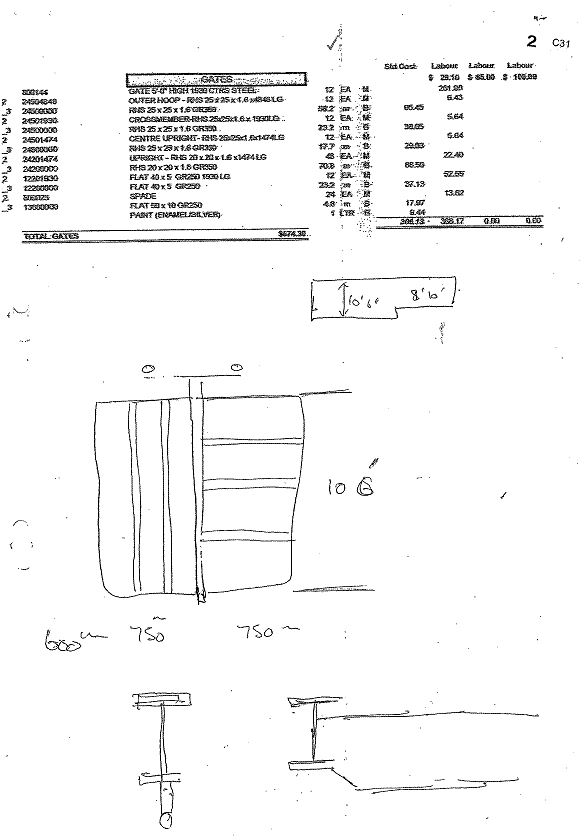
Third Krueger Quote
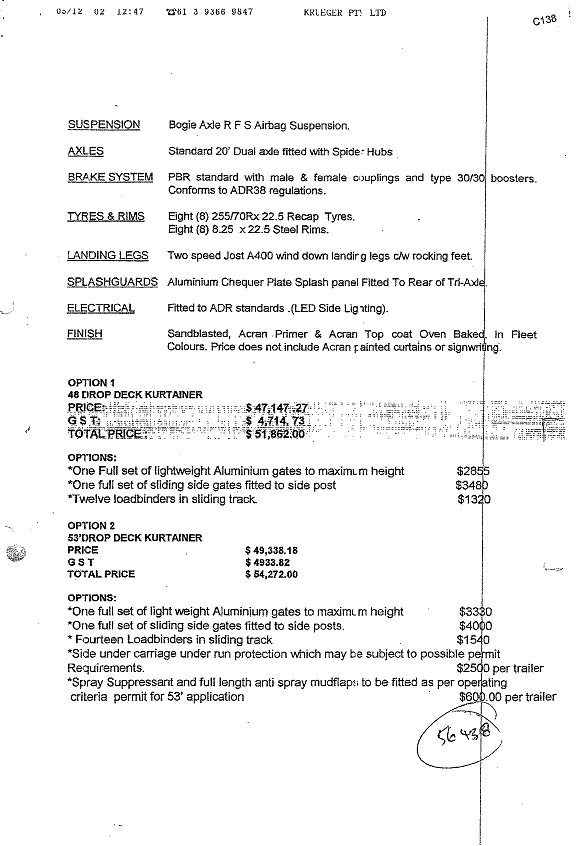
Initial Krueger Drawings
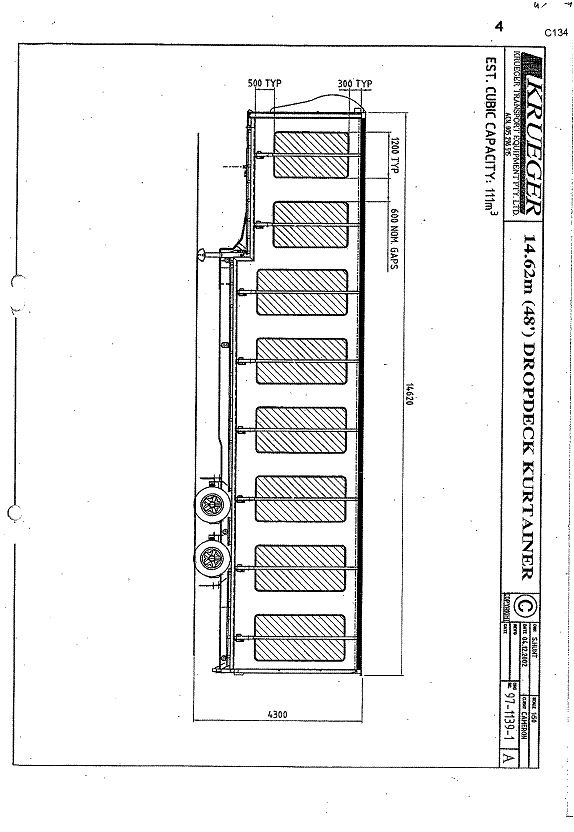
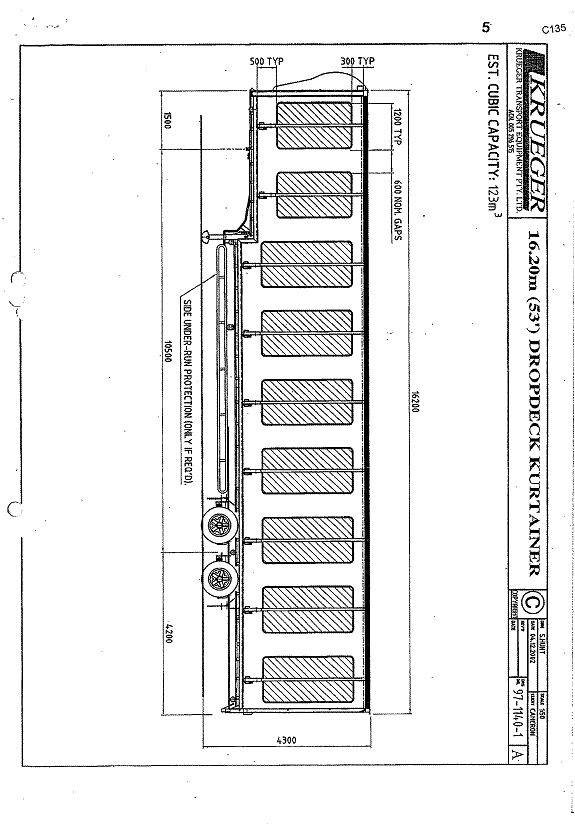
Interim Krueger Drawings
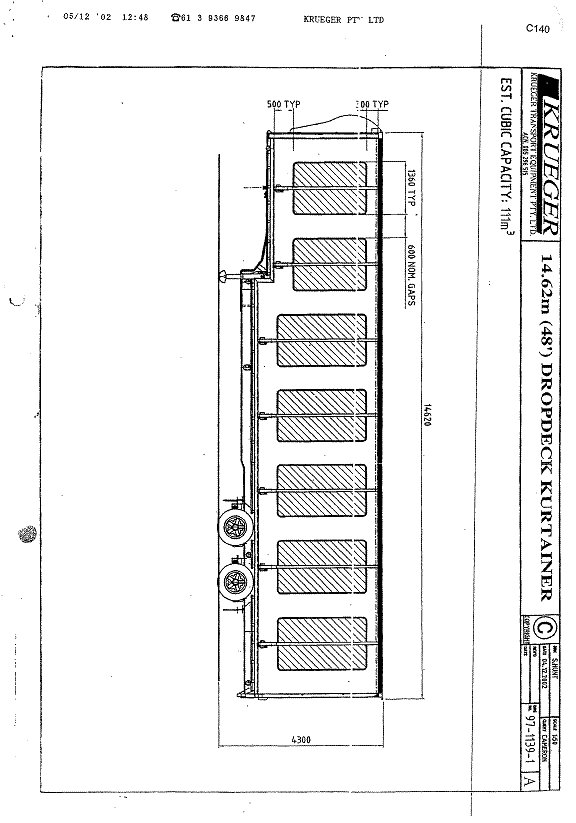
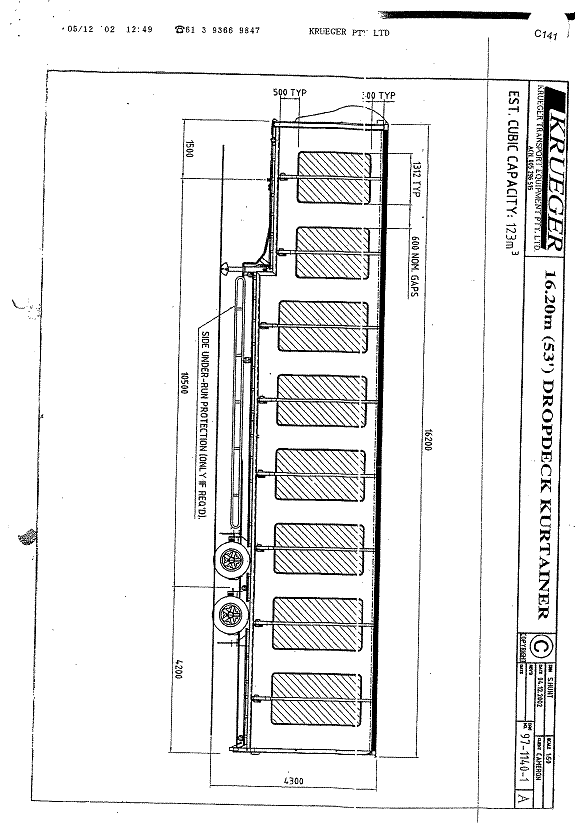
Subsequent Krueger Drawings
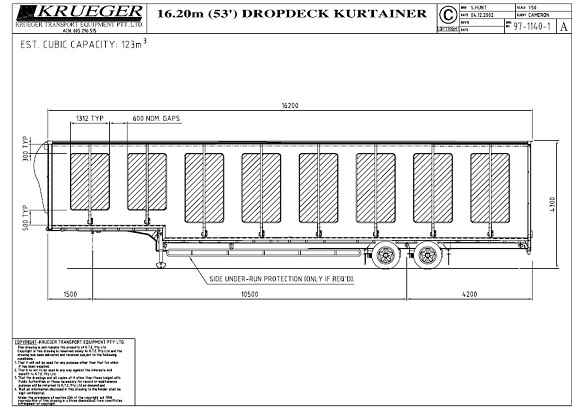
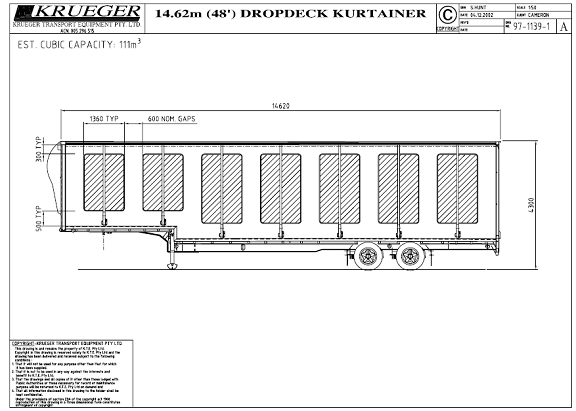
Annexure 2
Vawdrey Sketches
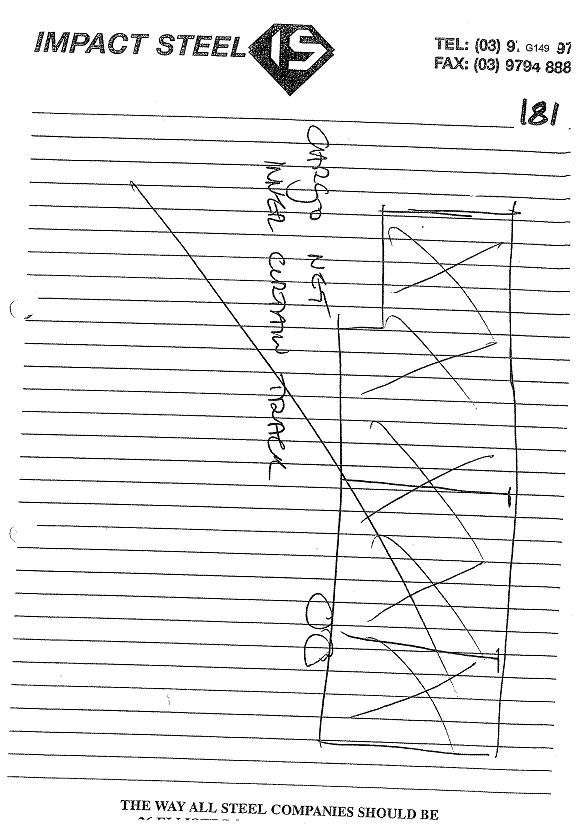
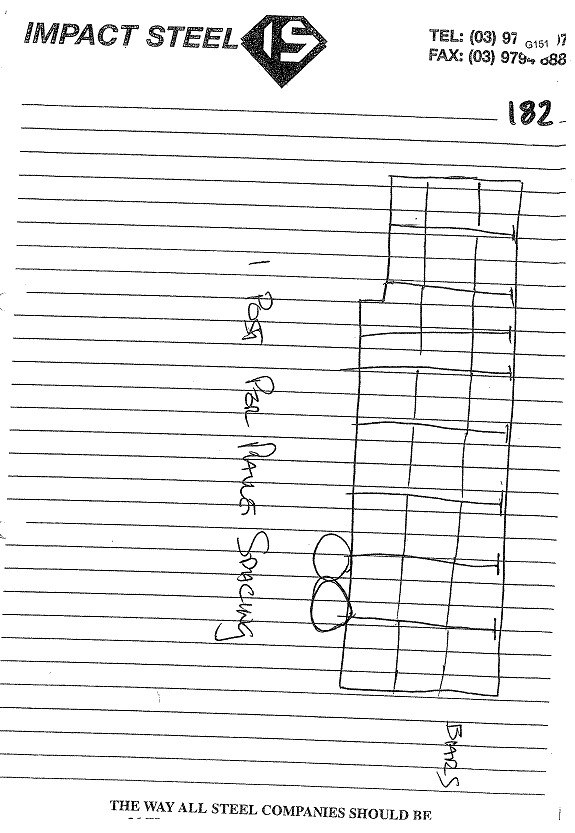
Annexure 3
Grant Krueger Sketch of Krueger Concept
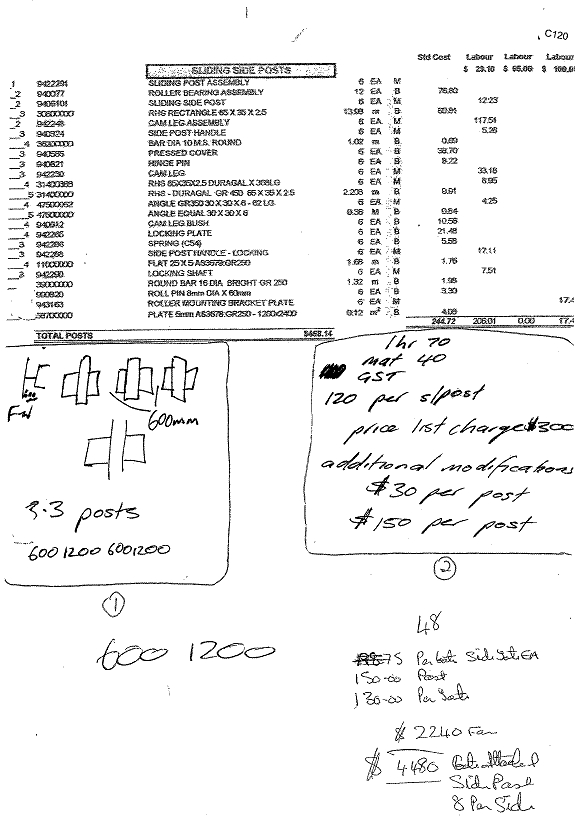
Annexure 4
Adel Gerges Sketch of Krueger Concept
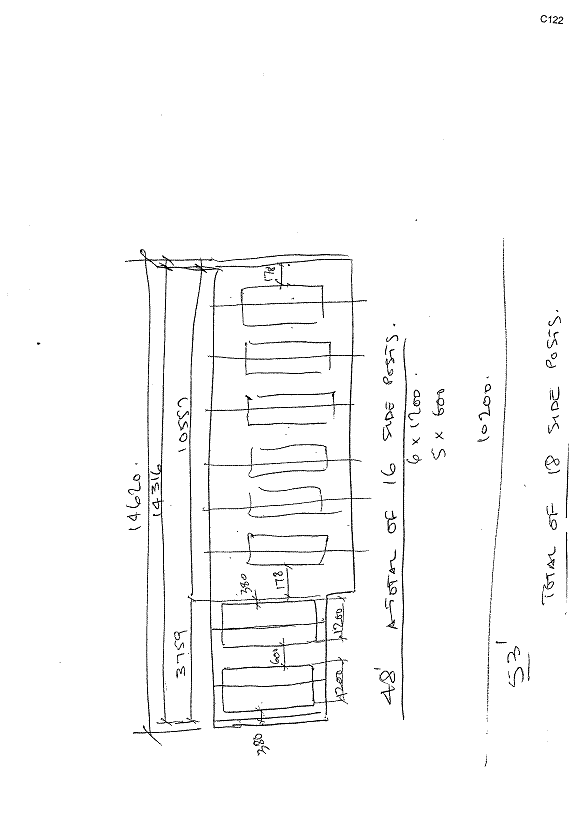
Annexure 5
Gold Wingbars
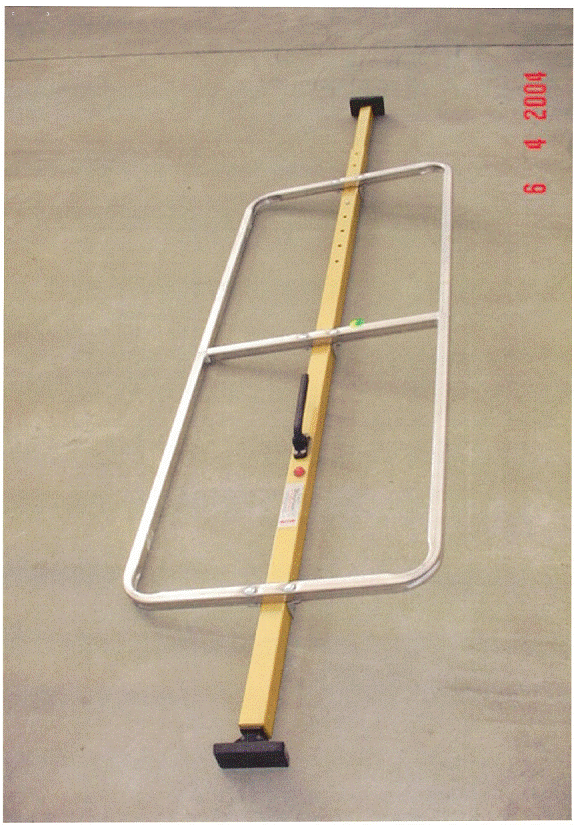
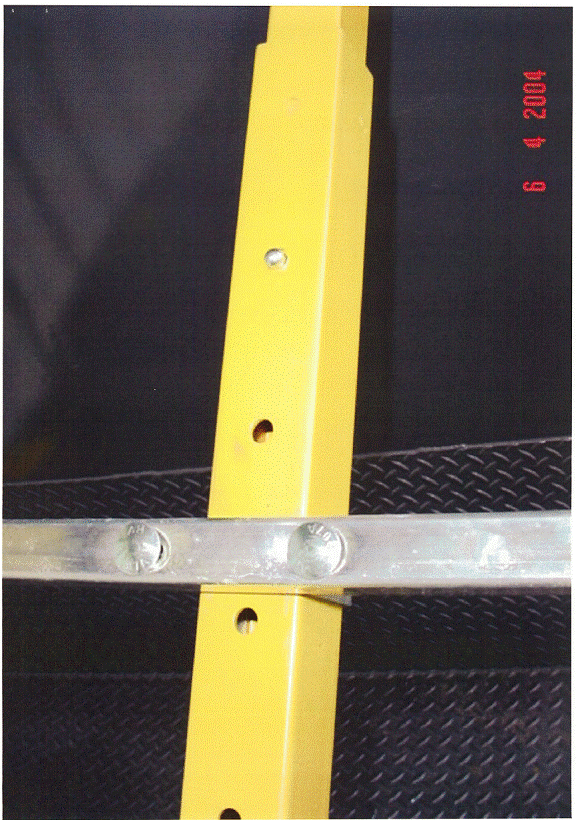
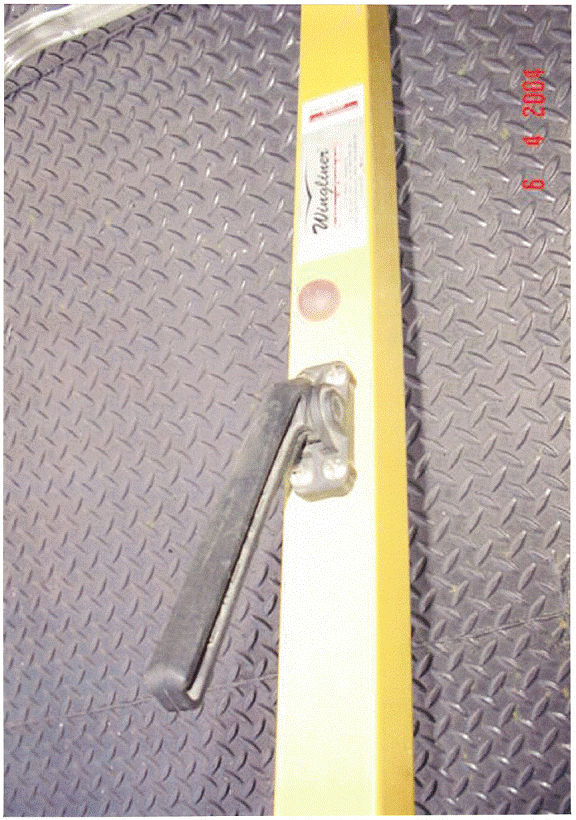
Cargo-Sta
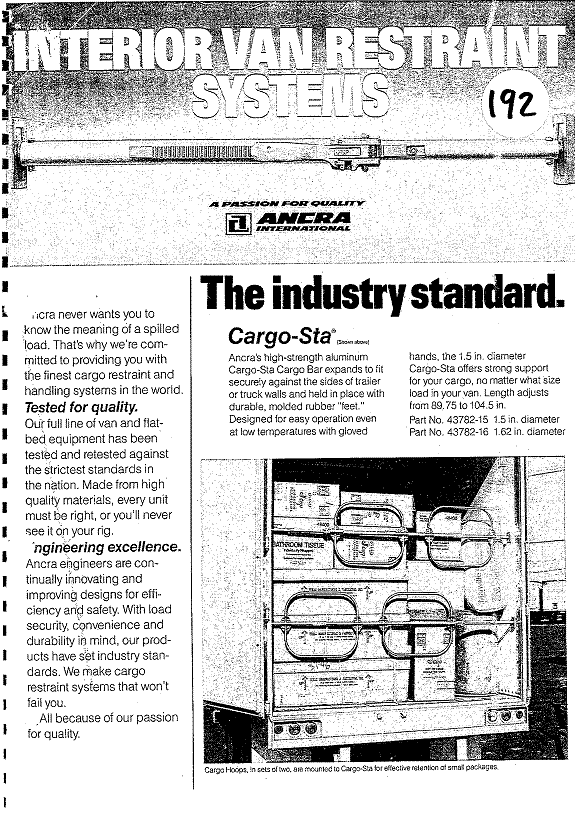
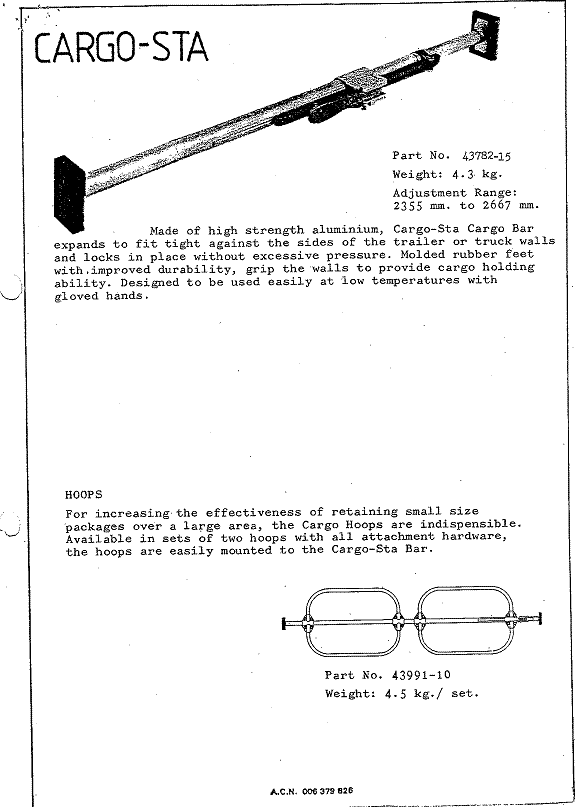
Annexure 6
First Vawdrey Drawing
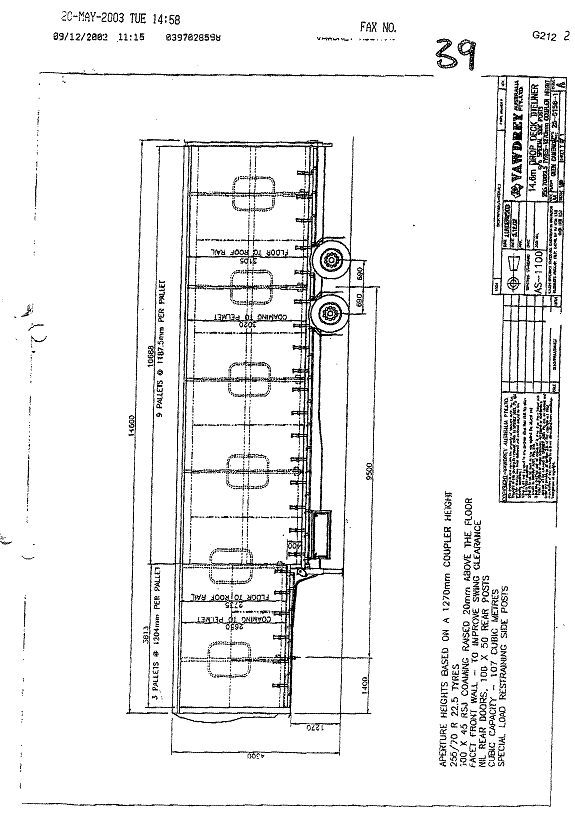
Annexure 7
Vawdrey Engineering Drawings
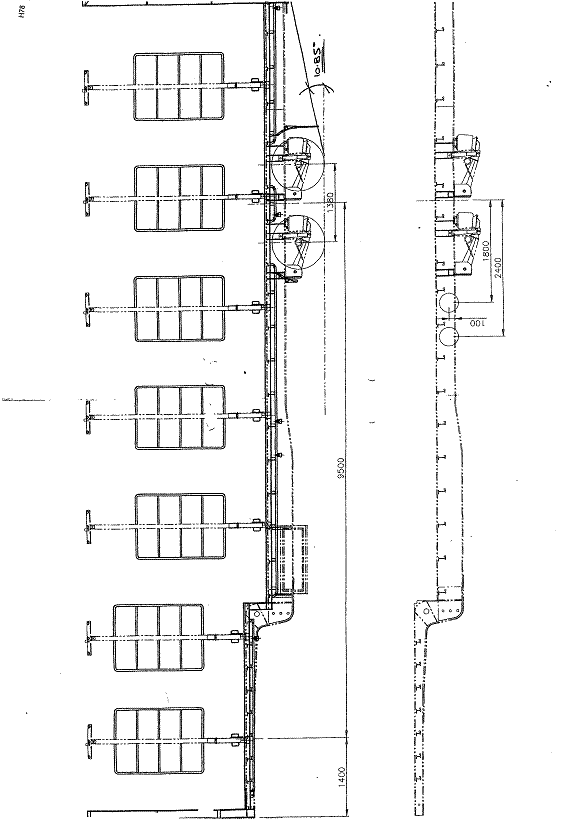
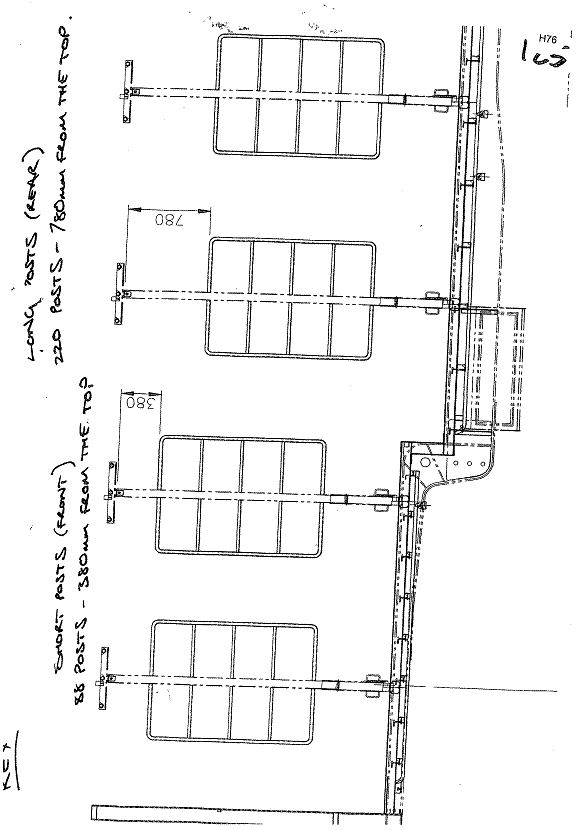
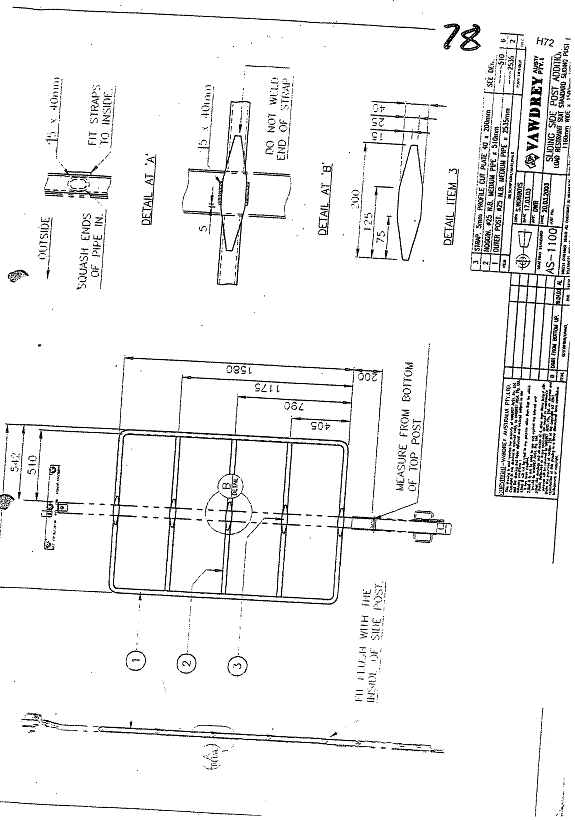
Annexure 8
Vawdrey–type lock Drawings