FEDERAL COURT OF AUSTRALIA
Temple v Powell [2008] FCA 714
Workplace Relations Act 1996 (Cth)ss 170MN, 170ND, 179, 349(2)(a)
Building and Construction Industry Improvement Act 2005 (Cth)ss 2, 36, 37, 38, 48, 49, 57, 75
Industrial Relations Act 1979 (WA)
Crimes Act 1900 (NSW)
Building and Construction Industry Improvement Bill 2005 cll 73, 74
Leighton Contractors Pty Ltd v Construction, Forestry, Mining and Energy Union(2006) 164 IR 375 considered
In re A Solicitor’s Clerk [1957] 1 WLR 1219considered
La Macchia v Minister for Primary Industries (1986) 72 ALR 23considered
The Commonwealth v SCI Operations (1998) 192 CLR 285considered
Coleman v Shell Company of Australia (1943) 45 SRNSW 27considered
Giorgianni v The Queen (1985) 156 CLR 473not followed
Credit Lyonnais Bank Nederland NV v Export Credit Guarantee Department [1998] 1 Lloyd’s Rep 19applied
Credit Lyonnais Bank Nederland NV v Export Credit Guarantee Department [2000] 1 AC 486 cited
Thompson v Australian Capital Television Pty Ltd (1996) 186 CLR 574discussed
The “Koursk” [1924] P 140 considered
Communications, Electrical, Electronic, Energy, Information, Postal, Plumbing and Allied Services Union of Australia v Laing (1998) 89 FCR 17considered
Minister for Industry, Tourism and Resources v Mobil Oil Australia Pty Ltd [2004] FCAFC 72followed
Cruse v CFMEU [2007] FMCA 1873considered
Australian Competition and Consumer Commissioner v CFMEU [2007] ATPR 42-140
WAD 347 of 2006
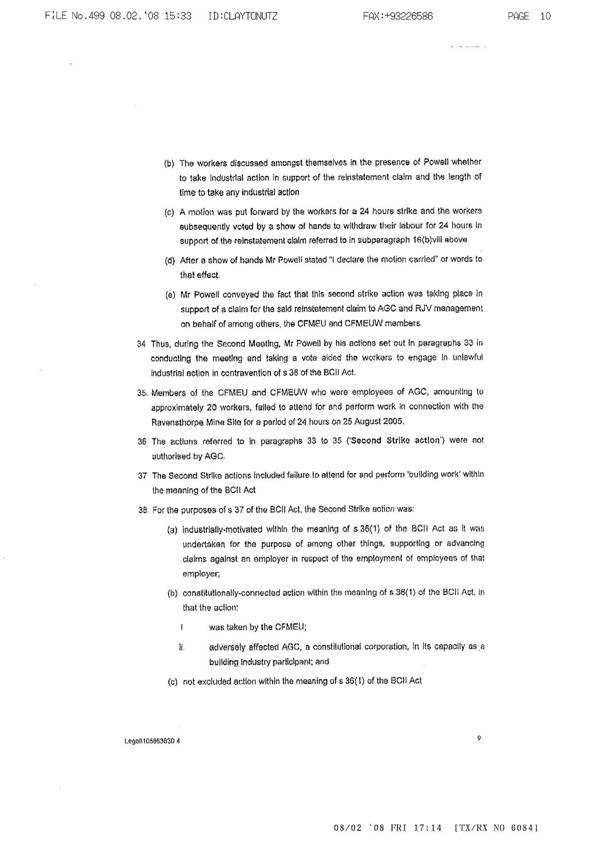
DOWSETT J
23 MAY 2008
BRISBANE (BY VIDEO LINK TO PERTH)
| IN THE FEDERAL COURT OF AUSTRALIA |
|
| WESTERN AUSTRALIA DISTRICT REGISTRY | WAD 347 of 2006 |
| BETWEEN: | MARK TEMPLE Applicant
|
| AND: | MICHAEL POWELL First Respondent
CONSTRUCTION, FORESTRY, MINING AND ENERGY UNION OF WORKERS Second Respondent
JOSEPH MCDONALD Third Respondent
CONSTRUCTION, FORESTRY, MINING AND ENERGY UNION Fourth Respondent
|
| DOWSETT J | |
| DATE OF ORDER: | 23 MAY 2008 |
| WHERE MADE: | BRISBANE (BY VIDEO LINK TO PERTH) |
THE COURT ORDERS THAT:
1. Michael Powell, in connection with his contravention of s 170MN of the Workplace Relations Act 1996 (Cth) on 17 August 2005, pay a penalty in the amount of $1,000.
2. Michael Powell, in connection with his contravention of s 38 of the Building and Construction Industry Improvement Act 2005 (Cth) on 25 August 2005, pay a pecuniary penalty in the amount of $2,500.
3. Construction, Forestry, Mining and Energy Union of Workers, in connection with its contravention of s 38 of the Building and Construction Industry Improvement Act 2005 (Cth) on 25 August 2005, pay a pecuniary penalty in the amount of $12,000.
4. Joseph McDonald, in connection with his contravention of s 170MN of the Workplace Relations Act 1996 (Cth) on 17 August 2005, pay a penalty in the amount of $1,500.
5. Construction, Forestry, Mining and Energy Union, in connection with its contravention of s 170MN of the Workplace Relations Act 1996 (Cth) on 17 August 2005, pay a penalty in the amount of $1,000.
6. Construction, Forestry, Mining and Energy Union, in connection with its contravention of s 178 of the Workplace Relations Act 1996 (Cth) on 17 August 2005, pay a penalty in the amount of $5,000.
7. Construction, Forestry, Mining and Energy Union, in connection with its contravention of s 38 of the Building and Construction Industry Improvement Act 2005 (Cth) on 25 August 2005, pay a pecuniary penalty in the amount of $12,000.
8. Each penalty is to be paid, on or before Monday 8 July 2008, to the District Registrar of the Western Australia District Registry of the Federal Court of Australia who is to remit such payment to the Consolidated Revenue Fund of the Commonwealth or otherwise in accordance with law.
Note: Settlement and entry of orders is dealt with in Order 36 of the Federal Court Rules.
| IN THE FEDERAL COURT OF AUSTRALIA |
|
| WESTERN AUSTRALIA DISTRICT REGISTRY | WAD 347 of 2006 |
| BETWEEN: | MARK TEMPLE Applicant
|
| AND: | MICHAEL POWELL First Respondent
CONSTRUCTION, FORESTRY, MINING AND ENERGY UNION OF WORKERS Second Respondent
JOSEPH MCDONALD Third Respondent
CONSTRUCTION, FORESTRY, MINING AND ENERGY UNION Fourth Respondent
|
| JUDGE: | DOWSETT J |
| DATE: | 23 MAY 2008 |
| PLACE: | BRISBANE (BY VIDEO LINK TO PERTH) |
REASONS FOR JUDGMENT
THE APPLICATION
1 The applicant was, at all material times, an Inspector within the meaning of the Workplace Relations Act 1996 (Cth) (the “WR Act”). At such times he was also an Australian Building and Construction Inspector appointed pursuant to s 57 of the Building and Construction Industry Improvement Act 2005 (Cth) (the “BCII Act”). The applicant seeks declaratory orders, pecuniary penalties and other relief in connection with admitted breaches by the first respondent (“Mr Powell”), the third respondent (“Mr McDonald”) and the fourth respondent (“the CFMEU”) of s 170MN of the WR Act, by the CFMEU of s 178 of that Act and by Mr Powell, the second respondent (“the CFMEUW”) and the CFMEU of s 38 of the BCII Act.
THE LEGISLATION
2 Section 170MN(1) of the WR Act provided as follows:
(1) From the time when:
(a) a certified agreement; or
(b) an award under subsection 170MX(3) (which deals with the exercise of arbitration powers on termination of a bargaining period);
comes into operation until its nominal expiry date has passed, an employee, organisation or officer covered by subsection (2) must not, for the purpose of supporting or advancing claims against the employer in respect of the employment of employees whose employment is subject to the agreement or award, engage in industrial action.
3 Pursuant to s 170ND, s 170MN was a “penalty provision”, meaning that a person who contravened it was liable to a penalty. The maximum penalty, in the case of a corporation, was $33,000 and, in the case of a natural person, $6,600.
4 Section 178(1) provided:
Where an organization or person bound by an award, an order of the Commission … or a certified agreement breaches a term of the award, order or agreement, a penalty may be imposed by the Court or a court of competent jurisdiction.
In the case of a corporation, the maximum penalty was $49,500.
5 Section 38 of the BCII Act provided:
A person must not engage in unlawful industrial action.
6 For the purposes of s 38, s 37 provided that:
Building industrial action is unlawful industrial action if:
(a) the action is industrially motivated; and
(b) the action is constitutionally connected action; and
(c) the action is not excluded action.
7 Section 48 of the BCII Act provided:
(1) In this Part, unless the contrary intention appears:
“appropriate court” means:
(a) for a contravention of section 38- the Federal Court, the Federal Magistrates Court, a Supreme Court of a State or Territory or a District Court, or County Court, of a State; or
(b) for any other contravention-the Federal Court.
“pecuniary penalty order” means an order under paragraph 49(1)(a).
“person”, in relation to a contravention of a civil penalty provision, includes an industrial association.
(2) For the purposes of this Part, a person who is involved in a contravention of a civil penalty provision is treated as having contravened that provision. For this purpose, a person is involved in a contravention of a civil penalty provision if, and only if, the person:
(a) has aided, abetted, counselled or procured the contravention; or
(b) has induced the contravention, whether by threats or promises or otherwise; or
(c) has been in any way, by act or omission, directly or indirectly, knowingly concerned in or party to the contravention; or
(d) has conspired with others to effect the contravention.
8 Section 49(1) provided:
An appropriate court, on application by an eligible person, may make one or more of the following orders in relation to a person (the defendant) who has contravened a civil penalty provision:
(a) an order imposing a pecuniary penalty on the defendant;
(b) an order requiring the defendant to pay a specified amount to another person as compensation for damage suffered by the other person as a result of the contravention;
(c) any other order that the court considers appropriate.
9 The BCII Act received the Royal Assent on 12 September 2005. However, pursuant to s 2, ss 36, 37 and 38 commenced on 9 March 2005. Sections 48 and 49, which were part of Chapter 7, commenced on 12 September 2005. The relevant conduct in this case occurred in August 2005. There is a question as to whether, for present purposes, ss 48 and 49 apply to the conduct which is said to have contravened s 38. I will return to this matter at a later stage.
AGREED FACTS
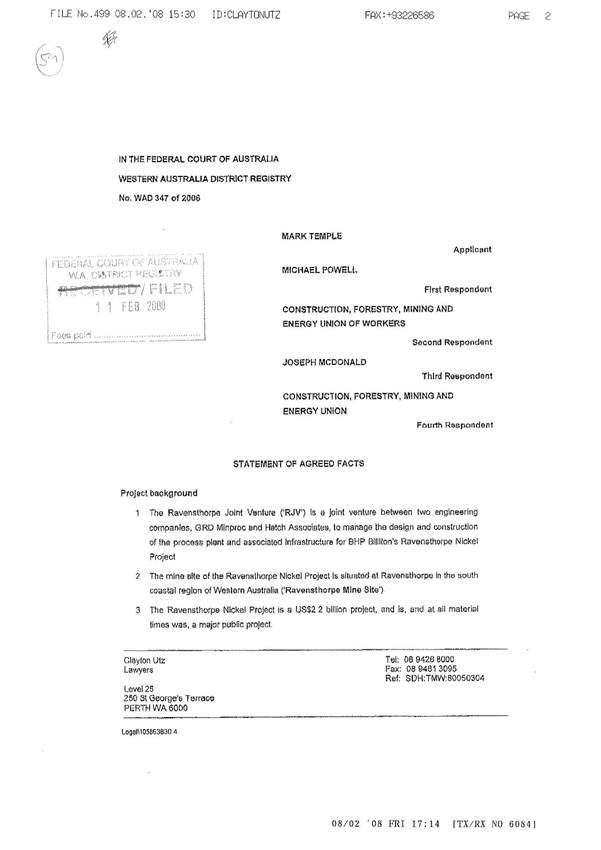
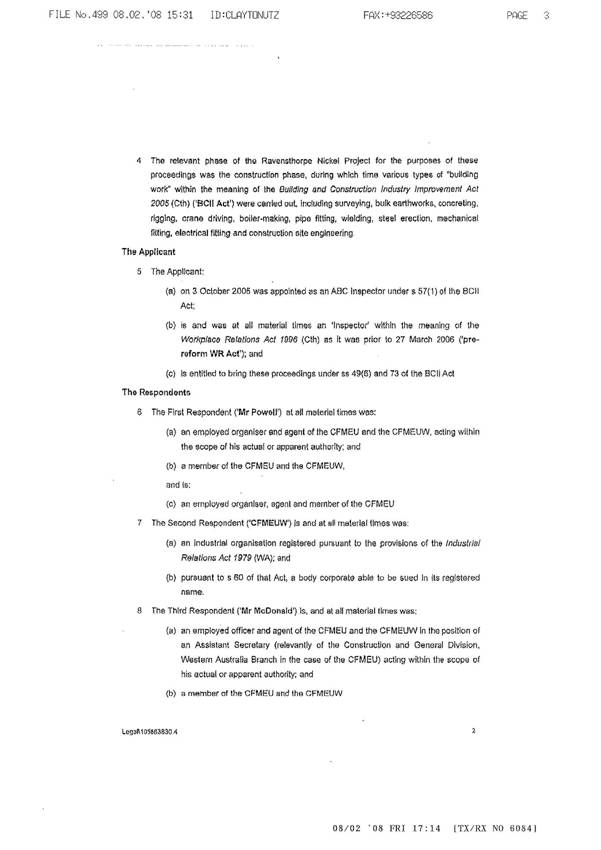
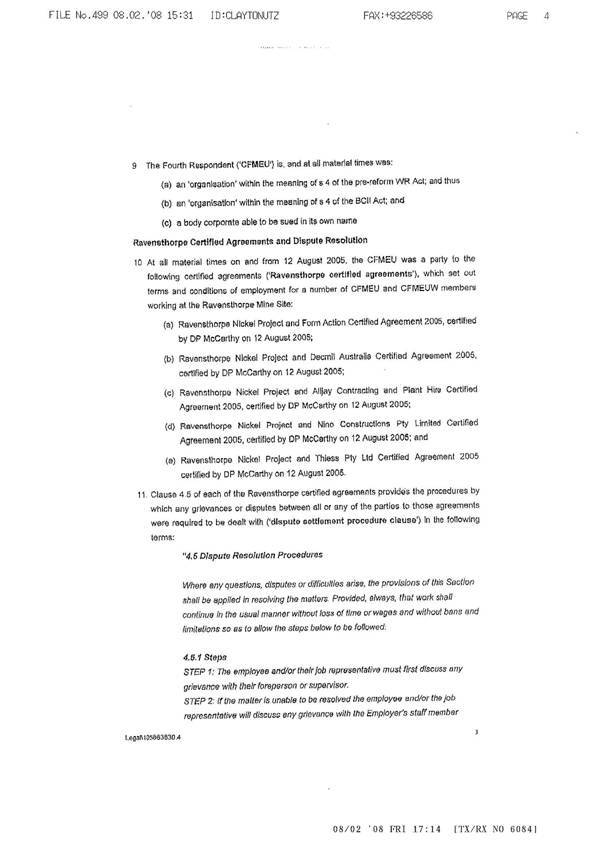
10 The parties have prepared a statement of agreed facts, a copy of which is annexed to these reasons. It will assist in understanding the case if I give a broad outline of the relevant circumstances.
11 The Ravensthorpe Joint Venture was a joint venture between two engineering companies to manage the design and construction of a processing plant and associated infrastructure in connection with a nickel mine at Ravensthorpe in the southern coastal region of Western Australia. It was a very large project. The CFMEUW was an industrial organization registered pursuant to the provisions of the Industrial Relations Act 1979 (WA) (the “State Act”). The CFMEU was an organization for the purposes of both the WR Act and the BCII Act. Mr Powell was a member and an employed organizer and agent of both the CFMEU and the CFMEUW. Mr McDonald was a member and an employed officer and agent of both organizations. At all material times members of both organizations were working at the Ravensthorpe site, being employees of one or other of the following corporations (the “employers”):
· Broadway Pty Ltd trading as Decmil Australia;
· Alljay Contracting Pty Ltd trading as Alljay Construction and Plant Hire;
· Nino Constructions Pty Ltd;
· CBI Constructors Pty Ltd;
· Thiess Pty Ltd;
· AGC Industries Pty Ltd; and
· Formation Concrete Civils Pty Ltd.
12 AGC Industries Pty Ltd (“AGC”) has a particular significance in the case.
13 The CFMEU and the CFMEUW were, at all material times, parties to certified agreements which prescribed the terms and conditions of employment for their members working at the Ravensthorpe site. Those certified agreements were:
(a) Ravensthorpe Nickel Project and Form Action Certified Agreement 2005;
(b) Ravensthorpe Nickel Project and Decmil Australia Certified Agreement 2005;
(c) Ravensthorpe Nickel Project and Alljay Contracting and Plant Hire Certified Agreement 2005;
(d) Ravensthorpe Nickel Project and Nino Constructions Pty Ltd Certified Agreement 2005; and
(e) Ravensthorpe Nickel Project and Theiss Pty Ltd Certified Agreement 2005.
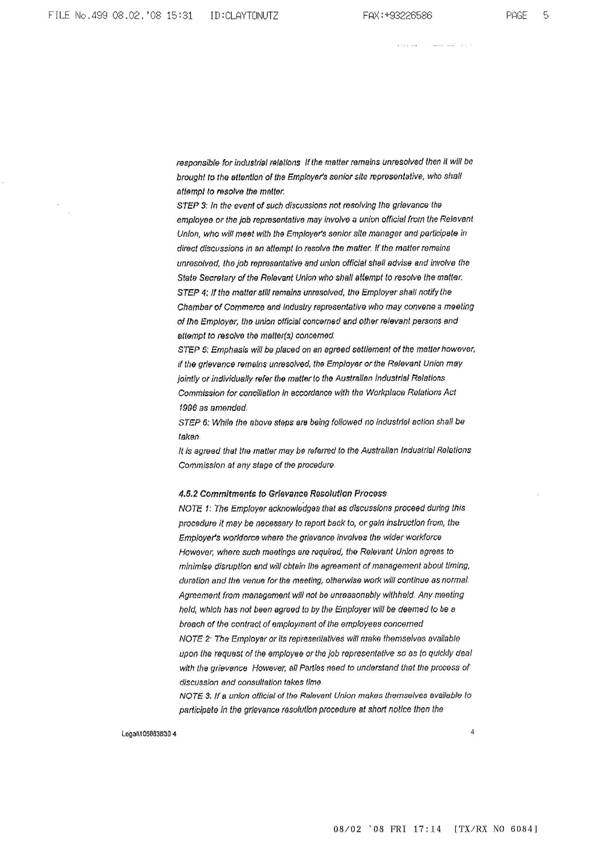
14 All of those agreements were certified on 12 August 2005. Clause 4.5 of each of them provided as follows:
Where any questions, disputes or difficulties arise, the provisions of this Section shall be applied in resolving the matters Provided, always, that work shall continue in the usual manner without loss of time or wages and without bans and limitations so as to allow the steps below to be followed:
4.5.1 Steps
STEP 1: The employee and/or their job representative must first discuss any grievance with their foreperson or supervisor.
STEP 2: If the matter is unable to be resolved the employee and/or the job representative will discuss any grievance with the Employer’s staff member responsible for industrial relations. If the matter remains unresolved then it will be brought to the attention of the Employer’s senior site representative, who shall attempt to resolve the matter.
STEP 3: In the event of such discussions not resolving the grievance the employee or the job representative may involve a union official from the Relevant Union, who will meet with the Employer’s senior site manager and participate in direct discussions in an attempt to resolve the matter. If the matter remains unresolved, the job representative and union official shall advise and involve the State Secretary of the Relevant Union who shall attempt to resolve the matter.
STEP 4: If the matter still remains unresolved, the Employer shall notify the Chamber of Commerce and Industry representative who may convene a meeting of the Employer, the union official concerned and other relevant persons and attempt to resolve the matter(s) concerned.
STEP 5: Emphasis will be placed on an agreed settlement of the matter however, if the grievance remains unresolved, the Employer or the Relevant Union may jointly or individually refer the matter to the Australian Industrial Relations Commission for conciliation in accordance with the Workplace Relations Act 1996 as amended.
STEP 6: While the above steps are being followed no industrial action shall be taken.
It is agreed that the matter may be referred to the Australian Industrial Relations Commission at any stage of the procedure.
4.5.2 Commitments to Grievance Resolution Process
NOTE 1: The Employer acknowledges that as discussions proceed during this procedure it may be necessary to report back to, or gain instruction from, the Employer’s workforce where the grievance involves the wider workforce. However, where such meetings are required, the Relevant Union agrees to minimise disruption and will obtain the agreement of management about timing, duration and the venue for the meeting, otherwise work will continue as normal. Agreement from management will not be unreasonably withheld. Any meeting held, which has not been agreed to by the Employer will be deemed to be a breach of the contract of employment of the employees concerned.
NOTE 2: The Employer or its representatives will make themselves available upon the request of the employee or the job representative so as to quickly deal with the grievance However, all Parties need to understand that the process of discussion and consultation takes time.
NOTE 3: If a union official of the Relevant Union makes themselves available to participate in the grievance resolution procedure at short notice then the provision of 24 hours written notice as per clause 7 1 of this Agreement may be wavered by agreement of the Employer.
NOTE 4: The Employer will ensure that all activities during operation of the procedure are in accordance with safe working practices.
NOTE 5: Sensible time limits will be allowed for the carrying out of all on site steps in this procedure however, this will not prevent the Employer and/or the Relevant Union from notifying the matter to the Australian Industrial Relations Commission for conciliation at any stage.
4.5.3 Sensible Time Limited to be Allowed
Sensible time limits shall be allowed for each step and work shall continue as it was prior to the matter being raised.
No Party will be prejudiced as to any final settlement by the continuance of work.
Matters associated with employee performance and termination of employment shall be progressed in accordance with the Employer’s disciplinary procedures.
However, these procedures do not prevent an employee from seeking any redress under the Workplace Relations Act 1996.
The steps in this Section shall not apply to any bona fide safety concern which will be dealt with in accordance with subsection 6.1 of this Agreement.
INFRINGING CONDUCT
15 The statement of agreed facts describes the relevant infringing conduct as the “First Strike action” and the “Second Strike action”. The First Strike action was the conduct which constituted the alleged breach of s 170MN of the WR Act by Mr Powell, Mr McDonald and the CFMEU and the breach of s 178 by the CFMEU. The Second Strike action constituted the alleged breach of s 38 of the BCII Act by Mr Powell, the CFMEUW and the CFMEU.
The First Strike action
16 On Wednesday 17 August 2005 Messrs Powell and McDonald visited the Raventhorpe site to discuss with CFMEU and CFMEUW members issues arising out of proposed federal industrial legislation. Messrs Powell and McDonald addressed an authorized meeting of about 150 workers, including such members. Mr McDonald referred to the proposed legislation. Somebody asked whether the certified agreements relating to the Ravensthorpe site were in place. Mr McDonald said that he believed that most of them were. He also said that he had heard that there were “issues” at the site, and that those issues could only be discussed if they were raised by employees. A number of issues (the “claims”) were raised, including:
· the provision of a shed for union delegates at the site;
· dust;
· withdrawal of overtime during inclement weather;
· choice of superannuation funds;
· non-payment of superannuation;
· the shop;
· security staff;
· reinstatement of two AGC employees who had been recently terminated; and
· payment of incorrect wages and penalty rates.
17 Those attending the meeting then discussed the claims amongst themselves, but in the presence of Messrs Powell and McDonald. In particular, they discussed the possibility of industrial action and the length of any such action. Somebody moved that they strike for 48 hours. The motion was carried on a show of hands. Mr McDonald said “I declare the motion carried” or words to that effect. He also said that the “company” would “take you all to the Commission” and that, “You run the risk of being called up to give evidence and face prosecution and jail if you fail to answer questions”, or words to that effect. Neither Mr Powell nor Mr McDonald otherwise attempted to discourage the proposed industrial action. Acting on behalf of CFMEU and CFMEUW members, the two men informed management that strike action was to be taken.
18 All CFMEU and CFMEUW members who were employed by the employers failed to attend for, or perform, work for a period of 48 hours. Such action was not authorized and was taken for the purpose of supporting or advancing the claims. Neither the CFMEU nor the CFMEUW had previously pursued those claims. Following the meeting Mr Powell raised “certain issues underlying” the claims with the employers and with the Chamber of Commerce and Industry which acted as employers’ representative. Reinstatement of the two AGC employees was pursued in correspondence and negotiations. CFMEUW subsequently pursued that matter in the Western Australian Industrial Relations Commission. All other claims were resolved shortly after the First Strike action.
19 It is agreed that Mr Powell and Mr McDonald were “parties to or concerned in the First Strike action” acting on behalf of the CFMEU, as its agents or employees, “and within the scope of their authority from the CFMEU, whether actual or apparent.” Section 349(2) of the WR Act provided:
Any conduct engaged in on behalf of a body corporate by:
(a) an officer, director, employee or agent of the body corporate within the scope of his or her actual or apparent authority; or
(b) any other person at the direction or with the consent or agreement (whether express or implied) of an officer, director, employee or agent of the body corporate, where the giving of the direction, consent or agreement is within the scope of the actual or apparent authority of the officer, director, employee or agent;
shall be taken, for the purposes of this Act or the BCII Act (as the case requires) to have been engaged in also by the body corporate.
20 It followed (and is agreed) that Mr Powell, Mr McDonald and the CFMEU contravened s 170MN of the WR Act by engaging in industrial action for the purpose of supporting or advancing claims against employers during the operational period of a certified agreement. Such conduct was also in breach of the dispute settlement procedure clauses in the various certified agreements and so in breach of s 178 of the WR Act. It is agreed that the CFMEU thereby breached s 178.
Second Strike action
21 On 23 and 24 August 2005 Mr Powell attended at the Ravensthorpe site and, on 24 August, addressed an authorized meeting of workers employed by AGC at that site, including members of the CFMEU and the CFMEUW. During that meeting the workers raised the question of reinstatement of the two former employees. In Mr Powell’s presence they discussed the possibility of taking industrial action in support of the claim for reinstatement and the length of any such action. Somebody moved that there be a 24 hour strike. The motion was carried on a show of hands. Mr Powell said: “I declare the motion carried”, or words to that effect. He then conveyed the decision to the employers, acting on behalf of CFMEU and CFMEUW members.
22 Paragraphs 35 to 41 of the statement of agreed facts assert:
35. Members of the CFMEU and CFMEUW who were employees of AGC, amounting to approximately 20 workers, failed to attend for and perform work in connection with the Ravensthorpe Mine Site for a period of 24 hours on 25 August 2005.
36. The actions referred to in paragraphs 33 to 35 (“Second Strike action”) were not authorised by AGC.
37. The Second Strike actions included failure to attend for and perform “building work” within the meaning of the BCII Act
38. For the purposes of s 37 of the BCII Act, the Second Strike action was:
(a) Industrially-motivated within the meaning of s 36(1) of the BCII Act as it was undertaken for the purpose of among other things, supporting or advancing claims against an employer in respect of the employment of employees of that employer;
(b) constitutionally-connected action within the meaning of s 36(1) of the BCII Act, in that the action:
(i) was taken by the CFMEU;
(II) adversely affected AGC, a constitutional corporation, in its capacity as a building industry participant; and
(c) not excluded action within the meaning of s 36(1) of the BCII Act.
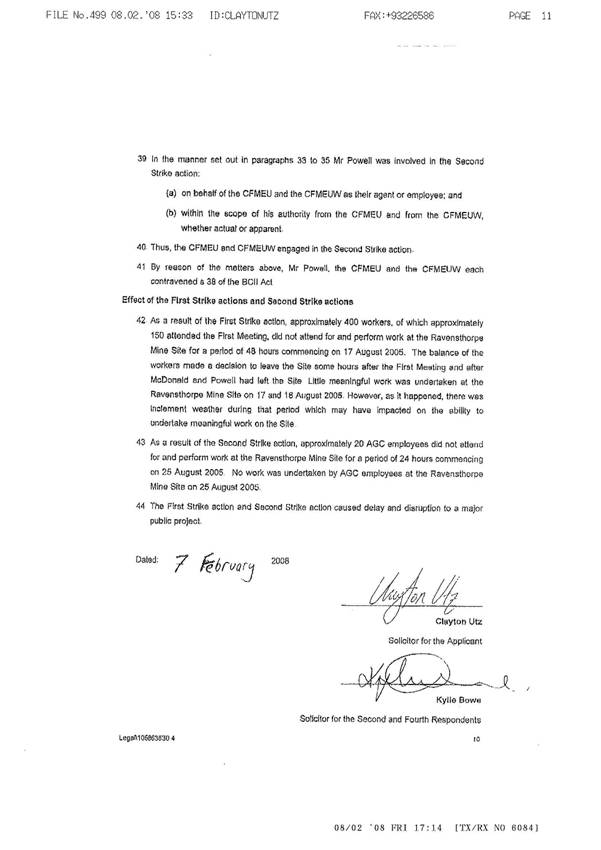
39. In the manner set out in paragraphs 33 to 35 Mr Powell was involved in the Second Strike action:
(a) on behalf of the CFMEU and the CFMEUW as their agent or employee; and
(b) within the scope of his authority from the CFMEU and from the CFMEUW, whether actual or apparent.
40. Thus, the CFMEU and CFMEUW engaged in the Second Strike action.
41. By reason of the matters above, Mr Powell, and the CFMEU and the CFMEUW each contravened s 38 of the BCII Act.
Effect of the First and Second Strike actions
23 At paras 42-44 of the statement of agreed facts it is said that:
42. As a result of the First Strike action, approximately 400 workers, of which approximately 150 attended the First Meeting, did not attend for and perform work at the Ravensthorpe mine site for a period of 48 hours commencing on 17 August 2005. The balance of the workers made a decision to leave the Site some hours after the First Meeting and after McDonald and Powell had left the Site. Little meaningful work was undertaken at the Ravensthorpe Mine Site on 17 and 18 August 2005. However, as it happened, there was inclement weather during that period which may have impacted on the ability to undertake meaningful work on the site.
43. As a result of the Second Strike action, approximately 20 AGC employees did not attend for and perform work at the Ravensthorpe Mine Site for a period of 24 hours commencing on 25 August 2005. No work was undertaken by AGC employees at the Ravensthorpe mine site on 25 August 2005.
44. The first strike action and second strike action caused delay and disruption to a major public project.
SECTIONS 48 AND 49 OF THE BCII
24 At the hearing, I expressed concern arising out of the fact that although s 38 was expressly said to have retrospective effect, s 49 was not. The latter section imposed the relevant penalties and, with s 75, conferred jurisdiction on the Court. I permitted the parties to make submissions in writing concerning that matter. In preparing the statement of agreed facts, the parties had apparently acted upon the basis that s 49 applied so as to permit these proceedings. The applicant has maintained that position, and I do not understand the respondents to have submitted otherwise. However, in their written submissions, the respondents submitted that s 48 did not apply to these proceedings as it was not in force at the time of the Second Strike action. Relevantly, subs 48(2) provided that a person who was involved in a contravention was to be treated as having contravened it. Such involvement was defined in terms which are frequently found in the criminal law and, in recent years, in statutes imposing civil penalties or other civil liability. In the absence of all necessary admissions, one might have expected the applicant to have relied upon subs 48(2) to demonstrate Mr Powell’s liability for his involvement in strike action taken following the meeting of 24 August 2005 and that of the CFMEU and the CFMEUW.
25 Sections 48 and 49 were both located in Chapter 7 of the BCII Act. Section 2 of that Act provided that the chapter was to commence on the date of Royal Assent. If, as has been assumed, s 49 applied to the Second Strike action, it is difficult to see why s 48 should not also have applied. However the respondents submitted that the decision of Le Miere J in Leighton Contractors Pty Ltd v Construction, Forestry, Mining and Energy Union (2006) 164 IR 375 established that s 48 did not apply to conduct occurring prior to 12 September 2005, although his Honour appears to have accepted that s 49 did apply.
26 The applicant accepted that s 48 had no application for present purposes but asserted that the respondents had admitted the alleged contraventions, and that the precise basis for treating Mr Powell, the CFMEUW and the CFMEU as having contravened s 38 was not in dispute. The applicant also submitted that the common law concerning accessorial liability would fill any “lacuna” caused by the absence of a provision such as s 48.
27 The respondents have not sought to withdraw any of the admissions contained in the statement of agreed facts. I propose to dispose of the matter upon the basis of such facts. However, in identifying the seriousness of the conduct alleged against each respondent it will be necessary to say something about accessorial liability. Because the question has been ventilated at length, I will first address the question of whether s 49 applied to the conduct of the first, second and fourth respondents in connection with the Second Strike action. As the applicant has not relied upon s 48, it is not necessary to consider its application for present purposes.
Operation of s 49
28 The applicant submitted that s 49 was intended to apply to conduct occurring between 9 March and 12 September 2005. That approach to s 49 was based upon a series of decisions which commenced with In re A Solicitor’s Clerk [1957] 1 WLR 1219. The case concerned legislation which prohibited the continued employment as a solicitor’s clerk of a person who had previous convictions for offences of dishonesty. The relevant legislation had, at one stage, applied to a solicitor’s clerk who was convicted of larceny, embezzlement, fraudulent conversion or any other criminal offence in respect of money or property belonging to, or held by, the solicitor who employed him or her, or any client of such solicitor. The Act was amended so that it applied to a solicitor’s clerk who had been convicted of larceny, embezzlement or fraudulent conversion of any money or property, regardless of who owned or controlled it. The question was whether the amendment applied to a clerk who had been convicted of such an offence prior to the amendment. In the Queen’s Bench Division Lord Goddard CJ said, at 1222-1223 (Barry and Havers JJ concurring):
In all editions of Maxwell on the Interpretation of Statutes it is stated that it is a fundamental rule of English law that no statute should be construed to have a retrospective operation unless such a construction appears very clearly in the terms of the Act or arises by a necessary or distinct implication and this passage has received judicial approval by the Court of Appeal … . But in my opinion this Act is not in truth retrospective. It enables an order to be made disqualifying a person from acting as a solicitor’s clerk in the future and what happened in the past is the cause or reason for the making of the order, but the order has no retrospective effect. It would be retrospective if the Act provided that anything done before the Act came into force or before the order was made should be void or voidable, or if a penalty were inflicted for having acted in this or any other capacity before the Act came into force or before the order was made. This Act simply enables a disqualification to be imposed for the future which in no way affects anything done by the appellant in the past.
29 In La Macchia v Minister for Primary Industries (1986) 72 ALR 23, the Full Court considered a provision pursuant to which the relevant minister might cancel a fishing licence if the holder were convicted of certain offences. That section took effect from 31 August 1985. On 13 June 1985 one joint licence holder was convicted of a relevant offence. On 14 October 1986 the minister decided to cancel the licence. The question was whether or not the minister was entitled to do so upon the basis of a conviction recorded prior to the commencement of the legislation authorizing such cancellation. At 26-27, Toohey J (Bowen CJ concurring) said:
There are, I think, only two other matters in the applicant’s case that call for comment.
The first is the argument that, in relying upon a power in section 9A(3A) which did not exist at the time of the conviction of Mr La Macchia, a penal power was exercised retrospectively. There are two answers to this contention. The first is that the Minister was not exercising a penal power even though cancellation imposed a hardship on the applicants by depriving them for a time of their ability to fish commercially. Cancellation is not part of the penalty a Court of Petty Sessions may impose. It is part of the scheme of the Act which seeks to control commercial fishermen in their fishing activity. Rock lobsters are a valuable common property resource and activities damaging the resources are hard and costly to police. The power of cancellation is an important aspect of the system of control and should be seen in that light.
Secondly, while the Minister could not have given notice prior to the sub-section coming into operation, he was not constrained thereafter to rely upon a conviction that itself occurred after the sub-section came into operation. The commission of an offence, whether before or after 31 August 1985, is a circumstance warranting the giving of a notice under sub-section (3A). The order does not have retrospective effect simply because it relies upon conduct that occurred before the power existed … .
30 Finally, in The Commonwealth v SCI Operations (1998) 192 CLR 285, at 309 McHugh and Gummow JJ referred with apparent approval to an observation by Jordan CJ in Coleman v Shell Company of Australia (1943) 45 SRNSW 27 at 30-31. His Honour said, concerning the retrospective operation of statutes:
As to the first question, it is to be noted that there has been some ambiguity in the use of the word “retrospective”. In some cases, it has been said that it would give a retrospective operation to a statute to treat it as impairing an existing right or obligation or creating a new right or obligation … . On the other hand it was said … that an Act is retrospective if it provides that as at past date the law shall be taken to have been that which it was not. It is not retrospective because it interferes with existing rights. Most Acts do. There is no presumption that interference with existing rights is not intended; but there is a presumption that an Act speaks only as to the future. Similarly it has been said that an amendment of a section in an Act makes it retrospective in its original form but not retrospective so far as it is new … .
Upon a consideration of the authorities, I think that as regards any matter or transaction, if events have occurred prior to the passing of the Act which have brought into existence particular rights or liabilities in respect of that matter or transaction, it would be giving a retrospective operation to the Act to treat it as intended to alter those rights or liabilities, But it would not be giving it a retrospective operation to treat it as governing the future operation of the matter or transaction as regards the creation of further particular rights or liabilities.
31 The applicant submitted that these cases demonstrate that to apply s 49 to conduct occurring prior to 12 September 2005 would not mean that it had retrospective effect, the section merely speaking “as to the future”. However, it is at least arguable that the effect of s 49, upon its commencement on 12 September 2005, was to impose a penalty on past conduct which had not previously attracted such a penalty. In any event, the question of intended retrospective effect is a matter of construction.
32 The BCII Act is somewhat different from the legislation considered in the cases to which I have referred. On its face, it was intended to have some retrospective effect. By fixing 9 March 2005 as the commencing date for ss 36, 37 and 38 Parliament clearly intended to proscribe conduct which was, at the time of its commission, lawful. The question is whether, as a matter of construction, Parliament intended to impose a pecuniary penalty upon persons who had, prior to the enactment of s 38, engaged in conduct which was proscribed by that section. Given the clear intention to render such conduct unlawful, it is difficult to avoid the inference that Parliament intended that such conduct attract the prescribed sanctions. Subject only to the possibility that one should start with the presumption against retrospectivity, the natural wording of s 49 suggested that it applied to all breaches of s 38, whether they occurred before or after 12 September 2005. The clear intention (in s 38) to proscribe conduct with retrospective effect offers a firm basis for concluding that the sanctions prescribed by s 49 were to attach to all infringing conduct occurring after the commencement of s 38. It was at least implied on behalf of the respondents that the intention may have been to allow a period of grace before the imposition of penalties took effect. Such an approach seems unlikely. It is more likely that Parliament realized that because the legislation (including s 38) would not actually take effect until the date of Royal Assent, there could be no proceedings prior thereto.
33 In any event, there is extrinsic material which suggests that the intention was that such civil penalties be attracted by conduct occurring on and after 9 March 2005. In the explanatory memorandum issued in connection with the Building and Construction Industry Improvement Bill 2005 at para 17 it was said that:
The provisions of the BCII Bill dealing with industrial action and increased penalties for breaches of the strike pay provisions will operate from the date of introduction. Many certified agreements in the building and construction industry are due to expire later in the year. The retrospective character of this Bill will ensure that unions that take unlawful industrial action prior to the nominal expiry date of these and other existing agreements in the coming months, will be subject to the sanctions and greater penalties provided by the BCII Bill. Likewise parties who are affected will be able to seek damages to recover any losses they suffer.
34 On 9 March 2005 in his Second Reading Speech, the Minister for Employment and Workplace Relations said (Parliamentary Debates (House of Representatives) Official Hansard at p 6):
The provisions prohibiting unlawful industrial action will take effect from introduction. The remainder of the provision of this Bill will take effect on the day on which this Act receives the Royal Assent.
From this day forward, industrial action taken by unions to pursue the early negotiation of new agreements would not only be unprotected but also unlawful. If unions or other parties take unlawful industrial action they will be subject to civil penalty. This clause mirrors the penalty clause in the previous version of this Bill.
35 There may be a degree of ambiguity as to the meaning of the expression “From this day forward”. However, when read with the explanatory memorandum, it is clear that the intention was to impose penalties upon conduct which occurred after introduction of the Bill and before receipt of the Royal Assent. I have referred to some of the earlier versions of the Bill. One version, received in the Federal Court library in Brisbane on 14 March 2005 (presumably the Bill introduced into the House on 9 March 2005) provided, in cl 2, that Chapter 6 take effect on 9 March 2005. Chapter 6 of that draft contained cll 73 and 74, which are now ss 37 and 38. Given the clear intention disclosed in the Explanatory Memorandum that conduct occurring after 9 March 2005 be subject to the sanctions prescribed in the Act, there is no reason to read the words of s 49 other than in accordance with their ordinary meaning. Section 49 imposed civil penalties upon persons who acted in breach of s 38 on or after 9 March 2005.
ACCESSORIAL LIABILITY
36 The applicant sought to demonstrate accessorial liability by reference to the common law. He relied particularly upon the decision in Giorgianni v The Queen (1985) 156 CLR 473 per Gibbs CJ at 480 and per Mason J at 492. That case concerned a section of the Crimes Act 1900 (NSW) which provided:
Any person who aids, abets, counsels or procures the commission of any misdemeanour … may be indicted, convicted and punished as a principal offender.
37 At 480 Gibbs CJ said, concerning that section:
Section 351 of the Crimes Act is based on section 8 of the Accessories and Abettors Act 1861 (UK), which it has often been said, was only declaratory of the common law on the subject … . Although it was said, …, that there is a difference between the four words (aids, abets, counsels, procures) used in the section, and that each word must be given its ordinary meaning, it is apparent that the ordinary meaning of some at least of those words overlaps and that sometimes the words are used in particular combinations or as a phrase which is to be considered as a whole … . When used in relation to felonies, the words “aid and abet” describe the action of a person who was present at the commission of the offence and took some part therein (who was called the principal in the second degree as well as an “aider and abettor”), whereas “counsel and procure” described an accessory before the fact who was not present at the commission of the offence … . The usage was not always uniform or discriminating. The distinction between principals in the first and second degree and between principals and accessories now generally has no legal importance … . No similar distinction was drawn in the case of misdemeanours, and at common law, in cases of misdemeanour, anyone who, in the case of a felony, would have been a principal in the second degree, or an accessory, was a principal offender and was treated as if he had taken the same path as the active perpetrator of the facts constituting the offence … . The reason for mentioning those matters, which are now largely of historical interest, is that statements in the authorities regarding the mental state necessary to constitute a person an accessory before the fact in the case of a felony will apply equally to a person who has counselled or procured the commission of a misdemeanour. Further, it will be found that statements which refer to the knowledge and intention necessary to make a person an aider and abettor will often be equally applicable to a person who has counselled or procured the commission of the offence.
Russell on Crime, 12th ed (1964), p 151, states that “the bare minimum” which is necessary to constitute a person an accessory before the fact is that his conduct should indicate “(a) that he knew that the particular deed was contemplated, and (b) that he approved of or assented to it, and (c) that his attitude in respect of it in fact encouraged the principal. …” There is a strong body of authority which supports the view that knowledge of the facts is necessary before a person can be made liable as a secondary party for the commission of an offence. In Johnson v Youden …, Lord Goddard CJ stated the position in relation to aiders and abettors as follows:
Before a person can be convicted of aiding and abetting the commission of an offence he must at least know the essential matters which constitute that offence. He need not actually know that an offence has been committed, because he may not know that the facts constitute an offence and ignorance of the law is not a defence.
38 At 492, Mason J said:
The terms “aid, abet, counsel or procure” requires some comment. In England the approach has been taken that those terms, as they occur in section 8 of the Accessories and Abettors Act 1861 (UK) … should be treated as four separate words and, so far as possible, be given their ordinary meaning … . This approach has attracted some criticism … . In any case, it has no application to the construction of the same terms as they appear in s 351. Once it is acknowledged that those terms are merely declaratory of the common law, it is to the common law concept of secondary participation, and not to the ordinary meaning of the words themselves, that regard must be had.
In felony at common law the terms “aid” and “abet” are generally used to refer to the conduct of a principal in the second degree, or one who is present at the commission of the offence by the principal offender while the terms “counsel” or “procure” are generally used in relation to the conduct of an accessory before the fact, or one who is absent at the time of the commission of the offence … . In substance, however, there appears to be no distinction between a principal in the second degree and an accessory before the fact beyond the question of presence. In misdemeanour, where no attempt has been made to classify the parties to an offence, each of the four terms is employed to refer to the conduct of a secondary participant. But the terms are descriptive of a single concept. In this regard, I would adopt the observation of Cussen ACJ in R v Russell …, as being applicable to secondary participation in misdemeanour. Having listed various words, including “aiding” and “abetting” which have been used to refer to the conduct of a principal in the second degree in felony, his Honour observed:
All the words mentioned are, I think, instances of one general idea, that the person charged as a principal in the second degree is in some way linked in purpose with the person actually committing the crime, and is by his words or conduct doing something to bring about, or rendering more likely, such commission.
As R v Russell itself illustrates, there need not exist any agreement or a consensus between the principal in the second degree or secondary participant and the principal offender.
39 I have cited these passages at some length because the applicant assumed that these cases establish that the various statutory provisions relating to parties to offences reflected the position at common law in connection with torts. However, in Credit Lyonnais Bank Nederland NV v Export Credit Guarantee Department [1998] 1 Lloyd’s Rep 19 the Court of Appeal rejected that proposition. See, in particular, the judgment of Stuart-Smith LJ at 35-36 and that of Hobhouse LJ at 42-46. Hobhouse LJ identified three categories of conduct by a person other than the actual perpetrator which might attract criminal liability. They were:
· those who solicit or incite another to commit a crime or conspire with another to commit a crime;
· those who aid another in the commission of a crime, often known as “aiding, abetting, counselling and procuring”; and
· principals whose agents commit offences.
40 His Lordship concluded, at 46, that only conduct which fell into either the first or the third category would constitute a tort at common law. In other words, at common law, aiding, abetting, counselling and procuring was not a basis for tortious liability. On appeal to the House of Lords (reported at [2000] 1 AC 486) the decision of the Court of Appeal was upheld, although on slightly different grounds. Their Lordships observed that the criminal law might not offer a good guide to accessorial liability in tort. See the speech of Lord Wolfe MR at 496-500 (Lord Slynn, Lord Steyn, Lord Clyde and Lord Millett agreeing).
41 In Thompson v Australian Capital Television Ltd (1996) 186 CLR 574 the High Court considered accessorial liability in tort. At 580-1 Brennan CJ, Dawson and Toohey JJ said:
… (F)or there to be joint tort feasors there must be a concurrence in the act or acts causing damage … (T)o constitute joint tort feasors two or more persons must act in concern in committing the tort.
42 As with the decision in Credit Lyonnais these propositions were largely based upon the decision of the Court of Appeal in The “Koursk” [1924] P 140. In Thompson at 600, Gummow J said, concerning the judgments in The “Koursk”:
Scrutton LJ … there spoke of “two persons who agree on common action, in the course of, and to further which, one of them commits a tort”, saying that in such a case there is one tort committed by one of them “in concert with another”. Sargant LJ … accepted the proposition that persons are joint tort feasors when their “respective shares in the commission of the tort are done in furtherance of a common design” so that those who “aid or counsel, direct, or join” in commission of the tort are joint tort feasors … .
43 It was not necessary for his Honour to consider whether there was any inconsistency between the two propositions or to state any preference as between them.
44 This case is not a suitable vehicle for further exploration of any distinction between accessorial liability in crime and in tort. It is sufficient to say that there may be dangers in seeking to apply decisions as to common law accessorial liability in crime when considering accessorial liability in tort. Assuming that there is a difference between the position in crime and that in tort, there is a further policy question as to which should be adopted in proceedings for civil penalties. Again, it is neither appropriate nor necessary that I consider that matter further.
CONDUCT ATTRACTING PENALTIES
Breach of s 170MN of the WR Act
45 Paragraphs 17-20 of the statement of agreed facts demonstrates that the relevant industrial action was the failure of employees to attend for, and perform, work for a period of 48 hours. In para 17 it is agreed that Mr McDonald and Mr Powell were parties to, or otherwise concerned in, such unlawful action. In para 23 it is agreed that both men were parties to, and concerned in, the First Strike action on behalf of the CFMEU (as agents or employees) and within the scope of their authority from the CFMEU, whether actual or apparent. Paragraph 23 appears to lay a basis for reliance upon s 349(2)(a) of the WR Act to which I have previously referred. In other words, para 23 asserts the basis for the CFMEU’s liability for the actions of Mr McDonald and Mr Powell. In para 24 it is agreed that the CFMEU should be ‘‘taken to have engaged in the First Strike action”. Finally, in para 25 it is agreed that Mr McDonald, Mr Powell and the CFMEU contravened s 170MN.
46 Mr Powell and Mr McDonald’s involvement was their attendance at, and conduct of, the relevant meeting and, perhaps, the subsequent notification to management of the proposed strike. The CFMEU was liable to a penalty in connection with that conduct by virtue of the relationship between the two men and that organization. The conduct of the employees was unlawful by virtue of its having occurred during the term of the certified agreements and being for the purpose of supporting or advancing claims against employers in respect of the employment of employees whose employment was subject to such agreements.
Breach of s 178 of the WR Act
47 The gravamen of this offence was that the CFMEU, whilst bound by the various certified agreements, breached the dispute resolution procedure prescribed therein by engaging in industrial action without first following prescribed procedures. It is agreed that Mr McDonald and Mr Powell’s conduct constituted a breach by the CFMEU of those agreements. Clearly, the conduct which constituted this breach was substantially the same as that which constituted the breach of s 170MN.
Breach of s 38 of the BCII Act
48 Pursuant to s 37 building industrial action was unlawful industrial action if:
(a) the action is industrially-motivated; and
(b) the action is constitutionally-connected action; and
(c) the action is not excluded action.
The parties agree that the Second Strike action satisfied those requirements. However it is necessary to say a little about them.
49 “Building industrial action” was defined in s 36 to mean:
(a) the performance of building work in a manner different from that in which it is customarily performed, or the adoption of a practice in relation to building work, the result of which is a restriction or limitation on, or a delay in, the performance of the work, where:
(i) the terms and conditions of the work are prescribed, wholly or partly, by an industrial instrument or an order of an industrial body; or
(ii) the work is performed, or the practice is adopted, in connection with an industrial dispute (within the meaning of subsection (4)); or
(b) a ban, limitation or restriction on the performance of building work, or on acceptance of or offering for building work, in accordance with the terms and conditions prescribed by an industrial instrument or by an order of an industrial body; or
(c) a ban, limitation or restriction on the performance of building work, or on acceptance of or offering for building work, that is adopted in connection with an industrial dispute (within the meaning of subsection (4)); or
(d) a failure or refusal by persons to attend for building work or a failure or refusal to perform any work at all by persons who attend for building work;
but does not include:
(e) action by employees that is authorised or agreed to, in advance and in writing, by the employer of the employees; or
(f) action by an employer that is authorised or agreed to, in advance and in writing, by or on behalf of employees of the employer; or
(g) action by an employee if:
(i) the action was based on a reasonable concern by the employee about an imminent risk to his or her health or safety; and
(ii) the employee did not unreasonably fail to comply with a direction of his or her employer to perform other available work, whether at the same or another workplace, that was safe for the employee to perform.
50 The conduct identified in paras (a) and (d) would, almost certainly, have been the conduct of employers or employees. However the conduct identified in paras (b) and (c) may have been the conduct of others. In Communications, Electrical, Electronic, Energy, Information, Postal, Plumbing and Allied Services Union of Australia v Laing (1998) 89 FCR 17 at 30-31, French J observed, concerning a similar provision in the WR Act:
While par (a) of the definition relates to the “performance of work”, par (b) is more broadly expressed. It refers to “a ban, limitation or restriction on the performance of work, or on the acceptance of or offering for work”. The central meaning of the term “ban” in the industrial, as in its ordinary usage, is to “prohibit or interdict”: the Macquarie Dictionary. Communication between persons or an organization and persons is essential to a “ban”. And while the notion of “limitation” or “restriction” may have a meaning related to manner of actual performance of work, that meaning is picked up in par (a) of the definition. Under par (b) it extends to the communication of a limitation or restriction. Communication picked up under pars (b) and (c) must no doubt purport to be at least hortatory, if not authoritative and binding, upon the person or persons to whom they are directed.
In the ordinary course such communication will be verbal whether oral, written or in electronic form. Being intended to affect or affecting the performance of work, it is industrial action because of its instrumental character. Notwithstanding that it is communication it falls within the terms of the definition.
51 At 32, his Honour continued:
So a picket line whose purpose is to prevent or deter or discourage employees from attending on their employer’s premises and from carrying out their work could constitute a ban for the purposes of s 127.”
52 In Leighton at [30], Le Miere J set out these passages and observed:
In my opinion, convening and conducting a meeting of workers during working hours might, but will not necessarily, constitute a ban, limitation or restriction on the performance of building work and hence be building industrial action. Such conduct is capable of constituting a “ban, limitation or restriction on the performance of building work” if its purpose is to prevent or deter or discourage employees from performing building work and it purports to be at least hortatory, if not authoritative and binding, upon the person or persons to whom it is directed.
In this way relevant building industrial action may be committed by a person other than an employer or employee.
53 As to the requirement that the relevant conduct was “constitutionally-connected action”, that term was defined in s 36 to mean:
… building industrial action that satisfies at least one of the following conditions:
(a) the action is taken by an organisation;
(b) the action is taken by a constitutional corporation, or adversely affects a constitutional corporation in its capacity as a building industry participant;
(c) the action is taken in connection with an industrial dispute;
(d) the action relates to work that is regulated by a Commonwealth industrial instrument;
(e) the action relates to the negotiation, proposed negotiation, or making or proposed making, (as relevant), of a collective agreement under Division 2 of Part 8 of the Workplace Relations Act;
(f) the action occurs in a Territory or Commonwealth place.
54 In the present case the applicant claimed that the Second Strike action was constitutionally connected, having been taken by the CFMEU (an organization for the purposes of para (a) of the definition), and it having adversely affected AGC (a constitutional corporation) in its capacity as a building industry participant. However para (a) would only have applied if the relevant action were taken by the CFMEU. I proceed upon the basis that para (b) applied.
55 In para 34 it is agreed that the strike on 25 August 2005 was unlawful industrial action, and that Mr Powell, in conducting the meeting and taking the vote, “aided the workers to engage in” such unlawful industrial action in contravention of s 38. Paragraph 36 seems to assert that the actions referred to in paras 33 to 35 were not authorized by AGC. Those actions included the raising of issues at the authorized meeting held on 24 August 2004. It is not clear to me that such matters were necessarily unlawful. I proceed upon the basis that the relevant unlawful industrial action was the failure to attend for work, or to perform work, on 25 August 2005, and that Mr Powell “aided” the workers to engage in such action by his conduct at the meeting. It is agreed that he thereby contravened s 38. It is also agreed that the CFMEU and the CFMEUW engaged in such action and similarly contravened s 38. Whatever the true state of the law may be with respect to accessorial liability at common law, it is not necessary for me to take that matter further, given these admissions.
PENALTIES
56 The applicant identified the following relevant considerations in fixing penalties:
(a) the nature of the unlawful industrial action found to have occurred;
(b) the circumstances in which the relevant conduct took place (including whether the conduct was undertaken in deliberate defiance or disregard of the Act);
(c) the likely deterrent effect (both specific and general) of any civil penalty imposed;
(d) the consequences of the conduct found to be in contravention of the BCII Act, both in terms of the amount of loss or damage caused, if any, and less tangible effect on the building and construction industry and public generally;
(e) the period over which the contraventions extended;
(f) the extent of co-operation with regulatory authorities and any acknowledgment of wrong doing;
(g) the need to give effect to the statutory purposes underpinning the BCII Act and the relevant parts of the WR Act;
(h) whether the contraventions involved or were directly attributable to the conduct of senior management;
(i) the Respondents’ past record of statutory contraventions and other conduct in industrial relations;
(j) if the contravention involved an association or organization, the size of that association or organization;
(k) A building association’s corporate culture; and,
(l) the financial position of each of the Respondents (if the evidence suggests that they will personally pay any penalty that is imposed).
57 The applicant submitted that in fixing civil penalties, the Court should take account of the views of any relevant regulator as a specialist body, but that such views should not be treated as determinative. As much appears to be established by the decision of the Full Court in Minister for Industry, Tourism and Resources v Mobil Oil Australia Pty Ltd [2004] FCAFC 72. Accepting that decision as I must, I observe only that considerable care must be exercised in so doing, particularly where the regulator is a party to the proceedings. Such “views” must be more than bald assertions of the desired outcome in a particular case, or of the regulator’s policy. One would expect some factual basis to be demonstrated for the views so advanced. A respondent might expect an opportunity to test the views and the facts upon which they are allegedly based. In other words, it may be necessary for the regulator to provide admissible lay and expert evidence. The Court cannot treat a statement as relevant if it is really only an opinion or statement of preferred outcome. I do not understand this issue to loom large in the present case.
58 The applicant’s submissions deal in some detail with the purpose of the WR Act and the BCII Act, pointing to various reasons for treating breaches of industrial legislation as relatively serious. I doubt, however, whether such considerations are of particular relevance in a case such as this where the relevant conduct was limited in scope and effect. All legislation which prescribes penalties, criminal or otherwise, has the purpose of deterring conduct which is deemed to be undesirable. The important point is that the penalty be sufficiently substantial to act as an appropriate deterrent, having regard to matters which may tempt persons to infringe. The penalty must also be proportionate to the infringing conduct.
59 I infer that the First Strike action substantially disrupted work on the Ravensthorpe project. It lasted for 48 hours and involved about 400 workers. It may be, however, that little work would have been done at that time in any event. Weather conditions were unfavourable. No attempt was made to negotiate with the employers prior to taking industrial action. Such pre-emptive action may be attractive to workers and unions. Minimal notice of industrial action probably maximises disruptive effect. It is said that the contraventions “were in manifest defiance of the law”. That may be so. However the statement of agreed facts demonstrates that neither Mr Powell nor Mr McDonald directly instigated any discussion concerning strike action. It may be that they deliberately created a situation from which such action was calculated to emerge, but there is no evidence to that effect.
60 There is nothing oppressive about requiring parties in an industrial relationship to adhere to the law. Where the parties have agreed upon dispute resolution procedures there is nothing oppressive about insisting upon their complying with the terms of such agreement. The strike action was quite arbitrary. The absence of any prior negotiations concerning the claims suggests that they may not have been the real, or sole, reason for the strike. The Second Strike action was, in some senses, less serious than the First Strike action. It involved a shorter stoppage and fewer employees. However all striking workers were employed by AGC. It probably aggravated any consequences of the earlier strike.
61 I have previously referred to the decision in Leighton. That case involved alleged breaches of s 38 of the BCII Act. The three respondents were, I understand, the CFMEU, the CFMEUW and Mr McDonald, although this is not entirely clear from the report of the case. Mr McDonald conducted meetings at which industrial action was considered. The relevant industrial action was the holding of the meetings during working hours and subsequent bans and strikes. I note that there were eighteen infringements by the CFMEU and five by the CFMEUW. Mr McDonald committed sixteen infringements. The industrial action extended over a longer period of time than did the presently relevant conduct.
62 The respondents have other industrial “background”. The applicant pointed to the decision in Cruse v CFMEU [2007] FMCA 1873. In that case the CFMEU was found to have breached s 38 in connection with an unlawful strike lasting two and a half days. In Australian Competition and Consumer Commissioner v CFMEU [2007] ATPR 42-140 all four of the present respondents were found to have engaged in secondary boycott action by preventing or hindering the supply of concrete to a site by forming a picket line at the gate. Both Mr McDonald and Mr Powell have had their rights of entry revoked or suspended because of their conduct in connection with the exercise of such rights. The applicant asserts that the CFMEU has, on numerous occasions, been found to have contravened other provisions of industrial legislation involving coercive behaviour and false and misleading statements, advising or organising action with intent to coerce an employer and breaching orders. Unfortunately, save in the case of the Leighton matter, I was not told whether this conduct occurred before or after that with which I am present concerned. In Leighton, the relevant conduct occurred in March 2005. Normally, only conduct preceding that in question is taken into account in fixing penalties. In any event, although the respondents have apparently engaged in prior industrial misconduct, I have insufficient information to justify my according great weight to such misconduct.
63 The respondents submitted that in a large organisation such as the CFMEU, with autonomous state branches, it is not necessarily appropriate to treat conduct by all branches throughout the country as relevant past conduct for the purpose of fixing a penalty in connection with the unlawful conduct of one branch. There is substance in that submission. Whether previous misconduct is relevant to fixing a penalty is a question of logic. In some cases a pattern of conduct across the country may suggest a nationwide plan of action or a national culture of misconduct. In other cases it may appear that a particular branch or geographical region has acted alone in adopting a plan of action or has developed a particular culture. It was also submitted that past conduct cannot operate so as to increase the penalty beyond that which is appropriate to the misconduct in question. That proposition may be correct, but it should not be taken as implying that past misconduct is irrelevant to the fixing of penalty.
64 The respondents submitted that “… prior contraventions of industrial legislation per se should not be taken into account when assessing prior conduct. What should be relevant is prior breaches of provisions which contain the same elements in the case under consideration.” I do not accept that proposition. On the criminal side, it has never been suggested that only previous convictions for offences similar to that charged are relevant to sentence. Rather, a sentencing court looks to the general record of conduct of the relevant offender, his or her attitude to the law as disclosed by such conduct, apparent attempts at rehabilitation and similar considerations. Repeated conduct of a particular kind may lead to an identified need to provide some particularly persuasive form of deterrent against similar future misconduct.
65 The applicant conceded that the respondents’ admissions in the statement of agreed facts have avoided the unnecessary expense, time and effort associated with a lengthy trial. However these proceedings were commenced on 30 November 2006. The admissions were made on 14 January 2008. They were certainly not made at an early stage.
66 The respondents submitted that on each occasion the first and third respondents had entered the site for the purposes of a lawful meeting. This seems to have been the case. At each meeting workers raised matters of concern and decided upon the action to be taken. In connection with the First Strike action Mr McDonald warned the workers of the consequences. The only involvement of the respondents was conducting the meetings, taking the votes, advising the employers of the proposed action and subsequent negotiation. Although 400 people went on strike after the First Strike action only 150 workers had been at the meeting.
67 It was said that notwithstanding the delay in making the relevant admissions “the respondents should be given the full value of the utilitarian discount and the discount for contrition of up to 35% on sentence …”. It is very difficult to speak of the “full value of the utilitarian discount and the discount for contrition”. It is not clear to me that the volume of industrial prosecutions has been such as to produce a standardised approach to the problem. In any event I am not sure that I should treat the admissions as an act of contrition rather than as a commercial or tactical decision. However I keep them in mind in fixing the penalties.
68 The respondents also submitted that it was relevant to penalty that the Second Strike action was not unlawful action at the relevant time, the BCII Act not having been proclaimed until 12 September 2005. This fact creates a rather uncomfortable situation for the Court. Parliament made it clear that s 38 was to have retrospective effect. The Government gave early warning of its intention to seek such retrospective effect. However the Government cannot, itself, outlaw conduct by executive decree. Citizens should not have to regulate their conduct by reference to the non-binding views of the Government. However the Court must take into account the fact that Parliament has enacted s 38 with retrospective effect.
69 The respondents submitted that both strikes related to disputed matters raised at the first meeting, and that they should be treated as one course of conduct. I am inclined to the view that there were two separate incidents, the First and Second Strike actions. They should be dealt with separately, but the overall penal effect must also be considered. Further, the CFMEU’s breach of s 178 was constituted by virtually the same facts as was its breach of s 170MN.
70 The penalties imposed in Leighton offer a convenient starting point for present purposes. Because of the more extensive misconduct in that case, the penalties in this case should be lower. In Leighton the relevant conduct was all contrary to s 38 of the BCII Act. For that reason, and because the maximum penalty for such a breach is higher than those for the WR Act infringements, I will commence by considering the penalties for the infringements of s 38. Mr McDonald was not involved in this aspect of the case.
71 In Leighton the penalty imposed on Mr McDonald was $30,000 against a maximum penalty of $22,000 for each infringement. The applicant suggested that in this case a penalty of $2,500 should be imposed on Mr Powell. The respondents suggested a penalty of $1,000, fully suspended for a period of six months. In other words no penalty would be payable in the event that Mr Powell behaved himself for that period. This approach may have been partially motivated by the view that there was really only one course of unlawful conduct. I find it difficult to take such an indulgent view of Mr Powell’s conduct, given that he had some previous history of disobedience to industrial law, and that, as I infer, the second strike imposed additional disruption upon AGC. The substantial penalty imposed upon Mr McDonald in Leighton also dictates something more than a merely nominal penalty in this case. The two unions also have previous histories of industrial misconduct. For each of them the maximum penalty is $110,000. In Leighton the CFMEUW was treated as being less involved in the contraventions than was the CFMEU. This may have reflected the fact that the CFMEU had acknowledged eighteen contraventions whilst the CFMEUW had acknowledged only five. The Court imposed a penalty of $30,000 upon the CFMEUW for those five infringements. In this case, the applicant suggested a penalty of $20,000 for each union. The respondents submitted that a penalty of $5,000, fully suspended, was appropriate. I do not agree. There was nothing trivial about the misconduct in question. I see no real basis for distinguishing between the CFMEU and the CFMEUW.
72 The applicant’s recommendation of a penalty of $2,500 for Mr Powell is, in my view, at the lower end of the appropriate range. I adopt it, subject to any adjustment which may be necessary after I have considered the appropriate penalty for him in connection with the First Strike action. The penalties imposed on the CFMEU and CFMEUW should be roughly equivalent to that imposed upon Mr Powell but adjusted, having regard to the higher maximum penalty. I see no reason for treating the two unions as being more or less culpable than was Mr Powell. Subject to the possibility of adjustment for overall effect I fix the penalty at $12,000 in each case.
73 I turn to the First Strike action. It led to a two day strike and involved a much larger number of men, serving a wider range of employers, than did the later strike. It was, in that sense, more serious. On the other hand, in the case of Mr McDonald, it was the only action in which he was involved. The maximum penalties under the WR Act are substantially lower than those under the BCII Act. For Messrs Powell and McDonald the maximum penalty for a breach of s 170MN is $6,600. The maximum for the CFMEU is $33,000. In the case of a corporation, the maximum penalty for a breach of s 178 is $49,500. It is important to keep in mind that the conduct constituting the CFMEU’s breach of s 170MN was the same as that constituting its breach of s 178.
74 It is convenient to commence with the CFMEU’s contravention of s 178. The applicant submitted that the penalty should be $5,000. The respondents submitted that there should be no penalty or a fully suspended penalty. This was upon the basis of its submission that I should impose a penalty of $5,000, suspended for six months, in connection with its breach of s 170MN. Such an approach is misconceived. It is true that virtually the same conduct constituted the breach of s 170MN and that of s 178. However the maximum penalty for a breach of s 178 is substantially higher than that for a breach of s 170MN. In my view the applicant’s figure of $5,000 is, again, towards the lower end of the appropriate range, given that it represents slightly more than 10% of the maximum, a proportion roughly equivalent to that which I have imposed in connection with the s 38 offences. I fix the penalty at $5,000, again, subject to an overall review of the total effect of all of the penalties.
75 With respect to the s 170MN infringement, were I fixing a penalty for the CFMEU upon the basis that its conduct had infringed that section rather than s 178, I would have been inclined to impose a penalty of, again, slightly over 10% of the maximum of $33,000, say about $3,500. That would be a total of $8,500 for the two infringements. To take that approach would, however, be effectively to impose two penalties for substantially the same conduct. It is reasonable to impose some additional penalty, given that the CFMEU not only contravened the statute, but also the agreements to which it had voluntarily become a party. To recognise that the same conduct constituted the two infringements, with the additional factor of disregard for the certified agreements, I fix the penalty for the breach of s 170MN at $1,000.
76 Turning to Messrs Powell and McDonald, the applicant submitted that in Mr Powell’s case, the penalty should be $2,500 and in Mr McDonald’s, $4,000. The respondents submitted that each should receive a penalty of $1,500 of which two-thirds should be suspended for a period of six months. The distinction between the treatment of Mr McDonald and that of Mr Powell is presumably based upon Mr McDonald’s involvement in the Leighton matter and the rather more serious circumstances surrounding the revocation of his entry permits as compared to those surrounding the suspension of Mr Powell’s permits. As I have said, it may be unfair and unwise to place much reliance upon the latter matter, given absence of any knowledge concerning the dates of the relevant misconduct. With regard to the Leighton matter, I must keep in mind the fact that Mr McDonald had not been dealt with for such conduct at the time of the First Strike action. However I am inclined to accept that Mr McDonald has a somewhat worse record than does Mr Powell.
77 I do not accept that Mr Powell’s infringement of s 170MN (with a maximum penalty of $6,600) should attract the same penalty as his infringement of s 38 of the BCII Act (with a maximum penalty of $22,000). It is true that the first strike was more serious than the second. More employers and employees were involved, and the strike was for two days rather than one. On the other hand, Mr Powell engaged in the Second Strike action knowing that he had previously engaged in the First Strike action, and probably intending to aggravate the effects upon AGC of the earlier strike. These considerations will be best reflected by my imposing a penalty of $1,000 upon Mr Powell in connection with the First Strike action. In the case of Mr McDonald, a penalty of $1,500 is appropriate. Thus, the penalties which I have provisionally fixed are:
|
| s 170MN | s 178 | s 38 | Total |
| Mr Powell | $1,000 | Nil | $ 2,500 | $ 3,500 |
| CFMEUW | Nil | Nil | $12,000 | $12,000 |
| Mr McDonald | $1,500 | Nil | Nil | $ 1,500 |
| CFMEU | $1,000 | $5,000 | $12,000 | $18,000 |
78 Having considered the overall conduct of the various respondents and all other material facts, I see no reason to make any further adjustment to these figures. I also see no reason for suspending any of the penalties.
DECLARATORY RELIEF
79 I turn to the question of declaratory relief. I accept that there is jurisdiction to make a declaration as to infringement of legislation and to do so upon agreed facts. However declaratory relief will generally be granted only if there is some possible utility in doing so. In the present case the imposition of penalties appears to have been the primary system prescribed by the relevant legislation for infringements thereof. It is not immediately clear to me that any further vindication is necessary. Nor do I see any way in which declarations would assist in future enforcement of the legislation or public education concerning such legislation. The courts have always been cautious about granting such relief and remain concerned that the efficacy of declaratory relief not be undermined by misuse.
80 The declarations sought are as follows:
UPON THE ADMISSIONS WHICH THE RESPONDENTS MADE IN THE STATEMENT OF AGREED FACTS FILED ON 7 FEBRUARY 2008, IT IS DECLARED THAT:
1. On 17 and 18 August 2005, Michael Powell, Joseph McDonald and the CFMEU each contravened section 170MN of the Workplace Relations Act 1966 (Cth) by engaging in industrial action, for the purposes of supporting or advancing claims against a number of employers contracted to provide services at the Ravensthorpe Mine Site in respect of the employment of a number of employees whose employment was subject to applicable certified agreements which bound the CFMEU, were in operation, and had not passed their nominal expiry dates.
2. On 17 and 18 August 2005, the CFMEU breached certified agreements which covered employees at the Ravensthorpe Mine Site and bound the CFMEU, by failing to comply with the dispute settlement procedure clause of those certified agreements.
3. On 25 August 2005, Mr Powell, the CFMEUW and the CFMEU each contravened section 38 of the Building and Construction Industry Improvement Act 2005 (Cth), by engaging in unlawful industrial action. In particular, in conducting a meeting of employees and taking a vote of those employees, Mr Powell aided the employees to engage in unlawful industrial action in contravention of section 38, for which conduct the CFMEUW and CFMEU are each vicariously liable
81 Neither the first nor the second declaration identifies the actual conduct which constituted the contraventions. This, by itself, deprives those proposed declarations of any efficacy, given that the penalties which I have imposed sufficiently recognize the respondents’ misconduct. Each of the three proposed declarations impliedly asserts that the various employees who went on strike acted unlawfully. Whilst that fact may have been established as between the parties to these proceedings, those employees have not had the opportunity to be heard. Given the absence of any specific benefit to be derived from the declarations, I doubt the appropriateness of making declarations which carry that implication.
82 Finally, I return to the question of accessorial liability. At least in the case of the s 38 breaches, I am unpersuaded that the liability of the CFMEU or the CFMEUW is clearly demonstrated on the agreed facts. To make the declarations against them might well create misleading perceptions as to accessorial liability in this area of the law. The position may have been otherwise had s 38 been relied upon, or had the matter been fully argued by reference to the common law.
83 I decline to make the declarations sought by the applicant.
COSTS
84 The applicant has submitted that each party should bear its own costs. The respondents have not submitted to the contrary. There will be no order as to costs.
| I certify that the preceding eighty-four (84) numbered paragraphs are a true copy of the Reasons for Judgment herein of the Honourable Justice Dowsett. |
Associate:
Dated: 23 May 2008
| Counsel for the Applicant: | Mr R L Hooker |
|
|
|
| Solicitor for the Applicant: | Clayton Utz |
|
|
|
| Counsel for the First and Third Respondents: | Mr K J Bonomelli |
|
|
|
| Solicitor for the First and Third Respondents: | Jeremy Noble Barristers & Solicitors |
|
|
|
| Counsel for the Second and Fourth Respondents: | Mr T J Dixon |
|
|
|
| Solicitor for the Second and Fourth Respondents: | Construction, Forestry, Mining and Energy Union |
| Dates of Hearing: | 12 and 13 February 2008 |
|
|
|
| Date of Judgment: | 23 May 2008 |