FEDERAL COURT OF AUSTRALIA
Hamersley Iron Pty Limited v The National Competition Council
[2008] FCA 598
Trade Practices Act 1974 (Cth), ss 44B, 44F(1), 44G(2), 44H
Acts Interpretation Act 1901 (Cth), s 33(1)
Federal Court Rules 1979 (Cth), O 35, r 11, O 37 r 6
Hamersley Iron Pty Ltd v National Competition Council (1999) 164 ALR 203 considered
BHP Billiton Iron Ore Pty Ltd v National Competition Council (2007) 162 FCR 234 cited
Hope Downs Management Services Pty Ltd v Hamersley Iron Pty Ltd (2000) ATPR 41-733 considered
Athens v Randwick City Council (2005) 64 NSWLR 58 followed
Yates Property Corp Pty Ltd v Boland (1998) 89 FCR 78 cited
Owston Nominees No 2 Pty Ltd v Branir Pty Ltd (2003) 129 FCR 558 cited
Newcastle City Council v Leaway Pty Ltd [2005] NSWLEC 619 cited
Polyaire Pty Ltd v K-Aire Pty Ltd (No 4) (2007) 147 LSJS 65 cited
Ecrosteel Pty Ltd t/as Packs Business Form Brokers v Pefor Printing Pty Ltd (unreported, Sup Ct, NSW, 12 November 1997, Santow J) cited
McNair Anderson Associates Pty Ltd v Hinch [1985] VR 309 cited
Repatriation Commission v Nation (1995) 57 FCR 25 cited
Blanch v British American Tobacco Australia Services Ltd (2005) 62 NSWLR 653 cited
Pacific Carriers Ltd v BNP Paribas (2004) 218 CLR 451 cited
Lion Nathan Australia Pty Ltd v Coopers Brewery Ltd (2006) 156 FCR 1 cited
Australian Energy Ltd v Lennard Oil NL (No 2) [1988] 2 Qd R 230 cited
Kwikspan Purlin System Pty Ltd v Federal Commissioner of Taxation (1987) 93 FLR 263 cited
Blacktown Concrete Services Pty Ltd v Ultra Refurbishing & Construction Pty Ltd (in liq) (1998) 43 NSWLR 484 cited
Bass v Permanent Trustee Co Ltd (1999) 198 CLR 334 cited
Ainsworth v Criminal Justice Commission (1992) 175 CLR 564 cited
Turner v London Transport Executive [1977] ICR 952 cited
Hacking v Lee (1860) 9 WR 70 cited
Maxwell v IRC [1962] NZLR 683 cited
Ord v Ord [1923] 2 KB 432 cited
Richards v Richards [1953] P 36 cited
Burman v Woods [1948] 1 KB 111 cited
Mills v Cooper [1967] 2 KB 459 cited
New Brunswick Railway Company v British and French Trust Corporation [1939] AC 1 cited
Co-Ownership Land Development Pty Ltd v Queensland Estates Pty Ltd (1973) 47 ALJR 519 cited
Gamser v Nominal Defendant (1977) 136 CLR 145 cited
Permewan Wright Consolidated Pty Ltd v Attorney-General (NSW) (1978) 35 NSWLR 365 cited
Minister for Immigration and Ethnic Affairs v Kurtovic (1990) 21 FCR 193 applied
Papazoglou v Republic of the Philippines (1997) 74 FCR 108 cited
S & M Motor Repairs Pty Ltd v Caltex Oil (Australia) Pty Ltd (1988) 12 NSWLR 358 cited
Harman v Secretary of State for the Home Department [1983] 1 AC 280 cited
Lade & Co Pty Ltd v Black [2006] 2 Qd R 531 cited
Thomson Australian Holdings Proprietary Limited v The Trade Practices Commission (1981) 148 CLR 150 cited
Commonwealth v Verwayen (1990) 170 CLR 394 applied
Legione v Hately (1983) 152 CLR 406 applied
Waltons Stores (Interstate) Ltd v Maher (1988) 164 CLR 387 applied
Halsbury’s Laws of Australia (Butterworths, 1995)
Spencer Bower, Turner and Handley, Res Judicata (3rd ed, 1996)
J Tarrant, “Construing undertakings and court orders” (2008) 82(2) Australian Law Journal 82
VID 1230 OF 2007
WEINBERG J
5 May 2008
MELBOURNE
| IN THE FEDERAL COURT OF AUSTRALIA |
|
| VICTORIA DISTRICT REGISTRY | VID 1230 OF 2007 |
| BETWEEN: | HAMERSLEY IRON PTY LIMITED (ACN 004 558 276) Applicant
|
| AND: | THE NATIONAL COMPETITION COUNCIL First Respondent
THE PILBARA INFRASTRUCTURE PTY LTD (ACN 103 096 340) Second Respondent
|
| WEINBERG J | |
| DATE OF ORDER: | 5 may 2008 |
| WHERE MADE: | MELBOURNE |
THE COURT ORDERS THAT:
1. The application be dismissed.
2. Each party, if so advised, file and serve short submissions regarding costs on or before 12 May 2008.
3. Failing the filing of any such submissions, it be ordered that the applicant pay the respondents’ costs, such costs to be taxed in default of agreement.
Note: Settlement and entry of orders is dealt with in Order 36 of the Federal Court Rules.
| IN THE FEDERAL COURT OF AUSTRALIA |
|
| VICTORIA DISTRICT REGISTRY | VID 1230 OF 2007 |
| BETWEEN: | HAMERSLEY IRON PTY LIMITED (ACN 004 558 276) Applicant
|
| AND: | THE NATIONAL COMPETITION COUNCIL First Respondent
THE PILBARA INFRASTRUCTURE PTY LTD (ACN 103 096 340) Second Respondent
|
| JUDGE: | WEINBERG J |
| DATE: | 5 May 2008 |
| PLACE: | MELBOURNE |
REASONS FOR JUDGMENT
1 This is an application for declaratory and prerogative relief by Hamersley Iron Pty Ltd (Hamersley) against the National Competition Council (the NCC), an independent statutory authority established pursuant to s 29A of the Trade Practices Act 1974 (Cth) (the TPA). The NCC exists primarily to assess progress made by State and Territory Governments in opening up to competition their agencies undertaking business activities. It also provides advice and recommendations to the designated Minister, usually the Federal Treasurer, regarding the declaration of services under the essential facilities provisions of Pt IIIA of the TPA.
2 Hamersley, a wholly owned subsidiary of Rio Tinto Limited, operates various mines in the Pilbara region in Western Australia. It owns and operates a rail track service used to transport iron ore for export. One of its competitors, the Pilbara Infrastructure Pty Ltd (TPI), a wholly owned subsidiary of Fortescue Metals Group Ltd, seeks access to that rail track service.
3 On 16 November 2007 TPI made an application to the NCC under s 44F(1) of the TPA requesting it to recommend to the designated Minister “that a particular service be declared”. The application identified Hamersley as the provider of the service and owner of the facility to which the application related.
4 Hamersley claims that, by reason of certain orders made by Kenny J in Hamersley Iron Pty Ltd v National Competition Council (1999) 164 ALR 203) (First Hamersley Iron), the NCC should be prevented from considering or otherwise dealing with TPI’s application.
5 In First Hamersley Iron, a similar application was made by Robe River Mining Co Pty Ltd and a group of associated joint venturers (hereafter described for convenience as Robe River). Kenny J held that the NCC did not have power to recommend declaration of Hamersley’s rail track under Pt IIIA of the TPA because it was not a “service” within s 44B. That was because the rail track involved “the use of a production process” and therefore fell within the exclusion to the definition of “service” in that section.
6 TPI’s application to the NCC, which lies behind this proceeding, involves the same rail track as that featured in First Hamersley Iron, thoughit extends beyond it. Hamersley claims that the NCC remains permanently bound by her Honour’s orders in First Hamersley Iron, and therefore has no power to consider TPI’s application or recommend declaration of the service. That is so despite the fact that TPI was not a party to the earlier proceeding.
7 Hamersley invokes the doctrine of res judicata as the central plank of its case. It also relies upon what it says were undertakings given to the Court by the NCC in First Hamersley Iron, which it submits prevent the NCC from entertaining TPI’s application.
THE LEGISLATIVE SCHEME
8 Part IIIA of the TPA contains a statutory regime for regulated access to what may be described as “essential facilities”. Introduced in 1995, this regime allows the designated Minister, usually the Federal Treasurer, to “declare” a particular “service” pursuant to s 44H. The Minister cannot proceed without a recommendation from the NCC. This means that all declarations must be filtered through the NCC.
9 A declaration of a service overrides what would otherwise be the exclusive rights of the owner of a “monopoly” facility to determine the terms and conditions upon which that owner will supply its services to others. In essence, the focus is upon facilities of national significance, which it would be uneconomic to duplicate and which supply a service, access to which would promote competition, efficiency and the public interest.
10 The first stage of this process is to determine whether the facility is essential. Section 44F(1) provides that the designated Minister, or any other person, may apply to the NCC in writing, asking it to recommend that a particular service be declared. Section 44F(2) states that after receiving the application, the NCC must inform the provider of the service of its receipt, and subsequently recommend to the designated Minister that the service either be declared or that it not be declared. Section 44F(4) provides that in deciding what recommendation to make, the NCC must consider whether it would be economical for anyone to develop another facility that could provide part of the service.
11 Section 44B defines “service” for the purposes of Pt IIIA. Relevantly, it states that “service” means a service provided by means of a facility and includes “the use of an infrastructure facility such as a road or railway line”. However, the section provides that the term “service” does not include “the use of a production process” except to the extent that it is an “integral but subsidiary part of the service”.
12 The NCC cannot recommend and the relevant Minister cannot declare a service to be open to access by a third party unless they are satisfied of all of the matters set out in s 44G(2). That section provides:
“The Council cannot recommend that a service be declared unless it is satisfied of all of the following matters:
(a) that access (or increased access) to the service would promote a material increase in competition in at least one market (whether or not in Australia), other than the market for the service;
(b) that it would be uneconomical for anyone to develop another facility to provide the service;
(c) that the facility is of national significance, having regard to:
(i) the size of the facility; or
(ii) the importance of the facility to constitutional trade or commerce; or
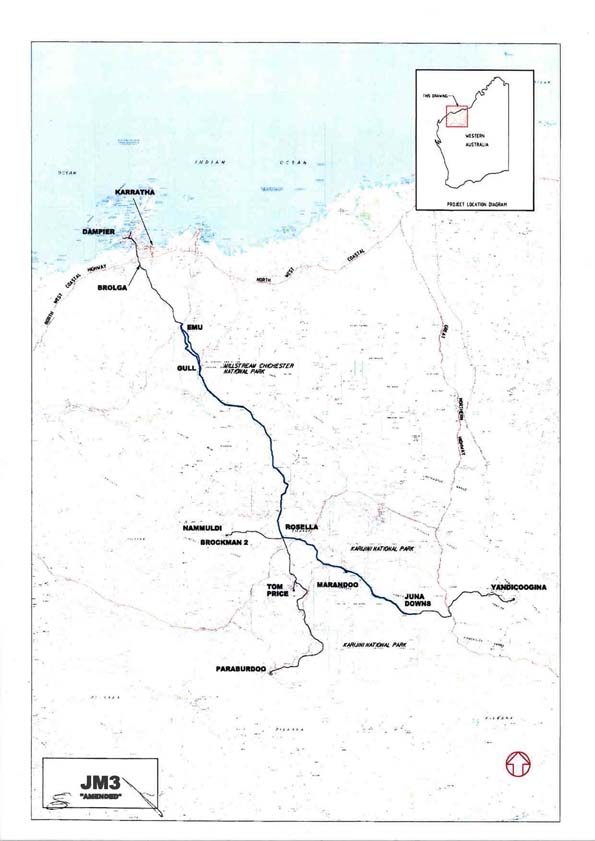
(iii) the importance of the facility to the national economy;
(d) that access to the service can be provided without undue risk to human health or safety;
(e) that access to the service is not already the subject of an effective access regime;
(f) that access (or increased access) to the service would not be contrary to the public interest.”
13 A Ministerial decision to declare a service is capable of review on application by the provider of the service. Reviews are undertaken by the Australian Competition Tribunal. Likewise, when a Minister rejects a recommendation for a declaration, the unsuccessful applicant may apply to the Australian Competition Tribunal to have that decision reviewed.
14 In general terms, a service cannot be declared unless to do so would promote competition. Competition will be promoted if access to the relevant service creates the conditions for the improvement of competition.
15 The provisions of Pt IIIA are complex and have given rise to difficulty. For example, judges of this Court have differed as to the meaning of the term “the use of a production process” in s 44B. Recently, in BHP Billiton Iron Ore Pty Ltd v National Competition Council (2007) 162 FCR 234, a Full Court, by majority, disapproved Kenny J’s reasoning in First Hamersley Iron. In March this year, the High Court granted special leave to appeal from that decision of the Full Court.
16 It is well established that the doctrine of res judicata will apply whether or not the decision which is said to give rise to that form of estoppel has itself been overruled. It makes no difference whether the initial judgment was wrong. It follows that I need not concern myself with whether First Hamersley Iron represents good law. The only question is whether it operates in the way for which Hamersley contends.
FIRST HAMERSLEY IRON
17 In considering whether First Hamersley Iron operates to prevent the NCC from dealing with the TPI application, it is of course necessary to pay close attention to the issues determined in that case.
18 The facts may be briefly stated. In September 1998 Robe River applied to the NCC under s 44F(1) to recommend that the designated Minister declare the Hamersley rail track to be a “service”. The application identified Hamersley as the provider of the service and the owner of the facility to which it related.
19 The Robe River application went on to state as follows:
“3.2 The service to which [Robe] seeks access is the bulk iron ore rail track transportation service provided by the Hamersley Rail Infrastructure Facility, as defined in part 4 of this application (Rail Track Service). This should be distinguished from any rail haulage service which may be available in relation to this facility.
3.3 The Rail Track Service is required for use by both [Robe] trains and by [Robe] hi-rails only over that section of the Hamersley Rail Infrastructure Facility described in part 4 of this application.
The Rail Track Service comprises the use of an infrastructure facility, being the Hamersley Rail Infrastructure Facility mainline, yard track and maintenance support road, including the in-track fault detection and monitoring systems, and the use of a communications service being the train control systems, inclusive of two-way radio.
3.4 The access sought by [Robe] is the use of the Rail Track Service by [Robe] trains laden with iron ore from [Robe's] West Angelas minesite, travelling from the minesite to [Robe's] Port Walcott at Cape Lambert, and by empty [Robe] trains on a return journey to the minesite.
...
3.6 [Robe] is not seeking the service provided by the [Hamersley] locomotives, rolling stock or hi-rails. [Robe] will provide its own locomotives, rolling stock, hi-rails and all necessary operational personnel.
[Hi-rails are road motor vehicles capable of being driven on rail tracks and are used for maintenance purposes]”
20 The Hamersley Rail Infrastructure Facility was characterised in part 4 of the Robe River application in the following terms:
4.1 The facility used to provide the Rail Track Service is the section of the standard gauge railway line owned and operated by Hamersley which runs approximately 300kms in the Central Pilbara:
(a) from the existing [Robe] overpass in the Millstream-Chichester National Park, near Emu Siding south through the Hamersley Range to the Rosella siding at the 250KP point of the mainline;
(b) then eastward from the Rosella siding through the existing railway formation to the [Hamersley] Marandoo minesite; and
(c) from the [Hamersley] Marandoo minesite out east towards Hamersley's Yandicoogina deposit, to the point where this line will intersect with the proposed [Robe] rail line extending north from the West Angelas minesite (yet to be constructed) ...
...
4.2 This facility includes the following components:
· all aspects of the standard gauge rail line; including mainline, yard track, passing sidings, culverts, bridges and temporary diversion tracks;
· the rail line maintenance support road;
· all signs and signalling on the rail line;
· the [Hamersley] train control system including two-way radio used by [Hamersley];
· the in-track fault detection and monitoring systems, built into the railway; and
· other facilities to provide the Rail Track Service safely.”
21 Details of the mainline and track specifications, maintenance support road, signs and signalling, train control system and track fault detection and monitoring systems were set out in subsequent paragraphs.
22 In First Hamersley Iron, Kenny J noted (at [6]) that Robe River had stated in par 4.8 of the Robe River application that it:
“… will provide all locomotives, rolling stock and operational personnel required to run [Robe's] trains on the Hamersley Rail Infrastructure Facility. [Robe] will also provide all hi-rails, other vehicles and personnel for maintenance and support of [Robe's] trains and rolling stock using the rail maintenance support road. [Robe] will provide its own train control system for all [Robe] trains travelling on [Robe] rail track, and does not seek access to the [Hamersley] train control system in that regard.”
23 Kenny J found that Hamersley used the rail track service as an element of its mining operations to transport batches of ore of differing grades, composition and quantities from a number of mines that it operated in the area. Each mine produced ore of different grades, which contributed to a particular “batch” of the export product. With the assistance of the rail track service, each mine operated as if it were a pit within a larger mine. Her Honour found that each step in that process, including the use of the rail track service, was part of a highly integrated operation designed to bring the product to port after blending and stockpiling operations had occurred. That led her to conclude that the rail track involved “the use of a production process” and therefore fell within the exclusion to the definition of the term “service”.
24 Kenny J delivered her reasons for judgment on 28 June 1999. Before me, Hamersley sought to tender the transcript of what took place on that day. The NCC and the TPI objected to the tender of that transcript. They submitted that whatever might have transpired when judgment was delivered could not be relevant to any issue in the proceeding before me. I indicated that I would have the transcript marked for identification and rule upon its admissibility when I delivered judgement in this matter. Having now considered the way in which Hamersley puts its case, the transcript is plainly relevant. I therefore accept its tender.
25 The transcript shows that when her Honour delivered her reasons for judgment, she indicated to counsel that she had prepared a draft of the orders which she proposed to make. She made that draft available to counsel so that the proposed orders could be considered and submissions made about them. After saying that she would defer the question of costs, her Honour continued:
“The declarations in paragraphs 1 and 2 on the first page in substance, I think, follow the terms of the application made by Hamersley. I say in substance because they don’t replicate it exactly.”
26 She then foreshadowed the declarations that were ultimately made. They were in the following terms:
“1. The Rail Track Service, as defined in Part 3 of the application for a declaration recommendation made pursuant to s 44F(1) of Part IIIA of the Trade Practices Act 1974 Cth (the Act) by the second to sixth respondents, is not a service within the meaning of s 44B of the Act.
2. The first respondent does not have power to make a recommendation regarding declaration of the Rail Track Service to the designated Minister pursuant to s 44F(2)(B) of the Act.”
27 Her Honour said that the second of the two declarations “would follow from the terms of paragraph 1”.
28 Her Honour then proceeded to address counsel present in Court. In that regard, Hamersley was represented by Ms Melanie Sloss, the NCC by Mr Robin Brett QC, and the Robe River respondents by Mr Norman O’Bryan. The transcript reads as follows:
HER HONOUR: “I will hear Mr Brett on the question of an injunction. As presently drafted I would propose that the first respondent be permanently restrained from making a recommendation regarding declaration of the rail track service to the designated minister pursuant to section 44F(2)(b) of the act. As I understand the submissions which were made to me, the real difficulty arose in relation to any injunction I might wish to make in relation to the protected contractual rights issue.
Secondly, I would propose that the application made by Hamersley to the court which is the application of 30 October 1998, be granted to the extent of the declarations made and the injunction ordered, but otherwise be dismissed. That reflects the second part, if you like, of my reasons for judgement. I have already spoken to you about the matter of costs.
MR BRETT: Does your Honour wish to hear from me first?
HER HONOUR: It might be useful, Mr Brett, yes.
MR BRETT: We have nothing to say on the question of a declaration. In relation to an injunction we would simply submit that it’s not necessary, that having regard to the fact that a declaration is going to be made, the [NCC] would act accordingly. That’s really all we have to say about it, your Honour.
HER HONOUR: I’m content to accept that unless one of the other parties has something to say to me on the matter. As I understand it the council is saying what one would [expect] of any reputable and responsible public body, that the court having made a declaration, it has not power. It will not take the matter any further. Ms Sloss?
MS SLOSS: Yes, your Honour, I appreciate what my learned friend has just said. That position is slightly different from the positions we understood it in the outline that was filed in the proceeding. Perhaps I should take instructions on that.
HER HONOUR: Yes, certainly. While Ms Sloss takes instructions on that, is there anything anyone else wishes to say?
MR O’BRYAN: Only to support Mr Brett’s submission on behalf of the second to sixth respondents.
HER HONOUR: Thank you, Mr O’Bryan.” [Emphasis added.]
29 Having taken instructions, Ms Sloss made certain submissions regarding the wording of the proposed declarations. Ms Sloss then continued:
“… Turning then to the orders on page 2, in light of my learned friend Mr Brett’s assurances to the court this morning, it would be unnecessary to grant the injunction in paragraph 1. That requires a consequential change to former paragraph 2.” [Emphasis added.]
30 Kenny J then made the declarations foreshadowed and adjourned the question of costs to a date to be fixed.
31 One further matter in relation to First Hamersley Iron should be noted. Hope Downs Management Services Pty Ltd (Hope Downs), a company unconnected with Robe River, was granted leave to intervene in the proceeding before Kenny J. This was on the basis that it intended in the near future to make its own access application regarding the Hamersley rail track to the NCC. However, during the course of the trial, Hope Downs filed a motion seeking to be joined as a party to the proceeding, rather than merely appearing as an intervener. Presumably, it did so in order to be able to take the benefit of any judgment that might be given in favour of the NCC and Robe River. Hope Downs’ application was granted and it was duly joined to the proceeding. The significance of that fact will become apparent later in these reasons for judgment.
FIRST HAMERSLEY IRON – THE APPEAL
32 In separate appeals, Hope Downs and the NCC appealed from the judgment of Kenny J in First Hamersley Iron. However, on 22 November 1999 when the appeals came on for hearing, the Full Court was informed that Robe River had withdrawn its application for access to the Hamersley rail track. Counsel for Hamersley then submitted that the appeals should not proceed because they were moot.
33 However, counsel for the NCC submitted that there was still a live issue in relation to costs to be determined. Counsel also argued that it would be in the public interest for the appeals to proceed. Hope Downs joined in that submission and also submitted that its appeal should be heard because, otherwise, her Honour’s orders might operate as an estoppel against any future application it might make for access to the Hamersley rail track.
34 In response, Hamersley offered certain undertakings to the Full Court. Some of those undertakings related to costs. However, the fourth undertaking specifically addressed Hope Downs’ concerns regarding issue estoppel or res judicata. That undertaking was in the following terms:
“4. In relation to any application made under Pt IIIA of the Trade Practices Act 1974 by Hope Downs Management Services Pty Ltd or any of its related corporations and in relation to any proceeding (including proceedings before the Australian Competition Tribunal) in connection with that application, it will not contend that the declarations and orders made by Kenny J in the proceeding on 28 June 1999, or the Reasons for Judgment upon which those declarations or orders were founded, give rise to any issue estoppel or res judicata affecting any contention raised by:
a) Hope Downs Management Services Pty Ltd or any such related corporation; or
b) National Competition Council”
35 Counsel for the NCC submitted that the Full Court should not accept the undertakings offered. Counsel for Hope Downs took the same stance and indicated that it wished to proceed with the appeal.
36 Ultimately, the Full Court held that, having regard to the undertakings offered by Hamersley, no purpose would be served in proceeding to hear the appeals: Hope Downs Management Services Pty Ltd v Hamersley Iron Pty Ltd (2000) ATPR 41-733 at [14]. Any possible prejudice to Hope Downs resulting from issue estoppel or res judicata was removed by those undertakings. Accordingly, the Court ordered (at [15]) that the appeals be forever stayed. It added that it should not be taken to have expressed any view as to the correctness or otherwise of the judgment appealed from.
37 Transcript of the proceedings before the Full Court was tendered before me. In that transcript, senior counsel for Hope Downs expressed concern that any future application his client might make for a recommendation in relation to the Hamersley railway track would be met with a claim of issue estoppel or res judicata. Mr Neil Young QC, on behalf of Hamersley, responded by submitting that the appeal had become academic. That was because the issue in the case depended entirely upon the definition of “rail track service” in Robe River’s application which was now defunct.
38 Chief Justice Black commented that everything turned upon “the particular application”.
39 Mr Young then observed:
“The whole concept of the rail track service that was the subject of her Honour’s declaration was only the product of the definitions in the application and hence her Honour – the declaration in question is the subject of appeal. The appeal is this: the rail track service as defined in part 3 of the application for a declaration recommendation made pursuant to s 44F(1) is not a service.”
40 Black CJ interposed: “So no issue estoppel.”
41 Mr Young replied:
“So no issue estoppel. There couldn’t be. One need only turn back to the pleadings to see that the entire issue as pleaded is whether the rail track service as defined by Robe’s application was or was not a service within the meaning of s 44B of the Act.
…
In relation to the rail track service sought by Robe which had the peculiarities that your Honour has mentioned …”
42 Mr Young continued:
“If [Hope Downs] made their own application that would mean there would be a new piece of litigation relating to the application defined by Robe in its hypothetical application. That [new] application would presumably define a service. It may be a bare bones service that Robe sought. It may have freight aspects as well. Indeed it may be an application as against BHP because their railway terminus is much closer to Hope Downs’ proposed mine than Hamersley’s.”
43 Mr Young added that if the NCC refused any such application by Hope Downs, the question whether that decision was lawful could be tested. He pointed out that the evidence in any such proceeding would be likely to be different, as would the facts surrounding the operation of the rail track service. He submitted that Kenny J’s judgment could not, as a matter of practical reality, operate as an issue estoppel against Hope Downs.
44 Notwithstanding Mr Young’s submissions, Goldberg J, a member of the Full Court, expressed his concerns as to whether an issue estoppel might arise. The transcript then records Mr Young saying as follows:
“Can I put your Honour’s mind at rest about issue estoppel. It’s our submission that it doesn’t arise. If the court is of a different view and thought it was a possibility, we would be prepared to proffer a second undertaking not to take an issue estoppel point.
GOLDBERG J: Or res judicata.
MR YOUNG: Or res judicata, yes.”
45 This exchange explains the undertaking eventually given by Hamersley in relation to both issue estoppel and res judicata. The NCC and TPI rely upon Mr Young’s analysis of the position in his argument to the Full Court as encapsulating their submission as to why Hamersley cannot rely upon any form of estoppel in the proceeding before me.
THE TPI ACCESS APPLICATION
46 As previously indicated, on 16 November 2007 TPI lodged with the NCC an application seeking access to what it termed “a rail track service provided by the railway network owned by Hamersley Iron Pty Ltd … located in the Pilbarra in Western Australia”.
47 In its application, TPI stated that Hamersley owned:
“3.2.1 the railway line from Paraburdoo to Dampier which is approximately 385km long;
3.2.2 the railway line from Yandicoogina to Rosella Siding (on the Paraburdoo to Dampier railway) which is approximately 195km long; and
3.2.3 the railway line from Brockman No. 2 to Rosella Siding which is approximately 45km long”
which it described as the Hamersley Rail Network.
48 The rail track service that TPI seeks to have declared is defined in its application as:
“the use of the facility comprising the Hamersley Rail Network:
3.4.1 the railway line from Paraburdoo to Dampier, including all points in between;
3.4.2 the railway line from Yandicoogina to Rosella Siding, including all points in between; and
3.4.3 the railway line from Brockman No. 2 to Rosella Siding, including all points in between (Hamersley Service).”
49 TPI said the Hamersley Service would also include the use of all associated infrastructure necessary to allow third-party trains and rolling stock to move along the Hamersley Rail Network between points of interconnection.
50 After TPI lodged its application, the NCC notified Hamersley in accordance with the requirements of s 44F(2)(a). Hamersley responded by submitting that the NCC was bound by First Hamersley Iron and, as a consequence, not permitted to receive, consider, or make any recommendation in respect of the TPI application.
51 The NCC, however, rejected Hamersley’s submission. It made clear that it intended to consider the TPI application, call for submissions regarding that application, and, by implication, in due course make a recommendation to the designated Minister as to whether the service should be declared.
52 In essence, Hamersley puts forward three arguments as to why the NCC has no power to deal with the TPI application:
· the NCC is precluded by res judicata from doing so;
· even if res judicata in its strict sense does not apply, a doctrine somewhat akin thereto is applicable; and
· to permit the NCC to embark upon its proposed course would be to condone a breach of an undertaking given to the Court by Mr Brett when Kenny J delivered her reasons for judgment.
53 In its particulars, Hamersley initially relied upon issue estoppel as well. Indeed, its case seemed to focus upon issue estoppel rather than res judicata or any breach of undertaking. However, during the course of argument before me, Hamersley expressly abandoned any reliance upon issue estoppel.
54 I shall deal with Hamersley’s three contentions in turn.
RES JUDICATA
55 In Halsbury’s Laws of Australia (Butterworths, 1995) Vol 12 at [190-40], a distinction is drawn between res judicata, issue estoppel, and Anshun estoppel. It is said that a final judgment by a competent tribunal may affect subsequent proceedings between the same parties in three ways.
56 First, the judgment extinguishes any cause of action which is the subject of the decision. If the cause of action is established, it is said to merge in the judgment. If the cause of action is rejected, the parties are estopped from claiming that it continues to exist. Consequently, no further proceedings may be brought as between the parties (or their privies) to enforce that particular cause of action. This effect is sometimes described as cause of action estoppel or res judicata: Chamberlain v Deputy Commissioner of Taxation (1988) 164 CLR 502.
57 Second, the judgment of the court represents a conclusive determination not only of the ultimate finding in the case but also of all issues of fact or law necessary to the decision. This is generally described as issue estoppel: Blair v Curran (1939) 62 CLR 464 at 531-2 and Jackson v Goldsmith (1950) 81 CLR 446 at 466.
58 Third, the decision may preclude the parties from raising in future proceedings causes of action or issues which they could and should have raised in the former proceeding. This extension of res judicata and issue estoppel is generally known in Australia as Anshun estoppel: Port of Melbourne Authority v Anshun Pty Ltd (1981) 147 CLR 589.
59 In Spencer Bower, Turner and Handley, Res Judicata (3rd ed, 1996) (Spencer Bower), the term “res judicata” is used more broadly. Spencer Bower (at 2) speaks of res judicata as the rule which precludes a party, as against the other, from denying in subsequent litigation the correctness of the decision in the earlier litigation. Spencer Bower describes this as “res judicata estoppel” and says that it encompasses both “cause of action estoppel” and “issue estoppel”. The second consequence – the merger of the original cause of action in a judgment in favour of the plaintiff – is referred to as “merger in judgment”.
60 On either view, res judicata can arise only from a final judgment of a competent tribunal given on the merits. It cannot arise from a proceeding that was discontinued, or resolved by way of dismissal for want of prosecution, or non-compliance with court orders. In order to establish res judicata, it must be shown that the cause of action in the later proceeding is identical to that which was litigated in the former proceeding. The identity of the causes of action is determined as a matter of substance rather than form. Res judicata binds only the parties and their privies.
61 Res judicata was formerly regarded as a rule of evidence but is now generally considered to be a rule of public policy. When the doctrine applies, it constitutes an absolute bar to a subsequent suit for the same cause of action. As previously indicated at [16], the correctness of the decision is not relevant. If it is a final decision by a court having jurisdiction as to the same question and between the same parties, it will be binding on them unless and until overturned on appeal.
62 Spencer Bower states (at 17) that a party setting up res judicata by way of estoppel as a bar to the opponent’s claim, or as the foundation of that party’s own claim, is required to establish that:
· the decision was final and on the merits;
· it determined the same question as that raised in the later litigation; and
· the parties to the later litigation were either parties to the earlier proceeding or their privies.
63 Hamersley’s submission that the NCC is barred by res judicata from dealing with the TPI application focuses largely upon the second of the two declarations made by Kenny J in First Hamersley Iron, namely:
“that [the NCC] does not have power to make a recommendation regarding declaration of the Rail Track Service to the designated Minister pursuant to s 44F(2)(b) of the Act.”
64 Hamersley submits that this declaration was expressed in clear and unambiguous language. It was unqualified. It did not say that the NCC lacked this power only in relation to the Robe River application. It did not say that the declaration would last only for so long as conditions did not materially alter. It said that the NCC lacked this power in relation to this particular service and would do so for all time and in respect of any applicant who might wish to gain access to it.
65 The NCC and TPI challenge this interpretation of her Honour’s declaratory orders. They submit that it is wrong to focus solely upon the second of the two declarations that her Honour made and to ignore the first. They say that when the second declaration is read together with the first, as her Honour plainly intended, it becomes immediately apparent that the second declaration does not have the effect for which Hamersley contends.
66 In considering these competiting contentions, it is useful to set out again the first of her Honour’s two declarations. It was in the following terms:
“(1) The Rail Track Service, as defined in Pt 3 of the application for a declaration recommendation made pursuant to s 44F(1) of Pt IIIA of the Trade Practices Act by the second to sixth respondents, is not a service within the meaning of s 44B of the Act.”
67 The NCC and TPI submit that the second declaration is the operative declaration and cannot be read in isolation from the first. The second declaration uses the term “Rail Track Service”, which is capitalised and can only be understood by reference to the definition of that expression in the first declaration. The first declaration, in turn, links both declarations to the definition of “Rail Track Service” in part 3 of the Robe River application.
68 It follows, so the NCC and the TPI submit, that the second declaration does not bear the meaning for which Hamersley contends. It is to be read in a more limited manner. It was, along with the first declaration, intended to quell the particular controversy that gave rise to First Hamersley Iron. It must therefore be understood as preventing the NCC from dealing with the Rail Track Service as defined in the Robe River application and as having no greater scope.
69 The debate between the parties gives rise to the need to consider how a court goes about construing orders, particularly declaratory orders, of another judge.
70 Hamersley submits that when an order made by one judge comes before another judge for consideration, “… [t]he Court construes it just like any other document. It does not delve into the subjective intention of the judge pronouncing the order”: Radmanovich v Nedeljkovic [2002] NSWSC 212 at [7]. That submission is plainly correct.
71 Hamersley next submits that the process of construction must be faithful to the meaning of the order as originally pronounced. A later court cannot make the order it considers the original court should have made. See generallyP W Young, “Construing Court Orders” (1998) 72 ALJ 117. Nonetheless, it is now tolerably clear, and Hamersley accepts, that in construing an order, regard may be had to the reasons for judgment and to other extrinsic material where appropriate: Athens v Randwick City Council (2005) 64 NSWLR 58 at [131]-[140] per Santow JA with whom Tobias JA agreed. Moreover, in construing an order, it may be relevant to know what the successful plaintiff or applicant sought by way of relief. I shall return to this issue shortly.
72 Hamersley formulates the issue of construction concerning the orders of Kenny J as follows:
· Whether, as Hamersley contends, the reference to “Rail Track Service” in the second declaration means “the bulk iron ore rail track transportation service provided by the Hamersley Rail Infrastructure Facility” with the consequence that the NCC has no power to make a recommendation regarding declaration of such a service; or
· Whether, as the NCC and TPI contend, the adoption in the second declaration of the defined term “Rail Track Service” from the Robe River application carries an implication that the second declaration merely states that the NCC lacks power to make a recommendation to declare such a service, pursuant to the Robe River declaration application.
73 Hamersley submits that in resolving this issue, there is no need to resort to any extrinsic material, including, it argues, the reasons for judgment. It submits that had Kenny J intended the narrow construction for which the NCC and TPI now contend, her Honour would have said so. It argues that the ordinary meaning of the words used in the second declaration is that the Court declared, once and for all, the position in respect of any recommendation regarding declaration of Hamersley’s rail track service.
74 Hamersley says that such a construction is not surprising. On the NCC’s construction, the Robe River parties would not have been inhibited by the declarations made by Kenny J from making a further application, even the very next day, for a recommendation regarding the same rail track service. That is because a second application by Robe River would not be “the Robe declaration application the subject of those orders”.
75 Hamersley argues that on the NCC’s construction, Hope Downs would have been free, immediately following First Hamersley Iron, to apply for a recommendation in exactly the same terms as Robe River had done. It says that would be contrary to principle. It would mean that the declarations made by Kenny J would not have quelled the controversy between the parties. The Court would therefore not have discharged its judicial function.
76 Hamersley says that if regard is had to extrinsic material, the result is the same. Although the rail track service was defined in Robe River’s application for a recommendation, the scheme of Pt IIIA of the TPAprovides that declaration of that service would have been for everyone, not just Robe River. To have a sensible field of operation, the declaratory orders must have been intended to prevent someone else seeking a recommendation for declaration of precisely the same service. Moreover, Hamersley’s application, which was the subject of Kenny J’s declarations, sought both a narrower declaration that the NCC lacked power to deal with any submission in relation to the Robe declaration application, and a broader declaration that it lacked power to make a recommendation to the designated Minister for declaration of the Hamersley Rail Track Service. The first of the declarations sought was limited to the Robe declaration application. The second was not so limited. Hamersley submits that the second declaration reflected the terms of the broader declaration sought.
77 Finally, Hamersley submits the fourth of its undertakings to the Full Court makes it clear that the parties to the proceeding, including the NCC as well as the Full Court itself, assumed that Kenny J’s orders related not just to the Robe declaration application, but also to any subsequent application that might be brought by Hope Downs. Had Kenny J’s orders been regarded as limited to the Robe River application, no such undertaking by Hamersley would have been necessary.
78 The NCC and TPI challenge this interpretation of Kenny J’s orders. They submit that the starting point when construing a judicial order must be to consider precisely what was needed to quell the justiciable controversy that gave rise to the proceeding. They say that it would go beyond the proper boundaries of the judicial process to determine rights by applying the law to facts, which are neither agreed nor determined, without regard to the evidence led in the particular case.
79 The respondents say that the controversy before Kenny J plainly did not extend to all possible future times and circumstances. Her Honour’s orders should not be interpreted as though it did. They say that resort may be had to contextual matters, such as the reasons for judgment and the pleadings, in order to identify the subject matter of the controversy as an aid to interpreting the orders. They refer in that regard to: Yates Property Corp Pty Ltd v Boland (1998) 89 FCR 78; Owston Nominees No 2 Pty Ltd v Branir Pty Ltd (2003) 129 FCR 558 at [49]-[51]; Athens v Randwick City Council (2005) 64 NSWLR 58 at [27]-[29] and [129]-[140]; Newcastle City Council v Leaway Pty Ltd [2005] NSWLEC 619 at [28]-[36]; Polyaire Pty Ltd v K-Aire Pty Ltd (No 4) (2007) 147 LSJS 65.
80 The respondents also refer to a recent article, J Tarrant, “Construing undertakings and court orders” (2008) 82(2) Australian Law Journal 82. In that article, it is suggested that the courts have taken two different approaches as to whether reference may be made to the reasons for judgment when construing court orders. On one view, this may be done only where a court order is ambiguous. On this view, the reasons for judgment are considered to be extrinsic material. However, a more recent line of authority has emerged, which holds that court orders must always be examined in the context of the reasons for judgment.
81 A number of the authorities cited by Tarrant are instructive. First, by way of background, in Ecrosteel Pty Ltd t/as Packs Business Form Brokers v Pefor Printing Pty Ltd (unreported, Sup Ct, NSW, 12 November 1997), Santow J observed (at 6) that
“orders have to cope with situations not readily foreseen, where their later application, and hence their precise interpretation, may be open to argument.”
82 Tarrant notes that there is a debate as to whether it may be appropriate, in certain circumstances, not merely to have regard to the reasons for judgment but also other material in order to interpret a court order. This would include pleadings and affidavits.
83 Tarrant cites in support of the traditional, and more constrained, view that there must be ambiguity in a court order before the reasons for judgment can be considered: McNair Anderson Associates Pty Ltd v Hinch [1985] VR 309 at 312; Repatriation Commission v Nation (1995) 57 FCR 25 at 33; and Blanch v British American Tobacco Australia Services Ltd (2005) 62 NSWLR 653 at 655. He notes, however, that in relation to contracts, there has been a movement away from the requirement that there be ambiguity before extrinsic material can be examined: Pacific Carriers Ltd v BNP Paribas (2004) 218 CLR 451. There has been a similar movement in relation to the interpretation of corporate constitutions: Lion Nathan Australia Pty Ltd v Coopers Brewery Ltd (2006) 156 FCR 1 at [51], [100] and [238].
84 That movement was anticipated in relation to court orders in Yates Property Corp Pty Ltd v Boland (1998) 89 FCR 78, in which a Full Court of this Court held that in interpreting an order of a court framed in unambiguous language, regard should still be had to the reasons given by the court for making the order because they formed part of the context in which the order was made. See also Australian Energy Ltd v Lennard Oil NL (No 2) [1988] 2 Qd R 230. This second, and more flexible, line of authority was preferred by the Court of Appeal in Athens v Randwick City Council where Santow JA explained (at [129]) that the “purpose of a court order is, ordinarily, to give effect to a judgment”. See also Polyaire Pty Ltd v K-Air Pty Ltd (No 4) (2007) SASC 36; Kwikspan Purlin System Pty Ltd v Federal Commissioner of Taxation (1987) 93 FLR 263.
85 In my view, the weight of authority now favours the view that ambiguity is not required before going beyond a court order. Such orders should always be interpreted in the context of the reasons for judgment. That is the position taken by Tarrant, with whose conclusions I agree.
86 Indeed, I would go further. In my opinion, it is permissible when construing court orders (irrespective of whether they be ambiguous) to have regard to, at least, the pleadings which defined the issues to be resolved: Owston Nominees No 2 Pty Ltd v Branair Pty Ltd (2003) 129 FCR 558 and Athens v Randwick City Council.
87 I note that in Owston Nominees No 2 Pty Ltd v Branair Pty Ltd (2003) at 569, Allsop J concluded that, when construing court orders, regard may even be had to the evidence that was led before the judge who pronounced those orders. See also Blacktown Concrete Services Pty Ltd v Ultra Refurbishing & Construction Pty Ltd (in liq) (1998) 43 NSWLR 484 and Australian Energy Ltd v Lennard Oil NL (No 2) at 232.
88 The NCC and TPI argue that a fair reading of First Hamersley Iron makes it clear, as does the legislative regime in Pt IIIA of the TPA,that Kenny J was engaged in making a determination which was entirely dependent on the evidence led in that case as to the then current state of facts. They refer to [15]-[25] of her Honour’s reasons for judgment. They submit that Kenny J was not asked, and did not purport, to make orders expressed to extend to all possible future times and circumstances. They submit that her Honour’s orders should not be interpreted in that way.
89 The respondents say that Hamersley has sought to interpret Kenny J’s orders as having some ambulatory effect by artificially and impermissibly isolating the second declaration from its context. They say that [8] of her Honour’s reasons for judgment makes clear the contextual relationship between the declarations ultimately made. There, Kenny J stated explicitly that what became the second declaration was sought “in consequence of” the first.
90 Finally, the NCC, in particular, says that Hamersley’s attempt to rely upon paragraphs 3(a) and (b) and 5(a) and (b) identified in its Details of Claim in First Hamersley Iron as revealing a dichotomy between a specific form of declaration and an ambulatory form of declaration, thus leading to the inference that her Honour intended the second declaration to have ambulatory effect, should be rejected. In its written submissions, the NCC says:
“13.1 The premise on which the Applicant relies is unsound. Each of paragraphs 3(a) and 5(a) deals with process before the NCC, and each of paragraphs 3(b) and 5(b) deals with the outcome of the process before the NCC. Each of paragraphs 3(b) and 5(b) is specific, not ambulatory, because it incorporates the definition of “Hamersley rail track service” first set out in paragraph 1 by reference to the particular [Robe River] application.
13.2 Further, it is clear that the forms of relief sought in paragraphs 3 and 5 of the Application depend on the entitlement to relief in the form of paragraphs 1 or 2 first being established; see the chapeau to paragraph 3.
13.3 For these reasons, it is clear that the dichotomy in question is between process and outcome, not between the specific and the ambulatory.”
91 The NCC concludes that the application in First Hamersley Iron was drafted in the recognition that specificity was required and that any request for permanent, ongoing, and ambulatory relief would have been rejected. It submits that her Honour’s orders should not be read in any other way.
92 TPI joins in the NCC’s submissions. However, it adds that apart from the fact that Kenny J used the term “Rail Track Service”, which her Honour had carefully and narrowly defined in her first declaration, it was not open to her to make a declaration in any wider terms. That was because there was no matter before the Court other than the amenability of the Rail Track Service, as defined, to a declaration recommendation by the NCC. Accordingly, the Court had no jurisdiction to make a declaration about anything more than it did: Bass v Permanent Trustee Ltd (1999) 198 CLR 334 at [45]-[47]. TPI also cites Ainsworth v Criminal Justice Commission (1992) 175 CLR 564 at 582 in support of the proposition that, where the underlying factual subject matter of a proposed declaration is uncertain or hypothetical, the Court lacks jurisdiction to make a declaration.
93 The NCC and TPI do not rely solely upon the need to construe Kenny J’s orders in context. They also rely upon the policy that underlies Pt IIIA of the TPA. They submit that the very notion of a “service” that may be declared imports into the process, which is to be conducted by the NCC, elements that are dynamic. Each access application must turn upon its particular facts. These include not merely what the provider of the service does, or has available, but also what the person seeking access actually desires. Unless read in this manner, the criteria set out in s 44G cannot be sensibly applied.
94 Hamersley responds by pointing out that Kenny J made it clear when she delivered her reasons for judgment that she was prepared to grant permanent injunctive relief against the NCC in the terms that she foreshadowed. It submits that, but for the assurance given by Mr Brett, her Honour would have granted that relief. It says that there would then have been no basis upon which any later court could properly have read down those terms. If, for whatever reason, circumstances changed so dramatically that the injunction as originally granted was no longer appropriate, application could be made to have it discharged or varied. However, failing such application, the injunction would stand and operate for all time according to its terms.
95 There are a number of difficulties with this aspect of Hamersley’s submissions. In the first place, I am far from satisfied that Kenny J would have granted an injunction in the terms foreshadowed but for Mr Brett’s assurance. The transcript reveals that her Honour was prepared before pronouncing final orders to hear submissions from the parties as to the form that any injunction should take. It is entirely speculative as to whether any such submissions would have been made. It is a further matter of conjecture as to whether, having heard such submissions, her Honour would have granted the injunctive relief foreshadowed in exactly those terms.
96 Next, there is obviously force in Mr Young’s submission to the Full Court regarding the effect of any changed circumstances. That was said mainly in the context of issue estoppel. However, it applies with equal force to res judicata.
97 There is no evidence before me that the “Rail Track Service”, as defined in First Hamersley Iron, operates today as it did nine years ago. Indeed, there is evidence to suggest that it does not. That means that there must be a question as to whether it still constitutes “the use of a production process”, irrespective of whether the test used by Kenny J is held to be correct.
98 The evidence as to the current position regarding the Rio Tinto Ltd group of companies, of which Hamersley is a wholly owned subsidiary, is that Rio Tinto holds interests in and operates eleven mines and associated iron ore treatment facilities. As a result of Rio Tinto’s acquisition of North Limited in 2000, it acquired a majority interest in what had previously been the Robe River Joint Venture. Following that acquisition, Rio Tinto integrated the operations of Hamersley and Robe River. In that context, Pilbara Iron Pty Ltd, a wholly owned subsidiary of Hamersley, operates and maintains the combined infrastructure assets, including the rail assets.
99 This means that the existing dedicated and integrated rail system, which carries ore from the Rio Tinto mines to the ports at Dampier and Cape Lambert, includes a number of lines that were not part of the Hamersley Rail Track System at the time of First Hamersley Iron. There is now a dual-track system between Emu Siding and Rosella, whereas in 1998 there was only a single track. In addition, there are now spur lines from the West Angelas Mine to Juna Downs and from the Hope Downs mine to the West Angelas spur line, which were not part of the Hamersley Rail Track Service at that time. The current, and past, rail networks are set out in annexures A and B to this judgment, and are marked JM1 and JM3 respectively.
100 The TPI application seeks a recommendation for a declaration in respect of the railway line from Paraburdoo to Dampier which is approximately 385 kilometres long, the railway line from Yandicoogina to Rosella Siding (on the Paraburdoo to Dampier railway) which is approximately 195 kilometres long, and the railway line from Brockman No 2 to Rosella Siding which is approximately 45 kilometres long.
101 The access that TPI seeks includes that part of the Hamersley rail track service sought by Robe River. However, TPI seeks greater access as well. Hamersley, not surprisingly, submits that the greater includes the lesser. Accordingly, if part of that which TPI now seeks is excluded because of what was determined in First Hamersley Iron, it must follow that TPI’s application as a whole cannot proceed.
102 Logically, Hamersley’s submission is correct. However, there is more to be said. The evidence suggests that the configuration of that part of the rail track, now sought to be the subject of a declaration, is broadly similar to that which was the subject of the earlier proceeding. However, putting such questions to one side, there is nothing to suggest, and no evidence to support, the conclusion that material circumstances as to its usage have not changed. That is significant given that the facility, which is the subject of the current application, is clearly not the same as that considered in First Hamersley Iron.
103 Nine years have elapsed since First Hamersley Iron was decided. It is clear from the evidence before me that there have been major developments in the Pilbara iron ore industry during that time. The rapid rise of China to become the world’s largest steel producer and importer of iron ore has presented the industry with an opportunity to grow at a rate and a scale not contemplated a decade or so ago. According to Building Prosperity – The Australian Iron Ore Industry in the 21st Century (May 2006) by Malcolm Gray, an economic consultant commissioned by Rio Tinto to write the report, iron ore production in Australia grew 80 per cent faster than total world production in the ten years to 2005. In the same period, Australian iron ore exports grew 25 per cent faster than total world exports.
104 Mr Gray says that the Pilbara iron ore rail systems are regarded as among the best heavy haul railways in the world. He says that they form a vital part of a closely integrated iron ore production process. Importantly, he says in his report (at page 8):
“The design of this process has been constantly refined. Innovations have included the introduction of the ‘One Mine’ integrated production process by Hamersley Iron, and the Pilbara Rail Company and now Pilbara Iron initiatives by Hamersley Iron and Robe to combine and, through integrated management, secure more efficient operation of their infrastructure assets.”
105 In other words, Mr Gray regards the Pilbara iron ore industry as being in a state of constant change, with new mines being developed and there being a consequent expansion of infrastructure upon which the industry depends. He points out that both Hamersley and Robe River have made major investments in this area, including the construction of rail extensions to new mines at Yandicoogina and West Angelas. These rail extensions now form part of the overall rail network.
106 Mr Gray refers specifically to the construction of dual tracks in the most heavily congested parts of the rail system in order to accommodate increased production. He also notes that concrete rail sleepers are replacing timber ones along the track from Brockman Mine to Rosella Siding. He refers to new projects that are under construction or have been completed in response to China’s demand for iron ore imports. These include dual tracking 145 kilometres of railway north of Rosella to link with existing dual track and providing further dual track for the whole of the section of rail between Rosella and the Robe-Hamersley Iron crossover. He refers to the extension of the railway track system to Hope Downs to service the new mine, which is to commence production in 2008.
107 Mr Gray’s report regarding the changes that have taken place over the past decade or so in relation to the Hamersley rail infrastructure were not challenged before me. His findings support the respondents’ contention that the TPI application relates to access to a rail track system that differs in material respects from that which was the subject of First Hamersley Iron. There are minor differences in configuration but, more importantly it would seem, significant differences in usage. The fact that there have been such changes makes it difficult to assert, as Hamersley does, that the issues raised in the TPI application are identical to those in the Robe River application.
108 I am mindful of TPI’s submission that there is a further distinction between the rail track service that was considered in the Robe River application and that to which access is sought in the TPI application. The Robe River application was for a “point to point” service; that is, a service enabling the running of trains from a point near Emu Siding to a point of intersection with the proposed Robe River rail line. The aim was to allow the development by Robe River of its West Angelas Mine and the transport of iron ore to Port Walcott. The use of the Hamersley rail network contemplated by TPI is for “an all-points” service; that is, one that would permit access at any point along that network.
109 There may be some logic in the distinction between a “point to point” and an “all-points” service. However, its significance, as a practical matter, and in the context of this case, eludes me. A “point to point” service need not necessarily preclude a train from stopping along a particular route, allowing access to be gained along the way. I therefore reject this aspect of the NCC’s submission.
110 I accept that the track under consideration in First Hamersley Iron lies squarely within the Hamersley rail network and that therefore that track would be encompassed within any recommendation made in response to the TPI application. My difficulty with Hamersley’s submission lies in the premise that nothing of any consequence has changed and its somewhat bold submission that, even if it has, Kenny J’s orders are, to put the matter colloquially, “frozen in time”.
111 It is of the essence of any estoppel that it involves identity of subject matter. The party seeking to set up an estoppel must establish that the opponent is seeking to re-agitate some question of law or issue of fact, which has been the subject of a final decision between the same parties by a court of competent jurisdiction.
112 In Turner v London Transport Executive [1977] ICR 952, a plea of issue estoppel failed because “the findings of the industrial tribunal were not sufficiently clear and precise”. Browne LJ said (at 964):
“The essential foundation of a plea of issue estoppel must be that the issue or issues raised in the first proceedings, and the issue or issues raised in the second proceedings are identical. It is for the party who seeks to rely on the estoppel to establish this identity.” [Emphasis added.]
113 Some examples of just how strictly the courts have viewed this requirement may be useful. It has been held that a party, against whom judgment has been given when suing in a representative capacity, is not estopped from suing in a different representative capacity. That is because the subject matter of the litigation is not the same in the two proceedings. See generally Hacking v Lee (1860) 9 WR 70. Similarly, an acquittal on a charge of wilfully making a false tax return has been held not to be a bar to a civil claim brought by the Commissioner alleging that the return was fraudulent or wilfully misleading. The issues were not identical. In addition, the onus of proof differed: Maxwell v IRC [1962] NZLR 683.
114 There are cases in which a change of circumstances has led to the rejection of a claim of estoppel. In Ord v Ord [1923] 2 KB 432, a wife sued for maintenance under a deed of separation. The husband sought to have the deed set aside on the basis that she had fraudulently concealed her adultery. In the first action, the husband failed to prove adultery. In a later action for further instalments, it was held that he could rely upon other acts of adultery of which he had no knowledge at the time of the first action.
115 Similarly, in Richards v Richards [1953] P 36, it was held that where a wife’s charge of cruelty had been dismissed by justices, there was no estoppel preventing her from leading the same evidence, together with other evidence covering a later period, to establish cruelty at a later date. In Burman v Woods [1948] 1 KB 111, it was held that a decision refusing an order for possession based on hardship would not bar later proceedings. That was because the factors relevant to hardship might change. To the same effect is Mills v Cooper [1967] 2 KB 459, where it was held that a decision that the defendant was not a gypsy did not bar proceedings alleging that he was a gypsy on a later date.
116 Spencer Bower (at 199) considers these cases to support the principle that issue estoppel “does not apply in a changing situation”. The same point was made in New Brunswick Railway Company v British and French Trust Corporation [1939] AC 1, where Lord Maugham LC said (at 20):
“If an issue has been distinctly raised and decided in an action, in which both parties are represented, it is unjust and unreasonable to permit the same issue to be litigated afresh between the same parties or persons claiming under them; but in my view the doctrine cannot be made to extend to presumptions or probabilities as to issues in a second action which may be, and yet cannot be asserted beyond all possible doubt to be, identical with those raised in the previous action. In the earlier action here the only relevant issue was as to the true construction of the only bond then sued upon; … The issue of construction in the second action could indeed be proved in the second action to be similar to that decided in the first; but it related to a different cause of action based on other bonds and could not be asserted to be the same issue. Moreover, it is a matter of common knowledge that such bonds are often issued at different dates and in different countries, matters which might well have a possible bearing on their true construction.” [Emphasis added.]
117 In general, the identical subject matter requirement has been construed strictly. In Co-Ownership Land Development Pty Ltd v Queensland Estates Pty Ltd (1973) 47 ALJR 519, Walsh J said (at 522):
“In order that the principle of issue estoppel may apply it … must be possible to assert without doubt that the issues are identical.”
118 In the light of these authorities, Hamersley’s estoppel claim must fail. In my view, the TPI application raises different issues to those that confronted the NCC at the time of First Hamersley Iron. The orders that Kenny J pronounced must be construed in the light of her Honour’s reasons for judgment as a whole, as well as in the context of the issues which presented themselves at the time.
119 I should, for the sake of completeness, deal with Hamersley’s alternative submission. It argues that even if its rail track today is not the same in all relevant respects as that of 1998, its claim of res judicata should still succeed. It submits that no matter how great the differences there may be between the two track systems, Kenny J’s orders still speak for themselves, and must stand unless and until they are varied.
120 Hamersley recognises the implications of this submission. It accepts that, over time, conditions may change to such a degree as to warrant reconsideration of whether its railway system still involves “the use of a production process”. It says that in that event, it would be open to the NCC to make application, pursuant to O 37 r 6 of the Federal Court Rules, for a variation of Kenny J’s orders. This would be on the basis of “matters occurring after judgment”.
121 It has been held that O 37 r 6 does not authorise the Court to set aside a judgment regularly passed and entered because new facts and circumstances have arisen. See Gamser v Nominal Defendant (1977) 136 CLR 145, which concerned a similar rule of the Supreme Court of New South Wales. If an injunction has been granted, however, an order may be made under this rule suspending the operation of the injunction from the date of the changed circumstances. See generally Permewan Wright Consolidated Pty Ltd v Attorney-General (NSW) (1978) 35 NSWLR 365.
122 I am unable to accept this variant of Hamersley’s submission. If, as the NCC and TPI submit, Kenny J’s orders related specifically to the Hamersley rail track service as it then stood, and if either the configuration or use of that track now differs significantly, there is no basis for any estoppel. Moreover, there is no question of the NCC having to establish changed circumstances. It is Hamersley which must establish that the earlier judgment gives rise to an estoppel.
123 I doubt that O 37 r 6 was intended to provide a mechanism by which a party could escape from an established estoppel merely because circumstances have changed. Rather, as previously discussed, its purpose seems to have been to enable a judge to vary or discharge an injunction granted previously where the circumstances giving rise to that injunction have changed.
124 I am fortified in my conclusion that there is no res judicata by the nature of the legislative scheme under which the NCC exercises its statutory duties. The NCC is not an ordinary litigant. It does not seek to vindicate its own private rights. Prima facie, duties conferred by statute are intended by Parliament to be exercised from time to time as occasion arises. See generally s 33(1) of the Acts Interpretation Act 1901 (Cth) and the well-known observations of Gummow J in Minister for Immigration and Ethnic Affairs v Kurtovic (1990) 21 FCR 193 at 211 and 218-9.
125 It follows that Hamersley’s claim of res judicata is not made out.
THE RESIDUAL ESTOPPEL POINT
126 Hamersley next submitted, albeit tentatively, that the NCC was barred from dealing with the TPI application even if Kenny J’s orders did not bear the interpretation for which it contended.
127 It may be that counsel had in mind some notion akin to abuse of process as the basis for this contention. If so, the argument fails. The doctrine of abuse of process, as distinct from various forms of proprietary estoppel, ordinarily operates as a shield rather than a sword. In addition, it is generally confined to curial proceedings and does not operate to prevent investigative or other like processes from being carried out. See generally Papazoglou v Republic of the Philippines (1997) 74 FCR 108 at 131-2.
128 I reject Hamersley’s submission that some notion akin to abuse of process can be used to obtain prohibition or injunctive relief of the kind now sought.
THE NCC’S ASSURANCE TO KENNY J
129 Hamersley submits that Mr Brett’s assurance to Kenny J that the NCC would abide by declaratory orders without the need for any permanent injunction to be granted gave rise to an undertaking to the Court from which the NCC should not now be permitted to resile.
130 An undertaking is a formal promise to the Court to act or refrain from acting in a particular manner: see generally O 35 r 11 of the Federal Court Rules.
131 Undertakings are often given to a court by one or more parties to a dispute. In many cases, the undertakings do not form part of any court order. Nonetheless, an undertaking has the same effect in law as an injunction. Breach of an undertaking is a contempt of court. Self-evidently, the principles that apply to interpreting court orders also apply to interpreting undertakings: S & M Motor Repairs Pty Ltd v Caltex Oil (Australia) Pty Ltd (1988) 12 NSWLR 358.
132 It is quite common when injunctive relief is sought against the Commonwealth for the court to inquire of its own motion whether an injunction is really necessary or whether an appropriate undertaking will be forthcoming. Typically, in such circumstances, undertakings are readily proffered. The need to grant injunctive relief is thereby avoided.
133 It is less common, though still not unusual, when declaratory and injunctive relief are sought against the Commonwealth for an assurance to be given that it will abide by any declaration and that no injunction is therefore necessary. In such cases, formal undertakings are not normally proffered. It is assumed that the Commonwealth will act in accordance with the law as declared by the Court. The Commonwealth is expected to act as a “model litigant”. It is assumed that it will comply with the spirit as well as the letter of the law.
134 Hamersley submits that the assurance given to Kenny J by Mr Brett on behalf of the NCC, which is set out at [28] above, and her Honour’s statement that she was “content to accept that”, amounted to a formal undertaking to the Court, and was therefore tantamount to a permanent injunction.
135 Hamersley notes that the NCC’s costs submission to Kenny J, after judgment was delivered, (which referred to Mr Brett’s assurance to her Honour that the NCC “would act in accordance with the declaration of the Court”) had been accepted “as making injunctive relief unnecessary”. Hamersley further notes that her Honour’s judgment regarding costs contained the following observation (at [11]):
“In consequence of the Court’s ultimate decision [the NCC] has since given a further undertaking that made it unnecessary to grant any of the injunctiverelief originally sought by the applicant.”
[Emphasis added.]
136 Hamersley submits that the central feature of an undertaking is nothing more than a commitment to perform a particular duty. It is not necessary for the word “undertake” to be used. Some undertakings are merely implied. See for example: Harman v Secretary of State for the Home Department [1983] 1 AC 280 at 304. As with an injunction, the terms of an undertaking must be strictly observed: Lade & Co Pty Ltd v Black [2006] 2 Qd R 531 at [36].
137 Hamersley submits that the Court should treat what Mr Brett said on behalf of the NCC as an undertaking to Kenny J reflecting the terms of the permanent injunction which her Honour had stated that she proposed to grant. In other words, the undertaking was equivalent to an injunction preventing the NCC from making a recommendation regarding declaration of the Hamersley rail track service to the designated Minister. The statements made by Mr Brett were given in lieu of such an injunction. Absent those statements, an injunction would have been granted. Mr Brett put forward no reason why the proposed injunction was inappropriate other than that it was “not necessary”. Nor did he qualify his assurance that the NCC would “act accordingly” by stating, for example, that it would do so only for a particular period of time, or until the situation changed materially.
138 Hamersley’s submissions in this regard have some force. The indication by Kenny J that she would “accept” what was proffered on behalf of the NCC reflects the usual terminology employed by a court that accepts an undertaking from a party in lieu of an injunction. See Thomson Australian Holdings Proprietary Limited v The Trade Practices Commission (1981) 148 CLR 150 at 164.
139 Having given this matter careful consideration, I have concluded that Mr Brett’s statements to Kenny J should not be regarded as amounting to a formal undertaking. The words that he used seem to me to have been casually expressed and spoken without any attention to formality. His “assurance” cannot properly be understood as constraining the NCC forever from entertaining any application made by a different applicant for a declaration recommendation in respect of what might have become a different service.
140 To construe Mr Brett’s statements in the manner for which Hamersley contends would also be contrary to the NCC’s statutory functions and duties under Pt IIIA. Moreover, his words could scarcely form the basis of any application against the NCC for contempt of court. Injunctive orders must be expressed in unambiguous language so that a person subjected to an injunction is entirely clear what conduct is expected of them: McNair Anderson Associates Pty Ltd v Hinch.
141 More importantly, it needs to be emphasised that if Kenny J had in fact contemplated granting an injunction that extended more widely than the application then before the Court, it is reasonable to assume that the NCC and the other respondents would have sought to dissuade her Honour from doing so. The fact that none of the respondents made any submission to that effect suggests that they did not view Mr Brett’s statements as tantamount to an undertaking equivalent to a permanent injunction going beyond the bounds of the declarations actually made.
142 If, contrary to my conclusions set out above, Mr Brett’s words are to be understood as an “undertaking”, rather than as a statement of deference to the declaratory orders foreshadowed, the question remains, what was the NCC undertaking to do? If, as I have indicated, the declarations made by her Honour concerned a specific service defined in a particular application to the NCC, and resolved a controversy that was to be determined on the then current facts, the “undertaking” was surely intended to operate no more broadly than the declaratory relief. Mr Brett’s statement was made in response to the foreshadowed declarations and not just the foreshadowed permanent injunction. His statement was that the NCC “would act accordingly”. That means, in context, in accordance with the declarations proposed. It does not mean in accordance with any injunction of the kind her Honour might put forward for consideration.
143 In any event, the terms of the foreshadowed injunction employed the expression “rail track service” in a context where that expression had to be understood as defined in the first of the declarations ultimately made.
144 I accept, of course, that an assurance of the kind given by Mr Brett might, in some circumstances, give rise to an estoppel. In Halsbury’s Laws of Australia, the doctrine of estoppel by representation is discussed at [190-240]-[190-270]. The doctrine precludes a party who, by representation, has induced another party to adopt or accept a state of affairs, and consequently to act to that other party’s detriment, from asserting a right inconsistent with the state of affairs upon which that other party acted.
145 At common law, an estoppel by representation arises only as a result of words or conduct reasonably likely to be understood as a representation of fact and not a mere expression of opinion. Moreover, the circumstances must be such that a reasonable person would accept the representation as an invitation to act upon it in a particular way. It must be causally linked to the decision of the party to whom it is made to act upon it to that party’s detriment. See generally Commonwealth v Verwayen (1990) 170 CLR 394.
146 If a representation is to found an estoppel, it must be clear and unambiguous. See Legione v Hately (1983) 152 CLR 406 at 436 per Mason and Deane JJ and Minister for Immigration and Ethnic Affairs v Kurtovic. See also the cases discussed at footnotes 10 and 11 to [190-245] of Halsbury’s.
147 There are several difficulties with Hamersley’s submission that Mr Brett’s “assurance” gives rise to such an estoppel. First, Mr Brett’s statements were scarcely expressed in clear and unambiguous language. He said what he did in response to an indication by Kenny J of the terms of an injunction that her Honour might be prepared to grant. However, there was nothing definite about the terms of that injunction, and it was made entirely clear that no injunction of any kind would be granted until the parties had been given the opportunity to be heard regarding its terms.
148 Next, it might be thought that any representation embedded in that “assurance” involved a promise as to future conduct and not a statement as to an existing state of affairs: Legione v Hately; Waltons Stores (Interstate) Ltd v Maher (1988) 164 CLR 387 at 398 per Mason CJ and Wilson J, at 415 per Brennan J, at 459 per Gaudron J; and Commonwealth v Verwayen at 499-500 per McHugh J. Of course, a statement as to whether a present intention exists may itself be a representation as to an existing fact. However, that is hardly a proper characterisation of Mr Brett’s language.
149 It is well recognised that statements as to future conduct may ground equitable estoppel. Equity will come to the aid of a party, who has acted to his or her detriment on the basis of some assumed state of affairs to which the other party to the transaction has contributed, if it would be unfair or unjust not to do so. There are, however, constraints upon the use of equitable estoppel. The applicant must prove that he or she assumed the existence of a particular legal relationship with the respondent, that the respondent induced that assumption, that the applicant acted or abstained from acting on the faith of that assumption, that the respondent knew of the applicant’s action or intended the applicant to act in that way and that the applicant would suffer detriment if the assumption were not fulfilled. See Waltons Stores (Interstate) Ltd v Maher.
150 In effect, in order to establish equitable estoppel, it must be shown that it would be unconscionable for one party to resile from the assumed state of affairs on which the other party has relied.
151 In circumstances where it is uncertain as to the form that any permanent injunction might have taken, it is difficult to see how any assurance given by Mr Brett, expressed, it must be said, casually and in informal terms, can make it unconscionable for the NCC to go about performing its statutory duty. It must be remembered that Hamersley was represented by experienced and competent counsel at the time the assurance was given. It could have sought clarification of Mr Brett’s remarks but did not do so. If, at the end of the day, Mr Brett had one thing in mind, and Ms Sloss something else, that is unfortunate. However, the test to be applied when determining whether something said by counsel gave rise to an undertaking must be the same as that to be adopted when construing judicial orders. That test is an objective, and not a subjective, one.
152 Applying an objective test, Mr Brett’s remarks would not, in context, have been understood as giving rise to a formal undertaking, and certainly not one in the terms for which Hamersley now contends. It follows that I reject the submission that the NCC is precluded by Mr Brett’s “assurance” from considering the TPI application.
IDENTITY OF PARTIES
153 The principal parties in this proceeding so far as relief is concerned, namely Hamersley and the NCC, are the same as those in First Hamersley Iron. However, neither Robe River nor Hope Downs, the respondents in that proceeding, have any involvement in this case.
154 TPI, as the person seeking the NCC’s recommendation, stands in the shoes previously worn by Robe River, and perhaps Hope Downs as well. That means that the parties in the earlier action relied on as creating a res judicata, and those in this proceeding, are not identical. That might affect Hamersley’s entitlement to the relief sought since TPI cannot conceivably be estopped from making its application to the NCC. There is no suggestion in this case that Kenny J’s judgment can operate, as it were, in rem.
UNDERTAKING GIVEN TO THE FULL COURT
155 I should deal briefly with a separate submission advanced on behalf of the NCC and TPI. They say that if, contrary to my primary findings, an estoppel based on res judicata does arise in this case, Hamersley’s undertaking to the Full Court in the earlier litigation prevents it from taking advantage of that estoppel.
156 In that context, it will be recalled that the appeal from Kenny J’s judgment by the NCC and Hope Downs was forever stayed after the withdrawal of Robe River’s application to the NCC. That occurred after Hamersley gave certain undertakings. Paragraph 4 of those undertakings is set out at [34] of these reasons for judgment.
157 I reject this contention by the NCC and TPI. The undertaking given by Hamersley to the Full Court was specifically linked to any application made under Pt IIIA of the TPA by Hope Downs or any of its related corporations. It was limited to any proceedings in connection with that application. It was only in that regard that Hamersley undertook not to rely, in the future, upon any issue estoppel or res judicata. The undertaking has no wider application and certainly no application to the present proceeding.
CONCLUSION
158 For the reasons set out above, the application must be dismissed. At least one of the parties has indicated that it might wish to be heard in relation to costs. In the normal course, Hamersley, as the unsuccessful applicant in this proceeding, would be ordered to pay the costs of the respondents. I can see no reason to depart from that course. However, if any party wishes to be heard to the contrary, I will allow a period of seven days for the filing of submissions. If no submissions are filed, the Court will order that the applicant pay the respondents’ costs, to be taxed in default of agreement.
| I certify that the preceding one hundred and fifty-eight (158) numbered paragraphs are a true copy of the Reasons for Judgment herein of the Honourable Justice Weinberg. |
Associate:
Dated: 5 May 2008
| Counsel for the Applicant: | Mr P.W. Collinson SC with Mr S.H. Parmenter |
|
|
|
| Solicitors for the Applicant: | Allens Arthur Robinson |
|
|
|
| Counsel for the First Respondent: | Mr P.J. Hanks QC with Mr P.R.D. Gray |
|
|
|
| Solicitor for the First Respondent: | Australian Government Solicitor |
|
|
|
| Counsel for the Second Respondent: | Mr N.J. O’Bryan SC with Mr T.J.F. McEvoy |
|
|
|
| Solicitors for the Second Respondent: | DLA Phillips Fox |
|
|
|
| Date of Hearing: | 27 March 2008 |
|
|
|
| Date of Judgment: | 5 May 2008 |
Annexure A
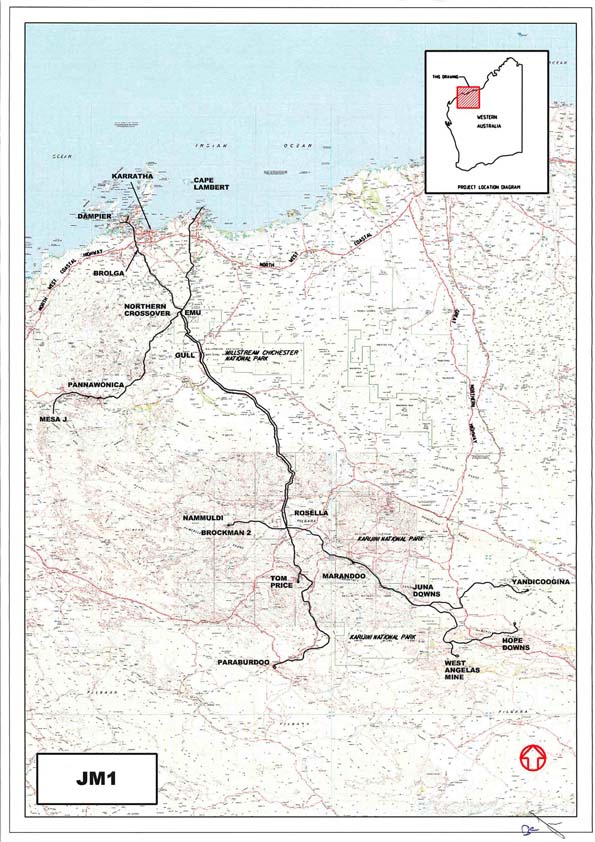
Annexure B