

FEDERAL COURT OF AUSTRALIA
Black & Decker Inc v GMCA Pty Ltd (No 2) [2008] FCA 504
PATENTS – invalidity – whether invention novel – whether invention useful
PATENTS – standing of licensee – whether exclusive licence – whether retrospective operation of licence agreement
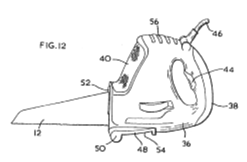
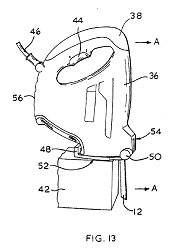
DESIGNS – whether divisional application valid – whether new and original – infringement by fraudulent or obvious imitation
Corporations Act 2001 (Cth) ss 127, 128, 129
Designs Act 1906 (Cth) ss 17, 22C, 30
Designs Act 2003 (Cth) s 73(1)
Patents Act 1990 (Cth) ss 18(1), 40, 120(1)
Adelmann & Ham Boiler Corporation v Llanrwst Foundry Co (1928) 45 RPC 413 cited
Cleveland Graphite Bronze Co v Glacier Metal Co Ltd (1950) 67 RPC 149 cited
Colbeam Palmer Ltd v Stock Affiliates Pty Ltd (1968) 122 CLR 25 cited
Collector of Customs v Pozzolanic Enterprises Pty Ltd (1993) 43 FCR 280 cited
F Hoffman-La Roche & Co v Commissioner of Patents (1971) 123 CLR 529 cited
Foggin v Lacey (2003) 57 IPR 225 cited
General Tire & Rubber Co v Firestone Tyre and Rubber Co Ltd [1972] RPC 457 cited
Grant v Commissioner of Patents (2006) 69 IPR 221 referred to
Kimberly-Clark Australia Pty Limited v Arico Trading International Pty Limited (2001) 207 CLR 1 cited
Lockwood Security Products Pty Ltd v Doric Products Pty Ltd (No 2) (2007) 72 IPR 447 cited
Lockwood Security Products Pty Ltd v Doric Products Pty Ltd (2004) 217 CLR 274 cited
Minnesota Mining & Manufacturing Co v Beiersdorf (Aust) Ltd (1980) 144 CLR 253 cited
Nesbit Evans Group Australia Pty Ltd v Impro Ltd (1997) 39 IPR 56 cited
Nicaro Holdings Pty ltd v Martin Engineering Co (1990) 16 IPR 545 cited
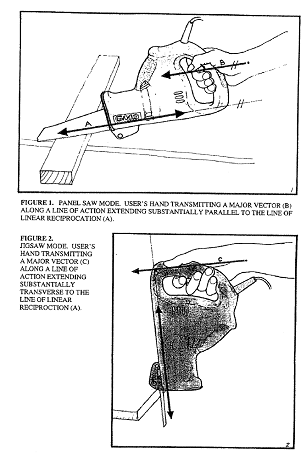
No-Fume Ltd v Frank Pitchford & Co Ltd (1935) 52 RPC 231 cited
Polyaire Pty Ltd v K-Aire Pty Ltd (2005) 221 CLR 287 cited
R v Wheeler (1819) 2 B & Ald 345 cited
Royal British Bank v Turquand (1856) 6 E & B 327 cited
Stack v Brisbane City Council (1996) 35 IPR 296 cited
Ullrich Aluminium Pty Ltd v Dias Aluminium Products Pty Ltd (2006) 153 FCR 437 cited
Wanem Pty Ltd v John Tekiela (1990) 19 IPR 435 cited
BLACK & DECKER INC and BLACK & DECKER (AUSTRALIA) PTY LTD v GMCA PTY LTD
VID 1262 of 2005
HEEREY J
18 APRIL 2008
MELBOURNE
| IN THE FEDERAL COURT OF AUSTRALIA |
|
| VICTORIA DISTRICT REGISTRY | VID 1262 of 2005 |
| BETWEEN: | BLACK & DECKER INC First Applicant
BLACK & DECKER (AUSTRALIA) PTY LTD Second Applicant
|
| AND: | GMCA PTY LTD Respondent
|
| HEEREY J | |
| DATE OF ORDER: | 18 APRIL 2008 |
| WHERE MADE: | MELBOURNE |
THE COURT ORDERS THAT:
1. The parties bring in minutes of orders to give effect to these reasons.
Note: Settlement and entry of orders is dealt with in Order 36 of the Federal Court Rules.
| IN THE FEDERAL COURT OF AUSTRALIA |
|
| VICTORIA DISTRICT REGISTRY | VID 1262 of 2005 |
| BETWEEN: | BLACK & DECKER INC First Applicant
BLACK & DECKER (AUSTRALIA) PTY LTD Second Applicant
|
| AND: | GMCA PTY LTD Respondent
|
| JUDGE: | HEEREY J |
| DATE: | 18 APRIL 2008 |
| PLACE: | MELBOURNE |
| 1.0 Introduction.................................................................................................... | [1] |
| 2.0 The Standard Patent..................................................................................... | [9] |
| 2.1 Specification and claims.......................................................................................... | [9] |
| 2.2 Construction........................................................................................................... | [17] |
| 2.3 Manner of manufacture........................................................................................... | [25] |
| 2.4 Description of the invention..................................................................................... | [29] |
| 2.5 Fair basing.............................................................................................................. | [32] |
| 2.6 Utility..................................................................................................................... | [37] |
| 2.7 Novelty.................................................................................................................. | [42] |
| 2.7.1 Bosch PMS 400.............................................................................................. | [45] |
| 2.7.2 Bosch PFZ 550E............................................................................................. | [47] |
| 2.7.3 Makita JR3000V............................................................................................. | [49] |
| 2.7.4 The Complete Book of Tools p 106................................................................. | [50] |
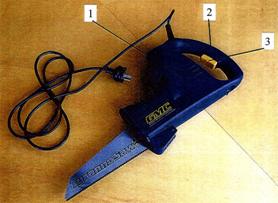
| 2.7.5 The Bosten design patent................................................................................. | [51] |
| 2.7.6 The Kivela patent............................................................................................ | [52] |
| 2.7.7 The Burrows patent......................................................................................... | [53] |
| 2.8 Obviousness........................................................................................................... | [54] |
| 3.0 The Innovation Patent................................................................................. | [66] |
| 4.0 Infringement of the Standard Patent................................................. | [72] |
| 4.1 Infringement by T1.................................................................................................. | [73] |
| 4.2 Infringement by T2.................................................................................................. | [81] |
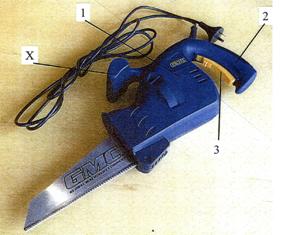
| 5.0 Infringement of the Innovation Patent............................................ | [89] |
| 5.1 Infringement by T1.................................................................................................. | [90] |
| 5.2 Infringement by T2.................................................................................................. | [92] |
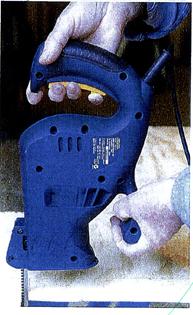
| 6.0 The Design............................................................................................................ | [96] |
| 6.1 A divisional application........................................................................................... | [98] |
| 6.2 New and original?................................................................................................... | [104] |
| 7.0 Infringement of the Design....................................................................... | [108] |
| 7.1 Alleged infringing articles......................................................................................... | [109] |
| 7.2 Fraudulent imitation................................................................................................. | [110] |
| 7.3 Obvious imitation.................................................................................................... | [115] |
| 8.0 Black & Decker (Australia) Pty Ltd as exclusive licensee....... | [120] |
| 8.1 Did the 1987 Agreement confer an exclusive licence?.............................................. | [128] |
| 8.2 Prospective operation of the 2005 Deed................................................................. | [135] |
| 8.3 Termination of the 1987 Agreement by the March 2006 letter.................................. | [137] |
| 8.4 Authorisation of the December 2006 Deed.............................................................. | [141] |
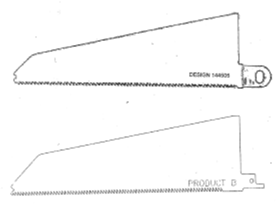
| 8.5 Does the December 2006 Deed operate retrospectively?........................................ | [146] |
| 9.0 Conclusion........................................................................................................ | [150] |
REASONS FOR JUDGMENT
1.0 Introduction
1 The applicants Black & Decker Inc, a United States corporation, and its wholly owned Australian subsidiary Black & Decker (Australia) Pty Ltd claim that the respondent GMCA Pty Ltd has infringed their intellectual property rights conferred by Australian Standard Patent No 757412 (the Standard Patent), Australian Innovation Patent No 2002 100583 (the Innovation Patent) and Australian Registered Design No 144505 (the Design).
2 The priority date of both Patents is 18 December 1998 and that of the Design 9 November 1999.
3 The relevant claims of the Patents are for a power saw and the Design is for a blade to be used in such a saw.
4 The power saw of Black & Decker’s alleged invention is a reciprocating (backwards and forwards) electrically powered tool. By changing the blade the saw may be used either as a panel saw or a jigsaw. The specification in the Standard Patent show the preferred embodiment used as a panel saw (Figure 12) or jigsaw (Figure 13) as follows:

5 In its traditional manual form a panel saw has a long deep blade with a handle at the rear. Usually the blade decreases in depth towards the front of the saw, which has a blunt end. A panel saw is operated by moving the saw in a back and forth motion at about a 45 degree angle to the top of the workpiece. The saw cuts on the push stroke.
6 As at December 1998 portable panel saws powered by an electric motor were well known.
7 A jigsaw is a portable power tool. It is used for accurate or fine cutting both in straight lines and curves (including tight or intricate curves) in timber, metals or other materials. In order to be able to cut tight curves jigsaw blades are usually narrower than panel saw blades. A jigsaw blade operates in an up-and-down motion with the teeth of the blade pointing away from the user, both for safety and general ease of use. A jigsaw usually has a flat support surface, often in the form of a fixed plate or shoe, so that the jigsaw can be pushed firmly on to the top of the workpiece. Jigsaws as described were known at the priority date.
8 As well as disputes concerning validity and infringement in relation to the Patents and the Design, there is an issue as to the standing of the second applicant. This latter issue turns on the validity and effect of certain transactions between the two applicants.
2.0 The Standard Patent
2.1 Specification and claims
9 The specification states that the invention “relates to a power tool and has particular, although not exclusive, relevance to such power tools which are able to have their modes of operation changed”.
10 It is noted that some power tools are capable of operating in more than one mode, such as a power drill which may also be used as a screwdriver. Conventionally such tools which operate in more than one mode are held by the user in the same position or orientation relative to the workpiece. It is said that a power tool capable of operating in one mode as a panel saw and in another mode as a jigsaw, yet being held and operated by a user differently dependent upon which of these two options is required, would be “a very flexible proposition”. An object of the invention is said to be to provide a power tool with greater flexibility and utility. The consistory clause is as follows:
Accordingly, the present invention provides a power tool having a linear reciprocating output, including a body housing a motor for driving the power tool, the body including a fixed handle to allow a user to manually hold and operate the power tool; a trigger positioned adjacent the handle wherein the handle is positioned relative to the body such that a user may operate the power tool in a plurality of positions relative to a workpiece in order to perform a different power tool function in each of said plurality of positions; characterized in that the handle is accessible from more than one side, each accessible side corresponding to a given one of the plurality of different positions and wherein the trigger being operable by a user when gripping the handle in each of said plurality of positions and wherein the handle is positioned such that a force applied thereto by the user in a first of said plurality of positions comprises a major vector transmitted along a line of action extending substantially parallel to the line of linear reciprocation, and a force applied thereto by the user in a second of said plurality of positions comprises a major vector transmitted along a line of action extending substantially transverse to the line of linear reciprocation. Because the handle is accessible from more than one side, then the tool may be used in a different attitude and orientation to a workpiece dependent upon the task to be undertaken.
11 It would seem that the last sentence of the passage just quoted encapsulates the inventive step. As put by senior counsel for Black & Decker, “(a)n important aspect of the power tool of the invention is the design and position of the handle so as to enable it to be gripped by the user comfortably and safely in either orientation whether the tool is acting as a panel saw or jigsaw”.
12 There then follows a description of various drawings of parts of the preferred embodiment, including mountings of the saw blade. However, the invention is not said to lie in the internal mechanics by which different blades may be fitted to the device.
13 The specification describes in some detail the operation of preferred embodiments in Figures 12 and 13. They share the same body but are used for a different purpose and operate in different modes. As to Figure 12, it is said that it has been found desirable to offer the user the facility of using the panel saw “not only in its powered mode but also manually”. The specification continues:
…the user should be able to grip the handle (38) of the panel saw and use it as a conventional manually operated saw whether the blade is being driven by the motor (24) or not. To achieve this the saw needs to be lightweight but also it has been found that, when the saw is being driven by the motor (24), conventional reciprocating action will prevent manually using the tool with ease, because of the combination of the frequency of reciprocation of the saw blade (12) and the length of each reciprocal stroke.
14 There is some discussion of the preferable frequency of reciprocation which is said to be 6,500 strokes per minute and length of each reciprocal stroke of around 10 mm. Nevertheless, the invention can be operated effectively with a frequency of vibration between 3,000 and 10,000 strokes per minute and works effectively within a range of 5 to 15 mm.
15 Referring to Figure 13, the same body with a different blade, it is said the saw blade (12) “is that found on conventional ‘jigsaws’”. The specification continues:
Conventionally, jigsaws are held relative to the workpiece in a different attitude to panel saws. This can be seen by reference to the difference in attitude between Figure 12 and 13. In Figure 13, the body (36) can be seen resting on a block (42) which represents a workpiece. In use of the jigsaw, the body (36) would be held on the block (42) in the attitude shown in Figure 13.
It can be seen from Figure 13 that the handle (38) is now positioned relative to the workpiece (42) such that the body (36) may easily be used as a jigsaw. In use of the jigsaw, a user exerts a force via the handle (38) in the direction of the large arrow marked “A”. This is so that the blade (12) is driven also in the direction of the arrow “A” to cut through the workpiece.
It can be seen by comparing Figures 12 and 13, that the handle (38), although itself the same in both figures, it [sic] able to be used for exerting forces in a different direction depending on which mode of use (either the panel saw of Figure 12 or the jigsaw of Figure 13) the tools are put to.
The handle (38) is positioned adjacent a trigger (44) which trigger (44) is operable by user when the handle (38) is gripped.
It can be seen from both Figures 12 and 13, therefore, that the position of the handle (38) relative to the body (36) is such that the user may operate the saw in a plurality of positions relative to a workpiece. Thus, regardless of whether the tool is being used as a panel saw in Figure 12 or a jigsaw in Figure 13, the same handle is used for operating the saw. It will be appreciated by those skilled in the art, that this holds true whether the panel saw of Figure 12 is being used as a powered saw by powering the motor (24) via an electricity supply cable (46), or whether it is being used manually.
…
From Figures 12 and 13, therefore, it can be seem that the handle (38) is accessible from one of two sides, depending on whether the tool is to be used as a panel saw or as a jigsaw.
16 The claims of the invention are as follows, claim 6 being the one principally relied upon (the integer numbers inserted between square brackets are those agreed on by the parties):
1. [1.1] A power tool having a linear reciprocating output, [1.2] including:
a body housing a motor for driving the power tool, [1.3] the body including a fixed handle to allow a user to manually hold and operate the power tool;
[1.4] a trigger positioned adjacent the handle [1.5] wherein the handle is positioned relative to the body such that a user may operate the power tool in a plurality of positions relative to a workpiece in order to perform a different power function in each of said plurality of positions;
[1.6] characterized in that the handle is accessible from more than one side, [1.7] each accessible side corresponding to a given one of the plurality of different positions and wherein the trigger being operable by a user when gripping the handle in each of said plurality of positions
[1.8] and wherein the handle is positioned such that a force applied thereto by the user in a first of said plurality of positions comprises a major vector transmitted along a line of action extending substantially parallel to the line of linear reciprocation, [1.9] and a force applied thereto by the user in a second of said plurality of positions comprises a major vector transmitted along a line of action extending substantially transverse to the line of linear reciprocation.
2. [2.1] A power tool as claimed in claim 1 [2.2] wherein the body includes a second handle to which the user may apply a force when the tool is in said first position to apply a secondary force having a major vector in a direction substantially transverse to the line of linear reciprocation.
3. [3.1] A power tool as claimed in any one of the preceding claims, [3.2] wherein the tool includes a saw.
4. [4.1] A power tool as claimed in claim 1 or claim 2 [4.2] wherein the reciprocating output includes an array of interchangeable saw blades.
5. [5.1] A power tool as claimed in claim 4 [5.2] wherein each of the interchangeable saw blades are secured to the power tool to present a longitudinally extending cutting edge extending parallel to the line of linear reciprocation in the same direction.
6. [6.1] A power tool as claimed in any one of claims 3 to 5 [6.2] having at least two different positions, [6.3] at least one position corresponding to the function of a panel saw [6.4] and at least one position corresponding to the function of a jigsaw.
7. [7.1] A power tool as claimed in any one of the preceding claims [7.2] wherein the handle includes a substantially D shaped handle formed integrally with the body.
8. [8.1] A power tool as claimed in claim 7 [8.2] wherein the trigger is disposed centrally of an inner surface of said D shaped handle so as to be readily operable by a user when gripping the handle in each of said plurality of positions.
2.2 Construction
17 The principle construction debate centred around the term “a major vector” in integers 1.8, 1.9 and 2.2 of the Standard Patent.
18 GMCA’s case on this issue was not so much to assert a particular meaning for the term but rather to argue that it lacked any fixed or certain meaning with the result that claim 1 was not clear, as required by s 40(3) of the Patents Act 1990 (Cth). Senior counsel asked rhetorically:
What is the force applied by the user to the handle in panel saw mode to which reference is made? In comparison with what other force or forces is the force which the user applies to the handle to be compared with to as ‘a major vector’? How large is the force meant to be?
19 GMCA’s expert witness Dr Hugh Stark said that the actual forces acting on the saw when used in panel mode were complex, varied over time and could not be described as to direction and magnitude without experiment or calculation. Also, Dr Stark said, given the cyclical nature of the sawing action both the direction and magnitude of the forces applied by the user to the handle would vary widely throughout the sawing cycle.
20 The relevant skilled addressee here is a person skilled in the design and manufacture of power tools. The invention is for a product, albeit a product whose inventive feature is said to lie on its ability to be used in particular ways. The skilled addressee is not a person whose connection with power tools is only in the capacity of a dealer or end user.
21 Claims must be construed in a practical, common sense manner, and are valid so long as they provide a workable standard suitable to the intended use: Minnesota Mining & Manufacturing Co v Beiersdorf (Aust) Ltd (1980) 144 CLR 253 at 273; Nesbit Evans Group Australia Pty Ltd v Impro Ltd (1997) 39 IPR 56 at 95.
22 It is accepted that “a major vector” is not a technical engineering term. According to the Shorter Oxford Dictionary, when used in mathematics “vector” is a “quantity having direction as well as magnitude, denoted by a line drawn from its original to its final position”. The Macquarie Dictionary defines the term, as used in mathematics, as “a quantity which possesses both magnitude and direction”.
23 Black & Decker’s witness Mr Richard Frost read the expression “a major vector” as requiring that “one of the significant or substantial forces… applied by the user to the handle of the power tool of the invention must be transmitted along the line of action set out in the claims”. Another Black & Decker witness, Professor John Redmond, helpfully explained the concept in diagrammatic form:
24 The term in question does not have the difficulty GMCA seeks to find in it. The expression is a major vector, that is to say a vector which is substantial, or of significance, although not necessarily the most substantial. No comparative identification and quantification of possible other vectors is required to understand what the inventor is endeavouring to convey. The context here is relatively straightforward technology. Anybody using a power saw has to apply some directional force to the handle. It is a major force in the sense that it is substantial and necessary; were it not for that force the saw would not be presented to and held at the workpiece. That force operates parallel to the backwards-and-forwards motion of plane sawing and transversely to the up-and-down motion of jigsawing. Claim 1 is telling the reader that the saw of the invention is designed to be reoriented and gripped by the user when used to perform each of those different sawing operations. GMCA’s case on this issue is not made out.
2.3 Manner of manufacture
25 The alleged invention, so far as claimed in any claim, must be a manner of manufacture within the meaning of s 6 of the Statute of Monopolies: Patents Act s 18(1)(a).
26 GMCA submitted that both patents were but an “attempt to re-design a known tool so as to achieve impermissibly, a patent monopoly over what is really a marketing idea”. The alleged invention, so the argument went, citing Maugham J in Adelmann & Ham Boiler Corporation v Llanrwst Foundry Co (1928) 45 RPC 413 at 420, was simply the application of a well known and well understood piece of mechanism to achieve an obvious advantage. The mere “positioning” of the handle for a known tool in order to achieve a known result was not a manner of manufacture.
27 Much of this argument overlapped with GMCA’s case on description, utility, novelty and obviousness. To the extent that it did not, it must be rejected. The alleged invention did not involve an abstract idea, like that considered in Grant v Commissioner of Patents (2006) 69 IPR 221. It concerned machines and their operation and thus “something of a corporeal and substantial nature”: R v Wheeler (1819) 2 B & Ald 345 at 350, cited in Lockwood Security Products Pty Ltd v Doric Products Pty Ltd (No 2) (2007) 72 IPR 447 at [66] (Lockwood 2).
28 As the High Court said in Lockwood 2 at [65], “[i]ngenuity may lie in an idea for overcoming a practical difficulty in circumstances where a difficulty with a product consisting of a known set of integers is common general knowledge”.
2.4 Description of the invention
29 Section 40(2)(a) of the Patents Act requires the specification to describe the invention fully, including the best method known to the applicant of performing the invention.
30 GMCA say that the specification “does not explain how [counsel’s emphasis] the major vector element contributes to the achievement of the invention (which is said to be a useful tool)”. Reliance was placed on a passage in Lockwood Security Products Pty Ltd v Doric Products Pty Ltd (2004) 217 CLR 274 at [99] (Lockwood 1). However, that passage is not in point. It is in the context of a fair basing argument and says that a claim cast in the form of a consistory clause is not fairly based if other parts of the specification show that the invention is narrower than that consistory clause. The inquiry, their Honours stress, is into what the body of the specification read as a whole discloses as the invention.
31 In any case, the specification does not put forward the “major vector element” as something “contribut(ing) to the achievement of the invention”. The invention is not for a method of holding a power saw; it is for a power saw capable of fulfilling different functions. As already explained, the (perhaps overly scientific) term “vector” is but a word used in describing these two functions. The specification contains quite detailed explanations and diagrams of the preferred embodiment. There is no obligation on a patentee to describe more than a single preferred form of the invention. The ground of insufficiency is not made out merely because it is said there are other ways of carrying out the invention as to which the specification is not sufficiently precise: No-Fume Ltd v Frank Pitchford & Co Ltd (1935) 52 RPC 231 at 248. The test is whether the disclosure in the specification will “enable the addressee to produce something within each claim without new inventions or additions or prolonged study of matters presenting initial difficulty”: Kimberly-Clark Australia Pty Limited v Arico Trading International Pty Limited (2001) 207 CLR 1 at [25]. This requirement has been satisfied.
2.5 Fair basing
32 The claims must be fairly based on the matter described in the specification: Patents Act s 40(3). The body of the specification must provide a “real and reasonably clear disclosure” of the invention claimed: F Hoffman-La Roche & Co v Commissioner of Patents (1971) 123 CLR 529 at 539; Lockwood 1 at [69].
33 GMCA submits that the claims are not fairly based. It says that the claims, in particular claim 1, are not limited to power saws but extend to all manner of power tools. They do not include “essential features” in the specification, viz the reciprocation frequency and stroke length ranges. They also refer to a “plurality” of positions whereas in fact there are only two.
34 Whatever may be the position in relation to claim 1, the claims from claim 3 onwards, and in particular the critical claim 6, are clearly confined to power saws.
35 The reciprocation frequency and stroke length ranges are matters of guidance for the skilled addressee. They are not essential to the working of the claimed invention. As Maugham LJ said in No-Fume at 248, the specification does not have to define
… all the proportions, or all the dimensions, or all the temperatures, or all the materials which would give a similar or like result.
36 The preferred embodiment makes it clear that only two uses are disclosed.
2.6 Utility
37 The invention, so far is claimed in any claim, must be useful: Patents Act s 18(1)(c). This means that the invention as claimed must produce the desired result.
38 GMCA’s case on this ground was based on the supposed difficulty, or indeed impossibility, in identifying the “major vector”. This, so it was said, meant that it was impossible to identify “what is required in terms of the [sic] locating the handle or operating the tool”.
39 There is no substance in this ground. The alleged problems arising from the “major vector” term have already been discussed. Plane sawing and jigsawing are well known modes of operating a power saw. The preferred embodiment, and in particular Figures 12 and 13, make it clear how the device is to be constructed and how it would operate.
40 GMCA further relied on an experiment conducted by Dr Stark. He placed a piece of timber in a vice and then suspended a saw (successively the Black & Decker product and GMCA’s two allegedly infringing products) by a flexible piece of nylon cord attached to the handle where a user would grip it. He turned on the power and applied adhesive tape to hold the trigger in the “ON” position. With the saw blade then reciprocating he applied the blade to the timber while supporting the handle using only the flexible cord. The saw in each case was able to cut through the timber purely by virtue of the downward force of the gravity on the body of the product. The cord retained a vertical or near vertical orientation during the cutting process. He concluded that “negligible horizontal force was being applied to the handle of the saw in the reciprocation direction during the cutting process”. The force required to cause the reciprocating blade to cut (ie gravity) was substantially transverse to the line of linear reciprocation.
41 I do not see how this experiment shows that a product of the invention was not able to produce the desired result, ie using the same saw, with a change of blade, as either a plane saw or a jigsaw. In particular, normal use as a plane saw would not involve suspending the saw from a flexible nylon cord. As senior counsel for Black & Decker put it, what the claims require is that “the tool be designed so that it includes a fixed handle which is configured and positioned so that the user can apply a relevant force through the handle appropriate to the intended use”, whether as a panel saw or a jigsaw.
2.7 Novelty
42 The invention must be novel as compared with the prior art base as it existed before the priority date: Patents Act s 18(1)(b)(i). The question is whether the alleged anticipation contains each essential integer of the claim so as to amount to an infringement (the reverse infringement test).
43 In the case of an anticipation in documentary form, the document must contain “clear and unmistakable directions to do what the patentee claims to have invented”: General Tire & Rubber Co v Firestone Tyre and Rubber Co Ltd [1972] RPC 457 at 486.
44 Although GMCA originally pleaded some 22 anticipations, by trial these had been reduced to 13. In final submissions only seven were relied on. The general comment can be made that although some of the devices could perhaps as a matter of physical possibility be used as a jigsaw there was no clear direction that this was their intended use.
2.7.1 Bosch PMS 400
45 This device was in evidence and is also described in the Bosch 1993/94 Catalogue. It is described as a “multisaw” and is pictured as being used in panel saw mode. There are photographs of various blade accessories such as a rasp, file and various brushes and also the statement: “In addition, the Bosch jigsaw accessory range is available for the multisaw”.
46 However there is no separate, fixed handle. The user grasps the body of the tool itself, as one would a torch. Essential integers of the claimed invention are thus missing. I do not accept Dr Stark’s argument that the body itself is a handle. One would not speak of the handle of a torch. The notion of a handle involves something separate jointed onto an object for ease of handling, as in the handle of a suitcase.
2.7.2 Bosch PFZ 550E
47 This appeared in the same Catalogue. It does have a handle. It is described as the same as the PFZ 550PE “but without orbital action”. The latter, in the same catalogue is said to “cope effortlessly with straight cuts and offers you optimum curve cutting”. Pictures show the PFZ 550E being used as a “handy all-purpose saw” (cutting plastic piping), as a file and as a brush. All these show the saw being used in similar orientation to panel saw mode. Another picture shows the saw being used as a rasp “to give wood the finishing touch”. The last mentioned use, however, is not comparable to a jigsaw. The device is being moved towards the user.
48 There is no clear direction, or indeed any direction at all, for use of this device as a jigsaw.
2.7.3 Makita JR3000V
49 The tool itself was in evidence and was described in a Makita Catalogue. It appears with another saw JR3010 under the heading “Recipro Saws”. It is a reciprocating saw. It is said also to have an “adjustable rocker shoe”. It is not said that it can be used as a jigsaw. The list of accessories for Recipro Saws sets out blades suitable for various kinds of materials, but none are identified as being designed for jigsaw use. Immediately adjacent to the Recipro Saws in the catalogue appear conventional jigsaws.
2.7.4 The Complete Book of Tools p 106
50 This text shows a reciprocating saw in panel saw mode. The blades can be turned to allow cutting in different directions. This solution of altering the blade position is something different from the Patent where the orientation of the body or handle of the tool is altered relative to the hand of the user.
2.7.5 The Bosten design patent
51 This United States design patent discloses a reciprocating saw but there is no separate fixed handle. The tool is designed to be held by the body. There is a slide switch rather than a trigger. Dr Stark accepted that this patent was not saying that a user could hold the barrel vertically and cut away with their primary hand.
2.7.6 The Kivela patent
52 This United States patent is directed to an attachment for a drill. There is no reference to a jigsaw blade or to jigsaw cutting. The attachment allows the user to perform a sawing operation with the teeth facing at any one of four different directions (at 90 degree intervals). The user is able to cut in the chosen direction without altering or reorienting the body or handle of the tool relative to the user.
2.7.7 The Burrows patent
53 This United States patent is for a “new and improved drive mechanism for a portable reciprocating saw”. The patent discloses a blade with teeth facing downward. It also discloses that the blade may be turned so that the teeth face upwardly. However, the tool is designed with a handle and trigger positioned so that the device is intended to be used only in the panel saw orientation shown in Figure 1. While it would not be impossible to operate the saw upside down, it would be ergonomically inferior and there would be no reason to do so. Cutting in different directions is accommodated by the fact that the blade may be rotated.
2.8 Obviousness
54 Section 18(1) of the Patents Act relevantly provides that, for the purposes of a standard patent, an invention is a “patentable invention” so far as claimed in any claim if the invention
(b) when compared with the prior art base as it existed before the priority date of that claim:
…
(ii) involves an inventive step…
55 Section 7(2) of the Patents Act defines the concept of inventive step and 7(3) the information which may be added to common general knowledge. The present case is governed by the provisions which were in force before the operation of the Patents Amendment Act 2001 (Cth). The relevant provisions were:
(2) For the purposes of this Act, an invention is to be taken to involve an inventive step when compared with the prior art base unless the invention would have been obvious to a person skilled in the relevant art in the light of the common general knowledge as it existed in the patent area before the priority date of the relevant claim, whether that knowledge is considered separately or together with either of the kinds of information mentioned in subsection (3), each of which must be considered separately.
(3) For the purposes of subsection (2), the kinds of information are:
(a) prior art information made publicly available in a single document or through doing a single act; and
(b) prior art information made publicly available in 2 or more related documents, or through doing 2 or more related acts, if the relationship between the documents or acts is such that a person skilled in the relevant art in the patent area would treat them as a single source of that information;
being information that the skilled person mentioned in subsection (2) could, before the priority date of the relevant claim, be reasonably expected to have ascertained, understood and regarded as relevant to work in the relevant art
in the patent area.
56 The relevant definition of “prior art base” in the Dictionary in sch 1 was:
(a) in relation to deciding whether an invention does or does not involve an inventive step or an innovative step:
(i) information in a document that is publicly available, whether in or out of the patent area; and
(ii) information made publicly available through doing an act in the patent area.
(b) in relation to deciding whether an invention is or is not novel:
(i) information of a kind mentioned in paragraph (a); and
(ii) information contained in a published specification filed in respect of a complete application where:
(A) if the information is, or were to be, the subject of a claim of the specification, the claim has, or would have, a priority date earlier than that of the claim under consideration; and
(B) the specification was published after the priority date of the claim under consideration; and
(C) the information was contained in the specification on its filing date and when it was published.
57 In Lockwood 2 at [111] the High Court noted, in the context of an invention said to arise from a combination of integers, that whether that combination or addition
is inventive will turn on what a person skilled in the relevant art, possessed with that person’s knowledge, would have regarded, at the time, as technically possible in terms of mechanics, and also as practical. That is the sense in which an idea can involve an inventive insight about a known product. A court cannot substitute its own deduction or proposition for that objective touchstone, except in the rarest of circumstances, such as where an expressly admitted matter of common general knowledge is the precise matter in respect of which a monopoly is claimed. Even if an idea of combining integers, which individually may be considered mere design choices, is simple, its simplicity does not necessarily make it obvious. Older cases concerning simple mechanical combinations illustrate this point, as does Haberman [v Jackel International Ltd [1999] FSR 683 at 697–8, 706 per Laddie J].
58 As already noted ([20] above), the relevant skilled person is one skilled in the design and manufacture of power tools, as distinct from a dealer or end user.
59 Black & Decker point out, validly in my opinion, that GMCA’s experts Dr Stark and Mr Stephen Bloom were not asked to and did not give evidence about the state of common general knowledge in Australia at the priority date.
60 Mr Bloom is the General Manager of a company which supplies hand and power tools to members of the building trades and home handymen. His evidence was that renovators often use sabre saws (reciprocating power saws) to cut in different directions
towards and away from them, particularly for rough cut outs in walls or ceilings, or for cutting out holes in bench tops for sinks, though a jigsaw tool might have been used if it had been available. These orientations might require the little finger to be used to work the switch mechanism.
He himself had used a reciprocating power saw in this manner before the priority date.
61 Mr Christopher Barrett is a carpenter and registered builder. His evidence was that he used Milwaukee and Makita reciprocating saws before 1998
for window removal and cutting of wall plates, nails in domestic renovations and extensions in various applications, during the course of demolition and construction.
He no longer possesses the saws in question and does not remember model numbers. His evidence is not sufficiently clear to establish that the saws he refers to were part of common general knowledge.
62 Part of the common general knowledge alleged by GMCA was:
· how a reciprocating power saw was used to perform work which could be done with a panel saw;
· that a reciprocating power saw would typically have a handle fitted with a trigger, the handle/trigger design being of the kind that would allow the saw to be operated when inverted;
· that the Bosch PMS 400 saw was a tool which could be used for panel saw and jigsaw work (within the range of applicable blades);
· that the Bosch PFZ 550 was a tool which could be used as a panel saw and for jigsaw work (within the range of applicable blades); and
· that reciprocating power saws were typically sold with a range of interchangeable blades and that different or replacement blades were readily available from power tool vendors.
63 This is largely an attempt to revive prior art which has not succeeded in destroying novelty, for the reasons already explained. Indeed GMCA’s case on obviousness can be summarised in its proposition:
tradesmen in fact inverted reciprocating power saws, if necessary using the little finger to operate the trigger, to perform work which a jigsaw could do.
64 It is a notorious fact that tradesmen, and not only tradesmen, often use tools for purposes for which they are not designed or sold. In my opinion that does not lead to the conclusion that the inventive step in the present case was obvious. The alleged invention here is a product, not a method.
65 There is also secondary evidence of commercial success. Confidential exhibits show substantial sales of Black & Decker’s Scorpion product from its introduction in March 2001. The fact that the product was subsequently discontinued does not detract from the effect of this. I am not persuaded that the alleged invention does not comply with s 18(1)(b)(ii) of the Patents Act.
3.0 The Innovation Patent
66 The Innovation Patent is more narrowly addressed to a power saw of the kind that is claimed in claim 6 of the Standard Patent, that is, to a power saw that can be used in two orientations, as a panel saw and a jigsaw.
67 The application for the Innovation Patent was filed on 22 July 2002.
68 GMCA submitted that there were “key differences” between the two Patents as follows:
(a) “linear reciprocating output” (Standard Patent) versus the broader concept of reciprocation in a “fore aft” direction (Innovation Patent);
(b) the requirement for a “major vector” (Standard Patent), whereas no such concept is claimed in the Innovation Patent;
(c) the Standard Patent makes claims in respect of tools capable of operating in a plurality of positions; the Innovation Patent makes claims only in respect of saws capable of operating in two positions;
(d) the Standard Patent requires the position of the tool to be relative to the workpiece; in contrast, the Innovation Patent requires the body of the tool to be relative to the hand of the user.
69 As a result, it was said, the Innovation Patent was not entitled to the priority date of the Standard Patent and was not entitled to claim divisional status. Accordingly the Innovation Patent had a later priority date and was anticipated by the Standard Patent.
70 But as Black & Decker correctly pointed out, correspondence between the claims of the two Patents is irrelevant. Section 79B speaks of an application for an invention which is disclosed in the specification filed in respect of the first (or “parent”) application. The true comparison is between what is claimed in the Innovation Patent and what is a real and reasonably clear disclosure of the invention in the entirety of the specification of the Standard Patent, not just its claims, or any particular claim. Here what was claimed in the Innovation Patent was narrower than the invention of the Standard Patent, but it was the result of a valid divisional application.
71 The various grounds of invalidity alleged in respect of the Standard Patent were also raised in respect of the Innovation Patent. They must be rejected for the same reasons.
4.0 Infringement of the Standard Patent
72 It is not in dispute that GMCA has offered for sale and sold in Australia two allegedly infringing products, referred to in this case as T1 and T2. Black & Decker has to show that the GMCA products take each and every essential integer of the claims relied on (claims 1 and 3 to 8 of the Standard Patent): Nicaro Holdings Pty ltd v Martin Engineering Co (1990) 16 IPR 545 at 559-560.
4.1 Infringement by T1
73 A photograph of T1:

74 The only integers in contest are those designated 1.8 and 1.9 in claim 1 of the Patent. Integer 1.8 it will be recalled is as follows (emphasis added):
and wherein the handle is positioned such that a force applied thereto by the user in a first of the said plurality of positions comprises a major vector transmitted along a line of action extending substantially parallel to the line of linear reciprocation.
Integer 1.9 is in the same terms save only that the word “parallel” is replaced by the word “transverse”. These integers obviously relate to the operation of the device in its panel saw (integer 1.8) and jigsaw (integer 1.9) modes.
75 When Dr Stark was first approached by GMCA’s solicitors he reported that all the integers of claim 1 were present in T1.
76 The solicitors wrote back asking whether it was possible for him to say, when T1 was used in a panel saw mode, in which direction the “major vector” required by the integer extends without carrying out experiments or calculations. A second question the solicitors asked was whether it was possible to say, without carrying out any experiments or calculations, that the major vector was transmitted “along a line of action extending substantially parallel to the line of linear reciprocation”.
77 Dr Stark’s response, to which he adhered at the trial, was that in order to determine whether T1 possessed a handle to which a user would apply a force which was a “major vector” transmitted in the relevant direction, it was necessary to make a relative assessment of all of the actual forces acting on the saw during the operation of the saw in the relevant mode. He contended that the expression “a major vector” required the force supplied by the user to the handle to be the greatest force acting on the tool. His evidence was that the actual forces acting on the saw when used as a panel saw were complex, variable over time, such that he could not describe either the direction or magnitude of those forces without experimental work or calculation and, given the cyclic nature of the saw in action, such that he would expect that both the direction and magnitude of the force as applied by the user to the handle would vary widely throughout the sawing cycle. Accordingly, he was “unable to comment on the presence or otherwise” of integer 1.8.
78 Claims must be determined in a practical and common sense manner: Nesbit v Impro at 95; Minnesota Mining at 274. In Cleveland Graphite Bronze Co v Glacier Metal Co Ltd (1950) 67 RPC 149 at 154 it was said that the claims must be as precise “as the subject admits of”. The fact that Dr Stark had no problems on first reading is of significance. It is not the role of an independent expert to seek out difficulties or to read a patent with, to borrow an expression from administrative law, “an eye keenly attuned to the perception of error”: Collector of Customs v Pozzolanic Enterprises Pty Ltd (1993) 43 FCR 280 at 287 quoted in Minister for Immigration and Ethnic Affairs v Wu Shan Liang (1996) 185 CLR 259 at 272. This episode reflects on Dr Stark’s credibility as an independent expert. Generally I found Dr Stark lacked objectivity and detachment. He appeared keen to raise every conceivable argument in favour of the party which retained him.
79 As already mentioned, it is common ground that “vector” is not a technical engineering term. I agree with the opinion of Black & Decker’s expert Professor Redmond that the integers 1.8 and 1.9 simply describe the forces which are to be transmitted by the user, via the hand, during the differing modes of operation. They are directed to the orientation of the body of the tool and the direction in which the user applies force to the handle. The term “a major vector” simply means a significant or substantial force, not the most substantial at any point in time. Integers 1.8 and 1.9 are telling the reader what is the essence of the invention, namely that the device is designed to be held with the saw operating in different directions for different tasks. As GMCA’s expert Mr Frost said:
Although the various forces involved in the use of a power tool might be complex at each instance, there is no need for experimentation or calculations to determine where such a “major vector” is directed.
80 I find T1 infringes.
4.2 Infringement by T2
81 A photograph of T2:

82 It will be seen that the shape of the main handle of T2 is different from that of T1. T2 has a second handle and its trigger occupies much of the inner surface of the main handle, positioned around the middle of its inner surface. The safety catch is positioned at the end of the trigger which is closer to the electric cord.
83 Both Professor Redmond and Mr Frost concluded that T2 is designed to be operated in both panel saw mode and jigsaw mode and the trigger is readily operable in each position.
84 Dr Stark’s evidence on the alleged infringement by T2, apart from the “major vector” point dealt with above, was that the handle was only “comfortably and practically suitable for holding” in the panel saw mode. He illustrated this point with a photograph of T2 in jigsaw mode:
85 He said that in this mode:
· the safety catch is only operable by the little finger, and since this catch requires significant force it is neither comfortable nor practical to so operate it;
· the widest part of the handle is between the thumb and forefinger, this is much less comfortable than holding it in (the panel saw mode).
Accordingly, Dr Stark said, the handle of T2 can be accessed from one side only and there is no plurality of positions.
86 However, on the evidence of Mr Frost and Professor Redmond and my own observation, the presence of the safety switch on T2 does not impede, detract from or obstruct the operability of T2 in both panel and jigsaw modes. Disengaging the safety switch is a preliminary step which precedes the normal operation of the trigger. As Dr Stark accepted in cross-examination, once the safety switch is disengaged the user can hold the trigger with four fingers inside the grip and operate the saw quite normally.
87 T2 is sold with a jigsaw blade. The instruction manual includes directions for “curve cutting”, in which the saw is pictured being used in jigsaw mode. The box in which the T2 is sold indicates that one of its uses is for “jigsaw cutting”.
88 I find T2 infringes the Standard Patent.
5.0 Infringement of the Innovation Patent
89 The claims of the Innovation Patent are as follows:
1. A power saw comprising a body housing a motor and a drive system linking the motor to a blade mount such that operation of the motor causes reciprocation of the blade mount, and a plurality of interchangeable saw blades for releasable connection to the blade mount, said interchangeable saw blades comprising a first, larger, saw blade and a second, smaller, blade such that when the selected saw blade is mounted on the blade mount in a operative condition the saw blade projects forwardly from a forward end of the body and is reciprocably driven by the mount in a fore aft direction, said body having at a rear end thereof a handle to allow a user to hold and operate the saw, and a trigger carried by the handle for actuating the motor, the handle being so configured in the body of the tool that when used with the first saw bade the body can be held in the hand of the user in a first orientation of the body relative to the hand, and when used with the second blade the handle can be held by the hand of the user with the body orientated through approximately 180º relative to the hand with respect to the first orientation such that the saw can be used in a jigsaw mode, and the trigger being so positioned that it can be operated with equal facility by the hand of the user in each of said orientations.
2. A power saw comprising a body housing a motor and a drive system linking the motor to a blade mount such that operation of the motor causes reciprocation of the blade mount, and a plurality of interchangeable saw blades for releasable connection to the blade mount, said interchangeable saw blades comprising a panel saw blade and a jigsaw blade such that when the selected saw blade is mounted on the blade mount in a operative condition the saw blade projects forwardly from a forward end of the body and is reciprocably driven by the mount in a fore aft direction, said body having at a rear end thereof a handle to allow a user to hold and operate the saw, and a trigger carried by the handle for actuating the motor, the handle being so configured in the body of the tool that when used with the panel saw blade the body can be held in the hand of the user in a first orientation of the body relative to the hand and in said orientation the saw can also be used in the manner of a handsaw by forwards and backwards motion of the body, and when used with the jigsaw blade the handle can be held by the hand of the user with the body orientated through approximately 180º relative to the hand with respect to the first orientation, and means for providing a forward support surface extending transversely to the line of action of the saw blade for supporting the body from a workpiece when acting as a jigsaw, wherein the trigger is positioned substantially midway along the length of the handle so as to be readily actuable in each of said two orientations.
3. A power saw comprising a body housing a motor and a drive system linking the motor to a blade mount such that operation of the motor causes reciprocation of the blade mount, and a plurality of interchangeable saw blades for releasable connection to the blade mount, said interchangeable saw blades comprising a panel saw blade and a jigsaw blade such that when the selected saw blade is mounted on the blade mount in a operative condition the saw blade projects forwardly from a forward end of the body and is reciprocably driven by the mount in a fore aft direction, said body having at a rear end thereof a handle to allow a user to hold and operate the saw, and a trigger carried by the handle for actuating the motor, the handle being so configured that when used with the panel saw blade the saw is held by the hand of the user accessing the handle from one side such that the saw projects generally forwardly from the hand of the user and when used with the jigsaw blade the body is reoriented relative to the hand of the user so that the hand accesses the handle from the opposite side whereby the saw can be used in jigsaw mode with the body projecting generally downwardly relative to the hand, and the trigger being so positioned that it is engaged by substantially the same part of the hand when gripping the handle in each of said orientations.
4. A power saw comprising a body housing a motor and a drive system linking the motor to a blade mount such that operation of the motor causes reciprocation of the blade mount, and a plurality of interchangeable saw blades for releasable connection to the blade mount, said interchangeable saw blades comprising a panel saw blade and a jigsaw blade such that when the selected saw blade is mounted on the blade mount in a operative condition the saw blade projects forwardly from a forward end of the body and is reciprocably driven by the mount in a fore aft direction, said body having at a rear end thereof a handle to allow a user to hold and operate the saw, and a trigger carried by the handle for actuating the motor, the handle being so configured that when used with the panel saw blade the saw is held by the hand of the user accessing the handle from one side such that the saw projects generally forwardly from the hand of the user and such that the saw can also be used in the manner of a handsaw by forwards and rearwards motion of body by means of the hand, and when used with the jigsaw blade the body is reoriented relative to the hand of the user so that the hand accesses the handle from the opposite side whereby the saw can be used in jigsaw mode with the body projecting generally downwardly relative to the hand, and the trigger is positioned substantially midway along the length of the handle so as to be readily actuable in each of said two orientations.
5. A power saw according to any one of claims 2 to 4 wherein the jigsaw blade is of substantially uniform depth along its length and the panel saw blade progressively increases in depth from its distal end to its proximate end portion so that at its proximate end portion the depth of the blade is significantly greater than that of the jigsaw blade at the proximate end portion thereof, and wherein the blade mount is within the interior of the body at the forward end thereof and is accessible via an opening of a size sufficient to accommodate the depth of the panel saw blade adjacent the proximate end portion thereof.
5.1 Infringement by T1
90 None of the experts disputed that T1 has all the integers of the Innovation Patent. Dr Stark did not change his opinion as he did in relation to infringement of the Standard Patent.
91 I find that T1 infringes the Innovation Patent.
5.2 Infringement by T2
92 GMCA asserted there was a lack of clarity in the reference in the claims of the Innovation Patent to the body of the saw in the jigsaw mode being “orientated through approximately 180° relative to the hand with respect to” the panel saw orientation. This was said to be difficult to understand because the meaning of the term depends on the starting axis of the hand and the specification offers no guide as to how this axis is to be identified.
93 Both Mr Frost and Professor Redmond had no difficulty understanding the Innovation Patent. For example, the latter, when asked to say whether the 180 degree integer was present in T2, said:
…the handle of the T2 is so configured that when I used it with the second saw blade (the smaller jigsaw blade), I was able to hold the body in an orientation approximately 180 degrees relative to my hand with respect to the first orientation…
In his initial report to GMCA’s solicitors Dr Stark said that this integer was not present in T2, but did not express any difficulty in understanding it. The difficulties only emerged after GMCA’s solicitors asked him a further question. He agreed that the specification “tells you that the tool is adapted to operate in both panel and jigsaw mode and that they are in different orientations when one does that”.
94 The assertion that T2 cannot be used in jigsaw mode because of the position of the safety switch must be rejected for the reasons already given in relation to the Standard Patent.
95 I find that T2 infringes the Innovation Patent.
6.0 The Design
96 The Design has a statement of monopoly as follows:
Monopoly is claimed in the shape and configuration of the blade as shown in the accompanying representations. When determining the extent of the monopoly claimed, the teeth of the blade are to be disregarded.
97 The representation of the blade, matched against the outline of GMCA’s allegedly infringing product, is as follows:

6.1 A divisional application
98 The application was filed with IP Australia on 22 November 2000. The application claimed the priority of an earlier application which was filed on 9 November 1999 on the basis that the design application was made pursuant to s 22C of the Designs Act 1906 (Cth). The parent application is registered as No. 143550. It covers the design for the shank end of a saw blade.
99 GCMA contends that the design application was not made pursuant to a proper exclusion of material from the purported parent design application in accordance with s 22C and accordingly that the registration is not entitled to divisional status from the priority date of the former application.
100 However the history of the parent application shows that when lodged on 9 November 1999 it claimed the following monopoly:
Monopoly is claimed in the shape or configuration applicable to an area marked “A” of a saw blade as shown in any one of the annexed embodiments or applicable to the entire saw blade as in any one of the annexed embodiments as illustrated in the accompanying drawings.
The area marked A is the shank.
101 On 11 May 2000 the examiner wrote to Black & Decker’s patent attorneys pointing out that the application showed more than one design and that under the Act the applicant could only have one design for their application. The letter stated (emphasis in original):
You should choose which design you want on this application and ask us to delete the other application/s.
You may make separate applications for each of the deleted designs under section 22C of the Designs Act. This section gives the later application/s the same lodgement date as your present application, so long as they are lodged before your present application is registered or refused.
102 On 30 March 2001 the attorneys replied forwarding an amended application which confined the statement of monopoly to the area marked A. Thus the parent application was amended so that it was narrowed to include only the shank. Consistently with s 22C the design in suit claimed the balance.
103 The Design is therefore properly entitled to the priority date claimed.
6.2 New and original?
104 Section 17 of the Designs Act 1906 requires that a design be new or original to enable it to be registered. It must be “substantially novel or substantially original, having regard to the nature of the article to which the design is applied”: Ullrich Aluminium Pty Ltd v Dias Aluminium Products Pty Ltd (2006) 153 FCR 437 at [3]. GMCA’s expert Mr Brown considered nine prior saw blades as follows:
(i) Canadian Patent No. 636160;
(ii) US Patent No. 3,802,079;
(iii) US Patent No. 2,621,689;
(iv) Extract from “Popular Mechanics Encyclopaedia of Tools and Techniques” by Oldham, 1994, page 132;
(v) “Power Hand Tool Handbook”, pages 40 – 41, 1980 by Case;
(vi) Bourke Patent US No. 5,755,293;
(vii) Black & Decker European Patent No. 0949 032;
(viii) pages 94, 95 and 106 from “The Complete Book of Tools” by Jackson and Day;
(ix) Disston No. 12 and D23 lightweight saws.
105 With the exception of the Disston saw blades all of these references were provided to Mr Brown by GMCA’s solicitors. None of the references contain a blade with a notch at the front or the same shape as the Design. The Disston blades lack the notch at the front of the Design and any shank at the rear and an angled front edge.
106 Black & Decker’s expert Professor Redmond considered the references and was of the view that none were substantially similar visually to the Design. In my view none of the references showed blades which were substantially similar visually to the Design.
107 I am not satisfied that GMCA has established that the Design was not new and original.
7.0 Infringement of the Design
108 The parties agree that the Designs Act 1906 is applicable. Under s 30(1) of that Act a person shall be deemed to infringe the monopoly in a registered design if he, without the licence or authority of the owner of the design:
(a) …
(b) imports into Australia for sale… any article in respect of which the design is registered and to which the design or any fraudulent or obvious imitation of it has been applied outside Australia…; or
(c) sells, or offers or keeps for sale, or hires, or offers or keeps for hire, any article:
(i) … or
(ii) in respect of which the design is registered and to which the design or any fraudulent or obvious imitation of it has been applied outside Australia…
7.1 Alleged infringing articles
109 Two blades sold by GMCA in Australia are alleged to infringe the Design. The one with which this case is primarily concerned has been referred to as product B. A comparison of product B with the blade of the Design appears at [97] above. A later product (confusingly referred to as product A) which was sold with the T2 saw is a modification of product B. Its only significance is that it lacks the notch at the end of product B. It seems to be accepted that if product B does not infringe then a fortiori product A does not.
7.2 Fraudulent imitation
110 Mr Andrew Coates of GMCA obtained the saw blades for the T1 saw (product B) from the Zhongjian factory in China. Mr Coates has worked for GMCA for ten years and before that for ten years for Black & Decker. He has had much experience travelling overseas assessing and purchasing power tools.
111 Mr Coates went to the factory in November 2001. He was shown a saw described by the Chinese as a “some functions saw”. He was told by an engineer at the factory that Black & Decker had patented the internal mechanism and the shoe of a like saw. He was told that the factory had used their standard reciprocating saw which was in the “opposite direction” to the Black & Decker saw and “therefore there was no patents broken”. Nothing was mentioned about the blades of the saw. Mr Coates deposed:
I was not aware of any patent concerning the tool, other than what was said to me by Zhongjian. I also did not think that there was anything special or striking about the mechanics (as I understood them) or the shape of the tool or blade.
112 Neither Mr Coates nor anyone else at GMCA made independent searches or enquiries about whether any features of the tool were patented.
113 In Polyaire Pty Ltd v K-Aire Pty Ltd (2005) 221 CLR 287 the High Court considered the concept of fraudulent imitation under the 1906 Act. Their Honours held (at [36]) that in order to find a fraudulent imitation it was not necessary to show that the differences between alleged infringement and design had been made to disguise the copying. In this respect their Honours at [28] qualified the statement in Malleys Limited v J W Tomlin Pty Ltd (1961) 180 CLR 120 at 127. In Polyaire their Honours at [17] accepted the submission
that the application of a "fraudulent imitation" requires that the application of the design be with knowledge of the existence of the registration and of the absence of consent to its use, or with reason to suspect those matters, and that the use of the design produces what is an "imitation" within the meaning of para (a) [of s 30(1)]. This… is the knowledge, belief or intent which renders the conduct fraudulent.
In a footnote to that passage their Honours say:
See as to the permissible inference by a jury of fraud against a party who "wilfully shuts his eyes" the judgment of Lord Esher MR in English and Scottish Mercantile Investment Co Ltd v Brunton [1892] 2 QB 700 at 707-708.
114 As the submissions of Black & Decker appear to accept, the knowledge, belief or intent which does or does not render the conduct fraudulent is that of the Chinese manufacturer. It is the manufacturer who is said to have “applied” the Design outside Australia. I see no reason to disbelieve the evidence of Mr Coates. It seems inherently unlikely that the Chinese manufacturer had knowledge of the Australian Designs Act; still less that the Design was registered under it. There is no basis for finding that the manufacturer had reason to suspect such registration. The onus on Black & Decker to establish fraudulent imitation has not been discharged.
7.3 Obvious imitation
115 The principles are stated by Gummow J in Wanem Pty Ltd v John Tekiela (1990) 19 IPR 435 at 440, cited with approval by the Full Court in Foggin v Lacey (2003) 57 IPR 225 at [13]. Gummow J said:
…(i) first impressions are important in determining whether there is an infringement of a design,
(ii) an obvious imitation is one which is not the same as the registered design but is a copy apparent to the eye notwithstanding slight differences,
(iii) the question must be looked at as one of substance and by examining the essential features of the design,
(iv) a closer correspondence between the registered design and the alleged infringing design is necessary to satisfy the test of obvious imitation than that of fraudulent imitation,
(v) precise mathematical comparisons or matters of measurements or ratios, which form no part of the mental picture which the eye conveys to the brain of shape or configuration suggested by the design, are not to be applied as the test of infringement; appearance to the eye is the critical issue, and
(vi) questions of infringement must not be determined by a narrow or overly technical approach in comparison between the design and the alleged infringement, lest the registration be sapped of its worth to the registered owner.
116 As the Full Court in Foggin noted, it is for the Court to rule on the meaning of the design and question of infringement as determined by reference to the eye of the consumer.
117 My first, and continuing, impression is that product B is significantly different in appearance from the Design. In particular the shank is quite different. What is in issue here is an everyday product. To the lay person this looks like a saw, obviously not a hand saw but one with some attachment in the shape of the shank. I regard this as more important than differences in angles and proportions. Put simply, the Design shows a saw blade with a shank; product B is a saw with a different sort of shank.
118 As might be expected experts on either side gave differing views. Professor Redmond thought that the dominant aspect of the Design was the blade and that product B was “closely similar, such that it has the same appeal to the eye as the design in the (Design)”. He saw the shank as an “attachment device” but the saw blade was the “core or crucial visual element”. The shank was “peripheral” or “of less significance”. Nevertheless I think the ordinary consumer would see a panel saw blade as a piece of metal with teeth along the bottom and a sloping top. The shank is at one end, and thus is in a literal sense peripheral, but it is, and would be seen as, an integral and distinctive part of the article.
119 I am not satisfied product B is an obvious imitation of the Design.
8.0 Black & Decker (Australia) Pty Ltd as exclusive licensee
120 GMCA say that the second applicant (BDA) was not the exclusive licensee of the first applicant (BDI) and thus did not have standing to enforce the Standard Patent or the Innovation Patent: Patents Act s 120(1) and sch 1 (definition of “exclusive licensee”). The Designs Act grants only the owner of a design the explicit right to bring infringement proceedings: Designs Act 1906 s 30(2), Designs Act 2003 (Cth) s 73(1).
121 The background to this issue includes a number of agreements and arrangements between BDI and BDA.
122 On 28 September 1987 BDI and BDA entered into an “Intellectual Property and Technical Assistance Agreement” (the 1987 Agreement). By cl 2.2 BDI granted to BDA “the sole right and license throughout Australia… to… use and/or sell Products in accordance with the Patents…”. By cl 1.4 the term “Patents” was defined to include “all patents… design registrations or other similar industrial property rights…”. By contrast to cl 2.2, under cl 2.3 BDI granted BDA a “non-exclusive right and license” to use trade marks.
123 On 13 September 2005 BDI and BDA entered into a deed (the 2005 Deed) whereby the parties “acknowledge(ed), confirm(ed) and agree(d)” that the licence granted to BDA under the 1987 Agreement “is and shall be an exclusive licence”.
124 On 13 October 2005 BDI and BDA commenced the present proceeding.
125 By a letter dated 3 March 2006 (the March 2006 letter) BDI advised BDA that, “effective as of” 1 January 1997, the 1987 Agreement “is hereby terminated”. BDA confirmed the letter. The letter was apparently provoked by concern within the Black & Decker Group as to potential United States tax liabilities.
126 On 13 December 2006 BDI and BDA entered into a deed (the December 2006 Deed). It recited the 1987 Agreement, the 2005 Deed, the March 2006 letter and stated that:
It has since come to the attention of BDI and BDA that this purported termination could affect BDA’s standing as a plaintiff in Australian Federal Court proceedings number 1262 of 2005.
The December 2006 Deed then provided:
1. BDI and BDA agree that any termination of the 1987 agreement and the 2005 deed by letter dated 3 March 2006 shall be null and void ab initio, and of no effect.
2. BDI and BDA agree and confirm that the 2005 deed shall continue in effect insofar as it is necessary to confirm that the 1987 agreement is an exclusive licence to exploit the patents given by BDI to BDA.
3. BDI and BDA agree that the 1987 agreement remains in full force and is in effect as and from 28 September 1987, without any interruption, save that there shall not be any obligations on BDA to pay to BDI any licence fees nor any entitlement of BDI to demand such payment of licence fees by BDA pursuant to that agreement with effect from 1 January 1997 for any period after that date.
127 GMCA contends:
1. The 1987 Agreement did not confer on BDA an exclusive licence;
2. The 2005 Deed only had prospective operation. It could not confer on BDA a status, and therefore rights, which it did not have beforehand against persons who were not parties to the 1987 Agreement;
3. The March 2006 letter brought the 1987 Agreement to an end;
4. The December 2006 Deed was not operative as it was not duly authorised under the constitutions of either BDI or BDA;
5. Alternatively, if the December 2006 Deed was effective in law it could only affect non-parties prospectively.
8.1 Did the 1987 Agreement confer an exclusive licence?
128 The statutory definition of “exclusive licensee” in the Dictionary in sch 1 of the Patents Act is:
…a licensee under a licence granted by the patentee and conferring on the licensee… the right to exploit the patented invention… to the exclusion of the patentee and all other persons.
129 The ordinary meaning of “sole right and licence”, the expression in the 1987 Agreement, is that the licensor is granting a licence to the licensee, but to nobody else. It does not exclude the licensor itself from enjoyment of the right the subject of the licence.
130 Black & Decker point to three features which, construing the 1987 Agreement objectively, are said to lead to a conclusion that an exclusive licence has been granted.
131 First, the contrasting reference in cl 2.3 to a “non-exclusive” licence in respect of trade marks. I do not think this helps; in fact it supports giving the natural meaning to “sole licence”. A non-exclusive licence is plainly something different from a sole licence. With the former, the licensor is free to grant licenses to others; with the latter the licensor cannot licence persons other than the sole licensee, but is not prevented from itself exploiting the property the subject of the licence. An exclusive licence is something different from both a sole licence and a non-exclusive licence.
132 Secondly, cl 12 provides that BDA “shall have the first right, but not the obligation to initiate litigation to abate the infringement”. This expression follows words in the clause which oblige BDA to notify BDI of any apparent infringement of intellectual property rights by third parties. I do not see how conferring such rights on BDI, which after all is the owner of the rights and would be interested in protecting them, somehow indicates that the rights granted under the licence to BDA are exclusive.
133 Thirdly, the “relative position of the parties” at the time of the 1987 Agreement “so far as [sic] exploitation of devices the subject of patents covered by the licence”. Reference is made to a recital which states that BDI is a holding company which holds patents and other intellectual property within the Black & Decker Group and does not make, use, sell or otherwise exploit those patents otherwise than by licensing. It is said that BDA was the only entity concerned with the exploitation in Australia of Black & Decker products. However, the division of functions as between BDA and BDI which happened to exist in 1987 does not override the rights and obligations created by the 1987 Agreement. By use of the term “sole… license” BDI was reserving for itself the right to exploit the patents if future circumstances should warrant such a course.
134 The 1987 Agreement did not confer an exclusive licence on BDA.
8.2 Prospective operation of the 2005 Deed
135 Black & Decker accepts that the 2005 Deed could not retrospectively make the 1987 Agreement a grant of an exclusive licence to BDA if, as I have found, it is not properly to be construed as such.
136 However, from 13 September 2005 (ie before and at the time of the commencement of the present proceeding) BDA was an exclusive licensee of BDI.
8.3 Termination of the 1987 Agreement by the March 2006 letter
137 The March 2006 letter had effect in accordance with its terms. The result is that the 1987 Agreement, as varied by the 2005 Deed, was terminated. The United States tax motive confirms that this was a deliberate act on behalf of both BDI and BDA.
138 The termination of the 1987 Agreement was stated to be “effective as of 1 January 1997”. Nevertheless that cannot retrospectively change the state of affairs which in fact existed at the commencement of this proceeding on 13 October 2005. At that date, as GMCA appears to accept, at least implicitly, BDA was an exclusive licensee of BDI.
139 Black & Decker contend that the continued conduct of BDI in permitting BDA to exploit in Australia its patents and designs objectively suggests that it was not intended by the parties that the March 2006 letter effect a termination of all obligations under the 1987 Agreement, but rather “a variation of it to remove any entitlement of BDI to claim royalties”, this being the matter which had provoked concern about US tax liabilities. Alternatively, it is said that the conduct of BDI and BDA from March 2006 amounted to an entry into a new agreement on the same terms as the 1987 Agreement, including the exclusive licence arrangement introduced by the 2005 Deed, save only that BDA was not required to pay royalties or fees to BDI. Despite the March 2006 letter, it was “business as usual”.
140 The March 2006 letter, agreed on by BDI and BDA for reasons which no doubt seemed compelling at the time, is quite unequivocal. The 1987 Agreement is not varied; it is “hereby terminated”. If a new contract is to be implied from conduct, it does not follow that BDA’s position is to be that of exclusive licensee, as distinct from sole or non-exclusive licensee. If BDI and BDA continued to do business I do not see how that fact can give rise to an implied new contract which incorporates some features (the exclusive licence) but not others (payment of royalties) from the former contract. As far as the very limited evidence goes, the better view is that the course of conduct gave rise to a non-exclusive licence, terminable either at will or on reasonable notice, and subject to payment of a reasonable royalty. Alternatively, BDI would be entitled to payment on a quantum meruit.
8.4 Authorisation of the December 2006 Deed
141 The articles of association of BDA as at December 2006 vested the management of the company’s business in its Board (BDA constitution, Art 44). There were three directors at the time, Linda Bagioni (a US resident), Alison Armstrong and Christopher McKenna. Mr McKenna was disabled by a stroke. Ms Armstrong was in New Zealand. Mr Jordan, BDA’s solicitor in Australia, contacted her and asked her to sign the Deed. She executed the document whilst in New Zealand and returned it to Mr Jordan. Execution of the document was not sanctioned or ratified at a Board meeting of BDA. It was not executed under BDA’s common seal. In evidence Ms Armstrong said that the Board of BDA would not ordinarily meet for the purpose of granting power to her to sign agreements on behalf of the company.
142 As to BDI, its constitution states that its business “shall be managed by or under the direction of the Board of Directors” (Art I, sec 1). Mr Darren Pratt, a Vice President of the company, signed the December 2006 Deed on behalf of BDI. Article IV, sec 4 provides that Vice Presidents “shall have the power to sign and execute, unless otherwise provided by resolution of the Board of Directors, all authorized contracts or other obligations in the name of the corporation in the ordinary course of business”.
143 GMCA argued that, in respect of BDA, the December 2006 Deed was not executed as required by s 127(1) of the Corporations Act 2001 (Cth). A common seal was not used and the document was not signed by two directors or a director and a company secretary. Also Ms Armstrong’s execution was not authorised by the Board.
144 However, s 127(1) is not mandatory. Section 127(4) provides that the section does not limit the ways in which a company may execute a document (including a deed). As to authority to execute, persons dealing with BDA, including BDI, were entitled to assume that the company’s constitution had been complied with and that a director had been duly appointed and had authority to exercise the powers customarily performed by a director of a similar company: s 129(1), (3), the statutory equivalent of the Rule in Turquand’s Case (Royal British Bank v Turquand (1856) 6 E & B 327). Section 128(1) provides that a person is entitled to make the assumptions in s 129 and a person is not entitled to make an assumption under s 129 if they knew the assumption was incorrect. While there is no evidence in the present case as to the powers of a director of a similar company to BDA, the onus is on GMCA to establish the contrary. In any event, it seems inherently likely that a director of a company similar to BDA, a wholly owned subsidiary of an overseas company, would have authority to execute on the company’s behalf a document of the kind executed by Ms Armstrong. A degree of informality is to be expected. The reality is that Ms Armstrong was not, in the time-honoured expression, engaged on a frolic of her own.
145 In relation to BDI, Mr Pratt was authorized, by virtue of his office, to execute the Deed. The Deed was clearly in the ordinary course of business of BDI in that it dealt with the licensing of intellectual property, which seems to have been BDI’s only business.
8.5 Does the December 2006 Deed operate retrospectively?
146 Black & Decker’s case is that because the December 2006 Deed made the March 2006 letter of termination “null and void ab initio”, the 1987 Agreement, as varied by the 2005 Deed, continued uninterrupted. As a consequence, BDA is to be treated as having the status of exclusive licensee from at least the date of the 2005 Deed (its case that such status existed from the 1987 Agreement has been rejected for the reasons already given).
147 However, statutory rights to damages or an account of profits conferred on owners or exclusive licensees of intellectual property only have effect for the period that a plaintiff in fact has the relevant status. Thus in Colbeam Palmer Ltd v Stock Affiliates Pty Ltd (1968) 122 CLR 25 Windeyer J held (at 36) that an account of profits should be taken to terminate as at the date the plaintiff assigned the trade mark in question and (at 41) that the assignee, having been joined as a plaintiff, should be entitled to an account of profits from the date of assignment. Similarly in Stack v Brisbane City Council (1996) 35 IPR 296 at 302 Drummond J held that where an equitable title had been converted into legal title by assignment, the assignor would have the right to an account of profits made by the infringers in the period up to the assignment and that the assignee alone would have the right to any profits made by the infringers after that date. Likewise, if an election were made for damages the assignee
is the proper claimant for that relief, but only as from the date its equitable ownership became converted by registration into full legal and beneficial ownership of the patent.
148 Consistently with these authorities, it is not possible for BDI and BDA by internal arrangements to shift between themselves entitlements under the statute as against strangers. The December 2006 Deed does not operate retrospectively.
149 The result of the foregoing is:
1. BDA was an exclusive licensee of BDI from 13 September 2005;
2. It had standing to commence this proceeding on 13 October 2005;
3. It ceased to be an exclusive licensee from 3 March to 13 December 2006;
4. It became an exclusive licensee from 13 December 2006 until the present time;
5. It would not be entitled to an account of profits made from, or damages for any loss caused by, any infringement by GMCA before 13 September 2005 and between 3 March and 13 December 2006.
9.0 Conclusion
150 The Standard Patent and the Innovation Patent are valid and infringed. The Design is valid but not infringed. BDA’s rights to damages or an account of profits are limited to the extent explained above.
151 The parties are directed to bring in minutes of orders to give effect to these reasons.
| I certify that the preceding one hundred and fifty-one (151) numbered paragraphs are a true copy of the Reasons for Judgment herein of the Honourable Justice Heerey. |
Associate:
Dated: 18 April 2008
| Counsel for the Applicants: | B N Caine SC and G Fitzgerald |
|
|
|
| Solicitor for the Applicants: | Davies Collison Cave |
|
|
|
| Counsel for the Respondent: | R M Garratt QC and J Samargis |
|
|
|
| Solicitor for the Respondent: | Knightsbridge Lawyers |
| Date of Hearing: | 19, 20, 22, 26, 27 and 28 November, and 3 December 2007 |
|
|
|
| Date of Judgment: | 18 April 2008 |


