FEDERAL COURT OF AUSTRALIA
Elwood Clothing Pty Ltd (ACN 079 393 696) v Cotton On
Clothing Pty Ltd (ACN 052 130 462)
[2008] FCA 447
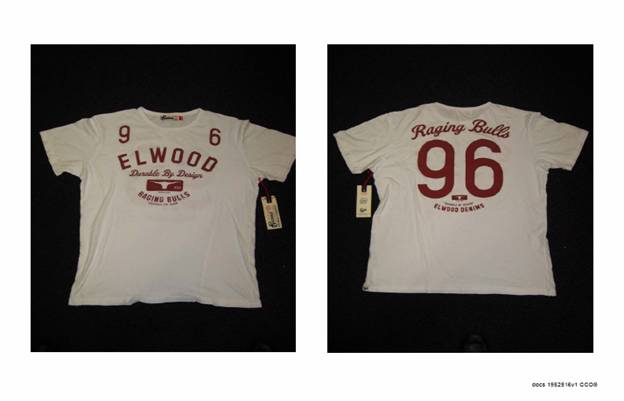
Designs Act 2003 (Cth)
Fine Arts Copyright Act 1862 (UK)
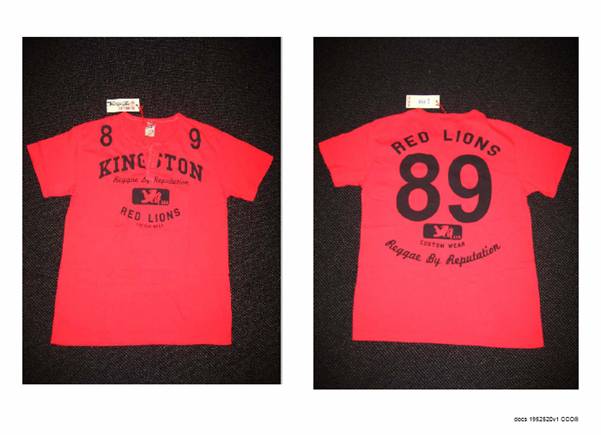
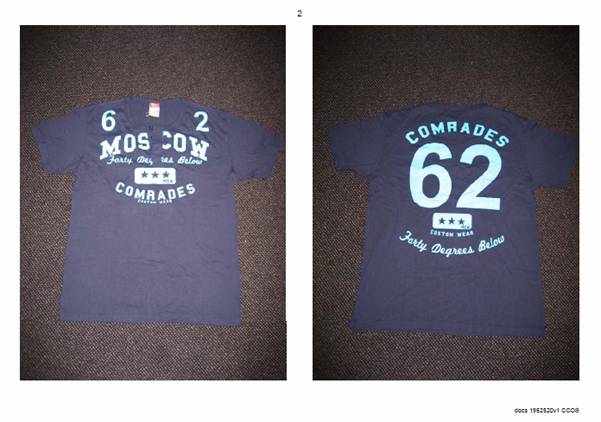
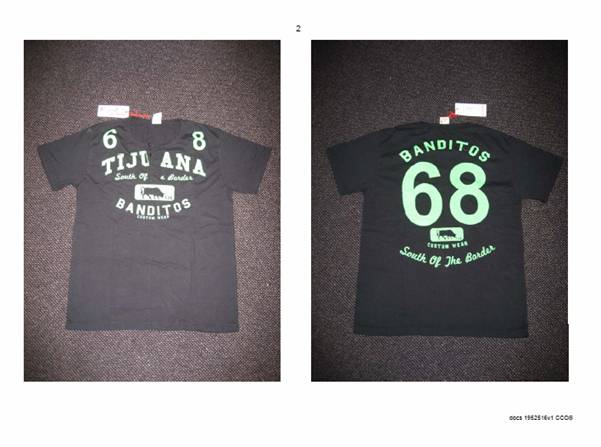
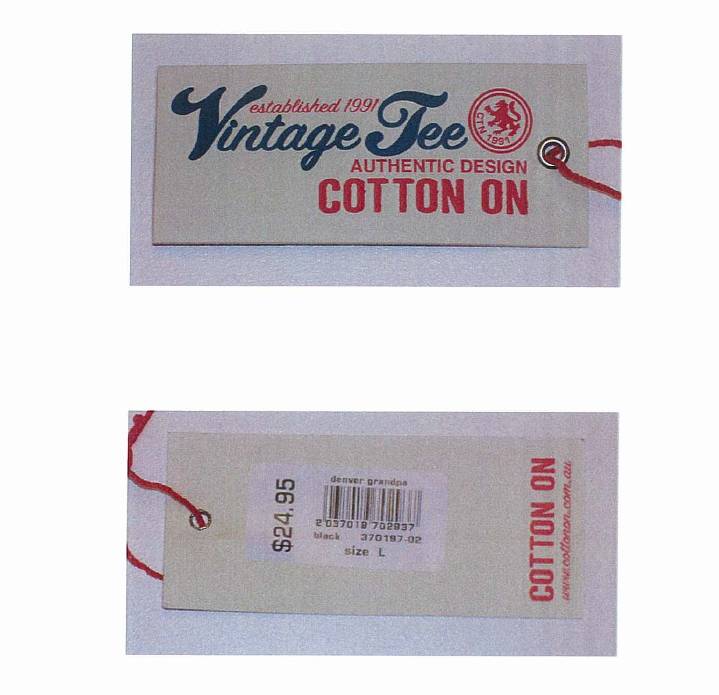
Anacon Corporation Ltd v Environmental Research Technology [1994] FSR 659
A-One Accessory Imports Pty Ltd v Off Road Imports Pty Ltd (1996) 65 FCR 478
Australian Chinese Newspapers Pty Ltd v Melbourne Chinese Press Ltd (2003) 58 IPR 1
Autocaps (Aust) Pty Ltd v Pro-Kit Pty Ltd (1999) 46 IPR 339
Designers Guild Ltd v Russell Williams (Textiles) Ltd (1999) All ER (D) 342
Designers Guild Ltd v Russell Williams (Textiles) Ltd [2001] 1 WLR 2416
Desktop Marketing Systems Pty Ltd v Telstra Corporation Ltd (2002) 119 FCR 491
Handi-Craft Co v B Free World Ltd [2007] EWHC 10
Kalamazoo (Aust) Pty Ltd v Compact Business Systems Pty Ltd (1985) 5 IPR 213
Ladbroke (Football) Ltd v William Hill (Football) Ltd [1964] 1 All ER 465
Ladbroke v William Hill [1964] 1 WLR 273
Lott v JBW & Friends Pty Ltd (2000) 76 SASR 105
Matthews v Freedman 157 F3d 25, (1st Cir, 1998)
Miller & Lang, Limited v Polak [1908] 1 Ch 433
Network Ten Pty Ltd v TCN Channel Nine Pty Ltd (2004) 218 CLR 273
Newspaper Licensing Agency Pty Ltd v Marks and Spencer (2003) 1 AC 559
Nine Films & Television Pty Ltd v Ninox Television Ltd (2005) 146 FCR 144
Nine Network Australia Pty Ltd v IceTV Pty Ltd(2007) 73 IPR 99
Roland Corporation & Anor v Lorenzo & Sons Pty Ltd (1991) 33 FCR 111
Sands & McDougall Pty Ltd v Robinson (1917) 23 CLR 49
Skybase Nominees Pty Ltd v Fortuity Pty Ltd (1996) 36 IPR 529
TCN Channel Nine Pty Ltd v Network Ten Pty Ltd (No 2) (2005) 145 FCR 35
The Polo/Lauren Company LP v Zilani Holdings Pty Ltd [2008] FCA 49
Warwick Film Productions Ltd v Eisinger [1969] Ch 508
Woodtree Pty Ltd v Zheng (2007) 74 IPR 484
ELWOOD CLOTHING PTY LTD (ACN 079 393 696) v COTTON ON CLOTHING PTY LTD (ACN 052 130 462)
VID 800 OF 2007
GORDON J
7 APRIL 2008
MELBOURNE
|
IN THE FEDERAL COURT OF AUSTRALIA |
|
|
VICTORIA DISTRICT REGISTRY |
VID 800 OF 2007 |
|
BETWEEN: |
ELWOOD CLOTHING PTY LTD (ACN 079 393 696) Applicant
|
|
AND: |
COTTON ON CLOTHING PTY LTD (ACN 052 130 462) Respondent
|
|
GORDON J |
|
|
DATE OF ORDER: |
7 APRIL 2008 |
|
WHERE MADE: |
MELBOURNE |
THE COURT ORDERS THAT:
1. The application and the cross-claim are dismissed.
2. The Applicant pay the Respondent’s costs of the application, to be taxed in default of agreement.
Note: Settlement and entry of orders is dealt with in Order 36 of the Federal Court Rules.
|
IN THE FEDERAL COURT OF AUSTRALIA |
|
|
VICTORIA DISTRICT REGISTRY |
VID 800 OF 2007 |
|
BETWEEN: |
ELWOOD CLOTHING PTY LTD (ACN 079 393 696) Applicant
|
|
AND: |
COTTON ON CLOTHING PTY LTD (ACN 052 130 462) Respondent
|
|
JUDGE: |
GORDON J |
|
DATE: |
7 APRIL 2008 |
|
PLACE: |
MELBOURNE |
REASONS FOR JUDGMENT
1 The Applicant, Elwood Clothing Pty Ltd (“Elwood”) designs, manufactures and sells fashionable clothing and clothing accessories aimed at the youth market. Elwood operates one retail store located at 732 Glenferrie Road, Hawthorn in the State of Victoria. It also sells its clothing and clothing accessories wholesale to numerous retailers throughout Australia.
2 These proceedings concern Elwood’s entitlement to claim copyright under the Copyright Act 1968 (Cth) (“the Act”) in two computer design drawings and, if such copyright exists, whether the respondent, Cotton On Clothing Pty Ltd (“Cotton On”) has infringed it.
3 Specifically, Elwood seeks: (1) a declaration of infringement; (2) injunctive relief; (3) an order for delivery up to Elwood of any infringing materials in the possession, custody, or control of Cotton On and (4) various forms of damages against Cotton On pursuant to ss 115 and 116 of the Act. Cotton On defends the proceedings on the basis that copyright cannot subsist in the drawings and, even if it does, that it has not infringed. In addition, Cotton On cross-claims that cease-and-desist letters sent to it by Elwood’s solicitors in July and August 2007 constitute groundless threats of infringement within the meaning of s 202 of the Act. Cotton On seeks declarations to that effect as well as a declaration of non-infringement.
4 The first design, called “NewDeal,” depicts on its front side the word “Elwood” printed to form a downward-curving arc below the numbers 9 and 6, which are separated and also printed along a similar downward-curving arc. Below these elements is the phrase (printed horizontally in a cursive font) “Durable By Design.” Below that phrase is a stylised logo of a forward-facing bull, underneath which is the word “Trademark” in small print. Finally, there appear the phrases “Raging Bulls” and (in smaller font) “Prepared for Denim” both of which are printed to form an arc curving upward. On the back side appears the number 96 in a giant font below the phrase “Raging Bulls” printed along a downward-curving arc in a cursive font. Below the “96” the bull logo again appears, underneath which are the phrases “Durable by Design” and “Elwood Denims,” both printed so as to form an upward-curving arc. The overall effect of the elements in combination is that of a circular pattern whose centre is roughly in the middle of the phrase “Durable by Design” on the front and the middle of the “96” on the back. The NewDeal design was applied by Elwood to a male style T-shirt, style number EM36413 (“NewDeal T-Shirt”). A picture of the NewDeal design applied to an Elwood T-shirt may be seen in Annexure A.
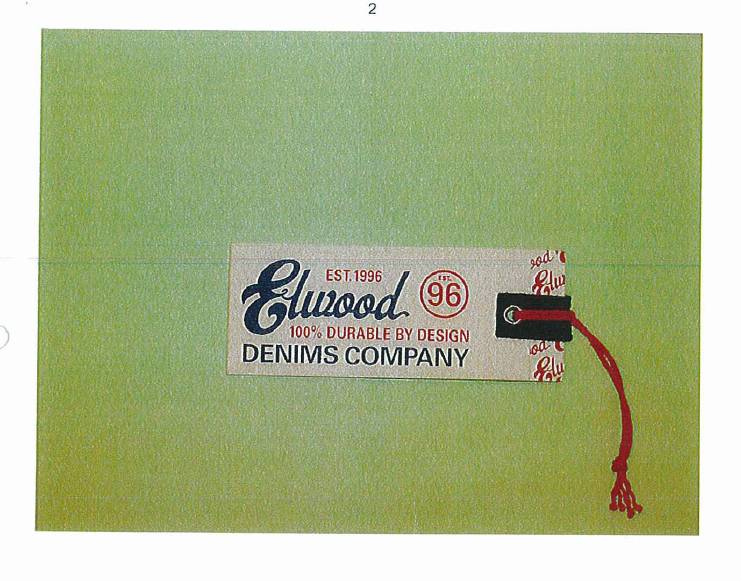
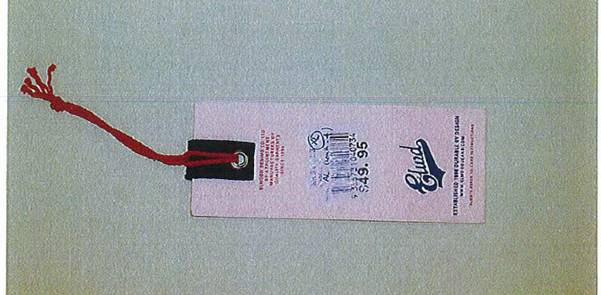
5 The second design, called “Vintage Sport Swing Tag,” is a small rectangular drawing that has been applied to a swing tag and two clothing labels which were used on a range of Elwood’s garments, including the NewDeal T-Shirt. The design depicts the word “Elwood” in a cursive font below the phrase “Est 1996,” to the right of which is a circle containing the number 96 below the word “Est” in small print. Below “Elwood” is the phrase “100% Durable by Design,” and below that, in larger print, the phrase “Denims Company.” Finally, on the reverse side of the drawing is the word “Elwood,” again in a cursive font, but with a flourish extending from beneath the “d” back toward the “E” in Elwood. Below that “Elwood” in small print are the phrases “Established 1996 Durable by Design” and “Always Refer to Care Instructions.” The material on the left-hand side of the drawing is printed running bottom to top; that is, it is perpendicular to the rest of the text, which runs left to right. A picture of the Vintage Sport Swing Tag may be seen in Annexure B.
6 The allegedly infringing Cotton On products are similar. Rather than bore the reader with another lengthy written description of the products, I would direct them to the pictures that may be seen in Annexures A, B and C of (1) a T-shirt with the principal lettering of “Tijuana Banditos” (Annexure A); (2) a swing tag with the principal lettering “Vintage Tee” and “Cotton On” (Annexure B); and (3) T-shirts with the principal lettering of “Kingston Red Lions” and “Moscow Comrades” (Annexure C). As the photographs would suggest, the net effect of the evidence led at trial by both sides is aptly summed up in what I would characterize as Cotton On’s mantra, if not business plan: “The same, but different.” The Cotton On employees responsible for designing the allegedly infringing items conceded during cross-examination that in relation to the designs at issue in this case, they were directed to create products, using the “NewDeal” and the “Vintage Sport Swing Tag” design drawings (“the Design Drawings”) as a reference, with the same look and feel, yet different. The Cotton On witnesses also conceded that, in the result, the principal, if not only, difference between the allegedly infringing products and the Design Drawings was in the content of the lettering. As will be seen below, one of the questions in this case is whether that difference is significant.
7 Before moving to the substantive issues, however, I note that the fact that both the Design Drawings were exploited industrially by application to a T-shirt and swing tag, respectively, will not deprive them of copyright protection (indeed, no suggestion to the contrary was raised by the parties), provided that they are original artistic works; The Polo/Lauren Company LP v Zilani Holdings Pty Ltd [2008] FCA 49 at [73] notes that “artistic works exploited in two dimensions as visual features of pattern or ornamentation will … retain copyright protection” (quoting the Revised Explanatory Memorandum to the Designs (Consequential Amendments ) Bill 2003 (Cth)).
8 Section 32(1) of the Act states, relevantly, that copyright subsists in original artistic works. Section 10(1) of the Act in turn provides that an “artistic work” includes a “drawing … whether [the drawing] is of artistic quality or not.” Against this backdrop, and in light of the concessions made by Cotton On’s witnesses in cross-examination, which essentially eliminated any possibility of a significant fact-based defence being maintained by Cotton On, the parties agreed in closing submissions that the present case boils down to three substantive legal questions, aside from potential issues of quantum, for resolution by the Court:
(1) Artistic versus Literary Works: Are arrangements of principally literary materials such as the Design Drawings capable of being “artistic works” within the meaning of s 10(1) of the Act?
(2) Originality: If yes to (1), do the Design Drawings display sufficient originality for the purposes of protection as “original artistic works” under s 32 of the Act and what is the scope of that protection?
(3) Substantial Part: If yes to (2), have the allegedly infringing items reproduced a substantial part of the Design Drawings?
Artistic v Literary Works
9 In answering the first question, the starting point must be the definition of “drawing” found in the Act. As Cotton On correctly notes, that term is defined inclusively to include “a diagram, map, chart, or plan” (s 10(1) of the Act). But while this definition is helpful in fleshing out what might otherwise not be considered as within the “core meaning” of drawing, it does not directly suggest that core meaning. In Woodtree Pty Ltd v Zheng (2007) 74 IPR 484, Heerey J accepted (at [25]) the definition of drawing given by Professor Ricketson in his treatise on copyright: namely that a drawing “is a two-dimensional work in which shapes and images are depicted by lines, often without colouring.” His Honour then went on to say (at [27]) that “the essence of a drawing remains the concept of a representation of some object by a pictorial line.”
10 So much may be accepted. However, what Cotton On really relies upon is the next passage from Woodtree (at [28]), where Heerey J stated:
In the present case the work in question consists substantially of a photograph, which is not in ordinary speech a drawing and which the statute specifically treats as something distinct from a drawing. The only other visual item is the text. Text is not a drawing. I do not think that by adding a non-drawing to a non-drawing one can end up with a drawing, however much skill goes into the placement and arrangement.
11 The Design Drawings in this case, as both parties more or less accept, are arrangements of text with graphical elements in a particular pattern; not a representation of an object by a pictorial line. Accordingly, if the passage cited in Woodtree were to be understood as laying down a bright-line rule that a work comprising an arrangement of elements that are individually unprotectible cannot, in turn, be protected, then the position of Elwood would seem to be rather bleak. However, I reject this understanding of Woodtree for two reasons.
12 First, Woodtree, cannot be studied in isolation; it is part of a body of case law, which establishes that (1) whether a work will be recognized as an artistic work such as a drawing is highly fact-specific, such that no bright-line rule can be drawn; and (2) the important principle in deciding whether the work is a “drawing” is whether the work at issue can be said to have a visual rather than “semiotic” function: Miller & Lang, Limited v Polak [1908] 1 Ch 433 (concluding that decorative wording and designs on Christmas cards were drawings for the purpose of the Fine Arts Copyright Act 1862 (UK)); Roland Corporation & Anor v Lorenzo & Sons Pty Ltd (1991) 33 FCR 111 (holding that two logos consisting of a single letter each, “R” and “B,” designed in a certain way were eligible for copyright protection as they were drawn with care and to obtain an effect); Anacon Corporation Ltd v Environmental Research Technology [1994] FSR 659, at 662 (suggesting that a circuit diagram depicting how components were to be connected together could be an artistic work because it is “a thing to be looked at in some manner or other [and] is to be looked at in itself”); Lott v JBW & Friends Pty Ltd (2000) 76 SASR 105 (finding that a “graphic bar” consisting of four words in a woodcut design or font that was selected from a computer program was a drawing within the meaning of the Act because it was not so simple that the time and effort in designing the graphic design could be ignored); Australian Chinese Newspapers Pty Ltd v Melbourne Chinese Press Ltd (2003) 58 IPR 1 at [107] (holding that a calligraphic rendering of a Chinese character used in a newspaper masthead was capable of constituting a “painting” under the Act because Chinese calligraphy is a visual art and played “an important cultural and aesthetic role in Chinese life of ancient origin”); Woodtree Pty Ltd v Zheng (2007) 74 IPR 484 (holding that a layout for a box label comprising a photograph and several short lines of explanatory text and numbers was not capable of constituting an artistic work).
13 Cotton On concedes the first point (whether a work will be recognized as an artistic work such as a drawing is highly fact-specific, and that no bright-line rule can be drawn) in its submissions and accepts the second point (the important principle in deciding whether the work is a “drawing” is whether the work at issue can be said to have a visual rather than “semiotic” function) as well, although they put the second point a little differently. The heart of Cotton On’s argument on the artistic work question was put by counsel for Cotton On as follows:
[I]t is submitted that the broad distinction is between an artistic work (including a drawing) which represents or depicts some object or shape that is to be comprehended or appreciated visually and a literary work that communicates information in the form of text, figures or symbols that is understood through the mental process that we would normally refer to as “reading”.
14 In the end, I do not consider this test proposed by Cotton On to be any different in substance from the principle as I have summarised it in [11] or as Heerey J characterized it in Woodtree (and this is the second reason why Woodtree does not support Cotton On’s position) at [29] (emphasis added):
Clearly a letter or letters of the alphabet can provide the subject matter for a drawing. One thinks of the illuminated manuscripts of medieval works such as the Book of Kells. However, in the present case the text is fulfilling a semiotic function. It is communicating to the reader the message that within the cardboard box will be found a wooden photo box with 6 albums which hold 120 10 x 15 cm photos.
15 In other words, a drawing can be composed of text. The question is, are the Design Drawings (and for this purpose I do not think it changes the answer if one focuses on the whole or on the component bits individually) designed to convey “semiotic” meaning (ie to be read as a text) or rather a visual look and feel (ie to be understood as a design)? Counsel for Cotton On submits that the Design Drawings are to be read. In my view, this submission should not be accepted. What is the message that one can glean from “reading” the NewDeal Design? Is it that the wearer is a “raging bull”? Is it that the shirt is “durable by design”? Or perhaps we are to understand that the design was originally “prepared for denim”? Counsel for Cotton On attempts to identify a textual message based on the evidence given by Mr Gillott, the founder of Elwood and ultimate designer of the NewDeal Design, who spoke of the significance of the word ELWOOD as a brand and of the allusive references in the phrases “Raging Bull” and “Durable by Design”: the first as a phrase evoking teams, masculinity and the old film of that name and the second as a reference to Elwood’s general emphasis on denim products.
16 To this one could also add that the evidence showed that the number “96” refers to the year in which Elwood was founded, and that “Prepared for Denim” (and its abbreviation PFD) are traditional phrases in the clothing industry associated with durability and denim designs. However, even accepting that an ordinary consumer of the Design Drawings would, without having the background knowledge of Mr Gillott, understand the various elements in the same or a similar way, I do not accept that any of these elements (whether singularly or as a whole) convey a coherent message as distinct from presenting a pictorial effect. That is, I do not accept that the elements convey a message in the same way that the box label in Woodtree communicated to the reader what were the contents of the box on which the words appeared. At the most, the text of the Design Drawings conveys an image or impression to be associated with the Elwood brand; it does not tell a story, give instructions, describe a scene, or convey information about the world or the product on which it is featured. That is, it performs none of the functions that one would expect to find in a literary text. Certainly no reasonable consumer would purchase items featuring the Design Drawings on that basis (ie for their textual or literary value). Rather, the consumer purchases the items because the selection and arrangement of the various elements (text, colour, font, shape, and so on) has been carefully made to form an aesthetically pleasing visual “look and feel” in the same way that any picture or drawing does.
17 As a result, the Design Drawings are artistic works - drawings - within the meaning of s 10(1) of the Act in which copyright may subsist.
18 Before turning to the second question, however, I should deal briefly with an argument advanced by counsel for Cotton On in support of his artistic work submission. He submitted that if the Court were to find that Design Drawings were copyrightable artistic works as drawings, then copyright would have to be acknowledged as subsisting in any work containing a conscious layout, including the simple cover of a textbook (eg block text stating “Ricketson on Copyright”) or even written submissions of counsel. This contention is not right. As the foregoing analysis would suggest, the hypothetical examples given by counsel are easily distinguishable from the drawings at issue. Like the box label in Woodtree and unlike the drawings here, the works described in the hypothetical examples are each designed to convey, and do convey “semiotic” meaning (ie the contents of the book in the first hypothetical and the party’s theory of the case in the second).
Originality
19 I now turn to the second question regarding originality and the scope of copyright protection to be afforded to the Design Drawings. While “originality” for the purposes of s 32 of the Act does not require any particular level of novelty or creativity, it is still necessary to show that there has been the application of some minimum level of skill and effort to the making of the form in which the particular work is expressed: Sands & McDougall Pty Ltd v Robinson (1917) 23 CLR 49; Ladbroke (Football) Ltd v William Hill (Football) Ltd [1964] 1 All ER 465; Kalamazoo (Aust) Pty Ltd v Compact Business Systems Pty Ltd (1985) 5 IPR 213; Desktop Marketing Systems Pty Ltd v Telstra Corporation Ltd (2002) 119 FCR 491. This is an overall assessment, as copyright may still subsist in a work that comprises both original and non-original elements, as for example, in Warwick Film Productions Ltd v Eisinger [1969] Ch 508 where a significant part of the work in question comprised unedited transcripts of a trial; see also A-One Accessory Imports Pty Ltd v Off Road Imports Pty Ltd (1996) 65 FCR 478. It is also clear that this “original contribution” should originate from the alleged author, and that it should not be copied from elsewhere.
20 Initially, Cotton On adopted the position that the Design Drawings lacked the requisite originality because no significant skill or labour was expended in their creation. However, in light of the evidence led at trial, which established that Elwood had expended several weeks and significant effort in creating the Design Drawings, in its closing submissions Cotton On rightly abandoned both this argument and the related argument that computer-aided design was somehow less worthy of protection than traditional pen and paper design. Given these concessions, I find it unnecessary to recite the details of the evidence on these points.
21 The only point which Cotton On maintains in this respect, and I accept, is that the Vintage Sport Swing Tag must be understood as, and confined to, the two-dimensional drawings which are reflected in the pictures in the Annexures. The evidence at trial showed that: (1) the swing tag design was understood by its designer to include three-dimensional elements such as the string, felt, and safety pin by which the final tag was attached to a garment; and (2) even the three-dimensional swing tag design was not considered by Elwood to be separate from what the witnesses called the “Label Set” (ie the various labels attached to a garment at its collar and other locations and which were also said to contribute to the overall “look and feel”). These additional components of the swing tag design were never put by Elwood as part of its case, probably for the reason that if Elwood attempted to claim infringement of a two-dimensional design applied industrially in three dimensions it might run foul of the non-overlap provisions of s 77 of the Act (providing that copyright protection is unavailable in certain circumstances where a work could be registered under the Designs Act 2003 (Cth)). Accordingly, I have disregarded or discounted so much of the evidence as relates to three-dimensional aspects of the swing tag or the associated Label Set.
22 However, even though Cotton On now accepts that the Design Drawings have the requisite originality, it remains to consider the scope of that which is protected. It is of course axiomatic that copyright protects only forms of expression, not underlying concepts or ideas: Skybase Nominees Pty Ltd v Fortuity Pty Ltd (1996) 36 IPR 529, 531; Desktop Marketing Systems Pty Ltd v Telstra Corporation Ltd (2002) 119 FCR 491, 547-574. This distinction is often illustrated by the juxtaposition of Romeo and Juliet (a copyrightable form of expression) with the story idea of boy-meets-girl, boy-and-girl-are-separated-by-forces-beyond-their-control, boy-and-girl-die-tragically (ie the uncopyrightable underlying concept of star-crossed lovers): eg Matthews v Freedman 157 F3d 25, 27 (1st Cir, 1998). But while the distinction is easy to state in theory, it is often difficult in practice to identify and distinguish the unprotectible idea from the protected form of expression.
23 What is the idea or concept at issue here? One definition advanced by counsel was the “sporty feel” common to college-style athletic wear, which has for decades featured layouts containing a central logo around which numbers are arranged. No doubt this is part of the idea, but I would seek to put it more precisely than that. In so doing, I adopt the evidence of Elwood’s designer Mr Simons, who stated that the underlying concept of the NewDeal Design is that of a central logo surrounded by a V-shaped pattern of arched text, with the distinctive feature of numbers at the shoulder level. The aesthetic theory behind the design was said to be that it accentuates the shape of the male torso by giving the effect of broadening the shoulders while simultaneously narrowing the waist.
24 By adopting this definition (which is perhaps broader than Elwood would wish for),
I am effectively narrowing the scope of copyright protection available. That is to say, it follows from the so defining the underlying concept that Elwood cannot claim a monopoly over all designs featuring the layout described, and that Cotton On, or any other competitor, may ape the basic concept used by Elwood in its design, including by using letters or numbers on the shoulders. To put it another way, in considering whether a potential infringer has copied a substantial part of the NewDeal Design, the bare fact that there is similarity of general layout does not establish infringement (ie the fact that the Cotton On T-shirts also feature a V-shaped pattern of arched text around a central logo does not enter the substantial part calculus). Similarly, I do not understand there to be (nor would I accept) an assertion of a monopoly with respect to a general layout of a swing tag (the unprotected idea behind which might be described as a stylised logo and text running both horizontally and vertically), whose form is in any event in large part constrained by common practice and standards in the garment industry. To be sure, if the Elwood claims were understood or considered at that level of abstraction, they would no doubt fail for the reason proffered by Cotton On - namely, that what was copied was an unprotectible idea.
25 As a result, the monopolies claimed by Elwood must be identified more precisely and as covering only a particular form of expression of the “V-shaped pattern of arched text around a central logo” idea and a particular swing tag design: Matthews, 157 F3d at 27 (adopting the same approach to the consideration of whether copyright subsisted in a T-shirt design). Elwood appeared to accept this point: “It is important to emphasize that [Elwood’s] claim is not for all sport or collegiate type t-shirt[s; i]t is over this particular design it has created.”(emphasis added). It must again be emphasized that this is a narrow, or “thin” level of copyright protection.
Substantial Part
26 This then brings me to consider the third and final substantive issue: did Cotton On copy a substantial part of the Design Drawings?
27 Having subtracted from consideration the unprotectible ideas in the Design Drawings, it falls to consider whether there is anything left about the Design Drawings that is an expression of that idea protected under the Act, and whether Cotton On has copied that in substantial part. It is clear that to the extent the Design Drawings have any distinctiveness as compositions, it depends on the precise selection and arrangement of the various design elements giving expression to the underlying ideas described above. I will not attempt to define every element, but the principal elements would have to be: (1) the font and size of the text; (2) the degree of arc in the text; (3) the relationship between the sizes of the elements; (4) the precise size of the central logo; and (5) the ordering of the elements (by which I mean, for example, the front of the NewDeal Design follows the pattern numbers on the shoulders with large block font text, then cursive font text, then logo, then block font text, then block font text). In other words, the task for the Court is to compare the allegedly infringing products to the Design Drawings and see whether the Cotton On products substantially copy those elements.
28 Before doing so, it is necessary to make reference to both the submissions of the parties, the evidence of the witnesses, and the case law on “substantial part”. Perhaps at the risk of undue abbreviation, the employees of Cotton On who designed the allegedly infringing products conceded during cross-examination that their products were basically the same as Elwood’s, save that the content of the text had been changed (eg “68” substituted for “96”, “Tijuana” for “Elwood”, and so on). In closing submissions, counsel for Cotton On identified the following dissimilarities which, it was submitted, should prevent a finding that a substantial part of the NewDeal Design had been taken:
In the present case, there is no similarity at all, or only limited similarity, in relation to the following matters represented in [Elwood's] NewDeal drawing:
a. The words used in the Respondent’s t-shirts, i.e. TIJUANA, South of the Border, Banditos, Custom Wear; MOSCOW, Forty Degrees Below, Comrades; RED LIONS, KINGSTON, Reggae by Reputation, are quite different;.
b. The numbers are also different: 68 (for TIJUANA), 62 (for MOSCOW), 89 (for RED LIONS).
c. The central devices are quite distinct: a profile of a bull, a lion, stars.
d. There are differences in the fonts and stylings of the individual letters, words and numbers.
29 With respect to the Vintage Sport Swing Tag, Counsel for Cotton On submitted the following:
[T]he label of [Cotton On] differs in the following respects:
a. The words on each line: while [Elwood] seeks to downplay the significance of text, it seems axiomatic that, in the case of a label, the respective names of [Elwood] and [Cotton On] clearly play a pivotal role as brands or identifiers and are obviously completely different
b. The fonts and font sizes used;
c. The positioning and arrangement of these lines of text;
d. The colours used for each line;
e. The devices used: 96 est is a single small circle on Elwood and a lion device and the words “Cotton On” within a double circle on [Cotton On's] label.
30 Courts have, at various times and in various circumstances, listed factors to be considered in determining whether the infringing act was done in relation to a substantial part of the work. The lists reflect differences in approach and language. Those differences are to be expected having regard to the fact that the cases concern different subject matters and various forms of work and where no two acts of infringement are identical. This case is no different. What follows is not exhaustive. It is a list of the principal factors relevant to the facts of this case and, in particular, factors which seek to identify the relationship between the concept of a “substantial part” and the underlying (and unprotected) ideas or concepts contained the work.
31 First, a crucial consideration is the importance of the part in relation to the work as a whole. That depends much more on the quality rather than the quantity of what has been taken: Newspaper Licensing Agency Pty Ltd v Marks and Spencer (2003) 1 AC 559; Ladbroke v William Hill [1964] 1 WLR 273 at 276. Secondly, the quality one is looking for, in the case of an original work, is in the originality of the skill or labour in producing the work: Newspaper Licensing at 560. Thirdly, the question of quantity. In Newspaper Licensing, concerning copyright in a published edition, Lord Hoffman at [561] described the test in relation to this factor as follows:
The test is quantitative in the sense that as there can be infringement only by making a facsimile copy, the question will always be whether one has made a facsimile copy of enough of the published edition to amount to a substantial part. But the question of what counts as enough seems to me to be qualitative, depending not upon the proportion which the part taken bears to the whole but on whether the copy can be said to have appropriated the presentation and layout of the edition.
See also Network Ten Pty Ltd v TCN Channel Nine Pty Ltd (2004) 218 CLR 273 and TCN Channel Nine Pty Ltd v Network Ten Pty Ltd (No 2) (2005) 145 FCR 35 at [19].
32 In Designers Guild Ltd v Russell Williams (Textiles) Ltd (1999) All ER (D) 342, at [20], Morritt LJ described the task in the following way:
First, the part to be considered is the part of the copyright work which has been copied. Second, the copying which is relevant is the copying, not of the idea, but of the expression of the idea. Third, substantiality is a qualitative not a quantitative test. Fourth, the antithesis of “substantial” is “insignificant”. Fifth, in considering whether the part which has been copied is substantial no weight is to be attributed to that which is commonplace or well-known or derived from some other source. Sixth, it must be borne in mind that the object of the law of copyright is to protect the product of the skill and labour of the maker not to confer on him a monopoly in the idea it may express.
33 The relationship between the concept of a “substantial part” and the underlying (and unprotected) ideas or concepts contained the work had been earlier addressed by Finkelstein J in Autocaps (Aust) Pty Ltd v Pro-Kit Pty Ltd (1999) 46 IPR 339. The case concerned what has been described as an “informational catalogue” for different kinds of petrol caps. The applicant complained that the respondent had adopted the same numbering system used in its catalogues to designate and describe the caps. Finkelstein J described the applicant’s contention at [48] as follows:
The complaint made by CPC is that Pro-Kit has taken the information constituted by the digits in the part number for each cap, that a particular cap is suitable for use not only for a specific make or model of vehicle, but for other models, and those vehicles in relation to which the caps can be used. In my view, the digits are a significant element of each CPC part number in the sense that, of the various pieces of information conveyed by a part number, the information concerning interchangeability is as important as the other information. When taken in combination with the list of vehicles for which a particular cap is appropriate, it enables a retailer wishing to sell these caps to readily determine which caps should be purchased and in what quantity in order to meet demand. It is possible for such a retailer, once he or she is aware that caps are interchangeable, to maintain a significantly smaller holding of stock.
34 In the present case, two questions require answering. First, does Cotton On's design incorporate features taken from the copyright work and, if so, does what has been taken constitute all or a substantial part of the copyright work?: Handi-Craft Co v B Free World Ltd [2007] EWHC 10 at [168] citing Millett LJ in Designers Guild Ltd v Russell Williams (Textiles) Ltd [2001] 1 WLR 2416 at 2425-2426. It is a matter of impression.
35 What then is the position here? Cotton On has admittedly and blatantly copied one integer of a series of integers which together constitute the copyright work. In the case of the NewDeal print, the one integer which it admittedly has taken is, as the applicant put it, the shape and form of the graphic. It may be accepted that the shape and form of the graphic is the "essential or material" idea that underpinned the creation of the copyright work but the fact remains that what is taken is the idea and not a substantial part of the work: Designer Guild Ltd v Russell Williams (Textiles) Ltd [1999] All ER (D) 342.
36 It is at all times necessary to remember that the work in issue in this case is the particular expression of the idea constituted by the combination of features detailed earlier. What Cotton On took and then adapted was the idea of the V shaped graphic and the placement of the text and symbols within that V shaped graphic. Cotton On did not copy the text or the symbols on the NewDeal print. Unlike the judge in the Handi-Craft decision,
I cannot say that the NewDeal print and the Cotton On t-shirt prints make “the same visual impression on me as the other": [171]. They do not. The text and symbols matter. The colours matter. Similarly, unlike Finkelstein J in Autocaps, I cannot say that what is conveyed by the two prints is the same – it is not.
37 Elwood contended that the fact that the introduction of the Cotton On garments into the market place "killed" sales of the NewDeal print t-shirts is a relevant consideration in determining whether a substantial part has been reproduced: TCN Channel Nine Pty Ltd v Network Ten Pty Ltd (2005) 145 FCR 35 at [15]. There are two answers to that submission. First, the submission assumes that the "property" taken is subject to copyright. In the present case, what was taken was just one integer of the property and that integer is not protected. Secondly, the events that followed the introduction of the Cotton On garments equally support the contention that what was taken was, in fact, a good idea. And ideas are not protected by copyright: see [22] above.
38 The analysis in relation to the Vintage swing ticket is similar. The form, shape and placement of the graphics was taken by Cotton On. I accept that the shape of the graphic is important or crucial to its design and success. However, as with the NewDeal print, what Cotton On has admittedly taken is one integer of a series of integers which together constitute the copyright work. And the integer taken is, in fact, the idea and not a substantial part of the work.
Cross-claim
39 Cotton On filed a cross-claim for relief in relation to the making of unjustified threats of infringement pursuant to s 202 of the Act. The threats were said to be contained in correspondence from the Applicant's solicitors dated 31 July and 30 August 2007. The proceedings were commenced on 31 August 2007.
40 Section 202 of the Act provides a statutory cause of action for groundless threats of infringement, even if made bona fide: Nine Films & Television Pty Ltd v Ninox Television Ltd (2005) 146 FCR 144 at [48] per Lindgren J. Section 202 of the Act relevantly provides:
(1) Where a person, by means of circulars, advertisements or otherwise, threatens a person with an action or proceeding in respect of an infringement of copyright, then, whether the person making the threats is or is not the owner of the copyright or an exclusive licensee, a person aggrieved may bring an action against the first-mentioned person and may obtain a declaration to the effect that the threats are unjustifiable, and an injunction against the continuance of the threats, and may recover such damages (if any) as he or she has sustained, unless the first-mentioned person satisfies the court that the acts in respect of which the action or proceeding was threatened constituted, or, if done, would constitute, an infringement of copyright.
…
(4) The defendant in an action under this section may apply, by way of counterclaim, for relief to which he or she would be entitled in a separate action in respect of an infringement by the plaintiff of the copyright to which the threats relate and, in any such case, the provisions of this Act with respect to an action for infringement of a copyright are, mutatis mutandis, applicable in relation to the action.
41 In Nine Network Australia Pty Ltd v IceTV Pty Ltd(2007) 73 IPR 99 at [231] – [234], Bennett J described s 202 in the following terms:
231. The prerequisite in s 202(1) is that a person is threatened with an action or proceeding. This refers to a proceeding not yet brought. "Threat" imports an intention to bring an action or ‘an indication of probable evil to come’ (Macquarie Dictionary (4th ed, 2005)). That is the commencement of the proceedings threatened. Once the proceedings have been commenced, the threat to commence those proceedings has ceased. The link between the threat and the commencement of legal proceedings and the need for a statutory remedy in the context of the comparable s 121 of the Patents Act1952 (Cth) (then in force) was commented upon by von Doussa J in Townsend Controls Pty Ltd v Gilead(1989) 14 IPR 443 at 448. His Honour said that the purpose of the section was to provide a statutory remedy where a person makes a threat instead of enforcing the claimed monopoly by instituting proceedings for infringement.
232. The history of the section suggests that it was concerned to deter unjustified threats themselves, threats that did not result in infringement proceedings or could not be justified by actual infringement; threats made to ‘frighten away competitors or to damage such persons less directly, by threatening to sue their customers or suppliers as joint tortfeasors’ (Ricketson S and Creswell C, The Law of Intellectual Property: Copyright, Designs & Confidential Information(Lawbook Co., subscription service) at [2.195]; Avel Pty Ltd v Intercontinental Grain Importers Pty Ltd (1996) 65 FCR 154 at 159)). It is a right extended to the threatened person not generally available to those threatened with an action for a civil wrong.
233. Section 202 does not specifically provide for a cross-claim in an infringement action, only for the commencement of an action. However, by O 5 r 1(1) of the Federal Court Rules, a respondent:
‘may cross-claim against an applicant for any relief to which the respondent would be entitled against the applicant if the applicant were a respondent in a separate proceeding commenced in the Court by the respondent for that purpose.’
234. [The Respondent] did not bring its action when the threats were current. Had it brought the action, [the Applicant] would have undoubtedly availed itself of the entitlement in s 202 (4) of the Act to bring an action for infringement by way of cross-claim. I do not see that [the Respondent] would have been precluded from bringing a cross-claim under s 202(1) just because [the Applicant] filed its proceedings first. It is important, however, to make it clear that [the Respondent] at no time has the right under s 202 to claim for any remedy that is not based upon the threats. To the extent that those threats were directed to [the Respondent], they ceased upon the commencement of proceedings by [the Applicant]. Section 202 does not entitle [the Respondent] to claim damages resulting from the commencement of these proceedings.
42 Against that background, it is necessary to consider the facts in the present case. Cotton On refers to correspondence not in evidence. What is apparent is that the threats were not made to a third party but to Cotton On. The time between the threats being made and the commencement of proceedings is short – one day in relation to the second letter. There is no evidence of any damage that flowed to Cotton On in that intervening time. Cotton On’s written submissions refer to alleged damages but it is not clear whether such damage occurred prior to the commencement of proceedings. More significantly, Cotton On has not demonstrated that there is any utility in a declaration or injunction under s 202(1) of the Act once Elwood’s claim for infringement is dismissed. In the circumstances, I would dismiss the cross-claim.
Conclusion
43 In light of the foregoing, Elwood’s infringement claim must fail and I would dismiss the cross-claim. Accordingly, I would order that the application and the cross claim be dismissed. I would order Elwood to pay Cotton On’s costs of the proceedings. I would make no order as to costs in relation to the cross-claim.
|
I certify that the preceding forty-three (43) numbered paragraphs are a true copy of the Reasons for Judgment herein of the Honourable Justice Gordon. |
Associate:
Dated: 7 April 2008
|
Counsel for the Applicant: |
Mr M Rivette |
|
|
|
|
Solicitor for the Applicant: |
Middletons |
|
|
|
|
Counsel for the Respondent: |
Prof S Ricketson |
|
|
|
|
Solicitor for the Respondent: |
Griffith Hack |
|
|
|
|
Date of Hearing: |
25 and 26 February 2008 |
|
|
|
|
Date of Written Submissions: |
28 February 2008, 3 and 4 March 2008. |
|
|
|
|
Date of Judgment: |
7 April 2008 |
Annexure A
Elwood NewDeal T-Shirt
Cotton On Tijuana T-Shirt
Annexure B
Elwood Vintage Sport Swing Tag
Cotton On Swing Tag
Annexure C
Cotton On Kingston and Moscow T-Shirts