FEDERAL COURT OF AUSTRALIA
Barrett Property Group Pty Ltd v Carlisle Homes Pty Ltd [2008] FCA 375
Copyright Act 1968 (Cth) ss 14(1), 31(1)(b)(i)
Evidence Act 1995 (Cth) s 55(1)
Barrett Property Group Pty Ltd v Metricon Homes Pty Ltd [2007] FCA 1509 cited
Briginshaw v Briginshaw (1938) 60 CLR 336 applied
Clarendon Homes (Aust) Pty Ltd v Henley Arch Pty Ltd (1999) 46 IPR 309 applied
Eagle Homes Pty Ltd v Austec Homes Pty Ltd (1999) 43 IPR 1 applied
Edwards v The Queen (1993) 178 CLR 193 applied
Kipling v Genatosan Ltd [1917-1923] MacG Cop Cas 203 referred to
Tamawood Ltd v Henley Arch Pty Ltd (2004) 61 IPR 378 applied
Le Corbusier, Vers une architecture (1923)
BARRETT PROPERTY GROUP PTY LTD AND SRS PROPERTY HOLDINGS PTY LTD v CARLISLE HOMES PTY LTD
VID 1245 OF 2005
HEEREY J
20 MARCH 2008
MELBOURNE
|
IN THE FEDERAL COURT OF AUSTRALIA |
|
|
VICTORIA DISTRICT REGISTRY |
VID 1245 OF 2005 |
|
BETWEEN: |
BARRETT PROPERTY GROUP PTY LTD First Applicant
SRS PROPERTY HOLDINGS PTY LTD Second Applicant
|
|
AND: |
CARLISLE HOMES PTY LTD Respondent
|
|
HEEREY J | |
|
DATE OF ORDER: |
20 MARCH 2008 |
|
WHERE MADE: |
MELBOURNE |
THE COURT ORDERS THAT:
1. The parties bring in minutes of orders to give effect to these reasons.
Note: Settlement and entry of orders is dealt with in Order 36 of the Federal Court Rules.
|
IN THE FEDERAL COURT OF AUSTRALIA |
|
|
VICTORIA DISTRICT REGISTRY |
VID 1245 OF 2005 |
|
BETWEEN: |
BARRETT PROPERTY GROUP PTY LTD First Applicant
SRS PROPERTY HOLDINGS PTY LTD Second Applicant
|
|
AND: |
CARLISLE HOMES PTY LTD Respondent
|
|
JUDGE: |
HEEREY J |
|
DATE: |
20 MARCH 2008 |
|
PLACE: |
MELBOURNE |
REASONS FOR JUDGMENT
CONTENTS
INTRODUCTION.................................................................................................................... [1]
The parties’ designs................................................................................................................ [8]
subsistence of copyright......................................................................................... [10]
Barrett’s development of the Seattle design........................................................................... [10]
Carlisle’s use of Seattle design........................................................................... [37]
Access to Seattle design....................................................................................................... [37]
Whether Carlisle used the Seattle design – its case at trial...................................................... [48]
The conference at Mallesons................................................................................................. [52]
Retainer of expert by Carlisle................................................................................................ [64]
Carlisle’s defence and amendments....................................................................................... [65]
Untruthful evidence as to early mention of Rochester............................................................. [72]
Relevance of untruthful evidence........................................................................................... [75]
substantial part........................................................................................................... [80]
sufficient similarity................................................................................................... [88]
Orders............................................................................................................................... [110]
Schedule A: Barrett’s Seattle
Schedule B: Carlisle’s Provence
Schedule C: Second of four draft plan concept drawings for the Seattle
Schedule D: Mr Doulgeridis’ Sketch C for the Provence
INTRODUCTION
1 The applicant companies (collectively, Barrett) assert ownership of copyright in the plans for a home design and building first marketed under the name Seattle. Later versions were called Memphis and Aberdeen. Barrett claims that the respondent (Carlisle) has infringed their copyright by reproducing in its Provence home a “substantial part” of the copyright works: Copyright Act 1968 (Cth) ss 14(1), 31(1)(b)(i).
2 The substantial part alleged to be reproduced is the “al fresco quadrant”. This part comprises a combination of the rumpus, family, kitchen and meals areas around an open courtyard enclosed on three sides, all under a single roof line.
3 The first issue is whether copyright subsists. The principals of both Barrett and Carlisle were formerly employees of Henley Properties Pty Ltd, a major home builder. Carlisle says that the various designs of Henley were part of the “furniture of their minds”. In particular, Carlisle contends, the al fresco quadrant as produced by Carlisle is a development of the Henley Rochester. Barrett, so Carlisle says, started with the Rochester, added a rumpus room and extended the roofline. This was an “obvious, logical and simple” addition. The skill and effort in creation was so “trivial” that it did not confer originality.
4 Secondly, Carlisle says it did not use Barrett’s design in creating the Provence. It accepts it had access to the Seattle, but that in itself is not enough to constitute infringement. The Rochester also becomes important on this issue. Carlisle says it developed its Provence from the Rochester, not the Seattle.
5 Thirdly, Carlisle says that the al fresco quadrant was not a substantial part of Barrett’s works.
6 Fourthly, Carlisle says there was not sufficient similarity between the relevant part of its works and the al fresco quadrant in Barrett’s works.
7 Barrett has recently successfully sued another home builder for copyright infringement in respect of the Seattle design: Barrett Property Group Pty Ltd v Metricon Homes Pty Ltd [2007] FCA 1509. In that case Gilmour J has comprehensively reviewed copyright law principles as applicable to home designs: see especially at [13]-[28]. I gratefully adopt that review and incorporate it in these reasons.
The parties’ designs
8 Barrett’s Seattle design is Schedule A to these reasons.
9 Carlisle’s Provence design is Schedule B to these reasons.
SUBSISTENCE OF COPYRIGHT
Barrett’s development of the Seattle design
10 The principal of Barrett mainly concerned with the development of the Seattle design was Mr Daniel Stutterd. In about May 1999 Mr Stutterd was working with Metricon as a Sales Manager. At that time he and Mr Anthony Roberts, then working for Henley as National General Manager, left their respective employers to set up their own business. Mr Stutterd had worked for Metricon for about a year and prior to that for about seven years for Henley in various roles up to General Manager. Mr Roberts had worked with him at Henley.
11 In May 1999 Mr Stutterd and Mr Roberts travelled around Australia for about two weeks assessing the housing markets in Queensland, Sydney, Perth and Adelaide. At the conclusion of their trip they had formed a basic business plan. They decided to target what they perceived as a gap in the market for “single storey homes with double storey luxury”. On 22 June 1999 they formed Barrett, then called Homes of Today Pty Ltd. Later that year it adopted its present name.
12 Mr Stutterd denied that they encountered the al fresco concept in this trip.
13 The development of that design proceeded as follows.
14 In early June 1999 Mr Stutterd engaged Mr Keith Fuller, a contract designer, to design a single storey house. He told Mr Fuller that he wanted a single storey design with a large master bedroom suite including a parents’ retreat usually found in more premium double storey designs. Mr Stutterd and Mr Roberts had a number of meetings with Mr Fuller who presented various concept designs. However Mr Stutterd and Mr Roberts considered that these were not what they were looking for. They also found it difficult to work with Mr Fuller as he was only available after hours. Mr Stutterd and Mr Roberts decided to engage another designer, Mr Randall Pye.
15 In late June Mr Stutterd and Mr Roberts contacted Mr Pye and retained him to create some initial concepts. They gave him some of Mr Fuller’s sketches. Mr Pye produced some initial concept drawings. Mr Stutterd and Mr Roberts discussed the concepts and provided him with feedback. Mr Pye worked on the project with a contractor Ms Rhonda Kellett and his employee Ms Adele Mihalcsek.
16 On 29 July Mr Stutterd met with Mr Pye who provided four draft plan concept drawings. The second of these drawings (Schedule C to these reasons) had four bedrooms, an “EF Dining/Rumpus” and an area designated “EF Dining Area”. EF stands for el fresco. As explained by Ms Kellett, this was a mistaken reference to “al fresco”. It was intended to mean outdoor dining. She knew outdoor dining was popular in Europe. She could not remember who of the persons involved (Messrs Pye, Roberts, Stutterd and herself) came up with the idea.
17 At that stage Mr Stutterd preferred the third of Mr Pye’s four designs because it had four bedrooms and a rumpus room which he thought was the best design for what he wanted to achieve. He made some drawings himself further developing the third plan and provided copies of these to Mr Pye on 4 August. At this stage the name “Seattle 31” had already been adopted, 31 being a reference to the area of the design.
18 On 11 August Mr Pye sent a rough concept drawing prepared by Ms Kellett. Four further drawings were faxed between Mr Stutterd and Mr Pye on or about 12 and 13 August. In the course of these the al fresco quadrant appears clearly, for example in Exhibit RRP 15 to Mr Pye’s affidavit.
19 On 20 August Mr Stutterd received from Mr Pye a number of roof plan drawings which contained a number of different options for the roof of the Seattle house. Mr Stutterd discussed with Mr Pye the option of covering the al fresco dining area shown in the first of those options, which was adopted.
20 Variations were subsequently prepared by Mr Pye including a three bedroom scaled down version and other detailed works.
21 The final Seattle plan was approved by Barrett in September (exhibit DJS 8).
22 In Metricon subsistence of Barrett’s copyright in the Seattle was not challenged. However, Gilmour J noted at [34]:
The drawing process, as evidenced in (Barrett’s) affidavit material, shows a substantial evolution in the design concept and implementation, which is clearly revealed in the sequence of drawings exhibited. There are approximately 130 drawings and notes that culminate in the final Seattle 31 plan, which Barrett approved in or about September 1999.
23 Carlisle disputed that there were 130 drawings in evidence in the present case. My calculation accords with that of Gilmour J. There may well be some duplication, with the same drawing being reproduced by sender and receiver. But I am satisfied that the general conclusion reached by Gilmour J is equally justified in the present case.
24 By September 1999 Barrett was building the first prototype of the Seattle design at 10 Brownell Road, Glen Iris, as a home for Mr Roberts. About this time it commenced marketing, building and selling houses in accordance with the Seattle plan. The product was available in 22, 26 or 31 square versions. The first display home was built and opened at a display village located at 47 Scenic Drive, Beaconsfield in January 2000.
25 The Seattle design proved to be popular and sold very well.
26 Subsequently Barrett developed the Memphis, which was a 33 square variation of the Seattle, and in about 2003 the Aberdeen, which involved changes for energy requirements.
27 In cross-examination Mr Stutterd did not accept that the Seattle was “strikingly similar” to the Rochester. He pointed out that the Seattle had a three room width, that is including the extra room for parents’ retreat section of the master bedroom, the al fresco section and the rumpus room.
28 Mr Stutterd said that he recalled the plan of the Rochester and was aware of it prior to the design of the Seattle. He was not aware that Henley had added a rumpus room to the Rochester design at the request of some customers. He agreed that such modification at the request of a customer was not unusual in the industry, but this was less so in 1999 because in his experience Henley then was “very stringent” on the changes it made to its plans. It was a “volume builder and wouldn’t make a lot of changes”.
29 Mr Stutterd denied providing any Henley plans to Mr Pye. It turned out in cross-examination that he had supplied some kitchen fit-out plans of a Henley plan called the Chirnside. I was invited to infer that because Mr Stutterd copied part of the Henley Chirnside, it followed that he copied part of the Henley Rochester. I do not think this follows at all. In any event, Carlisle’s case is not that Barrett copied Rochester, for the simple reason that prior to the design of the Seattle, or indeed thereafter, the Rochester did not have an al fresco quadrant. Rather it is put that (i) Mr Stutterd was aware of the Rochester, (ii) although the Rochester did not have an al fresco quadrant, it would be logical to add a rumpus room, (iii) once a rumpus room was added in the logical place for one, it would be a further logical step to add roofing so as to create an al fresco area. Carlisle’s case in denying the subsistence of copyright is not really an allegation of copying but a quasi-patent law case theory of obviousness. Its counsel put in final submissions that, starting with the Rochester, it was a “well known thing to add a rumpus” and that all Mr Stutterd next did was “put a roof over the courtyard, which was already there once you add the rumpus”. These two steps were “so trivial that they can’t be said to constitute the exercise of sufficient skill and effort such as to give rise to originality”.
30 A design feature which, on the evidence, had not appeared in the market before and which formed a key part of a commercially very successful design hardly deserves characterisation as trivial. As senior counsel for Barrett pointed out, if the hypothetical development of Rochester was so obvious, somehow it did not occur to Henley or other competitors. In any case, copyright is concerned with form rather than ideas, whether obvious or not.
31 Mr Pye was served with a subpoena by the applicant. The only Henley document in his possession was the Chirnside kitchen fit-out plan already referred to above. Mr Pye said in evidence that he was not aware of the Rochester prior to 1999 and Mr Stutterd did not say to him that he (Stutterd) wanted a plan similar to the Rochester. I see no reason to disbelieve Mr Pye.
32 I found Mr Stutterd a credible witness. He was corroborated by Mr Pye, Ms Kellett and Ms Mihalcsek. I am satisfied that the applicant came to the design of the Seattle in the way it says.
33 Counsel for Carlisle pointed to the acceptance in cross-examination by Mr Stutterd of what counsel said were a number of significant similarities between the Seattle and the Rochester. These included the use of feature columns, the arrangement of a lounge and dining area and the meals, kitchen and family room in a triangular arrangement. However, all the evidence shows these were equally features which might be found elsewhere in the project home market even if in some instances, as for example in the use of feature columns, they were a very common feature of Henley homes.
34 Counsel for Carlisle developed his case theory by “(a)ssuming the Rochester plan was Mr Stutterd’s starting point”. For the reasons already advanced, there is simply no basis in the evidence for this assumption.
35 It was put that the decision to extend the roof over the courtyard to cover the al fresco dining area, rather than leaving it as an open courtyard, or covering it with a pergola, was dictated by considerations of cost and convenience, rather than any skill or judgment. But there were other solutions for roofing, as Carlisle’s witness Mr Quigley demonstrated (exhibit J), which might have aesthetic advantages while being more expensive. Choosing a particular solution which happens to be cheap and effective does not bespeak lack of originality, indeed the opposite.
36 I conclude that the al fresco quadrant part of Barrett’s Seattle design, and the Memphis and Aberdeen derivations, were original and that copyright in them subsists in Barrett.
CARLISLE'S USE OF SEATTLE DESIGN
Access to Seattle design
37 By the time work started on Carlisle’s Provence design in June 2003 the Seattle design and its Memphis variation had been in the public domain in the Melbourne metropolitan area for some years. As already mentioned, the first display version of the Seattle was erected in Scenic Drive, Beaconsfield and was open for public inspection in January 2000. The Memphis was built at a display village located in Highgate Way, Rowville and open for inspection in November 2001. The Aberdeen was built at a display village in Ridgemont Drive, Berwick and open for public inspection in or about December 2003.
38 The director of Carlisle principally responsible for the design of the Provence was Mr John Doulgeridis. He holds the degree of Bachelor of Planning and Design from the University of Melbourne (1993). From August 1993 to January 2004 he worked for Henley in a number of capacities including building supervisor and estimator. From December 1999 he ran Henley’s subsidiary Northbridge Homes and was involved in all aspects of the residential homes business.
39 In January 2004 Mr Doulgeridis joined with two other friends and colleagues at Henley, Mr David Taylor and Mr Dean Morrison, in establishing Carlisle. The three men are directors of Carlisle. Mr Doulgeridis is responsible for design, Mr Taylor for administration and finance and Mr Morrison for sales and marketing. The relevant work on the Provence was commenced in June 2003, before the men had left Henley.
40 Mr Doulgeridis saw the Seattle display home in Beaconsfield in late 2000 or early 2001. He agreed in cross-examination that he was familiar with the Seattle design around that time. He saw the Memphis display home in about November 2001 or early 2002. As to the al fresco feature Mr Doulgeridis was asked:
And you will have observed the al fresco feature and the surrounding rooms from the Seattle and Memphis, didn’t you? ---I knew that a key feature of the home was the al fresco itself. I think that you would open any brochure and it would state that, you know, the houses included al frescos.
41 Mr Doulgeridis knew in June 2003, before he left Henley, that the Memphis had been a successful product. He was also asked:
The question was, you knew about the combination of those features from Memphis and Seattle before June 2003 and when I say those features I mean the combination of family, rumpus, Neil’s [sic – obviously meals] al fresco, didn’t you? ---In a broad perspective, not you know, a very close perspective of it but in a general sense, yes.
42 He agreed that he had done at least two inspections, if not more.
43 Mr Morrison agreed he had seen the floor plan of the Seattle before June 2003 and could possibly have seen it in 2000. His ordinary duties at Henley involved him inspecting a very significant number of display homes (about 1,000), including homes of Barrett and Metricon. He was also familiar with the Memphis and Aberdeen. He would have seen the Memphis in Rowville in about 2001.
44 Mr Morrison said he was aware as at May 2002 that the al fresco quadrant feature was “out there in the marketplace”, and that he was aware that the market “was accepting of those sorts of designs”, that it was “talked about regularly” and “you would be silly not to acknowledge that it was wanted by the market”.
45 Mr Doulgeridis and Mr Morrison were also aware of Metricon’s Streeton design before they left Henley.
46 It was not in contest that Carlisle had access to Barrett’s Seattle and Memphis designs and the opportunity to use the al fresco quadrant when it produced the Provence design. Whether it availed itself of that opportunity is the main issue in this case.
47 Before leaving the question of access, it is worth noting that the quality of that access and opportunity is significant. Display homes are completely open to the public. Usually brochures containing sketch layouts are freely available. Understandably, rival builders take the opportunity to inspect other products in the marketplace. In the present case the opportunity to inspect the Seattle had existed for three and a half years. The al fresco quadrant was a conspicuous and commercially successful feature of the Seattle design, as would have been obvious to competitors such as Carlisle.
Whether Carlisle used the Seattle design – its case at trial
48 At the outset of his written closing submissions, counsel for Carlisle submitted that the “central issue” in the case was whether Carlisle copied Barrett’s Seattle, Memphis or Aberdeen designs to develop its Provence design or whether the Provence was independently created “having regard to other influences, principally the Henley Property Group’s Rochester, and having regard to John Doulgeridis’ desire to incorporate the concept of an al fresco dining space in the open courtyard of that design [ie the Rochester]”. In oral submissions he said that the Rochester
…is highly significant in the present case for two reasons. First of all, because it provides an alternative source of inspiration for the Provence design, alternative to any of our friends’ works or any work derived from their work. And, secondly, on the subsistence question …it provides the basis for our attack on the subsistence of copyright in our friends’ works.
49 The alleged influence of the Rochester was further developed in Carlisle’s written closing submissions. For example, it was said that the Rochester was one of the most successful Henley designs, was well known in the market and both Mr Doulgeridis and Mr Stutterd were aware of it prior to producing their designs. In referring to Mr Doulgeridis’ initial sketches it was said that they “incorporated particular features which were then common in the volume home market and were seen in Henley’s Rochester and Montrose”. It is said that the “key influence” of the Rochester was in the arrangement of the kitchen meals area, family room and rumpus room in the rear of the house. The submissions continue:
Mr Doulgeridis was aware that the Rochester was a popular and successful Henley plan, and that the Rochester had been withdrawn from the market by Henley in 2002 or early 2003.
50 Although, as already noted, it was not put that Mr Doulgeridis directly copied the al fresco quadrant from the Rochester (since the Rochester did not have an al fresco), that design was right at the forefront of the defence which Carlisle mounted at trial against Barrett’s infringement claim.
51 The alleged importance of the Rochester to Carlisle’s case comes from facts which would have been within the knowledge of Carlisle’s directors before this litigation commenced, or was threatened. One would expect the Rochester to have been prominent in their minds from the outset. However, as will be seen, this was not so. It is necessary to examine in some detail the emergence of the Rochester during the development of Carlisle’s case.
The conference at Mallesons
52 On 7 July 2005 Middletons on behalf of Barrett wrote a letter of demand to Carlisle alleging that the drawings for and construction of the Provence house were an infringement of what was described as the “key feature” of Barrett’s Aberdeen home, the al fresco dining area.
53 On 11 July Mr Doulgeridis, Mr Morrison and Mr Taylor attended a conference at Mallesons Stephen Jaques to discuss a response to the Middletons letter. The Mallesons representatives at the conference were Mr Peter Megens and Mr Daniel Feldman. Mr Megens, a partner, has practised for 27 years in construction law. Mr Feldman, an employee solicitor who now works for Freehills, had been admitted for two years. If the Rochester had the importance now placed on it, it would be expected that it would have featured prominently in the instructions that the Carlisle directors gave to their solicitors. In circumstances which it is not necessary to discuss, legal professional privilege was subsequently waived. Carlisle led evidence as to what was said at the conference.
54 Mr Doulgeridis, Mr Morrison and Mr Taylor all said in evidence that the fact of the Rochester having been the design source for the Provence was raised at the conference.
55 Mr Doulgeridis said that he mentioned the Rochester. He was asked in cross-examination:
Do you say that you mentioned Rochester in the course of the meeting with the solicitors? ---Absolutely, I…
Absolutely? ---I showed Peter Megens the plan of the Rochester 30 with the rumpus room at our meeting.
What do you say you said about it? ---I told Peter that our plan was more similar to the Rochester rather than the Aberdeen.
What else did you say about it? ---I went through the detail of the plan with him and showed him the differences with the internal kitchen, the garage obviously being on the opposite side.
HIS HONOUR: Which plans are you talking about now? ---The Aberdeen plan, the Rochester plan and the Carlisle plan, being the Provence.
56 In examination-in-chief Mr Taylor said that there had been comment about their previous employer Henley. The examination continued:
And what was the nature of that comment?---Peter Hayes was mentioned as being responsible for developing the plans for Henley Properties and there was also a comment about, given our past, the development of our plans surrounding the Rochester.
And who made that comment? ---John Doulgeridis.
Do you recall with any precision, what that comment was? ---That in the development of the plan, John had used concepts and, for (want) of another better word, inspiration, in the development of the Provence plan.
Now, were any other plans referred to? ---Not that I can recall.
Was there discussion as to how you should respond to Middletons’ letter? ---Yes, from memory, we needed to be fairly strong in our response because there was no basis on which the, we believed the letter had been sent, given the development of our plan.
He said that Mr Doulgeridis brought a plan of the Rochester to the meeting and presented it to everyone there. He “put it on the table for Megens and Feldman to have a look at that plan”.
Mr Taylor said that Mr Megens and Mr Feldman
…obviously… had a look at that plan in relation to the Barrett plan and in relation to our plan, being the Provence, and they believed that we would have potentially more of an issue in a copyright case against Henley rather than Barrett.
57 In cross-examination Mr Taylor confirmed that the Carlisle directors told the solicitors about the Rochester, that the design of the Provence was derived from the Rochester and that was the only explanation, as far as he could recall, given for the derivation of the Provence. He said:
…we saw it as a fairly serious allegation as us copying the Barrett plan so it was important for us to go and talk with the solicitors and show them where the derivation of our plan came from.
58 Mr Morrison could recall little about the discussion. In a relatively short cross-examination he answered “I don’t recall” or words to that effect over 70 times. He could not recall precisely what was said about the Rochester other than the fact that it was discussed in the meeting He accepted that it was fair to say that the only thing he specifically remembered, or almost the only thing, was the fact that the Carlisle directors told the solicitors about the Rochester.
59 Mr Megens and Mr Feldman made detailed handwritten notes as follows. (The text copies the originals although in the layout spaces have been left so that the reference, or non-reference, by each noter-taker to a particular topic can be seen.)
|
Peter Megens |
Daniel Feldman |
|
John Doulgeridis – Director also – equal share holding |
|
|
Carlisle Homes Pty Ltd, Suite 18,2-14 Hallam South Road, Hallam, Vic, 3803 |
Carlisle Homes Pty Ltd |
|
O/P – Barrett Property Group Pty Ltd and SRS Property Holdings Pty Ltd |
Letter from Barrett Property Group Pty Ltd 7/7/05 |
|
Porter Davis Homes |
|
|
HIA member |
|
|
Design and build production houses. Started trading July 1 2004. Net sales was 140 houses. Operate Keysborough to Pakenham. |
CH design/builds houses in SE Melbourne Started in 7/04 and has 140Ks Keysborough à Pakenham |
|
Were employees of Henly: Dean was State Manager. David was Assistant State Manager. John was manager of Northridge Homes, a subsidiary of Henly. |
Former employees of Henley Properties |
|
We only build order houses on client’s land. Employ 13 people and a lot of subcontractors. |
CH has 13 builders on staff |
|
Company in existence December 03. Sat on it for a month. |
|
|
Change name to Carlisle Homes P/L and then started selling to general public in 1/07/04. |
|
|
John has done building degree at Melb Uni. John designed them all. |
CH’s designs |
|
I started Dec 03 to Jan 04. All 3 of us had input into the houses. |
- Building degree held by John – he does the designs. Dec ’03 à ’04 - All three CH directors had input |
|
John was with Henly 11 years. Dean was there 8 years in total. David – 8 years with 2 years off. |
(John 11, Dean 8 years, David 8 years) |
|
We had a good idea of what works and what doesn’t work. |
|
|
Henly had copyright case with Clarendon in Federal Court. |
|
|
Henly had 40 designs. MD, Peter Hays, did bulk of it and they had 2 drafts people designing. We got involved – John at Northridge did general comment on designs. John used to build every display house and Peter Hays and I would walk through it, reanalyse it etc. Usually let Hays talk and then input into it. I would meet the designers on site. Draw up sketches in the office etc. |
Henley/Northridge - Peter Hays (MD) designs most - 2 “designers” on staff - John also assisted with QA - Walkthroughs with half-built homes - Designers would also visit on-site - John has built 12 display homes, all of which get pulled apart during the building process. |
|
We would build a prototype and build a house from scratch. I would have built a dozen display homes. |
|
|
Hays was Hooker Corp before Henly. |
|
|
Dean or David were not closely involved etc |
|
|
Left Henly on reasonable terms and had no difficulty from him. |
Leaving Henley - Hays was not happy. - Otherwise fairly happy departure |
|
Barrett Property Group started about 6 or 7 years ago. |
Barrett Started 6-7 years ago (May ’99) |
|
There are 3 directors: - -Danny Studdart – former Henly GM -Anthony Roberts – former GM Henly -David Shergold – Supervisor Henly |
3 directors - Danny Studdard (former GM Henly) - Anthony Roberts - David Shirgyle |
|
May 1999 Anthony left Henly. |
|
|
They started with 2 single storey houses. |
Started with 2 houses |
|
A “Memphis” and a “Bordeaux” – a double storey. |
- Memphis 33 (single storey) - Bordeaux (double storey) |
|
Memphis was a big success and has gone from strength to strength. It became the Aberdeen in about Jan 2004. |
Memphis 33 became “Aberdeen” about 1/04 |
|
Barrett went across and reinvented the “Alfresco” in Melb. |
|
|
It is an open covered courtyard. |
|
|
That idea come out of Perth. Metricon uses it in the Prada 35, also the Streeton 34. |
Idea sourced from Perth/Brisbane. Metricon also uses it – Prada 35 |
|
AV Jennings have the Coventry. |
AV Jennings - Coventry |
|
Also Montville by Wincrest Pty Ltd. |
Wincrest Homes – Montville |
|
I understand Metricon were threatened with proceedings and it didn’t go anywhere. |
|
|
Development of Design à Did a sketch for a 31 to 31 sq home on a 16 ½ metre block |
Design of our house - Based on 30 -31²m has to fit on 16.5 sq block. |
|
à Started from scratch – had visited many display homes. Would have looked at about 200 houses. |
|
|
John designs to costs. |
|
|
Metricon was blitzing the market with alfresco living builder. Porter Davis had alfresco house. Henly was doing this design. |
- had seen the Barrett and Metricon versions |
|
Harvan Design is our designer. |
|
|
Darryl Hargraves does the final designs. |
designer of CH’s homes is Daryl Hargreaves |
|
- sizes are different |
never altered basics of main rooms/al fresco configuration |
|
- kitchen is different |
|
|
Hit a hiccup in March/April 2004 for a Jennings design which was very close to our concepts. We had done 2 months worth of work. |
AV Jennings has similar structure – March ‘04 |
|
We decided to keep back of the house and rework the front to differentiate it from the Jennings’ version. |
To differentiate, we redesigned front part of the house. Key consumer reaction is to the front configuration, not the back part of the house |
|
If you walk through our display and their display they feel totally different. |
|
|
The master suite has a totally different feel |
|
|
David Taylor John Doulgeridis Peter Megens DRF Dean Morrison | |
|
So were Barrett’s directors. | |
|
A distinguishing feature of the “Aberdeen” is the al fresco | |
|
May have seen a demand by Barrett | |
|
- Herald-Sun pictures – al fresco living etc | |
|
DRAFT COPYRIGHT ASSIGNMENT ← Daryl Hargreaves | |
|
ISSUE RESPONSE Fasham Johnston v Merchant Builders |
60 It will be observed that neither set of notes makes any mention of the Rochester, either as a source of “inspiration” for the Provence, or otherwise.
61 Mr Megens and Mr Feldman gave evidence. Neither had any recollection of any mention of the Rochester. Mr Megens said that he wanted to be satisfied that his clients had an independent record of derivation of copyright since the letter of demand was his main interest at that stage. It would be fair to say that Mr Megens’ main concern was Henley, given that both the Barrett and Carlisle principals had come from what he termed the “Henley school of design”.
62 Following the conference Mr Megens wrote a letter to Middletons. In reference to Middletons’ assertion about the al fresco dining area, the Mallesons letter stated:
1.6 We are instructed that these features are commonly incorporated in many modern homes; they have been featured in popular publications as representing a major national trend in residential design. Your client is not the originator of that trend. Further, the “al fresco” concept and configuration adopted for the “Aberdeen” is a fundamental design component of many single-level residential home designs. Indeed, “al fresco” clearly describes a lifestyle as much as a design concept. Should your clients entertain any doubt as to this, attached are copies of plans for:
(a) the Metricon “Prada 35 Mk2” (plans dated 21 November 2003); and
(b) the Metricon “Streeton 34” (plans dated 17 November 2003).
Further examples of very similar configures are also attached, namely:
(c) the “AV Jennings Coventry 310”; and
(d) the “Wincrest Homes Montville”.
Many other examples are now also available.
1.7 In any event, we are instructed that the design for the “Provence” was developed by our client without any reference to the “Aberdeen”. Our client has retained a detailed design dossier concerning the “Provence”, and it is clear from its design history that the “Provence” is wholly original.
63 The letter concluded with an assertion that the Carlisle claims were “manifestly insubstantial and vexatious” and constituted groundless threats within the meaning of s 202 of the Copyright Act.
Retainer of expert by Carlisle
64 In February 2006 Mallesons on behalf of Carlisle engaged Mr Michael Brickell as an expert witness. The brief included the suggestion that he meet with representatives of Carlisle who would provide him with further details about each of the Seattle, Memphis, Aberdeen and Provence houses including the design and construction of the Provence house. Nothing was now said in the instructions about the importance of the Rochester in the history of the Provence. Nor did Mr Doulgeridis or the other representatives of Carlisle say anything to Mr Brickell about this.
Carlisle’s defence and amendments
65 This proceeding was commenced on 11 October 2005. Carlisle filed a defence on 24 November 2005. In paragraph 20 Carlisle denied that Barrett’s plans were original and pleaded that “features similar to the features of the Memphis and Aberdeen house designs are well known and used in Australian home building”.
66 Particulars were given of seventeen different house designs. The first three were Metricon designs. The remaining fourteen were either display homes in Western Australian or articles in West Australian newspapers about home designs. The particulars concluded with the statement “(Carlisle) will add further particulars prior to trial”. No mention was made of the Rochester.
67 An amended defence was filed on 3 February 2006. Paragraph 20 was amended to include reference to the Seattle but otherwise the paragraph and the particulars under it were not altered.
68 A further amended defence was filed on 2 November 2007, shortly prior to the trial which commenced on 7 November. To the particulars under paragraph 20 were added the Rochester 30 and Rochester 26, said to be “exhibited as documents 2 and 3 to the affidavit of John Doulgeridis dated 27 March 2006”.
69 In his affidavit of 27 March 2006 Mr Doulgeridis gives an account of the derivation of the Provence. After speaking about the theme of “open living” as a major trend in the market he deposed (paragraph 23):
Further, existing concepts in the market lent themselves easily to be adapted for the purposes of an al fresco design. For instance, at about the time that Carlisle Homes was incorporated [January 2004], some of Henley’s plans that were withdrawn from the market shared the predominant feature of having a carved out area between a rear corner of the house (where a rumpus room was located) and a meals area in the centre of the floor plan.
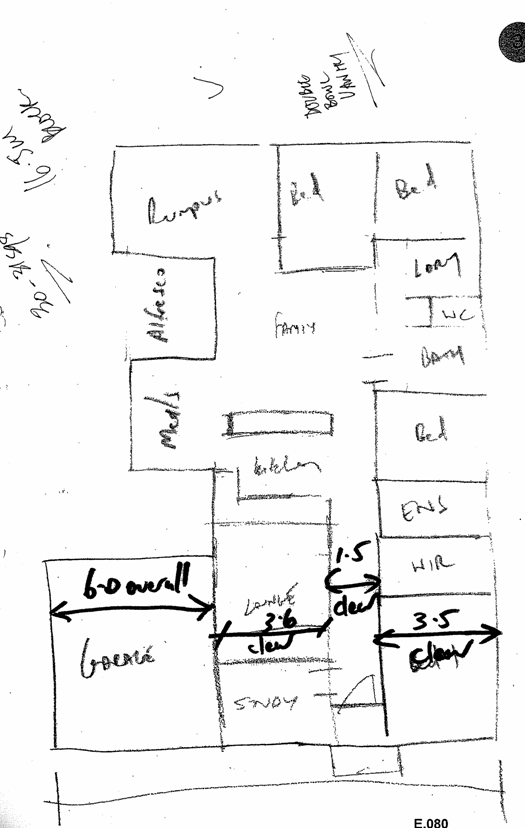
70 He identifies those plans as the Rochester 30 (Document 2) and the Rochester 26 (Document 3) and also a Barton home, the Montrose. He further says that these designs “allowed for the insertion of an al fresco area” and it would be cost effective to do so. He goes on to say that those matters “inspired” his first design drawings and identifies three sketch plans, designated Sketch A, Sketch B and Sketch C, he prepared in about June 2003. (Sketch C is Schedule D to these reasons.) These were “some initial ideas reflecting the overall design theme for what was to ultimately become the ‘Provence’ house”.
71 I accept that the version contained in the affidavit of March 2006 is substantially consistent with the case advanced at trial. However, the question remains whether the importance of the Rochester was mentioned at the conference with Mallesons in July 2005 and if it was not, what is the significance of that omission.
Untruthful evidence as to early mention of Rochester
72 I am positively satisfied that none of the Carlisle representatives mentioned the Rochester at the Mallesons conference. The absence of any mention of the Rochester in detailed contemporaneous notes taken by the two solicitors is compelling. While no doubt, as Mr Megens said, the file note was not a complete record of all the topics discussed, it defies belief that the three Carlisle men would have mentioned something central to the defence to Barrett’s claim, and explained it by reference to the Rochester plan, but somehow managed to have that information overlooked by two competent lawyers, one of them extremely experienced, who were taking detailed contemporaneous notes. At the time of the conference there was no reason to doubt that legal professional privilege would protect the confidentiality of what was said. The lawyers’ concern was, as Mr Megens said, to obtain an independent record of derivation of copyright, the very thing which would have directed attention to what Carlisle now claims.
73 The Mallesons letter, the instructions to Mr Brickell and the Carlisle pleaded defences are all inconsistent with the Rochester having been raised at the Mallesons conference.
74 Further, I am satisfied on the balance of probabilities, while having regard to the seriousness of such a finding (see Briginshaw v Briginshaw (1938) 60 CLR 336), that Messrs Doulgeridis, Taylor and Morrison gave consciously untrue evidence when they said that the Rochester was mentioned at the Mallesons conference. It inevitably follows that they must have colluded in so doing.
Relevance of untruthful evidence
75 In the criminal law there is extensive jurisprudence as to the evidentiary use that can be made of lies. The leading case is Edwards v The Queen (1993) 178 CLR 193. Deane, Dawson and Gaudron JJ, after noting that ordinarily the telling of a lie will merely affect the credit of the witness who tells it, said at 209:
It is only if the accused is telling a lie because he perceives that the truth is inconsistent with his innocence that the telling of the lie may constitute evidence against him. In other words, in telling the lie the accused must be acting as if he were guilty. It must be a lie which an innocent person would not tell. That is why the lie must be deliberate. Telling an untruth inadvertently cannot be indicative of guilt. And the lie must relate to a material issue because the telling of it must be explicable only on the basis that the truth would implicate the accused in the offence for which he is charged. It must be for that reason that he tells the lie. To say that the lie must spring from the realization or consciousness of guilt is really another way of saying the same thing. It is to say that the accused must be lying because he is conscious that “if he tells the truth, the truth will convict him”. (Citations omitted.)
76 Although I am not aware of any consideration in civil cases of the probative effect of lies, the probative logic remains the same (see Evidence Act 1995 (Cth) s 55(1)), subject of course always to the application of a different standard of proof with the Briginshaw qualification.
77 In the present case, the most likely explanation for Messrs Doulgeridis, Taylor and Morrison telling lies about what was said at the Mallesons conference is that they realised that the failure to mention the Rochester would tend to show that Rochester was not the true source of their Provence design. If they invented an untrue source, the most likely explanation for that is that they knew the source alleged by Barrett was the true one.
78 The evidence points to the following conclusion, which I find. Mr Doulgeridis did copy the al fresco quadrant from Barrett’s Seattle plan, which had been on the market for several years. Probably he did so without much thought and assumed, because the plan had been around for a while, that it was in the public domain, especially in Western Australia. When challenged, the Carlisle directors first raised the argument that the al fresco was commonplace and devoid of originality. The initial versions of the defence reflect this. When the directors were unable to produce any concrete examples of the design pre-dating the Streeton, they fell back on the Rochester argument. When faced with the difficulty that there was no record of mentioning the Rochester on the first opportunity to do so, they falsely claimed that they did.
79 As already mentioned, Carlisle’s evidence of the alleged design history included three sketches, and in particular the sketch subsequently identified as Sketch C. The mere existence of the sketches does not rule out Mr Doulgeridis having produced them by copying the Seattle. Given the false Rochester story I am unable to be satisfied as to the truth of any positive case advanced by Carlisle as to the design history of the Provence.
SUBSTANTIAL PART
80 The historical background and authoritative judicial interpretation of the substantial part requirement, in the context of a building design dispute, are comprehensively reviewed by Wilcox and Lindgren JJ in Tamawood Ltd v Henley Arch Pty Ltd (2004) 61 IPR 378 at [47]-[56].
81 In Metricon at [29]-[42] Gilmour J applied those principles and held that the al fresco quadrant was a substantial part of the Seattle and Memphis designs. I respectfully agree with his Honour’s conclusion and reasoning, which I would have arrived at independently, for the following reasons.
82 First, in purely quantitative terms (which is relevant, although not of course conclusive), the al fresco quadrant is about a third of the total floor area. Less may be sufficient; a defendant who took four of the 32 lines of Rudyard Kipling’s If in an advertisement for a “reviver of nerve power” was held to have taken a substantial part: Kipling v Genatosan Ltd [1917-1923] MacG Cop Cas 203.
83 More importantly, the al fresco quadrant is an essential part of the house, something that Le Corbusier characterised as “a machine for living in” (Vers une architecture, 1923). Potential buyers would recognise the al fresco quadrant as a part of the house where they and their family would spend most of their waking hours. Thus the al fresco quadrant had a commercial significance, as the evidence demonstrated.
84 In visual terms, Gilmour J at [40] described the impression presented by the al fresco as built:
The layout of the Seattle 31 gave the impression of a free-flowing design, leading from the hallway to the hub of the home, with the al fresco quadrant, under one roof-line, being central to the design. The impression was reinforced by the open-plan kitchen that looked over the living and al fresco areas. The design allowed one to view into the rumpus room which enhanced the free-flowing design features of the Seattle 31 plan. These features were clearly based in a communal area of the plan, so as to optimise appreciation of the al fresco quadrant and surrounding living areas. Based on my impression, I would describe the al fresco quadrant as being substantial in a qualitative sense.
That accords with my impression.
85 Counsel for Carlisle submitted that the al fresco quadrant “was the product of negligible or trivial skill, labour and effort”. For the reasons given in relation to the subsistence issue, I reject this submission; see Tamawood at [55]-[56].
86 Counsel also argued that by the time the Provence was designed in 2003 the al fresco quadrant had become commonplace. However, the relevant time for assessing the “substantial part” question is when the Seattle was designed, that is in 1999. If that were not so, copyright owners would lose their rights provided a sufficient number of infringements had been perpetrated.
87 I find that the al fresco quadrant was a substantial part of Barrett’s designs and buildings.
SUFFICIENT SIMILARITY
88 A finding of subjective copying is relevant to the issue of sufficient similarity. In Eagle Homes Pty Ltd v Austec Homes Pty Ltd (1999) 43 IPR 1 Lindgren J, with whom Finkelstein J agreed, said at [86] that
…where subjective copying occurs there can be expected to be found an infringement, unless it transpires that that the product is so dissimilar to the copyright work that the copyright work can no longer be seen in the work produced.
Subsequently in Tamawood Wilcox and Lindgren JJ at [46] somewhat qualified that view. Their Honours noted that the primary judge in the case before them had “expressed surprise” at the passage from Eagle. Their Honours said:
Referring to an expectation, that statement allows for exceptions. Also it must be read in context. As stated earlier in the judgment (at [72]) Eaglewas better regarded as a case of reproduction of the whole of the copyright work, so it was strictly not necessary to undertake the “substantial part” inquiry. Eaglewas a case of subjective copying of the shapes and arrangement of, and interrelationship between rooms, and of traffic flow, throughout the house. The statement which surprised his Honour is akin to that of Lord Bingham in Designers Guild Ltd v Russell William (Textiles) Ltd [[2001] FSR 11, [2000] UKHL 58 at 116, 117] (Designers Guild) that:
…[w]hile the finding of copying did not in theory conclude the issue of substantiality, on the facts here [Designers Guild was also a case of overall similarity] it was almost bound to do so.
It was acknowledged several times elsewhere in the judgment in Eagle (at [69], [74] and [103], for example) that subjective copying alone is not enough, and that where a part is taken it must be a substantial part of the copyright work. (Peterson J’s aphorism, “what is worth copying is prima facie worth protecting”, a statement made in University of London Press Ltd v University Tutorial Press Ltd[1916] 2 Ch 601 at 610 in relation to the subsistence of copyright, was in fact invoked in the context of infringement and “substantial part” in Ladbroke by Lord Reid at 279 and by Lord Pearce at 293-294, but the House of Lords may be taken to have cautioned against this practice in Designers Guild).
89 One rationale for treating a finding of deliberate copying as relevant to the issue of sufficient similarity is that if the defendant has gone to the trouble of deliberately copying it is likely that the defendant’s work will be similar to the copied work. Otherwise, there would be no reason to copy. It is not easy to see why the fact that a case happens to be a “substantial part” case rather than a whole of work case makes any difference.
90 In Tamawood their Honours did not refer to the earlier Full Court decision in Clarendon Homes (Aust) Pty Ltd v Henley Arch Pty Ltd (1999) 46 IPR 309. This appears to have been a “substantial part” case: see at [37]. In any event, the Full Court said at [28]:
Further, in a case where there has been deliberate copying, the court will not look kindly on a defendant when the plaintiff seeks to establish that what has been copied is sufficiently objectively similar to the plaintiff’s work. In Blackie & Sons Ltd v The Lothian Book Publishing Co Pty Ltd (1921) 29 CLR 396 Starke J said at 404:
It is not for the court to make the way of the taker of copyright matter easy. It is a sound principle of copyright law that the court should not allow one man to take away the result “of another man’s labour, or, in other words, his property”, unless it is satisfied that the part taken is “so slight, and the effect upon the total composition was so small”, “as to render the taking perfectly immaterial”, or what is much the same thing, that the part taken is an unsubstantial part. (Citations omitted.)
See also S W Hart & Co Pty Ltd v Edwards Hot Water Systems (1985) 159 CLR 466 at 484 where Wilson J referred with approval to the judgment of Street J in Ancher, Mortlock, Murray & Woolley Pty Ltd v Hooker Homes Pty Ltd [1971] 2 NSWLR 278 where his Honour acknowledged that his finding of infringement had been coloured by the unmeritorious use made by the defendant of the plaintiff’s work.
91 The Full Court in Clarendon later at [39] made it clear that a finding of deliberate copying was not conclusive. Objective similarity remains to be proved. Their Honours said:
But copying can be both conscious and unconscious. When copying is deliberate then, so it seems, the Court is permitted to show greater latitude in the plaintiff’s favour. We accept this approach should not be taken too far. In a given case there either is or is not sufficient objective similarity to make out infringement. It will only be when the trial judge regards the position as finely balanced that he should err in favour of the plaintiff if the conduct complained of is deliberate.
I shall follow that approach.
92 As is usual in these cases, both sides called expert witnesses. Ultimately, however, the question is an “original decision for the court itself”: Ancher, Mortlock, Murray and Woolley Pty Ltd v Hooker Homes Pty Ltd [1971] 2 NSWLR 278 at 286 per Street J. His Honour, after discussing the assistance that experts could give the judge in such cases, went on to say:
But the important point is that, in distinction from the judicial process in relation to expert evidence such as is normally encountered in litigation, a court in the present type of litigation is entitled, and, indeed, bound, to form and act on its own original opinion.
93 Senior counsel for Barrett pointed to the following close similarities between the al fresco quadrant feature that appear in both Barrett and Carlisle’s plans and houses. (It is to be noted that in the Carlisle plans and houses these features appear in a mirror image to those of Barrett.)
(a) The sequence of rumpus, family, kitchen and meals areas around the central al fresco feature.
(b) The shape, relative space and configuration of these different surrounding areas.
(c) The right angled sides and corners of the al fresco area.
(d) The placement of the al fresco area between the meals and rumpus rooms.
(e) The grouping of these elements under a single side roof line.
94 Senior counsel accepted that there were some differences and in particular:
(a) while the position of the kitchen is the same in both, the configuration of the kitchen is different; and
(b) the Barrett al fresco is slightly more rectangular than that of Carlisle’s which is more of a square shape.
95 Counsel for Carlisle relied on the proposition that the more simple, commonplace, familiar and straight forward the subject matter of a copyright work, the closer the similarity that will be required if infringement is to be found: Tamawood at [42]. He cited the well known case of Kenrick & Co v Lawrence & Co (1890) 25 QBD 99 at 103-104, a case which concerned the representation of a hand making the mark of a cross on a ballot paper.
96 This proposition, while undoubtedly correct, is of little assistance in the present case. Barrett’s al fresco quadrant was truly original and commercially successful. Nor is it to the point, as counsel for Carlisle argued, that there are differences elsewhere between the Provence and the Barrett designs, such as in respect of the front facades. The fact that this is a “substantial part” case necessarily means that there are other parts of Carlisle’s works in respect of which there is no allegation of copying.
97 Barrett’s expert witness Dr John Cooke compared the Seattle plan to the Provence plan. He said:
The rear part of the [Provence] plan, containing Kitchen, Meals, Family, Alfresco, Rumpus, Bed 2, Bed 3, Bed 4, Laundry, Bath, WC, Laundry and Pantry is essentially very similar in layout (mirror reversed) to the corresponding area in the Seattle plan, with differences in the arrangement of wet areas and angled doors to Bed 3 and Bed 4 instead of the doors at right angles to the corridor in the Seattle plan.
The main difference in this part of the plans is the shape of the Kitchen and the access to the Laundry (direct from the Kitchen in the Respondent’s Plan; from the bedroom corridor in the Seattle Plan). The position of the Laundry access in the Respondent’s Plan has enabled the bedroom corridor to be shortened.
98 In comparing the respective houses, Dr Cooke said:
The vista from the Entry in the (Carlisle house) (Photograph No 67) is closed by a recessed and top lit wall feature, whereas the corresponding vista in the Seattle (Photograph No 4) is closed by an aperture in the wall beside the Rumpus room doorway and the doorway of the Rumpus room itself. The Rumpus room doorway is visible in this vista because the rear part of the plan of the (Carlisle house) is a mirror reversed version of the Seattle plan, with the result that the Entry access leads to the Rumpus room doorway in the Seattle whereas in the (Carlisle house) the Rumpus room is to the right of the Entry access.
However the spatial effects in both houses are similar.
99 He concluded:
Overall, in my opinion the arrangement of the Alfresco and surrounding living areas, including the indoor/outdoor connection and the Alfresco space itself is a highly significant feature of both houses [reference to photographs] as is the organization of the circulation areas to minimize waste and maximize virtual impact.
100 Dr Cooke made similar comments in relation to the Memphis plan compared with the Provence plan. He considered the Memphis plan a close version of the Seattle plan and subject to his general comments as to the latter.
101 In comparing the Memphis house to the Provence houseDr Cooke did not think that the numerous differences in colours, furnishings and floor materials affected the fundamentals. Again he thought the al fresco and surrounding living areas including the indoor/outdoor connection and the al fresco space itself was a “highly significant” feature of both houses.
102 In comparing the Aberdeen plan to the Provence plan Dr Cooke considered the Aberdeen plan a close version of the Memphis plan, mirror reversed. His comments on the comparisons between the Memphis plan and the Provence plan generally applied to the Aberdeen plan.
103 In conclusion, Dr Cooke noted that Barrett and Carlisle sell project homes in competition with each other and it was to be expected that houses of comparable size would contain very similar accommodation. It was not surprising in his view that competitors in the same housing market would produce roughly rectangular plans of single storey houses as such a plan is likely to fit a typical lot size more readily than other plan shapes. However, within those constraints he thought that Barrett and Carlisle had produced plans with “striking similarities”, even though by no means identical. In particular, the al fresco area cut into the rectangular plan shape and bounded on three sides by informal living/dining areas was “a crucial factor in the generation of that substantial part of the plan and is a highly distinctive feature”.
104 Carlisle’s expert Mr Brickell noted a number of similarities and differences between the Provence plan and the Seattle plan. Some of these would seem to be irrelevant to the issues in this case, for example, the garage main entry and master bedroom suite (similarity) and the detailed layouts of the master bedroom suites (difference). His main grounds for his view that the Provence plan did not involve a reproduction of a substantial part of the Seattle were (i) that the design process followed a logical path over some four months whereas copying could have been achieved “in a matter if days by simply copying plans” and (ii) that competing project home builders with similar site constraints, market demands and cost objectives “may well arrive at design concepts resulting in plans that closely resemble those of their competitors”.
105 Both these grounds seem to be more a matter of forensic comment than architectural analysis. Further, Mr Brickell was given no instructions on the design derivation of the three sketches which Carlisle purported to show the independent development of the Provence, and he sought no instructions on how these documents came into existence.
106 In cross-examination Mr Brickell was directed to the al fresco areas of the Seattle and Provence plans. He was asked:
Just having regard to these features if you don’t mind. So you have got Provence in front of you, looking at the meals, kitchen, family, rumpus, alfresco?---Yes.
And you know it has got a single covered roof across those features?---Okay
And if you compare that to the Seattle would you agree the features in both houses save in respect to the, you can see a difference in the way in which the kitchen benches are depicted, save in that respect do you agree the plans are very similar?---I said that in my report.
Yes, and so much so that they are almost identical?---Well, I said they are similar.
And would you adopt a description extent of similarity, very similar?---I would say they are similar. I am not prepared to say they are identical. I think there are some aspects in there which may appear to be insignificant about the location of the kitchen, the relationship of the room that is behind the kitchen area which do impact on the similarity.
Well, otherwise in an overall sense those features are similar in both houses?
---Yes.
107 Although Mr Brickell commented on the commonality of the al fresco design feature, he made no enquiry concerning the state of design in relation to the actual use of the feature before January 2000. In maintaining the commonplace nature of the al fresco he relied on examples which were post-Seattle.
108 Mr Quigley was asked to undertake a design task based on reference to the Rochester 30. Whilst he is a distinguished architect I am not persuaded that his evidence was of any assistance in this case. As already discussed, the fact that the Rochester might have been developed by a rumpus room and roof line over the courtyard is not to the point. Whether it was “logical” or not, the fact is by 1999, nobody other than Barrett had done it.
109 In conclusion I find that there was sufficient similarity between the al fresco quadrant part of the respective plans and houses. I think this conclusion could be reached without the finding of deliberate copying, but such a finding adds weight to the evidence supporting this conclusion.
ORDERS
110 It follows that Barrett has succeeded on all issues. I direct that the parties bring in minutes to give effect to these reasons.
|
I certify that the preceding one hundred and ten (110) numbered paragraphs are a true copy of the Reasons for Judgment herein of the Honourable Justice Heerey |
Associate:
Dated: 20 March 2008
|
Counsel for the Applicants: |
C D Golvan SC and S Ricketson |
|
|
|
|
Solicitors for the Applicants: |
Middletons |
|
|
|
|
Counsel for the Respondent: |
A J Ryan and S M Rebikoff |
|
|
|
|
Solicitors for the Respondent: |
Mallesons Stephen Jaques |
|
|
|
|
Dates of Hearing: |
7, 8, 12, 13, 14, 15 November and 12 December 2007 |
|
|
|
|
Date of Judgment: |
20 March 2008 |
Schedule A: Barrett’s Seattle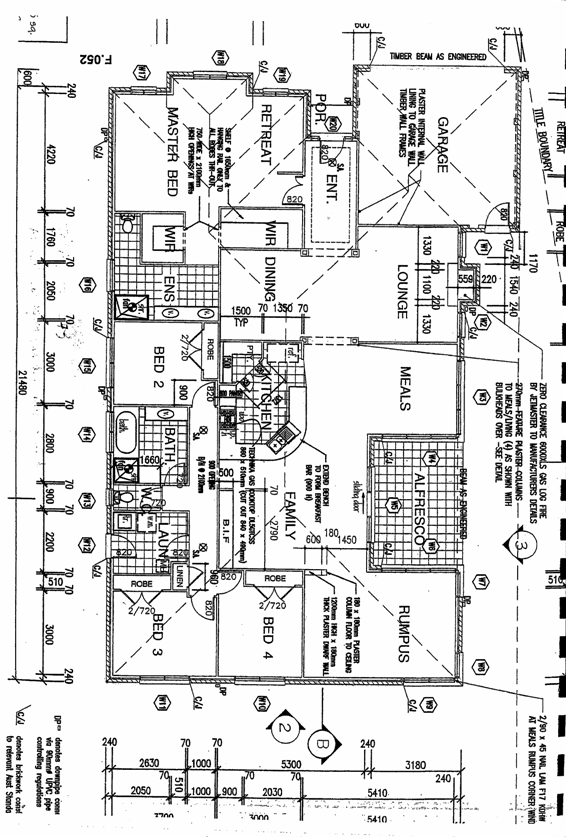
Schedule B: Carlisle’s Provence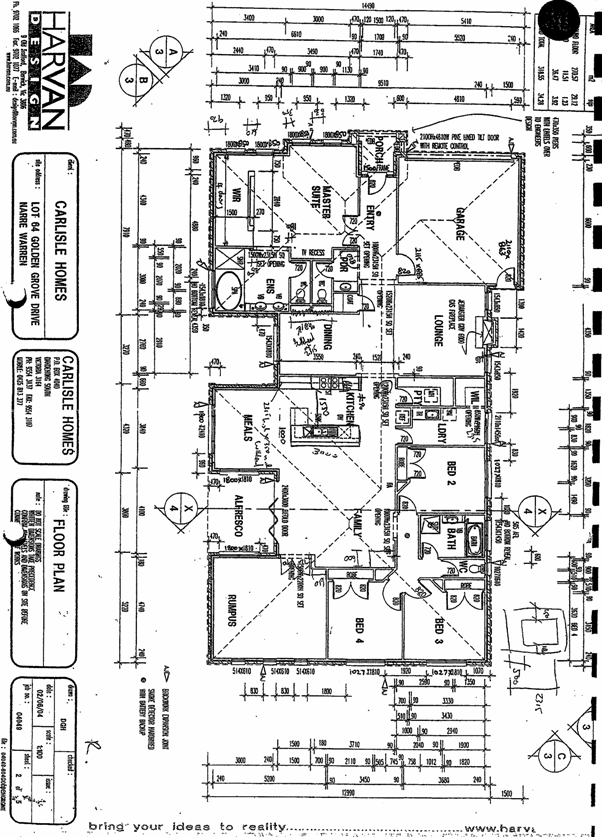
Schedule C: Second of four draft plan concept drawing for the Seattle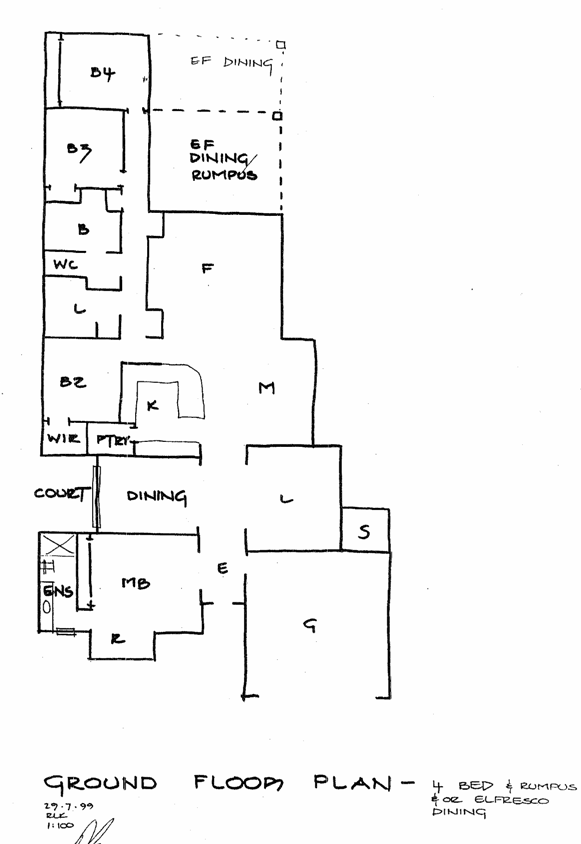
Schedule D: Mr Doulgeridis’ Sketch C for the Provence