

FEDERAL COURT OF AUSTRALIA
Ngadjon-Jii People v State of Queensland [2007] FCA 1937
NATIVE TITLE – consent determination – whether order under s 87 Native Title Actappropriate
`
QUD 6027 OF 1999
SPENDER J
12 DECEMBER 2007
MALANDA
|
IN THE FEDERAL COURT OF AUSTRALIA |
|
|
QUEENSLAND DISTRICT REGISTRY |
QUD 6027 OF 1999 |
|
BETWEEN: |
VERA FLORENCE KETCHELL, ERNIE DOUGLAS RAYMONT, STANLEY THOMAS MORTA, ELSIE ELIZABETH GO SAM, YVONNE SHIRLEY CANENDO, ENA EILEEN GERTZ, GRACE KIDNER, MARGARET PATRICIA RAYMONT and ILA ELIZABETH KIDNER on their own behalf and on behalf of the NGADJON-JII PEOPLE Applicant
|
|
AND: |
STATE OF QUEENSLAND First Respondent
CAIRNS CITY COUNCIL Second Respondent
EACHAM SHIRE COUNCIL Third Respondent
ERGON ENERGY CORPORATION LIMITED Fourth Respondent
|
|
SPENDER J |
|
|
DATE OF ORDER: |
12 DECEMBER 2007 |
|
WHERE MADE: |
THE COURT NOTES THAT:
A. On 14 October 1999, the Applicant filed a native title determination application Q6027 of 1999 (“the Application”) in relation to land and waters.
B. The parties have reached an agreement as to the terms of a determination of native title to be made in relation to the land and waters covered by the Application.
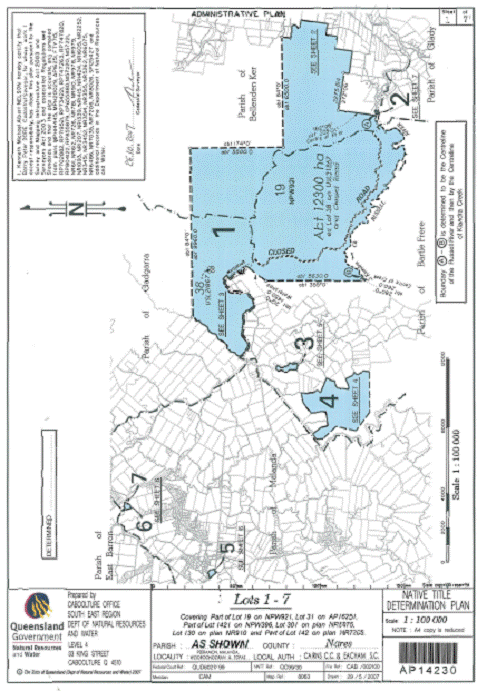
C. The area covered by the Application is approximately 13,287 hectares of land and waters in the far north of the State of Queensland (the “Determination Area”). The Determination Area is the land and waters described in Schedule 1.
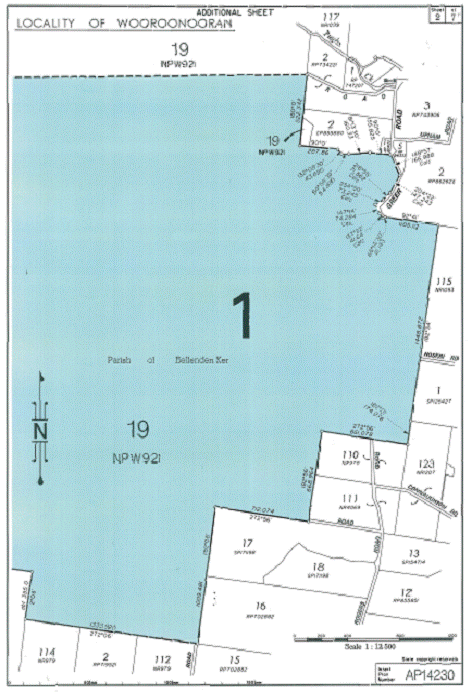
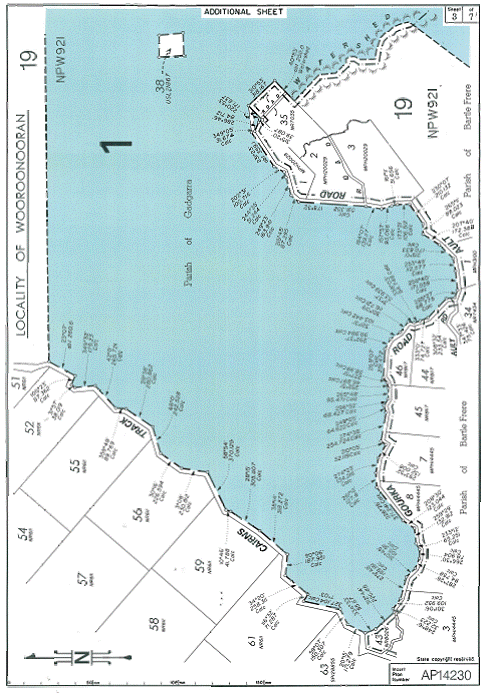
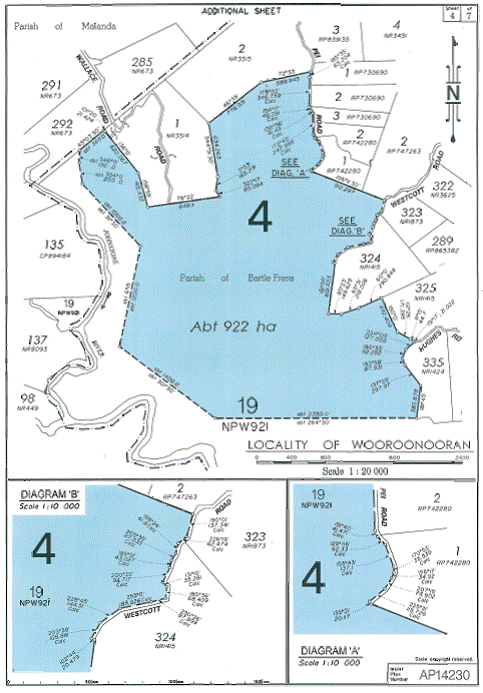
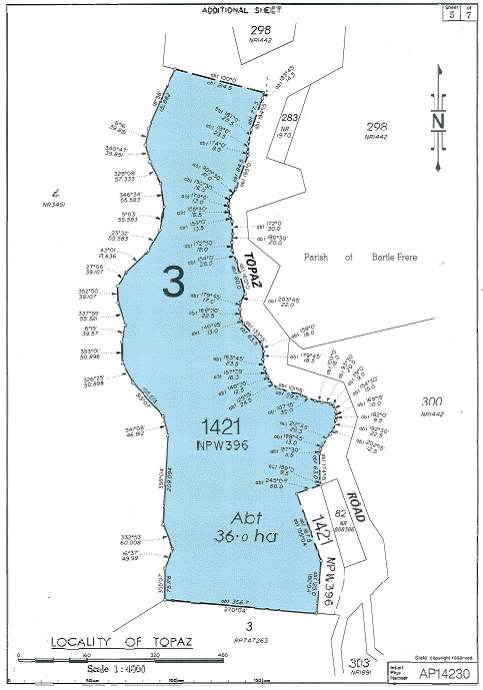
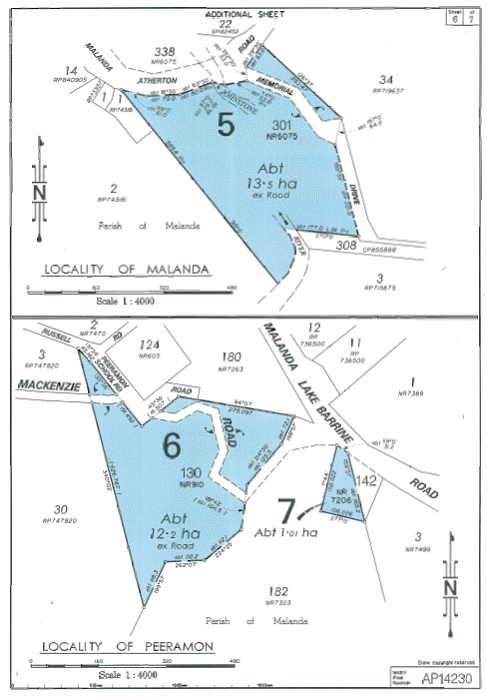
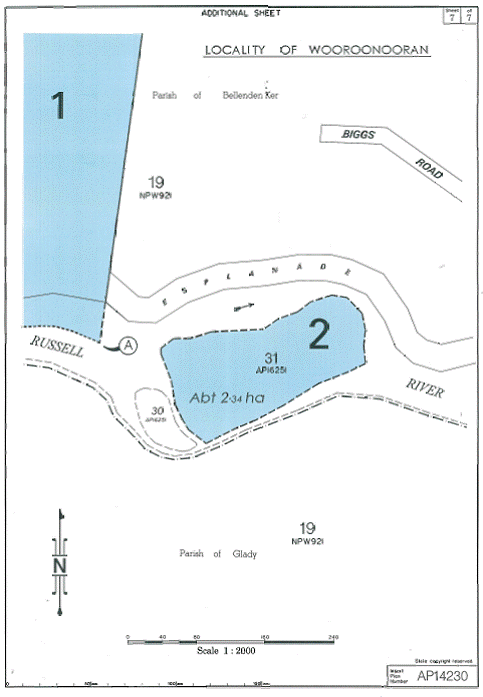
D. The Determination Plan shows the Determination Area.
E. The parties accept that the effect of the determination is that the Ngadjon-Jii People, in accordance with the traditional laws acknowledged and the traditional customs observed by them, are recognised as the Native Title Holders for the Determination Area.
F. The parties acknowledge that the Ngadjon-Jii People have a long-standing strong connection to the Determination Area under traditional laws acknowledged and traditional customs observed by them.
G. The parties have agreed to make application to the Federal Court of Australia for a determination that native title exists in relation to the land and waters covered by the Application.
Being satisfied that the determination of native title in the terms sought by the parties is within the power of the Court, and it appearing to the Court to be appropriate to do so:
THE COURT DETERMINES BY CONSENT THAT:
Existence of native title
1. Native title exists in relation to the land and waters described in Schedule 1 (“the Determination Area”).
Native title holders
2. The native title is held by the persons described in Schedule 2 (the “Native Title Holders”).
The nature and extent of native title rights and interests
3. Subject to paragraphs 4, 5, 6, 8 and 9 the nature and extent of the native title rights and interests in relation to the Determination Area, except in relation to Water, are as follows:
3.1 In relation to the land and waters referred to in Part A of Schedule 1, the native title is a right of the Native Title Holders in accordance with traditional laws and customs to possession, occupation, use and enjoyment to the exclusion of all others.
3.2 In relation to the land and waters referred to in Part B and Part C of Schedule 1, non-exclusive rights of the Native Title Holders to use and enjoy the land and waters, being to:
(i) access and to be physically present on the Determination Area in accordance with traditional laws and customs;
(ii) hunt, fish and gather on the Determination Area for the purpose of satisfying personal, domestic, social, cultural, religious, spiritual, ceremonial and non-commercial communal needs in accordance with traditional laws and customs;
(iii) take, use and enjoy the Natural Resources of the Determination Areafor the purpose of satisfying personal, domestic, social, cultural, religious, spiritual, ceremonial and non-commercial communal needs in accordance with traditional laws and customs;
(iv) maintain and protect from physical harm, places within the Determination Area of importance to Native Title Holders in accordance with traditional laws and customs; and
(v) perform social, cultural, religious, spiritual or ceremonial activities on the Determination Area and invite others to participate in those activities in accordance with traditional laws and customs.
(vi) pass on native title rights and interests in relation to the Determination Area in accordance with traditional laws and customs;
(vii) make decisions in accordance with traditional laws and customs about the use and enjoyment of the Determination Area by Aboriginal People who are governed by the traditional laws acknowledged and traditional customs observed by the Native Title Holders;
3.3 In relation to the land and waters referred to in Part C of Schedule 1, the non-exclusive right of the Native Title Holders to camp in accordance with traditional laws and customs which does not include the right to permanently reside or build permanent structures or fixtures.
4. Subject to paragraphs 5, 6, 8 and 9, the nature and extent of the native title rights and interests in relation to Water within the Determination Area are the non-exclusive rights, in accordance with traditional laws and customs to:
(a) use, enjoy, hunt on and fish in and gather from the Water for personal, domestic, social, cultural, religious, spiritual, ceremonial and communal purposes; and
(b) take and use the Water and its resources for personal, domestic, social, cultural, religious, spiritual, ceremonial and communal purposes;
provided that:
· in all such cases, the purpose is non-commercial; and
· such right to Water does not confer any right to possession, occupation, use or enjoyment of the Water to the exclusion of others.
5. The native title rights and interests described in paragraphs 3.2, 3.3 and 4:-
(a) do not confer possession, occupation, use and enjoyment of that land and waters on the Native Title Holders to the exclusion of others; and
(b) do not extend to a right to control access to or a right to control the use of that land and waters.
6. Notwithstanding anything in the determination, there are no native title rights and interests in or in relation to:
(a) minerals as defined in the Mineral Resources Act 1989 (Qld); and
(b) petroleum as defined in the Petroleum Act 1923 (Qld) and the Petroleum and Gas (Production and Safety) Act 2004 (Qld).
7. If a word or expression is not defined in this order, but is defined in the Native Title Act 1993 (Cth), then it has the meaning given to it in the Native Title Act 1993 (Cth). In addition to the other words and expressions defined in this order:
(a) “Determination Area” means the land and waters described in Schedule 1;
(b) “Determination Plan” means the plan AP14230 attached to Schedule 1 and which shows the Determination Area. To the extent of any inconsistency between the description of the Determination Area and the Determination Plan, the description of the Determination Area prevails.
(c) “Laws of the State of Queensland and the Commonwealth” means the common law and the laws of the State of Queensland and the Commonwealth of Australia and to avoid doubt, includes, but is not limited to, regulations, statutory instruments, local planning instruments and local laws;
(d) “Local Government” has the meaning given to it in the Local Government Act 1993 (Qld);
(e) “Native Title Holders” means the persons described in Schedule 2;
(f) “Natural Resources” means animal, plant, fish and bird life found on or in the Determination Area from time to time and clays, sand, shell and soil found on or below the surface of the Determination Area but does not include minerals or petroleum; and
(g) “Water” means water as defined in the Water Act 2000 (Qld)and tidal water as defined in the Land Act 1994 (Qld).
8. The native title rights and interests are subject to and exercisable in accordance with the Laws of the State of Queensland and the Commonwealth.
The nature and extent of any other interests
9. The nature and extent of other interests in relation to the Determination Area are the following, as they exist at the date of the determination:
9.1 the interests of the State of Queensland pursuant to the Nature Conservation Act 1992 (Qld) and subordinate legislation relating to the use and management of the Wooroonooran National Park, the Topaz Road National Park and the Malanda Conservation Park;
9.2 the interest of permittees or licensees pursuant to the Nature Conservation Act 1992 (Qld) and subordinate legislation relating to the use and management of the Wooroonooran National Park, the Topaz Road National Park and the Malanda Conservation Park;
9.3 the rights and interests of the Wet Tropics Management Authority pursuant to the Wet Tropics World Heritage Protection and Management Act 1993 (Qld) and the Wet Tropics Management Plan 1998 (Qld) and other subordinate legislation;
9.4 the interest of permittees or licensees pursuant to the Wet Tropics World Heritage Protection and Management Act 1993 (Qld) and the Wet Tropics Management Plan 1998 (Qld);
9.5 the rights, interests, powers and functions of the Cairns City Council as a Local Government under its local government jurisdiction and as an entity exercising statutory powers;
9.6 the rights, interests, powers and functions of the Eacham Shire Council as a Local Government under its local government jurisdiction and as an entity exercising statutory powers;
9.7 the rights and interests of Ergon Energy Corporation Limited as an entity exercising statutory powers and as owner and operator of electricity distribution and transmission facilities within the Determination Area;
9.8 the rights and interests of Telstra Corporation Limited being:
(i) rights and interests as the owner or operator of the telecommunications facilities installed within the Determination Area and as the holder of a carrier licence under the Telecommunications Act 1997 (Cth);
(ii) rights and interests created pursuant to the Post and Telegraph Act 1901 (Cth), the Telecommunications Act 1975 (Cth), the Australian Telecommunications Corporation Act 1989 (Cth), the Telecommunications Act 1991 (Cth) and the Telecommunications Act 1997 (Cth); and
(iii) rights to enter the Determination Area by employees, agents or contractors of Telstra Corporation Limited in the performance of their duties to enable access to its telecommunications facilities in, and in the vicinity of, the Determination Area;
9.9 any other rights and interests held by or under the Crown by the force and operation of the Laws of the State of Queensland and the Commonwealth as may be current at the date of this determination;
9.10 the interests of members of the public to access the Wooroonooran National Park, the Topaz Road National Park and the Malanda Conservation Park for recreation purposes in accordance with the Nature Conservation Act 1992 (Qld);
9.11 the interests of the State of Queensland and the Ngadjon-Jii People under a deed of agreement authorised by the Ngadjon-Jii People on 7 October 2007;
9.12 the interests of members of the public pursuant to section 18 of the Native Title (Queensland) Act 1993 in accessing and enjoying:-
(i) waterways, beds and banks and foreshores of waterways including the beds and banks of the Russell River adjoining Lot 31 on AP16251; and
(ii) areas that were public places as at 31 December 1993 including the Russell River;
and
9.13 the rights and interests held by force and operation of the Laws of the State of Queensland and the Commonwealth.
Relationship between native title rights and other interests
10. The relationship between the native title rights and interests described in paragraphs 3 to 4 and the other interests described in paragraph 9 (“the other interests”) is that:
(a) the other interests continue to have effect, and the rights conferred by or held under the other interests may be exercised notwithstanding the existence of the native title rights and interests; and
(b) the other interests and any activity that is required or permitted by or under, and done in accordance with, the other interests prevail over the native title rights and interests and any exercise of the native title rights and interests.
11. The native title is not to be held in trust.
12. An Aboriginal Corporation whose name will be nominated in writing within 12 months is to:
(a) be the prescribed body corporate for the purposes of s 57(2) of the Native Title Act 1993 (Cth); and
(b) perform the functions mentioned in s 57(3) of the Native Title Act 1993 (Cth).
13. In the event that there is no nomination within the time specified in paragraph 12 or such later time as the Court may order, the Registered Native Title Claimants are to forthwith apply to the Court for further directions.
14. Until such time as there is a prescribed body corporate in relation to the Determination Area any notices required under the Native Title Act 1993 (Qld) or otherwise to be served on the Native Title Holders, the native title claim group or the Registered Native Title Claimants may be served upon the North Queensland Land Council Native Title Representative Body Aboriginal Corporation, and such notice shall be deemed to be sufficient.
15. This determination of native title is to take effect on the registration of the agreement referred to in paragraph 9.11, on the Register of Indigenous Land Use Agreements.
16. In the event that the agreement referred to in paragraph 9.11 is not registered on the Register of Indigenous Land Use Agreements within twelve months of the date of this Order or such later time as the Court may order, the matter is to be listed for further directions.
Note: Settlement and entry of orders is dealt with in Order 36 of the Federal Court Rules.
|
IN THE FEDERAL COURT OF AUSTRALIA |
|
|
QUEENSLAND DISTRICT REGISTRY |
QUD 6027 OF 1999 |
|
BETWEEN: |
VERA FLORENCE KETCHELL, ERNIE DOUGLAS RAYMONT, STANLEY THOMAS MORTA, ELSIE ELIZABETH GO SAM, YVONNE SHIRLEY CANENDO, ENA EILEEN GERTZ, GRACE KIDNER, MARGARET PATRICIA RAYMONT and ILA ELIZABETH KIDNER on their own behalf and on behalf of the NGADJON-JII PEOPLE Applicant
|
|
AND: |
STATE OF QUEENSLAND First Respondent
CAIRNS CITY COUNCIL Second Respondent
EACHAM SHIRE COUNCIL Third Respondent
ERGON ENERGY CORPORATION LIMITED Fourth Respondent
|
|
JUDGE: |
SPENDER J |
|
DATE: |
12 DECEMBER 2007 |
|
PLACE: |
MALANDA |
REASONS FOR JUDGMENT
1 This proceeding arises out of an application for a determination of native title made by Vera Florence Ketchell, Ernie Douglas Raymont, Stanley Thomas Morta, Elsie Elizabeth Go Sam, Yvonne Shirley Canendo, Ena Eileen Gertz, Grace Kidner, Margaret Patricia Raymont and Ila Elizabeth Kidner, on their own behalf and on behalf of the Ngadjon-Jii People. The respondents are the State of Queensland, the Cairns City Council, the Eacham Shire Council and Ergon Energy Corporation Limited.
2 The claim area comprises approximately 13 287 hectares of land and waters within various reserves, environmental parks and national parks around Atherton, Mareeba and Cairns in Far North Queensland, including the southern portion of Wooroonooran National Park, including Broken Nose, the South Peak, the North Peak and the Northwest Peak of the Mt Bartle Frere, the Topaz Road National Park, the Malanda Falls Conservation Park, two parcels of land reserved for quarry purposes, and an island in the middle of the Russell River. The claim area is comprehensively defined as the ‘Determination Area’ in Schedule 1 of the Minute of Consent Order, filed 14 November 2007.
BACKGROUND OF THE APPLICATION:
3 The application for determination of native title was filed in the Court on 14 October 1999. That application was amended pursuant to an order of the Court on 19 June 2006 and an amended Claimant Application was filed on 29 June 2006. That amended Claimant Application forms the basis of the consent determination proposed to be made today.
4 The agreement reached between the parties and filed in the Court on 14 November 2007 confers exclusive and non-exclusive rights on the Ngadjon-Jii People to use and enjoy the land and waters in the determination area.
5 The agreement between the parties is subject to the Court being satisfied that it has the power to make orders in terms of those sought and the Court being satisfied that it is proper to do so.
POWER OF THE COURT:
6 Pursuant to s 13 of the Native Title Act 1993 (Cth) (the Act), applications for the determination of native title may be made to the Federal Court in relation to areas for which there is no approved determination of native title. Part 3 of the Act sets out the rules for making such applications to the Court.
7 Part 4, Division 1C of the Act provides that some or all of the parties involved in a native title proceedings may negotiate an agreed outcome for that application or part of that application. Section 87 of the Act allows the Court, if it is satisfied that such an order is within its power, to make an order in, or consistent with, the terms of the parties’ written agreement without holding a hearing.
8 Where the Court makes an order in which a determination of native title is made, s 94A of the Act requires the Court to set out details of the matters mentioned in s 225. Section 225 provides:
‘A determination of native title is a determination whether or not native title exists in relation to a particular area (the determination area) of land or waters and, if it does exist, a determination of:
(a) who the persons, or each group of persons, holding the common or group rights comprising the native title are; and
(b) the nature and extent of the native title rights and interests in relation to the determination area; and
(c) the nature and extent of any other interests in relation to the determination area; and
(d) the relationship between the rights and interests in paragraphs (b) and (c) (taking into account the effect of this Act); and
(e) to the extent that the land or waters in the determination area are not covered by a non-exclusive agricultural lease or a non-exclusive pastoral lease – whether the native title rights and interests confer possession, occupation, use and enjoyment of that land or waters on the native title holders to the exclusion of all others.’
CONSIDERATION OF AGREEMENT AND DRAFT DETERMINATION:
9 In considering whether it is appropriate to make the order that the parties seek, I have had the benefit of the Summary of Connection Material report of Dr Sandra Pannell, Anthropologist, prepared in September 2007 and filed as an annexure to the affidavit of Martin Edwin Ellis Dore on 7 November 2007. That summary document of Dr Pannell’s earlier anthropological report material was prepared at the request of the solicitor for the applicant and the North Queensland Land Council to assist the Court in considering the agreement between the parties.
10 In order to establish that there are today native title holders, it must first be established that, at the time of sovereignty, a society of persons bound together by observance of traditional laws and customs existed. In identifying the Ngadjon-Jii People, Dr Pannell’s summary report explains that:
‘[7] The claimants describe the native title claim group as the Ngadjon-People (or ‘Ngadjon) ‘tribe’. The ‘tribe’ consists of two sub-groups or ‘clans’, the Barron River and the Russell River clan groups, which, at any given moment in time, are also associated with specific family names. While each of the two riverine groups is traditionally associated with different areas within Ngagjon-Jii territory, the claimants identify their traditional rights and interests as communally vested in the group at the tribal level. Whether a ‘people’ or a ‘tribe’, the Ngadjon-Jii claimants also see themselves as quintessentially ‘rainforest Aborigines’.’
11 The Ngadjon-Jii People’s traditional entitlement to ownership of the ancestral lands and waters derives from their physical, cultural and spiritual connection to the claim area. In reviewing the Ngadjon-Jii People’s claimed physical connection, Dr Pannell explains:
‘[55] Ngadjon-Jii patterns of physical occupation, both historically and in the contemporary period, can be characterised as multi-sited. Thus, while some individuals lived at Top Camp and Gulkagulka, other Ngadjon-Jii people, during the same period, occupied camp sites in ‘the Jungle’ (in Malanda), at the junction of the Ithaca and North Johnstone Rivers, on farms at Glen Allyn, at Bunjabilli (aka ‘Bottom Camp’ in reference to Top Camp, at Lamins Hill) at Butcher’s Creek, and at the camp at the Malanda Falls.
…
[57] Twentieth-century anthropological and linguistic accounts provide further evidence of the general physical connection of the Ngadon-Jii people to the claimed areas. For example, based upon fieldwork with Ngadon-Jii informants in the 1930s and again in the 1970s, including several of the claimants’ immediate forebears, Norman Tindale, recorded that “Ngatjan territory was virtually all in rainforest extending from Atherton in the west to near Innisfail on the coastal plains”.’
12 In reviewing the Ngadjon-Jii People’s claimed cultural connection, Dr Pannell continues:
‘[58] For the claimants, language is identified as one of the distinctive cultural features of their group.
…
[59] The Ngadjon dialect was acquired from the Ngadjon-Jii relatives in the parental and grant-parental generation. Knowledge of the claimant group’s traditional language is actively transmitted to younger generations of Ngadjon-Jii people through daily instruction, and through the production of written texts.
…
[63] The cultural connection between Ngadjon-Jii people and named places within the claimed area is illustrated by the personal names of the claimants. Claimants, whether old or young, posses language names, which, among other things, refer to rainforest faunal or floral species or to named places on Ngadjon-Jii country.’
13 In reviewing the Ngadjon-Jii People’s claimed spiritual connection, Dr Pannell writes:
‘[65] Ngadjon-Jii people maintain a spiritual connection to the claimed lands through the transmission of oral narratives about ‘Dreamtime’ beings and Ngadjon-Jii ancestors, known as the ‘old people’. The language-named Storytime or ‘Dreamtime’ places acknowledged and protected by the Ngadjon-Jii people point to the claimants’ belief that their traditional lands and waters constitute a sentient landscape, forever occupied by both Dreaming and ancestral spirits.’
14 Dr Pannell states in her report that the entitlement of the Ngadjon-Jii claimants to possession of the claim area is recognised by members of neighbouring Aboriginal groups. Dr Pannel’s summary report notes:
‘[38] The traditional connection and identity of the Ngadjon-Jii claimants is acknowledge [sic] by members of neighbouring Aboriginal groups, including other dialect speakers of the Dyirbal language group. Prior to lodging the native title determination application, senior Ngadjon-Jii people convened several meetings with elders from neighbouring groups, including, Mamu, Majaanji, Kairi Yidindji, Gordonvale Yidindji, Dulabed Yidindji, Dugulbara Yidindji, Malanbara Yidindji, Barbaram and Jirrabal tribal people. At these meetings, senior Aboriginal members from each of these groups agreed that the claimants possessed a traditional connection to the areas claimed by them.’
15 This same report then concludes:
‘[39] In addition to these group meetings, the anthropologist researching Ngagjon-Jii peoples’ native title interviewed elders and others members of neighbouring Aboriginal groups. On the basis of these interviews, and also based upon the outcome of the group meetings, it is the opinion of the research anthropologist that there is a widespread consensus in the regional Aboriginal community, that the claimants are; (1) Ngadjon-Jii, and (2) that they are the ‘Traditional Owners’ of the lands and water under claim by the claimant group.’
16 Dr Pannell’s report contains many examples in which the Ngadjon-Jii People have maintained their connection to the determination area. These include: occupying the remnant forests or otherwise utilizing them to avoid being taken to missions that operated during the first half of the twentieth-century; working on local farms whilst occupying traditional dwellings; engaging in occupations carried out on the country, such as timber cutting or fossicking; and in some cases, returning to Ngadjon-Jii country upon release from government missions.
17 According to Dr Pannell’s report:
‘[92] With the exception of some of the members of the Parkinson family, who reside on Palm Island, at the time when the native title claim was lodged, practically all of the Ngadjon-Jii claimants lived either in Malanda or in Atherton.’
18 I am satisfied, based on all of the information available to the Court, that the Ngadjon-Jii People have a long-standing and continuing connection to the determination area under traditional laws acknowledged and traditional laws observed by them.
TERMS OF THE PROPOSED ORDER:
19 The proposed order, which is consistent with the terms agreed by the parties, recognises that the Ngadjon-Jii People, as the holders of the native title in the determination area, are entitled to the exclusive and non-exclusive use and enjoyment of the land and waters in accordance with their traditional laws and customs.
20 The proposed orders further recognise other interests in the determination area and the relationship of those interests with the native title interests. The proposed order contains other provisions, required by the Act, which it is unnecessary for me to set out here.
21 It is a cause of great satisfaction when native title claims are settled through agreement rather than through protracted litigation. I am most pleased to observe that the number of native title determinations by this Court, which have been reached by consent, has dramatically increased in recent years. This suggests that governments and other parties are increasingly aware of the benefits of negotiated settlements of native title claims, which otherwise have the potential to be lengthy, costly and divisive in the community.
22 I am satisfied that the Court has power to make a determination in the terms proposed by the parties by agreement. Such an order determines under the laws of Australia that native title exists in the determination area according to the traditional laws and customs of the Ngadjon-Jii People. This is recognition of what has long been held by the Ngadjon-Jii People.
23 For the above reasons, I have concluded that it is proper to make the order sought by the parties to give effect to their agreement, and I now make that order.
|
I certify that the preceding twenty-three (23) numbered paragraphs are a true copy of the Reasons for Judgment herein of the Honourable Justice Spender. |
Associate:
Dated: 12 December 2007
|
Solicitor for the Applicant: |
North Queensland Land Council Aboriginal Corporation |
|
|
|
|
Solicitor for the First Respondent: |
Crown Law |
|
|
|
|
Solicitor for the Second, Third and Fourth Respondents: |
MacDonnells Law |
|
|
|
|
Date of Hearing: |
12 December 2007 |
|
|
|
|
Date of Judgment: |
12 December 2007 |
SCHEDULE 1
DETERMINATION AREA
The Determination Area comprises all of the land and waters described in the following Parts, excluding any area of land and waters on which a public work, as that expression is defined in the Native Title Act 1993 (Cth), is or has been established on or before 23 December 1996, and any adjacent land and waters the use of which is or was necessary for, or incidental to, the construction, establishment or operation of the work.
Note: a reference in this Schedule to a Determination Plan lot number is a reference to the depiction on the Determination Plan of the relevant areas as described in the tables below.
EXCLUSIVE AREAS
Part A
The land and waters, being:
|
Area |
Determination Plan lot number |
|
Lot 31 on AP16251 |
Lot 2 on AP14230 |
NON-EXCLUSIVE AREAS
Part B
The land and waters, being:
|
Area |
Determination Plan lot number |
|
Lot 130 on NR910 |
Lot 6 on AP14230 |
|
Lot 142 on NR7206, excluding the area of land and waters subject to former Lease of Agricultural Farm 180 which commenced on 1 July 1909 |
Lot 7 on AP14230 |
|
Lot 301 on NR6075 |
Lot 5 on AP14230 |
Part C
The land and waters, being:
|
Area |
Determination Plan lot number |
|
Part of Lot 19 on NPW921 formerly described as Part of Lot 19 on NPW696, excluding the area of land and waters subject to former Lease of Land Selection 323 which commenced on 1 January 1883, and excluding the area of land and waters subject to former Deed of Grant No.18557 for Agricultural Farm 1344 dated 9 June 1960 situated in former portion 116 in Parish of Bellenden Ker in the County of Nares, and excluding the area of land and waters subject to former freehold Lot 3 on RP855879. |
Lots 1 and 4 on AP14230 |
|
Lot 1421 on NPW396, excluding the area of land and waters subject to former Lease for Special Purposes No.5054 which commenced on 1 December 1926, and excluding the area of land and waters subject to former Lease for Special Purposes No.14990 which commenced on 1 December 1946 |
Lot 3 on AP14230 |
SCHEDULE 2
DESCRIPTION OF THE NATIVE TITLE HOLDERS
In respect of the Determination Area, the common law holders are those people known as the Ngadjon-Jii People. The Ngadjon-Jii People are those Aboriginal people who are:
(i) the descendants of Barry Clarke;
(ii) the descendants of Sally Beard (aka Charlie Beard);
(iii) the descendants of Lydia Murray;
(iv) the descendants of Bella Williams;
(v) the descendants of Mick Calico;
(vi) the descendants of Anne Belson;
(vii) the descendants of Mick Ameur;
(viii) the descendants of Joe Battle (aka Joe Beringo);
(ix) the descendants of Polly Robinson;
(x) the descendants of Lucy Gordon;
(xi) Florrie and Elliot Lifu who, upon the death of their biological mother, were adopted by their father’s second wife, the Ngadjon-Jii ancestor, Lucy Gordon; or
(xii) recruited by adoption, in accordance with the traditional laws and customs of the Ngadjon-Jii People.


