

FEDERAL COURT OF AUSTRALIA
Woodtree Pty Ltd v Zheng [2007] FCA 1922
COPYRIGHT – packaging for photoboxes – labels containing photograph and descriptive text – whether “drawing” or “compilation”
TRADE PRACTICES – similar get-up of packaging for identical products sold by trade rivals – displayed side by side at retail outlets – whether misleading and deceptive – whether gross profit on equivalent sales lost an appropriate measure of damage
WORDS AND PHRASES – “drawing” “compilation”
Copyright Act 1968 (Cth) s 10(1)
Federal Court of Australia Act 1976 (Cth) s 51A
Federal Magistrates Act 1999 (Cth) ss 3and 42
Trade Practices Act 1974 (Cth) ss 52, 53, 79 and 82
Woodtree Pty Ltd v Zheng [2007] FMCA 457 reversed
Woodtree Pty Ltd v Zheng (No 2) [2007] FMCA 989 cited
Lott v JBW & Friends Pty Ltd (2000) 76 SASR 105 discussed
Millar & Lang Ltd v Polak [1908] 1 Ch 433 cited
Roland Corporation v Lorenzo & Sons Pty Ltd (1991) 33 FCR 111 cited
Metwally v University of Wollongong (No 2) (1985) 60 ALR 68 at 71 cited
Cadbury Schweppes Pty Ltd v Darrell Lea Chocolate Shops Pty Ltd (2007) 159 FCR 397 applied
Boehringer Ingelheim Ltd v Vetplus Ltd (2007) 73 IPR 593 cited
Harrods Ltd v Harrodian School Ltd (1996) 35 IPR 355 cited
Australian Woollen Mills Ltd v F S Walton & Co Ltd (1937) 58 CLR 641 applied
I & L Securities Pty Limited v HTW Valuers (Brisbane) Pty Limited (2002) 210 CLR 109 applied
Ricketson, S The Law of Intellectual Property: Copyright, Designs and Confidential Information (2nd ed, LBC Information Services, 1999 – update 24)
WOODTREE PTY LTD v HARRY ZHENG AND BLUE BOSS PTY LTD
VID 514 OF 2007
HEEREY J
7 december 2007
MELBOURNE
|
IN THE FEDERAL COURT OF AUSTRALIA |
|
|
VICTORIA DISTRICT REGISTRY |
VID 514 OF 2007 |
|
BETWEEN: |
WOODTREE PTY LTD Appellant
|
|
AND: |
HARRY ZHENG First Respondent
BLUE BOSS PTY LTD Second Respondent
|
|
HEEREY J |
|
|
DATE OF ORDER: |
7 december 2007 |
|
WHERE MADE: |
MELBOURNE |
THE COURT ORDERS THAT:
1. The appeal is allowed;
2. The appellant within seven days file and serve submissions as to interest and costs;
3. The respondents file and serve submissions in response within seven days thereafter.
Note: Settlement and entry of orders is dealt with in Order 36 of the Federal Court Rules.
|
IN THE FEDERAL COURT OF AUSTRALIA |
|
|
VICTORIA DISTRICT REGISTRY |
VID 514 OF 2007 |
|
BETWEEN: |
WOODTREE PTY LTD Appellant
|
|
AND: |
HARRY ZHENG First Respondent
BLUE BOSS PTY LTD Second Respondent
|
|
JUDGE: |
HEEREY J |
|
DATE: |
7 december 2007 |
|
PLACE: |
MELBOURNE |
REASONS FOR JUDGMENT
1 This copyright, passing-off and trade practices dispute concerns the packaging used for photo boxes.
2 The photo boxes are used for storing photographs. They are rectangular wooden boxes with hinged lids. Inside there are a number of bearers from which hang plastic sleeves in which photographs may be stored, as in a filing cabinet. On three sides of the box and on its lid there are windows in which selected photos can be displayed.
3 The photo boxes come in three sizes which hold respectively five, six and 13 bearers with plastic sleeves, referred to by the parties as “albums”. The following description concerns the medium size or six album box. The small and large size boxes and packaging have some different features which however need not be discussed for present purposes.
4 Both appellant and respondents have marketed their photo boxes in cardboard boxes of the same dimensions, approximately 28 cm long, 24 cm wide and 22 cm high.
5 The dispute does not concern the photo boxes themselves (which, apart from the photographs displayed, are identical) but a label which the second respondent Blue Boss Pty Ltd, an importer wholesaler and retailer of gift ware, affixed to the cardboard boxes in which its photo boxes were marketed. The first respondent, Mr Harry Zheng, is a director of Blue Boss.
Respondents’ packaging
6 The respondents’ label was as follows:
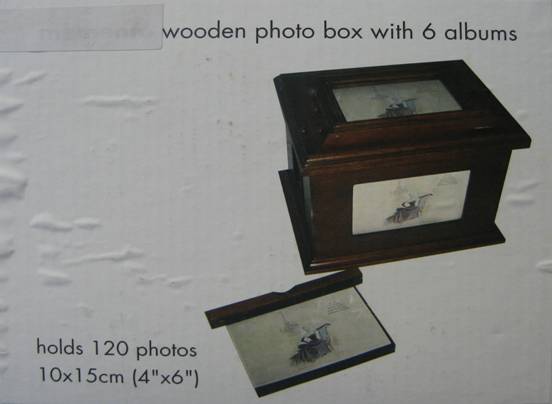
7 The sample photograph in the respondents’ label shows a woman sitting on a couch. Immediately to the left of the word “wooden” there appeared the word “memento” in the same font as in the appellant’s label (see [11] below). However, the respondents marketed their product with the word “memento” covered. At first the covering was a white paper strip through which the word could be discerned fairly easily. Later a black strip was used which effectively obscured the word.
8 The respondents’ label is obviously stuck on. The label measures 18 cm x 15 cm, leaving margins of 3-6 cm of bare white cardboard.
9 The respondents also affixed a smaller label 6 cm x 5 cm bearing the words “Better Homeware”:
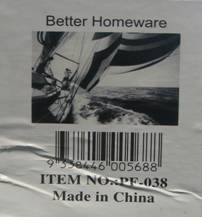
10 The respondents’ larger label was affixed to two sides of its cardboard box. The smaller label was only affixed on one side. Apart from the labels mentioned, the respondents’ cardboard box was of bare white cardboard.
Appellant’s packaging
11 The appellant’s cardboard box had a label on the two larger sides as follows:
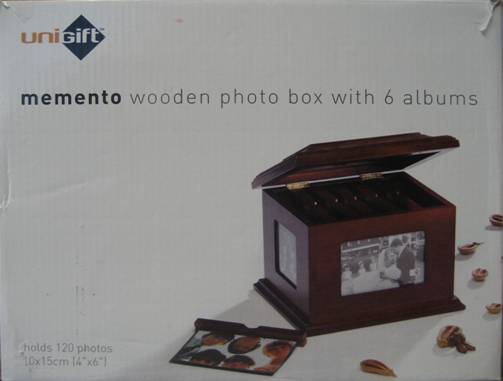
12 The wedding photograph on the appellant’s label bears its “Unigift” mark and the figures “4″x 6″ 15 x 10 cm”.
13 On the other two smaller sides there is a photograph of the wooden box with lid closed. The same wedding photograph is displayed however there is no separate photograph as shown in [11] and there are no sprinkled nuts. In addition to the “Unigift” mark and the text “memento wooden photo box with 6 albums” there is the text:
This stylish and functional wooden photo box will store 4 of your favourites on the side of the box. The pull out photo folders are hidden within the box and can hold up to 120 extra photos.
14 All labels on the appellant’s box are printed on the cardboard itself, unlike the respondents’ which, as already noted, are stuck on in a rather crude fashion.
15 All sides of the appellant’s box have a glossy finish, as does the top. Two sides are a pale pink and the other two sides white. On the top the background is a chocolate brown with the word “memento” in a lighter brown and across that, in white, the words “memento wooden photo box with 6 albums”.
16 Any intellectual property rights in the photo boxes themselves, or the photographs appearing on the labels, are not in issue in these proceedings.
17 In the Federal Magistrates Court Riley FM dismissed all the appellant’s claims: Woodtree Pty Ltd v Zheng [2007] FMCA 457. In a subsequent ruling her Honour awarded the respondents costs on an indemnity basis from 2 June 2006, the date of a Calderbank offer: Woodtree Pty Ltd v Zheng (No2) [2007] FMCA 989.
18 The appellant now appeals from those judgments.
Copyright issues
19 The appellant asserts that its label is an “artistic work” within the meaning of the definition in s 10(1) of the Copyright Act 1968 (Cth). The relevant part of that definition reads:
artistic work means:
(a) a painting, sculpture, drawing, engraving or photograph, whether the work is of artistic quality or not;
20 “Drawing” is defined to include “a diagram, map, chart or plan”.
21 The appellant’s case is that its label is a drawing. It is submitted that the words and the placement of the photograph were part of an overall design which constituted a “drawing”. As already mentioned, no copyright is asserted in the photograph itself. However, it is said that the “drawing” consists of a number of visual elements selected and arranged by the appellant. These elements are the digitised photograph of the box and a series of words in specific fonts, colours and sizes. These elements, so the argument goes, have been carefully arranged in a spatial sense, with each element assuming a specific position that gives the overall arrangement a particular visual effect.
22 In dealing with this issue the learned Magistrate discussed Lott v JBW & Friends Pty Ltd (2000) 76 SASR 105. The work there in question was a graphic bar with the words “Opera in the Outback”. The report does not contain a reproduction. Mullighan J held that it was a “drawing”. His Honour said at [14]
The graphic designer had to create a design and make choices about the layout, font, colour and dimensions of each part of the design. Having perused the graphic … I do not regard it as so simple as to deny copyright.
…
The selection of the font from a computer program is no less creative than manual drawing …
23 In the present case her Honour, correctly in my view, pointed out at [29] that Lott is not authority for the proposition that anything a graphic designer prepares is a drawing.
24 The same point was made by Mr Minahan, counsel for the respondents, in his written submissions. The submissions, he said, involved the use of a computer and selection of typeface and decisions about layout and presentation including headings and indentation. The same could be said for a newspaper. However neither the submissions nor a newspaper would be regarded as a drawing.
25 Her Honour adopted the statement in Ricketson, S The Law of Intellectual Property, Copyright Designs and Confidential Information, at par 7.365:
Essentially, a drawing is a two-dimensional work in which shapes and images are depicted by lines, often without colouring.
26 I would agree that this is the ordinary meaning of the term “drawing”. The Macquarie Dictionary gives us several definitions of the noun “drawing”:
…
2. representation by lines; delineation of form without reference to colour.
3. a sketch, plan, or design, esp one made with pen, pencil, or crayon.
27 In the context of the visual arts, the traditional distinction has been between paintings, which are coloured, and drawings, which are monotone, usually, but not always, black upon white. The statutory definition, particularly by its inclusion of maps, makes it clear that for the purposes of the Act something may be a drawing notwithstanding that it is coloured. However, the essence of a drawing remains the concept of a representation of some object by a pictorial line.
28 In the present case the work in question consists substantially of a photograph, which is not in ordinary speech a drawing and which the statute specifically treats as something distinct from a drawing. The only other visual item is the text. Text is not a drawing. I do not think that by adding a non-drawing to a non-drawing one can end up with a drawing, however much skill goes into the placement and arrangement.
29 Certainly for something to be a “drawing” for copyright purposes no great complexity or (as the statute tells us) artistic quality is required. In Millar & Lang Ltd v Polak [1908] 1 Ch 433 the works held to be drawings included words such as “Greetings”, “Friends ever”. “Good luck”, “Lest we forget”, and “For old times sake” in a distinctive form within an ornamental oval or circular scroll. In Roland Corporation v Lorenzo & Sons Pty Ltd (1991) 33 FCR 111 the devices held by Pincus J to be drawings were based on the letters R and B but, as is apparent from the report at 112, were quite stylised. As his Honour said at 114, they were “by no means random and were plainly drawn with care, to obtain an effect”. Clearly a letter or letters of the alphabet can provide the subject matter for a drawing. One thinks of the illuminated manuscripts of medieval works such as the Book of Kells. However, in the present case the text is fulfilling a semiotic function. It is communicating to the reader the message that within the cardboard box will be found a wooden photo box with 6 albums which hold 120 10 x 15 cm photos. The pictorial image of that box is conveyed by a photograph, which is not a drawing.
30 Mr Golvan SC for the appellant sought leave to amend its statement of claim to raise an allegation that its label was a “literary work”. The definition of that term in s 10(1) includes
(a) a table, or compilation, expressed in words, figures or symbols.
The appellant says its label is a “compilation”.
31 It appears that, although not pleaded, this issue was at least touched on in the court below. It is discussed at [34]-[37] of the judgment. Mr Minahan objected to this late amendment, citing the decision of the High Court in Metwally v University of Wollongong (No 2) (1985) 60 ALR 68 at 71:
It is elementary that a party is bound by the conduct of his case. Except in the most exceptional circumstances it would contrary to all principle to allow a party, after a case has been decided against him, to raise a new argument which, whether deliberately or by inadvertence, he failed to put during the hearing when he had an opportunity to do so.
32 The application to amend should be refused, primarily for the reason that the proposed amendment lacks arguable merit. The notion of compilation involves a collecting and putting together or arranging or organising of disparate data. That is not the case with the appellant’s label. It is simply a photograph and a description of an object. It conveys the one message.
Trade Practices issues
33 The appellant’s case was pleaded in the common law tort of passing off as well as alleged contraventions of ss 52 and 53(c) and (d) of the Trade Practices Act 1974 (Cth). Section 52 prohibits conduct in trade or commerce which is misleading or deceptive or likely to mislead or deceive. More specifically, s 53(c) and (d) prohibits representations that goods or a corporation have sponsorship or approval which they do not have.
34 In the court below, concentration was very much on the passing off claim. However, as the Full Court has recently pointed out in Cadbury Schweppes Pty Ltd v Darrell Lea Chocolate Shops Pty Ltd (2007) 159 FCR 397 at [96]-[99], the degree of overlap between the two causes of action should not obscure the important differences between them. The law of passing off protests goodwill as a species of property: Boehringer Ingelheim Ltd v Vetplus Ltd (2007) 73 IPR 593 at [37] per Jacob LJ, citing a passage from the judgment of Millett LJ in Harrods Ltd v Harrodian School Ltd (1996) 35 IPR 355 at 366. However claims under the Trade Practices Act it is not necessary for a plaintiff to establish an exclusive reputation, or indeed any reputation at all. The question is rather whether consumers are likely to be misled or deceived by the defendant’s conduct.
35 In the present case much of the debate concerning the nature of the appellant’s reputation and when it was established becomes irrelevant once concentration is focussed on the respondents’ conduct.
36 Her Honour made the following findings relating to the trade practices issues.
37 The appellant’s photo boxes were sold in 500 retail stores throughout Australia and New Zealand including Priceline, The Reject Shop and The Warehouse. The appellant first imported them in July 2005. Photo boxes in packaging mentioned above were first imported on 26 October 2005 and reached retail outlets in Melbourne four or five days later and interstate outlets within a week.
38 Between those dates and 29 March 2006, two days before the commencement of proceedings, the appellant had sold the following quantities of different sizes.
Large 2860
Medium 7116
Small 8760
39 Blue Boss was a customer of the appellant in 2004 and 2005 and had bought photo boxes and numerous other items. In late 2005 it bought 54 photo boxes of the types in issue.
40 A witness attended a shop called Stuff and Nonsense at Victoria Gardens on 3 May 2006. The witness observed the respondents’ photo boxes being sold for $10 or $20 less than the appellant’s. That is for $20, $30 and $50 for small, medium and large sizes as against $30, $40 and $60 or $70 for the respective sizes of the appellant’s boxes. The appellant’s and respondents’ boxes were sold side by side at Stuff and Nonsense as well as in the respondents’ store in Eastland.
41 The learned Magistrate found that at least one example of each type of photo box was displayed out of its carton in retail outlets. Her Honour noted at [95] that it was likely that photo boxes would have been displayed out of their cartons as consumers would want to see the box before buying it and to look inside and see how the albums can be removed and how the photo box actually worked. Thus it was to be expected that retailers would display an example of each photo box in a way that would facilitate the consumer’s inspection of the product.
42 Her Honour also found that almost invariably there would be photo boxes inside their cartons or indeed empty cartons stored on the shelves or tables of retail outlets near the examples on display, primarily for the purposes of storage and to be readily accessible for purchase. Those cartons would be visible to consumers at the time of making their choice of photo box.
43 Neither parties’ photo boxes bore the “memento” mark. When removed from their cardboard box the parties’ photo boxes were virtually indistinguishable.
44 Mr Zheng’s evidence as to how he came to market the photo boxes was as follows. He bought a line of photo boxes from the appellant in October 2005. The cartons had a similar overall layout to the ones mentioned above, except that they had no writing in the lower left corner and photographs of three photo boxes on the front and rear panels rather than one. Mr Zheng said that numerous other companies were selling photo boxes of various shapes and designs in mid 2005 in Australia.
45 Mr Zheng decided to import photo boxes himself rather than going through a wholesaler such as the appellant. He contacted his Chinese supplier who asked him to provide an example of exactly the type of photo box he wanted, as many different types were available. Mr Zheng provided a copy of the appellant’s “memento” packaging. He told the supplier to prepare packaging for his company and take photographs for that purpose. He told the supplier to ensure the respondents’ packaging was different to the appellant’s packaging. He told the supplier to include the words “a wooden photo box with six albums and 120 photos 10 x 15 cms (4″x 6″)”. The word “memento” was mistakenly included on the respondents’ packaging. He did not ask for it to be included. He ordered a total of 3000 photo boxes.
46 When the photo boxes arrived in Australia Mr Zheng instructed his staff to put plain white stickers are the word “memento”. The respondents did not offer for sale any photo boxes with the word “memento” uncovered and all of their boxes bore the Better Homeware brand rather than the Unigroup brand. Later in response to demands from the appellant, the respondents covered the whole of the large stickers with white paper and later still black paper.
47 The respondents sold 676 units with the word “memento” covered by the white stickers. It still had 1700 units in their warehouse. All photo boxes sold by the respondents had the Better Homeware brand on them.
48 The learned Magistrate accepted Mr Zheng’s evidence except in relation to the instructions that he gave his supplier for the packaging. Her Honour found that there was likely to have been a fax cover sheet which contained instructions for the supply in relation to the design of the photo boxes themselves and the packaging. She inferred from the respondents’ failure to discover the fax cover sheet and the contract that those documents would not have assisted their case. She did not accept that Mr Zheng asked his supplier to make the packaging very different to the appellant’s. It would have been easy to ask the supplier to provide a proof of the design for packaging to enable him to check it. If Mr Zheng had done so it would have been obviously that the design was very similar to the applicant’s and included the word “memento”.
49 In the circumstances her Honour found that Mr Zheng chose not to ask for a preview of the packaging because he had given precise instructions about it and knew exactly how it would look. Her Honour found that Mr Zheng did not instruct his supplier not to use the word “memento”.
50 In finding against the appellant on the trade practices issues the learned Magistrate reasoned as follows (at [136]). Photo boxes were generally displayed outside their cartons. When seen without their cartons the appellant’s and respondents’ photo boxes were very different. The face papers gave a different overall impression and showed different branding. Consumers would see the Unigift brand and the Better Homeware brand before they turned their attention to the cartons. While they might wonder whether there was a connection between the respondents’ product and the appellant’s, at that stage they would mostly be concentrating on the price and deciding whether it was worth paying an extra $10 or $20 for the more polished and professional cartons offered by the appellant. Her Honour did not think that the consumers would have any significant interest in the brand or origin of photo boxes. Her Honour said there was nothing to indicate that the appellant’s product, as opposed to its cartons, was superior to the respondents’. Her Honour thought that the attempted concealment of the word “memento” would signal to the consumers that there would have been some sort of printing error and that the respondents’ product was not a “memento” version of a photo box.
51 Her Honour concluded at [141] that there was “not even a remote chance” that the reasonable consumer of photo boxes and gift ware in the medium to discount sector of the market might be led to believe by the design of the respondents’ packaging that the respondents had any sort of affiliation with the appellant.
52 While the learned Magistrate conducted a detailed and thoughtful review of the evidence, I am compelled to a different conclusion. There seem to me to be five critical factors. First, the products were often marketed at retail outlets side by side. Secondly, the photo boxes themselves were identical (apart from photographs displayed). Thirdly, the general get-up of the packaging was strikingly similar in content, type face and layout. Fourthly, the overall impression was that the respondents’ packaging, and in particular the stuck on labelling, appeared cheaper and less sophisticated than the appellant’s. Fifthly, the respondents’ retail price was substantially less.
53 In my view, many potential purchasers in this setting would be likely to infer that both boxes came from the same source. They would not be likely to pay too much attention to the Unigift or Better Homeware brand. It is a very common marketing practice to use different brand names for products clearly made by the same manufacturer. That being so, a substantial number of consumers would be likely to think that the same manufacturer was giving the consumer a choice: you can buy the same photo box but with cheaper packaging for a lesser price. This would be attractive for somebody who thought they might simply get the photo box and use their own wrapping paper to make a gift. The cost of the wrapping paper would in all probability be significantly less than the price differential between the photo boxes.
54 So whether or not the appellant had a prior reputation of any and what extent, the fact remains that by using the very similar get-up in the way these products were marketed the respondents were likely to mislead and deceive consumers into thinking that their products and the appellant’s products came from the same source.
55 Moreover, the learned Magistrate’s findings support a conclusion that this was a case of deliberate copying. I would apply the principle in Australian Woollen Mills Ltd v F S Walton & Co Ltd (1937) 58 CLR 641 at 657.
Damages
56 On the trade practices causes of action the appellant’s damages claim is based on the number of sales of the respondents’ offending boxes. The appellant claims the gross profit on an equivalent number of sales it says it has lost.
57 There were 676 such sales by the respondents. The lowest profit margin for the appellant, being that on its small photo boxes, was $5.45. The resultant figure is $3684.20.
58 Mr Minahan argues that not every sale the respondents made was a sale lost to the appellant. It can be inferred, he says, that consumers bought the respondents’ boxes because they were cheaper. There was evidence from the appellant’s director Mr Leo Norich that consumers buy photo boxes based on product, price and packaging in that order.
59 In my view, the appellant’s approach is a realistic one. The competing products were presented side by side to consumers. As already noted, the effect of the offending packaging was likely to induce consumers into thinking that they were getting the same product from the same source but would be saving money by not having to pay for more elaborate packaging, which they did not need. The misleading and deceptive conduct only has to be one among a number of causes which contributes to a consumer decision harmful to a plaintiff. As Gleeson CJ said in I & L Securities Pty Limited v HTW Valuers (Brisbane) Pty Limited (2002) 210 CLR 109 at [33]:
In most business transactions resulting in financial loss there are multiple causes of the loss. The statutory purpose would be defeated if the remedy under s 82 were restricted to loss of which the contravening conduct was the sole cause.
60 While the appellant’s claim is based on gross profit lost, that seems a practical measure in the circumstances of this case. It is a modest claim because it assumes that all sales lost were of the small box, which had the lowest margin. It would be an artificial exercise to attempt to calculate some proportion of that profit which represented savings of fixed costs. This case was properly brought in the Federal Magistrates Court, a jurisdiction which is expected to operate as informally as possible: Federal Magistrates Act 1999 (Cth) ss 3(2)(a) and 42. In a case of this nature parties should not feel they have to engage forensic accountants and similar experts.
Orders
61 The appeal will be allowed and the judgment below set aside. In lieu thereof there will be judgment for the appellant against the respondents (the liability of the first respondent under s 79(1)(c) of the Trade Practices Act was not in dispute). The amount of that judgment will be $3684.20 plus appropriate interest under s 51A of the Federal Court of Australia Act 1976 (Cth).
62 There remain the questions of costs. As already mentioned, the learned Magistrate made an order for indemnity costs. The respondents had made Calderbank offers as follows:
· 5 April 2006: an undertaking to cease selling products with the offending packaging
· 27 April 2006: the undertaking, $3775 for costs and $1200 damages
· 19 May 2006: the undertaking, $4331 for costs and $2706 damages
· 2 June 2006: the undertaking, $4331 for costs and $9000 damages. (The time for compliance with this offer was extended on two occasions).
63 I direct that the appellant within seven days file written submissions as to interest and costs and that the respondent file answering submissions within seven days thereafter.
|
I certify that the preceding sixty three (63) numbered paragraphs are a true copy of the Reasons for Judgment herein of the Honourable Justice Heerey |
Associate:
Dated: 7 December 2007
|
Counsel for the Appellant: |
C Golvan SC |
|
|
|
|
Solicitors for the Appellant: |
Middletons |
|
|
|
|
Counsel for the Respondent: |
S Minahan |
|
|
|
|
Solicitors for the Respondent: |
F A L Lawyers |
|
|
|
|
Date of Hearing: |
23 November 2007 |
|
|
|
|
Date of Judgment: |
7 December 2007 |


