FEDERAL COURT OF AUSTRALIA
Australian Competition and Consumer Commission v Telstra Corporation Limited (ACN 051 775 556) [2007] FCA 1904
Trade Practices Act 1974 (Cth) ss 51A, 52, 53(aa), 53(c), 84(2)(b)
.au Domain Administration Ltd v Domain Names Australia Pty Ltd (2004) 207 ALR 521 cited and followed
Alpine Holdings Pty Ltd v Warwick Entertainment Centre Pty Ltd (2003) 11 Tas R 242 cited
Astrazeneca Pty Ltd v GlaxoSmithKline Australia Pty Ltd [2006] ATPR 42-106 cited and followed
Australian Competition and Consumer Commission v Telstra (2004) 208 ALR 459 cited
Butcher v Lachlan Elder Realty Pty Ltd (2004) 218 CLR 592 cited and followed
Campomar Sociedad, Limitada v Nike International Ltd (2000) 202 CLR 45 cited and followed
Duracell Australia Pty Ltd v Union Carbide Australia Ltd (1988) 14 IPR 293 cited and followed
Finucane v New South Wales Egg Corp (1988) 80 ALR 486 cited
Freeman & Lockyer (a firm) v Buckhurst Park Properties (Mangal) Ltd [1964] 2 QB 480 cited
Gillette Australia Pty Ltd v Energizer Australia Pty Ltd (2002) 193 ALR 629 cited and followed
Johnson & Johnson Pacific Pty Ltd v Unilever Australia Ltd (No 2) (2007) ATPR 42-136 cited
Karmot Auto Spares Pty Ltd v Dominelli Ford (Hurstville) Pty Ltd (1992) 35 FCR 560 cited
Keen Mar Corp Pty Ltd v Labrador Park Shopping Centre Pty Ltd [1989] ATPR 46-048 cited
Lisciandro v Official Trustee in Bankruptcy (1996) 69 FCR 180 cited
National Exchange Pty Ltd v Australian Securities and Investments Commission [2004] ATPR 42-000 cited and followed
Parkdale Custom Built Furniture Pty Ltd v Puxu Pty Ltd (1982) 149 CLR 191 cited
Singtel Optus Pty Ltd v Telstra Corporation Ltd [2004] FCA 859 cited
Taco Co of Australia Inc v Taco Bell Pty Ltd (1982) 42 ALR 177 cited
Talmax Pty Ltd v Telstra Corporation Ltd [1997] 2 Qd R 444 cited
Telstra Corporation Ltd v Optus Communications Pty Ltd (1996) 36 IPR 515 cited and followed
Trade Practices Commission v Optus Communications Pty Ltd (1996) 64 FCR 326 cited
Trade Practices Commission v Sun Alliance Australia Ltd [1994] ATPR 41-286 cited
AUSTRALIAN COMPETITION AND CONSUMER COMMISSION v TELSTRA CORPORATION LIMITED (ACN 051 775 556)
VID 855 OF 2007
GORDON J
6 DECEMBER 2007
MELBOURNE
| IN THE FEDERAL COURT OF AUSTRALIA |
|
| VICTORIA DISTRICT REGISTRY | VID 855 OF 2007 |
| BETWEEN: | AUSTRALIAN COMPETITION AND CONSUMER COMMISSION Applicant
|
| AND: | TELSTRA CORPORATION LIMITED (ACN 051 775 556) Respondent
|
| GORDON J | |
| DATE OF ORDER: | 6 DECEMBER 2007 |
| WHERE MADE: | MELBOURNE |
THE COURT ORDERS THAT:
1. The Applicant, after conferring with the Respondent, file and serve minutes of proposed orders to give effect to these reasons for decision by no later than 13 December 2007.
Note: Settlement and entry of orders is dealt with in Order 36 of the Federal Court Rules.
| IN THE FEDERAL COURT OF AUSTRALIA |
|
| VICTORIA DISTRICT REGISTRY | VID 855 OF 2007 |
| BETWEEN: | AUSTRALIAN COMPETITION AND CONSUMER COMMISSION Applicant
|
| AND: | TELSTRA CORPORATION LIMITED (ACN 051 775 556) Respondent
|
| JUDGE: | GORDON J |
| DATE: | 6 DECEMBER 2007 |
| PLACE: | MELBOURNE |
REASONS FOR JUDGMENT
INTRODUCTION
1 Australia was one of the first countries in the world to embrace mobile telephone technology. As at 30 June 2006, the Australian mobile telecommunications industry had 19.76 million mobile telephone services in operation and mobile services, as a proportion of the Australian population, were at 96% (Australian Mobile Telecommunications Association Ltd, 2007 Annual Report (Australian Mobile Telecommunications Association Ltd, Canberra, 2007) http://www.amta.org.au/default.asp?id=28 viewed 3 December 2007, p 8). This puts Australian usage of mobile telephone technology among the highest in the world.
2 It is therefore not surprising that when Telstra Corporation Limited (“Telstra”) decided to replace its existing mobile phone networks with a third generation mobile telecommunications network, the Next G network, both the announcement and the implementation of the Next G network attracted the attention of politicians, users of the Core Division Multiple Access Network (“CDMA Network”), users of the Next G network, and the Australian Competition and Consumer Commission (the “ACCC”).
accc allegations
3 This proceeding concerns 12 events in Telstra’s advertising campaign and other public announcements about the Next G network (“the 12 Events”). The ACCC alleges that as a result of those 12 Events, contrary to s 52 of the Trade Practices Act 1974 (Cth) (“the Act”), Telstra engaged, and continues to engage, in conduct that is misleading or deceptive, or is likely to mislead or deceive.
4 The ACCC also alleges that the 12 Events make false representations about services (contrary to s 53(aa) of the Act) and make representations that goods or service have performance or other characteristics they do not have (contrary to s 53(c) of the Act).
the 12 events
5 The 12 Events which the ACCC submits are in breach of ss 52, 53(aa) and 53(c) of the Act are:
(1) the Everywhere Advertisement, which was televised in, and in the surrounding areas of, Sydney, Melbourne, Brisbane, Adelaide, Perth, Newcastle and Wollongong from 20 May 2007 to 30 June 2007;
(2) the Cramer Testimonial Advertisement, which was published in the following newspapers on the following dates:
| NEWSPAPER | DATE |
| Sunday Mail, Brisbane | 19 August 2007 |
| Gladstone Observer | 20 August 2007 |
| Gold Coast Bulletin | 22 August 2007 |
| Toowoomba Chronicle | 31 August 2007 |
| Sunday Mail, Brisbane | 2 September 2007 |
| The Age | 4 September 2007 |
| Courier Mail | 10 September 2007* |
* This publication was inadvertent.
(3) the AFL Website Advertisement, which appeared on the Australian Football League’s website from 1 March 2007 until 17 September 2007;
(4) the Telstra Website Information which appeared on Telstra’s website from 1 October 2006 until 3 October 2007;
(5) a Brochure first distributed in its initial form on 10 May 2007 and then replaced by a variation on 4 June 2007. The 4 June 2007 replacement brochure has not been printed since 25 June 2007;
(6) a Telstra Media Release of 8 August 2007;
(7) the Telstra Shop Business Centre Website page;
(8) selected pages from the Telstra Next G website available since 6 October 2006;
(9) the Next G network for Business brochure available from the website http://www.commsaut.com.au/Uploads/Images/NextGBusiness.pdf since October 2006;
(10) a television advertisement aired in the Cairns area on 8 September 2007;
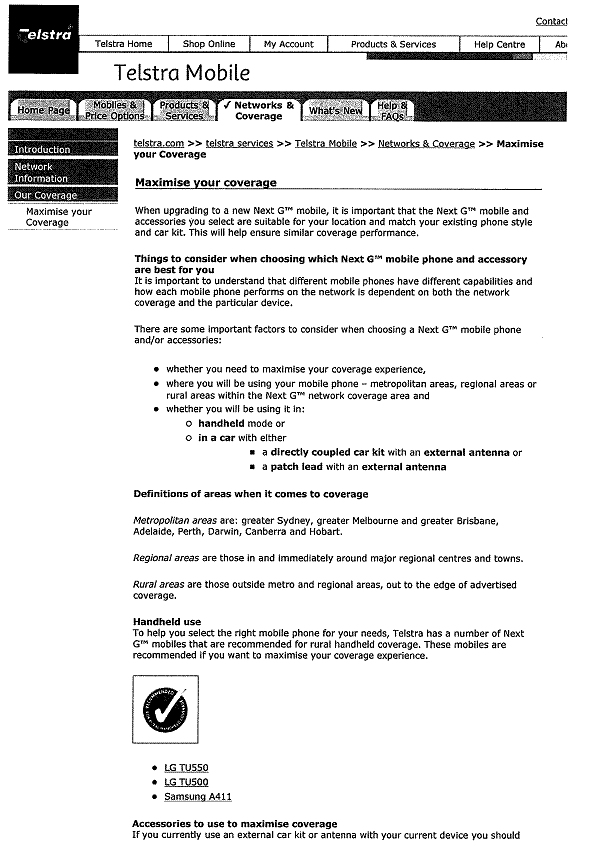
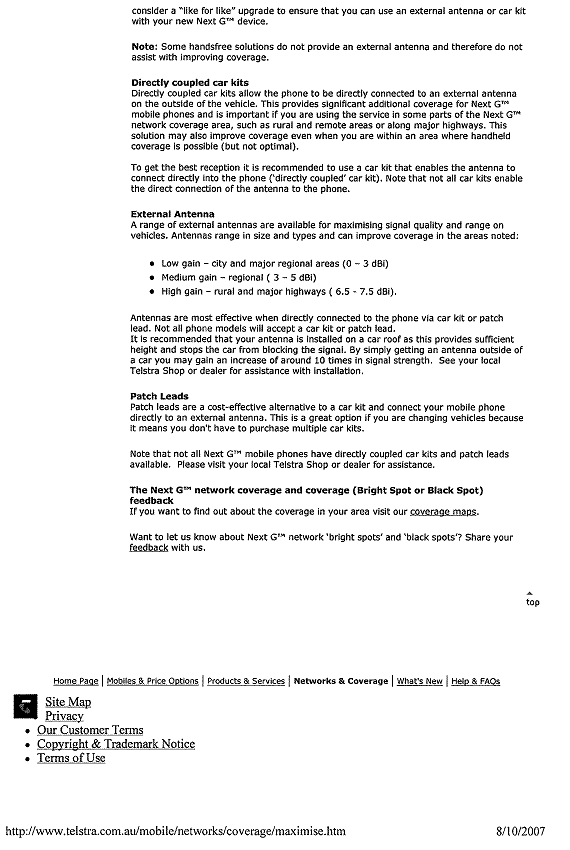
(11) two Brisbane radio commercials aired on the 15 September 2007; and
(12) the Next G Family Brochure first distributed on 6 October 2006 and not printed since 22 January 2007.
6 The 12 Events were alleged by the ACCC to contain one or more of the following representations, namely that:
(1) mobile coverage on the Next G network is available to Next G customers:
(a) everywhere in Australia geographically (“the First Coverage Representation”); or
(b) everywhere the customer, from time to time, needs to use their mobile telephone (“the Second Coverage Representation”),
(collectively “the Coverage Representations”); and
(2) a customer subscribing to the Next G network will receive the same or better coverage than is available currently on the CDMA network (“the CDMA Comparison Representation”).
7 The ACCC alleges that each of the 12 Events conveyed each of the Coverage Representations in breach of ss 52, 53(aa) and / or 53(c) of the Act because:
(1) coverage on the Next G network is not available to Next G customers everywhere in Australia;
(2) as at 8 August 2007, the area of Australian land mass covered by the Next G network was only CIC-1% without an external antenna and only CIC-2% with an external antenna. (I have not included the actual area of land mass covered. The figures, set out in Schedule 1, are commercial in confidence (“CIC”) and are to remain confidential);
(3) physical features including man-made structures, hills, mountains and trees may impede coverage; and
(4) mobile telephony reception (and therefore effective coverage) is significantly affected by mobile handset quality, a matter to which Telstra has not drawn consumers’ attention in its promotion of the Next G network sufficiently or at all.
8 The ACCC also alleges that 3 of the 12 Events (“the 3 Events”) conveyed the CDMA Comparison Representation in breach of ss 52, 53(aa) and / or 53(c) of the Act because:
(1) coverage on the Next G network is not always available to Next G customers where they previously had and / or presently have coverage on the CDMA network;
(2) independent testing supports the conclusion that the coverage of the Next G network is less than the historical and / or present coverage of the CDMA network; and
(3) independent testing supports the conclusion that the coverage of the Next G network is not the same as, or better than, the coverage of the CDMA network.
telstra’s response
9 Telstra submits that the ACCC’s claim should be dismissed because:
(1) none of the 12 Events convey either of the Coverage Representations;
(2) none of the Events convey the CDMA Comparison Representation if the CDMA Comparison Representation is a representation as to present fact. If the CDMA Comparison Representation is a representation as to future matters (which Telstra asserts), the ACCC has not alleged that Telstra did not have reasonable grounds for making it;
(3) if any representation was conveyed, the representation made is not false, misleading or deceptive (s 52 of the Act), does not make any false representation about services (s 53(aa)) and does not contain any representation that goods and services have performance or other characteristics in breach of s 53(c) of the Act.
conclusion
10 As these reasons will demonstrate, by the 12 Events taken collectively and separately, Telstra engaged and continues to engage in conduct that is misleading or deceptive, or is likely to mislead or deceive. The particular respect or respects in which each of those 12 Events had that character differs. Each event conveyed, either generally or in a particular respect, the Second Coverage Representation when, in fact, whether a user could obtain coverage depended in part upon where that person was, what handset that person was using and in some cases whether that handset had an external antenna attached. For similar reasons, the CDMA Comparison Representation, which is a more confined or precise statement of the Second Coverage Representation, is also misleading or deceptive, or likely to mislead or deceive.
11 It was common ground, that if the conduct complained of by the ACCC contravened s 52 of the Act, then having regard to its content, that conduct would also contravene ss 53(aa) and (c) of the Act.
structure of the reasons
12 Theses reasons are structured as follows:
(1) Relevant legal principles;
(2) The Classes of consumers;
(3) Were one or both of the Coverage Representations and the CDMA Comparison Representation conveyed?
(4) Was the Second Coverage Representation misleading or deceptive?
(5) The Cumulative Effect of the 12 Events;
(6) Telstra’s liability for Events 7 and 10;
(7) The CDMA Comparison Representation;
(8) The other evidence.
(1) RELEVANT LEGAL PRINCIPLES
13 Section 52 of the Act relevantly provides that:
A corporation shall not, in trade or commerce, engage in conduct that is misleading or deceptive or is likely to mislead or deceive.
14 The relevant legal principles have been well traversed by Australian courts. A two-step analysis is required. First, it is necessary to ask whether each or any of the pleaded representations is conveyed by the particular events complained of: Campomar Sociedad, Limitada v Nike International Ltd (2000) 202 CLR 45 at [105]; National Exchange Pty Ltd v Australian Securities and Investments Commission [2004] ATPR 42-000 at [18] per Dowsett J (with whom Jacobson and Bennett JJ agreed) and Astrazeneca Pty Ltd v GlaxoSmithKline Australia Pty Ltd [2006] ATPR 42-106 at [37]. That is, do the 12 Events singularly or collectively convey either of the Coverage Representations and do the 3 Events singularly or collectively convey the CDMA Comparison Representation.
15 Secondly, it is necessary to ask whether the representations conveyed are false, misleading or deceptive or likely to mislead or deceive. This is a “quintessential question of fact”: Australian Competition and Consumer Commission v Telstra (2004) 208 ALR 459 at [49].
16 Because the conduct complained of in the present matter was not directed at a specific individual both questions that have been identified must be considered by reference to the class or classes of consumers likely to be affected by the conduct: Parkdale Custom Built Furniture Pty Ltd v Puxu Pty Ltd (1982) 149 CLR 191 at 199 per Gibbs CJ; Nike at [102], [103], [105] and [106]; Butcher v Lachlan Elder Realty Pty Ltd (2004) 218 CLR 592 at [36] per Gleeson CJ, Hayne and Heydon JJ.
17 In .au Domain Administration Ltd v Domain Names Australia Pty Ltd (2004) 207 ALR 521 at [12]-[26] Finkelstein J provided a useful summary of the approach that might be taken where a court is required to assess conduct by reference to a specific class or classes of consumers and did that by particular reference to Taco Co of Australia Inc v Taco Bell Pty Ltd (1982) 42 ALR 177 at 202-203 per Deane and Fitzgerald JJ and Nike at [100]-[103]. The approach may be summarised in six points, as follows:
(1) first, identify the relevant section or sections of the public by reference to which the issue is to be tested. The target section or sections of the public would, of course, vary according to the facts of each case: Parkdale at 209 per Mason J; Finucane v New South Wales Egg Corp (1988) 80 ALR 486 at 516. The relevant section or sections of the public may be confined by factors such as the time period over which the alleged representations were made and the geographical circulation of the advertisements containing the alleged representations. (For an example of geographical circulation defining the relevant test section, see Talmax Pty Ltd v Telstra Corporation Ltd [1997] 2 Qd R 444 at 446);
(2) second, having identified the relevant section or sections of the public, consider who comes within that section or those sections. This may include the astute and the gullible, the intelligent and the not so intelligent, the well educated and the poorly educated: see also Parkdale at 199 per Gibbs CJ;
(3) third, it is permissible, but not essential, to have regard to evidence that some person has in fact been misled, though this evidence will not be conclusive;
(4) fourth, it is necessary to enquire whether any proven misconception has arisen because of the misleading or deceptive conduct;
(5) fifth, where the persons alleged to have been misled are members of a class, it is necessary to isolate a representative member of the class and enquire whether that hypothetical person is likely to be deceived;
(6) sixth, when considering the likely effect of the misrepresentation on this hypothetical person, he or she should be judged as an “ordinary” or “reasonable” member of the class, excluding reactions to the representation that are “extreme” or “fanciful”.
18 The question in this case can therefore be stated as being whether an ordinaryor reasonable member of each identified class would perceive:
(1) the 12 Events singularly or collectively to convey either of the Coverage Representations;
(2) the 3 Events singularly or collectively to convey the CDMA Comparison Representation.
If yes, the next question is whether the representations are false, misleading or deceptive or likely to mislead or deceive an ordinary or reasonable member of each identified class.
19 As noted, under the two-step analysis that has been described, the court cannot consider each event in isolation. Each event must be considered within the context of the advertising campaign of which it formed part: see Telstra Corporation Ltd v Optus Communications Pty Ltd (1996) 36 IPR 515 at 523-524; Trade Practices Commission v Optus Communications Pty Ltd (1996) 64 FCR 326 at 338; Astrazeneca at [24]; Johnson & Johnson Pacific Pty Ltd v Unilever Australia Ltd (No 2) [2007] ATPR 42-136 at [16]. In a national advertising campaign it would ordinarily be expected that there would be a dominant message and, in such a case, particular attention should be paid to that dominant message. In Telstra Corporation at 524, that principle was stated as follows:
In television and print advertising where a false dominant impression is conveyed, its message will not be ameliorated by the accuracy of the detailed message which is derived from a careful analysis of all the constituent parts of the advertisement.
20 Part of this contextual approach requires consideration of any “hangover effect” caused by earlier advertising. That is, it is necessary to consider whether an impression obtained from an earlier but related advertisement may need to be taken into account in determining whether a later advertisement is misleading: see Duracell Australia Pty Ltd v Union Carbide Australia Ltd (1988) 14 IPR 293 at 299, cited in Singtel Optus Pty Ltd v Telstra Corporation Ltd [2004] FCA 859 at [43]; and Optus Communications at 338.
21 The ACCC also alleges that the conduct complained of contravenes ss 53(aa) and (c) of the Act, which provide:
A corporation shall not, in trade or commerce, in connexion with the supply or possible supply of goods or services or in connexion with the promotion by any means of the supply or use of goods or services:
…
(aa) falsely represent that services are of a particular standard, quality, value or grade;
…
(c) represent that goods or services have sponsorship, approval, performance characteristics, accessories, uses or benefits they do not have …
22 Section 53 identifies specific types of conduct which, if engaged in by a corporation in connection with the promotion or supply of goods and services, will contravene ss 52 and 53 of the Act. However, unlike s 52, breach of s 53 is an offence: Pt VC of the Act. As noted earlier, it was common ground, that if the conduct complained of by the ACCC contravened s 52 of the Act, then having regard to its content, that conduct would also contravene ss 53(aa) and (c) of the Act.
(2) THE CLASSES OF CONSUMERS
23 As noted above, the targeted section or sections of the public will vary according to the facts of each case: see [17(1)] above. In the present case, the section of the public targeted was mobile phone users, including potential mobile phone users. Given the widespread use of mobile phones in Australia, this section of the public is necessarily large. However, the 12 Events were not all targeted to that section of the public in the same manner, at the same time and throughout geographic Australia. The geographical scope of their dissemination and the time period over which the dissemination occurred varied. It follows that it is possible to divide the identified section of the public geographically into six subclasses, although in the end it will be shown that the division is not determinative of the outcome.
Class 1: Across Australia
24 Class 1 concerns Events 3, 4, 6, 7, 8 and 9. Events 3, 4, 7, 8 and 9 were available through the internet and were therefore available anywhere in Australia.
25 Although Event 6 is a Media Release posted on the website of the Australian Stock Exchange which the Court is entitled to assume was made available for national distribution, it is not possible to say whether any section of the public was made aware of what appeared in it. No evidence was proffered by the ACCC about the extent of the Media Release’s circulation As Counsel for Telstra submitted, there was no basis to determine whether the Media Release was just ‘dead in the water’ or that a media outlet actually reported on it.
26 The remaining events in Class 1, Events 3, 4, 7, 8 and 9, were geographically unrestricted and were directed to a section of the public that comprises all mobile phone users, including potential mobile phone users in Australia.
Class 2: Major cities and surrounding areas (excluding the Northern Territory and Tasmania)
27 Class 2 concerns Event 1, the Everywhere Advertisement. It was shown on television in, and in the surrounding areas of, Sydney, Melbourne, Brisbane, Adelaide, Perth, Newcastle and Wollongong between 20 May 2007 and 30 June 2007.
28 Class 2 is therefore confined to mobile phone users, including potential mobile phone users in, and in areas surrounding, these major Australia cities. It is probable then that those who were exposed to the Everywhere Advertisement included persons who had been exposed to one or more of the Events in Class 1 – Events 3, 4, 7, 8 and 9.
Class 3: Sydney, Melbourne and Brisbane
29 Class 3 concerns Events 5 and 12.
30 The geographical distribution of the brochures comprising Events 5 and 12 is far from clear. At the very least, some of the brochures were available at certain metropolitan Telstra Shops in Sydney, Melbourne and Brisbane.
31 Class 3 is confined to mobile phone users, including potential mobile phone users, in Melbourne and Brisbane who were also customers at Telstra Shops. These users may also have been exposed to one or more of the events within Classes 1 and 2.
Class 4: Queensland and Victoria
32 Class 4 concerns Event 2, the Cramer Testimonial Advertisement, which was published in the various newspapers identified earlier between 19 August 2007 and 10 September 2007: see [5(2)] above.
33 Class 4 is confined to mobile phone users, including potential mobile phone users, in Queensland and Victoria. These users may also have been exposed to one or more of the events in Classes 1 and 2 and possibly, Class 3.
Class 5: Cairns
34 Class 5 concerns Event 10, the television advertisement screened in Cairns on 8 September 2007. Class 5 comprises all mobile phone users, including potential mobile phone users, in and around Cairns.
35 These users may also have been exposed to one or more of the events described as Classes 1, 2 and 4.
Class 6: Brisbane
36 Class 6 concerns Event 11, the two Brisbane radio commercials aired on the 15 September 2007. This class comprises all mobile phone users, including potential mobile phone users, in and around Brisbane. These users may also have been exposed to one or more of the events described in Classes 1, 2, 3 and 4.
The significance of dividing the Events geographically
37 Even though it is possible to identify these 6 subclasses (because the geographical dissemination of the Events differs) the ordinary or reasonable member of each subclass is not shown to be different in any relevant respect. Put another way, there is nothing to suggest that there may be a heightened or diminished sense of expertise in telecommunications in one class and not the other. Accordingly, although the events occurred in different places and were available to different audiences, the approach to the two-step analysis will be the same for all events.
Awareness of limitations
38 The “ordinary” or “reasonable” member of the class against which the conduct in question is to be tested is a person who has general knowledge of how mobile telephones operate. An ordinary or reasonable member of the class may well appreciate that before the introduction of the Next G network there were limitations on coverage. As Telstra submits, a member of the class may well know that reception on mobile telephones with which that person is familiar can be affected by such things as physical structures (eg buildings, tunnels or bridges), building materials, geographic features (eg mountains, foliage), weather, and being in lifts or underground car parks. But if a member of the class is to be understood as being conscious of these potential limitations to coverage of existing services, that person would also be aware that telecommunications is a developing field with new products and services continuously becoming available. A member of that class would rely on a service provider to update them on the extent of any limitations to mobile telephone coverage.
39 Observing that members of the relevant class may be assumed to know of the limitations of the existing mobile telephony systems does not assist Telstra in this case. It does not assist because the point being made in each of the 12 Events was that Next G is not the existing system. That is, Telstra was not advertising the existing system. Telstra was launching a new, different and better system which was said to provide coverage “everywhere you need it”. In considering the questions of whether the Coverage Representations were conveyed and if so, whether they were misleading or deceptive, it is of the first importance to recall that Telstra sought in each of the 12 Events to convey that Next G was new, was different and was better.
(3) WERE ONE OR BOTH OF THE COVERAGE REPRESENTATIONS CONVEYED?
40 I have carefully reviewed each Event several times and have sought to assess the likely effect of each Event on mobile phone users, including potential mobile phone users. In undertaking that task I have been conscious of the fact that a detailed inspection of the transcript of the television and radio advertisements must give a misleading impression of what is conveyed. However, in reviewing each Event I also had at the forefront the following caution from Lindgren J in Gillette Australia Pty Ltd v Energizer Australia Pty Ltd (2002) 193 ALR 629 at [47] regarding television advertising:
… [A]part from the difference between a one-off viewing and repeated viewings, the circumstances in which a judge attends to a television commercial for the purposes of a case are not those in which members of the public do so. First, members of the public watch a commercial after and before viewing other things, rather than in isolation. Second, unlike the judge, they do not carefully view the commercial with a special interest in noting and memorising its features. Third, they view the commercial, not in the calm of chambers, but against a background of distractions, such as domestic activity, or simply a preoccupation with other more interesting or pressing concerns. Fourth, usually they do not know in advance that the commercial is about to commence.
41 Similar caution must be adopted when reviewing the other, non-television Events.
42 With that caution in mind, I shall now set out a more detailed description of each of the 12 Events.
(1) The Everywhere Advertisement
43 The Everywhere Advertisement was a commercial Telstra had broadcast on television featuring the tagline “say hello to Telstra’s Next G network with coverage everywhere you need it”. Against the background music of Paul McCartney’s “Hello Goodbye”, the Everywhere Advertisement contained the following vocal copy accompanied by the following series of images:
| IMAGES | VOCAL COPY |
| Broad shot of children walking into a primary school building - close up of a woman with a child on her lap and a mobile telephone in one hand – broad shot of the inside of a classroom, initially dark but then illuminated. | The woman says “hello from the kids’ school”.
|
| Close up of two surf lifesaving boards lying on sand – image of two surf lifesavers pushing a boat out of a boatshed towards the sea – shot of several lifesavers standing on the beach and a female surf lifesaver holding a mobile telephone - shot of surf lifesavers performing drills on the beach. | The female surf lifesaver says “hello from the beach”.
|
| A man standing in front of a train in an underground or enclosed station holding a mobile telephone with passengers in the background boarding the train. | The man says “hello from the train station”.
|
| Image of train emerging from a tunnel and passengers embarking and disembarking as it arrives at the platform – concurrent overlay of text “Say hello to Telstra’s Next G™ network coverage everywhere you need it”. | Voice over says “say hello to Telstra’s Next G network with coverage everywhere you need it”. |
| Cityscape background with a group of people in the middle ground waving and a man in the foreground addressing the camera. | Man in the foreground says “hello from the city”. |
| Man emerging from a lift simultaneously removing telephone from his ear and addressing the camera. | Man emerging from lift says “hello from the lift”. |
| Woman loading groceries into the boot of a car in an underground or enclosed car park – turns to address the camera with her mobile phone in hand. | Woman says “hello from the car park”. |
| Image of a car arriving at an underground car park boom gate – driver inserts parking ticket into boom gate – image of car proceeding up the car park ramp. | Voice over says “to say hello to Telstra’s Next G network, simply visit a Telstra Shop or dealer today”. |
| Telstra logo on bright blue background with text: “Visit your local Telstra Shop or Dealer today” and then “telstra.com/nextg”. | Voice over says “Telstra Next G network Australia’s largest and fastest mobile network – with coverage everywhere you need it”. |
What is reperesented?
The First Coverage Representation
44 The ACCC submits that both Coverage Representations are conveyed. The distinction between the two Coverage Representations is fine, but it is an important one. With respect to the First Coverage Representation, the ACCC submits that it is conveyed by:
(1) the phrase “Telstra’s Next G network Australia’s largest and fastest mobile network with coverage everywhere you need it” when considered in light of the diverse needs of the Australian population, many of whom live, work or visit remote parts of the country; and
(2) the various places depicted in the advertisement such as the beach, car park, lift.
45 I do not accept that a reasonable person would equate the statements made in, and the impressions conveyed by, the Everywhere Advertisement with the claim that the Next G network offers mobile coverage literally “everywhere in Australia”. To draw that conclusion would be an extreme or fanciful interpretation of the content of the advertisement and would give the words “you need it” no work to do. The images in the advertisement do not depict remote or unpopulated areas of Australia but show individuals using the Next G network in everyday situations – at a school, on a patrolled surf beach, at a train station, in the city, leaving a lift and in an underground car park. I do not consider that an ordinary or reasonable member of the class would be under the impression after watching the Everywhere Advertisement that he or she would be able to use a Next G mobile telephone in any geographic location within Australia. The area of coverage represented by the Everywhere Advertisement does not extend throughout the breadth of the country. Rather, the locations identified in the advertisement are confined to geographical areas, such as populated cities, towns and coastal areas, where one would usually expect mobile coverage.
Second Coverage Representation
46 This representation is in a different category. The ACCC submits that the Everywhere Advertisement represents that coverage on the Next G network is available everywhere the customer needs to use their mobile phone. In particular, the ACCC submits that the Everywhere Advertisement conveys this “everywhere you need it” representation in:
(1) the repeated use of the phrase “everywhere you need it” – produced twice in the vocal copy and once as text on the screen; and
(2) specific references to places where people might be from time to time such as the vocal copy “hello from the lift” and “hello from the car park” accompanied by images of a woman using her mobile phone in an underground car park and a man using his mobile phone as he exits a lift.
47 As noted above (at [19]) courts have emphasised the importance of considering the context in which an advertisement is viewed when determining the message which it conveys. Taking the advertisement as a whole and in the context earlier described, the Everywhere Advertisement conveys the Second Coverage Representation. It conveys the representation that a person can use the Next G network regardless of where the person was, what handset that person was using and whether that handset had an external antenna attached. It conveys that representation by repeated use of the tagline “everywhere you need it” and by the images which are depicted in the advertisement. Importantly, the final images in the advertisement focus on people using a mobile telephone in a lift and in a car park. This is the final image that lingers with the viewer and has the power to supplant previously held conceptions about the limitations on mobile telephone coverage (see [38]). They have a particular prominence in the message conveyed.
(2) The Cramer Testimonial
48 The Cramer Testimonial Advertisement, a print advertisement, was a purported testimonial from a Mr Gordon Cramer, identified as “Senior Partner, radio4smallbusiness.com.au, QLD”.
49 The advertisement depicted Mr Cramer sitting on a bed in what appeared to be a hotel room working on a computer. Mr Cramer was using earphones. A mobile phone external mouthpiece was visible. The advertisement contained a prominent heading in bold type purporting to be a quote from a Mr Cramer which read:
My work covers the entire country. Luckily, so does the Next GTM network.
50 In smaller type, also purporting to be a quote from Mr Gordon Cramer:
… Interviewing business people for the station and hosting seminars takes me right across Australia. Getting speed and coverage where I need it was problematic, which is what influenced my choice in upgrading to the Next GTM network over the old CDMA network. With the Next GTM network, I not only get the coverage, but the speed and power to do things I couldn’t do before. Now I can do interviews on my Next GTM mobile, email them to my laptop for editing, then upload to my site with wireless broadband, all within minutes. With the Next GTM network, I cover more ground, reach more people, and productivity is through the roof.
51 It then contains words in medium-sized type as follows:
Australia’s Largest and Fastest National Mobile Network.
What is the representation?
The First Coverage Representation
52 The ACCC submits that the First Coverage Representation is conveyed by the words “My work covers the entire country. Luckily, so does the Next GTM network”. It submits that the words “the entire country” could reasonably lead people to understand that the Next G service covers the entire geographic area of Australia and that message is reinforced by the passage which reads “Getting speed and coverage where I need it was problematic, which is what influenced my choice in upgrading to the Next GTM network… I not only get the coverage, but the speed and power to do things I couldn’t do before.”
53 As with the Everywhere Advertisement, I do not accept that an ordinary or reasonable member of the class would equate the statements made in, and the impressions conveyed by, the Cramer Testimonial with the claim that the Next G network offers mobile coverage literally “everywhere in Australia”. To draw that conclusion would be an extreme or fanciful interpretation of the content of the advertisement. The coverage represented by the Cramer Testimonial, like the coverage represented by the Everywhere Advertisement, does not extend throughout the breadth of the country. The words “My work covers the entire country. Luckily, so does the Next GTM network” do not convey to a reasonable or ordinary member of the class that Mr Cramer’s work in fact covered the entire country but rather that he worked across those parts of Australia where one would usually expect mobile coverage.
The Second Coverage Representation
54 The ACCC submits that the Cramer Testimonial conveys the Second Coverage Representation. I agree. The whole thrust of the testimonial was to tell an ordinary or reasonable member of the class that Mr Cramer was able to use the Next G network wherever he needed it.
(3) The AFL Website Advertisement
55 Telstra published the AFL Website Advertisement, an internet advertisement for its Next G network, on the Australian Football League website at http://www.afl.com.au/FunGames/tabid/77/Default.aspx. Under the heading, “BIGPOND MOBILE SERVICES”, the AFL Website Advertisement contained the following words to the right of a handset:
afl.com.au is now mobile! watch exclusive mobile AFL video and get live scores, news & match stats on your 3G Mobile and Telstra’s Next GTM Network.
Next G is the next generation mobile network, bringing high-speed, wireless broadband Internet to mobile phones and laptops across Australia.
56 Under the handset and these words was the tagline “Faster, Simpler, Everywhere you need it – Click here for a Demo!” Since 17 September 2007, the AFL Website Advertisement has not contained the words “Everywhere you need it”.
What is the representation?
The First Coverage Representation
57 The ACCC submits that the First Coverage Representation is conveyed by the following passage:
Next G is the next generation mobile network, bringing high-speed, wireless broadband internet to mobile phones and laptops across Australia.
Faster, Simpler, Everywhere you need it – Click here for a Demo!
(Emphasis added.)
58 There are no images in the advertisement depicting remote or unpopulated areas of Australia. The only image is a handset.
59 As with the Everywhere Advertisement and the Cramer Testimonial, I do not accept that an ordinary or reasonable person would equate the statements made in, and the impressions conveyed by, the AFL Website with the claim that the Next G network offers mobile coverage “everywhere in Australia”. To draw that conclusion would be an extreme or fanciful interpretation of the content of the advertisement and give the words “you need it” no work to do.
The Second Coverage Representation
60 The ACCC submits that the Second Coverage Representation is also conveyed by the highlighted passage. As I have noted earlier, the phrase “Everywhere you need it” was removed from the website on 17 September 2007 after the ACCC commenced these proceedings and before trial. Unlike the Everywhere Advertisement, there were no images or vocals accompanying this advertisement.
61 Taking the advertisement as a whole (including the highlighted passage), both prior to and after 17 September 2007, the advertisement conveyed the Second Coverage Representation. It conveyed that regardless of where the person was, what handset that person was using and whether that handset had an external antennae attached, a Next G mobile user had mobile coverage where they needed it.
(3) The Telstra Website Information
62 Telstra maintains a website at http://www.telstra.com.au which contains information in relation to the CDMA network and the Next G network (“The Telstra Website Information”). The Telstra Website Information includes two separate web pages. The first webpage at http://www.telstra.com.au/cdmaupgrade/index.htm includes the following statements:
UPGRADE NOW TO NEXT G™ NETWORK
Australia’s Largest and Fastest National Mobile Network.
…
The Telstra Next G™ network is more than just a new mobile network - it’s a whole new mobile experience. Enjoy coverage like never before – with the Next G™ network being Australia’s largest mobile network, you can be connected in more places than on the CDMA network.
Experience the exciting and growing range of Next G™ products and services that allow you to do more things in more places, faster than before – from video calling, email, FOXTEL by Mobile, Big Pond® TV and much more.
…
The Next G™ network covers most Australians. Visit our coverage maps to see if you are covered.
63 The second web page at http://www.telstra.com.au/mobile/networks/info/cdma.htm includes the following statements:
When we announced in November 2005 that we would build the new Next G™ network, we also advised that when it provided equivalent coverage to that of the CDMA network, we would phase out the CDMA network.
…
All existing CDMA customers who upgrade to the Next G™ network will get the services they enjoy today, plus many more. The new Next G™ network will provide improved products and services to customers over a similar coverage area to the existing CDMA network. Importantly, country customers who upgrade will have access to the latest mobile services including video calling, FOXTEL™ by Mobile, content, and music services.
We expect many of our existing CDMA customers will upgrade or renew their mobile handsets over the transition period leading up to the CDMA networks closure, as customers normally do on a periodic basis, and at this time will opt to take up an offer of a new Next G ™ handset and service.
…
To check coverage on the Next G™ network or CDMA network ► Our Coverage.
What is the representation?
64 The ACCC did not pursue its claim that the Telstra Website conveyed either of the Coverage Representations. As these reasons for decision will later demonstrate, that concession has consequences for the CDMA Comparison Representation. Whether that concession should have been made by the ACCC, is an issue which is unnecessary to consider.
(5) The Brochure
65 Telstra published a brochure promoting its Next G network and then republished it with slight variations informing the reader that “the CDMA network will close in 2008” (“the February Variation Brochure”) (collectively “the Brochure”). The Brochure contained on the front page the tagline:
Say hello to Next G™ network coverage everywhere you need it.
The next page contained the statement:
Faster. Simpler.
With coverage everywhere you need it.
Wider coverage than CDMA
– with the Next G™ network
Telstra’s Next G™ network will provide coverage that is the same or better than the current CDMA network by early 2008 – so you can stay in touch in more places than ever before.
66 On another page under the heading “How does the Next G™ network compare to CDMA?” the following table appeared:
|
| CDMA network | Next G™ network |
| Coverage of Australian population | Over 98% | Over 98% |
| Voice & SMS | Yes | Yes |
| Picture messaging | Recent handsets only | All handsets |
| Video calling | No | Yes |
| Message Bank | Voice only | Voice & video |
| BigPond® Photos | No | Yes |
| BigBlog™ (Mobile) | No | Yes |
| BigPond® Music on your Mobile | No | Yes |
| FOXTEL™ by Mobile^ | Nil | 12 channels |
| Sensis® services | Yes | Yes |
| International Roaming | 20 countries | Over 155 countries |
| Download speeds# | Moderate | Using HSDPA – 500kbps to 1.5 Mbp (which is more than 10 times today’s CDMA 1x RTT network) |
#You must be a BigPond® Member to use this feature.
67 The text is accompanied by several pictures including:
(1) a picture of a man with two children in a rural setting;
(2) a man who appears to be in a fishing trawler; and
(3) a man and a woman in what appears to be a holiday setting along a coastline enjoying a video call.
What is the representation?
The First Coverage Representation
68 The ACCC submits that the First Coverage Representation is conveyed by the repeated tagline “Everywhere you need it”. For the reasons set out in [45] above, I reject that contention.
The Second Coverage Representation
69 The ACCC also submits that the Second Coverage Representation is conveyed by the repeated tagline “Everywhere you need it”. Taking the Brochure as a whole and in the context earlier described, it conveys the Second Coverage Representation. It conveys the representation that a person can use the Next G network regardless of where the person was, what handset that person was using and whether that handset had an external antenna attached. It conveys that representation by repeated use of the tagline “everywhere you need it” and by the images which are depicted in the Brochure.
(6) The Media Release
70 On 8 August 2007 Telstra issued the Media Release to the Australian Stock Exchange titled “Telstra’s 3G networks attract two million mobile subscribers”. In the Media Release, Telstra’s Chief Executive Officer, Mr Sol Trujillo, is quoted as saying:
The speed, coverage and features of our world-class Next G™ network are second to none and have opened up new opportunities for our customers…
For example one Tasmanian salmon farmer, Tassal, relies on the Next G™ network to remain in touch with its staff managing the salmon out at sea and expects to see savings of more than $100,000 per year by remotely inputting data from the barge. An accounting specialist business, Bishop Collins, saves more than $500 per week by working with clients on location to access information on the spot. In the Abrolhos Islands off the Western Australian coast, pearl farmer and jewellery designer Jane Liddon can compete on an international basis by quickly sending large files such as photographs and designs to buyers overseas.
(Emphasis added).
What is the representation?
The First Coverage Representation
71 The ACCC submits that the First Coverage Representation is conveyed by the media release and, in particular, the highlighted passage in [70] above and the references to several remote parts of Australia: off the coasts of Southern Tasmania and Western Australia. As with the Everywhere Advertisement and the Cramer Testimonial, I do not accept that an ordinary or reasonable person would equate the statements made in, and the impressions conveyed by, the Media Release with the claim that the Next G network offers coverage “everywhere in Australia”. Furthermore, I do not accept Telstra’s submission that an ordinary or reasonable person would know that Tassal, the company referred to in the media release, operates its business off the south eastern tip of Tasmania, in the Southern Ocean. To draw these conclusions would be an extreme or fanciful interpretation of the media release.
The Second Coverage Representation
72 The ACCC also submits that the Second Coverage Representation is conveyed by the passages to which I have referred. Again, as with the Everywhere Advertisement and the Cramer Testimonial, I consider that the Media Release conveyed the Second Coverage Representation. The whole thrust of the media release was to tell an ordinary or reasonable member of the class that users were able to use it where ever they needed it – “out at sea”, “on location with clients”, “on the spot”, “off the Western Australian Coast…[to] compete on an international basis”.
(7) The Telstra Shop Business Centre website
73 The Telstra Shop Business Centre website, headed “Telstra Shop Business Centre”, and located at http://www.telstrashopbusiness.com.au includes:
(1) the statement “[s]ay hello to everywhere” within a stylised map of Australia promoting the Next G network. The stylised map is by way of a continuous line;
(2) under the stylised map of Australia and the heading “Next G network”, the following words:
To manage your business, you need to be responsive, informed, accessible and fast on your feet, wherever business takes you. Give your business a competitive advantage – the agility to do more no matter where you are with blistering broadband speeds on Telstra’s Next G network. Telstra Shop Business Centre gives you cost effective telecommunications solutions with the freedom to connect wirelessly to the office, staff and customers when you are on the move.
(3) on the right-hand side of the page, under the heading “Great new product” is an image of a handset and the words, “Palm Treo 750”;
(4) there is a “Mobile Solutions” icon on the left-hand side of the page. When clicked on the viewer is directed to another page which states:
By using Telstra’s new Next G network, we also provide new broadband devices that allows [sic] you to connect wirelessly to 98% of Australia’s population at blistering broadband speeds.
What is the representation?
The First Coverage Representation
74 The ACCC submits that the First Coverage Representation is conveyed by the passages and images on the website referred to above. The ACCC placed considerable emphasis on the use of the word “everywhere” inside the stylised map conveying a connection everywhere in Australia. Contrary to Telstra’s submissions, I do not consider that the phrase “everywhere in Australia” is a “throw away line”. On the other hand, I do not consider that the statement “[s]ay hello to everywhere” within a stylised map of Australia in the form earlier described does convey the First Coverage Representation.
75 As with the Everywhere Advertisement and the Cramer Testimonial, I do not accept that an ordinary or reasonable person would equate the statements made in, and the impressions conveyed by, the Telstra Shop Business Website with the claim that the Next G network offers coverage “everywhere in Australia”. To draw that conclusion would be an extreme or fanciful interpretation.
The Second Coverage Representation
76 The ACCC also submits that the Second Coverage Representation is conveyed by the same passages and images. Again, as with the Everywhere Advertisement and the Cramer Testimonial, I consider that the website conveyed the Second Coverage Representation. The whole thrust of the website was to tell an ordinary or reasonable member of the class that users were able to use it wherever they needed it – “To manage your business, you need to be responsive, informed, accessible and fast on your feet – wherever business takes you”; “the agility to do more no matter where you are ..” and “freedom to connect wirelessly to the office, staff and customers when you are on the move.”
(8) Telstra Next G Website
77 Telstra maintains a website at www.nextg.com.au. Until the last morning of the trial, the home page was headed “Welcome to Telstra’s Next G™ network. Faster, Simpler, with Coverage Everywhere you need it.” (“the Telstra Next G Website”).
78 Under that heading, the home page contained the words:
The Next G™ network is Telstra’s next generation wireless broadband network, brining high-speed broadband to mobile phones and laptops across Australia.
With coverage 100 times greater than any other 3G network in Australia, Telstra’s Next G™ network delivers faster, simpler communication and entertainment, everywhere you need it.
(Emphasis added.)
79 On another page the words “Say hello to coverage across Australia” appeared within a stylised map of Australia. A third page included the words “Say hello to the Next G™ Network Faster, Simpler, Everywhere you need it” (Emphasis added).
80 Telstra maintains that the ACCC only exhibited some pages from the Telstra Next G Website. They submitted that the website also provided extensive information about coverage on the Next G network, allowing a user to check his or her own mobile phone coverage. Telstra adduced evidence that another page on the Telstra Next G network included the statement:
Within Australia’s largest network, you can be connected in more places. Check our coverage to see if you’re covered.
81 Telstra gave evidence that by clicking on the “Check our coverage” link, a user was taken to an internet page which was in the form set out in Schedule 2. Mr Goonan, the Director of Wireless Fundamental Planning and Integration in the Wireless Engineering and Operations Group for Telstra, was also called by Telstra to give evidence as to the existence and function of the internet page set out in Schedule 2. As that page indicates, a user was required to enter sufficient information to identify his or her location and the network proposed to be used by that user. Three points must be noted. First, the coverage of the networks offered was obviously different. Otherwise why would a user need to choose between networks? Secondly, the link to any disclaimer was small and at the foot of the page. A copy of the disclaimer is in Schedule 3. Thirdly, the page provided for a link to “maximise coverage”. By clicking on that link, a user was taken to a further internet page, in the form of Schedule 4, which explained that it was important that the Next G mobile and accessories selected were suitable for a user’s location and matched the user’s existing phone style and car kit to “help ensure similar coverage performance”.
82 Finally, Mr Goonan gave evidence that when the information concerning location was submitted and a Telstra mobile coverage map was generated by the website, a disclaimer accompanied the coverage map. This disclaimer was in the form of Schedule 3.
What is the representation?
The First Coverage Representation
83 The ACCC submits that the First Coverage Representation is conveyed by the passages and images referred to above ([78] to [80]) and, in particular, the repeated use of the tagline “everywhere you need it” or what are similar messages.
84 As with the Everywhere Advertisement and the Cramer Testimonial, I do not accept that an ordinary or reasonable person would equate the statements made in, and the impressions conveyed by, the Website with the claim that the Next G network offers coverage “everywhere in Australia”. To draw that conclusion would be an extreme or fanciful interpretation of the website.
The Second Coverage Representation
85 The ACCC also submits that the Second Coverage Representation is conveyed by the same passages and images. Again, as with the Everywhere Advertisement and the Cramer Testimonial, I consider that the website page conveyed the Second Coverage Representation. The whole thrust of the website page was to tell an ordinary or reasonable member of the class that users were able to use it wherever they needed it by the use of phrases such as “across Australia” and “Say hello to coverage across Australia” and the repeated reference to the tagline “Everywhere you need it”. I consider the web pages in further detail at [114] to [122] below in the context of whether the Second Coverage Representation was misleading or deceptive.
(9) The Next G Network for Business Brochure
86 As part of a news item dated October 2006, Telstra published the multi-page Next G network for Business Brochure on a non-Telstra website at www.commsaut.com.au/Uploads/Images/NextGBusiness.pdf.
87 The Network for Business Brochure contains the headline “NEXT G NETWORK for Business. Faster, Simpler, Everywhere you need it” on the front page. At the foot of the page appear the words:
Available in most places across Australia.
Check telstra.com to see if you are covered.
Telstra OPEN for Business
88 Page two of the Network Business Brochure includes:
(1) the tagline “Everywhere you need it”;
(2) the phrase in orange font in quotation marks “Open up a world of opportunities by doing more things, in more places, than all the generations of business before you.”
(3) in bold, orange font, a heading “Do business whenever you need to” followed by the words:
Telstra’s Next GTM Network is more than just a mobile network, it’s a new mobile experience. You can experience coverage in most places across Australia. Whether you’re in or out of the city or roaming overseas, your business can stay connected whenever you need to be, thanks to Telstra’s Next GTM Network. Next GTM Network is available in most places across Australia – check telstra.com to see if you’re covered.
…
There’s never been a simpler way to stay connected to everyone and everything that’s important to your business. With just one touch, only Telstra’s Next GTM Network connects you to news, email, maps, and your customers, staff and suppliers.
89 Similar messages are repeated on page three:
(1) “Telstra’s Next GTM Network helps you do business whenever you need to. With extensive national coverage, say goodbye to annoying poor coverage and wasted time …”;
(2) In an orange box under the heading “Next G Network – how it can help you and your business”, appear bullet points which include the words “Telstra’s Next G™ Network’s extensive national coverage allows you to do business whenever you need to and when you’re on the move”.
90 Page four is in a similar form. In the top right-hand corner of the page, opposite an image of a man sitting on a beach using his mobile, are the words “Open up a world of new opportunities for your business faster, simpler and everywhere you need it with Next GTM Network, only from Telstra. Available in most places across Australia. Check telstra.com for coverage in your area”. Another orange box contains the statement “Improved 3G coverage to do business whenever you need to”. A similar orange box appears on page five repeating that statement.
What is the representation?
The First Coverage Representation
91 The ACCC submits that the First Coverage Representation is conveyed by the passages referred to above. The ACCC submits that “wherever” is synonymous with “whenever”.
92 As with the Everywhere Advertisement and the Cramer Testimonial, I do not accept that an ordinary or reasonable person would equate the statements made in, and the impressions conveyed by, the Network for Business Brochure with the claim that the Next G network offers coverage “everywhere in Australia”. To draw that conclusion would be an extreme or fanciful interpretation of the brochure.
93 The Network for Business Brochure was distributed in October 2006, much earlier than some of the other events. At that time, the Network for Business Brochure contained phrases such as “Available in most places across Australia”. For that additional reason. I do not accept that an ordinary or reasonable person would equate the statements made in, and the impressions conveyed by, the Network for Business Brochure with the claim that the Next G network offers coverage “everywhere in Australia”.
The Second Coverage Representation
94 The ACCC also submits that the Second Coverage Representation is conveyed by the same passages and images. Again, as with the Everywhere Advertisement and the Cramer Testimonial, I consider that the Network for Business Brochure conveyed the Second Coverage Representation. The whole thrust of the Network for Business Brochure (and, in particular, the extracts identified in [87] to [90] above) was to tell an ordinary or reasonable member of the class that users who happened to be in business were able to use it where ever they needed it.
(10) Cairns television advertisement
95 A television advertisement for Telstra’s Next G network including the statement “Everywhere you need it” was televised in the Cairns region at 9:03 pm on 8 September 2007 (“the Cairns television advertisement”).
96 Like the Everywhere Advertisement, the Cairns television advertisement uses backing music to the tune of Paul McCartney’s “Hello Goodbye” and contains the following vocal copy:
Step into Telstra Shop Cairns Central and Smithfield and introduce yourself to the world of Next G. The CDMA network is closing and its time to say hello to Telstra’s Next G Network. Let our staff show you the Next G benefits with improved coverage and features. Improve your business productivity and efficiency. Say hello to the Next G network today. Faster, simpler, with coverage everywhere you need it. Telstra Shop Cairns Central and Smithfield.
(Emphasis added.)
97 The vocal copy was accompanied by a series of images showing what appears to be Telstra Shop staff assisting customers with their selection of a mobile telephone inside a Telstra Shop. Over the top of these images certain phrases in the vocal copy were highlighted including:
The CDMA Network is closing
Improved Coverage & Features
Improve Productivity and Efficiency
Faster Simpler
What is the representation?
The First Coverage Representation
98 As with the Everywhere Advertisement and the Cramer Testimonial, I do not accept that an ordinary or reasonable person would equate the statements made in, and the impressions conveyed by, the Cairns television advertisement with the claim that the Next G network offers coverage “everywhere in Australia”. To draw that conclusion would be an extreme or fanciful interpretation of the advertisement.
The Second Coverage Representation
99 Again, as with the Everywhere Advertisement and the Cramer Testimonial, I consider that the Cairns television advertisement conveyed the Second Coverage Representation. The thrust of the Cairns television advertisement and in particular, the tagline “everywhere you need it” was to tell an ordinary or reasonable member of the class that users were able to use it where ever they needed it.
(11) ‘All over the country’ radio commercials
100 Two radio commercials for Telstra’s Next G network were broadcast in Brisbane on Saturday 15 September 2007(“the ‘all over the country’ radio commercials”). The first ‘all over the country’ radio commercial involved an advertisement for an entity called “1300 Rubbish” and stated:
Announcer: Thousands of Australians are joining Telstra Next G network. Just like Geordie Gill who runs the removal company, 1300Rubbish. So Geordie, how has Next G helped your business?
Geordie: 1300Rubbish has rubbish removal jobs all over the country. The larger Next G network has given us access to different areas and it makes my team happy, makes me happy as well.
Announcer: Great news Geordie. So now’s the time to join the Next G network - Australia’s largest and fastest national mobile network. Visit your local Telstra Shop or dealer today.
101 The second ‘all over the country’ radio commercial involved “healthcare workers” and stated:
Announcer: Thousands of Australians are joining Telstra’s Next G network. Just like Steve Bowmaker whose agency, HumeNet, provides services to healthcare workers. So Steve, how has Next G helped you?
Steve: We’ve now been able to offer all of our Mobile healthcare workers a full mobile solution. So they’ve got great mobile phones but they’ve also got high speed data access from wherever the jobs take them.
Announcer: Glad to hear it Steve. So now’s the time to join the Next G network - Australia’s largest and fastest national mobile network. Visit your local Telstra Shop or dealer today.
(Emphasis added.)
What is the representation?
The First Coverage Representation
102 As with the Everywhere Advertisement and the Cramer Testimonial, I do not accept that an ordinary or reasonable person would equate the statements made in, and the impressions conveyed by, the ‘all over the country’ radio commercials with the claim that the Next G network offers coverage “everywhere in Australia”. To draw that conclusion would be an extreme or fanciful interpretation of the commercials.
The Second Coverage Representation
103 The ACCC also submits that the Second Coverage Representation is conveyed by the same passages and images. Again, as with the Everywhere Advertisement and the Cramer Testimonial, I consider that the ’all over the country’ radio commercials conveyed the Second Coverage Representation. The whole thrust of the commercials were to tell an ordinary or reasonable member of the class that users were able to use Next G wherever they needed it – “wherever the jobs take them” and “jobs all over the country”.
(12) The Family Brochure
104 On 6 October 2006, Telstra first published the Next G Family Brochure, a nine page glossy brochure entitled “Next G for my Family. Faster, Simpler, Everywhere you need it”. Accompanying the title on the front page is an image of a man and a boy in what appears to be a rural setting.
105 The second page has three further references to the tagline “everywhere you need it”. These references surround a picture of a man holding an infant in what appears to be a remote beach / holiday setting. There are also other phrases including “Next G is more than just a new mobile network – it’s a new experience. It brings your family and the world closer, and lets you do much more”, “With Next G you can do it on the move, fast” and “Our Next G Network gives you the largest 3G coverage in Australia to keep your family connected”. The second page also contains a statement “Next G is available in most places across Australia – check www.telstra.com to see if you are covered.”
What is the representation?
The First Coverage Representation
106 As with the Everywhere Advertisement and the Cramer Testimonial, I do not accept that an ordinary or reasonable person would equate the statements made in, and the impressions conveyed by, the Next G Family Brochure with the claim that the Next G network offers coverage “everywhere in Australia”. To draw that conclusion would be an extreme or fanciful interpretation of the Next G Family Brochure.
The Second Coverage Representation
107 The ACCC also submits that the Second Coverage Representation is conveyed by the same passages and images. Again, as with the Everywhere Advertisement and the Cramer Testimonial, I consider that the Next G Family Brochure conveyed the Second Coverage Representation. The whole thrust of the Next G Family Brochure was to tell an ordinary or reasonable member of the class that users were able to use it wherever they needed it – on a farm playing with their child, walking along a beach with their child, playing with their family at the beach. The repeated references to the tagline “Everywhere you need it” and the other images and passages identified above are further reinforcement of that message.
(4) WAS THE SECOND COVERAGE REPRESENTATION MISLEADING OR DECEPTIVE?
108 That the Second Coverage Representation was misleading or deceptive or likely to mislead or deceive contrary to s 52 of the Act is apparent when regard is had to:
(1) the technical evidence adduced by Telstra at trial;
(2) Telstra’s explicit disclaimer; and
(3) Telstra’s emphasis in subsequent advertising material that coverage was affected by the type of handset used and whether there was external antennae.
It is necessary to say something further about each of these matters.
Technical Evidence
109 Mr Goonan, the Director of Wireless Fundamental Planning and Integration in the Wireless Engineering and Operations Group for Telstra, gave evidence, amongst other things, about the coverage of mobile networks and mobile coverage predictions. He said that, generally speaking, “coverage” refers to the area in which service is usable. He gave evidence that the number and positioning of base stations have a key role to play in network coverage because the number or density (or both) of base stations directly influence signal strength, a key determinant. He explained that base stations are constructed for a number of reasons, including:
(1) to enable network coverage to be extended in terms of the geographical reach of the network;
(2) to enable the network to cater for higher levels of traffic;
(3) to increase the level or depth of coverage provided by the network within a given area (particularly within densely populated locations such as inner city metropolitan areas and city centres); and
(4) to manage the quality of the radio signal (that is, to minimise interference).
110 Mr Goonan said that a combination of network capacity and signal quality, along with the level of coverage provided at a given location and time, impacts and determines the performance of mobile calls to or from mobile handsets into that area dropping out, suffering interference or failing. In addition, the extent of network coverage provided by a particular base station may be affected by:
(1) the elevation of the position on which the base station is constructed;
(2) the height and direction of the base station radio antennas on the tower or building structure;
(3) the environment surrounding the base station (for example, whether there are obstacles such as building structures or other natural geographic obstacles); and
(4) the curvature of the earth.
111 Mr Goonan also gave evidence that because of the variability of the radio signal propagation, digital mobile telecommunications service providers typically use predictive models to determine coverage and to produce coverage maps. Telstra Next G coverage maps, produced using accepted industry practice and methodology, depict coverage areas as:
(1) an inner contour which describes the area where reliable coverage is predicted when using a device without an external antenna; and
(2) an outer contour which describes the area where reliable coverage is predicted when using a device with an external antenna.
The minimum coverage signal levels which are used to describe these contours are based on the standards for minimum signal levels required for network operation, as defined by the world governing standards body for 3GSM technology. A prediction tool is then used to account for a range of factors including terrain, vegetation and physical structures and a large number of technical factors including physical and electrical characteristics of the network and customer devices to statistically estimate where reliable coverage will be received.
112 The central thesis of Mr Goonan’s evidence was that while predictions of coverage were “generally accurate, there will be specific areas described as being within a coverage area where a customer’s device will not work” and that “[t]his is a common characteristic of wireless systems.” So, for example, he spoke of coverage being degraded or not existing in specific locations due to physical structures or geographical features. He noted that “[p]hysical structures which may block or inhibit coverage could include basements, lifts, underground car parks, concrete buildings, tunnels and road cuttings. Geographical features which may block or inhibit coverage include hills, mountains and trees.”
113 Each of these matters mentioned by Mr Goonan is a significant qualification to the accuracy of the Second Coverage Representation. None is explicitly mentioned or can be inferred from any of the 12 Events.
Explicit Disclaimer
114 The significance of the points made by Mr Goonan is further reinforced by Telstra publishing an express disclaimer inconsistent with the message conveyed to the reasonable or ordinary user by the Second Coverage Representation. The disclaimer is set out in Schedule 3. The whole of the disclaimer is important, but the following passages bear particular emphasis:
….while the footprint of coverage outlined on the maps is generally accurate, there will be specific areas described as being within a coverage area where a customer’s device will not work. This is a common characteristic of wireless systems. For example, coverage could be degraded or not existent in specific locations due to certain physical structures or geographic features. Physical structures which may block or inhibit coverage include basements, lifts, underground car parks, concrete buildings, tunnels and road cuttings. Geographic features which may block or inhibit coverage could include formations such as hills and mountains or even trees.
…
Data speeds experienced on Telstra’s wireless networks may be affected by network availability, the type and configuration of customer equipment, the performance of external networks (for example the Internet), the signal strength of the device used and other factors such as the type of application being used.
(Emphasis added.)
115 No evidence was led to establish when the disclaimer was introduced. However, even if it was in existence throughout the dissemination of each of the 12 Events, none of the Events made sufficient reference to the disclaimer so as to make it a sufficient qualification to the Second Coverage Representation. And as will later be demonstrated, some made no reference to any form of qualification.
116 When considering whether conduct is misleading or deceptive, a court must consider the conduct as a whole and should accordingly consider whether the entire representation in question, including the disclaimer, is misleading or deceptive: see Butcher at [152]. For a disclaimer to prevent the conduct in question from being misleading or deceptive, it must either communicate information to the relevant class such that they are not misled at all, or provide information to the relevant class so that, in an evidentiary sense, it is unable to be shown that the relevant class relied on the representation: Karmot Auto Spares Pty Ltd v Dominelli Ford (Hurstville) Pty Ltd (1992) 35 FCR 560 at 572; Alpine Holdings Pty Ltd v Warwick Entertainment Centre Pty Ltd (2003) 11 Tas R 242. When considering the effectiveness of a disclaimer its form and the manner of its execution, as much as its substance, are relevant factors: Keen Mar Corp Pty Ltd v Labrador Park Shopping Centre Pty Ltd [1989] ATPR 46-048.
117 None of the 12 Events explicitly contained a copy of this disclaimer. Events 2, 3, 6, 7, 8, 10 and 11 did not contain any indication whatsoever that the Second Coverage Representation as conveyed was qualified, nor did they refer the consumer elsewhere for more information regarding the Second Coverage Representation.
118 Event 1 (the Everywhere Advertisement) concluded with a screen displaying the text “Visit your local Telstra Shop or Dealer today”, followed by “telstra.com/nextg” (see [43]). This is not sufficient to alert an ordinary or reasonable member of the class that the images and messages which preceded that text were in any way qualified. Even an “eager consumer, wanting information, wanting to know whether to migrate from CDMA” visiting telstra.com/nextg is not directly alerted to the disclaimer. Rather, they are required to first navigate to a “coverage map” before the disclaimer becomes apparent. The disclaimer is so far removed from the original event that it has little, if any, qualifying effect.
119 Events 4, 5, 9 and 12 contain phrases which invite the consumer to “check to see if they are covered”. There is a slight variation in the wording used by each of these Events. Event 4 (the Telstra Website) (referred to in Event 1 in the manner I have just described) states “Next G network covers most Australians. Visit our coverage maps to see if you are covered” and contained a link to the coverage maps page referred to above at [80]-[82].
120 Event 5 (the Brochure) had the following text appearing on the back page “for more information on Telstra’s Next GTM network, including coverage areas CLICK telstra.com.au/nextg.” This was then followed by the heading “Important things you should know” and several trade mark statements and disclaimers, none of which made any reference to or sought to qualify the Second Coverage Representation.
121 Event 9 (the Network for Business Brochure) twice included the wording “[c]heck telstra.com to see if you are covered” and Event 12 (the Next G Family Brochure) included a similar invitation which read “Next G is available in most places across Australia – check telstra.com to see if you are covered.”
122 While Events 4, 5, 9 and 12 highlight to a consumer that more information is available in relation to the Next G network’s coverage, they do not communicate the limitations of the Second Coverage Representation conveyed in the disclaimer, nor do they, for that matter, give any indication which would lead a consumer to believe that a qualifier or disclaimer attached to the advertisement. They simply convey the message that coverage may not be afforded in all areas. They are silent to the fact that certain factors, such as geographical and physical features, as well as handset choice may affect coverage. The disclaimer does not erase the misleading or deceptive conduct by Telstra in relation to the Second Coverage Representation.
Blue Tick
123 Still further reinforcement of the points made by Mr Goonan is provided by Telstra’s subsequent adoption of advertising which emphasises “the importance of handset selection and additional accessories such as antennas”. Again, none of these qualifications were made in any of the Events. Each is inconsistent with and demonstrates the misleading and deceptive character of the Second Coverage Representation. A page on the Telstra website, reproduced in Schedule 4, emphasised:
When upgrading to a new Next GTM mobile, it is important that the Next GTM mobile and accessories you select are suitable for your location and match your existing phone style and car kit. This will help ensure similar coverage performance.
124 Mr Goonan gave evidence that the website informed customers that some important factors to consider when choosing a Next G mobile handset or accessories (or both) included:
(1) whether the customer needs to maximise their coverage experience,
(2) where they will be using their mobile phone – metropolitan areas, regional areas or rural areas within the Next G network coverage area; and
(3) whether they will be using it in:
(i) handheld mode; or
(ii) in a car with either a directly coupled car kit with an external antenna or a patch lead with an external antenna.
125 Mr Goonan also noted that where customers wished to use their handsets without accessories such as external antenna, Telstra had a number of Next G mobiles that were specifically recommended for rural handheld coverage. Mr Goonan gave evidence that handsets were advertised by Telstra, both on its website and in stores from mid-July 2007 with a “blue tick” and as “recommended for rural handheld coverage”.
126 Events 2, 6, 10 and 11 were released following the introduction by Telstra of the “blue tick” recommendation system in mid July 2007. However, none of these Events contained any such qualifying information. The remainder of the Events continued to circulate unamended, despite the new “blue tick” recommendation program.
Conclusion
127 When viewed in light of the technical evidence and the explicit disclaimer, I consider that the Second Coverage Representation:
(1) was misleading or deceptive or likely to mislead or deceive contrary to s 52 of the Act;
(2) falsely represented that services were of a particular standard or quality contrary to s 53(aa) of the Act; and
(3) falsely represented that goods or services had performance characteristics they did not have contrary to s 53(c) of the Act.
(5) CUMULATIVE EFFECT OF THE 12 EVENTS
128 Although from time to time I have referred to the events whether taken “singularly or collectively”, my analysis has proceeded by treating each event discretely. If, as may have been the case, a person was exposed to more than one of the events which I have identified as conveying the Second Coverage Representation, the meaning conveyed to that person by one of the events would not have been dispelled by exposure to another. If anything, the exposure to one or more of the other events would have reinforced the representation conveyed by the first. It would have been reinforced by repetition and by repetition of what was a prominent (I would identify as dominant) message of Telstra’s advertising campaign encapsulated by the tagline “Everywhere you need it” and other similar visual and audio messages.
(6) TELSTRA'S LIABILITY FOR EVENTS 7 AND 10
129 Telstra submits that it is not liable for Events 7 (the Telstra Shop Business Centre website) and 10 (the Cairns television advertisement). It claims these Events were not produced or approved by Telstra. The ACCC refutes Telstra’s attempt to distance itself from Events 7 and 10 through the operation of s 84(2)(b) of the Act which states:
Any conduct engaged in on behalf of a body corporate:
…
(b) by any other person at the direction or with the consent or agreement (whether express or implied) of a director, servant or agent of the body corporate, where the giving of the direction, consent or agreement is within the scope of the actual or apparent authority of the director, servant or agent;
shall be deemed, for the purpose of this Act, to have been engaged in also by the body corporate.
130 Section 84(2)(b) is an enlarging provision intended to widen the common law principles relating to agency rendering a person’s conduct that of the company if it can be said to have been “engaged in on behalf of” the company or “at the direction or with the consent or agreement of” a servant of the company: Trade Practices Commission v Sun Alliance Australia Ltd [1994] ATPR 41-286 at 41,848 and the cases cited therein and Lisciandro v Official Trustee in Bankruptcy (1996) 69 FCR 180 at 188-189 per Ryan and Drummond JJ.
131 As the express words make clear, s 84(2)(b) of the Act is concerned with both actual and “ostensible or apparent authority”: see Freeman & Lockyer (a firm) v Buckhurst Park Properties (Mangal) Ltd [1964] 2 QB 480 at 503.
132 Consistent with that view of s 84(2)(b) of the Act, the ACCC contends that Telstra is liable on two grounds: first, that each of the Events was published by one of Telstra’s dealers and secondly, by reason of the prominence of the Telstra branding in each of the Events.
133 A copy of a dealership agreement between Telstra Corporation Ltd and De Graaff Holdings Pty Ltd incorporating licence terms and mobile service terms (“the dealership agreement”) was adduced into evidence as representative of the contractual arrangements between Telstra and its dealers. The terms of the dealership agreement are, unsurprisingly, confidential. For that reason, I do not propose to set out the terms of the agreement in any detail.
134 The ACCC submits that the terms of the dealership agreement are sufficient to place the conduct of the dealers into a category of conduct which would be deemed to be conduct of Telstra by operation of s 84(2)(b) of the Act. On the other hand, Telstra submits that s 84(2)(b) of the Act is not applicable because the dealers who produced Events 7 and 10 were not acting with the actual or apparent authority of Telstra, nor were they acting at the direction or the consent or agreement of Telstra. In addition, Telstra submits that the ACCC has failed to adduce any evidence to the contrary.
135 I reject Telstra’s contention. The conduct engaged in by the dealers in publishing events 7 and 10 was, in my view, at the very least carried out within the scope of the dealers’ apparent authority within the meaning of s 84(2)(b) of the Act.
136 First, the dealership agreement relevantly imposes on dealers an obligation:
(1) to promote particular services (cl 2.1 of the dealership agreement);
(2) to participate in all of Telstra’s national and regional advertising programs and to use marketing materials provided to the dealer by Telstra (cl 10.1 of the licence terms);
(3) to ensure that any advertising or promotional material published by the dealer complies with any advertising approval processes and procedures prescribed by Telstra (cl 10.2 of the licence terms);
(4) in relation to what are described as “Mobile Services” to only promote those services under the promotions made available to the dealer by Telstra (cl 7.1 of the Mobile Service Terms).
137 As those terms of the dealership agreement make clear, Telstra was directly interested in the advertising of the Next G network undertaken by the dealer. Secondly, Telstra took no step to stop the advertisements. That fact is unsurprising – the two Events contained the same or consistent message as each of the other Events which were published by Telstra.
138 The conduct engaged in by the dealers in publishing the advertisements was within the scope of the dealers’ apparent authority under s 84(2)(b) of the Act and was carried out on behalf of Telstra.
(7) THE CDMA COMPARISON REPRESENTATION
139 It is necessary to preface this part of the reasons with some observations about the way in which the ACCC put its case. As I have said earlier in these reasons, the ACCC alleges that 3 Events conveyed the CDMA Comparison Representation in breach of ss 52, 53(aa) and / or 53(c) of the Act because:
(1) coverage on the Next G network is not always available to Next G customers where they previously had and / or presently have coverage on the CDMA network;
(2) independent testing supports the conclusion that the coverage of the Next G network is less than the historical and / or present coverage of the CDMA network; and
(3) independent testing supports the conclusion that the coverage of the Next G network is not the same as, or better than, the coverage of the CDMA network.
The 3 Events were Events 2 (the Cramer Testimonial Advertisement), 4 (the Telstra Website Information) and 5 (the Brochure).
140 That understanding of the ACCC’s case is founded upon the way in which the ACCC appeared in its final address to draw its case together. It should be recorded however that the ACCC’s case summary and its written submissions are at least open to construction that each of the 12 Events (or at least more than the 3 Events identified above) conveyed the CDMA Comparison Representation.
141 The root of the difficulty that is apparently presented lies in the intersection between the Second Coverage Representation and the CDMA Comparison Representation. In the end, both representations are said to convey to the recipient the message that the Next G system is new, different and is better than the existing mobile telephony system in Australia (see [39]). It is therefore artificial to divide the case between the Second Coverage Representation and a distinct representation about the comparison with the CDMA. Not only is it artificial to make the division, its making must not be allowed to obscure the importance of recognising that the misleading or deceptive conduct in issue in this case is constituted by unqualified (or at least insufficiently qualified) representations about what is said to be a new and improved mobile telephony system.
142 Against that background, it is unsurprising that, if as I hold to be the case, the Second Coverage Representation was conveyed by each of the 12 Events, that the 3 Events fastened upon by the ACCC as conveying a more focused or precise representation with the existing CDMA network was also made out and was, for the reasons set out in [108] to [127] above also misleading or deceptive.
143 Further, Telstra submits that the CDMA Comparison Representation, if it was conveyed, is a representation as to future matters: s 51A of the Act. I reject that contention.
144 The content of each of the Events is critical. So, for example:
(1) Event 2 (the Cramer Testimonial Advertisement) contained what purported to be a quote from Mr Gordon Cramer to the following effect:
… Interviewing business people for the station and hosting seminars takes me right across Australia. Getting speed and coverage where I need it was problematic, which is what influenced my choice in upgrading to the Next GTM network over the old CDMA network. With the Next GTM network, I not only get the coverage, but the speed and power to do things I couldn’t do before. Now I can do interviews on my Next GTM mobile, email them to my laptop for editing, then upload to my site with wireless broadband, all within minuted. With the Next GTM network, I cover more ground, reach more people, and productivity is through the roof.
(Emphasis added.)
(2) Event 4, (the Telstra Website Information),includes the following statements:
UPGRADE NOW TO NEXT G™ NETWORK
Australia’s Largest and Fastest National Mobile Network.
…
The Telstra Next G™ network is more than just a new mobile network - it’s a whole new mobile experience. Enjoy coverage like never before – with the Next G™ network being Australia’s largest mobile network, you can be connected in more places than on the CDMA network.
…
All existing CDMA customers who upgrade to the Next G™ network will get the services they enjoy today, plus many more. The new Next G™ network will provide improved products and services to customers over a similar coverage area to the existing CDMA network. Importantly, country customers who upgrade will have access to the latest mobile services including video calling, FOXTEL™ by Mobile, content, and music services.
(Emphasis added)
(3) Event 5 (the Brochure) contained the following statements:
Faster. Simpler.
With coverage everywhere you need it.
Wider coverage than CDMA
– with the Next G™ network
Telstra’s Next G™ network will provide coverage that is the same or better than the current CDMA network by early 2008 – so you can stay in touch in more places than ever before.
And on another page under the heading “How does the Next G™ network compare to CDMA?” the table set out at [66] appeared.
(4) Event 10 (the Cairns television advertisement), contained vocal copy which included:
… The CDMA network is closing and its time to say hello to Telstra’s Next G Network. Let our staff show you the Next G benefits with improved coverage and features. Improve your business productivity and efficiency. Say hello to the Next G network today. Faster, simpler, with coverage everywhere you need it. Telstra Shop Cairns Central and Smithfield.
(Emphasis added.)
As noted earlier, the vocal copy was accompanied by a series of images overlaid with certain phrases in the vocal copy were highlighted including:
The CDMA Network is closing
Improved Coverage & Features
Improve Productivity and Efficiency
Faster Simpler
145 As these extracts make clear, insofar as the Events convey the CDMA Comparison Representation, the representation is of a present state of affairs, not future matters.
(8) OTHER EVIDENCE
146 Although a deal of other evidence was led from a variety of witnesses, it is unnecessary to examine that evidence in any detail in these reasons. For the most part, it was evidence directed to seeking to give examples of the way in which the Next G network was said to operate or not to operate, as the case may be. None of it detracted from the evidence adduced by Telstra from Mr Goonan which showed, in the manner described earlier in these reasons, that the Next G network does not provide coverage that accords with what was conveyed by the Second Coverage Representation.
147 The tendency of the other evidence with which I have not dealt in detail was to provide particular and specific examples of respects in which the ACCC asserted that the Second Coverage Representation was untrue. But because the matter can be resolved by having regard to Telstra’s own evidence it is not necessary to undertake the task of making findings of fact that would amount to no more than specific instances of the general facts described in evidence by Mr Goonan.
148 I have considered whether, as the ACCC submitted, I should go on, in any event, to make findings about the particular instances described in evidence. I do not consider that it would be appropriate to do so. First, it is not necessary to do so in order to decide this case. Secondly, the findings that I have made are at a level of generality that encompasses the more particular instances of alleged misleading and deceptive conduct described in and said to be established by that other evidence. And thirdly, to make findings of particular instances of misleading and deceptive conduct that are findings cast in any substantially different fashion from those I have made runs a serious risk of the findings that have been made being understood to encompass more than they do.
CONCLUSION
149 I will permit the parties to file minutes of proposed orders to give effect to these reasons for decision. I direct the ACCC to file and serve minutes of proposed orders by no later than 13 December 2007. If any issue remains outstanding, including costs, it can be raised by any party at that time.
| I certify that the preceding one hundred and forty-nine (149) numbered paragraphs are a true copy of the Reasons for Judgment herein of the Honourable Justice Gordon. |
Associate:
Dated: 6 December 2007
| Counsel for the Applicant: | Mr N O'Bryan SC, Dr V Priskich |
|
|
|
| Solicitor for the Applicant: | Corrs Chambers Westgarth |
|
|
|
| Counsel for the Respondent: | Mr W Houghton QC, Mr S Parmenter |
|
|
|
| Solicitor for the Respondent: | Mallesons Stephen Jaques |
|
|
|
| Date of Hearing: | 22, 23, 24 and 25 October 2007 |
|
|
|
| Date of Judgment: | 6 December 2007 |
SCHEDULE 1 – CONFIDENTIAL
[REDACTED]
SCHEDULE 2
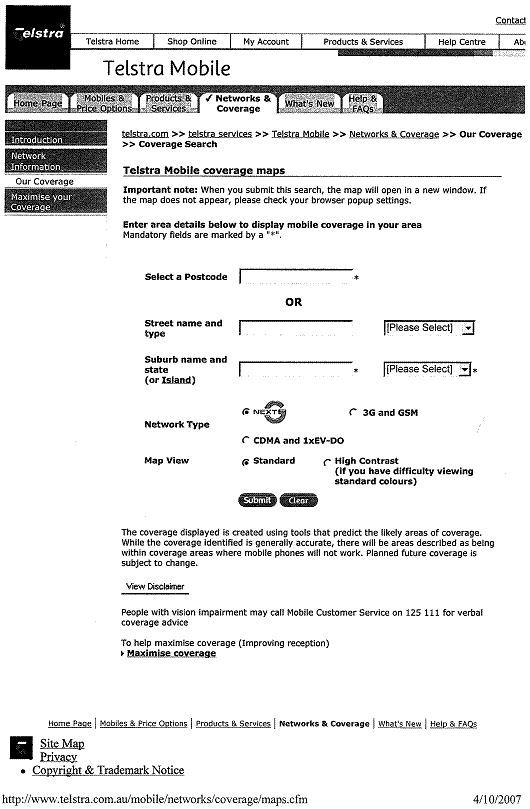
SCHEDULE 3
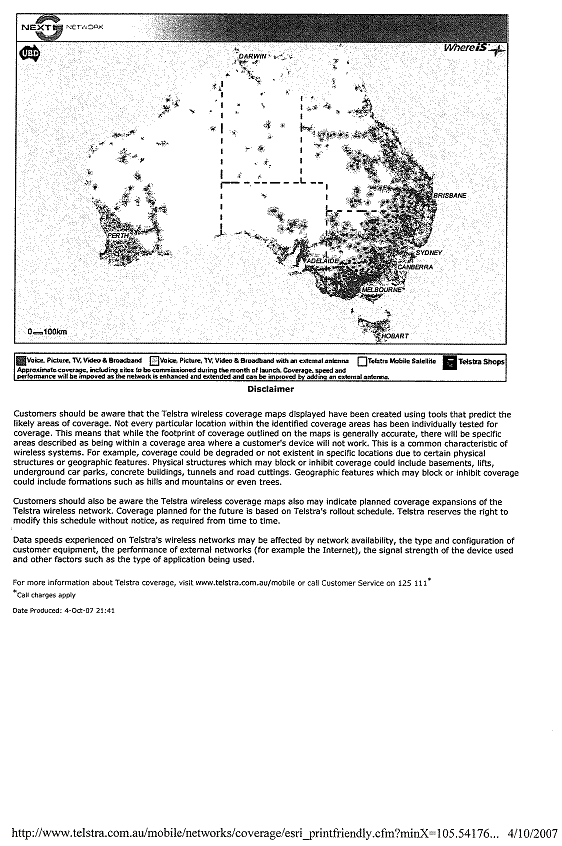
SCHEDULE 4