

FEDERAL COURT OF AUSTRALIA
King Furniture Australia v Dare Gallery [2007] FCA 1845
Trade Practices Act 1974 (Cth) s 52
Duracell Australia Pty Ltd v Union Carbide Australia Ltd (1988) 14 IPR 293
Collier Constructions Pty Ltd v Foskett Pty Ltd (1990) 97 ALR 460
Hoover (Australia) Pty Ltd v Email Ltd (1991) 104 ALR 369
Sterling Winthrop Pty Ltd v Boots Co (Australia) Pty Ltd (1995) 32 IPR 361
Bristol-Myers Squibb Australia Pty Ltd v Astra Pharmaceuticals Pty Ltd (1999) 45 IPR 144
Taco Co of Australia Inc v Taco Bell Pty Ltd (1982) 42 ACR 177
Astrazeneca Pty Ltd v GlaxoSmithKline Australia Pty Ltd [2006] FCAFC 22
St Lukes Health Insurance v Medical Benefits Fund of Australia Ltd (1995) ATPR 41-428
Minister for Health and Aged Care v Harrington Associates Ltd (2000) 107 FCR 212
Medical Benefits Fund of Australia Ltd v Cassidy (2003) 205 ALR 402
Parkdale Custom Built Furniture Pty Ltd v Puxu Pty Ltd (1982) 149 CLR 191
Gillette Australia Pty Ltd v Energizer Australia Pty Ltd (2002) 193 ALR 629
NSD 1727 OF 2007
BUCHANAN J
5 DECEMBER 2007
SYDNEY
|
IN THE FEDERAL COURT OF AUSTRALIA |
|
|
NEW SOUTH WALES DISTRICT REGISTRY |
NSD 1727 OF 2007 |
|
BETWEEN: |
KING FURNITURE AUSTRALIA PTY LTD Applicant
|
|
AND: |
DARE GALLERY PTY LTD First Respondent
DARE GALLERY QLD PTY LTD Second Respondent
DARE GALLERY (BRISBANE) PTY LTD Third Respondent
DARE GALLERY SA PTY LTD Fourth Respondent
DARE GALLERY VIC PTY LTD Fifth Respondent
DARE GALLERY ADMINISTRATION PTY LTD Sixth Respondent
|
|
BUCHANAN J |
|
|
DATE OF ORDER: |
5 DECEMBER 2007 |
|
WHERE MADE: |
SYDNEY |
THE COURT DECLARES THAT:
1. In causing to be published and broadcast the advertisements comprising Annexures A and B to the Statement of Claim filed on 29 August 2007, the first respondent did, in trade or commerce, engage in conduct in contravention of section 52 of the Trade Practices Act 1974 (Cth).
THE COURT ORDERS THAT:
2. The first respondent, within 30 days, cause to be published in such newspapers as published the advertisements in Annexure A to the Statement of Claim filed on 29 August 2007 (or any advertisement substantially to that effect) the following advertisement:
‘MISLEADING STATEMENTS BY DARE GALLERY
On 5 December 2007 the Federal Court of Australia held that advertisements published in this and other newspapers in August 2007 by or on behalf of Dare Gallery which compared the quality and place of manufacture of the Dare Montreaux Modular sofa with the Phoenix Modular sofa sold by King Furniture Australia Pty Ltd were misleading or deceptive and in contravention of the Trade Practices Act 1974 (Cth). Dare Gallery has been ordered by the Federal Court to publish and pay for this corrective advertisement.’
3. The advertisements published in accordance with Order 2 are to have a similar prominence as the advertisements which the first respondent caused to be published between 17 and 26 August 2007 and are to be published with the same frequency as before.
4. The first respondent, within 30 days, cause to be broadcast on such radio stations as broadcast the advertisements to the effect set out in Annexure B to the Statement of Claim filed on 29 August 2007 the following advertisement:
‘This announcement relates to a misleading advertisement by Dare Gallery on this station.
On 5 December 2007 the Federal Court of Australia held that advertisements broadcast on this and other radio stations by Dare Gallery and which compared the quality, warranty and place of manufacture of the Dare Montreaux Modular sofa with the Phoenix Modular sofa sold by King Furniture Australia Pty Limited were misleading or deceptive and in contravention of the Trade Practices Act 1974. Dare Gallery has been ordered by the Federal Court to publish and pay for this corrective advertisement.’
5. The advertisements broadcast in accordance with Order 3 are to be broadcast with the same frequency and in the same timeslot as the advertisement previously broadcast on the radio station. The spoken words are to be preceded and followed by the same bowling ball noise as the original advertisements.
6. The proceedings against the second to sixth respondent's are dismissed.
7. The parties will be heard on costs.
Note: Settlement and entry of orders is dealt with in Order 36 of the Federal Court Rules.
|
IN THE FEDERAL COURT OF AUSTRALIA |
|
|
NEW SOUTH WALES DISTRICT REGISTRY |
NSD 1727 OF 2007 |
|
BETWEEN: |
KING FURNITURE AUSTRALIA PTY LTD Applicant
|
|
AND: |
DARE GALLERY PTY LTD First Respondent
DARE GALLERY QLD PTY LTD Second Respondent
DARE GALLERY (BRISBANE) PTY LTD Third Respondent
DARE GALLERY SA PTY LTD Fourth Respondent
DARE GALLERY VIC PTY LTD Fifth Respondent
DARE GALLERY ADMINISTRATION PTY LTD Sixth Respondent
|
|
JUDGE: |
BUCHANAN J |
|
DATE: |
5 DECEMBER 2007 |
|
PLACE: |
SYDNEY |
REASONS FOR JUDGMENT
BUCHANAN J:
1 The parties in this case each sell furniture, including sofas. They are in competition with each other although they sell in different price ranges. As this case shows they may be commercially sensitive to each other’s marketing efforts. According to evidence given by Mr Stephen Sheppard, a director of each of the respondents (collectively Dare Gallery), in early 2007 he became aware that the applicant (King Furniture) had embarked on a national television advertising campaign disparaging timber framed sofa products. Dare Gallery sells such sofas. King Furniture manufactures and sells sofas with a metal frame construction. Mr Sheppard described the advertisements in the following way:
‘In the King advertisements:
(a) A bowling ball is dropped on the springs of both a timber and webbing constructed sofa and King Furniture’s sprung steel structure and spring suspension sofa, with the seat cushions removed from both sofas, and the ball is shown bouncing on the King Furniture frame and falling through the webbed frame; and
(b) King Furniture claim that traditional webbing and timber construction sofas (similar to those sold by Dare Gallery) are of an inferior quality to the King Furniture sofas that are constructed using steel frames and sprung steel suspension.’
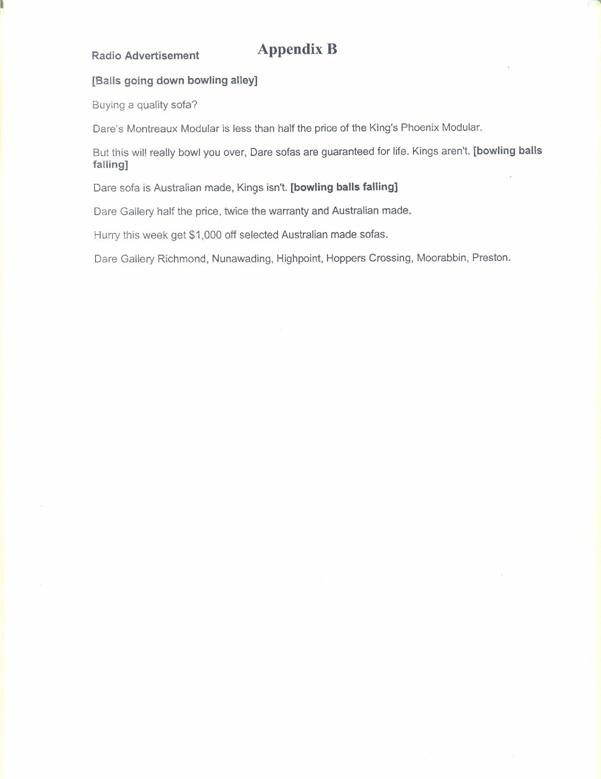
2 According to his evidence, Mr Sheppard decided ‘to defend Dare Gallery’s position, our construction and our values, and to make the point that price doesn’t necessarily determine quality’. He authorised an advertising campaign. There is no suggestion that the King Furniture advertisements mentioned Dare Gallery by name. The advertising campaign authorised by Mr Sheppard respected no such limitation. Mr Sheppard authorised advertisements in print media and on radio which made a direct comparison between specific models of modular furniture – the Phoenix modular sofa sold by King Furniture and the Montreaux modular sofa sold by Dare Gallery. In the radio advertisements the bowling ball theme was perpetuated with a spoken commentary being punctuated by the sound of bowling balls and falling pins.
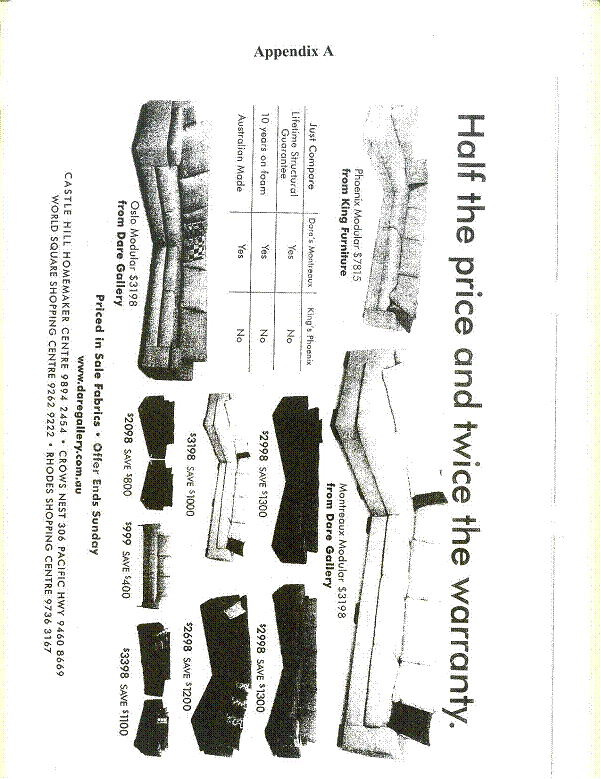
3 There were a number of very similar versions of the print advertisements. A typical example is reproduced as Appendix A to this judgment while a transcript of the radio advertisement is at Appendix B. In its Statement of Claim King Furniture pleaded that the advertisements made a number of representations which were misleading or deceptive within the meaning of s 52 of the Trade Practices Act 1974 (Cth) (The TP Act). The questions which arise for consideration are:
1. what representations are, relevantly, made by the two types of advertisements?
2. are any or all of the representations misleading or deceptive?
3. if so, what relief, if any, should be granted to King Furniture?
4 The advertisements were published and broadcast in about mid-August 2007. The proceedings were commenced by Application filed 29 August 2007. They included a claim for interlocutory relief. Upon the proceedings being commenced the advertising campaign by Dare Gallery was discontinued. It has not been recommenced. Pending hearing of the proceedings the matter has been accommodated by an undertaking from Dare Gallery not to resume the advertising campaign.
LEGAL PRINCIPLES
5 The principles to be applied in the present case are well established and there was little dispute about them, although naturally enough, the parties differed in where they placed greatest emphasis. A choice to advance the merits of a particular product by comparison advertising must be carefully implemented. Care must be taken not to mislead with half-truths about a competing product or by the omission of ‘an essential integer to a fair comparison’. Some of the cases where the principles have been discussed or referred to are
Duracell Australia Pty Ltd v Union Carbide Australia Ltd (1988) 14 IPR 293 at 299; Collier Constructions Pty Ltd v Foskett Pty Ltd (1990) 97 ALR 460 at 477-479 (affirmed on appeal (1991) ATPR 46-071) (‘Collier Constructions’); Hoover (Australia) Pty Ltd v Email Ltd (1991) 104 ALR 369 at 375; Sterling Winthrop Pty Ltd v Boots Co (Australia) Pty Ltd (1995) 32 IPR 361 at 364-365 and Bristol-Myers Squibb Australia Pty Ltd v Astra Pharmaceuticals Pty Ltd (1999) 45 IPR 144 at 165.
6 So far as s 52 of the TP Act is concerned ‘(i)t is not essential for the applicant to show that the effects of the contravention of s 52 upon these persons would continue up to the point of sale to them by the respondent’ (Collier Constructions 97 ALR at 478 citing Taco Co of Australia Inc v Taco Bell Pty Ltd (1982) 42 ACR 177 at 197-199). As a Full Court said recently in Astrazeneca Pty Ltd v GlaxoSmithKline Australia Pty Ltd [2006] FCAFC 22, (2006) ATPR 42-106 (at [33]):
‘For s 52 of the Act to be enlivened it is sufficient that the conduct complained of, in all the circumstances, answers the statutory description, that is to say, that it is misleading or deceptive or is likely to mislead or deceive. It is unnecessary to go further and establish that any actual or potential consumer has taken or is likely to take any positive step in consequence of the misleading or deception.’
7 Decisions of this Court have, from time to time, emphasised that it is no answer to a claim of misleading or deceptive advertising that it was merely intended to catch the attention and that the full facts would have been disclosed before any financial commitment was made (see St Lukes Health Insurance v Medical Benefits Fund of Australia Ltd (1995) ATPR 41-428, Minister for Health and Aged Care v Harrington Associates Ltd (2000) 107 FCR 212 at 233-4 and Medical Benefits Fund of Australia Ltd v Cassidy (2003) 205 ALR 402 at [43].
8 The respondents, however, argued in the present case that the matter was to be tested by reference to what might happen at the potential point of sale, and with the benefit of further information. They submitted:
‘35. In the circumstances of this case, prospective customers of sofas would normally need to attend one of the Applicant’s or Respondents’ showrooms to discuss their specific furniture requirements; both as to configuration, fabric and final price of their chosen furniture and are likely to go to a number of different retailers before deciding to purchase.
36. The furniture would likely be a substantial purchase and would not be bought either on impulse or merely by reference to the advertisements.’
and (in the context of the relief sought):
‘119. Any impact the alleged misrepresentations may have had upon potential consumers would have worked itself out because any consumer likely to purchase a sofa would have had an opportunity to discover the truth and reverse any misrepresentation when they attended at the parties’ respective stores to investigate the purchase of such sofas.’
9 The respondents relied, in this connection, on Parkdale Custom Built Furniture Pty Ltd v Puxu Pty Ltd (1982) 149 CLR 191 (‘Parkdale’). In Parkdale the causes of action focussed on the proposition that the respondent had engaged in misleading or deceptive conduct by manufacturing and offering for sale furniture that was deceptively similar to the distinctive furniture made by the applicant. The High Court rejected allegations of breach of s 52 of the TP Act observing that purchasers of expensive furniture might be expected, if acting reasonably, to satisfy themselves of the origins and manufacture of the furniture before purchase. It is important to note that the case was argued in the High Court on the footing that the relevant deception was ‘with respect to thesource of manufacture as distinct from deception as to the quality of the goods’ (per Mason J at 202 – italics in original). The respondent’s practice, in that case, of labelling its chairs to show the name of the manufacturer was found to be a relevant, indeed critical, part of its conduct viewed as a whole. The case did not turn on the effect of advertising, but on what might happen at the point of sale. That was to be evaluated by reference to the entirety of the conduct of the respondent. Such considerations do not apply in the present case. There is no reason, therefore, to depart from the well established principles to which I earlier referred.
WHAT ARE THE REPRESENTATIONS MADE IN THE DARE GALLERY ADVERTISEMENTS?
10 The Statement of Claim pleads the representations in the following way:
‘10. The following representations are contained in the published advertisements:
(a) that the Phoenix Modular Sofa is not made in Australia (“the Not Australian Made Representation”);
(b) that the warranty on the Dare Montreaux Sofa was twice as valuable a warranty than that available on the Phoenix Modular Sofa (“the Dare Warranty Representation”);
(c) in the alternative to (b), that the warranty on the Dare Montreaux Sofa was significantly more valuable than the warranty available on the Phoenix Modular Sofa (“the Alternative Dare Warranty Representation”);
(d) that the warranty on foam in respect of the Phoenix Modular Sofa was for a period less than 10 years (“the Foam Warranty Representation”);
(e) that apart from the price and warranty, the Phoenix Modular Sofa and the Montreaux Modular sofa were of the same or similar quality (“the Same or Similar Quality Representation”);
(f) that the retail price of the Phoenix Modular Sofa was $7815 (“the Price Representation”).
11. The following representations are contained in the broadcast advertisement:
(a) the Not Australian Made Representation;
(b) that all of King’s sofas are made outside Australia;
(c) that all of Dare’s sofas are made in Australia;
(d) the Dare Warranty Representation;
(e) the Alternative Dare Warranty Representation;
(f) The Same or Similar Quality Representation;
(g) that Dare Sofas have a lifetime guarantee as to their component parts (“the Lifetime Guarantee Representation”).’
11 In its Defence Dare Gallery expressly admitted the allegations in paragraph 10(e) and 11(e), but otherwise, in one way or another, resisted the pleaded allegations. I shall deal, therefore, with each in turn.
10(a) and 11(a) – Not Australian Made Representation
12 There is no doubt that the published advertisement alleged that the King Phoenix sofa was not made in Australia. In my view the same representation was made in the radio advertisement. I find the representation as pleaded established.
10(b) and 11(d) – The Dare Warranty Representation
13 The suggested representation is that the warranty on the Dare Montreaux sofa was twice as valuable a warranty as that available on the King Phoenix sofa. Although it is true that both the published advertisement and the radio advertisement use the terms ‘half the price’ and ‘twice the warranty’ these statements lack any real specificity and in my view are too general to be regarded as intended to provide specific, rather than very approximate, comparisons. For example, in the published advertisement it is clear that the figures shown do not satisfactorily equate with the general statement ‘half the price’. Similarly the general statement ‘twice the warranty’ invites further attention. I am not satisfied that there is a sufficiently specific representation that the Dare warranty was ‘twice as valuable’.
10(c) and 11(e) – The Alternative Dare Warranty Representation
14 The alternative representation pleaded is that the warranty on the Dare Montreaux sofa was significantly more valuable than the warranty available on the King Phoenix sofa. Curiously, in its Defence Dare Gallery in substance denies the allegation in 10(c) with respect to the published advertisement but admits it with respect to the radio advertisement. Although the pleaded alternative representation remains somewhat general I am satisfied that it captures fairly the intendment of both kinds of advertisement. There seems no doubt that the representation that the Dare Montreaux sofa was available for (less than) half the price of the King Phoenix sofa was intended to be seen in counter position with the suggestion that, at the same time, the available warranties were significantly more valuable on the Dare Montreaux sofa than on the King Phoenix sofa. I find this representation established.
10(d) – The Foam Warranty Representation
15 This suggested representation arises only from the published advertisement. It arises in particular from the table in that advertisement. It is quite clear that the intent of the comparison there offered is to suggest that the King Phoenix sofa, if it has any warranty on foam at all, has warranty arrangements for foam which are less than the 10 years available for the Dare Montreaux sofa. I am satisfied that this representation is established.
10(e) and 11(f) – The Same or Similar Quality Representation
16 This representation is admitted with respect to the published advertisements but not with respect to the radio advertisement. I can see no satisfactory basis for any distinction. In my view the statements made in the radio advertisement, which are introduced with the words ‘buying a quality sofa’ convey the same sense as the admitted representation in the published advertisement. Even without the admission I would be satisfied that this representation has been established. The whole tenor of the advertisements is to suggest that, with respect to sofas of a similar quality, the Dare sofa is better priced and has a better warranty.
10(f) – The Price Representation
17 In my view this representation is clearly made in the published advertisement.
11(b) and 11(c) – Australian made?
18 The suggested representation in the radio advertisement depends upon a particular and limited construction of the phrase ‘Dare sofa is Australian made, Kings isn’t’. In my view it is not established that this statement refers to all Dare sofas or all King sofas. The better view is that it refers to the sofas earlier identified in the radio advertisement – namely Dare’s Montreaux modular sofa and King’s Phoenix modular sofa. I find that these representations are not established.
11(g) – The Lifetime Guarantee Representation
19 No actionable representation is separately alleged in the Statement of Claim to emerge from the statement in the published advertisement that Dare’s Montreaux sofa has a lifetime structural guarantee and King’s Phoenix sofa does not. However, the radio advertisement says ‘Dare sofas are guaranteed for life. King’s aren’t.’ This statement is not confined to matters of structure but applies to the sofa as a whole. I am not satisfied that the representation can fairly be read to specifically relate to ‘component parts’ but I am satisfied that the radio advertisements make a representation that Dare sofas have a lifetime guarantee.
WERE THE REPRESENTATIONS MISLEADING OR DECEPTIVE?
10(a) and 11(a) – Not Australian Made Representation
20 More expensive sofas in the Dare Gallery range are made in Australia by Oakgrove Pty Limited. The evidence was that all Dare Montreaux modular sofas are manufactured in Australia. King Furniture has two factories, one in Sydney and one in Shanghai, China. King Phoenix modular sofas are made at both locations. Ms Margaret Thompson, the office manager at King Furniture’s Sydney premises, gave affidavit evidence that she had extracted, from a database maintained by King Furniture, a large number of records which she printed. According to her searches, and the data which was printed out, in 2006 345 Phoenix sofas sold by King Furniture were manufactured in Australia and 215 in China, while in 2007, from January to June, 104 were manufactured in Australia and 72 in China.
21 Ms Thompson was not cross-examined although counsel for Dare Gallery said that he did not accept that the figures were satisfactorily established in the precise amounts given by Ms Thompson. That was because earlier attempts by Mr King to provide hearsay evidence of similar searches carried out by another employee, which I rejected, yielded different figures. However, there was no issue taken by Dare Gallery that a substantial number of the overall quantity of King Phoenix modular sofas made and sold by King Furniture are manufactured in Australia.
22 According to Mr Sheppard’s evidence he gave instructions to Matthew Mister, Dare Gallery’s Marketing Manager, to design print advertisements on 13 August 2007, to Mr Grahame Dingle, Dare Gallery’s advertising and marketing consultant, to create and produce a radio advertisement ‘in or around August 2007’ and that he approved the content of both forms of advertisement on or about 16 August 2007. The print advertisements were first published on 17 August 2007 and the radio advertisements were first broadcast on 16 August 2007.
23 I am satisfied that Mr Sheppard knew that King Phoenix sofas are manufactured in both Sydney and Shanghai. He acknowledged as much in his evidence. The explanation which he gave for this representation was that an enquiry which he made on 11 August 2007 at a King Furniture store in Richmond, Victoria about a particular King Phoenix modular sofa on the showroom floor in a particular fabric (Daintree) yielded the information that it was made in Shanghai. According to Mr Sheppard’s evidence he was first told, on 11 August 2007, that a sofa in the same fabric was available from Australia at a slightly higher price ($8,166 rather than $7,815). Two days later when he called the store ‘to confirm the information’ he was told that the sofa was not available in that fabric from the Sydney factory.
24 I reject Mr Sheppard’s explanation as any form of defence. The evidence did not establish that the King Phoenix sofa in the advertisement was a photo of a sofa in the Daintree fabric. It would be impossible, in any event, to tell from the photo in the advertisement what fabric is used. There is no suggestion in the print advertisement that the King Phoenix sofa depicted in the photo was shown in a particular fabric or was made in China. The radio advertisement provides no scope at all for any excuse of the kind offered.
25 I am satisfied that the representation in both the print advertisement and the radio advertisement to the effect that King Phoenix sofas are not made in Australia was misleading or deceptive within the meaning of s 52 of the TP Act.
10(c) and 11(e) – The Alternative Dare Warranty Representation
26 In the print advertisement this representation is conveyed in part by use of the words ‘twice the warranty’ and also by parts of the table which appeared in that advertisement. In the radio advertisement the representation is conveyed also by the words ‘twice the warranty’ and also by the words ‘Dare sofas are guaranteed for life. King’s aren’t’. In his affidavit evidence Mr Sheppard offered the following analysis about these matters in the form of the table set out hereunder.
|
|
Claims made by the First Respondent in the published advertisements and the broadcast advertisements |
Dare Gallery: |
King Furniture: |
|
2.
3.
4.
|
…
Dare Gallery offers “twice the warranty” for it’s “Montreaux sofa” than King’s Furniture do for their “Phoenix” sofa
• Dare Gallery offers a “Lifetime structural guarantee” on the “Montreaux” sofa whereas King Furniture does not offer a Lifetime Guarantee on their “Phoenix” sofa:
• Dare Gallery offers a “10 year Warranty on foam” on their “Montreaux” sofa whereas King Furniture does not offer a full 10 year warranty on foam in their “Phoenix” sofa:
|
…
Dare Gallery offers a 2 year guarantee against manufacturing faults on fabric, stitching, zippers and all other elements of their sofas. Dare Gallery also offer a structural warranty for the frame and structural components of the sofa and this is a full warranty for the life of the sofa. The Dare warranty covers wear and tear, and also includes the costs of freight, labour, transport.
Dare Gallery offers a lifetime warranty on the frame and structural components. Dare Gallery will repair the sofa at no cost to the consumer and on a “no fault” basis.
Dare Gallery offers a full 10 year warranty on foam and webbing and will repair it on a “no fault” basis at no cost to the consumer during the 10 year period.
|
…
King Furniture offers a 15 year diminishing “pro-rata” warranty, covering the frame and all components including fabrics, leathers, foam, feather & fibre fillings, suspension, springs, mechanisms, zippers, fasteners & legs. The King Furniture Warranty diminishes such that after 2 years the consumer has to pay 25% of the total cost of repairs, and the King Furniture Warranty continues to diminish until at 15 or above years the consumer must pay 100% of the cost of the repairs. Further, the King Furniture Warranty only covers manufacturer’s defects, does not cover wear and tear, and does not cover freight, labour, transport.
King Furniture’s 15 year diminishing “pro-rata” warranty only covers manufacturing faults with the frame and all components including fabrics, leathers, foam, feather & fibre fillings, suspension, springs, mechanisms, zippers, fasteners & legs. The King Furniture warranty states “depending on the covering and the degree of use the covering materials cushion fillings and suspension may need to get replaced periodically at the customers expense”. This is not a lifetime guarantee on the structure of the sofa.
King Furniture’s 15 year diminishing “pro-rata” warranty (covers only 31% of costs of defective component after 10 years), and does not cover freight, labour, transport.
|
27 This table contained one significant factual error as well as some omissions. The King Furniture warranty on its steel frame was not offered on a diminishing or pro-rata basis. It was a 15 year warranty. So much was clearly stated in its printed warranty and Mr Sheppard was not able to offer a satisfactory explanation for his failure to summarise it accurately. Other components were warranted against manufacturing defects (wear and tear was not included) according to a schedule by which the purchaser would make an increasing percentage contribution to the cost of repairs or replacement. The warranty only applied to the original purchaser.
28 According to Mr Sheppard the Dare Gallery warranty at the relevant time (and since April 2007) included a two-year guarantee against manufacturing faults on fabric notwithstanding that a warranty issued from Dare Galleries Fortitude Valley store on 28 August 2007 stated that ‘fabric is not under warranty’. I am prepared to accept this evidence for the purpose of the present analysis. The effect, so far as fabric is concerned, is that the Dare sofa had an equivalent warranty to the King Furniture sofa (which required no contribution from a customer in the first two years) and thereafter the King Furniture warranty continued, although diminishing, for a further substantial period.
29 So far as structural guarantees are concerned the Dare Gallery warranty applied also only to original purchasers. Mr Sheppard’s explanation of the effect of a ‘lifetime’ warranty was that ‘a purchaser in their thirties or forties could be expected to live for at least another 30 years after buying a Dare Gallery sofa’ and ‘[e]ven considering the period of just the first 15 years from the date of purchase I believe that Dare Gallery offer twice the warranty on the frame and webbing compared to the 15 year diminishing “pro-rata” warranty offered by King Furniture on frames and structure on their sofas’. This second statement is incorrect. For a 15 year period both sofas were the subject of a structural guarantee. I find it impossible to attribute any real weight to the suggestion that the Dare Gallery sofa guarantee to the original purchaser might continue indefinitely after 15 years. There was no evidence about how long sofas are retained by their original purchasers. Both guarantees appeared to me, from the evidence, to be confidently offered upon the basis that it was highly unlikely they would need to be honoured.
30 I deal separately with the representation about the foam warranty but so far as it makes a contribution to the alternative Dare warranty issue again there is no evidence from either side of the record about the practical significance of the respective positions. Neither Dare Gallery nor King Furniture called any evidence about the extent to which any warranty on foam had ever been required to be honoured. It seems true, however, that viewed simply by reference to possibilities the Dare Gallery warranty on its face appears superior.
31 An assessment of this element of the case is difficult. If Dare Gallery bore an onus to show that its warranty was significantly more valuable than that offered by King Furniture I would not be satisfied that such a case had been made out upon the simplistic comparison offered by Mr Sheppard, particularly having regard to the errors and omissions incorporated within it. However in respect of this issue, as with other issues, the applicant bears the onus. In the absence of any hard evidence about warranty claims and responses and having regard to the requirement that a customer make an increasingly large contribution to repair and replacement arising from ‘failure due to a manufacturing defect’ (wear and tear being excluded) I am not satisfied that the applicant has discharged its onus of showing that this representation is misleading or deceptive.
10(d) – The Foam Warranty Representation
32 The representation relied upon appears only in the print advertisement. In that advertisement it appears in the table. It consists of the assertion that the Dare Montreaux sofa has 10 years (warranty) on foam and the King Phoenix sofa does not. It is certainly misleading to say that the King Phoenix sofa does not have at least a 10 year warranty on foam. It does although, as earlier discussed, the value of the warranty reduces over time commencing after the first two years. After 10 years (i.e. in year 11 onwards) a customer must contribute 75% and upwards of the cost of repair or replacement as well as meeting transport costs. In my view the representation is misleading but not seriously so and it provides no real foundation for relief if this was the only complaint which the applicant had.
10(e) and 11(f) – The Same or Similar Quality Representation
33 It was to this issue that most of the evidence in the proceedings was directed. The applicant called not only Mr King to give evidence about the matter but also two experts, Associate Professor Douglas Tomkin from the Faculty of Design, Architecture and Building, University of Technology, Sydney and David John Granger, a Director of Bang Design Pty Limited with extensive experience in furniture design. The respondents relied, in relation to this issue, on Mr Sheppard’s evidence and evidence from Mr Ian Hemburrow, the Managing Director of Oakgrove Furniture Pty Limited which manufactures the Montreaux sofas and other furniture for Dare Gallery. In addition I had an inspection on the first day of the hearing of a King Phoenix sofa and a Dare Montreaux sofa which permitted an examination of both external appearance and features as well as methods of construction and materials and componentry which are normally hidden from view. I found this of considerable assistance in understanding the evidence which was given about the respective sofas.
34 I was invited by the applicant to form my own view about the relative quality of the sofas from this inspection. In my view I should use the inspection as an aid to understanding the evidence which was given, including expert evidence, and refrain from relying on any subjective initial impression of my own.
35 Not surprisingly, Mr King asserted superior quality for the King Phoenix sofa and Mr Sheppard disagreed. Mr Sheppard’s contribution to the debate was diminished somewhat by the fact that in his initial affidavit evidence he asserted that Dare Montreaux sofas were made exclusively from structural grade timber. This assertion was contradicted both by Mr Hemburrow and by the visual inspection which was carried out on the first day of the hearing. Some timber used in the sofa inspected and, it was accepted, other Dare Montreaux sofas is clearly marked non-structural. It has knots in places. However Mr Hemburrow’s evidence was that, although of ‘merchant’ quality and not structural grade it was more than adequate for its intended task. Both Mr Tomkin and Mr Granger agreed that the Dare Montreaux furniture was structurally adequate.
36 Professor Tomkin and Mr Granger were not unanimous about every aspect of their evaluation of the two sofas but they were agreed that the King Phoenix sofa was a superior quality sofa to the Dare Montreaux sofa. Their opinions were based very substantially on the methods of construction or ‘build quality’ of the various sofas as well as the nature of the materials used. The King Phoenix sofa has a welded metal frame to which is attached a ‘Pullmaflex’ spring system with an integrated wire mesh. Systems of this kind are commonly found in motor vehicle seats. It has substantial foam padding on the arms and back of the sofa as well as on the seat. The fabric is double top-stitched.
37 The Dare Montreaux sofa has a wooden frame to which webbing is stapled. The webbing goes from back to front. It has less padding on the arms and back of the sofa and Mr Sheppard’s evidence was that by contrast to the King sofa these were not intended to be sat on. It has single stitching in the fabric which is not top-stitched. In the Dare Montreaux sofa which was inspected there were some fairly obvious examples (although not visible to any customer or purchaser) of staples not driven home and screws not properly located. Some of Mr Granger’s evidence was:
‘7. In my opinion, from my first impression, the King Phoenix sofa is of better finish than the Dare Montreaux sofa. I am of this opinion because of the general appearance of the upholstery and the impression I receive of the quality of “fit and tailoring” of the upholstery over each of the sofa frames.
8.(a) The stitching of the King Phoenix sofa is of high quality, utilizing top-stitching (and twin-needle stitching) in most areas. Whereas the stitching of the Dare Montreaux sofa is not the same quality, utilizing only single stitch seams. Although both sofas demonstrate straight and accurate stitching and seams, it is my opinion that in upholstered furniture top stitching produces a product of higher quality, durability and finish than that of single stitching.
…
9(a) The King Phoenix sofa is constructed from a welded-steel frame, compared with the stapled/screwed-timber frame of the Dare Montreaux sofa. Upon this closer inspection it is my opinion that the construction and engineering (the “build quality”) of both the King Phoenix and Dare Montreaux sofas are of satisfactory quality and durability for their intended use. However it is my opinion that the “build quality” [of the] King Phoenix sofa is better than the Dare Montreaux sofa.
(b) In my opinion a fully welded-steel frame has greater structural integrity and stability than a stapled/screwed-timber frame. For example, the welding of the steel frame components provides greater integrity and durability to the joints/assembly – whereas, as a general rule, it is possible for staples and screws to be miss-aligned during construction, and/or work loose over time under continued heavy use.’
38 Professor Tomkin’s evidence included the following:
‘The pattern cutting and stitching on the King Sofa is superior to the Dare Sofa. The King Sofa uses double top stitching compared with the Dare Sofa which is single stitched. The mitre pattern cut on the King Sofa arm/back upholstery results in a neater and tighter fit than on the Dare Sofa.
…
In my opinion the manufacturing processes used by King offer higher standards of quality control when compared with Dare.
… It is my view that a properly constructed spring system is superior to a seat support using high quality webbing. Steel is longer lasting and more reliable than synthetic webbing which can degrade over time.
…
On the basis of the inspection results details above I hold the view that the King Sofa is of considerably higher quality compared to the Dare Sofa.’
39 Both parties attempted in various ways to attack the build quality, overall suitability and specific characteristics of the particular sofas of the other side which were inspected as well as their models generally. By and large it was accepted by each side that the sofas inspected were representative of the model in question although Dare Gallery pointed out the Montreaux sofa inspected (which had been purchased by Mr King for the purposes of the litigation) was floor stock which had been manufactured in December last year. The intense scrutiny to which each sofa was subjected caused a design change in the Dare Montreaux sofa during the course of proceedings. On the sofa as inspected (and as sold prior to the proceedings) the centre foot was, in part, ineffectively attached to the frame. One of four screws inserted to hold the foot in place did not locate at all in the frame. The explanation given was that the foot in question was designed for some other sofa but had been used for the Montreaux sofa as well. It appears that future models of the Montreaux sofa will have a centre foot designed specifically for that model.
40 It is not necessary to outline all the challenges that were made to various aspects of the sofas and the responses to those challenges. They do not change the general picture. I am satisfied on the basis of the evidence that the King Phoenix sofa is a clearly superior sofa to the Dare Montreaux sofa in terms of its overall quality, having regard to the method of construction and the materials used, by a fair margin. It follows that the representation to the effect that the sofas were of the same or of similar quality in the context of the advertisements, and that the Dare Montreaux sofa was available for about half the price, was misleading or deceptive within the meaning of s 52 of the TP Act.
10(f) – The Price Representation
41 The representation that the retail price of the Phoenix Modular sofa was $7,815 was made only in the print advertisement. There was evidence from Mr Sheppard that he was quoted this price on 11 August 2007. Mr King gave the following evidence about the price King Phoenix sofas:
‘I would estimate that between 85% and 95% of Phoneix modulars sold by King Furniture sell at reduced cost – for example during a sale or as a package item. Only a limited amount, and usually due to specifics requested by customers (such as fabric – see below) would be sold at full retail price.’
42 He later said that a cheaper fabric than that examined by Mr Sheppard ‘would not necessarily be the same as quoted (i.e. could be less than $7,815)’. However there was no evidence called about the normal retail price of a King Phoenix sofa. Mr King accepted that the price quoted to Mr Sheppard was correct. He accepted in his oral evidence that lower prices would not normally be offered except in sale periods. Although he agreed that sales staff had authority to discount that is not the same, in my view, as a publicly offered price. I am not satisfied that it was misleading or deceptive of Dare Gallery to publish $7,815 as the price of a King Phoenix sofa.
11(g) – The Lifetime Guarantee Representation
43 This representation is made only in the radio advertisement. The representation suggested by the Statement of Claim was ‘that Dare sofas have a lifetime guarantee as to their component parts’. I earlier indicated that I was not satisfied that the representation made in the radio advertisement (which was ‘Dare sofas are guaranteed for life’) could fairly be read in the way pleaded although I am satisfied that the advertisement makes a representation that the sofa as a whole is guaranteed for life and I am also satisfied that such a representation falls within the scope of the pleaded case. The evidence showed that the only part of a Dare Montreaux sofa which had a ‘lifetime’ guarantee was the frame. The representation made in the radio advertisement about a lifetime guarantee was in my view misleading or deceptive within the meaning of s 52 of the TP Act.
CONCLUSION
44 The representations which I have found to be misleading or deceptive to any significant extent are those to the effect that the King Phoenix sofa is not Australian made, that the Dare Montreaux sofa is of the same or a similar quality to the King Phoenix sofa and that the Dare Montreaux sofa has a lifetime guarantee. Although I found that the representation about foam warranties was misleading or deceptive I do not think that it justifies relief or adds anything to the relief which is otherwise warranted.
45 What then of the overall impact of the representations I have found to have been made?
46 I have taken into account and carefully considered the respondents’ arguments that prospective customers are used to a bit of ‘puffing’ and that it is unlikely that a decision to spend thousands of dollars would be made without much more thought than would be generated by either class of advertisement. There was some evidence that such decisions are not quickly or spontaneously made. However, I agree with the applicant that the vice of the advertisements (and I have no doubt their intended effect) is their tendency to produce a disinclination (aversion might not be too strong a word) to further investigating or considering an overpriced and non-Australian product. This is, in accordance with the authorities, to be judged at the time of the advertisements themselves and not by reference to later possibilities.
47 I am satisfied that the areas in which the representations have been found to be misleading or deceptive are important ones. There can be no doubt, in my mind, that Dare Gallery set out to actively dissuade potential customers from a critical comparison between the two models by rejecting the King sofa as an overpriced alternative at the outset. I am satisfied that the representations I have identified were seriously misleading. Furthermore, they were intentionally misleading or deceptive about matters within Mr Sheppard’s knowledge.
48 I think that the impact of each radio advertisement would be more fleeting than the print advertisement. Some allowance must be made for the fact that the scrutiny to which a television or radio advertisement is subjected after it has been captured and replayed for the purpose of litigation, perhaps often, is not a fair duplication of its impact upon consumers. As Lindgren J observed in Gillette Australia Pty Ltd v Energizer Australia Pty Ltd (2002) 193 ALR 629 (at 47):
‘First, members of the public watch a commercial after and before viewing other things, rather than in isolation. Secondly, unlike the judge, they do not carefully view the commercial with a special interest in noting and memorising its features. Thirdly, they view the commercial, not in the calm of chambers, but against a background of distractions, such as domestic activity, or simply a preoccupation with other more interesting or pressing concerns. Fourthly, usually they do not know in advance that the commercial is about to commence.’
49 It may be doubted that each of the representations would strike the consciousness of a potential purchaser with any significant force upon a first hearing. Although the evidence disclosed that the radio advertisement was played in Sydney on 14 occasions between 16 and 23 August 2007 and in Melbourne between 16 and 21 August 2007 on 23 occasions and on 14 occasions on the Gold Coast between 23 and 26 August 2007, it is impossible to be satisfied about the specific level of repeat exposure to a potential purchaser. Nevertheless, repetition of the radio advertisement was one of its features. The print advertisement was capable of being retained and referred to by a potential purchaser as often as necessary. The level of repetition was not as high. The print advertisement appeared in Melbourne on 20 and 26August 2007; in Sydney on 21August 2007, in a half page advertisement in a magazine on 22August 2007 and on 25 and 26 August 2007 and in Queensland in a Brisbane newspaper on 17 August 2007 and a Gold Coast newspaper on 18 August 2007. In the end it seems to me I should deal with both categories of advertisement as equally serious.
50 The applicant has not sought damages. It has sought relief by way of declarations and injunction and an order for corrective advertising. I am satisfied that appropriate declarations should be made. I am not satisfied that it is necessary to grant injunctions. The advertising campaign ceased virtually immediately. It has not resumed. Mr Sheppard gave evidence that in his assessment it had been ineffective. There is no suggestion of any proposal to embark upon any future advertising of this kind. I do not think it should merely be assumed, in the absence of some solid foundation for concern, that Dare Gallery will be imprudent enough to repeat conduct which the Court has declared to be misleading or deceptive.
51 However, King Furniture has a legitimate commercial concern about the impact of the advertisements and the fact that the impact may linger. In my view this should be addressed. For this purpose I place no weight upon Mr Sheppard’s evidence that he does not think that the advertisements were of benefit to Dare Gallery. Whether or not that is so (and his evidence is insufficient to establish that as a fact) it is no answer to concern by King Furniture that its reputation or that of its sofas may have been damaged. The applicant asks that the Court direct corrective advertising in the same media as the original advertisements and to the same extent. It asked for the advertisements to say the following in the case of the print advertisements:
‘An order that on or before a date to be fixed by the Court, the Respondents cause to be published in the Courier Mail, Sydney Morning Herald and such other newspapers as contained the Advertisements notices containing the following text:
“CORRECTION OF MISLEADING STATEMENTS BY DARE GALLERY
On … September 2007, the Federal Court of Australia held that advertisements published in this and other newspapers in August 2007 by or on behalf of Dare Gallery and which compared the price, quality, warranties and place of manufacture of the Dare Montreaux Modular Sofa with the Phoenix Modular Sofa sold by King Furniture Australia Pty Limited were misleading and deceptive and in contravention of the Trade Practices Act 1974 (Cth).
Dare Gallery apologizes to its customers, the general public and to King Furniture Australia Pty Limited for Dare Gallery’s misleading and deceptive conduct”
Such notices to have a similar prominence in terms of size, number and location to the Advertisements published in those newspapers.’
The radio advertisement was to be in very similar terms.
52 Before any corrective advertising can take place it will be about four months since the original advertisements. It is accepted that it would not be appropriate to use corrective advertising as a form of punishment. Nevertheless I agree that some form of corrective advertising is warranted.
53 I do not consider that the Court should direct that the advertisements contain an apology. Of its nature an apology is a gesture suggesting contrition. In my view that quality is not faithfully reflected by a formula imposed by the Court.
54 Subject to those qualifications I am satisfied that corrective advertising, substantially in the form sought in the Statement of Claim, should be published at Dare Gallery’s expense in such newspapers as contained the print advertisements and on the radio stations to the same extent and at the same times as the radio advertisements were broadcast. The correction of the printed advertisement will contain the following text:
‘MISLEADING STATEMENTS BY DARE GALLERY
On 5 December 2007 the Federal Court of Australia held that advertisements published in this and other newspapers in August 2007 by or on behalf of Dare Gallery which compared the quality and place of manufacture of the Dare Montreaux Modular sofa with the Phoenix Modular sofa sold by King Furniture Australia Pty Ltd were misleading or deceptive and in contravention of the Trade Practices Act 1974. Dare Gallery has been ordered by the Federal Court to publish and pay for this corrective advertisement.’
Such notices are to have a similar prominence as the original advertisements and are to be published with the frequency as before.
55 The corrective advertising by radio is to be accomplished by broadcast on each of the radio stations which broadcast the advertisements the following announcement:
‘This announcement relates to a misleading advertisement by Dare Gallery on this station.
On 5 December 2007 the Federal Court of Australia held that advertisements broadcast on this and other radio stations by Dare Gallery and which compared the quality, warranty and place of manufacture of the Dare Montreaux Modular sofa with the Phoenix Modular sofa sold by King Furniture Australia Pty Limited were misleading or deceptive and in contravention of the Trade Practices Act 1974 (Cth). Dare Gallery has been ordered by the Federal Court to publish and pay for this corrective advertisement.’
The announcement is to be broadcast with the same frequency and in the same time slot as the advertisement previously broadcast on the radio station. The spoken words are to be preceded and followed by the same bowling ball noise as the original advertisements.
56 In addition to publication of notices in newspapers and broadcast announcements on radio stations the applicant sought that Dare Gallery for three months display on its website and in a prominent place on the front window of each Dare Gallery retail outlet a statement effectively denouncing the content of the advertisements by describing as untrue a list of statements made within them. I am not satisfied that it would be appropriate to make such an order. It seems to me to be punitive in character. Accordingly no order of this kind will be made.
57 It was accepted at the conclusion of proceedings that there is no evidence fixing responsibility for the misleading or deceptive representations to any of the second to sixth respondents. Accordingly, the application will be dismissed so far as it concerns the second to sixth respondents. The orders which I will make will apply to the first respondent. I was asked by the respondents not to deal with costs in this judgment. I will hear the parties as to costs.
|
I certify that the preceding fifty-seven (57) numbered paragraphs are a true copy of the Reasons for Judgment herein of the Honourable Justice Buchanan. |
Associate:
Dated: 5 December 2007
|
Counsel for the Applicant: |
J Stevenson SC, G Wright |
|
|
|
|
Solicitor for the Applicant: |
Colin Biggers & Paisley |
|
|
|
|
Counsel for the Respondent: |
A K Panna SC |
|
|
|
|
Solicitor for the Respondent: |
Bolden Lawyers |
|
|
|
|
Date of Hearing: |
22 - 24 October 2007 |
|
|
|
|
Date of Judgment: |
5 December 2007 |


