

FEDERAL COURT OF AUSTRALIA
National Auto Glass Supplies (Australia) Pty Limited v Nielsen & Moller Autoglass (NSW) Pty Limited (No 8) [2007] FCA 1625
TRADE PRACTICES – claims for defamation run in parallel with claims for representations said to constitute misleading and deceptive conduct
Trade Practices Act 1974 (Cth) ss 52, 53(d) and (e), 55A, 60, 75B(1)(c), 80 and 82
Fair Trading Act 1987 (NSW) ss 42, 44(f) and (g), 50, 55, 61(c), 65 and 68
Defamation Act 1974 (NSW) ss 8A, 15(2), 16, 22(1)(c), 46, 46A and 48A
Wrongs Act 1958 (Vic)
Criminal Code Act 1899 (Qld)
Defamation Act 1889 (Qld)
Criminal Code Act 1913 (WA)
Wrongs Act 1936 (SA)
Defamation Act 1957 (Tas)
Civil Law (Wrongs) Act 2002 (ACT)
Corporations Act 2001 (Cth) ss 203B, 206A(2) and 206B
Crimes Act 1914 (Cth) ss 5 and 29D
Federal Court Rules Order 11 rule 1B
Motor Accidents Act 1988 (NSW) s 79A
Civil Liability Act 2002 (NSW) s 16
Federal Court of Australia Act 1976 (Cth) s 51A
Lee v Wilson and Mackinnon (1934) 51 CLR 276 referred to
Webb v Bloch (1928) 41 CLR 331 referred to
Sim v Stretch (1936) 52 TLR 669 applied
National Auto Glass Supplies (Australia) Pty Ltd v Nielsen & Moller Autoglass (NSW) Pty Ltd (2006) 156 FCR 148 referred to
Regie Nationale des Usines Renault SA v Zhang (2002) 210 CLR 491 referred to
Tisand (Pty) Ltd v Owners of the ship MV “Cape Moreton” (Ex “Freya”) (2005) 219 ALR 48 referred to
Neilson v Overseas Projects Corporation of Victoria Ltd (2005) 223 CLR 331 referred to
Damberg v Damberg (2001) 52 NSWLR 492 referred to
Browne v Dunn (1893) 6 R 67 referred to
National Auto Glass Supplies (Australia) Pty Limited v Nielsen & Moller Autoglass (NSW) Pty Limited (No 5) [2007] FCA 569 referred to
National Auto Glass Supplies (Australia) Pty Limited v Nielsen & Moller Autoglass (NSW) Pty Limited (No 7) [2007] FCA 582 referred to
Taco Company of Australia Inc v Taco Bell Pty Ltd (1982) 42 ALR 177 referred to
Campomar Sociedad, Limitada v Nike International Limited (2000) 202 CLR 45 referred to
Astrazeneca Pty Limited v GlaxoSmithKline Australia Pty Limited (2006) ATPR 42-106 referred to
Butcher v Lachlan Elder Realty Pty Limited (2004) 218 CLR 592 referred to
Boral Besser Masonry Limited v Australian Competition and Consumer Commission (2003) 215 CLR 374 referred to
Roberts v Bass (2002) 212 CLR 1 applied
Adam v Ward [1917] AC 309 at 334 referred to
Lange v Australian Broadcasting Corporation (1997) 189 CLR 520 referred to
Belt v Lawes (1882) 51 LJQB 359 referred to
Bryanston Finance Ltd v de Vries [1975] 1 QB 703 referred to
Bellino v Australian Broadcasting Corporation (1996) 185 CLR 183 referred to
Polly Peck (Holdings) Plc v Trelford (1986) 1 QB 1000 referred to
Carson v John Fairfax & Sons Limited (1993) 178 CLR 44 referred to
Rogers v Nationwide News Pty Limited (2003) 216 CLR 327 applied
Random House Australia Pty Ltd v Abbott (1999) 167 ALR 224 referred to
Amalgamated Television Services Pty Ltd v Marsden [2002] NSWCA 419 referred to
Wishart v Mirror Newspapers Ltd (1963) 63 SR (NSW) 745 referred to
Gray v Motor Accident Commission (1998) 196 CLR 1 referred to
John Fairfax & Sons Ltd v Kelly (1987) 8 NSWLR 131 applied
NATIONAL AUTO GLASS SUPPLIES (AUSTRALIA) PTY LIMITED ACN 081 814 342, MAGGIE YEUNG LO AND HARVEY HUI OUYANG v NIELSEN & MOLLER AUTOGLASS (NSW) PTY LIMITED ACN 107 721 595, JACK J MOLLER AND CARL MOLLER
NSD 2596 OF 2005
GRAHAM J
26 OCTOBER 2007
SYDNEY
| IN THE FEDERAL COURT OF AUSTRALIA |
|
| NEW SOUTH WALES DISTRICT REGISTRY | NSD 2596 OF 2005 |
| BETWEEN: | NATIONAL AUTO GLASS SUPPLIES (AUSTRALIA) PTY LIMITED ACN 081 814 342 First Applicant
MAGGIE YEUNG LO Second Applicant
HARVEY HUI OUYANG Third Applicant
|
| AND: | NIELSEN & MOLLER AUTOGLASS (NSW) PTY LIMITED ACN 107 721 595 First Respondent
JACK J MOLLER Second Respondent
CARL MOLLER Third Respondent
|
| GRAHAM J | |
| DATE OF ORDER: | 26 OCTOBER 2007 |
| WHERE MADE: | SYDNEY |
THE COURT ORDERS THAT:
1. The claims for relief by the first applicant be dismissed.
2. There be judgment for the second applicant against the first and third respondents in the sum of $31,000.
3. There be judgment for the third applicant against the first and third respondents in the sum of $22,300.
4. The claims for relief by the second and third applicants against the second respondent be dismissed.
5. The parties file and serve such written submissions as they may be advised in respect of costs on or before 1 November 2007.
Note: Settlement and entry of orders is dealt with in Order 36 of the Federal Court Rules.
| IN THE FEDERAL COURT OF AUSTRALIA |
|
| NEW SOUTH WALES DISTRICT REGISTRY | NSD 2596 OF 2005 |
| BETWEEN: | NATIONAL AUTO GLASS SUPPLIES (AUSTRALIA) PTY LIMITED ACN 081 814 342 First Applicant
MAGGIE YEUNG LO Second Applicant
HARVEY HUI OUYANG Third Applicant
|
| AND: | NIELSEN & MOLLER AUTOGLASS (NSW) PTY LIMITED ACN 107 721 595 First Respondent
JACK J MOLLER Second Respondent
CARL MOLLER Third Respondent
|
| JUDGE: | GRAHAM J |
| DATE: | 26 OCTOBER 2007 |
| PLACE: | SYDNEY |
REASONS FOR JUDGMENT
Overview
1 The first applicant and the first respondent are and have since about March 2004 been competitors in the business of supplying auto glass (windscreens etc) for motor vehicles in Australia.
2 The principal supplier of the first applicant has been Fuyao Glass Industry Group Co. Ltd of China (‘FYG’), a company owned by a Mr Cho Tak Wong.
3 The case concerns three separate publications said to have been made on or about Tuesday 13 September 2005 and Thursday 15 September 2005. The first publication took the form of a facsimile directed to ‘NM Customers’, presumably a reference to customers of the first respondent and/or another Nielsen & Moller business. In cross-examination the third respondent identified Nielsen & Moller Autoglass Pty Limited as such a business. The facsimile comprised a cover sheet on a ‘Fax’ form prepared for use by ‘Nielsen & Moller Auto glass Australia Pty Ltd ABN 71 107 721 595’ of ‘8 – 10 Durkin Place Peakhurst 2210 SYDNEY’ and a two page attachment in the form of a letter from the second respondent to Mr Scott Eldridge, Regional Coordinator, Australian Tax Office dated 13 September 2005. The Australian Business Number ABN 71 107 721 595 was in fact the Australian Business Number by which the first respondent was identified. To add to the confusion the cover sheet bore the stylised mark ‘NM’ followed by ‘Since: 1919’ and the third respondent purported to sign the facsimile cover sheet as Managing Director of ‘Nielsen & Moller Autoglass International & Australia Pty Ltd’.
4 A copy of the facsimile, with an indication that it was transmitted at 2.43 pm on 13 September 2005 on the facsimile machine of ‘NM AUTOGLASS INTERNA 0291530192’, was Exhibit B in the proceedings (the ‘13 September facsimile’). The 13 September facsimile as transmitted was not identical with the document referred to in the First Schedule to the Third Further Amended Statement of Claim filed 27 October 2006 as the ‘Customer Facsimile’. The copy attached to that Statement of Claim bears the heading ‘FIRST SCHEDULE’ which has been added by the applicants, as have paragraph numbers for identification purposes both on the facsimile cover sheet and also on the attachment thereto being in the form of a two page letter bearing date 13 September 2005 from the second respondent to Mr Scott Eldridge, Regional Coordinator, Australian Tax Office. The form of the letter in the First Schedule is not a copy of the letter in fact attached to the facsimile cover sheet as transmitted. The copy of the letter in Exhibit B contains three manuscript alterations – the misspelling of the word ‘escaped’ has been corrected, the word ‘the’ has been changed to ‘their’ in one place and the word ‘major’ has been inserted. In addition the copy in Exhibit B bears the signature of the second respondent as its author.
5 The respondents have admitted that the third respondent published the first page of the Customer Facsimile and that the second respondent published a document resembling the first page of the attachment. The third respondent was the author of the first page of the 13 September facsimile and the second respondent was the author of the attachment, which he wrote at the request of the third respondent. There was no evidence to prove that the attachment had been written for any purpose other than its transmission to the addressee named upon it.
Insofar as the applicants seek relief for defamation in respect of the publication of the 13 September facsimile it is appropriate to have regard to what Dixon J, as his Honour then was, said in Lee v Wilson and Mackinnon (1934) 51 CLR 276 at 287-8, namely:
‘It is the publication, not the composition of a libel, which is the actionable wrong. Often the person sued for publishing is not the writer. The injury done by a libel arises from the effect produced upon its readers. These considerations naturally led to a rigorous application to libels of the rule that the meaning of a document should be determined independently of the actual intention which the writer entertained. The acceptance of a criterion of liability which adopted, not the intention actuating the writer, but the understanding produced in the reader, was aided by the rule, which can be traced back to an early time, that for the interpretation of a libel evidence could be received of particular circumstances affecting its meaning, and of the actual interpretation which persons conversant with those circumstances affixed to it.’
6 At the time when the 13 September facsimile was transmitted the third respondent was the sole director of the first respondent.
7 As at 13 September 2005 no companies had been registered bearing the names ‘Nielsen & Moller Auto glass Australia Pty Ltd’ or ‘Nielsen & Moller Autoglass International & Australia Pty Ltd’. However, Nielsen & Moller Autoglass Pty Limited ACN 064 101 873, which was registered on 28 March 1994, was in existence on that date. Prior to October 2001, it apparently had a different name. As at 14 August 2006 Nielsen & Moller Autoglass Pty Limited had an issued capital of two shares, both of which were owned by the third respondent, who was also its sole director and secretary.
On 6 September 2003 a letter was sent by the third respondent on a letterhead suggesting that the company with the Australian Business Number 79 064 101 873 then had the name ‘Nielsen & Moller Autoglass International Pty Ltd’. Its address was shown as the third respondent’s then home address.
On 18 February 2004 the third respondent signed a facsimile message as ‘Managing Director/Proprietor’ of ‘Nielsen & Moller Autoglass International Pty Ltd’ on a facsimile form giving the Australian Business Number 79 064 101 873 as its ABN.
On 11 May 2004 the third respondent signed a letter on the letterhead of ‘Nielsen & Moller Autoglass International Pty Ltd’ showing as its address ‘8–10 Durkin Place Peakhurst NSW 2210 Sydney Australia’ and giving the Australian Business Number of Nielsen & Moller Autoglass Pty Limited as its ABN. Nielsen & Moller Autoglass International Pty Ltd may have been the then name of Nielsen & Moller Autoglass Pty Limited, but there is insufficient evidence to enable such a conclusion to be drawn.
8 In an affidavit sworn 27 November 2006 Geoffrey James Rankine gave the following evidence:
‘6. There are two companies with similar names, namely:-
(a) Nielsen & Moller Autoglass Pty Limited
- this Company is an exclusive agency business for seven manufacturers, 4 in China, 1 in Saudi Arabia, 1 in Egypt and 1 new manufacturer in India.. The Company has exclusive selling agency agreements. This Company arranges the supply of windscreens to Australia, including Nielsen & Moller Autoglass (NSW) Pty Limited. The Company is paid commission by the manufacturer.;
(b) Nielsen & Moller Autoglass (NSW) Pty Limited [the first respondent]
- this Company imports autoglass into Australia and resells as a wholesaler to the retail windscreen industry in competition to NAGS [referring to the first applicant].’
9 The third respondent commenced working in the automotive replacement glass industry in about 1970. Mr Rankine commenced working in that industry in about 1979.
10 In December 2003 Mr Rankine and the third respondent had discussions concerning the establishment of a new autoglass business specialising in the wholesale supply of replacement windscreens for motor vehicles in Australia. On 22 January 2004 they caused the first respondent to be registered with the Australian Business Number 71 107 721 595. Shortly after incorporation the third respondent became the sole director and secretary of the first respondent. The first respondent has an issued capital of 100 shares, 20 of which have been held by the third respondent and 80 of which have been held by GDF Nominees Pty Limited in trust for Mr Rankine and his wife, Karin Rankine. Mr Rankine’s evidence was that both he and his wife worked in the business of the first respondent. However, he did not work for Nielsen & Moller Autoglass Pty Limited ABN 79 064 101 873, which was also referred to in evidence as ‘the commission agent company’.
11 As at 13 September 2005 the facsimile machine connected to the telephone service (02) 9153 0192 was located in the third respondent’s office within the first respondent’s premises. In another part of the same premises a facsimile machine was connected to the telephone service (02) 9533 2433. On 13 September 2005 People Telecommunications Pty Ltd invoiced ‘Nelsen & Moller Autoglass Pty Lt (sic)’ $39.45 in respect of the service (02) 9153 0192 described in the invoice as being for ‘Local $4.95’ and ‘Service and Equipment $34.50’. The comparable invoice issued on 13 October 2005 imposed charges totalling $38.70 being for ‘Local $4.20’ and ‘Service and Equipment $34.50’.
In respect of the same service, namely (02) 9153 0192, AXiS Telecoms Pty Ltd invoiced Nielsen & Moller Autoglass Pty Ltd a total of $107.77 being $8.03 for international calls in the period 10 September 2005 to 22 September 2005 and $99.74 for national calls in the period 1 September 2005 to 30 September 2005.
12 Notwithstanding the references to ‘Nielsen & Moller Auto glass Australia Pty Ltd’ and ‘Nielsen & Moller Autoglass International & Australia Pty Ltd’, the imprint ‘NM AUTOGLASS INTERNA’, the use of the telephone service ‘02 9153 0192’, the assertion in the facsimile cover sheet that ‘This information and report has been instigated by me, and sent to relevant authorities, on behalf of the Australian Independent autoglass industry’, and the details in relation to the account for the telephone service (02) 9153 0192 being sent to ‘Nelson & Moller Autoglass Pty Lt’ and ‘Nielsen & Moller Autoglass Pty Ltd’, I am satisfied that the whole of the 13 September facsimile, comprising three pages, was transmitted by the third respondent on behalf of the first respondent, Nielsen & Moller Autoglass (NSW) Pty Limited, whose Australian Business Number was recorded on the facsimile cover sheet.
13 I am further satisfied that the attachment to the facsimile was itself forwarded by facsimile from the second respondent to the first respondent at about 1.45 pm on 13 September 2005, whereupon it was added by the third respondent to the facsimile cover sheet and then transmitted by him as a three page document, on behalf of the first respondent. The 13 September facsimile was not published by the second respondent (see [5] above and [15]-[16] below; see also Webb v Bloch (1928) 41 CLR 331 at 363-5 per Isaacs J).
14 The applicants’ case is that more than 30 copies of the facsimile directed to ‘NM Customers’ were transmitted to various persons in New South Wales, Queensland, Victoria, Tasmania, South Australia, Western Australia and the Australian Capital Territory on or about 13 September 2005.
15 The second publication took the form of a three page letter (not to be confused with the two page attachment to the 13 September facsimile) to ‘Mr Scott Eldridge, Regional Coordinator, Australian Tax Office’ from the second respondent bearing date 13 September 2005 (‘the ATO letter’). A photocopy of a copy of this letter has become Exhibit C in the proceedings. It is acknowledged by the applicants that the manuscript letter ‘C’ was not on the copy from which the photocopy was made nor were the words ‘SECOND SCHEDULE’ or the paragraph numbers appearing in square brackets which have been added by the applicants in the left hand margin for ease of identification. The second respondent has admitted hand delivering the original of the ATO letter to the Hurstville branch of the Australian Tax Office on or about 13 September 2005. The third respondent says that the second respondent did so at his request.
16 The applicants allege that the ATO letter was published by the respondents. The respondents have admitted that the second respondent published the ATO letter. Publication by the first and third respondents is denied. The second respondent was the author of the ATO letter.
17 The third publication took the form of an email from the third respondent to Curie Chen with a copy to Zhou Jie in China. A printed copy of the email as received in China, indicating that it was transmitted at 11.33 pm on 15 September 2005 and that it emanated from the third respondent whose email address was ‘carl@nmautoglass.com.au’, has become Exhibit D in the proceedings (the ‘15 September email’). It is acknowledged that the copy which is in evidence has had added to it by the applicants the words ‘THIRD SCHEDULE’ and the paragraph numbers appearing in square brackets in the left hand margin of the copy. The applicants allege that the 15 September email was published by the first and third respondents on or about 15 September 2005. The respondents have admitted that the third respondent wrote and published the email. Publication of it by the first respondent has been denied.
18 Copies of Exhibits B, C and D are attached as appendices ‘A’, ‘B’ and ‘C’ respectively to these reasons for judgment.
19 According to the third respondent he forwarded the 13 September facsimile to ‘various customers and other members of the industry’ on or about 13 September 2005. The extent of the publication would appear to have been to six automotive glass businesses in New South Wales, four in Queensland, two in Victoria, one in South Australia, one in Western Australia, one in Tasmania and one in the Australian Capital Territory, apart from transmissions to four ‘Nielsen & Moller’ businesses in Queensland and Victoria.
20 No officers of any of the businesses to whom the 13 September facsimile was transmitted were called to give evidence in the proceedings.
21 Apart from the proven publication of the 13 September facsimile by the third respondent on behalf of the first respondent, the applicants also rely upon what is said to be the ‘grapevine’ effect of its publication.
22 The evidence suggests that communications were received by the applicants from various business associates of the first applicant in the period mid September – October 2005 predominantly expressing concern about the business future of the first applicant in the context of issues with the Australian Tax Office. There were about 15 such communications. Only a couple of them made mention of any facsimile and only a couple of them made mention of the directors of the first applicant or any of them. It is unlikely that news of the 13 September facsimile having been transmitted, or of its contents, was widespread.
23 In relation to the ATO letter I am satisfied that its publication was limited. I am satisfied that the ATO letter was published by the second respondent at the request of the third respondent and received no wider publication than that arising from the delivery of the original of it by the second respondent to the Hurstville branch of the Australian Tax Office.
24 In relation to the 15 September email to Curie Chen I am satisfied that it was published to Curie Chen in the Special Administrative Region of Hong Kong , within China, and to Zhou Jie in China proper on 15 September 2005 and also that it received no wider publication. I am further satisfied that it was published by the third respondent on his own behalf and not in a representative capacity on behalf of the first respondent.
As early as 19 February 2004, when promoting the commission agent company having the ABN 79 064 101 873, the third respondent gave as his email address ‘carl@nmautoglass.com.au’ i.e. the same email address as recorded on the 15 September email. That email address had no direct connection with the first respondent whose ABN was 71 107 721 595. The evidence indicates that the first respondent did not commence business until after 19 February 2004.
25 Insofar as it is suggested that the publications conveyed imputations which were defamatory of the applicants or any of them the test to be applied in determining the question of defamatory meaning is that enunciated by Lord Atkin in Sim v Stretch (1936) 52 TLR 669 at 671, namely, would the words tend to lower the applicants in the estimation of right-thinking members of society generally?
26 In Sim v Stretch there had been a quarrel between neighbours which concerned the vicissitudes of a domestic servant whose fortune it was to be employed at successive times by both the plaintiff and the defendant. The defendant had dictated to the post office at Maidenhead a telegram reading ‘Stretch, The Twigs, Cookham Dean. Edith has resumed her service with us to-day. Please send her possessions and the money you borrowed, also her wages, to Old Barton. – Sim’.
The Statement of Claim in that case, after alleging publication of the words of the telegram to the officials of the post office whose duty it was to transmit and deal with the telegram, alleged in paragraph 7:
‘By the said words the defendant meant and was understood to mean that the plaintiff [Stretch] was in pecuniary difficulties, that by reason thereof he had been compelled to borrow and had in fact borrowed money from the said housemaid, that he had failed to pay the said housemaid her wages, and that he was a person to whom no one ought to give any credit’.
At the close of the plaintiff’s case counsel for the defendant submitted that the words of the telegram were incapable either of the meaning alleged in the innuendo or of any defamatory meaning.
27 Lord Atkin proceeded to say at 671:
‘… The learned Judge rejected the submission … It appears to me that the alleged innuendo is fantastic, and that the words used are in their ordinary meaning incapable of being understood by reasonable persons as conveying an imputation on the plaintiff’s financial credit. It was, in my opinion, the duty of the Judge so to have held, and to have withdrawn the count alleging the innuendo from the jury. …
… Judges and text-book writers alike have found difficulty in defining with precision the word “defamatory”. The conventional phrase exposing the plaintiff to hatred, ridicule, or contempt is probably too narrow. The question is complicated by having to consider the person, or class of persons, whose reaction to the publication is the test of the wrongful character of the words used. I do not intend to ask your Lordships to lay down a formal definition, but after collating the opinions of many authorities I propose, in the present case, the test: Would the words tend to lower the plaintiff in the estimation of right-thinking members of society generally? Assuming such to be the test of whether words are defamatory or not, there is no dispute as to the relative function of Judge and jury, of law and fact. It is well settled that the Judge must decide whether the words are capable of a defamatory meaning. That is a question of law; is there evidence of a tort? If they are capable, then the jury is to decide whether they are in fact defamatory.
In the present case it is material to notice that there is no evidence that the words were published to anyone who had any knowledge at all of any of the facts … There is no direct evidence that they were published to anyone who had ever heard of the plaintiff. The post office officials at Maidenhead would not be presumed to know him, and we are left without any information as to the officials at Cookham Dean. … It might, however, be inferred that the publication of the telegram at Cookham Dean was to someone who knew the plaintiff. What would he or she learn by reading the telegram? That Edith Saville had been in the plaintiff’s employment; that she had that day entered the defendant’s employment; and that the former employer was requested to send on to the new place of employment the servant’s possessions, together with the money due to her for money borrowed and for wages. How could perusal of that communication tend to lower the plaintiff in the estimation of the right-thinking peruser who knew nothing of the circumstances but what he or she derived from the telegram itself?’
Lord Russell of Killowen and Lord Macmillan concurred with Lord Atkin’s reasons.
28 Insofar as the applicant’s case relies upon the assertion that the publications were defamatory, that, in the circumstances of this case, becomes a question of fact for me as the trial judge to determine. The question as to whether the publications were capable of giving rise to the defamatory imputations pleaded has already been addressed (see National Auto Glass Supplies (Australia) Pty Ltd v Nielsen & Moller Autoglass (NSW) Pty Ltd (2006) 156 FCR 148).
29 In the Third Further Amended Application filed 27 October 2006 in this case the first applicant identified that its claims have arisen under ss 52, 53, 55A and 60 of the Trade Practices Act 1974 (Cth) (the ‘Trade Practices Act’) and ss 42, 44, 50 and 55 of the Fair Trading Act 1987 (NSW) (the ‘Fair Trading Act’).
In addition, the applicants have indicated that they all claim relief for defamation under the Defamation Act 1974 (NSW), the Wrongs Act 1958 (Vic), the Criminal Code Act 1899 (Qld), the Defamation Act 1889 (Qld), the Criminal Code Act 1913 (WA), the Wrongs Act 1936 (SA), the Defamation Act 1957 (Tas), the Civil Law (Wrongs) Act 2002 (ACT) and the law of Hong Kong and the People’s Republic of China.
30 The substantive claims made by the first applicant in the Third Further Amended Application filed 27 October 2006 included claims for orders as follows:
‘On the grounds stated in the accompanying Third Further Amended Statement of Claim, the First applicant claims:
1. An order that the respondents are liable to pay damages to the First applicant:
(a) under S.82 of the Trade Practices Act and s.68 of the Fair Trading Act;
(b) under S.87 of the Trade Practices Act and s.72 of the Fair Trading Act.
2. A declaration that the Respondents have engaged in misleading and deceptive conduct pleaded in the Second (sic) Further Amended Statement of Claim;
3. Orders under Section 80(1) of the Trade Practices Act and s.65 of the Fair Trading Act restraining the Respondents from engaging in the misleading and deceptive conduct pleaded in the Second (sic) Further Amended Statement of Claim;’
31 In respect of the claims made by all of the applicants in respect of alleged defamation the Third Further Amended Application filed 27 October 2006 contained a claim for substantive relief as follows:
‘On the grounds stated in the accompanying Second (sic) Further Amended Statement of Claim, the Applicants claim:
1. An order that the Respondents are liable to pay damages to the Applicants for defamation, including aggravated and exemplary damages.
Particulars of aggravated and exemplary damages
(a) the failure of the Respondents to apologise;
(b) the falsity of the imputations complained of and the knowledge by the Respondents of that falsity prior to publication;
(c) the sensationalist presentation of the matters complained of;
(d) the failure of the Respondents to make reasonable enquiries of the Applicants including but not limited to ascertaining falsity of the imputations and the failure to ascertain the likely impact upon the Applicants prior to publishing the matters complained of;
(e) the failure of the Respondents to make reasonable enquiries of persons other than the Applicants prior to publishing the matters complained of;
(f) the malice of the Respondents as particularised in the Applicants’ Reply to Amended Defence and Defence to Cross Claim.
(g) the repetition of the defamatory imputations in the matters complained of in the following subsequent publications:
(i) letter from the Second respondent to ATO dated 4 October 2005;
(ii) letter from the Second respondent to the ATO dated 25 October 2005;
(iii) email from the Third respondent to the ATO (Nesa Gnanaratnam) dated 22 February 2006;
(iv) email from the Third respondent to ATO (Nesa Gnanaratnam) dated 1 March 2006;
(v) letter from the Third respondent to the director of ACCC dated 15 March 2006;
(vi) letter from the Second respondent to the Honourable Bruce Baird dated 24 March 2006.
(vii) email from the Second respondent to Roger Jiang dated 4 August 2006.
(viii) email from the First and Third respondents to Curie Chan (sic) dated 4 August 2006.
(h) the contemptuous conduct of the Second Respondent by reason of his letter to Robert Yip and Co dated 9 January 2006.
(i) the violent verbal assault made by the Third Respondent on the Applicants’ lawyers outside the Federal Court on 22 August 2006
(j) the Applicants rely upon the malice of the Second and/or Third respondents infecting the First respondent by reason of them being the guiding minds of the First respondent.
(k) the publication of the second matter complained of, after publication of the first matter complained of;
(l) the publication of the third matter complained of after publication of the first and second matters complained of.’
32 Section 82 of the Trade Practices Act relevantly provided:
‘82(1) A person who suffers loss or damage by conduct of another person that was done in contravention of Part … V … may recover the amount of the loss or damage by action against that other person or against any person involved in the contravention.’
33 Notwithstanding the prayers for relief by way of damages under s 82 of the Trade Practices Act and the corresponding s 68 of the Fair Trading Act, the first applicant has not attempted to prove that it suffered any loss or damage by the conduct of the respondents of which it has complained and has abandoned its claim for damages in that regard. However, the first applicant presses its claim for damages for defamation in respect of the publication of the 13 September facsimile in Queensland, Victoria, South Australia, Western Australia, Tasmania and the Australian Capital Territory, acknowledging that it has no entitlement to damages in New South Wales by virtue of s 8A of the Defamation Act 1974 (NSW).
34 In respect of publication of the 15 September email in China, including the Special Administrative Region of Hong Kong, no attempt has been made to establish what, if any, defamation law applies in that country or in that region. The applicants submit that it should be presumed, in the absence of evidence to the contrary, that the defamation law in China, including the Special Administrative Region of Hong Kong, is the same as it is in the place in which the proceedings were brought.
35 In the context of a motor vehicle accident in New Caledonia in which a New South Wales resident was seriously injured, Gleeson CJ, Gaudron, McHugh, Gummow and Hayne JJ said in Regie Nationale des Usines Renault SA v Zhang (2002) 210 CLR 491 at 518 [69]-[70]:
‘Two particular questions arise respecting the pleading of foreign law in tort actions. …
The first question is whether it is necessary for the plaintiff to plead the foreign law in order to establish a cause of action. The answer preferred by Dicey is in the negative. In Walker v W A Pickles Pty Ltd, Hutley JA explained:
“An action of tort may be brought in New South Wales courts irrespective of where the facts founding the action may have occurred, even if they occurred in a place where there may be no law at all: see Mostyn v Fabrigas. A pleading of a cause of action in tort which did not allege that the facts occurred in any particular law district would be formally valid. On the basis that the utmost economy is enjoined by the rules, it would seem to me that pleading of a foreign element in the initiating process in a claim in tort can never be necessary …
This approach is reinforced by the principle that foreign law, which is, except between the States and the Territories of the Commonwealth, a fact, is presumed to be the same as local law; and a fact presumed to be true does not have to be pleaded: see Supreme Court Rules, Pt 15, r 10(a).”
On the other hand, if the defendant seeks to rely upon a foreign lex causae, then, in the ordinary way, it is for the defendant to allege and prove that law as an exculpatory fact.’
(footnotes omitted)
36 In Tisand (Pty) Ltd v Owners of the ship MV “Cape Moreton” (Ex “Freya”) (2005) 219 ALR 48 the ‘Cape Moreton’ had been arrested by an admiralty marshal of the Court on the application of the plaintiffs in support of a claim for damage to a cargo of zircon sand said to have occurred on a voyage from South Africa to China. Freya Navigation Shipholding Ltd was said to be legally responsible, as carrier, for the damage. A Full Court comprising Ryan and Allsop JJ considered a Notice of Motion brought by Alico Marine Ltd seeking an order that the writ in rem under which the ship had been arrested be set aside. Alico Marine Ltd claimed to be the owner of the ship.
37 The issue before the Full Court was whether Freya was the owner of the ship at the time of the proceedings, given that it was the ‘registered owner’, or whether Alico was the owner, albeit in a proprietary sense. If Freya was the owner, then the arrest of the ship was warranted, as damage to the cargo had occurred while the ship was in the possession of Freya and prior to the sale of the ship to Alico. In the result the writ in rem was set aside.
38 At 80 [147]-[148] their Honours said:
‘[147]The relevant choices [as to the relevant law dealing with the assignment of property in a ship] appear to be the law of the forum, the law of the country of registry as the lex situs (and not merely when the ship is on the high seas), the law of the place of the ship if in another country’s territorial waters, and (on one reading of The “Nazym Khikmet” and Vostok Shipping)the law of the domicile of the registered owner or operator.
[148] Given that no evidence of foreign law was adduced in the present case, the question of choice between those sources of law is academic. In the absence of detailed argument on the question, we do not propose to express any concluded views. …’
Then at 80-81 [150] they said:
‘[150]Since no foreign law has been proved, the issue of the operation of the so-called presumption that foreign law is the same as the law of the forum arises. … It may be doubted whether an Australian statute in terms directed only to Australian-owned ships is properly the subject of the presumption in these circumstances. In Damberg v Damberg (2001) 52 NSWLR 492; [2001] NSWCA 87 at [118]-[147] Heydon JA (as his Honour then was) examined the authorities on the so-called presumption. That analysis reveals the difficulties of, and disparities in approach to, its application. Some authorities limit the presumption to non-statutory law. Some extend the presumption to statutes. Some, while accepting the presumption as extending to statute law, require that the statute law not be peculiar to local situations or linked to local conditions or to establishing regulatory requirements. Thus, to the extent that statute law can be seen as part of the “general law” of the law of the forum, it will form part of the presumption. See, in particular, the different approaches in Purdom v Pavey & Co (1896) 26 SCR 412; Hellens v Densmore [1957] SCR 768 at 780; Gray v Kerslake [1958] SCR 3; The Ship “Mercury Bell” v Amosin (1986) 27 DLR (4th) 641 and Schnaider v Jaffe [1916] CPD 696, all referred to by Heydon JA in Damberg v Damberg.’
39 In Neilson v Overseas Projects Corporation of Victoria Ltd (2005) 223 CLR 331, the High Court was concerned to determine the meaning and manner of application of Article 146 of the General Principles of Civil Law of the People’s Republic of China. In that case an Australian living in China had been injured in a fall in an apartment provided for his use by an Australian company.
Gummow and Hayne JJ in a joint judgment, Callinan J and Heydon J each concluded that in the absence of evidence to the contrary, it should be presumed that the law of the People’s Republic of China with respect to the construction of Article 146 was the same as the law in Western Australia where the case had been brought (at 372 [125], 411 [249] and 420 [275]).
40 Gleeson CJ, McHugh J and Kirby J each found the general presumption that, in the absence of evidence to the contrary, foreign law was the same as Australian law, to be devoid of content in the case before the Court. At 343 [16] Gleeson CJ said:
‘16 … I find no assistance in a general presumption that, in the absence of evidence to the contrary, foreign law is the same as Australian law. That might be a rational and practical aid to decision-making in many cases, but, whatever its precise extent, the principle seems to me to be devoid of content in this case. …’
At 396-397 Kirby J said at [202] – [204]:
‘202 The foregoing difficulties, presented by the record, for the ascertainment of the law and practice of China governing Art 146 GPCL, have caused a majority of this Court to invoke a supposed presumption of the common law of evidence. This is to the effect that, in a case where the content of foreign law is significant for the resolution of the issues, and such law is not proved at all or adequately, an Australian court may presume that such law is the same as Australian law. It may decide the case accordingly.
203 Like Gleeson CJ and McHugh J, I derive no assistance from this supposed presumption, at least in a case such as the present. In this case, it involves an unrealistic fiction which has only to be stated for its flaw to be revealed. A presumption that a basic rule of the substantive law of England or some other common law country, in default of proof, is the same as the law of Australia is one that might be justified in a particular case. However, the notion that the law of a country so different, with a legal system so distinct, as China is the same as that of Australia, is completely unconvincing …
204 With all respect to the majority view, I regard it as straining even credulity to impose on an Australian court the fiction of presuming that the law of China (the place of the wrong), which is an essential element in this case, is the same as the law in Australia. Or that a written law of China would be interpreted and applied by a Chinese court in the same way as an Australian judge would do in construing a similar text.’
41 As I understand the relevant authorities, the general presumption that, in the absence of evidence to the contrary, foreign law is the same as Australian law is not inflexible. Where the law of the forum is governed by a statute and the law within Australia is itself lacking in uniformity, I doubt whether it could be presumed that the defamation law in China, including the Special Administrative Region of Hong Kong, is the same as it is in New South Wales.
42 Damberg v Damberg (2001) 52 NSWLR 492 was a case in which a material consideration was whether in relation to the avoidance or evasion of capital gains tax, German law should be presumed to be the same as Australian law. The leading judgment in the case was that of Heydon JA, as his Honour then was, with which Spigelman CJ and Sheller JA agreed. At 504 – 505 [112]-[119] his Honour said:
‘[112]It may be assumed that German tax law in relation to capital gains rests on a statute. The trial judge was not taken to the terms of any relevant German statute. Nor was this Court. All the trial judge was invited to do was assume that German law was identical to Australian law. He was not taken to any statutory provision in Australian law. This Court was not taken to the detail of the relevant Commonwealth legislation. This Court, too, was asked to assume that German and Australian law were the same. …
[113] The content of German law is vital from several points of view.
…
[118] A common assumption of the parties was that if German law was not proved as a fact, the court had no alternative but to apply Australian law. Is that assumption sound?
[119] The proposition that where foreign law is not proved it will be presumed to be the same as the lex fori is amply supported: ....’
43 Heydon JA proceeded to cite a number of authorities in support of the presumption and then embarked upon a detailed consideration of Australian, English, Canadian and South African authorities and a number of academic treatises in relation to the presumption.
44 His Honour concluded that it should not be assumed that German law in relation to the avoidance or evasion of capital gains tax was the same as Australian law. His Honour said at 522 [162]:
‘[162]To state exhaustively when a court will not assume that the unproved provisions of foreign law are identical with those of the lex fori would be a difficult task. It is not necessary to perform it in this case. The issue in this case is whether it should be assumed that German law in relation to the avoidance or evasion of capital gains tax is the same as Australian law. In my opinion it should not. … German law on the point must be statutory. German law is not a common law-based system. … There is a risk that there may be special machinery and highly individual provisions in German law as there are in Australian tax law: indeed the only evidence of German law, from Mr Stiegler, suggests that it is quite different from Australian law. Taxation law cannot be assumed to be a field resting on great and broad principles likely to be part of any given legal system.’
45 Whilst the present matter masquerades as one brought under the Trade Practices Act, and the Fair Trading Act, thereby attracting federal jurisdiction, it has been conducted and argued, to all intents and purposes, as a defamation case. However, notwithstanding the emphasis given by the applicants to the matter as a defamation action, it is important to note that the first applicant still maintains its entitlement to injunctive relief under s 80 of the Trade Practices Act and the corresponding s 65 of the Fair Trading Act, restraining the respondents from engaging in ‘the misleading and deceptive conduct pleaded in the Second (sic) Further Amended Statement of Claim’. Section 80 of the Trade Practices Act relevantly provided:
‘80(1) Subject to subsections (1A), (1AAA) and (1B), where, on the application of … any other person, the Court is satisfied that a person has engaged, or is proposing to engage, in conduct that constitutes or would constitute:
(a) a contravention of any of the following provisions:
(i) a provision of Part … V …;
…
(b) attempting to contravene such a provision;
(c) aiding, abetting, counselling or procuring a person to contravene such a provision;
…
(e) being in any way, directly or indirectly, knowingly concerned in, or party to, the contravention by a person of such a provision; …
…
the Court may grant an injunction in such terms as the Court determines to be appropriate.
…’
46 In their ‘Defence to Third Further Amended Statement of Claim’ the respondents have raised a number of defamation issues not covered by matters of non-admission and denial. These include:
(a) If it be found that the matters complained of were defamatory of the applicants as alleged and conveyed any of the imputations alleged, such imputations were:
‘substantially true and:
i. related to a matter of public interest; or
ii. was published under qualified privilege’,
in respect of publication in New South Wales.
(b) In relation to publication of matters complained of in States and Territories of Australia other than New South Wales:
‘i. the matters complained of were true in substance and in fact; and
ii. further, in respect of the publication of the matters complained of in Queensland, Tasmania and the Australian Capital Territory, such publication was made for the public benefit.’
(c) If it be found that the matters complained of were defamatory of the applicants and bore any of the imputations alleged, the matters complained of were:
‘published on an occasion of qualified privilege:-
i. at common law;
ii. pursuant to section 22 of the Defamation Act 1974 (NSW).’
(d) For a case in mitigation of damages in relation to the publication of the matters complained of the respondents relied upon:
‘i. the bad reputation of the Applicants;
ii. the truth of the Applicants’ imputations;
iii. the truth of the allegations contained in the First, Second and Third matters complained of.’
(e) In relation to the publication of the 13 September facsimile in New South Wales, the publication of the ATO letter in New South Wales and the publication of the 15 September email in New South Wales (which did not in fact occur), the respondents, referred to as ‘the defendant’, have relied upon a number of contextual imputations of and concerning the applicants which they contend were published contextually to each of the applicants’ imputations, each of which related to matters of public interest, were matters of substantial truth and related to matters of public interest. The respondents further contend that by reason of the substantial truth of any one or more of the relevant contextual imputations each of the imputations relied upon by the applicants did not further injure the reputation of the applicants.
(f) In relation to the publication of the 13 September facsimile, the ATO letter and the 15 September email outside New South Wales, the respondents contended that the publications conveyed certain imputations of and concerning the applicants which were true in substance and in fact and the publication of which was for the public benefit and, by virtue of the substantial truth of them or some of them, the applicants’ reputation was not further injured by the imputations for which the applicants contended.
47 Detailed particulars were provided in respect of the matters pleaded in the Defence to Third Further Amended Statement of Claim, occupying about 10 pages of typed script.
48 In their Reply to Defence to Third Further Amended Statement of Clam (sic), the applicants alleged that the respondents were ‘actuated by express malice in the publication of the matters complained of in that they were motivated by an ulterior purpose or foreign motive’.
Detailed particulars were provided.
49 Having outlined the nature of the proceedings, it is appropriate to now paint the surrounding picture in a little more detail.
Background
50 The first applicant, National Auto Glass Supplies (Australia) Pty Limited ACN 081 814 342, ABN 33 081 814 342, was registered on 2 March 1998. Its directors were Yeung Lo, who is also known as ‘Maggie’ (the second applicant), Hui Ouyang, who is also known as ‘Harvey’ (the third applicant), Carl Christian Moller (the third respondent) and Tian He. According to the second applicant, the directors at the time were also the shareholders.
51 Prior to their acquisition of the property known as 19 James Cook Island, Sylvania Waters, the second and third applicants lived at 95 Shoalhaven Road, Sylvania Waters. They purchased 19 James Cook Island, Sylvania Waters for $1,860,000 in October 2002. They sold 95 Shoalhaven Road, Sylvania Waters for approximately $846,000 about a year later.
52 It was said that Tian He was born in Changhai (sic) China on 3 April 1971. The second applicant said of Tian He that she ‘was not actively involved in the management of the NAGS [referring to the first applicant]’.
The second applicant gave the following evidence in respect of Tian He:
Q: ‘… are you able to identify where this person comes from and what … her relationship is to you?’
A: ‘I am not – I am not able to explain.’
Q: ‘Do I understand your answer to be you are not able to explain?’
A: ‘Because I don’t know where she is now.’
…
Q: ‘… Mr Carl Moller claims that a conversation took place with you and him about Tian He in which you said words to the effect that he, Tian He, was not a real person. Did that conversation take place?’
A: ‘I cannot remember.’
In re-examination she said that Tian He was a female friend of Cho Tak Wong, the senior person in FYG, whom she had met once when visiting China. [The transcript at 357 is incorrect where it refers to Mr Cho as ‘Mr Zhu’.]
53 The first applicant commenced its business in about April - May 1998.
54 On 25 October 1999 the second applicant as a director of the first applicant advised the Australian Securities and Investments Commission that Tian He had ceased to be a director on that day, her place being taken by Cho Yim Ping who had been born in Fu Jian, China, on 10 August 1975. It was submitted by the third respondent that Cho Yim Ping was the daughter of Cho Tak Wong, the owner of FYG. Apart from sharing the same surname ‘Cho’, there was no evidence to allow a finding on this submission to be made one way or the other. The residential address of Cho Yim Ping, provided by the second applicant as a director of the first applicant, was 95 Shoalhaven Road, Sylvania Waters, i.e. a home owned by the second and third applicants.
55 On 22 October 2001 the second applicant as a director of the first applicant informed the Australian Securities and Investments Commission that the third respondent had ceased to be a director of the first applicant on 19 October 2001.
56 On 13 June 2002 the second applicant, as a director of the first applicant, notified the Australian Securities and Investments Commission that the third applicant, whose address was 95 Shoalhaven Road, Sylvania Waters, had ceased to be a director of the first applicant on that day.
57 In 2002, the third respondent ceased to be a shareholder in the first applicant, transferring his shares to the second applicant.
58 On 15 July 2002 the second applicant as a director of the first applicant notified the Australian Securities and Investments Commission that Minnie Li-Adams had been appointed as a director of the first applicant on that day.
59 On 3 September 2002 the second applicant as a director of the first applicant notified the Australian Securities and Investments Commission that Cho Yim Ping had ceased to be a director of the first applicant on that day.
60 On 28 April 2003 the second applicant as a director of the first applicant informed the Australian Securities and Investments Commission that Minnie Li-Adams had ceased to be a director of the first applicant on that day.
61 As at 27 October 2003 the second applicant was the sole director of the first applicant. Her address at that time was still 95 Shoalhaven Road, Sylvania Waters.
62 As at 6 August 2004 the second applicant, whose address was then 19 James Cook Island, Sylvania Waters, was the sole director of the first applicant. The first applicant then had an issued capital of 100 ‘DIVIDEND V R’ shares and 100 ‘ORDINARY’ shares. The ‘DIVIDEND V R’ shares were owned as to 20 by Cho Yim Ping and as to 80 by the second applicant. The ‘ORDINARY’ shares were owned as to 25 by Cho Yim Ping and as to 75 by the second applicant. Cho Yim Ping’s address was again shown as 95 Shoalhaven Road, Sylvania Waters, the former residential address of the second and third applicants, and the second applicant’s address was shown as 19 James Cook Island, Sylvania Waters.
63 The status of the second applicant as a director of the first applicant was materially affected by a criminal conviction in 2004 about which it will be necessary to say a little more shortly. At the time ss 203B, 206A(2) and 206B of the Corporations Act 2001 (Cth) (‘the Corporations Act’) relevantly provided:
‘203B A person ceases to be a director of a company if the person becomes disqualified from managing corporations under Part 2D.6 [which includes s 206B] (see subsection 206A(2)) unless ASIC or the Court allows them to manage the company (see sections 206F and 206G)
…
206A(2) A person ceases to be a director, alternate director or a secretary of a company if:
(a) the person becomes disqualified from managing corporations under this Part [which includes s 206B]; and
(b) they are not given permission to manage the corporation under section 206F or 206G.
206B(1) A person becomes disqualified from managing corporations if the person:
(a) is convicted on indictment of an offence that:
(i) concerns the making, or participation in making, of decisions that affect the whole or a substantial part of the business of the corporation; or
(ii) concerns an act that has the capacity to affect significantly the corporation’s financial standing; or
(b) is convicted of an offence that:
(i) is a contravention of this Act and is punishable by imprisonment for a period greater than 12 months; or
(ii) involves dishonesty and is punishable by imprisonment for at least 3 months; or
(c) is convicted of an offence against the law of a foreign country that is punishable by imprisonment for a period greater than 12 months.
The offences covered by paragraph (a) and subparagraph (b)(ii) include offences against the law of a foreign country.
(2) The period of disqualification under subsection (1) starts on the day the person is convicted and lasts for:
(a) if the person does not serve a term of imprisonment – 5 years after the day on which they are convicted; or
(b) if the person serves a term of imprisonment – 5 years after the day on which they are released from prison.
…’
64 On 22 April 2004 indictments were presented against the second and third applicants in the criminal jurisdiction of the District Court of New South Wales. In relation to each count each of the second and third applicants entered a plea of ‘guilty’.
65 The counts against the third applicant alleged offences under s 29D of the Crimes Act 1914 (Cth) and the counts against the second applicant alleged offences under ss 5 and 29D of the Crimes Act 1914 (Cth). They were as follows:
Counts in the indictment against the third applicant
‘(1) For that between about 25 September 1998 and 4 January 1999 at Sydney he did defraud the Commonwealth by dishonestly causing false invoices to be presented to the Australian Customs Service in relation to the importation of windscreens by National Auto Glass Supplies Australia Pty Limited, ACN 081 814 342.
(2) Further, that between about 14 March 2000 and 13 December 2000 at Sydney he did defraud the Commonwealth by dishonestly causing false invoices to be presented to the Australian Customs Service in relation to the importation of windscreens by National Auto Glass Supplies Australia Pty Limited, ACN 081 814 342.’
Counts in the indictment against the second applicant:
‘(1) For that between about 25 September 1998 and 4 January 1999 at Sydney she was knowingly concerned in Hui Ouyang defrauding the Commonwealth who dishonestly caused false invoices to be presented to the Australian Customs Service in relation to the importation of windscreens by National Auto Glass Supplies Australia Pty Limited, ACN 081 814 342.
(2) Further, for that between about 14 March 2000 and 13 December 2000 at Sydney she was knowingly concerned in Hui Ouyang defrauding the Commonwealth who dishonestly caused false invoices to be presented to the Australian Customs Service in relation to the importation of windscreens by National Auto Glass Supplies Australia Pty Limited, ACN 081 814 342.’
66 Maximum penalties for each of the offences charged was imprisonment for 10 years or a fine of $110, 000 or both.
67 It is clear that any convictions in respect of the offences charged would automatically disqualify the convicted person from managing corporations, with the consequence that the convicted party would cease to be a director of any company and subject to a five year period of disqualification calculated in accordance with s 206B(2) of the Corporations Act.
68 On 30 April 2004 Goldring DCJ convicted the second applicant in respect of the two offences to which she pleaded guilty and also convicted the third applicant in respect of the two offences to which he pleaded guilty. He proceeded to fine the second applicant $30,000 in respect of each offence. In addition, in respect of each offence, his Honour sentenced the second applicant to a term of 12 months’ imprisonment and ordered that the sentences be partly cumulative for a period of six months and partly concurrent.
69 His Honour also fined the third applicant a sum of $30,000 in respect of each offence charged against him. In addition he sentenced the third applicant to a term of 12 months’ imprisonment in respect of each offence, again on the basis that the sentences would be partly cumulative for a period of six months and partly concurrent.
70 His Honour proceeded to remand the second and third applicants to appear before him again on Friday 18 June 2004 to determine whether it would be suitable to order that the second and third applicants serve their sentences by way of ‘home detention’.
71 On 18 June 2004 Goldring DCJ set a recognisance release period of 8 months in respect of each sentence. He directed that the first of the two sentences imposed on each of the second and third applicants start on 18 June 2004 and expire on 17 June 2005. He further ordered that the second sentence imposed on each of the second and third applicants should start on 18 December 2004 and expire on 17 December 2005. He determined that the recognisance release period in respect of the first sentence should expire on 17 February 2005 and, in respect of the second sentence, 17 August 2006 [plainly his Honour intended 2005].
His Honour proceeded to direct that the period up until 14 February 2006 (sic) be served by way of home detention.
72 Plainly, the second applicant had no right to serve as a director of the first applicant for five years after 18 June 2004 or, arguably, after 30 April 2004.
73 On 2 February 2005 the second applicant purported to ‘resign as director and secretary of National Auto Glass Supplies (Australia) P/L to be effective as from 2nd February 2005’. On the same day the second applicant appears to have completed a form notifying the Australian Securities and Investments Commission of her cessation as an office holder of the first applicant, both as a director and as a secretary. That form was apparently received by the Australian Securities and Investments Commission later in the month of February 2005.
74 On 2 February 2005 Lei Lei Lu, who had been born in An Kang, China on 22 August 1985, and whose address was 19 James Cook Island, Sylvania Waters, became the sole director and the sole secretary of the first applicant. Cho Yim Ping and the second applicant remained as the only shareholders of the first applicant, their shareholdings remaining as they had been on 6 August 2004. Lei Lei Lu was a daughter of the second applicant from a previous relationship she had with a ‘young boy’ when she was a ‘very young girl’. Lei Lei Lu, a university student, is said to have instructed the solicitors for the first applicant to institute the current proceedings on the first applicant’s behalf. The second applicant says that Lei Lei Lu did not give instructions directly to the second applicant as to how the business of the first applicant was to be run. Lei Lei Lu did not sign cheques for the first applicant, nor did she sign its Business Activity Statements. Furthermore, she did not have an office at the premises of the first applicant.
75 On 7 July 2005 Lei Lei Lu appears to have signed a ‘Change to company details’ form, which was lodged with the Australian Securities and Investments Commission later in that month, which advised that on 7 July 2005 Cho Yim Ping had ceased to be the holder of any shares in the first applicant, all of the shares then being held by the second applicant whose address was given as 19 James Cook Island, Sylvania Waters.
In response to the question on the ‘Change to company details’ form, namely ‘Who should ASIC contact if there is a query about this form?’ the answer provided was – the second applicant.
76 In 1997 Cho Tak Wong approached the second applicant with a view to having FYG enter the Australian automotive glass market.
77 A ‘SALES AGREEMENT’ bearing date 1 January 2001 was entered into between FYG and the first applicant. That agreement was apparently signed by Curie Chen of the Sales & Marketing Department, Asian Pacific of FYG and by the third applicant on behalf of the first applicant. The attestation clause in respect of the execution of the agreement by FYG included the words:
‘Approved by:
MR. CHO TAK WONG
Executive Director & CEO’
The sales agreement nominated that FYG would be represented by Mr Curie Chen. Its terms included:
‘MISSION The target of this agreement is to ensure the profitable business for both companies in long run and to increase the common market share.’
In relation to the term of the agreement it provided:
‘This agreement is valid until Dec 31, 2001 and will automatically renewed (sic) for the subsequent year should there be no objection on (sic) either parties.’
78 The second applicant was born in Fu Jian in the People’s Republic of China on 10 September 1967.
79 Before coming to Australia the second applicant attended university in China studying business, including accounting.
80 In July 1995 the second applicant came to Australia with her daughter, Lei Lei Lu. Her purpose in coming was, in the first instance, to study English.
81 The third applicant was born in Guangzhou in the People’s Republic of China on 14 April 1969. After completing his high school studies in China he came to Australia in 1988. His primary purpose in coming to Australia was also to study English.
82 The second and third applicants met each other in Australia when playing tennis. They were married to one another on 1 June 1996. There have been two children of the marriage, who were born in or about 2001 and 2002.
83 From the time of registration of the first applicant in 1998, the second applicant has held the position of ‘Financial Controller’ of it, continuing to do so even after her conviction in respect of the offences mentioned above in 2004 notwithstanding the terms of s 206A(1) of the Corporations Act.
84 In or about late 1997 the second and third applicants approached the third respondent with a view to him becoming involved in a company which would import windscreens from China and sell them by wholesale in Australia. In this context the second and third applicants and the third respondent visited China in early 1998 where they met representatives of FYG. At the time the second and third applicants had little or no knowledge of the automotive windscreen replacement business.
85 Following the registration of the first applicant, the third respondent was appointed as its managing director but the evidence of the third respondent, which I accept, was that ‘this was in name only’ as he said:
‘The actual management and control of the First Applicant remained with Maggie and Harvey. Maggie was the financial controller of the First Applicant and handled all financial matters. I operated in the role of marketing, sales and export manager of the First Applicant. During the course of my directorship, I: -
(a) had no authority in the financial matters of the First Applicant;
(b) was not involved in financial decisions of the First Applicant;
(c) was not aware of the financial position of the First Applicant at any time;
(d) was not provided with regular financial reports of the First Applicant;
(e) was not a signatory to any of the bank accounts of the First Applicant; and
(f) never signed any cheques on behalf of the First Applicant.’
The second applicant gave evidence that the third respondent was a signatory on a bank account which the first applicant had with the Australia and New Zealand Banking Group Limited, but no documents were produced to support this assertion.
86 The first applicant and the third respondent parted company with one another on 29 October 2001 when the third respondent was, if one may use the vernacular, sacked. His sacking was preceded by a series of written warnings.
On 18 September 2001 the second applicant, writing as ‘Chairman of NAGS’, forwarded a ‘WARNING MEMO’ to the third respondent with copies to the third applicant and Cho Yim Ping reading:
‘2:00pm 13.09.01, you once again lost your mind, not listening and respecting the opinion of Chairman, even using bad languages and foul words to insult and threaten her. Such behaviour and attitude are simply not accepted by the directors of the company.’
87 On the following day the second applicant, again writing as ‘Chairman of NAGS’, forwarded a further ‘WARNING MEMO’ to the third respondent with copies to the third applicant and to Cho Yim Ping in which she wrote:
‘10:15 pm 18.09.2001, once again, you called Chairman’s home threatening her and her family. Your disturbing behaviour has caused Chairman and her family unrest and you are warned that police would be involved if you do further disturbance to Chairman and her family.’
88 Yet again, on 2 October 2001, the second respondent, writing as ‘Chairman of NAGS’, sent a further ‘WARNING MEMO’ to the third respondent with copies to the third applicant and to Cho Yim Ping in which she wrote:
‘28th September 2001, 2:00 pm at NAGS office, you once again threatened directors of the company by saying that you would use any means to harm the company and set up another competing business against NAGS. Your sayings are simply not acceptable as NAGS is still paying your wages. You are warned not to spread rumours to damage NAGS image, reputation or disrupting NAGS activities or you will be responsible for any consequences.’
89 In the foregoing circumstances, the second respondent wrote a letter to Cho Tak Wong as Chairman and Chief Executive Officer of FYG in China on 4 October 2001. In that letter the second respondent asserted, amongst other things:
‘NAGS, as presently structured, faces imminent collapse. Maggie’s and Harvey’s threatened legal action against Carl is illogical as their legal position was compromised from the date of their first defaulsification (sic) and forgery of FYG invoices. …
…
The present NAGS situation is unsustainable and if you want FYG to have any future in Australia I advise you as a matter of URGENCY to remove both Maggie and Harvey and enter into a new arrangement with your Australian management. Carl has no intention of staying on at NAGS while Maggie and Harvey are involved and must make use of his skills elsewhere. …
Maggie has blatantly and dishonestly exploited Carl – my family name and reputation – she has ignored Carl’s rights as a minor shareholder – lost the trust of her senior managers - her manipulation of Harvey in contacting me and trying to involve me in her problems has emphasised to me her DOUBLE STANDARDS – she has one rule for herself and one for everyone else.
...’
90 On or about 4 October 2001 the third respondent forwarded an email to Cho Tak Wong at FYG in which he said, amongst other things:
‘… I understand your close relationship with Maggie, never the less I must inform you, that through Maggies complete misunderstanding of Australian Law and legal business practises. (sic) … I also wish to inform you Maggie is now forcing me out of NAGS in a very bad way, I know this is her right, but I really think she is treating staff and business in a bad way which could ultimately destroy NAGS and FYG reputation in Australia, New Zealand. At this stage NAGS does not have a CEO, Maggie is pregnant and not thinking clearly and she is heavily manipulated by Harvey and his inexperienced ways, they seem to think they can carry on business of which I set up. …’
91 On 4 October 2001 Cho Tak Wong appears to have forwarded a copy of the third respondent’s email to him, to Zhou Jie at the email address ‘zhoujie@fuyaogroup.com’.
Zhou Jie’s title within FYG is not clear. Communications which are in evidence show him as:
‘Zhou Jie
Fuyao Group Float Glass
Shuangliao & Tongliao Factory’
In an email dated 24 September 2001 he indicated that he would be visiting the first applicant in October 2001.
92 Later on 4 October 2001 Zhou Jie copied the third applicant with the email which the third respondent had sent to Cho Tak Wong and which Cho Tak Wong had forwarded to Zhou Jie under the heading ‘Private & Confieential (sic)’ on that day.
93 In the foregoing context, the second applicant writing as a ‘Director’ of the first applicant sent a letter to the third respondent on 29 October 2001 stating:
‘You were given the opportunity to attend at the offices of the company on Tuesday 9th October 2001 to comment on your possible misconduct during the course of your employment with this company. We note that you chose not to attend this meeting.
You chose however to provide written comments through your solicitor and these comments have been duly considered by the company. It is the decision of the company that these comments do not satisfactorily answer the allegations which were made against you by the company. The company is satisfied that your actions constitute gross and/or serious misconduct and accordingly your employment is terminated as from the date of this letter.
You will receive payment of your accrued entitlements to the date of termination.’
94 The Commonwealth Director of Public Prosecution’s ‘STATEMENT OF FACTS’ dated 22 April 2004 in relation to the offences to which the second and third applicants pleaded guilty included the following:
‘…
4. On 6 April 1998 NAGS commenced importing windscreens from China into Australia. From 21 May 1998 NAGS imported windscreens exclusively from Fuyao Glass Industry Group Co Ltd (“FYG”) in China. FYG only supplied goods in Australia through NAGS.
5. During the charge periods NAGS imported goods from FYG on 30 occasions.
6. The two offences relate to 30 importations of windscreens. The first offence relates to 8 importations between 25 September 1998 and 4 January 1999. The second offence relates to 22 importations between 14 March 2000 and 13 December 2000.
7. During the charge periods all goods imported into Australia were subject to control by Australian Customs Service (“ACS”). When good arrived in Australia, it was necessary for their importation to be approved by the ACS and for customs duty and GST to be paid, before they could be released to the importer. The process of approval and payment was called “customs clearance”. To obtain customs clearance of imported goods, the importer, or a customs broker acting on behalf of the importer, was required to complete an Entry for Home Consumption. The Entry For Home Consumption recorded the customs duty and GST required to be paid before the goods could be released for collection.
8. Customs duty and GST was calculated against the declared value of the goods. To enable the ACS to calculate the customs duty and GST that was payable, it had to be advised of the value of the goods. This occurred in the following way:
· Importation documents were provided to a freight forwarder, who was responsible for arranging carriage of the goods to Australia. Those documents generally comprised a commercial invoice (recording the value of the goods) and a bill of lading (if the goods arrived by sea) or an airway bill (if the goods arrived by air);
· The freight forwarder provided those documents to a customs broker, who was responsible for arranging customs clearance of the goods;
· The customs broker prepared an Entry for Home Consumption, in which the customs broker advised the ACS of the type, quantity and value of the goods in order to enable calculation of customs duty and GST. Generally the customs broker prepared the Entry For Home Consumption on a computer system operated by the ACS and which customs brokers could access through computer terminals in their offices. That system was known as “COMPILE” (Customs Online Method of Preparing from Invoices Lodgeable Entries);
· To complete an Entry For Home Consumption the customs broker entered into the computer system details in respect of the goods. Those details included the type, quantity and value of the goods, as recorded in the applicable commercial invoice. The customs broker did not inspect the goods in order to confirm that information, but relied on the accuracy of the importation documents in preparing the Entry For Home Consumption;
· The customs broker electronically lodged the Entry For Home Consumption. The ACS received the lodgement and determined whether the goods would be released. If the goods were cleared for release, the COMPILE computer system calculated the amount of customs duty and GST that was payable, based on the declared value and quantity of the goods and their tariff classification;
· The ACS did not inspect the goods in most commercial importations in order to confirm their value or type. Rather, in deciding whether the goods would be released and in determining customs duty and GST, the ACS relied on the accuracy of the information provided by the customs broker in the Entry For Home Consumption. The information that the importer gave to the freight forwarder was accordingly of critical importance in the proper calculation of customs duty and GST. It was necessary for the importer to provide correct information about the value of the goods, if correct customs duty and GST was to be levied. If the importer understated the true value or quantity of the goods, a lesser amount of customs duty and GST would be levied than was properly payable, and the Commonwealth would be deprived of money.
9. During the charge periods the offenders obtained false invoices from FYG for customs declaration purposes. The false invoices understated the value of the goods in shipments 1 to 6, and understated both the value and quantity of the goods in shipments 7 to 30. The invoices were on FYG letterhead and purportedly provided details of the imported windscreens, including size of each windscreen, the quantity of each type of windscreen, the price and the total amount in relation to each shipment. Some of the invoices also specified whether the cost of the goods included overseas insurance and freight (CIF) or the cost of the goods alone (FOB-“free on board”). The false invoices were provided to the freight forwarders and then to customs brokers, who relied upon them in preparing and lodging the Entries For Home Consumption. The under-declaration of value and quantity resulted in the underpayment of customs duty throughout the charge periods, and the underpayment of GST between 9 July 2000 and 13 December 2000.
10. The offenders also obtained correct invoices from FYG that accurately recorded the value and quantity of the goods and enabled NAGS to make full payment to FYG. The ACS later located those correct invoices at the premises of NAGS and at the residence of the offenders.
11. OUYANG was responsible for supplying importation documents in respect of the 30 shipments to freight forwarding companies (Famous Pacific Shipping (Australia) Pty Ltd and Ultimate Freight Group Pty Ltd). The importation documents were necessary to enable the ACS to calculate customs duty and GST, and to release the imported windscreens to NAGS. The importation documents comprised an invoice, a letter specifying which windscreens attracted a 5% duty rate, and a bill of lading.
12. Both freight forwarding companies sent the documents to licensed customs brokers (Port of Melbourne Customs Agency Pty Ltd and Gary Ian Holt respectively). The customs brokers entered the details from the relevant documents into the COMPILE computer system and lodged the Entries For Home Consumption. Upon payment of the customs duty and GST, the goods were then customs cleared and delivered to NAGS.
13. LO was responsible for organising payment to FYG and payment for customs duty and GST on behalf of NAGS.
…’
95 In his sentencing remarks Goldring DCJ said on 30 April 2004:
‘The offenders, Mr Ouyang and Mrs Lo, who are husband and wife, have each pleaded guilty to two charges. The husband, Mr Ouyang, has pleaded guilty to two charges of defrauding the Commonwealth, the first over a period between 25 September 1998 and 24 January 1999, the second between 14 March 2000 and 13 December 2000. Mrs Lo is charged with being knowingly concerned in the two offences committed by her husband. The charges are different because Mr Ouyang actually forwarded about thirty separate forged invoices to a customs agent so that they could be presented to the Australian Customs Service. However, the Crown contends, and I accept, that both are equally culpable. …
…
The first charge against both offenders relates to a period of about three months at the end of 1998 and the second a period of nine months starting in March 2000. The total amount of $263,692.16 which should have been paid was not paid. Of this, about one-third was GST and two thirds Customs Duty. The amount of duty evaded in respect of the first offence on each indictment was significantly less than that in respect of the second. In addition, the invoices in respect of the second offence but not the first showed a false quantity, a smaller quantity, that was in fact delivered as well as a false price. The criminal acts involved in both offences were similar.
The offences are significant. They clearly resulted from a well thought out plan which required careful execution and the co-operation of the third party, FYG, in China. They were part of a series of transactions executed over two separate periods.
… shortly after Mr Ouyang and Mrs Lo became aware that Customs maintained the sum of $263,692.16 was due, they repaid it in full … . I assume that interest on the money outstanding to the Commonwealth was also paid.
…
As a result of … discussions FYG offered NAGS an exclusive distributorship of its product in Australia. … It is agreed that the automotive glass industry in Australia is competitive. …
…
… I am satisfied that the motive for the fraud was commercial rather than personal.
…
The offences themselves are serious …
… In some ways it [customs fraud] is more serious because those who commit it are usually motivated solely by commercial greed and for that reason they would be seen as more culpable. …
…
The offence is so serious and the requirements of general deterrents (sic) such that I must impose terms of imprisonment in respect of each offence. There is no alternative to the imposition of such a sentence.
…
I propose to fine each offender a sum of $30,000 in respect of each offence. In addition, in respect of each offence, each offender will be sentenced to a term of twelve months imprisonment. The sentences will be partly cumulative for a period of six months and partly concurrent. …
Home detention is a type of imprisonment available in New South Wales. …
I … convict both offenders of the offences to which they have pleaded guilty. I direct that they be assessed as to their suitability to serve their sentences by way of home detention. …’
96 The Crown appealed against what it contended was the inadequacy of the sentences imposed by Goldring DCJ. That appeal was dismissed. However, in the course of his reasons for judgment Giles JA said, in his leading judgment:
‘…
2 The respondents, who are husband and wife, were directors of National Autoglass Supplies (Australia) Pty Limited (“National”). National’s principal activity was the wholesaling of automotive windscreens. Mr Ouyang was the general manager of the company and Mrs Lo was its financial controller. At the time of sentencing Mrs Lo was the sole director and shareholder of the company.
3 In the periods September 1998 to January 1999 and March 2000 to December 2000 National imported thirty shipments of windscreens. It obtained them from Fuyuo (sic) Glass Industry Group Co Limited (“Fuyuo”) in China. Eight shipments were imported in the first of these periods and twenty-two in the second. National was correctly invoiced by Fuyuo for the windscreens and paid the invoiced amounts. But the respondents also obtained false invoices from Fuyuo for customs declaration purposes. The false invoices were provided to freight forwarders and then to National’s customs brokers, who relied on them in preparing declarations to the Australian Customs Service to obtain clearance of the windscreens.
4 The Australian Customs Service calculated the customs duty and the GST on the amounts of the false invoices, relying on their accuracy and without inspecting the goods. As a result, there was underpayment of customs duty of $167,268.35 and GST of $96,423.81, a total of $263,692.16. …
5 Mr Ouyang was responsible for supplying the importation documents to the freight forwarders and the customs brokers. Mrs Lo was responsible for paying the correctly invoiced amounts to Fuyuo and the incorrectly calculated amounts of customs duty and GST. Their course of action was deliberate, in order to meet a cash flow problem of the company and for commercial advantage. The Judge recognised this, and considered that they were equally culpable.
…’
97 In respect of the applicants’ claim for aggravated and exemplary damages, they rely, in part, upon the alleged ‘repetition of the defamatory imputations in the matters complained of’ in certain communications referred to in paragraph 1(g) of the Third Further Amended Application (see at [31] above).
98 I am unable to discern any relevant ‘repetition of the defamatory imputations in the matters complained of’ in any of the documents identified in sub-paragraphs (i), (ii), (iii), (iv), (vi), (vii) or (viii) of the said paragraph 1(g).
99 Furthermore, in respect of (viii) I would observe that the email, which was directed to Curie Chen at FYG and sent by the third respondent as:
‘Managing Director
CEO
NMI & NMA Group Companies’,
was in fact a communication of the third respondent and not a communication of the first respondent. Once again it was an email sent by the third respondent using his own email address, namely ‘carl@nmautoglass.com.au’. It was not sent by him on behalf of the first respondent.
100 In relation to the letter apparently sent by the third respondent as the Managing Director of the first respondent to:
‘The Director
ACCC
Sydney’
on 15 March 2006 [see paragraph 1(g)(v) of the Third Further Amended Application] it may be observed that within its five pages it included the following on pages 4 and 5 thereof:
(page 4)
‘…
The home detention sentence did not stop MAGGIE from attending her office and continuing her business activities even though she was a convicted criminal and a disqualified Company Director. She has now resorted to issuing a Summons for Defamation on Fatuous Grounds through her Solicitors Robert Yip&Co on myself and my father. Her oleaginous approach to business and propensity to approach her solicitors in order to extract herself from her illegalities has certainly cost her a large amount of money …’
(page 5)
‘…
The present Predatory Pricing Tactics of NAGS and MAGGIE and CHO has had such a SERIOUS EFFECT ON THE AUSTRALIAN MARKET THAT ITS COMPETITORS ARE NOW FACED WITH CRITICAL FINANCIAL DIFFICULTIES AND UNLESS IMMEDIATE ACTION IS TAKEN THE AUSTRALIAN ARG MARKET WILL BE TAKEN OVER BY A CORRUPT CHINESE CEO AND HIS ACCOMPLICE.
…’
I would understand the reference to an ‘oleaginous approach to business’ to be to a well-oiled approach.
101 The letter dated 15 March 2006 concluded with an observation that it had been prepared at the third respondent’s request by the second respondent. Notwithstanding his education at Sydney Grammar School, I very much doubt that the word ‘oleaginous’ was one which formed part of the third respondent’s vocabulary. He did not present as a linguistic scholar of any note.
102 In relation to the applicants’ reliance upon the so-called ‘contemptuous conduct’ of the second respondent by reason of his letter dated 9 January 2006 (referred to in paragraph 1(h) of the Third Further Amended Application – see [31] above) to Robert Yip & Co, the solicitors for the applicants, I have difficulty in so categorising the second respondent’s conduct in sending it.
103 It would appear that the initiating process in this matter was served upon the second respondent mid morning on the Boxing Day holiday in 2005. The letter in question recorded the second respondent’s response to the claims made by the applicants against him.
In his letter he sought an apology and withdrawal of the relevant claims made by the applicants and threatened a complaint to the Law Society of New South Wales and pursuit of a ‘Government enquiry’ in relation to the applicants’ solicitors and also an employed solicitor identified as ‘Alice’.
What seems to have been of particular concern to the second applicant was the ‘Certificate of legal practitioner’ under Order 11, rule 1B of the Federal Court Rules which would appear to have been signed by Alice Chen of Robert Yip & Co Solicitors as ‘Legal practitioner representing the Applicants’ and attached to the Statement of Claim. It provided as follows:
‘I, Alice Chen, certify to the Court that, in relation to the pleading dated 21 December 2005 filed on behalf of the Applicants, the factual and legal material available to me at present provides a proper basis for:
(a) each allegation in the pleading; …’
…’
104 It seems to me that what the second applicant was endeavouring to do was to contend that Ms Chen could not have properly certified in relation to the Statement of Claim filed 21 December 2005 that the factual and legal material available to her provided a proper basis for each allegation of fact in the Statement of Claim as she did.
105 There were a number of occasions on which this matter was before the Court when interlocutory hearings took place. One such occasion was 22 August 2006 when the respondents’ Notice of Motion filed 18 August was returnable before the Court at 4.30 pm on that day.
106 The directions and orders made on 22 August were, relatively speaking, uncontentious. Senior counsel for the applicants suggested to the third respondent in cross-examination that when he was leaving the Law Courts Building on that day the third respondent shouted abuse at the applicants’ lawyers including senior counsel himself. The third respondent conceded that he did say something but was not prepared to describe it as ‘abuse’. The third respondent’s recollection was that he said ‘Maggie is a liar, your client is a liar’. The third respondent denied shouting at the applicants’ lawyers ‘You are all liars and your clients are liars’. The third respondent rejected the suggestion that his answer in this regard was ‘deliberately false’. His evidence conflicted with that of Robert Yip, the solicitor for the applicants, who swore that the third respondent had said ‘You are all liars, all liars. Like your clients, you are all liars.’ It may be observed that what was put to the third respondent did not itself accord precisely with Mr Yip’s account of the communication.
107 I am not satisfied that more was said on 22 August 2006 than the third respondent conceded. It is true that the third respondent did not challenge Mr Yip’s account in cross-examination, but the niceties of Browne v Dunn (1893) 6 R 67 may not have been known to him as a litigant in person. That which was said could not, as I see it, be described as a ‘violent verbal assault made by the Third Respondent on the Applicants’ lawyers’.
108 Insofar as the applicants rely upon the so-called ‘malice’ of the second respondent ‘infecting the First respondent by reason of’ his being a guiding mind of the first respondent, I am unable to so conclude. The second respondent was not a guiding mind of the first respondent. He was not a director of the first respondent, nor was he a shadow director or even a shareholder.
109 Notwithstanding that the first applicant only entered the market for automotive replacement glass in 1998, it is clear that it rapidly progressed to become one of the major players in the market. Its ability to reach this status was undoubtedly assisted by the dishonesty of the second and third applicants, acting with the cooperation of FYG, in respect of which they were charged and convicted. As Goldring DCJ said:
‘… the total amount of $263,692.16 which should have been paid [by way of customs duty and goods and services tax on imported automotive glass] was not paid [but was paid promptly after they were found out] …
The offences … clearly resulted from a well thought out plan which required careful execution and the co-operation of the third party, FYG in China. …
… the automotive glass industry in Australia is competitive …
… I am satisfied that the motive for the fraud was commercial …
… Customs fraud … is more serious [than social security fraud] because those who commit it are usually motivated solely by commercial greed …’
The publications complained of
110 The second applicant’s evidence was that she did not receive any communication from any of the respondents before the first and third respondents published the 13 September facsimile. I accept her evidence in this regard. She says that she was not given an opportunity to respond to any of the matters complained of. She further says that she felt outraged and it was more than she could stand. She said that she was so upset that she could not read the 13 September facsimile in one go but had to stop reading to calm herself down before she could continue. She said that she started to panic as she did not know to whom the 13 September facsimile had been sent and whether people would believe the matters stated in it. The second applicant gave evidence that when she read the affidavits of the second and third respondents she became angry and cried. She sensed that the second and third respondents just wanted to hurt her.
111 In relation to the ATO letter the second applicant’s reaction to it was that she could not believe that the second respondent actually sent it to the Australian Tax Office. She believed that the respondents would never stop trying to hurt and stab her in the back.
112 In relation to the 15 September email the second applicant said that she was extremely embarrassed by its transmission. She said that one of the reasons for her extreme embarrassment was that the first applicant did not have direct business dealings with Fuyao (Hong Kong) Limited. She believed that as soon as the email was sent it would have been directed to Cho Tak Wong. The second applicant also said that she believed it would be disturbing to Curie Chen to receive the 15 September email. She believed that the ultimate purpose of the third respondent in communicating with Curie Chen was to damage her long established relationship with Cho Tak Wong and FYG. It will be recalled that it was Curie Chen who executed the Sales Agreement with the first applicant on behalf of FYG, which bears the date 1 January 2001.
113 The second applicant said that following the publication of the matters complained of she lost all her confidence to meet and socialise with customers, staff or FYG.
114 The second applicant also said that due to stress she had been unable to sleep well at night and felt that her health had been severely damaged.
115 The second applicant sensed that some people who had previously been counted amongst her friends had intentionally ceased to have contact with her.
116 The third applicant said that after reading the 13 September facsimile he felt offended and annoyed. He says that he was very angry and felt stressed as he thought that everyone in the market would have received a copy of the 13 September facsimile or heard about it from others.
117 The third applicant says that he was very angry and felt stressed after he learnt of the ATO letter.
118 After receiving a copy of the 15 September email the third applicant says that he was very angry. He feared that FYG would be very upset with the second applicant and himself which would adversely affect their long established business relationship. He says that he was very embarrassed especially when he was aware that Curie Chen and Cho Tak Wong were aware of his earlier conviction in respect of the customs fraud offences. He felt that Curie Chen and Cho Tak Wong might believe the third respondent’s comment that the second applicant was cheating everyone she worked with and that he was involved in all sorts of criminal conduct in Australia. He says that he felt deeply embarrassed with the flow of emails.
119 The third applicant says that he received no communication from any of the respondents before the publications, in respect of which complaint was made, were effected. I accept his evidence in this regard.
120 The third applicant says that he was scared that people would think that he was a hard-minded criminal when he believed that he had done nothing wrong and was only trying to work hard. He says that he came to be under constant mental stress and pressure. He also says that he avoided social contact because he felt awkward and did not know what to say to people. He expressed his belief that following the publications complained of his health became affected. He said that he had trouble sleeping at nights and suffered back and neck pain and abdominal pain and felt tired all the time.
121 No evidence was given by Lei Lei Lu, as the sole director of the first applicant, to indicate the attitude of the first applicant to the publications of which the applicants complained.
122 None of the respondents were legally represented at the hearing.
123 When asked which of the applicants’ witnesses, who had sworn affidavits, were required for cross-examination, the third respondent, who effectively spoke for himself and the second respondent, at least until the second respondent withdrew from the hearing on 13 April 2007, indicated that the people he required were the second applicant and possibly Mr John Kersley.
124 As it transpires the second applicant was called to give evidence on 7 December 2006. She was in the witness box giving evidence in chief for a little over half an hour. Somewhat surprisingly, neither the second nor third respondent had any questions for her by way of cross-examination at the conclusion of her evidence in chief. However, late in the day on 7 December 2006 senior counsel for the applicants said:
‘At this point I am going to ask your Honour to grant us the indulgence of a short adjournment. What I wish to do before I close my case is adduce evidence from both the second and third applicant as to hurt to feelings from the conduct of the litigation by the respondents. Now, we had to wait until this point to deal with the conduct up to this point so we were waiting to see if there was crossexamination and the like and whether propositions were going to be put to them and it’s my intention to adduce short evidence of hurt to feelings going to aggravated damages from the … respondents’ conduct of the litigation and post-suit conduct as well.’
125 Following a short adjournment the second applicant was called to give further evidence in chief at about 3.53 pm on 7 December 2006. The second applicant’s further evidence in chief concluded very shortly thereafter. Whilst the second respondent again indicated that he did not wish to cross-examine the second applicant, the third respondent took a slightly different tack on this occasion. When invited to cross-examine the second applicant the third respondent said that he had many questions he wished to ask. His cross-examination commenced at about 4.02 pm on 7 December 2006 and did not conclude until about 3.40 pm on 8 December 2006.
126 Notwithstanding the applicants’ professed desire to adduce evidence from the third applicant as to hurt to feelings from the conduct of the litigation by the respondents, the applicants elected not to call the third applicant. Instead, the applicants closed their case shortly after 4.00 pm on 8 December 2006.
127 Evidence was given in the cases of the second and third respondents by the second respondent, until he was excused from giving further evidence on 13 April 2007, the third respondent and Mr Rankine. The third respondent closed his case shortly after 11.30 am on 19 April 2007. The applicants did not have any case in reply.
128 When the second respondent was excused from giving further evidence on 13 April 2007 (see National Auto Glass Supplies (Australia) Pty Limited v Nielsen & Moller Autoglass (NSW) Pty Limited (No 5) [2007] FCA 569) an order was made, on the applicants’ application, that no further use may be made of any part of the affidavit or oral evidence of the second respondent (see National Auto Glass Supplies (Australia) Pty Limited v Nielsen & Moller Autoglass (NSW) Pty Limited (No 7) [2007] FCA 582).
129 At times during the course of the hearing each of the second and third respondents made remarks which manifest a degree of bitterness about the predicament in which the first respondent found itself and which they attributed to the applicants’ conduct. They undoubtedly had a sense of grievance that the first applicant had not been competing with the first respondent on a level playing field. Some indication of the second respondent’s feelings about the matter were reflected in an observation which he made shortly before the luncheon adjournment on 13 April 2007. Senior counsel for the applicants had indicated that his clients wished to apply for costs of the second respondent’s application to be excused. Thereupon an interchange took place which is recorded in the transcript for 13 April 2007 as follows:
His Honour: ‘… Mr Moller [referring to the second respondent], what the applicants have indicated is even though you have succeeded in this particular application of yours, they want the costs associated with the consideration of that application to be paid by you and I will address that question at 2.15 pm. If you choose not to be here I will take it that you do not wish to be heard in opposition to it. If you wish to be heard in opposition to it, I would suggest that you be here at 2.15 pm to let me know what your position is.’
Mr J Moller: ‘Thank you, your Honour. I will not be here and I wish them Buckley’s luck.’
His Honour: ‘All right.’
Mr Littlemore: ‘I don’t know if that went down.’
His Honour: ‘“I do not intend to be here and wish them Buckley’s luck”. Well, I have noted that that is your response to the application for costs, Mr Jack Moller. … If you choose to be here at 2.15 you may be further heard on the matter; otherwise, I will treat that as your response to their application for costs …’
130 The second applicant presented in the witness box as a strong and clever woman. She gave me the impression that she was quite a healthy person. Such minor displays of emotional distress on her part, which I witnessed, did not seem to me to be reflective of any real feelings of hurt associated with the publication of the matters of which the applicants complained.
131 The second applicant acknowledged that the Australian Taxation Office had visited the first applicant’s office and also the second and third applicant’s home. She acknowledged that the Australian Taxation Office had downloaded data from the first applicant’s computer system and also obtained copies of some financial statements and documents of the first applicant.
132 It is inconceivable, in the context of the fraudulent conduct in which the second and third applicants had engaged, with the cooperation of FYG, over two periods of three and a half months and nine months respectively during 1998, 1999 and 2000, and which became more grave with the passage of time – the dishonest understatement of the value of goods that were entered for home consumption developing into a dishonest understatement of both the value and the quantity of goods that were entered for home consumption – that they experienced all of the outrage, panic, anger, fear, hurt, embarrassment, lack of confidence, a sense of deterioration in health, a sense of avoidance by friends, offence, annoyance, stress, upset, a sense of being scared, pressure, rejection, sleep disorders, a sense of back, neck or abdominal pain and feelings of tiredness, of which they respectively complained when the 13 September facsimile, the ATO letter and the 15 September email were published.
Statutory claims
133 In relation to the first applicant’s statutory claims against the first respondent in respect of the 13 September facsimile, against the second respondent in respect of the ATO letter and against the third respondent in respect of the 13 September facsimile and the 15 September email, it is sufficient for present purposes to set out the terms of ss 52(1), 53(d), 53(e), 55A and 60 of the Trade Practices Act which relevantly provided:
‘52(1) A corporation shall not, in trade or commerce, engage in conduct that is misleading or deceptive or is likely to mislead or deceive.
…
53 A corporation shall not, in trade or commerce, in connexion with the supply or possible supply of goods or services or in connexion with the promotion by any means of the supply or use of goods or services:
…
(d) represent that the corporation has a sponsorship, approval or affiliation it does not have;
(e) make a false or misleading representation with respect to the price of goods or services;
…
55A A corporation shall not, in trade or commerce, engage in conduct that is liable to mislead the public as to the nature, the characteristics, the suitability for their purpose or the quantity of any services.
…
60 A corporation shall not use physical force or undue harassment or coercion in connection with the supply or possible supply of goods or services to a consumer or the payment for goods or services by a consumer.’
(See also ss 42, 44(f), 44 (g), 50 and 55 of the Fair Trading Act.)
134 Nothing was put by way of submission by counsel for the applicants to suggest that the evidence supported findings that the applicants or any of them had contravened s 53(d), s 53(e), s 55A or s 60 of the Trade Practices Act or the comparable provisions of the Fair Trading Act.
135 On 19 April 2007 senior counsel for the applicants handed up ‘An Outline of the Applicants’ Final Submissions’. These submissions did not include any express references to the Trade Practices Act or the Fair Trading Act. In this context an exchange took place between senior counsel for the applicants and myself which is recorded in the transcript at pages 909-910 as follows:
His Honour: ‘Am I right in thinking that you will alert me if you come to a cause of action other than defamation in the course of these submissions?’
Mr Littlemore: ‘I shall.’
His Honour: ‘And at the moment we’re looking at defamation; is that right?’
Mr Littlemore: ‘Well, we’re looking at both under 1C [a reference to paragraph 1C in the applicants’ Outline of Submissions]. First of all is the representations, that’s the Trade Practices Act cause of action.’
His Honour: ‘When you use the word “representation” you’re suggesting that that is not a defamation concept.’
Mr Littlemore: ‘Yes.’
His Honour: ‘So when you use “representation” you’re speaking of Trade Practices.’
Mr Littlemore: ‘Always talking about Trade Practices.’
His Honour: ‘And when you use “imputation” you’re talking about defamation.’
Mr Littlemore: ‘Yes. And what we’ve tried to do in this case is plead exactly the same meanings as representations and imputations to make the issue as narrow as we can ….’
136 In relation to representations the applicants submitted that a relevant question was ‘whether As [the applicants] have proved the representations to be misleading because of their falsity’.
137 At the conclusion of the Outline of the Applicants’ Final Submissions the applicants submitted, under the heading ‘Injunctive relief’, that an injunction should go restraining the respondents, their servants and agents, ‘from publishing any matter of and concerning any of the applicants that contains any of the following representations’, suggesting that there should then be inserted in the relevant order, details of all representations pleaded in paragraphs 7, 8 and 10 of the Third Further Amended Statement of Claim that may have been found to have been published by the respondents and to have been false.
138 It was clear from the applicants’ submissions that their Trade Practices case was confined to one alleging misleading and deceptive conduct or conduct that was likely to mislead or deceive in contravention of s 52(1) of the Trade Practices Act (or the equivalent s 42 in respect of the claims made against the second and third respondents under the Fair Trading Act).
139 In the present case, such representations as may have been made by:
(a) the first respondent in the 13 September facsimile were not made to the public at large. They were made to the small number of identified individuals to whom the 13 September facsimile was sent who answered the description of being customers of the first respondent or another Nielsen & Moller business;
(b) the second respondent in the ATO letter, were made to the Regional Coordinator of the Australian Tax Office for the region that included the Hurstville branch office and were not made to the public at large;
(c) the third respondent in the 13 September facsimile (see s 75B(1)(c) of the Trade Practices Act and s 61(c) of the Fair Trading Act) were not made to the public at large. They were made to the small number of identified individuals to whom the 13 September facsimile was sent who answered the description of being customers of the first respondent or another Nielsen & Moller business;
(d) the third respondent in the 15 September email, were not made to the public at large. They were made to two identified individuals – Curie Chen and Zhou Jie, both of whom were officers of FYG or one of its related companies.
140 For s 52 of the Trade Practices Act to be enlivened it is sufficient that the conduct complained of, in all the circumstances, answers the statutory description, that is to say, that it is misleading or deceptive or is likely to mislead or deceive. It is unnecessary to go further and establish that any actual or potential consumer has taken or is likely to take any positive step in consequence of being misled or deceived. That is not to say that evidence of actual misleading or deception and of steps taken in consequence thereof is not likely to be both relevant and important on the question of whether the relevant conduct in fact answers the statutory description and as to the relief, if any, which should be granted (per Deane and Fitzgerald JJ in Taco Company of Australia Inc v Taco Bell Pty Ltd (1982) 42 ALR 177 (‘Taco Bell’) at 199).
141 In order to determine whether there has been any contravention of s 52(1) of the Trade Practices Act it is necessary to determine whether or not the conduct complained of amounted to a representation which has led or would be likely to lead to a misconception arising in the minds of that section of the public to whom the conduct (which may include refraining from doing an act) has been directed. Where the persons to whom the conduct has been directed are members of a class, it is necessary to isolate by some criterion a representative member of that class to determine whether a misconception is likely to arise from the conduct alleged (see the judgment of the Full Court of the High Court in Campomar Sociedad, Limitada v Nike International Limited (2000) 202 CLR 45 (‘Campomar’) at [98]-[103]).
142 In Taco Bell at 200, Deane and Fitzgerald JJ emphasised that ‘no conduct can mislead or deceive unless the representee labours under some erroneous assumption’ (cited with approval in Campomar at [104]).
143 The task of the Court is to determine whether any misconceptions or deceptions alleged to arise or to be likely to arise from the conduct complained of are properly to be attributed to the ordinary or reasonable members of the section of the community towards whom the conduct has been directed. The Court may disregard assumptions drawn by persons to whom the conduct is directed, where those assumptions or their reactions are extreme or fanciful (see Campomar at [104]-[105]).
144 Conduct which produces or contributes to confusion or uncertainty may or may not be misleading or deceptive for the purposes of s 52. Ordinarily, a tendency to cause confusion or uncertainty will not suffice to establish conduct of the type described in s 52. The question whether particular conduct causes confusion or wonderment cannot be substituted for the question whether the conduct answers the statutory description contained in s 52 (per Deane and Fitzgerald JJ in Taco Bell at 201; see also Campomar at [106]).
145 In Astrazeneca Pty Limited v GlaxoSmithKline Australia Pty Limited (2006) ATPR 42-106 a Full Court formulated the above propositions as appropriate matters for consideration where there had been an alleged contravention of the Trade Practices Act by a drug company in the sending of certain flyers to members of the medical profession and the publication of certain advertisements in ‘Australian Doctor’ magazine concerning an asthma drug. The Court observed at [52] that the lack of evidence called by the applicant in that case to the effect that general practitioners relied upon the representations complained of in prescribing medication for use by their patients was not determinative of a case for an alleged contravention of s 52. The section does not require demonstration that anyone has actually been misled.
146 As to whether conduct may be categorised as misleading or deceptive Deane and Fitzgerald JJ said in Taco Bell at 202:
‘Irrespective of whether conduct produces or is likely to produce confusion or misconception, it cannot, for the purposes of s 52, be categorized as misleading or deceptive unless it contains or conveys, in all the circumstances of the case, a misrepresentation. The difficulty which will commonly arise in a s 52 case is in determining whether the conduct contains or conveys, in all the circumstances, a misrepresentation and in assessing the significance to that question of evidence that one or more persons were in fact led into error. In extreme, but not necessarily infrequent, cases, it may be correct to hold that, as a matter of law, conduct said to contravene s 52 is incapable of conveying the untrue meaning alleged or any other false meaning. Such cases aside, whether or not conduct amounts to a misrepresentation is a question of fact to be decided by considering what is said and done against the background of all surrounding circumstances. In some cases, such as an express untrue representation made only to identified individuals, the process of deciding that question of fact may be direct and uncomplicated. …’
(see also Campomar at [100] and Butcher v Lachlan Elder Realty Pty Limited (2004) 218 CLR 592 at [36]-[37]).
Appendix A
147 The applicants submit that in the 13 September facsimile it was represented that the third respondent sent the 13 September facsimile to relevant authorities on behalf of the Australian Independent Autoglass industry. No such representation was made.
148 The applicants submit that in the 13 September facsimile it was represented that the first applicant conducted its business unfairly, in that it sold products at unrealistic prices that were below cost in order to gain market control.
True it is that the 13 September facsimile bears the heading ‘NAGS/FYG Background in Australia Since 1998’. However, observations about how the first applicant conducted its business are relatively confined. In the text of the cover sheet to the 13 September facsimile, the third respondent wrote:
‘The wholesale supply industry has become unsustainable, due to unrealistic low supply prices that are by far the lowest in the world. With Australia now selling below costs for last 6 maths (sic) all suppliers’
I would observe that this statement about ‘selling below cost’ appears to be related to all wholesale suppliers and not simply the first applicant.
In the attachment to the facsimile coversheet, addressed to the Australian Tax Office, the following appears:
‘I [referring to the second respondent] … would point out that NAGS at the moment has embarked on predatory pricing policy to control the Australian replacement market by selling product below cost.’
I would understand the reference to ‘predatory pricing policy’ to be a reference to a policy under which uneconomically low prices were set. However, the objective of price-cutting will ordinarily be to take business away from competitors. If the objective is achieved, competitors will necessarily be damaged. If it is achieved to a sufficient extent, one or more of them may be eliminated. That is inherent in the competitive process. Successful competition is bound to cause damage to some competitors. It is dangerous to proceed too quickly from a finding about purpose to a conclusion about taking advantage of market power, which may be wrongful and constitute conducting a business unfairly (see per Gleeson CJ and Callinan J in Boral Besser Masonry Limited v Australian Competition and Consumer Commission (2003) 215 CLR 374 (‘Besser’) at 420 [122]-[123]).
149 In discerning whether the representation alleged by the applicants was made in the 13 September facsimile it is relevant to have regard to the fact that the statement concerning a predatory pricing policy was made in the context of an assertion that there were four major wholesalers of autoglass in Australia, one only of whom was the first applicant, yet all of whom had been ‘selling below costs’.
150 For a finding to be made that the 13 September facsimile contained a representation that the first applicant conducted its business ‘unfairly’ one would need to find material suggesting that the unfairness lay in the first applicant taking advantage of a substantial degree of power in the relevant market for the purpose of eliminating or substantially damaging its competitors.
151 I do not consider that by the assertion that the first applicant had ‘at the moment … embarked on predatory pricing policy to control the Australian replacement market by selling product below cost’ the 13 September facsimile represented that the first applicant ‘conducted its business unfairly’.
152 The applicants submit that in the 13 September facsimile it was represented that the first applicant conducted its business illegally in order to gain market control by acquiring imported products dumped by Chinese suppliers. No such representation was made.
153 The applicants submit that in the 13 September facsimile it was represented that the first applicant had assisted Chinese suppliers to dump products on the Australian market. No such representation was made.
154 The applicants submit that in the 13 September facsimile it was represented that the first applicant had laundered money to China for its own financial gain. No such representation was made.
155 The applicants submit that in the 13 September facsimile it was represented that the first applicant had defrauded the Australian Taxation Office by falsifying its accounts and transferring the benefit to China.
156 In making this submission, the applicants appear to be placing reliance upon the following passage from the two page attachment to the relevant fax form, being in the form of a letter from the second respondent to Mr Scott Eldridge, Regional Coordinator, Australian Tax Office dated 13 September 2005, in which it was stated:
‘MAGGIE and HARVEY with CHO’s compliance have continued to defraud the A,T,O, of taxable income by the simple expedient of increasing the cost of sales in NAG’s accounts, thus transferring this benefit to China, possibly through Hongkong.’
By this statement, viewed in its context, a representation was made to the effect that the second applicant, the third applicant and Mr Cho have, since the conviction of the second applicant and the third applicant for the customs offences undertaken transfer pricing in relation to autoglass supplied from China to Australia, with the consequence that the Australian Taxation Office has been defrauded of income tax that would otherwise have been payable on the profits of the first applicant.
157 It cannot, in my view, be said that in the 13 September facsimile it was represented that the first applicant, as opposed to the second and third applicants, had defrauded the Australian Taxation Office by falsifying its accounts and transferring the benefit to China.
158 The applicants submit that in the 13 September facsimile it was represented that the ATO letter was written on behalf of PGI Windscreens. The two page attachment to the fax form was never sent to the addressee named therein. It could not be said that it was a letter that had been ‘written’ in the sense of having been sent.
Furthermore, the attachment was not a copy of the ATO letter.
There was no representation that the ATO letter (Exhibit C) had been written on behalf of PGI Windscreens.
159 The applicants submit that in the 13 September facsimile it was represented that the first applicant implemented a predatory pricing policy by selling product at below cost, to control the Australian replacement glass market.
160 In my opinion, such a representation was made in the 13 September facsimile in respect of the Australian autoglass replacement market. However, the 13 September facsimile also represented that the other three major wholesalers of autoglass in Australia, namely O’Brien Windscreens, P.G.I. Windscreens and N & M Autoglass had been selling windscreens for below cost for the preceding six months.
161 The third respondent’s evidence, which I accept, is that between 2004 and 2006 the average wholesale price for Category A windscreens fell from $75 to $50 inclusive of GST.
The approximate total cost of each imported laminated replacement windscreen in and about 2005 appears to have been between $50 and $55, yet the first applicant was selling some windscreens for as little as $45.
162 Whilst the third respondent was unable to produce any FYG invoices establishing the cost of windscreens which the first applicant sold for as little as $45, he did have access to the costs charged by similar factories to FYG in China for windscreens.
163 Under cross-examination, the third respondent gave the following evidence:
‘Q. … you cannot produce, can you, and have never been in a position to produce any invoice, receipt, order or other business record of NAGS, indicating that it sold any product below cost?
A. I have copies of invoices in my exhibits explaining that prices were below cost in my opinion.
…
Q. But they don’t say anything about this is below cost, do they?
A. They indicate a low selling price.
Q. To you?
A. To the industry.
Q. Yes, but you’ve not been able to produce a document to compare with them, that is, as to what it cost from FYG to what it was sold by NAGS?
A. I haven’t got FYG invoices as costs, I have other factories, similar factories in China’s comparison costs.’
164 The second applicant, in her evidence in chief, was asked certain questions on this matter. Her evidence was as follows:
‘Q. Did you ever see any invoice or receipt, order or other document that caused you to suspect that NAGS was selling any product below cost?
A. No.
Q. Have you ever had any information that the company was selling any product below cost?
A. No.’
165 Given the depth of the third respondent’s knowledge of the autoglass industry over a period of 36 years and his involvement in the marketing, sales and export activities of the first applicant between 1998 and October 2001, I am inclined to accept his evidence that the first applicant was selling some windscreens for below cost in the period leading up to the publication of the 13 September facsimile by the third respondent on behalf of the first respondent. I prefer that evidence to the second applicant’s evidence that she never had any information that the company was selling any product below cost.
166 In my opinion, the representation in the 13 September facsimile that the first applicant had implemented a predatory pricing policy by selling product at below cost to control the Australian autoglass replacement market was not false or misleading within the meaning of s 52 of the Trade Practices Act and/or s 42 of the Fair Trading Act.
167 In the foregoing circumstances the first applicant has no right to declaratory or injunctive relief in respect of the alleged contraventions of s 52 of the Trade Practices Act and/or s 42 of the Fair Trading Act in respect of the publication by the third respondent on behalf of the first respondent of the 13 September facsimile. Nor is the first applicant entitled to any relief against the second respondent in respect of the 13 September facsimile.
Appendix B
168 The applicants submit that in the ATO letter it was represented that the first applicant had laundered money to China for its own financial gain. No such representation was made.
169 The applicants submit that in the ATO letter it was represented that the first applicant had defrauded the Australian Taxation Office by falsifying its accounts and transferring the benefit to China.
170 In making this submission the applicants appear to be placing reliance upon the following passage from the ATO letter, namely:
‘MAGGIE and HARVEY with CHO’s compliance have continued to defraud the A,T,O, of taxable income by the simple expedient of increasing the cost of sales in NAG’s accounts, thus transferring this benefit to China, possibly through Hongkong.’
By this statement, viewed in its context, a representation was made to the effect that the second applicant, the third applicant and Mr Cho have, since the conviction of the second applicant and the third applicant for the customs offences, undertaken transfer pricing in relation to autoglass supplied from China to Australia, with the consequence that the Australian Taxation Office has been defrauded of income tax that would otherwise have been payable on the profits of the first applicant.
171 It cannot, in my view, be said that in the ATO letter it was represented that the first applicant, as opposed to the second and third applicants, had defrauded the Australian Taxation Office by falsifying its accounts and transferring the benefit to China.
172 The applicants submit that in the ATO letter it was represented that the ATO letter was written on behalf of P.G.I. Windscreens. No such representation was made.
173 The applicants submit that in the ATO letter it was represented that the first applicant implemented a predatory pricing policy by selling product below cost, to control the Australian replacement glass market.
174 In my opinion, such a representation was made in the ATO letter in respect of the Australian autoglass replacement market. In this regard, I would repeat the evidence and findings at [160]-[165] above.
175 In my opinion, the representation in the ATO letter that the first applicant had implemented a predatory pricing policy by selling product at below cost to control the Australian autoglass replacement market was not false or misleading within the meaning of s 52 of the Trade Practices Act and/or s 42 of the Fair Trading Act.
176 Apart from other considerations, I cannot imagine that the relevant representation was one which would be likely to lead to a misconception arising in the mind of that section of the public to whom the conduct had been directed. I find it difficult to imagine that what might be described as a whistleblower’s letter to the Australian Taxation Office would be likely to lead to any relevant misconception. It would simply provide a basis for inquiry and careful assessment following a thorough investigation.
177 In the foregoing circumstances the first applicant has no right to declaratory or injunctive relief in respect of the alleged contraventions of s 52 of the Trade Practices Act and/or s 42 of the Fair Trading Act in respect of the publication by the second respondent of the ATO letter. Nor is the first applicant entitled to any relief against the first and/or third respondents in respect of the ATO letter.
Appendix C
178 The applicants submit that in the 15 September email it was represented that the first applicant had so conducted its affairs as to warrant official investigation by the Australian Tax Office into whether it had engaged in criminal conduct including taxation fraud, money laundering and predatory pricing.
179 The 15 September email has not been expressed with great clarity, apart from containing numerous typographical errors. Its central feature seems to me to be a concern in respect of ‘taxation crimes’ that may have been ‘committed by all directors’ for which ‘jail sentences’ may be imposed. The third respondent has focussed upon alleged misdeeds of the second applicant.
180 True it is that the 15 September email refers to a desire on the part of the third respondent to relieve himself of responsibility ‘for NAGS possible prosection (sic)’ and refers to a very serious problem ‘we all now have re NAGS possible frauds being found’.
181 The 15 September email informs the addressees that ‘the Australian Government Taxation Office has now officially launched full investigation to possible taxation fraud, money laundering, and predatory pricing in Australian market since new competitor entered market’.
182 In my opinion the 15 September email did not contain a representation that the first applicant had so conducted its affairs as to warrant official investigation by the Australian Tax Office into whether it had engaged in criminal conduct including taxation fraud, money laundering and predatory pricing.
183 The applicants submit that in the 15 September email it was represented that the first applicant was implicated in a major taxation fraud. Alternatively, it was submitted that in the 15 September email it was represented that the first applicant was reasonably suspected of being implicated in a major taxation fraud.
184 I have difficulty in concluding that any such representation was made in the 15 September email. It refers to an investigation into ‘possible taxation fraud’ and later to ‘NAGS possible frauds being found’.
It does not seem to me to be implicit in the words used that any representation concerning the first applicant rises above a representation that the first applicant may be implicated in taxation fraud. As already observed, the main thrust of the 15 September email seems to be directed at conduct of the second applicant that may implicate the directors of the first applicant.
185 The applicants submit that in the 15 September email it was represented that the first applicant’s criminal conduct was such that it posed a risk to FYG of losing its Australian stock orders and payment for them.
186 In making this submission, the applicants appear to be placing reliance upon the following passage from the 15 September email, namely:
‘Australia Government has power to seize stock and company if crime has been committed, therefore FYG could lose all its Australia supplied stock orders and payments, due to NAGS and Maggie Los, possible prosection (sic), also after recent Australia customs prosection (sic) cases lost by Maggie, also the USA Mitchell logo case lost by Maggie has caused big character problem for Maggie Lo.’ (emphasis added)
In my opinion it cannot be said that in the 15 September email it was represented that the first applicant’s criminal conduct was such that it posed a risk to FYG of losing its Australian stock orders and payment for them. It is clear that the foreshadowed possibility of the loss of stock orders and payments was predicated upon the words ‘if crime has been committed’. There was no allegation that crime had been committed.
187 In the foregoing circumstances the first applicant has no right to declaratory or injunctive relief in respect of the alleged contraventions of s 52 of the Trade Practices Act and/or s 42 of the Fair Trading Act in respect of the publication by the third respondent of the 15 September email. Nor is the first applicant entitled to any relief against the first and/or second respondents in respect of the 15 September email.
188 Apart from other considerations it will be recalled that the addressee to whom the 15 September email was sent was Mr Curie Chen, who had been appointed as FYG’s representative under the sales agreement between FYG and the first applicant (see [77] above). The party to whom the 15 September email was copied was Mr Zhou Jie, another officer of FYG. Mr Zhou Jie had been a party to a merry-go-round of emails back on 4 October 2001. The third respondent had forwarded an email to Mr Cho Tak Wong expressing concerns which he had about the second applicant. Mr Cho Tak Wong proceeded to copy the relevant email to Mr Zhou Jie who in turn copied the email to the third applicant.
189 It is inconceivable that Mr Curie Chen and Mr Zhou Jie were without detailed knowledge of the convictions of the second and third respondents for the very serious customs fraud in which they had engaged, by the time of the third respondent’s transmission to them of the 15 September email, and also detailed knowledge of the District Court’s and the Court of Criminal Appeal’s findings in respect of FYG’s significant involvement in that fraud (see [94]-[96] above).
190 In the circumstances, it is unlikely that the 15 September email would have led to any relevant misconceptions arising in the minds of Mr Curie Chen and/or Mr Zhou Jie as the persons to whom the 15 September email had been directed.
191 It follows that the first applicant’s claims for relief under the Trade Practices Act and/or the Fair Trading Act should be dismissed with costs.
192 I turn now to the claims made by the applicants for relief in respect of alleged defamation. It is convenient to firstly deal with the claims made by the first applicant.
Defamation claims in respect of the first applicant
193 The first applicant alleges that it was defamed by the publication of the 13 September facsimile. It does not allege that it was defamed by the publication of the ATO letter, nor does it allege that it was defamed by the publication of the 15 September email.
194 In relation to the 13 September facsimile I have already found that it was published by the third respondent on behalf of the first respondent.
195 Relevantly for the first applicant’s case, the 13 September facsimile would appear to have been published to about four automotive glass businesses in Queensland, two in Victoria, one in South Australia, one in Western Australia, one in Tasmania, one in the Australian Capital Territory and to about four ‘Nielsen & Moller’ businesses in Queensland and Victoria with only a small number of persons becoming apprised of the 13 September facsimile through the ‘grapevine’ effect.
196 In relation to the publication of the 13 September facsimile the applicants have alleged that it conveyed six separate imputations which were defamatory of the first applicant. These have been detailed in subparagraphs (a) – (f) of paragraph 14 of the Third Further Amended Statement of Claim filed 27 October 2006. The imputations alleged mirror the representations alleged to have been made concerning the first applicant and spelt out in paragraphs [148], [152], [153], [154], [155] and [159] above. I do not intend to repeat my observations in respect of the first five of them beyond saying that I have carefully considered the specific parts of the 13 September facsimile relied upon by the applicants as allegedly conveying the imputations which have been pleaded in the context of the whole of the document. It appears to me that the words used in the 13 September facsimile would not, in their ordinary meaning, have conveyed to the ordinary reasonable reader the imputations alleged or any of them.
197 In relation to the representational matter addressed in [159] above, I accept that the words used in the 13 September facsimile, in their ordinary meaning, would convey to the ordinary reasonable reader an imputation in respect of the Australian autoglass replacement market, that the first applicant implemented a predatory pricing policy by selling product at below cost, to control the Australian replacement autoglass market.
198 However, I do not consider that the imputation in question was defamatory of the first applicant in the sense that the words used would tend to lower the first applicant in the estimation of right-thinking members of society generally. Robust competition is something upon which the economy thrives. It is praise-worthy. In the absence of any suggestion that by selling product below cost the first applicant was taking advantage of a substantial degree of power in the Australian autoglass replacement market for the purpose of eliminating or substantially damaging its competitors, the imputation could not be said to be defamatory.
199 In my opinion the first applicant’s claims for damages for defamation fail.
200 In relation to the imputations said to have been conveyed by the 13 September facsimile, the ATO letter and the 15 September email which it is said were defamatory of the second applicant, I will deal with the second and third applicants’ claims seriatim.
Defamation claims in respect of the second applicant – Appendix A
201 The second applicant alleges that she was defamed by the publication of the 13 September facsimile, by the publication of the ATO letter and also by the publication of the 15 September email.
202 Apart from its publication elsewhere the 13 September facsimile was published to about six automotive glass businesses in New South Wales.
In relation to the ATO letter I have already found that it was published by the second respondent and then only to the Australian Taxation Office.
In relation to the 15 September email I have already found that it was published by the third respondent and then only to Curie Chen and Zhou Jie.
203 The applicants submit that the publication of the 13 September facsimile conveyed an imputation of and concerning the second applicant that she used the first applicant to launder money to China for her own personal gain.
204 As I would understand it, the applicants rely, in particular, upon those passages in the attachment to the fax form as follows:
‘CHO and MAGGIE have used NAGS for their personal financial gain to launder money back to China. …
MAGGIE and HARVEY with CHO’s compliance have … [used] the simple expedient of increasing the cost of sales in NAG’s accounts, thus transferring this benefit to China, possibly through Hongkong.’
205 As previously observed the matter relied upon by the applicants implies that the second applicant, the third applicant and Mr Cho have undertaken transfer pricing in relation to autoglass supplied from China to Australia with the consequence that less income tax has been paid on the profits of the first applicant than would otherwise have been payable.
206 Transfer pricing would involve FYG, as the first applicant’s supplier of autoglass, charging the first applicant more for its product than was a proper price.
In the context of an assertion in the attachment to the fax form that Cho Tak Wong controlled the first applicant, I would conclude that the words used in the 13 September facsimile would not, in their ordinary meaning, convey to an astute reader an imputation that the second applicant used the first applicant to launder money to China for her own personal gain. The beneficiary of any transfer pricing would plainly be Cho Tak Wong’s company, FYG, and not the first applicant. With some hesitation I would conclude that the words used in the 13 September facsimile would in their ordinary meaning convey to an ordinary reasonable reader an imputation that the second applicant used the first applicant to launder money to China for her personal gain, Mr Cho doing the same for his personal gain.
207 I consider that the imputation in question was defamatory of the second applicant in the sense that the words used would tend to lower the second applicant in the estimation of right-thinking members of society generally.
208 The applicants submit that the publication of the 13 September facsimile conveyed an imputation of and concerning the second applicant that she conspired with the third applicant to defraud the Australian Taxation Office by falsifying the accounts of the first applicant and transferring the benefit to China.
209 It appears to me that the words used in the 13 September facsimile would not, in their ordinary meaning, convey to the ordinary reasonable reader an imputation that the second applicant conspired with the third applicant to defraud the Australian Taxation Office by falsifying the accounts of the first applicant and transferring the benefit to China. There is no suggestion in the attachment to the fax that accounts were falsified. The words ‘thus transferring this benefit to China’ imply transfer pricing by FYG rather than the making of false entries in the first applicant’s accounts with a view to stating the cost of sales at a higher figure than an invoiced figure. Furthermore, the words used give no indication of an agreement between the second applicant and the third applicant to perform an illegal act or to perform a legal act by illegal means.
210 The imputation alleged has not been established.
211 The applicants submit that the publication of the 13 September facsimile conveyed an imputation of and concerning the second applicant that she was a person convicted of two offences of providing false customs invoices who defrauded the Australian Taxation Office.
212 In my opinion the words used in the 13 September facsimile, in their ordinary meaning, would have conveyed to the ordinary reasonable reader such an imputation.
213 I consider that the imputation in question was defamatory of the second applicant in the sense that the words used would tend to lower the second applicant in the estimation of right-thinking members of society generally.
Defamation claims in respect of the second applicant – Appendix B
214 The applicants submit that the publication of the ATO letter conveyed an imputation of and concerning the second applicant that she used the first applicant to launder money to China for her own personal gain.
215 As I would understand it, the applicants rely, in particular, upon those passages in the ATO letter as follows:
‘CHO and MAGGIE have used NAGS for their personal financial gain to launder money back to China. …
MAGGIE and HARVEY with CHO’s compliance have … [used] the simple expedient of increasing the cost of sales in NAG’s accounts, thus transferring this benefit to China, possibly through Hongkong.’
216 As previously observed the matter relied upon by the applicants implies that the second applicant, the third applicant and Mr Cho have undertaken transfer pricing in relation to autoglass supplied from China to Australia with the consequence that less income tax has been paid on the profits of the first applicant than would otherwise have been payable.
217 Transfer pricing would involve FYG, as the first applicant’s supplier of autoglass, charging the first applicant more for its product than was a proper price.
In the context of an assertion in the ATO letter that Cho Tak Wong controlled the first applicant, I would conclude that the words used in the ATO letter would not, in their ordinary meaning, convey to an astute reader an imputation that the second applicant used the first applicant to launder money to China for her own personal gain. The beneficiary of any transfer pricing would plainly be Cho Tak Wong’s company, FYG, and not the first applicant. With some hesitation I would conclude that the words used in the ATO letter would in their ordinary meaning convey to an ordinary reasonable reader an imputation that the second applicant used the first applicant to launder money to China for her personal gain, Mr Cho doing the same for his personal gain.
218 I consider that the imputation in question was defamatory of the second applicant in the sense that the words used would tend to lower the second applicant in the estimation of right-thinking members of society generally.
219 The applicants submit that the publication of the ATO letter conveyed an imputation of and concerning the second applicant that she conspired with the third applicant to defraud the Australian Taxation Office by falsifying the accounts of the first applicant and transferring the benefit to China.
220 I would conclude that the words used in the ATO letter would not, in their ordinary meaning, convey to the ordinary reasonable reader an imputation that the second applicant conspired with the third applicant to defraud the Australian Taxation Office by falsifying the accounts of the first applicant and transferring the benefit to China. There is no suggestion in the ATO letter that accounts were falsified. The words ‘thus transferring this benefit to China’ imply transfer pricing by FYG rather than the making of false entries in the first applicant’s accounts with a view to stating the cost of sales at a higher figure than an invoiced figure. Furthermore, the words used give no indication of an agreement between the second applicant and the third applicant to perform an illegal act or to perform a legal act by illegal means.
221 The imputation alleged has not been established.
222 The applicants submit that the publication of the ATO letter conveyed an imputation of and concerning the second applicant that she was a person convicted of two offences of providing false customs invoices who defrauded the Australian Taxation Office.
223 In my opinion the words used in the ATO letter, in their ordinary meaning, would have conveyed to the ordinary reasonable reader such an imputation.
224 I consider that the imputation in question was defamatory of the second applicant in the sense that the words used would tend to lower the second applicant in the estimation of right-thinking members of society generally.
Defamation claims in respect of the second applicant – Appendix C
225 The applicants submit that the publication of the 15 September email conveyed an imputation of and concerning the second applicant that she had so conducted the affairs of the first applicant as to warrant official investigation by the Australian Taxation Office into whether she had engaged in criminal conduct including taxation fraud, money laundering and predatory pricing.
226 In my opinion the words used in the 15 September email, in their ordinary meaning, would have conveyed to the ordinary reasonable reader such an imputation.
227 I consider that the imputation in question was defamatory of the second applicant in the sense that the words used would tend to lower the second applicant in the estimation of right-thinking members of society generally.
228 The applicants submit that the publication of the 15 September email conveyed an imputation of and concerning the second applicant that she was implicated in a major taxation fraud. Alternatively, that she was reasonably suspected of being implicated in a major taxation fraud.
229 As previously observed, the 15 September email refers to an investigation into ‘possible taxation fraud’ and later to ‘NAGS possible frauds being found’.
230 There are other parts of the 15 September email which are, in my opinion, germane for present purposes, namely:
· ‘Official News From Australian Government Tax Office NAGS Maggie Lo Investigation Fraud’
· ‘… Maggie Lo … will … be investigated by Australian Taxation Office for taxation crimes …’
· ‘… Maggie Lo … will … be investigated and possibly prosecuted, unless prove innocent’
· ‘… I never signed any accounts, Maggie Lo, falsely sent them to Tax office … causing all directors NAGS to now become involved in very serious case against Australian Government Taxation Office.’
· ‘… I have requested Maggie Lo, supplies me with correct NAGS company results for profit …’
· ‘… due to … Maggie Los, possible prosection (sic), …’
· ‘… I suggest Mr Cho talks to Maggie Lo about this very serious problem we all now have re NAGS possible frauds being found’
231 In my opinion the words used in the 15 September facsimile, in their ordinary meaning, would have conveyed to the ordinary reasonable reader an imputation that the second applicant was reasonably suspected of being implicated in a major taxation fraud.
232 I consider that the imputation in question was defamatory of the second applicant in the sense that the words used would tend to lower the second applicant in the estimation of right-thinking members of society generally.
233 The applicants submit that the publication of the 15 September email conveyed an imputation of and concerning the second applicant that her criminal conduct was such that it posed a risk to FYG of losing its Australian stock orders and payment for them.
234 In making this submission, the applicants appear to be placing reliance upon the following passage from the 15 September email, namely:
‘Australia Government has power to seize stock and company if crime has been committed, therefore FYG could lose all its Australia supplied stock orders and payments, due to NAGS and Maggie Los, possible prosection (sic), also after recent Australia Customs prosection (sic) cases lost by Maggie, also the USA Mitchell logo case lost by Maggie has caused big character problem for Maggie Lo.’ (emphasis added)
In my opinion the words used in the 15 September email would not, in their ordinary sense, have conveyed to the ordinary reasonable reader an imputation that the second applicant’s criminal conduct was such that it posed a risk to FYG of losing its Australian stock orders and payment for them. It is clear that the foreshadowed possibility of the loss of stock orders and payments was predicated upon the words ‘if crime has been committed’. There was no allegation that crime had been committed.
235 The applicants submit that the publication of the 15 September email conveyed an imputation of and concerning the second applicant that she defrauded everybody that had ever worked for her.
236 In my opinion the words used in the 15 September email, in their ordinary meaning, would have conveyed to the ordinary reasonable reader such an imputation.
237 I consider that the imputation in question was defamatory of the second applicant in the sense that the words used would tend to lower the second applicant in the estimation of right-thinking members of society generally.
Defamation claims in respect of the third applicant – Appendix A
238 The third applicant alleges that he was defamed by the publication of the 13 September facsimile and also by the publication of the ATO letter. He does not allege that he was defamed by the publication of the 15 September email.
239 The applicants submit that the publication of the 13 September facsimile conveyed an imputation of and concerning the third applicant that he conspired with the second applicant to defraud the Australian Taxation Office by falsifying the accounts of the first applicant and transferring the benefit to China.
240 It appears to me that the words used in the 13 September facsimile would not, in their ordinary meaning, have conveyed to the ordinary reasonable reader an imputation that the third applicant conspired with the second applicant to defraud the Australian Taxation Office by falsifying the accounts of the first applicant and transferring the benefit to China. There is no suggestion in the attachment to the fax that accounts were falsified. The words ‘thus transferring this benefit to China’ imply transfer pricing by FYG rather than the making of false entries in the first applicant’s accounts with a view to stating the cost of sales at a higher figure than an invoiced figure. Furthermore, the words used give no indication of an agreement between the third applicant and the second applicant to perform an illegal act or to perform a legal act by illegal means.
241 The imputation alleged has not been established.
242 The applicants submit that the publication of the 13 September facsimile conveyed an imputation of and concerning the third applicant that he was a person convicted of two offences of providing false customs invoices who defrauded the Australian Taxation Office.
243 In my opinion the words used in the 13 September facsimile, in their ordinary meaning, would have conveyed to the ordinary reasonable reader such an imputation.
244 I consider that the imputation in question was defamatory of the third applicant in the sense that the words used would tend to lower the third applicant in the estimation of right-thinking members of society generally.
Defamation claims in respect of the third applicant – Appendix B
245 The applicants submit that the publication of the ATO letter conveyed an imputation of and concerning the third applicant that he conspired with the second applicant to defraud the Australian Taxation Office by falsifying the accounts of the first applicant and transferring the benefit to China.
246 It appears to me that the words used in the ATO letter would not, in their ordinary meaning, have conveyed to the ordinary reasonable reader an imputation that the third applicant conspired with the second applicant to defraud the Australian Taxation Office by falsifying the accounts of the first applicant and transferring the benefit to China. There is no suggestion in the ATO letter that accounts were falsified. The words ‘thus transferring this benefit to China’ imply transfer pricing by FYG rather than the making of false entries in the first applicant’s accounts with a view to stating the cost of sales at a higher figure than an invoiced figure. Furthermore, the words used give no indication of an agreement between the third applicant and the second applicant to perform an illegal act or to perform a legal act by illegal means.
247 The imputation alleged has not been established.
248 The applicants submit that the publication of the ATO letter conveyed an imputation of and concerning the third applicant that he was a person convicted of two offences of providing false customs invoices who defrauded the Australian Taxation Office.
249 In my opinion the words used in the ATO letter, in their ordinary meaning, would have conveyed to the ordinary reasonable reader such an imputation.
250 I consider that the imputation in question was defamatory of the third applicant in the sense that the words used would tend to lower the third applicant in the estimation of right-thinking members of society generally.
Qualified privilege/Malice
251 The issues raised by the respondents in their ‘Defence to Third Further Amended Statement of Claim’ (see [46] above) include claims that imputations that may be found to have been defamatory were published under qualified privilege or on an occasion of qualified privilege.
252 In their reply to the Defence to Third Further Amended Statement of Claim filed 28 November 2006 the applicants have asserted that the respondents were actuated by express malice in the publication of the matters complained of in that they were motivated by an ulterior purpose or foreign motive.
253 The common law protects a defamatory statement made on an occasion where one person has a duty or interest to make the statement and the recipient of the statement has a corresponding duty or interest to receive it. Communications made on such occasions are privileged because their making promotes the welfare of society. But the privilege is qualified – hence the name qualified privilege – by the condition that the occasion must not be used for some purpose or motive foreign to the duty or interest that protects the making of the statement (per Gaudron, McHugh and Gummow JJ in Roberts v Bass (2002) 212 CLR 1 at [62] and [75]).
254 A privileged occasion is, in reference to qualified privilege, an occasion where the person who makes a communication has an interest or a duty, legal, social or moral, to make it to the person to whom it is made and the person to whom it is so made has a corresponding interest or duty to receive it. This reciprocity is essential (per Lord Atkinson in Adam v Ward [1917] AC 309 at 334; see also Lange v Australian Broadcasting Corporation (1997) 189 CLR 520 (‘Lange’) at 570).
255 The purpose of the law of defamation is to strike a balance between the right to reputation and freedom of speech (see Lange at [568]).
256 Apart from a few exceptional cases, the common law categories of qualified privilege protect only occasions where defamatory matter is published to a limited number of recipients. If a publication is made to a large audience, a claim of qualified privilege at common law is rejected unless, exceptionally, the members of the audience all have an interest in knowing the truth. Publication beyond what was reasonably sufficient for the occasion of qualified privilege is unprotected. Because privileged occasions are ordinarily occasions of limited publication – more often than not occasions of publication to a single person – the common law has seen honesty of purpose in the publisher as the appropriate protection for individual reputation. As long as the publisher honestly and without malice uses the occasion for the purpose for which it is given, that person escapes liability even though the publication is false and defamatory. But a test devised for situations where usually only one person receives the publication is unlikely to be appropriate when the publication is to tens of thousands, or more, of readers, listeners or viewers (see Lange at [572]).
257 A purpose or motive that is foreign to the occasion and actuates the making of the statement is called express malice. The term ‘express malice’ is used in contrast to presumed or implied malice that at common law arises on proof of a false and defamatory statement. Proof of express malice destroys qualified privilege. Accordingly, for the purposes of that privilege, express malice is any improper motive or purpose that induces the defendant to use the occasion of qualified privilege to defame the plaintiff (per Gaudron, McHugh and Gummow JJ in Roberts v Bass at [75]).
258 In Roberts v Bass at [10] Gleeson CJ illustrated what was meant by express malice as follows:
‘… if the privileged occasion is the making by A of a report to B about the character or conduct of C, in pursuance of a duty or interest, then if the dominant motive for the making of a defamatory statement in the report is a desire to injure C, that defeats the privilege. The occasion has been misused. In that context, an honest expression of opinion about C’s character or conduct is the obverse of a statement made with the dominant motive of injuring C.’
259 Malice means a motive for, or a purpose of, defaming the plaintiff that is inconsistent with the duty or interest that protects the occasion of the publication. It is the motive or purpose for which the occasion is used that is ultimately decisive, not the defendant’s belief in the truth of the matter (per Gaudron, McHugh and Gummow JJ at [79]).
260 Improper motive in making the defamatory publication must not be confused with a defendant’s ill-will, knowledge of falsity, recklessness, lack of belief in the defamatory statement, bias, prejudice or any other motive than duty or interest for making the publication. If one of these matters is proved, it usually provides a premise for inferring that the defendant was actuated by an improper motive in making the publication. Indeed, proof that the defendant knew that a defamatory statement made on an occasion of qualified privilege was untrue is ordinarily conclusive evidence that the publication was actuated by an improper motive. But, leaving aside the special case of knowledge of falsity, mere proof of the defendant’s ill-will, prejudice, bias, recklessness, lack of belief in truth or improper motive is not sufficient to establish malice. The evidence or the publication must also show some ground for concluding that the ill-will, lack of belief in the truth of the publication, recklessness, bias, prejudice or other motive existed on the privileged occasion and actuated the publication (per Gaudron, McHugh and Gummow JJ in Roberts v Bass at [76]; see also per Kirby J at [185]).
Defences/Truth (paragraphs 20 and 21 of the Defence to Third Further Amended Statement of Claim
261 A defamatory imputation is presumed to be false and it is for a respondent to show that it is substantially true.
262 In Belt v Lawes (1882) 51 LJQB 359 at 361 Field J said:
‘… a libel prima facie imports a wrong, which it could not do if the alleged libellous matter were true, and therefore the onus of proving the truth thereof is cast on the defendant. …’
Later at 361 Huddleston, B said:
‘The allegation is that the defendant published “falsely and maliciously”. The defendant in his statement of defence traverses the falsehood of the statement alleged to have been made by him, and thereby takes the onus of justifying, but this he would have without such traverse.’
263 In considering the truth defences which have been raised it is convenient to address the defamatory imputations referred to at [203], [211], [214], [222], [242] and [248] above together and to also consider the defamatory imputations referred to at [225], [231] and [235] together.
It will be recalled that the defamatory imputations referred to at [203], [211] and [242] were conveyed by the publication of the 13 September facsimile and the defamatory imputations referred to at [214], [222] and [248] were conveyed by the publication of the ATO letter.
Each of the defamatory imputations referred to at [225], [231] and [235] were conveyed by the publication of the 15 September email.
264 In my opinion, the respondents have failed to establish that the imputations to the effect that the second applicant used the first applicant to launder money to China for her own personal gain and that the second and third applicants defrauded the Australian Taxation Office were matters of substantial truth within the meaning of s 15(2) of the Defamation Act 1974 (NSW). Similarly, in respect of the publication of the 13 September facsimile in Queensland, Victoria, South Australia, Western Australia, Tasmania and the Australian Capital Territory, the respondents have failed to establish that these imputations were true in substance and in fact.
265 The truth defences have not been made out.
Defences/Qualified Privilege
266 It seems to me that the communication by the second respondent of the ATO letter to the Australian Taxation Office at the request of the third respondent was protected by qualified privilege. Just as a communication to the Australian Securities and Investments Commission about maladministration, incompetence or possible dishonesty within a company would be protected by qualified privilege (see per Lawton LJ in Bryanston Finance Ltd v de Vries [1975] 1 QB 703 at 736) so also, in my opinion, would a communication such as the ATO letter be protected by qualified privilege, subject to the possible loss of such privilege due to malice on the part of the second or third respondents that may be proved by the applicants.
267 It is apparent from the terms of the ATO letter itself that the second respondent was not well disposed towards the second and third applicants. One might say that he was personally aggrieved by their conduct in relation to the affairs of the first applicant. However, I do not consider that the communication by the second applicant of the ATO letter was other than for the common convenience and welfare of society. It was not actuated by a desire to injure the second and third applicants. The occasion for the qualified privilege had not been misused by the second respondent.
268 I do not consider that the second respondent was actuated by malice in sending the ATO letter to the Australian Taxation Office. In my opinion the second respondent’s conduct in publishing the ATO letter was reasonable in the circumstances within the meaning of s 22(1)(c) of the Defamation Act 1974 (NSW).
269 In Lange at 573 Brennan CJ, Dawson, Toohey, Gaudron, McHugh, Gummow and Kirby JJ said of s 22 at 573:
‘Reasonableness of conduct is the basic criterion in s 22 of the Defamation Act which gives a statutory defence of qualified privilege.’
270 In my opinion, the communication of the ATO letter was protected by qualified privilege.
Defences/Contextual truth/Polly Peck
271 In relation to the publication of the 13 September facsimile and the ATO letter in New South Wales it is appropriate to have regard to s 16 of the Defamation Act 1974 (NSW), which relevantly provided:
‘16(1) Where an imputation complained of is made by the publication of any … letter, note, … or other thing and another imputation is made by the same publication, the latter imputation is, for the purposes of this section, contextual to the imputation complained of.
(2) It is a defence to any imputation complained of that:
(a) the imputation relates to a matter of public interest …
(b) one or more imputations contextual to the imputation complained of:
(i) relate to a matter of public interest …, and
(ii) are matters of substantial truth, and
(iii) by reason that those contextual imputations are matters of substantial truth, the imputation complained of does not further injure the reputation of the plaintiff.’
272 In relation to the contextual imputations relied upon in respect of the publication of the 13 September facsimile and the publication of the ATO letter in New South Wales (see paragraphs 24 and 25 of the Defence to Third Further Amended Statement of Claim), I am not satisfied that one or more of the imputations contextual to the imputations complained of related to a matter of public interest.
273 In Bellino v Australian Broadcasting Corporation (1996) 185 CLR 183 at 221, Dawson, McHugh and Gummow JJ considered that the discussion of the conduct of any person holding public office, participating in the administration of justice or public affairs, offering goods or services to the public or otherwise engaging in public conduct that invites public criticism or discussion came within the term ‘subject of public interest’ within the meaning of the Criminal Code Act 1899 (Qld).
I do not consider that imputations contextual to the imputations complained of which related to persons associated with the first applicant as a supplier of automotive glass products to the public, related to a matter of public interest.
274 Furthermore, even though the contextual imputations relied upon, or some of them, may have been matters of substantial truth, I consider that the imputations complained of would further injure the reputations of the second and third applicants in the estimation of right-thinking members of society generally.
275 In my opinion the contextual imputation defences under s 16 of the Defamation Act 1974 (NSW) fail.
276 I turn now to the defences raised in paragraphs 27 – 29 of the Defence to Third Further Amended Statement of Claim which rely upon the decision of the Court of Appeal in England in Polly Peck (Holdings) Plc v Trelford (1986) 1 QB 1000 (‘Polly Peck’).
277 Polly Peck defences are not available in New South Wales, Queensland and Tasmania. They are available in respect of publications in Victoria, South Australia, Western Australia and the Australian Capital Territory.
278 In his leading judgment in Polly Peck O’Connor LJ stated a series of relevant principles at 1020 et seq as follows:
‘The first principle is that where a plaintiff chooses to complain of part of a whole publication, the jury is entitled to see and read the whole publication …
…
The second principle is that where a publication contains two distinct libels, the plaintiff can complain of one and the defendant cannot justify that libel by proving the truth of the other. The difficulty with this apparently self-evident proposition is in deciding whether the two libels are indeed distinct in the sense that the imputation defamatory of the plaintiff’s character in the one is different from the other.
The third principle is that it is for the jury to decide what the natural and ordinary meaning of the words complained of is. …
The fourth principle is that the trial of the action should concern itself with the essential issues and the evidence relevant thereto and that public policy and the interest of the parties require that the trial should be kept strictly to the issues necessary for a fair determination of the dispute between the parties.
In this case both the newspaper articles in which the passages of which complaint is made appear consist of a mixture of fact and comment, which is only to be expected. There are two different articles, so that strictly there are two separate causes of action, but when I look at the statement of claim it is quite obvious that the imputation of which Mr Nadir complains is the same, for in paragraphs 8 and 10 of the statement of claim, … it will be seen that the sting of the libel is that he deceived or negligently mislead shareholders, investors and members of the general public as to the operation of his business enterprises. If the action succeeds, the jury will be asked to assess a single sum by way of damages.
It is the “sting” of the libel to which the defences of justification and fair comment are directed. …
…
… In cases where the plaintiff relies on the natural and ordinary meaning of words and pleads a false innuendo, the defendant is entitled to justify the words in any meaning that it is open to the jury to find that the words bear, and I do not see why the defendant should not plead that in their context the words are true. …
I do not think that a plaintiff is permitted to use a blue pencil upon words published of him so as to change their meaning and then prevent the defendant from justifying the words in their unexpurgated form. …
…
I am now in a position to state my conclusions. In cases where the plaintiff selects words from a publication, pleads that in their natural and ordinary meaning the words are defamatory of him, and pleads the meanings which he asserts they bear by way of false innuendo, the defendant is entitled to look at the whole publication in order to aver that in their context the words bear a meaning different from that alleged by the plaintiff. The defendant is entitled to plead that in that meaning the words are true …
Where a publication contains two or more separate and distinct defamatory statements, the plaintiff is entitled to select one for complaint, and the defendant is not entitled to assert the truth of the others by way of justification.
Whether a defamatory statement is separate and distinct from other defamatory statements contained in the publication is a question of fact and degree in each case. The several defamatory allegations in their context may have a common sting, in which event they are not to be regarded as separate and distinct allegations. The defendant is entitled to justify the sting, and once again it is fortuitous that what is in fact similar fact evidence is found in the publication.
…’
279 In the present case the respondents have not endeavoured to look at the whole of the 13 September facsimile, the whole of the ATO letter and/or the whole of the 15 September email and aver that in their context the words used bear meanings different from those alleged by the applicants as constituting defamatory imputations.
280 It seems to me that on the facts of this case there is no scope for the operation of the Polly Peck defence in those jurisdictions where it is available.
281 I should add that I am by no means satisfied that paragraphs 27 – 29 inclusive of the Defence to Third Further Amended Statement of Claim in fact raise Polly Peck defences. Certainly the facts do not fall within the Polly Peck principles.
282 It is convenient to summarise the findings which I have made thus far:
(a) The first applicant’s claims for relief under the Trade Practices Act and/or the Fair Trading Act should be dismissed with costs (see [191] above).
In the applicants’ outline of their final submissions of 19 April 2007 it was submitted that an injunction should go restraining the respondents, their servants and agents from publishing any matter of and concerning any of the applicants that contained any of the representations pleaded by the first applicant in support of its case for relief under the Trade Practices Act and/or the Fair Trading Act. Were it appropriate to grant relief under one or other of those Acts, and in my opinion it would not be appropriate, I would not consider that the circumstances warrant injunctive relief such as has been proposed.
(b) The first applicant is not entitled to damages for defamation (see [199] above).
(c) By publishing the 13 September facsimile the first and third respondents conveyed a defamatory imputation of and concerning the second applicant that she used the first applicant to launder money to China for her own personal gain (see [206]-[207] above).
(d) By publishing the 13 September facsimile the first and third respondents conveyed a defamatory imputation of and concerning the second applicant that she was a person convicted of two offences of providing false customs invoices who defrauded the Australian Taxation Office (see [212]-[213] above).
(e) By publishing the 13 September facsimile the first and third respondents conveyed a defamatory imputation of and concerning the third applicant that he was a person convicted of two offences of providing false customs invoices who defrauded the Australian Taxation Office (see [243]-[244] above).
(f) The second and third applicants are entitled to damages in respect of the publication of the 13 September facsimile in New South Wales, Queensland, Victoria, South Australia, Western Australia, Tasmania and the Australian Capital Territory (see [19]-[22] above).
(g) By publishing the ATO letter, at the request of the third respondent, the second respondent conveyed a defamatory imputation of and concerning the second applicant in the same terms as the imputation conveyed by the 13 September facsimile and referred to at [206]-[207] above (see [217]-[218] above).
By publishing the ATO letter, at the request of the third respondent, the second respondent conveyed defamatory imputations of and concerning the second and third applicants in the same terms as the imputations conveyed by the 13 September facsimile and referred to at [212]-[213] and [243]-[244] above (see [223]-[224] and [249]-[250] above).
However, the publication of the ATO letter was protected by qualified privilege. In the circumstances neither the second applicant nor the third applicant has any entitlement to damages against the second respondent or the third respondent in respect of that publication (see [270] above).
(h) By publishing the 15 September email the third respondent conveyed defamatory imputations of and concerning the second applicant that:
(i) she had so conducted the affairs of the first applicant as to warrant official investigation by the Australian Taxation Office into whether she had engaged in criminal conduct including taxation fraud, money laundering and predatory pricing (see [226]-[227] above);
(ii) she was reasonably suspected of being implicated in a major taxation fraud (see [231]-[232] above); and
(iii) she defrauded everybody that had ever worked for her (see [236]-[237] above).
In making these findings referable to the 15 September email I have assumed that the defamation law in the Special Administrative Region of Hong Kong and in the remainder of the People’s Republic of China is the same as it is New South Wales. However, as I said at [41]:
‘… the general presumption that, in the absence of evidence to the contrary, foreign law is the same as Australian law is not inflexible. Where the law of the forum is governed by a statute and the law within Australia is itself lacking in uniformity, I doubt whether it could be presumed that the defamation law in China, including the Special Administrative Region of Hong Kong, is the same as it is in New South Wales.’
In the absence of evidence as to the relevant defamation law in the Special Administrative Region of Hong Kong and in the remainder of the People’s Republic of China or at least that part where Mr Zhou Jie was located at the time when he received the 15 September email, I do not consider that any award of damages should be made referable to the transmission of the 15 September email to Curie Chen and Zhou Jie. The relevant defamation law (if any) has not been proven. I would also note the findings made by me at [188]-[190] above in relation to the circumstances in which the 15 September email was transmitted to Mr Curie Chen and Mr Zhou Jie.
Damages
283 As indicated above the second and third applicants claim damages including aggravated and exemplary damages. Particulars in respect of the claims for aggravated and exemplary damages are set out in paragraphs (a)-(l) on the second and third pages of the Third Further Amended Application filed 27 October 2006.
284 On the other side of the coin, the first and third respondents have pleaded, in mitigation of the second and third applicants’ damages, their bad reputation, the truth of the imputations relied upon in, relevantly, the 13 September facsimile and the truth of the allegations contained in, relevantly, the 13 September facsimile.
285 I have already made a number of findings of fact which bear upon the question of damages at [97]-[132] above.
286 The three purposes to be served by an award of damages for defamation were identified in the joint reasons of Mason CJ, Deane, Dawson and Gaudron JJ in Carson v John Fairfax & Sons Limited (1993) 178 CLR 44 (‘Carson’) at 60:
(i) consolation for the personal distress and hurt caused to the relevant applicant by the publication;
(ii) reparation for harm done to the relevant applicant’s personal and, where appropriate, professional, reputation; and
(iii) vindication of the relevant applicant’s reputation.
As pointed out in Carson the first two purposes are frequently considered together and constitute consolation for the wrong done to the relevant applicant.
Vindication looks to the relevant attitude of others (per Hayne J in Rogers v Nationwide News Pty Limited (2003) 216 CLR 327 (‘Rogers’) at [60]; see also at [35]).
287 In relation to damages for defamation in the State of New South Wales, it is appropriate to note the following provisions in the Defamation Act 1974 (NSW):
‘46(1) In this Part relevant harm means, in relation to damages for defamation:
(a) harm suffered by the person defamed, …
(2) Damages for defamation shall be the damages recoverable in accordance with the common law, but limited to damages for relevant harm.
(3) In particular, damages for defamation:
(a) shall not include exemplary damages, and
(b) shall not be affected by the malice or other state of mind of the publisher at the time of the publication complained of or at any other time, except so far as that malice or other state of mind affects the relevant harm.
46A(1) In determining the amount of damages to be awarded in any proceedings for defamation, the court is to ensure that there is an appropriate and rational relationship between the relevant harm and the amount of damages awarded.
(2) In determining the amount of damages for non-economic loss to be awarded in any proceedings for defamation, the court is to take into consideration the general range of damages for non-economic loss in personal injury awards in the State (including awards made under, or in accordance with, any statute regulating the award of any such damages).’
288 Relevant statutory provisions limiting the general range of damages for non-economic loss in New South Wales would appear to include s 79A of the Motor Accidents Act 1988 (NSW) and s 16 of the Civil Liability Act 2002 (NSW).
289 However, in relation to s 46A it is appropriate to bear in mind what Hayne J said in Rogers at [72]-[76] with which Gleeson CJ and Gummow J agreed at [35]:
‘72 No doubt the purpose of comparing awards for defamation and awards in personal injury cases is to ensure that what Diplock LJ called “the scale of values of the duel” is not adopted. A person's reputation is not to be valued more highly than life or limb. If an award of damages for defamation is greater than the amount that would be allowed for the non-economic consequences of the most serious physical injuries with permanently disabling consequences, it may be evident that the amount awarded for defamation is manifestly excessive. In this way, the comparison which s 46A requires limits awards for defamation. What it does not do, however, is identify where, within the outer limits of proper awards, a particular case should find its proper level. It does not, for example, say that some or all forms of defamation should attract awards less than (or greater than) an award that might be made for (say) the loss of a limb.
73 Nor would it be consistent with the statutory adoption of the rule that “[d]amages for defamation shall be the damages recoverable in accordance with the common law” (s 46(2)) to understand s 46A as prescribing a particular, let alone a mathematical, relationship between the damages to be awarded for defamation and the damages for non-economic loss in personal injury awards. It is of the first importance to recall the fundamental principle that the damages to be awarded for defamation must compensate for the effect of the defamation on the particular plaintiff. Likewise, it is fundamental that the damages for non-economic loss in personal injury awards must compensate for the effect of the injury on the particular plaintiff. Classifying kinds of defamation and kinds of personal injury, and using that classification to assert some relationship between the damages to be awarded in these cases would deny those fundamental principles. Nothing in s 46A permits or requires it to be done.
74 In the end, what s 46A draws to attention is that damages awarded for defamation must take their proper place in the administration of justice. In particular, they must stand in a proper relationship with awards for the non-economic consequences of personal injury. The relationship which s 46A(2) identifies is not, however, some precise or mathematical relationship between particular cases of defamation and personal injury or between particular classes of such cases. To do that would compare the incomparable. Nonetheless, s 46A(2) should be understood as having two particular consequences of relevance to the present appeal.
75 First, it invites attention to the nature of the injury done by defamation compared with the consequences of physical injury. The injury done by defamation, even if serious, is often evanescent. By contrast, some personal injuries are permanent and devastatingly disabling. One of the principal purposes of an award of damages for defamation is to vindicate the wrong that was done. By contrast, damages for personal injury can compensate, but cannot right the wrong that was done. Yet, in neither defamation nor in personal injuries is there any measure by which the compensation for the non-pecuniary loss which the particular plaintiff has suffered can be assessed except what is “reasonable”.
76 The second effect of s 46A(2) flows from both the reference to the “general range” of damages allowed in personal injury cases and the inclusion, within the class of personal injury cases to be considered, of cases where the damages to be allowed are regulated by statute. Treating cases where the damages allowable are capped by statute as included within the “general range” to be considered shows that those statutory limits imposed in cases of motor or workplace accident are not to be taken as being indirectly imposed as limits on the amount to be allowed in defamation. But the reference to the general range of damages does identify the highest sums awarded for the non-economic consequences of personal injury as what might be called a presumptive outer limit to awards for defamation. So much follows from the fact that rarely, if ever, will the harm done by a defamation be greater than the most serious form of physical injury which leads to permanent and serious disabilities. And if that represents the presumptive outer limit to awards for defamation, each particular award that is made must find a place within a range which is marked out in that way.’
290 In Random House Australia Pty Ltd v Abbott (1999) 167 ALR 224 a Full Court comprising Beaumont, Miles and Drummond JJ considered awards of damages that had been made in respect of a book entitled ‘Goodbye Jerusalem: Night Thoughts of a Labor Outsider’ written by Mr Bob Ellis and published by Random House Australia Pty Ltd. In that case modest amounts had been awarded by the Primary Judge by way of compensatory and aggravated damages broken down as to damages for injury to reputation, damages for injury to feelings and aggravated damages. One matter which was addressed on the hearing of the appeal was the relevance of a defendant’s failure to apologise in determining both ordinary compensatory damages and aggravated compensatory damages. The Court held that a failure to apologise could be taken into account on both aspects of the matter.
291 In determining the quantum of damages in the present case one matter to be taken into account is whether the reputations of the second and third applicants suffered any material damage at all. It is also appropriate to bear in mind, as Hayne J said in Rogers, that the injury done by defamation, even if serious, is often evanescent. The injuries in this case would seem to me to be transient in nature.
292 On the question of the claims made by the second and third applicants for aggravated damages it is undoubtedly the case that the first and third respondents were unwilling to apologise for their conduct in publishing the defamatory matter.
293 Suggestions were put by senior counsel for the applicants to the third respondent that he hated the second and third applicants and that he attacked them on a racial pretext. These suggestions were denied by the third respondent and I accept his denial.
294 In cross-examination of the third respondent the following evidence was given:
Q: ‘You, sir, have heaped on my client [referring to the second applicant] your racist vituperation?’
A: ‘It is not racist. I am not being racist towards your client. What I am merely stating is that she is a prosecuted criminal and she was born in China and she has immigrated to Australia and become a naturalised Australian citizen. That was the inference.’
295 By way of compensatory damages it would seem to me that the second applicant should be awarded $9,000 for injury to her reputation in New South Wales and $1,500 for injury to her reputation in each of Queensland, Victoria, South Australia, Western Australia, Tasmania and the Australian Capital Territory, a total of $18,000.
296 By way of compensatory damages it would seem to me that the third applicant should be awarded $4,000 for injury to his reputation in New South Wales and $1,000 for injury to his reputation in each of Queensland, Victoria, South Australia, Western Australia, Tasmania and the Australian Capital Territory, a total of $10,000.
297 In respect of injury to their respective feelings and health they should be awarded damages of $1,000 each for each jurisdiction in which the 13 September facsimile was published, a total of $7,000 each.
298 In relation to aggravated compensatory damages each of the second and third applicants should be awarded $500 each for each jurisdiction in which the 13 September facsimile was published given the first and third respondents’ failure to apologise and retract the defamatory material, a total of $3,500 each.
299 In reaching these determinations as to the amounts to be awarded by way of damages I have had regard to the principles enunciated by Beazley, Giles and Santow JJA in Amalgamated Television Services Pty Ltd v Marsden [2002] NSWCA 419 (‘Marsden’) at [1313] et seq.
300 In dealing with damage to reputation their Honours said at [1370] that, in fulfilling the purpose of reparation for harm done to, and vindication of, reputation, it is necessary to know the reputation said to have been injured. In principle, a plaintiff with a bad reputation will be entitled to lower damages than a plaintiff with a high reputation, because the injury to the reputation will be less if the reputation is already diminished.
301 In this regard it is important to remember that reputation is to be contrasted with character, that is, what a person is as distinct from what other people think of the person, but ‘character’ can properly be used in the same sense as ‘reputation’.
302 General knowledge that an applicant has a criminal record among the section of the community in which it is claimed that a defamatory imputation has been published forms part of an applicant’s general reputation, which is of necessity brought into the field of relevancy by a claim by the applicant that his or her reputation has been injured (see perHardie J in Wishart v Mirror Newspapers Ltd (1963) 63 SR (NSW) 745 at 756-7).
303 As I understand the Defence to Third Further Amended Statement of Claim, the first and third respondents’ case in respect of mitigation of damages was directed at the relevance of harm to reputation in the context of a person with a bad reputation. In the absence of evidence as to the reputation of the second and third applicants and having regard to the notoriety that would surround their convictions for very serious customs fraud offences, the clear inference is that they were people with diminished reputations as at September 2005.
Exemplary Damages
304 I now turn to the question of exemplary damages outside of New South Wales.
305 Exemplary damages are awarded rarely. They recognise and punish fault, but not every finding of fault warrants their award. Something more must be found. (See per Gleeson CJ, McHugh, Gummow and Hayne JJ in Gray v Motor Accident Commission (1998) 196 CLR 1 at [12] and [20]).
306 Exemplary damages depart from the notion of compensation. They are separately assessed, and their purpose is to punish a respondent and teach a respondent that defaming an applicant does not pay. In assessing compensatory damages a jury must consider how much an applicant ought to receive whereas in assessing punitive damages a jury must consider how much a respondent ought to pay. Exemplary damages may be awarded, for example, when a newspaper respondent chooses to publish without belief in the truth of what it publishes because circulation will rise and enough money will be made to offset any damages, in the traditional words ‘in contumelious disregard’ of the applicant’s rights (see per Beazley, Giles and Santow JJA in Marsden at [1317] and [1473]).
307 In my opinion, publication by the third respondent of the 13 September facsimile on behalf of the first respondent did not demonstrate a contumelious disregard of the rights of the second and third applicants. It is apparent that the third respondent had a conviction that the second and third applicants had defrauded the Australian Taxation Office in relation to the disclosure of the taxable income of the first applicant.
308 I do not consider the circumstances to be such as to warrant the imposition of exemplary damages in respect of publication of the 13 September facsimile in jurisdictions other than New South Wales.
309 Accordingly, there should be awards of damages against the first and third respondents in favour of the second and third applicants as follows:
Second applicant – a total of $28,500
Third applicant – a total of $20,500
Interest up to judgment
310 In the Third Further Amended Application filed 27 October 2006 the respondents sought an order that the respondents pay the applicants interest, which I would understand to mean interest up to judgment, on any amount that may be awarded by way of damages in respect of the defamation claims.
311 No submissions were advanced orally or in writing in respect of this claim.
312 Section 51A of the Federal Court of Australia Act 1976 (Cth) (the ‘Federal Court Act’) provides for interest up to judgment as follows:
‘51A(1) In any proceedings for the recovery of any money (including any debt or damages or the value of any goods) in respect of a cause of action that arises after the commencement of this section, the Court or a Judge shall, upon application, unless good cause is shown to the contrary, either:
(a) order that there be included in the sum for which judgment is given interest at such rate as the Court or the Judge, as the case may be, thinks fit on the whole or any part of the money for the whole or any part of the period between the date when the cause of action arose and the date as of which judgment is entered; or
(b) without proceeding to calculate interest in accordance with paragraph (a), order that there be included in the sum for which judgment is given a lump sum in lieu of any such interest.
(2) Subsection (1) does not:
(a) authorize the giving of interest upon interest or of a sum in lieu of such interest;
(b) apply in relation to any debt upon which interest is payable as of right whether by virtue of an agreement or otherwise;
(c) affect the damages recoverable for the dishonour of a bill of exchange;
(d) limit the operation of any enactment or rule of law which, apart from this section, provides for the award of interest; or
(e) authorize the giving of interest, or a sum in lieu of interest, otherwise than by consent, upon any sum for which judgment is given by consent.
(3) Where the sum for which judgment is given (in this subsection referred to as the relevant sum) includes, or where the Court in its absolute discretion, or a Judge in that Judge’s absolute discretion, determines that the relevant sum includes, any amount for:
(a) compensation in respect of liabilities incurred which do not carry interest as against the person claiming interest or claiming a sum in lieu of interest;
(b) compensation for loss or damage to be incurred or suffered after the date on which judgment is given; or
(c) exemplary or punitive damages;
interest, or a sum in lieu of interest, shall not be given under subsection (1) in respect of any such amount or in respect of so much of the relevant sum as in the opinion of the Court or the Judge represents any such amount.
(4) Subsection (3) shall not be taken to preclude interest or a sum in lieu of interest being given, pursuant to this section, upon compensation in respect of a liability of the kind referred to in paragraph (3)(a) where that liability has been met by the applicant, as from the date upon which that liability was so met.’
313 The proper approach to the determination of interest up to judgment in a defamation case was considered by McHugh JA, as his Honour then was, in John Fairfax & Sons Ltd v Kelly (1987) 8 NSWLR 131. Kirby P, as his Honour then was, agreed with McHugh JA’s reasons in that case.
314 At 142-4 McHugh JA said:
‘Interest is awarded to compensate the plaintiff for the loss which he suffers in being kept out of his money …
…
… In most cases the plaintiff in a defamation action will not suffer any loss after the verdict or, at all events, he cannot be treated as suffering any loss after that time. Since … the verdict must be taken to be sufficiently large to vindicate him in the future … he ought not be treated as suffering any future loss so far as injury to his reputation is concerned. …
…
The settled doctrine of the Australian courts relating to awards of interest requires that interest should be awarded for real and practical, and not merely theoretical, losses … Speaking generally, I think that the plaintiff in a defamation action is entitled to interest on each of the ordinary elements of the award of damages in a defamation action. If, of course, it appears that part of the award may reflect damages for damage which will be incurred after the date of the verdict, no interest can be awarded on that component of the award …
In a practical as well as a theoretical sense, the plaintiff in a defamation action is entitled on publication to damages. In particular, he is entitled to damages to vindicate him. A plaintiff in such an action sustains loss for each day that the defendant fails to pay the appropriate damages to him. However, it does not follow that the plaintiff is entitled to interest on the whole award. In many cases the award will reflect an amount for continuing injury to feelings and reputation to the date of verdict. Hence the amount awarded may, and usually will, be higher than the amount which would have been awarded as at the date of publication or even as at the date of the writ. …
… if … the plaintiff is entitled to at least part of his damages from the date of publication, the choice is between awarding no interest at all or attempting to calculate interest on a basis which, although not mathematically perfect, achieves a measure of justice. Since it is unfair to plaintiffs to deprive them of interest for the period in which they have been deprived of their money, interest ought to be awarded to the extent that it is fair and proper.
… Speaking generally, the best approach is to treat the award as though the damages represent a loss spread over the period from the date of publication to trial. It is a process which does not achieve perfect justice for the plaintiff since he may have ceased to suffer actual injury well before the trial. But it seems to me to be the most practical approach to a difficult problem. …In O’Sullivan v Komesaroff (Supreme Court of Victoria, 22 April 1983, unreported), Brooking J said that the assessment of interest “comes close to being an instinctive synthesis based on various rough calculations and broad assessments”. …’
315 In the circumstances of this case, and recognising the difficulties associated with the determination of a proper amount to be included for interest up to judgment in a defamation matter, there should in my opinion be awards of lump sums, in lieu of any such interest, included in the sums for which judgments are given in favour of the second and third applicants, in accordance with s 51A(1)(b) of the Federal Court Act.
316 I consider an appropriate lump sum amount to be included in the judgment for the second applicant to be $2,500 and an appropriate lump sum amount to be included in the judgment for the third applicant to be $1,800.
Costs
317 It may be seen that the applicants’ claims for relief under the Trade Practices Act and/or the Fair Trading Act have failed and I have already indicated that they should be dismissed with costs.
318 The first applicant’s claims for relief in respect of alleged defamation of it by the publication of the 13 September facsimile have also failed.
319 The claims of the second and third applicants for damages for defamation against the second respondent in relation to the publication of the ATO letter have failed and the claims for damages for defamation by the second applicant against the third respondent for damages for defamation in respect of publication of the 15 September email have also failed.
320 On the other hand, the claims for damages for defamation brought by the second and third applicants against the first and third respondents in respect of the publication of the 13 September facsimile have succeeded.
321 In relation to costs in proceedings for defamation in New South Wales s 48A of the Defamation Act 1974 (NSW) relevantly provides:
‘48A(1) In awarding costs in respect of proceedings for defamation, the court may have regard to the following matters:
(a) the way in which the parties to the proceedings conducted their cases (including any misuse of a party’s superior financial position to hinder the early resolution of the proceedings),
(b) whether the costs in the proceedings may exceed the quantum of damages to be awarded in the proceedings,
(c) such other matters as the court considers relevant.
(2) Without limiting subsection (1), a court must (unless the interests of justice require otherwise):
(a) if proceedings for defamation are successfully brought by a plaintiff and costs in the proceedings are to be awarded to the plaintiff – order costs of and incidental to the proceedings to be assessed on an indemnity basis if the court is satisfied that the defendant unreasonably failed to make a settlement offer or agree to a settlement offer proposed by the plaintiff, or
(b) if proceedings for defamation are unsuccessfully brought by a plaintiff and costs in the proceedings are to be awarded to the defendant – order costs of and incidental to the proceedings to be assessed on an indemnity basis if the court is satisfied that the plaintiff unreasonably failed to accept a settlement offer made by the defendant.
(3) In this section:
settlement offer means any genuine offer to settle the proceedings made before the proceedings are determined and includes an offer to make amends (whether made before or after the proceedings are commenced).’
322 Given the findings which have been made on the various causes of action that have been pleaded and doing justice between the parties, it seems to me the appropriate order as to costs in this case is that there be no order as to costs. However, before any order is made I propose to direct the parties to file and serve such written submissions as to costs as they may be advised so that the question can be addressed promptly and a decision reached as to whether the tentative view that I have mentioned is appropriate or some other order should be made.
Appendix A
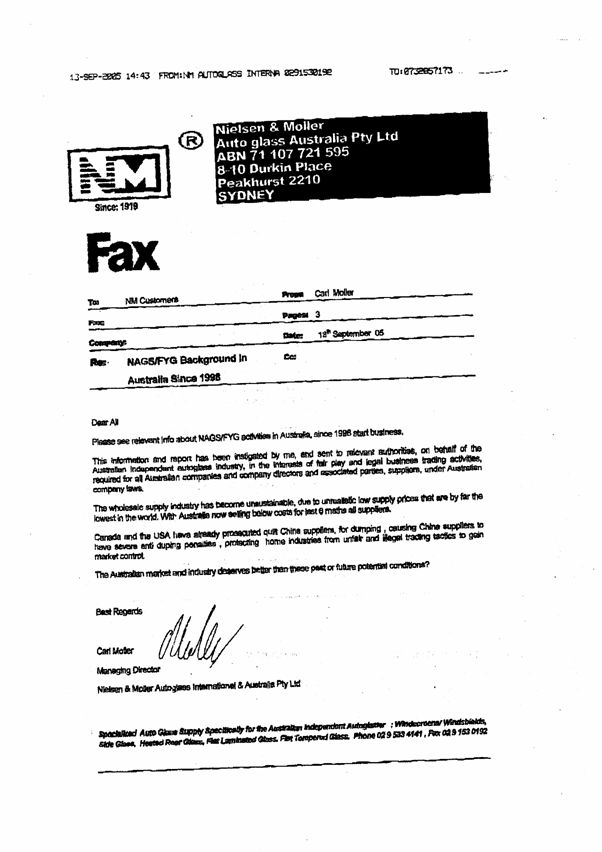
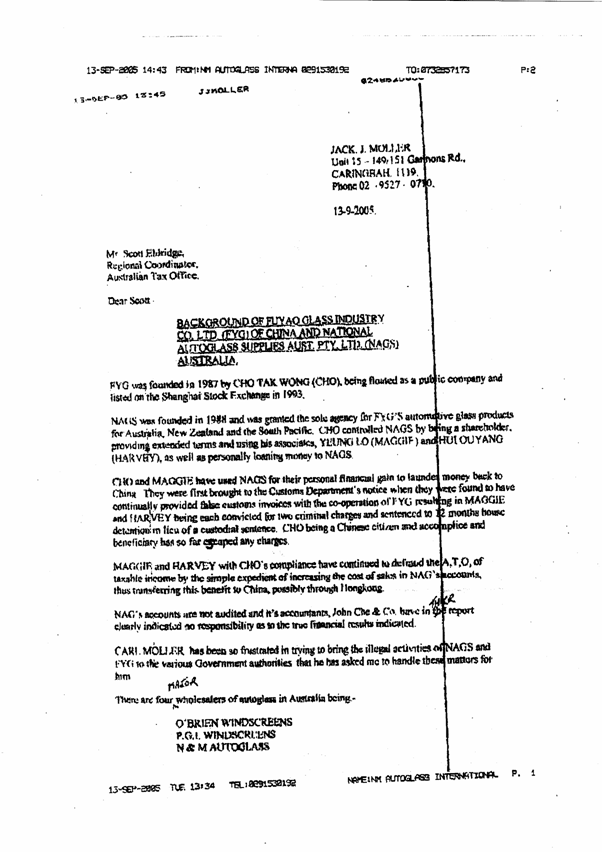
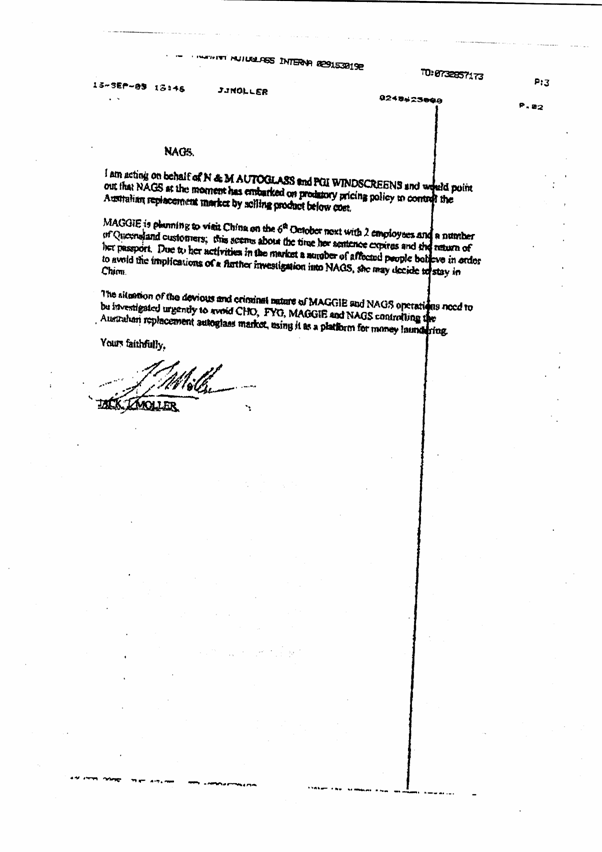
Appendix B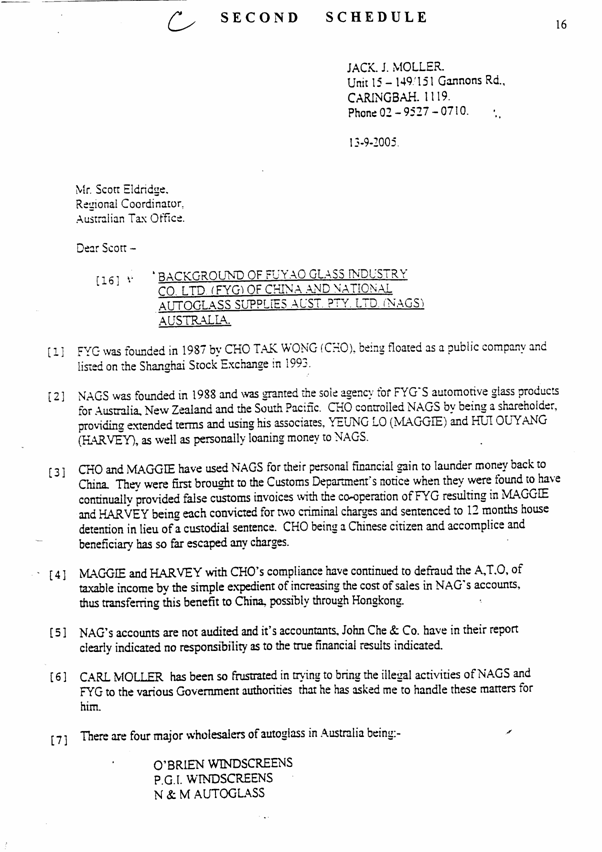
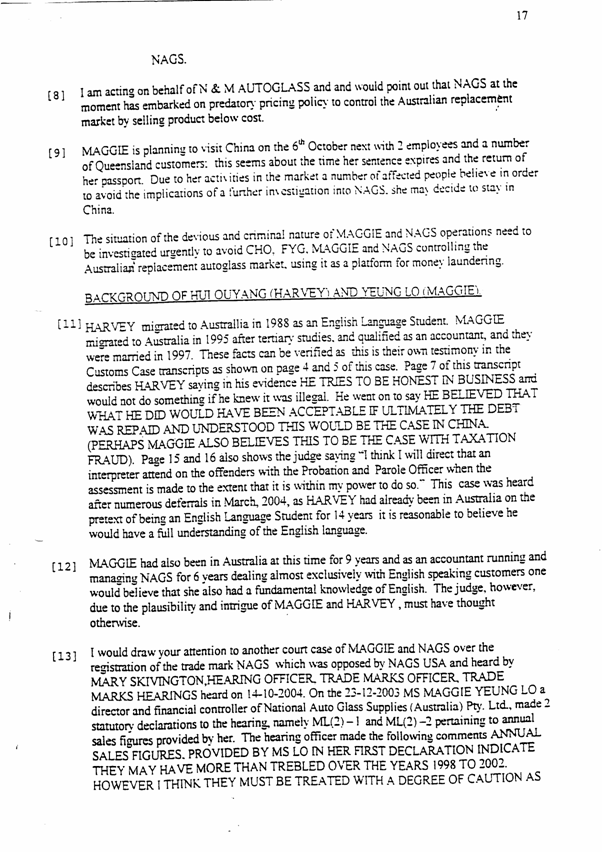
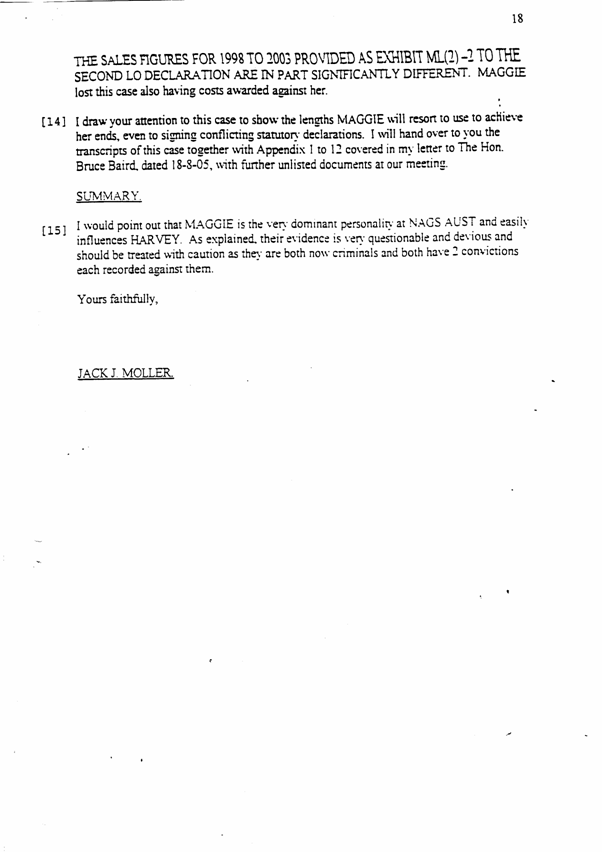
Appendix C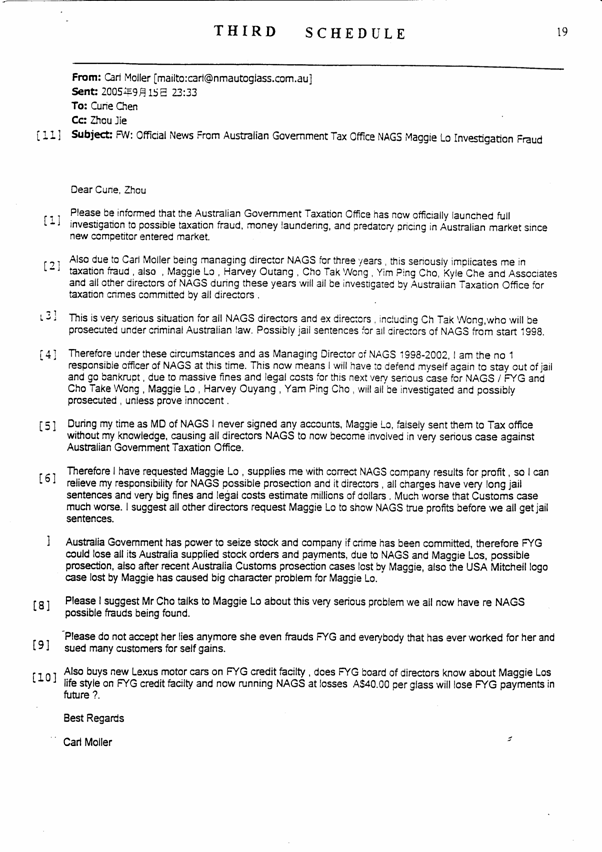
| I certify that the preceding three hundred and twenty-two (322) numbered paragraphs together with Appendices A, B and C are a true copy of the Reasons for Judgment herein of the Honourable Justice Graham. |
Associate:
Dated: 26 October 2007
| Counsel for the Applicants: | S M Littlemore QC and A A Henskens |
|
|
|
| Solicitors for the Applicants: | Robert Yip & Co |
|
|
|
| The first respondent did not appear | |
|
|
|
| The second respondent appeared in person up to and including 12 December 2006 and on the morning of 13 April 2007. He did not appear thereafter. | |
|
|
|
| The third respondent appeared in person | |
|
|
|
| Dates of Hearing: | 4, 5, 6, 7, 8, 11, 12, 13, 14 December 2006, 12, 13, 16, 17, 18, 19 and 20 April 2007 |
|
|
|
| Date of Judgment: | 26 October 2007 |


