

FEDERAL COURT OF AUSTRALIA
SZBHU v Minister for Immigration & Citizenship [2007] FCA 1614
Migration Act 1958 (Cth) ss 422B, 425, 425A, 441A, 441C.
Council of the City of Greater Wollongong v Cowan (1955) 93 CLR 435
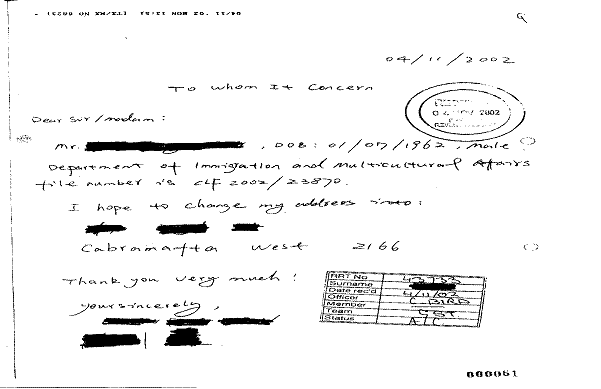
Florance v Andrew (1985) 58 ALR 377
Fodare Pty Ltd v Official Trustee in Bankruptcy [2000] FCA 1721
H v Minister for Immigration & Multicultural Affairs(2001) 63 ALD 43
Minister for Immigration and Multicultural and Indigenous Affairs v SZFHC (2006) 150 FLR 439
SZFDE v Minister for Immigration & Citizenship [2007] HCA 35
SZFOH v Minister for Immigration & Citizenship (2007) 159 FCR 199.
VAAC v Minister for Immigration & Multicultural & Indigenous Affairs(2003) 129 FCR 168
SZBHU v MINISTER FOR IMMIGRATION AND CITIZENSHIP and REFUGEE REVIEW TRIBUNAL
NSD 294 OF 2007
GILMOUR J
24 October 2007
PERTH (part-HEARD BY VIDEOLINK TO SYDNEY)
|
IN THE FEDERAL COURT OF AUSTRALIA |
|
|
NEW SOUTH WALES DISTRICT REGISTRY |
NSD 294 OF 2007 |
|
BETWEEN: |
SZBHU Appellant
|
|
AND: |
MINISTER FOR IMMIGRATION AND CITIZENSHIP First Respondent
REFUGEE REVIEW TRIBUNAL Second Respondent
|
|
GILMOUR J |
|
|
DATE OF ORDER: |
24 October 2007 |
|
WHERE MADE: |
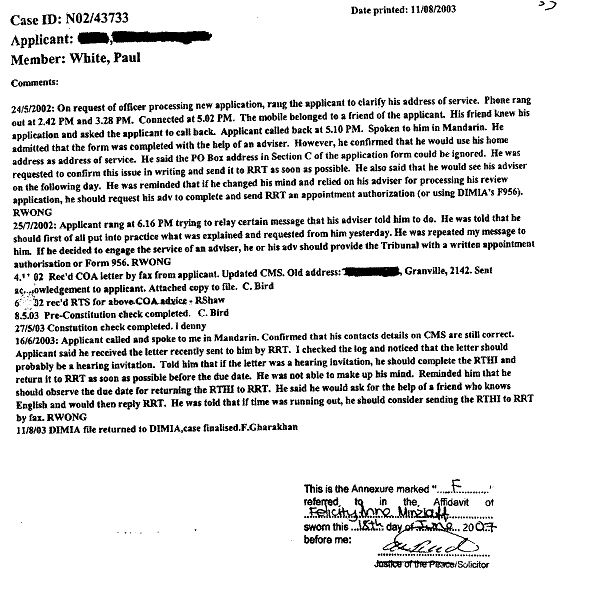
PERTH (part-HEARD BY VIDEO-LINK TO SYDNEY) |
THE COURT ORDERS THAT:
1. The appeal be allowed.
2. The orders of the Federal Magistrates Court made on 20 February 2007 be set aside.
3. In lieu, there be orders that:
3.1 The decision of the Refugee Review Tribunal dated 10 July 2003 be quashed.
3.2 The application for review be remitted to the Tribunal to be re-determined according to law.
Note: Settlement and entry of orders is dealt with in Order 36 of the Federal Court Rules.
|
IN THE FEDERAL COURT OF AUSTRALIA |
|
|
NEW SOUTH WALES DISTRICT REGISTRY |
NSD 294 OF 2007 |
|
ON APPEAL FROM THE FEDERAL MAGISTRATES COURT OF AUSTRALIA |
|
BETWEEN: |
SZBHU Appellant
|
|
AND: |
MINISTER FOR IMMIGRATION AND CITIZENSHIP First Respondent
REFUGEE REVIEW TRIBUNAL Second Respondent
|
|
JUDGE: |
GILMOUR J |
|
DATE: |
24 October 2007 |
|
PLACE: |
PERTH (HEARD BY VIDEO-LINK TO SYDNEY) |
REASONS FOR JUDGMENT
1 This is an appeal from the orders made by Federal Magistrate Emmett on 20 February 2007 dismissing an application for review by the appellant in respect of a decision of the Refugee Review Tribunal (“the Tribunal”) made on 10 July 2003, which affirmed the decision of a delegate of the first respondent made on 21 June 2002 not to grant a protection visa. The case, regrettably, has had an unduly lengthy and troubled history.
BACKGROUND
2 The appellant is a citizen of the People’s Republic of China who arrived in Australia on 3 April 2002. At the time of his application to the first respondent for a protection visa, the applicant was 40 years of age. He is from the Hainan Province of China. He claimed that as a middle-aged man he began to suffer a lot because of health problems. His friends, he said, introduced him to Falun Gong, the practice of which he claimed improved his health. This caused him to continue with its practice. He said that after the Chinese government declared Falun Gong as an anti-government organisation, he and his friends attended several activities for Falun Gong groups asking for support and fair treatment for Falun Gong practitioners. In response, according to the appellant, the government placed several members in detention. The appellant claimed that, after “9/11”, the Chinese government concluded that Falun Gong was a kind of terrorist organisation. The appellant claimed that he felt that he was in danger and that he had not been able to find employment. Because of this, he said, he fled to Australia. He claimed that if he went back to China, the Government would imprison him because of his association with Falun Gong.
PROCEEDINGS BEFORE THE TRIBUNAL
3 On 24 July 2002 the appellant applied to the Tribunal for a review of the delegate’s decision stating, “I don’t agree with the decision”.
4 A handwritten note, dated 4 November 2002, allegedly signed by the appellant and faxed on that day to the offices of the Tribunal advised it that he “hope(d)” to change his address to (address deleted) Cabramatta West 2166. The Tribunal, by letter also dated 4 November 2002, mailed to the appellant at that address, acknowledged this as a change of address, although this was returned to the Tribunal marked “return to send” on 6 December 2002. Approximately six months later in a letter dated 30 May 2003, the Tribunal wrote to the appellant at this address and invited the appellant to attend a hearing on 9 July 2003 to give oral evidence and present arguments in support of his claims. It notified the appellant that if he did not attend the hearing and a postponement was not granted, then the Tribunal might make a decision on his case without further notice (‘the invitation letter’). It was sent in purported discharge of the Tribunal’s obligations under ss 425 and 425A of the Act.
THE TRIBUNAL DECISION
5 In its decision, the Tribunal noted that the appellant did not respond to the hearing invitation and that the letter of invitation was not returned. The appellant did not appear at the hearing on 9 July 2003. The Tribunal proceeded to make a decision pursuant to s 426A of the Migration Act 1958 (Cth) (“the Act”) without taking any further action to enable the appellant to appear. This action was premised on the acceptance by the Tribunal that the conditions set out under s 425A(1) had been met, namely that the applicant (appellant) had been invited under s 425 of the Act to appear before the Tribunal and did not appear before the Tribunal on the day, time and place at which the applicant (appellant) was scheduled to appear. It is the first of these findings which is at the heart of this appeal.
6 The Tribunal’s decision was briefly stated as follows:
‘The Applicant’s claims are of such a general natural that I cannot be satisfied as to their veracity. Further the Applicant has provided so little information in support of his claims that I am not satisfied, on the evidence before me, that the Applicant has a well-founded fear of persecution within the meaning of the Convention’.
PROCEEDINGS BEFORE THE FEDERAL MAGISTRATE
7 The appellant originally sought judicial review of the Tribunal’s decision by an application dated 25 August 2003 in the Federal Magistrates Court. The appellant failed to appear at a directions hearing on 13 November 2003 which was stood over to 27 February 2004. However, as the appellant failed to appear on the subsequent date, the application was dismissed by a Registrar of that court. The application made in 2003 was reinstated by consent on 7 December 2006 by orders of Emmett FM.
8 On 31 January 2006, the appellant filed an application dated 27 January 2006 in the Federal Magistrates Court under r 44.05 of the Federal Magistrate Court Rules and sought an extension of time under s 477 of the Act. The appellant was unrepresented at the hearing.
9 On 7 December 2006, an order was made by consent, reinstating the appellant’s application filed on 25 August 2003 and granting leave to the appellant to rely upon the amended application filed by him on 31 January 2006. Directions were also made on that occasion for the filing and serving of any affidavit containing any additional evidence by the applicant by 19 January 2007 and directed that the appellant file and serve written submissions 14 days before the hearing. No document has been filed by or on behalf of the appellant since that date.
10 In his amended application the appellant stated as follows:
‘RRT made a decision that is neither fair nor reasonable as it was made in my absence to give oral evidence and arguments as I did not receive any letter to attend any hearing. Apparently it is not a registered letter. RRT’s grounds for rejection of visa are insufficient as RRT has not considered my evidences that I submitted to the Minister of Immigration for ministerial intervention on 22 April 2004 as per copies submitted herewith.
In the Year 2005, the senior Chinese diplomat, Mr (name deleted) defected to Australia dropping the bombshell saying that there are more than 1000 Chinese spies and secret agents operating in Australia monitoring Falun Gong practitioners. Now Mr (name deleted), he himself has already got his protection visa and becomes an Australian Permanent Resident leaving me and all other Falun Gong practitioners jeopardised and facing persecution if I am forced to return to China. The risks are genuine because these spies and secret agents permeate every level in the Chinese community. Only after a short while he was granted a Protection Visa, he travelled to U.S.A. to give evidence in the U.S. Senate which further exposed their activities to the world. With 5000 years of history in china, it has long taught the Chinese Government that they could be overthrown by peasants, like Falun Gong practitioners, without guns.’
(Transcribed without alteration other than as to the name of the diplomat)
11 The appellant was not legally represented at the hearing before the Federal Magistrate on 20 February 2007, although he had the assistance of an interpreter. The application was dismissed for reasons stated that same day.
DECISION OF THE FEDERAL MAGISTRATE
The First Ground
12 This asserted that the appellant did not receive the invitation letter and that therefore it was not fair or reasonable to make a decision in his absence without giving him the opportunity to give oral evidence and present arguments. The Federal Magistrate found that the appellant had received the invitation letter: Federal Magistrate’s reasons at [19]-[20]. In so finding, her Honour noted that the first respondent had established that the invitation letter had been sent by the Tribunal to “the last address for service provided to the Tribunal by the applicant”. Her Honour found that the invitation letter had been sent in accordance with the provision of s 441A of the Act and that therefore the appellant was deemed to have received it seven working days from the date of despatch: s 441C(4) of the Act. [20]-[21] There was no issue before her Honour as to whether the letter concerning a new address for the appellant dated 4 November 2002 was actually from him, whether it was actually his address, or whether it was, in effect, a notice of change of address. The Federal Magistrate also found that the Tribunal had properly exercised its discretion under s 426A of the Act to proceed in the absence of the appellant. The appellant also asserted that the invitation letter was not a registered letter. Her Honour correctly pointed out that the Act does not require that such a letter be sent by registered post [29]. The first ground was accordingly not made out.
The Second Ground
13 Her Honour discerned that the second ground was a complaint that the Tribunal did not consider the material that the appellant had provided to the Minister for Ministerial intervention on 22 April 2004. However, as the material post-dated the Tribunal’s decision dated 10 July 2003, the information was not before the Tribunal for its consideration. Thus, as her Honour found, this gave rise to no jurisdictional error on the part of the Tribunal.
The Third Ground
14 The final ground disclosed no error as it concerned a person who was granted a protection visa, said to have been a senior Chinese diplomat.
15 Her Honour, in dismissing the application, concluded that the Tribunal had conducted its review and made its decision in accordance with the legislative regime and that its decision was not affected by jurisdictional error.
NOTICE OF APPEAL
16 The Notice of Appeal contains the following three grounds:
‘1. Procedures that were required by law to be observed in connection with the making of the Decision were not observed;
2. A breach of the rules of natural justice occurred in connection with the making of the Decision;
3. Particulars and Grounds: As a matter of fact, the Tribunal has apparently failed to give me the notice of invitation to appear. Based on the green book page 63, 65, 67, the notices regarding to RRT hearing were all sent to (deleted), Cabramatta, NSW, 2166. The reason RRT sent mails to above address is that RRT had received a post address changed notice signed by someone else, but not me on 04 Nov 2002. Please compare with my previous signature in page 58 in my RRT application form and the signature in page 61, it would be very easy to tell the signature in page 61 was not my previous signature. Without checking carefully and properly, RRT then sent all correspondence to wrong address. At same time, my migration agent appointed was also disappeared. In this case, I have never been notified to attend the hearing. As it is RRT and my migration agent to make these errors, so I believe RRT has not complied with Migration Act Section 425A(2). As a result, RRT has not followed the legal procedure when they consider my application.’
(Transcribed without alteration).
17 There is, in substance, only one ground, namely that the Tribunal, in breach of s 425(1) of the Act, did not invite the applicant to appear before it and accordingly the Tribunal was not entitled under s 426A of the Act to make its decision in the absence of attendance at the hearing by the appellant.
18 As I have mentioned, the Federal Magistrate found that the letter of invitation had been sent to the appellant in accordance with the provisions of ss 425A, 441A(4) and 441C(4) of the Act.
19 Section 425A, relevantly, is in these terms:
425A Notice of invitation to appear
(1) If the applicant is invited to appear before the Tribunal, the Tribunal must give the applicant notice of the day on which, and the time and place at which, the applicant is scheduled to appear.
(2) The notice must be given to the applicant:
(a) except where paragraph (b) applies--by one of the methods specified in section 441A; or
(b) if the applicant is in immigration detention--by a method prescribed for the purposes of giving documents to such a person.
(3) The period of notice given must be at least the prescribed period or, if no period is prescribed, a reasonable period.
(4) The notice must contain a statement of the effect of section 426A.
20 Section 441A(4) of the Act is in these terms:
441A Methods by which Tribunal gives documents to a person other than the Secretary
Dispatch by prepaid post or by other prepaid means
(4) Another method consists of a member, the Registrar or an officer of the Tribunal, dating the document, and then dispatching it:
(a) within 3 working days (in the place of dispatch) of the date of the document; and
(b) by prepaid post or by other prepaid means; and
(c) to:
(i) the last address for service provided to the Tribunal by the recipient in connection with the review; or
(ii) the last residential or business address provided to the Tribunal by the recipient in connection with the review.
21 Section 441C(4) of the Act provides in these terms:
441C When a person other than a Secretary is taken to have received a document from the Tribunal
Dispatch by prepaid post or by other prepaid means
(4) If the Tribunal gives a document to a person by the method in subsection 441A(4) (which involves dispatching the document by prepaid post or by other prepaid means), the person is taken to have received the document:
(a) if the document was dispatched from a place in Australia to an address in Australia--7 working days (in the place of that address) after the date of the document; or
(b) in any other case--21 days after the date of the document.
22 It was in issue before me as to whether the invitation letter had been dispatched under s 441A(4) to any of the addresses set out under s 441A(4)(c)(i) or (ii) of the Act.
23 If it was not dispatched to one or more of those addresses, then the deemed receipt of the invitation letter by the appellant provided for under s 441C(4) of the Act could not be established. Consequently, the condition under s 426A(1)(a), to the exercise of power by the Tribunal could not be fulfilled and the decision, made in the absence of the appellant, would be infected by jurisdictional error. There would not have been compliance with ss 425 and 425A of the Act. There would have been a denial of natural justice as that has effect by virtue of s 422B and Div 4 of Part 7 of the Act: see generally SZFDE v Minister for Immigration & Citizenship [2007] HCA 35 at [31]-[32] and [48].
24 It is common ground that the invitation letter was despatched to the appellant at the Cabramatta address. This is the address on the handwritten letter dated 4 November 2002 to which I earlier referred. It is apparently from the appellant, but not actually from him, according to the appellant. It purported to notify this address to the Tribunal as that to which he hoped to change.
25 The appellant contends, for the first time, that this letter was not signed or sent by him or upon his instructions. This is not to say that he previously had admitted the letter to be his. The appellant said that he was not aware of it at the time of the hearing before the Federal Magistrate.
26 The first respondent submits that this ground was not raised before the Federal Magistrate, nor were the facts now asserted mentioned in the Court below, and that accordingly, the appellant requires leave from this Court before he is permitted to raise this new ground: seeH v Minister for Immigration and Multicultural Affairs (2001) 63 ALD 43; VAAC v Minister for Immigration and Multicultural and Indigenous Affairs(2003) 129 FCR 168.
27 However this ground, in substance, is not a new one. In his application for review to the Federal Magistrates Court dated 27 January 2006, the appellant included in the first ground that he had not received any letter (which would include the invitation letter) to attend any hearing of the Tribunal.
28 Before me, he repeats that ground. True, it is, that the allegations of fact in support of that ground upon which he now relies were not before the Federal Magistrate. As I said, he never previously stated that the handwritten letter to the Tribunal dated 4 November 2002 and apparently signed by him, was not his document. This letter was before the Federal Magistrate and, I infer, that the appellant therefore had access to it: Federal Magistrate’s Reasons [12]. Its authenticity was not, before, questioned. Now the appellant invites the Court to conduct its own forensic exercise by comparing the signature on this letter with, for example, the signature, said by the appellant to be his signature contained in his application for review to the Tribunal. Further, the fact that his migration agent had “disappeared”, was not raised before the Court below. Properly characterised, what the appellant is seeking to do is to move the Court to consider fresh evidence on the appeal.
29 When the matter first came before me on 1 May 2007, I adjourned it and made directions for the filing of affidavits in relation to the appellant’s new factual contentions. I intimated to the parties at the same time that a jurisdictional issue which might in the circumstances arise, was whether there had been a breach of s 425(1) having regard to the facts which may emerge concerning the letter dated 4 November 2002 and the provisions of s 441A(4)(c)(i) or (ii) of the Act.
30 At the resumed hearing on 16 August 2007, conducted by video-link between Perth and Sydney, counsel for the first respondent advised that the Minister did not oppose the new evidence proposed to be introduced by the appellant if cross-examination of him were allowed. I acceded to that course and the appellant was indeed cross-examined at some length. I will turn to that shortly.
31 I was otherwise satisfied that it was appropriate to grant leave to adduce fresh evidence on the appeal. The appellant filed an affidavit sworn by him on 8 May 2007 both to explain why the evidence that he now sought to rely upon was not adduced before the Federal Magistrate, as well as to state the new evidence: Federal Court of Australia Act 1976 (Cth)s 27; Federal Court Rules Order 52 r 36(4) and (5); Fodare Pty Ltd v Official Trustee in Bankruptcy [2000] FCA 1721.
32 I accept the appellant’s evidence that he does not speak, read or write English. It was not put to him that this was not the case. He said that he did not know of the content of the 4 November 2002 letter on the Tribunal’s file at the time of the hearing of his appeal before the Federal Magistrate, or even when he was in detention at Villawood Immigration Detention Centre in New South Wales in 2005. It was only, he deposed, after the dismissal of his application for review by the Federal Magistrate, that a friend of his translated some particular pages, which I infer, included the letter of 4 November 2002, that he became aware of the reason as to why he had never received any invitation to attend the Tribunal hearing. He said that the translator, at the hearing before the Federal Magistrate, had not translated all the contents of the papers before the Court, and again, I infer, had not translated the contents of this letter. It was not suggested to him that it had been. Accordingly, through ignorance of the content of the letter, he did not raise these matters before the Federal Magistrate. The appellant alleges that, consequently, although he was aware that he had not received any responses from the Tribunal after he had lodged his application, he had not previously discovered the reason for this.
33 It is reasonably clear that if this issue had been raised before the Federal Magistrate, and the appellant’s evidence in respect to it had been accepted in substance, that the appeal would have been successful: Council of the City of Greater Wollongong v Cowan (1955) 93 CLR 435; Florance v Andrew (1985) 58 ALR 377 at 381 per Lockhart J.
The Appellant’s Affidavit
34 The fresh evidence in the appellant’s affidavit to which I have referred, is to the following effect. The appellant’s application for review of the decision of the first respondent was lodged on 24 July 2002 through a migration agent. He did not attend the Tribunal hearing because he did not receive the invitation letter, due to it being mailed to the wrong address.
35 He deposed by reference to papers contained in the “green book” that all notices concerning the Tribunal hearing were sent to the Cabramatta address. The reference to the “green book” is, I infer, the book of papers with a green front cover used for the purposes of the review before the Federal Magistrate. He stated in particular that:
‘The reason RRT sent mails to above address is that RRT had received a post address changed notice signed by someone else, but not me on 04 Nov 2002. Please compare with my previous signature in page 58 in my RRT application form and the signature in page 61, it would be very easy to tell the signature in page 61 was not my previous signature. Without checking carefully and properly, RRT then sent all correspondence to wrong address. At same time, my migration agent appointed was also disappeared. In this case, I have never been notified to attend the hearing. As it is RRT and my migration agent to make these errors, so I believe RRT has not complied with Migration Act Section 425 A (2). As a result, RRT has not followed the legal procedure when they consider my application.’
36 This repeats most of the particulars contained in the Notice of Appeal.
First Respondent’s Affidavit
37 The first respondent filed an affidavit, sworn on 18 June 2007, by Felicity Anne Minzlaff, a solicitor with Blake Dawson Waldron, the solicitors of record for the first respondent. She deposes to the following effect, having considered the contents of the Tribunal’s file (No 2/43733) (‘the RRT File’). Within the RRT File was a letter dated 4 November 2002, which was sent by the Tribunal to the appellant and concerns the appellant’s change of address. This letter was marked as sent by registered post number “RP14956540” to “(deleted) Cabramatta, NSW 2166”. It was however returned. The RRT File further includes a copy of an envelope marked “Return to send”, registered post number “RP14956540”. The second respondent received this letter on 6 December 2002.
38 The RRT File also includes a letter dated 30 May 2003 addressed to the appellant at the Cabramatta address which invited the appellant to attend a hearing before the Tribunal on Wednesday 9 July 2003 (this is a copy of the invitation letter). The second page of this letter is marked with the registered post number “RP16999477”. The Tribunal’s registered post records shows that a letter was sent to the appellant on 30 May 2003, with the registered post number “RP16999477”.
39 The RRT File also includes a record of telephone notes which were recorded by the Tribunal in respect of file N02/43733. The entry in the telephone notes dated 16 June 2003 refer to a telephone conversation between the appellant and one R. Wong, presumably a person employed within the Tribunal’s offices. It was as follows:
16/6/03: Applicant called and spoke to me in Mandarin. Confirmed that his contacts details on CMS are still correct. Applicant said he received the letter recently sent to him by RRT. I checked the log and noticed that the letter should probably be a hearing invitation. Told him that if the letter was a hearing invitation, he should complete the RTHI and return it to RRT as soon as possible before the due date. He was not able to make up his mind. Reminded him that he should observe the due date for returning the RTHI to RRT. He said he would ask for the help of a friend who knows English and would then reply RRT. He was told that if time was running out, he should consider sending the RTHI to RRT by fax.
RWONG
40 The RRT File contains several other letters addressed to the appellant at the Cabramatta address. A letter dated 15 July 2003, marked “RP16947057”, advised the appellant that the Tribunal would hand down its decision in respect of his application for review on 7 August 2003. The Tribunal’s registered post records disclose that a letter with registered post number RP16947057 was sent to the appellant on 15 July 2003. A letter dated 7 August 2003 and marked “RP16949722” advised the appellant of the Tribunal’s decision. The Tribunal’s registered post records disclose that a letter with registered post number RP16949722 was sent to the appellant on 8 August 2003. No records were found which indicated that any of the letters sent to the appellant dated 30 May 2003, 15 July 2003 and 7 August 2003 were returned to the second respondent unclaimed.
41 The appellant filed an application on 25 August 2003 for judicial review in respect of the Tribunal’s decision, which was handed down in the Federal Magistrates Court on 7 August 2003.
42 On 28 April 2004, the first respondent received a letter written on behalf of the appellant dated 22 April 2004, which requested that the first respondent exercise her discretion under s 417 of the Act, to grant the appellant a protection visa. Paragraph 3 of this letter states as follows:
‘I lodged an application with DIMIA on 2 May 2002. A decision to refuse me a protection visa was made on 21 June 2002. On 24 July 2002 I sought review of that decision with Refugee Review Tribunal. On 7th August 2003, I received news that my decision was refused.’ (Emphasis added)
REASONS
43 It is necessary to set out the content of the letter of 4 November 2002 in full.
44 The appellant in his affidavit says that the signature in Chinese characters at the foot of this document is not his. He invited the Court to make a comparison between that signature and other signatures of his which were before me, in order to conclude that indeed the signature was not his. That is not a matter upon which I could reach a conclusion unassisted by expert evidence. However, a more fundamental question arises. It is whether this letter, even if it were from the appellant, or had been prepared and faxed by an agent, properly construed, constituted a notice as to his address for service or his residential address, such as to constitute the “last address for service provided to the Tribunal by the recipient in connection with the review”, or the “last residential address” provided to the Tribunal by the recipient in connection with the review (s 441A(4)(c)(i) and (ii)).
45 In my opinion it is not. It indicates by the use of the expression “I hope to change my address to …” no more than the anticipated address of the appellant at some unstated time in the future. Counsel for the Minister submitted that I should read those words against the background of the content of a letter dated 25 July 2002 sent to the appellant at the Granville address, which had been given in his written application for review to the Tribunal dated 23 June 2002, as both his home and mailing address. The letter, written in English, invites the appellant to tell the Tribunal, immediately, if he changes his home address or mailing address amongst other things. I do not accept that submission. Firstly, I have found that the appellant is incapable of reading English. In any event, even if he did have that letter translated such that he understood it, this does not affect the construction to be placed upon the letter of 4 November 2002.
46 In supplementary written submissions, counsel for the first respondent submitted that if the Court was satisfied that the 4 November 2002 fax was sent by a migration agent on behalf of the appellant, it should then conclude that as a matter of probability, that agent’s first language was Mandarin and that English was his or her second language. The Court, in those circumstances, it was submitted, should be reluctant to rely upon a precise English dictionary definition of “hope”. I am in no position to infer any of the matters upon which this submission is premised. It would be quite unfair to do so.
47 Compliance by the Tribunal with the requirements of Part 7 of the Act is essential. This includes the requirement under ss 425 and 425A of the Act to invite an applicant to appear before it by giving the applicant notice of the day on which and the time and place at which the applicant is scheduled to appear: SZFDE v Minister for Immigration and Citizenship at [31]-[32]. This in turn invokes s 441A of the Act and compliance by the Tribunal with one of the methods there specified, by which such notice must be given to the applicant. The Tribunal, in this case, elected to give notice to the appellant under the provisions of s 441A(4). Relevantly, this necessarily involved dispatch of the notice to the last address for service or the last residential address provided to the Tribunal by the appellant in connection with the review. If notice was not sent to either address then, as I have earlier outlined, the deeming of service provided for in a case such as this under s 441C(4) cannot be established. The letter of 4 November 2002 did not constitute notice to the Tribunal of the address for service or the residential address of the appellant, even if it were from him. The home and mailing address provided by the appellant in his application for review before the Tribunal was the Granville address.
48 Furthermore, the appellant, in cross-examination, denied not only that the letter was from him or authorised by him, but also denied that he had ever lived at the address provided in the letter being the Cabramatta address, or even knew of its existence before the contents of the letter were translated for him. There is no evidence, direct or indirect, to contradict this denial. He said that as at 4 November 2002, he was living at an address in Kempsey. Before me, the appellant was reluctant to disclose the actual address as he was concerned that an illegal person who lived there may get into trouble. Counsel for the first respondent did not press the matter. In written submissions, the first respondent accepted that he was living in Kempsey at that time. The first respondent submitted that from this, I should infer that the appellant did not want anyone to know about the Kempsey address and that is why he provided the Cabramatta address in the 4 November 2002 fax. I am not prepared to draw that inference. It was never suggested in cross-examination of the appellant that such was the case and he emphatically denied any knowledge of that address. I accept his evidence that he was living at an address at Kempsey at the relevant time. For these and other reasons to which I will return later, I am not prepared to find that the letter of 4 November 2002 was from the appellant or authorised by him.
49 The matter does not end there. Section 441A(4)(c)(i) does not identify any particular method by which an applicant may provide an address for service to the Tribunal. It would be sufficient, in my opinion, if this were done orally by an applicant. The first respondent contends that there is evidence that the appellant, during a telephone conversation with an officer in the employ of the first respondent, acknowledged that he lived at the address set out in the letter and that he had also received the letter of invitation. This was denied by the appellant during cross-examination. The evidence tendered in support of this is contained in a document which purports to contain a chronological account of matters pertaining to the appellant’s application to the Tribunal including, at least in a summary way, the content of conversations said to have occurred with the appellant. It was an annexure to the affidavit of Ms Minzlaff and I set it out below.
50 The entirety of this document was not before the Federal Magistrate on the review, other than the entry for 16 June 2003. This entry was set out in full at [4] of the affidavit of Felicity Anne Kerr sworn 26 June 2006, which was in evidence before the Federal Magistrate. The Federal Magistrate did not refer to the content of the entry for 16 June 2003 in her reasons. I expect that this was because her Honour, in her reasons [12] concluded that the letter of 4 November 2002 constituted notice to the Tribunal of a change of address by the applicant (appellant). No reasons for so finding were disclosed and, in particular, no consideration was given to the use of the word “hope”, to which I have referred.
51 During cross-examination, the appellant stated that he had had the assistance of a migration agent in the preparation and filing of his application for review with the Tribunal. It seems that this was likely the case. To that extent, it is consistent with the entry for 24 May 2002. The application for review to the Tribunal, admittedly signed by the appellant, gave his home and mailing address as Granville address. In it, Section C allows for details of an Authorised Recipient to be provided. This includes the name, organisation, address and telephone numbers of such a person and is required to be signed by the Authorised Recipient.
52 An address, as best as I can tell, “PO Box K63 Haymarket NSW 1240”, is contained within Section C in handwriting but then scored through with a large cross. No signature appears. It follows that, for the purposes of the review by the Tribunal, the appellant had no ‘Authorised Recipient’ and documents from the Tribunal ought to have been despatched to the Granville address provided by the appellant. I note that the address is similar to, and perhaps intended to be the same as, the address of the appellant’s “authorised person”, one Ray Wen of PO Box K536 Haymarket NSW 2000, contained in a document entitled “Authorisation of person to act and receive communication” forming part of the first respondent’s file maintained in relation to the appellant’s application for a protection visa. Mr Wen, it appears, was a migration agent to whom the appellant had been introduced by a friend. The appellant knew him only by his Chinese name, not by this anglicised version of his name. This document contains both the appellant’s signature and that of the authorised person who signed on 1 May 2002. Correspondence from the Department of Immigration and Multicultural and Indigenous Affairs, as it then was, was sent to the Granville address as well as to the PO Box address of Ray Wen, the appellant’s authorised person. However, during cross-examination, the appellant denied speaking to any officer of the Tribunal by telephone. This, on its face, is contradicted by the content of the notes.
53 The entry for 4 November 2002 is:
‘Rec’d COA letter by fax from applicant. Updated CMS. Old address: (address deleted), Granville 2142. Sent acknowledgement to applicant. Attached copy to file. C. Bird’
54 The entry for 6 November 2002 reads:
‘rec’d RTS for above COA advice – R Shaw.’
55 According to the affidavit of Ms Minzlaff, this record discloses that the letter of acknowledgement sent by the Tribunal by registered post to the Cabramatta address, also dated 4 November 2002, advising the appellant that his home and mailing addresses had been updated on the records of the Tribunal was returned to the Tribunal marked “return to send”. Then there is the note dated 16 June 2003, a little over seven months from the time that the Tribunal’s letter of 4 November 2002 had been returned, that a conversation apparently occurred in Mandarin between, I take it, a Tribunal officer, RWONG, and the appellant. The note states that the appellant confirmed that his contact details on “CMS” are still correct. I was told by counsel for the Minister that “CMS” was an abbreviation for Case Management System. The note then refers to a statement apparently made by the appellant that he had received “the letter recently sent to him by RRT”. The Tribunal officer notes that he or she checked the log and “noticed that the letter should probably be a hearing invitation”. This, I take it, assuming that the conversation occurred, although it is denied by the appellant, was a reference to the invitation letter, although it is by no means clear from the note that it was. What follows only adds to the uncertainty. The note states “told him that if the letter was a hearing invitation, he should complete the RTHI and return it to RRT as soon as possible before the due date”. It then notes that “he was not able to make up his mind”. It then states that the appellant would ask for the help of a friend who knows English and would then reply to the Tribunal.
56 If this conversation took place, and I am not, on the evidence before me, prepared positively to find that it did, then the context of it, as noted, is quite equivocal. The Cabramatta address is not noted on the record. There is no positive identification of what the appellant’s contact details on the “CMS” were at that time. It is not clear that the letter that was being discussed was in fact the invitation letter. If the appellant said that he was not able to make up his mind, then that must be taken in the context of a discussion in Mandarin about a letter in written English which may or may not have been the invitation letter. The establishment of such matters should not be left to inference, as counsel for the first respondent submitted. The witnesses who could, and who, in my opinion, should have sworn affidavits concerning the content of the file notes did not do so. Furthermore, the note contains at least one significant error. The first entry is dated “24/5/02”. The application for review was not filed until 24/7/2002. The first respondent has submitted that the first date was a typographical error and should have been noted as “24/7/02”. That may or may not be the case. There was no evidence concerning this issue and I am not prepared to make any finding in respect of it. It does however point out the problem of reliance upon a note without having the benefit of evidence from its authors.
57 It is regrettable that no evidence was adduced from either the officer noted as C. Bird or that noted as RWONG. In the face of the emphatic denials by the appellant that he never had any such conversations, I am not prepared to find that the notes should be construed in the way contended by the first respondent. The content of the conversations as summarised in the notes, in my opinion, falls a long way short of clearly identifying that the Cabramatta address was the subject of the discussion as to the appellant’s then contact details, or that there was any acknowledgement that he had received the invitation letter.
58 The first respondent then pointed to evidence given by the appellant in cross-examination when he said “Later the Department sent the letter. I showed letter to David Deng and ask him to do my case”. This, it was submitted, entitles the Court to infer that the letter referred to was that dated 7 August 2003 containing the Tribunal’s decision mailed to the appellant at the Cabramatta address.
59 It is necessary to set out the relevant part of the transcript of the appellant’s cross-examination in order to understand the context in which the evidence relied upon by the first respondent sits:
‘MS KAUR-BAINS: Okay. Do you know an agent by the name of Ray Wen in Haymarket, W-e-n?
THE INTERPRETER: I don’t know. No, that’s the English?
MS KAUR-BAINS: Okay. But in any case, at the time that this letter that I have taken you to on page 44 – at the time you got that letter, you had a migration agent acting for you, is that correct?
THE INTERPRETER: This is English letter, I could not read it, I could not remember I showed the something English to the first migration agent, or to the second.
MS KAUR-BAINS: Okay. Were you living at (address deleted), Granville - sorry, at the time, as at May 2002?
THE INTERPRETER: Yes.
MS KAUR-BAINS: Okay. When did you leave that address?
THE INTERPRETER: Later the department sent me letter, I showed the letter to David Deng, ask him to do my case and then I moved around that time. I just do not remember when it was, but at that address I still had a home town fellow was living there; that person collected mails on my behalf.
MS KAUR-BAINS: And that home town fellow, what was his name?
THE INTERPRETER: (name deleted).
MS KAUR-BAINS: (name deleted).
THE INTERPRETER: In Chinese I call that person (name deleted).
MS KAUR-BAINS: (name deleted), okay. And are you saying that he lived with you at (address deleted)?
THE INTERPRETER: Yes, yes.
MS KAUR-BAINS: And that fellow, he is a friend of yours?
THE INTERPRETER: Yes, he is my friend; came from Hainan as well.
MS KAUR-BAINS: And did he – do you know if he had a mobile phone?
THE INTERPRETER: He did, but I do not have the number now. For long we lost contact with each other and that person changed his mobile phones many times.
MS KAUR-BAINS: When did you lose contact with (name deleted)?
THE INTERPRETER: Because back then every week, sometime every month I call him to ask whether there was mails for me. If there was I would get into the train, go there – I went there and collected them.’
60 It is evident that the address which the appellant was talking about was the Granville address where his “home town fellow” was living. The appellant had “moved around at that time”, and weekly or monthly he would go by train to Granville and collect mail from that address. The letter (at p 44 of the Appeal Book) the subject of cross-examination was one dated 7 May 2002 from the Tribunal addressed to the appellant at the Granville address. I reject this submission as simply not open, and indeed, as contrary to the evidence.
61 The first respondent points to other evidence. On 23 August 2003, the appellant instructed Mr David Deng of YWS & Associates, Migration Consultants, 609/368 Sussex Street, Sydney to act on his behalf in relation to his migration affairs. It was submitted that given that the original application for judicial review before the Federal Magistrate was dated 25 August 2003, two days after Mr Deng was retained by the appellant and within two weeks or so after the date of the Tribunal’s decision, this too suggests that the appellant had received a copy of the decision of the Tribunal under cover of its letter dated 7 August 2003. The explanation of the appellant as to why he retained Mr Deng was that he had not heard from his previous migration agent who I find to have been, using his English version name, Mr Ray Wen. I accept this explanation in light of my earlier findings.
62 It was then contended on behalf of the first respondent, that the content of a letter written, it would appear by Mr Deng or someone within his office, on behalf of the appellant to the then Department of Immigration, Multicultural and Indigenous Affairs dated 22 April 2004, gave rise to the inference that the appellant had received a copy of the decision of the Tribunal delivered on 7 August 2003 which was sent to him at the Cabramatta address.
63 The letter of 22 April 2004 under the heading “Personal History” and which is written in the first person from the appellant states by way of background “On 7 August 2003, I received news that my decision was refused.” However, on the evidence before me, that cannot be correct. It is accepted that the appellant did not appear before the Tribunal either at the hearing on 9 July 2003 or when the decision was handed down on 7 August 2003. Furthermore, as is evident from the affidavit of Ms Minzlaff at [10]-[11], the Tribunal’s letter dated 7 August 2003, together with a copy of its decision, addressed to the Cabramatta address, was not in fact sent by registered post, until the following day, 8 August 2003.
64 Whilst, because of the unsatisfactory and incomplete evidence before me, I cannot make positive findings one way or the other, it is entirely possible, even probable, upon the appellant instructing Mr Deng as his new migration agent, as to what was occurring in relation to his application for review, that Mr Deng or his office would have contacted the Tribunal to ascertain the then present position. Such inquiry would have elicited the information that the Tribunal had dismissed his application for review on 7 August 2003. That may have given rise to the original application for judicial review dated 25 August 2003. This contains very brief generic grounds of appeal. It is certainly possible, even likely, that Mr Deng would have obtained a copy of the reasons from the Tribunal. The letter of 22 April 2004 was clearly not written by the appellant. It was most likely that it was prepared by Mr Deng or someone within his office under his supervision. It contains very scant details of the personal history of the appellant and it includes the sentence to which I averted earlier, concerning his receipt of news on 7 August 2003, in effect, that his application to the Tribunal had been refused.
CONCLUSION
65 As counsel properly conceded, it was for the first respondent to establish that the invitation letter had been sent and in particular, that the requirements of the chosen method of its despatch by the Tribunal under s 441A(4)(c)(i) or (ii) had been established. In my opinion, the 4 November 2004 letter failed to meet the requirements of s 441A(4)(c)(i) and (ii) under the Act. Counsel submitted that the letter dated 4 November 2004 is to be read as a change of address letter. I have found that it was not such a letter. It was not sent to the Granville address, the address provided by the appellant in his application for review. Accordingly, there was no compliance by the Tribunal with ss 425 and 425A of the Act and jurisdictional error arose from its purported exercise of power under s 426Aof the Act. There was no valid decision. See generally: SZFOH v Minister for Immigration and Citizenship (2007) 159 FCR 199.
66 The order of the Federal Magistrate of 20 February 2007 dismissing the application of the appellant should be set aside. There should, in lieu, be orders, in the nature of certiorari, that the decision of the Tribunal of 10 July 2003 be quashed, and mandamus, requiring the Tribunal to re-determine the review of the decision of the delegate according to law.
67 Such further determination will include the Tribunal giving the appellant, pursuant to s 425 of the Act, a fresh invitation to appear before it at the hearing of the review. The Tribunal will be required, for that purpose, to ascertain the appellant’s current address for service.
68 The appeal should be allowed.
|
I certify that the preceding sixty-eight (68) numbered paragraphs are a true copy of the Reasons for Judgment herein of the Honourable Justice Gilmour. |
Associate:
Dated: 24 October 2007
|
The Appellant represented himself: |
|
|
|
|
|
Counsel for the First Respondent: |
Ms S Kaur-Bains |
|
|
|
|
Solicitors for the First Respondent: |
Blake Dawson Waldron |
|
|
|
|
Date of Hearing: |
1 May 2007, 16 August 2007 |
|
|
|
|
Date of Judgment: |
24 October 2007 |


