FEDERAL COURT OF AUSTRALIA
SZJBA v Minister for Immigration and Citizenship [2007] FCA 1592
MIGRATION – appeal from a decision of the Federal Magistrates Court – where the Refugee Review Tribunal sent a letter to the appellant inviting comment – where letter purportedly sent under s 424A of the Migration Act 1958 (Cth) – where appellant’s adviser attempted to send response to invitation – whether failure by Tribunal to follow up response amounts to jurisdictional error.
Migration Act 1958 (Cth) Part 7 ss 424A, 424B and 424C
Constitution s 75(v)
Abebe v Commonwealth (1999)197 CLR 510 cited
Appellant 2395 of 2002 v Minister for Immigration and Multicultural Affairs (2003) 216 CLR 473 cited
Minister for Immigration and Citizenship v Le [2007] FCA 1318 referred to
Minister for Immigration and Multicultural Affairs v Wang (2003) 215 CLR 518 cited
Minister for Immigration and Multicultural and Indigenous Affairs v SGLB (2004) 207 ALR 12 referred to
Minister for Immigration and Multicultural and Indigenous Affairs v SCAR (2003) 128 FCR 553 cited
Minister for Immigration, Multicultural and Indigenous Affairs v Respondents S152 of 2003 (2004)205 ALR 487 cited
Muin v Refugee Review Tribunal (2002) 190 ALR 601 cited
NAFF v Minister for Immigration and Multicultural and Indigenous Affairs (2004) 221 CLR 1 cited
NAHF v Minister for Immigration and Multicultural and Indigenous Affairs (2003) 128 FCR 359 cited
NAIS v Minister for Immigration and Multicultural and Indigenous Affairs (2005) 223 ALR 171 cited
NCSC v News Corporation Limited (1984) 156 CLR 296 cited
Prasad v Minister for Immigration and Ethnic Affairs (1985) 6 FCR 155 referred to
Re Applicant S v Minister for Immigration and Multicultural Affairs (2003) 217 CLR 387 cited
Re Minister for Immigration and Multicultural Affairs; ex parte Epeabaka (2001) 206 CLR 128 cited
Re Minister for Immigration and Multicultural Affairs; ex parte Miah (2001) 206 CLR 57 referred to
Re Minister for Immigration and Multicultural and Indigenous Affairs; ex parte Applicants S134 (2003) 195 ALR 1 cited
Re Refugee Review Tribunal; ex parte Aala (2006) 204 CLR 82 cited
Re Refugee Tribunal; ex parte H (2001) 179 ALR 425 cited
Re Ruddock; Ex parte S154/2002 (2003) 201 ALR 437 cited
SAAP v Minister for Immigration and Multicultural and Indigenous Affairs (2005) 215 ALR 162 cited
SZAYW v Minister for Immigration and Multicultural and Indigenous Affairs (2006) 229 ALR 423 cited
SZBEL v Minister for Immigration and Multicultural and Indigenous Affairs (2006) 231 ALR 592 referred to
SZFDE v Minister for Immigration and Citizenship [2007] HCA 35 referred to
VEAL v Minister for Immigration and Multicultural and Indigenous Affairs (2005) 225 CLR 88 cited
SZJBA v MINISTER FOR IMMIGRATION AND CITIZENSHIP AND REFUGEE REVIEW TRIBUNAL
NSD 1390 OF 2007
ALLSOP J
16 OCTOBER 2007
SYDNEY
|
IN THE FEDERAL COURT OF AUSTRALIA |
|
|
NEW SOUTH WALES DISTRICT REGISTRY |
NSD 1390 OF 2007 |
|
ON APPEAL FROM THE FEDERAL MAGISTRATES COURT OF AUSTRALIA |
|
BETWEEN: |
SZJBA Appellant
|
|
AND: |
MINISTER FOR IMMIGRATION AND CITIZENSHIP First Respondent
REFUGEE REVIEW TRIBUNAL Second Respondent
|
|
ALLSOP J |
|
|
DATE OF ORDER: |
16 OCTOBER 2007 |
|
WHERE MADE: |
SYDNEY |
THE COURT ORDERS THAT:
1. The appeal be allowed.
2. The orders of the Federal Magistrates Court made on 29 June 2007 be set aside and in lieu thereof it be ordered that:
(a) the decision of the second respondent made on 9 February 2007 be set aside and the review of the delegate’s decision in respect of the appellant be remitted to the second respondent to be heard according to law; and
(b) the first respondent pay the applicant’s costs before the Federal Magistrates Court.
3. The first respondent pay the appellant’s costs of the appeal.
Note: Settlement and entry of orders is dealt with in Order 36 of the Federal Court Rules.
|
IN THE FEDERAL COURT OF AUSTRALIA |
|
|
NEW SOUTH WALES DISTRICT REGISTRY |
NSD 1390 OF 2007 |
|
ON APPEAL FROM THE FEDERAL MAGISTRATES COURT OF AUSTRALIA |
|
BETWEEN: |
SZJBA Appellant
|
|
AND: |
MINISTER FOR IMMIGRATION AND CITIZENSHIP First Respondent
REFUGEE REVIEW TRIBUNAL Second Respondent
|
|
JUDGE: |
ALLSOP J |
|
DATE: |
16 OCTOBER 2007 |
|
PLACE: |
SYDNEY |
REASONS FOR JUDGMENT
1 This is an appeal from orders made by the Federal Magistrates Court dismissing an application for judicial review of a decision of the Refugee Review Tribunal (the “Tribunal”) affirming a decision of a delegate of the first respondent Minister not to grant a protection visa. Had not the appellant been in immigration detention, I would have taken some more time writing these reasons. The necessity for prompt disposition of the matter, once I had concluded that the appeal should succeed, necessitated that any possible improvement in felicity of expression should give way to despatch.
2 The relevant Tribunal decision was made on 9 February 2007, after a hearing on 17 January 2007. An earlier Tribunal hearing had taken place on 26 May 2006, prior to an earlier decision by the Tribunal made on 15 June 2006. That earlier decision had been set aside by orders made by consent in the Federal Magistrates Court.
3 I granted leave to file in Court an amended notice of appeal that had been prepared by Dr Griffiths SC, who appeared pro bono pursuant to a request made by the Registrar after an order was made pursuant to Order 80 of the Federal Court Rules. Reliance on that amended notice of appeal was opposed by the Minister, on the grounds that it raised factual matters not argued at first instance that would, or could, have been affected by evidence. The Minister also submitted that, taking the appellant’s complaints at their highest, the appeal should be dismissed because the supposed procedural unfairness complained of could not possibly have affected the result. These contentions (which were not the totality of the Minister’s submissions) require me to explain something of the background as to the conduct of the matter below and how the matter came to this Court on appeal, in the form it does.
4 The applicant is of Indo-Fijian ethnicity, born in Fiji in April 1956. He arrived in Australia in January 1999. He did not apply for a protection visa until 23 February 2006. The appellant’s claims, in summary, were that he was a businessman, who, from 1987 until January 1999, owned his own electronics shop in Suva. He claimed to fear for his safety from indigenous Fijians, citing the events of the 1987 coup and threats and physical abuse since then. He claimed that his wife had been raped by indigenous Fijians in 1987. He claimed some notoriety in Fiji as a prominent businessman and supporter of the Fiji Labor Party.
5 The reasons of the Tribunal, after reciting his claims, described the hearing on 17 January 2007. It is clear from that part of the reasons that the Tribunal had difficulty accepting a good deal of the evidence of the appellant. On the day following the hearing, 18 January 2007, the Tribunal sent a letter to the appellant’s migration agent, as his “authorised recipient” under the Migration Act 1958 (Cth) and Migration Regulations, Ms Beatriz Stotz of “Playfair Visa and Migration Services”. (Ms Stotz had appeared for the appellant at the Tribunal hearing.) In its reasons, the Tribunal said that the letter was sent “pursuant to s 424A of the Migration Act”. The letter did expressly not so state, but the terms of the first paragraph bear this out:
The Tribunal has information that would, subject to any comments you make, be the reason, or part of the reason, for deciding that you are not entitled to a protection visa.
6 It is unnecessary to set out much of the letter. Five lengthy paragraphs of factual observations set out inconsistencies between information that had been previously provided and that had been provided to the Tribunal. This was said to be relevant because of possible adverse credibility findings on the basis of such inconsistencies.
7 A sixth piece of information set out in the letter was as follows:
You visited Australia for the first time in 1989 staying for three months. However, you did not apply for asylum on that occasion. Moreover, you returned to Australia in January 1999, but did not apply for asylum until 23 February 2006. This information is relevant because it may cast doubt on the genuineness of your fear of persecution in Fiji.
8 The invitation to comment on this information was expressed as follows:
You are invited to comment on this information. Your comments are to be in writing and in English. They are to be received at the Tribunal by 25 January 2007.
9 According to the reasons of the Tribunal, the following then occurred:
On 25 January 2007 the Tribunal received a fax from the applicant’s adviser requesting an extension of time until 30 January 2007 in order to provide comments in response to the Tribunal’s 424A letter. On 29 January 2007 the Tribunal wrote to the applicant’s adviser informing her that the Tribunal has not granted an extension of the time for provision of comments. However, she was also advised that the Tribunal would not take any steps to finalise the case until 31 January 2007 and would consider any material which is submitted on or before that date.
On 30 January 2007, upon the Tribunal’s request, the applicant faxed a copy of his passport to the Tribunal.
At the time of writing the decision no submissions or materials had been received by the applicant or his adviser.
10 The Tribunal then proceeded to dispose of the application. The appellant was comprehensively disbelieved. The inconsistencies in his evidence “throughout the process”were said to “cast considerable doubt on his reliability as a witness and the credibility of his claims”. The perceived failure to respond to the letter sent on 18 January 2007 played a part in the Tribunal coming to the view it did, saying that the “applicant did not respond to the Tribunal’s 424A letter in which these matters were put to him for his comment. In the Tribunal’s view, his application for a protection visa was a final attempt at securing residency in Australia”. In fairness, the basis of the disbelief of the appellant went far wider than the stated failure to respond to the s 424A letter.
11 The amended application for review filed in the Federal Magistrates Court had two grounds. The second can be ignored, as it played no part in the appeal. The first was expressed as follows:
The RRT failed to attain, or failed to exercise, jurisdiction, by reason that it failed to accord procedural fairness to the Applicant in not considering the Applicant’s five-page written submission forwarded to the RRT on 25 January 2007 by the Applicant’s migration agency, and being in answer to the RRT’s letter of 18 January 2007.
Particulars
Decision Record CB 228-230, 233
S.424A Migration Act
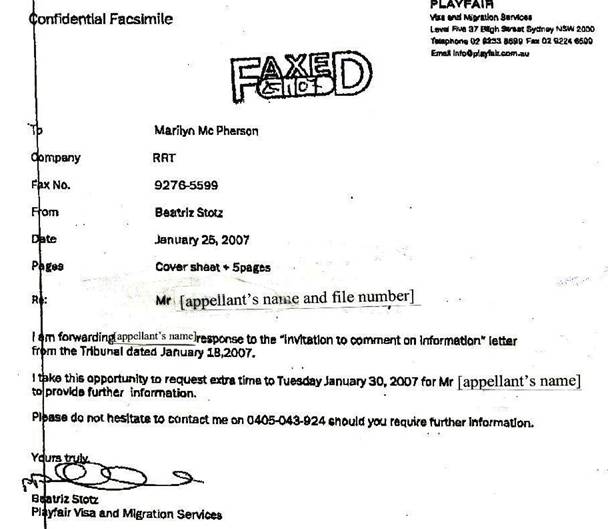
12 The appellant appeared for himself before the Federal Magistrates Court. The references in the particulars were to the three page letter sent on 18 January 2007 by the Tribunal to Ms Stotz (the “Decision Record CB 228-230”) and a confidential facsimile from Ms Stotz at Playfair to Ms Marilyn McPherson, one of the Tribunal case officers (the “Decision Record CB 233”). That latter document is attached as annexure ‘A’ to these reasons.
13 Annexure ‘A’ is the form of document kept by Playfair. The “faxed” stamp was put on at Playfair. The version of this page that was received by the Tribunal and later written on by the Tribunal had a facsimile machine imprint at the top of the page as follows:
“25/01/2007 14:46 61292246599 page 01/01”
(The telephone number, 61292246599, was that of the Playfair facsimile line.) At the bottom of this page of the Tribunal’s printed received page the following appeared:
“PAGE 1/1 *RCVD AT 25/01/2007 4:10:41 PM [AUS Eastern Daylight Time] * SVR: SYDFAX/4* DNIS:5599* CSID:61292246599* DURATION (mm-ss): 00-32”
The evidence before the Federal Magistrates Court did not explain the inconsistencies of the references to time in these two markings.
14 On the face of the document received by the Tribunal someone put, by way of marking by hand, an asterisk next to the second paragraph and wrote in hand on it to the right of the address and other information: “Request for extension to provide information”
15 It can be seen that the facsimile received by the Tribunal refers to the “cover page + 5 pages”. It can also be seen that the first paragraph of the facsimile, expressed in the present tense, stated that the response to the invitation letter was being forwarded. The second paragraph commenced by a reference to “this opportunity” (that is while something was being done) being taken to request extra time to provide further information.
16 The Federal Magistrate found, and no appeal is made from the finding, that only the cover sheet and not any enclosure was received by the Tribunal.
17 Notwithstanding the lack of appeal from that finding, it is necessary to examine what occurred before the Federal Magistrates Court, not only in the immediate resolution of the appellant’s appeal, but also by way of comment on the findings made about Ms Stotz.
18 The appellant conducted the hearing before the Federal Magistrates Court without legal assistance. Ms Stotz provided an affidavit in which she swore to the following:
(a) She prepared the appellant’s response to the “Invitation to Comment on Information”, which was a five page document that she attached to her affidavit.
(b) She prepared the cover sheet.
(c) On 25 January 2007, she requested the office manager at Playfair that the documents (6 pages in all) be sent by facsimile to the Tribunal. Ms Stotz did not say that she had sent them or that she observed them being sent.
(d) It was standard office practice at Playfair to contact the Tribunal to confirm receipt (that is, by the Tribunal) of a facsimile.
(e) In the afternoon of 25 January 2007, she received a call from a Tribunal officer on her mobile phone. She deposed to the following events:
The person stated that she was calling me regarding [name of the appellant]
I thanked the person for contacting me and stated that I wanted confirmation that the tribunal had received the Fax sent by Playfair that afternoon regarding [name of the appellant].
The Tribunal officer said that she was going to check and after a minute or so, she said: “Ýes, here it is, 5 pages.” I said thank you and we finished the conversation.
Under cross-examination, Ms Stotz was taxed with the question why the Tribunal officer would be ringing her. Her answer was tolerably understandable and conformable with common sense. Her explanation was as follows:
Why were they calling you? ---Well, the normal procedure is a fax will be sent and then the Tribunal will be called to check that the fax has been received. If the Tribunal will ring the case officer, or the person who the fax was addressed to, if the person, for example, is not there, then – whoever answers the phone – we will say, “We are ringing about – to confirm that this message – this fax transmission has been received.” Sometimes the person who takes the call will confirm – sometimes the person who takes the call says, “I will let the case officer know,” and sometimes the case officer will say, “well, I don’t have it yet but I will ring you to confirm when I have it.” So my understanding on that day is that I was out of my office, I received the call, it was a confirmation, “yes, the fax is here.”
[emphasis added]
If the fax room at Playfair had rung the Tribunal to check receipt, a case officer may well have been replying to Ms Stotz to tell her of receipt. It may also be noted that her recollection in the last sentence was “Yes, the fax is here” not, as it was elsewhere in her evidence,“Yes, here it is, 5 pages.” Later in cross-examination, she said that the conversation was:
‘I’m calling you about Mr [SZJBA],” and I said, “Yes. Did you receive the fax?” and she said, “No. Let me go and check,” and then, about a minute or two later, she said, “Yes, it’s here , the fax of around five pages,” and I said, “Yes, okay. Great,” she said, “Yes. Good,” and that is all the conversation that took place.
(f) Ms Stotz said that on the following Monday, 29 January 2007 (the previous Friday being the Australia Day public holiday), she had another conversation with a Tribunal officer as follows:
On Monday, January 29, I was contacted by phone by a Tribunal officer. The officer stated that a Fax was going to be forwarded to my office stating that the Member had not agreed to an extension of time to provide further information as requested in my Fax Message but the Member would not finalize [name of appellant]’s case until January 31, 2007 so I could still forward information until such time.
I explained to the Tribunal officer that that was all right because we (meaning [name of appellant] and I) had already submitted the comments we wished the Member to consider in the Response faxed on January 25, 2007 and the extra time requested in the Fax to provide further information was for the purposes of providing further country information, should anything developed in Fiji during the extra week that had been requested.
(g) Ms Stotz said that she did not know the names of the Tribunal officers with whom she spoke. She had dealt with a number while acting for the appellant.
19 At the hearing in the Federal Magistrates Court, three important factual matters were put in issue, which were distinct, though obviously related:
(a) whether the 5 page response was received by the Tribunal (or sent by Playfair, though its non-receipt was the primary focus);
(b) whether the conversation that Ms Stotz said occurred on 25 January 2007 occurred, at all;
(c) whether the conversation that Ms Stotz said occurred on 29 January 2007 occurred, at all.
20 No issue was raised and no question was put throwing into doubt the preparation and existence of the five page response.
21 It is also important to understand that the appellant’s case was not pleaded, but was asserted in the application in the way that is set out above.
22 The first respondent relied on two affidavits from one deponent, Mr Jonathan Willoughby-Thomas, the New South Wales District Registrar of the Tribunal, and the Migration Review Tribunal (the “MRT”). Mr Willoughby-Thomas said that he had “overall responsibility for receiving and managing review applications lodged in the MRT and the Tribunal in the New South Wales District Registry, including the management of all correspondence relating to applications for review.”
23 In his first affidavit, Mr Willoughby-Thomas stated that he had inspected the file (with which he otherwise had nothing to do). He gave a commentary (not admissibly) as to what the markings on the coversheet showed and meant. He then gave evidence (in part inadmissibly) as to what all officers of the MRT and the Tribunal were told about “case notes” (by which he meant diary notes) of discussions and what the procedure was for entering a note of conversations in the computer system. He said the following:
All officers of the MRT-RRT are instructed to take case notes of any discussions with review applicants, their migration agents, legal representatives, authorised recipients or other persons on behalf an applicant about a particular case. Annexed hereto and marked “C” is a copy of an email I sent to all New South Wales registry team leaders and managers on 14 July 2006 giving them instructions on the use of case notes.
Case notes are recorded in the ‘Case Notes’ screen of the MRT-RRT Case Management System (CMS). The MRT-RRT produced a CMS “Leader Guide” which was used to train officers when the CMS was introduced. The Leader Guide relevantly states “Case notes replace the need to write Post-it notes, Word memos or emails” and “if it is about a case it must be in the case”. Annexed hereto and marked “D” is a copy of the relevant extract from the CMS Leader Guide.
24 Mr Willoughby-Thomas then annexed a “complete copy of the case notes taken in the applicant’s matter”. The document was plainly tendered as a complete record of all conversations. Mr Willoughby-Thomas, could not, of course, prove any such thing. The limit of his knowledge was the system, including the instructions that had been given to case officers and any standard of compliance with the system that he had observed (though he gave no evidence of this latter kind). Nevertheless, in his affidavit he concluded with the entirely inadmissible statement emphasised below:
I have read the affidavit of Beatriz Stotz affirmed 7 May 2007. Annexed hereto and marked “E” is a complete copy of the case notes taken in the applicant’s matter. The absence of cases notes in relation to the conversations described at paragraphs 11 to 15 of the affidavit of Ms Stotz suggests to me that those conversations may not have taken place.
25 The case notes identified eight case officers who had entered diary notes between November 2006 and February 2007. None gave evidence. The evidence disclosed that they all were still employed by the Department.
26 On this state of the evidence, all that could be said about the case note document was that it was the document kept as a record of conversations, that the system was that notes of conversations were supposed to be entered, and that there was an instruction to that effect. There was no evidence as to whether instructions were invariably followed. There was no evidence from those who handled the appellant’s file. Notwithstanding this, Ms Stotz was cross-examined as follows:
I ask you to accept, for the purpose of my next question, that this is a complete copy of the case notes taken by the Tribunal in respect to the applicant’s application for review? --- Yes.
If you have a look at the second page – the first page commences with the first entry for 11 November 2006, on the first page. If you turn over ---? ---Yes.
---you will see that there re further entires, starting with 15 January 2007 and following down the page? --- Yes.
If you go down to the entry from 16 January ---? --- Yes.
---you’ll see that there is no entry made by the Tribunal on 25 January? --- Yes
There’s an entry for 16 January 2007? --- Yes.
And there’s an entry for 20 January 2007. would you agree with me that there is no record, apparent record, taken by the Tribunal of the conversation of 25 January 2007?--- Yes.
I put it to you on the basis of that evidence, that no conversation did take place between yourself and a member of the Tribunal on 25 January 2007? --- That’s not correct.
[emphasis added]
27 With respect to the cross-examiner, without proof of the completeness of the document (of which there was none) the last question should not have been asked, nor should it have been permitted by the Federal Magistrate. Apart from any other difficulty, the question was misleading because of the lack of proof of the completeness of the document as containing all conversations in the period.
28 There was no doubt, however, that in the cross-examination here and elsewhere Ms Stotz was clearly challenged on her version of events about the conversations taking place. She was not challenged at all, however, about preparing the five page response submission.
29 Mr Willoughby-Thomas was called on 10 May 2007. In his evidence in chief, he was asked a question and gave an answer which if viewed as evidence as to the system was unexceptional (though repetitive), but if given to show the completeness of the case notes document as recording all the conversations was plainly beyond his knowledge. He was asked and said as follows:
I’m wondering if you just outline, for the benefit of the Court, how these case notes come into existence and what they represent? --- Okay. The Tribunal keeps a record of all communication, correspondence or telephone conversations between the Tribunal and the applicant or their representative. All staff are instructed to- on every occasion that they deal with the applicant or their representative, that they are to record that information on the case management system, as a case note. The system is relatively user-friendly, you just click in on “Case note” and type it in, save it and it’s saved in the system, but all dealings with the applicant are recorded on Casemate.
30 Later, he was asked a question which (leaving aside its leading character) should not have been put or allowed to the extent that it sought evidence beyond the system:
Is it true to say that all oral communication between the Tribunal and the applicant or their representatives is on the CMS, or Casemate system, but not all file notes then make their way onto the actual file that goes before the Tribunal member? – Well, it would be fair to say, yes, that any dealings with the applicant that are recorded on Casemate, as they should be, would not necessarily be also on the file.
31 The appellant cross-examined Mr Willoughby-Thomas. Importantly for the proposition put by Mr Roberts SC, on behalf of the Minister, that the amended notice of appeal contains a new case, it should be noted that the appellant cross-examined for a time assuming that Mr Willoughby-Thomas was correct that the five page response was not received. The following exchange took place:
Sir, I put to you that if you received the coversheet of the fax which says, “Coversheet plus five pages” and you only received the coversheet, which is only one page, don’t you think you should be calling them and finding out why the five pages wasn’t there? Because you only received one page, which is the coversheet, which states that, “Coversheet plus five pages ---“? --- Right.
But you did not receive the five pages, did you? --- No, I’m assuming not, because it says only the one page was received.
Even though, by looking at the content of the first page, it says “One page plus five – coversheet plus five”? --- Right. If a case officer had picked that up and had, you know, been aware, yes, they may have rung but we receive hundreds of faxes a day and often they are printed off and placed on the file.
In other words, this case wasn’t picked up? --- I would say – I would say they didn’t – they’re not obliged to. They’re obliged to receive the information that the applicant sends. Right?
As I have been the applicant, don’t you think there should be somebody who is responsible, if they did not get the fax – and I’ve been in detention for 22 months. Should there have been somebody responsible to at least do something about it, that they did not receive the five pages of the fax? --- It would really depend on the officer receiving it. They may or may not have rung, but, receiving hundreds of these faxes, often they are, generally, printed off and placed on the file for consideration by the member.
So in this case it wasn’t done? --- I won’t say it wasn’t done but I – there’s no evidence that it was done.
When you say “There’s no evidence”, that means it wasn’t done?” --- No. I’m saying that there’s no evidence that it was done. I don’t know. I didn’t personally do it.
So do you say that there was an error, as far as your department was concerned?
[emphasis added]
32 After objection from counsel for the Minister, the Federal Magistrate then cut off this line of questioning in the following exchange:
Federal Magistrate: --- … I don’t agree with Mr Mitchell’s objection but, by the same token, I don’t think this line of questioning is of any help to me. Can you suggest why it would be?
Applicant: The way I look at it, your Honour, I have a feeling that there was an error made there, by not responding. I’ll give you an example, your Honour. For example, if somebody send me a fax with a coversheet that says, “Coversheet plus six pages”, and I don’t receive that six pages, I will definitely give them a call, saying that I only received one coversheet, not the six pages.
Federal Magistrate: The real question for me is whether the Tribunal received the six pages. That is the issue.
His Honour: That is correct, your Honour.
Federal Magistrate: The Tribunal is not obliged to make inquiries, so maybe different considerations apply to this. I think that the witness has said is that there is no evidence one way or the other. I’ll give you one or two more questions on the point but I think you should move on.
33 This (together with the Minister’s submissions) was the foundation for the Federal Magistrate saying in his reasons at [27]:
Although the headings on the 25 January 2007 facsimile might have put an alert reader at the Tribunal on notice that not all pages which had been intended to be sent were actually sent, or at least had not been received, the Tribunal is not obliged to make inquiries or to prompt and stimulate an elaboration which the applicant choses [sic] not to embark upon: Minister for Immigration & Multicultural & Indigenous Affairs v SGLB (2004) 207 ALR 12 at 21 – 22 [42] and [43]; Re Ruddock; Ex parte Applicant S154/2002 (2003) 201 ALR 437 at 451 [58]. No error is demonstrated by the Tribunal not correcting the applicant’s adviser’s error.
34 These conclusions also reflected what had been put to the Federal Magistrate by the Minister’s counsel in writing.
35 The above is enough to demonstrate that the argument sought to be propounded under the amended notice of appeal was run at the trial. There was no pleading. The amended application contained an assertion of a failure to afford procedural fairness. The appellant said that the cover sheet and five pages had been received. The Minister said that only the cover page had been received. The appellant said that even if that were so, the Tribunal should have taken steps to find out about the five pages, given the face of the cover sheet. The Minister said that there was no duty to inquire. The Federal Magistrate agreed with that last proposition. The appellant, through Dr Griffiths SC in the amended notice of appeal, challenges that conclusion. He is entitled to do so.
36 Before turning to the argument on that issue, it is necessary to say something further about the Federal Magistrate’s findings. I do so because a witness, the migration agent, Ms Stotz, was disbelieved on her oath. That, of course, was a very serious and grave conclusion. No appeal is taken about that finding. I have already said some things about her questioning. It needs to be added that after the first day’s hearing, another affidavit (of 18 May 2007) of Mr Willoughby-Thomas was filed and relied upon at a second day of hearing. This affidavit gave evidence of a search of the electronic memory of the facsimile machine. The affidavit contained hearsay material from a Ms Ruddy as to what the printout from the machine revealed. Based on what that other person (who was not called) had told him, Mr Willoughby-Thomas said that he believed that only one facsimile came from Playfair on 25 January 2007 and that he believed that this was the one page coversheet.
37 None of the case officers was called on this second day either.
38 On the evidence, the Federal Magistrate made the following findings at [24]-[26]:
I am satisfied that the Tribunal’s records disclose that on 25 January 2007 it received a facsimile transmission from the applicant’s agent of one page in length. That is also confirmed by the machine-made notations at the top and the bottom of the document. The evidence provided by Mr Willoughby-Thomas in his second affidavit satisfies me that the Tribunal’s records do not disclose that a further facsimile was sent by the applicant’s agent to the Tribunal that day and that, at no time prior to the handing down of its decision, did the Tribunal receive the further five pages which the applicant asserts had been sent to it. I also note that it is not the applicant’s case that the facsimile was sent more than once.
I do not accept that the evidence of the applicant’s adviser concerning the telephone conversations she says she had with officers of the Tribunal is accurate. It is not corroborated by contemporary file notes or by a facsimile transmission report from her office. Moreover, her evidence is contradicted by the Tribunal’s casenotes, where there is no record of statements relevant and important to these proceedings which the adviser says were made on 25 and 29 January 2007. Further, the Tribunal’s letter of 29 January 2007 (CB 234) suggests that the Tribunal had not received any substantive response to its s.424A(1) notice.
I find that on 25 January 2007 the applicant’s adviser faxed one page only to the Tribunal, that being the facsimile cover page reproduced at CB 233.
39 As I have said, no challenge was made on appeal to any of these findings. I only wish to say that I have serious reservations as to the legitimacy of finding in [25], effectively, that Ms Stotz was not telling the truth. Even if one accepts the evidence of Mr Willoughby-Thomas based, as it was, largely on hearsay and the views of another not called as to what the facsimile machine records showed, the receipt of only one page (the cover page) did not conclusively mean the conversation that Ms Stotz deposed to could not have taken place. The cover page contained a statement that it was accompanied by five pages. Someone could have read that (without seeing the five pages) and said that the “fax has arrived with five pages”. Not one available witness was called to contradict Ms Stotz.
40 I have not had the benefit of counsel’s argument on the above issues. I am not intending any personal criticism of counsel at the hearing, or of the Federal Magistrate. Ms Stotz was, however, a witness, and such a finding may be of significant damage to her personally and professionally. I simply wish to record the reservation that I have as to the legitimacy of the finding made about her.
The amended notice of appeal
41 The amended notice of appeal was in the following terms:
1. The Federal Magistrate erred in not holding that the decision of the Second Respondent dated 9 February 2007 was vitiated by the jurisdictional error on one or more of the following grounds.
Particulars
(a) Having regard to the contents of the coversheet of the Appellant’s facsimile dated 25 January 2007 and the Second Respondent’s obligations under sections 414, 420(1), 424A and 424C, the Second Respondent was obliged to, and did not, make appropriate enquiries of the Appellant or his representative concerning the substance of the comments he intended to make pursuant to the section 424A invitation before making a decision on the review;
(b) There was a breach of sections 414, 420(1), 424A and/or 424C of the Migration Act 1958 in the Second Respondent’s failure to take into account the Appellant’s response dated 25 January 2007 to the Second Respondent’s invitation dated 18 January 2007 under section 424A of the Migration Act 1958;
(c) Having regard to the matters set out in (a) above, the Second Respondent’s conduct and decision were unreasonable in the Wednesbury sense.
42 Though developed, in a legal sense, from the amended application in the Federal Magistrates Court, this complaint had been raised by the appellant in the conduct of the case. He made the assertion that even if one page only had been received, the Tribunal should have called. This was dismissed on the basis that there was no duty to inquire.
43 There was no issue but that the coversheet was received by the Tribunal. The coversheet plainly told the Tribunal that the response existed and that it was intended to be with the coversheet.
44 If the Minister wished to question whether the response existed at the time the facsimile was sent, he could have. Hardly surprisingly, he did not. Ms Stotz’s credit was put in issue about the conversation. She was not challenged on the existence of the five pages.
45 The question is whether the Tribunal erred in failing to call the number given on the coversheet to ask where the apparently intended five page response was.
46 In [27] of his reasons, the Federal Magistrate cited two cases in support of his conclusion that there was no duty to inquire: Minister for Immigration and Multicultural and Indigenous Affairs v SGLB (2004) 207 ALR 12 at 21-22 [42]-[43] and Re Ruddock; Ex parte S154/2002 (2003) 201 ALR 437 at 451 [58]. The first (SGLB 207 ALR 12) was a reference to the reasons of Gummow and Hayne JJ (with whom Gleeson CJ agreed). Their Honours in that case said that the power to obtain evidence under s 427 did not import an element of duty, a position made plain by s 426(3). That was a straightforward recognition that no duty to enquire about evidence arises from the terms of s 427 of the Migration Act. This much can be readily accepted. There are ample Full Court decisions to like effect. In S154 201 ALR 437, Gummow and Heydon JJ (with whom Gleeson CJ agreed) said in the context of examining how detailed the questioning of an applicant was required to be said that:
The Tribunal conducting an inquisitorial hearing is not obliged to prompt and stimulate an elaboration which the applicant chooses not to embark on.
This reference has nothing to do with the question here.
47 In Re Minister for Immigration and Multicultural Affairs v Miah (2001) 206 CLR at 69 [31], Gleeson CJ and Hayne J emphasised that in considering a legislative scheme or context and any particular kind of power within it:
It is necessary to pay regard to the practical context in which the decision maker must consider whether to exercise the power. This may be of particular importance where, as here, the complaint is of a failure by the decision-maker to communicate something to an affected person before a decision is made. It is the potential for a decision to affect rights, interests, or legitimate expectations, that attracts the requirement of procedural fairness.
48 The step that is said to have been required to have been taken here was to communicate with the representatives of the appellant, informing them of an apparently unsuccessful attempt to respond to a letter sent under s 424A. One can describe that as exercising a power. Any step in the administrative process is in one sense the exercise of power. It is more easily and aptly described as the taking of an administrative step within the context of the review process provided for by Part 7 of the Migration Act. Not to take that step or not to exercise that power was, in practical terms, to deny the appellant the invitation that he had apparently taken-up to respond to the letter of 18 January. Given that it was apparent that the response had not been received, through human or machine error, a failure to exercise the power or take the step had the consequence of ensuring that the response, which s 424A, or the actions of the Tribunal, contemplated was not received.
49 The Migration Act, s 424 provides for the Tribunal “getting” information that it considers relevant. Section 424(1) says that if the Tribunal gets such information, it must have regard to it. Section 424A contains the well-known obligation to send a letter giving the applicant particulars of relevant information and inviting the applicant to comment. Section 424B requires the invitation to specify how the comments may be given. Section 424C(2) empowers the Tribunal to make a decision if the comments are not given within time “without taking any further action to obtain the applicant’s views on the information.” It is implicit in Division 4 of Part 7 that the Tribunal must read and have regard to any response to an invitation to comment sent pursuant to s 424A. No express provision states as much, but Parliament did not need to. It would undoubtedly be wrong of the Tribunal to say that it may well have received the envelope containing the response, but it was not obliged to open it and read the contents, because it had no obligation to inquire. Such an obligation (together with one to have regard to the contents) inheres within Part 7 and the undertaking of the review process. The Tribunal is conducting a review by reference to the material before it. Here, the material before it was a document which, on its face, clearly stated that a response was provided, but evidently, through some oversight or error, human or machine, it had not been transmitted.
50 The giving of the invitation to comment (whether strictly required under s 424A or not) carries with it an obligation to deal with a communication in response to the invitation in a reasonably business-like way. Parliament does not have legislate for such matters. If it could be seen (as it could be from a plain reading of the coversheet) that a response was intended to be enclosed, but for some reason it was not, and the identity and the phone number of the sender was clear (as it was), not to take the simplest administrative steps to follow up the information was to deny or destroy, after the event, the genuineness and reality of the invitation to comment that had been given.
51 In Minister for Immigration and Multicultural and Indigenous Affairs v SCAR (2003) 128 FCR 553 (referred to by the High Court in SZFDE v Minister for Immigration and Citizenship [2007] HCA 35 at [35]), the Full Court discussed the content of the obligation in s 425 to invite the applicant to appear. Much of what was said there is relevant to the cognate invitation to comment. Each invitation must be “real and meaningful”. The time frame in which this is to be assessed may be open and may depend upon the question posed: compare NAHF v Minister for Immigration and Multicultural and Indigenous Affairs (2003) 128 FCR 359 at 364-5 and SCAR 128 FCR 553.
52 It does not seem to me to matter whether a letter was required to be sent by s 424A or not. If s 424A required the letter to be sent (see in particular SZBEL v Minister for Immigration and Multicultural and Indigenous Affairs (2006) 228 CLR 152and the sixth piece of information to be commented upon) a statutory obligation arose under ss 424A, 424B and 424C to give a real and meaningful invitation to comment. If the letter was not required by s 424A, nevertheless the Tribunal thought it was, and sent a letter to the appellant through his advisers requesting comment upon certain matters. Though purportedly sent under s 424A, it may simply have been sent under s 424, or merely as part of the exercise of executive power. In either case, the Tribunal having stated that it would receive a response was bound to give a real and meaningful opportunity to respond: see for example s 424(1).
53 On either basis, the obligation of the Tribunal to give a real and meaningful invitation to comment carried with it the obligation to take reasonably open and regular administrative procedural steps to permit or facilitate fulfilment of the real and meaningful nature of the invitation, where not to take such steps would undermine or subvert the meaningfulness or the reality of the invitation. That obligation involves such mundane things as opening letters, reading them once opened and taking at least basic simple steps that would be taken in any well-run commercial, professional or governmental office, conformable with the recognition of the importance of the response to the invitation to the rights of the applicant and the review process contained within Part 7 of the Migration Act. This does not rest on some posited duty of inquiry. It is not engaging in steps that require for their enforcement some express statutory power. The letter that was received, on its face, told any person who read it that there was with it, or supposedly with it, a five page document which was a response to the relevant invitation. On the facts found by the Federal Magistrate, the five page document was not enclosed. The response was an important document. It must have been, or should have been, apparent that an error (human or machine) had occurred. Whether or not someone did or did not read the coversheet and appreciate this is not determinative. It is clear that someone read at least the second paragraph. The first paragraph (immediately above the second paragraph) in its terms said (together with the express statement above it that there was a “coversheet + 5 pages”) that the response was forwarded when, on this hypothesis, it was not. Whether or not this letter was given to the Tribunal member or not, the Tribunal had notice, in clear plain English, that the appellant (through his advisers) had attempted (unsuccessfully) to respond to the invitation and that something (by way of human or machine error) had gone wrong. This was plain from the English language used on the coversheet. The fact that a person or persons at the Tribunal may not have so understood the coversheet (if that be the case) does not matter. Notwithstanding the submission of Mr Roberts SC, the coversheet was not ambiguous. The present tense was used. It stated that there were five pages with it. On the findings of the Federal Magistrate, there were not. The Minister cannot hide behind the Tribunal not reading, or not reading carefully enough, such an important communication. To do so is itself to undermine the reality and meaningfulness of the invitation to comment that the Tribunal itself had given. A hint of the approach or administrative mindset that led to no step being taken to ring Playfair about the apparently missing five pages can be seen in Mr Willoughby-Thomas’ evidence in cross-examination. Although he had no personal knowledge of the events the subject of the application and this appeal, he stated the following in the exchange with the applicant in cross-examination in the extract was that referred to earlier:
They may or may not have rung, but, receiving hundreds of these faxes, often they are, generally, printed off and placed on the file for consideration by the members.
54 It is not good enough to say that the Tribunal gets lots of faxes. This was an important document. It was apparently a coversheet to a response to an invitation to comment. Reading it made clear that what had apparently been intended to be sent had not been received. The obligation to give an invitation to comment, and separately or cumulatively, the giving of an invitation to comment carried with it, as I have said, an obligation of the kind that I have expressed to enable that invitation to be meaningful and real: that is the obligation to take reasonably open and regular administrative procedural steps of at least a simple character to permit or facilitate the fulfilment of the real and meaningful nature of the invitation. That started with the obligation to read the communication. It extended to ringing Playfair at the identified number to tell them the five pages apparently intended to be sent had not come through.
55 It was said that the five pages could have made no difference and so relief should be denied. I cannot agree. The Tribunal member took into account as a factor in disbelieving the appellant the fact that no response had been forthcoming. I am not prepared to usurp the bona fide and open-minded consideration of the appellant’s case by the Tribunal.
56 In my view, the inaction of the Tribunal for the reasons I have given, amounted to an undermining of the reality and meaningfulness of the invitation to comment that was given purportedly under s 424A or under s 424 or under the general executive power. As such, it was a jurisdictional error in that it undermined the steps in the conduct of the review undertaken pursuant to Part 7 of the Migration Act, that were required by, or authorised by, the statute or authorised as the conduct of the general executive power under s 61 of the Constitution which had been undertaken by the Tribunal, and, once undertaken, were not to be frustrated by the action or inaction of the Tribunal in circumstances where, as I have said, it was obliged to take basic and simple administrative procedural steps.
57 These conclusions can be fortified by the recognition, so often stated, that the Tribunal is engaged in an inquisitorial process: Re Ruddock; Ex parte S154 201 ALR at 450-451 [57]-[58], 455-6 [81], 457 [86] and [88]; Miah 206 CLR 57 at 69-70 [31]-[32]; Re Refugee Review Tribunal; ex parte H (2001) 179 ALR 425 at 435 [29]-[31]; Muin v Refugee Review Tribunal (2002) 190 ALR 601 at 648 [208]; Minister for Immigration and Multicultural Affairs v Respondents S152/2003 (2004) 205 ALR 487 at 513 [97]; Re Minister for Immigration and Multicultural Affairs; ex parte Epeabaka (2001) 206 CLR 128 at 146 [52]; Abebe v Commonwealth (1999) 197 CLR 510 at 576 [187]; NCSC v News Corporation Limited (1984)156 CLR 296 at 315; Re Refugee Review Tribunal; ex parte Aala (2006) 204 CLR 82 at [75]; Re Minister for Immigration and Multicultural and Indigenous Affairs; ex parte Applicants S134 (2003)195 ALR 1 at 8; Dranichnikov v Minister for Immigration and Multicultural Affairs (2003)197 ALR 389 at 405, [78]; Appellant S395 of 2002 v Minister for Immigration and Multicultural Affairs (2003) 216 CLR 473 at [39]; VEAL v Minister for Immigration and Multicultural and Indigenous Affairs (2005) 225 CLR 88 at 24; Re Applicant S v Minister for Immigration and Multicultural Affairs (2003) 217 CLR 387 at 413 [76]; NAFF v Minister for Immigration and Multicultural and Indigenous Affairs (2004) 221 CLR 1 at [22]; SZAYW v Minister for Immigration and Multicultural and Indigenous Affairs (2006) 229 ALR 423 at [4]; SZBEL 228 CLR 592 at [40]; SZFDE [2007] HCA 35 at [30]; Minister of Immigration and Multicultural Affairs v Wang (2003) 215 CLR 518 at 540-41 [71], 526 [18] and 531 [37]; SAAP v Minister for Immigration and Multicultural and Indigenous Affairs (2005) 215 ALR 162 at [111] ff and [199]; NAIS v Minister for Immigration and Multicultural and Indigenous Affairs (2005) 223 ALR 171 at [9], [69] and [165].
58 This inquisitorial function has become relevant in a number of contexts. In Applicant S 217 CLR at 413 [76] McHugh J said:
If the Tribunal had considered the issue that it was legally required to consider, it was open to the Tribunal to investigate whether such a perception existed, whether within the Afghan society or some section of it, or objectively. Indeed, arguably in the context of its inquisitorial process, the Tribunal had a duty to seek evidence concerning this vital matter.
59 Here, the question was not whether the Tribunal should have undertaken some evidence gathering task. The failure here was to take a simple administrative step of an office or housekeeping nature, the failure to take which could be seen on its face at the time to subvert the observance of the Tribunal of its obligation to give procedural fairness by the giving of the s 424A letter, or by the operation of s 424, or by the general executive power. Division 4 of Part 7 is the statutory formulation of the giving of natural justice: see s 422B. Given the importance of procedural fairness for the principles of jurisdictional error sourced in s 75(v) of the Constitution: see SZFDE [2007] HCA 55 at [32], any subversion of the process of the Tribunal is a matter of importance: SZFDE [2007] HCA 55 at [32].
60 The same conclusion is to be reached by the application of the principles that in certain circumstances the decision of a Tribunal or decision-maker will be vitiated if some inquiry is not made. Most recently, Kenny J examined these cases in her Honour’s comprehensive judgment in Minister for Immigration and Citizenship v Le [2007] FCA 1318. It can readily accepted, as her Honour said, that there is no general obligation to inquire found in s 424(7), nor is there a general obligation to initiate inquiries or to make an applicant’s case for him or her. I refer, without repetition, to the long list of cases referred to by Kenny J in Le [2007] FCA 1318 at [60]. The absence of such a general obligation of inquiry can be accepted, without denying the limited proposition supported by numerous other cases that, in certain exceptional cases, a failure to make some inquiry may ground a finding of jurisdictional error if it was plainly necessary to make some reasonably straightforward inquiry before the making of the relevant decision: Prasad v Minister for Immigration and Ethnic Affairs (1985) 6 FCR 155 at 169-70. Kenny J discusses this in Le at [60]-[67]. I adopt without repetition her Honour’s reasons. The only qualification that I would make to her Honour’s reasons is that the rubric of Wednesbury unreasonableness may cover circumstances that amount to jurisdictional error and those that amount to error within jurisdiction. It is unnecessary here to explore such possible differences. Here, the failure to take the steps, which in my view were required in the review process, subverted an opportunity to respond to an invitation contemplated or authorised by the statute as part of the review process and so amounted to jurisdictional error.
61 The orders of the Court will be:
1. The appeal be allowed.
2. The orders of the Federal Magistrates Court made on 29 June 2007 be set aside and in lieu thereof it be ordered that
(a) the decision of the second respondent made on February 2007 be set aside and the review of the delegate’s decision in respect of the appellant be remitted to the second respondent to be heard according to law; and
(b) the first respondent pay the applicant’s costs before the Federal Magistrates Court.
3. The first respondent pay the appellant’s costs of the appeal.
62 Once again, may I express the Court’s thanks to counsel for the appellant who appeared pursuant to a request of the Court under Order 80. The disposition of the judicial power of the Commonwealth in cases such as these, when a point of difficulty or principle arises, cannot be satisfactorily effected without the support of the profession. It is a public service of significant importance, in particular when executed with the efficiency and skill shown by counsel in this case.
|
I certify that the preceding sixty-two (62) numbered paragraphs are a true copy of the Reasons for Judgment herein of the Honourable Justice Allsop. |
Associate:
Dated: 16 October 2007
|
Counsel for the Appellant: |
Dr J Griffiths SC (pro bono) |
|
|
|
|
Counsel for the Respondent: |
Mr P Roberts SC and Mr J Mitchell |
|
|
|
|
Solicitor for the Respondent: |
Australian Government Solicitor |
|
|
|
|
Date of Hearing: |
12 October 2007 |
|
|
|
|
Date of Judgment: |
16 October 2007 |
Attachment A