

FEDERAL COURT OF AUSTRALIA
Shop Distributive and Allied Employees’ Association v Karellas Investments Pty Ltd (No. 2) [2007] FCA 1425
Criminal Code Act 1995 (Cth) and Chapter 2 of the Criminal Code
Trade Practices Act 1974 (Cth) s 87(1) and (1A)
Workplace Relations Regulations 2006 (Cth) Regs 8.13 and 8.15 (within Chapter 2)
Byrne v Australian Airlines Limited (1995) 185 CLR 410 cited
Ansett Transport Industries (Operations) Proprietary Limited v Wardley (1980) 142 CLR 237 cited
Quickenden v O’Connor (2001) 109 FCR 243 cited
Briginshaw v Briginshaw (1938) 60 CLR 336 referred to
Rejfek v McElroy (1965) 112 CLR 517 referred to
Gould v Vaggelas (1985) 157 CLR 215 referred to
The State of Victoria v Sutton (1998) 195 CLR 291 cited
Brooks v Burns Philp Trustee Co. Ltd. (1969) 121 CLR 432 cited
Demagogue Pty Ltd v Ramensky [1992] 39 FCR 31 referred to
SHOP DISTRIBUTIVE AND ALLIED EMPLOYEES' ASSOCIATION v KARELLAS INVESTMENTS PTY LTD (ACN 008 547 911)
NSD 768 OF 2007
GRAHAM J
12 SEPTEMBER 2007
SYDNEY
| IN THE FEDERAL COURT OF AUSTRALIA |
|
| NEW SOUTH WALES DISTRICT REGISTRY | NSD 768 OF 2007 |
| BETWEEN: | SHOP DISTRIBUTIVE AND ALLIED EMPLOYEES' ASSOCIATION Applicant
|
| AND: | KARELLAS INVESTMENTS PTY LTD (ACN 008 547 911) Respondent
|
| GRAHAM J | |
| DATE OF ORDER: | 12 SEPTEMBER 2007 |
| WHERE MADE: | SYDNEY |
THE COURT:
1. Declares that the employee collective agreement styled ‘Karellas Investments Pty Ltd Employee Collective Agreement 2007’ was not approved in accordance with s 340(2) of the Workplace Relations Act 1996 (Cth).
2. Orders that the Amended Application filed in Court on 23 May 2007, be otherwise dismissed.
3. Orders that there be no order as to costs.
Note: Settlement and entry of orders is dealt with in Order 36 of the Federal Court Rules.
| IN THE FEDERAL COURT OF AUSTRALIA |
|
| NEW SOUTH WALES DISTRICT REGISTRY | NSD 768 OF 2007 |
| BETWEEN: | SHOP DISTRIBUTIVE AND ALLIED EMPLOYEES' ASSOCIATION Applicant
|
| AND: | KARELLAS INVESTMENTS PTY LTD (ACN 008 547 911) Respondent
|
| JUDGE: | GRAHAM J |
| DATE: | 12 SEPTEMBER 2007 |
| PLACE: | SYDNEY |
REASONS FOR JUDGMENT
1 The respondent, Karellas Investments Pty Ltd (ACN 008 547 911) (‘Karellas’) is the proprietor of two retail stores which trade under the ‘I.G.A.’ banner, one at Cremorne and the other at Blaxland in the State of New South Wales. In April 2007 it had 85 employees at its Cremorne store and 151 employees at its Blaxland store who answered the description of shop assistants, butchers, apprentice butchers, pastry cooks, bakers, apprentice bakers and/or apprentice pastry cooks, some of whom were identified as ‘Adult’ and others as ‘-19 years’.
2 One such employee at the Blaxland store was Sandra Elisabeth Stringer who worked for Karellas as a permanent part-time night fill retail assistant. She was a member of the New South Wales branch of the applicant.
3 The applicant alleges that Karellas contravened s 341(1) of the Workplace Relations Act 1996 (Cth) (‘the Act’) on or about 1 May 2007 when it lodged an employee collective agreement with the Employment Advocate which had ‘not been approved in accordance with section 340’ of the Act.
4 The applicant also alleges that the respondent made false or misleading statements to another person in circumstances that constituted a contravention of s 401(1) of the Act in or about 19 – 27 April 2007.
Workplace Agreements
5 Sections 326 – 332 of the Act make provision for the making of various forms of workplace agreements. These may take the form of an ‘AWA’ or ‘Australian workplace agreement’, which is made in writing between a particular employer and a particular person whose employment is subject to the agreement, or collective agreements, variously described as employee collective agreements, union collective agreements, employer greenfields agreements, union greenfields agreements and multiple-business agreements. This case is concerned with the making of an employee collective agreement.
6 Section 327 of the Act provided:
‘327 An employer may make an agreement (an employee collective agreement) in writing with persons employed at the time in a single business (or part of a single business) of the employer whose employment will be subject to the agreement.’
7 An employee collective agreement is made at the time when the agreement is approved in accordance with s 340 of the Act (see s 333(b)).
8 Section 418 of the Act provided for the making of regulations in relation to, amongst other things, the signing of workplace agreements by persons bound by those agreements, or representatives of those persons.
9 Regulation 8.13 of the Workplace Relations Regulations 2006 (Cth) (‘the Regulations’) relevantly provided:
‘8.13(1) For paragraph 418(e) of the Act, an employer must obtain the signatures of:
(a) for all workplace agreements – the employer … in relation to the agreement; and
(b) in addition to paragraph (a):
(i) if the workplace agreement is an employee collective agreement – a representative of the employees to the agreement …
…
(2) For subregulation (1), a signature to the workplace agreement must be accompanied by:
(a) the full name and address of each person signing the workplace agreement in accordance with subregulation (1); and
(b) an explanation of the person’s authority to sign the workplace agreement.
…
(5) The validity of a workplace agreement is not affected by a failure to comply with subregulations (1) and (2).’
10 Under s 347(1) of the Act a workplace agreement comes into operation on the day the agreement is lodged with the Employment Advocate. By virtue of s 347(2), such an agreement ‘comes into operation even if the requirements in Divisions 3 and 4 [ss 334-341] and section 342 have not been met in relation to the agreement’.
11 By virtue of s 351 of the Act a workplace agreement that is in operation relevantly binds the employer in relation to the agreement and all persons whose employment is, at any time when the agreement is in operation, subject to the agreement.
The proceedings
12 The applicant is an organisation of employees that represents an employee who is or will be bound by the employee collective agreement (‘the 2007 Agreement’) which was lodged on 1 May 2007 with the Employment Advocate, in this case. Ms Stringer, an employee of Karellas who is bound by the 2007 Agreement, requested the applicant to make the application presently before the Court for an order under Division 11 of Part 8 of the Act in relation to the 2007 Agreement. It is common ground that the requirements of s 405(3) of the Act have been satisfied. Accordingly, the applicant is a competent applicant in respect of the present application within the meaning of s 405(1)(d) of the Act, brought by it on behalf of Ms Stringer.
13 In respect of the contraventions which have been alleged it would be open to the Court to order the payment of pecuniary penalties in respect of each contravention up to $33,000. However, no such relief is sought. All that is sought is an order under s 409(a) of the Act. In that regard, the Act relevantly provided:
‘409 The Court may make an order:
(a) declaring that the workplace agreement is void; …
…
412(1) An order under section 409 … takes effect from the date of the order or a later date specified in the order.
(2) The Court may make an order under section 409 … only to the extent that the Court considers appropriate to remedy the following:
(a) all or part of any loss or damage resulting from the contravention mentioned in section 408 [in this case a contravention of s 341(1) and/or s 401(1)];
(b) prevention or reduction of all or part of that loss or damage.’
(emphasis added)
14 In clause 1 of Schedule 7 to the Act entitled ‘Transitional arrangements for existing pre-reform Federal agreements etc’ (see s 8 of the Act) ‘pre-reform certified agreement’ was defined to mean an agreement that:
‘(a) was made under Division 2 or 3 of Part VIB of this Act before the reform commencement; and
(b) was certified under Division 4 of Part VIB of this Act (whether before the reform commencement, or after the reform commencement because of Part 8 of this Schedule).’
The reform commencement was 27 March 2006.
15 In relation to pre-reform certified agreements Part 2 of Schedule 7 relevantly provided:
‘3(1) A pre-reform certified agreement ceases to be in operation in relation to an employee if a collective agreement … comes into operation in relation to that employee.
...
(5) If a pre-reform certified agreement has ceased operating in relation to an employee because of subclause (1), the agreement can never operate again in relation to that employee.
…
5(1) While a pre-reform certified agreement is in operation, it prevails, to the extent of any inconsistency, over:
(a) a preserved State agreement; or
(b) a notional agreement preserving State awards.
(2) While a pre-reform certified agreement is in operation, it prevails over an award to the extent of any inconsistency …
…’
The Employee Collective Agreement
16 The 2007 Agreement in respect of which relief is sought as aforesaid is annexure ‘A’ to an affidavit of David John Bliss sworn 4 May 2007. It is 16 pages in length. It is entitled ‘Karellas Investments Pty Ltd Employee Collective Agreement 2007’ and is expressed to be made:
‘BETWEEN
Employer: Karellas Investments Pty Ltd
A.B.N: 48 008 547 911
AND
Employees of the Employer bound by this Agreement’
17 Clause 3 of the 2007 Agreement provides for it to have a ‘nominal term of 5 years from the date on which the Agreement is lodged with the OEA’.
18 The relationship between the 2007 Agreement and an individual employee’s contract of employment with Karellas was dealt with in clauses 3 and 4 of the 2007 Agreement as follows:
‘3.2 This Agreement provides for minimum legal entitlements only, and shall not restrict the Employer and Employee/s from agreeing to higher rates of pay, or additional benefits.
3.3 All Protected Allowable Award Matters are expressly excluded from operation by this Agreement.
4.1 The employment status of Employees shall be as agreed between the Parties and recorded in writing. This status will be permanent, salaried or casual.’
19 Under the heading ‘Minimum Wages for Ordinary Hours’ clause 8 of the 2007 Agreement provided, inter alia:
‘8.1 The minimum rates of pay for each hour worked by Existing Employees are in accordance with the Australian fair Pay and Condition Standard (AFPCS) and as specified in clause 9 to this Agreement. These rates will be adjusted proportionate to movements in the AFPCS as amended by the Australian Fair Pay Commission from time to time.
…
8.4 Casual Employees will be entitled to the appropriate casual rate of pay in accordance with the Australian fair Pay and Conditions Standard, which includes a casual loading of 20%.
…’
20 Clause 9 of the 2007 Agreement under the heading ‘Penalty Rates’ provided:
‘9.1 Non-Salaried Existing Employees are entitled to the following penalties.
9.2 All hours worked by an Existing Employee on a Sunday between 5 am and midnight shall be paid at a rate of time and a half the Existing Employee’s ordinary hourly rate of pay.
9.3 All hours worked by an Existing Employee between midnight and 5 am on any day from midnight Sunday to 5 am Saturday shall be paid at a rate of time and a quarter the Existing Employee’s ordinary hourly rate of pay.
9.4 All hours worked by an Existing Employee on a Public Holiday, as defined by clause 13 of this agreement, shall be paid at a rate of double time the Existing Employee’s ordinary hourly rate of pay.’
21 In s 4(1) of the Act ‘Australian Fair Pay and Conditions Standard’ was given the meaning for which s 171(3) of the Act provided as follows:
‘171(3) The provisions of Divisions 2 to 6 [referring to ss 176-316 of the Act] constitute the Australian Fair Pay and Conditions Standard’
22 The 2007 Agreement concluded with a page providing for execution for and on behalf of the employer and execution for and on behalf of the employees. It commenced:
‘We hereby certify that we agree to the terms of the Karellas Pty Ltd Employee Collective Agreement 2007.’
23 In the space provided for execution of the 2007 Agreement by the employee representative the following words appeared:
‘Signed for and on behalf of the employee/s
I, the undersigned, state that I am an Employee of the Employer and am proposed to be covered by this Agreement. I counted the votes in a secret ballot of Employees in relation to the Agreement, and on this basis I state that a valid majority of Employees have made this Agreement.’
The distinction between a contract of employment and an employee collective agreement
24 The prevailing system of industrial regulation from time to time has allowed for individual contracts of employment between a given employer and a given employee to be underpinned in a variety of ways. Firstly, there have been industrial awards, then there may have been pre-reform certified agreements and, more recently, workplace agreements. In this case it is unnecessary to address the legal significance of an Australian workplace agreement between an employer and an employee which may have been executed by the employer and the employee in the manner for which s 340(1) of the Act provides.
25 The underpinning regime, as I have described it, does not require that the rights and obligations for which it provides should become contractual rights and obligations.
26 The interaction of pre-reform certified agreements with other instruments was dealt with in clause 5 of Schedule 7 to the Act as indicated above.
27 As also indicated above, clause 3(1) of Schedule 7 to the Act provided for pre-reform certified agreements to cease to be in operation in relation to an employee if, relevantly, a collective agreement came into operation in relation to that employee.
28 The 2007 Agreement came into operation on the day that the agreement was lodged with the Employment Advocate notwithstanding that the requirements of ss 334-342 of the Act may not have been met in relation to it.
29 Under s 349 of the Act an award has no effect in relation to an employee while a workplace agreement operates in relation to the employee.
30 In the case of an employee collective agreement the relevant statutory underpinning afforded to it is to be found in s 351 of the Act. Under s 351(b), when in operation, such an agreement binds all persons whose employment is subject to the agreement, regardless of whether an individual employee cast a valid vote deciding that that employee did not want to approve the agreement or not and whether an individual employee was an employee of Karellas at the time when the 2007 Agreement came into operation.
31 In dealing with a situation where there was an award underpinning an individual contract of employment Brennan CJ, Dawson and Toohey JJ said in Byrne v Australian Airlines Limited (1995) 185 CLR 410 at 421:
‘In a system of industrial regulation where some, but not all, of the incidents of an employment relationship are determined by award, it is plainly unnecessary that the contract of employment should provide for those matters already covered by the award. The contract may provide additional benefits, but cannot derogate from the terms and conditions imposed by the award and, … the award operates with statutory force to secure those terms and conditions. Neither from the point of view of the employer nor the employee is there any need to convert those statutory rights and obligations to contractual rights and obligations. …’ (footnote omitted)
32 Earlier, their Honours explained at 420:
‘A right to the payment of award rates is imported by statute into the employment relationship, which is contractual in origin, and, express promise apart, it is only in that sense that it can be said that award rates are imported into the contract of employment. The award regulates what would otherwise by governed by the contract. But award rates are imported as a statutory right imposing a statutory obligation to pay them. The importation of the statutory right into the employment relationship does not change the character of the right. As Latham CJ points out in his judgment in Amalgamated Collieries of WA Ltd v True, the legal relations between the parties are in that situation determined in part by the contract and in part by the award. And as the judgment of the Privy Council in that case suggests, a provision in an award may also be made a term of the contract by agreement between the parties, but that is only to emphasise the distinction between an obligation imported by statute and one arising by agreement.’ (footnote omitted)
33 To like effect, Wilson J said in Ansett Transport Industries (Operations) Proprietary Limited v Wardley (1980) 142 CLR 237 at 287 – 8:
‘… It will be seldom … that an award will lend itself to the “covering the field” test of inconsistency on the subject of the contract of employment. Few, if any, awards reflect an intention to express completely, exhaustively or exclusively the law governing that contract between the parties. It will generally be a case of specific provisions which will, of course, have the effect of rendering inoperative any provisions of subordinate law, whether common law or statutory, touching that employment with which they are inconsistent. In Reg. v Industrial Court of South Australia; Ex parte General Motors-Holden’s Pty. Ltd. Walters and Wells JJ., in a passage with which I respectfully agree, discuss the relationship of an award to the common law and to statute law and refer with approval to the following passage from Webb: Industrial Relations and the Contract of Employment (1974), p. 21:
“The significance of the common law can be recognised if contracts of employment are seen to be stratified. First there is a foundation strata being the common law. Superimposed on this are State Acts, regulations and State industrial determinations; in places such State law cuts through and replaces the common law foundational strata. Above this again are Commonwealth Acts, regulations and awards of the Arbitration Commission. Federal law cuts through State law in places, sometimes at the point where State law has already cut through common law, sometimes direct into common law.”
Their Honours also refer, inter alia, to the remarks of Latham C.J. in Amalgamated Collieries of W.A. Ltd. v True.’ (footnotes omitted)
34 In relation to a pre-reform certified agreement serving as an underpinning instrument, such a situation was considered by a Full Court of this Court in Quickenden v O’Connor (2001) 109 FCR 243. At [69] Black CJ and French J said:
‘The broad brush complaint that common law contractual rights were displaced by the certified agreement faced another threshold issue. For while the agreement bound Dr Quickenden by force of law, it did not thereby terminate his contract of employment. It created rights and obligations which were statutory in character and could operate in addition to the rights and obligations under his contract and, where inconsistent, no doubt displace them. There is nothing in the agreement however which expressly sets aside or displaces the terms of existing or common law rights generally. The agreement itself is not, on the face of it, and is not expressed to be, exhaustive of the rights and duties of those bound by it. If anything it focuses upon the rights of employees, rather than their obligations.’
35 In his reasons for judgment Carr J said at [131]:
‘… As the High Court of Australia explained in Byrne v Australian Airlines Ltd (1995) 185 CLR 410 at 420 – 421 an award imposes certain statutory terms and conditions which do not necessarily displace underlying common law contractual relations. If they conflict, the award or certified agreement may modify the contractual provisions, but otherwise they continue to co-exist. Byrne involved an award, but there does not seem to be any relevant distinction, for present purposes, between an award and a certified agreement. …’
36 In the case of the 2007 Agreement it displaced a pre-reform certified agreement and provided what I have referred to as an ‘underpinning’ for the individual contracts of employment of Karellas’ employees.
The alleged false or misleading statements
37 The applicant’s concerns in relation to the approval of the 2007 Agreement arise from two publications put around by Karellas in the period 19 – 27 April 2007. The first document is four pages in length. It is on the letterhead of Karellas and addressed to ‘Dear Employee’. It is dated 19 April 2007. On the second page it has been signed by a Peter Smith as ‘Operations Manager’. The second document is three pages in length. It is also on the letterhead of Karellas and addressed to ‘Dear Employee’. It also bears the signature of Mr Smith as ‘Operations Manager’. It is undated.
Copies of the two documents are attached to these reasons for judgment as appendices ‘A’ and ‘B’ respectively.
38 The two documents were the subject of certain interrogatories administered by the applicant upon the respondent on 25 June 2007. Verified answers to these interrogatories were provided on 26 July 2007. Further verified answers were provided on 10 August 2007 which qualified the original answers. The applicant was content to tender both sets of answers and to allow the respondent to have the benefit of the qualifications. Relevantly, the answers provided establish that copies of the 19 April 2007 document were made available by the respondent to approximately 85 out of 85 employees at its Cremorne store and approximately 151 out of 151 employees at its Blaxland store ‘in or about April 2007 and before 3.00 pm on 27 April 2007’. It is agreed between the parties, and supported by the further verified answers, that notwithstanding the terms of the original answers, there were different versions of the four page document. Depending on an employee’s job classification, he or she received as part of the document a table of ‘Examples of your new pay rates if the Proposed Agreement is approved by a valid majority of Employees’ which may have been applicable to (say) ‘Shop Assistant Casual – 19 Years’ or (say) ‘Shop Assistant Casuals Adult’. Somewhat curiously, one version of the document bears the manuscript date ‘20/4/07’ against Mr Smith’s signature and another version bears the manuscript date ‘19/7/07’ (sic) against his signature.
39 The second (undated) document was made available to 65 of the employees of Karellas who worked at the Blaxland store between 4.30 pm on 26 April 2007 and 3.00 pm on 27 April 2007, by leaving copies of it in the ‘Tea Room’. Of those 65 employees, between five and ten were handed a copy personally. No copies of it or parts of it were made available to the employees who worked at the Cremorne store. Two copies of the document which are in evidence suggest that Mr Smith may have separately signed each individual copy of it.
40 On Friday 27 April 2007 an organiser employed by the New South Wales branch of the applicant had a discussion with Mr Vasilli Karellas, a director of Karellas at a coffee shop in or near to Cremorne. During the course of the discussion Mr Vasilli Karellas said to the union organiser words to the effect of:
‘… we have circulated a letter this morning to all staff confirming that they will get a 5% wage increase.’
Mr Karellas proceeded to leave the union organiser at the coffee shop returning approximately five minutes later with a single page document which he handed to the union organiser. The single page document was a copy of the first page of the three page (undated) document referred to above.
41 The applicant’s case turns upon the four page document dated 19 April 2007 (the particular version being unimportant), the three page (undated) document and, so it was said, a conversation to which Ms Stringer deposed in her affidavit sworn 4 May 2007 with a Mr Chris Kable, whom she described as ‘my immediate manager at IGA Blaxland’. The relevant part of Ms Stringer’s affidavit was as follows:
‘11 … In particular, I recall telling Mr Kable that, among other things, our rest breaks, overtime rates and Picnic Day were all removed from the Agreement. In response to my concerns I recall Mr Kable telling me words to the effect of:
“I don’t think its legal to take meal breaks and rest breaks away from you. I think they are staying as they are. If you vote ‘yes’, you will still get your meal breaks and rest breaks.”’
42 No evidence has been provided to establish that Mr Kable had any relevant authority to make admissions in respect of the 2007 Agreement which would be binding on Karellas. At the end of the day, the applicant withdrew its reliance upon the Stringer/Kable conversation.
Sections 340(2)(a) and 341(1)
43 In relation to the alleged contravention of s 341(1) of the Act the applicant’s case is that such approval as may have been given to the 2007 Agreement was not approval in accordance with s 340(2)(a) of the Act. It was acknowledged that there had been compliance with what were described as the ‘mechanical provisions’ contained in s 340(2)(b).
44 Sections 340(2) and 341(1) relevantly provided:
‘340(2) An employee collective agreement … is approvedif:
(a) the employer has given all of the persons employed at the time whose employment will be subject to the agreement a reasonable opportunity to decide whether they want to approve the agreement; and
(b) either:
(i) if the decision is made by a vote – a majority of those persons who cast a valid vote decide that they want to approve the agreement; or
(ii) otherwise – a majority of those persons decide that they want to approve the agreement.
341(1) An employer contravenes this subsection if:
(a) the employer lodges a workplace agreement …; and
(b) the agreement has not been approved in accordance with section 340.
…’
45 The applicant contends that if a publication is put around by an employer within a week or so before a vote by employees is taken on whether to approve or disapprove an employee collective agreement, and that publication contains representations which are false or misleading and are likely to materially influence a decision one way or the other, then the employer will not have ‘given all of the persons employed at the time whose employment will be subject to the agreement a reasonable opportunity to decide whether they want to approve the agreement’ within the meaning of s 340(2)(a) of the Act.
46 A short chronology referable to the period 19 April – 1 May 2007 appears hereunder:
19 April 2007 Karellas first put around the various versions of the four page document
21 April 2007 Ms Stringer was handed her copy of the 19 April document by Mr Kable
26-27 April 2007 Copies of the three page document were made available to employees working at the Blaxland store
28 April 2007 Ms Stringer took a copy of the three page document from the Blaxland store tearoom
27 -30 April 2007 Employees at the Cremorne and Blaxland stores voted by secret ballot on the approval/non-approval of the 2007 Agreement
30 April 2007 Ms Stringer voted on the approval/non-approval of the 2007 Agreement at the Blaxland store
30 April 2007 7.00 pm a notice was posted inside the Blaxland store tearoom with words to the effect ‘The Workplace Agreement has been approved by a majority of employees’
47 In respect of the 78 employees at the Cremorne store who cast a valid vote, 70 voted to approve the employee collective agreement and 8 voted against approval. The evidence does not establish what the outcome of the vote was at the Blaxland store.
48 The applicant submits that, by making the false or misleading statements upon which it relies in the four page document dated 19 April 2007 and the (undated) three page document, Karellas deprived persons employed at the time, whose employment would be subject to the 2007 Agreement, of a ‘reasonable opportunity to decide’ whether they wanted to approve the agreement.
49 It seems to me that if the minds of the relevant employees were or were likely to be contaminated by misinformation about the 2007 Agreement and its effect then it could be said that such employees were denied a ‘reasonable opportunity to decide’ whether they wanted to approve it. In the absence of any evidence whatsoever as to the effect of any of the matters of alleged misinformation on the minds of any of Karellas’ employees, the likely effect of such alleged misinformation has to be considered.
50 The giving of a reasonable opportunity to decide for which s 340(2)(a) provides, is not simply concerned with timeliness of information or access to the relevant employee collective agreement. Timeliness is covered by s 337 which relevantly provided:
‘337(1) If an employer intends to have a workplace agreement … approved under section 340, the employer must take reasonable steps to ensure that all eligible employees in relation to the agreement either have, or have ready access to, the agreement in writing during the period:
(a) beginning 7 days before the agreement is approved; and
(b) ending when the agreement is approved.
(2) The employer must take reasonable steps to ensure that all eligible employees in relation to the agreement are given an information statement at least 7 days before the agreement is approved.
...
(4) The information statement mentioned in subsection (2) … must contain:
(a) information about the time at which and the manner in which the approval will be sought under section 340; and
…
(c) if the agreement is an employee collective agreement – information about the effect of section 335 …
…
(8) An employer contravenes this subsection if:
(a) the employer lodges a workplace agreement; and
(b) the employer failed to comply with subsection (1) … in relation to the agreement;
(9) An employer contravenes this subsection if:
(a) the employer lodges a workplace agreement; and
(b) the employer failed to comply with subsection (2) or (if applicable) paragraph (3)(a) in relation to the agreement.
…’
51 It may be observed that there is nothing in the relevant Ministers’ Second Reading Speeches or any Explanatory Memorandum to indicate what may have beenintended by the use of the phrase ‘a reasonable opportunity to decide’ within the meaning of s 340(2)(a) of the Act.
52 The respondent submits that a seeming failure to comply with s 340(2)(a) may be ignored, in the absence of evidence that the employer’s failure to give all of the persons employed at the time whose employment would be subject to the relevant employee collective agreement a reasonable opportunity to decide whether they wanted to approve the agreement or not caused a person so employed to cast a vote in favour of approval of the agreement which, had they been given a reasonable opportunity to decide, they would not have cast in that way.
53 I am unable to discern any such requirement from the words of s 340(2) of the Act, whether viewed on their own or in the context of the other provisions of Division 5 of Part 8.
54 Undoubtedly, a judgment as to whether or not ‘a reasonable opportunity to decide’ has been given will require consideration of the likely effect that misinformation, given by an employer, may have upon an employee’s decision to vote one way or another. A trivial misstatement in a document put around by an employer could hardly amount to a failure by the employer to give all of the persons employed at the time whose employment would be subject to the proposed employee collective agreement a reasonable opportunity to decide whether they wanted to approve the agreement or not.
55 In my opinion the ultimate consequence that may flow from the failure by an employer to give ‘a reasonable opportunity to decide’ is an irrelevant consideration. Whether an employer has or has not given all of the persons employed at the time whose employment would be the subject to the agreement a reasonable opportunity to decide whether they wanted to approve the agreement or not should be capable of being determined immediately prior to the ballot at which votes may be cast one way or the other.
56 It seems to me that there is some force in the respondent’s submission in this case to the effect that judgment on the question of whether Karellas gave all of the persons employed at the time whose employment would be subject to the proposed employee collective agreement a reasonable opportunity to decide whether they wanted to approve the agreement or not, should have regard to the lack of any evidence whatsoever from employees expressing dissatisfaction with the outcome that was secured as a result of a majority of those persons casting valid votes that they wanted to approve the 2007 Agreement.
57 That, however, is not the end of the matter. The applicant has identified numerous representations said to have been made by Karellas in the documents which it put around, which the applicant submits were false. The representations upon which the applicant relies were as follows:
| Representation number | Relevant paragraph of Statement of Claim | Substance of the representation |
| 1 | 2(i) | Under the 2007 Agreement, employees would receive a pay rise of at least 5% |
| 2 | 2(ii) | Under the 2007 Agreement, employees would continue to receive their penalty rates |
| 4 – 9 | 9(i) – 9(vi) | Under the 2007 Agreement, employees would receive a guaranteed 5% pay increase, would not incur a pay decrease and would receive certain identified rates of pay |
| 10 | 9(vii) | Under the 2007 Agreement, casual loading of 24.58% had been retained |
| 12 | 9(ix) | Under the 2007 Agreement, public holidays had been retained |
| 13 | 9(x) | Under the 2007 Agreement, entitlement to penalty rates had been retained |
| 14 | 9(xi) | Despite the abolition of redundancy provisions, redundancy had been retained |
Those representations which were identified by the applicant as numbers 3 and 11 were not pressed.
58 The applicant alleged that representations numbered 1 and 2 were to be found in the four page document dated 19 April 2007 and that the remaining representations were to be found in the three page document.
59 Relevantly, the four page document dated 19 April 2007 included the following:
‘Dear Employee,
As you are aware, the Karellas Investments Pty Ltd Enterprise Agreement 2003, has passed its nominal expiry date. As such, Karellas Investments Pty Ltd is proposing to implement a collective workplace agreement that will cover all employees whilst complying with the current complex workplace relations laws. This proposed Agreement will operate for 5 years and will become the legal minimum framework for our terms and conditions of employment at Karellas Investments Pty Ltd.
This Agreement is called the Karellas Investments Pty Ltd Employee Collective Agreement 2007 and is attached to the staff noticeboard for everyone’s access.
Five Percent Pay Increase!
You will receive at least a 5% pay rise if the Agreement is approved by a valid majority of employees across Karellas Investments Pty Ltd. You will not receive your pay rise to your ordinary hourly rate unless the proposed Agreement is approved across the business.
Accordingly, upon approval of the Agreement by a valid majority of employees, your revised ordinary hourly rate of pay and some examples of your higher penalty and superannuation entitlements is set out in the attached rates schedule.
In simple terms, vote YES for the Agreement to vote YES for a pay rise!
…
Key advantages of the proposed Agreement are:
1. You will immediately receive at least a 5% pay rise if the Agreement is approved
2. Future wages increase will be in accordance with Australian Fair Pay Commission Adjustments
3. You will continue to receive weekend, late night and public holiday penalties
…
We Need Your Support
The proposed agreement delivers the advantages above …. We ask for your support to approve this agreement …. Please show your support by voting YES for the proposed agreement.
…
Kind Regards,
…’
60 The text of the communication was then followed by a table of rates appropriate for the relevant category of employee to whom it was provided. Such schedules had the heading:
‘Examples of your new pay rates if the Proposed Agreement is approved by a valid majority of Employees’
61 The final page of the four page document concerned the modus operandi for voting on the approval of the relevant employee collective agreement. It included:
‘Your employer must allow you a reasonable opportunity to decide whether you want to approve the employee collective agreement.’
62 The ‘Karellas Investments Pty Ltd Enterprise Agreement 2003’ referred to was a pre-reform certified agreement within the meaning of Schedule 7 to the Act which came into force from 23 July 2003 and was expressed to ‘remain in force until 22 July 2006’. Clause 1 of the agreement (the ‘2003 Agreement’) provided:
‘1. This agreement shall be known as the Karellas Investments Pty. Ltd. Enterprise Agreement 2003.’
63 Clause 3 of the 2003 Agreement relevantly provided as follows:
‘3a. This agreement shall be binding on Karellas Investments Pty. Ltd … its employees for who (sic), classifications exist in this Agreement and the Shop Distributive and Allied Employees Association … [the applicant]
...’
64 Clause 8 of the 2003 Agreement provided for ordinary hours of work and for penalty rates as follows:
‘8. Spread of Ordinary Hours and Additional Penalties
a. Ordinary hours may be worked during the following times:
i. Monday to Friday – 5.00 am to Midnight.
ii. Saturday – 5.00 am to 10.00 pm.
iii. Sunday – 7.00 am to 7.00 pm.
b. Other times may also be worked outside the ordinary hours and be paid at the appropriate rates as stated below:
i. for work between midnight and 5.00am on any day from midnight Sunday to 5.00am Saturday and between 10.00pm and midnight Saturday:
1. full-time and part-time employees: normal rate plus 30%;
2. casual employees: normal rate plus 54.58%.
ii. for work between midnight Saturday and 7.00am Sunday and for work between 7.00pm Sunday and midnight Sunday;
1. full-time and part-time employees: normal rate plus 100%;
2. casual employees: normal rate 124.58% (sic).
c. The following additional penalties shall apply to work done within ordinary hours:
i. for work between the hours of 7.00am on Sunday to 7.00pm on Sunday:
1. full-time and part-time employees: ordinary rate plus 50%
2. casual employees: ordinary rate plus 74.58%.’
65 In respect of casual employment clause 12b provided:
‘12. Casual Employment
…
b. A casual employee shall be paid at the ordinary rate for all time worked in ordinary hours plus an additional 24.58% for all time worked during each engagement.’
66 In relation to public and other holidays clause 16 of the 2003 Agreement provided:
‘16. Public Holidays
a. Permanent employees shall be entitled, without loss of pay, to public holidays as observed in each State/Territory as follows:
New Years Day
Australia Day
Good Friday
Easter Saturday
Easter Monday
ANZAC Day
Queen’s Birthday (Birthday of Sovereign)
Labour Day (8 Hour day)
Christmas Day
Boxing Day
…
c. The following days shall be taken in addition to the days named above, or in lieu of where stated:
New South Wales – in addition, Picnic Day shall be on the first Tuesday of November in any year, or on any other day agreed between the Union and the Company. Such day shall be treated as an additional day off or pay in lieu. However work on this day will not attract holiday penalty rates.
…’
67 Clause 51 of the 2003 Agreement dealt with a number of topics under the heading ‘Redundancy’. These included ‘Discussions Before Terminations’, ‘Transfer to Lower Paid Duties’, ‘Transmission of Business’, ‘Time off Work During Notice Period’, ‘Notice To Employment National’, ‘Severance Pay’, ‘Employee Leaving During Notice Period’, ‘Incapacity to Pay’, ‘Alternative Employment’, ‘Employees Exempted’ and ‘Employees With Less Than One Year’s Service’.
68 In the Schedule of Wage Rates appearing at the end of the 2003 Agreement the full-time adult employee weekly rate of pay for January – July 2006 was recorded as $572.00.
69 The three page document that was put around by the respondent amongst certain of its employees at its Blaxland store (see Appendix ‘B’) included:
‘ Truth about the Proposed Employee
Collective Agreement –
The Facts
Dear Employee,
We are aware that false and misleading information regarding the proposed Karellas Investments Pty Ltd Employee Collective Agreement 2007 has been circulated to some employees. Employee must be aware of the facts, truths and key benefits of the Agreement.
| Guaranteed 5% Pay Increase |
Employee WILL NOT incur a pay decrease from the approval of the collective Agreement.
[a table then follows which records a table of rates of pay under the headings ‘Shop Assistants’, ‘Existing Agreement’ and ‘Proposed Agreement’]
…
You do deserve a pay rise and the Employer has recognized this through offering a 5% pay increase. …
| Key Benefits are Retained |
· Casual loading of 24.58% is retained.
…
· You are entitled to ALL gazetted public holidays in the State of NSW. This includes Easter Saturday, Queens Birthday and Labour Day in accordance with clause 13 of the Agreement.
· You are still entitled to penalties at clause 9 under the proposed Agreement – there are no reductions to your weekend penalties.
· The Agreement does not provide for redundancy or severance payments. However, this is still protected under common law termination obligations including redundancy.
…
As demonstrated by this correspondence, you are better off under the proposed collective Agreement.
| VOTE YES |
FOR THE ABOVE BENEFITS AND SECURE
YOURSELF A BETTER DEAL.
Kind regards,
…’
70 In my opinion the applicant’s contention that representation 12 was false should be rejected, as should its contention that representation 14 was false.
71 There can be no doubt that when the three page document referred to ‘Key Benefits’ that were being retained it was referring to the retention of benefits within the terms of the 2007 Agreement which were to be found in the 2003 Agreement. However, the statement that employees retained an entitlement to ‘ALL gazetted public holidays’ could not, when compared with the 2003 Agreement, which it replaced, be said to constitute a misrepresentation. The three page document made no mention of the loss of an entitlement to a picnic day on the first Tuesday of November or on some other day agreed between the applicant and the respondent, but, equally, it did not imply that such a benefit had been retained.
72 In relation to ‘redundancy or severance payments’ it is abundantly clear from the three page document that the 2007 Agreement made no provision for such payments. It cannot be suggested that Karellas was representing that any rights conferred by the 2003 Agreement in respect of redundancy were being retained in the 2007 Agreement. In my opinion, the statement ‘However, this is still protected under common law termination obligations including redundancy’ does not involve any relevant misrepresentation. It is undoubtedly true that the common law provides protection in the event that a person’s employment is terminated without due notice and otherwise than for misconduct. One circumstance where compensation may be payable would be where a person’s employment was terminated without due notice in circumstances where that person had become redundant.
Findings of misrepresentation
73 To a greater or lesser extent it seems to me that each of the other matters complained of by the applicant were false and/or misleading in significant respects. In my opinion, by putting the two documents around the respondent denied the persons employed by it at the time whose employment would be subject to the employee collective agreement a reasonable opportunity to decide whether they wanted to approve the agreement or not. The obligation cast upon Karellas to give all of the persons employed the necessary ‘reasonable opportunity to decide’ was not satisfied.
74 In my opinion the four page document represented that the 2007 Agreement itself provided for a pay rise of at least 5% above the rates of pay for which the 2003 Agreement made provision.
75 The applicant accepts that if the rate of pay under the 2007 Agreement was less than the rate of pay under the 2003 Agreement the difference may be viewed de minimis and, for present purposes, ignored. However, the applicant maintains that the 2007 Employee Collective Agreement did not provide for a 5% pay rise when compared with the prevailing rate under the 2003 Enterprise Agreement.
76 It was acknowledged by Karellas that the 2007 Agreement included no such provision. My understanding is that Karellas would say that its employees in fact received under their individual contracts of employment a pay rise of at least 5%. This may be so, but, in my opinion, it was misleading, to say the least, to suggest that the 2007 Agreement provided for such a pay increase.
77 In my opinion, the three page document represented that the 2007 Agreement provided for the retention of the penalty rates for which the 2003 Agreement provided.
78 Once again, it was acknowledged by Karellas that such a representation, if made, was false. Whilst the rate of pay for work between (say) 7:00 am and 7:00 pm on a Sunday may have remained at time and a half, nevertheless for (say) work between midnight on a Monday and 5:00 am on the following day, the penalty rate was reduced from normal rate plus 30% to normal rate plus 25% for full-time and part-time employees.
79 Whilst the relevant bullet point under the heading ‘Key Benefits are Retained’ in the three page document was cleverly worded, in my opinion, it was at the least misleading in relation to the retention of penalty rates when it said that employees were ‘still entitled’ to penalties under the 2007 Agreement and failed to mention that in some circumstances those penalty rates had been reduced.
80 Similar observations may be made in respect of the paragraph numbered 3 in the four page document dated 19 April 2007 under the heading ‘Key advantages of the proposed Agreement are:’.
81 In relation to the representation contained in the three page document that under the 2007 Agreement the casual loading of 24.58% had been retained, it seems to me that this is also false or misleading. The relevant casual loading was reduced from 24.58% in the 2003 Agreement to 20% under the 2007 Agreement.
82 In the foregoing circumstances I consider that the representations relied upon by the applicant and identified by it as 1, 2, 4 – 9, 10 and 13 were false or misleading. The employees of Karellas were misinformed in relation to the true effect of the 2007 Agreement when contrasted with the 2003 Agreement. In the circumstances all of the persons employed by Karellas in April 2007 whose employment would be subject to the 2007 Agreement, if approved, were not given by Karellas a ‘reasonable opportunity to decide’ whether they wanted to approve the 2007 Agreement or not. Accordingly, the 2007 Agreement was not approved within the meaning of s 340(2) of the Act notwithstanding that a majority of those employees who cast a valid vote may have decided that they wanted to approve the 2007 Agreement. In the circumstances Karellas contravened s 341(1) by lodging the 2007 Agreement with the Employment Advocate when it had not been ‘approved in accordance with section 340’.
Section 401
83 Section 401(1) of the Act, which the applicant contends was also contravened by the respondent, relevantly provided as follows:
‘401(1) A person contravenes this section if:
(a) the person makes a false or misleading statement to another person; and
(b) the person is reckless as to whether the statement is false or misleading; and
(c) the making of that statement causes the other person:
(i) to make, approve, lodge, vary or terminate a workplace agreement; …
…’
84 As I understand the applicant’s case, it contends that by putting around the four page document, incorporating whatever was the appropriate table of pay rates, dated 19 April 2007 and the (undated) three page document in the period 19-30 April 2007 Karellas made false or misleading statements within the meaning of s 401(1)(a) of the Act.
85 In relation to s 401(1) of the Act the applicant submits that all of the required elements covered by subparagraphs (a), (b) and (c)(i) have been satisfied in the circumstances of this case.
86 In relation to the use of the word ‘reckless’ in s 401(1)(b) of the Act the respondent draws attention to certain references to when a person is reckless ‘with respect to a circumstance’ or ‘with respect to a result’ as found in s 5.4 of the Criminal Code, being the criminal code set out in the Schedule to the Criminal Code Act 1995 (Cth).
87 Regulation 8.15 of the Regulations provided:
‘8.15 Unless the contrary intention appears in the Act or these Regulations, Chapter 2 of the Criminal Code (other than section 13.2 and Part 2.7) applies to civil remedy provisions in this Part as if those provisions were offences.’
88 Section 13.2 of the Criminal Code provided for a standard of proof beyond reasonable doubt. Plainly that standard has no application to the current proceedings.
89 Section 729 of the Act provided:
‘729 A court hearing a proceeding under a civil remedy provision must apply the rules of evidence and procedure for civil matters.’
90 The relevant standard of proof in the present case is that enunciated by Dixon J, as his Honour then was in Briginshaw v Briginshaw (1938) 60 CLR 336 (‘Briginshaw’) at 361-362 as follows:
‘… when the law requires the proof of any fact, the tribunal must feel an actual persuasion of its occurrence or existence before it can be found. It cannot be found as a result of a mere mechanical comparison of probabilities independently of any belief in its reality. No doubt an opinion that a state of facts exists may be held according to indefinite gradations of certainty; and this has led to attempts to define exactly the certainty required by the law for various purposes. Fortunately, however, at common law no third standard of persuasion was definitely developed. Except upon criminal issues to be proved by the prosecution, it is enough that the affirmative of an allegation is made out to the reasonable satisfaction of the tribunal. …’
In Rejfek v McElroy (1965) 112 CLR 517 at 521-522 Barwick CJ, Kitto, Taylor, Menzies and Windeyer JJ said:
‘But the standard of proof to be applied in a case and the relationship between the degree of persuasion of the mind according to the balance of probabilities and the gravity or otherwise of the fact of whose existence the mind is to be persuaded are not to be confused. The difference between the criminal standard of proof and the civil standard of proof is no mere matter of words: it is a matter of critical substance. No matter how grave the fact which is to be found in a civil case, the mind has only to be reasonably satisfied and has not with respect to any matter in issue in such a proceeding to attain that degree of certainty which is indispensable to the support of a conviction upon a criminal charge …’
In Briginshaw, Dixon J also said at 362:
‘… But reasonable satisfaction is not a state of mind that is attained or established independently of the nature and consequence of the fact or facts to be proved. The seriousness of an allegation made, the inherent unlikelihood of an occurrence of a given description, or the gravity of the consequences flowing from a particular finding are considerations which must affect the answer to the question whether the issue has been proved to the reasonable satisfaction of the tribunal. …’
91 In relation to recklessness s 5.4 (in Chapter 2) of the Criminal Code provided:
‘5.4(1)A person is reckless with respect to a circumstance if:
(a) he or she is aware of a substantial risk that the circumstance exists or will exist; and
(b) having regard to the circumstances known to him or her, it is unjustifiable to take the risk.
(2) A person is reckless with respect to a result if:
(a) he or she is aware of a substantial risk that the result will occur; and
(b) having regard to the circumstances known to him or her, it is unjustifiable to take the risk.
(3) The question whether taking a risk is unjustifiable is one of fact.
(4) If recklessness is a fault element for a physical element of an offence, proof of intention, knowledge or recklessness will satisfy that fault element.’
92 There was no evidence as to Karellas’ awareness of any risks associated with the making by it of statements in the four page document or the three page document that may be found to have been false or misleading. Furthermore, there was no evidence as to the circumstances known to Karellas which may have made any risk unjustifiable.
93 Turning to subparagraph (c)(i) of s 401(1) of the Act, there was no evidence to support a finding that the making of any false or misleading statement, in one or other of the two documents mentioned, to another person or persons, caused that other person or persons to approve the relevant employee collective agreement. Approval under s 340(2) of the Act requires, of course, a collective decision by a majority of employees who may cast valid votes on the question of approval.
94 The applicant submitted that it may be inferred from the making of false or misleading statements in the four page document and/or the three page document that the making of the statements caused persons to whom the statements were made to approve the 2007 Agreement. In support of this submission reliance was placed upon certain statements of principle enunciated by Wilson J in Gould v Vaggelas (1985) 157 CLR 215 at 236. Gould v Vaggelas was a case of fraud where Gould Holdings Pty Limited purchased the South Molle tourist resort from a number of companies associated with Vaggelas. Mr and Mrs Gould sought damages for deceit in respect of representations made to Mrs Gould that the business was very profitable, the Vaggelases having submitted false figures as to occupancy rates and financial returns. Wilson J summarised the relevant principles applicable to such a case as follows at 236:
‘1. Notwithstanding that a representation is both false and fraudulent, if the representee does not rely upon it he has no case.
2. If a material representation is made which is calculated to induce the representee to enter into a contract and that person in fact enters into the contract there arises a fair inference of fact that he was induced to do so by the representation.
3. The inference may be rebutted, for example, by showing that the representee, before he entered into the contract, either was possessed of actual knowledge of the true facts and knew them to be true or alternatively made it plain that whether he knew the true facts or not he did not rely on the representation.
4. The representation need not be the sole inducement. It is sufficient so long as it plays some part even if only a minor part in contributing to the formation of the contract.’
95 His Honour proceeded to say at 238:
‘… Where a plaintiff shows that a defendant has made false statements to him intending thereby to induce him to enter into a contract and those statements are of such a nature as would be likely to provide such inducement and the plaintiff did in fact enter into that contract and thereby suffered damage and nothing more appears, common sense would demand the conclusion that the false representations played at least some part in inducing the plaintiff to enter into the contract.’
96 However, his Honour emphasised that the onus of proof rested on the plaintiff. At 238-239 he said:
‘… When all the facts are in, the fact-finding tribunal must determine whether or not it is satisfied on the balance of probabilities that the misrepresentations in question contributed to the plaintiff's entry into the contract. The onus to show that they did is a condition precedent to relief and rests at all times on the plaintiff.’
97 In my opinion, absent any evidence that the making of any false or misleading statement to another person or persons caused that other person or persons to vote to approve the 2007 Agreement, a ‘fair inference of fact’ that the making of the false or misleading statement or statements relied upon caused the person or persons to approve the 2007 Agreement would not be available. It is quite possible that, the causal link between the making of a false or misleading statement to another person or persons and the approval of, in this case, the 2007 Agreement by a majority of those persons who cast a valid vote deciding that they wanted to approve same, is missing because the employees of Karellas who cast valid votes indicating that they wanted to approve the agreement, did not even read the documents containing the false or misleading statements upon which the applicant has relied, let alone pay any regard to them.
98 It follows that the applicant’s case for contravention of s 401(1) must fail.
Relief
99 Given the contravention of s 341(1) which has been found the Court has power under s 409(a) to declare the 2007 Agreement void, as the applicant would wish the Court to do, provided that a proper case for such an order was made out under s 412(2) of the Act.
100 By virtue of s 412(1) of the Act it is clear that an order declaring the 2007 Agreement ‘void’ would only take effect from the date of the order or a later date specified in the order.
101 In my opinion, an order declaring that the 2007 Agreement was void would not breathe new life into the 2003 Agreement as a pre-reform certified agreement. By virtue of clause 3(1) of Schedule 7 to the Act, when taken with clause 3(5), the 2003 Agreement ceased to be in operation when the 2007 Agreement was lodged with the Employment Advocate and once it ceased operating, it could not be revived. To use the words of clause 3(5) it could ‘never operate again in relation to’ Karellas’ employees. This may seem a curious outcome. Nevertheless, s 347 of the Act made it clear that the 2007 Agreement came into operation on the day that it was lodged with the Employment Advocate and that it did so notwithstanding that, relevantly, the requirements of s 340(2)(a) had not been met in relation to it.
102 Had s 409(a) empowered the Court to make an order declaring the 2007 Agreement to be void ab initio, it certainly would have been a curious outcome to have the 2003 Agreement permanently displaced. But that is not what the legislature had in mind. Plainly, when one has regard to the terms of s 412(1) of the Act it is apparent that what the legislature intended was that from the date of the relevant order declaring the agreement void or a later date specified in that order, the relevant workplace agreement would cease to have any force and effect.
103 In relation to the use of the word ‘void’ Gaudron, Gummow and Hayne JJ said in The State of Victoria v Sutton (1998) 195 CLR 291 (‘Victoria v Sutton’) at [38]:
‘Windeyer J said of the term “void” that it “has never been an easy word” and pointed out that it did not necessarily mean that the void act had no legal effect at all. In particular, where … a disposition between two parties is described as “void” at the will of a third, the preferred construction is to read “void” as “voidable”. …’ (footnote omitted)
104 The reference to the observations of Windeyer J were to his Honour’s judgment in Brooks v Burns Philp Trustee Co. Ltd. (1969) 121 CLR 432 at 458-459 where his Honour said:
‘“Void”, “Invalid”, “Unenforceable”.
I have in this judgment used the words “invalid”, “unenforceable” or “ineffectual”, as, in similar cases, other judges have done. Other words and phrases can be used. For example, in the judgment under appeal the appellant’s covenant is called “illegal and void”. A similar promise was called by Asquith L.J. “void and unenforceable”: Gaisberg v. Storr …. The words used do not matter if the actual legal result they are used to express be not in doubt or debate. But it has always seemed to me likely to lead to error, … to adopt first one of the familiar legal adjectives - “illegal”, “void”, “unenforceable”, “ineffectual”, “nugatory” - and then having given an act a label, to deduce from that its results in law. That is to invert the order of inquiry, and by so doing to beg the question, and allow linguistics to determine legal rights. That need not happen if words be used, as Hobbes said that by wise men they should be, only as counters to reckon with; but reckoning becomes difficult if the values of counters are not constant. There may be no difficulty for adherents to Humpty Dumpty’s principle as expounded by him to Alice. But his latitude and his command of his words as his servants are not generally allowed to lawyers. They are called upon to interpret other men’s words.
The word “void” has never been an easy word, as is pointed out in the second Australian edition of Cheshire and Fifoot’s Law of Contract, p. 440. It is commonly said that when it describes a juristic act it means that it was always devoid of legal consequences. But this in itself is ambiguous, as witness the difference (which I have emphasized by italics) between the first edition of Sir George Paton’s Text Book of Jurisprudence (1946) and the second edition (1951). In the first it was said (at p. 241) that “if the defects [of a juristic act] are such that the act has nolegal effect at all, then the act is said to be void”. The relevant passage in the latter edition (at p. 250) states - more accurately perhaps, and influenced probably by Professor Cohn's remarks in Law Quarterly Review, vol. 64 (1948), at pp. 325, 326-
“A defect may make a juristic act either void or voidable. If the defect is such that the act is devoid of the legal results contemplated then the act is said to be void. A void act is sometimes said to be a nullity in law, but this is not strictly so, as an act void in its primary intent may nevertheless have an effect in another way.”’ (footnote omitted)
105 In Victoria v Sutton, Kirby J expounded upon the meaning of the word ‘void’ at [95] as follows:
‘… The word “void” is inherently ambiguous … . It sometimes means that the act in question has not, and never has had, any legal effect (void ab initio). But sometimes it means that the act becomes void as against the world or against those who cannot enforce or take advantage of it subsequently (void ex post facto). “Void” is in some contexts treated as synonymous with “voidable” or voidable at the election of the party for whose benefit a legal rule makes the transaction void. The task of a court, in differentiating between the available meanings of the word, is to ascertain the objective of the lawmaker in the particular circumstances. It is to discover the meaning to be attributed to the word which is natural to its context. Many past cases demonstrate that the use of the word “void” presents a problem of statutory construction. There is no settled meaning.’ (footnotes omitted)
Section 412(2)
106 In the foregoing circumstances the question arises as to whether the Court should exercise its discretion to declare the 2007 Agreement void. By virtue of s 412(2) of the Act the Court may exercise its discretion favourably to the applicant only to the extent that the Court considers appropriate to remedy the following:
(a) all or part of any loss or damage resulting from the contravention by Karellas of s 341(1) of the Act;
(b) prevention or reduction of all or part of that loss or damage.
107 The key words in s 412(2) are ‘resulting from’ the contravention.
108 There is absolutely no evidence to suggest that by virtue of the 2007 Agreement coming into operation when lodged with the Employment Advocate otherwise than in accordance with s 341(1) of the Act any Karellas employee suffered any monetary loss or damage. The highest that the applicant can put the case which it brought on Ms Stringer’s behalf is to say that by virtue of Karellas’ contravention of s 341(1) of the Act in relation to the 2007 Agreement, the employee collective agreement underpinning her own contract of employment has become one which contains some terms that are less favourable than those for which the 2003 Agreement provided e.g. in respect of the applicable penalty rate payable for work on (say) a Tuesday morning between midnight on the previous night and 5.00 am where the relevant penalty rate would be the rate of time and a quarter of her ordinary hourly rate of pay, instead of her normal rate of pay plus 30%.
109 It may be observed that subparagraphs (a) and (b) of s 412(2) of the Act are not expressed conjunctively or disjunctively. However, reference to the Explanatory Memorandum circulated by authority of the then Minister for Employment and Workplace Relations in respect of the Workplace Relations Amendment (Work Choices) Bill 2005 makes it clear that the disjunctive was intended. Paragraph 1296 of the Explanatory Memorandum provides:
‘1296. Subsection 105I(2) would provide that the Court may only make an order under section 105F, 105G or 105H if the Court considers that the order is appropriate to:
· remedy all or part of any loss or damage resulting from the contravention of the civil remedy provision mentioned in proposed section 105E (paragraph 105I(2)(a)); or
· prevent or reduce all of (sic) part of that loss or damage (paragraph 105I(2)(b)).’
110 It seems to me that the critical inquiry under s 412(2) of the Act must be as to what, if any, loss or damage resulted from the contravention, in this case, of s 341(1).
111 The applicant relied upon the judgment of the Full Court in Demagogue Pty Ltd v Ramensky (1992) 39 FCR 31 (‘Demagogue’) to support the proposition that ‘loss or damage’ did not have to be loss or damage for which monetary damages could be awarded. That may well be correct but Demagogue may be distinguished on the basis that it concerned misleading or deceptive conduct in contravention of the Trade Practices Act 1974 (Cth) (‘the Trade Practices Act’), in the form of non-disclosure by a vendor of unusual features relating to access to land located at Noosa Heads in the State of Queensland, which the purchasers, who sought relief under s 87(1) and/or (1A) of the Trade Practices Act, acquired by entering into a contract which they would never have entered into had they been aware of the true position with regard to access to the site. The trial judge had clearly found a causal link between the misleading and deceptive conduct and the purchasers’ entry into the contract (see per Black CJ at 33 and per Gummow J at 42).
112 Each of Black CJ, Gummow J and Cooper J found that the expression ‘loss or damage’ where used in s 87 of the Trade Practices Act, and which corresponded in many respects with s 412(2) of the Act in the present case, could include being saddled with an agreement which had been induced by misleading or deceptive conduct. At 33 Black CJ said:
‘… I consider it to be clear that the loss or damage contemplated by s 87(1A) is not limited to loss or damage in the s 82 [monetary damages] sense but was intended to include the detriment suffered by being bound to a contract unconscionably induced.
…
In my view, the loss or damage for the purposes of both ss 87(1) and 87(1A) will include the detriment suffered by being bound to a contract induced by misleading or deceptive conduct in contravention of s 52. Proof of loss or damage of the sort that would be an “amount of … loss or damage” for the purpose of s 82 is not a prerequisite for the grant of relief under either subsection.’
113 Gummow J, in his leading judgment, said at 42-43:
‘The phrase “loss or damage” appears in s 82 and in various subsections of s 87, particularly subss (1) and (1A). In my view, on this appeal nothing turns upon the circumstance that in a given case subs (1) may be attracted only by reason of the making of an application under s 82 to recover the amount of the loss or damage suffered by conduct in contravention in (sic) a provision of Pt IV or V.
Section 82 is concerned with the recovery of “the amount of the loss or damage” suffered by conduct in contravention of the Act. Section 87(1) requires that the court consider that its order will compensate “in whole or in part” for the loss or damage or will prevent or reduce the loss or damage. Section 87(1A) requires that the orders concerned will compensate in whole or in part for the loss or damage suffered “or likely to be suffered”, or will “prevent or reduce the loss or damage suffered, or likely to be suffered …”.
Thus, whilst s 82 is concerned with the recovery of an amount representing the loss or damage, s 87 is concerned with compensation, whether in whole or in part, for loss or damage and with the reduction of loss or damage, and with the prevention of loss or damage which is likely to be suffered. In the phrase “likely to be suffered”, the word “likely” speaks of a “real chance or possibility”: Western Australia v Wardley Australia Ltd (1991) 30 FCR 245 at 261.
One significant distinction between ss 82 and 87 is the quia timet operation of s 87. On the appeal to the High Court in Wardley Australia Ltd v Western Australia (1992) 175 CLR 514 at 527 [Mason CJ, Dawson, Gaudron and McHugh JJ said]:
“The Act draws a clear distinction in Pt VI between loss or damage which may be recovered under s 82 and the likelihood of loss or damage which may be prevented, or, if not prevented, reduced by one of the remedies under s 87.”
Deane J said (at 850) that the statute in s 87 expressly distinguishes between the actual suffering of loss or damage and the likelihood (or contingency) that loss or damage will be suffered in the future. This emphasises that the phrase “the loss or damage”, at least in s 87, may be concerned with more than pecuniary recovery as understood in the law of damages in tort; tort law postulates the commission, already accomplished, of a wrong: Leeds Industrial Co-operative Society Ltd v Slack [1924] AC 851 at 859, 868-869.
Further, unlike the position at general law with the administration of the equitable remedy of rescission of contracts, orders under s 87 may be made not only against parties to the contract but also against third parties, being persons involved (within the meaning of s 75B) in the contravention as a result of which the plaintiff entered into the contract: Lezam Pty Ltd v Seabridge Australia Pty Ltd … at 304; Munchies Management Pty Ltd v Belperio … at 714.
The respondents complain that they entered into a contract as the result of reliance upon conduct which contravened s 52. Why should they not be described as having suffered loss or damage, within the meaning of s 87, by that very reliance and entry into legal relations from which they otherwise would have abstained? If that contract be declared void ab initio as provided for in s 87(2)(a), will that not reduce this loss or damage?’
114 Cooper J also proceeded in Demagogue to expound upon the meaning of the phrase ‘loss or damage’. At 44, Gummow J expressed his agreement with what Cooper J said in that regard. Cooper J’s observations were recorded at 46-48 as follows:
‘Section 87 provides both the source of the court’s power to provide a remedy and the remedy itself. It is therefore important to distinguish clearly between the need to establish the factual circumstances necessary to enliven the power of the court to grant relief and the circumstances which are relevant to the nature of the relief which it is appropriate to grant.
The circumstance in s 87(1) which empowers the court to grant relief is a finding that a party “has suffered or is likely to suffer loss or damage by the conduct of another person”. That is a question of fact.
The words “loss or damage” where they appear in s 87(1) are to be construed by the application of the ordinary canons of statutory construction. This requires giving the words their ordinary meaning in the context in which they appear.
The ordinary meaning of loss is “detriment or disadvantage resulting from deprivation or change of conditions” (Shorter Oxford English Dictionary (3rd ed (Revised), 1990) at 1241). “Damage” is defined as “1. Loss or detriment caused by hurt or injury affecting estate, condition or circumstances (Arch) 2. Injury, harm”. (Shorter Oxford English Dictionary at 485).
There are two matters within the context of s 87(1) which colour the meaning of the phrase in the section. The first is that the loss or damage has been or is likely to be caused by conduct in contravention of the Act. The second is that any order made is to compensate for the loss or damage. However, the compensation is not limited to the payment of a money sum or damages as an examination of s 87(2) discloses. Nor is there anything in s 87(2) which would limit the loss or damage suffered or likely to be suffered to pecuniary loss or damage. In particular, s 87(2)(a) (declaring a contract or collateral agreement to be void) and s 87(2)(ba) (refusing to enforce any or all provisions of a contract) take as their point of focus the denial of the benefit of a contract to a person whose proscribed conduct has caused loss or damage to the other party. Such an order has the consequential effect of releasing the innocent party from the obligations imposed by the contract. In the context of providing compensation it is the obligations imposed by such a contract which is the loss or damage which the order seeks to redress.
In my opinion “loss or damage” in s 87(1) means no more than the disadvantage which is suffered by a person as the result of the act or default of another (Halsbury's Laws of England (4th ed), Vol 12, par 1102) in the circumstances provided for in the section.
The phrase “loss or damage” in s 87(1) does not involve any concept of quantum or assessment of damages: see Barneys Blu-Crete Pty Ltd v Australian Workers’ Union (1979) 43 FLR 463 at 473 where Northrop J expressed a similar view as to the use of the same phrase in s 45D(1)(a) of the Act. This is to be contrasted with the context of the phrase in s 82 where it is “the amount of the loss or damage” which is recoverable by action. For the purpose of s 82 it is the quantum or assessment of the loss or damage suffered in monetary terms which must be demonstrated. The rules as to the assessment of damages or the measure of damages in an action for deceit are relevant to the question of loss or damage under s 82. However those rules are not relevant to the meaning of the phrase in s 87(1).
The distinction between “loss or damage” and “the amount of the loss or damage” is reflected in the terms of section 4K of the Act. The section provides:
“In this Act –
(a) a reference to loss or damage, other than a reference to the amount of any loss or damage, includes a reference to injury; and
(b) a reference to the amount of any loss or damage includes a reference to damages in respect of an injury.”
There are practical reasons why this should be so. The prima facie rule that the measure of damage in deceit is the difference between the value of the property and the price paid is inappropriate where the contract is not completed: Myers v Transpacific Pastoral Co Pty Ltd [1986] ATPR 47,421 at 47,424. Where the contract remains unrescinded the costs associated with the conveyance of the property are costs arising out of the contract and of performing the obligations imposed thereby. Until the contract is rescinded such costs and expenses do not take on the character of costs and expenses thrown away and as such recoverable loss and damage under the general law. The court is not restricted in granting a remedy under s 87 by the limitations under the general law of a party's right to rescind for breach of contract or misrepresentation (Henjo Investments Pty Ltd v Collins Marrickville Pty Ltd (1988) 79 ALR 83 at 102, 109). Likewise the limitations under the general law as to the assessment of damages and the measure of damage ought not be imported into a definition of “loss or damage” in s 87 to limit the category of actionable loss or damage.
To adopt a definition of “loss or damage” for the purpose of s 87(1) which includes the disadvantage of incurring contractual obligations that would not have been incurred but for the conduct complained of does not mean that the granting of a proper discretionary remedy necessarily leads to the setting aside of such a contract or to a refusal to enforce it according to its terms. That result will always depend upon the particular circumstances which exist when the occasion calls for an exercise of the powers under s 87 of the Act. …’
115 The problem for the applicant and Ms Stringer in particular, in the present case, is that there is simply no evidence of any loss or damage for which monetary damages could be awarded, if otherwise appropriate and available, in her favour or in favour of any of Karellas’ other employees. Nor is there any evidence that the approval, making and/or coming into operation of the 2007 Agreement resulted from the contravention by Karellas of s 341(1) of the Act.
116 Section 412(2) of the Act confines the Court’s power to declare a workplace agreement void to those cases where the relevant loss or damage to be remedied, prevented or reduced is loss or damage ‘resulting from’ the relevant contravention. In order to establish a causal link between the contravention of s 341(1) of the Act and Karellas employees becoming saddled with the 2007 Agreement in this case, evidence would be required from employees of Karellas who voted to approve the agreement indicating that had it not been for one or other of the misrepresentations contained in the four page document or the three page document put around by Karellas, they would not have voted as they did.
117 In the absence of any evidence on the issue, the Court may not make an order declaring the 2007 Agreement void. It is unnecessary, in the circumstances, to address the proper exercise of the Court’s discretion to grant relief under s 409(a) of the Act were it otherwise able to do so.
118 In the foregoing circumstances, there should be a declaration that the employee collective agreement styled ‘Karellas Investments Pty Ltd Employee Collective Agreement 2007’ was not approved in accordance with s 340(2) of the Act. Otherwise, the Amended Application filed in Court on 23 May 2007 should be dismissed.
119 Given the terms of s 824 of the Act, there should be no order as to costs.
Appendix A
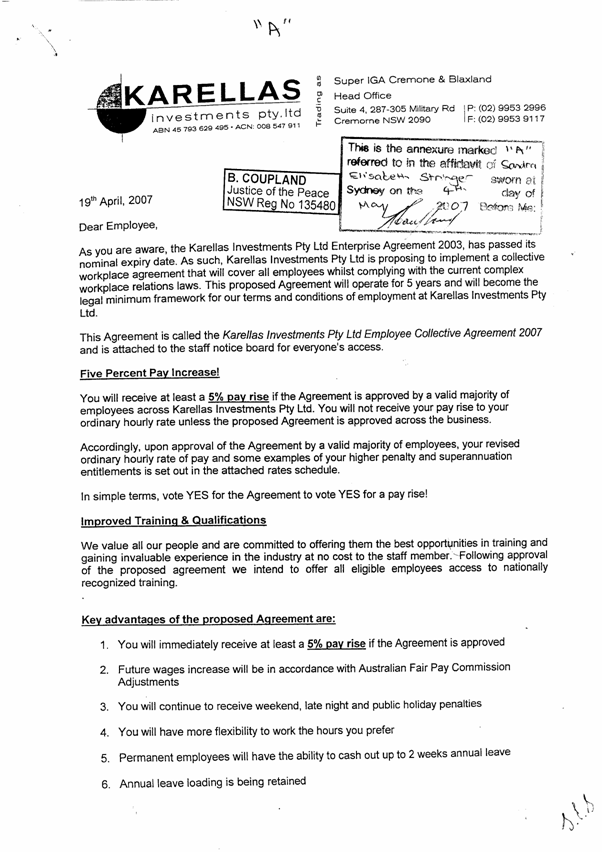
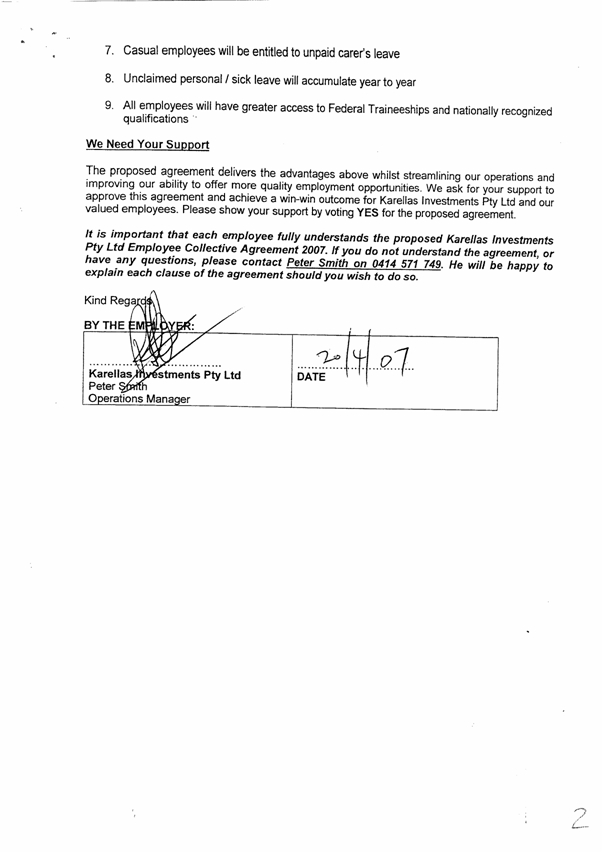
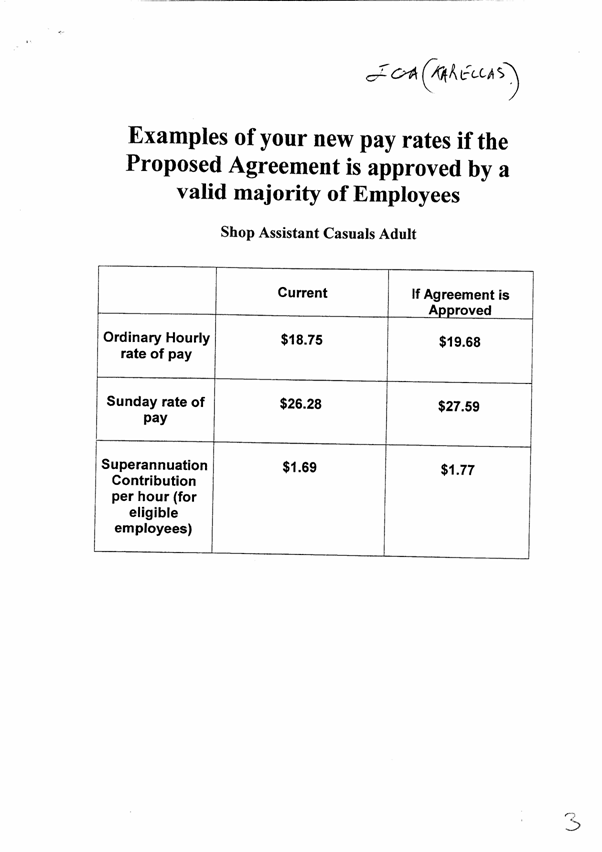
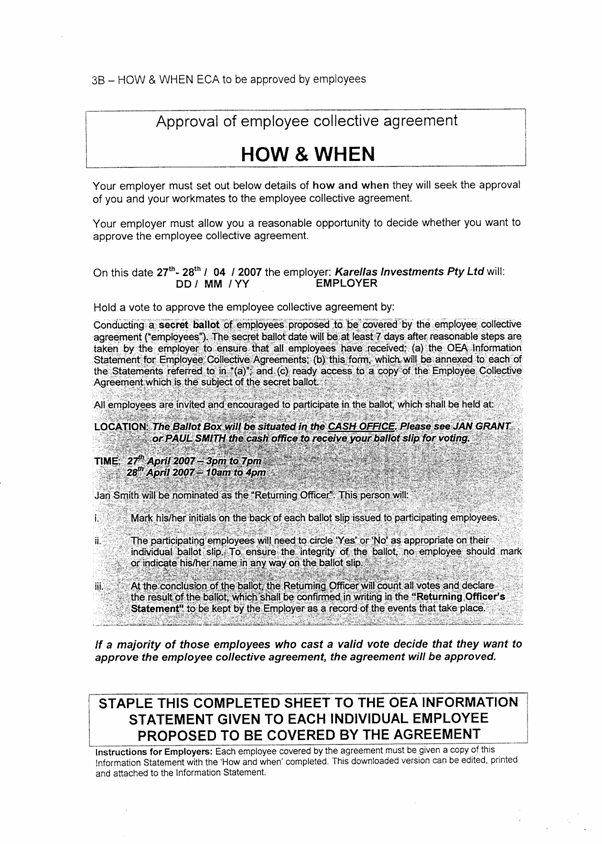
Appendix B
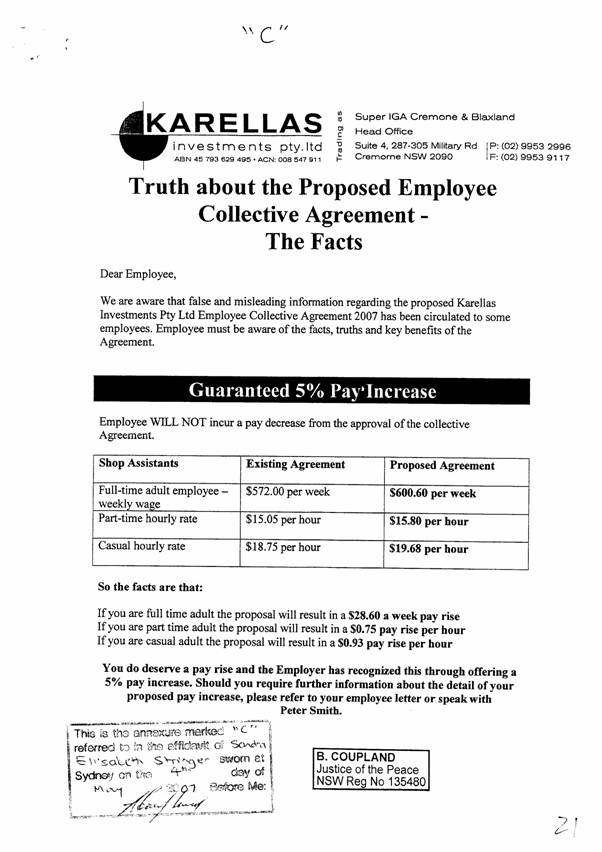
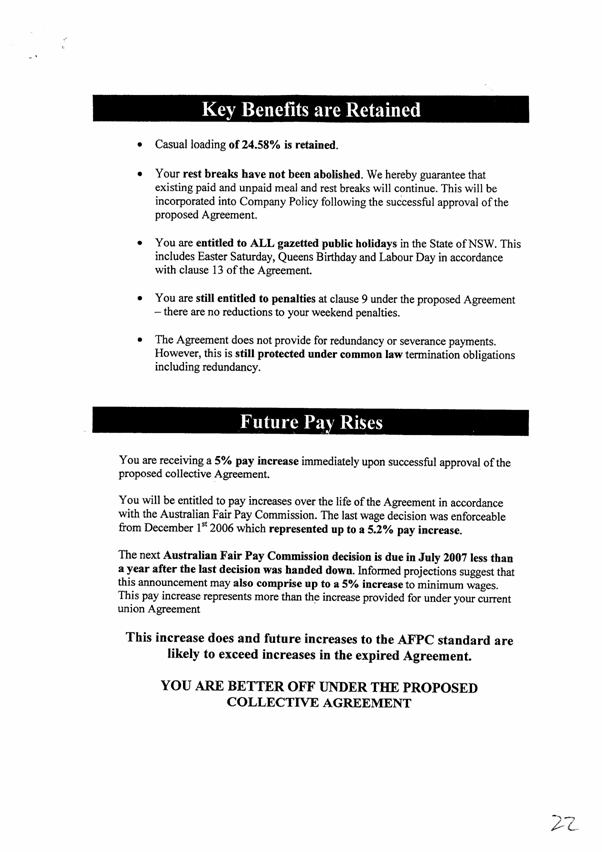
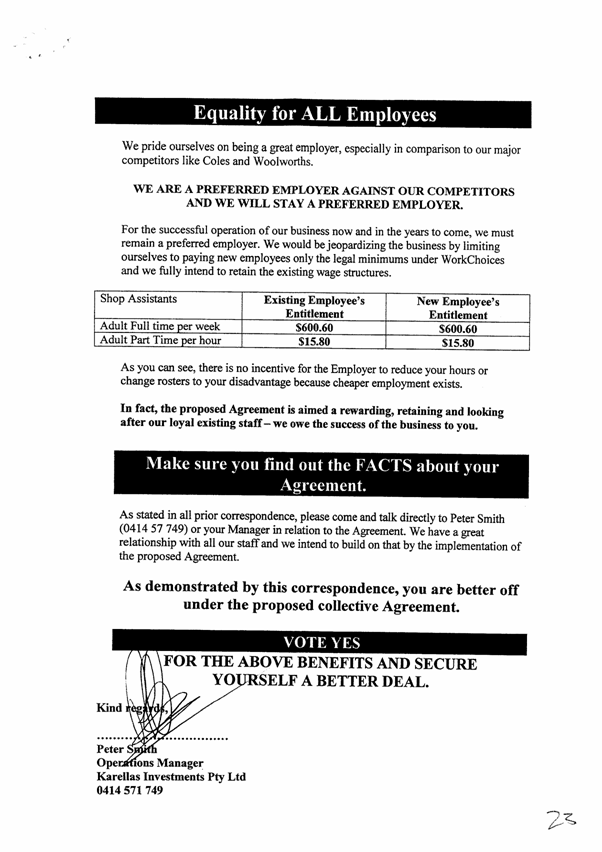
| I certify that the preceding one hundred and nineteen (119) numbered paragraphs together with Appendices ‘A’ and ‘B’ are a true copy of the Reasons for Judgment herein of the Honourable Justice Graham. |
Associate:
Dated: 12 September 2007
| Counsel for the Applicant: | A G Rogers – appearing by direct client access |
|
|
|
| Counsel for the Respondent: | P J Newall and M J Easton |
|
|
|
| Solicitor for the Respondent: | Greenstein Shakenovsky |
|
|
|
| Date of Hearing: | 27 July, 30 – 31 August 2007 |
|
|
|
| Date of Judgment: | 12 September 2007 |


