

FEDERAL COURT OF AUSTRALIA
Telstra Corporation Limited v Minister for Communications, Information Technology and the Arts [2007] FCA 1398
Subpoenas and Notices to Produce – whether fishing constitutes oppression – the necessary distinction between ‘apparent relevance’ and ‘relevance leading to admissibility’ in the document production process
Evidence Act 1995 (Cth) ss 55-58
Global Intertrade Pty Ltd v Adelaide Festival Centre Trust [1999] FCA 162 referred to
Tyco Australia Pty Ltd v Leighton Contractors Pty Ltd (2005) 142 FCR 428 applied
Alphapharm Pty Limited v Eli Lilly Australia Pty Limited [1996] FCA 391 followed
Waind v Hill and National Employers’ Mutual General Association Ltd. (1978) 1 NSWLR 376 applied
Seven Network Limited v News Limited (No 11) [2006] FCA 174 considered
The Commissioner for Railways v Small (1938) 38 SR (NSW) 564 applied
TELSTRA CORPORATION LIMITED v MINISTER FOR COMMUNICATIONS, INFORMATION TECHNOLOGY AND THE ARTS
NSD 1515 OF 2007
GRAHAM J
5 SEPTEMBER 2007
SYDNEY
|
IN THE FEDERAL COURT OF AUSTRALIA |
|
|
NEW SOUTH WALES DISTRICT REGISTRY |
NSD 1515 OF 2007 |
|
BETWEEN: |
TELSTRA CORPORATION LIMITED Applicant
|
|
AND: |
MINISTER FOR COMMUNICATIONS, INFORMATION TECHNOLOGY AND THE ARTS Respondent
|
|
GRAHAM J |
|
|
DATE OF ORDER: |
5 SEPTEMBER 2007 |
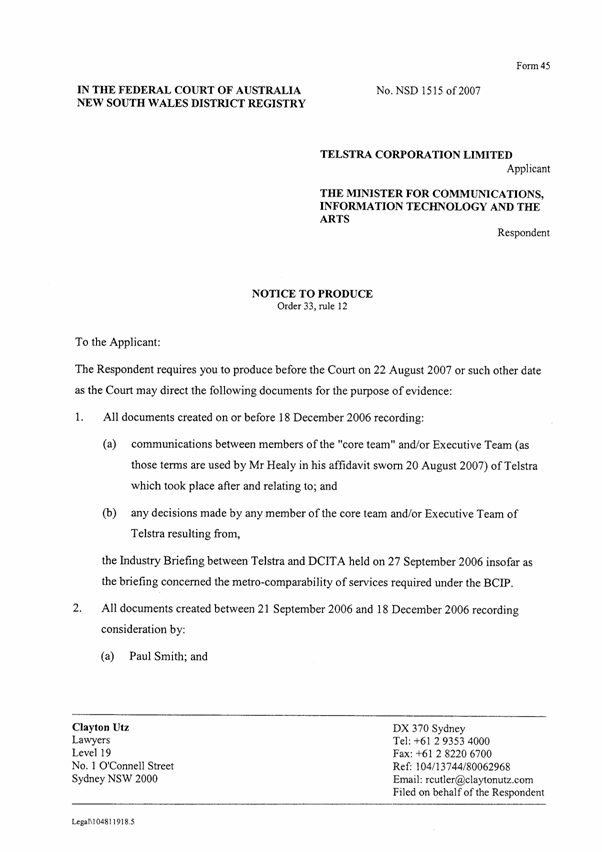
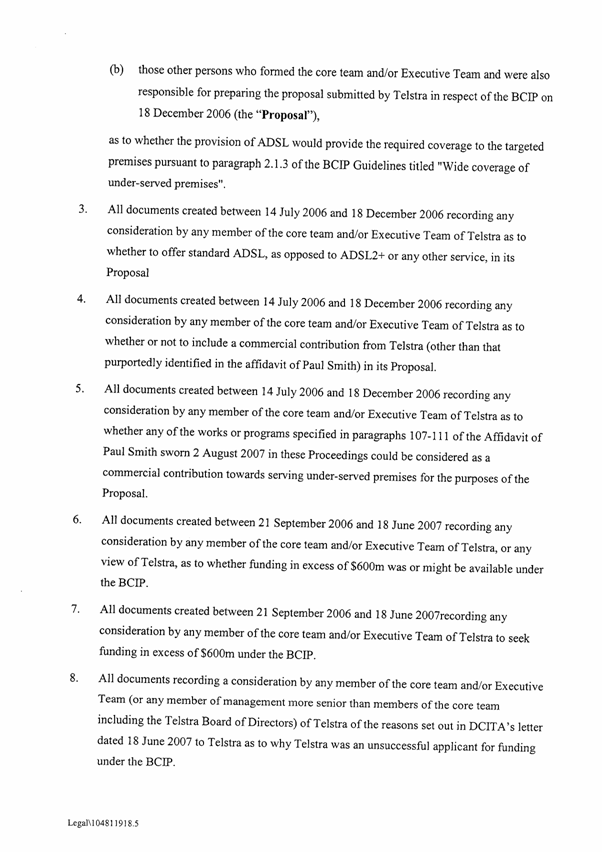
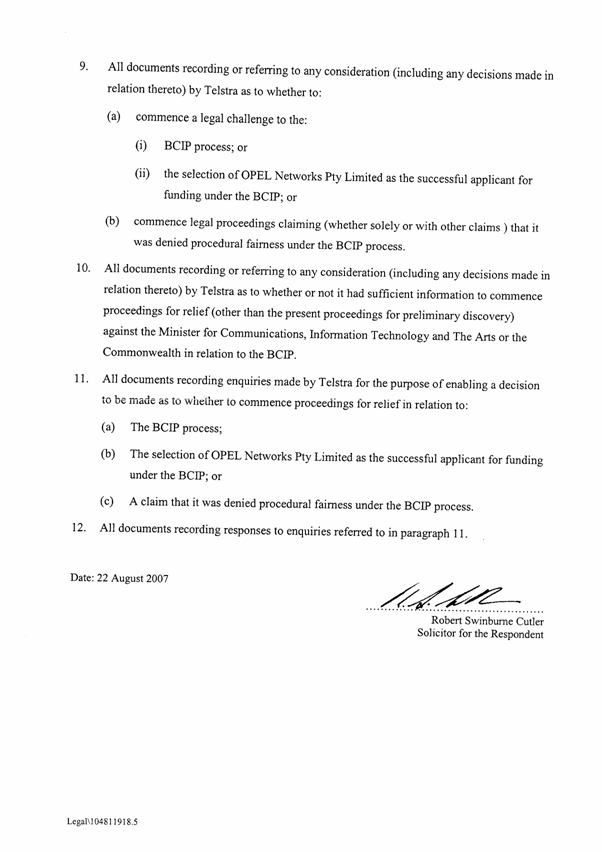
|
WHERE MADE: |
SYDNEY |
THE COURT:
1. Orders that the applicant’s Notice of Motion filed 21 August 2007, as amended on 22 August 2007, be dismissed.
2. Orders that the costs of the Motion be costs in the applicant’s Amended Application filed 9 August 2007.
3. Directs that the applicant produce the documents the subject of the respondent’s Notice to Produce dated 22 August 2007 (Ex AM2) before a Registrar on 12 September 2007 at 9.30 am.
Note: Settlement and entry of orders is dealt with in Order 36 of the Federal Court Rules.
|
IN THE FEDERAL COURT OF AUSTRALIA |
|
|
NEW SOUTH WALES DISTRICT REGISTRY |
NSD 1515 OF 2007 |
|
BETWEEN: |
TELSTRA CORPORATION LIMITED Applicant
|
|
AND: |
MINISTER FOR COMMUNICATIONS, INFORMATION TECHNOLOGY AND THE ARTS Respondent
|
|
JUDGE: |
GRAHAM J |
|
DATE: |
5 SEPTEMBER 2007 |
|
PLACE: |
SYDNEY |
REASONS FOR JUDGMENT
The relevant legal framework
1 Order 15A of the Federal Court Rules (‘the Rules’) was inserted into the Rules in 1988. It allows for discovery to identify a respondent, discovery from a prospective respondent, discovery from a non-party, inspection of discovered documents and inspection, measurement, photocopying, preservation, custody and detention of property, the taking of samples, carrying out of experiments etc. (cf. Order 17 rule 1 of the Rules in respect of inter-partes proceedings which have already been commenced).
2 Order 15A rule 2 ensures that a person providing discovery under Order 15A is not required to produce documents which, on the ground of privilege, the person could not be required to produce.
3 In relation to the inspection of documents discovered pursuant to an order made under Order 15A, Order 15A rule 10 provides:
‘10 Division 2 of Order 15 shall, with any necessary modification, apply to the inspection of the documents referred to in a list of documents made and served in accordance with this Order as if the list were a list of documents as mentioned in Order 15 rule 2.’
4 Order 15 deals with discovery and inspection of documents in normal inter-partes proceedings. Division 2 of that Order deals with inspection and includes rules 10 – 14. Order 15 rules 11, 13 and 14 relevantly provide:
‘11 (1) Where:
(a) it appears from a list of documents filed by a party under this Order that any document is in his possession, custody or power;
…
the Court may, subject to any question of privilege which may arise, order the party –
(d) to produce the document for inspection by any other party at a time and place specified in the order; or …
…
13 (1) The Court may, at any stage of any proceeding, order any party to produce to the Court any document in his possession, custody or power relating to any matter in question in the proceeding.
(2) Upon production of a document to the Court pursuant to an order under subrule (1), the Court may deal with the document in such manner as the Court thinks fit.
14 Where an application is made for an order under rule 11 for the production of any document for inspection by another party or for an order under rule 13 for the production of any document to the Court and a claim is made that the document is privileged from production or an objection to production is made on any other ground, the Court may inspect the document for the purpose of deciding the validity of the claim or objection.’
5 By an Amended Application filed 9 August 2007 the applicant (‘Telstra’) applied for preliminary discovery of certain documents, of which the respondent (‘the Minister’) has or is likely to have possession.
6 The power of the Court to order discovery from a prospective respondent is to be found in Order 15A rule 6 which provides as follows:
‘6 Where –
(a) there is reasonable cause to believe that the applicant has or may have the right to obtain relief in the Court from a person whose description has been ascertained;
(b) after making all reasonable inquiries, the applicant has not sufficient information to enable a decision to be made whether to commence a proceeding in the Court to obtain that relief; and
(c) there is reasonable cause to believe that that person has or is likely to have or has had or is likely to have had possession of any document relating to the question whether the applicant has the right to obtain the relief and that inspection of the document by the applicant would assist in making the decision;
the Court may order that the person shall make discovery to the applicant of any document of the kind described in paragraph (c).’
7 The documents in respect of which preliminary discovery is presently sought were defined in the Amended Application as follows:
‘… documents in the possession of the Respondent in the following categories:
1. All documents (including but not limited to, correspondence and notes of any discussions between the Respondent or any officer, servant or agent of the Department of Communications, Information Technology and the Arts (the Department) and OPEL Networks Pty Limited (OPEL)) relating to the possibility of any applicant for funding under the Broadband Connect Infrastructure Program (the Program) being able to submit an application seeking more than $600 million of funding, or being provided with funding in excess of $600 million, either under the Program or in addition to funding available under the Program.
2. All applications made by OPEL for funding under the Program and for any additional funding for its proposed infrastructure projects as described in the media release entitled “Australia Connected: Fast affordable broadband for all Australians” issued by the Respondent on 18 June 2007.
3. All documents relating to advice received from any probity or process adviser to the Respondent or any officer, servant or agent of the Department concerning:
(a) the amount of funding to be made available under the Program or in addition to that funding; and
(b) the advice to be provided to potential applicants concerning the amount of funding to be made available under the Program or in addition to that funding.
4. All documents relating to any assessment by the Respondent or any officer, servant or agent of the Department of the applications submitted by OPEL and the Applicant for funding under the Program or, in the case of OPEL, any additional funding, including all documents relating to the decision to award $958 million to OPEL which were prepared:
(a) by or on behalf of the Respondent; or
(b) by or on behalf of any officer, servant or agent of the Department who was wholly or partly responsible for the assessment of the applications.
5. All documents recording the decision to award funding under the Program to OPEL.’
8 It may be observed that under the Amended Application discovery is not sought of any documents of which the Minister has had, but no longer has, possession.
9 Whilst Order 15A makes no provision as to the means whereby discovery should be given by a party such as the Minister to a party such as Telstra, it seems clear to me that discovery must be given in the manner for which Order 15 rule 2(2) provides, namely:
‘2(2) Unless the Court or a Judge orders otherwise, a party must give discovery by serving:
(a) a list of documents required to be disclosed; and
(b) an affidavit verifying the list.’
Mansfield J expressed the same view in Global Intertrade Pty Ltd v Adelaide Festival Centre Trust [1999] FCA 162 at [2].
10 The form of the list of documents may, in my opinion, be taken to have been regulated by Order 15 rule 6, which relevantly provides:
‘6(1) A list of documents required by or under this Order shall, unless the Court otherwise orders, be in accordance with Form 22 and conform to the requirements of this rule.
(2) A list of documents shall enumerate the documents which are … in the possession … of the party making the list.
(3) A list of documents shall enumerate the documents in a convenient sequence and as shortly as possible, but shall describe each document or, in the case of a group of documents of the same nature, shall describe the group, sufficiently to enable the document or group to be identified.
…
(8) Where a party making a list of documents has a solicitor in the proceeding, the solicitor shall certify on the list that, according to his instructions, the list and the statements in the list are correct.’
11 Form 22, of course, provides for documents to be enumerated one by one in either Schedule 1 Part 1, Schedule 1 Part 2 or Schedule 2 of the relevant list. The operative words in Form 22 are:
‘1. The party has in his possession … the documents enumerated in Schedule 1.
2. The documents enumerated in Part 2 of Schedule 1 are privileged from production on the ground – …
…’
12 The Court should not allow its power to order the making of discovery by a prospective respondent to become an occasion for a trial within a trial. However, in relation to the issues which are germane to the determination of an Order 15A rule 6 application, it is well established that the applicant’s evidence may be tested and that a prospective respondent may tender evidence going to those issues.
Factual background
13 It is inappropriate on an application such as that which is presently before the Court to make any findings of fact other than those that are proper in an interlocutory context. From the evidence which is before the Court on the present motion, to which reference will be made shortly, it would appear that on 21 September 2006 the Minister and the Deputy Prime Minister and Minister for Trade issued a ‘JOINT MEDIA RELEASE’ under the heading ‘$600 million Broadband Connect program launched’, which relevantly stated as follows:
‘ $600 million Broadband Connect program launched
The Australian Government will invest up to $600 million in rural, regional and remote Australia to encourage private sector rollouts of broadband infrastructure, Deputy Prime Minister Mark Vaile and the Minister for Communications, Information Technology and the Arts, Senator Helen Coonan, announced today.
Part of the $1.1 billion Connect Australia package, this is the second phase of the $878 million Broadband Connect program.
The first phase of Broadband Connect is a per-customer subsidy paid to Internet Service Providers who connect customers in areas where a broadband connection is hard to get. This subsidy model has already resulted in more than one million extra broadband connections in Australia.
This second phase will support a small number of large scale infrastructure projects and leverage additional funding from the private sector and State and Territory Governments to extend the reach of broadband across rural, regional and remote Australia.
“The Broadband Connect Infrastructure Program will build on the billion dollar investment the Australian Government has already made in rural, regional and remote communications by encouraging the roll-out of large scale, sustainable and scalable networks across Australia,” Senator Coonan said.
“By encouraging investment in infrastructure the Government’s vision is to see more homes and businesses gain access to high quality broadband services, with those services able to grow to support the full range of existing and emerging broadband applications,” Minister Vaile said.
The program guidelines were released today with applications for funding to close on 30 November 2006.
“Broadband infrastructure is the roads and railways of a modern 21st century economy. In regional Australia in (sic) can break down the tyranny of distance and help deliver essential health and education services through telemedicine and e-learning services,” Senator Coonan said.
“The Australian Government is committed to ensuring that this infrastructure is available to all Australians – regardless of where they live,” Minister Vaile said.
Proposals submitted under Broadband Connect can also seek funding under the $30 million Mobile Connect program to improve mobile phone coverage or bid for funding under the $113 million Clever Networks program to extend fast broadband networks for education and health initiatives.
The Broadband Connect guidelines were finalised after an Expressions of Interest process earlier this year.
“There was a strong and enthusiastic response. The overwhelming majority of the 69 responses strongly supported the Government’s proposed alternative infrastructure-based approach outlined in the EOI,” Senator Coonan said.
“Several respondents are interested in developing proposals for major national or regional infrastructure projects that would result in well developed, end-to-end solutions of significant scale.
“Some also proposed a consortium approach to bring together major transmission capacity projects (such as interstate links and local access solutions) that could be integrated into comprehensive national or regional projects.”
The existing incentive-based element of the Broadband Connect program will continue during this financial year while the infrastructure-based program is developed, and appropriate transitional arrangements will be put in place.
Broadband Connect is one of four programs being delivered under Connect Australia, the Government’s $1.1 billion regional telecommunications package. The Government intends to use the substantial funding it has allocated under the Connect Australia package to revitalise communities in rural, regional and remote Australia.
…’
14 The ‘Broadband Connect Infrastructure Program Guidelines’ were recorded on 60 pages of typed script. These relevantly included:
‘1.1.5 Expression of Interest (EOI)
On 8 June 2006, the Minister for Communications, Information Technology and the Arts announced a request for EOI to seek stakeholders’ views on the Australian Government’s proposed alternative approach to Broadband Connect.
The alternative approach canvassed in the EOI was that the Australian Government would provide financial assistance (through a competitive grants process) to support large scale broadband infrastructure projects, primarily aimed at addressing currently under-served premises and areas.
The EOI process invited interested parties to put forward ideas, plans and proposals to bring to fruition the Australian Government’s broadband objectives. The opportunity to provide a response to the EOI was available to all interested parties, including carriers and service providers.
The Australian Government has considered responses to the EOI in assessing the feasibility of proceeding with the proposed competitive grants program under Broadband Connect. As a result, the Australian Government is now implementing a Broadband Connect Infrastructure Program and is seeking applications for funding from interested parties on a competitive basis in accordance with these guidelines.
…
1.3 The opportunity
Under the Broadband Connect Infrastructure Program, the Australian Government will consider providing financial assistance for a small number of major projects of significant scale and service coverage. The intent is to collectively provide sustainable wholesale broadband services as widely as possible across the geographic areas covered under the existing Broadband Connect program in order to provide broadband access to currently under-served areas and premises.
…
1.4 Funds available
Funding under the Broadband Connect Infrastructure Program will be provided to support the capital cost of establishing new broadband infrastructure, including upgrades to existing infrastructure, to enable the provision of wholesale broadband services to under-served premises and areas broadly across regional Australia. Funding will not be provided to support the ongoing operation of networks established through the program.
Up to $600 million may be available for this purpose, providing funding support for large scale broadband infrastructure projects. Only one funding round will be held. Depending on the nature of the applications received, the Australian Government may not allocate any or all available funds.
Australian Government funding support will not be available for investments that are otherwise commercially viable. Funding will support infrastructure that will service under-served areas or premises that otherwise would not get timely access to metro-comparable services through commercial investment alone.
…
2.1.3 Wide coverage of under-served premises
Applicants must demonstrate that proposed projects will cover significant numbers of under-served premises and that they will provide the required standard of wholesale broadband services to the vast majority of premises (including under-served premises) in the target coverage area. This is because under-served premises are located throughout regional, rural and remote areas, including in regional and rural cities and towns as a result of technology impairments (e.g. RIMs and pair gains).
Under-served premises are defined as those premises within the Broadband Connect area that do not have sustainable access to a metro-comparable broadband service.
…
It is a requirement that proposed projects offer wholesale broadband services to the vast majority of under-served premises in the area covered by the proposed project (the “target coverage areas”). It is expected that proposed projects would cover at least 95 per cent of under-served premises within the target coverage area. In relation to geographic areas this means that proposed projects must offer coverage across the populated parts of contiguous regional areas, given that under-served premises are generally located throughout such populated areas.
…
PART 3: Application Assessment Strategy
…
3.4.3 Final assessment
Following receipt of all revised applications, the Australian Government will make a final comparative assessment to establish the optimal project or mix of proposed projects, aimed at obtaining best value in achieving the Australian Government’s objectives.
As a result of the final comparative assessment, the Australian Government may agree to offer a funding agreement to the preferred applicant(s). Should the Australian Government be unable to finalise a funding agreement (or any other required documentation) with a preferred applicant, the Australian Government may, at its sole discretion, decide to grant funding to another applicant and invite that applicant to finalise a funding agreement and any other required documentation.
…
PART 6: MATTERS CONCERNING APPLICATIONS
…
6.2 Confidentiality
The Australian Government will own applications.
While an applicant will, as between itself and the Australian Government, own intellectual property rights that exist in the information contained in an application, the Australian Government and its advisers may reproduce, adapt, modify and develop such information for the purposes of the application and assessment processes and, to the extent necessary, the applicant licences the Australian Government and its advisers to do so.
…
Applicants should provide details in respect of any information that they would require DCITA to treat as confidential. Examples of confidential information to be protected may include:
· commercial secrets;
· proprietary information, for example information about how a particular technical or business solution is to be provided;
· an applicant’s internal costing information or information about its profit margins;
· pricing structures (where this information would reveal whether an applicant was making a profit or loss on the supply of a particular good or service) which excludes publicly available pricing structures; and
· intellectual property matters where these relate to an applicant’s competitive position.
…
The Australian Government will hold in confidence those parts of applications identified as confidential, provided that the Australian Government may disclose information contained in, or provided in connection with, an application if:
· that disclosure is required by law;
…
6.4.1 Closing date for applications
Applications must be lodged between 9.00am on 29 November 2006 and 5.00pm on 30 November 2006. …
…
6.6.4 Performance and financial guarantees
It is the Australian Government’s preference to enter into a funding agreement for a successful Broadband Connect project with a single entity (as funding recipient). It is the Australian Government’s preference that the funding entity be fully responsible for all of the obligations in the funding agreement, regardless of whether there are in fact other organisations (project participants) involved in the roll-out of infrastructure and/or the provision of services. It is not a requirement that assets purchased with the financial support of the Australian Government be vested in the funding recipient, with whom the Australian Government executes a funding agreement.
…’
15 By a letter dated 18 June 2007 the Chief General Manager, Infrastructure and Security of the Department of Communications, Information Technology and the Arts wrote to Mr Paul Smith, a Business Development Manager with Telstra, advising that Telstra’s application for the Broadband Connect Infrastructure Program had been unsuccessful. The letter recorded that the Prime Minister had on 18 June 2007 announced that the Government intended to enter into a funding agreement with OPEL Networks Pty Ltd. The letter indicated that the OPEL Networks proposal was considered to offer the Government the ‘best value for money’.
16 By a letter dated 19 July 2007 the Group General Counsel of Telstra wrote to the Minister and drew attention to an announcement ‘Australia Connected: Fast affordable broadband for all Australians’ in which the Minister had apparently stated that the Australian Government had awarded to a consortium of Singtel Optus and Elders (OPEL) ‘a total of $958 million in funding from the Broadband Connect Infrastructure program … and an additional funding allocation’.
17 The letter continued:
‘The Guidelines issued by the Government in relation to the Program stated that applications were sought for “up to $600 million” of funding and that “only one funding round will be held”. The Guidelines also stated that the basic principles underlying the selection process were to ensure that “all applicants are treated in a fair and equitable manner” and that the Government would “notify all applicants … of any changes to [the] guidelines”.’
18 By the said letter Telstra sought answers to a series of questions and copies of a series of documents by 4.00 pm on 26 July 2007. The letter concluded:
‘If the Government fails to provide those answers or documents, or if the answers and documents provided do not satisfactorily address Telstra’s concerns, Telstra proposes, on an urgent basis, to apply to the Federal Court of Australia for preliminary discovery of documents that will enable it to form a view whether to commence proceedings in that Court against the Minister and the Commonwealth seeking appropriate relief.’
19 By a letter dated 26 July 2007 Clayton Utz Lawyers as the solicitors for the Minister responded to Telstra’s letter of 19 July 2007. In their reply they said amongst other things:
‘24. DCITA has also instructed us to provide the following details in addition to the general outline of events set out in paragraphs 13 to 15 above:
(a) OPEL’s application was submitted on 18 December 2006, in compliance with the deadline set out in the Guidelines (as clarified on 3 November 2006);
(b) OPEL’s application did not seek funding greater than $600 million;
(c) All of the applications lodged within time were subjected to initial screening assessment as provided for in the Guidelines. On the basis set out in the Guidelines (see section 3.2), a number of applications were excluded at this point (by decision of the assessment panel on or about 23 January 2007);
(d) The remaining applications (including OPEL’s and Telstra’s applications) proceeded to benchmarking;
(e) During benchmarking, Telstra’s application was assessed against the assessment criteria published in the Guidelines (section 4) as failing to achieve three of the eight essential deliverables set out in section 2.1 of the Guidelines to a satisfactory level. Accordingly, Telstra’s application was excluded from further consideration at the completion of benchmarking (by decision of the assessment panel on or about 14 February 2007). Any other application which did not achieve an essential deliverable to a satisfactory level was also excluded at this point;
(f) A small number of applications (including OPEL’s), which had been assessed as achieving all of the essential deliverables to a satisfactory level, proceeded to comparative assessment;
(g) Comparative assessment (as provided for in the Guidelines) was then undertaken. As a result of the comparative assessment, OPEL was selected as the preferred applicant (by decision of the assessment panel on or about 2 March 2007);
(h) DCITA then reported the decision of the assessment panel to the Minister and sought the Minister’s authorisation to commence discussions with OPEL to seek to improve the value for money that would be achieved by the Government in respect of the funding sought by OPEL in its proposal. This authorisation was provided on or about 3 March 2007;
(i) On or about 7 March 2007, OPEL was invited to meet with DCITA in respect of certain aspects of its proposal;
(j) Between 9 March 2007 and 2 April 2007, DCITA and OPEL discussed OPEL’s proposal as originally submitted with a view to achieving improved value for money for the Government in relation to certain aspects of the proposal; and
(k) During those discussions (i.e. not until after OPEL’s selection as preferred applicant), DCITA and OPEL also explored options to extend coverage of the OPEL solution to a greater number of under-served premises if additional funding was to be provided. OPEL was requested to provide a separate proposal in relation to the relevant additional benefits and coverage.
…
26 On 10 April 2007, the Minister agreed to OPEL’s submitted proposal, as revised during the course of the discussions with OPEL, for funding of $600 million.
27. On 5 June 2007 the Government agreed to OPEL’s additional proposal.’
The Notices to Produce
20 The Motion presently before the Court has evolved into one in which the relief sought is now as follows:
‘1. Paragraphs 1 – 5 and 8 – 10 inclusive of the Notice to Produce dated 22 August 2007 (Exhibit AM2) issued by the respondent, be set aside.
2. The costs of the motion be costs in the Order 15A rule 6 Amended Application filed 9 August 2007.
3. Such further or other order as the Court deems fit.’
21 It is appropriate to shortly state the history of the Minister’s several Notices to Produce and of Telstra’s applications in relation thereto.
22 On 10 August 2007 the Minister served a Notice to Produce in accordance with Order 33 rule 12 of the Rules upon Telstra. Order 33 deals with ‘EVIDENCE: GENERAL’. Rule 12 relevantly provides:
‘12(1) Where a party to any proceedings serves on another party notice, in accordance with Form 45, requiring the party served to produce at any trial or hearing in the proceedings … any document … for the purpose of evidence and the document … is in the possession, custody or power of the party served, the party served shall, unless the Court otherwise orders, produce the document … in accordance with the notice, without the need for any subpoena for production
…’
23 In Tyco Australia Pty Ltd v Leighton Contractors Pty Ltd (2005) 142 FCR 428 (‘Tyco’) Hill J said at [44] – [46]:
‘44 While there is nothing in the procedural requirements of O 15A, r 9 that deal with the filing by a respondent to an application for pre-action discovery of affidavit evidence in opposition, it has never been suggested that such affidavits could not be filed. One example where affidavits were filed was Conrock Ltd v CSR Ltd (1990) 96 ALR 690. In that case, Pincus J finally made no order for costs against the respondent, notwithstanding that the applicant was successful. The affidavits went to the question of confidentiality of documents as well as a claim that compliance with the pre-action discovery would be oppressive and onerous. In Legent Corp v Fundi Software Services Pty Ltd (unreported, Federal Court, Lockhart J, No G134 of 1992, 13 July 1992), affidavit evidence was filed by both the applicant and respondent and cross-examination was foreshadowed. However, the matter settled. Justice Lockhart observed (at 7) that the parties could not necessarily assume that they would have a right to cross-examine. His Honour cites no authority for this proposition. Perhaps what his Honour meant was that the Court would control, in its discretion, the extent of cross-examination, having regard to the issue between the parties. One can only speculate.
45 It would seem, also, that notices to produce have been issued in other pre-action discovery proceedings. It seems that Gummow J in Aitken v Neville Jeffress Pidler Pty Ltd (1991) 33 FCR 418 allowed the issue of a notice to produce and that it was answered. Likewise, it would seem that a notice to produce was issued in Legent and in CGU [CGU Insurance Ltd v Malaysia International Shipping Corp Berhad [2001] FCA 681]. It is not clear from the report of Aitken or Legent that any argument was directed at the question whether a notice to produce could issue and in those circumstances it is difficult to treat these cases as authority for the view that there is power to issue a notice. On the other hand, it is perhaps not irrelevant that it is only since CCA Beverages[CCA Beverages (Adelaide) Ltd v Hansford (unreported Federal Court, S G58 of 1991, O’Loughlin J, 15 November 1991)] that there was thought to be a difficulty with that power.
46 However, for the reasons I have given, I am of the view that there is power to issue, in an appropriate case, a notice to produce in pre-action discovery proceedings. Whether the notice should be confined clearly depends upon the issues that are said to arise and in respect of which the production of documents is sought. An applicant who seeks to use a notice to produce, in effect, to gain production of the very documents which are the subject of the pre-action discovery will not have given the notice to produce in good faith, but rather, will have acted in a way that is an abuse of process. Otherwise, in principle at least, the notice to produce procedure may be exercised by both parties if otherwise relevant to issues in dispute. However, I would emphasise that it clearly is not contemplated that a pre-action discovery proceeding become a full-blown factual contest between the parties. The judge hearing the application will, no doubt, confine cross-examination and examine the subject matter of any notice to produce to ensure this does not become the case.’
24 Hely J recorded his general agreement with Hill J’s reasons. At [54] his Honour said:
‘Contestable issues of fact may arise in proceedings under O 15A for preliminary discovery: St George Bank Ltd v Rabo Australia Ltd (2004) 211 ALR 147. There is no reason why the ordinary interlocutory procedures should not be available to assist in the resolution of those contestable issues of fact, subject to the overriding consideration that the invocation of those procedures does not amount to an abuse of the process of the Court: Kimberley Mineral Holdings Ltd (in liq) v McEwan [1980] 1 NSWLR 210. Thus, at least prima facie, it would be an abuse of process for an applicant for preliminary discovery to seek to compel the production of documents by notice to produce, when the production of those documents is sought under O 15A, r 6. But it does not follow, for example, that a subpoena sought to be issued by an applicant for preliminary discovery against a third party would necessarily be an abuse, depending upon the scope and purpose of the subpoena.’
25 It may be seen from what has been said above that the Minister’s Notice to Produce served on Telstra could hardly amount to an abuse of process in the sense indicated in the passages from Tyco quoted above. A potential abuse of process might have arisen were Telstra to have issued a Notice to Produce to the Minister requiring the production of the very documents which a discovery order may identify.
26 Telstra’s objection to the Minister’s Notice to Produce urged that ‘none of the documents sought in the Notice are relevant to the issues in the present proceeding’.
27 The Minister’s original Notice to Produce dated 10 August 2007 called for the production of documents covered by 16 separate paragraphs. By a Notice of Motion filed 14 August 2007 Telstra sought an order that the initial Notice to Produce dated 10 August 2007 be set aside.
28 On the return date for the Notice of Motion filed 14 August 2007 the Minister informed the Court of her intention to inform Telstra in writing by no later than 4:15 pm on 17 August 2007 whether she required Telstra to respond to the initial Notice to Produce dated 10 August 2007 or whether she would withdraw that Notice to Produce and serve a fresh Notice to Produce. The Minister through her counsel indicated that any fresh Notice to Produce would be served no later than 4:15 pm on 17 August 2007.
29 The Minister did not press for compliance with her initial Notice to Produce.
30 On 21 August 2007 an order was made by consent that Telstra’s Notice of Motion filed 14 August 2007 seeking relief in respect of the Minister’s initial Notice to Produce dated 10 August 2007 be dismissed with no order as to costs.
31 By that time the Minister had served upon Telstra a fresh Notice to Produce dated 17 August 2007 which called for the production by Telstra of documents covered by 12 separate paragraphs.
32 On 21 August 2007 leave was granted to Telstra to file in Court a fresh Notice of Motion dated 20 August 2007 returnable instanter seeking to set aside the Minister’s second Notice to Produce issued on 17 August 2007. The hearing of that Notice of Motion commenced on 21 August 2007 and concluded on 22 August 2007. Telstra read two affidavits of Geoffrey Edward Healy, a partner at Freehills, the solicitors for Telstra, sworn 20 and 21 August 2007 respectively and also an affidavit of Paul Smith sworn 2 August 2007 upon which Telstra intended to rely at the hearing of its Amended Application filed 9 August 2007 for discovery in accordance with Order 15A rule 6 of the Rules, which is presently fixed for hearing on 13 September 2007.
33 On 22 August 2007 the Minister served a third form of Notice to Produce dated 22 August 2007 on Telstra seeking the production before the Court on 22 August 2007 or such other date as the Court may direct of documents covered by 12 separate paragraphs. The third Notice to Produce became Exhibit AM2 on the hearing of Telstra’s Motion. Leave was granted to Telstra to amend its Notice of Motion dated 20 August 2007 to confine it to one seeking to set aside paragraphs 1 to 5 and 8 to 10 inclusive of the Minister’s third Notice to Produce.
34 Along the way, Dr J E Griffiths SC, senior counsel for Telstra, produced two redacted forms of Notice to Produce with which Telstra was prepared to comply but agreement was not reached between the parties on the scope of an appropriate Notice to Produce.
35 A copy of the Minister’s third Notice to Produce dated 22 August 2007 (Ex AM2) is attached to these reasons for judgment as Appendix ‘A’.
36 In the light of the narrowing by the Minister of the requirement for the production of documents in accordance with paragraphs 6, 7, 11 and 12, Telstra has withdrawn its objection to the production of documents in response to those paragraphs as recorded in the Minister’s third form of Notice to Produce (Ex AM2).
37 This leaves for consideration the documents covered by paragraphs 1 – 5 and 8 which Telstra contends lack relevance and the production of which Telstra submits would be oppressive.
In relation to paragraphs 9 and 10 of the Minister’s third Notice to Produce (Ex AM2), they called for the production of:
‘9. All documents recording or referring to any consideration (including any decisions made in relation thereto) by Telstra as to whether to:
(a) commence a legal challenge to the:
(i) BCIP process; or
(ii) the selection of OPEL Networks Pty Limited as the successful applicant for funding under the BCIP; or
(b) commence legal proceedings claiming (whether solely or with other claims) that it was denied procedural fairness under the BCIP process.
10. All documents recording or referring to any consideration (including any decisions made in relation thereto) by Telstra as to whether or not it had sufficient information to commence proceedings for relief (other than the present proceedings for preliminary discovery) against the Minister for Communications, Information Technology and The Arts or the Commonwealth in relation to the BCIP.’
38 Telstra repeatedly submitted that it may have been denied procedural fairness in circumstances where it never had an opportunity to submit a proposal to the Minister which might attract funding of $958 million rather than the $600 million for which the Broadband Connect Infrastructure Program Guidelines provided.
39 By the handing up in Court of a draft form of Notice to Produce at about 11:36 am on 22 August 2007 Telstra indicated, through its counsel, its willingness to comply with such a Notice to Produce. In lieu of the Minister’s paragraphs 9 and 10 as quoted above Telstra’s draft included the following, which I have numbered to accord with the Minister’s numbering, to the extent to which that is possible:
‘9. All documents recording or referring to any decision by Telstra to:
(a) commence a legal challenge to the:
(i) BCIP process; or
(ii) the selection of OPEL Networks Pty Limited as the successful applicant for funding under the BCIP; or
(b) commence legal proceedings claiming (whether solely or with other claims) that it was denied procedural fairness under the BCIP process.
9A. All documents recording or referring to Telstra being in a position to decide to commence a legal challenge or legal proceedings, as referred to in paragraph 9 above.
10. All documents recording or referring to any decision made by Telstra as to whether or not it had sufficient information to commence proceedings for relief (other than the present proceedings for preliminary discovery) against the Minister for Communications, Information Technology and The Arts or the Commonwealth in relation to the BCIP.’
40 In support of its proposed redefinition of paragraphs 9–10 in the Minister’s third Notice to Produce dated 22 August 2007, Telstra relied upon the decision of Lindgren J in Alphapharm Pty Limited v Eli Lilly Australia Pty Limited [1996] FCA 391 (‘Alphapharm’).
41 Eli Lilly Australia Pty Limited apparently wrote a letter dated 16 April 1996 to pharmacists throughout Australia in relation to Alphapharm Pty Limited’s anti-depressant drug ‘Zactin’ and Eli Lilly Australia Pty Limited’s competing anti-depressant drug ‘Prozac’, which had been on the market for a much longer time than Zactin. Alphapharm Pty Limited complained to Eli Lilly Australia Pty Limited about the letter. Eli Lilly Australia Pty Limited’s solicitors responded to the effect that their client had in its possession material which fully supported the allegations. This led Alphapharm Pty Limited to apply for an order pursuant to Order 15A rule 6 of the Rules for discovery by Eli Lilly Australia Pty Limited of such material so that Alphapharm Pty Limited would be able to decide whether to commence a proceeding in the Court against Eli Lilly Australia Pty Limited alleging that the letter was misleading or deceptive in contravention of s 52 of the Trade Practices Act 1974 (Cth).
42 In his reasons for judgment Lindgren J made certain observations concerning Order 15A rule 6 as follows:
‘1. Paragraphs 6 (a) and 6 (c) pose an objective test, the opening words “there is” in each paragraph signifying “there exists”; but the “insufficiency test” of para 6 (b) has both subjective and objective aspects.
2. Although I need not explore the subjective aspect fully, it seems clear that if the evidence went so far as to show that a particular applicant was already able to decide to commence a proceeding by, for example, showing that the applicant had in fact decided to do so, para 6 (b) would not be satisfied even though the information available did not satisfy the objective aspect of the insufficiency test referred to below.
3. The fact that a particular applicant genuinely feels unable, because of a lack of information, to decide to commence a proceeding does not, without more, satisfy para 6 (b); the objective aspect of the paragraph requires it to be shown as an objective fact that the applicant lacks “sufficient information to enable a decision to be made whether to commence a proceeding”.
4. In my view, the objective aspect of para 6 (b) invokes a notion of “reasonable sufficiency”, the question raised being whether it is reasonable that the applicant for an order be required to take its decision without having the information to become available from inspection of the document or documents of which discovery is sought.
5. If the insufficiency test is satisfied, a second question will arise, namely, whether the Court's discretion should be exercised in favour of the making of an order.
6. The questions posed by rule 6 and referred to above are to be answered in the context of an adversary system of forensic contest in which a proposed respondent is ordinarily entitled to withhold its evidence, certainly prior to the commencement of proceedings.
7. The questions are also to be answered in the light of the nature of the “cause of action” contemplated and the range of information potentially available in respect of a cause of action of that kind.
8. Contrary to a submission of Eli Lilly, in my opinion rule 6 is not necessarily rendered unavailable by the fact that the applicant already has available evidence establishing a prima facie case for the granting of relief. This is made clear by the reference in para (a) to the existence of “reasonable cause to believe that the applicant has ... the right to obtain relief ...” (emphasis supplied). It would impose an artificial constraint on rule 6, not supported by its terms or purpose, to exclude, a priori, all cases in which the insufficiency of the information possessed by the applicant to enable a decision to be made whether to litigate is due to a matter of “defence” which would defeat the prima facie case.
9. Rule 6 does not provide a means by which an applicant will be enabled to have available to it every document which would assist it in deciding whether to litigate. If that were the intention, paras (a) and (c) would stand alone and the additional condition set out in para (b) would not be necessary.
10. Paragraph 6 (b) contemplates that after making all reasonable inquiries, the applicant has come up against a problem, namely, that it is lacking a piece of information or pieces of information reasonably necessary to enable it to decide whether to commence a proceeding.’
43 As I understood Telstra’s submission, it contended that production of a document could be required if it showed that a decision had in fact been made by it to commence a proceeding against the Minister or the Commonwealth to obtain relief in the Court. It asserted that production could not be required of documents recording or referring to consideration by Telstra as to whether it should commence a legal challenge or legal proceedings, but it acknowledged that documents recording or referring to its ability to decide whether to commence such a challenge or proceedings would properly be amenable to a Notice to Produce calling for their production.
44 It seems to me that an assertion that a subpoena and/or a notice to produce should be set aside if it calls for the production of documents which do not answer the description of being ‘relevant’, involves a misconception as to what the proper function of a subpoena and/or notice to produce is.
45 Relevance may well be a yardstick by which the admissibility into evidence of documents, that may have been produced under a subpoena or in response to a notice to produce, is to be decided (see ss 55-58 of the Evidence Act 1995 (Cth)). Furthermore, it may bear upon whether access to documents that have been produced to the Court in response to a subpoena or under a notice to produce should be afforded to a party seeking such access. However, such considerations are not determinative of whether a subpoena or notice to produce or part thereof should be set aside.
46 As Moffitt P, with whose judgment Hutley and Glass JJA agreed, said in Waind v Hill and National Employers’ Mutual General Association Ltd. (1978) 1 NSWLR 376 (‘Waind’s case’) at 381 there are three steps involved in dealing with subpoenas and documents that may be produced thereunder. At p381 Moffitt P said:
‘As Jordan C.J. pointed out in Small’s case [The Commissioner for Railways v Small (1938) 38 SR (NSW) 564] and, as appears in Burchard’s case [Burchard v Macfarlane [1891] 2 QB 241] there are at least two steps in the procedure of having a third party bring documents to court, and in their use thereafter. Indeed, on a correct view, there are three steps. The first is obeying the subpoena, by the witness bringing the documents to the court and handing them to the judge. This step involves the determination of any objections of the witness to the subpoena, or to the production of the documents to the court pursuant to the subpoena. The second step is the decision of the judge concerning the preliminary use of the documents, which includes whether or not permission should be given to a party or parties to inspect the documents. The third step is the admission into evidence of the document in whole or in part; or the use of it in the process of evidence being put before the court by cross-examination or otherwise. It is the third step which alone provides material upon which ultimate decision in the case rests. In these three steps the stranger and the parties have different rights, and the function of the judge differs.’
47 Once documents have been produced to the court, any objections to their production having been rejected, the documents are in the control of the court. At this stage the person producing the documents may state that he objects to them being handed to a party seeking access to them for inspection. Documents should not go beyond the judge against the objection of the owner, unless there is valid reason to do so. Subject to matters such as confidentiality, it is for the judge, as part of the second step, to determine whether the documents appear relevant in the sense that they relate to the subject matter of the proceedings, in which event the judge will permit inspection by one or both parties at an appropriate time. The question of their admissibility without more, in accordance with the rules of evidence, does not then arise (per Moffitt P in Waind’s case at 382 – 385 cf per Sackville J in Seven Network Limited v News Limited (No 11) [2006] FCA 174 at [6]).
48 The ultimate question of whether any documents are ruled to be relevant and/or admissible is left to the third stage of receiving evidence. As part of the second step inspection may be allowed, notwithstanding that a given document is not admissible as it stands, and notwithstanding that the party seeking inspection has not given any undertaking to tender it or use it in cross-examination (per Moffitt P in Waind’s case at 385).
49 If a person wishes to resist production to the court of documents under a subpoena or in response to a notice to produce, objection should be taken as part of what Moffitt P describes as ‘the first step’. Available grounds for objection to production include:
(a) that the documents called for are the documents of title of the party burdened with production;
(b) that the documents are privileged from production on the ground of self-incrimination;
(c) that the documents are privileged from production on the ground of legal professional privilege;
(d) that the documents are required for some spurious purpose unconnected with the litigation;
(e) that the subpoena or notice to produce is oppressive in the sense that it is so wide as to impose an onerous task on the party burdened with production to collect and produce documents, many of which could have no apparent relevance to the litigation.
50 What may be oppressive in respect of a subpoena directed to a third party will not necessarily be oppressive if the subject of a notice to produce inter-partes.
51 If a subpoena is used for the purpose of discovery and calls upon the subpoenaed party to make a judgment as to which of his or her documents relate to issues between the parties it will be oppressive. A subpoena or a notice to produce addressed to a party will also be oppressive if it is so worded as to require the addressee to engage in such a discovery process (per Moffitt P in Waind’s case at 381-2 and per Jordan CJ in Small’s case at 574).
52 A subpoena or notice to produce will not necessarily be objectionable because it is labelled as a ‘fishing exercise’. Because a party who issues a subpoena or notice to produce is unaware of the precise description of a particular document or whether a particular document or documents are in the possession of the party subpoenaed or subjected to the notice to produce, or even whether such a document or documents exist or is unaware of the contents of such a document or documents, does not mean that a subpoena or notice to produce will be taken to have been improperly issued and amenable to being set aside as part of the first step described by Moffitt P (see per Moffitt P in Waind’s case at 378 and 382).
53 Where a subpoena or notice to produce is addressed to a party, it is still necessary that it should state with reasonable particularity the documents which are to be produced (per Jordan CJ in Small’s case at 574).
54 In his illustration of a subpoena, the issue of which would be oppressive and render it amenable to being set aside, Moffitt P contemplated a requirement that the branch of a bank produce all cheques received by it in a particular year in order to find, if it existed, a cheque of the opponent in a false name (see Waind’s case at 382).
55 In my opinion the documents, the production of which is sought under paragraphs 9 and 10 of the Minister’s third Notice to Produce (Ex AM2), are defined with reasonable particularity such that the Notice to Produce is not oppressive. They have sufficient apparent relevance to the issues arising under Order 15A rule 6 of the Rules to allow the Notice to Produce to stand. In my opinion it would be an improper exercise of the Court’s power to restrict the reach of paragraphs 9 and 10 in the Minister’s third Notice to Produce to those documents which Telstra would be willing to produce were the Notice to Produce confined to the documents identified in paragraphs 9, 9A and 10 of Telstra’s draft form of Notice to Produce. Neither paragraph 9 nor paragraph 10 of the Minister’s third Notice to Produce (Ex AM2) should be set aside.
56 In relation to the documents sought under paragraphs 1 – 5 inclusive and 8 of the Minister’s third Notice to Produce (Ex AM2) I am satisfied that the documents sought have been identified with reasonable particularity.
57 Given the terms of Mr Smith’s affidavit sworn 2 August 2007, upon which Telstra intends to rely on the hearing of its Amended Application under Order 15A rule 6, I consider the documents identified in the said paragraphs to have sufficient apparent relevance to be amenable to a notice to produce at this stage. Senior counsel for Telstra was at pains to explain that much of what was contained in Mr Smith’s affidavit was there simply to provide background and had only tangential relevance. This cri de coeur does not mean that the Minister may not challenge the factual background which is relevant to those issues which need to be addressed objectively and/or subjectively on the hearing of the Order 15A rule 6 application and to which Lindgren J made reference in Alphapharm.
58 As to the scope of the requirement imposed by the said paragraphs, it is appropriate to observe that the Minister’s third Notice to Produce dated 22 August 2007 is significantly scaled down from the requirement sought to be imposed by the Minister’s second Notice to Produce dated 17 August 2007. Plainly, the Minister has had regard to much of the material to which Mr Healy deposed in his affidavit sworn 20 August 2007 in narrowing down her requirement. In his affidavit sworn 20 August 2007 Mr Healy said, inter alia:
‘2 I am informed by Paul Smith, Business Development Manager employed by Telstra, and believe that:
…
(b) having regard to the 12 categories of documents of which production is sought, in order to comply with the Notice, Telstra would be required to review a very large number of documents in Telstra’s possession that refer or relate to the Broadband Connect Infrastructure Program (Program) to determine which of those documents fall within the terms of the Notice. The following facts are relevant:
(i) Mr Smith has in his email mailbox approximately 2,200 emails, 1 to 2 boxes of hard copy documents and 200 electronic documents all of which relate to the Program;
(ii) there were approximately 10 other Telstra employees who formed the core team responsible for developing Telstra’s proposal in relation to the Program;
(iii) there were approximately 60 other Telstra employees who had input into Telstra’s proposal (not including members of the Telstra Executive Team who are considered below);
(iv) The Telstra employees who had input into Telstra’s proposal were located in offices in at least Sydney (4 buildings), Brisbane (2 buildings), Melbourne (3 buildings), Adelaide (1 building), Perth (1 building), Canberra (1 building) and Darwin (1 building); and
(v) a number of the Telstra employees who had input into Telstra’s proposal no longer work for Telstra;
(c) in order to comply with category 1 of the Notice, Telstra would be required to review at least all documents in Telstra’s possession held by:
(i) the 4 Telstra employees who attended the Industry Briefing;
(ii) the at least 13 additional Telstra employees who Mr Smith informed of the Industry Briefing;
(iii) any other Telstra employees who were informed of the Industry Briefing, including by any of the persons referred to in (i) and (ii) above,
that refer or relate to the Program from 27 September 2006 onwards to determine which documents record communications within Telstra “relating to” the Industry Briefing between Telstra and DCITA on 27 September 2006, or record “any decisions made by Telstra resulting from” that Briefing. This is necessary because:
● of the breadth of the phrase “relating to” in sub-paragraph (a) of category 1;
● category 1 is not limited to documents in the possession of certain persons within Telstra; and
● category 1 is not limited to any date range other than being “after” 27 September 2006;
(d) in order to comply with category 2 of the Notice, Telstra would be required to review all documents referring or relating to the Program which are in the possession of at least:
(i) Mr Smith;
(ii) the other Telstra employees who formed the core team responsible for developing Telstra’s proposal in relation to the Program,
from at least 21 September 2006 (when the Guidelines in relation to the Program were released) until at least 18 June 2007 when Telstra received the letter dated 18 June 2007 from the Respondent advising Telstra that its bid had been unsuccessful for reasons including coverage; and
(e) in order to comply with category 8 of the Notice, Telstra would be required to review at least all documents in Telstra’s possession held by:
(i) Mr Smith;
(ii) the at least 11 persons whom Mr Smith either immediately forwarded a copy of DCITA’s letter of 18 June 2007 to, or discussed the letter with;
(iii) the 3 Telstra employees Mr Smith is aware received a copy (other than directly from him) of DCITA’s letter of 18 June 2007;
(iv) any other Telstra employees who received a copy of, or were informed of the contents of, DCITA’s letter of 18 June 2007, including by any of the persons referred to in (ii) and (iii) above,
for the period from 18 June 2007 onwards to determine whether a document records “a consideration” by Telstra of DCITA’s letter of 18 June 2007.’
59 It may be observed that the Minister’s third Notice to Produce (Ex AM2) has introduced time frames limiting the documents, the production of which has been sought, and also confining the documents sought to ones recording communications and consideration at the level of what Mr Healy described as ‘core team’ members and/or members of Telstra’s ‘Executive Team’ and above.
60 Having regard to the narrowing both in terms of date and in terms of management level, I do not consider the requirements imposed upon Telstra by the Minister’s third Notice to Produce dated 22 August 2007 (Ex AM2) to be oppressive.
61 In the circumstances, I would not be disposed to set aside any of paragraphs 1 – 5 or 8 – 10 of the Minister’s third Notice to Produce. Accordingly, Telstra’s Notice of Motion dated 20 August 2007 which was filed in Court on 21 August 2007 and subsequently amended on 22 August 2007 should be dismissed. Costs should be dealt with in the manner agreed between the parties, namely that the costs of the motion should be costs in the applicant’s Order 15A rule 6 Amended Application filed 9 August 2007
62 I propose to direct that the documents required to be produced before the Court by the Minister’s third Notice to Produce dated 22 August 2007 (Ex AM2) be produced before a Registrar of the Court at 9.30 am on 12 September 2007.
Appendix ‘A’
|
I certify that the preceding sixty-two (62) numbered paragraphs together with Appendix ‘A’ are a true copy of the Reasons for Judgment herein of the Honourable Justice Graham. |
Associate:
Dated: 5 September 2007
|
Counsel for the Applicant: |
Dr J E Griffiths SC and Ms K H Barrett |
|
|
|
|
Solicitor for the Applicant: |
Freehills |
|
|
|
|
Counsel for the Respondent: |
A J Sullivan QC and S Habib |
|
|
|
|
Solicitor for the Respondent: |
Clayton Utz |
|
|
|
|
Date of Hearing: |
21 and 22 August 2007 |
|
|
|
|
Date of Judgment: |
5 September 2007 |


