FEDERAL COURT OF AUSTRALIA
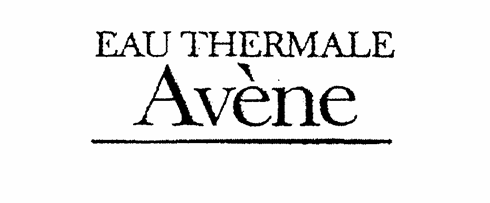
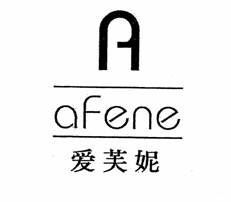
Pierre Fabre Dermo-Cosmetique v Senator Automation Pty Ltd [2007] FCA 1391
Trade Marks Act 1995 (Cth), ss 10, 44, 56, 57, 60
PIERRE FABRE DERMO-COSMETIQUE v SENATOR AUTOMATION PTY LIMITED
NSD1555 OF 2006
EMMETT J
18 JULY 2007
SYDNEY
|
IN THE FEDERAL COURT OF AUSTRALIA |
|
|
NEW SOUTH WALES DISTRICT REGISTRY |
NSD1555 OF 2006 |
ON APPEAL FROM THE HEARING OFFICER AND DELEGATE OF THE REGISTRAR OF TRADE MARKS
|
BETWEEN: |
PIERRE FABRE DERMO-COSMETIQUE Applicant
|
|
AND: |
SENATOR AUTOMATION PTY LIMITED Respondent
|
|
JUDGE: |
EMMETT J |
|
DATE OF ORDER: |
18 JULY 2007 |
|
WHERE MADE: |
SYDNEY |
THE COURT ORDERS THAT:
1. The appeal be dismissed.
2. The applicant pay the respondent’s costs of the appeal.
Note: Settlement and entry of orders is dealt with in Order 36 of the Federal Court Rules.
|
IN THE FEDERAL COURT OF AUSTRALIA |
|
|
NEW SOUTH WALES DISTRICT REGISTRY |
NSD1555 OF 2006 |
ON APPEAL FROM THE HEARING OFFICER AND DELEGATE OF THE REGISTRAR OF TRADE MARKS
|
BETWEEN: |
PIERRE FABRE DERMO-COSMETIQUE Applicant
|
|
AND: |
SENATOR AUTOMATION PTY LIMITED Respondent
|
|
JUDGE: |
EMMETT J |
|
DATE: |
18 JULY 2007 |
|
PLACE: |
SYDNEY |
REASONS FOR JUDGMENT
1 Pierre Fabre Dermo-Cosmetique (the Opponent) is registered under the Trade Marks Act 1995 (Cth) (the Act) as the owner of Trade Mark No 592970, a representation of which is set out in Schedule 1 (the Opponent’s Mark). On 1 December 2003, Senator Automation Pty Limited (Senator) applied for registration under the Act of two trade marks, which would be Nos 980194 and 980195 (Senator’s Marks). Representations of Senator’s Marks are set out in Parts 1 and 2, respectively, of Schedule 2.
2 The Opponent opposed the registration of Senator’s Marks under Part 5 of the Act. On 28 July 2006 a delegate of the Registrar of Trade Marks concluded that the grounds of opposition relied on by the Opponent were not established and directed that Senator’s Marks may proceed to registration. However, the delegate also directed that registration would not occur until any appeal had been decided or discontinued. By notice of appeal filed on 17 August 2006, the Opponent appealed to the Federal Court from the decision of the Registrar’s delegate. The appeal is before me today.
3 Section 52 of the Act provides that, if the Registrar has accepted an application for the registration of a trade mark, a person may oppose the registration by filing a notice of opposition. Under s 55, the Registrar must, after giving the opponent and the applicant an opportunity of being heard on the opposition, decide either to refuse to register the trade mark or to register the trade mark, having regard to the extent, if any, to which any ground on which the application was opposed has been established.
4 Section 57 of the Act provides that the registration of a trade mark may be opposed on any of the grounds on which an application for the registration of a trade mark may be rejected. Section 44 relevantly provides that an application for the registration of a trade mark must be rejected if that trade mark is deceptively similar to a trade mark registered by another person in respect of similar goods. Section 10 provides that, for the purposes of the Act, a trade mark is taken to be deceptively similar to another trade mark if it so nearly resembles that other trade mark that it is likely to deceive or cause confusion. In addition, s 60 provides that the registration of a trade mark in respect of particular goods may be opposed on the ground that another trade mark had, before the priority date for the registration of the first trade mark, acquired a reputation in Australia and, because of the reputation of that second trade mark, the use of the first trade mark would be likely to deceive or cause confusion. Those are the grounds on which the Opponent now opposes the registration of Senator’s Marks.
5 Section 56 of the Act provides that an applicant or an opponent may appeal to the Federal Court from a decision of the Registrar made under s 55. An appeal to the Court under s 56 requires a hearing de novo by the Court without any presumption in favour of the correctness of the Registrar’s decision from which the appeal is brought.
6 The first question that requires consideration by the Court is whether Senator’s Marks so nearly resemble the Opponent’s Mark that they are likely to deceive or cause confusion. Related to that question is whether the use of Senator’s Marks would be likely to deceive or cause confusion because of the reputation of the Opponent’s Mark. While the two questions are not precisely the same, they raise the same issues as to likelihood of deception or confusion. That involves a comparison of Senator’s Marks with the Opponent’s Mark. That, in turn, involves a comparison between the marks, assuming notional use of both. Such notional use means a normal and fair use for all goods covered by the marks under consideration.
7 To determine deceptive similarity, the marks must not be placed side by side. Rather, consideration must be given to any common net impression inferred from the two marks. In making the comparison that is required, the Court must consider all surrounding circumstances, including the circumstances in which the marks will be used and the circumstances in which the goods to which they relate will be bought and sold, together with the character of the probable acquirers of the goods.
8 The Court must first estimate the effect or impression produced on the mind of consumers by the Opponent’s Mark, being the impression or recollection that would be carried away and retained by the consumer. In making such an estimate, it is permissible to give more or less weight to particular features of the mark in recognition that one component may be more striking and memorable than another. Marks are remembered by general impression or by some significant detail, rather than by photographic recollection of the whole.
9 The Opponent’s Mark is registered in Class 3 in respect of soaps, cosmetics, hair lotions, shampoos, make up, make up removers, shaving and aftershave preparations, suntan preparations and all other goods in the class. Such goods are likely to be sold from a shelf in supermarkets and pharmacies.
10 The Opponent’s Mark is a combination of three words in a particular typescript together with an underlining. An endorsement in respect of the Opponent’s Mark provides that registration is to give no right to the exclusive use of the French words “EAU THERMALE”, which, the endorsement says, may be translated as “THERMAL WATER”.
11 The evidence indicates that the Opponent’s Mark is derived from the name of a small town in France. Promotional material distributed by the Opponent asserts that in 1736 the properties of thermal spring water near the town of Avène were discovered. The promotional material asserts that the beneficial properties of Avène thermal spring water were officially validated by the French National Academy of Medicine in 1874 and that in the same year the thermal spring was officially recognised as a “public benefit” site.
12 The applications in respect of Senator’s Marks are for registration in Class 3 and Class 35. Relevantly, the goods in Class 3 include “soaps, perfumery, essential oils, cosmetics, hair lotions and dentifrices”. Trade Mark 980195 is for a single word “afene”. Trade Mark 980194 has three elements being the word “afene”, together with a stylised capital “A” and three Chinese characters. An endorsement in respect of Trade Mark 980194 states that Senator has advised that the Chinese characters may be transliterated as “Ai Fu Ni”, which may be translated into English as “girls who love hibiscus”.
13 The Opponent points out that the word “Avène” is the significant detail of the Opponent’s Mark that would be carried away and retained by a consumer. That is because that word is given significant prominence in the way in which it is depicted in the Opponent’s Mark and denotes the origin of the Opponent’s goods. The Opponent also says that the words “EAU THERMALE” are descriptive of a characteristic of its goods and that, therefore, that part of the Opponent’s Mark may be discounted. I accept the Opponent’s contentions in that regard.
14 The Opponent also claims that the word “Avène” is a coined word and therefore has no meaning that can be readily ascribed to it as an aide memoire by the public. In the light of the promotional material to which I have referred, that is a curious submission. While the word has no meaning in English, it is not a coined word but is a French place name.
15 The Opponent also asserts aural similarity between the words “Avène” and “afene”. The Opponent suggests that the only difference is the substitution of the letter “f” for the letter “v” and the use of a grave accent. The Opponent suggests that the two words would, nevertheless, be pronounced similarly.
16 However, a consumer with any knowledge of French would pronounce “è” more or less in the same way as “air”. On the other hand the natural pronunciation of “afene” would be to pronounce the letter “e” in the same way as the middle “e” in the word “scene”. I do not consider that the natural pronunciation of the second vowel of the two words is similar, quite apart from the difference in the voiced and unvoiced fricatives “v” and “f”. I do not consider that any aural impression created by the Opponent’s Mark is such that aural use of either of Senator’s Marks is likely to deceive or cause confusion.
17 The visual impression created by the Opponent’s Mark is of a phrase in the French language. It is in a particular typescript and is underlined. While the words “EAU THERMALE” may be descriptive, they are nevertheless part of the Opponent’s Mark.
18 I do not consider that Trade Mark 980194 has any visual similarity to the Opponent’s Mark. The stylised capital “A” is fairly dominant and the Chinese characters suggest no connection with the French language. The word “afene” may have some meaning in another language, but it certainly does not suggest any connection with the French language. I do not consider that there is any prospect that a consumer who had an impression from the Opponent’s Mark of a phrase in French would be likely to be confused or deceived by seeing Trade Mark 980194.
19 The dissimilarities between the Opponent’s Mark and Trade Mark 980195 lead to a similar conclusion. While each has a five letter word, the Opponent’s Mark consists of three words, which are clearly recognisable as French. The word “afene” is not recognisable as a word of any particular language. The letters of the two five letter words differ in the ways that I have indicated, namely, one has “v” and the other has “f” and the Opponent’s Mark has a grave accent over the middle “e”. Further, the five letter word in the Opponent’s Mark begins with an uppercase “A” whereas the word in Trade Mark 980195 begins with a lowercase “a”. The underlining of the word “Avène” in the Opponent’s Mark is part of the mark, while there is no underlining in Trade Mark 980195. While the underlining is not a matter of any significance, it is nevertheless a distinguishing factor.
20 The most significant impression that would be carried away by a consumer from the Opponent’s Mark is the Frenchness of the expression, which is not reproduced in Trade Mark 980195. I do not consider that there is any likelihood of confusion or deception by reason of the use of Trade Mark 980195.
21 In the light of the conclusion that I have reached, it is not necessary to consider a further question that would arise in relation to opposition based on s 60 of the Act. Senator disputes that the Opponent has established, on the balance of probabilities, that it had a reputation, as at 1 December 2003, the date when Senator applied for registration of its marks, that the use of Senator’s Marks would be likely to confuse or deceive having regard to that reputation.
22 The evidence of reputation of the Opponent in relation to its mark is somewhat skimpy. Mr Chris Van Niekerk is the General Manager of Douglas Pharmaceuticals Australia Limited. In a statutory declaration relied on by the Opponent, Mr Van Niekerk said that, since approximately September 2003, his company has “commercialised’ goods in Australia under the trade marks “Avene” and “Eau Thermale Avene”. He says that “the mark is applied to a wide range of personal care goods” and that the range of products has been substantially and continually available since his company began “commercialising” the products in 2003. It is significant that Mr Van Niekerk spells the word without the grave accent. In any event, the relevant date is 1 December 2003, when Senator lodged its applications.
23 The Opponent also relied on an affidavit of Mr Bruno Hostelet, the Asia-Pacific Regional Director of the Opponent. Mr Hostelet said that the Opponent’s products under the Trade Mark “AVENE”, without the grave, were sold into Australia before September 2003 and distributed to retailers by the Opponent’s Australian subsidiary. He produced invoices for the supply of products in Australia by the Opponent’s subsidiary in the months of February, May and December 2002 and April, July and August 2003.
24 However, there was no evidence as to the actual distribution of the Opponent’s products to the public or as to the manner in which such goods were sold to the public. While both the statutory declaration and the affidavit referred to the trade mark “Avene”, without the grave accent, there is no evidence at all that that word has been used in connection with the Opponent’s products without the words “EAU THERMALE” and without the grave accent.
25 I would be disposed to conclude that the Opponent has not established, on the balance of probabilities, that it had a relevant reputation in the Opponent’s Mark as at 1 December 2003. There is certainly no evidence that it had any reputation in the mark “Avene”. However, as I have said, it is unnecessary for me to determine that question in view of the conclusion that I have reached that there is no likelihood of confusion between the Opponent’s Mark on the one hand and Senator’s Marks on the other.
26 It follows that the Opponent’s appeal should be dismissed with costs. Senator asks for an order that the costs of the appeal be paid on an indemnity basis. In support of that application it relies on a letter written by its solicitors to the Opponent’s solicitors on 14 December 2006. By that letter, Senator’s solicitors said that its client was confident that the appeal would be dismissed and offered to settle the proceeding on terms that the matter be dismissed with no order as to costs. There is no element of compromise of the substantive claim in the offer, but simply an indication of preparedness to forego costs. I do not regard the appeal as being so hopeless that it was unreasonable to prosecute the appeal after that offer was made. While I have concluded that the appeal should fail, I do not regard the Opponent’s prosecution of the appeal as being so unreasonable as to justify a special order as to costs. I therefore decline to make any special order.
|
I certify that the preceding twenty-six (26) numbered paragraphs are a true copy of the Reasons for Judgment herein of the Honourable Justice Emmett. |
Associate:
Dated: 21 August 2007
|
Counsel for the Applicant: |
C Champion |
|
|
|
|
Solicitor for the Applicant: |
Hazan Hollander |
|
|
|
|
Counsel for the Respondent: |
S Chrysanthou |
|
|
|
|
Solicitor for the Respondent: |
Rutland’s Law Firm |
|
|
|
|
Date of Hearing: |
18 July 2007 |
|
|
|
|
Date of Judgment: |
18 July 2007 |
SCHEDULE 1
THE OPPONENT’S MARK
SCHEDULE 2
SENATOR’S MARKS
PART 1
PART 2