FEDERAL COURT OF AUSTRALIA
King v Northern Territory of Australia [2007] FCA 944
NATIVE TITLE – right to live and to camp and for that purpose to erect shelters and other structures – whether right comprehended a right to build permanent structures and remain permanently on land and whether evidence supported such rights – whether such rights inconsistent with rights of pastoral lease holders – whether to distinguish Full Court's decision in Northern Territory of Australia v Alyawarr, Kaytetye, Warumungu, Wakaya Native Title Claim Group (2005) 145 FCR 442
NATIVE TITLE – extinguishment – where land in claim area proclaimed as garbage reserve and later approved as garbage depot – whether inconsistent with claimed native title rights and interests
NATIVE TITLE – construction of improvements on land subject to pastoral leases – whether claimed native title rights and interests extinguished by the construction of improvements – whether evidence established that improvements were constructed
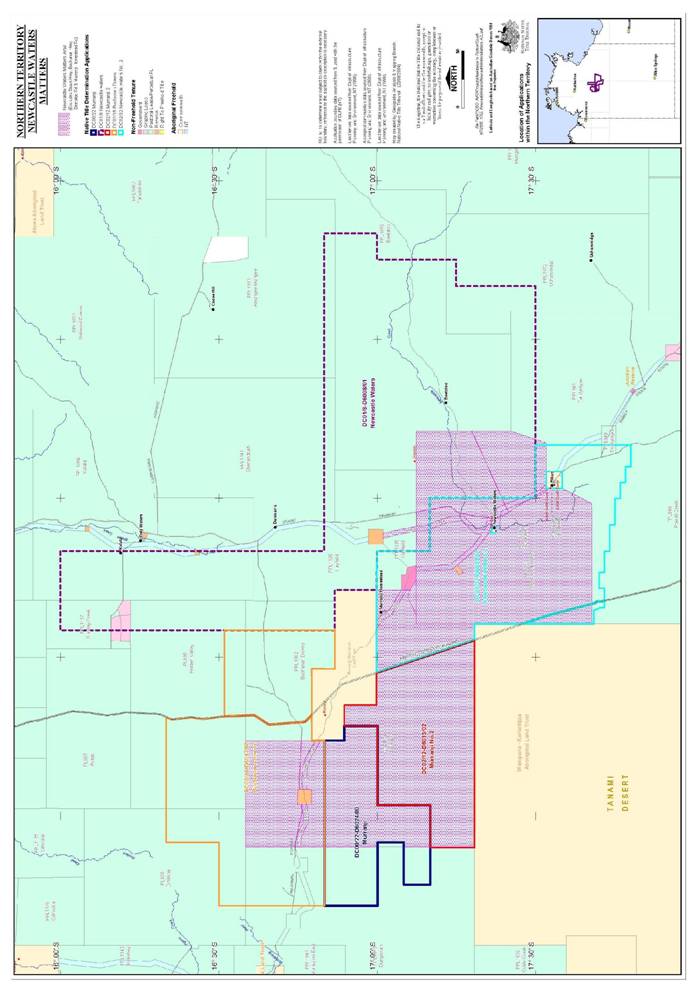
NATIVE TITLE – extinguishment – adjacent land necessary for enjoyment of improvements constructed on land subject to pastoral leases – how adjacent land should be identified in determination – whether evidence enabled conclusion about adjacent area necessary for enjoyment of improvements
NATIVE TITLE – extinguishment – construction of improvements on land subject to pastoral leases – whether only improvements constructed at time of determination to be included
NATIVE TITLE – previous exclusive possession acts – public works – where NT Gas Pty Ltd operated gas pipelines across the claim area – whether gas pipelines wholly or partly extinguish the claimed native title rights – whether gas pipelines were a "public work" for purposes of s 23B(7) of the Native Title Act 1993 (Cth) – whether attributable to the Northern Territory
NATIVE TITLE – public works – land adjacent to public work pursuant to s 251D of the NTA – whether 100 metre road corridor necessary for or incidental to operation of Newcastle Waters road – relevance of government policy
NATIVE TITLE – public works – land adjacent to public works pursuant to s 251D of the NTA – where relevant public works were highways – whether gravel pits used to maintain and repair highways, and access roads associated with gravel pits, were adjacent land – whether water catchment and storage dams for highway were adjacent land
NATIVE TITLE – public works – land adjacent to public works pursuant to s 251D of the NTA – whether land surrounding bore which provides potable water to Town of Newcastle Waters was adjacent land
NATIVE TITLE – vacant Crown land – whether s 47B of the NTA not engaged because of a making of a proclamation of a town or a declaration of a heritage place
WORDS AND PHRASES – 'adjacent', 'public work'
Crown Lands Ordinance 1931 (NT)
Crown Lands Ordinance 1931-1959 (NT)
Crown Lands Ordinance 1931-1963 (NT)
Crown Lands Ordinance 1931-1964 (NT)
Energy Pipelines Act 1981 (NT)
Heritage Conservation Act 1991 (NT), s 26(1)(a)
Native Title Act 1993 (Cth) s 47B(1)(b)(ii)
Public Health (Night-Soil, Garbage, Cesspits, Wells and Water) Regulations 1960 (NT), regs 30 and 31
Public Health Ordinance 1952-1962 (NT)
Northern Territory Crown Lands Act 1890 (SA)
Northern Territory Crown Lands Amendment Act 1896 (SA)
Northern Territory Land Act 1872 (SA)
Northern Territory Land Act 1899 (SA)
Northern Territory Land Amendment Act 1876 (SA)
Validation (Native Title) Act (NT), ss 9L and 9M
Water Act 1992 (NT)
Alyawarr, Kaytetye, Warumungu, Wakay Native Title Claim Group v Northern Territory of Australia (2004) 207 ALR 539 followed
Australian Provincial Assurance Co Ltd v Coroneo (1938) 38 SR (NSW) 700 referred to
Brock v United States of America (2007) 157 FCR 121 referred to
Citizens Airport Environment Association Inc v Maritime Services Board (1993) 30 NSWLR 207 referred to
Commissioner of Main Roads v North Shore Gas Co Ltd (1967) 120 CLR 118 referred to
Daniel v State of Western Australia [2003] FCA 666 distinguished
De Rose v State of South Australia (No 2) (2005) 145 FCR 290 applied
De Rose v South Australia [2002] FCA 1342 referred to
Fourmile v Selpam (1998) 80 FCR 151 referred to
Griffiths v Northern Territory [2006] FCA 903 referred to
Gumana v Northern Territory [2007] FCAFC 23 referred to
Jango v Northern Territory of Australia (2006) 152 FCR 150 referred to
Members of the Yorta Yorta Aboriginal Community v Victoria (2002) 214 CLR 422 referred to
Neowarra v Western Australia [2003] FCA 1402 referred to
Northern Territory of Australia v Alyawarr, Kaytetye, Warumungu, Wakaya Native Title Claim Group and Another (2005) 145 FCR 442 followed
NT Power Generation Pty Ltd v Power and Water Authority (2004) 219 CLR 90 referred to
R v Toohey; ex parte Attorney General (NT) (1980) 145 CLR 374referred to
Western Australia v Ward (2002) 213 CLR 1 applied
Wik Peoples v Queensland (1996) 187 CLR 1 referred to
GEORGE KING (MURRANJI) v NORTHERN TERRITORY OF AUSTRALIA AND OTHERS
NTD 6024 OF 2000
PHILIP ULAMARI AND POMPEY RAYMOND v NORTHERN TERRITORY OF AUSTRALIA AND OTHERS
NTD 6008 OF 2001
RAYMOND DIXON AND JEFFREY DIXON (ON BEHALF OF THE WARNINKI-KAJALANGUJKU AND KURRAWKURRAWKA/KILIKILIKA/WAJILAN GROUPS) v NORTHERN TERRITORY OF AUSTRALIA AND OTHERS
NTD 6013 OF 2002
RAYMOND DIXON, JEFFREY DIXON & JIMMY WAVEHILL (ON BEHALF OF THE TURRUTPA-JALAPIRRI, PINKAKUJARRA, MURRANJAYI AND LIYARTU-WALAMARNTA GROUPS) v NORTHERN TERRITORY OF AUSTRALIA AND OTHERS
NTD 6017 OF 2002
ERIC KINGSTON JANGALA, WILLIAM KINGSTON JANGALA, JOHNNY BENSON AND JANET SANDY (ON BEHALF OF THE WILYUKU, IJIPARTA, NGIRTINKU, KULARJA, MARLINJA/KIDPAWURRU AND WALAMARNTA GROUPS) v NORTHERN TERRITORY OF AUSTRALIA AND OTHERS
NTD 6033 OF 2002
REGINA COLLINS, HAROLD DALYWATER, REX COLLINS, SUSAN RAYMOND, AND RENATA COLLINS (ON BEHALF OF THE JARRIMANU GROUP) v NORTHERN TERRITORY OF AUSTRALIA AND OTHERS
NTD 3 OF 2004
MOORE J
26 june 2007
SYDNEY (HEARD IN DARWIN)
| IN THE FEDERAL COURT OF AUSTRALIA |
|
| NORTHERN TERRITORY DISTRICT REGISTRY | NTD 6024 OF 2000 |
| BETWEEN: | GEORGE KING (MURRANJI) Applicant
|
| AND: | NORTHERN TERRITORY OF AUSTRALIA First Respondent
BRANIR PTY LTD Second Respondent
LAVERTON NOMINEES PTY LTD Third Respondent
|
| MOORE J | |
| DATE OF ORDER: | 26 June 2007 |
| WHERE MADE: | SYDNEY (VIA VIDEOLINK TO DARWIN) |
THE COURT ORDERS THAT:
1. The parties submit a draft determination and related orders within 6 weeks of the giving of these reasons or such further time as the Court directs.
2. Liberty to apply on 7 days' notice.
Note: Settlement and entry of orders is dealt with in Order 36 of the Federal Court Rules.
| IN THE FEDERAL COURT OF AUSTRALIA |
|
| NORTHERN TERRITORY DISTRICT REGISTRY | NTD 6008 OF 2001 |
| BETWEEN: | PHILIP ULAMARI AND POMPEY RAYMOND Applicants
|
| AND: | NORTHERN TERRITORY OF AUSTRALIA First Respondent
CONSOLIDATED PRESS HOLDINGS LTD Second Respondent
BRANIR PTY LTD Third Respondent
YARABALA PTY LTD Fourth Respondent
TELSTRA CORPORATION LTD Fifth Respondent
A.P.N. PTY LTD Sixth Respondent
JAMES WILLIAM BEEBE Seventh Respondent
EDWARD HART Eighth Respondent
ELIZABETH HART Ninth Respondent
ROBERT HARVEY Tenth Respondent
BEVERLEY STOCKWELL Eleventh Respondent
THOMAS STOCKWELL Twelfth Respondent |
| JUDGE: | MOORE J |
| DATE OF ORDER: | 26 june 2007 |
| WHERE MADE: | SYDNEY (VIA VIDEOLINK TO DARWIN) |
THE COURT ORDERS THAT:
1. The parties submit a draft determination and related orders within 6 weeks of the giving of these reasons or such further time as the Court directs.
- Liberty to apply on 7 days' notice.
Note: Settlement and entry of orders is dealt with in Order 36 of the Federal Court Rules.
IN THE FEDERAL COURT OF AUSTRALIA |
|
| NORTHERN TERRITORY DISTRICT REGISTRY | NTD 6013 OF 2002 |
| BETWEEN: | RAYMOND DIXON AND JEFFREY DIXON (ON BEHALF OF THE WARNINKI – KAJALANGUJKU AND KURRAWKURRAWKA/KILIKILIKA/WAJILAN GROUPS) Applicants
|
| AND: | NORTHERN TERRITORY OF AUSTRALIA First Respondent
BRANIR PTY LTD Second Respondent
|
| JUDGE: | MOORE J |
| DATE OF ORDER: | 26 june 2007 |
| WHERE MADE: | Sydney (via videolink to darwin) |
THE COURT ORDERS THAT:
1. The parties submit a draft determination and related orders within 6 weeks of the giving of these reasons or such further time as the Court directs.
- Liberty to apply on 7 days' notice.
Note: Settlement and entry of orders is dealt with in Order 36 of the Federal Court Rules.
IN THE FEDERAL COURT OF AUSTRALIA |
|
| NORTHERN TERRITORY DISTRICT REGISTRY | NTD 6017 OF 2002 |
| BETWEEN: | RAYMOND DIXON, JEFFREY DIXON AND JIMMY WAVEHILL (ON BEHALF OF THE TURRUTPA-JALAPIRRI, PINKAKUJARRA, MURRANJAYI AND LIYARTU-WALAMARNTA GROUPS) Applicants
|
| AND: | NORTHERN TERRITORY OF AUSTRALIA First Respondent
LAVERTON NOMINEES PTY LTD Second Respondent
BRANIR PTY LTD Third Respondent
D J JAMES AND J M JAMES Fourth Respondents
|
| JUDGE: | MOORE J |
| DATE OF ORDER: | 26 june 2007 |
| WHERE MADE: | Sydney (via videolink to darwin) |
THE COURT ORDERS THAT:
1. The parties submit a draft determination and related orders within 6 weeks of the giving of these reasons or such further time as the Court directs.
- Liberty to apply on 7 days' notice.
Note: Settlement and entry of orders is dealt with in Order 36 of the Federal Court Rules.
| IN THE FEDERAL COURT OF AUSTRALIA |
|
| NORTHERN TERRITORY DISTRICT REGISTRY | NTD 6033 OF 2002 |
| BETWEEN: | ERIC KINGSTON JANGALA, WILLIAM KINGSTON JANGALA, JOHNNY BENSON AND JANET SANDY (ON BEHALF OF THE WILYUKU, IJIPARTA, NGIRTINKU, KULARJA, MARLINJA/KIDPAWURRU, WALAMARNTA GROUPS) Applicants
|
| AND: | NORTHERN TERRITORY OF AUSTRALIA First Respondent
CONSOLIDATED PRESS HOLDINGS LTD Second Respondent
TELSTRA CORPORATION LTD Third Respondent
A.P.N. PTY LTD Fourth Respondent
NT GAS PTY LTD Fifth Respondent
ELLIOTT DISTRICT COMMUNITY GOVERNMENT COUNCIL Sixth Respondent
|
| JUDGE: | MOORE J |
| DATE OF ORDER: | 26 june 2007 |
| WHERE MADE: | Sydney (via videolink to darwin) |
THE COURT ORDERS THAT:
1. The parties submit a draft determination and related orders within 6 weeks of the giving of these reasons or such further time as the Court directs.
- Liberty to apply on 7 days' notice.
Note: Settlement and entry of orders is dealt with in Order 36 of the Federal Court Rules.
| IN THE FEDERAL COURT OF AUSTRALIA |
|
| NORTHERN TERRITORY DISTRICT REGISTRY | NTD 3 OF 2004 |
| BETWEEN: | REGINA COLLINS, HAROLD DALYWATER, REX COLLINS, SUSAN RAYMOND AND RENATA COLLINS (ON BEHALF OF THE JARRIMANU GROUP) Applicants
|
| AND: | NORTHERN TERRITORY OF AUSTRALIA First Respondent
ELLIOTT DISTRICT COMMUNITY GOVERNMENT COUNCIL Second Respondent
TELSTRA CORPORATION LTD Third Respondent
|
| JUDGE: | MOORE J |
| DATE OF ORDER: | 26 june 2007 |
| WHERE MADE: | Sydney (via videolink to darwin) |
THE COURT ORDERS THAT:
1. The parties submit a draft determination and related orders within 6 weeks of the giving of these reasons or such further time as the Court directs.
- Liberty to apply on 7 days' notice.
Note: Settlement and entry of orders is dealt with in Order 36 of the Federal Court Rules.
Newcastle Waters Matters
REASONS FOR JUDGMENT
1 The reasons for judgment are organised under the following headings:
| Introduction | [2] |
| The claim area | [5] |
| The native title holders | [8] |
| The principal respondent parties | [19] |
| The claimed native title rights | [20] |
| History of the proceedings | [29] |
| Positions of the parties regarding the claimed native title rights | [42] |
| Applicants' witnesses and evidence | [47] |
| Issues for determination | [61] |
| Stock routes | [62] |
| Issue 1: connection, extinguishment and the terms of the determination in relation to specific claimed rights | [64] |
| To travel over, to move about and have access to the non-exclusive areas: [21](a) and [23](a) | [65] |
| To hunt and to fish on the land and waters of the non-exclusive areas: [21](b) and [23](b) | [70] |
| To gather and to use the natural water resources of the non-exclusive areas such as food, medicinal plants, wild tobacco, timber, stone and resin: [21](c) and [23](c) | [71] |
| To take and to use the natural water resources on the non-exclusive areas: [21](d) and [23](d) | [72] |
| To live, to camp and for that purpose to erect shelters and other structures on the non-exclusive areas ([21](e)) and to camp on the non-exclusive areas ([23](e)) | [79] |
| To light fires on the non-exclusive areas for domestic purposes: [21](f) and [23](f). | [95] |
| To conduct and to participate in the following activities on the non-exclusive areas… [21](g) | [101] |
| To maintain and to protect sites and places on the non-exclusive areas that are of significance under their traditional laws and customs: [21](h) | [102] |
| To share or exchange subsistence and other traditional resources obtained on or from the non-exclusive areas: see [21](i) | [106] |
| Issue 2: extinguishment – reserved land | [108] |
| Consideration of issue 2 | [114] |
| Issue 3: extinguishment – pastoral lease land | [116] |
| Inconsistency between the claimed rights and the grant of pastoral leases | [118] |
| Construction of pastoral improvements | [125] |
| Homestead complex | [131] |
| Sheds and other structures | [135] |
| Airstrips | [137] |
| Bores, turkey nests, squatters' tanks, dams and other stock watering points | [139] |
| Stockyards | [142] |
| Trap yards | [143] |
| Roads, tracks, laneways, mustering routes and like improvements | [144] |
| Consideration of issue 3 | [147] |
| Issue 4: extinguishment – public works land | [171] |
| Whether the gas pipelines were public works | [172] |
| Whether certain areas were adjacent to a public work | [187] |
| Newcastle Waters road | [190] |
| Gravel pits | [195] |
| Water catchment and storage dams | [202] |
| Bore RN23745 | [204] |
| Public works on stock routes | [211] |
| Issue 5: town land | [221] |
| Proclamation of town | [227] |
| Consideration of issue 5 | [232] |
| Declaration of heritage place | [239] |
| Conclusion | [251] |
Introduction
2 Many areas of land in the Northern Territory are presently used as cattle stations. This comparatively contemporary use of the land often involves significant commercial activity on large properties held as pastoral leasehold. One such property is Newcastle Waters station and another is Murranji station. Much of that land may have been used for other purposes by Aboriginal people for thousands of years through to the present. In these proceedings, it is mostly conceded that this use of the land by the applicants and their forebears was in accordance with traditional laws and customs. A central issue in this case is how the applicants' native title rights and interests should be recognised under the Native Title Act 1993 (Cth) ("NTA") in the face of the pastoralists' rights deriving from the pastoral leases.
3 This judgment deals with six applications for determination of native title under the NTA to the extent that they coextended geographically in whole or in part with the claim area, which comprised certain lands and waters in the west Barkly region of the Northern Territory. The claim area was located roughly half way between Darwin and Alice Springs and comprised Newcastle Waters station and nearly the whole of Murranji station, as well as stock routes within the external boundaries of those stations.
4 I have not descended into detail in relation to a number of matters addressed by the evidence where there was no issue between the parties. Nor have I set out and discussed in detail the various legislative regimes relevant to these applications or the authorities unless it has been necessary. Matters of uncontentious detail can be gleaned from the Court record including the comprehensive and detailed submissions of the parties. On occasions, the submissions of the parties have been adopted or paraphrased as they have provided a helpful and adequate account of the issues and evidence.
The claim area
5 The claim area comprised only part of the land and waters which the applicants claim to traditionally own and occupy. It can be viewed as comprising four areas. The first was the area known as Newcastle Waters station, which was the whole of NT Portion 2093 and was the subject of PPL 947 held by Consolidated Press Holdings Ltd ("CPH"). It was an area of around 3404 square kilometres. The second area was known as Murranji station, which comprised the whole of NT Portion 908 and almost the whole of NT Portion 851. This area was the subject of PPL 1074 held by Branir Pty Ltd, save for a relatively small elongated area on the central western boundary of the station. It was an area of around 4362 square kilometres. The third area comprised three areas of stock routes, namely NT Portions 4273, 4274 and 5147. NT Portion 4274 comprised parts of certain stock routes within the external boundaries of Newcastle Waters station. The others were parts of the Murranji stock route within the external boundaries of Murranji station. The fourth area was the area the subject of proceeding NTD 3 of 2004. This area covered land within the Newcastle Waters township, land reserved for the purpose of a garbage dump, and land reserved for the purpose of commonage. A map of the claim area can be found at annexure A. I note that there are three errors in this map. First, the references to "NT Por 4724" should be to "NT Por 4274". Secondly, "Wampana Karlantijpa Aboriginal Land Trust" should be described as "Karlantijpa North Aboriginal Land Trust area". The third error concerns that part of the Murranji stock route which lies in the eastern part of the Murranji station. On the map it is described as "NT Por 4274". It should be "NT Por 4273".
6 A number of small areas within the external boundaries of Newcastle Waters station and Murranji station were excluded from the relevant pastoral leases and therefore did not form part of the claim area. The excluded areas were used for a variety of purposes including a railway corridor, telecommunications, a cemetery and roads. Within the external boundaries of Newcastle waters, the excluded areas were:
(a) NT Por 1427
(b) NT Por 2450
(c) NT Por 3624
(d) NT Por 4275
(e) NT Por 5025
(f) 100 metre wide road corridor centred on the Beetaloo station access Road
(g) 100 metre wide road corridor centred on the Stuart Highway
7 Within the external boundaries of Murranji station, the excluded areas were:
(a) NT Portion 5148
(b) NT Portion 5026
(c) NT Portion 5621
(d) 100 metre wide road corridor centred on the Murranji station homestead to the Murranji stock route road
(e) 100 metre wide road corridor centred on the Buchanan Highway
The native title holders
8 The applicants identified the holders of native title in the claim area as:
1. members of nine estate groups ("estate group members");
2. members of six neighbouring estate groups ("neighbouring estate group members");
3. spouses of the estate group members.
9 These 15 groups were said to constitute a single native title holding community or society such that the applicants' native title rights and interests were properly described as "communal" for the purposes of s 223 and making a determination under s 225 of the NTA. These matters were ultimately accepted by the Northern Territory. The other respondents did not make submissions challenging the view that the applicants constituted a single native title holding community. The evidence supports a finding that they do.
10 The rights and interests of the neighbouring estate group members and the spouses of the estate groups members were described as being subject to the rights and interests of the estate group members. The estate group members were members of the following nine estate groups:
1. the Marlinja (Collins) group;
2. the [Y]Ijiparta (Kingston) group;
3. the Elliott (Gurungu/Kulumintini) group;
4. the Warranangku (Beetaloo) group;
5. the Kulaja (North Waterhole) group;
6. the Powell Creek (Walanpiri) group;
7. the Ngapurr (Nellis Waterhole) group;
8. the North Western group;
9. the Murranji (Narlwan/Nyirrinji) group.
11 These members include people who were members of the group by reason of:
(a) patrilineal descent;
(b) the fact that his or her mother, father's mother or mother's mother is or was a member of the group by reason of patrilineal descent;
(c) having been adopted or incorporated into the descent relationships in (a) or (b).
12 Ultimately, there was also no issue about the composition of the 15 groups. The applicants did not press an additional class of native title holders identified in the original points of claim, namely persons whose places of spirit conception were within the claim area.
13 The six neighbouring estate groups were:
10. the Tururrutpa (Hidden Valley) group;
11. the Powell Creek (Japurla-japurla / Yapa-yapa / Mali-mali) group;
12. the Top Springs (Yingawunarri) group;
13. the Badpa (Daly Waters) group;
14. the Bamarrnganja (Walanja) group;
15. the Kinbininggu (Peter's Hole), Abie Thomas and Major Taylor group.
14 Members of the neighbouring estate groups were said to include Aboriginal people who were members for the same reasons as identified in [11].
15 All 15 groups are Mudburra or Jingili or mixed Mudburra/Jingili groups. All Jingili estate groups known to the applicants' anthropologist, Eden Robert Graham, have been included amongst the 15 estate groups. However, not all Mudburra groups have been included. The more western Mudburra estate groups have been excluded because they were more closely integrated with groups whose country is in the region north-west of the claim area.
16 Mudburra and Jingili (the latter often pronounced Jingulu or Jingilu) are Aboriginal languages which are quite distinct. They are associated with relatively definable tracts of land, as are each of the 15 estate groups. Many of the applicants speak the Mudburra language fluently, whereas only a small number are fluent in Jingili. Others have the ability to understand Jingili to varying degrees. A number of Aboriginal witnesses gave evidence that Jingili was a very difficult language to learn. All or almost all of the applicants speak English of varying degrees from Aboriginal English to standard English.
17 Close links exist between the 15 estate groups and have arisen through:
(a) a high level of intermarriage;
(b) a common kinship system and close kinship affiliations;
(c) shared initiation and other ceremonies;
(d) some shared Dreaming track affiliations;
(e) joint responsibility for several important song cycles;
(f) shared residential and working histories.
18 Numerous instances of these connections were demonstrated by the evidence of the Aboriginal witnesses. This evidence supported the applicants' claim to be a single native title holding community. A number of Aboriginal witnesses said that they viewed the Mudburra and Jingili groups within the claim region as being "one mob", whereas they did not hold this view in relation to other nearby Aboriginal estate groups, even though they were related to members of other groups.
The principal respondent parties
19 CPH and Branir are respectively the lessees of Newcastle Waters station and Murranji station. Eight individuals with less direct interests in the claim area, along with Branir, were represented by the Northern Territory Cattlemen's Association and took an active role in the proceedings. I will refer generally to these two companies and the individuals represented by the NT Cattlemen's Association as "the Pastoralists", as was done throughout the hearing of these matters. The Pastoralists were jointly represented throughout the hearings, although separate points of response (and amended and substituted versions) were filed by CPH, Laverton Nominees Pty Ltd (the lessee of PPL 1076 – Dungowan station which is outside the claim area) and the NT Cattlemen's Association. The Pastoralists together with the Northern Territory were the respondents who, in the main, acted as the principal contradictors. NT Gas Pty Ltd also took an active part in the proceedings.
The claimed native title rights
20 The native title rights and interests ultimately claimed by the applicants were identified in their second draft proposed orders and determination dated 1 August 2006. The rights and interests in respect of the exclusive areas were identified as "possession, occupation, use and enjoyment to the exclusion of all others", subject to the traditional laws and customs that govern the exercise of the native title rights and interests by the applicants.
(a) the right to travel over, to move about and to have access to the non-exclusive areas;
(b) the right to hunt and to fish on the land and waters of the non-exclusive areas;
(c) the right to gather and to use the natural resources of the non-exclusive areas such as food, medicinal plants, wild tobacco, timber, stone and resin;
(d) the right to take and to use the natural water resources on the non-exclusive areas;
(e) the right to live, to camp and for that purpose to erect shelters and other structures on the non-exclusive areas;
(f) the right to light fires on the non-exclusive areas for domestic purposes;
(g) the right to conduct and to participate in the following activities on the non-exclusive areas:
(i) cultural activities;
(ii) cultural practices relating to birth and death, including burial rites;
(iii) ceremonies;
(iv) meetings
(v) teaching the physical and spiritual attributes of sites and places on the areas that are of significance under their traditional laws and customs;
(h) the right to maintain and to protect sites and places on the non-exclusive areas that are of significance under their traditional laws and customs;
(i) the right to share or exchange subsistence and other traditional resources obtained on or from the non-exclusive areas;
(j) the right to be accompanied on to the non-exclusive areas by persons who, though not native title holders, are:
(i) people required by traditional law and custom for the performance of ceremonies or cultural activities on the areas;
(ii) people who have rights in relation to the areas according to the traditional laws and customs acknowledged by the estate group members;
(iii) people required by the estate group members to assist in, observe, or record traditional activities on the areas;
(k) the right to make decisions about the use and enjoyment of the non-exclusive areas by Aboriginal people who recognise themselves as governed by Aboriginal traditional laws and customs and who acknowledge the traditional laws and customs of the native title holders;
(l) the right to conduct activities necessary to give effect to the rights referred to in (a) to (k) hereof.
23 The applicants contended that the neighbouring estate groups and the spouses of the estate group members held native title rights and interests as follows:
(a) the right to travel over, to move about and to have access to the non-exclusive areas;
(b) the right to hunt and to fish on the land and waters of the non-exclusive areas;
(c) the right to gather and to use the natural resources of the non-exclusive areas such as food, medicinal plants, wild tobacco, timber, stone and resin;
(d) the right to take and to use the natural water resources on the non-exclusive areas;
(e) the right to camp on the non-exclusive areas;
(f) the right to light fires on the non-exclusive areas for domestic purposes;
(g) the right to conduct activities necessary to give effect to the rights referred to in (a) to (f) hereof.
24 The rights described in paragraphs (a), (b), (c), (d) and (f) of [21] concerning the neighbouring estate group members are the same as the rights identified in the corresponding paragraphs in [23] regarding the estate group members.
25 For convenience, I will refer, as the applicants did, to the non-exclusive rights referred to in [21] and [23] as "the claimed native title rights".
26 Not all the claimed native title rights were in issue. The rights which remain in issue are [21](a), (d), (e), (f), (h), (i) and [23](a), (d), (e) and (f).
27 It is convenient to note at this point that the Northern Territory proposed that an additional clause should be included in the determination, expressing a limitation on the native title rights and interests recognised in the determination. The proposed clause was as follows:
The native title rights and interests are subject to and exercisable:
(a) only in accordance with the traditional laws and customs of the native title holders;
(b) for the personal or communal needs of the native title holders which are of a domestic or subsistence kind and not for any commercial or business purpose;
(c) in accordance with the valid laws of the Northern Territory of Australia and the Commonwealth of Australia.
28 The Pastoralists agreed with the proposed clause. The applicants agreed to its inclusion on the basis that its operation would be limited to the non-exclusive areas. It is not clear if there remains an issue about this clause. If there is, the parties can make further submissions before the determination is made.
History of the proceedings
Until further order of the Court,
(a) proceedings D6024 of 2000 (Murranji), D6008 of 2001 (Newcastle Waters), D6013 of 2002 (Murranji No.2), D6017 of 2002 (Buchanan Downs), D6033 of 2002 (Newcastle Waters No.2) ("the Newcastle Waters matters") are to be heard together to the extent that they coextend geographically in whole or in part with the areas the subject of perpetual pastoral lease 947 (NT portion 2093) – Newcastle Waters, perpetual pastoral lease 1074 (NT portions 851 and 908) – Murranji, and those parts of the Murranji, Birdum and North-South Stock Routes which comprise NT Portions 4273, 4274 and 5147" ("the Newcastle Waters matters area");
(b) the evidence in each matter be evidence in the other matters; and
(c) each party to each of the matters referred to in sub-paragraph (a) is a party to the Newcastle Waters matters notwithstanding the nature or location of that party's interest.
30 This order substantially confined the litigation to the determination of issues concerning the existence and extent of native title rights and interests, on the pastoral leases which, in the main, constituted Newcastle Waters station and Murranji station.
31 On 31 October 2005, I ordered that a sixth matter, namely NTD 3 of 2004, be heard together with the other matters. The effect of this order was that the Newcastle Waters matters were to include not only the areas described in order 1(a) of the orders of Mansfield J, but also the whole of the area the subject of NTD 3 of 2004, which, as noted at [5], covers the Newcastle Waters township area and two areas of reserved land.
32 The applicants' points of claim were filed on 25 October 2005. Points of response were filed by the Northern Territory, NT Cattlemen's Association, NT Gas, Telstra Corporation Ltd, Laverton Nominees and CPH.
33 The trial of this matter took place as follows:
1. on country hearings in the claim area (6, 7 and 8 March 2006);
2. hearings in Darwin, primarily for hearing evidence (3 and 4 April 2006); and
3. final submissions heard in Darwin (31 July and 1 and 2 August 2006).
34 The Court sat for the on country hearings mainly in the town of Newcastle Waters at a site about 500 metres from the Newcastle Waters homestead. Oral evidence was given by 13 Aboriginal witnesses. This is discussed in more detail at [47] to [59]. Evidence for the Pastoralists was given by Ken Warriner. Mr Warriner was a pastoralist living at Newcastle Waters station and the managing director and chairman of the board of Consolidated Pastoral Company Limited ("CPC") which undertook the cattle operations on Newcastle Waters station. CPC was a wholly owned subsidiary of CPH. Mr Warriner gave evidence both at the township and on a number of other sites where views were conducted, concerning the operations and improvements on Newcastle Waters station.
35 Views were conducted on the third day of the on country hearings. Evidence was given for the applicants by Pompey Raymond and Todman Dixon at two sites, a site about 100 metres across the road from the general store roughly on the boundary of lots 19 and 20, and at the horse paddock between the township and the homestead buildings. This included an explanation of the traditional use of certain trees and grasses, the history of certain structures and the identification of a number of significant sites, such as the union camp site, the original Aboriginal camp site and a "ring" place for boys' mantiwa (young men's initiation ceremony) business.
36 A view was conducted of the water tank on NT Portion 4232, where a description of the infrastructure was provided by junior counsel for the Northern Territory. Evidence was given by Mr Warriner at what is known as the Causeway Bore and Yards on Newcastle Waters station about structures including the drafting yard, trap yards and a turkey's nest. Mr Warriner also gave evidence at the Newcastle Waters homestead explaining various homestead buildings and surrounding structures.
37 The applicants had also intended that there be a view at Beetaloo station and that evidence be given on country at Beetaloo station by Pompey Raymond. Beetaloo station partly bordered the claim area but was not included in that area. Poor weather prevented access to Beetaloo station during the on country hearings and for some time thereafter.
38 At the hearings on 3 and 4 April 2006 in Darwin, oral evidence for the applicants was given by Mr Graham, the applicants' anthropologist, and Pompey Raymond (of the type which would have been given at Beetaloo station had the site visit been possible). Three witnesses were called for the Northern Territory, who variously gave evidence in relation to road reserves, gravel pits and bores as they related to the claim area. For the Pastoralists, evidence was given and documents tendered mainly in relation to improvements on Murranji station and Newcastle Waters station and also in relation to community living areas on Newcastle Waters station and Powell Creek. Both the applicants and the Pastoralists also lead evidence in relation to the Powell Creek telegraph station, a registered heritage place designated NT Portion 5988(A) located on PPL 948. NT Gas led evidence in relation to the gas pipeline which passed through the claim area.
39 On 4 April 2006, a timetable was set (by consent) for the filing of final written submissions. First, the applicants were to file and serve final written submissions concerning connection, and the Northern Territory was to file and serve final written submissions concerning extinguishment issues, by 29 May 2006. The respondents other than the Northern Territory were then to file and serve final written submissions concerning extinguishment issues by 5 June 2006. Next the applicants were to file and serve final written submissions concerning extinguishment issues and the Northern Territory was to file and serve final submissions concerning connection issues by 14 July 2006. Finally, the respondents other than the Northern Territory were to file and serve final written submissions concerning connection issues by 19 July 2006. Any party could file and serve a brief reply by 26 July 2006. Broadly, the parties complied with the timetable.
41 The applicants filed a notice of motion on 16 August 2006 seeking an order that Yarabala's submissions be removed from the Court file. It also sought an order declaring that Yarabala was not a party to the Newcastle Waters matters. Regrettably, this issue and the position taken by Yarabala delayed the finalisation of these proceedings. The notice of motion was heard on 1 September 2006. Ultimately, the applicants and Yarabala reached agreement, reflected in consent orders made on 24 October 2006, that Yarabala's final written submissions be removed from the Court file and replaced with new written submissions, the nature of which was to contend that the applicants had failed to establish that they have the necessary connection to PPL 849 and PPL 947 and had therefore failed to establish any native title rights in respect of the pastoral lease land. In accordance with those orders, Yarabala subsequently filed "replacement" written submissions, and the applicants filed written submissions in reply.
Positions of the parties regarding the claimed native title rights
42 As the matter proceeded, concessions were made by the applicants, the Northern Territory and the Pastoralists reflecting a large measure of agreement about the existence of native title rights and interests, their content and the way in which they should be described. For that, the parties and their legal representatives should be commended. It has made the resolution of this matter much simpler, relatively quicker and probably considerably less expensive for the parties. Nevertheless, there remained some disagreement about the existence of particular claimed rights and interests or disagreement about the way in which a conceded right or interest (conceded in a conceptual sense or as a matter of principle) should be described. The claimed native title rights which remained in issue are dealt with under the heading "Issue 1: extinguishment, connection and the terms of the determination in relation to specific claimed rights".
43 It is convenient at this point to address Yarabala's position, as embodied in the written submissions it ultimately relied on. Yarabala's position appeared to be that the non-exclusive native title rights and interests claimed in respect of the land and waters subject to the current pastoral leases were not native title rights and interests within the meaning of s 223(1)(a) of the NTA. Yarabala's submissions were brief and not easy to follow. As I understood them, however, its submissions were not consistent with now settled principles concerning the construction and application of the NTA. Yarabala submitted that the applicants' evidence established that the traditional laws and customs of the applicants did not now, and never had, comprehended anything less than exclusive rights, and the evidence did not show that the traditional customs observed had evolved to accommodate such a qualification. Yarabala characterised the applicants' argument as being that if one or more of the rights and interests in the bundle comprising native title was partially inconsistent with the valid grant of inconsistent rights, then the remnant was a partially extinguished native title right and interest. Yarabala submitted that such a case could not succeed, firstly because the idea of degrees of inconsistency had been rejected by the High Court in Western Australia v Ward (2002) 213 CLR 1 ("Ward HC"), and secondly, because the applicants' evidence did not establish that the non-exclusive rights and interests claimed in relation to the current pastoral leases were possessed under traditional laws and customs.
44 I do not propose to deal with Yarabala's submissions at length. For the reasons the applicants have given in their written submissions, Yarabala's submissions should be rejected. They involve an unsupportable amalgam of concepts concerning the content of traditional laws and customs and the nature of rights which might be capable of recognition under the NTA. In so far as Yarabala invited precision in relation to the claim area, that will, I apprehend, be achieved. To the extent that I am being invited by Yarabala to express conclusions about the existence or otherwise of rights and interests which might be recognised under the NTA in relation to areas outside the claim area, it is inappropriate for me to do so. The scope of these proceedings and the path they have taken flowed from procedural orders made on earlier occasions (see [29]). It was too late for Yarabala to seek to alter the course of the proceedings.
45 NT Gas filed points of response and took an active role in the proceedings. The position of NT Gas was that its interests in the claim area wholly extinguished native title in the relevant areas. Its submissions are considered under "Issue 4: extinguishment – public works land".
46 Telstra filed points of response in which it did not admit native title. However, by the April 2006 hearings, Telstra no longer sought to rely on the relevant paragraph of its points of response with the result that there was no longer an issue between the applicants and Telstra. The agreed position was set out in a document entitled "Record of Agreed Facts and Position of the Applicants and Telstra Corporation Limited" filed on 5 April 2006, which related to Telstra's infrastructure and interests in the claim area and the relationship between Telstra's interests and any native title interests found to exist within the claim area.
Applicants' witnesses and evidence
47 Evidence was given for the applicants by 16 Aboriginal witnesses. As noted earlier, oral evidence was given on country by 13 of these witnesses. Their statements were also admitted into evidence though omitting parts objected to and on which the respondents required formal evidence to be adduced. The Aboriginal witnesses who gave oral evidence were Pompey Raymond, Lindsay Bostock, Janey Dixon, William Kingston, Shannon Dixon, Johnny Devlin, Peter Henderson, Susan Raymond, Jimmy Wavehill, Todman Dixon, Janet Sandy Gregory, Rosemary Raymond and Harold Dalywaters. The statements of three additional Aboriginal witnesses, Mr Dixon, Sarah Allum and Harold Ulamari, were tendered by consent. Mr Dixon died before final submissions and in accordance with the applicant group's traditional customs his first name will not be used.
48 At the time of the on country hearings, the two most senior Mudburra and Jingili law men were respectively Mr Dixon and Pompey Raymond. Both were accepted to be experts in matters to do with Aboriginal law relating to the claim area. Mr Dixon was born in about 1923 in the bush near Badpa (Daly Waters) and was a Mudburra man who spoke Jingili and Mudburra. He was mangaya (meaning boss or owner for the country inherited from a person's father and father's father) for Murranji (or Narlwan) country. Murranji country covers part of the Murranji Aboriginal Land Trust area and part of Murranji station and the stock route inside it. At the time of his death, Mr Dixon was the most senior living Mudburra man and the most senior living mangaya in the Murranji (or Narlwan) group. For a long time prior to his death, he was one of the leaders for the mantiwa ceremony and other ceremonies. Because of his knowledge and authority in the community, he was entitled to speak about the other countries in and around the claim area, even though each had its own mangaya and kulyungkulyungpi (meaning policeman or manager for the country inherited from the person's mother). Mr Dixon's wife passed away in late 2005. They had ten children together.
49 Pompey Raymond was born in 1936 near Beetaloo station homestead and grew up in the camp at Beetaloo along the ridge near the big waterhole called Warranangku. Warranangku country surrounds that waterhole. He is a senior Jingili man and senior mangaya for the Warranangku group. Pompey Raymond is married to Susan Raymond, whose sister was married to Mr Dixon. Susan Raymond also gave evidence. Pompey Raymond and his wife live at the family's outstation at Jingaloo (which is on Warranangku country, just inside Beetaloo station) and also at North Camp in Elliott. They also sometimes stay at the Marlinja community. She was born in Newcastle Waters station. Her mangaya country is Marlinja. Evidence was also given by Rosemary Raymond, one of Susan and Pompey Raymond's children. Rosemary Raymond was born on Newcastle Waters station and grew up in the camp near to the present day Marlinja community, where she now lives. She was the acting principal of the Newcastle Waters school at the time of giving evidence.
50 Evidence was given by three of Mr Dixon's children, namely Shannon, Todman and Janey Dixon. Shannon and Todman were both born at Newcastle Waters station, whereas Janey was born in Elliott, a town 23 kilometres to the south of Newcastle Waters town. All three grew up at Newcastle Waters station, although the family moved to Elliott after the big flood in 1974. They are mangaya for Murranji country. Their mother's mangaya country was Marlinja country and so they are kulyungkulyungpi for that country. Shannon Dixon normally lives in the Marlinja community but was living at Elliott at the time of the on country hearings. Janey lives in the Marlinja community and works at the Newcastle Waters school, and Todman also lives most of the time at the Marlinja community.
51 Sarah Allum is a Jingili woman who was born in about 1920 on Newcastle Waters station, and grew up on the ridge near the homestead. She married Pompey Allum (group 11) whose country was Powell Creek and they had nine children. She is mangaya for Kulaja country. She has lived in Katherine since 1992.
52 Lindsay Bostock is a Jingili man who was born and grew up on Beetaloo station. He believes he is sixty-four years of age. He worked as a ringer at Beetaloo station for many years, and later at Ucharondige station where he became head stockman. He is married to Nita Bill, whose mother was in group 11. He and his wife live at Ucharondige, which is on Jingili country, and he still works on Ucharonidge station.
53 Harold Dalywaters is a Mudburra man who was born in 1965 at the hospital at Tennant Creek. He grew up in a tin house not far from Newcastle Waters homestead. He is mangaya for Badpa (Daly Waters) country. He is kulyungkulyungpi for Marlinja country. His jaju (mother's mother) country is Murranji country. He has previously worked as a stockman on a number of stations, including Newcastle Waters station and Ucharondige station. He has lived in Elliott now for ten years. For the past six and a half years he has worked as an Aboriginal Community Police Officer.
54 Johnny Devlin was born in the bush at Dunmara station in about 1942. He worked as a ringer on Newcastle Waters station for many years, and also worked on a number of other stations. He is a Jingili man and speaks Jingili as well as Mudburra. He is married to Susan Kingston, who is one of William Kingston's sisters. He now lives at North Camp in Elliott.
55 Peter Henderson was born at Newcastle Waters station in 1963, and grew up on the station, moving to Elliott after the big flood when he was about ten or eleven years old. He is a Jingili man, although he speaks the Mudburra language much better than the Jingili language. He worked at Murranji station for over seven years and then at Tanumbirini station before going to live in Katherine. Since 1988 he has spent most of his time living in Elliott or Jangirulu outstation.
56 William Kingston is a Jingili man who was born on Newcastle Waters station in 1935, and grew up on Newcastle Waters. He is mangaya for the country around [Y]ijiparta (Longreach) and kulyungkulyungpi for the Walanpiri country on Powell Creek (Bamayu) and Newcastle Waters station. Until the union strike in the 1960s, he worked mainly on Newcastle Waters station. At the time of the strike, his family moved to the union camp near the Newcastle Waters township. His family later moved to North Camp in Elliott where he lives today.
57 Janet Sandy Gregory was born in 1959 on Newcastle Waters station. She grew up in Elliott and lives there today. She is mangaya for Walamarnta country and kulyungkulyungpi for the area around [Y]ijiparta. She was married to Stanley Nuggett, who is part of the Collins family.
58 Harold Ulamari was born in 1952 on Beetaloo station. He is a Jingili man. He grew up at the Aboriginal camp on the station. His mangaya country is Warranangku country which is mostly on Beetaloo station but is also partly on the eastern side of Newcastle Waters station. His mother's country is around Walamarnta. He moved with his family to Newcastle Waters station in the early 1960s. Pompey Raymond is his father's brother. His son married a daughter of Shannon Dixon. He completed teacher training at Batchelor College and went on to teach at a number of places. He now lives in Darwin but has continued to come back to places such as Beetaloo station, Elliott, the Marlinja community and Jingaloo outstation on a regular basis.
60 In addition to the evidence of Aboriginal witnesses, the evidence relied on by the applicants included:
1. an anthropological report by Mr Graham dated October 2005. Mr Graham also gave brief oral evidence in Darwin.
2. genealogical material, prepared by Mr Graham and Northern Land Council field officer Debra Knoche. This material comprised complete genealogies for the estate groups, and an explanation of the upper genealogies of all groups.
3. personal data of the applicants from the Register of Wards documents, compiled by Mr Graham and Ms Knoche. The Register was compiled in the 1950s and updated in the 1960s and was a list of names with personal details of the Aboriginal population of the Northern Territory, including some of the members of the 15 groups, who were declared wards by legislation in 1957.
4. a report entitled "Intruders, work and land: an historical overview" prepared by Dr Lenore Coltheart and Dr Ann McGrath in 1983 for the Murranji land claim which provided the post-contact history of the claim area and region.
5. a statement of historical research by a historian, Dr Julie Wells, identifying relevant historical material relating to Aboriginal people in the claim area from the date of sovereignty to the present.
6. a 1992 report entitled "Mudburra Ethnobotany Aboriginal Plant Use from Kulumindini (Elliott) Northern Australia", written by Glenn Wightman, Mr Dixon, Lorraine Williams and Harold Dalywaters, which contains the results of an ethnobotanical study conducted among the Mudburra people of the Kulumindini (Elliott) area.
Issues for determination
61 At the Court's request, the applicants filed a document entitled "Final statement of issues" identifying the issues which remained in dispute. The respondents agreed with the document. It has proved extremely valuable in identifying the issues and what submissions were made about them together with the relevant evidence.
Stock routes
62 There is now agreement between the parties about the effect on native title of the 1933 declaration of routes for the passage of travelling stock over NT Portions 4273, 4274 and 5147 for the purpose of these proceedings. A compromise was reached between the applicants and the Northern Territory, with which the Pastoralists agreed. The compromise was essentially to the effect that the dedication of stock routes such as occurred in this case was to be treated in the same way as pastoral leases and as having the same effect on native title as pastoral leases. More specifically, the terms of the agreed position were that:
(a) the native title rights which the Court should recognise in the determination of native title in relation to those Portions are the same as the native title rights which the Court finds to exist in relation to NT Portions 851, 908 and 2903 (being the areas covered by the existing pastoral leases); and
(b) the determination of native title which the Court makes will record as an "other interest" in relation to NT Portions 4273, 4274 and 5147 valid rights of use for the passage of travelling stock.
63 The compromise was reached on the basis that it had no application to any other proceedings and did not preclude any party making submissions to any different effect in any other proceedings.
Issue 1: connection, extinguishment and the terms of the determination in relation to specific claimed rights
64 In this section, consideration is given to the parties' submissions concerning the claimed native title rights which were disputed in whole or in part. Those submissions related, firstly, to the issue of connection and secondly, to the extinguishing effect of the grant of historical and current pastoral leases in the claim area on particular rights. Some of the submissions addressed what, in substance, were issues of drafting. Further consideration is given to the submissions concerning the possible extinguishment of native title rights by pastoral improvements in the claim area, under "Issue 3: extinguishment – pastoral leases". The general legal principles concerning extinguishment by the grant of pastoral leases are discussed when considering issue 3 though are relevant to the following discussion concerning specific claimed rights.
To travel over, to move about and have access to the non-exclusive areas: [21](a) and [23](a)
65 The Northern Territory agreed with the applicants' formulation of this claimed right, on the understanding that it did not include a right to be permanently located at any particular place on the claim area the subject of the pastoral leases, as such a right would be inconsistent with the grant of the pastoral leases. The Pastoralists adopted these submissions and proposed that the word "limited" be inserted in the formulation of this right, as follows:
The right to travel over, move about and to have limited access to the non-exclusive areas.
66 The Pastoralists contended that the right should be expressed as a right to "limited" access, which was said to be justified by the pastoralist's right to govern that access in the event of any conduct inconsistent with the rights being exercised.
67 There was no issue that the evidence established the existence of a right to travel over, move about and have access to non-exclusive areas. It did. Rather the Pastoralists advanced the inclusion of the qualifying word "limited" on the basis that any native title right to access was subject to a pastoralist's right to govern access. Reference was made to uncontroversial evidence, which I accept, to the effect that dogs can frighten cattle and ordinarily if cattle have been mustered into a paddock or have otherwise been confined in a paddock, the gate to the paddock needs to be shut after opening. Implicit in the submission, as I understood it, was that a pastoralist could insist on a person seeking to exercise a native title right to access, not exercising the right near cattle if accompanied by a dog or, if exercising the right by entering a paddock through a closed gate, could only exercise the right on the basis that the gate would be closed.
68 Counsel for the applicants submitted that as pastoral leases did not confer a right of exclusive possession, it followed from Ward HC (at [179] – [186]) that pastoral lessees had no right to exclude or limit access of native title holders to lands held under pastoral lease. The reservation in pastoral leases did not define or confine the native title right to access the land: see Ward HC (at [417]). The possibility of conflict in the exercise of the native title right and rights being exercised (or which might be exercised) by a pastoralist was said to be irrelevant in determining inconsistency of rights. Counsel for the applicants did concede, however, that if there was a conflict in activity, the activities of the pastoralists prevailed: s 9L of the Validation (Native Title) Act (NT)("VNT Act"). Counsel for the applicants noted the determinations by the Full Court in Northern Territory of Australia v Alyawarr, Kaytetye, Warumungu, Wakaya Native Title Claim Group and Another (2005) 145 FCR 442 ("Alyawarr") (at [122] and [133]) and Attorney-General (NT) v Ward (2003) 134 FCR 16 ("Ward FC") (at [11]). Those determinations contained no qualification of the type proposed by the Pastoralists. Counsel for the applicants also noted that the applicants accepted that the determination should contain a clause to the effect that where there was a conflict in the exercise of rights, the rights of the Pastoralists prevailed.
69 In my opinion, the qualification of the right of access proposed by the Pastoralists by the inclusion of the word "limited" is unnecessary. Once it has been established by evidence that there is a native title right of access, a matter not disputed by the Pastoralists, then the right should be expressed in terms fully describing the right. The circumstances identified by the Pastoralists were instances involving the exercise of a right of access. What, in substance, the qualification sought to address was the exercise of unqualified rights by, on the one hand the native title holders exercising a right of access, and, on the other, the right of pastoralists to conduct pastoral activities exercising rights conferred by the pastoral lease. But the circumstances involving a conflict in the exercise of rights is addressed by the applicants' acceptance in their draft determination of a clause which provides that to the extent, if at all, that the exercise of native title rights and interests conflicts with the exercise of the rights and interests of the pastoral lease holders, the rights and interests of the pastoral lease holders prevail over but do not extinguish the native title rights and interests.
To hunt and to fish on the land and waters of the non-exclusive areas: [21](b) and [23](b)
70 The Northern Territory submitted that, on the authority of Ward FC, this right was to be understood as a right to hunt and fish for traditional food and not to hunt livestock, so as to avoid inconsistency with the grant of the pastoral leases. This submission was adopted by the Pastoralists. The applicants did not take issue with this proposition.
To gather and to use the natural water resources of the non-exclusive areas such as food, medicinal plants, wild tobacco, timber, stone and resin: [21](c) and [23](c)
71 This claimed right was accepted by the Northern Territory and the Pastoralists on the basis of the types of resources specified in the right, coupled with the limitation proposed by the Northern Territory (see [27]) upon the right to share and exchange resources. It was conceded on that basis that the claimed right was not inconsistent with the grant of the pastoral leases.
To take and to use the natural water resources on the non-exclusive areas: [21](d) and [23](d)
72 The Northern Territory's position was that the word "resources" should be deleted, and that the right should be expressed instead as "the right to take and to use the natural free water on the non-exclusive areas". The Pastoralists finally proposed the following formulation:
The right to take and use the natural free flowing and freestanding water on the non-exclusive areas, and for the sake of clarity and the avoidance of doubt this right does not include the right to take or use water captured or controlled by the holders of PPL 1074 and PPL 947.
73 In support of this formulation, the Pastoralists submitted that it was necessary to include an express reference to "free flowing" and "freestanding" water in order to distinguish between natural waters (in relation to which there can be native title rights and interests) and water that has been captured and in the possession of the pastoralist. It was submitted that although there cannot be ownership of free flowing or freestanding water at common law, once it had been appropriated by a pastoralist in the exercise of a right conferred by a pastoral lease, for example into a man-made dam, it belonged to the pastoralist (subject to statutory provision to the contrary). The Pastoralists submitted also that there could be no recognition of any exclusive native title right in relation to free flowing or free standing water because such a right was inconsistent with common law principles: see Attorney-General (Northern Territory) v Ward (2003) 134 FCR 16 (at [24]-[25]) and Commonwealth v Yarmirr (2001) 208 CLR 1 (at [235]).
74 The applicants submitted that since rights in water were vested in the Northern Territory, under ss 9-11 of the Water Act 1992 (NT), it was inappropriate to speak of water "controlled" by the pastoral lessee. They submitted that although the vesting of rights in water in the Northern Territory was inconsistent with a native title right to control water, such rights were not inconsistent with a native title right to take and use water.
75 The applicants submitted that the evidence disclosed use of water by the applicants and their ancestors, as of right. Water was obtained from springs, soakages, a rock hole and from certain trees. The applicants submitted that the term "natural" clearly referred to waters in their natural state and would not embrace water in a man-made structure. The terminology of the claimed right had been accepted by a Full Court in Ward FC (at[11](right 5(a))).
76 Two issues arise. The first is whether the formulation of "natural water resources" advanced by the applicants should be preferred to the Northern Territory's formulation of "natural free water" and the formulation advanced by the Pastoralists, being "natural free flowing and freestanding water resources". The second is whether the qualification ("for the sake of clarity …") proposed by the Pastoralists is necessary. Again there was no dispute that the evidence established a native title right concerning water usage. It did. The evidence was to the effect that the right had been exercised in a way which involved taking water from streams and watercourses but also taking water from soakages (which might include digging), springs and subterranean water accessed through caves and water obtained from trees by cutting them.
77 I accept, as submitted by the Northern Territory, that the word "resources" should not be used unless it serves some purpose. For my part, I view it as surplusage even if it is a formulation which has been used in other determinations. Similarly, however, the word "free" may qualify the right established by the evidence but its meaning in this context appears to me to be obscure. That the word "free" was unnecessary is made more acute if the proposed qualifying words advanced by the Pastoralists were included in the description of the right. I consider that these qualifying words should be included though without the word "controlled" which again is obscure and probably unnecessary.
78 Counsel for the applicants accepted that the qualifying words reflected the legal position but were unnecessary. That is, it was accepted that such native title rights as had been established by the evidence, did not extend to use of water which had been appropriated by someone into a man-made structure. In my opinion, it is desirable to make as clear as possible the right and its limits in the determination in relation to a matter of potential significance, namely water. Accordingly, an appropriate formulation is "the right to take and use the natural water on the non-exclusive areas, and for the sake of clarity and the avoidance of doubt this right does not include the right to take or use water captured by the holders of PPL 1074 or PPL 947".
To live, to camp and for that purpose to erect shelters and other structures on the non-exclusive areas ([21](e)) and to camp on the non-exclusive areas ([23](e))
79 The applicants accepted that the secondary rights holders did not, on the evidence, have a customary right to dwell permanently on the non-exclusive areas, their right being expressed as a right "to camp". As to both the estate group members and the secondary rights holders, the Northern Territory and the Pastoralists proposed that the rights should be expressed as a "right to camp but not dwell permanently". The applicants submitted that any qualification to the effect that the secondary rights holders did not have a right to dwell permanently on the land was unnecessary, such a construction of the claimed right, and the phrase "to camp", not being reasonably open. I accept the applicants submissions in relation to the right claimed at [23](e) and see no reason to qualify the right as proposed by the respondents. It is a right to camp only, which does not comprehend dwelling permanently. The following discussion relates to the claimed right at [21](e), that is, the right of the estate group members.
80 Both the Northern Territory and the Pastoralists contended that a right to dwell permanently on the land was inconsistent with the grant of the pastoral leases. The Northern Territory also contended that the evidence concerning this claimed right did not extend to the right to remain permanently at a particular location on the claim area or to erect any permanent structure, particularly structures such as conventional housing. It submitted that all the applicants' witnesses in fact had permanent residences in towns, on Aboriginal land, on outstations (areas excised from pastoral leases and granted in fee simple to an Aboriginal association) or on pastoral leases in accommodation supplied by their employer. With one exception, none permanently resided on their estate area, and none exercised the right as part of a native title right. It also submitted that the evidence of the erection of shelters and structures, such as humpies, windbreaks and bough shades was of structures made mostly of wood, leaves and grass (although some also used tin or metal) and had a limited life of a few months. The Northern Territory accepted the applicants' analysis that there had generally been a progression from living in humpies, to tin houses to more conventional housing, at least in relation to the applicants and their immediate forebears. However, it submitted that in most cases it was not the applicants who had erected structures in the exercise of a native title right but rather pastoralists for whom they worked or by builders engaged by the crown in furtherance of the "outstation" movement.
81 In Alyawarr, the Full Court held that the right, expressed in the same terms as the right claimed in this case, was not inconsistent with the rights conferred by a pastoral lease because (at [131]):
Consistently with what was said by Nicholson J in Daniel (No 2) and Sundberg J in Neowarra, the right to 'live' on the land can be interpreted as a right to live permanently on the land without any conflict with pastoral leaseholders' rights. That right does not necessarily involve permanent settlement at a particular place. The issue therefore reduces to the question whether a native title right of permanent settlement is inconsistent with a pastoral leaseholder's rights. There is no logical reason why it must be so. Just as the right to live permanently on the land does not necessarily give rise to inconsistency with the pastoral leaseholder's rights, neither does the right to erect a permanent structure. The existence of such a structure does not preclude a pastoralist's right to require its removal in the event that it conflicts with a proposed exercise by the pastoralist of a right under the lease. It is not inevitable that such a conflict will arise. (emphasis added)
82 The Northern Territory and the Pastoralists contended that the Full Court's decision ought not be followed, for two reasons. Firstly, it was said that the pastoral leases in Alyawarr were not current leases under which pastoral activities were occurring, and secondly, the decision of the Full Court was attended by error. The applicants submitted that the contention that the Full Court had erred could not be maintained because the decision was binding authority. Further, they submitted that Alyawarr could not be distinguished on the basis advanced by the Northern Territory because the relevant inquiry was about inconsistency of rights, not activity. Further, in Alyawarr (at[218]-[227]), the same arguments about a right to live on land were advanced in relation to a current Crown lease, and were rejected. The Full Court in De Rose v State of South Australia (No 2) (2005) 145 FCR 290 ("De Rose (No 2)") had also recognised a similarly worded right in relation to lands which had been continuously subject to pastoral leases for over 60 years and remained so at the time of trial and determination. The applicants also submitted that the qualification proposed by the Northern Territory and the Pastoralists suggested a right on the part of the lessee to exclude the native title holders should they remain on the land any longer than "temporarily", which was contrary to the principle that pastoral leases did not confer a right to exclude native title holders from the land established in Wik Peoples v Queensland (1996) 187 CLR 1 ("Wik") at 120-121, 146-147, 154-155, 190-195, and Ward HC (at [179]-[186] and [417]).
83 The Northern Territory submitted that the evidence established a position the same as in Daniel v State of Western Australia [2003] FCA 666 ("Daniel") where Nicholson J concluded that there was no right to build houses but that there was a right to built shelters including bough sheds, mias and humpies.
84 The applicants contended that the issue appeared not to be whether there was a right to live on the land but how this right could be exercised, in particular whether the right may be exercised permanently at a particular place on the land, and whether it may be exercised by erecting permanent shelters and structures. The applicants also noted that the wording of the claimed right did not make any reference to living or camping permanently at a particular place or to the erection of permanent structures.
85 Two issues arise for consideration. The first is whether the evidence established the existence of the claimed right or of a right with similar but different characteristics. The second is whether the claimed right had been extinguished by the grant of the pastoral leases. As to this second issue, I view myself as bound by the decision of the Full Court in Alyawarr to conclude that the grant of the pastoral leases in the present matter did not extinguish any native title right to live or camp on the leasehold land. That the present case involved subsisting leases is not, for reasons submitted by the applicants, a relevant point of distinction.
86 As to whether the claimed right exists, it is necessary to review the evidence. Generally, the Aboriginal witnesses who gave evidence on country were asked preliminary questions in evidence in chief about their mangaya country, the meaning of "mangaya", and what rights it entailed in the land. Each witness confirmed that they had a right to live on their mangaya country. For example, Shannon Dixon gave evidence, when asked what it meant to be mangaya or an owner for country, that it meant "I can go stay and live there". A number of witnesses were specifically asked if anyone had the right, under traditional law, to stop them staying or living in their mangaya country, and these witnesses confirmed that no one had such a right. Evidence was, however, given by Janey Dixon that if she caused serious trouble then members of her family could kick her out of her mother's country (Marlinja) or father's country (Narlwan).
87 Some witnesses also gave evidence about their rights in their mother's country. Janey Dixon, for example, lives in Marlinja, which is her mother's country. Her evidence was that she has the right to live in Marlinja, permanently, and that no one could stop her from living there, under traditional law, and that she was kurdungurlu or kulyungkulyungpi for that country, which she described as being "like a black policeman".
88 A number of witnesses also gave evidence that their children and grandchildren also had rights in their country, through them. For example, William Kingston gave evidence that his mangaya country, Longreach, is also his daughter's mangaya country. Janey Dixon's evidence was that her daughter and her brother's children had rights in Marlinja, her mother's country, including the right to stay there. A number of witnesses also gave evidence about the rights of their spouse or children who also had rights in that country and the nature of those rights. The pattern was that spouses also had rights to live on the country but under traditional law, were expected to ask permission to do certain things, although the evidence was also that the spouse knew where he or she could and could not go and who they should ask.
89 Evidence of a similar kind was given in statements by the three witnesses who were not required for cross-examination. None of the evidence about the right to live was challenged in a material way in cross-examination.
90 It was not in issue that there had been, in relation to the claim group, a general progression over time concerning the type of structures in which the applicants and their forebears lived. The following are some illustrative examples of the evidence given by the applicants' witnesses. Pompey Raymond gave evidence of having grown up at the Aboriginal camp at Beetaloo station where a "big mob" lived in humpies. Later, two houses were built near the homestead for workers, where Pompey Raymond and his brother lived at one time. Today, Pompey Raymond and Susan Raymond live mainly at Jingaloo outstation where there is one house. Shannon Dixon gave evidence of having grown up in the Aboriginal camp at Newcastle Waters where his family lived in a humpy made of lancewood, spinifex and flattened out 44-gallon drums. After he left the station, tin houses were built for the Aboriginal people. At holiday times, his family lived in Narlwan also in humpies. Susan Raymond grew up at the Aboriginal camp on Newcastle Waters station around the same time as Shannon Dixon, and also gave evidence of having lived in a humpy and of going on walking trips to places such as Beetaloo where they would stay in a humpy at Tent Pole bore (now Lewis Ridge bore). The humpies were built a long time ago but they would "fix them up a bit" each time. Todman and Janey Dixon, who are both some years younger than their brother Shannon, recalled growing up on Newcastle Waters station living in a tin house. The applicants submitted that not all the claim group lived today in conventional housing, with Lindsay Bostock giving evidence that he and his wife lived today in a small tin house on Ucharonidge station. None of this evidence was challenged in any material way, and I accept it.
91 There was further evidence of structures being erected by the claim group. Pompey Raymond gave evidence of building a lancewood bough shelter at Jingaloo and building a fence for his garden. He also said that there was a big bough shade at Marlinja and said "we make bough shade or sort of a humpy, or wind break, for ceremony". Again, this evidence was not challenged in any material way and I accept it.
92 Both the Northern Territory and the Pastoralists submitted that the right should not be expressed as involving or comprehending a "right to live". But that is precisely what the evidence established, the acknowledgement and observance of that right. It must be remembered, as Sackville J observed in Jango v Northern Territory of Australia (2006) 152 FCR 150 ("Jango") (at [407]), Aboriginal witnesses cannot be expected to recount their laws and customs with anything like the precision that might reasonably be expected of a lawyer expounding common law principles. It is true that the evidence did not establish a present widespread observance of the right to live being exercised in the form of building structures in which to permanently reside. However, that does not compel the conclusion that the claimants did not presently possess that right in the relevant statutory sense. Gleeson CJ, Gummow and Hayne JJ observed in Members of the Yorta Yorta Aboriginal Community v State of Victoria (2002) 214 CLR 422(at [84]):
[E]vidence that at some time, since sovereignty, some of those who now assert that they have that native title have not exercised those rights, or evidence that some of those through whom those now claiming native title rights or interests contend to be entitled to them have not exercised those rights or interests, does not inevitably answer the relevant statutory questions.
That is so, because the critical question concerns possession of the rights and interests and not their exercise.
93 I accept that a right to live is presently acknowledged and observed by the claim group. The relevant right should be viewed as having the same content as the right discussed by the Full Court in Alyawarr. That right does not necessarily involve permanent settlement at a particular place. But importantly, as the Full Court recognised, even if the right is sought to be exercised by permanent settlement, it cannot be exercised in a way which is inconsistent with a pastoral leaseholder's rights. Ultimately, a right recognised in a determination to live and camp which might involve the erection of shelters and other structures, cannot be exercised in a way that derogates from the leaseholder's rights. Whether the exercise of the native title right has that effect, falls to be determined at the time of its exercise. If, for example, the assertion of the native title right involved the construction of a modern brick building on land used or proposed to be used for grazing or for some other purpose expressly or impliedly authorised by the pastoral lease, then its exercise would almost certainly derogate from the leaseholder's rights. In such circumstances the leaseholder could insist on the removal of the structure, as the Full Court recognised, or prevent its construction.
94 But these are not matters that go to the content of the right, if established on the evidence as it is. Accordingly, it is inappropriate to identify the right in the way proposed by the Northern Territory and the Pastoralists and it should be expressed in the way proposed by the applicants and established by the evidence.
To light fires on the non-exclusive areas for domestic purposes: [21](f) and [23](f).
95 Earlier in the proceedings, the claimed right at [21](f) and [23](f) was framed as "[t]he right to cook on the determination area and to light fires for all purposes other than the clearance of vegetation". In response, the Northern Territory and the Pastoralists proposed separate but similar formulations of the right. The Northern Territory proposed:
The right to cook on the areas and to light fires for that and other domestic purposes, but not for the clearance of vegetation.
96 The Pastoralists proposed formulation was:
The right to light fires for cooking, heating, lighting, making tools and products and other domestic purposes, other than the purpose of clearing vegetation.
97 The applicants then proposed an alternative formulation which they submitted better accorded with the evidence than the claimed right as originally expressed. The reformulation was a "right to light fires on the non-exclusive areas for domestic purposes". The applicants contended that this embraced the domestic purposes of cooking, heating and lighting, but would not cover burning off country and was not inconsistent with the rights under the pastoral leases. Further, the applicants submitted that laws like the Bushfires Act 1980 (NT) did not prohibit the lighting of fires for any of the purposes contemplated by the claimed native title right. Relying on Ward HC (at [26]), the applicants submitted that native title was not extinguished by the existence of statutory powers which if exercised would do no more than regulate the exercise of the native title right without abrogating it, and that although powers in Part III of the Bushfires Act might regulate the exercise of the claimed right, they did not extinguish it. Yarabala resisted this argument and submitted that this was not a regulation of the type contemplated by the High Court in Ward HC.
98 There existed a minor area of contention between the applicants, on the one hand, and the Northern Territory and the Pastoralists on the other, concerning this right. The issue concerned what the claimed right as formulated did and did not comprehend. Relying on Ward HC, the Northern Territory and the Pastoralists submitted that there could be no native title right to burn country. They contended that any right to light fires other than for purposes of cooking, heating and light, was inconsistent with the grant of a pastoral lease. The uncontested evidence, which I accept, was that not only were fires used for cooking and heating but for other purposes which included burning bark for domestic purposes, boiling foliage for medicinal purposes and manufacturing nulla nullas. These purposes are adequately described by the simple formulation proposed by the applicants, namely "domestic purposes". Indeed, the use of the catch all, "other domestic purposes", in the Northern Territory's and the Pastoralists' formulations would, as a matter of construction, extend the right to cover all domestic purposes. That is what the applicants proposed. The applicants' formulation is to be preferred in describing what the right comprehends.
99 It was accepted by counsel for the applicants that on the evidence there was no right to set alight vast grasslands in order to regenerate the country or as an aid to hunting. Indeed, no such right had ever been claimed. However, there appeared to be no dispute that, as I was informed by senior counsel for the Northern Territory, in other Aboriginal societies in the Northern Territory, fires are used for these purposes. The expression "domestic purposes" might be viewed as comprehending such activities and it is, on balance, desirable that it be made clear that the right does not extend to such activities. Accordingly, it is appropriate to include the words "but not for the clearance of vegetation".
100 As to the particular submission of Yarabala, I accept, for the reasons the applicants submitted, that the Minister's powers are of regulation, and native title rights have not, in this respect, been extinguished.
To conduct and to participate in the following activities on the non-exclusive areas… [21](g)
101 There was in effect no issue about this claimed right. It was accepted by the Northern Territory and the Pastoralists. It was submitted by the Northern Territory and the Pastoralists that the right did not comprehend a right to regulate the presence of others and that any such native title right had been extinguished by the grant of pastoral leases. This proposition was not disputed by the applicants. The Northern Territory accepted that the applicants might be able to regulate the presence of others in the activities referred to where those activities took place on sacred sites on the claim area, pursuant to the Northern Territory Aboriginal Sacred Sites Act (NT). The effect of that Act is recognised in the applicants' draft determination.
To maintain and to protect sites and places on the non-exclusive areas that are of significance under their traditional laws and customs: [21](h)
102 The Northern Territory and the Pastoralists proposed similar amendments to this claimed right. There was however no issue about the content and wording of the core right. The Northern Territory proposed the right be expressed as:
The right to maintain and to protect sites and places on the non-exclusive areas that are of significance under their traditional laws and customs (not including a right to exclude persons from any part of the non-exclusive areas).
103 The formulation proposed by the Pastoralists was:
The right to maintain and to protect sites and places on the non-exclusive areas that are of significance under their traditional laws and customs (not including a right to exclude persons from or otherwise control access to or use of any part of the non-exclusive areas).
104 The Northern Territory and the Pastoralists both contended that the right should be qualified as "not including a right to exclude persons". They submitted that any native title right to exclude others had been extinguished by the grant of pastoral leases. However, both also conceded that the Full Court in Alyawarr had not been prepared to add any qualification to a right to maintain and protect places and areas of importance of that kind. The applicants submitted that the Northern Territory and the Pastoralists had not advanced any reasons why I should depart from the decision in Alyawarr.
105 Counsel for the applicants submitted that the claimed right did not involve an assertion of a right to control access and exclude others from the land. It was submitted that a contention that the claimed right did or might involve such an element had been rejected in two judgments of the Full Court of this Court, being Ward FC (at [24]-[25]) and Alyawarr (at [136]-[140]). There is little room to doubt that this is correct. On the assumption that I accept, which I do, that these authorities establish that a right expressed in the terms proposed by the applicants does not involve an assertion of a right to control access and exclude others from the land, the Northern Territory did not press its contentious words of qualification or clarification. However, the Pastoralists did press the issue. In view of what has now been said by the Full Court on two occasions, it is inappropriate that words of qualification or clarification be included when they are demonstrably unnecessary.
To share or exchange subsistence and other traditional resources obtained on or from the non-exclusive areas: see [21](i)
106 The Northern Territory agreed with this claimed right, subject to the inclusion of the clause referred to at [27]. The Pastoralists opposed the inclusion of this claimed right in its entirety. The Pastoralists contended that rights to trade, share or exchange were not rights in relation to land and therefore not recognisable by the common law. The issue was pressed only to preserve the right to argue the matter on appeal, and they acknowledged that the Court was bound to reject the submission on the basis of the Full Court's decision in Alyawarr.
107 The issue concerning this right can be dealt with briefly. I reject the Pastoralists submission, as they accepted I was bound to, that the claimed right was not one in relation to land.
Issue 2: extinguishment – reserved land
108 The only issue regarding reserved land in the claim area related to NT Portion 797 which is the subject of Reserve 1153. NT Portion 797 was proclaimed as a reserve for the "purposes of a garbage reserve" by the Governor-General under s 103 of the Crown Lands Ordinance 1931-1964 (NT) on 11 December 1964 and published in the Northern Territory Government Gazette on 27 January 1965. Section 103(1)(c) of the Ordinance, at the time of the reservation, permitted the Governor-General, at any time by proclamation, to reserve for any purpose including "for any other public purpose which he thinks fit" any Crown lands not subject to any right to or contract for purchase. On 4 October 1971, NT Portion 797 was approved by the Chief Medical Officer as a depot for the depositing of garbage for the purposes of reg 30 of the Public Health (Night-Soil, Garbage, Cesspits, Wells and Water) Regulations 1960 (NT) (the Regulations), in force under the Public Health Ordinance 1952-1962 (NT). Regulation 30 provided:
A person shall not deposit garbage elsewhere than at a garbage depot approved by the Chief Medical Officer.
109 Regulation 31 provided:
A person depositing garbage at a garbage depot approved by the Chief Medical Officer shall dispose of the garbage as directed by the Chief Medical Officer.
110 The issue is whether reservation as a garbage reserve and approval as a depot for the depositing of garbage involved the exercise of a power concerning the use of the land which was wholly inconsistent with the continued existence of any native title rights exercisable on the land. In particular, the question was whether the effect of the reservation and approval under the Regulations created rights in others that were inconsistent to any extent with the claimed native title rights in respect of the land.
111 The applicants submitted that the Regulations did not contain any restriction on the use of a garbage depot. They merely provided an ability for members of the public to use land for the disposal of garbage, at the direction of an executive officer. The applicants contended that the effect of the reservation and approval for use as a garbage depot could not be considered wholly inconsistent with the continued existence of native title rights: see Daniel (at [693] regarding access to a cemetery reserve). Further, it was submitted that the approval could not be said with any certainty to have affected native title to any extent greater than that caused by the earlier grant of historical pastoral leases.
112 The Northern Territory and the Pastoralists submitted that between 1965 and 1980 the entirety of NT Portion 797 was used for the disposal of garbage. The applicants accepted that the land was in fact used for disposal of garbage for the period, although they noted that such use of the land was unlawful until the land was approved as a depot for the deposit of garbage in 1971. Aerial photographs of the area in 1980 and 2003 were in evidence. The applicants submitted, in the event that it was necessary to consider the evidence about use of the reserve, that the aerial photographs did not show which part or parts of NT Portion 797 were used for the disposal of garbage. It was submitted that it should not be inferred that all the land was used, particularly since it was a large area (44 hectares). The applicants' position was therefore that in the absence of evidence about the area used, it was not possible to conclude that native title rights were extinguished to any extent in any part of the reserve.
113 The Northern Territory submitted that the use of land for the disposal of garbage on land which was reserved as a garbage reserve and declared as a garbage depot demonstrated the assertion of rights by the Crown, and the creation of rights in third parties, which were wholly inconsistent with the continued existence and enjoyment of any native title rights in relation to the whole of the area covered.
Consideration of issue 2
114 There was no real issue about the applicable principles. They can be gleaned from the joint judgment of Gleeson CJ, Gaudron, Gummow and Hayne JJ in Ward HC (at [219]-[221]). The designation of land as a reserve for certain purposes does not, without more, create any right in the public or any section of the public which by reason of inconsistency extinguished native title rights and interests. Whether a particular native title right continued in existence or was extinguished depended upon other considerations, particularly what, if any, rights in others were created by the reservation or later asserted by the executive. In the present case it is sufficient to focus on the circumstances which existed in 1971 which had been brought about by the initial reservation and the approval of the land as a depot for depositing garbage. Those circumstances were that the land was reserved for a public purpose namely as a garbage reserve and, it can be inferred, garbage from the township was to be deposited in the reserve. Both a right to deposit garbage and an implied obligation to do so been created by that time. The question then was whether this was consistent with the continuation of the native title rights agreed or determined in this matter.
Issue 3: extinguishment – pastoral lease land
116 The issues that arose in respect of the land in the claim area subject to historical and current non-exclusive pastoral leases were:
1. whether or to what the rights granted by historical pastoral leases over NT Portions 797, 851, 908, 2093, 4232, 4273, 4274 and the town of Newcastle Waters were inconsistent to any extent with the claimed native title rights;
2. in relation to NT Portions 851, 908 and 2093 presently held under pastoral leases, the extent to which the claimed native title rights were extinguished by the construction of improvements.
117 These issues reflect the distinction between the extinguishing effect of the grant of a pastoral lease per se and the subsequent construction and use of improvements in exercise of the rights granted by that pastoral lease: see De Rose (No 2).
Inconsistency between the claimed rights and the grant of pastoral leases
118 The only parts of the claim area currently subject to pastoral leases are NT Portions 851 and 908 (Murranji station) and NT Portion 2093 (Newcastle Waters station). Historical pastoral leases wholly covered NT Portions 797, 851, 908, 2093, 4232 and 4274 and the town of Newcastle Waters and part of NT Portion 4273. The pastoral leases were all granted prior to the commencement of the Racial Discrimination Act 1975 (Cth) on 31 October 1975.
119 It was common ground that:
(a) the current pastoral leases and their immediate predecessors did not extinguish native title rights and interests to any greater extent than the historical pastoral leases that covered NT Portions 851, 908 and 2093; and
(b) the historical and current pastoral leases are previous non-exclusive possession acts that engage Division 2B of Part 2 of the NTA.
120 The effect of the grant of the pastoral leases on native title is determined by ss 9L and 9M of the VNT Act, which correspond with s 23G of the NTA. To the extent that the grant of pastoral leases involved the grant of rights inconsistent with native title rights and interests in relation to the land, such native title rights are extinguished if they would have been extinguished "apart from" the NTA: see s 9M of the VNT Act.
121 The Northern Territory identified eight pastoral leases which it contended had partially extinguished native title rights and interests over the whole of NT Portions 797, 851, 908, 2093, 4232, 4274 and the town of Newcastle Waters, and part of NT Portion 4273. The leases were granted under the Northern Territory Land Act 1872 (SA), the Northern Territory Land Amendment Act 1876 (SA), the Northern Territory Crown Lands Act 1890 (SA), the Northern Territory Crown Lands Amendment Act 1896 (SA), the Northern Territory Land Act 1899 (SA) and the Crown Lands Ordinance 1931 (NT).
122 The Northern Territory did not contend that the rights conferred by any particular lease extinguished native title rights and interests to any greater extent than any other lease granted over the claim area. In other words, all pastoral leases ultimately had the same effect on native title, a conclusion which the applicants accepted. The applicants submitted on that basis that the questions that arose could be answered by examining the rights commonly conferred by the historical pastoral leases that have affected the claim area. The applicants submitted that the rights commonly conferred by the historical pastoral leases were, as a general proposition, rights to:
1. occupy and use the land for pastoral purposes;
2. graze stock and use natural pastures for that purpose;
3. use natural and man-made waters for watering stock and for domestic purposes;
4. travel over the land for the purpose of conducting pastoral activities;
5. construct and maintain improvements, to clear the land, but not to destroy timber or trees other than for use on or in connection with the land.
123 Pastoral leases of the type in question extinguish various native title rights including any native title right or interest amounting to the right to exclusive possession, occupation, use and enjoyment: see Ward HC (at [192]). In the context of similar pastoral leases in Western Australia, the High Court in Ward HC (at [422]) held that the right to be asked permission to use or have access to the land was inconsistent with the rights granted under the pastoral leases. As the Northern Territory and the Pastoralists submitted, the eight pastoral leases in question extinguished this native title right independently of the VNT Act, which is confirmed by s 9M(1)(a) of the VNT Act. Ward HC did not determine which other native title rights and interests would be consistent and which would be inconsistent with rights conferred on a pastoral lease holder, although views were expressed about certain rights (at [425] and [194]).
124 The submissions of the Northern Territory and the Pastoralists in relation to the extinguishing effect of the grants of the relevant pastoral leases on particular claimed native title rights and interests were dealt with in the context of issue 1. The Northern Territory and the Pastoralists conceded that a number of the claimed rights in the applicants' draft determination were not inconsistent with the rights granted under the pastoral leases, so far as land not the subject of improvements and buffer zones was concerned. In relation to the native title rights which it did concede, the Pastoralists made the general submission that a native title right to access the stations was contingent upon access being undertaken in a manner consistent with the pastoralists' right to conduct pastoral operations. It was further submitted that the right of access was subject to the access not involving interference with a muster or other operation, not involving the bringing of dogs onto a station other than under strict control and the requirement that gates be left as they were found. They referred to evidence given by particular Aboriginal witnesses concerning the behaviour of dogs near cattle and the consequences of gates being left open.
Construction of pastoral improvements
125 The Pastoralists contended that native title rights had been wholly extinguished in relation to those parts of the claim area which were or had been the subject of improvements, and also adjacent areas (also described as "buffer zones"). Native title rights were said to be wholly inconsistent with the pastoral lease holder's rights in relation to those areas. The Northern Territory adopted the submissions of the Pastoralists on this issue.
126 The main improvements were identified as:
1. the homestead complex;
2. other sheds and other structures outside the homestead complex;
3. airstrips;
4. bores, turkey nests, squatters' tanks, dams and other stock watering points;
5. stockyards;
6. trap yards;
7. roads, tracks, laneways, mustering routes and like improvements.
127 Other improvements included approximately 80 to 90 fenced paddocks and fencing in excess of 1000 kilometres. The fenced paddocks included commercial cattle paddocks (which could be up to 300,000 to 400,000 acres) and stud paddocks which tended to be much smaller.
128 The following is a summary of the evidence concerning the main improvements and the Pastoralists' submissions including those concerning the appropriate buffer zone (where applicable). The evidence primarily relied upon was the evidence of Mr Warriner. His evidence related, in the main, to Newcastle Waters station, although limited evidence on Murranji station was also given. There were also two exhibits in evidence, one in relation to Newcastle Waters station (exhibit L) and the other in relation to Murranji station (exhibit K), containing information about improvements on the stations. Also in evidence were two maps. One was a 2005 map produced by the Department of National Resources, Environment and the Arts showing the location of improvements on Newcastle Waters station and part of Murranji station. The other map was produced by the Lands and Survey Branch of the Northern Territory Administration in 1988 and showed, inter alia, bores and fences on Newcastle Waters station.
129 The applicants conceded that native title had been wholly extinguished in those parts of Newcastle Waters station and Murranji station which were:
(a) a homestead, house, sheds and buildings;
(b) bores, turkey nests, squatters' tanks, constructed dams or other constructed stock watering points;
(c) the homestead airstrip and highway airstrip on NT Portion 2093;
130 The areas in relation to which this concession applied were the land on which the improvements had been lawfully constructed prior to the date of the determination, and included any adjacent land or waters, the exclusive use of which was necessary for the enjoyment of the improvements. The latter part of this concession concerning adjacent land, was a concession in principle. It did not involve a concession about the specific adjacent lands claimed by the Pastoralists.
Homestead complex
131 The original homestead building on Newcastle Waters station was constructed in about the 1890s, with the present homestead being constructed in 1984. Mr Warriner gave evidence describing the "homestead complex" on the station, which included both living and business areas. It was about 1 square kilometre in size excluding the airstrip. It extended from the front gate in the north to the area of the guest quarters and the "supermarket" (where scrap metal, wire and other materials are stored) in the south and runs from the airstrip to the waterhole. Mr Warriner's evidence included the dates on which parts of the homestead complex had been constructed.
132 The Pastoralists contended that native title rights were extinguished not only in the areas comprising the homestead complex but also an additional zone of 2 kilometres surrounding that area (excluding any area not the subject of PPL 947).
133 In relation to that zone, the Pastoralists relied on the evidence of Mr Warriner. That evidence was to the effect that the pastoral lessee and its staff required security and privacy for the homestead complex (including the fenced part of the waterhole) because of:
1. the previous and future use of the water hole as a source of water;
2. operational and safety issues regarding the use of road trains and heavy machinery; and
3. the need to exercise control over access to valuable and/or dangerous stores (including fuel).
134 The Pastoralists took a similar position in regards to Murranji station, submitting that the native title rights and interests were extinguished in the area of the Murranji homestead complex and within a 2 kilometre radius of that complex.
Sheds and other structures
135 These improvements were buildings located at some stockyards used for the purpose of accommodating the "stock camp" on Newcastle Waters station. Stockmen camped around the area of the sheds and used them for shelter, storage of equipment and for cooking and eating. Mr Warriner's evidence was that there were three stock camp buildings.
136 The Pastoralists submitted that the ability to exclude persons from an area of 1 kilometre from each structure was necessary to preserve the privacy and security of those structures. It was submitted that where these structures were near a yard with more than one trough, a larger number of cattle would be mustered to the area, with the result that a zone of a couple of kilometres would be needed. Mr Warriner gave evidence about the importance of excluding people from areas where large numbers of cattle had been mustered and that water points were installed near stockyards to muster large numbers of cattle.
Airstrips
137 Mr Warriner's evidence was that airstrips were very important on pastoral stations and that they must be able to be used at all times. Two "good strips" able to take larger aircraft were located at the homestead and the highway. Airstrips suitable for light aircraft were also located at every set of yards. It was also possible to land on good quality station tracks in some areas if there was a need to do so. There were obvious safety issues with having people or dogs too close to an airstrip. It was also important that a camp of any sort was not near an airstrip as camp rubbish such as wire or rope could cause significant damage and be quite dangerous to a plane. Mr Warriner's evidence was that people or dogs should not be any nearer than 500 metres of an airstrip, and that you would not put an airstrip within about 1 kilometre of a large community unless the airstrip was fenced off, such as the homestead airstrip.
138 The Pastoralists submitted that there were obvious inconsistencies between the operation of airstrips and the exercise of native title rights and interests within the area the subject of the airstrips and within 500 metres of airstrips for operation and safety reasons. There was evidence, for example, that netting had been installed at the airstrip at Newcastle Waters to limit the potential for interference by materials from the Marlinja community. The Pastoralists submitted that the right to use an airstrip (which was said to crystallise when the airstrip was constructed) was inconsistent with the right to exercise native title rights and interests over the airstrip or the area reasonably necessary for or incidental to its use. It was submitted that it was not to the point that there was no necessary inconsistency between the occasional exercise of a native title right to use an airstrip and the pastoral lessee's rights to construct and use an airstrip (at any time) if there was no exercise of the native title right when the airstrip was being used.
Bores, turkey nests, squatters' tanks, dams and other stock watering points
139 Mr Warriner's evidence was they could rely on surface water during the wet season and some time thereafter, but outside that time, they relied on water sourced from bores. He said there were about 80 bores on Newcastle Waters station and every bore was checked twice a year. Each bore pumped to at least one turkey nest or squatters' tank. There were about 80 squatters' tanks and turkey nests of Newcastle Waters station. All paddocks also had troughs, bores, squatters' tanks and/or turkey nests, or a combination. His evidence was that a squatters' tank was a storage facility constructed from cement, metal or other materials, and a turkey nest was an artificially built up area to store water made from naturally occurring materials. There were also three to four excavations on the station which were used or had been used as dams, all but one of which were rain fed. The dam water was generally not available after the middle of the year. About 80% of the watering points had traps allowing cattle to wander in and out of the fenced area to get water for most of the year. At mustering time, one way gates were used so that the cattle went to the water as usual but then could not get out of the yard.
140 Mr Warriner's evidence was that cattle did not like new things and were disturbed by noise and movement. Once cattle are spooked away from an area, they may not come back for some time (up to weeks). This may also mean that the pasture or cattle lose condition. Not having access to water physically stresses cattle, and affects their condition and temperament.
141 The Pastoralists submitted that interference with cattle access to water points was potentially a difficulty, and that native title rights and interests that included a right to be in the area comprised by the watering points and the area necessary for or incidental to the use of the improvements had been extinguished because they were inconsistent with the pastoralists' right to construct and use that improvement. The Pastoralists submitted that:
1. a pastoralist had a right to construct and use improvements directed to watering cattle;
2. interference with such improvements or with the area incidental to and necessary for the use of a watering facility was inconsistent with a pastoralist's rights;
3. the presence of persons near water points could scare cattle away, as established by the evidence of three Aboriginal witnesses;
4. the area within which cattle were likely to be spooked away from watering points was within approximately 1 kilometre of them (relying on Mr Warriner's evidence); and
5. a large area of exclusion might be necessary to prevent the interference with large numbers of cattle mustered to yards around multiple water points (again, on the evidence of Mr Warriner).
Stockyards
Trap yards
143 Trap yards are smaller yards used to "capture" cattle as part of the "self-mustering" process. There are 80 or 90 on Newcastle Waters station. They involve a system of gates that can be set to one direction (in or out) to trap the cattle that go into the yard. Trap yards always contain a watering point. Relying on Mr Warriner's evidence, the Pastoralists submitted that it was important that traps and the approaches to them were not subject to interference, so that cattle could become used to using the yards and therefore easily trapped in them. It was also important to be able to exclude persons from the area of the trap so that its operation could not be interfered with by setting spears wrongly. It was contended that the area that was necessary for and incidental to the construction and use of trap yards was created by having a 1 kilometre radius around each trap yard.
Roads, tracks, laneways, mustering routes and like improvements
144 Mr Warriner's evidence was that there was about 4000 to 5000 kilometres of roads on Newcastle Waters station. Roads ran along every fence line and also linked up all the bores so that they could be easily accessed by land for checking and maintenance. They could also be used as emergency landing strips. Mr Warriner also gave evidence that people using these roads was not a problem as long as they were not being used at certain times, say for a muster, and provided that the gates were shut afterwards.
145 Similar, though generalised evidence, was given about roads on Murranji station.
146 The Pastoralists submitted that the rights granted by a pastoral lease included the right to construct roads, tracks, laneways, mustering routes and like improvements. Since a pastoralist could establish a right of way, it was submitted that the pastoralist must have a right to use it at will. The right to exercise a right of way meant that native title rights could not co-exist with such rights, as both rights could not be exercised at the same time. The Pastoralists referred by analogy to Fourmile v Selpam Pty Ltd (1998) 80 FCR 151.
Consideration of issue 3
147 The applicants submitted that the Northern Territory and the Pastoralists' case was, at best, based on a potential conflict in activity of the same kind rejected by a Full Court in Alyawarr. Further, it was submitted that even if the conflict did arise in the future, it would be solved under s 23G(1)(a) of the NTA which provides that the granted rights prevail over but do not extinguish native title to the extent that they are not inconsistent with them.
148 Ultimately, the applicants accepted that I was bound to give effect to the reasoning of the Full Court in De Rose (No 2) even though, it was submitted, there was a tension between the Full Court's judgment and the judgment of the High Court in Ward HC. The Full Court in De Rose (No 2) said (at [157]):
The result is that native title rights and interests over De Rose Hill Station have been extinguished in relation to the specific areas of land on which the improvements authorised by the leases have been constructed. The previous non-exclusive possession acts (namely the grants of the leases) gave the lessees rights which, when exercised, were inconsistent with native title rights and interests over De Rose Hill Station.
149 Having regard to the judgment of the Full Court, the applicants accepted that when certain improvements were lawfully made on leasehold land, native title rights were extinguished on the land on which each improvement was made, though this concession was qualified in several ways. It is convenient to discuss separately the issues which included some matters of detail about how the determination should be expressed.
150 The first and probably most significant issue concerns the particular class of improvements to which the concession just discussed applies. The applicants accepted, on the basis of De Rose (No 2), that subject to other qualifications, improvements in the form of a homestead or house, sheds, buildings, bores, turkey nests, squatters' tanks, constructed dams or other constructed stock watering points, and certain airstrips, can be treated as having extinguished all native title rights in the land on which they were situated. The airstrips in relation to which the concession was made were the homestead and highway airstrips. No such concession was made in relation to other improvements, namely other airstrips, roads, tracks, laneways, mustering routes and cattle yards of various types (including those described as stockyards, trap yards, drafting yards and holding paddocks, though some of these expressions were said by the applicants to have been used interchangeably).
151 It is unnecessary to refer to the statutory provisions which create the fabric for this discussion as they are in relevantly the same terms as those considered by the Full Court in De Rose (No 2). Certainly no submission to the contrary was made. The reasoning of the Full Court indicates that it is necessary to identify the native title rights and interests (at [146]), then to ascertain rights conferred by the leases (at [147]), and finally to determine whether their conferral is inconsistent with the continued existence of the established native title rights (at [148] and following). This last step can involve a consideration of the nature of the right conferred by the lease having regard to the manner in which it can be exercised (at [149]) and, additionally, how it has been exercised in order to identify the areas of land in respect of which native title rights have been extinguished (at [150] and [157]).
152 In applying this approach, the Full Court in De Rose (No 2) did not disturb the conclusion of the trial judge that improvements in the nature of fences and roads did not extinguish native title (at [124]). However, having regard to clause 6 of the draft determination in Appendix A to the reasons for judgment (and the determination as finally made) in that matter, this may not have been an issue in the appeal, as was submitted by the Pastoralists in these proceedings (see [18] and [127] of the Full Court's reasons). While it was not a matter explicitly referred to by the Full Court, the primary judge did not conclude (as reflected in the determination he made and also reflected in the determination made by the Full Court) that areas on which cattle yards were constructed were areas in which native title had been extinguished. One explanation for this is that those yards were associated with watering points which were areas in which native title had been extinguished. It should also be noted that the determination of the Full Court treated native title rights as extinguished on airstrips.
153 While there was a measure of disagreement between the parties concerning the rights conferred from time to time under the pastoral leases (or enabling legislation including regulations) to make improvements to the leased land, the applicants did not dispute that as a result of express covenants in the leases, the enabling legislation (including regulations) or by implication, rights were conferred on the pastoral lessees to construct, maintain and use stockyards and trap yards (and the other contentious improvements, namely airstrips (other than the homestead and highway airstrips) and pastoral roads, tracks, laneways and mustering routes.
154 It should be noted that in their written submissions, the applicants referred in some detail to the reservation in the leases, variously expressed over time in favour of Aboriginal people and contended that the reservation did qualify or limit the rights held under lease. However, I did not understand the applicants to submit that these reservations operated in the applicants' favour in a way which derogated from or qualified the pastoralists' right to construct improvements. Indeed during final submissions on 31 July 2006, counsel for the applicants said that the reservations were irrelevant to the issue of extinguishment. Accordingly, I proceed on the basis that the improvements in issue have been constructed and are maintained and used in exercise of rights conferred on the Pastoralists to so construct, maintain and use them.
155 I first consider the position of the stockyards, trap yards, drafting yards and holding paddocks. Having regard to the competing draft determinations in this matter it is only necessary to consider yards described as stockyards or trap yards (which are the yards referred to in the Pastoralists' draft determination where it was said that extinguishment had occurred). Generally, I accept the evidence of Mr Warriner, earlier summarised, concerning these and other improvements on Newcastle Waters station.
156 In my opinion, all native title rights established by the applicants have been extinguished by the grant of the right to construct stockyards and trap yards and the exercise of that right and are extinguished on the areas on which they have been constructed. To paraphrase the observations of the Full Court in De Rose (No 2) (at [149]) directed to a dwelling house or storage sheds, it is hard to see how the native title holders right to gain access to the land or hunt anywhere on the land in a traditional manner could co-exist with the lessees' rights to construct and use stockyards and trap yards. They are created for the specific purpose of housing cattle. While their use for this purpose may only be periodic or intermittent, this right to use together with the exercise of the right to construct is inconsistent with an temporally unconstrained right to travel over, move about and have access to the land as well as to hunt, to use the natural resources and live and camp (and the other native title rights referred to elsewhere).
157 It is convenient to deal with airstrips (other than the homestead and highway airstrips) roads, tracks, laneways and mustering routes together as, in my opinion, they are conceptually similar. I will refer to the airstrips here in question as the "trap yard airstrips" and to the roads, tracks, laneways and mustering routes collectively as "pastoral roads". I accept Mr Warriner's evidence that airstrips were located at each set of yards and that it was necessary to keep them clear. I also accept his evidence about the location and use of pastoral roads on Newcastle Waters station.
158 The following observations were made by the trial judge concerning airstrips and roads in De Rose v South Australia [2002] FCA 1342 (at [558]), the proceedings culminating in De Rose (No 2):
...I do not see how improvements such as fences and roads would wholly, or even partially, extinguish native title; they are clear examples of improvements which are capable of joint use. Airstrips represent a particular problem because of issues of safety. Because of that factor, I would deny the claimants all rights of access with a buffer zone of 500 metres. In respect of airstrips and their buffer zones, native title has been extinguished.
159 This reasoning must, of course, be tested against the approach determined by the Full Court in the appeal from that judgment. It is doubtless true that many of the native title rights arising in this matter (except, perhaps, the right to live and camp including to erect shelters) can be exercised on land on which an airstrip or road has been constructed. While it is possible that the exercise of those rights might conflict with the use of an airstrip or road (for example, hunting on the airstrip or road when a plane is landing or vehicle passing by), it could reasonably be expected that such circumstances would be rare. However, as I apprehend the reasons of the Full Court in De Rose (No 2), based, as they were, on High Court authority, it is important to focus ultimately on the competing and potentially inconsistent rights of pastoralists (and their exercise) and native title right holders and not merely on whether land can be used simultaneously by both in exercise of those rights.
160 If I was satisfied on the evidence that the trap yard airstrips and pastoral roads were constructed, in the sense discussed by the Full Court in De Rose (No 2), in exercise of rights conferred by the leases, then it would appear to follow from the reasons of the Full Court, that their construction in exercise of those rights probably extinguished all native title rights on the land on which they were constructed. However, the evidence to which I was referred does not enable me to conclude that there was such construction. If it be the fact (and this is not established one way or the other by this evidence) that the trap yard airstrips were nothing more than naturally flat land cleared of vegetation and the roads were nothing more than navigable land over which vehicles have continuously driven, then probably neither could be said to have been constructed. If it be the fact (and this is not established one way or the other by this evidence) that either the trap yard airstrips or the pastoral roads (or some of them) had been graded and formed then it may be possible to say they have been constructed in exercise of rights conferred by the lease. Given the paucity of the evidence I am unable to conclude that native title rights have been extinguished on land on which trap yard airstrips and pastoral roads presently exist on the claim area.
161 The next issue concerns land adjacent to the improvements. The applicants conceded that where native title had been extinguished on land due to the construction of an improvement on that land, native title would also be extinguished on adjacent land, the exclusive use of which was necessary for the enjoyment of the improvement. The applicants proposed a regime, to be incorporated in the determination, which involved identifying the land adjacent to improvements in general terms and the creation of a liberty to apply:
to establish the precise location of the boundaries of land on which the improvements referred to at Schedule D to this determination have been constructed and any adjacent land or waters the exclusive use of which is necessary for the enjoyment of the improvements.
162 The Pastoralists contended that such an order should be expressed consistently with [166] of De Rose (No 2), not by reference to "exclusive use", and similarly, that the reference to the buffer zone or adjacent areas in the determination should be expressed in the same way. Where the evidence permitted a finding about the adjacent area needed to permit enjoyment of the improvement, the Pastoralists submitted that that should be reflected in the determination though they appeared to accept that, as an alternative, findings could be made in the reasons for judgment identifying the adjacent area in relation to those improvements addressed by the evidence.
163 In De Rose (No 2) the Full Court discussed, comparatively briefly, the question of "buffer zones". The Full Court said (at [166]-[167]):
...As was said in Ward (HC), the grant of a right (in this case to erect or construct improvements) carries with it those rights necessary for its meaningful exercise (at [308]). On this basis, the native title rights and interests are extinguished over the land on which the improvements are constructed and any adjacent land the use of which is reasonably necessary for or incidental to the operation or enjoyment of the improvements.
It will be noted that this formulation is similar to that adopted by s 251D of the NTA. However, the reason for employing that formulation is not that it is to be found in the NTA. Rather, the formulation gives effect to the principle expressed in Ward (HC). It follows that it is not appropriate to incorporate into the determination a buffer zone ascertained by reference to the dimensions that happened to be specified, for other purposes, in the [South Australian law concerning pastoral leases]. (emphasis added)
164 In the draft determination appended to the Full Court's reasons for decision (a draft proposed by the State of South Australia), the formulation concerning adjacent areas as "the exclusive use of which is necessary for the enjoyment…". This is the formulation in the determination ultimately made by the Full Court. In this matter, as mentioned earlier, the Pastoralists advocated the adoption of the formulation in the reasons. The applicants advocated the adoption of the formulation in the determination. For my part, I doubt that there is a material difference between the formulation in the reasons and the formulation in the determination (except, perhaps, whether one speaks of "use" or "exclusive use" (in the determination)). If something is reasonably necessary, it is necessary. I apprehend that the word "necessary", like the word "unique", gains little by qualification. If anything, the qualifying word "reasonably" might be viewed as a word of limitation (potentially to the Pastoralists' detriment): see Brock v United States of America (2007) 157 FCR 121 (at [107]-[109]). Similarly, if adjacent land is required because its use is incidental to the operation or enjoyment of the improvement, then it can reasonably be said that its use is necessary for the operation or enjoyment of the improvement. In any event, the formulation in the reasons of the Full Court had its origins in the reasons of the majority of the High Court in Ward HC (at [308]) in which only the word "necessary" is used, albeit to ancillary rights for the meaningful exercise of a granted right and not the use of areas of land.
165 While the test propounded by the Full Court in its reasons in De Rose (No 2) did not speak of "exclusive use", the determination did. It can be assumed that the determination of the Full Court truly reflects the Court's intentions. Accordingly, it is appropriate to adopt the formulation used in the determination in De Rose (No 2).
166 I turn to consider whether, and to what extent, the determination should specify the area of adjoining land on which native title rights have been extinguished at least in relation to improvements about which there was some evidence. In their written submissions, the Pastoralists proposed a buffer zone of 2 kilometres around the homestead areas, a buffer zone of 1 kilometre around buildings used for the purpose of accommodating the "stock camp" on Newcastle Waters station, 500 metres for airstrips, 1 kilometre for constructed watering points, 2 kilometres for stockyards and 1 kilometre from trap yards. Other than in the case of the buffer zone around the homestead complex these distances were identified in the evidence of Mr Warriner in relation to the improvements on Newcastle Waters station.
167 To the extent that there was evidence about an appropriate area, it was to the following effect. Mr Warriner said that for safety reasons, you could not land on an airstrip if people (or dogs) were too close and he said that by that, he meant 500 metres. He also observed that you would not put an airstrip near a large community (unless it was fenced, which the homestead airstrip was). As to troughs and other constructed watering points, Mr Warriner said that people can spook cattle and you would not want them near troughs and other watering points. He said the distance depended on the circumstances and the number of cattle using the watering point but that "in most cases" a distance of about 1 kilometre was sufficient. However, he went on to say that if you were dealing with a large mob of cattle at a watering point that had a number of troughs, you might need a couple of kilometres to ensure that there was no disruption. He gave similar evidence about stockyards and trap yards, expressing the conclusion that it was important that people did not come within 1 kilometre of a trap yard and 2 kilometres of a stockyard.
168 I am satisfied this evidence reflects a genuinely held view (which was not challenged in cross examination) and at a level of generality, it is a reasonable view. However, it does not, in my opinion, provide a sufficiently firm evidentiary foundation for me to conclude that in relation to each improvement in the class of improvements about which evidence was given, native title rights have been extinguished in the described area because it is an area necessary for the enjoyment of each improvement in the class. More detailed evidence would be necessary. However, I would provide for the liberty to apply proposed by the applicants so that when (and if) an issue arises about the existence of native title rights in an area surrounding an area on which an improvement has been constructed, quite specific attention can be given to the improvement and what is truly required to ensure that the improvement can be fully and effectively enjoyed by the owner of the lease. No submission was made that the exercise of the liberty to apply would be constrained by s 61 or s 13 of the NTA and I proceed on the basis that it would not.
170 Counsel for the Pastoralists equivocated about whether the extinguishing effect of improvements (to be reflected in the determination) concerned only improvements made at the time of the determination. In my opinion it is only such improvements which have that effect. It is the right to construct improvements, when exercised, which has an extinguishing effect:see De Rose (No 2) (at [149] and [156]). This is reflected in the determination made by the Full Court in De Rose (No 2). It is appropriate that I follow the approach of the Full Court. That is, to express the determination in terms of extinguishment by the improvements made at the time of the determination.
Issue 4: extinguishment – public works land
171 The two issues in relation to public works land in the claim area were:
1. whether the gas pipelines constructed and operated by NT Gas were public works for the purposes of the previous exclusive possession act provisions of the NTA; and
2. whether certain areas of land were adjacent to and necessary for, or incidental to, the construction, establishment or operation of a public work for the purposes of s 251D of the NTA.
Whether the gas pipelines were public works
173 NT Gas contended that each pipeline was a "public work" as defined in s 253 of the NTA, which definition is picked up by the VNT Act. It submitted that the combined effect of s 23B(7) and s 23C(2) (together with s 9J of what is now the VNT Act) was that the construction or establishment of the pipeline was a previous exclusive possession act wholly extinguishing native title. The applicants' position was that the pipelines were not public works and had no greater effect on native title rights and interests than the pastoral leases. NT Gas also advanced an alternative basis on which there had been partial extinguishment by the grant of two licences which, as a final proposition advanced by NT Gas, enlivened s 44H of the NTA with the result that activities undertaken by NT Gas prevailed over native title rights and interests.
174 The definition in s 253 of the NTA provides:
public work means:
(a) any of the following that is constructed or established by or on behalf of the Crown, or a local government body or other statutory authority of the Crown, in any of its capacities:
(i) a building, or other structure (including a memorial), that is a fixture; or
(ii) a road, railway or bridge; or
(iia) where the expression is used in or for the purposes of Division 2 or 2A of Part 2 - a stock-route; or
(iii) a well, or bore, for obtaining water; or
(iv) any major earthworks; or
(b) a building that is constructed with the authority of the Crown, other than on a lease.
175 NT Gas relied on two aspects of this definition. It submitted that the pipelines were "fixture(s)" or, alternatively, constituted "major earthworks", though ultimately NT Gas submitted the pipelines themselves were not earthworks but their construction involved major earthworks. The applicants contended that they were neither. As to whether the pipelines were fixtures, the applicants pointed to s 59 of the Energy Pipelines Act 1981 (NT) which declares that a pipeline is not a fixture of the land to which is attached or through, under, on, across or above which it is constructed.
176 It is tolerably clear that s 59 determines rights and obligations in the Northern Territory under Northern Territory law (whether the common law or statute) between a licensee under the Act who has constructed or operates a pipeline and the owners or lessees of property through which the pipeline passes. The provision is intended to ensure that the balance of rights and obligations would not be determined on the basis that the pipeline was a fixture. However, the relevant legal question, for present purposes, is whether the pipelines were "fixture(s)" as that expression appears in s 253 of the NTA. The character of the pipelines, for that purpose, cannot be determined by Northern Territory legislation. Indeed, I am bound to follow the conclusion of Mansfield J in Alyawarr, Kaytetye, Warumungu, Wakay Native Title Claim Group v Northern Territory of Australia (2004) 207 ALR 539 (at [307]) that the word "fixture" in the definition means a fixture as understood at common law, unless I thought his Honour was plainly wrong, which I do not.
177 At common law, as Mansfield J noted, a fixture requires a degree of annexation to the land, and an intention that it be permanent: see generally Australian Provincial Assurance Co Ltd v Coroneo (1938) 38 SR (NSW) 700 at 712-713. The applicants appeared to make a submission that the pipelines were not fixtures, apart from s 59 of the Energy Pipelines Act, having regard to the observations of the majority of the High Court in Commissioner of Main Roads v North Shore Gas Co Ltd (1967) 120 CLR 118 at 127. For my part, I do not view those observations as warranting the conclusion that the pipelines in the present case were not fixtures at common law. Their Honours said that the presumption that whatever is fixed to freehold land is said to become part of it is rebuttable and, in effect, could be rebutted where a statute had empowered someone other than the owner of land to affix to or embed things in the soil and yet retain ownership of those things. Their Honours were addressing what the legal consequences might be of something being a fixture in a particular context, not what was a fixture. In the present case there is little room to doubt that the pipelines are fixtures. They were embedded in the soil and, for all practical purposes, were to remain there permanently. I conclude that they are fixtures. It is unnecessary to determine whether they are also major earthworks.
178 The next issue is whether the pipelines were constructed or established by or on behalf of the Northern Territory or a statutory authority for the purposes of the definition of "public work" in s 253. NT Gas submitted that the definition was met because it had constructed the main pipeline (and by implication the lateral pipeline) on behalf of a statutory authority, namely the Northern Territory Electricity Commission ("NTEC") whose functions, relevantly, were later assumed by the Power and Water Corporation ("PAWC"). The applicants did not dispute that these had been statutory authorities for the purposes of the definition. In issue was whether the pipelines were constructed "on behalf of" a statutory authority.
179 It is necessary, at this point, to refer to the evidence in more detail. Unless otherwise indicated, the following represents findings of fact. NT Gas holds two pipeline licences. One was granted by the Northern Territory on 13 December 1985 and was a licence to construct, operate and maintain a pipeline that carried natural gas from the Palm Valley gas fields near Alice Springs (Amadeus Basin) to the Channel Island Power station (Darwin). That power station was constructed as a gas-fired power station by the Crown to utilise gas carried by the pipeline to generate electricity for Darwin and other Northern Territory towns. CPH granted the Crown an energy supply easement, the benefits of which were later granted to NT Gas. A second licence concerning the lateral pipeline to Elliott was granted on 25 July 1989 and similar arrangements were subsequently put in place. That pipeline supplies gas to the Elliott Power station. Construction of the main pipeline commenced in July 1985 continuing through the dry seasons of 1985 and 1986. Construction was completed in October 1986.
180 NT Gas asserted, in written submissions, that NTEC contracted for the construction and operation of the pipelines. On one view of the written submissions of the applicants, this appeared to be accepted. However, the evidence of NT Gas on this issue was obscure and not probative of the fact. It took the form of an executive summary of a submission made to the Australian Competition and Consumer Commission dated 4 October 2001. That simply asserted that NTEC entered into a long-term agreement with NT Gas for the transportation of gas through the main pipeline and that absent the long term agreement between NT Gas and the NTEC and the Northern Territory's support, development of that pipeline would not have occurred. The document constituting the agreement was provided by counsel for NT Gas to counsel for the applicants. The document was not tendered. However, an agreement was reached by counsel whereby certain matters revealed by the document were mutually admitted. They did not include an admission, nor did they support a finding, that NTEC contracted for the construction of the pipelines.
181 The admissions by the applicants were that NT Gas was solely responsible for the custody, control and operation of the two pipelines. PAWC had no relevant rights in relation to such custody, control or operation with two provisos. They were that NT Gas obtained all gas from a subsidiary of PAWC, which gas was delivered to PAWC at its receiving facilities and that PAWC had rights to full capacity in the pipelines for gas transmission, if required. The other admitted fact was that title to, and property in, the gas conveyed in the pipelines remained with NT Gas until it was delivered to and received by PAWC at its receiving facilities, for example the Channel Island or Elliott Power stations.
182 In addition to these admitted facts, the evidence established that the Northern Territory had provided guarantees and indemnities supporting NT Gas's obligations to the four major Australian banks for the lease financing of the main pipeline. The Northern Territory also guaranteed and indemnified the financing of $385 million for the construction of the pipeline in 1985 and 1986. Over 99% of the gas transported through the pipeline was carried on behalf of PAWC. NT Gas tendered a number of pamphlets and like documents (as well as a DVD) concerning the pipeline and its construction. Their precise evidentiary status was not clear though there was no objection to their tender. It is tolerably clear from this material, and I find, that the Northern Territory was persuaded to alter plans to build a coal-fired power station to supply electricity to Darwin and, instead, to build a gas-fired power station. This occurred after representations were made by a consortium which included, amongst others, producers of gas retrieved in Central Australia. This probably happened in 1984. In the result, a consortium, including the gas producers, established NT Gas for the purpose of constructing and operating the pipeline and marketing the gas. In a pamphlet dated July 1986 (when the construction of the pipeline was nearing completion) NTEC was described as a major consumer of the gas transmitted through the pipeline though other consumers were also contemplated.
183 What must be determined is whether against this factual background, the pipelines were constructed on behalf of NTEC. The expression "on behalf of" has no fixed legal meaning: see R v Toohey; ex parte Attorney General (NT) (1980) 145 CLR 374 at 386. It may be used when speaking of an agency relationship or the relationship of trustee and beneficiary but can be used in relation to quite ephemeral relationships. The expression's meaning will be substantially determined by context. In my opinion, the expression "on behalf of" is, in context, intended to comprehend the construction or establishment of a public work where its construction or establishment is done by the Crown or an emanation of the Crown indirectly rather than directly. That is, the work is constructed by a person or body for the Crown or an emanation of the Crown.
184 In the present case, the main pipeline was constructed by NT Gas for its own benefit as a supplier of gas to both NTEC and, at least potentially, others. While the supply of gas by NT Gas was essential to sustaining electricity generation by, at that time, a statutory authority (NTEC), it cannot be said that the construction was on behalf of NTEC. While the case concerned entirely different legal issues, some general support for this approach is found in the observations of the High Court in NT Power Generation Pty Ltd v Power and Water Authority (2004) 219 CLR 90 (at [164] and following). Where infrastructure and utilities historically operated and controlled by government are operated and controlled by trading corporations, it is difficult to treat those corporations as part of the government or protected by a derivative Crown immunity.
185 Reference was made to the judgment of the Court of Appeal of New South Wales in Citizens Airport Environment Association Inc v Maritime Services Board (1993) 30 NSWLR 207. In issue in that case was whether the Federal Airports Corporation was dredging sand "on behalf of" the Maritime Services Board. The Court was divided on whether the dredging was being done "on behalf of" the Board, but that division of opinion turned, in part, on how the various members of the Court viewed the facts. There appeared to be general acceptance that it was necessary for there to be some measure of control by the Board over the dredging to be able to say that the activity was undertaken on its behalf. This authority is of limited assistance particularly given that in the present case there was effectively no evidence concerning whether NTEC exercised any control over the construction of the pipelines, and if so what the nature of the control was. I am not satisfied the main pipeline (or the lateral line) is a "public work" as defined and accordingly its construction was not a previous exclusive possession act extinguishing native title.
186 Alternative submissions were made by NT Gas, namely that the grant of the two pipeline licences engaged s 44H of the NTA and activity done in furtherance of those licences prevailed over any native title rights and interests of the applicants. Reference was also made to the easements but it was accepted by NT Gas that they had no greater extinguishing effect than that flowing from the grant of the pastoral leases. These matters were not addressed in any substantial way in the written submissions nor developed orally. The applicants' draft determination recognises NT Gas's interests deriving from the licences and easements. I do not apprehend that it is presently necessary for me to determine any further issues raised by NT Gas, having dealt with the question of whether the pipelines were public works.
Whether certain areas were adjacent to a public work
187 This leads to a consideration of the second matter, areas adjacent to public works. Section 23B(7) of the NTA includes as previous exclusive possession acts the construction or establishment of any public work that commenced to be constructed or established on or before 23 December 1996. Section 251D of the Act provides that a reference to land or waters on which a public work is constructed, established or situated includes a reference to "any adjacent land or waters the use of which is or was necessary for, or incidental to, the construction, establishment or operation of the work". The Northern Territory contended that a number of areas of land were adjacent land for the purpose of s 251D of the Act. The adjacent areas of land which the Northern Territory contended fell with s 251D of the Act which are in issue relate to:
(a) a road reserve for the Newcastle Waters road;
(b) gravel pits servicing the Stuart and Buchanan Highways;
(c) water catchment and storage dams servicing the Buchanan Highway; and
(d) a buffer zone around Bore RN23745.
188 An agreed statement of facts reflecting the Northern Territory and the Pastoralists' position regarding infrastructure works was tendered by the Northern Territory. It contained the majority of the Northern Territory's evidence regarding construction and establishment of the relevant public works. A large amount of material was also tendered as attachments to the agreed statement of facts containing documents such as locality plans, aerial photographs and other photographs. Evidence was also given for the Northern Territory concerning the relevant public works and adjacent areas by three witnesses.
189 As with improvements and adjacent areas, the applicants proposed that public works and adjacent areas be identified in general terms in the determination and there be liberty to apply "to establish the precise location and boundaries of the public works and adjacent land and waters identified in relation to any part or parts of the determination area" referred to in the determination.
Newcastle Waters road
190 The following appeared not to be controversial. The Newcastle Waters road runs west from the Stuart Highway down to the town of Newcastle Waters and Newcastle Waters station and is approximately 3.13 kilometres in length. It connects with Drovers Drive. It was constructed in or about 1988 by or on behalf of the Crown in right of the Northern Territory. It is a bitumen road which was sealed in or about 1988. There was no formal reservation of a road reserve. The road was not excluded from the Newcastle Waters station pastoral lease or the stock route which it crosses before entering the town of Newcastle Waters.
191 The applicants conceded that the Newcastle Waters road was a public work, the construction of which wholly extinguished native title rights and interests over the land on which the constructed road and the associated drainage works were situated. The applicants conceded a road reserve of 50 metres (25 metres either side of the centreline of the road). However, the Northern Territory contended that the appropriate road reserve was 100 metres (50 metres either side of the centreline of the road) being the area necessary for, or incidental to, the operation of the road. The applicants submitted that the evidence did not justify a 100 metre wide road reserve.
192 Evidence regarding road reserves including the Newcastle Waters road was given for the Northern Territory by Kenneth Grattan, who is the Manager of Network Planning, Road Network Division of the Northern Territory Department of Planning and Infrastructure and, in that capacity, responsible for planning the Northern Territory's road works. Mr Grattan's evidence was that the Newcastle Waters Road was located within a road reserve 100 metres wide and that "[t]he entirety of the road reserve is necessary for the safe operation of the road and for its ongoing maintenance and repair". Mr Grattan also gave evidence that the current policy in the Northern Territory for minimum rural road reserves was 200 metres for national highways, 150 metres for rural arterials and 100 metres for rural local roads. Prior to the adoption of current policy, the standard for all roads was 100 metres.
193 Mr Grattan gave evidence that "[g]enerally speaking, the more major the road (in terms of physical size and traffic volume), the wider the reserve". Mr Grattan identified and explained eleven general considerations which determined the size of any particular reserve. These included safety, repair and maintenance, drainage, and the presence of creek or river crossings. He said that the 100 m road reserve in the case of the Newcastle Waters road was necessary for those ten reasons, and for safety in particular, although he did not explain with any specific reference to the road in question why this was the case. However, he did give evidence that a 100 m road reserve was necessary in that part of the Newcastle Waters road that crosses Newcastle Waters Creek (formed as a causeway of probably and approximately 100 metres in length), because control of upstream and downstream areas adjacent to the causeway was necessary to ensure the road's structural integrity. Mr Grattan was not cross-examined about the causeway.
194 In cross-examination, Mr Grattan accepted that the reason he said a 100 metre road reserve was appropriate was because that was current government policy. When asked, he was unable to point to any particular reason why the 100 metre corridor was justified in this instance apart the fact that it was general government policy. However, in re-examination, he agreed that there was nothing about the road that would render the application of the policy inappropriate, and that:
[I]f anything, [the Newcastle Waters Road] most probably has a greater level of problem because it feeds to a town centre which means that the need for services is mostly going to be higher than it would be in a remote area. The Stuart Highway is the main trunk corridor for services and this would feed into the township.
Gravel pits
195 The issue concerning gravel pits on the claim area was whether they, or the access roads leading to them, were adjacent to land on which a public work was constructed, in accordance with s 251D of the NTA. The relevant public work to which they were said to be adjacent was the Stuart Highway or the Buchanan Highway, depending on the particular gravel pit.
196 The Northern Territory's witness on this issue was Daniel Lobley, Senior Planning Engineer, Network Planning Branch of the Road Network Division of the Department of Planning and Infrastructure. He was responsible for preparing road development strategies. The following general evidence about gravel pits appeared not to be controversial. Gravel pits contained naturally occurring gravel deposits which were used as sources of pavement materials for road construction and maintenance. Gravel pits occupied a relatively large surface area since they were not excavated to a substantial depth because suitable gravel is usually found in a depth of 2 metres. Gravel pits were usually located within 20 kilometres of the site for which the gravel will be used. Gravel pits were progressively rehabilitated as they were used.
197 Mr Lobley gave evidence about 11 gravel pits. The largest of the gravel pits was 175 metres by 210 metres, and the smallest was 100 metres by 50 metres, although the dimensions of two of the gravel pits were not provided. Four of the gravel pits were accessed by an access track from the Stuart Highway and seven by an access track from the Buchanan Highway. The access tracks from the Stuart Highway were each 10 metres to 15 metres wide. The access tracks leading from the Buchanan Highway were mostly 5 metres wide, though two were 10 to 15 metres wide. The gravel pits and their access tracks were said to be necessary for the ongoing maintenance and repair of the highway with which they were associated.
198 The four gravel pits associated with the Stuart Highway were variously located 100 metres to the west, 160 metres to the west, 1.07 kilometres to the east and 3.5 kilometres to the east of the Stuart Highway. The seven gravel pits associated with the Buchanan Highway were located much further from the highways. The closest gravel pit was 74.09 kilometres west of the Stuart Highway and south of the Buchanan Highway, with the furthest being 105.12 kilometres west of the Stuart Highway and south of the Buchanan Highway.
199 In relation to the gravel pits associated with the Buchanan Highway, Mr Lobley's evidence was that an additional area near each of the existing gravel pits contained material necessary for the continued use of the gravel pits and were necessary for the ongoing maintenance and repair of the Buchanan Highway. The additional areas were identified as being 3 hectares in relation to six pits in and 5 hectares in relation to the remaining pit.
200 Of the 11 gravel pits identified, a "gravel pit data details" sheet was provided only in relation to four pits, which were the pits associated with the Stuart Highway. Those sheets contained various information about each of the four pits including their dimensions and precise location.
201 In relation to the additional areas near the seven Buchanan Highway pits, Mr Lobley agreed in cross-examination that they were identified for future use as gravel pits but were not used to date. He also agreed that the measurements of the additional areas were rough estimates. Technicians had assessed the area and believed that they contained gravel suitable for roads. One reason for the belief was that the additional areas were near known gravel sites. Mr Lobley said that suitable gravel could not be found easily and that a substantial cost was involved in exploration and identification, hence the significance of the additional areas which had been identified.
Water catchment and storage dams
202 Mr Lobley also provided evidence on this issue. He identified two water catchment and storage dams in the claim area which, along with their associated access tracks and additional surrounding area, were said to be necessary for the ongoing maintenance and repair of the Buchanan Highway. Both water catchment and storage dams were located south of the Buchanan Highway. The first was located approximately 95 kilometres from the Stuart Highway and is 100 metres by 50 metres in size, with an access track to the Buchanan Highway with an approximate width of 10 to 15 metres. The second was approximately 104 kilometres from the Buchanan Highway, 60 metres by 40 metres in size and has an access track of the same approximate width as the first.
203 Mr Lobley's evidence was that in relation to each of the dams, an additional area of 100 metres by 100 metres was necessary for maintenance and continual use of the water catchments and dams. That area was said to be necessary for heavy plant vehicles, including road trains and "doubles" which have large turning radii, to get access to the dam for refilling.
Bore RN23745
204 This bore was located within a separate fenced compound (Fenced Compound 2) on NT Portion 4232. It was constructed by or on behalf of the Crown in right of the Northern Territory in 1992. The bore contributed to the town of Newcastle Waters' potable water supply. It was located about 100 metres from both the town of Newcastle Waters and the Marlinja community.
205 The Northern Territory's witness on this issue was Don Pidsley, Senior Engineer Asset Manager, Water Facilities and Water Services, of PAWC. Mr Pidsley was responsible for optimising asset life and providing hydrological advice on ground water supply systems. Mr Pidsley's explained the relevant bore principles. The bore withdraws water from aquifers which are permeable water laden strata lying on an impermeable strata known as "the basin". Water arrives at the aquifers through recharge from the surface through overlying soils within the basin. The basin may be polluted by contaminants in the water arriving into it, although the permeable strata acts, to an extent, as a filter. The concern is that contaminants will enter the ground water system and make its way into the bore. The chance of biological contamination of bore water is lessened the greater the time between when the water enters the aquifers and when the water is tapped by the bore, because biological contaminants have a limited life in ground water.
206 Against that background, Mr Pidsley's evidence was that the integrity of the area immediately adjacent to a bore must be maintained in order to limit the risk of biological contamination of bore water, particularly where a bore is intended for potable water supply. He explained that PAWC maintained a buffer zone around a bore to minimise risk. Buffer zones consisted of an "exclusion zone", in which the aim was to prevent all potentially contaminating activity, and an "active management zone", in which some activity was permitted.
207 Mr Pidsley's evidence was that the risk of contamination of the area surrounding Bore RN23745 was "quite real". Two older bores were in the vicinity which had had to be decommissioned, one due to an outbreak of e. coli and the other because the casing collapsed on it. He said that there were two main paths of contamination, light industry and septics. The entire Newcastle Waters community was serviced by septic tanks. There was no light industry in the area of which Mr Pidsley was aware. He said that in the case of the bore in question, PAWC would "normally" seek to impose a buffer zone consisting of an exclusion zone of 400 metres and an active management zone of 600 metres. However, due to the proximity of the bore to the town, the full exclusion zone could not be imposed. The current township was about 100 metres from the bore. There were three active houses and septic tanks within that 100 metres, and other derelict houses. Mr Pidsley said that a 100 metre exclusion zone was required, being the minimum necessary to prevent the possibility of any new land use providing a direct passage of contamination. It was consistent with the policy for minimum distance between septics and bores within private blocks of land, set by the Controller Water Resources and the Department of Health and Community Services.
208 Mr Pidsley also said that PAWC imposed an active management zone of 300 metres to the extent that it was possible to do so, since such a zone extended over the Newcastle Waters town area. In cross-examination, he agreed that there were tracks in that 300 metre area, and that he did not have any problem with people using those tracks such as for hunting. He said that the bore was carefully monitored for changes resulting from existing activity within the town, and that PAWC should be consulted about any future development within the zone. Mr Pidsley said that it was possible for the active management zone to operate over privately owned lots in relation to new works. In cross-examination, Mr Pidsley agreed that what PAWC really wanted was to have some ability to regulate the land surrounding the bore and to be consulted on development to prevent potential pollution.
209 It appears that the Northern Territory only pressed the exclusion zone and not the active management zone as an adjacent area for the purpose of s 251D of the NTA. The active management zone was not referred to in the Northern Territory's submissions, written or oral, and on that basis was not addressed in the applicants' submissions.
210 The applicants' case was that the 100 metre exclusion zone was not necessary for, or incidental to, the operation of the bore. Rather, it was directed to ensuring that no activity occurred in the area that would result in pollution of the aquifer, since it was biological contamination of the aquifer and not the bore which was the issue. The zone contended for was concerned with minimising the possibility of future adverse impacts on water in the aquifer. Section 251D of the NTA was directed at adjacent land "the use of which" is necessary for, or incidental to the operation of a public work. It was submitted that no "use" of land within the 100 metres surrounding the bore had been identified.
Public works on stock routes
211 The Pastoralists identified four bores situated on stock routes. The Pastoralists contended that these bores were "public works" within s 253 of the NTA and as such extinguished native title in respect of the land subject to the bores and adjacent areas. Those bores are Number 4 Bore, Number 9 Bore, Number 11 Bore and the Bucket Creek Bore. Counsel for the Pastoralists made oral submissions in relation to these bores at the hearing of final submissions. Although this issue was raised in the Pastoralists' points of response, it was not addressed in the written submissions of the Pastoralists or the Northern Territory which were filed for the hearing of final submissions. Counsel for the Pastoralists submitted that if the Court was unable to decide because there was insufficient evidence, rather than dismiss the contention it would be useful for the parties to be given the opportunity to reach agreement, so that by the time the determination was made, it could either be agreed or liberty to apply could be taken up when and if necessary. The issue was not addressed by the applicants at the hearing of final submissions, nor was it identified in the final statement of issues which was provided after the hearing of final submissions.
212 Counsel for the Pastoralists conceded that the evidence relating to the bores was limited, at least in respect of the issue as to whether the bores were constructed by or on behalf of the Commonwealth. Counsel referred to the cross-examination of Mr Warriner in which he said that as far as he was aware, although the operators of Newcastle Waters station had done some reparatory work on the bores, the bores were government stock route bores on Crown land. Counsel referred also to some statements made in cross-examination by Peter Henderson and Todman Dixon. Mr Henderson was cross-examined by counsel for the Pastoralists about his knowledge and experience of various bores. In particular, Mr Henderson had said that Number 9 Bore was on a stock route and that he thought it was a government bore. It is unclear what support for the Pastoralists contentions could be garnered by statements given by Todman Dixon in cross-examination.
213 I first deal with the question of the area adjacent to the Newcastle Waters road. I am satisfied that the evidence of the Northern Territory, which I accept, does establish that a 50 metre corridor on either side of the centre line of the Newcastle Waters road was adjacent land necessary for, or at least incidental to, the operation of the road. The fact that the width of the corridor has its roots in policy, does not, in my opinion, mean that the evidence can be disregarded. The submissions of the applicants that the corridor could be narrower may be correct. However, those submissions were not supported by any evidence.
214 In relation to the gravel pits, the applicants' position was that none of the existing gravel, the access tracks, nor the additional areas, were adjacent to the relevant public work, being the Stuart Highway or Buchanan Highway. It is convenient to commence by considering what is meant by "adjacent" in s 251D. This issue was addressed in Neowarra v Western Australia [2003] FCA 1402 by Sundberg J. His Honour said the following (at [656]):
The word "adjacent" does not just mean "next door to" or "very close to". Its meanings include "adjoining", "contiguous" and "bordering". See the Shorter Oxford English Dictionary (adjoining and bordering) and the Macquarie Dictionary (contiguous). The tracks here fit those descriptions. They adjoin, border and are contiguous to the site even though they only meet it over a small area, namely the width of the track.
215 I accept what his Honour concluded about the meaning of the word. However, the context in which it appears is relevant and ultimately what must be ascertained is what the extended definition was intended to comprehend. That task is not completed by simply ascribing a meaning to one particular word. For my part, I doubt that mere connection in any form between the putative adjacent land and the land on which the public work was constructed, established or situated will engage s 251D. For example a public road might be lit by lights on poles connected by cable running parallel to the road. Those poles and lights might reasonably be viewed as a public work or part of a public work (the road). Ordinarily, one would expect that there would be one or a number of feeder power lines providing power to the network of poles, lights and cable. Putting aside the question of whether any feeder power line was itself a public work, it may be doubted that s 251D was intended to result in the land the feeder power line travelled over for its entire length (and perhaps any land over which lines in the power grid to which the feeder power line was connected and conceivably land on which any power station creating the power was located) was to be treated as land adjacent to the road simply because, at one point, that land intersected the land on which the road (and poles) was constructed.
216 The plain purpose of the extended definition is, in my opinion, to ensure, as its central objective, that areas around and immediately proximate to land on which public works were located were available (and unencumbered by native title rights and interests) to facilitate the initial construction or establishment and ongoing operation of the works. Sundberg J found in Neowarra, that access roads leading to the sites on which public works were located constituted land adjacent to the sites. However, the present factual situation is quite different. The only link between the gravel pits and the highways were the access tracks. The Northern Territory did not submit that the gravel pits were themselves public works. It does not follow from Sundberg J's conclusion that land over which very long access roads travel to connect certain sites (here, gravel pits) to a public work, and those sites themselves, are adjacent to the relevant public work. It may be, as the applicants submitted, that what is required for particular land or waters to be "adjacent" as that term is used in s 251D is that there be both connection and geographical proximity. In the present case I am satisfied that the four gravel pits used to maintain the Stuart Highway and their associated access tracks are adjacent to the highway in the sense contemplated by s 251D.
217 However, the seven gravel pits associated with the Buchanan Highway, and the very long access roads to them cannot, in my opinion, be described as adjacent to those highways. Accordingly only four of the eleven existing gravel pits fall within the scope of s 251D. In relation to the additional areas near the existing gravel pits associated with the Buchanan Highway, it follows that they are not land "adjacent" to a public work within the meaning of s 251D.
218 It follows from the reasoning concerning the meaning of "adjacent" in s 251D that the two storage dams approximately 100 kilometres from the Buchanan Highway and their access roads also were not adjacent to the highway and not comprehended by the extended definition.
219 Bore RN23745 raises different issues concerning the extended definition in s 251 of the NTA. There appeared to be no dispute that in an area of 100 metres around the bore, certain activities might pollute the water source. Does it follow that it is land which is necessary for the operation of the public work? On balance, I think not. The public work was the bore (having regard to par (a)(iii) in the definition of "public work" in s 253) which was constituted by the pumps, casings and other apparatus used to draw water from underground. When a productive bore is established or sunk, the water is already there. The public work that is created or established is the apparatus necessary to retrieve the water. It is unlikely that the relevant paragraph of the definition of "public work" was intended to comprehend all or part of the underground water source (and the water it held) which might be an aquifer extending over many square kilometres. It is the operation of the pumping facility to which the extended definition is directed and not the water the bore extracts. Any exclusion zone on which s 251D would operate would be the land necessary to maintain the continuing operation of the bore. No attempt was made in the evidence to establish what, if any, area this might be.
220 The evidence concerning the four bores on stock routes to which the Pastoralists referred, was scant. It does not establish, in my opinion, that they were constructed or established by on behalf of the Crown or a statutory authority of the Crown. Accordingly, it has not been demonstrated that they are "public work(s)" as defined.
Issue 5: town land
221 It was common ground that when the application was made on 10 February 2004, lots 19-26, 34 and 35 in the town were not covered by a freehold estate or a lease, and were vacant Crown land. It was also common ground that lots 1, 2, 6-16, 31 and 32 in the town were covered by a freehold estate or a lease, that s 47B of the NTA did not apply to these areas, and that the extinguishment of native title by the construction of public works on lots 1, 3, 4 and 5 and by the establishment of Drover's Drive could not be disregarded pursuant to s 47B(2).
222 The relevant application over the vacant Crown land within the town is matter NTD 3 of 2004 (town of Newcastle Waters). The land is in close proximity to the Marlinja community where a significant number of the claimants live. A number of the older claimants were also born at or near Marlinja and/or had their mantiwa ceremony close by. Aboriginal witnesses gave evidence of the traditional and continuing use of resources in and around the township area.
223 The issue is whether s 47B of the NTA is not engaged in relation to the areas of vacant Crown land because of the making of a:
1. proclamation of a town under s 111 of the Crown Lands Ordinance 1931-1963 (NT);
2. declaration of a heritage place within the town under s 26(1)(a) of the Heritage Conservation Act 1991 (NT)
224 Under s 47B(2) of the NTA, the extinguishment of native title is to be disregarded in the circumstances set out in s 47B(1). That section relevantly provides:
Vacant Crown land covered by claimant applications
When section applies
(1) This section applies if:
(a) a claimant application is made in relation to an area; and
(b) when the application is made, the area is not:
(i) covered by a freehold estate or a lease; or
(ii) covered by a reservation, proclamation, dedication, condition, permission or authority, made or conferred by the Crown in any capacity, or by the making, amendment or repeal of legislation of the Commonwealth, a State or a Territory, under which the whole or a part of the land or waters in the area is to be used for public purposes or for a particular purpose; or
(iii) subject to a resumption process (see paragraph (5)(b)); and
(c) when the application is made, one or more members of the native title claim group occupy the area.
Prior extinguishment to be disregarded
(2) For all purposes under this Act in relation to the application, any extinguishment, of the native title rights and interests in relation to the area that are claimed in the application, by the creation of any prior interest in relation to the area must be disregarded.
225 No factual issue was raised by the respondents concerning about whether or not the s 47B areas were, at the relevant times, occupied within the meaning of s 47B(1)(c) of the NTA.
226 The applicants' position was that s 47B applied to the vacant Crown land in the town. It was submitted that, on the basis of the Full Court's decision in Alyawarr, neither the proclamation of the town nor the declaration of a heritage place provided that the land was to be used for a "public purpose" or "particular purpose". The Northern Territory's position was that Alyawarr should be distinguished and that s 47B did not apply to the vacant Crown land, nor to any of the other land or waters in the determination area.
Proclamation of town
227 Section 111(1)(a) of the Crown Lands Ordinance 1931-1963 (NT) provided that the Governor-General may, by proclamation, constitute and define the boundaries of, inter alia, new towns and distinguish them by name. Subsection 111(3) provided that the Governor-General may by proclamation set apart as town lands any Crown land within the boundaries of a town. The proclamation of the town of Newcastle Waters was made by the Governor-General on 17 December 1963 and published in the Commonwealth Gazette on 9 January 1964. The proclamation provided:
… all that portion of Crown Land described in Schedule 1 hereto shall from the date hereof be constituted a new town to be named the Town of Newcastle Waters and that the boundaries of the said new town shall be as defined in the said Schedule.
And I do further declare that the Crown Land described in the Schedule 2 hereto within the said new town shall be set apart as town lands.
228 The Schedule referred to survey plan A287 lodged in the Lands and Survey Branch, Darwin. The proclamation continued by virtue of s 108(2) of the Crown Land Act 1992. The Northern Territory's position was that all the land within the boundaries of the proclaimed town was covered by a "proclamation" within s 47B(1)(b)(ii). No submission to the contrary was made by the applicants.
229 The consequences of proclaiming land as a town were provided by the Crown Lands Ordinance 1931-1963 (NT). The Ordinance permitted the grant of various categories of leases, including leases of town lands. Leases of town lands were granted in perpetuity (s 14) and in most cases, first had to be offered for sale at public auction (s 67). If a lease did not sell, it could be allotted to any person who applied for it at fixed rental (s 68).
230 On 19 May 1965, a notice was published in the Northern Territory Government Gazette advising of a public auction of leases of the town lands, lots 14 and 17-19 for residential purposes, and lot 10 for business purposes. The tenure history tendered by the Northern Territory showed that numerous town leases were granted over lots within the town after proclamation.
231 The Northern Territory contended that the proclamation of the town of Newcastle Waters precluded the application of s 47B to the vacant Crown land within the town. However, if the Court concluded that s 47B could apply within the town of Newcastle Waters, then the Northern Territory's position was that s 47B could only apply to the land outside of lot 33(A), in effect, lot 34 of the town.
Consideration of issue 5
232 In Alyawarr, the Full Court (at [174] to [190]) held that the proclamation of the town of Hatches Creek, also made under s 111 of the Crown Lands Ordinance, did not preclude the application of s 47B to the land within the town boundaries. The Full Court said (at [187] to [190]):
The purpose of s 47B is beneficial. The qualification on its application in s 47B(1)(b)(ii) is no doubt intended to minimise the impact of native title determination applications on areas set aside by proclamation or otherwise under statutory authority for public or particular purposes. That limitation should not be construed more widely than is necessary to achieve its purpose. A proclamation for a broadly expressed purpose which encompasses a variety of potential but unascertained uses is not a proclamation for a particular purpose. The term 'public purposes' may arguably encompass a land use planning purpose which is met by establishing a framework or condition for the allocation of private rights such as the grant of residential or commercial leases in a township. Alternatively, it may be construed as referring to purposes of a public nature such as the creation of reserves for public works or recreation or environmental protection. A narrower construction accords with a comprehensible policy that, in the public interest, prior extinguishment which might obviate public exposure to compensation claims or a future act process should be continued in force. It is not necessary in aid of the narrower construction to define its outer limits here. It is sufficient to say that the mere proclamation of a townsite, which might comprise largely private property holdings by lease or otherwise, does not define public purposes or a particular purpose within the meaning of s 47B(1)(b)(ii).
The second constructional question turns on the requirement that to attract the exemption from the operation of s 47B the proclamation must be one under which the land or waters which it covers 'is to be used' for the specified purposes. The words 'is to be used' import the need to identify some intention to use the subject land for the requisite purpose or purposes. The question that arises is whether that intention is to be gleaned by reference to the terms of the proclamation and its constating legislation as an intention fixed for the duration of the proclamation or whether it is to be ascertained as a matter of fact at the time of the application for a native title determination. The evidence suggests that there is little or no prospect of the Hatches Creek townsite ever becoming a town. The proclamation is in effect a dead letter even though it was said by the Northern Territory to have the effect of defeating the beneficial operation of s 47B in this case. Nevertheless although the first interpretation can yield artificial results, it does provide an objective basis for determining the question of the imputed intention associated with the proclamation. The alternative approach would require factual inquiry into whether there has been, at the time of the application, an effective abandonment, attributable to the Crown, of any intention to implement the proposed purposes of the proclamation. The latter construction is not to be preferred.
…
On the basis that the proclamation in this case was not for 'public purposes' or for a 'particular purpose' within the meaning of s 47B(1)(b)(ii) ground of appeal 49 does not succeed…
233 In summary, the Full Court concluded that s 47B(1)(b)(ii) did not apply because, firstly, a proclamation for a broadly expressed purpose which encompassed a variety of potential but unascertained uses was not a proclamation for a particular purpose, and secondly, that the mere proclamation of a townsite, which might comprise largely private property holdings by lease or otherwise, did not constitute a public or particular purpose, within the meaning of s 47B(1)(b)(ii).
234 The Northern Territory submitted that the Full Court's judgment in Alyawarr should be distinguished. As a point of distinction, the Northern Territory relied upon the fact, which the Full Court noted, that no tenure of any kind was granted in the town of Hatches Creek after its proclamation as a town, and at the time of the application, all of the land within it was vacant Crown land, and that this had been pointed out by the Full Court. The Full Court had also noted that the evidence suggested there was little or no prospect of the townsite ever becoming a town. The proclamation was a "dead letter". In comparison, the town of Newcastle Waters had houses, residents, a school, roads, a park, and was in an entirely different category. The Northern Territory submitted that the Full Court itself had contemplated that a different result could flow in the public interest where the proclamation was followed by the grant of interest as contemplated by the Crown Lands Ordinance and the establishment of a town in reality and not just a "paper town".
235 The Northern Territory submitted the proclamation of a new town, and the setting aside of Crown land within the town's boundaries as town lands, had been the first step in the process for the conferral of interests on members of the public permitting them to establish residences and businesses. The Northern Territory referred to Daniel, in which Nicholson J held that s 47B of the NTA had no application to the Karratha townsite area, which had been declared a townsite by the Governor. His Honour held (at [970]) that the Governor was "the Crown in any capacity", that defining and setting apart the boundaries of the townsite as town and suburban lands constituted a proclamation or declaration, and that a townsite is both a public purpose and particular purpose.
236 The applicants submitted that there was no basis for distinguishing Alyawarr and that it was binding on this Court. The applicants referred also to the decision of Weinberg J in Griffiths v Northern Territory [2006] FCA 903 ("Timber Creek Case"), in which his Honour had regarded himself as bound by the Full Court's conclusion in Alyawarr in relation to the issue of whether the proclamation of Timber Creek as a town disengaged s 47B. Timber Creek, like the town of Newcastle Waters, was a working town and not a paper town like Hatches Creek, the town concerned in Alyawarr. In the Timber Creek Case, Weinberg J said (at [677] – [678]):
The factual matrix under which s 47B must be considered in the present case differs somewhat from that which applied in Alyawarr. The proclamation constituting and defining the boundaries of Timber Creek, and setting aside Crown lands within the town boundaries so declared as town lands, was dated 10 May 1975. It was made under s 111 of the Ordinance, the same provision that authorised the proclamation of Hatches Creek. The Timber Creek proclamation was published in the Commonwealth Government Gazette on 10 June 1975.
As the Full Court noted in Alyawarr, judges at first instance have differed on the application of s 47B to areas within the boundaries of towns constituted by proclamation. In Hayes, Olney J was content to apply the section to unalienated and unreserved Crown land in the town of Alice Springs. In Daniel, however, RD Nicholson J observed that the section would not apply to the town site of Karratha because the proclamation of a site for a town would involve "a public purpose", as well as "a particular purpose". However, because there was no claim to the town site in Daniel(which was, in any event, covered by a reserve) his Honour's comments regarding s 47B were dicta.
237 His Honour continued (at [699] to [700]):
Counsel for the Northern Territory did not have the benefit of the considered views of the Full Court in Alyawarr at the time these submissions were made. Plainly, they are at odds with the reasoning of the Full Court. As previously mentioned, Alyawarr was the subject of an unsuccessful application for special leave to appeal to the High Court. Hayne J described the reasoning of the Full Court as 'not attended by sufficient doubt to warrant a grant of special leave to appeal to this Court'.
I am of course bound by the decision of the Full Court in Alyawarr. As I was a member of that Full Court, it is hardly surprising that I regard the decision as correct. To the extent that Daniel reflects a different approach to the construction of s 47B, I must respectfully decline to follow that decision. It follows that s 47B(1)(b)(ii) is no impediment to the operation of s 47B in these proceedings.
238 In my opinion, the basis for distinguishing Alyawarr advanced by the Northern Territory fails to recognise that the Full Court expressly rejected the notion that the expression "is to be used" raises for consideration what in fact happened after the proclamation. Whether the land "is to be used" for a prescribed purpose, was to be gleaned from the proclamation and constating legislation. Those instruments provided an objective basis for determining the question (at [188]). As to the judgment of Nicholson J in Daniel, it was handed down on 3 July 2003, some two years before Alyawarr was decided on 29 July 2005. Moreover, Nicholson J's comments relied on by the Northern Territory, were also described as dicta by Weinberg J in the Timber Creek Case. The reasoning of Weinberg J is apt to apply in the present matter and the proclamation of the township has not excluded the beneficial operation of s 47B.
Declaration of heritage place
239 Section 26(1)(a) of the Heritage Conservation Act confers a power on the Minister, upon receiving a recommendation of the Heritage Advisory Council, to:
by notice in the Gazette, declare the place (or part of the place) or object to which the recommendation relates, to be a heritage place or heritage object or, in the case of an object associated with a heritage place but which is not itself declared to be a heritage object, to be part of the Northern Territory heritage
240 On 11 November 1993, the area within the town of Newcastle Waters was declared a heritage place pursuant to s 26(1)(a) of the Heritage Conservation Act. The declaration provided:
I, BARRY FRANCIS COULTER, the Minister for Conservation, in pursuant of section 26(1)(a) of the Heritage Conservation Act on the recommendation of the Heritage Advisory Council and within the time specified in the section, declare the area specified in the Schedule, known as Newcastle Waters Township, to be a heritage place.
241 The Schedule to the declaration provided:
ALL THAT PARCEL OF LAND in the Northern Territory of Australia containing an area of 6.58 hectares more or less being Lot 33(A) Town of Newcastle Waters and being more particularly delineated on Survey Plan S93/30, lodged with the Surveyor-General, Darwin.
242 Survey Plan S93/30 might be thought to show the Newcastle Waters heritage precinct, which was lot 33(A), comprised lots 1-16, 19-26, 31-32 and 35(A), and Drovers Drive. However, the Northern Territory pointed out that there was no lot 35(A), but a lot 35, which was the constructed part of the Newcastle Waters road and which the applicants accepted to be a public work extinguishing native title.
243 A declaration under s 26(1)(a) enlivens a power to make an interim conservation order or create a conservation management plan: see ss 28-32 of the Heritage Conservation Act. Under s 26(5), "where the Minister declares a place to be a heritage place under [s 26](1)(a), and, to the Minister's knowledge, the place is or contains a sacred site within the meaning of the Aboriginal Land Rights (Northern Territory) Act 1976 of the Commonwealth, that fact shall be recorded in the Register". There was no evidence of any of the powers being exercised in the present case.
244 The Northern Territory contended that the declaration was clearly for a "public purpose", and fell within the narrow construction preferred by the Full Court in Alyawarr. The Northern Territory referred to the object of the Heritage Conservation Act, set out in s 3 of the Act, which provides:
The principal object of this Act is to provide a system for the identification, assessment, recording, conservation and protection of places and objects of prehistoric, protohistoric, historic, social, aesthetic, or scientific value…
245 The Full Court in Alyawarr observed that the expression "public purposes" may comprehend "purposes of a public nature such as the creation of reserves for public works or recreation or environmental protection" (at [187]). The Northern Territory submitted that the declaration as a heritage place was for the purpose of environmental protection.
246 The applicants submitted that the declaration in the present case was no different to the proclamation of a town considered in Alyawarr. There was no requirement in the declaration or the legislation that the declared area was to be used for public purposes or any particular purpose. The declaration embraced a variety of potential uses, none of which were defined at the time the declaration was made. They pointed also to the fact that there was no evidence of an interim conservation order or conservation management plan ever having been made.
247 In my opinion, the declaration under the Heritage Conservation Act is comprehended by the collocation of words "reservation, proclamation, dedication, condition, permission or authority" and the critical question is whether, under that declaration, the area the subject of the declaration "is to be used" for public purposes. The declaration under the Heritage Conservation Act did not have the same characteristics as the declaration of the township identified by the Full Court in Alyawarr. The contention which the Full Court rejected in Alyawarr were that, firstly, the declaration of the township had been for a particular purpose because it was simply a broadly expressed purpose with a variety of potential but unascertained uses. It also rejected a second contention that the declaration had been for a public purpose on the basis that it might comprise largely private property holdings. The declaration under the Heritage Conservation Act is demonstrably for a public purpose. As the objects of the Act make clear, a declaration is to facilitate the conservation and protection of a place which might be, amongst other things, of historic and social value.
248 However, the question s 47B relevantly poses is whether the area is to be used for a public purpose. The declaration under the Act is the first step in implementing a legislative scheme which, as a second step would involve the creation of a conservation management plan which, before it becomes effective, must be accepted by the Administrator and laid before the Legislative Assembly. Once the plan is effective, generally it prevents work of any sort being carried out other than in accordance with the plan (though there are mechanisms to permit such work to be done but they are not presently relevant). An alternative second step is the declaration of an interim conservation order which temporarily prevents any work being done.
249 In my opinion, the making of such a declaration under the Heritage Conservation Act did not result in a situation where the land was to be used for public purposes. That would occur, at the earliest if at all, when either a conservation management plan became effective or any interim conservation order was made. Even then the question of whether the land was to be used for a public purpose might well depend on the terms of the management plan and its impact on existing use. For example, a building used as a department store or pub which may have been built in the 19th century might be the subject of a declaration and a conservation management plan which prevented changes being made to the facade and the interior. It is remotely possible, but unlikely, that one could say that the building was then, by virtue of the combined effect of the declaration and plan, to be used for public purposes. However, in relation to the declaration in the present case, the point has not been reached where these issues fall to be considered. Before either of the possible second steps is taken, the land the subject of the declaration can continue to be used as it had hitherto been used and indeed can be used for other purposes. Its existing and future use is unaffected by the declaration. It would not take on the character of land which is to be used for public purposes merely by the making of the declaration.
250 In the result, s 47B enables extinguishment by the creation of prior interests to be disregarded. Accordingly native title rights and interests recognised by this judgment, exist in relation to lots 19-26 inclusive in the township of Newcastle Waters.
Conclusion
251 In these reasons, I have endeavoured to deal with all issues raised by the parties. If any issue remains unaddressed, the parties should draw that to my attention as soon as possible. By the orders I will make, the parties have 6 weeks (or such further period as I might determine) to agree on the terms of a determination to reflect these reasons. However, I do not discount the possibility that the parties might agree, even at this late stage, on the inclusion in the determination of one or a number of provisions which might not accord entirely with my reasoning. If this occurred I would most likely give effect to that agreement, subject to hearing from the parties. Ultimately, the public interest is probably better served, where possible, by agreed determinations rather than those adjudicated by the Courts.
| I certify that the preceding two hundred and fifty-one (251) numbered paragraphs are a true copy of the Reasons for Judgment herein of the Honourable Justice Moore. |
Associate:
Dated: 26 June 2007
| Counsel for the Applicants: | Mr T Keely; with Mr S Glacken (31 July 2006, 1 and 2 August 2006 only) | |
| Solicitor for the Applicants: | Northern Land Council | |
| Counsel for the Northern Territory Government: | Mr T Pauling QC with Ms S Brownhill | |
| Solicitor for the Northern Territory Government: | Solicitor for the Northern Territory | |
| Counsel for Consolidated Press Holdings Ltd, Laverton Nominees Pty Limited, Branir Pty Limited, Robert Harvey, Beverley Stockwell, Thomas Stockwell, James Beebe, Elizabeth Hart, Edward Hart, David James and Jennifer James: | Mr G Hiley QC with Mr M McKenna | |
| Solicitor for Consolidated Press Holdings Ltd and Laverton Nominees Pty Limited: | Ward Keller | |
| Solicitor for Branir Pty Limited, Robert Harvey, Beverley Stockwell, Thomas Stockwell, James Beebe, Elizabeth Hart, Edward Hart, David James and Jennifer James: | Cridlands Lawyers | |
| Counsel for NT Gas Pty Ltd: | Mr M McKenna | |
| Solicitor for NT Gas Pty Ltd: | Ward Keller | |
| Counsel for Yarabala Pty Ltd: | Ms R Webb QC (1 September 2006) | |
| Solicitor for Yarabala Pty Ltd: | Noonans Lawyers | |
| Dates of Hearing: | 6, 7, 8 March 2006; 3, 4 April 2006; 31, 1 and 2 August 2006; 1 September 2006 | |
| Date of final written submissions: | 7 November 2006 | |
| Date of Judgment: | 26 June 2007 | |
Annexure A